
NATIONAL UNIVERSITY THE UNIVERSITY OF VALUES GENERAL CATALOG LEARN MORE TODAY!
|
|
|
- Gwendoline Harrell
- 10 years ago
- Views:
Transcription
1 2011 TM NATIONAL UNIVERSITY THE UNIVERSITY OF VALUES GENERAL CATALOG LEARN MORE TODAY!

2 TM National University System Administration Jerry C. Lee, Ed.D., Chancellor of the National University System Virginia E. Beneke, M.B.A., Vice Chancellor, Marketing Richard Carter, B.S., Vice Chancellor, Business Operations Nancy Rohland-Heinrich, M.B.A., Vice Chancellor, Pre-College Programs Julie Lanthier Bandy, M.P.A., Associate Vice Chancellor, Marketing Kendra Losee, M.B.A., Associate Vice Chancellor, Marketing Beth Schechter, B.A., Associate Vice Chancellor, Communications National University System Affiliates National University John F. Kennedy University Division of Pre-College Programs National University Academy National University Virtual High School National University International Spectrum Pacific Learning Company LLC WestMed College

3 2011 N a t i o n a l U n i v e r s i t y G e n e r a l C a t a l o g V o l u m e 7 4 A u g u s t 3 0, National University Academic Headquarters North Torrey Pines Road La Jolla, CA (858) Accredited by the Accrediting Commission for Senior Colleges and Universities of the Western Association of Schools and Colleges (WASC) 985 Atlantic Avenue, Suite 100, Alameda, CA 94501, (510) , [email protected] Approved by the Commission on Teacher Credentialing (CTC) 1900 Capital Avenue, Sacramento, CA Accredited by the Commission on Collegiate Nursing Education (CCNE) for the Bachelor of Science in Nursing Program One Dupont Circle, NW, Suite 530, Washington, D.C., , (202) Accredited by the International Assembly for Collegiate Business Education (IACBE) for the School of Business and Management P.O. Box 25217, Overland Park, KS 66225, (913) , [email protected] T h e U n i v e r s i t y o f Va l u e s 1 ( ) N AT- U N I V ( ) TM 2010 National University 8796
4

5 A Message from the President Dear Student, On behalf of the Board of Trustees, faculty, staff, alumni and your fellow students, it is my pleasure to welcome you to National University. We are so pleased that you have chosen to pursue your academic goals with us. This academic year we will celebrate our 40th anniversary. Founded in 1971, National University was among the first institutions in the United States to recognize and focus on the unique educational needs of non-traditional learners. Today, National University is the second-largest, private, nonprofit institution of higher learning in California. The University is unique because of its intensive one-course-permonth format, regional campuses, and flexible online degree programs which enable students to complete their degree programs in an accelerated time frame. Throughout this catalog, and in every class offered at National University, you will observe a consistent focus on quality and an ongoing commitment to incorporating current subject matter into our curricula. Our goal is to ensure that the education you receive at is among the most rigorous, relevant, and rewarding in higher learning. Patricia E. Potter Interim President National University National University remains focused on providing students with state-of-the-art technologies, including high-tech classrooms and a library with one of the largest collections of e-books in the United States. The University offers more than 65 programs that are available either completely or partially online, allowing students locally, nationally, and globally to pursue a broad range of degrees and credentials. Our commitment to serving students is embodied in our Student Concierge Service which provides a one-stop student service center seven days a week, 365 days a year. The Student Concierge Service can assist you in many ways, including acting as a liaison with other units in the University, as an advocate for you as you navigate National s processes and programs, and as a central source of quality assurance. National University is proud of what it has accomplished in the past 39 years, and we look forward to sharing an even more distinguished future with you as we continue to seek new and better ways to address your needs as a student. Sincerely, Patricia E. Potter

6 Note: the University reserves the right to change or modify policies, regulations, curricula, courses, tuition and fees, or any other aspect of its programs described in this catalog at any time. Not all courses or programs listed in this catalog will be available at every campus or online. Not all facilities, equipment and other resources will be available at every campus. Catalog Effective Date: August 30, 2010 For more information, call NAT-UNIV ( ) Current students call NU-ACCESS ( ) Student Concierge Services Visit us on the web

7 Table of Contents Introduction Administration Calendar and Class Schedules Locations and Departments General Information Support Services Financial Aid Policies and Procedures Academic Information for Undergraduate Degrees Academic Information for Graduate Degrees and Credentials General Education College of Letters and Sciences School of Business and Management School of Education School of Engineering and Technology School of Health and Human Services School of Media and Communication Nevada Programs Extended Learning National University Language Institute Course Descriptions Index

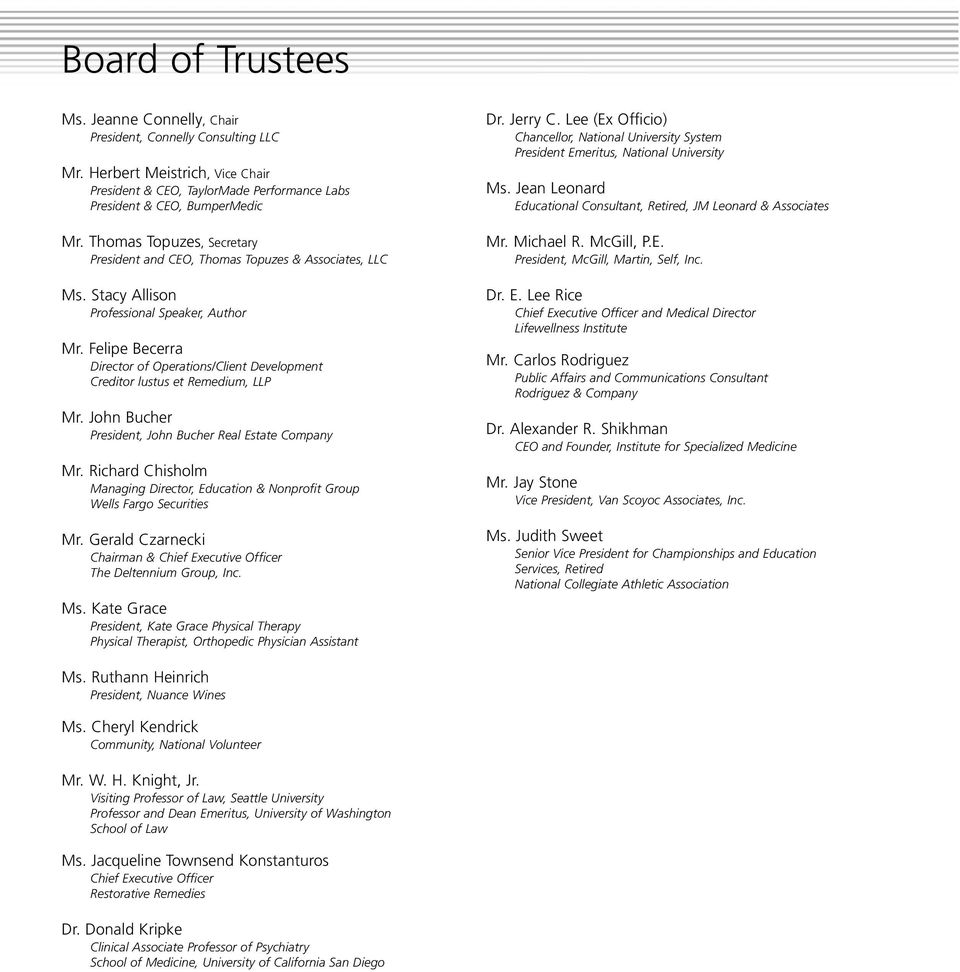
8 Board of Trustees Ms. Jeanne Connelly, Chair President, Connelly Consulting LLC Mr. Herbert Meistrich, Vice Chair President & CEO, TaylorMade Performance Labs President & CEO, BumperMedic Mr. Thomas Topuzes, Secretary President and CEO, Thomas Topuzes & Associates, LLC Ms. Stacy Allison Professional Speaker, Author Mr. Felipe Becerra Director of Operations/Client Development Creditor lustus et Remedium, LLP Mr. John Bucher President, John Bucher Real Estate Company Mr. Richard Chisholm Managing Director, Education & Nonprofit Group Wells Fargo Securities Mr. Gerald Czarnecki Chairman & Chief Executive Officer The Deltennium Group, Inc. Ms. Kate Grace President, Kate Grace Physical Therapy Physical Therapist, Orthopedic Physician Assistant Dr. Jerry C. Lee (Ex Officio) Chancellor, National University System President Emeritus, National University Ms. Jean Leonard Educational Consultant, Retired, JM Leonard & Associates Mr. Michael R. McGill, P.E. President, McGill, Martin, Self, Inc. Dr. E. Lee Rice Chief Executive Officer and Medical Director Lifewellness Institute Mr. Carlos Rodriguez Public Affairs and Communications Consultant Rodriguez & Company Dr. Alexander R. Shikhman CEO and Founder, Institute for Specialized Medicine Mr. Jay Stone Vice President, Van Scoyoc Associates, Inc. Ms. Judith Sweet Senior Vice President for Championships and Education Services, Retired National Collegiate Athletic Association Ms. Ruthann Heinrich President, Nuance Wines Ms. Cheryl Kendrick Community, National Volunteer Mr. W. H. Knight, Jr. Visiting Professor of Law, Seattle University Professor and Dean Emeritus, University of Washington School of Law Ms. Jacqueline Townsend Konstanturos Chief Executive Officer Restorative Remedies Dr. Donald Kripke Clinical Associate Professor of Psychiatry School of Medicine, University of California San Diego
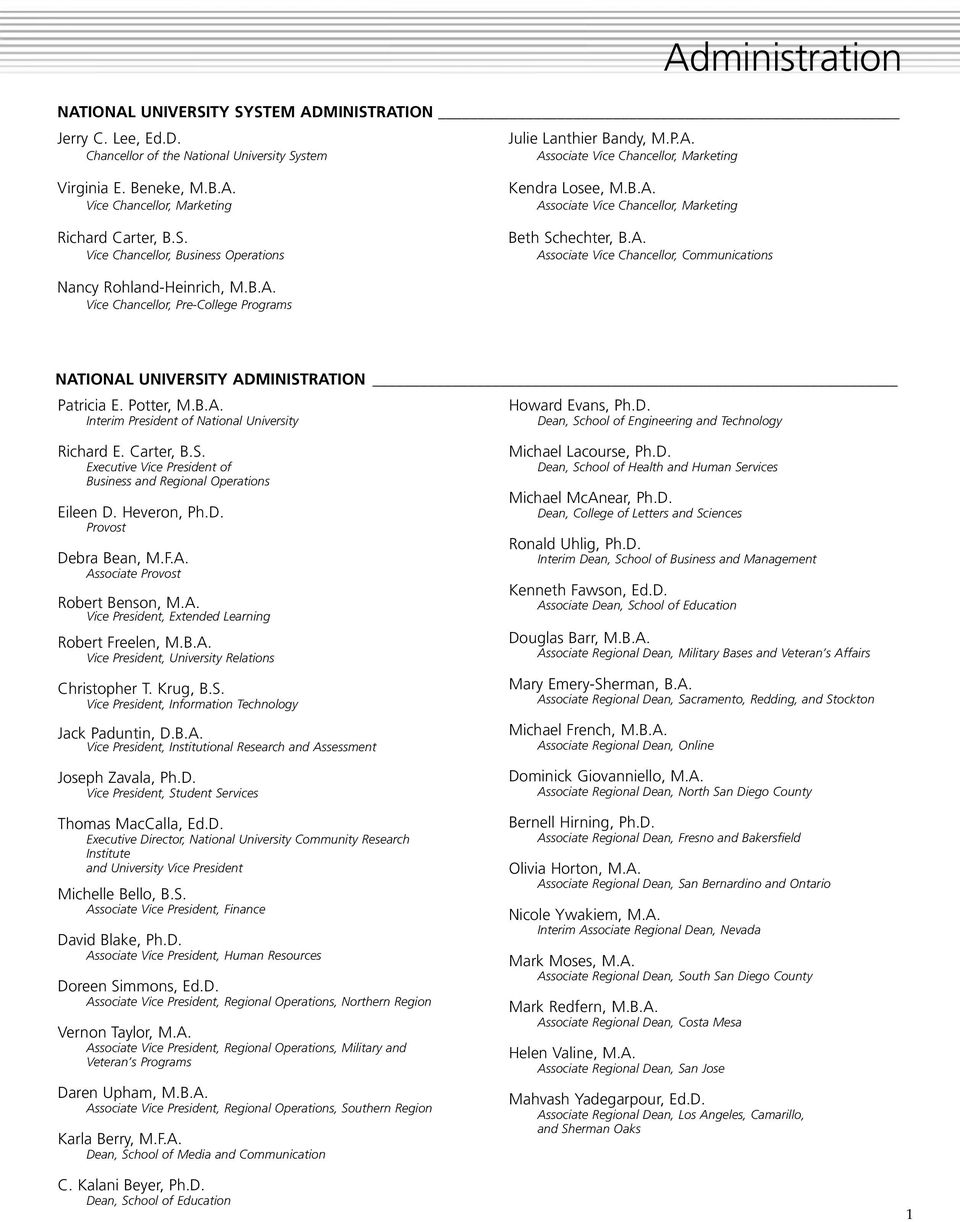
9 Administration NATIONAL UNIVERSITY SYSTEM ADMINISTRATION Jerry C. Lee, Ed.D. Chancellor of the National University System Julie Lanthier Bandy, M.P.A. Associate Vice Chancellor, Marketing Virginia E. Beneke, M.B.A. Vice Chancellor, Marketing Richard Carter, B.S. Vice Chancellor, Business Operations Kendra Losee, M.B.A. Associate Vice Chancellor, Marketing Beth Schechter, B.A. Associate Vice Chancellor, Communications Nancy Rohland-Heinrich, M.B.A. Vice Chancellor, Pre-College Programs NATIONAL UNIVERSITY ADMINISTRATION Patricia E. Potter, M.B.A. Interim President of National University Howard Evans, Ph.D. Dean, School of Engineering and Technology Richard E. Carter, B.S. Executive Vice President of Business and Regional Operations Eileen D. Heveron, Ph.D. Provost Debra Bean, M.F.A. Associate Provost Robert Benson, M.A. Vice President, Extended Learning Robert Freelen, M.B.A. Vice President, University Relations Christopher T. Krug, B.S. Vice President, Information Technology Jack Paduntin, D.B.A. Vice President, Institutional Research and Assessment Joseph Zavala, Ph.D. Vice President, Student Services Thomas MacCalla, Ed.D. Executive Director, National University Community Research Institute and University Vice President Michelle Bello, B.S. Associate Vice President, Finance David Blake, Ph.D. Associate Vice President, Human Resources Doreen Simmons, Ed.D. Associate Vice President, Regional Operations, Northern Region Vernon Taylor, M.A. Associate Vice President, Regional Operations, Military and Veteran s Programs Daren Upham, M.B.A. Associate Vice President, Regional Operations, Southern Region Karla Berry, M.F.A. Dean, School of Media and Communication Michael Lacourse, Ph.D. Dean, School of Health and Human Services Michael McAnear, Ph.D. Dean, College of Letters and Sciences Ronald Uhlig, Ph.D. Interim Dean, School of Business and Management Kenneth Fawson, Ed.D. Associate Dean, School of Education Douglas Barr, M.B.A. Associate Regional Dean, Military Bases and Veteran s Affairs Mary Emery-Sherman, B.A. Associate Regional Dean, Sacramento, Redding, and Stockton Michael French, M.B.A. Associate Regional Dean, Online Dominick Giovanniello, M.A. Associate Regional Dean, North San Diego County Bernell Hirning, Ph.D. Associate Regional Dean, Fresno and Bakersfield Olivia Horton, M.A. Associate Regional Dean, San Bernardino and Ontario Nicole Ywakiem, M.A. Interim Associate Regional Dean, Nevada Mark Moses, M.A. Associate Regional Dean, South San Diego County Mark Redfern, M.B.A. Associate Regional Dean, Costa Mesa Helen Valine, M.A. Associate Regional Dean, San Jose Mahvash Yadegarpour, Ed.D. Associate Regional Dean, Los Angeles, Camarillo, and Sherman Oaks C. Kalani Beyer, Ph.D. Dean, School of Education 1
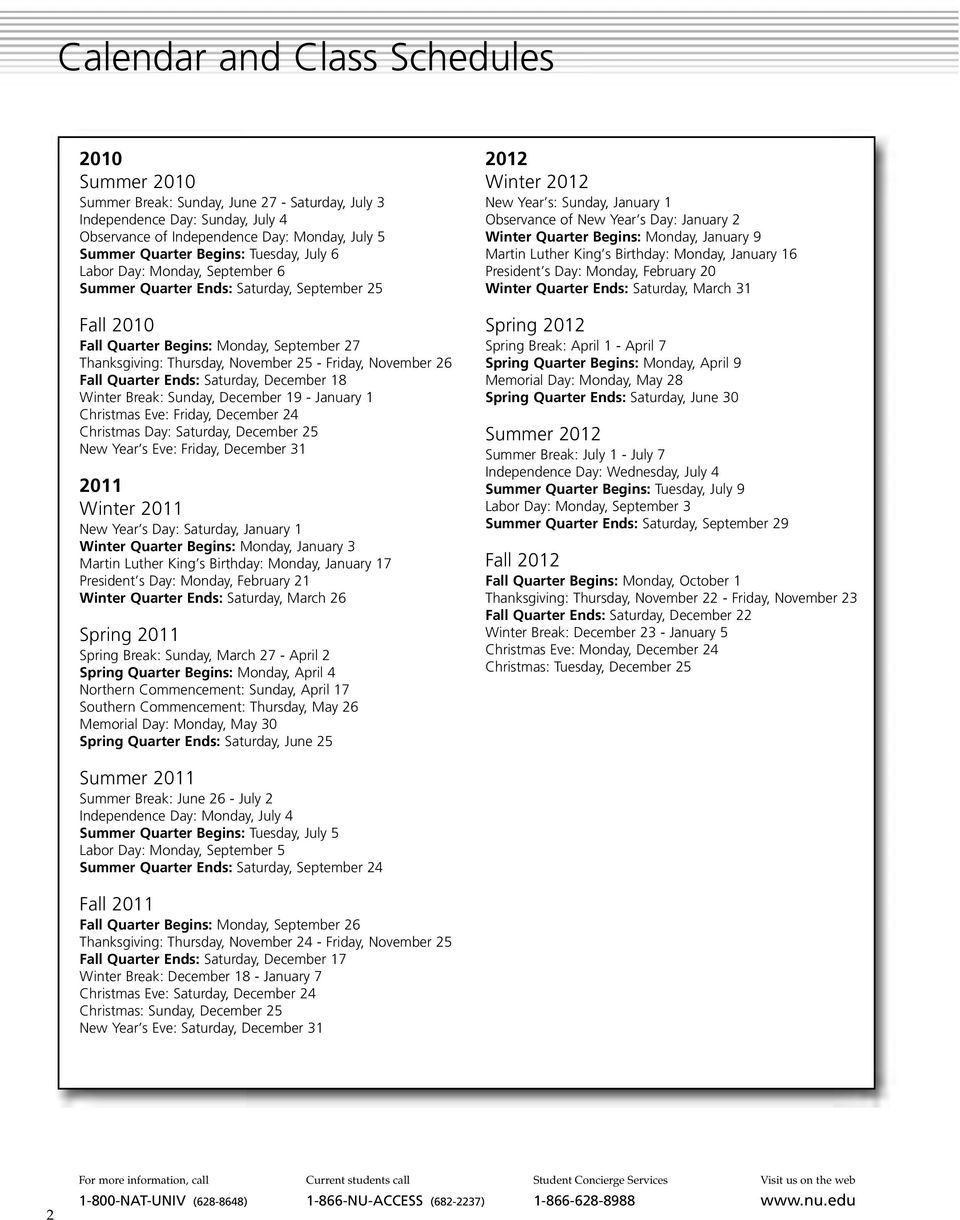
10 Calendar and Class Schedules 2010 Summer 2010 Summer Break: Sunday, June 27 - Saturday, July 3 Independence Day: Sunday, July 4 Observance of Independence Day: Monday, July 5 Summer Quarter Begins: Tuesday, July 6 Labor Day: Monday, September 6 Summer Quarter Ends: Saturday, September 25 Fall 2010 Fall Quarter Begins: Monday, September 27 Thanksgiving: Thursday, November 25 - Friday, November 26 Fall Quarter Ends: Saturday, December 18 Winter Break: Sunday, December 19 - January 1 Christmas Eve: Friday, December 24 Christmas Day: Saturday, December 25 New Year s Eve: Friday, December Winter 2011 New Year s Day: Saturday, January 1 Winter Quarter Begins: Monday, January 3 Martin Luther King s Birthday: Monday, January 17 President s Day: Monday, February 21 Winter Quarter Ends: Saturday, March 26 Spring 2011 Spring Break: Sunday, March 27 - April 2 Spring Quarter Begins: Monday, April 4 Northern Commencement: Sunday, April 17 Southern Commencement: Thursday, May 26 Memorial Day: Monday, May 30 Spring Quarter Ends: Saturday, June Winter 2012 New Year s: Sunday, January 1 Observance of New Year s Day: January 2 Winter Quarter Begins: Monday, January 9 Martin Luther King s Birthday: Monday, January 16 President s Day: Monday, February 20 Winter Quarter Ends: Saturday, March 31 Spring 2012 Spring Break: April 1 - April 7 Spring Quarter Begins: Monday, April 9 Memorial Day: Monday, May 28 Spring Quarter Ends: Saturday, June 30 Summer 2012 Summer Break: July 1 - July 7 Independence Day: Wednesday, July 4 Summer Quarter Begins: Tuesday, July 9 Labor Day: Monday, September 3 Summer Quarter Ends: Saturday, September 29 Fall 2012 Fall Quarter Begins: Monday, October 1 Thanksgiving: Thursday, November 22 - Friday, November 23 Fall Quarter Ends: Saturday, December 22 Winter Break: December 23 - January 5 Christmas Eve: Monday, December 24 Christmas: Tuesday, December 25 Summer 2011 Summer Break: June 26 - July 2 Independence Day: Monday, July 4 Summer Quarter Begins: Tuesday, July 5 Labor Day: Monday, September 5 Summer Quarter Ends: Saturday, September 24 Fall 2011 Fall Quarter Begins: Monday, September 26 Thanksgiving: Thursday, November 24 - Friday, November 25 Fall Quarter Ends: Saturday, December 17 Winter Break: December 18 - January 7 Christmas Eve: Saturday, December 24 Christmas: Sunday, December 25 New Year s Eve: Saturday, December 31 2 For more information, call NAT-UNIV ( ) Current students call NU-ACCESS ( ) Student Concierge Services Visit us on the web
11 Class Calendar at a Glance AUGUST 2010 SEPTEMBER 2010 OCTOBER 2010 S M T W T F S S M T W T F S S M T W T F S Calendar, Schedules NOVEMBER 2010 DECEMBER 2010 JANUARY 2011 S M T W T F S S M T W T F S S M T W T F S FEBRUARY 2011 MARCH 2011 APRIL 2011 S M T W T F S S M T W T F S S M T W T F S MAY 2011 JUNE 2011 JULY 2011 S M T W T F S S M T W T F S S M T W T F S AUGUST 2011 SEPTEMBER 2011 OCTOBER 2011 S M T W T F S S M T W T F S S M T W T F S NOVEMBER 2011 DECEMBER 2011 JANUARY 2012 S M T W T F S S M T W T F S S M T W T F S Starting dates of classes. National holiday. The University will be closed. University break. The University does not offer classes during breaks. 3

12 Undergraduate Class Schedule Undergraduate classes are 4.5 quarter units, 45 contact hours, unless otherwise noted. All online classes begin on Mondays, with the exception of those terms when Monday is a holiday. In these cases, online courses begin on Tuesday. Ending dates vary by program. National University s academic year is divided into four twelve-week quarters, each composed of three one-month classes. Classes are held two evenings each week from 5:30 to 10 p.m. Undergraduate students generally attend two Saturday sessions from 8 a.m. to 12:30 p.m. or 1 p.m. to 5:30 p.m. Undergraduate day classes are held either Monday and Wednesday or Tuesday and Thursday from 9 a.m. to 2:30 p.m. Eight-week class schedules are listed in SOAR. Weekday Time Saturday Schedule Monday/Wednesday (8 sessions) 5:30 p.m.-10 p.m. 8 a.m.-12:30 p.m. or 1 p.m.-5:30 p.m.; Normally two Saturdays, three Saturdays if weekday holiday makes it necessary. Tuesday/Thursday (8 sessions) 5:30 p.m.-10 p.m. 8 a.m.-12:30 p.m. or 1 p.m.-5:30 p.m.; Normally two Saturdays, three Saturdays if weekday holiday makes it necessary. 24 month calendar follows: Onsite Undergraduate Class Schedule Mondays and Wednesdays Onsite Undergraduate Class Schedule Tuesdays and Thursdays SUMMER 2010 July 7, 10(8-12:30), 12, 14, 19, 21, 24(8-12:30), 26, 28, 31(8-12:30) August 2, 4, 9, 11, 14(8-12:30), 16, 18, 23, 25, 28(1-5:30) August 30, September 1, 8, 11(1-5:30pm), 13, 15, 18(8-12:30), 20, 22, 25(8-12:30) FALL 2010 September 27, 29, October 4, 6, 9(8-12:30), 11, 13, 18, 20, 23(1-5:30) October 25, 27, November 1, 3, 8, 10, 13(8-12:30), 15, 17, 20(8-12:30) November 22, 24, 29, December 1, 4(8-12:30), 6, 8, 13, 15, 18(1-5:30) WINTER 2011 January 3, 5, 8(8-12:30), 10, 12, 19, 22(1-5:30), 24, 26, 29(8-12:30) January 31, February 2, 5(8-12:30), 7, 9, 12(8-12:30), 14, 16, 23, 26(1-5:30) February 28, March 2, 7, 9, 14, 16, 19(8-12:30), 21, 23, 26(8-12:30) SPRING 2011 April 4, 6, 11, 13, 16(8-12:30), 18, 20, 25, 27, 30(1-5:30) May 2, 4, 9, 11, 16, 18, 21(8-12:30), 23, 25, 28(8-12:30) June 1, 4(8-12:30), 6, 8, 11 (8-12:30) 13, 15, 20, 22, 25(1-5:30) SUMMER 2011 July 6, 9(8-12:30), 11, 13, 18, 20, 23(8-12:30), 25, 27, 30(8-12:30) August 1, 3, 8, 10, 13(8-12:30), 15, 17, 22, 24, 27(1-5:30) August 29, 31 September 7, 10(1-5:30pm), 12, 14, 17(8-12:30), 19, 21, 24(8-12:30) FALL 2011 September 26, 28, October 3, 5, 8(8-12:30), 10, 12, 17, 19, 22(1-5:30) October 24, 26, 31 November 2, 7, 9, 12(8-12:30), 14, 16, 19(8-12:30) November 21, 23, 28, 30 December 3(8-12:30), 5, 7, 12, 14, 17(1-5:30) WINTER 2012 January 9, 11, 18, 21 (1-5:30), 23, 25, 28(8-12:30), 30 February 1, 4(8-12:30) February 6, 8, 11(8-12:30), 13, 15, 22, 25 (8-12:30), 27, 29 March 3(1-5:30) March 5, 7, 12, 14, 19, 21, 24(8-12:30), 26, 28, 31(8-12:30) SPRING 2012 April 9, 11, 16, 18, 21(8-12:30), 23, 25, 30, May 2, 5(1-5:30) May 7, 9, 12(8-12:30), 14, 16, 19(1-5:30), 21, 23, 30, June 2(8-12:30) June 4, 6, 11, 13, 16(8-12:30) 18, 20, 25, 27, 30(1-5:30) SUMMER 2012 July 9, 11, 16, 18, 23, 25, 28(8-12:30), 30, August 1, 4(8-12:30) August 6, 8, 13, 15, 18(8-12:30), 20, 22, 27, 29, September 1(1-5:30) September 5, 8 (8-12:30), 10, 12, 17, 19, 22(8-12:30), 24, 26, 29(8-12:30) FALL 2012 October 1, 3, 8, 10, 13(8-12:30), 15, 17, 22, 24, 27(1-5:30) October 29, 31 November 5, 7, 12, 14, 17(8-12:30), 19, 21, 24(8-12:30) November 26, 28, December 3, 5, 10, 12, 15(8-12:30), 17, 19, 22(1-5:30) 4 SUMMER 2010 July 6, 8, 13, 15, 17(8-12:30), 20, 22, 27, 29, 31(1-5:30) August 3, 5, 10, 12, 17, 19, 21(8-12:30), 24, 26, 28(8-12:30) August 31, September 2, 7, 9, 11(8-12:30), 14, 16, 21, 23, 25(1-5:30) FALL 2010 September 28, 30 October 5, 7, 12, 14, 16(8-12:30), 19, 21, 23(8-12:30) October 26, 28, November 2, 4, 6(8-12:30), 9, 11, 16, 18, 20(1-5:30) November 23, 30, December 2, 4(1-5:30), 7, 9, 11(8-12:30), 14, 16, 18(8-12:30) WINTER 2011 January 4, 6, 11, 13, 18, 20, 22(8-12:30), 25, 27, 29(1-5:30) February 1, 3, 8, 10, 12(1-5:30), 15, 17, 22, 24, 26(8-12:30) March 1, 3, 8, 10, 12(8-12:30), 15, 17, 22, 24, 26(1-5:30) SPRING 2011 April 5, 7, 12, 14, 19, 21, 23(8-12:30), 26, 28, 30(8-12:30) May 3, 5, 7(8-12:30), 10, 12, 14(8-12:30), 17, 19, 24, 28(1-5:30) May 31 June 2, 7, 9, 14, 16, 18(8-12:30), 21, 23, 25(8-12:30) SUMMER 2011 July 5, 7, 12, 14, 16(8-12:30), 19, 21, 26, 28, 30(1-5:30) August 2, 4, 9, 11, 16, 18, 20(8-12:30), 23, 25, 27(8-12:30) August 30, September 1, 6, 8, 10(8-12:30), 13, 15, 20, 22, 24(1-5:30) FALL 2011 September 27, 29 October 4, 6, 11, 13, 15(8-12:30), 18, 20, 22(8-12:30) October 25, 27, November 1, 3, 5(8-12:30), 8, 10, 15, 17, 19(1-5:30) November 22, 29, December 1, 3(1-5:30), 6, 8, 10(8-12:30), 13, 15, 17(8-12:30) WINTER 2012 January 10, 12, 17, 19, 21(8-12:30), 24, 26, 31, February 2, 4(1-5:30) February 7, 9, 14, 16, 21, 23, 25(1-5:30), 28, March 1, 3(8-12:30) March 6, 8, 13, 15, 17(8-12:30), 20, 22, 27, 29, 31 (1-5:30) SPRING 2012 April 10, 12, 17, 19, 24, 26, 28(8-12:30), May 1, 3, 5(8-12:30) May 8, 10, 15, 17, 19(8-12:30) 22, 24, 29, 31, June 2(1-5:30) June 5, 7, 12, 14, 19, 21, 23(8-12:30), 26, 28, 30(8-12:30) SUMMER 2012 July 10, 12, 17, 19, 21 (8-12:30), 24, 26, 31, August 2, 4(1-5:30) August 7, 9, 14, 16, 21, 23, 25(8-12:30), 28, 30, September 1(8-12:30) September 4, 6, 11, 13, 15(8-12:30), 18, 20, 25, 27, 29(1-5:30) FALL 2012 October 2, 4, 9, 11, 16, 18, 20(8-12:30), 23, 25, 27(8-12:30) October 30, November 1, 3 (8-12:30)6, 8, 10(8-12:30), 13, 15, 20, 24(1-5:30) November 27, 29, December 4, 6, 8(8-12:30), 11, 13, 18, 20, 22(8-12:30)

13 Graduate Class Schedule Graduate classes are 4.5 quarter units, 40 contact hours, unless otherwise noted. All online classes begin on Mondays, with the exception of those terms when Monday is a holiday. In these cases, online courses begin on Tuesday. Ending dates vary by program. National University s academic year is divided into four twelve-week quarters, each composed of three one-month classes. Classes are held two evenings each week from 5:30 to 10 p.m. Graduate students meet for a final session on the last Saturday of the four-week term, either from 8:30 a.m. to 12:30 p.m. or 1 p.m. to 5 p.m. Eight-week class schedules are listed in SOAR. Calendar, Schedules Weekday Time Saturday Schedule Monday/Wednesday (8 sessions) 5:30 p.m.-10 p.m. 8:30 a.m.-12:30 p.m. or 1 p.m.-5 p.m.; Normally one Saturday, two Saturdays if weekday holiday makes it necessary. Tuesday/Thursday (8 sessions) 5:30 p.m.-10 p.m. 8:30 a.m.-12:30 p.m. or 1 p.m.-5 p.m.; Normally one Saturday, two Saturdays if weekday holiday makes it necessary. 24 month calendar follows: Onsite Graduate Class Schedule Mondays and Wednesdays Onsite Graduate Class Schedule Tuesdays and Thursdays SUMMER 2010 July 7, 10(8-12:30), 12, 14, 19, 21, 26, 28, 31(8:30-12:30) August 2, 4, 9, 11, 16, 18, 23, 25, 28(1-5:00) August 30, September 1, 8, 13, 15, 18(8-12:30), 20, 22, 25(8:30-12:30) FALL 2010 September 27, 29, October 4, 6, 11, 13, 18, 20, 23(1-5:00) October 25, 27, November 1, 3, 8, 10, 15, 17, 20(8:30-12:30) November 22, 24, 29, December 1, 6, 8, 13, 15, 18(1-5:00) WINTER 2011 January 3, 5, 8(8-12:30), 10, 12, 19, 24, 26, 29(8:30-12:30) January 31, February 2, 5(8-12:30), 7, 9, 14, 16, 23, 26(1-5:00) February 28, March 2, 7, 9, 14, 16, 21, 23, 26(8:30-12:30) SPRING 2011 April 4, 6, 11, 13, 18, 20, 25, 27, 30(1-5:00) May 2, 4, 9, 11, 16, 18, 23, 25, 28(8:30-12:30) June 1, 4(8-12:30), 6, 8, 13, 15, 20, 22, 25(1-5:00) SUMMER 2011 July 6, 9(8-12:30), 11, 13, 18, 20, 25, 27, 30(8:30-12:30) August 1, 3, 8, 10, 15, 17, 22, 24, 27(1-5:00) August 29, 31 September 7, 12, 14, 17(8-12:30), 19, 21, 24(8:30-12:30) FALL 2011 September 26, 28, October 3, 5, 10, 12, 17, 19, 22(1-5:00) October 24, 26, 31 November 2, 7, 9, 14, 16, 19(8:30-12:30) November 21, 23, 28, 30 December 5, 7, 12, 14, 17(1-5:00) WINTER 2012 January 9, 11, 18, 23, 25, 28(8-12:30), 30 February 1, 4(8:30-12:30) February 6, 8, 11(8-12:30), 13, 15, 22, 27, 29 March 3(1-5:00) March 5, 7, 12, 14, 19, 21, 26, 28, 31(8:30-12:30) SPRING 2012 April 9, 11, 16, 18, 23, 25, 30, May 2, 5(1-5:00) May 7, 9, 12 (8-12:30), 14, 16, 21, 23, 30, June 2(8:30-12:30) June 4, 6, 11, 13, 18, 20, 25, 27, 30(1-5:00) SUMMER 2012 July 9, 11, 16, 18, 23, 25, 30, August 1, 4(8:30-12:30) August 6, 8, 13, 15, 20, 22, 27, 29, September 1(1-5:00) September 5, 8 (8-12:30), 10, 12, 17, 19, 24, 26, 29(8:30-12:30) FALL 2012 October 1, 3, 8, 10, 15, 17, 22, 24, 27(1-5:00) October 29, 31 November 5, 7, 12, 14, 19, 21, 24(8:30-12:30) November 26, 28, December 3, 5, 10, 12, 17, 19, 22(1-5:00) SUMMER 2010 July 6, 8, 13, 15, 20, 22, 27, 29, 31(1-5:00) August 3, 5, 10, 12, 17, 19, 24, 26, 28(8:30-12:30) August 31, September 2, 7, 9, 14, 16, 21, 23, 25(1-5:00) FALL 2010 September 28, 30 October 5, 7, 12, 14, 19, 21, 23(8:30-12:30) October 26, 28, November 2, 4, 9, 11, 16, 18, 20(1-5:00) November 23, 30, December 2, 7, 9, 11(8:00-12:30), 14, 16, 18(8:30-12:30) WINTER 2011 January 4, 6, 11, 13, 18, 20, 25, 27, 29(1-5:00) February 1, 3, 8, 10, 15, 17, 22, 24, 26(8:30-12:30) March 1, 3, 8, 10, 15, 17, 22, 24, 26(1-5:00) SPRING 2011 April 5, 7, 12, 14, 19, 21, 26, 28, 30(8:30-12:30) May 3, 5, 7(8-12:30), 10, 12, 17, 19, 24, 28(1-5:00) May 31 June 2, 7, 9, 14, 16, 21, 23, 25(8:30-12:30) SUMMER 2011 July 5, 7, 12, 14, 19, 21, 26, 28, 30(1-5:00) August 2, 4, 9, 11, 16, 18, 23, 25, 27(8:30-12:30) August 30, September 1, 6, 8, 13, 15, 20, 22, 24(1-5:00) FALL 2011 September 27, 29 October 4, 6, 11, 13, 18, 20, 22(8:30-12:30) October 25, 27, November 1, 3, 8, 10, 15, 17, 19(1-5:00) November 22, 29, December 1, 6, 8, 10(8-12:30), 13, 15, 17(8:30-12:30) WINTER 2012 January 10, 12, 17, 19, 24, 26, 31, February 2, 4(1-5:00) February 7, 9, 14, 16, 21, 23, 28, March 1, 3(8:30-12:30) March 6, 8, 13, 15, 20, 22, 27, 29, 31 (1-5:00) SPRING 2012 April 10, 12, 17, 19, 24, 26, May 1, 3, 5(8:30-12:30) May 8, 10, 15, 17, 22, 24, 29, 31, June 2(1-5:00) June 5, 7, 12, 14, 19, 21, 26, 28, 30(8:30-12:30) SUMMER 2012 July 10, 12, 17, 19, 24, 26, 31, August 2, 4(1-5:00) August 7, 9, 14, 16, 21, 23, 28, 30, September 1(8:30-12:30) September 4, 6, 11, 13, 18, 20, 25, 27, 29(1-5:00) FALL 2012 October 2, 4, 9, 11, 16, 18, 23, 25, 27(8:30-12:30) October 30, November 1, 3 (8-12:30)6, 8, 13, 15, 20, 24(1-5:00) November 27, 29, December 4, 6, 11, 13, 18, 20, 22(8:30-12:30) 5

14 CALIFORNIA NEVADA Citrus Heights Summerlin West Covina Palm Desert Headquartered in La Jolla, California, Temecula National City VIRGINIA FLORIDA Quantico Orlando National University has 27 campuses and nine Online Information Centers throughout California, Nevada, PERU Lima Florida, Virginia, and Lima, Peru. denotes National University Campus denotes Online Information Centers maps not shown to scale

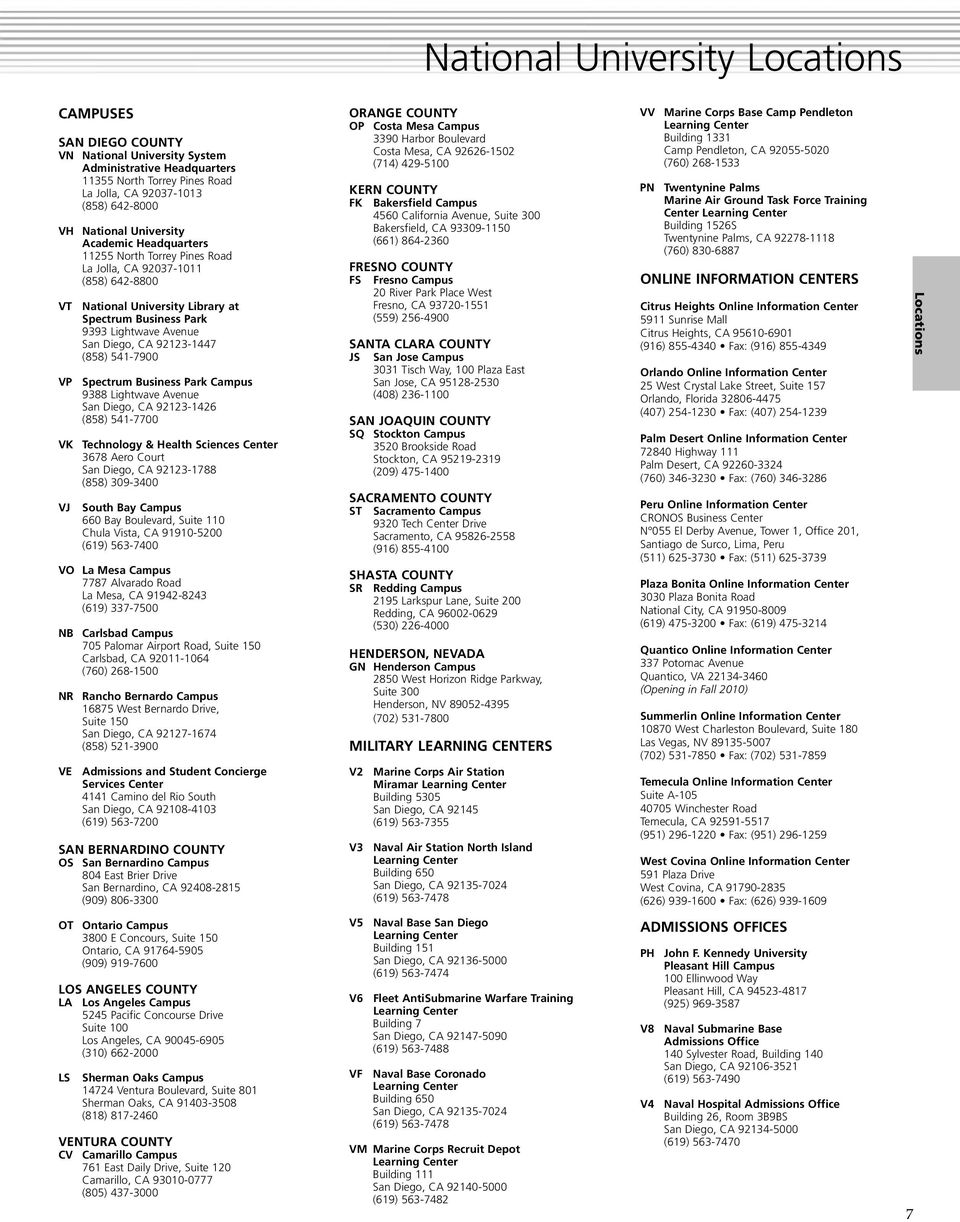
15 National University Locations CAMPUSES SAN DIEGO COUNTY VN National University System Administrative Headquarters North Torrey Pines Road La Jolla, CA (858) VH National University Academic Headquarters North Torrey Pines Road La Jolla, CA (858) VT VP VK VJ National University Library at Spectrum Business Park 9393 Lightwave Avenue San Diego, CA (858) Spectrum Business Park Campus 9388 Lightwave Avenue San Diego, CA (858) Technology & Health Sciences Center 3678 Aero Court San Diego, CA (858) South Bay Campus 660 Bay Boulevard, Suite 110 Chula Vista, CA (619) VO La Mesa Campus 7787 Alvarado Road La Mesa, CA (619) NB NR VE Carlsbad Campus 705 Palomar Airport Road, Suite 150 Carlsbad, CA (760) Rancho Bernardo Campus West Bernardo Drive, Suite 150 San Diego, CA (858) Admissions and Student Concierge Services Center 4141 Camino del Rio South San Diego, CA (619) SAN BERNARDINO COUNTY OS San Bernardino Campus 804 East Brier Drive San Bernardino, CA (909) ORANGE COUNTY OP Costa Mesa Campus 3390 Harbor Boulevard Costa Mesa, CA (714) KERN COUNTY FK Bakersfield Campus 4560 California Avenue, Suite 300 Bakersfield, CA (661) FRESNO COUNTY FS Fresno Campus 20 River Park Place West Fresno, CA (559) SANTA CLARA COUNTY JS San Jose Campus 3031 Tisch Way, 100 Plaza East San Jose, CA (408) SAN JOAQUIN COUNTY SQ Stockton Campus 3520 Brookside Road Stockton, CA (209) SACRAMENTO COUNTY ST Sacramento Campus 9320 Tech Center Drive Sacramento, CA (916) SHASTA COUNTY SR Redding Campus 2195 Larkspur Lane, Suite 200 Redding, CA (530) HENDERSON, NEVADA GN Henderson Campus 2850 West Horizon Ridge Parkway, Suite 300 Henderson, NV (702) MILITARY LEARNING CENTERS V2 V3 Marine Corps Air Station Miramar Learning Center Building 5305 San Diego, CA (619) Naval Air Station North Island Learning Center Building 650 San Diego, CA (619) VV Marine Corps Base Camp Pendleton Learning Center Building 1331 Camp Pendleton, CA (760) PN Twentynine Palms Marine Air Ground Task Force Training Center Learning Center Building 1526S Twentynine Palms, CA (760) ONLINE INFORMATION CENTERS Citrus Heights Online Information Center 5911 Sunrise Mall Citrus Heights, CA (916) Fax: (916) Orlando Online Information Center 25 West Crystal Lake Street, Suite 157 Orlando, Florida (407) Fax: (407) Palm Desert Online Information Center Highway 111 Palm Desert, CA (760) Fax: (760) Peru Online Information Center CRONOS Business Center N 055 El Derby Avenue, Tower 1, Office 201, Santiago de Surco, Lima, Peru (511) Fax: (511) Plaza Bonita Online Information Center 3030 Plaza Bonita Road National City, CA (619) Fax: (619) Quantico Online Information Center 337 Potomac Avenue Quantico, VA (Opening in Fall 2010) Summerlin Online Information Center West Charleston Boulevard, Suite 180 Las Vegas, NV (702) Fax: (702) Temecula Online Information Center Suite A Winchester Road Temecula, CA (951) Fax: (951) West Covina Online Information Center 591 Plaza Drive West Covina, CA (626) Fax: (626) Locations OT Ontario Campus 3800 E Concours, Suite 150 Ontario, CA (909) LOS ANGELES COUNTY LA Los Angeles Campus 5245 Pacific Concourse Drive Suite 100 Los Angeles, CA (310) LS Sherman Oaks Campus Ventura Boulevard, Suite 801 Sherman Oaks, CA (818) VENTURA COUNTY CV Camarillo Campus 761 East Daily Drive, Suite 120 Camarillo, CA (805) V5 V6 VF Naval Base San Diego Learning Center Building 151 San Diego, CA (619) Fleet AntiSubmarine Warfare Training Learning Center Building 7 San Diego, CA (619) Naval Base Coronado Learning Center Building 650 San Diego, CA (619) VM Marine Corps Recruit Depot Learning Center Building 111 San Diego, CA (619) ADMISSIONS OFFICES PH V8 V4 John F. Kennedy University Pleasant Hill Campus 100 Ellinwood Way Pleasant Hill, CA (925) Naval Submarine Base Admissions Office 140 Sylvester Road, Building 140 San Diego, CA (619) Naval Hospital Admissions Office Building 26, Room 3B9BS San Diego, CA (619)
16 8 Departments Academic Affairs North Torrey Pines Road, La Jolla, CA (858) Fax: (858) Accounts Payable (858) Fax: (858) Administration and Business North Torrey Pines Road, La Jolla, CA (858) Fax: (858) Admissions 1 (800) NAT-UNIV ( ) [email protected] Admissions and Student Concierge Services Center 4141 Camino del Rio South San Diego, CA Admissions: (619) Fax: (619) SCS: (866) Fax: (619) [email protected] Articulations North Torrey Pines Road, La Jolla, CA (858) or [email protected] Bookstore (National University TextDirect) 1 (866) [email protected] Website: Career Center 9393 Lightwave Avenue, San Diego, CA (858) Fax: (858) [email protected] College of Letters and Sciences North Torrey Pines Road, La Jolla, CA (858) Fax: (858) [email protected] Communications Group North Torrey Pines Road, La Jolla, CA (858) Fax: (858) Conference Facilities 9388 Lightwave Avenue, San Diego, CA (858) Copy / Postal Services North Torrey Pines Road, La Jolla, CA (858) Fax: (858) Credentials [email protected] Fax: (858) Development and Alumni Relations North Torrey Pines Road, La Jolla, CA (858) Fax: (858) [email protected] [email protected] English Language Programs 9388 Lightwave Avenue, San Diego, CA (858) Fax: (858) [email protected] Evaluation (858) Fax: (858) [email protected] Extended Learning North Torrey Pines Road, La Jolla, CA (858) Fax: (858) Financial Aid North Torrey Pines Road, La Jolla, CA (858) Fax: (858) [email protected] General Information (619) or 1 (800) NAT-UNIV ( ) Grades and Attendance (858) or Fax: (858) [email protected] Graduation (858) or Fax: (858) [email protected] Human Resources North Torrey Pines Road, La Jolla, CA (858) Fax: (858) Information and Community Relations North Torrey Pines Road, La Jolla, CA (858) Fax: (858) Information Technology 3570 Aero Court, San Diego, CA (858) Fax: (858) [email protected] International Programs Office 9388 Lightwave Avenue, San Diego, CA (858) Fax: (858) [email protected] Institutional Review Board (858) [email protected] Library 9393 Lightwave Avenue, San Diego, CA (858) Fax: (858) Reference/Information (858) Fax: (858) [email protected] Office of the President North Torrey Pines Road, La Jolla, CA (858) Fax: (858) Office of the Provost North Torrey Pines Road, La Jolla, CA (858) Fax: (858) Online Admissions 4141 Camino del Rio South, Suite 201A San Diego, CA (619) Fax: (619) [email protected] Purchasing North Torrey Pines Road, La Jolla, CA (858) Fax: (858) Regional Operations North Torrey Pines Road, La Jolla, CA (858) Fax: (858) Registrar North Torrey Pines Road, La Jolla, CA (858) [email protected] Scholarship Awards North Torrey Pines Road, La Jolla, CA (858) Fax: (858) School of Business and Management North Torrey Pines Road, La Jolla, CA (858) Fax: (858) [email protected] School of Education North Torrey Pines Road, La Jolla, CA (858) Fax: (858) [email protected] School of Engineering and Technology 3678 Aero Court, Suite 201C, San Diego, CA (858) Fax: (858) [email protected] School of Health and Human Services 3678 Aero Court, San Diego, CA (858) Fax: (858) [email protected] School of Media and Communication 3678 Aero Court, San Diego, CA (858) Fax: (858) [email protected] Student Accounts 9388 Lightwave Avenue, San Diego, CA (858) Fax: (858) [email protected] Student Accounts Receivable (858) Fax: (858) [email protected] Student Business Services (858) Fax: (858) [email protected] Student Services (866) NU ACCESS ( ) [email protected] Testing Services 9393 Lightwave Avenue, San Diego, CA (858) Fax: (858) [email protected] Transcripts (858) or Fax: (858) [email protected] Tuition Assistance 9388 Lightwave Avenue, San Diego, CA (858) Fax: (858) [email protected] To order transcripts, visit Veterans Affairs 9388 Lightwave Avenue, San Diego, CA (858) Fax: (858) [email protected] 2850 West Horizon Ridge Parkway, Suite 301 Henderson, NV (702) Fax: (702) [email protected]

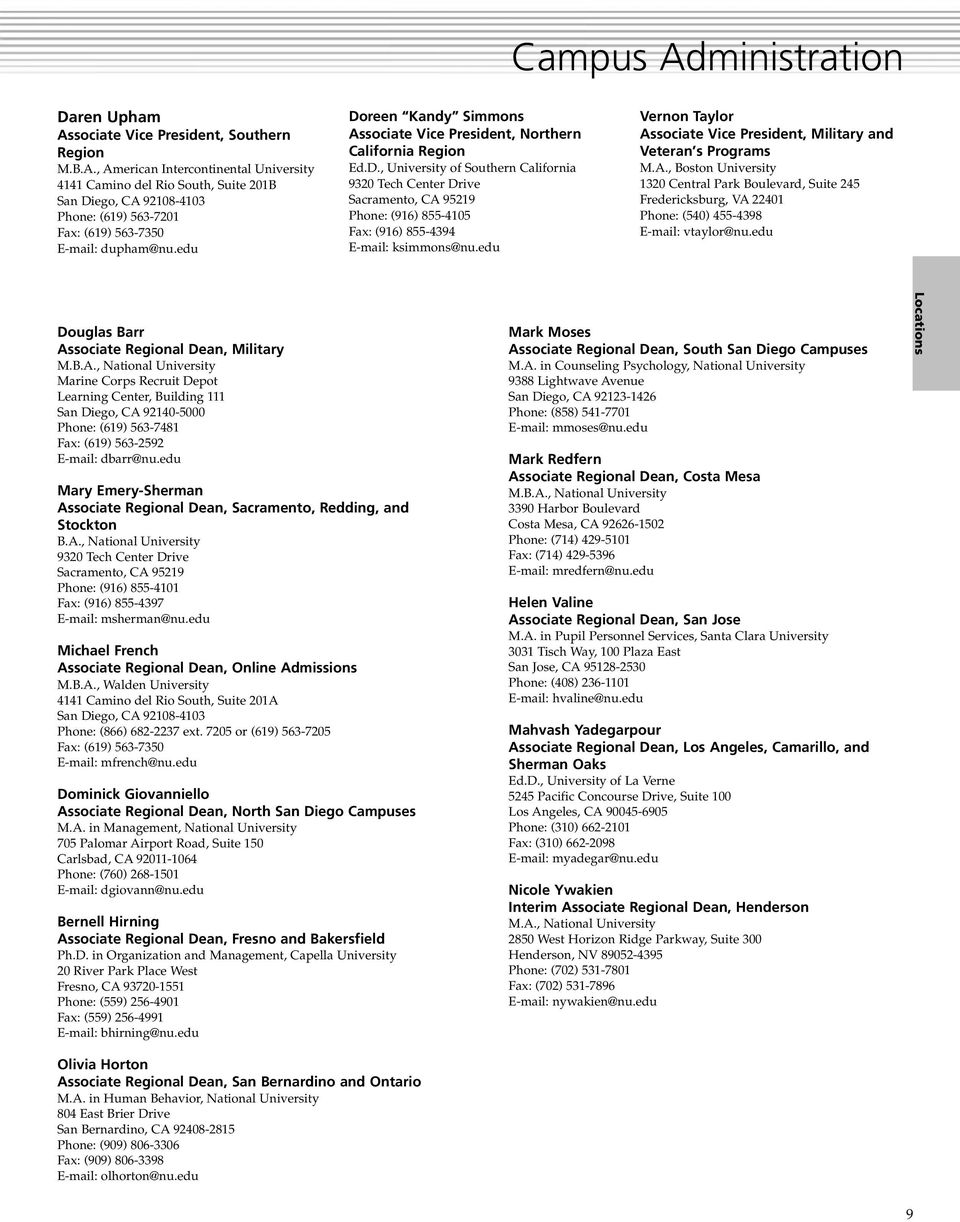
17 Campus Administration Daren Upham Associate Vice President, Southern Region M.B.A., American Intercontinental University 4141 Camino del Rio South, Suite 201B San Diego, CA Phone: (619) Fax: (619) Doreen Kandy Simmons Associate Vice President, Northern California Region Ed.D., University of Southern California 9320 Tech Center Drive Sacramento, CA Phone: (916) Fax: (916) Vernon Taylor Associate Vice President, Military and Veteran s Programs M.A., Boston University 1320 Central Park Boulevard, Suite 245 Fredericksburg, VA Phone: (540) [email protected] Douglas Barr Associate Regional Dean, Military M.B.A., National University Marine Corps Recruit Depot Learning Center, Building 111 San Diego, CA Phone: (619) Fax: (619) [email protected] Mary Emery-Sherman Associate Regional Dean, Sacramento, Redding, and Stockton B.A., National University 9320 Tech Center Drive Sacramento, CA Phone: (916) Fax: (916) [email protected] Michael French Associate Regional Dean, Online Admissions M.B.A., Walden University 4141 Camino del Rio South, Suite 201A San Diego, CA Phone: (866) ext or (619) Fax: (619) [email protected] Dominick Giovanniello Associate Regional Dean, North San Diego Campuses M.A. in Management, National University 705 Palomar Airport Road, Suite 150 Carlsbad, CA Phone: (760) [email protected] Bernell Hirning Associate Regional Dean, Fresno and Bakersfield Ph.D. in Organization and Management, Capella University 20 River Park Place West Fresno, CA Phone: (559) Fax: (559) [email protected] Mark Moses Associate Regional Dean, South San Diego Campuses M.A. in Counseling Psychology, National University 9388 Lightwave Avenue San Diego, CA Phone: (858) [email protected] Mark Redfern Associate Regional Dean, Costa Mesa M.B.A., National University 3390 Harbor Boulevard Costa Mesa, CA Phone: (714) Fax: (714) [email protected] Helen Valine Associate Regional Dean, San Jose M.A. in Pupil Personnel Services, Santa Clara University 3031 Tisch Way, 100 Plaza East San Jose, CA Phone: (408) [email protected] Mahvash Yadegarpour Associate Regional Dean, Los Angeles, Camarillo, and Sherman Oaks Ed.D., University of La Verne 5245 Pacific Concourse Drive, Suite 100 Los Angeles, CA Phone: (310) Fax: (310) [email protected] Nicole Ywakien Interim Associate Regional Dean, Henderson M.A., National University 2850 West Horizon Ridge Parkway, Suite 300 Henderson, NV Phone: (702) Fax: (702) [email protected] Locations Olivia Horton Associate Regional Dean, San Bernardino and Ontario M.A. in Human Behavior, National University 804 East Brier Drive San Bernardino, CA Phone: (909) Fax: (909) [email protected] 9
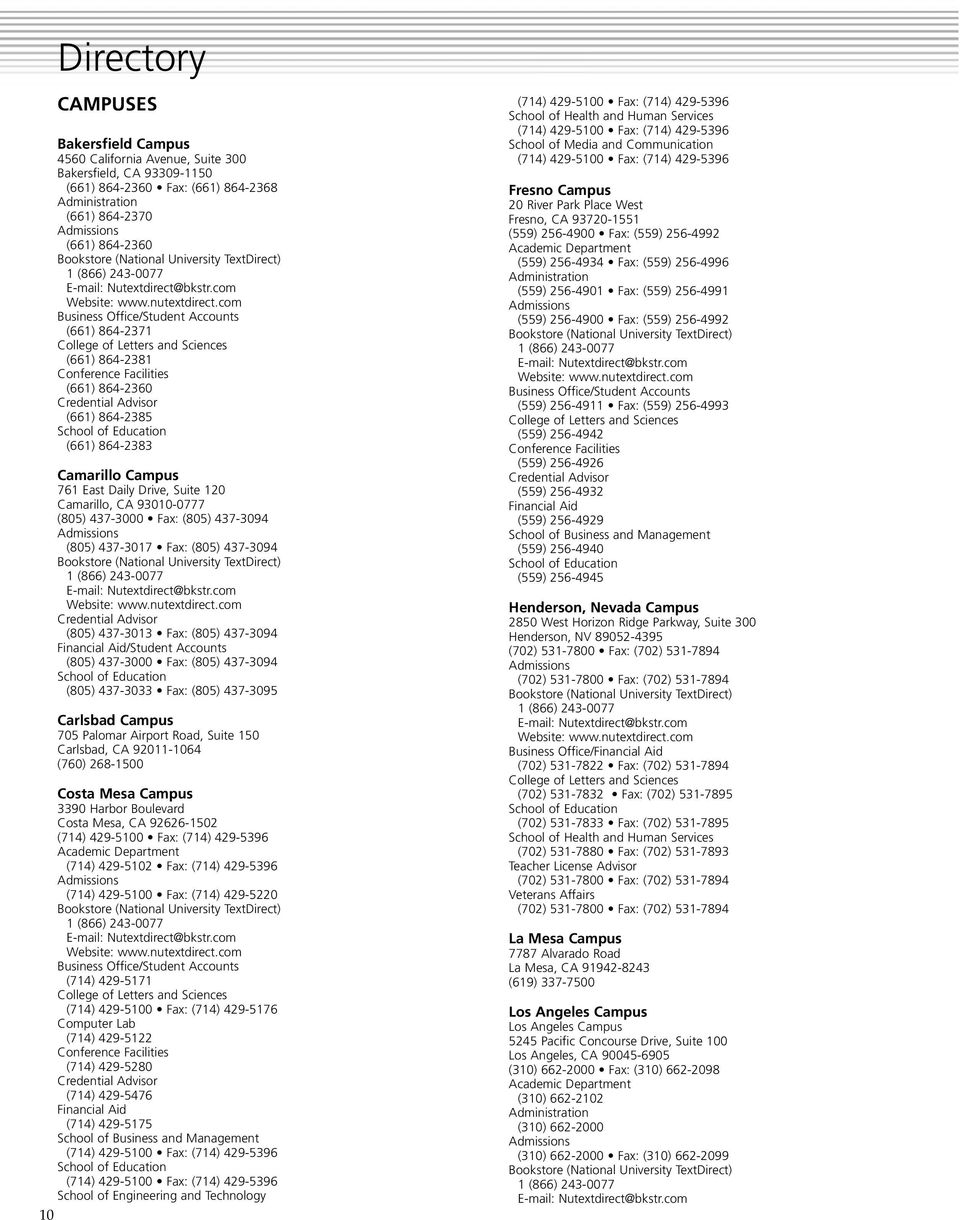
18 Directory CAMPUSES Bakersfield Campus 4560 California Avenue, Suite 300 Bakersfield, CA (661) Fax: (661) Administration (661) Admissions (661) Bookstore (National University TextDirect) 1 (866) [email protected] Website: Business Office/Student Accounts (661) College of Letters and Sciences (661) Conference Facilities (661) Credential Advisor (661) School of Education (661) Camarillo Campus 761 East Daily Drive, Suite 120 Camarillo, CA (805) Fax: (805) Admissions (805) Fax: (805) Bookstore (National University TextDirect) 1 (866) [email protected] Website: Credential Advisor (805) Fax: (805) Financial Aid/Student Accounts (805) Fax: (805) School of Education (805) Fax: (805) Carlsbad Campus 705 Palomar Airport Road, Suite 150 Carlsbad, CA (760) Costa Mesa Campus 3390 Harbor Boulevard Costa Mesa, CA (714) Fax: (714) Academic Department (714) Fax: (714) Admissions (714) Fax: (714) Bookstore (National University TextDirect) 1 (866) [email protected] Website: Business Office/Student Accounts (714) College of Letters and Sciences (714) Fax: (714) Computer Lab (714) Conference Facilities (714) Credential Advisor (714) Financial Aid (714) School of Business and Management (714) Fax: (714) School of Education (714) Fax: (714) School of Engineering and Technology 10 (714) Fax: (714) School of Health and Human Services (714) Fax: (714) School of Media and Communication (714) Fax: (714) Fresno Campus 20 River Park Place West Fresno, CA (559) Fax: (559) Academic Department (559) Fax: (559) Administration (559) Fax: (559) Admissions (559) Fax: (559) Bookstore (National University TextDirect) 1 (866) [email protected] Website: Business Office/Student Accounts (559) Fax: (559) College of Letters and Sciences (559) Conference Facilities (559) Credential Advisor (559) Financial Aid (559) School of Business and Management (559) School of Education (559) Henderson, Nevada Campus 2850 West Horizon Ridge Parkway, Suite 300 Henderson, NV (702) Fax: (702) Admissions (702) Fax: (702) Bookstore (National University TextDirect) 1 (866) [email protected] Website: Business Office/Financial Aid (702) Fax: (702) College of Letters and Sciences (702) Fax: (702) School of Education (702) Fax: (702) School of Health and Human Services (702) Fax: (702) Teacher License Advisor (702) Fax: (702) Veterans Affairs (702) Fax: (702) La Mesa Campus 7787 Alvarado Road La Mesa, CA (619) Los Angeles Campus Los Angeles Campus 5245 Pacific Concourse Drive, Suite 100 Los Angeles, CA (310) Fax: (310) Academic Department (310) Administration (310) Admissions (310) Fax: (310) Bookstore (National University TextDirect) 1 (866) [email protected]
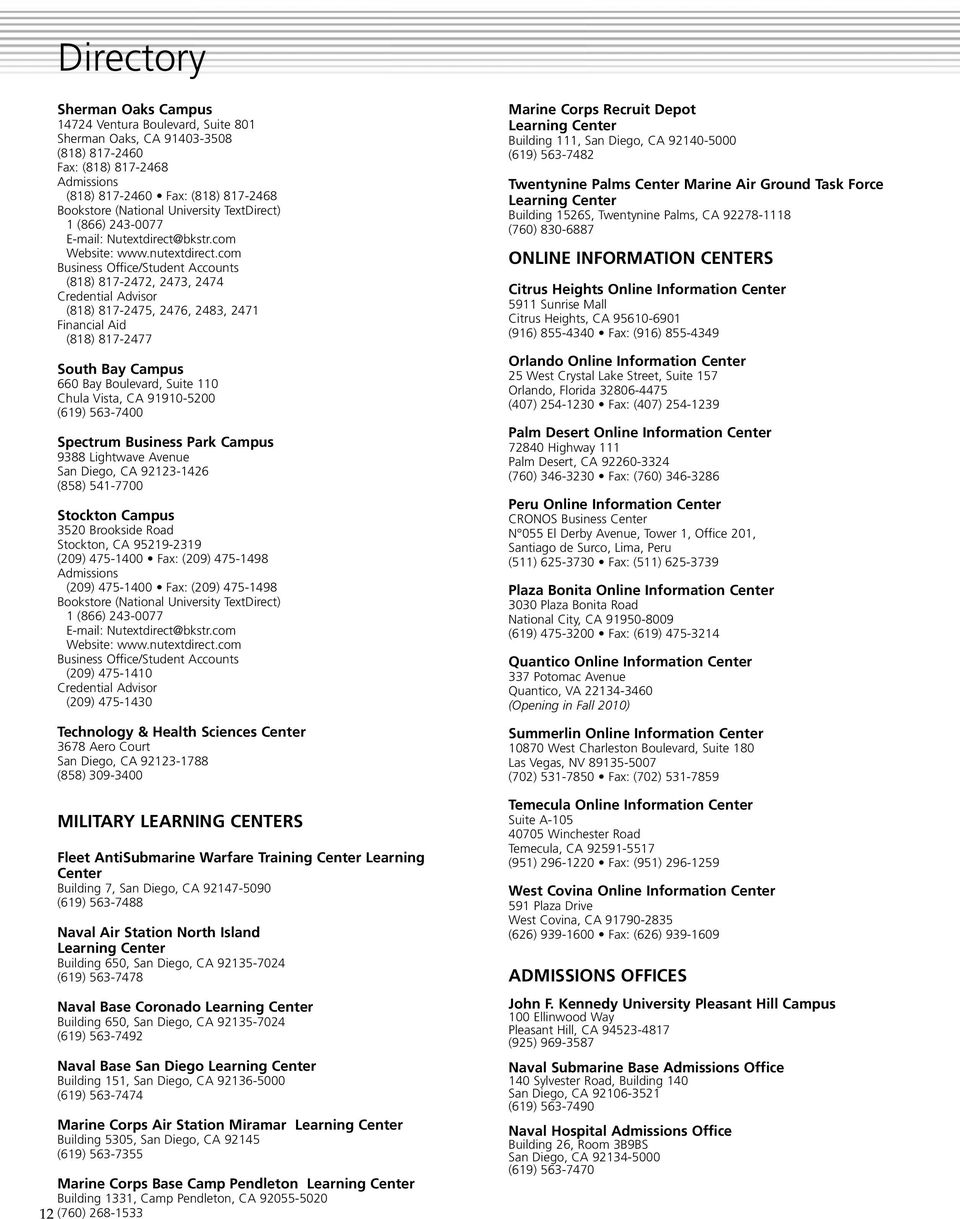
19 Directory Website: Business Office/Student Accounts (310) , (310) , 2032, 2033 College of Letters and Sciences (310) Fax: (310) Credentials (310) , 2052, 2051 Financial Aid (310) , 2022 School of Business and Management (310) Fax: (310) School of Education (310) Fax: (310) Ontario Campus 3800 E Concours Drive, Suite 150 Ontario, CA (909) Fax: (909) Admissions (909) Fax: (909) Bookstore (National University TextDirect) 1 (866) [email protected] Website: Business Office/Student Accounts (909) College of Letters and Sciences (909) Fax: (909) Credential Advisor (909) Fax: (909) Financial Aid (909) Fax: (909) School of Business and Management (909) Fax: (909) School of Education (909) Fax: (909) Rancho Bernardo Campus West Bernardo Drive, Suite 150 San Diego, CA (858) Redding Campus 2195 Larkspur Lane, Suite 200 Redding, CA (530) Fax: (530) Admissions (530) Administration (530) Bookstore (National University TextDirect) 1 (866) [email protected] Website: Business Office/Student Accounts (530) College of Letters and Sciences (530) Credential Advisor (530) Financial Aid (530) School of Education (530) School of Business and Management (530) Student Teaching Placement (530) San Bernardino Campus 804 East Brier Drive San Bernardino, CA (909) Fax: (909) Admissions (909) Fax: (909) Bookstore (National University TextDirect) 1 (866) [email protected] Website: Business Office/Student Accounts (909) College of Letters and Sciences (909) Fax: (909) Credential Program Specialist (909) Fax: (909) Financial Aid (909) School of Education (909) Fax: (909) School of Media and Communication (909) Fax: (909) Sacramento Campus 9320 Tech Center Drive Sacramento, CA (916) Fax: (916) Academic Department (916) Fax: (916) Admissions (916) Fax: (916) Bookstore (National University TextDirect) 1 (866) [email protected] Website: Business Office/Student Accounts (916) Fax: (916) Cafeteria (916) Conference Facilities (916) Educational Services (916) College of Letters and Sciences (916) Copy/Postal Services (916) and 4241 Credential Advisor (916) and 4307 Financial Aid (916) and 4176 School of Business and Management (916) School of Education (916) Student Teaching Placement (916) and 4207 San Jose Campus 3031 Tisch Way, 100 Plaza East San Jose, CA (408) Fax: (408) Academic Department (408) Fax: (408) Administration (408) Fax: (408) Admissions (408) Fax: (408) Bookstore (National University TextDirect) 1 (866) [email protected] Website: Business Office/Student Accounts (408) Fax: (408) College of Letters and Sciences (408) Credential Advisor (408) Financial Aid (408) School of Business and Management (408) School of Education (408) Student Teaching/Placement Coordinator (408) Locations

20 Directory Sherman Oaks Campus Ventura Boulevard, Suite 801 Sherman Oaks, CA (818) Fax: (818) Admissions (818) Fax: (818) Bookstore (National University TextDirect) 1 (866) [email protected] Website: Business Office/Student Accounts (818) , 2473, 2474 Credential Advisor (818) , 2476, 2483, 2471 Financial Aid (818) South Bay Campus 660 Bay Boulevard, Suite 110 Chula Vista, CA (619) Spectrum Business Park Campus 9388 Lightwave Avenue San Diego, CA (858) Stockton Campus 3520 Brookside Road Stockton, CA (209) Fax: (209) Admissions (209) Fax: (209) Bookstore (National University TextDirect) 1 (866) [email protected] Website: Business Office/Student Accounts (209) Credential Advisor (209) Technology & Health Sciences Center 3678 Aero Court San Diego, CA (858) MILITARY LEARNING CENTERS Fleet AntiSubmarine Warfare Training Center Learning Center Building 7, San Diego, CA (619) Naval Air Station North Island Learning Center Building 650, San Diego, CA (619) Naval Base Coronado Learning Center Building 650, San Diego, CA (619) Naval Base San Diego Learning Center Building 151, San Diego, CA (619) Marine Corps Air Station Miramar Learning Center Building 5305, San Diego, CA (619) Marine Corps Base Camp Pendleton Learning Center Building 1331, Camp Pendleton, CA (760) Marine Corps Recruit Depot Learning Center Building 111, San Diego, CA (619) Twentynine Palms Center Marine Air Ground Task Force Learning Center Building 1526S, Twentynine Palms, CA (760) ONLINE INFORMATION CENTERS Citrus Heights Online Information Center 5911 Sunrise Mall Citrus Heights, CA (916) Fax: (916) Orlando Online Information Center 25 West Crystal Lake Street, Suite 157 Orlando, Florida (407) Fax: (407) Palm Desert Online Information Center Highway 111 Palm Desert, CA (760) Fax: (760) Peru Online Information Center CRONOS Business Center N 055 El Derby Avenue, Tower 1, Office 201, Santiago de Surco, Lima, Peru (511) Fax: (511) Plaza Bonita Online Information Center 3030 Plaza Bonita Road National City, CA (619) Fax: (619) Quantico Online Information Center 337 Potomac Avenue Quantico, VA (Opening in Fall 2010) Summerlin Online Information Center West Charleston Boulevard, Suite 180 Las Vegas, NV (702) Fax: (702) Temecula Online Information Center Suite A Winchester Road Temecula, CA (951) Fax: (951) West Covina Online Information Center 591 Plaza Drive West Covina, CA (626) Fax: (626) ADMISSIONS OFFICES John F. Kennedy University Pleasant Hill Campus 100 Ellinwood Way Pleasant Hill, CA (925) Naval Submarine Base Admissions Office 140 Sylvester Road, Building 140 San Diego, CA (619) Naval Hospital Admissions Office Building 26, Room 3B9BS San Diego, CA (619)
21 Location Maps Technology & Health Sciences Center 3678 Aero Court San Diego, CA (858) National University System Administrative Headquarters North Torrey Pines Road La Jolla, CA (858) National University Academic Headquarters North Torrey Pines Road La Jolla, CA (858) Locations South Bay Campus 660 Bay Boulevard, Suite 110 Chula Vista, CA (619) La Mesa Campus 7787 Alvarado Road La Mesa, CA (619) Spectrum Business Park Campus 9388 Lightwave Avenue San Diego, CA (858) Library National University Library at Spectrum Business Park 9393 Lightwave Avenue San Diego, CA (858) Admissions and Student Concierge Services Center 4141 Camino del Rio South San Diego, CA (619) Avenida Encinas Avenida Encinas Coaster RR Rancho Bernardo Campus West Bernardo Drive, Suite 150 San Diego, CA (858) Carlsbad Campus 705 Palomar Airport Road, Suite 150 Carlsbad, CA (760)
22 Location Maps Marine Corps Recruit Depot Learning Center Building 111 San Diego, CA (619) Marine Corps Base Camp Pendleton Learning Center Building 1331 Camp Pendleton, CA (760) Marine Corps Air Station Miramar Learning Center Building 5305 San Diego, CA (619) Fleet AntiSubmarine Warfare Training Learning Center Building 7 San Diego, CA (619) Naval Air Station North Island Learning Center Building 650 San Diego, CA (619) Naval Base Coronado Learning Center Building 650 San Diego, CA (619) Naval Base San Diego Learning Center Building 151 San Diego, CA (619) Twentynine Palms Learning Center Marine Air Ground Task Force Training Center Building 1526S Twentynine Palms, CA (760)
23 Location Maps San Bernardino Campus 804 East Brier Drive San Bernardino, CA (909) Ontario Campus 3800 E Concours, Suite 150 Ontario, CA (909) Locations Los Angeles Campus 5245 Pacific Concourse Drive, Suite 100 Los Angeles, CA (310) Sherman Oaks Campus Ventura Boulevard, Suite 801 Sherman Oaks, CA (818) Camarillo Campus 761 East Daily Drive, Suite 120 Camarillo, CA (805) Costa Mesa Campus 3390 Harbor Boulevard Costa Mesa, CA (714) Bakersfield Campus 4560 California Avenue, Suite 300 Bakersfield, CA (661)
24 Location Maps Fresno Campus 20 River Park Place West Fresno, CA (559) San Jose Campus 3031 Tisch Way, 100 Plaza East San Jose, CA (408) Stockton Campus 3520 Brookside Road Stockton, CA (209) Sacramento Campus 9320 Tech Center Drive Sacramento, CA (916) Redding Campus 2195 Larkspur Lane, Suite 200 Redding, CA (530) Henderson, Nevada Campus 2850 West Horizon Ridge Parkway, Suite 301 Henderson, NV (702)
25 General Information Degrees Offered , 19 Mission Statement Institutional Learning Outcomes General Description Accreditation/Memberships Granting of Credit Faculty Familiarity with University Regulations National University Community Research Institute (NUCRI) Military Community General Fees Tuition Enrollment Agreement Payments and Release of Records Safety Program Campus Security Conference Services Professional Development and Seminars T h e U n i v e r s i t y o f Va l u e s TM
26 18 Degree Programs Offered at National University UNDERGRADUATE DEGREES Associate of Arts with Concentrations in: Business Administration Criminal Justice Administration Professional Golf Management Public Administration Videogame Production Associate of Science with a Major in: Health Science & Pre-Nursing Bachelor of Arts with Majors in: Arabic Studies Biological Science with a Preliminary Single Subject Teaching Credential (CA) Chinese Studies Digital Entertainment & Interactive Arts Digital Journalism Early Childhood Development w/a Multiple Subject Teaching Credential (CA) Early Childhood Education with Concentrations in: Early Childhood Administration Teacher Education English English w/ Single Subject Matter Preparation English w/ Preliminary Single Subject Teaching Credential (CA) General Studies Global Studies History Interdisciplinary Studies Interdisciplinary Studies w/a Preliminary Multiple Subject Teaching Credential (CA) Management with Concentrations in: Alternative Dispute Resolution Business Law Economics Entrepreneurship Hospitality & Casino Management Human Resource Management Marketing Project Management Mathematics w/a Preliminary Single Subject Teaching Credential (CA) Persian Studies Political Science Pre-Law Studies Psychology Sociology Spanish with optional: Preliminary Single Subject Teaching Credential (CA) Sport Psychology Strategic Communications Bachelor of Business Administration with Concentrations in: Accountancy Alternative Dispute Resolution Business Law Economics Entrepreneurship Finance Hospitality & Casino Management Human Resources Management Marketing Project Management Professional Golf Management Bachelor of Public Administration Bachelor of Science with Majors in: Accountancy Allied Health Biology Clinical Lab Science Computer Science Construction Engineering Technology Construction Management Criminal Justice Administration Domestic Security Management Environmental Science & Policy Financial Management Healthcare Administration Hospitality & Casino Management Information Systems Information Technology Management Manufacturing Design Engineering Mathematics with Concentration in: Single Subject Teaching Nursing (Accelerated Post-Bachelor Degree) Nursing (BSN) (Generic Entry) Nursing (Licensed Vocational Nurse to BSN) Nursing (RN Completion) Organizational Behavior Organization Leadership Paralegal Studies Public Health Radiation Therapy Foreign Credential Bridge Program (for students with foreign three-year bachelor s degrees) GRADUATE DEGREES Global Master of Business Administration (in Spanish) Master of Accountancy Master of Arts with Fields of Study in: Accomplished Collaborative Leadership Applied Linguistics Counseling Psychology Digital Journalism English Film Studies History Human Behavior Human Resource Management with Specializations in: Organizational Development & Change Management Organizational Leadership Language Teaching & Learning with Specializations in: Bilingual Cross-Cultural Language & Dev Spanish Language Instruction Teaching & Learning in a Global Society Management Rhetoric & Composition Social Transformation & Community Development Strategic Communications Teaching with Specializations in: Applied Behavior Analysis Autism Best Practices Early Childhood Education Early Childhood Special Education Educational Technology National Board Certified Teacher Leadership Reading Special Education Teacher Leadership Teaching & Learning in a Global Society Master of Business Administration with Specializations in: Financial Management Human Resources Management Integrated Marketing Communication International Business Management Accounting Marketing Organizational Leadership Professional Golf Management Master of Criminal Justice Master of Education with Specializations in: Best Practices Cross-Cultural Teaching Master of Fine Arts with Fields of Study in: Creative Writing Digital Cinema Professional Screenwriting Master of Forensic Sciences with Specializations in: Criminalistics Investigation Master of Healthcare Administration Master of Integrative Health Master of Public Administration with Specializations in: Human Resource Management Organizational Leadership Public Finance Social Transformation & Community Development Master of Public Health with Areas of Specialization in: Health Promotion Mental Health Master of Science with Fields of Study in: Applied School Leadership Clinical Regulatory Affairs Computer Science with Specializations in: Advanced Computing Database Engineering Software Engineering Cyber Security & Information Assurance Educational Administration Educational & Instructional Technology Educational Counseling Engineering Management with Specializations in: Project Management Systems Engineering Technology Management Enterprise Architecture (DoDAF, FEAF) Environmental Engineering Health Informatics Homeland Security & Safety Engineering Management Information Systems Instructional Leadership Juvenile Justice Special Education Nursing with Specialization in: Nursing Informatics Organizational Leadership School Psychology Special Education
27 Degree Programs Offered at National University Master of Science (continued) Special Education Emphasis in the Deaf and Hard-of-Hearing Sustainability Management Wireless Communications NEVADA PROGRAMS Associate of Science in Health Science & Pre- Nursing Associate of Science in Nursing Bachelor of Arts in Arabic Studies Bachelor of Arts in Early Childhood Education Bachelor of Arts in Elementary Education w/ Nevada Licensure Bachelor of Arts in Mathematics Education w/ Nevada Licensure Bachelor of Arts in Secondary Education, Major in English w/nevada Licensure Bachelor of Business Administration Bachelor of Public Administration Bachelor of Science in Criminal Justice Administration Bachelor of Science in Nursing RN Completion English Language Program (ELP) Master of Arts in Counseling Psychology Master of Arts in Teaching Master of Business Administration Master of Education in Elementary Education w/ Nevada Licensure Master of Education in Secondary Education w/ Nevada Licensure Master of Forensic Science Master of Public Administration Master of Science in Organizational Leadership Master of Science in Special Education with Licensure CERTIFICATE PROGRAMS UNDERGRADUATE LEVEL Accountancy Advanced Professional Golf Management (NU Golf Academy) Alcohol & Drug Abuse Counseling Alternative Dispute Resolution Arabic Language & Culture Basic Human Resource Management Basic Sales & Marketing Basics of Casino Management Criminal Justice Administration Chinese Language & Culture CISCO Certified Network Associate (CCNA) Construction Contract Administration Construction Documents Technology Construction Management Construction Safety & Inspection Construction Specifications Electrical Systems Cost Estimating Finance Hospitality & Casino Management Human Resource Management Information Technology Management LVN 30 Unit Option Marketing Mechanical Systems Cost Estimating Paralegal Studies Legal Assistant Parlegal Specialist Persian Language & Culture Professional Golf Management (NU Golf Academy) GRADUATE LEVEL Applied Behavioral Analysis Autism Bereavement Studies California Reading Early Childhood Education Early Childhood Special Education Educational Technology Electronic Business Forensic & Crime Scene Investigations Health Coaching Integrative Health International Business National Board Certified Teacher Leadership Nursing Informatics Patient Advocacy Project Management Security & Safety Engineering Subject Matter Authorization in Introductory Mathematics for Single or Multiple Subject Teaching Credential holders (California) EXTENDED LEARNING PROGRAMS American Society of Quality (ASQ) Certification Training Autism Education Behavior Management Workshops Career Technical Education Cisco CCNA Exploration Construction Management Certificate Correctional Education: Continuing Education CSET Preparation Dropout Prevention Specialist Federal Enterprise Architecture Health Coaching Lean Six Sigma Marine Technology with Concentrations in: Diving Medic Technician Nondestructive Testing Inspection Underwater Welding Technician National Board Certification Teacher Academy Online Health Continuing Education Online Career Training Programs Online Personal Enrichment Programs Organizational Training Workshops Product Realization Professional & Life Enrichment Workshops Reading Instruction Competence Assessment (RICA) Preparation Teacher Development Self-Paced Online Course US Constitution Test Prep & Exam Vocational Education General Info CALIFORNIA CREDENTIAL PROGRAMS Approved by the Commission on Teacher Credentialing (CTC) Preliminary Multiple Subject Teaching Credential Program Preliminary Single Subject Credential Program University Internship Credential Program for Multiple Subject/Single Subject Teaching Career Technical Education Credential Preliminary Administrative Services Certificate/Credential University Internship Administrative Services Credential Clear Administrative Services Credential Pupil Personnel Services Credential School Counseling (PPSC) Pupil Personnel Services Credential School Psychology (PPSP) University Internship Pupil Personnel Services Credential School Counseling (PPSC) Entire program can be completed online. On-site program with possible online courses or prerequisites. Online program with residency in Los Angeles. Preliminary Level I Education Specialist Credential: DHH with English Learner Authorization Mild/Moderate Disabilities w/ English Learner Authorization Moderate/Severe Disabilities w/ English Learner Authorization Mild/Moderate Disabilities w/ Multiple or Single Subject Credential Moderate/Severe Disabilities with Multiple or Single Subject Concurrent Credential University Internship Education Specialist Credential: Mild/Moderate Disabilities Moderate/Severe Disabilities Deaf or Hard-of-Hearing (DHH) Not all courses or programs are available at every campus. Consult an admissions advisor for online course availability. Clear Level II Education Specialist: Deaf or Hard-of-Hearing (DHH) Clear Level II Education Specialist: Mild/Moderate Disabilities Clear Level II Education Specialist: Moderate/Severe Disabilities 19
28 General Information Mission Statement National University is dedicated to making lifelong learning opportunities accessible, challenging, and relevant to a diverse student population. Its aim is to facilitate educational access and academic excellence through exceptional management of University operations and resources, innovative delivery systems and student services, and relevant programs that are learner-centered, successoriented, and responsive to technology. National University s central purpose is to promote continuous learning by offering a diversity of instructional approaches, by encouraging scholarship, by engaging in collaborative community service, and by empowering its constituents to become responsible citizens in an interdependent, pluralistic, global community. Institutional Learning Outcomes 1. Apply information literacy skills necessary to support continuous, lifelong learning 2. Communicate effectively orally and in writing, and through other appropriate modes of expression 3. Display mastery of knowledge and skills in a discipline 4. Demonstrate cultural and global awareness to be responsible citizens in a diverse society 5. Demonstrate professional ethics and practice academic integrity 6. Utilize research and critical thinking to solve problems 7. Use collaboration and group processes to achieve a common goal General Description National University is the second largest private, nonprofit institution of higher learning in California. The University is geographically dispersed, with its academic and administrative centers located in La Jolla, California. These centers include all administrative offices the offices of the president, vice presidents, school deans and department chairs, financial aid, registrar, and admissions. From its administrative center, National University supports a variety of campuses, making learning convenient for its students. Accreditation/Memberships Since 1977, National University has been accredited by the Accrediting Commission for Senior Colleges and Universities of the Western Association of Schools and Colleges (WASC). The University is also: Approved by the Commission on Teacher Credentialing (CTC) Accredited by the California Board of Registered Nursing (BRN) Approved by the Commission on Collegiate Nursing Education (CCNE) for the offering of the Bachelor of Science in Nursing Program Accredited by the International Assembly for Collegiate Business Education (IACBE) for programs offered by the School of Business & Management A member of the American Association of Colleges for Teacher Education (AACTE) Approved to train veterans under Title 38, U.S. Code (GI Bill) Approved for student financial aid by the Department of Education A member of the Council of Colleges of Arts and Sciences (CCAS) Authorized under federal law to enroll non-immigrant alien students A member of the American Association of Intensive English Programs (AAIEP) through its American Language and Intercultural Studies program A participant in the Servicemembers Opportunity College network (SOC) Approved for Army, Air Force, Coast Guard, Marine Corps, Navy and U.S. government tuition assistance. Students in San Diego who qualify may enroll in the Army or Air Force ROTC crossenrollment programs. The Division of Extended Learning is a member of the following organizations: The International Association for Continuing Education and Training (IACET) as an Authorized Provider of the Continuing Education Unit (CEU) The University Continuing Education Association (UCEA) The Association for Continuing Higher Education (ACHE) The Learning Resources Network (LERN) Campuses Bakersfield Camarillo Carlsbad Costa Mesa Fresno Henderson, Nevada Kearny Mesa La Mesa Los Angeles Ontario Rancho Bernardo Redding Sacramento San Bernardino San Jose Sherman Oaks South Bay Spectrum Stockton Military Learning Centers ASW Camp Pendleton MCAS Miramar MCRD San Diego NAB Coronado NAS North Island Naval Base San Diego Twentynine Palms Online Information Centers Citrus Heights Lima, Peru Orlando, Florida Palm Desert Plaza Bonita Quantico, Virginia* Summerlin Temecula West Covina *Opening Fall 2010 Granting of Credit The academic year is divided into four 12-week quarters, each comprised of three one-month classes. (Refer to the Financial Aid section for a definition of the academic year used for financial aid calculations.) Students may enroll in classes in most programs any month of the year. National University awards credit in quarter units. Under the current policy, 4.5 units of credit are awarded for most courses. A unit of credit is based upon the hours of classroom instruction for each course and the hours that a typical student reasonably should expect to devote preparing for each hour of class. An undergraduate course requires 45 hours of classroom instruction and an undergraduate student generally is expected to devote two hours or more in outside preparation for each hour of class. A graduate course requires 40 hours of classroom instruction and a graduate student generally is expected to devote three hours or more in outside preparation for each hour of class. Undergraduate courses typically are scheduled for a one-month period, generally for 4.5 hours on two weekdays and 4.5 hours on two Saturdays during the month. Graduate courses typically are scheduled for a one-month period, generally 4.5 hours two weekday nights with a 4.5-hour session on one Saturday. 20
29 General Information Faculty There are three tiers of faculty at National University full-time and part-time, which includes associate and adjunct. FULL-TIME FACULTY are members of the University whose primary responsibilities include teaching, scholarship, service, intellectual coordination with the part-time faculty, professional development, student advising and participation in the University s governance. ASSOCIATE FACULTY are teachers who make a half-time commitment to the University faculty over the course of the year. They are contracted to teach a designated number of courses per year, advise students on course, program, or career-related issues, participate in departmental, school and University activities and engage in scholarship relevant to their teaching. ADJUNCT FACULTY are teachers whose principal professional commitments are elsewhere in their fields, but who are contracted to teach a designated number of courses per year, advise students on course-related topics, and maintain currency in their professional and disciplinary fields. Adjunct faculty serve initially as adjunct and may be promoted over time to Core Adjunct and Certified Core Adjunct. All faculty hold advanced degrees in their areas of expertise and are respected professionals with many years of career experience. When hired, they receive an orientation to the University as well as training in the various learning modalities used at National University. Ongoing professional development occurs throughout the academic year. Familiarity with University Regulations When signing an enrollment agreement, students acknowledge receipt of the General Catalog and agree to abide by the policies, rules, and regulations of the University. When students enrolling through the Internet checkmark the box on the online agreement constituting a virtual signature, they acknowledge that they are bound by the policies, rules, and regulations of the University contained in this catalog. This publication includes academic standards and the general requirements for graduation. Ignorance of or lack of familiarity with this information does not serve as an excuse for noncompliance or infractions. The University provides assistance in the form of academic advising, but students are responsible for meeting the published requirements of their respective programs. National University Community Research Institute (NUCRI) The National University Community Research Institute (NUCRI) is an outgrowth of the 1997 President s Commission on Community. A major outcome of the commission was to envision the University s collaborative future as a full community partner. Community became an institutional core value and NUCRI developed into a universitywide, point of contact for making the university-community connection across disciplines and facilitating community research and technology applications for smart and creative community building. The academically-oriented and practitioner-based Institute focuses on community research and technology, knowledge sharing, professional development, educational outreach and service. Through its University Consultant Corps of faculty, students, and community practitioners NUCRI engages in collaborative research and innovative technology transfer initiatives with strategic alliances to pursue its mission. The overarching goal is to enhance community capacity building and involvement for sustainable community development. General Fees Fees are non-refundable. All records and services are withheld from students who have any outstanding financial obligations to the University or have defaulted on a Title IV loan at the University. Application Fee...$60 For students entering any degree program. This fee is charged to all but international students. Non-Degree Application Fee...$60 For students entering any non-degree program. International Student Application Fee...$65 See also International Student Prepayment and Refund policy. International Student Activity Fee...$50 See also International Student Prepayment and Refund policy. Re-admission Fee...$60 For students who have been inactive for more than 12 months or who are entering another degree program. Graduation Processing Fee...$100 Charged to all students before graduation. Transcript Fee...$5 Per copy fee for each transcript (Academic or Extended Learning) Returned Check Charge...$20 Reinstatement Fee...$100 Charged only to those students with unpaid delinquent financial obligations. Late Payment Fee...$25 Charged when tuition payment has not been received by the first night of class. Credit by Examination Fee...$100 Per examination, per course. Challenge Examinations Fee...$50 Per course charge, course waiver, no credit. Nursing Fees Basic BSN Program Orientation Fee...$1,480 Nevada ASN Program Orientation Fee...$1,480 RN-to-BSN Students Orientation Fee...$595 Nursing Clinical Laboratory (NSG) Fee...$675 per course E-Portfolio... $35 per year E-Portfolio Renewal Fee... $30 per year School of Media and Communication (SOMC) Residency Fees: SOMC MDC 688 Course Fee... $1,200 SOMC MDC 689 Course Fee... $550 SOMC SCR 675 Course Fee...$750 SOMC SCR 670P Course Fee...$250 National University Golf Academy Golf Lab Fee...$300 per PGM course (Students enrolled in the BA Sport Psychology program or a BA in Sport Psychology elective may also access Academy services and Swing Lab for $300 per course) Teaching Performance Assessment Fees...$305 Total cost for initial submission of all 4 TPA Tasks. See Credentials section under School of Education for further information on TPA tasks and Task Stream. 21 General Info
30 General Information Tuition Tuition rates in effect as of August 30, Undergraduate - $308 per quarter unit Graduate - $350 per quarter unit Course Level quarter units quarter units quarter units quarter units 100, 200, 300, 400 $1,386 $924 $693 $ (Undergrad)* $1,386 $924 $693 $ (Grad)* $1,575 $1,050 $ $ & 700 $1,575 $1,050 $ $525 * Tuition for 500-level courses is charged according to students degree programs. Tuition is due and payable prior to the first class session of each course. Tuition not fully paid when due is subject to a late fee. If a tuition payment check is returned due to insufficient funds, the University reserves the right to drop all current and future classes for that student. Students will be notified of this action and assessed a return check charge. The University may require students who have written multiple insufficient-fund checks to make all future payments by cashier s check, cash, or money order. The University reserves the right to modify tuition at any time. Students whose employers have entered into a contractual agreement with the University may be eligible for reduced tuition. Military Community National University has seven convenient locations for the military community in San Diego County, and one in San Bernardino County. Centers are located at Naval Base San Diego, Anti-Submarine Warfare Training Center San Diego, Naval Air Station North Island, Marine Corps Recruit Depot San Diego, Marine Corps Air Station Miramar, Marine Corps Base Camp Pendleton, and Marine Corps Air Ground Combat Center Twentynine Palms. National University also has admissions offices at Naval Hospital and Naval Submarine Base in San Diego, and at Naval Base Bremerton, Washington. National University offers reduced tuition for classes on base for qualified students, including: active duty members, their spouses and dependents, Department of Defense employees, military retirees and selective military reserve members. The University accepts DANTES tests offered through the military voluntary education program. National University is a member of the Servicemembers Opportunity Colleges (SOC) network, and participates in the Military Installation Voluntary Education Review (MIVER). Enrollment Agreement Students must sign an enrollment agreement before beginning classes at National University. The agreement includes topics pertaining to tuition and fees, billing, attendance, financial assistance, payment options and other matters of enrollment. Contact an admissions advisor for further information. Payments and Release of Records The University grants degrees and releases transcripts only after a student satisfies all financial obligations to the University. All records and services are withheld from students who have any outstanding financial obligations to the University or who have defaulted on a federal Perkins or NU-Help loan. 22 Safety Program National University is concerned about the safety of its students and employees and has instituted a University Safety Policy and an Injury and Illness Prevention Program. Students play an important role in ensuring that their classroom facilities are safe. Students should: Review fire, medical, and earthquake emergency procedures posted in each classroom and be prepared to respond accordingly Review emergency egress routes and know the location of fire extinguishers (posted in each classroom) Watch for any hazardous conditions and report them immediately to the center assistant Campus Security In general, National University s campuses are situated in highly populated urban areas. As such, they are subject to the same security problems as other businesses in the area. To help prevent crime, students should: Lock their cars Never leave valuable items in their parked cars Return to their cars in the company of other students when they leave the classroom at night. If no other students are going in that direction, students should request that a security guard or the center assistant accompany them Take items of value with them when they leave a classroom, unless they are certain that the classroom will be locked or monitored while they are away Report anything that appears to be out of the ordinary (e.g., a stranger lingering in the area) immediately to the center assistant Safety procedures are posted at campuses and labs. Students should never single-handedly try to stop a criminal in the act. Students should call for security or report the act by calling 911. When the emergency operator answers, students should give the operator their direct dial number, name, and specific location, including building and room number. (For students calling from La Mesa, South Bay, Marine Corps Recruit Depot, or any of the San Diego naval installations, the location displayed on the 911 emergency operator s console will be that of the central telephone switch unit in Mission Valley, rather than that of the caller.) If time permits, students should also notify the University operator by dialing O, since it is possible the 911 emergency operator may try to contact them through the main University number. If students are involved in or aware of any event that requires the attention of University administration, they should complete a Report of Student/Visitor Incident or Injury, available through the center assistant, and follow the instructions. Pursuant to the Campus Security Act of 1990, the University publishes the Annual Report on Campus Security that discloses information about campus safety policies, procedures, and crime statistics. This report is available on the University s website, and printed copies are available upon request to all current students and prospective students at each National University campus. Conference Services National University offers conveniently located facilities available for conference needs at very competitive rates. The University s conference style classrooms are perfect for hosting seminars, conferences, off-site meeting, or training sessions in an academic atmosphere that is comfortable, focused and conducive to interaction and learning.
31 General Information Professional Development and Seminars National University s Division of Extended Learning is an authorized provider of the Continuing Education Unit (CEU); benchmarked to International Association for Continuing Education and Training (IACET) standards. The IACET CEU is considered the hallmark of quality in continuing education and training. IACET CEUs enhance the credibility of professional development and training in disciplines, such as: education, engineering, accounting, legal, medical, Real Estate and others. National University provides many administrative services to support professional development events and conferences. These may be held at National University s campuses throughout California, client locations, online, or by realtime web seminars. Extended Learning documents CEUs with a certificate and/or an official National University transcript. For more information regarding professional excellence with NU CEUs, please call (858) General Info 23
32 24 General Information
33 Student Support Services Mathematics Tutoring National University Library System (NULS) Library Resources and Services Online Information Centers Online Courses Writing Across the Curriculum Writing Centers Bookstore English Language Programs Transfer of Credits to Other Institutions Student Support Services Internet and Wireless Student Access SOAR Student Portal Computer-Based Information Systems Student Concierge Services Students with Disabilities The Student Relations Coordinator (SRC) Career Center Testing Services Development and Alumni Relations California Community College Transfer Services CSU and IGETC California Community College Scholarships International Students Support Services T h e U n i v e r s i t y o f Va l u e s TM
34 Student Support Services 26 Student Support Services National University provides a number of services to help students attain their educational goals. In addition to the Office of Academic Affairs, several offices of the University join together to provide services for the academic, economic, and personal needs of enrolled students. Student services include student advising and scheduling, records evaluation, veteran s assistance, financial aid, and other services. Additionally, the library, alumni association, extended learning office, and student accounts office are available to help students. Mathematics Tutoring Tutoring services in the fields of mathematics, sciences, engineering and business mathematics, including help with calculator usage, Excel, SPSS and Minitab applications are included in the study assistance extended to National University students. The exception for tutoring are specialized areas in business management, finance and accounting. Mathematics tutors are available free of charge to National University students. Since the request for help is online, all student can avail themselves of this student service. Tutors are available online Monday through Friday afternoons and evenings and by appointment on weekends. Students who need assistance are required to complete a Math Tutor Help Request Form available online in the NU Home Page under Student Services. When the request form is received by the NU Math Center, a math tutor is assigned to contact the student and arrangements can then be made between Math Tutor and student. National University Library System The National University Library System (NULS) offers a wide range of online resources and services designed to meet the needs of online students and those at National University campuses. The Spectrum Library 9393 Lightwave Avenue, San Diego, CA USA (858) or 1 (866) NU ACCESS ( ) Library Hours of operation: Pacific Time (PT) excluding holidays and breaks: Monday Thursday 10 a.m. 10 p.m. PT Friday 10 a.m. 6 p.m. PT Saturday 8:30 a.m. 5 p.m. PT Sunday 10 a.m. 5 p.m. PT Online resources and services are available 24/7 at The Spectrum Library is organized around student needs: Group and individual study spaces. Group study rooms should be reserved in advance. Information Commons computers dedicated to student research and preparation of class work. Students may borrow laptops for in-library use. Wireless access is available. Printing is free from Library workstations. Curriculum Resource Center (CRC) designed for education students, the CRC contains educational curriculum, textbooks, multimedia materials, and software resources used in California schools Multimedia Lab may be reserved for working on small group multimedia projects. Print Collections Journals: current titles and microfiche back-files Books: Reference and circulating collection, juvenile and young adult books, curriculum materials, and special collections of theses and dissertations. Online Library Resources and Services The Spectrum Library is also the administrative center for the Library s Web-based services and online information. All of the online resources are accessible 24 hours a day, 7 days a week through the Library s home page: Authentication is required. Login: your National University 9-digit ID number Password: your 6-digit birth date (mmddyy) e-reference resources provide access to the online version of many standard reference encyclopedias and handbooks e-books represent over one-third of the Library s book collection and are selected to support academic research. E-books are listed in the Library s Catalog: The e-journal collection provides full text of many articles indexed by the databases to which NULS subscribes. Journal title records in the Library catalog indicate which databases provide the full text. Services offered by the Library include: Web-based Library tutorials and guides Reference help Phone: (858) or NU ACCESS ( ) Library [email protected] Books Direct ships books to regional centers and students 40 miles from a center. A request form is available online FREE Journal Direct provides electronic access to print articles in the Library s collection. A request form is available online FREE Interlibrary Loan provides access to articles and books owned by other libraries. Official course textbooks are excluded from this service. A request form is available online FREE Online Information Centers National University s Online Information Centers (OIC) enable prospective students to test-drive online programs, find answers to questions about studying at National University, apply, enroll, pay fees, update study schedules, and receive other services normally available on campus. The OICs have been designed for the growing number of online students who enjoy the flexibility of online learning, but also prefer a live student advisory service a reasonable distance from home. Online Courses National University offers many programs and courses in an online format using the ecollege platform. Students may complete an online course orientation and also receive instruction on using Class Live Pro, the synchronous chat technology used to communicate with the faculty and other students in the class. In an online course, students will be able to view the syllabus and assignments, participate in threaded discussions, ask questions of the instructor and view their exam and assignment grades. Course materials and digital learning modules will be presented. Faculty may use the online chat feature for lectures and question/answer sessions. Students are provided access to online courses beginning on the Sunday before the term begins through three weeks after the term ends. Onsite classes may make use of an e-companion which is an online resource where students can view course materials and assignments. As of June 2010, following is a list of minimum system requirements that are needed to successfully access your courses on the ecollege platform.
35 Student Support Services Technical Requirements Windows Users Windows 2000, XP, Vista or 7 Pentium III 1 GHz processor 256 MB RAM High-speed internet connection (ie: DSL, cable, etc.) Note: Dial-up internet connection is supported SoundCard & Speakers Internet Explorer 8.0 (supported) Internet Explorer 7.0 (recommended) Internet Explorer 6.0 (supported) Firefox 3.0 (recommended/supported) Mac OS Users Mac OS X 10.4, 10.5 or 10.6 G4, G5 or Intel Processor 256 MB RAM High-speed internet connection (ie: DSL, cable, etc.) Note: Dial-up internet connection is supported SoundCard & Speakers Safari 3.0 or Firefox 3.0 (recommended) Safari 2.0 or Firefox 2.0 (supported) Note: Browsers listed have been validated with the course platform. A user risks running into problems with the course software if they choose to use a non-supported browser. Writing Across the Curriculum Writing Across the Curriculum is a University-wide program designed to enhance the development of students writing and critical thinking skills throughout their studies at National University. Strong writing skills are in demand in nearly every profession give students a competitive edge in job searches and career advancement. The University is dedicated to providing students and faculty with a full range of conceptual material, instructional resources, and support systems. The goals of the Writing Across the Curriculum program are: To make writing and the complementary skills of reading, critical thinking, and research a regular part of coursework at National University To facilitate the acquisition of writing and communication skills that are vital to personal and professional success To distinguish graduates of National University in the eyes of employers and the general public through their professional and technical excellence in language and communication skills Writing Across the Curriculum promotes writing and reading enhancement throughout all schools of study through a variety of publications and activities, including: Writing intensive courses Workshops for faculty Writing centers Professional forums for self-expression, such as The Gnu, a student literary journal, and WHACK, a faculty newsletter Upon registration, students are asked to purchase The Little Brown Essential Handbook for Writers (Longman, Publisher). This book serves as the official National University writing guide and reference text, and it is used by instructors from all disciplines as a reference for their students. Writing Center National University students have the opportunity to work one-onone with writing consultants to develop their writing and critical thinking skills via synchronous appointments with the Online Writing Center. An integral part of the Writing Across the Curriculum Program, the writing centers welcome the opportunity to help students at all levels to improve from outlining a first year composition essay, to drafting a graduate level research paper. The writing center staff, comprised of experienced writing instructors and well-trained graduate students are eager to read students drafts and to offer strategies for improving their writing. For more information about writing center services and how to make an appointment, go to Bookstore The University contracts with an external vendor for the sale and buyback of textbooks. Textbooks are available for purchase two weeks prior to the first night of class. The cost of books varies with each course. Students must purchase all books and supplies necessary for the course in which they are enrolled. Textbooks may be purchased online, by phone, or by fax. Online access to the vendor is provided through the student portal on the University s website. English Language Programs English Language Programs (ELP) offer English language instruction and a variety of cultural experiences to international students, visitors, and professionals. Programs include: University Preparation, an intensive course designed to prepare students for the academic environment; and English Communication, a course designed to meet the personal or professional needs of individuals. TOEFL is waived for ELP students who complete National University s academic programs. English Language Programs also offer customized programs for executives and professionals, business English communication courses, Vocational English as a Second Language (VESL), Accent Reduction, Business English, and language assessment services, including the test of English for international communication (TOEIC). Transfer of Credits to Other Institutions Each institution has policies that govern the acceptance of credit from other institutions. Accreditation by one of six regionally accrediting associations is the normal and primary criterion for making such determinations. National University is accredited by the Western Association of Schools and Colleges (WASC). Generally, credits and degrees from National University have been accepted by transfer institutions. Students who are anticipating a transfer, or advanced studies, are encouraged to contact such institutions directly to determine how National University credits will relate to the requirements of those institutions. Internet and Wireless Student Access All National University students can access the Internet from any of the computers found in the University s computer classrooms and open computer labs. National University has wireless Internet access at most campuses. At the applicable campuses, wireless access is available within most student areas, such as classrooms and lounges. The student should contact the site Center Assistant to determine if a site has wireless access or to get logon information to access the wireless network. National University s programs and courses make frequent use of Internet resources, allowing students to learn the skills required to gain information through such electronic media. 27 Support Services
36 Student Support Services SOAR Student Portal National University offers all students online access to their academic, financial and personal records. Through the SOAR student portal, students can access their online classes, grades, degree progress report, textbook requirements, online bookstore, financial aid checklists, and student account and class schedule. Computer-Based Information Systems Research and Development Center National University offers students online, real-time access to pertinent information. Through the student web portal, accessible from the University s home page, students can access appropriate parts of their records, class schedules, Degree Progress Report, and textbook requirements, as well as add courses to their schedules. Student Concierge Services National University s Student Concierge Services is students onestop center for student service. Student Services Advocates are trained in a range of areas such as Financial Aid, Credentials, Admissions, and Graduations. Student Concierge Services is dedicated to providing innovative and individualized solutions for students. Student Concierge Services recognizes that National University students may not be available to contact us during normal business hours. That is why Student Concierge Services is available Monday through Friday from 7 a.m. to midnight (Pacific) at (866) or [email protected]. Students with Disabilities National University complies with the Americans with Disabilities Act of 1990 and Section 504 of the Federal Rehabilitation Act of Accordingly, qualified persons with disabilities may not, on the basis of that disability, be denied admission or subjected to discrimination in admission decisions. Further, no qualified student with a disability, on the basis of that disability, may be excluded from any academic, research, counseling, financial aid, or other post-secondary education program or activity that the University provides to all students. Students seeking special accommodations due to a disability must submit an application with supporting documentation to the Office of Scholarships and Special Services. The Committee for Students with Disabilities, which meets monthly, will consider all materials and will afford qualifying individuals with appropriate accommodation. If a student is denied accommodation or believes that the accommodation afforded is insufficient, the student may appeal to the Vice President for Student Services, who will render a decision within seven (7) days of receipt of the appeal or prior to the start date of the next course, depending on which occurs first. The decision of the vice president is final. Students or prospective students who want to read the complete National University Policy and Procedures, Services to Students with Disabilities, should request a copy from an advisor. Applications for accommodations for a disability may be sent to the Office of Scholarships and Special Services, National University, North Torrey Pines Road, La Jolla, CA , Phone: (858) The California Relay Operator can be reached at 711. The Student Relations Coordinator The Office of Student Affairs serves the National University community by advocating for accepted norms of fairness, decency and ethical behavior, adherence to the letter and spirit of National University policies, and prevention of delay, complication, and unresponsiveness in the application of University rules and 28 processes. The Student Relations Coordinator (SRC) works to fulfill the mission of the University by serving as an informal and impartial resource for the National University community and by acting in the following ways: Serving as an advisor who listens and identifies options to address the student s problem; Encouraging and assisting people to resolve their own conflicts. When requested, the SRC will intervene and work with all parties to resolve a dispute; Identifying personnel appropriate to handle a given problem, explain National University policies, connect people with University resources, and explain how the University system works; Assisting when normal channels have failed to resolve students problems or when there is not a well-defined channel to address the concern; Providing a confidential way to raise sensitive or very private concerns; and Providing feedback to the President, Board of Trustees, deans, and other University officers about policies, practices, and structures that regularly produce conflicts, problems, and complaints. In deciding whether to initiate contact with the SRC, it is best to view this step as a last resort to be taken only when other approaches have failed. For many problems, a normal procedure or route of appeal can be found in the General Catalog. Academic advisors, student concierge services, department chairpersons, deans, and directors are all, by virtue of their office, experts at handling specific types of problems and should normally be consulted first. The SRC does not take sides, but considers the rights and interests of all parties to a dispute with the aim of achieving a fair outcome. The SRC does not make, change, or set aside policies or decisions, but advocates for fairness. The SRC will not identify students or reveal their confidences without permission except when required by law. Information provided by the student to the SRC may not be used in grievance or other formal proceedings. For help identifying alternative courses of action please contact the Student Relations Coordinator: Student Relations Coordinator, National University North Torrey Pines Road, La Jolla, CA Phone: (858) , [email protected] Career Center The Career Center of National University is committed to providing professional career and employment related services to National University s current students and alumni. Regardless of the geographical location of students, the Career Center provides online assistance in the following areas: resume review and development, job search assistance, interviewing and negotiating techniques, career management assistance and career exploration through online assessments for those seeking additional support. The Center also offers an online portal that enables students and alumni to search for jobs and post resumes. The portal contains additional career-related resources as well. For more information about the Career Center and its services, please call (858) or NU-ACCESS, ext or [email protected]. Testing Services Testing services include ACCUPLACER Testing, CLEP, and Credit by Exam/Challenge Exam. For more information about National University s testing services, please call (858) or NU- ACCESS, ext or via [email protected].
37 Student Support Services Development and Alumni Relations National University Alumni Relations The Office of Development and Alumni Relations seeks to celebrate and promote the successes of our graduates. It also provides alumni with lifelong connections, resources, career services and other benefits, while fostering and facilitating opportunities for personal and professional growth and continued participation within the University community. National University alumni are eligible to participate in a broad array of programs and services through the Office of Development and Alumni Relations. The University maintains open communication with its alumni community through its website, , mail; through an alumni e-newsletter titled the Newswire, which is circulated regularly to alumni with addresses on file; and through an annual alumni magazine titled Vision. To subscribe, contact (866) , ext or visit The alumni relations website provides up-to-date information on initiatives such as cultural, educational and networking events, career fairs and career development workshops. Alumni may also access Alumni Connections, a free online Community, a network created exclusively for National University alumni, accessible via the alumni website or at Alumni Connections features an alumni directory, job postings, class notes, and more. Alumni are also encouraged to visit the online National University merchandise store, where they can purchase University apparel and show their pride as alumni. One of the most popular benefits available to Alumni is membership to the National University Online Library, which includes access to the NetLibrary electronic book collection and the Academic Search Premier Databases, Alumni Edition. To purchase a one-year membership, please visit es/onlinelibrary.html. Development As a nonprofit institution, the University relies to a large extent on contributions and partnerships to provide nontraditional learners with an affordable, accessible, and relevant education. The development office is responsible for securing annual gifts, corporate and foundation relations, planned giving, and major donor relations. Charitable gifts help to fund scholarships and endowments that make a college degree affordable to underserved students. Partnerships with corporations and foundations launch new programs that are relevant and leading-edge. The development office fosters interaction with the University among corporations and other organizations to serve mutually beneficial community needs. For further information, please visit or contact the Office of Development and Alumni Relations at (858) or [email protected]. California Community College Transfer Student Support Services Articulation National University is one of the top choices in California for community college students interested in transferring to a private school. New courses begin each month, so you can enroll at any time. National University has articulated coursework from all California Community Colleges for a seamless transfer experience. The articulation agreements can be found at: Admissions/Undergraduate/TransferInformation.cfm Students can obtain transfer information from the Transfer Center at the college or from National University s Regional Recruitment Specialists that visit each community college. Regional Recruitment Specialists: Northern California, Southern California (excluding San Diego and Imperial Counties) San Diego and Imperial Counties. You may ask your Transfer Center for the e-contact information or call NU-ACCESS for additional information. CSU General Education Certifications and IGETC National University will accept the following General Education certifications: California State University (CSU) General Education Breadth Certification and the Inter-Segmental General Education Transfer Curriculum (IGETC). All requirements for CSU General Education and IGETC must be completed and certified prior to transfer to National University. The University will not accept partial certifications. Students transferring with full certification are typically required to take one to three upper-division general education National University courses in order to fulfill the unit requirements. Students must provide an official transcript with the certification included or a separate certification form from the community college attended. California Community College Scholarships Transfer to Triumph Scholarship Students who are transferring from a California Community College may be eligible for the Transfer to Triumph program. To be eligible a student must meet the following requirements: Be in good academic standing at the time of application to National University. Have completed at least 30 semester units at a California Community College or combination of California Community Colleges. Their last semester of attendance was at a California Community College and is within 24 months of their application date to National University. If students believe that they qualify for this scholarship, they must initiate it through their admissions advisor who will make a preliminary eligibility determination. The admissions advisor will enter the preliminary eligibility into the system. Once the student s entire file is complete, the Registrar s Office will evaluate the student and determine official eligibility for the scholarship. Students will be sent an indicating whether they have been approved or denied for the scholarship based on official eligibility determination. If a student is approved for the scholarship, the admission fee will be waived by the Student Accounts Office. The student must notify the scholarship coordinator once they are within three courses of completion of their program: National University, Attn: Scholarships and Special Services North Torrey Pines Road, La Jolla, CA 92037, (858) The scholarship coordinator will verify this information and issue the award. Tuition for the final two courses will be billed and waived, and the student will receive an adjusted accounting. Promising Scholar Award This scholarship award is intended for students who are enrolling into National University directly from a California Community College. 29 Support Services
38 Student Support Services To be eligible for this award, students must meet the following qualifications: Be in good academic standing at the Community College at the time of application to National University. The last semester of college attendance was at a California community college and is within 12 months of application to National University. If students believe that they qualify for this scholarship, they can initiate it by requesting an application through the National University Regional Recruitment Specialist, Transfer Center at their school, or through a National University Admissions Advisor. Complete the Promising Scholar Award application form and have this form signed by the Transfer Director of your community college to verify that you have attended the community college within the last 12 months and submit the form within 90 days of application date to National University. If you will not be attending National University within the next six months, please do the following: Complete this form and retain a copy for yourself. Present this form to the National University Regional Recruitment Specialist or submit it to the National University Scholarships and Special Services Coordinator. Upon enrollment to National University, contact the Scholarship and Special Services Coordinator to activate the award application previously submitted. You must enroll within 12 months of submitting the original award application. Students who apply for this Promising Scholar Award may also be eligible for the Transfer to Triumph Scholarship provided they meet the scholarship criteria stated above under Transfer to Triumph. You will automatically be considered for the Transfer to Triumph Scholarship upon submission of your Promising Scholar Award application. International Students Support Services Anguilla Antigua Australia Barbados Belize Bermuda British Virgin Islands Canada (except for the Province of Quebec) Cayman Islands Commonwealth of Caribbean Countries Dominica Grenada Guyana Jamaica Admission Liberia Montserrat New Zealand Norway* Republic of Ireland St. Kitts and Nevis St. Lucia St. Vincent The Bahamas Trinidad and Tobago Turks and Caicos Islands United Kingdom (England, Scotland, Northern Ireland, Wales) *Specific grades required Applicants who require a Certificate of Eligibility for Nonimmigrant (F-1) Student Status, should contact the International Admissions Office-Spectrum Center (858) or [email protected]). A nonrefundable application fee of $65 is required for all international students. Prospective international students must establish means of financial support, provide official transcripts of previous education in order to establish academic eligibility, and fulfill an English Language Proficiency requirement Note: The University is required to maintain student records and to furnish the information to appropriate U.S. federal agencies upon request. English Language Proficiency for Online International Students Online International students from a country where English is not the primary language will be required to fulfill the University s English Language Proficiency requirement prior to beginning their degree program. Further information on the English Language Proficiency requirement can be found in the University catalog on page 28. International Student Prepayment and Refund International students admitted to National University with F-1 visas are required to pay their first three classes in advance upon arrival at the University. Tuition for the first class is non-refundable. Tuition refunds for the second and third months will be in accordance with National University refund policies. Transcript Evaluation Official documents (e.g. transcripts, mark sheets, diplomas) are required for admission. Transcripts from international institutions of higher education may require a credit recommendation by a recognized evaluation service selected by National University. Applicants are responsible for any required evaluation fees. The final decision on awarding credit is made by National University, which carefully considers the evaluation service s recommendations. More information is available by ing [email protected] or by contacting the Office of the Registrar in San Diego. Language Proficiency Verification of English Language Proficiency helps to ensure that lack of facility in English will not hinder academic performance at National University. Applicants from the following countries are not required to submit English Language Proficiency: Applicants who have obtained a California Teaching Credential from the CTC are exempt from the English Language Proficiency requirement. The English Language Proficiency requirement can be fulfilled with one of the following: Providing proof of an associate, bachelor or master s degree from a regionally accredited United States college or university. *Note: Students who have an Associate degree only MUST provide verification they have met the course equivalency for ENG100/101 with a grade of C or better in order to be eligible to waive the English Language Proficiency requirement. Providing proof satisfactory completion of two full years (equivalent of 60 semester units or 90 quarter units) of transferable degree study in an English language school system at a recognized college or university located in a country where the dominant language is English. Provide proof of a minimum of 3 years of study at a United States high school culminating in the award of a high school diploma (graduation) Test of English as a Foreign Language (TOEFL) taken within 24 months before beginning coursework. TOEFL Requirements Paper Based Test Computer Based Test Internet Based Test Undergraduate Graduate International English Language Testing System (IELTS). Undergraduates must score 5.5 and graduates must score 6, with no band lower than a 5. 30
39 Student Support Services Certificate of Proficiency in English (CPE) by University of Cambridge English for Speakers of Other Languages (ESOL). The minimum requirement is a grade of C. Certificate of Advanced English (CAE) by University of Cambridge English for Speakers of other Languages (ESOL).The minimum requirement is a grade of C. GCSE/IGCSE/GCE O Level English, English Language, or English as a Second Language with minimum grade of B. GCE A/AS/AICE Level English or English Language with minimum grade of C International Baccalaureate English A1 or A2 Higher Level passed with minimum grade 4 London Tests of English, Level 5 (Proficient) by Ed Excel International. The minimum requirement is Pass. London Tests of English, Level 4 (Advanced) by Ed Excel International. The minimum requirement is Merit. Completing an English Language Program (ELP) through a language school approved by National University. Students can meet the English Language Proficiency requirements by satisfactorily completing the highest level of study at the following five language training institutions: English Language Systems (ELS) in locations throughout the United States and abroad (in California, ELS centers are in San Diego, Orange County, Santa Monica, San Francisco, and Oakland). Students must complete level 109 for undergraduate studies and level 112 for graduate studies. San Diego State University s American Language Institute (ALI) level 106 or pre-mba program. San Jose State University s Studies in American Language advanced level. University of California at Davis s International Training and Education Center advanced level. Fresno International English Institute Students may also satisfy the English Language Requirement by completing National University s English Language Program. International students who need English Proficiency take a placement exam which will allow for placement in the appropriate class level. English Language classes follow the University calendar and provide 96 hours of instruction per month. Levels range from beginning to advanced. At the end of each month, the students are evaluated for advancement. TOEFL and IELTS scores are not required for students who have completed National University s English Language Program. For additional information regarding National University s English Language Program students should contact the English Language Program Office at or via at [email protected] or at the following address: English Language Program National University 9388 Lightwave Avenue, Suite 185A San Diego, CA Orientation for International Students Orientation is done prior to class start as a group and on an individual basis. The orientation session will cover National University s international programs, academic and immigration policies and procedures and cultural adjustments in the United States. Immigration regulations, auto and health insurance, banking, and other topics of interest are also covered. For in-depth information regarding international student programs, please refer to the international student handbook which is available on National University s website. International Student Activity Fee International students are required to pay a student activity fee of $50 upon arrival at the University. Activity fees are non-refundable. International students who enroll in a second degree program at the University will be required to pay an additional activity fee, upon the start of that program. International Student Responsibilities Under regulations U.S. Citizenship and Immigration Services (USCIS), that implement the Student and Exchange Visitor Information System (SEVIS), it is critical that all F-1 international students take responsibility for maintaining their legal status in the United States. If you have any questions regarding SEVIS rules and regulations, please contact the International Programs Office ([email protected]). Mandatory Medical Insurance International students holding F-1 or J-1 non-immigrant visas at National University must provide proof of medical health insurance. Students have two options to show proof of medical insurance: 1. Purchase health insurance in their home country, or 2. Purchase health insurance in the United States, after arrival. Minimum Health Insurance Requirements: 1. Benefit $250,000 (for each injury or sickness) 2. Deductible $50 (for each injury or sickness) Assistance with purchasing an acceptable health insurance plan is available upon arrival at National University during orientation. We estimate that one full year of health Insurance will cost approximately $700 $1,000 USD (single coverage). Students will need to show proof of medical insurance prior to the first day of class. If you do not show proof of medical insurance, you may not be able to enroll in classes. Support Services 31
40 32 Student Support Services
41 Financial Aid and Scholarships How to Apply Eligibility Requirements Dependency Status Satisfactory Academic Progress Policy Student Loan Deferment Loan Deferment Procedures Financial Aid Refund Policy APLE Scholarship Programs Types of Awards Scholarship Rules and Policies Externally Funded Scholarships V.A. Educational Benefits Vocational Rehabilitation Eligibility Procedures Military Tuition Assistance Alternative Educational Funding Additional Information Sources Financial Aid Calendar Financial Aid Program Charts T h e U n i v e r s i t y o f Va l u e s TM
42 Financial Aid and Scholarships Student Financial Aid There are many types of financial aid available to assist students who qualify. For specific information regarding financial aid programs and the University s Financial Aid policies and procedures, please visit the Financial Aid website at or visit a financial aid advisor on-campus. How to Apply for Financial Aid Planning ahead and applying for financial aid can help students obtain an education, which might otherwise be outside their financial reach. To be considered for federal and state financial aid, students must complete the process of need analysis. Need analysis is the method used to estimate the amount of money students and their families can reasonably contribute toward the cost of education. For the current school year, a student s awards will be determined using the previous year s income (taxed and untaxed) and current assets. Other factors that are considered include the student s marital status and the number of dependents. The data to complete a need analysis is collected when a student completes the Free Application for Federal Student Aid (FAFSA). Information on completing the FAFSA is available in the Financial Aid Guide, available from a financial aid or admissions advisor at all campuses or online at The Financial Aid Guide explains how to submit a FAFSA, which students must complete and sign with the federal processor for evaluation. To expedite the application process, students are encouraged to apply online at National University computer labs are available for students use. Important Note: If a student (and parent, if required) has a personal identification number (PIN), the application can be signed electronically. Sign up for a PIN at: Apply Faster Sign your FAFSA with a Federal Student Aid PIN. Your PIN allows you to electronically sign when you submit your FAFSA. If you are providing parent information, one parent must also sign your FAFSA. To sign electronically, your parent should also apply for a PIN. You do not have to pay to get help or submit your FAFSA. Submit your FAFSA for free online at Federal Student Aid provides free help online at or you can call FED-AID. TTY users (hearing impaired) may call Student Eligibility Requirements To receive financial aid, students must meet all of the federal eligibility requirements. Students must: have a high school diploma or a General Education Development (GED) certificate be a U.S. citizen or an eligible non-citizen be enrolled in an eligible program and have their records evaluated by the Office of the Registrar (excludes non-degree studies and continuing education programs, which do not qualify for federal or state aid) demonstrate financial need as determined by the federal methodology (excludes the federal unsubsidized Stafford Loan Program, Grad PLUS Program and Parent PLUS program) have a valid social security number maintain satisfactory academic progress, as defined by the university Financial Aid Office sign a Statement of Educational Purpose/Certification Statement 34 not owe an overpayment on any Title IV educational grant or be in default on a Title IV educational loan unless satisfactory payment arrangements are made to repay or otherwise resolve the overpayment or default register with the Selective Service, if required to do so complete the verification process, if selected to do so, by submitting a signed copy of federal tax forms and any other required documents Note: A student s eligibility for any of the federal aid programs may be suspended or terminated by a court as part of a conviction for possessing or selling drugs. Dependency Status Students who apply for financial aid must determine whether they qualify as independent (self-supporting) students or as dependent students. Determination of a student s dependency status is made in the student status section on the Free Application for Federal Student Aid (FAFSA). If you can check ANY of the following boxes, you are an Independent student; you will not have to provide parental information. If you check NONE of the following boxes, you will be asked to provide parental information. I was born before January 1, 1987 I am married I will be working on a master s or doctorate program (this does not include students who are enrolled in a credential only program) I am serving on active duty in the U.S. Armed Forces I am a veteran of the U.S. Armed Forces I have children and I provide more than half of their support Since I turned age 13, both of my parents were deceased I have dependents (other than children or my spouse) who live with me and I provide more than half of their support I was in foster care since turning age 13 I was a dependent or ward of the court since turning age 13 I am currently or I was in legal guardianship I am currently or I was an emancipated minor I am homeless or I am at risk of being homeless Students who claim to be independent may be asked to provide documentation to verify their dependency status prior to receiving financial aid. Students who want to be considered independent due to circumstances other than those listed should contact a financial aid advisor prior to completing the FAFSA. Financial Aid Satisfactory Academic Progress (SAP) Policy In accordance with federal and state student aid regulations, a student must maintain satisfactory academic progress to qualify for financial aid. There are three standards one qualitative and two quantitative. The Financial Aid qualitative standard measures cumulative Grade Point Average (GPA) and adheres to National University s Satisfactory Academic Progress policies, one for undergraduates and the other for graduates. For complete explanations, read the Satisfactory Academic Progress sections under Academic Information for Undergraduate Degrees and Academic Information for Graduate Degrees. The policy statements include the minimum cumulative GPA requirements and provisions for probationary periods, disqualification, and reinstatement. The Financial Aid Office abides by the University s decisions enforcing its policies. The two Financial Aid quantitative standards measure progression toward the completion of a declared program of study. A maximum time frame is required, and it cannot exceed 150% of the program
43 Financial Aid and Scholarships Type of Degree/Program Each academic year of 32 weeks of instruction Associate Degree (90 units required for completion) Cumulative number of units successfully completed Bachelor s Degree (180 units required for completion) Cumulative number of units successfully completed Master s Degree/Credential Program (60 units required) Cumulative number of units successfully completed length for undergraduate programs. In addition, the Financial Aid Office has established the following requirements for minimum successful completion of credits at the end of an academic year defined as a period of 32 weeks of instructional time. The units include coursework taken at National University and transfer credits. Progress will be reviewed when a student completes 32 weeks of instruction. If a student fails to meet the minimum credits required for an academic year, i.e., the 32 weeks of instruction and/or exceeds the maximum time frame for number of academic years of eligibility for pursing a program, the student is ineligible for aid. To appeal the disqualification a student must file a Request for Review Satisfactory Academic Progress form available from any Financial Aid Office and online at National University s website. Student Loan Deferment Federal subsidized Stafford loan borrowers are eligible for a federal interest subsidy whereby the federal government, rather than the student, pays the interest on a student s outstanding loan during the time the student is in school. During an authorized deferment of repayment, unsubsidized Stafford borrowers are eligible for the same deferment as subsidized Stafford borrowers. However, a deferment for an unsubsidized Stafford borrower only applies to the principal loan amount. Deferments for Grad and Parent PLUS applicants vary. See the Financial Aid Guide for details. Loan Deferment Procedures Once a month, the University submits student enrollment data to the National Student Loan Clearinghouse, which reduces the number of deferment forms students need to complete. Students who receive a letter, statement, or a deferment form from a lender must complete and submit the form as instructed. To be eligible for loan deferment, students must be in attendance at least half-time and meet one of the following: 1. Have completed at least the first class in their enrollment OR 2. Be in attendance in the first class of their enrollment and the ninth day of the session must have passed. *Deferment forms cannot be processed until students have started their program of study. The University cannot accommodate students who request deferment forms prior to beginning their program. Deferment forms are only certified for the official class dates of enrollment and are based on unit load per quarter, regardless of the length of the class. The University provides lenders with data on student status but does not grant or deny deferment. The Clearinghouse only reports enrollment status to the National Student Loan Data System (NSLDS) for Stafford/PLUS borrowers. This reporting does not apply to Perkins or NU-HELP borrowers, who should file paper deferment forms to notify the University of their loan status. For further clarification of enrollment status and certification, please see Definition of Student Status in the Policies and Procedures section of this catalog. Financial Aid Refund Policy As part of the Higher Education Amendments of 1998, Congress passed new provisions regarding refund policies and procedures for students who have received federal student aid and are considered withdrawn from school. Based on National University policies, which are made in accordance with federal regulations, a student is considered withdrawn if not in attendance for 75 consecutive days. The Federal Return of Title IV Funds (R2T4) policy was effective October 7, 2000, and governs all federal grant and loan programs, including Federal Pell Grant, SEOG, ACG, SMART, TEACH Grant, Perkins Loan, Stafford/Direct Loans (subsidized and unsubsidized,) and PLUS loans. For more information, please read the Policies and Procedures section of this catalog. Assumption Program of Loans for Education (APLE) The APLE program is a competitive teacher incentive program designed to attract outstanding students into the teaching profession. For those selected, the APLE program assumes up to $11,000 in outstanding educational loans. Students must be California residents and enrolled in a course of study or a teacher preparation program leading to an initial teaching credential or a specialist credential in special education or reading. To receive the full benefit of the program, selected APLE recipients must agree to teach for four consecutive years in a California public school in a subject matter shortage area (math, science, foreign language, or special education) or in schools that serve a high proportion of students from lowincome areas, low-performing schools, schools with a high percentage of emergency permit teachers, or rural schools. For those applicants selected, the program will assume up to $2,000 in educational loan debt for the first year of eligible teaching service and up to $3,000 for each of the second, third, and fourth years of eligible teaching service. The application period is from May through September. Interested students should talk to a financial aid advisor for current deadlines. *APLE participants who provide, the designated teaching service in the areas of math, science, or education specialist teaching service in a California public school that is ranked in the lowest 60 percentile of the Academic Performance Index are eligible to receive an additional $1,000 per year in loan assumption benefits. APLE participants who provide, the designated teaching service in the areas of math, science, or education specialist teaching service in a California public school that is ranked in the lowest 20 percentile of the Academic Performance Index are eligible to receive an additional $1,000 per year for a possible total loan assumption benefit of up to $19,000. Scholarship Programs University Scholarships and Grants Each year, National University awards tuition scholarships or grants to students in the following categories: those who demonstrate exceptional scholastic achievement; those who are educationally and 35 Financial Aid
44 Financial Aid and Scholarships economically disadvantaged in underrepresented categories; those with disabilities and demonstrated financial need; and those who are singleparents with demonstrated financial need. All scholarships or grants are based on the eligibility rules that apply to the particular award. The University s goal is to attract and retain quality students by providing scholarships that are based upon merit and financial need. The University may, at its discretion, target certain campuses and/or certain academic programs for the awarding of scholarships. This prioritization will then constitute the first criterion for selection. The secondary criterion will be those specified for each type of scholarship as described below. National University s scholarships are considered last money tuition scholarships. These scholarships are designed to supplement, but not replace, federal and state financial aid, employer tuition assistance, and student income. Awards are credited directly to the recipient s financial accounts. The number of scholarships depends on the availability of allocated funds. As a nonprofit institution, the University tries to provide as many scholarship and grant opportunities as possible. The scholarship application process is available online through the student portal. Students are responsible for reading and complying with the policies and procedures contained in this catalog prior to applying for a scholarship. Types of Awards Collegiate Honor Award Tuition scholarships of up to $2,000 are available to students who have demonstrated exceptional scholastic achievement and are in need of financial assistance. To be eligible for this award, applicants must have completed 54 semester units at a U.S. regionally accredited community college or four-year college with an undergraduate grade point average of at least 3.5 on a scale of 4.0. Awards will be credited to students accounts in increments, up to the maximum of $500 per course. The application form is available online through the student portal. Presidential Tuition Scholarship Presidential Tuition Scholarships of up to $2,500 are available each fiscal year to undergraduate transfer students in at least one of the following categories: educationally and economically disadvantaged persons who have been historically underrepresented at higher educational institutions (African Americans, Hispanics and Native Americans) single parents with demonstrated financial need persons with a verified disability and financial need Applicants must also meet all of the eligibility criteria listed below. They must: have an annual income below $18,000 for single applicants or $25,000 for a family of two or more demonstrate a cumulative college grade point average of 2.30 on a 4.00 scale have at least 56 semester hours of credit from an accredited college or university apply for federal and state financial aid be an undergraduate student working toward a first bachelor s degree be a U.S. citizen or eligible non-citizen Awards will be credited to students accounts in increments, up to the maximum of the full cost of tuition per course. The application form is available online through the student portal. 36 Military Tuition Scholarship Military Tuition Scholarships of up to $2,500 are available to military personnel, including active duty, reservists, national guardsmen/ women, their spouses, and their dependents. The scholarship is intended to benefit educationally and economically disadvantaged personnel and their family members who have demonstrated financial need. For active duty personnel to qualify, they must have exhausted the aggregate amount of their military tuition assistance. In order to determine financial need, an applicant must file a Free Application for Federal Student Aid (FAFSA), which can be done online at The applicant must also submit a letter describing personal circumstances that make earning an education important. In making the awards, preference will be given to applicants seeking undergraduate degrees. Awards will be credited to a student s account in increments up to a maximum of $500 per course toward tuition. The application is available online through the student self-service portal. The letter describing personal circumstances should be sent to: The Office of Scholarships and Special Services National University North Torrey Pines Road, La Jolla, CA Community Scholarship The purpose of the community scholarship is to recognize outstanding performance in the workplace, professional organizations, and community colleges. The Community Scholarship program for employers and organizations is designed to augment such recognition programs as employee of the quarter/year, etc. For community colleges, the scholarship is designed to recognize outstanding academic performance for undergraduate transfer students. Employers, professional organizations, and community colleges interested in participating in the National University Community Scholarship program should contact the Coordinator of Scholarships and Special Services at (858) or via at [email protected]. The request should include a brief description of the employer/organization s current recognition program selection procedures and the number of employees/members eligible to participate. Transfer to Triumph Scholarship Students who are transferring from a California Community College may be eligible for the Transfer to Triumph program. To be eligible a student must meet the following requirements: Be in good academic standing at the time of application to National University Have completed at least 30 semester units at a California Community College or combination of California Community Colleges Their last semester of attendance was at a California Community College and is within 24 months of their application date to National University If students believe that they qualify for this scholarship, they must initiate it through their admissions advisor who will make a preliminary eligibility determination. The admissions advisor will enter the preliminary eligibility into the system and the application fee will be waived by student accounts. Once the student s entire file is complete, the Registrar s Office will evaluate the student and determine official eligibility for the scholarship. Students will be sent an indicating whether they have been approved or denied for the scholarship based on official eligibility determination. If a student had an admissions fee waived based on a preliminary determination and they are found not eligible at the time of evaluation then the admissions fee will be charged. The student must notify the scholarship coordinator once they are within three courses of completion of their program. The scholarship coordinator will verify
45 Financial Aid and Scholarships this information and issue the award. Tuition for the final two courses will be billed and waived, and the student will receive an adjusted accounting. Promising Scholar Award This scholarship award is intended for students who are enrolling into National University directly from a California Community College. To be eligible for this award, students must meet the following criteria: Be in good academic standing at the Community College at the time of application to National University. The last semester of college attendance was at a California community college and is within 24 months of application to National University. If students believe that they qualify for this scholarship, they can initiate it by requesting an application through the National University Community College Transfer Specialist, Transfer Center at their school, or through a National University Admissions Advisor. Complete the Promising Scholar Award application form and have the form signed by the Transfer Director of your community college to verify that you have attended the community college within the last 24 months and submit the form within 90 days of application date to National University. Upon enrollment to National University, contact the Scholarship and Special Services Coordinator to activate the scholarship application previously submitted. Students who apply for the Promising Scholar Award may also be eligible for the Transfer to Triumph Scholarship provided they meet the scholarship criteria stated above under Transfer to Triumph. You will automatically be considered for the scholarship upon submission of your Promising Scholar Award application. Need-Based Scholarship The National University Need-Based Scholarship assists new and existing graduate students in degree programs with the tuition cost for one course per fiscal year for students with exceptional need. This award applies only to courses governed by the University s standard tuition rate. Awards are made based on student need, as established by the Expected Family Contribution (EFC) number and as calculated by the U.S. Department of Education from the filing of a Free Application for Federal Student Aid (FAFSA). The award is available each fiscal year, students must re-apply. Funds are distributed as available. Applicants must also meet all of the eligibility criteria listed below: Must be a graduate student in a degree program Existing graduate students must demonstrate a grade point average of 3.00 on a 4.00 scale. New students must demonstrate a grade point average of 3.00 on a 4.00 scale from their most previous recent institution. Must be in good standing with student accounts Must submit a FAFSA form Be a U.S. citizen or eligible non-citizen Has not received another previous need-based scholarship that Fiscal Year from National University Scholarship Rules and Policies Rules and policies that govern National University funded awards are as follows: To be considered for an award, students must apply and begin attending courses within the first three months of admission. Award recipients have twelve (12) months from the date of notification of the award to use funds, after which, all unused funds will be revoked. Funds will not be applied toward non-degree or certificate courses. Funds will only be applied toward courses the student has not yet attended. Funds will be not applied to past due balances. Funds are credited to a student s account in maximum increments of $500 per 4.5 unit course per month for the Collegiate Honor Award; $500 per 4.5 unit course per month for the Military Tuition Scholarship; up to the full cost of tuition per month for the Presidential Tuition Scholarship (up to $2500 total). Award funds will only be applied toward the tuition cost for academic coursework toward an intended degree objective. Awards are not transferable. Only one award can be received and used per degree objective, except for eligible Presidential Tuition applicants who may re-apply and may receive a new award each Fiscal Year while pursuing their first bachelor s degree. Awards are made to students for their intended degree objective at the time of application. Students who receive other educational assistance in excess of 90 percent of the cost of tuition for a course are not eligible to receive award funds for the course. Recipients must maintain good standing with the Student Accounts Office to ensure continuation of their award. This award may affect the amount of other financial aid for which a student may qualify, or the award may be reduced or nullified by other educational assistance and aid the student receives. Application of award funds toward a withdrawn course will be based on the charge incurred. If there is no charge, there will be no application of funds. Externally Funded Scholarships There are many corporations, organizations, and foundations that provide scholarships to students seeking undergraduate and graduate degrees. For application procedures and scholarship criteria, students should consult reference books in National University s Library Catalog or on the University s Financial Aid website. V.A. Educational Benefits Many active duty military personnel, veterans, dependents of deceased or disabled veterans, and reservists are eligible for Department of Veterans Affairs educational benefits. The programs administered by the Veterans Affairs office at National University are: Chapter 32, VEAP For veterans who entered active duty between January 1, 1977 and June 30, 1985 and who contributed to the program while on active duty. Chapter 30, Montgomery G.I. Bill (Active Duty) For veterans who entered active duty beginning July 1, 1985 and who participated in the 12-month pay reduction program while on active duty. Also includes Chapter 32 active duty persons with eligibility as of October 1, 1996 who elected to participate in the Montgomery G.I. Bill. Chapter 1606, Montgomery G.I. Bill (Selected Reserve Program) For undergraduates and graduates who enlisted in the reserves and who have made a six-year commitment to the selected reserves. 37 Financial Aid
46 Financial Aid and Scholarships 38 Chapter 1607 (Selected Reserve Program) For undergraduate and graduate students of the reserves personnel who were recalled for active duty. Eligibility is determined by the Department of Defense. Chapter 35, Dependent s Benefits For spouses or children of veterans who died on active duty, whose death was caused by a service-connected disability, or who are rated 100 percent permanently disabled according to the Department of Veterans Affairs. Chapter 31, Vocational Rehabilitation For veterans with a service-connected disability, or who are rated 10 percent or more disabled according to the Department of Veterans Affairs. See additional information below. Chapter 34, G.I. Bill For veterans who are currently on active duty if they entered the armed forces before January 1, 1977, or after January 1, 1977, under a delayed entry program. Students should be aware that the Veterans Administration pays educational benefits only for those courses that are part of an approved degree or certificate program and that have not been previously and successfully completed. Students are required to attend classes regularly and maintain satisfactory grades. Post-09/11GI Bill (Chapter 33) The Post-9/11 GI Bill is for individuals with at least 90 days of aggregate service on or after September 11, 2001, or individuals discharged with a service-connected disability after 30 days. You must have received an honorable discharge to be eligible for the Post-9/11 GI Bill. The Post-9/11 GI Bill will become effective for training on or after August 1, Eligibility is determined by the Muskogee Veterans Affairs Department. Depending on each individual s situation benefits could include tuition and fees, a monthly housing allowance, stipend for books and supplies. Post 09/11 benefits differ from other education assistance programs in that each type of payment is issued separately, with some payments made directly to the school and others issued to the individual. Transfer of Post-9/11 GI Bill Benefits to Dependents (TEB) For the first time in history, service members enrolled in the Post- 9/11 GI Bill program will be able to transfer unused educational benefits to their spouses or children starting Aug. 1, Any member of the Armed Forces (active duty or Selected Reserve, officer or enlisted) on or after August 1, 2009, who is eligible for the Post- 9/11 GI Bill. Refer to the GI Website at Vocational Rehabilitation Eligibility Procedures Vocational Rehabilitation is a state-supported program of services funded under Title I of the Rehabilitation Act of 1973 that assists individuals with disabilities who are pursuing meaningful careers. Vocational Rehabilitation can also be sponsored by the Department of Veterans Affairs. Prospective students eligible for Vocational Rehabilitation must work with an Admissions Advisor to prepare the documents required below. The Admissions Advisor will send an to [email protected] with the following information: 1) Student name 2) Student ID 3) Program of interest 4) Name of company or organization providing sponsorship for Vocational Rehabilitation 5) Name and contact information of Vocational Rehabilitation Counselor assigned to the student In order to make an accurate assessment of the course work remaining under the desired degree program, students must provide all education transcripts including any military transcripts such as a SMART. Unofficial transcripts are acceptable in this pre-evaluation. Once eligibility is determined a letter will be sent to the sponsor(s) listing the courses that the recipient still needs to complete the requested degree program. This letter, which will be submitted on letterhead and faxed as well as mailed to the sponsor, will furnish a cost estimate. National University will provide up to 3 different program estimates for each recipient. Students must have a preevaluation and Vocational Rehabilitation sponsor approval before enrolling in any classes. The recipient will have exactly one year from the date of the pre-evaluation to take advantage of this contract and retain the catalog rights as stated in the contract. For questions or additional information please contact [email protected] Military Tuition Assistance The Veterans Affairs Tuition Assistance department is located at 9388 Lightwave Avenue, San Diego, CA The department provides counseling, guidance, and reimbursements to the University for students who are eligible for active duty tuition assistance if they are in the armed forces. Students may be eligible for tuition assistance up to 75 percent of the cost of their tuition. The amount of the benefit for active duty tuition assistance is determined by the military branch of service. The tuition assistance staff works with active students and ensures the contracts are monitored for accuracy and meet compliance issues. It is the student s responsibility to apply for tuition assistance through the Educational Services Officer on-base. Students who want to apply for programs administered by the Department of Veterans Affairs can obtain information on how to apply for their benefits by calling or visiting the Veterans Affairs Office located at the Spectrum Business Park campus. Veterans who enroll at National University are encouraged to call or visit the veterans representative for instructions prior to signing up for benefits. The Veterans Affairs Office telephone number is (858) Nevada students should contact the Veteran Affairs office at 2850 W. Horizon Ridge Parkway, Suite 301, Henderson, Nevada, 89052, or call (702) Alternative Educational Funding Reserve Officers Training Program (ROTC) Army and Air Force Students can enroll in the ROTC program while attending classes at National University. There is a continuing need for scientific, computer, engineering, medical, and management personnel as well as pilots and navigators in both the Army and Air Force. ROTC offers scholarships on a competitive basis for students already enrolled in college. Scholarship programs vary slightly each year. Generally, scholarships exist at the two-, three-and one-half- and four-year college levels. Applicants for ROTC scholarships are selected on the basis of the whole-person concept that includes both objective (e.g., grade point average) and subjective (e.g., interview evaluation) factors. National University students can enroll in ROTC by contacting the local ROTC Recruiting Office. Veterans who complete their studies and are commissioned by age thirty-five (35) may also be eligible for the ROTC. Corporate Tuition Assistance Many companies and government agencies award tuition reimbursement to employees. Students should check with their employer for information on how to apply for this employeedevelopment fringe benefit.
47 Financial Aid and Scholarships Aid for Native Americans Native American students who can prove membership in a federally recognized tribe may receive educational grants from the federal Bureau of Indian Affairs (BIA). Applications for BIA grants for California tribes are available by writing the Bureau s Office of Indian Education, 2800 Cottage Way, Sacramento, CA or by calling (916) California State Rehabilitation The Department of Rehabilitation is a state agency that helps men and women with disabilities enter or return to work. It also has programs that ensure the rights of people with disabilities. Persons with a disability who need help living more independently or who need training to get a job should contact the regional office of this state agency. Private Lenders There are several privately funded education loan programs available to assist students who do not qualify or have limited eligibility for government or institutional financial aid. Additional private lenders can be found at Additional Information Sources California Student Aid Commission U.S. Department of Education College is Possible Scholarship Search and Financial Aid Calculator The U.S. Department of Education has created the Student Financial Aid Ombudsman to work with student loan borrowers to informally resolve loan disputes and problems with the following federal loans: William D. Ford Federal Direct Stafford Loans: Subsidized and Unsubsidized Direct Stafford Loans, Direct PLUS Loans (for parents) and Direct Consolidation Loans Federal Family Education Loans: Subsidized and Unsubsidized Stafford Loans, FFEL PLUS Loans (for parents) and FFEL Consolidation Loans Guaranteed Student Loans, SLS Loans and Perkins Loans Ombudsman Customer Service Line (877) or at Financial Aid Calendar A calendar of deadlines and critical dates for students applying for financial aid at the University January 1, 2009 January 1, 2010 March 2, 2009 March 2, 2010 April 2009 April 2010 Apply for financial aid. Students must file a new Free Application for Federal Student Aid (FAFSA) annually. Deadline for new Cal Grant A and B applications. National University Financial Aid priority filing date for FSEOG and Federal Perkins Loans. Note: The Financial Aid Office will continue to make awards after this date as long as funds remain. National University begins processing student awards. Financial Aid Packets containing the IAFFA and other verification documents will be mailed to aid applicants. Financial Aid June 2009 June 2010 July 2009 July 2010 October 2009 October 2010 June 30, 2010 June 30, 2011 June 30, 2010 June 30, 2011 Completion of Student s Academic Year Announcements of Cal Grant A and B Awards. The funding period begins for the Federal Pell Grant and Campus-Based programs (FSEOG, Federal Perkins). The funding period begins for the Cal Grant programs. Federal Pell Grant deadline. Last day to file the FAFSA. Note: The Federal Student Aid Center must receive the student s FAFSA by this date (June 30th). Applications postmarked June 30th and received by the processor after June 30th will not be accepted for processing. National University Verification/Processing deadline. Students must submit all requested forms by this date in order to receive financial aid for the school year. Applying for an additional loan (Stafford and/or PLUS): Because students apply for and are awarded aid during different times of the year, each student s academic year will vary. Generally, students are eligible to reapply after they successfully complete all courses in the previous loan period. In addition, 32 weeks of inclass instruction (8 months) must be completed. To submit a new loan application, students must have at least three months remaining in their academic year. 39
48 Financial Aid and Scholarships Financial Aid Programs The following chart describes Federal, State and institutional financial aid programs that are available. Please pay attention to program requirements and applications deadlines. Grant Loan Undergraduate Graduate CRED - 1 CERT - 2 Need-Based Financial Aid Programs Application Deadline Date Funding Begins FEDERAL PELL GRANT is a grant program to help students with tuition cost. This program assists students who are working towards a first bachelor s degree. Award Range: $400 to $5,550 Applications: FAFSA, IAFFA FEDERAL SUPPLEMENTAL EDUCATIONAL OPPORTUNITY GRANT (FSEOG) is a grant program to assist with tuition cost. Like Pell Grant, a student must be enrolled in a first bachelor s degree. Awards are made on a limited basis to students with an exceptional financial need. Award: $4,000 maximum per year Applications: FAFSA, IAFFA June 30, 2011 July 2010 Priority July 2010 filing date: March 2, 2010 ACADEMIC COMPETITIVENESS GRANT (ACG) is a federally funded grant program to assist with financial need. ACG applicants must be first- or second-year students who have competed a rigorous secondary school program. Students must be U.S. citizens, PELL grant recipients, and enrolled full time. Second-year recipients must have achieved a minimum 3.0 GPA at the end of the first year. Awards: $750 first academic year of student s program of study $1,300 second academic year of student s program of study Applications: FAFSA, IAFFA June 30, 2011 Based on each student s individual course schedule National Science and Mathematics Access to Retain Talent Grant (SMART) is a federally funded grant program to assist with financial need. SMART applicants must be third- or fourth-year students in a four-year degree program, pursuing a program of study in Computer Science, Engineering, Critical Foreign Languages, Life Sciences, Mathematics, Physical Sciences, Technology, or Multidisciplinary Studies. Students must be U.S. citizens, PELL grant recipients, and enrolled full time, and maintain a minimum cumulative 3.0 GPA (no rigorous high school program required.) Awards: $4,000 per third and fourth academic year of student s undergraduate program June 30, 2011 Based on each student s individual course schedule CAL GRANT A is a state funded grant program to help students with tuition cost. Grant recipients are selected on the basis of financial need and grade point average. Students must be California residents working towards a first bachelor s degree. Recipients of this award will be notified by the California Student Aid Commission in June. Award: $3,236 per quarter Applications: FAFSA, GPA verification CAL GRANT B is a state funded grant program to help students with tuition cost. This program is intended to assist students with high-potential from disadvantaged/low-income families. Students must be California residents who have completed less than one semester of undergraduate studies. Recipients of this award will be notified by the California Student Aid Commission in June. Tuition Award: $3,236 per quarter Access: $517 per quarter Applications: FAFSA, GPA verification March 2, 2010 Oct March 2, 2010 Oct Credential Program Students must complete the program residency requirement at National (except for recipients of NU Scholarships) and may only apply for financial aid as a fifth year undergraduate. 2 Certificate Program These programs must consist of 36 units in length (except for recipients of NU Scholarships). Students are not eligible to reapply for an additional Stafford or PLUS Loan in the Certificate Program. KEY FAFSA: Free Application for Federal Student Aid IAFFA: Institutional Application for Financial Aid GPA: Grade Point Average Note: Award ranges and aid types are tentative. 40
49 Financial Aid and Scholarships Grant Loan Undergraduate Graduate CRED - 1 CERT - 2 Need-Based Financial Aid Programs Application Deadline Date Funding Begins TEACH GRANT PROGRAM was created by Congress through the College Cost Reduction Act of The Teacher Education Assistance for College and Higher Education Grant Program (TEACH) provides grants of up to $4,000 per year to students who intend to teach in a public or private elementary or secondary school that serves students from low-income families. Award Range: $100 to $4,000 Applications: FAFSA, IAFFA June 30, 2011 July 2010 FEDERAL PERKINS LOAN is a low-interest (5%) loan program. This program assists students with tuition cost and is funded on a limited basis to students with exceptional need. The major advantage for Perkins recipients is that the government pays the interest during at least half-time attendance and for nine months after the student s last date of attendance. In addition, students are not required to make payments during that time. Priority filing date March 2, 2010 July 2010 Award Range: $300 to $3,600 Cumulative Totals: Up to $20,000 for undergraduate study Up to $40,000 for graduate or professional study Applications: IAFFA, FAFSA SUBSIDIZED FEDERAL STAFFORD STUDENT LOAN is a loan program to assist students with educational expenses. The undergraduate interest rate is capped at 8.25% and is adjusted July 1 of each year. The rate is 4.5%. Stafford recipients are not required to make payments or pay the interest during full-time attendance or the first six months after the student s last date of attendance. Loan Amount: For each academic year, a dependent student may borrow: up to $3,500 as a first year undergraduate up to $4,500 as a second year undergraduate up to $5,500 as a third, fourth, or fifth year undergraduate up to $8,500 as a graduate Dependent students may receive both an unsubsidized and subsidized Stafford up to the amounts listed above. Applications: FAFSA, IAFFA, Loan Application UNSUBSIDIZED FEDERAL STAFFORD LOAN is a program available to students who may not qualify for a subsidized Stafford Loan or for students who may qualify for only a partial subsidized Stafford Loan. This loan has a variable interest rate capped at 8.25% adjusted July 1 of each year. The rate is 6.80%. The terms and conditions are the same as the subsidized Stafford Loan, except that the borrower is responsible for the interest that accrues while the student is in school and during the grace period. Loan Amount: Students may receive both subsidized and unsubsidized Stafford Loans totaling up to the applicable Stafford limit (based on grade level). Applications: FAFSA, IAFFA, Loan Application Loan Amount: For each academic year, an independent student may borrow: up to $9,500 as a first year undergraduate (at least $6,000 of this amount must be in unsubsidized Stafford) up to $10,500 as a second year undergraduate (at least $6,000 of this amount must be in unsubsidized Stafford) up to $12,500 as a third, fourth, or fifth year undergraduate (at least $7,000 of this amount must be in unsubsidized Stafford) up to $12,500 for a credential (at least $7,000 of this amount must be in unsubsidized Stafford) up to $20,500 as a graduate (at least $12,000 of this amount must be in unsubsidized Stafford) Note: Students enrolled in an academic year requiring less than 36 units will be subject to a pro-rated loan. Continued on the next page Three months prior to the student s last course of the academic year Three months prior to the student s last course of the academic year Based on each student s individual course schedule Based on each student s individual course schedule Financial Aid 41
50 Financial Aid and Scholarships Grant Loan Undergraduate Graduate CRED - 1 CERT - 2 Need-Based Financial Aid Programs Application Deadline Date Funding Begins UNSUBSIDIZED FEDERAL STAFFORD LOAN (Continued) Aggregate Stafford Loan Limits Dependent Undergraduate: $ 31,000 Independent Undergraduate: $ 57,500 Graduate: $138,500 ($65,500 in subsidized Stafford and $73,000 in unsubsidized Stafford) Note: The graduate debt limit includes any Stafford Loans received as an undergraduate. Fees: Loan Origination Fee: A loan origination fee of up to 1% of the loan principal is deducted proportionately from each loan disbursement. Insurance Premium: An insurance premium of up to 1% of the loan principal, called the Federal Default fee, may also be deducted proportionately from each loan disbursement. Three months prior to the student s last course of the academic year Based on each student s individual course schedule FEDERAL PLUS PARENT LOANS FOR STUDENTS is a loan program to assist parents of undergraduate dependent students with educational costs. The interest rate is fixed at 7.90% for loans. Like the unsubsidized Stafford Loan, the interest is not subsidized by the government. Repayment begins 60 days after the loan is made. Loan Amount: For each academic year, a parent may borrow up to the student s cost of attendance minus other aid, per undergraduate dependent student. Fees: Origination and Federal Default fees vary per lender. Applications: Parent IAFFA, FAFSA, Loan Request Three months prior to the student s last course of the academic year Based on each student s individual course schedule FEDERAL PLUS LOANS FOR GRADUATE STUDENTS (GRAD PLUS) is a loan program to assist graduate students with educational costs. This loan requires the borrower to demonstrate credit-worthiness, has a fixed interest rate of 7.90%, and fees up to 4% may be charged. Like the unsubsidized Stafford loan, the interest is not subsidized by the government. Contact your lender for information regarding payment deferment, if applicable. Three months prior to the student s last course of the academic year Based on each student s individual course schedule Loan Amount: For each academic year, the student may borrow up to the cost of attendance minus other aid. Fees: (same as the PLUS Loan Program) Applications: IAFFA, FAFSA, Loan Application NATIONAL UNIVERSITY SCHOLARSHIP PROGRAM consists of the Collegiate Honor Award, the NU Presidential Scholarship, and the Military Tuition Scholarship. These awards are designed to recognize students for outstanding leadership, superior job performance and exceptional scholastic achievement. The NU Presidential Tuition Scholarship is also designed to recruit and retain underrepresented educationally and economically disadvantaged students, single parents with financial need and handicapped students. Awards: Collegiate Honor up to $2,000 Presidential Tuition Scholarship up to $2,500 Military Tuition Scholarship up to $2,500 Application: Scholarship Application Open, but subject to available funds Funding will begin upon receipt of the signed scholarship acceptance letter by the Fin. Aid Dept.. NATIONAL UNIVERSITY HIGHER EDUCATION LOAN PROGRAM (NU-HELP) is a low-interest (6.75%) loan established by National University. This loan program is designed to supplement other resources the student may receive. Applicants are selected on the basis of financial need and credit history. Repayment begins six months after the student s last date of attendance. The maximum repayment term is 10 years. Funds are awarded to assist students with tuition cost, on a limited basis. Open, but subject to available funds July 2010 Award Range: up to full tuition for 12 months Cumulative total of tuition for fiscal year: Origination Fee: $30 will be charged to the student s account. Applications: FAFSA, IAFFA, NU-HELP Loan Application 42
51 Policies and Procedures General Policies and Procedures Academic Policies and Procedures Civil Rights Policies and Procedures Student Discipline T h e U n i v e r s i t y o f Va l u e s TM
52 Policies and Procedures General Policies and Procedures Attendance Procedures All students must be officially enrolled in order to attend class and to receive a grade. This means that the course must be added to the student s schedule prior to the ninth (9th) day of the session. University instructors will not permit non-enrolled students to attend a class or be issued a grade. The Office of the Registrar will not post grades for students who are not enrolled. Typically, the start-date of a session is the first Monday of the new course month or term. If the first Monday is a holiday, the start-date will be the first Tuesday. For example, if the first course offered in the October session meets on Mondays and Wednesdays, then that first Monday is the start-date for the session. The session start date (whether that is a Monday or Tuesday) stays the same regardless of the day students actually meet for their first class. Students are considered officially enrolled in a class at midnight (PST) of the ninth (9th) day of the session. Students are expected to attend all class periods of a course. An instructor may withdraw a student from the course up to the twenty-first (21st) day of the session if the student has more than two (2) absences. An absence is assessed each time a student does not attend a regularly scheduled class, whether or not it is an excused absence. Students who have more than three (3) absences and who are still enrolled as of midnight (PST) of the twenty-first (21st) day of the session will be issued a letter grade of F or U as appropriate for the grading criteria of the class. Tardiness and early departures from classes accrue and have the potential to cumulatively affect absences. Lack of participation for students taking online classes does not qualify the student for a refund. Students, whether onsite or online, are responsible for following the published policy on deadlines for drop and withdrawal. With instructor approval, students may be allowed to make up examinations or class assignments missed due to absence or tardiness. Students must arrange to complete any make-up work with the instructor in advance. Work must be completed prior to the final class session. A grade of incomplete may be issued if the student has attended two-thirds of the course and coursework is not completed by the final class session. Instructors may use their discretion when issuing approval of, and assigning, an incomplete grade. Any dispute about attendance must be addressed by the student in writing and submitted to the Registrar s Office within ninety (90) days of when grades were posted. If extenuating circumstances prevent the submission of the dispute within that time frame, the Registrar s Office will make a determination about whether the circumstances warrant further consideration. The Registrar s Office will not consider a dispute that is more than one year old. Once grades have been issued and credit awarded, neither the coursework nor the grade can be expunged from the student s record. Tuition will not be refunded without extenuating circumstances and approval of the Finance Committee. Refund Policy Students are accepted and enrolled in classes with the understanding they will attend the entire course. Faculty contracts, commitment of space, and other University resources are made on that assumption, creating financial obligations that students who withdraw must share. The University s refund policy reflects this position. Students 44 may drop a course prior to midnight (PST) of the ninth (9th) day of the session, by contacting NU-ACCESS ( ) or [email protected]. The student is responsible for ensuring that the drop or withdraw is reflected in their record appropriately by viewing their schedule on the student web portal. To accurately count session days, note that the first day of a session and not the actual day a student attends class counts as day one. The University counts calendar days rather than business days for determining refunds. As such, if the first day of the session is a Monday, the student would need to drop prior to midnight (PST) of the following Tuesday, the ninth day of that session. If a student does not complete a course, tuition refunds are made according to the schedule below. The refund policy is the same for onsite and online classes. Students who drop or withdraw from a course: prior to midnight (PST) of the ninth (9th) day of the session receive a 100 percent refund; prior to midnight (PST) of the tenth (10th) day of the session receive a 50 percent refund; and after midnight (PST) of the tenth (10th) day receive no refund. To receive a refund, students must submit a written request to the nearest Student Accounts Office as the University does not disburse refunds automatically. Students must have a credit balance on their account to receive a refund. Most refunds are processed and mailed within ten (10) working days from the receipt of the request depending on the verification of funds. All refunds are mailed to the student s home address so students must make sure that the address on file is correct. Refund request forms are available at all Student Accounts Offices. International Student Prepayment and Refund International students admitted to National University with F-1 visas are required to pay their first three classes in advance upon arrival at the University. Tuition for the first class is non-refundable. Tuition refunds for the second and third months will be in accordance with National University refund policies. Financial Aid Refund Policy As part of the Higher Education Amendments of 1998, Congress passed new provisions regarding refund policies and procedures for students who have received Federal Student Assistance and are considered withdrawn from school. Based on National University policies, which are made in accordance with federal regulations, a student is considered withdrawn if not in attendance for 75 consecutive days. Given National University s model of one course per month, this would generally equate to a three-month break in attendance. The Federal Return of Title IV Funds (R2T4) policy was effective October 7, 2000, and governs all federal grant and loan programs, including Federal Pell Grant, SEOG, ACG, SMART, Perkins Loan, Stafford/Direct Loans (subsidized and unsubsidized,) and PLUS loans. This federal regulation assumes that awards of Federal Student Aid funds are earned in proportion to the number of days attended for the period funded. If a student is considered withdrawn from the University, a calculation is then performed to identify the total scheduled financial assistance the student earned and is therefore entitled to receive. If the student receives (or the University receives on the student s behalf) more financial aid than is earned, the unearned funds must be returned to the Department of Education and/or the appropriate lender. If the student receives (or the
53 Policies and Procedures University receives on the student s behalf) less financial aid than the amount earned, the student may be able to receive those additional funds. The portion of federal grants and loans that a student is entitled to receive is calculated on a percentage basis. The percentage is determined by comparing the total number of days in the specified payment period to the number of days completed before withdrawing from the University. For example, if a student completes 30 percent of the payment period, the student earns 30 percent of the financial aid he/she was originally scheduled to receive. This means that 70 percent of the scheduled award received at the beginning of the payment period becomes unearned and must be returned. In general, loan disbursements and grants cover a specific period of time and number of units called the payment period. Once more than 60 percent of the payment period has been completed, all (100 percent) of the financial aid award received for that period is considered earned. Important Note: If a student is considered withdrawn from the University (officially or unofficially) before completing 60 percent of a payment period, the student may have to repay unearned federal monies that were already disbursed at the beginning of the payment period. The withdrawal date will be determined as either: The effective date of withdrawal from the last course attempted, as documented by the University, or The last date of attendance at an academically related activity, as documented by the University. If it is determined that the student received excess funds that must be returned, the University shares the responsibility of returning those funds. The University s portion of the funds to be returned is equal to the lesser of: The entire amount of the excess funds, or The total in tuition and fee charges multiplied by the percentage of unearned aid received. If the refund calculation determines that the University is not required to return all of the excess funds, then the student must return the remaining amount. Any loan funds that a student is required to return must be repaid according to the terms of the promissory note. If any grant funds must be returned, the law allows the repayment amount to be reduced by 50 percent. This means that a student who has received too much in grant funds will only be required to return half of the excess amount. If there is a return of any unearned financial aid by the University, the student will be billed accordingly. In such cases, the student will be required to make arrangements with the Student Business Services Office to pay the amount refunded to the Department of Education or the lender within 45 days of the date of the University s notification. In addition, the student will not be eligible for any further federal financial aid until the balance is paid to the Business Office. Finance Committee Students who wish to dispute the interpretation of a University financial policy, or who seek special consideration regarding a financial matter, can appeal their case to the finance committee. Requests must be submitted in writing through the Student Accounts Office and must contain all pertinent information to support the appeal. All financial disputes must be submitted within one year of occurrence. Each case is decided upon its own merits. The decision of the committee is final and not subject to appeal, unless there is information pertinent to the outcome which was not available at the time of the initial request. Course Scheduling Any course substitutions or changes in a degree program must be consistent with a student s degree objective and fulfill the graduation requirements for the degree. Students should contact an admissions advisor for assistance in requesting such changes. For students receiving financial aid, changes made to their schedules after processing may delay or cancel their aid. Students should speak to a financial aid advisor before withdrawing from a course or requesting a change of schedule or program. Students can change the class in which they are enrolled prior to the start date of that course. To ensure that the desired course is available, students are encouraged to substitute or add a course at least one (1) week in advance of the start date. Students may drop a course prior to midnight (PST) of the ninth (9th) day of the session, by contacting NU-ACCESS ( ) or [email protected]. A grade will not be awarded and tuition will not be charged. After midnight (PST) of the ninth (9th) day of the session, a grade may be entered and tuition will be charged according to the refund policy. Course Drop and Withdrawal The term drop means a student has dropped a course prior to midnight (PST) of the ninth (9th) day of the session, and no grade or notation appears on the student s record. The term withdrawal signifies that a student has withdrawn from a course after midnight (PST) of the ninth (9th) day of the session, and a W will appear on the student s record. Students who withdraw after midnight (PST) of the twenty-first (21st) day of the session will receive a grade of F or U, as appropriate for the course. This is a permanent mark with no grade points assigned. Notifying the instructor of one s intent to withdraw is insufficient and will not constitute an official withdrawal. Students may drop a course prior to midnight (PST) of the ninth (9th) day of the session, by contacting NU-ACCESS ( ) or [email protected]. The student is responsible for ensuring that the drop or withdraw is reflected in their record appropriately by viewing their schedule on the student web portal. Grade Reporting All grades are reported electronically. Students can access their official grades as posted to their record via the student web portal on the University s website. Students who need an official printed copy of a grade report can request one through the website. The report is generated automatically and mailed out on a weekly basis. Grades are not given over the telephone, via , or by visiting the Office of the Registrar. Although it is requested that instructors submit grades within ten (10) working days, due to the varying requirements of each course, instructors are allowed a reasonable time frame. Grades are only reported for students who are officially enrolled in a class. Students should direct questions regarding the accuracy of a grade to their instructor. Student Records Transcripts and other documents received by the University for the purpose of admission or recording supplemental work become the property of the University and will not be released to or copied for students. Even though California regulatory agencies require that 45 Policies and Procedures
54 Policies and Procedures student records be kept for only five (5) years, National University s student records are retained indefinitely. Transcript Request (Issuance) All academic and extended learning transcripts are ordered online via the National Student Clearinghouse at Students must specify if they are requesting a standard academic transcript or a continuing education /extended learning transcript. The transcript fee is $5. The Registrar issues transcripts and other official documents only after students have settled all financial obligations to the University. All records and services are withheld from students who have any outstanding financial obligations to the University or who have defaulted on a federal Perkins or NU-Help loan. Transcripts contain only coursework completed at National University. A summary of previous education is entered into the official transcript of record. Definition of Student Status (Full-Time, Part-Time/Half-Time) A student s enrollment status will be determined based upon their course schedule and the number of units carried in accordance with the below chart. Students who do not attend for a quarter (a threeconsecutive-month period) are considered to be Withdrawn for that time period. Please note, students are not considered Withdrawn or discontinued from the university until they either request to enter that status or have a 12 month break from the last class, but are considered Withdrawn (for verification purposes Enrollment Status Students enrolled at the University may attend courses any month of the year. Undergraduate Students Unit Requirements Number of Months Half Full Graduate & Credential Students Unit Requirements Number of Months Half Full such as loan deferment or full/half time student certification) for the time period in which there was a break of three months or more. The number of units used in determining enrollment status differs depending on the career being pursued (undergraduate or graduate). The units for any individual class with a Withdrawn status do not count towards determining full or part-time status. Graduate students, who are working on project, thesis or research class in which a grade of IP (In Progress) or I (Incomplete) is issued, will receive credit towards enrollment from the official start date through the end date of the class only. Once 90 calendar days have passed after the end date of the class it may no longer be used to determine a full or half time student status. reception area of the Office of the Registrar, (858) or [email protected]. Verifications can also be requested through the mail with an authorized student signature. Note: Off-campus agencies may use different definitions for determining full-time status. For example, the above definition of Full-Time Student Status may not apply to international students who require an F-1 visa. Cancellation of Classes or Programs The University reserves the right to cancel or postpone a class or a program if student enrollment is insufficient. However, every effort will be made to cancel the class or program well in advance of the intended start date allowing students to reschedule or make other arrangements. Bar from Attendance Students may be barred from attending classes for failure to: Present official transcripts certifying degree/status from previous institutions Comply with admission requirements Respond to official University notices Settle financial obligations when due Students who are barred from attendance are generally given advance notice. If a student fails to respond or has a history of failing to respond, action will be taken without further notice and the student will no longer be entitled to services of the University, except for assistance toward reinstatement. The University can drop the student from all current and future classes if appropriate. Under no circumstances may a student who has been barred from attendance attend class or receive a grade. Withdrawal from the University Students who wish to withdraw permanently from National University must take one of the below two actions: 1 Fill out the University Withdrawal Form which is available at each campus or online at the University s website Or 2. They must contact the Financial Aid Office or their Admissions Advisor who will verify student information and submit the request in writing on behalf of the student to the Office of the Registrar. Students taking one of the two above actions will be immediately withdrawn from the University and all future classes will be deleted from their schedules. Students should be aware that the current term class remains subject to the official drop and withdrawal deadlines as published elsewhere in this catalog. Federal student aid recipients should refer to the Financial Aid Refund Policy in this catalog. Non-Degree Students A limited number of applicants are allowed to be admitted as nondegree students. Non-degree student applicants must follow the usual admission procedures, establish academic qualifications to enter the courses desired, and remit the customary tuition and fees. Admission as a non-degree student neither implies nor ensures acceptance as a degree candidate. Non-degree students are permitted to enroll in no more than six (6) courses or 27 quarter units. Students requesting an exception must submit a request via the e-form on the student web portal to the Committee on the Application of Standards. Students with proper identification can verify enrollment at the 46
55 Policies and Procedures Transition Program Information Transition programs are degree programs noted in the catalog where an undergraduate student in an approved transition program who meets certain requirements (length of time remaining in Undergraduate degree as well as GPA minimum) may enroll in and take up to 3 graduate level courses to be used as upper division electives in his/her Bachelor s program. As a result, when the student finishes the Bachelor s degree and enrolls in the graduate transition program, the student will have those classes completed and waived in their Graduate program; and will not need to replace units. The following rules apply: A student may enroll in an Undergraduate to Graduate transition program when they are within six classes of completion of the Undergraduate program. The required Undergraduate cumulative GPA is a 3.00 minimum. Students must enroll in and take the first class in the Graduate program within six months after conferral date of the Undergraduate degree. Students must complete the Graduate program within four years with no break in enrollment of 12 months or more. Only classes that are identified as transition program eligible may be taken and the student must meet all prerequisite requirements for the graduate level class. The courses taken while part of an Undergraduate career do not transfer as graduate level classes either at National University or at any other university. A student must obtain a grade of B or better in a transition class in order for it to be eligible for both a waiver of content and units in the Graduate program. A transition course in which a student earns a grade of B-, C+, or C will qualify for a *waiver* only of the content in the Graduate program but the student must take another graduate level approved elective to replace the graduate level units. The Graduate level unit requirement will not be lowered for grades of B- or below. If a student gets a grade of C-, D+, D, D-, or F neither a waiver of content or units will be granted. The student must retake the course within the Graduate program and obtain a better grade. The original grade will remain part of the Undergraduate record as it is considered to be part of an awarded degree and as such the GPA is not subject to alteration at any time. Transition Programs College of Letters and Sciences (COLS) Bachelor of Arts in Political Science to Master of Public Administration Bachelor of Public Administration to Master of Public Administration Bachelor of Science in Criminal Justice to Master of Criminal Justice Bachelor of Science in Criminal Justice to Master of Forensic Sciences Bachelor of Science in Criminal Justice to Master of Public Administration Bachelor of Science in Organizational Behavior to Master of Arts in Human Behavior Bachelor of Science in Biology to Master of Forensic Sciences Bachelor of Science in Domestic Security Management to Master of Public Administration School of Business and Management (SOBM) Bachelor of Arts in Management to Master of Arts in Management Bachelor of Business Administration to Master of Business Administration Bachelor of Science in Accountancy to Master of Business Administration School of Engineering and Technology (SOET) Bachelor of Science in Computer Science to Master of Science in Computer Science Bachelor of Science in Information Systems to Master of Science in Management Information Systems Bachelor of Science in Information Technology Management to Master of Science in Engineering Management with Specialization in Technology Management Air Force ROTC National University does not have an AFROTC program. Students may, however, enroll in AFROTC courses at the following institutions (where AFROTC courses are conducted) in conjunction with completing their degree programs at National University. The Air Force Reserve Officer Training Corps (AFROTC) is a threeor four-year program designed to equip students with leadership skills and commission officers for tomorrow s Air Force. AFROTC offers a variety of two, three and four year scholarships, many of which pay the full cost of tuition, books, and fees. These scholarships are available for qualified cadets, and may be applied towards tuition, lab fees, and other required items. In addition, scholarship students receive a non-taxable book allowance and monthly stipend. California State University Sacramento (CSUS AFROTC) Further information on these programs may be obtained from the Aerospace Studies Department, (916) , or [email protected]. The detachment website can be found at Loyola Marymount University (LMU AFROTC) Through arrangements with Loyola Marymount University (LMU) in west Los Angeles, students may participate in the Air Force Reserve Officer Training Corps (AFROTC) program. Aerospace Studies classes and Leadership Laboratories are conducted at various times during the week on the main campus of LMU. Classes consist of one hour of academics and two hours of laboratory for freshman and sophomores; three hours of academics and two hours of laboratory for juniors and seniors. No military commitment is incurred until entering the last two years of the program (Professional Officer Course) or accepting an AFROTC scholarship. Successful completion of as little as four semesters of AFROTC academic classes and leadership laboratories can lead to a commission as a second lieutenant in the United States Air Force. For more information, contact the Department of Aerospace Studies (AFROTC) at Loyola Marymount University at (310) San Diego State University (SDSU AFROTC) There is no advance application needed to participate in the Freshmen or Sophomore level course; however, an orientation program, held just prior to the start of the semester, is recommended. 47 Policies and Procedures
56 Policies and Procedures 48 Required coursework includes lectures, a leadership laboratory practical component, panel discussions, dialogues, problem solving, and physical training. All coursework is completed on site at or near one of the below schools, with the exception of a four-week summer Field Training encampment conducted on a military base between the second and third year. Upon successful completion of the AFROTC program and all requirements for a Bachelor s Degree, cadets are commissioned as Second Lieutenants and serve a minimum of four years in the Active Duty Air Force. Interested students should contact the AFROTC Detachment 075 Unit Admissions Officer at (619) or see the website below for more information. AFROTC Detachment 075 Website: Auditing Courses To audit a course, a person who is not a current student must complete an admission application with an admissions advisor. Approval to audit is given on a space-available basis. Students auditing a course must pay the regular fees and tuition and participate in class activities, but are not required to take examinations. No course credit is awarded to the student. Visitors No one may visit a classroom during class hours without the prior approval of the instructor and the Director of Student Services at the site. Students may not bring children to the classroom or computer lab or leave them at any other University facility while attending class. Violations may result in disciplinary action. Smoking Policy The University prohibits smoking in all National University facilities, vehicles, and outside stairways. In addition, the University prohibits the sale of all tobacco products and tobacco advertising at University facilities and in University publications. Tobacco smoke is known in the state of California to cause cancer; it poses a significant risk to the smoker. Second-hand smoke can be harmful and annoying to non-smokers. Individuals who smoke outside a University facility should smoke a minimum of twenty-five (25) feet away from the building and must properly dispose of smoking materials in appropriate designated receptacles. Animals on Campus Animals, other than trained service animals for persons with disabilities, are not permitted in a University facility. Violations may result in disciplinary action. Library Borrowing Privileges and Fines All current National University students, faculty, and staff are eligible to borrow Library materials. The National University Library borrowing privilege is subject to verification of current university enrollment or employment, and is valid for the duration of enrollment or employment. Print books and the CDs and DVDs that accompany some of them circulate for four weeks. A maximum of 10 books may be checked out at one time. Periodicals, microforms, reference books, reserve books, and Special Collection items do not circulate, but may be photocopied within allowable copyright restrictions. The late fee for overdue books and CDs is $0.20 per day, per item with a $10 maximum late fee. Once the fine reaches $5.00, students may not check out more books until the fine is paid. Materials not returned to the Library are considered lost. For lost items, the borrower is responsible for $30.00 replacement cost plus the $10.00 maximum late fee. If the material is returned, only the $30.00 replacement fee is refundable. Library Video Booking All media booking requests from faculty members must be placed three working days prior to the date needed. The video booking form is located on the Library website under Faculty Resources, or through the Library Catalog. Faculty members may not pick up videos at the Spectrum Library and take them to another location. Students may view audio-visual materials in the Spectrum Library with advance notice by calling the Library Help Desk at (858) Computer Lab Regulations Computer labs are available at many University locations for use by students, faculty, and staff. Lab assistants or other authorized staff is available at each location to ensure availability and operability of computing resources and to ensure that the resources are used appropriately. By using any National University Computer Lab, students agree to comply with the computer and Internet access policy, and additionally agree to follow the following regulations: 1) Students must sign in to use the computer lab facilities. They may be asked to show University identification. 2) Students may not install software on University computers. Software copyrights are strictly enforced. The Computer Software Policy provides complete details. 3) Students may not bring food or drink into the labs. 4) Computing resources in the lab are for University-related use purposes only. 5) Students should minimize their use of lab printers. Printing is restricted to 25 pages at a time. Students must use copy machines when multiple copies of documents are required. The lab assistant has the right and responsibility to limit computer printing based on local requirements and his/her judgment. 6) The computers are equipped with headphones for student s use for multimedia content. Students are asked to adjust the volume on the headsets to a level that will not disturb others. The lab assistant or other authorized staff member has the right to ask students to leave for non-compliance with any University regulations. Technical questions, equipment failure or malfunction, and disputes should be reported to the Help Desk line at for resolution. Lab hours are posted at each facility and are subject to change to support class scheduling requirements and holidays. It is the lab user s responsibility to become familiar with the schedule. The computer labs close promptly at the scheduled closing times. Ethical Usage Computing resources must be used in accordance with the high ethical standards of the University community and local, state, and federal laws. Examples of unethical and possible illegal use follow:
57 Policies and Procedures Violations of computing system security Unauthorized use of computer accounts, access codes, or computer identification accounts assigned to others Intentional use of computer telecommunication facilities in ways that unnecessarily impede the computing activities of others (such as randomly initiating interactive electronic communications or e- mail exchanges, or overuse of interactive network utilities) Use of computing facilities for private business purposes unrelated to the purposes or to the mission of the college or college life Academic dishonesty (plagiarism, cheating) Violation of software license agreements Violation of network usage policies and regulations Violation of another user s privacy Illegal Usage Computer resources may not be used for illegal purposes. Examples of illegal purposes include but are not limited to: Intentional harassment of other users Intentional destruction of or damage to equipment, software, or data belonging to the University or other users Intentional disruption of unauthorized monitoring of electronic communications Unauthorized copying of copyrighted material. The copying of copyrighted materials, such as third-party software, without the express written permission of the owner or the proper license, is prohibited. Network Security Terms of Use Policies In order to promote ethical and facilitative computing, National University s network users are prohibited from any of the following: Use of systems and/or networks in attempts to gain unauthorized access to remote systems Use of systems and/or networks to connect to other systems, in evasion of the physical limitations of the remote system Decryption of system or user passwords The copying of system files Intentional attempts to crash network systems or programs Any attempts to secure a higher level of privilege on network systems Running of HTTP, , and FTP servers is strictly prohibited on student machines The willful introduction of computer viruses or other disruptive/destructive programs into the organization network or into external networks Failure to adhere to these prohibitions may subject the student to punishable disciplinary action. Computer Software and Policies The Copyright Law of the United States (Title 17, United States Code) governs the making of copies of copyrighted software. Copyright infringement could subject the violator to civil damages and criminal penalties, including a fine or imprisonment. University policy further prohibits any use or copying not authorized by the purchase agreement or license under which the university acquired the software. A copy of such agreement is available for inspection at the office of the Vice President, Information Technology. Students may not use the addresses of other students, faculty, or staff for purposes unrelated to the University. Violations may lead to disciplinary action. Family Educational Rights and Privacy Act of 1974 (FERPA) National University maintains all student records in accordance with the provisions of FERPA as amended. FERPA affords students certain rights with respect to their education records. They are: The right to inspect and review the student s education records within forty-five (45) days of the day the University receives a request for access. Students should submit to the registrar, dean, head of the academic department, or other appropriate official, written requests that identify the record(s) they wish to inspect. The University official will make arrangements for access and notify the student of the time and place where the records may be inspected. If the records are not maintained by the University official to whom the request was submitted, that official shall advise the student of the correct official to whom the request should be addressed. The right to request an amendment of the student s education records that the student believes is inaccurate or misleading. They should write the University official responsible for the record, clearly identify the part of the record they want changed, and specify why it is inaccurate or misleading. If the University decides not to amend the record as requested by the student, the University will notify the student of the decision and advise the student of his or her right to a hearing regarding the request for amendment. Additional information regarding the hearing procedures will be provided to the student when notified of the right to a hearing. The right to consent to disclosures of personally identifiable information contained in the student s education records, except to the extent that FERPA authorizes disclosure without consent. One exception that permits disclosure without consent is disclosure to school officials with legitimate educational interests. A school official is a person employed by the University in an administrative, supervisory, academic, research, or support staff position (including law enforcement unit personnel and health staff); a person or company with whom the University has contracted (such as an attorney, auditor, or collection agent); a person serving on the Board of Trustees; or a student serving on an official committee, such as a disciplinary or grievance committee, or assisting another school official in performing his or her tasks. A school official has a legitimate educational interest if the official acts in any of the following capacities: is performing a task that is specified in his or her position description or contract agreement, related to a student s education or to the discipline of a student: providing a service or benefit relating to the student or the student s family (e.g., counseling, job placement, financial aid, etc.); or maintaining the safety and security of the campus. Upon request, the University may disclose education records without a student s consent to officials of another school in which that student seeks or intends to enroll. The right to file a complaint with the U.S. Department of Education concerning alleged failures by National University to comply with the requirements of FERPA. The name and address of the Office that administers FERPA is: Family Policy Compliance Office U.S. Department of Education 400 Maryland Avenue, SW Washington, DC Directory information at National University is limited to the following public information: Name of student Date of birth Place of birth Major field of study 49 Policies and Procedures
58 Policies and Procedures Dates of enrollment Degrees and dates conferred Academic honors and awards received Addresses, telephone numbers, and addresses of alumni will be placed in the Alumni Directory Any other personal information voluntarily provided by alumni to be distributed to other alumni If students do not want the University to release directory information they must submit the FERPA Request for Non Disclosure Form to the Office of the Registrar. This form is found on the University website. For more information, and for particular questions with respect to a student s rights under FERPA, students should contact the Office of the Registrar at or [email protected]. Academic Policies and Procedures Some degree programs may have additional policies and procedures. Please see the appropriate section of the catalog for more information. Grade Appeals Faculty members are vested with the authority to establish course requirements and standards of performance. It is the responsibility of faculty to articulate and communicate course requirements and standards of performance to students at the beginning of each course and apply all grading criteria uniformly and in a timely manner. Final grades submitted by faculty to the Registrar s Office are presumed to be accurate and final. A student, who has questions about a grade received in a course, should ordinarily seek to resolve the issue by first consulting with the instructor. If the issue has not been resolved after consultation, and the student believes there are grounds for appealing the grade, the student may invoke the gradeappeal procedure outlined below. Grounds for a Grade Appeal. Students can appeal a grade only when they can document that one or a combination of the following has occurred: An error in calculating the grade Failure of the instructor to notify students clearly and promptly of the criteria for grade determination Assignment of a grade based on reasons other than the announced criteria and standards Assignment of a grade based on factors other than student achievement, e.g., personal bias Inconsistent or inequitably applied standards for evaluation of student academic performance If the student believes that the grade received is based upon unlawful discrimination, or sexual harassment, as defined in these policies and procedures, the student should proceed with the process under Complaints Relating to Discrimination and Sexual Harassment. The Appeal Process When students believe that they have grounds for appealing a grade issued by an instructor because of an occurrence of one or more of the above mentioned circumstances, the following procedures must be followed: The student must submit an e-form electronically via the student portal to the School Dean within forty-five (45) days of the submission of the grade for the course. The student must attach to the e-form clear substantiating documentation that demonstrates the occurrence of one or more of the above-listed grounds for appeal. 50 Documentation may be in the form of correspondence, graded assignments, proof of timely submission, etc. The student must also attach documentary evidence of the level of achievement in support of the particular grade that the student believes he/she should have been awarded. If the evidence meets the criteria, the Dean forwards the student s e-form to the instructor for a response, which the instructor must provide within fifteen (15) days. The dean then refers all documentation to the grade appeals committee. Grade Appeals Committee A standing committee within each school in San Diego, the grade appeals committee consists of three or more faculty members (fulltime or associate) appointed by the appropriate school Dean. The grade appeals committee considers the documentation and may decide either to change or uphold the grade. The grade appeals committee will render a final decision within thirty (30) days of receiving the grade appeal e-form information from the Dean. This decision is then forwarded to the School Coordinator who notifies all of the following via an communication: the student, the instructor, and the Registrar s Office. The decision of the grade appeals committee on these matters is final and cannot be appealed. Accelerated Study Maximum Number of Units Students with a superior academic record and a compelling, demonstrated need may petition the school dean for an accelerated study allowing them to be enrolled in more than 7.5 quarter units in the same term. The granting of an accelerated study is wholly at the dean s discretion. With the exception of certain approved programs, applications for acceleration must be approved a month in advance. To be eligible, students must have: 1) Completed 13.5 quarter units at National University prior to the request 2) Maintained a 3.5 grade point average for undergraduates or a 3.7 for graduates 3) Completed all prior coursework with no outstanding grades of Incomplete 4) Maintained a current account balance, i.e., the balance should not exceed the current month s tuition. Note: This requirement can be waived if the student has an approved financial aid packet in the Financial Aid Office or an approved company-reimbursement plan on file in the Student Accounts Office 5) Demonstrated a compelling, exceptional need Students who believe that they meet the above requirements should submit their e-form well in advance of the anticipated course start date since processing time is six (6) to eight (8) weeks. Approval to take more than 18 units in a quarter requires approval from the school dean of the student s program. Students are not approved to accelerate their studies every month or to take more than two classes in one month. If students meet all of the above conditions, they should take the following steps: 1) Fill out an Accelerated Study Request, available as an e-form on the student portal, or see an admissions advisor for assistance 2) The e-form must include justification of the special circumstances that necessitate an accelerated study
59 Policies and Procedures Additional Considerations With regard to summer intensive programs, students who wish to accelerate may take either a summer intensive course with an evening course or two summer intensive courses in the same month, provided that they meet the above criteria. Students in the Master of Arts in Counseling Psychology who have a GPA of 3.0 may take a regular evening course simultaneously with PSY 631B, Practicum for MFT Trainees. Independent Study Independent study is a catalog course taught independently to one student. Not all courses in the catalog are approved for independent study. Under certain conditions and circumstances, students may be approved to take a course through independent study. Convenience or the desire to graduate early are not considered valid reasons. Approval is at the discretion of the school dean. Students who believe that they have a justifiable reason for an independent study should submit their request well in advance of the anticipated start date because processing time is six (6) to eight (8) weeks. To be considered eligible to apply, ALL of the following conditions must be met: 1) The course must be approved for independent study 2) The student must be evaluated by the Office of the Registrar 3) The student must have completed 13.5 quarter units in residence with a grade point average of 3.0 or higher. 4) The student must have no grades of Incomplete at time of application 5) The student must have no more than one other independent study at the current degree level 6) The student must have a current account balance If a required class is cancelled and not available either onsite or online for at least four months, students may request special consideration to waive the above requirements. Students should submit the e-form with their advisor s assistance (see below) and notate this information. Students taking an independent study course are expected to meet all of the course competencies and are evaluated according to criteria similar to those employed in normal offerings of the course (i.e., written examination and/or a substantive, interpretive research paper). If students meet all of the above conditions, they should take the following steps: 1) See an Admissions Advisor and request that an independent study request, available as an e-form, be submitted. 2) The e-form must include justification of the special circumstances that necessitate an independent study If the department chair or school dean approves the independent study, the Office of Academic Services adds the class to the student s schedule. The school will notify the instructor and the student of the scheduled class dates. Work on the independent study cannot begin until the student and the instructor have been placed in the scheduled course and notified of the class dates. Students who are not approved for an independent study are notified by the school via . If an instructor submits a grade of Incomplete, the instructor must also notate the date when the grade of I is entered. Incomplete grades that are not removed before the time limit become permanent grades of F or U as appropriate for the course. Standard tuition charges apply to independent study classes. Guided Study Guided study is an individualized course that deals with material not covered in any approved catalog course. Students in guided study courses work independently under the guidance of an instructor. Guided studies follow the same approval process as independent studies and students must meet the eligibility requirements as indicated under the independent study section. Requests should be made well in advance of the desired start of the guided study. Change of Academic Program Students may apply for a change of academic program at any time, provided they are not on probation or disqualified from their current program. Application for such a change does not mean automatic acceptance into the new program, which occurs only when the Office of the Registrar changes the student s program on their official record. Students on probation must submit their request for a change of program to the Committee on the Application of Standards for approval. Students who change academic programs will be subject to the requirements of the new program in effect in the current catalog at the time of the change. Students must be aware that courses taken in the program they are exiting might not apply toward the new program. For financial aid purposes, the University will not include in the calculation of a student s Satisfactory Academic Progress (SAP) standing the credits attempted and grades earned that do not count toward the student s new major. The University will count credit earned as it applies toward the current program. The third (3rd) and any subsequent applications for a change in program must be accompanied by a letter of intent approved by the Committee on the Application of Standards. The letter should explain the reason for the change along with the plan for completion. Practicums, Internships, and Residencies Students may be required to take practical training courses in the form of internships, practicums, or residencies depending on the academic discipline in which they are enrolled. This training may be accomplished at National University facilities or at offsite locations, depending on the specialty. All such courses share commonalities, including: Students must register in advance University instructors are responsible for developing course requirements and supervising the progress of students Regular meetings between students and instructors provide opportunities for guidance and evaluation. These interactions are generally held on a weekly basis. Practical training experiences require significantly more time than a regular course Students are evaluated on their progress and assigned either a letter grade or a satisfactory/unsatisfactory grade, as determined by the appropriate academic department. The satisfactory grade is not calculated into the student s GPA. All practicums, internships, or residencies are granted full credit toward graduation, do not extend degree requirements, and are mandatory in several degree and credential programs Student teaching field experience does not grant graduate credit, but is required for degree conferral as part of a joint 51 Policies and Procedures
60 Policies and Procedures master s/credential program Standard tuition charges apply Students who do not complete practicums, internships, or residencies in the time allotted are issued either a grade of Incomplete (I) or In Progress (IP), depending on the approved grading criteria for the course. Students must complete the I or IP within the time specified. Students who fail to complete the course by the required completion date receive the grade of F or U, as appropriate for the grading criteria of the class. Students should consult the academic program requirements for further information. Veterans should contact the Veterans Affairs office at National University to determine how enrollment in such courses may affect benefits. Concurrent Enrollment at Other Institutions After students are admitted to National University, all courses leading to an associate, credential, bachelor s degree, or master s degree must be taken at National University unless written approval to take coursework at another institution is given in advance by the Office of the Registrar. Credit earned at another institution without such prior approval might not apply toward an academic program at National University. To qualify for concurrent enrollment, students must: 1) Have completed the admissions process and been officially evaluated. 2) Not exceed the maximum number of units (18 quarter units) authorized by the University for each term 3) Maintain a 2.0 grade point average in undergraduate studies or a 3.0 grade point average in graduate studies 4) Submit a Request for Concurrent Enrollment accompanied by a course description to the Office of the Registrar 5) Request that an official transcript be sent directly to the Office of the Registrar upon completion of the approved course(s) 6) Be in good financial standing 7) International students must complete 13.5 units prior to concurrent enrollment approval. 8) Submit the concurrent enrollment request no later than two weeks prior to the enrollment date at the other institution. Committee on the Application of Standards (CAS) Exceptions to Academic Policies In cases of exceptional circumstance, students can request an exception to a published University academic policy by submitting a request to the Committee on the Application of Standards (CAS). Convenience or ignorance of a published policy does not constitute sufficient justification for a CAS request. Students should make such a request through their admissions advisor or via an e-form on the student portal. Students must submit a letter of explanation and documentary evidence in support of the request. Each case is decided upon its own merits and the decision of the committee is final and not subject to appeal, unless there is information pertinent to the outcome which was not available at the time of the initial request. All decisions rendered by the committee are valid for one (1) year from the date the decision was made. Appeals approved by the committee will be considered null and void if a student does not take action within the 52 allotted one (1) year time frame. CAS may require action be taken within a shorter time frame, based on the students unique circumstance and the policy to which an exception has been requested. If students meet all of the above conditions, they should take the following steps: 1) Fill out a Committee on the Application of Standards Request, available as an e-form on the student portal, or see an admissions advisor for assistance 2) The request must include both justification and documentation of the special circumstances that necessitate an exception to a published University policy. Institutional Review Board The National University Institutional Review Board (NU-IRB) was established in accordance with federal regulations governing the use of human subjects in research. The NU-IRB is charged with the responsibility for review and surveillance of all research involving human subjects carried out at National University. Review and surveillance are conducted to assure the protection of the rights and welfare of all research subjects, including volunteers. Any research conducted by National University faculty, staff, or students that involves human subjects in any way must receive IRB approval before the research can be undertaken. Also, any research that utilizes National University faculty, staff, or students as subjects must be approved by the NU-IRB before the research can be undertaken. Research that is based solely on external literature written by others about human subjects does not require approval of the NU-IRB nor does research that is purely theoretical or is exclusively limited to non-human subjects such as engineering, etc. If the research, however, involves human subjects in any way, such as being recorded in a data pool or being asked to participate in an experiment, to be observed, to respond to a survey or questionnaire or to participate in a focus group, then approval of the NU-IRB is required. All individuals who conduct research at National University or under its auspices shall observe the guidelines and policies in the planning, designing, and implementation of research projects involving human subjects. These policies and guidelines are intended to supplement, not supplant, ethical guidelines for research established by professional organizations that represent the various disciplines within the academic and professional communities. Researchers at the University shall strive to maintain the highest ethical standards and shall utilize the guidelines described in the policy as minimum standards in the effort to protect the welfare and rights of their human subjects and contribute knowledge to their disciplines. Finally researchers must remember that the highest wisdom is that which cherishes and protects the dignity of each and every human being. (Human Subjects Research Policy, Policy #8:01:00). The CITI (Collaborative Institutional Training Initiative) Program provides research ethics instruction in various aspects of the responsible conduct of research (RCR) including human subjects protection, health information privacy and security, laboratory animal welfare, research misconduct, data management, authorship, peer review, conflict of interest, mentoring and collaborative science. National University uses the CITI program to stay in compliance with Federal and institutional policies regarding training, as a condition before conducting human subjects, as well as assure that research protocols are planned, and conducted in an ethical manner and consistent with standards established by the NU-IRB. The Office of the Institutional Review Board will only accept electronic protocol submissions via IRBNet ( ). All protocols (including revisions and renewals) must be submitted
61 Policies and Procedures electronically via IRBNet, and all review decision letters will be issued electronically via IRBNet. Principal investigators, faculty sponsors and IRB members will be required to complete human subject research training through the Collaborative Investigator Training Initiative (CITI). The passing rate is a cumulative score of 85%. Each module takes approximately 15 minutes to complete. Please go to to register for CITI online training. An interactive IRB training course is available for all applicants, faculty and IRB Members. You may access IRB Orientation from the main menu in ecollege using your standard username and password. There is a separate module for applicants, faculty sponsors, and IRB members. User guides, FAQs, and PowerPoints are also available from this site for download. Students enrolled in thesis/capstone courses will be automatically enrolled or contact your admissions advisor for enrollment. The Office of the Institutional Review Board can be contacted at (858) or [email protected]. IRB Orientation For students conducting human subject research, this self paced course provides some key information about how to successfully complete the Institutional Review Board process at National University. It is separated into different sections to focus on key groups involved in the approval process: Applicants (Individuals wishing to conduct human subject research (students and faculty), Faculty Sponsors (Instructors teaching research courses), and IRB Committee (Faculty who are approved IRB members). No tuition, non-credit. For more information contact [email protected] or your admissions advisor. Civil Rights Policies and Procedures Complaints Relating to Discrimination or Sexual Harassment National University is committed to maintaining a working and learning environment in which students, faculty, and staff can develop intellectually, professionally, personally, and socially. Such an atmosphere must be free of intimidation, fear, coercion, and reprisal. The University prohibits discrimination or harassment on the basis of race, ethnic or national origin, religion, age, sex, color, physical or mental disability, marital or veteran status under any program or activity offered under its control. In keeping with this commitment, the University also maintains a strict policy that prohibits sexual harassment, which includes harassment based on gender, pregnancy, childbirth, or related medical condition and inappropriate conduct of a sexual nature. This policy applies regardless of the gender or sexual orientation of the complainant or the alleged harasser. It is University policy that all persons should enjoy freedom from unlawful discrimination of any kind, as well as from sexual harassment, or retaliation for reporting a complaint. This policy applies to prohibit unlawful discrimination or harassment between members of the University community, including between students and other students and between students and employees or third parties, if the University has notice regarding or control over the third party. Individuals who engage in prohibited conduct will be subject to disciplinary action. Grievance Procedures for Civil Rights Violations The University encourages prompt reporting of complaints so that a rapid response can be made and appropriate action taken. Note that reporting a complaint need not be limited to someone who was the target of the discrimination or harassment. The following person is designated to coordinate the University s responsibilities under the law and to insure compliance with the University s policies against discrimination: Vice President for Student Services National University North Torrey Pines Road La Jolla, CA Telephone: (858) Any student who feels that they have been subjected to discrimination by a student or by the University through any of its employees, contractors, entities, policies, procedures, or programs may file a complaint with the Vice President for Student Services. The University will endeavor to maintain confidentiality to the extent permitted by law. Where the complainant s desire to maintain anonymity constrains the University from attempts at establishing facts and eliminating the potential discrimination, the University will attempt to find the right balance between the complainant s desire for privacy and confidentiality and its responsibility to provide an environment free of discrimination. The University has a duty to investigate even if the student declines to file a complaint or demand action. The University may take more formal action in cases of egregious discrimination that may require complete disclosure of all relevant facts. Informal Procedures for Civil Rights Issues Students who believe that they have been subjected to unlawful discrimination or harassment may use the following informal procedures to resolve their complaint. This process may be used as a prelude to filing a formal complaint or as an alternative and generally is completed within thirty (30) days. It is not necessary that this option be used. Students have the right to file a formal written complaint either initially or if they believe informal resolution is not possible. Students may, at any time, elect to stop these informal procedures. The Student Relations Coordinator in the Office of Student Affairs will provide any member of the University community an opportunity to discuss specific concerns in a confidential setting. Assistance will be provided to: help the complainant understand the definition of discrimination or sexual harassment and determine if the alleged conduct would constitute discrimination or sexual harassment; explain the various informal and formal options available to the complainant, including strategies for the complainant to inform the offending party that the behavior is unlawful or unwelcome and should cease, action by an appropriate University official to stop the unlawful or unwelcome conduct and mediation; and identify various support services available to the complainant. The student may seek a resolution of the matter through discussion with the alleged offender or person responsible for the program or for enforcing the rule or procedure. The University encourages discussion between the parties directly involved in a dispute, especially in the early stages before the parties have assumed official or public positions that may polarize the dispute and make resolution more difficult. Students may seek advice about how best to approach this individual or to obtain other assistance, such as 53 Policies and Procedures
62 Policies and Procedures 54 mediation, from their admissions advisor, the Office of Student Affairs, or any other appropriate campus officer. If no resolution is forthcoming or if direct confrontation is deemed inappropriate, the student may report the incident(s) to the Vice President for Student Services or to the alleged offender s supervisor, if appropriate. The campus officer who is consulted will keep a written log of discussions, which in all events will be forwarded to the Vice President for Student Services. If the dispute is resolved to the satisfaction of all parties, a memorandum stating resolution of the conflict is sent to the parties and the Vice President for Student Services will monitor the situation to prevent recurrence or retaliation. Formal Procedures for Civil Rights Issues A. Filing a Written Complaint with the Vice President for Student Services: 1) The complainant must file a claim by following the guidelines in this section. These forms are available in the Office of Student Affairs. To be processed, the claim must be filed within 120 days of the alleged unlawful discrimination or harassment or within one-hundred twenty (120) days of the complainant s learning of the discriminatory or harassing action. 2) The Vice President for Student Services dates and logs all written complaints and sends the complainant an acknowledgement that the complaint is under review. 3) If the complaint does not meet the procedural requirements, the Vice President for Student Services immediately notifies the complainant of the specific deficiencies of the complaint. If the complaint meets the procedural requirements, the Vice President for Student Services forwards a copy of the complaint to the alleged offender or unit against which the complaint is made ( respondent ). 4) The Vice President for Student Services will arrange appropriate interim measures when warranted to protect the parties. 5) The Vice President for Student Services investigates the complaint (or the Vice President s designee, who has been trained in the investigation of such complaints), meeting separately with the student and with others who are either named in the complaint or who may have knowledge of the facts. Generally, the investigation is completed within thirty (30) days from the date the Vice President for Student Services receives the complaint. On completion of the investigation, the Vice President for Student Services will prepare a report of the witness statements and the evidence. All relevant parties will be notified accordingly. How to File a Claim of Discrimination To file claim of discrimination, submit a letter to: Vice President for Student Services National University North Torrey Pines Road La Jolla, CA Include the following information in your letter: Your name, address, telephone number, and student ID number The basis of your claim. The basis is what you believe was the motivating factor for the discrimination. For example, you may believe you were treated differently because of your race, color, religion, sex, age, national origin, marital status, sexual orientation, or disability. The name of the individual(s) or entity you believe discriminated against you. The issue(s) of your claim. The issue is a description of what happened, or the action that was taken by the individual(s) that discriminated against you, resulting in some harm. Explain as clearly as possible what happened, why you believe it happened, and how you were discriminated against. Please include how other persons in the same setting were treated differently than you, if applicable. If you were denied a benefit or service, please provide a copy of the denial letter. If you have documents to support the events you are reporting, provide a copy of the supporting documents. Appellate Procedures for Civil Rights Issues A party may file a written appeal within ten (10) days of receipt of the findings with the Provost. The written appeal must state the objections to the decision. Upon receipt of the appeal, the Provost will forward a copy to the other party(ies). Parties can forward commentary to the Provost within fourteen (14) days of receipt of the appeal. Within twenty-one (21) days following receipt of an appeal, the Provost will render a final decision. Changes to these procedures may be made as needed to resolve problems. Any request for changes should be directed to the Vice President for Student Services. If the complaint is against the Vice President for Student Services or other officer involved in these procedures, the Provost will designate a University employee to act in their place in these complaint procedures. If the decision finds that the complainant falsely accused another of discrimination or harassment knowingly or in a malicious manner, the complainant will be subject to appropriate sanctions. Retaliatory action of any kind by any member of the University community against anyone seeking redress under these procedures, cooperating in the investigation, or other participation in these procedures is prohibited and will be regarded as the basis for disciplinary action. In cases of discrimination or sexual harassment, the complainant may, at any time during the informal or formal procedure at National University, file a complaint with: Office for Civil Rights U.S. Department of Education 50 Beale Street, Suite 7200 San Francisco, California The University will complete its investigation and make findings on a complaint filed at the University, even if a complaint has also been filed with the Office for Civil Rights. Student Discipline Students are expected to conduct themselves in a responsible manner that reflects ethics, honor and good citizenship. They are also expected to abide by the regulations of the University. It is the students responsibility to maintain academic honesty and integrity
63 Policies and Procedures and to manifest their commitment to the goals of the University through their conduct and behavior. Any form of academic dishonesty, or inappropriate conduct by students or applicants, may result in penalties ranging from warning to dismissal, as deemed appropriate by the University. Students will be informed in writing of the nature of the charges against them. They will be given a fair opportunity to refute the charges and there will be provisions for appeal of a decision. Drug and Alcohol Policy The Drug-Free Schools and Communities Act Amendments of 1989 (Public Law ) clearly stated the position which universities are expected to take with regard to drug and alcohol abuse. In support of the purpose of this legislation National University wishes to make known its concern for the health and well-being of all members of the University community students, staff, and faculty as well as the health and well-being of the community as a whole. National University policy prohibits the unlawful possession, use, or distribution of illicit drugs and alcohol by students and employees on its property or as part of any of its activities. Such prohibition specifically includes, without limitation: Possession or use of any controlled substance, including heroin, barbiturates, cocaine, LSD, hallucinogens, and marijuana. The sale of any controlled substance which is in violation of local, state, or federal statutes. Giving alcohol to any person under the age of twenty-one (21) or the use of alcohol on campus, unless at a specifically authorized university activity. Any other conduct which involves a drug-related violation of local, state, or federal statutes is included in this prohibition. Violations of this policy will result in disciplinary action or referral for prosecution according to local, state, and federal statues, or both. Disciplinary actions for violations by students will be determined by a Hearing Committee according to the process outlined in Hearing Procedures below. Academic Dishonesty Academic dishonesty includes cheating, plagiarism, and any attempt to obtain credit for academic work through fraudulent, deceptive, or dishonest means. Below is a list of some forms academic dishonesty may take. Using or attempting to use unauthorized materials, information, or study aids in any academic exercise Submitting work previously submitted in another course without the consent of the instructor Sitting for an examination by surrogate or acting as a surrogate Representing the words, ideas, or work of another as one s own in any academic exercise Conducting any act that defrauds the academic process Plagiarism is the presentation of someone else s ideas or work as one s own. As such, plagiarism constitutes fraud or theft. Plagiarism or academic dishonesty in any form is a grave offense and will not be tolerated. If an instructor determines there is sufficient evidence of academic dishonesty on the part of a student, the instructor may exercise one or more of the following options: Require a timed writing sample to be written on the assigned topic to determine the veracity of the suspicion Require that the work be rewritten Issue a lowered or failing grade for the assignment Issue a lowered or failing grade for the course Request formal disciplinary action by the Judicial Affairs Officer If a student s assignment or course grade is lowered on the grounds of academic dishonesty, the instructor must inform the student that academic dishonesty figured into the calculation of the grade. The student may exercise his/her right to appeal the grade by requesting a disciplinary hearing, convened by the Judicial Affairs Officer. The student must submit a written appeal to the Judicial Affairs Officer within forty-five (45) days of the allegation. It is the instructor s responsibility to report any reasonable suspicion of academic dishonesty to the Judicial Affairs Officer so that such behavior may be monitored and repeat offenders identified. Notification may be made through one s department chair. Upon request for disciplinary action or upon repeated offenses, the Judicial Affairs Officer will initiate hearing proceedings that may result in disciplinary action such as probation, suspension, or expulsion. Avoiding Plagiarism Students are responsible for the work they submit and must give credit for any information that is not either the result of original research or common knowledge. For example, it would be necessary to give credit to an author who provided an argument about the strategic importance of the Emancipation Proclamation in the American Civil War. Conversely, major historical facts, such as the dates of the American Civil War, are considered common knowledge and do not require that credit be given to a particular author. If a student borrows ideas or information from another author, he/she must acknowledge the author in the body of the text and on the reference page. If a student borrows the words of another author, he/she must be careful to use the author s exact words, enclose them in quotation marks, and cite the source in the body of the text and also on the reference page. If students are unsure whether or not they should cite, they are encouraged to cite. They are also encouraged to ask their instructors for guidance on this issue. Students might also consult writing handbooks such as the Essential Little Brown Handbook and for formatting questions refer to manuals such as The MLA Handbook for the Humanities, The Publication Manual of the APA for social sciences and business, and The CBE Style Manual for natural and applied sciences. Civility in the Classroom: A Code of Classroom Etiquette Freedom of speech and expression is valued not only throughout society but also, and particularly, in the academic setting. No more is this so than in the classroom. As a diverse community of learners, students must strive to work together in a setting of civility, tolerance, and respect for each other in an environment that does not distract from the mutual commitment to academic inquiry and reflection. To that end, the following code of classroom etiquette has been established. When participating in class dialogue, no one monopolizes discussions to the exclusion of others, either in terms of time or opinions expressed. Conflicting opinions among members of a class are respected and responded to in a professional manner. No side conversations or other distracting behaviors are engaged in during class discussions or presentations. No offensive comments, language, or gestures are part of the classroom environment. Cell phones and other electronic devices (notebooks excepted) are placed in the off mode during class time. Children and pets (guide dogs excepted) are not brought to class. 55 Policies and Procedures
64 Policies and Procedures Adherence to this code of etiquette will enable students to receive the most from their academic endeavors and should be seen as a regular and voluntary compact among faculty and students. Any infraction of this code, or act that is deemed to be materially or substantially disruptive of the learning environment is cause for removal of a student from a class or for student disciplinary proceedings. Online Student Code of Conduct Freedom of speech and expression is valued not only throughout the society but also, and particularly, in the academic setting. Equally valued is the respect given to university computer systems and information technology. To that end, students will adhere to the following online code of conduct: Access National University courses only for lawful purposes. Respect the privacy of other members of the class and other students. Respect the integrity of the University s computer systems. Respect the diversity of opinions among the instructor and members of the class and respond to them in a courteous manner. Maintain an environment free of harassment, stalking, threats, abuse, insults, or humiliation to the instructor and members of the class. This includes, but is not limited to demeaning written or oral comments of an ethnic, religious, sexist (or sexual orientation), or racist nature; and the unwanted sexual advances or intimidations by , or on discussion boards and other postings in course shells. Abide by all rules and regulations published by the University and agree to be subject to disciplinary actions as described in the General Catalog. Reasons for Probation, Suspension, and Dismissal of Students Students may also be disciplined for any of the following reasons: Academic dishonesty Forgery, altering University documents, or knowingly providing false information Disruption of the educational or administrative process of the University, by acts or expression Physical abuse or threat of abuse to students, University employees, or their families Verbal abuse or intimidation of students or University employees including shouting, use of profanity, or other displays of hostility Theft of University property or the property of a University employee, student, or visitor Vandalism or unauthorized destruction of University property or the property of a University employee, student, or visitor Sale or knowing possession of illegal drugs or narcotics Use of or being under the influence of alcohol on campus Possession, use, or threats of use of explosives or deadly weapons on University property Sexually explicit, indecent, or obscene behavior on University property or by any means of communication, including the Internet Sexual harassment Sexual assault Soliciting or assisting another in an act that would subject students to a serious University sanction Trespassing in an area of the University where the student is not authorized to be, or failure to leave immediately an area when directed by an employee of the University Using University equipment or networks to violate copyrights Violation of the University s visitor policy Violation of the University s animal policy Violation of the University s computer regulations 56 Violation of any other lawful policy or directive of the University or its employees. Any action that would grossly violate the purpose of the University or the rights of those who comprise the University Disciplinary action may include probation, suspension, or dismissal from the University. Students suspected of committing any violation of University policy are accorded procedures consistent with fair process typically before disciplinary action is imposed. However, in appropriate circumstances, students may be suspended prior to a hearing. Any violation of University policy (including all forms of academic dishonesty) can result in a student being barred from graduate or professional schools at this or other universities. In addition, violating University policy can make a student ineligible for government commissions or other employment. When a violation has occurred, an incident report, including the date, time, and circumstances of the alleged act, must be submitted to the Office of Student Affairs. This report includes a description of the actions of all parties involved, names of witnesses available, and documentary evidence that supports the charge. Students wishing to report a violation should file the report through the Director/ Associate Director of Student Services, or a full-time/associate faculty member. Upon receipt of the report, the Student Judicial Affairs Officer will determine if a University policy may have been violated by the student. If there is insufficient information to make that determination, the Judicial Affairs Officer will notify the person making the report. If there is sufficient information, the Judicial Affairs Officer will contact the student and initiate an investigation. If the investigation indicates that a violation of the code of conduct has occurred, the Judicial Affairs Officer will contact the student in writing informing the student of the charges in sufficient detail, including the time and place the alleged violation occurred and the penalty that would be appropriate if the student did in fact violate the policy. The Judicial Affairs Officer is responsible for ensuring the student s right to due process by notice and the opportunity to be heard (hearing). If circumstances warrant it, the student may be given the option of waiving a hearing and accepting a lesser penalty. In cases that go to a hearing, disciplinary action is determined by the hearing committee. See Hearing and Appellate Procedures below. Hearing Procedures Hearing committees consist of three (3) members. The Judicial Affairs Officer appoints two (2) members from the University faculty or administrative staff and the student selects one (1) member from the University faculty. If the student fails to provide the name of a faculty member, the Judicial Affairs Officer will select the third (3rd) member. The Judicial Affairs Officer also designates the chairperson to conduct the proceedings and report the committee s decision. Members of hearing committees must be unbiased and must not have had direct involvement in the case prior to the hearing. Parties to the hearing are notified in writing of the hearing date, time, location and procedures at least seven (7) working days before the hearing. Hearing procedures include the following: A written or electronic record of the proceedings is maintained. The hearing is closed and members of the committee will take reasonable precautions to ensure that the proceedings remain confidential, unless disclosure is required by law. A scribe or technician may be present to record the minutes. The proceeding is not governed by formal rules of evidence or by trial-like procedures. The procedures are those used by reasonable
65 Policies and Procedures persons conducting a serious proceeding. The chairperson rules on all procedural questions. The chairperson reads the charges or complaint to the committee. Each side presents its case. Members of the committee have the right to question any of the parties or witnesses. Parties may be advised by legal counsel, but legal counsel may not be present during the hearing. The chairperson may terminate a party s right to address the committee if the party becomes abusive or persists in presenting irrelevant evidence or information. If either party fails to appear, the hearing will continue as if the absent party were present. The failure of any party to appear without justifiable cause will terminate that party s right to appeal. After the hearing, the committee deliberates and renders a decision by simple majority based on a preponderance of the evidence. If the committee decides to impose a penalty, it specifies the disciplinary action to be imposed. The Judicial Affairs Officer and the committee chairperson send written notification of the committee s decision and of the right to appeal it. Appellate Procedures Students who believe they have been wrongfully or excessively penalized may appeal the hearing decision. Such an appeal must be requested in writing within thirty (30) days of notification of the action and must be directed to the Provost. In order for the Provost to convene an appeals committee, a student must establish that there is sufficient cause for such an appeal. It is the responsibility of the student to submit a clear, coherent, written statement providing the basis for the appeal, including any supporting documentation. For an appeal to be granted, the student must present: All documentation for all hearings will be kept on file. Disciplinary expulsions are noted on student transcripts. Probation and suspension are also noted on transcripts but only for the duration of the probation or suspension. Any retaliatory action of any kind by an employee or student of the University against any other employee or student of the University as a result of that person s seeking redress under these procedures, cooperating in an investigation, or other participation in these procedures is prohibited and will be regarded as the basis for disciplinary action. Hearing Rights In disciplinary, administrative, grievance, and appeal hearings, parties have the following rights: To be present during the hearing To be informed of all the evidence received by the committee To present witnesses To challenge or rebut evidence or testimony presented by the opposing party To submit evidence on behalf of their own position To make a summary argument and to respond to the argument of the opposing party to bring another person to the hearing as support or as a spokesperson. Forty-five (45) days from notification of the allegation/dismissal to submit a written hearing request to the Judicial Affairs Officer. (Thirty (30) days to appeal a hearing decision See Appellate Procedures) a reasonable possibility that the unfavorable decision was clearly wrong, given the hearing committee s interpretation of the evidence or in the disciplinary action imposed. new evidence that was not available for presentation at the original hearing and which, if true, creates a reasonable probability of a different decision. In addition, a satisfactory explanation must be provided for the failure to present such evidence at the hearing. At the discretion of the Provost any disciplinary action previously imposed may be suspended pending disposition of the appeal. The Provost will appoint a panel of three (3) individuals from the University s faculty, administration, or both, and will designate one of them to conduct appeal proceedings. Members of the committee must not have had direct involvement in the case prior to the appellate hearing. A meeting time is arranged within thirty (30) days of receiving of the request for an appeal. All relevant information is then considered by the committee, including the record of the proceedings of the original hearing, written statements of the case and the testimony of any witnesses for each of the opposing parties and any new evidence presented. The hearing procedures for the appeal will be identical to the procedures for the original hearing (see Hearing Procedures). The appeal committee will make every attempt to render a decision within ten (10) working days from the date of the hearing. The committee may recommend to uphold the previous decision, mitigate sanctions, or dismiss all charges or complaints. The chairperson of the committee will send a written report of the appeal committee s recommendation, including a description of the appeal and the rationale for its recommendation, to the Provost. Within fourteen (14) days of receiving the recommendation, the Provost will send written notification of his/her decision to the student. This decision is final. 57 Policies and Procedures
66 58 Policies and Procedures
67 Academic Information for Undergraduate Degrees Admission Procedures Sources of Credit Grades and Grading System Satisfactory Academic Progress Graduation Requirements for Undergraduate Degrees T h e U n i v e r s i t y o f Va l u e s TM
68 Academic Information for Undergraduate Degrees Admission Procedures Admissions Advising National University offers year-round admission. Persons seeking admission to undergraduate studies at National University are unique in their specific circumstances and needs. Applicants are interviewed by an admissions advisor, who discusses the applicants specific requirements for admission at the initial interview. All prospective and registered students receive a unique nine-digit student number. Faculty Advising Upon admission to the University, students may contact a faculty advisor to assist them in making appropriate decisions about educational and career-related issues. Faculty advisors, who are listed under each degree program within this catalog, provide students the benefit of experience in professional practice and insight gathered from years of formal study in higher education. Students should direct requests for information about curriculum content, course requirements, proficiency examinations, and program goals to their faculty advisor as well. Faculty advisors help students meet University academic regulations and standards. Use of Social Security Number Applicants must include their Social Security Number where indicated on the application for admission forms. The Social Security Number is used to identify student records, including records for financial aid eligibility and the disbursement and repayment of financial aid and other debts payable to the University. The Internal Revenue Service requires the university to file forms that include information such as amount paid for tuition. This information is used by the IRS to help determine whether a student, or a person claiming the student as a dependent, may take a credit or deduction on their federal income taxes. Address All students should provide a valid address where indicated on the application for admission forms. National University regularly uses to communicate important announcements to its students regarding financial aid, student accounts, advising, student records, and more. As the preferred method of communication, it is important that students provide the University with an address they use frequently and notify the University if it changes. The University keeps students addresses on file with other contact information. Qualifications Applicants for admission to an undergraduate degree program must meet the following requirements: Freshman Admission Applicants: Must have attended a regionally accredited high school High school graduates applying for enrollment at National University must have a high school GPA of 2.0. High school applicants who are within six months of completing their high school diploma may be eligible for conditional admission. See conditional admission section below. Transfer applicants: Applicants who have completed fewer than 90 quarter (60 semester) units of transferable college credit (remedial-level courses are nontransferable) must have graduated from high school, passed a high school-level G.E.D. test (standard score for each section must be at least 40 with an overall score of 225), or received a Certificate of Proficiency from a State Department of Education to be accepted on a provisional basis. Applicants transferring from regionally accredited colleges and universities are admitted as degree students if their cumulative grade point average from all schools is 2.0 (C) or better. Applicants with a cumulative grade point average below 2.0 may be admitted on probationary status if the Committee on the Application of Standards (CAS) determines there is sufficient evidence of potential to complete college studies. See Probationary Admission below. Students who have documents from a foreign country must request a foreign credential pre-evaluation to determine eligibility through their admissions advisor. All applicants must present preliminary evidence of prior education at the required interview with an admissions advisor. Unofficial transcripts are acceptable. All applicants to the University must also: a. Complete an application for admission b. Execute an enrollment agreement c. Pay a nonrefundable application fee of $60 * It is strongly recommended that all undergraduate students complete the mathematics and English ACCUPLACER evaluation. Note: If the University determines that a student does not meet stated admissions requirements, his/her studies will be interrupted. The Committee on the Application of Standards must approve any exceptions to the above admissions requirements before the applicant can be accepted for admission to the University. Provisional Acceptance Undergraduate students may take courses during provisional acceptance while the Office of the Registrar awaits receipt of official transcripts from: All colleges and universities the student has previously attended. All examinations the student has taken including CLEP, AP, DANTES, and/or Excelsior College Exams Military documents Official Military DD-295 or Official Military SMART Transcript (Navy or Marine) Copy of the DD-214 AARTS (Army/American Council on Education Registry Transcript) Transcript (Army) Coast Guard Institute (Coast Guard) Community College of the Air Force transcript High school transcripts (required if the student has less than 60 semester units [90 quarter units] of transferable coursework from previous collegiate level institutions or if the student has not attended any higher education institution). G.E.D. or high school proficiency certificates may be submitted by students who have obtained high school equivalency through an alternative route. If the Office of the Registrar does not receive all required documentation within three months of the date of admission, the students studies are temporarily interrupted until the Registrar receives all official documents. If the students studies are 60
69 Academic Information for Undergraduate Degrees temporarily interrupted this can affect financial aid eligibility. The Registrar will send a courtesy notification every 30 days to students in provisional status advising them of any outstanding documentation needed for their file to be complete. Coursework satisfactorily completed during the provisional acceptance period counts toward graduation if it is consistent with specific degree program requirements. Conditional Admission Applicants who are within six months of completing a high school diploma may apply and be conditionally admitted into a National University undergraduate program. The official admission of such students will occur when they produce, in a sealed envelope, an official transcript that shows conferral of the high school diploma. Baccalaureate courses may not be taken until proof of the student s high school diploma is provided. When the Office of the Registrar receives this official documentation, students will be considered for full admission into a National University program. Probationary Admission Applicants who have a cumulative grade point average below 2.0 and who are ineligible for admission must apply to the Committee on the Application of Standards (CAS). Students should work directly with an admissions advisor to submit all of the following required documentation through the CAS e-form process: Transcripts from all institutions the student has attended (unofficial transcripts are acceptable). High school transcripts must be included A copy of their mathematics and English ACCUPLACER exam scores A letter of intent explaining their purpose and goals for attending the University If CAS determines that there is sufficient evidence of potential to complete college studies, it will admit the student on probation for a specific number of courses in which the student must meet all conditions of CAS. The number of courses and other requirements set as CAS conditions are individualized according to each student s situation. Students are not eligible to receive financial aid during the probationary admission period. Upon satisfactory completion of all CAS conditions, the student will be officially admitted to the University. If the student does not meet the conditions of CAS during the probationary period, he/she will not be admitted to the University. Mathematics and English Evaluation It is strongly recommended that all entering undergraduate students take the ACCUPLACER mathematics and English evaluation as part of the admissions process. The results of the evaluation are printed immediately and a copy is provided to students. First-time undergraduate students can take the ACCUPLACER evaluation tests once at no charge. Subsequent examinations can be repeated after 14 days for a $5 fee. The ACCUPLACER may be repeated a maximum of three (3) times. Mathematics Placement Students may request transfer credit for lower division college-level mathematics courses completed elsewhere with a grade of C- or better. Remedial-level courses will not transfer or count for credit. It is recommended that students without transferable mathematics credits complete the pre-collegiate mathematics sequence, MTH 012A and MTH 012B, prior to starting college-level mathematics. Students may test out of one or both of these classes through successful placement by ACCUPLACER. MTH 012A and MTH 012B are remedial-level courses and do not grant collegiate credit. Grading for these courses is Satisfactory/Unsatisfactory only. English Placement Students may request transfer credit for lower division college-level English courses completed elsewhere with a grade of C- or better. Remedial-level courses will not transfer or count for credit. It is strongly recommended that students without transferable English credits take the ACCUPLACER exam to determine whether they should complete the pre-collegiate English course, ENG 013, prior to college-level English. ENG 013 is a remedial-level course and does not grant collegiate credit. Grading for this course is Satisfactory/Unsatisfactory only. Transcript Requests of Other Institutions Transfer credit earned at other institutions cannot be considered without official transcripts. To expedite the evaluation process, it is recommended that students request transcripts directly from all of their previous institutions or the evaluation process may be delayed. Official transcripts should be sent by the issuing institution directly to: Office of the Registrar National University North Torrey Pines Road La Jolla, California, The Office of the Registrar will not accept hand-carried transcripts or transcripts issued to student as official documents unless they are in a sealed envelope from the issuing institution. Upon request, the University will process on the student s behalf the initial request for all domestic transcripts (excluding GED documents or scores), including payment of associated fees. If a transcript has not arrived within four weeks, the Registrar s Office will submit a second request. Thereafter, it becomes the student s responsibility to ensure that the University receives the document(s). Students are advised that they must follow up with the documents that are outstanding to assure receipt within the required time frame. When the admission process is complete, any further acquisition of transcripts is the sole responsibility of the student. The University will not process requests for foreign transcripts/documents. Students who have attended institutions in foreign countries or who have a GED or GED documents must acquire official transcripts/documents themselves. Transcripts from other institutions that have been presented for admission or evaluation become a part of the student s academic file and are not returned or copied for distribution. Evaluation Evaluation is the official determination of the required course of study for a student s degree and is the final step in the admission process. After the Office of the Registrar receives all official transcripts and other documents required for admission, the student s records are evaluated for transferability of credit. The course of study that a student discussed with an advisor at the initial admissions interview is only an estimate of the course requirements 61 Undergraduate
70 Academic Information for Undergraduate Degrees for a degree. The Office of the Registrar makes the official determination regarding the applicability of previous coursework toward meeting the requirements of a particular degree program. Students will be notified by when they may view their Degree Progress Report (DPR) online through the student portal. As students progress through the program, the DPR will show coursework already completed and courses remaining to be completed. The DPR helps students, advisors, and the University to determine progress toward completion of program requirements and also serves as a graduation check. Applications for financial aid cannot be processed until evaluation has occurred. Federal regulations require the University to determine the appropriate grade level for funding purposes. Readmission Procedures Students who are in good standing but have a break in enrollment for 12 or more months may be readmitted to the University by submitting an application for readmission. They are required to follow the policies of the catalog in effect at the time of readmission, including the degree requirements for their program. Students must also pay a readmission fee. Sources of Credit Transfer Credit National University accepts credits from regionally accredited institutions. It may also accept credits from institutions that are accredited by an agency which is a member of Council for Higher Education Accreditation (CHEA), provided that the academic quality of the institutions can be verified and the credits otherwise comply with National University guidelines. National University may also accept credits from collegiate institutions which are accredited by non-chea member agencies provided they are recognized by the United States Secretary of Education. In either case the below process must be followed to request transfer credit consideration. Transfer of credits from agencies which are not CHEA members are subject to additional scrutiny to validate that their academic programs adhere to the standards of institutions accredited by CHEA members. Credits transferred from collegiate institutions will only be accepted if they apply to the student s degree or certificate program and if they are comparable in nature, content, and level of credit to similar coursework offered by National University. Transfer students must have been in good standing and eligible to return to the last institution in which they were enrolled. By design, remedial college credits do not meet collegiate standards and will not be accepted as transfer credits by National University. National University makes transfer credit decisions based upon its assessment of the collegiate institution and the circumstances and performance of the student. For students transferring from nonregionally accredited institutions, National University may accept fewer transfer credits, require the student to have earned minimum grades, or accept transfer credit on a provisional basis to be validated by satisfactory coursework in residence. Under no circumstances will National University accept transfer credit for a course in which the student earned a D+ or lower grade. Requests for transfer credit consideration: Any student who would like to request consideration of nonregionally accredited coursework must submit the following via a CAS e-form (available on the Student Portal). Institution s catalog for the years the student attended Listing of what courses the student would like to use in transfer, including direct course equivalencies whenever possible. It is recommended that the student work with an admissions advisor for assistance. 62 California Community College Transfer to Triumph Program Students who are transferring from a California Community College may be eligible for the Transfer to Triumph program. To be eligible students must meet the following requirements: Be in good academic standing at the time of application to National University Have completed their last 30 semester units at a California Community College Their last semester of attendance was at a California Community College and is within 24 months of their application date to National University Further information on the Transfer to Triumph program can be found in the Scholarships section of this catalog. Collegiate The maximum number of lower-division credits acceptable for transfer to an associate degree program is 58.5 quarter units (39 semester units). For a baccalaureate degree program, no more than quarter units (69 semester units) are allowed. The maximum number of upper-division credits acceptable for transfer is 40.5 quarter units (27 semester units). A total of 36 quarter units (24 semester units) may be accepted from the extension division of a regionally accredited university. In either case, only credits accepted by the previous institution toward degree requirements are transferable. The maximum credit allowed in transfer for vocational/technical courses is 18 quarter units (12 semester units). The maximum credit allowed in transfer for physical education is 9 quarter units (6 semester units). Non-collegiate Credit Transfer The maximum number of credits acceptable for non-collegiate learning is 58.5 quarter units (39 semester units) for an associate degree, with a cumulative total of 67.5 quarter units (45 semester units) for a baccalaureate degree. The credits may be from the following sources: A maximum of 67.5 quarter units (45 semester units) may be earned at the lower-division by College-Level Examination Program (CLEP) examinations A maximum of 45 quarter units (30 semester units) may be earned at the lower division level for Advanced Placement Examinations (AP) or International Baccalaureate Examinations (IB). A maximum of 22.5 quarter units (15 semester units) may be earned for: 1) DANTES independent study/credit by examination courses 2) Excelsior College Examinations 3) Credit recommended in the National Guide to Credit Recommendations for Non-Collegiate Courses (American Council on Education [ACE]) 4) Local, state, and federal law enforcement training recommended by ACE and such credit as is listed on a transcript from a regionally accredited college. 5) Departmental examinations at National University (Credit by Examination) A maximum of 45 quarter units (30 semester units) may be allowed for military experience and military schools that have been evaluated by ACE. A maximum of 45 quarter units (30 semester units) of lowerdivision credit may be allowed for clinical courses for a registered nurse who is a graduate of a three-year hospital nursing school. Up
71 Academic Information for Undergraduate Degrees to 22.5 quarter units (15 semester units) of additional lower-division credit may be granted for academically equivalent coursework. College Level Examination Program (CLEP) The University awards credit for successful completion of CLEP subject examinations. CLEP examination credit can be applied to meet general education, preparation for the major, or general lower-division elective credit. National University awards credit for CLEP examinations in accordance with published American Council on Education (ACE) guidelines. The ACE guidelines provide a minimum score required as well as a recommendation on the amount of transfer credit that may be applied. In order to receive credit for CLEP examinations, an official CLEP transcript must be received by the Office of the Registrar. CLEP information can be found at the College Board website: Currently the following National University campuses offer the CLEP examinations: San Diego, Costa Mesa, Redding, Sacramento, Twentynine Palms, MCAS Miramar, and San Jose. For further information on testing sites please contact the Testing Center at (858) Note: Students who have taken a CLEP general examination prior to 2002 may use the credit towards general education requirements, as it applies, up to a maximum of 27 quarter units or 18 semester hours. National does not accept transfer credits for the mathematics general CLEP examination. Note: The College Entrance Examination Board (CEEB) code for National University is The chart below provides the transfer credit allowed for CLEP examinations. Defense Activity for Non-Traditional Education Support (DANTES) DANTES Subject Standardized Tests (DSST) demonstrates collegelevel learning acquired outside of the college classroom. The tests cover material usually taught in one-semester or one-year postsecondary courses. Credit for successful completion of DSST can be applied toward general education, preparation for the major or general elective credit. Most tests grant three semester units (4.5 quarter units) of credit. The total number of units awarded for subject exams cannot exceed 22.5 quarter units (15 semester units). DSST are available to military personnel through the Base Education Services Officer. Further information can be found at CLEP EXAMINATIONs MINIMUM SCORE UNITS (Qtr) TRANSFER CREDIT ALLOWED FOR: American Government POL201 American Literature General Ed Area D Analyzing & Interpreting Literature 50 9 LIT100 & 1 General Ed Area D Biology 50 9 BIO100 & 1 General Ed Area A-G Calculus MTH220 Chemistry 50 9 CHE101 & 1 General Ed Area A-G College Algebra MTH215 College Algebra - Trigonometry MTH215 College French - Level General Ed Area G College French -Level General Ed Area G & 2 Area A-G College German - Level General Ed Area G College German - Level General Ed Area G & 2 Area A-G College Mathematics Area B & 1 elective College Spanish - Level General Ed Area G College Spanish - Level General Ed Area G & 2 Area A-G English Composition with Essay 50 9 ENG100, ENG101 & ENG240 English Composition without Essay 50 9 ENG100, ENG101 & 1 open elective English Literature General Ed Area D Financial Accounting ACC201 Freshman College Composition 50 9 ENG100, ENG101 & 1 open elective History of the United States I HIS220A History of the United States II HIS220B Human Growth and Development General Ed Area E Humanities General Ed Area D Information Systems and Computer Applications General Ed Area A-G Introductory Business Law LAW304 waiver (only lower division credit) Introductory Educational Psychology open elective Introductory Psychology PSY100 Introductory Sociology SOC100 Natural Sciences General Ed Area A-G Pre-calculus General Ed Area B Principles of Accounting 50 9 ACC201 & ACC202 Principles of Macroeconomics ECO204 Principles of Management open elective Principles of Marketing open elective Principles of Microeconomics ECO203 Social Sciences and History General Ed Area E Trigonometry General Ed Area B Western Civilization I: Ancient Near East to General Ed Area D Western Civilization II: 1648 to Present General Ed Area D 63 Undergraduate
72 Academic Information for Undergraduate Degrees Excelsior College Examinations The Excelsior College Examinations assess college-level competence acquired in non-campus settings in more than 40 arts and sciences, business, education, and nursing subjects. Credit for successful completion of an Excelsior College Examination can be applied toward general education, preparation for the major, or general lower-division elective credit. Most examinations are for three or six semester units (4.5 or 9 quarter units) of credit. The total number of units awarded for subject exams cannot exceed 22.5 quarter units (15 semester units). Excelsior College Examination information is available through the Testing Center in San Diego. Students should contact the Testing Center at (858) for further information. Advanced Placement (AP) Exams National University awards college credit, as recommended by ACE, for advanced placement exams passed with a score of 3, 4, or 5. An official transcript must be received in order for credit to be awarded. Further information on the AP Exams can be found at Credits from the AP Exams will transfer as outlined in the chart below. Military Education Credit To be awarded credit for courses taken at military service schools on an equivalency basis, students must submit proof of discharge (Form DD- 214), an Application for the Evaluation of Educational Experiences during Military Service (DD-295), AARTS transcript for Army personnel, Coast Guard Institute transcript for Coast Guard service members, Community College of the Air Force transcript, or a Military SMART transcript for those serving in the Navy or Marine Corps. Students must present appropriate transcripts, certificates, or other official documents before an evaluation can be made. Credits for military school courses apply directly to undergraduate work as it relates to the level and content of the particular degree program. The maximum amount of transfer credit granted for military education is 45 quarter units. Other Non-Collegiate Credit National University accepts credit, to the maximum specified above, from coursework recognized by the National Guide to Credit Recommendations for Non-Collegiate Courses (American Council on Education [ACE]). Students must present appropriate transcripts, certificates, or other official documents before an evaluation can be made. Credits for non-collegiate approved courses apply directly to undergraduate work as it relates to the level and content of the particular degree program. International Baccalaureate (IB) National University awards college credit to students who successfully obtain the International Baccalaureate Diploma who have completed Higher Level Examinations. Credit may also be awarded to students who score a 4, 5, 6, or 7 on individual Higher Level Exams. No credit is awarded for IB standard level passes. An official transcript must be received in order to award credit. Further information on the IB programs can be found at The following chart shows how the credit from IB Examinations will be transferred (see chart on the following page.) National University Credit and Challenge by Examination Credit by Examination Currently enrolled students can obtain credit for undergraduate courses through departmental examinations, called Credit by Examination, when their training or work experience seems to provide proficiency in the subject matter of an approved course. Only a limited number of courses are approved for Credit by Examination. Students cannot challenge courses that are in the same area as an advanced course taken at National University or another regionally accredited institution. Students can apply for credit or challenge by exam via the e-forms link on the Student Portal. Students must submit their petitions after they are evaluated at the ADVANCED PLACEMENT (AP) EXAM SCORE REQUIRED UNITS (Qtr) TRANSFER CREDIT ALLOWED FOR: 64 Psychology 3, 4, PSY100 English Literature/Composition 3, 4, 5 9 ENG100, ENG101 & LIT100 Biology 3, 4, 5 12 BIO General Ed Area A-G course Art History 3, 4, ART100 Calculus AB 3, 4, MTH220 Calculus BC 3, 4, MTH221 Chemistry 3, 4, 5 12 CHE General Ed Area A-G Computer Science A 3, 4, General Ed Area A-G Computer Science AB 3, 4, General Ed Area A-G + One open elective course Macroeconomics 3, 4, ECO204 Microeconomics 3, 4, ECO203 English Language/Composition 3, 4, 5 9 ENG100, ENG101 & ENG240 European History 3, 4, General Ed Area E courses German Language 3, 4, General Ed Area G Courses Comp Government and Politics 3, 4, General Ed Area E course US Government and Politics 3, 4, POL201 Music Theory 3, 4, General Ed Area D courses Physics B 3, 4, 5 12 PHS104, 1 Area A-G & 1 open elective Physics C 3, 4, 5 9 PHS104 & 1 Area A-G Spanish Language 3, 4, Area G Spanish Literature 3, 4, Area D Statistics 3, 4, MTH210 US History 3, 4, 5 9 HIS220A & HIS220B
73 Academic Information for Undergraduate Degrees University. The Office of the Registrar determines eligibility for the exam and whether an exam will be for credit or challenge, depending on the student s degree program requirements. Approval for the exam must be granted by the Office of the Registrar. Students must pay the required $100 Credit by Examination fee to the Business Office and complete the exam within 120 days of the approval. Should the 120 days pass, students are eligible for one (1) extension per exam. The Office of the Registrar determines eligibility for this exception, including extension length. All Credit by Examinations must support the objectives of the student s degree program and cannot exceed 13.5 quarter units in an associate degree program or 22.5 quarter units in a baccalaureate degree program, including credits earned toward an associate s degree. Of the 22.5 quarter units permitted in a bachelor s degree, a maximum of 13.5 may consist of credit by examination at the upperdivision level. Students can earn no more than 9 quarter units in their major or minor through Credit by Examination. All grades are final; students cannot repeat a Credit by Examination if a previous attempt was unsuccessful. Credit from Credit by Examination counts toward graduation, but no grade points are assigned or included in calculating grade point averages. The credit cannot be used to meet residency requirements. Challenge by Examination Waivers for certain University courses can only be established by departmental examination. Typically, the courses that require a departmental examination to establish an exemption (waiver) are courses in computer science, mathematics, technical subjects, or those required for licensure or a credential. Procedures to challenge a course by examination are identical to the credit by examination procedures explained above, but the fee for a Challenge by Examination is $50 rather than $100. No credit is awarded for a waived course. Course Waivers Occasionally, students may request to waive a course based on previous training or experience. If the student can demonstrate mastery of a subject, the department chair must submit a recommendation to the Committee on the Application of Standards (CAS) to allow the student to waive the particular course. If the course in question has an available credit/challenge by examination (or other approved test) then the student must pass the examination and may not request for a waiver. A course waived by CAS exempts a student from that course. Units are not awarded for a waived course, so the student may need to take a different course such as an elective in order to meet the overall unit requirements for the degree. Language Proficiency Testing National University will offer language proficiency testing for students who need foreign language proficiency verification through an agreement with the University of Pennsylvania Language Proficiency Testing Department. National University will allow students, who have met the Intermediate level of foreign language proficiency through this test, to waive the Area G language requirement in G.E. This service is made available to the students at a reasonable cost. (*note that students will still need to meet the overall unit requirement for General Education). The foreign language competency test consists of four components which measures one s ability to communicate, read, and write in a foreign language. The duration of the test varies depending on the language, and could take approximately hours. The test contains an oral interview between test candidate and the tester, a reading comprehension assignment, and a writing sample. University of Pennsylvania Language Proficiency Testing Department will keep a permanent record of the results of the competency testing. Credit by exam is not available. INTERNATIONAL BACCALAUREATE HIGHER LEVEL SCORE REQUIRED UNITS (Qtr) TRANSFER CREDIT ALLOWED FOR: (IB HL) EXAMS Language A General Ed Area A1 & LIT100 Language A2 Spanish A SPN200 & SPN201 German A General Ed Area G French A General Ed Area G Japanese A General Ed Area G Language B Spanish B SPN200 & SPN201 Business & Management None Economics ECO203 & ECO204 Geography General Ed Area A-G History General Ed Area E & 1 A-G Biology BIO161 & BIO162 Chemistry CHE141 & CHE142 Design Technology Open Elective Units Environmental Systems General Ed Area A-G Physics PHS171 & PHS172 Computer Science Open Elective Units Computer Science Open Elective Units Mathematics General Ed Area B Film Open Elective Units Music Open Elective Units Theatre Arts General Ed Area D Theatre Arts General Ed Area D Visual Arts Open Elective Units Extended Essay Open Elective Units Theory of Knowledge Open Elective Units 65 Undergraduate
74 Academic Information for Undergraduate Degrees Servicemembers Opportunity College (SOC) Agreement National University is a member of Servicemembers Opportunity Colleges (SOC) Consortium and participates in the SOCNAV, SOCMAR, SOCCOAST, SOCAD, and SOCGUARD associate and bachelor s degree programs for Army, Navy, Marine Corps, Coast Guard, and National Guard personnel and their adult dependents. The SOC network programs provide active duty personnel with a means to earn an undergraduate degree from National University if they are transferred before completion of the required coursework. National University issues a SOC Student Agreement to active-duty service members admitted, provided that National University is designated as student s home college. A home college is defined as the institution where a student is making academic progress toward degree completion. To receive a SOC Agreement students must: Apply to National University online or by submitting paperwork to an admissions advisor Send all transcripts and other required documents, such as the DD295 or SMART Transcript to National University Office of the Registrar. Satisfactorily complete 9 quarter units in residence. Send an to [email protected] identifying National University as the home college, and request a SOC agreement. Participation in the SOC network begins when a Student Agreement is issued. This agreement guarantees that National University will accept transfer credit from SOC member colleges and will confer the undergraduate degree upon successful completion of all academic requirements. A SOC Student Agreement is valid for a period of five years. If the student requests to change their academic degree plan, a new SOC contract will be created according to the catalog in effect at the time of the request. To be eligible for an associate or bachelor s degree from National University under the terms of the Student Agreement, students must complete at least 18 quarter units in residence at National University. Military students should contact the Office of the Registrar for further information. National University extends the Student Agreement process to service members of the military branches noted above and their adult dependents. Approval for the Training of Veterans National University is approved for the training of veterans under Title 38 of the U.S. Code, Chapters 30, 31, 32, 34, and 35. The University is also authorized for active duty tuition assistance. National University students are responsible for notifying the Veterans Affairs Department of any change of status, class schedule changes, or unsatisfactory progress. Grades and Grading System Students who have more than three absences, excused or unexcused, cannot be awarded a satisfactory grade. Definition of Grades A Outstanding Achievement Significantly Exceeds Standards B Commendable Achievement Exceeds Standards C Acceptable Achievement Meets Standards D Marginal Achievement Below Standards F Failing I Incomplete A grade of I may only be issued when a student has attended at least two-thirds of the course sessions and is unable to complete the requirements due to uncontrollable and unforeseen circumstances. Students must communicate these circumstances (preferably in writing) to the instructor prior to the final day of the course. If an instructor decides that an Incomplete is warranted, he/she issues a grade of I and notates the conditions for removal of the Incomplete in the student s record. Students receive notification via about the assignment of an Incomplete, including the conditions for its removal. The information remains in place until the Incomplete is removed or the time limit for removal has passed. An Incomplete is not issued when the only way the student could make up the work is to attend a major portion of the class the next time it is offered. Students must resolve Incomplete grades no later than six months after the official course end date. Students can be required to remove an Incomplete in a shorter period of time at the discretion of the instructor. The Office of the Registrar sends a courtesy reminder regarding the Incomplete on record when four months has elapsed since the course end date, provided the instructor has not specified a shorter end date. An I that is not removed within the stipulated time becomes an F or a U based on the grading criteria of the course. No grade points are assigned. The F is calculated in the grade point average. U Unsatisfactory A permanent grade indicating that a credit attempt was not acceptable. An Unsatisfactory grade merits no grade points and is not computed in the grade point average. W Withdrawal Signifies that a student has withdrawn from a course after midnight of the ninth day of the class session. A Withdrawal is not allowed after the twenty-first (21st) day of the session. This is a permanent mark with no grade points assigned. S Satisfactory Credit is granted but no grade points are assigned. IP In Progress A designation representing a project course that allows up to six months or more for completion. No grade points are assigned for the IP grade. 66
75 Academic Information for Undergraduate Degrees The following grades are assigned for selected project/practicum courses identified in the course description section of this catalog: H Honors Signifies Outstanding Achievement. No grade points are assigned. S Satisfactory Signifies Acceptable Achievement. No grade points are assigned. U Unsatisfactory Signifies Unacceptable Achievement. No credit is granted and no grade points are assigned. Plus/Minus Grading National University uses a plus/minus grading system. The grade of A+ is not issued. In the plus/minus system, the grade points per credit used in the calculation of the grade point average are specified below. Instructors may elect not to use the plus/minus system provided that they clearly state this in the course outline. Repetition of Courses Students are not obligated to repeat a failed course unless it is a course required for graduation. Students may repeat, at the prevailing cost per quarter unit, any course in which an F, D, or C- grade was received. The original grade remains part of the student s permanent record, but is not considered in computing the grade point average. In order to properly document the repeated course, students must notify the Office of the Registrar that the course has been repeated. No course can be repeated more than twice. No course may be repeated in which a grade of C or higher has been earned. Computing Grade Point Averages To compute a student s grade point average, the total number of credit units is divided into the total number of grade points. Course units count only once toward graduation requirements. I, W, U, IP, H, and S designations carry no grade points and are not considered when figuring the grade point average. When a course is repeated, the original grade remains part of the permanent record but is not calculated in the grade point average. Satisfactory Academic Progress Students attending National University are expected to maintain satisfactory academic progress in their degree program. Academic progress is defined by a qualitative measure. The qualitative academic progress is assessed by the cumulative grade point average (GPA) achieved at National University. Grade Point Average (GPA) Requirements Undergraduate students must maintain a C (2.0) grade point average for coursework taken at National University. All coursework completed at National University in fulfillment of major requirements must average 2.0 or higher. All coursework completed for the minor or the concentration must average 2.0 or higher. If the required grade point average is not maintained, the minor or concentration is not awarded. If the degree requires a concentration, then the student must repeat coursework that was completed with a grade of C- or below until the required 2.0 GPA is obtained. Academic Probation Students whose cumulative GPA falls below 2.0 for coursework taken at National University are placed on academic probation. They are allowed six courses to improve their cumulative GPA to 2.0, provided no further grades of C- or below are earned. If a student on probation receives a grade of C- or below they will be academically disqualified. Students placed on academic probation are removed from this status when they have improved their cumulative GPA to 2.0 or better. Academic probation is permanently notated on official transcripts. Academic Disqualification Students on academic probation who fail to raise their cumulative GPA to 2.0 within six classes, or who receive a grade of C- or below while on probation, will be academically disqualified from the University. To be considered for reinstatement, they must complete 12 semester units (18 quarter units) of transferable coursework at a regionally accredited institution with a GPA of no less than 2.3 and then petition the Committee on the Application of Standards. Academic disqualification is permanently notated on official transcripts. Grade Points Awarded A = 4.0 A- = 3.7 B+ = 3.3 B = 3.0 B- = 2.7 C+= 2.3 C = 2.0 C- =1.7 D+ =1.3 D = 1.0 D- =0.7 F = 0.0 Grade Changes All grades are final. Students are not allowed to complete additional work after the final grade has been assigned or to repeat examinations in order to improve a grade. Students may request a review of their records if the possibility of a clerical or computational error exists. (Please see the section on Grade Appeals in this catalog.) If the faculty determines that a student should be academically dismissed for reasons other than grades, they will refer the matter to the Office of Student Affairs, which will initiate an administrative hearing process. The hearing process to be followed is identical to the one invoked for disciplinary actions, outlined in the Policies and Procedures section of this catalog. Interruption of Study Due to Excessive Incomplete Grades Students who have three concurrent Incomplete grades will be prohibited from taking any further courses until all Incomplete grades have been removed. They will be allowed to resume their program when final grades have been received for all Incomplete grades. In the event that these Incomplete grades become permanent grades of F, the student will be dismissed from the University and will not be eligible for reinstatement. Undergraduate 67
76 Academic Information for Undergraduate Degrees 68 Second Degree from National University A second degree from National University can be granted if all course and residency requirements for the second degree have been met. Completion of an additional minor within the same degree major does not qualify for a second degree. The number of courses for a second degree varies, but at least 45 quarter units must be completed in residence in the new degree program. National University Memorial Degree In the event of a student death prior to completion of degree requirements, the family may request that the board of trustees award posthumously a memorial degree in the field of the student s area and level of study, as long as the student was in good standing at the University. A family member may contact the University Registrar at Catalog Rights Any student whose record reflects a break in enrollment for a period of 12 or more consecutive months is not eligible to retain his/her catalog rights. All other students are defined as having continuous enrollment and, as such, remain subject to the requirements of the academic program that were listed in the catalog at the time of their admission. Students who interrupt studies for a period of greater than 12 or more months must re-apply for admission. Re-admitted students are subject to all catalog requirements in existence at the time of re-enrollment. Students who change their major after having been admitted to the University must follow the major requirements in effect at the time of such change. Students who choose to add or drop a minor are not subject to a catalog change, unless the minor is not offered in the original catalog. If the minor was not offered in the original catalog, the student must meet both major and minor requirements under the catalog in effect at the time of the requested plan change. Students can elect to follow the requirements listed in the current catalog; however, students cannot combine requirements from their previous catalog with those in the current catalog. Students who have been disqualified and are later approved for reinstatement (after a 12-month absence) are subject to the requirements of the catalog in effect at the time they are reinstated and re-admitted to the University. Graduation Requirements for Undergraduate Degrees Unit and GPA Requirements Total Number of Units The minimum number of units required to earn an associate degree is 90 quarter units. The minimum number of units required to earn a baccalaureate degree is 180 quarter units. Students may be required to complete more than 180 quarter units depending upon their program of study. Upper-Division Units The total number of upper-division units (numbered 300 through 599) required for a baccalaureate degree is 76.5 quarter units. Residency Requirements To qualify for a certificate, students must complete two-thirds of the certificate program at National University. To qualify for an associate degree, students must complete each of the following requirements at National University: A minimum of 31.5 quarter units. At least half of the courses/units required for the major or core requirements if the associate degree has a major or core requirements. At least two-thirds of the courses/units required for the minor or concentration, if a student has selected a minor or concentration, or if a concentration is required as part of the degree requirements. To qualify for a baccalaureate degree, students must complete each of the following requirements at National University: A minimum of 45 quarter units, at least 36 units of which must be in upper-division courses (numbered ) At least half of the upper-division units required for the major At least two-thirds of the upper-division units required for the minor or concentration, if a student has selected a minor or concentration, or if a concentration is required as part of the degree requirements. Courses taken through credit by examination and credits students transfer to the University do not apply towards residency requirements. GPA Requirements Students must meet the following GPA requirements for their degree. a. Minimum overall cumulative grade point average of 2.0 b. Minimum cumulative grade point average of a 2.0 within their major or core coursework (unless otherwise specified) c. Minimum cumulative grade point average of 2.0 within their minor or concentration coursework (unless otherwise specified.) General Education Requirements All undergraduate students must complete the university General Education requirements. Unless otherwise specified in the program students must meet the requirements located in the General Education section of this catalog. The general education curriculum furnishes students with the basic knowledge necessary to pursue any degree program. Students who fulfill the curriculum gain a strong interdisciplinary liberal arts framework geared toward problem solving. This emphasis promotes self-directed research in many academic areas that have traditionally been kept separate. The general education program consists of a minimum of 70.5 quarter units. Of the 70.5 units, students must complete at least 4.5 units at the upper-division level and 4.5 units in diversity enriched coursework. All undergraduate students working toward any associate or baccalaureate degree must meet the University diversity requirement. CSU General Education Certifications and IGETC National University will accept the following General Education certifications: California State University (CSU) General Education Breadth Certification and the Inter-Segmental General Education Transfer Curriculum (IGETC). All requirements for CSU General
77 Academic Information for Undergraduate Degrees Education and IGETC must be completed and certified prior to transfer to National University. The University will not accept partial certifications. Students transferring with full certification are typically required to take one to three upper-division general education courses at National in order to fulfill the unit requirements. Students must provide an official transcript with the certification included or a separate certification form from the community college attended. National University has general education requirements in the following areas: AREA A: ENGLISH COMMUNICATION (Minimum 15 quarter units) AREA B: MATHEMATICAL CONCEPTS AND QUANTITATIVE REASONING (Minimum 4.5 quarter units) AREA C: INFORMATION LITERACY (Minimum 4.5 quarter units) AREA D: ARTS AND HUMANITIES (Minimum 13.5 quarter units) AREA E: SOCIAL AND BEHAVIORAL SCIENCES (Minimum 13.5 quarter units) AREA F: PHYSICAL AND BIOLOGICAL SCIENCES (Minimum 6 quarter units required [Note: one science lab is required.]) AREA G: MODERN LANGUAGE (Minimum 9 quarter units) AREA A-G: GENERAL EDUCATION ELECTIVE (Minimum 4.5 quarter units) Courses taken to achieve minimum collegiate-level competency in the areas of writing and mathematical concepts and systems do not satisfy any portion of the general education requirement. Major, Minor, and Concentration Requirements Preparation for the Major Some majors require a set of introductory and/or skills courses designed to prepare students for upper-division study. Many courses taken for this purpose can also be used to satisfy general education requirements. Major Students must complete a departmental major for any bachelor s degree. Most majors consist of an integrated area of specialized study at the upper-division level and contain at least nine courses, which total at least 40.5 quarter units. Coursework taken to meet major requirements cannot be used to meet minor or general education requirements. At least half of the required upper-division courses for the major must be completed in residence. Minor Students may take any minor with any baccalaureate degree program. Students must verify, prior to requesting a change of degree plan, that the particular combination being requested has not been duplicated by the major or specifically prohibited by the baccalaureate program. Students must also meet any entry requirements and prerequisites for the requested minor. Completion of a minor is not required. A minor consists of a minimum of six upper-division courses that total at least 27 quarter units, unless otherwise specified. Courses in the minor cannot be used to meet the major requirements. Courses in the minor can be used to satisfy preparation for the major and general education requirements as appropriate. At least two-thirds of the units in the minor must be completed in residence. Concentration A Concentration may be required by the degree program or an optional choice for the student. A Concentration is an area of specialization related to the major that allows students to delve deeper into a focused study area. Unless otherwise specified completion of a concentration is not required. Courses in the concentration cannot be used to meet major requirements. Courses in the concentration can be used to satisfy preparation for the major and general education requirements as appropriate. At least two thirds of the units in the concentration must be completed in residence. Application for Graduation Graduation is not automatic upon the completion of degree requirements. Students must submit the online graduation application located on the student portal within the designated application period for degree posting. Students are advised to submit their application at least three months prior to their anticipated conferral date. A $100 processing fee is required at the time of application. Requirements for graduation include: 1. Satisfactory completion of student s program of study leading to a degree. 2. Settlement of all financial obligations with the University. Additional graduation and commencement information can be found on the web at *Note: National University does not backdate degrees. Students applying for graduation will automatically be processed for the next conferral date. Graduation with Honors Graduation with honors is available to students whose academic record indicates superior achievement. Earned honors are noted on diplomas and official University transcripts. Honors for associate and baccalaureate degrees are determined only by courses taken at National University. Honors are awarded according to the following grade point averages: Summa Cum Laude 3.90 Magna Cum Laude 3.70 Cum Laude 3.50 Only those students who complete 45 quarter units or more in residence in their program are considered for honors awards. *Note: In the calculation of eligibility for honors the cumulative GPA is truncated to two decimal places. For example, if the cumulative GPA of record is a this figure is truncated to 3.69 and the honors designation would be Cum Laude. 69 Undergraduate
78 Academic Information for Undergraduate Degrees Honor Societies PINNACLE HONOR SOCIETY FOR UNDERGRADUATE STUDENTS Pinnacle is a national collegiate honorary society founded for the single purpose of recognizing the nation s most outstanding adult and other non-traditional students. Honored students receive letters of congratulation, certificates of membership, lapel pins, diploma seals and honor cords. Students accepted for membership to the Pinnacle Honor Society are nationally recognized for their academic achievement, community service, leadership, and ethical standards. Each commencement season, the Office of Student Affairs invites undergraduate students to join Pinnacle based on their qualifying grade point average. Students will be asked to complete an application which is then reviewed for eligibility determination. SIGMA BETA DELTA HONOR SOCIETY Sigma Beta Delta, founded in 1994, is an honor society which recognizes scholarship and achievement by students of business, management, or administration who have attained superior records at universities with regional accreditation. The society characterizes itself by three principles: wisdom, honor, and the pursuit of meaningful aspirations. It recognizes these qualities as being important for success in the academic realm, as well as providing guidelines which lead to a fulfilling personal and professional life and a life distinguished by honorable service to humankind. The Dean of the School of Business and Management invites qualified students to join Sigma Beta Delta. Membership provides lifetime recognition, eligibility for fellowship awards, networking opportunities and a lifetime subscription to the Society s Aspirations newsletter. Dark green and gold cords worn during commencement exercises designate Sigma Beta Delta graduates. PI LAMBDA THETA HONOR SOCIETY Pi Lambda Theta is the international honor society and professional association for students in the field of education. The Dean of the School of Education nominates students to Pi Lambda Theta who have met rigorous requirements. Membership in this honor society offers students access to scholarships, research grants, career search, and leadership conferences, as well as support from the National Board of Professional Teacher Standards. A gold cord worn during commencement exercises designates Pi Lambda Theta graduates. Degree Conferral Degrees are posted to transcripts after the close of each academic quarter, specifically on the third Sunday in January, April, July, and October. Diplomas are mailed six to eight weeks following the degree conferral date. Annual commencement exercises are held in San Diego and Sacramento. Students may elect to attend the commencement ceremony in the location that is most convenient for them. The online Application for Degree allows the student to specify which commencement location he/she would like to attend. Detailed information with specific instructions regarding the commencement exercises is mailed to eligible students prior to each ceremony date for those who have submitted their online Application for Degree by the posted deadline to participate. Consult the University s website for the dates of commencement. 70
79 Academic Information for Graduate Degrees and Credentials Admission Procedures Sources of Credit Grades and Grading System Satisfactory Academic Progress Graduation Requirements for Graduate Degrees T h e U n i v e r s i t y o f Va l u e s TM
80 Academic Information for Graduate Degrees Admission Procedures Admissions Advising National University offers year-round admission. Persons seeking admission to graduate and credential studies at National University are unique in their specific circumstances and needs. Applicants are interviewed by an admissions advisor, who discusses applicants specific requirements for admission at the initial interview. All prospective and registered students receive a unique nine-digit student number. Faculty Advising Upon admission to the University, students may contact a faculty advisor to assist them in making appropriate decisions about educational and career-related issues. Faculty advisors, who are listed under each degree program within this catalog, provide students the benefit of experience in professional practice and insight gathered from years of formal study in higher education. Students should direct requests for information about curriculum content, course requirements, proficiency examinations, and program goals to their faculty advisor as well. Faculty advisors help students meet University academic regulations and standards. Use of Social Security Number Applicants are required to include their Social Security Number where indicated on the application for admission forms. The Social Security Number is used to identify student records, including records for financial aid eligibility and the disbursement and repayment of financial aid and other debts payable to the University. The Internal Revenue Service requires the University to file forms that include information such as amount paid for tuition. This information is used by the IRS to help determine whether a student, or a person claiming the student as a dependent, may take a credit or deduction on their federal income taxes. Address All students should provide a valid address where indicated on the application for admission forms. National University regularly uses to communicate important announcements to its students regarding financial aid, student accounts, advising, grades, student records, and more. As the preferred method of communication, it is important that students provide the University with an address they use frequently and notify the University if it changes. The University keeps students addresses on file with other contact information. Qualifications Applicants for admission to a graduate or post-baccalaureate program must meet one of the following five requirements: 1) Hold a bachelor s degree or higher from a regionally accredited college or university where an overall grade point average of 2.5 or better was achieved, or where a grade point average of 2.75 or higher was achieved in the last 90 quarter units. 2) Hold a bachelor s degree or higher from a regionally accredited college or university where an overall grade point average of 2.0 to 2.49 was achieved and a satisfactory score on one of the following tests: Minimum score of 550 on the Graduate Management Admission Test (GMAT) Minimum scores of 480 (verbal) and 570 (quantitative) the Graduate Record Examination (GRE) Minimum score of on the Miller Analogies Test An approved, standardized program-specific exam 72 Note: National University s College Board Institutional Code=4557 3) Hold a bachelor s degree or higher from a regionally accredited college or university where an overall grade point average of 2.0 to 2.49 was achieved and have successfully completed at least 13.5 quarter units of graduate level coursework with grades of B or better at a regionally accredited institution. 4) Holders of a bachelor s degree or higher from a regionally accredited college or university where an overall grade point average of 2.0 to 2.49 was achieved may be admitted on a probationary status. See Probationary Admission section below for additional information. 5) Applicants who are within six months of completing a baccalaureate degree may be eligible to apply for admission to National University. See Admission prior to completion of a Bachelors degree for more information. If an applicant is registered for graduate level courses and it is determined that they did not complete the Bachelor s requirements the offer of admission will be rescinded. * Applicants whose higher education was completed in a foreign country must request a foreign pre-evaluation through an admissions advisor to determine eligibility for a graduate program. Applicants who are seeking any California credential must have their official documents evaluated by an approved agency and an official evaluation report must be received by the Registrar s Office notating that they have earned an equivalent to a 4 year United States Bachelors degree. All applicants must present preliminary evidence of prior education at the required interview with an admission advisor. Unofficial transcripts are acceptable. All applicants to the University must also: A. Complete an application for admission. B. Execute an enrollment agreement. C. Pay a non-refundable application fee of $60. D. Complete the program admission process. All post-baccalaureate applicants, regardless of citizenship, whose preparatory education was principally in a language other than English, must demonstrate competence in English. Students who do not possess a bachelor s degree from a post-secondary institution where English is the language of instruction are encouraged to take the English ACCUPLACER evaluation as part of the admissions process. The English ACCUPLACER evaluation for graduate students is advisory only and does not delay the admissions process. The results of the English evaluation are printed immediately and a copy is provided to the student. Based on the student s score, the admissions advisor recommends appropriate English courses. * Any exceptions to the above admissions requirements must be considered by the Committee on the Application of Standards. Probationary Admission Students whose undergraduate GPA was 2.0 to 2.49 may be accepted on probationary status. They are ineligible for official admission and will not be processed for degree evaluation or financial aid until they have completed 4.5 quarter units of graduate study with a grade of B or better. Students admitted on probationary status are not permitted to schedule more than one course for 4.5 quarter units during the probationary period. However, if the first required course in a student s degree program is taken using satisfactory/ unsatisfactory (S/U) grading criteria, the student may schedule the S/U course and one additional course that issues a letter grade. Students are not permitted to enroll in any other coursework until the first letter grade has been posted to their record and their
81 Academic Information for Graduate Degrees probationary status has been lifted. Students should be aware that this may mean a break in enrollment of one term (month) due to the timeframe for submission of grades by Instructors. Students who receive a grade below B during the probationary period are not eligible for admission to the University. Admission In the term prior to Bachelors degree completion Undergraduate students in their final semester or term before graduation who want to be admitted and enrolled into National University for graduate study may be admitted into a postbaccalaureate program if their record to date provides evidence that they will complete the degree as anticipated. They must have a 2.50 (or equivalent) overall cumulative GPA. Students who register for graduate or post baccalaureate coursework and then are determined not to have completed the requirements for the Bachelor s degree will have their offer of admission rescinded. All domestic students should provide a copy of their diploma or final transcript to an Admissions Advisor before commencing post baccalaureate or graduate level work. International students should provide their final documentation for verification prior to or at orientation. Provisional Acceptance Students who have completed a baccalaureate degree and want to be admitted to a post-baccalaureate degree program when official transcripts are not immediately available can be provisionally accepted. Students are responsible for obtaining, from the college or university where they earned their baccalaureate degree, an official transcript in a sealed envelope. When the Office of the Registrar receives official documentation, it considers students for eligibility. Post-baccalaureate students may take courses during provisional acceptance while the Office of the Registrar awaits receipt of official transcripts. If the Office of the Registrar does not receive the required documentation within three months of the date of admission, the student s studies are temporarily interrupted until all official documents are received. If the student s studies are temporarily interrupted this can affect financial aid eligibility. The Office of the Registrar will send a courtesy notification every 30 days to students in provisional status, advising them of what documentation remains outstanding. Students should also view their checklist, which can be found on the student web portal, to determine outstanding documents. Coursework completed satisfactorily during provisional acceptance will count toward graduation if it is consistent with specific degree program requirements. Official Transcript and Bachelor s Degree Verification Requirements Post-baccalaureate students are required to secure from the college or university where they completed their baccalaureate degree a copy of their transcript in a sealed envelope. The Office of the Registrar will not accept hand-carried transcripts or transcripts issued to student as official documents unless in a sealed envelope from the issuing institution. Official transcripts should be sent by the issuing institution directly to: Office of the Registrar National University North Torrey Pines Road La Jolla, California, Transcripts from other institutions that have been presented for admission or evaluation become a part of the student s academic file and are not returned or copied for distribution. Evaluation Once eligibility for admission to a post-baccalaureate program has been determined students are eligible for official evaluation. Students will be notified by that they have been evaluated and the student may view their Degree Progress Report (Graduate) online. The course of study that a student discussed with an advisor at the initial admissions interview is only an estimate of the course requirements for a degree. The Degree Progress Report (DPR) is the official notification of the coursework and other requirements that are required for the program. As students progress through the program, the DPR will show coursework already completed and the coursework remaining. The DPR helps students, advisors, and the University to determine progress toward completion of program requirements and also serves as a graduation check. Applications for financial aid cannot be processed until evaluation has occurred. Readmission Procedures Students who are in good standing but have a break in enrollment for 12 or more months may be readmitted to the University by submitting an application for readmission. They are required to follow the policies of the catalog in effect at the time of re-admission, including the degree requirements for their program. Students must also pay a re-admission fee. Sources of Credit Course Waivers and Unit Transfer Limits Students who believe that they have taken coursework at a regionally accredited institution that is applicable to their current program may submit an e-form waiver either through the student portal or with the assistance of an admissions advisor. An official course description for each course must be attached to the e-form request. Course descriptions can usually be obtained directly from the issuing institution, copied from an institution s catalog, or found online through an institution s course catalog. The Office of the Registrar must receive official transcripts from the transferring institution before a course waiver request may be submitted. If a course description is not sufficient for determining transferability, students may be required to submit a course syllabus. Students can transfer a maximum of 13.5 quarter units at the graduate level provided that the units have not been used to satisfy the requirements of an awarded degree. Regardless of the number of units transferred to the graduate program, students must meet residency requirements of their particular program in order to be eligible for graduation. Students should refer to their particular degree program to determine the maximum amount of transfer credit that can be applied. All courses considered for graduate transfer credit must have been taken in a graduate level degree program or notated as graduate level on the issuing institution s transcript. To be considered for a course waiver, the transferring course must have been completed with a grade of B (3.0) or better. No courses can be accepted in transfer as a waiver or credit where the grade earned was a B- or below. If the transfer only qualifies for a waiver, the student does not have to complete the course but credit is not awarded. The Degree Progress Report will show that course requirement has been met but that zero (0) units have been awarded. This may require additional graduate-level coursework to be taken in order to satisfy the graduate unit requirements for the student s degree. Prerequisite Waivers Some graduate degree programs require students to complete undergraduate-level prerequisites. If a student has completed equivalent coursework at a regionally accredited institution then he/she must submit an e form course waiver request. The Registrar s 73 Graduate
82 Academic Information for Graduate Degrees Office will then review the course content and make a determination on the waiver request. No graduate transfer credit will be awarded if the course was taken as part of an undergraduate level degree or classified as an undergraduate class by the institution attended. Special Consideration Waivers Based on Non-Graduate Level Coursework Students who have a course waiver approved based on a course taken through extended learning or continuing education will typically not be awarded any units. If the issuing institution recognizes the credits as meeting graduate level academic standards, notates on the transcript that the course is granted graduate level academic credit, and confirms in an official letter from their Office of the Registrar that the course would be accepted to meet a requirement in their own graduate programs, National University may consider approving and awarding credit. When a student has acquired mastery of a subject through a concentration of undergraduate courses or through considerable experience or training, the lead faculty member may recommend that a course be waived. The lead faculty will determine the required documentation that needs to be submitted in support of the waiver. The lead faculty will then make a recommendation, which must be submitted through an e-form to the Committee on the Application of Standards. Time Limit Coursework that is more than seven years old cannot be transferred into post-baccalaureate credential or degree programs. Similarly, coursework completed at National University more than seven years ago cannot be applied to post-baccalaureate credential or degree programs for re-enrolling students. Coursework that is more than seven years old must be repeated, or, with the approval of the school dean, a more recent, suitable course may be substituted. Challenge by Examination Students in the School of Education (SOE) and School of Business and Management (SOBM) have the option to take a Challenge by Examination for one or more of the following classes - subject to the limitations noted in the respected degree programs: (SOE) EDT 608, EDT 655, HED 602 and (SOBM) ACC 501, ACC 601M, MGT 605, MKT 602, MGT 608, MNS 601, ECO 602, ECO 607, FIN 609A, ACC 604, FIN 501. In order to test out of these courses, students must follow the same procedures as outlined in Academic Information for Undergraduate Degrees under the heading Challenge by Examination. The fee for each challenge exam is $50 and no credit is awarded. Additional coursework may need to be taken to make up the graduate level units in the degree program. Contact an advisor or a local representative for more information. Credit by Examination is not allowed at the graduate level. Grades and Grading System Students who have more than three absences, excused or unexcused, cannot be given a satisfactory grade. A Outstanding Achievement B Commendable Achievement C Marginal Achievement D Unsatisfactory Achievement F Failing A grade of I may only be issued when a student has attended at least two-thirds of the course sessions and is unable to complete the requirements due to uncontrollable and unforeseen circumstances. Students must communicate these circumstances (preferably in writing) to the instructor prior to the final day of the course. If an instructor decides that an Incomplete is warranted, he/she issues a grade of I and notates the conditions for removal of the Incomplete in the student s record. Students receive notification via about the assignment of an Incomplete, including the conditions for its removal. The information remains in place until the Incomplete is removed or the time limit for removal has passed. An Incomplete is not issued when the only way the student could make up the work is to attend a major portion of the class the next time it is offered. Students must resolve Incomplete grades no later than six months after the official course end date. Students can be required to remove an Incomplete in a shorter period of time at the discretion of the instructor. The Office of the Registrar sends a courtesy reminder regarding the Incomplete on record when four months has elapsed since the course end date, provided the instructor has not specified a shorter end date. An I that is not removed within the stipulated time becomes an F or a U based on the grading criteria of the course. No grade points are assigned. The F is calculated in the grade point average. U Unsatisfactory A permanent grade given indicating that a credit attempt was not acceptable. An Unsatisfactory grade merits no grade points and is not computed in the grade point average. W Withdrawal Signifies that a student has withdrawn from a course after midnight of the ninth day of the session. A Withdrawal is not allowed after the twenty-first (21st) day of the session. This is a permanent mark with no grade points assigned. S Satisfactory Credit is granted and no grade points are assigned. This is a grade assigned for satisfactory work in practicum, residencies, and field experience courses. IP In Progress A designation representing a project/thesis/research/practicum/internship/field study course that allows up to 12 months for completion. No grade points are assigned for the IP grade. The following grades are assigned for selected project/practicum courses identified in the course description section of this catalog: H Honors Signifies outstanding work. No grade points are assigned. S Satisfactory Signifies acceptable work. No grade points are assigned. U Unsatisfactory Signifies unacceptable work. No credit is awarded and no grade points are assigned. Plus/Minus Grading National University uses a plus/minus grading system. The grade of A+ is not issued. In the plus/minus system, the grade points per credit used in the calculation of the grade point average are specified below. Instructors may elect not to use the plus/minus system provided that they clearly state this in the course outline. I 74 Incomplete
83 Academic Information for Graduate Degrees Repetition of Courses Students are not obligated to repeat a failed course unless it is a course required for graduation. Students may repeat, at the prevailing cost per quarter unit, any course in which an F, D, C, or B- grade was received. The original grade earned remains part of the student s permanent record, but is not considered in computing the grade point average. In order to properly document the repeated course, students must notify the Office of the Registrar that the course has been repeated. No course can be repeated more than twice. A course in which a grade of B or higher has been earned may not be repeated. Grade Changes All grades are final. Students are not allowed to complete additional work after the final grade has been assigned or to repeat examinations in order to improve a grade. Students may request a review of their records if the possibility of a clerical or computational error exists. (Please see the section on Grade Appeals in this catalog.) Computing Grade Point Averages To compute a student s grade point average (GPA), the total number of credit units is divided into the total number of grade points. Course units count only once toward graduation requirements. H, I, IP, S, U, and W carry no grade points and are not considered in computing the grade point average. When a course is repeated, the original grade is excluded from the GPA calculation but remains part of the permanent record. Grade Points Awarded A = 4.0 A- = 3.7 B+ = 3.3 B = 3.0 B- = 2.7 C+= 2.3 C = 2.0 C- =1.7 D+ =1.3 D = 1.0 D- =0.7 F = 0.0 Satisfactory Academic Progress Graduate students must maintain a cumulative grade point average (GPA) of 3.0 for all graduate work. The cumulative GPA is calculated by taking into account all graduate-level course work that has not been applied to a completed degree. Once a degree has been completed, a cumulative GPA is assigned for the course work in that degree, and the cumulative GPA calculator is reset for any future course work. If a graduate student has two or more degree and/or credential plans that are not yet completed, all the course work in those plans is used to calculate the cumulative GPA. Students who receive a D or F grade in a required course must repeat the course. The D or F grade is calculated in the cumulative GPA until the course is satisfactorily repeated. The original grade is excluded from the GPA calculation but remains as part of the student s official academic record. In order to properly document the repeated course, students must notify the Office of the Registrar that the course has been repeated. *Note: Academic probation, disqualification, dismissal, and/or reinstatement are permanently noted on student s transcripts. Academic Probation Students whose cumulative GPA falls below a 3.0 for coursework completed at National University are placed on academic probation. Students are allowed three courses to improve their cumulative grade point average to the required 3.0, provided no further grades of B- or below are earned. The University strongly recommends that any coursework in which a letter grade of C or below was earned should be repeated while on probation. In this situation, if the courses are not repeated, the student may fail to raise the cumulative GPA to the required 3.0 and will be subject to disqualification. Removal from Probation Students placed on probation will be removed from probation once they have improved their grade point average to a cumulative GPA of 3.0 or better. Satisfactory grades received while on probation count toward fulfillment of degree requirements. Disqualification Students on academic probation who fail to raise their GPA to 3.0 or better or who receive a grade of B- or below during their probationary period will be disqualified from their academic program. Disqualified students cannot attend National University for the next three months (terms) following the month in which the student was disqualified. After a three-month leave from the University, students can apply for reinstatement. Note: International students on an F-1 student visa must apply for reinstatement within 15 days of the date of disqualification due to immigration regulations regarding student visas. Reinstatement Students who have been disqualified and want to be considered for reinstatement must petition the Committee on the Application of Standards (CAS.) The petition must explain the reason for the disqualification and the steps the student has taken to remedy the issues. Students must include supporting documentation. Students, approved by CAS, who are readmitted to the University will be placed on a Conditional status. CAS will indicate the conditions and time frame requirements of the reinstatement. Students who meet the conditions of CAS and achieve the required 3.0 cumulative GPA will be placed on permanent probation. Students who fail to meet the CAS conditions will be dismissed from the University. Interruption of Study Due to Excessive Incomplete Grades Students who have three concurrent Incomplete grades will be prohibited from taking any further courses until all Incomplete grades have been removed. They will be allowed to resume their program when final grades have been received for all Incomplete grades. In the event that these Incomplete grades become permanent grades of F, the student will be dismissed from the University and will not be eligible for reinstatement. Academic Dismissal Post-baccalaureate students who were disqualified from, and reinstated to, their academic program on a status of permanent probation must maintain a cumulative GPA of 3.0 or better. A cumulative GPA that falls below a 3.0 will result in academic dismissal and the student is not eligible for reinstatement. If the faculty determines that a student should be academically dismissed for reasons other than grades, they will refer the matter to the Office of Student Affairs, which will initiate a hearing process. The hearing process to be followed is identical with the one invoked for disciplinary actions. Second Degree from National University Students can obtain a second master s degree from National University if they have met all course and residence requirements for 75 Graduate
84 Academic Information for Graduate Degrees the second degree. Completion of an additional area of specialization within the same degree does not qualify for a second degree. Units earned toward the first master s degree cannot be applied toward the second. Catalog Rights Any student whose record reflects a break in enrollment for a period of 12 or more consecutive months is not eligible to retain his/her catalog rights. All other students are defined as having continuous enrollment and, as such, remain subject to the requirements of the academic program that were listed in the catalog at the time of their admission. Students who interrupt studies for a period of 12 or more months must re-apply for admission. Re-admitted students are subject to all catalog requirements in existence at the time of reenrollment. Students who request to change their academic program after admission must follow the catalog requirements in effect on the date they request the change. Students can elect to change to the current catalog. However, they must meet all prerequisites and requirements for their academic program that are in effect in the current catalog. They cannot combine requirements from their previous catalog with those in the current catalog. Students who are disqualified and are approved through CAS for reinstatement after an absence of 12 months are subject to the requirements of the catalog in effect at the time they are re-admitted to the University. Additional Residency Requirements for Credential and Certificate Programs Students in certificate programs must complete two-thirds of the required coursework at National University. Credential candidates must complete a minimum of 31.5 quarter units in residence at National University to be recommended for a credential to the Commission on Teacher Credentialing. Courses taken online are considered to be in-residence. All credential programs must be completed with a GPA of 3.0 ( D and F grades are not accepted). The credential residency requirement does not apply to candidates for the following programs: Level II Special Education California Reading Certificate Early Childhood Special Education Certificate Professional (Tier II) Administrative Services Credential An additional credential if one is previously held Graduation Requirements for Graduate Degrees Each master s degree has been structured to delineate the program prerequisites, core requirements, area (s) of specialization, and electives that constitute the requirements for the degree. Each degree has a designated field of study (core) that consists of at least six courses, which total at least 27 quarter units. Not all degrees have areas of specialization. Unit and GPA Requirements Residency Graduate degrees require the completion of a minimum of 45 quarter 76 units. Students must earn a minimum of 40.5 quarter units at National University and must complete half of the core requirements and three-fourths of the area of specialization in residence. Field of Study and Area of Specialization GPA Requirements Students must meet the following GPA requirements for their degree. a. Minimum overall cumulative grade point average of 3.0 b. Minimum cumulative grade point average of a 3.0 within their core requirements c. Minimum cumulative grade point average of 3.0 within their area of specialization (if one is required or selected) Application for Graduation Graduation is not automatic upon the completion of degree requirements. Students must submit the online graduation application located on the student portal within the designated application period for degree posting. Students are advised to submit their application at least three months prior to their anticipated conferral date. A $100 processing fee is required at the time of application. Requirements for graduation include: 1. Satisfactory completion of student s program of study leading to a degree. 2. Settlement of all financial obligations with the University. Additional graduation and commencement information can be found on the web at *Note: National University does not backdate degrees. Students applying for graduation will automatically be processed for the next conferral date. Graduation with Honors Graduate students whose grade point average is a 3.85 or better will graduate With Distinction. Prerequisites completed at the undergraduate level are not included in the calculation of the grade point average for graduate honors. *Note: In the calculation of eligibility for Honors the official cumulative GPA is truncated to two decimal places. Students must have a cumulative GPA of or higher to be eligible for the Honors designation. Earned honors are noted on diplomas and official University transcripts. Only students who complete 40.5 quarter units or more of their programs in residence are considered for honor awards. Honor Societies PI LAMBDA THETA HONOR SOCIETY Pi Lambda Theta is the international honor society and professional association for students in the field of education. The Dean of the School of Education nominates students to Pi Lambda Theta who have met rigorous requirements. Membership in this honor society offers students access to scholarships, research grants, career search, and leadership conferences, as well as support from the National Board of Professional Teacher Standards. A gold cord worn during commencement exercises designates Pi Lambda Theta graduates. SIGMA BETA DELTA HONOR SOCIETY Sigma Beta Delta, founded in 1994, is an honor society which recognizes scholarship and achievement by students of business, management, or administration who have attained superior records at universities with regional accreditation. The society characterizes itself by three principles: wisdom, honor, and the pursuit of
85 Academic Information for Graduate Degrees meaningful aspirations. It recognizes these qualities as being important for success in the academic realm, as well as providing guidelines which lead to a fulfilling personal and professional life and a life distinguished by honorable service to humankind. The Dean of the School of Business and Management invites qualified students to join Sigma Beta Delta. Membership provides lifetime recognition, eligibility for fellowship awards, networking opportunities and a lifetime subscription to the Society s Aspirations newsletter. Dark green and gold cords worn during commencement exercises designate Sigma Beta Delta graduates. Graduate Degree Conferral Degrees are posted to transcripts after the close of each academic quarter, specifically on the third Sunday in January, April, July, and October. Diplomas are mailed six to eight weeks following the degree conferral date. Annual commencement exercises are held in San Diego and Sacramento. Students may elect to attend the commencement ceremony in the location that is most convenient for them. The online Application for Degree allows the student to specify which commencement location he/she would like to attend. Detailed information with specific instructions regarding the commencement exercises is mailed to eligible students prior to each ceremony date for those who have submitted their online Application for Degree by the posted deadline to participate. Consult the University s website for the dates of commencement. 77
86 78 Academic Information for Graduate Degrees
87 General Education General Education Program Requirements...80 Approved Courses...80 T h e U n i v e r s i t y o f Va l u e s TM
88 General Education 80 The general education program promotes the intellectual growth of all students in National University s undergraduate degree programs. The general education curriculum assumes that undergraduates will not concentrate on a major field of study until they have completed a thorough general education program that is writing-intensive and addresses the cultural diversity of contemporary society. Students in the general education program are advised to focus on writing and speech communication first. Students are then counseled to explore mathematical and other formal systems to develop abstract reasoning abilities and are required to take a course in informational literacy and report writing. Finally, all students are required to have a significant exposure to the natural sciences, the humanities and fine arts, and the social and behavioral sciences and modern language. Many of these courses include an examination of the human condition in a multicultural society. The general education curriculum emphasizes communications, mathematics and sciences, humanities and social/behavioral sciences. Thus, the curriculum provides coherence to undergraduate education, affording the student the opportunity to: Program Learning Outcomes Upon successful completion of this program, students will be able to: Demonstrate critical thinking, reading and writing skills appropriate to upper-division college work. Demonstrate critical awareness of the major approaches, methods, assumptions, and applications of different academic disciplines. Employ college-level scientific and quantitative reasoning skills to appraise information and to solve problems. Develop basic proficiency in another language. Demonstrate awareness of past and present human and cultural diversity. Access, evaluate and use information gathered through a variety of resources and technologies in developing research projects and presentations. The general education curriculum furnishes students with the basic knowledge necessary to pursue any degree program. Students who fulfill the curriculum gain a strong interdisciplinary liberal arts framework geared toward problem solving. This emphasis promotes self-directed research in many academic areas that have traditionally been kept separate. Diversity Requirement The diversity component serves the general education program goal of increasing respect for, and awareness of, diverse peoples and cultures. A plus [+] after any course on the list of approved general education courses signifies a diversity-enriched course. Students must complete at least one diversity-enriched course in the general education program. CSU General Education Certifications and IGETC National University will accept the following General Education certifications: California State University (CSU) General Education Breadth Certification and the Inter-Segmental General Education Transfer Curriculum (IGETC). All requirements for CSU General Education and IGETC must be completed and certified prior to transfer to National University. The University will not accept partial certifications. Students transferring with full certifications are typically required to take one to three upper-division general education courses at National in order to fulfill the unit requirements. Students must provide an official transcript with the certification included or a separate certification form from the community college attended. General Education Program Requirements The general education program consists of a minimum of 70.5 quarter units. Of the 70.5 quarter units, students must complete at least 4.5 units at the upper-division level and 4.5 units in diversity enriched coursework. All undergraduate students working toward any associate or bachelor s degree must meet the University s diversity requirement. National University has general education requirements in the following eight areas: AREA A: ENGLISH COMMUNICATION (Minimum 15 quarter units) Category 1: Writing (10.5 quarter units required) ENG 100 Effective College English I (3 quarter units) Prerequisite: Satisfactory performance on Accuplacer ENG 101 Effective College English II (3 quarter units) Prerequisite: ENG 100 ENG 240 Advanced Composition or ENG 334A Technical Writing (Only Business and Engineering majors may fulfill the requirement by taking ENG 334A) Category 2: Speech and Communication (4.5 quarter units required) COM 100 Intro to Mass Communication COM 103 Oral Communication COM 120 Intro to Interpersonal Comm AREA B: MATHEMATICAL CONCEPTS AND QUANTITATIVE REASONING (Minimum 4.5 quarter units) MTH 204 Mathematics for Science Prerequisite: MTH 12A, and MTH 12B MTH 209A Fundamentals of Mathematics I Prerequisite: Placement Evaluation MTH 210 Probability and Statistics Prerequisite: Placement evaluation MTH 215 College Algebra & Trigonometry Prerequisite: Placement Evaluation MTH 216A College Algebra I (3 quarter units) Prerequisite: Placement Evaluation MTH 216B College Algebra II (3 quarter units) Prerequisite: MTH 216A MTH 220 Calculus I Prerequisite: MTH 215 or placement evaluation MTH 301 Fundamentals of Mathematics II Prerequisite: MTH 209A CSC 208 Calculus for Comp. Science I Prerequisite: MTH 215 MNS 205 Intro to Quantitative Methods Prerequisite: Placement Evaluation NSG 322 Intro to Biomedical Statistics AREA C: INFORMATION LITERACY (Minimum 4.5 quarter units) ILR 260 Information Literacy AREA D: ARTS AND HUMANITIES (Minimum 13.5 quarter units) ART 100 Introduction to Art History ART 200 Visual Arts HIS 233 World Civilizations I
89 General Education HIS 234 World Civilizations II LIT 100 Introduction to Literature LIT 345 Mythology Prerequisite: LIT 100 MUS 100 Fundamentals of Music MUS 327 World Music (+) PGM 101 Philosophy of Coaching PHL 100 Introduction to Philosophy PHL 337 Ethics THR 200 Theater Arts AREA E: SOCIAL AND BEHAVIORAL SCIENCES (Minimum 13.5 quarter units) COM 220 Media Literacy COM 380 Democracy in the Info. Age (+) ECO 203 Principles of Microeconomics ECO 204 Principles of Macroeconomics HIS 220A United States History I (+) HIS 220B United States History II (+) HIS 300 Roots of Western Civilization (+) PGM 100 History of Sport PGM 200 Personnel Dev & Human Relation (may only be taken by students in the Associate of Arts Concentration in Professional Golf Management) POL 100 Introduction to Politics POL 201 American Politics PSY 100 Introduction to Psychology SOC 100 Principles of Sociology (+) SOC 260 Cultural Anthropology SOC 350 Cultural Diversity (+) AREA F: PHYSICAL AND BIOLOGICAL SCIENCES (Minimum 6 quarter units required [Note: one science lab is required]) BIO 100 Survey of Bioscience BIO 100A Survey of Bioscience Lab (1.5 quarter units) Prerequisite: BIO 100, or BIO 161 for science majors BIO 161 General Biology 1 BIO 162 General Biology 2 Prerequisite: BIO 161 BIO 201 Human Anatomy & Physiol I Recommended: Prior completion of: BIO 100, BIO 100A, CHE 101, CHE 101A or equivalent courses. BIO 201A Human Anatomy & Physiol Lab I (1.5 quarter units) Prerequisite: BIO 201 BIO 202 Human Anatomy & Physiol II Recommended: Prior completion of: BIO 201, and BIO 201A, BIO 100, and BIO 100A, CHE 101, and CHE 101A or equivalent courses BIO 202A Human Anatomy & Physiol Lab II (1.5 quarter units) Prerequisite: BIO 202 BIO 203 Introductory Microbiology Recommended: Prior completion of: BIO 201, and BIO 201A, BIO 202, and BIO 202A, BIO 100, and BIO 100A, CHE 101, and CHE 101A or equivalent courses BIO 203A Introductory Microbiology Lab (1.5 quarter units) Prerequisite: BIO 203 CHE 101 Introductory Chemistry Recommended Preparation: MTH 204, or MTH 215, or MTH 216A, and MTH 216B CHE 101A Introductory Chemistry Lab (1.5 quarter units) Prerequisite: CHE 101, or CHE 141 for science majors CHE 141 General Chemistry 1 Prerequisite: MTH 215 or equivalent CHE 142 General Chemistry 2 Prerequisite: CHE 141 EES 103 Fundamentals of Geology EES 103A Fundamentals of Geology Lab (1.5 quarter units) Prerequisite: EES 103 PHS 104 Introductory Physics Prerequisite: 2 years of high school algebra, and MTH 204, or MTH 215, or MTH 216A, and MTH 216B PHS 104A Introductory Physics Lab (1.5 quarter units) Prerequisite: PHS 104, or PHS 171 for science majors PHS 171 General Physics 1 Prerequisite: MTH 215, or MTH 216A, and MTH 216B PHS 172 General Physics 2 Prerequisite: PHS 172 PGM 202 Sustainable Golf & Turf Mgmt (6 quarter units) (may only be taken by students in the Associate of Arts Concentration in Professional Golf Management) AREA G: MODERN LANGUAGE (Minimum 9 quarter units) Language Proficiency Testing National University will offer language proficiency testing for students who need foreign language proficiency verification through one of the below two options: 1. Passing a credit/challenge by examination offered through the National University testing center. Note: only limited languages are available. 2. If the language is not available through a National University Credit/Challenge examination then testing can be done through an agreement with the University of Pennsylvania Language Proficiency Testing Department. National University will allow students who have met the Intermediate level of foreign language proficiency through this test to waive the Area G language requirement in G.E. This service is made available to students at a reasonable cost. Further information may be obtained from In all cases students will still be required to meet the overall unit requirement for General Education. Minimum 9 quarter units) 9 ARB 100 Beginning Arabic I Corequisite: ARB 100A ARB 100A Beginning Arabic I Lab (1.5 quarter units) Corequisite: ARB 100 ARB 101 Beginning Arabic II Prerequisite: ARB 100, and ARB 100A, Corequisite: ARB 101A ARB 101A Beginning Arabic II Lab (1.5 quarter units) Prerequisite: ARB 100, and ARB 100A, Corequisite: ARB 101 ARB 200 Intermediate Arabic I Prerequisite: ARB 101, and ARB 101A, Corequisite: ARB 200A ARB 200A Intermediate Arabic I Lab (1.5 quarter units) Prerequisite: ARB 101, and ARB 101A, Corequisite: ARB General Education
90 General Education 82 ARB 201 Intermediate Arabic II Prerequisite: ARB 200, and ARB 200A, Corequisite: ARB 201A ARB 201A Intermediate Arabic II Lab (1.5 quarter units) Prerequisite: ARB 200, and ARB 200A, Corequisite: ARB 201 ARB 300 Advanced Arabic I Prerequisite: ARB 201, and ARB 201A, Corequisite: ARB 300A ARB 300A Advanced Arabic I Lab (1.5 quarter units) Prerequisite: ARB 201, and ARB 201A, Corequisite: ARB 300 ARB 301 Advanced Arabic II Prerequisite: ARB 300, and ARB 300A, Corequisite: ARB 301A ARB 301A Advanced Arabic II Lab (1.5 quarter units) Prerequisite: ARB 300, and ARB 300A, Corequisite: ARB 301 ASL 120 American Sign Language I ASL 220 American Sign Language II Prerequisite: ASL 120 ASL 320 American Sign Language III Prerequisite: ASL 220 CHN 100 Beginning Chinese I Corequisite: CHN 100A CHN 100A Beginning Chinese I Lab (1.5 quarter units) Corequisite: CHN 100 CHN 101 Beginning Chinese II Prerequisite: CHN 100, and CHN 100A, Corequisite: CHN 101A CHN 101A Beginning Chinese I Lab (1.5 quarter units) Prerequisite: CHN 100, and CHN 100A, Corequisite: CHN 101 CHN 200 Intermediate Chinese I Prerequisite: CHN 101, CHN 101A, Corequisite: CHN 200A CHN 200A Intermediate Chinese I Lab (1.5 quarter units) Prerequisite: CHN 101, CHN 101A, Corequisite: CHN 200 CHN 201 Intermediate Chinese II Prerequisite: CHN 200, CHN 200A, Corequisite: CHN 201A CHN 201A Intermediate Chinese II Lab (1.5 quarter units) Corequisite: CHN 201, Prerequisite: CHN 200, CHN 200A CHN 300 Adv Intermediate Chinese I Prerequisite: CHN 201, CHN 201A, Corequisite: CHN 300A CHN 300A Adv Intermediate Chinese I Lab (1.5 quarter units) Prerequisite: CHN 201, CHN 201A, Corequisite: CHN 300 CHN 301 Adv Intermediate Chinese II Prerequisite: CHN 300, CHN 300A, Corequisite: CHN 301A CHN 301A Adv Interm Chinese II Lab (1.5 quarter units) Prerequisite: CHN 300, CHN 300A, Corequisite: CHN 301 PRS 100 Beginning Persian I Corequisite: PRS 100A PRS 100A Beginning Persian I Lab (1.5 quarter units) Corequisite: PRS 100 PRS 101 Beginning Persian II Prerequisite: PRS 100, and PRS 100A, Corequisite: PRS 101A PRS 101A Beginning Persian II Lab (1.5 quarter units) Corequisite: PRS 101, Prerequisite: PRS 100, and PRS 100A PRS 200 Intermediate Persian I Corequisite: PRS 200A, Prerequisite: PRS 100, and PRS 101A PRS 200A Intermediate Persian I Lab (1.5 quarter units) Corequisite: PRS 200, Prerequisite: PRS 101, and PRS 101A PRS 201 Intermediate Persian II Corequisite: PRS 201A, Prerequisite: PRS 200, and PRS 200A PRS 201A Intermediate Persian II Lab (1.5 quarter units) Corequisite: PRS 201, Prerequisite: PRS 200, and PRS 200A PRS 300 Advanced Persian I Corequisite: PRS 300A, Prerequisite: PRS 201, and PRS 201A PRS 300A Advanced Persian I Lab (1.5 quarter units) Corequisite: PRS 300, Prerequisite: PRS 201, and PRS 201A PRS 301 Advanced Persian II Corequisite: PRS 301A, Prerequisite: PRS 300, and PRS 300A PRS 301A Advanced Persian II Lab (1.5 quarter units) Corequisite: PRS 301, Prerequisite: PRS 300, and PRS 300A SPN 100 Beginning Spanish I Prerequisite: and SPN 101 Beginning Spanish II Prerequisite: SPN 100 SPN 200 Intermediate Spanish I Prerequisite: SPN 101 LUS 100 Introductory Luiseño 1 Corequisite: LUS 100A LUS 100A Introductory Luiseño 1 Lab (1.5 quarter units) Corequisite: LUS 100 LUS 101 Introductory Luiseño 2 Corequisite: LUS 101A, Prerequisite: LUS 100, and LUS 101A LUS 101A Introductory Luiseño 2 Lab (1.5 quarter units) Corequisite: LUS 101, Prerequisite: LUS 100, and LUS 100A LUS 200 Intermediate Luiseño 1 Corequisite: LUS 200A, Prerequisite: LUS 101, and/or LUS 101A LUS 200A Intermediate Luiseño 1 Lab (1.5 quarter units) Corequisite: LUS 200, Prerequisite: LUS 101, and/or LUS 101A LUS 201 Intermediate Luiseño 2 Corequisite: LUS 201A, Prerequisite: LUS 200, and/or LUS 200A LUS 201A Intermediate Luiseño 2 Lab (1.5 quarter units) Corequisite: LUS 201, Prerequisite: LUS 200, and/or LUS 200A LUS 300 Advanced Luiseño 1 Corequisite: LUS 300A, Prerequisite: LUS 201, and/or LUS 201A LUS 300A Advanced Luiseño 1 Lab (1.5 quarter units) Corequisite: LUS 300, Prerequisite: LUS 201, and/or LUS 201A LUS 301 Advanced Luiseño 2 Corequisite: LUS 301A, Prerequisite: LUS 300, and/or LUS 300A LUS 301A Advanced Luiseño 2 Lab (1.5 quarter units) Corequisite: LUS 301, Prerequisite: LUS 300, and/or LUS 300A Students may also satisfy Area G requirements with 9 quarter units of computer languages: CSC 242 Intro to Programming Concepts Prerequisite: CSC 200, and CSC 208 CSC 252 Programming in C++ Prerequisite: CSC 242 CSC 262 Programming in JAVA Prerequisite: MTH 215
91 General Education AREA A-G: GENERAL EDUCATION (Minimum 4.5 quarter units) If a student has not met the upper-division unit requirement in the completion of the above general education areas, an upper-division course from the following list must be taken. (Upper-division courses applicable to General Education are numbered ). If a student has already met the upper-division unit requirement in the completion of the above general education areas, any course below or any course in Areas A through G may satisfy this Area. ART 315 Film as Art Prerequisite: ENG 100, ENG 101 ART 329 World Art (+) Prerequisite: ENG 100, ENG 101 BRO 210 History of Television Prerequisite: ENG 100, ENG 101, and COM 100, or COM 103 COM 360 Representation in the Media (+) Prerequisite: ENG 100, and/or ENG 101 COM 380 Democracy in the Info. Age (+) EES 301 Earth & Planetary Sciences EES 322 Oceanography EES 335 Environmental Science ENG 365 Creative Writing ENG 375 Nature Writing HIS 300 Roots of Western Civilization HUM 362 Persian Culture LIT 311 British Literature I Prerequisite: LIT 100 LIT 312 British Literature II Prerequisite: LIT 100 LIT 321 American Literature I Prerequisite: LIT 100 LIT 322 American Literature II Prerequisite: LIT 100 MUS 326 Survey of Am Music History PHL 320 Comparative Religion (+) PHL 332 Religion of Islam PHL 375 Environmental Ethics PHS 102 Survey of Physical Science PSY 300 Social Psychology of Sport Prerequisite: ENG 100, ENG 101, PSY 100 PSY 301 Child Development Prerequisite: ENG 100, ENG 101 SCI 300 Geography (+) SOC 325 Popular Culture SOC 327 Arab Culture SOC 336 American Film and Society (+) SOC 344 Marriage, Sex and the Family SOC 350 Cultural Diversity SOC 352 Modern Chinese Culture Remedial courses taken to achieve minimum levels of collegiatelevel competency in the areas of writing and mathematical concepts and systems do not satisfy any portion of the general education requirement. 83 General Education
92 84 General Education
93 College of Letters and Sciences Dean, Michael McAnear Ph.D., Germanic Languages University of California at Los Angeles Degrees Offered Faculty Undergraduate Degree Programs Minors Graduate Degree Programs Certificate Programs FOR FURTHER INFORMATION contact The College of Letters and Sciences in San Diego at (858) fax: (858) T h e U n i v e r s i t y o f Va l u e s TM
94 Degree Programs Offered 86 Undergraduate Degrees Associate of Arts with Concentrations in: Business Administration Criminal Justice Administration Professional Golf Management Public Administration Video Game Production Associate of Science in Health Science and Pre-Nursing Bachelor of Arts with Majors in: Arabic Studies Biological Science with a Preliminary Single Subject Credential (California) Chinese Studies English English with a Preliminary Single Subject Credential (California) English with Single-Subject Matter Preparation General Studies Global Studies History Interdisciplinary Studies Interdisciplinary Studies with a Preliminary Multiple Subjects Teaching Credential (California) Mathematics with a Preliminary Single Subject Credential (California) Persian Studies Political Science Pre-Law Studies Psychology Sociology Spanish with optional Preliminary Single Subject Teaching Credential (California) Sport Psychology Bachelor of Public Administration Bachelor of Science with Majors in: Biology Criminal Justice Administration Domestic Security Management Environmental Science and Policy Mathematics with a Concentration in: Single-Subject Teaching Organizational Behavior Paralegal Studies Foreign Credential Bridge Program Transition Programs Bachelor of Arts in Political Science to Master of Public Administration Bachelor of Public Administration to Master of Public Administration Bachelor of Science in Biology to Master of Forensic Science Bachelor of Science in Criminal Justice Administration to Master of Criminal Justice Bachelor of Science in Criminal Justice Administration to Master of Forensic Science Bachelor of Science in Criminal Justice Administration to Master of Public Administration Bachelor of Science in Domestic Security Management to Master of Public Administration Bachelor of Science in Organizational Behavior to Master of Arts in Human Behavior Minors Alternative Dispute Resolution Arabic Culture and History Arabic Studies Business Law Chinese Culture and History Chinese Studies Criminal Justice Administration English Global Studies History Mathematics Natural Sciences Persian Culture and History Persian Studies Political Science Pre-Law Studies Sociology Graduate Degrees Master of Arts with Fields of Study in: Applied Linguistics Counseling Psychology English Film Studies History Human Behavior Rhetoric and Composition Social Transformation and Community Development Master of Criminal Justice Master of Fine Arts with a Field of Study in: Creative Writing Master of Forensic Sciences with Specializations in: Criminalistics Investigation Master of Public Administration with Specializations in: Human Resource Management Organizational Leadership Public Finance Social Transformation and Community Development Entire program can be completed online. On-site program with possible online courses or prerequisites. Online program with residency in Los Angeles. Not all courses or programs are available at every campus. Consult an admissions advisor for online course availability.
95 Degree Programs Offered Certificate Programs Undergraduate Level Alternative Dispute Resolution Advanced Professional Golf Management Alcohol and Drug Abuse Counseling Arabic Language and Culture Chinese Language and Culture Criminal Justice Administration Paralegal Studies Persian Language and Culture Professional Golf Management Subject Matter Authorization in Introductory Mathematics for Single or Multiple Subject Teaching Credential Holders Graduate Level Bereavement Studies Forensic and Crime Scene Investigations Patient Advocacy General Education Curriculum The University s general education program links undergraduate work in writing, oral communication, critical thinking, mathematics and other skill areas with programs at the upper division level. A number of courses address issues of cultural diversity, while the traditional goal of promoting intellectual breadth along with skill-based fundamentals has been enhanced and made more flexible. The purpose of National University s general education program is to meet the educational objectives of adult learners who seek to strengthen their professional work and advance their creative and analytical abilities. Sacramento Philharmonic, St. Paul s Cathedral in Sacramento, and many others. In addition to sponsoring events and encouraging discussion of contemporary intellectual and cultural issues at National University campuses throughout California, the Center for Cultural and Ethnic Studies also houses the Community Oral History Project. The mission of the Community Oral History Project at National University is to create a pedagogical tool that makes history come alive for students and show them how community history is an integral part of U.S. and world history. Students and faculty collect and process oral history interviews with persons who had been eyewitnesses to or participants in events of historical significance for deposit in the oral history collection at National University and the San Diego Historical Society. The ultimate purpose of the project is to encourage oral history scholarship at National University and in the community. Writing Across the Curriculum Writing Across the Curriculum is a University-wide program that enriches all schools and areas of learning through the development of writing skills and critical thinking. The College of Letters and Sciences has developed this program to ensure that the writing needs of all disciplines are met and that the quality of writing and related skills distinguish the National University graduate. In conjunction with faculty of the other schools, the faculty of Arts and Sciences serve the entire University community by improving the skills so essential to student well being. They do this by creating writing-intensive courses, directing the Writing Centers, editing the WAC (WHACK) newsletter and the Gnu Student Journal. Letters and Sciences Special Programs Center for Cultural and Ethnic Studies The Center for Cultural and Ethnic Studies hosts forums, workshops and cultural events with the goal of promoting diversity and intellectual curiosity at the university. These events are intended to encourage awareness of contemporary artistic, intellectual, cultural, gender and ethnic issues in daily life. In order to give these concerns intellectual context, the Center events focus specific attention on questions of race, class, and gender, historical representation, cultural images and globalization. In practice, the Center serves as a bridge between the University and other communities. Events provide a common platform for the exchange of research and ideas by National University faculty and scholars at other institutions, artists and community activists. The work of the Center for Cultural and Ethnic Studies is to bring cultural, intellectual and artistic events of the highest caliber to the University. Events arranged by the Center are co-sponsored and supported by numerous organizations, including the California Council for the Humanities, San Diego Public Library, African and African-American Studies Research Project at UCSD, Naval Training Center Foundation, San Diego Historical Society, Sacramento Public Library, 87
96 Faculty Department of Arts and Humanities Janet Baker Professor and Chair San Diego Main Campus Ph.D., English University of Florida, Gainesville Phone: (858) Luis Acebal Assistant Professor Redding Campus Ph.D., Comparative Literature State University of New York at Binghamton Phone: (530) Wanda Addison Assistant Professor San Diego Main Campus Ph.D., English University of Louisiana, Lafayette Phone: (858) Melinda Campbell Associate Faculty San Diego Main Campus Ph.D., Philosophy University of California, Davis Phone: (858) Annette Cyr Assistant Professor San Diego Main Campus MFA Yale University, Connecticut Phone: (858) Michael M. Day Assistant Professor San Diego Main Campus Ph.D., Chinese Studies Leiden University, Netherlands Phone: (858) Colin Dickey Associate Professor Los Angeles Campus M.F.A., California Institute of the Arts Phone: (310) Lee T. Lovallo Assistant Professor Sacramento Campus Ph.D., Music Composition and Theory University of Buffalo Phone: (916) John Lown Associate Faculty San Diego Main Campus Ph.D., Religion and Classics Vanderbilt University Phone: (858) Paul T. Majkut Professor San Diego Main Campus Ph.D., American Literature Indiana University of Pennsylvania Phone: (858) Colin J. Marlaire Assistant Professor San Diego Campus Ph.D., English Marquette University Phone: (858) Vicki Martineau Assistant Professor Fresno Campus Ed.D., Organizational Leadership University of Laverne Phone: (559) Scott McClintock Assistant Professor Costa Mesa Campus Ph.D., Comparative Literature University of California, Irvine Phone: (714) John Miller Professor Costa Mesa Campus Ph.D., English Literature, University of California, Irvine Phone: (714) Azita Mokhtari Associate Faculty San Diego Main Campus Ph.D., Foreign Language Education University of Texas, Austin Phone: (858) Frank Montesonti Assistant Professor Los Angeles Campus MFA., Poetry University of Arizona, Tucson Phone: (310) Christine Photinos Associate Professor San Diego Main Campus Ph.D., Literature University of California, San Diego Phone: (858) Franz J. Potter Assistant Professor San Bernardino Campus Ph.D., English University of East Anglia Phone: (909) Ramin Sarraf Assistant Professor San Diego Main Campus Ph.D., Persian Linguistics University of Texas, Austin Phone: (858) Michael Zimmer Associate Faculty Los Angeles Campus MFA, Writing University of Southern California Department of Mathematics and Natural Sciences Michael R. Maxwell Associate Professor and Chair San Diego Main Campus Ph.D., Animal Behavior University of California, Davis Phone: (858) Martha L. Buibas Instructor San Diego Main Campus M.S., Mathematics/Physics University of Bucharest, Romania Phone: (858) Anwar Chaudhry Assistant Professor Fresno Campus MD, King Edwards Medical College University of the Punjab, Pakistan Phone: (559) William W. Fullerton Assistant Professor San Diego Main Campus Ph.D., Biochemistry University of Dublin Phone: (858) Pavel Glukhovskiy Assistant Professor Los Angeles Campus Ph.D., Chemistry Texas A&M University Phone: (310) Thomas C. Hahn Associate Faculty San Diego Main Campus Ed.D., Higher Education University of California, Los Angeles Phone: (858) Paz A. Jensen Instructor San Diego Main Campus M.A., Mathematics San Jose State University Phone: (858) Huda Makhluf Assistant Professor San Diego Main Campus Ph.D., Microbiology and Immunology Medical University of South Carolina, Charleston Phone: (858) Dzung T. Nguyen Associate Professor San Diego Main Campus Ph.D., Physical Chemistry University of California, Davis Phone: (858) Bhaskara Reddy Associate Professor Ontario Campus Ph.D., Biological Anthropology University of Madras, India Phone: (909) Ismail Sebetan Professor San Diego Main Campus Ph.D., Forensic Science Tohoku University, Japan Phone: (858) Nataliya V. Serdyukova Professor San Diego Main Campus Ph.D., Technical Science Kiev Polytechnic Institute Phone: (858) Mohammed Shaki Associate Faculty San Diego Main Campus MPA, Public Administration University of Oklahoma, Norman Phone: (858) Nina Stankous-Nelson Assistant Professor San Diego Main Campus Ph.D., Physics and Mathematics Institute of Thermophysics, Russia Phone: (858) Igor Subbotin Professor Los Angeles Campus Ph.D., Mathematics, Institute of Mathematics of the Ukrainian Academy of Science Phone: (310) Department of Professional Studies James G. Larson Associate Professor and Chair San Diego Main Campus JD, Thomas Jefferson School of Law Phone: (858) Maryam Davodi-Far Assistant Professor San Diego Main Campus DPA, Healthcare University of Laverne Phone: (858) Kenneth Goldberg Associate Professor D.P.A. University of LaVerne Phone: (858) James Guffey Associate Professor Sacramento Campus Ph.D., Public Administration Golden Gate University Phone: (916)
97 Faculty Jack B. Hamlin Assistant Professor San Diego Main Campus JD, University of San Diego, School of Law Phone: (858) Bryan Hance Assistant Professor Los Angeles Campus JD, Pepperdine University Phone: (310) Kenneth Kay Associate Professor Fresno Campus LLM, Taxation School of Law Phone: (559) Chandrika M. Kelso Associate Professor San Diego Main Campus J.D., Osmania University College of Law, India Phone: (858) Deborah Le Blanc Associate Professor Los Angeles Campus D.P.A., Public Administration, University of La Verne Phone: (310) (310) Victor Lewis Associate Professor San Diego Main Campus J.D., Attorney At Law Western State University College of Law Phone: (858) Department of Psychology J. Roland Fleck Associate Professor and Chair San Diego Main Campus Ed.D., Educational Psychology/Research Design University of Georgia Phone: (858) Valerie Alexander Associate Professor San Diego Main Campus Ph.D., Counseling Psychology University of Pittsburgh Phone: (858) Cheryl Anisman Professor San Diego Main Campus Ph.D., Educational and Clinical Psychology Wayne State University, Detroit Phone: (858) Sarah Castillo Associate Professor Carlsbad Campus Ph.D., Sports Psychology University of Idaho Phone: (760) Mason E. Fries Assistant Professor Costa Mesa Campus Ph.D., Psychology United States International University Phone: (714) Gerald Glover Associate Faculty San Diego Main Campus Ph.D., Cultural Anthropology University of Florida Shane Gomes Assistant Professor Los Angeles Campus Ph.D., Philosophy Alliant International University Phone: (310) Paul Jenkins Assistant Professor Sacramento Campus Psy.D., Psychology California School of Professional Psychology Phone: (916) Maureen O Hara Professor San Diego Main Campus Ph.D., Clinical Psychology Union Institute, Ohio Phone: (858) [email protected] Jan Parker Professor San Diego Main Campus Ph.D., Psychology, United States International University Phone: (858) [email protected] Donald Posson Instructor Henderson Campus M.S., Counseling and Human Development Troy State University Phone: (702) [email protected] Carrie Randazzo Associate Faculty Fresno Campus Ph.D., Clinical Psychology California School of Professional Psychology, Fresno Brenda Lee Shook Associate Professor Sacramento Campus Ph.D., Biological Psychology Brandeis University Phone: (916) [email protected] B. Charles Tatum Professor San Diego Main Campus Ph.D., Experimental Psychology University of New Mexico Phone: (858) [email protected] Brian P. Tilley Assistant Professor Carlsbad Campus Ph.D.., Counseling Psychology Iowa State University Phone: (760) [email protected] Henry J. Venter Assistant Professor Fresno Campus Ph.D., Psychology Rand Afrikaans University, Johannesburg, Republic of South Africa Phone: (559) [email protected] Allyson Washburn Associate Faculty San Jose Campus Ph.D., Philosophy The Johns Hopkins University [email protected] Gregory White Professor Redding Campus Ph.D., Psychology University of California at Los Angeles Phone: (530) [email protected] Susan Williams-Quinlan Associate Professor Stockton Campus Ph.D., Clinical Psychology University of Rhode Island Phone: (209) [email protected] Department of Social Sciences Douglas Slawson Professor and Chair San Diego Main Campus Ph.D., U.S. History Catholic University of America Phone: (858) [email protected] Carl Boggs Professor Los Angeles Campus Ph.D., Political Science University of California, Berkeley Phone: (310) [email protected] Jacqueline Caesar Associate Professor San Diego Main Campus Ph.D., Leadership and Human Behavior United States International University Phone: (858) [email protected] Jacque Lynn Foltyn Professor San Diego Main Campus Ph.D., Sociology University of California, San Diego Phone: (858) [email protected] Thomas M. Green Associate Professor San Diego Main Campus Ph.D., Sociology University of Hawaii Phone: (858) [email protected] Margaret J. Greer Assistant Professor Sacramento Campus Ph.D., Sociology University of Texas Phone: (916) [email protected] Shak B. Hanish Assistant Professor San Diego Main Campus Ph.D., Political Science Northern Arizona University Phone: (858) [email protected] (Leslie) Thomas Pollard Professor San Jose Campus Ph.D., American Studies University of Kansas Phone: (408) [email protected] Daniel Thorburn Instructor Stockton Campus Ph.D. Cand. Phil., History University of California, Berkeley Phone: (209) [email protected] Alex Zukas Professor San Diego Main Campus Ph.D., History University of California, Irvine Phone: (858) [email protected] Lorna L. Zukas Professor San Diego Main Campus Ph.D., Sociology University of California, San Diego Phone: (858) [email protected] Letters and Sciences 89
98 College of Letters and Sciences 90 MISSION STATEMENT The College of Letters and Sciences (COLS) prepares students for meaningful careers and lifelong learning by developing an education that fosters the key qualities of broad-mindedness, selfassurance and competency in oral and written communication, the ability to both understand and undertake academic research, the necessary intellectual skill and zeal to identify and pursue one s chosen area of study, and a commitment to world-citizenship. The College of Letters and Sciences champions the philosophy of a strong liberal arts education. COLS comprises the liberal arts core of National University and is made up of a community of teaching scholars who are dynamically involved with the University at large, educating the majority of its undergraduates, cultivating and administering the general education curriculum, sponsoring innovative research centers and institutes, and offering numerous graduate degree programs. UNDERGRADUATE DEGREES ASSOCIATE OF ARTS Faculty Advisors: Paz Jensen; (858) ; [email protected] Vicki Martineau; (559) ; [email protected] The Associate of Arts (AA) degree is designed to give students a solid foundation for continuing professional and traditional studies as well as continued intellectual growth. Program Learning Outcomes Upon successful completion of this program, students will be able to: Demonstrate critical thinking, reading and writing skills appropriate to upper-division college work. Demonstrate critical awareness of the major approaches, methods, assumptions, and applications of different academic disciplines. Employ college-level scientific and quantitative reasoning skills to appraise information and to solve problems. Develop basic proficiency in another language. Demonstrate awareness of past and present human and cultural diversity. Access, evaluate and use information gathered through a variety of resources and technologies in developing research projects and presentations. Students are urged to meet English and mathematics requirements as early as possible in their college studies to avoid serious difficulties in other coursework. Refer to the section on undergraduate admission procedures for specific information regarding application and placement evaluation. Degree Requirements To receive the AA degree, students must complete at least 90 quarter units, 31.5 of which must be taken in residence at National University. Of the 90 units required, 70.5 must fall into the areas of general education listed below. The other units can be comprised of either elective courses or students may choose to take a concentration in one of the below areas. General Education Program Requirements The general education program consists of a minimum of 70.5 quarter units. Of the 70.5 units, students must complete at least 4.5 units at the upper-division level and 4.5 units in diversity enriched coursework. A plus [+] indicates a diversity enriched offering. AREA A: ENGLISH COMMUNICATION (Minimum 15 quarter units) AREA B: MATHEMATICAL CONCEPTS AND QUANTITATIVE REASONING (Minimum 4.5 quarter units) AREA C: INFORMATION LITERACY (Minimum 4.5 quarter units) AREA D: ARTS AND HUMANITIES (Minimum 13.5 quarter units) AREA E: SOCIAL AND BEHAVIORAL SCIENCES (Minimum 13.5 quarter units) AREA F: PHYSICAL AND BIOLOGICAL SCIENCES (Minimum 6 quarter units required [Note: one science lab is required.]) AREA G: MODERN LANGUAGE (Minimum 9 quarter units) AREA A-G: GENERAL EDUCATION (Minimum 4.5 quarter units) Note: Remedial courses taken to achieve minimum levels of collegiate-level competency in the areas of writing and mathematical concepts and systems do not satisfy any portion of the general education requirement. The following Concentrations are available for students in the Associate of Arts degree: Concentration in Business Administration Faculty Advisor: Gary Zucca; (209) ; [email protected] This concentration is designed for students enrolled in the Associate of Arts degree to provide a broad base of introductory business related disciplines. Students completing this degree and concentration are prepared for entry-level positions in business and/or articulation into a bachelor s degree program in business. Requirements for the Concentration (8 courses; 36 quarter units) MNS 205* Intro to Quantitative Methods Prerequisite: Placement Evaluation ECO 203* Principles of Microeconomics ECO 204* Principles of Macroeconomics ACC 201 Financial Accounting Funds. ACC 202 Managerial Accounting Funds. Prerequisite: ACC 201 FIN 310 Business Finance Prerequisite: ACC 201 LAW 304 Legal Aspects of Business I MGT 309C Prin of Mgmt & Organizations * May be used to satisfy General Education Requirements Concentration in Criminal Justice Administration Faculty Advisor: James Guffey; (916) ; [email protected] The Concentration in Criminal Justice Administration is designed to prepare students for many entry level positions in the Criminal Justice System. Many positions within the Criminal Justice System do not require a Bachelor of Science degree for entry-level
99 College of Letters and Sciences positions. Examples are correctional officer, police officer, juvenile hall counselor or jailer. The Concentration in Criminal Justice will provide the basic skills necessary for better paying security positions, and will suffice for hire as a bail enforcement agent or private investigator apprentice. In addition students wishing to pursue a Bachelors degree in Criminal Justice will be able to transfer credits earned in CJA 340, 351, 352, and 356 as well as the general education coursework to partially fulfill the requirements for the B.S. Degree in Criminal Justice Administration. Program Learning Outcomes Upon successful completion of this program, students will be able to: Explain the historical background of policing in England and the U.S. Describe the historical context of American corrections. Identify the basics of criminal procedure and criminal law. Describe the basic concepts of criminal law. Describe the basic concepts of criminal evidence. Preparation for the Concentration (6 courses; 24 quarter units) ENG 100* Effective College English I (3 quarter units) Prerequisite: Satisfactory performance on Accuplacer ENG 101* Effective College English II (3 quarter units) Prerequisite: ENG 100 ENG 240* Advanced Composition COM 103* Oral Communication MTH 210* Probability and Statistics Prerequisite: Placement evaluation ILR 260 Information Literacy * May be used to meet a General Education requirement Requirements for the Concentration (5 courses; 22.5 quarter units) CJA 229 CJA 340 CJA 351 CJA 352 CJA 356 Introduction to Policing Corrections Courts & the Judicial Process Criminal Law and Procedure Criminal Evidence Concentration in Professional Golf Management Faculty Advisor: Sarah Castillo; (760) ; [email protected] The Associate of Arts Concentration in Professional Golf Management will prepare students for careers in Professional Golf Course Management and provide learners with a fundamental understanding of the knowledge and skills required for introductory positions in the golf industry. The coursework focuses upon managerial competencies, playing proficiency, and an understanding of the importance of the concepts of wellness and peak performastion provides: A broad-based core of administrative competencies coupled with essential sports management fundamentals oriented to the field of golf; An introductory understanding of the processes that enable specific administrative functions in the recreation and golf industry; A foundation in applied academic rudiments required to include critical thinking, writing, and communication skills required in today s recreational golf industry; Knowledge and skill building in the areas of instruction and player development; and Professional management skills and exposure to the golf industry. Program Learning Outcomes Upon successful completion of this program, students will be able to: Identify fundamental business support activities, theoretical and practical, related to golf management; Recognize ethical issues as they apply to cross-functional management activities in the golf industry; Identify current and emerging trends in the golf industry in marketing, branding, finance and the evolving customer base; Recognize the importance of diversity and multiculturalism in the global golf industry; Demonstrate undergraduate-level written communication skills; Demonstrate oral communications and presentation skills; Apply analytical and critical thinking skills in understanding the complex network of challenges and opportunities associated with the burgeoning recreational golfing market; and Prepare students for apprentice-level golf professional positions. Preparation for the Concentration (6 courses; 28.5 quarter units) PGM 101* Philosophy of Coaching PGM 100* History of Sport PSY 100* Introduction to Psychology PGM 200* Personnel Dev & Human Relation PGM 202* Sustainable Golf & Turf Mgmt (6 quarter units) PSY 300* Social Psychology of Sport Prerequisite: ENG 100, ENG 101, PSY 100 * May be used to meet a General Education requirement Requirements (5 courses; 22.5 quarter units) PGM 102 PGM 103 PGM 203 PGM 213 PGM 220 Facility Operations Acctg and Business Practices Instruction & Player Dev Merchandising & Invent Mgmt Adv Sem. Instr. Player Develop Concentration in Public Administration Faculty Advisor: Maryam Davodi-Far; (858) ; [email protected] The Concentration in Public Administration is designed to prepare students for many entry level positions in public administration. This degree provides a working knowledge in public administration theories and policy development and basic accounting necessary to perform in the field of public administration. Program Learning Outcomes Upon successful completion of this program, students will be able to: Describe and synthesize the theories of public administration. Explain the operations and procedures of public management. Identify the basics of accounting and budgeting in government. Demonstrate an understanding of the roles of public administrators in contemporary public organizations. Describe the major theoretical and philosophical approaches to research in public policy and administration. Preparation for the Concentration (6 courses; 24 quarter units) 91 Letters and Sciences
100 College of Letters and Sciences ENG 100* Effective College English I (3 quarter units) Prerequisite: Satisfactory performance on Accuplacer ENG 101* Effective College English II (3 quarter units) Prerequisite: ENG 100 ENG 240* Advanced Composition COM 103* Oral Communication MTH 210* Probability and Statistics Prerequisite: Placement evaluation ILR 260* Information Literacy * May be used to meet a General Education requirement Requirements for the Concentration: (5 courses: 22.5 quarter units) PAD 100 Public Policy & Admin Basics PAD 115 Leadership Skills in Public PAD 205 Research Methods in Public Adm ECO 203* Principles of Microeconomics ACC 201 Financial Accounting Funds. * May be used to meet a General Education requirement Concentration in Videogame Production Faculty Advisor: John Banks; (858) ; [email protected] The concentration in Video Game Production provides students with a foundation in the software and design process used in 2- dimensional and 3-dimensional and digital video media production. Students are introduced to the latest professional software used in graphic and interactive design, digital video editing, and 3-D modeling. This concentration provides transition courses for students interested in pursuing a Bachelors degree in Digital Entertainment and Interactive Arts (MUL). Program Learning Outcomes Upon successful completion of this program, students will be able to: Apply the principles of graphic design in the production of digital media projects. Use media authoring software to create interactive content with graphics, animation, sound and video. Identify current trends and key technologies in the media industry. Summarize the videogame production process. Concentration Requirements (4 courses, 18 quarter units) MUL 205 Principles of Graphic Design Prerequisite: ENG 100, ENG 101, COM 100, or COM 103 MUL 255 Interactive Design Prerequisite: ENG 100, ENG 101, COM 100, or COM 103 MUL 265 Digital Audio and Video Prerequisite: ENG 100, ENG 101, COM 100, or COM 103 MUL D Modeling and Rendering Prerequisite: ENG 100, ENG 101, COM 100, or COM 103 ASSOCIATE OF SCIENCE IN HEALTH SCIENCE AND PRE-NURSING (A.S. - HS) Faculty Advisor: Huda Makhluf; (858) ; [email protected] The Associate of Science in Health Science and Pre-Nursing degree is designed to give students a solid foundation for continuing intellectual growth and further professional studies leading to a career in nursing or other health science-related fields. Program Learning Outcomes Upon successful completion of this program, students will be able to: 92 Discuss the social, physiological, and psychological aspects of human behavior at a basic level. Discuss the complexities of human biology on the continuum from the level of organism to the level of organized social being. Use computer technologies to augment productivity and to gain access to multiple informational resource services. Communicate effectively with others using oral, visual, and written methods. Discuss career options in the field of healthcare. Students are urged to meet English requirements as early as possible in their college studies to avoid serious difficulties in other coursework. Refer to the section on undergraduate admission procedures for specific information regarding application and placement evaluation. Degree Requirements To receive the A.S. HS degree, students must complete at least 90 quarter units, 31.5 of which must be taken in residence at National University. Of the 90 units required, 42 must fall into the areas of general education listed below. Students must complete 4.5 quarter units in diversity enriched coursework. A plus (+) indicates a diversity enriched offering. The other 48 units can be comprised of elective courses and/or specific major program preparatory courses. AREA A: ENGLISH COMMUNICATION Requirements for the Degree Category 1 Writing (6 quarter units) ENG 100 ENG 101 Effective College English I (3 quarter units) Prerequisite: Satisfactory performance on Accuplacer Effective College English II (3 quarter units) Prerequisite: ENG 100 Category 2 Speech and Communication (4.5 quarter units) COM 103 Oral Communication AREA C: INFORMATION LITERACY AND TECHNOLOGY (4.5 quarter units) ILR 260 Information Literacy AREA E: SOCIAL AND BEHAVIORAL SCIENCES (9 quarter units) PSY 100 Introduction to Psychology SOC Principles of Sociology AREA F: PHYSICAL AND BIOLOGICAL SCIENCES (18 quarter units) BIO 201 BIO 201A BIO 202 BIO 202A BIO 203 Human Anatomy & Physiol I Recommended: Prior completion of: BIO 100, BIO 100A, CHE 101, CHE 101A or equivalent courses. Human Anatomy & Physiol Lab I (1.5 quarter units) Prerequisite: BIO 201 Human Anatomy & Physiol II Recommended: Prior completion of: BIO 201, and BIO 201A, BIO 100, and BIO 100A, CHE 101, and CHE 101A or equivalent courses Human Anatomy & Physiol Lab II (1.5 quarter units) Prerequisite: BIO 202 Introductory Microbiology
101 College of Letters and Sciences BIO 203A Recommended: Prior completion of: BIO 201, and BIO 201A, BIO 202, and BIO 202A, BIO 100, and BIO 100A, CHE 101, and CHE 101A or equivalent courses Introductory Microbiology Lab (1.5 quarter units) Prerequisite: BIO 203 It is strongly recommended that students complete the BIO A series in numerical sequence BIO A, A, A Electives Students must complete at least 4.5 quarter units at the upper division level within the elective section. In addition to introductory science courses BIO 100, 100A, CHE 101, and 101A, students are encouraged to take courses in mathematics, particularly a course involving statistical analysis such as MTH 210 or NSG 322. BACHELOR DEGREES BACHELOR OF ARTS DEGREES MAJOR IN ARABIC STUDIES Faculty Advisor: Ramin Sarraf; (858) ; [email protected] The Bachelor of Arts in Arabic Studies degree consists of intensive proficiency-oriented coursework in Arabic language acquisition, as well as instruction in essential knowledge and understanding of history, culture, geography, and politics of the Arab world. The program prepares students for a variety of career paths in government, military, business, and education. Program Learning Outcomes Upon successful completion of this program, students will be able to: Demonstrate proficiency in listening, speaking, reading and writing in Modern Standard Arabic. Distinguish between Modern Standard Arabic and colloquial regional Arabic. Read representative modern texts in Arabic. Translate and interpret to and from Arabic. Distinguish major aspects of Arabic culture and civilization. Demonstrate familiarity with Islam and its influence on the history of the Arab world. Degree Requirements To receive the Bachelor of Arts in Arabic Studies degree, students must complete at least 180 quarter units as listed below, 45 of which must be completed in residence at National University, and 76.5 of which must be completed at the upper-division level. All undergraduate students must complete the university general education requirements. In the absence of transfer credit, general electives may be necessary to satisfy the total units required for the degree. Students should refer to the section on undergraduate admission procedures for specific information regarding admission and evaluation. Preparation for the Major (9 courses; 28.5 quarter units) ARB 100* Beginning Arabic I Co requisite: ARB 100A ARB 100A* Beginning Arabic I Lab (1.5 quarter units) Co requisite: ARB 100 ARB 101* Beginning Arabic II Prerequisite: ARB 100, and ARB 100A, Co requisite: ARB 101A ARB 101A* Beginning Arabic II Lab (1.5 quarter units) Prerequisite: ARB 100, and ARB 100A, Co requisite: ARB 101 ARB 200* Intermediate Arabic I Prerequisite: ARB 101, and ARB 101A, Co requisite: ARB 200A ARB 200A* Intermediate Arabic I Lab (1.5 quarter units) Prerequisite: ARB 101, and ARB 101A, Co requisite: ARB 200 ARB 201* Intermediate Arabic II Prerequisite: ARB 200, and ARB 200A, Corequisite: ARB 201A ARB 201A* Intermediate Arabic II Lab (1.5 quarter units) Prerequisite: ARB 200, and ARB 200A, Corequisite: ARB 201 LIT 100* Introduction to Literature * May be used to meet a General Education requirement Requirements for the Major (11 courses; 43.5 quarter units) ARB 300 ARB 300A ARB 301 ARB 301A ARB 400 SOC 327 HIS 339 HIS 342 PHL 332 POL 410 LIT 315 Advanced Arabic I Prerequisite: ARB 201, and ARB 201A, Co requisite: ARB 300A Advanced Arabic I Lab (1.5 quarter units) Prerequisite: ARB 201, and ARB 201A, Co requisite: ARB 300 Advanced Arabic II Prerequisite: ARB 300, and ARB 300A, Co requisite: ARB 301A Advanced Arabic II Lab (1.5 quarter units) Prerequisite: ARB 300, and ARB 300A, Co requisite: ARB 301 Advanced Arabic Conversation Prerequisite: ARB 301, and ARB 301A Arab Culture The Middle East, C.E. Prerequisite: ENG 100, ENG 101 History of Modern Middle East Prerequisite: ENG 100, ENG 101 Religion of Islam Middle Eastern Politics Arabic Lit in Translation Prerequisite: LIT 100 Upper-Division Electives (8 courses; 36 quarter units) Choose eight upper-division degree related electives from available offerings. The following are strongly recommended: GLS 430 HIS 431 HIS 434 LIT 463 PHL 320 POL 340 SOC 328 ARB 350 The Global Economy Prerequisite: ENG 240 The Ancient World Prerequisite: ENG 100, ENG 101, and HIS 233 Modern World, 1500 to Present Prerequisite: ENG 100, ENG 101, and HIS th Century World Literature Prerequisite: LIT 100 Comparative Religion Comparative Politics Intercultural Thinking Fundamentals of Arabic Transla Prerequisite: ARB 301, and ARB 301A 93 Letters and Sciences
102 College of Letters and Sciences MAJOR IN BIOLOGICAL SCIENCE WITH A PRELIMINARY SINGLE SUBJECT TEACHING CREDENTIAL (CALIFORNIA) Faculty Advisor: For Science: Michael Maxwell; (858) ; [email protected] For Credential: Ron Saltinski; (310) ; [email protected] The Bachelor of Arts with a Major in Biological Science with a Preliminary Single Subject Credential provides a rigorous education that prepares candidates for a career as a teacher at the middle and secondary school levels. The program stresses foundation in biological science and its application. This program prepares candidates for professional work as single subject teachers in a changing cultural and economic environment. Please see additional Credential admissions requirements under Teacher Education in the School of Education s Credential Programs section of the catalog. Program Learning Outcomes Upon successful completion of this program, students will be able to: Describe cell structure and physiological functioning of microbes and macroscopic organisms, including plants and animals; Identify major human organ systems, and the roles of their constituent organs; Explain structure and function of DNA and other important molecules (e.g., proteins), including patterns of chromosomal inheritance; Discuss biodiversity and evolutionary history of Earth s organisms; Describe ecological interactions at the levels of the population, community, and ecosystem; Discuss fundamental concepts of natural and physical science, including methods of scientific inquiry, ethics, and environmental processes. Teacher Education Program Outcomes Demonstrate knowledge of development in order to explain how to support growth in cognitive, social, physical and emotional domains; Utilize different teaching strategies to accomplish educational goals; Demonstrate a thorough understanding of the learning needs of students to create positive learning environments that ensure healthy human growth; Demonstrate understanding through use of systematic observations, documentation and other effective assessment strategies in a responsible manner to facilitate and account for learning, and to support positive growth Design, implement and evaluate standards-based lesson plans for learning and achievement in content areas; Consider students knowledge when designing, implementing, and assessing curriculum to promote developmentally appropriate learning outcomes for all children; Adhere to professional standards and ethics. Degree Requirements To receive a Bachelor of Arts with a Major in Biological Science with a Single Subject Teaching Credential, candidates must complete at least 180 quarter units as articulated below, 45 of which must be completed in residence at National University and 76.5 of which must be completed at the upper-division level. All undergraduate students must complete the university General Education requirements. In the absence of transfer credit, additional general electives may be necessary to satisfy total units for the degree. The following courses are specific degree requirements. 94 Preparation for the Major (12 courses, 42 quarter units) MTH 210* Probability and Statistics Prerequisite: Placement evaluation EES 103* Fundamentals of Geology EES 103A* Fundamentals of Geology Lab (1.5 quarter units) Prerequisite: EES 103 CHE 141* General Chemistry 1 Prerequisite: MTH 215 CHE 142* General Chemistry 2 Prerequisite: CHE 141 CHE 101A* Introductory Chemistry Lab (1.5 quarter units) Prerequisite: CHE 101, or CHE 141 for science majors BIO 161* General Biology 1 BIO 162* General Biology 2 Prerequisite: BIO 161 BIO 100A* Survey of Bioscience Lab (1.5 quarter units) Prerequisite: BIO 100, or BIO 161 for science majors PHS 171* General Physics 1 Prerequisite: MTH 215, or MTH 216A, and MTH 216B PHS 172* General Physics 2 Prerequisite: PHS 171 PHS 104A* Introductory Physics Lab (1.5 quarter units) Prerequisite: PHS 104, or PHS 171 for science majors * May be used to meet a General Education requirement Requirements for the Major (19 courses; 79.5 quarter units) Biological Science Requirements (12 courses, 48 quarter units) EES 301 BIO 310 BIO 330 EES 335 BIO 380 SCI 400 BIO 405 BIO 405A BIO 408 BIO 411 BIO 412 BIO 412A Earth & Planetary Sciences Evolution Recommended: Prior completion of: BIO 161,BIO 162, BIO 100A, or BIO 100A, and BIO 100 Ecology Environmental Science Human Biology for Teachers History of Science Prerequisite: One 4.5 quarter unit science course from the natural sciences Cell and Molecular Biology Recommended: Prior completion of: BIO 161, BIO 162, BIO 100A & CHE 141, CHE 142 & CHE 101A Cell and Molecular Biology Lab (1.5 quarter units) Prerequisite: BIO 405 Genetics and Heredity Recommended: Prior completion of: BIO 161, BIO 162, and BIO 100A, CHE 141, CHE 142, and CHE 101A, or equivalent Biodiversity Recommended: Prior completion of: BIO 161 & 162 & 100A or BIO 100 & 100A General Zoology Recommended: Prior completion of: BIO 161, BIO 162, BIO 100A, CHE 141, CHE 142, and CHE 101A General Zoology Lab (1.5 quarter units) Prerequisite: BIO 412 Education Theory and Methodology Requirements (7 courses, 31.5 quarter units) All Teacher Education coursework has a field experience component. TED 305 TED 300 Teaching as a Profession Fundamentals of Education Prerequisite: TED 305
103 College of Letters and Sciences TED 430 TED 310 TED 420 TED 330B TED 455 Special Needs Students Prerequisite: TED 305 Development and Learning Prerequisite: TED 305 Diversity in Schooling Prerequisite: TED 305 Reading and Language Arts Prerequisite: TED 305 Methods of Teaching Science Prerequisite: TED 305 Student Teaching Requirements (4 courses, 18 quarter units) TED 465 A, B, C, and D are field experience courses receiving a Satisfactory or Unsatisfactory grade and are not factored into the cumulative GPA. Please see clinical practice requirements for the Credential under Teacher Education in the School of Education s Credential programs section of the catalog. TED 465A TED 465B TED 465C TED 465D Student Teaching I Prerequisite: Completion of all upper division course requirements, including all TED coursework. Student Teaching II Prerequisite: Completion of all upper-division course requirements, including all TED coursework. Student Teaching III Prerequisite: Completion of all upper-division course requirements, including all TED coursework. Student Teaching IV Prerequisite: Completion of all upper-division course requirements, including all TED coursework. Credentialing Requirements (2 courses, 9 quarter units) Students must have senior standing to enroll in these two classes. The classes are considered graduate level. The grades earned must be a B or better. These courses will not transfer to any graduate level program (at National University or elsewhere). HEDX 1201X Health Education for Teachers EDX 1201X Computer Tech in Classroom Please see additional completion requirements for the Credential under Teacher Education in the School of Education s Credential programs section of the catalog. MAJOR IN CHINESE STUDIES Faculty Advisor: Michael M. Day; (858) ; [email protected] The Bachelor of Arts in Chinese Studies degree consists of intensive proficiency-oriented coursework in Chinese language acquisition, as well as instruction in essential knowledge and understanding of history, culture, geography, and politics of China. The program prepares students for a variety of career paths in government, military, business, and education. Program Learning Outcomes Upon successful completion of this program, students will be able to: An advanced proficiency in listening, speaking, reading, and writing of Modern Standard Chinese (Mandarin). The ability to read representative modern texts in Chinese. An adequate knowledge of the language to translate and interpret Chinese. A working knowledge of Chinese grammar, morphology, and vocabulary. An understanding of major aspects of Chinese culture and civilization from pre-historic times to the present. A comprehensive familiarity with the history of China. A basic familiarity with China s position in and influence on world politics and economy. Degree Requirements To receive the Bachelor of Arts in Chinese Studies degree, students must complete at least 180 quarter units as articulated below, 45 of which must be completed in residence at National University, 76.5 of which must be completed at the upper-division level, and the University General Education requirements. In the absence of transfer credit, additional general electives may be necessary to satisfy total units for the degree. The following courses are specific degree requirements. Students should refer to the section on undergraduate admission procedures for specific information regarding admission and evaluation. Further questions should be addressed to the faculty advisor. Preparation for the Major (8 courses and, 24 quarter units) CHN 100* Beginning Chinese I Co requisite: CHN 100A CHN 100A* Beginning Chinese I Lab (1.5 quarter units) Co requisite: CHN 100 CHN 101* Beginning Chinese II Prerequisite: CHN 100A, CHN 100, and Co requisite: CHN 101A CHN 101A* Beginning Chinese I Lab (1.5 quarter units) Prerequisite: CHN 100, and CHN 100A, Co requisite: CHN 101 CHN 200* Intermediate Chinese I Co requisite: CHN 200A, Prerequisite: CHN 101, CHN 101A CHN 200A* Intermediate Chinese I Lab (1.5 quarter units) Co requisite: CHN 200, Prerequisite: CHN 101, CHN 101A CHN 201* Intermediate Chinese II Co requisite: CHN 201A, Prerequisite: CHN 200, CHN 200A CHN 201A* Intermediate Chinese II Lab (1.5 quarter units) Co requisite: CHN 201, Prerequisite: CHN 200, CHN 200A * May be used to meet a General Education requirement Requirements for the Major (13 courses; 52.5 quarter units) CHN 300 Adv Intermediate Chinese I Co requisite: CHN 300A, Prerequisite: CHN 201, CHN 201A CHN 300A Adv Intermediate Chinese I Lab (1.5 quarter units) Co requisite: CHN 300, Prerequisite: CHN 201, CHN 201A CHN 301 Adv Intermediate Chinese II Co requisite: CHN 301A, Prerequisite: CHN 300, CHN 300A CHN 301A Adv Interm Chinese II Lab (1.5 quarter units) Co requisite: CHN 301, Prerequisite: CHN 300, and CHN 300A CHN 400 Advanced Chinese Conversation Prerequisite: CHN 301, and CHN 301A CHN 450 Selected Readings in Modern Ch Prerequisite: CHN 301, and CHN 301A HIS 346 Chinese History and Culture I Prerequisite: ENG 100, ENG 101 HIS 355 Chinese History and Culture II Prerequisite: ENG 100, ENG Letters and Sciences
104 College of Letters and Sciences 96 PHL 326 POL 418 SOC 352 LIT 310 SOC 338 Chinese Thought Modern Economy & Govt of China Modern Chinese Culture Chinese Lit in Translation Prerequisite: LIT 100 Chinese Film and Television Upper-Division Electives (5 courses; 22.5 quarter units) Choose five upper-division degree related electives from available offerings. The following are strongly recommended: GLS 430 HIS 431 HIS 434 LIT 463 HIS 348 POL 340 SOC 328 The Global Economy Prerequisite: ENG 240 The Ancient World Prerequisite: ENG 100, ENG 101, and HIS 233 Modern World, 1500 to Present Prerequisite: ENG 100, ENG 101, and HIS th Century World Literature Prerequisite: LIT 100 Asian Studies Prerequisite: ENG 100, ENG 101 Comparative Politics Intercultural Thinking MAJOR IN ENGLISH Faculty Advisor: John Miller; (714) ; The Bachelor of Arts in English provides a strong background in the study of English. The program stresses literary analysis, diversity, critical thinking, and written and oral communication skills through a rigorous curriculum of literature, composition, language and linguistics, and communication studies. It is an excellent preparation for careers in teaching, media, advertising, writing, and publishing; for graduate or professional studies in English, communications, or law; and for advancement in any field in which communication skills are important. Note: Students interested in teaching English or Language Arts in middle or secondary schools should consider enrolling in the Single Subject Matter Preparation Program or the major in English with Single Subject Credential. Program Learning Outcomes Upon successful completion of this program, students will be able to: Discuss and analyze the major writers, works, movements, and periods of the British and American literary traditions. Evaluate the relationship of marginalized or oppositional voices to the evolution of literary traditions and histories. Analyze and interpret literary works within their historical and cultural contexts. Analyze works of literature in the context of the conventions and histories of their genres. Analyze the use and effects of literary and rhetorical features of literary texts. Understand and identify major critical approaches to the interpretation of works of literature. Compose sophisticated written works of literary analysis, incorporating appropriate close reading, research, and writing skills. Degree Requirements To receive the Bachelor of Arts in English degree, students must complete at least 180 quarter units as articulated below, 45 of which must be completed in residence at National University, 76.5 of which must be completed at the upper-division level, and the University General Education requirements. In the absence of transfer credit, additional general electives may be necessary to satisfy total units for the degree. The following courses are specific degree requirements. Students should refer to the section on undergraduate admission procedures for specific information on admission and evaluation. Preparation for the Major (1 course; 4.5 quarter units) LIT 100* Introduction to Literature * May be used to meet a General Education requirement Requirements for the Major (12 courses; 54 quarter units) LIT 311 British Literature I Prerequisite: LIT 100 LIT 312 British Literature II Prerequisite: LIT 100 LIT 321 American Literature I Prerequisite: LIT 100 LIT 322 American Literature II Prerequisite: LIT 100 LIT 338 Shakespeare Prerequisite: LIT 100 LIT 360 Literary Theory Prerequisite: LIT 100 LIT th Century World Literature Prerequisite: LIT 100 LIT 498 English Capstone Course Prerequisite: Satisfactory completion of 8 upper-division LIT courses Choose any three additional upper-division Literature (LIT) courses from available offerings. and Choose one of the following courses: ART 315 or ENG 350 or ENG 352 or ENG 365 or ENG 375 Film as Art Prerequisite: ENG 100, ENG 101 Fundamentals of Linguistics Origins of English Creative Writing Nature Writing Upper-Division Electives (4 courses; 18 quarter units) Students can use any upper-division courses in the College of Letters and Sciences to fulfill the Upper-Division Elective requirement.
105 College of Letters and Sciences MAJOR IN ENGLISH WITH A PRELIMINARY SINGLE SUBJECT TEACHING CREDENTIAL (CALIFORNIA) Faculty Advisors: For English B.A.: John Miller; (714) ; [email protected] LIT 100* Introduction to Literature * May be used to meet a General Education requirement Requirements for the Major (25 courses; quarter units) Letters and Sciences For Credential: Mary Anne Weegar; (858) ; [email protected] The Bachelor of Arts in English with a Preliminary Single Subject Credential provides a rigorous education that prepares candidates for a career as a teacher of English at the middle and secondary school levels. The program stresses literary analysis, diversity, and critical thinking and written and oral communication skills through a rigorous curriculum of literature, composition, language and linguistics, and communication studies. This program prepares candidates for professional work as single subject teachers in a changing cultural and economic environment. Please see additional Credential admissions requirements under Teacher Education in the School of Education s Credential Programs section of the catalog. Program Learning Outcomes Upon successful completion of this program, students will be able to: Discuss and analyze the major writers, works, movements, and periods of the British and American literary traditions. Evaluate the relationship of marginalized or oppositional voices to the evolution of literary traditions and histories. Analyze and interpret literary works within their historical and cultural contexts Analyze and interpret works of literature in the context of the conventions and histories of their genres. Analyze and interpret the use and effects of literary and rhetorical features of literary texts. Understand and identify major critical approaches to the interpretation of works of literature. Compose sophisticated written works of literary analysis, incorporating appropriate close reading, research, and writing skills. Apply educational technology to meet the needs of all learners. Explain how to support growth in cognitive, social, physical and emotional domains. Create positive learning environment that ensure healthy human growth. Utilize systematic observations, documentation, and other assessment strategies to facilitate and account for learning and to support positive growth. Design, implement, and evaluate standards-based lesson plans for learning and achievement in content areas. Demonstrate professional standards and ethics. Utilize different teaching strategies to accomplish teaching and learning goals. Degree Requirements To receive a Bachelor of Arts in English with a Single Subject Teaching Credential, candidates must complete at least 180 quarter units as articulated below, 45 of which must be completed in residence at National University and 76.5 of which must be completed at the upper-division level, and the university General Education. In the absence of transfer credit, additional general electives may be necessary to satisfy total units for the degree. The following courses are specific degree requirements. Preparation for the Major (1 course; 4.5 quarter units) English Requirements (11 courses; 49.5 quarter units) ENG 350 Fundamentals of Linguistics or ENG 365 Creative Writing LIT 311 British Literature I Prerequisite: LIT 100 LIT 312 British Literature II Prerequisite: LIT 100 LIT 321 American Literature I Prerequisite: LIT 100 LIT 322 American Literature II Prerequisite: LIT 100 LIT 338 Shakespeare Prerequisite: LIT 100 LIT 360 Literary Theory Prerequisite: LIT 100 LIT th Century World Literature Prerequisite: LIT 100 LIT 498 English Capstone Course Prerequisite: Satisfactory completion of 8 upper-division LIT courses and Any two additional upper division Literature (LIT) courses from available offerings. Education Orientation, Theory and Methodology Requirements (8 courses; 36 quarter units) Students must complete TED 305 prior to TPA 1 All Teacher Education (TED) courses include a field experience component. It is strongly recommended students take the following courses in the order they are listed. TED 305 TED 300 TED 430 TED 410 TED 310 TED 420 TED 330B TED 450 Teaching as a Profession Fundamentals of Education Prerequisite: TED 305 Special Needs Students Prerequisite: TED 305 Survey of Multicultural Lit. Prerequisite: TED 305 Development and Learning Prerequisite: TED 305 Diversity in Schooling Prerequisite: TED 305 Reading and Language Arts Prerequisite: TED 305 Methods of Teaching English Prerequisite: TED 305 Student Teaching Requirements (4 courses; 18 quarter units) Please see clinical practice requirements for the Credential under Teacher Education in the School of Education s Credential programs section of the catalog. 97
106 College of Letters and Sciences TED 465A TED 465B TED 465C TED 465D Student Teaching I Prerequisite: Completion of all upper division course requirements, including all TED coursework. Student Teaching II Prerequisite: Completion of all upper-division course requirements, including all TED coursework. Student Teaching III Prerequisite: Completion of all upper-division course requirements, including all TED coursework. Student Teaching IV Prerequisite: Completion of all upper-division course requirements, including all TED coursework. Additional Courses for Satisfying SB2042 and CTC for California Teaching Credential (2 courses; 9 quarter units) Students must have senior standing to enroll in these two classes. The classes are considered graduate level. The grades earned must be a B or better. These courses will not transfer to any graduate level program (at National University or elsewhere). EDX 1201X HEDX 1201X Computer Tech in Classroom Health Education for Teachers Candidates must meet all state of California requirements for the multiple and single subject credential to be recommended to the Commission on Teacher Credentialing. Further information on both the TPA requirements and the Credential requirements can be found in the Credentials Program section under the School of Education in this catalog. MAJOR IN ENGLISH WITH SINGLE-SUBJECT MATTER PREPARATION Faculty Advisor: John Miller; (714) ; [email protected] The major in English with Single Subject Matter Preparation is designed to prepare students for careers teaching middle or secondary school English or language arts. The program is approved by the California Commission on Teacher Credentialing: students, who complete this program, including the required portfolio, will not be required to take the California Subject Examination for Teachers (CSET) in English to receive their teaching credential. To fulfill the Single Subject Matter Preparation standards mandated by the state of California, the program requires additional study in certain areas beyond what is required by the regular major in English. In order to receive the equivalency letter, students must also submit a portfolio of work produced in program courses; the requirements of the portfolio are covered in ENG 300. Program Learning Outcomes Upon successful completion of this program, students will be able to: Discuss the major writers, works, movements, and periods of the British and American literary traditions. Evaluate the relationship of marginalized or oppositional voices to the evolution of literary traditions and histories. Analyze literary works within their historical and cultural contexts. Analyze works of literature in the context of the conventions and histories of their genres. Analyze the use and effects of literary and rhetorical features of literary texts. Identify major critical approaches to the interpretation of works of literature. Compose sophisticated written works of literary analysis, incorporating appropriate close reading, research, and writing skills. 98 Analyze popular media texts and their effects on consumers. Identify issues and challenges confronting middle and secondary school English teachers in the public schools. Discuss language structures, language acquisition, linguistic diversity and the development of literacy. Utilize different teaching strategies to accomplish the teaching and learning goals. Degree Requirements To receive a Bachelor of Arts in English with Single-Subject Matter Preparation candidates must complete at least 180 quarter units as articulated below, 45 of which must be completed in residence at National University, 76.5 of which must be completed at the upperdivision level, and the University General Education requirements. In the absence of transfer credit, additional general electives may be necessary to satisfy total units for the degree. The following courses are specific degree requirements. Preparation for the Major (4 courses; 18 quarter units) COM 103* Oral Communication ILR 260* Information Literacy LIT 100* Introduction to Literature THR 200* Theater Arts * May be used to meet a General Education requirement Requirements for the Major (15 courses; 67.5 quarter units) COM 360 ENG 300 ENG 350 ENG 365 LIT 311 LIT 312 LIT 321 LIT 322 LIT 338 LIT 360 LIT 463 LIT 498 and Representation in the Media Prerequisite: ENG 100, and/or ENG 101 English Practicum & Portfolio Fundamentals of Linguistics Creative Writing British Literature I Prerequisite: LIT 100 British Literature II Prerequisite: LIT 100 American Literature I Prerequisite: LIT 100 American Literature II Prerequisite: LIT 100 Shakespeare Prerequisite: LIT 100 Literary Theory Prerequisite: LIT th Century World Literature Prerequisite: LIT 100 English Capstone Course Prerequisite: Satisfactory completion of 8 upper-division LIT courses Choose any three additional upper-division Literature (LIT) courses from available offerings. Upper-Division Elective (1 course; 4.5 quarter units) Students can use any upper-division course in the College of Letters and Sciences to fulfill the Upper-Division Elective requirement. Important Note: Students enrolled in the Single Subject Matter Preparation program who take any of the Requirements for the
107 College of Letters and Sciences Major online may be required to complete one or more of the examinations in those courses at a National University campus computer lab or other approved location. Students with questions about this requirement should contact the program Faculty Advisor. The Portfolio Requirement In order to receive the Single Subject Matter Preparation equivalency letter, all students must submit a portfolio of work completed in program classes. (Note: the portfolio is not a graduation requirement.) The specific requirements of this portfolio are discussed in ENG 300. The portfolio itself is submitted upon completion of the program. Students who have completed required program coursework at other colleges or universities will need to submit work from those courses or eligible substitutions. Students or prospective students with questions about this requirement should contact the program Faculty Advisor. MAJOR IN GENERAL STUDIES Faculty Advisor: Carl Boggs; (310) ; [email protected] The Bachelor of Arts in General Studies (BAGS) is designed to meet the needs of a growing number of students who have completed considerable study in diverse subject areas, both academic and applied. This program allows students to organize their varied explorations into a coherent degree program. The BAGS is unique among academic curricula, for it liberates students from the burden of repeating coursework in order to fulfill traditional degree requirements. The degree allows students to explore a wide variety of disciplines. It integrates both applied study (e.g., business, nursing, computer science, military science) and arts and sciences to an extent not currently available in other degree programs. This is particularly important for adults who often interrupt their studies for prolonged periods and return with a different academic focus and career goal. The general studies degree allows nontraditional learners to continue moving forward without retracing a considerable portion of their study. Program Learning Outcomes Upon successful completion of this program, students will be able to: Demonstrate critical thinking abilities on scholarly discourses within a specific range of disciplines. Demonstrate the ability with parenthetical citations within texts and other references. Develop oral and written communication skills. Demonstrate consistent proficiency with the mechanics of academic writing. Explain and interpret the role of education in occupational choices. Degree Requirements To receive a Bachelor of Arts in General Studies degree, students must complete at least 180 quarter units as articulated below, 45 of which must be completed in residence at National University, 76.5 of which must be completed at the upper-division level, and the University General Education requirements. In the absence of transfer credit, additional general electives may be necessary to satisfy total units for the degree. The following courses are specific degree requirements. In addition to the above general education requirements, two concentrations are required. A concentration for the General Studies degree program is defined as 22.5 quarter units in a given discipline. A General Studies concentration differs from a major in the reduced number of credits that are required. The first concentration requirement is fulfilled by acquiring 22.5 quarter units in an Arts and Sciences discipline such as natural sciences, mathematics, literature, history, or social science, and nine of the quarter units must be completed at the upper-division level. For example: If a student was pursuing a literature concentration, they would need five courses with a Literature prefix. The second concentration requirement is fulfilled by completing 22.5 quarter units in either a single Applied Studies or Arts and Science discipline, with at least nine of the quarter units completed at the upper-division level. If a student selects the second concentration in the Applied Studies discipline, such as management, law, accounting, or marketing, all five courses must have the same prefix such as MGT if the management discipline was selected. However students do have the option of selecting a second concentration in Arts and Sciences rather than Applied Studies. If a second concentration in Arts and Sciences is selected, then students have the option of choosing five courses from various disciplines within the Arts and Sciences area. Students should refer to the section on undergraduate admission procedures for specific information on admission and evaluation. Concentration Requirement (10 courses; 45 quarter units) Each student in the BAGS program is required to complete two concentration requirements of 22.5 units each. Each of the concentration requirements must include at least nine-quarter units of upper-division work. Students can choose from a variety of subject areas to satisfy the Arts and Sciences concentration requirements. These courses could be used alone or in combination with courses taken at other institutions. Listed below are examples of subject areas that can be used to fulfill a concentration requirement: Arts and Sciences (5 courses; 22.5 quarter units) Literature Environmental Studies Fine and Performing Arts (including Art and Music) History Social Sciences (including Sociology and Political Science) Psychology Spanish Arabic Persian Chinese Natural Sciences Communication Global Studies Human Behavior Philosophy Applied Study (5 courses; 22.5 quarter units) Students can also use courses from the listed areas to satisfy the concentration requirement in Applied Study. These courses could be used on their own or in combination with related courses at other institutions. Law Management Economics Accounting Information Technology Management Criminal Justice Administration Marketing Public Administration Leadership Finance 99 Letters and Sciences
108 College of Letters and Sciences 100 Portfolio Requirement (1 course; 4.5 quarter units) BGS 499 Portfolio Project Prerequisite: (Completion of other major requirements. Must be taken within last three classes of the program) All students must complete a final portfolio project under the supervision of a faculty member. During this portfolio project, students map out the mosaic of their academic accomplishments and find the internal coherence of their intellectual explorations. To fulfill the portfolio requirement, students need to save and maintain a file of all papers for their classes, which will be revised and included in the portfolio. Upper-Division Electives (5 courses; 22.5 quarter units) To fulfill their unit requirements, students can choose electives from any 300-, 400-, or 500-level courses for which they meet prerequisites. MAJOR IN GLOBAL STUDIES Faculty Advisor: Lorna Zukas; (858) ; [email protected] Offered only online, the Bachelor of Arts in Global Studies degree program provides a flexible integration of skills and competencies that prepares students for a variety of international careers as well as graduate studies in business, technology, education, social science, government, media and law. In short, the program provides students with the ability to think and act globally. The global environment in which economics, culture and technology converge is diverse, changing, complex and interdependent. By combining a variety of disciplines, this program provides a framework in which to understand and effectively negotiate global realities, whether they are economic, political, cultural, or ecological. The program encourages students to apply cultural understanding and explore and develop potential markets for their ideas and talent. Students in this program learn to use global communications and information technologies to conduct research in a variety of electronic databases. Global Studies majors become knowledgeable in the cultures and practices of the world s communities. Graduates understand the roles that ecology, gender, race, class, religion, and ethnicity play in cultural environments and apply their understanding to everyday interactions among diverse cultures. Graduates also produce a portfolio that enables them to integrate the skills they have acquired and apply them to the solution of a real world problem. This portfolio, which graduates post on a website of their own design, includes individual projects and a final, full-length project. Program Learning Outcomes Upon successful completion of this program, students will be able to: Analyze issues as they impact the global environment. Explain the varied experiences of different social groups interacting with the global economy over the past several hundred years. Analyze a global problem such as poverty, hunger, the spread of disease, or environmental degradation from several disciplinary perspectives. Evaluate scholarship on globalization for its veracity and reliability. Describe the relationships between economic and cultural change in regions of the globe. Describe the relationships between economic change and processes of nation-state formation over the last several hundred years. Synthesize theoretical perspectives and empirical data into a coherent argument. Degree Requirements To obtain a Bachelor of Arts in Global Studies, students must complete at least 180 quarter units as articulated below, 45 of which must be completed in residence at National University, 76.5 of which must be completed at the upper-division level, and the University General Education requirements. In the absence of transfer credit, additional general electives may be necessary to satisfy total units for the degree. The following courses are specific degree requirements. Students should refer to the section on undergraduate admission procedures for specific information regarding admission and evaluation. If the foreign language requirement is not completed in General Education, the equivalent must be completed as preparation for the Global Studies major either by testing or by satisfactorily passing two courses in one of the following languages: Arabic, Chinese, French, German, Japanese, Portuguese, Russian, or Spanish. Other languages are acceptable upon approval of the director of the program. If a student opts to take the elective course GLS 440, Study Abroad, additional fees, waivers, passports, visas, immunizations and other requirements may need to be fulfilled depending on the destination. It is the student s responsibility to find out about these additional requirements and to meet them. Preparation for the Major (1 course; 4.5 quarter units) HIS 234* World Civilizations II * May be used to meet a General Education requirement Requirements for the Major (10 courses; 45 quarter units) COM 385 Tale, Text and Hypertext Prerequisite: ENG 100, and/or ENG 101 GLS 410 Gender and Global Society Prerequisite: ENG 240 GLS 420 Ecological Revolutions Prerequisite: ENG 240 GLS 430 The Global Economy Prerequisite: ENG 240 HIS 320 Culture of Global Capitalism Prerequisite: ENG 100, ENG 101 LIT th Century World Literature Prerequisite: LIT 100 PHL 320 Comparative Religion SCI 300 Geography SOC 328 Intercultural Thinking GLS 499 Seminar and Portfolio Project Portfolio requirement for GLS 499: Students must complete a final portfolio project under the supervision of a faculty member. Students need to keep all graded work from all previous courses for possible inclusion in the portfolio. Upper-Division Electives (6 courses; 27 quarter units) To fulfill upper-division unit requirement, students may select from the courses listed below: ART 329 GLS 310 World Art Prerequisite: ENG 100, ENG 101 Global Communications Prerequisite: ENG 240
109 College of Letters and Sciences GLS 330 Film in a Global Context Prerequisite: ENG 240 GLS 440 Study Abroad Prerequisite: HIS 320 HIS 325 Modern World Migration Prerequisite: ENG 100, ENG 101 HIS 434 Modern World, 1500 to Present Prerequisite: ENG 100, ENG 101, and HIS 234 LIT 345* Mythology Prerequisite: LIT 100 MUS 327* World Music PHL 375 Environmental Ethics POL 350 International Relations POL 320 Politics of Social Movements PSY 441 Global Psychology Prerequisite: PSY 100 EES 335 Environmental Science * May be used to meet a General Education requirement MAJOR IN HISTORY Faculty Advisor: Dan Thorburn; (209) ; [email protected] The Bachelor of Arts in History is a broad-based program that has specific goals including: (1) engaging the mind and imagination of those who study history; (2) introducing students to worlds, times, places, and cultures including their own in ways they have never before considered; and (3) promoting the acquisition of historical knowledge and critical thinking, reading, writing, and research skills. Upon successful completion of the undergraduate history major, students should be able to demonstrate competency in the vital skills of historical explanation, discernment, and synthesis. The study of the past broadens our perspective and allows us to discover the essential elements of human existence. The term historian covers a broad range of career options and job settings. In general, historians study, assess, and interpret the past to determine what happened and why. They examine court documents, diaries, letters, and newspaper accounts; they conduct research, write, teach, evaluate, and make recommendations. They interview individuals and study artifacts and archeological evidence. In addition to providing experience in logical argumentation, history courses offer research, writing, and analytical skills necessary for many fulfilling careers. Graduates with a degree in history often become educators themselves and teach in elementary schools, secondary schools, or in postsecondary institutions. Beyond teaching, historians also work as researchers in museums and local historical organizations that deal with cultural resources management and historic preservation and make valuable contributions to government and private think tanks. A history degree is excellent preparation for journalists, ad writers, editors and anyone interested in producing multimedia materials and documentaries. Historians have rewarding careers as information managers such as archivists, records managers, and librarians. Finally, training in history creates a strong intellectual foundation for people interested in advocacy such as lawyers and paralegals, litigation support, legislative staff work, and nonprofit foundations. Positions that attract history majors will likely require some of the following qualifications beyond the Bachelor of Arts in History: experience, extensive knowledge of a particular time period or region, and specialized writing and research skills. Program Learning Outcomes Upon successful completion of this program, students will be able to: Demonstrate knowledge of World History. Demonstrate knowledge of U.S. History. Analyze a variety of primary sources. Analyze secondary sources for their argument and use of supporting evidence, including how the argument may be influenced by the incompleteness of evidence or by biases that are part of surviving evidence. Discuss current concerns, new theories, new evidence and issues that shape the history of historical interpretation. Conduct historical research and support with appropriate primary and secondary source materials. Degree Requirements To receive a Bachelor of Arts with a Major in History, students must complete at least 180 quarter units as listed below, 45 of which must be completed in residence at National University, and 76.5 of which must be completed at the upper-division level. All undergraduate students must complete the university general education. The following courses are degree requirements. In absence of transfer credit, additional general electives may be necessary to satisfy the total units required for the degree. Students should refer to the section on undergraduate admission procedures for specific information regarding admission and evaluation. If the foreign language requirement is not completed in General Education, the equivalent must be completed as preparation for the History major either by testing or by satisfactorily passing two courses in one of the following languages: Arabic, Chinese, French, German, Japanese, Portuguese, Russian, or Spanish. Other languages are acceptable upon approval of the director of the program. Preparation for the Major (5 courses; 22.5 quarter units) ENG 240* Advanced Composition HIS 220A* United States History I HIS 220B* United States History II HIS 233* World Civilizations I HIS 234* World Civilizations II * May be used to meet a General Education requirement Required for the Major (10 courses; 45 quarter units) HIS 431 The Ancient World Prerequisite: ENG 100, ENG 101, and HIS 233 HIS 432 The Classical World Prerequisite: ENG 100, ENG 101, and HIS 233 HIS 433 The Post-Classical World Prerequisite: ENG 100, ENG 101, and HIS 233 HIS 434 Modern World, 1500 to Present Prerequisite: ENG 100, ENG 101, and HIS 234 HIS 400 Historical Theories & Methods Prerequisite: ENG 240 HIS 360 American Colonial Experience Prerequisite: ENG 100, ENG 101, and HIS 220A HIS 361 Making and Sundering of Union Prerequisite: ENG 100, ENG 101, and HIS 220A HIS 362 U.S. Between Wars, Prerequisite: ENG 100, ENG 101, and HIS 220B HIS 363 U.S. Since World War I Prerequisite: ENG 100, ENG 101, and HIS 220B HIS 499 Capstone Research Project Prerequisite: ENG 240 or equivalent, HIS 400, and 31.5qu of core coursework Letters and Sciences 101
110 College of Letters and Sciences 102 Electives (6 courses; 27 quarter units) Students must complete a minimum of 27 quarter units of electives to fulfill the upper-division unit requirements to earn the Bachelor of Arts in History. Students can select from the following strongly recommended and recommended electives OR choose from any upper-division course in the College of Letters and Sciences. Three elective courses must be in the History program (HIS). To ensure adequate preparation for the California State Examination for Teachers (CSET), students who wish to become middle-school and high-school history teachers in California should take all of their electives from the strongly recommended list. Strongly Recommended HIS 320 Culture of Global Capitalism Prerequisite: ENG 100, ENG 101 SOC 350* Cultural Diversity HIS 410 California History Prerequisite: ENG 100, ENG 101 PHL 320 Comparative Religion POL 540 American Political System SCI 300 Geography Recommended GLS 410 Gender and Global Society Prerequisite: ENG 240 GLS 420 Ecological Revolutions Prerequisite: ENG 240 GLS 430 The Global Economy Prerequisite: ENG 240 HIS 300* Roots of Western Civilization HIS 325 Modern World Migration Prerequisite: ENG 100, ENG 101 HIS 339 The Middle East, C.E. Prerequisite: ENG 100, ENG 101 HIS 341 History Through Theater Prerequisite: ENG 100, ENG 101 HIS 342 History of Modern Middle East Prerequisite: ENG 100, ENG 101 HIS 345 Latin American Studies Prerequisite: ENG 100, ENG 101 HIS 346 Chinese History and Culture I Prerequisite: ENG 100, ENG 101 HIS 348 Asian Studies Prerequisite: ENG 100, ENG 101 HIS 349 African Studies Prerequisite: ENG 100, ENG 101 HIS 355 Chinese History and Culture II Prerequisite: ENG 100, ENG 101 HIS 370 History of the American S/W Prerequisite: ENG 100, ENG 101 HIS 490 Guided Study (variable units) MUS 326 Survey of Am Music History SOC 325 Popular Culture SOC 328 Intercultural Thinking SOC 336 American Film and Society * May be used to meet a General Education requirement MAJOR IN INTERDISCIPLINARY STUDIES Faculty Advisor: Jacqueline Caesar; (858) ; [email protected] The Bachelor of Arts in Interdisciplinary Studies (BAIS) provides a broad, rigorous education that introduces students to essential knowledge, and connections across the disciplines and application of knowledge to life beyond the University. This degree gives students an enriched and provocative curriculum that prepares them for professional work in a changing cultural and economic environment. Program Learning Outcomes Upon successful completion of this program, students will be able to: Demonstrate an understanding of interdisciplinary theory and the practice of critical thinking for the collection, validation, analysis, and synthesis of historical data and new information Explain the integration of knowledge in a global context and engage in collaborative research across disciplines Identify and appreciate the cultural perspectives of world view Use information communication technology for knowledge sharing and the interdisciplinary approach Demonstrate a deep and flexible understanding of subject matter Degree Requirements To receive a Bachelor of Arts degree with a major in interdisciplinary studies, students must complete at least 180 quarter units as articulated below, 45 of which must be completed in residence at National University and 76.5 of which must be completed at the upper-division level. All undergraduate students must complete the university general education. The following courses are specific degree requirements. In the absence of transfer credit, students may need to take additional general electives to satisfy the total units for the degree. Students should refer to the section on undergraduate admission procedures for specific information on admission and evaluation. Preparation for the Major (3 courses; 13.5 quarter units) ENG 365* or ENG 350 Creative Writing Fundamentals of Linguistics HIS 220A** United States History I or HIS 220B** United States History II LIT 100** Introduction to Literature * May be used to meet a General Education requirement Requirements for the Major (13 courses; 58.5 quarter units) COM 380 SOC 336 or SOC 350 BIS 301 BIS 401 Democracy in the Info. Age American Film and Society Cultural Diversity Intro to Interdisciplinary Stu Interdisciplinary Practice: In Prerequisite: BIS 301 and four additional courses from the major 4.5 quarter units in literature (LIT) are required. The following are recommended:
111 College of Letters and Sciences LIT 321 or LIT 322 or LIT 338 or LIT 345 or LIT 446 or LIT 450 or LIT 460 American Literature I Prerequisite: LIT 100 American Literature II Prerequisite: LIT 100 Shakespeare Prerequisite: LIT 100 Mythology Prerequisite: LIT 100 Studies in Poetry Prerequisite: LIT 100 Studies in the Novel Prerequisite: LIT 100 Gender and Literature Prerequisite: LIT quarter units in social sciences (HIS, POL, SOC) are required. The following are recommended: HIS 320 Culture of Global Capitalism Prerequisite: ENG 100, ENG 101 or HIS 341 History Through Theater Prerequisite: ENG 100, ENG 101 or HIS 410 or SOC 325 or SOC 344 or SOC 430 or SOC 445 or SOC 540 California History Prerequisite: ENG 100, ENG 101 Popular Culture Marriage, Sex and the Family Culture, Technology & Society Contemporary Social Problems Power and Social Change 4.5 quarter units in behavioral sciences (HUB, PSY) are required. The following are recommended: HUB 420 Human Communication Prerequisite: ENG 100, ENG 101, and PSY 100 or HUB 440 Organizational Development Prerequisite: ENG 100, ENG 101, and PSY 100 or PSY 426 or PSY 427 or PSY 428 or PSY 429 or PSY 432 History of Psychology Prerequisite: ENG 100, ENG 101, and PSY 100 Biological Psychology Prerequisite: ENG 100, ENG 101, and PSY 100 Developmental Psychology Prerequisite: ENG 100, ENG 101, and PSY 100 Intro to Personality Theory Prerequisite: ENG 100, ENG 101, and PSY 100 Social Psychology Prerequisite: ENG 100, ENG 101, and PSY 100 or PSY 433 Cognitive Psychology Prerequisite: ENG 100, ENG 101, and PSY 100 Students should choose no fewer than 4.5 quarter units in natural science and 4.5 quarter units in mathematics. A third 4.5 quarter unit course (either SCI, BIO, EES, or MTH) must also be selected. Some of the mathematics courses may have more than one prerequisite. The following are recommended: SCI 300 or BIO 330 or BIO 411 or BIO 450 or MTH 301 or MTH 317 or MTH 410 or MTH 411 or MTH 412 or MTH 417 or MTH 418 Geography Ecology Biodiversity Recommended: Prior completion of: BIO 161 & 162 & 100A or BIO 100 & 100A Natural History of California Fundamentals of Mathematics II Prerequisite: MTH 209A Mathematical Modeling Prerequisite: MTH 215, or MTH 216A, and MTH 216B, and MTH 210 Technology in Math Education Prerequisite: MTH 215, or MTH 216A, and MTH 216B, or MTH 301 Number Theory Prerequisite: MTH 215 or MTH 216A and MTH 216B, or MTH 301 History of Mathematics Prerequisite: MTH 215, or MTH 301, or MTH 216A, and MTH 216B Foundations of Geometry Prerequisite: MTH 216A, and MTH 216B, or MTH 215, and MTH 311 Statistical Analysis Prerequisite: MTH 210, and MTH 220 Nine quarter units from the humanities complex (ART, HIS, HUM, MUS, PHL, SOC, THR, GLS) are required. The following are recommended: ART 315 Film as Art Prerequisite: ENG 100, ENG 101 or ART 323 or ART 329 or GLS 410 or HIS 345 or HIS 348 or HIS 349 Modern Art World Art Prerequisite: ENG 100, ENG 101 Gender and Global Society Prerequisite: ENG 240 Latin American Studies Prerequisite: ENG 100, ENG 101 Asian Studies Prerequisite: ENG 100, ENG 101 African Studies Prerequisite: ENG 100, ENG 101 Letters and Sciences 103
112 College of Letters and Sciences 104 or HIS 370 or MUS 326 or MUS 327 or PHL 320 or PHL 339 or PHL 375 or PHL 337 or SOC 328 or SOC 500 History of the American S/W Prerequisite: ENG 100, ENG 101 Survey of Am Music History World Music Comparative Religion Study of a Major Philosopher Environmental Ethics Ethics Intercultural Thinking Cultural Pluralism in the USA Capstone Course BIS 499 Intedisciplinary Studies Project Upper-Division Electives (2 courses; 9 quarter units) Students can select any 300-, 400-, or 500-level courses in arts and sciences to complete the total of 76.5 upper-division units for the degree. Students will need a Task Stream account for portfolio work. Please refer to your Faculty Advisor for more information (including fees.) MAJOR IN INTERDISCIPLINARY STUDIES WITH A PRELIMINARY MULTIPLE SUBJECTS TEACHING CREDENTIAL (CALIFORNIA) Faculty Advisors: Mary Anne Weegar; (858) ; [email protected] Jacqueline Caesar; (858) ; [email protected] The Bachelor of Arts in Interdisciplinary Studies and a Preliminary Multiple Subjects Teaching Credential (California) provides a broad, rigorous education that prepares candidates for a career as a teacher at the elementary level. The program introduces candidates to essential knowledge, connections across the disciplines, and applies knowledge of life beyond the University. This degree program gives candidates an enriched and thought-provoking curriculum that incorporates content across subject areas and with specific educational methodology courses. This program prepares candidates for professional work as multiple subject teachers in a changing cultural and economic environment. Please see additional Credential admissions requirements under Teacher Education in the School of Education s Credential Programs section of the catalog. Program Learning Outcomes Upon successful completion of this program, students will be able to: Demonstrate an understanding of interdisciplinary theory and the practice of critical thinking for the collection, validation, analysis, and synthesis of historical data and new information Explain the integration of knowledge in a global contact and engage in collaborative research across disciplines. Identify and appreciate the cultural perspectives of world view. Use information communications technology for knowledge sharing and the interdisciplinary approach. Demonstrate a deep and flexible understanding of subject matter. Apply educational technology to meet the needs of all learners. Explain how to support growth in cognitive, social, physical, and emotional domains Utilize different teaching strategies to accomplish the teaching and learning goals Create positive learning environment that ensures healthy human growth. Utilize systematic observations, documentation and other assessment strategies to facilitate and account for learning, and to support positive growth. Design, implement and evaluate standards-based lesson plans for learning and achievement in content areas. Demonstrate professional standards and ethics. Degree Requirements To receive a Bachelor of Arts in Interdisciplinary Studies with a Multiple Subjects Teaching Credential, candidates must complete at least 180 quarter units as articulated below, 45 of which must be completed in residence at National University and 76.5 of which must be completed at the upper-division level, including the university General Education. In the absence of transfer credit, additional general electives may be necessary to satisfy total units for the degree. The following courses are specific degree requirements. Candidates must demonstrate subject-matter competency through a state-approved examination. Students should refer to the section on undergraduate admission procedures for specific information on admission and evaluation. Preparation for the Major (3 courses; 13.5 quarter units required) LIT 100* Introduction to Literature HIS 410 California History Prerequisite: ENG 100, ENG 101 MTH 209A* Fundamentals of Mathematics I Prerequisite: Placement Evaluation * May be used to meet a General Education requirement Requirements for the Major (22 courses; 99 quarter units) All Teacher Education courses (TED) have a field experience component. Interdisciplinary Major Requirements (18 courses; 81 quarter units) Students must complete TED 305 prior to TPA 1. All Teacher Education (TED) courses include a field experience component. BIS 301 COM 380 ENG 350 MTH 301 BIS 401 Intro to Interdisciplinary Stu Democracy in the Info. Age Fundamentals of Linguistics Fundamentals of Mathematics II Prerequisite: MTH 209A Interdisciplinary Practice: In Prerequisite: BIS 301 and four additional courses from
113 College of Letters and Sciences the major Choose one from the following: ART 329 or MUS 327* World Art Prerequisite: ENG 100, ENG 101 World Music or ART 400 Expressive and Integrative Art Choose one from the following: SCI 300 or EES 301 or BIO 330 or EES 335 or BIO 411 or BIO 450 Geography Earth & Planetary Sciences Ecology Environmental Science Biodiversity Recommended: Prior completion of: BIO 161 & 162 & 100A or BIO 100 & 100A Natural History of California Education Orientation, Theory, and Methodology Requirements TED 305 Teaching as a Profession TED 300 Fundamentals of Education Prerequisite: TED 305 TED 430 Special Needs Students Prerequisite: TED 305 TED 410 Survey of Multicultural Lit. Prerequisite: TED 305 TED 310 Development and Learning Prerequisite: TED 305 TED 350 Math and Science Methods Prerequisite: TED 305 TED 355 Hist/Social Science Methods Prerequisite: TED 305 TED 380 Arts/PE/Health Methods Prerequisite: TED 305 TED 330A Reading and Lang. Arts Methods Prerequisite: TED 305 TED 440 Leadership and Assessment Prerequisite: TED 305 Capstone Course BIS 499 Interdisciplinary Studies Proje Student Teaching Requirements (4 courses; 18 quarter units) TED 465 A, B, C, and D are field experience or seminar courses receiving an Honors, Satisfactory or Unsatisfactory grade and are not factored into the cumulative GPA. Please see clinical practice requirements for the Credential under Teacher Education in the School of Education s Credential programs section of the catalog. TED 465A TED 465B TED 465C TED 465D Student Teaching I Prerequisite: Completion of all upper division course requirements, including all TED coursework. Student Teaching II Prerequisite: Completion of all upper-division course requirements, including all TED coursework. Student Teaching III Prerequisite: Completion of all upper-division course requirements, including all TED coursework. Student Teaching IV Prerequisite: Completion of all upper-division course requirements, including all TED coursework. Please see additional completion requirements for the Credential under Teacher Education in the School of Education s Credential programs section of the catalog. Candidates must meet all state of California requirements for the multiple and single subject credential to be recommended to the Commission on Teacher Credentialing. Further information on both the TPA requirements and the Credential requirements can be found in the Credentials Program section under the School of Education in this catalog. MAJOR IN MATHEMATICS WITH A PRELIMINARY SINGLE SUBJECT TEACHING CREDENTIAL (CALIFORNIA) Faculty Advisors: For Mathematics B.A.: Igor Subbotin; (310) ; [email protected] For Credential: Zhonghe Wu; (310) ; [email protected] The Bachelor of Art in Mathematics with a Preliminary Single Subject Credential provides a rigorous education that prepares candidates for a career as a teacher of Mathematics at the middle and secondary school levels. The program stresses foundation in mathematics and its application. This program prepares candidates for professional work as single subject teachers in a changing cultural and economic environment. Please see additional Credential admissions requirements under Teacher Education in the School of Education s Credential Programs section of the catalog. Program Learning Outcomes Upon successful completion of this program, students will be able to: Employ a variety of reasoning skills and effective strategies for solving problems both within the discipline of mathematics and in applied settings that include non-routine situations Use language and mathematical symbols to communicate mathematical ideas in the connections and interplay among various mathematical topics and their applications that cover range of phenomena across appropriate disciplines Use current technology tools, such as computers, calculators, graphing utilities, video, and interactive programs that are appropriate for the research and study in mathematics Employ algebra and number theory ideas and tools as a base of a fundamental language of mathematics research and communication Develop fundamental knowledge in geometry Model real world problems with a variety of algebraic and transcendental functions Use advanced statistics and probability concepts and methods Use educational technology to meet the needs of all learners including those with special needs linguistically and culturally diverse students Explain how to support growth in cognitive, social, physical and emotional domains Create positive learning environment that ensures healthy human growth Utilize systematic observations, documentation, and other assessment strategies in a responsible manner to facilitate and account for learning and to support positive growth Design, implement, and evaluate standards-based lesson plans for learning and achievement in content areas Demonstrate professional standards and ethics Utilize different teaching strategies to accomplish the teaching and learning goals Letters and Sciences 105
114 College of Letters and Sciences 106 Degree Requirements To receive a Bachelor of Art in Mathematics with a Single Subject Teaching Credential, candidates must complete at least 180 quarter units as articulated below, 45 of which must be completed in residence at National University and 76.5 of which must be completed at the upper-division level, and the university general education requirements. In the absence of transfer credit, additional general electives may be necessary to satisfy total units for the degree. The following courses are specific degree requirements. Students should refer to the section on undergraduate admission procedures for specific information on admission and evaluation. Preparation for the Major (6 courses; 27 quarter units) MTH 210* Probability and Statistics Prerequisite: Placement evaluation MTH 215* College Algebra & Trigonometry Prerequisite: Placement Evaluation or MTH 216A* College Algebra I (3 quarter units) Prerequisite: Placement Evaluation and MTH 216B* College Algebra II (3 quarter units) Prerequisite: MTH 216A MTH 220* Calculus I Prerequisite: MTH 215 or placement evaluation or CSC 208* Calculus for Comp. Science I Prerequisite: MTH 215 MTH 221 Calculus II Prerequisite: MTH 220 MTH 222 Calculus III Prerequisite: MTH 221 MTH 223 Calculus IV Prerequisite: MTH 222 * May be used to meet a General Education requirement Requirements for the Major (21 courses; 94.5 quarter units) Mathematics Requirements (9 courses; 40.5 quarter units) MTH 311 MTH 325 or CSC 331 MTH 411 MTH 435 MTH 416 MTH 417 MTH 418 MTH 412 MTH 410 Topics from Geometry Prerequisite: MTH 215 Discrete Mathematics Prerequisite: MTH 215, or MTH 216A, and MTH 216B Discrete Structures and Logic Prerequisite: CSC 252, and CSC 310 Number Theory Prerequisite: MTH 215 or MTH 216A and MTH 216B, or MTH 301 Linear Algebra Prerequisite: MTH 220, and MTH 325 Algebraic Structures Prerequisite: MTH 435, and MTH 325 Foundations of Geometry Prerequisite: MTH 216A, and/or MTH 216B, or MTH 215, and MTH 311 Statistical Analysis Prerequisite: MTH 210, and MTH 220 History of Mathematics Prerequisite: MTH 215, or MTH 301, or MTH 216A, and MTH 216B Technology in Math Education Prerequisite: MTH 215, or MTH 216A, and MTH 216B, or MTH 301 Education Theory and Methodology Requirements (7 courses; 31.5 quarter units) Students must complete TED 305 prior to TPA 1. All Teacher Education (TED) courses include a field experience component. It is strongly recommended students take the following courses in the order they are listed. TED 305 TED 300 TED 430 TED 310 TED 420 TED 330B TED 461 Teaching as a Profession Fundamentals of Education Prerequisite: TED 305 Special Needs Students Prerequisite: TED 305 Development and Learning Prerequisite: TED 305 Diversity in Schooling Prerequisite: TED 305 Reading and Language Arts Prerequisite: TED 305 Mathematics Teaching Methods Prerequisite: TED 305 Student Teaching Requirements (4 courses; 18 quarter units) TED 465 A, B, C, and D are field experience courses receiving an Honors, Satisfactory or Unsatisfactory grade and are not factored into the cumulative GPA. Please see clinical practice requirements for the Credential under Teacher Education in the School of Education s Credential programs section of the catalog. TED 465A TED 465B TED 465C TED 465D Student Teaching I Prerequisite: Completion of all upper division course requirements, including all TED coursework. Student Teaching II Prerequisite: Completion of all upper-division course requirements, including all TED coursework. Student Teaching III Prerequisite: Completion of all upper-division course requirements, including all TED coursework. Student Teaching IV Prerequisite: Completion of all upper-division course requirements, including all TED coursework. Credentialing Requirement (1 course; 4.5 quarter units) Students must have senior standing to enroll in this class. HEDX 1201X Health Education for Teachers Please see additional completion requirements for the Credential under Teacher Education in the School of Education s Credential programs section of the catalog. MAJOR IN PERSIAN STUDIES Faculty Advisor: Ramin Sarraf; (858) ; [email protected] The Bachelor of Arts with a Major in Persian Studies consists of intensive proficiency-oriented coursework in Persian language acquisition, as well as instruction in essential knowledge and understanding of history, culture, geography, and politics of the Persian speaking countries. The program prepares students for a variety of career paths in government, military, business, and education.
115 College of Letters and Sciences Program Learning Outcomes Upon successful completion of this program, students will be able to: Demonstrate proficiency in Persian listening, speaking, reading and writing Distinguish between both formal/written and informal/spoken Persian. Translate and interpret to and from Persian Distinguish major aspects of Persian culture and civilization Develop a basic familiarity with Islam and its influence on the history of Iran Demonstrate familiarity with modern issues in regards to Iran Degree Requirements To receive the Bachelor of Arts Degree with a Major in Persian Studies, students must complete at least 180 quarter units as articulated below, 45 of which must be completed in residence at National University, 76.5 of which must be completed at the upperdivision level, and the University General Education requirements. In the absence of transfer credit, additional general electives may be necessary to satisfy total units for the degree. The following courses are specific degree requirements. If the foreign language requirement is not completed in General Education, the equivalent must be completed as preparation for the Persian Studies major, or by testing or by coursework equivalent preparation. Preparation for the Major (9 courses; 28.5 quarter units) PRS 100* Beginning Persian I Corequisite: PRS 100A PRS 100A* Beginning Persian I Lab (1.5 quarter units) Corequisite: PRS 100 PRS 101* Beginning Persian II Prerequisite: PRS 100, and PRS 100A, Corequisite: PRS 101A PRS 101A* Beginning Persian II Lab (1.5 quarter units) Corequisite: PRS 101, Prerequisite: PRS 100, and PRS 100A PRS 200* Intermediate Persian I Corequisite: PRS 200A, Prerequisite: PRS 100, and PRS 101A PRS 200A* Intermediate Persian I Lab (1.5 quarter units) Corequisite: PRS 200, Prerequisite: PRS 101, and PRS 101A PRS 201* Intermediate Persian II Corequisite: PRS 201A, Prerequisite: PRS 200, and PRS 200A PRS 201A* Intermediate Persian II Lab (1.5 quarter units) Corequisite: PRS 201, Prerequisite: PRS 200, and PRS 200A LIT 100* Introduction to Literature * May be used to meet a General Education requirement Requirements for the Major (11 courses; 43.5 quarter units) PRS 300 PRS 300A PRS 301 PRS 301A Advanced Persian I Corequisite: PRS 300A, Prerequisite: PRS 201, and PRS 201A Advanced Persian I Lab (1.5 quarter units) Corequisite: PRS 300, Prerequisite: PRS 201, and PRS 201A Advanced Persian II Corequisite: PRS 301A, Prerequisite: PRS 300, and PRS 300A Advanced Persian II Lab (1.5 quarter units) Corequisite: PRS 301, Prerequisite: PRS 300, and PRS PRS 400 HUM 362 HIS 339 HIS 342 PHL 332 POL 410 LIT A Advanced Persian Conversation Prerequisite: PRS 301, and PRS 301A Persian Culture The Middle East, C.E. Prerequisite: ENG 100, ENG 101 History of Modern Middle East Prerequisite: ENG 100, ENG 101 Religion of Islam Middle Eastern Politics Contemporary Persian Lit Upper-Division Electives (7 courses; 31.5 quarter units) Choose seven courses from the following lists. GLS 430 HIS 431 HIS 434 LIT 463 PHL 320* POL 340 SOC 328 PRS 350 SOC 423 POL 415 The Global Economy Prerequisite: ENG 240 The Ancient World Prerequisite: ENG 100, ENG 101, and HIS 233 Modern World, 1500 to Present Prerequisite: ENG 100, ENG 101, and HIS th Century World Literature Prerequisite: LIT 100 Comparative Religion Comparative Politics Intercultural Thinking Fundamentals of Persian Transl Prerequisite: PRS 301, and PRS 301A Iranian Cinema Petroleum and the Persian Gulf MAJOR IN POLITICAL SCIENCE Faculty Advisor: Shak Hanish; (858) ; [email protected] Political science, the systematic and rigorous study of politics and government, is becoming increasingly crucial in a complex and controversial world. Current cynicism about politics and public leadership belies a need for responsive, representative, effective, and capable public authority. Citizens still expect government to tackle such intimidating social problems, such as healthcare, community security, economic, and social justice and the balancing of conflicting rights and freedoms. Political science analyzes the ways societies use public authority to address collective problems. The political science program is designed to equip students with specialized research and analytical skills as well as familiarity with more generalized problem-solving skills sufficient to allow them to make valuable contributions to any vocation or enterprise they pursue and to insure that they will be prepared to solve public problems. The Bachelor of Arts in Political Science will engage students in the study of social, economic, and political life, nationally and globally. A bachelor s degree in political science can lead to exciting careers in federal, state, and local governments; law, business, and international organizations; nonprofit associations and organizations; campaign management, electoral politics, and polling; journalism;, and research and teaching. Letters and Sciences 107
116 College of Letters and Sciences 108 BA Political Science/Master of Public Administration (MPA) Transition Program Students who are currently enrolled in the BA Political Science program who have at least a cumulative GPA of 3.0 and are within six courses of completion of the BA program may register for the BA Political Science/MPA transition program. They may do this by asking their admission advisor to submit a plan change into the transition program allowing them to take two MPA classes as electives during the BA Political Science program. Students may choose up to two 600 level public administration (PAD) courses with the exception of PAD 631 and PAD 644. For students in the BA Political Science/MPA transition program, the University will waive two graduate-level public administration courses taken as part of the bachelor's degree, but these students must still meet the residency requirements for the MPA. The Transition Program requirements can be found in the Policies and Procedures section of this catalog. Program Learning Outcomes Upon successful completion of this program, students will be able to: Explain major theories, concepts, and methods of political science. Apply key political science perspectives and theories to real world situations. Apply the methods used by political scientists to undertake research and answer questions about politics and government. Degree Requirements To be awarded a Bachelor of Arts in Political Science, students must complete at least 180 quarter units as articulated below, 45 of which must be completed in residence at National University and 76.5 of which must be completed at the upper-division level. All undergraduate students must complete the university general education. In the absence of transfer credit, students may need to take additional general electives to satisfy the total units for the degree. Students should refer to the section on undergraduate admission procedures for specific information on admission and evaluation. Preparation for the Major (3 courses; 13.5 quarter units) POL 100* Introduction to Politics POL 201* American Politics MTH 210* Probability and Statistics Prerequisite: Placement evaluation * May be used to meet a General Education requirement Requirements for the Major (9 courses; 40.5 quarter units) POL 320 POL 330 POL 340 POL 350 POL 360 POL 400 Politics of Social Movements Political Theory Comparative Politics International Relations Public Policy European Politics POL 410 POL 540 POL 499 Middle Eastern Politics American Political System Capstone Seminar in Politics Prerequisite: ENG 240 or equivalent, and at least 27qu of core coursework Required Upper-Division Electives (7 courses; 31.5 quarter units) Students should choose from the following Upper-Division Electives: CJA 467 Intl. & Domestic Terrorism COM 380* Democracy in the Info. Age GLS 410 Gender and Global Society Prerequisite: ENG 240 GLS 430 The Global Economy Prerequisite: ENG 240 HIS 320 Culture of Global Capitalism Prerequisite: ENG 100, ENG 101 SOC 350* Cultural Diversity HUM 501 Global Civic Culture PAD 403 Government & Community Relatio PHL 320 Comparative Religion PHL 375 Environmental Ethics POL 490 Guided Study (variable units) POL 539 Dynamics of World Politics SOC 385 Methods of Social Inquiry Prerequisite: ENG 100, ENG 101, and SOC 100 SOC 445 Contemporary Social Problems SOC 540 Power and Social Change * May be used to meet a General Education requirement MAJOR IN PRE-LAW STUDIES Faculty Advisor: Bryan Hance; Phone: (310) ; [email protected] The Bachelor of Arts in Pre-Law Studies program provides students with the well rounded education needed for admission to law schools. Emphasis is placed on the verbal, critical thinking, and analytical skills that are considered vital for success as a law student and as a member of the legal profession. This major also allows students interested in a career in business or government to gain an understanding of the complex legal issues they will face in their professions. Program Learning Outcomes Upon successful completion of this program, students will be able to: Develop legal and critical thinking skills in judicial issues. Describe, analyze, and anticipate legal issues in a business environment Analyze contemporary legal issues in the state, federal, and administrative law forums Analyze issues by application of relevant rules of law, ethical standards, and social mores. Develop concise legal arguments. Demonstrate written, oral communication, and presentation skills used in pre-law.
117 College of Letters and Sciences Describe need for effective planning in preparation for the negotiation process. Degree Requirements To earn a Bachelor of Arts with a Major in Pre-Law Studies, students must complete at least 180 quarter units as articulated below, 45 of which must be completed in residence at National University, 76.5 of which must be completed at the upper-division level, and the University General Education requirements. In the absence of transfer credit, additional general electives may be necessary to satisfy total units for the degree. The following courses are specific degree requirements. Students should refer to the section on undergraduate admission procedures for specific information on admission and evaluation. Prerequisites for the Major (5 courses; 19.5 quarter units) ENG 100* Effective College English I (3 quarter units) Prerequisite: Satisfactory performance on Accuplacer ENG 101* Effective College English II (3 quarter units) Prerequisite: ENG 100 SOC 100* Principles of Sociology or PSY 100* Introduction to Psychology POL 201* American Politics or PHL 100* Introduction to Philosophy LAW 200 Intro to Law & Legal Writing * May be used to meet a General Education requirement Requirements for the Major (9 courses; 40.5 units) LAW 400 LAW 304 LAW 305 LAW 310 LAW 402 or ADR 405 LAW 405 LAW 408 Capstone: LAW 420 or LAW 470 ADR 400 Current Legal Issues Legal Aspects of Business I Legal Aspects of Business II Prerequisite: LAW 304 Litigation The Art of Negotiation Negotiation Fundamentals Analytical Reasoning Legal Writing Research and Ora Advocacy Pre-Law Senior Project Prerequisite: LAW 310, LAW 400, and LAW 408 Alternative Dispute Resolution Upper-Division Electives (7 courses; 31.5 units) Choose seven upper-division degree related electives. The courses noted with an * below are strongly recommended. LAW 430* LAW 440 LAW 445 LAW 455 LAW 460* ADR 410* ADR 415* ADR 420* ADR 425* Constitutional Law Comparative International Law Administrative Law for Busines Public Contracting Law School Portfolio Project Facilitation Fundamentals Mediation Fundamentals Communication & Conflict Issues in Conflict Management ADR 430* CJA 464 SOC 445 PHL 337 ENG 432 Ethics and Neutrality Constitutional Law for CJ Contemporary Social Problems Ethics Report & Research Paper Writing Prerequisite: ENG 100/101 MAJOR IN PSYCHOLOGY Faculty Advisor: Brenda Shook; (916) ; [email protected] The Bachelor of Arts in Psychology program offers a comprehensive introduction to the contemporary discipline of psychology. Graduates of this program are well prepared to seek employment in personnel, vocational counseling, criminal justice, journalism, or entry-level counseling in the context of a county-funded agency or hospital. They are also prepared to seek admission to graduate programs at the master s or doctoral level. Program Learning Outcomes Upon successful completion of this program, students will be able to: The ability to articulate major theories, concepts, and historical trends in psychology The ability to explain behavior, cognition, and emotion from multiple schools of thought and multicultural perspectives The ability to identify a problem, examine available evidence, analyze assumptions, and apply research methods to solve a problem. This includes the ability to interpret numbers and apply basic statistical procedures. The ability to communicate in different literary formats e.g., narrative, exposition, critical analysis, and to use APA format The ability to perform information searches and to organize and evaluate the soundness of information The ability to use current technologies in both research and communication theories and systems Understand and demonstrate appropriate sensitivity to the psychology of diverse populations and their implications for psychological theory, research and mental health treatment Degree Requirements To receive a Bachelor of Arts in Psychology degree, students must complete at least 180 quarter units including the university general education, 76.5 of which must be completed at the upper-division level and 45 of which must be completed in residence at National University. The following courses are specific degree requirements. In the absence of transfer credit, students may need to take additional general electives to satisfy the total units for the degree. Students should refer to the section on undergraduate admission procedures for specific information on admission and evaluation. Preparation for the Major (2 courses; 9 quarter units) MTH 210* Probability and Statistics Prerequisite: Placement evaluation PSY 100* Introduction to Psychology * May be used to meet a General Education requirement Requirements for the Major (10 courses; 45 quarter units) PSY 426 PSY 427 History of Psychology Prerequisite: ENG 100, ENG 101, and PSY 100 Biological Psychology Letters and Sciences 109
118 College of Letters and Sciences 110 PSY 428 PSY 429 PSY 430 PSY 432 PSY 433 HUB 441 CHD 440 PSY 480 or PSY 491 Prerequisite: ENG 100, ENG 101, and PSY 100 Developmental Psychology Prerequisite: ENG 100, ENG 101, and PSY 100 Intro to Personality Theory Prerequisite: ENG 100, ENG 101, and PSY 100 Intro to Psychopathology Prerequisite: ENG 100, ENG 101, and PSY 100 Social Psychology Prerequisite: ENG 100, ENG 101, and PSY 100 Cognitive Psychology Prerequisite: ENG 100, ENG 101, and PSY 100 Research Design and Analysis Prerequisite: ENG 100, ENG 101, MTH 210, and PSY 100 Drugs, Values and Society Senior Project Prerequisite: All other courses required for the major must be completed prior to enrolling in this course. Guided Study for Honors Studen (variable units) Prerequisite: Satisfactory completion of core courses with a GPA of 3.75 or higher Upper-Division Electives (6 courses; 27 quarter units) Students not pursuing a minor must choose six Upper-Division Electives from courses with the following prefixes: HUB, PSY, SOC, HRM, and CJA. Other electives must be approved by the department chair or regional full-time or associate faculty. Students may not take PSY 301 as an Upper-Division Elective. The following course is strongly recommended: PSY 441 Global Psychology Prerequisite: PSY 100 MAJOR IN SOCIOLOGY Faculty Advisor: Margaret Greer; (916) ; [email protected] The Bachelor of Arts in Sociology program engages students in the study of social life, social change, and the social causes and consequences of human behavior. Students will investigate the structure of groups, organizations, and societies, and how people interact within these contexts. Since all human behavior is social, the subject matter of sociology ranges from the intimate family to global warfare; from organized crime to religious cults; from the divisions of social class, race, and gender to the shared beliefs of a common culture; and from the sociology of work to the sociology of beauty. In fact, few fields have such broad scope and relevance for research, theory, and application of knowledge. Sociology majors develop analytical skills and the ability to understand issues within many distinctive perspectives. Sociology offers a range of research techniques that can be applied to virtually any aspect of social life: street crime and delinquency, corporate growth or downsizing, how people express emotions, welfare or education reform, health/hiv AIDS, how families differ and flourish, or problems of peace, war, and terrorism. Because sociology addresses the most challenging issues of our time, it is a rapidly expanding field whose potential is increasingly tapped by those who craft policies and create programs. Sociologists understand social inequality, patterns of behavior, forces for social change and resistance, and how social systems work. The program s stimulating curriculum in social theory, research methods, and key sociological concepts provides a solid base for students to learn to think abstractly, formulate problems, ask appropriate questions, search for answers, analyze situations and data, organize material, write well, and make oral presentations. Sociological training helps students bring breadth and depth of understanding to the global workplace and graduates frequently enter a variety of jobs in business, the health professions, criminal justice, social services, and government. Sociology provides training for professions such as law enforcement, education, medicine, social work, and counseling. Furthermore, sociology offers valuable preparation for careers in journalism, politics and policy analysis, public relations, business, or public administration, and program evaluation fields that involve investigative skills and working with diverse groups. Program Learning Outcomes Upon successful completion of this program, students will be able to: Identify and distinguish between sociological research methods. Describe the roles of individuals and groups in the social construction of reality. Apply major sociological theories to real world situations. Identify the roles of gender, race, ethnicity and social class in social change at the micro social and macro social levels. Degree Requirements To be awarded a Bachelor of Arts in Sociology, students must complete at least 180 quarter units as articulated below, 45 of which must be completed in residence at National University, 76.5 of which must be completed at the upper-division level, and the University General Education requirements. In the absence of transfer credit, additional general electives may be necessary to satisfy total units for the degree. The following courses are specific degree requirements. All courses required in the major and required Upper-Division Electives for the degree must be completed with a C- or better. Students are required to complete a capstone project as part of the degree program. It is strongly suggested that students save all graded work. Students should refer to the section on undergraduate admission procedures for specific information regarding admission and evaluation Prerequisites for the Major (2 courses; 9 quarter units) SOC 100* Principles of Sociology MTH 210* Probability and Statistics Prerequisite: Placement evaluation * May be used to meet a General Education requirement Requirements for the Major (9 courses 40.5 quarter units) SOC 344 Marriage, Sex and the Family SOC 443 Sociology of Deviance Prerequisite: ENG 100, ENG 101, and SOC 100 SOC 385 Methods of Social Inquiry Prerequisite: ENG 100, ENG 101, and SOC 100 SOC 455 Organizational Sociology Prerequisite: ENG 100, ENG 101, and SOC 100 SOC 365 Classical Social Theory Prerequisite: SOC 100, and ILR 260 SOC 500 Cultural Pluralism in the USA SOC 375 Contemporary Social Theory Prerequisite: ENG 100, ENG 101, and SOC 100 SOC 540 Power and Social Change SOC 499 Sociology Senior Project Prerequisite: SOC 100, and ENG 240 or equivalent The Capstone Seminar is taken toward the end of the program after completion of the 40.5 units of required courses for the major, and after completion of six or more electives.
119 College of Letters and Sciences Required Upper-Division Electives (7 courses; 31.5 quarter units) Students must complete a minimum of seven courses (31.5 quarter units) of electives from the list below. SOC 449 Sociology of Law Prerequisite: ENG 100, ENG 101, and SOC 100 SOC 460 The Individual and Society Prerequisite: ENG 100, ENG 101, and SOC 100 SOC 331 Sociology of Health & Illness Prerequisite: ENG 100, ENG 101, and SOC 100 SOC 325 Popular Culture SOC 328 Intercultural Thinking SOC 336 American Film and Society SOC 430 Culture, Technology & Society SOC 445 Contemporary Social Problems SOC 490 Guided Study (variable units) CJA 448 Violence and Society GLS 410 Gender and Global Society Prerequisite: ENG 240 GLS 430 The Global Economy Prerequisite: ENG 240 SOC 350* Cultural Diversity HUM 501 Global Civic Culture MTH 412 History of Mathematics Prerequisite: MTH 215, or MTH 301, or MTH 216A, and MTH 216B MUL 325 Psychology of Video Games Prerequisite: All general core courses, and PSY 100 PHL 320 Comparative Religion PHL 375 Environmental Ethics POL 320 Politics of Social Movements SCI 300 Geography Note: Students wishing to complete a minor in any field may substitute the minor-required courses to fulfill the elective requirements in Sociology. Suggested areas of minor are: Criminal Justice, Global Studies and History. * May be used to meet a General Education requirement MAJOR IN SPANISH Faculty Advisor: Luis Acebal; (530) ; [email protected] The Bachelor of Arts with a Major in Spanish consists of intensive proficiency-oriented coursework in Spanish language acquisition, as well as instruction in essential knowledge and understanding of history, culture, geography, and politics of the region. The program prepares students for a variety of career paths in government, military, business, and education. Each student has the option of choosing to complete seven courses of upper-division electives or pursuing a Preliminary Single Subject Teaching Credential (California). For students who select the Teaching Credential: Please see additional Credential admissions requirements under Teacher Education in the School of Education s Credential Programs section of the catalog. Program Learning Outcomes Upon successful completion of this program, students will be able to: Develop oral, written and reading proficiency in Spanish Read and interpret representative texts and cultural productions in Spanish. Develop analytical and critical skills that build from textual, cultural and linguistic analysis to the exploration of society Translate and interpret to and from Spanish. Differentiate the major aspects of Latin American and Hispanic culture and civilization from pre-columbian times to the present Demonstrate familiarity with the history and culture of the Spanish speaking world. A comprehensive familiarity with the history and culture of the region Degree Requirements To receive the Bachelor of Arts Degree with a Major in Spanish, students must complete at least 180 quarter units as listed below, 45 of which must be completed in residence at National University, and 76.5 of which must be completed at the upper-division level. All undergraduate students must complete the university general education. The following courses are degree requirements. In the absence of transfer credit, general electives may be necessary to satisfy the total units required for the degree. Students should refer to the section on undergraduate admission requirements for specific information regarding admission and evaluation. Preparation for the Major (5 courses, 22.5 quarter units) SPN 100* Beginning Spanish I SPN 101* Beginning Spanish II Prerequisite: SPN 100 SPN 200* Intermediate Spanish I Prerequisite: SPN 101 SPN 201* Intermediate Spanish II Prerequisite: SPN 200 LIT 100* Introduction to Literature * May be used to meet a General Education requirement Requirements for the Major (11 courses; 43.5 quarter units) SPN 300 Advanced Spanish I Prerequisite: SPN 201 SPN 300A Advanced Spanish I Lab (1.5 quarter units) Prerequisite: SPN 201, Corequisite: SPN 300 SPN 301 Advanced Spanish II Prerequisite: SPN 300 SPN 301A Advanced Spanish II Lab (1.5 quarter units) Prerequisite: SPN 300, SPN 300A, Corequisite: SPN 301 SPN 310 Literary Readings in Spanish Prerequisite: LIT 100, SPN 301 SPN 330 Intro Lat Am Cultures Prerequisite: SPN 301 SPN 350 Film and Culture Prerequisite: SPN 301 SPN 420 Literature and Culture I Prerequisite: SPN 310, and SPN 330 SPN 430 Literature and Culture II Prerequisite: SPN 420 SPN 450 Identity and Multiculturalism Prerequisite: SPN 310, and SPN 330 SPN 499 Spanish Capstone Prerequisite: SPN 430 Letters and Sciences 111
120 College of Letters and Sciences Upper-Division Electives (7 courses; 31.5 quarter units) The following are strongly recommended: HIS 345 Latin American Studies Prerequisite: ENG 100, ENG 101 GLS 430 The Global Economy Prerequisite: ENG 240 GLS 440 Study Abroad Prerequisite: HIS 320 HUM 501 Global Civic Culture HIS 434 Modern World, 1500 to Present Prerequisite: ENG 100, ENG 101, and HIS 234 LIT 360 Literary Theory Prerequisite: LIT 100 LIT 460 Gender and Literature Prerequisite: LIT 100 LIT th Century World Literature Prerequisite: LIT 100 LIT 480 Literature of the Americas Prerequisite: LIT 100, and LIT 300 PHL 320 Comparative Religion POL 340 Comparative Politics SOC 328 Intercultural Thinking SPN 490 Guided Study in Spanish (variable units) Optional (to be selected in place of upper division electives) Preliminary Single Subject Teaching Credential (California) (13 courses; 58.5 quarter units) The Bachelor of Art in Spanish with a Preliminary Single Subject Credential provides a rigorous education that prepares candidates for a career as a teacher of Spanish at the middle and secondary school levels. The program stresses foundation Spanish and its application. This program prepares candidates for professional work as single subject teachers in a changing cultural and economic environment. Students majoring in Spanish can enroll in this program at any time prior to the completion of SPN 490 or 491. This program prepares students with the knowledge, skills and dispositions required for entry into the teaching profession. Program Learning Outcomes Upon successful completion of this program, students will be able to: Demonstrate application of educational technology to meet the needs of all learners including those with special needs linguistically and culturally diverse students. Demonstrate knowledge of adolescent development in order to explain how to support growth in cognitive, social, physical and emotional domains Demonstrate a thorough understanding of the learning needs of students to create positive learning environment that ensure healthy human growth. Utilize systematic observations, documentation, and other effective assessment strategies in a responsible manner to facilitate and account for learning and to support positive growth. Design, implement, and evaluate standards-based lesson plans for learning and achievement in content areas. Education Orientation, Theory and Methodology Requirements (7 courses; 31.5 quarter units) Students must complete TED 305 prior to TPA 1 All Teacher Education (TED) courses include a field experience component. It is strongly recommended students take the following courses in the order they are listed. TED 305 Teaching as a Profession TED 300 Fundamentals of Education Prerequisite: TED 305 TED 430 Special Needs Students Prerequisite: TED 305 TED 310 Development and Learning Prerequisite: TED 305 TED 420 Diversity in Schooling Prerequisite: TED 305 LTL 504B# Teach Methods: Sec Schs LTL 524S# Lang Teach & Assess: Spanish # = Courses may not be taken until all Upper Division SPN courses are completed. Student Teaching Requirements (4 courses; 18 quarter units) Please see clinical practice requirements for the Credential under Teacher Education in the School of Education s Credential programs section of the catalog. TED 465A TED 465B TED 465C TED 465D Student Teaching I Prerequisite: Completion of all upper division course requirements, including all TED coursework. Student Teaching II Prerequisite: Completion of all upper-division course requirements, including all TED coursework. Student Teaching III Prerequisite: Completion of all upper-division course requirements, including all TED coursework. Student Teaching IV Prerequisite: Completion of all upper-division course requirements, including all TED coursework. Credentialing Requirements (2 courses; 9 quarter units) Students must have senior standing to enroll in these two classes. The EDX1201X class is considered graduate level. These courses will not transfer to any graduate level program (at National University or elsewhere). EDX 1201X Computer Tech in Classroom HEDX 1201X Health Education for Teachers Please see additional completion requirements for the Credential under Teacher Education in the School of Education s Credential programs section of the catalog. Candidates must meet all state of California requirements for the multiple and single subject credential to be recommended to the Commission on Teacher Credentialing. Further information on both the TPA requirements and the Credential requirements can be found in the Credentials Program section under the School of Education in this catalog. 112
121 College of Letters and Sciences MAJOR IN SPORT PSYCHOLOGY Faculty Advisor: Sarah Castillo; (760) ; The Bachelor of Arts in Sport Psychology program offers a comprehensive introduction to the contemporary discipline of sport psychology. Graduates of this program are well prepared to seek employment in entry-level coaching positions and admission to graduate psychology programs at the master s or doctoral level. Program Learning Outcomes Upon successful completion of this program, students will be able to: Discuss current trends in psychological research in both individual and team contexts within sport psychology. Analyze how psychological and physiological factors influence performance in sport, and techniques to increase performance and reduce anxiety. Examine the history of sport psychology and its role in contemporary psychological theories and systems. Discuss the influences of diversity and multiculturalism on group interactions and performance. Apply psychological theory to coaching situations. Communicate orally and in writing using proper sport and psychology terminology. Discuss the legal and ethical issues in sport psychology and performance enhancement. Degree Requirements To receive a Bachelor of Arts in Sport Psychology degree, students must complete at least 180 quarter units as articulated below, 45 of which must be completed in residence at National University, 76.5 of which must be completed at the upper-division level, and the University General Education requirements. In the absence of transfer credit, additional general electives may be necessary to satisfy total units for the degree. The following courses are specific degree requirements. Students should refer to the section on undergraduate admission procedures for specific information on admission and evaluation. Preparation for the Major (2 courses; 9 quarter units): MTH 210* Probability and Statistics Prerequisite: Placement evaluation PSY 100* Introduction to Psychology * May be used to meet a General Education requirement Requirements for the Major (12 courses; 54 quarter units) PSY 448 History of Sport & Psychology Prerequisite: ENG 100, ENG 101, and PSY 100 PSY 449 Group Dynamics in Sport Prerequisite: ENG 100, ENG 101, and PSY 100 PSY 300 Social Psychology of Sport Prerequisite: ENG 100, ENG 101, PSY 100 HUB 441 Research Design and Analysis Prerequisite: ENG 100, ENG 101, MTH 210, and PSY 100 PSY 440 Sport Psychology for Coaches Prerequisite: ENG 100, ENG 101, and PSY 100 PSY 443 Culture and Sport Psychology Prerequisite: ENG 100, ENG 101, PSY 100 BIO 385 Biomechanics of Sport Prerequisite: ENG 100, or ENG 101, and PSY 100 PSY 446 Positive Psychology Prerequisite: ENG 100, ENG 101, PSY 100 Students in the BA in Sport Psychology are required to choose an emphasis and complete all courses specified in the emphasis as part of the Requirements for the Major. Each emphasis requires a Senior Project. Emphasis in Applied Sport Psychology Designed for students wishing to prepare for entry into professional coaching, this specialization focuses upon the application of psychological principles to athletics. The specialization includes a senior project and practicum designed to give students practical experiences in the field of sport psychology. PSY 444 PSY 445 PSY 442 PSY 485 Wellness and Peak Performance Prerequisite: ENG 100, ENG 101, PSY 100 Applied Sport Psychology Prerequisite: ENG 100, ENG 101, and PSY 100 Sem Applied Sport Psychology Prerequisite: ENG 100, ENG 101, PSY 100 Sport Psychology Sr. Project Prerequisite: ENG 100, ENG 101, PSY 100, and 10 core courses Emphasis in Professional Golf Management This emphasis is designed to prepare students for entry into the field of professional golf management and coaching. These courses are designed to include practical experiences in coaching, instruction, and player development as well as introduce students to contemporary issues in golf management. PGM 444 PGM 447 PGM 445 PGM 448 Instruction/Player Develop. Prerequisite: ENG 100, and Recommended Preparation: ENG 101 Prof. Golf Management Seminar Player Development II Seminar Senior Project in PGM Prerequisite: ENG 100, ENG 101 Upper Division Electives (4 courses; 18 quarter units) Choose four upper division electives from available offerings within the College of Letters Sciences. BACHELOR OF PUBLIC ADMINISTRATION Faculty Advisor: Maryam Davodi-Far; (858) ; [email protected] The Bachelor of Public Administration (BPA) is designed to meet the educational and professional needs of individuals in the public sector who are interested in professional or career advancement. It also prepares individuals for challenging and dynamic careers in government at the local, state, and federal levels. Individuals completing the program are prepared for mid-level positions, teaching, or training assignments, or research in the government and nonprofit organizations. BPA/MPA Transition Program Students who are currently enrolled in the Bachelor of Public Administration program and have at least a GPA of 3.0 and are within six courses of graduation, may register for the BPA/MPA transition program by taking two MPA classes as electives during the BPA program. To be eligible, students must apply for and begin the MPA program within six months of completing their BPA program. Students may choose up to two of the graduate-level public administration courses (with the exception of PAD 631 and PAD 644). For students in the BPA/MPA transition program, the University will waive up to two graduate-level public administration courses taken as part of the bachelor s degree, but these students must still meet the residency requirements for the Letters and Sciences 113
122 College of Letters and Sciences 114 MPA. Students must complete graduate level coursework taken as part of the BPA degree with a grade of B or better. Further information on Transition Program requirements can be found in the Policies and Procedures section of this catalog. Program Learning Outcomes Upon successful completion of this program, students will be able to: Synthesize the theories of public administration. Analyze the operations and procedures of public management and nonprofits. Develop skills in managing a public sector or nonprofit organization. Apply the theories and practices in program and resource management Apply the theories and practices of accounting and budgeting in government and nonprofits. Evaluate the role of community groups in local government. Analyze ethical situations in the public sector. Utilize research process to address a current problem in public administration. Collect data, conduct a literature review, analyze data, write and explain findings, and present results orally and/or in writing. Degree Requirements To receive a Bachelor of Public Administration, students must complete at least 180 quarter units as described below, 76.5 of which must be completed at the upper-division level and 45 of which must be completed in residence at National University. All undergraduate students must complete the university general education. In the absence of transfer credit, students may need to take additional general electives to satisfy the total units for the degree. Refer to the section of undergraduate admission procedures for specific information regarding application and evaluation. Preparation for the Major (3 courses; 13.5 quarter units) ACC 201 Financial Accounting Funds. ECO 203* Principles of Microeconomics MNS 205* Intro to Quantitative Methods Prerequisite: Placement Evaluation * May be used to meet a General Education requirement Requirements for the Major (12 courses; 54 quarter units) PAD 400 PAD 401 PAD 402 PAD 403 PAD 404 ACC 434 MGT 400 ODV 420 MGT 422 LED 420 MNS 407 PAD 405 Intro to Public Administration Public Policy Development Public Admin & Urban Environme Government & Community Relatio Public Admin & the Nonprofit S Government and Nonprofit Acct Prerequisite: ACC 201 Ethics in Law, Business & Mgmt Intro to Organizational Behavi Team Bldg, Interpers Dynamics, Adaptive Leadership in Change Management Science Prerequisite: MNS 205 Senior Research Project Prerequisite: Satisfactory completion of 36 quarter units of BPA major coursework. Upper-Division Electives (4 courses; 18 quarter units Students are encouraged to take any minors or electives in the following prefix areas: CJA, MGT, HRM, ODV, LAW, ACC, FIN, BKM, HUB, LED, and ECO. BACHELOR OF SCIENCE DEGREES MAJOR IN BIOLOGY Faculty Advisor: Michael Maxwell; (858) ; [email protected] The Bachelor of Science in Biology offers personal and academic fulfillment and growth as students discover the amazing world of biology. This degree prepares students for graduate and professional study, careers in life science education, research, health sciences, and applied biology. The BS Biology provides a solid foundation in all levels of biological organization, from molecules to ecosystems. Such a comprehensive curriculum is crucial to meeting modern challenges in science, which include new and emerging diseases, rapid advances in our understanding of genetics, physiology and biodiversity, threats to species and ecosystem functioning, and global population increase and sustainability. A degree in biology is common preparation for careers in the various medical professions, genetics, molecular and cell biology, biotechnology, microbiology, conservation biology, evolutionary biology, ecology, animal and plant science, as well as science writing, editing and education. Students who wish to include an interdisciplinary approach to their academic training should look closely at the benefits provided by this major. In addition to meeting requirements for BS Biology, this degree allows for the integration of study in the life sciences with coursework in the physical and earth sciences, as well as applied fields such as forensics. Furthermore, in keeping with the commitment of the College of Letters and Sciences to the complete academic development of its students, science courses involve writing and diversity components, as well as fundamental critical thinking components. Bachelor of Science in Biology to Master of Forensic Science Transition program: The BS Biology to MFS transition program allows students who are enrolled in the BS Biology with a cumulative grade point average of at least 3.0 and who are within completing their last six courses to register for two courses in the MFS program as electives for the bachelor's degree. The two graduate courses are restricted to those that do not require a prerequisite. The number of courses required to earn an MFS degree for transition program students is reduced from 12 to as few as 10 courses. of Further rules and requirements for Transition programs are located in the Policies and Procedures section of this catalog. Program Learning Outcomes Upon successful completion of this program, students will be able to: Discuss biological processes at all of levels of organization: molecular, cellular and microbial, organismal, population, and ecosystem. Explain the importance of unifying concepts in biology, including cell theory, genetics, and evolution. Describe the structure and function of Earth's organisms, as well as their roles in the natural world. Apply the scientific method in laboratory-based and field-based inquiry. Demonstrate effective oral, visual, and written communication and quantitative skills, including the critical analysis of data and scientific literature. Demonstrate computer and technology literacy, including the ability to access databases within the context of course research and project development.
123 College of Letters and Sciences Evaluate historical developments and research in biology, as well as current and contemporary research and challenges. Degree Requirements To receive a Bachelors of Science in Biology, students must complete at least 180 quarter units as articulated below, 45 of which must be completed in residence at National University, and 76.5 of which must be completed at the upper division level. All undergraduate students must also complete the university general education. In the absence of transfer credit, additional general electives may be necessary to satisfy total units for the degree. Refer to the section on undergraduate admission requirements for specific information regarding admission and evaluation. BIO 411 BIO 412 BIO 412A BIO 420 equivalent Biodiversity Recommended: Prior completion of: BIO 161 & 162 & 100A or BIO 100 & 100A General Zoology Recommended: Prior completion of: BIO 100, and Prerequisite: BIO 161, 162, 100A, CHE 141, 142 & 101A General Zoology Lab (1.5 quarter units) Prerequisite: BIO 412 Animal Behavior Upper-Division Electives (7 courses; 31.5 quarter units) Letters and Sciences Preparation for the Major (13-14 courses; quarter units) MTH 210* Probability and Statistics Prerequisite: Placement evaluation MTH 215* College Algebra & Trigonometry Prerequisite: Placement Evaluation or MTH 216A* College Algebra I (3 quarter units) Prerequisite: Placement Evaluation and MTH 216B* College Algebra II (3 quarter units) Prerequisite: MTH 216A CHE 141* General Chemistry 1 Prerequisite: MTH 215 CHE 142* General Chemistry 2 Prerequisite: CHE 141 CHE 101A* Introductory Chemistry Lab (1.5 quarter units) Prerequisite: CHE 101, or CHE 141 for science majors BIO 161* General Biology 1 BIO 162* General Biology 2 Prerequisite: BIO 161 BIO 100A* Survey of Bioscience Lab (1.5 quarter units) Prerequisite: BIO 100, or BIO 161 for science majors PHS 171* General Physics 1 Prerequisite: MTH 215, or MTH 216A, and MTH 216B PHS 172* General Physics 2 Prerequisite: PHS 171 PHS 104A* Introductory Physics Lab (1.5 quarter units) Prerequisite: PHS 104, or PHS 171 for science majors CHE 150 Introductory Organic Chemistry Prerequisite: CHE 101, and CHE 101A CHE 150A Introductory Organic Chem Lab (1.5 quarter units) Prerequisite: CHE 150 * May be used to meet a General Education requirement Requirements for the Major (11 courses; 40.5 quarter units) BIO 310 BIO 330 BIO 406 BIO 406A BIO 407 BIO 407A BIO 408 Evolution Recommended: Prior completion of: BIO 161, BIO 162, BIO 100A, or BIO 100A, and BIO 100 Ecology Cellular Biology Prerequisite: BIO 162 with a minimum grade of C Cellular Biology Lab (1.5 quarter units) Prerequisite: BIO 406, BIO 162 with a minimum grade of C Molecular Biology Prerequisite: BIO 162 with a minimum grade of C Molecular Biology Lab (1.5 quarter units) Prerequisite: BIO 407, BIO 162 with a minimum grade of C Genetics and Heredity Recommended: Prior completion of: BIO 161, BIO 162, and BIO 100A, CHE 141, CHE 142, and CHE 101A, or Students may select only 300-, 400-, or 500-level in the College of Letters and Sciences to complete the total of 76.5 quarter units of upper division for the degree. Suggested upper-division courses are given below. Approved transition program students may select up to two FSC courses from below to meet up to 9.0 quarter units of the elective requirement. Important Note: The FSC coursework is only available for students in an approved transition program. BIO 450 Natural History of California BIO 480 Studies in Field Biology CHE 350 Organic Chemistry I Prerequisite: CHE 142 CHE 351 Organic Chemistry II Prerequisite: CHE 350 CHE 360 Biochemistry I Prerequisite: CHE 351 CHE 361 Biochemistry II Prerequisite: CHE 360 EES 322 Oceanography EES 335 Environmental Science EES 336 Natural Resource Conservation MTH 317 Mathematical Modeling Prerequisite: MTH 215, or MTH 216A, and MTH 216B, and MTH 210 SCI 303 GIS: Geographic Info Systems SCI 400 History of Science Prerequisite: One 4.5 quarter unit science course from the natural sciences. SCI 490 Guided Study (variable units) For students in an approved transition program only: FSC 630 Forensic Pathology I FSC 633 Advanced Forensic Toxicology FSC 634 Forensic Serology and DNA FSC 635 Forensic Anthropology FSC 642 Forensic Pathology II MAJOR IN CRIMINAL JUSTICE ADMINISTRATION Faculty Advisor: James Guffey; (916) ; [email protected] The Bachelor of Science in Criminal Justice Administration degree is designed to meet the educational and professional needs of individuals in law enforcement who are interested in professional development or career advancement. It also prepares individuals for challenging and dynamic careers in the justice system at the local, state, and federal levels. Individuals completing the program are prepared for entry- and advanced-level positions, teaching, or training assignments, private security employment, research, or employment as consultants within the field. The major consists of upper-division courses that include basic forensic science, research methods, juvenile justice, corrections, criminology, leadership and management, civil and criminal investigations, court systems, criminal law, and a senior research 115
124 College of Letters and Sciences project supervised by full-time, associate, and select core adjunct faculty. Additionally, students select elective courses from psychology, sociology, addictive disorders, behavioral science, legal studies, information technology, and human resource management to provide a broader perspective in human behavior. TRANSITION PROGRAMS There are three transition programs available to students in the Criminal Justice program: BS in Criminal Justice Administration/Master of Criminal Justice (MCJ) Program BS in Criminal Justice Administration/Master of Forensic Science (MFS) Program BS in Criminal Justice Administration/Master of Public Administration (MPA) Program The transition program allow students who are enrolled in the BS in Criminal Justice Administration with a cumulative grade point average of at least 3.0 and who are within completing their last six courses to register for two courses in the MCJ, MFS, or MPA program as electives for the bachelor s degree. The two graduate courses are restricted to those that do not require a prerequisite. Students pursuing the BSCJ/MPA program can take any two courses (with the exception of PAD 631 and PAD 644). Students pursuing the BSCJ/MCJ or BSCJ/MFS can choose any two classes which do not require prerequisites. The number of courses required to earn an MCJ, MFS or MPA degree for transition program students is reduced from 12 to as few as 10 courses. Please see additional information on Transition Program requirements in the Policies and Procedures section of the catalog. Program Learning Outcomes Upon successful completion of this program, students will be able to: Synthesize the contributions of the various forensic science disciplines to the current detection and solving of crimes. Develop research designs to address current problems in criminal justice. Discuss the causes and patterns of juvenile delinquency. Apply biological, psychological, sociological, and economic explanations for criminal behavior from a variety of disciplines. Discuss the leadership and management styles in law enforcement. Analyze the role of criminal sanctions in relationship to victims and offenders. Analyze the problems within the criminal justice system. Degree Requirements To receive a Bachelor of Science in Criminal Justice Administration, students must complete at least 180 quarter units as articulated below, 45 of which must be completed in residence at National University, 76.5 of which must be completed at the upper-division level, and the University General Education requirements. In the absence of transfer credit, additional general electives may be necessary to satisfy total units for the degree. The following courses are specific degree requirements. Refer to the section on undergraduate admission procedures for specific information regarding application and evaluation. Preparation for the Major (1 course; 4.5 quarter units) CJA 229** Introduction to Policing ** Students who are currently in law enforcement should contact the Lead Faculty for any potential course waiver 116 Requirements for the Major (9 courses; 40.5 quarter units) CJA 449 Research Methods CJA 431 Criminology CJA 337 The Juvenile Offender CJA 446 CJ Management and Leadership CJA 460 Principles of Investigation CJA 351 Courts & the Judicial Process CJA 352 Criminal Law and Procedure CJA 340 Corrections CJA 470 Supervised CJ Senior Project Prerequisite: CJA 449 Students who do not complete the Senior Project within the two month period are eligible, at the discretion of the instructor, to receive a grade of I with a maximum of a one-time six month extension. Students who do not complete the project at the end of the extension period will need to retake CJA 470. Upper-Division Electives (7 courses; 31.5 quarter units) Recommended Courses CJA 400 Gangs in America CJA 401 Criminal Intelligence CJA 434 Survey of Forensic Sciences CJA 443 Curr Issues in Law Enforcement CJA 441 Organized & White Collar Crime CJA 448 Violence and Society CJA 356 Criminal Evidence CJA 457 Minorities/Crime/Soc. Justice CJA 464 Constitutional Law for CJ CJA 465 Practicum in Criminal Justice (1.5 quarter units) CJA 467 Intl. & Domestic Terrorism HUB 420 Human Communication Prerequisite: ENG 100, ENG 101, and PSY 100 HRM 409B Survey in HRM & OD HRM 432 Recruit, Selection, Promo, Ret ODV 420 Intro to Organizational Behavi HUB 410 Psychology for Managers Prerequisite: ENG 100, ENG 101, and PSY 100 PSY 437 Theories of Psychotherapy Prerequisite: ENG 100, ENG 101, and PSY 100 SOC 445 Contemporary Social Problems MAJOR IN DOMESTIC SECURITY MANAGEMENT Faculty Advisor: Kenneth Goldberg; (858) ; [email protected] The Bachelor of Science in Domestic Security Management (BS- DSM) program provides graduates with a foundation in the politics and cultures of terrorist, and best security practices to cope with a pending emergency, operations during an emergency, and recovery from an emergency. The program focuses on the management aspects of disasters and emergencies. More importantly, the program focuses on developing well rounded decision makers with a strong background in leadership and ethics. Students will conduct research on various government and private sector entities and report on suggested improvements in preparing for an emergency. The program prepares graduates to work with a variety of emergency preparedness capacities such as land borders, seaports and airports, threat assessment, disaster management, and crisis response planning and management. The goal of the program is to develop both the critical acumen and theoretical outcomes before, during, and after emergencies. Graduates will develop the ability to write emergency plans, implement and manage emergency plans, and assist policy makers on recovery issues.
125 College of Letters and Sciences The BS-DSM program is designed for students who aspire to work in the private security industry or city, state or federal levels. It is also appropriate for military personnel of all ranks, mid-level managers, and managers seeking promotion within the private sector to various levels of government. The BS-DSM program is composed of ten core courses and six electives offered in an accelerated one-month onsite format. As an introduction, students are offered a broad overview of security management, current issues in domestic security, and the culture and politics of terrorists. The remaining six courses expose the student to direct management strategies for emergencies including leadership and ethics. Together these courses provide a theoretical and practical foundation for managing emergencies. BS-DSM/MPA Transition Program Students who are currently enrolled in the Bachelor of Science in Domestic Security Management program and have at least a GPA of 3.0 and are within six courses of graduation, may register for the BS-DSM/MPA transition program by asking their admission advisor to submit a plan change into the transition program and by taking two MPA classes as electives during the BPA program. Students may choose up to two of the graduate-level public administration courses with the exception of PAD 631 and PAD 644. For students in the BS-DSM/MPA transition program, the University will waive two graduate-level public administration courses taken as part of the bachelor's degree, but these students must still meet the residency requirements for the MPA. Please see additional information and requirements for Transition Programs in the Policies and Procedures section of this catalog. DSM 430 DSM 440 DSM 444 DSM 470 DSM 475 DSM 490 Border-Transportation Security Crisis Management Disaster Management Legal Issues of Security Interviewing and Interrogation Supervised Senior Project Prerequisite: See below Special Notes: The Supervised Senior Project The Supervised Senior Project is designed to be a comprehensive project. Therefore, students should schedule DSM 490 toward the end of their degree program. The minimum requirements are the completion of at least 27 quarter units of the major requirements in the DSM program. To complete the project satisfactorily, students apply extensive effort in research and writing over a period of two months. Due to the time and effort required for this project, it is recommended that students dedicate themselves to the completion of this project without academic distraction. Students who do not complete the Supervised Senior Project within the two-month period are eligible, at the discretion of the instructor, to receive a grade of I with a maximum of a one-time six month extension. Students who do not complete the project at the end of the extension period will need to retake DSM 490. Upper-Division Electives (6 courses; 27 quarter units) Students can select any six of the courses listed below to complete this requirement Letters and Sciences Program Learning Outcomes Upon successful completion of this program, students will be able to: Develop written, oral communication and critical thinking skills. Apply relevant criticism in sustained analysis and interpretations of security management thinking. Engage in informed critical discussion, both oral and written, pertaining to domestic security management and past breeches of security within the United States. Evaluate emergency disaster pre-plans, recovery plans, and after-action reports. Apply analytical skills in approaching ethical dilemmas and implications of technology faced in government and private industry. Describe the political and religious implications of the terrorist climate. Degree Requirements To earn a Bachelor of Science with a major in domestic security management, students must complete at least 180 quarter units overall, the university general education, and the major and elective requirements as described below, 76.5 quarter units must be completed at the upper division level and 45 must be completed in residence at National University. In the absence of transfer credit, students may need to take additional general electives to satisfy the total units for the degree. Students should refer to the section on undergraduate admission procedures for specific information on admission and evaluation. Requirements for the Major (10 courses; 45 quarter units) DSM 401 CJA 446 CJA 467 DSM 420 Domestic Security Management CJ Management and Leadership Intl. & Domestic Terrorism Information Security CJA 434 Survey of Forensic Sciences CJA 356 Criminal Evidence CJA 400 Gangs in America CJA 457 Minorities/Crime/Soc. Justice CJA 340 Corrections COM 380* Democracy in the Info. Age MGT 422 Team Bldg, Interpers Dynamics, MGT 309C Prin. of Mgmt & Organizations HUB 420 Human Communication Prerequisite: ENG 100, ENG 101, and PSY 100 CJA 460 Principles of Investigation * May be used to meet a General Education requirement MAJOR IN ENVIRONMENTAL SCIENCE AND POLICY Faculty Advisor: Dzung T. Nguyen; (858) ; [email protected] The Bachelor of Science in Environmental Science and Policy degree explores the complex relationships between atmospheric, hydrologic, geological, and ecological systems and human activities in a systematic way. This is accomplished by examining these interactions from a variety of perspectives, including the social sciences, the humanities, and the natural sciences. The B.S. in Environmental Science and Policy degree provides excellent training for careers with agencies responsible for environmental protection and natural resources use, consulting firms, and those seeking opportunities for graduate studies. Students who have completed the major will also be able to appreciate and examine a problem at a variety of scales, from local to global. Finally, through their work in the capstone seminar course, they will have had the practical experience of working on a few focus issues in a collaborative way, simulating the real-world give-and-take-among parties with different interests and 117
126 College of Letters and Sciences perspectives on environmental questions. The College of Letters and Sciences is committed to the complete academic development of its students. Consequently, where practical, all mathematics and science courses are writing-intensive and incorporate a diversity component. Please note that all mathematics and science courses contain a critical thinking component by their very nature. Program Learning Outcomes Upon successful completion of this program, students will be able to: Describe the scientific principles that underlie the dynamics and energy flow within natural ecosystems. Explain the role of biogeochemical, climatological, and geological cycles which impact climate, resources, land use and management, economic conditions, extinctions, global warming and cooling. Identify the social, historical, economic, and political factors and constraints that have shaped our present-day environmental problems. Discuss the roles of philosophy, religion, and ethics in shaping humans interaction with the natural surroundings. Identify the factors that influence the emergence of the environmental movement and the codification of environmental laws. Evaluate the impact of environmental policy on the quality of life from a social and global perspective. Develop oral, written, and technological communication skills. Degree Requirements To receive a Bachelor of Science in Environmental Sciences and Policy degree, students must complete at least 180 quarter units as articulated below, 45 of which must be completed in residence at National University, 76.5 of which must be completed at the upperdivision level, and complete General Education Requirements. In the absence of transfer credit, additional general electives may be necessary to satisfy total units for the degree. Refer to the section on undergraduate admission procedures for specific information regarding admission and evaluation. Preparation for the Major (14 courses; quarter units) To prepare for a major in Environmental Science and Policy, students must demonstrate proficiency in the fundamental concepts of life sciences, earth sciences, and mathematics through successful completion of the following courses. MTH 210* Probability and Statistics Prerequisite: Placement evaluation MTH 215* College Algebra & Trigonometry Prerequisite: Placement Evaluation or MTH 216A* College Algebra I (3 quarter units) Prerequisite: Placement Evaluation and MTH 216B* College Algebra II (3 quarter units) Prerequisite: MTH 216A BIO 161* General Biology 1 Recommended Preparation: BIO 100, BIO 100A, or CHE 141, CHE 142, CHE 101A BIO 162* General Biology 2 Prerequisite: BIO 161 BIO 100A* Survey of Bioscience Lab (1.5 quarter units) Prerequisite: BIO 100, or BIO 161 for science majors CHE 141* General Chemistry 1 Prerequisite: MTH 215 CHE 142* General Chemistry Prerequisite: CHE 141 CHE 101A* Introductory Chemistry Lab (1.5 quarter units) Prerequisite: CHE 101, or CHE 141 for science majors EES 103* Fundamentals of Geology EES 103A* Fundamentals of Geology Lab (1.5 quarter units) Prerequisite: EES 103 COM 103* Oral Communication SCI 300* Geography CIS 301 Mgmt Information Systems ENG 334A Technical Writing * May be used to meet a General Education requirement Requirements for the Major (12 courses; 54 quarter units) MTH 317 Mathematical Modeling Prerequisite: MTH 215, or MTH 216A, and MTH 216B, and MTH 210 SCI 303 GIS: Geographic Info Systems BIO 330 Ecology EES 322 Oceanography EES 335 Environmental Science EES 336 Natural Resource Conservation EES 337 Environ Law & Sustainability PHL 375 Environmental Ethics BIO 411 Biodiversity Recommended: Prior completion of: BIO 161 & 162 & 100A or BIO 100 & 100A EES 491A Capstone: Environ Study 1 (Select a seminar series topic from the following list) A. Wildlife Management B. Desert /Xeric Watershed Management C. Riparian Ecology and Management D. Waste Water Management E. Environmental Impact Report (EIR) process and preparation F. Urban Open Space Management (canyons, vernal pools, housing corridors, etc.) G. Land use, zoning, development and mitigation process H. GIS/ Remote Sensing/ Electronic Tracking Data bases EES 491B Capstone: Environ Study 2 (Select a seminar series topic from the following list. It must be a different topic from the one in EES 491A) A. Wildlife Management B. Desert /Xeric Watershed Management C. Riparian Ecology and Management D. Waste Water Management E. Environmental Impact Report (EIR) process and preparation F. Urban Open Space Management (canyons, vernal pools, housing corridors, etc.) G. Land use, zoning, development and mitigation process H. GIS/ Remote Sensing/ Electronic Tracking Data bases EES 492 Intern/Project: Env Sci Policy Upper-Division Electives (2 courses; 9 quarter units) Students may select only 300-, 400-, or 500-level courses in the College of Letters and Sciences to complete the total of 76.5 upper division units for the degree. Some of the suggested upper-division courses are: ENG 375 BIO 405 BIO 405A Nature Writing Cell and Molecular Biology Recommended: Prior completion of: BIO 161, BIO 162, BIO 100A & CHE 141, CHE 142 & CHE 101A Cell and Molecular Biology Lab (1.5 quarter units)
127 College of Letters and Sciences BIO 450 PHL 336 GLS 420 Prerequisite: BIO 405 Natural History of California Philosophy of Science Ecological Revolutions Prerequisite: ENG 240 MAJOR IN MATHEMATICS Faculty Advisor: Igor Subbotin; (310) ; The Bachelor of Science in Mathematics provides a strong foundation in mathematics and its applications. Designed to help address our nation s increasing need for mathematical scientists, technicians and especially teachers, the program emphasizes reflective and conceptual understanding and technique. First, it provides the fundamental mathematical knowledge to formulate and solve problems. Computer science courses are encouraged, since the use of computers has been instrumental in the expansion of these opportunities. Students who want a basic mathematics degree can culminate their program with the project courses. Second, the program trains mathematics teachers who want to provide quality mathematical instruction to students in primary or secondary schools. The single-subject teaching concentration was created for this purpose. The Department of Mathematics and Natural Sciences is committed to the complete academic development of its students. Consequently, where practical, all mathematics and science courses are writing intensive and incorporate a diversity component. Students are advised that all mathematics courses encourage critical thinking by their very nature. Moreover, all mathematics courses require that the student purchase and use a scientific calculator for the operations of the subject matter. Some courses require a more advanced graphing calculator and computer software. The Single-subject Mathematics Preparation Program was created to train mathematics teachers who want to provide quality mathematical instruction to students in secondary schools. Single-Subject Mathematics Preparation Program The Single-Subject Mathematics Preparation Program is approved by the Commission on Teacher Credentialing. Students who complete the program with the Concentration in Single Subject Teaching will not be required to take the California Subject Examination for Teachers (CSET) in mathematics in order to receive their teaching credential. The program emphasizes a strong foundation in mathematical content together with activities designed to help future teachers assume leadership roles in an increasingly complex educational world. Interested students should complete the following application process: Send a letter to the Department Chair requesting admission to the program and copies of transcripts to the Lead Mathematics Faculty for evaluation. Upon enrollment, submit two essays for the Mathematics Portfolio (Instructions for the development and completion of a Mathematics Portfolio are sent upon receipt of the request letter. The portfolio is completed for review by the Department Chair or Lead Faculty two months before the last class.) After completing the major program requirements, students must complete all required courses from the single-subject teaching concentration (MTH 304, MTH 410, MTH 460, MTH 461). The study of mathematics must encompass the discipline in its broadest sense. The future mathematician should develop in an academic environment that stresses scholarship, diversity, and growth through a rigorous and focused curriculum of advance mathematics that incorporates: problem solving, mathematics as communication, reasoning, and mathematical connections. The Bachelor of Science in Mathematics program is dedicated to providing such sound preparation and training to a diverse population of nontraditional learners whose goal is to work professionally in mathematics or teach Mathematics in California public schools. Program Learning Outcomes Upon successful completion of this program, students will be able to: Employ a variety of reasoning skills and effective strategies for solving problems both within the discipline of mathematics and in applied settings that include non-routine situations Use language and mathematical symbols to communicate mathematical ideas in the connections and interplay among various mathematical topics and their applications that cover range of phenomena across appropriate disciplines Use current technology tools, such as computers, calculators, graphing utilities, video, and interactive programs that are appropriate for the research and study in mathematics Employ algebra and number theory ideas and tools as a base of a fundamental language of mathematics research and communication Develop fundamental knowledge in geometry Model real world problems with a variety of algebraic and transcendental functions Use advanced statistics and probability concepts and methods Degree Requirements To receive a Bachelor of Science in mathematics degree, students must complete at least 180 quarter units as articulated below, 45 of which must be completed in residence at National University, 76.5 of which must be completed at the upper-division level, and the University General Education requirements. In the absence of transfer credit, additional general electives may be necessary to satisfy total units for the degree. The following courses are specific degree requirements. Refer to the section on undergraduate admission procedures for specific information regarding admission and evaluation. Preparation for the Major (8 courses; 36 quarter units) MTH 210* Probability and Statistics Prerequisite: Placement evaluation MTH 215* College Algebra & Trigonometry Prerequisite: Placement Evaluation CSC 242 Intro to Programming Concepts Prerequisite: CSC 200, and CSC 208 PHS 102* Survey of Physical Science MTH 220* Calculus I Prerequisite: MTH 215 or placement evaluation or CSC 208* Calculus for Comp. Science I Prerequisite: MTH 215 MTH 221 Calculus II Prerequisite: MTH 220 MTH 222 Calculus III Prerequisite: MTH 221 MTH 223 Calculus IV Prerequisite: MTH 222 * May be used to meet a General Education requirement Requirements for the Major (13 courses; 58.5 quarter units) Letters and Sciences 119
128 College of Letters and Sciences MTH 311 Topics from Geometry Prerequisite: MTH 215 MTH 317 Mathematical Modeling Prerequisite: MTH 215, or MTH 216A, and MTH 216B, and MTH 210 MTH 325 Discrete Mathematics Prerequisite: MTH 215, or MTH 216A, and MTH 216B or CSC 331 Discrete Structures and Logic Prerequisite: CSC 252, and CSC 310 MTH 435 Linear Algebra Prerequisite: MTH 220, and MTH 325 MTH 433 Differential Equations Prerequisite: MTH 223, and MTH 435 MTH 411 Number Theory Prerequisite: MTH 215 or MTH 216A and MTH 216B, or MTH 301 MTH 416 Algebraic Structures Prerequisite: MTH 435, and MTH 325 MTH 417 Foundations of Geometry Prerequisite: MTH 216A, and MTH 216B, or MTH 215, and MTH 311 MTH 418 Statistical Analysis Prerequisite: MTH 210, and MTH 220 MTH 432 Advanced Calculus Prerequisite: MTH 223 MTH 412 History of Mathematics Prerequisite: MTH 215, or MTH 301, or MTH 216A, and MTH 216B MTH 438 Applied Mathematical Modeling Prerequisite: MTH 433, MTH 416, and MTH 432 MTH 450A Mathematics Project Course I Prerequisite: Completion of Mathematics Core for B.S. and interview with Department Chair. Upper-Division Elective or Concentration Requirements (4 courses; 18 quarter units) Students may choose to pursue the Concentration in Single Subject Teaching or they may select electives to complete the total requirement of 76.5 upper-division units for the degree. In the selection of electives only 300-, 400-, or 500-level courses in the College of Letters and Sciences may be taken. The following are highly recommended: MTH 460 MTH 461 MTH 440 MTH 441 MTH 442 PHL 336 SCI 400 EES 301 SCI 303 SOC 385 Problem Solving Strategies Prerequisite: MTH 416, and MTH 417 Methods of Teaching Math Prerequisite: MTH 311, MTH 325, MTH 412, and MTH 460 Numerical Analysis Prerequisite: MTH 220 Abstract Algebra Prerequisite: MTH 416 Functions of Complex Variables Prerequisite: MTH 223 Philosophy of Science History of Science Prerequisite: One 4.5 quarter unit science course from the natural sciences. Earth & Planetary Sciences GIS: Geographic Info Systems Methods of Social Inquiry Prerequisite: ENG 100, ENG 101, and SOC 100 Concentration in Single-Subject Teaching Students must successfully complete the following courses for a concentration in single-subject teaching. It is recommended that students take MTH 410, MTH 460 and MTH 461 classes at or near 120 the end of their program after completing the upper-division major requirements. The MTH 304 class should be taken as early as possible. Concentration Requirements MTH 304 Math Practicum and Portfolio Prerequisite: MTH 215, or MTH 216A, and MTH 216B, or placement evaluation MTH 410 Technology in Math Education Prerequisite: MTH 215, or MTH 216A, and MTH 216B, or MTH 301 MTH 460 Problem Solving Strategies Prerequisite: MTH 416, and MTH 417 MTH 461 Methods of Teaching Math Prerequisite: MTH 311, MTH 325, MTH 412, and MTH 460 Students must complete the major for a BS in Mathematics and complete an interview with the Lead Faculty before taking a project course. Students can select additional electives (see above for guidelines). MAJOR IN ORGANIZATIONAL BEHAVIOR Faculty Advisor: Henry Venter; (559) ; [email protected] The behavior of individuals and groups in an organization directly affects the success of the organization. Knowledge of human behavior, psychology and business is critical in helping people lead productive lives and contribute to the achievement of organizational goals and objectives. The Bachelor of Science in Organizational Behavior provides a solid foundation for applying knowledge to the workplace and increasing the effectiveness of both individuals and work teams. Program Learning Outcomes Upon successful completion of this program, students will be able to: Ability to write a comprehensive paper in APA style that covers the empirical and theoretical study of a specific topic related to the major. Knowledge of ethics, responsibility, and legal obligations and apply these principles to personal and professional situations. Competency in applying group psychology and group dynamics to team building and cooperative/collaborative tasks. Knowledge of human resource development and training as applied to organizational effectiveness, performance management, motivation, and achieving individual, group, and organizational goals. Knowledge of the history and precursors of organizational theory and management practice and to articulate this in writing from a psychological perspective. Entry level skills and techniques in diagnosing, planning, implementing, and managing organizational change and technological innovation. Mastery of human communication and conflict resolution skills applied in diverse settings with diverse populations. Capacity to recognize multiple cultural perspective and their implication for work place success. Ability to apply basic methods of collection and interpretation of behavioral and organizational quantitative and qualitative data. Bachelor of Sciences in Organization Behavior/Master of Arts in Human Behavior (BSOB/MAHUB) Transition Program Students who are currently enrolled in the BSOB degree program and have at least a GPA of 3.0 and are within six courses of graduation, may request the BSOB/MAHUB transition program through their Admissions Adviser and once approved may then
129 College of Letters and Sciences take two of the following three MAHUB classes as electives during the BSOB program: HUB601A, HUB646, and HUB601D. The number of courses required to earn a MAHUB is reduced from 12 to as few as 10 courses. Additional requirements and information on the Transition Programs is located in the Policies and Procedures section of this catalog. Degree Requirements To receive a Bachelor of Science in Organizational Behavior, students must complete at least 180 quarter units as articulated below, 76.5 of which must be completed at the upper division level and 45 of which must be completed in residence at National University. All undergraduate students must complete the university general education. In the absence of transfer credit additional general electives may be needed to fulfill the total unit requirement for the degree. Requirements for the Major (9 courses; 40.5 quarter units) HUB 440 HUB 410 HUB 500 MGT 422 or HUB 400 Organizational Development Prerequisite: ENG 100, ENG 101, and PSY 100 Psychology for Managers Prerequisite: ENG 100, ENG 101, and PSY 100 Cross-Cultural Dynamics Prerequisite: ENG 100, ENG 101, and PSY 100 Team Bldg, Interpers Dynamics, Group Structure & Dynamics Prerequisite: ENG 100, ENG 101, and PSY 100 HRM 409B Survey in HRM & OD or PSY 432 Social Psychology Prerequisite: ENG 100, ENG 101, and PSY 100 MGT 400 Ethics in Law, Business & Mgmt HUB 401 Conflict Resolution Prerequisite: ENG 100, ENG 101, and PSY 100 or HUB 420 Human Communication Prerequisite: ENG 100, ENG 101, and PSY 100 PSY 435 Analysis of Data in Research Prerequisite: MTH 210, PSY 100, ENG 100, and ENG 101 PSY 480 Senior Project Prerequisite: All other courses required for the major must be completed prior to enrolling in this course. for this program. The Program Director provides ABA oversight. Program Learning Outcomes Upon successful completion of this program, students will be able to: Learning legal terminology Understanding paralegalism as a profession Understanding legal theory and practice Developing legal research skills through online computer programs Developing manual legal research skills through library usage Developing oral communication skills Developing written communication skills Developing the ability to recognize legal issues Developing the ability to analyze legal issues Developing the ability to apply the proper legal remedies Developing analytical tools within an ethical framework The ability to integrate theory and practice Degree Requirements To receive a Bachelor of Science in Paralegal Studies, must complete at least 180 quarter units as articulated below, 45 of which must be completed in residence at National University, 76.5 of which must be completed at the upper-division level, and the University General Education requirements. In the absence of transfer credit, additional general electives may be necessary to satisfy total units for the degree. The following courses are specific degree requirements. Note: No person shall practice law in California unless the person is an active member of the State Bar. Requirements for the Major (10 courses; 45 quarter units) PLA 301 PLA 303 PLA 305 PLA 306 PLA 308 PLA 309 PLA 310 PLA 425 PLA 318 PLA 324 Legal Theory and Ethics Law Office Administration Property Torts Contracts Directed Research & Writing A Directed Research & Writing B Litigation I Remedies and Judgments English for Professionals Letters and Sciences Upper-Division Electives (7 courses; 31.5 quarter units) Students can select from the following course prefixes to meet elective requirements: HUB, PSY, SOC, CJA, HCA, HRM, MGT, and COM. MAJOR IN PARALEGAL STUDIES Faculty Advisor: Bryan Hance; (310) ; [email protected] The Bachelor of Science in Paralegal Studies program is intended to provide students with the legal skills required to serve the community ethically and efficiently. The program provides an academic and practical education of uncompromising quality, and is designed through its curriculum to enable students to understand and articulate legal theory and apply it ethically to legal professional practice. This degree is offered and ABA approved at the Los Angeles and Sherman Oaks campuses and housed within the College of Letters and Sciences in the Department of Professional Studies. The department chair and lead faculty provide the academic oversight Specialty Concentrations (4 courses; 18 quarter units) (3 courses; 13.5 quarter units, for students choosing Litigation) All students must take two of the two-course concentrations listed below. Students must take the level I and level II courses for each area. Because Litigation I is required in the major, students who select Litigation II will be required to take an additional elective. PLA 407 PLA 421 PLA 426 PLA 427 PLA 428 PLA 429 PLA 430 PLA 431 PLA 432 Family Law I Family Law II Litigation II Prerequisite: PLA 425 Probate and Estate Planning I Recommended: Prior completion of: PLA 404 Probate and Estate Planning II Corporations I Corporations II Prerequisite: PLA 429 Real Estate I Recommended: Prior completion of: PLA 305 Real Estate II 121
130 College of Letters and Sciences PLA 434 Prerequisite: PLA 431 Criminal Law II COM 100 COM 103 Intro to Mass Communication Oral Communication 122 Elective Courses (3 courses; 13.5 quarter units) (4 courses; 18 quarter units, for students who choose the Litigation concentration) PLA 302 PLA 404 PLA 407 PLA 421 PLA 311 PLA 413 PLA 314 PLA 315 PLA 316 PLA 317 PLA 433 PLA 434 PLA 335 Computers and the Law Wills, Trusts, & Estate Planni Family Law I Family Law II Internship Juvenile Law and Procedure Workers' Compensation Bankruptcy Law & Procedure Entertainment Law Immigration Practice Criminal Law I Criminal Law II Employment Law FOREIGN CREDENTIAL BRIDGE PROGRAM (FOR STUDENTS WITH FOEIGN CREDENTIALS) The Foreign Credential Bridge Program (FCBP) is designed as a prequalifying year of undergraduate study for students who have earned a recognized three-year bachelor s degree outside of the United States and who wish to earn a master s degree from National University. Students with such foreign credentials who apply to a master s program must complete this fourth year of undergraduate courses prior to beginning graduate level coursework. Eligibility for the FCBP is made by the Office of the Registrar. Students must request a pre-evaluation of their foreign credentials through an Admissions Advisor or through the International Programs Office (for those with student visas.) Bridge Program Requirements This bridge program requires a residency minimum of 48 quarter units of study. Students must fulfill the requirements in the areas listed below. These requirements may be met by coursework taken in the bachelor s degree or at another regionally accredited institution. If they are so fulfilled, the content of the area will be waived, but the student will still need to meet the overall unit requirement of the program through open elective credit. AREA A: ENGLISH COMMUNICATION (15 quarter units required) Category1: Writing (10.5 quarter units required) ENG 100 ENG 101 ENG 240 or ENG 334A Effective College English I (3 quarter units) Prerequisite: Satisfactory performance on Accuplacer Effective College English II (3 quarter units) Prerequisite: ENG 100 Advanced Composition Technical Writing (Only Business and Engineering majors may fulfill the requirement by taking ENG334A) Category2: Speech and Communications (4.5 quarter units required) AREA B: MATHEMATICAL CONCEPTS AND QUANTITATIVE REASONING (Minimum 4.5 quarter units) MTH 210 Probability and Statistics Prerequisite: Placement evaluation MTH 215 College Algebra & Trigonometry Prerequisite: Placement Evaluation MTH 216A College Algebra I (3 quarter units) Prerequisite: Placement Evaluation MTH 216B College Algebra II (3 quarter units) Prerequisite: MTH 216A AREA D: ARTS AND HUMANITIES (13.5 quarter units required) ART 100 ART 200 HIS 233 HIS 234 LIT 100 LIT 345 MUS 100 MUS 327 PHL 100 Introduction to Art History Visual Arts World Civilizations I World Civilizations II Introduction to Literature Mythology Prerequisite: LIT 100 Fundamentals of Music World Music Introduction to Philosophy AREA E: SOCIAL AND BEHAVIORAL SCIENCES (13.5 quarter units required) COM 380 ECO 203 ECO 204 HIS 220A HIS 220B HIS 300 SOC 350 POL 201 PSY 100 SOC 100 SOC 260 Democracy in the Info. Age Principles of Microeconomics Principles of Macroeconomics United States History I United States History II Roots of Western Civilization Cultural Diversity American Politics Introduction to Psychology Principles of Sociology Cultural Anthropology AREA F: PHYSICAL AND BIOLOGICAL SCIENCES (6 quarter units required) (Note: One science lab is required at 1.5 quarter units.) BIO 100 BIO 100A CHE 101 Survey of Bioscience Survey of Bioscience Lab (1.5 quarter units) Prerequisite: BIO 100, or BIO 161 for science majors Introductory Chemistry Recommended Preparation: MTH 204, or MTH 215, or
131 College of Letters and Sciences MTH 216A, and MTH 216B CHE 101A Introductory Chemistry Lab (1.5 quarter units) Prerequisite: CHE 101, or CHE 141 for science majors EES 103 Fundamentals of Geology EES 103A Fundamentals of Geology Lab (1.5 quarter units) Prerequisite: EES 103 PHS 104 Introductory Physics Prerequisite: 2 years of high school algebra, and MTH 204, or MTH 215, or MTH 216A, and/or MTH 216B PHS 104A Introductory Physics Lab (1.5 quarter units) Prerequisite: PHS 104, or PHS 171 for science majors BIO 201 Human Anatomy & Physiol I Recommended: Prior completion of: BIO 100, BIO 100A, CHE 101, CHE 101A or equivalent courses. BIO 201A Human Anatomy & Physiol Lab I (1.5 quarter units) Prerequisite: BIO 201 BIO 202 Human Anatomy & Physiol II Recommended: Prior completion of: BIO 201, and BIO 201A, BIO 100, and BIO 100A, CHE 101, and CHE 101A or equivalent courses BIO 202A Human Anatomy & Physiol Lab II (1.5 quarter units) Prerequisite: BIO 202 BIO 203 Introductory Microbiology Recommended: Prior completion of: BIO 201, and BIO 201A, BIO 202, and BIO 202A, BIO 100, and BIO 100A, CHE 101, and CHE 101A or equivalent courses BIO 203A Introductory Microbiology Lab (1.5 quarter units) Prerequisite: BIO 203 MINORS Minor in Alternative Dispute Resolution Faculty Advisor: Jack Hamlin; (858) ; [email protected] Although designed for those students majoring in business administration who may seek entry into the Alternative Dispute Resolution field, a minor in Alternative Dispute Resolution is available to all students in any bachelor s degree program. ADR is in high demand in the business community, local, state and federal governments, and neighborhood communities. The successful completion of the minor in ADR will provide students with the necessary skills to become effective negotiators, mediators, and facilitators and to promote peace and understanding between diverse cultures. Requirements for the Minor (6 courses; 27 quarter units) ADR 400 Alternative Dispute Resolution ADR 405 Negotiation Fundamentals ADR 410 Facilitation Fundamentals ADR 415 Mediation Fundamentals Choose any two of the following: ADR 420 Communication & Conflict or ADR 425 Issues in Conflict Management or ADR 430 Ethics and Neutrality Minor in Arabic Culture and History Faculty Advisor: Ramin Sarraf; (858) ; [email protected] Requirements for the Minor (6 courses; 27 quarter units) SOC 327 HIS 339 Arab Culture The Middle East, C.E. HIS 342 PHL 332 POL 410 LIT 315 Prerequisite: ENG 100, ENG 101 History of Modern Middle East Prerequisite: ENG 100, ENG 101 Religion of Islam Middle Eastern Politics Arabic Lit in Translation Prerequisite: LIT 100 Minor in Arabic Studies Faculty Advisor: Ramin Sarraf; (858) ; [email protected] Requirements for the Minor (8 courses; 30 quarter units) (Required preparation for the minor: ARB 100/100A, ARB 101/101A, ARB 200/200A and ARB 201/201A) ARB 300 ARB 300A ARB 301 ARB 301A ARB 400 Advanced Arabic I Prerequisite: ARB 201, and ARB 201A, Corequisite: ARB 300A Advanced Arabic I Lab (1.5 quarter units) Prerequisite: ARB 201, and ARB 201A, Corequisite: ARB 300 Advanced Arabic II Prerequisite: ARB 300, and ARB 300A, Corequisite: ARB 301A Advanced Arabic II Lab (1.5 quarter units) Prerequisite: ARB 300, and ARB 300A, Corequisite: ARB 301 Advanced Arabic Conversation Prerequisite: ARB 301, and ARB 301A Choose three courses from the following: SOC 327 HIS 339 HIS 342 PHL 332 POL 410 LIT 315 ARB 350 Arab Culture The Middle East, C.E. Prerequisite: ENG 100, ENG 101 History of Modern Middle East Prerequisite: ENG 100, ENG 101 Religion of Islam Middle Eastern Politics Arabic Lit in Translation Prerequisite: LIT 100 Fundamentals of Arabic Transla Prerequisite: ARB 301, and ARB 301A Minor in Business Law Faculty Advisor: Bryan Hance; (310) ; [email protected] Requirements for the Minor (6 courses; 27 quarter units) This minor is designed to provide students who have an interest in a career in law, business, or government, with an understanding of the complex legal issues that exist in today s business environment. LAW 400 Current Legal Issues LAW 304 Legal Aspects of Business I LAW 305 Legal Aspects of Business II Prerequisite: LAW 304 ADR 400 Alternative Dispute Resolution ADR 405 Negotiation Fundamentals Choose one from the following: LAW 440 Comparative International Law or Letters and Sciences 123
132 College of Letters and Sciences LAW 445 or LAW 455 Administrative Law for Busines Public Contracting Minor in Chinese Culture and History Faculty Advisor: Michael Day; (858) ; Requirements for the Minor (6 courses; 27 quarter units) SOC 352 HIS 346 HIS 355 PHL 326 POL 418 LIT 310 Modern Chinese Culture Chinese History and Culture I Prerequisite: ENG 100, ENG 101 Chinese History and Culture II Prerequisite: ENG 100, ENG 101 Chinese Thought Modern Economy & Govt of China Chinese Lit in Translation Prerequisite: LIT 100 Minor in Chinese Studies Faculty Advisor: Michael Day; (858) ; [email protected] Requirements for the Minor (8 courses; 30 quarter units) CHN 300 Adv Intermediate Chinese I Corequisite: CHN 300A, Prerequisite: CHN 201, CHN 201A CHN 300A Adv Intermediate Chinese I Lab (1.5 quarter units) Corequisite: CHN 300, Prerequisite: CHN 201, CHN 201A CHN 301 Adv Intermediate Chinese II Corequisite: CHN 301A, Prerequisite: CHN 300, CHN 300A CHN 301A Adv Interm Chinese II Lab (1.5 quarter units) Corequisite: CHN 301, Prerequisite: CHN 300, and CHN 300A CHN 400 Advanced Chinese Conversation Prerequisite: CHN 301, and CHN 301A CHN 450 Selected Readings in Modern Ch Prerequisite: CHN 301, and CHN 301A Choose two courses from the following: SOC 352 HIS 346 HIS 355 PHL 326 POL 418 LIT 310 Modern Chinese Culture Chinese History and Culture I Prerequisite: ENG 100, ENG 101 Chinese History and Culture II Prerequisite: ENG 100, ENG 101 Chinese Thought Modern Economy & Govt of China Chinese Lit in Translation Prerequisite: LIT 100 Minor in Criminal Justice Administration Faculty Advisor: James Guffey; (916) ; [email protected] Requirements for the Minor (6 courses; 27 quarter units) The minor in criminal justice administration is designed to provide students with a selective overview of the criminal justice system. To fulfill the requirements for the minor, students can take any six courses listed as upper-division requirements for the major and beginning with CJA prefixes. (Prerequisites may be required depending on courses chosen. Minor in English Faculty Advisor: John Miller; (714) ; [email protected] Requirements for the Minor (6 courses; 27 quarter units) Choose at least three of the following courses: LIT 311 LIT 312 LIT 321 LIT 322 LIT 338 British Literature I Prerequisite: LIT 100 British Literature II Prerequisite: LIT 100 American Literature I Prerequisite: LIT 100 American Literature II Prerequisite: LIT 100 Shakespeare Prerequisite: LIT 100 Choose the remaining course(s) from the following list: ENG 350 Fundamentals of Linguistics ENG 365 Creative Writing ENG 375 Nature Writing LIT 360 Literary Theory Prerequisite: LIT 100 LIT 345* Mythology Prerequisite: LIT 100 LIT 430 Children's Literature Prerequisite: LIT 100 LIT 443 World of the Short Story Prerequisite: LIT 100 LIT 446 Studies in Poetry Prerequisite: LIT 100 LIT 450 Studies in the Novel Prerequisite: LIT 100 LIT 456 Studies in Drama Prerequisite: LIT 100 LIT 460 Gender and Literature Prerequisite: LIT 100 * May be used to meet a General Education requirement Minor in Global Studies Faculty Advisor: Lorna Zukas; (858) ; [email protected] Requirements for the Minor (6 courses; 27 quarter units) Please choose any six of the following: COM 385 GLS 410 GLS 420 GLS 430 HIS 320 PHL 320 Tale, Text and Hypertext Prerequisite: ENG 100, and/or ENG 101 Gender and Global Society Prerequisite: ENG 240 Ecological Revolutions Prerequisite: ENG 240 The Global Economy Prerequisite: ENG 240 Culture of Global Capitalism Prerequisite: ENG 100, ENG 101 Comparative Religion 124
133 College of Letters and Sciences SCI 300 Geography Minor in History Faculty Advisor: Dan Thorburn; (209) ; Requirements for the Minor (6 courses; 27 quarter units) Please choose any six of the following: HIS 360 American Colonial Experience Prerequisite: ENG 100, ENG 101, and HIS 220A HIS 361 Making and Sundering of Union Prerequisite: ENG 100, ENG 101, and HIS 220A HIS 362 U.S. Between Wars, Prerequisite: ENG 100, ENG 101, and HIS 220B HIS 363 U.S. Since World War I Prerequisite: ENG 100, ENG 101, and HIS 220B HIS 431 The Ancient World Prerequisite: ENG 100, ENG 101, and HIS 233 HIS 432 The Classical World Prerequisite: ENG 100, ENG 101, and HIS 233 HIS 433 The Post-Classical World Prerequisite: ENG 100, ENG 101, and HIS 233 HIS 434 Modern World, 1500 to Present Prerequisite: ENG 100, ENG 101, and HIS 234 BIO 405 BIO 405A BIO 408 BIO 411 BIO 412 BIO 412A BIO 420 BIO 450 Prerequisite: One 4.5 quarter unit science course from the natural sciences. Cell and Molecular Biology Recommended: Prior completion of: BIO 161, BIO 162 & CHE 141, CHE 142 & CHE 101A Cell and Molecular Biology Lab (1.5 quarter units) Prerequisite: BIO 405 Genetics and Heredity Recommended: Prior completion of: BIO 161, BIO 162, and BIO 100A, CHE 141, CHE 142, and CHE 101A, or equivalent Biodiversity Recommended: Prior completion of: BIO 161 & 162 & 100A or BIO 100 & 100A General Zoology Recommended: Prior completion of: BIO 100, and BIO 100A or equivalent General Zoology Lab (1.5 quarter units) Prerequisite: BIO 412 Animal Behavior Natural History of California Minor in Persian Culture and History Faculty Advisor: Ramin Sarraf; (858) ; [email protected] Requirements for the Minor (6 courses; 27 quarter units) Letters and Sciences Minor in Mathematics Faculty Advisor: Igor Subbotin; (310) ; [email protected] Requirements for the Minor (6 courses; 27 quarter units) Students must select six upper division ( level) courses in mathematics beyond MTH 221. Students can complete this minor to fulfill requirements for a Bachelor of Arts in Interdisciplinary Studies. Minor in Natural Sciences Faculty Advisor: Michael Maxwell; (858) ; [email protected] Prerequisites (4 courses; 12 quarter units) BIO 100* Survey of Bioscience BIO 100A* Survey of Bioscience Lab (1.5 quarter units) Prerequisite: BIO 100, or BIO 161 for science majors EES 103* Fundamentals of Geology EES 103A* Fundamentals of Geology Lab (1.5 quarter units) Prerequisite: EES 103 * May be used to meet a General Education requirement Requirements for the Minor (6 courses; 27 quarter units) Select six courses from the following: EES 301 SCI 303 BIO 310 EES 322 BIO 330 EES 335 EES 336 SCI 400 Earth & Planetary Sciences GIS: Geographic Info Systems Evolution Recommended: Prior completion of: BIO 161, BIO 162, BIO 100A, or BIO 100A, and BIO 100 Oceanography Ecology Environmental Science Natural Resource Conservation History of Science HUM 362 HIS 339 HIS 342 PHL 332 POL 410 LIT 320 Persian Culture The Middle East, C.E. Prerequisite: ENG 100, ENG 101 History of Modern Middle East Prerequisite: ENG 100, ENG 101 Religion of Islam Middle Eastern Politics Contemporary Persian Lit Minor in Persian Studies Faculty Advisor: Ramin Sarraf; (858) ; [email protected] Requirements for the Minor (8 courses; 30 quarter units) PRS 300 Advanced Persian I Corequisite: PRS 300A, Prerequisite: PRS 201, and PRS 201A PRS 300A Advanced Persian I Lab (1.5 quarter units) Corequisite: PRS 300, Prerequisite: PRS 201, and PRS 201A PRS 301 Advanced Persian II Corequisite: PRS 301A, Prerequisite: PRS 300, and PRS 300A PRS 301A Advanced Persian II Lab (1.5 quarter units) Corequisite: PRS 301, Prerequisite: PRS 300, and PRS 300A PRS 400 Advanced Persian Conversation Prerequisite: PRS 301, and PRS 301A and Choose three courses from the following: HUM 362 HIS 339 HIS 342 Persian Culture The Middle East, C.E. Prerequisite: ENG 100, ENG 101 History of Modern Middle East 125
134 College of Letters and Sciences 126 PHL 332 POL 410 LIT 320 PRS 350 SOC 423 POL 415 Prerequisite: ENG 100, ENG 101 Religion of Islam Middle Eastern Politics Contemporary Persian Lit Fundamentals of Persian Transl Prerequisite: PRS 301, and PRS 301A Iranian Cinema Petroleum and the Persian Gulf Minor in Political Science Faculty Advisor: Shak Hanish; (858) ; Preparation for the Minor POL 100* Introduction to Politics POL 201* American Politics * May be used to meet a General Education requirement MTH 210 Probability and Statistics Requirements for the Minor (6 courses; 27.0 quarter units) Choose six courses from the following: POL 320 POL 330 POL 340 POL 350 POL 360 POL 400 POL 410 POL 539 SOC 385 SOC 540 Politics of Social Movements Political Theory Comparative Politics International Relations Public Policy European Politics Middle Eastern Politics Dynamics of World Politics Methods of Social Inquiry Prerequisite: ENG 100, ENG 101, and SOC 100 Power and Social Change Minor in Pre-Law Studies Faculty Advisor: Bryan Hance; (310) ; [email protected] Requirements for the Minor (6 courses; 27 quarter units) A minor in pre-law studies helps prepare business professionals for the increasing legal implications of business in a global environment. LAW 304 LAW 305 LAW 408 LAW 400 ADR 405 MGT 400 Legal Aspects of Business I Legal Aspects of Business II Prerequisite: LAW 304 Legal Writing Research and Ora Current Legal Issues Negotiation Fundamentals Ethics in Law, Business & Mgmt Minor in Sociology Faculty Advisor: Margaret Greer; (916) ; [email protected] Requirements for the Minor (6 courses; 27 quarter units) SOC 325 SOC 328 SOC 344 SOC 443 SOC 445 SOC 365 SOC 375 SOC 385 SOC 455 SOC 500 SOC 540 Popular Culture Intercultural Thinking Marriage, Sex and the Family Sociology of Deviance Prerequisite: ENG 100, ENG 101, and SOC 100 Contemporary Social Problems Classical Social Theory Prerequisite: SOC 100, and ILR 260 Contemporary Social Theory Prerequisite: ENG 100, ENG 101, and SOC 100 Methods of Social Inquiry Prerequisite: ENG 100, ENG 101, and SOC 100 Organizational Sociology Prerequisite: ENG 100, ENG 101, and SOC 100 Cultural Pluralism in the USA Power and Social Change GRADUATE PROGRAMS MASTER OF ARTS IN APPLIED LINGUISTICS Faculty Advisor: Azita Mokhtari; (858) ; [email protected] The Master of Arts in Applied Linguistics prepares candidates for careers in the fields of: Applied Linguistics, Language Education, Foreign Language Education and English as a Foreign/Second Language. The program provides breadth and depth of knowledge in several areas of Linguistics, English/Foreign language instruction and the specialized knowledge and skills needed to plan and conduct research and/or instruction in Second Language Acquisition, Teaching English as a Foreign/Second Language, Foreign Language Methodology and Applied Linguistics. The Master of Arts in Applied Linguistics program is recommended for students with Bachelor s degree in: Language & Linguistics, Foreign Languages, English, Literature, and other related fields. The program is equally ideal for anyone who would pursue a master's degree in order to advance their careers; post-secondary teachers of English as Second/Foreign Language, teachers of Foreign Languages both in the USA and abroad, anyone intending to teach ESL or Foreign Languages at two or four year colleges, for government linguists or language instructors interested in advancing their academic careers, and as preparation for Doctoral Studies in related fields. The career opportunities for successful candidates include but are not limited to secondary, post-secondary and private sector instruction in: English as a Second Language (TESL), English as a Foreign Language (TEFL), and Foreign Language Teaching (FLT). Please note: This degree does not award the applicant with any credential or licensure in K-12 schools. Teaching Requirement: This program has a teaching internship component (ALN 690) which requires 60 hours of language teaching. This Internship provides practical teaching experience for students in the Applied
135 College of Letters and Sciences Linguistics/TESL/TEFL MA Program, offered on S/U basis only. Prior teaching experience may be used to satisfy the requirements for this Internship. In addition, Teaching Assistantship, language instruction in the private sector or as a Volunteer can be used to satisfy the Internship requirement. In the case of students without prior teaching experience, they are required to work with the Lead Faculty to set up an internship opportunity. Teaching experience is required for graduation. In the rare case where neither: 1- Prior Teaching Experience 2- Teaching Assistantship 3- Teaching Internship position is available to the student, with the consent of the Program Director, ALN 690 may be taken as Practicum to provide the student with best practices in Foreign/Second Language instruction, in a supervised teaching mode where the student will plan and conduct teaching sessions of varying levels and difficulties, assigned by the instructor. For the waiver request, students need to submit the following: resume with references, employer letter (current/former), or a letter from internship supervisor specifying 60 hours of language teaching. This requirement can be waived for students who can submit documents that show they satisfy the teaching requirement. ALN 620 ALN 630 ALN 640 ALN 650 ALN 660 ALN 670 ALN 680 ALN 690 ALN 699 Second Language Acquisition Sec/Foreign Language Method I Prerequisite: ALN 620 Sec/Foreign Language Method II Prerequisite: ALN 630 Current Issu in Sec Lang Learn Prerequisite: ALN 640 Diachronic Study of Eng Lang Research Methods in Appl Ling Prerequisite: Successful completion of 7 ALN courses Sec/Foreign Lang Assessment Prerequisite: Successful completion of 7 ALN courses Internship Prerequisite: The Internship can only be taken at the end of the coursework and prior to taking the Thesis. Thesis Prerequisite: ALN 690 with a minimum grade of S MASTER OF ARTS IN COUNSELING PSYCHOLOGY Faculty Advisor: Valerie Alexander; (858) ; [email protected] Letters and Sciences Program Learning Outcomes Upon successful completion of this program, students will be able to: Demonstrate their capacity for continued learning, growth and scholarly activity in the discipline in general and in their specific field(s) of interest in particular. Exhibit professional and technical expertise consistent with professional and ethical standards of disciplinary and/or content-area. Evaluate relevant literature, including primary and secondary sources, in Applied Linguistics in a multifaceted and nuanced manner. Apply a scholarship-based understanding of key theories and philosophies to a variety of research and teaching areas in Applied Linguistics. Plan, manage research-based projects and employ their knowledge of the conventions and methods in the field of Applied Linguistics. Create sophisticated and professionally-informed written works or websites related to Applied Linguistics. Measure language learners' initial and developing linguistic knowledge and skills. Apply aspects of Applied Linguistics methods and methodology when teaching second language learners. Degree Requirements (11 courses, 49.5 quarter units) To receive a Master of Arts in Applied Linguistics students without the required teaching experience must complete 49.5 quarter units of graduate credit. Students who apply for and are approved to waive ALN 690 must complete a minimum of 45 quarter units of graduate work. A total of 4.5 quarter units of graduate credit may be granted for equivalent graduate work completed at another regionally accredited institution as it applies to this degree and provided the units were not used in earning other advanced degrees. Students should refer to the section on graduate admission requirements for specific information regarding admission and evaluation. Core Requirements (11 courses, 49.5 quarter units) ALN 600 ALN 610 English Phonology/Phonetics English Syntax The Master of Arts in Counseling Psychology degree emphasizes marriage and family therapy and is designed for students who are committed to the practice of individual, couples, family, adolescent, and child psychotherapy. This degree meets the academic requirements necessary to sit for the Marriage and Family Therapist (MFT) License mandated by the Board of Behavioral Science in the state of California. The degree may not meet requirements in other states. Students should consult the licensing boards of the appropriate states for information about the MFT outside of California. It also prepares students for the pursuit of doctoral studies in practitioner-oriented programs such as counseling or clinical psychology. Application Requirements Students interested in enrolling in this program should contact the appropriate campus for further information regarding the application process. To be considered for admission, applicants must meet the University graduate admission requirements listed in the general information as well as the MAC program criteria. All applicants are evaluated for the psychotherapy profession, regardless of career goals. Students must submit an application packet, pass a personal interview, and attend the program orientation before they may begin classes. Students should consult the regional faculty to determine at what point in the sequence they may enter the program. Entrance points may differ in each region. The program is guided by the standards of the California Board of Behavioral Sciences for academic training relevant to licensing as a Marriage and Family Therapist in the State of California, and by contemporary scientific, professional, and public practice. At the completion of the program students will achieve the following outcomes required for successful practice of Marriage and Family Therapy: Program Learning Outcomes Upon successful completion of this program, students will be able to: Establish professional relationships with diverse clients that provide the necessary conditions for therapeutic change. Diagnose and assess categories of mental distress, psychopathology, and problems in living in diverse individuals, 127
136 College of Letters and Sciences couples, families, and systems according to the current diagnostic systems. Develop strategies and detailed plans for successful and ethical psychotherapeutic interventions with diverse client groups in various clinical contexts, including crisis intervention and case management assessment. Critically evaluate and assess various models of psychotherapy and execute psychotherapeutic interventions within diverse relationships. Apply clinical theory, research, and related literature within the field of Marriage and Family Therapy. Apply professional ethics, values, and relevant laws and legal codes to the professional roles and systems related to the practice of Marriage and Family Therapy. Integrate professional and personal development through self reflection and introspective awareness. Additional Program Information and Requirements Students must complete all coursework with a grade of B or better. Students who receive a grade of C+ or lower in two (2) or more courses must repeat all such courses before being allowed to continue in the program. Students must complete a minimum of 10 hours of individual, marital, family, and group psychotherapy before taking PSY 631A and another 15 hours before graduation for a total of 25 hours. Students must obtain a total of 200 hours of counseling experience at a designated practicum site with an approved practicum site supervisor during PSY 631B. One-hundred-fifty of the 200 hours must involve face-to-face psychotherapy with clients. Independent studies are not allowed in this program. Students may not take more than one course per month. Students seeking licensure must register with the Board of Behavioral Science Examiners (BBS) after graduation and fulfill all BBS licensing requirements. Students are also urged to join the California Association of Marriage and Family Therapy and the American Association of Marriage and Family Therapists. Students must obtain malpractice insurance through C.A.M.F.T. or another professional organization. Students must complete all coursework within seven years. Any courses taken more than seven years ago must be repeated. Degree Requirements (18 courses; 81 quarter units) To receive the Master of Arts in Counseling Psychology, students must complete at least 81 quarter units of graduate work. A total of 13.5 quarter units of graduate credit may be granted for equivalent graduate work completed at another institution, as it applies to this degree and if the units were not used in earning another advanced degree. Students should refer to the section on graduate admission requirements for specific information regarding application and evaluation. In addition: Prerequisite Requirement (1 course; 4.5 quarter units) Candidates who have not previously completed this course or its equivalent are required to do so before they begin the program. PSY 429 can be taken either online or in a classroom. PSY 429 Intro to Personality Theory Prerequisite: ENG 100, ENG 101, and PSY 100 Core Requirements (18 courses; 81 quarter units) 128 These courses are scheduled on a limited basis. Students are encouraged to consult the regional faculty for the course sequence requirement, which may differ in each region. Enrollment in these courses is limited to MA Counseling Psychology students unless the course is specifically listed in another degree. PSY 635 PSY 629A PSY 653 PSY 623A PSY 623B PSY 636 PSY 632A PSY 632B PSY 628 PSY 627 PSY 631A PSY 631B* PSY 637 PSY 624 PSY 642 CHD 640 PSY 626 PSY 655 Childhood and Adolescence Adulthood and Aging Research Critiques Clinical Assessment I Clinical Assessment II Prerequisite: PSY 623A Child/Adolescent Therapy Family Therapy A Couples Therapy B Prerequisite: PSY 632A Group Therapy Legal & Ethical Issues for MFT Counseling Practicum I Counseling Practicum II Prerequisite: PSY 631A Culture Competencies Assess Techniques for MFT Therapy with Relational Trauma Treatment of Addictions Human Sexuality in Therapy Psychopharmacology MASTER OF ARTS IN ENGLISH Faculty Advisor: Franz Potter; (909) ; [email protected] The Master of Arts in English provides a balanced and comprehensive program of graduate study in literature and writing. The program is ideal for teachers who desire a content M.A. beyond the credential. It is also excellent preparation for doctoral studies in English, teaching in the two-year college, or other careers requiring a high degree of literacy. The curriculum offers a balanced coverage of major approaches to literature, including theoretical, historical, comparative, thematic, multicultural, and genre studies. It provides students with the tools and skills to produce literary scholarship of professional quality and to participate in the ongoing scholarly discussions of issues in the field of literary study. Writing Across the Curriculum The University s Writing Across the Curriculum program offers opportunities for students to participate in meaningful projects that will enhance their career development. These projects include editing and producing the student literary journal, The GNU and working on the WHACK, the Writing Across the Curriculum Newsletter. Contact Vicki Martineau, Director of Writing Across the Curriculum, at [email protected], for additional information. In addition, various departmental faculty have opportunities for students to assist them with teaching, scholarly projects, or other activities and students can receive valuable experience and mentoring from working with them. Contact individual faculty members for information. Program Learning Outcomes Upon successful completion of this program, students will be able to: Research and apply relevant criticism in sustained analyses and interpretations of specific works of fiction, non-fiction, and poetry. Evaluate the relevance and validity of different theoretical approaches (e.g., historicist, biographical, etc.) to the understanding of specific works of literature.
137 College of Letters and Sciences Engage in informed critical discussion, both oral and written, of theoretical issues pertaining to the study of literature. Synthesize current theory and practice in the study of American multicultural literature. Evaluate the complexities of canon formation. Engage in informed critical discussion, both oral and written, of the works and criticism of a specific literary period or movement. Participate in rigorous critiques of the scholarly works of others. Revise and expand a scholarly paper to submit for publication in a scholarly or literary journal. Degree Requirements (10 courses; 45 quarter units) To receive the Master of Arts in English, students must complete at least 45 quarter units. A total of 4.5 quarter units of graduate credit may be granted for equivalent graduate work completed at another institution, as it applies to this degree and provided the units were not used in earning another advanced degree. Students should refer to the General Catalog section on graduate admission requirements for specific information regarding admission and evaluation. Core Requirements (6 courses; 27 quarter units) ENG 600 Seminar in Literary Theory ENG 610 Multicultural Literature ENG 620A Literary Period or Movement I or ENG 620B Literary Period or Movement II ENG 640 Seminar in Poetry ENG 690A Major Author Seminar I or ENG 690B Major Author Seminar II ENG 699 English Capstone Course Program Electives (4 courses; 18 quarter units) Select from the following list of courses: ENG 620A Literary Period or Movement I or ENG 620B Literary Period or Movement II MCW 600 Pedagogy of Creative Writing MCW 630 Seminar in Fiction MCW 645 Seminar in Poetry MCW 650 Seminar in Creative Nonfiction ENG 660 Seminar in Literary Hypermedia ENG 655 Composition Pedagogy ENG 656 History of Rhetoric ENG 657 Modern Rhetoric ENG 665 Film Theory ENG 666 Film History: The Silents ENG 667 Film History: American Film ENG 668 Film Genre Studies ENG 669 World Film ENG 670 Comparative Literary Studies ENG 690A Major Author Seminar I or ENG 690B Major Author Seminar II ENG 680A Seminar in a Theme I ENG 680B Seminar in a Theme II ENG 685 Great Directors: American ENG 686 Great Directors: International MASTER OF ARTS IN FILM STUDIES Faculty Advisor: Paul T. Majkut; (858) ; [email protected] The Master of Arts in Film Studies curriculum covers the central aspects of film studies, including theory, history, film genre, national film histories, and individual directors. The degree provides the student with the critical vocabulary, tools, and research abilities required to produce professional scholarship in the discipline on topics of current and historical academic interest. The Program provides students with advanced theoretical, historical, and aesthetic appreciation of cinema. Film Studies, as an independent academic discipline, is among the fastest growing areas in higher education. Film Studies departments are increasingly seeking teachers with advanced education in this discipline. The program prepares the student for doctoral studies in the art of film, for teaching at the community-college level, and for other careers requiring advanced literacy and critical thinking. Note: The Program includes a number of variable-content courses under the same course number. Variable-content course topics will be found on SOAR and will also appear on student transcripts. The variable-content courses are ENG 668, ENG 669, ENG 685, and ENG 686. These courses may be taken more than once, with different content, to fulfill degree requirements. Program Learning Outcomes Upon successful completion of this program, students will be able to: Analyze, synthesize, and evaluate film theory, aesthetics, history, and individual American and international directors. Research and write in the areas of film theory, aesthetics, history, and individual American and international directors. Critique specific films using technical film vocabulary, critical approaches, and film research tools. Evaluate the relevance and validity of different theoretical approaches to film studies. Engage in informed critical discussion, both oral and written, of theoretical issues pertaining to the study of film. Engage in informed critical discussion, both oral and written, of the works and criticism of a specific film or literary period or movement. Revise and expand a paper to submit for publication in a scholarly or film journal. Degree Requirements (10 courses; 45 quarter units) To receive the Master of Arts in Film Studies, students must complete at least 45 quarter units. A total of 4.5 quarter units of graduate credit may be granted for equivalent graduate work completed at another institution, as it applies to this degree and provided units were not used in earning another advanced degree. Students should refer to the section in the General Catalog on graduate admission requirements for specific information regarding application and evaluation. Program Core Requirements (8 Courses, 36 quarter units) ENG 665 ENG 666 ENG 667 ENG 668 ENG 669 ENG 685 ENG 686 Film Theory Film History: The Silents Film History: American Film Film Genre Studies World Film Great Directors: American Great Directors: International Letters and Sciences 129
138 College of Letters and Sciences 130 ENG 698 Film Studies Capstone Course Prerequisite: A total of seven core courses and two elective courses as described in the Degree Requirements for the Program must be completed before enrolling in the Capstone course. Program Electives (2 courses; 9 quarter units) Students should select electives in consultation with the M.A. in Film Studies Program Faculty Advisor MASTER OF ARTS IN HISTORY Faculty Advisor: Alex Zukas; (858) ; [email protected] The Master of Arts in History offers a broad yet focused program of graduate training in historical research and writing. The program is well-suited for teachers who would like a discipline-based Master s degree beyond the credential. It is also excellent preparation for a career with the State Department, teaching History at the community college, doctoral studies in History, or any career in the public or private sectors requiring advanced research, analytical, and writing skills. The graduate curriculum offers balanced coverage of the major theoretical, regional, comparative, thematic, topical, global, and epochal approaches to the research and writing of History. It equips students with the advanced research, analytical, and writing skills needed to produce historical scholarship of professional quality and to participate in the transformative and trenchant discussions of professional historians. At the conclusion of their course of study, students will present original research findings either by writing a traditional Master s thesis or creating a Web-based multimedia Master s project. Either option will be the result of extensive historical research. Program Learning Outcomes Upon successful completion of this program, students will be able to: Analyze the relationship between fact, method, theory, and interpretation of historical accounts. Analyze the various ethical and professional issues that emanate from historical scholarship. Evaluate and interpret historical texts, in a multifaceted and nuanced manner. Develop a scholarship-based understanding of key historiographic theories and philosophies to a variety of historical subjects. Pose questions and conduct historical research that engages disciplinary perspectives, uses relevant resources, and contributes to scholarly understanding. Create sophisticated and professionally-informed written works or websites in a prose and visual style that is clear and effective. Additional Program Information and Requirements All students are encouraged to select a thesis advisor early in their program from the program faculty based on areas of interest and planned thesis or multimedia project but they must choose a thesis advisor approved by the Program Lead Faculty no later than the start of their fifth course. Students should consult regularly with their thesis advisor regarding course selection and their research proposal. The student s thesis advisor and faculty members teaching HIS 695 and/or HIS 696 will give final approval to the student s research prospectus and the thesis advisor and faculty member teaching HIS 698 or HIS 699 will give final acceptance to the Master s thesis or multimedia project as satisfying part of the requirements for the Master of Arts in History degree. Degree Requirements (10 courses; 45 quarter units) To be admitted to the Master of Arts in History program, students must have a Bachelor of Arts in History or a closely-related field in the social sciences or humanities. Students with a minor in history may be admitted after approval by the Program Lead Faculty. To receive the Master of Arts in History, students must complete at least 45 quarter units. A total of 4.5 quarter units of graduate credit may be granted for equivalent graduate work completed at another institution, as it applies to this degree, and provided the units were not used in earning another advanced degree. Coursework transferred from other universities must first have the approval of the Program Lead Faculty. Students should refer to the General Catalog section on graduate admission requirements for specific information regarding admission and evaluation. Core Requirements (6 courses; 27 quarter units) HIS 600 HIS 618A or HIS 618B HIS 620A or HIS 620B HIS 630 HIS 695 HIS 698 or HIS 699 Seminar in History and Theory Seminar in Modern Europe I Seminar in Modern Europe II Seminar in US History I Seminar in US History II Seminar in World History Directed Research Methods Media/Technology Project Prerequisite: HIS 695, and HIS 696 and all other program requirements Thesis Prerequisite: HIS 695 and all other program requirements Program Electives (4 courses; 18 quarter units) Select from the following list of courses (students may only repeat a course that has a different topic than one taken for a core requirement): HIS 618A or HIS 618B HIS 620A or HIS 620B HIS 640 HIS 645A HIS 645B HIS 649A HIS 649B HIS 658 HIS 668 HIS 678 HIS 688 HIS 696 Seminar in Modern Europe I Seminar in Modern Europe II Seminar in US History I Seminar in US History II Seminar in Comparative History Special Topics in History I Special Topics in History II Sem in a Period/Movement I Sem in a Period/Movement I Seminar in Modern China Seminar in Modern Middle East Seminar in Modern Africa Seminar in Latin America History and Applied Media Prerequisite: HIS 695 MASTER OF ARTS IN HUMAN BEHAVIOR Faculty Advisor: Charles Tatum; (858) ; [email protected] The Master of Arts in Human Behavior is designed for people desiring greater knowledge of the behavioral sciences. The degree
139 College of Letters and Sciences exposes the student to a wide array of behavioral topics covering personal, social and organizational issues. The program is intended for students who have specific ambitions in the fields of supervision, management, and administration, but should also appeal to students undergoing life transitions, seeking personal or career growth, or requiring preparation for doctoral-level training. Program Learning Outcomes Upon successful completion of this program, students will be able to: Synthesize and apply communication theory and practice in real-world situations. Develop a personal and professional code of ethics based on knowledge and understanding of moral and ethical principles and values. Assimilate adult development and human sexuality theories and principles into personal and interpersonal growth. Analyze and apply behavioral and organizational change processes to personal, social, and organizational settings. Integrate theories of leadership into applied areas of supervision, management, and administration. Demonstrate practical competence in the use of behavioral theory, research and assessment. Produce written materials (papers, essays, projects, journals, etc.) that analyze, integrate, and critique critical theories, issues and research in human behavior. Demonstrate oral fluency (class debates, group discussions, individual presentations, etc.) in articulation of the theory and practice of behavioral science. Demonstrate multi-cultural awareness and appreciation of human diversity. Program Electives (2 courses; 9 quarter units) Students can select graduate elective courses from the following course prefixes: CHD, HRM, HUB, MKT, MGT, PAC and SOC (CHD 601, PAC600 and SOC 604 are highly recommended). In addition, some education and psychology courses are acceptable with the approval of the Chair of the Department of Psychology. (Note: Due to enrollment restrictions, special permission by the Chair of the Department of Psychology is required to take CHD 640 or any courses designated PSY 600 or above). MASTER OF ARTS IN RHETORIC AND COMPOSITION Interim Faculty Advisor: Christine Photinos; (858) ; [email protected] The Master of Arts in Rhetoric and Composition provides a balanced and comprehensive program of graduate study in Rhetoric and Composition. The program is ideal for teachers who desire a content M.A. beyond the credential. It is also excellent preparation for doctoral studies in Rhetoric and Composition, for teaching in two-year or four-year colleges, and for directing Rhetoric and Composition programs. The curriculum covers major approaches to Rhetoric and Composition, including theoretical, historical, and pedagogical, as well as considerations of emerging technologies, diversity issues, and research on writing. Because teachers of Rhetoric and Composition often teach courses in ESL, literature, or creative writing, students in this program will take elective courses in those areas and apply rhetorical analyses to those fields of study. Letters and Sciences Degree Requirements (12 courses; 54 quarter units) To receive the Master of Arts in Human Behavior, students must complete at least 54 quarter units of graduate work. A total of 13.5 quarter units of graduate credit may be granted for equivalent graduate work completed at another institution, as it applies to this degree and provided the units were not used in earning another advanced degree. Students should refer to the section on graduate admission requirements for specific information regarding application and evaluation. For students who completed the Bachelor of Science in Organizational Behavior transition program, the university will waive up to two MA in Human Behavior courses taken as part of the bachelor s degree (see BS in Organizational Behavior transition program), but these students must still meet the residency requirements for the MA in Human Behavior. The number of courses waived is dependent on the courses taken and grades earned in the transition program. Core Requirements (10 courses; 45 quarter units) HUB 648 Personal Growth & Comm. HUB 646 Personal and Pro. Ethics HUB 641 Stages of Adult Development HUB 639 Issues in Sexuality HUB 601A Organizational Behavior HUB 642 Theories of Behavior Change HUB 601D Creative Leadership HUB 650 Behavioral Research HUB 660 Assessment in Organizations Prerequisite: HUB 650 HUB 680 Integrative Project Prerequisite: HUB 650 Program Learning Outcomes Upon successful completion of this program, students will be able to: Produce scholarship of professional quality and participate in the ongoing scholarly discussions of issues in the field of Rhetoric and Composition. Examine and relate key divergent theories within Rhetoric and Composition to the teaching of writing, including process, collaboration, peer review, and social epistemology. Compose essays in a variety of genres and styles including teaching philosophies, syllabi, writing assignments, and lesson plans for the teaching of writing. Evaluate institutionalized rhetorical systems that constrain and promote notions of race, class, and gender. Design and conduct research appropriate to the fields of Rhetoric and Composition in a variety of methodological systems, e.g., bibliographical, historical, ethnographical, and classroom research. Compose textual analyses of data-based and qualitative research that are appropriate for the fields of Composition and Rhetoric. Plan and execute theoretically sound approaches to incorporation of technology into pedagogy and scholarship. Appraise various historical and modern rhetorical theories in order to read texts through a rhetorical lens. Admissions Requirement: A Bachelor of Arts degree in English or a closely related field such as Comparative Literature or Liberal Arts with a strong English component, or a Bachelor of Arts degree in Education with a minor in English, is required for admission to the Master of Arts in Rhetoric and Composition Program. Degree Requirements (10 courses; 45 quarter units) 131
140 College of Letters and Sciences To receive the Master of Arts in Rhetoric and Composition, students must complete at least 45 quarter units. A total of 4.5 quarter units of graduate credit may be granted for equivalent graduate work completed at another institution, as it applies to this degree and provided the units were not used in earning another advanced degree. Students should refer to the General Catalog section on graduate admission requirements for specific information regarding admission and evaluation. Program Core Requirements (8 courses; 36 quarter units) ENG 654 Research on Writing ENG 655 Composition Pedagogy ENG 656 History of Rhetoric ENG 657 Modern Rhetoric ENG 658 Computers and Composition ENG 659 Rhetoric, Aesthetics & Logic ENG 661 Composition and Diversity ENG 662 Rhetoric and Comp Capstone Prerequisite: Final course of the M.A. in Rhetoric and Composition Program. Exceptions may be made if the student is within two courses of program completion, with the approval of the Lead Faculty. Prerequisite: Prior completion of ENG 654, ENG 655, ENG 656, ENG 657, ENG 658, ENG 659, and ENG 661. All courses require a minimum grade of B. Program Electives (2 courses; 9 quarter units) Choose two courses from the following list of recommended electives. Other ALN, ENG, or MCW courses may be taken as electives with permission of the program Faculty Advisor. ALN 600 English Phonology/Phonetics ALN 610 English Syntax ALN 620 Second Language Acquisition ALN 660 Diachronic Study of Eng Lang ENG 600 Seminar in Literary Theory ENG 610 Multicultural Literature ENG 670 Comparative Literary Studies ENG 680A Seminar in a Theme I ENG 680B Seminar in a Theme II MCW 600 Pedagogy of Creative Writing MCW 620 Writing Internship MASTER OF ARTS IN SOCIAL TRANSFORMATION AND COMMUNITY DEVELOPMENT Faculty Advisor: Gerald Glover; [email protected]; This trans-disciplinary program covers a range of social and community change models that address individual and community development in a global context. Through reading, discussion, experiential activities, case study, and fieldwork, students will develop skills in planning and change facilitation. For aspiring change agents and consultants working in international social transformation and community development projects. The target population includes current, and future, leaders involved with social transformation and community development initiatives. For example, the MA in Social Transformation and Community Development may interest freelance specialists consulting for projects in developing countries, desk officers working with nongovernmental organizations (NGO) such as OXFAM, CARE, and others, varied professionals who want to become consultants, civil servants with international organizations, 132 change agents from the private sector, organizational and/or community leaders, expatriates on international assignments, and students who plan careers in social transformation and community development. Graduates of the Master of Arts in Social Transformation and Community Development will apply graduate level analytical and critical thinking, and use primary source literature research to evaluate social transformation and community development projects and proposals. They will be expected to demonstrate graduate level presentation and writing skills to communicate effectively to a variety of professional settings. They will develop holistic and systems views of relevant literature and research in the profession and be able to make appropriate decisions in field applications. They will demonstrate high ethical principles and practice, be open to feedback and able to learn from it, and show in their actions and communications a commitment to expanding access, building community, supporting collaborative community service, and empowerment of responsible citizens in an interdependent, pluralistic, global community. Program Learning Outcomes Upon successful completion of this program, students will be able to: Evaluate and apply the scholarly and professional literature and research from the social transformation and community development professions, including the roles of educators, political leaders, non-profit administrators, and corporate executives, consultants, and change agents; Compare and contrast case examples to articulate and evaluate the strengths and weaknesses of ecological dynamics of human communities, carrying capacity, access to basic resources, health and well being, and quality of life; Evaluate, compare, and apply research on social transformation and community development, such as quality of life and social indicators, demographic trends, and the success/failure of initiatives; Describe the origins and contemporary implications of cultural differences effecting individual identity formation, community development and social transformation, and translate intervention methods into diverse cultural contexts; Critically analyze social transformation and community development cases and practices from within systemic, holistic, and sustainable perspectives; Evaluate the global and local relevance of various social transformation and development models and methods; Recognize and manage their own conduct within the dynamics of power, politics, and resources in social transformation and community development contexts; Plan, design, and evaluate an effective and sustainable social transformation and community development initiatives; and Effectively evaluate and appropriately apply methods for social transformation and community development initiatives including some of the following: planning, analyzing organizational culture, reconciling stakeholder values, building social networks, innovation diffusion, effective communication, adaptive leadership, managing knowledge, problem solving, and technology transfer. Degree Requirements (12 courses; 54 quarter units) To be awarded the MA in Social Transformation and Community Development students must complete at least 54 quarter units of graduate work. A total of 9 quarter units of graduate credit may be granted for equivalent graduate level coursework completed at another institution, as it applies to this degree and provided the units were not used in earning another advanced degree. Students
141 College of Letters and Sciences must complete a field work project involving community development or social transformation. Students will identify a suitable project as part of SCD 620 and SCD 699. Core Requirements (11 courses; 49.5 quarter units) SCD 600 SCD 610 SCD 620 SCD 630 SCD 640 SCD 650 SCD 660 SCD 670 SCD 680 SCD 690 SCD 699 Global Development Human Environments Applied Field Research Culture and Change Social Change Models Communicating Innovations International Consulting Power and Resources Planning and Evaluation Strategies for Consulting Integrative Seminar Prerequisite: SCD 600, SCD 620, SCD 640, SCD 680, SCD 690 Program Elective (1 course; 4.5 quarter units) Choose one graduate level elective from the following list: Analyze issues of police morale, motivation, retention, selection and recruitment. Evaluate and determine what should be the consequences of unethical conduct by police officers. Evaluate and compare the American criminal justice system with other criminal justice systems. Evaluate disciplinary, theoretical, criminological, and philosophical foundations in the management of criminal justice. Develop oral, written, and technological communication for criminal justice professionals. Utilize critical thinking and problem solving skills to identify quality scholarship and research in the field of criminal justice. Degree Requirements (12 courses; 54 quarter units) For students in the BS in Criminal Justice Administration/MCJ transition program, the University will waive the criminal justice course(s) taken as part of the bachelor s degree (see BS in Criminal Justice Administration transition program) if the grade earned is a B or higher but no graduate units will be awarded. To receive a Master of Criminal Justice, students must complete at least 54 quarter units of graduate work. A total of 13.5 quarter units of graduate credit may be granted for equivalent graduate work completed at another institution, as it applies to this degree. Letters and Sciences LED 602 Developing Groups and Teams LED 604 Leading Change and Adaptation LED 605 Negotiation/Conflict Resolutio HUB 601A Organizational Behavior HUB 601D Creative Leadership HUB 650 Behavioral Research HUB 660 Assessment in Organizations Prerequisite: HUB 650 MGT 635 The Org Consulting Process MASTER OF CRIMINAL JUSTICE Faculty Advisor: Victor Lewis; (858) ; [email protected] The Master of Criminal Justice (MCJ) is designed to provide students with the required knowledge and competence in administration, management and problem solving skills in the challenging and demanding careers of Criminal Justice in the fields of criminal justice administration and criminal justice research and development. Students completing the Master in Criminal Justice are exposed to both theoretical and applied models and concepts in criminal justice administration, as well as qualitative and quantitative research methods. The Master of Criminal Justice program integrates theory with practice to provide graduates with the skills and knowledge needed to address the complex issues and challenges of criminal justice in the 21st century. Students in this program develop the problem solving and research skills as well as technological expertise necessary to analyze reality-based cases and assignments to develop strategies and solutions that are both practical and effective. Challenging and demanding careers in government at the local, state, and federal level in the administration of justice, law enforcement management, correctional administration, security administration, and criminal justice research as well as teaching and training assignments await graduates with a Master s Degree in Criminal Justice. Students should refer to the section on graduate admission requirements for specific information regarding application and evaluation. Core Requirements (8 courses; 36 quarter units) CJA 600 CJA 610 CJA 620 CJA 622 CJA 625 CJA 627 CJA 650 CJA 690 CJ Theory, Practice & Policy Critical Issues in CJ Legal Issues in CJ Professional Ethics in CJ Security Management & Planning Comparative CJ Systems Advanced Criminological Theory Research Project Thesis Prerequisite: Completion of the seven Core courses Program Electives (4 courses; 18 quarter units) Select 4 courses from the following list of courses: CJA 655 CJA 660 CJA 665 FSC 622 FSC 631 FSC 643 Advanced Research Methods Drugs, Alcohol & Public Policy Violence and Victimization Law and Criminal Procedure Major Case Investigation Forensic Psychology MASTER OF FINE ARTS IN CREATIVE WRITING Faculty Advisor: Frank Montesonti; (858) ; [email protected] Program Learning Outcomes Upon successful completion of this program, students will be able to: Evaluate the managerial practices that have shaped the criminal justice professions. Analyze court decisions involving police or criminal justice agencies in terms of criminal sanctions. The Master of Fine Arts in Creative Writing offers students the opportunity to master advanced skills in carrying out independent and sustained activity in creative writing in the areas of fiction, literary nonfiction, poetry, and screenwriting. Guided development of each writer s talents culminates in a final project, a publishable quality thesis in the area of specialty. This final project should demonstrate a critical application of specialist knowledge in the chosen specialty and should make an independent contribution to existing work in that area. This program is excellent preparation for 133
142 College of Letters and Sciences 134 a professional career in writing, working in the areas of publishing or filmmaking, and is the minimal academic qualification appropriate for those who desire to teach writing at the college or university level. Faculty in the MFA in Creative Writing program maintain a strong commitment to scholarly value and the active support of students in their passion for literature, film and writing. Creative writing students are expected to make important contributions to the publication of the student literary journal (GNU) and actively participate in seminars designed to foster creative and critical debate. Courses are directed to the refinement of creative practice and academic excellence. Faculty are experienced and published writers in their fields and offer supervision in the areas of fiction, poetry, literary nonfiction, and screenwriting. Program Learning Outcomes Upon successful completion of this program, students will be able to: Evaluate various aesthetic theories of fiction, literary nonfiction, poetry, or screenwriting. Formulate practical and theoretical models of teaching and learning the writing of fiction, literary nonfiction, poetry and screenwriting. Critique specific works of literature and screenwriting. Develop publishable-quality writing in fiction, literary nonfiction, poetry, or screenwriting. Evaluate different literary formats. Implement craft principles of plot, characterization, style, point of view, narrative technique, and language in the creation of fiction. Implement craft principles of plot, characterization, style, point of view, narrative technique, and language in the creation of literary nonfiction. Implement craft principles of language, style, themes, technique, rhythm, and form in the creation of poetry. Implement craft principles of plot, characterization, style, point of view, narrative technique, language, form, dialogue, and other issues of screenwriting. Career Development Opportunities A number of career development opportunities are available for degree candidates who plan to teach, work in film, or pursue careers in writing or publishing. A small number of pre-established internship positions will be available through National University, which may include: tutoring positions in the online Writing Center; teaching assistantships in the Composition program; editorial positions on the Gnu, National University s literary journal; coordinating positions for an annual Writing and Literary Conference. Other pre-established positions, outside of the University, may include: organizing a reading series at a local library; teaching a series of writing workshops at a low-income housing center; or working for a small press or literary journal. Students interested in these opportunities should register for MCW620, Writing Internship, and will be eligible to apply for the pre-established positions. All students enrolled in MCW620 will have a chance to develop and implement an internship program appropriate to their specific interests. Application Requirements To be considered for admission, applicants must meet the University graduate admission requirements listed in the general information. In addition, applicants in creative writing should submit portfolios of their writing directly to: [email protected]. The portfolio should include pages of fiction or literary nonfiction (usually two to three short stories or essays), or pages of poetry, or a completed screenplay, or a substantial sample of work in several forms. Based on the portfolio, applicants may be advised to complete one or more of the following undergraduate courses prior to enrolling in the advanced writing workshops: ENG 365 LIT 443 LIT 446 LIT 450 LIT 456 Creative Writing World of the Short Story Prerequisite: LIT 100 Studies in Poetry Prerequisite: LIT 100 Studies in the Novel Prerequisite: LIT 100 Studies in Drama Prerequisite: LIT 100 Degree Requirements (13 courses; 58.5 quarter units) To receive the MFA in Creative Writing, students must complete at least 58.5 quarter units; a total of 13.5 quarter units may be granted for equivalent work completed at another institution, as it applies to this degree, and provided the units were not used in earning another advanced degree. Students should refer to the General Catalog section on graduate admission requirements for specific information regarding admission and evaluation. Core Requirements (5 courses; 22.5 quarter units) Students are required to take MCW 600 and MCW 610, one seminar in their chosen specialty, and two additional courses of their choice in different areas. MCW 600 Pedagogy of Creative Writing MCW 610 Textual Strategies and choose three of the following courses: MCW 620 Writing Internship MCW 630 Seminar in Fiction MCW 645 Seminar in Poetry MCW 650 Seminar in Creative Nonfiction MCW 685 Basics of Screenwriting MCW 600 is four weeks; all other writing workshops and seminars are eight weeks in duration. Core Specialized Study (2 courses; 9 quarter units) Students are expected to take a minimum of two seminars in their specialty. All advanced creative writing courses are conducted by teachers who are accomplished creative writers sensitive to the efforts of writing. Classes are conducted as workshops, with student work comprising much of the text for the course. MCW 630A Advanced Workshop in Fiction Prerequisite: MCW 630 and MCW 630B Adv Workshop in Fiction Prerequisite: MCW 630 or MCW 640A Advanced Workshop in Poetry Prerequisite: MCW 645 and MCW 640B Advanced Workshop in Poetry Prerequisite: MCW 645 or MCW 650A Adv Workshop in Lit Nonfiction
143 College of Letters and Sciences Prerequisite: MCW 650 and MCW 650B Adv Workshop in Lit Nonfiction Prerequisite: MCW 650 or MCW 680A Adv Workshop in Screenwriting Prerequisite: MCW 685 and MCW 680B Adv Workshop in Screenwriting Prerequisite: MCW 685, and MCW 680A Elective Requirements (4 courses; 18 quarter units) Students choose two electives in form and technique specific to specialty; courses must constitute a coherent program of study. It is possible to pursue a course in another discipline when such study is demonstrably essential to the student s creative work. Students are encouraged to choose electives to strengthen areas of weakness; pursue technical or theoretical knowledge essential to the student s creative work, or to otherwise enrich the degree program. The candidate must work out a specific program in conjunction with the lead program faculty. Approved courses (other courses may be approved by lead program faculty) ENG 600 Seminar in Literary Theory ENG 610 Multicultural Literature ENG 620A Literary Period or Movement I ENG 620B Literary Period or Movement II ENG 640 Seminar in Poetry ENG 660 Seminar in Literary Hypermedia ENG 655 Composition Pedagogy ENG 670 Comparative Literary Studies ENG 680A Seminar in a Theme I ENG 680B Seminar in a Theme II ENG 690A Major Author Seminar I ENG 690B Major Author Seminar II ENG 665 Film Theory ENG 666 Film History: The Silents ENG 667 Film History: American Film ENG 668 Film Genre Studies ENG 669 World Film ENG 685 Great Directors: American ENG 686 Great Directors: International The remaining two electives may be from the above list, or additional MCW workshops that the student has not already taken as part of her/his specialized study. These include: Thesis Courses (2 courses; 9 quarter units) MCW 660 MCW 670 Thesis I (Practicum) Recommended Preparation: MCW660 Requires Completion of MFA CW portfolio, and Prerequisite: all core, specialized study and elective courses Thesis II (Revision) Prerequisite: MCW 660 Thesis: The thesis must be a mature, substantial body of work e.g. a collection of stories, essays, or poems, a novel, or a full-length screenplay. The thesis will include an aesthetic statement (minimum 2000 words) in which the writer discusses her/his evolution as an artist and the evolution of the work. The student will choose a mentor for the thesis, and will work with the mentor in an individualized manner, decided upon through conference with the mentor. Language Requirement There is no language requirement for this program. It is possible, however, to pursue a series of electives in a particular language when such study is demonstrably essential to the student s creative work. The candidate must work out a specific program in conjunction with the lead program faculty. MASTER OF FORENSIC SCIENCES Faculty Advisor: Ismail Sebetan; (858) ; [email protected] The Master of Forensic Sciences (MFS) is a specialized professional degree designed for law enforcement, lab personnel, attorneys, investigators, and other professionals seeking to upgrade their existing skills, as well as individuals who are interested in pursuing a career in the forensic sciences, law, law enforcement, private or governmental laboratories, jails and corrections, and the Medical Examiner s Office. The field of forensics focuses on the application of scientific methods to the resolution of legal problems. The Master of Forensic Sciences degree program offers two areas of specialization. Students are required to take one specialization. Program Specific Information Students will be required to obtain their own photographic equipment for FSC648, which must meet the requirements of the course. All digital cameras to be used must meet the same standards as film based forensic cameras, which includes: interchangeable lenses, manual settings for shutter and aperture, and the ability to use an external, off camera electronic flash attachment. Letters and Sciences MCW 630A Advanced Workshop in Fiction Prerequisite: MCW 630 MCW 630B Adv Workshop in Fiction Prerequisite: MCW 630 MCW 640A Advanced Workshop in Poetry Prerequisite: MCW 645 MCW 640B Advanced Workshop in Poetry Prerequisite: MCW 645 MCW 650A Adv Workshop in Lit Nonfiction Prerequisite: MCW 650 MCW 650B Adv Workshop in Lit Nonfiction Prerequisite: MCW 650 MCW 680A Adv Workshop in Screenwriting Prerequisite: MCW 685 MCW 680B Adv Workshop in Screenwriting Prerequisite: MCW 685, and MCW 680A MCW 635 Child & Young Adult Writing Program Learning Outcomes Upon successful completion of this program, students will be able to: Explain basic human anatomy, component of death investigation and techniques used for analysis of diseases and trauma, identification of unknown dead bodies; and to professionally interact with the forensic pathologist and medico-legal death investigators. Apply the technical procedures and methods of collection, preservation, chain of custody, analysis, comparison and report preparation of the biological, trace and toxicological evidentiary evidence. Analyze the basic principles and the role of crime scene investigators in forensic and legal procedures. Apply the basic principles of forensic photography, and explain the legal issues related to forensic photography and courtroom or trial presentation. Evaluate the legal and psychological issues involved in 135
144 College of Letters and Sciences 136 competency to stand trial, diminished capacity, and insanity defenses. Apply profiling knowledge and crime scene analysis methods to crime scene variables. Utilize theories, techniques an practices to all criminal and civil investigation. Use investigative techniques in the processing and interpretation of evidence of computer and multimedia forensics. Analyze the legal, ethical, and constitutional tensions between the interests of society, and the rights of individuals in connection with various criminal procedures and contexts. Integrate scientific research methodology to explore issues in forensic science. Degree Requirements (12 courses; 54 quarter units) For students in the BS in Criminal Justice Administration/MFS transition program, the University will waive the forensic sciences course(s) taken as part of the bachelor s degree (see BS in Criminal Justice transition program), but these students must still meet the residency requirements for the MFS. To receive an MFS, students must complete at least 54 quarter units of graduate coursework. A total of 13.5 quarter units of graduate credit may be granted for equivalent graduate work completed at another institution, as it applies to this degree and provided the units were not used in earning another advanced degree. Students should refer to the section on graduate admission requirements for specific information regarding application and evaluation. Students must have an undergraduate degree in a laboratory science in order to enroll in the MFS with a specialization in criminalistics. The MFS with a specialization in investigation does not have a specific major requirement for the undergraduate degree. Core Requirements (8 courses; 36 quarter units) FSC 630 FSC 642 FSC 643 FSC 648 FSC 631 FSC 647 FSC 654 FSC 662 Forensic Pathology I Forensic Pathology II Forensic Psychology Forensic Photography Major Case Investigation Crime Scene Investigation Criminal Profiling Supervised Research Project Prerequisite: Satisfactory completion of 8 FSC core courses. Specialization in Criminalistics This specialization requires that students have an undergraduate degree in physical science. The specialization courses include Trace Evidence, Advanced Forensic Toxicology, Advanced Forensic Serology and DNA, and Forensic Anthropology and Archeology, as well as coursework in: Forensic Medicine and Pathology; Psychology, Psychiatry, and the Law; Major Case Investigation; Crime Scene Investigation; and Criminal Investigation Analysis (Profiling). The program culminates in a supervised master s research project directed by full-time faculty and a committee of associate and core adjunct faculty selected by students from their program. Program Requirements (4 courses; 18 quarter units) FSC 632 FSC 633 Trace Evidence Advanced Forensic Toxicology FSC 634 FSC 635 Forensic Serology and DNA Forensic Anthropology Specialization in Investigation The specialization in investigation is designed to provide graduate education in the most current and advanced forensic investigative techniques available in the field, with a wide understanding of the concepts underlying the forensic sciences. This program is suitable for those students who are interested in pursuing a career in forensic crime and death investigations. The program also allows individuals who are currently working in forensic investigation areas to develop and upgrade their individual educational skills. The specialization courses include Advanced Criminalistics, Electronic Crime Scene Investigation: Computer Forensics, Constitution and Criminal Procedure, and Advanced Fingerprint Analysis. The program also includes forensic-related writing and research. The program culminates in a supervised master s research project directed by fulltime faculty and a committee of associate and core adjunct faculty selected by students from their program. Program Requirements (4 courses; 18 quarter units) FSC 620 FSC 621 FSC 622 FSC 623 Advanced Criminalistics Digital Evidence Law and Criminal Procedure Fingerprint Analysis Program Electives For electives, students can take courses with the pre approval of the Faculty Advisor who should be consulted prior to scheduling of any elective. The following are recommended: FSC 661 FSC 651 Internship in Forensic Science (variable quarter units) Topics in Forensic Sciences MASTER OF PUBLIC ADMINISTRATION Faculty Advisor: Maryam Davodi-Far; (858) ; [email protected] The Master of Public Administration (MPA) is designed for students who want to pursue the challenging career of government management at the federal, state, or local level and nonprofit management. With an emphasis on the proactive public administrator, it is for those public administrators who aspire to top level positions. The degree provides a wide range of skills in financial management, budgeting, quantitative methods, urban planning and redevelopment, personnel policies, politics, and grant writing. Program Learning Outcomes Upon successful completion of this program, students will be able to: Utilize critical thinking and research methods relevant to public administration in a multi-cultural environment. Evaluate the concept of new public management within a historical context. Analyze the impact of political influences on the public sector decision-making process. Analyze the division of power within American government as established by the U.S. Constitution. Describe, analyze, and evaluate the various approaches to managing government employees. Evaluate the effectiveness of public administration strategies for dealing with the media, community, and local government agencies. Evaluate the impact of public administration decisions on urban
145 College of Letters and Sciences planning and redevelopment. Synthesize resources and approaches for developing grant proposals for community programs and services. Degree Requirements (12 courses; 54 quarter units) For students in the Bachelor of Public Administration/BS in Criminal Justice Administration/BS in Domestic Security Management/BA Political Science/MPA transition program, the University will waive up to two public administration courses taken as part of the bachelor s degree (see BS in Bachelor of Public Administration/Criminal Justice Administration/BS in Domestic Security Management/BA Political Science transition program), but these students must still meet the residency requirements for the MPA. The number of courses waived is dependent on the courses taken and grades earned in the transition program. To be awarded a Master of Public Administration, students must complete at least 54 quarter units of graduate work. A total of 13.5 quarter units of graduate credit may be granted for equivalent graduate work completed at another institution, as it applies to this degree and provided the units were not used in earning another advanced degree. Students should refer to the section on graduate admission requirements for specific information regarding application and evaluation. Core Requirements (8 courses; 36 quarter units) ODV 600 Theory & Practice of OD PAD 620 Foundations of Public Admin PAD 622 Seminar in Urban Affairs PAD 626 Public Personnel Policy PAD 627 Quantitative Methods in PA PAD 632 Finance Mgt & Grant Admin PAD 631 Urban Planning & Redevelopment PAD 644 MPA Project Students may chose to complete either an Area of Specialization or Graduate electives to meet the overall unit requirements for the degree. Specialization in Human Resource Management Faculty Advisor: Bernadette Baum; (858) ; [email protected] This area of specialization focuses on managing people, the human resource of the organization. Moving beyond common sense and good interpersonal skills, these courses provide students with the knowledge to recruit, select, train, evaluate, and compensate employees. Students learn how changes in the workplace, such as governmental regulations, global competition, developing technologies and organizational transformations, influence the performance and productivity of workers. Technical knowledge and practical skills for dealing with a multicultural workforce offer students new ideas on leadership and effective tools for managing human resource. Program Requirements (4 courses; 18 quarter units) HRM 660 HRM 630 HRM 637 HRM 667 Theory & Practice of HRM Legal, Ethical & Safety Issues Workforce Plan, Dev & Outsourc Compensation & Benefits Specialization in Organizational Leadership Faculty Advisor: Julia Buchanan; (858) ; [email protected] The purpose of the area of specialization in organizational leadership is to provide students with the skills and theoretical concepts that will assist them when seeking promotions or positions in management and supervision. This area of specialization is designed to prepare diverse adult learners to become effective, change oriented leaders in an international society by adding distinctive and challenging curricula. The area of specialization in organizational leadership is ideal for individuals who desire to understand the technical and reflective processes that often accompany opportunities to exercise leadership in profit and not-for-profit organizations. Program Requirements (4 courses; 18 quarter units) LED 602 LED 603 LED 604 LED 605 Developing Groups and Teams Organizational Leadership Leading Change and Adaptation Negotiation/Conflict Resolutio Specialization in Public Finance Faculty Advisor: Maryam Davodi-Far; (858) ; [email protected] This area of specialization provides an opportunity for students to acquire specific knowledge and develop practical skills in public finance. It particularly emphasizes the areas of public/private partnerships and contract bargaining and negotiation critical areas in public administration today. The population served is that of public employees working in the areas of public finance and/or human resource management or those interested in working in these particular areas. Program Requirements (4 courses; 18 quarter units) PAD 640 PAD 641 PAD 642 PAD 643 Public Finance Local Government Budgeting Sem in Public-Private Financin Contract Negotiation in the Pu Specialization in Social Transformation and Community Development Faculty Advisor: Gerald Glover; [email protected] This area of specialization is designed for aspiring change agents and consultants, working in national and international social transformation and community development projects. This area of specialization is designed to prepare diverse learners to analyze social transformation and community development cases and practices from within systemic, holistic and sustainable perspectives. The area of specialization is ideal for individuals who desire to develop and understanding of the dynamics of power, politics, and resources in a social transformation and community development context. Program Requirements (4 courses, 18 quarter units) Letters and Sciences 137
146 College of Letters and Sciences Choose any four of the following: ADR 430 Ethics and Neutrality SCD 610 SCD 640 SCD 650 SCD 670 SCD 660 or SCD 690 Human Environments Social Change Models Communicating Innovations Power and Resources International Consulting Strategies for Consulting Program Electives (4 courses; 18 quarter units) Students must complete four graduate courses from the following subject areas to meet the elective requirement: CJA, HUB, PAD, SCD, HRM, LED. CERTIFICATE PROGRAMS UNDERGRADUATE CERTIFICATES Undergraduate Certificate in Alternative Dispute Resolution Faculty Advisor: Jack Hamlin; (858) ; The successful completion of the ADR certificate program will provide students with the necessary skills to become effective negotiators, mediators, and facilitators. These skills are in high demand in the business community, local, state, and federal governments, and neighborhood communities. Students who wish to pursue a baccalaureate degree or a second baccalaureate degree can apply some or all the academic credits awarded in the certificate program toward that degree, assuming they meet the GPA and other requirements of that degree program. Employment and volunteer opportunities exist for mediators in both the private and government sectors such as: Ombudsperson for a corporation or university Education, teaching and training Human Resources Departments U.S. Military State Mediation and Conciliation Service (SMCS) State of California Department of Fair Employment and Housing City Attorney s Offices Federal Mediation and Conciliation Service Equal Employment Opportunity Commission (EEOC) Mediation and Arbitration Private Practice Small Claims Courts Nonprofit Organizations and Community Mediation Programs Restorative Justice Program Certificate Requirements (6 courses; 27 quarter units) To receive a Certificate in Alternative Dispute Resolution, students must complete four courses for the major and two electives from the courses listed below. Undergraduate Certificate in Alcohol and Drug Abuse Counseling Faculty Advisor: Don Posson; (702) ; [email protected] The Certificate in Alcohol and Drug Abuse Counseling is designed to meet state requirements for certification of alcohol and drug abuse counselors. This program meets the educational requirements of The California Association of Alcoholism and Drug Abuse Counselors (CAADAC), a certification body recognized by the State of California. For complete information on the CAADAC certification, or to order a CAADAC Handbook visit or call (916) Program Learning Outcomes Upon successful completion of this program, students will be able to: Establish professional relationships with diverse clients with alcohol and drug abuse and/or dependence issues Demonstrate entry level counseling skills in working with individuals, groups, and families relative to alcohol and drug abuse and/or dependence issues. Assess and diagnose clients using DSM IV-TR alcohol and drug abuse and dependence criteria. Develop a treatment plan based on a biopsychosocial assessment of the individual s strengths, weaknesses, problems, and needs. Develop case management plans for clients that bring services, agencies, resources, or people together with a planned framework of action. Evaluate the effectiveness of treatment approaches. Provide client education to individuals, groups, and families on alcohol and drug abuse and dependence. Interact with counselors and other professionals in regard to client treatment and services. Adhere to established professional codes of ethics and standards of practice. Program Specific Information Upon application students must sign the ADC Student Agreement before beginning their coursework. Students must obtain malpractice insurance prior to beginning their work with clients. Students attend in person practicum classes one Saturday a month during the seven month clinical practicum at a National University campus. Certificate Requirements To receive the certificate, students must complete at least 45 quarter units. Students must also complete a 255 hour practicum experience working with clients at an approved practicum site. Refer to the section on undergraduate admission requirements for specific information regarding application, placement evaluation and matriculation. Requirements for the Certificate (10 courses, 45 quarter units) ADR 400 Alternative Dispute Resolution ADR 405 Negotiation Fundamentals ADR 410 Facilitation Fundamentals ADR 415 Mediation Fundamentals Electives Choose two of the following: ADR 420 Communication & Conflict ADR 425 Issues in Conflict Management 138 PSY 100* ADC 205 ADC 215 ADC 225 ADC 235 Introduction to Psychology Intro to Substance Abuse Prerequisite: PSY 100, SOC 100, SOC 350 Physiology of Substance Abuse Prerequisite: PSY 100, SOC 100, SOC 350 Law and Ethics Prerequisite: PSY 100, SOC 100, SOC 350 Case Management Prerequisite: PSY 100, SOC 100, SOC 350
147 College of Letters and Sciences ADC 245 Individual Counseling I Prerequisite: PSY 100, SOC 100, SOC 350, ADC 205 ADC 255 Individual Counseling II Prerequisite: ADC 245 ADC 265 Group & Family Counseling Prerequisite: PSY 100, SOC 100, SOC 350 ADC 275 Personal & Professional Growth Prerequisite: PSY 100, SOC 100, SOC 350 ADC 285 Practicum in Substance Abuse Prerequisite: All courses in the Major. * May be used to meet a General Education requirement Electives ADC 295 Guided Study (variable units) Undergraduate Certificate in Arabic Language and Culture Faculty Advisor: Ramin Sarraf; (858) ; [email protected] To receive the Certificate in Arabic Language and Culture, students must complete at least 18 quarter units as listed below: Certificate Requirements (6 courses; 18 quarter units) ARB 100 Beginning Arabic I Corequisite: ARB 100A ARB 100A Beginning Arabic I Lab (1.5 quarter units) Corequisite: ARB 100 ARB 101 Beginning Arabic II Prerequisite: ARB 100, and ARB 100A, Corequisite: ARB 101A ARB 101A Beginning Arabic II Lab (1.5 quarter units) Prerequisite: ARB 100, and ARB 100A, Corequisite: ARB 101 ARB 200 Intermediate Arabic I Prerequisite: ARB 101, and ARB 101A, Corequisite: ARB 200A ARB 200A Intermediate Arabic I Lab (1.5 quarter units) Prerequisite: ARB 101, and ARB 101A, Corequisite: ARB 200 Undergraduate Certificate in Chinese Language and Culture Faculty Advisor: Michael M. Day; (858) ; [email protected] Certificate Requirements (6 courses; 18 quarter units) CHN 100 Beginning Chinese I Corequisite: CHN 100A CHN 100A Beginning Chinese I Lab (1.5 quarter units) Corequisite: CHN 100 CHN 101 Beginning Chinese II Prerequisite: CHN 100A, CHN 100, and Corequisite: CHN 101A CHN 101A Beginning Chinese I Lab (1.5 quarter units) Prerequisite: CHN 100, and CHN 100A, Corequisite: CHN 101 CHN 200 Intermediate Chinese I Corequisite: CHN 200A, Prerequisite: CHN 101, CHN 101A CHN 200A Intermediate Chinese I Lab (1.5 quarter units) Corequisite: CHN 200, Prerequisite: CHN 101, CHN 101A Undergraduate Certificate in Criminal Justice Administration Faculty Advisor: James Guffey; (916) ; [email protected] This coursework and the accompanying credits may be transferred to appropriate degree programs if all other requirements for admission to a degree program are met. This certificate provides students with an overview of some of the most important pillars of the criminal justice field. Students will gain insight into the principles, problems and solutions of supervision and management of personnel in the criminal justice agencies, the issues and theories surrounding the field of corrections, an understanding of the behavioral, psychological, sociological motivational factors of criminality and finally, a study of the intricacies within the judicial process of criminal justice. Certificate Requirements (4 courses; 18 quarter units) CJA 446 CJA 340 CJA 431 CJA 351 CJ Management and Leadership Corrections Criminology Court & the Judicial Process Undergraduate Certificate in Persian Language and Culture Faculty Advisor: Ramin Sarraf; (858) ; [email protected] Certificate Requirements (6 courses, 18.0 quarter units) PRS 100 PRS 100A PRS 101 PRS 101A PRS 200 PRS 200A Beginning Persian I Corequisite: PRS 100A Beginning Persian I Lab (1.5 quarter units) Corequisite: PRS 100 Beginning Persian II Prerequisite: PRS 100, and PRS 100A, Corequisite: PRS 101A Beginning Persian II Lab (1.5 quarter units) Corequisite: PRS 101, Prerequisite: PRS 100, and PRS 100A Intermediate Persian I Corequisite: PRS 200A, Prerequisite: PRS 100, and PRS 101A Intermediate Persian I Lab (1.5 quarter units) Corequisite: PRS 200, Prerequisite: PRS 101, and PRS 101A CERTIFICATE PROGRAMS IN THE NATIONAL UNIVERSITY GOLF ACADEMY Faculty Advisor: Sarah Castillo; (760) ; [email protected] Students pursuing golf management certificate programs can apply credit towards associate or bachelor degrees. 100 level courses are available to eligible high school students attending the Virtual High School. Dual credit towards high school completion and college credit can be earned. THE PROFESSIONAL GOLF MANAGEMENT AND THE ADVANCED PROFESSIONAL GOLF MANAGEMENT CERTIFICATES Responding to one of the fastest growing recreational sports industries, the Professional Golf Management Certificate will provide learners a fundamental understanding of the knowledge and skills required for introductory level positions within the golf industry and for golf enthusiasts seeking career options in the 139 Letters and Sciences
148 College of Letters and Sciences expanding arena. The Advanced Professional Golf Management Certificate will prepare candidates for progressive accelerated management opportunities associated with the supervision of golf operations and marketing. The courses focus upon common managerial and administrative competencies unique to supporting a wide realm of recreational and professional support positions in the field of golf. The Professional Certificates in Golf Management provide: 1. A broad-based core of administrative competencies coupled with essential sports management fundamentals oriented to the field of golf, 2. An introductory understanding of the processes that enable specific administrative functions in the recreation and golf industry; and 3. A foundation in applied academic rudiments to include critical thinking, writing, and communication skills required in today s recreational golf industry. Undergraduate Certificate in Professional Golf Management Program Learning Outcomes Upon successful completion of this program, students will be able to: Identify fundamental business support activities, theoretical and practical, related to golf management; Recognize ethical issues as they apply to cross-functional management activities in the golf industry; Identify current and emerging trends in the golf industry in marketing, branding, finance, issues of sustainability, and the evolving customer base; Recognize the importance of diversity and multiculturalism in the global golf industry; Demonstrate undergraduate-level written communication skills; Demonstrate oral communications and presentation skills; Apply analytical and critical thinking skills in understanding the complex network of challenges and opportunities associated with the burgeoning recreational golfing market; and Prepare students for preparation in apprentice golf professional positions. Certificate Requirements (8 courses, 36 quarter units ) PGM 100 PGM 101 PGM 102 PGM 103 PGM 104 PGM 216 PGM 213 PGM 214 History of Sport Philosophy of Coaching Facility Operations Acctg and Business Practices Tournament Operations Mental Prep & Short Game Merchandising & Invent Mgmt Supervising & Delegating marketing, branding, finance, issues of sustainability, and the evolving customer base; Recognize the importance of diversity and multiculturalism in the global golf industry; Demonstrate undergraduate-level written communication skills; Demonstrate oral communications and presentation skills; Apply analytical and critical thinking skills in understanding the complex network of challenges and opportunities associated with the burgeoning recreational golfing market; and Prepare students for preparation in apprentice golf professional positions. Certificate Core Requirements (8 courses, 36 quarter units) PGM 200 PGM 201 PGM 202 PGM 203 PGM 204 PGM 210 PGM 215 PGM 220 Personnel Dev & Human Relation Hospitality & Resort Mgmt Sustainable Golf & Turf Mgmt (6 quarter units) Instruction & Player Dev Sports Marketing and Promotion Modern Swing Concepts Facilities Ops & Green Apps Adv Sem. Instr. Player Develop PARALEGAL PROGRAM CERTIFICATES These are the Certificates in Paralegal which were the last COLS thing that had to go in. Please give them their own section right after the Golf Academy stuff or in alphabetical by Paralegal Studies under the Undergraduate Certificates PARALEGAL STUDIES Faculty Advisor: Bryan Hance; (310) ; [email protected] Legal Assistant Certificate Program Description This program option consists of 17 courses (76.5); 16 of which are Legal Specialty courses and one course of English for Professionals. 27 quarter units of general education are required (see catalog for information on general education). All lower division general education courses must be completed at National University or another regionally accredited institution. The course work and the accompanying credits in this program may be transferred to the Bachelor of Science in Paralegal Studies, if all other requirements for admission are met. Certificate Requirements (17 courses; 76.5 quarter units) Requirements for Core Courses (10 courses; 45 quarter units) Undergraduate Certificate in Advanced Professional Golf Management Program Learning Outcomes Upon successful completion of this program, students will be able to: Identify fundamental business support activities, theoretical and practical, related to golf management; Recognize ethical issues as they apply to cross-functional management activities in the golf industry; Identify current and emerging trends in the golf industry in PLA 324 PLA 301 PLA 303 PLA 309 PLA 305 PLA 306 PLA 308 PLA 318 PLA 425 PLA 310 English for Professionals Legal Theory and Ethics Law Office Administration Directed Research and Writing A Property Torts Contracts Remedies and Judgments Litigation I Directed Research and Writing B 140
149 College of Letters and Sciences Requirements for Specialty Concentrations (4 courses; 18 quarter units) (3 courses; 13.5 quarter units, for students choosing Litigation) All students must select two specialty concentrations listed below. Students must take the level I and level II courses for each Specialization. Since Litigation I is a requirement of the core courses, students who select the Litigation Specialization will be required to take one additional elective. PLA 407 PLA 421 PLA 426 PLA 427 PLA 428 PLA 429 PLA 430 PLA 431 PLA 432 PLA 433 PLA 434 Family Law I Family Law II Litigation II (Prerequisite: PLA 425) Probate and Estate Planning I (Recommended: PLA 404) Probate and Estate Planning II Corporations I Corporations II (Prerequisite: PLA 429) Real Estate I Real Estate II (Prerequisite: PLA 431) Criminal Law I Criminal Law II Requirements for Elective Courses (3 courses; 13.5 quarter units) (4 courses; 18 quarter units, for students who choose the Litigation concentration) PLA 302 PLA 311 PLA 314 PLA 315 PLA 316 PLA 317 PLA 335 PLA 404 PLA 407 PLA 413 PLA 433 PLA 434 Computers and the Law Internship Workers Compensation Bankruptcy Law and Procedure Entertainment Law Immigration Practice Employment Law Wills, Trusts, & Estate Planning Family Law I Juvenile Law and Procedure Criminal Law I Criminal Law II Paralegal Specialist Certificate This program option consists of nine courses (40.5 quarter units); all of which are Legal Specialty courses except one course of English for Professionals is required in five of six Paralegal Specialist Certificate program options. A minimum of 90 quarter units of general education and electives are required in each program option below. All lower division general education courses must be completed at National University or another regionally accredited institution. Upon successful completion of the program, students earn the Paralegal Specialist Certificate in one of the following six areas: Litigation Corporations Real Estate Probate and Estate Planning Criminal Law Family Law Students may earn more than one Paralegal Specialist Certificate. Generally, any course completed for any one Paralegal Specialist Certificate need not be repeated and will apply towards other Paralegal Specialist Certificates. Each certificate is tailored to include training in substantive legal analysis, drafting of relevant legal documents, and managing of procedural matters. Each specialization requires the completion of 40.5 quarter units. Litigation Specialization This certificate covers case analysis, legal research, drafting of pleadings, motion and discovery documents, evidence law, and preparation of civil cases for trial. Certificate Requirements (9 courses; 40.5 quarter units) PLA 324 PLA 301 PLA 303 PLA 309 PLA 306 PLA 308 PLA 318 PLA 425 PLA 426 English for Professionals Legal Theory and Ethics Law Office Administration Directed Research & Writing A Torts Contracts Remedies and Judgments Litigation I Litigation II (Prerequisite: PLA 425) Corporations Specialization This certificate covers case analysis, legal research, and preparation of documents for the formation and management of the corporate entity, including regulation of securities, acquisitions, and mergers. Certificate Requirements (9 courses; 40.5 quarter units) PLA 324 PLA 301 PLA 303 PLA 309 PLA 308 PLA 305 PLA 318 PLA 429 PLA 430 English for Professionals Legal Theory and Ethics Law Office Administration Directed Research & Writing A Contracts Property Remedies and Judgments Corporations I Corporations II (Prerequisite: PLA 429) Real Estate Law Specialization This certificate covers case analysis, legal research, analysis and preparation of documents involving leases, sale of property, real estate syndications, condominiums, zoning, and other related matters. Certificate Requirements (9 courses; 40.5 quarter units) PLA 324 PLA 301 PLA 303 PLA 309 PLA 305 PLA 308 PLA 318 PLA 431 PLA 432 English for Professionals Legal Theory and Ethics Law Office Administration Directed Research & Writing A Property Contracts Remedies and Judgments Real Estate I (Recommended: PLA 303) Real Estate II (Prerequisite: PLA 431) Probate and Estate Planning Specialization This certificate covers case analysis, legal research, preparation of documents, including wills and trusts, and handling administration Letters and Sciences 141
150 College of Letters and Sciences 142 of decedent s estate, including tax matters. Certificate Requirements (9 courses; 40.5 quarter units) PLA 324 PLA 301 PLA 303 PLA 309 PLA 305 PLA 407 PLA 427 PLA 428 PLA 404 English for Professionals Legal Theory and Ethics Law Office Administration Directed Research & Writing A Property Family Law I Probate and Estate Planning I (Recommended: PLA 404) Probate and Estate Planning II Wills, Trusts, and Estate Planning Criminal Law Specialization This certificate covers the prosecution of criminal defendants and their defense, whether in public or private practice. Certificate Requirements (9 courses; 40.5 quarter units) PLA 324 PLA 301 PLA 306 PLA 309 PLA 407 PLA 310 PLA 413 PLA 433 PLA 434 English for Professionals Legal Theory and Ethics Torts Directed Research & Writing A Family Law I Directed Research & Writing B Juvenile Law and Procedure Criminal Law I Criminal Law II Family Law Specialization This certificate covers case analysis, legal research, analysis, and preparation of family law pleadings involving dissolution of marriage, paternity actions, domestic violence actions, adoptions, and other related matters. Certificate Requirements (9 courses; 40.5 quarter units) PLA 301 PLA 309 PLA 305 PLA 303 PLA 425 PLA 407 PLA 421 PLA 413 PLA 404 Legal Theory and Ethics Directed Research & Writing A Property Law Office Administration Litigation I Family Law I Family Law II Juvenile Law and Procedure Wills, Trusts, and Estate Planning Subject Matter Authorization in Introductory Mathematics for Single or Multiple Subject Teaching Credential Authorization Faculty Advisor: Igor Subbotin; (310) ; [email protected] Holders of a Single or Multiple Subject Teaching Credential issued by the California Commission on Teacher Credentialing (CTC) may add a Subject Matter Authorization in Introductory Mathematics. Introductory subjects authorize the holder to teach the subject matter content typically included in curriculum guidelines and textbooks approved for study in grades 9 and below. A teacher with an introductory authorization can teach a class in which the curriculum is for grades 9 and below (but the students in the class may be in grades 10-12). Program Learning Outcomes Upon successful completion of this program, students will be able to: Employ reasoning skills and effective strategies for solving problems Use language and mathematical symbols to communicate mathematical ideas Employ algebra and number theory ideas Program Requirements An applicant will qualify for an Introductory Mathematics subject matter authorization upon the completion of 48 quarter units of non-remedial collegiate coursework as specified. The introductory subject matter authorization (included within the forty eight quarter units) requires a minimum of four quarter units (or three semester units) in each of the specific content areas listed under the subject below: Introductory Mathematics requirements include algebra advanced algebra geometry probability or statistics development of the real number system or introduction to mathematics. The following are required: 1. Course work must be college level mathematics or higher. 2. Algebra courses must be for credit, applicable towards a degree, and, if completed at the community college level, transferable to a four-year institution to be acceptable. Note: Elementary algebra courses may not be used to meet these requirements. If the course in question is titled elementary algebra or similar then the student will need to submit a course description/syllabus to verify the acceptability. 3. As both algebra and advanced algebra are required, there are several options available to meet both areas. The requirement is algebra content at two different levels. a. An individual completes a college algebra course; the "advanced" course may be another level of algebra such as linear algebra. An individual may not use another college algebra course, an elementary algebra course, or the same level algebra course completed at another college or university. b. An individual completes a college or other level algebra course (other than elementary algebra); the "advanced" course may be a "higher" level math course such as trigonometry or calculus. 4. Courses in calculus will clear the specific course requirements (one for each content area being cleared) in algebra, advanced algebra, geometry, and development of the real number system but the applicant must still have the required 48 quarter units. Note: Calculus courses will not clear the probability and statistics content area. 5. If the applicant has only one or two courses in calculus and no course work in algebra, geometry, or real number systems, the applicant will need to either submit course descriptions so that it can be confirmed whether or not those areas were covered by the calculus course(s) or complete additional course work in the required content areas. 6. Personal enrichment-type mathematics courses are not acceptable. 7. One mathematics-based computer course is acceptable as additional units toward the required 48 quarter units. The following courses are strongly recommended to satisfy the requirements for the Introductory Mathematics authorization. The listed sequences are general, and are subject to change depending
151 College of Letters and Sciences on the applicant s transcript and choice. ALL APPLICANTS must submit his/her transcript (s) via an Admissions or Credential Advisor for faculty evaluation before starting any course work. The transcript will then be analyzed by the Mathematics Lead Faculty and an appropriate sequence will be identified and communicated to the applicant in writing and placed in the student s educational record. Introductory Mathematics Requirement Areas: Algebra and Advanced Algebra (3 courses; quarter units) Sequence 1 MTH 204* and MTH 215* or Mathematics for Science Prerequisite: MTH 12A, and MTH 12B College Algebra & Trigonometry Prerequisite: Placement Evaluation MTH 216A* College Algebra I (3 quarter units) Prerequisite: Placement Evaluation and MTH 216B* College Algebra II (3 quarter units) Prerequisite: MTH 216A or Sequence 2 MTH 215* College Algebra & Trigonometry Prerequisite: Placement Evaluation or MTH 216A* College Algebra I (3 quarter units) Prerequisite: Placement Evaluation and MTH 216B* College Algebra II (3 quarter units) Prerequisite: MTH 216A MTH 220* Calculus I Prerequisite: MTH 215 or placement evaluation * May be used to meet a General Education requirement Geometry (1 course; 4.5 quarter units) MTH 301* or MTH 311 Fundamentals of Mathematics II Prerequisite: MTH 209A Topics from Geometry Prerequisite: MTH 215 Probability and Statistics (1 course; 4.5 quarter units) MTH 221 MTH 222 MTH 223 MTH 317 MTH 325 MTH 410 MTH 412 MTH 418 MTH 435 MTH 417 Prerequisite: MTH 215 or placement evaluation Calculus II Prerequisite: MTH 220 Calculus III Prerequisite: MTH 221 Calculus IV Prerequisite: MTH 222 Mathematical Modeling Prerequisite: MTH 215, or MTH 216A, and MTH 216B, and MTH 210 Discrete Mathematics Prerequisite: MTH 215, or MTH 216A, and MTH 216B Technology in Math Education Prerequisite: MTH 215, or MTH 216A, and MTH 216B, or MTH 301 History of Mathematics Prerequisite: MTH 215, or MTH 301, or MTH 216A, and MTH 216B Statistical Analysis Prerequisite: MTH 210, and MTH 220 Linear Algebra Prerequisite: MTH 220, and MTH 325 Foundations of Geometry Prerequisite: MTH 216A, and MTH 216B, or MTH 215, and MTH 311 GRADUATE CERTIFICATES Graduate Certificate in Bereavement Studies Faculty Advisor: Contact the College of Letters and Sciences; Phone: (858) Bereavement permeates all areas of life. The way one understands oneself and one s world is completely shattered, requiring multiple transitions within multiple systems in which one is embedded. Sometimes these transitions and the way one reconstructs the world becomes complicated, resulting in grief responses that interfere with meaning-making and integration of the loss. Therefore, those in a helping role who understand the integrative nature of loss are in need. This bereavement certificate aims at educating learners from all walks of life in the area of death, loss, and bereavement. The graduate of this program may sit for the Certification in Thanatology (death studies), which results in an individual s credential as a Certified Thanatologist. Those with this specialization can work in areas such as palliative and hospice care, geriatric facilities, post death services, spiritual counseling, hospitals, mental health, consultation, community health, educational settings, and rehabilitation centers, to name just a few. Requirements for the Certificate (8 courses; 36 quarter units) Letters and Sciences MTH 210* Probability and Statistics Prerequisite: Placement evaluation Development of the real number system or introduction to mathematics ( 1 course; 4.5 quarter units) MTH 209A* Fundamentals of Mathematics I Prerequisite: Placement Evaluation or MTH 411 Number Theory Prerequisite: MTH 215 or MTH 216A and MTH 216B, or MTH 301 Elective Course Requirements (5-6 courses; quarter units) The following are recommended elective courses that could be selected as needed to reach a total of 48 quarter units. BER 600 BER 601 BER 602 BER 603 BER 604 BER 605 BER 606 BER 699 Intro to Bereavement Studies Treatment of Bereavement Prerequisite: BER 600 Culture and Bereavement Prerequisite: BER 600 Bereavement Throughout Life Prerequisite: BER 600 Dying Patient and the Family Prerequisite: BER 600 Bereavement and Spirituality Prerequisite: BER 600 Bereavement in the Workplace Prerequisite: BER 600 Integrated Seminar Prerequisite: BER 600 (BER 600 and four courses in the Bereavement Certificate Program) MTH 220* Calculus I 143
152 College of Letters and Sciences Graduate Certificate in Forensic and Crime Scene Investigations Faculty Advisor: Ismail Sebetan; (858) ; The Certificate in Forensic & Crime Scene Investigation (FCSI) is designed to prepare individuals to enter the field of forensic & crime scene investigation and for those currently in the field as law enforce personnel, criminal investigators, evidence technicians, forensic nurses, prosecutors, attorneys, judges and other members of the multidisciplinary team involved in criminal investigation who would like to further develop their skills and expertise. Program Learning Outcomes Upon successful completion of this program, students will be able to: Demonstrate understanding of basic human anatomy, component of death investigation and techniques used for analysis of diseases and trauma, and identification of unknown dead bodies. Differentiate the characteristic features of the various types of violent death with the circumstances under which those deaths occur and to meaningfully interact with the forensic pathologist and medico-legal death investigators. Demonstrate and describe the basic principles and the role of crime scene investigators in forensic and legal procedures. Identify, collect, transport, preserve, and explain the evidentiary value of physical evidence including chain of custody. Explain & use the investigative techniques utilized in the processing, and interpretation of evidence of computer and multimedia (video, image, audio) forensics, and the application of the field in both the criminal and civil arenas. Analyze the constitutional tensions between the interests of society, on the one hand, and the rights of individuals, on the other, in connection with various criminal procedures and contexts. Demonstrate understanding of friction ridge skin differential development and how it applies to the classification of fingerprints and the methodology used in forensic individualization. Note: Students who wish to pursue a master s degree can apply some or all the academic credits awarded in the certificate program toward the MFS degree, assuming they meet the GPA and other requirements of that degree program. be leaders and communication specialists who empower others and work collaboratively with health care providers to mediate conflict and facilitate positive change in both the lives of patients and in the healthcare industry. Patient Advocates work to protect and enhance patients rights and become agents of change in the healthcare system. When not working in direct patient care, Advocates may choose to work for governmental or non-governmental agencies, in private enterprise, for disease-specific organizations, voluntary associations, or for grassroots or national health policy organizations which foster patients rights and strengthen capacity among community health providers. Patient Advocates work in physical and mental health organizations, in the media, and in a variety of hospital and clinic settings. The interdisciplinary Patient Advocacy Certificate program trains students in the history of patient advocacy and development of U.S. healthcare policy, personal and professional ethics, creative leadership, negotiation and mediation, and community advocacy design. Program specific information regarding the certificate Some course work in anatomy and physiology is recommended at the undergraduate level. Candidates must complete two-thirds of the coursework, including PAC 600 and PAC 670 in residence at National University. Coursework transferred from other universities must have the approval of the Lead Faculty. Students wishing to pursue a Master s degree can apply some or all of the academic credits awarded in the certificate program toward that degree, assuming they meet the GPA and other requirements of that degree program and the coursework is applicable and approved for the degree program being pursued. Certificate Requirements (6 courses; 27 quarter units) PAC 600 Seminar in Patient Advocacy HUB 601D Creative Leadership HUB 646 Personal and Pro. Ethics ADR 605 Negotiation ADR 615 Mediation PAC 670 Patient Advocacy in Action Prerequisite: PAC 600 Certificate Requirements (7 courses quarter units) FSC 630 FSC 642 FSC 647 FSC 620 FSC 621 FSC 622 FSC 623 Forensic Pathology I Forensic Pathology II Crime Scene Investigation Advanced Criminalistics Digital Evidence Law and Criminal Procedure Fingerprint Analysis Graduate Certificate in Patient Advocacy Faculty Advisor: Contact the College of Letters and Sciences; Phone: (858) The successful completion of the Patient Advocacy Certificate Program (PAC) provides students with the necessary skills to work as patient advocate specialists, patient representatives, and ombudsmen. Patient advocates help guide patients and their families through the healthcare system to assure that patient medical and health needs are met. Patient advocates are trained to 144
153 School of Business and Management Interim Dean, Ronald P Uhlig, Ph.D. Physics University of Maryland Degrees Offered Faculty Undergraduate Degree Programs Minors Graduate Degree Programs Certificate Programs FOR FURTHER INFORMATION contact The School of Business and Management in San Diego at (858) fax: (858) [email protected] The University of Values TM
154 Degree Programs Offered Undergraduate Degrees Bachelor of Arts with Majors in: Management with Concentrations in: Alternative Dispute Resolution Business Law Economics Entrepreneurship Hospitality and Casino Management Human Resource Management Marketing Project Management Bachelor of Business Administration with Concentrations in: Accountancy Alternative Dispute Resolution Business Law Economics Entrepreneurship Finance Hospitality and Casino Management Human Resource Management Marketing Professional Golf Management Project Management Bachelor of Science with Majors in: Accountancy Financial Management Hospitality and Casino Management Organizational Leadership Minors Accountancy Business Administration Business Studies Economics Transition Programs Bachelor of Arts in Management to Master of Arts in Management Bachelor of Business Administration to Master of Business Administration Bachelor of Science in Accountancy to Master of Business Administration Graduate Degrees Global Master of Business Administration (offered in Spanish) Master of Accountancy Master of Arts with Fields of Study in: Human Resource Management with Areas of Specialization in: Organizational Development and Change Management Organizational Leadership Management Master of Business Administration with Specializations in: Financial Management Human Resources Management Integrated Marketing Communication International Business Management Accounting Marketing Organizational Leadership Professional Golf Management Master of Science with Fields of Study in: Management Information Systems Organizational Leadership Certificate Programs Undergraduate Level Accountancy Basic Human Resource Management Basic Sales and Marketing Basics of Casino Management Finance Hospitality and Casino Management Human Resource Management Marketing Graduate Level Accountancy International Business The following programs are also listed in the School of Engineering and Technology Section Master of Science in Management Information Systems Entire program can be completed online. On-site program with possible online courses or prerequisites. Online program with residency in Los Angeles. Not all courses or programs are available at every campus. Consult an admissions advisor for online course availability. 146
155 Department of Accounting and Finance Donald A. Schwartz Professor and Chair San Diego Main Campus J.D., New York University; CPA Phone: (858) Nelson Altamirano Associate Professor San Diego Main Campus Ph.D., International Economic Policy and Management University of California, San Diego Phone: (858) Gurdeep Kumar Chawla Professor San Jose Campus D.B.A., Finance, CPA Golden Gate University Phone: (408) Brian P. Simpson Associate Professor San Diego Main Campus Ph.D., Economics George Mason University Phone: (858) Reza Fadaei-Tehrani Professor San Diego Main Campus Ph.D., Economics, University of Nebraska Phone: (858) Consolacion L. Fajardo Professor Sacramento Campus D.P.A., Government Accounting and Public Finance University of Southern California Phone: (916) Gregory B. Merrill Professor San Diego Main Campus Ph.D., Financial and Managerial Accounting Texas A & M University; CPA Phone: (858) [email protected] Wali Mondal Professor San Diego Main Campus Ph.D., Agricultural Economics Ohio State University Phone: (858) [email protected] Farhang Mossavar-Rahmani Professor San Diego Main Campus D.B.A., Financial Management United States International University Phone: (858) [email protected] S. Thomas Rim Associate Professor Costa Mesa Campus D.B.A., Accounting Argosy University Phone: (714) [email protected] Forrest E. Young Associate Professor San Diego Main Campus D.B.A., CPA, Accounting Argosy University Phone: (805) [email protected] Department of Leadership and Human Resource Management Bruce Buchowicz Professor and Chair San Diego Main Campus Ph.D., Industrial Engineering and Management Sciences Northwestern University, Chicago, Illinois Phone: (858) [email protected] Bernadette Baum Assistant Professor San Diego Main Campus J.D., Suffolk University Law School Phone: (858) [email protected] Julia Buchanan Assistant Professor San Diego Main Campus Ph.D., Leadership Studies, University of San Diego Phone: (858) [email protected] Jeffrey R. Mueller Assistant Professor Sacramento Campus Doctor of Management University of Phoenix Phone: (916) [email protected] George Agrimis Associate Faculty San Diego Main Campus MBA Roosevelt University Phone: (858) [email protected] Michelle Browning Associate Professor Los Angeles Campus Ph.D., Higher Education: Policy, Planning and Administration University of Southern California Phone: (310) [email protected] Brian Gilliam Instructor Fresno Campus M.B.A., Accountancy National University Phone: (559) [email protected] Michael Pickett Assistant Professor Ontario Campus Ed.D., Educational Technology Pepperdine University Phone: (909) [email protected] Farnaz Sharifrazi Instructor San Diego Main Campus M.S., Technology Management National University Phone: (858) [email protected] Gary Zucca Associate Professor Stockton Campus Ph.D., Sociology University of Florida Phone: (209) [email protected] Department of Management and Marketing Ramon Corona Associate Professor and Interim Chair San Diego Main Campus Ph.D., Education Universidad Iberoamericana, Mexico Phone: (858) [email protected] Mohammad Bsat Associate Professor San Diego Main Campus Ph.D., Business Administration The University of Mississippi, Oxford, Mississippi Phone: (858) [email protected] Mark Dannenberg Instructor Redding Campus Masters of International Management American Graduate School of International Management, Glendale, Arizona Phone: (530) [email protected] Iraj Mahdavi Associate Professor San Diego Main Campus Ph.D., Political Science University of Michigan Phone: (858) [email protected] Mohammed Nadeem Associate Professor San Jose Campus Ph.D., E-Business Union Institute and University Phone: (408) [email protected] Faculty Susan Silverstone Assistant Professor San Diego Main Campus D.D.S., University of Leeds M.B.A., University of Colorado Phone: (858) [email protected] David E. Smith Professor Costa Mesa Campus D.B.A., International Business United States International University Phone: (714) [email protected] Richard Weaver Associate Professor San Diego Main Campus Ph.D., Management The Fielding Institute Phone: (858) [email protected] Juan España Professor San Diego Main Campus Ph.D., Economics University of California, Santa Barbara Phone: (858) [email protected] Gary Glen Parks Associate Professor San Diego Main Campus Ed.D., Learning and Technology Alliant International University Phone: (858) [email protected] Business and Management 147
156 School of Business and Management VISION STATEMENT The vision of the School of Business and Management is to build a learning community of educators, scholars, and students who are people of integrity, with competitive knowledge, with the capacity for innovation, and with cultural sophistication who are recognized for their capable, purposeful, and ethical leadership in a changing world. MISSION STATEMENT The mission of the School of Business and Management is to provide nontraditional as well as traditional students with flexible access to relevant business and professional education, in order to enhance their opportunities as ethical, effective, and knowledgeable leaders in a global economy. Programs provide rigor, currency, and continuous improvement and are delivered by a faculty that synthesizes its scholarly activity and practitioner experience into an optimal blend of theory and practice. UNDERGRADUATE DEGREES BACHELOR OF ARTS DEGREES MAJOR IN MANAGEMENT Faculty Advisor: Mohammad Bsat; (858) ; [email protected] The Bachelor of Arts in Management provides students a business related degree with an emphasis on managing organizations and personnel in a multicultural and global setting. To achieve maximum flexibility, the major in management program minimizes prerequisites, enabling students to take the required courses in any sequence. Students are also offered several areas of concentration. Bachelor of Arts in Management / Master of Arts in Management (BA MGT / MA MGT) Transition Program Students who are currently enrolled in the Bachelor of Arts in Management program, have at least a cumulative GPA of 3.0, and are within six courses of graduation may register for the Bachelor of Arts in Management/Master of Arts in Management (BA MGT/MA MGT) transition program. Students in the BAMGT transition program may take up to two MA MGT classes as electives during the BA MGT. The two courses are: MGT 601M and LED 601. The number of courses required to earn an MA/MGT degree for transition program students is reduced from 12 to as few as 10 courses, depending on classes selected and grades earned. Additional information and requirements for Transition Program students is located in the Policies and Procedures section of this catalog. Program Learning Outcomes Upon successful completion of this program, students will be able to: Describe the basic functions of management and their practical implications. Analyze and evaluate management, leadership, and motivation theories. Identify organizational behavior, communications, and change theories and their practical implications. Explain the effect of international business environmental factors (legal, economic, and cultural) on the conduct of global business. Explain the principles and theories of ethical decision-making and their practical implications in the everyday conduct of business. 148 Degree Requirements To receive a Bachelor of Arts in Management, students must complete at least 180 quarter units as articulated below, 45 of which must be completed in residence at National University, 76.5 of which must be completed at the upper-division level, and the University General Education requirements. In the absence of transfer credit, additional general electives may be necessary to satisfy total units for the degree. The following courses are specific degree requirements. Refer to the section of undergraduate admission procedures for specific information regarding admission and evaluation. Preparation for the Major (3 courses; 13.5 quarter units) ECO 203 * Principles of Microeconomics ECO 204 * Principles of Macroeconomics LAW 304 Legal Aspects of Business I * May be used to satisfy General Education requirement Requirements for the Major (9 courses; 40.5 quarter units) ODV 420 Intro to Organizational Behavi BKM 400 Business Knowledge Mgmt Strat MGT 309C Prin. of Mgmt & Organizations MGT 400 Ethics in Law, Business & Mgmt HRM 409B Survey in HRM & OD MKT 302A Marketing Fundamentals MGT 430 Survey of Global Business Prerequisite: ECO 203, and ECO 204 LED 400 Introduction to Leadership BUS 480 Integrated Business Policy Upper-Division Electives (6 courses; 27 quarter units) Students may choose to take any one of the concentrations listed below or appropriate elective courses to satisfy the total upperdivision units for the degree in the following prefix areas: ACC, BKM, ECO, FIN, HRM, LAW, MGT, MKT, MNS, LED, and ODV. If students plan to do an internship for academic credit, they must take BUS 491 as an elective. Concentration in Alternative Dispute Resolution Faculty Advisor: Jack Hamlin; (858) ; [email protected] This concentration is designed for those students majoring in business administration or management who may seek entry into the Alternative Dispute Resolution (ADR) field. ADR is in high demand in the business community, local, state and federal governments, and neighborhood communities. The successful completion of the ADR program will provide students with the necessary skills to become effective negotiators, mediators and facilitators and to promote peace and understanding between diverse cultures. Requirements for the Concentration (4 courses; 18 quarter units) Choose any four of the following: ADR 400 Alternative Dispute Resolution ADR 405 Negotiation Fundamentals ADR 410 Facilitation Fundamentals ADR 415 Mediation Fundamentals ADR 420 Communication & Conflict ADR 425 Issues in Conflict Management ADR 430 Ethics and Neutrality Concentration in Business Law Faculty Advisor: Jack Hamlin; (858) ; [email protected] This concentration is designed for students undertaking the Bachelor
157 School of Business and Management of Arts in Management or BBA degree. The concentration will provide students who have an interest in a career in law, business, or government, with an understanding of the complex legal issues that exist in today s business environment. Requirements for the Concentration (6 courses; 27 quarter units) LAW 400 Current Legal Issues LAW 304 Legal Aspects of Business I LAW 305 Legal Aspects of Business II Prerequisite: LAW 304 MGT 400 Ethics in Law, Business & Mgmt ADR 400 Alternative Dispute Resolution ADR 405 Negotiation Fundamentals Concentration in Economics Faculty Advisor: Nelson Altamirano; (858) ; [email protected] This concentration is designed for those students who seek to gain specialized knowledge in the field of economics. This concentration emphasizes market process (or free market) economics. Economics prepares students for careers in business, government, and nonprofit organizations. Economics also provides very good preparation for graduate level work, including in business, law, public policy, and public administration. Knowledge of economics can increase one s earning potential relative to other academic fields (including business and management). According to a U.S. Department of Commerce report, those with undergraduate economic degrees are among the highest paid workers placing third out of fifteen academic fields (behind only engineering and agriculture/forestry). By concentrating in economics, students can take advantage of some of the increased earnings potential that economics makes possible. For guidance and recommendations concerning the concentration in economics, please contact the above-named Faculty Advisor. Students must successfully complete five of the following courses for a concentration in economics, completing three of them in residence at National University. Three of the five courses completed for the concentration must be ECO 401, 402, and ECO 430. It is recommended that students take the courses needed for the concentration in economics toward the end of their program. Requirements for the Concentration (5 courses; 22.5 quarter units) ECO 401 Market Process Economics I ECO 402 Market Process Economics II ECO 430 Economics and Philosophy Plus any two of the following ECO 447 Money and Banking Prerequisite: ECO 203, and ECO 204 ECO 415 Labor Economics Prerequisite: ECO 203, and ECO 204 ECO 420 International Economics Prerequisite: ECO 203, and ECO 204 Concentration in Entrepreneurship Faculty Advisor: Gary Zucca; (209) ; [email protected] This concentration is designed for those students who seek to gain practical knowledge in starting, managing, or running a business. The concentration is aimed at providing students with the specialized knowledge of entrepreneurship, e-business, small business management, and family business. Entrepreneurship is one of the core concentrations in many schools of business. Completing this concentration will enable students to compete in the marketplace for employment or to start new business ventures. According to the U.S. Department of Commerce, California is a leader in small business and family business. This concentration will enable students to gain knowledge on various aspects of small business and family business including venture capital, risk management, registration of new business, security issues, bankruptcy, estate planning, and philanthropy. This knowledge, combined with knowledge gained in the Bachelor of Arts in Management program will significantly enhance the earning potential of a student. Students are strongly advised to contact the above-named Faculty Advisor for guidance and recommendations regarding academic preparation for this concentration. Program Learning Outcomes Upon successful completion of this program, students will be able to: Identify the origin and development of entrepreneurship. Analyze risk taking and innovation. Describe marketing of goods and services. Comprehend financial plan and control of small business. Apply the basics of e-commerce through technology. Analyze e-commerce servers and clients. Distinguish family business from other forms of business. Examine the impact of family business both nationally and globally. Requirements for the Concentration (4 courses; 18 quarter units) Students must successfully complete the following four courses: MGT 481 Foundation of Entrepreneurship MGT 482 Small Business Management MGT 483 E-Business MGT 484 Family Business Management Concentration in Hospitality and Casino Management Faculty Advisor: Michael Pickett; (909) ; [email protected] This concentration is designed for those majoring in management who seek entry or advancement in the management of hospitality and casino industries. There is a wide and growing range of opportunities for graduates including management, marketing and community relations in hotels, restaurants, tourism facilities, and visitors bureaus. Requirements for the Concentration (7 courses; 31.5 quarter units) SMG 432 Leisure Services Management HCM 400 Princ of Hosp & Casino Acct HCM 430 Princ of Hosp & Casino Staffin HCM 450 Native Am Tribal Comm Developm HCM 440 Cultural Diversity & Hosp Mgt HCM 420 Hospitality and Casino Mkt HCM 410 Hospitality and Gaming Law Concentration in Human Resource Management Faculty Advisor: Bernadette Baum (858) ; [email protected] This concentration provides education, knowledge and skills that apply to every level of an organization. This degree program is excellent preparation for students attracted to a career in the increasingly important field of human resource management. Business and Management 149
158 School of Business and Management Requirements for the Concentration (6 courses; 27 quarter units) Students must successfully complete the following courses for a concentration in Human Resource Management. Students must complete at least four of the courses in residence at National University. It is recommended that students take these courses in the order listed below at or near the end of their program after completing the upper-division BA/Management core courses HRM 433 HRM 439 ODV 410 HRM 432 Pay & Benefit Admin, & HR Tech Legal, Reg, & Labor Relation C OD, Career Systems, & Training Recruit, Selection, Promo, Ret and two Upper-Division Elective courses in the following prefix areas: HRM, LED, ODV. Concentration in Marketing Faculty Advisor: Mohammed Nadeem; (408) ; [email protected] This concentration is organized around a managerial framework that gives students an understanding of the concepts of marketing as well as the application of these concepts in making decisions and managing marketing activities. There is a wide range of opportunities in marketing, including marketing management, marketing research, purchasing manager/buyer, market analysis, product/branch manager, retailing, sales promotion, and international marketing. Students must successfully complete the following courses for a concentration in marketing, completing at least four of them in residence at National University. It is recommended that students take these courses at or near the end of their program after completing the upper-division BBA major courses. Requirements for the Concentration (6 courses; 27 quarter units) MKT 420 Principles of Consumer Behavio Prerequisite: MKT 302A MKT 430 Intro to Global Marketing Prerequisite: MKT 302A MKT 434 Intro to Market Research Prerequisite: MKT 302A MKT 443 Introduction to Advertising Prerequisite: MKT 302A Plus any two of the following courses MKT 440A Sales Techniques & Methodology Prerequisite: MKT 302A MKT 441 Channel and Value Networks Prerequisite: MKT 302A MKT 442A Intro to Public Relations Prerequisite: MKT 302A MKT 445 e-marketing Prerequisite: MKT 302A MKT 446 Introduction to Services Mkt Prerequisite: MKT 302A MKT 447 Marketing for Entrepreneurs Prerequisite: MKT 302A Concentration in Project Management Faculty Advisor: George Agrimis; (858) ; [email protected] This concentration is designed for students who seek specialized knowledge in the field of project management by preparing them for careers in industry. The undergraduate curriculum prepares people who choose a career in the discipline and elect to go on to their professional certification in Project Management and / or their MBA. 150 Project Management is one of the most emphasized management roles by organizations as a career path. The concentration can position a student to realize job opportunities that increase his or her potential for future earnings. Program Learning Outcomes Upon successful completion of this program, students will be able to: Compare and distinguish between projects and the on-going nature of operations. Explain the elements of project initiation, project implementation and termination. Design the project and define work breakdown structure, develop budgets and schedules, resource allocations, and project control techniques. Apply cost accounting concepts to a project according to its contractual parameters, and track the project according to its planned milestones and measurement of value. Analyze the elements of a contractual agreement by its terms and conditions, and ensure compliance during implementation and execution of the project. Formulate a plan to create an infrastructure of parallel projects that builds critical chains to multitask efforts. Requirements for the Concentration (6 courses; 27 quarter units) Students must successfully complete the following courses for a Concentration in Project Management. Students must complete at least five of the courses in residence at National University (two of which must be PMB 400 and PMB 410). It is recommended that students take the courses needed for the Concentration in Project Management at or near the end of their program. Prerequisite (1 course; 4.5 quarter units) MGT 451 Production & Ops Management I Core Requirements (6 courses; 27 quarter units) PMB 400 Project Management Essentials Prerequisite: MGT 451 PMB 410 Project Planning and Control Prerequisite: MGT 451, PMB 400 PMB 420 Program Management Prerequisite: MGT 451, PMB 400 PMB 430 Project Accting Fundamentals Prerequisite: MGT 451, PMB 400 PMB 440 Contract Management Prerequisite: MGT 451, PMB 400 MGT 422 Team Bldg, Interpers Dynamics, BACHELOR OF BUSINESS ADMINISTRATION Faculty Advisor: Brian Simpson; (858) ; [email protected] The Bachelor of Business Administration (BBA) degree prepares students for career opportunities and advancement in business and industry. Successful completion of lower- and upper-division BBA requirements ensures that graduates comprehend the relationships among marketing, quantitative theory, accountancy, economic principles and financial, human and organizational management. The BBA gives students an opportunity to specialize in designated fields by pursuing concentrations and minors, or to choose an individualized set of general BBA electives. Bachelor of Business Administration/Master of Business Administration (BBA/MBA) Transition Program Students who are enrolled in the BBA, within completing their last six courses in their undergraduate program, and who have a
159 School of Business and Management cumulative GPA of at least a 3.00 may enroll in the BBA to MBA transition program. Students in the BBA transition program may take up to three of the following MBA classes as electives during the BBA: MKT 602, LED 601, ECO 602. The number of courses required to earn an MBA degree for transition program students is reduced from 14 to as few as 11 courses, depending on classes selected and grades earned. Additional information and requirements for Transition Program students is located in the Policies and Procedures section of this catalog. Program Learning Outcomes Upon successful completion of this program, students will be able to: Comprehend and apply the principles of business ethics Obtain the quantitative skills and knowledge needed to make sound business decisions Acquire knowledge in the fields of business, including management, international business, marketing, business law, accountancy, finance, economics, and knowledge management, and apply these skills to different business environments Integrate the knowledge acquired in the program to analyze a business to identify its strengths and weaknesses and determine what changes can be made for improvement Conduct independent research relevant to business-related issues Demonstrate written and oral presentation skills expected of a business school graduate Degree Requirements To receive a BBA, students must complete at least 180 quarter units as articulated below, 45 of which must be completed in residence at National University, 76.5 of which must be completed at the upperdivision level. All undergraduate students must also complete the University General Education requirements. In the absence of transfer credit, additional general electives may be necessary to satisfy total units for the degree. The following courses are specific degree requirements. Refer to the section of undergraduate admission procedures for specific information regarding admission and evaluation. Preparation for the Major (6 courses; 27 quarter units) MNS 205 * Intro to Quantitative Methods Prerequisite: Placement Evaluation ECO 203 * Principles of Microeconomics ECO 204 * Principles of Macroeconomics ACC 201 Financial Accounting Funds. ACC 202 Managerial Accounting Funds. Prerequisite: ACC 201 LAW 304 Legal Aspects of Business I * May be used to meet a General Education requirement Requirements for the Major (8 courses; 36 quarter units) BKM 400 Business Knowledge Mgmt Strat MGT 309C Prin. of Mgmt & Organizations FIN 310 Business Finance Prerequisite: ACC 201 MNS 407 Management Science Prerequisite: MNS 205 MKT 302A Marketing Fundamentals MGT 430 Survey of Global Business Prerequisite: ECO 203, and ECO 204 MGT 451 Production & Ops Management I BUS 480 Integrated Business Policy Upper-Division Electives (8 courses; 36 quarter units) Students may choose to take one of the BBA Concentrations listed below and/or appropriate elective courses with the following prefixes to satisfy the total units required for the degree: ACC, BKM, BUS, ECO, FIN, HRM, LAW, LED, MGT, MKT, ODV, or HUB. Recommended Electives BUS 491 Internship Project Prerequisite: 31.5 quarter units in business or business related courses and a 2.5 GPA FIN 446 International Financial Mgmt Prerequisite: FIN 310 FIN 440 Financial Institutions Prerequisite: FIN 310 HRM 409B Survey in HRM & OD HRM 432 Recruit, Selection, Promo, Ret HRM 439 Legal, Reg, & Labor Relation C LAW 305 Legal Aspects of Business II Prerequisite: LAW 304 MGT 400 Ethics in Law, Business & Mgmt MGT 442 Strategic Business Management MKT 430 Intro to Global Marketing Prerequisite: MKT 302A MKT 434 Intro to Market Research Prerequisite: MKT 302A MKT 443 Introduction to Advertising Prerequisite: MKT 302A Concentration in Accountancy Faculty Advisor: Connie Fajardo; (916) ; [email protected] This concentration is designed for those majoring in business administration with its broad base of business-related disciplines, but who also wish to gain the intermediate-level accounting knowledge and skills appropriate for careers in the accounting and finance departments of a business, nonprofit, or government entity. Students are encouraged to seek a nationally recognized accounting designation such as the CMA (Certified Management Accountant) or CFM (Certified in Financial Management). Those who are considering a CPA designation (Certified Public Accountant) are best served by enrolling in the B.S. in Accountancy degree program. Students are strongly advised to contact the above-named Faculty Advisor for guidance and recommendations as to academic preparation that will best meet their career objectives. Requirements for the Concentration (6 courses; 27 quarter units) Students must successfully complete the following courses for a concentration in Accountancy and must have successfully completed ACC 201 before enrolling in any of these courses: ACC 410A Intermediate Accounting I Prerequisite: ACC 201 ACC 410B Intermediate Accounting II Prerequisite: ACC 410A Plus any four of the following courses ACC 410C Intermediate Accounting III Prerequisite: ACC 410B ACC 431 Advanced Accounting Prerequisite: ACC 410C ACC 432A Taxation-Individual Prerequisite: ACC 431 ACC 432B Taxation-Business Prerequisite: ACC 432A ACC 433A Managerial Accounting I Business and Management 151
160 School of Business and Management 152 Prerequisite: ACC 201 ACC 433B Managerial Accounting II Prerequisite: ACC 433A ACC 434 Government and Nonprofit Acct Prerequisite: ACC 201 ACC 435A Auditing I Prerequisite: ACC 431 ACC 435B Auditing II Prerequisite: ACC 435A Concentration in Alternative Dispute Resolution Faculty Advisor: Jack Hamlin; (858) ; [email protected] This concentration is designed for those students majoring in business administration who may seek entry into the Alternative Dispute Resolution field. ADR is in high demand in the business community, local, state and federal governments, and neighborhood communities. The successful completion of the ADR program will provide students with the necessary skills to become effective negotiators, mediators and facilitators and to promote peace and understanding between diverse cultures. Requirements for the Concentration (4 courses; 18 quarter units) Choose any four of the following: ADR 400 Alternative Dispute Resolution ADR 405 Negotiation Fundamentals ADR 410 Facilitation Fundamentals ADR 415 Mediation Fundamentals ADR 420 Communication & Conflict ADR 425 Issues in Conflict Management ADR 430 Ethics and Neutrality Concentration in Business Law Faculty Advisor: Jack Hamlin; (858) ; [email protected] This concentration is designed for students undertaking the Bachelor of Business Administration (BBA) or BA Management (BAM) degree. The concentration will provide students who have an interest in a career in law, business or government, with an understanding of the complex legal issues that exist in today s business environment. Requirements for the Concentration (6 courses; 27 quarter units) Choose six courses from the following: LAW 400 Current Legal Issues LAW 304 Legal Aspects of Business I LAW 305 Legal Aspects of Business II Prerequisite: LAW 304 LAW 440 Comparative International Law LAW 445 Administrative Law for Busines LAW 455 Public Contracting ADR 400 Alternative Dispute Resolution ADR 405 Negotiation Fundamentals Concentration in Economics Faculty Advisor: Nelson Altamirano; (858) ; [email protected] This concentration is designed for those students who seek to gain specialized knowledge in the field of economics. This concentration emphasizes market process (or free market) economics. Economics prepares students for careers in business, government, and nonprofit organizations. Economics also provides very good preparation for graduate level work, including in business, law, public policy, and public administration. Knowledge of economics can increase one s earning potential relative to other academic fields (including business and management). According to a U.S. Department of Commerce report, those with undergraduate economic degrees are among the highest paid workers. They place third out of fifteen academic fields (behind only engineering and agriculture/forestry). By concentrating in economics, students can take advantage of some of the increased earnings potential that economics makes possible. For guidance and recommendations concerning the concentration in Economics, please contact the above-named Faculty Advisor. Requirements for the Concentration (5 courses; 22.5 quarter units) Students must successfully complete five of the following courses for a concentration in Economics. Students must complete at least three of the courses in residence at National University. Three of the five courses completed for the concentration must be ECO 401, 402, and ECO 430. It is recommended that students take the courses needed for the concentration in economics at or near the end of their program. ECO 401 Market Process Economics I ECO 402 Market Process Economics II ECO 430 Economics and Philosophy Plus any two of the following ECO 447 Money and Banking Prerequisite: ECO 203, and ECO 204 ECO 415 Labor Economics Prerequisite: ECO 203, and ECO 204 ECO 420 International Economics Prerequisite: ECO 203, and ECO 204 Concentration in Entrepreneurship Faculty Advisor: Gary Zucca; (209) ; [email protected] This concentration is designed for those students who seek to gain practical knowledge in starting, managing, or running a business. The concentration is aimed at providing students with the specialized knowledge of entrepreneurship, e-business, small business management, and family business. Entrepreneurship is one of the core concentrations in many schools of business. Completing this concentration will enable students to compete in the marketplace for employment or to start new business ventures. According to the U.S. Department of Commerce, California is a leader in small business and family business. This concentration will enable students to gain knowledge on various aspects of small business and family business including venture capital, risk management, registration of new business, security issues, bankruptcy, estate planning, and philanthropy. This knowledge, combined with knowledge gained in the BBA program will significantly enhance the earning potential of a student. Students are strongly advised to contact the above-named Faculty Advisor for guidance and recommendations regarding academic preparation for this minor. Program Learning Outcomes Upon successful completion of this program, students will be able to: Identify the origin and development of entrepreneurship Analyze risk taking and innovation Describe marketing of goods and services Comprehend financial plan and control of small business Apply the basics of e-commerce through technology Analyze E-Commerce servers and clients Distinguish family business from other forms of business Examine the impact of family business both nationally and globally
161 School of Business and Management Requirements for the Concentration (4 courses; 18 quarter units) MGT 481 Foundation of Entrepreneurship MGT 482 Small Business Management MGT 483 E-Business MGT 484 Family Business Management Concentration in Finance Faculty Advisor: Farhang Mossavar-Rahmani; (858) ; Career opportunities in finance are in three interrelated areas: financial institutions, including banks, insurance companies, credit unions and similar organizations; investments, including the sale of securities or security analysis; and financial management in all types of commercial and not-for-profit organizations. This concentration prepares students for future managerial responsibilities in these areas with an emphasis on the financial management of organizations. Students must successfully complete the following courses for a concentration in finance. Students must complete at least four of the courses in residence at National University. It is recommended that students take these courses toward the end of their program after completing the upper-division BBA core courses. Requirements for the Concentration (6 courses; 27 quarter units) FIN 440 Financial Institutions Prerequisite: FIN 310 FIN 442 Investments Prerequisite: FIN 310, and FIN 440 FIN 443 Working Capital Management Prerequisite: FIN 310 FIN 444 Risk Management & Insurance Prerequisite: FIN 310 FIN 446 International Financial Mgmt Prerequisite: FIN 310 FIN 447 Financial Planning Prerequisite: FIN 310, and FIN 442 Concentration in Hospitality and Casino Management Faculty Advisor: Michael Pickett; (909) ; [email protected] This concentration is designed for those majoring in business administration who seek entry or advancement in the management of hospitality and casino industries. There is a wide and growing range of opportunities for graduates including management, marketing, and community relations in hotels, restaurants, tourism facilities, and visitors bureaus. Requirements for the Concentration (7 courses; 31.5 quarter units) SMG 432 Leisure Services Management HCM 400 Princ of Hosp & Casino Acct HCM 430 Princ of Hosp & Casino Staffin HCM 450 Native Am Tribal Comm Developm HCM 440 Cultural Diversity & Hosp Mgt HCM 420 Hospitality and Casino Mkt HCM 410 Hospitality and Gaming Law Concentration in Human Resource Management Faculty Advisor: Bernadette Baum; (858) ; [email protected] This concentration provides education, knowledge and skills that apply to every level of an organization. This degree program is excellent preparation for students attracted to a career in the increasingly important field of human resource management. Students must successfully complete the following courses for a concentration in Human Resource Management. Students must complete at least four of the courses in residence at National University. It is recommended that students take these courses in the order listed below toward the end of their program after completing the upper-division BBA core courses. Requirements for the Concentration (6 courses; 27 quarter units) HRM 409B Survey in HRM & OD HRM 432 Recruit, Selection, Promo, Ret HRM 433 Pay & Benefit Admin, & HR Tech HRM 439 Legal, Reg, & Labor Relation C ODV 410 OD, Career Systems, & Training ODV 420 Intro to Organizational Behavi Concentration in Marketing Faculty Advisor: Mohammed Nadeem; (408) ; [email protected] This concentration is organized around a managerial framework that gives students an understanding of the concepts of marketing as well as the application of these concepts in making decisions and managing marketing activities. There is a wide range of opportunities in marketing, including marketing management, marketing research, purchasing manager/buyer, market analysis, product/branch manager, retailing, sales promotion, and international marketing. Students must successfully complete the following courses for a concentration in marketing, with at least four of them in residence at National University. It is recommended that students take these courses toward the end of their program after completing the upperdivision BBA core courses. Requirements for the Concentration (6 courses; 27 quarter units) MKT 420 Principles of Consumer Behavio Prerequisite: MKT 302A MKT 430 Intro to Global Marketing Prerequisite: MKT 302A MKT 434 Intro to Market Research Prerequisite: MKT 302A MKT 443 Introduction to Advertising Prerequisite: MKT 302A Plus any two of the following courses MKT 440A Sales Techniques & Methodology Prerequisite: MKT 302A MKT 441 Channel and Value Networks Prerequisite: MKT 302A MKT 442A Intro to Public Relations Prerequisite: MKT 302A MKT 445 e-marketing Prerequisite: MKT 302A MKT 446 Introduction to Services Mkt Prerequisite: MKT 302A MKT 447 Marketing for Entrepreneurs Prerequisite: MKT 302A Concentration in Professional Golf Management Faculty Advisor: Sarah Castillo; (760) ; [email protected] Designed to prepare students for entry into the field of professional 153 Business and Management
162 School of Business and Management golf management and coaching. The coursework includes practical experiences in coaching, instruction, and player development as well as an introduction to contemporary issues in golf management. Program Learning Outcomes Upon successful completion of this program, students will be able to: Present a case study analysis of a financial situation presently being faced in the golf industry and explore methods for facing the challenges presented in the case study. Articulate a philosophy and approach to instruction and player development. Utilize basic turf grass science and apply that knowledge to an environmentally sensitive golf facility. Use common methods of analysis to measure a facility s financial performance. Requirements for the Concentration (4 courses; 18 quarter units) PGM 444 PGM 447 PGM 445 PGM 448 Instruction/Player Develop. Prerequisite: ENG 100 Prof. Golf Management Seminar Prerequisite: ENG 100, and ENG 101 Player Development II Seminar Prerequisite: ENG 100, and ENG 101 Senior Project in PGM Prerequisite: ENG 100, ENG 101 Concentration in Project Management Faculty Advisor: George Agrimis; (858) ; [email protected] This concentration is designed for students who seek specialized knowledge in the field of project management by preparing them for careers in industry. The undergraduate curriculum prepares people who choose a career in the discipline and elect to go on to their professional certification in Project Management and / or their MBA. Project Management is one of the most emphasized management roles by organizations as a career path. The concentration can position a student to realize job opportunities that increase his or her potential for future earnings. Program Learning Outcomes Upon successful completion of this program, students will be able to: Compare and distinguish between projects and the on-going nature of operations. Explain the elements of project initiation, project implementation and termination. Design the project and define work breakdown structure, develop budgets and schedules, resource allocations, and project control techniques. Apply cost accounting concepts to a project according to its contractual parameters, and track the project according to its planned milestones and measurement of value. Formulate a plan to create an infrastructure of parallel projects that builds critical chains to multitask efforts. Requirements for the Concentration (6 courses; 27 quarter units) Students must successfully complete the following courses for a concentration in Project Management. Students must complete at least five of the courses in residence at National University (two of which must be PMB 400 and PMB 410). It is recommended that students take the courses needed for the Concentration in Project Management at or near the end of their program. Prerequisite (1 course; 4.5 quarter units) MGT 451 Production & Ops Management I 154 Concentration Core Requirements (6 courses; 27 quarter units) PMB 400 PMB 410 PMB 420 PMB 430 PMB 440 MGT 422 Project Management Essentials Prerequisite: MGT 451 Project Planning and Control Prerequisite: MGT 451, PMB 400 Program Management Prerequisite: MGT 451, PMB 400 Project Accting Fundamentals Prerequisite: MGT 451, PMB 400 Contract Management Prerequisite: MGT 451, PMB 400 Team Bldg, Interpers Dynamics, BACHELOR OF SCIENCE DEGREES MAJOR IN ACCOUNTANCY Faculty Advisor: Connie Fajardo; (916) ; [email protected] The major in Accountancy provides a comprehensive series of accounting, tax, and auditing courses together with a strong underpinning of business courses that include economics, business law, finance, management, and management science. The program is designed with CPA Exam content specifications in mind so that the curriculum covers the topics in all four parts of the CPA Exam and also the two parts of the Certified Management Accountant (CMA) exam. The program academically prepares students for a wide range of accounting-related careers, including public accounting, corporate accounting, internal auditing, accounting in not-for-profit organizations, and positions with tax practitioners, state and local government agencies, various states boards/departments of revenue, Internal Revenue Service, and Government Accountability Office. Bachelor of Science in Accountancy to Master of Business Administration (BS ACC/MBA) Transition Program Students who are currently enrolled in the Bachelor of Science in Accountancy program, have at least a cumulative GPA of 3.0, and are within six courses of graduation may register for the BS ACC/MBA transition program. Students in the BS ACC/MBA transition program may take up to three MBA classes as electives during the BS ACC. Students can select any three graduate-level accounting courses for which required course prerequisites (if any) have been met, or may select from the following MBA core courses: ECO 602, MKT 602, and LED 601. The number of courses required to earn an MBA degree for transition program students is reduced from 14 to as few as 11 courses, depending on classes selected and grades earned. Students must complete their MBA program within four years with no break exceeding 12 months. Additional information and requirements for Transition Program students is located in the Policies and Procedures section of this catalog. Online Course Availability All of the coursework in this program can be taken online. Most online courses offer one or two live voice/visual evening sessions per week, in which instructors orally explain important concepts, visually illustrate problem-solving techniques, and respond to student questions. These sessions are recorded so that students who are unable to attend at the scheduled time can play back the video recording at a convenient time. Program Learning Outcomes Upon successful completion of this program, students will be able to:
163 School of Business and Management Use information technologies and computerized accounting software for financial accounting and reporting. Apply generally accepted accounting principles to measure and report information related to accounting for the assets, liabilities, equities, revenues and expenses, and cash flows of business enterprises and governmental and not-for-profit entities. Prepare tax returns and reports for individuals and business enterprises. Interpret cost data and prepare managerial accounting reports. Utilize generally accepted auditing principles in the audit of public, private, government, and not-for-profit entities. Apply ethical and legal concepts to accounting and tax related issues. Demonstrate effective communication of accounting information. To receive a Bachelor of Science with a major in Accountancy, students must complete at least 180 quarter units as articulated below, 45 of which must be completed in residence at National University, 76.5 of which must be completed at the upper-division level, and the University General Education requirements. In the absence of transfer credit, additional general electives may be necessary to satisfy total units for the degree. The following courses are specific degree requirements. Refer to the section of undergraduate admission requirements for specific information regarding admission and evaluation. Preparation for the Major (4 courses; 18 quarter units) MNS 205 * Intro to Quantitative Methods Prerequisite: Placement Evaluation ECO 203 * Principles of Microeconomics ECO 204 * Principles of Macroeconomics ACC 201 ** Financial Accounting Funds. ** Eligible for Credit-By-Exam waiver: contact Faculty Advisor * May be used to meet a General Education requirement Requirements for the Major (17 courses; 76.5 quarter units) Prerequisite for all Accounting Courses Students must have completed ACC 201 or its equivalent with a minimum grade of C within two years of taking any of the following accounting courses, unless a grade of 75 or better is received on an appropriate challenge exam. Core Business Requirements (5 courses; 22.5 quarter units) BKM 400 Business Knowledge Mgmt Strat LAW 304 Legal Aspects of Business I MGT 309C Prin. of Mgmt & Organizations FIN 310 Business Finance Prerequisite: ACC 201 and MGT 430 Survey of Global Business Prerequisite: ECO 203, and ECO 204 or MKT 302A Marketing Fundamentals or MNS 407 # Management Science Prerequisite: MNS 205 # Recommended for students considering the CPA or CMA examination Core Accounting Requirements (12 courses; 54 quarter units) Students are strongly encouraged to complete courses in the following order ACC 300 Applied Tech for Accountants Prerequisite: ACC 201 ACC 434 Government and Nonprofit Acct Prerequisite: ACC 201 ACC 433A Managerial Accounting I Prerequisite: ACC 201 ACC 433B Managerial Accounting II Prerequisite: ACC 433A ACC 410A Intermediate Accounting I Prerequisite: ACC 201 ACC 410B Intermediate Accounting II Prerequisite: ACC 410A ACC 410C Intermediate Accounting III Prerequisite: ACC 410B ACC 431 Advanced Accounting Prerequisite: ACC 410C ACC 432A Taxation-Individual Prerequisite: ACC 431 ACC 432B Taxation-Business Prerequisite: ACC 432A ACC 435A Auditing I Prerequisite: ACC 431 ACC 435B Auditing II Prerequisite: ACC 435A MAJOR IN FINANCIAL MANAGEMENT Faculty Advisor: Farhang Mossavar- Rahmani; (858) ; [email protected] The objective of the major in Financial Management is to prepare students for positions in the field of corporate financial management. The program helps prepare students for the Certified in Financial Management (CFM) exam which is the principal certification for corporate financial officers. It also prepares students for the Certified Cash Manager (CCM) exam. The CCM designation signifies a high degree of expertise in the field of cash and treasury management. Program Learning Outcomes Upon successful completion of this program, students will be able to: Apply quantitative and qualitative skills in problem-solving. Describe ethical, legal, and global issues that impact business and finance. Explain political, social, legal, regulatory, and technological issues in the context of micro and macro finance. Discuss the theoretical, contemporary, and practical aspects of Finance. Demonstrate oral and written communication skills needed within the business environment. Examine financial situations and make financial decisions. Degree Requirements To receive a Bachelor of Science with a major in financial management, students must complete at least 180 quarter units as articulated below, 45 of which must be completed in residence at National University, 76.5 of which must be completed at the upperdivision level, and the University General Education requirements. In the absence of transfer credit, additional general electives may be necessary to satisfy total units for the degree. The following courses are specific degree requirements. Refer to the section of undergraduate admission procedures for specific information regarding admission and evaluation. Preparation for the Major (5 courses; 22.5 quarter units) MNS 205 * Intro to Quantitative Methods Prerequisite: Placement Evaluation Business and Management 155
164 School of Business and Management 156 ECO 203 * Principles of Microeconomics ECO 204 * Principles of Macroeconomics ACC 201 Financial Accounting Funds. ACC 202 Managerial Accounting Funds. Prerequisite: ACC 201 * May be used to meet a General Education requirement Requirements for the Major (17 courses; 76.5 quarter units) Core Business Requirements (7 courses; 31.5 quarter units) BKM 400 Business Knowledge Mgmt Strat MNS 407 Management Science Prerequisite: MNS 205 MGT 309C Prin. of Mgmt & Organizations FIN 310 Business Finance Prerequisite: ACC 201 MKT 302A Marketing Fundamentals LAW 304 Legal Aspects of Business I ACC 300 Applied Tech for Accountants Prerequisite: ACC 201 Core Finance Courses (10 courses; 45 quarter units) FIN 440 Financial Institutions Prerequisite: FIN 310 FIN 442 Investments Prerequisite: FIN 310, and FIN 440 FIN 443 Working Capital Management Prerequisite: FIN 310 FIN 444 Risk Management & Insurance Prerequisite: FIN 310 FIN 446 International Financial Mgmt Prerequisite: FIN 310 FIN 447 Financial Planning Prerequisite: FIN 310, and FIN 442 FIN 449 Analysis of Financial Statemen Prerequisite: FIN 310 FIN 450 Bank Management Prerequisite: FIN 310 FIN 451 Real Estate Finance Prerequisite: FIN 310 FIN 448 Seminar in Finance Prerequisite: FIN 310, FIN 440, FIN 442, FIN 443, and FIN 446 MAJOR IN HOSPITALITY AND CASINO MANAGEMENT Faculty Advisor: Michael Pickett; (909) ; [email protected] The Bachelor of Science in Hospitality and Casino Management degree is intended to prepare students to work in the rapidly expanding field of Tribal Government Gaming Enterprises. This term includes all aspects of the casino operations and all ancillary departments that are tied into the infrastructure of such casino resorts. Combining general business and management courses with casino specific skill level and management courses, students will be prepared for an entry level position or advancement within the industry. In addition to acquiring general business and management skills, students will become familiar with the hospitality environment; understand the basic regulatory issues, including the terminology and implications for game protection. Working in collaborative teams, actual scenarios from industry will be discussed and analyzed through problem resolution processes. This program will prepare graduates to develop and lead world class hospitality services and value-added customer partnerships. Program Learning Outcomes Upon successful completion of this program, students will be able to: Communicate professionally and effectively with various levels of organizational leadership, customers, and team members in a variety of formats to include oral, visual, and written. Demonstrate broad-based skills including casino specific management and leadership skills, Minimum Internal Control Standards (MICS) and marketing concepts, and the unique role of Tribal Government Gaming Enterprises within the business and hospitality industry. Apply current hospitality and casino management guest service concepts and customer loyalty strategies recognized as industry standards. Utilize information and knowledge resources to maximize workplace learning, problem solving, and decision-making. Employ the major components of security and surveillance methods to include game protection, asset protection, and fair gaming procedures. Apply critical thinking skills and techniques in managerial decision-making processes. Demonstrate team problem solving tools, quality management for service organization, and a clear sense of what is required to build effective teams in the hospitality and gaming industry. Synthesize business policy, market opportunity, and organizational development linking technology policy with organizational strategy. Analyze the organizational and human aspects of the quality service in the hospitality industry to include key concepts of ethics, change management, communication, and managing resistance within today s organizations. Degree Requirements To receive a Bachelor of Science with a Major in Hospitality and Casino Management, students must complete at least 180 quarter units as articulated below, 45 of which must be completed in residence at National University, 76.5 of which must be completed at the upper-division level, and the University General Education requirements. In the absence of transfer credit, additional general electives may be necessary to satisfy total units for the degree. The following courses are specific degree requirements. Refer to the section of undergraduate admission procedures for specific information regarding admission and evaluation. Requirements for the Major (13 courses; 58.5 quarter units) Business Foundation Courses (4 courses, 18 quarter units) MGT 309C Prin. of Mgmt & Organizations HRM 409B Survey in HRM & OD HCM 420 Hospitality and Casino Mkt HCM 400 Princ of Hosp & Casino Acct Technology Foundation Course (1 course, 4.5 quarter units) BKM 400 Business Knowledge Mgmt Strat Hospitality and Casino Core Courses (7 courses, 31.5 quarter units) HCM 401 Intro to Casino Management HCM 402 Service in the Casino Industry HCM 405 Casino Operations Management HCM 415 Gaming Rules and Regulations HCM 425 Management of Gaming Revenues HCM 435 Casino Security/Surveillance HCM 445 Player Development Program Capstone Project (1 course, 4.5 quarter units)
165 School of Business and Management Select one of the following: HCM 480 Casino Internship or HCM 490 Capstone Project Upper Division Elective Requirement (3 courses; 13.5 quarter units) Students may choose appropriate elective courses to satisfy the total upper division units needed for the degree with the following prefixes: ACC, BKM, BUS, ECO, FIN, HRM, LAW, LED, MGT, MKT, ODV or HCM. MAJOR IN ORGANIZATIONAL LEADERSHIP Faculty Advisor: Julia Buchanan; (858) ; The Bachelor of Science in Organizational Leadership provides students who are interested in starting, or who are currently working in, business enterprises with theoretical and applied knowledge of leadership theories and frameworks. Building understanding of the difference between leading small organizations and more traditional large corporations and agencies will be examined. The premise that leadership is a process and can be learned through understanding theory, analyzing scenarios, case studies and complex problems will provide the opportunity for students to acquire their learning experientially. The Bachelor of Science in Organizational Leadership is designed to give students the opportunity to develop the skills needed to be an effective leader in team and group settings within organizations. It is intended to help students move from an authoritarian paradigm to one of collaboration and integration. Program Learning Outcomes Upon successful completion of this program, students will be able to: Develop a personal leadership approach. Compare and contrast the concepts of leadership and power. Identify challenges and advantages of diverse groups in organizations. Analyze negotiating styles of leaders and evaluate their effectiveness. Examine the strategies leaders use to motivate and evaluate members of groups and teams. Analyze and evaluate aspects of leadership in organizational culture and global environments. Evaluate the ethical implications of leadership decisions and strategies. Compare and analyze strategies and frameworks used by leaders to initiate change in organizations. Explain how the classic studies have informed the understanding and application of leadership and organizational theory. Apply appropriate technology to leadership decision making in organizations. Communicate orally and in writing using proper business communication formats. Degree Requirements To receive a Bachelor of Science in Organizational Leadership, students must complete at least 180 quarter units as articulated below, 45 of which must be completed in residence at National University, 76.5 of which must be completed at the upper-division level, and the University General Education requirements. In the absence of transfer credit, additional general electives may be necessary to satisfy total units for the degree. The following courses are specific degree requirements. Refer to the section on undergraduate admission procedures for specific information regarding application and evaluation. Students must maintain a C average. Non-Leadership Course Requirements (4 courses, 18 quarter units) LAW 304 Legal Aspects of Business I MGT 309C Prin. of Mgmt & Organizations HRM 409B Survey in HRM & OD or ODV 410 OD, Career Systems, & Training COM 334 or COM 354 Persuasion Prerequisite: ENG 101, COM 100, COM 103, and COM 220 Professional Presentations Prerequisite: ENG 101, COM 100, COM 103, and COM 220 or COM 420A Public Relations Strategies Prerequisite: COM 334, and COM 394 Requirements for the Major (10 courses, 45 quarter units) LED 400 LED 410 LED 420 LED 430 LED 440 LED 450 LED 460 LED 470 LED 480 LED 490 Introduction to Leadership Leading Diverse Groups & Teams Adaptive Leadership in Change Conflict/Negotiation for Ldrs Ldrship Overview of Org. Func. Advanced Group Dynamic Theory Prerequisite: LED 400, and LED 410 Ethics and Decision Making Classic Studies of Leadership Research for Leaders Prerequisite: LED 410, and LED 420 Leadership Capstone Project Prerequisite: Completion of six of the preceding courses Upper-Division Electives (2 courses, 9 quarter units) Students select from upper-division courses with the following prefixes: ECD, ECO, FIN, HCM, HRM, MGT, ODV, SMG, and SOC. UNDERGRADUATE MINORS Minor in Accountancy Faculty Advisor: Connie Fajardo; (916) ; [email protected] Requirements for the Minor (6 courses; 27 quarter units) Students can earn a minor in accountancy if they have successfully completed ACC 410A and at least five of the upper-division accounting courses required in the major. See Major in Accountancy. Prerequisites may be required depending on courses chosen. Minor in Business Administration Faculty Advisor: Bruce Buchowicz; (858) ; [email protected] Requirements for the Minor (11 courses; 49.5 quarter units) Business and Management 157
166 School of Business and Management Prerequisites for the Minor (5 courses; 22.5 quarter units) ACC 201 Financial Accounting Funds. ACC 202 Managerial Accounting Funds. Prerequisite: ACC 201 ECO 203 * Principles of Microeconomics ECO 204 * Principles of Macroeconomics MNS 205 * Intro to Quantitative Methods Prerequisite: Placement Evaluation * May be used to meet a General Education requirement Core Requirements (6 courses; 27 quarter units) FIN 310 Business Finance Prerequisite: ACC 201 MGT 309C Prin. of Mgmt & Organizations MNS 407 Management Science Prerequisite: MNS 205 HRM 409B Survey in HRM & OD MKT 302A Marketing Fundamentals MGT 430 Survey of Global Business Prerequisite: ECO 203, and ECO 204 Minor in Business Studies Faculty Advisor: Bruce Buchowicz; (858) ; [email protected] Requirements for the Minor (11 courses; 49.5 quarter units) Prerequisites for the Minor (5 courses; 22.5 quarter units) ACC 201 Financial Accounting Funds. ACC 202 Managerial Accounting Funds. Prerequisite: ACC 201 ECO 203 * Principles of Microeconomics ECO 204 * Principles of Macroeconomics MNS 205 * Intro to Quantitative Methods Prerequisite: Placement Evaluation * May be used to meet a General Education requirement Core Requirements (6 courses; 27 quarter units) MGT 309C Prin. of Mgmt & Organizations FIN 310 Business Finance Prerequisite: ACC 201 LAW 410 Intro to Law & Legal Analysis MGT 430 Survey of Global Business Prerequisite: ECO 203, and ECO 204 MKT 302A Marketing Fundamentals MNS 407 Management Science Prerequisite: MNS 205 Minor in Economics Faculty Advisor: Nelson Altamirano; (858) ; [email protected] This minor is designed for those students who seek to gain specialized knowledge in the field of economics. It emphasizes market process (or free market) economics. Economics prepares students for careers in business, government, and nonprofit organizations. Economics also provides very good preparation for graduate level work, including in business, law, public policy, and public administration. Knowledge of economics can increase one s earning potential relative to other academic fields (including business and management). According to a U.S. Department of Commerce report, those with 158 undergraduate economic degrees are among the highest paid workers. They place third out of fifteen academic fields (behind only engineering and agriculture/forestry). By choosing a minor in economics, students can take advantage of some of the increased earnings potential that economics makes possible. Students must successfully complete the following courses for a minor in economics. Requirements for the Minor (8 courses; 36 quarter units) Prerequisites for the Minor (2 courses; 9 quarter units) ECO 203 * Principles of Microeconomics ECO 204 * Principles of Macroeconomics * May be used to meet a General Education requirement Requirements for the Minor (6 courses; 27 quarter units) ECO 401 Market Process Economics I ECO 402 Market Process Economics II ECO 447 Money and Banking Prerequisite: ECO 203, and ECO 204 ECO 415 Labor Economics Prerequisite: ECO 203, and ECO 204 ECO 420 International Economics Prerequisite: ECO 203, and ECO 204 ECO 430 Economics and Philosophy Graduate Degrees MAESTRÍA GLOBAL EN ADMINISTRACIÓN DE NEGOCIOS (GLOBAL MBA) EN ESPAÑOL Asesor Académico: Ramón Corona; (858) ; [email protected] La Maestría en Administración de Negocios es un programa que proporciona a los estudiantes adultos las teorías y habilidades necesarias para la toma de decisiones y negociaciones a nivel ejecutivo. La orientación de este programa es multidisciplinaria, incluyendo un análisis económico, político y cultural en la planeación estratégica, y el desarrollo de negocios nacionales e internacionales. Asimismo, se enfatiza la aplicación de principios éticos en las organizaciones. El programa consiste en una serie de cursos que componen los diversos aspectos de un negocio en el ámbito global, tanto a nivel operativo, como conceptual y de liderazgo, y está diseñado para el ejecutivo (gerente o director) de una empresa pequeña, mediana o global, que busca aprender conceptos de administración, mercadotecnia, finanzas, liderazgo, etc., con un enfoque de aplicación inmediata en su organización. Asimismo, este programa es ideal para ejecutivos experimentados que buscan actualizar sus conocimientos y habilidades en áreas como mercadotecnia global o vía Internet (e-marketing), finanzas internacionales, etc., a fin de garantizar su competencia en el mercado. Objetivos del Programa Integrar conceptos y teorías de Mercadotecnia, Liderazgo, Economía, Finanzas y Administración a la solución de problemas y aprovechar oportunidades de negocios. Evaluar y analizar las situaciones de negocios en un contexto global para desarrollar estrategias y planes adecuados. Comparar el uso de las habilidades de Liderazgo y Negociaciones en un entorno global. Diseñar y administrar alianzas y socios internacionales Analizar estados financieros y tomar decisiones financieras y contables bien informadas y adecuadas.
167 School of Business and Management Formular decisiones de negocios éticas y apoyar un ambiente de negocios justo e incluyente. Prerrequisitos para ingresar al programa Haber completado un programa de pregrado (licenciatura), y obtenido el título, en una universidad debidamente acreditada. El departamento escolar de National University (Office of the Registrar) analizará la documentación proporcionada y determinará la validez de los estudios del solicitante, y autorizará o no, su ingreso al programa. Asimismo, el estudiante deberá comprobar su nivel de dominio del idioma español, ya sea que haya estudiado su pregrado (Licenciatura) en un país donde el idioma oficial sea el español y que los cursos los haya estudiado en español, o mediante la autorización del asesor académico del programa después de una entrevista con el estudiante. Requisitos para el grado 11 cursos; 49.5 unidades cuatrimestrales A fin de recibir el grado de Global MBA en Español, el estudiante debe completar por lo menos 49.5 unidades de trabajo de posgrado. Un total de 9 unidades de posgrado pueden ser revalidadas por un trabajo de posgrado equivalente en otra institución acreditada, y se aplicaría a este programa siempre y cuando no se hayan utilizado en la obtención de otro grado académico. Los estudiantes se deberán referir a la sección de requisitos de admisión para la solicitud y evaluación. Cursos obligatorios GMB 689S Liderazgo y Negociaciones GMB 620S Negocios Electrónicos GMB 601S Estadísticas para Negocios GMB 631S Mercadotecnia Global GMB 673S Alianzas Estratégicas Globales GMB 682S Contabilidad Gerencial GMB 672S Administ. del Riesgo Global GMB 683S Administ. Financiera Global GMB 674S Estrategias Compet. Globales GMB 602S Administración Estratégica Prerrequisito: Curso que culmina la parte académica para los estudiantes del MBA. A fin de inscribirse en GMB 602S, los estudiantes deben haber completado al menos 30 unidades cuatrimestrales de los cursos requeridos del MBA, exceptuando el GMB 696S. GMB 696S Proyecto MBA Prerrequisito: haber completado todos los cursos fundamentales GLOBAL MASTER IN BUSINESS ADMINISTRATION (MBA) IN SPANISH Faculty Advisor: Ramon Corona; (858) ; [email protected] Offered online and conducted entirely in Spanish language, the Global MBA in Spanish program provides adult learners with the theories and the skills needed for executive decision-making and negotiation. The focus of this program is on multidisciplinary approaches, including economic, political, and cultural analyses in the strategic planning and development of national and international business. Moreover, the ethical application for executives in organizations is emphasized. The program consists of a series of courses covering the various business components in a global environment, both at an operational level, as well as conceptual and leadership, and it is geared towards the business executive (Manager or Director) of a small, medium or large global company who needs to learn key concepts and applications in the fields of Management, Marketing, Finance, Leadership, etc. focusing in an immediate application in his/her work or business. Furthermore, this program is ideal for experienced executives who need to update their knowledge and skills in fields such as Global Marketing, E-Marketing, Global Finance, and the like, so they remain competitive in the marketplace. Program Learning Outcomes Integrate Marketing, Leadership, Economics, Finance and Management concepts and theories to solving business problems and taking advantage of Business opportunities Evaluate and analyze business situations in a global setting to develop appropriate strategies and plans Judge leadership and negotiation skills in a changing Global environment Design and manage international partnerships and alliances Analyze financial statements and make informed financial and accounting decisions Formulate ethical business decisions and support a fair and engaging business environment Program Requirements To have completed a Bachelor s degree (including certificate or título) from an accredited institution. The Office of the Registrar will analyze the documentation provided and determine eligibility to the degree as well as the validation of the student s academic background. The applicant must also demonstrate proficiency in the Spanish language such as required for a graduate program, either by having taken the courses of the Bachelor s program in Spanish language or by approval of the faculty advisor after a telephone or CLP interview with the student. Degree Requirements (11 courses; 49.5 quarter units) In order to obtain the Global MBA in Spanish degree, students must complete at least 49.5 quarter units of graduate work. A maximum of nine (9) graduate units can be transferred from an accredited institution and used for credits in this program provided that the units have not been used to satisfy the requirements of an awarded degree. Students should refer to the admission requirements section for the application and evaluation details. Core Requirements GMB 689S Leadership and Negotiations GMB 620S Electronic Business GMB 601S Statistics for Business GMB 631S Global Marketing GMB 673S Global Strategic Alliances GMB 682S Managerial Accounting GMB 672S Global Risk Management GMB 683S Global Financial Management GMB 674S Global Competitive Strategies GMB 602S Strategic Decision Making (A capstone course for MBA students. To enroll in GMB 602S, MBA students must first complete at least 30 quarter units of the MBA program requirements, other than GMB 696S.) GMB 696S MBA Project (Prerequisites: Must have completed all core classes. MASTER OF ACCOUNTANCY Faculty Advisor: Connie Fajardo; (916) ; [email protected] The Master of Accountancy provides a comprehensive series of Business and Management 159
168 School of Business and Management 160 accounting, tax, and auditing courses together with a strong underpinning of business courses that include economics, business law, finance, management, and management science. The program is designed with CPA Exam content specifications in mind so that the curriculum covers the topics in all four parts of the CPA Exam and also the two parts of the Certified Management Accountant (CMA) exam. The program academically prepares students for a wide range of accounting-related careers, including public accounting, corporate accounting, internal auditing, accounting in not-for-profit organizations, and job opportunities with tax practitioners, state and local government agencies, various states boards/departments of revenue, Internal Revenue Service, and Government Accountability Office. Program Learning Outcomes Upon successful completion of this program, students will be able to: Measure, prepare, analyze, and report accounting information based on generally accepted accounting principles for businesses and for governmental and non-profit entities. Utilize current information technologies, methodologies, and systems, to plan, implement, execute, and analyze performance of the organization and its resources. Apply tax rules and regulations relating to individuals and business enterprises. Analyze cost and managerial accounting data and other qualitative information to prepare reports for external and internal decision-making. Utilize auditing principles and procedures applicable to business, governmental, and not-for-profit entities. Apply ethical and legal concepts to accounting and tax problems. Integrate the knowledge and skills acquired from the program to analyze and solve accounting related issues. Demonstrate effective communication of accounting information. Program Admission Information Applicants must have a minimum of a bachelor s degree in any discipline. However, students who have a bachelor s degree in Accounting must the Faculty Advisor for the program and obtain written approval to enroll in the program. All students are advised to contact a fulltime accounting faculty member for a brief interview by phone or personal visit for the purpose of reviewing the student s career objectives and providing guidance regarding the courses to be selected. Degree Requirements (14 courses; 63 quarter units) To receive a Master of Accountancy, students must complete at least 54 quarter units of graduate work. A total of 13.5 quarter units of graduate credit may be granted for equivalent graduate work completed at another institution, as it applies to this degree and provided the units were not used in earning another advanced degree. Students should refer to the section in graduate admission requirements for specific information regarding application and evaluation. Core Requirements (14 courses; 63 quarter units) Students are strongly encouraged to complete all courses in the following order: ACC 601M Foundations of Financial Acc ACC 657 Accounting Information Systems Prerequisite: ACC 601M ACC 640M Acc for Gov't & NFP Entities Prerequisite: ACC 601M ACC 630M Cost Accounting Prerequisite: ACC 601M ACC 631M Advanced Managerial Accounting Prerequisite: ACC 630M ACC 610M Financial Accounting I Prerequisite: ACC 601M ACC 611M Financial Accounting II Prerequisite: ACC 610M ACC 612M Financial Accounting III Prerequisite: ACC 611M ACC 615M Advanced Financial Accounting Prerequisite: ACC 612M ACC 620M Taxation of Individuals Prerequisite: ACC 615M ACC 621M Taxation of Bus & Oth Entities Prerequisite: ACC 620M ACC 650M Auditing Principles Prerequisite: ACC 621M ACC 651M Auditing Procedures Prerequisite: ACC 650M ACC 695M Cases in Accounting & Auditing Prerequisite: Completion of all prior core requirements MASTER OF ARTS IN HUMAN RESOURCE MANAGEMENT Faculty Advisor: Bernadette Baum; (858) ; [email protected] The Master of Arts in Human Resource Management provides students with both the critical skills and knowledge required to be effective in this continuously growing domain through case study, experiential learning opportunities, and best practices. This program serves to increase skills and abilities for a professional to either serve as a senior management team member or as a consultant to organization leadership on human resource management and organizational change issues. The program integrates the many facets of human resource management in the 21st century through concept, theory, critical analysis and application of recruitment, staffing, training and development, organizational behavior, performance improvement, compensation, benefits, insurance, technology, legal aspects, labor relations, work groups and teams, organizational change and adaptation, ethical issues, and safety concerns in the workplace. The curriculum, incorporating relevant HRM and ODV technology and best practices for both consultants and internal practitioners, is much more in-depth and geared toward those already in the field of practice (HRM and ODV) and for business professionals who want to extend their knowledge beyond operations management. This cutting edge program is designed to offer an innovative multidisciplinary approach to the growing field of human resource management and the continuum of organizational change in the 21st century. Tracks It is highly recommended that students complete the core courses prior to moving into the areas of specialization tracks. This will help ensure the students have a solid foundation in human resource management. Operating outside of this recommendation is at the student s own discretion and he or she should seek advisement from a counselor and/or lead faculty of the program. Program Learning Outcomes Upon successful completion of this program, students will be able to: Complete a job analysis of a specific job to be used for recruiting, selection, performance appraisal, training, and compensation. Develop a recruiting plan and design a selection process for recruiting, interviewing, and selecting candidates for employment for jobs within an organization. Conduct a needs assessment and design a training program for current employees on a specific topic related to organizational
169 School of Business and Management goals. Assess benefits relevant to the employee population and organizational structure, and formulate a compensation system based upon merit, knowledge, and skill acquisition. Assess and develop methods designed to prevent employer liability and labor relation issues (anti discrimination statutes, employee and labor relations, union, and non-union environment issues). Develop a consulting proposal and course of action for an organization regarding a particular organizational challenge and/or change process. Recognize, analyze, and effectively address ethical, legal, and safety challenges faced in the workplace. Use knowledge acquired in this program to improve one s job performance, develop one s career, and contribute to the achievement of one s organization s goals and objectives. Degree Requirements (12 courses; 54 quarter units) To receive a Master of Arts in Human Resource Management, students must complete at least 54 quarter units of graduate work. A total of 13.5 quarter units of graduate credit may be granted for equivalent graduate work competed at another institution, as it applies to this degree and provided the units were not used in earning another advanced degree. It is recommended that students take the project course as their last course in the sequence of the program. Core Requirements (9 courses; 40.5 quarter units) HRM 660 Theory & Practice of HRM HRM 630 Legal, Ethical & Safety Issues HRM 637 Workforce Plan, Dev & Outsourc HRM 667 Compensation & Benefits HRM 633A Seminar in Employee Relations, HRM 669 Research Sem in HRM Corp Strat ODV 600 Theory & Practice of OD ODV 601 Integrating Perfomance Mgt, Te HRM 670 Project/Thesis Program Electives (3 courses; 13.5 quarter units) To complete their program, students must select electives from any graduate level course offered by the School of Business and Management. Highly recommended in the choice of electives are FIN 600, Finance for Non-Financial Managers, and MGT 635, The Organizational Consulting Process. In the alternative, students may complete their program by completing the specializations listed below. Completion of specialization in lieu of electives will increase the total number of courses by one. Specialization in Organizational Development and Change Management Faculty Advisor: Bernadette Baum; (858) ; [email protected] Program Requirements (4 courses; 18 quarter units) ODV 606 Seminar in Training & Developm ODV 608 Research Sem in Current Issues LED 602 Developing Groups and Teams ODV 610 Adv Studies in Org Behavior in Specialization in Organizational Leadership Faculty Advisor: Julia Buchanan; (858) ; [email protected] The purpose of the area of specialization in organizational leadership is to provide students with the skills and theoretical concepts that will assist them when seeking promotions or positions in management and supervision. This area of specialization is designed to prepare diverse adult learners to become effective, changeoriented leaders in an international society by adding distinctive and challenging curricula. This area of specialization is ideal for individuals who desire to understand the technical and reflective processes that often accompany opportunities to exercise leadership in profit and notforprofit organizations. Program Learning Outcomes Upon successful completion of this program, students will be able to: Distinguish between multiple approaches for exercising leadership to promote innovation and confront complex issues within organizations. Interpret organizational dynamics, group dynamics and engage in systems thinking in order to promote the development of a learning organization capable of innovation, adaptation, and orchestrating conflict. Evaluate ethical issues and aid organizational members in creating ethical culture appropriate to the organizational and global environment that supports operating in environments of diversity, uncertainty and unpredictability. Distinguish between the functions of authority, power, the practice of leadership, and utilize frameworks that serve organizational purposes. Program Requirements (4 courses; 18 quarter units) LED 602 Developing Groups and Teams LED 603 Organizational Leadership LED 604 Leading Change and Adaptation LED 605 Negotiation/Conflict Resolutio MASTER OF ARTS IN MANAGEMENT Faculty Advisor: Mark Dannenberg; (530) ; [email protected] The Master of Arts in Management gives students in, or seeking, professional and mid-management careers the opportunity to obtain decision-making skills through a sequence of core courses in basic management and business subjects. Open electives allow students to achieve individual program design and to focus their studies on their professional disciplines. This program is designed primarily for students who have undergraduate degrees in fields other than business, desire a flexible program, and are seeking graduate work in management. Bachelor of Arts in Management/Master of Arts in Management Transition Program The Bachelor of Arts in Management/Master of Arts in Management (BAM/MAM) Transition Program allows currently enrolled BAM students with a cumulative grade point average of at least a 3.0 who are within completing their last six courses to register for up to two two MAM courses as electives for their BAM degree. Students can take the following two courses: LED601 and MGT601M. The number of courses required to earn an MAM degree for Transition Program students is reduced from 12 to 10 courses. Additional information and requirements for Transition Program Business and Management 161
170 School of Business and Management 162 students is located in the Policies and Procedures section of this catalog. Program Learning Outcomes Upon successful completion of this program, students will be able to: Frame managerial problems in a manner that fosters effective problem solving. Apply effective leadership and management concepts in organizational issues. Evaluate the effectiveness of using chosen concepts to solve problem.. Integrate various theories and organizational practices for problem solving. Utilize legal and ethical concepts in managerial decision making. Apply information literacy skills for improving organizational performance. Design team processes to enhance organizational output. Develop effective managerial communication. Develop management plans that include sustainability practices and a cultural understanding in a global context. Degree Requirements (12 courses; 54 quarter units) To receive a Master of Arts in Management, students must complete at least 54 quarter units of graduate work. A total of 13.5 quarter units of graduate credit may be granted for equivalent graduate work completed at another institution, as it applies to this degree and provided the units were not used in earning another advanced degree. Refer to the section on graduate admission requirements for specific information regarding application and evaluation. Core Requirements (12 courses; 54 quarter units) LED 601 Ethics/Theories of Leadership MGT 630 Global Business Environment ODV 600 Theory & Practice of OD MKT 602 Marketing Management FIN 600 Finance for Non-Financial Mgrs MGT 601M Principles of Management MGT 603 Business Operations Management MGT 604 Business Project Management MGT 606 Service Management MGT 607 Performance Management MGT 602 Strategic Decision-Making Prerequisite: To enroll in MGT 602, MBA students must first complete at least 27 quarter units of the MBA program requirements, other than MGT 610C and MA in Management students must complete at least 22.5 quarter units of Core Requirements. MGT 610C Graduate Business Project Prerequisite: Specific prerequisites for each program are indicated below: MBA students: completion of 31.5 quarter units in the MBA program MA in Management students: completion of 27 quarter units of core requirement MS in Corporate and International Finance students: Completion of FIN 609A and 36 quarter units of core classes MASTER OF BUSINESS ADMINISTRATION Faculty Advisor: Farhang Mossavar-Rahmani; (858) ; [email protected] The mission of the Master of Business Administration (MBA) program is to prepare students for leadership positions in business, and to provide them with the knowledge and skills needed to successfully manage organizations in an ever-changing business environment. The MBA program imparts the conceptual understanding and application of problem-solving tools contained in basic business disciplines, including accounting, economics, data analysis, finance, management, leadership, and marketing. In addition, students are equipped with the skills needed for effective team-building, quantitative and qualitative decision-making, and creative problem-solving. To ensure that MBA program meets the needs of today s leaders and managers, the program is dedicated to the following 5 themes: 1. Relevance The Program has been designed based on the demands in both domestic and global market place. 2. Accessibility and support MBA program is available to students in both online and onsite. Upon admission to the MBA program students will be assigned to a faculty advisor to assist them throughout the program in making appropriate decisions about educational and career-related issues. 3. Specialization Students may design their degree as a general business program or may choose to specialize in a particular discipline. 4. Application The MBA program imparts the conceptual understanding and application of problem-solving tools contained in basic business disciplines. It also addresses the interests of the stakeholders of an enterprise and of the communities in which the enterprise is operating. 5. Technology In order to fulfill the learning outcomes, classes will integrate current technology in traditional onsite classes as well as in webenhanced online classes. Contact the Faculty Advisor All students are advised to contact the Faculty Advisor (see name, phone number and address above) for a brief visit by phone or personal visit for the purpose of reviewing the student s career objectives and providing guidance regarding the courses and/or specialization to be selected. MBA Transition Program National University students who completed a transition program as part of their undergraduate degree and who satisfy MBA transition program requirements described in the catalog description of various undergraduate programs must complete a minimum of 49.5 quarter units for their MBA degree. The number of units required for the MBA program is dependent on the coursework completed in the Bachelors transition program and the grades earned. Basic English and Math Skills It is strongly recommended that students who are unsure about having adequate English writing or math skills take one or both onehour Accuplacer tests to determine their level of competency. If below the minimum level needed to be comfortable and ensure success in the MBA program, students should seriously consider enrolling in appropriate writing skill courses. If a student has already taken the GRE or GMAT, a score of at least of 480 (verbal) and 570 (quantitative) on the GRE or a score of at least 550 on the GMAT indicates adequate proficiency. Program Learning Outcomes Upon successful completion of this program, students will be able to: Synthesize information from functional areas within an organization, such as operations, finance, accounting, management, and marketing, as they support decision-making processes throughout an organization. Evaluate the financial position of an enterprise, and plan the use of its financial resources to achieve its objectives. Apply the basic theories of leadership, economics, and business statistics to solving business problems and taking advantage of
171 School of Business and Management business opportunities Formulate the appropriate business policies and strategies within an environment of change to meet the objectives of the organization s stakeholders. Utilize current methodologies, systems and technology in order to plan, execute and implement the strategies needed for effective management. Assess the risk and opportunities associated with operating within multi-cultural, global business environment. Demonstrate effective written communication and oral presentation skills in a collaborative, problem-solving setting. Assess and manage ethical issues and multicultural diversity. Examine information, ideas, belief, problems or arguments through an intellectual process that judges relevance, clarity, accuracy, and importance. Degree Requirements (16-19 courses; quarter units) To receive an MBA degree, students must complete at least 63 quarter units of graduate credit. A total of 13.5 quarter units of equivalent graduate work may be granted if completed with a grade of B or better (3.0 GPA) at another regionally accredited institution as it applies to this degree and provided the units were not used in earning another advanced degree. Please refer to the section on graduate academic information for admission, evaluation, and the course waiver process. Self-Paced Foundation Courses (optional) The following non-credit, self-paced, and self-study courses are offered online, free of charge to registered MBA students. BUS 500A Intermediate Algebra (no units) Two-Week Foundation Courses (Required) (2 courses; 4.5 quarter units-no graduate level credit granted towards the MBA degree) The following two foundation courses are required for all MBA students, but may be waived if a score of 80 percent or above are achieved on a challenge exam. Rather than being self-study and selfpaced, these courses are scheduled in normal fashion with qualified instructors. Each is two weeks long: ACC 501 is offered in the first two weeks of an academic month, and FIN 501 is offered in the second two weeks. The two courses are offered online and at certain onsite campus locations. Although these courses are prerequisites for certain core courses and do not provide academic credit, they have substantial content that is not covered in the related core courses and therefore must be successfully completed or waived by achieving a score of 80% on a challenge exam. ACC 501 FIN 501 Accounting Fundamentals (1.5 quarter units) Finance Fundamentals (3 quarter units) Prerequisite: ACC 501, or ACC 201 Module I : Tools for Problem-Solving* (Core Requirements) (8 courses 36 quarter units) MGT 605 Organization Mgmt & Leadership MKT 602 Marketing Management MGT 608 Managerial Support Systems MNS 601 Statistics for Business ECO 607 ** Economics for Managerial Decis Recommended: Prior completion of: BUS 500A, Prerequisite: BUS 500C ACC 604 *** Managerial Accounting Prerequisite: ACC 501 FIN 609A Seminar in Financial Managemen Prerequisite: FIN 310, or FIN 501 ECO 602 Global Context of Business *Up to three of the eight Module I courses may be waived by a student who has taken an undergraduate course in a similar subject and can demonstrate sufficient knowledge retention by achieving a score of 84 percent or above on a graduate level challenge exam. Students may then make up the quarter units needed to meet the 63 quarter units required for the degree by taking an additional graduate level course offered by the School of Business and Management. The fifth course of a five-course specialization would also provide the required quarter units. ** It is strongly recommended that students take BUS500A *** Students who successfully complete both ACC630M and ACC631M are waived of ACC604 but must replace the quarter units by taking a graduate level course offered by the School of Business and Management Module II : Application and Integration (2 courses; 9.0 quarter units) Prerequisites: All Module I courses must be completed satisfactorily before taking either of the Module II courses MGT 602 MGT 652 Strategic Decision-Making Prerequisite: To enroll in MGT 602, MBA students must first complete at least 27 quarter units of the MBA program requirements, other than MGT 610C and MA in Management students must complete at least 22.5 quarter units of Core Requirements. Business Simulation Prerequisite: MGT 602. (Note: this course is a simulation of strategic decision-making, and a thorough knowledge of business strategy theory and models is required to participate productively in this simulation.) General Electives (4 courses; 18 quarter units) Students may select any graduate courses offered by the School of Business and Management, including BUS 691 Internship Project. As an alternative, students may enroll in an Area of Specialization (see below). Some of the specializations require five rather than four courses. The fifth course is the capstone for the area of specialization that can be used to replace MGT 652 in the Module II. Also, if a student can successfully challenge one of the Module I courses (with approval of the Lead Faculty), the fifth specialization course can be used to replace the quarter units of the waived course. MGT 601M Principles of Management LED 601 Ethics/Theories of Leadership BKM 600 Knowledge Mgmt for Bus Strateg IBU 640 International Experience MGT 625 Managerial Communication MBA Specializations Requirements for Specialization (4-7 courses; quarter units) In lieu of general electives, students can choose an Area of Specialization. In order to graduate with a specialization, students must complete all courses specified in the desired area in addition to all Module I and Module II requirements except the area of specializations that have a capstone course. In that case students are required to take only MGT602 in the Module II and the specialization capstone course will replace the MGT652 course. Business and Management 163
172 School of Business and Management Specialization in Financial Management Faculty Advisor: Farhang Mossavar-Rahmani; (858) ; The field of finance has undergone great changes in the last decade and now represents one of the most dynamic activities within companies of all sizes, as well as within nonprofit and governmental organizations. Executives with a background in finance head about one out of every three corporations today. The financial management program is designed to provide both a sound theoretical and a conceptual framework for financial managers. Special emphasis is placed on growth and diversification policies, evaluation and management of securities portfolios, investment banking and merger strategies, analysis of foreign exchange rate movements, formulation of plans to reduce foreign exchange risk exposure and case and/or research projects dealing with contemporary financial issues. Program Learning Outcomes Upon successful completion of this program, students will be able to: Evaluate financial condition of the company and recommend the proper course of actions. Evaluate the capital structure of the company and the impact of that on the raising capital. Appraise securities portfolios and investment proposal and evaluate the relationship among the returns for foreign and domestic investment instruments. Assess foreign exchange risk and evaluate the exchange rate systems used by the various governments and the governments intervention in the foreign exchange markets. Evaluate methods of payments for international trade and common trade financing methods. Program Requirements (5 courses; 22.5 quarter units) FIN 610 FIN 631 FIN 635 FIN 674 FIN 655 Topics in Financial Management Prerequisite: FIN 609A Security Analysis & Portfolio Prerequisite: FIN 609A International Finance Prerequisite: FIN 609A Managing Financial Institution Prerequisite: FIN 609A Finance Research Project Prerequisite: FIN 609A, and minimum of 36 quarter units of core courses Specialization in Human Resource Management Faculty Advisor: Bernadette Baum; (858) ; [email protected] This area of specialization focuses on managing people, the human resource of the organization. Moving beyond common sense and good interpersonal skills, these courses provide students with the knowledge to recruit, select, train, evaluate and compensate employees. Students learn how changes in the workplace, such as governmental regulations, global competition, developing technologies and organizational transformations, influence the performance and productivity of workers. Technical knowledge and practical skills for dealing with a multicultural workforce offer students new ideas on leadership and effective tools for managing human resource. Program Learning Outcomes Upon successful completion of this program, students will be able to: Complete a job analysis of a specific job to be used for recruiting, 164 selection, performance appraisal, training and compensation. Develop a recruiting plan and design a selection process for recruiting, interviewing, and selecting candidates for employment for jobs within an organization. Conduct a needs assessment and design a training program for current employees on a specific topic related to organizational goals. Assess benefits relevant to the employee population and organizational structure, and formulate a compensation system based upon merit, knowledge, and skill acquisition. Recognize, analyze, and effectively address ethical, legal and safety challenges faced in the workplace, and develop methods designed to prevent employer liability. Program Requirements (4 courses; 18 quarter units) HRM 660 Theory & Practice of HRM HRM 630 Legal, Ethical & Safety Issues HRM 637 Workforce Plan, Dev & Outsourc HRM 667 Compensation & Benefits Specialization in Integrated Marketing Communication Faculty Advisor: Sara Kelly; (858) ; [email protected] This specialization prepares students to take leadership roles in the management and control of marketing messages within and beyond their organizations. Building on the foundation developed in the core classes, courses in this sequence provide learners with essential skills in the marketing communication process. Students gain mastery in conceiving, planning and distributing integrated marketing content for traditional and new media channels, including blogs, social networks and mobile media. They also learn essential quantitative research skills that enable them to evaluate the effectiveness of communication campaigns.through coursework and a capstone project, graduates are prepared to fulfill management responsibilities for commercial and not-for-profit marketing efforts, including advertising, public relations, fundraising, and other campaigns. Program Learning Outcomes Upon successful completion of this program, students will be able to: Critique integrated marketing communication campaigns by writing analysis paper. Construct integrated marketing communication plan by executing plan. Produce marketing communication content by supervising creative workers. Propose content dissemination channels by writing media mix plan. Evaluate effectiveness and return-on investment of communication campaigns. Program Requirements (5 courses; 22.5 quarter units) COM 605 Content Distribution COM 610 Integrated Marketing Comm COM 630 Campaign & Program Evaluation COM 635 Management of Creativity COM 660 Capstone Project Specialization in International Business Faculty Advisor: Juan España; (858) ; [email protected] Business activities have an increasingly global reach. Successful business professionals must have a thorough knowledge of international business environments and be able to operate within individual foreign markets.
173 School of Business and Management In this specialization students have the option to travel to foreign locations where, under the guidance of National University professors, they attend lectures, visit universities, factories and cultural sites, thus achieving full immersion in a foreign environment such as China, Mexico, etc. Specific issues covered in this specialization include cultural, economic and legal issues, as well as exporting, franchising, licensing, foreign direct investment and outsourcing. Students develop skills in areas such as international risk analysis, international human capital development, international communication, site selection, matching markets, and products/services, etc. Program Learning Outcomes Upon successful completion of this program, students will be able to: Identify and analyze the factors that shape the international business environment. Examine the main differences between domestic and international operations of companies and the implications for functional areas such as human resource management, marketing, R&D, manufacturing, logistics, etc. Determine the best approach to enter individual foreign markets based on the selection of appropriate entry modes and competitive strategies. Perform in-depth quantitative and qualitative analysis of foreign markets and countries Assess the relative attractiveness of foreign markets based on a systematic appraisal of relevant quantitative and other data. Program Requirements (4 courses; 18 quarter units) Student should choose 4 courses from the following: MGT 630 Global Business Environment MGT 637 Comparative Int'l Management MGT 680 Topics in Int'l Business IBU 653 Global Bus & Strategic Plannin IBU 640 International Experience Specialization in Management Accounting Faculty Advisor: Connie Fajardo; (916) ; [email protected] Designed for students who wish to prepare for entry into the corporate, not-for-profit, or government sector of the accounting profession, and may be considering candidacy for the Certified Management Accountant (CMA) designation. Students wishing to prepare for the Certified Public Accountant (CPA) certification should consider the B.S. in Accountancy or Master of Accountancy program which programs provide the broader and more in-depth preparation, including income taxes and auditing, needed for the CPA Exam. (CPA Exam candidates in California must have completed 24 semester units (36 quarter units) in accounting or tax courses and 24 semester units (36 quarter units) in business courses which include business law, mathematics, statistics, computer science, and information systems.) Before taking any of the courses in the Specialization in Management Accounting, students are strongly advised to contact the Faculty Advisor or other member of the accounting faculty for a brief phone interview to review the student s career objectives. Program Learning Outcomes Upon successful completion of this program, students will be able to: Record and properly categorize common business transactions, make appropriate adjusting journal entries as needed, and prepare financial statements in accordance with U.S. accounting standards. Analyze cost and managerial accounting data and other qualitative information to prepare reports for external and internal users. Measure, analyze, and report accounting information of governmental and not-for-profit entities. Measure, analyze, and report accounting information for business entities. Integrate and utilize current information technologies, methodologies, and systems to plan, implement, execute, and analyze performance of the organization and its resources. Program Requirements (7 courses; 31.5 quarter units) To receive an MBA with Specialization in Management Accounting, students must complete the following seven courses. Note that ACC604 is waived for students who complete both ACC630M and ACC631M. Additional graduate accounting courses can be used to replace ACC601M and/or any of the Module I courses that have been waived by challenge exam. ACC 601M* Foundations of Financial Acc ACC 630M Cost Accounting Prerequisite: ACC 601M ACC 631M Advanced Managerial Accounting Prerequisite: ACC 630M ACC 657 Accounting Information Systems Prerequisite: ACC 601M ACC 640M Acc for Gov't & NFP Entities Prerequisite: ACC 601M ACC 610M Financial Accounting I Prerequisite: ACC 601M ACC 611M Financial Accounting II Prerequisite: ACC 610M * This course can only be waived by students who have taken a similar college level course and can demonstrate sufficient knowledge retention by achieving a score of 84 percent or above on a challenge exam Specialization in Marketing Faculty Advisor: Mohammed Nadeem; (408) ; [email protected] The Marketing specialization allows students to gain an understanding of how marketing relates to all the other functions of a business and how to integrate marketing into everything the business does. The Marketing pathway aims to promote a comprehensive understanding of the role of marketing management in consumer, industrial markets and service industries in addition to developing problem-solving and decision-making capabilities in these fields. Marketing concepts provide valuable insights into the various exchange processes involved in consumer, business-tobusiness, and non-profit settings, around the globe. The purpose of this is to develop a critical and analytical approach to marketing managers tasks within the context of the organization as a whole. Students interested in the marketing specialization should be curious about why customers buy what they do and how product development, branding, pricing, and other elements of the marketing mix affect consumer choices. Beyond the first-core marketing management class as part of general MBA program, specialization students are required to take market research, consumer behavior, global marketing, strategic operational marketing and marketing practicum (capstone). Marketing practicum is an integrative course and the capstone for the specialization. The principal outcome of the capstone course will be the completion of a project to integrate various functional areas of marketing. After completing the Marketing specialization---students are expected to develop knowledge, understanding, and cognitive, intellectual, practical and transferable marketing skills. Business and Management 165
174 School of Business and Management 166 Program Learning Outcomes Upon successful completion of this program, students will be able to: Evaluation of marketing opportunities and developing successful strategies. Synthesis of varying marketing, operations, personnel and financial initiatives. Analysis and positioning of a brand and building equity. Application of classic and leading-edge marketing principals and theories. Understanding of an in-depth knowledge and specific tools derived from the modern marketing world. Program Requirements (4 courses; 18 quarter units) MKT 620 MKT 631 MKT 634 MKT 660 Consumer Behavior Prerequisite: MKT 602 Global Marketing Prerequisite: MKT 602 Market Research Prerequisite: MKT 602 Strategic Operational Marketin Prerequisite: MKT 602, MKT 620, MKT 631, and MKT 634 Specialization in Organizational Leadership Faculty Advisor: Julia Buchanan; (858) ; [email protected] The purpose of the area of specialization in organizational leadership is to provide students with the skills and theoretical concepts that will assist them when seeking promotions or positions in management and supervision. This area of specialization is designed to prepare diverse adult learners to become effective, changeoriented leaders in an international society by adding distinctive and challenging curricula. This area of specialization is ideal for individuals who desire to understand the technical and reflective processes that often accompany opportunities to exercise leadership in profit and notforprofit organizations. Program Learning Outcomes Upon successful completion of this program, students will be able to: Distinguish between multiple approaches for exercising leadership to promote innovation and confront complex issues within organizations. Interpret organizational dynamics, group dynamics and engage in systems thinking in order to promote the development of a learning organization capable of innovation, adaptation, and orchestrating conflict. Evaluate ethical issues and aid organizational members in creating ethical culture appropriate to the organizational and global environment that supports operating in environments of diversity, uncertainty and unpredictability. Distinguish between the functions of authority, power, the practice of leadership, and utilize frameworks that serve organizational purposes. Program Requirements (4 courses; 18 quarter units) LED 602 Developing Groups and Teams LED 603 Organizational Leadership LED 604 Leading Change and Adaptation LED 605 Negotiation/Conflict Resolution Specialization in Professional Golf Management Faculty Advisor: Sarah Castillo; (760) ; [email protected] Responding to one of the fastest growing recreational sports industries, the specialization in Professional Golf Management will focus upon the core competencies of Turfscience and Sustainability Systems, Marketing and Profitability in the Golf Industry, General Management, and The Business and Practice of Instruction. These core competencies will focus upon how the golf industry increasingly recognizes the importance of sound managerial skills, profitability, sustainability, the ability to match a facility mission with the marketplace, and team building in the successful operation of a private, public, resort, or municipal facility. Students assess how changes in the industry and workplace influence productivity and performance, and develop technical knowledge and practical skills for dealing with a changing work environment and multicultural workforce. Students will gain practical knowledge and skills on leadership and effective tools for managing human resources. Program Learning Outcomes Upon successful completion of this program, students will be able to: Apply fundamental business activities, theoretical and practical, related to golf management; Appraise ethical issues as they apply to cross-functional management activities in the golf industry; Select current and emerging trends in the golf industry and apply issues related to marketing, branding, finance, sustainability, and the evolving customer base; Defend the importance of diversity and multiculturalism in the global golf industry; Prepares graduate-level written work in golf management and demonstrates appropriate oral and written communication skills in the presentation of graduate-level work; Perform analytical and critical thinking skills in appraising the complex network of challenges and opportunities associated with the golf industry. Program Requirements (5 courses; 22 quarter units) PGM 600 General Management PGM 610 Turfscience and Sustainability PGM 620 The Business of Instruction PGM 630 Marketing and Profitability PGM 690 PGM Project MASTER OF SCIENCE IN MANAGEMENT INFORMATION SYSTEMS Faculty Advisors: Rell Snyder; (714) ;- [email protected] and Gary Parks; (858) ; [email protected] The Master of Science in Management Information Systems (MSMIS) program is designed to provide students with the requisite management, business, strategic, and technical skills needed to help them apply information systems technology more efficiently and effectively. The MSMIS program s objective is to close this gap by providing the needed education and career development foundations, including oral, written, and presentation skills; technical skills; people and business skills; and ethics and professionalism, which are integrated throughout its individual courses. The curriculum is designed as a set of interrelated building blocks consisting of foundations, core, integration, and career tracks. Admission Requirements Candidates seeking admission to the program must possess a baccalaureate degree. This program is designed to offer information systems expertise to those from various education backgrounds.
175 School of Business and Management Enrolling students must have an undergraduate degree in information systems, information technology, computer science, or software engineering, business or must have approval of the lead faculty and have some background in business and technology. Transition Programs National University students who completed a transition program as part of their undergraduate degree and who satisfy MSMIS transition program requirements described in the catalog description of various undergraduate programs must complete a minimum of 45 quarter units for their MSMIS degree. The number of units required for the MSMIS program is dependent on the coursework completed in the Bachelors transition program and the grades earned. Program Learning Outcomes Upon successful completion of this program, students will be able to: Use analytical and critical thinking skills to develop organizational project management strategies and strategic solutions for information system processes. Perform systems analysis that addresses requirements among information systems technology, people and organizational goals. Evaluate current and emerging systems integration and distributed computing alternatives to maximize efficiencies and meet organizational goals. Develop decision support system solutions inclusive of knowledge based systems, expert systems and artificial intelligence. Illustrate managerial principles and applications of networking and telecommunications. Communicate and advise organizations using written and oral skills required for IS professionals. Integrate legal, ethical, and global implications in decision making processes. Degree Requirements (12 courses; 54 quarter units) The MSMIS program requires the completion of 54-quarter units of graduate coursework. Where appropriate, a maximum of quarter units of graduate work completed at another regionally accredited institution may be transferred to meet stated requirements in the program provided those units were not used in earning another advanced degree. The degree program consists of ten courses plus the two-part MSMIS graduate project Core Requirements (12 courses; 54 quarter units) CIS 601 CIS 602 DAT 604 CIS 604 LED 606 CIS 607 BKM 600 BKM 610 TMG 625 MGT 604 CIS 620A CIS 620B Information Systems Strategies Network Services & Protocols Prerequisite: CIS 601 Database Design and Impl. Management and Security Prerequisite: CIS 601 Information Mgmt for Leaders Systems Integration Prerequisite: CIS 601 Knowledge Mgmt for Bus Strateg Managerial Sup Syst, DSS & ESS Systems Analysis and Design Business Project Management Master's Research Project I Prerequisite: All core requirements with a GPA of 3.0 approval of lead faculty. Master's Research Project II Prerequisite: CIS 620A MASTER OF SCIENCE IN ORGANIZATIONAL LEADERSHIP Faculty Advisor: Julia Buchanan; (858) ; [email protected] The mission of the Master of Science in Organizational Leadership (MSOL) program is to prepare diverse nontraditional learners to become effective, change-oriented leaders in an international society. The program uses distinctive and challenging curriculum that integrates theory with practice, university with community, personal success with ethical service to others, and information technology with creativity, empathy, and democracy. Program Learning Outcomes Upon successful completion of this program, students will be able to: Distinguish between multiple approaches for exercising leadership to promote innovation and confront complex issues within organizations. Interpret organizational dynamics, group dynamics and engage in systems thinking in order to promote the development of a learning organization capable of innovation, adaptation, and orchestrating conflict. Evaluate ethical issues and aid organizational members in creating ethical culture appropriate to the organizational and global environment that supports operating in environments of diversity, uncertainty and unpredictability. Distinguish between the functions of authority, power, the practice of leadership, and utilize frameworks that serve organizational purposes. Implement effective use of emerging technology, presentation skills and communication both in face-to-face and virtual environments. Utilize dialogue and other forms of inquiry with groups and teams in order to create collective problem solving and strategic plans. Create frameworks to determine how decisions made might impact ethical culture, support sustainability practices and consider global awareness. Identify quality scholarship and research and demonstrate the potential application of emerging leadership theory and knowledge to real world scenarios and simulations. Integrate knowledge and skills from multiple disciplines in order to utilize critical thinking, synthesize information, manage conflict, and create collective problem solving capacity. Degree Requirements (12 courses; 54 quarter units) To receive a Master of Science in Organizational Leadership, students must complete at least 54 quarter units of graduate work. A total of 13.5 quarter units of graduate credit may be granted for equivalent graduate work completed at another institution, as it applies to this degree and provided the units were not used in earning another advanced degree. Refer to the section on graduate admission procedures for specific information regarding application and evaluation. Core Requirements (10 courses; 45 quarter units) LED 601 Ethics/Theories of Leadership MNS 601 Statistics for Business LED 602 Developing Groups and Teams LED 603 Organizational Leadership LED 604 Leading Change and Adaptation LED 605 Negotiation/Conflict Resolutio LED 606 Information Mgmt for Leaders FIN 600 Finance for Non-Financial Mgrs LED 608 Seminars in Leadership LED 609 Capstone Project Course Prerequisite: MNS 601 and five leadership courses Business and Management 167
176 School of Business and Management Program Electives (2 courses; 9 quarter units) Each student must complete two graduate courses from the School of Business and Management to meet the electives requirement. CERTIFICATE PROGRAMS UNDERGRADUATE Undergraduate Certificate in Accountancy Faculty Advisor: Connie Fajardo; (916) ; [email protected] Designed for students who wish to prepare for entry into the accounting profession and may be considering one of the recognized professional accounting designations other than the Certified Public Accountant (CPA). CPA Exam candidates should consider the B.S. in Accountancy or Master in Accountancy which provide much greater in -depth preparation for the CPA Exam. CPA Exam candidates in California must have completed 24 semester units (36 quarter units) in accounting or tax and 24 semester units (36 quarter units) in business which includes business law, mathematics, statistics, computer science, and information systems. Students who wish to pursue a baccalaureate degree, a second baccalaureate degree, or a master s degree can apply some or all of the academic credits awarded in the certificate program toward that degree, depending upon its requirements and providing the coursework taken is at the same level as the degree program. Before taking any of the courses in the Certificate in Accountancy program, students are strongly advised to contact a full-time accounting faculty member for a brief interview to review the student s career objectives and provide guidance as to the courses to be selected. Certificate Prerequisite (1 course; 4.5 quarter units) Available to both undergraduate and graduate students. ACC 201 Financial Accounting Funds. (Before taking any other accounting courses in this program, students must complete ACC 201 or its equivalent within two years with a grade of C or better, unless they receive an equivalent grade on an accounting aptitude exam.) Certificate Requirements (6 courses; 27 quarter units) To receive a Certificate in Accountancy, students must complete any six undergraduate courses with the prefix ACC for which the required prerequisite has been successfully completed. It is strongly recommended that students consult with full-time accounting faculty before enrolling in the Certificate in Accountancy. Undergraduate Certificate in Basic Human Resource Management Faculty Advisor: Bernadette Baum; (858) ; [email protected] The Certificate in Basic Human Resource Management is designed to provide fundamental knowledge and skills for students seeking entry-level and supervisory positions in the field of human resource management. The program provides a basic knowledge of the foundations of managing human resources, including recruitment, selection, retention, compensation, development, and legal compliance in the workplace. The certificate program prepares students for expanded opportunities in diverse industries. Students will obtain valuable knowledge and skills in human resource 168 management that will enable them to contribute to the ongoing process of attracting and retaining individuals who will assist in furthering an organization s interest in achieving its mission. Program Learning Outcomes Upon successful completion of this program, students will be able to: Comprehend the various functions of human resource management. Identify and describe the stages of the human resource planning process. Describe key issues in the motivation and compensation of employees. Explain human resource assessment as it relates to the mission of an organization. Recognize common concerns surrounding employer liability in the workplace. Interpret employment laws and explain their impact on an organization. Apply research techniques to the preparation of written assignments. Certificate Requirements (4 courses; 18 quarter units) HRM 200 Intro to Basic Human Resources HRM 210 Staffing and Development Prerequisite: HRM 200 HRM 220 Compensating Employees Prerequisite: HRM 200 HRM 230 Legal Aspects of Basic HRM Prerequisite: HRM 200 Undergraduate Certificate in Basic Sales and Marketing Faculty Advisor: Mohammed Nadeem; (408) ; [email protected] This program encompasses the foundations of the most important areas in sales and marketing including the fundamentals, advertising, consumer behavior and personal selling. Students will obtain valuable knowledge and skills in marketing and customer service to pursue entry and mid-level positions in a wide range of fields and industries. Program Learning Outcomes Upon successful completion of this program, students will be able to: Comprehend the various elements of the sales and marketing fields and apply them to real-life situations. Describe how the Internet is changing marketing for all businesses. Identify market segments and target markets. Comprehend the basic marketing concepts and the four P s: Price, Promotion, Place and Product. Recognize the importance of understanding customer needs and expectations as well as customer service. Distinguish the key components of advertising and their impact to the business. Demonstrate the ability to use on-line resources to research and prepare written and oral assignments Certificate Requirements (4 courses; 18 quarter units) MKT 200 MKT 210 MKT 220 MKT 230 Basic Marketing Intro to Consumer Behavior Prerequisite: MKT 200 Intro to Personal Selling Prerequisite: MKT 200 Basic Advertising Concepts Prerequisite: MKT 200
177 School of Business and Management Undergraduate Certificate in Basics of Casino Management Faculty Advisor: Michael Pickett; (909) ; Covering one of the fastest growing industries, the Basics in Casino Management Certificate will provide learners a fundamental understanding of the knowledge and skills required for successful transition into supervisory positions within their organizations, while presenting the content in a delivery format that is modeled by a constructivist methodology thereby providing a catalyst into the higher education arena for underrepresented learners. The Basics in Casino Management courses focus upon common supervisory competencies found in fast-paced hospitality and casino organizations. A Basics in Casino Management certificate provides: 1. A broad-based core of supervisory competencies coupled with essential technology-oriented business functions, 2. An introductory understanding of the processes that enable specific business functions in the hospitality and casino industry, and 3. A grounding in applied academic fundamentals to include critical thinking, writing, and communication skills required in today s hospitality and casino industry. Program Learning Outcomes Upon successful completion of this program, students will be able to: Identify fundamental business activities, theoretical and practical, related to hospitality and casino management. Recognize ethical issues as they apply to cross-functional supervisory activities in the hospitality and casino industry. Identify current and emerging trends in the hospitality and casino industry as applied to Native American gaming institutions. Recognize the importance of diversity and multiculturalism in the hospitality and casino industry. Demonstrate undergraduate-level written communication skills. Demonstrate undergraduate-level oral communication and presentation skills. Apply analytical and critical thinking skills in interpreting the advantages and disadvantages of the gaining industry on tribal and community relations. Certificate Requirements (6 courses; 27 quarter units) HCM 200 HCM 210 HCM 220 HCM 230 HCM 240 HCM 250 Basic Accounting Intro to Gaming Law Prerequisite: HCM 200 Intro to Casino Marketing Prerequisite: HCM 200 Hospitality Staffing Prerequisite: HCM 200 Hospitality Diversity Prerequisite: HCM 200 Tribal Community Dev Prerequisite: HCM 200 Undergraduate Certificate in Finance Faculty Advisor: Farhang Mossavar-Rahmani; (858) ; [email protected] This coursework and the accompanying credits may be transferred to appropriate degree programs if all other requirements for admission are met. A certificate in Finance is designed for students who are interested in strengthening their business acumen, acquiring analytical skills, or supplementing their financial background. Career opportunities include three interrelated areas: financial institutions, investments, and financial management. Expertise in finance is a sought after and unique skill. This certificate prepares students for managerial responsibilities in organizations such as banks, insurance companies, securities firms, commercial, and not-for-profit organizations. The four courses that comprise this certificate provide a broad yet comprehensive knowledge of financial management. Upon successful completion, students will have acquired critical skills in the analysis of accounting, market, and economic data. This will prepare them for expanded opportunities in diverse industries. Degree Requirements Certificate Prerequisites (5 courses; 22.5 quarter units) ACC 201 ACC 202 FIN 310 FIN 442 FIN 443 Financial Accounting Funds. Managerial Accounting Funds. Prerequisite: ACC 201 Business Finance Prerequisite: ACC 201 Investments Prerequisite: FIN 310, and FIN 440 Working Capital Management Prerequisite: FIN 310 Certificate Requirements (4 courses; 18 quarter units) FIN 440 FIN 444 FIN 446 FIN 448 Financial Institutions Prerequisite: FIN 310 Risk Management & Insurance Prerequisite: FIN 310 International Financial Mgmt Prerequisite: FIN 310 Seminar in Finance Prerequisite: FIN 310, FIN 440, FIN 442, FIN 443, and FIN 446 Undergraduate Certificate in Hospitality and Casino Management Faculty Advisor: Michael Pickett; (909) ; [email protected] This coursework and the accompanying credits may be transferred to the BBA programs if all other requirements for admission are met. Certificate Requirements (6 courses; 27 quarter units) HCM 400 HCM 410 HCM 420 HCM 430 HCM 440 HCM 450 Princ of Hosp & Casino Acct Hospitality and Gaming Law Hospitality and Casino Mkt Princ of Hosp & Casino Staffin Cultural Diversity & Hosp Mgt Native Am Tribal Comm Developm Undergraduate Certificate in Human Resource Management Faculty Advisor: Bernadette Baum; (858) ; [email protected] This certificate is designed for those who wish to gain the knowledge and skills in HRM which are appropriate for professional and supervisory careers in the field of human resource management. Business and Management 169
178 School of Business and Management Certificate Requirements (4 courses; 18 quarter units) HRM 409B Survey in HRM & OD HRM 432 Recruit, Selection, Promo, Ret HRM 433 Pay & Benefit Admin, & HR Tech HRM 439 Legal, Reg, & Labor Relation C Undergraduate Certificate in Marketing Faculty Advisor: Mohammed Nadeem; (408) ; [email protected] This coursework and the accompanying credits may be transferred to appropriate degree programs if all other requirements for admission are met. To receive certification, students are required to successfully complete four courses and achieve a passing grade on a comprehensive test covering these four areas. Certificate Requirements (4 courses; 18 quarter units) MKT 302A Marketing Fundamentals MKT 420 Principles of Consumer Behavio Prerequisite: MKT 302A MKT 434 Intro to Market Research Prerequisite: MKT 302A MKT 443 Introduction to Advertising Prerequisite: MKT 302A GRADUATE CERTIFICATES Graduate Certificate in Accountancy Faculty Advisor: Connie Fajardo; (916) ; [email protected] employed by a multinational company or interested in pursuing a career in international business. Expertise in this field is in high demand throughout the world. The four courses included in this certificate provide a comprehensive overview of trade principles and practices as well as a broad knowledge of global markets. Upon successful completion of this certificate, students will have developed skills enabling them to match markets with goods and services from a global perspective. Certificate Prerequisites (3 courses; 13.5 quarter units) ECO 203 Principles of Microeconomics MKT 302A Marketing Fundamentals or MKT 602 Marketing Management ECO 630 Global Economic Geography Prerequisite: ECO 607 Certificate Requirements (4 courses; 18 quarter units) MGT 630 MGT 637 MKT 631 ECO 631 Global Business Environment Comparative Int'l Management Global Marketing Prerequisite: MKT 602 Global Trade Policy & Procedur Prerequisite: ECO 607 Designed for students who wish to prepare for entry into the accounting profession and may be considering one of the recognized professional accounting designations other than the Certified Public Accountant (CPA). CPA Exam candidates should consider the B.S. in Accountancy or Master in Accountancy which provide much greater in -depth preparation for the CPA Exam. CPA Exam candidates in California must have completed 24 semester units (36 quarter units) in accounting or tax and 24 semester units (36 quarter units) in business which includes business law, mathematics, statistics, computer science, and information systems. Students who wish to pursue a master s degree can apply some or all of the academic credits awarded in the certificate program toward that degree, depending upon its requirements. Certificate Requirements (6 courses; 27 quarter units) To receive a Certificate in Accountancy, students must complete any six graduate courses with the prefix ACC for which the required prerequisite has been successfully completed. It is strongly recommended that students consult with full-time accounting faculty before enrolling in the Certificate in Accountancy. Graduate Certificate in International Business Faculty Advisor: Juan España; (858) ; [email protected] This coursework and the accompanying credits may be transferred to appropriate degree programs if all other requirements for admission are met. This certificate program is designed for students who are either 170
179 School of Education Dean, C. Kalani Beyer Ph.D., Curriculum Design University of Illinois at Chicago Associate Dean, Kenneth Fawson Ed.D., Organization and Leadership University of San Francisco Degrees Offered Faculty Undergraduate Degree Programs Graduate Degree Programs Credential Programs Teacher Education Credential Programs Teaching Performance Assessment (TPA) Administrative Services Credential Programs Pupil Personnel Services Credential Programs Education Specialist Credential Programs Clear Level II Education Specialist Credentials Certificate Programs FOR FURTHER INFORMATION contact The School of Education in San Diego at (858) fax: (858) T h e U n i v e r s i t y o f Va l u e s TM
180 Degree Programs Offered 172 UNDERGRADUATE DEGREES Bachelor of Arts with Majors in: Biological Science with a Preliminary Single Subject Teaching Credential (California) Early Childhood Development with a Preliminary Multiple Subject Teaching Credential (California) Early Childhood Education with Concentrations in: Early Childhood Administration Teacher Education English with a Preliminary Single Subject Credential (California) Interdisciplinary Studies with a Preliminary Multiple Subject Teaching Credential (California) Mathematics with a Preliminary Single Subject Credential (California) Spanish with a Preliminary Single Subject Teaching Credential (California) GRADUATE DEGREES Master of Arts in Accomplished Collaborative Leadership Master of Arts in Language Teaching and Learning with Specializations in: Bilingual Cross-Cultural Language and Development Spanish Language Instruction Teaching and Learning in a Global Society Master of Arts in Teaching with Specializations in: Applied Behavior Analysis Autism Best Practices Early Childhood Education Early Childhood Special Education Educational Technology National Board Certified Teacher Leadership Reading Special Education Teacher Leadership Teaching and Learning in a Global Society Master of Education with Specializations in: Best Practices Cross-Cultural Teaching with a Single or Multiple Subject Credential with Intern Credential Option Master of Science with Fields of Study in: Applied School Leadership (in Partnership with Santa Clara County Office of Education [SCCOE]) Educational Administration Educational Counseling Instructional Leadership Juvenile Justice Special Education School Psychology Special Education Special Education, Emphasis in the Deaf and Hard-of-Hearing Nevada Programs (Please see Nevada section of this catalog) Bachelor of Arts in Elementary Education with Nevada Licensure Bachelor of Arts in Mathematics Education with Nevada Licensure Bachelor of Arts in Secondary Education, Major in English with Nevada Licensure Master of Arts in Teaching Master of Education in Elementary Education with Nevada Licensure Master of Education in Secondary Education with Nevada Licensure Master of Science with Licensure in Special Education CALIFORNIA CREDENTIAL PROGRAMS (Approved by the Commission on Teacher Credentialing) Preliminary Multiple Subject Teaching Credential Program Preliminary Single Subject Credential Program University Internship Credential Program for Multiple Subject/Single Subject Teaching Career Technical Education Credential Preliminary Administrative Services Certificate/Credential University Internship Administrative Services Credential Clear Administrative Services Credential Pupil Personnel Services Credential School Counseling (PPSC) Pupil Personnel Services Credential School Psychology (PPSP) University Internship Pupil Personnel Services Credential School Counseling (PPSC) Preliminary Level I Education Specialist Credential: DHH with English Learner Authorization Mild/Moderate Disabilities w/ English Learner Authorization Moderate/Severe Disabilities w/ English Learner Authorization Mild/Moderate Disabilities w/ Multiple or Single Subject Credential Moderate/Severe Disabilities with Multiple or Single Subject Concurrent Credential University Internship Education Specialist Credential: Mild/Moderate Disabilities Moderate/Severe Disabilities Deaf or Hard-of-Hearing (DHH) Clear Level II Education Specialist: Deaf or Hard-of-Hearing (DHH) Clear Level II Education Specialist: Mild/Moderate Disabilities Clear Level II Education Specialist: Moderate/Severe Disabilities GRADUATE CERTIFICATE PROGRAMS Applied Behavior Analysis Autism California Reading Early Childhood Education Early Childhood Special Education Educational Technology National Board Certified Teacher Leadership The following programs are also listed in the College of Letters and Sciences Section Bachelor of Arts with Majors in: Biological Science with a California Preliminary Single Subject Credential English with a California Preliminary Single Subject Credential (California) Interdisciplinary Studies with a California Preliminary Multiple Subject Teaching Credential Mathematics with a California Preliminary Single Subject Credential (California) Entire program can be completed online. On-site program with possible online courses or prerequisites. Online program with residency in Los Angeles. Not all courses or programs are available at every campus. Consult an admissions advisor for online course availability.
181 Faculty Department of Educational Administration Rollin R.D. Nordgren Professor and Chair San Diego Main Campus Ph.D., Interdisciplinary Studies University of South Florida Phone: (858) Sidney R. Castle Associate Professor San Diego Main Campus Ph.D. Educational Administrative Arizona State University Phone: (858) Daniel Cunniff Associate Professor San Diego Campus Ph.D., Educational Administration Walden University Phone: (858) Daniel Giles Associate Faculty San Diego Main Campus MS, Educational Administration Azusa Pacific University Phone: (858) Augustine Herrera Associate Faculty Los Angeles Campus M.A., School Administration California State University Phone: (310) Gary Hoban Professor JKF Campus Ph.D., Educational Administration University of California Los Angeles Phone: (925) Robert W. Kibby Associate Professor Sacramento Ed.D., Educational Administration University of Southern California Phone: (916) David Kurth Assistant Professor San Bernardino Campus Ed.D., Organizational Leadership University of LaVerne Phone: (909) Marjorie Miller Associate Faculty Ontario Campus MS., Educational Administration Azusa Pacific University Phone: (909) Dina Pacis Assistant Professor San Diego Main Campus Ed.D., Curriculum and Instruction University of San Diego/San Diego State University Phone: (858) Wayne Padover Associate Professor Los Angeles Campus Ph.D., Educational Leadership University of Oregon Phone: (310) Robert Scharf Associate Professor Los Angeles Campus Ed.D., Administrative Studies University of California, Los Angeles Phone: (310) Glenn Sewell Associate Faculty Stockton Campus MS, Educational Leadership California State University, Los Angeles Phone: (209) Vashti Sherrill Associate Faculty Bakersfield Campus M.A. in Education California State, Bakersfield Phone: (661) Michael Stuart Associate Faculty Redding Campus M.A., Administration Chico State University Phone; (530) Floria Trimble Assistant Professor Los Angeles Campus Ed.D., Nova Southeastern University Phone: (310) Clifford E. Tyler Associate Professor San Jose Campus Ed.D., Educational Administration University of the Pacific Phone: (408) Department of School Counseling and School Psychology Susan Eldred Associate Professor and Chair San Diego Main Campus Ed.D., Educational Psychology United States International University Phone: (858) Michael Anderson Assistant Professor San Diego Main Campus Psy.D., Psychology Wisconsin School of Professional Psychology Phone: (858) Bill Matthew Associate Faculty Bakersfield Campus Ph.D., Research Evaluation/ Counselor Education Iowa State University Phone: (661) Harvey Hoyo Associate Professor Costa Mesa Campus Ed.D., Educational Leadership University of California, Los Angeles Phone: (714) Barbara Ray Associate Faculty Sacramento Campus Ed.D., Educational Administration University of the Pacific, Master s Degree in Education- Counseling Boston University Phone: (916) [email protected] Linda Smedley Associate Professor Los Angeles Campus Ed.D., Educational Psychology University of Southern California Phone: (310) [email protected] Lisa Spencer Associate Professor San Diego Main Campus Ed.D., Educational Psychology Seattle Pacific University Phone: (858) [email protected] Diana Wheeler Associate Professor Costa Mesa Campus Ed.D., Administration and Leadership Loma Linda University Phone: (714) [email protected] Joseph White Assistant Professor Los Angeles Campus Ed.D., Educational Leadership University of LaVerne Phone: (310) [email protected] Department of Special Education Mary-Lynn Britt Tatman Ferguson Associate Professor and Department Chair San Diego Main Campus Ph.D., Educational Psychology University of Minnesota, Minneapolis Phone: (858) [email protected] KayDee Caywood Associate Professor Los Angeles Campus Ph.D., Special Education University of California at Los Angeles Phone: (310) [email protected] Ennio Cipani Professor Fresno Campus Ph.D., Educational Psychology Florida State University Phone: (559) [email protected] Mary E. Hazzard Professor Emeritus San Diego Main Campus Ph.D., Nursing New York University [email protected] Denise Hexom Associate Professor Sacramento Campus Ed.D., Education Administration University of Southern California Phone: (916) [email protected] Myrtice Irish Assistant Professor Ontario and San Bernardino Campuses Ed.D., Education Management University of LaVerne Phone: (909) [email protected] Penelope Keough Assistant Professor Los Angeles Campus Psy.D, Culture and Human Behavior California School of Professional Psychology Phone: (310) [email protected] Education 173
182 Faculty 174 Kathleen Klinger Associate Professor E-Faculty D.Ed., United States International University Phone: (619) Lucinda Kramer Associate Professor Costa Mesa Campus Ph.D., Special Education University of New Mexico Phone: (714) Joy Kutaka-Kennedy Associate Professor San Jose Campus Ed.D., Special Education University of San Francisco Phone: (408) Gail Lancaster Associate Faculty Fresno Campus M.A., Special Education Fresno Pacific College Phone: (559) Elizabeth Maloney Associate Faculty Stockton Campus Ed.D., Education Psychology and Counseling University of the Pacific Phone: (209) Judith Menoher Associate Professor Redding Campus Ed.D., Elementary, Curriculum & Instruction Brigham Young University Phone: (530) Torrie Norton Associate Faculty Carlsbad Campus M.Ed., School Management University of La Verne Phone: (760) Stuart Schwartz Professor San Diego Main Campus Ed.D., Special Education University of Kansas Phone: (858) Joan P. Sebastian Professor San Diego Main Campus Ed.D., Education University of Utah Phone: (858) Dorothy Singleton Associate Faculty Ph.D, Special Education University of San Francisco Phone (408) Colleen L. Smith Instructor San Jose Campus M.A., Communicative Disorders San Diego State University videophone Anne Spillane Assistant Professor Costa Mesa Campus Ph.D., Special Education Columbia University Phone: (714) Cynthia Sytsma Assistant Professor San Diego Main Campus Ph.D., Human Services Walden University Phone: (858) Maude Taylor Associate Faculty Bakersfield Campus M.A. Special Education and Exceptional Children California State University, Fresno Phone: (661) Department of Teacher Education Cynthia Schubert-Irastorza Professor and Co-Chair San Diego Main Campus Ed.D., Educational Administration United States International University Phone: (858) Jo Birdsell Professor and Co-Chair San Diego Campus Ed.D., Educational Leadership Northern Arizona University Phone: (858) Enid Acosta-Tello Assistant Professor Costa Mesa Campus Ed.D., Educational Administration University of California, Irvine Phone: (714) Ronarae Adams Instructor and Presidential Appointment San Diego Main Campus M.Ed., Educational Administration Azusa Pacific University Phone: (858) Madelon Alpert Instructor Costa Mesa Campus M.A., Reading Specialist University of Arizona Phone: (714) Lynne Anderson Professor San Diego Main Campus Ph.D., Educational Administration University of Minnesota Phone: (858) Clara Amador-Watson Associate Professor Los Angeles Campus Ph.D., Education University of Southern California Phone: (310) Valerie K. Amber Associate Professor Costa Mesa Campus Ed.D., Education University of San Francisco Phone: (714) Gary K. Barton Associate Professor Costa Mesa Campus Ph.D., Education Claremont Graduate University Phone: (714) Edward H. Behrman Associate Professor Camarillo Campus Ed.D., Educational Administration University of Pennsylvania Phone: (805) Terry A. Bustillos Assistant Professor Costa Mesa Campus Ed.D., Policy Analysis and Administration University of Southern California Phone: (714) John Carta-Falsa Professor San Diego Campus Ph.D., Professional Psychology United States International University Ph.D., Communicative Disorders University of Southern California Phone: (858) Nedra A. Crow Professor San Diego Main Campus Ph.D., Cultural Foundations of Education University of Utah Phone: (858) Brenda Czech Assistant Professor San Jose Campus Ph.D., Educational Psychology University of Southern California Phone: (408) Prem S. Dean Associate Professor Sacramento Campus Ph.D., Leadership and Human Behavior United States International University Phone: (916) Thomas J. Doyle Professor Los Angeles Campus Ed.D., Curriculum and Instruction Northern Illinois University Phone: (310) Donna Elder Assistant Professor Los Angeles Campus Ed.D., Educational Leadership University of Laverne Phone: Dee Fabry Assistant Professor San Diego Main Campus Ph.D., Education Leadership University of Colorado at Denver Phone: (858) Nancy Falsetto Assistant Professor San Bernardino Campus Ed.D. Education University of Southern California Phone: (909) Karen Fetter Instructor Camarillo Campus Doctoral Candidate, Education Nova Southeastern University Phone: (805) Bernardo P. Gallegos Professor/Presidential Appointment Los Angeles Campus Ph.D. Education University of New Mexico Phone: (310) Ron Germaine Associate Professor San Diego Main Campus Ed.D., Leadership University of San Diego Phone: (858)
183 Faculty Susan Gilbert Assistant Professor Los Angeles Campus Ed.D., Education Psychology Seattle Pacific University Phone: (310) Linda Gresik Assistant Professor Los Angeles Campus Ed. D., Institutional Management Pepperdine University Phone: (310) John Luster Assistant Professor Sacramento Campus Ed.D., Educational Governance and Policy University of Southern California Phone: (916) Sam Marandos Assistant Professor Stockton Campus Ed.D.,Curriculum and Instruction University of San Francisco Phone : (209) Alberto Sanchez Associate Faculty San Diego Main Campus M.Ed., Iberoamericana University Iberoamericana University Phone: (858) [email protected] Ronald Saltinski Assistant Professor Los Angeles Campus Ph.D., Education University of Michigan-Ann Arbor Phone: [email protected] Robyn Hill Associate Professor Carlsbad Campus Ph.D., Education, Culture and Society University of Utah Phone: (760) [email protected] Caprice Houston-Bey Instructor Henderson Campus M.A., Instructional and Curriculum Studies University of Nevada Las Vegas Phone: (902) [email protected] David Karell Assistant Professor Sacramento Campus Ed.D., Education Leadership University of Southern California Phone: (916) [email protected] Margot Kinberg Associate Professor Carlsbad Campus Ph.D., University of Delaware Phone: [email protected] Marilyn J. Koeller Associate Professor Costa Mesa Campus Ph.D., Organizational Leadership University of Southern California Phone: (714) [email protected] Marilyn Laughridge Instructor Redding Campus M.Ed., Education, Curriculum and Instruction Brigham Young University Phone: (530) [email protected] Lorraine Leavitt Assistant Professor Costa Mesa Campus Ed.D., Educational Administration University of Southern California Phone: (714) [email protected] James Mbuva Professor San Bernardino Campus Ph.D., Intercultural Education Biola University Phone: (909) [email protected] Marilyn Moore Professor San Diego Main Campus Ed.D., Instruction and Administration University of Kentucky, Lexington Phone: (858) [email protected] Cathy A. Pohan Professor Fresno Campus Ph.D., Educational Psychology University of Nebraska-Lincoln Phone: [email protected] Ida Randall Assistant Professor Bakersfield Campus Ed.D., Educational Leadership University of Southern California Phone: (661) [email protected] Thomas H. Reynolds Professor San Diego Main Campus Ph.D., Curriculum and Instruction University of Wisconsin, Madison Phone: (858) [email protected] Jan Richards Associate Professor Ontario Campus Ed. D, Educational Leadership Azusa Pacific University Phone: (909) [email protected] Clifford Russell Professor San Diego Main Campus Ed.D., Curriculum and Instruction Brigham Young University Phone: (858) [email protected] Peter I. Serdyukov Professor San Diego Main Campus Doctor of Pedagogical Sciences, Kiev State Linguistic University Ph.D., Kiev State Pedagogic Institute of Foreign Languages Phone: (858) [email protected] Carol M. Shepherd Associate Professor Sacramento Campus Ed.D., Education and Supervision Seton Hall University Phone: (918) [email protected] Gwendolyn Stowers Professor San Diego Main Campus Ph.D., Curriculum and Instruction New Mexico State University Phone: (858) [email protected] Joseph Tranchina Associate Faculty San Jose Campus M.A., Education University of California, Berkeley Phone: (408) [email protected] Linda Ventriglia-Nava Assistant Professor/Presidential Appointment Sacramento Campus Ph.D., Education Claremont Graduate University Phone: (916) [email protected] Mary Anne Weegar Assistant Professor San Diego Main Campus Ed. D., Education Nova Southwestern University Phone: (858) [email protected] Zhonghe Wu Associate Professor Costa Mesa Campus Ph.D., Curriculum and Instruction - Mathematical Education Texas A&M University College Station Phone: (714) [email protected] Education 175
184 School of Education 176 Undergraduate Degrees BACHELOR OF ARTS DEGREES MAJOR IN BIOLOGICAL SCIENCE WITH A PRELIMINARY SINGLE SUBJECT TEACHING CREDENTIAL (CALIFORNIA) Faculty Advisor: For Science: Michael Maxwell; (858) ; [email protected] For Credential: Ron Saltinski; (310) ; [email protected] The Bachelor of Arts with a Major in Biological Science with a Preliminary Single Subject Credential provides a rigorous education that prepares candidates for a career as a teacher at the middle and secondary school levels. The program stresses foundation in biological science and its application. This program prepares candidates for professional work as single subject teachers in a changing cultural and economic environment. Please see additional Credential admissions requirements under Teacher Education in the School of Education s Credential Programs section of the catalog. Program Learning Outcomes Upon successful completion of this program, students will be able to: Describe cell structure and physiological functioning of microbes and macroscopic organisms, including plants and animals; Identify major human organ systems, and the roles of their constituent organs; Explain structure and function of DNA and other important molecules (e.g., proteins), including patterns of chromosomal inheritance; Discuss biodiversity and evolutionary history of Earth s organisms; Describe ecological interactions at the levels of the population, community, and ecosystem; Discuss fundamental concepts of natural and physical science, including methods of scientific inquiry, ethics, and environmental processes. Teacher Education Program Outcomes Demonstrate knowledge of development in order to explain how to support growth in cognitive, social, physical and emotional domains; Utilize different teaching strategies to accomplish educational goals; Demonstrate a thorough understanding of the learning needs of students to create positive learning environments that ensure healthy human growth; Demonstrate understanding through use of systematic observations, documentation and other effective assessment strategies in a responsible manner to facilitate and account for learning, and to support positive growth Design, implement and evaluate standards-based lesson plans for learning and achievement in content areas; Consider students knowledge when designing, implementing, and assessing curriculum to promote developmentally appropriate learning outcomes for all children; Adhere to professional standards and ethics. Degree Requirements To receive a Bachelor of Arts with a Major in Biological Science with a Single Subject Teaching Credential, candidates must complete at least 180 quarter units as articulated below, 45 of which must be completed in residence at National University and 76.5 of which must be completed at the upper-division level. All undergraduate students must complete the university General Education requirements. In the absence of transfer credit, additional general electives may be necessary to satisfy total units for the degree. The following courses are specific degree requirements. Preparation for the Major (12 courses, 42 quarter units) MTH 210* Probability and Statistics Prerequisite: Placement evaluation EES 103* Fundamentals of Geology EES 103A* Fundamentals of Geology Lab (1.5 quarter units) Prerequisite: EES 103 CHE 141* General Chemistry 1 Prerequisite: MTH 215 CHE 142* General Chemistry 2 Prerequisite: CHE 141 CHE 101A* Introductory Chemistry Lab (1.5 quarter units) Prerequisite: CHE 101, or CHE 141 for science majors BIO 161* General Biology 1 Recommended Preparation: BIO 100, BIO 100A, or CHE 141, CHE 142, CHE 101A BIO 162* General Biology 2 Prerequisite: BIO 161 BIO 100A* Survey of Bioscience Lab (1.5 quarter units) Prerequisite: BIO 100, or BIO 161 for science majors PHS 171* General Physics 1 Prerequisite: MTH 215, or MTH 216A, and MTH 216B PHS 172* General Physics 2 Prerequisite: PHS 171 PHS 104A* Introductory Physics Lab (1.5 quarter units) Prerequisite: PHS 104, or PHS 171 for science majors * May be used to meet a General Education requirement Requirements for the Major (19 courses; 79.5 quarter units) Biological Science Requirements (12 courses, 48 quarter units) EES 301 BIO 310 BIO 330 EES 335 BIO 380 SCI 400 BIO 405 BIO 405A BIO 408 BIO 411 BIO 412 BIO 412A Earth & Planetary Sciences Evolution Recommended: Prior completion of: BIO 161, Prerequisite: BIO 162, BIO 100A, or BIO 100A, and BIO 100 Ecology Environmental Science Human Biology for Teachers History of Science Prerequisite: One 4.5 quarter unit science course from the natural sciences. Cell and Molecular Biology Recommended: Prior completion of: BIO 161, BIO 162, BIO 100A and CHE 141, CHE 142 & 101A Cell and Molecular Biology Lab (1.5 quarter units) Prerequisite: BIO 405 Genetics and Heredity Recommended: Prior completion of: BIO 161, BIO 162, and BIO 100A, CHE 141, CHE 142, and CHE 101A, or equivalent Biodiversity Recommended: Prior completion of: BIO 161 & BIO 162 & BIO 100A or BIO 100 & BIO 100A General Zoology Recommended: Prior completion of: BIO 161 & BIO 162 & BIO 100A, CHE 141, CHE 142, & CHE 101A General Zoology Lab (1.5 quarter units) Prerequisite: BIO 412
185 School of Education Education Theory and Methodology Requirements (7 courses, 31.5 quarter units) All Teacher Education coursework has a field experience component. TED 305 TED 300 TED 430 TED 310 TED 420 TED 330B TED 455 Teaching as a Profession Fundamentals of Education Prerequisite: TED 305 Special Needs Students Prerequisite: TED 305 Development and Learning Prerequisite: TED 305 Diversity in Schooling Prerequisite: TED 305 Reading and Language Arts Prerequisite: TED 305 Methods of Teaching Science Prerequisite: TED 305 Student Teaching Requirements (4 courses, 18 quarter units) TED 465 A, B, C, and D are field experience courses receiving a Satisfactory or Unsatisfactory grade and are not factored into the cumulative GPA. Please see clinical practice requirements for the Credential under Teacher Education in the School of Education s Credential programs section of the catalog. TED 465A TED 465B TED 465C TED 465D Student Teaching I Prerequisite: Completion of all upper division course requirements, including all TED coursework. Student Teaching II Prerequisite: Completion of all upper-division course requirements, including all TED coursework. Student Teaching III Prerequisite: Completion of all upper-division course requirements, including all TED coursework. Student Teaching IV Prerequisite: Completion of all upper-division course requirements, including all TED coursework. Credentialing Requirements (2 courses, 9 quarter units) Students must have senior standing to enroll in these two classes. The classes are considered graduate level. The grades earned must be a B or better. These courses will not transfer to any graduate level program (at National University or elsewhere). EDX 1201X HEDX 1201X Computer Tech in Classroom Health Education for Teachers Please see additional completion requirements for the Credential under Teacher Education in the School of Education s Credential programs section of the catalog. MAJOR IN EARLY CHILDHOOD DEVELOPMENT WITH A PRELIMINARY MULTIPLE SUBJECT TEACHING CREDENTIAL (CALIFORNIA) Department Co-Chair: Jo Birdsell; (858) ; [email protected] Faculty Advisor: John Carta-Falsa; (858) ; [email protected] The Bachelor of Arts majoring in Early Childhood Development with a California Preliminary Multiple Subject Teaching Credential provides a broad, rigorous education that prepares candidates for a career as a teacher at early elementary grades. Candidates are introduced to essential knowledge, strategies, techniques and connections across the disciplines as applied to young children. Focus is on an enriched and thought-provoking curriculum that incorporates content across subject areas, specific educational methodology courses and preparation for professional work as multiple subject teachers in elementary grades. All candidates must demonstrate subject-matter competency through a state-approved examination. Please see additional Credential admissions requirements under Teacher Education in the School of Education s Credential Programs section of the catalog. Program Learning Outcomes Upon successful completion of this program, students will be able to: Identify essential concepts, inquiry tools, and structure of content areas including academic Subject and resources to deepen their understanding.. Demonstrate communication skills in utilizing complex characteristics of children s families and communities. Create environments that are healthy, respectful, supportive, and challenging that demonstrate understanding of young children s characteristics and needs, and multiple interacting influences on children s development and learning. Use systematic observations, documentation, and other effective assessment strategies in a responsible manner in partnership with families and other professionals to positively influence children s development and learning. Design, implement and evaluate experiences that promote positive development and learning for all children. Use a wide array of effective approaches, strategies, and tools to positively influence children s development and learning. Design, implement, and evaluate meaningful, challenging curriculum that promotes comprehensive developmental and learning outcomes for all young children Know and apply appropriate ethical guidelines and other professional standards related to early childhood practice. Create positive relationships and supportive interactions as the foundation for their work with young children. Understand and apply educational technology to meet the needs of all learners including those with special needs and linguistically and culturally diverse students Design, implement and assess standards-based lesson plans for learning and achievement in content areas. Adhere to professional standards and ethics Degree Requirements To receive a Bachelor of Arts in Early Childhood with a California Preliminary Multiple Subject Teaching Credential, candidates must complete at least 180 quarter units as articulated below, 45 of which must be completed in residence at National University, 76.5 of which must be completed at the upper-division level, and the University General Education requirements. In the absence of transfer credit, additional general electives may be necessary to satisfy total units for the degree. The following courses are specific degree requirements. Candidates should refer to the section on undergraduate admission procedures for specific information on admission and evaluation. Preparation for the Major (3 courses; 13.5 quarter units) ECE 201 The Growing Child: Zero to 8 ECE 210 Child, Family, School and Comm HED 220 Health, Nutrition and Safety Prerequisite: PSY 100 and ECE 201 Education 177
186 School of Education Requirements for the Major (19 courses; 85.5 quarter units) All Teacher Education courses (TED) and Early Childhood courses (ECE) have field experience components. Orientation Course ECE 301 Early Childhood Teaching ECE 301 is a two (2) month course and is required prior to beginning coursework in this degree program. Foundation Courses ECE 330 Early Cognition Prerequisite: ECE 201, ECE 210, HED 220, and ECE 310 ECE 310 Diversity: Development & Ed. ECE 464 Ethical and Legal Issues Prerequisite: HED 220 Method Courses Cluster 1 (Reading) ECE 410 Early Language and Literacy Prerequisite: ECE 330 ECE 446 Literature and Young Children TED 330A Reading and Lang. Arts Methods Prerequisite: TED 305 or ECE301 Cluster 2 (Curriculum and Instruction) ECE 415 Designing Emergent Curriculum Prerequisite: ECE 330 ECE 430 Play as Pedagogy Prerequisite: ECE 330 ECE 435 Music, Movement, Drama, Dance ART 400 Expressive and Integrative Art Cluster 3 (Math and Science) ECE 420 Nature, Numbers and Technology Prerequisite: ECE 330 TED 350 Math and Science Methods Prerequisite: TED 305 or ECE301 Cluster 4 (Special Needs, Assessment, Classroom Management) ECE 440 Observing, Assessing & Plannin Prerequisite: ECE 330, ECE 415 ECE 445 Strategies: Guiding Behaviors Prerequisite: ECE 330, ECE 415, and ECE 430 ECE 465 Crisis Trauma and Abuse TED 430 Special Needs Students Prerequisite: TED 305 or ECE301 Cluster 5 (History and Social Science) HIS 410 California History Prerequisite: ENG 100, ENG 101 TED 355 Hist/Social Science Methods Prerequisite: TED 305 or ECE301 Student Teaching Requirements (4 courses; 18.0 quarter units) TED 465A, TED 465B, TED 465C and TED 465D are field experience and seminar courses. Grading is (S) Satisfactory or (U) Unsatisfactory and is not factored into the cumulative GPA. Please see clinical practice requirements for the Credential under Teacher Education in the School of Education s Credential programs section of the catalog. TED 465A TED 465B 178 Student Teaching I Prerequisite: Completion of all upper division course requirements, including all TED coursework. Student Teaching II Prerequisite: Completion of all upper-division course requirements, including all TED coursework. TED 465C Student Teaching III Prerequisite: Completion of all upper-division course requirements, including all TED coursework. TED 465D Student Teaching IV Prerequisite: Completion of all upper-division course requirements, including all TED coursework. Please see additional completion requirements for the Credential under Teacher Education in the School of Education s Credential programs section of the catalog. MAJOR IN EARLY CHILDHOOD EDUCATION Department Co-Chair: Cynthia Schubert-Irastorza; (858) ; [email protected] Faculty Advisor: John Carta-Falsa; (858) ; [email protected] The Bachelor of Arts degree in Early Childhood Education (BAECE) has been designed to include the competencies and guidelines as established by the National Association for the Education of Young Children (NAEYC); the Child Development Associates National Competency Standards (CDA); and the National Head Start Association (NHSA). The completion of the BAECE degree program meets the educational requirements needed for the Child Development Associates National Credentialing program and meets the requirements of the State of California Child Development Permits. Non-residents of California; military personnel or their dependents; and international students should contact the Department of Education of the state in which they reside or intend to reside, or the Ministry of Education of the country in which they live, to determine specific requirements for employment. State or country specific coursework, in addition to the BAECE degree program, may be required to obtain a permit, license or credential necessary for employment. Candidates assume the responsibility for determining and meeting these requirements. The program is based on a conceptual framework of current theory, contemporary perspectives and sound research findings. Focus is on knowledge, attitudes, skills, practice, reflection and field experiences needed to become efficient, competent, and effective professionals in the field of early childhood education. Emphasis is on designing appropriate learning environments, individual and adaptive curricula, and instructional strategies and techniques to maximize learning outcomes. Topics demonstrated, both in writing and discussion, provide a broad-based foundation of child development in the areas of familial and socio-cultural influences on learning and brain development, parent empowerment, peer cooperation and collaboration, early cognition, emerging literacy (listening, speaking, reading and writing), ongoing participant observation and appropriate developmental screening assessments, child advocacy, law and ethics, and, most important, play as pedagogy. Program Learning Outcomes Upon successful completion of this program, students will be able to: Identify essential concepts, inquiry tools, and structure of content areas including academic Subject and resources to deepen their understanding. Demonstrate communication skills in utilizing complex characteristics of children s families and communities. Create environments that are healthy, respectful, supportive, and challenging that demonstrate understanding of young children s characteristics and needs, and multiple interacting influences on children s development and learning. Use systematic observations, documentation, and other effective
187 School of Education assessment strategies in a responsible manner in partnership with families and other professionals to positively influence children s development and learning. Design, implement and evaluate experiences that promote positive development and learning for all children. Use a wide array of effective approaches, strategies, and tools to positively influence children s development and learning. Design, implement, and evaluate meaningful, challenging curriculum that promotes comprehensive developmental and learning outcomes for all young children. Know and apply appropriate ethical guidelines and other professional standards related to early childhood practice. Create positive relationships and supportive interactions as the foundation for their work with young children. Degree Requirements To receive a Bachelor of Arts in Early Childhood Education degree, students must complete at least 180 quarter units as articulated below, 45 of which must be completed in residence at National University, 76.5 of which must be completed at the upper-division level, and the University General Education requirements. In the absence of transfer credit, additional general electives may be necessary to satisfy total units for the degree. The following courses are specific degree requirements. Refer to the section on undergraduate admission procedures for specific information regarding admission and evaluation. Preparation for the Major (4 courses; 18 quarter units) PSY 100* Introduction to Psychology ECE 201 The Growing Child: Zero to 8 ECE 210 Child, Family, School and Comm HED 220 Health, Nutrition and Safety Prerequisite: PSY 100 and ECE 201 * May be used to meet a General Education requirement Requirements for the Major (10 courses; 45 quarter hours) ECE 464 ECE 310 ECE 330 ECE 410 ECE 415 ECE 420 ECE 430 ECE 440 ECE 445 ECE 450 Ethical and Legal Issues Prerequisite: HED 220 Diversity: Development & Ed. Early Cognition Prerequisite: ECE 201, ECE 210, HED 220, and ECE 310 Early Language and Literacy Prerequisite: ECE 330 Designing Emergent Curriculum Prerequisite: ECE 330 Nature, Numbers and Technology Prerequisite: ECE 330 Play as Pedagogy Prerequisite: ECE 330 Observing, Assessing & Plannin Prerequisite: ECE 330, ECE 415, ECE 430 Strategies: Guiding Behaviors Prerequisite: ECE 330, ECE 415, and ECE 430 Academic Seminar/Field Experie Prerequisite: Satisfactory completion of all core courses with an average grade of "C" (2.0) or better in the core. Upper-Division Electives or Concentration Requirements (6 courses; 27 quarter units) Candidates may choose one concentration or a combination of approved elective courses within the concentrations. In addition, students may choose ECE 312, ECE 314 and ECE 490 in combination of approved elective courses within either concentration. ECE 312 ECE 314 ECE 465 ECE 490 Infant and Toddler Care Prerequisite: ECE 330, and ECE 430 Experiences: Infants & Toddler Prerequisite: ECE 312 Crisis Trauma and Abuse Guided Study (variable units) Concentration in Early Childhood Administration Faculty Advisor: John Carta-Falsa; (858) ; [email protected] Students must successfully complete the following courses for a concentration in Early Childhood Administration. It is recommended that students take these classes toward the end of their program after completing the upper-division major requirements. Concentration Requirements (6 courses; 27 quarter units) ECE 461 ECE 460 ECE 462 HRM 432 ECE 466 HUB 401 Leadership and Supervision Program Administration Financial Mgmt & Resources Recruit, Selection, Promo, Ret Planning Physical Environments Conflict Resolution Prerequisite: ENG 100, ENG 101, and PSY 100 Concentration in Teacher Education Faculty Advisor: John Carta-Falsa; (858) ; [email protected] Candidates must successfully complete the following courses for a Concentration in Teacher Education in Early Childhood Education. It is recommended that students take these classes after completing the upper-division major requirements and when they are within six (6) months of completing their degree program. This concentration allows currently enrolled students who are completing their last six courses to register for three prerequisites HED 602, EDX 1201X, and, EXC 625 for the California teaching credential program as electives. Students must complete graduate level coursework taken as part of the BAECE degree with a grade of B or better. This coursework will not transfer as graduate level credit to National University or any other University as it is part of an undergraduate degree program. Grades earned in graduate level courses will be calculated as part of the student s undergraduate grade point average. Concentration Requirements (6 courses; 27 quarter units) ECE 446 Literature and Young Children EDX 1201X Computer Tech in Classroom EXC 625 Children w/excep. in Class ECE 435 Music, Movement, Drama, Dance ART 400 Expressive and Integrative Art HED 602 Introductory Health Ed: K-12 MAJOR IN ENGLISH WITH A PRELIMINARY SINGLE SUBJECT TEACHING CREDENTIAL (CALIFORNIA) Faculty Advisors: For English B.A.: John Miller; (714) ; [email protected] For Credential: Mary Anne Weegar; (858) ; [email protected] Education 179
188 School of Education The Bachelor of Arts in English with a Preliminary Single Subject Credential provides a rigorous education that prepares candidates for a career as a teacher of English at the middle and secondary school levels. The program stresses literary analysis, diversity, and critical thinking and written and oral communication skills through a rigorous curriculum of literature, composition, language and linguistics, and communication studies. This program prepares candidates for professional work as single subject teachers in a changing cultural and economic environment. Please see additional Credential admissions requirements under Teacher Education in the School of Education s Credential Programs section of the catalog. Program Learning Outcomes Upon successful completion of this program, students will be able to: Discuss and analyze the major writers, works, movements, and periods of the British and American literary traditions. Evaluate the relationship of marginalized or oppositional voices to the evolution of literary traditions and histories. Analyze and interpret literary works within their historical and cultural contexts Analyze and interpret works of literature in the context of the conventions and histories of their genres. Analyze and interpret the use and effects of literary and rhetorical features of literary texts. Understand and identify major critical approaches to the interpretation of works of literature. Compose sophisticated written works of literary analysis, incorporating appropriate close reading, research, and writing skills. Apply educational technology to meet the needs of all learners. Explain how to support growth in cognitive, social, physical and emotional domains. Create positive learning environment that ensure healthy human growth. Utilize systematic observations, documentation, and other assessment strategies to facilitate and account for learning and to support positive growth. Design, implement, and evaluate standards-based lesson plans for learning and achievement in content areas. Demonstrate professional standards and ethics. Utilize different teaching strategies to accomplish teaching and learning goals. Degree Requirements To receive a Bachelor of Arts in English with a Single Subject Teaching Credential, candidates must complete at least 180 quarter units as articulated below, 45 of which must be completed in residence at National University and 76.5 of which must be completed at the upper-division level, and the university General Education. In the absence of transfer credit, additional general electives may be necessary to satisfy total units for the degree. The following courses are specific degree requirements. Preparation for the Major (1 course; 4.5 quarter units) or ENG 365 Creative Writing LIT 311 British Literature I Prerequisite: LIT 100 LIT 312 British Literature II Prerequisite: LIT 100 LIT 321 American Literature I Prerequisite: LIT 100 LIT 322 American Literature II Prerequisite: LIT 100 LIT 338 Shakespeare Prerequisite: LIT 100 LIT 360 Literary Theory Prerequisite: LIT 100 LIT th Century World Literature Prerequisite: LIT 100 LIT 498 English Capstone Course Prerequisite: Satisfactory completion of 8 upper-division LIT courses and Any two additional upper division Literature (LIT) courses from available offerings. Education Orientation, Theory and Methodology Requirements (8 courses; 36 quarter units) Students must complete TED 305 prior to TPA 1 All Teacher Education (TED) courses include a field experience component. It is strongly recommended students take the following courses in the order they are listed. TED 305 Teaching as a Profession TED 300 Fundamentals of Education Prerequisite: TED 305 TED 430 Special Needs Students Prerequisite: TED 305 TED 410 Survey of Multicultural Lit. Prerequisite: TED 305 TED 310 Development and Learning Prerequisite: TED 305 TED 420 Diversity in Schooling Prerequisite: TED 305 TED 330B Reading and Language Arts Prerequisite: TED 305 TED 450 Methods of Teaching English Prerequisite: TED 305 Student Teaching Requirements (4 courses; 18 quarter units) Please see clinical practice requirements for the Credential under Teacher Education in the School of Education s Credential programs section of the catalog. 180 LIT 100* Introduction to Literature * May be used to meet a General Education requirement Requirements for the Major (25 courses; quarter units) English Requirements (11 courses; 49.5 quarter units) ENG 350 Fundamentals of Linguistics TED 465A TED 465B TED 465C TED 465D Student Teaching I Prerequisite: Completion of all upper division course requirements, including all TED coursework. Student Teaching II Prerequisite: Completion of all upper-division course requirements, including all TED coursework. Student Teaching III Prerequisite: Completion of all upper-division course requirements, including all TED coursework. Student Teaching IV Prerequisite: Completion of all upper-division course requirements, including all TED coursework.
189 School of Education Additional Courses for Satisfying SB2042 and CTC for California Teaching Credential (2 courses; 9 quarter units) Students must have senior standing to enroll in these two classes. The classes are considered graduate level. The grades earned must be a B or better. These courses will not transfer to any graduate level program (at National University or elsewhere). EDX 1201X HEDX 1201X Computer Tech in Classroom Health Education for Teachers MAJOR IN INTERDISCIPLINARY STUDIES WITH A PRELIMINARY MULTIPLE SUBJECTS TEACHING CREDENTIAL (CALIFORNIA) Faculty Advisors: Mary Anne Weegar; (858) ; [email protected] Jacqueline Caesar; (858) ; [email protected] The Bachelor of Arts in Interdisciplinary Studies and a Preliminary Multiple Subjects Teaching Credential (California) provides a broad, rigorous education that prepares candidates for a career as a teacher at the elementary level. The program introduces candidates to essential knowledge, connections across the disciplines, and applies knowledge of life beyond the University. This degree program gives candidates an enriched and thought-provoking curriculum that incorporates content across subject areas and with specific educational methodology courses. This program prepares candidates for professional work as multiple subject teachers in a changing cultural and economic environment. Please see additional Credential admissions requirements under Teacher Education in the School of Education s Credential Programs section of the catalog. Program Learning Outcomes Upon successful completion of this program, students will be able to: Demonstrate an understanding of interdisciplinary theory and the practice of critical thinking for the collection, validation, analysis, and synthesis of historical data and new information Explain the integration of knowledge in a global contact and engage in collaborative research across disciplines. Identify and appreciate the cultural perspectives of world view. Use information communications technology for knowledge sharing and the interdisciplinary approach. Demonstrate a deep and flexible understanding of subject matter. Apply educational technology to meet the needs of all learners. Explain how to support growth in cognitive, social, physical, and emotional domains Utilize different teaching strategies to accomplish the teaching and learning goals Create positive learning environment that ensures healthy human growth. Utilize systematic observations, documentation and other assessment strategies to facilitate and account for learning, and to support positive growth. Design, implement and evaluate standards-based lesson plans for learning and achievement in content areas. Demonstrate professional standards and ethics. Degree Requirements To receive a Bachelor of Arts in Interdisciplinary Studies with a Multiple Subjects Teaching Credential, candidates must complete at least 180 quarter units as articulated below, 45 of which must be completed in residence at National University and 76.5 of which must be completed at the upper-division level, including the university General Education. In the absence of transfer credit, additional general electives may be necessary to satisfy total units for the degree. The following courses are specific degree requirements. Candidates must demonstrate subject-matter competency through a state-approved examination. Students should refer to the section on undergraduate admission procedures for specific information on admission and evaluation. Preparation for the Major (3 courses; 13.5 quarter units required) LIT 100* Introduction to Literature HIS 410 California History Prerequisite: ENG 100, ENG 101 MTH 209A* Fundamentals of Mathematics I Prerequisite: Placement Evaluation * May be used to meet a General Education requirement Requirements for the Major (22 courses; 99 quarter units) All Teacher Education courses (TED) have a field experience component. Interdisciplinary Major Requirements (18 courses; 81 quarter units) Students must complete TED 305 prior to TPA 1. All Teacher Education (TED) courses include a field experience component. BIS 301 COM 380 ENG 350 MTH 301 BIS 401 Intro to Interdisciplinary Stu Democracy in the Info. Age Fundamentals of Linguistics Fundamentals of Mathematics II Prerequisite: MTH 209A Interdisciplinary Practice: In Prerequisite: BIS 301 and four additional courses from the major Choose one from the following: ART 329 World Art Prerequisite: ENG 100, ENG 101 MUS 327* World Music ART 400 Expressive and Integrative Art Choose one from the following: SCI 300 Geography EES 301 Earth & Planetary Sciences BIO 330 Ecology EES 335 Environmental Science BIO 411 Biodiversity Recommended: Prior completion of: BIO 161 & BIO 162 & BIO 100A or BIO 100 & BIO 100A BIO 450 Natural History of California Education Orientation, Theory, and Methodology Requirements TED 305 Teaching as a Profession TED 300 Fundamentals of Education Prerequisite: TED 305 TED 430 Special Needs Students Prerequisite: TED 305 TED 410 Survey of Multicultural Lit. Prerequisite: TED 305 Education 181
190 School of Education TED 310 Development and Learning Prerequisite: TED 305 TED 350 Math and Science Methods Prerequisite: TED 305 TED 355 Hist/Social Science Methods Prerequisite: TED 305 TED 380 Arts/PE/Health Methods Prerequisite: TED 305 TED 330A Reading and Lang. Arts Methods Prerequisite: TED 305 TED 440 Leadership and Assessment Prerequisite: TED 305 Capstone Course BIS 499 Interdisciplinary Studies Proje Student Teaching Requirements (4 courses; 18 quarter units) TED 465 A, B, C, and D are field experience or seminar courses receiving an Honors, Satisfactory or Unsatisfactory grade and are not factored into the cumulative GPA. Please see clinical practice requirements for the Credential under Teacher Education in the School of Education s Credential programs section of the catalog. TED 465A Student Teaching I Prerequisite: Completion of all upper division course requirements, including all TED coursework. TED 465B Student Teaching II Prerequisite: Completion of all upper-division course requirements, including all TED coursework. TED 465C Student Teaching III Prerequisite: Completion of all upper-division course requirements, including all TED coursework. TED 465D Student Teaching IV Prerequisite: Completion of all upper-division course requirements, including all TED coursework. Please see additional completion requirements for the Credential under Teacher Education in the School of Education s Credential programs section of the catalog. MAJOR IN MATHEMATICS WITH A PRELIMINARY SINGLE SUBJECT TEACHING CREDENTIAL (CALIFORNIA) Faculty Advisors: For Mathematics B.A.: Igor Subbotin; (310) ; [email protected] For Credential: Zhonghe Wu; (310) ; [email protected] The Bachelor of Art in Mathematics with a Preliminary Single Subject Credential provides a rigorous education that prepares candidates for a career as a teacher of Mathematics at the middle and secondary school levels. The program stresses foundation in mathematics and its application. This program prepares candidates for professional work as single subject teachers in a changing cultural and economic environment. Please see additional Credential admissions requirements under Teacher Education in the School of Education s Credential Programs section of the catalog. Program Learning Outcomes Upon successful completion of this program, students will be able to: Employ a variety of reasoning skills and effective strategies for solving problems both within the discipline of mathematics and in applied settings that include non-routine situations Use language and mathematical symbols to communicate mathematical ideas in the connections and interplay among 182 various mathematical topics and their applications that cover range of phenomena across appropriate disciplines Use current technology tools, such as computers, calculators, graphing utilities, video, and interactive programs that are appropriate for the research and study in mathematics Employ algebra and number theory ideas and tools as a base of a fundamental language of mathematics research and communication Develop fundamental knowledge in geometry Model real world problems with a variety of algebraic and transcendental functions Use advanced statistics and probability concepts and methods Use educational technology to meet the needs of all learners including those with special needs linguistically and culturally diverse students Explain how to support growth in cognitive, social, physical and emotional domains Create positive learning environment that ensures healthy human growth Utilize systematic observations, documentation, and other assessment strategies in a responsible manner to facilitate and account for learning and to support positive growth Design, implement, and evaluate standards-based lesson plans for learning and achievement in content areas Demonstrate professional standards and ethics Utilize different teaching strategies to accomplish the teaching and learning goals Degree Requirements To receive a Bachelor of Art in Mathematics with a Single Subject Teaching Credential, candidates must complete at least 180 quarter units as articulated below, 45 of which must be completed in residence at National University and 76.5 of which must be completed at the upper-division level, and the university general education requirements. In the absence of transfer credit, additional general electives may be necessary to satisfy total units for the degree. The following courses are specific degree requirements. Students should refer to the section on undergraduate admission procedures for specific information on admission and evaluation. Preparation for the Major (6 courses; 27 quarter units) MTH 210* Probability and Statistics Prerequisite: Placement evaluation MTH 215* College Algebra & Trigonometry Prerequisite: Placement Evaluation or MTH 216A* College Algebra I (3 quarter units) Prerequisite: Placement Evaluation and MTH 216B* College Algebra II (3 quarter units) Prerequisite: MTH 216A MTH 220* Calculus I Prerequisite: MTH 215 or placement evaluation or CSC 208* Calculus for Comp. Science I Prerequisite: MTH 215 MTH 221 Calculus II Prerequisite: MTH 220 MTH 222 Calculus III Prerequisite: MTH 221 MTH 223 Calculus IV Prerequisite: MTH 222 * May be used to meet a General Education requirement Requirements for the Major (21 courses; 94.5 quarter units)
191 School of Education Mathematics Requirements (9 courses; 40.5 quarter units) MTH 311 MTH 325 or CSC 331 MTH 411 MTH 435 MTH 416 MTH 417 MTH 418 MTH 412 MTH 410 Topics from Geometry Prerequisite: MTH 215 Discrete Mathematics Prerequisite: MTH 215, or MTH 216A, and MTH 216B Discrete Structures and Logic Prerequisite: CSC 252, and CSC 310 Number Theory Prerequisite: MTH 215, MTH 216A, MTH 216B, or MTH 301 Linear Algebra Prerequisite: MTH 220, and MTH 325 Algebraic Structures Prerequisite: MTH 435, and MTH 325 Foundations of Geometry Prerequisite: MTH 216A, and/or MTH 216B, or MTH 215, and MTH 311 Statistical Analysis Prerequisite: MTH 210, and MTH 220 History of Mathematics Prerequisite: MTH 215, or MTH 301, or MTH 216A, and MTH 216B Technology in Math Education Prerequisite: MTH 215, or MTH 216A, and MTH 216B, or MTH 301 Education Theory and Methodology Requirements (7 courses; 31.5 quarter units) Students must complete TED 305 prior to TPA 1. All Teacher Education (TED) courses include a field experience component. It is strongly recommended students take the following courses in the order they are listed. TED 305 Teaching as a Profession TED 300 Fundamentals of Education Prerequisite: TED 305 TED 430 Special Needs Students Prerequisite: TED 305 TED 310 Development and Learning Prerequisite: TED 305 TED 420 Diversity in Schooling Prerequisite: TED 305 TED 330B Reading and Language Arts Prerequisite: TED 305 TED 461 Mathematics Teaching Methods Prerequisite: TED 305 Student Teaching Requirements (4 courses; 18 quarter units) TED 465 A, B, C, and D are field experience courses receiving an Honors, Satisfactory or Unsatisfactory grade and are not factored into the cumulative GPA. Please see clinical practice requirements for the Credential under Teacher Education in the School of Education s Credential programs section of the catalog. TED 465A Student Teaching I Prerequisite: Completion of all upper division course requirements, including all TED coursework. TED 465B Student Teaching II Prerequisite: Completion of all upper-division course requirements, including all TED coursework. TED 465C Student Teaching III Prerequisite: Completion of all upper-division course requirements, including all TED coursework. TED 465D Student Teaching IV Prerequisite: Completion of all upper-division course requirements, including all TED coursework. Credentialing Requirement (1 course; 4.5 quarter units) Students must have senior standing to enroll in this class. HEDX 1201X Health Education for Teachers Please see additional completion requirements for the Credential under Teacher Education in the School of Education s Credential programs section of the catalog. MAJOR IN SPANISH WITH A PRELIMINARY SINGLE SUBJECT TEACHING CREDENTIAL (CALIFORNIA) The Bachelor of Arts with a Major in Spanish consists of intensive proficiency-oriented coursework in Spanish language acquisition, as well as instruction in essential knowledge and understanding of history, culture, geography, and politics of the region. The program prepares students for a variety of career paths in government, military, business, and education. Each student has the option of choosing to complete seven courses of upper-division electives or pursuing a Preliminary Single Subject Teaching Credential (California). Note: The below includes information on the BA Spanish with Credential only. Students who do not wish to do the credential should refer to the College of Letters and Sciences BA Spanish program. Please see additional Credential admissions requirements under Teacher Education in the School of Education s Credential Programs section of the catalog. Program Learning Outcomes Upon successful completion of this program, students will be able to: Develop oral, written and reading proficiency in Spanish Read and interpret representative texts and cultural productions in Spanish. Develop analytical and critical skills that build from textual, cultural and linguistic analysis to the exploration of society Translate and interpret to and from Spanish. Differentiate the major aspects of Latin American and Hispanic culture and civilization from pre-columbian times to the present Demonstrate familiarity with the history and culture of the Spanish speaking world. A comprehensive familiarity with the history and culture of the region Degree Requirements To receive the Bachelor of Arts Degree with a Major in Spanish, students must complete at least 180 quarter units as listed below, 45 of which must be completed in residence at National University, and 76.5 of which must be completed at the upper-division level. All students must complete the university general education. The following courses are degree requirements. In the absence of transfer credit, general electives may be necessary to satisfy the total units required for the degree. Students should refer to the section on undergraduate admission requirements for specific information regarding admission and evaluation. Preparation for the Major (5 courses, 22.5 quarter units) Education 183
192 School of Education SPN 100 Beginning Spanish I SPN 101 Beginning Spanish II Prerequisite: SPN 100 SPN 200 Intermediate Spanish I Prerequisite: SPN 101 SPN 201 Intermediate Spanish II Prerequisite: SPN 200 LIT 100* Introduction to Literature * May be used to meet a General Education requirement Requirements for the Major (11 courses; 43.5 quarter units) SPN 300 Advanced Spanish I Prerequisite: SPN 201 SPN 300A Advanced Spanish I Lab (1.5 quarter units) Prerequisite: SPN 201, Corequisite: SPN 300 SPN 301 Advanced Spanish II Prerequisite: SPN 300 SPN 301A Advanced Spanish II Lab (1.5 quarter units) Prerequisite: SPN 300, SPN 300A, Corequisite: SPN 301 SPN 310 Literary Readings in Spanish Prerequisite: LIT 100, SPN 301 SPN 330 Intro Lat Am Cultures Prerequisite: SPN 301 SPN 350 Film and Culture Prerequisite: SPN 301 SPN 420 Literature and Culture I Prerequisite: SPN 310, and SPN 330 SPN 430 Literature and Culture II Prerequisite: SPN 420 SPN 450 Identity and Multiculturalism Prerequisite: SPN 310, and SPN 330 SPN 499 Spanish Capstone Prerequisite: SPN 430 Preliminary Single Subject Teaching Credential (California) (13 courses; 58.5 quarter units) The Bachelor of Art in Spanish with a Preliminary Single Subject Credential provides a rigorous education that prepares candidates for a career as a teacher of Spanish at the middle and secondary school levels. The program stresses foundation Spanish and its application. This program prepares candidates for professional work as single subject teachers in a changing cultural and economic environment. Students majoring in Spanish can enroll in this program at any time prior to the completion of SPN 490 or 491. This program prepares students with the knowledge, skills and dispositions required for entry into the teaching profession. Program Learning Outcomes Upon successful completion of this program, students will be able to: Demonstrate application of educational technology to meet the needs of all learners including those with special needs linguistically and culturally diverse students. Demonstrate knowledge of adolescent development in order to explain how to support growth in cognitive, social, physical and emotional domains Demonstrate a thorough understanding of the learning needs of students to create positive learning environment that ensure healthy human growth. Utilize systematic observations, documentation, and other effective assessment strategies in a responsible manner to facilitate and account for learning and to support positive growth. Design, implement, and evaluate standards-based lesson plans for learning and achievement in content areas. 184 Education Orientation, Theory and Methodology Requirements (7 courses; 31.5 quarter units) Students must complete TED 305 prior to TPA 1 All Teacher Education (TED) courses include a field experience component. It is strongly recommended students take the following courses in the order they are listed. TED 305 TED 300 TED 430 TED 310 TED 420 LTL 504B# LTL 524S# Teaching as a Profession Fundamentals of Education Prerequisite: TED 305 Special Needs Students Prerequisite: TED 305 Development and Learning Prerequisite: TED 305 Diversity in Schooling Prerequisite: TED 305 Teach Methods: Sec Schs Lang Teach & Assess: Spanish # = Courses may not be taken until all Upper Division SPN courses are completed. Student Teaching Requirements (4 courses; 18 quarter units) Please see clinical practice requirements for the Credential under Teacher Education in the School of Education s Credential programs section of the catalog. TED 465A TED 465B TED 465C TED 465D Student Teaching I Prerequisite: Completion of all upper division course requirements, including all TED coursework. Student Teaching II Prerequisite: Completion of all upper-division course requirements, including all TED coursework. Student Teaching III Prerequisite: Completion of all upper-division course requirements, including all TED coursework. Student Teaching IV Prerequisite: Completion of all upper-division course requirements, including all TED coursework. Credentialing Requirements (2 courses; 9 quarter units) Students must have senior standing to enroll in these two classes. The EDX1201X class is considered graduate level. These courses will not transfer to any graduate level program (at National University or elsewhere). EDX 1201X HEDX 1201X Computer Tech in Classroom Health Education for Teachers Please see additional completion requirements for the Credential under Teacher Education in the School of Education s Credential programs section of the catalog. GRADUATE PROGRAMS MASTER OF ARTS IN ACCOMPLISHED COLLABORATIVE LEADERSHIP Faculty Advisors: For NBC Courses: Rae Adams; (858) ; [email protected] For MAT Courses: Sidney R. Castle; (858) ; [email protected]
193 School of Education This program is designed for teachers who wish to become National Board Certified and who also want to develop the leadership skills necessary to work collaboratively with school administrators to effect meaningful school change. An accomplished school leader is a teacher with National Board Certification who may assume a collaborative leadership role by leading the school through serving on school committees, acting as club sponsors, or team coaches, and may work with administrators as a change agent within the school. This program combines the MAT NBCT courses and the MAT 650 series courses that were developed using textbooks from Dr. Doug Reeves Leadership and Learning Center (LLC) in Denver, Colorado. At the conclusion of the program, in addition to receiving a master of arts degree, candidates have an opportunity to submit their portfolios and take the exam required for the National Board for Professional Teaching Standards certification process. Program Learning Outcomes Upon successful completion of this program, students will be able to: Demonstrate an understanding of the principles of effective educational accountability. Analyze implicit and explicit, educational accountability systems. Apply principles of effective accountability in educational settings. Engage with colleagues in developing new educational accountability systems. Provide constructive feedback and suggestions for improving existing educational accountability systems. Reflect on student learning through a systematic study and reflection of one's own teaching practices and through shared knowledge gained from purposefully formed professional learning communities. Examine cross-cultural educational issues and relating those to enhancing student learning. Teach students by effectively accessing and using research based learning theories, assessment strategies, teaching models, technology, and classroom management strategies to educate all learners. Degree Requirements (10 courses; 45 quarter units) To receive a Master of Arts in Accomplished Collaborative Leadership, students must complete 45 quarter units of graduate work. A total of 4.5 quarter units of graduate credit may be granted for equivalent graduate level work completed, as it applies to this degree and if the units were not used in earning another advanced degree. Core Requirements (10 courses; 45 quarter units) MAT 651 MAT 652 MAT 653 MAT 654 MAT 655 NBC 680 NBC 681 NBC 682 NBC 683 Assessing Educational Leaders Leadership Accountability Prerequisite: MAT 651 Motivational Leadership Prerequisite: MAT 651, MAT 652 Seminar in Social Issues Prerequisite: MAT 651, MAT 652, MAT 653 Leadership Impact Seminar Prerequisite: MAT 651, MAT 652, MAT 653, MAT 654 Quality Teaching and Learning Prerequisite: Interview with Program Director Membership in Learning Communi Recommended Preparation: NBC 680 Videotape Analysis Recommended Preparation: NBC 680 Student Work and Assessments NBC 639 Recommended Preparation: NBC 680 Leadership Portfolio Recommended Preparation: NBC 680, NBC 681, NBC 682, NBC 683 MASTER OF ARTS IN LANGUAGE TEACHING AND LEARNING Department Co-Chair and Faculty Advisor: Jo Birdsell; (858) ; [email protected] The Master of Arts degree in Language Teaching and Learning is designed for practicing and potential educators interested in acquiring the knowledge, skills, abilities and authorization to deliver instruction in classrooms of English Language Learners. Candidates will develop a strong foundation in additional language acquisition, linguistics and language development, teaching methods and materials, standards based-assessment and culturally inclusive and responsive instruction. The program includes Specializations for candidates interested in teaching in bilingual classrooms where the students language of origin is predominately Spanish. An additional Specialization in Teaching and Learning in a Global Society is designed to provide non Spanish speaking candidates with knowledge, skills, and dispositions to effectively teach diverse students in our society. Program Prerequisites This program is designed for candidates who hold a California (CA) multiple Subject or single subject teaching credential. Candidates seeking the specialization in Bilingual Cross-Cultural Language or the specialization in Spanish Language Instruction must be proficient in Spanish upon admission to the program and obtain a passing score on a grammar, reading, and composition examination through the National University Testing Center and an oral interview conducted by the program lead faculty. Program Learning Outcomes Upon successful completion of this program, students will be able to: Demonstrate knowledge of educational philosophy, perspectives and practices related to language teaching and learning. Differentiate between factors of first and second language acquisition to analyze teaching and learning strategies. Demonstrate effective strategies, resources, and technologies for teaching English Language Learners (EL). Implement effective standards-based assessments of learning outcomes for EL learners. Analyze and apply culturally responsive and inclusive teaching strategies, including multicultural and multilingual approaches. Construct an Applied Research Project that reports findings from applied research and a presentation that describes the research findings. Degree Requirements (10 courses; 45 quarter units) To receive a Master of Arts in Language Teaching and Learning, students must complete 45 quarter units of graduate work. A total of 4.5 quarter units of graduate credit may be granted for equivalent graduate work completed, as it applies to this degree and if the units were not used in earning another advanced degree. Core Requirements (6 courses; 27 quarter units) LTL 600 LTL 602 LTL 604A Found of Lang Teach & Learn Linguistics & Lang Learn Prerequisite: LTL 600 Teach Methods: Elem Schs Prerequisite: LTL 600, and LTL 602 Education 185
194 School of Education 186 or LTL 504B LTL 606A or LTL 606B LTL 608 LTL 690 Teach Methods: Sec Schs S-B Assessment: Elem Schs Prerequisite: LTL 604A, and LTL 504B S-B Assessment: Sec Schs Prerequisite: LTL 604A, and LTL 504B Culturally Responsive Inst Prerequisite: LTL 600 Applied Research Candidates must choose one of the following Specializations: Specialization in Bilingual Cross-Cultural Language and Development Department Co-Chair and Faculty Advisor: Jo Birdsell; (858) ; This Specialization is designed to equip candidates with the skills necessary to provide specialized English Language Development (ELD) instruction to English Learners (EL). Program Learning Outcomes Upon successful completion of this program, students will be able to: Demonstrate proficiency in using a variety of resources and processes to identify, describe and interpret geographic, demographic, sociopolitical, and socio-cultural events and contexts for Latinos in their countries of origin and in the United States Examine and apply instructional theories and approaches for bilingual education and bilingualism. Analyze and apply Spanish language and communication processes in instructional and community contexts. Develop and analyze program design, implementation and advocacy practices for programs designed to serve language minority and/or language majority students. Required Courses (4 courses; 18 quarter units) LTL 612S LTL 614S LTL 616S LTL 618S Culture: Experiences in U.S. Bilingual Methods & Material Language & Comm: Spanish Program Design & Advocacy Specialization in Spanish Language Instruction Department Co-Chair and Faculty Advisor: Jo Birdsell; (858) ; [email protected] This specialization is designed to equip candidates with the skills necessary to provide English Language Development (ELD); Specially Designed Academic Instruction Delivered In English (SDAIE); and content instruction delivered in the primary language. Program Learning Outcomes Upon successful completion of this program, students will be able to: Demonstrate proficiency in reading, writing, listening and speaking Spanish for a variety of purposes in authentic contexts Analyze and apply the linguistic and cultural structures and functions of Spanish and English Analyze and compare Spanish and Latin American cultural traditions, perspectives, products, and practices from a historical, social and political perspective Examine and implement a variety of effective strategies, techniques, and approaches to teaching listening, speaking, reading, writing and cultural knowledge in Spanish Required Courses (4 courses; 18 quarter units) LTL 620S LTL 622S LTL 524S LTL 616S Contrastive Analysis: Sp & Eng Prerequisite: LTL 600 Cultural Texts & Traditions Lang Teach & Assess: Spanish Language & Comm: Spanish Specialization in Teaching and Learning in a Global Society Faculty Advisor: Gwendolyn Stowers; (858) ; [email protected] This specialization is designed to provide candidates with the necessary knowledge, skills, and dispositions to teach in culturally and linguistically diverse classrooms. Program Learning Outcomes Upon successful completion of this program, students will be able to: Using current research on multilingualism and multiculturalism, explore the global issues of immigration, poverty, environment, distribution of resources and power and identify how these issues affect human development, schooling and learning. Examine the current models of schooling and how they might be transformed to make curricula (instructional approaches, practices, materials and assessments) accessible, equitable and just to an increasingly diverse population. Develop a community of practice that promotes global awareness and participation in community service and school learning activities, including field experiences and social and professional relationships with parents, teachers, administrators and local community members and organizations. Develop a systematic approach to reflect on personal and professional beliefs, knowledge, dispositions and practices to continuously improve teaching and student learning. Review and conduct action research on issues of international and immigrant populations, language, class, race, gender, ethnicity and culture in the school and reflect on that research. Required Courses (4 courses; 18 quarter units) TED 665 TED 666 TED 667 TED 668 Cognition, Lang. & Cult Cultural and Linguistics Diversity and Change Multicultural Literature Recommended Preparation: It is recommended that candidates completing the Global Teaching and Learning specialization complete course work in sequential order (TED 665, TED 666, TED 667, TED 668). MASTER OF ARTS IN TEACHING Department Chair: Cynthia Schubert-Irastorza; (858) ; [email protected] Faculty Advisor: Dee Fabry; (858) ; [email protected] The Master of Arts in Teaching (MAT) degree is designed for practicing educators who want to enhance their teaching skills, broaden their intellectual and professional understanding by interrelating educational theory and practice to promote lifelong learning efforts, and sustain their commitment as instructional leaders in the K-12 settings.
195 School of Education Program Learning Outcomes Upon successful completion of this program, students will be able to: Reflect on their own teaching practice which includes professional and ethical conduct. Build professional relationships/networks. Build learning communities within their school/classroom. Analyze cross-cultural educational issues. Identify, describe, and apply theories of curriculum as they relate to state approved standards. Design and Implement assessments in the classroom, school, and district. Use technology for research and teaching. Use multiple teaching models and assessment strategies. Implement, assess, and evaluate standards-based curriculum. Conduct action research in their teaching. Degree Requirements (10 courses; 45 quarter units) To receive a Master of Arts in Teaching, students must complete 45 quarter units of graduate work. A total of 4.5 quarter units of graduate credit may be granted for equivalent graduate work completed, as it applies to this degree and if the units were not used in earning another advanced degree. Those holding National Board Certification qualify for a waiver of one of the following courses: MAT 641, MAT 642, MAT 643, or MAT 644. To file for this waiver the student must submit an online e-form course waiver and attach a copy of the NBCT Certification or have an official American Council on Education (ACE) transcript sent to the university. Further information can be found in the Academic Information for Graduate Students section of this catalog. Note: Students must have access to Microsoft Office on either a PC or Mac platform. Core Requirements (6 courses; 27 quarter units) EDT 612 MAT 641 MAT 642 MAT 643 MAT 644 MAT 640 or NBC 639 # Meaningful Learning w/ Tech. Education & Social Pluralism Recommended Preparation: EDT 612 Program Design Models of Teaching Foundations of Curriculum Applications of Research Prerequisite: all other core classes Leadership Portfolio Recommended Preparation: NBC 680, and NBC 681, and NBC 682, and NBC 683 or MAT 655 # Leadership Impact Seminar Prerequisite: MAT 651, and MAT 652, and MAT 653, and MAT 654 or MAT 640C #Action Res for the Read Spec Prerequisite: MAT 645, MAT 646, MAT 647A, and MAT 647B # - In place of MAT 640 students in the NBCT area of specialization must take NBC639, Students in the Reading Area of specialization must take MAT640C and students in the Teacher Leadership Area of specialization must take MAT655 All Candidates must choose one of the following specializations. Please note not all specializations are offered online: Specialization in Autism Faculty Advisor: KayDee Caywood; (310) ; [email protected] This specialization is designed for those interested in working with and teaching students that fall within the Autism Spectrum Disorder. Program Learning Outcomes Upon successful completion of this program, students will be able to: Demonstrate competence and understanding in using behavioral analysis to manage and change behaviors in children with autism. Demonstrate competence in recognizing behaviors and utilizing assessments that identify children as having autism. Demonstrate knowledge of the background and orientation of the terms included in Autism Spectrum Disorder (ASD) category. Demonstrate skills needed for working collaboratively with diverse populations in ASD. Demonstrate understanding of differing evidence- based strategies for teaching students with autism. Demonstrate an understanding of federal and state laws. Demonstrate competency to collaborate in a group process (paraprofessionals, DIS providers, etc.) to organize a structured ASD classroom, to collect relevant data on behavioral outcomes, and to implement identified evidence-based strategies. Required Courses (4 courses; 18 quarter units) EXC 621 EXC 622 EXC 623 EXC 624 Intro Students w/autism Spect Assess & Behavioral App in Aut Intervention/Instr. w/aut. Autism Collab w/parents & Fam. Specialization in Applied Behavior Analysis (ABA) Faculty Advisor: Bill Matthew; (661) ; [email protected] The five-course sequence in applied behavior analysis is designed to prepare candidates for the national certification examinations sponsored by the Behavior Analyst Certification Board (BACB). Upon successful completion of National University s five course sequence, the candidate will receive a certificate of completion from National University, but this is not professional certification by the Behavior Analyst Certification Board (BACB) and does not entitle candidates to claim they are Board Certified Behavior Analysts (BCBA's). Information about becoming certified through the BACB can be found at Program Learning Outcomes Upon successful completion of this program, students will be able to: Apply techniques and methods of applied behavior analysis within multicultural learning environments. Present data and information from applied behavior analysis procedures in graphic, textual, and oral formats. Integrate overall practice guidelines, code of ethics and laws in applied behavior management. Critique relevant research literature and use idiographic research methods to solve behavior problems. Use multiple data sources and points of view in the design, implementation, and evaluation of analytic goals. Required Courses (5 courses; 22.5 quarter units) Education ABA 601 Assessment in ABA 187
196 School of Education ABA 602 ABA 603 ABA 604 ABA 605 Processes of ABA Prerequisite: ABA 601 Applications of ABA Prerequisite: ABA 602 Advanced Applications I Prerequisite: ABA 603 Advanced Applications II Prerequisite: ABA 603 Specialization in Best Practices Faculty Advisor: Linda Ventriglia-Nava; (916) ; [email protected] The Best Practices program implements research-based practices that accelerate student achievement. It involves the following effective teaching practices: vocabulary development, comprehensive strategies, accelerated English language learning, higher level questioning, differentiated and targeted instruction, student engagement strategies, cooperative grouping patterns, standard-based instruction. Along with learning the strategies listed above, candidates will be taught how to create multidisciplinary standards-based lesson plans. Program Learning Outcomes Upon successful completion of this program, students will be able to: Use Best Practice teaching strategies across the curriculum. Integrate Best Practices for standards-based instruction across content areas. Apply to their teaching the framework of Teach, Practice and Apply using Best Practice teaching strategies. Implement Best Practice teaching strategies for the development of vocabulary, math, reading comprehension, and interdisciplinary learning. Integrate Best Practices in multimedia-interactive classroom instruction. Demonstrate a repertoire of differentiated instructional strategies. Required Courses (4 courses; 18 quarter units) MAT 670 MAT 671 MAT 674 MAT 675 Theory Best Practice Teaching Appl Best Practice Strat in Cl Differentiated Instruction 21st Century Multimedia & Tech Specialization in Early Childhood Education Faculty Advisor: Susan Gilbert; (310) ; [email protected] The Early Childhood Education Specialization program has been designed to include the competencies and guidelines as established by the National Association for the Education of Young Children (NAEYC) Advanced Program standards. The certificate is also structured to meet the State of California Child Development Permit Matrix requirements for employment in pre-school settings and does not confer a State of California teaching credential or license. Non-residents of California; military personnel or their dependents; and international students should contact the Department of Education of the state in which they reside or intend to reside, or the Ministry of Education of the country in which they live, to determine specific requirements for employment. State or country specific coursework, in addition to the certificate program, may be required to obtain a permit, license or credential necessary for employment. Candidates assume the responsibility for determining and meeting these requirements. 188 The four course sequence specializing in early childhood education is designed to prepare candidates with teaching experience for meeting the unique needs of teaching children from birth to age 8. Program Learning Outcomes Upon successful completion of this program, students will be able to: Analyze and evaluate teaching strengths. Develop a plan for continued growth in accordance with CTC Professional Growth Manual Guidelines Analyze and discuss the strengths, challenges, and importance of addressing key transitions. Create a plan for addressing transition issues that includes all stakeholders: the child, primary caregivers, teachers, administrators, and policy makers Analyze and articulate the strengths and challenges of current research and theory on how children learn upon classroom practice Propose further, action based research that will contribute to the existing research base Modify existing curriculum to include both intentional and differentiated instructional strategies, so that it is developmentally appropriate, integrates content across the core content areas, and includes the appropriate standards and means of assessment Required Courses (4 courses; 18 quarter units) ECE 650 ECE 651 ECE 652 ECE 653 The Early Childhood Teacher Transitions in Early Childhood Cognition and the Young Child Best ECE Teaching Practices Specialization in Early Childhood Special Education Faculty Advisor: Lucinda Kramer; (714) ; [email protected] This specialization is designed for individuals who have completed Level II coursework in special education and hold a Clear LevelII Education Specialist Credential, Mild/Moderate or Moderate/Severe disabilities. Completion of the specialization extends teaching authorization from birth through pre-k. Program Learning Outcomes Upon successful completion of this program, students will be able to: Apply knowledge, application, and analysis of several theoretical bases supported by research upon which early intervention and instructional techniques are developed. Use of information literacy skills to make evidence-based decisions to modify child and family outcomes and intervention priorities. Demonstrate an understanding of current federal and state laws and regulations governing and/or impacting programs and assessment of young children with special needs. Create developmentally appropriate learning environments that affirm cultural and linguistic responsiveness. Administer and interpret various assessment tools across developmental domains that support families relationships with their children and confidence in their children s and their own abilities. Demonstrate competence to translate assessment information into written functional long-term goals and short-term objectives and effectively communicate the results to the family and appropriate professionals.
197 School of Education Prerequisites Completion of Level II coursework in either Mild/Moderate or Moderate/Severe Education Specialist credential, Learning, Handicapped or Severely Handicapped credentials, and experience in early childhood development with a concentration in infants, toddlers, and preschoolers. Professionals in other fields should schedule an appointment with faculty advisor in special education for admission. Required Courses (6 courses; 27 quarter units) EXC 603 EXC 605 EXC 606 EXC 607 EXC 608 EXC 609 Typical/Atypical Dev Spec Need Prerequisite: Completion of Level II Education Specialist Program or permission of faculty Assessment ECSE ECSE Family & Partnership IFSP Process ECSE Interventions ECSE Field Experience Prerequisite: EXC 603, EXC 605, EXC 606, EXC 607, EXC 608. This course must be taken as the last course in the program. Students, after completing their coursework successfully, who are interested in applying for the Certificate, must meet with a credential program specialist to complete the exit paperwork and application for the certificate to the CTC. Specialization in Educational Technology Faculty Advisor: Cynthia Chandler; (858) ; [email protected] This specialization is designed for individuals wishing to develop their knowledge and skills for using technology in the educational setting. Program Learning Outcomes Upon successful completion of this program, students will be able to: Integrate interdisciplinary connection between evidence based technologies for multimedia instruction. Use teaching strategies to accommodate learners in an online or blended environment. Participate in online community building and web-based interactive activities. Assess the effectiveness and efficiency of multimedia courseware and internet resource for use in instruction and delivery system. Examine the critical issues involved in designing effective distance educational programs. Design web-based courses using web page design authoring tools. Required Courses (4 courses; 18 quarter units) EDT 605 EDT 610 EDT 660 EDT 671 Education Theory & Technology Prerequisite: EDT 600A or permission of faculty advisor Teaching Online Multimedia & Interactive Tech. Curriculum for Online Learning Specialization in National Board Certified Teacher Leadership Faculty Advisor and NBCT Program Director: Ronarae Adams; (858) ; [email protected] The five-course NBCT sequence is designed to meet the needs of several groups of teachers: Those who want to improve their teaching and prepare themselves to achieve National Board Certification now or sometime during their career. Those who are active NBCT candidates and want to earn graduate level credit as they develop the required portfolio in response to NBPTS submission guidelines. Those who have achieved NBCT and want to earn graduate credit as they develop an NBCT Leadership Portfolio. New teachers who want to experience the NBCT portfolio process in advance of submitting for full candidacy to the NBPTS. The NBCT Specialization engages teachers in the preparation and submission of the NBPTS portfolio in any one of 24 certificate areas (as defined by the NBPTS organization (nbpts.org). The School of Education and the National University NBPTS Professional Teaching Development Center (PTDC) provide the following online and on-site services, opportunities and program options for new, practicing, and accomplished educators: Support and Assistance for NBCT Candidates and School Districts Access to Candidate Support Providers (CSPs) and NBCT Faculty Holding National Board Certification meets requirements for clearing preliminary credentials Master of Arts in Teaching, Master of Science in Instructional Leadership, Master s in Accomplished Collaborative Leadership Teachers Leader and Professional Development Opportunities Networking and Celebration of Accomplishments Program Learning Outcomes Upon successful completion of this program, students will be able to: Demonstrate the ability to focus on student learning through a systematic study and reflection of one s own teaching practices. Demonstrate continuous growth in effective instructional practices and leadership through evidence of contributions to purposefully formed collaborative learning communities. Integrate fairness, equity, and access in designing strategies to meet diverse student learning. Apply learning theories, methodologies, and assessments to manage, monitor, and engage student learning. Integrate information literacy skills to inform professional teaching practices and future instruction. Required Courses (4 courses; 18 quarter units) (NBC 639 is the capstone course and replaces the general MAT 640 required for the Master of Arts in Teaching) NBC 680 Quality Teaching and Learning Prerequisite: Interview with Program Director or NBCX 1201X NBCT NBC 681 Membership in Learning Communi Recommended Preparation: NBC 680 NBC 682 Videotape Analysis Recommended Preparation: NBC 680 NBC 683 Student Work and Assessments Recommended Preparation: NBC 680 Specialization in Reading Faculty Advisor: Marilyn Moore; (858) ; [email protected] This five-course sequence is designed to meet the needs of teachers who already have a valid teaching credential and want to attain a Education 189
198 School of Education specialty in assessing student reading capabilities and provide appropriate reading instruction in response to those assessments. (MAT 640C is the capstone course and replaces the general MAT 640 required for the Master of Arts in Teaching.) Program Learning Outcomes Upon successful completion of this program, students will be able to: Show knowledge about theories and research related to effective reading and language arts instruction. Conduct individualized informal literacy assessments for struggling readers at early and intermediate levels, including English language learners. Prepare a Reading Specialization Field Study Proposal with recommendations for instructional interventions, based on individualized informal literacy assessments. Design and conduct tutorial, small group, and whole-class language arts instruction. Implement research-based theory, assessment, and instructional strategies. Utilize the ability to incorporate instructional technology into language arts instruction. Communicate plans for tutorial, small group, and whole-class language arts instruction to principal and other school personnel, including assessment-based rationale. Communicate results of individualized informal assessments to parents. Make decisions about what ALL students need to succeed (Social Justice). Portray a professional image, model integrity, and reflect continuously on actions and interactions. Required Courses (4 courses; 18 quarter units) MAT 645 Dev. Fluency in Reading MAT 646 Comprehension Strategies MAT 647A Lang Arts Assess and Instruc I Prerequisite: MAT 645 and MAT 646 MAT 647B Fld St: Lag Art Assess & In II Prerequisite: MAT 645, MAT 646, and MAT 647A Candidates in the Reading Specialization are required to upload assignments in the Reading Specialization electronic Presentation Portfolio in e-college. Completion of the reading specialization qualifies the candidate for a state of California Reading Certificate. Upon successful completion, the candidate should contact their credential advisor for the reading certification application procedures. All courses must be taken at National University. No coursework is accepted from another university for this program and no substitutions are allowed. Specialization in Special Education (5 courses; 18 quarter units for students seeking a CA Level II Education Specialist Credential) (4 courses; 18 quarter units for students not seeking a CA Level II Education Specialist Credential) Faculty Advisor: Stuart Schwartz [email protected] Program Learning Outcomes Upon successful completion of this program, students will be able to: Demonstrate data-based decision-making skills. Demonstrate advanced skills in systems that assess, plan, and provide academic instruction to support students with behavioral and emotional needs. 190 Demonstrate knowledge of current research, theory, legislation, policy, and practice. Demonstrate ability to successfully plan transitional life experiences for students. Expand the scope and depth of study in candidates area of special emphasis. Candidates in the mild/moderate specialization will also demonstrate advanced skills in the areas of assessment, curriculum and collaboration. Candidates in the moderate/severe specialization will also demonstrate advanced skills in the areas of communication and leadership. Clear Level II Education Specialist Credential (CA) Requirements (5 courses; 18 quarter units) Individuals who desire to obtain the Clear Level II Education Specialist Credential (CA) must complete the following five courses. Please see additional requirements for the Education Specialist Credential in the School of Education s Credential Programs section of the catalog. EXC 655A EXC 656 EXC 657 EXC 658 or EXC 659 EXC 655B Professional Induction Seminar (3 quarter units) Best Pract. Stud Spec Needs Comm. Resources & Transition Adv. Spc. Mild/Moderate Adv. Spc. Moderate/Severe Exit Seminar (1.5 quarter units) Non Clear Level II Education Specialist Requirements (4 courses; 18 quarter units) Individuals who are not seeking the Level II Education Specialist Credential (CA) should complete the following three courses and choose one elective from the below list: EXC 656 Best Pract. Stud Spec Needs EXC 657 Comm. Resources & Transition EXC 658 Adv. Spc. Mild/Moderate Prerequisite: EXC 655A or EXC 659 Adv. Spc. Moderate/Severe Electives EXC 615 EXC 620 EXC 644 EXC 650 Tech for Persons w/ Disab. Prerequisite Completion of Generic Core Requirements or permission of faculty advisor Positive Behavior Support Reading Methods for Special Ed Consultation and Collaboration Specialization in Teacher Leadership Faculty Advisor: Sidney R. Castle (858) ; [email protected] This five-course specialization comes from the Advanced Learning Press Center for Performance Assessment, which offers a unique master s degree program that provides teachers with the skills and theories to be leaders in their classrooms and schools. It is a collaborative effort with Advanced Learning Press, which already offers a ten course master s degree in educational leadership. All the courses will be offered online. Similar to the National Board Specialization, the capstone is an alternative course to MAT 640 Applications of Research for the Art of Teaching. The capstone course is MAT 655 Leadership Impact: Synthesis of Theory and Practice. Program Learning Outcomes Upon successful completion of this program, students will be able to:
199 School of Education Demonstrate an understanding of the principles of effective educational accountability. Demonstrate the ability to analyze and understand research on educational leadership. Demonstrate an understanding of how to lead learning communities and cross-cultural educational initiatives within school and classroom Demonstrate the ability to build professional relationships and networks for instructional leadership. Required Courses (5 courses; 22.5 quarter units) MAT 651 MAT 652 MAT 653 MAT 654 MAT 655 Assessing Educational Leaders Leadership Accountability Motivational Leadership Seminar in Social Issues Leadership Impact Seminar Specialization in Teaching and Learning in a Global Society Faculty Advisor: Gwendolyn Stowers; (858) ; [email protected] This specialization is designed to provide candidates with the necessary knowledge, skills, and dispositions to teach in culturally and linguistically diverse classrooms. Program Learning Outcomes Upon successful completion of this program, students will be able to: Using current research on multilingualism and multiculturalism, explore the global issues of immigration, poverty, environment, distribution of resources and power and identify how these issues affect human development, schooling and learning. Examine the current models of schooling and how they might be transformed to make curricula (instructional approaches, practices, materials and assessments) accessible, equitable and just to an increasingly diverse population. Develop a community of practice that promotes global awareness and participation in community service and school learning activities, including field experiences and social and professional relationships with parents, teachers, administrators and local community members and organizations. Develop a systematic approach to reflect on personal and professional beliefs, knowledge, dispositions and practices to continuously improve teaching and student learning. Review and conduct action research on issues of international and immigrant populations, language, class, race, gender, ethnicity and culture in the school and reflect on that research. Required Courses (4 courses; 18 quarter units) TED 665 TED 666 TED 667 TED 668 Cognition, Lang. & Cult Cultural and Linguistics Diversity and Change Multicultural Literature Recommended Preparation: It is recommended that candidates completing the Global Teaching and Learning specialization complete course work in sequential order (TED 665, TED 666, TED 667, TED 668). MASTER OF EDUCATION (M.ED.) SPECIALIZING IN BEST PRACTICES WITH A SINGLE OR MULTIPLE SUBJECT CREDENTIAL AND INTERNSHIP OPTION Department Co-Chair: Jo Birdsell (858) ; [email protected] Faculty Advisor for Master of Education: Nedra Crow; (858) ; [email protected] Faculty Advisor for Multiple Subject: Linda Gresik; (310) ; [email protected] Faculty Advisor for Single Subject: Nancy Falsetto; (909) ; [email protected] Faculty Advisor for University Internship: Clara Amador-Watson; (310) ; [email protected] Faculty Advisor for Student Teaching: Marilyn Laughridge; (530) ; [email protected] The Master of Education Specializing in Best Practices is designed for students who are committed to completing the requirements for a credential in Multiple Subject or Single Subject in the state of California and specialize in Best Practices. Courses for this degree meet the Commission on Teacher Credentialing (CTC) requirements for a preliminary credential and meet requirements for a master s degree. This program interrelate theory and practice to drive assessment and reflection as bases for sound instructional decision making. The program, which has an internship option, is intended for students who want to obtain a preliminary credential and master s degree at the same time. Students seeking to complete only a master s degree should enroll in the Master of Arts in Teaching. Students who are pursuing a credential and who want to make a program change to the Master of Education specializing in Best Practices may do so under these conditions: The student must make the program change before Student Teaching 1. Please see additional Credential admissions requirements under Teacher Education in the School of Education s Credential Programs section of the catalog. Program Learning Outcomes Upon successful completion of this program, students will be able to: Demonstrate knowledge and abilities in making subject matter comprehensible to all K12 learners (TPE Domain A) Demonstrate knowledge and abilities in assessing student learning.(tpe Domain B) Demonstrate knowledge and abilities in engaging and supporting students in learning.(tpe Domain C) Demonstrate knowledge and abilities in planning instruction and designing learning experiences for students.(tpe Domain D) Demonstrate knowledge and abilities in creating and maintaining effective environments for student learning.(tpe Domain E) Demonstrate knowledge and abilities in developing as a professional educator.(tpe Domain F) Demonstrate the application of educational research, evidencebased practices, and academic writing. Degree Requirements (19-21 courses; quarter units) Education To receive a Master of Education Specializing in Best Practices, students must complete at least 57 quarter units of graduate work, 48 of which must be taken in residence at National University. Students enrolled in the joint degree-credential program will not be awarded the master s degree until they complete all graduate and credential coursework, including student teaching. 191
200 School of Education 192 Core Requirements (5 courses; 19.5 quarter units) Recommended Sequence TED Teaching and Credentialing (1.5 quarter units) TED 615 The Foundations of Education TED 605 The Diverse Classroom TED 611 Educational Psychology MAT Applications of Research + (This course may be taken concurrently with another course, and must be taken within the first three courses) +++ (must be taken as the last course in the program) Methods Courses (4 courses; 18 quarter units) Multiple Subject It is recommended that students take the Reading Competency Assessment Examination after completion of TED 621B. TED 621A Lang. Dev. Methods: Elem. Sch. Prerequisite: TED 615 TED 621B Reading/Lang. Arts Methods Prerequisite: TED 621A TED 622A Curriculum and Instruction I Prerequisite: TED 621A TED 622B K-6 Math and Science Prerequisite: TED 621A Single Subject TED 623 Lang. Dev. Methods: Secondary Prerequisite: TED 615 TED 625A Curriculum Design Sec. Learner Prerequisite: TED 623 TED 625B Instruction and Classroom Mana Prerequisite: TED 625A TED 624 Literacy for Content Areas Prerequisite: TED 623 Note: All Foundations and Methods Courses require 4 hours of fieldwork in K-12 schools. Co-requisites (3 courses; 13.5 quarter units) HED 602 Introductory Health Ed: K-12 EXC 625 Children w/excep. in Class EDT 608 Technology in the Classroom Student Teaching and Internship Course Requirements (5 courses; 21 quarter units for regular student teaching) (3 courses; 12 quarter units for the internship program) The student teaching and intern courses do not grant graduate credit (except for TED 610, TED 629 or TED 629I). Please see clinical practice requirements for the Credential under Teacher Education in the School of Education s Credential programs section of the catalog. Student Teaching Requirements (5 courses; 21 quarter units) TED 629 TED 630A TED 630B TED 630C Student Teaching Seminar (3 quarter units) Co requisite: TED 630A, and TED 630B, and TED 630C, and TED 630D Student Teaching I Student Teaching Prerequisite: TED 630A Student Teaching Prerequisite: TED 630B TED 630D Student Teaching Prerequisite: TED 630C Please see additional completion requirements for the Credential under Teacher Education in the School of Education s Credential programs section of the catalog. OR Internship Requirements (3 courses; 12 quarter units) TED 610 Best Internship Practices TED 629I Intern Teaching Seminar (3 quarter units) Co requisite: TED 628I, Prerequisite: May only be taken by students approved for the internship program. TED 628I Internship Clinical Practice Co requisite: TED 629I, Prerequisite: May only be taken by students approved for the internship program. Please see additional completion requirements for the Credential under Teacher Education in the School of Education s Credential programs section of the catalog. Specialization in Best Practices (4 courses; 18 quarter units) Faculty Advisor: Linda Ventriglia-Nava; (916) ; [email protected] The Best Practices program implements research-based practices that accelerate student achievement. It involves the following effective teaching practices: vocabulary development, comprehensive strategies, accelerated English language learning, higher level questioning, differentiated and targeted instruction, student engagement strategies, cooperative grouping patterns, standard-based instruction. Along with learning the strategies listed above, candidates will be taught how to create multidisciplinary standards-based lesson plans. Program Learning Outcomes Upon successful completion of this program, students will be able to: Use Best Practice teaching strategies across the curriculum. Integrate Best Practices for standards-based instruction across content areas. Apply to their teaching the framework of Teach, Practice and Apply using Best Practice teaching strategies. Implement Best Practice teaching strategies for the development of vocabulary, math, reading comprehension, and interdisciplinary learning. Integrate Best Practices in multimedia-interactive classroom instruction. Demonstrate a repertoire of differentiated instructional strategies. Required Courses (4 courses; 18 quarter units) MAT 670 MAT 671 MAT 674 MAT 675 Theory Best Practice Teaching Appl Best Practice Strat in Cl Differentiated Instruction 21st Century Multimedia & Tech MASTER OF EDUCATION SPECIALIZING IN CROSS-CULTURAL TEACHING WITH A SINGLE OR MULTIPLE SUBJECT CREDENTIAL AND INTERNSHIP OPTION (21 courses; 90 quarter units TED-non internship) (19 courses; 81 quarter units TED internship)
201 School of Education The Master of Education Specializing in Cross-Cultural Teaching is designed for students dedicated to instructional leadership in the K-12 setting. Courses meet the California Commission on Teacher Credentialing (CTC) requirements for a preliminary credential and meet requirements for a master s degree. This program has an internship option intended for students who want to obtain a preliminary credential and master s degree at the same time. Students not seeking to achieve a preliminary teaching credential, yet desiring to complete a master s degree should enroll in the Master of Arts in Teaching. Students who are pursuing a credential and who want to make a program change to the Master of Education in Cross-Cultural Teaching may do so under these conditions: The student must make the program change before Student Teaching 1. Please see additional Credential admissions requirements under Teacher Education in the School of Education s Credential Programs section of the catalog. Program Learning Outcomes Upon successful completion of this program, students will be able to: Demonstrate knowledge and abilities in making subject matter comprehensible to all K12 learners.(tpe Domain A) Demonstrate knowledge and abilities in assessing student learning.(tpe Domain B) Demonstrate knowledge and abilities in engaging and supporting students in learning.(tpe Domain C) Demonstrate knowledge and abilities in planning instruction and designing learning experiences for students.(tpe Domain D) Demonstrate knowledge and abilities in creating and maintaining effective environments for student learning.(tpe Domain E) Demonstrate knowledge and abilities in developing as a professional educator.(tpe Domain F) Demonstrate the application of educational research, evidencebased practices and academic writing Degree Requirements (19-21 courses; quarter units) To receive a Master of Education Specializing in Cross-Cultural Teaching, students must complete at least 57 quarter units of graduate work, 48 of which must be taken in residence at National University. Students enrolled in the joint degree-credential program will not be awarded the master s degree until they complete all graduate and credential coursework, including student teaching. Core Requirements (5 courses; 19.5 quarter units) TED 601+ Teaching and Credentialing (1.5 quarter units) TED 615 The Foundations of Education TED 605 The Diverse Classroom TED 611 Educational Psychology MAT Applications of Research + This course may be taken concurrently with another course and must be taken within the first three courses. ++ Must be taken as the last course in the program. Methods Courses (4 courses; 18 quarter units) Multiple Subject Note: It is recommended that candidates take the Reading Instruction Competency Assessment exam after completion of TED 621B. TED 621A Lang. Dev. Methods: Elem. Sch. Prerequisite: TED 615 TED 621B Reading/Lang. Arts Methods Prerequisite: TED 621A TED 622A Curriculum and Instruction I Prerequisite: TED 621A TED 622B K-6 Math and Science Prerequisite: TED 621A Single Subject TED 623 Lang. Dev. Methods: Secondary Prerequisite: TED 615 TED 625A Curriculum Design Sec. Learner Prerequisite: TED 623 TED 625B Instruction and Classroom Mana Prerequisite: TED 625A TED 624 Literacy for Content Areas Prerequisite: TED 623 Note: All Foundations and Methods Courses require 4 hours of fieldwork in K-12 schools. Co-requisites (3 courses; 13.5 quarter units) HED 602 Introductory Health Ed: K-12 EXC 625 Children w/excep. in Class EDT 608 Technology in the Classroom Student Teaching and Internship Course Requirements (5 courses; 21 quarter units for regular student teaching) (3 courses; 12 quarter units for the internship program) The student teaching and intern courses do not grant graduate credit (except for TED 610, TED 629 or TED 629I). Please see clinical practice requirements for the Credential under Teacher Education in the School of Education s Credential programs section of the catalog. Student Teaching Requirements (5 courses; 21 quarter units) TED 629 Student Teaching Seminar (3 quarter units) Co requisite: TED 630A, and TED 630B, and TED 630C, and TED 630D TED 630A Student Teaching I TED 630B Student Teaching Prerequisite: TED 630A TED 630C Student Teaching Prerequisite: TED 630B TED 630D Student Teaching Prerequisite: TED 630C Please see additional completion requirements for the Credential under Teacher Education in the School of Education s Credential programs section of the catalog. OR Internship Requirements (3 courses; 12 quarter units) TED 610 TED 629I Best Internship Practices Intern Teaching Seminar (3 quarter units) Co requisite: TED 628I, Prerequisite: May only be taken by students approved for the internship program. Education 193
202 School of Education TED 628I Internship Clinical Practice Co requisite: TED 629I, Prerequisite: May only be taken by students approved for the internship program. Please see additional completion requirements for the Credential under Teacher Education in the School of Education s Credential programs section of the catalog. Specialization in Cross-Cultural Teaching (4 courses; 18 quarter units) Faculty Advisor: Gwendolyn Stowers; (858) ; [email protected] The Cross-Cultural Teaching Area of Specialization is geared to providing candidates with knowledge, skills, and dispositions to effectively teach the increasingly diverse students in our society. Program Learning Outcomes Upon successful completion of this program, students will be able to: Review the literature on critical pedagogy as it relates to the education of students in diverse classrooms Examine multicultural literature and social factors producing language in cultures Compare changes in societal affecting educational success Examine historical and educational assumptions influencing research Identify models of community, school and university articulations to counter school resistance by building community Identify issues needed to transform Whiteness in the classroom Use literature to provide children with positive multicultural experiences and cross cultural understanding Compare children s and young adult multicultural literature and design effective strategies Required Courses (4 courses; 18 quarter units) TED 665 TED 666 TED 667 TED 668 Cognition, Lang. & Cult Cultural and Linguistics Diversity and Change Multicultural Literature Recommended Preparation: It is recommended that candidates completing the Global Teaching and Learning specialization complete course work in sequential order (TED 665, TED 666, TED 667, TED 668). MASTER OF SCIENCE IN APPLIED SCHOOL LEADERSHIP (IN PARTNERSHIP WITH SCCOE) WITH PRELIMINARY ADMINISTRATIVE SERVICES CREDENTIAL OPTION Regional Faculty Advisor: San Jose: Clifford Tyler; (408) ; [email protected] Coordinator School Leadership Services: Tish Nielsen; (408) ; [email protected] This program is designed for students who are committed to improving education and who are interested in advancing their careers by becoming school site or district administrators. This program is offered in collaboration with the Santa Clara County Office of Education (SCCOE) Leaders in Educational Administration Program (L.E.A.P), which is comprised of six courses leading to the Preliminary Administrative Services Credential. Students accepted into the program receive full National University graduate credit for the six SCCOE Tier I courses. In addition, students are required to enroll in two 194 additional National University Tier I core courses, not including EDA 620B (Fieldwork in Educational Administration). The EDA 620B National University requirement is met through the completion of 75 hours of on-site administrative fieldwork embedded in the six SCCOE courses. Students must also take an additional four required National University Master of Science in Educational Administration courses for the completion of the Master of Science in Applied School Leadership Degree. Please see additional Credential admissions requirements under Teacher Education in the School of Education s Credential Programs section of the catalog. Program Learning Outcomes Upon successful completion of this program, students will be able to: Demonstrate an understanding of organizational development, and the benefits of mobilizing human and fiscal resources, restructuring, creating a school environment that identifies institutional needs for diversity and the administrative tasks of the principal and vice principal. Apply landmark court cases, legislation, federal and state regulations governing student rights, due process, delivery of instruction, and general operation of school districts Understand, evaluate, and apply school district procedures for curriculum implementation and instructional improvement, based on assessment and appropriateness of multi-cultural classroom environments Understand, evaluate, and apply financial policies and practices used in schools and districts, which emphasize federal, state, and local revenue sources as well as district and school budgeting and financial management procedures Examine the total operation of personnel and school management functions and staff development, which includes personnel management and administration, personnel relations, personnel laws, and collective bargaining Make better decisions regarding the management of information technology within the organization, and how information and educational technology can be used to improve instructional programs and drive professional development of the staff Build consensus among stake-holders, evaluate, analyze and develop new school programs and paradigms Demonstrate an understanding of various social and political forces that impact effective school community relations with an emphasis on diversity. Apply his or her acquired understanding and knowledge to a field experience in practical and real-world school settings, which is documented in a portfolio and supervised by a mentor in partnership with the University. Degree Requirements (12 courses; 54 quarter units) To receive a Master of Science in Applied School Leadership in partnership with the Santa Clara County Office of Education, students must complete at least 54 quarter units of graduate work. A total of 13.5 quarter units of graduate credit may be granted for equivalent graduate work completed at another institution, as it applies to this degree and if the units were not used in earning another advanced degree. Core Requirements (10 courses; 45 quarter units) EDA 631 (**),* EDA 632 (**),* EDA 633 (**),* EDA 634 (**),* EDA 635 (**),* EDA 636 (**),* Shared Vision of Learning Teaching and Learning Culture Mgmt for Teaching/Learni Diverse Families/Communities Personal Ethics for Leadership Political and Social Influence
203 School of Education EDA 617 EDA 650 ILD 625 EDA 694 or EDA 637 Philosophy and Leadership Ethics and School Leadership Educational Research Thesis Prerequisite: ILD 625 Action Research Prerequisite: ILD 625 (**) SCCOE Courses * Required for Preliminary Administrative Services Certificate/Credential Plus choose two additional National University core courses from the following list: EDA 623 Curriculum and Assessment EDA 624 Supervision of Instruction EDA 625 Technology and Data Analysis EDA 614 Educational Leadership Today EDA 626 Human Resources and Diversity EDA 618 School Law and Ethics EDA 619 Financial Leadership EDA 628 Summative Leadership Seminar Prerequisite: Successful completion of seven courses in the Administrative Services Credential series. Fieldwork is required and the requirement is met through the completion of 75 hours of supervised on-site administrative fieldwork embedded in the six SCCOE courses) MASTER OF SCIENCE IN EDUCATIONAL ADMINISTRATION WITH PRELIMINARY ADMINISTRATIVE SERVICES CREDENTIAL OPTION Regional Faculty Advisors: Bakersfield: Ginger Sherrill (661) ; [email protected] Camarillo: Lennis Hampton-Dearing (805) ; [email protected] Costa Mesa: Contact the School of education Fresno: Michele Pecina; (559) ; [email protected] Los Angeles: Robert Scharf; (310) ; [email protected] Redding: Michael Stuart; (530) ; [email protected] Ontario: Marge Miller; (909) ; [email protected] Sacramento: Robert Kibby; (906) ; [email protected] San Bernardino: David Kurth; (909) ; [email protected] San Diego: Contact the School of Education San Jose: Clifford Tyler; (408) ; [email protected] Stockton: Glenn Sewell; (209) ; [email protected] This program is designed for students who are committed to improving education and who are interested in advancing their careers by becoming school site or district administrators. It can be completed with or without a preliminary credential option for those pursuing a career in the nonpublic education sector. For students who want to pursue the credential option: Please see additional Credential admissions requirements under Administrative Services in the School of Education s Credential Programs section of the catalog. Program Learning Outcomes Upon successful completion of this program, students will be able to: Demonstrate an understanding of organizational development, and the benefits of mobilizing human and fiscal resources, restructuring, creating a school environment that identifies institutional needs for diversity and the administrative tasks of the principal and vice principal Apply landmark court cases, legislation, federal and state regulations governing student rights, due process, delivery of instruction, and general operation of school districts. Understand, evaluate, and apply school district procedures for curriculum implementation and instructional improvement, based on assessment and appropriateness of multi-cultural classroom environments. Understand, evaluate, and apply financial policies and practices used in schools and districts, which emphasize federal, state, and local revenue sources as well as district and school budgeting and financial management procedures. Examine the total operation of personnel and school management functions and staff development, which includes personnel management and administration, personnel relations, personnel laws, and collective bargaining. Make better decisions regarding the management of information technology within the organization, and how information and educational technology can be used to improve instructional programs and drive professional development of the staff. Build consensus among stake-holders, evaluate, analyze and develop new school programs and paradigms Demonstrate an understanding of various social and political forces that impact effective school community relations with an emphasis on diversity Apply his or her acquired understanding and knowledge to a field experience in practical and real-world school settings, which is documented in a portfolio and supervised by a mentor in partnership with the University. Engage in the examination of philosophy of educational leadership, including a study of ethics through reflective reading of great educational thinkers/leaders. Degree Requirements (14 courses; 60 quarter units) To receive a Master of Science in Educational Administration, students must complete at least 60 quarter units of graduate work. A total of 13.5 quarter units of graduate credit may be granted for equivalent graduate work completed at another institution, as it applies to this degree and if the units were not used in earning another advanced degree. Course equivalence cannot be granted for life experience. Core Requirements (14 courses; 60 quarter units) EDA Orientation and Advisory (1.5 quarter units) EDA 623* Curriculum and Assessment EDA 617 ** Philosophy and Leadership EDA 624* Supervision of Instruction ILD 625* Educational Research EDA 625 Technology and Data Analysis EDA 614* Educational Leadership Today EDA 626* Human Resources and Diversity EDA 618* School Law and Ethics EDA 619* Financial Leadership EDA 620B* Credential Field Experience or EDA 620C+++ Degree Field Experience or EDA 620I Intern Field Experience Prerequisite: May only be taken by students approved for the internship program. EDA 628* Summative Leadership Seminar Prerequisite: Successful completion of seven courses in the Administrative Services Credential series. EDA 650 Ethics and School Leadership EDA 694 Thesis Prerequisite: ILD 625 or EDA 637 Action Research Prerequisite: ILD 625 Education 195
204 School of Education 196 Please see additional completion requirements for the Credential under Administrative Services in the School of Education s Credential programs section of the catalog. + (Must be taken as the first course and may be taken concurrently with another course) * Required for the Preliminary Administrative Services Certificate/ Credential. ** Recommended to be completed as one of the first three courses in the program. +++ This course must be completed in residence and is for completion of the Masters degree only without credential option. MASTER OF SCIENCE IN EDUCATIONAL COUNSELING WITH PPSC CREDENTIAL OPTION Department Chair: Susan Eldred; (858) ; [email protected] Program Faculty Advisor: San Diego: Lisa R. Spencer; (858) ; [email protected]; Faculty Advisors: Costa Mesa: Harvey Hoyo; (714) ; [email protected] Fresno: Carol Cerioni; (559) ; [email protected] Los Angeles: Joseph White; (310) ; [email protected] Redding: Linda Michaels-Spivey; (530) ; [email protected] Sacramento: Barbara Ray; (916) ; [email protected] San Bernardino: Contact the School of Education Stockton: Greg Kirkwood; (209) Director of Clinical Practice SD: Earlene Dunbar; [email protected] The Department of School Counseling and School Psychology offers a graduate degree leading to the Master of Science in Educational Counseling and a recommendation for a Pupil Personnel School Counseling Credential (PPSC). This program is aligned with national standards and prepares candidates for the position of school counselor. Graduates of this program generally seek employment as school counselors in K-12 schools and employment in a community college. Candidates enrolled in the degree and credential program are not awarded the master s degree until they have successfully completed all coursework, the thesis/research project and the PRAXIS exam. All coursework must be completed prior to the PPSC credential recommendation. Course equivalence will not be granted for life experiences. It is strongly recommended, but not required, that applicants have one year of related professional experience working with school age children, preferably in a public school setting. Admission Requirements Complete all program prerequisites Enroll in CED 604 (School Counseling Orientation) Attendance to all sessions is mandatory and completion of required assignments is necessary. Completes a Write Placer Exam (occurs in CED604) that is reviewed and signed by Faculty Advisor for Admission to School Counseling program. Please see additional Credential admissions requirements under Pupil Personnel Services in the School of Education s Credential Programs section of the catalog. Program Advisement All PPSC candidates will be assigned a faculty advisor. Candidates will meet with a faculty advisor for evaluation of prior coursework to meet program prerequisites. Only CED 604 and prerequisites can be taken prior to admission. All candidates are expected to meet with their assigned faculty advisor at the following times: (1) upon admission into the program, (2) after five classes, (3) before starting their internship, and (4) at the completion of internship hours. Candidates who receive a grade lower than a B minus in more than two courses will be evaluated by the faculty and may be required to repeat the coursework at their own expense before being allowed to continue in the program. Advancement to Candidacy Advancement to Candidacy is a process and is one of several evaluative steps to help ensure that program objectives are met and that candidate-learning outcomes are attained. After admission as a degree and credential-seeking candidate, a candidate must also Advance to Candidacy. To qualify for candidacy, a candidate must: Complete prerequisite coursework or equivalent (MTH 210, PSY 301) Complete CED 604, the next four graduate CED courses with a grade no lower than a B minus and have satisfactory CDECC evaluations If a candidate earns less than 3.0 GPA upon completion of the above courses, the candidate will not advance to Candidacy. The candidate will be required to meet with lead faculty. A plan for remediation or possible dismissal from the program will be considered. Faculty advisor approval on CDECC ratings. Program Learning Outcomes Upon successful completion of this, students will be able to: Integrate major developmental theories and chronological stages of life-long human development and the impact of these stages on school behavior and learning. Examine and effectively address social and diversity concerns and crises of individuals and groups of students. Conduct needs assessments and use data to plan, develop, and implement and evaluate comprehensive guidance programs. Apply individual counseling skills and techniques to help diverse students cope with personal and interpersonal problems appreciating the diversity of each student. Apply group counseling skills and techniques to help diverse students cope with personal and interpersonal problems appreciating the diversity of each student. Develop skills to foster positive consultative and collaborative relationships with school staff, parents, and community agencies in support and advocacy of student academic, career, and personal/social success. Incorporate education and school counseling codes, legal and ethical standards and professional practices to specific counseling situations. Integrate descriptive statistics, test and survey construction, uses of standardized and non-standardized group and individual assessment in counseling related duties. Utilize computer technology relevant to the tasks and role of a school counselor. Integrate learning theory, curriculum designs for diverse classrooms and the development of classroom intervention strategies into counseling practice Demonstrate ethical and professional behavior in practice and professional identity as a school counselor integrating a foundational understanding of the profession and leadership qualities in practice. Integrate major career development theories, and the impact of career development on student behavior and learning and academic success. Develop and interpret social science research and applying the findings to professional practice.
205 School of Education Degree Requirements (21 courses; 90 quarter units) To receive a Master of Science in Educational Counseling, students must complete at least 81.0 quarter units of graduate work. A total of 13.5 quarter units of graduate credit may be granted for equivalent graduate work completed at another institution, as it applies to this degree and if the units were not used in earning another advanced degree and provided the coursework was completed within the past 7 years. Course equivalence cannot be granted for life experience. Program Prerequisites (2 courses; 9 quarter units) MTH 210 Probability and Statistics Prerequisite: Placement evaluation PSY 301 Child Development Prerequisite: ENG 100, ENG 101 Note: Only CED 604 and prerequisites can be taken prior to admission. Core Requirements (15 courses; 64.5 quarter units) CED 604 CED 605 CED 600 CED 602 CED 606 CED 610 CED 611 CED 603 CED 601 CED 612 CED 613 CED 614 PED 676 ILD 625 School Counseling Orientation (1.5 quarter units) Instructional Design Applied Child/Adol Development Societal Issues in the Schools Development and Evaluation Adv Coun Theories & Methods Group Counseling Prerequisite: CED 610 Multicultural Counseling Prerequisite: CED 610 Consultation in the Schools Prerequisite: CED 610 Career & Academic Counseling Psycho-Educational Assessment Prerequisite: CED 604, and Advancement to Candidacy Legal and Ethical Practices Applied Behavior Analysis Educational Research Choose either: CED 637 School Counseling Research Prerequisite: ILD 625 or CED 694 Thesis Prerequisite: ILD 625, Successful completion of an undergraduate or graduate statistics course, and Faculty Permission Candidates should refer to the current PPS Graduate Handbook for School Counseling found at for specific information about the practicum and internship requirements. Candidates are required to complete 100 hours of practicum prior to starting internship. These hours will be completed throughout CED coursework. Internship/Fieldwork Prerequisites Please see clinical practice requirements under Pupil Personnel Services in the Credential Programs section of the catalog Internship/Fieldwork Requirements for Masters Degree with PPSC Credential Students (4 courses; 16.5 quarter units) A minimum of 600 clock hours is required. The candidate will draft a plan with the Site Supervisor and University Supervisor, meet weekly with Site Supervisor for supervision, keep weekly logs of each 200 hours of internship, and submit logs to University Supervisor. No more than two sites at one time with no more than two Site Supervisors at one time. Includes two levels (Elementary and Secondary). The internship consists of the following: CED 620 Internship Seminar (3 quarter units) Choose 3 from the following: CED 616 School Counseling Intern. I CED 617 School Counseling Intern. II CED 618 School Counseling Intern. III CED 619 Couns Practicum Comm College Candidates are expected to complete their internship either on a full time basis of 3 to 4 months (40 hours per week) or part time basis of a minimum of 8 hours per week. Please see additional completion requirements for the Credential under Pupil Personnel Services in the School of Education s Credential programs section of the catalog. Internship Requirements for Masters Degree only students (4 courses; 16.5 quarter units) For candidates that are only pursuing the MS degree in Educational Counseling (without the PPSC credential). CED 619 CED 620 Couns Practicum Comm College Internship Seminar (3 quarter units) Plus select two courses from the following list (other electives may be chosen in consultation with the Faculty Advisor by special permission): TED 605 The Diverse Classroom EDT 660 Multimedia & Interactive Tech. EDA 614 Educational Leadership Today EDA 617 Philosophy and Leadership Candidates are expected to complete their internship either on a full time basis of 3 to 4 months (40 hours per week) or part time basis of a minimum of 8 hours per week. MASTER OF SCIENCE IN INSTRUCTIONAL LEADERSHIP Faculty Advisor: For EDA Courses: Dina Pacis; (858) ; [email protected] Faculty Advisor: For NBC Courses: Ronarae Adams; (858) ; [email protected] This program will develop leadership skills, particularly involving working with school change, for teachers who are interested in being school leaders but are not ready or interested in becoming administrators. A school leader is a teacher who may be involved in leading by serving on school committees, acting as club sponsors or team coaches, and may be involved as a change agent within the school. An administrator is a certified staff member who has an administrative degree and serves in an administrative position. The degree is a collaborative effort between the Teacher Education and Educational Administration Departments. It combines the five National Board Certified Teaching courses and five courses from the Educational Administration program that deal with leadership. At the conclusion of the program, the candidate has the opportunity to submit the portfolios and take the exam required for the National Board for Professional Teaching Standards certification process receive a Master of Science degree. Students who are interested in the option of obtaining the California Preliminary administrative certificate should speak with the faculty advisor. Education 197
206 School of Education Program Learning Outcomes Upon successful completion of this program, students will be able to: Demonstrate the ability to focus on student learning through a systematic study and reflection of one s own teaching practices and through shared knowledge gained from purposefully formed professional learning communities. Demonstrate a commitment to educating all students by examining cross-cultural educational issues and relating those to enhancing student learning. Demonstrate knowledge of how to teach students by effectively accessing and using research based learning theories, assessment strategies, teaching models, technology, and classroom management strategies to educate all learners. Acquire knowledge and develop skills associated with restructuring organizations, mobilizing of human and fiscal resources, and creating a school environment that identifies institutional needs for diversity Build consensus among stake holders by implementing procedures for curricular improvements based upon assessment and appropriateness of diverse classroom environments Evaluate, analyze, and develop new school programs and paradigms from the politics of school organizations for the improvement of instruction. Demonstrate instructional leadership in maintaining and increasing teaching effectiveness provided through relevant professional development opportunities Degree Requirements (10 courses; 45 quarter units) To receive a Master of Science in Instructional Leadership, candidates must complete 45 quarter units of graduate coursework, 22.5 of which must be taken from the National Certification program and 22.5 quarter units of graduate work from the Educational Administration program. A maximum of 4.5 quarter units may be transferred into this program with faculty advisor approval provided the course in transfer was taken at graduate level from a regionally accredited institution and was not used in earning another advanced degree. Core Requirements (National Board Certification) (5 courses; 22.5 quarter units) Teachers focus on student learning through systematic study and reflection of their own teaching practices and share their knowledge to form local learning communities. Teachers are committed to educating all students by examining cross-cultural educational issues and relating those to enhancing student learning. Teachers know how to teach their subject by effectively accessing and using research based learning theories and assessment management strategies to educate all learners. NBC 680 NBC 681 NBC 682 NBC 683 NBC 639 Quality Teaching and Learning Membership in Learning Communi Videotape Analysis Student Work and Assessments Leadership Portfolio Educational Administration Coursework Core Requirements (5 courses; 22.5 quarter units) EDA 614 EDA 618 EDA 624 EDA 625 EDA Educational Leadership Today School Law and Ethics Supervision of Instruction Technology and Data Analysis Human Resources and Diversity MASTER OF SCIENCE IN JUVENILE JUSTICE SPECIAL EDUCATION Faculty Advisor: Cindy Sytsma; (858) ; [email protected] The Master of Science in Special Education with emphasis in Juvenile Justice is designed for educators and other professionals who want to become more knowledgeable about educational learning problems and teaching strategies to enhance performance of students in alternative educational settings, court school or reside in juvenile hall. Program Learning Outcomes Upon successful completion of this program, students will be able to: Demonstrate graduate level written, verbal communication, and presentation skills. Apply analytical and critical thinking skills. Establish working relationships with interacting and coordinating agencies. Apply the IDEA, federal and state law requirements in nonpublic and residential placements. Collaborate with a variety of professionals within the Juvenile Justice educational settings. Develop IEPs for adolescents with or without disabilities. Prepare a functional assessment of a student with behavior problems. Advocate for exceptional individuals with behavior and/or learning problems. Design interventions and instructional strategies and practices for students in the juvenile justice systems that are culturally relevant. Apply strategies for teaching individuals with emotional/behavior problems. Degree Requirements (13 courses; 55.5 quarter units) To receive a Master s of Science in Juvenile Justice Special Education students must complete at least 55.5 quarter units of graduate work. A total of 13.5 quarter units of graduate credit may be granted for equivalent graduate work completed at another institution, as it applies to this degree and if the units were not used in earning another advanced degree. Course equivalence cannot be granted for life experience. Core Requirements (7 courses; 28.5 quarter units) (Field experience course must be taken at the beginning of the program and may be taken concurrently with other courses.) EXC 631 Field Experience & Orientation (1.5 quarter units) EXC 632 Instruct For Secondary w/ld/bd EXC 633 Creating Alliances in Alt. Ed. EXC 634 Role of Teachers in Alt Ed EXC 635 Mgmt. of Behaviors in Class EXC 636 Prof Ethics in Juv Justice Sys EXC 638 Delinquency & Gang Impact Interdisciplinary Core Requirements (4 courses; 18 quarter units) HUB 642 PSY 635 EXC 644 CHD 601 Theories of Behavior Change Childhood and Adolescence Reading Methods for Special Ed Drugs in American Society Research Coursework (2 courses; 9 quarter units)
207 School of Education ILD 625 EXC 637 or EXC 694 Educational Research Action Research Prerequisite: ILD 625 Thesis Prerequisite: ILD 625, Successful completion of either an undergraduate or graduate statistics course and written permission of lead faculty (Note: students register for two months for the research courses; but individual projects may take 6-12 months). MASTER OF SCIENCE IN SCHOOL PSYCHOLOGY WITH PPSP CREDENTIAL Department Chair: Susan Eldred; (858) ; Program Faculty Advisor: San Diego: Michael Anderson; (858) ; Faculty Advisors: Bakersfield: Bill Matthew; (661) ; Fresno: Carol Cerioni; (559) ; Costa Mesa: Diana Wheeler; (714) ; Los Angeles: Linda Smedley; (310) ; Sacramento: Contact the School of Education Barbara Ray; (916) ; San Diego Practicum/Internship Coordinator: Mark Roybal; The Department of Pupil Personnel Services-School Psychology offers a graduate degree leading to the Master of Science in School Psychology and a recommendation for a Pupil Personnel School Psychology credential (PPSP). Candidates cannot get a master s degree without a credential. This program is aligned with national standards and prepares candidates in California for the position of school psychologist. Graduates of this program generally seek employment as a school psychologist in P-12 school districts and must hold a PPSP credential for public school employment. Candidates enrolled in the degree and credential program are not awarded the master s degree until they have completed all coursework including practicum and internship and successful completion of the PRAXIS exam. Course equivalence cannot be granted for life experiences. It is strongly recommended, but not required, that applicants have one year of related professional experience working with school age children, preferably in a public school setting. Admission Requirements Complete all program prerequisites (MTH 210, PSY 430, PSY 301 and TED 430) Enroll in and successfully complete PED 504 (School Psychology Orientation). Attendance at all sessions is mandatory (make-up sessions not available) and completion of required assignments are mandatory. Complete a Write Placer exam (occurs prior to PED 504) that is reviewed and signed by faculty advisor for admission to the School Psychology program. Please see additional Credential admissions requirements under Pupil Personnel Services in the School of Education s Credential Programs section of the catalog. Program Advisement All coursework must be completed within seven years with a 3.0 GPA. All PPSP candidates will be assigned a faculty advisor. Candidates will meet with a faculty advisor for evaluation of prior coursework to meet program prerequisites. Only PED 504 and prerequisites can be taken prior to admission. All candidates are expected to meet with their assigned faculty advisor at the following times: (1) upon admission into the program, (2) after 5 classes, (3) before starting their practicum and internship, (4) at the exit of the program. Candidates who receive a grade lower than a B in two or more courses may be evaluated by the faculty and may be required to repeat the course(s) at their own expense before being allowed to continue in the program. Advancement to Candidacy Advancement to Candidacy is a process and is one of several evaluative steps to help ensure that program objectives are met and that candidate outcomes are attained. To qualify for candidacy, a candidate must: Complete prerequisite coursework or equivalent (MTH 210, PSY 430, PSY 301, and TED 430) Complete PED 504 and the first four graduate PED courses with a grade no lower than a B If a candidate earns less than 3.0 GPA upon completion of the above courses, the candidate will not advance to Candidacy. The candidate will be required to meet with faculty advisor. A plan for remediation or possible dismissal from the program will be considered. Program Learning Outcomes Upon successful completion of this program, students will be able to: Demonstrate knowledge of varied methods of assessment and data collection methods for identifying strengths and needs, developing effective services and programs, and measuring progress and outcomes; demonstrates skills to use psychological and educational assessment, data collection strategies, and technology resources and apply results to design, implement, and evaluate response to services and programs. Demonstrate knowledge of varied methods of consultation, collaboration, and communication applicable to individuals, families, groups, and systems and used to promote effective implementation of services; demonstrates skills to consult, collaborate, and communicate with others during design, implementation, and evaluation of services and programs. Demonstrate knowledge of biological, cultural, and social influences on academic skills; human learning, cognitive, and developmental processes; and evidence based curriculum and instructional strategies; demonstrates skills to use assessment and data-collection methods and to implement and evaluate services that support cognitive and academic skills. Demonstrate knowledge of biological, cultural, developmental, and social influences on behavior and mental health; behavioral and emotional impacts on learning and life skills; and evidencebased strategies to promote social-emotional functioning and mental health; demonstrates skills to use assessment and datacollection methods and to implement and evaluate services that support socialization, learning, and mental health. Demonstrate knowledge of school and systems structure, organization, and theory; general and special education; technology resources; and evidence-based school practices that promote academic outcomes, learning, social development, and mental health; demonstrates skills to develop and implement practices and strategies to create and maintain effective and supportive learning environments for children and others. Demonstrate knowledge of principles and research related to resilience and risk factors in learning and mental health, services in schools and communities to support multitiered prevention, and evidence-based strategies for effective crisis response; demonstrates skills to promote services that enhance learning, mental health, safety, and physical well-being through protective Education 199
208 School of Education and adaptive factors and to implement effective crisis preparation, response, and recovery. Demonstrate knowledge of principles and research related to family systems, strengths, needs, and culture; evidence-based strategies to support family influences on children s learning, socialization, and mental health; and methods to develop collaboration between families and schools; demonstrates skills to design, implement, and evaluate services that respond to culture and context and facilitate family and school partnership/interactions with community agencies for enhancement of academic and social-behavioral outcomes for children. Demonstrate knowledge of individual differences, abilities, disabilities, and other diverse characteristics; principles and research related to diversity factors for children, families, and schools, including factors related to culture, context, and individual and role differences; and evidence-based strategies to enhance services and address potential influences related to diversity; demonstrates skills to provide professional services that promote effective functioning for individuals, families, and schools with diverse characteristics, cultures, and backgrounds and across multiple contexts, with recognition that an understanding and respect for diversity in development and learning and advocacy for social justice are foundations of all aspects of service delivery Demonstrate knowledge of research design, statistics, measurement, varied data collection and analysis techniques, and program evaluation methods sufficient for understanding research and interpreting data in applied settings; demonstrates skills to evaluate and apply research as a foundation for service delivery and, in collaboration with others, use various techniques and technology resources for data collection, measurement, analysis, and program evaluation to support effective practices at the individual, group, and/or systems levels. Demonstrate knowledge of the history and foundations of school psychology; multiple service models and methods; ethical, legal, and professional standards; and other factors related to professional identity and effective practice as school psychologists; demonstrates skills to provide services consistent with ethical, legal, and professional standards; engage in responsive ethical and professional decision-making; collaborate with other professionals; and apply professional work characteristics needed for effective practice as school psychologists, including respect for human diversity and social justice, communication skills, effective interpersonal skills, responsibility, adaptability, initiative, dependability, and technology skills. Degree Requirements (29 courses; quarter units) To receive a Master of Science in School Psychology, students must complete at least quarter units of graduate work. A total of 13.5 quarter units of graduate credit may be granted for equivalent graduate work completed at another institution, as it applies to this degree and if the units were not used in earning another advanced degree. Students are not awarded the master s degree until they have completed all graduate and credential coursework, including internship and action research (PED637) or thesis (PED694). Course equivalence cannot be granted for life experience. Students must complete all coursework with a GPA of 3.0 or better within seven years. Any courses taken more than seven years ago must be repeated. Program Prerequisites (4 courses; 18 quarter units) MTH Probability and Statistics Prerequisite: Placement evaluation PSY 430 Intro to Psychopathology Prerequisite: ENG 100, ENG 101, and PSY 100 PSY 301 Child Development Prerequisite: ENG 100, ENG 101 TED 430 Special Needs Students Prerequisite: TED 305 or permission of the faculty advisor Note: Only PED 504 and prerequisites can be taken prior to admission. Program Advancement to Candidacy Requirements (5 courses; 19.5 quarter units) PED 504 PED 665 PED 666 PED 652 PED 680 School Psychology Orientation (1.5 quarter units) Test and Measurements Prerequisite: PED 504 Human Neuropsychology Prerequisite: PED 504 Child Psychopharmacology Prerequisite: PED 666 Roles, Issues and Ethics Core Requirements (15 Courses; 63 quarter units) PED 670 PED 667 PED 683 CED 601 CED 610 PED 671 PED 672 PED 673 PED 674 PED 675 PED 676 PED 677 PED 678 ILD 625 Advanced Social Psychology Developmental Psychopathology Prerequisite: PED 504 Program Evaluation Consultation in the Schools Prerequisite: CED 603 Adv Coun Theories & Methods Prerequisite: CED 604 Cognitive Assessment Prerequisite: PED 665, PED 680, PED 504 Psycho-Academic Assessment Prerequisite: PED 671 with a minimum grade of B Social/Emotional Assessment Prerequisite: PED 672 with a minimum grade of B Special Populations Assessment Prerequisite: PED 673 with a minimum grade of B Alternative Assessment Prerequisite: PED 674 with a minimum grade of B Applied Behavior Analysis Curriculum Interventions (1.5 quarter units) Practicum in School Psychology (3 quarter units) Prerequisite: All assessment courses Educational Research Choose either: PED 637 School Psychology Research Prerequisite: ILD 625 or PED 694 Thesis Prerequisite: ILD 625 In PED 678 (Practicum in School Psychology) candidates will do their practicum hours and experiences only in public school based settings (according to CCTC requirements). A credentialed school site psychologist will evaluate candidate performance. Internship Prerequisites Please see clinical practice requirements for the Credential under Pupil Personnel Services in the School of Education s Credential programs section of the catalog. Candidates are required to complete ALL 450 hours of practicum prior to starting their internship. Candidates must complete the
209 School of Education practicum experience under the supervision of a credentialed and experienced (three years) school psychologist. National University school psychology candidates will complete school based practicum during the PED 678 course (3-month course). Internship (1200 hours/2 levels) (5 courses; 21 quarter units) A minimum of 1200 clock hours is required. The candidate will draft a plan with the Site Supervisor and University Supervisor, meet weekly with Site Supervisor for supervision, keep weekly logs of each 300 hours of internship, and submit logs to University Supervisor. No more than two sites at one time with no more than two Site Supervisors at one time. Includes two levels (Elementary and Secondary). The internship consists of the following: PED 685 PED 687 PED 688 PED 689 PED 690 Internship Seminar (3 quarter units) School Psych Internship I School Psych Internship II School Psych Internship III School Psychology Intern IV Candidates should refer to the current Graduate Manual for School Psychology for specific information about the practicum and internship requirements. Please see additional completion requirements for the Credential under Pupil Personnel Services in the School of Education s Credential programs section of the catalog. (PED 685 course meets once per month during the entire internship) MASTER OF SCIENCE IN SPECIAL EDUCATION WITH PRELIMINARY LEVEL I CREDENTIAL OPTION Department Chair: Britt Tatman Ferguson; (858) ; [email protected] Regional Faculty Advisors: Bakersfield: Maude Taylor; (661) ; [email protected] Costa Mesa: Lucinda Kramer; (714) ; [email protected] Fresno: Ennio Cipani; (559) ; [email protected] Los Angeles: KayDee Caywood; (310) ; [email protected] Ontario: Myrtice Irish; (909) ; mirish@nu.;edu Sacramento: Denise Hexom; (209) ; [email protected] San Bernardino: Myrtish Irish; (909) ; [email protected] San Diego: Joan Sebastian; (858) ; [email protected] San Jose: Joy Kutaka-Kennedy; (408) ; [email protected] Stockton: Elizabeth Maloney; (209) ; [email protected] DHH Faculty Advisor: Colleen L. Smith; ; videophone*; [email protected] The Master of Science in Special Education is designed for educators and other professionals who want to become knowledgeable about educational learning problems and teaching strategies to enhance student performance. Program Learning Outcomes Upon successful completion of this program, students will be able to: Demonstrate competence in the application of research methods including critiquing and synthesizing current educational literature Demonstrate competence in the ability to apply research methods including technology for research Demonstrate appropriate standards of conduct; practice within legal and ethical parameters. Develop skills to become a change agent and advocate for exceptional individual, including diverse learners Demonstrate an understanding of federal and state laws, legislation and judicial decisions regarding exceptional individuals Demonstrate competence in instructional design including adaptations required to assist diverse special education learners achieve the state standards for curriculum Demonstrate competence in positive behavioral support Demonstrate expertise in use of adaptive and augmentative technology. Demonstrate the knowledge, skills and dispositions to actively and creatively engage and support all students in learning Strive to become a continuous learner, a scholar, a collaborative community service member and a responsible citizen Degree Requirements (17 courses; 64.5 quarter units) To receive a Master of Science in Special Education, students must complete at least 64.5 quarter units of graduate work. A total of 13.5 quarter units of graduate credit may be granted for equivalent graduate work completed at another institution, as it applies to this degree and if the units were not used in earning another advanced degree. Course equivalence cannot be granted for life experience. Students must complete all coursework with a GPA of 3.0 or better within seven years. Any courses taken more than seven years ago must be repeated. Core Requirements (9 courses; 37.5 quarter units) Field experience courses must be taken at the beginning of the program and may be taken concurrently with other courses. EXC 602A EXC 602B EXC 604 ILD 625 TED 611 TED 621A or TED 623 EXC 620 EXC 630 EXC 650 Field Experience: Spc Ed (3 quarter units) Fld Exper: Inclusive Settings (3 quarter units) Excep & Diversity in Clsrm Educational Research Educational Psychology Lang. Dev. Methods: Elem. Sch. Prerequisite: TED 615 Lang. Dev. Methods: Secondary Prerequisite: TED 615 Positive Behavior Support Assess/Instr Planning in SpEd Consultation and Collaboration Education Students enrolled in the joint degree credential program are not awarded the master s degree until they have completed all graduate and credential coursework, including student teaching. Although many of the following courses are available online, EXC 630 and certain field experiences must be taken onsite. Please see additional Credential admissions requirements under Education Specialist programs in the School of Education s Credential Programs section of the catalog. Advanced Specialist Requirements (7 courses; 22.5 quarter units) Please see Advanced Specialization and Clinical Practice requirements under Education Specialist in the School of Education s Credential Programs section of the catalog. EXC 644 EXC 644A Reading Methods for Special Ed Field Study: Reading and Langu (1.5 quarter units) Prerequisite Completion of Generic Core Requirements. 201
210 School of Education 202 EXC 660 Instruct of Learners w/ MM Dis Prerequisite Completion of Generic Core Requirements EXC 660A Field Study: Learners w/mm Dis (1.5 quarter units) Prerequisite Generic Core Requirements. or EXC 665 Inst Lrners Mod/Svr Disabs Prerequisite Completion of Generic Core Requirements. EXC 665A Field Stdy: Mod/Severe Disabls (1.5 quarter units) Prerequisite Completion of Generic Core Requirements plus EXC 615 Tech for Persons w/ Disab. Prerequisite Completion of Generic Core Requirements. EXC 615A Fld Study: Technology (1.5 quarter units) Prerequisite Completion of Generic Core Requirements EXC 694 Thesis Prerequisite: ILD 625, and Successful completion of either an undergraduate or graduate statistics course. Must have written permission of lead faculty. and or EXC 637 Action Research (Note: students register for two months for the research courses; but individual projects may take 6-12 months.) Although many of the courses in this credential program are offered online, certain testing courses and fieldwork in the Advanced Specialization sequence must be taken on-site. Students seeking the Preliminary Level I Education Specialist: Mild/Moderate Disabilities credential must take: EXC 603A Supervised Teaching Seminar (1.5 quarter units) EXC 685A** Std. Teaching Mild/Moderate Prerequisite: Candidates must successfully complete all other course work in the Level 1 Mild/Moderate credential program. EXC 685B** Std. Teaching Mild/Moderate Prerequisite: All other course work in the Level I Mild/Moderate credential program. Please see additional Credential completion requirements under Education Specialist in the School of Education s Credential Programs section of the catalog. Additional co-requisites are required for students completing the credential. Please see the Preliminary level 1 Education Specialist Credential requirements Students seeking the Preliminary Level I Education Specialist: Moderate/Severe Disabilities credential must take: EXC 603A Supervised Teaching Seminar (1.5 quarter units) EXC 690A** Std. Teaching Mod/Severe Prerequisite: Candidates must successfully complete all other course work in the Level 1 Moderate/Severe credential program. EXC 690B** Std Teaching Mod/Severe Prerequisite: Candidates must successfully complete EXC690A and all other course work in the Level 1 Moderate/Severe credential program. Please see additional Credential completion requirements under Education Specialist in the School of Education s Credential Programs section of the catalog. Additional co-requisites are required for students completing the credential. Please see the Preliminary level 1 Education Specialist Credential requirements (Note: students register for two months for the research courses; but individual projects may take 6-12 months.) Program Elective (1 course; 4.5 quarter units) To complete the Special Education degree program, students can select one elective from the School of Education graduate course offerings approved by the Special Education faculty. Students who plan to teach at the secondary level are encouraged to take TED 624. ** EXC685A,B,EXC690A,B,EXC685I and EXC690I may not be used to fulfill graduate unit requirements for a Masters degree. MASTER OF SCIENCE IN SPECIAL EDUCATION-EMPHASIS IN THE DEAF AND HARD-OF-HEARING WITH PRELIMINARY LEVEL I CREDENTIAL OPTION Department Chair: Britt Tatman Ferguson; (858) ; [email protected] DHH Faculty Advisor: Colleen L. Smith; ; videophone*; [email protected] The Master of Science in Special Education with an emphasis in the deaf and hard-of-hearing (DHH) is designed for educators and other professionals who want to become knowledgeable about educational learning challenges and teaching strategies to enhance performance of students who are deaf and hard of hearing. Students enrolled in the joint degree credentials program are not awarded the master s degree until they have completed all graduate and credential coursework, including student teaching. Course equivalence cannot be granted for life experience. Admission to the Program Online Admissions: [email protected] Application items: Application for Admission to the Education of the Deaf graduate program Personal and professional goals essay (1 full single-spaced page maximum) CD or DVD portfolio of ASL Fluency (video samples of self, 8 to 10 minutes maximum in length) including the following content: 1. Introduction of self and description of your sign and written language acquisition experience 2. Narration of a selected work of ASL literature or personal narrative 3. Narration of a selected work of children s English literature Intermediate proficiency or better in American Sign Language competencies as assessed by the Proficiency Interview (ASLPI). Note: an ASLPI will be scheduled after submission of the three application items delineated above. Send all above application items in one complete packet to: National University DHH Program - Admissions 3031 Tisch Way, 100 Plaza East San Jose, Ca Note: Students must have access to a broadband Internet connection, Microsoft Office Word, and digital Video recording devices, including a webcam (1.3 megapixel or better at 30 frames per second) and a digital video camera. Please see additional Credential admission requirements under Education Specialist in the School of Education s Credential Programs section of the catalog.
211 School of Education Program Learning Outcomes Upon successful completion of this program, students will be able to: Utilize knowledge of research to critique and synthesize learning theories as they relate to cognitive, language, and social development of ASL-English learners as well as those with special needs throughout their lifespan. Demonstrate understanding and practice of cultural-historical perspectives, educational theories and models, legal and ethical practices, and technological innovations for instructing ASL- English Bilingual Multicultural learners including those with special needs. Demonstrate academic discourse competency and language proficiency in both ASL and English, and utilize interpretation and translation skills between ASL and written English. Implement developmentally appropriate strategies supporting first and second language acquisition as well as cognitive development engaging each student in the learning process. Demonstrate the ability to select, adapt, administer, and interpret and explain formative and summative assessment results, making appropriate dual language and content based recommendations. Implement and evaluate differentiated instructional pedagogies addressing state content standards and core curriculum in a culturally relevant manner. Demonstrate collaboration skills working with the multidisciplinary educational team, including families and other stakeholders, to interpret assessment tools and implementing developmentally appropriate dual language (i.e. expressive and receptive), cognitive, and social goals for children from birth to age five. Demonstrate knowledge of the etiologies and identify the learning characteristics of students who are DHH and those who are DHH with special needs. Implement appropriate classroom management with cultural sensitivity so that behavior challenges diminish and more positive attitudes toward school are developed. Demonstrate knowledge of developmental milestones from infancy to adulthood and advocacy skills meeting the communication and academic needs of d/deaf learners during key transitional stages. Collaborate effectively with diverse families, support providers (i.e. ASL-English bilingual specialist, audiologists, interpreters, paraprofessionals, and speech language pathologist), general education professionals, community agencies, and the Deaf communities. Degree Requirements (26 courses; quarter units) To receive a Master of Science in Special Education with an emphasis on deaf and hard of hearing, students must complete at least 81 quarter units of graduate work. A total of 13.5 quarter units of graduate credit may be granted for equivalent graduate work completed at another institution, as it applies to this degree and if the units were not used in earning another advanced degree. Course equivalence cannot be granted for life experience. Students must complete all coursework with a GPA of 3.0 or better within seven years. Any courses taken more than seven years ago must be repeated. Prerequisites (10 courses; 43.5 quarter units) PSY 100 PSY 301 PSY 427 PSY 431 Introduction to Psychology Child Development Prerequisite: ENG 100, ENG 101 Biological Psychology Prerequisite: ENG 100, ENG 101, and PSY 100 Psychological Testing Prerequisite: ENG 100, ENG 101, and PSY 100 HED 602 Introductory Health Ed: K-12 EDT 608 Technology in the Classroom EXC 603 Typical/Atypical Dev Spec Need EXC 604 Excep & Diversity in Clsrm EXC 602B Fld Exper: Inclusive Settings (3 quarter units) CLD 627 Meth. Crosscult. Instr. Interdisciplinary Core Courses (3 courses; 13.5 quarter units) TED 615 EXC 620 TED 621A The Foundations of Education Positive Behavior Support Lang. Dev. Methods: Elem. Sch. Prerequisite: TED 615 Core Courses for the Education Specialist: Deaf and Hardof-Hearing (8 courses; 36 quarter units) DHH 600 DHH 601 DHH 602 DHH 603 DHH 604 DHH 605 DHH 606 DHH 607 ASL-English Bilingual Educatio ASL Acquisition & Development English Acquisition & Dev Assessment for DHH Learners Biliteracy Education Ed of Deaf Special Needs Curriculum and Instruction Bilingual-Multicultural Ed Research Coursework (2 courses; 9 quarter units) ILD 625 EXC 636 or EXC 694 Educational Research Prof Ethics in Juv Justice Sys Thesis Prerequisite: ILD 625, and Successful completion of either an undergraduate or graduate statistics course. Must have written permission of lead faculty. and Student Teaching (3 courses; 12 quarter units) Please see clinical practice requirements under Education Specialist in the School of Education s Credential Programs section of the catalog. DHH 609 Student Teaching Seminar (3 quarter units) DHH 608A Student Teaching I DHH 608B Student Teaching II OR Internship Requirements (for those in a DHH Internship program only) (3 courses; 10.5 quarter units) Please see internship specific requirements under Education Specialist in the School of Education s Credential Programs section of the catalog. EXC 655I DHH 608I DHH 609 Internship Induction Seminar (3 quarter units) Student Teaching for Interns Student Teaching Seminar (3 quarter units) Please see additional Credential completion requirements under Education Specialist in the School of Education s Credential Programs section of the catalog. DHH608A,B,608I may not be used to fulfill graduate unit requirements for a Masters degree. Education 203
212 School of Education 204 CREDENTIAL PROGRAMS GENERAL INFORMATION FOR ALL CREDENTIAL PROGRAMS Candidates seeking admission to a Credential program (at either undergraduate or graduate level) at National University should refer to the academic information for undergraduate or graduate admission procedures. Information below that is specific to either an Undergraduate/Blended or Graduate level program is notated. CREDENTIAL PROGRAMS ADMISSION PROCESS In addition to the admission requirements listed in the General Admission Procedures sections of this catalog, applicants to all of National University s credential programs must comply with the following admissions procedure: Stage 1: All credential candidates must complete a credential orientation and candidate statement prior to the completion of TED 305 (undergraduate) or TED 601 (graduate) for Multiple or Single Subject candidates, EXC 602A for Special Education candidates, CED 604 or PED 604 for Pupil Personnel Services candidates, EDA601 for Administrative Services candidates. The candidate statement must be reviewed and signed by the faculty advisor for admission to the School of Education. Stage 2: The Certificate of Clearance is a document that verifies the candidate has completed the California Commission on Teacher Credentialing fingerprint, character, and identification process. Candidates are required to obtain a Certificate of Clearance prior to scheduling any coursework with a field experience component and/or prior to clinical practice. Stage 3: Candidates must show either proof of completing the Basic Skills Assessment, or show attempt to complete the Basic Skills Assessment. Stage 4: Candidates must complete credential orientations for their specific program either online or in person with their Credential Program Specialist. Note: Candidates are not eligible for financial aid until the evaluation is complete. Candidates transferring from a credential program from another university must provide a letter of good standing. Undergraduate candidates who have coursework in transfer that may meet coursework requirements at National University should coordinate with their admissions advisor. Graduate candidates may be eligible for up to 13.5 quarter units of transfer or content waiver based on previously completed coursework that is equivalent to a course at National University. An E-Form waiver must be submitted for any course equivalencies and can be done via the student portal or with the assistance of an admissions advisor. Candidates with international degrees who do not hold a U.S.- approved bachelor s degree must receive an evaluation from a CTC-approved international evaluation agency before being admitted to the University and starting the first course. CREDENTIAL RESIDENCY REQUIREMENTS All candidates enrolled in a Credential program must meet the residency requirements as specified in the degree. ALL student teaching courses MUST be taken in residency and may not be waived. Courses taken online are considered to be in-residence. Undergraduate Residency: Please see Academic Information for Undergraduate Degrees for overall degree residencies as well as your degree requirements for specific residencies Graduate Residency: 1. Candidates must complete a minimum of 31.5 quarter units in residence at National University to be recommended for a credential to the California Commission on Teacher Credentialing. Courses taken online are considered to be in-residence. 2. The residency requirement does not apply to candidates in the following programs: Level II Special Education California Reading Certificate Early Childhood Special Education Certificate Professional/Tier II Administrative Services Credential An additional credential if one is previously held Note: All Credential related coursework must be completed with a GPA of 3.0 ( D, F or U grades are not accepted and must be repeated). Candidates who are absent for a period of 12 months or more must re-enroll and be re-evaluated under a new catalog. All credential courses are valid for seven years. THE STUDENT AGREEMENT To ensure that graduates of National University s teaching and services credential programs are able to meet the legal requirements of the California Commission on Teacher Credentialing (CTC), all applicants for admission to credential programs must enter into a student agreement. A copy of the student agreement is contained in the credential information packet that is available from a Credential Program Specialist. The student agreement gives National University the right to suspend or terminate the candidate s participation in the credential program upon a showing that the candidate has: Committed acts or engaged in conduct that could constitute grounds for denial of a credential; Failed to demonstrate the requisite skills and qualifications to satisfy the requirements for a credential; or Demonstrated other qualities or behaviors enumerated in the student agreement inconsistent with National University s recommendation of the candidate for an education credential. The student agreement also authorizes National University to release to the Commission all pertinent information pertaining to the candidate s qualification or fitness for a credential. STUDENT ASSISTANCE, NOTICE OF NEED TO IMPROVE, AND DISMISSAL FROM SCHOOL OF EDUCATION PROGRAMS National University is committed to maintaining quality standards throughout its credential programs and to graduating competent professional educators. As required by the California Commission on Teacher Credentialing (CTC), National University identifies and assists candidates who need special assistance and retains in its programs only those candidates who are suited for entry to or advancement in the education profession. The CTC is charged by the state with evaluating the moral character and fitness of all persons who wish to teach or perform certified services in California public schools. Every person who is an applicant for, or who now holds any credential, certificate, permit, or license authorizing service in California public schools is answerable to the CTC and the Committee on Credentials for his or her fitness-related conduct. California s Laws and Rules Pertaining to the Discipline of Professional Certificated Personnel (2002), available on the CTC website at address legal, ethical, and behavioral standards to which all such persons must adhere. If a candidate is identified as being deficient or needing assistance to meet program standards at any point during his or her program, the candidate s instructor of record during coursework or University supervisor during a fieldwork assignment will issue the candidate a Candidate Assistance Plan. The plan will indicate one of three possible actions that the instructor/supervisor intends to recommend
213 School of Education to the lead faculty in the program: 1. The candidate is identified as needing improvement in designated areas. A plan of improvement, with an expected date of completion, is attached to the form. The candidate will be permitted to continue taking classes or continue in his/her fieldwork assignment while completing the plan. 2. The candidate is identified as needing improvement in designated areas. A plan of improvement, with an expected date of completion, is attached to the form. The candidate receives a failing grade in the class or an unsatisfactory grade in the fieldwork assignment. The candidate will not be permitted to continue taking classes or continue in his/her fieldwork assignment until the plan is completed and the class or fieldwork assignment is re-taken, at the candidate s expense. 3. The candidate is identified as being unsuited for the education profession and is recommended for dismissal from the program. Upon receiving a Professional Growth and Development Plan, the candidate will meet with his/her instructor of record or University supervisor, along with the regional lead faculty and/or the lead supervisor. This Faculty Assistance Team will discuss any recommended plan of improvement with the candidate and will later meet with the candidate to evaluate the candidate s performance of the expectations listed on the plan. If the candidate is allowed to continue in the program and receives a second unsatisfactory grade in a practicum or student teaching assignment, the candidate will be recommended for dismissal from the program. The process for a hearing and appeal, upon recommendation for dismissal from a program, is outlined in the Policies and Procedures section of this catalog. Program Advisement Every credential program has an assigned faculty advisor who is available to provide program specific advisement related to a specific program field. The faculty advisor name and contact information is listed in the catalog under the heading of specific programs. These advisors are a resource for specific questions candidates may have about classes, curriculum, and instructors. Each candidate also has a Credential Program Specialist available to him/her to help navigate the specifics of the state credentialing requirements. These requirements can vary and are in constant flux due to changing legislation and the dynamic nature of public education. It is very important for candidates to work closely with their local Credential Program Specialist to understand and educate themselves on the specifics of their particular credentialing requirements. Credential Candidate Placement File Service When requested, the School of Education provides a placement file service for credential candidates. A placement file contains a standardized resume form, two student teacher evaluations, and three letters of recommendation. Placement files are prepared and sent to school districts upon written authorization from the candidate. CLINICAL PRACTICE INFORMATION Detailed requirements for clinical practice are listed in the specific program areas of the catalog and in other handbooks and/or orientation courses. All Clinical Practice, Student Teaching, Internship, Practicum and Advanced Specialization coursework is scheduled by a Credential Program Specialist. Student Teaching Placements Candidates are placed in their student teaching assignment by the University. Candidates should not contact districts directly to obtain student teaching placement. Please see detailed Student Teaching requirements in the specific program areas of the catalog. University Internships University Internship credential programs provide opportunities for Graduate/Post-Baccalaureate candidates to assume the responsibilities of full-time teachers of record while completing the credential coursework required for a preliminary credential. Interns are salaried credentialed employees of a school or agency, working on a two year Internship Credential valid only at the site of hire. University Internship credential candidates meet the requirements of No Child Left Behind (NCLB). National University candidates who are interested in becoming a university intern must meet the internship eligibility requirements to be enrolled in the program. Please see the detailed University Internship requirements under each specific credential program in the catalog. Option for of Student Teaching Out-of-State (Courtesy Placement) Candidates who have completed their California credential program coursework who wish to do their student teaching in an area of residence outside of California. Option for Non-California Residents to obtain a Preliminary Multiple or Single Subject Credential Candidates interested in completing a California preliminary credential who wishes to complete the entire program while holding residence outside of California. Only a limited number of candidates living outside of California may enroll in the teacher education program to complete their coursework online and their student teaching in their area of residence outside of California. Requirements for both Out-of-State Options Permission to student teach outside of California must be obtained by submitting a Courtesy Placement Request to the Courtesy Placement/Out-of-State department. The Out of State Program Specialist will review the candidate s eligibility requirements, and will interview the applicant to assess the candidate s knowledge, skills and dispositions. Successful completion of the student teaching program requirements and an interview will determine the candidate s eligibility for out-of-state or courtesy placement. Candidates must meet all California program and testing requirements to be eligible for an out-of-state or courtesy placement. Although National University makes every effort to find out-of-state or courtesy placements, the University is unable to guarantee placements. Out-of state requests are difficult to arrange because other states often have specific compliance requirements. Agreements between National University, a State Teaching Credential Office, Department of Defense (outside United States), and a cooperating university must be approved before placement is considered. The school of choice must adhere to strict guidelines that correlate with California standards and practices, mirror a California Public school setting, and serve diverse populations. A signed contract must be obtained from the requested school district. These agency agreements are secured by the National University credential staff. After a district contract is approved, a University Supervisor is hired by NU and a Supervising Teacher is assigned by the district to supervise the candidate. It is not unusual for this process to take several months to complete. In addition, some states will not allow out of state universities to place student teachers into their schools and will therefore require that the candidate enroll and pay for student teaching coursework at a local university. In these cases, the candidate must enroll and pay for National University student teaching coursework in addition to the local universities courses. Education 205
214 School of Education Upon completion of student teaching and all other credential requirements, candidates will meet the requirements for a California Teaching Credential. If a candidate desires a credential for another state, the candidate must contact the appropriate state agencies and meet the specific state requirements before student teaching. Please contact your Credential Program Specialist if you have additional questions about this placement option. RECOMMENDATION FOR A CALIFORNIA CREDENTIAL To be formally recommended for a California Teaching or Services Credential by National University all candidates must meet the following requirements: Undergraduate: Completed all requirements for the blended bachelor s degree. (Completion must be verified by the Registrar s office and degree must be conferred). Graduate: Proof of a conferred bachelor s degree from a regionally accredited institution of higher education (IHE) or an international degree of U.S. equivalence Successful completion of the National University Admissions process. Successful completion of the program coursework within seven years. Official transcripts from all colleges/universities attended on file at National University. Completion of the undergraduate or graduate residency requirements. Undergraduate candidates must also have a minimum of a 2.5 cumulative GPA overall for their bachelor s degree. Written evaluations of performance in field experiences, internships, educational projects, student teaching, and other practicum. Successful completion of the coursework with a minimum grade point average of 3.0. (Grades of D, F or U are not accepted). Fulfillment of all financial obligations to the University before applying for the credential; zero account balance. A completed CTC credential application with valid credit card to pay for CTC online application fee. Note: Candidates must have access to Microsoft Office on either a PC or Mac platform. Since National University and the CTC regularly use to communicate with candidates, it is highly recommended that candidates do not use AOL, Earthlink, or school district addresses since these s are regularly blocked from these accounts. An active Yahoo! or Hotmail account is recommended instead. Please see additional program specific requirements to be recommended for a California Credential. TEACHER EDUCATION CREDENTIAL PROGRAMS The Multiple Subject Teaching Credential authorizes the holder to teach in a self-contained classroom in grades PreK-12 or in classes organized primarily for adults. In addition, the holder of a Multiple Subject Teaching Credential may serve in a core or team teaching setting. The Single Subject Teaching Credential authorizes the holder to teach in departmentalized classes in any subject within their authorized fields in grades PreK-12, or in classes organized primarily for adults. The SB2042 credentials carry with them an authorization to teach English Language Learners both in the general education classroom and in designated classes. All candidates who complete their teacher preparation in California must be formally recommended for the credential by the college or 206 university where the program was completed. California has a twotier credential structure. A five-year preliminary credential is the first credential issued, and then a clear credential is issued. ADMISSION REQUIREMENTS Candidates requesting to be admitted to a Teacher Education Credential Program must follow the steps listed under Graduate or Undergraduate Admission and in addition to the previously stated Admission Process, the following specific credential requirements must be met and turned into a Credential Program Specialist within 30 days of enrollment. A Certificate of Clearance is required prior to scheduling any coursework with a field experience component. Complete a Credential Packet including the Acknowledgement of Terms and Agreements, Request for Student Teaching forms and Negative TB test results. Show proof of a Certificate of Clearance or other valid document showing fingerprint clearance issued by the CTC. A passing score or proof of attempt to pass the Basic Skills Assessment (must be passed prior to clinical practice). Complete a Credential Orientation TEACHING PERFORMANCE ASSESSMENT (TPA). See two following pages All Multiple and Single Subject credential candidates beginning their teacher preparation program on or after July 1, 2008 will be required to pass the Teaching Performance Assessment (TPA) mandated by the California Commission on Teacher Credentialing. The TPA is comprised of four Tasks to be completed by candidates at different times throughout their program. The purpose of the TPA is to assess the candidate s knowledge, abilities, and skills in relation to the TPEs. Each completed task is sent to a trained assessor to be scored and candidates must pass all four tasks in order to be recommended for a Multiple or Single Subject credential. Specific information on the Teaching Performance Assessment will be introduced in the Credential Orientation and throughout the TED coursework. All candidates required to complete the TPA will do so in TaskStream, an online environment specifically designed to support the completion of TPA Tasks electronically. Each candidate in a Teacher Education program will open a Task Stream account and receive specific information regarding this system during the Credential Orientation. Candidates will not complete the TPA Tasks as assignments within their coursework however the knowledge to successfully complete each TPA Task is imbedded in the curriculum. Below is an outline of the Undergraduate and Graduate Multiple and Single Subject teacher credential courses which prepare candidates for successful completion of the TPA. TEACHING PERFORMANCE FEES Candidates will be charged as follows: $65 upon submission of Task 1 $65 upon submission of Task 2 $65 upon submission of Task 3 $110 upon submission of Task 4* Please Note: $42 is charged to each candidate to open a TaskStream account (one year minimum required). This enables the student to complete and submit their TPA Task requirements. (*this assessment involves both a written submission and a video tape, requiring more expense in assessment). Candidates who must re submit a task response will be required to pay the corresponding fee for each submission. Candidates who successfully complete all 4 TPA tasks with initial submission will have a total fee of $305 and a TaskStream account fee of $42.
215 School of Education RECOMMENDED SEQUENCE FOR UNDERGRADUATE MULTIPLE AND SINGLE SUBJECT CREDENTIAL COURSEWORK FOR TPA PREPARATION Education 207
216 School of Education RECOMMENDED SEQUENCE FOR GRADUATE MULTIPLE AND SINGLE SUBJECT CREDENTIAL COURSEWORK FOR TPA PREPARATION Students should submit each Task for assessment once all the corresponding coursework for that task is complete. Early Task submissions (before all coursework associated is complete) may result in a non passing score. TPA Tasks should be submitted in order. Do not submit Tasks for assessment out of sequence. PrerequisiteTED601 TPA TASK 1: Subject Specific Pedagogy Complete before Task 2 TED610 will also prepare Interns for Task 1 TED615 TED605 TED611 TED621A (Multiple Subject) TED623 (Single Subject) EXC625 (recommended) SUBMIT TASK 1 (must be passed prior to Student Teaching) Single Subject Multiple Subject TPA TASK 2: Designing Instruction Complete before Task 3 TED610 will also prepare Interns for Task 2 TED625A TED625B TED624 HED602 and EDT608 (recommended) TED621B TED622A TED622B SUBMIT TASK 2 (must be passed prior to Student Teaching) Student Teaching Route University Internship Route TPA TASK 3: Assessing Learning Complete before Task 4 TED629 TED630A Student Teaching I OR TED630B Student Teaching II TED629I University Internship Seminar TED628I University Internship SUBMIT TASK 3 (must be completed during Student Teaching or Internship) Student Teaching Route University Internship Route TPA TASK 4: Culminating Teaching Experience TED630C Student Teaching III OR TED630D Student Teaching IV TED629I University Internship Seminar TED628I University Internship SUBMIT TASK 4 (must be completed during Student Teaching or Internship) 208
217 School of Education UNDERGRADUATE CREDENTIAL PORTFOLIO Undergraduate candidates in the Blended Bachelor s with Multiple or Single Subject credential programs will complete a Portfolio in Task Stream. The portfolio is comprised of signature assignments completed and or collected by the candidate throughout their credential program coursework. This portfolio may be in addition to other portfolios required as part of the Bachelor s degree. CLINICAL PRACTICE REQUIREMENTS In addition to meeting the general and program specific admission requirements, candidates must also complete the following and turn into a Credential Program Specialist before they are cleared for Clinical Practice: Student Teaching Valid Certificate of Clearance or other valid document showing fingerprint clearance issued by the CTC Passage of the Basic Skills Assessment Completion of Subject Matter Competency Successful Passage of TPA Task 1 and TPA Task 2 Negative TB test (valid within the last four years) Graduate candidates must complete all credential courses; Undergraduates must also complete upper division degree courses 3.0 GPA (grades of D and F are not accepted) Zero account balance Attend Screening Interview with a School of Education faculty member Attend Student Teaching orientation BCLAD only verification of passing scores on oral and written language proficiency examinations Candidates will be placed: By the University in their student teaching school under the supervision of a University Supervisor and Supervising Teacher(s). In a supervised full-time student teaching assignment within the appropriate credential area for a minimum of 80 days. For at least one-half of their student teaching, in approved public, charter, or private schools that implement state adopted core curriculum content standards within the state of California. Summer school, after-school programs, and outdoor education programs will be reviewed to determine if they meet criteria for a student teaching assignment. Court schools or community alternative schools may be acceptable placements for one-half of the student teaching experience. In two different teaching settings. BCLAD candidates must be in classrooms that provide literacy and academic content taught in the language of emphasis for at least one extended teaching assignment. In two different grade spans. Credential Candidates Teaching Under Contract National University provides a program whereby actively employed teachers can complete the requirements for their teaching credential while employed. All of the student teaching may be conducted in the candidate s classroom, assuming that the contract position is a match for the credential sought. Credential candidates teaching under contract: In an approved multiple subject assignment can complete the assignment in their own classroom. There must be documented experience with K-2 or beginning readers, otherwise candidates must complete four weeks in an alternate setting with a certified teacher. In an approved single subject assignment (within the credential area) can complete the full semester in their own assignment provided that they are teaching four periods in two grade levels, or can document prior experience at other grade levels otherwise candidates must complete four weeks in an alternate setting with a certified teacher In a regionally (WASC) approved nonpublic school setting must complete a minimum of one course of the four-course sequence student teaching experience in a public school. Teach under the supervision of a University Supervisor and Supervising Teacher who model effective teaching, implement state-adopted academic core curriculum, mentor the candidate, and work with the University Supervisor. Private School Experience 1) Candidates for the Multiple Subject and Single Subject credentials who complete their teacher preparation through a Commission-approved program in California must be recommended for the credential by their college or university. Teachers who completed their professional preparation outside of California must apply directly to the Commission for their initial credentials and must meet all the CTC requirements for the granting of a credential. 2) Certain candidates with three or more years of accredited private school experience may be able to waive student teaching under SB 57. See a Credential Program Specialist for details or obtain information on the CTC website at 3) Certain candidates with six or more years of accredited private school experience may apply directly to the California Commission on Teacher Credentialing (CTC) under SB 57 by submitting application form 41-4, fingerprint clearance materials, transcripts, other requested materials, and current applicable fees. Website: or call (888) (toll free). University Internship The University Internship route provides an opportunity for candidates who have been offered employment to complete their clinical practice, while employed in an appropriate position as a Multiple or Single subject teacher of record. This experience is a partnership between the candidate, National University, and the employer meant to support the candidate in an environment similar to that authorized by the Preliminary credential obtained at the end of the program. Graduate level National University candidates who are interested in becoming a university intern must complete and show verification of all prerequisite requirements and go through the internship eligibility process to determine suitability for the internship program. Once intern eligible, candidates must apply for an Internship Credential is valid for two years and issued specifically for the site of hire. Prerequisites Valid Certificate of Clearance or other valid document showing fingerprint clearance issued by the CTC Bachelor s Degree on file Passage of the Basic Skills Assessment Completion of Subject Matter Competency Completion of U.S. Constitution requirement met by exam, transcript verifying completed U.S. Constitution coursework or CSU Bachelor s degree Negative TB test (valid within the last four years) 120 hours of pre-service met by coursework Contract Agreement (MOU) on file between the employing District, School or Agency and National University BCLAD only verification of passing scores on oral and written language proficiency examinations 3.0 GPA (grades of D and F are not accepted) Zero account balance Education 209
218 School of Education Eligibility Requirements In addition to completion of all internship prerequisites, candidates are required to verify completion of the following Intern Eligibility: 1. Verification of internship program prerequisites 2. Internship candidate acknowledgement 3. District or agency offer of employment for the intern as a full time teacher of record in a setting appropriate for the credential being sought with a minimum of 20 instructional hours per week 3. Verification of intern eligibility determined in an interview by lead internship faculty Early Completion Internship Option The Early Completion Internship Option is intended to provide candidates with requisite skills and knowledge an opportunity to challenge the course work portion of a Multiple or Single Subject Internship Program and demonstrate pedagogical skills through a performance assessment while in a university internship program. The Early Completion Internship Option (ECO) is available to candidates who have completed the Teaching Foundations Exam in the following areas: Multiple Subjects, Mathematics, Science or English. ECO Eligibility Requirements In order to be eligible for the Early Completion Internship Option, candidates must: Complete all Internship Prerequisite and Eligibility requirements except the 120 hours of pre-service met by coursework Passage of the Teaching Foundations Exam (TFE) within in the candidate s subject matter area (TFE exam and subject matter competency must match) ECO Completion Requirements Candidates who have been granted the University Internship credential and are eligible for the Early Completion Internship Option will need to complete the following in order to be recommended for a Preliminary credential: Education Technology requirement (EDT 608, or an equivalent course/exam) Proof of passing the Reading Instruction Competence Assessment (RICA) Multiple Subject candidates only. Scores must be valid at the time of recommendation Successful completion of all four TPA Tasks* *Candidates participating in the Early Completion Internship Option must pass each TPA Task on the first try. If an ECO intern does not pass a TPA Task on the first try, they must: Drop out of the Early Completion Option and finish the regular university internship program Complete all associated coursework with the TPA Task they did not pass (see the TPA Course chart for associated coursework). Continue to work on the TPA Tasks until they are passed (the TPAs will still be required for the Preliminary credential). COMPLETION REQUIREMENTS In addition to the above requirements listed for admission and clinical practice the following must be completed and documentation turned into a Credential Program Specialist to be recommended for a California Credential: Completion of U.S. Constitution requirement met by exam, transcript verifying completed U.S. Constitution coursework or CSU Bachelor s degree Successful completion of all four TPA Tasks Proof of passing the Reading Instruction Competence Assessment (RICA) Multiple Subject candidates only. Scores must be valid at the time of recommendation 210 CPR certification for Infant, Child, and Adult (must be valid when candidate applies for teaching credential) BCLAD only verification of passing scores on oral and written language proficiency examinations Undergraduate candidates must have successful completion of the Credential Portfolio 3.0 GPA (grades of D, F, or U are not accepted) Zero Account Balance Please contact a Credential Program Specialist for specific information regarding any of the requirements for the Teacher Education programs. ADMINISTRATIVE SERVICES CREDENTIAL PROGRAMS The Administrative Services Credential authorizes the following services in grades PreK-12 and in classes organized primarily for adults, Develop, coordinate, and assess instructional programs, Evaluate certificated and classified personnel, Provide candidates discipline, including but not limited to, suspension and expulsion, Provide certificated and classified employees discipline, including but not limited to, suspension, dismissal, and reinstatement, Supervise certificated and classified personnel, Manage school site, district, or county level fiscal services, Recruit, employ, and assign certificated and classified personnel, Develop, coordinate, and supervise candidate support services, including but not limited to extracurricular activities, pupil personnel services, health services, library services, and technology support services. California has a two-tier credential structure. A five-year preliminary credential is the first credential issued, and then a clear credential is issued. PRELIMINARY CREDENTIAL ADMISSION REQUIREMENTS Candidates requesting to be admitted to an Administrative Services Credential Program must follow the steps listed under Graduate Admission and in addition to the previously stated Admission Process the following specific credential requirements must be met and turned into a Credential Program Specialist within 30 days of enrollment. Possession of a valid Preliminary, Clear, Life, General, or Services credential. A day to day or short term teaching permit does not qualify as an accepted credential for admission. Complete a Credential Packet including the Acknowledgement of Terms and Agreements, Request for Field Experience Placement forms and Negative TB test results Complete a Credential Orientation CLINICAL PRACTICE REQUIREMENTS In addition to meeting the general and program specific admission requirements, candidates must also complete the following and turn documentation into a Credential Program Specialist before they are cleared for Clinical Practice: Student Teaching Valid Certificate of Clearance or other valid document showing fingerprint clearance issued by the CTC Passage of the Basic Skills Assessment. Negative TB test (valid within the last four years). Completion of at least 3 courses in the credential sequence 3.0 GPA. Grades of D and F are not accepted. Zero account balance. University Internship The University Internship route provides an opportunity for candidates who have been offered employment to complete their clinical practice, while employed in an appropriate position as a
219 School of Education school administrator. This experience is a partnership between the candidate, National University, and the employer meant to support the candidate in an environment similar to that authorized by the Preliminary credential obtained at the end of the program. National University candidates who are interested in becoming a university intern must complete and show verification of all prerequisite requirements and go through the internship eligibility process to determine suitability for the internship program. Once intern eligible, candidates must apply for an Internship Credential is valid for two years and issued specifically for the site of hire. All candidates participating in the Administrative Services University Internship program must serve a minimum of one full year in their internship position to be recommended for the Preliminary credential. Prerequisites Possession of a valid Preliminary, Clear, Life, General, or Services credential. A day to day or short term teaching permit does not qualify as an accepted credential for admission. Passage of the Basic Skills Assessment. Three years of experience while in the possession of a valid California emergency permit and/or teaching credential issued under the laws, rules, and regulations in effect on or before December 31, 1971, requiring the possession of a baccalaureate degree. Two of the three years experience may be accepted with an emergency permit. Three years of experience appropriate to the possession of a services credential with a specialization, while holding the appropriate credential for the entire three years. A letter of application stating the candidate s qualifications for admission to the internship program, plus three letters of recommendation, one of the three must be from superintendent or district representative** Contract Agreement on file between the employing District, School or Agency and National University Negative TB test (valid within the last four years) Completion of EXC625 or equivalent 3.0 GPA (grades of D and F are not accepted) Zero account balance **All candidates must furnish three letters of recommendation from their district discussing their prospects for success in the program. One of the letters must be from their superintendent or the superintendent s designee pledging district support of the candidate. Eligibility Requirements In addition to completion of all internship prerequisites, candidates are required to verify completion of the following Intern Eligibility: 1. Verification of internship program prerequisites 2. District or agency offer of employment for the intern as a full time administrator in a setting appropriate for the credential being sought 3. Verification of intern eligibility determined in an interview by lead internship faculty COMPLETION REQUIREMENTS In addition to the above requirements listed for admission and clinical practice the following must be completed and documentation turned into a Credential Program Specialist to be recommended for a California Credential: Copy of valid teaching or services credential with at least 12 months remaining before expiration Three years of experience appropriate to the possession of a services credential with a specialization, while holding the appropriate credential for the entire three years. Successful completion of written and oral exit examinations 3.0 GPA (grades of D, F or U are not accepted) Zero account balance Certificate/Credential Candidates are issued a Certificate of Eligibility upon completion of the program. Unless candidate provides a completed Verification of Employment as an Administrator (CL-777) form with the credential application, in which case the candidate will be recommended for the credential. CLEAR CREDENTIAL ADMISSION REQUIREMENTS Candidates requesting to be admitted to an Administrative Services Credential Program must follow the steps listed under Graduate Admission and in addition to the previously stated Admission Process the following specific credential requirements must be met and turned into a Credential Program Specialist within 30 days of enrollment. Possession of a valid Preliminary Administrative Services credential COMPLETION REQUIREMENTS In addition to the above program specific requirements listed for admission the following must be completed and documentation turned into a Credential Program Specialist to be recommended for a California Credential: A minimum of two years of successful, full-time school administrative experience in the public schools, or private schools of equivalent status. Candidates must work under contract while holding a valid Preliminary Administrative Services credential for the entire two years. Successful completion of all coursework for the Clear Administrative Services credential Exit interview with full-time faculty Zero account balance Please contact a Credential Program Specialist for specific information regarding any of the requirements for the Administrative Services programs. PUPIL PERSONNEL SERVICES CREDENTIAL PROGRAMS SCHOOL COUNSELING The Pupil Personnel Services Credential with School Counseling Specialization authorizes the holder to perform the following duties, Develop, plan, implement, and evaluate a school counseling and guidance program that includes academic, career, personal, and social development; Advocate for the high academic achievement and social development of all candidates; Provide school wide prevention and intervention strategies and counseling services; Provide consultation, training, and staff development to teachers and parents regarding candidates needs; Supervise a districtapproved advisory program as described in California Education Code, Section Candidates seeking only a School Counseling credential must already hold an appropriate Master s degree. Candidates who do not already hold an appropriate Master s degree must be enrolled into the Master in Educational Counseling with Credential program. ADMISSION REQUIREMENTS Candidates requesting to be admitted to the Pupil Personnel Services program for School Counseling must follow the steps listed under Graduate Admission and in addition to the previously stated Admission Process, the following specific credential requirements must be met and turned into a Credential Program Specialist within 30 days of enrollment. A Certificate of Clearance is required prior to scheduling any coursework with a field Education 211
220 School of Education experience component. Complete a Credential Packet including the Acknowledgement of Terms and Agreements form and Negative TB test results. Show proof of a Certificate of Clearance or other valid document showing fingerprint clearance issued by the CTC. A passing score or proof of attempt to pass the Basic Skills Assessment (must be passed prior to clinical practice) Candidates must possess an appropriate Master s Degree or be in enrolled in the Master of Science in Educational Counseling program Complete a Credential Orientation CLINICAL PRACTICE REQUIREMENTS In addition to meeting the general and program specific admission requirements, advancement to candidacy and practicum requirements, candidates must also complete the following and turn documentation into a Credential Program Specialist before they are cleared for Clinical Practice: Internship Hours Valid Certificate of Clearance or valid equivalent document. Passage of the Basic Skills Assessment. Submit an application for Field Experience to a Credential Program Specialist 30 days prior to the requested field experience start date with approval from the internship coordinator or faculty advisor. Complete 12 CED courses including CED 610, CED 611, CED 603, and CED 601 (except CED 637, CED 694 and CED 620) 3.0 GPA (grades of D and F are not accepted) Zero account balance University Internship The University Internship credential route provides an opportunity for candidates who have been offered employment to complete their clinical practice, while employed in an appropriate position as a school counselor. This experience is a partnership between the candidate, National University, and the employer meant to support the candidate in an environment similar to that authorized by the Preliminary credential obtained at the end of the program. National University candidates who are interested in becoming a university intern must complete and show verification of all prerequisite requirements and go through the internship eligibility process to determine suitability for the internship program. Once intern eligible, candidates must apply for an Internship Credential is valid for two years and issued specifically for the site of hire. Prerequisites: Valid Certificate of Clearance or valid equivalent document. Passage of the Basic Skills Assessment. Negative TB test (valid within the last four years). Verification of two years relevant paid experience in a K-12 public school or related system or as a licensed counselor or therapist. Letter of recommendation from the Principal or Administrator of the hiring school. Faculty approval of an American School Counseling Association (ASCA) National Model essay Completion of program prerequisites courses, CED604 and four additional core CED courses 3.0 GPA (grades of D and F are not accepted) Zero account balance Recommendation by NU Faculty Advisor Eligibility Requirements In addition to completion of all internship prerequisites, candidates are required to verify completion of the following Intern Eligibility: 1. Verification of internship program prerequisites Contract Agreement (MOU) on file between the employing District, School or Agency and National University 3. District or agency offer of employment for the intern as a full time school counselor with a minimum of 10 hours per week. 4. Verification of intern eligibility determined in an interview by lead faculty COMPLETION REQUIREMENTS In addition to the above requirements listed for admission and clinical practice the following must be completed and documentation turned into a Credential Program Specialist to be recommended for a California Credential: Successful completion of the ETS Praxis (#0420) examination in School Counseling (passing score is 570) Possession of an appropriate Master s degree or completed Master s degree coursework Successful completion of the Exit interview with Faculty advisor or University Supervisor. 3.0 GPA (grades of D, F or U are not accepted) Zero account balance SCHOOL PSYCHOLOGY The Pupil Personnel Services Credential with School Psychology Specialization authorizes the holder to perform the following duties, Provide services that enhance academic performance; Design strategies and programs to address problems of adjustment; Consult with other educators and parents on issues of social development and behavioral and academic difficulties; Conduct psycho-educational assessment for purposes of identifying special needs; Provide psychological counseling for individuals, groups, and families; Coordinate intervention strategies for management of individuals and school wide crises. Candidates seeking only a School Psychology credential must already hold an appropriate Master s degree. Candidates who do not already hold an appropriate Master s degree must be enrolled into the Masters in School Psychology with Credential program. ADMISSION REQUIREMENTS Candidates requesting to be admitted to the Pupil Personnel Services program for School Psychology must follow the steps listed under Graduate Admission and in addition to the previously stated Admission Process, the following specific credential requirements must be met and turned into a Credential Program Specialist within 30 days of enrollment. A Certificate of Clearance is required prior to scheduling any coursework with a field experience component. Complete a Credential Packet including the Acknowledgement of Terms and Agreements form and Negative TB test results. Show proof of a Certificate of Clearance or other valid document showing fingerprint clearance issued by the CTC. A passing score or proof of attempt to pass the Basic Skills Assessment (must be passed prior to clinical practice) Candidates must possess an appropriate Master s Degree or be in enrolled in the Master of Science in Educational Counseling program Complete a Credential Orientation CLINICAL PRACTICE REQUIREMENTS In addition to meeting the general and program specific admission requirements, advancement to candidacy and practicum requirements, candidates must also complete the following and turn documentation into a Credential Program Specialist before they are cleared for Clinical Practice: Internship Hours Valid Certificate of Clearance or valid equivalent document. Passage of the Basic Skills Assessment. Submit an application for Field Experience to a Credential Program Specialist 30 days prior to the requested field
221 School of Education experience start date with approval from the internship coordinator or faculty advisor. Complete prerequisite coursework, all CED and PED courses (except PED 685) 3.0 GPA (grades of D and F are not accepted) Zero account balance University Internship The University Internship route provides an opportunity for candidates who have been offered employment to complete their clinical practice, while employed in an appropriate position as a school psychologist. This experience is a partnership between the candidate, National University, and the employer meant to support the candidate in an environment similar to that authorized by the Preliminary credential obtained at the end of the program. National University candidates who are interested in becoming a university intern must complete and show verification of all prerequisite requirements and go through the internship eligibility process to determine suitability for the internship program. Once intern eligible, candidates must apply for an Internship Credential is valid for two years and issued specifically for the site of hire. Pre-requisite and Eligibility requirements for the University Internship are the same as those for the Field Experience requirements. Please contact your Credential Program Specialist for information on qualifying for a School Psychology University Internship. COMPLETION REQUIREMENTS In addition to the above requirements listed for admission and clinical practice the following must be completed and documentation turned into a Credential Program Specialist to be recommended for a California Credential: Successful completion of the ETS National Praxis (#0400) examination-school Psychology (passing score is 148) Possession of Master s degree or completed Master s degree coursework Successful completion of the Exit interview with Faculty advisor or University Supervisor. 3.0 GPA (grades of D, F or U are not accepted) Zero account balance Please contact a Credential Program Specialist for specific information regarding any of the requirements for the Pupil Personnel Services programs. EDUCATION SPECIALIST CREDENTIAL PROGRAMS MILD/MODERATE, MODERATE/SEVERE and DUAL WITH MULTIPLE OR SINGLE SUBJECT CREDENTIAL The Education Specialist Instruction Credential authorizes the holder to teach in the area of specialization Mild/Moderate or Moderate/Severe in the following settings: Special day classes; Special schools; Home/hospital settings; Correctional facilities; Nonpublic schools and agencies; Resource rooms Mild/Moderate Disabilities (M/M) Includes specific learning disabilities; mild to moderate mental retardation; attention deficit and attention deficit hyperactivity disorders; serious emotional disturbance; and authorizes service in grades K 12 and in classes organized primarily for adults through age 22. Moderate/Severe Disabilities (M/S) Includes autism; deaf-blindness; moderate to severe mental retardation; multiple disabilities; serious emotional disturbance; and authorizes service in grades K 12 and in classes organized primarily for adults through age 22. California has a two-tier credential structure. A five-year preliminary credential is the first credential issued, and then a clear credential is issued. PRELIMINARY LEVEL I ADMISSIONS REQUIREMENTS Candidates requesting to be admitted to an Education Specialist with Mild/Moderate or Moderate/Severe authorizations and/or Dual with Multiple or Single Subject Credential Program must follow the steps listed under Graduate Admission and in addition to the previously stated Admission Process the following specific credential requirements must be met and turned into a Credential Program Specialist within 30 days of enrollment. A Certificate of Clearance is required prior to scheduling any coursework with a field experience component. Complete a Credential Packet including the Acknowledgement of Terms and Agreements and Negative TB test results. Show proof of a Certificate of Clearance or other valid document showing fingerprint clearance issued by the CTC. A passing score or proof of attempt to pass the Basic Skills Assessment (must be passed prior to clinical practice). Complete a Credential Orientation ADVANCED SPECIALIZATION REQUIREMENTS Before moving onto Clinical Practice, candidates must qualify for their Advanced Specialization coursework by completing the following: Successful completion of all Core coursework Passage of the Basic Skills Assessment Completion of Subject Matter Competency Passage of the Generic Core Exam (Basic Skills and Subject Matter must be met prior to taking the Generic Core Exam) All generic core courses are scheduled by an admissions advisor. A Credential Program Specialist will schedule the advanced specialization courses and student teaching when candidates pass the generic core exam. CLINCIAL PRACTICE REQUIREMENTS In addition to meeting the general and program specific admission and advanced specialization requirements, candidates must also complete the following and turn documentation into a Credential Program Specialist, before they are cleared for Clinical Practice: Student Teaching Valid Certificate of Clearance or other valid document showing fingerprint clearance issued by the CTC Negative TB test (valid within the last four years) Successful completion of all Mild/Moderate and/or Moderate/Severe coursework Submit an application for Student Teaching to a Credential Program Specialist 30 days prior to the requested student teaching start date Interview with an Education Specialist faculty member GPA (grades of D, F, or U are not accepted) Zero Account Balance Student Teaching for Dual Candidates In addition to the above Student Teaching requirements, Dual Candidates must also complete the following and turn documentation into a Credential Program Specialist, before they are cleared for Clinical Practice: Successful Passage of TPA Task 1 and TPA Task 2 Education 213
222 School of Education 214 University Internship The University Internship route provides an opportunity for candidates who have been offered employment to complete their clinical practice, while employed in an appropriate position as an Education Specialist Mild/Moderate or Moderate/Severe teacher of record. This experience is a partnership between the candidate, National University, and the employer meant to support the candidate in an environment similar to that authorized by the Preliminary credential obtained at the end of the program. National University candidates who are interested in becoming a university intern must complete and show verification of all prerequisite requirements and go through the internship eligibility process to determine suitability for the internship program. Once intern eligible, candidates must apply for an Internship Credential is valid for two years and issued specifically for the site of hire. Includes deaf-blind; deaf-autism; deaf with other special needs; and authorizes service to individuals age birth through 22. Prerequisites Valid Certificate of Clearance or other valid document showing fingerprint clearance issued by the CTC Bachelor s Degree on file Passage of the Basic Skills Assessment Completion of Subject Matter Competency Completion of U.S. Constitution requirement met by exam, transcript verifying completed U.S. Constitution coursework or CSU Bachelor s degree Negative TB test (valid within the last four years) 120 hours of pre-service met by coursework Contract Agreement (MOU) on file between the employing District, School or Agency and National University 3.0 GPA (grades of D and F are not accepted) Zero account balance Eligibility Requirements In addition to completion of all internship prerequisites, candidates are required to verify completion of the following Intern Eligibility: 1. Verification of internship program prerequisites 2. Internship candidate acknowledgement 3. District or agency offer of employment for the intern as a full time teacher of record in a setting appropriate for the credential being sought with a minimum of 20 instructional hours per week 4. Verification of intern eligibility determined in an interview by lead internship faculty COMPLETION REQUIREMENTS In addition to the above requirements listed for admission, advanced specialization and clinical practice the following must be completed and documentation turned into a Credential Program Specialist to be recommended for a California Credential: Completion of U.S. Constitution requirement met by exam, transcript verifying completed U.S. Constitution coursework or CSU Bachelor s degree Proof of passing the Reading Instruction Competence Assessment (RICA). Scores must be valid at the time of recommendation CPR certification for Infant, Child, and Adult (must be valid when candidate applies for teaching credential) Successful completion of an Exit Exam 3.0 GPA (grades of D, F, or U are not accepted) Zero Account Balance Dual candidates must also complete the following in order to be recommended for their Multiple or Single Subject credentials: Successful completion of all four TPA Tasks. Certificate/Credential Candidates are issued a Certificate of Eligibility upon completion of the program. Unless the candidate provides a completed Verification of Employment as an Education Specialist (CL-777.1) form with the credential application, in which case the candidate will be recommended for the credential. Please contact a Credential Program Specialist for specific information regarding any of the requirements for the Education Specialist programs. DEAF AND HARD OF HEARING The Education Specialist Instruction Credential authorizes the holder to teach in the area of specialization Deaf and Hard-of- Hearing in the following settings: Special day classes; Special schools; Home/hospital settings; Correctional facilities; Nonpublic schools and agencies; Resource rooms Deaf and Hard of Hearing (DHH) California has a two-tier credential structure. A five-year preliminary credential is the first credential issued, and then a clear credential is issued. PRELIMINARY LEVEL I ADMISSION REQUIREMENTS Candidates requesting to be admitted to an Education Specialist with Deaf and Hard-of-Hearing authorization Credential Program must follow the steps listed under Graduate Admission and in addition to the previously stated Admission Process, the following specific credential requirements must be met and turned into a Credential Program Specialist within 30 days of enrollment. A Certificate of Clearance is required prior to scheduling any coursework with a field experience component. Complete a Credential Packet including the Acknowledgement of Terms and Agreements and Negative TB test results. Show proof of a Certificate of Clearance or other valid document showing fingerprint clearance issued by the CTC. A passing score or proof of attempt to pass the Basic Skills Assessment (must be passed prior to clinical practice). Complete a Credential Orientation In addition to the above credential admission requirements, candidates must also submit the a completed application packet to the DHH Program Lead. See program admission information listed with the specific program coursework. CLINCIAL PRACTICE REQUIREMENTS In addition to meeting the general and program specific admission requirements, candidates must also complete the following and turn documentation into a Credential Program Specialist, before they are cleared for Clinical Practice: Student Teaching Valid Certificate of Clearance or other valid document showing fingerprint clearance issued by the CTC Negative TB test (valid within the last four years) Successful completion of all DHH coursework Submit an application for Student Teaching to a Credential Program Specialist 30 days prior to the requested student teaching start date Interview with an Education Specialist faculty member GPA (grades of D, F, or U are not accepted) Zero Account Balance University Internship The University Internship route provides an opportunity for candidates who have been offered employment to complete their clinical practice, while employed in an appropriate position as an Education Specialist Deaf and Hard-of-Hearing teacher of record. This experience is a partnership between the candidate, National
223 School of Education University, and the employer meant to support the candidate in an environment similar to that authorized by the Preliminary credential obtained at the end of the program. National University candidates who are interested in becoming a university intern must complete and show verification of all prerequisite requirements and go through the internship eligibility process to determine suitability for the internship program. Once intern eligible, candidates must apply for an Internship Credential is valid for two years and issued specifically for the site of hire. Prerequisites Valid Certificate of Clearance or other valid document showing fingerprint clearance issued by the CTC Bachelor s Degree on file Passage of the Basic Skills Assessment Completion of Subject Matter Competency Completion of U.S. Constitution requirement met by exam, transcript verifying completed U.S. Constitution coursework or CSU Bachelor s degree Negative TB test (valid within the last four years) 120 hours of pre-service met by coursework Contract Agreement (MOU) on file between the employing District, School or Agency and National University 3.0 GPA (grades of D and F are not accepted) Zero account balance Eligibility Requirements In addition to completion of all internship prerequisites, candidates are required to verify completion of the following Intern Eligibility: 5. Verification of internship program prerequisites 6. Internship candidate acknowledgement 7. District or agency offer of employment for the intern as a full time teacher of record in a setting appropriate for the credential being sought with a minimum of 20 instructional hours per week 8. Verification of intern eligibility determined in an interview by lead internship faculty COMPLETION REQUIREMENTS In addition to the above requirements listed for admission, advanced specialization and clinical practice the following must be completed and documentation turned into a Credential Program Specialist to be recommended for a California Credential: Completion of U.S. Constitution requirement met by exam, transcript verifying completed U.S. Constitution coursework or CSU Bachelor s degree Proof of passing the Reading Instruction Competence Assessment (RICA). Scores must be valid at the time of recommendation CPR certification for Infant, Child, and Adult (must be valid when candidate applies for teaching credential) Successful completion of an Exit Exam Letter of recommendation from Master Teacher Comprehensive Examination 3.0 GPA (grades of D, F, or U are not accepted) Zero Account Balance CLEAR LEVEL II MILD/MODERATE, MODERATE/SEVERE and DEAF AND HARD-OF-HEARING ADMISSION REQUIREMENTS Candidates requesting to be admitted to Clear Level II Education Specialist with Mild/Moderate, Moderate/Severe, or Deaf and Hard-of-Hearing (DHH) authorization Credential Program must follow the steps listed under Graduate Admission and in addition to the previously stated Admission Process the following specific credential requirements must be met and turned into a Credential Program Specialist within 30 days of enrollment. Valid Preliminary Level I Education Specialist Credential Verification of current Education Specialist employment with probable duration of two years in the position Complete a Credential Packet including the Acknowledgement of Terms and Agreements COMPLETION REQUIREMENTS In addition to the above requirements listed for admission the following must be completed and documentation turned into a Credential Program Specialist to be recommended for a California Credential: A minimum of two years of successful, full-time teaching experience in the area on the Preliminary credential in the public schools or private schools of equivalent status, as verified by the applicant s employer Successful completion of the program (coursework and approved non-university activities) for the Clear Level II credential within five years. Successful completion of an Exit Exam. Completion of any needed credential clearing courses. All Clear Level II Education Specialist credential candidates are required to have successfully completed coursework in Preliminary Level I Educational Technology and Health Education, including valid CPR Certification for Infant, Child and Adult. Candidates will be evaluated for these courses. If these classes have been completed in a Level I program or at another university, the candidate should meet with an admissions or Credential Program Specialist to submit an online equivalency request. 3.0 GPA (grades of D, F, or U are not accepted) Zero Account Balance Please contact a Credential Program Specialist for specific information regarding any of the requirements for the Education Specialist programs. CREDENTIAL PROGRAMS FOR TEACHER EDUCATION PRELIMINARY MULTIPLE SUBJECT TEACHING CREDENTIAL PROGRAM (CALIFORNIA) Program Lead: Nedra Crow; (858) ; [email protected] Faculty Advisor: Linda Gresik; (310) ; [email protected] Education Certificate/Credential Candidates are issued a Certificate of Eligibility upon completion of the program. Unless the candidate provides a completed Verification of Employment as an Education Specialist (CL-777.1) form with the credential application, in which case the candidate will be recommended for the credential. Please contact a Credential Program Specialist for specific information regarding any of the requirements for the Education Specialist programs. Please see admission requirements under Teacher Education in the School of Education s Credential Programs section of the catalog. Program Learning Outcomes Upon successful completion of this program, students will be able to: Demonstrate knowledge and abilities in making subject matter comprehensible to all K12 learners. (TPE-Domain A- Making Subject Matter Comprehensible To Students) Demonstrate knowledge and abilities in assessing student 215
224 School of Education 216 learning. (TPE-Domain B- Assessing Student Learning) Demonstrate knowledge and abilities in engaging and supporting students in learning. (TPE-Domain C-Engaging and Supporting Students in Learning) Demonstrate knowledge and abilities in planning instruction and designing learning experiences for students. (TPE-Domain D-Planning Instruction and Designing Learning Experiences for Students) Demonstrate knowledge and abilities in creating and maintaining effective environments for student learning. (TPE- Domain E-Creating and Maintaining Effective Environments for Student Learning) Demonstrate knowledge and abilities in developing as a professional educator. (TPE-Domain F-Developing as a Professional Educator) Credential Requirements (16 courses; 67.5 quarter units) Foundation and Methods Requirements (8 courses; 33.0 quarter units) TED 601 Teaching and Credentialing (1.5 quarter units) TED 615 The Foundations of Education TED 605 The Diverse Classroom TED 611 Educational Psychology TED 621A Lang. Dev. Methods: Elem. Sch. Prerequisite: TED 615 TED 621B Reading/Lang. Arts Methods Prerequisite: TED 621A TED 622A Curriculum and Instruction I Prerequisite: TED 621A TED 622B K-6 Math and Science Prerequisite: TED 621A All TED courses include a four hour field experience component which requires students to complete activities in K-12 schools. Co-requisites (3 courses; 13.5 quarter units) HED 602 Introductory Health Ed: K-12 EXC 625 EDT 608 Children w/excep. in Class Technology in the Classroom Student Teaching (5 courses; 21 quarter units) Please see clinical practice requirements under Teacher Education in the School of Education s Credential Programs section of the catalog. TED 629 TED 630A TED 630B TED 630C TED 630D Student Teaching Seminar (3 quarter units) Co requisite: TED 630A, and TED 630B, and TED 630C, and TED 630D Student Teaching I Student Teaching Prerequisite: TED 630A Student Teaching Prerequisite: TED 630B Student Teaching Prerequisite: TED 630C Please see completion requirements under Teacher Education in the School of Education s Credential Programs section of the catalog. Note: TED 630A,B,C, and D are field experience courses receiving a Satisfactory or Unsatisfactory grade and therefore do not factor into the student GPA. Please see Academic Information for Graduate Degrees for more information on GPA calculation. PRELIMINARY SINGLE SUBJECT TEACHING CREDENTIAL PROGRAM (CALIFORNIA) Program Lead: Nedra Crow; (858) ; [email protected] Faculty Advisor: Nancy Falsetto; (909) ; [email protected] Please see admission requirements under Teacher Education in the School of Education s Credential Programs section of the catalog. Program Learning Outcomes Upon successful completion of this program, students will be able to: Demonstrate knowledge and abilities in making subject matter comprehensible to all K12 learners. (TPE-Domain A-Making Subject Matter Comprehensible To Students) Demonstrate knowledge and abilities in assessing student learning. (TPE-Domain B-Assessing Student Learning) Demonstrate knowledge and abilities in engaging and supporting students in learning. (TPE-Domain C-Engaging and Supporting Students in Learning) Demonstrate knowledge and abilities in planning instruction and designing learning experiences for students. (TPE-Domain D-Planning Instruction and Designing Learning Experiences for Students) Demonstrate knowledge and abilities in creating and maintaining effective environments for student learning. (TPE- Domain E-Creating and Maintaining Effective Environments for Student Learning) Demonstrate knowledge and abilities in developing as a professional educator. (TPE-Domain F-Developing as a Professional Educator) Credential Requirements (16 courses; 67.5 quarter units) Foundation and Methods (8 courses; 33 quarter units) TED 601 Teaching and Credentialing (1.5 quarter units) TED 615 The Foundations of Education TED 605 The Diverse Classroom TED 611 Educational Psychology TED 623 Lang. Dev. Methods: Secondary Prerequisite: TED 615 TED 625A Curriculum Design Sec. Learner Prerequisite: TED 623 TED 625B Instruction and Classroom Mana Prerequisite: TED 625A TED 624 Literacy for Content Areas Prerequisite: TED 623 All TED courses include a four hour field experience component which requires students to complete activities in K-12 schools. Co-requisites (3 courses; 13.5 quarter units) HED 602 Introductory Health Ed: K-12 EXC 625 Children w/excep. in Class EDT 608 Technology in the Classroom Student Teaching (5 courses; 21 quarter units) Please see clinical practice requirements under Teacher Education in the School of Education s Credential Programs section of the catalog. TED 629 TED 630A TED 630B Student Teaching Seminar (3 quarter units) Co requisite: TED 630A, and TED 630B, and TED 630C, and TED 630D Student Teaching I Student Teaching
225 School of Education Prerequisite: TED 630A TED 630C Student Teaching Prerequisite: TED 630B TED 630D Student Teaching Prerequisite: TED 630C Please see completion requirements under Teacher Education in the School of Education s Credential Programs section of the catalog. Note: TED630A,B,C and D are field experience courses receiving a Satisfactory or Unsatisfactory grade and therefore do not factor into the student GPA. Please see Academic Information for Graduate Degrees and Credentials for more information on GPA calculation. UNIVERSITY INTERNSHIP CREDENTIAL PROGRAM FOR MULTIPLE OR SINGLE SUBJECTS (CALIFORNIA) Faculty Advisor: Clara Amador-Watson; (310) ; [email protected] Please see admission requirements under Teacher Education in the School of Education s Credential Programs section of the catalog. Program Learning Outcomes Upon successful completion of this program, students will be able to: Demonstrate knowledge and abilities in making subject matter comprehensible to all K12 learners. (TPE-Domain A- Making Subject Matter Comprehensible To Students) Demonstrate knowledge and abilities in assessing student learning. (TPE-Domain B- Assessing Student Learning) Demonstrate knowledge and abilities in engaging and supporting students in learning. (TPE-Domain C-Engaging and Supporting Students in Learning) Demonstrate knowledge and abilities in planning instruction and designing learning experiences for students. (TPE-Domain D-Planning Instruction and Designing Learning Experiences for Students) Demonstrate knowledge and abilities in creating and maintaining effective environments for student learning. (TPE- Domain E-Creating and Maintaining Effective Environments for Student Learning) Demonstrate knowledge and abilities in developing as a professional educator. (Domain F) Credential Requirements (18 courses; 76.5 quarter units) Internship Program Course Sequence Please see internship eligibility requirements under Teacher Education in the School of Education s Credential Programs section of the catalog. The CTC mandates that all approved internship programs require a minimum of 120 hours of pre-service coursework prior to becoming the "teacher of record." 4.5 quarter units are equal to 40 clock hours. Pre-Service Coursework TED 601 Teaching and Credentialing (1.5 quarter units) TED 621A Lang. Dev. Methods: Elem. Sch. Prerequisite: TED 615 or TED 623 Lang. Dev. Methods: Secondary Prerequisite: TED 615 TED 621B Reading/Lang. Arts Methods Prerequisite: TED 621A or TED 624 Literacy for Content Areas Prerequisite: TED 623 Internship Specific Course Requirements An internship credential is required before enrollment into the following three courses. TED 610 Best Internship Practices TED 629I Intern Teaching Seminar (3 quarter units) Co requisite: TED 628I TED 628I Internship Clinical Practice Co requisite: TED 629I These courses provide initial and ongoing support and training that internship candidates require. TED 629I and TED 628I are eight month long courses intended to support the eight month long internship coaching cycle. Students must also attend and participate in the school districts regular workshops and collaborative monthly meetings with intern and both support supervisors (site and university). Preliminary Teaching Coursework Sequence for Interns TED 605 The Diverse Classroom TED 611 Educational Psychology TED 615 The Foundations of Education EXC 625 Children w/excep. in Class TED 622A Curriculum and Instruction I Prerequisite: TED 621A or TED 625A Curriculum Design Sec. Learner Prerequisite: TED 623 EDT 608 Technology in the Classroom TED 622B K-6 Math and Science Prerequisite: TED 621A or TED 625B Instruction and Classroom Mana Prerequisite: TED 625A HED 602 Introductory Health Ed: K-12 Please see completion requirements under Teacher Education in the School of Education s Credential Programs section of the catalog. CAREER TECHNICAL EDUCATION CREDENTIAL (CALIFORNIA) Faculty Advisor: Thomas Doyle; (310) [email protected] The Career Technical Education Credential program prepares students for a technical career path. Qualified teachers are needed who will teach the knowledge, skills and dispositions necessary for obtaining and retaining jobs. These teachers need an understanding of teaching and the pedagogical skills necessary for training workers in technical fields for a market requiring sensitivity to diversity, knowledge of skills and the practical application of those skills in the workplace. In order to train teachers for teaching students, choosing a technical education path, the State of California has developed professional standards for Career Technical Education. This program has been created based upon these standards. As a result, candidates will be prepared to use research-based pedagogical skills in the classroom by using the Career Technical Education standards and frameworks. These curriculum standards bolster California s standards-based education system by incorporating cutting-edge technology about career options, technology and skills required for success in adult life. Program Requirements The National University teacher preparation program for Career Technical Education is an intensive program with a sequence of courses that includes supervised teaching that spans four months of the program. If candidates are already teaching in a technical/vocational classroom, the supervised teaching will take place in their own classroom under the guidance and support of a University Supervisor and Site Mentor. The University Supervisor 217 Education
226 School of Education will be responsible for guiding and evaluating the candidate. The Site Mentor will guide candidates, answer questions and provide encouragement and feedback. Candidates who do not have their own classroom will need to secure employment in their subject specialty prior to enrolling in Supervised Teaching. Program Learning Outcomes Upon successful completion of the program, candidates will be able to: Develop the knowledge, skills and dispositions necessary for effective teaching. Develop a positive environment conducive to learning. Use knowledge of the diversity of language and culture in California to create of learning environment where all students can succeed. Use learning theory as the foundation of curriculum development and instructional practice. Use assessment to differentiate instruction to meet the needs of all students including, but not limited to English language learners (ELL), special needs, gifted students, the top 1/3 or the class, the middle 1/3 of the class and the bottom 1/3 of the class. Demonstrate ethical behaviors in the classroom, in the school and in the community. Describe the legal issues that impact the teaching profession including FERPA requirements and mandatory reporting. Create a list of school and community resources to meet the needs of students who struggle with issues of chemical dependency, abuse, violence, homelessness, and other issues impacting the quality of life. Describe and demonstrate OSHA safety requirements. Demonstrate effective application of the California Teacher Performance Expectations. Use the CTE California Standards and Frameworks to provide content knowledge to students concerning their chosen career path. Use information processing to create lesson plans that meet the unique needs of the individual student. Demonstrate written and oral skills in devising and delivering lessons. Design lessons and units that show students are engaged in developmentally appropriate learning Core Requirements (7 courses; 31.5 quarter units) CTEX 1100X CTEX 1111X CTEX 1125X CTEX 1126X CTEX 1199X EDX1201X HEDX1201X Orientation to CTE Adolescent/Adult Ed Psych Prerequisite: CTEX 1100X Instruction/Management Prerequisite: CTEX 1100X; CTEX 1111X Diverse Classroom Prerequisite: CTEX 1100X; CTEX 1111X; CTEX 1125X Supervised Teaching Computer Tech. in Classroom Health Education for Teachers Requirements for the Three Year Preliminary CTE Credential Individuals must satisfy all of the following requirements: 1. Three years of work experience directly related to each industry sector to be named on the credential. One year equals a maximum of 1000 clock hours and the experience may be fulltime or part-time, paid or unpaid. See Work Experience below for additional information regarding the experience requirement. 2. High school completion by one of the following methods: a. Possess a high school diploma b. Possess a diploma based on passage of the GED Test c. Possess the foreign equivalent of a high school diploma Verification, signed by the Commission-approved program sponsor, that the applicant has been apprised of the requirements for both the preliminary and clear credentials, including the requirements of the program of personalized preparation. 4. Completed application (form 41-4) 5. Completed Live Scan receipt (41-LS), verifying fingerprints have been taken and fees have been paid, unless fingerprint clearance is already on file at CTC. 6. Application processing fee 7. Recommendation by a Commission-approved CTE program sponsor Authorization The Preliminary CTE Teaching Credential authorizes the holder to teach in the subject or subjects named on the credential in grades twelve and below and in classes organized primarily for adults, in career technical, trade or vocational courses. The preliminary credential is valid for three years. Available subjects, also known as industry sectors, are as follows: Agriculture and Natural Resources Arts, Media, and Entertainment Building Trades and Construction Education, Child Development, and Family Services Energy and Utilities Engineering and Design Fashion and Interior Design Finance and Business Health Science and Medical Technology Hospitality, Tourism, and Recreation Information Technology Manufacturing and Product Development Marketing, Sales, and Service Public Service Transportation Work Experience Verification of work experience means written confirmation of the applicant s qualifying experience, signed by the applicant s past or present employer(s) on company letterhead that attests to and/or includes all of the following: 1. Employer s name, address, and telephone number 2. The working relationship of the person signing the verification to the applicant 3. Beginning and ending dates of employment 4. Complete description of duties 5. A statement as to whether or not the employment was full-time (If employment was less than full-time, an accounting of the number of hours the applicant was employed is required.) If the applicant was self-employed or if the applicant s experience was vocational, verification shall include a statement, signed by the applicant under penalty of perjury, detailing the information described in 1 5 above, and must be further substantiated, in writing, by other person(s) having first-hand knowledge of the applicant s self-employment or avocation, such as the applicant s accountant, major supplier of goods, or major user of goods or services. At least one year of the required work experience must be within the last five years, or two years within the last ten years, immediately preceding the issuance of the preliminary credential. Teaching experience is not generally accepted as work experience; however, for the purpose of meeting the recency requirement, any of the following, or a combination of the following, may be cumulated to total 1000 clock hours: Work experience
227 School of Education College-level related course work Non-college related course work Occupational internship Vocational teaching experience Completion of forty-eight (48) semester units of postsecondary vocational training related to the industry sector(s) named on the credential may be substituted for a maximum of two of the three years of required work experience. The course work must be verified by official transcript and may be made on a pro rata basis up to the two-year maximum. Period of Validity The preliminary credential is valid for three years. The clear credential is valid for five years and must be renewed online every five year renewal cycle. Once issued, there are no additional academic requirements to renew the clear credential. Requirements for the Five-Year Clear Credential Individuals must satisfy all of the following requirements: 1. Possess a valid California Preliminary CTE Teaching Credential 2. Commission Approved program of personalized preparation program that includes training in Specially Designed Academic Instruction Delivered in English (SDAIE): 3. Completion of all seven requirement courses for the CTE program listed above. 4. U.S. Constitution Requirement 5. Verify two years of successful teaching on the basis of the preliminary CTE Teaching Credential in the industry sector/s listed on the credential 6. Application and Processing Fee Authorization The Clear CTE Teaching Credential authorizes the holder to teach in the subject or subjects named on the credential in grades twelve and below and in classes organized primarily for adults, including services to English learners in Specially Designed Academic Instruction Delivered in English (SDAIE) in career technical, trade or vocational courses. The clear credential is valid for five years and must be renewed online every five year renewal cycle. Once issued, there are no additional academic requirements to renew the clear credential. CREDENTIAL PROGRAMS FOR ADMINISTRATIVE SERVICES PRELIMINARY ADMINISTRATIVE SERVICES CREDENTIAL (CALIFORNIA) Department Chair and Faculty Advisor: Please contact the School of Education (11 courses; 46.5 quarter units) This program is designed for students who are committed to improving education and who want to advance their careers by becoming public school administrators. Please see admission requirements under Administrative Services in the School of Education s Credential Programs section of the catalog. Program Learning Outcomes Upon successful completion of this program, students will be able to: Provide candidates with the research base for reflective educational decision making. Possess the necessary skills to become successful practicing school administrator. Demonstrate their knowledge of practice related to curriculum standards and accountability leading to the improvement of teaching and learning. Possess the technological background for making data driven decisions leading to instructional improvement. Develop an ethical framework for effective educational leadership. Demonstrate through practice sensitivity to and an understanding of cultural diversity and its significance in building effective school communities Scheduling Notes: All courses, with the exception of field experience EDA 620B, are scheduled by an admissions advisor. Credential Requirements Program Prerequisite (1 course; 4.5 quarter units) EXC 625 * Children w/excep. in Class * Note: EXC 625 may be met with experience working with students with disabilities in a less restricted environment. Waiver requires faculty review and approval of experience. Core Requirements (10 courses; 42 quarter units) EDA Orientation and Advisory (1.5 quarter units) EDA 623 Curriculum and Assessment EDA 624 Supervision of Instruction EDA 625 Technology and Data Analysis EDA 614 Educational Leadership Today EDA 626 Human Resources and Diversity EDA 618 School Law and Ethics EDA 619 Financial Leadership EDA 620B** Credential Field Experience Prerequisites: Students must have completed at least 3 of the following courses: EDA 623, EDA 624, EDA 625, EDA 614, EDA 626, EDA 618, EDA 619 EDA 628*** Summative Leadership Seminar + Must be taken as the first course and may be taken concurrently with another course ** May be taken concurrently with another class or scheduled in an open month. This course takes 3-12 months to complete. It must be completed within 12 months of the course being scheduled. Students must complete three courses in the credential sequence EDA 623, EDA 624, EDA 625, EDA 614, EDA 626, EDA 618, EDA 619 before taking this course. The course must be completed in residence. *** At least two other credential courses, not including EDA 620B, must be completed before taking the course. Please see completion requirements under Administrative Services in the School of Education s Credential Programs section of the catalog. UNIVERSITY INTERNSHIP CREDENTIAL PROGRAM FOR ADMINISTRATIVE SERVICES (CALIFORNIA) Department Chair and Faculty Advisor: Please contact the School of Education Please see admission requirements under Administrative Services in the School of Education s Credential Programs section of the catalog. Program Learning Outcomes Upon successful completion of this program, students will be able to: Education 219
228 School of Education Provide candidates with the research base for reflective educational decision making. Possess the necessary skills to become successful practicing school administrator. Demonstrate their knowledge of practice related to curriculum standards and accountability leading to the improvement of teaching and learning. Possess the technological background for making data driven decisions leading to instructional improvement. Develop an ethical framework for effective educational leadership. Demonstrate through practice sensitivity to and an understanding of cultural diversity and its significance in building effective school communities Credential Requirements (11 courses; 46.5 quarter units) Prerequisite (1 course; 4.5 quarter units) Please see internship eligibility requirements under Administrative Services in the School of Education s Credential Programs section of the catalog. EXC 625 * Children w/excep. in Class * Note: EXC 625 may be met with experience working with students with disabilities in a less restricted environment. Waiver requires faculty review and approval of experience. Core Requirements (10 courses; 42 quarter units) EDA 601 ** Orientation and Advisory (1.5 quarter units) EDA 623 Curriculum and Assessment EDA 624 Supervision of Instruction EDA 625 Technology and Data Analysis EDA 614 Educational Leadership Today EDA 626 Human Resources and Diversity EDA 618 School Law and Ethics EDA 619 Financial Leadership EDA 620I # Intern Field Experience Prerequisite: May only be taken by students approved for the internship program. EDA 628*** Summative Leadership Seminar ** (Must be taken as the first course and may be taken concurrently with another course) # This course is taken in place of EDA 620B, the practicum/field work required in the regular Preliminary Administrative Services credential program. Interns register once for this course, at the beginning of their work in the intern program, and meet monthly with the instructor over the duration of their intern program which must last for one full year. *** At least two other credential courses, not including EDA 620I, must be completed before taking the course. Please see completion requirements under Administrative Services in the School of Education s Credential Programs section of the catalog. Interns may elect to take some courses online. They must, however, participate in EDA 620I onsite in accordance with the schedule of the University. CLEAR ADMINISTRATIVE SERVICES CREDENTIAL (CALIFORNIA) Faculty Advisor: Contact the School of Education The Clear Administrative Services program provides a field-based preparation for administrators seeking a successor credential for administrators to replace their expiring Preliminary Administrative Services Credential. It consists of three courses or 13.5 hours: Induction Seminar, Professional Development Seminar, and Assessment Seminar, and may be completed in three months. Please see admission requirements under Administrative Services in the School of Education s Credential Programs section of the catalog. Program Learning Outcomes Upon successful completion of this program, students will be able to: Identify areas of interest for personal study and professional development. Identify supplementary areas of study and professional development. Create and maintain a vision of learning at the candidate s school or school district. Develop and sustain a school culture focused on teaching and learning. Provide organizational management of the many aspects of the candidate s school and/or district. Present an assessment of the Professional Clear Administrative Credential coursework in relationship to current and future administrative responsibilities. Assess their individualized professional growth through participation in the Professional Clear Administrative Services Credential Program. Demonstrate sensitivity to school and family needs in diverse communities. Apply knowledge of the political, social, economic, legal and cultural context of educational leadership in the candidate s school and/or school district. Provide ethical leadership within the candidate s school and/or school district. Prepare goals for personal and professional growth. Develop a plan for future personal and professional growth. Select mentors and build working relationships with them. Discuss and reflect upon the completion of the Induction plan. Assess the efficacy of their experiences with mentoring. Program Requirements (3 courses; 13.5 quarter units) EDA 607 Induction Seminar Prerequisite: Candidate must possess a valid preliminary administrative services credential. EDA 608 Professional Dev. Seminar Prerequisite: EDA 607 EDA 609 Assessment Seminar Prerequisite: EDA 607, EDA 608 Courses must be completed in the above sequence. Please see completion requirements under Administrative Services in the School of Education s Credential Programs section of the catalog. 220
229 School of Education CREDENTIAL PROGRAMS FOR PUPIL PERSONNEL SERVICES PUPIL PERSONNEL SERVICES CREDENTIAL SCHOOL COUNSELING (PPSC) (CALIFORNIA) Department Chair: Susan Eldred (858) Program Faculty Advisor and Internship Coordinator: Lisa R. Spencer; (858) ; Faculty Advisors: Costa Mesa: Harvey Hoyo; 714) ; Fresno: Carol Cerioni; (559) ; Los Angeles: Joseph White; (310) ; Redding: Linda Michaels-Spivey; (530) Sacramento: Barbara Ray; (916) ; San Bernardino: Please contact the School of Education Stockton: Greg Kirkwood; (209) Director of Clinical Practice SD: Earlene Dunbar; The Department of School Counseling and School Psychology offer a program for a recommendation for a School Counseling (PPSC) Credential. This credential authorizes the holder to serve as a school counselor in a school setting at any grade level K-12. Candidates who have completed an appropriate master s degree in Counseling, Psychology, Social Work, or Education from National University or another regionally-accredited institution can work toward a Pupil Personnel Services Credential with a School Counseling Specialization (PPSC) (without receiving another master s degree). To meet state-required competencies for the credential, candidates must complete either the entire Master of Science in Educational Counseling or the prerequisites and requirements for the MS in Educational Counseling not already met in previous graduate coursework. Course equivalence cannot be granted for life experiences. This program is aligned with national standards and prepares candidates for the position of school counselor. Graduates of this program generally seek employment as school counselors in K-12 school, school employment or employment in a community college. Candidates enrolled in the credential program are not awarded the credential until they have completed all coursework and have successfully completed the PRAXIS exam. Course equivalence cannot be granted for life experiences. It is strongly recommended, but not required, that applicants have one year of related professional experience working with school age children, preferably in a public school setting. Admission Requirements Complete all program prerequisites Enroll in CED 604, (School Counseling Orientation). Attendance at all sessions is mandatory and completion of required assignments is necessary. Complete a Write Placer exam (occurs in CED 604) that is reviewed and signed by Faculty Advisor for admission to School Counseling program. Please see additional admission requirements under Pupil Personnel Services in the School of Education s Credential Programs section of the catalog. Program Advisement All PPSC candidates will be assigned a faculty advisor. Candidates will meet with a faculty advisor for evaluation of prior coursework to meet program prerequisites. Only CED 604 and prerequisites can be taken prior to admission. All candidates are expected to meet with their assigned faculty advisor at the following times: (1) upon admission into the program, (2) after five classes, (3) before starting their clinical practice, and (4) at the completion of internship hours. Candidates who receive a grade lower than a B minus in more than two courses will be evaluated by the faculty and may be required to repeat the coursework at their own expense before being allowed to continue in the program. Advancement to Candidacy Advancement to Candidacy is a process and is one of several evaluative steps to help ensure that program objectives are met and that candidate-learning outcomes are attained. After admission as a credential seeking candidate, a candidate must also Advance to Candidacy. To qualify for candidacy, a candidate must: Complete prerequisite coursework or equivalent (MTH 210 and PSY 301) Complete CED 604 and the next four graduate CED courses with a grade no lower than a B minus. If a candidate earns less than 3.0 GPA upon completion of the above courses, the candidate will not Advance to Candidacy. The candidate will be required to meet with lead faculty. A plan for remediation or possible dismissal from the program will be considered. Faculty advisor approval on CDECC. Program Learning Outcomes Upon successful completion of this program, students will be able to: Demonstrate knowledge of major developmental theories (personality, social, physical, emotional, and cognitive development) and chronological stages of life-long human development and their impact of these stages on school behavior and learning. Identify and effectively address relevant social and diversity concerns and crises of individuals and groups of students. Conduct needs assessments and use data to plan, develop, implement, and evaluate comprehensive guidance programs. Apply individual counseling skills and techniques to help students cope with personal and interpersonal problems appreciating the diversity of each student. Apply group counseling skills and techniques to help students cope with personal and interpersonal problems appreciating the diversity of each student. Effectively apply positive consultative and collaborative relationships with school staff, parents, and community agencies in support of candidate academic, career, and personal/social success. Demonstrate knowledge of legal mandates affecting education and school counseling and apply appropriate legal and ethical standards and practices to specific counseling situations. Demonstrate a basic understanding of descriptive statistics, test and survey construction, as well as the purpose and uses of standardized and un-standardized group and individual assessment. Understand and utilize computer technology relevant to the tasks and roal of a school counselor. Demonstrate knowledge of learning theory, curriculum designs for diverse classrooms and development of classroom intervention strategies. Identify themselves as professional school counselors, understanding the history and development and trends in the profession and acting as a professional leader to enhance the field of school counseling. Demonstrate knowledge of major career development theories, and the impact of career development on school behavior and learning. Demonstrate skills in developing and interpreting social science research and applying the findings to professional practice. Education 221
230 School of Education Program Requirements (19 courses; 81 quarter units) A total of 13.5 quarter units of credit may be granted for equivalent graduate work completed at another institution, as it applies to this program and if the units were not used in earning another advanced degree. Program Prerequisites (2 courses; 9 quarter units) It is strongly recommended, but not required, that applicants have one year of related professional experience working with schoolage children, preferably in a school or other institutional setting. MTH 210 Probability and Statistics Prerequisite: Placement evaluation PSY 301 Child Development Prerequisite: ENG 100, ENG 101 Note: Only CED 604 and prerequisites can be taken prior to program admission. Program Requirements (13 courses; 55.5 quarter units) CED 604 CED 605 CED 600 CED 602 CED 606 CED 610 CED 611 CED 603 CED 601 CED 612 CED 613 CED 614 PED 676 School Counseling Orientation (1.5 quarter units) Instructional Design Applied Child/Adol Development Societal Issues in the Schools Development and Evaluation Adv Coun Theories & Methods Group Counseling Prerequisite: CED 610 Multicultural Counseling Prerequisite: CED 610 Consultation in the Schools Prerequisite: CED 610 Career & Academic Counseling Psycho-Educational Assessment Prerequisite: CED 604, and Advancement to Candidacy Legal and Ethical Practices Applied Behavior Analysis Candidates should refer to the current PPS Graduate Handbook for School Counseling found at for specific information about the practicum and internship requirements. Candidates are required to complete 100 hours of practicum prior to starting internship. These hours will be completed throughout CED coursework. Internship/Fieldwork Prerequisites Please see clinical practice requirements under Pupil Personnel Services in the School of Education s Credential Programs section of the catalog. Internship (4 courses; 16.5 quarter units) (600 hours/2 levels) A minimum of 600 clock hours is required. The candidate will draft a plan with the Site Supervisor and University Supervisor, meet weekly with Site Supervisor for supervision, keep weekly logs of each 200 hours of internship, and submit logs to University Supervisor. No more than two sites at one time with no more than two Site Supervisors at one time are permitted. Includes two levels (Elementary and Secondary). The internship consists of the following: CED Internship Seminar (3 quarter units) Choose 3 from the following: CED 616 School Counseling Intern. I CED 617 School Counseling Intern. II CED 618 School Counseling Intern. III CED 619 Couns Practicum Comm College Candidates are expected to complete their internship either on a full time basis of 3 to 4 months (40 hours per week) or part time basis of a minimum of 8 hours per week. Please see additional completion requirements for the Credential under Pupil Personnel Services in the School of Education s Credential programs section of the catalog. UNIVERSITY INTERNSHIP CREDENTIAL PROGRAM FOR PUPIL PERSONNEL SERVICES SCHOOL COUNSELING (CALIFORNIA) Department Chair: Susan Eldred; (858) ; [email protected] Program Faculty Advisor: Lisa R. Spencer; (858) ; [email protected] Faculty Advisors: Costa Mesa: Harvey Hoyo; 714) ; [email protected] Fresno: Carol Cerioni; (559) ; [email protected] Los Angeles: Joseph White; (310) ; [email protected] Redding: Linda Michaels-Spivey; (530) l; [email protected] Sacramento: Barbara Ray; (916) ; [email protected] San Bernardino: Contact the School of Education Stockton: Contact the School of Education The University Internship Credential Program for Pupil Personnel Services in School Counseling allows students who meet the requirements to begin service as a paid school counselor in their sponsoring district while completing their formal coursework preparation. This program is aligned with national standards and prepares candidates for the position of school counselor. Graduates of this program generally seek employment as school counselors in K-12 school districts. Candidates enrolled in the degree and credential program are not awarded the master s degree until they have completed all coursework and have successfully completed the ETS PRAXIS- School Counseling exam. All coursework must be completed prior to the Preliminary PPSC credential recommendation. Course equivalence cannot be granted for life experiences. Please see admission requirements under Pupil Personnel Services in the School of Education s Credential Programs section of the catalog. Program Advisement All PPSC candidates will be assigned a faculty advisor. Candidates will meet with a faculty advisor for evaluation of prior coursework to meet program prerequisites. Only CED 604 and prerequisites can be taken prior to admission. All candidates are expected to meet with their assigned faculty advisor at the following times: (1) upon admission into the program, (2) after five classes, (3) before starting their internship hours, and (4) at the completion of internship hours. Candidates who receive a grade lower than a B minus in more than two courses will be evaluated by the faculty and may be required to repeat the coursework at their own expense before being allowed to continue in the program. Advancement to Candidacy Advancement to Candidacy is a process and is one of several
231 School of Education evaluative steps to help ensure that program objectives are met and that candidate-learning outcomes are attained. After admission as a credential seeking candidate, a candidate must also Advance to Candidacy. To qualify for candidacy, a candidate must: Complete prerequisite coursework or equivalent (MTH 210 and PSY 301) Complete CED 604 and the next four graduate CED courses with a grade no lower than a B minus and have satisfactory CDECC evaluations. If a candidate earns less than 3.0 GPA upon completion of the above courses, the candidate will not Advance to Candidacy. The candidate will be required to meet with lead faculty. A plan for remediation or possible dismissal from the program will be considered. Program Learning Outcomes Upon successful completion of this program, students will be able to: Demonstrate knowledge of major developmental theories (personality, social, physical, emotional, and cognitive development) and chronological stages of life-long human development and their impact on school behavior and learning. Demonstrate knowledge of common psychiatric disorders in childhood and adolescence Identify and effectively address relevant social and diversity concerns and crises of individuals and groups of students. Conduct needs assessments and use data to plan, develop, implement and evaluate comprehensive guidance programs. Apply individual counseling skills and techniques to help students cope with personal and interpersonal problems appreciating the diversity of each student.. Apply group counseling skills and techniques to help students cope with personal and interpersonal problems appreciating the diversity of each student.. Effectively apply positive consultative and collaborative relationships with school staff, parents, and community agencies in support of candidate academic, career, and personal/social success. Demonstrate knowledge of legal mandates affecting education and school counseling and apply appropriate legal and ethical standards and practices to specific counseling situations. Demonstrate a basic understanding of descriptive statistic, test and survey construction, as well as the purpose and uses of standardized and un-standardized group and individual assessment. Understand and utilize computer technology relevant to the tasks and roles of a school counselor. Demonstrate knowledge of learning theory, curriculum designs for diverse classrooms and development of classroom interventions strategies. Identify themselves as professional school counselors, understanding the history and development and trends in the profession and acting as a professional leader to enhance the field of school counseling. Demonstrate knowledge of major career development theories, and the impact of career development on school behavior and learning. Program Requirements (19 courses; 81 quarter units) A total of 13.5 quarter units of credit may be granted for equivalent graduate work completed at another institution, as it applies to this program if completed no more than 7 years prior to application to program, and if the units were not used in earning an advanced degree. Internship Program Recommended Course Sequence Please see internship eligibility requirements under Pupil Personnel Services in the School of Education s Credential Programs section of the catalog. Program Prerequisites (2 courses; 9 quarter units) MTH 210 PSY 301 Probability and Statistics Prerequisite: Placement evaluation Child Development Prerequisite: ENG 100, ENG 101 Internship Pre-Service Coursework (5 courses; 19.5 quarter units) CED 604 CED 605 CED 600 CED 602 CED 606 School Counseling Orientation (1.5 quarter units) Instructional Design Applied Child/Adol Development Societal Issues in the Schools Development and Evaluation Program Requirements (8 courses; 36 quarter units) CED 610 CED 611 CED 603 CED 601 CED 612 CED 613 CED 614 PED 676 Adv Coun Theories & Methods Group Counseling Prerequisite: CED 610 Multicultural Counseling Prerequisite: CED 610 Consultation in the Schools Prerequisite: CED 610 Career & Academic Counseling Psycho-Educational Assessment Legal and Ethical Practices Applied Behavior Analysis Candidates should refer to the current PPS Graduate Handbook for School Counseling found at for specific information about the practicum and internship requirements. Candidates are required to complete 100 hours of practicum throughout CED coursework. Internship/Field Experience (4 courses; 16.5 quarter units) A minimum of 600 clock hours is required. The candidate will draft a plan with the Site Supervisor and University Supervisor, meet weekly with Site Supervisor for supervision, keep weekly logs of each 200 hours of internship, and submit logs to University Supervisor. No more than two sites at one time with no more than two Site Supervisors at one time. Includes two levels (Elementary and Secondary). The internship consists of the following: CED 620 CED 616 CED 617 CED 618 Internship Seminar (3 quarter units) School Counseling Intern. I School Counseling Intern. II School Counseling Intern. III Please see completion requirements under Pupil Personnel Services in the School of Education s Credential Programs section of the catalog. PUPIL PERSONNEL SERVICES CREDENTIAL SCHOOL PSYCHOLOGY (PPSP) PROGRAM (CALIFORNIA) Program Chair: Susan Eldred; (858) ; [email protected] Program Faculty Advisor: San Diego: Michael Anderson; (858) ; [email protected] Faculty Advisors: Education 223
232 School of Education Bakersfield: Bill Matthew; (661) ; Fresno: Carol Cerioni; (559) Costa Mesa: Diana Wheeler; (714) ; Los Angeles: Linda Smedley; (310) ; Sacramento: Contact the School of Education Barbara Ray (916) ; San Diego Practicum/Internship Coordinator: Mark Roybal; Candidates who have completed an appropriate master s degree in counseling, social work or psychology from this or another regionally-accredited institution can work toward a Pupil Personnel Services Credential with a School Psychology Specialization (i.e. without receiving another master s degree). To meet state of California required competencies for the credential; candidates must complete either the entire Master of Science in School Psychology or the prerequisites and requirements for the MS in School Psychology not already met in graduate coursework. Course equivalence cannot be granted for life experiences. No more than eight comparable graduate level courses can be waived. Courses not eligible for waiver include all assessment courses, practicum, internship and the orientation course (PED 504). To adhere to the recently updated NASP Standards, waiver of ILD 625 (Research in Education) and PED 637 (Action Research) or PED 694 (Thesis) is not automatic. The candidate's previous research related coursework in their Master's Degree Program will be reviewed on a case by case basis to ensure that the overall quality and equivalence of an MS in School Psychology is being met. Admission Requirements Complete all program prerequisites (MTH 210, PSY 430, PSY 301 and TED 430) Enroll in PED 504, (School Psychology Orientation). Attendance to all sessions is mandatory (make-up sessions are not available) and completion of required assignments are mandatory. Complete a Write Placer exam (prior to PED 504) that is reviewed and signed by faculty advisor for admission to School Psychology program. Please see additional admission requirements under Pupil Personnel Services in the School of Education s Credential Programs section of the catalog. Program Advisement All PPSP candidates will be assigned a faculty advisor. Candidates will meet with a faculty advisor for evaluation of prior coursework to meet program prerequisites. Only PED 504 and prerequisites can be taken prior to admission. All candidates are expected to meet with their assigned faculty advisor at the following times: (1) upon admission into the program, (2) after 5 classes, (3) before starting their practicum and internship, (4) at the exit of the program. Candidates who receive a grade lower than a B in two or more courses may be evaluated by the faculty and may be required to repeat the course(s) at their own expense before being allowed to continue in the program. Advancement to Candidacy Advancement to Candidacy is a process and is one of several evaluative steps to help ensure that program objectives are met and that candidate outcomes are attained. To qualify for candidacy, a candidate must: Complete prerequisite coursework or equivalent (MTH 210, PSY 430, PSY 301, and TED 430) Complete PED 504, first four graduate PED courses with a grade 224 no lower than a B If a candidate earns less than 3.0 GPA upon completion of the above courses, the candidate will not advance to Candidacy. The candidate will be required to meet with faculty advisor. A plan for remediation or possible dismissal from the program will be considered. Program Learning Outcomes Upon successful completion of this program, students will be able to: Demonstrate knowledge of varied methods of assessment and data collection methods for identifying strengths and needs, developing effective services and programs, and measuring progress and outcomes; demonstrates skills to use psychological and educational assessment, data collection strategies, and technology resources and apply results to design, implement, and evaluate response to services and programs. Demonstrate knowledge of varied methods of consultation, collaboration, and communication applicable to individuals, families, groups, and systems and used to promote effective implementation of services; demonstrates skills to consult, collaborate, and communicate with others during design, implementation, and evaluation of services and programs. Demonstrate knowledge of biological, cultural, and social influences on academic skills; human learning, cognitive, and developmental processes; and evidence based curriculum and instructional strategies; demonstrates skills to use assessment and data-collection methods and to implement and evaluate services that support cognitive and academic skills. Demonstrate knowledge of biological, cultural, developmental, and social influences on behavior and mental health; behavioral and emotional impacts on learning and life skills; and evidencebased strategies to promote social-emotional functioning and mental health; demonstrates skills to use assessment and datacollection methods and to implement and evaluate services that support socialization, learning, and mental health. Demonstrate knowledge of school and systems structure, organization, and theory; general and special education; technology resources; and evidence-based school practices that promote academic outcomes, learning, social development, and mental health; demonstrates skills to develop and implement practices and strategies to create and maintain effective and supportive learning environments for children and others. Demonstrate knowledge of principles and research related to resilience and risk factors in learning and mental health, services in schools and communities to support multitiered prevention, and evidence-based strategies for effective crisis response; demonstrates skills to promote services that enhance learning, mental health, safety, and physical well-being through protective and adaptive factors and to implement effective crisis preparation, response, and recovery. Demonstrate knowledge of principles and research related to family systems, strengths, needs, and culture; evidence-based strategies to support family influences on children s learning, socialization, and mental health; and methods to develop collaboration between families and schools; demonstrates skills to design, implement, and evaluate services that respond to culture and context and facilitate family and school partnership/interactions with community agencies for enhancement of academic and social-behavioral outcomes for children. Demonstrate knowledge of individual differences, abilities, disabilities, and other diverse characteristics; principles and research related to diversity factors for children, families, and schools, including factors related to culture, context, and individual and role differences; and evidence-based strategies to enhance services and address potential influences related to diversity; demonstrates skills to provide professional services that promote effective functioning for individuals, families, and
233 School of Education schools with diverse characteristics, cultures, and backgrounds and across multiple contexts, with recognition that an understanding and respect for diversity in development and learning and advocacy for social justice are foundations of all aspects of service delivery. Demonstrate knowledge of research design, statistics, measurement, varied data collection and analysis techniques, and program evaluation methods sufficient for understanding research and interpreting data in applied settings; demonstrates skills to evaluate and apply research as a foundation for service delivery and, in collaboration with others, use various techniques and technology resources for data collection, measurement, analysis, and program evaluation to support effective practices at the individual, group, and/or systems levels. Demonstrate knowledge of the history and foundations of school psychology; multiple service models and methods; ethical, legal, and professional standards; and other factors related to professional identity and effective practice as school psychologists; demonstrates skills to provide services consistent with ethical, legal, and professional standards; engage in responsive ethical and professional decision-making; collaborate with other professionals; and apply professional work characteristics needed for effective practice as school psychologists, including respect for human diversity and social justice, communication skills, effective interpersonal skills, responsibility, adaptability, initiative, dependability, and technology skills. Credential Requirements Program Prerequisites (4 courses; 18 quarter units) MTH 210 PSY 301 PSY 430 TED 430 Probability and Statistics Prerequisite: Placement evaluation Child Development Prerequisite: ENG 100, ENG 101 Intro to Psychopathology Prerequisite: ENG 100, ENG 101, and PSY 100 Special Needs Students Prerequisite: TED 305 or permission of faculty advisor Note: Only PED 504 and prerequisites can be taken prior to admission. Program Requirements (28 courses; 117 quarter units) To receive a PPSP credential, there is a minimum graduate residency requirement of 54 quarter units. However, the actual number of units allowable for waiver will be based on equivalent graduate work completed at another institution, as it applies to this degree and if the units were not used in earning another advanced degree. PED 504 PED 665 PED 666 PED 652 PED 680 School Psychology Orientation (1.5 quarter units) Test and Measurements Prerequisite: PED 504 Human Neuropsychology Prerequisite: PED 504 Child Psychopharmacology Prerequisite: PED 666 Roles, Issues and Ethics CED 601 CED 610 PED 671 PED 672 PED 673 PED 674 PED 675 PED 676 PED 677 PED 678 Consultation in the Schools Prerequisite: CED 610 Adv Coun Theories & Methods Cognitive Assessment Prerequisite: PED 665, PED 680, PED 504 Psycho-Academic Assessment Prerequisite: PED 671 with a minimum grade of B Social/Emotional Assessment Prerequisite: PED 672 with a minimum grade of B Special Populations Assessment Prerequisite: PED 673 with a minimum grade of B Alternative Assessment Prerequisite: PED 674 with a minimum grade of B Applied Behavior Analysis Curriculum Interventions (1.5 quarter units) Practicum in School Psychology (3 quarter units) Prerequisite: All assessment courses Candidates should refer to the current Graduate Manual for School Psychology for specific information about the practicum and internship requirements. Candidates are required to complete ALL 450 hours of practicum prior to starting their internship. Candidates must complete the practicum experience under the supervision of a credentialed and experienced (three years) school psychologist. National University school psychology candidates will complete school based practicum during the PED 678 course (three-month course). In PED 678 (Practicum in School Psychology) candidates will do their practicum hours and experiences only in public school based settings (according to CCTC requirements). A credentialed school site psychologist will evaluate candidate performance. Internship Prerequisites Please see clinical practice requirements under Pupil Personnel Services in the School of Education s Credential Programs section of the catalog. Candidates may participate in a paid internship if they are able to secure a position with an employing agency that meets the standards of the university internship program. The program for a PPSP university internship is identical to the program for the nonuniversity interns. Please note that the majority of internship positions are unpaid. For more information on obtaining a University Internship Credential for School Psychology and participating as a paid intern, please contact a Credential Program Specialist. Internship Requirements (5 courses; 21 quarter units) (1200 hours/2 levels) A minimum of 1200 clock hours is required. The candidate will draft a plan with the Site Supervisor and University Supervisor, meet weekly for two hours with Site Supervisor for supervision, keep weekly logs of each 300 hours of internship, and submit logs to University Supervisor. No more than two sites at one time with no more than two Site Supervisors at one time. Includes two levels (Elementary and Secondary). The internship consists of the following: PED 685 Internship Seminar (3 quarter units) PED 687 School Psych Internship I PED 688 School Psych Internship II PED 689 School Psych Internship III PED 690 School Psychology Intern IV Education Core Requirements PED 670 Advanced Social Psychology PED 667 Developmental Psychopathology Prerequisite: PED 504 PED 683 Program Evaluation Candidates are expected to complete their internship either on a full time basis of 8 months (40 hours per week) or on part time basis of 17 months (20 hours per week). Less than 20 hours per week at the internship site will not be approved. 225
234 School of Education Please see completion requirements under Pupil Personnel Services in the School of Education s Credential Programs section of the catalog. (PED 685 course meets once per month during the entire internship) CREDENTIAL PROGRAMS FOR EDUCATION SPECIALISTS PRELIMINARY LEVEL I EDUCATION SPECIALIST CREDENTIAL: DEAF AND HARD- OF-HEARING WITH ENGLISH LEARNER AUTHORIZATION (CALIFORNIA) Department Chair: Britt Tatman Ferguson; (858) ; [email protected] Faculty Advisor: Colleen L. Smith; ; videophone*; [email protected] Admission to the Program Online Admissions: [email protected] Application items: Application for Admission to the Education of the Deaf graduate program Personal and professional goals essay (1 full single-spaced page maximum) CD or DVD portfolio of ASL Fluency (video samples of self, 8 to 10 minutes maximum in length) including the following content: 1. Introduction of self and description of your sign and written language acquisition experience 2. Narration of a selected work of ASL literature or personal narrative 3. Narration of a selected work of children s English literature Intermediate proficiency or better in American Sign Language competencies as assessed by the Proficiency Interview (ASLPI). Note: an ASLPI will be scheduled after submission of the three application items delineated above. Send all above application items in one complete packet to: National University DHH Program - Admissions 3031 Tisch Way, 100 Plaza East San Jose, Ca Note: Students must have access to a broadband Internet connection, Microsoft Office Word, and digital Video recording devices, including a webcam (1.3 megapixel or better at 30 frames.) Please see additional admission requirements under Education Specialist in the School of Education s Credential Programs section of the catalog. Program Learning Outcomes Upon successful completion of this program, students will be able to: Utilize knowledge of research to critique and synthesize learning theories as they relate to cognitive, language, and social development of ASL-English learners as well as those with special needs throughout their lifespan. Demonstrate understanding and practice of cultural-historical perspectives, educational theories and models, legal and ethical practices, and technological innovations for instructing ASL- English Bilingual Multicultural learners including those with special needs. Demonstrate academic discourse competency and language proficiency in both ASL and English, and utilize interpretation and translation skills between ASL and written English. Implement developmentally appropriate strategies supporting first and second language acquisition as well as cognitive development engaging each student in the learning process. Demonstrate the ability to select, adapt, administer, and interpret and explain formative and summative assessment results, making appropriate dual language and content based recommendations. Implement and evaluate differentiated instructional pedagogies addressing state content standards and core curriculum in a culturally relevant manner. Demonstrate collaboration skills working with the multidisciplinary educational team, including families and other stakeholders, to interpret assessment tools and implementing developmentally appropriate dual language (i.e. expressive and receptive), cognitive, and social goals for children from birth to age five. Demonstrate knowledge of the etiologies and identify the learning characteristics of students who are DHH and those who are DHH with special needs. Implement appropriate classroom management with cultural sensitivity so that behavior challenges diminish and more positive attitudes toward school are developed. Demonstrate knowledge of developmental milestones from infancy to adulthood and advocacy skills meeting the communication and academic needs of d/deaf learners during key transitional stages. Collaborate effectively with diverse families, support providers (i.e. ASL-English bilingual specialist, audiologists, interpreters, paraprofessionals, and speech language pathologist), general education professionals, community agencies, and the d/deaf communities. Credential Requirements (24 courses; 105 quarter units) Prerequisites (10 courses; 43.5 quarter units) PSY 100 Introduction to Psychology PSY 301 Child Development Prerequisite: ENG 100, ENG 101 PSY 427 Biological Psychology Prerequisite: ENG 100, ENG 101, and PSY 100 PSY 431 Psychological Testing Prerequisite: ENG 100, ENG 101, and PSY 100 HED 602 Introductory Health Ed: K-12 EDT 608 Technology in the Classroom EXC 603 Typical/Atypical Dev Spec Need Prerequisite: permission of faculty EXC 604 Excep & Diversity in Clsrm EXC 602B Fld Exper: Inclusive Settings (3 quarter units) CLD 627 Meth. Crosscult. Instr. Interdisciplinary Core Courses (3 courses; 13.5 quarter units) TED 615 EXC 620 TED 621A The Foundations of Education Positive Behavior Support Lang. Dev. Methods: Elem. Sch. Prerequisite: TED 615 Core Courses for the Education Specialist: Deaf and Hardof-Hearing Credential (11 courses; 48 quarter units) 226
235 School of Education Please see clinical practice requirements under Education Specialist in the School of Education s Credential Programs section of the catalog. DHH 600 ASL-English Bilingual Educatio DHH 601 ASL Acquisition & Development DHH 602 English Acquisition & Dev DHH 603 Assessment for DHH Learners DHH 604 Biliteracy Education DHH 605 Ed of Deaf Special Needs DHH 606 Curriculum and Instruction DHH 607 Bilingual-Multicultural Ed DHH 608A Student Teaching I DHH 608B Student Teaching II DHH 609 Student Teaching Seminar (3 quarter units) Please see completion requirements under Education Specialist in the School of Education s Credential Programs section of the catalog. PRELIMINARY LEVEL I EDUCATIONAL SPECIALIST CREDENTIAL: MILD/MODERATE DISABILITIES WITH ENGLISH LEARNER AUTHORIZATION (CALIFORNIA) Department Chair and Faculty Advisor: Britt Tatman Ferguson; (858) ; [email protected] Program Learning Outcomes Upon successful completion of this program, students will be able to: Utilize research knowledge to critique and synthesize cultural/historical perspectives, educational theories, and effective ASL English learning practices. Implement and evaluate differentiated visual learning activities that motivate individual academic development and lifelong learning within our diverse communities. Implement and evaluate culturally relevant curriculum expanding students megacognitive skills and multiple literacy skills. Critique communication policies and language planning frameworks, and implement the latest technology to facilitate individual student s identity development, nonverbal communication, and academic interaction skills. Demonstrate academic discourse competency in both ASL and written English, and utilize interpretation and translation skills between the two visual languages. Implement and evaluate creative ASL-English curriculum showing evidence of individual students learning progresses based on learning interests and state content standards. Demonstrate negotiation skills by reconstructing new knowledge working as change agents advocating the communication and academic needs of ASL-English speakers. Demonstrate consultation and collaboration skills by linking reflective learning communities, working with and through professional organizations and families. Credential Requirements Program Co-requisites (2 courses; 9 quarter units) HED 602 Introductory Health Ed: K-12 EDT 608 Technology in the Classroom Core Requirements (11 courses; 46.5 quarter units) Field experience courses must be taken at the beginning of the program and may be taken concurrently with other courses. EXC 602A Field Experience: Spc Ed (3 quarter units) EXC 602B Fld Exper: Inclusive Settings (3 quarter units) EXC 604 Excep & Diversity in Clsrm TED 615 The Foundations of Education TED 611 Educational Psychology EXC 620 Positive Behavior Support EXC 630 Assess/Instr Planning in SpEd TED 621A Lang. Dev. Methods: Elem. Sch. Prerequisite: TED 615 or TED 623 Lang. Dev. Methods: Secondary Prerequisite: TED 615 TED 621B Reading/Lang. Arts Methods Prerequisite: TED 621A EXC 650 Consultation and Collaboration CLD 627 Meth. Crosscult. Instr. Advanced Specialization Requirements (9 courses; 28.5 quarter units) Please see advanced specialization and clinical practice requirements under Education Specialist in the School of Education s Credential Programs section of the catalog. EXC 644 Reading Methods for Special Ed EXC 644A Field Study: Reading and Langu (1.5 quarter units) Prerequisite Completion of Generic Core Requirements. EXC 660 Instruct of Learners w/ MM Dis Prerequisite Completion of Generic Core Requirements EXC 660A Field Study: Learners w/mm Dis (1.5 quarter units) Prerequisite Generic Core Requirements. EXC 615 Tech for Persons w/ Disab. Prerequisite: Completion of Generic Core requirements or permission of faculty advisor EXC 615A Fld Study: Technology (1.5 quarter units) Prerequisite Completion of Generic Core Requirements and EXC 603A Supervised Teaching Seminar (1.5 quarter units) EXC 685A Std. Teaching Mild/Moderate Prerequisite: Candidates must successfully complete all other course work in the Level 1 Mild/Moderate credential program. EXC 685B Std. Teaching Mild/Moderate Prerequisite: All other course work in the Level I Mild/Moderate credential program. Please see completion requirements under Education Specialist in the School of Education s Credential Programs section of the catalog. Although many of the courses in this credential program are offered online, certain testing courses and fieldwork in the Advanced Specialization sequence must be taken on-site. PRELIMINARY LEVEL I EDUCATION SPECIALIST CREDENTIAL: MODERATE/SEVERE DISABILITIES WITH ENGLISH LEARNER AUTHORIZATION (CALIFORNIA) Department Chair and Faculty Advisor: Britt Tatman Ferguson; (858) ; [email protected] Please see admission requirements under Education Specialist in the School of Education s Credential Programs section of the catalog. Education 227
236 School of Education Program Learning Outcomes Upon successful completion of this program, students will be able to: Demonstrate competence in the application of research methods used with students with moderate/severe disabilities, including critiquing and synthesizing current peer-reviewed educational literature. Demonstrate competence in designing instruction to meet the needs of students with moderate/severe disabilities, including functional skills and accessing the general curriculum. Demonstrate an understanding of federal and state laws, legislation, and judicial decisions regarding exceptional individuals. Demonstrate competence in Positive Behavior Support, including Functional Analysis of Behavior (FBA). Demonstrate expertise in the use of adaptive and augmentative technology used with students with moderate/severe disabilities. Develop skills to become a change agent, advocate for students with moderate/severe disabilities, and assist moderate/severe students in becoming self-determined. Demonstrate appropriate standards of conduct; practice within legal and ethical parameters. Demonstrate the knowledge, skills, and dispositions to actively and creatively support all students in learning. Demonstrate competence in the ability to apply research methods used with students with moderate/severe disabilities, including professional writing, and the use of technology for research. Credential Requirements (22 courses; 84 quarter units) Program Co-requisites (2 courses; 9 quarter units) HED 602 Introductory Health Ed: K-12 EDT 608 Technology in the Classroom Core Requirements (11 courses; 46.5 quarter units) Field experience courses must be taken at the beginning of the program and may be taken concurrently with other courses. EXC 602A EXC 602B EXC 604 TED 615 TED 611 EXC 620 EXC 630 TED 621A or TED 623 TED 621B EXC 650 CLD 627 Field Experience: Spc Ed (3 quarter units) Fld Exper: Inclusive Settings (3 quarter units) Excep & Diversity in Clsrm The Foundations of Education Educational Psychology Positive Behavior Support Assess/Instr Planning in SpEd Lang. Dev. Methods: Elem. Sch. Prerequisite: TED 615 Lang. Dev. Methods: Secondary Prerequisite: TED 615 Reading/Lang. Arts Methods Prerequisite: TED 621A Consultation and Collaboration Meth. Crosscult. Instr. Advanced Specialization Requirements (9 courses; 28.5 quarter units) Please see advanced specialization and clinical practice requirements under Education Specialist in the School of Education s Credential Programs section of the catalog. EXC 644 Reading Methods for Special Ed EXC 644A Field Study: Reading and Langu (1.5 quarter units) Prerequisite Completion of Generic Core Requirements. EXC 665 Inst Lrners Mod/Svr Disabs Prerequisite Completion of Generic Core Requirements. EXC 665A Field Stdy: Mod/Severe Disabls (1.5 quarter units) Prerequisite Completion of Generic Core Requirements EXC 615 Tech for Persons w/ Disab. Prerequisite: Completion of Generic Core requirements or permission of faculty advisor EXC 615A Fld Study: Technology (1.5 quarter units) Prerequisite Completion of Generic Core Requirements and EXC 603A Supervised Teaching Seminar (1.5 quarter units) EXC 690A Std. Teaching Mod/Severe Prerequisite: Candidates must successfully complete all other course work in the Level 1 Moderate/Severe credential program. EXC 690B Std Teaching Mod/Severe Prerequisite: Candidates must successfully complete EXC690A and all other course work in the Level 1 Moderate/Severe credential program. Please see completion requirements under Education Specialist in the School of Education s Credential Programs section of the catalog. Although many of the courses in this credential program are offered online, certain testing courses and fieldwork in the Advanced Specialization sequence must be taken on-site. PRELIMINARY LEVEL I EDUCATION SPECIALIST CREDENTIAL: MILD/MODERATE DISABILITIES WITH MULTIPLE OR SINGLE SUBJECT (CALIFORNIA) Department Chair and Faculty Advisor: Britt Tatman Ferguson; (858) ; [email protected] Please see admission requirements under Education Specialist in the School of Education s Credential Programs section of the catalog. Program Learning Outcomes Upon successful completion of this program, students will be able to: Demonstrate knowledge and skills in engaging and supporting all students in learning. Demonstrate knowledge and skills in creating and maintaining effective environments for student learning. Demonstrate knowledge and skills in understanding and organizing subject matter for student learning. Demonstrate knowledge and skills in planning instruction and designing learning experiences for all students. Demonstrate knowledge and skills in assessing student learning. Demonstrate knowledge and skills in developing as a professional educator. Credential Requirements (27 courses; 102 quarter units) Program Co-requisites (2 courses; 9 quarter units) HED 602 Introductory Health Ed: K-12 EDT 608 Technology in the Classroom Core Requirements (11 courses; 43.5 quarter units) 228
237 School of Education Field experience courses must be taken at the beginning of the program and may be taken concurrently with other courses. TED 601 EXC 602A EXC 602B EXC 604 TED 615 TED 611 EXC 620 EXC 630 TED 621A or TED 623 TED 621B EXC 650 Teaching and Credentialing (1.5 quarter units) Field Experience: Spc Ed (3 quarter units) Fld Exper: Inclusive Settings (3 quarter units) Excep & Diversity in Clsrm The Foundations of Education Educational Psychology Positive Behavior Support Assess/Instr Planning in SpEd Lang. Dev. Methods: Elem. Sch. Prerequisite: TED 615 Lang. Dev. Methods: Secondary Prerequisite: TED 615 Reading/Lang. Arts Methods Prerequisite: TED 621A Consultation and Collaboration Multiple Subject (2 courses; 9 quarter units) TED 622A TED 622B Curriculum and Instruction I Prerequisite: TED 621A K-6 Math and Science Prerequisite: TED 621A Single Subject (2 courses; 9 quarter units) TED 625A TED 625B Curriculum Design Sec. Learner Prerequisite: TED 623 Instruction and Classroom Mana Prerequisite: TED 625A Advanced Specialization Requirements (12 courses; 40.5 quarter units) Please see advanced specialization and clinical practice requirements under Education Specialist in the School of Education s Credential Programs section of the catalog. EXC 644 Reading Methods for Special Ed EXC 644A Field Study: Reading and Langu (1.5 quarter units) Prerequisite Completion of Generic Core Requirements. EXC 660 Instruct of Learners w/ MM Dis Prerequisite Completion of Generic Core Requirements EXC 660A Field Study: Learners w/mm Dis (1.5 quarter units) Prerequisite Generic Core Requirements. EXC 615 Tech for Persons w/ Disab. Prerequisite: Completion of Generic Core requirements or permission of faculty advisor EXC 615A Fld Study: Technology (1.5 quarter units) Prerequisite Completion of Generic Core Requirements TED 629 Student Teaching Seminar (3 quarter units) Co requisite: TED 630A, and TED 630B TED 630A Student Teaching I TED 630B Student Teaching Prerequisite: TED 630A EXC 603A Supervised Teaching Seminar (1.5 quarter units) EXC 685A Std. Teaching Mild/Moderate Prerequisite: Candidates must successfully complete all other course work in the Level 1 Mild/Moderate credential program. and EXC 685B Std. Teaching Mild/Moderate Prerequisite: All other course work in the Level I Mild/Moderate credential program. Please see completion requirements under Education Specialist in the School of Education s Credential Programs section of the catalog. Although many of the courses in this credential program are offered online, certain testing courses and fieldwork in the Advanced Specialization sequence must be taken on-site. PRELIMINARY LEVEL I EDUCATION SPECIALIST CREDENTIAL: MODERATE/ SEVERE DISABILITIES WITH MULTIPLE OR SINGLE SUBJECT (CALIFORNIA) Department Chair and Faculty Advisor: Britt Tatman Ferguson; (858) ; [email protected] Please see admission requirements under Education Specialist in the School of Education s Credential Programs section of the catalog. Program Learning Outcomes Upon successful completion of this program, students will be able to: Demonstrate competence in the application of research methods used with students with moderate/severe disabilities, including critiquing and synthesizing current peer-reviewed educational literature. Demonstrate competence in designing instruction to meet the needs of students with moderate/severe disabilities, including functional skills and accessing the general curriculum. Demonstrate an understanding of federal and state laws, legislation, and judicial decisions regarding exceptional individuals. Demonstrate competence in Positive Behavior Support, including Functional Analysis of Behavior (FBA). Demonstrate expertise in the use of adaptive and augmentative technology used with students with moderate/severe disabilities. Develop skills to become a change agent, advocate for students with moderate/severe disabilities, and assist moderate/severe students in becoming self-determined. Demonstrate appropriate standards of conduct; practice within legal and ethical parameters. Demonstrate the knowledge, skills, and dispositions to actively and creatively support all students in learning. Demonstrate competence in the ability to apply research methods used with students with moderate/severe disabilities, including professional writing, and the use of technology for research. Credential Requirements (27 courses; 102 quarter units) Program Co-requisites (2 courses; 9 quarter units) HED 602 Introductory Health Ed: K-12 EDT 608 Technology in the Classroom Core Requirements (11 courses; 43.5 quarter units) Field experience courses must be taken at the beginning of the program and may be taken concurrently with other courses. TED 601 EXC 602A EXC 602B EXC 604 TED 615 Teaching and Credentialing (1.5 quarter units) Field Experience: Spc Ed (3 quarter units) Fld Exper: Inclusive Settings (3 quarter units) Excep & Diversity in Clsrm The Foundations of Education Education 229
238 School of Education 230 TED 611 EXC 620 EXC 630 TED 621A or TED 623 TED 621B EXC 650 Educational Psychology Positive Behavior Support Assess/Instr Planning in SpEd Lang. Dev. Methods: Elem. Sch. Prerequisite: TED 615 Lang. Dev. Methods: Secondary Prerequisite: TED 615 Reading/Lang. Arts Methods Prerequisite: TED 621A Consultation and Collaboration Multiple Subject (2 courses; 9 quarter units) TED 622A TED 622B Curriculum and Instruction I Prerequisite: TED 621A K-6 Math and Science Prerequisite: TED 621A Single Subject (2 courses; 9 quarter units) TED 625A TED 625B Curriculum Design Sec. Learner Prerequisite: TED 623 Instruction and Classroom Mana Prerequisite: TED 625A Advanced Specialization Requirements (12 courses; 40.5 quarter units) Please see advanced specialization and clinical practice requirements under Education Specialist in the School of Education s Credential Programs section of the catalog EXC 644 Reading Methods for Special Ed EXC 644A Field Study: Reading and Langu (1.5 quarter units) Prerequisite Completion of Generic Core Requirements. EXC 665 Inst Lrners Mod/Svr Disabs Prerequisite Completion of Generic Core Requirements. EXC 665A Field Stdy: Mod/Severe Disabls (1.5 quarter units) Prerequisite Completion of Generic Core Requirements EXC 615 Tech for Persons w/ Disab. Prerequisite: Completion of Generic Core requirements or permission of faculty advisor EXC 615A Fld Study: Technology (1.5 quarter units) Prerequisite Completion of Generic Core Requirements TED 629 Student Teaching Seminar (3 quarter units) Co requisite: TED 630A, and TED 630B TED 630A Student Teaching I TED 630B Student Teaching Prerequisite: TED 630A EXC 603A Supervised Teaching Seminar (1.5 quarter units) EXC 690A Std. Teaching Mod/Severe Prerequisite: Candidates must successfully complete all other course work in the Level 1 Moderate/Severe credential program. EXC 690B Std Teaching Mod/Severe Prerequisite: Candidates must successfully complete EXC690A and all other course work in the Level 1 Moderate/Severe credential program. Please see completion requirements under Education Specialist in the School of Education s Credential Programs section of the catalog. Although many of the courses in this credential program are offered online, certain testing courses and fieldwork in the Advanced Specialization sequence must be taken on-site. UNIVERSITY INTERNSHIP PROGRAM FOR EDUCATION SPECIALIST CREDENTIAL: MILD/MODERATE OR MODERATE/SEVERE DISABILITIES WITH ENGLISH LEARNER AUTHORIZATION (CALIFORNIA) Faculty Advisor: Joan Sebastian; (858) ; [email protected] (22 courses; 82.5 quarter units) Please see admission requirements under Education Specialist in the School of Education s Credential Programs section of the catalog. Program Learning Outcomes Upon successful completion of this program, students will be able to: Demonstrate knowledge and skills in engaging and supporting all students in learning. Demonstrate knowledge and skills in creating and maintaining effective environments for student learning. Demonstrate knowledge and skills in understanding and organizing subject matter for student learning. Demonstrate knowledge and skills in planning instruction and designing learning experiences for all students. Demonstrate knowledge and skills in assessing student learning. Demonstrate knowledge and skills in developing as a professional educator Internship Program Course Sequence Please see internship eligibility requirements under Education Specialist in the School of Education s Credential Programs section of the catalog. The CTC mandates that all approved internship programs require a minimum of 120 hours of pre-service coursework prior to becoming the "teacher of record." 4.5 quarter units are equal to 40 clock hours. Pre-Service Coursework (3 courses; 12 quarter units) EXC 602A EXC 620 TED 621B Field Experience: Spc Ed (3 quarter units) Positive Behavior Support Reading/Lang. Arts Methods Prerequisite: TED 621A Note: EXC602A is only 3.0 quarter units for logging of classroom hours but it meets the 40 clock hours of pre-service requirements for internship because of the field observation component of the course. Internship Specific Course Requirements (2 courses; 7.5 quarter units) An internship credential is required before enrollment into the following courses. EXC 655I Internship Induction Seminar (3 quarter units) EXC 685I Sup. Teach Intern Mild/Mod Prerequisite: All other course work in the Level I Mild/Moderate internship credential programor EXC 690I Sup. Teach Intern Mod/Severe Prerequisite: All other course work in the Level I Moderate/Severe credential internship program 12 observations from the Site Support Provider plus 12 observations and 3 evaluations from the National University Support Provider/Supervisor (minimum amounts in 6 month period) will be completed during the internship courses. Internships may take longer than 6 months to complete depending on the specific school site calendar.
239 School of Education These courses provide initial and ongoing support and preparation required by the internship. Interns must also attend and participate in school districts regular workshops and as well as the collaborative monthly meetings with both support providers site and university). Preliminary Teaching Coursework Sequence for Interns (10 courses; 43.5 quarter units) EXC 604 Excep & Diversity in Clsrm CLD 627 Meth. Crosscult. Instr. EXC 602B Fld Exper: Inclusive Settings (3 quarter units) TED 615 The Foundations of Education TED 611 Educational Psychology HED 602 Introductory Health Ed: K-12 EDT 608 Technology in the Classroom EXC 630 Assess/Instr Planning in SpEd TED 621A Lang. Dev. Methods: Elem. Sch. Prerequisite: TED 615 or TED 623 Lang. Dev. Methods: Secondary Prerequisite: TED 615 EXC 650 Consultation and Collaboration Advanced Specialization Requirements (6 courses; 18 quarter units) Please see advanced specialization requirements under Education Specialist in the School of Education s Credential Programs section of the catalog. EXC 644 Reading Methods for Special Ed EXC 644A Field Study: Reading and Langu (1.5 quarter units) Prerequisite Completion of Generic Core Requirements. EXC 660 Instruct of Learners w/ MM Dis Prerequisite Completion of Generic Core Requirements EXC 660A Field Study: Learners w/mm Dis (1.5 quarter units) Prerequisite Generic Core Requirements. or EXC 665 Inst Lrners Mod/Svr Disabs Prerequisite Completion of Generic Core Requirements. EXC 665A Field Stdy: Mod/Severe Disabls (1.5 quarter units) Prerequisite Completion of Generic Core Requirements EXC 615 Tech for Persons w/ Disab. Prerequisite: Completion of Generic Core requirements or permission of faculty advisor EXC 615A Fld Study: Technology (1.5 quarter units) Prerequisite Completion of Generic Core Requirements Although many of the courses in this credential program are offered online, certain testing courses and fieldwork in the Advanced Specialization sequence must be taken on-site. Final Credential Requirements (1 course; 1.5 quarter units) EXC 603A ++ Supervised Teaching Seminar (1.5 quarter units) ++ To be taken at the end of the interns credential program, after all coursework is completed. Please see completion requirements under Education Specialist in the School of Education s Credential Programs section of the catalog. UNIVERSITY INTERNSHIP PROGRAM FOR EDUCATION SPECIALIST CREDENTIAL: MILD/MODERATE OR MODERATE/SEVERE DISABILITIES WITH MULTIPLE OR SINGLE SUBJECT CREDENTIAL (CALIFORNIA) Faculty Advisor: Joan Sebastian; (858) ; [email protected] Please see admission requirements under Education Specialist in the School of Education s Credential Programs section of the catalog. Program Learning Outcomes Upon successful completion of this program, students will be able to: Demonstrate knowledge and skills in engaging and supporting all students in learning. Demonstrate knowledge and skills in creating and maintaining effective environments for student learning. Demonstrate knowledge and skills in understanding and organizing subject matter for student learning. Demonstrate knowledge and skills in planning instruction and designing learning experiences for all students. Demonstrate knowledge and skills in assessing student learning. Demonstrate knowledge and skills in developing as a professional educator Credential Requirements (27 courses; quarter units) Internship Program Course Sequence Please see internship eligibility requirements under Education Specialist in the School of Education s Credential Programs section of the catalog. The CTC mandates that all approved internship programs require a minimum of 120 clock hours of pre-service coursework prior to becoming the teacher of record. 4.5 quarter units are equal to 40 clock hours. Pre-service Coursework (3 courses; 12 quarter units) EXC 602A EXC 620 TED 621B Field Experience: Spc Ed (3 quarter units) Positive Behavior Support Reading/Lang. Arts Methods Prerequisite: TED 621A, TED 615 Note: EXC 602A is only 3.0 quarter units for logging of classroom hours but it meets the 40 clock hours of pre-service requirements for internship because of the field observation component of the course. Internship Specific Course Requirements (2 courses; 7.5 quarter units) An internship credential is required before enrollment into the following courses. EXC 655I Internship Induction Seminar (3 quarter units) EXC 685I Sup. Teach Intern Mild/Mod Prerequisite: All other course work in the Level I Mild/Moderate internship credential program EXC 690I Sup. Teach Intern Mod/Severe Prerequisite: All other course work in the Level I Moderate/Severe credential internship program 12 observations must be on file from your Site Support Provider (minimum amount - in 6 month period) plus 12 observations and 3 Education 231
240 School of Education evaluations must be on file from your National University Support Provider/Supervisor (minimum amount - in 6 month period). Internships may take longer than 6 months to complete depending on the specific school site calendar. These courses provide initial and ongoing support and training that internship candidates require. Students must also attend and participate in school districts regular workshops and collaborative monthly meetings with both support providers (site and university). Preliminary Teaching Coursework Sequence for Interns (10 courses; 43.5 quarter units) EXC 604 Excep & Diversity in Clsrm EXC 602B Fld Exper: Inclusive Settings (3 quarter units) HED 602 Introductory Health Ed: K-12 EDT 608 Technology in the Classroom TED 611 Educational Psychology EXC 630 Assess/Instr Planning in SpEd TED 621A Lang. Dev. Methods: Elem. Sch. Prerequisite: TED 615 or TED 623 Lang. Dev. Methods: Secondary Prerequisite: TED 615 TED 622B K-6 Math and Science Prerequisite: TED 621A, TED 615 or TED 625A Curriculum Design Sec. Learner Prerequisite: TED 623 TED 622A Curriculum and Instruction I Prerequisite: TED 621A, TED 615 or TED 625B Instruction and Classroom Mana Prerequisite: TED 625A EXC 650 Consultation and Collaboration Advanced Specialization Requirements (6 courses; 18 quarter units) Please see advanced specialization requirements under Education Specialist in the School of Education s Credential Programs section of the catalog. EXC 644 Reading Methods for Special Ed EXC 644A Field Study: Reading and Langu (1.5 quarter units) Prerequisite Completion of Generic Core Requirements. EXC 660 Instruct of Learners w/ MM Dis Prerequisite Completion of Generic Core Requirements EXC 660A Field Study: Learners w/mm Dis (1.5 quarter units) Prerequisite Completion of Generic Core Requirements. or EXC 665 Inst Lrners Mod/Svr Disabs Prerequisite Completion of Generic Core Requirements. EXC 665A Field Stdy: Mod/Severe Disabls (1.5 quarter units) Prerequisite Completion of Generic Core Requirements EXC 615 Tech for Persons w/ Disab. Prerequisite: Completion of Generic Core requirements or permission of faculty advisor EXC 615A Fld Study: Technology (1.5 quarter units) Prerequisite: Completion of Generic Core Requirements Although many of the courses in this credential program are offered online, certain testing courses and fieldwork in the Advanced Specialization sequence must be taken on-site. Final Credential Requirements (1 course; 1.5 quarter units) EXC 603A* Supervised Teaching Seminar (1.5 quarter units) 232 * To be taken at the end of the interns credential program, after all coursework is completed. Post-Internship Coursework (TED 4 courses; 16.5 quarter units) TED 615 The Foundations of Education TED 629 Student Teaching Seminar (3 quarter units) Co requisite: TED 630A, and TED 630B TED 630A Student Teaching I TED 630B Student Teaching Prerequisite: TED 630A Please see completion requirements under Education Specialist in the School of Education s Credential Programs section of the catalog. UNIVERSITY INTERNSHIP PROGRAM FOR EDUCATION SPECIALIST CREDENTIAL: DEAF AND HARD-OF-HEARING (CALIFORNIA) Faculty Advisor & Field Experience Coordinator: Colleen L. Smith; * videophone *; [email protected] Admission Requirements to the Program Online Admissions: [email protected] Application items: Application for Admission to the Education of the Deaf graduate program Personal and professional goals essay (1 full single-spaced page maximum) CD or DVD portfolio of ASL Fluency (video samples of self, 8 to 10 minutes maximum in length) including the following content: 1. Introduction of self and description of your sign and written language acquisition experience 2. Narration of a selected work of ASL literature or personal narrative 3. Narration of a selected work of children s English literature Intermediate proficiency or better in American Sign Language competencies as assessed by the Proficiency Interview (ASLPI). Note: an ASLPI will be scheduled after submission of the three application items delineated above. Send all above application items in one complete packet to: National University, DHH Program - Admissions 3031 Tisch Way, 100 Plaza East San Jose, CA Please see additional admission requirements under Education Specialist in the School of Education s Credential Programs section of the catalog. Program Learning Outcomes Upon successful completion of this program, students will be able to: Candidates will utilize knowledge of research to critique and synthesize learning theories as they relate to cognitive, language, and social development of ASL-English learners as well as those with special needs throughout their lifespan. [ILO 6; DHH 1; ESPS 1, 11; TPE 6] Candidates will demonstrate understanding and practice of cultural-historical perspectives, educational theories and models, legal and ethical practices, and technological innovations for instructing ASL-English Bilingual Multicultural learners including those with special needs. [ILO 5; DHH 2; ESPS 2, 6; TPE 12; CSTP 7; BCLAD]
241 School of Education Candidates will demonstrate academic discourse competency and language proficiency in both ASL and English, and utilize interpretation and translation skills between ASL and written English. [ILO2; DHH 3, ESPS 16; BCLAD] Candidates will implement developmentally appropriate strategies supporting first and second language acquisition as well as cognitive development engaging each student in the learning process. [ILO 3; DHH 4, ESPS 9, 10, 12; TPE 5, 7; CSTP 1; BCLAD] Candidates will demonstrate the ability to select, adapt, administer, and interpret and explain formative and summative assessment results, making appropriate dual language and content based recommendations. [ILO 1; DHH 5; ESPS 5; TPE 2, 3; CSTP 5; BCLAD] Candidates will implement and evaluate differentiated instructional pedagogies addressing state content standards and core curriculum in a culturally relevant manner. [ILO 3; DHH 6; ESPS 3, 13; TPE 1, 4; CSTP 3, 4; BCLAD] Candidates will demonstrate collaboration skills working with the multi-disciplinary educational team, including families and other stakeholders, to interpret assessment tools and implementing developmentally appropriate dual language (i.e. expressive and receptive), cognitive, and social goals for children from birth to age five. [ILO 7; DHH 7; ESPS 15; TPE 9, 11] Candidates will demonstrate knowledge of the etiologies and identify the learning characteristics of students who are DHH and those who are DHH with special needs. [ILO 3; DHH 1, 8; ESPS 13] Candidates will implement appropriate classroom management with cultural sensitivity so that behavior challenges diminish and more positive attitudes toward school are developed. [ILO 4; DHH 9; ESPS 12, 15; TPE 10; CSTP 1] Candidates will demonstrate knowledge of developmental milestones from infancy to adulthood and advocacy skills meeting the communication and academic needs of d/deaf learners during key transitional stages. [DHH 10; ESPS 7, 8; TPE 8] Candidates will collaborate effectively with diverse families, support providers (i.e. ASL-English bilingual specialist, audiologists, interpreters, paraprofessionals, and speech language pathologist), general education professionals, community agencies, and the d/deaf communities. [ILO 7; DHH 11; ESPS 4; TPE 13; CSTP 6] minimum of 120 hours of pre-service coursework to becoming the teacher of record. 4.5 quarter units are equal to 40 clock hours. Pre-Service Coursework (3 courses; 13.5 quarter units) EXC 604 Excep & Diversity in Clsrm EXC 620 Positive Behavior Support TED 621A Lang. Dev. Methods: Elem. Sch. Prerequisite: TED 615 or TED 623 for those interested in a Single Subject Credential] Internship Specific Course Requirements (2 courses; 7.5 quarter units) An internship credential is required before enrollment into the following courses. EXC 655I Internship Induction Seminar (3 quarter units) DHH 608I Student Teaching for Interns Prerequisite: All other coursework in the Level I Deaf and Hard-of-Hearing internship credential program 12 observations must be on file from your Site Support Provider (minimum amount - in 6 month period) plus 12 observations and 3 evaluations must be on file from your National University Support Provider/Supervisor (minimum amount - in 6 month period). Internships may take longer than 6 months to complete depending on the specific school site calendar. These courses provide initial and ongoing support and training that internship candidates require. Students must also attend and participate in school districts regular workshops and collaborative monthly meetings with intern and both support supervisors (site and university). Interdisciplinary Core Courses (1 courses; 4.5 quarter units) TED 615 The Foundations of Education Core Courses for the Education Specialist: Deaf and Hardof-Hearing Credential (8 courses; 36 quarter units) Education Credential Requirements (24 courses; quarter units) Prerequisite Requirements (9 courses; 39 quarter units) PSY 100 Introduction to Psychology PSY 301 Child Development Prerequisite: ENG 100, ENG 101 PSY 427 Biological Psychology Prerequisite: ENG 100, ENG 101, and PSY 100 PSY 431 Psychological Testing Prerequisite: ENG 100, ENG 101, and PSY 100 HED 602 Introductory Health Ed: K-12 EDT 608 Technology in the Classroom EXC 603 Typical/Atypical Dev Spec Need EXC 602B Fld Exper: Inclusive Settings (3 quarter units) CLD 627 Meth. Crosscult. Instr. DHH 600 DHH 601 DHH 602 DHH 603 DHH 604 DHH 605 DHH 606 DHH 607 ASL-English Bilingual Educatio ASL Acquisition & Development English Acquisition & Dev Prerequisite: DHH 601 Assessment for DHH Learners Prerequisite: B average in prior coursework Biliteracy Education Prerequisite: DHH 600, DHH 601, DHH 602, DHH 603 all with a minimum grade of B Ed of Deaf Special Needs Prerequisite: DHH 600, DHH 601, DHH 602, DHH 603 all with a minimum grade of B Curriculum and Instruction Prerequisite: DHH 600, DHH 601, DHH 602, and CLD 627 Bilingual-Multicultural Ed Prerequisite: DHH 600, DHH 601, DHH 602 all with a minimum grade of B Internship Program Course Sequence Please see internship eligibility requirements under Education Specialist in the School of Education s Credential Programs section of the catalog. The CTC mandates that all approved internship programs require a Final Credential Requirements (1 course; 3.0 quarter units) DHH 609 ** Student Teaching Seminar (3 quarter units) Prerequisite: Completion of all required DHH credential course work with a GPA of B or better. 233
242 School of Education 234 ** To be taken at the end of the interns credential program after all coursework is completed Please see completion requirements under Education Specialist in the School of Education s Credential Programs section of the catalog. CLEAR LEVEL II EDUCATION SPECIALIST CREDENTIAL: DEAF AND HARD-OF- HEARING (CALIFORNIA) Department Chair: Britt Tatman Ferguson; (858) ; [email protected] Faculty Advisor: Colleen L. Smith; ; videophone*; [email protected] Please see admission requirements under Education Specialist in the School of Education s Credential Programs section of the catalog. Program Learning Outcomes Upon successful completion of this program, students will be able to: Utilize knowledge of research to critique and synthesize learning theories as they relate to cognitive, language, and social development of ASL-English learners as well as those with special needs throughout their lifespan. Demonstrate understanding and practice of cultural-historical perspectives, educational theories and models, legal and ethical practices, and technological innovations for instructing ASL- English Bilingual Multicultural learners including those with special needs. Demonstrate academic discourse competency and language proficiency in both ASL and English, and utilize interpretation and translation skills between ASL and written English. Implement developmentally appropriate strategies supporting first and second language acquisition as well as cognitive development engaging each student in the learning process. Demonstrate the ability to select, adapt, administer, and interpret and explain formative and summative assessment results, making appropriate dual language and content based recommendations. Implement and evaluate differentiated instructional pedagogies addressing state content standards and core curriculum in a culturally relevant manner. Demonstrate collaboration skills working with the multidisciplinary educational team, including families and other stakeholders, to interpret assessment tools and implementing developmentally appropriate dual language (i.e. expressive and receptive), cognitive, and social goals for children from birth to age five. Demonstrate knowledge of the etiologies and identify the learning characteristics of students who are DHH and those who are DHH with special needs. Implement appropriate classroom management with cultural sensitivity so that behavior challenges diminish and more positive attitudes toward school are developed. Demonstrate knowledge of developmental milestones from infancy to adulthood and advocacy skills meeting the communication and academic needs of d/deaf learners during key transitional stages. Collaborate effectively with diverse families, support providers (i.e. ASL-English bilingual specialist, audiologists, interpreters, paraprofessionals, and speech language pathologist), general education professionals, community agencies, and the d/deaf communities. Required Courses (5 courses; 18 quarter units) EXC 655A Professional Induction Seminar (3 quarter units) EXC 656 Best Pract. Stud Spec Needs EXC 657 Comm. Resources & Transition IHD 1203X Facilitating Outcomes EXC 655B Exit Seminar (1.5 quarter units) Please see completion requirements under Education Specialist in the School of Education s Credential Programs section of the catalog. All courses are scheduled by an advisor. Courses in the Level II program may not be taken concurrently. Instructions for applying for a waiver of EXC 656 are provided in EXC 655A. Candidates for the Level II Credential must take EXC 655A first and may not begin any of the other Level II courses until EXC 655A is completed. EXC 655B must be taken last. Candidates in the deaf and hard-of-hearing program may take EXC 656, EXC 657, and IHD 1203X in any order. CLEAR LEVEL II EDUCATION SPECIALIST CREDENTIAL: MILD/MODERATE DISABILITIES (CALIFORNIA) Department Chair and Faculty Advisor: Britt Tatman Ferguson; (858) ; [email protected] Please see admission requirements under Education Specialist in the School of Education s Credential Programs section of the catalog. Required Courses (5 courses; 18 quarter units) EXC 655A EXC 656 EXC 657 EXC 658 EXC 655B Professional Induction Seminar (3 quarter units) Best Pract. Stud Spec Needs Comm. Resources & Transition Adv. Spc. Mild/Moderate Exit Seminar (1.5 quarter units) Please see completion requirements under Education Specialist in the School of Education s Credential Programs section of the catalog. All courses are scheduled by an advisor. Courses in the Level II program may not be taken concurrently. Instructions for applying for a waiver of EXC 656 are provided in EXC 655A. Candidates for the Level II Credential must take EXC 655A first and may not begin any of the other Level II courses until EXC 655A is completed. EXC 655B must be taken last. Candidates in the mild/moderate program may take EXC 656, EXC 657, and EXC 658 in any order. CLEAR LEVEL II EDUCATION SPECIALIST CREDENTIAL: MODERATE/SEVERE DISABILITIES (CALIFORNIA) Department Chair and Faculty Advisor: Britt Tatman Ferguson; (858) ; [email protected] Please see admission requirements under Education Specialist in the School of Education s Credential Programs section of the catalog.
243 School of Education Required Courses (5 courses; 18 quarter units) Certificate Requirements (5 courses; 22.5 quarter units) EXC 655A EXC 656 EXC 657 EXC 659 EXC 655B Professional Induction Seminar (3 quarter units) Best Pract. Stud Spec Needs Comm. Resources & Transition Adv. Spc. Moderate/Severe Exit Seminar (1.5 quarter units) Please see completion requirements under Education Specialist in the School of Education s Credential Programs section of the catalog. ABA 601 ABA 602 ABA 603 ABA 604 ABA 605 Assessment in ABA Processes of ABA Prerequisite: ABA 601 Applications of ABA Prerequisite: ABA 602 Advanced Applications I Prerequisite: ABA 603 Advanced Applications II Prerequisite: ABA 603 All courses are scheduled by an advisor. Courses in the Level II program may not be taken concurrently. Instructions for applying for a waiver of EXC 656 are provided in EXC 655A. Candidates for the Level II Credential must take EXC 655A first and may not begin any of the other Level II courses until EXC 655A is completed. EXC 655B must be taken last. Candidates in the moderate/severe program may take EXC 656, EXC 657, and EXC 659 in any order. CERTIFICATE PROGRAMS Graduate Certificate in Applied Behavior Analysis Faculty Advisor: Bill Matthew; (661) ; [email protected] The five-course sequence in applied behavior analysis is designed to prepare candidates for the national certification examinations sponsored by the Behavior Analyst Certification Board (BACB). Upon successful completion of National University s five course sequence, the candidate will receive a certificate of completion from National University, but this is not professional certification by the Behavior Analyst Certification Board (BACB) and does not entitle candidates to claim they are Board Certified Behavior Analysts (BCBA's). Information about becoming certified through the BACB can be found at Program Learning Outcomes Upon successful completion of this program, students will be able to: Read, understand and apply techniques and methods of applied behavior analysis. Successful program graduates will be able to present data and information from applied behavior analysis procedures in graphic, textual, and oral formats. Apply methods of behavior analysis in applied settings. Articulate orally and in writing the principles of applied behavior analysis as they relate to the basic laws of learning common to multicultural environments. Articulate orally and in writing the basic, overall practice guidelines and code of ethics in the field of applied behavior analysis. Critically read the relevant research literature as well as use idiographic research methods to solve problems that are germane to the field of applied behavior analysis. Understand the importance of the use of multiple data sources and points of view in the design, implementation, and evaluation of applied behavior analytic goals. Special Note: Prior to qualifying to take the national Board Certified Behavior Analyst exam, candidates must do 1500 hours of Supervised Fieldwork, which is supervised by a Board Certified Behavior Analyst (BCBA). National University does not provide this supervision. Graduate Certificate in Autism Faculty Advisor: KayDee Caywood; (310) ; [email protected] This certificate is designed for those interested in finding out more about working with and teaching those that fall within the Autism Spectrum Disorder. The four course sequence is designed to provide the student with an orientation to the terms and the characteristics involved, assessment and behavior management interaction strategies, a variety of teaching strategies, and train necessary skills in collaborating with parents and families of those in the spectrum. It is recommended that students complete EXC 621 first in the sequence. Credentialed teachers interested in this certificate to enhance their knowledge of teaching those in the field, should contact a Credential Program Specialist. Professionals in other fields such as social work, nursing, and child development can also complete the coursework for professional growth units or a National University certificate. Program Learning Outcomes Upon successful completion of this program, students will be able to: Demonstrate knowledge of the background and orientation of the terms included in the Autism Spectrum Disorder (ASD) category. Demonstrate an understanding of federal and state laws, legislation and judicial decisions regarding children with autism. Demonstrate competence in recognizing behaviors and utilizing assessments that identify children as having autism. Demonstrate competence and understanding in using behavioral analysis to manage and change behaviors of children with autism. Demonstrate understanding of differing evidence-based program strategies for teaching students with autism. Demonstrate the competence to organize a structured classroom, to collect relevant data on behavioral outcomes, and to implement identified evidence-based strategies for a class that includes students that fall within the spectrum. Demonstrate skills needed for working collaboratively within and across systems that serve children and families and with professionals from diverse disciplines. These courses can be applied to the Master of Arts in Teaching. Certificate Requirements (4 courses; 18 quarter units) EXC 621 EXC 622 EXC 623 EXC 624 Intro Students w/autism Spect Assess & Behavioral App in Aut Intervention/Instr. w/aut. Autism Collab w/parents & Fam. Requirements for the Credential Certification 1. Hold a bachelor's or master's degree from a regionally accredited 235 Education
244 School of Education college or university with an overall grade point average of 2.5 or better, or where a grade point average of 2.75 or higher as achieved in the last 90 quarter units. 2. Possess a valid Education Specialist Mild/Moderate, Deaf and Hard-of-Hearing, Physical and Health Impairment, or Visual Impairment credential. 3. Meet with a Credential Program Specialist within 30 days of enrollment to obtain certification application procedures. California Reading Certificate (Graduate) Faculty Advisor: Marilyn Moore; (858) ; [email protected] The CA Reading Certificate authorizes the holder to assess student reading and provide reading instruction in response to those assessments. Reading Certificate holders are also authorized to develop, implement, and adapt the reading content curriculum and assist classroom teachers in these areas. Holders of the Certificate may perform the above services at one or more school sites at the grade levels authorized by their prerequisite teaching credential. Program Learning Outcomes Upon successful completion of this program, students will be able to: Show knowledge about theories and research related to effective reading and language arts instruction. Conduct individualized informal literacy assessments for struggling readers at early and intermediate levels including English language learners. Prepare a Reading Specialization Field Study Proposal with recommendations for instructional interventions, based on individualized informal literacy assessments. Design and conduct tutorial, small group, and whole-class language arts instruction. Implement research-based theory, assessment, and instructional strategies. Utilize the ability to incorporate instructional technology into language arts instructions. Communicate plans for tutorial, small group, and whole-class language arts instruction to principal and other school personnel, including assessment-based rationale. Communicate results of individualized informal assessments to parents. Make decisions about what ALL students need to succeed (Social Justice). Portray a professional image, model integrity, and reflect continuously on actions and interactions. Certificate Requirements (4 courses; 18 quarter units) MAT 645 Dev. Fluency in Reading Prerequisite: TED 621A, or TED 623, TED 621B, or TED 624 or permission of faculty MAT 646 Comprehension Strategies MAT 647A Lang Arts Assess and Instruc I Prerequisite: MAT 645 and MAT 646 MAT 647B* Fld St: Lag Art Assess & In II Prerequisite: MAT 645, MAT 646, and MAT 647A Note: At the end of each course, students must have their instructor sign off on the competency verification forms found in the credential packet. These verification forms must be completed before applying for the certificate. Candidates are also required to upload assignments in the reading specialization electronic presentation portfolio in e-college. Requirements for the Certificate 1. Hold a bachelors or masters degree from a regionally accredited college or university with an overall grade point average of 2.5 or better was achieved, or where a grade point average of 2.75 or higher was achieved in the last 90-quarter units. 2. Possess a valid teaching credential. 3. Meet with Admission Advisor to enroll in the CA Reading Certificate program. 4. Meet with Credential Program Specialist within 30 days of enrollment to obtain reading certification application procedures. This packet provides detail on the additional requirements for the certificate listed below. 5. No coursework is accepted from another university for this program and no substitutions are allowed. Completion Requirements for the Certificate 1. Provide verification of three years successful, full-time teaching experience in any grade or subject, preschool through adults. A letter or other appropriate documentation by the candidate s employer may provide verification. Acceptable experience does NOT include student teaching, internship teaching, or teaching while holding an emergency permit. This experience may also be gained outside of California. 2. Provide a copy of a teaching credential valid for a minimum of 12 months and have a non-delinquent student account balance 3. For each course, provide competency verification forms signed off on by each course instructor 4. After successful completion of the required coursework and a completed credential packet, the regional reading certificate coordinator will review the packet for final approval. Once approval is obtained, please see your Credential Advisor to apply to the CTC for the certificate. A valid credit card for the online application fee is required. Graduate Certificate in Early Childhood Education Faculty Advisor: Susan Gilbert; (310) ; [email protected] The Early Childhood Education Certificate program has been designed to include the competencies and guidelines as established by the National Association for the Education of Young Children (NAEYC) Advanced Program standards. The certificate is also structured to meet the State of California Child Development Permit Matrix requirements for employment in pre-school settings however it does not confer a State of California teaching credential or license. Non-residents of California; military personnel or their dependents; and international students should contact the Department of Education of the state in which they reside or intend to reside, or the Ministry of Education of the country in which they live, to determine specific requirements for employment. State or country specific coursework, in addition to the certificate program, may be required to obtain a permit, license or credential necessary for employment. Candidates assume the responsibility for determining and meeting these requirements. The four course sequence specializing in early childhood education is designed to prepare candidates with teaching experience for meeting the unique needs of teaching children from birth to age 8. Program Learning Outcomes Upon successful completion of this program, students will be able to: Analyze and evaluate teaching strengths Develop a plan for continued growth in accordance with CTC Professional Growth Manual Guidelines Analyze and discuss the strengths, challenges and importance of 236
245 School of Education addressing key transitions Create a plan for addressing transition issues that includes all stakeholders: the child, primary caregivers, teachers, administrators, and policy makers. Analyze and articulate the strengths and challenges of current research and theory of how children learn upon classroom practice. Propose further, action based research that will contribute to the existing research base. Modify existing curriculum to include both intentional and differentiated instructional strategies, so that it is developmentally appropriate, integrates content across the core content areas, and includes the appropriate standards and means of assessment. Certificate Requirements (4 courses; 18 quarter units) ECE 650 ECE 651 ECE 652 ECE 653 The Early Childhood Teacher Transitions in Early Childhood Cognition and the Young Child Best ECE Teaching Practices Graduate Certificate in Early Childhood Special Education Faculty Advisor: Lucinda Kramer; (714) ; [email protected] This certificate is designed for individuals holding a Clear (Level II) Education Specialist Credential in Mild/Moderate or Moderate/Severe disabilities. Completion of the certificate extends special education teaching authorization from birth to Pre-K. It may also be added to Clear credentials in Deaf and Hard-of-Hearing, Physical and Health Impairments, and Visual Impairments. In addition, persons with Learning Handicapped or Severely Handicapped credentials may add this certificate. Professionals in other fields, such as social work, nursing, behavioral intervention, and child development may also complete the coursework for professional growth units or a National University certificate. Program Learning Outcomes Upon successful completion of this program, students will be able to: Demonstrate the knowledge, application, and analysis of several theoretical bases supported by research upon which early intervention and instructional techniques are developed. Demonstrate the use of information literacy skills to make researched -based decisions to modify child and family outcomes and intervention priorities. Demonstrate an understanding of current federal and state laws and regulations governing and/or impacting programs and assessment of young children with special needs and their families. Demonstrate and affirm cultural and linguistic responsiveness to support home language. Demonstrate expertise in administering and interpreting various assessment tools across developmental domains. Demonstrate competence to translate assessment information into written functional long-term goals and short-term objectives and effectively communicate the results to the family. Demonstrate competence to translate assessment information into functional long-term goals and short-term objectives and effectively communicate the results to the family and appropriate professionals. Prerequisites Completion of Level II coursework in either Mild/Moderate, Moderate/Severe Education Specialist credential, Learning, Handicapped or Severely Handicapped credentials and experience in early childhood development with a concentration in infants, toddlers, and preschoolers. Professionals in other fields should schedule an appointment with regional faculty advisor in special education for admission. Certificate Requirements (6 courses; 27 quarter units) EXC 603 EXC 605 EXC 606 EXC 607 EXC 608 EXC 609* Typical/Atypical Dev Spec Need Assessment ECSE ECSE Family & Partnership IFSP Process ECSE Interventions ECSE Field Experience Additional Requirements for the Certificate and Application Information Candidates are required to pass a Comprehensive Exit Exam After completing their coursework and the exam successfully, Candidates must meet with a Credential Program Specialist to complete and submit to the Commission on Teacher Credentialing application for the certificate. Graduate Certificate in Educational Technology Faculty Advisor: Cynthia Chandler; (858) ; [email protected] This certificate is designed for individuals wishing to develop their knowledge and skills for using technology in the educational setting Program Learning Outcomes Upon successful completion of this program, students will be able to: Explore and analyze various learning theories such as behaviorism, cognitivism, constructivism and neurocognition and apply those theories to instruction with technology. Research and report the ways that technology can be used to support specific types of learners. Identify and demonstrate methods and techniques to accommodate learners in an online or blended environment. Identify ways in which new learning technologies are supported by research. Participate in online community building and in web-based interactive activities. Assess the effectiveness and efficiency of multimedia courseware as an instructional delivery system. Describe the critical issues involved in designing effective distance educational programs, including formation of instructional goals and objectives, media/technology selection, and financial considerations. Design web-based courses using web page design authoring tools. Discuss the hardware and software requirements which need to be met in order to effectively utilize online learning. Analyze appropriate Internet resources to use. Certificate Requirements (5 courses; 22.5 quarter units) EDT 608 EDT 610 EDT 655 EDT 660 EDT 612 Technology in the Classroom Teaching Online Issues & Trends in Ed. Tech Multimedia & Interactive Tech. Meaningful Learning w/ Tech. Education 237
246 School of Education Graduate Certificate in National Board Certified Teacher Leadership Faculty Advisor: Ronarae Adams; (858) ; The School of Education and the National University NBPTS Professional Teaching Development Center (PTDC) provide the following services, opportunities and program options for new, practicing, and accomplished educators: Support and Assistance for NBCT Candidates and School Districts Access to Candidate Support Providers (CSPs) and NBCT Faculty Master of Arts in Teaching, Master of Science in Instructional Leadership, Master s in Accomplished Collaborative Leadership Five course Certificate Program Teachers Leader and Professional Development Opportunities Networking and Celebration of Accomplishments The five-course NBCT Leadership sequence is thoughtfully designed to develop a professional teacher leadership portfolio that aligns with requirements and submission dates outlined by the National Board for Professional Teaching Standards. The courses meet the needs of several groups of teachers: Those who want to improve their teaching and prepare themselves to achieve National Board Certification now or sometime during their career. Those who are active NBCT candidates and want to earn graduate level credit as they develop the required portfolio in response to NBPTS submission guidelines. Those who have achieved NBCT and want to earn graduate credit as they develop an NBCT Leadership Portfolio. New teachers who want to experience the NBCT portfolio process in advance of submitting for full candidacy to the NBPTS. Program Learning Outcomes Upon successful completion of this program, students will be able to: Demonstrate the ability to focus on student learning through a systematic study and reflection of one s own teaching practices and through shared knowledge gained from purposefully formed professional learning communities. Demonstrate a commitment to educating all students by examining cross-cultural educational issues and relating those to enhancing student learning. Demonstrate knowledge of how to teach students by effectively accessing and using research based learning theories, assessment strategies, teaching models, technology, and classroom management strategies to educate all learners. Required Courses (5 courses; 22.5 quarter units) NBC 680 Quality Teaching and Learning or NBCX 1201X NBCT NBC 681 Membership in Learning Communi NBC 682 Videotape Analysis NBC 683 Student Work and Assessments NBC 639 Leadership Portfolio 238
247 School of Engineering and Technology Dean, Howard E. Evans Ph.D., Chemical Engineering Science California Institute of Technology Degrees Offered Faculty Undergraduate Degree Programs Minors Graduate Degree Programs Certificate Programs FOR FURTHER INFORMATION contact The School of Engineering and Technology in San Diego at (858) fax: (858) The University of Values TM
248 Degree Programs Offered UNDERGRADUATE DEGREES Bachelor of Science with Majors in: Computer Science Construction Engineering Technology Construction Management Manufacturing Design Engineering Information Systems Information Technology Management Minors Computer Science Information Technology Management Technology CERTIFICATE PROGRAMS Undergraduate Level Cisco Certified Network Associate (CCNA) Exploration Construction Contract Administration Construction Document Technology Construction Management Construction Safety and Inspection Construction Specifications Electrical Systems Cost Estimating Information Technology Management Mechanical Systems Cost Estimating Graduate Level Project Management Security and Safety Engineering Transition Programs BSCS/MSCS Program BSIS/MSMIS Program BSITM/MSENM Program GRADUATE DEGREES Master of Science with Fields of Study in: Computer Science with Areas of Specialization in Advanced Computing Database Engineering Software Engineering Cyber Security and Information Assurance with Areas of Specialization in: Health Information Assurance Computer Forensics Information Assurance and Security Cryptography Engineering Security Software Engineering Engineering Management with Areas of Specialization in: Enterprise Architecture Project Management Systems Engineering Technology Management Environmental Engineering Homeland Security and Safety Engineering Management Information Systems Sustainability Management Wireless Communications Entire program can be completed online. On-site program with possible online courses or prerequisites. Online program with residency in Los Angeles. Not all courses or programs are available at every campus. Consult an admissions advisor for online course availability. 240
249 Department of Computer Science and Information Systems Alireza Farahani Associate Professor and Chair Kearny Mesa Campus Ph.D., Applied Mathematics University of Rhode Island Phone: (858) John Bugado Professor Emeritus Kearny Mesa Campus M.B.A. San Diego State University Phone: (858) Albert Cruz Instructor Kearny Mesa Campus M.B.A. University of Phoenix Phone: (858) Pradip Peter Dey Professor Kearny Mesa Campus Ph.D., Computer Science University of Pennsylvania Phone: (858) Amber W. Lo Associate Professor Sacramento Campus Ph.D., Management Information Systems Texas A&M University Phone: (916) Patrick Olson Associate Professor San Jose Campus Ph.D., Management Information Systems Claremont Graduate University Phone: (408) Gordon Romney Professor Kearny Mesa Campus Ph.D., Computer Science/Electrical Engineering University of Utah Phone: (858) Bhaskar Raj Sinha Associate Professor Kearny Mesa Campus Ph.D., Electrical and Computer Engineering University of California, Davis Phone: (858) Rell Snyder Associate Professor Costa Mesa Campus D.B.A., Information Systems Argosy University Phone: (714) Mudasser Fraz Wyne Professor Kearny Mesa Campus Ph.D., Computer Science University of Birmingham, United Kingdom Phone (858) Department of Applied Engineering Shekar Viswanathan Professor and Chair Kearny Mesa Campus Ph.D., Chemical Engineering University of Windsor, Canada Phone: (858) Samuel Afuwape Associate Faculty Kearny Mesa Campus Ph.D., Biomedical Engineering Louisiana Tech Phone: (858) Mohammad Amin Professor Kearny Mesa Campus Ph.D., Electrical and Computer Engineering Marquette University Phone: (858) Hassan Badkoobehi Professor Kearny Mesa Campus Ph.D., Industrial Engineering, University of Oklahoma Phone: (858) Peilin Fu Assistant Professor Kearny Mesa Campus Ph.D., Systems Engineering and Engineering Management Chinese University of Hong Kong Phone: (858) Thomas M. Gatton Professor Kearny Mesa Campus Ph.D., Civil Engineering University of Illinois Phone: (858) Ben Radhakrishnan Associate Faculty Kearny Mesa Campus M.S., Mechanical Engineering State University of New York, Buffalo Phone: (858) Faculty Engineering and Technology 241
250 School of Engineering and Technology Undergraduate Degrees BACHELOR OF SCIENCE MAJOR IN COMPUTER SCIENCE Faculty Advisor: Alireza Farahani; (858) ; Faculty Co-Advisor: Amber Lo; (916) ; The Bachelor of Science in Computer Science degree program provides a strong technical background for students planning to begin careers upon graduation and for those interested in graduate study in computer science. Degree requirements include courses in object oriented programming, data structures and algorithms, operating systems, computer communication networks, software engineering, and computer architecture, as well as mathematics, statistics, and the natural sciences. The program features a rigorous academic foundation that is complemented by realistic programming assignments. Emphasis is placed on developing both the technical and design skills necessary to begin and enhance an individual s career. Graduates of this program are well prepared for immediate employment in either the computer industry or many other businesses that increasingly rely on computer science. Program Learning Outcomes Upon successful completion of this program, students will be able to: Apply mathematical foundations, algorithmic principles, and computer science theory in the modeling, design and optimization of computer-based systems. Analyze a problem and design the computing requirements appropriate to its solution. Implement and evaluate a computer-based system, process, component, or program to meet objectives. Discuss the impact of computing on individuals, organizations, and society, including ethical, legal, security, and global policy issues. Use current techniques, skills, and tools necessary for computing practice that supports the recognized need for continual professional development. Apply design and development principles in the construction of software systems. Function effectively on teams to accomplish a common goal. Demonstrate written and oral communication skills expected of a computer science professional. TRANSITION PROGRAMS BSCS/ Master of Science in Computer Science (MSCS) Transition Program Students must complete graduate-level coursework taken as part of the BSCS degree with a grade of B or better. This coursework, which counts as electives, will not transfer as graduate-level credit to National University or any other institution as it is part of an undergraduate degree program. Grades earned in graduate level courses will be calculated as part of the student s undergraduate grade point average. Students must be within completing their last six courses in their undergraduate program and have a cumulative GPA of at least a 3.00 to be eligible. Students must apply for and begin the MSCS program within six months after completing their final BSCS course. Students must complete their MSCS program within four years with no break exceeding 12 months. BSCS/MSCS Transition Program Allows currently enrolled BSCS students to register for two MSCS courses as electives for their BSCS degree. Students can select SEN 601, SEN 602 or DAT 604.The number of courses required to earn an MSCS degree for Transition Program students is reduced from 12 to as few as 10 courses, depending on courses selected and grades earned. 242 Degree Requirements To receive a Bachelor of Science in Computer Science, students must complete at least 180 quarter units quarter units must be completed at the upper-division level, and 45, including the senior project courses (CSC 480A and CSC 480B), must be taken in residence at National University. All Bachelor degree students must complete the university general education. In the absence of transfer credit, students may need to take additional general electives to satisfy the total units for the degree. Students should refer to the section on undergraduate admission procedures for specific information on admission and evaluation. General Education Recommendation It is recommended that students take: ENG 334A* Technical Writing Prerequisite: ENG 100 and ENG 101 * May be used to satisfy a general education requirement. Prerequisites for the Major (12 courses; 48 quarter units) Select two sets of courses from the following (each selection must have a lecture and lab course) BIO 100* Survey of Bioscience BIO 100A* Survey of Bioscience Lab (1.5 quarter units) Prerequisite: BIO 100, or BIO 161 for science majors And/Or CHE 101* Introductory Chemistry Recommended Preparation: MTH 204, or MTH 215, or MTH 216A, and MTH 216B CHE 101A* Introductory Chemistry Lab (1.5 quarter units) Prerequisite: CHE 101, or CHE 141 for science majors And/Or PHS 104* Introductory Physics Prerequisite: 2 years of high school algebra, and MTH 204, or MTH 215, or MTH 216A and MTH 216B PHS 104A* Introductory Physics Lab (1.5 quarter units) Prerequisite: PHS 104, or PHS 171 for science majors MTH 215* College Algebra & Trigonometry Prerequisite: Placement Evaluation CSC 200 Orientation to Comp. Science CSC 208* Calculus for Comp. Science I Prerequisite: MTH 215 CSC 209 Calculus for Comp. Science II Prerequisite: CSC 208 CSC 220 Applied Probability & Stats. Prerequisite: MTH 215 CSC 242* Intro to Programming Concepts Prerequisite: CSC 200, and CSC 208 CSC 252* Programming in C++ Prerequisite: CSC 242 CSC 262* Programming in JAVA Prerequisite: MTH 215 * May be used to satisfy a general education requirement. Requirements for the Major (17 courses; 73.5 quarter units) CSC 300 CSC 310 CSC 331 CSC 335 CSC 338 CSC 340 Object Oriented Design Prerequisite: CSC 252 Linear Algebra & Matrix Analys Prerequisite: CSC 208 Discrete Structures and Logic Prerequisite: CSC 252, and CSC 310 Data Structures and Algorithms Prerequisite: CSC 300, CSC 331 Algorithm Design Prerequisite: CSC 335 Digital Logic Design
251 School of Engineering and Technology Prerequisite: CSC 200, CSC 208 Co-requisite: CSC340L CSC 340L Digital Logic Design Lab (1.5 quarter units) Co-requisite: CSC 340 CSC 342 Computer Architecture Prerequisite: CSC 340, and CSC 340L CSC 350 Computer Ethics CSC 400 OS Theory and Design Prerequisite: CSC 335 CSC 422 Database Design Prerequisite: CSC 300 CSC 430 Programming Languages Prerequisite: CSC 300 CSC 436 Comp. Communication Networks Prerequisite: CSC 335 Select any two courses from the following list: CSC 421 Compiler Design Prerequisite: CSC 335 CSC 440 Advanced Programming in Java Prerequisite: CSC 262 CSC 445 Wireless Appl. Development Prerequisite: CSC 242, or CSC 262 CSC 450 Artificial Intelligence Prerequisite: CSC 335 CSC 451 AI Programming Prerequisite: CSC 335 CSC 452 Human Computer Interactions Prerequisite: CSC 300 CSC 454 Computer Graphics Prerequisite: CSC 310, and CSC 335 CSC 455 Game Programming Prerequisite: CSC 454 CSC 456 Advanced Game Programming Prerequisite: CSC 455 Capstone Project CSC 480A Computer Science Project I Prerequisite: Completion of core courses. CSC 480B Computer Science Project II Prerequisite: CSC 480A MAJOR IN CONSTRUCTION ENGINEERING TECHNOLOGY Faculty Advisor: Thomas Gatton; (858) ; [email protected] The Construction Engineering Technology program provides students with a well rounded education in construction principles, and practices in preparation for a career in the construction industry. Upon completion of this degree, students will be prepared for careers such as construction superintendent, field engineer, project manager, project coordinator, facilities engineer, cost estimator, CAD drafter, and quality and safety controller. Additionally, graduates of this program with experience, interest, and/or knowledge about specific construction trades, will be capable of performing in a large number of positions within those respective subcontracting firms. Program Learning Outcomes Upon successful completion of this program, students will be able to: Effectively communicate through written, verbal, and graphical media. Demonstrate knowledge of engineering science and mathematics and its application in problem solving. Analyze structural systems. Recognize ethical issues and apply professional standards in decision-making. Utilize appropriate computer tools for engineering problems. Apply modern methods for surveying and metrics. Exhibit a fundamental understanding of building mechanical and electrical systems. Demonstrate cost estimating and scheduling techniques. Integrate and apply field inspection techniques and safety standards. Apply the principles of project management and control. Work effectively in a team environment. Degree Requirements To receive a Bachelor of Science in Construction Engineering Technology, students must complete at least 180 quarter units, 76.5 of which must be completed at the upper-division level and 45 of which must be taken in residence, including the research project classes. All Bachelor degree students must complete the university general education requirements. In the absence of transfer credit, students may need to take additional general electives to satisfy the total units for the degree. Students should refer to the section on undergraduate admission procedures for specific information on admission and evaluation. Preparation for the Major (10 courses; 39 quarter units) CHE 101* Introductory Chemistry Recommended Preparation: MTH 204, or MTH 215, or MTH 216A, and MTH 216B CHE 101A* Introductory Chemistry Lab (1.5 quarter units) Prerequisite: CHE 101, or CHE 141 for science majors MTH 210* Probability and Statistics Prerequisite: Placement evaluation or CSC 220 Applied Probability & Stats. Prerequisite: MTH 215 PHS 104* Introductory Physics Prerequisite: 2 years of high school algebra, and MTH 204, or MTH 215, or MTH 216A, and MTH 216B PHS 104A* Introductory Physics Lab (1.5 quarter units) Prerequisite: PHS 104, or PHS 171 for science majors CSC 208* Calculus for Comp. Science I Prerequisite: MTH 215 EGR 220 Engineering Mathematics Prerequisite: MTH 215 EGR 225 Statics & Strength of Material Prerequisite: EGR 220 EGR 230 Electrical Circuits & Systems Prerequisite: MTH 215 EGR 219 Intro to Graphics and Auto CAD Prerequisite: MTH 215 * May be used to satisfy a general education requirement. Requirements for the Major (15 courses; 67.5 quarter units) EGR 307 EGR 310 EGR 316 DEN 408 CEN 320 CEN 323 CEN 410 CEN 413 CEN 416 CEN 419 Introduction to Engineering Engineering Economics Prerequisite: MTH 215 Legal Aspects of Engineering Computer Aided Engineering I Prerequisite: EGR 219 Surveying, Metrics and GIS Prerequisite: EGR 219 Structural Analysis Prerequisite: EGR 220, and EGR 225 Constr Materials and Methods Prerequisite: MTH 215 Plans and Specifications Prerequisite: EGR 219 Mech and Electrical Systems Prerequisite: MTH 215 Est., Scheduling and Control Engineering and Technology 243
252 School of Engineering and Technology 244 CEN 420 CEN 422 EGR 440 Prerequisite: CEN 410 Est., Scheduling & Control II Prerequisite: CEN 419 Field Inspection and Safety Prerequisite: CEN 410 Project Management Fundamental Prerequisite: EGR 307 Engineering Senior Project EGR 486A Engineering Senior Project I Prerequisite: Satisfactory completion of 10 BSCET or BSDET core courses. EGR 486B Engineering Senior Project II Prerequisite: EGR 486A MAJOR IN CONSTRUCTION MANAGEMENT Faculty Advisor: Thomas Gatton; (858) ; [email protected] This program fills a pressing need in the construction industry for individuals to conduct and manage activities within the construction industry. It has been developed with significant industry guidance and assistance. The Industry experts are aware that there has been substantial growth in this industry, causing a shortage of individuals with the proper training due to a lack of alignment of academic programs and industry needs. The purpose of the Bachelor of Science in Construction Management program is to provide students with a well-rounded education in written and verbal communication, technical construction fundamentals, mathematics, business, law, humanities, fine arts, and social, behavioral and natural sciences that will prepare them for a career at management, administrative, and ownership positions in the construction industry. This degree program will prepare the student for careers such as construction executive, project manager, project engineer/coordinator, field engineer, planning/scheduling engineer, cost engineer, cost estimator, quality and safety controller, construction superintendent, CAD drafter, and facilities engineer. Additionally, graduates with experience, interest, and/or knowledge about specific construction trades will be capable of performing in a large number of management and administrative positions within respective subcontracting companies, including trades such as carpentry, excavation, concrete work, plumbing, structural steel, cabinetry, roofing, insulation, drywall, electrical, HVAC, and landscaping. Program Learning Outcomes Upon successful completion of this program, students will be able to: Effectively communicate through written, verbal, and graphical media. Demonstrate knowledge of engineering science and mathematics and its application in problem solving. Analyze structural system. Recognize ethical issues and apply professional standards in decision-making. Utilize appropriate computer tools for engineering problems. Apply modern methods for surveying and metrics. Exhibit a fundamental understanding of building mechanical and electrical systems. Demonstrate cost estimating and scheduling techniques. Integrate and apply field inspection techniques and safety standards. Apply the principles of project management and control. Apply construction accounting principles and analyze financial reports. Demonstrate knowledge of the legal aspects of construction contracting. Assess conflict and identify resolution strategies. Work effectively in a team environment. Degree Requirements To receive a Bachelor of Science in Construction Management, students must complete at least 180 units as articulated below, 76.5 of which must be completed at the upper-division level and 45 of which must be completed in residence at National University. All Bachelor degree students must complete the university general education. The following courses are specific degree requirements. In the absence of transfer credit, students may need to take additional general electives to satisfy the total units for the degree. Students are expected to possess or have access to a computer and Internet connection including an account outside of National University for course projects and assignments. Refer to the section on undergraduate admission procedures for specific information regarding application and evaluation. Preparation for the Major (14 courses; 60 quarter units) COM 103* Oral Communication MTH 210* Probability and Statistics Prerequisite: Placement evaluation or CSC 220 Applied Probability & Stats. Prerequisite: MTH 215 ILR 260* Information Literacy ECO 204* Principles of Macroeconomics ECO 203* Principles of Microeconomics PSY 100* Introduction to Psychology PHS 104* Introductory Physics Prerequisite: 2 years of high school algebra, and MTH 204, or MTH 215, or MTH 216A, and MTH 216B PHS 104A* Introductory Physics Lab (1.5 quarter units) Prerequisite: PHS 104, or PHS 171 for science majors ACC 201 Financial Accounting Funds. CIS 425 Programming for IT Environment EGR 220 Engineering Mathematics Prerequisite: MTH 215 EGR 225 Statics & Strength of Material Prerequisite: EGR 220 EGR 230 Electrical Circuits & Systems Prerequisite: MTH 215 EGR 219 Intro to Graphics and Auto CAD Prerequisite: MTH 215 * May be used to satisfy a general education requirement. Requirements for the Major (18 courses; 81 quarter units) ENG 334A Technical Writing HUB 401 Conflict Resolution Prerequisite: ENG 100, ENG 101, and PSY 100 MGT 309C Prin. of Mgmt & Organizations EGR 307 Introduction to Engineering EGR 310 Engineering Economics Prerequisite: MTH 215 EGR 316 Legal Aspects of Engineering DEN 408 Computer Aided Engineering I Prerequisite: EGR 219 CEN 320 Surveying, Metrics and GIS Prerequisite: EGR 219 CEN 323 Structural Analysis Prerequisite: EGR 220, and EGR 225 CEN 410 Constr Materials and Methods
253 School of Engineering and Technology CEN 413 CEN 416 CEN 419 CEN 420 CEN 421 CEN 422 CEN 425 EGR 440 Prerequisite: MTH 215 Plans and Specifications Prerequisite: EGR 219 Mech and Electrical Systems Prerequisite: MTH 215 Est., Scheduling and Control Prerequisite: CEN 410 Est., Scheduling & Control II Prerequisite: CEN 419 Constr, Acct, Finance and Law Prerequisite: ACC 201 Field Inspection and Safety Prerequisite: CEN 410 Design & Const Process Integra Project Management Fundamental Prerequisite: EGR 307 Engineering Senior Project (2 courses; 9 quarter units) EGR 486A EGR 486B Engineering Senior Project I Prerequisite: Satisfactory completion of 10 BSCET or BSDET core courses. Engineering Senior Project II Prerequisite: EGR 486A MAJOR IN INFORMATION SYSTEMS Faculty Advisor: Patrick Olson; (408) ; [email protected] The Bachelor of Science in Information Systems (BSIS) program links business and technology, and there is great demand in the corporate world for people who can integrate all elements of the enterprise into a comprehensive network of responsive, proactive information delivery systems. Information systems have become increasingly important in fields such as healthcare and criminal justice. The BSIS program includes: data communications, systems analysis, system development, database administration, project management, computer forensics, health information management, and quality/information assurance. Program Learning Outcomes Upon successful completion of this program, students will be able to: Apply analytical and critical thinking skills, and information systems concepts for solving organizational problems. Discuss the potential global impact of specific information systems solutions. Evaluate and implement organizational planning, design, and integration of information systems solutions in a competitive environment. Plan and design organizational communications infrastructure and networking topology. Improve strategic information management procedures and processes. Identify innovative and efficient solutions to solve organizational problems. Demonstrate written and oral communication skills in a collaborative environment. BSIS/ Master of Science in Management Information Systems (MSMIS) Transition Program The transition program that is available for students in the BSIS is a BSIS to Master of Science in Management Information Systems. Students must meet certain requirements as specified in the Policies and Procedures section of this catalog. Students can select CIS 601 and any one of the following two courses: DAT 604 and CIS 602. The number of courses required to earn an MSMIS degree for Transition Program students is reduced from 12 to 10 courses, depending on courses selected and grades earned. Students must complete graduate-level coursework taken as part of the BSIS degree with a grade of B or better. This coursework, which counts as electives, will not transfer as graduate-level credit to National University or any other institution as it is part of an undergraduate degree program. Grades earned in graduate level courses will be calculated as part of the student s undergraduate grade point average. Other rules and requirements are specified in the Policies and Procedures section of the catalog. Degree Requirements To receive a Bachelor of Science in Information Systems, students must complete at least 180 quarter units as articulated below, 45 of which must be completed in residence at National University, 76.5 of which must be completed at the upper-division level, and the University General Education requirements. In the absence of transfer credit, additional general electives may be necessary to satisfy total units for the degree. The following courses are specific degree requirements. Students should refer to the section on undergraduate admission procedures for specific information on admission and evaluation. Preparation for the Major Students should be computer literate and have a basic understanding of computer usage. Requirements for the Major (14 courses; 63 quarter units) CIS 301 CIS 310 CIS 320 CIS 330 CIS 340 CIS 350 CIS 416 CIS 425 CIS 430 CIS 440 CIS 450 CIS 460 CIS 420A CIS 420B Mgmt Information Systems Technology Project Management Systems Analysis & Integration System Development Data Communications Database Management Systems Database Administration Prerequisite: CIS 340 Programming for IT Environment Web/EB Design & Development Systems Quality Assurance Information/Systems Assurance Human Factor /Ergonomic Design Information Systems Project I Prerequisite: CIS 310 Information Systems Project II Prerequisite: CIS 420A Upper-Division Electives (2 courses; 9 quarter units) Select two courses from the following list: CIS 470 Computer Forensics CIS 480 Health Information Management ITM 434 Wireless LAN Administration ITM 435 Wireless LAN Security Prerequisite: ITM 434 ITM 470 Information Security Managemen ITM 475 Information Security Technolog Prerequisite: ITM 470 MAJOR IN INFORMATION TECHNOLOGY MANAGEMENT Faculty Advisor: Bhaskar Raj Sinha (858) ; [email protected] The Bachelor of Science in Information Technology Management (BSITM) program is designed to meet the increasing demand for technology expertise in consulting, marketing and sales support, Engineering and Technology 245
254 School of Engineering and Technology 246 customer services and support, information and library science, and general management. This program is designed to provide students with understanding of basic information technology management concepts and practical technology skills. Graduates are prepared for positions in the areas of (1) Information Desktop Management and Administration, (2) Database Management Systems (DBMS) Development, Administration and Support, (3) Network Management and Support. Program Learning Outcomes Upon successful completion of this program, students will be able to: Demonstrate an ability to set up and integrate local and remote server and workstation computers with proper user authentication to preserve user privacy and confidentiality. Demonstrate the ability to plan an integrated system that involves computer applications to satisfy specific business processes. Demonstrate, manage and administer a LAN and wireless networking environment. Design, develop, administer, and support a robust relational database management system. Apply concepts of best practices in information technology management and security to enterprise processes. Describe the ethical challenges that confront an IT professional Demonstrate written and oral communication skills in collaborative environments by participating on teams that address solutions for IT management challenges. BSITM/Master of Science in Engineering Management Technology Management (MSENM-TM) Transition Program Students in the BSITM may be eligible for a transition program. Certain requirements must be met and are specified in the Policies and Procedures section of this catalog. Allows currently enrolled BSITM students to register for two MSENM-TM courses as electives for their BSITM degree. Students can select any two of the following courses: TMG620, TMG625, TMG635, or TMG640. The number of courses required to earn an MSENM-TM degree for Transition Program students is reduced from 12 to 10 courses, depending on courses taken and grades earned. Additional rules and requirements are found in the Policies and Procedures section of this catalog. Degree Requirements To receive a Bachelor of Science in Information Technology Management, students must complete at least 180 quarter units, 76.5 of which must be completed at the upper-division level and 45 of which must be taken in residence, including the capstone project classes (ITM 490 A/B). All Bachelor degree students must complete the university general education. In the absence of transfer credit, students may need to take additional general electives to satisfy the total units for the degree. Students should refer to the section on undergraduate admission procedures for specific information on admission and evaluation. Prerequisites for the Major (4 courses; 18 quarter units) Students should be computer literate and have a basic understanding of computer usage. ITM 200 Computer Hardware & Software ITM 205 Office Productivity Software ITM 210 Introduction to IT ITM 230 Computer Network Overview Requirements for the Major (14 courses; 63 quarter units) ITM 320 ITM 340 ITM 345 ITM 350 ITM 420 ITM 430 ITM 434 ITM 435 ITM 440 ITM 450 ITM 470 ITM 475 ITM 490A ITM 490B Information Technology Mgmt. Prerequisite: ITM 210 IT Clients Using MS Windows IT Servers Using Linux Desktop Application Support Prerequisite: ITM 205 Local Area Networks Wide Area Networks Prerequisite: ITM 420 Wireless LAN Administration Wireless LAN Security Prerequisite: ITM 434 Database Concepts & Data Model DB Processing & Administration Prerequisite: ITM 440 Information Security Mgmt. Info Security Technologies Prerequisite: ITM 470 Info Technology Project I Prerequisite: 10 of the core ITM courses must be successfully completed. Info Technology Project II Prerequisite: ITM 490A Upper-Division Electives (2 courses; 9 quarter units) Students can choose any approved upper-division degree related electives from the School of Business and Management or the School of Engineering and Technology. Students who are eligible and enroll in a transition program should take transition program classes as their electives. MAJOR IN MANUFACTURING DESIGN ENGINEERING Faculty Advisor: Thomas Gatton; (858) ; [email protected] The Bachelor of Science in Manufacturing Design Engineering provides students with the theoretical foundations, hands-on experience, and teaming skills required for effective conceptual, logistical, developmental, and interdisciplinary design of complex engineering devices, product life cycles, and engineering systems through integration of state-of-the-art computer-aided tools, concurrent engineering standards, and simulation modeling techniques. Graduates of this program will have competency in the fundamentals of evolving automated manufacturing technology and provide the industry with a source for qualified graduates to apply engineering principles in the design of automated and computer integrated manufacturing systems. Upon completion of this degree, students will be prepared to hold positions such as manufacturing system design engineer, design supervisor for engineering projects, and product design engineer. The program blends together professional components from the traditional engineering curricula with the practical aspects of programming applications, engineering project management standards, and simulation modeling techniques. It also combines knowledge and practices needed for professionals working on engineering projects that require innovative and interdisciplinary background, skills, and experience. Program Learning Outcomes Upon successful completion of this program, students will be able to: Combine knowledge and practices needed for working on engineering projects that require innovative and interdisciplinary skills. Utilize product reliability and design optimization concepts in engineering applications.
255 School of Engineering and Technology Apply state-of-the-art computer-aided engineering tools and engineering graphics techniques and methodologies. Integrate engineering project management standards for efficient and competitive design of engineering products and processes. Apply the concepts of engineering experiment design and analysis. Analyze human factors, ergonomics, and safety issues as part of the requirements for design of engineering systems, products, and services. Analyze a production problem and design and/or develop a manufacturing system. Develop oral and written communication skills appropriate for engineering professionals. Demonstrate global awareness and team skills needed in manufacturing design engineering. Degree Requirements To receive a Bachelor Science in Manufacturing Design Engineering, students must complete at least 180 quarter units, 76.5 of which must be completed at the upper-division level and 45 of which must be taken in residence, including the research project classes. All Bachelor degree students must fulfill the university general education. In the absence of transfer credit, students may need to take additional general electives to satisfy the total units for the degree. Students should refer to the section on undergraduate admission procedures for specific information on admission and evaluation. Preparation for the Major (10 courses; 39 quarter units) CHE 101* Introductory Chemistry Recommended Preparation: MTH 204, or MTH 215, or MTH 216A, and MTH 216B CHE 101A* Introductory Chemistry Lab (1.5 quarter units) Prerequisite: CHE 101, or CHE 141 for science majors MTH 210* Probability and Statistics Prerequisite: Placement evaluation or CSC 220 Applied Probability & Stats. Prerequisite: MTH 215 PHS 104* Introductory Physics Prerequisite: 2 years of high school algebra, and MTH 204, or MTH 215, or MTH 216A, and MTH 216B PHS 104A* Introductory Physics Lab (1.5 quarter units) Prerequisite: PHS 104, or PHS 171 for science majors CSC 208* Calculus for Comp. Science I Prerequisite: MTH 215 EGR 220 Engineering Mathematics Prerequisite: MTH 215 EGR 225 Statics & Strength of Material Prerequisite: EGR 220 EGR 230 Electrical Circuits & Systems Prerequisite: MTH 215 EGR 219 Intro to Graphics and Auto CAD Prerequisite: MTH 215 * May be used to satisfy a general education requirement. Requirements for the Major (16 courses; 72 quarter units) EGR 307 EGR 310 EGR 316 DEN 408 DEN 411 Introduction to Engineering Engineering Economics Prerequisite: MTH 215 Legal Aspects of Engineering Computer Aided Engineering I Prerequisite: EGR 219 Computer Aided Engineering II Prerequisite: EGR 219 DEN 417 DEN 420 DEN 422 DEN 423 DEN 426 DEN 429 DEN 432 DEN 435 EGR 440 Computer Aided Engineering IV Prerequisite: EGR 219 Computer Aided Engineering V Prerequisite: EGR 219 Materials and Manufacturing Prerequisite: EGR 225 Human Factors in Engineering Prerequisite: MTH 215 Reliability Engineering Prerequisite: MTH 215 Product Design Optimization Prerequisite: MTH 215 Concurrent Design Engineering Prerequisite: MTH 210, EGR 307 Design & Analysis of Experimen Project Management Fundamental Prerequisite: EGR 307 Engineering Senior Project EGR 496A Senior Capstone Project I Prerequisite: EGR 440, and satisfactory completion of 8 BSMDE Major courses EGR 496B Senior Capstone Project II Prerequisite: EGR 496A MINORS Minor in Computer Science Faculty Advisor: Alireza Farahani; (858) ; [email protected] Students can complete a minor in computer science to fulfill requirements for a bachelor s degree with a major other than computer science. Prior to enrolling in the minor, students must complete the prerequisite courses listed below or waive them through challenge exams. Prerequisites for the Minor (5 courses; 22.5 quarter units) MTH 215* College Algebra & Trigonometry Prerequisite: Placement Evaluation CSC 200 Orientation to Comp. Science CSC 208* Calculus for Comp. Science I Prerequisite: MTH 215 CSC 242 Intro to Programming Concepts Prerequisite: CSC 200, and CSC 208 CSC 252 Programming in C++ Prerequisite: CSC 242 * May be used to satisfy a general education requirement. Requirements for the Minor (6 courses; 27 quarter units) CSC 300 Object Oriented Design Prerequisite: CSC 252 CSC 331 Discrete Structures and Logic Prerequisite: CSC 252, and CSC 310 CSC 335 Data Structures and Algorithms Prerequisite: CSC 300, CSC 331 CSC 340 Digital Logic Design Prerequisite: CSC 200, CSC 208 Choose two upper-division level ( ) Computer Science (CSC) courses provided that all required prerequisites have been met. Students may not take CSC 480A/B. Minor in Information Technology Management Faculty Advisor: Bhaskar Raj Sinha; (858) ; [email protected] Engineering and Technology 247
256 School of Engineering and Technology Requirements for the Minor (6 courses; 27 quarter units) A minor in information technology management is available to students in any bachelor s degree program other than the BS in information technology management. To fulfill the requirements for the minor, students can take any six courses listed as upperdivision requirements for the major and beginning with ITM prefixes. See Bachelor of Science in Information Technology Management section. Prerequisites may be required. Minor in Technology Requirements for the Minor Faculty Advisors: Patrick Olson; (408) ; [email protected] and Raj Sinha; (858) ; [email protected] (6 courses; 27 quarter units) To constitute a technology minor, students must select any six upper division courses from the following technology areas. All prerequisites must be met for courses selected. Information Technology Management (ITM) Information Systems (CIS ) GRADUATE PROGRAMS MASTER OF SCIENCE IN COMPUTER SCIENCE Faculty Advisors: Pradip Peter Dey; (858) ; [email protected] and Mudasser F. Wyne (858) [email protected] The Master of Science in Computer Science (MSCS) program at National University provides students with a solid foundation, in the fundamental knowledge and skills of software engineering, database theory and design and cloud computing, exposing them to best practice methodologies using a variety of tools and techniques required for solving real world problems and to be of immediate benefit to the computing industry. National University s MSCS program not only prepares students in the theoretical and practical aspects of solving complex computing problems but also it develops other essential communication skills. MSCS graduates are able to clearly discuss issues, trends, and solutions with both technical and non-technical audiences. In addition, every part of the curriculum is devoted towards developing people skills, ethics, and standards of professionalism. The rigorous scientific and analytical techniques taught in the MSCS program have four primary goals: (1) to provide a clear understanding of scope and limitations of computational models, (2) to facilitate acquisition of marketable skills throughout the program, (3) to facilitate logical discussion of concepts, trends and issues including cloud computing and security in computing, and underlying problem solving strategies, and (4) to facilitate lifelong learning. National University s approach to teaching in the MSCS program allows graduates to immediately become highly productive members of a real-world computing team. Specializations After acquisition of common fundamental concepts, students select one of the following three specializations in order to concentrate on specialized knowledge and skills in one of the advanced areas: (1) Advanced Computing, (2) Software Engineering, and (3) Database Engineering. Integration The two master s project classes provide an integrating mechanism 248 for acquiring realistic experience through building a computationally complex project. It is a three-month project solving a real problem for a real client against a time deadline using all available tools and resources as students work together in teams. This component addresses the need to integrate a broad range of technologies and skills. Students are given the opportunity to crystallize the ideas learned earlier and to implement comprehensive systems across an organization. Career Tracks In the MSCS program, graduates are proficient in analytical and critical thinking skills, have a sense of professionalism, and are instilled with a strong set of values essential for success in computer science. This program reflects current and future industry needs, and graduates are trained and prepared to assume a leadership role in the field. Admission Requirements Candidates seeking admission to the program should possess a baccalaureate degree in Computer Science (CS), Software Engineering (SE), Information Systems (IS), Information Technology (IT) or a closely related area. Non-CS students should fulfill the program prerequisites either through additional equivalent coursework or waiver through a course challenge exam. MSCS Transition Program National University students who completed a transition program as part of their undergraduate degree and who satisfy MSCS transition program requirements described in the catalog description of various undergraduate programs must complete a minimum of 45 quarter units for their MSCS degree. The number of units required for the MSCS program is dependent on the coursework completed in the Bachelors transition program and the grades earned. Program Learning Outcomes Upon successful completion of this program, students will be able to: Create software requirements specifications, and design and develop complex software systems. Evaluate computer security vulnerabilities and threats, and countermeasures that are effective and ethical. Analyze, design and develop database solutions by translating database modeling theory into sound database design and implementation. Analyze and design complex front-end applications for cloud and client-server architectures and integrate them with backend databases. Compare & contrast alternative systems for process and memory management. Demonstrate ability to conduct in-depth research, both individually as well as in teams, in a specific computer science area. Demonstrate critical thinking and ability to analyze and synthesize computer science concepts and skills with ethical standards. Degree Requirements (14 courses; 63 quarter units) To receive a Master of Science in Computer Science, students must complete 54 quarter units of graduate coursework. A total of 13.5 quarter units of graduate credit may be granted for equivalent graduate work completed at another accredited institution, as it applies to this degree, and provided the units were not used in earning another advanced degree. The degree program consists of ten courses plus the two-part MSCS graduate project (two courses, 4.5 quarter units each) that cannot be taken until all other courses have been completed.
257 School of Engineering and Technology Program Prerequisites (2 courses; 9 quarter units) Students with non-computer related baccalaureate degrees can qualify for admission to the program by choosing one or a combination of the following options: Complete the following prerequisites: CSC 252 Programming in C++ Prerequisite: CSC 242 CSC 300 Object Oriented Design Prerequisite: CSC 252 or Gain permission of the lead faculty of the MSCS program based on equivalent coursework supported by verifiable documented proof. Core Requirements (8 courses, 36 quarter units) SEN 601 SEN 602 DAT 604 DAT 605 CSC 606 CSC 607 CSC 686 CSC 687 Software Eng Fundamentals Software Architecture Principl Prerequisite: SEN 601 or approval of lead faculty. Database Design and Impl. Web and Cloud Computing Prerequisite: DAT 604 or approval of lead faculty. Modern Operating Systems Security in Computing Computer Science Project I Prerequisite: Completion of all MSCS core courses or permission of the instructor. Computer Science Project II Prerequisite: CSC 686 Requirements for the Specialization (4 courses; 18 quarter units) All students must choose one Specialization defined below: Specialization in Advanced Computing Students in this specialization learn to solve computational problems combining mathematical modeling, domain analysis, information processing techniques, and user interface engineering Program Learning Outcomes Upon successful completion of this program, students will be able to: Construct a computational model for a given problem and examine its consequences Evaluate programming models Compare emerging computing concepts Design and implement a user interface for a software system in order to maximize its usability Program Requirements (4 courses; 18 quarter units) CSC 610 CSC 615 CSC 668 CSC 670 Mathematical Foundations Advanced Programming Topics in Computing Prerequisite: CSC 606, SEN 601, SEN 602 or approval of the lead faculty User Interface Engineering Specialization in Database Engineering Students in this specialization learn to solve complex database problems combining analysis, design, implementation and testing techniques. Program Learning Outcomes Upon successful completion of this program, students will be able to: Evaluate logical and physical database architecture components. Demonstrate proficiency in advanced database programming skills. Configure and deploy database systems. Demonstrate database administration and management skills. Program Requirements (4 courses; 18 quarter units) DAT 615 DAT 625 DAT 635 DAT 645 Advanced Database Programming Prerequisiste DAT 604 Database Management Systems Prerequisite: DAT 604 or approval of lead faculty. Database Installation & Config Prerequisite: DAT 615 or approval of lead faculty. DB Management & Security Prerequisite: DAT 604 or approval of lead faculty. Specialization in Software Engineering Students in this specialization learn to solve complex software engineering problems combining analysis, design, implementation and testing techniques and user interface engineering. Program Learning Outcomes Upon successful completion of this program, students will be able to: Evaluate design methodologies of hardware/software integration, networking and graphical user interface for software projects. Develop and evaluate comprehensive software test plans at both the software module and the systems level Analyze and manage software configuration to ensure conformance to Total Quality Assurance standards Design and implement a user interface for a software system in order to maximize its usability Program Requirements (4 courses; 18 quarter units) SEN 632 SEN 635 SEN 662 CSC 670 Software Architecture Appl. Software Testing Engineering Software Quality User Interface Engineering Prerequisite: CSC 610, SEN 620, CSC 630, or CSC 650 or permission of the instructor. MASTER OF SCIENCE IN CYBER SECURITY AND INFORMATION ASSURANCE Faculty Advisor: Gordon Romney; (858) ; [email protected] The Master of Science in Cyber Security and Information Assurance is a professional degree for those who endeavor through technical and managerial measures to ensure the security, confidentiality, integrity, authenticity, control, availability and utility of the world's computing and information systems infrastructure. The program has a required core and a required specialization which can be selected from some alternatives. The core is designed to provide a means of supporting the variety of backgrounds (both education and work experience) that those who wish to study this area may bring to the program. The core is also a statement of the knowledge domain that is common to most efforts in this area. The specializations provide for study in particular domains of knowledge within the field - which are also tied to communities of effort within the field. Program Admission Requirements All students who seek to enroll in the MS program must meet with Engineering and Technology 249
258 School of Engineering and Technology 250 the Faculty Advisor noted above prior to enrolling in the first course of the program. Prerequisite courses must be met or the student must secure approval from the Faculty Advisor. Program Learning Outcomes Upon successful completion of this program, students will be able to: Evaluate the interaction and relative impact of human factors, processes and technology in CSIA infrastructures. Devise a mitigation plan against both external and internal vulnerabilities to enterprise computer infrastructures and sensitive digital assets. Support multiple risk assessment strategies and processes to maximize effectiveness and minimize costs of CSIA in a high assurance information system. Integrate systems-level-infrastructure thinking into CSIA problem identification and resolution, and effectively communicate the solution. Differentiate among the models, architectures, challenges and global legal constraints of secure electronic commerce technologies used to ensure transmission, processing and storage of sensitive information. Prescribe how to provide message privacy, integrity, authentication and non-repudiation using network security practices and infrastructure hardening techniques. Evaluate and contrast the impact of diverse ethical perspectives, cultural customs and organizational political dynamics on CSIA. Assess, from both a national and global perspective, the relative demands of Internet-openness, legislation and law-enforcement, and individual right-to-privacy. Forecast the impact of continually advancing technology and national and international cyber-legislation on CSIA. Conduct in-depth research into a specific CSIA topic, including finding and integrating relevant research results of others. Generate critical thinking in analysis and synthesis of enterprise and global CSIA issues through effective individual and team graduate-level written and oral assignments. Produce a successful project using project development skills. Degree Requirements (12 courses; 54 quarter units) To obtain the Master of Science in Cyber Security and Information Assurance, students must complete 54 graduate units. A total of 13.5 quarter units of graduate credit may be granted for equivalent graduate work completed at another regionally accredited institution, as it applies to this degree, and provided the units were not used in earning another advanced degree. All students must complete the 8 core requirements and choose an Area of Specialization. Please refer to the graduate admissions requirements for specific information regarding application and evaluation. Core Requirements (8 courses, 36 quarter units) CYB 600 CYB 601 CYB 602 CYB 603 CYB 604 CYB 605 CYB 606 Cyber Security Technology Cyber Sec. Toolkit Utilization Prerequisite: CYB 600 with a minimum grade of B Threat Mitigation Policy/Audit Prerequisite: CYB 601 Cyber Security Ethical Issues Prerequisite: CYB 602 Wireless and Mobile Security Prerequisite: CYB 603 Information Assurance Part I Prerequisite: CYB 604 Net Defense & Countermeasures CYB 699 Prerequisite: CYB 605 Cyber Policy Project Prerequisite: CYB 606 and completion of one specialization area Requirements for the Specialization (4 courses; 18 quarter units) All students must choose one Specialization defined below: Specialization in Health Information Assurance The specialization in Health Information Assurance provides study in the professional domain of Cyber Security and Information Assurance that seeks to apply the concepts and practices of this field to a specific industry domain - Health. This domain has sensitive information on individuals and depends on this information for its practice so security in this industry is particularly important. Program Learning Outcomes Upon successful completion of this program, students will be able to: Prepare a health information risk mitigation and security plan. Propose information privacy policies that maintain the confidentiality of personal data in health care. Prescribe information assurance requirements for Health care. Program Requirements (4 courses; 18 quarter units) CYB 611 CYB 613 CYB 614 CYB 615 Cyber Sec. Mgmt & Cryptography Prerequisite: CYB 606 Information Assurance Part II Prerequisite: CYB 605 Privacy of Information Prerequisite: CYB 611 Info Assurance of Med. Records Prerequisite: CYB 614 Specialization in Computer Forensics The specialization in Computer Forensics provides study in the professional domain of Cyber Security and Information Assurance that seeks to build and present facts about computer and network usage generally for the purposes of explaining what has happened and holding those responsible to account. This requires particular attention to servers as well as clients, and particularly data servers. Program Learning Outcomes Upon successful completion of this program, students will be able to: Organize a functional forensic security tool kit. Derive a network usage history, identify and characterize event origins, and recreate the chronology of events. Create an application of forensic principles for SQL Server databases. Program Requirements (4 courses; 18 quarter units) CYB 611 CYB 621 CYB 622 CYB 623 Cyber Sec. Mgmt & Cryptography Prerequisite: CYB 606 Computer Forensics Principles Prerequisite: CYB 611 Computer Forensics Technology Prerequisite: CYB 621 SQL Serv. Forensics Principles Prerequisite: CYB 622
259 School of Engineering and Technology Specialization in Information Assurance and Security The specialization in Information Assurance and Security Policy provides study in the professional domain of Cyber Security and Information Assurance that focuses on the organizational and informational portion of the field. This arena particularly involves larger organizations, often in government, that have codified standards, policies and practices for this field. Program Learning Outcomes Upon successful completion of this program, students will be able to: Prepare an IT risk mitigation and security plan. Prepare and create an enterprise disaster recovery and business continuity plan. Derive information assurance from an INFOSEC perspective. Program Requirements (4 courses; 18 quarter units) CYB 611 CYB 612 CYB 613 CYB 616 Cyber Sec. Mgmt & Cryptography Prerequisite: CYB 606 Disaster Rec./Bus. Continuity Prerequisite: CYB 611 Information Assurance Part II Prerequisite: CYB 605 Info Assurance INFOSEC Posture Prerequisite: CYB 613 to: Devise high quality security software for embedded systems. Evaluate high quality security software for distributed cloud systems. Design and deploy a secure wireless network. Program Requirements (4 courses; 18 quarter units) CYB 611 CYB 628 CYB 629 CYB 630 Cyber Sec. Mgmt & Cryptography Prerequisite: CYB 606 Security for Embedded Systems Prerequisite: CYB 611 Sec. for Distributed Sys. I Prerequisite: CYB 628 Sec. for Distributed Sys. II Prerequisite: CYB 629 MASTER OF SCIENCE IN ENGINEERING MANAGEMENT Faculty Advisor: Shekar Viswanathan; (858) ; [email protected] The Master of Engineering Management program (M.S.) is designed to bring the benefits of modern technology and high quality graduate-level instruction to engineers/scientists/technologists interested in furthering their skills in engineering management with specialization in any of the following areas: Specialization in Cryptography Engineering The specialization in Cryptography Engineering provides study in the professional domain of Cyber Security and Information Assurance that seeks to prevent and defend against problems for software, data storage and network usage by encoding data and information. This requires particular attention to software, specifically encoding and decoding algorithms and technologies. Program Learning Outcomes Upon successful completion of this program, students will be able to: Evaluate cryptographic and biometric technologies. Design and implement multi-factor authentication using public key infrastructure technology. Create a practical cryptography application. Program Requirements (4 courses; 18 quarter units) CYB 611 CYB 625 CYB 626 CYB 627 Cyber Sec. Mgmt & Cryptography Prerequisite: CYB 606 Cryptography Design Principles Prerequisite: CYB 611 Cryptography Practical Appl. I Prerequisite: CYB 625 Cryptography Practical App. II Prerequisite: CYB 626 Specialization in Security Software Engineering The specialization in Security Software Engineering provides study in the professional domain of Cyber Security and Information Assurance that focuses on developing secure software. In addition to the traditional types of software this specialization includes embedded systems and distributed systems. Program Learning Outcomes Upon successful completion of this program, students will be able Project / Program Management, so as to become effective future project/program managers; Enterprise Architecture education so as to become expert in technology oriented Enterprise Architectures and executing decisions in technological and scientific organizations. Systems management expert related to the life cycle of systems including definition, development, deployment and decommissioning; Certified Lean Six Sigma programs for improving enterprise excellence Technology Management experts to manage and lead technology in global marketplace. These M.S. programs offer practical business perspectives necessary for engineering management. Unlike traditional MBA programs, these programs emphasize required management skills that are specifically built on the students technical backgrounds and experience. The custom-designed mix of management concepts and technical expertise will help prepare professionals to direct major public and private organizations in today s competitive global technical environments. In this program, engineering management principles are drawn from many different disciplines such as: applied sciences, engineering, natural sciences, mathematics, economics, business and social sciences. Relevance to the Real World Engineering Management leadership has become a highly sought skill in today s competitive global technological marketplace. It is now a well recognized profession in most industries. Within this curriculum are the following areas of specializations: project/program management, systems engineering, technology management, enterprise architecture and certified lean six sigma programs. These five specializations provide a broad perspective of engineering management careers that are of current interest and need. Program Learning Outcomes Upon successful completion of this program, students will be able to: Engineering and Technology 251
260 School of Engineering and Technology Demonstrate quantitative analytical and critical thinking skills and techniques to manage projects, and processes (products and services) Examine a multidisciplinary approach involving the integration of engineering, management, quality and risk analysis in projects, and processes (products and services). Identify, prioritize and select relevant solutions in solving complex engineering problems and processes. Assess tools and techniques, resources, organizational systems, and decision making processes for the successful management of processes products and services. Apply global mindset and a detailed knowledge of business environments in engineering management solutions. Demonstrate organizational and team skills needed to manage projects and processes. Communicate graduate level oral and writing skills. Demonstrate professional and ethical responsibility. Degree Requirements (14 courses; 63 quarter units) To receive a Master of Science in Engineering Management, students must complete 63 quarter units. A total of 13.5 quarter units of graduate credit may be granted for equivalent graduate work completed at another accredited institution, as it applies to this degree, and provided the units were not used in earning another advanced degree. Students should refer to the section in the graduate admission requirements for specific information regarding application and evaluation. Program Prerequisites (2 courses; 9 quarter units) Candidates for the program must possess a Bachelors degree in engineering, engineering technology, or physical sciences or a closely related area from an accredited university. Interested students from other disciplines may be admitted to the program but may be required to complete additional courses. Non-degree students will not be allowed to enter this program. For those who have a general non-science and non-engineering degree, admission would be based on relevant experience and the following program prerequisites: MGT 309C Prin. of Mgmt & Organizations CSC 220 Applied Probability & Stats. Prerequisite: MTH 215 or MNS 205 Intro to Quantitative Methods Prerequisite: Placement Evaluation Core Requirements (8 courses; 36 quarter units for all except FEAC specialization) (9 courses; 40.5 quarter units with FEAC specialization) ENM 600 Engineering Mgmt Concepts ENM 601 Project Management Principles ENM 602 Risk, Contracts, and Legal Iss PME 602 Skills Management Prerequisite: ENM 600, ENM 601, ENM 602, and ENM 603 ENM 604 Quality Management TMG 610 Global Trends in Technology ENM 607A Capstone Course I Prerequisite: All core classes in program. ENM 607B Capstone Course II Prerequisite: ENM 607A Students in the FEAC specialization must also take the following course as an additional core course: ENM 603 Operation Management Prerequisite: ENM 600 Requirements for the Specialization (4 courses; 18 quarter units) All students must choose one Area of Specialization defined below Specialization in Enterprise Architecture This specialization is designed to prepare technically qualified individuals for responsible management role in the management of Enterprise Architecture. The specialization courses relevant to this program are offered by FEAC Institute, an independent, framework, methodology and tool agnostic organization that focuses on pragmatic Enterprise Architecture hands-on education and training leading to formal Certification. Program Learning Outcomes Upon successful completion of this program, students will be able to: Apply a multidisciplinary approach involving the integration of enterprise architecture, management, quality, and Department of Defense Architecture Framework (DODAF). Design and implement comprehensive architecture enterprise in accordance with DODAF architecture process. Develop an integrated Infrastructure Architecture and relate it to the Federal Enterprise Architecture Program Management Office (FEAPMO). Employ the Federal Enterprise Architecture Vision and Principles and the Government Accounting Office s view of Enterprise Architecture, Office of Management and Budget. Program Requirements 4 courses; 18 quarter units DoDAF [DEPARTMENT OF DEFENSE ARCHITECTURE FRAMEWORK] CERTIFICATION PROGRAM COURSES DFX 1201X Architecture Framework Basics DFX 1202X Core and Supporting Products DFX 1203X Enterprise Architecture Planni DFX 1204X Advanced Architecture Modeling OR FEA(F) [FEDERAL ENTERPRISE ARCHITECTURE (FRAMEWORK)] CERTIFICATION PROGRAM COURSES EAX 1201X Enterprise Architecture Concep EAX 1202X Enterprise Architecture Planni EAX 1203X Enterprise Architecture Implem EAX 1204X Enterprise Architecture Integr Courses for the Enterprise Architecture specialization are offered by Federal Enterprise Architecture Institute through National University s Extended Learning Division. Accordingly, the fee and schedule structures may differ from regular National University courses. Specialization in Project Management From small companies to giant global institutions, project managers are fueling much of the successful development of exciting technical enterprises. Talented and knowledgeable project managers command the best assignments, salaries, other compensation and bonuses. They are the future leaders and entrepreneurs. Good project managers are not born, but are nurtured from a combination of experience, time, talent, and training. Successful projects don t happen spontaneously; they require preparation, planning, and organization. This program is designed to provide systematic training to those would like to pursue an engineering project management career. 252
261 School of Engineering and Technology Program Learning Outcomes Upon successful completion of this program, students will be able to: Apply a multidisciplinary approach involving the integration of engineering, management, quality, and cultural analysis to the conduct of project management engineering. Evaluate the financial impact of projects on corporations and businesses and develop appropriate action plans through project management engineering. Integrate state-of-the-art technological advances to the practice of project management engineering. Achieve agreed upon scope, budget and schedule requirements using resources, organizational systems, and decision-making processes. Program Requirements (4 courses; 18 quarter units) ENM 603 PME 601 PME 603 PME 604 Operation Management Prerequisite: ENM 600 Advanced Project Management Product Management Prerequisite: ENM 600, ENM 601, ENM 602, and ENM 603 Project Financing Management Prerequisite: ENM 600, ENM 601, ENM 602, and ENM 603 Specialization in Systems Engineering This specialization focuses on complex technology systems that have a far reaching effect on society and its people. These systems are comprised of three types of entities: a) complex products such as aircraft, ships, land vehicles, and military hardware; b) networks of information and infrastructure such as air traffic control, highways, and public works and environmental processes; and, c) organizations that design, build, and maintain these products, systems and related services, i.e., businesses (public and private, for-profit and non-profit), military command, and government agencies. The systems engineering program provides knowledge in the activities related to the life cycle of systems including definition, development, deployment, and decommission. Program Learning Outcomes Upon successful completion of this program, students will be able to: Comprehend the fundamentals of systems and general systems theory. Design discrete and continuous systems utilizing appropriate systems theory, operational requirements, and component integration. Validate system performance with testing and evaluation methods. Maintain system operations at optimal conditions through the application of systems management fundamentals. Program Requirements (4 courses; 18 quarter units) SYE 600 SYE 601 SYE 602 SYE 603 Introduction to Systems Design Systems Analysis & Design Eval Prerequisite: SYE 600 Advanced System Design Prerequisite: SYE 601 System Dynamics Prerequisite: SYE 602 Specialization in Technology Management This specialization prepares individuals to manage and lead the technology in any organizations. From the Internet Renaissance, a new way of managing information technology resources in organizations has emerged. Information technology has expanded the technological management responsibilities beyond desks, offices, labs, manufacturing sites, cities, and countries. Technology has become the essential force in any industry. Over the past decade the synergy of business, technology, and people have created the abundance of opportunities in all fields of technology management, especially information technology. Program Learning Outcomes Upon successful completion of this program, students will be able to: Implement and manage technologies aligned with the business of an organization. Perform organizational systems analysis, design, planning, and integration of technology. Evaluate hardware, software, and systems applications that support technologies. Develop strategic technology management policies and procedures required by the organization. Program Requirements (4 courses; 18 quarter units) TMG 620 TMG 635 TMG 640 TMG 625 Principles of Technology Mgmt. Mgmt. of Tech & Innovation Managing Technology Change Systems Analysis and Design MASTER OF SCIENCE IN ENVIRONMENTAL ENGINEERING Faculty Advisor: Hassan Badkoobehi; (858) ; [email protected] The Master of Science in Environmental Engineering (MSENE) program is designed to provide students with the requisite mathematical foundations and environmental processing skills for solving real world problems. Environmental engineers are the technical professionals who identify and design solutions for environmental problems. They are responsible for safe drinking water, treatment and proper disposal of wastes, maintaining air quality, controlling water pollution, and re-mediating contaminated sites. Environmental engineers also develop new and improved means to protect the environment. This program involves traditional engineering components such as mathematics, physics, chemistry, and engineering design. In addition, it also includes disciplines such as biology, microbiology, ecology, public health, geology, meteorology, economics, and political science. To address the spectrum of issues facing the environment, environmental engineers are broadly educated as well as technically trained. The following subjects are now considered essential in the background of an environmental engineer: ecology, microbiology, chemistry, statistics, ground water, solid waste, environmental impact assessment, environmental legislation and modeling, and remediation of site contamination with spills or improper disposal of hazardous materials. Environmental engineers are employed by engineering consulting firms, industries that need to comply with pollution emission and discharge regulation, private and municipal agencies that supply drinking water and treat and dispose wastes, government agencies that monitor and regulate waste discharges and air emissions, private and government laboratories, universities that conduct Engineering and Technology 253
262 School of Engineering and Technology environmental research, international agencies that transfer knowledge to developing countries, and public-interest groups that advocate environmental protection. Admission Requirements Candidates seeking admission to the program must possess a baccalaureate degree in any one of the area such as in science, chemistry, engineering, microbiology from a regionally accredited institution. The non-engineering/non-science student will find the technical focus of many courses challenging. These students should fulfill the program prerequisites or waive them through a course challenge exam. Students considering this program should contact the program lead faculty prior to enrollment. Program Learning Outcomes Upon successful completion of this program, students will be able to: Examine the economical, social, legal, ethical, global and political aspects of sound and sustainable environmental solutions. Analyze water, air, and land resource problems relative to environmental standards. Utilize critical thinking skills to solve air, water and hazardous waste problems to meet environmental standards. Evaluate the potential impact of product, processes and activities through life cycle assessment. Evaluate water, waste water, air pollutant and hazardous waste quality using physical, biological and chemical treatment methods. Develop environmental project plans that include risk management strategies. Provide a methodology to determine and control the hazardous air pollutants from industrial/commercial sources. Communicate through oral and written skills appropriate for this profession. Collaborate with other professionals in analyzing, designing, and evaluating environmental projects. Degree Requirements (12 courses; 54 quarter units) To receive a Master of Science in Environmental Engineering, students must complete 54 quarter units of graduate coursework. A total of 13.5 quarter units of graduate credit may be granted for equivalent graduate work completed at another institution, as it applies to this degree, and provided the units were not used in earning another advanced degree. Students should refer to the section on graduate admission requirements for specific information regarding application and evaluation. Program Prerequisites (6 courses; 21 quarter units) Students who have a Bachelor of Science in Engineering or related field are exempt from the prerequisites. All other applicants with a non-engineering bachelor s degree must make up the deficiencies with the following prerequisites: CHE 101 Introductory Chemistry Recommended Preparation: MTH 204, or MTH 215, or MTH 216A, and MTH 216B CHE 101A Introductory Chemistry Lab (1.5 quarter units) Prerequisite: CHE 101, or CHE 141 for science majors CSC 208 Calculus for Comp. Science I Prerequisite: MTH 215 CSC 220 Applied Probability & Stats. Prerequisite: MTH 215 BIO 203 Introductory Microbiology Recommended: Prior completion of: BIO 201, and BIO 201A, BIO 202, and BIO 202A, BIO 100, and BIO 100A, CHE 101, and CHE 101A or equivalent courses 254 BIO 203A Introductory Microbiology Lab (1.5 quarter units) Prerequisite: BIO 203 Core Requirements (12 courses; 54 quarter units) SEM 601 ENE 610 ENE 611 SEM 604 ENE 605 SEM 606 ENE 607 SEM 608 ENE 608 ENM 600 ENE 609A ENE 609B Introduction to Sustainability Microbiological Processes Prerequisite: BIO 203, and BIO 203A Water Treatment Processes Prerequisite: CSC 208, and CSC 220 or permission from lead faculty Life Cycle and Risk Assessment Air Pollution Control Environmental Management Solid & Hazardous Waste Remedi Prerequisite: CHE 101, or CHE 101A Sustainable Buildings Site Remediation Engineering Mgmt Concepts Research Project I Prerequisite: Satisfactory completion of all program core course requirements with a GPA of 3.0 or better Research Project II Prerequisite: ENE 609A MASTER OF SCIENCE IN HOMELAND SECURITY AND SAFETY ENGINEERING Faculty Advisor: Shekar Viswanathan; (858) ; [email protected] The 9/11 events have highlighted the national and to some extent international need for highly educated and experienced professionals in the area of Homeland Security and Safety Engineering. This program, due to its special nature, represents an interdisciplinary area of research and application that brings together all fields of engineering, and science from the most traditional to the most technologically advanced and novel. A well developed curriculum with, emphasis on fundamentals and practices that define the theory and effective practice of asset and people protection, provides the focus for the Homeland Security and Safety Engineering degree. There are two well known external certifications related to security and safety professionals. The CPP program is the product of the American Society for Industrial Security (ASIS), an international organization for professionals responsible for security. This includes managers and directors of security departments or organizations, as well as security professionals. With more than 32,000 members worldwide, ASIS draws from corporate and organizational executive and management ranks, plus security consultants and architects, attorneys, and law enforcement professionals. The CPP program was officially launched in 1977, making it the longest running security certification program. Today, more than 9,500 individuals are CPP-certified, representing one of the largest certified groups of security professionals in existence. The Certified Safety Professional (CSP) designation has become the mark of the professional within the safety field. This certification is administered by the Board of Certified Safety Professionals (BCSP). The importance of this designation as a measure of professional standing and competence is accepted not only by the profession but is also gaining acceptance by federal, state, and local governments; by employers; and by the public. The Homeland Security and Safety Engineering program is designed in such a way that anyone successfully completing this program would be academically trained to appear for Certified Safety Professional (CSP) certification administered by the Board of Certified Safety Professionals and for the American Society of
263 School of Engineering and Technology Industrial Security (ASIS) Certified Protection Professional (CPP) exam. Program Learning Outcomes Upon successful completion of this program, students will be able to: Use risk analysis to assess the safety and security of assets. Illustrate the issue related to safety and security. Integrate state-of-the-art technological advances to the practice of modern safety/security engineering programs. Apply a global mindset to safety/security issues. Assess the impact of safety/security issues for the operation of corporations and businesses and develop appropriate action plans. Integrate tools and techniques, resources, organizational systems, and decision making processes for the successful implementation of safety and security plans. Develop oral, written and technological communication skills appropriate with this profession. Appraise legal, ethical and professional responsibility. Degree Requirements To receive a Master of Science in Homeland Security and Safety Engineering, students must complete 54 quarter units involving twelve courses. A total of 13.5 quarter units of graduate credit may be granted for equivalent graduate work completed at another institution, as it applies to this degree, and provided the units were not used in earning another advanced degree. Students should refer to the section in the graduate admission requirements for specific information regarding application and evaluation. Program Prerequisites (1 course; 4.5 quarter units) Candidates for the program must possess a Bachelor s degree in engineering, engineering technology, physical sciences, or a closely related area from an accredited university. Interested students from other disciplines may be admitted to the program but may be required to complete additional courses. Non-degree students will not be allowed to enter this program. For those who have a general non-science and non-engineering degree, admission is based on relevant experience and the following minimum program prerequisites: CHE 101 Introductory Chemistry Recommended Preparation: MTH 204, or MTH 215, or MTH 216A, and MTH 216B This course may be waived if the equivalent has been completed at the undergraduate level with a grade of C or better. Core Requirements (12 courses; 54 quarter units) Students enrolled this program are advised to take the courses in the order specified below. SSE 602 Evaluation of Safety Programs SSE 603 Fundamentals of Security SSE 604 Security - Planning and Design Prerequisite: SSE 603 SSE 605 Chemical Plant Process Safety Prerequisite: SSE 602 SSE 606 Managing Information Security SSE 607 Fire and Explosion Engineering SSE 608 Explosives and Bio Materials Prerequisite: SSE 603 SSE 609 Planning for Terrorism SSE 611 Emergency Management SSE 612 Disaster Preparedness Process SSE 610A Capstone Course SSE 610B Prerequisite: SSE 602, SSE 603, SSE 604, SSE 605, SSE 606, SSE 607, SSE 608, SSE 609 Second Capstone Course Prerequisite: SSE 610A MASTER OF SCIENCE IN MANAGEMENT INFORMATION SYSTEMS Faculty Advisors: Rell Snyder; (714) ;- [email protected] and Gary Parks; (858) ; [email protected] The Master of Science in Management Information Systems (MSMIS) program is designed to provide students with the requisite management, business, strategic, and technical skills needed to help them apply information systems technology more efficiently and effectively. The MSMIS program s objective is to close this gap by providing the needed education and career development foundations, including oral, written, and presentation skills; technical skills; people and business skills; and ethics and professionalism, which are integrated throughout its individual courses. The curriculum is designed as a set of interrelated building blocks consisting of foundations, core, integration, and career tracks. Admission Requirements Candidates seeking admission to the program must possess a baccalaureate degree. This program is designed to offer information systems expertise to those from various education backgrounds. Enrolling students must have an undergraduate degree in information systems, information technology, computer science, or software engineering, business or must have approval of the lead faculty and have some background in business and technology. Transition Programs National University students who completed a transition program as part of their undergraduate degree and who satisfy MSMIS transition program requirements described in the catalog description of various undergraduate programs must complete a minimum of 45 quarter units for their MSMIS degree. The number of units required for the MSMIS program is dependent on the coursework completed in the Bachelors transition program and the grades earned. Program Learning Outcomes Upon successful completion of this program, students will be able to: Use analytical and critical thinking skills to develop organizational project management strategies and strategic solutions for information system processes. Perform systems analysis that addresses requirements among information systems technology, people and organizational goals. Evaluate current and emerging systems integration and distributed computing alternatives to maximize efficiencies and meet organizational goals. Develop decision support system solutions inclusive of knowledge based systems, expert systems and artificial intelligence. Illustrate managerial principles and applications of networking and telecommunications. Communicate and advise organizations using written and oral skills required for IS professionals. Integrate legal, ethical, and global implications in decision making processes. Degree Requirements (12 courses; 54 quarter units) The MSMIS program requires the completion of 54-quarter units of graduate coursework. Where appropriate, a maximum of quarter units of graduate work completed at another regionally accredited institution may be transferred to meet stated requirements Engineering and Technology 255
264 School of Engineering and Technology in the program provided those units were not used in earning another advanced degree. The degree program consists of ten courses plus the two-part MSMIS graduate project Core Requirements (12 courses; 54 quarter units) CIS 601 CIS 602 DAT 604 CIS 604 LED 606 CIS 607 BKM 600 BKM 610 TMG 625 MGT 604 CIS 620A CIS 620B Information Systems Strategies Network Services & Protocols Prerequisite: CIS 601 Database Design and Impl. Management and Security Prerequisite: CIS 601 Information Mgmt for Leaders Systems Integration Prerequisite: CIS 601 Knowledge Mgmt for Bus Strateg Managerial Sup Syst, DSS & ESS Systems Analysis and Design Business Project Management Master's Research Project I Prerequisite: All core requirements with a GPA of 3.0 approval of lead faculty. Master's Research Project II Prerequisite: CIS 620A MASTER OF SCIENCE IN SUSTAINABILITY MANAGEMENT Faculty Advisor: Shekar Viswanathan; (858) ; [email protected] The term sustainability began with the 1987 publication of the World Commission on Environment and Development report, defined as development that meets the needs of the present without compromising the ability of future generations to meet their own needs. A combination of forces-including unprecedented growth in population, economy, urbanization, and energy use-is imposing new stresses on the earth s resources and society s ability to maintain or improve environmental quality. In addition, these pose a major threat to economic viability of many corporations. Starting within the last decade, a movement began inside business to change the way companies operate by eliminating things such as hazardous chemicals as well as the entire concept of waste. The same business practices that increase social and environmental capital also improve the long-term profitability of companies. These win-win situations for the natural world, the community, and business have given traction to the next industrial revolution. To meet these new challenges, many corporations, cities and states and countries are introducing new policies and programs from an emphasis on pollution control to pollution prevention to sustainable practices. This concept of sustainability encompasses ideas, aspirations and values that continue to inspire public and private organizations to become better stewards of the environment and that promote positive economic growth and social objectives. The principles of sustainability can stimulate technological innovation, advance competitiveness, and improve our quality of life. This program is designed to provide methods and theory appropriate to the study of sustainability by exploring the concepts of sustainability and systems approaches across disciplines. Career Tracks The following job titles were taken from a search of various sustainable job postings. Possible types of positions include: Project Manager, Sustainability Manager, Sustainability Analyst, Sustainable Design Professional, Engineer, Environmental Consultant, Sustainability Consultant, Energy Efficiency Analyst, Operations Manager, Development Specialist, Resource Manager, etc. 256 Program Learning Outcomes Upon successful completion of this program, students will be able to: Understand the importance of sustainability concepts Acquire scientific knowledge and methods required to evaluate the sustainability of systems. Learn to design, manufacture, and operate processes in an environmentally friendly manner. Demonstrate critical thinking skills required to analyze problems in their social and environmental context. Develop economically, environmentally, and socially sound sustainable decisions. Evaluate the impact of products, processes, and activities through life cycle assessment. Communicate through graduate level oral and writing skills. Demonstrate understanding of professional and ethical responsibility. Degree Requirements (11 courses; 49.5 quarter units) To receive a Master of Science in Sustainability Management, students must complete 49.5 quarter units involving eleven courses. A total of 9.0 quarter units of graduate credit may be granted for equivalent graduate work completed at an another institution, as it applies to this degree, and provided the units were not used in earning another advanced degree. Students should refer to the section in the graduate admission requirements for specific information regarding application and evaluation. Program Prerequisites Candidates for the program must possess a Bachelor s degree in engineering, engineering technology, sciences, business, management or a closely related area from an accredited university. Interested students from other disciplines may be admitted to the program but may be required to complete additional courses. Nondegree students will not be allowed to enter this program. For those who have a general non-science and non-engineering degree, admission is based on relevant experience and the following program prerequisite: CSC 220 Applied Probability & Stats. Prerequisite: MTH 215 This course may be waived if its equivalent has been completed at the undergraduate level with a grade of C or better. Core Requirements (11 courses; 49.5 quarter units) Students enrolled or seeking admission to the program can start any course; however, it is recommended to take the courses in the order specified below: SEM 601 Introduction to Sustainability SEM 602 Enterprise Excellence Prerequisite: CSC 220 or equivalent SEM 603 Sustainable Innovation SEM 604 Life Cycle and Risk Assessment SEM 605 Energy Management SEM 606 Environmental Management SEM 607 Watershed Management SEM 608 Sustainable Buildings SEM 609 Sustainable Supply Chain SEM 610A Capstone Course Prerequisite: SEM 601, SEM 602, SEM 603, SEM 604, SEM 605, SEM 606, SEM 607, SEM 608, SEM 609 SEM 610B Capstone Course Prerequisite: SEM 610A
265 School of Engineering and Technology MASTER OF SCIENCE IN WIRELESS COMMUNICATIONS Faculty Advisor: Mohammad Amin; (858) ; The Master of Science in Wireless Communications (MSWC) program is a professional degree that integrates communication techniques, problem solving strategies, simulation skills and mathematical foundations with hands-on training required to solve real world problems in telecommunications. The program is designed for professionals and managers to facilitate the learning and application of skills in the field of wireless communications. The program uses a distinctive and challenging curriculum that emphasizes multidisciplinary knowledge and integrates theory through applications and design concepts. Classes combine lectures, case studies and hands-on activities, individual and team projects, research papers and participant presentations. Careers With National s MSWC program, faculty, students, and employers will be assured that our graduates are proficient in analytical, technical and critical thinking skills, they have a sense of professionalism, and are instilled with a strong set of values essential for success in the wireless communications field. This program reflects current and future industry needs, and graduates from the MSWC program are trained and prepared to assume a leadership role in the field. The MSWC arms students with the tools necessary to achieve professional success in both theoretical and practical aspects of communication fields. Graduates are equipped to seek employment in research organizations, computer centers, or wireless communications businesses and enterprises.. This program also prepares students for further education in wireless communications enabling graduates to pursue Ph.D. studies, if they desire. Demonstrate critical thinking and ability to analyze and synthesize wireless communications concepts, project management principles, and ethical standards. Degree Requirements (16 courses; 72 quarter units) The MSWC program requires the completion of 54-quarter units of graduate course work. Where appropriate, a maximum of quarter units of graduate work completed at another accredited institution may be transferred to meet stated requirements in the program. The degree program consists of ten courses plus the two part MSWC Master s Research Project. It is recommended that all courses be taken in sequence. Program Prerequisites (4 courses; 18 quarter units) Students without a baccalaureate degree in Electrical Engineering or in a closely related area must complete the following four courses: MTH 215 College Algebra & Trigonometry Prerequisite: Placement Evaluation CSC 208 Calculus for Comp. Science I Prerequisite: MTH 215 CSC 209 Calculus for Comp. Science II Prerequisite: CSC 208 PHS 104 Introductory Physics Prerequisite: 2 years of high school algebra, and MTH 204, or MTH 215, or MTH 216A, and MTH 216B Lead Faculty may waive any prerequisites based on verifiable documented proof that the student has acquired the equivalent learning. Students must submit an e-form course waiver via the student portal. Core Requirements (12 courses; 54 quarter units) Engineering and Technology Admission Requirements It is assumed that candidates seeking admission to the program possess a baccalaureate degree in engineering, engineering technology, or physical/computational science from an accredited university. Program Learning Outcomes Upon successful completion of this program, students will be able to: Evaluate wireless networking, protocols, architectures, and standards to the development and design of wireless communication systems. Evaluate and select the appropriate kinds of coding and decoding schemes for constructing, detecting and filtering wireless communications signals. Build security into wireless communications systems and contrast ethical and legal issues in the global telecommunications industry. Plan, integrate and implement multiple types of Second (2G) and Third Generation (3G) wireless networks. Create strategic analysis software and tools to develop wireless, networks and service plans. Develop simulation models of the radio components of wireless systems using MATLAB, SIMULINK and its communication tools. Evaluate and forecast economic impact of continually advancing technologies on wireless service, equipment, application providers, and consumers. Conduct research into a specific wireless communication topic, including finding and integrating relevant research results of others. Students are encouraged to take the following 12 courses in the order of presentation. Courses WCM 600, WCM 601 and WCM 602 are foundation courses that must be completed before taking any other courses and the project courses. WCM 600 Signal Processing Theory WCM 601 Digital Wireless Fundamentals Prerequisite: WCM 600 WCM 602 Wireless Principles/Standards WCM 604 Coding and Modulation for W/C Prerequisite: WCM 601, WCM 602 WCM 605 Wireless Systems Security Prerequisite: WCM 602 WCM 606 CDMA Wireless Systems Prerequisite: WCM 604 WCM 607 3G & 4G Wireless Networks Prerequisite: WCM 604 WCM 608 Wireless Engineering Software Prerequisite: WCM 604 WCM 609 Radio Systems Modeling Prerequisite: WCM 604 WCM 612 Wireless Economics Topics Prerequisite: WCM 601, WCM 602, WCM 603, WCM 604, WCM 605, WCM 606, WCM 607, WCM 608, and WCM 609 or approval of faculty advisor WCM 611A Master's Research Project I Prerequisite: Satisfactory completion of a minimum of eight out of ten courses, WCM 601 through WCM 609, WCM 612 WCM 611B Master's Research Project II Prerequisite: WCM 611A 257
266 School of Engineering and Technology 258 CERTIFICATE PROGRAMS UNDERGRADUATE CERTIFICATE PROGRAMS Undergraduate Certificate in Cisco Certified Network Associate (CCNA) Exploration Faculty Advisor: Bhaskar Raj Sinha (858) ; The Cisco CCNA Exploration provides a comprehensive overview of networking; from fundamentals to advanced applications and services. This certificate emphasizes theoretical concepts and practical application, while providing opportunities for students to gain the skills and hands-on experience needed to design, install, operate, and maintain networks. The CISCO CCNA Exploration consists of four core CCNA courses. At National University, each of these core course (4.5 units) consists of two classes. Each class has 2.25 units and is defined as a four week session. The CCNA Exploration curriculum helps pre pare students for the Cisco CCNA network associate certification exam. Upon completion of all eight courses ( PSX1100X, PSX1101X, PSX1102X, PSX1103X, PSX1104X, PSX1105X, PSX1106X, and PSX1107X), students are prepared for CISCO CCNA Comprehensive Exam. Requirements for the Certificate (8 courses; 18 quarter units) PSX 1100X Network Fundamentals I (2.25 quarter units) PSX 1101X Network Fundamentals II (2.25 quarter units) Prerequisite: PSX 1100X PSX 1102X Routing Protocols & Concepts I (2.25 quarter units) Prerequisite: PSX 1101X PSX 1103X Routing Protocols & Concepts I (2.25 quarter units) Prerequisite: PSX 1102X PSX 1104X LAN Switching & Wireless I (2.25 quarter units) Prerequisite: PSX 1103X PSX 1105X LAN Switching & Wireless II (2.25 quarter units) Prerequisite: PSX 1104X PSX 1106X Accessing the WAN I (2.25 quarter units) Prerequisite: PSX 1105X PSX 1107X Accessing the WAN II (2.25 quarter units) Prerequisite: PSX 1106X Students who are enrolled or who may wish to enroll in the BSITM program should contact the Faculty Advisor regarding any course substitutions within that program. Undergraduate Certificate in Construction Contract Administration Faculty Advisor: Thomas Gatton; (858) ; [email protected] The Construction Contract Administration Certificate Program provides an opportunity for students to obtain the essential skills necessary for competency in the process of construction contract administration through the life-cycle of the construction project. The program is aligned with the requirements of the Construction Specifications Institute s (CSI) recommendations and manual of practice. This certificate program will prepare the student for taking the Construction Specifications Institute certification exam as a Certified Construction Contract Administrator (CCCA) Students will complete courses to develop competency in the areas of engineering graphics, plans, specifications, estimating, scheduling, control, materials and methods, the construction process cycle, construction documents, procurement, work execution, facilities management, project inception and closeout, delivery, design, inspections, quality, measurement, payment, claims and disputes. Upon completion, students will understand the principles of contractual relationships, document organization and construction contract administration procedures. Prerequisites for the Certificate (5 courses; 22.5 quarter units) EGR 219 CEN 410 CEN 413 CEN 419 CEN 425 Intro to Graphics and Auto CAD Prerequisite: MTH 215 Constr Materials and Methods Prerequisite: MTH 215 Plans and Specifications Prerequisite: EGR 219 Est., Scheduling and Control Prerequisite: CEN 410 Design & Const Process Integra Requirements for the Certificate (4 courses; 18 quarter units) CEN 450 CEN 453 CEN 470 CEN 473 Construction Documents I Prerequisite: CEN 413, and CEN 419 Construction Documents II Prerequisite: CEN 450 Construction Contract Admin I Prerequisite: CEN 453 Construction Contract Admin II Prerequisite: CEN 470 Courses taken for this certificate program may be applied to other certificate programs, as well as a degree program, where applicable. Additionally, some of the prerequisite courses have credit/challenge by exams available to students who have acquired the content knowledge of the required prerequisite coursework in a nonacademic format. Please contact the Faculty Advisor for more information. Undergraduate Certificate in Construction Documents Technology Faculty Advisor: Thomas Gatton; (858) ; [email protected] The Construction Documents Technology certificate program provides an opportunity for students to obtain the essential skills for construction document management. This certificate is specially focused for individuals interesting in understanding construction documents and the process flow of construction documentation through the life-cycle of the construction project. This certificate program will prepare the student for taking the Construction Specifications Institute certification exam as a Construction Document Technologist. Students will complete courses to develop competency in the areas of engineering graphics, plans, specifications, materials and methods, construction process cycle, construction documents, procurement and facilities management. Prerequisites for the Certificate (2 courses; 9 quarter units) EGR 219 CEN 410 Intro to Graphics and Auto CAD Prerequisite: MTH 215 Constr Materials and Methods Prerequisite: MTH 215 Requirements for the Certificate (4 courses; 18 quarter units) CEN 413 CEN 419 CEN 450 Plans and Specifications Prerequisite: EGR 219 Est., Scheduling and Control Prerequisite: CEN 410 Construction Documents I Prerequisite: CEN 413, and CEN 419
267 School of Engineering and Technology CEN 453 Construction Documents II Prerequisite: CEN 450 Courses taken for this certificate program may be applied to other certificate programs, as well as a degree program, where applicable. Additionally, some of the prerequisite courses have credit/ challenge by exams available to students who have acquired the content knowledge of the required prerequisite coursework in a nonacademic format. Please contact the Faculty Advisor for more information. Undergraduate Certificate in Construction Management Faculty Advisor: Thomas Gatton; (858) ; [email protected] The Construction Management certificate program provides an opportunity for students to obtain the essential skills for managing construction projects. This certificate is specially focused for individuals with significant field experience, but lacking construction management skills and academic preparation, and wish to become construction managers in various sub-contracting trades. Students will complete courses to develop competency in the areas of construction systems, project control, estimating and control, economics, management and accounting. Prerequisites for the Certificate (6 courses; 27 quarter units) ACC 201 EGR 307 EGR 310 EGR 219 CEN 410 CEN 413 Financial Accounting Funds. Introduction to Engineering Engineering Economics Prerequisite: MTH 215 Intro to Graphics and Auto CAD Prerequisite: MTH 215 Constr Materials and Methods Prerequisite: MTH 215 Plans and Specifications Prerequisite: EGR 219 Requirements for the Certificate (4 courses; 18 quarter units) CEN 419 CEN 421 CEN 425 EGR 440 Est., Scheduling and Control Prerequisite: CEN 410 Constr, Acct, Finance and Law Prerequisite: ACC 201 Design & Const Process Integra Project Management Fundamental Prerequisite: EGR 307 Courses taken for this certificate program may be applied to other certificate programs, as well as a degree program, where applicable. Additionally, some of the prerequisite courses have credit/challenge by exams available to students who have acquired the content knowledge of the required prerequisite coursework in a nonacademic format. Please contact the Faculty Advisor for more information. Undergraduate Certificate in Construction Safety and Inspection Faculty Advisor: Thomas Gatton; (858) ; [email protected] The Safety and Inspection certificate program provides an opportunity for students to obtain the essential skills for implementing and managing construction safety and quality programs through inspection. This certificate is specially focused for individuals with significant field experience, desiring knowledge of management skills to perform field implementation of safety and quality through competent inspections. Students will complete courses to develop competency in the areas of electrical and construction systems, plans and project scheduling, estimating and control, inspection procedures and techniques, and management principles. Prerequisites for the Certificate (5 courses; 22.5 quarter units) EGR 307 EGR 230 EGR 219 CEN 410 CEN 413 Introduction to Engineering Electrical Circuits & Systems Prerequisite: MTH 215 Intro to Graphics and Auto CAD Prerequisite: MTH 215 Constr Materials and Methods Prerequisite: MTH 215 Plans and Specifications Prerequisite: EGR 219 Requirements for the Certificate (4 courses; 18 quarter units) CEN 416 CEN 419 CEN 422 EGR 440 Mech and Electrical Systems Prerequisite: MTH 215 Est., Scheduling and Control Prerequisite: CEN 410 Field Inspection and Safety Prerequisite CEN 410 Project Management Fundamental Prerequisite: EGR 307 Courses taken for this certificate program may be applied to other certificate programs, as well as a degree program, where applicable. Additionally, some of the prerequisite courses have credit/challenge by exams available to students who have acquired the content knowledge of the required prerequisite coursework in a nonacademic format. Please contact the Faculty Advisor for more information. Undergraduate Certificate in Construction Specifications Faculty Advisor: Thomas Gatton; (858) ; [email protected] The Construction Specifications Certificate Program provides an opportunity for students to obtain the essential skills necessary for competency in the process of construction documentation through the life-cycle of the construction project and prepare construction documents. The program is aligned with the requirements of the Construction Specifications Institute s (CSI) recommendations and manual of practice. This certificate program will prepare the student for taking the CSI certification exam as a Certified Construction Specifier (CCS). Students will complete courses to develop competency in the areas of engineering graphics, plans, specifications, estimating, scheduling, control, materials and methods, the construction process cycle, construction documents, procurement, facilities management, and project inception, delivery and design. Upon completion, students will understand the principles of contractual relationships, document organization and document preparation. Prerequisites for the Certificate (5 courses; 22.5 quarter units) EGR 219 CEN 410 CEN 413 CEN 419 Intro to Graphics and Auto CAD Prerequisite: MTH 215 Constr Materials and Methods Prerequisite: MTH 215 Plans and Specifications Prerequisite: EGR 219 Est., Scheduling and Control Prerequisite: CEN 410 Engineering and Technology 259
268 School of Engineering and Technology CEN 425 Design & Const Process Integra Requirements for the Certificate (4 courses; 18 quarter units) CEN 450 CEN 453 CEN 460 CEN 463 Construction Documents I Prerequisite: CEN 413, and CEN 419 Construction Documents II Prerequisite: CEN 450 Construction Specifications I Prerequisite: CEN 453 Construction Specifications II Prerequisite: CEN 460 Courses taken for this certificate program may be applied to other certificate programs, as well as a degree program, where applicable. Additionally, some of the prerequisite courses have credit/challenge by exams available to students who have acquired the content knowledge of the required prerequisite coursework in a nonacademic format. Please contact the Faculty Advisor for more information. Undergraduate Certificate in Electrical Systems Cost Estimating Faculty Advisor: Thomas Gatton; (858) ; [email protected] The Electrical Systems Estimating certificate program provides an opportunity for students to obtain the essential skills for construction cost estimating with a specialization in electrical systems. This certificate is specially focused for individuals with significant field experience, but lacking cost estimating skills and academic preparation, wishing to perform construction cost estimating for electrical systems. Students will complete courses to develop competency in the areas of construction systems, project control, estimating, economics, management and accounting. Prerequisites for the Certificate (3 courses; 13.5 quarter units) EGR 230 EGR 219 CEN 410 Electrical Circuits & Systems Prerequisite: MTH 215 Intro to Graphics and Auto CAD Prerequisite: MTH 215 Constr Materials and Methods Prerequisite: MTH 215 Requirements for the Certificate (4 courses; 18 quarter units) CEN 413 CEN 419 CEN 420 CEN 427 Plans and Specifications Prerequisite: EGR 219 Est., Scheduling and Control Prerequisite: CEN 410 Est., Scheduling & Control II Prerequisite: CEN 419 Electrical Syst Est & Bidding Prerequisite: CEN 420 Courses taken for this certificate program may be applied to other certificate programs, as well as a degree program, where applicable. Additionally, some of the prerequisite courses have credit/challenge by exams available to students who have acquired the content knowledge of the required prerequisite coursework in a nonacademic format. Please contact the Faculty Advisor for more information. Undergraduate Certificate in Information Technology Management Faculty Advisor: Bhaskar Raj Sinha (858) ; [email protected] This certificate program offers students interested in technology related careers the opportunity to develop the professional expertise to apply and manage technology in a variety of situations. With this certificate, students can pursue careers in fields such as marketing, information management, customer service, data management, and sales. Students who later want to pursue a baccalaureate degree can apply some or all of the credits awarded in the certificate program toward their degree assuming they meet the GPA and other requirements of that program. Certificate Prerequisite (1 course; 4.5 quarter units) ITM 210 Introduction to IT Certificate Requirements (5 courses; 22.5 units) ITM 320 Information Technology Mgmt. Prerequisite: ITM 210 ITM 340 IT Clients Using MS Windows ITM 420 Local Area Networks ITM 430 Wide Area Networks Prerequisite: ITM 420 ITM 440 Database Concepts & Data Model Elective (1 course, 4.5 quarter units) Choose one of the following: ITM 345 IT Servers Using Linux or ITM 434 Wireless LAN Administration or ITM 470 Information Security Mgmt. Undergraduate Certificate in Mechanical Systems Cost Estimating Faculty Advisor: Thomas Gatton; (858) ; [email protected] The Mechanical Systems Cost Estimating certificate program provides an opportunity for students to obtain the essential skills for cost estimating with a specialization in mechanical systems. This certificate is specially focused for individuals with significant field experience, but lacking cost estimating skills and academic preparation, wishing to perform construction cost estimating for mechanical systems. Students will complete courses to develop competency in the areas of electrical and construction systems, plans and specifications, project control, scheduling, estimating, bidding, control, economics, management and accounting. Prerequisites for the Certificate (3 courses; 13.5 quarter units) EGR 219 CEN 410 CEN 413 Intro to Graphics and Auto CAD Prerequisite: MTH 215 Constr Materials and Methods Prerequisite: MTH 215 Plans and Specifications Prerequisite: EGR
269 School of Engineering and Technology Requirements for the Certificate (4 courses; 18 quarter units) CEN 416 CEN 419 CEN 420 CEN 429 Mech and Electrical Systems Prerequisite: MTH 215 Est., Scheduling and Control Prerequisite: CEN 410 Est., Scheduling & Control II Prerequisite: CEN 419 Mechanical Syst Est & Bidding Prerequisite: CEN 420 the American Society of Safety Engineers and the American Society of Industrial Security s (ASIS) Certified Protection Professional (CPP) exam. This specialty is administered through the Office of the Dean of Engineering and Technology. The lead faculty of the program reviews each student s coursework prior to permitting him/her into this program. Based on the student s performance, the coordinator and the dean determine whether the student is eligible to receive a certificate of achievement. Certificate Requirements (4 courses; 18 quarter units) Courses taken for this certificate program may be applied to other certificate programs, as well as a degree program, where applicable. Additionally, some of the prerequisite courses have credit/challenge by exams available to students who have acquired the content knowledge of the required prerequisite coursework in a nonacademic format. Please contact the Faculty Advisor for more information. GRADUATE CERTIFICATE PROGRAMS Graduate Certificate in Project Management Faculty Advisor: Shekar Viswanathan; (858) ; [email protected] SSE 602 SSE 603 SSE 604 SSE 609 Evaluation of Safety Programs Fundamentals of Security Security - Planning and Design Prerequisite: SSE 603 Planning for Terrorism From small companies to giant global institutions, project managers are fueling much of the successful development of exciting business enterprises. Talented and knowledgeable project managers command the best assignments, salaries, other compensation, and bonuses. They are the future leaders and entrepreneurs. Good project managers are not born but are nurtured from a combination of experience, time, talent, and training. Successful projects don t happen spontaneously; they require preparation, planning, and organization. This certificate program is designed to provide systematic training to students pursuing a project management certification offered by Project Management Institute. To earn this certificate, students are required to take the following courses in the order specified below: Engineering and Technology Certificate Requirements (5 courses; 22.5 quarter units) ENM 601 ENM 602 PME 601 PME 602 PME 604 Project Management Principles Risk, Contracts, and Legal Iss Advanced Project Management Prerequisite: ENM 600, ENM 601, ENM 602, and ENM 603 Skills Management Prerequisite: ENM 600, ENM 601, ENM 602, and ENM 603 Project Financing Management Prerequisite: ENM 600, ENM 601, ENM 602, and ENM 603 Graduate Certificate in Security and Safety Engineering Faculty Advisor: Shekar Viswanathan; (858) ; [email protected] The Security and Safety Engineering certificate program prepares graduates for positions in several areas of security and safety engineering. Students completing 18 quarter units of the following courses can earn a Security and Safety Engineering certificate and the specialty would be recorded on the students university transcript. This program academically trains students to appear for Certified Safety Professional (CSP) certification administered by 261
270 262 School of Engineering and Technology
271 School of Health and Human Services Dean, Michael Lacourse Ph.D., Human Performance and Educational Inquiry Methodology Indiana University Degrees Offered Faculty Undergraduate Degree Programs Nursing Programs Graduate Degree Programs Certificate Programs FOR FURTHER INFORMATION contact The School of Health and Human Services in San Diego at (858) fax: (858) T h e U n i v e r s i t y o f Va l u e s TM
272 Degree Programs Offered Undergraduate Degrees Associate of Science with Major in: Nursing (Nevada only) Bachelor of Science with Majors in: Allied Health Clinical Lab Sciences Healthcare Administration Public Health with Concentration in: Health Promotion Nursing (Generic Entry) Nursing (Licensed Vocational Nurse/ Licensed Practical Nurse to BSN Nursing (RN Completion) Nursing (Accelerated Post-Bachelor Degree) Radiation Therapy Graduate Degrees Master of Healthcare Administration Master of Integrative Health Master of Public Health with Specialization in: Health Promotion Mental Health Master of Science with Fields of Study in: Clinical Regulatory Affairs Health Informatics Nursing with Specialization in: Nursing Informatics Certificate Programs Undergraduate Level LVN 30 Unit Option Graduate Level Clinical Informatics Health Coaching Integrative Health Nursing Informatics Entire program can be completed online. On-site program with possible online courses or prerequisites. Online program with residency in Los Angeles. Not all courses or programs are available at every campus. Consult an admissions advisor for online course availability. 264
273 Faculty Department of Nursing Mary D. Kracun Professor; Department Chair & Director San Diego Main Campus Ph.D., Nursing Texas Woman s University Phone: (858) [email protected] Lara L. Carver Assistant Professor; Associate Director National University Nevada Ph.D. University of Nevada Las Vegas Phone: (702) [email protected] Debra Casey Clinical Assistant Professor San Diego Main Campus M.S.N. University of Phoenix Phone: (858) [email protected] Catherine Chung Clinical Assistant Professor National University Nevada MA, BSN University of Iowa Phone: (702) [email protected] Jocelyn Corrao Clinical Assistant Professor; Associate Director National University Los Angeles MBA, BSN Cardinal Stritch University Phone: (310) [email protected] Kala R. Crobarger Assistant Professor; Associate Director San Diego Main Campus M.S.N. CSU Dominguez Hills Phone: (858) [email protected] Edna Domingo Assistant Professor National University Los Angeles Ph.D., Nursing University of San Diego Phone: (310) [email protected] Patricia A. Johnson Associate Faculty San Diego Main Campus M.S.N. California State University, Long Beach [email protected] Ann E. Kelly Assistant Professor San Diego Main Campus M.S.N. University of San Diego Phone: (858) [email protected] David Lemberg Associate Faculty San Diego Main Campus D.C. New York Chiropractic College Linda Travis Macomber Assistant Professor San Diego Main Campus M.B.A, B.S.N. Northeastern University Phone: (858) [email protected] Bonnie M. Marblestone Assistant Professor San Diego Main Campus Ph.D. University of San Diego Phone: (858) [email protected] Jayne Moore Professor; Associate Director National University Fresno Ph.D. University of Wyoming Phone: (559) [email protected] Pauline G. Moore Associate Professor San Diego Main Campus D.N.S., Nursing University of California, San Francisco Phone: (858) [email protected] Patrick Mowrey Instructor San Diego Main Campus M.S.N. Regis University Phone: (858) [email protected] Jennifer Powers Clinical Assistant Professor National University Nevada M.S.N., F.N.P. University of Nevada, Las Vegas Phone: (702) [email protected] Catherine Prato Assistant Professor National University Nevada Ph.D. University of Nevada, Las Vegas Phone: (702) [email protected] Lyn M. Puhek Assistant Professor San Diego Main Campus DNP, CNS Case Western Reserve University Phone: (858) [email protected] Jenna P. Scarafone Clinical Assistant Professor San Diego Main Campus M.N., C.P.N.P University of California, Los Angeles Phone: (858) [email protected] Donna Small Clinical Assistant Professor National University Fresno M.S.N. California State University, Fresno Phone: (559) [email protected] Mark Stevens Clinical Assistant Professor National University Fresno M.S.N. California State University, Fresno Phone: (559) [email protected] Linda Takvorian Clinical Assistant Professor National University Los Angeles M.S.N. University of Phoenix Phone: (310) [email protected] Theresa Tarrant Assistant Professor National University Nevada Ph.D. University of Nevada, Las Vegas Phone: (702) [email protected] Bryan Tune Clinical Assistant Professor National University Fresno M.S.N.A. Midwestern University Phone: (559) 256- Donalee Waschak Associate Faculty National University Sherman Oaks/College of the Canyons M.S.N. University of Phoenix Phone: (661) [email protected] Department of Health Sciences Patric Schiltz Professor & Department Chair San Diego Main Campus Ph.D. Howard University Phone: (858) [email protected] Michael Myers Associate Professor San Diego Main Campus Ph.D., Physiology University of Rochester Phone: (858) [email protected] Tania Puro Instructor San Diego Main Campus M.S., Medical Technology State University of New York Phone: (858) [email protected] Department of Community Health Gina M. Piane Professor & Department Chair San Diego Main Campus Dr. P.H. University of Illinois, Chicago Phone: (858) [email protected] David O. Adesanya Assistant Professor San Diego Main Campus M.P.H.; M.D. Loma Linda University Alba Lucia Diaz Assistant Professor San Diego Main Campus Ed.D., M.P.H. University of San Francisco Suzanne Evans Associate Professor San Diego Main Campus Ed.D. Curriculum and Instruction Aurora University Phone: (858) [email protected] Ellen Kaye Gehrke Professor San Diego Main Campus Ph.D. George Washington University Phone: (858) [email protected] Terry Schmidt Professor San Diego Main Campus Dr. H.A. Medical University of South Carolina Phone: (858) [email protected] Health and Human Services 265
274 School of Health and Human Services MISSION Prepare professionals to meet the dynamic health needs of a diverse, global community. VISION To be the southwest s premier healthcare educator. VALUES Diversity SHHS faculty members are qualified stewards of their academic discipline who sustain excellence in the quality of their teaching and the achievement of student learning outcomes. Scholarly Engagement SHHS provides personalized clinical learning experiences that are conducted in authentic professional environments under the guidance of qualified mentors. Undergraduate Degrees BACHELOR OF SCIENCE DEGREES MAJOR IN ALLIED HEALTH Faculty Advisor: Patric Schiltz; (858) ; [email protected] The allied health profession refers to occupations that support, aid and increase the efficiency of the physician, dentist or primary health care specialist. Allied health professionals are involved with the delivery of health or related services pertaining to the identification, evaluation and prevention of diseases and disorders; dietary and nutrition services; rehabilitation and health systems management. The Bachelor of Science in Allied Health degree program provides a broad-based foundation in global and national health care issues and trends, ethical and legal issues, health promotion and disease prevention, evidence based practice and allied health care research, health care systems management and health care based informatics. The program is designed to articulate with Associate of Arts, allied health related degree programs at community colleges. It prepares graduates with additional knowledge, skills, and values to advance in the allied health profession; meet societal and health care delivery demands; and work in a variety of settings with diverse patients, families and communities. Graduates are prepared to assume supervisory, management, and/or educational positions. In addition, successful completion of this program allows students to pursue graduate education in the health care field. Program Learning Outcomes Upon successful completion of this program, students will be able to: Demonstrate, orally and in writing, an understanding of the determinants of health such as, environment, socioeconomic conditions, behavioral healthcare and human genetics. Demonstrate, orally and in writing, an understanding of the value and importance of the functions of coordinated, comprehensive and continuous healthcare. Understand and use systematic observations, documentation and other effective assessment strategies in a responsible manner in partnership with patients, families, and other professionals to positively maintain and promote health behavior and prevent disease. 266 Demonstrate, orally and in writing, an understanding of the value of operations in the healthcare system from a broad economic, oversight, management, political, social, legal, system and organizational perspective. Manage and use large volumes of scientific, technological and patient information in a manner that delivers effective outcomesbased clinical care in the context of community and system needs. Perform in ethically sensitive ways and provide education and counseling for clients, families, and communities in situations where ethical issues arise. Appreciate the growing diversity of the population and the need to understand health, disease prevention, and healthcare through different cultural values. Work effectively as an interdisciplinary team member in organized settings that emphasize Degree Requirements To receive a Bachelor of Science degree with a Major in Allied Health, students must complete at least 180 quarter units as articulated below including the university general education requirements, 45 quarter units of which must be completed in residence at National University, 76.5 quarter units of which must be completed at the upper-division level. In the absence of transfer credit, additional general electives may be necessary to satisfy total units for the degree. The following courses are specific degree requirements. Refer to the section on undergraduate admission procedures for specific information regarding admission and evaluation. Requirements for the Major (10 courses; 45 quarter units) HSC 310 HSC 400 NSG 322 HSC 330 GER 310 HSC 300 HSC 410 HSC 420 HSC 430 HSC 440 Issues & Trends in Healthcare Mgmt for Health Professionals Intro to Biomedical Statistics Health Education & Promotion Healthy Aging Legal/Ethical Issues & Hlth Pr Informatics for Health Profs Healthcare Research Case and Outcomes Management Allied Health Capstone Project Prerequisite: Completion of the major requirements Upper-Division Electives (6 courses; 27 quarter units) Students must complete a minimum of 27 quarter units (6 courses) of electives to fulfill the upper-division unit requirements for the Bachelor of Science in Allied Health. The following are strongly recommended ART 329 World Art Prerequisite: ENG 100, ENG 101 CHD 440 Drugs, Values and Society CIS 301 Mgmt Information Systems COH 320 Chronic & Communicable Disease ECE 310 Diversity: Development & Ed. ECO 430 Economics and Philosophy SOC 350* Cultural Diversity Prerequisites: ENG 100, ENG 101 HUB 401 Conflict Resolution Prerequisites: ENG 100, ENG 101, and PSY 100 LAW 400 Current Legal Issues MGT 400 Ethics in Law, Business & Mgmt MGT 309C Prin. of Mgmt & Organizations PHL 336 Philosophy of Science Prerequisites: ENG 100, ENG 101
275 School of Health and Human Services PHL 337 PSY 301 PSY 432 BIO 408 SOC 310 SOC 445 Ethics Prerequisites: ENG 100, ENG 101 Child Development Prerequisites: ENG 100, ENG 101 Social Psychology Prerequisites: ENG 100, ENG 101, and PSY 100 Genetics and Heredity Recommended: Prior completion of: BIO 161, BIO 162, and BIO 100A, CHE 141, CHE 142, and CHE 101A, or equivalent Cultural Workplace Dynamics Prerequisites: ENG 100, and ENG 101 Contemporary Social Problems Prerequisites: ENG 100, and ENG 101 CLS 320 CLS 401 CLS 495 Clinical Lab Management Quantitative Analysis Recommended: Prior completion of: CHE 142 Clinical Lab Science Capstone Prerequisite: Must have completed all required core classes. Upper-Division Electives (7 courses; 31.5 quarter units) Students must complete a minimum of 31.5 quarter units of electives to fulfill the upper-division unit requirements for the MLT to Bachelor of Science in Clinical Lab Science. The following courses are strongly recommended: MAJOR IN CLINICAL LAB SCIENCES Faculty Advisor: Patric Schiltz; (858) ; [email protected] The MLT to BS in Clinical Lab Science program provides the formally trained Medical Lab Technician an opportunity to complete their BS degree entirely online, at a pace that suits their needs. The program contains necessary prerequisites for application into a post baccalaureate Clinical Lab Sciences traineeship. Some graduates may choose to find employment in the clinical diagnostics/medical device industry, or pursue advanced degrees such as in Healthcare Management. Program Learning Outcomes Upon successful completion of this program, students will be able to: Assess clinical laboratory practice and procedure by applying the knowledge of technical skills and theory obtained. Identify problems in the clinical laboratory and establish a course of action to correct them. Demonstrate competence in the knowledge and basis of laboratory methods which use advanced analytical, immunological and molecular techniques. Interpret and evaluate laboratory procedures and results. Demonstrate the ability to critically think and apply knowledge to new situations. Conduct research using primary literature sources. Produce written work of the standards required by employers in the industry or post graduate programs. Degree Requirements To receive the MLT to BS in Clinical Lab Science degree, students must complete at least 180 quarter units as articulated below including the university general education requirements, 45 quarter units of which must be completed in residence at National University, 76.5 quarter units of which must be completed at the upper-division level. Refer to the section on undergraduate admission procedures for specific information regarding admission and evaluation. Requirements for the Major (9 courses; 40.5 quarter units) NSG 322 HSC 300 CLS 301 CLS 305 CLS 310 CLS 315 Intro to Biomedical Statistics Legal/Ethical Issues & Hlth Pr Clinical Biochemistry Recommended: Prior completion of: CHE 142 Clinical Immunology Recommended: Prior completion of: CHE 101, BIO 161, BIO 203 or equivalent Clinical Virology Recommended: Prior completion of: CHE 101, BIO 161, BIO 203 or equivalent Molecular Diagnostics Recommended: Prior completion of: BIO 162, and CHE 142 CIS 301 HSC 310 COM 354 HSC 410 HSC 400 CIS 440 CIS 480 HSC 420 Mgmt Information Systems Issues & Trends in Healthcare Professional Presentations Prerequisite: ENG 101, COM 100 or COM 103 or COM 220 Informatics for Health Profs Mgmt for Health Professionals Systems Quality Assurance Health Information Management Healthcare Research MAJOR IN HEALTHCARE ADMINISTRATION Faculty Advisor: Suzanne Evans; (858) ; [email protected] The Bachelor of Science, Major in Healthcare Administration (BSHA) is an undergraduate professional degree designed to enhance the practice of healthcare administration/management by preparing students for entry level administrative roles in healthcare organizations. Healthcare administration involves the organization, financing and delivery of services to prevent and treat illness and disease, including programs that serve the public and private sectors at all levels local, state and federal. The BSHA program emphasizes the conceptual and analytical skills required to manage in contemporary healthcare organizations. The program features experiential opportunities in project management, teamwork and leadership. Ideal candidates for the BSHA program are those students looking for career entry in healthcare administration and those looking to advance from clinical/technical roles to supervisory roles. Graduates will enhance their opportunities for professional growth and job placement through carefully planned internships and a capstone experience. The BSHA program is an associate member institution of the Association of University Programs in Health Administration (AUPHA). Background Checks Agencies used by the school of Health and Human Services may require criminal background and/or drug screening prior to acceptance of a student into an internship or practicum. Students who do not pass the background check and/or drug test may be unable to attend the internship or practicum course and, therefore, may be unable to complete the program of study. Any fee or cost associated with background checks and/or drug testing is the responsibility of the student. Program Learning Outcomes Upon successful completion of this program, students will be able to: Communicate effectively with clients and members of a healthcare organization using written, visual and oral methods; Differentiate the roles, perspectives, and expectations of clinical practitioners, nonclinical staff, supervisors, and managers in promoting quality and safety within healthcare organizations; Health and Human Services 267
276 School of Health and Human Services Identify the components of the health care delivery system in the united states and the impact of social, cultural, political, economic and environmental factors that affect the management and operation of health care organizations; Use healthcare information technology, including statistical reasoning, to create, assess, analyze, and interpret quantitative and qualitative healthcare data and information for effective decision-making; Describe theories affecting healthcare administration practice, including theories in business, law, organizational behavior, organizational design and strategic management; Demonstrate critical thinking to solve problems and improve performance in healthcare organizations using principles of accounting, law, financial analysis, human resources management, operations analysis, management information systems analysis, strategic planning, and marketing; Describe the determinants and measurements of health and disease in the population and the responsibilities of healthcare organizations to individual consumers and the community; Demonstrate the ability to integrate administrative knowledge and competencies to make good ethical choices, improve organizational performance, and collaborate and lead others in an authentic healthcare organization; Integrate the skills and knowledge obtained in the general education with conceptual and technical competencies obtained in healthcare management education. Degree Requirements Degree Requirements To receive a Bachelor of Science degree in Healthcare Administration, students must complete at least 180 quarter units as articulated below, 45 quarter units of which must be completed in residence at National University and 76.5 quarter units of which must be completed at the upper-division level. All students must also complete the university general education requirements. In the absence of transfer credit, additional general electives may be necessary to satisfy total units for the degree. The following courses are specific degree requirements. Refer to the section on undergraduate admission requirements for specific information regarding admission and evaluation. Preparation for the Major (21 courses; 88.5 quarter units) ENG 100* ENG 101* ENG 240* COM 103* NSG 322* ILR 260* HIS 233* HIS 234* PSY 100* or SOC 100* ECO 203* ECO 204* BIO 100* BIO 100A* COH 100 COH 150 ACC 201 Effective College English I (3 quarter units) Prerequisite: Satisfactory performance on Accuplacer Effective College English II (3 quarter units) Prerequisite: ENG 100 Advanced Composition Oral Communication Intro to Biomedical Statistics Information Literacy Prerequisites: ENG 100, and ENG 101 World Civilizations I Prerequisites: ENG 100, and ENG 101 World Civilizations II Prerequisites: ENG 100, and ENG 101 Introduction to Psychology Principles of Sociology Prerequisites: ENG 100, and ENG 101 Principles of Microeconomics Principles of Macroeconomics Survey of Bioscience Survey of Bioscience Lab (1.5 quarter units) Prerequisites: BIO 100, or BIO 161 for science majors Personal Health Healthcare Terminology Financial Accounting Funds. ACC 202 Managerial Accounting Funds. Prerequisites: ACC 201 COH 310 Culture and Health COH 315 Introduction to Epidemiology Prerequisite: NSG 322 COH 320 Chronic & Communicable Disease COH 321 Health Behavior * May be used to meet a general education requirement Requirements for the Major (17 courses; 76.5 quarter units) HSC 300 HSC 310 COM 344 HSC 400 HCA 401 HCA 402 HCA 403 HCA 405 HCA 406 HSC 410 LED 410 or MGT 422 HSC 420 HCA 425 Legal/Ethical Issues & Hlth Pr Issues & Trends in Healthcare Organizational Communication Prerequisites: ENG 101, COM 100 or COM 103 or COM 220 Mgmt for Health Professionals Intro to HA HR Management Prerequisites: COH 100, COH 150, COH 310, COH 315, COH 320, COH 321, ACC 201, and ACC 202 Intro to HA QA Management Prerequisite: COH 100, COH 150, COH 310, COH 315, COH 320, COH 321, ACC 201, and ACC 202 Intro to Health Economics Prerequisites: COH 100, COH 150, COH 310, COH 315, COH 320, COH 321, ACC 201, and ACC 202 Basic HA Budgeting & Finance Prerequisites: COH 100, COH 150, COH 310, COH 315, COH 320, COH 321, ACC 201, and ACC 202 Intro to HA Planning/Marketing Prerequisites: COH 100, COH 150, COH 310, COH 315, COH 320, COH 321, ACC 201, and ACC 202 Informatics for Health Profs Leading Diverse Groups & Teams Team Bldg, Interpers Dynamics, Healthcare Research Healthcare Politics & Policy Prerequisites: COH 100, COH 150, COH 310, COH 315, COH 320, COH 321, ACC 201, and ACC 202 HSC 430 Case and Outcomes Management HCA 450 Global Health Systems Prerequisites: COH 100, COH 150, COH 310, COH 315, COH 320, COH 321, ACC 201, and ACC 202 HCA 494A Healthcare Internship Prerequisites: HSC 300, HSC 310, HSC 400, HCA 401, HCA 402, HCA 403, HCA 405, and HCA 406 and application for admission to internship. HCA 494B Healthcare Capstone Project Prerequisite: HCA 494A MAJOR IN PUBLIC HEALTH Faculty Advisor: David Adesanya; (858) ; [email protected] The Bachelor of Science in Public Health Major in Health Promotion features a broad-based foundation in the liberal arts and sciences and an ecological perspective of public health and the role that health promotion plays in preventing disease while maintaining or increasing quality of life. Graduates of the program will possess an understanding of the contributions of core public health disciplines to the nation s health. At the same time, graduates will also learn how to apply knowledge and skills relating to the interactions and interdependencies of health behavior, the physical and social environment, and public policy to affect health at local, state, national and international levels. The program is designed to prepare entry-level health promotion 268
277 School of Health and Human Services professionals to begin careers in a variety of community health agencies: Official health agencies, voluntary health agencies, community based/non-governmental agencies, medical care services, education agencies, and business and industry. Within these practice settings, entry-level health promotion practitioners address significant health challenges from individual, family, group, organization, neighborhood, community, and societal perspectives. Graduates will apply their competencies to assess needs, plan and implement programs, assess program outcomes, communicate and advocate for public health issues, and participate in the development of health promotion as a profession. Upon graduation, entry-level health promotion practitioners will be eligible to demonstrate their knowledge and skills to become Certified Health Education Specialists (CHES) through the National Commission on Health Education Credentialing, Inc. Background Checks Agencies used by the School of Health and Human Services may require criminal background and/or drug screening prior to acceptance of a student into an internship or practicum. Students who do not pass the background check and/or drug test may be unable to attend the internship or practicum course and, therefore, may be unable to complete the program of study. Any fee or cost associated with background checks and/or drug testing is the responsibility of the student. Program Learning Outcomes Upon successful completion of this program, students will be able to: Demonstrate knowledge of the core disciplines of public health and their relationship to the ecology of public health. Review the development of professions and their evolving role in society in the context of health promotion. Compare and contrast the resources used to determine the health status of local, state, national, and international groups, communities, and populations. Differentiate between the behavioral, biological, environmental, and health services contributions to health from a historical perspective. Describe behavioral and non-behavioral variables contributing to morbidity and mortality produced by chronic and communicable diseases and injuries. Compare and contrast the contributions of distress, nutrition, physical activity, and the misuse and abuse of drugs to morbidity and mortality among specific groups, communities, and societies. Assess the need for health promotion programs in response to the characteristics of diverse communities of interest using primary and secondary data. Plan health promotion using measurable structural, process, and outcome objectives to address identified needs. Employ a variety of behavioral, environmental, and policy strategies and tactics to implement health promotion programs. Monitor progress of health promotion program in meeting stated goals and objectives. Assess the progress and outcomes of a health promotion program in relation to established standards. Categorize communication and advocacy strategies and tactics according to the influence of behavior, environment, and public policy according to a given health need in a given community. Incorporate ethical and cultural considerations in health promotion programs. Evaluate careers in health promotion that incorporate lifelong learning and high professional standards. Degree Requirements To receive a Bachelor of Science degree in Public Health with a Concentration in Health Promotion, students must complete at least 180 quarter units as articulated below, 45 of which must be completed in residence at National University and 76.5 of which must be completed at the upper-division level. All undergraduate students must also meet the university general education requirements. In the absence of transfer credit, additional general electives may be necessary to satisfy total units for the degree. The following courses are specific degree requirements. Refer to the section on undergraduate admission requirements for specific information regarding admission and evaluation. Preparation for the Major (21 courses; 82.5 quarter units) Student must present evidence of a valid CPR and First Aid certification. Certification must be valid at the time of graduation ENG 100* Effective College English I (3 quarter units) Prerequisite: Satisfactory performance on Accuplacer ENG 101* Effective College English II (3 quarter units) Prerequisite: ENG 100 ENG 240* Advanced Composition COM 103* Oral Communication NSG 322* Intro to Biomedical Statistics ILR 260* Information Literacy HIS 233* World Civilizations I HIS 234* World Civilizations II PSY 100* Introduction to Psychology SOC 100* Principles of Sociology POL 201* American Politics BIO 201* Human Anatomy & Physiol I Recommended: prior completion of BIO 100 & 100A, CHE 101 & 101A, or equivalent courses BIO 201A* Human Anatomy & Physiol Lab I (1.5 quarter units) Prerequisite: BIO 201 BIO 202* Human Anatomy & Physiol II Recommended: prior completion of BIO 201 & 201A, 100 & 100A, CHE 101 & 101A, or equivalent courses BIO 202A* Human Anatomy & Physiol Lab II (1.5 quarter units) Prerequisite: BIO 202 BIO 203* Introductory Microbiology Recommended: prior completion of BIO 201 & 201A, BIO 202 & 202A, BIO 100 & 100A, CHE 101 & 101A, or equivalent courses BIO 203A* Introductory Microbiology Lab (1.5 quarter units) Prerequisite: BIO 203 PHL 375* Environmental Ethics Prerequisite: ENG 100, ENG 101 or EES 335* Environmental Science COH 100 Personal Health COH 310 Culture and Health COH 320 Chronic & Communicable Disease * May be used to meet a General Education requirement Requirements for the Major (17 courses; 76.5 quarter units) Public Health Core Requirements (5 courses; 22.5 quarter units) COH 300 COH 315 COH 321 COH 400 HSC 410 The Ecology of Public Health Prerequisite: COH 100, COH 310, and COH 320 Introduction to Epidemiology Prerequisite: NSG 322 Health Behavior Environmental Health Informatics for Health Profs Health and Human Services 269
278 School of Health and Human Services 270 Health Promotion Core Requirements (12 courses; 54 quarter units) COH 380 HP Program Planning & Eval Prerequisite: COH 300, COH 315, COH 400, and HSC 410 COH 401 Health Promotion Concepts Prerequisite: COH 300, COH 315, COH 400, and HSC 410 COH 412 Injury Prevention Prerequisite: COH 300, COH 315, COH 400, and HSC 410 COH 415 HP & Stress Management Prerequisite: COH 300, COH 315, COH 400, and HSC 410 COH 416 PH & Physical Activity Prerequisite: COH 300, COH 315, COH 400, and HSC 410 COH 417 Public Health Nutrition Prerequisite: COH 300, COH 315, COH 400, and HSC 410 COH 418 Drug Use & Abuse Prerequisite: COH 300, COH 315, COH 400, and HSC 410 COH 419 Public Health & Sexuality Prerequisite: COH 300, COH 315, COH 400, and HSC 410 COH 430 HP Strategies & Tactics Prerequisite: COH 300, COH 315, COH 400, and HSC 410 COH 435 PH Communications & Advocacy Prerequisite: COH 300, COH 315, COH 400, and HSC 410 COH 494A Internship in Health Promotion Prerequisite: COH 300, COH 315, COH 400, HSC 410, and a minimum completion of 36 quarter units of the Health Promotion core. COH 494B Public Health Capstone Project Prerequisite: COH 494A, and Evidence of valid CPR and First Aid certification. Recommended Electives If needed, students are encouraged to choose from the following: GER 310 Healthy Aging COH 420 Health of Vulnerable Groups COH 422 Global Health Promotion BACHELOR OF SCIENCE DEGREE, MAJOR IN RADIATION THERAPY Faculty Advisor: Patric M. Schiltz; [email protected]; (858) The Bachelor of Science in Radiation Therapy builds on a broadbased foundation in liberal arts and sciences designed to strengthen critical thinking and communication skills to work with a diverse population in multiple health care settings. Graduates of this program will be able to understand all aspects of radiation therapy including effective patient care and education, treatment planning and radiation physics as well as the biological effects of radiation in a rapidly advancing high touch, highly technical profession. The Radiation Therapy Program combines classroom with clinical experiences to prepare graduates for an entry level position in the profession as an integral member of the health care team using radiation to treat cancer and some benign diseases. Graduates will use their competencies to assess the physical, emotional and educational needs of the patients they serve, determine the efficacy of a prescribed treatment and carry out the accurate delivery and documentation of treatment. The Radiation Therapy Program is a full-time, lock-step program in which each cohort of students progress in unison, taking each of the courses in a sequenced manner. Courses in the program build on knowledge from courses previously completed. Students will also take two courses in one month as scheduled. Once the program is completed, students will be eligible to apply to sit for the American Registry of Radiologic Technologists (ARRT) national examination and apply for certification from the California Department of Public Health, Radiologic Health Branch. The Radiation Therapy Program is currently seeking accreditation by the California Department of Public Health, Radiologic Health Branch and the Joint Review Committee on Education in Radiologic Technology (JRCERT). The Radiation Therapy Program prepares the graduate to be able to fulfill the following outcomes as an entry-level professional. Admission Requirements Students seeking to study radiation therapy at National University must: A. Meet all requirements for admission to an undergraduate degree program at the University as Outlined in the University Catalog. B. Have obtained a 2.50 cumulative GPA from all regionally accredited institutions attended. C. Students must complete a minimum of 40 hours of observation in a radiation therapy department. A completed time sheet must be signed by the therapist at the observation site. Time sheets and a list of observations sites are available in the radiation therapy office. D. Submit a minimum of 3 letters of reference forms from radiations therapists in the department where the student observed, teachers, and/or an employer. Reference forms are available from the radiation therapy office. E. Submit a separate application for admissions to the Department of Health Science, Radiation Therapy program. F. Complete the written essay included with the application packet. G. Interview with the Radiation Therapy Admissions Committee. *Note: Meeting the minimum requirements, as listed above, does not guarantee admissions into the radiation therapy program. Admission Process Admission to the radiation therapy program is a three-step process: 1) Application to the University; 2) Application to the respective radiation therapy program; and 3) Participation in an interview with the Radiation Therapy Program Admission Committee. Prospective students should follow the University application requirements listed in the General Admission Procedures section of this catalog. In addition, prospective radiation therapy students will complete a separate application for admission. These applications, with supporting documentation, are accepted in January and should be sent to the Radiation Therapy Program Director. A minimum GPA of 2.50 is required for entry into the Radiation Therapy Program. A prospective student should first meet with an Admissions Advisor. The advisors are located at each of the University campus offices. The prospective student will arrange to have transcripts from all other Colleges and Universities sent to National University. These courses will be evaluated for equality to National University Department of Radiation Therapy required prerequisite courses. All prospective students will enroll in RTT 200 Introduction to Radiation Therapy. This course will review all aspects of the Radiation Therapy curriculum and program and profession to provide applicants with a knowledge base to form their decision to enter the program. A Calculation Worksheet will be used to evaluate each prospective student s application packet by the Radiation Therapy Admissions
279 School of Health and Human Services Committee. The prospective student will be ranked in comparison to the other applicants during that application year. The scoring will be based on: Quality of grades in the prerequisite courses. Number of attempts to achieve a passing grade in the prerequisite courses. Ranking of the recommendation letters. Number of hours of clinical observation. Knowledge of the profession. Written essay included with the application packet. Ranked interview. Once all prospective students for a given year have been interviewed, the Radiation Therapy Admissions committee will rank applicants based on the interview and application materials. The highest ranked individuals will be admitted to the program until all class positions are filled. There is no waiting list. Students who are not accepted may re-apply for admissions process in the following year. They are encouraged to speak with the Program Director about strategies to strengthen their application. Before participating in clinical internship, students must submit proof of the Radiation Therapy Health Clearance, current health insurance and current Cardio-Pulmonary Resuscitation (CPR) certificate from the American Heart Association (BLS-Basic Life Support for Health Care Providers). Students are responsible for determining if their health insurance coverage includes provisions for emergency room visits in the event of a needle stick or other injury in the clinical setting. Students are responsible for meeting all of the above requirements. Background Checks Radiation therapy departments used by the Radiation Therapy Option require criminal background and drug screening prior to internship.students who do not pass the background check and/or drug test may be unable to attend the internship, therefore, may be unable to complete the program of study. Any fee or cost associated with background checks and/or drug testing is the responsibility of the student. Students will need to provide their own transportation to class and clinical internship. Proof of auto insurance and a valid driver s license is required. Students successfully completing the Radiation Therapy Program will be eligible to apply for state and national examinations. Application for the national exam will be provided in the last course of the Program. Students are responsible for submitting applications and fees to the State of California and the American Registry of Radiologic Technologists (ARRT). Program Learning Outcomes Upon successful completion of this program, students will be able to: Effectively communicate with patients/families and members of the health care community. Demonstrate patient, radiation and equipment safety at all times. Demonstrate clinical competence in the areas of patient care, treatment, simulation, dosimetry and brachytherapy. Formulate priorities in daily clinical practice. Apply concepts of teamwork. Deliver a prescribed course of treatment adhering to acceptable departmental, institutional, governmental and professional standards. Evaluate the clinical significance of the treatment parameters as prescribed to suspend treatment as appropriate. Develop plans based on patient assessment to address physical, emotional, and educational needs. Assess patient side effects and complications to create an interdisciplinary management strategy that fosters prevention, healing and comfort. Demonstrate the ability to critically think and apply knowledge to new situations. Analyze clinical data to ensure safety and quality improvement of radiation therapy operations. Evaluate treatment plans to ensure accurate and effective treatment delivery. Demonstrate values and attitudes congruent with the profession s standards and ethics. Analyze current health care research for application to the radiation therapy practice. Apply strategies that promote professional development and life long learning. Degree Requirements To receive a Bachelor of Science degree in Radiation Therapy, students must complete at least quarter units as articulated below, 45 of which must be completed in residence at National University and 76.5 of which must be completed at the upper division level. All students must also meet the university general education requirements. In the absence of transfer credit, additional general education electives may be necessary to satisfy total units for the degree. Refer to the section on undergraduate admission requirements for specific information regarding admission and evaluation. Preparation for the Major (17 courses; 67.5 quarter units) COM 103*, ++ Oral Communication MTH 215*, ++ College Algebra & Trigonometry Prerequisite: Placement Evaluation NSG 322*, ++ Intro to Biomedical Statistics ILR 260*, ++ Information Literacy PSY 100* Introduction to Psychology SOC 100* Principles of Sociology BIO 161* General Biology 1 BIO 201*,++ Human Anatomy & Physiol I Recommended: prior completion of BIO 100 & 100A, CHE 101 & 101A, or equivalent courses. BIO 201A* Human Anatomy & Physiol Lab I (1.5 quarter units) Prerequisite: BIO 201 BIO 202**,++ Human Anatomy & Physiol II Recommended: prior completion of BIO 201 & 201A, 100 & 100A, CHE 101 & 101A, or equivalent courses BIO 202A* Human Anatomy & Physiol Lab II (1.5 quarter units) Prerequisite: BIO 202 BIO 203* Introductory Microbiology Recommended: prior completion of BIO 201 & 201A, BIO 202 & 202A, BIO 100 & 100A, CHE 101 & 101A, or equivalent courses BIO 203A* Introductory Microbiology Lab (1.5 quarter units) Prerequisite: BIO 203 PHS 171*,++ General Physics 1 Prerequisite: MTH 215, or MTH 216A, and MTH 216B PHS 172*,++ General Physics 2 Prerequisite: PHS 171 RTT 200 Introduction to Radiation Ther SOC 350* Cultural Diversity or SOC 331* Sociology of Health & Illness Prerequisite: ENG 100, ENG 101, and SOC 100 * May be used to meet a General Education requirement ++ Courses required for professional accreditation. Health and Human Services 271
280 School of Health and Human Services Requirements for the Major (21 courses; 94.5 quarter units) Note: Students must pass each course with a C or better before continuing in the program. Courses are taken in a specific order. RTT 300 RTT 305 RTT 306 RTT 310 RTT 315 RTT 316 RTT 317 RTT 320 RTT 410 RTT 411 RTT 415 RTT 416 RTT 420 RTT 440 RTT 450 RTT 455 RTT 460 RTT 490 Medical Imaging Prerequisite: RTT 200 and Acceptance into the Radiation Therapy Program Patient Care I Prerequisite: BIO 201, BIO 202, BIO 203, RTT 300 Co-requisite: RTT 320 Patient Care II Prerequisite: RTT 305 Sectional/Topographic Anatomy Prerequisite: BIO 201, BIO 202 Clinical Concepts I Prerequisite: RTT 305, RTT306 Clinical Concepts II Prerequisite: RTT 315, RTT 480 Co-requisite: RTT 415 Clinical Concepts III Prerequisite: RTT 316 Co-requisite: RTT 416 Pro Ethics and Legal Issues Prerequisite: RTT 300 Co-requisite: RTT 305 Clinical Radiation Physics I Prerequisite: MTH 215, PHS 171, RTT 300 Clinical Radiation Physics II Prerequisite: RTT 410 Clinical Oncology I Prerequisite: RTT 305, RTT 306, RTT 310, RTT 480 Co-requisite: RTT 316 Clinical Oncology II Prerequisite: RTT 415 Radiation Biology Prerequisite: RTT 410, RTT 411, RTT 415, RTT 416, RTT 481 Co-requisites: RTT460 Research in Radiation Therapy Prerequisite: NSG 322, RTT 315, RTT 316, RTT 317, RTT 410, RTT 411, RTT 415, RTT 416 Co-requisite: RTT 450 Quality Management Prerequisite: RTT 410, RTT 411 Co-requisite: RTT 440 Medical Dosimetry Prerequisite: RTT 315, RTT 316, RTT 317, RTT 410, RTT 411 Operational Issues Prerequisite: RTT 316, RTT 416 Co-requisite RTT 420 Advanced Capstone Prerequisite: Completion of major requirements Internships (3 courses; 13.5 quarter units) After completing all required coursework, students meet with the Program Director/Clinical Coordinator for placement prior to the internship. (The internship must be completed at the assigned radiation therapy clinical sites/1664 hours) A minimum of 1664 hours is required. Students will complete a weekly clinical log, clinical rotation evaluations and competencies. These will be reviewed weekly during the class meeting. Internship consists of the following: Clinical experience at a minimum of three affiliated radiation 272 therapy departments as selected by the Program Director /Clinical Coordinator. Weekly two-hour classroom meeting. RTT 480 Internship I Prerequisite: RTT 300, RTT 305, RTT 306, RTT 310, RTT 320 RTT 481 Internship II Prerequisite: RTT 480 RTT 482 Internship III Prerequisite: RTT 481 Note: RTT 480 requires 408 hrs, RTT 481, 482 require 640 hrs each. All RTT courses required for professional accreditation Recommended Elective Courses Students who need electives are encouraged to chose from the following GER 310 Healthy Aging HSC 410 Informatics for Health Profs HSC 310 Issues & Trends in Healthcare HUB 401 Conflict Resolution Prerequisite: ENG 100, ENG 101, and PSY 100 NURSING PROGRAMS INFORMATION APPLICABLE TO ALL NURSING PROGRAMS Individuals expressing interest in studying nursing at National University will be provided with objective counseling regarding all of the options available to them through the Department of Nursing. Enrollment in the University does not automatically include admission to a nursing program. Admission Requirements Students seeking to study nursing at National University must: 1. Meet all requirements for admission to an undergraduate degree program at the University as outlined in the University Catalog. 2. Have obtained a 2.75 cumulative GPA from all regionally accredited institutions attended. 3. Submit a separate application for admission into a specific nursing program (see below) *Note: Meeting the minimum requirements, as listed above, does not guarantee admission into a nursing program. Admission Process Admission into the nursing programs at National University is a two-step process: 1) Application to the University; and 2) Application to the respective nursing program. Prospective students should follow the University application requirements listed in the General Admission Procedures section of this catalog. In addition, prospective nursing students will complete a separate application for admission to a specific nursing program. These applications, with supporting documents, should be sent to the Department of Nursing, to the campus at which you would enroll; San Diego, Fresno, Henderson, Los Angeles, Sherman Oaks (RN to BSN only). These addresses are found on the Nursing application, online, and on the back of the University Catalog. Students taking their preparation courses at National University are held to the same standard as those who transfer preparation courses in from other schools. A prospective student should first meet with an Admissions Advisor. The Advisors are located at each of the University campus
281 School of Health and Human Services offices. The prospective student will arrange to have transcripts from all other Colleges and Universities sent to National University. These courses will be evaluated for equality to National University Department of Nursing required prerequisite courses. All prospective students must attend a Pre-Nursing Program Information Forum which will describe the process for applying to and acceptance into the Nursing Program. The specifics described are: number of Nursing courses, sequence of courses, requirements for progression in the Program. Prospective Students must attend a Forum before submitting the application packet. These Forums will be offered monthly (schedules are available online or by ing [email protected]). A Calculation Worksheet will be used to evaluate each prospective student s application packet by the Admissions Committee of the Department of Nursing. The prospective student will be ranked in comparison to the other applicants for that application cycle. The scoring will be based on: Quality of Grades in all Math and Science prerequisite courses Number of attempts in taking the Math and Science prerequisite courses. All prerequisite courses must be completed with a minimum passing grade of C (73%). Test of Essential Academic Skills Score (TEAS), (explained below) Proctored essay. Please note: Students will be contacted by the Department of Nursing to schedule the proctored essay and TEAS exam once a complete Nursing application packet is on file. All prospective students must take the Test of Essential Academic Skills (TEAS) prior to consideration for admission to the Nursing Program, following completion of all Math and Science prerequisite courses. The procedure for taking the TEAS will be explained at the Information Forum. The TEAS may be taken a total of 3 times (see Re-Application Process below), with no less than 60 days between tests. All prospective students must complete a proctored essay. One essay topic will be drawn from questions developed by the Nursing Faculty and typed on a computer. Each prospective student in any one session will answer the same question. Prospective students have the option of re-writing the essay should they be denied admission to the Nursing Program (see Re-Application Process below). Following the receipt of all application items, the prospective student s packet will be reviewed by the Admissions Committee for the Department of Nursing, and a decision made regarding acceptance. Admission will be offered to students achieving the highest rank scores, until all class positions are filled for any one cohort. The prospective student will receive a letter regarding this decision. Students who are not accepted may re-apply for admission to the Nursing Program a total of 3 times, if she/he is interested. If the prospective student chooses to re-take the TEAS, she/he will need to follow the TEAS application process, and are responsible for any associated fees. If the prospective student chooses to re-do the essay question, she/he must contact the Nursing Department by ing [email protected]. Students are not eligible for financial aid until the Nursing application, Evaluation Packet, and the formal degree evaluation is done by the Office of the Registrar. Before participating in clinical practice, students must submit proof of a health clearance that complies with the health facility s requirements for immunizations and health screening tests. In addition, before engaging in clinical practice at health facilities, students will be required to obtain professional liability insurance in the amount of $1,000,000 per occurrence/ $3,000,000 aggregate. Continued liability coverage as well as current health clearance and immunity coverage is required throughout the program. Students must possess a social security number to disclose to the California Board of Registered Nursing (BRN) at the time of Application for Licensure by Examination. The Department of Nursing requires that students who participate in fieldwork in healthcare facilities maintain current health insurance coverage and Cardio-Pulmonary Resuscitation (CPR) certificate from the American Heart Association (BLS-Basic Life Support for Health Care Providers plus AED certification). The student is responsible to determine if his/her insurance coverage includes provisions for emergency room visits in the event of a needle stick or other high risk exposure in the clinical setting, as well as the costs of anti-hiv drugs if the physician determines the medications are warranted. Prior to a clinical experience in a facility, students may be required to demonstrate freedom from drug use through screening. Facilities also require an individual background check and fingerprinting on a student. Please note: if a student is out of the program for 5 months or more, she/he must re-do the drug screen and background check. Students are responsible to meet all requirements established by clinical facilities. Students will need to provide their own transportation to class and all clinical experiences. Proof of auto insurance, a current car registration, and a valid driver s license is required for access to clinical facilities located on military installations. Mental and Physical Qualifications for Professional Nursing Please be advised that there are minimum entry mental and physical qualifications to professional nursing practice. Typically, each nursing employer sets minimal physical and mental standards for employment as a Registered Nurse. National University wishes to inform prospective students of the general nature of such qualifications. Further, National University wishes to assist applicants in meeting all essential qualifications. Applicants should assess their own capabilities for nursing prior to entering the profession of nursing as a graduate. Thus, the following are MINIMUM mental and physical qualifications for admission of applicants to a professional nursing program: Frequently work in a standing position and do frequent walking. Lift and transfer patients up to 6 inches from a stooped position, then push or pull the weight up to 3 feet. Lift and transfer patients from a stooped to an upright position to accomplish bed-to-chair and chair-to-bed transfers. Physically apply up to 10 pounds of pressure to bleeding sites, or in performing CPR. Respond and react immediately to auditory instructions/requests/monitor equipment, and perform auditory auscultation without auditory impediments. Physically perform up to a twelve hour clinical laboratory experience. Perform close and distance visual activities involving objects, persons, and paperwork, as well as discriminate depth and color perception. Discriminate between sharp/dull and hot/cold when using hands. Perform mathematical calculations for medication preparation and administration. Communicate effectively, both orally and in writing, using appropriate English grammar, vocabulary and wording. Make appropriate and timely decisions under stressful situations. Health and Human Services 273
282 School of Health and Human Services All students of the Department of Nursing are expected to meet these qualifications and successfully complete other course requirements. Individuals applying for admission to the Department of Nursing should consider their eligibility in light of these qualifications and assess their ability to meet these qualifications. In carrying out the nondiscrimination policy of the Department of Nursing with regard to students and applicants with disabilities, the Department will endeavor to make reasonable modifications and otherwise reasonably accommodate students and applicants with disabilities. Students with disabilities should consider their ability to meet the above qualifications with reasonable accommodation. Any requests for accommodation will be considered through the University s Office of Scholarships and Special Services as described in the university catalog. For those female students who become pregnant during the Program, the above physical and mental qualifications should be kept in mind both during the pregnancy and during the postnatal recovery period. The student may be asked to provide a physician s clearance for return to the Program. This is especially important for women who deliver via cesarean section where the typical recovery period is 6-weeks. Program Advisement All accepted students will be assigned a Nursing Faculty Counselor prior to the mandatory new student orientation. Students are encouraged to periodically communicate with both the Nursing Faculty Counselor and the Admissions Advisor throughout the program. Progression Requirements All transfer courses accepted from another college or university must be equivalent in content and credit. Students with previous preparation in nursing are admitted to the program as space is available providing requirements are met for admission to the University and the Department of Nursing. Academic acceptance is determined on an individual basis through evaluation of past academic preparation and professional experience. All students with healthcare coursework from a foreign institution must have a foreign transcript evaluation done by an approved agency. Healthcare coursework includes, but is not limited to, courses taken in pursuit of a nursing, physician, dental, or other medical profession licensure. Please contact [email protected] for additional information. Students who have not had continual enrollment in National University s nursing program (defined as not taking nursing coursework for more than a one calendar year) or who are transferring from another nursing program must demonstrate levelappropriate proficiency skills prior to readmission to the program. Likewise, these students will need to retake the medication calculation examinations successfully. Students who are unsuccessful in their first attempt at any of the nursing courses or who choose to take a voluntary break from the course sequencing for any reason will be placed in subsequent cohorts as openings in the classes are available. Students who are absent for a period of 12 months or more must re-enroll and be re-evaluated under a new catalog. For students who take a break from the Program, a schedule change form must be submitted, which will then be evaluated by the Nursing Department. Students should contact the Nursing Department for assistance with this process. Any student who wishes to challenge a nursing course (with an NSG prefix) or earn academic credit by examination must successfully complete the culminating examination appropriate to the course. University policies, found in this catalog, should be followed to apply for Challenge or Credit by Examination opportunities. In the nursing theory or non-clinical courses, the 274 terminal measures are often a final exam and/or term paper. In the case of the challenge exam, these requirements must receive a passing grade of 80 percent or higher. In the nursing clinical laboratory classes students will demonstrate competent clinical care by way of return demonstration for all skills listed in the course syllabus being challenged. In the clinical courses where critical or life-threatening maneuvers are required, the student must perform the return demonstration with 100 percent skill and accuracy. Regardless of how many courses students take as challenge/credit by exam, they must still meet National University residency requirements. Students requesting to take one or more NSG courses in a nondegree status are required to submit a letter of intent to the Nursing Department along with any BRN-issued documents related to course requirements. Students will complete a two-part interview process. After its completion, successful candidates will be enrolled in classes on a space available basis. The Student Agreement To ensure that graduates of National University s nursing programs are able to meet the legal requirements of the California Board of Registered Nursing (the Board), all newly admitted nursing students must enter into a student agreement. A copy of the student agreement is distributed at the mandatory student orientation. The student agreement gives National University the right to suspend or terminate the student s participation in the nursing program upon showing that the student has: Committed acts or engaged in conduct that could constitute grounds for denial of an RN license; Failed to demonstrate the requisite skills and qualifications to satisfy the requirements for an RN license; Demonstrated other qualities or behaviors enumerated in the student agreement inconsistent with National University s recommendation of the student for an RN license. The student agreement also authorizes National University to release to the Board of Registered Nursing all pertinent information pertaining to the qualification or fitness for an RN license. Time Management The professional nursing program, with its intense clinical practice component, is very demanding in terms of time and energy allocation. Students are advised not to undertake a work schedule that could jeopardize successful completion of the program. Student Assistance, Notice of Need to Improve, and Dismissal from School of Nursing Programs National University is committed to maintaining quality standards throughout its nursing programs and to graduating competent professional nurses. As required by the Board, National University identifies and assists students who need special assistance, and retains in its programs only those students who are suited for entry to or advancement in the nursing profession. The Board is charged by the state with evaluating the moral character and fitness of all persons who wish to work as a registered nurse in California healthcare facilities. Every person who is an applicant for, or who now holds any nursing license is answerable to the Board for his or her fitness-related conduct. Learning Contracts Learning contracts will be used by faculty to notify students of learning issues and/or a clinical performance problem. If the student fails to meet the standard set forth in the learning contract, the following may result: 1) Immediate removal from a clinical laboratory or facility site, 2) Immediate removal from a theory course, and/or 3) Recommendation of dismissal from the program
283 School of Health and Human Services of study if the situation warrants. Students will receive a copy of the contract and an additional copy will be maintained in the student s file in the Department of Nursing. Procedures Governing Problems with Progress in the Program When a student is having a problem with the nursing program or a student is notified that she/he is not meeting the standards in either the classroom, nursing skills laboratory, or clinical facility, the student should meet first with the course lead or (if the deficit is in clinical practice) with the course lead and the clinical nursing faculty. The student should seek clarification of the deficit and work with the faculty to construct a plan for improvement which may or may not include the creation of a Student/Faculty Learning Contract. Following the receipt of an unsatisfactory grade of C -or below (graded courses) or a U (a non graded course) for any Nursing course, the student will receive a letter via mail notifying her/him of this unsatisfactory grade with a reminder that one more unsatisfactory grade of C-/U or below in any Nursing course will result in a dismissal from the Program. The only appeal to dismissal for unsatisfactory grades as defined is if one of the unsatisfactory grades meets the grounds for a grade appeal. In that case students should follow the grade appeal process as noted in the Policies and Procedures section of this catalog. Application for Licensure Students seeking an RN license must apply to the Board of Registered Nursing for such a license. It is the student s responsibility to keep current on the laws pertaining to the practice of registered nursing, as these laws are subject to change. Students should submit the Application for Licensure by Examination at least four to six months before their graduation date. All requests for transcript forms must be signed after the completion/ graduation date. All first time applicants are required to submit fingerprints with the application. The Board requires applicants to take an examination containing objective multiple-choice questions administered by computer. The number of questions may vary from a minimum of 75 to a maximum of 265. The standard testing time for such examinations is a maximum of six hours. BACHELOR OF SCIENCE IN NURSING Faculty Advisor: Contact the Department of Nursing at (858) The Bachelor of Science in Nursing (BSN) program prepares degree candidates to develop critical thinking, communication and therapeutic nursing skills within the framework of trans-cultural nursing. Graduates are able to manage the nursing care of culturally diverse clients in a variety of settings. The BSN program is accredited by the Commission on Collegiate Nursing Education (CCNE) through June The community health nursing course sequencing and content (NSG 412, NSG 411, and NSG 410) meet requirements for certification as a public health nurse in California. BACHELOR OF SCIENCE IN NURSING GENERIC ENTRY (B.S.N.) Faculty Advisor: Contact the Department of Nursing at (858) (This program is for students with little to no prior college credits) Program Learning Outcomes Upon successful completion of this program, students will be able to: Formulate accurate nursing diagnoses based on multiple sources of collected data. Plan, implement, and evaluate strategies with patient-related identified nursing diagnoses. Work with families across the lifespan to identify learning needs and implement teaching strategies to achieve mutually defined healthcare goals. Manage multiple patients in a variety of settings by prioritizing and appropriately using/incorporating available resources. Effectively communicate with both patients/families and other members of the healthcare team. Assume professional, ethical, and legal behavior upholding the standards of entry into the profession. Practice professional nursing using theory and knowledge as a basis for practice. Demonstrate competency by meeting standards of care in providing nursing care to a diverse set of clients in a multicultural community. Demonstrate competency and leadership in organizing care for a caseload of clients. Analyze and synthesize current findings from nursing research and research in related fields. Evaluate current findings from relevant research for utilization in practice. Develop a critical stance on professional issues related to nursing practice, education, and knowledge development by analyzing the historical and contemporary environments in nursing. Use computer technologies to augment productivity and to gain access to multiple informational resource services. Departmental Admission Requirements To be eligible for admission to the generic entry BSN program, candidates must satisfy all of the following criteria: Have completed the National University undergraduate admission process Attend a Pre-Nursing Program Information Forum Complete all prerequisites courses Take the Test of Essential Academic Skills Complete a proctored written essay Degree Requirements To receive a Bachelor of Science in Nursing (BSN), students must complete at least 180 quarter units as articulated below, 45 of which must be completed in residence at National University, 76.5 of which must be completed at the upper-division level, and the below General Education requirements. In the absence of transfer credit, additional general electives may be necessary to satisfy total units for the degree. The following courses are specific degree requirements. Required General Education Preparation (18 courses; 69 quarter units) AREA A: ENGLISH COMMUNICATION CATEGORY 1 Writing (6 quarter units) ENG 100 ENG 101 Effective College English I (3 quarter units) Prerequisite: Satisfactory performance on Accuplacer Effective College English II (3 quarter units) CATEGORY 2 Speech and Communication (4.5 quarter units) Prerequisite: ENG 100 COM 103 Oral Communication Health and Human Services 275
284 School of Health and Human Services AREA B: MATHEMATICAL CONCEPTS AND QUANTITATIVE REASONING (4.5 quarter units) NSG 322 Intro to Biomedical Statistics AREA C: INFORMATION LITERACY AND TECHNOLOGY (4.5 quarter units) ILR 260 Information Literacy Prerequisite: ENG 100, ENG 101 AREA D: ARTS AND HUMANITIES (9 quarter units) See the General Education section of the catalog for applicable courses AREA E: SOCIAL AND BEHAVIORAL SCIENCES (9 quarter units) PSY 100 SOC 100 Introduction to Psychology Principles of Sociology AREA F: PHYSICAL AND BIOLOGICAL SCIENCES (18 quarter units) BIO 201 BIO 201A BIO 202 BIO 202A BIO 203 BIO 203A Human Anatomy & Physiol I Recommended: prior completion of BIO 100 & 100A, CHE 101 & 101A, or equivalent courses Human Anatomy & Physiol Lab I (1.5 quarter units) Prerequisite: BIO 201 Human Anatomy & Physiol II Recommended: prior completion of BIO 201 & 201A, 100 & 100A, CHE 101 & 101A, or equivalent courses Human Anatomy & Physiol Lab II (1.5 quarter units) Prerequisite: BIO 202 Introductory Microbiology Recommended: prior completion of BIO 201 & 201A, BIO 202 & 202A, BIO 100 & 100A, CHE 101 & 101A, or equivalent courses Introductory Microbiology Lab (1.5 quarter units) Prerequisite: BIO 203 AREA G: MODERN LANGUAGE (9 quarter units) SPN 340A SPN 341 Spanish for the Work Place Cross-Cultural Communication AREA A-G: GENERAL EDUCATION (4.5 quarter units) SOC 500 or HUB 500 Cultural Pluralism in the USA Prerequisite: ENG 100, ENG 101 Cross-Cultural Dynamics Prerequisite: ENG 100, ENG 101, and PSY 100 The following areas of General Education must be completed prior to beginning any preparation for the Major or Nursing Major core coursework: Area A1, A2, Area B, Area C, Area E, and Area F Preparation for the Major (9 courses; 36 quarter units) Note: ALL Nursing courses must be taken in the order listed below. Students must obtain a grade of C or better in all Nursing courses. Further information is located in the Nursing Programs section of this catalog. NSG 403 Nursing Theories and Models NSG 211T** Health Assessment (3 quarter units) Prerequisite: Admission to nursing program and completion of required general education preparation with a minimum GPA 2.75 NSG 211A** Health Assessment Clinical (1.5 quarter units) NSG 304 Pharmacology in Nursing NSG 422 Nursing Research Prerequisite: NSG 322 NSG 200** Foundations of Nursing Practic Prerequisite: C or better in, NSG 211T and S in NSG 211A, Co-requisite: NSG 200A NSG 200A**Foundations Clinical Lab Prerequisite: C or better in NSG211T and S in NSG 211A Co-requisite: NSG200 NSG 205** Medical-Surgical Nursing I Prerequisite: NSG 200, and NSG 200A, or NSG 204, and NSG 204A NSG 205A**Medical-Surgical I Clinical Prerequisite: NSG 200, and NSG 200A, or NSG 204, and NSG 204A Nursing Core Courses (14 courses; 60 quarter units) NSG 320** Medical-Surgical Nursing II NSG 320A**Medical-Surgical II Clinical NSG 314** Child-bearing Family Nursing Prerequisite: C or better in NSG 205 and S in NSG 205A NSG 314A**Child-bearing Family Clinical Prerequisite: C or better in NSG 205 and S in NSG 205A NSG 315** Pediatric Nursing Prerequisite: NSG 314, and NSG 314A NSG 315A**Pediatric Nursing Clinical Prerequisite: NSG 314, and NSG 314A NSG 325** Psychosocial Nursing Prerequisite: C or better in NSG 320 and S in NSG 320A NSG 325A**Psychosocial Nursing Clinical Prerequisite: C or better in NSG 320 and S in NSG 320A or see specific degree NSG 412*** Community Healthcare Delivery NSG 411*** Community Health Frameworks Prerequisite: NSG 412 NSG 410*** Community: Population Focus Prerequisite: NSG 411 NSG 340** Nursing Leadership/Management Prerequisite: C or better in NSG 325 and S in NSG 325A NSG 340A**Leadership/Management Clinical (1.5 quarter units) Prerequisite: C or better in NSG 325 and S in NSG 325A NSG 440 Issues in Professional Nursing Recommended Preparation:Prerequisites: completion of all other required nursing courses ** Content required for licensure by CA Board of Registered Nursing *** This course requires a clinical practicum of 32 hours 276
285 School of Health and Human Services LICENSED VOCATIONAL NURSE TO BACHELOR OF SCIENCE IN NURSING (L.V.N.- TO-B.S.N.) (CALIFORNIA) Faculty Advisor: Contact the Department of Nursing at (858) Departmental Admission Requirements To be eligible for admission to the LVN-BSN program, candidates must satisfy all of the following criteria: Have completed the National University undergraduate admission process Hold a current, active license to practice as a licensed vocational nurse in the state of California Submit the appropriate Nursing program application Attend a Pre-Nursing Program Information Forum Complete all prerequisites courses Take the Test of Essential Academic Skills Complete a proctored written essay Submit the appropriate nursing program application Program Learning Outcomes Upon successful completion of this program, students will be able to: Formulate accurate nursing diagnoses based on multiple sources of collected data. Plan, implement, and evaluate strategies with patient-related identified nursing diagnoses. Work with families across the lifespan to identify learning needs and implement teaching strategies to achieve mutually defined healthcare goals. Manage multiple patients in a variety of settings by prioritizing and appropriately using/incorporating available resources. Effectively communicate with both patients/families and other members of the healthcare team. Assume professional, ethical, and legal behavior upholding the standards of entry into the profession. Practice professional nursing using theory and knowledge as a basis for practice. Demonstrate competency by meeting standards of care in providing nursing care to a diverse set of clients in a multicultural community. Demonstrate competency and leadership in organizing care for a caseload of clients. Analyze and synthesize current findings from nursing research and research in related fields. Evaluate current findings from relevant research for utilization in practice. Develop a critical stance on professional issues related to nursing practice, education, and knowledge development by analyzing the historical and contemporary environments in nursing. Use computer technologies to augment productivity and to gain access to multiple informational resource services. designated below) without completing at least 180 quarter units (at National University or through credit transfer) will not be granted the BSN degree. Required General Education Preparation (18 courses; 69 quarter units) The following areas of General Education must be completed prior to beginning any preparation for the Major or Nursing Major core coursework: Area A1, A2, B, C E, and F) AREA A: ENGLISH COMMUNICATION (10.5 quarter units) Required General Education Preparation (18 courses; 69 quarter units) CATEGORY 1 Writing (6 quarter units) ENG 100 ENG 101 Effective College English I (3 quarter units) Prerequisite: Satisfactory performance on Accuplacer Effective College English II (3 quarter units) Prerequisite: ENG 100 CATEGORY 2 - Speech and Communication (4.5 quarter units) COM 103 Oral Communication AREA B: MATHEMATICAL CONCEPTS AND QUANTITATIVE REASONING (4.5 quarter units) NSG 322 Intro to Biomedical Statistics AREA C: INFORMATION LITERACY AND TECHNOLOGY (4.5 quarter units) ILR 260 Information Literacy AREA D: ARTS AND HUMANITIES (9 quarter units) See the General Education section of the catalog for applicable courses AREA E: SOCIAL AND BEHAVIORAL SCIENCES (9 quarter units) PSY 100 SOC 100 Introduction to Psychology Principles of Sociology Health and Human Services Degree Requirements To receive a Bachelor of Science in Nursing (BSN), students must complete at least 180 quarter units as articulated below, 45 of which must be completed in residence at National University, 76.5 of which must be completed at the upper-division level, and the University General Education requirements. In the absence of transfer credit, additional general electives may be necessary to satisfy total units for the degree. The following courses are specific degree requirements. Students should refer to the section on undergraduate admission procedures for specific information on admission and evaluation. The following courses are specific degree requirements. In the absence of transfer credit, students may take additional general electives to satisfy the total units required for the degree. Students exiting after completing the courses required for licensure by the California Board of Registered Nursing (as AREA F: PHYSICAL AND BIOLOGICAL SCIENCES (18 quarter units) BIO 201 BIO 201A BIO 202 BIO 202A BIO 203 Human Anatomy & Physiol I Recommended: Prior completion of: BIO 100, BIO 100A, CHE 101, CHE 101A or equivalent courses. Human Anatomy & Physiol Lab I (1.5 quarter units) Prerequisite: BIO 201 Human Anatomy & Physiol II Recommended: Prior completion of: BIO 201, and BIO 201A, BIO 100, and BIO 100A, CHE 101, and CHE 101A or equivalent courses Human Anatomy & Physiol Lab II (1.5 quarter units) Prerequisite: BIO 202 Introductory Microbiology 277
286 School of Health and Human Services 278 BIO 203A Recommended: Prior completion of: BIO 201, and BIO 201A, BIO 202, and BIO 202A, BIO 100, and BIO 100A, CHE 101, and CHE 101A or equivalent courses Introductory Microbiology Lab (1.5 quarter units) Prerequisite: BIO 203 AREA G: MODERN LANGUAGE (9 quarter units) SPN 340A SPN 341 Spanish for the Work Place Cross-Cultural Communication AREA A-G: GENERAL EDUCATION (4.5 quarter units) SOC 500 or HUB 500 Cultural Pluralism in the USA Cross-Cultural Dynamics Prerequisite: ENG 100, ENG 101, and PSY 100 Nursing Core Courses (16 courses; 64.5 quarter units) Note: ALL Nursing courses must be taken in the order listed below. Students must obtain a grade of C or better in all Nursing courses. Further information is located in the Nursing Programs section of this catalog. NSG 310** Professional Nursing Values NSG 403 Nursing Theories and Models NSG 211T** Health Assessment (3 quarter units) Prerequisite: Admission to nursing program and completion of required general education preparation with a minimum GPA 2.75 NSG 211A** Health Assessment Clinical (1.5 quarter units) NSG 404 Pharmacology for Nurses NSG 320** Medical-Surgical Nursing II NSG 320A**Medical-Surgical II Clinical NSG 422 Nursing Research Prerequisite: NSG 322 NSG 325** Psychosocial Nursing Prerequisite: C or better in NSG 320 and S in NSG 320A NSG 325A**Psychosocial Nursing Clinical Prerequisite: C or better in NSG 320 and S in NSG 320A or see specific degree NSG 412*** Community Healthcare Delivery NSG 411*** Community Health Frameworks Prerequisite: NSG 412 NSG 410*** Community: Population Focus Prerequisite: NSG 411 NSG 340** Nursing Leadership/Management Prerequisite: C or better in NSG 325 and S in NSG 325A NSG 340A**Leadership/Management Clinical (1.5 quarter units) Prerequisite: C or better in NSG 325 and S in NSG 325A NSG 440 Issues in Professional Nursing Recommended Preparation:Prerequisites: completion of all other required nursing courses ** Content required for licensure by CA Board of Registered Nursing *** This course requires a clinical practicum of 32 hours BACHELOR OF SCIENCE IN NURSING (B.S.N.) ACCELERATED POST-BACHELOR DEGREE (CALIFORNIA) Faculty Advisor: Contact the Department of Nursing at (858) This program is for individuals with prior earned bachelor s degree (i.e., B.A., B.S.) who wish to be prepared for licensure as a registered nurse while simultaneously earning a Bachelor of Science in Nursing degree. Departmental Admission Requirements To be eligible for admission to the Accelerated post-bachelor s BSN program, candidates must satisfy all of the following criteria: Have completed the National University undergraduate admission process Hold a bachelor s degree from an accredited school Have an overall college GPA of 2.75 OR 3.0 GPA on last 60 hours of coursework completed Submit the appropriate nursing program application Attend a Pre-Nursing Program Information Forum Complete all prerequisites courses Take the Test of Essential Academic Skills Complete a proctored written essay Program Learning Outcomes Upon successful completion of this program, students will be able to: Formulate accurate nursing diagnoses based on multiple sources of collected data. Plan, implement, and evaluate strategies with patient-related identified nursing diagnoses. Work with families across the lifespan to identify learning needs and implement teaching strategies to achieve mutually defined healthcare goals. Manage multiple patients in a variety of settings by prioritizing and appropriately using/incorporating available resources. Effectively communicate with both patients/families and other members of the healthcare team. Assume professional, ethical, and legal behavior upholding the standards of entry into the profession. Practice professional nursing using theory and knowledge as a basis for practice. Demonstrate competency by meeting standards of care in providing nursing care to a diverse set of clients in a multicultural community. Demonstrate competency and leadership in organizing care for a caseload of clients. Analyze and synthesize current findings from nursing research and research in related fields. Evaluate current findings from relevant research for utilization in practice. Develop a critical stance on professional issues related to nursing practice, education, and knowledge development by analyzing the historical and contemporary environments in nursing. Use computer technologies to augment productivity and to gain access to multiple informational resource services. Degree Requirements To receive a Bachelor of Science in Nursing (BSN), students must complete at least 180 quarter units as articulated below, 45 of which must be completed in residence at National University and 76.5 of which must be completed at the upper-division level. In the absence of transfer credit, additional general electives may be necessary to satisfy total units for the degree. The following courses are specific degree requirements. Students should refer to the
287 School of Health and Human Services section on undergraduate admission procedures for specific information on admission and evaluation. Preparation for the Major (19 courses; 72 quarter units) Note: ALL Nursing courses must be taken in the order listed below. Students must obtain a grade of C or better in all Nursing courses. Further information is located in the Nursing Programs section of this catalog. COM 103 Oral Communication NSG 322 Intro to Biomedical Statistics PSY 100 Introduction to Psychology SOC 100 Principles of Sociology BIO 201 Human Anatomy & Physiol I Recommended: Prior completion of: BIO 100, BIO 100A, CHE 101, CHE 101A or equivalent courses. BIO 201A Human Anatomy & Physiol Lab I (1.5 quarter units) Prerequisite: BIO 201 BIO 202 Human Anatomy & Physiol II Recommended: Prior completion of: BIO 201, and BIO 201A, BIO 100, and BIO 100A, CHE 101, and CHE 101A or equivalent courses BIO 202A Human Anatomy & Physiol Lab II (1.5 quarter units) Prerequisite: BIO 202 BIO 203 Introductory Microbiology Recommended: Prior completion of: BIO 201, and BIO 201A, BIO 202, and BIO 202A, BIO 100, and BIO 100A, CHE 101, and CHE 101A or equivalent courses BIO 203A Introductory Microbiology Lab (1.5 quarter units) Prerequisite: BIO 203 NSG 403 Nursing Theories and Models NSG 211T** Health Assessment (3 quarter units) Prerequisite: Admission to nursing program and completion of required general education preparation with a minimum GPA 2.75 NSG 211A** Health Assessment Clinical (1.5 quarter units) NSG 304 Pharmacology in Nursing NSG 422 Nursing Research Prerequisite: NSG 322 NSG 200** Foundations of Nursing Practic Prerequisite: C or better in NSG 211T and S in NSG 211A, Co-requisite: NSG 200A NSG 200A**Foundations Clinical Lab Prerequisite: C or better in NSG211T and S in NSG 211A Co-requisite: NSG200 NSG 205** Medical-Surgical Nursing I Prerequisite: NSG 200, NSG 200A, or NSG 204, and NSG 204A NSG 205A**Medical-Surgical I Clinical Prerequisite: NSG 200, NSG 200A,or NSG 204, and NSG 204A Nursing Core Courses (14 courses; 60 quarter units) Note: ALL Nursing courses must be taken in the order listed below. Students must obtain a grade of C or better in all Nursing courses. Further information is located in the Nursing Programs section of this catalog. NSG 320** Medical-Surgical Nursing II NSG 320A**Medical-Surgical II Clinical NSG 314** Child-bearing Family Nursing Prerequisite: C or better in NSG 205 and S in NSG 205A NSG 314A**Child-bearing Family Clinical Prerequisite: C or better in NSG 205 and S in NSG 205A NSG 315** Pediatric Nursing Prerequisite: NSG 314, and NSG 314A NSG 315A**Pediatric Nursing Clinical Prerequisite: NSG 314, and NSG 314A NSG 325** Psychosocial Nursing Prerequisite: C or better in NSG 320 and S in NSG 320A NSG 325A**Psychosocial Nursing Clinical Prerequisite: C or better in NSG 320 and S in NSG 320A or see specific degree NSG 412*** Community Healthcare Delivery NSG 411*** Community Health Frameworks Prerequisite: NSG 412 NSG 410*** Community: Population Focus Prerequisite: NSG 411 NSG 340** Nursing Leadership/Management Prerequisite: C or better in NSG 325 and S in NSG 325A NSG 340A**Leadership/Management Clinical (1.5 quarter units) Prerequisite: C or better in NSG 325 and S in NSG 325A NSG 440 Issues in Professional Nursing Recommended Preparation:Prerequisites: completion of all other required nursing courses ** Content required for licensure by CA Board of Registered Nursing *** This course requires a clinical practicum of 32 hours BACHELOR OF SCIENCE IN NURSING (B.S.N.) RN COMPLETION (CALIFORNIA) Faculty Advisor: Contact the Department of Nursing at (858) Departmental Admission Requirements To be eligible for admission to the BSN program, candidates must satisfy all of the following criteria: Have completed the National University undergraduate admission process Hold a current, active license to practice as a registered nurse in the state where clinical experiences will be completed Have achieved a grade point average of 2.75 or the equivalent in the basic nursing program Be a graduate of an associate degree in nursing program or meet equivalency requirements for National University Submit the appropriate nursing program application Attend a Pre-Nursing Program Information Forum Complete all prerequisites courses Take the Test of Essential Academic Skills Complete a proctored written essay Equivalency Requirements Licensed RNs who have not earned the Associate of Science in Nursing degree can meet equivalency requirements by completing the general education requirements, the preparation for the major and Anatomy and Physiology (12 quarter units). Students can use Anatomy and Physiology to meet the Physical and Biological Sciences general education requirements, or they can use prior coursework from other regionally accredited institutions. The basic nursing education program must have included coursework in those areas required by the California Board of Registered Nursing. Program Learning Outcomes Upon successful completion of this program, students will be able to: Formulate accurate nursing diagnoses based on multiple sources Health and Human Services 279
288 School of Health and Human Services 280 of collected data. Plan, implement, and evaluate strategies with patient-related identified nursing diagnoses. Work with families across the lifespan to identify learning needs and implement teaching strategies to achieve mutually defined healthcare goals. Manage multiple patients in a variety of settings by prioritizing and appropriately using/incorporating available resources. Effectively communicate with both patients/families and other members of the healthcare team. Assume professional, ethical, and legal behavior upholding the standards of entry into the profession. Practice professional nursing using theory and knowledge as a basis for practice. Demonstrate competency by meeting standards of care in providing nursing care to a diverse set of clients in a multicultural community. Demonstrate competency and leadership in organizing care for a caseload of clients. Analyze and synthesize current findings from nursing research and research in related fields. Evaluate current findings from relevant research for utilization in practice. Develop a critical stance on professional issues related to nursing practice, education, and knowledge development by analyzing the historical and contemporary environments in nursing. Use computer technologies to augment productivity and to gain access to multiple informational resource services. Degree Requirements To receive a Bachelor of Science in Nursing (BSN), students must complete at least 180 quarter units as articulated below, 45 of which must be completed in residence at National University, 76.5 of which must be completed at the upper-division level, and the University General Education requirements. In the absence of transfer credit, additional general electives may be necessary to satisfy total units for the degree. The following courses are specific degree requirements. A maximum of 45 quarter units (30 semester units) of lower division credit may be allowed for clinical courses for a registered nurse who is a graduate of a three-year hospital nursing school. Up to 22.5 quarter units (15 semester units) of additional lower division credit may be granted for academically equivalent coursework. Students should refer to the section on undergraduate admission procedures for specific information on admission and evaluation. The following courses are specific degree requirements. In the absence of transfer credit, students may take additional general electives to satisfy the total units required for the degree. Preparation for the Major (6 courses; 27 quarter units) NSG 322* Intro to Biomedical Statistics PSY 100* Introduction to Psychology SOC 100* Principles of Sociology or SOC 260* Cultural Anthropology SPN 340A Spanish for the Work Place SPN 341 Cross-Cultural Communication SOC 500 Cultural Pluralism in the USA or HUB 500 Cross-Cultural Dynamics Prerequisite: ENG 100, ENG 101, and PSY 100 * May be used to meet a General Education requirement Nursing Core Courses (11 courses; 45 quarter units) Note: ALL Nursing courses must be taken in the order listed below. Students must obtain a grade of C or better in all Nursing courses. Further information is located in the Nursing Programs section of this catalog. NSG 310** Professional Nursing Values NSG 403 Nursing Theories and Models NSG 211T** Health Assessment (3 quarter units) Prerequisite: Admission to nursing program and completion of required general education preparation with a minimum GPA 2.75 NSG 211A** Health Assessment Clinical (1.5 quarter units) NSG 404 Pharmacology for Nurses NSG 422 Nursing Research Prerequisite: NSG 322. NSG 412*** Community Healthcare Delivery NSG 411*** Community Health Frameworks Prerequisite: NSG 412 NSG 410*** Community: Population Focus Prerequisite: NSG 411 NSG 342 RN-BSN Nursing Management NSG 440 Issues in Professional Nursing Recommended Preparation:Prerequisites: completion of all other required nursing courses ** Content required for licensure by CA Board of Registered Nursing *** This course requires a clinical practicum of 32 hours Upper-Division Electives (3 courses; 13.5 quarter units) In the absence of upper-division transfer units, 13.5 quarter units of upper-division coursework may be needed to meet the minimum upper-division requirement of 76.5 quarter units. Electives should be chosen in consultation with faculty advisors. Graduate Degrees MASTER OF HEALTHCARE ADMINISTRATION (MHA) Faculty Advisor: Terry L. Schmidt; [email protected]; (858) The Master of Healthcare Administration (MHA) is a graduate professional degree designed to enhance the practice of healthcare administration/management by preparing students for entry level and middle management roles in healthcare organizations. Healthcare management involves the organization, financing and delivery of services to prevent and treat illness and disease, including programs that serve the public and private sectors at all levels local, state, and federal. Faculty members have expertise in diverse fields such as management, economics, law, medicine, public health, planning, sociology, and statistics. They are united by a common commitment to solving problems and developing innovations related to the access, cost, and quality of healthcare. The MHA program emphasizes the conceptual and analytical skills required to understand and manage today s healthcare organization and prepare for tomorrow s challenges. Special attention is given to the social contributions of the profession and its unique people dependent focus. Also featured are experiential opportunities in project management, teamwork and leadership. Ideal candidates for the MHA program are those students looking for career advancement from middle to upper middle management; those looking for career transition into healthcare administration from other professions; and those looking to advance from
289 School of Health and Human Services clinical/technical roles to management roles. Graduates will enhance their opportunities for professional growth and job placement through carefully planned internships and a multidisciplinary team-based capstone experience. The MHA program is an associate member institution of the Association of University Programs in Health Administration (AUPHA). Program Learning Outcomes Upon successful completion of this program, students will be able to: Solve complex problems in a healthcare environment by employing analytical skills; Establish strategic priorities of a healthcare organization in line with the needs and values of the community it serves; Conduct financial analysis, explain financial and accounting information, and make long-term investment decisions for a healthcare organization; Apply healthcare management concepts for healthcare organizations; Utilize administrative and clinical information technology and decision-support tools in process and performance improvement; Incorporate the principles of quality management for proving outcomes in healthcare organizations; Synthesize best practices in healthcare leadership; Evaluate the ethical, legal, and regulatory requirements of the healthcare industry. Degree Requirements (16 courses; 72 quarter units) To receive an MHA degree, students must complete at least 72 quarter units of graduate work. A total of 13.5 quarter units of graduate credit may be granted for equivalent graduate work completed at another institution, as it applies to this degree and provided the units were not used in earning another advanced degree. Refer to the section on graduate admission requirements for specific information regarding application and evaluation. Core Requirements (16 courses; 72 quarter units) Unit 1: Foundations of Healthcare HCA 600 U.S. Healthcare System HCA 602 Managerial Epidemiology HCA 640 Biostatistics and Research HCA 610 Health Policy Unit 2: The Healthcare Organization HCA 620 Health Organization Management HCA 626 Healthcare Information Systems HCA 622 Quality Appraisal & Evaluation Unit 3: The Healthcare Administrator HCA 662 Healthcare Accounting HCA 660 Health Economics HCA 664 Healthcare Finance HCA 628 HA Human Resources Management HCA 630 Healthcare Law & Ethics HCA 624 Healthcare Planning & Marketin Unit 4: The Healthcare Leader HCA 670 Healthcare Leadership HCA 691A Healthcare Internship Prerequisite: HCA 600, HCA 602, HCA 610, HCA 620, HCA 622, HCA 624, HCA 626, HCA 628, HCA 630, HCA 660, HCA 662, HCA 664, HCA 670, and HCA 690, or permission by instructor HCA 692 Healthcare Capstone Prerequisite: HCA 600, HCA 602, HCA 610, HCA 620, HCA 622, HCA 624, HCA 626, HCA 628, HCA 630, HCA 640, HCA 660, HCA 662, HCA 664, HCA 670, and HCA 691A or permission of by instructor. Recommended Elective (1 course, 4.5 quarter units) HCA 650 Medical Practice Management MASTER OF INTEGRATIVE HEALTH (M.I.H.) Faculty Advisor: Ellen Kaye Gehrke; [email protected]; (858) The Master of Integrative Health program will provide the student with intermediate to advanced knowledge and skills in integrative and holistic health care theory, clinical practice and standard of care. The goal is to educate students who wish to enter, or who are already employed, in public and private healthcare organizations related to integrative, holistic, or complementary and alternative medicine (CAM) clinical practice, research, education, administration, or regulatory affairs. Some graduates may choose to continue their academic preparation by pursuing advanced degrees in various medical and biomedical disciplines. The program does not prepare students for a licensure examination in any related integrative or holistic healthcare practice. Integrative health is a lifestyle approach to health care and promotion that is holistic or whole person and that recognizes the interrelationships among physical, mental, social, environmental, and spiritual dimensions of health and well-being. Integrative health practice is based on several related principles of health care: encouragement of self-care and personal responsibility for health; the engagement of mind, body, and spirit as essential to good health; promotion of vibrant health, wellness, and the achievement of one s potential; use of alternative and complementary therapies that are safe and effective; reliance on natural and less expensive approaches to achieving good health. Integrative medicine is a related healthcare model that combines diagnostics and treatments from conventional medicine with complementary and alternative medicine (CAM) for which there is evidence of safety and effectiveness. The National Center for Alternative and Complementary Medicine at the National Institutes of Health (NCCAM), the nation s premiere research institute, groups CAM practices into four domains: mind-body medicine, biologically-based practices, manipulative and body-based practices, and energy medicine. The MIH curriculum focuses on these four domains in the context of clinical healthcare. Program Learning Outcomes Upon successful completion of this program, students will be able to: Summarize and interpret the theoretical foundations, principles of good clinical practice and standard of care for integrative and holistic healthcare. Critique philosophical and cultural foundations of global healing traditions. Compare the safety and efficacy of mind-body clinical therapies and formulate appropriate treatment plans for diverse individuals. Compare the safety and efficacy of biofield and energy based therapies and formulate appropriate treatment plans for diverse individuals. Compare the safety and efficacy of bio-energetic therapies for musculoskeletal pain and dysfunction and formulate appropriate treatment plans for diverse individuals Evaluate client physical fitness levels and formulate effective 281 Health and Human Services
290 School of Health and Human Services exercise prescription plans for positive health outcomes in diverse individuals. Evaluate client dietary profiles and formulate appropriate nutritional and healthy eating plans for positive health outcomes in diverse individuals. Compare the safety and efficacy of spiritual therapies for positive health outcomes and formulate treatment plans for diverse individuals. Critique scientific methods of inquiry applied to the discovery and evaluation of evidence-based integrative healthcare. Create a comprehensive business plan for the management and operation of an integrative health clinical practice. Complete a data-based research project or creative activity related to an integrative health problem. Create and evaluate alternative integrative health treatment plans for diverse individuals that incorporate multiple therapies Degree Requirements (12 courses; 54 quarter units) To receive the MIH degree, 54 quarter units of graduate work must be completed. A total of 13.5 quarter units of graduate credit may be granted for equivalent graduate work completed at another institution, as it applies to this degree and provided the units were not used in earning another advanced degree. Refer to the section on graduate admission requirements for specific information regarding application and evaluation. Core Requirements (12 courses; 54 quarter units) Students are admitted into cohort learning teams and complete all degree requirements in the following sequence: IHS 610 Integrative Healthcare IHS 612 Global Healing Traditions HCA 640 Biostatistics and Research IHS 614 Mind-Body Therapy for Healing IHS 616 Biofield and Energy Therapy IHS 618 Bio-Energetic Therapy IHS 620 Exercise, Nutrition and Health IHS 622 Spirituality, Health & Healing IHS 680 Integrative Health Management IHS 685 Integrative Health Practicum Prerequisite: IHS 610, IHS 612, IHS 614, IHS 618, IHS 620, and IHS 680 IHS 690 Integrative Health Capstone Prerequisite: IHS 610, IHS 612, IHS 614, IHS 618, IHS 620, IHS 680, and IHS 685 IHS 624 Healing Journeys for Health Prerequisite: IHS 610, IHS 612, IHS 614, IHS 618, IHS 620, IHS 622, IHS 680, IHS 685, and IHS 690 MASTER OF PUBLIC HEALTH Faculty Advisor: Gina Piane; [email protected]; (858) The Master of Public Health (MPH) is a graduate professional degree designed to prepare students for leadership positions in health promotion and disease prevention. Public Health involves multidisciplinary and collaborative strategies for solving health related problems, including programs that serve the public sector at all levels local, state, federal, and global. Faculty members have expertise and experience in public health promotion. The MPH program emphasizes the application of broad-based, state-of-the-art quantitative and qualitative skills needed for problem-solving. Special attention is given to enhancement of communication skills needed to work with diverse populations. Ideal candidates for the MPH program are those students looking for career advancement within the public health sector; and those 282 looking for career transition into public health from other health professions. Graduates will enhance their opportunities for professional growth and job placement through carefully planned internships and a multidisciplinary team-based capstone experience. The MPH program is an applicant for accreditation with the Council on Education in Public Health (CEPH). In accordance with the competency guidelines established by the National Commission for Health Education Credentialing (NCHEC) and the Council on Education in Public Health (CEPH), the Master of Public Health program prepares graduates to master the following program learning outcomes. Program Learning Outcomes Upon successful completion of this program, students will be able to: Analyze and interpret health data. Describe the distribution and determinants of disease, disabilities and death in human populations Evaluate the environmental factors that affect the health of a community. Analyze the planning, organization, administration and policies of health care organizations. Apply the concepts and methods of social and behavioral sciences relevant to the identification and solution of public health problems. Degree Requirements (16 courses; 72 quarter units) To receive an MPH degree, students must complete at least 72 quarter units of graduate work including the core MPH requirements and one area of specialization. A total of 13.5 quarter units of graduate credit may be granted for equivalent graduate work completed at another institution, as it applies to this degree and provided the units were not used in earning another advanced degree. Refer to the section on graduate admission requirements for specific information regarding application and evaluation. Core Requirements (11 courses, 49.5 quarter units) HCA 600 COH 601 COH 602 COH 603 COH 604 COH 606 COH 608 COH 611 COH 612 COH 691 COH 692 U.S. Healthcare System Global Public Health Biostatistics Public Health Biology Theories of Health Behavior Epidemiology Prerequisite: COH 602 Public Health and the Environm Prerequisite: COH 603 Public Health Research Methods Prerequisite: COH 606 Health Policy and Advocacy Prerequisite: COH 609 Public Health Internship Prerequisite: HCA 600, COH 601, COH 602, COH 603, COH 604, COH 605, COH 606, COH 607, COH 608, COH 609, COH 610, COH 611, COH 612, COH 613, minimum of 120 hours of structured work experience in a public health organization under the direct supervision of one or more experienced public health educators. Public Health Capstone Prerequisite: COH 691 Area of Specialization in Health Promotion The specialization in Health Promotion will prepare MPH students for leadership positions in health promotion, health education and health enhancement. The program emphasizes the planning,
291 School of Health and Human Services implementation and evaluation of community-wide prevention programs. Program Learning Outcomes Upon successful completion of this program, students will be able to: Assess individual and community needs for health education. Plan health education strategies, interventions, and programs. Implement health education strategies, interventions, and programs. Conduct evaluation related to health education. Administer health education strategies and interventions. Serve as a health education resource person. Communicate and advocate for health and health education. Apply appropriate research principles and techniques in health education. Administer health education programs. Advance the profession of health education. Specialization Requirements (5 courses; 22.5 quarter units) COH 605 COH 607 COH 609 COH 618 COH 613 Public Health Promotion Prerequisite: COH 604 Public Health Program Develop Prerequisite: COH 605, COH 606 Public Health Program Evaluati Prerequisite: COH 607 Health Promotion Strategies Public Health Informatics Prerequisite: COH 606 Area of Specialization in Mental Health Students in the specialization in Mental Health will be prepared for leadership positions in planning, implementing and evaluating community-wide prevention programs to enhance mental health. Program Learning Outcomes Upon successful completion of this program, students will be able to: Assess the social, political, and environmental context of mental health in relation to public health practice. Plan mental health interventions and programs. Plan the implementation of mental health programs. Conduct evaluations related to mental health. Relate fundamental principles of epidemiology to mental and substance abuse disorders. Apply appropriate research principles and techniques to mental health. Advocate for mental health in communities. Specialization Requirements (5 courses; 22.5 quarter units) MASTER OF SCIENCE IN CLINICAL REGULATORY AFFAIRS Faculty Advisor: Patric M. Schiltz; [email protected]; (858) The Master of Science in Clinical Regulatory Affairs provides a comprehensive program of graduate study in the field of clinical trials and the federal regulations associated with developing and performing clinical trials. The program will be based on didactic lectures, case studies, and comprehensive texts and articles associated with federal government regulations and clinical trial research monitoring and coordinating. This program will allow the student to have a comprehensive knowledge of the field, develop and implement appropriate protocols and documents, as well as understand data management and the clinical trial research industry. Background Checks Clinical agencies utilized by the School of Health and Human Services may require criminal background and/or drug screening prior to acceptance of the student into the clinical facilities. Students who do not pass the criminal background check and/or drug test may be unable to attend the clinical course and therefore may be unable to complete the program of study. Any fee or cost associated with background checks and/or drug testing is the responsibility of the student. Program Learning Outcomes Upon successful completion of this program, students will be able to: Understand the federal regulations in the approval process of a new drug, medical device, or biologic; Have a fundamental knowledge of human rights obligations, adverse events, clinical trial monitoring, and data collection; Understand good clinical and manufacturing process; Develop and implement standard operating procedures, clinical data collection forms, eectronic records, clinical trial protocols, and federal regulatory forms; Develop and implement a methodology for a clinical trial with supportive data management and data analysis; Design and implement an investigational device exemption; Design and implement an investigational new drug application; File for pre market approval, new drug approval, or biologic license approval; Develop compliance documents and quality assurance and quality control documentation; Prepare for an FDA meeting; Understand evidence based data and data management; Coordinate and monitor clinical trials; Understand and comply with FDA audits; and Be proficient in statistical analysis of clinical results Degree Requirements (11 courses; 49.5 quarter units) Health and Human Services COH 614 COH 615 PSY 635 HUB 641 HUB 639 or PSY 642 or CHD 640 Psychosocial Epidemiology Prerequisite: COH 606 Program Planning Childhood and Adolescence Stages of Adult Development Issues in Sexuality Relational Violence Treatment of Addictions To receive a Master of Science in Clinical Regulatory Affairs degree, students must complete at least 49.5 quarter units of graduate work. A total of 9 quarter units of graduate credit may be granted for equivalent graduate work completed at another institution, as it applies to this degree and provided the units were not used in earning another advanced degree. Refer to the section on graduate admission requirements for specific information regarding application and evaluation. Core Requirements (11 courses 49.5 quarter units) MRA 600 MRA 601 MRA 602 Intro to Regulatory Affairs Clinical Documentation Human Subjects in Clinical Tri 283
292 School of Health and Human Services HCA 609A Healthcare Law, Policy, Politi HTM 605 Healthcare Info Technologies HCA 605 Evidenced Based Healthcare MRA 603 Medical Device and Pharmaceuti MRA 604 Coordinating and Monitoring Cl MRA 605 Analytical Methods for Regulat MRA 606 FDA Regulations & Submissions MRA 610A Regulatory Affairs Capstone or MRA 610B Regulatory Affairs Internship MASTER OF SCIENCE IN HEALTH INFORMATICS Faculty Advisor: Linda Travis Macomber; (858) The MS in Health Informatics is designed for individuals to acquire core competencies that support the collection, management, retrieval, exchange and/or analysis of information in electronic form in healthcare and public health organizations. To achieve this goal and successfully implement information technology solutions within healthcare delivery organizations, the program of study includes coursework related to data structures and analysis, health information systems and technologies, planning and project management, resource management, staff training, legal and ethical issues including confidentiality, privacy and security and health information technology leadership. This program will be most relevant for health care professionals seeking mid-level management and leadership positions within a health care delivery organization where they will collect, manage, retrieve, exchange, or analyze information. Program Learning Outcomes Upon successful completion of this program, students will be able to: Evaluate the healthcare delivery system in the US and the impact of social, cultural, political, economic, and environmental factors affecting the management and operation of healthcare organizations. Apply statistical and research methodologies to implement evidence-based health information technology management practice and healthcare quality improvement. Evaluate health data management technologies and methods to improve the quality, efficiency, equity and safety of healthcare practice and organization. Develop and implement policies and technologies to protect data integrity and validity, including information privacy and security policies and procedures. Evaluate strategies for improving healthcare delivery and achieving institutional strategic initiatives using information systems and technologies. Evaluate leadership principles and practices in health information technology staff development, technology adoption and change management in a healthcare organization. Evaluate a healthcare organization s processes and systems to ensure compliance with ethical, legal and regulatory mandates and professional standards of health information technology. Communicate knowledge of health information systems and technology to all stakeholders of a healthcare ecosystem. Degree Requirements To receive a MS in Health Informatics degree; students must complete at least 54 quarter units of graduate work. A total of 13.5 quarter units of graduate credit may be granted for equivalent graduate work completed at another institution, as it applies to this degree and provided the units were not used in earning another advanced degree. Refer to the section on graduate admissions requirements for specific information regarding application and evaluation. 284 Core Requirements 12 courses; 54 quarter units) HCA 600 HCA 640 HTM 605 CIS 601 HTM 620 HTM 652 CIS 604 HCA 664 HTM 660 LED 604 HTM 680 HTM 692 U.S. Healthcare System Biostatistics and Research Healthcare Info Technologies Information Systems Strategies Health Data Management EHR Meaningful Use Management and Security Prerequisite: CIS 601 Healthcare Finance System Management and Planning Leading Change and Adaptation Health Informatics Case Study Prerequisite: All other core requirements completed except HTM 692 Health Informatics Capstone Prerequisite: All core requirements completed MASTER OF SCIENCE IN NURSING Faculty Advisor: Mary D. Kracun; (858) ; [email protected] The Master of Science in Nursing (MSN) degree program is for baccalaureate prepared nurses. In keeping with the standards for graduate education for advanced practice nursing delineated by the American Association of Colleges of Nursing in the Essentials of Master s Education for Advanced Practice Nurses, the purpose of the MSN program is to prepare students to make the transition to the role of an Advanced Practice Nurse. Masters level nursing education is the appropriate level of education for nursing professionals who are seeking roles that require advanced practice skills in order to function as providers and organizers of the health care delivery process. Admission Requirements To be eligible for admission to the MSN program at National University, candidates must: Meet the University requirements for graduate study, listed in the General Catalog under admission requirements Hold a BSN degree from an approved and accredited school of nursing (State Board of Nursing, and CCNE and/or NLNAC) Provide proof of current, active, and unencumbered RN license in the State of residence Have completed the following prerequisite courses: o NSG 322, or an undergraduate course in biomedical statistics; o NSG 422, or an undergraduate course in research methodology and application o NSG 412, 411, & 410, or equivalent undergraduate coursework in Community Health Nursing Have a GPA of at least 3.0 on a 4.0 scale Have completed the University Application for Graduate Admissions, including the application fee Provide one official transcript from each college or university attended Have three letters of professional reference Provide evidence of current, active professional liability and malpractice insurance coverage throughout the program Provide evidence of specified immunizations and a report of a recent physical examination, and current BLS-AED certification Additional Prerequisite Requirements Students should be proficient in operating a personal computer, including: Demonstrated competency in standard computer operating systems and electronic filing systems, basic keyboarding skills, organizing and sorting electronic documents;
293 School of Health and Human Services Demonstrated knowledge of standard computer applications to include Microsoft Word and Excel; Familiarity with using internet browsers and standard systems such as MS Outlook Program Learning Outcomes Upon successful completion of this program, students will be able to: Evaluate economic, policy, environmental, and social forces that impact nursing practice, health care delivery and quality of health care. Integrate the theoretical knowledge of nursing into advanced nursing practice with individuals from diverse backgrounds in a variety of settings. Apply statistical and research methodologies to implement evidence-based nursing practice and quality assessment of clinical outcomes. Degree Requirements (17 courses; 76.5 quarter units) The Master of Science in Nursing requires a minimum of 54 graduate quarter units, with 40.5 of those units completed at National University. All students must take the core requirements and an area of specialization. A total of 13.5 units of graduate credit may be granted for equivalent graduate work completed at another institution as it applies to this program and provided the units were not used to earn another advanced degree. Refer to the General Catalog section on graduate admission requirements for specific information regarding admission and evaluation. Prerequisites (5 courses; 22.5 quarter units) NSG 322* NSG 422 NSG 412 NSG 411 NSG 410 Intro to Biomedical Statistics Nursing Research Prerequisite: NSG 322 Community Healthcare Delivery Community Health Frameworks Prerequisite: NSG 412 Community: Population Focus Prerequisite: NSG 411 Core Requirements (6 courses; 27 quarter units) Students are strongly encouraged to take the first four courses in the order presented below. NSG 600 Advanced Practice Nursing NSG 601 Issues & Trends in Healthcare HCA 640 Biostatistics and Research NSG 620 Theory in Advanced Practice Recommended: Prior completion of NSG 601 NSG 690 Research and Evaluation Method NSG 691 Nursing Capstone Area of Specialization in Nursing Informatics Program Learning Outcomes Upon successful completion of this program, students will be able to: Evaluate a healthcare environment to ensure compliance with ethical, legal and regulatory mandates and professional standards for advanced nursing practice. Integrate relevant nursing, computer, and information science knowledge for the purpose of effectively improving the quality and value of nursing practice and patient care delivery. Collaborate with practitioners, educators, administrators, and researchers in the needs assessment, planning, design, transition to and evaluation of information systems and innovative technologies. Infuse evidenced based practice resources and references supporting critical thinking and optimal care decisions for nurses at the point of care. Evaluate ongoing quality and process improvement for patientcentered care systems that optimize clinical workflow, care coordination, and patient outcomes. Lead nursing and staff development, educational, and innovation-oriented programs associated with technology adoption in health care settings while engaging and communicating effectively with multiple stakeholders. Program Requirements (6 courses; 27 quarter units) NSG 650 NSG 651 NSG 652 NSG 653 NSG 654 NSG 655 Foundations of Informatics Innovations in Health IT Informatics/EHR Meaningful Use Clinical Decision Support Nursing Quality Improvement Nursing Informatics Leadership Certificate Programs UNDERGRADUATE CERTIFICATE PROGRAMS Undergraduate Certificate in LVN 30 Unit Option Licensed vocational nurses (LVNs) who desire to complete the minimum number of units required to take the licensure examination may apply for this option. LVNs who select the 30- Unit Option method to satisfy the requirements for licensure as a Registered Nurse should consult the Chair of the Department of Nursing for an individual program consultation to discuss the advantages and disadvantages of this option. Program Learning Outcomes Upon successful completion of this program, students will be able to: Formulate accurate nursing diagnoses based on multiple sources of collected data. Plan, implement, and evaluate strategies with patient-related identified nursing diagnoses. Work with families across the lifespan to identify learning needs and implement teaching strategies to achieve mutually defined healthcare goals. Manage multiple patients in a variety of settings by prioritizing and appropriately using/incorporating available resources. Effectively communicate with both patients/families and other members of the healthcare team. Assume professional, ethical, and legal behavior upholding the standards of entry into the profession. Practice professional nursing using theory and knowledge as a basis for practice. Demonstrate competency by meeting standards of care in providing nursing care to a diverse set of clients in a multicultural community. Demonstrate competency and leadership in organizing care for a caseload of clients. Analyze and synthesize current findings from nursing research and research in related fields. Evaluate current findings from relevant research for utilization in practice. Develop a critical stance on professional issues related to nursing practice, education, and knowledge development by analyzing the historical and contemporary environments in nursing. Health and Human Services 285
294 School of Health and Human Services Use computer technologies to augment productivity and to gain access to multiple informational resource services. Departmental Admission Requirements To be eligible for admission to the 30 Unit certificate, candidates must satisfy all of the following criteria: Have completed the National University undergraduate admission process Hold a current, active license to practice as a licensed vocational nurse Have successfully completed the required preparation courses Submit the appropriate nursing program application For advising purposes only, complete the ACCUPLACER math and English tests After completing the interview process, successful candidates will be enrolled in classes as spaces become available Requirements for the Certificate To receive the 30 Unit Option certificate, students must complete the 40.5 quarter units as outlined below. The following courses are specific certificate requirements. Required Preparation (4 courses; 12 quarter units) BIO 202* Human Anatomy & Physiol II Recommended: prior completion of BIO 201 & 201A, 100 & 100A, CHE 101 & 101A, or equivalent courses BIO 202A* Human Anatomy & Physiol Lab II (1.5 quarter units) Prerequisite: BIO 202 BIO 203* Introductory Microbiology Recommended: prior completion of BIO 201 & 201A, BIO 202 & 202A, BIO 100 & 100A, CHE 101 & 101A, or equivalent courses BIO 203A* Introductory Microbiology Lab (1.5 quarter units) Prerequisite: BIO 203 * May be used to meet a General Education requirement Nursing Core Courses (6 courses; 27 quarter units) All Nursing courses must be taken in the order listed below: NSG 310** Professional Nursing Values NSG 320** Medical-Surgical Nursing II NSG 320A**Medical-Surgical II Clinical NSG 325** Psychosocial Nursing Prerequisite: C or better in NSG 320 and S in NSG 320A NSG 325A**Psychosocial Nursing Clinical Prerequisite: C or better in NSG 320 and S in NSG 320A or see specific degree NSG 342** RN-BSN Nursing Management ** Content required for licensure by CA Board of Registered Nursing GRADUATE CERTIFICATE PROGRAMS Graduate Certificate in Clinical Informatics Faculty Advisor: Linda Travis Macomber; [email protected]; (858) The Graduate Certificate in Clinical Informatics is designed for individuals with advanced healthcare or information technology (IT) knowledge and skills to acquire core competencies that support the collection, management, retrieval, exchange and/or analysis of information in electronic form in healthcare and public health organizations. The program of study includes coursework related to 286 data structures and analysis, health information systems and technologies, planning and project management, staff training, legal and ethical issues including confidentiality, privacy and security and health information technology leadership. This program will be most relevant for health care or IT professionals seeking rapid career advancement or transition to clinical IT. Program Learning Outcomes Upon successful completion of this program, students will be able to: Evaluate health data management technologies and methods to improve the quality, efficiency, equity and safety of healthcare practice and organization. Develop and implement policies and technologies to protect data integrity and validity, including information privacy and security policies and procedures. Collaborate in the planning, realization and evaluation of strategies for improving healthcare delivery and achieving institutional strategic initiatives using information systems and technologies. Evaluate principles and practices in health information technology staff development, technology adoption and change management in a healthcare organization. Evaluate a healthcare organization s processes and systems to ensure compliance with ethical, legal and regulatory mandates and professional standards of health information technology. Certificate Requirements (8 courses; 36 quarter units) HCA 600 HTM 605 CIS 601 HTM 620 HTM 652 CIS 604 HCA 664 HTM 660 U.S. Healthcare System Healthcare Info Technologies Information Systems Strategies Health Data Management EHR Meaningful Use Management and Security Prerequisite: CIS 601 Healthcare Finance System Management and Planning Graduate Certificate in Health Coaching Faculty Advisor: Patric M. Schiltz; [email protected]; (858) This certificate is designed for integrative health professionals seeking to extend and improve their ability to coach patients through lifestyle and health changes. Potential students include physicians, nurses, chiropractors, nutritionists, pharmacists, acupuncture practitioners, naturopathy practitioners, physical fitness trainers, weight management coaches, and physical therapists, among others. For admission to the graduate certificate program, students must meet all requirements for admission to a graduate degree program. For integrative practitioners and other interested individuals who are professionally prepared and licensed, but may not have completed a bachelor s degree, six of the eight courses are offered in partnership with Extended Learning and may be taken for nonacademic credit. Please see extended learning section for more information on non academic coursework. Program Learning Outcomes Upon successful completion of this program, students will be able to: Demonstrate an understanding of coaching the?whole person?. Recognize how to use self awareness tools to facilitate personal development and growth in self and in coaching clients. Evaluate health coaching models and methods. Demonstrate knowledge of the coaching relationship. Be able to discuss the three phases of transition: endings, neutral
295 School of Health and Human Services zone, and new reality; recognize how to use exercises/tools to facilitate transition through coaching. Demonstrate an understanding of the core skills of motivational interviewing and when to use it, as well as why it is important for health coaching. Demonstrate knowledge of emotional intelligence and social intelligence. Demonstrate an understanding of the use of EQ assessment tools and how assessment results are useful in the coaching practice. Practice core coaching competencies with clients. Write a project focused research paper, which results in the development of a coaching application, tool or training method. Describe the key elements of healing environments Demonstrate understanding of the elements and implications of holistic stress management Differentiate between allopathic and complementary and integrative health care practices. Certificate Requirements (8 courses; 36 quarter units) To receive a Certificate in Health Coaching, students must complete the eight courses listed below. These include the six core courses, a practicum experience that requires students to complete 120 hours of coaching, and an independent study course that required a project-focused research paper. IHC 600 IHC 610 IHC 615 IHC 620 IHC 635 IHC 630 IHC 632 IHC 640 Intro to Complementary Healing Self as Coach Fundamentals of Health Coachin The Coaching Relationship Multiple Intelligences Advanced Health Coaching Sem. Practicum in Health Coaching Independent Study Graduate Certificate in Integrative Health Faculty Advisor: Ellen Kaye Gehrke; [email protected]; (858) The Certificate in Integrative Health and Wellness is designed for health care practitioners, students, and those interested in seeking to understand more about the emerging field of integrative health and healing. Combining the therapies and practices of conventional medicine and complementary and alternative medicine, integrative health focuses on healing rather than disease. It emphasizes a therapeutic relationship between client and practitioner, utilizes a holistic perspective, and supports the integration of mind, body, and spirit. Topics in this unique Certificate Program examine spirituality and health, stress management, legal and ethical issues of integrative health, healing environments, energy medicine, Chinese medicine, Ayurveda, and nutrition and fitness. The Certificate in Integrative Health and Wellness will enhance the learner s knowledge, skill, and experience through a thoughtfully designed curriculum that: provides a broad foundation of evidence-based information addressing the complexities of this field of study; addresses the interconnectedness of mind, body, and spirit; explores healing philosophies and health systems as well as the impact of social, cultural, environmental, and global perspectives on healing; describes the importance of personal responsibility and the dynamic, integral relationship between client and practitioner in the healing process; and examines the emerging and complex ethical and legal issues surrounding this field of study. Graduates of this certificate program will be able to apply their new knowledge and skills in many settings including acute care facilities, private clinical practices, nursing homes, wellness centers, chronic disease centers, health clubs, and corporate settings. Program Learning Outcomes Upon successful completion of this program, students will be able to: Examine the nature of stress as an integrative approach to balance the mind, body, and spirit. Describe the philosophies that support healing environments and describe creating the sacred spaces and spiritually healing environments. Examine energy medicine as an integrative approach to balance the mind, body, and spirit, and differentiate the meridians as energy pathways. Explain the role of herbs and herbalism in nutrition and health. Describe the physiological effects of movement and exercise. Compare and contrast spirituality in different groups. Differentiate between religion and spirituality. Describe the origins of Ayurvedic medicine and explain how diseases are manifested in the doshas. Explain the seven elements used by states to define the practice of medicine. Explain the impact of key food and drug laws and clinical drug trials relative to complementary and alternative therapies. Certificate Requirements (8 courses; 36 quarter units) IHM 600 IHM 605 IHM 615 IHM 625 IHM 630 IHM 632 IHM 635 IHM 640 Integrative Stress Management Healing Environments Nutrition and Fitness Energy Medicine Spirituality, Health & Healing Chinese Medicine Ayurveda Legal and Ethical Issues Graduate Certificate in Nursing Informatics Faculty Advisor: Mary D. Kracun; (858) ; [email protected] The Graduate Certificate in Nursing Informatics is designed for nurses who seek advanced education in nursing informatics theory and practice. Nurses play an important leadership role in the implementation of health information technology in health care delivery organizations. Potential students include nurses who participate and in some instances lead the successful deployment of health information technologies to achieve improvement in the quality, safety, outcomes and thus value of health services in the United States. The goal is to equip RNs for leadership roles in nursing informatics that includes the information and knowledge management best practices and effective technology capabilities for nurses identified through the Technology Informatics Guiding Education Reform Initiative ( Admission Requirements To be eligible for admission to the Graduate Certificate Program in Nursing Informatics at National University, candidates must: Meet the University requirements for graduate study, listed in the General Catalog under admission requirements; Hold a BSN degree from an approved and accredited school of nursing (State Board of Nursing, and CCNE and/or NLNAC); Provide proof of current, active, and unencumbered RN license in the State of residence; Have completed the following courses: o An undergraduate course in statistics; o An undergraduate course in research methodology and application; Health and Human Services 287
296 School of Health and Human Services Have a GPA of at least 3.0 on a 4.0 scale; Have completed the University Application for Graduate Admissions, including the application fee; Provide one official transcript from each college or university attended; Have three letters of professional reference; Provide evidence of current, active professional liability and malpractice insurance coverage throughout the program; Provide evidence of specified immunizations and a report of a recent physical examination, and current BLS-AED certification *Applicants without a BSN may have an ADN or Diploma in Nursing from an approved, accredited program and a baccalaureate degree in a related field. In addition, it is recommended that they take the following courses: Community Health. Additional Prerequisite Requirement Students should be proficient in operating a personal computer, including: o Demonstrated competency in standard computer operating systems and electronic filing systems, basic keyboarding skills, organizing and sorting electronic documents; o Demonstrated knowledge of standard computer applications to include Microsoft Word and Excel; o Familiarity with using internet browsers and standard systems such as MS Outlook. Program Learning Outcomes Upon successful completion of this program, students will be able to: Collaborate in the development, realization and evaluation of strategies for improving nursing practice through the implementation of health information systems and technologies. Develop and analyze continuous improvement processes for patient-centered care systems that optimize clinical workflow and care coordination through information systems and technology. Provide leadership in nursing staff development, project management, technology adoption and change management in health care settings. Demonstrate the ability to effectively communicate knowledge of health information systems and technology to all participants of a health care ecosystem. Certificate Requirements (8 courses; 36 quarter units) The Graduate Certificate in Nursing Informatics requires a minimum of 36 quarter units, with 18 of those units completed in residence at National University. A total of 9 quarter units of graduate credit may be granted for graduate work completed at another institution (two classes can transfer, but must be approved by the Department Chair) as it applies to this certificate. Refer to the General Catalog section on graduate admission requirements for specific information regarding admission and matriculation. NSG 601 NSG 650 NSG 651 NSG 652 NSG 653 NSG 654 NSG 655 NSG 691 Issues & Trends in Healthcare Foundations of Informatics Innovations in Health IT Informatics/EHR Meaningful Use Clinical Decision Support Nursing Quality Improvement Nursing Informatics Leadership Nursing Capstone 288
297 School of Media and Communication Dean, Karla Berry M.F.A. School of the Art Institute of Chicago Degrees Offered Faculty Undergraduate Degree Programs Minors Graduate Degree Programs FOR FURTHER INFORMATION contact The School of Media and Communication in San Diego at (858) fax: (858) T h e U n i v e r s i t y o f Va l u e s TM
298 Degree Programs Offered and Faculty Degrees Offered UNDERGRADUATE DEGREES Bachelor of Arts with Majors in: Digital Entertainment and Interactive Arts Digital Journalism Strategic Communications Minor in Journalism GRADUATE DEGREES Master of Arts with Fields of Study in: Digital Journalism Strategic Communications Master of Fine Arts with Fields of Study in: Digital Cinema Professional Screenwriting Master of Science in Educational and Instructional Technology. Entire program can be completed online. On-site program with possible online courses or prerequisites. Online program with residency in Los Angeles. Not all courses or programs are available at every campus. Consult an admissions advisor for online course availability. Faculty Department of Media Cynthia Sistek-Chandler Interim Chair and Assistant Professor Kearny Mesa Campus Ed.D. Educational Technology University of San Diego/San Diego State Phone: (858) John Banks Associate Professor Kearny Mesa Campus M.F.A., Studio Art School of the Art Institute of Chicago Phone: (858) E. George Beckwith Associate Professor San Bernardino Campus Ed.D., United States International University Phone: (909) Ted Henning Associate Faculty Los Angeles Campus M.S., Educational Technology National University James Jaurez Assistant Professor Kearny Mesa Campus Ph.D. Candidate, Computer Technology in Education Nova Southeastern University Phone: (858) Bettina Moss Assistant Professor Los Angeles Campus M.F.A., Screenwriting Columbia University (310) Scott Moss Associate Faculty Kearny Mesa Campus M.A., Educational Technology San Diego State University (858) Mark Resch Associate Faculty San Jose Campus MFA, Video and Sculpture The School of the Art Institute of Chicago (408) Denise Tolbert Assistant Professor Costa Mesa Campus Ph.D., Educational Technology University of Northern Colorado Phone: (714) E. Alyn Warren III Associate Professor Costa Mesa Campus M.F.A., English University of California, Irvine Phone: (714) Christopher Rossiter Associate Faculty Los Angeles Campus M.F.A., Cinematography American Film Institute Phone: (310) Department of Communication Arts Joan Van Tassel Chair and Associate Professor Kearny Mesa Campus Ph.D., Annenberg School for Communication University of Southern California Phone: (858) Sara-Ellen Amster Assistant Professor Costa Mesa Campus Ph.D., Communication University of California, San Diego Phone: (714) Scott Campbell Assistant Professor Kearny Mesa Campus MFA Interdisciplinary Arts Goddard College Phone: (858) Sara Kelly Assistant Professor Kearny Mesa Campus Ed.D., Higher Education Widener University Phone: (858) Louis Rumpf Instructor Kearny Mesa Campus M.A., Speech Communication San Diego State University Phone: (858)
299 School of Media and Communication MISSION STATEMENT The School of Media and Communication is dedicated to preparing a diverse population of learners with valuable skills and enhanced understanding in order to pursue careers that merge traditional and modern media. Students will acquire a broad education in communication theory, literacy, and research aimed at enhancing the interaction of individuals and society with media. The School of Media and Communication offers programs in evolving technologies and disciplines as well as traditional media communication. Graduates will demonstrate leadership, social responsibility, and service to the global community. The School of Media and Communication mission is accomplished as we collectively: Apply the values of honesty, civility, creativity, and teamwork Pursue the highest standards in learning, teaching, and research Enhance the natural qualities, social cohesion, and knowledge base of the University s distinctive regional western states market while preparing for a broader online market Promote equity and cultural diversity Develop national and international partnerships for mutual benefit and strategic achievement Pursue and respond to new challenges with resourcefulness, and by expanding our resource flexibility, to achieve greater selfreliance Strive for continuous improvement through systematic performance evaluation. UNDERGRADUATE DEGREES BACHELOR OF ARTS DEGREES MAJOR IN DIGITAL ENTERTAINMENT AND INTERACTIVE ARTS Faculty Advisor: Mark Resch [email protected] The Bachelor of Arts in Digital Entertainment and Interactive Arts consists of courses that prepare the student for a broad range of positions requiring a background in digital entertainment and interactive design, multimedia and game production. Students learn and apply theory and practice for producing digital media with a focus on creating original works. Successful completion of the program will enable graduates to compete for employment because they possess a relevant combination of skills and knowledge vital to today s workplace. Positions in the fields of gaming, video and multimedia production, motion graphics and design include Art Director, Web Designer, Game Designer, Video Editor, Project Manager and Multimedia Specialist. Program Learning Outcomes Upon successful completion of this program, students will be able to: Develop a personal vision in the creation of original multimedia content. Apply the principles of graphic and information design in the generation of digital media projects. Examine current trends and key technologies in the media industry. Demonstrate oral, visual, and written communication skills with clients, project managers, and media production team members. Describe and implement the phases of media production, from the initial planning to the final delivery of a professional product. Explain the legal and ethical issues related to media production and distribution. Create active and interactive content with graphics, animation, sound and video using media authoring software. Degree Requirements To receive a Bachelor of Arts degree with a Major in Digital Entertainment and Interactive Arts, students must complete at least 180 quarter units as articulated below, 45 of which must be completed in residence at National University, and 76.5 of which must be completed at the upper-division level. All students must complete the university general education requirements. The following courses are specific degree requirements. In the absence of transfer credit, students may need to take additional general electives to satisfy the total units for the degree. Preparation for the Major (2 courses; 9 quarter units) COM 100* Intro to Mass Communication or COM 103* Oral Communication and COM 220* Media Literacy * May be used to meet a General Education requirement Requirements for the Major General Core Courses (16 courses; 72 quarter units) MUL 300 BRO 305 MUL 305 MUL 309 MUL 365 MUL 461 MUL 345 MUL 370 MUL 315 MUL 355 MUL 375 MUL 462 MUL 399 MUL 445 MUL 430 MUL 471 Convergence Media Prerequisite: COM 100 or COM 103 and COM 220 Media Storytelling Prerequisite: ENG 100, ENG 101, COM 100, or COM 103 or COM 220 Applied Graphic Design Prerequisite: COM 100 or COM 103 and COM 220 Camera and Image Prerequisite: COM 100 or COM 103 and COM 220 Applied Digital Audio & Video Prerequisite: COM 100 or COM 103 and COM 220 Motion Graphics Prerequisite: COM 100 and COM 103 or COM 220 Applied Web Design Prerequisite: COM 100 or COM 103 and COM 220 Digital Interactivity Prerequisite: COM 100 or COM 103 and COM 220 Video Game Design Prerequisite: COM 100 or COM 103 and COM 220 Game Scripting Prerequisite: COM 100 or COM 103 and COM 220 Applied 3-D Modeling & Renderi Digital Audio Creation Prerequisite: COM 100 or COM 103 and COM 220 Emerging Technologies Prerequisite: COM 100 or COM 103 and COM 220 Management of Web Projects Prerequisite: COM 100 or COM 103 and COM 220 Advanced 2-D Imaging Prerequisite: COM 100 or COM 103 and COM 220 Adv Digital Interactivity Proj Prerequisite: COM 100 or COM 103 and COM 220 Capstone Core Course (1 course; 4.5 quarter units) MUL 420 Multimedia Arts Portfolio Proj (2 month course) Prerequisite: COM 100 or COM 103 or COM 220, all general core courses; completed concentration courses. MAJOR IN DIGITAL JOURNALISM Faculty Advisor Sara Ellen Amster; (714) ; [email protected] The Bachelor of Arts in Digital Journalism is a pre-professional Media and Communication 291
300 School of Media and Communication program that provides students with a solid foundation in traditional journalistic practices and theories as well as in the new forms of digital journalism that are rapidly reinventing the field. The course of study includes the theory and methods of gathering information and writing for news beats, as well as reporting and writing, investigative and features stories. The program introduces students to the professional responsibilities faced by journalists and news organizations with in-depth study of the ethical and legal ramifications of news gathering and dissemination. Students become versed in writing for different media outlets ranging from print to broadcast and Web-based formats such as multimedia pages, blogs and podcasts. Students will actively engage in reporting and writing assignments in order to produce a professional portfolio that is tailored to their goals and enables them to compete for employment in the field of 21st century journalism. Graduates of the program will be prepared to embark on varied journalism career paths at newspapers and magazines, broadcast outlets, convergent newsrooms and new media entities. Program Learning Outcomes Upon successful completion of this program, students will be able to: Publish effective online news products. Write in a variety of story forms, including news and feature. Write focused news and feature stories for a variety of platforms. Identify the elements of style and structure in news and feature stories. Apply copyediting rules and techniques for fact-checking. Identify what constitutes news. Apply ethical principles of journalism during reporting, writing and producing. Recognize the legal boundaries of the First Amendment that balance the freedom and responsibility of the press. Degree Requirements To receive a Bachelor of Arts degree with a Major in Digital Journalism, students must complete at least 180 quarter units as articulated below. Forty-five (45) quarter units must be completed in residence at National University and 76.5 must be completed at the upper-division level. All students must complete the university general education requirements. In the absence of transfer credit, students may need to take additional general electives to satisfy the total units for the degree. Prerequisites for the Major (5 courses; 19.5 quarter units) ENG 100* Effective College English I (3 quarter units) Prerequisite: Satisfactory performance on Accuplacer ENG 101* Effective College English II (3 quarter units) Prerequisite: ENG 100 COM 100* Intro to Mass Communication or COM 220* Media Literacy MUL 200 MUL 245 JRN Communication Tools Prerequisite: ENG 100, ENG 101, COM 100, and COM 103 Principles of Web Design Prerequisite: ENG 100, ENG 101, COM 100, and COM 103 * May be used to meet a General Education requirement Requirements for the Major (14 courses; 63 quarter units) News Reporting and Writing Acr JRN 301 JRN 305 JRN 310 BRO 330 JRN 330 JRN 335 JRN 340 JRN 350 JRN 360 or COM 380 JRN 420 JRN 421 JRN 432 JRN 495 Copy Editing The Art of the Interview Convergent Journalism Prerequisite: ENG 100, ENG 101, and COM 100 or COM 220 Field Production I Prerequisite: BRO 305 or JRN 310 Investigative Reporting Prerequisite: ENG 100, ENG 101 Beat Reporting Prerequisite: ENG 100, ENG 101 Feature Writing Prerequisite: ENG 100, ENG 101 Youth and the News Prerequisite: ENG 100, ENG 101 Freedom of the Press Democracy in the Info. Age Prerequisite: ENG 100 and ENG 101 Journalism Ethics Prerequisite: ENG 100 and ENG 101 Legal Issues in Journalism Prerequisite: ENG 100 and ENG 101 Video Journalism Capstone Project in Journalism Prerequisite: JRN 310, JRN 330, JRN 335, JRN 340, and BRO 330 Upper-Division Elective Courses (2 courses; 9 quarter units) To complete the requirements for the major in journalism students must take two elective courses at the 300 and/or 400 level. Elective courses should be chosen based on student career plans and may be taken in any subject that provides the student with an expertise in a particular area or field of journalism: business, health, economics, ecology, etc. All journalism majors should seek the advice of the faculty advisor before selecting electives. MAJOR IN STRATEGIC COMMUNICATIONS Faculty Advisor: Joan Van Tassel [email protected] The Bachelor of Arts in Strategic Communications consists of courses that prepare the student for leadership positions in public relations, advertising marketing, and corporate communication. Graduates can use the strategic thinking and message creation skills they acquire to work in any industry, helping organizations create messages for presentations and print, broadcast, and Internet media. The program covers the theory and practice of integrated marketing communication campaigns, disseminated in interpersonal, intercultural, organizational and public settings. Students learn through academic work, case studies, and hands-on experience to create messages across media platforms. Successful completion of the program will enable graduates to compete for employment in positions that require strategic thinking and planning, project management, and message creation expertise. Program Learning Outcomes Upon successful completion of this program, students will be able to: Develop campaign messaging strategies by writing scenarios. Apply persuasion theory to media messages creating communication campaigns.
301 School of Media and Communication Create content that fulfills strategic communications campaign objectives by producing media stories and messages. Explain strategic communication plans and present them online. Create strategic communications programs by working in groups. Gather appropriate data to guide the development of a strategic communications program by conducting research. Develop multi-platform, multi-public message dissemination plans by writing plans. Differentiate communication contexts and apply appropriate theoretical precepts and practical skills. Degree Requirements To receive a Bachelor of Arts in Strategic Communications, students must complete at least 180 quarter units as articulated below, 45 of which must be completed in residence at National University, 76.5 of which must be completed at the upper-division level, and the University General Education requirements. In the absence of transfer credit, additional general electives may be necessary to satisfy total units for the degree. The following courses are specific degree requirements. Prerequisites (3 courses; 10.5 quarter units) 220 COM 400 Mediated Messaging Prerequisite: COM 354, COM 385 and COM 394 COM 410A Advertising Strategies Prerequisite: COM 334 and COM 394 COM 411A Advertising Campaigns Prerequisite: COM 400 and COM 410A COM 420A Public Relations Strategies Prerequisite: COM 334, and COM 394 COM 421A Public Relations Campaigns Prerequisite: COM 400 and COM 420A COM 430A Interactive Strategies Prerequisite: COM 334 and COM 394 COM 431A Interactive Campaigns Prerequisite: COM 400 and COM 430A COM 444 Current Issues in Communication Prerequisite: Satisfactory completion of seven 300 or 400 level COM courses. COM 499 Communication Program Capstone Prerequisite: Completion of sixteen core courses. MINORS Minor in Journalism Faculty Advisor: Sara Ellen Amster; (714) ; [email protected] ENG 100* Effective College English I (3 quarter units) Prerequisite: Satisfactory performance on Accuplacer ENG 101* Effective College English II (3 quarter units) Prerequisite: ENG 100 COM 100* Intro to Mass Communication or COM 103* Oral Communication or COM 220* Media Literacy * May be used to fulfill a general education requirement Requirements for the Major (20 courses; 90 quarter units) COM 300 Interpersonal Communication Prerequisite: ENG 101, COM 100 or COM 103 or COM 220 COM 305 Intercultural Communication Prerequisite: ENG 101, COM 100 or COM 103 or COM 220 COM 310 Communication Theory Prerequisite: ENG 101, COM 100 or COM 103 or COM 220 COM 315 Communication Research Methods Prerequisite: ENG 101, COM 100 or COM 103 or COM 220 COM 324 Critical Thinking and Ethics Prerequisite: ENG 101, COM 100 or COM 103 or COM 220 COM 334 Persuasion Prerequisite: ENG 101, COM 100 or COM 103 or COM 220 COM 344 Organizational Communication Prerequisite: ENG 101, COM 100 or COM 103 or COM 220 COM 354 Professional Presentations Prerequisite: ENG 101, COM 100 or COM 103 or COM 220 COM 364 Communication Technologies Prerequisite: ENG 101, COM 100 or COM 103 or COM 220 COM 385 Tale, Text and Hypertext Prerequisite: ENG 100, and/or ENG 101 COM 394 Strategic Writing Prerequisite: ENG 101, COM 100 or COM 103 or COM The minor is designed for those students who seek specialized knowledge of the field, including its most recent innovations. It emphasizes traditional foundations, including ethics, but also touches on convergent journalistic techniques for the 21st Century. Minor Requirements (6 courses; 27 quarter units) JRN 300 JRN 305 JRN 310 JRN 340 JRN 360 JRN 420 Multimedia Journalism Skills Prerequisite: ENG 100 and ENG 101 The Art of the Interview Prerequisite: ENG 100 and ENG 101 Convergent Journalism Prerequisite: ENG 100, ENG 101, and COM 100 or COM 220 Feature Writing Prerequisite: JRN 300, JRN 301, and JRN 305, ENG 100, ENG 101 Freedom of the Press Prerequisite: ENG 100 and ENG 101 Journalism Ethics Prerequisite: ENG 100 and ENG 101 To the extent that specific courses have prerequisites, students will be required to meet them. The faculty advisor must grant approval for students to substitute one other existing JRN course to meet the requirements for the minor in place of another JRN course. (e.g., JRN 350, Youth and the News, for those interested in teaching). GRADUATE DEGREES MASTER OF ARTS IN DIGITAL JOURNALISM Faculty Advisor Sara Ellen Amster; 714) ; [email protected] The Master of Arts in Digital Journalism prepares learners to become dynamic new media professionals capable of using emerging technologies to generate, create, and disseminate news and analysis in a competitive, fast-moving global information environment. The program is designed for learners who plan to engage in information gathering and dissemination via multiple media Media and Communication 293
302 School of Media and Communication channels: online journalism and news, education, newsletter publishing, business intelligence, marketing and other business research, non-profit organization policy and position paper publishing, and other fact-finding and reporting activities. The changing nature of 21st-century communication requires highly skilled professionals who can respond to today s 24-hour information-on-demand cycle. Learners will be armed with theoretical and practical approaches to help them and their organizations meet the world s voracious appetite for news clear, accessible and relevant knowledge and analysis. Taught entirely online, the program will link new media practitioners internationally with each other to exchange current experience and practices. It will provide training in backpack video skills, which are in demand in the new media marketplace that now spans every industry. Coursework will marry non-traditional multimedia skills with the proven journalistic foundations, legal underpinnings, and ethics of reporting practice. It will teach students how to find, investigate, gather, analyze, organize, present, and disseminate complex information to intended audiences. Near the end of this 13-month program, students will be matched with mentors in the new media and communications fields. Along the way, they will create an electronic portfolio designed to help them gain employment and build their careers. The degree requires that students are able to write in English at an advanced level and are flexible enough to learn the latest technological skills that new media professionals need. Students must already possess a bachelor of arts degree. They must prove basic competency in fundamental digital skills or enroll in the tutorials offered in Essential Digital Competencies, JRN 502, as a companion course to their other studies. If a student s writing skills need improvement, he or she may be required to enroll in a remedial writing class before continuing in the program. Applicants for whom English is a second language are encouraged to take the Accuplacer English as a second language test to estimate their ability to succeed in the program. Consultation with the advisor is required. Essential Digital Competencies, JRN 502, must be taken prior to Video Journalism, JRN 610. Program Learning Outcomes Upon successful completion of this program, students will be able to: Develop digital informational content (text, graphics, audio, video) for dissemination across multiple media platforms. Evaluate the effect of information and knowledge management structures on accuracy and reliability in news media publications. Employ emerging media practices within ethical and legal boundaries. Examine and create interactive online publications for a global audience. Critique business models and evaluate their effectiveness in the emerging media world of contemporary journalism. Collect and analyze news and information gathered from computer databases. Compare past and present trends in news writing, reporting and editing. JRN 502 Essential Digital Competencies These are the ways JRN 502 may be waived. Incoming students may be asked by their advisor to demonstrate knowledge in six key skill areas: shooting photographs, editing photographs, shooting video, editing video, recording audio and editing audio. Option 1 If they already possess basic skills in these areas, they will turn in a 90-second video with audio. If the video lacks audio, students must submit a separate digital recording that shows they can record and edit audio. They can upload their video to and send the link to the advisor. Option 2 If students cannot submit a video or audio, they must consult with their journalism advisor on which tutorials they need to take online based on their skill levels. These tutorials are available free as shareware or at low cost from various journalism organizations and vendors. Option 3 Students who feel they need supervision in each or all of these areas must take Essential Digital Competencies or JRN 502. Degree Requirements (14 courses, 60 quarter units) To receive a Master of Arts in Digital Journalism students must complete at least 58.5 quarter units of graduate work, of which a minimum of 45 quarter units must be taken in residence at National University. Students can transfer up to 13.5 quarter units at the graduate level from a regionally accredited institution, provided the units have not been used to satisfy the requirements of an awarded degree and the Faculty Advisor determines the course content is applicable to the program. Students wishing to transfer credits into the program should contact the program faculty advisor. Refer to the section in the graduate admission requirements for additional specific information regarding application and evaluation. The capstone in this program will be developed individually with the advisor and may include an internship in a student s home community or one arranged through National University s student newspaper. Prerequisite for the Program (1 course; 1.5 quarter units) JRN 502 Essential Digital Competencies (1.5 quarter units) Core Requirements (13 courses; 58.5 quarter units) JRN 600 Multimedia Journalism JRN 605 Advanced Feature Writing JRN 610 Video Journalism (Prerequisite: JRN 502) JRN 615 International Journalism JRN 620 Producing the Online Publication JRN 630 Advanced Editing JRN 640 The Business of Journalism JRN 650 Computer-Assisted Reporting JRN 655 Seminar in Law JRN 656 Seminar in Ethics JRN 660 Specialty Reporting JRN 670 Enterprise Reporting JRN 680 Capstone Project MASTER OF ARTS IN STRATEGIC COMMUNICATIONS Faculty Advisor: Sara Kelly; (858) ; [email protected] The goal of the Master of Arts in Strategic Communications is to prepare students to assume professional positions in organizations that must meet the challenges of operating in an increasingly complex and interdependent global environment. It will arm graduates with both theoretical and practical approaches to developing strategic communications programs that enable organizations to meet their goals and objectives. Each course provides an essential stepping-stone on the way to planning, executing, and evaluating effective strategic communications efforts. The objective of the program is to develop effective, strategically sophisticated professionals who possess the full complement of analytic and practical tools to lead communication efforts. It will
303 School of Media and Communication foster strategic thinking, logical analysis, and solution generation. Upon completion of the degree, graduates will be able to develop and implement communications initiatives using both traditional mass media and newer cutting-edge channels such as social networking sites, blogs, podcasts and vodcasts, instant messenger, texting, and mobile media. This degree requires that students be able to write in English at an advanced level. If the student s writing skills need improvement, the student may be required to enroll in a remedial writing course before continuing in the program. Applicants for whom English is a second language are encouraged to take the Accuplacer, English as a Second Language Placement Test. COM 605 COM 610 COM 615 COM 620 COM 625 COM 630 COM 635 COM 640 COM 650 COM 660 Content Distribution Integrated Marketing Comm Research Methods Crisis Communications Campaign & Program Management Campaign & Program Evaluation Management of Creativity Persuasion Legal and Ethical Issues Capstone Project Program Elective (1 course; 4.5 quarter units) Graduates will acquire an array of intellectual, managerial, and communication skills, including: An understanding of communications opportunities The ability to carry out analyses of organizational communications needs The knowledge to conduct audience analysis, formative, and evaluative research The training to develop, implement, and evaluate appropriate strategies and tactics to reach multiple publics Professional-level writing and presentation skills At the completion of the Master of Arts in Strategic Communications, graduates will emerge with a deep understanding of the theories of communication and persuasion, an ability to lead and participate in the team development of organizational communication strategies, and the practical skills to plan, produce, and evaluate strategic communications programs and campaigns. Program Learning Outcomes Upon successful completion of this program, students will be able to: Plan communication campaigns by producing multi-public, multi-channel communication campaign planning documents. Manage communication campaigns by producing budgets, task lists, and schedules in project management software. Apply formative research to develop communication campaigns and messages. Create persuasive campaigns that meet high ethical standards by producing messages. Evaluate effective communication campaigns by conducting summative research. Deliver professional-level presentations in the online environment. Demonstrate leadership and collaborative skills by participating in group tasks and presentations as leader and team member. Degree Requirements (12 courses; 54 quarter units) To receive a Master of Arts in Strategic Communications, students must complete at least 54 quarter units of graduate work, of which a minimum of 40.5 quarter units must be taken in residence at National University. Students can transfer up to 13.5 quarter units at the graduate level from a regionally accredited institution in the areas of communication or business, provided the units have not been used to satisfy the requirements of an awarded degree. Students wishing to transfer credits into the program should contact the program faculty advisor. Refer to the section in the graduate admission requirements for additional specific information regarding application and matriculation. Core Requirements (11 courses; 49.5 quarter units) COM 600 Comm in Global Environment Students may take any graduate level course with the approval of the program faculty advisor provided that they have completed all prerequisites for that course. MASTER OF FINE ARTS IN DIGITAL CINEMA Faculty Advisor: E. Alyn Warren III; ; [email protected] The Digital Cinema MFA program provides graduates with an indepth study of digital motion picture production and postproduction and a foundation in film history. Graduate fellows develop technical skills in digital cinema production, the ability to critically evaluate film and video projects for practical and commercial outcomes, and a critical acumen in the area of film, visual communication and media studies. The curriculum covers screenwriting, digital cinematography, lighting, directing, production management, non-linear editing and post-production workflow, producing and distribution. The program focuses on developing filmmakers well versed in all aspects of low budget, independent narrative and documentary style filmmaking and prepares graduates to work in a variety of production capacities in the following fields: commercial or industrial film and television, digital entertainment media and communication, educational or instructional media production. The MDC program consists of five core seminars and six workshops with concurrent studio practica. In addition, depending upon their thesis project and professional interests, graduate fellows select one elective in film studies and one specialization workshop in advanced screenwriting or producing documentaries prior to taking the 4- course thesis sequence. Graduate fellows will complete the program with an original professional quality, digital short tailored to their interests, needs and desire for career development and a written thesis containing original research, critical analysis and a complete record of the thesis project. Program Delivery Format The MDC program is offered as a hybrid format, with online courses and one-month in-residency at the Los Angeles campus for US citizens and permanent US residents; In the hybrid/online program, instruction for a majority of courses is delivered online. The program is also offered full-time onsite at the National University Los Angeles campus. International students with a qualified student visa must take the program onsite (also open to U.S. residents). For all Digital Cinema fellows the MDC 683 Directing and Production Management is a hybrid workshop held online during the first month, and in the second month it must be taken onsite at the National University Los Angeles campus. The MDC688 & MDC689 workshops must be taken at the Los Angeles campus. The MDC 688 Production workshop lasts the first two weeks of the month and the second, MDC 689 Post-production, runs for two weeks during the second half of the month. These three workshops provide students with hands-on production experience in a Media and Communication 295
304 School of Media and Communication collaborative environment using professional equipment and must be completed prior to the thesis sequence. Students who are unable to devote a full month onsite for both MDC 688 and MDC 689 may elect to split the onsite residency by taking MDC 689 first and then later scheduling MDC 683 and MDC 688, which must be taken concurrently. For more information on the onsite workshops, contact the program lead faculty advisor. Fees Production and course material fees: SOMC MDC 688 Course Fee... $1,200 SOMC MDC 689 Course Fee... $550 Thesis Sequence To qualify for the Digital Cinema thesis sequence the MFA fellow must have successfully completed all core courses by maintaining a B average and have completed the Production Sequence with a minimum grade of B. Candidates who do not meet these criteria will be required to successfully repeat a course based upon policies for Graduate programs published in the National University catalog and consultation with the program lead faculty. Through the thesis project a thesis fellow must demonstrate her/his ability to work under the guidance of a thesis advisor to independently develop, produce and edit a short subject digital motion picture project of between 15 and 30 minutes in length, that presents a coherent storyline and sustains the interest of a discriminating audience. Specific parameters of the project are developed in consultation with the thesis advisor. A thesis advisor is arranged by the program lead faculty from among qualified Digital Cinema faculty based on the thesis project and schedule. In addition to the digital short motion picture, the MFA Candidate must complete a written thesis that demonstrates the candidate s ability to communicate coherently, critically, and creatively. I will include the complete production documentation a treatment or synopsis, a project funding, budget, schedule and distribution plan and a shooting script as well as a critical analysis of the project, relevant genre influences, and a self-assessment of the candidate s evolution as a filmmaker during the thesis period. The thesis sequence consists of four-courses and may last from months. The courses are: MDC692 Thesis Proposal, MDC693 Thesis Production, MDC694 Thesis Post-Production and MDC 695 Thesis Qualification Review. During the Thesis Proposal course, a candidate works with a thesis advisor to develop a thesis proposal. Upon qualification of the proposal, the candidate is eligible for the Thesis Production course. During this time the candidate develops a script, conducts pre-production planning and completes the production phase of the project. Upon satisfactory completion of the production phase, the candidate is eligible for post-production, during which s/he edits and submits a rough cut for review by the thesis advisor. A candidate is eligible for Thesis Qualification Review upon satisfactory completion of post-production and submission of a director s cut for review by a thesis committee selected from among the program teaching faculty. At the end of this course a candidate submits the short subject and written thesis for evaluation by a thesis committee. The thesis committee determines whether the student has met or exceeded the qualification requirements for the Digital Cinema Master of Fine Arts. A candidate must satisfactorily complete each thesis course within the maximum specified time period. Thesis Proposal and Qualification Review courses last two months each, and the Production and Post-production courses each last a maximum of six months. A candidate who is unable to satisfactorily complete each course during the specified time period must retake the course. Any thesis course that receives an unsatisfactory evaluation must be repeated. 296 At the completion of the Master of Fine Arts in Digital Cinema, students will possess the knowledge and skills needed to produce a professional quality digital motion picture and to participate in the ongoing scholarly and critical discussions of issues in the field of film, film theory and criticism. Application Requirements and Program Prerequisites To be considered for admission, applicants must meet the University graduate admission requirements listed in the catalog under general information for graduate degrees. Students admitted to the hybrid online program are expected to possess or have reliable access to a high-speed Internet connection including an account outside of National University for course projects and assignments. The hybrid program also requires access to a digital still and video cameras. Students also need to have access to a DVD rental service. Given the nature of digital video production and editing, students must have personal access to a computer that meets the system requirements for professional digital video editing software currently available. AVID Media Composer is used for the onsite residency post-production course and students are expected to have a working knowledge of that software interface at the time of the residency. (Always check the manufacturer s web site for system requirements before purchasing software. Students may need to upgrade their computer or components to meet those specifications.) The student should also have an external FireWire 400 or 800 (IEEE 1394) hard drive for media storage, to possess or have access to a digital still camera, a digital video camera with manual controls, a tripod, a basic lighting kit, and non-linear editing software (MDC 660, 651, 652 and 653). The following software is required: Microsoft Office (Word, Excel, PowerPoint, Internet Explorer) or comparable software capable of outputting PDF documents, a variety of standard browser plug-ins (i.e. JavaScript, Flash, Shockwave, QuickTime, etc.), an FTP client software (such a s Fetch, CoreFTP, FileZilla, etc.), Adobe Photoshop Elements (or equivalent photo image processing program (MDC661 & 651), Apple QuickTime Pro and the above mentioned AVID Media Composer or a comparable digital video editing software package (MDC662 & 652), and a script writing program such as CELTX, MovieMagic or Final Draft (MDC680 & 681). Students should plan to learn to operate the software before taking related classes. A digital scanner is also recommended. Additional fees apply to the onsite residency production and postproduction courses. Fees cover the additional costs of the residency workshops including workshop expenses, expendables, materials, supplies and meals. Expenses for accommodation and transportation related to the intensive residency are not included in the tuition or fees, and students are responsible for arranging their own accommodations and transportation during the onsite residency. For more information on any of the above requirements contact the program lead faculty advisor. Program Prerequisites The Digital Cinema MFA is a graduate level program. It is recommended that students have had undergraduate courses or experience in some of the following areas: communication, film, literature, media studies, graphic design, multimedia arts, history, philosophy, psychology or sociology. For more information contact the program lead faculty advisor. It is expected that students have acquired the basic knowledge and skills needed to operate a digital camera using manual settings and are familiar with photographic principles like exposure, iris, and shutter, as well as such digital concepts as white balance, image resolution, frame rate and screen ratio. A successful applicant should have entry-level knowledge of video editing software and
305 School of Media and Communication be able to create new projects, capture digital video and audio assets, assemble and insert, edit, and export sequences to a variety of QuickTime formats for DVD, internet and streaming formats. Students who do not have such experience or skills should take a basic video editing class such as MUL265 Digital Audio and Video or equivalent noncredit preparation course prior to entering the program. Students who do not have those skills may be asked to submit a short digital video project for consideration. Contact the program lead faculty for specifications. Program Learning Outcomes Upon successful completion of this program, students will be able to: Critique the creative works of others using relevant critical models and professional vocabulary Evaluate professional and theoretical issues and processes pertaining to movies and aspects of digital filmmaking based on recognized industry models and standards Incorporate research from primary and secondary sources into sustained analyses and interpretations of screenplays, films and television programs Generate an original narrative screenplay that incorporates standard industry format and narrative structural elements Create an original screenplay or a documentary production treatment with a coherent structure and compelling storyline that engages and sustains the interest of a discriminating audience Generate the standard industry documentation required to effectively communicate and collaborate with a production team during the development, production, editing and distribution of a professional motion picture Generate original digital motion picture sequences using current cinematic theory and techniques to support the thematic concepts and story objectives of a script Construct digital motion picture sequences using current visual and sound editing techniques and theory that engage and sustain the interest of a discriminating audience Implement post-production workflow processes to capture, edit, finish and export digital video assets to appropriate distribution media Create an original short motion picture based on an original concept with a coherent storyline that is significant and complex enough to engage and sustain the interest of a discriminating audience and is suitable for distribution or submission to a film festival Degree Requirements (22 courses; 81 quarter units) To receive a Master of Fine Arts, students in the Digital Cinema program must complete at least 81 quarter units of graduate work, of which a minimum of 63 quarter units must be taken at National University. Students can transfer up to 13.5 quarter units at the graduate level from a regionally accredited institution in the areas of communication, film, media studies, or production, provided the units have not been used to satisfy the requirements of an awarded degree. Program applicants wishing to transfer credits into the program should contact the program lead faculty advisor and arrange for an evaluation in advance. Refer to the section in the graduate admission requirements for additional specific information regarding application and matriculation. Core Requirements (4 courses; 18 quarter units) MDC 650 MDC 660 MDC 661 MDC 662 Producing Digital Cinema Narrative Structure in Film Cinematic Design & Grammar Sound Design & Production Prerequisite: MDC 652 Workshops and Studio Practica (3 courses; 13.5 quarter units; 3 studio Practica, 6.75 quarter units) MDC 651 Digital Cinematography Corequisite: MDC 651P, Prerequisite: MDC 661 MDC 651P Cinematography Practicum (2.25 quarter units) Corequisite: MDC 651 MDC 652 Digital Video Editing Corequisite: MDC 652P MDC 652P Digital Editing Practicum (2.25 quarter units) Corequisite: MDC 652 MDC 680 Screenwriting I Corequisite: MDC 680P MDC 680P Screenwriting I Practicum (2.25 quarter units) Corequisite: MDC 680 Production Sequence (4 courses; 18 quarter units; 1 studio practicum, 2.25 quarter units) MDC 653 Film Directing Process Prerequisite: MDC 651, MDC 660, and MDC 652 MDC 683 Directing & Production Mgmt Prerequisite: MDC 650 and MDC 653 MDC 683P Production Mgmt Practicum (2.25 quarter units) Corequisite: MDC 688, MDC 683 MDC 688 Digital Cinema Production Corequisite: MDC 683, Prerequisite: MDC 651, and MDC 653 MDC 689 Digital Cinema Post-Production Corequisite: MDC 683P, Prerequisite: MDC 652 and MDC 662 Specialized Study (1 course; 4.5 quarter units and 1 studio practicum, 2.25 quarter units) MDC 670 Producing Documentaries Corequisite: MDC 670P, Prerequisite: MDC 650, and MDC 683 MDC 670P Documentary Practicum (2.25 quarter units) Corequisite: MDC 670, Prerequisite: MDC 650, and MDC 683 or MDC 681 Screenwriting II Corequisite: MDC 681P, Prerequisite: MDC 680 MDC 681P Screenwriting II Practicum (2.25 quarter units) Corequisite: MDC 681 Thesis Sequence (4 courses; quarter units) MDC 692 MDC 693 MDC 694 MDC 695 Thesis Project Proposal Prerequisite: Satisfactory completion of all MDC core requirements. Thesis Project Production (2.25 quarter units) Prerequisite: MDC 692 Thesis Project Postproduction (2.25 quarter units) Prerequisite: MDC 693 Thesis Review & Qualification (2.25 quarter units) Prerequisite: MDC 694 Electives (1 course, 4.5 quarter units) To complete the program, students can select electives from any of the following courses or apply for an equivalency substitution with another graduate level course in media studies, media production, art or literary criticism, narrative or dramatic writing or theory. Contact program lead faculty for more information. ENG 665 Film Theory Media and Communication 297
306 School of Media and Communication ENG 666 ENG 667 ENG 668 ENG 669 ENG 685 ENG 686 Film History: The Silents Film History: American Film Film Genre Studies World Film Great Directors: American Great Directors: International MASTER OF FINE ARTS IN PROFESSIONAL SCREENWRITING Faculty Advisor: Bettina Moss; ; The MFA in Professional Screenwriting program provides an indepth study of the art of screenwriting, where students learn to write compelling, well structured stories with memorable characters. Students will also acquire a foundational understanding of how to market themselves and their work in the entertainment industry. This program is hybrid, with the majority of classes delivered online. There is a two week required on-site residency in Los Angeles. Graduate candidates develop skills in advanced screenwriting, the ability to critically evaluate film and television scripts for practical and commercial outcomes, and critical acumen in the area of film and media studies. Graduate candidates will complete the program with a minimum of two feature length screenplays and/or teleplays, an aesthetic statement reflecting their artistic development and a marketing plan. Instructors bring the benefit of professional film and television experience to their teaching. The program focuses on developing screenwriters well versed in both commercial and independent screenwriting and prepares graduates to work in a variety of capacities in the following fields: commercial, industrial or independent screenwriting and television writing and/or development, digital entertainment, media and communication, and educational or instructional film programs. Course work covers screenwriting, television writing, adaptation, script analysis, script development, pitching and marketing as well as business aspects of film and television programming. Upon completion of the Master of Fine Arts in Professional Screenwriting, students will possess the knowledge and skills needed to write professional level screenplays, to participate in the ongoing scholarly and critical discussions of issues in the field of film and screenwriting and to present their work to the entertainment industry. Program Delivery The program is offered as a Hybrid, online/on-site low-residency program for US citizens and permanent US residents. The five core courses, the electives and advanced courses, some with co-requisite studio practica are delivered online. Depending upon their thesis projects and professional interests, students select three electives to be completed prior to taking the 2-course thesis sequence. The low-residency component of the program consists of two advanced courses which are taken during a two week period onsite at National University s Los Angeles campus and run concurrently. SCR 670P - Development- Production Writing Practicum, and SCR 675 The Business of Screenwriting The residency pre-requisite course SCR 670 is taken online. The low residency courses provide students with the opportunity to learn in person in a collaborative environment that introduces them to working professionals and to synthesize crucial elements of 298 screenwriting, pitch presentations and how business is conducted in the film and television community. The two residency courses are educational opportunities to create relationships with professors and industry professionals and learn about the entertainment industry by direct experience. They are not designed to serve as venues for sales of screenplays or for obtaining agent or manager representation. Fees SCR 675 course fee $750 SCR 670P course fee $250 Thesis Sequence To qualify for the Master of Fine Arts the successful MFA candidate must demonstrate her/his ability to work under the guidance of a thesis advisor and to; a) independently develop, write and revise a minimum of two feature length screenplays and/or teleplays, b) independently develop and write an aesthetic statement documenting the artistic choices that resulted in the student s thesis projects and reflect how their artistic choices exist within a larger cultural and social context and, c) create a marketing plan and pitch to introduce the student s work to the entertainment community. These must be contained in the MFA Thesis Portfolio. In order to proceed to thesis, SCR Master of Fine Arts candidates must apply in writing to the program lead faculty for advancement to candidacy. On the basis of the application, the MFA candidate is assigned to a thesis advisor. To be eligible for advancement to thesis candidacy, prospective candidates must have successfully completed all core courses by maintaining a B average AND have completed all advanced courses with a minimum grade of B. Candidates who do not meet these criteria will be required to successfully repeat a course and/or complete an approved guided study or professional internship. The Professional Screenwriting thesis portfolio is developed during a two-course sequence that may last from 4-12 months. The courses are SCR 690 Screenwriting Thesis and SCR 691 Thesis Qualification & Review. During the Screenwriting Thesis course, a candidate works with a thesis advisor to develop a Screenwriting Portfolio by polishing and/or revising one or two scripts previously developed in Advanced Screenwriting classes and/or developing and writing another new screenplay. In addition, an aesthetic statement is crafted along with a marketing plan. Upon successful completion of these components as determined by the thesis advisor, the graduate candidate is cleared to take the SCR 691 Thesis Qualification & Review. The candidate submits the screenplays, aesthetic statement and marketing plan for evaluation by a thesis committee. Based on the committee s review the candidate has two months to revise the screenwriting portfolio and meet the standards for qualification review. The thesis committee determines whether the student has met or exceeded the qualification requirements for the Professional Screenwriting Master of Fine Arts. A candidate must satisfactorily complete each thesis course within the maximum specified time period. A candidate who is unable to satisfactorily complete each course during the specified time period must retake the course. Any thesis course that receives an unsatisfactory evaluation must be repeated. Application Requirements and Program Prerequisites To be considered for admission, applicants must meet the University graduate admission requirements listed in the catalog under general information for graduate degrees. Students are expected to possess or have reliable access to a high-
307 School of Media and Communication speed Internet connection including an account outside of National University for course projects and assignments. Students need to have access to a DVD rental service or other reliable source for obtaining access to films and television shows. Students must have personal access to a computer that meets the system requirements for viewing films and film clips online. The following software is required: Microsoft Office (Word, Excel, PowerPoint, Internet Explorer) or comparable software capable of outputting PDF documents, a variety of standard browser plug-ins (i.e. JavaScript, Flash, Shockwave, QuickTime, Real player etc.). Students must also acquire and use an approved screenwriting software specific to the creation of screen and television scripts. Additional fees apply to residency workshops including workshop expenses, expendables, materials, supplies and meals. See General Information under Fees for more information. Expenses for accommodation and transportation related to the residency are not included in the tuition or fees, and students are responsible for arranging their own accommodations and transportation during the onsite residency. For more information on any of the above requirements contact the program lead faculty advisor. Program Prerequisites The Professional Screenwriting MFA is a graduate level program. Prior to entry it is expected that students have acquired the knowledge and skills needed to write, evaluate and engage in critical thought at the graduate level. Students who do not have such experience or skills should take appropriate courses before entering the program. It is recommended that students have had undergraduate courses or experience in some of the following areas: communication, film, television, English, literary or media studies, history, philosophy, psychology or sociology or other relevant areas. For more information contact the program lead faculty advisor. Program Learning Outcomes Upon successful completion of this program, students will be able to: Apply rigorous critiques demonstrating recognition of film and television screenwriting elements such as 3-Act structure, characterization, dialog, theme, conflict and resolution. Through both oral and written analysis of feature film and television scripts develop the skills for constructing and revising one s own as well as other s work. Apply principles relevant to the craft and practice of screenwriting to generate original and/or adapted narrative work that incorporates learning paradigms from program content. Write and revise screenplays at an advanced level which demonstrate self-direction, imagination and originality in identifying and solving problems. Develop a polished aesthetic statement documenting the writer?s growth as an artist and the impact of academic, cultural and social influences. Create an engaging, professional pitch and marketing plan suitable for introducing the MFA candidate s work to the film and/or television business. Degree Requirements (19 courses; 72 quarter units) To receive a Master of Fine Arts, students in the Professional Screenwriting program must complete at least 72 quarter units of graduate work, of which a minimum of 63 quarter units must be taken in residence at National University. Students can transfer up to 9 quarter units at the graduate level from a regionally accredited institution in the areas of screenwriting, communication, film or media studies, or other appropriate areas of study provided the units have not been used to satisfy the requirements of an awarded degree. Students wishing to transfer credits into the program should contact the program lead faculty advisor. Refer to the section in the graduate admission requirements for additional specific information regarding application and evaluation. Core Requirements (7 courses; 27 quarter units) SCR 650 Script Reading and Coverage MDC 660 Narrative Structure in Film MDC 680 Screenwriting Corequisite: MDC 680P MDC 680P Screenwriting I Practicum (2.25 quarter units) Corequisite: MDC 680 MDC 681 Screenwriting II Corequisite: MDC 681P, Prerequisite: MDC 680 MDC 681P Screenwriting II Practicum (2.25 quarter units) Corequisite: MDC 681 Note: Practica are the Studio labs associated with 2 month courses. One of the following Film History Courses: ENG 667 Film History: American Film ENG 668 Film Genre Studies ENG 669 World Film Advanced Core Requirements (8 courses; quarter units) SCR 682 SCR 682P SCR 683 SCR 683P SCR 665 SCR 670 SCR 670P SCR 675 Adv Screenwriting Workshop Corequisite: SCR 682P, Prerequisite: MDC 681 Adv Screenwriting Practicum (2.25 quarter units) Prerequisite: MDC 681, Corequisite: SCR 682 Adaptation Workshop Prerequisite: SCR 682, Corequisite: SCR 683P Adaptation Practicum (2.25 quarter units) Prerequisite: SCR 682, Corequisite: SCR 683 Television Writing Prerequisite: MDC 680 Dev-Prod Writing Prerequisite: MDC 681, Corequisite: SCR 670 Dev-Prod Writing Practicum (2.25 quarter units) Prerequisite: MDC 681, and SCR 670 The Business of Screenwriting Prerequisite: MDC 681 Graduate Electives Requirement (2 courses; 9 quarter units) (* students may not repeat a film studies course taken as a core requirement) MCW 600 Pedagogy of Creative Writing ENG 665 Film Theory ENG 667 Film History: American Film ENG 668 Film Genre Studies ENG 669 World Film MCW 630 Seminar in Fiction MCW 650 Seminar in Creative Nonfiction MDC 650 Producing Digital Cinema MDC 661 Cinematic Design & Grammar Thesis Sequence (2 courses; 6.75 quarter units) SCR 690 SCR 691 Screenwriting Thesis Prerequisite: all other program courses Thesis Qualification & Review (2.25 quarter units) Prerequisite: SCR 690 Media and Communication 299
308 School of Media and Communication MASTER OF SCIENCE IN EDUCATIONAL AND INSTRUCTIONAL TECHNOLOGY Faculty Advisor Cynthia Sistek-Chandler; ; The Master of Science in Educational and Instructional Technology is designed for students who want to participate in the paradigm changes that technology is precipitating in both education and training, as human learning moves from print and classroom-based instruction to digital media. The history and effectiveness of change processes and the role of technology in human learning are key components to the program. Graduates will be prepared to enter education careers such as K-12 technology coordination, site administration, home school and virtual school instruction, and online instruction in higher education. Graduates will be prepared for the rapidly growing employment opportunities available to people skilled in applying emerging information and telecommunication technologies to solving instructional problems. These graduates will be capable of applying their knowledge and skills to any situation in which digital technologies hold the potential for improving instruction especially business, industry, and governmental agencies. This program emphasizes practical applications by offering extensive technical training in a variety of software. The program culminates with a final technology project that applies the theory and practice of educational and instructional technology. Program Learning Outcomes Upon successful completion of this program, students will be able to: Conduct an educational needs assessment using analysis of subject matter, job/task, audience and context. Apply learning theory, instructional theory, and interactive communication theory using various technology methods across disciplines. Integrate interdisciplinary connections from technology, psychology, and computer assisted interactive communications. Construct an instructional module using appropriate theories and methodologies. Evaluate effective teaching methods for adult learners using available technologies. Evaluate the social, political, economic, and global implications of web-based instruction. Integrate multimedia elements into simulations, virtual worlds, and learning objects. Program Technical Requirements Students are expected to possess a computer or to have access to a campus with a computer lab. Given the nature of educational and instructional technology, the off campus computer should have a high speed internet connection (T1 or DSL) and have at least 1.6 GHz of processing speed with 512 MB RAM. In addition students should have access to MS Office (Word, PowerPoint, Excel, and Internet Explorer), as well as Adobe Dreamweaver 8. Additional software may be required depending on courses selected. Finally, students must also have access to a computer headset with microphone for Adobe Connect for synchronous video enabled, web-based conferences. accredited institution to meet stated requirements in the program. Students should refer to the section on graduate admission requirements for specific information regarding application and evaluation. Core Requirements (6 courses; 27 quarter units) EDT 600A EDT 601 EDT 605 EDT 607 EDT 609 EDT 631 Technology Foundations Instructional Design Prerequisite: EDT 600A Education Theory & Technology Prerequisite: EDT 600A Media Based Learning Objects Prerequisite: EDT 600A, EDT 601, and EDT 605 Developing Online Courseware Prerequisite: EDT 600A, EDT 601, EDT 605, and EDT 607 Media and Instruction Prerequisite: EDT 600A Required Electives (4 courses; 18 quarter units) Students will select four of the following courses as electives EDT 603 Advanced Instructional Design Prerequisite: EDT 601 EDT 611 Current Training Issues Prerequisite: Completion of all core requirements. EDT 613 Simulations & Virtual Reality EDT 615 Performance Technology Prerequisite: Completion of all core requirements. EDT 616 Video Games as Learning Tools Prerequisite: Completion of all core requirements. EDT 623 Web-based Instruction Prerequisite: Completion of all core requirements. EDT 632 Technology and Leadership Prerequisite: Completion of all core requirements. EDT 633 Assessment & Accountability Prerequisite: Completion of all core requirements. Integration Seminars and Project (2 courses; 9 quarter units) EDT 693 EDT 695 Instructional Eval. & Devl. Prerequisite: Completion of all core and elective requirements Capstone Project Prerequisite: EDT 693 and all core and elective classes. Elective (1 course; 4.5 quarter units) Students may take any graduate-level course with the approval of the program lead faculty, provided that they have completed all prerequisites for that course. Degree Requirements (12 courses; 54 quarter units) To obtain a Master of Science in Educational and Instructional Technology students must complete 54 quarter units of graduate work. Where appropriate, students can transfer a maximum of 13.5 quarter units of graduate work completed at another regionally 300
309 Nevada Programs Programs Offered Financial Aid Nevada Program Information School of Education School of Health and Human Services T h e U n i v e r s i t y o f Va l u e s TM
310 Nevada Programs 302 National University s Henderson Campus has been authorized by the State of Nevada Commission on Post Secondary Education to offer the following programs onsite. In addition, the State of Nevada s Department of Education has approved all teacher education programs leading to teacher licensing in the State of Nevada. The Master of Arts in Counseling Psychology meets the academic requirements necessary to sit for the Marriage and Family Therapist License examinations mandated by the State Board of Examiners for the State of Nevada. Nevada Programs All students receiving an undergraduate degree in Nevada are required by State Law to complete a course in Nevada Constitution. Associate of Science in Health Science and Pre-Nursing Associate of Science in Nursing Bachelor of Arts with a Major in Arabic Studies Bachelor of Arts in Elementary Education Bachelor of Arts in Mathematics Education Bachelor of Arts in Secondary Education Major in English Bachelor of Business Administration Bachelor of Public Administration Bachelor of Science in Criminal Justice Administration Bachelor of Science in Nursing (RN Completion) English Language Program (see National University Language [NULI] section for more information) Master of Education in Elementary Education with Nevada Licensure Program Master of Education in Secondary Education with Nevada Licensure Program Master of Arts in Teaching Master of Arts in Counseling Psychology Master of Business Administration Master of Forensic Science Master of Public Administration Master of Science with Licensure in Special Education Master of Science in Organizational Leadership Financial Aid In addition to the financial aid outlined in the financial aid section of the catalog, the following programs are available to Nevada residents: V.A. Educational Benefits On site Nevada students interested in using Military benefits as listed on page 33 must request transcripts for all/any previous training: College/University, vocational, military, etc. Please call or visit the Veteran Affairs Office for additional information at: 2850 W. Horizon Ridge Parkway, Suite 301 Henderson, NV State Grants Nevada public colleges and universities offer various grant opportunities that are funded by the state. Each college has designed programs that best serve its student population. Some programs are only for Nevada residents, while others are open to nonresidents. Most grants are need-based, but some may not require documented need. Information on two of the grant programs follows. Keep in mind that not all programs are offered at all colleges. Access Grant The Access Grant is for undergraduate and graduate students who have financial need and are Nevada residents. The maximum award is $3,000 for graduate students and $2,500 for undergraduates, but the amount can vary depending on your cost of attendance, enrollment status, living arrangements and availability of funds. Nevada Student Incentive Grant This grant is for qualified low-income undergraduate and graduate students who are Nevada residents. The award amount varies by type of colleges, college costs, enrollment status and living arrangements. Tribal Scholarships If you re a Native American, your tribe or nation may offer scholarships. To learn more, contact your tribe or call the regional office of the Bureau of Indian Affairs in Sacramento, California, at (916) or go to Many tribes and the BIA require a needs analysis from the college s financial aid office to document eligibility, so be sure to file your FAFSA early. You ll also find scholarships for Native Americans at Foster Youth Grants Up to $5,000 a year for college or vocational training is available for foster youth who have aged out of foster care or who were adopted after age 16. To learn more, talk to your high school counselor, your independent living coordinator, your college s financial aid administrator, go to and click on Nevada, or call (775) A number of foundations also offer tuition waivers and scholarships for foster youth. The Otto A. Huth Scholarship Trust Fund is available to children who have been in the custody of the Nevada Division of Child and Family Services in a foster or group home. The application deadline is March 15 of each year. For more information, go to (click on Scholarships ). In addition, the CASA Foundation provides up to $500 per semester for foster youth. For details, call (702) Refund Policy Nevada Onsite Only Students are accepted and registered for classes with the understanding that they will attend the entire course. Faculty contracts, the commitment of space, and other University resources are made on that assumption, creating financial obligations that students who withdraw must share. National University s refund policy reflects this position. Students may use the self-service function on the student web portal to withdraw themselves from class prior to midnight of the ninth (9th) day of the session, or they may ask an admissions advisor to withdraw them. To accurately count session days, note that the first day of a session not the actual day a student attends class counts as day one of that session. The University counts calendar days rather than business days for determining refunds. As such, if the first day of the session is a Monday, the student would need to withdraw prior to midnight of the following Tuesday, the ninth day of that session. If a student taking an onsite class in Nevada does not complete a course, a tuition refund is made according to the following schedule, which is based upon a 28-day month. Students who withdraw from a course prior to midnight of the: ninth (9th) day of the session will receive a 100 percent refund tenth (10th) day of the session will receive a 64 percent refund eleventh (11th) day of the session will receive a 60 percent refund twelfth (12th) day of the session will receive a 57 percent refund thirteenth (13th) day of the session will receive a 54 percent refund fourteenth (14th) day of the session will receive a 50 percent refund fifteenth (15th) day of the session will receive a 46 percent refund
311 Nevada Programs sixteenth (16th) day of the session will receive a 43 percent refund seventeenth (17th) day of the session will receive a 40 percent refund Students who withdraw from a course after midnight of the seventeenth (17th) day of the session will not receive a refund. Students must have a credit balance in their account to receive a refund. Refunds, depending on the verification of funds, are processed and mailed within fifteen (15) days from the later of: a) the date from when a student cancels enrollment; b) the date from when the institution terminates a student s enrollment; c) the last day of an authorized leave of absence (if the student fails to return after this period); or d) the last day of attendance of a student. All refunds are mailed to the student s home address. Students must make sure that the address on file is correct. Nevada Program Information ASSOCIATE OF SCIENCE IN HEALTH SCIENCE AND PRE-NURSING ( ) Faculty Advisor: Huda Makhluf; (858) ; [email protected] See College of Letters and Science Listings BACHELOR OF ARTS, MAJOR IN ARABIC STUDIES ( ) Faculty Advisor: Ramin Sarraf; (858) ; [email protected] See College of Letters and Science Listings BACHELOR OF ARTS, MAJOR IN EARLY CHILDHOOD EDUCATION ( ) Lead Faculty: John Carta-Falsa; (858) ; [email protected] See School of Education Listings BACHELOR OF BUSINESS ADMINISTRATION Faculty Advisor: Brian Simpson; (858) ; [email protected] See School of Business and Management Listings BACHELOR OF PUBLIC ADMINISTRATION Faculty Advisor: Maryam Davodi-Far; (858) ; [email protected] See College of Letters and Sciences Listings BACHELOR OF SCIENCE IN CRIMINAL JUSTICE ADMINISTRATION Faculty Advisor: James Guffey *(916) * [email protected] See College of Letters and Sciences Listings ENGLISH LANGUAGE PROGRAM (ELP) See National University Language Institute section of the catalog for more information. MASTER OF ARTS IN TEACHING Program Faculty Advisor: Caprice Houston-Bey; (702) ; [email protected] See School of Education Listings Candidates for the Master of Arts in Teaching (MAT) degree must already hold a Nevada teaching license. The MAT program does not meet the standards of quality for licensure or endorsement in teaching in public education in Nevada. Students should speak with the faculty advisor regarding area of specialization selection. MASTER OF BUSINESS ADMINISTRATION Faculty Advisor: Farhang Mossavar-Rahmani; (858) ; [email protected] See School of Business and Management Listings MASTER OF FORENSIC SCIENCES Faculty Advisor: Ismail Sebetan; (858) ; [email protected] See College of Letters and Sciences Listings MASTER OF PUBLIC ADMINISTRATION Faculty Advisor: Maryam Davodi-Far; (858) ; [email protected] See College of Letters and Sciences Listings MASTER OF SCIENCE IN ORGANIZATIONAL LEADERSHIP Faculty Advisor: Julia Buchanan; (858) ; [email protected] See School of Business and Management listings MASTER OF ARTS IN COUNSELING PSYCHOLOGY (NEVADA) Faculty Advisor: Donald Posson; (702) ; [email protected] The Master of Arts in Counseling Psychology degree provides the academic pathway for students who are committed to the practice of professional counseling. The program includes core courses that all students must take, and three optional tracks: The MA Counseling Psychology Counseling specialization meets the academic requirements for many jobs in the human services field throughout Nevada in both public and private domains. This option also meets the counseling course requirements for the Nevada Teacher s License, Special Endorsement for School Counselors. The MA Counseling Psychology Nevada LCPC meets the academic requirements to be eligible for licensing as a licensed clinical professional counselor by the Nevada Board of Examiners for Marriage and Family Therapists and Licensed Professional Counselors. The MA Counseling Psychology Nevada MFT Specialization meets the academic requirements to be eligible for licensure as a marriage and family therapist by the Nevada Board of Examiners for Marriage and Family Therapists and Licensed Professional Counselors. The degree may not meet requirements in other states. Students should consult the licensing boards of the appropriate states for information about the MFT outside of Nevada. The degree also prepares students for the pursuit of doctoral studies in practitioner-oriented programs such as counseling or clinical psychology. Program Specifications Students must complete all coursework with a grade point average (GPA) of 3.0 for all courses in this program. Students who receive a grade of "C+" or lower in two (2) or more courses must repeat all such courses before being allowed to continue in the program. Students who receive a "D" or "F" grade in any course must repeat the course. Students must complete a minimum of 10 hours of individual, marital, family, or group psychotherapy before taking the first Counseling Practicum course and another 10 hours before graduation for a total of 20 hours. Nevada Programs 303
312 Nevada Programs MAC- Counseling specialization students must obtain a total of 100 hours of counseling experience at a designated practicum site or school counseling program with an approved practicum site supervisor during each of the PSY 651A, B, & C courses. During each of these courses, 75 hours must involve face-to-face counseling with clients. MAC/NV-LCPC & MFT Students must obtain a total of 100 hours of counseling experience at a designated practicum site with an approved practicum site supervisor during PSY 651A, B, C, & D. During each of these courses, 75 hours must involve face-to-face psychotherapy with clients. Independent studies are not allowed in this program without departmental approval. Nevada students seeking licensure must register with the Nevada Board of Examiners for Marriage and Family Therapists and Licensed Clinical Professional Counselors after graduation and fulfill all NV licensing requirements. Students are also urged to join their respective professional association. Students in the NV-MFT and NV-LCPC specializations must obtain malpractice insurance, which may be obtained through their professional association another professional organization. Students must complete all coursework within seven years. Any courses taken more than seven years ago must be repeated. Program Learning Outcomes Upon successful completion of this program, students will be able to: Establish professional relationships with diverse clients that provide the necessary conditions for therapeutic change. Diagnose and assess categories of mental distress, psychopathology, and problems in living in diverse individuals, couple, families, and systems according to the current diagnostic systems. Demonstrate ability to develop strategies for successful and ethical psychotherapeutic interventions with diverse client groups in various clinical contexts, including crisis intervention and case management assessment. Develop detailed treatment plans for clients from diverse groups in various clinical contexts, including crisis intervention and case management assessment. Demonstrate knowledge of various models of psychotherapy, capacity to critically evaluate and assess their effectiveness, and execute psychotherapeutic interventions within diverse relationships. Apply clinical theory (including a resilience, recovery based model within the field of professional counseling on an emotional, cognitive, and interpersonal level. Demonstrate ability to research professional literature on clinical theory within the field of professional counseling on an emotional, cognitive, and interpersonal level. Demonstrate competency in the knowledge, skills, and abilities related to the application of professional ethics and values and relevant laws and legal codes to the professional roles and systems related to counseling practices. Demonstrate knowledge of various theories of personality development and ability to critically evaluate etiology and development of personality characteristics, noting relevant professional literature. Demonstrate understanding about the requirements of the field of professional counseling to include education, licensure, ethics, code of conduct, and professional association requirements. Degree Requirements (17-21 courses; quarter units) (with Area of Specialization in Counseling 17 courses; 72 quarter units) (with Area of Specialization in Clinical Professional Counseling 18 Courses; 75 quarter units) 304 (with Area of Specialization in Marriage and Family Therapy 21 Courses, 88.5 quarter units) To receive the Master of Arts in Counseling Psychology, students must complete the number of credits listed above for their selected specialization. A total of 13.5 quarter units of graduate credit may be granted for equivalent graduate work completed at another institution, as it applies to this degree and if the units were not used in earning another advanced degree. Students should refer to the section on graduate admission requirements for specific information regarding application and evaluation. Prerequisite Recommended Preparation (1 course, 4.5 quarter units) Candidates who have not previously completed one of these courses or their equivalent are strongly urged to do so. PSY 429 Intro to Personality Theory Prerequisite: ENG 100, ENG 101, and PSY 100 or PSY 437 Theories of Psychotherapy Prerequisite: ENG 100, ENG 101, and PSY 100 Core Requirements (11 courses; 49.5 quarter units) CHD 640 Treatment of Addictions PSY 616 Counseling Theories PSY 623 Diagnosis and Assessment PSY 625 Counseling Techniques/Practice PSY 627A Legal and Ethical Issues PSY 628 Group Therapy PSY 629 Lifespan Development PSY 636 Child/Adolescent Therapy PSY 637 Culture Competencies PSY 642 Therapy with Relational Trauma PSY 655 Psychopharmacology Specialization in Counseling (6 courses; 22.5 quarter units) Specialization Learning Outcomes Assist students in academic, personal, social, and career development. Possess knowledge, abilities, and skills necessary to plan, organize, implement, and evaluate a school counseling program Specializations: PSY 654 Career & Lifestyle Development Plus two of the following courses: CED 606 Development and Evaluation Prerequisite: CED 604 CED 613 Psycho-Educational Assessment Prerequisite: CED 604, and Advancement to Candidacy PSY 617A Family Systems PSY 617B Advanced Family Systems Prerequisite: PSY 617A PSY 626 Human Sexuality in Therapy PSY 632A Couples/Family Therapy A PSY 632B Couples/Family Therapy B Prerequisite: PSY 632A PSY 653 Research: Paradigms & Critique Plus three practicum courses PSY 650A School Counseling Practicum I (3 quarter units) Prerequisite: Regional Lead Faculty Approval PSY 650B School Counseling Practicum II (3 quarter units) Prerequisite: Regional Lead Faculty Approval PSY 650C School Counseling Practicum II (3 quarter units) Prerequisite: Regional Lead Faculty Approval or
313 Nevada Programs PSY 651A PSY 651B PSY 651C Counseling Practicum I (3 quarter units) Prerequisite: Regional Lead Faculty Approval Counseling Practicum II (3 quarter units) Prerequisite: Regional Lead Faculty Approval Counseling Practicum III (3 quarter units) Prerequisite: Regional Lead Faculty Approval The practicum seminar meets once a week for 1.5 hours during three consecutive months in addition to the onsite practicum requirements. This seminar may meet in the late afternoon. Specialization in Clinical Professional Counseling (LCPC) (7 courses; 25.5 quarter units) Specialization Learning Outcomes Provide professional counseling and mental health services, which include the application of clinical counseling theory and techniques to prevent and alleviate mental and emotional disorders and psychopathology, and to promote optimal mental health, rehabilitation, treatment, testing, assessment, and evaluation within the scope of practice for Licensed Clinical Professional Counselors Apply cognitive, affective, behavioral, systemic, and community counseling strategies within the scope of practice for Licensed Clinical Professional Counselors Possess knowledge of the principles of human development, counseling, wellness, and pathology required to practice in a variety of settings, including independent practice, community agencies, behavioral health care organizations, integrated delivery systems, hospitals, employee assistance programs, and substance abuse treatment centers. PSY 626 PSY 651A PSY 651B PSY 651C PSY 651D PSY 653 PSY 654 Human Sexuality in Therapy Counseling Practicum I (3 quarter units) Prerequisite: Regional Lead Faculty Approval Counseling Practicum II (3 quarter units) Prerequisite: Regional Lead Faculty Approval Counseling Practicum III (3 quarter units) Prerequisite: Regional Lead Faculty Approval Counseling Practicum IV (3 quarter units) Prerequisite: Regional Lead Faculty Approval Research: Paradigms & Critique Career & Lifestyle Development Specialization in Marriage and Family Therapy (Nevada MFT) (10 courses; 39 quarter units) Specialization Learning Outcomes Provide professional counseling and mental health services, which include the application of clinical counseling theory and techniques, to individuals, couples, families, and groups wherein the interpersonal relationships are examined for the purpose of achieving more adequate, satisfying, and productive marriage and family adjustments Apply cognitive, affective, behavioral, systemic, and community counseling strategies to enable individuals to mature and grow within marriage and the family Possess knowledge of the principles of human development, counseling, wellness, and pathology required to practice in avariety of settings, including independent practice, community agencies, behavioral health care organizations, integrated delivery systems, hospitals, employee assistance programs, and substance abuse treatment centers. Apply family systems theory, principles, and techniques to address and treat mental and emotional disorders PSY 617A PSY 617B PSY 626 PSY 632A PSY 632B PSY 651A PSY 651B PSY 651C PSY 651D PSY 653 Family Systems Advanced Family Systems Prerequisite: PSY 617A Human Sexuality in Therapy Couples/Family Therapy A Couples/Family Therapy B Prerequisite: PSY 632A Counseling Practicum I (3 quarter units) Prerequisite: Regional Lead Faculty Approval Counseling Practicum II (3 quarter units) Prerequisite: Regional Lead Faculty Approval Counseling Practicum III (3 quarter units) Prerequisite: Regional Lead Faculty Approval Counseling Practicum IV (3 quarter units) Prerequisite: Regional Lead Faculty Approval Research: Paradigms & Critique SCHOOL OF EDUCATION NEVADA LICENSING PROGRAMS Certain licensing programs may require enrollment into an electronic portfolio. Please see your faculty advisor for further information. Admission Requirements Students seeking a Nevada Teachers License at the graduate level at National University must possess a conferred or completed bachelor s degree, with a minimum 2.5 GPA from a regionally accredited U.S. university. Students with international degrees who do not hold a U.S.A. approved bachelor s degree must receive an evaluation from an approved international evaluation agency before being admitted to the University and starting the first course. Admission Process In addition to the admission requirements listed in the General Admission Procedures section of this catalog, applicants to all of National University s licensing programs must proceed through the following admissions procedure: Stage 1: Students meet with an admission advisor and complete an admissions packet. Students who meet the listed criteria are admitted on a provisional basis with an estimated program of study. Graduate students, see Graduate Admission Standards. Stage 2: All graduate level licensure students must attend a Faculty Advisement orientation seminar and complete a candidate statement within 30 days of starting their first course or prerequisite course. The candidate statement must be reviewed and signed by the faculty advisor for admission to the School of Education. Stage 3: Students must complete the licensure packet and return this to the faculty advisor within 30 days to avoid evaluation or scheduling errors. Candidates enrolled in both master s degree and licensure programs are evaluated after the licensure packet is returned to the faculty advisor. Students are not eligible for financial aid until the evaluation is complete. Students transferring from a teacher education program at another university must provide a letter of good standing. A maximum of 13.5 quarter units may be accepted for unit credit and/or course content. Students who are absent for a period of 12 months or more must Nevada Programs 305
314 Nevada Programs 306 reenroll and reevaluate under a new catalog. All licensing courses are valid for seven years. Student Assistance, Notice of Need to Improve, and Dismissal from School of Education Programs National University is committed to maintaining quality standards throughout its licensure and masters programs and to graduating competent professional educators. National University identifies and assists students who need special assistance, and retains in its programs only those students who are suited for entry to or advancement in the education profession. If a student is identified as being deficient or needing assistance to meet program standards at any point during his or her program, the student s instructor of record during coursework or University supervisor during a fieldwork assignment will issue the student a Professional growth and development plan form. The form will indicate one of three possible actions that the instructor/supervisor intends to recommend to the lead faculty in the program: 1. The student is identified as needing improvement in designated areas. A plan of improvement, with an expected date of completion, is attached to the form. The student will be permitted to continue taking classes or continue in his/her fieldwork assignment while completing the plan. 2. The student is identified as needing improvement in designated areas. A plan of improvement, with an expected date of completion, is attached to the form. The student receives a failing grade in the class or an unsatisfactory grade in the fieldwork assignment. The student will not be permitted to continue taking classes or continue in his/her fieldwork assignment until the plan is completed and the class or fieldwork assignment is re-taken, at the student s expense. 3. The student is identified as being unsuited for the education profession and is recommended for dismissal from the program. Upon receiving a Professional growth and development plan form, the student will meet with his/her instructor of record or University supervisor, along with the regional lead faculty and/or the lead supervisor. This Faculty Assistance Team will discuss any recommended plan of improvement with the student and will later meet with the student to evaluate the student s performance of the expectations listed on the plan. If the candidate is allowed to continue in the program and receives a second unsatisfactory grade in a practicum or student teaching assignment, the student will be recommended for dismissal from the program. The process for a hearing and appeal, upon recommendation for dismissal from a program, is outlined in the Academic Dismissal Procedure under the Academic Information for Graduate Degrees section of this catalog. Program Advisement Every licensure program has an assigned Faculty Advisor who is available to provide 0program specific advisement related to a specific program field. The Faculty Advisor name and contact information is listed in the catalog under the heading of the specific program you enrolled in and these advisors are a resource for specific questions you may have about classes, curriculum and instructors. Student Teaching Requirements Applicable to all Elementary, Secondary, and Special Education Licensure Students: Before beginning any part of student teaching, candidates must: Return the completed licensure packet within 30 days of admission and orientation Provide proof of passage of the PRAXIS I and II Provide verification of a negative tuberculin examination within four years (must be current through student teaching) Attend student teacher interview and orientation with School of Education faculty Complete the prerequisite coursework with a 3.0 GPA; D and F grades are not accepted Complete a minimum of 40.5 quarter units for elementary and 31.5 quarter units for secondary in residence. Have a zero account balance. See a faculty advisor or placement specialist for specific information regarding any of these requirements. Elementary and Secondary Student Teaching Placements Candidates are placed in their student teaching assignment by the University. Detailed requirements for student teaching are listed in the Student Teaching Handbook for Elementary/Secondary and in the OR1 for Teacher Education Note: Teacher Education Candidates may apply for equivalency (see form in Student Teaching Handbook) of one half of this requirement if they can document appropriate experience and meet other specified criteria. Candidates will be placed: By the University in their student teaching school under the supervision of a University Supervisor and Cooperative Teacher(s). For at least one-half of their student teaching, in approved public, charter or private schools that implement state adopted core curriculum content standards within the state of Nevada. Summer school, after-school programs, and outdoor education programs will be reviewed to determine if they meet criteria for a student teaching assignment. Court schools or community alternative schools may be acceptable placements for one-half of the student teaching experience. Out-of-state courtesy placements in state-accredited schools outside Nevada may be considered if the candidate moves out of state. Prior approval must be given by the field experience coordinator in San Diego. In a supervised full-time student teaching assignment within the appropriate licensing area for 16 weeks. In two different teaching settings. In two different grade spans. Elementary Education Candidates will be placed: In classrooms to observe and participate at two or more of the following grade spans: K-2, 3-5, and 6-8. A K-2 class experience is required unless there is documented fieldwork experience with beginning readers. Secondary Education Candidates will be placed: In two or more subject-specific teaching assignments that differ in content and/or grade level. In a teaching experience of a minimum of four academic periods a day in two classroom settings. Licensure Candidates Teaching Under Contract National University provides a program whereby actively employed teachers can complete the requirements for their teaching license while employed. All of the student teaching may be conducted in the candidate s classroom, assuming that the contract position is a match for the license sought. Licensure candidates teaching under contract: In an approved elementary education assignment can complete the assignment in their own classroom. There must be documented experience with K-2 or beginning readers, otherwise candidates must complete four weeks in an alternate setting with a certified teacher. In an approved secondary education assignment (within the license area) can complete the full semester in their own assignment provided that they are teaching four periods in two grade levels, or can document prior experience at other grade levels.
315 Nevada Programs In a regionally accredited and approved non-public school setting must complete a minimum of 4 weeks student teaching in a public school. Teach under the supervision of a University Supervisor and Cooperative Teacher who model effective teaching, implement state-adopted academic core curriculum, mentor the candidate, and work with the University Supervisor. Application for a Nevada Teacher License Successful completion of the coursework with a minimum grade point average of 3.0 for graduate coursework. (Grades of D and F are not accepted.) All coursework must be completed within seven years to be accepted. Fulfillment of all financial obligations to the University before applying for the credential. Passing a portfolio review that covers the objectives of the particular program pursued. Contact your local faculty advisor for deadline and review dates. Each candidate must have on file: A zero account balance Official transcripts from all colleges/universities attended Passing score in PRAXIS I Verification of subject matter competency with score reports or cards from PRAXIS II. Proof of passing with a grade of C or better coursework or an examination covering the U.S. Constitution, Nevada Constitution, and Nevada School Law. Written evaluations of performance in field experiences, internships, educational projects, student teaching and other practica All candidates are expected to participate in the evaluation of programs including follow-up studies after being employed in the field. Demonstrate knowledge of child and adolescent development in order to explain how to support growth in cognitive, social, physical and emotional domains; Utilize different teaching strategies to accomplish the teaching and learning goals; Demonstrate a thorough understanding of the learning needs and developmental issues of students to create positive learning environments that ensures healthy human growth; Demonstrate understanding through use of systematic observations, documentation and other effective assessment strategies in a responsible manner to facilitate and account for learning, and to support positive growth, Design, implement and evaluate standards-based lesson plans for learning and achievement n content areas; Consider students? knowledge when designing, implementing, and assessing curriculum to promote developmentally appropriate learning outcomes for all children; Adhere to professional standards and ethics. Degree Requirements To receive a Bachelor of Arts in Elementary Education, candidates must complete at least 180 quarter units as articulated below, 45 of which must be completed in residence at National University and 76.5 of which must be completed at the upper division level. In the absence of transfer credit, additional general electives may be necessary to satisfy total units for the degree. The following courses are specific degree requirements. Candidates must demonstrate competency with passing scores on PRAXIS I & II examinations. General Education Requirements: (75 quarter units) AREA A: ENGLISH COMMUNICATION (15 quarter units required) BACHELOR OF ARTS IN ELEMENTARY EDUCATION Faculty Advisor for License: Caprice Houston-Bey; (702) ; [email protected] Faculty Advisor for G.E.: Jacqueline Caesar; (858) ; [email protected] The Bachelor of Arts in Elementary Education provides a broad, rigorous education that prepares candidates for a career as a teacher at the elementary level. The program introduces candidates to essential knowledge, connections across the disciplines and application of knowledge to life beyond the University. This degree program gives candidates an enriched and provocative curriculum that incorporates content across subject areas and with specific educational methodology courses. This program prepares candidates for professional work as elementary teachers in a changing cultural and economic environment. Program Learning Outcomes Upon successful completion of this program, students will be able to: Demonstrate an understanding of interdisciplinary theory and the practice of critical thinking for the collection, validation, analysis and synthesis of historical data and new information; Explain the integration of knowledge in a global context and engage in collaborative research across disciplines; Identify and appreciate the cultural perspectives of world views; Use information communications technology for knowledge sharing and the interdisciplinary approach; Demonstrate a deep and flexible understanding of subject matter Demonstrate application of educational technology to meet the needs of all learners including those with special needs and linguistically and culturally diverse students; this was originally one? split into 2 for clarity and language CATEGORY 1 Writing (10.5 quarter units required) ENG 100 Effective College English I (3 quarter units) Prerequisite: Satisfactory performance on Accuplacer ENG 101 Effective College English II (3 quarter units) Prerequisite: ENG 100 ENG 240 * Advanced Composition CATEGORY 2 Speech and Communication (4.5 quarter units required) COM 100 Intro to Mass Communication AREA B: MATHEMATICAL CONCEPTS QUANTITATIVE REASONING (4.5 quarter units required) MTH 209A Fundamentals of Mathematics I Prerequisite: Placement Evaluation AREA C: INFORMATION LITERACY AND TECHNOLOGY (4.5 quarter units required) ILR 260 Information Literacy AREA D: ARTS AND HUMANITIES (13.5 quarter units required) HIS 233 or HIS 234 ART 100 World Civilizations I World Civilizations II Introduction to Art History Nevada Programs 307
316 Nevada Programs MUS 100 Fundamentals of Music AREA E: SOCIAL AND BEHAVIORAL SCIENCES (13.5 quarter units required) HIS 220A [+] United States History I PSY 301 Child Development Prerequisite: ENG 100, ENG 101 SOC 100 [+] Principles of Sociology [+] diversity enriched offering AREA F: PHYSICAL AND BIOLOGICAL SCIENCES (15.0 quarter units required with 1 lab) Students must take one course each in the following three areas: Life science, Physical Science, and Earth Science. One of the required areas must have a laboratory component (minimum 6 quarter units combined for both lecture and lab component). The following are recommended. BIO 100 Survey of Bioscience BIO 100A Survey of Bioscience Lab (1.5 quarter units) Prerequisite: BIO 100, or BIO 161 for science majors PHS 102 Survey of Physical Science EES 301 Earth & Planetary Sciences AREA G: MODERN LANGUAGE (9 quarter units required) See the General Catalog for Modern Language requirement Preparation for the Major (3 courses; 10.5 quarter units) LIT 100 * Introduction to Literature HIS 375 Nevada History, Gov't and Cons Prerequisite: ENG 100, ENG 101 TED 320 Introduction to Teaching (1.5 quarter units) Prerequisite: Passage of General Education Requirements for a Bachelor of Arts Degree Passage of PRAXIS I Examination is required before beginning course work in the major. * May be used to meet a General Education requirement Requirements for the Major (24 courses quarter units ) ALL Teacher Education courses (TED) have a field experience component. Students must maintain a 3.0 GPA within all TED course work and grades of D or F are not acceptable in TED courses. All major course work must be completed and PRAXIS II passed prior to student teaching. TED320 must be satisfactorily passed prior to beginning course work in the major. Elementary Education Major Requirements (19 courses; 85.5 quarter units) BIS 301 Intro to Interdisciplinary Stu COM 380 Democracy in the Info. Age SOC 350 Cultural Diversity ENG 350 Fundamentals of Linguistics MTH 301 Fundamentals of Mathematics II Prerequisite: MTH 209A BIS 401 Interdisciplinary Practice: In Prerequisite: BIS 301 and four additional courses from the major 308 TED 300 Fundamentals of Education Prerequisite: TED 305 TED 310 Development and Learning Prerequisite: TED 305 TED 330A Reading and Lang. Arts Methods Prerequisite: TED 305 TED 340 Content Area Reading Methods Prerequisite: TED 305 TED 350 Math and Science Methods Prerequisite: TED 305 TED 355 Hist/Social Science Methods Prerequisite: TED 305 TED 380 Arts/PE/Health Methods Prerequisite: TED 305 TED 410 Survey of Multicultural Lit. Prerequisite: TED 305 TED 430 Special Needs Students Prerequisite: TED 305 TED 440 Leadership and Assessment Prerequisite: TED 305 Choose one from the following: ART 329 World Art Prerequisite: ENG 100, ENG 101 MUS 327 World Music ART 400 Expressive and Integrative Art Choose one from the following: SCI 300 Geography EES 301 Earth & Planetary Sciences BIO 310 Evolution Recommended: Prior completion of: BIO 161, Prerequisite: BIO 162, BIO 100A,, or BIO 100A, and BIO 100 EES 335 Environmental Science BIO 411 Biodiversity Recommended: Prior completion of: BIO 100, and Prerequisite: BIO 100A or equivalent Capstone Course BIS 499 Intedisciplinary Studies Proje Student Teaching Requirements (5 courses; 21 quarter units) Candidates MUST pass PRAXIS I & II examinations and have 60 hours of field experience documented prior to Student Teaching. TED 470 and 465 A, B, C, and D are field experience or seminar courses receiving a Satisfactory or Unsatisfactory grade and are not factored into the cumulative GPA. TED 465A Student Teaching I Prerequisite: Completion of all upper division course requirements, including all TED coursework. TED 465B Student Teaching II Prerequisite: Completion of all upper-division course requirements, including all TED coursework. TED 465C Student Teaching III Prerequisite: Completion of all upper-division course requirements, including all TED coursework. TED 465D Student Teaching IV Prerequisite: Completion of all upper-division course requirements, including all TED coursework. TED 470 Student Teach/E-Portfolio (3 quarter units) BACHELOR OF ARTS IN MATHEMATICS EDUCATION Faculty Advisor for Mathematics: Igor Subbotin; (310) ; [email protected] Faculty Advisor for License: Caprice Houston-Bey; (702) ; [email protected]
317 Nevada Programs The Bachelor of Arts in Mathematics Education provides a rigorous education that prepares candidates for a career as a teacher of Mathematics at the middle and secondary school levels. The program stresses foundation in mathematics and it s application. This program prepares candidates for professional work as single subject teachers in a changing cultural and economic environment. Candidates are required to complete all required coursework as well as the PRAXIS I and PRAXIS II to receive a license. Program Learning Outcomes Upon successful completion of this program, students will be able to: Employ a variety of reasoning skills and effective strategies for solving problems both within the discipline of mathematics and in applied settings that include non-routine situations Use language and mathematical symbols to communicate mathematical ideas in the connections and interplay among various mathematical topics and their applications that cover range of phenomena across appropriate disciplines Use current technology tools, such as computers, calculators, graphing utilities, video, and interactive programs that are appropriate for the research and study in mathematics Employ algebra and number theory ideas and tools as a base of a fundamental language of mathematics research and communication Develop fundamental knowledge in geometry Model real world problems with a variety of algebraic and transcendental functions Use advanced statistics and probability concepts and methods Use educational technology to meet the needs of all learners including those with special needs linguistically and culturally diverse students Explain how to support growth in cognitive, social, physical and emotional domains. Create positive learning environment that ensures healthy human growth. Utilize systematic observations, documentation, and other effective assessment strategies in a responsible manner to facilitate and account for learning and to support positive growth. Design, implement, and evaluate standards-based lesson plans for learning and achievement in content areas. Demonstrate professional standards and ethics. Utilize different teaching strategies to accomplish the teaching and learning goals. Degree Requirements To receive a Bachelor of Art in Mathematics Education, candidates must complete at least 180 quarter units as articulated below, 45 of which must be completed in residence at National University and 76.5 of which must be completed at the upper-division level. In the absence of transfer credit, additional general electives may be necessary to satisfy total units for the degree. General Education Requirements (79.5 quarter units) AREA A: ENGLISH COMMUNICATION (15.0 quarter units required) AREA B: MATHEMATICAL CONCEPTS AND QUANTITATIVE REASONING. (13.5 quarter units required) MTH 210 Probability and Statistics Prerequisite: Placement evaluation MTH 215 College Algebra & Trigonometry Prerequisite: Placement Evaluation MTH 220 Calculus I Prerequisite: MTH 215 or placement evaluation AREA C: INFORMATION LITERACY AND TECHNOLOGY (4.5 quarter units required) AREA D: ARTS AND HUMANITIES (13.5 quarter units required) AREA E: SOCIAL AND BEHAVIORAL SCIENCES (13.5 quarter units required) SOC 350 Cultural Diversity Choose 2 additional courses from General Education Area E offerings AREA F: PHYSICAL AND BIOLOGICAL SCIENCES (10.5 quarter units required with 1 lab) AREA G: MODERN LANGUAGE (9 quarter units required) See the General Catalog for Modern Language requirement Preparation for the Major (5 courses, 19.5 quarter units) TED 320 Introduction to Teaching (1.5 quarter units) Prerequisite: Passage of General Education Requirements for a Bachelor of Arts Degree HIS 375 Nevada History, Gov't and Cons Prerequisite: ENG 100, ENG 101 MTH 221 Calculus II Prerequisite: MTH 220 MTH 222 Calculus III Prerequisite: MTH 221 MTH 223 Calculus IV Prerequisite: MTH 222 Passage of PRAXIS I Examination is required before beginning coursework for the major. Mathematics Major Requirements (11 courses; 49.5 quarter units) MTH 311 Topics from Geometry Prerequisite: MTH 215 MTH 325 Discrete Mathematics Prerequisite: MTH 215, or MTH 216A, and MTH 216B or CSC 331 Discrete Structures and Logic Prerequisite: CSC 252, and CSC 310 MTH 411 Number Theory Prerequisite: MTH 215, MTH 216A, MTH 216B, or MTH 301 MTH 435 Linear Algebra Prerequisite: MTH 220, and MTH 325 MTH 416 Algebraic Structures Prerequisite: MTH 435, and MTH 325 MTH 417 Foundations of Geometry Prerequisite: MTH 216A, and/or MTH 216B, or MTH 215, and MTH 311 MTH 418 Statistical Analysis Prerequisite: MTH 210, and MTH 220 MTH 412 History of Mathematics Prerequisite: MTH 215, or MTH 301, or MTH 216A, and MTH 216B MTH 410 Technology in Math Education Prerequisite: MTH 215, or MTH 216A, and MTH 216B, or MTH 301 MTH 460 Problem Solving Strategies Prerequisite: MTH 416, and MTH 417 MTH 461 Methods of Teaching Math Prerequisite: MTH 311, MTH 325, MTH 412, and MTH 460 Nevada Programs 309
318 Nevada Programs Education Theory and Methodology Requirements (7 courses, 31.5 quarter units) All Teacher Education coursework has a field experience component. Students must maintain a 3.0 GPA within all TED coursework. Grades of?d? or?f? are not acceptable in TED courses. TED 300 Fundamentals of Education Prerequisite: TED 305 TED 310 Development and Learning Prerequisite: TED 305 TED 330B Reading and Language Arts Prerequisite: TED 305 TED 340 Content Area Reading Methods Prerequisite: TED 305 TED 420 Diversity in Schooling Prerequisite: TED 305 TED 430 Special Needs Students Prerequisite: TED 305 TED 440 Leadership and Assessment Prerequisite: TED 305 Student Teaching Requirements (5 courses, 21 quarter units) Students must pass PRAXIS I & II prior to Student Teaching I. TED 470 and 465 A, B, C, and D are field experience courses receiving a Satisfactory or Unsatisfactory grade and are not factored into the cumulative GPA. TED 465A Student Teaching I Prerequisite: Completion of all upper division course requirements, including all TED coursework. TED 465B Student Teaching II Prerequisite: Completion of all upper-division course requirements, including all TED coursework. TED 465C Student Teaching III Prerequisite: Completion of all upper-division course requirements, including all TED coursework. TED 465D Student Teaching IV Prerequisite: Completion of all upper-division course requirements, including all TED coursework. TED 470 Student Teach/E-Portfolio (3 quarter units) 3 BACHELOR OF ARTS IN SECONDARY EDUCATION MAJOR IN ENGLISH Faculty Advisor for License: Caprice Houston-Bey; (702) ; [email protected] Faculty Advisor for English: John Miller; (714) ; [email protected] The Bachelor of Arts in Secondary English Education provides a rigorous education that prepares candidates for a career as a teacher of English at the middle and secondary school levels. The program stresses literary analysis, diversity and critical thinking and written and oral communication skills through a rigorous curriculum of literature, composition, language and linguistics and a communication studies. This program prepares candidates for professional work as secondary teachers in a changing cultural and economic environment. Program Learning Outcomes Upon successful completion of this program, students will be able to: Demonstrate familiarity with major British and American writers and their works. Demonstrate knowledge of the major periods and movements of British and American literary history Demonstrate an appreciation of the role of marginalized or oppositional voices in the evolution of the literary tradition and literary history. Demonstrate the ability to analyze and interpret literary works 310 within their historical and cultural contexts Demonstrate the ability to analyze and interpret works of literature in the context of generic conventions. Demonstrate the ability to analyze and interpret the use and effects of literary and rhetorical features of literary texts. Demonstrate understanding of major critical approaches to the interpretation of literature. Demonstrate the ability to compose sophisticated written works of literary analysis, incorporating appropriate close reading, research, and writing skills. Demonstrate application of educational technology to meet the needs of all learners including those with special needs linguistically and culturally diverse students. Demonstrate knowledge of adolescent development in order to explain how to support growth in cognitive, social, physical and emotional domains. Demonstrate a thorough understanding of the learning needs of students to create positive learning environment that ensure healthy human growth. Utilize systematic observations, documentation, and other effective assessment strategies in a responsible manner to facilitate and account for learning and to support positive growth. Design, implement, and evaluate standards-based lesson plans for learning and achievement in content areas. Demonstrate professional standards and ethics. Utilize different teaching strategies to accomplish the teaching and learning goals Degree Requirements To receive a Bachelor of Arts in Secondary English Education candidates must complete at least 180 quarter units as articulated below, 45 of which must be completed in residence at National University and 76.5 of which must be completed at the upperdivision level. The following courses are specific degree requirements. Candidates must receive passing scores on PRAXIS I & II. General Education Requirements The General Education requirements are listed below: Candidates seeking a LICENSE are strongly advised to meet with an advisor early in their program to review program and license requirements. AREA A: ENGLISH COMMUNICATION (15 quarter units required : 10.5 units in writing and 4.5 in speech) ENG 100 Effective College English I (3 quarter units) Prerequisite: Satisfactory performance on Accuplacer ENG 101 Effective College English II (3 quarter units) Prerequisite: ENG 100 ENG 240 Advanced Composition COM 100 Intro to Mass Communication AREA B: MATHEMATICAL CONCEPTS QUANTITATIVE REASONING (4.5 quarter units required) MTH 209A Fundamentals of Mathematics I Prerequisite: Placement Evaluation AREA C: INFORMATION LITERACY AND TECHNOLOGY (4.5 quarter units required) ILR 260 Information Literacy AREA D: ARTS AND HUMANITIES (13.5 quarter units required) LIT 100 Introduction to Literature HIS 233 World Civilizations I
319 Nevada Programs or HIS 234 PHL 100 World Civilizations II Introduction to Philosophy AREA E: SOCIAL AND BEHAVIORAL SCIENCES (courses must be in 3 distinct areas) (13.5 quarter units required) HIS 220A [+] United States History I PSY 301 Child Development Prerequisite: ENG 100, ENG 101 or PSY 100 Introduction to Psychology SOC 100 [+] or SOC 260 Principles of Sociology Cultural Anthropology [+] Diversity enriched offering AREA F: PHYSICAL AND BIOLOGICAL SCIENCES (must have a life, earth, and physical science) (15 quarter units required with 1 lab) BIO 100 Survey of Bioscience BIO 100A EES 301 PHS 102 Survey of Bioscience Lab (1.5 quarter units) Prerequisite: BIO 100, or BIO 161 for science majors Earth & Planetary Sciences Survey of Physical Science AREA G: MODERN LANGUAGE (9 quarter units required) See the General Catalog for Modern Language requirement Preparation for the Major (4 courses; 15 quarter units) ENG 310 Grammar Prerequisite: ENG 101, LIT 100, and TED 320 ENG 350 Fundamentals of Linguistics HIS 375 Nevada History, Gov't and Cons Prerequisite: ENG 100, ENG 101 TED 320 Introduction to Teaching (1.5 quarter units) Prerequisite: Passage of General Education Requirements for a Bachelor of Arts Degree Passage of PRAXIS I Examination is required before beginning coursework for the major. Requirements for the Major ALL Teacher Education courses (TED) have a field experience component. Students must maintain a 3.0 GPA within all TED coursework and grades of D or F are not acceptable in TED courses. All major coursework must be completed and PRAXIS II passed prior to student teaching. English Major Requirements (10 courses; 45 quarter units) COM 360 Representation in the Media Prerequisite: ENG 100, and/or ENG 101 or ENG 375 Nature Writing or ART 315 and ENG 365 LIT 311 LIT 312 LIT 321 LIT 322 LIT 338 LIT 463 LIT 360 Film as Art Prerequisite: ENG 100, ENG 101 Creative Writing British Literature I Prerequisite: LIT 100 British Literature II Prerequisite: LIT 100 American Literature I Prerequisite: LIT 100 American Literature II Prerequisite: LIT 100 Shakespeare Prerequisite: LIT th Century World Literature Prerequisite: LIT 100 Literary Theory Prerequisite: LIT 100 Choose one from the following: ( Prerequisite to all courses: LIT 100) LIT 345 Mythology Prerequisite: LIT 100 LIT 430 Children's Literature Prerequisite: LIT 100 LIT 460 Gender and Literature Prerequisite: LIT 100 Education Theory and Methodology Major Requirements (9 courses; 40.5 quarter units) TED 300 Fundamentals of Education Prerequisite: TED 305 TED 310 Development and Learning Prerequisite: TED 305 TED 330B Reading and Language Arts Prerequisite: TED 305 TED 340 Content Area Reading Methods Prerequisite: TED 305 TED 410 Survey of Multicultural Lit. Prerequisite: TED 305 TED 420 Diversity in Schooling Prerequisite: TED 305 TED 430 Special Needs Students Prerequisite: TED 305 TED 440 Leadership and Assessment Prerequisite: TED 305 TED 450 Methods of Teaching English Prerequisite: TED 305 Student Teaching Requirements (5 courses; 21 quarter units) Candidates MUST pass PRAXIS I & II and must have documented 60 hours in field experience prior to student teaching. TED 465 A, B, C, and D are field experiences receiving an honors, satisfactory, or unsatisfactory grade and are not factored into the cumulative GPA TED 465A TED 465B TED 465C Student Teaching I Prerequisite: Completion of all upper division course requirements, including all TED coursework. Student Teaching II Prerequisite: Completion of all upper-division course requirements, including all TED coursework. Student Teaching III Prerequisite: Completion of all upper-division course requirements, including all TED coursework. TED 465D Student Teaching IV Prerequisite: Completion of all upper-division course requirements, including all TED coursework. TED 470 Student Teach/E-Portfolio * 3 Nevada Programs 311
320 Nevada Programs 312 MASTER OF EDUCATION IN ELEMENTARY EDUCATION WITH NEVADA LICENSURE Faculty Advisor: Caprice Houston-Bey; (702) ; The Master of Education in Elementary Education with Nevada Licensure is designed for students who are committed to being instructional leaders in the K-8 setting. Courses for this degree meet the Nevada Department of Education requirements for an initial teaching license. They also meet requirements for a master s degree from National University that inter-relates theory and practice and promotes lifelong learning. The program is intended for students who want to obtain an initial teaching license and master s degree at the same time. The student teaching courses are required for the initial teaching license. Students must have met subject matter competency prior to student teaching. Elementary and Secondary Education teacher candidates meet subject matter competence by passing the appropriate PRAXIS II examinations. Candidates must meet all state requirements for the Elementary Education Teaching License to apply to the Nevada Department of Education for licensure. An electronic portfolio is required for the assessment of all teacher licensure candidates. The purpose of the portfolio is for candidates to show how their work in teacher education is linked to their own competency in the Domains of Professional Competence. The portfolio must be reviewed and approved by a National University faculty member prior to exiting the licensure program. Program Learning Outcomes Upon successful completion of this program, students will be able to: Apply educational research, evidence-based practice and academic writing in elementary education. Demonstrate knowledge of student learning styles and the needs of diverse student populations in curriculum planning. Apply Teacher Performance Expectations and subject specific pedagogical competencies. Design and assess subject specific content and pedagogy appropriate to the age and specific needs of elementary students. Examine and apply historical, philosophical, cultural, political, and social issues influencing K12 education. Demonstrate knowledge, skills and dispositions needed to connect instructional planning to learner characteristics. Demonstrate knowledge, skills and dispositions needed to assess student learning of academic goals based on learner characteristics. Course of Study National University s Professional Teacher Preparation program is structured around courses grouped into intra-related and interrelated family courses focused on themes of foundations, education methods, and student teaching. Theory and practice as well as coursework and field experiences are developmental as candidates move from the foundation family courses to the method family courses and into student teaching. Candidates who successfully complete the Professional Teacher Preparation program are eligible for a teaching license; those who choose to earn a Master in Education degree must complete two additional courses. Nevada Licensing Programs Certain licensing programs may require enrollment into an electronic portfolio. Please see your faculty advisor for further information. Degree Requirements To receive a Master of Education in Elementary Education with Nevada Licensure, students must complete at least 66 quarter units of graduate work, 52.5 of which must be taken in residence at National University. Students enrolled in the joint degree-licensure program will not be awarded the master s degree until they complete all graduate and licensure coursework, including student teaching. Program Requirements (14 courses; 66 quarter units) Foundation Courses The three foundation courses are considered the foundation course family because all the courses build upon each other in terms of conceptual knowledge and skill, field experiences, and assessments. Furthermore, two of the three courses share all three required textbooks so that teacher candidates can integrate foundational perspectives into an on-going and ever developing professional educator philosophical statement. The foundation course family is the theoretical basis for skill development and acquisition in the method courses. The courses that comprise this family are: TED 615 TED 605 EXC 625 The Foundations of Education The Diverse Classroom Children w/excep. in Class Methods Courses As are the foundations courses, the pedagogy courses are formed around adult learning theory and fieldwork. So that each candidate gains a clear understanding of the realities of public education, the program s coursework and field experiences are interrelated to form a cohesive set of learning experiences. Teacher Performance Expectations (TPEs) inherent in the Domains of Professional Competence are highlighted throughout each course syllabus and course outline, and must be highlighted in each lesson plan developed by candidates so that each candidate will have extensive opportunities to learn and to teach. Elementary Education TED 621A Lang. Dev. Methods: Elem. Sch. Prerequisite: TED 615 TED 621B Reading/Lang. Arts Methods Prerequisite: TED 621A TED 668 Multicultural Literature TED 616A C&I I:History & Social Science TED 616B C&I II: Math & Science TED 616C C&I III:V & P Arts Health & PE Student Teaching TED 640A Student Teaching I (6 quarter units) TED 640B Student Teaching II (6 quarter units) TED 649 Student Teaching Seminar Master in Education Coursework MAT 641 Education & Social Pluralism MAT 640 Applications of Research MASTER OF EDUCATION IN SECONDARY EDUCATION WITH NEVADA LICENSURE Faculty Advisor: Caprice Houston-Bey; (702) ; [email protected] The Master of Education in Secondary Education with Nevada Licensure is designed for students who are committed to being instructional leaders in the 7-12 setting. Courses for this degree meet the Nevada Department of Education requirements for an initial teaching license. They also meet requirements for a master s degree from National University that inter-relates theory and practice and promotes lifelong learning. The program is intended for students who want to obtain an initial teaching license and master s degree at the same time.
321 Nevada Programs The student teaching courses are required for the initial teaching license. Students must have met subject matter competency prior to student teaching. Elementary and Secondary Education teacher candidates meet subject matter competence by passing the appropriate PRAXIS II examinations. Candidates must meet all state requirements for the Secondary Education Teaching License to apply to the Nevada Department of Education for licensure. An electronic portfolio is required for the assessment of all teacher licensure candidates. The purpose of the portfolio is for candidates to show how their work in teacher education is linked to their own competency in the Domains of Professional Competence. The portfolio must be reviewed and approved by a National University faculty member prior to exiting the licensure program. Course of Study National University s Professional Teacher Preparation program is structured around courses grouped into intra-related and interrelated family courses focused on themes of foundations, education methods and student teaching. Theory and practice as well as coursework and field experiences are developmental as candidates move from the foundation family courses to the method family courses and into student teaching. Candidates who successfully complete the Professional Teacher Preparation program are eligible for a teaching license; those who choose to earn a Master in Education degree must complete two additional courses. Program Learning Outcomes Upon successful completion of this program, students will be able to: Apply educational research, evidence-based1. Apply educational research, evidence-based practice and academic writing in secondary education. Demonstrate knowledge of student learning styles and the needs of diverse student populations in curriculum planning. Apply Teacher Performance Expectations and subject specific pedagogical competencies. Design and assess subject specific content and pedagogy appropriate to the age and specific needs of secondary level students. Examine and apply historical, philosophical, cultural, political, and social issues influencing K12 education. Demonstrate knowledge, skills and dispositions needed to connect instructional planning to learner characteristics. Demonstrate knowledge, skills and dispositions needed to assess student learning of academic goals based on learner characteristics. Degree Requirements To receive a Master of Education in Secondary Education with Nevada Licensure, students must complete at least 57 quarter units of graduate work, 43.5 of which must be taken in residence at National University. Students enrolled in the joint degree-licensure program will not be awarded the master s degree until they complete all graduate and licensure coursework, including student teaching. Program Requirements (12 courses; 57 quarter units) Foundation Courses The three foundation courses are considered the foundation course family because all the courses build upon each other in terms of conceptual knowledge and skill, field experiences, and assessments. Furthermore, two of the three courses share all three required textbooks so that teacher candidates can integrate foundational perspectives into an on-going and ever developing professional educator philosophical statement. The foundation course family is the theoretical basis for skill development and acquisition in the method courses. The courses that comprise this family are: TED 615 TED 605 EXC 625 The Foundations of Education The Diverse Classroom Children w/excep. in Class Methods Courses As are the foundations courses, the pedagogy courses are formed around adult learning theory and fieldwork. So that each candidate gains a clear understanding of the realities of public education, the program s coursework and field experiences are interrelated to form a cohesive set of learning experiences. Teacher Performance Expectations (TPEs) inherent in the Domains of Professional Competence are highlighted throughout each course syllabus and course outline, and must be highlighted in each lesson plan developed by candidates so that each candidate will have extensive opportunities to learn and to teach. TED 623 Lang. Dev. Methods: Secondary Prerequisite: TED 615 TED 624 Literacy for Content Areas Prerequisite: TED 623 TED 625A Curriculum Design Sec. Learner Prerequisite: TED 623 TED 625B Instruction and Classroom Mana Prerequisite: TED 625A Student Teaching TED 640A Student Teaching I (6 quarter units) TED 640B Student Teaching II (6 quarter units) TED 649 Student Teaching Seminar Master in Education Coursework MAT 643 Models of Teaching MAT 640 Applications of Research MASTER OF SCIENCE IN SPECIAL EDUCATION WITH NEVADA LICENSURE GENERALIST IN SPECIAL EDUCATION - ENDORSEMENT TO TEACH STUDENTS WITH MILD TO MODERATE NEEDS FOR ASSISTANCE AND INTERVENTION Department Chair and Faculty Advisor: Britt Ferguson; (858) ; [email protected] The purpose of the Generalist in Special Education endorsement program is to prepare students to instruct learners with mild to moderate disabilities in the K-12 system. The Generalist in Special Education endorsement program at National University is based on the premise that meeting the special instructional needs of students in today s schools requires knowledge of a wide array of teaching strategies, as no one strategy can meet the needs of every special needs student. Another major premise is that all prospective teachers must develop an awareness and acceptance of cultural, linguistic, ethnic, economic, gender, lifestyle, and ability differences. The program is designed to present a variety of researchvalidated methods, techniques, and opportunities to develop knowledge and skills to create and implement instructional programs that will positively impact the learning of K-12 students with special needs across developmental domains. Application for a Nevada Teacher License Successful completion of the coursework with a minimum grade point average of 3.0 for graduate coursework. (Grades of D and F are not accepted.) All coursework must be completed within seven years to be accepted. Fulfillment of all financial obligations to the University before applying for the credential. 313 Nevada Programs
322 Nevada Programs Each candidate must have on file: A zero account balance Official transcripts from all colleges/universities attended Passing score in PRAXIS I Verification of subject matter competency with passing score reports on PRAXIS II. Proof of passing with a grade of C or better coursework or an examination covering the U.S. Constitution, Nevada Constitution, and Nevada School Law. Written evaluations of performance in field experiences, internships, educational projects, student teaching and other practica Program Learning Outcomes Upon successful completion of this program, students will be able to: Demonstrate competence in the application of research methods including critiquing and synthesizing current educational literature Demonstrate competence in the ability to apply research methods including technology for research Demonstrate consultation and collaboration skills, including the ability to implement professional development at their school sites in the area of special education Advocate for students receiving special education services Understand Federal and State laws regarding special education Demonstrate competence in instructional design including adaptations required to assist students receiving special education services to achieve the state standards for curriculum Demonstrate competence in positive behavioral support Demonstrate expertise in use of technology as evidenced by development of adaptive devices, videos, and software Degree Requirements (15 courses; 70.5 quarter units) To receive a Master of Science in Special Education in with Nevada Licensure, students must complete at least 58.5 quarter units of graduate work, 49.5 of which must be taken in residence at National University. Students enrolled in the joint degree-licensure program will not be awarded the master s degree until they complete all graduate and licensure coursework, including student teaching. Candidates in the program must demonstrate mastery of methods and techniques that accommodate the increasing diversity in contemporary Special Education and General Education programs where students with special needs are served. Core Requirements (11 courses; 49.5 quarter units) EXC 625 Children w/excep. in Class TED 611 Educational Psychology EXC 603 Typical/Atypical Dev Spec Need Prerequisite: Completion of Level II Education Specialist Program or permission of faculty EXC 604 Excep & Diversity in Clsrm EXC 620 Positive Behavior Support EXC 630 Assess/Instr Planning in SpEd EXC 644 Reading Methods for Special Ed EXC 615 Tech for Persons w/ Disab. Prerequisite: Completion of Generic Core Requirements. EXC 650 Consultation and Collaboration EXC 657 Comm. Resources & Transition Prerequisite: EXC 655A EXC 660 Instruct of Learners w/ MM Dis Prerequisite: Completion of Generic Core Requirements Student Teaching (2 courses; 12 quarter units) EXC 686 A & B Student Teaching (9 weeks each) Project Courses (2 courses; 9 quarter units) Students wishing to complete a Master?s Degree in Special Education will need to complete two additional courses: ILD 625 Educational Research and EXC 694 Thesis Prerequisite: ILD 625, and Successful completion of either an undergraduate or graduate statistics course. Must have written permission of lead faculty. and or EXC 637 Action Research Prerequisite: ILD 625 SCHOOL OF HEALTH AND HUMAN SERVICES NURSING PROGRAMS Information Applicable to all Nursing Programs Individuals expressing interest in studying nursing at National University will be provided with objective counseling regarding all of the options available to them through the Department of Nursing. Enrollment in the University does not automatically include admission to a nursing program. Admission Requirements Students seeking to study nursing at National University must: 1. Meet all requirements for admission to an undergraduate degree program at the University as outlined in the University Catalog. 2. Have obtained a 2.75 cumulative GPA from all regionally accredited institutions attended. 3. Submit a separate application for admission into a specific nursing program (see below) *Note: Meeting the minimum requirements, as listed above, does not guarantee admission into a nursing program. Admission Process Admission into the nursing programs at National University is a two-step process: 1) Application to the University; and 2) Application to the respective nursing program. Prospective students should follow the application requirements listed in the General Admission Procedures section of this catalog. In addition, prospective nursing students will complete a separate application for admission to a specific nursing program. This application can be submitted following completion of all Math and Science prerequisite courses. These applications, with supporting documents, are accepted year-round and should be sent to the Department of Nursing, National University, 2850 W. Horizon Ridge Parkway #301, Henderson, NV Students taking their preparation courses at National University are held to the same standard as those who transfer preparation courses in from other schools. A minimum cumulative GPA of 2.75 is required for entry into NSG 304. A prospective student should first meet with an Admissions Advisor. The Advisors are located at each of the University campus offices. The prospective student will arrange to have transcripts from all other Colleges and Universities sent to National University. 314
323 Nevada Programs These courses will be evaluated for equality to National University Department of Nursing required prerequisite courses. All nursing program applications are reviewed by an admissions committee in a competitive selective review process. Admission is granted to the most qualified candidates. All prospective students will attend a Pre-Nursing Program Information Forum which will describe the process for applying to and acceptance to the Nursing Program. The specifics of the Nursing Program will be described to the prospective students at this time (i.e. number of Nursing courses, sequence of courses, requirements for progression in the Program). These Forums will be offered monthly. During the Pre-Nursing Program Information Forum, each student who plans to apply for admission to the Nursing Program will complete an essay. The essay topic will be drawn from one of four questions developed by the Nursing Faculty and typed on a computer. Each prospective student in any one session will answer the same question. prospective students have the option of re-writing the essay should they be denied admission to the Nursing Program (see re-application process below) if they plan to apply again in the future. A Calculation Worksheet will be used to evaluate each prospective student s application packet by the Admissions Committee of the Department of Nursing. The prospective student will be ranked in comparison to other applicants for that application cycle. The scoring will be based on: Quality of grades in all Math and Science prerequisite courses Number of attempts at taking the Math and Science prerequisite courses to achieve a minimal passing grade of C (73%) Test of Essential Academic Skills Score (TEAS) (explained below) Written essay completed at the Pre-Nursing Information Forum All prospective students must take the Test of Essential Academic Skills (TEAS) prior to consideration for admission to the nursing Program, but following completion of all Math and Science prerequisite courses. The procedure for taking the TEAS will be explained at the Information Forum. The TEAS may be taken a total of 3 times (see re-application process below), with no less than 60 days between tests. Following receipt of all application items, the prospective student s application packet will be reviewed by the Admissions Committee for the Department of Nursing, and a decision made regarding acceptance. Admission will be offered to students achieving the highest rank scores, until all class positions are filled for any one cohort. The prospective student will receive a letter regarding this decision. No waiting list is maintained. Students can have access to their Admissions Calculation Worksheet upon request. Students who are not accepted may re-apply for admission to the Nursing Program if he/she is interested. prospective students may re-apply to the Nursing Program up to 3 times in any 12-month period without incurring the cost of reapplying to the University. However, if the prospective student chooses to re-take the TEAS, he/she will need to follow the TEAS application process, with any associated fees. If the prospective student chooses to re-do the essay question, he/she must attend another Pre-Nursing Program Information Forum at which he/she will complete the question assigned to that group of attendees. Students are not eligible for financial aid until the Admission process is complete. Before participating in clinical practicums, students must submit proof of a health clearance that complies with the health facility s requirements for immunizations and health screening tests. In addition, before engaging in clinical practicums at health facilities, students will be required to obtain professional liability insurance in the amount of $1,000,000 per occurrence/ $3,000,000 aggregate. Continued coverage throughout the program is required. Students must possess a social security number to disclose to the Nevada State Board of Nursing (NSBN) at the time of Application for Licensure by Examination. The Department of Nursing requires that students who participate in fieldwork in healthcare facilities maintain current health insurance coverage and Cardio-Pulmonary Resuscitation (CPR) certificate from (BLS-American Heart Association -Basic Life Support for Health Care Providers). The student is responsible to determine if his/her insurance coverage includes provisions for emergency room visits in the event of a needle stick or other high risk exposure in the clinical setting, as well as the costs of anti-hiv drugs if the physician determines the medications are warranted. Prior to a clinical experience in a facility, students may be required to demonstrate freedom from drug use through screening. Facilities may also demand an individual background check and fingerprinting on a student. Students are responsible to meet all requirements established by clinical facilities. Students will need to provide their own transportation to class and all clinical experiences. Proof of auto insurance, a current car registration, and a valid driver s license is required for access to clinical facilities located on military installations. Mental And Physical Qualifications For Professional Nursing Please be advised that there are minimum entry qualifications to professional nursing practice. Typically, all nursing employers set up minimal physical and mental standards for employment as a registered nurse. National University wishes to inform prospective students of the general nature of such qualifications, although qualifications may vary among employers. Further, National University wishes to assist applicants in meeting all essential qualifications. Applicants should assess their own capabilities for nursing prior to entering the profession of nursing as a graduate. Thus, the following are MINIMUM mental and physical qualifications for admission of applicants to a professional nursing program: Frequently work in a standing position and do frequent walking. Lift and transfer patients up to 6 inches from a stooped position, then push or pull the weight up to 3 feet. Lift and transfer patients from a stooped to an upright position to accomplish bed-to-chair and chair-to-bed transfers. Physically apply up to 10 pounds of pressure to bleeding sites, or in performing CPR. Respond and react immediately to auditory instructions/requests/monitor equipment, and perform auditory auscultation without auditory impediments. Physically perform up to a twelve hour clinical laboratory experience. Perform close and distance visual activities involving objects, persons, and paperwork, as well as discriminate depth and color perception. Discriminate between sharp/dull and hot/cold when using hands. Perform mathematical calculations for medication preparation and administration. Communicate effectively, both orally and in writing, using appropriate grammar, vocabulary and word usage. Make appropriate and timely decisions under stressful situations. All students of the Department of Nursing are expected to meet these qualifications and successfully complete other course requirements. Individuals applying for admission to the Department of Nursing should consider their eligibility in light of Nevada Programs 315
324 Nevada Programs these qualifications and assess their ability to meet these qualifications. In carrying out the nondiscrimination policy of the Department of Nursing with regard to students and applicants with disabilities, the Department will endeavor to make reasonable modifications and otherwise reasonably accommodate students and applicants with disabilities. Students with disabilities should consider their ability to meet the above qualifications with reasonable accommodation. Any requests for accommodation will be considered through the University s Office of Scholarships and Special Services as described in the university catalog. Program Advisement All accepted students will be assigned a Nursing Faculty Advisor prior to the mandatory new student orientation. Students are encouraged to periodically communicate with both the Nursing Faculty Advisor and the Admissions Advisor throughout the program. Progression Requirements All transfer courses accepted from another college or university must be equivalent in content and credit. Students who complete coursework in preparation for the nursing major at National University will be given priority for selection into nursing classes. Students with previous preparation in nursing are admitted to the program as space is available providing requirements are met for admission to the University and the Department of Nursing. Academic acceptance is determined on an individual basis through evaluation of past academic preparation and professional experience. Students who have not had continual enrollment in National University s nursing program (defined as not taking nursing coursework for more than a one calendar year) or who are transferring from another nursing program must demonstrate levelappropriate proficiency skills prior to readmission to the program. Likewise, these students will need to retake the medication calculation examinations successfully. Students who are unsuccessful in their first attempt at any of the nursing courses or who choose to take a voluntary break from the course sequencing for any reason will be placed in subsequent cohorts as openings in the classes are available. Students who are absent for a period of 12 months or more must re-enroll and be re-evaluated under a new catalog. Any changes in the schedule of NSG classes must have a schedule or program change form approved by the Nursing department. Students should see their admissions advisor for assistance. The Student Agreement To ensure that graduates of National University s nursing programs are able to meet the legal requirements of the Nevada State Board of Nursing (the Board), all newly admitted nursing students must enter into a student agreement. A copy of the student agreement is distributed at the mandatory student orientation. The student agreement gives National University the right to suspend or terminate the student s participation in the nursing program upon showing that the student has: Committed acts or engaged in conduct that could constitute grounds for denial of an RN license; Failed to demonstrate the requisite skills and qualifications to satisfy the requirements for an RN license; Demonstrated other qualities or behaviors enumerated in the student agreement inconsistent with National University s recommendation of the student for an RN license. The student agreement also authorizes National University to release to the Board all pertinent information pertaining to the student s qualification or fitness for an RN license. Time Management The professional nursing program, with its intense clinical practice component, is very demanding in terms of time and energy allocation. Students are advised not to undertake a work schedule that could jeopardize successful completion of the program. Student Assistance, Notice of Need to Improve, and Dismissal from School of Nursing Programs National University is committed to maintaining quality standards throughout its nursing programs and to graduating competent professional nurses. As required by the Board, National University identifies and assists students who need special assistance, and retains in its programs only those students who are suited for entry to or advancement in the nursing profession. The Board is charged by the state with evaluating the moral character and fitness of all persons who wish to nurse in Nevada healthcare facilities. Every person who is an applicant for, or who now holds any nursing license is answerable to the Board for his or her fitness-related conduct. Learning Contracts Learning contracts will be used by faculty to notify students of learning issues and/or a clinical performance problem. If the student fails to meet the standard set forth in the learning contract, the following may result: 1) Immediate removal from a clinical laboratory or facility site, 2) Immediate removal from a theory course, and/or 3) Recommendation of dismissal from the program of study if the situation warrants. Students will receive a copy of the contract and an additional copy will be maintained in the student s file in the Department of Nursing. Procedures Governing Problems with Progress in the Program When a student is having a problem with the nursing program or a student is notified that he/she is not meeting the standards in either the classroom, nursing skills laboratory, or clinical facility, the student should meet first with the course coordinator or (if the deficit is in clinical practice) with the course coordinator and the clinical nursing faculty. The student should seek clarification of the deficit and work with the faculty to construct a plan for improvement (which may or may not include the creation of a Student/Faculty Learning Contract.) If the candidate is allowed to continue in the program and receives a second unsatisfactory grade in a nursing theory or clinical course, the student will be recommended for dismissal from the program. The process for a hearing and appeal, upon recommendation for dismissal from a program, is outlined in the Academic Dismissal Procedure under the Academic Information for Undergraduate Degrees section of this catalog. Application for Licensure Students seeking an RN license must apply to the Board for such a license. It is the student s responsibility to keep current on the laws pertaining to the practice of registered nursing, as these laws are subject to change. Students should submit the Application for Licensure by Examination at least four to six months before their graduation date. All requests for transcript forms must be signed after the completion/graduation date. All first time applicants are required to submit fingerprints with the application. The Board requires applicants to take an examination containing objective multiple-choice questions administered by computer. The number of questions may vary from a minimum of 75 to a maximum of 265. The standard testing time for such examinations is a maximum of six hours. 316
325 Nevada Programs ASSOCIATE OF SCIENCE IN NURSING (ASN) (NEVADA) Faculty Advisor: Lara Carver; (702) ; This program is for individuals seeking minimum preparation to take the Nevada licensure exam for registered nursing. Departmental Admission Requirements To be eligible for admission to the ASN program, candidates must satisfy all of the following criteria: Have completed the National University undergraduate admission process Submit the appropriate nursing program application Submit official score from TEAS testing Submit a proctored written essay Completion of all science and math prerequisites Submit sealed transcripts with grades from science and math prerequisite courses Have achieved a cumulative GPA of 2.75 from all regionally accredited institutions attended Program Learning Outcomes Upon successful completion of this program, students will be able to: Formulate accurate nursing diagnosis based on multiple sources of collected data. Plan, implement, and evaluate strategies with patient-related identified nursing diagnoses. Work with families across the lifespan to identify learning needs and implement teaching strategies to achieve mutually defined healthcare goals. Manage multiple patients in a variety of settings by prioritizing and appropriately using/incorporating available resources. Effectively communicate with both patients/families and other members of the healthcare team. Assume professional, ethical, and legal behavior upholding the standards of entry into the profession. Degree Requirements To receive an Associate of Science in Nursing (ASN), students must complete at least 108 quarter units as outlined below, 31.5 quarter units of which must be completed in residence at National University. Students should refer to the section on undergraduate admission procedures in the current general catalog for specific information on admission and evaluation. The following courses are specific degree requirements. In the absence of transfer credit, students may take additional general electives to satisfy the total units required for the degree. General Education Requirements (13 courses, 46.5 quarter units) AREA A: ENGLISH COMMUNICATION (10.5 quarter units) Required General Education Preparation (18 courses; 69 quarter units) CATEGORY 1 Writing (6 quarter units) ENG 100 Effective College English I (3 quarter units) Prerequisite: Satisfactory performance on Accuplacer ENG 101 Effective College English II (3 quarter units) Prerequisite: ENG 100 CATEGORY 2 - Speech and Communication (4.5 quarter units) COM 103 Oral Communication AREA B: MATHEMATICAL CONCEPTS AND QUANTITATIVE REASONING (4.5 quarter units) MTH 204 Mathematics for Science Prerequisite: MTH 12A, and MTH 12B AREA E: SOCIAL AND BEHAVIORAL SCIENCES (13.5 quarter units) PSY 100 SOC 100 HIS 375 Introduction to Psychology Principles of Sociology Nevada History, Gov't and Cons Prerequisite: ENG 100, ENG 101 AREA F: PHYSICAL AND BIOLOGICAL SCIENCES (18 quarter units) BIO 201 BIO 201A BIO 202 BIO 202A BIO 203 BIO 203A Human Anatomy & Physiol I Recommended: Prior completion of: BIO 100, BIO 100A, CHE 101, CHE 101A or equivalent courses. Human Anatomy & Physiol Lab I (1.5 quarter units) Prerequisite: BIO 201 Human Anatomy & Physiol II Recommended: Prior completion of: BIO 201, and BIO 201A, BIO 100, and BIO 100A, CHE 101, and CHE 101A or equivalent courses Human Anatomy & Physiol Lab II (1.5 quarter units) Prerequisite: BIO 202 Introductory Microbiology Recommended: Prior completion of: BIO 201, and BIO 201A, BIO 202, and BIO 202A, BIO 100, and BIO 100A, CHE 101, and CHE 101A or equivalent courses Introductory Microbiology Lab (1.5 quarter units) Prerequisite: BIO 203 Nursing Core Courses (14 courses, 61.5 quarter units) NSG 304 Pharmacology in Nursing NSG 204 Nrs Found & Health Assess NSG 204A Nrs Found & Health AssessC Lab NSG 205 Medical-Surgical Nursing I Prerequisite: NSG 204, and NSG 204A NSG 205A Medical-Surgical I Clinical Prerequisite: NSG 204, and NSG 204A NSG 314 Child-bearing Family Nursing Prerequisite: "C" or better in NSG 205 and "S" in NSG 205A NSG 314A Child-bearing Family Clinical Prerequisite: "C" or better in NSG 205 and "S" in NSG 205A NSG 315 Pediatric Nursing Prerequisite: NSG 314, and NSG 314A NSG 315A Pediatric Nursing Clinical Prerequisite: NSG 314, and NSG 314A NSG 320 Medical-Surgical Nursing II Prerequisite: C" or better in NSG 315 and "S" in NSG 315A NSG 320A Medical-Surgical II Clinical Prerequisite: C" or better in NSG 315 and "S" in NSG 315A NSG 325 Psychosocial Nursing Prerequisite: C" or better in NSG 320 and "S" in NSG 320A NSG 325A Psychosocial Nursing Clinical Prerequisite: "C" or better in NSG 320 and "S" in NSG 320A or see specific degree NSG 341 Leadership & Mgmnt in Nursing (3 quarter units) Nevada Programs 317
326 Nevada Programs BACHELOR OF SCIENCE IN NURSING, R.N COMPLETION (NEVADA ONLY) Department Chair: Mary Kracun; ; Faculty Advisor: Lara Carver; ; Regional Faculty Advisor: Lara Carver; ; This program is specific to NU Nevada Associate of Science in Nursing (ASN) graduates. It is a bridge program for our ASN graduates to obtain their Bachelor's of Science in Nursing (BSN) degree. The BSN includes componants of nursing theory, research, community health and leadership that professional BSN nurses need to increase their knowledge and grow into leadership positions in their nursing career. Program Learning Outcomes Upon successful completion of this program, students will be able to: Formulate accurate nursing diagnoses based on multiple sources of collected data. Plan, implement, and evaluate strategies with patient-related identified nursing diagnoses. Work with families across the lifespan to identify learning needs and implement teaching strategies to achieve mutually defined healthcare goals. Manage multiple patients in a variety of settings by prioritizing and appropriately using/incorporating available resources. Effectively communicate with both patients/families and other members of the healthcare team. Assume professional, ethical, and legal behavior upholding the standards of entry into the profession. Practice professional nursing using theory and knowledge as a basis for practice. Demonstrate competency by meeting standards of care in providing nursing care to a diverse set of clients in a multicultural community. Demonstrate competency and leadership in organizing care for a caseload of clients. Analyze and synthesize current findings from nursing research and research in related fields. Evaluate current findings from relevant research for utilization in practice. Develop a critical stance on professional issues related to nursing practice, education, and knowledge development by analyzing the historical and contemporary environments in nursing. Use computer technologies to augment productivity and to gain access to multiple informational resource services. Degree Requirements To receive a Bachelor of Science in Nursing (BSN), students must complete at least 180 quarter units as outlined below, a minimum of 76.5 quarter units of which must be completed at the upper division level and 45 quarter units of which must be completed in residence at National University. A maximum of 45 quarter units (30 semester units) of lowerdivision credit may be allowed for clinical courses for a registered nurse who is a graduate of a three-year hospital nursing school. Up to 22.5 quarter units (15 semester units) of additional lowerdivision credit may be granted for academically equivalent coursework. Students should refer to the section on undergraduate admission procedures for specific information on admission and evaluation. required for the degree. Questions regarding appropriate electives should be directed to the Faculty Advisor. Preparation for the Major (6 courses; 27 quarter units) MTH 210 * Probability and Statistics Prerequisite: Placement evaluation or NSG 322 * Intro to Biomedical Statistics PSY 100 * Introduction to Psychology SOC 100 * Principles of Sociology or SOC 260 * Cultural Anthropology SPN 340A Spanish for the Work Place SPN 341 Cross-Cultural Communication SOC 500 Cultural Pluralism in the USA or HUB 500 Cross-Cultural Dynamics Prerequisite: ENG 100, ENG 101, and PSY 100 These courses must be taken prior to taking any of the 400-level Nursing courses. * May be used to meet a General Education requirement Nursing Core Courses (11 courses; 45 quarter units NSG 310 NSG 403 NSG 211T NSG 211A NSG 404 NSG 422 Professional Nursing Values Nursing Theories and Models Health Assessment (3 quarter units) Health Assessment Clinical (1.5 quarter units) Pharmacology for Nurses Nursing Research Prerequisite: NSG 322 NSG 412 *** Community Healthcare Delivery NSG 411 *** Community Health Frameworks Prerequisite: NSG 412 NSG 410 *** Community: Population Focus Prerequisite: NSG 411 NSG 342 RN-BSN Nursing Management NSG 440 Issues in Professional Nursing Prerequisites: completion of all other required nursing courses *** This course requires a clinical practicum of 32 hours Upper-Division Electives (3 courses; 13.5 quarter units) In the absence of upper-division transfer units, 13.5 quarter units of upper-division coursework may be needed to meet the minimum upper-division requirement of 76.5 quarter units. Electives should be chosen in consultation with faculty advisors. The following courses are specific degree requirements. In the absence of transfer credit, students may need to take additional general electives or upper division courses to satisfy the total units 318
327 Division of Extended Learning Vice President, Bob Benson M.A., University of California San Diego Division of Extended Learning Certificate and Course Offerings National University Polytechnic Institute Education Engineering & Technology National University Polytechnic Institute Health & Human Services Business & Management Professional & Personal Development Online Career Training National University Community Research Institute Course Descriptions FOR FURTHER INFORMATION contact The Division of Extended Learning North Torrey Pines Road, La Jolla, CA Call: 1 (800) NAT-UNIV, ext San Diego: (858) fax: (858) [email protected] Web: T h e U n i v e r s i t y o f Va l u e s TM
328 Division of Extended Learning 320 The Division of Extended Learning meets the needs of National University s diverse community of adult learners through a variety of innovative programs. The courses facilitate professional and organizational development, giving adults the opportunity to meet the ongoing challenges of changing careers. Many certificates, certifications, and certification training programs are directly linked to increased earnings. Many of these programs are approved for Continuing Education Units (CEUs) for various professional organizations. The CEU is a uniform measure of non-credit continuing education learning experience. One CEU is awarded for every 10 contact hours of participation. Employers and others who routinely examine and evaluate individual accomplishments generally accept this unit of measurement. Extended Learning is an authorized provider of the Continuing Education Unit (CEU); benchmarked to International Association for Continuing Education and Training (IACET) standards. The IACET CEU is considered the hallmark of quality in continuing education and training. IACET CEUs enhance the credibility of professional development and training in disciplines, such as: education, engineering, accounting, legal, medical, Real Estate and others. Extended Learning, in collaboration with the School of Health and Human Services, is also approved as a continuing education provider (CEP) by the California Board of Registered Nursing. National University provides many administrative services to support professional development events and conferences. These may be held at National University s campuses throughout California, client locations, online, or by real-time web seminars. Extended Learning documents CEUs with a certificate and/or an official National University transcript. For more information regarding professional excellence with National University CEUs, please call (858) Extended Learning is a member of the following organizations: The International Association for Continuing Education and Training (IACET) as an Authorized Provider of the Continuing Education Unit (CEU) The Learning Resources Network (LERN) National Dropout Prevention Center/Network (NDPC/N) The University Continuing Education Association (UCEA) National University Polytechnic Institute Organizations: Authorized Training and Certification Facility American Heart Association American Red Cross Accreditation/Memberships Association of Commercial Diving Educators (ACDE) Association of Diving Contractors International (ADCI) Undersea and Hyperbaric Medical Society (UHMS) American National Standards Institute (ANSI) International Marine Contractors Association (IMCA) International Diving Standard Association (IDSA) National Board of Diving and Hyperbaric Medical Technologist (NBDHMT) American Welding Society (AWS) American Society Nondestructive Testing (ASNT) National University, Division of Extended Learning North Torrey Pines Road, La Jolla, CA Phone: 1 (800) NAT-UNIV, ext (858) , Fax: (858) Web: [email protected] Course Numbering System Credit Courses Academic credit is granted for a limited number of programs. National University operates on a quarter system and all academic credit is awarded in quarter units. Students who plan to apply credits earned through Extended Learning to an academic degree program should consult with the appropriate institution and academic department to ascertain whether academic credits earned will transfer toward their proposed course of study. All courses to which academic credit is applied are 4.5 quarter units, unless otherwise specified. Extended Learning reserves the right to modify tuition and/or program rates at anytime. Course Levels and Numbers The course numbering system described below is effective only for those Extended Learning courses offered after 1991: 1000X-1099X 1100X-1199X 1200X-1299X Non-Credit Courses Course for which lower division credit may be allowed toward degree requirements. Course for which upper division credit is allowed toward degree requirements. Course for which graduate credit may be allowed toward degree requirements. There are two categories of Extended Learning non-credit courses. 1800X-1899X 1900X-1999X These courses offer Continuing Education Units (CEUs), a nationally recognized measurement of a non-credit learning experience. Professional groups, employers, licensing agencies and others who routinely evaluate individual accomplishments and training generally accept this unit of measurement. One CEU is awarded for every 10 hours of participation. These courses carry neither academic credit nor CEUs. They are offered in response to the growing need for quality educational opportunities for professional, career, personal growth or general cultural interest and knowledge. Grading System for Academic Courses and Graded Continuing Education Unit Courses Grade A B C D F Definition Exceptional Very Good Satisfactory Marginal Failing Grading System for Satisfactory/Unsatisfactory Continuing Education Unit Courses and Non-Credit Courses Students are assessed on their comprehension of course material through class attendance, participation, weekly assignments, and instructor evaluation. In most cases, students will receive a grade of Satisfactory (S)/Unsatisfactory (U). Financial Aid Division of Extended Learning students enrolled in non-academic courses are generally not eligible to receive federal financial aid, although alternative funding options are available. Students planning to enroll in non-credit courses may apply for an IT Skills
329 Division of Extended Learning Loan, Key Career Loan, or Sallie Mae Career Loan. These agencies are not affiliated with the Division of Extended Learning or National University. Additionally, the Division of Extended Learning provides guidance to students who are utilizing funds through Tuition Assistance, Veteran s Assistance, and /or the Workforce Investment Act. The Division of Extended Learning does work with students who are seeking financial aid for certificate programs that grant academic credit. Financial aid is available through two methods: National University Tuition Assistance Loan and Federal Financial Aid through Title IV. For courses receiving a grade, students may drop a course prior to midnight (PST) of the ninth (9th) day of the session, by contacting NU-ACCESS ( ) or [email protected]. For non-graded or CEU courses offered by Extended Learning, students must contact Extended Learning directly at NAT-UNIV, ext or via at [email protected]. The student is responsible for ensuring that the drop or withdraw is reflected in their record appropriately by viewing their schedule on the student web portal. Payment Options Extended Learning Veterans Information Students wishing to apply for programs administered by the Department of Veterans Affairs can obtain information on how to apply for their benefits by calling or visiting the Veterans Affairs Office located at 9388 Lightwave Avenue, San Diego, (858) , or (800) , ext Tuition Tuition for Extended Learning courses varies per program. Current tuition rates can be found under Course Descriptions. Refund Policy For courses that are at least a month long; students who drop a course prior to midnight of the ninth (9th) day of the session will receive a 100 percent refund. Students who withdraw from a course on the tenth (10th) calendar day of the session will receive a 50 percent refund. Students who withdraw from a course after the tenth (10th) calendar day will receive no refund. In all cases in which refunds are awarded, the cost of books and materials will be deducted. Payment can be made by either telephone, fax, or in person. Checks and any one of the following credit cards are accepted for your convenience: American Express, Discover, Visa, or MasterCard. Company invoicing is also available. Payment for Extended Learning courses is required before attending class. Attendance for Academic Courses Please refer to the Attendance Procedures in the General Policies and Procedures section of the catalog. Corporate Training Corporate training is available for businesses or school districts through Extended Learning. Classes can be held at a place of business or at a National University learning center. Each program can be tailored to target an organization s unique challenges and inhouse training programs can be customized to any specifications necessary. Through these courses, National University can provide the services to maximize training budgets. Certificate and Course Offerings For courses that are less than a month long: Students will be eligible for refunds based on the percentage remaining of the course or program. Students must contact the Division of Extended Learning to withdrawal from the course and to request a refund. Refund Percentage of Session/Course Remaining 100% % 50% 67-74% No Refund 0-66% For test preparation courses and courses offered in partnership with educational providers: Students are not eligible to receive a refund once registration has been completed. These courses include CSET Preparation, Teacher Education Test Preparation, Self-Paced Online or CD-ROM Courses, Online Career Training Programs, and Online Personal Enrichment Programs. Course Drop and Withdrawal Non-attendance or notifying an instructor does not constitute officially dropping or withdrawing from a course. Students must notify Extended Learning to request withdrawal from a course. The term drop means a student has dropped a course prior to midnight (PST) of the ninth (9th) day of the session, and no grade or notation appears on the student s record. For courses receiving a grade, the term withdrawal signifies that a student has withdrawn from a course after midnight (PST) of the ninth (9th) day of the session, and a W will appear on the student s record. Students who withdraw after midnight (PST) of the twenty-first (21st) day of the session will receive a grade of F or U, as appropriate for the course. This is a permanent mark with no grade points assigned. Education Engineering & Technology National University Polytechnic Institute Health & Human Services Business & Management Professional & Personal Development Online Career Training EDUCATION CERTIFICATES Dropout Prevention Specialist Certificate Program ( ) Program Information: (858) ; [email protected] This six-course certificate program prepares individuals to become a Dropout Prevention Specialist (DPS) and be an advocate in the lives of children in at risk situations. Individuals learn about successful strategies proven to help young students stay in school and improve the quality of our nation s student graduates. Early identification and intervention, creating and improving resiliency factors, and a nurturing school climate are among the strategies suggested for students at high risk of failure. A DPS will foster whole and emotionally healthy children who will score higher on exams, learn more, and enjoy school more. Completion of the six courses meets the California Department of Education s requirements for a DPS certificate. The certificate may qualify for continuing education units in California and other states. Course Delivery Mode Classes are designed to be synchronous. Students will participate remotely with real-time Voice Over Internet Protocol Technology. Broadband access is mandatory. 321
330 Division of Extended Learning The certificate program consists of the following six courses: (6 courses; 7.2 CEUs) DPX 1810X DPX 1820X DPX 1830X DPX 1840X DPX 1850X DPX 1860X Intro to Dropout Prevention Student Success Team Assessment and Accountability Resources Fostering Resiliency School & Community Involvement Relevant Issues Autism Education Certificate Program ( ) Faculty Advisor: KayDee Caywood; (310) ; Courses can be taken for continuing education units (CEUs). This program is offered in cohorts only. This CTC-approved certificate for the Education Specialist - Added Authorization is designed for those interested in finding out more about working with and teaching those that fall within the Autism Spectrum Disorder. The four course sequence is designed to provide the student with an orientation to the terms and the characteristics involved, assessment and behavior management interaction strategies, a variety of teaching strategies, and train necessary skills in collaborating with parents and families of those in the spectrum. It is required that students complete Introduction to Students with Autism Spectrum Disorders first in the sequence. The certificate program consists of the following four courses: (4 courses; 16 CEUs) AEX 1801X AEX 1802X AEX 1803X AEX 1804X Intro Students w/autism Spect Assess & Behavioral App in Aut. Intervention/Instr. w/aut Autism Collab w/parents & Fam. Coaching Certificate & Courses ( ) Faculty Lead: Dr. Donna Elder; (310) ; [email protected] This certificate program teaches participants the elements of a good coaching model. Participants will learn to identify different types of questions and the appropriate time to use them. Upon successful completion, they will be able to understand the skills necessary in a good coaching relationship and apply the skills as a coach practitioner. Participants will analyze a coaching situation and be able to describe what worked well and ways to improve the coaching experience. This certificate program consists of the following two courses: (2 courses; 6 CEUs) IST 1846X IST 1847X Becoming a Coach; 4 CEUs Coaching Practice; 2 CEUs This course is separate and provides individual and group coaching to participants: IST 1848X Coaching for Teachers or Administrators; 2 CEUs graduate program. This course may not be used in place of HED 602 in programs under the School of Education.) EDX 1201X EDX 1229X IHD 1203X Computer Tech. in Classroom; 4.5 quarter units Leadership in Charter Schools; 4.5 quarter units Facilitating Outcomes; 4.5 quarter units National Board Certification (NBC) Leadership Certificate & Course Faculty Advisor: Ronarae Adams; (858) ; [email protected] National University s Professional Teaching Development Center provides options for support and assistance for teachers and principals who seek to earn National Board Certification at some point in their careers or to align with, and apply the tools and values of the National Board for Professional Teaching Standards organization. Master s Degree s aligned to NBC standards may be found in the School of Education section of the catalog (Master of Arts in Teaching degree program, the Master of Science in Instructional Leadership degree program and the Master in Collaborative Leadership degree program, offered in the School of Education and Educational Administration). Through the Division of Extended Learning, the NBC Leadership Certificate is offered for 20 CEU credits, which may be used towards salary and career advancement. Students may enroll in individual courses or for the five course sequence. The courses are scheduled at specific times of the year as determined by the Program Director. The certificate program consists of the following five courses: (5 courses; 20 CEUs) NBCX 1800X NBCX 1803X NBCX 1804X NBCX 1805X NBCX 1806X NBC Orientation; 4 CEUs NBC Accomplishments; 4 CEUs Video Evidence; 4 CEUs Student Assessment; 4 CEUs NBC Portfolio; 4 CEUs The courses are taught by National Board Certified Teachers and maintain the same rigor and expectations as the NBC academic courses in the graduate degree programs. Each course prepares teachers to respond with content and pedagogical expertise relationship to portfolio exercise prompts, NBCT certificate standards and the Architecture of Accomplished Teaching. Enrollment in one or all NBC courses will trigger and invitation to join the NU-PTDC virtual professional learning community for accomplished teachers and leaders. This membership driven community serves as a vehicle for additional collaboration and interaction among NBCTs, trained Candidate Support Providers, advanced Evidence Centered Accomplished Coaches, administrators and new teachers to the profession who share a common mission to improve student learning through highly effective teaching and leadership grounded in the NBCT tools for the profession. This course is separate and provides graduate academic credit; it cannot be used toward the NBC Leadership CEU Certificate. EDUCATION COURSES NBCX 1201X National Board Certification Academy; 4.5 quarter units Academic Courses HEDX 1201X Health Education for Teachers; 4.5 quarter units (This courses satisfies the CTC health education requirements for a Professional Clear under the Ryan Credential. This course does not grant graduate credit and cannot be used as an elective in a 322 NBCX 1201X serves as the graduate equivalent for the NBC 680 course in the Master of Arts in Teaching degree program, the Master of Science in Instructional Leadership degree program and the Master in Collaborative Leadership degree program, offered in the School of Education and Educational Administration.
331 Division of Extended Learning Vocational Education Program Information: (858) ; This two-part Vocational Education Series enables students to earn their Vocational Designated Subject Credential in vocational and technical education. These courses will help meet in-service educational requirements to work toward a part-time, full-time, or supervisory credential. This program is designed for anyone interested in acquiring and improving techniques in teaching occupational subjects to adult or community college students. EDX 1842X EDX 1843X Vocational Education Level I; 9 CEUs Vocational Education Level II; 9 CEUs Career Technical Education Credential Faculty Advisor: Thomas Doyle; (310) ; [email protected] Program Description The Career Technical Education program prepares candidates with the knowledge, skills and dispositions necessary to teach students who have chosen a technical career path. In order to train candidates for teaching these students, the State of California has developed professional standards for Career Technical Education. The NU program has been created based upon these standards. As a result, candidates will use research-based pedagogical skills in the classroom to deliver the California CTE Content Standards providing their students the knowledge and skills for success. Program Requirements The National University teacher preparation program for Career Technical Education is an intensive program with a sequence of courses that includes supervised teaching that spans four months of the program. If candidates are already teaching in a technical/vocational classroom, the supervised teaching will take place in their own classroom under the guidance and support of a University Supervisor and Site Mentor. The University Supervisor will be responsible for guiding and evaluating the candidate. The Site Mentor will guide candidates, answer questions and provide encouragement and feedback. Candidates who do not have their own classroom will need to secure employment in their subject specialty prior to enrolling in Supervised Teaching. Program Learning Outcomes Upon successful completion of the program, candidates will be able to: Develop the knowledge, skills and dispositions necessary for effective teaching. Develop a positive environment conducive to learning. Use knowledge of the diversity of language and culture in California to create of learning environment where all students can succeed. Use learning theory as the foundation of curriculum development and instructional practice. Use assessment to differentiate instruction to meet the needs of all students including, but not limited to English language learners (ELL), special needs, gifted students, the top 1/3 or the class, the middle 1/3 of the class and the bottom 1/3 of the class. Demonstrate ethical behaviors in the classroom, in the school and in the community. Describe the legal issues that impact the teaching profession including FERPA requirements and mandatory reporting. Create a list of school and community resources to meet the needs of students who struggle with issues of chemical dependency, abuse, violence, homelessness, and other issues impacting the quality of life. Describe and demonstrate OSHA safety requirements. Demonstrate effective application of the California Teacher Performance Expectations. Use the CTE California Standards and Frameworks to provide content knowledge to students concerning their chosen career path. Use information processing to create lesson plans that meet the unique needs of the individual student. Demonstrate written and oral skills in devising and delivering lessons. Design lessons and units that show students are engaged in developmentally appropriate learning Requirement Courses (7 courses; 31.5 quarter units) CTEX 1100X CTEX 1111X CTEX 1125X CTEX 1126X CTEX 1199X EDX 1201X HEDX 1201X Orientation to CTE Adolescent/Adult Ed Psych (Prerequisite: CTEX 1100X) Instruction/Management (Prerequisite: CTEX 1100X; CTEX 1111X) Diverse Classroom (Prerequisite: CTEX 1100X; CTEX 1111X; CTEX 1125X) Supervised Teaching Computer Tech. in Classroom Health Education for Teachers Requirements for the Three Year Preliminary CTE Credential Individuals must satisfy all of the following requirements: 1. Three years of work experience directly related to each industry sector to be named on the credential. One year equals a maximum of 1000 clock hours and the experience may be fulltime or part-time, paid or unpaid. See Work Experience below for additional information regarding the experience requirement. 2. High school completion by one of the following methods: a. Possess a high school diploma b. Possess a diploma based on passage of the GED Test c. Possess the foreign equivalent of a high school diploma 3. Verification, signed by the Commission-approved program sponsor, that the applicant has been apprised of the requirements for both the preliminary and clear credentials, including the requirements of the program of personalized preparation. 4. Completed application (form 41-4) 5. Completed LiveScan receipt (41-LS), verifying fingerprints have been taken and fees have been paid, unless fingerprint clearance is already on file at CTC. 6. Application processing fee 7. Recommendation by a Commission-approved CTE program sponsor Authorization The Preliminary CTE Teaching Credential authorizes the holder to teach in the subject or subjects named on the credential in grades twelve and below and in classes organized primarily for adults, in career technical, trade or vocational courses. The preliminary credential is valid for three years. Available subjects, also known as industry sectors, are as follows: Agriculture and Natural Resources Arts, Media, and Entertainment Building Trades and Construction Education, Child Development, and Family Services Energy and Utilities Engineering and Design Fashion and Interior Design Extended Learning 323
332 Division of Extended Learning Finance and Business Health Science and Medical Technology Hospitality, Tourism, and Recreation Information Technology Manufacturing and Product Development Marketing, Sales, and Service Public Service Transportation Work Experience Verification of work experience means written confirmation of the applicant s qualifying experience, signed by the applicant s past or present employer(s) on company letterhead that attests to and/or includes all of the following: 1. Employer s name, address, and telephone number 2. The working relationship of the person signing the verification to the applicant 3. Beginning and ending dates of employment 4. Complete description of duties 5. A statement as to whether or not the employment was full-time (If employment was less than full-time, an accounting of the number of hours the applicant was employed is required.) If the applicant was self-employed or if the applicant s experience was vocational, verification shall include a statement, signed by the applicant under penalty of perjury, detailing the information described in 1 5 above, and must be further substantiated, in writing, by other person(s) having first-hand knowledge of the applicant s self-employment or avocation, such as the applicant s accountant, major supplier of goods, or major user of goods or services. At least one year of the required work experience must be within the last five years, or two years within the last ten years, immediately preceding the issuance of the preliminary credential. Teaching experience is not generally accepted as work experience; however, for the purpose of meeting the recency requirement, any of the following, or a combination of the following, may be cumulated to total 1000 clock hours: Work experience College-level related course work Non-college related course work Occupational internship Vocational teaching experience Completion of forty-eight (48) semester units of postsecondary vocational training related to the industry sector(s) named on the credential may be substituted for a maximum of two of the three years of required work experience. The course work must be verified by official transcript and may be made on a pro rata basis up to the two-year maximum. Period of Validity The preliminary credential is valid for three years. The clear credential is valid for five years and must be renewed online every five year renewal cycle. Once issued, there are no additional academic requirements to renew the clear credential. Requirements for the Five-Year Clear Credential Individuals must satisfy all of the following requirements: Possess a valid California Preliminary CTE Teaching Credential Commission Approved program of personalized preparation program that includes training in Specially Designed Academic Instruction Delivered in English (SDAIE): Completion of all seven requirement courses for the CTE 324 program listed above. U.S. Constitution Requirement Verify two years of successful teaching on the basis of the preliminary CTE Teaching Credential in the industry sector/s listed on the credential Application and Processing Fee Authorization The Clear CTE Teaching Credential authorizes the holder to teach in the subject or subjects named on the credential in grades twelve and below and in classes organized primarily for adults, including services to English learners in Specially Designed Academic Instruction Delivered in English (SDAIE) in career technical, trade or vocational courses. The clear credential is valid for five years and must be renewed online every five year renewal cycle. Once issued, there are no additional academic requirements to renew the clear credential. CSET Preparation Courses Program Information: (858) ; [email protected] These courses give a comprehensive overview of all subject matter content needed to pass the California Subject Examinations for Teachers (CSET). All courses have been created and will be facilitated by credentialed, subject-matter experts. Courses are designed to align with the structure and rigor of academic courses, and are taught one month prior to a CSET test offering and run for four weeks. (The following courses do not grant credit) EDX 1905X CSET English Prep Course EDX 1912X CSET Science Prep Course EDX 1913X CSET Social Science Prep Course EDX 1914X CSET Math Prep Course EDX 1920X CSET Mult. Subject Prep Course Test Preparation Courses (The following courses do not grant credit) EDX 1938X U.S. Constitution Prep Course EDX 1940X RICA Prep Course Self-Paced Online Courses Self-paced Online Courses designed to satisfy teacher CEU requirements for career advancement. CD ROM versions of all courses are available for students who do not have access to highspeed internet. TEDX 1823X TEDX 1824X TEDX 1825X TEDX 1826X TEDX 1827X TEDX 1844X TEDX 1845X TEDX 1846X TEDX 1848X TEDX 1849X TEDX 1868X TEDX 1871X TEDX 1872X TEDX 1879X TEDX 1880X TEDX 1881X TEDX 1882X TEDX 1883X TEDX 1884X TEDX 1885X ADD: Info and Interventions; 4 CEUs Advanced Classroom Mgt; 3 CEUs Educational Assessment; 3 CEUs Traumatized Child; 3 CEUs Teaching Diversity; 3 CEUs Behavior is Language; 4 CEUs Violence in Schools; 3 CEUs Learning Disabilities; 4 CEUs Drugs & Alcohol in School; 3 CEUs Autism & Asperger s Disorders; 3 CEUs Inclusion; 3 CEUs Understanding Aggression; 4 CEUs Talented & Gifted; 3 CEUs Child Abuse; 3 CEUs Infant and Toddler Mental Health; 3 CEUs Reading Fundamentals #1; 3 CEUs Reading Fundamentals #2; 3 CEUs Reading Fundamentals #3; 4 CEUs Erly Childhood: Fmly-Centrd Srvcs; 3 CEUs Early Childhood: Observtn & Asmnt; 4 CEUs
333 Division of Extended Learning TEDX 1886X TEDX 1887X TEDX 1888X TEDX 1889X Early Childhood Program Planning; 4 CEUs Erly Chldhd: Tpcl & Atypcl Dvlpmnt; 4 CEUs Hrssmnt, Blyng & Cyber-Intmdtn; 3 CEUs Teaching Math Conceptually; 3 CEUs Behavior Management Workshop Program Information: (858) ; [email protected] The Behavior Blueprint courses have been developed from years of experience and best practices in both traditional and nontraditional educational settings. The basic tenets of behavior management, however, certainly apply to any classroom, school setting, or anywhere you deal with people. The workshops are user-friendly and break down behavior management into easily understood ideas and strategies. It is suggested that students either participate in each of the four individual in-depth courses which make up the components of Behavior Blueprint or the Behavior Blueprint course which is a condensed version of the other courses. These workshops will help educators in all roles to understand the basics of behavior and how to respond/react to challenging situations with students, staff, students parents, board members, or others in the community. New teachers typically find these workshops supplement the information they receive while obtaining their credential while experienced teachers report that they welcome the refresher regarding behavior management. Administrators appreciate the opportunity to look at the essentials of behavior management so that they can return to their school ready to take on the behavioral challenges they face every day. Enterprise Excellence. Enterprise Excellence is a holistic approach for transforming and maintaining an agile organization capable of quickly addressing problems, changing missions, changing requirements, changing technology, changing markets, and new opportunities. This approach optimizes the critical success factors of quality, cost, schedule and risk. Enterprise Excellence capitalizes on the past successes of the organization and creates a focused collaborative strategy tailored to the organizational needs and goals. The courses include: Green Belt Program Courses EEX 1801X Process Analysis & Optimization; 4.0 CEUs EEX 1802X Efficiency & Cost Effectiveness; 4.0 CEUs Black Belt Program Courses EEX 1803X Lead/Manage Continuous Improvement; 4.0 CEUs EEX 1804X Adv. Topics in Process Analysis; 4.0 CEUs Green Belt and Black Belt Certification Course EEX 1825X LSS GB Project Practicum; 4.0 CEUs EEX 1826X LSS BB Project Practicum; 4.0 CEUs The combined Green Belt and Black Belt program courses are equivalent to 160 hours of instruction. EEX 1825X and EEX 1826X are required only to obtain the Black Belt and Green Belt certifications in conjunction with the Green Belt and Black Belt program courses. Extended Learning Attending these workshops as a group from your school or organization will help in the promotion and development of behavior plans best suited to your program s specific behavior needs and will create a buy-in from all involved. Courses are taught onsite for continuing education units. IST 1820X IST 1821X IST 1822X IST 1823X IST 1824X IST 1825X Teachers Role in Behavior; 0.2 CEUs Decoding Student Behavior; 0.6 CEUs Behavior Management Foundations; 0.4 CEUs Proactive Behavior Management; 0.4 CEUs Your Behavior Blueprint - 1; 0.8 CEUs Your Behavior Blueprint - 2; 1.6 CEUs Correctional Education: Continuing Education Courses Program Information: (858) ; [email protected] Courses are designed for employees of the CA Department of Corrections and Rehabilitation in order to earn professional development credits for salary advancement. Focus of the courses will be on exceptional students in the classroom (as seen in an Institutional setting) and best practices for classroom management and instruction. Courses are offered online and onsite. Students receive 4.5 CEUs and a certificate of completion from National University for each course completed. PSX 1858X PSX 1859X PSX 1860X Diversity in the Classroom; 4.5 CEUs Bhvr Mgt in a Crctnal Clsrm; 4.5 CEUs Fcltng Incarceratd Adlt Lrnrs; 4.5 CEUs ENGINEERING & TECHNOLOGY CERTIFICATES Enterprise Excellence Certificate Programs Program Information: (858) ; [email protected] Six Sigma Green Belt and Black Belt Certifications Lean Six Sigma training programs prepares personnel to become professionals in implementation of Lean Six Sigma for achieving Lean Six Sigma Master Black Belt Certification ( ) EEX 1820X EEX 1821X LSS MBB: Part 1; 4.0 CEUs LSS MBB: Part 2; 4.0 CEUs This course prepares Lean Six Sigma Black Belts to become Lean Six Sigma Master Black Belts and to serve as a member of the leadership team of an organization to achieve Enterprise Excellence. Prior to attending this workshop candidates need to be certified Lean Six Sigma Black Belts for a minimum of 12 months and to have successfully completed the equivalent of the following workshops: Project Management Probability and Statistics for Scientists and Engineers Introduction to Reliability Engineering Lean Six Sigma Master Black Belt candidates will be nominated for certification after successfully completing this workshop; successfully completing a minimum of three Lean Six Sigma Black Belt projects in diverse environments; mentoring and coaching a minimum of five Lean Six Sigma Black Belt and/or Green Belt candidates to certification; and demonstrating an ability to perform Lean Six Sigma Green Belt and Black Belt training. Enterprise Architecture Certificate Program Program Information: (858) ; [email protected] The Federal Government requires Enterprise Architecture certifications in Federal Enterprise Architecture Framework (FEAF) and/or Department of Defense Architecture Framework (DoDAF). National University in conjunction with the Federal Enterprise Architecture Certification (FEAC) Institute provides training and education leading to certification in DoDAF and FEAF. National University offers students the opportunity to earn either continuing education units (CEU) or graduate academic credit. Students who take the classes for graduate credit can apply the units to the 325
334 Division of Extended Learning Master of Science in Engineering Management or Systems Engineering degree offered through the School of Engineering and Technology. For information on degree requirements refer to the School of Engineering and Technology section of this catalog. The DoDAF program offers experience with the products for the integrated architecture views including: Global Information Grid Network Centric Warfare Levels of Information Systems Interoperability Core Architecture Data Model The FEA(F) program addresses: Concepts: regulations, concepts, theories, principles, methodology, and views Planning: creating Enterprise Architecture understanding & awareness Implementation: internal implementation, marketing, selling, and managing change Integration of: business, data, application, and technology Practicum: Project Development and Presentation, Program Certification Exam Department of Defense Architecture Framework (DODAF) Certification Program ( ) Graduate credit: (4 courses; 18 quarter units; 1 course; 4 CEUs) CEUs: (5 courses; 20 CEUs) The five courses are designated by the following course numbers, depending on whether you are taking the program for graduate academic units (1200X) or CEU (1800X): DFX 1201X / 1801X DFX 1202X / 1802X DFX 1203X / 1803X DFX 1204X / 1804X DFX 1810X Architecture Framework Basics Core and Supporting Products Architecture Analysis Architecture Modeling Enterprise Architecture Practicum and Thesis (CEUs only) Federal Enterprise Architecture (Framework) [FEA(F)] Certification Program ( ) Graduate credit: (4 courses; 18 quarter units; 1 course; 4 CEUs) CEUs: (5 courses; 20 CEUs) The five courses are designated by the following course numbers, depending on whether you are taking the program for graduate academic units (1200X) or CEU (1800X): EAX 1201X / 1801X EAX 1202X / 1802X EAX 1203X / 1803X EAX 1204X / 1804X EAX 1810X Architecture Architecture Concepts Architecture Implementation Architecture Integration Ent. Arch. Practicum/Thesis (CEUs only) Cisco CCNA Exploration ( ) Faculty Advisor: Bhaskar Raj Sinha; (858) ; [email protected] (8 courses; 18 quarter units) This program provides a comprehensive overview of networking from fundamentals to advanced applications and services. It is based on a top-down approach to networking that is popular in many colleges and universities. This course emphasizes theoretical concepts and practical application, while providing opportunities for students to gain the skills and hands-on experience needed to 326 design, install, operate, and maintain networks. CCNA Exploration offers in-depth theory, challenging labs, and a detailed overview of protocol operations. CCNA is the industry standard, foundational certification for networking careers. Students need to complete all eight courses of CCNA Exploration to fully prepare for the CCNA exam. The program is designed for students with advanced problemsolving and analytical skills, such as degree candidates in engineering, math, or science, or for working professionals who would like to advance their careers or gain certification. This program prepares students for CCNA certification and for successful IT careers in small to medium businesses, as well as enterprise and service provider environments. Prerequisites Candidates for the Cisco Exploration program must possess an Associate s degree or have 1-2 years experience in information technology. Interested students from other disciplines such as computer science or information systems may be admitted to this program on approval by lead faculty or the instructor. Requirements for the Certificate: (8 courses; 18 quarter units) PSX 1100X PSX 1101X PSX 1102X PSX 1103X PSX 1104X PSX 1105X PSX 1106X PSX 1107X Network Fundamentals I (2.25 quarter units) (Prerequisite: None) Network Fundamentals II (2.25 quarter units) (Prerequisite: PSX 1100X) Routing Protocols & Concepts I (2.25 quarter units) (Prerequisite: PSX 1101X) Routing Protocols & Concepts II (2.25 quarter units) (Prerequisite: PSX 1102X) LAN Switching & Wireless I (2.25 quarter units) (Prerequisite: PSX 1103X) LAN Switching & Wireless II (2.25 quarter units) (Prerequisite: PSX 1104X) Accessing the WAN I (2.25 quarter units) (Prerequisite: PSX 1105X) Accessing the WAN II (2.25 quarter units) (Prerequisite: PSX 1106X) Students who are enrolled or who may wish to enroll in the BSITM program should contact the Lead Faculty regarding any course substitutions within that program. CCNA course scheduling is aligned with ITM program courses to facilitate timely academic options for the students. ENGINEERING & TECHNOLOGY COURSES American Society of Quality (ASQ) Certification Training Program Information: (858) ; [email protected] The Division of Extended Learning in collaboration with the San Diego Chapter of the American Society for Quality (ASQ) have partnered together to provide training courses that prepare individuals for ASQ certification. ASQ is the world s leading authority on quality, which advances learning, quality improvement, and knowledge exchange to improve business results, and to create better workplaces and communities worldwide. Each training course has been designed to prepare students for ASQ certification exams. Courses meet once a week for three hours and are taught by subject matter experts in the field. Courses are offered for continuing education units. Training courses are available for the following ASQ certifications: PSX 1804X CQA Training; 3.0 CEUs
335 Division of Extended Learning PSX 1805X PSX 1806X PSX 1807X PSX 1808X PSX 1809X PSX 1810X PSX 1811X PSX 1812X PSX 1813X PSX 1814X PSX 1815X CQE Training; 4.5 CEUs CSQE Training; 3.6 CEUs CMQ/OE Training; 3.0 CEUs CBA Training; 3.6 CEUs CCT Training; 3.0 CEUs CHA Training; 3.6 CEUs CQI Training; 3.0 CEUs CQIA Training; 3.0 CEUs CQPA Training; 3.0 CEUs CQT Training; 3.0 CEUs CRE Training; 3.6 CEUs Organizational Training Workshops Program Information: (858) ; The Division of Extended Learning, in partnership with VSE Corporation, offers training courses to help organizations in promoting efficiencies and productivity enhancements. Topics include a broad range of consulting, facilitation, project management, survey, and training support to improve plans, policies, practices, processes, and procedures. Courses are taught in workshops ranging from two to five days and are offered for continuing education units. EEX 1830X EEX 1831X EEX 1832X EEX 1833X EEX 1834X Critical Knowledge Workshop; 2.4 CEUs Prob. & Stats for Engineers/Scientists; 4 CEUs Intro to Reliability Engineering; 4 CEUs Intermed. Reliability Engineer.; 4 CEUs Adv. Reliability Engineering; 4 CEUs UID/AIDC Comprehensive Training Program Information: (858) ; [email protected] The Division of Extended Learning in partnership with UID Journal offers this highly-informative three-day workshop covering all aspects of Automatic Identification and Data Capture (AIDC) technologies including Part Marking Technologies and Bar Code and US DoD requirements for item Unique Identification (UID) on serially controlled assets. Participants will learn how Part Marking (2D data matrix bar codes) and RFID are used throughout the industry to increase visibility. The workshop will also cover how Automated Information Technology is used to track assets and report items pedigree data to the IUID registry. Participants will engage in valuable lectures, equipment labs sessions, and selffocused learning exercises led by instructors with more than forty years of combined experience in the AIDC industry. ISX 1800X UID/AIDC Comprehensive Trng National University Polytechnic Institute Program Information: Division of Extended Learning; (858) ; [email protected] NUPI programs include: Professional Certificate in Marine Technology Certificate in Construction Management All students are responsible for following all policies and procedures as outlined in the National University General Catalog including undergraduate admission requirements. Tuition: $311 per quarter unit Specific certificate details are listed below. Professional Certificate in Marine Technology The Professional Certificate in Marine Technology provides the student with the technical diving skills needed for entry into the offshore and inland diving industry as professional marine technicians and commercial divers. The program is fast paced immersion into surface supply and SCUBA diving, and includes air and helium-oxygen elements, diving safety, professional work habits, underwater work skills, and diving science needed to become a professional commercial diver. Students will develop problem solving, team building, and communication skills appropriate with this program. After completion of the core training, students will be directed to one of three diving professional concentrations: Diving Medic Technician, Non-Destructive Inspector Technician, or Underwater Welding Technician. Diving Medic Technician Diving Medics are divers who in addition to being a commercial diver also have qualifications in emergency medicine and diving medicine to proved treatments in hyperbaric chambers to divers with decompression illness. This specialty enhances employability by providing the student with Emergency Medical Technician (EMT) Basic and Diving Medic Technician (DMT) certification. Non-Destructive Inspector Technician Non-Destructive Testing (NDT) Inspectors are divers who in addition to being a commercial diver also have qualifications to perform inspections in accordance with American Society for Nondestructive Testing(ASNT). This specialty enhances employability by providing the student with both diving and nondiving skills. Underwater Welding Technician Underwater welders are divers who in addition to being a commercial diver also have the qualifications to weld underwater in horizontal, vertical, and overhead positions. This specialty enhances employability by providing the student with 1F, 2F, 3F, and 4F welding certification. Admission Program Requirements and Information Extended Learning National University Polytechnic Institute (NUPI), within the National University Division of Extended Learning, offers a broad range of innovative certificate programs that enable you to build and strengthen your capabilities. NUPI s four-week long course format offers convenient education and training in the rapidly expanding fields of marine technology, construction management, and biotechnology. NUPI facilities are located in San Diego, with some courses and programs offered online allowing you to take them from any place at any time. Accelerated by design, NUPI s programs let you earn your certificate quickly. With classes taught by experienced faculty utilizing state-of-the-art classroom and laboratory equipment, you ll continue to build and strengthen the skills you need for professional growth or to begin a new career. 1. Age An applicant must be eighteen years or older on or before his or her graduation. Some state and federal agencies require that an individual be 18 years of age to be qualified for licensure or certification. 2. Medical Physical Examination / Drug Policy Professional Commercial Diving program requires that the applicant must pass and provide written proof of a diving medical examination (including: History, Physical Exam, Lab, Drug and HIV screening) at the student s own expense. The medical examination must be performed by a licensed medical practitioner 327
336 Division of Extended Learning 328 using the Association of Diving Contractors International (ADCI) protocols and the approved Medical Acceptance Form. The Professional Commercial Diving program follows the drug abuse policy in effect throughout the commercial diving industry. There is zero tolerance for drugs (either prescribed or illegal). Students will have a drug test at a certified lab as part of the physical examination prior to enrollment, and then be subject to testing for cause and/or random testing. Testing for cause is ordered by instructors whenever any student is suspected of being under the influence. Refusal of drug testing is cause for termination from the program. 3. SCUBA Certification Students do not need a SCUBA certification prior to starting the program but it is recommended that you obtain a certification before starting. If you do not have a SCUBA certification you will be required to enroll in a SCUBA open water course certified by a recognized SCUBA certification agency (NAUI, PADI, etc) and complete it before you start the inland diving and SCUBA course. 4. Test of Adult Basic Education (TABE) Examination Students entering the Professional Commercial Diving program will be required to take the TABE examination in the first class in the program. The exam will assess basic competencies in reading, mathematics, language, and spelling. Students who do not meet the required minimum scores, may be subject to a remediation plan to improve basic competencies. You will also be required to take the exit TABE test during the final course of your program. 5. High School Diploma / GED Applicants must have a high school diploma or equivalent GED prior to starting the program. 6. Dress Code / Personal Protective Equipment The Professional Commercial Diving program requires the use of specific personal protective equipment and garments. Individual courses will have specific requirements. 7. Divers Log Book It is each student diver s personal responsibility to maintain an approved Diver s Log Book. Your future employer uses these logs to verify experience, dives, and academic training for hiring and promotion within the diving industry. The Diver s Log Book must contain a personal passport-size photo which is embossed to the page. Each student is responsible for keeping the Diver s Log Book current and accurate. Instructors will verify dives and will stamp each entry with the official NUPI stamp. 8. Welding Requirement Students pursuing their commercial diving cards are required to complete welding requirements theory and 30 hours of practical welding, consisting of 12 hours of oxyacetylene cutting and 18 hours of shielded metal arc welding (SMAW). Students holding a D1.1:2G or higher Performance Qualification are exempt from practical hours of surface welding. 9. International Requirements Many countries have unique regulations for the training of commercial divers. Additional training after graduation may be required if you plan to work internationally. Please check the qualifications, certifications, work permit regulations, and immigration requirements of the particular country being considered. Be aware that foreign immigration laws may restrict or prevent your working overseas. It is highly recommended that students apply for a passport prior to completing the program, and ensure you have the needed immunizations. 10. TWIC Card Students enrolled in the Professional Commercial Diving program should review the information on the Transportation Security Administration I (TSA) website regarding TWIC card requirements and eligibility. Most students entering the commercial diving industry will be required to have a TWIC card prior to employment. The TSA has strict requirements on the criteria that must be met for TWIC card eligibility. All students are advised to become familiar with the requirements. For more information, go to Note: Students are advised that, due to the nature of the program, class start and end times may be set outside normal University schedules. More information will be provided at the time of orientation. Program Fees The following student fees for gear, books and material are required to be paid prior to attending the first class of the core training and professional concentration sequences. Core Training: $2,050 Diving Medic Technician Professional Concentration: $476 Non-Destructive Inspector Technician Professional Concentration: $338 Underwater Welding Technician Professional Concentration: $714 Program Learning Outcomes Upon successful completion of this program, students will be able to: Dive and tend using surface supply or SCUBA underwater breathing apparatuses in either air or mixed gas modes to perform underwater tasks safely. Perform decompression safely under a variety of situations. Apply formulas associated with decompression and medical aspects of diving. Assess medical needs of divers and provide appropriate first aid and recompression treatment for diving illnesses. Work effectively as a dive team member to achieve goals of a planned diving job and underwater tasks. Demonstrate safe operation while working as an outside tender, inside tender, communications operator, and/or log keeper. Communicate with a diver using all modalities. Explain various safety regulations and rules pertaining to: diving, tending, rigging, hazardous materials, hydraulic and electrical tools, oxygen and compressed gas, equipment operation and maintenance, and seamanship. Plan a diving job utilizing all available data. Certificate Requirements (16-17 courses; quarter units) Students must complete all core courses as well as one concentration from the following: Diving Medic Technician, Underwater Welding Technician, and/or Non-Destructive Testing Inspector Technician. All students will be enrolled in the Physical Fitness Course throughout the entire program. The course is designed to teach the student proper life style and a routine of exercise that is needed to be a professional commercial diver. The course requires 3 hours a week of individual physical fitness and completion of the workbook logging all physical fitness there is no specific standard to be met, just improvement. This course will be offered through Extended Learning for no academic credit. Certificate Core Requirements (13 courses; 35 quarter units) PMTX 1012X PMTX 1014X PMTX 1022X PMTX 1081X Commercial Diving Orientation (3 quarter units) All students must pass and provide written proof of the Diving Physical Examination prior to starting core requirements Diving Physics & Air Decompres (3 quarter units) Corequisite: PMTX 1012X Medical Aspects of Diving (3 quarter units) Prerequisite: PMTX 1014X Advanced Diving First Aid (3 quarter units)
337 Division of Extended Learning PMTX 1028X PMTX 1024X PMTX 1031X PMTX 1017X PMTX 1033X PMTX 1015X PMTX 1070X PMTX 1035X PMTX 1060X Basic Surface Supply Diving (2 quarter units) Prerequisite: PMTX 1022X, PMTX 1012X, PMTX 1014X Decompression Chamber (3 quarter units) Prerequisite: PMTX 1012X, PMTX 1014X Diving Operations I (2 quarter units) Prerequisite: PMTX 1028X Com. SCUBA & Inland Diving (3 quarter units) Prerequisite: SCUBA card, PMTX 1012X Mixed Gas Diving (3 quarter units) Prerequisite: PMTX 1024X, Corequisite: PMTX 1031X Diving Administration (3 quarter units) Prerequisite: PMTX 1031X, PMTX 1033X, PMTX 1012X, PMTX 1014X, PMTX 1022X, PMTX 1028X, Diving Physical Exam. Burning & Surface Welding (2 quarter units) Prerequisite: PMTX 1031X Diving Operations II (2 quarter units) Prerequisite: PMTX 1031X Underwater Inspection & Survey (3 quarter units) Prerequisite: PMTX 1031X Diving Medic Technician (3 courses; 9 quarter units) Specialization Learning Outcomes 1. Recognize medical and trauma emergencies, trauma and medical assessment, and proper handling of persons afflicted with medical trauma conditions requiring advanced medical intervention following currently approved emergency medical technician (EMT) practices. 2. Evaluate, recognize, and perform recompression hyperbaric chamber treatments of diving illness disorders and to perform advanced medical skills in hyperbaric conditions following current hyperbaric clinical and commercial diving practices as a diving medic technician (DMT). PMTX 1082X PMTX 1085X PMTX 1086X EMT II Basic (3 quarter units) Prerequisite: PMTX 1081X Advanced Diving Medicine (3 quarter units) Prerequisite: PMTX 1012X, PMTX 1014X, PMTX 1024X, PMTX 1082X, Diving Physical Exam. Advanced Hyperbaric Medicine (3 quarter units) Underwater Welding Technician (3 courses; 9 quarter units) Specialization Learning Outcome Safely use burning tools to cut various thicknesses of steel underwater, and to use welding tools to safely weld steel underwater in the horizontal, vertical, and overhead positions; and to perform surface welding and cutting. PMTX 1074X PMTX 1076X PMTX 1078X Underwater Welding I (3 quarter units) Prerequisite: PMTX 1070X, Diving Physical Exam Underwater Welding II (3 quarter units) Prerequisite: PMTX 1074X, Diving Physical Exam Underwater Welding III (3 quarter units) Prerequisite: PMTX 1074X, Diving Physical Exam. Non-Destructive Inspector Technician (4 courses; 12 quarter units) Specialization Learning Outcome underwater and traditional settings. PMTX 1062X NDT Inspection I - MP/DP (3 quarter units) PMTX 1064X NDT Inspection II -UT I (3 quarter units) Prerequisite: PMTX 1062X PMTX 1066X NDT Inspection III - UT II (3 quarter units) Prerequisite: PMTX 1062X PMTX 1068X NDT Inspection IV - VT II (3 quarter units) Prerequisite: PMTX 1035X, PMTX 1066X, Diving Physical Exam Certificate in Construction Management This certificate provides students the skills needed to fill entry-level construction management positions. The curriculum provides students with a formal education and the essential skills for managing construction projects. This program addresses the industry-wide shortage of junior level construction managers available to replace the senior level construction managers who are nearing retirement. The program provides an opportunity for both the field-experienced and construction novice to develop the essential skills for managing a wide range of construction projects. The Certificate in Construction Management allows students to qualify for a variety of project management positions at design-build, construction management, general contractor and subcontracting firms. Computer Requirements: Student must have access to a PC or a MAC computer that is running Windows Operating System. Students using a MAC computer will need to install BootCamp boot manager software in order to run the Windows Operating System. In addition, students should verify that their computer supports AutoCAD products before pursuing the Certificate in Construction Management program. Recommended PC requirements are listed below: Microsoft Windows Windows XP 1 GB RAM High speed modem Sound card & speakers Age: Some state and federal agencies require that an individual be 18 years of age to be qualified for licensure or certification. Program Learning Outcomes: Upon successful completion of this program, students will be able to: Communicate through written, verbal, and graphical media. Demonstrate fundamental knowledge of engineering science and mathematics and its application in problem solving. Demonstrate an understanding of the basics of structural applications and analysis of construction systems and materials Demonstrate an understanding of professional standards, and ethical and legal issues in construction management and contracting. Use appropriate computer tools to solve engineering problems. Exhibit a fundamental understanding of building mechanical and electrical systems and methods for surveying and metrics. Demonstrate fundamentals of cost estimating and scheduling techniques. Apply field inspection techniques to meet safety standards. Demonstrate an understanding of the basic principles of project management and control. Requirements for the Certificate (12 courses; 54 quarter units) Extended Learning Demonstrate by theoretical, practical and industry-specific knowledge an inspector-level (ASNT Level II) capability in visual, liquid penetrant, magnetic particle and ultrasonic nondestructive testing in CENX 1010X CENX 1012X Intro. Construction Materials (4.5 quarter units) Construction Mathematics (4.5 quarter units) (Prerequisite: High school algebra or higher) 329
338 Division of Extended Learning 330 CENX 1014X CENX 1015X CENX 1016X CENX 1017X CENX 1018X CENX 1021X CENX 1022X CENX 1023X CENX 1024X CENX 1029X Intro AutoCAD & Eng. Graphics (4.5 quarter units) (Prerequisites: CENX 1012X and High school algebra or higher) Surveying and Metrics (4.5 quarter units) (Prerequisite: CENX 1012X) Structural Systems (4.5 quarter units) Working Drawings & Specs (4.5 quarter units) (Prerequisite: CENX 1014X) Fund. of Mechanical & Electric (4.5 quarter units) (Prerequisite: High school algebra or higher.) Cost Estimating (4.5 quarter units) (Prerequisites: CENX 1010X, CENX 1014X, CENX 1018X) Construction Plan & Schedule (4.5 quarter units) (Prerequisites: CENX 1010X, CENX 1014X, CENX 1017X) Build Codes, Safety & Inspect. (4.5 quarter units) (Prerequisites: CENX 1018X and CENX 1017X) Const. Contracts, Law & Ethics (4.5 quarter units) Construction Management (4.5 quarter units) (Prerequisite: Minimum of any 6 CENX courses). HEALTH & HUMAN SERVICES CERTIFICATE Health Coaching Certificate Program ( ) Program Information: (858) ; [email protected] This six-course program will expose individuals currently working in a wide-array of fields to the current trends and practices of Health Coaching. It is designed to benefit anyone seeking to extend and improve their ability to coach patients through lifestyle and health changes. Each course is one month long and is taught online by subject matter experts. Students who successfully complete all course requirements will receive four (4.0 CEUs) per completed course. Students who complete all six courses will also receive a certificate in Health Coaching from National University. The certificate consists of the following five courses: (6 courses; 24 CEUs) IHX 1810X IHX 1835X IHX 1800X IHX 1815X IHX 1820X IHX 1830X Self as Coach Social and Emotional Intelligences in Health Coaching Introduction to Complementary Health Practices Fundamentals of Health Coaching The Coaching Relationship Advanced Health Coaching Seminar HEALTH & HUMAN SERVICES COURSES Online Health Continuing Education Courses Program Information: (858) ; [email protected] The Center for Integrative Health and the Division of Extended Learning offer continuing education courses in integrated treatments and practice for nurses and other health professionals. These selfpaced courses were developed by experts in the field and each is run online for four weeks. They introduce students to current trends in the field of integrative health and allow them to earn the contact hours required to maintain active licensure. In addition, students will be awarded CE credit. IHX 1801X IHX 1802X IHX 1803X IHX 1804X IHX 1805X Health and the Human Spirit; 6 contact hours Ayurvedic Medicine; 7 contact hours Massage and Bodywork Therapies; 3 contact hours Traditional Chinese Medicine; 6 contact hours Cultural Competence; 4 contact hours All courses hold the following accreditations: AMERICAN NURSES CREDENTIALING CENTER S COMMISSION ALLEGRA Learning Solutions is accredited as a provider of continuing nursing education by the American Nurses Credentialing Center s Commission on Accreditation. ALLEGRA Learning Solutions courses are acceptable for CE contact hours in all states. Accreditation refers to recognition of continuing nursing education only and does not imply Commission on Accreditation approval or endorsement of any commercial product. CALIFORNIA BOARD OF REGISTERED NURSES Provider approved by the California Board of Registered Nursing, Provider #CEP for the number of hours stated. FLORIDA BOARD OF NURSING ALLEGRA Learning Solutions, LLC is accredited as a provider of continuing education by the Florida Board of Nursing (CE Provider # ). CALIFORNIA BOARD OF BEHAVIORAL SCIENCES California Board of Behavioral Sciences Provider Number PCE Course meets the qualifications for the stated hours of continuing education credit for MFTs and/or LCSWs as required by the California Board of Behavioral Sciences. NATIONAL CERTIFICATION BOARD FOR DIABETES EDUCATORS ALLEGRA Learning Solutions courses are approved for continuing education credit for diabetes educators. All ANCC accredited courses are acceptable for continuing education credit by the National Certification Board for Diabetes Educators (NCBDE). BUSINESS & MANAGEMENT COURSES Time Management Skills Improvement Program Information: (858) ; [email protected] Improve your time management skills and save time through this two and a half hour course divided into 10 short, 15-minute, self-paced learning chapters. This course is based upon the globally-acclaimed PEP Program, with over I million participants. The course provides participants with proven, practical, implementable, and sustainable tips and tools that will help the participants save time and get more of the right work done with less stress. The course is valuable to anyone no matter what your job or where you work. PSX 1931X Time Mgmnt Skills Improvement PROFESSIONAL & PERSONAL DEVELOPMENT COURSES Build & Sustain a Healthy Workplace: Understand and Eradicate Bullying at Work Program Information: (858) ; [email protected] Research indicates 70 percent of the workforce is bullied at some point in their life, and that at any given time, 25 percent of the workforce is being bullied. Targets and observers become anxious and fearful, and their work suffers as a result. It is estimated that bullying costs American businesses up to $6 billion annually in lost work product, communication breakdown, turnover, absenteeism, workers compensation, and litigation. One bully costs an organization a minimum of $100,000 per year. The Division of Extended Learning is excited to partner with Civility
339 Division of Extended Learning Partners, LLC, to offer a ground breaking half-day seminar where participants will gain innovative business management training in the hot new topic of workplace bullying. The seminar will clarify workplace bullying, provide an update on the laws in motion to end it, provide tools for eradicating it from the workplace, and everything you need to sustain a healthy workplace culture. IST 1899X Understand Workplace Bullying Online Personal Enrichment Program Information: (858) ; [email protected] The personal enrichment programs offer six-week online courses for adults. Each course comes equipped with an instructor, lively discussions with your fellow students, and plenty of practical information that you can put to immediate use. A new section of each course starts monthly. ETG 1901X Creating a Business Plan ETG 1909X Personal Finance ETG 1911X Debt Elimination Techniques That Work ETG 1947X Introduction to Excel ETG 1948X Introduction to MS Word 2007 ETG 1952X Fund. of Technical Writing ETG 1953X The Keys to Effective Editing ETG 1956X The Craft of Magazine Writing ETG 1957X Creativity Training for Writers ETG 1959X Travel Writing ETG 1963X Discover Digital Photography ETG 1969X Stocks, Bonds & Investing ETG 1972X Starting a Consulting Practice ETG 1973X Start/Operate a Home Business ETG 1977X Effective Business Writing ETG 1978X Business and Marketing Writing ETG 1982X Medical Terminology ETG 1985X Top Search Engine Positioning ETG 1990X Writing for Children ETG 1991X Adv. Creativity Training ETG 1993X Become a Grant Writing Consult. ETG 1994X Get Paid to Travel ETG 1995X Writing Effect. Grant Proposal ETG 1996X Market Your Business on the Web ETG 1997X Accounting Fundamentals ETG 1998X Real Estate Investing EDI 1900X Introduction to Windows Vista EDI 1904X Introduction to Visual Basic 2005 EDI 1911X Intro to PC Troubleshooting EDI 1964X Praxis I Prep EDI 1965X Introduction to Photoshop CS4 EDI 1966X Intermediate Photoshop CS4 EDI 1967X Intro to QuickBooks 2010 ONLINE CAREER TRAINING Program Information: (858) ; [email protected] The Division of Extended Learning in partnership with Gatlin Education Services offers online career training courses that are designed to provide the workforce skills necessary to acquire professional caliber positions for many in-demand occupations. All programs are designed to provide the most effective Web-based learning experience. Registration is open enrollment and includes everything students need, including textbooks and trained instructors. Students have 180 days to complete the coursework. Students receive a certificate of completion from National University. HSX 1900X Medical Transcription HSX 1904X MCSE 2003 HSX 1905X MCSA 2003 HSX 1906X MCSA HSX 1910X Microsoft Office Specialist HSX 1911X CompTIA Sec.+ Cert. Training HSX 1912X Network+ Cert. Training HSX 1915X Help Desk Analyst HSX 1917X Records Management HSX 1920X Web Database Developer HSX 1921X Search Engine Marketing HSX 1922X Pay Per Click Marketing HSX 1923X Search Engine Optimization HSX 1925X HVAC Technician HSX 1926X Veterinary Assistant HSX 1927X Admin. Dental Assistant HSX 1928X Home Inspection Certificate HSX 1929X Microsoft Cert. Tech. Specialist HSX 1931X Certified Bookkeeper HSX 1932X CompTIA A+ Certification HSX 1933X Project Management HSX 1936X Travel Agent Cert. Training HSX 1937X Webmaster Certification HSX 1938X Casino Poker Dealer HSX 1939X RFID on the Web HSX 1940X 3ds max HSX 1941X Admin. Medical Specialist HSX 1942X Admin Pro with MS Cert App Spclst HSX 1943X Admin Pro with Microsoft Specialist HSX 1944X Adv Hospital Coding/CCS Prep HSX 1945X Adv Coding - Physician s Office HSX 1946X Adv Personal Fitness Trainer HSX 1948X Marketing Design Certificate HSX 1950X Casino Blackjack Dealer HSX 1951X Certified Global Business Pro HSX 1952X Cert National Pharm Rep HSX 1953X Certified Wedding Planner HSX 1954X Chemical Plant Operations HSX 1958X Digital Arts Certificate HSX 1959X Medical Terminology HSX 1960X Entrepreneurship HSX 1961X Fine Arts Certificate HSX 1962X Forensic Computer Examiner HSX 1963X Freight Broker/Agent Training HSX 1965X ICD-10 Medical Coding HSX 1966X Interior Design HSX 1967X Management for IT Professionals HSX 1968X Management Training HSX 1969X Cert Alt Dspte Resltion Spclst HSX 1970X Medical Billing and Coding HSX 1973X Microsoft Cert Desktop Support HSX 1974X Modern Auto. Service Tech. HSX 1975X Multimedia Arts Certificate HSX 1976X NonProfit Management Training HSX 1977X Oil Refinery Operations HSX 1978X Paper Mill Operations HSX 1979X Payroll Practice & Management HSX 1981X Personal Fitness Trainer HSX 1982X Pharmacy Technician HSX 1983X Power Plant Operations HSX 1985X Pulp Mill Operations HSX 1986X Purchasing Management HSX 1987X Nutrition for Optimal Health HSX 1988X Technical Writing HSX 1989X Game Art Certificate HSX 1990X Video Game Design/Develop. HSX 1991X Web Design Certificate HSX 1992X Chartered Tax Pro. HSX 1993X Chartered Tax Pro. for CA Res. HSX 1994X Auto CAD 2009 HSX 1995X Emergency Mgmt Trng HSX 1997X Exercise Trnng for Older Adlts HSX 1998X Fitness Business Mgmt HSX 1999X Grant Writing HSCX 1900X Certified Mediator HSCX 1901X Hospitality & Casino Mgmt HSCX 1902X Understand Earned Value Mgmt Extended Learning 331
340 Division of Extended Learning HSCX 1903X Wmns Exercise Trng/Wellness HSCX 1905X Medical Trnscrptn+Terminology HSCX 1906X Admin-Blng & Coding+Trmnlgy HSCX 1907X Med Blng & Cdng+Med Trmnlgy HSCX 1908X Event Mgt &Design HSCX 1909X Principles of Green Buildings HSCX 1910X Clinical Dental Assisting HSCX 1911X Grphc Dsgn w/ Photoshop CS3 HSCX 1912X Prfrmng Comp. Building Asmnts HSCX 1913X Biofuel Production Operations HSCX 1914X Bldg Analyst: BPI BA Cert. HSCX 1915X Cert. Green Supply Chain Prof. HSCX 1916X Cert. Indoor Air Quality Mngr HSCX 1917X Cert. Indoor Environmentalist HSCX 1918X Natural Gas Plant Operations HSCX 1919X Snr Cert. Sustainability Prof. HSCX 1920X Wind Energy Apprentice HSCX 1921X MCAS: Office 07 & Wndws Vista HSCX 1922X Microsoft Office MASTER HSCX 1923X Admin Prof w/ MS Offce 07 Mstr HSCX 1924X MS Project 07 HSCX 1925X MS Project 07 w/ Software HSCX 1926X Prjct Mgmnt/MS Project 07 HSCX 1927X Prjct Mgmnt/MS Prjct07 w/sftwr HSCX 1928X Graphic Dsn w/ Photoshop CS4 HSCX 1929X Grphc Dsn w/phtshpcs4 w/sftwr HSCX 1930X Solar Power Professional Online Career Training Program Bundles Include: BUSINESS & PROFESSIONAL Certified Wedding Planner & Management Certificate This nationally recognized certified wedding planner-coordinator course teaches the student how to become a successful wedding planner and coordinator. This comprehensive program covers everything an aspiring wedding planner needs to know to get started in the business. Whether you plan on working part-time, planning only a few weddings a year, or a full-time career, this program will provide all the tools necessary to work as a professional wedding planner or start your wedding planning business. This Business Management Training Program and online course is perfect for a business owner, entrepreneur or anyone seeking to learn the introductory and foundational essentials in business and management. If you are thinking of starting a business or pursuing an MBA, learn the essentials here! The Management Training program consists of 12 separate modules geared to providing the vital information in a timely manner designed to fit your busy work and family schedules. This program will provide you with an introductory and basic understanding of financial and accounting terms, the successful negotiation strategies for most environments, and any necessary issues in the management of the marketing process, employment law, compliance and regulatory requirements, as well as licensing, permits and taxes, and successful negotiation strategies for most environments. All course materials included. Total cost $3,490 (660 hours). HSX 1953X Certified Wedding Planner HSX 1968X Management Training Event Management Design & Certified Wedding Planner Certificate The online program course provides students with both practical knowledge and a comprehensive understanding of the modern special event industry. It will prepare students seeking to enter the profession and equip those already working in the field to advance. The wedding planner-coordinator course teaches the student how to 332 become a successful wedding planner and coordinator. This comprehensive program covers everything an aspiring wedding planner needs to know to get started in the business. Whether you plan on working part-time, planning only a few weddings a year, or a full-time career, this program will provide all the tools necessary to work as a professional wedding planner or start your wedding planning business. All course materials included. Total cost $3,290 (600 hours). HSCX 1908X HSX 1953X HEALTHCARE & FITNESS Event Management and Design Certified Wedding Planner Admin Medical Specialist Certificate This certificate includes the nationally-recognized Admin Medical Specialist (AMS) online training course with Medical Billing and Coding ICD9 and ICD10, terminology and transcription. This program will provide the necessary skills students need to find a position as an Administrative Medical Specialist (AMS), Medical Billing Specialist, Medical Transcriptionist and/or Medical Coder. Students will gain knowledge of medical practice settings and specialties, and the differences in traditional and managed care. Students also learn about Commercial, HMO/PPO, Federal and State insurance plans, including eligibility and coverage, as well as reimbursement methodologies and HIPPA Compliance. Students will learn how to perform tasks associated with the entire accounts receivable and revenue cycle, including: scheduling and registration of patients, posting of accounting transactions; completion of insurance claim forms, and collections. Students learn to apply proper terminology and spelling for major pathological conditions and transcribe medical reports using correct capitalization, number, punctuation, abbreviation, symbols, and metric measurement rules. Students will also learn to implement the recently upgraded diagnostic and procedural medical coding system, (ICD-10) that will soon be mandated by the federal government for use in healthcare insurance processing, reimbursement, and statistical data gathering. All course materials included. Total cost $5,485 (800 hours). HSX 1900X HSX 1965X HSCX 1906X Medical Transcription ICD-10 Medical Coding Admin-Blng & Coding+Trmnlgy Advanced Medical Coding Certificate This Advanced Coding for the Physician s Office training program prepares students to learn CPT, ICD-9-CM (Volumes I and II), and HCPCS Level II coding. It also includes preparation for the Certified Professional Coder (CPC) certification exam. It s designed for students with previous medical coding experience or who have taken the Administrative Medical Specialist training. Students registering for the Advanced Coding for the Physician s Office course should have an understanding of CPT, ICD-9-CM, and HCPCS coding principles. There are brief introductions involving the basics of coding, which then will broaden and deepen as you proceed through the lessons. The Advanced Hospital Coding and CSS Prep training assumes students have an existing knowledge of medical terminology and healthcare sciences. It s designed to help students meet the challenge of today s changing standards by improving their coding skills. Upon completion, students will be ready to advance in their careers and to successfully complete the CCS exam. This ICD-10 Medical Coding online course and training program covers the recently upgraded diagnostic and procedural medical coding system, and will soon be mandated by the Federal government for use in the healthcare industry in insurance processing, reimbursement, and statistical data gathering. This online medical coding program will teach students how to prepare for and implement the massive changes to the existing coding system. This
341 Division of Extended Learning online certificate program presents a comprehensive overview of the changes in store for both diagnostic and procedural medical coding along with detailed information on the impacts of the medical coding changes to coders, healthcare staff, physicians, software systems, documentation, and information technology. Total cost $4,685 (360 hours). HSX 1945X HSX 1944X HSX 1965X Advanced Coding for the Physicians Office Advanced Hospital Coding and CCS Prep ICD-10 Medical Coding Advanced Personal Fitness Trainer & Business Management Certificate The Personal Fitness Trainer online course and certificate program is an interactive, comprehensive Web-based Professional Certificate in Personal Fitness Training (PFT). This program is collaboration between industry experts, internship affiliates, national organizations, Educational Fitness Solutions Inc, and their board of advisors. The Advanced Certificate is designed for students interested in furthering their personal training education by incorporating specialized resistance training, functional movements, and nutritional programs for their clients in partnership with Registered Dietitians. This course includes the basic Personal Fitness Training program (also offered separately), along with additional material on nutritional management, resistance biomechanics, and functional flexibility. This Fitness Business Management online training program is an innovative program designed to teach students how to manage a Personal Training Program and/or a Health-Fitness Department as a Strategic Business Unit (S.B.U.) in both commercial and noncommercial based health and fitness facilities. This program was developed to establish an industry standard in fitness management education for allied health and fitness professionals, personal trainers, fitness managers, and entrepreneurs that wish to establish a successful business model and fitness operation. All course materials included. Total cost $5,190 (600 hours). HSX 1946X HSX 1998X Advanced Personal Fitness Trainer Fitness Business Management Dental Assisting Certificate The Dental Assisting Certificate program will prepare students for a career working in a dental office. This nationally-recognized online program prepares students to become Certified Dental Assistants and to complete the radiology and infection control portions of the Dental Assisting National Board (DANB). Individuals learn about roles, skills and education of: the dentist, hygienist and dental assistant, administrative assistant and dental laboratory technician. Students will learn to identify the deciduous and permanent teeth and their functions, as well as, anatomical landmarks of the head and neck. The student will also learn essential administrative tasks for managing the business aspects of a dental practice. This portion of the program includes dental terminology and anatomy, medical records management, accounts receivable and reimbursement management, insurance and patient billing, patient scheduling, and procedural and diagnostic coding. All course materials included. Total cost $3,590. (390 hours). HSCX 1910X HSX 1927X Clinical Dental Assisting Admin. Dental Assistant Medical Transcriptionist Certificate This certificate program provides students with a working knowledge of medical terminology and proficiency in the transcription of medical reports. Medical transcriptionists work with pharmacists, therapists, technicians, nurses, social workers, psychologists, chiropractors, medical doctors, and many others. All of these providers rely on legal documents created by the medical transcriptionist. Students will learn how to transcribe medical reports using correct capitalization, number, punctuation, abbreviation, symbols, and metric measurement rules. Students will learn medical terms, abbreviations, prefixes and suffixes. The Medical Terminology section will teach students the elements of medical terminology, such as the etymology of words used to describe the human body. Students learn to apply proper terminology and spelling for major pathological conditions. The Medical billing and coding course provides knowledge of medical practice settings and specialties, as well as the differences in traditional and managed care. Students also learn about Commercial HMO/PPO, HIPPA Compliance, Federal and State insurance plans, including eligibility and coverage, and reimbursement methodologies. The ICD-10 section teaches the recently-upgraded diagnostic and procedural medical coding system that will soon be mandated by the federal government for use in healthcare insurance processing, reimbursement, and statistical data gathering. Students will also compare structural changes to coding, terminology, and functionality between ICD10 and ICD9. All course materials included. Total cost $5,085 (740 hours). HSCX 1905X HSX 1965X HSX 1970X Medical Trnscrptn+Terminology ICD-10 Medical Coding Medical Billing and Coding Personal Fitness Trainer Certificate This certificate program is designed to present the student with the knowledge, skills, and abilities to implement a unique medicallybased fitness model for their future or current clients. This program teaches the process of conducting a detailed health and fitness assessment. Students will be able to identify the business fundamentals of administration, marketing, and management in personal training. Students will gain information regarding exercise science, kinesiology, exercise physiology, biomechanics, neurology, client testing and assessment, functional anatomy, and exercise programming. Students will be provided an in-depth examination of contemporary nutritional topics such as meal plan analysis, functional food implementation, antioxidants, public nutrition, sports nutrition, vitamin supplementation, and weight management. Students will learn appropriate behavioral change modifications and dietary approaches for different ages and populations and gain a foundation for wellness nutrition based on current scientific research. All course materials included. Total cost $4,490. (450 hours). HSX 1981X HSX 1987X HOSPITALITY & GAMING Personal Fitness Trainer Nutrition for Optimal Health Gaming Dealer Certificate This certificate includes nationally-recognized courses that are designed to provide the workforce skills necessary to acquire professional caliber positions for many in-demand occupations including: Poker, Blackjack, Pai Gow or Roulette. The Casino Poker Dealer program is aimed at teaching students the appropriate methods, techniques, and mannerisms necessary to gain employment within the Casino Industries table game s environment. The program specifics include: shuffling, how-to-handle cheques, limits, and betting procedures. After successfully completing the Casino Poker and Blackjack Dealer training courses, the advisors at the World Wide Gaming Academy will assist students proactively with job placement and support. The support includes posting of student s personal online profile and a complete video audition necessary to showcase the valuable work related skills that have been learned. All course materials included. Total cost $2,790 (200 hours). HSX 1938X HSX 1950X Casino Poker Dealer Casino Blackjack Dealer Extended Learning 333
342 Division of Extended Learning 334 IT & SOFTWARE DEVELOPMENT Comp TIA A+ Certification & Management for IT Professionals The online CompTIA A+ Certification training program is the industry standard for validating the skills expected of an entry-level computer technician. CompTIA A+ certification training opens the door to an exciting career in computer technology. The CompTIA A+ series prepares learners for the CompTIA A+ certification exams: A+ Essentials and A+ Practical Application. Topics covered in this series include motherboards, memory, processors, video, storage media and devices, printers, operating systems, networking, security and more. Gaining CompTIA A+ certification assures employers and computer owners that a PC Repair Technician has the requisite knowledge to build, upgrade, optimize, troubleshoot, and repair personal computer (PC) systems. This Management for IT Professionals online training program is particularly well suited for anyone in IT who has recently assumed management responsibilities, anyone who is managing IT professionals, or anyone who wants a basic and introductory perspective on some of the unique issues facing the management of IT professionals. The leaders in an organization often set the tone and establish the benchmarks for success. In this program, the focus is on developing a successful leadership style that facilitates team-building, collaboration, and a corporate culture that promotes success. Different decision-making techniques will be explored in the context of successful leadership styles. All course materials included. Total cost $3,790 (540 hours). HSX 1932X Comp TIA A+ Certification Training HSX 1967X Management for IT Professionals COMP TIA Network+ Security+ & Management Certificate This nationally recognized CompTIA Network+ online course and certification training program is the worldwide standard of competency for professionals with nine months experience in networking support or administration. The Network+ certification validates technical competency in networking administration and support. This online certificate program is offered in partnership with major colleges, universities, and other accredited education providers. CompTIA Security + is a two part course that maps to CompTIA s Security+ certification. Part one covers Network Security. Students capture, analyze, and generate IP traffic, exploit protocol weaknesses, examine defensive solutions, install, configure, and test a powerful NIDS solution, and create a Linux based router/firewall solution. Part two is Host Security. A broad range of general security techniques such as packet filtering, password policies, and file integrity checking are covered. Special attention is given to securing network services common to each platform. This Management for IT Professionals online training program is particularly well suited for anyone in IT who has recently assumed management responsibilities, anyone who is managing IT professionals, or anyone who wants a basic and introductory perspective on some of the unique issues facing the management of IT professionals. The leaders in an organization often set the tone and establish the benchmarks for success. In this program, the focus is on developing a successful leadership style that facilitates team-building, collaboration, and a corporate culture that promotes success. Different decision-making techniques will be explored in the context of successful leadership styles. All course materials included. Total cost $5,085 (590 hours). HSX 1912X HSX 1911X HSX 1967X Comp TIA Network+ Certification Comp TIA Security+ Certification Management for IT Professionals Comp TIA Network+ Security+ Certificate This nationally recognized CompTIA Network+ online course and certification training program is the worldwide standard of competency for professionals with nine months experience in networking support or administration. The Network+ certification validates technical competency in networking administration and support. This online certificate program is offered in partnership with major colleges, universities, and other accredited education providers. CompTIA Security + is a two part course that maps to CompTIA s Security+ certification. Part one covers Network Security. Students capture, analyze, and generate IP traffic, exploit protocol weaknesses, examine defensive solutions, install, configure, and test a powerful NIDS solution, and create a Linux based router/firewall solution. Part two is Host Security. A broad range of general security techniques such as packet filtering, password policies, and file integrity checking are covered. Special attention is given to securing network services common to each platform. All course materials included. Total cost $2,990 (200 hours). HSX 1912X HSX 1911X Comp TIA Network+ Certification Comp TIA Security+ Certification MANAGEMENT & CORPORATE Administrative Microsoft Certified Application Specialist & Management Certificate This nationally recognized Administrative Professional with Microsoft Certified Application Specialist Training online course teaches the skills that students must acquire to be successful as an Administrative Professional using the Microsoft Office 2007 suite of programs. Students receive training on the most popular Microsoft Office 2007 programs including Word, Excel, Access, Power Point, and Outlook as well as the new Vista operating system. Upon successful completion of this program students will be prepared to sit for the MCAS certification offered by Microsoft. An introduction to QuickBooks is also provided. This nationally recognized Business Management online course is perfect for a business owner, entrepreneur or anyone seeking to learn the introductory and foundational essentials in business and management. If you are thinking of starting a business or pursuing an MBA, learn the essentials here! The Management Training program consists of 12 separate modules geared to providing the vital information in a timely manner designed to fit your busy work and family schedules. This program will provide you with an introductory and basic understanding of financial and accounting terms, the successful negotiation strategies for most environments, and any necessary issues in the management of the marketing process, employment law, compliance and regulatory requirements, as well as licensing, permits and taxes, and successful negotiation strategies for most environments. All course materials included. Total cost $4,390. (680 hours). HSX 1942X HSX 1968X Administrative Professional w/ Microsoft Certified Application Specialist Management Training Non-Profit Management & Certified Mediator Certificate This certificate is for those who work with or desire to work in a nonprofit organization or business environment. It s particularly well suited for anyone in the non-profit field who has recently assumed management responsibilities, anyone who is working in a non-profit organization, or anyone who wants a basic and introductory perspective on some of the unique issues facing management of a non-profit organization. This program consists of 10 modules geared to provide the basic and essential information in a timely manner
343 Division of Extended Learning designed to fit your busy work and family schedules. You will examine the fundamental and introductory principles of non-profit management as well as the roles and responsibilities of a nonprofit board of directors and the management team, examine the essential aspects of fundraising, and become acquainted with the fundamentals of the budgeting process. In addition students will learn core skill sets necessary for the practice of mediation. As it becomes more and more apparent that individuals, families, groups, organizations, communities and nations must begin to work together in peaceful ways for the common good, mediation and dispute resolution are poised to become increasingly popular. In mediation, a neutral third party, termed a mediator, works with both sides of a dispute to have them agree on their own terms, without someone else deciding what is best for them. All course materials included. Total cost $3,690 (360 hours). HSX 1976X HSCX 1900X Non-Profit Management Certified Mediator Non-Profit Management & Grant Writing Certificate This certificate is for those who work with or desire to work in a nonprofit organization or business environment. It s particularly wellsuited for anyone in the non-profit field who has recently assumed management responsibilities, anyone who is working in a non-profit organization, or anyone who wants a basic and introductory perspective on some of the unique issues facing management of a nonprofit organization. This course consists of 10 modules geared to provide the basic and essential information in a timely manner designed to fit your busy work and family schedules. You will examine the fundamental and introductory principles of non-profit management as well as the roles and responsibilities of a nonprofit board of directors and the management team, examine the essential aspects of fundraising, and become acquainted with the fundamentals of the budgeting process. Students will also learn the essentials of writing, researching, obtaining and maintaining operations and strategies within the grant system. The Grant Writing course consists of 10 modules geared to provide the essential information in a timely manner designed to fit busy, work, and family schedules. All course materials included. Total cost $4,190 (360 hours). HSX 1976X HSCX 1999X Non-Profit Management Grant Writing Non-Profit Management, Grant Writing & Certified Mediator Certificate This Non-Profit Management training course is for those who work with or desire to work in a non-profit organization or business environment. It s particularly well suited for anyone in the non-profit field who has recently assumed management responsibilities, anyone who is working in a non-profit organization, or anyone who wants a basic and introductory perspective on some of the unique issues facing management of a non-profit organization. This course consists of 10 modules geared to provide the basic and essential information in a timely manner designed to fit your busy work and family schedules. You will examine the fundamental and introductory principles of nonprofit management as well as the roles and responsibilities of a nonprofit board of directors and the management team, examine the essential aspects of fundraising, and become acquainted with the fundamentals of the budgeting process. This Grant Writing online course is perfect for anyone seeking to learn the essentials in writing or acquiring grants for private, public, or government use. If you are thinking of starting a business that utilizes grants, you will want to learn the essentials of writing, researching, obtaining and maintaining operations and strategies within the grant system. The course consists of 10 modules geared to provide the essential information in a timely manner designed to fit busy, work, and family schedules. Mediation and dispute resolution are rapidly growing fields of study and sought after skills in the workplace. This comprehensive course provides the core skill sets necessary for the practice of mediation. As it becomes more and more apparent that individuals, families, groups, organizations, communities and nations must begin to work together in peaceful ways for the common good, mediation and dispute resolution are poised to become increasingly popular. In mediation, a neutral third party, termed a mediator, works with both sides of a dispute to have them agree on their own terms, without someone else deciding what is best for them. All course materials included. Total cost $5,785. (660 hours). HSX 1976X HSX 1999X HSCX 1900X Non-Profit Management Grant Writing Certified Mediator SUSTAINABLE ENERGY & GOING GREEN Certified Indoor Air Quality Manager (CIAQM) & Building Analyst In the Certified Indoor Air Quality Manager online training you ll learn how to respectfully, thoroughly, and expeditiously handle indoor air quality complaints. You will also learn how to diagnose, resolve and prevent IAQ problems. We ll help you establish a comprehensive IAQ plan specific to your buildings. This Building Analyst course was developed and written in partnership with nationally-recognized building science experts. The online training course is full of scientific facts, interactive exercises, pictures, videos, graphics, and text. You ll also receive a study guide and a one year subscription to Home Energy Magazine. All course materials included. Total cost $1,990. (76 hours). HSCX 1916X HSCX 1914X Certified Indoor Air Quality Manager Building Analyst Quick Start Certified Indoor Environmentalist & Building Analyst Quick Start This Certified Indoor Environmentalist course teaches you the practical steps you should always follow in an indoor environmental assessment, covering how to take samples and how to resolve common IAQ problems. You ll learn about HVAC, building science, and all the major contaminants including their health effects. The Building Analyst course was developed and written in partnership with nationally-recognized building science experts. The two BPI online training courses are full of scientific facts, interactive exercises, pictures, videos, graphics, and text. Students will also receive a study guide and a one year subscription to Home Energy Magazine. All course materials included. Total cost $2,090 (92 hours). HSXC 1917X HSCX 1914X Certified Indoor Environmentalist Building Analyst Quick Start Home Inspection & Green Buildings Certificate The Home Inspection online course covers the principal components of home inspection procedures and processes. Students will learn how to create a home inspection report that will detail the home s condition including the heating and cooling systems, Extended Learning 335
344 Division of Extended Learning the plumbing and electrical systems, the roof and siding, as well as the framing and foundation. The Principles of Green Buildings program explains the science professionals need to know to make buildings perform efficiently and provide the healthiest environment. It helps prepare individuals for BPI, NATE, NARI, RESNET and other industry credentials. Successful completion of this course is recognized by NATE for 28 hours of CEUs applicable to NATE certification. All course materials included. Total cost $2,690 (230 hours). HSX 1928X HSCX 1909X Home Inspection Principles of Green Buildings Natural Gas Plant & Biofuel Production Operations Certificate The Natural Gas Plant Operations online course provides the knowledge and skills you ll need to begin an exciting career in natural gas plant operations. To take this course no prior science or math education is necessary - the course includes all of the necessary basic science and technology elements. The Biofuel operations online course gives you the training needed to begin an exciting career in biofuel production. As a biofuel production operator, your job will be to ensure the quality and purity of the biofuel your plant produces. This involves inspecting and repairing equipment, operating computer systems, and handling lab equipment. All course materials included. Total cost $5,190. (800 hours). HSCX 1918X HSCX 1913X Natural Gas Plant Operations Biofuel Operations Power & Natural Gas Plant Operations Certificate The nationally recognized Power Plant Operations training course will prepare you for an entry-level career as an Power Plant Operator. In the United States, there are thousands of power plants. These plants use hydrocarbon-based fuels (oil, gas or coal) to produce electricity. These plants are operated by Power Plant Operators. The power plant operators are highly paid and enjoy a stable work environment. There is an ongoing need for entry-level personnel. Generally, power plant operators enter the workforce in entry-level positions and work their way up - sometimes to the senior management positions. Currently a large portion of the workforce is retiring - creating a critical shortage of technical workers for many years to come. The Natural Gas Plant Operations online course provides the knowledge and skills you ll need to begin an exciting career in natural gas plant operations. To take this course no prior science or math education is necessary - the course includes all of the necessary basic science and technology elements. All course materials included. Total cost $5,190. (800 hours). HSX 983X HSCX 1918X Power Plant Operations Natural Gas Plant Operations National University Community Research Institute Director: Thomas MacCalla; (858) ; [email protected] The National University Community Research Institute (NUCRI) is an outgrowth of the 1997 President s Commission on Community. A major outcome of the commission was to envision the University s collaborative future as a full community partner. Community became an institutional core value and NUCRI 336 developed into a university-wide, point of contact for making the university-community connection across disciplines and facilitating community research and technology applications for smart and creative community building. The academically-oriented and practitioner-based Institute focuses on community research and technology, knowledge sharing, professional development, educational outreach and service. Through its University Consultant Corps of faculty, students, and community practitioners NUCRI engages in collaborative research and innovative technology transfer initiatives with strategic alliances to pursue its mission. The overarching goal is to enhance community capacity building and involvement for sustainable community development. NUCRI in collaboration with Extended Learning offers: (7 courses; 35 CEUs) PDX 1800X PDX 1801X PDX 1802X PDX 1803X PDX 1805X PDX 1806X PDX 1807X Entrepreneurship as a Life Skill; 5 CEUs Animation in the Science Classroom; 5 CEUs Digital Storytelling; 5 CEUs GLOBE Science Education Workshop; 5 CEUs Music and Culture Connection; 5 CEUs What Scientists Actually Do; 5 CEUs Science Literacy; 5 CEUs COURSE DESCRIPTIONS AEX 1801X: Intro Students w/autism Spect. 4.0 CEUs $525 This course introduces the history and terms that explain the parameters of teaching students with the ASD classification. A review of the law and rights of parents as well as issues regarding service and specialized programs are included. Using clinical and research-based exploration, the student will develop an understanding of what is needed to provide a successful teaching environment for students that fall within the spectrum. AEX 1802X: Assess & Behavioral App in Aut 4.0 CEUs $525 This course focuses on the empirical bases for the assessment and treatment of autism. The research literature supporting the efficacy of behaviorally based (Applied Behavior Analysis, ABA) approaches in the treatment of autism is unequivocal. This course will provide the student with an overview of the ABA approach to treating autism, and how ABA fits within an overall treatment paradigm for autism. The involvement of schools, agencies, and various professionals will be covered. AEX 1803X: Intervention/Instr. w/aut 4.0 CEUs $525 The course is designed to provide the student with relevant strategies/ instructional methods that are appropriate for young children (Pre-K 5) with emphasis on development of communication skills, and older children (Grades 6-12) that include strategies on inclusion with general education standards as well as those that include life skills curriculum. All intervention strategies are taught according to their ultimate success in a full-inclusive environment. Assignments will contribute to a multiple portfolio piece (for the Autism Certificate portfolio) that students can refer back to when working with individualized programs for students with ASD. AEX 1804X: Autism Collab w/ Parents & Fam 4.0 CEUs $525 This course assists educators, therapists and program administrators to build supportive relationships with families as a foundation for designing appropriate learning experiences for their child with autism. Using clinical and research-based feedback from parents of children with autism the student will develop the knowledge and skills for communicating accurately and sensitively, assist in the selecting and evaluating intervention services and helping families
345 Division of Extended Learning manage short-term and long-terms issues. CENX 1010X: Intro. Construction Materials 4.5 quarter units; $1, Fundamental materials and methods used in construction. The course covers use of wood, steel, masonry, concrete and other materials used in foundation, structural, window, wall, door and other building systems. The building process, from excavation to completion, is introduced with consideration of governmental regulation. CENX 1012X: Construction Mathematics 4.5 quarter units; $1, (Prerequisite: High school algebra or higher) Review of the fundamental concepts in algebra, geometry, trigonometry and graphing. It is intended to prepare the student for subsequent Construction Management courses requiring application of basic mathematic calculations. CENX 1014X Intro AutoCAD & Eng. Graphics 4.5 quarter units; $1, (Prerequisites: CENX 1012X and High school algebra or higher) Fundamental commands for 2-D drawing using AutoCAD. Techniques for sketching and dimensioning to develop elevation, floor plan, orthographic and sectional for the development of working drawings are presented. The fundamental standards for engineering graphic communication are also covered. CENX 1015X Surveying and Metrics 4.5 quarter units; $1, (Prerequisite: CENX 1012X) Introduction to mathematics and measurement procedures for surveying and construction layout. Topics include the fundamentals of surveying, the principles of distance and angular measurement, theodolites and leveling with specific application to construction. CENX 1016X Structural Systems 4.5 quarter units; $1, Introduction to the structural behavior of construction materials, including vectors, scalars, statics and the fundamentals of structural analysis and design. The structural properties of area, stress and strain, shear and moment and flexural and shearing stresses are introduced. Other topics include deflection, beam design and framing, columns and trusses. CENX 1017X Working Drawings & Specs 4.5 quarter units; $1, (Prerequisite: CENX 1014X) Introduction to construction drawings and develops the skill necessary to read and interpret working drawings and specifications. Basic concepts in engineering graphic drawing and the relevant terminology are introduced. Course coverage includes the locations of information across drawings, details, schedules, and specifications. CENX 1018X Fund. of Mechanical & Electric 4.5 quarter units; $1, (Prerequisite: High school algebra or higher.) Introduction to the mechanical and electrical systems that are used in building systems for environmental control, water supply and waste elimination, fire protection and acoustics. Electrical fundamentals and the basic operation of electrical equipment, such as motors and power distribution, and communications systems are presented. Sustainability and energy consideration in the constructed environment are also covered. CENX 1021X Cost Estimating 4.5 quarter units; $1, (Prerequisites: CENX 1010X, CENX 1014X, CENX 1018X) Fundamental principles of estimating and teaches drawing sets with real-world applications and examples that provide critical estimating experience. The course steps through the estimating process, the art of estimating and quantity takeoff, assigning costs and bid finalization. It demonstrates the use of Microsoft Excel in the estimating process to improve estimating productivity and accuracy. CENX 1022X Construction Plan & Schedule 4.5 quarter units; $1, (Prerequisites: CENX 1010X, CENX 1014X, CENX 1018X) Broad coverage of construction management, planning and scheduling. It introduces precedence diagramming, activity durations, resource allocations, network schedules and the use of Microsoft Project for short-interval scheduling, computer scheduling and linear scheduling. Topics also include arrow diagramming, PERT and coverage of contract provisions related to scheduling. CENX 1023X Build Codes, Safety & Inspect. 4.5 quarter units; $1, (Prerequisites: CENX1018X and CENX1017X) Introduction to the topic of construction inspection in the context of the requirements of government regulations, codes, safety, construction documents and construction work quality. It presents methods for managing construction work safety and project requirements compliance at every level and construction phase. CENX 1024X Const. Contracts, Law & Ethics 4.5 quarter units; $1, Prepares students with knowledge of construction and employment law that affect the construction industry. Topics include intrastate licensure and practice, source selection and alternative project delivery systems, claim resolution, safety, employment, ethical conduct and environmental issues. CENX 1029X Construction Management 4.5 quarter units; $1, (Prerequisites: Minimum of any 6 of the CENX courses) Principles and techniques of construction project management from the conceptual phase, throughout the construction phase and until project completion. Emphasis is placed on teamwork between the owner, designer, and contractor and application of management at the beginning of the project and the information required during design. CTEX 1100X: Orientation to CTE 4.5 quarter units; $525 This course provides an immediate foundation for effective teaching as measured by the California Standards for the Teaching Profession (CSTP). This course is designed as an introduction to the knowledge, skills and dispositions taught in other courses in the program CTEX 1111X: Adolescent/Adult Ed Psych 4.5 quarter units; $525 This course examines how educational psychology is applied to adolescent and adult learning and teaching. Theories of Development, Learning Theories, Instructional Approaches, Learning Environments, and Student Assessment are studied. Special emphasis will be given to applying theory into practices through the Supervised Teaching experience. Prerequisite: CTEX 1100X CTEX 1125X: Instruction/Management 4.5 quarter units; $525 Facilitates candidates ability to select and use instructional models appropriate to meet learning needs of students. Classroom management strategies used to create and implement classroom management plan. Candidates will demonstrate understanding of communication skills and strategies for effective parental involvement as well as working with other educators and community representatives. Prerequisites: CTEX 1100X, 1111X CTEX 1126X: Diverse Classroom 4.5 quarter units; $525 This course integrates California K-12 academic content standards with effective instructional strategies for adolescent/ adult learners. Candidates will access student background information for the purpose of designing and reflecting upon long and short term planning through lesson and unit plans, integrating CTE Standards with Standards from other content areas. Prerequisites: CTEX 1100X, 1111X, 1125X CTEX 1199X: Supervised Teaching 4.5 quarter units; $525 Supervised Teaching consists of a minimum of 16 weeks, 20 hours per week, concurrent with other required courses. Units: 1) school site classroom orientation and responsibilities, 2) learning environment and classroom management, 3) assessment and evaluation, and 4) lesson design and differentiated instruction. Grading is S or U. Extended Learning 337
346 Division of Extended Learning DFX 1201X / 1801X: Architecture Framework Basics 4.5 quarter units / 4.0 CEUs $2,560 Overview of DoDAF Framework background, history, planned evolution, government regulations, architecture uses, framework philosophy, concepts, definitions, review of the DoDAF six step process, products overview and relationships, government regulations details and reporting requirements, case studies, comparison with other frameworks and methods, and overview of Universal Reference Resources for DoD Framework. DFX 1202X / 1802X: Core and Supporting Products 4.5 quarter units / 4.0 CEUs $2,560 Overview of products and relationships from DOD architecture framework views. Learn modeling and integrating them into a viable DOD Architecture Framework for different DoD functions, organizations, programs and operations. All products represent a different type of model. Students learn how to create each product and use EA DoDAF specified tools. DFX 1203X / 1803X: Architecture Analysis 4.5 quarter units / 4.0 CEUs $2,560 Overview of concepts and theories of organizational strategic planning as basis for enterprise architecture. Examine FEA Program Management Office reference models. Define business architecture by utilizing business strategy, goals, objectives, technological environment and external variables. Gain understanding of planning and managing EA project within an enterprise. DFX 1204X / 1804X: Architecture Modeling 4.5 quarter units / 4.0 CEUs $2,560 Overview of the supporting products and their relationship(s) to the core products and to each other; operational, systems and technical view for supporting products overview, data and activity modeling, LISI, TRM/JTA, security, CADM, XML and DoD Technical Reference Model (TRM) and Joint Technical Architecture (JTA). DFX 1810X: Ent Architect Practicum/Thesis 4.0 CEUs; $2,135 DPX 1810X: Intro to Dropout Prevention 1.2 CEUs; $375 Provides overview of philosophy behind dropout prevention and key elements of quality school models. Learn elements of writing successful application for funded state department program. Course serves as foundation for subsequent courses that define strategies necessary to achieve dropout prevention outcomes and identify competencies required by dropout prevention specialist. DPX 1820X: Student Success Team 1.2 CEUs; $325 Learn how to investigate, identify, and inquire about the problems facing those students while being sensitive to the diversity of the population. The SST members develop an ongoing, monitored, individual support plan to address the students needs and work to develop a solutions-oriented support plan. DPX 1830X: Assessment and Accountability 1.2 CEUs; $325 Review ongoing assessment principles and practical strategies for gaining essential data and designing an improvement plan. Learn the continuous improvement process that begins and ends with the evaluation of student work. DPX 1840X: Resources Fostering Resiliency 1.2 CEUs; $325 This course focuses on resiliency factors to assist students and staff in overcoming obstacles and strategies for bringing school staff, students, and community into resilience effort. Elaborates on heavily researched factors and how to integrate into schools. Addresses school staff needing to broaden operations to become more community based and family-focused. DPX 1850X: School & Community Involvement 1.2 CEUs; $325 Explore the benefits of expanding the scope of potential support, involving community support agencies, parents, and interested 338 community members. Definitions of the major components of school outreach (communication, coordination, collaboration, and school and community involvement) are also covered. DPX 1860X: Relevant Issues 1.2 CEUs; $325 Students success in high-risk schools is the outcome of DPS s efforts. DPS serves as school-wide catalyst in many areas of school s improvement efforts. The DPS coordinates student support services from state and federal grants, local agencies, and parent and community. Class discussions center on relationship between DPS and school community. EAX 1201X / 1801X: Architecture Concepts 4.5 quarter units / 4.0 CEUs $2,560 Introduces the basic concepts, theories, and documentation frameworks upon which enterprise architecture is based. Enterprise architecture is viewed as a management and documentation process, with approaches from the private, public, defense, and international sectors being presented. Analyze all major enterprise architecture frameworks. EAX 1202X / 1802X: Architecture Planning 4.5 quarter units / 4.0 CEUs $2,560 Introduces organizational strategic planning as basis for enterprise architecture. Provides examination of the Federal Enterprise Architecture Program Management Office reference models, how to define business architecture, goals and objectives, technological environment and external variables. Provides understanding of how to plan and manage an EA project within an enterprise. EAX 1203X / 1803X: Architecture Implementation 4.5 quarter units / 4.0 CEUs $2,560 Analyze and integrate Enterprise Architecture Methodologies & review basic concepts. Activity based costing and cost/benefits analysis, developing performance measures in context of OMB Reference Models, Balanced Scorecard and GPRA, use of visual modeling, managing and incorporation of legacy systems, information assurance and security architecture, stakeholder communication strategies and maintenance. EAX 1204X / 1804X: Architecture Integration 4.5 quarter units / 4.0 CEUs $2,560 This course covers the integration of EA components across the matrices of different frameworks (Zachman, FEAF, TEAF, TOGAF, etc) and the OMB Reference Models, the integration of business, technical, data and application architectures, configuration management and standards. EAX 1810X: Ent. Arch. Practicum and Thesis 4.0 CEUs; $2,135 EDI 1900X: Introduction to Windows Vista $94 In this course, specifically designed for beginners and casual users, you ll learn to use Vista s best and most important features. EDI 1904X: Introduction to Visual Basic 2005 $94 In this course, you ll learn how to write Windows applications using the Visual Basic programming language/visual Basic 2005 development environment. You ll also learn principles of objectoriented and event-driven programming that you can use, not only with Visual Basic, but also with other programming languages you may want to learn. EDI 1911X: Intro to PC Troubleshooting $94 This course takes you step by step through the typical hardware and operating system problems encountered by technicians, and teaches you troubleshooting techniques to decipher any problem and gives you the skills you need to solve them. EDI 1964X: Praxis I Prep $94 Students will review and prepare for everything the Praxis includes.
347 Division of Extended Learning Students will improve their reading, writing, and math skills so that they will be ready to pass all three parts of the Praxis I. Students will also learn useful test-taking strategies and receive plenty of practice test questions. EDI 1965X: Introduction to Photoshop CS4 $94 Learn to use Adobe Photoshop CS4 to edit images, process photos, and create original graphics. Whether you re a photographer, graphic artist, or just want to alter old family photos, Photoshop is the program for you. This hands-on, project-oriented course is filled with detailed, step-by-step instructions EDI 1966X: Intermediate Photoshop CS4 $94 Are you ready to take your Photoshop skills to the next level? If you have already mastered Photoshop s basic tools and commands, you ll find it easy to master the nondestructive editing techniques covered in this course. EDI 1967X: Intro to QuickBooks 2010 $94 Learn how QuickBooks makes it easy to set up a chart of accounts, reconcile your checking account, create and print invoices, receipts, and statements, track your payables, inventory, and receivables, create estimates and generate reports. EDX 1201X: Computer Tech. in Classroom 4.5 quarter units; $525 Comprehensive overview of computer technology in the educational environment. Course addresses computer terminology, the Internet, and impact of the use of different computer modalities. Includes learning theories and hands-on practice. Satisfies the CTC technology requirement for a professional clear Ryan credential and the preliminary SB2042 credential EDX 1229X: Leadership in Charter Schools 4.5 quarter units; $525 Course explores contemporary and classical theories of leadership and how to initiate into charter schools and other alternative educational settings. Addresses same learning outcomes as EDA 614 and will be accepted in its place for MS Educational Admin cohorts approved to meet the needs of future charter school leaders. EDX 1842X: Vocational Education Level I 9 CEUs; $350 As more and more adult learners return to the classroom, it is important that teachers know how to reach this mature audience student population. This class will provide students with the concepts and developmental skills necessary for vocational instruction. EDX 1843X: Vocational Education Level II 9 CEUs; $350 Building upon the concepts presented in Level I, this course provides a broad overview of vocational education. EDX 1905X: CSET English Prep Course $355 This informative, intensive course is designed to familiarize students with a variety of proven strategies for passing the Single Subject English CSET. All subtest content will be covered. EDX 1912X: CSET Science Prep Course $355 This informative, intensive course is designed to familiarize students with a variety of proven strategies for passing the Single Subject Science CSET. All subtest content will be covered. EDX 1913X: CSET Social Science Prep Course $355 This informative, intensive course is designed to familiarize students with a variety of proven strategies for passing the Single Subject Social Science CSET. All subtest content will be covered. EDX 1914X: CSET Math Prep Course $355 This informative, intensive course is designed to familiarize students with a variety of proven strategies for passing the Single Subject Math CSET. This course emphasizes the following topics: algebra, number theory, geometry, probability, and statistics. EDX 1920X: CSET Mult. Subject Prep Course $355 This informative, intensive course is designed to familiarize students with a variety of proven strategies for passing the Multiple Subject CSET. All subtest content will be covered. EDX 1938X: U.S. Constitution Prep Course $150 This course is designed to help students pass the U.S. Constitution exam, a requirement for the California teaching credential. Prior to taking the exam, students will review essential elements of the U.S. Constitution; analyze the meaning, amendments and judicial interpretation; and examine the Bill of Rights and framers intents. EDX 1940X: RICA Prep Course $195 This intensive online course is specifically designed to help prepare current and future teachers to pass the new RICA Written Examination. It is a test preparation class only and is not a substitute for the required reading and reading instruction classes. EEX 1801X: Process Analysis & Optimization 4.0 CEUs; $ Provides fundamentals of concepts, tools and techniques for analyzing and optimizing engineering, manufacturing, and transactional processes. Focuses on application of Six Sigma methodology to improve process and product effectiveness. Provides technical expertise for selecting processes and products for improvement, defining improvement projects, developing improvement plans, and implementing continuous improvement projects. EEX 1802X: Efficiency & Cost Effectiveness 4.0 CEUs; $ Focuses on efficiency and cost effectiveness of an enterprise. Provides understanding of relationship between effectiveness and efficiency. Explores application of Lean Enterprise to continuous measurable improvement projects. Focuses on holistic approach to ensure effective/efficient processes while providing optimum customer satisfaction. Design for LSS methodology and application to operational efficiency and cost effectiveness. EEX 1803X: Continuous Improvement Processes 4.0 CEUs $2, Fundamentals of leading and managing continuous measurable improvement initiatives in business, industry and government. Covers leadership, continuous measurable improvement project leadership, continuous measurable improvement deployment strategies, and evaluation of continuous measurable improvement projects. This course covers the fundamentals of continuous measurable improvement risks, benefits, roles and responsibilities & technical methodologies. EEX 1804X: Advanced Process Analysis 4.0 CEUs; $2, Course focuses on advanced continuous measurable improvement strategies. The course covers advanced topics in Design of Experiments including Taguchi Methods, Response Surface Methods, and Design for Lean Six Sigma. In addition, it explores a range of issues affecting continuous measurable improvement strategies, e.g. risk mitigation, change management, and business trends. EEX 1820X: LSS MBB: Part CEUs; $2,900 *LSS MBB Part 1 & 2 required for MBB Certification Certified LSS BBs learn to serve as leaders in an organization to achieve Enterprise Excellence. Participants learn to develop Enterprise Excellence deployment strategies/plans, provide LSS GB and BB training, provide coaching and mentoring to LSS project teams, and provide critical advanced process and product development and improvement skills. EEX 1821X: LSS MBB: Part CEUs; $2,900 *LSS MBB Part 1 & 2 required for MBB Certification Certified LSS BBs learn to serve as leaders in an organization to Extended Learning 339
348 Division of Extended Learning 340 achieve Enterprise Excellence. Participants learn to develop Enterprise Excellence deployment strategies/plans, provide LSS GB and BB training, provide coaching and mentoring to LSS project teams, and provide critical advanced process and product development and improvement skills. EEX 1825X: LSS GB Project Practicum 4.0 CEUs; Price included with Green Belt Program courses Demonstrates the application of Six Sigma Green Belt problem solving tools and methodologies to solve industry specific problem. Students complete an improvement project using knowledge gained in the two prior courses. Upon satisfactory completion of course work and project report evaluation, students will be certified as NU LSS Green Belt. (Can only be taken if EEX 1801X and EEX 1802X have been completed) EEX 1826X: LSS BB Project Practicum 4.0 CEUs; Price included with Black Belt Program courses As the culmination of the specialization coursework, the intent of the project practicum is demonstrating the application of Six Sigma tools and methodologies to solve an industry specific problem. Upon satisfactory completion of the coursework and evaluation of the project, students will be certified as an NU LSS Black Belt. (Can only be taken if EEX 1803X and EEX 1804X have been completed) EEX 1830X: Critical Knowledge Workshop 2.4 CEUs; $950 per student This workshop teaches how to identify critical knowledge that makes an organization successful, locate individuals who possess it, and when not clearly documented, preserve it for future availability. Emphasis is placed on identifying the storage and retention system most applicable to your organization s culture and the means to implement it. Cohorts run with a minimum of 15 students with a limit at 20. EEX 1831X: Prob. & Stats for Engineers/Scientists 4 CEUs; Cohort of 15 students: $20, This course is a prerequisite for Reliability Management and Introduction to Reliability Engineering. It presents concepts, principles, and tools of probability and statistical data analyses. It is a practical, hands-on approach, intended to develop the application skill level of the participants. Some theory is covered for learning and understanding purposes. Cohorts run with a minimum of 15 students with a limit at 20. EEX 1832X: Intro to Reliability Engineering 4 CEUs; Cohort of 15 students: $23, This five day course covers basic reliability concepts, reliability prediction tools and risk assessment, designing and executing reliability tests, and analyzing experimental and field data. Participants should include managers, engineers and other technical personnel who will be involved in the day-to-day activities of reliability engineering. Cohorts run with a minimum of 15 students with a limit at 20. EEX 1833X: Intermed. Reliability Engineer. 4 CEUs; Cohort of 15 students: $23, This five day course covers intermediate reliability engineering concepts, designing and executing life tests, fitting and analyzing reliability functions, and Weibull/Weibayes analysis. Participants include managers, engineers and technical personnel who will be involved in the activities of reliability engineering programs, and/or provide reliability engineering subject matter expertise to IPT/IPPD teams. Cohorts run with a minimum of 15 students with a limit at 20. EEX 1834X: Adv. Reliability Engineering 4 CEUs; Cohort of 15 students: $23, This course is a continuation of Intermediate Reliability Engineering. It covers designing and executing accelerated life tests, other specialty tests, and advanced analytical techniques. Participants include managers, engineers and technical personnel who are involved in the activities of reliability engineering programs, and/or provide reliability engineering subject matter expertise to IPT/IPPD teams. Cohorts run with a minimum of 15 students with a limit at 20. ETG 1901X: Creating a Business Plan $94 Turn your business ideas into a solid plan for financing and longterm success. ETG 1909X: Personal Finance $94 This course is designed to prepare you for a lifetime of worthwhile personal financial planning. The tools you will learn will help you gain control over the financial impact of the choices you make. You ll also learn the secret to understanding and controlling your credit rating. ETG 1911X: Debt Elimination Techniques That Work $94 This course will teach you a specific and workable strategy that will get you out of all debt including your mortgage in the shortest possible time. You will also be guided down a new path concerning spending, saving and handling money that will keep you out of debt forever. ETG 1947X: Introduction to Excel $94 Discover dozens of shortcuts and tricks for setting up fully formatted worksheets quickly and efficiently. Learn the secrets behind writing powerful formulas, using functions, sorting and analyzing data, creating custom charts, creating 3-dimensional workbooks, building links, and creating macros and custom toolbar buttons. ETG 1948X: Introduction to MS Word 2007 $94 Learn how to create and modify documents in Word 2007, the most popular word-processing program available. ETG 1952X: Fund. of Technical Writing $94 Learn the skills you need to succeed in the well-paying field of technical writing. ETG 1953X: The Keys to Effective Editing $94 If you aspire to be an editor, this course will teach you the fundamentals of top-notch editing for both fiction and nonfiction. ETG 1956X: The Craft of Magazine Writing $94 If you re a determined new writer, this class will provide you with the skills you need to get published. ETG 1957X: Creativity Training for Writers $94 Banish writer s block forever with these tricks from the published writer s toolbox. ETG 1959X: Travel Writing $94 Profit from your experiences in exotic lands (or your own backyard) by learning how to write and sell travel articles and books. ETG 1963X: Discover Digital Photography $94 An informative introduction to the fascinating world of digital photography equipment. ETG 1969X: Stocks, Bonds & Investing $94 The course will not only teach you about the stock markets, 401k plans, and retirement, but it will also address personal financial issues. ETG 1972X: Starting a Consulting Practice $94 Find out how you can earn income by sharing your training or knowledge with others. ETG 1973X: Start/Operate a Home Business $94 An experienced entrepreneur teaches you how to develop the motivation, discipline, and creativity to quit your job and be your own boss. ETG 1977X: Effective Business Writing $94 Improve your career prospects by learning how to develop powerful
349 Division of Extended Learning written documents that draw readers in and keep them motivated to continue to the end. ETG 1978X: Business and Marketing Writing $94 Write great marketing copy to improve your company s image and your chances of getting hired or promoted. ETG 1982X: Medical Terminology $94 This course teaches medical terminology according to each body system. Multiple graphics, study tips and unusual facts make for a most enjoyable course. ETG 1985X: Top Search Engine Positioning $94 Learn how to achieve top search engine positioning in this highlyinteractive, six-week course. Discover how search engines work and how important events have shaped the entire Search Engine Optimization (SEO) industry. ETG 1987X: Introduction to Photoshop CS2 $94 Discover the fastest and most effective ways to use Photoshop from an expert and columnist for Photoshop User magazine. ETG 1988X: Intermediate Photoshop CS2 $94 If you understand the basics of the Photoshop toolset, this course will help you explore new and more advanced techniques for creating images, editing photos, and combining existing images in amazing ways. ETG 1990X: Writing for Children $94 Join a published children s author and discover how you can touch the hearts of children by creating books for them. ETG 1991X: Adv. Creativity Training $94 In this highly interactive course, you ll master the insider methods of writing for personal satisfaction or for publication. You ll increase your creativity, beat writer s block, manage time, and know how to pitch ideas to publishers, agents, and editors. ETG 1993X: Become a Grant Writing Consult. $94 Learn how you can use a basic knowledge of grant or proposal writing to become an expert in the red-hot grant consulting field. ETG 1994X: Get Paid to Travel $94 Learn what it takes to become a professional tour director, tour guide, and cruise host. Topics to be covered include tour procedures, documentation, and handling emergencies. Gain information on full and part-time career opportunities, as well as prospective employers and much more. ETG 1995X: Writing Effect. Grant Proposal $94 Learn to prepare grant proposals that get solid results for your favorite organization or charity. Avoid the mistakes that get applications for wonderful projects tossed into the wastebasket! Learn how to write professional proposals that actually succeed. ETG 1996X: Market Your Business on the Web $94 Find out how you can affordably market your business on the Internet from an e-commerce expert. In this practical, hands-on course, you ll learn little-understood secrets about the types of businesses that thrive on the Web. ETG 1997X: Accounting Fundamentals $94 You ll learn the basics of double-entry bookkeeping, while also learning how to analyze and record financial transactions, as well as prepare various financial reports at the end of the fiscal period. ETG 1998X: Real Estate Investing $94 In this course, we ll demystify the technical aspects of acquiring and profiting from property. We ll explore how to find, finance, and negotiate a deal, how to invest in lease options, foreclosures, quick flips, rehabs, and mobile homes. HEDX 1201X: Health Education for Teachers 4.5 quarter units; $525 This course provides an integrated curricula approach to health by infusing the components of nutrition, sexually transmitted diseases, and substance abuse (including alcohol, drugs, tobacco, and narcotics) into the general curriculum. It emphasizes promoting an overall healthy lifestyle that encourages life-long practices in students. HSX 1900X: Medical Transcription $1,595 This online, instructor-led program will prepare you to start a new career as a Medical Transcriptionist. A medical terminology course is included at no extra cost. Transcriber and all materials included. HSX 1904X: MCSE 2003 $3,295 The online Microsoft Certified Systems Engineer program is a sevenpart series that will prepare students for Microsoft s national MCSE certification exam. Microsoft Official Curriculum textbooks are included. HSX 1905X: MCSA 2003 $2,495 The online Microsoft Certified Systems Administrator program is a four-part series that will prepare students for Microsoft s national MCSA certification exam. Microsoft Official Curriculum textbooks are included. HSX 1906X: MCSA $2,195 The online Microsoft Certified Systems Administrator Plus program is a three-part series that will prepare students for Microsoft s national MCSA+ certification exam. Microsoft Approved Curriculum Text Books are included. HSX 1910X: Microsoft Office Specialist $1,595 This comprehensive online program is the only performance-based certification program approved by Microsoft to teach, assess and validate a students proficiency using the most popular suite of Microsoft Office 2003 programs including Word, Excel, Power Point, Outlook, and Access. Textbooks included. HSX 1911X: CompTIA Sec.+ Cert. Training $1,495 This two-part CompTIA IT Security+ course helps prepare a student for the CompTia Security+ certification exam. Textbook included. HSX 1912X: Network+ Cert. Training $1,495 This nationally-recognized CompTIA Network+ online course and certification training program is the worldwide standard of competency for professionals with nine months experience in networking support or administration. The Network+ certification validates technical competency in networking administration and support. HSX 1915X: Help Desk Analyst $1,495 The Help Desk Analyst/Tier 1 Support Specialist course and online training program will prepare students for success in a challenging Help Desk Analyst role. Textbooks included. HSX 1917X: Records Management $1,395 Gatlin s online record management certificate course is a power packed online training program that will teach you how to manage electronic records and conquer the paper pile-up. Textbook included. Extended Learning 341
350 Division of Extended Learning HSX 1920X: Web Database Developer $2,195 The Web Database Developer online program will provide students with intermediate and advanced knowledge and skills in utilizing and leveraging databases on the Internet. Tutorials and projects will teach the student the practical uses of Web Database Developer skills. Textbooks included. HSX 1921X: Search Engine Marketing $1,895 The Search Engine Marketer series is a bundle of five courses designed for persons who want to jump-start their career path in the fast-paced search engine industry. This comprehensive program covers all aspects of search engine marketing including; search engine optimization, pay per click marketing and website copywriting. HSX 1922X: Pay Per Click Marketing $1,495 This nationally recognized Pay Per Click Marketing (PPCM) online course and training program has been developed because of the high demand for Pay Per Click marketing specialists. HSX 1923X: Search Engine Optimization $1,495 This nationally recognized search engine optimization (SEO) online course and training program has been developed because of the high demand for search engine specialists. HSX 1925X: HVAC Technician $3,095 This nationally recognized HVAC online course and training program is offered in partnership with HVACReducation.net to bring you the only online HVAC Core Technician Training program of its kind on the web. HSX 1926X: Veterinary Assistant $1,795 This nationally recognized Administrative Veterinary Assistant online course and training program prepares students for an exciting new career as an administrative veterinary assistant. Textbooks are included. HSX 1927X: Admin. Dental Assistant $1,595 This nationally recognized Administrative Dental Assistant online certificate program teaches the essential administrative tasks for managing the business aspects of a dental practice and becoming an Administrative Dental Assistant.Textbooks included. HSX 1928X: Home Inspection Certificate $2,095 The nationally recognized Home Inspection online course and training program covers the principal components of home inspection procedures and processes. HSX 1929X: Microsoft Cert. Tech. Specialist $3,095 This Microsoft Certified Technology Specialist: Microsoft SQL Server 2005 course teaches students thorough knowledge of the product, as well as an understanding of how to use the Transact-SQL language, and know how to explore the user interface. HSX 1931X: Certified Bookkeeper $1,795 This online course, created by the AIPB for experienced bookkeepers prepares students for national certification with the American Institute of Professional Bookkeepers (AIPB). All textbooks included. HSX 1932X: CompTIA A+ Certification $1,695 This online training course is the industry standard for validating vendor-neutral skills expected of an entry-level computer technician. Those holding the CompTIA A+ certification have a broad base of knowledge and competency in core hardware and operating system technologies including installation, configuration, diagnosing, preventative maintenance, and basic networking. HSX 1933X: Project Management $1,495 The Project Management Professional (PMP) certification is a valuable, industry-wide achievement. This course prepares students for the PMP Certification Exam. The course covers the five process areas through the eight topics provided in A Guide to the Project Management Body of Knowledge. HSX 1936X: Travel Agent Cert. Training $1,595 This industry-leading program will prepare students for the Institute of Certified Travel Agents TAP Certification and teaches the basic skills needed to operate a computer reservation system. All materials included. HSX 1937X: Webmaster Certification $1,795 This online Webmaster course and training program begins by teaching simple web page development and progresses by introducing new concepts by involving you in active web page implementation using HTML and Dynamic HTML. Textbook included. HSX 1938X: Casino Poker Dealer $1,395 This online training program teaches everything you need to know in order to become a Professional Poker Dealer. Students learn all the fundamentals required, including: shuffling, how to handle cheques, limits, Seven Card Stud, Omaha and of course, how to deal the most popular card game today, Texas Hold Em. HSX 1939X: RFID on the Web $2,495 This online course provides students with information and practice exams necessary to sit for the CompTIA(TM) RFID+ certification exam as well as the knowledge and information necessary to evaluate and implement RFID technology in various application scenarios including supply chain logistics, manufacturing process improvement, health care, pharmaceutical authentication and more. HSX 1940X: 3ds max $1,695 This online course and training program teaches students how to use 3ds max to design, develop, and create 3D animation. This online certificate program takes you all the way through the user interface, modeling, material-creation, animating objects, cameras and scene generation. The class will also teach the capabilities of the interface, how to work efficiently, and how to apply the toolsets in the workplace. HSX 1941X: Admin. Medical Specialist $1,995 This online training course prepares students for a career as an Administrative Medical Specialist (AMS), Medical Billing Specialist, and/or Medical Coder. This program also provides preparation for the Certified Coding Associate (CCA) national certification exam. HSX 1942X: Admn Pro w/ MS Cert App Spclst $2,295 This online course and training program teaches the skills that students must acquire to be successful as an Administrative Professional using the Microsoft Office 2007 suite of programs. Upon successful completion of this program students will be prepared to sit for the MCAS certification offered by Microsoft. HSX 1943X: Admin Pro with MS Specialist $1,995 This online course and training program teaches the skills that students must acquire to be successful as an Administrative Professional using the Microsoft Office suite of programs. HSX 1944X: Adv Hospital Coding/CCS Prep $1,695 This online course and CCS test prep training program prepares medical coding students to take the American Health Information Management Association s (AHIMA) official certification exam to become a Certified Coding Specialist (CCS). 342
351 Division of Extended Learning HSX 1945X: Adv Coding - Physician s Office $1,395 This online course and training program prepares students to learn CPT, ICD-9-CM (Volumes I and II), and HCPCS Level II coding. Preparation for the Certified Professional Coder (CPC) certification exam is included. HSX 1946X: Adv Personal Fitness Trainer $2,795 This online course and certificate program is an interactive, comprehensive Web-based Professional Certificate in Personal Fitness Training (PFT) collaborated between industry experts, internship affiliates, national organizations, Educational Fitness Solutions Inc, and their board of advisors. HSX 1947X: ASP.NET $1,995 This online course and training program teaches the skills that students must acquire to be successful as a web development professional. The self-paced.net e-learning package is designed to help you prepare for the MCTS:.NET Framework 2.0 Web Applications exam and the MCTS:.NET Framework 2.0 Distributed Applications exam. HSX 1948X: Marketing Design Certificate $5,595 This online training course focuses on developing technical skill and creative artistry using applied marketing principles. Course content includes marketing concept development, critique, retouching, compositing, illustration, print and Web advertising, identity design, direct mail, marketing communication, company branding, and business startup scenarios. HSX 1950X: Casino Blackjack Dealer $1,395 This online training course teaches all the required fundamentals including: shuffling, how to handle cheques, limits, and betting procedures. After successfully completing the course, the advisors at the World Wide Gaming Academy will assist you with job placement and support. HSX 1951X: Certified Global Business Pro $2,495 This is an online course and training program for the Certified Global Business Professional Credential Exam. The Global Business Professional certification is a prestigious acknowledgement of international business expertise. HSX 1952X: Cert National Pharm Rep $1,595 This online training course (Certified National Pharmaceutical Rep) and program is designed for individuals who want to gain entry into the pharmaceutical industry but who lack the required pharmacology and medical education. HSX 1953X: Certified Wedding Planner $1,395 This course teaches students how to become a successful wedding planner and coordinator, and will provide all the tools necessary to work as a professional wedding planner or start a wedding planning business. HSX 1954X: Chemical Plant Operations $2,595 The course and online program will teach students how to operate a chemical plant, monitor instrumentation and the operation of equipment, detect potential and actual problems and take corrective action to prevent the interruption of system operations, and analyze operational trends and take corrective actions. HSX 1958X: Digital Arts Certificate $5,595 This online course and training program focuses on developing technical skill and creative artistry in digital photography and imaging. Students learn professional applications for Adobe Photoshop and Illustrator or equivalent digital imaging and vector drawing tools. HSX 1959X: Medical Terminology $595 This online course for healthcare professionals introduces elements of medical terminology, such as the etymology of words used to describe the human body. Students learn to apply proper terminology and spelling for major pathological conditions. HSX 1960X: Entrepreneurship $2,095 This online course and training program provides an excellent foundation for not only start-up business owner, but also the business owner or manager who wants to gain a further understanding of some of the basic, essential and fundamental principles associated with owning and operating a start-up or ongoing business. HSX 1961X: Fine Arts Certificate $4,495 This online program incorporates four courses to help develop and unleash your full artistic potential in painting and drawing. Students begin with a foundation in the history of art, move on to basic and figure drawing, and finish with the study of a systematic and timehonored approach to oil painting. HSX 1962X: Forensic Computer Examiner $3,095 This online program prepares students for a career in this emerging field by teaching how to retrieve evidence and prepare reports which will stand up in a court of law. Students learn the ethics of computer forensics, preparation and analysis of investigation results, and prepare for the CCE certification exam. HSX 1963X: Freight Broker/Agent Training $1,695 This training course teaches the skills that students must acquire to be successful as a Freight - Load Broker Agent. Tutorials and projects will teach the student the practical application of Freight Broker skills. HSX 1965X: ICD-10 Medical Coding $1,595 This online course and training program covers the recently upgraded diagnostic and procedural medical coding system. Students learn how to prepare for and implement the massive changes to the existing coding system. Textbook included. HSX 1966X: Interior Design $2,295 This online course is an interactive certificate program where students will learn how to create spaces for living, working, and enjoyment. The program focuses on Design Theory, Design Process methods and Design Studio Work. Upon completion, students will be prepared for entry-level employment in the design industry. HSX 1967X: Management for IT Professionals $2,095 This online course focuses on developing a successful leadership style that facilitates team-building, collaboration, and a corporate culture that promotes success. Different decision-making techniques will be explored in the context of successful leadership styles. HSX 1968X: Management Training $2,095 This online program consists of 12 separate modules which provide a basic understanding of financial and accounting terms, successful negotiation strategies for most environments, and any necessary issues in the management of the marketing process. employment law, compliance and regulatory requirements, as well as licensing, permits and taxes, and successful negotiation strategies for most environments. HSX 1969X: Cert Alt Dspte Resltion Spclst $2,995 This three-part online certificate program is offered in partnership with the Institute for Advanced Dispute Resolution. Mediation is a formal process of negotiation which uses a third-party neutral who has limited or no authoritative decision-making power to facilitate communication among the people who are involved in the conflict or dispute. Extended Learning 343
352 Division of Extended Learning 344 HSX 1970X: Medical Billing and Coding $1,595 This online certificate program is designed to prepare students to fill positions for medical coding and billing professionals, and prepares them for the CCA certification. You must also meet the Professional Association s Eligibility Requirements for the examination. HSX 1973X: Microsoft Cert Desktop Support $1,795 This online course and certification training program is the premier credential certification for IT professionals who support end users and troubleshoot desktop environments running on the Microsoft Windows operating system. HSX 1974X: Modern Auto. Service Tech. $2,695 The online program teaches the construction, operation, diagnosis, service, and repair of late-model automobiles and light trucks by using a building-block approach that starts with the fundamental principles of system operation and progresses gradually to complex diagnostic and service procedures. HSX 1975X: Multimedia Arts Certificate $5,595 This online training program focuses on providing the conceptual, technical, and visual design skills required to create multimedia applications and environments. Students learn professional applications for Adobe Photoshop, Macromedia Flash, Apple Final Cut Pro, and Adobe After Effects, or equivalent digital imaging, animation, digital video editing, and motion graphics tools. HSX 1976X: NonProfit Management Training $2,095 This online program allows students to examine the fundamental and introductory principles of non-profit management as well as the roles and responsibilities of a nonprofit board of directors and the management team, examine the essential aspects of fundraising, and become acquainted with the fundamentals of the budgeting process. HSX 1977X: Oil Refinery Operations $2,595 This online training program prepares students for entry-level positions in the Oil Refinery Operator career field. HSX 1978X: Paper Mill Operations $2,595 This online training program prepares students for entry-level positions in the Paper Mill Operator career field. HSX 1979X: Payroll Practice & Management $1,595 This online course and training program is ideal for students aspiring to become a Payroll Specialist. It is a good overall review for the Certified Payroll Professional (CPP) test given by the American Payroll Association. HSX 1981X: Personal Fitness Trainer $2,095 This online program is designed to present the student with the knowledge, skills, and abilities to implement a unique medicallybased fitness model for their future or current clients. HSX 1982X: Pharmacy Technician $1,995 This online training program teaches the skills needed to gain employment as a Pharmacy Tech in either the hospital or retail setting by providing graduates with the skills and knowledge that will enable them to qualify for entry-level positions in pharmacies as well as prepare for national certification. HSX 1983X: Power Plant Operations $2,595 The training course and online program will prepare students for an entry-level position as a Power Plant Operator. HSX 1985X: Pulp Mill Operations $2,595 This online training program prepares students for an entry-level position in the career as a Pulp Mill Operator. HSX 1986X: Purchasing Management $2,095 This online training certificate program introduces students to the various fundamental and basic aspects of the supply chain environment, including basic and introductory enterprise resource planning systems and requirement systems. HSX 1987X: Nutrition for Optimal Health $2,395 This program is for allied health/medical professionals, Registered Dietitians, fitness professionals, and the general public to learn about developing individualized nutritional programs for clients, patients, or for personal improvement. Students learn contemporary nutritional topics such as meal plan analysis, functional food implementation, antioxidants, public nutrition, sports nutrition, vitamin supplementation, and weight management. HSX 1988X: Technical Writing $1,595 This online course helps students develop their writing abilities to a professional level. They will learn research methods, audience considerations, style, drafting and revision techniques, how to work in a collaborative environment, and more. A variety of media and formats will be studied, including websites, s, proposals, memos, and instructions. HSX 1989X: Game Art Certificate $5,595 This online program builds technical and artistic skills in 3D modeling, texturing, lighting, and animation using Autodesk Maya and Photoshop. Challenging, practical projects will help students develop a high-quality portfolio of game art. HSX 1990X: Video Game Design/Develop. $1,995 This online program is an appropriate starting point for students who seek a professional career as a game developer. It is also wellsuited for enthusiastic amateurs and gamers looking to explore this exciting field as a recreational endeavor. HSX 1991X: Web Design Certificate $5,595 This online training program focuses on developing the visual graphic and information design skills required to create compelling Web sites. Students learn professional applications for Adobe Photoshop, Macromedia Dreamweaver and Flash, or equivalent software tools. HSX 1992X: Chartered Tax Pro. $1,795 This online training program teaches students to prepare returns for small business corporations and partnerships and more complex sole proprietorships. After successful completion of this program, you will have the tax knowledge and experience to prepare for the IRS Enrolled Agent (EA) exam. HSX 1993X: Chartered Tax Pro. for CA Res. $1,895 This online training program will qualify students to prepare individual tax returns for almost all U. S. and California taxpayers. The certificate program is comprised of six courses in Federal Income Tax Preparation, plus a California supplement. HSX 1994X: AutoCAD 2009 $1,995 This online course and certification training program is for those seeking AutoCAD Certification. AutoCAD 2009 is used in many industries including mechanical and civil engineering, architecture, and facilities planning/management. More employers are using AutoCAD and are in need of workers skilled in this software than any other CAD system. HSX 1995X: Emergency Mgmt Training $1,995 This online program provides the necessary skills and understanding of the issues and underlying concepts surrounding emergency management. The program reflects the practitioner and applied knowledge base, particularly lessons learned at local and state government levels.
353 Division of Extended Learning HSX 1997X: Exercise Trnng for Older Adlts $2,395 This nationally recognized Personal Training and Group Exercise Training for Older Adults online program is designed to establish a national standard to ensure the development of safe and effective exercise programs for older adults by personal trainers, allied health/medical and fitness professionals, and the general public. HSX 1998X: Fitness Business Management $2,395 This nationally recognized Fitness Business Management online training program is an innovative program designed to teach students how to manage a Personal Training Program and/or a Health-Fitness Department as a Strategic Business Unit (S.B.U.) in both commercial and non-commercial based health and fitness facilities. HSX 1999X: Grant Writing $2,095 This online program is for those seeking to learn the essentials in writing or acquiring grants for private, public, or government use. For those thinking of starting a business that utilizes grants, this program teaches the essentials of writing, researching, obtaining and maintaining operations and strategies within the grant system. HSCX 1900X: Certified Mediator $1,595 This course provides the core skill sets necessary for the practice of mediation. As it becomes more and more apparent that individuals, families, groups, organizations, communities and nations must begin to work together in peaceful ways for the common good, mediation and dispute resolution are poised to become increasingly popular. HSCX 1901X: Hospitality & Casino Mgt $2,495 The program is intended to prepare students to work in the rapidly expanding field of Tribal Government Gaming Enterprises. In addition to acquiring general business and management skills, students become familiar with the hospitality environment, and will understand the basic regulatory issues, including the terminology and implications for game protection. HSCX 1902X: Understand Earned Value Mgt $1,295 This course teaches you to more objectively measure project performance. Understanding Earned Value Management is critical to your project success. Students learn what is necessary to plan and manage your project utilizing Earned Value concepts. The course walks you through the process using a case study from start to finish. HSCX 1903X: Women s Exercise Training/Wellness $2,395 This program ensures the development of safe and effective exercise programs for women by personal trainers, allied health/medical and fitness professionals, and the general public. It prepares students for a career at medically-based fitness facilities, YMCA/JCCs, community programs, physical therapy clinics, health promotion sites, corporate sites, and private/commercial health clubs. HSCX 1905X: Medical Trnscrptn+Terminology $1,895 The Medical Transcription + Medical Terminology Program will give students both the complete Medical Transcription Program plus the 60-hour Medical Terminology course. HSCX 1906X: Admin-Blng & Cding+Terminology $2,295 The Administrative Medical Specialist with Medical Billing and Coding + Medical Terminology Program will give students both the complete AMS/MBC Program plus the 60-hour Medical Terminology course. HSCX 1907X: Med Blng & Cdng+Med Trmnlgy $1,895 The Medical Billing and Coding + Medical Terminology Program will give students both the complete MBC Program plus the 60-hour Medical Terminology course. HSCX 1908X: Event Management & Design $1,895 This online program provides students with both practical knowledge and a comprehensive understanding of the modern special event industry. It will prepare students seeking to enter the profession and equip those already working in the field to advance. HSCX 1909X: Principles of Green Buildings $595 This program explains the science professionals need to know to make buildings perform efficiently and provide the healthiest environment. It helps prepare individuals for BPI, NATE, NARI, RESNET and other industry credentials. Successful completion of this course is recognized by NATE for 28 hours of CEUs applicable to NATE certifications. HSCX 1910X: Clinical Dental Assisting $1,995 This nationally recognized online program prepares students to become Certified Dental Assistants and to complete the radiology and infection control portions of the Dental Assisting National Board (DANB). The program includes online material, an expert facilitator, and four textbooks. HSCX 1911X: Grphc Dsgn w/ Photoshop CS3 $1,795 This online training course will teach students the two most important aspects of today s graphic design field: the fundamental principles of design, and Adobe Photoshop. Through hands-on exercises, we ll cover the concepts and theories that graphic designers depend on and how to put them into practice. HSCX 1912X: Prfrmng Comp. Building Asmnts $695 This online training course helps prepare students for BPI Building Analyst Certification and NATE HVAC Efficiency Analyst Certification (Senior Level). Both BPI and NATE recognition of continuing education (30 CEHs) applicable to recertification is pending. Students must obtain a score of 75% or higher to obtain CEH recognition. HSCX 1913X: Biofuel Production Operations $2,595 This online course gives you the training needed to begin an exciting career in biofuel production. As a biofuel production operator, your job will be to ensure the quality and purity of the biofuel your plant produces. This involves inspecting and repairing equipment, operating computer systems, and handling lab equipment. HSCX 1914X: Bldg Analyst: BPI BA Cert. $1,195 This Building Analyst Course was developed and written in partnership with nationally-recognized building science experts. The two BPI online training courses are full of scientific facts, interactive exercises, pictures, videos, graphics, and text. You ll also receive a study guide and a one year subscription to Home Energy Magazine. HSCX 1915X: Cert. Green Supply Chain Prof. $1,595 Gain the skills/knowledge you ll need to green an organization s supply chain with this Supply Chain Management Certification online training program. This course gives you the specialized knowledge to enable a company to achieve its environmental sustainability goals through global sourcing, material management, procurement/buying, transportation and logistics, and new product development. HSCX 1916X: Cert. Indoor Air Quality Mngr $795 In this Certified Indoor Air Quality Manager online training and certification program, you ll learn how to respectfully, thoroughly, and expeditiously handle indoor air quality complaints. You will also learn how to diagnose, resolve and prevent IAQ problems. We ll help you establish a comprehensive IAQ plan specific to your buildings. HSCX 1917X: Cert. Indoor Environmentalist $895 This course teaches you the practical steps you should always follow in an indoor environmental assessment, covering how to take Extended Learning 345
354 Division of Extended Learning samples and how to resolve common IAQ problems. You ll learn about HVAC, building science, and all the major contaminants including their health effects. HSCX 1918X: Natural Gas Plant Operations $2,595 The Natural Gas Plant Operations online course provides the knowledge and skills you ll need to begin an exciting career in natural gas plant operations. To take this course no prior science or math education is necessary - the course includes all of the necessary basic science and technology elements. HSCX 1919X: Snr Cert. Sustainability Prof. $2,495 This online training program will prepare you for a career as a leader in the green collar economy. After completing this certification program, you will establish yourself as a sustainable business professional ready to take responsibility for setting the direction and coordinating an enterprise s sustainability strategy across multiple functional areas. HSCX 1920X: Wind Energy Apprentice $2,195 Students will learn the basics of wind energy principles including wind technology, wind energy anatomy, wind farm design, wind business, and characteristics of energy sources. This course covers the fundamentals of hydraulics and basic theory and practice of electrical circuits, including calculations as applied to alternating and direct currents. HSCX 1921X: MCAS: Office 07 & Wndws Vista $1,895 This is the only comprehensive, performance-based certification program approved by Microsoft to validate business computer skills using Windows Vista and Microsoft Office 2007 applications: Excel, Word, Power Point, and Outlook. Students will be prepared to pass the certification tests for the Vista operating system and each of the Office applications. HSCX 1922X: Microsoft Office MASTER $1,595 This program provides comprehensive, Microsoft-approved certification training exclusively for the Microsoft Office 2007 applications: Excel, Word, Power Point, and Outlook. Students will be prepared to pass the certification tests for each of the Office applications. HSCX 1923X: Admin Prof w/ MS Offce 07 Mstr $1,995 This program combines Administrative Professional Career Training Program with our new Microsoft Office 2007 Master program to give students unmatched training as Administrative Professionals. In addition to teaching administrative skills, this program prepares students for Microsoft Certified Application Specialist (MCAS) Master certification. HSCX 1924X: MS Project 07 $795 Students will learn how to effectively plan and track projects using Project s many features. In addition, the course will help students prepare to take Microsoft s Exam for MSProject 2007 standard or professional certification and provide the prerequisite training hours for Project Management Institute s Scheduling Professional (PMI-SP ) credential. HSCX 1925X: MS Project 07 w/ Software $1,295 Students will learn how to plan/track projects using Project. Course will prepare students to take Microsoft s Exam for MSProject 2007 standard/professional certification and provide the prerequisite training hours for Project Management Institute s Scheduling Professional credential. Same course as MS Project 2007, but it includes the standard edition software. HSCX 1926X: Prjct Mgmnt/MS Project 07 $1,995 This program combines the Project Management and Microsoft Project courses. Students will learn the essentials of project management and gain preparation for the current edition of the Project Management Professional national certification exam and get 346 the prerequisite training hours for Project Management Institute s Scheduling Professional (PMI-SP ) credential. HSCX 1927X: Prjct Mgmnt/MS Prjct07 w/sftwr $2,495 This program combines Project Management and MS Project courses. Students will prepare for the current edition of the Project Management Professional national certification exam and gain prerequisite training hours for Project Management Institute s Scheduling Professional credential. Same course as Project Management/Microsoft Project 2007 course, but includes MS Project 07 software. HSCX 1928X: Graphic Dsn w/ Photoshop CS4 $1,795 This online training course begins with the fundamentals of graphic design and then guides students through the design process. Participants learn the rules and standards for effective graphic design, web design, and photo editing. HSCX 1929X: Grphc Dsn w/phtshpcs4 w/sftwr $2,495 This is the same Graphic Design with Photoshop CS4 career training program, but it includes the standard edition Photoshop CS4 software. HSCX 1930X: Solar Power Professional $1,695 This program will give you the knowledge needed to obtain an entry level position in the growing field of solar energy. You ll discover the fundamental facts about photovoltaic solar powered energy systems and be prepared for employment with a dealer, installer, or other type of company within the photovoltaic industry. IHD 1203X: Facilitating Outcomes 4.5 quarter units; $525 This course will provide knowledge and resources related to facilitating the acquisition of language, learning, speech, sign language, and/or listening, amplification technologies, and communication facilitation strategies. IHX 1800X: Introduction to Complementary Health Practices 4 CEUs; $525 This course introduces complementary and healing practices. The cultural context of healing traditions and specific practices such as Chinese medicine, energy healing, mindbody healing, healing environments, spirituality and healing, naturopathy, homeopathy, manual therapies, and integrative nutrition will be examined. IHX 1801X: Health and the Human Spririt $295 This course will explore the forms and expressions of spirituality; discuss culture; examine the relationship between spirituality and aging; explain spiritual interests within the health care system; describe the role of spiritual care providers; and describe the relationship between spirituality and health conditions, therapeutic interventions, and healing environments IHX 1802X: Ayurvedic Medicine $295 Ayurvedic medicine is a sophisticated religion, philosophy, and system. The goal of this course is to provide an overview of Ayurvedic medicine, principles of Ayurvedic medicine, causes of disharmonies and diseases, diagnostic methods, and treatment methods will be explored. Specific elements of an Ayurvedic lifestyle will also be discussed. IHX 1803X: Massage and Bodywork Therapies $295 Therapeutic massage and bodywork healing methods are being integrated in many healthcare organizations. This course describes somatic and musculoskeletal therapies; Eastern, meridian-based, and point therapies; energy-based therapies; emotional bodywork; and manipulative therapies. The goal of this course is to describe the types of therapeutic bodywork techniques and healing therapies. IHX 1804X: Traditional Chinese Medicine $295 This course provides an overview of traditional Chinese medicine, including the basic concepts of qi, yin and yang, and the five
355 Division of Extended Learning elements. The role of the basic substances and the meridian system in healthcare explored. Causes of disharmony, types of examinations, and the most common treatment methods are also discussed. IHX 1805X: Cultural Competence $295 The goal of this course is to provide health care professionals with an overview of specific cultural characteristics of major cultural groups in the US; explore the relationship between language, culture, and health care; identify health beliefs and health care systems; describe cultural competence; and identify specific culturally competent practices. IHX 1810X: Self as Coach 4 CEUs; $525 This course is designed to provide the learners with an opportunity for self exploration and related self work leading to personal growth and development. Through a variety of self assessments and narrative/storytelling tools, students engage in a holistic exploration of the dimensions of their lives. IHX 1815X: Fundamentals of Health Coaching 4 CEUs; $525 This course is designed to provide students with the fundamentals of coaching including coaching models, relationships, contexts, and principles and practices. IXH 1820X: The Coaching Relationship 4 CEUs; $525 This course is designed to provide students an understanding of health coaching as a transformational journey. Topics include: theoretical perspectives on the change process, decision making, cocreating a plan of action, uncovering blocks, and handling resistance, among others. IHX 1830X: Advanced Health Coaching Seminar 4 CEUs; $525 This seminar is designed to provide students with intensive teaching and learning experiences in health coaching that will extend and enhance their coaching skill sets. IHX 1835X: Social and Emotional Intelligences in Health Coaching 4 CEUs; $525 This course examines emotional and social intelligence with an emphasis on a holistic approach. Topics included: the social neuroscience behind relationships; combining non-verbal agility to expand empathic accuracy; using assessments to develop competencies; and designing and implementing health coaching interventions. IST 1820X: Teacher s Role in Behavior 0.2 CEU; $75 Participants explore their role in student behavior by identifying behavior management techniques, reinforcement and consequences currently used in the school, analyzing staff interactions with students, and evaluating communication of expectations to students. Synthesizing this information, participants develop an action plan of areas for relearning, research and redesign. Onsite courses run with a minimum of 15 students IST 1823X: Proactive Behavior Management 0.4 CEUs: $125 An extension of Decoding Student Behavior, emphasizes proactive behavior management strategies for addressing student misbehavior. Participants explore antecedent control, environmental factors, and positive and negative reinforcement strategies. Participants identify behavior monitoring and student self-monitoring tools, identify reinforcement schedules for shaping desired behavior, and construct a classroom-wide model with monitoring procedures. Onsite courses run with a minimum of 10 students IST 1824X: Your Behavior Blueprint CEUs: $250 This 8-hour overview course incorporates all components of effective behavior management. Participants determine specific learning goals through self-assessment, study the foundations of behavior management, and take an in-depth look at decoding behavior and implementing proactive strategies, culminating with the design of a master behavior management plan for their individual classroom. Onsite courses run with a minimum of 10 students IST 1825X: Your Behavior Blueprint CEUs: $400 This 16-hour in-depth comprehensive course incorporates and develops all components of an effective behavior management plan. Participants determine specific individual learning goals, study foundations of behavior management, and practice decoding behavior and implementing proactive strategies. This course culminates with participants designing a master behavior management plan for their individual classroom. Onsite courses run with a minimum of 10 students IST 1846X: Becoming a Coach 4 CEUs; $300 The purpose of this course is to discuss various coaching models and how to become a good coach. These skills can be used in instructional coaching or career coaching. Participants will learn the components of a good coaching model and be introduced to the skills needed to be a successful coach. IST 1847X: Coaching Practice 2 CEUs; $150 This course provides the participant the opportunity to coach and be provided an opportunity to reflect on this practice. At the end the participant would have a portfolio of their experiences over this two month period. IST 1848X: Coaching for Teachers or Administrators 2 CEUs; $150 This course provides individual and group coaching to the participants. The coaching would be online, via phone, and through Class Live Pro. IST 1899X: Understand Workplace Bullying 0.3 CEUs; $199 Gain innovative business management training in the popular topic of workplace bullying. HR, managers, coaches, EAP s and business owners will find this training eye-opening. Course objectives include an understanding of bullying, tools for immediate action, and techniques for sustainable healthy changes in the corporate culture. Extended Learning IST 1821X: Decoding Student Behavior 0.6 CEUs: $200 Participants learn to decode student behavior through hands-on tools. All behavior serves a purpose and participants will learn to determine what needs the student is meeting through misbehavior and how to convert that into positive behavior. Includes analysis/application of knowledge to determine cause of behavior and effective interventions. Onsite courses run with a minimum of 10 students IST 1822X: Behavior Management Foundations 0.4 CEUs: $125 Two principles guide this course: an engaged learner is a behaved learner and behavior expectations need to be concise and memorable. Participants explore the foundational components to a well-managed learning environment: engaging all learning styles, establishing routines/ procedures, and culminating with the development and incorporation of a Common Language. Onsite courses run with a minimum of 10 students ISX 1800X: : UID/AIDC Comprehensive Trng 2.4 CEUs; $1,995 Workshop covers Part Marking Technologies including Bar Code and US DoD requirements for item Unique Identification on serially controlled assets. Learn how part marking (2D data matrix bar codes) and RFID are used to increase visibility and how Automated Information Technology tracks assets/reports items pedigree data to IUID registry. NBCX 1201X: National Board Certification Academy 4.5 quarter units $515 NBC Teacher Academy provides new and active NBCT candidates with a year-long, comprehensive approach to support and assistance. All aspects of the certification process are explored while candidates develop a strong, fundamental foundation and increased competence in identifying and increasing content and instructional knowledge, application, and articulation of skills and approaches. 347
356 Division of Extended Learning NBCX 1800X: NBC Orientation 4.0 CEUs; $515 Students will experience an overview of the NBPTS assessment process and tools to be used in developing the NBC portfolio. Research, readings and assignments focus on evidence centered practice that increases achievement for diverse learners. NBCX 1803X: NBC Accomplishments 4.0 CEUs; $515 Students will identify and analyze contributions they have made to the profession as a learner, leader and partner with families and the community. NBCX 1804X: Video Evidence 4.0 CEUs; $515 Students will design lessons that require videotaping and analysis of engagement in learning content that impacts student learning in diverse communities. NBCX 1805X: Student Assessment 4.0 CEUs; $515 Students will design and implement lessons as a result of analysis of student assessment data and student work samples, specific to diverse, individual needs. NBCX 1806X: NBC Portfolio 4.0 CEUs; $515 Students will select examples of accomplished teaching and leadership in a portfolio that provides samples of evidence of meeting NBC certificate standards and NU portfolio rubric standards. PDX 1800X: Entrepreneurship as a Life Skill 5 CEUs; $395 This self-paced hybrid online course focuses on the concept that entrepreneurship is everywhere and it is a necessary life skill in the global knowledge economy. This course also involves a hands-on, Saturday workshop. PDX 1801X: Animation in the Science Classroom 5 CEUs; $395 The course workshop introduces teachers to the Flash user interface and its various design and animation tools through small activities that will enable students to acquire the basic skills of drawing, creating animations, importing multimedia objects, creating symbols, and exporting the product to a Web page or standalone file. PDX 1802X: Digital Storytelling 5 CEUs; $395 Digital storytelling comes with its own set of rules: ideal length, point-of-view, pace, and a number of other fundamental principles. Students will explore the conventions, expectations, and skills involved in digital storytelling. The course begins with an onsite orientation followed by online instruction. PDX 1803X: GLOBE Science Education Workshop 5 CEUs; $395 GLOBE is a worldwide, primary and secondary school-based education and science program. GLOBE promotes and supports students, teachers and scientists to collaborate on inquiry-based investigations of the environment and the Earth System working in close partnership with NSF and NASA Earth System Science Projects. GLOBE is a K-12 science education program that brings together students, teachers and scientists through the GLOBE Schools Network in support of student learning and research. The hands-on program provides students and teachers with an opportunity to learn by 1) taking scientifically valid measurements in the fields of atmosphere, hydrology, soils, and land cover/phenology - depending upon their local curricula, 2) reporting their data through the Internet, and 3) Collaborating with scientists and other GLOBE students around the world. Classroom science kits are available for instructional purposes. PDX 1805X: Music and Culture Connection 5 CEUs; $395 This course deals with an historical and contemporary survey of music and its profound influence on shaping, morphing, challenging, and defining the social, political, and cultural landscapes throughout the world. This asynchronous online course examines music s role beyond the obvious aesthetics of an art form to that as a catalyst and 348 vehicle for major shifts in cultural mores. It reviews some of the major historical social shifts attributed to or furthered by music s influence. The course also focus on contemporary culture and deals with the overwhelming permeation of hip hop music on world youth, the economy, language, learning, social mores, fashion, and the media. It is designed to improve methods of communicating, understanding, and educating students and members of the community. PDX 1806X: What Scientists Actually Do 5 CEUs; $395 This course introduces the scientific method and mindset through stories of the daily work of real scientists, engineers, and mathematicians. The course also covers pragmatic guidelines for evaluating science information in the media and considering the scientific aspect of contemporary social topics such as climate change and endangered species protection. PDX 1807X: Science Literacy 5 CEUs; $395 This online course is an introduction to science, its interdisciplinary role and its relevance to life. It is designed for the non-scientist and teachers with little or no previous science background. It is teamtaught and the focus is on the wonders of science and will increase one s confidence-level in science. PMTX 1012X: Commercial Diving Orientation 3 quarter units; $933 Introduction to commercial diving and diving science, the various types of commercial diving, the diver s role in the industry, and safety policies principles and procedures related to safe diving operations. PMTX 1014X: Diving Physics & Air Decompres 3 quarter units; $933 Prerequisites: PMTX 1012X Covers the physical effects of working underwater on the diver s body by factors such as air, sound, and light, with detailed emphasis on pressure and temperature and calculation of formulas to solve diving problems related to physics. PMTX 1015X: Diving Administration 3 quarter units; $933 Corequisites: PMTX 1012X, PMTX 1014X, PMTX 1022X, PMTX 1031X, PMTX 1033X, PMTX 1028X, Instruction on dive planning and evaluating hazards for completion of underwater work tasks. Includes hazards and safety involving environmental and working around oil rigs or sunken vessels, and blueprint reading and basics of salvage theory. Additionally students will be introduced to report writing related to commercial diving. PMTX 1017X: Com. SCUBA & Inland Diving 3 quarter units; $933 Prerequisites: PMTX 1012X, Dive using SCUBA in various configurations, tend, supervise, keep log records of dives, operate radios (through water), and operate decompression chambers. Instruction using SCUBA diving to perform commercial diving work underwater by successfully completing a series of in-water projects. PMTX 1022X: Medical Aspects of Diving 3 quarter units; $933 Prerequisites: PMTX 1014X, Initial instruction on basic anatomy and physiology of the body related to diving, particularly the systems affected by hyperbaric or hydrostatic pressure. Learn to recognize, prevent, and provide care for the following diving maladies: decompression sickness, near drowning, squeezes and barotraumas, hypothermia, hyperthermia, hypoxia, anoxia, dyspnea, CO2 toxicity, CO poisoning, oxygen toxicity, nitrogen narcosis; and over inflation conditions of: pneumothorax, emphysema (subcutaneous and mediastinal), and arterial gas embolism. PMTX 1024X: Decompression Chamber 3 quarter units; $933 Prerequisites: PMTX 1012X, PMTX 1014X, Instructions in operation of a standard off shore deck decompression chamber and performance of duties of outside tender, inside tender, log keeper, and communications operator.
357 Division of Extended Learning PMTX 1028X: Basic Surface Supply Diving 2 quarter units: $622 Prerequisites: PMTX 1012X, PMTX 1014X, PMTX 1022X Instruction on basic skills of surface supply lightweight diving, fundamental concepts, terminology, and practical skills of seamanship, line handling, rigging, and underwater work procedures and the fundamentals of line (rope) and wire rope classification, composition, and use. Proper tying and use of knots and their practical application by divers, working load limit (WLL) for rope, wire, and rigging hardware, as well as to calculation of the ratio and mechanical advantage of block and tackle are covered. PMTX 1031X: Diving Operations I 2 quarter units: $622 Prerequisites: PMTX 1028X, Work underwater using surface supply diving to perform work underwater to develop underwater work skills and confidence. During this project-oriented course, students dive, tend, supervise, keep log records of dives, operate radios, and operate deck decompression chambers. Underwater, students solve problems in decompression, rigging, and maintenance; and are introduce to the use of hand, hydraulic and pneumatic tools used by divers. PMTX 1033X: Mixed Gas Diving 3 quarter units; $933 Prerequisites: PMTX 1024X, Corequisite: PMTX 1031X Theory of helium-oxygen commercial diving, practical applications of mixed gas diving used in various commercial diving operations, surface supply helium-oxygen diving, bell diving, advanced thermal protection, saturation diving theory, and theory of splitting and mixing of gases. PMTX 1035X: Diving Operations II 2 quarter units: $622 Prerequisites: PMTX 1031X, Designed to challenge each student s ingenuity, motivation, and ability to work together. The class must work together as an operational team in a simulated commercial diving evolution utilizing all of the safety, planning, rigging, and other team and industrial skills they have gained in order to accomplish the assigned project tasks. PMTX 1060X: Underwater Inspection & Survey 3 quarter units; $933 Prerequisites: PMTX 1031X, Conducting underwater inspections using nondestructive methods underwater and on the surface, elements of nondestructive testing: visual testing, magnetic particle, dye penetrate, and ultrasonic testing will be explored. This course of Visual Weld Inspection is a foundation course and serves as preparatory course for American Welding Society Certified Weld Inspector. PMTX 1062X: NDT Inspection I - MP/DP 3 quarter units; $933 Extensive instruction in the theory and practicum of topside and underwater survey inspections using the magnetic particle process and topside inspection using the dye penetrate process. Gain knowledge in the process of identifying, evaluating, and categorizing discontinuities with respect to their acceptance or rejection in accordance with industry codes and standards. PMTX 1064X: NDT Inspection II -UT I 3 quarter units; $933 Prerequisites: PMTX 1062X Covers both theory and practical techniques used in ultrasonic inspections, set-up and calibration techniques of A-Scan presentations and effects of location, size, and shape of discontinuities,and flooded member, corrosion, and erosion inspection. PMTX 1066X: NDT Inspection III - UT II 3 quarter units; $933 Prerequisites: PMTX 1062X Covers ultrasonic shear wave inspection theory and the set-up and calibration for shear wave inspection using a Distance Amplitude Correction (DAC) curve or 80 percent Full Screen Height (FSH) flaw evaluation technique. Students gain practice inspecting a wide range of plate and pipe welds with known discontinuities. Students also learn to identify, evaluate, and categorize discontinuities as to their acceptance or rejection in accordance with various industry codes and standards. PMTX 1068X: NDT Inspection IV - VT II 3 quarter units; $933 Prerequisites: PMTX 1035X, PMTX 1066X, Fundamentals of visual testing to include: visual limitations, inspector responsibilities, codes and standards, weld joint geometry, welding terminology, welding/ndt symbols, mechanical and chemical properties of metals, destructive testing, metallurgy, weld processes, and weld / base metal discontinuities. Learn to use and maintain a variety of visual enhancing test equipment to include, but not limited to, assorted measuring tools, cathodic potential meters, still photography cameras, and closed circuit television systems. PMTX 1070X: Burning & Surface Welding 2 quarter units: $622 Prerequisites: PMTX 1031X, Fundamentals of metallurgy including the physical properties, structure, and grain of common metals and their alloys, types and properties of steel and the fundamentals of the SMAW welding process. Fundamental and basic/intermediate practical skills of steel cutting, i.e., cutting, piercing, and gouging. Students are taught the skills necessary to obtain competency in both oxyacetylene and ultrathermic cutting techniques using ultra-thermic and tubular steel burning rods commonly used by diving contractors are included. PMTX 1074X: Underwater Welding I 3 quarter units; $933 Prerequisites: PMTX 1070X Introduction to basic skills to satisfactorily perform multiple-pass; underwater fillet welds in the 1F and 2F positions. Fabricate projects from realistic drawings putting to use valuable blueprint reading skills as they prepare for meeting the qualification specifications for horizonal welding. PMTX 1076X: Underwater Welding II 3 quarter units; $933 Prerequisites: PMTX 1074X, Provides the range of skills necessary to satisfactorily perform multiple-pass; underwater fillet welds in the (3F) vertical position. The vertical (3F) position comprises a large portion of wet welding performance in the commercial diving field. Emphasis on the performance of high quality, defect-free, wet welds by the student while preparing the student diver/welder to obtain a (3F) vertical welder qualification in accordance with the testing and acceptance criteria of AWS D3.6, specifications for underwater welding, class B fillet welds. PMTX 1078X: Underwater Welding III 3 quarter units; $933 Prerequisites: PMTX 1074X, Prepare diver/welder to obtain a (4F) overhead welder qualification in accordance with the testing and acceptance criteria of AWS D3.6, specifications for underwater welding, class B fillet welds. Students are challenged to perfect their full range of wet welding techniques as they apply these skills to a variety of realistic underwater projects. PMTX 1081X: Advanced Diving First Aid 3 quarter units; $933 Basics of an Emergency Medical Technicians advanced first aid skills needed by Commercial divers. Basic anatomy and physiology as related to emergency medical technician with emphasis on the: nervous system, cardiovascular system, and respiratory system. Also the student will learn to properly assess the sick and injured, as related to communicable diseases and trauma, practical skills of Basic Life Support (BLS) cardiopulmonary resuscitation (CPR), taking blood pressures, pulses, respiratory rates, lung sounds, and complete body checks, and administration of oxygen and the use of various adjuncts to assist in the management of an injured person s airway are included. PMTX 1082X: EMT II Basic 3 quarter units; $933 Prerequisites: PMTX 1081X Basics of an Emergency Medical Technicians advanced first aid skills needed by Commercial divers including advanced first aid: bandaging, splinting, and spinal immobilization techniques, and proper methods of moving and transporting the injured and ill. Extended Learning 349
358 Division of Extended Learning 350 Trauma, psychiatric emergencies, and emergencies are also covered, as well as all skills required by California title 22 and county expanded scope of practice. Students will perform ambulance ride along for clinical observations. Courses 1081 and 1082 are designed to prepare student for the EMT National Registry Exam. PMTX 1085X: Advanced Diving Medicine 3 quarter units; $933 Prerequisites: PMTX 1012X, PMTX 1014X, PMTX 1024X, PMTX 1082X, Diving medical requirements and the skills necessary to become a commercial diver medic technician. Recognize and manage diving decompression illness; with specific focus on barotrauma, decompression sickness, arterial gas embolism, pulmonary over inflation syndrome conditions, breathing gas disorders, hypothermia, and near drowning are covered. Student will conduct practical chamber treatments to hone necessary skills for recompression treatment and chamber nursing support. PMTX 1086X: Advanced Hyperbaric Medicine 3 quarter units; $933 Administration of clinical hyperbaric oxygen therapy, mono-place and multi-place chamber requirements and advantages of using hyperbaric medicine for treating clinical conditions of Arterial gas embolism, smoke inhalation, wounds healing, burns, and other conditions of the approved undersea medical society approved list. Student will be introduced to transcutanious oxygen monitoring. Skills include parental administration of medications, aseptic techniques and sterile fields, IV administration, catheterization, advanced wound care and suturing, advanced emergency airway care and endotracheal intubation, and emergency thoracentesis. Student must complete 40 hours of ER clinical observations. PSX 1100X: Network Fundamentals I (2.25 quarter units); $525 Provides classroom and laboratory experience of the architecture, structure, functions, components, and models of the Internet and other computer networks that uses the OSI and TCP layered models. A model Internet and Packet Tracer (PT) activities help students analyze protocol and network operation and build small networks in a simulated environment. These activities encourage students to explore networking concepts and to experiment with network behavior. PSX 1101X: Network Fundamentals II (2.25 quarter units); $525 Provide a comprehensive, theoretical, and practical approach to the architecture, structure, functions, components, and models of the Internet and other computer networks. Introduce the principles and structure of IP addressing and the fundamentals of Ethernet concepts, media, and operations. Students build simple LAN topologies by applying basic principles of cabling; performing basic configurations of network devices, including routers and switches; and implementing IP addressing schemes. (Prerequisite:PSX 1100X) PSX 1102X: Routing Protocols & Concepts I (2.25 quarter units); $525 Describes the architecture, components, and operation of routers, and explains the principles of routing and routing protocols. Students analyze, configure, verify, and troubleshoot the popular routing protocol RIPv1. Students model and analyze routing processes that may be difficult to visualize or understand. Topics include: Introduction to Routing and Packet Forwarding; Static Routing; Dynamic Routing Protocols; Distance Vector Routing Protocols; RIPv1. (Prerequisite:PSX 1101X) PSX 1103X: Routing Protocols & Concepts II (2.25 quarter units); $525 Students analyze, configure, verify, and troubleshoot the primary routing protocols RIPv2, EIGRP, and OSPF. They will be able to recognize and correct common routing issues and problems through a procedural lab, and a configuration, implementation, and troubleshooting labs. Packet Tracer (PT) activities reinforce new concepts, and allow students to model and analyze routing processes that may be difficult to visualize or understand. Topics include VLSM, CIDR; RIPv2; EIGRP; and Link-State Routing Protocols; OSPF.(Prerequisite:PSX 1102X) PSX 1104X: LAN Switching & Wireless I (2.25 quarter units); $525 Provides a comprehensive, theoretical, and practical approach to learning the technologies and protocols needed to design and implement a converged switched network. Students learn about the hierarchical network design model and how to select devices for each layer. Focuses on how to configure a switch for basic functionality, how to implement virtual LANs, and VLAN Trunking Protocol (VTP). Topics include LAN Design, Basic Switch Concepts and Configuration; VLANs and VTP.(Prerequisite:PSX 1103X) PSX 1105X: LAN Switching & Wireless II (2.25 quarter units); $525 Provides a continuing study of the comprehensive, theoretical, and practical approach to learning the technologies and protocols needed to design and implement a converged switched network. Students learn about the different implementations of Spanning Tree Protocol in a converged network, inter-vlan routing, and the skills necessary to implement a wireless LAN (WLAN) in a small-tomedium network. Topics include STP; Inter-VLAN Routing; Basic Wireless Concepts and Configuration. (Prerequisite:PSX 1104X) PSX 1106X: Accessing the WAN I (2.25 quarter units); $525 Covers the basic technologies used in a wide area network environment. The course describes how to use and configure PPP, Frame Relay, Network Security, and Cisco SDM. Topics include: Introduction to WANs; PPP; Frame Relay; Network Security SDM. (Prerequisite:PSX 1105X) PSX 1107X: Accessing the WAN II (2.25 quarter units); $525 This course continues with the study of the basic technologies used in a wide area network environment. It describes how to use and configure devices and protocols to access a Wide Area Network. Topics include ACLs, Teleworker Services, IP Addressing Services, and Network Troubleshooting. (Prerequisite:PSX 1106X) PSX 1804X: CQA Training 3.0 CEUs; $300 This course prepares students for Quality Auditor certification. Upon successful completion, students will understand the standards and principles of auditing and the auditing techniques of examining, questioning, evaluating and reporting to determine a quality system s adequacy and deficiencies. PSX 1805X: CQE Training 4.5 CEUs; $ 400 *Recommended: Students should have previously completed an algebra course. This course prepares students for Quality Engineer certification. Upon successful completion students will understand the principles of product and service quality evaluation and control. PSX 1806X: CSQE Training 3.6 CEUs; $350 This course prepares students for Software Quality Engineer certification. Upon successful completion, students will understand software quality development and implementation, software inspection, testing, verification and validation; and implements software development and maintenance processes and methods. PSX 1807X: CMQOE Training 3 CEUs; $300 This course prepares students to become a certified Manager of Quality/Excellence. Upon successful completion, students will be prepared to lead and champion process-improvement initiatives that can have regional or global focus in a variety of service and industrial settings. PSX 1808X: CBA Training 3.6 CEUs; $350 This course prepares students for Biomedical Auditor certification. Upon successful completion of this course, students will understand the principles of standards, regulations, directives and guidance for auditing a biomedical system while learning how to use various tools and techniques to examine, question, evaluate and report on system s adequacy and deficiencies.
359 Division of Extended Learning PSX 1809X: CCT Training 3 CEUs; $300 This course prepares students for Calibration Technician certification. Upon successful completion, students will understand how to test, calibrate, maintain and repair electrical, mechanical, electromechanical, analytical and electronic measuring, recording and indicating instruments and equipment for conformance to established standards. PSX 1810X: CHA Training 3.6 CEUs; $350 This course prepares students for HACCP Auditor certification. Upon successful completion, students will understand the standards and principles of auditing a HACCP-based (or process-safety) system. Course content will include how to use various tools and techniques to examine, question, evaluate and report on system s adequacy and deficiencies. PSX 1811X: CQI Training 3 CEUs; $300 This course prepares students for Quality Inspector certification. Upon successful completion, students will understand how to evaluate hardware documentation, perform laboratory procedures, inspect products, measure process performance, and record data and prepare formal reports. PSX 1812X: CQIA Training 3 CEUs; $300 This course prepares students for Quality Improvement Associate certification. Upon successful completion, students will have a basic knowledge of quality tools and their uses and is involved in quality improvement projects. PSX 1813X: CQPA Training 3 CEUs; $300 This course prepares students for Quality Process Analyst certification. Students will learn how to analyze and solve quality problems and oversee involvement in quality improvement projects. This course is designed for recent graduates or someone with work experience who wants to demonstrate their knowledge of quality tools and processes. PSX 1814X: CQT Training 3 CEUs; $300 This course prepares students for Quality Technician certification. Upon successful completion, students learn how to analyze and solve quality problems, prepare inspection plans and instructions, select sampling plan applications, prepare procedures, train inspectors, perform audits, analyze quality costs and other quality data, and apply fundamental statistical methods for process control. PSX 1815X: CRE Training 3.6 CEUs; $350 This course prepares students for Reliability Engineer certification. Upon successful completion, students will learn how to understand the principles of performance evaluation and prediction to improve product/systems safety, reliability and maintainability. PSX 1858X: Diversity in the Classroom 4.5 CEUs; $395 This course identifies the history and definition of persons with special needs and developmental characteristics of pupils identified as gifted, mentally retarded, physically disabled, vision or hearing impaired, emotionally disturbed, and learning disabled. Students learn multicultural and multilingual applications for educational settings and will learn practices that impact academic success. PSX 1859X: Bhvr Mgt in a Crctnal Clsrm 4.5 CEUs; $395 This course examines the behavioral, psychodynamic, biophysical, and environmental theories of behavior management. Emphasis is placed on practical eclectic approaches and strategies useful for managing student behavior in all educational settings. PSX 1860X: Fcltng Incarceratd Adlt Lrnrs 4.5 CEUs; $395 This course examines formal and informal assessment, curriculumbased assessment, and a variety of diagnostic testing methods related to academic performance. Students are provided procedures for developing lesson plans and methods for implementing programs to meet the goals and objectives specified in the Alternative Education Delivery Model (AEDM). PSX 1931X: Time Mgmnt Skills Improvement $69.95 Improve your time management skills and save time through this two and a half hour course divided into 10 short, 15-minute, selfpaced learning chapters. The course provides tips and tools that will help the participants save time and get more of the right work done with less stress. TEDX 1823X: ADD: Info & Interventions 4 CEUs; $399 Covering history of the disorder, accepted methods to assess and identify students with the disorder, and various methods, medications and strategies currently used to treat the disorder, this self-paced online course will help teachers achieve a better understanding of ADD and intervention strategies to facilitate positive student change. TEDX 1824X: Advanced Classroom Mgt 3 CEUs; $265 This course is geared primarily for professionals serving children and youths presenting behavior problems in the school or community. This course focuses on cognitive and cognitive-behavioral interventions (often lumped together under the rubric social skills ) with an emphasis on teaching students how to change and manage their own behavior. TEDX 1825X: Educational Assessment 3 CEUs; $265 This course is designed to further develop the conceptual and technical skills required by teachers to help them identify their educational goals, and implement meaningful instructional strategies for effective learning by students with special needs. The focus of this course will therefore be on assessment for instructional programming. addressed. TEDX 1826X: Traumatized Children 3 CEUs; $265 This course helps teachers, counselors, and educational personnel gain strategies to reach and teach students affected by stress, trauma, and/or violence. Participants learn the signs and symptoms of stress and trauma and explore how stress, violence, and trauma affect a student s learning, cognitive brain development, and socialemotional development. TEDX 1827X: Teaching Diversity 3 CEUs; $265 This course is designed to give you the knowledge, tools and dispositions to effectively facilitate a diverse classroom. This course will help you understand and identify differences in approaches to learning and performance, including different learning styles and ways in which students demonstrate learning. TEDX 1844X: Behavior is Language 4 CEUs; $399 This self-paced online course gives teachers a new perspective on student behavior and effective tools to facilitate positive student change. Participants will learn behavioral techniques and intervention strategies that quell disruptive behavior, reduce power struggles while increasing classroom control, reduce workload, and help prevent burnout. TEDX 1845X: Violence in Schools 3 CEUs; $265 This self-paced online gives teachers a better understanding of school violence, the motivations behind the use of violence and specific strategies to minimize the occurrence of violence in a school and community. The correlation and impact of the media, community and family upon violence will be investigated. TEDX 1846X: Learning Disabilities 4 CEUs; $399 This self-paced online course describes diverse theoretical approaches to handling learning disabilities and lays the foundation for appropriate assessment and evaluation. It covers program planning and implementation, stresses the importance of a close, positive partnership with parents/caregivers, and explores methods for ensuring the home-school axis is effective and meaningful. Extended Learning 351
360 Division of Extended Learning TEDX 1848X: Drugs & Alcohol in School 3 CEUs; $265 This self-paced online course teaches about alcohol, drugs and their influences in the classroom. Learn what students may be experiencing through their own use or from the use of persons close to them and the biological, psychological and social factors that comprise the disease of addiction. TEDX 1849X: Autism & Asperger s Disorders 3 CEUs; $265 This self-paced online course provides information on the characteristics of the disorder, learning styles associated with the disorder, communication weaknesses and various intervention strategies that have proven to be successful when working with students with Autism spectrum disorders. TEDX 1868X: Inclusion 3 CEUs; $265 This interactive, self-paced online course helps special and general educators to understand inclusion, an educational reform movement that advocates educating students with disabilities in the general education classrooms. This course will also help teachers identify their role in providing special services to students educated in inclusive classrooms. TEDX 1871X: Understanding Aggression 4 CEUs; $399 This self-paced online course includes topics on violence, aggression in the classroom, youth gangs, sports and television, drugs and alcohol, and hot spots that tend to breed aggression/violence. School personnel become more aware of causes of aggression and ways to evaluate & intervene before it turns to violence. TEDX 1872X: Talented & Gifted Education 3 CEUs; $265 This self-paced online course provides information on the history of exceptional children in relation to education, current law, and accepted methods for referral, assessment, and identification. It covers major program models and methods of differentiating instruction to meet the rate and level of learning of those students identified. TEDX 1879X: Child Abuse 3 CEUs; $265 This self-paced online course teaches how to recognize signs of physical abuse, emotional abuse, sexual abuse, physical neglect and emotional neglect in children. Participants explore specific factors that exist in families who abuse or neglect their children. This course meets the child abuse and neglect educational requirements in most states. TEDX 1880X: Infant & Toddler Mental Health 3 CEUs; $265 This self-paced online course gives educators an understanding of infant and toddler mental health, child development, and strategies to promote positive relationships with children and families. It provides information that will help the learner understand and identify their role as a child care provider, educator, and early childhood professional. instruction will be highlighted, including definitions, implications for instruction and future directions. TEDX 1884X: Erly Childhood: Fmly-Centrd Srvcs 3 CEU; $265 Family-Centered Services covers four chapters. The first chapter takes an in-depth look at the definition and application of familycentered services. The second and third chapters are designed to improve your understanding of the complexity of families. The final chapter emphasizes parent education, interagency collaboration, and building communities of care. TEDX 1885X: Early Childhood: Observtn & Asmnt 4 CEUs; $399 This course is designed to help educators, para-professionals and child caregivers observe and assess various aspects of children s development and programs. Participants will learn the components necessary for strong observation skills and will discover how to apply course learning to each student s particular environment and needs. TEDX 1886X: Early Childhood Program Planning 4 CEUs; $399 Program Planning will cover planning and implementing a comprehensive, research-based curriculum for young children. We will discuss what curriculum is, and identify guidelines presented by the National Association for the Education of Young Children (NAEYC). We will review the steps for creating curriculum, planning a schedule, and creating lesson plans. TEDX 1887X: Erly Chldhd: Tpcl & Atypcl Dvlpmnt 4 CEU; $399 This course will present an introduction to the study of child development from conception to age 6 including a study of child development chronologically and a discussion of the newlydelivered infant. The course will also cover the time of early childhood that was called the magic years by Selma Fraiberg. TEDX 1888X: Hrssmnt, Blyng & Cyber-Intmdtn 3 CEUs; $265 Harassment, Bullying and Cyber Intimidation in School will discuss definitions and the personal, social, and legal ramifications associated with sexual harassment, bullying, and cyber-intimidation. We will then explore preventative strategies as well as how school staff can address these issues when they occur. TEDX 1889X: Teaching Math Conceptually 3 CEUs; $265 The course incorporates strategies for teaching concepts constructively and contextually. The goal is to gain a deeper understanding of the underlying concepts of various math topics and explore the principles of teaching those concepts to learners. This course will focus on the topics of number sense, basic operation, and fractions. 352 TEDX 1881X: Reading Fundamentals #1 3 CEUs; $265 This self-paced online course, on effective reading instruction, was designed to give background on Reading First as it applies to the No Child Left Behind federal legislation. The course discusses the research that supports scientifically-based research as it applies to phonetically-based instruction, assessment, and evaluation. TEDX 1882X: Reading Fundamentals #2 3 CEUs; $265 This self-paced online course is designed to lay the foundation for effective reading instruction and to teach about the elements of effective instruction and the importance of reading instruction. TEDX 1883X: Reading Fundamentals #3 4 CEUs; $399 This self-paced online course will focus on learning to read, reading to learn, and an introduction to reading assessment. As part of these key areas of reading instruction, the five elements of effective reading
361 National University Language Institute North Torrey Pines Road, La Jolla, CA Phone: 1 (800) NAT-UNIV, ext (858) Fax: (858) [email protected] Web: Memberships and Accreditations Non-Credit Courses Grading System Financial Aid Veterans Information Refund and Payment Options Corporate Training Language Institute s Certificate Offerings Language and Cultural Seminars English Language Programs (ELP) Language Institute Course Descriptions T h e U n i v e r s i t y o f Va l u e s TM
362 National University Language Institute 354 The National University Language Institute serves the needs of a wide range of local and international students and promotes collaboration for education and community outreach in languages and cultures. Memberships and Accreditations National Association of Self-Instructional Language Programs (NASILP) American Association of Intensive English Programs (AAIEP) National Association of International Educators (NAFSA) Teachers of English to Speakers of Other Languages (TESOL) California Teachers of English to Speakers of Other Languages (CATESOL) Professional International Educators Roundtable (PIER) San Diego region Non-Credit Courses These courses carry neither academic credit nor CEUs. They are offered in response to the growing need for quality language and cultural educational opportunities for professional, career, personal growth, or general cultural interest and knowledge. Grading System S = Satisfactory U = Unsatisfactory Financial Aid Language Institute students are generally not eligible to receive federal financial aid, although alternative funding options are available. Students planning to enroll in non-credit courses may apply for an IT Skills Loan, Key Career Loan, or Sallie Mae Career Loan. These agencies are not affiliated with the Language Institute or National University. Additionally, the Language Institute provides guidance to students who are utilizing funds through Tuition Assistance, Veteran s Assistance, and /or the Workforce Investment Act. The Language Institute does work with students who are seeking financial aid for certificate programs that grant academic credit. Financial aid is available through two methods: National University Tuition Assistance Loan and Federal Financial Aid through Title IV. Veterans Information Students wishing to apply for programs administered by the Department of Veterans Affairs can obtain information on how to apply for their benefits by calling or visiting the Veterans Affairs Office located at 9388 Lightwave Avenue, San Diego, (858) , or (800) , ext For more information, please call (800) , ext Refund/Withdrawal Requests In order to receive a refund you must drop before the first day of class. Students taking onsite classes in Nevada will follow the Nevada refund policy. Please see Nevada section of catalog. Payment Options Payment can be made by either telephone, fax, online, or in person. Checks and any one of the following credit cards are accepted for your convenience: American Express, Discover, Visa, or MasterCard. Company invoicing is also available. Corporate Training Corporate training is available for businesses or school districts through the Language Institute. Classes can be held at a place of business or at a National University campus. Each program can be tailored to target an organization s unique challenges and in-house training programs can be customized to any specifications necessary. Language and Cultural Seminars Designed to teach useful phrases, as well as essential cultural and historical information for successful social interaction. The module s components will be accessible for repeated review and practice over a 90-day period. Seminars are self-paced allowing for navigation through the content at a pace appropriate to individual learning styles and speed. Access to Seminar Content: 90 days Cost: $300 per seminar The following seminars are available through the Language Institute: ARC 2000X Arabic Language and Cultural Seminar CHC 2000X Chinese Language and Cultural Seminar FAS 2000X Persian Language and Cultural Seminar English Language Programs (ELP) Teaching English to Speakers of Other Languages (TESOL) Certificate Program A comprehensive series of five content courses that culminate in a practicum project designed to offer maximum teaching experience. The principal goal of the certificate is to develop knowledge, and teaching skills through hands-on practice to teach ESL at any level. Tuition rates for TESOL courses are $500 per course Length: 220 hours/6 courses Cost: $3000 Courses: TSL 1900X Theories and Methods of Language Teaching and Acquisition (36 hours) TSL 1910X Structure of English and Grammar Teaching Techniques (36 hours) TSL 1920X Teaching Reading and Writing (36 hours) TSL 1930X Teaching Listening and Speaking (36 hours) TSL 1940X Practical Issues in Second Language Pedagogy (36 hours) TSL 1950X TESOL Practicum (40 hours) University Preparation Program Students can complete the University s language proficiency requirement through the English Language Programs University Preparation program onsite or online. Students take a placement exam which will allow for placement in the appropriate class level. This is an intensive program designed for high school graduates, university students, or professionals who plan to attend National University or another U.S. college or university and/or want to improve their academic skills for professional career advancement. This program follows a four-week format. Courses range from beginning through advanced levels. Classes are offered every month. Successful completion of level 820 fulfills the National University English language proficiency requirement; therefore the Test of English as a Foreign Language (TOEFL) examination and International English Language Testing System (IELTS) examination are not required. English Language levels consist of core courses increasing in difficulty and complexity from beginning to advanced levels. There are six main components covered in each of the ESL courses: 1. Reading: Students improve their reading ability by learning and practicing key reading comprehension and vocabulary skills.
363 National University Language Institute 2. Vocabulary Development: Students expand their vocabulary through various types of activities as well as presentation of roots, suffixes and affixes. 3. Grammar and Writing: The rules of English grammar are studied and used in context at the different levels. The focus is on applying grammar structures to written communication. 4. Writing and Editing: Students learn writing skills from developing basic paragraphs, summaries and outlines to composing full-length essays. Activities include academic writing, informal/free writing and grammar-based writing. 5. Listening: Non-native English speakers in this course improve their listening and note-taking skills by discussing tapes and lectures. This gives students many opportunities to interact with each other and with the instructor. 6. Speaking: Students gain proficiency in oral communication through group discussions and individual presentations, and by discussing personal as well as academic topics. Students give short speeches and participate in group discussions. Small groups allow students to interact with each other and with the instructor. In addition, each course level offers a variety of enhancement topics such as idiomatic expressions and cinema, writing research papers and newsletters, conducting academic research, world celebrations, American culture, the American legal system, and U.S. culture and history. Onsite Program: Length: Each level is one month long. Cost: Tuition rates for onsite ESL courses are $1,215 per course. Onsite Program Levels: ESL 1410X Beginning ESL I ESL 1420X Beginning ESL II ESL 1500X Beginning Intermediate ESL ESL 1600X Intermediate ESL ESL 1700X Intermediate Advanced ESL ESL 1810X Advanced ESL I ESL 1820X Advanced ESL II Online Program: Length: Each level is one month long. Cost: Tuition rates for online ELP courses are $400 per course. Online Program Levels: ELP 1510X Beginning Intermediate ESL I ELP 1520X Beginning Intermediate ESL II ELP 1610X Intermediate ESL I ELP 1620X Intermediate ESL II ELP 1710X Intermediate Advanced ESL I ELP 1720X Intermediate Advanced ESL II ELP 1810X Advanced ESL I ELP 1820X Advanced ESL II Program Outcomes Upon completion of the University Preparation program students should be able to: Listen to a lecture, and take effective notes. Use effective academic vocabulary. Participate effectively in discussion groups or study groups. Speak using indefinite and definite articles, adjective modifiers, compound modifiers, gerunds, infinitives, adverbs, connectors, embedded questions and conditionals appropriately and identify them while listening. Demonstrate comprehensive familiarity when speaking in regard to pronunciation, intonation, stress and tone. Demonstrate adequate knowledge in organizing, opening and closing a presentation. Use language effectively and deliver an effective speech. Read source material appropriate for university level research topics. Identify errors and peer edit. Write using indefinite and definite articles, adjective modifiers, compound modifiers, gerunds, infinitives, adverbs, connectors, embedded questions and conditionals appropriately and identify them while listening. Write five to six paragraph essays using APA format. Paraphrase and summarize passages appropriately. Write a succinct thesis statement. Locate, evaluate, and understand the differences between primary and secondary sources. Apply writing skills, such as paraphrasing, quoting and summary writing, synthesizing, and source citing with 75% accuracy in the research paper Write an 8 to 10 page APA style research paper in English with few local grammar mistakes and no sentence level errors. English Communication Certificate Program Designed to improve English communication skills in particular ability to speak and understand everyday spoken American English. Focus is on developing fluency in listening, speaking, and reading along with writing and grammar. Upon successful program completion, an English Communication Certificate Program Certificate of Completion is awarded. Length: 4 courses Hours: 40 hours per month Cost: $500 per course Courses: ECP 1900X Basic English Communication I ECP 1910X Basic English Communication II ECP 1920X Intermediate English Communication I ECP 1930X Intermediate English Communication II English Communication Certificate Program with TOEFL Preparation Workshop Designed to improve English communication skills in particular ability to speak and understand everyday spoken American English. Focus is on developing fluency in listening, speaking, and reading along with writing and grammar. A two day TOEFL preparation workshop focusing on fluency and comprehension is also included in each course. Upon successful program completion, an English Communication Certificate Program Certificate of Completion is awarded. Length: 4 months Hours: 52 hours per month* Cost: $700 per course Courses: ECP 1900X Basic English Communication I ECP 1910X Basic English Communication II ECP 1920X Intermediate English Communication I ECP 1930X Intermediate English Communication II Workshops: TFL 1900X Workshop 1: Reading, Structure and Writing Language Institute 355
364 National University Language Institute 356 TFL 1910X Workshop 2: Listening and Speaking * International Students must enroll in the English Communication Program with TOEFL preparation workshop. Test of English as a Foreign Language (TOEFL) Preparation Workshop Designed for students and professionals with intermediate English proficiency skills seeking to better prepare for the TOEFL exam. The focus of the workshop is on fluency and comprehension. Length: 6 hours per workshop offered two Saturdays per month. Cost $100 per workshop Workshops: TFL 1900X Reading, Structure and Writing TFL 1910X Listening and Speaking Accent Reduction Workshop Designed to provide tools and practice needed to improve pronunciation of American English. Focus is on correct vowel and consonant formation, word stress, sentence stress, intonation, and rhythm. Length: 6 hour workshop Cost $100 Workshop: ARW 1900X Accent Reduction Workshop Academic Preparation Course This course is designed for students seeking to develop essential skills and practice for a foundation to be successful in an academic course in an American University by providing the necessary tools such as classroom expectations, cultural adjustment, (APA) research writing, communication and presentation skills, plagiarism, in-text citations, paraphrasing and quoting Course: ESL1900X Length: 4 weeks Cost: $250 Business English Designed to provide the prospective of an entrepreneur, students will explore the important components of the business plan and explore the content areas of human resources, business organization, finance, and marketing while developing a working knowledge and application of business English. Course: ESL1901X Length: 96 hours Cost: $750 Conversation and American Culture Designed to improve English conversation skills and to learn more about American culture. Classroom instruction in conversation is combined with various social and recreational activities, emphasizing the study of American culture and lifestyle. Course: ESL1902X Tuition rates vary by group. Activity fee per course: $25 Customized Group Programs ELP offers customized programs for special groups in the health and business fields. LANGUAGE INSTITUTE COURSE DESCRIPTIONS ARC 2000X: Arabic Language and Cultural Seminar Designed to teach useful phrases, as well as essential cultural and historical information for successful social interaction. Comprised of short streaming videos on culture, history and language; interactive political and geography lessons; and entertaining language and culture quiz/games. ARW 1900X: Accent Reduction Workshop Designed to provide tools and practice needed to improve pronunciation of American English. Focus is on correct vowel and consonant formation, word stress, sentence stress, intonation and rhythm. CHC 2000X: Chinese Language and Cultural Seminar Designed to teach useful phrases, as well as essential cultural and historical information for successful social interaction. Comprised of short streaming videos on culture, history and language; interactive political and geography lessons; and entertaining language and culture quiz/games. ECP 1900X: Basic English Communication Designed to improve English conversation, reading and writing skills. Students should be able to prepare and act out a role play assignment and participate in conversational group activities. Students should be able to reduce the amount of writing errors and show an ability to edit own writing. ECP 1910X: Basic English Communication II Designed to improve fluency in conversation, reading and writing. Students should be able to actively participate in listening activities and conversational group activities. Students should also understand and be able to write a clear, concise and properly formed paragraph. ECP 1920X: Intermediate English Communication I Focus is on conversation, accent reduction and pronunciation and writing. Students will actively participate in conversational group activities and should complete assigned tasks at a satisfactory or higher level. Students should be able to use thesis statements, topic sentences, and supporting ideas. ECP 1930X: Intermediate English Communication II Focus is on conversation, accent reduction and pronunciation and writing. Students will actively communicate with a conversation partner, show an ability to master the basics of pronunciation, prepare, outline, and give an oral class presentation. ESL 1410X: Beginning ESL I Designed for those who have minimal exposure to the English Language, have minimal skills and knowledge of the English language. This course is to prepare students at the beginning level of English instruction by focusing on the basics of English grammar, reading and writing, as well as pronunciation, listening, and conversation. ESL 1420X: Beginning ESL II Designed to prepare those with minimal English skills to write in complete sentences, understand the structure of a paragraph, speak in front of others, be able to work in groups and hold easy conversations. Focus is on the basics of English grammar, reading and writing, as well as pronunciation, listening, and conversation. Upon completion should be able to write one to two paragraphs, use proper grammar rules and structure while writing.
365 National University Language Institute ESL 1500X: Beginning Intermediate ESL (Online Courses: ELP 1510X and ELP 1520X) Designed for those with more-than-basic skills in grammar and writing, and sufficient skills for beginning reading, vocabulary, listening, and speaking. Designed to help develop the necessary speaking, listening, reading and writing skills needed for successful completion of academic classes in an American University. Participation in a variety of academic situations such as discussions, lectures, study groups and one-on-one meetings with the instructor. ESL 1600X: Intermediate ESL (Online Courses: ELP 1610X and ELP 1620X) Designed for those with intermediate skills in grammar and writing, and sufficient skills for intermediate reading, vocabulary, listening, and speaking. Designed to help master the basic writing skills necessary for a solid essay. This course will help to express ideas in a clear and logical format using a variety of rhetorical modes. Class time will be dedicated to perfecting ability to use high-intermediate grammatical structures appropriately and correctly, as well as paragraph level and essay level structure. This course will help master reading skills, comprehension, summarizing articles, and vocabulary through the reading of textbook articles, news articles, discussion, and vocabulary exercises. This course will help improve communication skills through conversational group activities, music, videos, role play, and pronunciation practice. ESL 1700X: Intermediate Advanced ESL (Online Courses: ELP 1710X and ELP 1720X) Designed to offer high-fluency-level lessons in all core components: reading, vocabulary, writing, grammar, listening and speaking. This course is designed to help develop the necessary speaking, listening reading and writing skills needed for successful completion of academic classes in an American University. Participation in a variety of academic situations such as discussions, lectures, study groups and one on one meeting with the instructor. ESL 1810X: Advanced ESL I (Online Course: ELP 1810X) Designed to teach how to research and write an APA style paper, the necessary tools are provided for grammatical analysis that are easy to understand and apply to own writing. This course will assist in preparing for presentations in any course or discipline. This course is to prepare for entrance into academic studies in an American university with the necessary tools to research and write an outline, reference pages, and 1 to 2 page APA style paper. ESL 1820X: Advanced ESL II (Online Course: ELP 1820X) Highest level in the University Preparation program, emphasis is on research writing, presentation skills, and communication. Designed to assist in preparing for presentations in any course or discipline. Also an aid in the production of accurate, meaningful, and appropriate language. Will help develop the speaking and listening skills necessary for classes in an American university. Participation in a wide variety of academic situations, such as discussions, lectures, study groups and one-on-one conversations with the instructor. In preparation for entrance to academic studies in an American university an 8 to 10 page APA style research paper is written. ESL1900X: Academic Preparation This course is designed for students seeking to develop essential skills and practice for a foundation to be successful in an academic course in an American University by providing the necessary tools such as classroom expectations, cultural adjustment, (APA) research writing, communication and presentation skills, plagiarism, in-text citations, paraphrasing and quoting. ESL1901X: Business English Designed to provide the prospective of an entrepreneur, students will explore the important components of the business plan and explore the content areas of human resources, business organization, finance, and marketing while developing a working knowledge and application of business English. Topics include: Exploring, and analyzing multiculturalism / diversity. Assessment and exploration of Business Plans. Investigation of the various roles within Finance. Exploring, analyzing and differentiating goals, core values, management and leadership. Effective Resumes and Interviewing Skills. Delivery of effective presentations. Effective international marketing analysis models. Functions of Human Resources. Extensive Business Terminology. ESL1902X: Conversation and American Culture Designed to improve English conversation skills and to learn more about American culture. Classroom instruction in conversation is combined with various social and recreational activities, emphasizing the study of American culture and lifestyle. FAS 2000X: Persian Language and Cultural Seminar Designed to teach useful phrases, as well as essential cultural and historical information for successful social interaction. Comprised of short streaming videos on culture, history and language; interactive political and geography lessons; and entertaining language and culture quiz/games. TFL 1900X: Workshop 1: Reading, Structure and Writing Designed to help recognize language that is appropriate for standard written English, improve ability to read and understand short passages similar in topic and style to those found in North American universities and colleges. TFL 1910X: Workshop 2: Listening and Speaking Designed to help understand both short and long conversations in English, improve pronunciation and intonation for clear and easy to understand communication. TSL 1900X: Theories and Methods of Language Teaching and Acquisition Designed from a historical perspective, to cover the most prominent theories of second language pedagogy. These will serve as a springboard for discussion and reflection about the process of teaching, before moving on to more concrete issues such as learning styles, cultural influences, and personality factors. This course will introduce concepts that participants can modify and apply in subsequent courses in the series, thus helping to create a personalized teaching style. TSL 1910X: Structure of English and Grammar Teaching Techniques Designed to help acquire the necessary foundation and sense of grammar to give practical and immediate applicable techniques that can be used to teach grammar to students. Topics include: Discussion of common problem areas for students English specific to academic writing Games and activities to make grammar accessible to students TOEFL-related grammar issues TSL 1920X: Teaching Reading and Writing Introduces the topics typically covered in ESL reading/writing courses and also provides techniques for teaching these topics. Covers strategies for testing reading and writing, TOEFL-specific reading and writing issues; and practical and lively games designed to reinforce important topics. TSL 1930X: Teaching Listening and Speaking Introduces topics typically covered in ESL listening/speaking Language Institute 357
366 National University Language Institute courses, as well as the techniques for teaching these topics. For listening, topics include note-taking, and use of videos and songs. For speaking, topics of discussion range from dialog-based production at the lowest levels to speech preparation and delivery at the highest. Strategy discussion for testing, listening, speaking, TOEFL-specific listening comprehension issues, and practical and lively games designed to reinforce important topics. TSL 1940X: Practical Issues in Second Language Pedagogy Designed to cover topics such as lesson planning, teaching materials, classroom interaction and management; all essential to efficient teaching. Other topics include the teaching of vocabulary, pronunciation and other subjects sometimes deemed elective classes. Upon completion, participants will have acquired the tools necessary to teach in the ESL classroom. TSL 1950X: TESOL Practicum A 40-hour observation and teaching program is the final step in attaining a Professional Certificate in Teaching English as a Second Language. This practicum allows students to display their newly acquired knowledge and skills by working side-by-side with an experienced ESL teacher in a classroom environment. Students wishing to take the TESOL Practicum must speak with the program coordinator to receive the necessary details, such as evaluation procedures, forms, placement and requirements needed to successfully complete the practicum. This course is required for a Professional Certificate in Teaching English as a Second Language. 358
367 Course Descriptions Prefix/Subject Area by School National University Course Numbering Course Descriptions T h e U n i v e r s i t y o f Va l u e s TM
368 Prefix/Subject Area by National University School College of Letters and Sciences Prefix Subject Area Page ADC Alcohol & Drug Counseling 362 ADR Alternative Dispute Resolution 362 ALN Applied Linguistices 363 ARB Arabic 363 ART Art 364 ASL American Sign Language 364 BER Bereavement 364 BGS General Studies 365 BIO Biology 365 BIS Interdisciplinary Studies 366 CHD Chemical Dependency 369 CHE Chemistry 369 CHN Chinese 370 CJA Criminal Justice Administration 371 DSM Domestic Security Management 380 EES Earth & Environmental Science 384 ENG English 385 FSC Forensic Sciences 391 GLS Global Studies 391 HIS History 395 HUB Human Behavior 399 HUM Humanities 399 ILR Information Literacy 401 LAW Law 403 LIT Literature 405 LUS Luiseno 406 MCW Creative Writing 408 MTH Mathematics 412 MUS Music 416 PAC Patient Advocacy 419 PAD Public Administration 419 PGM Professional Golf Management 421 PHL Philosophy 422 PHS Physics 422 PLA Paralegal Studies 422 POL Political Science 424 PRS Persian 425 PSY Psychology 426 SCD Social Transformation & Community Development 430 SCI Natural Sciences 430 SOC Sociology 432 SPN Spanish 433 THR Theater 437 School of Business and Management Prefix Subject Area Page ACC Accounting 361 BKM Business Knowledge Management 366 BUS Business 367 ECO Economics 381 FIN Finance 389 GMB Global Master of Business Administration 392 HCM Hospitality & Casino Management 394 HRM Human Resources Management 397 IBU International Business 399 LED Leadership 404 MGT Management 409 MKT Marketing 411 MNS Management Science 412 ODV Organizational Development 418 PMB Project Managememt 424 School of Education Prefix Subject Area Page ABA Applied Behavioral Analysis 361 CED Counselor Education 367 CLD Cross-Cultural Language & Development (CLAD) 372 DHH Deaf and Hard-of-Hearing 380 ECE Early Childhood Educaton 380 EDA Educational Administration 382 EXC Special Education ILD Instructional Leadership 401 LTL Language, Teaching, and Learning 406 MAT Master of Arts in Teaching 407 NBC National Board Certified 417 PED School Psychology 420 TED Teacher Education 434 School of Engineering and Technology Prefix Subject Area Page CEN Construction Engineering 368 CIS Information Systems 370 CSC Computer Science 376 CYB Cyber Security 378 DAT Database 379 DEN Design Engineering 379 EGR Engineering 385 ENE Environmental Engineering 385 ENM Engineering Management 387 ITM Information Technology Management 401 PME Advanced Project Management 424 SEM Sustainability Management 431 SEN Software Engineering 431 SSE Safety and Security Engineering 434 SYE Systems Engineering 434 TMG Technology Management 437 WCM Wireless Communications 437 School of Health and Human Services Prefix Subject Area Page CLS Clinical Lab Studies 373 COH Community Health 373 GER Gerontology 391 HCA Healthcare Administration 393 HED Health Education 395 HSC Health Science 398 HTM Healthcare Information Technologies 398 IHC Integrative Health Coaching 400 IHM Integrative Health Management 400 IHS Integrative Health Science 400 MRA Clinical Regulatory Affairs 412 NSG Nursing 417 RTT Radiation Therapy 429 School of Media and Communication Prefix Subject Area Page BRO Broadcast Media 367 COM Communications 375 EDT Educational and Instructional Technology 383 JRN Journalism 402 MDC Digital Cinema 408 MUL Digital Entertainment and Interactive Arts 414 SCR Screenwriting 430 University Course Numbering System 0- to 99- Level Courses: Remedial courses that do not grant collegiate credit to 200- Level Courses: Lower-Division courses applicable to Associate degrees to 400- Level Courses: Upper-Division courses applicable to Bachelor degrees. 500-Level Courses: Courses which may be applicable as advanced upper-division credit or as graduate credit, as specified by the requirements of each degree program. 600-Level Courses: Graduate level courses. Note: All courses are 4.5 quarter units unless otherwise specified. University Grading Criteria All classes are graded except as noted in the course descriptions. Courses H Honors S Satisfactory U Unsatisfactory Please refer to the undergraduate and/or graduate policies section for additional information.
369 Course Descriptions ABA Applied Behavioral Analysis ABA 601 Assessment in ABA Introduces the student to the philosophy of behaviorism and the basic tenets of applied behavior analysis. Focuses on behavioral assessment and observation, and time series research design and its use in the scientific evaluation of behavior-environment relations. ABA 602 Processes of ABA Prerequisites: ABA 601 This course focuses on the fundamental aspects of behavior change strategies and tactics, such as stimulus control and the nature of reinforcing and aversive stimuli and their properties, and how these properties influence behavior change processes. Basic and applied empirical research demonstrating these strategies are covered. ABA 603 Applications of ABA Prerequisites: ABA 602 This course is a continuation of ABA 602, and covers the complex aspects of behavior change strategies that are built upon the fundamental behavioral principles. Detailed examples of behavior change strategies from the basic and applied research literature are covered. Major topics covered include verbal behavior, generalization and maintenance, contingency contracting, and self-management. ABA 604 Advanced Applications I Prerequisites: ABA 603 Examines functional assessment and functional analysis procedures with a focus on mental health and educational settings. Emphasis is on providing students with an understanding of both procedural and conceptual issues surrounding evidence-based intervention design for persons with severe behavior problems. ABA 605: Advanced Applications II Prerequisites: ABA 603 Examines advanced issues related to designing and evaluating behavioral assessment and instructional interventions in educational systems. The focus is on scientifically supported methods of instruction and behavior change methods, such as direct instruction and precision teaching. ACC-Accounting ACC 201 Financial Accounting Funds A survey of basic accounting theory and the application of accounting principles, this course includes the recording and summarization of business transactions in the form of financial statements under the rules of generally accepted accounting principles. (GAAP). It is designed for students who have little or no prior knowledge of financial accounting, this course corresponds to Principles of Accounting I at other colleges. ACC 202 Managerial Accounting Funds. Prerequisites: ACC 201 This course is an overview of the use of financial accounting and cost accounting data for the design and preparation of reports to aid management in organizing, directing, controlling, and decision-making functions. The topics include the fundamentals of cost accounting, budgeting and responsibility accounting for cost and profit centers. ACC 300 Applied Tech for Accountants Prerequisites: ACC 201 The design and internal control perspectives of accounting information systems, including systems analysis, decision support systems, system implementation, and the audit of management information systems. Included are the use of computerized accounting software and the design of spreadsheet models to perform specialized accounting and finance related tasks. ACC 410A Intermediate Accounting I Prerequisites: ACC 201 Often referred to as Intermediate Accounting, ACC 410A, B, and C cover a substantial portion of the U.S. accounting standards known as GAAP (generally accepted accounting principles). In particular, ACC 410A provides an in-depth review of the accounting process, the principal financial statements, accounting concepts, theory and application of the time value of money, and accounting for cash, receivables, and inventories. ACC 410B Intermediate Accounting II Prerequisites: ACC 410A Often referred to as Intermediate Accounting, (See ACC 410A for a series description.) ACC 410B covers accounting for plant, property and equipment, intangible assets, investments, current and long-term liabilities, and stockholders equity and retained earnings. ACC 410C Intermediate Accounting III Prerequisites: ACC 410B Often referred to as Intermediate Accounting, (See ACC 410A for a series description.) ACC 410C covers revenue and expense recognition, accounting for leases, pensions, income taxes, earnings per share, accounting changes and errors, segment and interim reporting, and preparation of the statement of cash flows. ACC 431 Advanced Accounting Prerequisites: ACC 410C An examination of advanced concepts of accounting for business combinations, with emphasis on the consolidation of parent/subsidiary balance sheet and income statement reporting. It also covers accounting for the formation, operation, and liquidation of partnerships, as well as special reporting requirements for multinational entities. ACC 432A Taxation-Individual Prerequisites: ACC 431 An introduction to the theory and practice of federal income taxation of individuals, including income, deductions, exemptions, credits, capital gains, depreciation, and deferred compensation plans. As a course requirement, students prepare Form 1040 income tax returns. ACC 432B Taxation-Business Prerequisites: ACC 432A An introduction to the theory and practice of federal income taxation of partnerships, subchapter S, and subchapter C corporations. Students learn the use of tax research publications. ACC 433A Managerial Accounting I Prerequisites: ACC 201 A study of cost accounting principles and procedures including fixed, variable and mixed costs, break-even point analysis, job order costing, process costing, standard costing, activity based costing, variance analysis for variable and fixed costs, budgeting (static and flexible budgets), and preparation of variable and absorption costing statements. ACC 433B Managerial Accounting II Prerequisites: ACC 433A A continuation of Managerial Accounting I, this course covers additional managerial accounting topics for decision-making including relevant costs, balanced scorecard, value added and non-value added costs, allocations of indirect costs using direct, step, and reciprocal methods, allocating joint cost, main and by-product costing, determination of Economic Order Quantity (EOQ), accounting for spoilage, transfer pricing, performance measurement, and capital budgeting techniques. ACC 434 Government and Nonprofit Acct Prerequisites: ACC 201 A study of the specialized accounting principles applicable to state and local governments and other non-profit organizations, with an emphasis on fund accounting principles used in the recording of assets, liabilities, equity, revenues and expenditures. Also covers the analysis and interpretation of financial statements of such governmental and nonprofit entities. ACC 435A Auditing I Prerequisites: ACC 431 A study of financial statement audits by CPAs performed in accordance with AICPA generally accepted auditing standards. Topics include professional ethics, legal liabilities, the planning of audit engagements, internal control and its relationship to the nature, timing and extent of evidence-gathering procedures, EDP controls and audit sampling. ACC 435B Auditing II Prerequisites: ACC 435A A continuation of ACC 435A, this course focuses on the auditing procedures of individual financial statement line items including cash, receivables, inventory, payables, long-term debt, equity balances and related income statement accounts. Also emphasizes the writing of auditor s reports, special reports and review and compilation reports in accordance with AICPA standards. ACC 501 Accounting Fundamentals 1.5 quarter units An introduction to accounting for students with no previous exposure to the subject, this two-week course covers accounting and financial statement terminology and the analysis of financial statements. Grading is by S or U only. ACC 601M Foundations of Financial Acc Basic financial accounting theory, including the recording of business transactions and preparation of financial statements using generally accepted accounting principles (GAAP). Analysis and interpretation of financial data to assist users in their decision-making. Spreadsheets and accounting system software. ACC 604 Managerial Accounting Prerequisites: ACC 501 A study of accounting concepts and reporting techniques applied in a management decision-making context, Students analyze accounting data from realworld case studies and present their analysis, conclusions, and recommendations. Managerial accounting models used by diverse enterprises in virtually all industrialized nations include cost accounting and the behavior of costs, budgeting, differential analysis, and responsibility accounting are examined. Reporting techniques involving the use of current spreadsheet and graphic presentation technology are presented. ACC 610M Financial Accounting I Prerequisites: ACC 601M The first course in a comprehensive three course sequence covering a substantial portion of U.S. financial reporting principles known as GAAP including an in-depth review of the conceptual framework and principal financial statements. Emphasis on revenue and expense recognition, together with accounting for current assets. Course Descriptions 361
370 Course Descriptions ACC 611M Financial Accounting II Prerequisites: ACC 610M The second course of a comprehensive three-course sequence covering a substantial portion of U.S. financial reporting principles known as GAAP, accounting for investments, tangible assets, natural resources and intangible assets, current and longterm liabilities, and shareholder equity. ACC 612M Financial Accounting III Prerequisites: ACC 611M The third course of a comprehensive three-course sequence covering a substantial portion of U.S. financial reporting principles known as GAAP, accounting for income taxes, compensation, pensions, leases, changes and errors, the statement of cash flows, and earnings per share. ACC 615M Advanced Financial Accounting Prerequisites: ACC 612M Examination of concepts of accounting for business combinations, with emphasis on the consolidation and financial reporting of parent/subsidiary relationships. Accounting for the formation, operation, and liquidation of partnerships, foreign currency translation and hedging, segment reporting, and international financial reporting standards. ACC 620M Taxation of Individuals Prerequisites: ACC 615M Study of the statutory provisions and judicial doctrines. Understanding and implementation of the theory and practice of federal income taxation of individuals. Incorporation of a series of tax strategy, case study (ethics) and research problems including tax form and return preparation. ACC 621M Taxation of Bus & Oth Entities Prerequisites: ACC 620M Study of the statutory provisions and judicial doctrines, Understanding and implementation of the theory and practice of federal income taxation of corporations, partnerships, estates and trusts. Incorporation of a series of tax strategy, case study (ethics) and research problems including tax form and return preparation. ACC 630M Cost Accounting Prerequisites: ACC 601M The first course in a two course sequence. Tracking, recording, and analyzing costs associated with the products or activities of an organization. Cost terminology, cost measurement concepts, cost accumulation systems, accumulating and allocating overhead costs using various cost drivers. ACC 631M Advanced Managerial Accounting Prerequisites: ACC 630M The second course in a two course sequence. Measurement, analysis, and use of accounting information for management decision-making. Variable costing and inventory management, capital budgeting and operational budgeting decisions, and performance measurement and control of cost/profit/investment centers. ACC 640M Acc for Gov t & NFP Entities Prerequisites: ACC 601M Accounting principles used by governmental units and non-profit organizations. Concepts of fund accounting and the analysis and interpretation of the financial statements. ACC 650M Auditing Principles Prerequisites: ACC 621M The first course in a two course sequence. Audits of financial statements by Certified Public Accountants. Topics include: professional ethics, legal liability, planning of audit engagements, internal control, EDP and sampling. 362 ACC 651M Auditing Procedures Prerequisites: ACC 650M The second in a two course sequence. Auditing procedures (compliance and substantive) for cash, receivables, inventory, payables, long-term debt, equity balances and related income statement accounts. Writing of auditor s reports, including special reports, and review/compilation reports in accordance with AICPA standards. ACC 657 Accounting Information Systems Prerequisites: ACC 601M The design and internal control perspectives of accounting information systems, including systems analysis, decision support systems, system implementation, and the audit of management information systems are studied. ACC 672 International Acctg Standards Prerequisites: ACC 501, or ACC 201 Anticipating the transition by U.S. companies from U.S. GAAP to International Financial Reporting Standards (IFRS), this course is designed to familiarize current and future accounting and finance professionals with the conceptual framework and major provisions of IFRS, with emphasis on differences between IFRS and U.S. GAAP. ACC 690 Guided Study (variable units) This course is individual study under the direction of an instructor. It requires prior approval of the appropriate academic department. ACC 695M Cases in Accounting & Auditing Prerequisites: Completion of prior core requirements A capstone course in which students apply the knowledge and skills acquired in preceding coursework to their analysis of real life situations involving financial accounting and reporting, cost/managerial accounting, tax and/or auditing issues. Selected cases may require the researching of relevant authoritative pronouncements, laws, regulations and the like. Grading is by H, S, or U only. ADC-Alcohol and Drug Counseling ADC 205 Intro to Substance Abuse Prerequisites: PSY 100, SOC 100, SOC 350 This course focuses on the definitions and diagnostic criteria for substance abuse and dependence, theories of etiology, medical and social model approaches, and the use of 12-step programs as adjuncts to treatment. It introduces the twelve core functions of chemical dependency counseling. ADC 215 Physiology of Substance Abuse Prerequisites: PSY 100, SOC 100, SOC 350 A survey of drug classifications and medical complications of their use, and the basic mechanisms of drug absorption, metabolism, distribution, and elimination. Mechanisms of tolerance, dependence, and withdrawal are emphasized. Also covered is an overview of brain systems involved in drug use, abuse, and dependence. ADC 225 Law and Ethics Prerequisites: PSY 100, SOC 100, SOC 350 This course explores the ethical and legal issues related to substance abuse counseling. Topics include laws related to confidentiality, mandated reporting, scope of practice, informed consent, and record keeping as well as ethical systems and standards. Students will practice the application of standards in a case study format. ADC 235 Case Management Prerequisites: PSY 100, SOC 100, SOC 350 The 12 Core Functions related to the assessment and management of client progress while in chemical dependency treatment are covered. Skills related to intake assessment, diagnosis, treatment planning and developing effective referrals will be taught and practiced. Concepts related to psychoeducation, special populations, prevention, and community outreach will be discussed. ADC 245 Individual Counseling I Prerequisites: PSY 100, SOC 100, SOC 350, ADC 205 Focus on the major theories and techniques of substance abuse counseling. Emphasis will be on strategies related to assisting clients in accepting the diagnosis of substance abuse and the early stages of recovery. Considerations for working with special populations will be discussed. Students will use case studies to apply techniques. ADC 255 Individual Counseling II Prerequisites: ADC 245 This course focuses on the application of the counseling techniques learned in ADC 245. Students will be expected to role-play techniques with volunteer(s) in their professional/social environment and submit videos of those sessions for discussion. Discussion of assessment techniques for clients with other psychiatric disorders will be covered. ADC 265 Group & Family Counseling Prerequisites: PSY 100, SOC 100, SOC 350 This course examines group counseling and family systems theories related to working with substance abuse clients and their families. Students will learn the application of these theories through the use of video sessions and case studies. ADC 275 Personal & Professional Growth Prerequisites: PSY 100, SOC 100, SOC 350 This course examines two inter-related concepts of counseling: personal awareness and growth with professional growth. This course is designed to assist students to begin the process of becoming aware of their personal issues and how those may impact their work with clients. ADC 285 Practicum in Substance Abuse Prerequisites: All courses in the Major. A two-part field practicum in which students work in an approved practicum site doing 255 hours of substance abuse counseling. They also participate in an academic seminar where they discuss their field work. This course is a minimum of 6 months in length. ADC 295 Guided Study (variable quarter units) Individual study of a selected topic or content area under the guidance of the instructor. ADR-Alternative Dispute Resolution ADR 400 Alternative Dispute Resolution This introductory course will provide students with a broad understanding of ADR. The course will cover Negotiation, Mediation, Arbitration how each is used, and the advantages and disadvantages of each method. The course utilizes role plays, simulations, and case studies. ADR 405 Negotiation Fundamentals An introductory interactive course designed for students and the business professional to develop the verbal and analytical skills required to perform effectively as a negotiator in conflict situations. Students will participate in negotiating exercises, and learn different negotiating techniques through simulations, videos, and case studies.
371 Course Descriptions ADR 410 Facilitation Fundamentals An interactive, introductory course designed for students and business professionals to develop an understanding of group dynamics and decision making as a basis for learning the roles, processes and techniques of group facilitation. The course utilizes role plays, simulations, and case studies. ADR 415 Mediation Fundamentals An introductory interactive and entertaining course designed for students and business professionals to develop the skills required to perform effectively as a mediator. Students will be introduced to different mediation styles such as facilitative, transformative, and evaluative methods. The course utilizes negotiating principles, role plays, videos, and case studies. ADR 420 Communication & Conflict This course will explore workplace, interpersonal and team conflict dynamics and methods for effective communication in such conflict situations. Participants will learn communication skills for resolving such conflicts for themselves, between others and within a team or group, and strategies for preventing or defusing rising conflict. Additionally, participants will learn how to integrate conflict resolution into various organizational cultures. ADR 425 Issues in Conflict Management This course will explore the nature of cultural differences in various conflict situations. Through the examination of various cultural perceptions, participants will learn how to apply concepts of cultural fluency in a variety of conflicting cultural scenarios, and employ personal, interpersonal and inter group skills to bridge cultural differences and achieve mutually beneficial outcomes. Students will participate in role plays, videos, and case studies to enhance their understanding of these issues. ADR 430 Ethics and Neutrality This course explores the behavior of mediators, arbitrators and other neutrals to avoid conflicts of interest and perceived partiality. Through case study and role playing the participant will learn appropriate behavior that improves the quality of the process, enhances competency and promotes acceptance of and confidence in ADR processes. Students will be introduced to topics such as how to remain impartial during mediation, avoiding conflicts of interest, quality of the process, competency, confidentiality and promoting public confidence in the mediation process. ALN-Applied Linguistics ALN 600 English Phonology/Phonetics An overview of the phonetic and phonological features of American English, which relate to the teaching of English as a second/foreign language. In addition to an understanding of the English sound system, students will gain skills in developing activities for teaching pronunciation and evaluate current materials for teaching pronunciation. ALN 610 English Syntax This course covers English grammatical structures which are central in TESL and TEFL teaching. Form, meaning and use will be studied. The pedagogical component of the course will provide ways to analyze learners oral and written language organize grammar information for learners and help them practice structures communicatively. ALN 620 Second Language Acquisition This course is a survey of the second language acquisition research, and critically examines major hypotheses about the complex variables underlying second language acquisition and the various perspectives that form second language acquisition theories. Selected cases illustrating the relation of second-language acquisition studies to linguistic theory are examined. ALN 630 Sec/Foreign Language Method I Prerequisites: ALN 620 This course provides a survey of theory and practice in the teaching of listening and speaking to nonnative learners. An overview of the theoretical and practical issues involved, the theoretical and empirical perspectives are integrated with practical experiences including observation, teaching practices as well as material development/analysis. ALN 640 Sec/Foreign Language Method II Prerequisites: ALN 630 This course is an overview of the theoretical and practical issues involved in the teaching of second or foreign language reading and writing. The course examines the relationship of second-language reading and writing development to second-language acquisition, composition theory, reading and writing research, and second-language teaching. ALN 650 Current Issu in Sec Lang Learn Prerequisites: ALN 640 This course covers areas of second/foreign language education including but not limited to: teaching Heritage Language Learners (HLLs). Issues relevant to Heritage Language Learners and Heritage Language teaching/learning and Non Heritage Language Learners and Non Heritage Language teaching/learning will be covered along with linguistic, demographic, sociolinguistic and sociocultural profiles. ALN 660 Diachronic Study of Eng Lang This course is a historical survey of the English language, as a model for other languages in their diachronic changes. Topics include the origin and derivation of words; historical changes in sounds, forms, and meaning; literary and philosophical influences on the language; and contributions from other languages and cultures. ALN 670 Research Methods in Appl Ling Prerequisites: Successful completion of 7 ALN courses Within the field of Applied Linguistics, this course covers fundamental concepts of research design and statistics, and the principal considerations involved in conducting quantitative and qualitative research including: methods, data collection and analyses, and ethics and style in research reporting. Discussions of these issues focus on individual research projects conducted by students. ALN 680 Sec/Foreign Lang Assessment Prerequisites: Successful completion of 7 ALN courses This course is intended to provide a working knowledge of the basic principles and procedures for test construction and testing within the second language context. Students will learn about a variety of first and second language tests including standardized tests, integrative language tests, discrete-point tests, and tests of communicative competence. ALN 690 Internship Prerequisites: The Internship can only be taken at the end of the coursework and prior to taking the Thesis. This Internship provides practical teaching experience for students in the Applied Linguistics/TESL/TEFL MA Program, offered on S/U basis only. Prior teaching experience may be used to satisfy the requirements for this Internship. In addition Teaching Assistantship can be used to satisfy the Internship requirement. In the rare case where neither: 1- Prior Teaching Experience 2- Teaching Assistantship 3- Teaching Internship position is available to the student, with the consent of the Program Director, ALN 690 may be taken as Practicum to provide the student with best practices in Foreign/Second Language instruction, in a supervised teaching mode where the student will plan and conduct teaching sessions of varying levels and difficulties, assigned by the instructor. ALN 699 Thesis Prerequisites: ALN 690 Each student is required to complete and file a Master s Thesis as a final demonstration of the ability to carry out original research. The Thesis consists of a critical essay of publishable quality. Proposals must be approved by the Thesis advisor with whom the degree candidate will be working as well as the program director. Students will take ALN 699 as the last course in the M.A. in Applied Linguistics program. Exceptions may be made if the student is within two courses of program completion, with the approval of the program director. Grading is by S or U only. ARB-Arabic ARB 100 Beginning Arabic I Corequisites: ARB 100A This is the beginning course in Modern Standard Arabic (MSA). Elementary skills in the standard communication modes of speaking, reading and listening to Arabic are introduced. The course includes an introduction to the Arabic alphabet and numerals and usage of basic vocabulary. ARB 100A Beginning Arabic I Lab 1.5 quarter units Corequisites: ARB 100 This is an intensive online laboratory course in which the student interacts in a speaking and listening mode to a programmed sequence of language units. These are parallel to the corresponding materials covered in ARB 100, Beginning Arabic. ARB 101 Beginning Arabic II Prerequisites: ARB 100, and ARB 100A Corequisites: ARB 101A A sequel to the beginning course in modern standard Arabic (MSA). The course includes an introduction to the basic parts of an Arabic sentence and the basic written Arabic phrases for oral and reading comprehension. ARB 101A Beginning Arabic II Lab 1.5 quarter units Prerequisites: ARB 100, and ARB 100A Corequisites: ARB 101 This laboratory course involves students in the use of common Arabic terms orally in situational context. The student will be involved in oral interpretation of the basic spoken Arabic phrases. Elementary skills in the standard communication modes of speaking, reading, and writing and listening to Arabic are emphasized. ARB 200 Intermediate Arabic I Prerequisites: ARB 101, and ARB 101A Corequisites: ARB 200A Enhances the student proficiency in spoken and written Modern Standard Arabic (MSA). This course emphasizes the difference between standard and dialectic spoken Arabic. Emphasis is given to both formal and informal Arabic. Grammar and vocabulary are expanded. Course Descriptions 363
372 Course Descriptions ARB 200A Intermediate Arabic I Lab 1.5 quarter units Prerequisites: ARB 101, and ARB 101A Corequisites: ARB 200 Emphasizes both formal and informal Arabic. This course enhances the student s proficiency in standard and dialectic spoken Arabic. Emphasis is given to both formal and informal Arabic. Grammar and vocabulary are expanded. ARB 201 Intermediate Arabic II Prerequisites: ARB 200, and ARB 200A Corequisites: ARB 201A This course gives emphasis to both formal and informal Arabic. Rules of grammar and vocabulary are applied in writing simple Arabic sentences when describing presented materials. ARB 201A Intermediate Arabic II Lab 1.5 quarter units Prerequisites: ARB 200, and ARB 200A Corequisites: ARB 201 This laboratory course allows the learner to apply in verbal form the rules of grammar in both standard and dialectic spoken Arabic. ARB 300 Advanced Arabic I Prerequisites: ARB 201, and ARB 201A Corequisites: ARB 300A This course develops student skills in idiomatic and conversational forms of speech, proficiency in moderately complex written structures. Also covered is translation of non-technical texts from Arabic to English and vice-versa. Basic syntactic patterns and vocabulary will b consolidated. ARB 300A Advanced Arabic I Lab 1.5 quarter units Prerequisites: ARB 201, and ARB 201A Corequisites: ARB 300 This laboratory course practices student skills in idiomatic and conversational forms of speech in moderately complex structures. Also covered is translation of non-technical texts from Arabic to English and vice-versa. Basic syntactic patterns and vocabulary will be consolidated. ARB 301 Advanced Arabic II Prerequisites: ARB 300, and ARB 300A Corequisites: ARB 301A This course continues to develop student skills in idiomatic and conversational forms of speech, proficiency in moderately complex written structures. The course makes use of Arabic in film and radio where the student prepares written reports based on the presented materials. ARB 301A Advanced Arabic II Lab 1.5 quarter units Prerequisites: ARB 300, and ARB 300A Corequisites: ARB 301 This laboratory course continues to develop student skills in idiomatic and conversational forms of speech, and proficiency. The course makes use of Arabic in film and radio where the student prepares written reports delivered orally based on the presented materials. ARB 350 Fundamentals of Arabic Transla Prerequisites: ARB 301, and ARB 301A This course aims to introduce students to basic translation skills and to consolidate their knowledge of Arabic through providing them with sufficient training in translating nominal and verbal Arabic sentences into English using a variety of texttypes that include high frequency vocabulary and expressions. ARB 400 Advanced Arabic Conversation Prerequisites: ARB 301, and ARB 301A 364 This course develops students skills in conversational and idiomatic forms of speech. It is based on contemporary literary usage conducted entirely in Arabic. The course is a combination of lecture, discussion, exercises, and communicative language activities based on written text. Basic syntactic patterns and vocabulary will be consolidated. ART-Art ART 100 Introduction to Art History Prerequisites: ENG 100, and ENG 101 Survey of the main periods in art history, with emphasis on the complex relationship between art and society. Explores the development of Western art from Prehistoric to Contemporary. Includes overviews of the arts of Africa, Oceania, Mesoamerica, South America, the Middle East, India, China, and Japan. ART 200 Visual Arts Fundamentals of visual arts presented through painting, photography, video or other media. Emphasis is determined by instructor. Students develop their own creative vision while learning aesthetic values and concepts, as well as how to handle materials. Students supply some art materials. ART 315 Film as Art Prerequisites: ENG 100, ENG 101 Survey of the art of cinema from the silent period to the present; examines film techniques and theories; explores film styles and genres, focusing on elements such as lighting, editing, and cinematography; establishes a basis by which students can make aesthetic judgments. ART 323 Modern Art Prerequisites: ENG 100, and ENG 101 An introduction to the major movements, styles and artists from Impressionism to the present. Examines how themes of contemporay art reflect the social, historical and cultural events of the period. ART 329 World Art Prerequisites: ENG 100, ENG 101 The fundamentals of visual and applied arts from a global perspective. Focuses on the art of India, China, Japan, Pre-Columbian Central and South America, Native North America, Oceania and Australia, Africa and the Middle East. Also covers the accelerated changes in world art since 1945 and diversity issues related to world art. ART 400 Expressive and Integrative Art Prepares students to integrate the arts into daily instruction in grade K-8. Emphasis is on recognition of cultural diversity through activities in the arts. Provides basic knowledge of content areas for planning appropriate cross-curricular activities. ART 490 Guided Study (variable units) Individual study under direction of instructor. Requires prior approval of appropriate academic department. ASL-American Sign Language ASL 120 American Sign Language I An introduction to American Sign Language (ASL). Students will learn basic ASL skills used in a variety of situations. The class is taught using American Sign Language. Voice and written communication are kept to a minimum. Deaf cultural studies are the thematic components throughout the course. ASL 220 American Sign Language II Prerequisites: ASL 120 A continuation of American Sign Language I. Students will learn intermediate ASL skills used in a variety of situations. The class is taught using American Sign Language. Voice and written communication are kept to a minimum. Deaf cultural studies are the thematic components throughout the course. ASL 320 American Sign Language III Prerequisites: ASL 220 A continuation of American Sign Language II. Students will learn advanced ASL skills used in a variety of situations. The class is taught using American Sign Language. Voice and written communication are kept to a minimum. Deaf cultural studies are the thematic component throughout the course. BER-Bereavement BER 600 Intro to Bereavement Studies Provides an introduction to basic bereavement concepts and theories. This introductory course is the prerequisite for the certificate program. Topics examined include the history of bereavement, normal bereavement responses, disenfranchised losses, and major bereavement theories. Personal experiences with loss will be explored. BER 601 Treatment of Bereavement Prerequisites: BER 600 Provides skill development in assessment and treatment for complicated and uncomplicated bereavement. Topics include identification of complicated bereavement responses, anniversary reactions, attachment theories and coping styles, and risk factors leading to abnormal bereavement. Treatment options, including complementary practices, are explored. Learners will be able to develop an integrative treatment plan. BER 602 Culture and Bereavement Prerequisites: BER 600 Examines the expression of bereavement within diverse cultures. Explores acceptable and abnormal bereavement responses within the cultural context, identification of culturally informed bereavement interventions, and psychosocial aspects of bereavement. Learners will explore personal cultural beliefs related to loss and an experiential component via exposure to culturally diverse bereavement rituals. BER 603 Bereavement Throughout Life Prerequisites: BER 600 Examines the dynamics of bereavement for individuals across the lifespan including children, adolescents, adults, and geriatric populations. Topics include developmentally appropriate bereavement responses, gender differences in expression of bereavement, and age appropriate interventions. Learners will demonstrate learning through collaborative projects, virtual discussions, and application of material via written work. BER 604 Dying Patient and the Family Prerequisites: BER 600 Examines the unique nature of anticipated death and dynamics between the dying patient and the family. The dying process is explored from biological, psychological, social, and spiritual perspectives. Health care systems involved with death are also explored. Learners will acquire knowledge to support the dying patient and the family. BER 605 Bereavement and Spirituality Prerequisites: BER 600
373 Course Descriptions Exposes learners to different religious and spiritual beliefs related to death and dying. Topics include exposure to religious and spiritual systems, meaning making, bereavement rituals, and near death experiences. Learners will develop a bereavement ritual while exploring personal religious and spiritual beliefs in regard to loss. BER 606 Bereavement in the Workplace Prerequisites: BER 600 Introduces learners to the unique nature of loss within the workplace, including death of a colleague, bereavement overload of health providers, retirement, death and the media, and related treatment interventions within workplace systems. Learners will develop an interdisciplinary treatment plan for application within the workplace. BER 699 Integrated Seminar Prerequisites: BER 600, and four courses in the Bereavement Certificate Program Major research paper in a topic of Bereavement Studies (collaboratively designed by the learner and instructor). This is a two month course. BGS-General Studies BGS 499 Portfolio Project Prerequisites: (Completion of other major requirements. Must be taken within last three classes prior to graduation. Portfolio requires revision of course papers from previous college work in Humanities, Visual & Performing Arts, Social Sciences, Math & Science, Language & Literature, as well as new essys. Grading is H, S, or U only. Course is eligible for In Progress (IP) grade. BIO-Biology BIO 100 Survey of Bioscience A survey course of the basic principles of the life sciences. Examines cellular, organismal, population and community biology based on the unifying concept of evolution. This course may not be taken for credit if SCI161 and/or SCI162, or their equivalents, have been completed. BIO 100A Survey of Bioscience Lab 1.5 quarter units Prerequisites: BIO 100, or BIO 161 for science majors Study of the unifying principles of life with emphasis placed on the following topics: molecular biology of the cell and cellular processes, including energy metabolism, membrane transport and cell division; classical genetics; population genetics; and the mechanism of evolution and the evolutionary basis of species classification. This laboratory course will complement the student s knowledge of biology with demonstrations and experiments. Contact hours for this laboratory course (45) are based on a 3:1 ratio, i.e. 3 lab hours = 1 lecture hour equivalent. BIO 161 General Biology 1 Fundamental concepts of biochemistry, cell biology, genetics, and evolution. Concepts include important organic molecules, cell structure and function, metabolism and enzyme activity, cellular respiration and photosynthesis, DNA structure, meiosis and mitosis, Mendelian genetics, and evolution and taxonomy. Intended for science majors. BIO 162 General Biology 2 Prerequisites: BIO 161 Organismal biology and ecology. Concepts include body structure and function of organisms within the Kingdoms of life. Ecological processes are examined at the levels of the population, community, and ecosystem. Intended for science majors. BIO 201 Human Anatomy & Physiol I Recommended: Prior completion of: BIO 100 BIO 100A CHE 101 CHE 101A or equivalent courses. Areas of study include cells, tissues, organ systems (integumentary, endocrine, cardiovascular, urinary and digestive), and their functional relation to each other. Topics also include the aging process and diseases in these systems, as well as the effects of genetics, diet, lifestyle, and the environment. BIO 201A Human Anatomy & Physiol Lab I 1.5 quarter units Prerequisites: BIO 201 This laboratory course examines organ systems, digestion, energy requirements, and the operation of enzymes. Students conduct fetal pig dissections to understand mammalian anatomy, in particular, the cardiovascular and urogenital systems. BIO 202 Human Anatomy & Physiol II Recommended: Prior completion of: BIO 201 and BIO 201A BIO 100 and BIO 100A CHE 101 and CHE 101A or equivalent courses Organ systems (skeletal, muscular, nervous, lymphatic, respiratory and reproductive), and their functional relation to each other. Topics also include the aging process and diseases in these systems, as well as the effects of genetics, diet, lifestyle, and the environment. BIO 202A Human Anatomy & Physiol Lab II 1.5 quarter units Prerequisites: BIO 202 This laboratory course examines homeostasis in the lungs, liver and kidneys, along with bones, muscles, nervous system (including brains), chromosomes, mitosis, meiosis, development and different types of inheritance through the testing of vision, hearing and taste and smell. BIO 203 Introductory Microbiology Recommended: Prior completion of: BIO 201 and BIO 201A BIO 202 and BIO 202A BIO 100 and BIO 100A CHE 101 and CHE 101A or equivalent courses Biology of pathogenic and nonpathogenic microbes, including bacteria, fungi, protozoans, and viruses. The epidemiology of disease-causing agents is studied, along with the fundamentals of the human immune response. BIO 203A Introductory Microbiology Lab 1.5 quarter units Prerequisites: BIO 203 This laboratory course introduced students to procedures for handling microbes, methods of identification of microorganisms (microscopic and by diagnostic media), preparation of stained slides and wet mounts, aseptic techniques, isolation of a single colony, preparation of a pure culture, inoculation and interpretation of select diagnostic tests. This two-month course is a combination of lecture and laboratory activities. BIO 219 Plants and People A study of food, fiber, forage, fuel and drug crops of major economic significance. Emphasizes ethnobotany, including basic principles of botany, geographic distribution, commercial value and marketable products. BIO 253 Environmental Microbiology Prerequisites: BIO 100, BIO 100A, CHE 101, CHE 101A, or CHE 120A The structure, function, and diversity of microbes are explored, including viruses, bacteria, protozoans, algae, and fungi. The growth of microbial cultures, and their control, are studied. Principles of microscopy, identification of microbes, taxonomy, toxicology, and field sampling are covered. Concepts in applied and industrial microbiology are included. BIO 253A Environmental Microbiology Lab 1.5 quarter units Prerequisites: BIO 100, BIO 100A, CHE 101, CHE 101A, or CHE 120A Laboratory techniques with regard to sampling, handling, and identifying microbes. Identification of microbes by various methods, including staining. Preparation of cultures, proper transfer and incubation protocols, and aseptic techniques. Selected characteristics of microbes, such as fermentation and culture growth, are studied. Environmental sampling for water, air, and solid matter samples. BIO 310 Evolution Recommended: Prior completion of: BIO 161 BIO 162 and BIO 100A or BIO 100 and BIO 100A Evolutionary biology. Topics include the history of life, fossil record, causes of micro-evolution (including natural selection and mutation), macro-evolutionary processes (including speciation and extinction), evolutionary genetics and developmental biology ( evo-devo ), phylogeny construction and taxonomy. BIO 330 Ecology A study of the relationship of plants and animals to their environment and to one another. Emphasizes populations, the population-community interface and community structure and interactions within the ecosystem. BIO 380 Human Biology for Teachers Human anatomy and physiology for students pursuing careers in education. Concepts include structure and functioning of major human organ systems, such as cardiovascular, immune, respiratory, nervous,sensory, endocrine, digestive, urinary, and reproductive systems. BIO 385 Biomechanics of Sport Prerequisites: ENG 100, or ENG 101, and PSY 100 This course looks at the role of external and biomechanical factors in athletic performance. Course content includes the biomechanics of athletic performance, linear and angular kinetics, the role of torque and force in athletic performance, and the risks associated with biomechanical stress in athletics. BIO 405 Cell and Molecular Biology Recommended: Prior completion of: BIO 161, BIO 162, BIO 100A and CHE 141, CHE 142 and CHE 101A or equivalent Study of biological principles including the chemical basis of life, cell structure and function, energy transformations, cell division, geneticsand the origin of life. BIO 405A Cell and Molecular Biology Lab 1.5 quarter units Prerequisites: BIO 405 This laboratory course will complement the student s knowledge of cell and molecular biology with demonstrations and experiments. Contact hours for this laboratory course (45) are based on a 3:1 ratio, i.e. 3 lab hours = 1 lecture hour equivalent. BIO 406 Cellular Biology Prerequisites: BIO 162 An introduction to cellular biology, including fundamentals of cell structure and function, inter- and intracellular communication through signaling and signal transduction, cell growth and energy generation through aerobic respiration and photosynthesis. Course Descriptions 365
374 Course Descriptions 366 BIO 406A Cellular Biology Lab 1.5 quarter units Prerequisites: BIO 406, BIO 162 This course emphasizes techniques essential to cellular biology, including cell culturing, protein extraction, and western blots. BIO 407 Molecular Biology Prerequisites: BIO 162 An introduction to molecular biology focusing on gene structure, organization, regulation and expression. Topics in genetic engineering and genome evolution are covered, as well as DNA replication, recombination, transcription and post-transcriptional mechanisms in both eukaryotic and prokaryotic cells. BIO 407A Molecular Biology Lab 1.5 quarter units Prerequisites: BIO 407, BIO 162 This course emphasizes techniques essential to molecular biology including DNA extraction, purification and quantification; polymerase chain reactions; and restriction enzyme digestion. BIO 408 Genetics and Heredity Recommended: Prior completion of: BIO 161 BIO 162 and BIO 100A CHE 141 CHE 142 and CHE 101A or equivalent Principles of heredity, with emphasis on the relationship of genetics to the human health, welfare and behavior. Application of genetics to the origin, adaptations and evolution of species. BIO 411 Biodiversity Recommended: Prior completion of: BIO 161 and BIO 162 and BIO 100A or BIO 100 and BIO 100A or equivalent Survey of the form and function of diverse life forms on earth. Describes representative members of the various kingdoms within the framework of evolutionary ecology and conservation. Includes current issues in habitat loss, extinctions, preservation of tropical rain forests and coral reefs, resource values for humans and restoration ecology. BIO 412 General Zoology Recommended: Prior completion of: BIO 161, BIO 162, BIO 100A, CHE 141, CHE 142, CHE 101A or equivalent A comparative approach to the study of animal life: organization, structure, physiology, reproduction, evolution and behavior of invertebrates and vertebrates. BIO 412A General Zoology Lab 1.5 quarter units Prerequisites: BIO 412 This laboratory course will complement the student s knowledge of zoology with demonstrations and experiments. Contact hours for this laboratory course (45) are based on a 3:1 ratio, i.e. 3 lab hours = 1 lecture hour equivalent. BIO 420 Animal Behavior Study of animal behavior that integrates the work of biologists, psychologists and anthropologists. BIO 450 Natural History of California A unique field experience for those students interested in a more comprehensive introduction to the scientific study of the Southwestern ecosystems of the U.S. This course consists of field trips, with sites specifically selected for each academic center within the University. BIO 480 Studies in Field Biology Field-based study in biology under the individual direction of the faculty. Topics and sites are specifically designed in collaboration with teachers and students. Units can be taken separately or cumulatively; this course can be repeated depending upon the needs of individual students. BIS-Interdisciplinary Studies BIS 301 Intro to Interdisciplinary Stu This course is designed to develop the mindset of a holistic thinker or inter-disciplinarian and that of a knowledge explorer, a participant observer and citizen leader in a culturally-diverse and interdependent world. The course is organized around instructional units and a number of related modules. It is based on a principle of information-giving, information-receiving, and information-exchanging. Emphasis is placed on reading, reflection, web resources and enrichment lectures, action research, writing, dialogue, and debate. BIS 401 Interdisciplinary Practice: In Prerequisites: BIS 301 and four additional courses from the major This course is a sequel to the introductory course interdisciplinary studies, BIS 301. It is the second of three course courses in the Bachelor of Arts program. It is a how-to course on interdisciplinary inquiry designed to provide students with an opportunity to use digital tools to explore and examine the assumptions and the relevance of connectivity between and among various disciplines on the College of Letters and Sciences. It is anticipated that the students will learn how to examine issues critically and approach problems holistically. They will also learn how to integrate the knowledge acquired in their program of study to date and create a space and a voice to demonstrate the practice of interdisciplinary. BIS 499 Intedisciplinary Studies Proje This is an eight-week, 4.5 quarter unit capstone course that focuses on portfolio and research methodologies. It is designed to provide students with an opportunity to integrate lessons learned from interdisciplinary portfolio-building and understand the craft of interdisciplinary research. The main course content areas include: 1) Portfolio packaging and interdisciplinary analysis on a topic as a model for students, 2) Internet research, 3) Developing an interdisciplinary research project, 4) Paper editing, 5) Constructing a sound argument, and 6) Clarifying elements across disciplinary boundaries. Grading is H, S, or U only. Course is eligible for In Progress (IP) grade. BKM-Business Knowledge Management BKM 400 Business Knowledge Mgmt Strat In the quest for sustainable global competitive advantage companies have finally come to realize that technology alone is not what sustains knowledge. Knowledge lies in your company s people, processes, and experience. The student will learn the process of conducting knowledge audits, knowledge analysis, and how to fill any knowledge gaps found through exploration and exploitation. The ability to identify tacit and explicit knowledge assets within an organization is related to how to capture knowledge, how to transfer it, how to share it, and how to manage it. BKM 400 provides the student with practical guidance on linking knowledge management to business strategy rather than approaching KM from a technically biased perspective. BKM 600 Knowledge Mgmt for Bus Strateg An overview of the methodologies used in today s learning organization for the capturing, transferring, sharing and managing of knowledge. The use of technological tools and the role of Knowledge Management (KM) are discussed from the perspective of an organization s strategic goals and objectives. BKM 610 Managerial Sup Syst, DSS & ESS An overview of the methodologies and expert system and mind mapping software used by Strategic and Middle Management to distribute a company s most valuable asset and expert knowledge, to the people that need it. The topics covered will include the mastering of the process of Mind Mapping which allows executive and strategic managers to project and modify their thoughts in a collaboration mode with other stakeholders to maximize the organization s strategic goals and objectives. BKM 615 Knowledge Audits & Managing Kn This course seeks to explain the purpose of a knowledge audit, the steps involved with identifying, evaluation and rating critical process knowledge, the various audit methods available, how to form a knowledge audit team and how to actually audit and analyze a company s existing knowledge. Furthermore, the course explores ways that knowledge gaps are best bridged and managed, including the use of both explorative and exploitative strategies. BKM 620 Knowledge Integr, Trns, & Shar An in-depth study of the integration and transfer methods as part of a culture-based process by which adaptive organizational knowledge that lie in peoples heads is exchanged with others. The course provides a comprehensive, thoroughly up-to-date treatment of formal knowledge transfer as a basic process by which documents, data, or other types of resources is captured and stored in formats and media that allows for retrieval by others when needed in a distributed computing environment. Primary emphasis will be on the integration of tacit and explicit knowledge in an enterprise with practical focus on web-enabled multi-tiered client/server distributed computing environments within the confines of a modern Intranet and Extranet. BKM 630 Knowledge Repos & Integr Metho An in-depth study of knowledge repositories, integration methods, and systems design in a distributed computing environment. The course provides a comprehensive, thoroughly up-to-date treatment of databases, datamarts, and data warehousing in a web-enabled integrated enterprise environment. Primary emphasis will be on the integration of explicit knowledge in an enterprise and its design, analysis, and implementation. Practical focus will be placed on web-enabled multi-tiered client/server computing and the integration of legacy systems within the confines of a modern Intranet. BKM 650 Enter Telecom & Global Collabo Complex collaboration refers to situations where working together effectively across boundaries is critical for complex projects and problems. Complex collaboration refers to knowledge-intensive business processes that require highly interactive communication, coordination, negotiation, research and/or development. Such projects may cross disciplinary, organizational, national, and/or cultural boundaries. Complex collaboration represents a capability that is essential to effective execution in such situations as new product development, mergers and acquisitions, joint ventures, and supply chain management, as well as large government projects. A number of issues emerge in examining complex collaboration, including: unit of analysis, critical relationships, resource development, virtual teaming, key skills, and improvement processes. BKM 650 provides the student with an understanding of the challenges of
375 Course Descriptions managing such situations include ambitious schedules, conflict of cultures and practices, massive amounts of information, multiple languages, and ambiguity of roles and responsibilities. BKM 670 Knowledge Mgmt Design & Dev An effective organization today relies on its shared knowledge among its stakeholders for successfully arriving at the goals set in its business strategy. This course will make use of theories, processes, behaviors, and issues that allow knowledge based organizations to transform themselves in to ones that organize and share knowledge in an effective and efficient manner. The course will involve students in the design and development of a management focused system that will support knowledge management in a selected organizational setting. Students will make use of various management tools including the fivetier knowledge management hierarchy as well as case-based studies that focus on the design and development of knowledge systems. BKM 680 Proto & Deploy Using Prj Mgt An in-depth study of iterative process of prototyping and deploying knowledge management system software before, during, and after the knowledge audit and capture phase of the Knowledge Management Development Lifecycle. The course provides a comprehensive, thoroughly up-to-date treatment of the capturing, codifying, and mapping of tacit knowledge in the enterprise; applying the iterative prototyping development process for software development and integration; and the timebased deployment process using modern project management software tools. Practical focus will be placed on the use of Project Management Software to manage the Knowledge Management Development Lifecycle. BRO-Broadcast Media BRO 210 History of Television Prerequisites: ENG 100, ENG 101, and COM 100, or COM 103 Overview of the history, theory and criticism of broadcast television in the United States and abroad. Teaches the creative and technical evolution of television, as well as investigates the social, political and cultural impact of broadcast television on 20th and 21st century society. BRO 305 Media Storytelling Prerequisites: ENG 100, and ENG 101, and COM 100, or COM 103, or COM 220 Provides student with basic theory, terminology, and practice essential to create narrative formats in broadcast and multimedia production. Covers conceptual, analytical and creative writing skills necessary to produce a program giving students a solid grasp of the contemporary narrative on multiple screens. BRO 330 Field Production I Prerequisites: BRO 305, or JRN 310 Introduction to single-camera field production for video and the roles and responsibilities of the field production team. Hands-on practice of skills necessary for producing a taped remote video production such as news reports, informative programs, and dramatic scenes. BRO 340 Studio Production I Prerequisites: BRO 305, or JRN 310 Provides an introduction to television studio production and the roles and responsibilities of the production team staff. Offers hands-on experience in production design, lighting, studio camera operations, audio recording, and directing. BRO 350 Graphics for Video Teaches computer-aided manipulation of graphic text and images used in video and theory of graphic design for video screens. Software tools include Illustrator, Photoshop, and AVID to create titles and overlay text, graphics, and images. Learn and use various file formats and compression codecs to integrate graphics and video production. BRO 430 Field Production II Prerequisites: BRO 305, BRO 310, MUL 300, MKT 302A, BRO 320, BRO 325, BRO 330, BRO 340, and HUB 400 Covers the advanced theory and practice of multicamera field production. Focuses on the planning, acquiring, and editing of interview, news, information, and performance formats. Teaches skills necessary to produce remote multi-camera video segments and packages for inclusion in longer programs. BUS-Business BUS 480 Integrated Business Policy (Capstone course) This course provides students with the opportunity to apply the principal concepts and skills learned in each of their BBA program core courses to real-world business situations. Students ability to integrate this knowledge and to apply and articulate critical analysis to cases and other assignments are among the key objectives of this course. Students must complete at least 9 BBA preparation and upper-division core courses before starting this capstone course. BUS 491 Internship Project Prerequisites: 31.5 quarter units in business or business related courses and a 2.5 GPA Internship Project is a supervised work experience for those students who have identified an employer offering an internship opportunity. It is designed to provide qualified applicants with practical experience, enable students to assess various career choices, advance in their careers, and apply concepts and ideas in a real-world setting. Normally, 90 hours onthe-job are needed to qualify for 4.5 quarter units. The course is scheduled for each student individually, for two academic months, but can be extended for up to six months. International students are subject to special restrictions and should consult their international student admissions advisor. Grading is H, S, or U only. BUS 500A Intermediate Algebra (No units) An introduction to quantitative methods for business graduate students with no previous exposure to the subject, it covers topics including algebraic operations, equations, graphs and functions, exponential and logarithmic functions, and an introduction to linear programming. No credit is awarded. BUS 500C Macro & Micro Economics (No units) An introduction to economics for business graduate students with no previous exposure to the subject, it covers topics including microeconomics, macroeconomics, and an introduction to management. No credit is awarded. BUS 691 Internship Project Prerequisites: 13.5 quarter units in graduate business course and 3.0 GPA Internship Project is a supervised work experience for those students who have identified an employer offering an internship opportunity. It is designed to provide qualified applicants with practical experience, enable students to assess various career choices, advance in their careers, and apply concepts and ideas in a real world setting. Normally, 90 hours onthe-job are needed to qualify for 4.5 quarter units. Course is scheduled for each student individually, for two academic months, but can be extended for up to six months. International students are subject to special restrictions and should consult their international student admissions advisor. Grading is H, S, or U only. CED-Counselor Education CED 600 Applied Child/Adol Development The counseling process, interventions, and strategies will address cultural, ethnic, issues presented in class. The course analyzes and conceptualizes human development themes from the perspective of various learning and personality theorists. Practicum experience is required. CED 601 Consultation in the Schools Prerequisites: CED 610 This course introduces School Psychology candidates to collaborative consultation techniques and models, including communication and interpersonal skills necessary toward effective consultation at the individual, group, and systems level. CED 602 Societal Issues in the Schools Introduces students to topical social issues related to counseling. It is meant to expose students to critical issues, their possible solutions and the most current thinking and research. Practicum experience required. CED 603 Multicultural Counseling Prerequisites: CED 610 Emphasis is on the building on skills developed in the individual and group counseling course including culture conflict, personal identity, managing gender and racial issues as well as lifestyle concerns; cooping vs. personal empowerment; effective intervention models when working with ethnic and linguistic minorities including building effective parent involvement programs. Principles of effective crosscultural counseling including applicable theories, goals, skills and techniques will be reviewed. Case examples, current regulations, and issues in counseling culturally diverse students are explored. Practicum experience is required. CED 604 School Counseling Orientation 1.5 quarter units An exploration of the field of school counseling and its suitability as a personal career choice. Emphasis is on an understanding of the multiple roles of school counselors that includes counseling, coordination and collaboration. Field experiences, using interviews and observations will give students insight into their future vocations. Emphasis is place on oral and written communication, and observational skills. Practicum experience is required. Grading is S or U only. CED 605 Instructional Design Basic expectations in curriculum and instruction at the elementary/secondary levels and the role of the school counselor in the development of this curriculum, addressing character education and working with at-risk students; (b) the role of the counselor as it relates to the exceptional student, the special education student and inclusiveness, and includes master scheduling considerations; (c) the creation of lesson plans in counseling areas which will be delivered in the elementary/secondary levels; (d) classroom management; and (e) the role of the counselor in Student Study Teams (SST) and Individualized Education Plan (IEP) meetings. Content-specific teaching practices, lesson design, learning environments and assessment of student learning are Course Descriptions 367
376 Course Descriptions 368 emphasized to provide access to the curriculum for all students. CED 606 Development and Evaluation This course will focus on the designing, developing, implementing, and evaluating a contemporary school counseling program in accordance with the National Standards. Foundations of school counseling programs are covered, as are results based guidance. Finally, students will learn the leadership skills necessary to implement the program and counseling services to meet needs of the community they are servicing. Practicum experience is required. CED 610 Adv Coun Theories & Methods An examination of the major theories of individual counseling and their application for school counselors and school psychologists. The focus is on building the theoretical knowledge and practical skills required for expert counseling. Issues of social and cultural diversity in the context of helping relationships are addressed. Practicum Experience is required. CED 611 Group Counseling Prerequisites: CED 610 Application of basic knowledge of the roles, functions, and dynamics among group leaders and group participants: covers group process theory and the research pertaining to group process; students analyze the interaction within a group. Practicum experience is required. CED 612 Career & Academic Counseling This course provides a general examination of current career development/ career education literature including theories and major concepts, career education programs and practices, resource materials, academic and career counseling skills, and the use of computerized career information systems. Practicum experience is required. CED 613 Psycho-Educational Assessment Prerequisites: CED 604, and Advancement to Candidacy An overview of the counselor s role in the use and interpretation of individual and group assessment instruments and the implications of assessment results on instructional and support programs in schools. Diversity issues, limitations of standardized testing and alternatives to traditional assessment are explored. CED 614 Legal and Ethical Practices Provides an introduction to professional, ethical, legal, theoretical, and practical aspects of counseling. Students will examine the roles and responsibilities of counselors, professional organizations, and associations. Historical and social context along with emerging professional issues and directions are included. National Standards and ethical guidelines fro practice are examined. CED 616 School Counseling Intern. I Prerequisites: A record of a passing score on the Basic Skills Requirement (CBEST), completion of all program prerequisites, completion of ten(10) courses, 100 hours of practicum, have permission of faculty advisor and approval of internship site by Placement Specialist. Students are placed in a school settings ranging from elementary to high school and expected to perform a variety of counseling related activities for a minimum of 600 hours of supervised practice to be scheduled over a period of at least two months. Students must maintain a grade of satisfactory throughout the internship series. Grading is S or U only. CED 617 School Counseling Intern. II Prerequisites: A record of a passing score on the Basic Skills Requirement (CBEST), completion of all program prerequisites, completion of ten(10) courses, 100 hours of practicum, have permission of faculty advisor and approval of internship site by Placement Specialist. Students are placed in a school settings ranging from elementary to high school and expected to perform a variety of counseling related activities for a minimum of 600 hours of supervised practice to be scheduled over a period of at least two months. Students must maintain a grade of satisfactory throughout the internship series. Grading is by H, S, or U only. CED 618 School Counseling Intern. III Prerequisites: A record of a passing score on the Basic Skills Requirement (CBEST), completion of all program prerequisites, completion of ten(10) courses, 100 hours of practicum, have permission of faculty advisor and approval of internship site by Placement Specialist. Students are placed in a school settings ranging from elementary to high school and expected to perform a variety of counseling related activities for a minimum of 600 hours of supervised practice to be scheduled over a period of at least two months. Students must maintain a grade of satisfactory throughout the internship series. Grading is by H, S, or U only. CED 619 Couns Practicum Comm College Prerequisites: A record of a passing score on the CBEST,completion of all program prerequisites, completion of ten(10) courses, 100 hours of practicum, have permission of faculty advisor and approval of internship site by Placement Specialist. Students are placed in a variety of school settings and expected to perform a variety of counseling related activities for a minimum of 200 hours of supervised practice to be scheduled over a period of at least two months. Students must maintain a grade of satisfactory throughout the internship series. Grading is by H, S, or U only. CED 620 Internship Seminar 3 quarter units Students will review the knowledge, skills, and standards of the graduate program in counseling in final preparation for their employment as professional counselors. Leadership opportunities within the counseling role are identified and developed. Students will prepare for the ETS Praxis examination, complete their program portfolios, and present their school project as part of this course. Grading is by S or U only. CED 637 School Counseling Research Prerequisites: ILD 625 This course is designed to provide the knowledge and skills required to generate and evaluate research relevant to various areas of professional education. The work of the educator will be emphasized throughout the course as students produce a major research and writing project. Students prepare a research proposal in their area of practice, obtain Institutional review Board (IRB) approval, conduct the study and prepare an oral and written report. Course include relevant aspects of professional writing while remaining focused on the practical needs of educators who wish to join the larger professional community in their field of specialty. This class is scheduled for two months one day a week and at the end of that time a grade of IP will be posted then the maximum length of time is 10 additional months. Grading is H, S, or U only. Course is IP grade eligible. CED 694 Thesis Prerequisites: ILD 625 and successful completion of an undergraduate or graduate statistics course. Students must have written permission of lead faculty to enroll in the course. This course is a supervised experience culminating in the completion of a thesis. The student prepares a research proposal, obtains Institutional Review Board (IRB) approval, conducts the study and prepares the written thesis. This class is scheduled for 2 months, meets once a week and at the end of that time a grade of IP will be posted then the maximum length of time is 10 additional months. Class size is limit to 5 students. Grading is H, S, or U only. Course is IP grade eligible. CEN-Construction Engineering CEN 320 Surveying, Metrics and GIS Prerequisites: EGR 219 Land and topographic surveying with global position systems and geographic information systems (GIS). Fundamentals of distance, leveling angles, theodolites, transverse surveys and computations. Hands-on with ArcView GIS to understand the basic GIS concepts and applications in land planning. CEN 323 Structural Analysis Prerequisites: EGR 220, and EGR 225 Introduction to analysis of wood, steel and concrete structures. Basic structural loads, forces and moments in beams, columns and trussed systems. Internal reactions and method of sections. Stress, sheer and deformation in beams and columns. Properties of soils and foundations. Basic design fundamentals. CEN 410 Constr Materials and Methods Prerequisites: MTH 215 An overview of the basic materials and methods utilized in construction projects. Wood, steel, masonry, glass, and concrete and other material are introduced along with their associated construction systems in foundations, framing, cladding, windows, doors, finishes and roofing. CEN 413 Plans and Specifications Prerequisites: EGR 219 Drawing and interpretation of plans, sections, details, symbols, notes and details in architectural, construction and shop drawings. Coordination and reference between drawings. Specification creation incorporating material properties, construction techniques and legal factors. Industry standards from AIA and CSI are presented. CEN 416 Mech and Electrical Systems Prerequisites: MTH 215 The impact of M/E systems on the design and construction process including energy considerations. Fundamentals of HVAC, plumbing, fire protection, electrical distribution, lighting, information systems, and vibrations in the building system. CEN 419 Est., Scheduling and Control Prerequisites: CEN 410 Introduces the fundamentals of construction management, estimating, scheduling and control. Quantity takeoff estimations for material, time, equipment and overhead are presented. Activity durations, scheduling and project updating for control are covered. CEN 420 Est., Scheduling & Control II Prerequisites: CEN 419 This course builds on the fundamentals of construction management, estimating, scheduling and control introduced in CEN 419. Advanced topics concerning quantity takeoff estimations for material, time, equipment, overhead, critical path, and prece-
377 Course Descriptions dence networks for activity durations, scheduling and project updating for control are presented. CEN 421 Constr, Acct, Finance and Law Prerequisites: ACC 201 This course applies the principles of business accounting and financial principles and engineering economics to the construction industry. Construction accounting systems, depreciation and financial analysis are introduced. Labor, overhead, and profit management are presented. Cash flow, time value of money, and legal aspects specific to construction industry contracts are introduced. CEN 422 Field Inspection and Safety Prerequisites: CEN 410 Integration of safety and productivity into daily field operations through inspection and accountability. Examines accident costs and contributing factors and techniques for risk minimization. Presents the relationship between safety and quality and techniques for site, structure, general and mechanical and electrical system inspections. CEN 425 Design & Const Process Integra This course focuses on the detailed processes of construction management and the relevant tools, processes and techniques are involved. Students will be developing skills and knowledge to integrate and manage the overall construction process including the project proposal and design, cost estimate, contract document drawings and specifications, construction schedule, and project presentation. CEN 427 Electrical Syst Est & Bidding Prerequisites: CEN 420 This course builds on the advanced concepts of construction cost estimating techniques covered in CEN 420 and presents cost estimating techniques applied specifically to electrical systems. Advanced topics concerning electrical contracting and estimating procedures, job costs electrical labor units, unit costs, electronic estimating, estimate indexing, submittal preparation and review, change orders and cost adjustments are presented. CEN 429 Mechanical Syst Est & Bidding Prerequisites: CEN 420 This course builds on the advanced concepts of construction cost estimating techniques covered in CEN 420 and presents cost estimating techniques applied specifically to mechanical systems. Advanced topics concerning mechanical contracting and estimating procedures, job costs electrical labor units, unit costs, mechanical systems estimating, estimate indexing, submittal preparation and review,change orders and cost adjustments are presented. CEN 450 Construction Documents I Prerequisites: CEN 413, and CEN 419 An overview of the construction project documents and processes, the stages of a typical construction project and the participants and their relationships, within the context of the construction project lifecycle. Introduction to activities of the project conception phase, schematic programming and program development and benefits and limitations of construction project delivery types and substitution procedures. Preliminary project descriptions, outline specifications, schematic design, design development stages, allowances, alternates and unit pricing. CEN 453 Construction Documents II Prerequisites: CEN 450 Continuation of CEN 450. Construction formats such as OmniClass, UniFormat, MasterFormat, SectionFormat and PageFormat to organize, store and retrieve information. General and procedural requirements, methods of specifying, specification language and practices, project manual, procurement, warranties and construction bonds. Pricing, project information, agreements, construction stage submittals, project closeout, and facility management. CEN 460 Construction Specifications I Prerequisites: CEN 453 In-depth coverage of construction contracts and limitations, owner-contractor agreements, general conditions, supplementary conditions for modifications, bidding document changes, document organization and requirements coordination. Advanced concepts of the benefits of MasterFormat and UniFormat, Division 01 and other contract relationships and Division 01 and the relevance to project manual organization. CEN 463 Construction Specifications II Prerequisites: CEN 460 Continuation of construction specifications and processes, covered in CEN 460. Advanced topics in master guide specification section scoping and preparation, project manual production, product decision and procurement organization, specification methods, insurance and bonding terms and warranty purposes and limitations. Detailed topics in appropriate specifications methods, procurement contracts and the Uniform Commercial Code, procurement and construction contract differences, performance method usage, short-form specification, preliminary project description organizations and proper specification writing using PageFormat and SectionFormat. CEN 470 Construction Contract Admin I Prerequisites: CEN 453 Continuation of construction documents knowledge gained in CEN453. In-depth coverage of documents used for construction and project delivery, the roles and responsibilities of project participants, preconstruction submittals and administrative procedures, pricing and bidding considerations, proper meeting procedures, and submittal maintenance procedures. Advanced concepts in the schedule of values, site visits, inspections, nonconforming work, quality assurance and quality control. CEN 473 Construction Contract Admin II Prerequisites: CEN 470 Continuation of the concepts of construction contract administration and processes, covered in CEN 470. Advanced topics on contract interpretation and modification, change order procedures, execution of work, claim handling methods, dispute prevention and resolution, measurement and payment methods, schedule of values usage, payment processes and liens. Project closeout, substantial and final completion, pre and post occupancy activities, project feedback and facility management transition. CHD-Chemical Dependency CHD 440 Drugs, Values and Society An examination of the history of substance use and abuse in the United States. Examines individual and institutional values that underpin chemically dependent behavior as well as socio-cultural factors, including media images, consumer product advertising, myths and stereotypes and subculture/life-style issues. Provides an overview of the social services structure, including outreach, education, prevention and treatment models. CHD 601 Drugs in American Society A survey course intended for a general audience with diverse interests in the phenomenon of drug use and abuse. Topics include pharmacology, history, theories of drug abuse, treatment methods, special populations, education and prevention models and ethical, political, social and legal considerations. Open to any graduate students with approval of their school except those who have completed CD 640. CHD 640 Treatment of Addictions A comprehensive study of the theories, etiology, assessment, diagnosis and treatment of addictions. Also covers medical and legal aspects, education and prevention strategies; and HIV/AIDS issues for chemically dependent clients and their families. CHE-Chemistry CHE 101 Introductory Chemistry Recommended Preparation: MTH 204 or MTH 215 or MTH 216A and MTH 216B Fundamentals of inorganic and organic chemistry, including bonding and basic types of reactions. An introduction to nuclear, biological and environmental chemistry. Basic principles and calculations of chemistry with emphasis in the areas of atomic structure, molecular structure and properties, equilibrium, thermodynamics, oxidation-reduction and kinetics. CHE 101A Introductory Chemistry Lab 1.5 quarter units Prerequisites: CHE 101, or CHE 141 for science majors This laboratory course will complement the student s knowledge of chemistry with demonstrations and experiments. Contact hours for this laboratory course (45) are based on a 3:1 ratio, i.e. 3 lab hours = 1 lecture hour equivalent. CHE 120A Intro to Chemistry Lab for Eng 1.5 quarter units Prerequisites: CHE 101 An online-only laboratory class that introduces engineering students to the fundamentals and procedures of chemistry laboratory. Open only for students in the Master of Science in Environmental Engineering, and is not a substitute for the course SCI 101A. CHE 141 General Chemistry 1 Prerequisites: MTH 215 or equivalent General chemistry topics important for higher level chemistry and science courses: thermodynamics, reaction kinetics, quantum mechanics, and bonding. Successful completion of a college algebra course is required for enrollment in this course. CHE 142 General Chemistry 2 Prerequisites: CHE 141 Second course of general chemistry, covering: thermodynamics, reaction kinetics, equilibrium, coordination chemistry, nuclear, organic, and biochemistry. CHE 150 Introductory Organic Chemistry Prerequisites: CHE 101, and CHE 101A This course is designed to introduce students to the fundamentals of organic chemistry. This course covers the properties and reactions of hydrocarbons and their functional groups, aromatic compounds, and biological molecules. Special efforts are made in demonstrating the interrelationship between organic chemistry and other areas of science, particularly biological, health, and environmental sciences. CHE 150A Introductory Organic Chem Lab 1.5 quarter units Prerequisites: CHE 150 This course is designed to introduce students to the practical aspects of organic chemistry. This course covers basic techniques for handling, analyzing, and Course Descriptions 369
378 Course Descriptions 370 identifying organic compounds. In addition, students will learn how to synthesize simple and practical small organic molecules. CHE 350 Organic Chemistry I Prerequisites: CHE 142 Introduces students to the chemistry of carbon compounds and their properties, structures and reactions. It emphasizes the study of the properties and reactions of aliphatic, halides, alcohols, esters, thiols and sulfides, and aromatic compounds, which in conjunction with selected experiments, gives an understanding of the mechanisms of organic reactions. CHE 351 Organic Chemistry II Prerequisites: CHE 350 Study of the properties and reactions of aromatic compounds, aldehydes, ketones, carboxylic acids, amines, and amides. In addition, students are introduced to the use of modern spectroscopic techniques to analyze and predict structures of organic molecules. CHE 360 Biochemistry I Prerequisites: CHE 351 Study of the structures and functions of important classes of biological molecules: proteins, carbohydrates, nucleic acids, and lipids. A strong and current background in chemistry is required to successfully complete this course. CHE 361 Biochemistry II Prerequisites: CHE 360 A continuation of CHE 360. This course concentrates on the principles of cellular regulatory processes and synthesis of biological molecules. CHN-Chinese CHN 100 Beginning Chinese I Corequisites: CHN 100A First course in Modern Standard Chinese (MSC). Elementary skills in speaking, writing, reading, and listening to MSC and the Mandarin Chinese dialect introduced. The course includes an introduction to Chinese characters, Pnyn (the phonetic writing system of Mandarin) and usage of basic vocabulary, as well as aspects of Chinese culture. CHN 100A Beginning Chinese I Lab 1.5 quarter units Corequisites: CHN 100 An intensive online laboratory course in which the student interacts in a speaking and listening mod to a programmed sequence of language units and utilizes an online audio web log. These exercise are parallel to the corresponding materials covered in CHN 100. CHN 101 Beginning Chinese II Prerequisites: CHN 100, and CHN 100A Corequisites: CHN 101A This course is a sequel to the beginning course in Modern Standard Chinese (MSC). The course includes an introduction to the basic parts of a Chinese sentence and the basic written Chinese phrases for oral and reading comprehension. CHN 101A Beginning Chinese I Lab 1.5 quarter units Prerequisites: CHN 100, and CHN 100A Corequisites: CHN 101 An intensive online laboratory course in which the student interacts in a speaking and listening mode to a programmed sequence of language units, and posts oral exercises on a designated web log. CHN 200 Intermediate Chinese I Prerequisites: CHN 101, CHN 101A Corequisites: CHN 200A This course enhances the student s proficiency in spoken and written Modern Standard Chinese (MSC). This course emphasizes the difference between standard and dialectic spoken Chinese. Emphasis is given to both formal and informal Chinese. Grammar and vocabulary are expanded. CHN 200A Intermediate Chinese I Lab 1.5 quarter units Prerequisites: CHN 101, CHN 101A Corequisites: CHN 200 In this course emphasis is given to both formal and informal Chinese. This course enhances the student s proficiency in standard spoken Chinese. Emphasis is given to both formal and informal Chinese. Grammar and vocabulary are expanded. CHN 201 Intermediate Chinese II Prerequisites: CHN 200, CHN 200A Corequisites: CHN 201A This course gives emphasis to both formal and informal Chinese. Rules of grammar and vocabulary are applied in writing simple Chinese sentences when describing presented materials. Grammar and vocabulary are expanded. CHN 201A Intermediate Chinese II Lab 1.5 quarter units Prerequisites: CHN 200, CHN 200A Corequisites: CHN 201 This laboratory course allows the learner to apply in verbal form the rules of grammar in standard spoken Chinese. This course enhances the student s proficiency in standard spoken Chinese. Emphasis is given to both formal and informal Chinese. CHN 300 Adv Intermediate Chinese I Prerequisites: CHN 201, CHN 201A Corequisites: CHN 300A This course develops student skills in idiomatic and conversational forms of speech, proficiency in moderately complex written structures. Also covered is translation of non-technical texts from Chinese to English and vice-versa. Basic syntactic patterns and vocabulary will be consolidated. CHN 300A Adv Intermediate Chinese I Lab 1.5 quarter units Prerequisites: CHN 201, CHN 201A Corequisites: CHN 300 This laboratory course practices student skills in idiomatic and conversational forms of speech in moderately complex structures. Also covered is translation of non-technical texts from Chinese to English and vice-versa. Basic syntactic patterns and vocabulary will be consolidated. CHN 301 Adv Intermediate Chinese II Prerequisites: CHN 300, CHN 300A Corequisites: CHN 301A This course continues to develop student skills in idiomatic and conversational forms of speech, proficiency in moderately complex written structures. The course makes use of Chinese in film and radio where the student prepares written reports based on the presented materials. CHN 301A Adv Interm Chinese II Lab 1.5 quarter units Prerequisites: CHN 300, CHN 300A Corequisites: CHN 301 This laboratory course continues to develop student skills in idiomatic and conversational forms of speech, and proficiency. The course makes use of Chinese in film and radio where the student prepares written reports delivered orally based on the presented materials. CHN 400 Advanced Chinese Conversation Prerequisites: CHN 301, CHN 301A This course develops students skills in conversational and idiomatic forms of speech. It is based on contemporary literary and colloquial usage conducted entirely in Chinese. The course is a combination of lecture, discussion, exercises, and communicative language activities based on written texts and video and film clips. Basic syntactic patterns and vocabulary will be consolidated. CHN 450 Selected Readings in Modern Ch Prerequisites: CHN 301, CHN 301A This course aims to introduce students to basic translation skills and to consolidate their knowledge of Chinese through providing them with sufficient training in translating modern Chinese into English using a variety of text-types that include high frequency vocabulary and expressions in variety of subjects relevant to the contemporary workplace. There will also be relevant English-Chinese translation exercises. CIS-Information Systems CIS 301 Mgmt Information Systems Overview of core concepts related to the emerging interconnections between technology, the organization, and information management. CIS 310 Technology Project Management Foundation of project management - project integration, scope, time, cost, quality, human resources, communications, risk, and procurement. The focus is on the concepts, skills, tools, and techniques involved in information technology project management. Students will develop a project plann using Microsoft Project. CIS 320 Systems Analysis & Integration Comprehensive introduction to the planning, analysis, design, and implementation of contemporary information systems. Students will examine the role and responsibility of a System Analyst. Several approaches to system requirements are also covered. CIS 330 System Development Introduces the Object-Oriented approach to system development with emphasis on user and computer interface design. Introduction to object-oriented programming, java, and Unified Modeling Language (UML) standard are also covered. CIS 340 Data Communications Covers in detail all the critical technical areas in data communications, wide-area networking, local area networking, and protocol design. The focus is on current technology of the data and computer communications field. Emphasis is on both the fundamental principles as well as the critical role of performance in driving protocol and network design. CIS 350 Database Management Systems Fundamentals of database systems. An introductory approach to developing database applications; students learn to evaluate a business situation and then build and design a database application. The focus is from systems design to distribution and integration of the system through hands-on experience. Core theories and ideas of database management are also covered. CIS 416 Database Administration Prerequisites: CIS 340 Designed to give the Oracle database administrator (DBA) a firm foundation in basic administrative tasks. Through instructor-led learning, structured hands-on practices and challenge-level exercise labs,
379 Course Descriptions the DBA will gain the necessary knowledge and skills to set up, maintain and troubleshoot an Oracle7 or Oracle8 database. CIS 420A Information Systems Project I Prerequisites: CIS 310 and 80 percent of courses in the major, except CIS 420B Technology Project Management, and 80 percent of courses in the major, except CIS 420B) A precursor to the final IS/IT product development capstone course. Students research their area of interest and learn how to apply project management tools in the preliminary development process of their final project product. Grading is by H, S, or U only. CIS 420B Information Systems Project II Prerequisites: CIS 420A A capstone hands-on project in the student s area of interest. Students apply skills learned, principles, topics and tools that have been taught throughout the program to develop an IS/IT specific product. Grading is H, S, or U only. CIS 425 Programming for IT Environment Introduction to programming concepts in an integrated computing environment. It also examines contemporary programming design techniques including event-oriented approaches. Develop applications using Microsoft Visual Basic in a graphical user interface (GUI) environment. CIS 430 Web/EB Design & Development Focuses on two aspects of website management: technical and business aspects. An introduction to Web languages and technologies is made with some in-depth coverage of HTML and CSS. How to manage people, content, and suppliers is covered in the business focus. CIS 440 Systems Quality Assurance Fundamentals of measuring an organization s system quality and ways to improve it. This cover also covers the testing process and how to staff and execute a test plan from start to finish. CIS 450 Information/Systems Assurance Provides understanding of how to audit information systems, including enterprise systems, fraud and fraud detection. The combination of text and software create a double learning environment in which students will gain an understanding of how these audits take place in the real world. CIS 460 Human Factor /Ergonomic Design Introduction to methods that incorporate human capabilities and limitations, environmental factors, human-machine interaction, and other factors into system design. The focus is on the interface between humans, technology, and systems. Human factors and ergonomics in systems analysis, design, and evaluation will also be examined. CIS 470 Computer Forensics Introduction of computer forensics in networked systems, provides understanding of technical issues in acquiring computer evidence with emphasis on computer forensic analysis. File systems and current computer forensics tools are also examined. CIS 480 Health Information Management Overview of the health information management and health care delivery systems. Coverage includes the patient record, numbering and filing systems, record storage and circulation, indexes, registers, and health data collection. CIS 601 Information Systems Strategies Exploration of the merger of Information Systems with legal, ethical, cultural, human resources, business philosophies and organizational structures. Learn the strategic role IS professionals play in the modern work-place environment and the role telecommunications plays in the modern work place, networked environment. CIS 602 Network Services & Protocols Prerequisites: CIS 601 Study of the principles and applications of telecommunications. Examination of voice, data, analog and digital transmission in local area and wide area networks will be explored and the related existing and emerging communications protocols. Discover the strategic role telecommunications plays in the modern networked environment. CIS 604 Management and Security Prerequisites: CIS 601 Study of organizational management, network infrastructures and information, including information risk analysis, threats, vulnerabilities and protection methods. Analyze a business enterprises information management security risks and vulnerabilities and prepare a comprehensive security plan for Intranet, Extranet and Internet infrastructures. CIS 606 End User Information Systems Prerequisites: CIS 601 Study of the end-user approach to systems analysis, addressing the links between information systems technology and organizational goals. IS design, analysis and implementation, with a focus on shaping information systems to enhance employee performance and carry out business strategies. CIS 607 Systems Integration Prerequisites: CIS 601 The study of information systems technology through systems integration and distributed computing, to maximize efficiencies to meet organizational goals. Comprehensive treatment of IS design, analysis and implementation, with a focus on client server computing and the integration of legacy systems with newer applications. CIS 620A Master s Research Project I Prerequisites: All core requirements with a GPA of 3.0 approval of lead faculty. This course is the first part of the master s research project. It focuses on the research and selection of an appropriate topic related to information systems. Students develop the project in a three-to-five member group and utilize skills previously acquired in their respective core curriculum. This is a regular one-month course. Grading is H, S, or U only. CIS 620B Master s Research Project II Prerequisites: CIS 620A Two-month course, meets once a week. A continuation of CIS 620A. Students develop the project in a three-to-five member group. Students complete a detailed analysis and design of the project within the first two weeks of the course. After completing the project, students formally present their final product to a review panel for evaluation and grading. Grading is H, S, or U only. CJA-Criminal Justice Administration CJA 229 Introduction to Policing This course is designed to provide the student with a basic understanding of the role of the peace officer in American society. The course will examine the steps in selecting candidates for the position of police officer, the complexity of the enforcement requirement, the challenges that face peace officers each day, the limitations placed on peace officers by all three branches of government at both the state and federal levels. CJA 337 The Juvenile Offender A study of the nature and control of juvenile delinquency. Examines patterns of delinquent behavior, factors of causation, juvenile law and the juvenile justice system. Students also learn policies and procedures in treatment and prevention. CJA 340 Corrections An introduction to the field of corrections and the corrections continuum. Topics include contemporary theories of punishment, corrections and rehabilitation, local, state, federal and military confinement facilities and community alternatives to incarceration. CJA 351 Courts & the Judicial Process A study of concepts and theories regarding the utilization, organization and management of the judicial process. Critically reviews the issues of fair trial, speedy trial, free press, calendar control, judicial responsibility and new technology. Students analyze the roles of the legal actors, problems of lower, trial and appellate courts and the distribution of judicial powers. CJA 352 Criminal Law and Procedure A survey of jurisprudential philosophy and case study of common law and statutory crimes. Discusses historical development, theory, principles and functions of criminal law. Also covers elements of due process, rule of law and the role of the constitution in protecting rights. CJA 356 Criminal Evidence A study of the elements of criminal law as applied to various theories of criminal evidence to enhance understanding of the various issues facing prosecutors, criminal justice practitioners and law enforcement agents. This course will explore the application of evidentiary issues and its relationship to investigations and criminal conduct. CJA 400 Gangs in America Exposes students to the basic trends of criminal behavior as it relates to gangs in America and the causative and contributory factors of gang behavior. It explores the general personality, intellectual and social perspectives of criminal behavior as it relates to gangs. CJA 401 Criminal Intelligence Exposes students to the basic trends of criminal intelligence as it relates terrorism around the world. The focus will be on the domestic and international threats of terrorism and the basic security issues that surround terrorism today. The student will gain an understanding of terrorism and the many factors that support and drive the terrorist movements throughout the world. The students will also analyze the laws and special forces which nations within the international community have created to meet this challenge. This course also presents an overview of computer crimes and the use of the internet to disrupt computer services throughout the world. The student will learn about emerging laws and digital solutions to block the use or spread of digital crimes or terrorism. CJA 431 Criminology This course exposes the students to the basic tenets of criminal behavior, the causative and contributory factors of behavior. It explores the general personality, intellectual and social perspectives of criminal behavior. CJA 434 Survey of Forensic Sciences An introduction to the forensic sciences. Includes Course Descriptions 371
380 Course Descriptions topics such as forensic photography, firearms and tool mark identification, the examination of questioned documents, hair and fiber analysis, serology, instrumental analysis, forensic pathology and odontology and forensic psychology. CJA 441 Organized & White Collar Crime This course will expose the students to elite and corporate deviance, the incidence and prevalence of white collar and organized crimes. The course explores the theoretical foundations of all types of occupational crimes, with a comparative, analytical global look at these crimes. It also exposes the students to the forms and causes of these crimes, the legal and law enforcement and societal responses to such crimes. CJA 443 Curr Issues in Law Enforcement Using a seminar approach, this course focuses on current specific problems and issues within the law enforcement community. Topics may include police morale, the retention of sworn personnel and future trends in law enforcement. CJA 446 CJ Management and Leadership An analysis of the organization and management of criminal justice agencies. Discusses principles of supervision and motivation of personnel, management problems and solutions, decision-making and administration of policies and procedures. CJA 448 Violence and Society An exploration of methods, patterns and meanings of individual and collective violence. Focuses on gangs, terrorists and the assaultive individual. Students analyze the causes of violence, attitudes toward violence and methods of controlling violence as well as the impact of gun control. CJA 449 Research Methods An introduction to conducting research in criminal justice-related fields. Students learn how to identify current problems in criminal justice, develop a practical research question, formulate hypotheses, identify appropriate resources to answer the research question and describe an appropriate research method to answer the research question. CJA 457 Minorities/Crime/Soc. Justice A review of the criminological literature and theoretical applications of the law and criminal justice as seen from a racial, gender specific, class and ethnic orientation. CJA 460 Principles of Investigation An introduction to the practices and procedures involved in conducting civil and criminal investigations. Topics include learning about crimes and their elements, modus operandi, major goals of investigations, primary functions and responsibilities of investigating officers/agents and the investigator s relationship with other individuals and agencies involved in an investigation. CJA 464 Constitutional Law for CJ A study of the fundamentals of the U.S. Constitution, the rights and protections of the accused; an exploration of the case law and the judicial system, the rights and responsibilities of the police and citizenry CJA 465 Practicum in Criminal Justice 1.5 quarter units A practicum designed for students seeking field experience in law enforcement. Students receive academic guidance from criminal justice faculty and supervision at the field placement site. Typically, the practicum requires students to work a minimum of hours under supervision. At the completion of the practicum, students are required to write an 372 in-depth research paper about their experiences during their placements with coordination and support from their faculty advisor and field supervisor. Units are arranged and determined based on assignment and number of hours prearranged at the placement site. Grading is S or U only. CJA 467 Intl. & Domestic Terrorism Exposes the students to the basics of terrorism and its global impact; terrorism investigation and intervention strategies. It describes the factors to be considered when implementing psychological, social, investigative and legal techniques against terrorism and its related crimes. CJA 470 Supervised CJ Senior Project Prerequisites: CJA 449 Supervised senior project undertaken by students of criminal justice when they have completed all core courses in the program. Coordinated by full-time faculty and chaired by a criminal justice faculty member chosen by the student from previous courses taken within the program. Students select a committee and a viable topic in criminal justice to research and then meet with a committee member once a week for two months. Upon completion, students present their project to the committee, other faculty and peers in an open forum. Grading is H, S, or U only. Accelerated study is not permitted with CJA 470. CJA 470 is two months in length. Students who do not complete the Senior Project within the two-month period are eligible, at the discretion of the instructor, to receive a grade of (IP). This allows the student up to one year to complete the project (from the start date of the class). Students who do not complete the project within one calendar year from the start date of the class will need to retake CJA 470. No grade of (I) can be given for this course. Grading is H, S, or U nly. Course is eligible for In Progress (IP) grade. CJA 490 Guided Study (variable units) Individual study under direction of instructor. Requires prior approval of appropriate academic department. Grading is by H, S, or U only. CJA 600 CJ Theory, Practice & Policy An overview of criminal justice administration, the history of police administration, organizational systems theory, principles, ideology, and managerial practice that has shaped the criminal justice profession. CJA 610 Critical Issues in CJ A seminar course focusing on contemporary issues related to problem-oriented policing (POP) and community-oriented policing (COP). Other topics include morale, motivation, retention, selection, recruitment, standards and training, evidence, arrest, lethal force, victim-witness, police reserves, and the cooptation of citizens in law enforcement by the criminal justice manager. CJA 620 Legal Issues in CJ An assessment of legal issues, legal terminology and analysis of court decisions involving criminal justice agencies exposure to criminal or civil liability involving wrongful death, wrongful termination, police corruption, and discrimination lawsuits. CJA 622 Professional Ethics in CJ A study of ethical, legal, professional controversies, personal dilemmas and approaches to solving those conflicts. Using a case study format, students evaluate personal values or biases and the abuse of power and authority. The course also examines police or justice practices involving cases of ethical or police policy violations. CJA 625 Security Management & Planning An overview of the history, structure, importance and specific function of security management and administration. Students are exposed to the objectives of security management, security planning, education and training, organizational leadership, risk analysis, communication, legal liability for security managers, asset protection, emergency planning and development of security programs CJA 627 Comparative CJ Systems A comparison of the American criminal justice system with other systems around the world. Students will evaluate the systems of law, police, courts and corrections in 30 different countries and examine the diversity that exists in the world legal systems. Also examines and compares American and foreign justice policies. CJA 650 Advanced Criminological Theory A seminar course that explores the important criminological theories. The course will evaluate and compare the following theories: Classical, Positivist, Trait, Social Disorganization, Differential Association, Strain, Control, Labeling, Radical Choice, Deterrence, and Feminist theories. The course will analyze each theory and its relevance to crime in 21st century America CJA 655 Advanced Research Methods The course is designed to aid graduate students to improve their writing and research skills and is specific to criminal justice. It includes an overview of the writing mechanics and process, how to properly conduct research, cite sources and guidelines for writing specific types of criminal justice papers. CJA 660 Drugs, Alcohol & Public Policy A series of perspectives and reflections of the world s of drug taking, drug seeking, and public policy. Examines the history and patterns of abuse of the major drugs effecting crime in today s society and analyzes the public policy issues related to the legalization of certain drugs and medical marijuana CJA 665 Violence and Victimization This course examines the causes of criminal victimization and looks at theories associated with violent victimization. It analyzes the offender-victim relationship, and presents ideas on preventing violence, and on responding to criminal victimization. CJA 690 Research Project Thesis Prerequisites: All 7 other core CJA classes A two-month course required of all MCJ students. Culminates in the research and writing of a substantial original work on a criminal justice pre-approved research project of personal interest involving the critical examination and evaluation of primary sources and appropriate secondary materials with faculty supervision and guidance. Grading is by H, S, or U only. CLD-Cross-Cultural Language and Academic Development CLD 627 Meth. Crosscult. Instr. An examination of content-area instruction for English language learners. Covers strategies that foster English Language Development (ELD) lesson development, adaptation, and delivery. Also covers Specially Designed Academic Instruction in English (SDAIE) and instructional scaffolds as well as instructional conversations to support ELD.
381 Course Descriptions CLS-Clinical Lab Science CLS 301 Clinical Biochemistry Recommended: Prior completion of: CHE 142 Explores the physiologic aspect of human metabolism and its role in health and disease. The derivation of energy and nutrients from digestive and absorptive processes, and the synthesis and metabolism of carbohydrates, fats and proteins. CLS 305 Clinical Immunology Recommended: Prior completion of: CHE 101 BIO 161 BIO 203 or equivalent Explores the immune system structure and function in health and disease. Topics include hypersensitivity, autoimmunity, immunodeficiency, transplant and tumor immunology, flow cytometry and other immunological techniques. CLS 310 Clinical Virology Recommended: Prior completion of: CHE 101 BIO 161 BIO 203 or equivalent Exploration of viral structure, classification, properties and interaction of viruses with cells, organisms and populations.viral cultivation, the laboratory diagnosis of viral infections,and prevention and control of infection. CLS 315 Molecular Diagnostics Recommended: Prior completion of: BIO 162 and CHE 142 This course provides an overview of the principles of clinical molecular diagnostics, the use of molecular techniques to diagnose disease, quality assurance in the molecular lab and DNA based tissue typing. CLS 320 Clinical Lab Management Exploration of financial, personnel-related, operational and marketing issues affecting the clinical laboratory. CLS 401 Quantitative Analysis Recommended: Prior completion of: CHE 142 Study of established methods and instrumentation used in chemical analysis including titration, extraction, chromatography, spectroscopy, buffers, electrochemistry and kinetic methods. CLS 495 Clinical Lab Science Capstone Prerequisites: Must have completed all required core classes. A student intiated project in the field of clinical laboratory science, which culminates in a written report, presented in a scholarly format.course is eligible for an IP grade. COH-Community Health COH 100 Personal Health Designed to assist individuals to establish health behaviors for optimal physical, emotional, and sexual health and maintain a healthy environment. COH 150 Healthcare Terminology Presentation of healthcare service terminology and word forms. Includes language describing health and disease. Emphasizes development of medical vocabulary employing the building of terms for application in understanding and analysis of medical records. COH 300 The Ecology of Public Health Prerequisites: COH 100, COH 310, and COH 320 Consideration of the interrelationships and interdependencies between individuals, families, groups, organizations, communities, and societies and their effects on health status. High level wellness, health, and disease are distinguished. Concepts are developed based on the evolution of public health in civilizations as well as contemporary influences. COH 310 Culture and Health Focus is on the influence of culture on illness, health, and rehabilitation. The relationship that culture plays in the health and wellness of both individuals and the community in which they live will be explored. COH 315 Introduction to Epidemiology Prerequisites: NSG 322 Presents concepts and processes of this core public health discipline. Occurrence, distribution, effects, and control of diseases and conditions examined from a broad perspective. Applications of epidemiological methods included. COH 320 Chronic & Communicable Disease Introduction to concepts of pathological process from a public health viewpoint. Consideration of historical and contemporary disease patterns based on an understanding of pathogenic, behavioral, and environmental dimensions. COH 321 Health Behavior Considers the significant influence that individual and collective behavior exerts on health status. Relationships of behavior and social variables are examined, including natural and built environments, economics, and public policy. COH 370 Alternative Healthcare Focus is on providing an understanding of complementary and integrative therapies. The historical context and theoretical basis as well as the most recent scientific research and clinical applications will be explored. The most prevalent complementary therapies in use today will be discussed. COH 380 HP Program Planning & Eval Prerequisites: COH 300, COH 315, COH 400, and HSC 410 Knowledge and skills essential to assessing needs, developing goals and objectives, and planning activities for health promotion programs presented. Developing program plans incorporating evaluation standards included. Program implementation explored. COH 400 Environmental Health Focus is on the foundations of environmental science and environmental issues. Global climate change, agriculture, biodiversity, resource management, environmental toxins, waste management, and other topics will be explored. COH 401 Health Promotion Concepts Prerequisites: COH 300, COH 315, COH 400, and HSC 410 Designed for entry-level professionals, covers the evolving profession of health promotion. Principles and practice of health promotion included. Essential core knowledge and skills considered. Health promotion s link to other health and human service endeavors reviewed. Challenges to health promotion included. COH 412 Injury Prevention Prerequisites: COH 300, COH 315, COH 400, and HSC 410 Occurrence and distribution of intentional and unintentional injuries in society and in selected population groups considered. Multiple physical, behavioral, social, and other variables contributing to injuries examined. Effective means for anticipating and preventing injuries identified. COH 415 HP & Stress Management Prerequisites: COH 300, COH 315, COH 400, and HSC 410 Traces the biological foundations of the stress response in contemporary society. Associates stressors with factors that may lessen or increase effects. Concept of allostatic load and disease occurrence considered. Specific strategies to manage stress presented. COH 416 PH & Physical Activity Prerequisites: COH 300, COH 315, COH 400, and HSC 410 Challenges to establishing and maintaining a physically active lifestyle in society examined. Physical, psychological, and social benefits of habitual physical activities considered. Public health impacts of sedentary living presented. Interventions to improve physical activity assessed. COH 417 Public Health Nutrition Prerequisites: COH 300, COH 315, COH 400, and HSC 410 Core concepts of nutrition and health presented. Health issues from undernutrition and overnutrition considered. Context of nutrition in contemporary society examined, including cultural, economic, and political. Interventions to influence nutritional intake considered. COH 418 Drug Use & Abuse Prerequisites: COH 300, COH 315, COH 400, and HSC 410 Biomedical, physiological, psychological, and sociological impacts of drugs of use and abuse explored. Effects of changing public policy and educational programs considered. Impacts of specific drugs on society and health status examined. Social norm and policy effects considered. COH 419 Public Health & Sexuality Prerequisites: COH 300, COH 315, COH 400, and HSC 410 Consideration of biological, psychological, and social dimensions of sexuality. Evolving social influences on sexuality, including behaviors, identity, contraception, pregnancy and birth rates examined. Population dynamics included. Trasmission of disease through sexual behavior is evaluated. COH 420 Health of Vulnerable Groups Considers population groups from different views: Biological, disease, educational, cultural, social, economic, political, geographic, age, gender, citizenship status, behavioral, and housing. Consideration of factors making certain groups vulnerable to premature and excess morbidity and mortality. COH 422 Global Health Promotion Behavioral, environmental, and public policy factors affecting populations. Transportation, emigration, and immigration patterns affect health status. Substantial differences in health status among world s population examined. Course presents a broad understanding of the global aspects of health promotion. COH 425 Health and Safety Focus is on health and safety management in the workplace. Emphasis is on how to protect employees, reduce illness and injury on the job, and develop a safety culture. OSHA required training, inspections, and postings and labeling will be explored. COH 430 HP Strategies & Tactics Prerequisites: COH 300, COH 315, COH 400, and HSC 410 Methodologies to implement health promotion programs emphasized. Levels of intervention, from Course Descriptions 373
382 Course Descriptions individual to society, are shown. Criteria for selecting methodologies presented. COH 435 PH Communications & Advocacy Prerequisites: COH 300, COH 315, COH 400, and HSC 410 Means for influencing social environments and public policy affecting public well being. Reaching identified target audiences through a variety of strategies examined. Successful communications and advocacy campaigns reviewed. COH 494 Community Health Capstone Prerequisites: Satisfactory completion of 50 quarter units of required coursework This two-month capstone project undertaken by community health students when they have completed the core courses in the program provides an opportunity to practice and implement strategies learned in the program. Students will also design and participate in a collaborative service learning experience in a community health setting. Students will complete the portfolio of their work from core courses and revise as needed to create an impressive final portfolio that can be used. Students who do not complete the project within the two-month period are eligible to receive a grade of (I) with a maximum of a one-time, six-month extension. Grading is by H, S, or U only. COH 494A Internship in Health Promotion Prerequisites: COH 300, COH 315, COH 400, HSC 410, and a minimum completion of 36 quarter units of the Health Promotion core. Practical application of knowledge and skills required for a health promotion professional in a community agency. Students assigned to agencies according to interests, abilities, and availability of approved internship sites. Two month requirement. COH 494B Public Health Capstone Project Prerequisites: COH 494A, and Evidence of valid CPR and First Aid certification. Summative, integrative experience drawing student curricular and related experiences together. Student initiated written project required addressing a significant health promotion challenge. Completed written project may be presented orally. COH 601 Global Public Health Analysis of global public health with emphasis on defining and evaluating preventive efforts to affect the quantitative, biological, economic, social, political, and behavioral determinants of health. Investigation of burden of disease, social justice and equitable health care. Emphasis on reproductive health, population dynamics, complex humanitarian emergencies, globalization and global cooperation. COH 602 Biostatistics An introduction to the use of statistical analysis in public health. Provides an understanding of the basic methods and underlying concepts of statistics that are used in public health decision-making. Among topics explored are descriptive statistics, probability, sampling, hypothesis testing and nonparametric statistics. COH 603 Public Health Biology Biological foundations of public health issues including infectious and chronic diseases. Reproduction and development of disease pathogens and transmission, immune responses and constitution of the host. Anatomical, physiological and cellular foundations for understanding chronic diseases. Focuses on methods for the control and prevention of disease. COH 604 Theories of Health Behavior The theoretical basis of individual health behavior. 374 Application of cognitive, psychosocial and environmental theories of health behavior and theories of self-directed and professionally facilitated health behavior change. Emphasis on Behavior Modification, Health Belief Model, Theory of Planned Behavior, Social Cognitive Theory, Stress and Coping, Social Support, and Transtheoretical Model. COH 605 Public Health Promotion Prerequisites: COH 604 Exploration of health status and issues in various communities. Application of the national agenda for health promotion and disease prevention in the United States. Emphasis on health disparities by socioeconomic status, ethnicity, gender, age, ability and literacy. Examination of diffusion of health innovations throughout communities. COH 606 Epidemiology Prerequisites: COH 602 The study of determinants and distribution of disease and disability in human populations. Empirical analysis of population data related to morbidity and mortality. Investigation of disease outbreaks, risk factors, health outcomes and causal relationships. Critical evaluation of public health literature and study design. COH 607 Public Health Program Develop Prerequisites: COH 605, COH 606 Development of community-wide interventions to promote health and prevent disease. Systematic design by application of the principles of epidemiology, health behavior and Evidence-Based Public Health. Includes Community-Based Participatory Research and investigation of ethical issues in conducting community-based public health programs. COH 608 Public Health and the Environm Prerequisites: COH 603 Analysis of the health impact of home, workplace, community and global environments. Examines scientific understanding of causes and control of the major environmental health problems. Includes environmental pollutants; physical, chemical, and biological agents of environmental contamination; vectors for dissemination; solid hazardous waste; susceptible populations; biomarkers; and emerging global environmental problems. COH 609 Public Health Program Evaluati Prerequisites: COH 607 Fundamentals of evaluation methods applied to public health interventions. Effective use of measurement tools to evaluate achievement of program goals and objectives. Includes analysis of validity and reliability of measurement instruments. Emphasis on reach, effectiveness, acceptance, implementation and maintenance of community programs. Includes fundamentals of proposal development. COH 611 Public Health Research Methods Prerequisites: COH 606 Fundamentals of research methods and statistical analysis of public health data. Includes principles of research investigation, research design, sampling, measurements, and the use of descriptive and inferential statistics for data analysis and hypothesis testing. Focuses on health survey design, sampling methodologies, questionnaire construction and administration, interviewing, and coding procedures. COH 612 Health Policy and Advocacy Prerequisites: COH 609 Explores the roles health advocates assume and how individuals working in public health settings might participate in advocacy strategies to affect policy. Focuses on frameworks for conceptualizing and promoting the right to health as well as strategies to give consumers more power in making decisions, defining issues, designing programs, and developing policies. COH 613 Public Health Informatics Prerequisites: COH 606 Application of information systems and technology to public health practice and research. Information technologies that support and improve the status of individual and community health. Development, deployment and maintenance of these systems. Effective use of data, information and knowledge tools to build manage, merge, retrieve and analyze public health data. COH 614 Psychosocial Epidemiology Prerequisites: COH 606 Analysis of the epidemiological study of mental illness. Investigation of contemporary applications of epidemiology in investigating disease distribution and etiology. Emphasis on the use of epidemiological studies to plan mental health services, design prevention programs and to evaluate the effectiveness of mental health programs. COH 615 Program Planning Focus is on the PRECEDE-PROCEED model for health promotion. Exploration of health promotion in communities, occupational, educational, and health care settings will be explored. COH 616 Mental Health Promotion Analysis of the evidence-based programs designed to prevent mental illness. Investigation of applications of evidence-based public health in planning and evaluating programs to prevent mental disorders. Analysis of existent programs, databases and professional literature. Design of mental health services and evaluation of the effectiveness of proposed mental health programs. COH 618 Health Promotion Strategies Prerequisite: COH605 Investigation and evaluation of strategies implemented to promote health in communities. Emphasis on community organization, coalition building, curriculum development, communication theory and technology, social marketing, mass media and ecological models. Critical analysis of interventions that implement each strategy through systematic analysis of public health literature.- COH 691 Public Health Internship Prerequisites: HCA 600, COH 601, COH 602, COH 603, COH 604, COH 605, COH 606, COH 607, COH 608, COH 609, COH 618, COH 611, COH 612, COH 613, minimum of 120 hours of structured work experience in a public health organization under the direct supervision of one or more experienced public health educators. Work in public health agency planning, implementing and/or evaluating a health promotion program or programs. Minimum of 120 hours of structured work experience in a healthcare organization under the direct supervision of one or more experienced health promotion specialists. Course is eligible for In Progress (IP) grade. This is a two month course. COH 692 Public Health Capstone Prerequisites: COH 691 Two-month capstone project focused on a relevant problem in public health theory or practice. Planning and completion of either a data-based research project or a scholarly and creative activity related to public health. Student project may require Institutional Review Board (IRB) approval. Course is eligible for In Progress (IP) grade.
383 Course Descriptions COM-Communication COM 100 Intro to Mass Communication An examination of the cultural, linguistic and institutional factors that shape the mediated messages of contemporary society. even the most everyday communications.students learn the history, business, and genres of books, magazines, newspapers, radio, television, and the Internet. Through readings and viewing assignments, course projects, this course introduces students to semiology, rhetorical analysis and mass media theory, practice, and social effects.. COM 103 Oral Communication This class is an introduction to the principles and application of speaking effectively to diverse audiences in a variety of settings. Focus is on topic selection, organization, analysis of research, and delivery, with special attention on learning effective delivery skills. COM 120 Intro to Interpersonal Comm An introduction to the principals and application behind effective interpersonal communication. Students will study various styles of interpersonal communication, apply different techniques, and evaluate their effectiveness. Important components of interpersonal communication that include listening, conflict management, and developing and maintaining relationships, will be addressed in the personal and professional setting. COM 220 Media Literacy Teaches ability to access, analyze, and evaluate information received from the media. Investigates message design strategies, the effects of media consumption and information fatigue, and the influences of bias and economic forces on media content. Covers meaning formation, verbal and visual rhetorical structures and the effects of media convergence. COM 300 Interpersonal Communication Prerequisites: ENG 101, COM 100, or COM 103, or COM 220 Examines the theory and research that explores interpersonal communication. Explores communication processes between dyads, small groups and teams, and in organizational settings. Teaches skills to improve students communication competence in both personal and professional environments. The course also covers self-awareness, self-disclosure, relational development, and conflict resolution. COM 303 Digital Literacy 2.0 Prerequisites: ENG 100, ENG 101 A multidisciplinary course about knowledge management in the 21st Century: tools, acquisition, evaluation, synthesis, formatting, presentation, and sharing. Essential digital skills to participate in the collaborative learning, work, and social environments of Web 2.0. COM 305 Intercultural Communication Prerequisites: ENG 101, COM 100, or COM 103, or COM 220 Looks at communication across cultures and considers how culture influences communication. Focuses on the dynamics of cross-cultural face-to-face interaction, conflict styles across cultures, societal influences on ethnocentrism and racism, cultural value orientations, non-verbal dimensions of communication, language interaction, stereotypes, relationship development, and cultural adaptation. COM 310 Communication Theory Prerequisites: ENG 101, COM 100, or COM 103, or COM 220 Provides a broad survey of the theoretical approaches employed in the study of communication. Focuses on theories relevant to many levels of interaction from interpersonal to mass and mediated communication. Also explores how and why theories are developed and how they can be evaluated. COM 315 Communication Research Methods Prerequisites: ENG 101, COM 100, or COM 103, or COM 220 Introduces students to quantitative and qualitative communication research methods to enable them to become competent evaluators, designers and authors of research. Teaches the fundamental principles of communication research, providing learners with the knowledge base and experience to answer many questions in the practice of communicating. COM 324 Critical Thinking and Ethics Prerequisites: ENG 101, COM 100, or COM 103, or COM 220 Examines critical thinking and ethics and their application to academic, personal, and professional situations. Covers systems of logical reasoning, critical analysis, and evaluation of message content, including supporting evidence, and logical fallacies. Discusses the morality and ramifications of decisionmaking in media industries. COM 334 Persuasion Prerequisites: ENG 101, COM 100, or COM 103, or COM 220 Introduces learners to the principles, functions, and practices of social influence. Examines how to influence others; attitudes, beliefs, opinions, values, and behaviors through communication. Explores scientifically established principles of persuasion that are used in contemporary media. COM 344 Organizational Communication Prerequisites: ENG 101, COM 100, or COM 103, or COM 220 Provides for the study and application of current theories and research on communication within and among organizations. Includes the study of the influence of management styles on organizational communication. Discussion of communication structure, functions, contexts in organizations, and communication ethics in organizations. COM 354 Professional Presentations Prerequisites: ENG 101, COM 100, or COM 103, or COM 220 Explores professional speaking and presentations. Identifies and provides practice of theory and skills used in advanced speaking. Teaches creation and integration of text, graphics, audio, and video into presentations. Offers hands-on experience applying theory and methods to create professional presentations. COM 360 Representation in the Media Prerequisites: ENG 100, and/or ENG 101 An exploration of the ways in which popular media represents our diverse and dynamic culture. The course focuses particularly on images and narratives of race and gender on television, in the movies and in popular culture. It also examines the cultural forces that influence how such representations are produced and perceived, their political and behavioral consequences, and various methods for analyzing and critiquing popular media. COM 364 Communication Technologies Prerequisites: ENG 101, COM 100, or COM 103, or COM 220 Examines communication technologies and their effects on society. Looks at the history of such systems: how they emerged, diffused, and evolved. Covers current systems, with an emphasis on how the Internet and other new platforms are changing media, education, business, and politics around the world. COM 380 Democracy in the Info. Age Prerequisites: ENG 100, and ENG 101 [+] A critical examination of the media and power in modern democracies. Covers theories of democratic participation and media responsibility, as measured against contemporary practices around the world. Explores effects of television news, popular access to video and electronic technologies, and global electronic networks on contemporary political and cultural discourse. COM 385 Tale, Text and Hypertext Prerequisites: ENG 100, and/or ENG 101 Introduces the evolution of storytelling from oral delivery, to written and interactive texts. Examines the consequences of this adaptation for culture, literature, science, politics, pedagogy and identity. Offers hands-on creation of online identities and texts using blogs, vlogs, chats, wikis, IM, and texting to publish their work on the Internet. COM 394 Strategic Writing Prerequisites: ENG 101, COM 100, or COM 103, or COM 220 Teaches strategic writing and presentation for traditional and new media platforms. Exposes students to creating content that meets organizational objectives, applying communication theory, and persuasion techniques. Learners develop content for advertising, PR, and corporate communications, based on formative evaluation research to prepare effective communications. COM 400 Mediated Messaging Prerequisites: COM 354, COM 385, and COM 394 Course examines 21st Century mediated communication systems and technology. Theory and methods used in creating, shaping, encoding, and transmitting mediated messages for personal and professional communications will be examined. Software and skills for encoding mediated messages into text, graphics, audio, and video will be learned and practiced. COM 410A Advertising Strategies Prerequisites: COM 334, and COM 394 Presents advertising strategies for the successful development of integrated ad messages. Focuses on creative copywriting and art direction, analyzing clients, products, and audiences. Considers the challenges and rewards provided by advertising campaigns directed to increasingly diverse consumers and markets. COM 411A Advertising Campaigns Prerequisites: COM 400, and COM 410A Students create and present a complete advertising campaign and produce materials for multiple media platforms including print, broadcast, and digital media for interactive and Web 2.0 platforms. Provides hands-on experience presenting a creative plan to an interested audience, similar to working with clients. COM 420A Public Relations Strategies Prerequisites: COM 334, and COM 394 Introduces the principles and strategies used by PR practitioners to plan and implement communication campaigns. Provides training in how to identify and reach audiences and to develop campaign plans, in traditional media with and Internet and Web 2.0 venues, such as blogs, wikis, content sharing, and social networking sites. COM 421A Public Relations Campaigns Prerequisites: COM 400, and COM 420A Teaches learners how to create and produce public Course Descriptions 375
384 Course Descriptions relations campaign materials across media platforms. Covers all forms of hands-on producing public relations materials, including new releases, public service announcements, media alerts, newsletters, and backgrounders, brochures, audio, video, and interactive content. COM 422 Tech. Writing & Presentation Prerequisites: ENG 334A An advanced workshop for technical writers, that applies the principles covered in COM 200 and ENG 334A specifically to technical presentations for nontechnical audiences. Focuses on writing styles appropriate for user manuals as well as oral presentations and offers training in platform skills, audiovisual techniques and other strategies needed to make technical information understood by business managers, end-users and the public. COM 430A Interactive Strategies Prerequisites: COM 334, and COM 394 Examines the fundamental principles of communicating over the Internet to implement organizational objectives. Teaches use of the Internet as a marketing and persuasive medium. Students develop a new media communication vampaign that includes traditional web sites, blogs, social networking sites, wikis, podcasts, videocasts, RSS, and widgets. COM 431A Interactive Campaigns Prerequisites: COM 400, and COM 430A Learners apply new tools and techniques to design, create and implement interactive communication programs and campaigns. Offers hands-on production of content for Internet and Web 2.0 platforms, including blogs, wikis, sites, virtual identities, and objects, and incorporates user-generated content, and word-of-web. COM 444 Current Issues in Communicatio Prerequisites: Satisfactory completion of or 400 level COM courses. Course examines the rhetoric and communication systems associated with current issues in communication. Analyzes the contextual, rhetorical, and communication systems that make an issue salient and contribute to its impact on society. Explores implications of technological changes on social, political, technological, economic, and global systems. COM 490 Independent Study (variable units) Prerequisites: Approval of Instructor and Department Chair. Individual study under direction of instructor. Requires prior approval of appropriate academic department. COM 499 Communication Program Capstone Prerequisites: Completion of sixteen coure courses. Students assemble and create materials necessary to produce an eportfolio that demonstrates their research, analysis, strategic thinking, content production and campaign evaluation skills. The digital, web-based eportfolio will demonstrate the student s experience and capabilities. The eportfolio will be an asset in the search for post-graduation positions. COM 600 Comm in Global Environment Explores theory and practice of interpersonal communication in the workplace, focusing on the ability to communicate with others in professional interactions. Covers the development of interpersonal and professional relationships between people with different characteristics and backgrounds to provide learners with tools for encoding and decoding verbal, nonverbal, and mediated messages. COM 605 Content Distribution Examines how organizations use different media channels mass media, social media (blogs, social 376 networks), personal media (cell phones, PDAs), and direct media (mail, , telemarketing) to disseminate messages. Covers selection of specific media to distribute messages, including costs, processes, content management, formatting, and mass personalization of messages. COM 610 Integrated Marketing Comm Covers IMC process for creating and fostering relationships with customers and publics through strategically controlling or influencing messages sent to and exchanged with these groups. Course teaches effective integration of an organization s marketing communication initiatives. Through case analysis, students learn how IMC has become critical to marketing efforts. COM 615 Research Methods Presents fundamentals of research underlying communication campaigns and programs. Covers qualitative and quantitative methodologies, secondary research, internal market intelligence, and data analysis. Offers practical experience with techniques to identify and reach audiences and publics and to track results of campaigns. Teaches research strategies to develop communications that fulfill organizational goals. COM 620 Crisis Communications Provides learners with principles and procedures for handling multiple stakeholders and publics under crisis conditions. Offers training to deal with media in less-than-optimal situations, when they may be faced with indifference or even hostility. Looks at case studies of strategies and tactics of organizations that have dealt with crises. COM 625 Campaign & Program Management Provides learners with knowledge to manage communication campaigns by covering theories and processes of campaign development and implementation. Covers best practices project management techniques, communication audits, budgets, and resource allocation. Offers hands-on experience creating, writing, and presenting communication campaign implementation plans. COM 630 Campaign & Program Evaluation Course covers communication campaign evaluation, before during and after the campaign period. Focuses on systematic qualitative, quantitative, and observational methods appropriate to guide campaign planning, make mid-course corrections to messages and media mix and to assess post-campaign effectiveness. Also presents techniques to conduct communication audits. COM 635 Management of Creativity Focuses on managing organizations and business units that are involved in producing materials based on creativity. Provides systematic analysis of definitions of creative industries and organizations and details the production, packaging, and distribution COM 640 Persuasion Exploration of theories of persuasion that guide the preparation of messages intended to influence others. Focuses on use of persuasion techniques to develop decisions about creative and production implementation. Uses case studies to analyze persuasive messages in contemporary media and to compare techniques used in alternative media platforms. COM 650 Legal and Ethical Issues Provides students with a clear understanding of the legal environment for public communications and the ethical considerations that must be taken into account. Examines international regulation of copyright and intellectual property protection and legal and regulatory provisions in the U.S. Teaches skills in assessing ethical risk and following ethical guidelines. COM 660 Capstone Project Presentation of skills the learner has acquired in the program. Their research, analysis, strategic thinking, message shaping, and evaluation skills will all come together in the final project: The preparation of a digital, web-based e-portfolio that will be an asset in the search for an appropriate post-graduation position. Grading is by H, S, or U only. CSC-Computer Science CSC 200 Orientation to Comp. Science An introductory survey course covering current developments and future prospects in the field of computing. Coverage begins with the fundamentals of computer architecture and progresses to software and software development processes. Topics included are operating systems, networking, programming languages, software engineering, database systems, and ethical issues in computing. CSC 208 Calculus for Comp. Science I Prerequisites: MTH 215 (Cross-listed and equivalent to MTH220) Focus on differential and integral calculus with applications. Topics include limits and continuity, derivatives, standard rules of differentiation including chain rule, exponential and logarithmic forms, curve sketching, definition of anti-derivative; integration rules including substitution and by parts, coverage of Fundamental Theorem of Calculus and a brief exposure to numeric integration. Students may not receive credit for both CSC 208 and MTH 220. CSC 209 Calculus for Comp. Science II Prerequisites: CSC 208 Continuation of Calculus I with emphasis on understanding of concepts and developing problem solving techniques and strategies. Topics include integration of trigonometric functions, functions of several variables, convergence of series and sequences. Applications in the areas of series approximation, continuous probability distributions, random variables, and modeling are discussed and examined. CSC 220 Applied Probability & Stats. Prerequisites: MTH 215 Introduction to the theory and applications of probability and statistics. Topics include fundamental concepts of probability, conditional probability, random variables, common distributions, and statistical inference (estimation, hypothesis testing, and regression). The emphasis is on developing problem solving skills and applying key results to computing and engineering problems such as algorithm analysis, queuing, and simulation. CSC 242 Intro to Programming Concepts Prerequisites: CSC 200, and CSC 208 Introduction to modern programming design techniques using C++. A study of basic programming constructs, techniques and fundamental control structures. Emphasis is on Object Oriented and modular programming. Coverage includes data types, functions, arrays and pointers. The course examines problem analysis, decomposition and modern programming paradigms and methodologies. CSC 252 Programming in C++ Prerequisites: CSC 242 Fundamentals of Object-Oriented Programming in C++ including class definition and object instantiation, inheritance and polymorphism. Detailed coverage of exception handling, operator overloading, I/O and file streams, templates, and the Standard
385 Course Descriptions Template Library (STL). Exposure to Data Structures and basic algorithms for sorting and searching. CSC 262 Programming in JAVA Prerequisites: MTH 215 The course introduces the Java programming language and its features. Topics include introduction to object oriented programming, basic control structures, java graphics and GUI objects, multimedia components, exposure to event driven programming, arrays and strings in java. Coverage includes encapsulation, inheritance, and polymorphism. CSC 300 Object Oriented Design Prerequisites: CSC 252 Covers the key concepts and methodologies required for object-oriented design, evaluation and development with focus on practical techniques such as use-case, CRC analysis, and patterns. The Unified Modeling Language (UML) is presented in detail. Special emphasis is given to the use of object patterns in developing software systems. CSC 310 Linear Algebra & Matrix Analys Prerequisites: CSC 208 Study of vectors in the plane and space, systems of linear equations, matrices, determinants, linear transformations, eigenvalues and eigenvectors. The computer algebra system MATLAB will be used throughout the course. Students will also develop experience applying abstract concepts to concrete problems drawn from engineering and Computer Science. CSC 331 Discrete Structures and Logic Prerequisites: CSC 252, and CSC 310 (Cross-listed and equivalent to MTH 325) A theoretical foundation for computer science. Introduction to topics such as sets, propositional logic, Boolean algebra, counting techniques, recursive equations and solution techniques, graph algorithms with application to trees. Introduction to mathematical proofs. Students may not receive credit for both CSC 331 and MTH 325. CSC 335 Data Structures and Algorithms Prerequisites: CSC 300, CSC 331 An overview of data structure concepts, arrays, stack, queues, trees, and graphs. Discussion of various implementations of these data objects, programming styles, and run-time representations. Course also examines algorithms for sorting, searching and some graph algorithms. Algorithm analysis and efficient code design is discussed. CSC 338 Algorithm Design Prerequisites: CSC 335 This course presents an introduction to the techniques for designing efficient computer algorithms, proving their correctness, and analyzing their running time complexity. General topics include asymptotic behavior, solving summations and recurrences, algorithm design techniques such as divide-and-conquer, dynamic programming, and greedy algorithms applied to sorting, searching and graphs. The course includes an introduction to the theory of parallel and distributed algorithms CSC 340 Digital Logic Design Prerequisites: CSC 200, CSC 208 Corequisiste: CSC 340L Foundation in design and analysis of the operation of digital gates. Design and implementation of combinational and sequential logic circuits. Concepts of Boolean algebra, Karnaugh maps, flip-flops, registers, and counters along with various logic families and comparison of their behavior and characteristics. CSC 340L Digital Logic Design Lab 1.5 quarter units Corequisites: CSC 340 A study of basic digital logic circuit design and implementation. Circuit schematic development and computer modeling and simulation of digital systems. Experiments explore designs with combinational and sequential logic. Students work through design activities, which include testing, troubleshooting and documentation. CSC 342 Computer Architecture Prerequisites: CSC 340, and CSC 340L An examination of advanced hardware design, analysis, and low level programming with emphasis on the structure of the machine. In addition, the machine cycles and instructions, pipelining, addressing modes, and architecture concepts are covered. Includes assembly language programming and program control structure CSC 350 Computer Ethics Analysis of the values, ethics and ideologies in computing and their applications to current issues in computer industry within the contemporary sociocultural setting. Focuses on ethical decision-making in computing matters. students develop an ethical outlook on a wide variety of workplace issues in computing through case study, debate and readings. CSC 400 OS Theory and Design Prerequisites: CSC 335 An introduction to operating system concepts including implementation, processes, deadlocks, communication, multi-processing, multilevel memory management, file systems, protection, resource allocation, and scheduling. CSC 421 Compiler Design Prerequisites: CSC 335 An introduction to the theory of programming language processors focusing on lexical analysis, syntax analysis, and compile-time mechanics, including code generation and optimization, execution of interpretive representations, and management of data structures. CSC 422 Database Design Prerequisites: CSC 300 A survey of principles, structure, analysis, and techniques of database design and implementation. Topics include physical and logical design, normalization, database models, security, and integrity. CSC 430 Programming Languages Prerequisites: CSC 300 A comparative study of programming languages. Syntax, semantics and pragmatics are considered. Language features that support software engineering are emphasized. Recent trends in programming language design and type theories are studied. CSC 436 Comp. Communication Networks Prerequisites: CSC 335 An in-depth study of fundamental concepts in the design and implementation of computer communication networks. Coverage of core problems such as framing, error recovery, multiple-access, flow control, congestion control, routing and end-to-end reliability. Topics include basics of switched communication networks, packet switch architecture, TCP/IP networking, routing algorithms, network programming, Quality-of-Service networks, and wireless communications. Mathematical tools are applied in quantitative modeling and analysis of networks. CSC 440 Advanced Programming in Java Prerequisites: CSC 262 A treatment of advanced programming techniques in Java using abstraction, encapsulation and inheritance. Development of applets and applications using client server technology, multithreading, event-driven programming techniques, and multimedia. CSC 445 Wireless Appl. Development Prerequisites: CSC 242, or CSC 262 Current wireless technologies and communication protocols. Coverage includes the current and emerging mobile applications, wireless and mobile infrastructure, devices, middleware, and network access issues. Examines the impact of wireless applications on individuals and organizations. Students will study the current tools, and techniques employed in development of mobile software solutions. CSC 450 Artificial Intelligence Prerequisites: CSC 335 An introduction to problem solving using modern artificial intelligence techniques. Examines the role of heuristics in problem solving. Concepts such as agents, production systems, and natural language communication are studied. Experimental artificial intelligence systems are developed. CSC 451 AI Programming Prerequisites: CSC 335 A study of artificial intelligence programming techniques. The role of heuristic programming in pattern matching and search problems is examined. Introduction to intelligent agents, and decision game trees. Implementation strategies for computing systems underlying the concepts such as, production systems, heuristic search and natural language communication are examined. CSC 452 Human Computer Interactions Prerequisites: CSC 300 Methods facilitating effective human-computer interaction. Procedures and environments fundamental to the development of a successful user interface are examined. Design philosophy, guiding principles, and technologies for constructing and sustaining interactive systems that optimize user production are appraised. Discussion of multidisciplinary dynamics of HCI, current and projected developments in HCI research. CSC 454 Computer Graphics Prerequisites: CSC 310, and CSC 335 A study of the fundamental mathematical, algorithmic and representational issues in computer graphics, with emphasis on 3 dimensional graphics. Examination of topics including the graphics process, projective geometry, homogeneous coordinates, projective transformations, line-drawing, surface modeling and object modeling using spatial sampling and parametric functions, approaches to rendering, texture synthesis and mapping, and polyhedral representations. CSC 455 Game Programming Prerequisites: CSC 454 A study of tools and techniques for design and implementation of interactive games. The course will emphasize programming aspects, including event loops and execution threads, rendering and animation in 3D, terrain/background representation, polygonal models, texturing, and collision detection. CSC 456 Advanced Game Programming Prerequisites: CSC 455 An advanced study of formal models and design principles of interactive games. The course will emphasize algorithms, models, programming techniques, including event loops and execution threads, rendering and animation in 3D, terrain/background representation, polygonal models, texturing, and collision detection. Course Descriptions 377
386 Course Descriptions 378 CSC 480A Computer Science Project I Prerequisites: Completion of core courses. A study of the software development life cycle. Emphasizes logical organization of system and communicating design through documentation suitable for generating a concrete implementation. Students construct an original project with practical applications applying software engineering concepts. This project includes program specifications, test plans, and user documentation. Grading is by H, S, or U only. CSC 480B Computer Science Project II Prerequisites: CSC 480A A continuation of the student project. Student teams complete the internal specification and test plan. The project is coded, modules-tested, system tested and all documentation is completed. Grading is by H, S, or U only. CSC 606 Modern Operating Systems A study of relation between architectures, system software and application software. Topics include process, thread, and memory management issues, multiprogramming, timesharing, multithreading, multiprocessing, inter-process communication, synchronization, virtual machines, client-server systems, distributed systems, real time systems, resource allocation, shared resources, input output, file systems, computer security and related problems. Scope and limitations of current Operating Systems are considered. CSC 607 Security in Computing This course examines the use of security vulnerabilities and threats in computer programs, operating systems, networks, and databases. The use of cryptography and other countermeasures to provide confidentiality, integrity, and availability is then evaluated in depth, from the perspectives of both technical effectiveness and ethics of users and developers. CSC 610 Mathematical Foundations A study of mathematical models of computation and theoretical foundations of computer science. Proof techniques, automata theory, Chomsky hierarchy, decidability and computational complexity are emphasized. CSC 615 Advanced Programming Review of structured, object oriented and event driven programming and data and procedural abstractions. Complex program development with advanced multi-threading and multiprocessing for parallel computing in multiple environments. CSC 668 Topics in Computing Prerequisites: CSC 606, SEN 601, SEN 602 or approval of the lead faculty Each time this course is offered, it addresses a topic in computer science that is not covered as a regular course. The topic is covered at an advanced level that is appropriate for any student who has successfully completed the prerequisite courses. Possible topics include grid computing, semantic web, intelligent systems and knowledge abstraction. CSC 670 User Interface Engineering A study of techniques in design and implementation of user interfaces. Emphasis will be on effective human computer interaction strategies that meet human cognitive capabilities and organizational practices and processes.. CSC 686 Computer Science Project I Prerequisites: Completion of all MSCS core courses or permission of the instructor. A study of the software development practices. Emphasizes logical organization of system and communicating design through documentation suitable for generating a concrete implementation. Students construct an original project with practical applications utilizing software engineering concepts. This project includes requirements engineering, design, test plans and user documentation. Grading is by H, S, or U only. CSC 687 Computer Science Project II Prerequisites: CSC 686 Two-month course, meets once a week. A continuation of the student project. Student teams complete the project in this phase. The project is coded, module-tested, system-tested and all documentation is completed. Grading is by H, S, or U only. CYB-Cyber Security CYB 600 Cyber Security Technology Examines the environment to be secured, and defines the attributes of that environment. Includes securing the environment, security technologies in the environment, security threats and security responses. CYB 601 Cyber Sec. Toolkit Utilization Prerequisites: CYB 600 Designed to introduce technical tools and begin to use them in hands-on exercises in both onsite and online instruction. This will facilitate students to complete future assignments and develop projects in teams. Technical tools used will include Microsoft and VMware virtual machines of Windows and Open Source operating systems, certificate authorities, SSL/TLS and browser certificates, web and database servers, programming frameworks, and network/packet analysis and sniffing strategies. CYB 602 Threat Mitigation Policy/Audit Prerequisites: CYB 601 Security awareness, education and organizational security policy are examined. Includes formal security models. Programming security and physical security are considered. Particularly physical security threat management. Security auditing is discussed as well as legal and ethical issues. CYB 603 Cyber Security Ethical Issues Prerequisites: CYB 602 Examines information technology issues including hardware reliability and network security, Ethics are introduced with a focus on professional ethics. Topics include intellectual property, plagiarism, privacy and work and wealth. CYB 604 Wireless and Mobile Security Prerequisites: CYB 603 Concepts covered include a comprehensive wireless and mobile security overview including the design, planning, installation, and maintenance of wireless network security infrastructures. Emphasis is placed on information warfare countermeasures relative to government, military, terrorist and rogue, and private enterprise demographics CYB 605 Information Assurance Part I Prerequisites: CYB 604 Information assurance for the enterprise is a coordinated, ongoing solution that merges all required procedures and controls involved in protecting and securing information. IA framework and security policies, logical security, and ethics, codes of conduct, laws and regulations are highlighted. CYB 606 Net Defense & Countermeasures Prerequisites: CYB 605 An introduction to network security including types of attacks. Firewalls are considered and intrusion detection systems, Efforts considered to enhance security include encryption, virtual private networks, and operating system hardening. Defending against network born security attacks is also examined. Security policies, standards and computerbased espionage are also topics. CYB 611 Cyber Sec. Mgmt & Cryptography Prerequisites: CYB 606 Security management including risk assessment; controls and safeguard; planning. Encryption standards and algorithms are examined. Secure communications and identity management are also probed. Windows and Linux environments are included. CYB 612 Disaster Rec./Bus. Continuity Prerequisites: CYB 611 In-depth focus on the development of an enterprise disaster recovery and business continuity plan that includes assessing impact and risks, prioritizing systems and functions for recovery, identifying data storage and recovery sites; specifying plans, procedures and relationships; creating a test process for the plan; and continued assessment of needs, threats and solutions. CYB 613 Information Assurance Part II Prerequisites: CYB 605 The functions and processes required to achieve physical and logical control over the entire security infrastructure are analyzed from an IA organizational and life cycle perspective. Personnel security, network and physical security, business continuity and cryptology are highlighted. CYB 614 Privacy of Information Prerequisites: CYB 611 Addresses the privacy requirements of information and the techniques for maintaining the confidentiality of personal data in healthcare, financial, defense and industry sectors. Techniques for dealing with the anonymization of data including encryption are evaluated. Approaches of dealing with the requirements of HIPAA, the Patriot Act, Sarbanes Oxley and the European Union Data Privacy Act are evaluated. Includes the comparative security requirements of relational databases. CYB 615 Info Assurance of Med. Records Prerequisites: CYB 614 The specific information assurance requirements of Healthcare are addressed as they relate to designing and maintaining secure, confidential medical records. Wireless data entry and retrieval devices are evaluated including PDAs, cell phones and wireless computer tablets. CYB 616 Info Assurance INFOSEC Posture Prerequisites: CYB 613 This course gives in-depth focus for Information Assurance from an INFOSEC, US defense/military, perspective. Information systems security from an INFOSEC perspective focuses on protection of information systems against unauthorized access to or modification of information, whether in storage, processing or transit, and against the denial of service to authorized users, including those measures necessary to detect, document, and counter such threats. Emphasis is upon defining the IA priorities, baseline and current snapshot posture for an organization; and establish and manage an IA defense indepth strategy. CYB 621 Computer Forensics Principles Prerequisites: CYB 611 Introduction of computer forensic principles: admissibility of electronic evidence, preparing for e-evidence collection; forensic examination of computers,
387 Course Descriptions detecting intrusions, malware, and fraud; and legal, ethical, and testimony topics. CYB 622 Computer Forensics Technology Prerequisites: CYB 621 Expansion of computer forensic principles to include tools and technologies: live incident response, network-based forensics; acquiring a forensic duplication; forensic analysis techniques; creating a complete forensic toolkit; mobile device forensics; and online-based forensics. CYB 623 SQL Serv. Forensics Principles Prerequisites: CYB 622 Application of forensic principles to SQL Server data bases. This serves as a guide to artifact and incident identification and analysis that can be applied to other relational data base systems. CYB 625 Cryptography Design Principles Prerequisites: CYB 611 Coverage includes: The Context of Cryptography, Introduction to Cryptography, Message Security, Block Ciphers, Block Cipher Modes, Hash Functions, Message Authentication Codes, The Secure Channel, Implementation Issues, Key Negotiation, Generating Randomness, Primes, Diffie-Hellman, RSA, Introduction to Cryptographic Protocols, Negotiation Protocol, Key Management, The Clock, Key Servers, The Dream of PKI, PKI Reality, PKI Practicalities, Storing Secrets, New Standards, New Patents. CYB 626 Cryptography Practical Appl. I Prerequisites: CYB 625 Application of the cryptography design principles learned in CYB 625 to hands-on projects. CYB 627 Cryptography Practical App. II Prerequisites: CYB 626 Application of the cryptography design principles learned in CYB 625 and CYB 626 to hands-on projects of a more complex nature or an opportunity to complete a more complex project. CYB 628 Security for Embedded Systems Prerequisites: CYB 611 The focus is security design for embedded systems. This provides the crucial do s and don ts of creating high quality security software that works to prevent all manner of security breaches. Includes discussion of Vista, Xen, phishing, Google issues, declassified military doctrine, Richard Clarke issues, Skype, mobile fraud, music security issues, antitrust issues, and more. CYB 629 Sec. for Distributed Sys. I Prerequisites: CYB 628 Application of the security concepts of distributed systems design learned in CYB 628 to hands-on projects. CYB 630 Sec. for Distributed Sys. II Prerequisites: CYB 629 Application of the security concepts of distributed systems design learned in CYB 625 and CYB 626 to hands-on projects of a more complex nature or an opportunity to complete a more complex project. CYB 699 Cyber Policy Project Prerequisites: CYB 606 and completion of one specialization area A Master s Project dealing with a student s area of concentration on Cyber Security and Information Assurance policy is presented to a review panel for evaluation and approval. In-depth focus on security policy definition, regulations and framework including asset classification, control, personnel security, physical, environmental, communications, operations management, access control, systems development and maintenance, disaster recovery and business continuity policies and procedures. Specific regulatory emphasis is placed on defense, financial, healthcare, critical infrastructure, educational and small business sectors. DAT-Database Management DAT 604 Database Design and Impl. Introduction to Database. DBMS Architecture. High Level Conceptual Data Models: ERI, Relational, ER to Relational Mapping. Operations and Relational Constraints Violations. Database Design Theory and Methodology: Functional Dependencies and Normal Forms. SQL *Plus environment and commands: Relational Algebra Operations, Creation and Modification of relations, Data Management and Retrieval using Multiple Tables. DAT 605 Web and Cloud Computing Prerequisites: DAT 604 or approval of lead faculty. A survey of the technologies required for software development of current applications, such as internet and client/server with a focus on database applications and software systems that solve a particular real-world problem. Examine application design and external, conceptual and internal levels of databases. Design and develop front-end application using GUI/API, server-side and client-side programming, and mulit-threading for modern relational databases in the client/server environment. DAT 615 Advanced Database Programming Prerequisite: DAT 604 This course teaches the skills for implementing and maintaining databases using Structured Query Language (SQL), including Data Design Language and Data Manipulation Language. Topics include creating databases using Transact-SQL and Data Transformation Services (DTS) to manipulate data; programming business logic using stored procedures, triggers, user-defined functions, and views. DAT 625 Database Management Systems Prerequisites: DAT 600 or approval of lead faculty. This course concentrates on the study of the internals of database management systems. Topics include: principles and theories of physical storage management, Storage and File Structure. Indexing and Hashing, query processing and optimization, index structures for relational databases, transaction processing, ACID properties, concurrency control, database backup and recovery. DAT 635 Database Installation & Config Prerequisites: DAT 615 or approval of lead faculty. Identify system requirements, Use Optimal Flexible Architecture. Install Database with the Universal Installer. Identify and configure commonly used environment variables. Explain the database and instance architecture. Use the management framework. Configuring, tuning and performance optimization. Identify common database interfaces. DAT 645 DB Management & Security Prerequisites: DAT 604 or approval of lead faculty. This course also teaches theory and application for providing effective administration and security in database management systems. The skills for managing database users and roles, database maintenance plans, security policies and procedures, documentation, the principal of least privilege, manage user accounts, implement standard password security features and audit database activity. DEN-Design Engineering DEN 408 Computer Aided Engineering I Prerequisites: EGR 219 Introduction to simulation modeling and analysis, model development, intermediate and detailed modeling, modeling issues and techniques. DEN 411 Computer Aided Engineering II Prerequisites: EGR 219 Introduction to the powerful computer aided design package SolidWorks for mechanical design applications, modeling and analysis. DEN 414 Computer Aided Engineering III Prerequisites: EGR 219 Introduction to the LabVIEW essential techniques for designing virtual instrument configurations and controls. DEN 417 Computer Aided Engineering IV Prerequisites: EGR 219 Introduction to the industry-standard engineering language provided by MATLAB latest versions for computation, analysis, and visualization, with emphasis on engineering graphics applications. DEN 420 Computer Aided Engineering V Prerequisites: EGR 219 Advanced topics on three-dimensional parametric modeling tools, features and functions of SolidWorks with emphasis on mechanical design solutions, standards, simulation and techniques. DEN 422 Materials and Manufacturing Prerequisites: EGR 225 An introduction to the thermal, bonding, usage and machining characteristics of materials and manufacturing processes used in the production industry. The course introduces the basic concepts of manufacturing and emphasizes quantitative analysis of manufacturing processes and the relationships between material properties and the variables of manufacturing processes. DEN 423 Human Factors in Engineering Prerequisites: MTH 215 Consideration of human characteristics in the requirements for design of the systems, products and devices. Human-centered design with focus on human abilities, limitations and interface. DEN 426 Reliability Engineering Prerequisites: MTH 215 An introduction to reliability engineering with emphasis on practical applications and the mathematical concepts. Cover mechanical, electronic and software failure mechanisms, design and testing. DEN 429 Product Design Optimization Prerequisites: MTH 215 This course focuses on analytical and empirical tools that allow designers and manufacturing engineers to predict the manufacturing and assembly cost estimates for optimized design. DEN 432 Concurrent Design Engineering Prerequisites: MTH 210, EGR 307 An introduction to the concepts, methodologies and practices of the concurrent engineering design environment for effective and efficient integration of products, systems and manufacturing processes. DEN 435 Design & Analysis of Experimen Introduction to the concepts of making the design and analysis of engineering experiments more effective and efficient. Coverage includes advanced tech- Course Descriptions 379
388 Course Descriptions niques to analyze experimental results, Taguchi s robust design strategy, combination designs, and Qualitek-4 software for automatic experiment design and analysis. DHH-Deaf and Hard-of-Hearing DHH 600 ASL-English Bilingual Educatio This introduction course is an overview of professional, legal, and ethical practices including educational policy and multi-literacy development. Critical examination of historical backgrounds, philosophies and theories and their relationships with assessment, curriculum, instructional, and learning pedagogy to meet individual and collective learners academic and social equity needs are addressed. DHH 601 ASL Acquisition & Development An overview of research regarding infants, younger and older students who acquire sign language as a first language and acquisition of finger spelling will be discussed. Students will apply a visual bilingual ASL-English framework to the challenge of developing comprehensible basic interpersonal communication as well as cognitive academic language proficiency. DHH 602 English Acquisition & Dev An overview of research regarding infants, younger and older students who acquire spoken language as a first language and writing development will be discussed. Students will apply a visual bilingual ASL-English framework to the challenge of developing comprehensible basic interpersonal communication as well as cognitive academic language proficiency. DHH 603 Assessment for DHH Learners In this two-month course, candidates will acquire skills in qualitative and quantitative assessment. Students will collect data through observational methods and traditional testing to determine baseline cognitive and communicative abilities. Students will complete a comprehensive case study which requires hands on use of observational, formal and curriculum-based measures. DHH 604 Biliteracy Education In this two-month course, candidates of learners who are DHH will learn about various strategies for developing ASL-English literacy, storytelling, reading for meaning and writing. Students will link ASL- English language planning framework and State Standards to the development of lesson plans for all parts of the literacy block. DHH 605 Ed of Deaf Special Needs This course will equip prospective teachers with the necessary tools to assess and develop instruction plans for children who are deaf with special needs. The course is designed to meet the standards of the California Commission on Teacher Credentialing and the national Council on Education of the Deaf. DHH 606 Curriculum and Instruction An in-depth examination of the theories and practices involved in assessment, thematic and multiliteracy-curriculum design linking to State Standards will be applied. Contents include uses of diverse learning pedagogy, narratives, critical dialogue, and writings as well as developing expertise in interweaving students prior knowledge and intrinsic motivations with learning objectives. DHH 607 Bilingual-Multicultural Ed An understanding of the cultural and linguistic diversity that exists within the Deaf community 380 including those from multilingual backgrounds and non-asl, non-english speaking families will be applied when creating lesson plans. An anthropological definition will be used to interpret culture through a variety of identities to which Deaf people relate. DHH 608A Student Teaching I The first month of the full day, full-time supervised student teaching experience with learners who are DHH or deaf with special needs. Candidates work with credentialed Master teachers providing special education services to DHH students. Consists of a minimum of 150 supervised contact hours. Grading is by H, S, or U only. DHH 608B Student Teaching II The first month of the full day, full-time supervised student teaching experience with learners who are DHH or deaf with special needs. Candidates work with credentialed Master teachers providing special education services to DHH students. Consists of a minimum of 150 supervised contact hours. Grading is by H, S, or U only. DHH 608I Student Teaching for Interns Prerequisites: All other coursework in the Level I Deaf and Hard-of-Hearing internship credential program This course is designed to provide a final evaluation and assessment of the National University teacher intern that takes place at the end of the internship. Interns will be registered for this course for a minimum of six months during which time they will receive support and supervision. Grading is S or U only. DHH 609 Student Teaching Seminar 3 quarter units Integrates theory and current research findings to situations encountered in the student teaching experience. Content areas include portfolio preparation, reflection of successful teaching strategies and solutions to challenges that occur in the classroom, collaboration and legal and ethical issues related to the teaching profession. Grading is by H, S, or U only. DSM-Domestic Security Management DSM 401 Domestic Security Management A survey course reviewing the history, current practices, and trends in the management of domestic disaster operations. The course discusses the responsibilities different levels of government (federal, state, and local) and agencies have with respect to domestic disasters and their relationships with the private sector. DSM 420 Information Security A survey of one of the fastest growing international crime problems. Cyber-terrorism has been quick to emerge as an enormous threat to national security and economy. This course exposes the students to the domestic, local, national and international effects of cyber-terrorism. It provides information on the categorizations of computer criminals based on the purposes and spheres of their activities DSM 430 Border-Transportation Security A study of the substantial vulnerability of the nation s land borders, ports, inland waterways and airports to underwater and aviation related attack. This course educates students regarding operations underwater and at airports and enhances the knowledge necessary to identify, prevent, respond to, and recover from major catastrophes at our nation s borders and ports. DSM 440 Crisis Management A study of incident assessment and methods that determine to what degree a crisis is unfolding and then develop a strategy to manage the consequences of the crisis. This course provides students with the knowledge of how local, state, and federal agencies come together and interact in different crisis scenarios. DSM 444 Disaster Management This course discusses the management areas of policy, planning, coordination, response, response management, and recovery during emergencies and/or disasters; focusing on defining and analyzing the role of managers in critical situations of an unusual or severe nature resulting in injury, loss of life and/or severe property damage. DSM 470 Legal Issues of Security A study of criminal and civil liability issues concerning government and private entities while preventing acts of terrorism, or during the recovery process after a critical incident. Exposes students to new congressional laws that apply specifically to homeland and domestic security. Delves into the protection of individual rights explaining the legal background and methods to avoid the pitfalls of liability. Covers legal issues in First, Fourth, Fifth and Eighth Amendments, and how the U.S. Constitution can be applicable to both government and private entities and the responsibilities of each. DSM 475 Interviewing and Interrogation Provides students with proven techniques which apply to both accusatory and non-accusatory interviews. Students develop skills in preparing for the interview and interrogation with emphasis on planning and strategies. Provides a basic format and fundamentals of specialized interviewing and interrogation methods for those who have little or no experience in this phase of an investigation. Studies one of the most specialized and difficult phases of law enforcement or security investigation-interrogation. DSM 490 Supervised Senior Project Prerequisites: Students must have completed all Core Courses requirements prior to beginning this course. For the supervised senior project, a two month course is undertaken by students upon completion of all core courses in the program. Students select a committee and a viable topic related to domestic security to research, and present the completed project to the committee, other faculty, and peers in an open forum. Grading is H, S, or U nly. Course is eligible for In Progress (IP) grade. ECE-Early Childhood Education ECE 201 The Growing Child: Zero to 8 Overview of major and theoretical frameworks and perspectives. Focus on gender and cultural impact on biological, physical, cognitive, social, moral, emotional and behavioral aspects of development for effective educational practices. ECE 210 Child, Family, School and Comm Focus on the influence of family, school and community on development and education of the young child. Special emphasis on the role of nutrition, positive home and school environments and community resources. ECE 301 Early Childhood Teaching Focus on teaching as a profession. Emphasis on California Early Childhood Preliminary Multiple Subject Teaching Credential requirements, California standards of the teaching profession (CSTP), teacher
389 Course Descriptions expectations (TPE) and performance (TPA), and procedure for creating an eportfolio. This two (2) month course must be taken prior to enrolling in any ECE/TED program course. ECE 310 Diversity: Development & Ed. Focus on cultural pluralism and its impact on development and education in regards to teaching and learning strategies. Emphasis on self-examination, reflection, and integration of current processes involved in interactions and relationships in society. ECE 312 Infant and Toddler Care Prerequisites: ECE 330, and ECE 430 Focus on principles of social, emotional, cognitive, language, physical development. Stress on close, caring relationships in a cultural setting and identification of individual needs, special needs and parent partnerships. A review of state and national standards and licensing along with current health, safety and nutrition highlighted. ECE 314 Experiences: Infants & Toddler Prerequisites: ECE 312 Focus on designing and implementing appropriate infant/toddler experiences in individual/group settings. Analysis of California licensing rules and regulations and national competency standards of quality care. Issues of health, safety and nutrition, influence of language development on developmental domains, identification and management of special needs highlighted. ECE 330 Early Cognition Prerequisites: ECE 201, ECE 210, HED 220, and ECE 310 Inquiry into the nature and tasks of early cognition including social, cultural and biological foundations. Attention paid to current research implications for learning theory, individual differences and classroom instruction. ECE 410 Early Language and Literacy Prerequisites: ECE 330 Focus on acquisition and developmental aspects of language related to emergent literacy skills. Emphasis on current research regarding language experiences that contributes to literacy acquisitions, including assessment and instruction. ECE 415 Designing Emergent Curriculum Prerequisites: ECE 330 Focus on essential elements of curriculum design including writing of goals, learning outcomes, developmentally appropriate activities, assessment measures and integration of the arts. Alignment with national and state standards stressed. ECE 420 Nature, Numbers and Technology Prerequisites: ECE 330 Focus on identification, design and delivery of developmentally age appropriate experiences that encourage active math, science and technology inquiry. Inquiry related to emerging notions of mathematical and scientific processes is basis for activities along with the inclusion of technology as a strategy. ECE 430 Play as Pedagogy Prerequisites: ECE 330 Focus on play as the primary learning modality for young children. Theoretical basis for play as a means of teaching, role in learning and as a means of assessment emphasized. ECE 435 Music, Movement, Drama, Dance Focus on enriching and enhancing young children s learning through the creative arts. Emphasis on integrating creative experiences within core subjects to create developmentally appropriate experiences. ECE 440 Observing, Assessing & Plannin Prerequisites: ECE 330, and ECE 415 Focus on acquiring and enhancing skills in the selection, administration, scoring, interpretation, reporting of screening assessment instruments. Emphasis on designing and implementing curricula based on assessment results. ECE 445 Strategies: Guiding Behaviors Prerequisites: ECE 330, and ECE 415, and ECE 430 Focus on observation, identification, description, and assessment of challenging behaviors. Designing and implementing effective teaching and learning strategies to successfully guide these behaviors within a social and cultural context. ECE 446 Literature and Young Children A survey of literature for young children in preschool through first grade. Emphasis on effective read aloud and story telling strategies for the developing language and listening skills, for developing concepts of print and vocabulary and for fostering a love of reading and early literacy skills. ECE 450 Academic Seminar/Field Experie Prerequisites: Satisfactory completion of all core courses with an average grade of C (2.0) or better in the core. Participation in a collaborative field/academic experience to reflect and actively practice material covered in core classes. Field experience must be in approved setting and arranged by student. Grading is S or U only. ECE 460 Program Administration Focus on administration of early childhood programs. Emphasis on working with boards, staff, parents and volunteers. Highlights include hiring, assessing, and supervising staff and volunteers. Attention to designing staff and volunteer professional development programs. ECE 461 Leadership and Supervision Emphasis on theories, principles and practical methods of leadership and supervision applicable to early childhood settings. Demonstrations of instructional, operational and organizational leadership. Focus on components of human resources related to staff recruitment, development and evaluation. ECE 462 Financial Mgmt & Resources Focus on financial policies and management of resources in early education settings. Emphasis on accounting fundamentals of preparing, recording and monitoring funds. ECE 464 Ethical and Legal Issues Prerequisites: HED 220 Focus on local, state and federal statutes and regulations in early education settings. Emphasis on ethical codes of conduct, including analysis of legal and ethical dilemmas and practice. ECE 465 Crisis Trauma and Abuse Emphasis on definition, factors, theories, and characteristics associated with abuse and family violence. Topics include examination and analysis of crisis, trauma and disaster preparedness, community response, legal rights, prevention and intervention strategies. ECE 466 Planning Physical Environments Guidelines on planning, designing and organizing physical learning environments for young children. Understanding, comparing, integrating theoretical frameworks on indoor and outdoor environments. ECE 490 Guided Study (variable units) An individual study course under the direction of a specified instructor. Requires prior approval of ECE lead faculty. ECE 650 The Early Childhood Teacher Examines the critical role of the early childhood teacher. Opportunities to reflect upon beliefs, analyze current role, recognize strengths and develop a plan to move forward that strengthens and supports their professional growth. Addresses NAEYC/NCATE Advanced Standard 5: Growing as a professional. ECE 651 Transitions in Early Childhood Focuses on transitions during early childhood. Particular attention paid to the transition to Kindergarten. Multiple perspectives considered. Addresses NAEYC/NCATE Advanced Standard 1: Promoting Child Development and Learning, Standard 2: Building Family and Community Relationships, Standard 4: Teaching and Learning and Standard 5: Growing as a professional. ECE 652 Cognition and the Young Child Deepen understanding of the capabilities of young children thinking skills. Focus is on current research. Opportunities to examine learning research in light of current educational reform efforts and develop practical application. Addresses NCATE/NAEYC Advanced Standard 1: Promoting child development and learning and Standard 5: Growing as a professional. ECE 653 Best ECE Teaching Practices Focus on research based effective teaching strategies for young children. Examines opportunities for integrating curriculum across content areas. Close attention paid to balancing standards and Developmentally Appropriate Practice (DAP). Addresses NCATE/NAEYC Advanced Standard 4, Teaching and Learning, Sub standard s 4B. 4c, and 4d. ECO-Economics ECO 203 Principles of Microeconomics In this course, students will study the price system, market structures, and consumer theory. Topics covered include supply and demand, price controls, public policy, the theory of the firm, cost and revenue concepts, forms of competition, elasticity, and efficient resource allocation, among others. ECO 204 Principles of Macroeconomics This course provides an examination of aggregate economic activity. It includes a study of aggregate supply and demand, the monetary and banking systems, aggregate economic accounting, inflation, unemployment, the business cycle, macroeconomic policy, and economic progress and stability, among other things. ECO 401 Market Process Economics I This course provides a basic understanding of market process economics. Students will learn about the nature and importance of economics, capitalism, wealth and its role in human life, natural resources and the environment, the division of labor and production, the dependence of the division of labor on capitalism, the price system and economic coordination, price controls, socialism, the institutions of private property, economic inequality, economic competition, and monopoly and the freedom of competition. Course Descriptions 381
390 Course Descriptions ECO 402 Market Process Economics II This course is a continuation of ECO 401 and is designed to provide students further understanding of market process economics. Students will learn about the concept of productive activity, the productive role of businessmen and capitalists, money and spending, productionism and unemployment, the productivity theory of wages, alternative approaches to aggregate economic accounting, the role of saving in spending, Keynesian economics, and inflation. ECO 415 Labor Economics Prerequisites: ECO 203, and ECO 204 Students will engage in a detailed study of the labor market. Students will learn about the relation of the labor market to other markets. Students will study the demand for and supply of labor, the causes of unemployment, labor market discrimination, what influences the productivity of labor, the effects of labor unions, and the determinants of wages, among other topics. ECO 420 International Economics Prerequisites: ECO 203, and ECO 204 Students will apply what they have learned in previous economics courses to analyze the global economic environment. They will learn and apply the law of comparative advantage to understand how all people can gain from international trade. Trade agreements, such as GATT and NAFTA, will be discussed and analyzed. Students will learn about the currency markets and the different types of monetary systems. ECO 430 Economics and Philosophy Students will learn about the relationship between philosophy and economics. They will study the philosophic foundations of market process economics, as well as other economic ideas. They will learn about the link between ethics and economics, as well as about the important role businesses play in the economy. Students will study topics such as why businessmen should be honest, the nature of antitrust laws, the virtue of integrity, the nature of government and rights, among others. ECO 447 Money and Banking Prerequisites: ECO 203, and ECO 204 Students will study the U.S. monetary and financial systems. They will learn about the important role these systems play in facilitating the production of wealth in the economy. This class covers the principles of money; the Federal Reserve System; the determinants of interest rates, bond prices, and stock prices; the different types of financial institutions; monetary theory; and monetary policy. ECO 490 Guided Study (variable units) This is individual study under direction of the instructor. It requires prior approval of appropriate academic department. ECO 602 Global Context of Business State-of-the-art view of the macroeconomic and political contexts in which domestic and international businesses operate. It includes macroeconomic metrics and analysis of business cycles and policies; global trade and world financial and monetary systems; institutional analysis of government-firm relationships and sustainable development, the environment and social responsibility. ECO 607 Economics for Managerial Decis Prerequisites: BUS 500C Recommended: Prior completion of: BUS 500A In this course, students study the price system, market structure, and consumer theory as they apply to managers in a variety of decision-making environments. This course covers the use of mathematical and economic decision-making tools for determining 382 optimal levels of output, resource usage, and capacity planning. ECO 630 Global Economic Geography Prerequisites: ECO 607 A survey of the global economy, this course examines how organizations identify and inventory resources in terms of manpower (demographics), industrial organization and development, sources of raw materials, and the current means of connectivity (e.g., language, as well as telecommunication and transportation infrastructures). It includes exposure to various sources of global economic information, such as the Country and Industry Report, U.S. government reports, online computer information, and various private sources such as banks and credit card bureaus. Students compile reports that focus on country, region, and industry analysis of opportunity and prospects. ECO 631 Global Trade Policy & Procedur Prerequisites: ECO 607 An examination of the development and current status of U.S. and foreign trade policies and procedures, this course focuses on GATT, NAFTA, European Integration, and other emerging regional trading blocs. It examines the impact of trade and foreign operations caused by national and regional antitrust laws. It surveys the procedures necessary for government approval of importing and exporting, including the legal options available to facilitate and overcome difficulties and disputes in foreign trade. ECO 635 Economics for Executive Mgrs This course provides the executive with the tools necessary for decision-making in a variety of environments. Topics include elasticity, market structure, marginal analysis, monetary theory, the business cycle, exchange rates, international trade, among others. Emphasis will be on the applications of economic theory to strategic decision-making. EDA-Educational Administration EDA 601 Orientation and Advisory 1.5 quarter units Builds a broad understanding of the Educational Administration program and its requirements, facilitates a permanent advisory relationship between faculty and students, and examines the role of the professional administrator and opportunities for advancement in the field. Must be the students first class (may be taken concurrently with another course). Grading is by S or U only. EDA 607 Induction Seminar Prerequisites: Candidate must possess a valid preliminary administrative services credential. Developing and planning an individualized candidate professional induction plan. Identification of professional growth opportunities, including non- University work, and developing a plan for a fieldbased project aligned with candidate s needs and interests. Introduction to the mentoring process and selection of a mentor. Preparation of a current administrative portfolio. Grading is by S or U only. Course is eligible for an IP grade. EDA 608 Professional Dev. Seminar Prerequisites: EDA 607 Critical analysis of issues in creating and maintaining a vision of learning; developing and sustaining a teaching and learning culture; providing organizational management; demonstrating sensitivity to school, family, and community diversity; providing ethical leadership, and applying knowledge of the political, social, economic, legal, and cultural aspects of schooling. Grading is by S or U only. Course is eligible for an In Progress (IP) grade. EDA 609 Assessment Seminar Prerequisites: Possession of a valid preliminary administrative services certificate., and EDA 607, and EDA 608 Capstone course in the Professional Clear Administrative Services Credential program. Engages candidates in assessing progress in completing activities proposed in Induction Plan; evaluating completed professional development activities reviewing, refining, and completing plan for fieldbased project; and assessing and submitting administrative portfolio and its artifacts. Grading is by S or U only. Course is eligible for an IP grade. EDA 614 Educational Leadership Today The theories, principles, and concepts related to leadership, administration, and management applied to education. Application and implications of theory for the instructional leader and educationrelated manager. EDA 617 Philosophy and Leadership Foundational course for the Master s program. Connecting Plato, Aristotle, John Dewey and other philosophers to schools today as well as relating leadership scholars such as James MacGregor Burns, Peter Senge, and Thomas Sergiovanni to the continuum of thought in developing educational leadership studies. EDA 618 School Law and Ethics Introductory course in educational law and ethics. Examination of education law, codes, case law, and regulations and their school level applications. Focus on areas of school law likely to be used by beginning school administrators. EDA 619 Financial Leadership Introduction to public school finance policies and practices, emphasizing site level finance. Exploration of federal, state, and local revenue sources, district and school budgeting, and financial management procedures. Introduction to public school budgeting and accounting procedures. Direction by practicing school administrators when investigating issues in public school finance. EDA 620B Credential Field Experience Prerequisites: Students must have completed at least 3 of the following courses:, EDA 623, EDA 624, EDA 625, EDA 614, EDA 626, EDA 618, EDA 619 Supervised application of theoretical concepts in practical settings. Candidates complete a portfolio of administrative activities demonstrating competency in those areas of school administration required by the Commission on Teacher Credentialing for awarding of the preliminary administrative services credential. Stresses day-to day administrative functions as well as policy analysis and implementation. This course may be taken concurrently with another class or scheduled in an open month. This course takes 3-12 months to complete. It must be completed within 12 months of being scheduled. This course must be completed in residence. All students pursuing a Preliminary Administrative Services Credential, unless approved for the Intern program, must complete EDA 620B.Grading is by S or U only. Course is eligible for an IP grade. EDA 620C Degree Field Experience Supervised application of theoretical concepts in practical settings. Candidates complete a portfolio of administrative activities demonstrating competency in those areas of school administration or educational or non-profit administration and leadership they intend to pursue. Course does not meet the requirements for the Preliminary Administrative Services
391 Course Descriptions Credential Candidates for the credential must take EDA620B. Grading is by S or U only. Course is eligible for an IP grade. EDA 620I Intern Field Experience Prerequisites: May only be taken by students approved for the internship program. Internship practicum for Administrative Services Credential program. Practicum/field work of day-to day administrative functions, policy analysis and implementation, collaboratively supervised by National University and the candidate s school district of employment for candidates holding an administrative position while completing course work. Grading is by S or U only. Course is eligible for an IP grade. EDA 623 Curriculum and Assessment Analysis of curriculum development and methods of aligning standards, instruction, and assessment. An instructional leader s perspective on instructional theory, curriculum development, and curriculum design methods aligning course content to articulated goals. Aligning valid and reliable assessment to the evaluation of the instructional program. EDA 624 Supervision of Instruction Theoretical and practical framework for supervising and evaluating instruction. A variety of theoretical perspectives and skills for engaging in the practice of supervision of instruction, curriculum assessment, program quality, and standards-based instruction. Emphasis on instructional leadership in maintaining and increasing teaching effectiveness provided through relevant professional development opportunities. EDA 625 Technology and Data Analysis Administrative perspective on using instructional technology. Methods of using technology to improve administrative functions, including generating and analyzing instructional data, using data to improve instruction, and analyzing legal and ethical issues surrounding educational technology. EDA 626 Human Resources and Diversity Analysis of social and political forces impacting human resources leadership and school-community relations. Internal and external components of operation of personnel and school management functions. Needs of diverse communities cultural Pluralism, personnel issues, and personnel and community relationships related to state and federal laws and local policies. Collective bargaining s impact on human resources and community relationships. EDA 628 Summative Leadership Seminar Organizational development, mobilization of human and fiscal resources, restructuring, building a school environment that embraces diversity. Administrative tasks in schools and school districts. Schools as political systems focusing on the improvement of instruction. Knowledge drawn from other preliminary administrative services credential courses and from direct, practical experience. EDA 631 Shared Vision of Learning Facilitating the development, articulation, implementation, and stewardship of a vision of teaching and learning supported by the school community. For candidates in Santa Clara County Office/NU joint program only. EDA 632 Teaching and Learning Culture Advocating, nurturing, and sustaining a school culture supporting instruction, student learning, and staff professional development using state standards and accepted accountability systems. For candidates in Santa Clara County Office/NU joint program only. EDA 633 Mgmt for Teaching/Learni Managing operations and resources to ensure a safe, efficient, and effective learning environment that enhances student achievement. For candidates in Santa Clara County Office/NU joint program only. EDA 634 Diverse Families/Communities Examining and evaluating attitudes toward race, culture, ethnicity, sexual orientation, and individuals with disabilities. Learning how to work effectively with diverse families, caregivers, and community members. For candidates in Santa Clara County Office/NU joint program only. EDA 635 Personal Ethics for Leadership Practicing and modeling a personal code of ethics, including protecting the rights and confidentiality of students, staff, families in a leadership capacity that includes shared decision-making, problem solving, and conflict management. For candidates in Santa Clara County Office/NU joint program only. EDA 636 Political and Social Influences Examining political, societal, economic, legal, and cultural influences on schools. Providing team leadership for effective communication with key schoolcommunity decision-makers. For candidates in Santa Clara County Office/NU joint program only. EDA 637 Action Research Prerequisites: ILD 625 Provides the knowledge, skills, and protocols to generate and evaluate research relevant to various areas of professional education. Students produce a major action research and writing project focused on the practical needs of educators who wish to join the larger professional community in their field of specialty. This class is scheduled for two months one day a week and at the end of that time a grade of IP will be posted then the maximum length of time is 10 additional months. Class size is 10. Grading is H, S, or U nly. Course is eligible for In Progress (IP) grade. EDA 650 Ethics and School Leadership Introduces connection between leadership and ethics. Study of traditional ethical frameworks as presented by early Greek writers, past and present philosophers and theologians, non-believers, and leadership scholars. Consideration of long-range implications of leadership activities through case study analysis. EDA 690 Guided Study (variable units) Individual study under direction of instructor. Requires prior approval of appropriate academic department. EDA 694 Thesis This course is a supervised experience culminating in the completion of a thesis. Focuses on an educational administration research topic. Employs more advanced research methodologies than EDA 637 (Action Research) and is recommended for those considering future doctoral work The student prepares a research proposal, obtains Institutional Review Board (IRB) approval, conducts the study and prepares the written thesis. This class is scheduled for 2 months, meets once a week and at the end of that time a grade of IP will be posted then the maximum length of time is 10 additional months. Grading is by H, S, or U only. EDA 695 Educational Project An opportunity for students to gain practical experience in designing, implementing and evaluating programs in an area of interest pertinent to their professional development as school administrators. EDT-Educational and Instructional Technology EDT 600A Technology Foundations Exploration of four theoretical constructs: learning theory, project design and management, assessment and evaluation, and the integration and application of digital tools. As a foundational course for EDT, students conduct scholarly research and develop technical skills while constructing and contributing in an online learning community. EDT 601 Instructional Design Prerequisites: EDT 600A Overview and application of the instructional design (ID) process. Topics include learning theories and how they relate to ID, design of needs assessment, analysis of subject matter content, development of effective learning objectives, design of instructional strategies, online collaboration, integration of mediabased delivery systems, and assessment and evaluation strategies. EDT 603 Advanced Instructional Design Prerequisites: EDT 601 Adds practical understanding to the knowledge gained in EDT601 by having students design a prototype for a web-based training course. Focuses on working with subject matter experts throughout the ID process, analyzing an education/training problem, developing effective instructional materials, and implementing a web-based instructional solution and evaluating its effectiveness. EDT 605 Education Theory & Technology Prerequisites: EDT 600A, or Permission of the faculty advisor Provides a comprehensive overview of major educational learning theories. Topics focus on using technology to support these theories when designing web-based courses, online learning communities, collaborative learning environments (both among students and between students and their mentors), games and simulations, and when constructing personal hypermedia tools and resources. EDT 607 Media Based Learning Objects Prerequisites: EDT 600A, EDT 601, and EDT 605 Learners experience exploration and creation of media-based learning objects for onsite and online courses. Pedagogical foundations in digital media authoring tools invite learners to research, plan, create, and evaluate reusable learning objects in classroom curriculum. Special focus is given to creating shared content libraries and rich media for educational products. EDT 608 Technology in the Classroom Comprehensive overview of technology use in an educational environment. Includes hands-on practice of word processing, presentations, spreadsheet, and database management. Topics include: introduction to Internet, integrating technology into teaching and learning, technology management, and strategies for integration of technology into the curriculum. Complies with the requirements for a California Teaching Credential. EDT 609 Developing Online Courseware Prerequisites: EDT 600A, EDT 601, EDT 605, and EDT 607 Learners explore and employ a wide range of online technologies to design and deliver course content for distance education. Working directly with learner Course Descriptions 383
392 Course Descriptions management systems, learners map the path from learning and instructional theory, instructional design, and technological implementation to solid curriculum development, content creation, and engaging course facilitation. EDT 610 Teaching Online This comprehensive course covers principles and strategies for conducting online lessons in a variety of online teaching environments including hybrid courses, with a primary focus on how teaching strategies have evolved in order to fit the new medium of online learning. Students survey theories and applications of online learning and teaching. Special focus is given on the use of the Internet for implementing distance education systems for adult learners. The course covers hands-on tools such as web page design authoring tools and videoconferencing technology. Career paths in the arena of online teaching will also be investigated. EDT 611 Current Training Issues Prerequisites: Completion of all core requirements. A topical seminar exploring the most current issues in instructional technology design and training. Topics include new developments in web-based authoring tools, international standards or emerging training/educational approaches based on enhanced information technology, recent research in the influence of technology on learning, cognitive research on learning and delivery methods. EDT 612 Meaningful Learning w/ Tech. This course focuses on integrating technology and constructing meaningful learning in K-16 classrooms. Students apply traditional learning theories to technology-based methods and techniques, use technology as a communication tool, and design lesson-based web projects. Contemporary issues involving the Internet and the development of virtual learning communities will also be addressed. EDT 613 Simulations & Virtual Reality Introduction to the use of simulated environments as a component of education/training programs. Topics include a historical review of simulation, instructional design principles applied to virtual reality as a tool for instruction, current constraints in both stand-alone and networked systems, and future possibilities for simulated learning environments. EDT 615 Performance Technology Prerequisites: Completion of all core requirements. Human Performance Technology takes instructional technologies and incorporates a range of interventions drawn from disciplines: behavioral psychology, instructional systems design, organizational development, and human resources management. HPT stresses a rigorous interdisciplinary analysis of performance levels, identifies causes for the performance gap, and offers a range of interventions to improve performance. EDT 616 Video Games as Learning Tools Prerequisites: Completion of all core requirements. Introduces students to the use of mainstream, entertainment video games in educational environments. The initial focus is to increase students games literacy and demonstrate through hands-on exploration how video games can be highly effective learning tools. Students will then employ this knowledge to incorporate a video game into their standards-based K-12 curriculum. EDT 623 Web-based Instruction Prerequisites: Completion of all core requirements. An overview of key concepts and principles that drive the design of effective web-based instruction, including evaluation, instructional approaches, learning sequences, interactive learning, assessment, 384 collaboration, learner motivation, technical requirements, and supplemental learning options. Handson experience with design/editing systems including HTML and DHTML utilizing Dreamweaver. EDT 631 Media and Instruction Prerequisites: EDT 600A Comprehensive overview of visual learning techniques, skills, methods, and theories to support and to enhance learning. Application of various digital media including video, audio, and graphics for communicating and for creating digital assets in an educational or in a training context. EDT 632 Technology and Leadership Prerequisites: Completion of all core requirements. Information technology issues, networking, and the convergence of media (telecommunications, voice, video, and data) will be contextualized through the lens of educational leadership. Future technology leaders will address current issues such as network security, digital ethics, budgets, and the total cost of ownership as it pertains to hardware and software. EDT 633 Assessment & Accountability Prerequisites: Completion of all core requirements. Data management in a digital environment is dependent upon technology systems and infrastructure. This course presents a systems approach to understanding issues with the delivery and management of data focusing on accountability, evaluation, and assessment. Summative and formative assessment strategies and techniques will be explored. EDT 655 Issues & Trends in Ed. Tech A survey of a wide range of state-of-the-art issues and trends that have impacted the field of educational technology at the local, state, national and international level. Also addresses the basic principles of information literacy skills and the ethical use of the Internet. EDT 660 Multimedia & Interactive Tech. An overview of the use of multimedia and interactive technologies in the educational environment, focusing on design and production of multimedia products. Students will develop media literacy via exposure to web-based conferencing, art programs, PowerPoint, Dreamweaver, image scanning and editing, as well as video and sound digitization. EDT 671 Curriculum for Online Learning A comprehensive course on how to design curriculum that will be implemented in an online teaching environment. Students use an online course management and authoring system to design a course for use in K-16 or for corporate, government, or military education. EDT 693 Instructional Eval. & Devl. Prerequisites: All core and elective classes An exploration and application of alternative theories and strategies for evaluating the effectiveness of instructional programs. Applies usability framework, instruments, approaches to student outcomes and assessment, and continuous quality improvement strategies as they apply to the design and improvement of instructional systems. Capstone prospectus developed. EDT 695 Capstone Project Prerequisites: EDT 693 and All core and elective classes. The final class in the MS in Educational and Instructional Technology program. Under the supervision of a faculty member, students complete a capstone project and accompanying report. Students meet weekly via voice/web with a faculty supervisor. Grading is by H, S, or U only. EES-Earth and Environmental Science EES 103 Fundamentals of Geology Introduction to the major geological processes which create and transform materials and landforms throughout the planet. Geotectonic processes, geomorphology, unifying themes such as plate tectonics, sea form spreading and athenosphere convection cells; and degradation-aggradation processes. EES 103A Fundamentals of Geology Lab 1.5 quarter units Prerequisites: EES 103 This laboratory course will complement the student s knowledge of geology with demonstrations and experiments. 45 contact hours. EES 301 Earth & Planetary Sciences Covers the geological make-ups and processes that resulted in the present Earth topography. It also examines energy reserves, pollution, ecology, and mineral resources. EES 322 Oceanography Examination of the interactions between oceanographic, geological and astronomical processes on the physical and living components of the world s oceans. Includes interactions between the ocean and the atmosphere and how these interactions affect currents, weather and biological activity. EES 335 Environmental Science A study of man s relationship to the environment and the effects on it. Examines plant and animal community structure, renewable and nonrenewable resources and environmental degradation with emphasis on what is needed for a sustainable society. EES 336 Natural Resource Conservation An overview of the distribution and uses of world natural resources and the application of economic concepts to the management of specific renewable resources. Examines specific resources such as soil, water, grasslands, forests, marine habitats, fish and game populations and energy resources. EES 337 Environ Law & Sustainability Investigation of the relationship of laws, national and world policy, and human society s promotion of a sustainable society. EES 491A Capstone: Environ Study 1 Seminar classes analyze different approaches, modes of inquiry, and methodologies associated with environmental issues. Students select a topic for further original research, producing a capstone paper based on a field-based or agency-based project. EES 491B Capstone: Environ Study 2 Seminar classes analyze different approaches, modes of inquiry, and methodologies associated with environmental issues. Students select a topic for further original research, producing a capstone paper based on a field-based or agency-based project. Topic chosen should be different from that chose in SCI 491A. The seminar topic chosen in SCI491B should be different than the one selected in SCI491A. EES 492 Intern/Project: Env Sci Policy Practical hands-on work experience with a private or public environmental agency at regional, state or federal levels. Faculty supervisor works with agency manager/supervisor and student in designing a specific project or work plan. A final summative paper is required at the end of the internship. Course is eligible for an IP grade.
393 Course Descriptions EGR-Engineering EGR 219 Intro to Graphics and Auto CAD Prerequisites: MTH 215 Introduction to the latest version of Auto CAD software for two- and three-dimensional modeling, engineering graphics and technical drawings. EGR 220 Engineering Mathematics Prerequisites: MTH 215 An examination of the major mathematical tools for engineers and scientists. Cross-listed and equivalent to CSC 310. EGR 225 Statics & Strength of Material Prerequisites: EGR 220 Introduction to the key topics in strength of materials with focus on applications, problem solving and design of structural members, mechanical devices, and engineering systems. EGR 230 Electrical Circuits & Systems Prerequisites: MTH 215 A study of fundamentals of direct and alternating current, basic circuit theory, three-phase circuits, transformers, electrical generators, and motors. EGR 307 Introduction to Engineering This is an introductory course for students enrolled in a bachelor s degree program in the School of Engineering and Technology. Aspects of engineering, ethics, team skills and the scientific approach to problem solving through analysis and design are presented. Computer tools and programming are introduced. EGR 310 Engineering Economics Prerequisites: MTH 215 Economic Analysis for decision making with emphasis on rate of return, net present value, benefit-cost and multi-objective evaluation methods. Cost estimation and alternative analysis. EGR 316 Legal Aspects of Engineering Course focuses on basic principles and new developments in the legal aspects of architectural, engineering and construction processes. Coverage includes contractor licensing, professional design services, liability, intellectual property, and competitive bidding. EGR 440 Project Management Fundamental Prerequisites: EGR 307 This course focuses on project management concepts and definitions, network scheduling techniques, strategic planning, risk management, cost control, and project implementation. EGR 486A Engineering Senior Project I Prerequisites: Completion of 10 BSCET or BSDET core courses. A substantive project that demonstrates a synthesis of learning accumulated in each major. This is the first part of a two-part Engineering Senior Project sequence. Students will be working in teams of two to four students and doing research leading to preliminary development of the final project product. EGR 486B Engineering Senior Project II Prerequisites: EGR 486A Two-month course, meets once a week. A continuation of EGR 486A. In this second part of the Engineering Senior Project, students finalize the project, prepare the final project paper and present project results to faculty and outside experts. EGR 496A Senior Capstone Project I Prerequisites: EGR 440 and satisfactory completion of 8 BSMDE Major courses A culminating experience for BSMDE majors involving a substantive project that demonstrates a synthesis of learning accumulated in program studies. This is the first part of a two-part Engineering Senior Project sequence. Students will be working in teams of 204 students and doing research leading to preliminary development of the final project product. EGR 496B Senior Capstone Project II Prerequisites: EGR 496A A continuation of EGR 496A. In this second part of the Engineering Senior Project, students continue the project; prepare an interim project paper and present project results and plans. ENE-Environmental Engineering ENE 604 Environmental Quality Control Introduction to application of pollution, analysis of water, including hazardous waste and engineering as well as water and wastewater pollution prevention. Addresses the current pollution prevention procedures outlined by the EPA for industry that include source reduction, recycling/reuse treatment, ultimate disposal and combinations of these preventive measures. ENE 605 Air Pollution Control Air quality management with an emphasis on the sources of air pollution, including the effects on humankind, plants, and animals. Study of federal, state, and local regulatory requirements and air pollution law. Design of air pollution control equipment will be done. ENE 607 Solid & Hazardous Waste Remedi Prerequisites: CHE 101, or CHE 101A Understanding of solid waste; its characterization, production, storage, collection and transportation. Transportation, monitoring, storage, minimization, treatment and disposal. Exploration of toxicology from multiple functional levels, measuring toxicity and assessing risk, respiratory toxicology, and toxic wastes and remediation technologies. ENE 608 Site Remediation Introduction to the issues relevant to the investigation and management of contaminated sites, emphasizing problem diagnosis / characterization and the development of site restoration / corrective action clean up programs. Includes methods for the development site restoration tasks, methods for evaluating the progress of corrective action programs. ENE 609A Research Project I Prerequisites: Satisfactory completion of all program core course requirements with a GPA of 3.0 or better. First part of the master s research project. It focuses on the research and selection of an appropriate topic on one of the research or applications of environmental engineering. Students develop the project and utilize skills previously acquired in their respective core curriculum. Grading is H, S, or U nly. Course is eligible for In Progress (IP) grade. ENE 609B Research Project II Prerequisites: ENE 609A Continuation of ENE 609A. Students complete a detailed analysis and design of the project. Twomonth, one session per week course. Students formally present their final product to a review panel for evaluation and grading. Grading is H, S, or U nly. Course is eligible for In Progress (IP) grade. ENE 610 Microbiological Processes Prerequisite BIO 203 and 203A An introduction to the design, analysis and implementation of microbiology and biological treatments is given with emphasis on biology of microorganisms and general bacteriology microbiology of aerobic and anaerobic bacteria, Water sampling techniques, related treatment on nitrogen, and phosphorous in the environmental lab in modern workplace are studied. ENE 611 Water Treatment Processes Prerequisite CSC 208 and CSC 220 or permission of lead faculty Introduction to hydraulics, and hydrology concept, focus on the basic water, and wastewater Processes on physical, chemical, and biological treatment. Address the current pollution prevention procedures outlined by the EPA for industry that include source reduction, recycling / reuse treatment. ENG-English ENG 013 Strategies for Writing This course provides the tools and practice students need to write successful college-level essays. It emphasizes the development of clear and logical writing through a focus on the basics of sentences, paragraphs, and essays. (This course is considered developmental in nature and does not award collegiate credit). Grading is S or U only. ENG 100 Effective College English I 3 quarter units Prerequisites: Satisfactory performance on Accuplacer The first of a two-course sequence designed to provide incoming students with the expository and argumentative writing and critical thinking skills required for college course work. Emphasizing essay-length compositions, the course covers critical reading and analysis, thesis formation and essay organization and basic research and revision techniques. ENG 101 Effective College English II 3 quarter units Prerequisites: ENG 100 The second of a two-course sequence designed to provide incoming students with expository and argumentative writing skills. ENG 240 Advanced Composition Prerequisites: ENG 100, and ENG 101 An advanced course in expository and argumentative writing that continues the work of Effective College English. While ENG 100 and ENG 101 focus on essay formulation and research, Advanced Composition emphasizes textual analysis. Students continue to practice the construction of arguments based on analytical reasoning, critical thinking and research skills. ENG 300 English Practicum & Portfolio Students observe, study, and discuss a range of activities and experiences common in English/Language Arts classrooms in public middle and secondary schools, and review the requirements of the Single Subject Matter Preparation program portfolio. Requires 31.5 hour observation in public schools. Grading is by H, S, or U only. ENG 310 Grammar Prerequisites: ENG 101, LIT 100, and TED 320 Analysis of Modern English structure using the methods of traditional grammar. Topics studied: parts of speech, grammatical functions, phrase, clause, and sentence types, and nominal and verbal categories. Nature and usefulness of prescriptive rules of grammar. How to teach traditional grammar as presented in the secondary English curriculum. Instruction will encourage students to demonstrate Course Descriptions 385
394 Course Descriptions 386 critical understanding of traditional grammar, of contemporary syntactic analysis, and of the strengths and weaknesses of those systems in secondary education. ENG 333 Written Business Communication Prerequisites: ENG 100, and ENG 101 A continuation of the kinds of expository writing that began in ENG 100/101. This more advanced course stresses applications and models in business communications: letters, memos, sales, research and marketing reports. ENG 334A Technical Writing Prerequisites: ENG 100, and ENG 101 (Only Business and Engineering majors may fulfill the General Ed Writing requirement by taking ENG334A) A workshop to help students whose careers will involve communicating technical information clearly. Students are encouraged to practice on professional models in their own disciplines while learning those attributes common to all effective technical writing. ENG 350 Fundamentals of Linguistics Prerequisites: ENG 100, and ENG 101 An introduction to contemporary linguistics. Covers the phonology, morphology and syntax of the English language with an emphasis on language acquisition as related to the developmental stages of childhood. The course is especially designed for students intending to teach elementary school students. ENG 352 Origins of English Prerequisites: ENG 100, and ENG 101 Examines the origins of language both within a person and within culture. Covers language acquisition and the history of the English language through its own developmental stages, including the evolution of standard American English and its major dialect communities. ENG 365 Creative Writing Prerequisites: ENG 100, and ENG 101 An advanced course for students who want to explore more sophisticated writing genres. The course surveys techniques in writing one or more genres, at the discretion of the instructor: short fiction, drama, poetry and screen writing. ENG 375 Nature Writing Prerequisites: ENG 100, and ENG 101 An advanced course for students interested in using writing as a means of exploring the natural world. This course surveys nature writing in its various forms (essays, articles, poetry, journals, etc.) as well as effective nature writing strategies. ENG 432 Report & Research Paper Writin Prerequisites: ENG 100, and ENG 101 An Advanced, cross-disciplined workshop that focuses on the requirements of effective report and research paper writing. Emphasizes effective organization, clear writing, critical thinking, appropriate source citation and both library and internet research. Introduces students to all of the major citation formats, including MLA, APA, CBE and Chicago Manual. Techniques learned are appropriate to any academic discipline or vocation that requires reports or research papers. ENG 490 Guided Study (variable units) Individual study under direction of instructor. Requires prior approval of appropriate academic department. ENG 600 Seminar in Literary Theory Historical and current issues in literary criticism and theory with particular attention to developments of the last fifty years. Emphasizes both reading and writing literary criticism in order to develop vocabulary and skills necessary to participate in scholarly literary debate. ENG 610 Multicultural Literature Examines core concepts of race, ethnicity, culture, and multiculturalism from the standpoint of recent developments in American literary canon formation. Students will synthesize current multicultural literary theories with a corpus of significant literary texts. ENG 620A Literary Period or Movement I Advanced, historically oriented study of a literary period, such as English Medieval, Romantic, or Victorian literature, or a movement, such as The Beat Generation. Variable topic selected by the instructor. (May not duplicate content of ENG 620B.) ENG 620B Literary Period or Movement II Advanced, historically oriented study of a literary period, such as American Romanticism, or of a movement such as American Modernism, the Harlem Renaissance, or the Lost Generation. Variable topic selected by the instructor. (May not duplicate content of ENG 620A.) ENG 640 Seminar in Poetry Advanced study of the history and practice of poetry. Close reading of a major poet or school of poetry, poetic forms and theories. ENG 654 Research on Writing Introduces research issues, methods, methodology, and research design in relation to Composition Studies in a broader academic context. Students will develop their abilities as researchers while reading empirical studies and texts related to study design and will design a research project for the final paper. Students are recommended to take this course early in their program. ENG 655 Composition Pedagogy Prepares the students for the practical and theoretical challenges of teaching English composition and other writing courses. Topics include process theory, cognitive studies, visual analysis, discourse studies, and best practices. ENG 656 History of Rhetoric Classical rhetoric focuses on the teachings of the major figures of ancient rhetoric, such as the sophists, Plato, Aristotle, Cicero, and Quintillion. Students will study the classical texts which form the base of modern studies in rhetoric and composition. The course also glosses major shifts through Medieval, Renaissance, and Enlightenment rhetoric. ENG 657 Modern Rhetoric Modern Rhetoric introduces students to the contemporary study of rhetoric. The course covers major figures such as Kenneth Burke, Lloyd Bitzer, and Stephen Toulmin. The course introduces a wide range of academic interests in contemporary rhetoric; in particular, students will practice reading texts rhetorically through major theories of rhetoric. ENG 658 Computers and Composition This course focuses on the history, theory, and pedagogical applications of digital composition. It introduces students to the sub-discipline of Computers and Composition, exploring its development and the central issues, questions, and practices with which it is concerned. ENG 659 Rhetoric, Aesthetics & Logic This course is an examination of rhetoric, poetics, and aesthetics as the bases of the principal theoretical foundations of the field whose focus is the study of writing. ENG 660 Seminar in Literary Hypermedia History and current practice of literary hypermedia. Through reading primary stand-alone and Webbased hypermedia installations, the course examines hypermedia as a specific literary genre. ENG 661 Composition and Diversity This course aims to highlight the main threads of conversation in the Composition Studies scholarship on diversity including issues related to feminism, gender, and identity. The readings represent the varied, multicolored and multicultural differences that are represented in the scholarship of Composition Studies focusing on teaching, theory, and the profession itself. ENG 662 Rhetoric and Comp Capstone Prerequisites: Prior completion of: ENG 654 ENG 655 ENG 656 ENG 657 ENG 658 ENG 659 ENG 661 Final course of the M.A. in Rhetoric and Composition Program. Exceptions may be made if the student is within two courses of program completion, with the approval of the Lead Faculty. Degree candidates will write their capstone project. They are encouraged to select one of their written projects from the M.A. in Rhetoric and Composition Program and revise and expand it as their capstone project. In addition, they will participate in Program assessment activities. ENG 665 Film Theory An overview of film theory designed to give students the critical tools necessary to describe and evaluate various aspects of cinema art. This course introduces concepts from a variety of approaches, including deconstruction, existentialism, Marxism, phenomenology, and psychoanalysis. ENG 666 Film History: The Silents A survey of films produced before the advent of recorded sound, this course focuses on the early national cinemas of France, Germany, the Soviet Union and the United States; attention is directed to concepts of visual narratology, montage and the conventions of acting, set design, lighting and movement. ENG 667 Film History: American Film This course offers an in-depth study of the development of cinema in the United States that takes a broad overview of American film making. Topics include film genre and the relationship of film to art, politics, religion and society. Additionally, the course considers Hollywood s treatment of ethnic groups, women, and systems of class structure. ENG 668 Film Genre Studies Film Genre Studies is a content-variable course that may be repeated for credit. Each iteration of the course focuses on a specific genre of film in an international- or American-historical context, including the Western, the Epic, the Biblical Epic, Film Noir, the Crime Story, Science-Fiction Adventure, Agitprop, or other film genres. This is an intensive study of the conventions, artists, and styles associated with specific genres and the historical circumstances in which the genre appeared. ENG 669 World Film World Film is a content-variable course that may be repeated for credit. Each iteration of this course is a study of the film tradition of a specific nation or group of nations other than the United States. Students in this course will engage in an intensive study of the elements of filmmaking and theory, as
395 Course Descriptions well as the contrasting visual styles of directors, artists, and themes prominent in the particular tradition or traditions surveyed. Trans-cultural and transcendental film categories, universals values, and the fundamental principles of film art are also important topics of discussion. ENG 670 Comparative Literary Studies Analysis of literary texts across national and linguistic as well as temporal, cultural, and disciplinary lines. ENG 680A Seminar in a Theme I Study of a literary motif or theme over time and/or across cultures. Variable topic chosen by instructor. Examples of themes are: the gothic, utopia/distopia, vampires, the road, and gender in literature. ENG 680B Seminar in a Theme II Study of a literary motif or theme over time and/or across cultures. Variable topic chosen by instructor. Examples of themes are: the dark gothic, meta-fiction, the home, and war in literature. ENG 685 Great Directors: American This seminar in great American directors is a content-variable course that may be repeated for credit. Each iteration of this course is a comprehensive study of the artistic achievements of an American director. Students will engage in detailed interpretations and analyses of the techniques and concepts employed by a particular director, paying special attention to literary works as they relate to the filmmaking efforts of the director studied. ENG 686 Great Directors: International This seminar in great international directors is a content-variable course that may be repeated for credit. Each iteration of this course is a comprehensive study of the canon of work of a specific director, excluding American directors. Students will engage in detailed interpretations and analyses of the techniques and concepts employed by a particular international director, paying special attention to literary works as they relate to the filmmaking efforts of the director studied. ENG 690A Major Author Seminar I A critical study of the work of a single author, such as Jane Austen, Walt Whitman, Charles Dickens, William Faulkner, Jack London. Special attention given to biography, culture, and literary context. ENG 690B Major Author Seminar II A critical study of the work of a single author, such as Shakespeare, George Eliot, Garcia Lorca, Ernest Hemingway, James Baldwin. Special attention given to biography, culture, and literary context. ENG 698 Film Studies Capstone Course Prerequisites: A total of seven core courses and two elective courses as described in the Degree Requirements for the Program must be completed before enrolling in the Capstone course. Degree candidates will select one of their written projects from a course in the M.A. in Film Studies Program to revise and expand as their capstone project. The duration of this course is two months. ENG 699 English Capstone Course Writing the Master s thesis or capstone project. Taken as the last course in the M.A. English program. Exceptions may be made if within two courses of program completion, with approval of the lead faculty. For details, the faculty advisor for the program. Grading is by S or U only. Course is eligible for an IP grade. ENM-Engineering Management ENM 600 Engineering Mgmt Concepts Designed to equip the students with all skills and management related topics covered in a graduate course in engineering management including portable management skills, management concepts, quality, product development, human resource management, communication, critical path networks and management of supply system and inventory control. ENM 601 Project Management Principles Focus on fundamentals of engineering project management and tools, in particular, Microsoft Project and provides guidelines for what project managers need to have in order to succeed. Introduction to project negotiation, project manager selection and project auditing and terminating. ENM 602 Risk, Contracts, and Legal Iss Focus on risks, contracts and legal issues related to project management. Covers materials on theories of risk management, cost estimation, pricing competitive bids, risk allocation, and incentive contract design, evaluation of threats and opportunities, and portfolio management. ENM 603 Operation Management Prerequisites: ENM 600 Examination of design and management of internal capacity as it applies to all organizations. It addresses how all operations and behavior components fit together and how to identify and resolve the right problem. Topics covered include, problem identification and resolution, process design, applications of technology and knowledge management. ENM 604 Quality Management Overview on theories of total quality management required for a successful organization. In addition, key Global Trends, Costs of Poor Quality, and Ethical Dilemmas will be discussed. The concepts related to Six Sigma, Benchmarking, SPC, quality tools, and ISO will be discussed. ENM 605 Infrastructure Management Focus on project management aspects related to infrastructure management. This course presents the principles and techniques of project management, beginning with the conceptual phase by the owner, through coordination of design and construction, to successful project completion. ENM 607A Capstone Course I Prerequisites: All core classes in program. Focus on the application of application of engineering processes learned through this program. Working in teams or as individuals under the guidance of their assigned faculty advisor, students select a research topic, and gather data. The duration of this course is one month. Grading is H, S, or U nly. Course is eligible for In Progress (IP) grade. ENM 607B Capstone Course II Prerequisites: ENM 607A Continuation of ENM 607A project course. Specific focus is on the analysis of the data collected including problem solutions. Students present their research in both written and oral form to the client organization, if applicable, and to other students and faculty. The duration is two months. Grading is H, S, or U nly. Course is eligible for In Progress (IP) grade. EXC-Special Education EXC 602A Field Experience: Spc Ed 3 quarter units An eight week special education field experience that orients students to all types of exceptionalities and service delivery options. Emphasizes the role of the special education teacher, the importance of being a culturally responsive educator, and strategies for becoming a reflective practitioner. Grading is S or U only. EXC 602B Fld Exper: Inclusive Settings 3 quarter units A field experience that orients students to all types of exceptionalities and service delivery options for special needs students served in general education settings. Emphasizes the roles of general education and special education teachers and parents. Grading is S or U only. EXC 603 Typical/Atypical Dev Spec Need Prerequisites: Permission of lead faculty Overview of typical and atypical development from birth to five including major theories, principles, concepts, and current research and practice dealing with the impact of delays, disabilities or chronic health impairments of the young child. EXC 603A Supervised Teaching Seminar 1.5 quarter units An eight week class taken concurrently with supervised teaching that integrates theory and practical approaches to real-life situations. Content includes portfolio preparation, expectations for a beginning teacher, collaboration, and legal and ethical issues related to special education. Grading is S or U only. EXC 604 Excep & Diversity in Clsrm A survey of the history and definition of special education, theoretical orientations and developmental characteristics of special needs students who manifest various types of disabilities, including mild/moderate and moderate/severe disabilities. Examines the history of racial and ethnic groups. Explores cultural and linguistic factors and policies of inclusion. EXC 605 Assessment ECSE This course is designed to develop a candidate s familiarity and skill in administering a wide variety of assessment techniques and instruments for infants, toddlers and young children with special needs. Instruments include formal, informal, and curriculum-based assessment. This two month course is taught onsite only. EXC 606 ECSE Family & Partnership Family-centered culturally responsive practice in early intervention is explored from a family systems theory model, with a focus on strategies for promoting parent/ professional partnerships in service coordination. EXC 607 IFSP Process Student will develop skills in writing Individualized Family Service Plans. This course introduces relevant special education legislation, laws and policies. EXC 608 ECSE Interventions This course focuses on the development of teacher competencies as related to design, management, and implementation of ECSE environments and interventions appropriate for young children with special needs. EXC 609 ECSE Field Experience (Must be taken as last course of program) Field Experience is the culminating experience in the pro- Course Descriptions 387
396 Course Descriptions gram. Students are required to assess, plan, teach and evaluate the progress of young children with disabilities in a ECSE setting. Students must complete a total of 100 clock hours. Only taught onsite. EXC 615 Tech for Persons w/ Disab. Prerequisites: Completion of Generic Core requirements or permission of faculty advisor An investigation of the current technologies that can empower individuals with disabilities to access their total environment throughout life. Focuses on technology applications in the school, home, community and workplace. EXC 615A Fld Study: Technology 1.5 quarter units Prerequisites: Completion of Generic Core Requirements Practical field activities designed to promote and supplement the course goals and outcomes of EXC 615. Students are encouraged to take the field study concurrently with EXC 615. Grading is S or U only. EXC 620 Positive Behavior Support An examination of behavioral, psychodynamic, biophysical and environmental theories of behavior management. Emphasizes practical approaches and strategies useful for managing student behavior in educational settings. EXC 621 Intro Students w/autism Spect This course includes history, terms, law, rights of parents, and issues regarding service and programs. Students will develop understanding of successful teaching environment for students with ASD. EXC 622 Assess & Behavioral App in Aut Course focuses on empirical bases for assessment and treatment. Overview of ABA approach w/in overall treatment paradigm for autism. Includes schools, agencies & professionals in discussion. EXC 623 Intervention/Instr. w/aut. Provides student with relevant strategies for young (emphasis on communication) and older (emphasis on inclusion & Life Skills). Interventions are taught according to success in environment. EXC 624 Autism Collab w/parents & Fam. Strategies to build supportive relationships with families. Develops knowledge and skills for sensitive communication. Helps to assist families in managing short and long term issues. EXC 625 Children w/excep. in Class An examination of four major types of learners: students with exceptionalities, multicultural and English language learners, gifted/talented and students at risk. Explores how these groups of learners can best be served in general education using effective instructional strategies, including accommodations, modifications, and differentiated instruction. EXC 630 Assess/Instr Planning in SpEd An overview of informal assessment, curriculumbased assessment and a variety of diagnostic tests related to academic performance. Provides procedures for developing the IEP and methods for implementing programs to meet the objectives specified in the IEP case study. Note: This course meets one night per week during a two-month period. EXC 631 Field Experience & Orientation 1.5 quarter units By observation and interview the student will get an understanding of the roles of the teacher in an incarceration facility, mental health facility, alternative education setting or a non-public school. They will examine the differences and similarities between the missions and goals of interacting and coordinating agencies. 388 EXC 632 Instruct For Secondary LD/BD This course will prepare teachers to develop and implement education programs that meet the needs of adolescents and young adults, with or without disabilities, placed in special facilities, who require individual education plans. EXC 633 Creating Alliances in Alt. Ed. Students will examine I.D.E.A and how it relates to students who are incarcerated or out of the regular education program, how to build alliances with coordinating agencies involved with students in out of school placement, and examine how to predict delinquent youth behavior and interventions that might mitigate the problem. EXC 634 Role of Teachers in Alt Ed In this course students will examine relevant educational and mental health practices that can be utilized by classroom teachers looking for practical methods in working with difficult students. The role of the teacher as a member of the milieu as well as educator is emphasized. EXC 635 Mgmt. of Behaviors in Class This course will prepare teachers to work with students with behavior problems in a variety of settings, including public schools, alternative schools, residential treatment centers and incarcerated youth confined by the juvenile justice system. EXC 636 Prof Ethics in Juv Justice Sys This course will prepare teachers to examine the ethical problems associated with working in the area of special education within a juvenile justice system, or in a variety of settings, including public schools, alternative schools, residential treatment centers and incarcerated youth confined by the juvenile justice system. EXC 637 Action Research Prerequisites: ILD 625 Supervised experience culminating in an action research project. Students will prepare a proposal, obtain IRB approval, implement the research, present study results and submit a final written paper. Students must complete the study within eight months. This class is scheduled for two months one day a week and at the end of that time a grade of IP will be posted. The maximum length of time is 8 additional months. Grading is H, S, or U only.. EXC 638 Delinquency & Gang Impact Prerequisites: EXC 631 or concurrent enrollment In this course students will examine accurate analysis of gangs in America in its social context and investigate the effectiveness of current interventions. EXC 644 Reading Methods for Special Ed Prerequisites: Completion of generic core requirements A survey of theories about teaching reading and the language arts to the student with disabilities. Discusses various assessment instruments relevant to the language arts, selection and administration of instruments and the interpretation and communication of results. Through the use of case studies, students learn how to develop, implement and evaluate prescriptive plans based on diagnostic procedures. Class will meet one night per week for two months. EXC 644A Field Study: Reading and Langu 1.5 quarter units Prerequisites: Completion of Generic Core Requirements. Practical field activities designed to promote and supplement the course goals and outcomes of EXC 644. Students are encouraged to take this field study concurrently with EXC 644. Class will meet the first and last class session of a two-month format. Grading is S or U only. EXC 650 Consultation and Collaboration A discussion of the spectrum of interpersonal and interactive learning skills required of the special education teacher. Emphasizes counseling with parents to enhance the parent-professional partnership. Stresses the sharing of knowledge and mutual efforts between professionals and parents to meet the special needs of exceptional students. EXC 655A Professional Induction Seminar 3 quarter units The first course in the Level II credential program. An Individual Induction Plan, a culminating activity project, a candidate planning guide and electronic portfolio activities are initiated. Grading is S or U only. EXC 655B Exit Seminar 1.5 quarter units The last course in the Level II Credential program. Presentation of the electronic portfolio to the University Supervisor and District Support Provider and submission of the culminating activity project, initiated in EXC655A, are included. Grading is S or U only. EXC 655I Internship Induction Seminar 3 quarter units This is a required course for credential students participating in an approved Internship program. Each intern will develop An Individual Induction Plan. Interns will receive classroom based support and evaluation over a minimum of 6 months as they complete the credential program. This course is added to the candidate s schedule upon starting the internship program and is normally scheduled over a 2 month period. Grading is S or U only. EXC 656 Best Pract. Stud Spec Needs This course is designed to assist you in developing an understanding of the philosophical, political, legal, and fiscal variables including cultural and linguistic diversity that impact contemporary issues, trends, and practices in the field of special education. Basic principles of professional behavior with respect to pupils, peers, administrators, teachers, parents, families and community agencies will be reviewed. EXC 657 Comm. Resources & Transition A comprehensive course designed to equip educators with the ability to plan and implement successful transitional life experiences for students with disabilities. Emphasis on collaboration with other educational and community agencies involved in the transition process. EXC 658 Adv. Spc. Mild/Moderate An advanced course in skills needed for effective collaboration, curriculum design and modification and assessment processes for students with mild/moderate disabilities. EXC 659 Adv. Spc. Moderate/Severe Advanced methods to ensure that candidates are instructional leaders. Eff. communication skills and transdisciplinary relationships with families, caregivers and paraprofessionals stressed. EXC 660 Instruct of Learners w/ MM Dis Prerequisites: Completion of Generic Core Requirements Overview of the characteristics of M/M disabilities. Discusses the planning and evaluation of curriculum, methods, techniques, basic strategies, materials and media for teaching students with M/M disabilities. Emphasizes learning strategies, study skills, educational assessment, etc. as they relate to IEP.
397 Course Descriptions EXC 660A Field Study: Learners w/mm Dis 1.5 quarter units Prerequisites: Generic Core Requirements. Practical field activities designed to promote and supplement the course goals and outcomes of EXC 660. Students are encouraged to take this field study concurrently with EXC 660. Grading is S or U only. EXC 665 Inst Lrners Mod/Svr Disabs Prerequisites: Completion of Generic Core Requirements. Overview of the characteristics; curriculum planning and evaluation; and teaching methods, strategies, media and materials for students who manifest moderate to severe disabilities. Addresses positive behavior support, communication and social networks, mobility and health and sensory issues. Interactive teaming and parent collaboration are addressed as they relate to IEP development. EXC 665A Field Stdy: Mod/Severe Disabls 1.5 quarter units Prerequisites: Completion of Generic Core Requirements Practical field activities designed to promote and supplement the course goals and outcomes of EXC 665. Students are encouraged to take this field study concurrently with EXC 665. Grading is S or U only. EXC 685A Std. Teaching Mild/Moderate Prerequisites: All other course work in the Level 1 Mild/Moderate credential program. The first 25 days of the full day, full-time supervised student teaching experience with mildly and moderately disabled students. Candidates are supervised by a teacher with a clear special education credential and a certified university supervisor. Grading is S or U only. EXC 685B Std. Teaching Mild/Moderate Prerequisites: All other course work in the Level I Mild/Moderate credential program. The final 20 days of a full-day, full-time supervised student teaching experience with mildly and moderately disabled students. Candidates are supervised by a teacher with a clear special education credential and a certified university supervisor. Grading is S or U only. EXC 685I Sup. Teach Intern Mild/Mod Prerequisites: All other course work in the Level I Mild/Moderate internship credential program. This course is designed to provide a final evaluation and assessment of the National University teacher intern that takes place at the end of the internship. Interns will be registered for this course for a minimum of six months during which time they will receive support and supervision. Grading is S or U only. EXC 686A Student Teaching 6 quarter units Students complete two nine-week sessions in a classsroom of mild to moderate learning disabled students. Teachers are required to use the explicit direct instruction model to plan lessons, develop curricular adaptations for general education curriculum to meet the needs of the disabled student, and develop curriculum-embedded assessments. Students are assessed by both the supervising teacher and a National University supervisor. EXC 686B Student Teaching 6 quarter units Students complete two nine-week sessions in a classsroom of mild to moderate learning disabled students. Teachers are required to use the explicit direct instruction model to plan lessons, develop curricular adaptations for general education curriculum to meet the needs of the disabled student, and develop curriculum-embedded assessments. Students are assessed by both the supervising teacher and a National University supervisor EXC 690A Std. Teaching Mod/Severe Prerequisites: All other course work in the Level 1 Moderate/Severe credential program. The first 25 days of the full-day, full-time supervised teaching experience with moderately/severely disabled students. Candidates are supervised by a teacher with a clear special education credential and a certified university supervisor. Grading is S or U only. EXC 690B Std Teaching Mod/Severe Prerequisites: Candidates must successfully complete EXC690A and all other course work in the Level 1 Moderate/Severe credential program. The final 20 days of the full-day, full-time student teaching experience with moderately/ severely disabled students. Candidates are supervised by a teacher with a clear special education credential and a certified university supervisor. Grading is S or U only. EXC 690I Sup. Teach Intern Mod/Severe Prerequisites: All other course work in the Level I Moderate/Severe credential internship program, May only be taken by students approved for the internship program. This course is designed to provide a final evaluation and assessment of the National University teacher intern that takes place at the end of the coaching cycle. This supervised teaching experience with moderate and severely disabled students takes place after the intern candidate receives a minimum of four months of mentorship and support from a University Support Provider/Mentor and a local Intern Site Support Provider and completes all coursework. Candidates work within their own classroom providing special education services to students with moderate/severe disabilities. Interns will be registered for this course for a minimum of six months during which time they will receive support and supervision. Grading is S or U only. EXC 694 Thesis Prerequisites: ILD 625, and Successful completion of either an undergraduate or graduate statistics course. Must have written permission of lead faculty. This course is a supervised experience culminating in the completion of a thesis. The student prepares a research proposal, obtains Institutional Review Board (IRB) approval, conducts the study and prepares the written thesis. This class is scheduled for 2 months, meets once a week and at the end of that time a grade of IP will be posted then the maximum length of time is 10 additional months. Grading is H, S, or U only. FIN-Finance FIN 310 Business Finance Prerequisites: ACC 201 This course is a survey of the basic principles and concepts used in the financial management of a business enterprise addressed from both theoretical and practical standpoints. Topics include money and capital markets, financial management of working capital, capital budgeting and fixed asset management, cost of capital, and short-term and long-term financing by means of debt and equity capital. FIN 440 Financial Institutions Prerequisites: FIN 310 An examination of the nature and role of financial institutions in the economy, topics include money markets and capital markets, the Federal Reserve System and monetary policy, the commercial banking system, thrift institutions, insurance companies, pension funds, investment companies, and other major financial institutions. FIN 442 Investments Prerequisites: FIN 310, and FIN 440 A survey of principles and practices in the field of investments, the course covers the valuation of corporate securities of multinational and domestic corporations, portfolio theory, and the measurement of portfolio performance. Emphasizes the role of return and risk in valuing stocks, bonds, options, and in constructing portfolios. FIN 443 Working Capital Management Prerequisites: FIN 310 A course emphasizing the management of current assets and current liabilities, it covers planning a firm s overall level of liquidity, stressing cash management and credit policies. Also discussed are selected topics such as bank relations, factoring, and secured inventory financing. FIN 444 Risk Management & Insurance Prerequisites: FIN 310 An analysis of the risk management problems in the business enterprise, the course emphasizes methodology for risk analysis, insurance principles and practices, techniques for risk and loss control, insurance underwriting, and rating. It also includes product liability, property damage, and bodily injury in business situations. FIN 446 International Financial Mgmt Prerequisites: FIN 310 An examination of the international aspects of corporate finance and investing, the course covers balance of payments, foreign exchange with emphasis on exchange rate determination, exchange risk, hedging, and interest arbitrage, international money and capital markets, international financing, and international banking. FIN 447 Financial Planning Prerequisites: FIN 310, and FIN 442 The course is an overview of the broad spectrum of financial planning, including activities such as producing a comprehensive plan to meet the client s needs and goals for sound financial management, gathering of client information, analyzing client objectives, and using communication skills essential to obtaining quantitative and qualitative client data. It also acquaints students with the importance of retirement and estate planning and tax management. FIN 448 Seminar in Finance Prerequisites: FIN 310, FIN 440, FIN 442, FIN 443, FIN 446 This is a capstone course for students specializing in the area of finance. It exposes students to a wide range of finance related topics, including issues affecting the current financial environment of business firms. The course integrates material from previous courses taken in the finance concentration and introduces the topics of capital budgeting and the process of obtaining long-term funds. FIN 449 Analysis of Financial Statemen Prerequisites: FIN 310 An examination of U.S. accounting principles, the course emphasizes the analysis and interpretation of financial statements for management and investment purposes. Students evaluate financial statements of actual publicly traded firms. Course material is applicable to credit policy, investment analysis, and other operating and financial policy decisions. Course Descriptions 389
398 Course Descriptions FIN 450 Bank Management Prerequisites: FIN 310 Financial decision making, organization and structure of banks and their industry are examined. Topics covered include managing financial assets, deposit acquisition, capital management, bank lending policies and procedures and the investment function in the bank. International banking service is also covered. FIN 451 Real Estate Finance Prerequisites: FIN 310 Forms of ownership and investment in real estate are examined. In particular, the course includes discussion of markets and methods of financing real property. The impacts of federal taxation on financing residential and commercial real estates are also discussed. Real estate finance topics are covered both from the perspective of borrowers and lenders. FIN 501 Finance Fundamentals 3 quarter units Prerequisites: ACC 501, or ACC 201 This course is an introduction to finance for students with knowledge of accounting fundamentals but with no previous exposure to the subject of finance. Topics in this two-week course include security markets, time value of money, short-term and long-term financing, and working capital management. Grading is S or U only. FIN 600 Finance for Non-Financial Mgrs This course examines the financial and accounting reports that aid managers in making business decisions. In doing so, this course covers issues such as long- and short-term budgeting, key financial statements, the role of the outside auditor, reporting financial information, and valuation of assets and equities. FIN 609A Seminar in Financial Managemen Prerequisites: FIN 310, or FIN 501 A study of corporate financial management, through case studies and/or term projects, this course covers issues such as sources of long-term financing, cost of capital, capital budgeting, dividend policy, mergers and acquisitions, bankruptcy and reorganization, the globalization of finance, ethical standards, information technology, and financial strategy. FIN 610 Topics in Financial Management Prerequisites: FIN 609A This course extends and expands the materials covered in FIN609A. The topics covered in this course include strategic financing decisions such as capital structure and dividend policy decisions; tactical financing decisions such as initial public offerings,financial restructuring, and lease financing; shortterm financial management such as cash, inventory, and receivables management; and special topics such as risk management, bankruptcy, reorganization and liquidation, corporate mergers, and multinational financial management. FIN 630 Financial Institutions Prerequisites: FIN 609A This course is an examination of the financial policies and practices of commercial banks, savings and loan associations, pension funds, insurance companies, and other major financial management institutions. It discusses sources and uses of funds, their cost and return, and government regulation of the financial sector. FIN 631 Security Analysis & Portfolio Prerequisites: FIN 609A This course is an analysis leading to the appraisal and pricing of securities. It discusses the income generating ability of securities, forecasts of trends in the stock and bond markets, fundamental and technical analysis, application of Modern Portfolio 390 Theory (MPT), analysis of active and passive investment strategies, and measurement of portfolio performance. FIN 633 Financing Capital Requirements Prerequisites: FIN 609A A discussion of how to establish capital structure policies and determine the best methods for raising required capital, the course covers formulation of debt, dividend and equity policies, selection of appropriate financing vehicle, and selection of capital market FIN 635 International Finance Prerequisites: FIN 609A An examination of the international aspects of corporate finance and investing, this course covers the international balance of payments and foreign exchange. It emphasizes exchange rate determination, exchange risk, hedging, and interest arbitrage, international money and capital markets, international financing, and international portfolio management. FIN 641 Adv. Security Analysis & Port. Prerequisites: FIN 609A, and FIN 631 An in-depth look at several of the advanced topics surveyed in FIN 631, this course includes bond portfolio management strategies, bond betas and their portfolio impact, option valuation models and hedging, practical use of portfolio insurance and hedging, problems with model-dependent hedging, and the use of futures contracts and their objectives. It covers problems faced by corporate and professional investment managers in their effort to hedge portfolio risks and improve portfolio returns. FIN 650 Global Financing for Trade An examination of the basic financial problems facing an internationally oriented company, this course includes the structure and operations of the international financial system, foreign exchange rates, foreign exchange risks and their management, international sources of funds, international cash management, and basic instruments of international financial transactions (e.g., letters of credit, foreign currency contracts, foreign currency accounts, and banking facilities). Note: Students specializing in financial management may not take this course. FIN 651 Commercial Bank Management This course is a detailed analysis of the functional areas of banking including the management of deposits, cash, loans, and other asset accounts. Current problem areas in banking such as liquidity, capital adequacy, and problem loans are explored, as well as bank investment accounts and their relationship to profitability and liquidity. FIN 652 Real Estate Finance Prerequisites: FIN 609A This course presents Real Estate Finance and Investment issues from a portfolio perspective. It provides a complete analysis of real estate partnerships, secondary mortgage markets, adjustable rate mortgages. It also includes the applied topics of corporate real estate, including lease versus own analysis, sale and leaseback decisions, and the role of real estate in corporate restructuring. FIN 653 Fin. Engineering & Derivatives This course provides an introduction to futures and options markets and outlines the different ways in which they can be used. It covers futures and forward contracts, pricing of forward and futures, hedging techniques, swaps, options markets, trading strategies, option pricing models, volatility smiles, and a detailed treatment of hedge parameters such as delta, gamma, and vega. Also discussed is portfolio insurance, value-at-risk measure, multi-step binomial trees to value American options, interest rate options, and other exotic options. FIN 654 Cases in Financial Studies Reflecting the fact the Finance has gone through dramatic changes in the last 20 years, this case study course will expose students to the revolutionary transformation in markets and organization we have seen the financial industry milieu. FIN 655 Finance Research Project Prerequisites: FIN 609A, and minimum of 36 quarter units of core courses Students, under the guidance of their assigned faculty advisor, clarify topics, identify sources from which data will be gathered, and complete and present their research in written form. Grading is H, S, or U only. Course is eligible for an In Progress (IP) grade. FIN 670 Finance & Accounting for EXECs This course covers major topics in finance and accounting, with emphasis on current theory and concepts rather than on procedure. Topics include financial statement interpretation and analysis, internal control structure, operating and capital budgeting, capital structure theory, and issues in finance and accounting for U.S. companies with foreign operations FIN 671 Credit Management Prerequisites: FIN 609A This course is an analysis of credit policy leading to the development of strategic and higher level technical skills appropriate for credit managers. The course will also analyze specific topics like the role of credit in the economy, credit management functions, retail credit, types of consumer credit, regulation of consumer credit, the consumer credit investigation, decision making in credit operation, responsibilities of the credit manager, international trade credit and collection policies and practices. FIN 673 Valuation of a Corporation Prerequisites: FIN 609A Valuation is designed to explain the theories of valuing a corporation. Topics include: foundations of value, core valuation techniques, how to create value, estimating continuing value, valuing multinational companies, and cross-border and emerging markets valuation. FIN 674 Managing Financial Institution Prerequisites: FIN 609A This course presents an overview of Financial System, Financial Markets, and Commercial Banking in the 1990s to the 21st century in the US and globalsetting. It covers asset and liability management problems for depository institutions including management issues, and performance analysis of nondepository entities. In addition, emphasis is placed on interest rates and interest rate risk management. International Bond Markets and new Issue Procedures in the Bond Market, digital money, and alternative electronic payment systems will also be discussed. FIN 675 World Economy, Trade & Finance Prerequisites: FIN 609A This course emphasizes microeconomic concepts related to managerial decision-making. Students will learn to analyze the global business environment of industrialized and developing countries, and to think strategically, using micro and macroeconomics principles. Markets, consumers, producers, trade, distribution, welfare, tariffs, non-tariffs barriers, and monetary and macroeconomics issues of development and transitions will be discussed.
399 Course Descriptions FIN 676 International Banking Prerequisites: FIN 609A This course examines both the theory and the practice of international banking. It covers the creation of credit and credit rationing; internationalization of banking, the risks and benefits from financial innovation, central banking, bank regulation, deposit protection, capital adequacy and free banking, and selective institutional aspects of international banking. It also reviews the principle of Islamic Banking. FIN 677 Financial Derivatives Prerequisites: FIN 609A This course presents and analyzes derivatives, such as forwards, futures, swaps, and options. It compares major types of derivatives, shows how they are used to achieve various hedging and speculating objectives, introduces a framework for pricing derivatives, and studies several applications of derivative-pricing techniques outside derivative markets. Topics also include traditional and exotic derivatives, market risk, credit issuer risk, stressed correlation materials, fat tails, and case studies in corporate finance. FIN 690 Guided Study (variable units) Prerequisites: FIN 609A This course is individual study under direction of the instructor. It requires prior approval of appropriate academic department. FSC-Forensic Sciences FSC 620 Advanced Criminalistics This class surveys physical evidence with an introduction to the operation of a forensic science laboratory and an overview of many of the analytical tools used in the criminalistics laboratory. Principles of chain of custody; and role of forensic scientist as expert witness. FSC 621 Digital Evidence This course will provide broad perspective on theory, technique and practice of digital evidence investigation. Different types of digital related crime, including fraud, stalking, identity theft, and internet related crimes. Chain of custody and current legal issues on digital evidence. FSC 622 Law and Criminal Procedure This course is an examination of the foundation for understanding Constitutional laws. The course will cover various sections of the Constitution and how law enforcement officials may obtain evidence, and conduct a search and seizure. FSC 623 Fingerprint Analysis Introduction to basic principles and techniques of fingerprints as applied to crime scenes, forensic evidence, identification, and court presentation. Methods of recognition, proper collection of known and latent fingerprints, processing, classification and comparison. Courtroom presentations will be discussed. FSC 630 Forensic Pathology I Forensic terminology, anatomy, and physiology of the human body with emphasis on the understanding of the underlying pathology of sudden, unexpected deaths encountered in forensics, Sudden Infant Death Syndrome (SIDS), methods personal identification and different types of injuries with their characteristic features and mechanisms of death. FSC 631 Major Case Investigation A study of investigative techniques that are utilized in felony crimes of violence and crimes against property, including homicide, rape, arson, assault and battery, robbery, burglary and grand theft. Examines the completion of such cases from initial crime scene through investigation and adjunction. FSC 632 Trace Evidence The principles and methods of the macroscopic examinations and the microscopic, chemical, andinstrumental analysis of trace and patterned evidence. Hair, fibers, glass, soil, paint, GSR, arson, explosives, fingerprint, and other patterned evidence will be covered in this class. The principles of chain of custody will be studied. FSC 633 Advanced Forensic Toxicology A comprehensive study of general principles and fundamentals of forensic toxicology, poisons, action, toxicity, and samples required for toxicological analysis with methods of collection, preservation and analysis. Details of the methods employed for analysis, such as color test, microdiffusion, Chromatography, mass spectrometry, GC-MS, radioimmunoassay (RIA). FSC 634 Forensic Serology and DNA Forensic identification, analysis, and comparison of the biological evidentiary samples. Electrophoresis, DNA extraction and purification procedures. Polymerase chain reaction (PCR), and methods of genetics and DNA analysis and detection. Casework training and students will get hands-on experience. FSC 635 Forensic Anthropology The study of the application of the methods and techniques of skeletal remains identification and physical anthropology to medicolegal problems. This course presents the protocol of forensic anthropology when analyzing human remains. Assessment of human or non-human; time since death and cause of death. FSC 642 Forensic Pathology II The scientific techniques used in Medicolegal investigations of regional injuries and death, firearm injuries transportation injuries, physical injuries, trauma and disease, child abuse, sexual assaults, diagnosis of rape, pregnancy, abortion and delivery. Infanticide, asphyxial and drug deaths. Forensic medical evidence and records for the court. FSC 643 Forensic Psychology An examination of the nomenclature of mental disorders, diminished capacity, and insanity defenses, involuntary commitment, mental competency to stand trial, mentally disordered sex offenders, psychological and psychiatric testing and assessment of criminal offenders. FSC 647 Crime Scene Investigation A comprehensive study of the techniques and procedures used for approaching and protecting the crime scene, survey and documentation, detailed search of the scene, initial evidence collection and packaging, processing the scene for latent prints and maintaining the chain-of-custody. The legal and scientific principles of crime scene searches and seizures. FSC 648 Forensic Photography This principles and techniques of film and digital photography as applied to crime scenes, forensic evidence, identification, and court presentation. Emphasis is on single lens reflex film or digital camera operation with various types of lighting. Legal aspects of forensic photography and courtroom presentations. FSC 651 Topics in Forensic Sciences A project-based course where students work under close faculty guidance and supervision on particular topics of interest. Grading is by H, S, or U only. FSC 654 Criminal Profiling This course is designed to help students acquire skills and knowledge in criminal investigation analysis. Introduces students to the various techniques used by criminologists and behavioral scientists to profile individuals that typically commit violent crimes. Includes study of victimology and crime scene analysis. FSC 661 Internship in Forensic Science (variable units) An internship for students looking for field experience in the law enforcement field. Students receive academic guidance from forensic science faculty and supervision at the field placement site. The internship requires students to work a minimum of 300 hours under faculty and field supervision. Students must write an in-depth research paper on their experiences during the placement. This paper is coordinated and supported by the students faculty advisor and field supervisor. Units are arranged and determined based on assignment and the number of hours at the placement site. Grading is H, S, or U only. FSC 662 Supervised Research Project Prerequisites: Satisfactory completion of 8 FSC core courses. Students select a viable topic in forensic science to research. Students meet with their instructor once a week for two months. Students will also be able to get guidance from the forensic lead faculty and other forensic staff throughout the entire process of the research. Grading is H, S, or U nly. Course is eligible for In Progress (IP) grade. FSC 690 Guided Study (variable units) Individual study under direction of the instructor. Requires prior approval of appropriate academic department. Grading is H, S, or U only. GER-Gerontology GER 310 Healthy Aging Focuses on the historical and cross-cultural, physiological, psychological, sociological, economic and political aspects of aging. Retirement patterns, living environments, chronic disease and the role of health care professionals will be explored. GLS-Global Studies GLS 310 Global Communications Prerequisites: ENG 240 Analyzes the history, growth, and future development of global communications and information systems. Examines the technological, social, political and economic forces impacting the development and spread of electronic communications and information technology in local, regional and global contexts around the world. GLS 330 Film in a Global Context Prerequisites: ENG 240 Examines how international cinema represents various aspects of societies and cultures outside the U.S. Representative films of Asia, Africa, Europe, Latin America, Australia and Oceania, and Canada may be studied. GLS 410 Gender and Global Society Prerequisites: ENG 240 Examines how people experience genders and sexu- Course Descriptions 391
400 Course Descriptions ality in global society. Explores how gender and sexuality relate to other categories of social identity and difference including race and social class. Analyzes media representations of gender roles and stereotypes. GLS 420 Ecological Revolutions Prerequisites: ENG 240 Examines the relationships between humans and the natural environment over the last 500 years. Topics include conceptions of nature, the use of resources in different societies, the consequences of various forms of economic organization (particularly capitalism) on the environment, and the impact of technological change on the world s ecology. GLS 430 The Global Economy Prerequisites: ENG 240 Examines changes associated with globalization over the last 500 years, including changes in technology, urbanization, finance, markets, lending, the internationalization of production, the organization of work, and power relations among nations and world cultures. Investigates both theories of and popular responses to the new global economy. GLS 440 Study Abroad Prerequisites: HIS 320 Students travel to a foreign country with roughly a third of the class devoted to study prior to travel, a third to directed travel and study in the chosen country, and a third to analyzing experiences abroad. Any visas, passports, immunizations, or other travel requirements are the students responsibilities. GLS 499 Seminar and Portfolio Project (Capstone course. To be taken as the final course in the major.) Students complete a final portfolio including one original research paper, another essay integrating central concerns of the program, and several papers representing students best coursework. The portfolio is posted on a website of the student s design. Ideally taken as final course in the major. Grading is S or U only. GMB-Global Master of Business Administration GMB 689S Liderazgo y Negociaciones El curso examina la naturaleza y proceso del liderazgo, así como el desarrollo de estrategias de negociación en el ambiente ejecutivo. Investiga las teorías de liderazgo, negociaciones, regateo y solución de conflictos. Enfatiza el estudio de casos y la solución de problemas utilizando modelos éticos de negocios. GMB 620S Negocios Electrónicos Es una introducción y panorama general de las transacciones de negocios a través de Internet, desde una perspectiva gerencial. El curso sirve como base del programa de Negocios Electrónicos y plantea estrategias para negocios cibernéticos, Mercadotecnia Electrónica, leyes prevalecientes en cibernética, Mercadotecnia por Internet, Infraestructura cibernética y seguridad, aplicaciones de negocios vía Internet, así como modelos relevantes de negocios vía Internet. GMB 601S Estadísticas para Negocios Es un examen de la complejidad creciente de los negocios en la resolución de problemas que enfrentan en la actualidad los gerentes y ejecutivos. El curso cubre la importancia que los aspectos estadísticos y presupuestal tienen en el proceso de toma de decisiones en los negocios, así como los principios y pasos a seguir en la planeación e inves- 392 tigación dentro de la organización. Dentro del contexto de este curso, los estudiantes proponen el estudio de una situación existente en una organización, e identifican un asesor académico con conocimiento del tema en cuestión. GMB 631S Mercadotecnia Global Un estudio de planificación y organización estratégicas para la mercadotecnia internacional al investigar los mercados globales, realizar mercadotecnia de productos de consumo, productos industriales y servicios en el mercado mundial. Investiga el esfuerzo de publicidad y promoción internacionales, la venta personal y la administración de personal, la fijación de precios, el sistema de distribución, la mecánica y logística del comercio de exportación, los requerimientos financieros para la mercadotecnia internacional y la coordinación y control de las operaciones globales. También trata acerca del efecto de los convenios comerciales sobre los negocios internacionales. GMB 673S Alianzas Estratégicas Globales Este curso utiliza teorías económicas y estratégicas para analizar el comportamiento competitivo de las organizaciones. Se pretende que el estudiante sea capaz de evaluar las decisiones estratégicas tomadas por las organizaciones en el ambiente competitivo dinámico del comercio internacional. El curso examina los impactos que las decisiones comerciales tienen en la supervivencia y rentabilidad de una organización. El ambiente competitivo se analiza en términos de factores culturales, económicos, sociales, político-legales y tecnológicos. GMB 682S Contabilidad Gerencial El enfoque de este curso es el contenido, análisis e interpretación de la información financiera y contable utilizada por ejecutivos en la toma de decisiones estratégicas necesarias, para lograr las metas de la organización. El curso incluye también temas de contabilidad internacional y el impacto ético de los mismos. GMB 672S Administración del Riesgo Global Este curso presenta teorías de la administración de riesgos para negocios internacionales así como situaciones que permitirán al estudiante aplicar estos conceptos e integrarlos a sus experiencias profesionales, y las de sus compañeros de clase. Al desarrollar planes de acción alternativos, se anima al estudiante a que analice una amplia gama de posibles riesgos relacionados, y que evalúe las repercusiones a corto y largo plazo de las posibles decisiones en la administración de riesgos. GMB 683S Administración Financiera Global Este curso es una introducción al marco conceptual dentro del cual se analizan las decisiones financieras más importantes de las corporaciones multinacionales. Incluye la Balanza de pagos internacional, la determinación del tipo de cambio, el riesgo cambiario, las coberturas cambiarias y el arbitraje de intereses, los mercados internacionales y la administración de la cartera internacional. GMB 674S Estrategias Competitivas Globales Utiliza las teorías estratégicas y económicas para analizar el comportamiento competitivo de las organizaciones. Capacita al estudiante en la valoración de las opciones estratégicas implementadas por las organizaciones en el entorno dinámico y competitivo de los negocios globales. El curso examina también el impacto de las opciones de negocios en la supervivencia y rentabilidad de una organización, mediante la toma de decisiones utilizando programas de simulación o equivalentes. El entorno competitivo es analizado en función de los factores culturales, económicos, sociales, legales, políticos y tecnológicos. GMB 602S Administración Estratégica Prerrequisito: Curso que culmina la parte académica para los estudiantes del MBA. A fin de inscribirse en GMB 602S, los estudiantes deben haber completado al menos 30 unidades cuatrimestrales de los cursos requeridos del MBA, exceptuando el GMB 696S. Es un estudio a fondo de las funciones gerenciales en la adaptación de las organizaciones al ambiente global. El curso enfatiza las características del entorno que hacen crítica la administración estratégica en el éxito de las organizaciones, incluyendo la evaluación de las fortalezas y debilidades organizacionales, la identificación de oportunidades y amenazas, la optimización de respuesta a eventos no planeados, y el análisis estratégico en entornos turbulentos. Analiza también los entornos socio-culturales, políticos, económicos, éticos, tecnológicos y de regulación que tienen impacto en los negocios de un entorno multicultural. El curso pone especial énfasis en el impacto del Tratado de libre comercio con Norteamérica (TLC) y el GATT (hoy OMC) en la administración estratégica de las empresas. Explora las oportunidades globales de negocio que surgen de las nuevas tecnologías, tanto para pequeñas como para grandes empresas. GMB 696S Proyecto MBA Prerrequisito: haber completado todos los cursos fundamentales Trabajando en equipos o en forma individual, y bajo la tutela de un asesor académico, los estudiantes clarifican los temas de investigación e identifican las fuentes y recursos necesarios para recopilar datos e información, a fin de preparar su proyecto final de grado. Posteriormente, los estudiantes recopilan datos, desarrollan y presentan su investigación en forma escrita a la organización-cliente (cuando aplique), y al instructor para ser evaluada. (English Descriptions) GMB 689S Leadership and Negotiations This course examines the nature and process of leadership and developing negotiation strategies in executive environments. It surveys theories of leadership, negotiations, bargaining and conflict resolution. The course emphasizes case studies and problem solving employing ethical business models. GMB 620S Electronic Business Introduction and overview of Internet enabled business transactions from a managerial perspective. The course serves as foundation for the E-Business program and addresses E-Business strategies, Cyberlaw, Internet marketing, Internet infrastructure and security, E-Business applications and highly relevant emerging Internet business models. GMB 601S Statistics for Business An examination of the increasing complexity of business problem-solving confronting today s managers, this course covers the role statistics and forecasting play in the business decision-making process, as well as the principles and steps involved in planning and conducting business research. Within the context of this course, students propose to study a situation that exists within an organizational setting and identify a faculty research advisor with knowledge in the focus area. GMB 631S Global Marketing A study of strategic planning and organizing for international marketing, researching global markets, marketing consumer products, industrial products, and services in the world market, the course explores the international advertising and promotion effort, personal selling and personnel manage-
401 Course Descriptions ment, pricing, distribution systems, export trade mechanics and logistics, financial requirements for international marketing, and coordinating and controlling global operations. It also discusses the effect of trade agreements on international business. GMB 673S Global Strategic Alliances This course examines new market opportunities, competitive threats and diffusion of business models associated with international business. Students develop the ability to evaluate the strategic use of alliances within broad competitive strategies. The formation of strategic alliances as a tool among multinational and international organizations is discussed in order to maximize the efficient and effective allocation of resources in pursuit of competitive advantage. GMB 682S Managerial Accounting The focus of this course is on the content, analysis, and interpretation of the financial and managerial accounting information used by managers in making the strategic decisions necessary to achieve organizational goals. The course also includes international accounting issues and the ethical impacts of such issues. GMB 672S Global Risk Management This course presents theories of risk management in international business and situations that will allow students to apply these concepts and integrate them with their own experiences and those of classmates. In developing alternative potential action plans, the student is encouraged to analyze a wide range of risk related situations and to evaluate short-term and long-term ramifications of decisions in risk management. GMB 683S Global Financial Management This course introduces students to the conceptual framework within which the key financial decisions of multinational corporations can be analyzed. It covers the international balance of payments, foreign exchange rate determination, exchange risk, hedging, and interest arbitrage, international money and capital markets, international financing, and international portfolio management. GMB 674S Global Competitive Strategies This course uses economic and strategy theories to analyze the competitive behavior of organizations. It is intended to enable the student to assess the strategic choices made by organizations in the dynamic competitive environment of international business. The course examines the impacts that business choices have on the survival and profitability of an organization. The competitive environment is analyzed in terms of cultural, economic, societal, political-legal, and technological factors. GMB 602S Strategic Decision-Making (A capstone course for MBA students. To enroll in GMB 602S, MBA students must first complete at least 30 quarter units of the MBA program requirements, other than GMB 696S.) An in-depth study of general management functions as organizations adapt to the global environment, this course emphasizes environmental characteristics that make strategic management critical to organizational success, including assessment of organizational strengths and weaknesses, identification of opportunities and threats, optimum response to unanticipated events, and strategic analysis in turbulent environments. It also analyzes the sociocultural, political, economic, ethical, technological, and regulatory environments that have an impact on businesses in multicultural settings. The course places special focus on the impact of NAFTA and WTO upon the strategic management of business enterprises. Explores global business opportunities provided through new technologies for both small firms and large corporations. GMB 696S MBA Project (Prerequisites: Must have completed all core classes.) Working in teams or as individuals under the guidance of their assigned faculty advisor, students clarify research topics and identify sources from which data is gathered in preparation for the project. Students then gather data and present their research in written form to the client organization, if applicable, and to the instructor. Grading is by H, S, or U only. This course is two months in length. HCA-Healthcare Administration HCA 401 Intro to HA HR Management Prerequisites: COH 100, COH 150, COH 310, COH 315, COH 320, COH 321, ACC 201, and ACC 202 Concepts of human resources in healthcare organizations, such as training, motivation and direction. Elements of employee selection, compensation, financial incentives, work standards, and leadership principles in healthcare organization considered. HCA 402 Intro to HA QA Management Prerequisites: COH 100, COH 150, COH 310, COH 315, COH 320, COH 321, ACC 201, and ACC 202 Introduction to continuous quality improvement in healthcare. Includes evaluation and risk management methods. Introduces outcome measurement and case management fundamentals. Introduces team development, analytical statistics, and process knowledge themes. HCA 403 Intro to Health Economics Prerequisites: COH 100, COH 150, COH 310, COH 315, COH 320, COH 321, ACC 201, and ACC 202 Introduction to the application of economics to decisions regarding the amount, organization, and distribution of healthcare services. Examine the structure, organization, activities, functions, and problems of healthcare from an economic perspective. Emphasis on management problems and policy issues in healthcare with regard to allocation of scarce resources. HCA 405 Basic HA Budgeting & Finance Prerequisites: COH 100, COH 150, COH 310, COH 315, COH 320, COH 321, ACC 201, and ACC 202 Fundamentals of healthcare financial management and budgeting, including financial organization of healthcare services, sources of operating revenues, management of working capital, and allocation, control, and analysis of resources. HCA 406 Intro to HA Planning/Marketing Prerequisites: COH 100, COH 150, COH 310, COH 315, COH 320, COH 321, ACC 201, and ACC 202 Development of marketing and planning strategies in healthcare organizations. Methods for marketing plans including pricing, communication, distribution channels, and service design. Planning methods from needs assessment through program design. HCA 425 Healthcare Politics & Policy Prerequisites: COH 100, COH 150, COH 310, COH 315, COH 320, COH 321, ACC 201, and ACC 202 Consideration of healthcare policy and politics. Consideration of the role of federal, state and local government healthcare public policy impact on health services. HCA 450 Global Health Systems Prerequisites: COH 100, COH 150, COH 310, COH 315, COH 320, COH 321, ACC 201, and ACC 202 Examination of factors that impact global health systems; analysis of health care delivery systems and influential governmental, economic, social and political forces. Consideration of healthcare resource development and allocation. HCA 494A Healthcare Internship Prerequisites: HSC 300, HSC 310, HSC 400, HCA 401, HCA 402, HCA 403, HCA 405, and HCA 406 and application for admission. Practical application of the knowledge and skills required for a healthcare administration professional in a healthcare agency. Students will be assigned to agencies according to their interests and the availability of an approved internship site. Two month requirement. HCA 494B Healthcare Capstone Project Prerequisites: HCA 494A A summative, integrative experience drawing student curricular and related experiences together. A student initiated written project is required addressing a significant health promotion challenge. The completed written project may be presented orally. HCA 600 U.S. Healthcare System US healthcare system overview, including terminology, components of healthcare delivery systems, financing, personnel, regulation, delivery and consumers. Consideration of the effects of public policy on services. HCA 602 Managerial Epidemiology Application of integration of principles and tolls of epidemiology to decision making processes in healthcare administration, with a focus on functional responsibilities of managers: planning, organizing, directing, staffing, controlling, and finance. HCA 605 Evidenced Based Healthcare This course is designed to give the student a fundamental understanding of evidence based healthcare and its impact on clinical trials. Emphasis will be placed on qualitative and quantitative measurements of evidence including cohort studies, healthcare technologies, outcome measurements randomized and non randomized studies, data sets and trial outcomes. HCA 609A Healthcare Law, Policy, Politi Healthcare Law, Policy, Politics and Ethics An examination of current health care public policy and politics in the United States. Studies the role of federal, state and county government in the development of health care public policy and its impact upon health care facilities. An analysis of current legal issues that affect health care providers, administrators and other health care personnel. Reviews contract law as it relates to health care facilities. HCA 610 Health Policy Focuses on the development of public policy concerning medical care and public health and the relationship between public decisions and the market place. Using contemporary policy issues as case studies, examines the role science, ideology, culture, and history play in influencing the structure of and changes to a nation s health system. HCA 620 Health Organization Management Healthcare organization theories and structure, including analyses of managerial functions, relationships, and operations for service delivery. Development of effective service delivery systems. Appreciation of external influences including community, financial institutions, socioeconomic environment, and regulatory agencies. Examination of professional roles, responsibilities, and accountability. Understanding of organizational mission, goals, Course Descriptions 393
402 Course Descriptions 394 objectives and priorities. HCA 622 Quality Appraisal & Evaluation Theoretical and practical frameworks to facilitate the continuous improvement of quality in healthcare organizations. Includes evaluation and risk management methods. Introduces multiple approaches, including outcome measurement and case management. Team development, analytical statistics, and process knowledge are central themes. HCA 624 Healthcare Planning & Marketin Strategic planning for healthcare organizations based on the analyses of secondary quantitative and qualitative data about technological, social, political, regulatory, and competitive aspects of the healthcare market. Marketing principles and tools for the development of a healthcare organization marketing plan. HCA 626 Healthcare Information Systems Effective data and information technology utilization to improve performance in healthcare organizations: including information systems, databases and analytical tools to structure, analyze and present information; legal and ethical issues affecting management of healthcare information. HCA 628 HA Human Resources Management Study of healthcare organization, training, motivation and direction of employees while maintaining high level productivity and morale. Includes selection, compensation, financial incentives, work standards, and leadership principles in healthcare organization. HCA 630 Healthcare Law & Ethics Legal, regulatory, and ethical dimensions of healthcare examined. Development and application of laws and regulations analyzed. Interpretation of uses of policy, law, and regulation changes and needs. Analysis of statutes and court decisions affecting healthcare. Ethical dimensions of healthcare organizations, their personnel and professionals considered. HCA 640 Biostatistics and Research An introduction to the use of statistical analysis in health care management. Provides an understanding of the basic methods and underlying concepts of statistics and research that are used in management decision-making. Among topics explored are descriptive statistics, probability, sampling, hypothesis testing and non-parametric statistics. Applications in health-related management and research are featured. HCA 650 Medical Practice Management Management and operational theory and practice for contemporary medical group administration, with emphasis on managed care delivery systems. HCA 660 Health Economics Application of healthcare economics to decisions regarding the amount, organization, and distribution of healthcare services. Examine the structure, organization, activities, functions, and problems of healthcare from an economic perspective. Emphasis on management problems and policy issues in healthcare with regard to allocation of scarce resources. HCA 662 Healthcare Accounting Basic accounting concepts, analytical techniques, decision-making and vocabulary for the management of healthcare organizations and the interpretation and use of accounting information to make healthcare managerial decisions. HCA 664 Healthcare Finance Healthcare financial environment, payment systems, discounted cash flow analysis, risk, financial statements, capital investments, and capital budgeting. Decision making in healthcare environments using accounting and finance theories, principles, concepts and techniques is emphasized. HCA 670 Healthcare Leadership Concepts of leadership related to current healthcare organizations. Communications - including public relations - team building, negotiation, and conflict resolution considered. Strategic aspects such as vision, viewpoint, and mission included. Managing uncertainty emphasized. HCA 691 Healthcare Internship Minimum of 120 hours of structured work experience in a healthcare organization under the direct supervision of one or more experienced healthcare managers. Grading is by S or U only. Course is eligible for an "IP" grade. HCA 692 Healthcare Capstone Prerequisites: HCA 600, HCA 602, HCA 610, HCA 620, HCA 622, HCA 624, HCA 626, HCA 628, HCA 630, HCA 640, HCA 660, HCA 662, HCA 664, HCA 670, and HCA 691A or permission of by instructor. Two-month capstone project focused on a relevant problem in healthcare administration theory or practice. Planning and completion of either a data-based research project or a scholarly and creative activity related to healthcare administration. HCM-Hospitality and Casino Management HCM 200 Basic Accounting Foundation course in the accounting processes applicable to the hotel, resort, or casino environment. Students will be introduced to the generally accepted accounting principles (GAAP) and legal requirements of financial reporting in the hospitality and casino industries. HCM 210 Intro to Gaming Law Prerequisites: HCM 200 Introduction to the various state and federal laws and regulations which pertain to the operation of gaming casinos in the hospitality industry. Additionally, this course provides essential background information to provide the student a broad introduction to the variety of laws in the United States. HCM 220 Intro to Casino Marketing Prerequisites: HCM 200 Examination of the application of the traditional marketing functions to the areas of the hospitality and casino industries. Students will develop the fundamental skills required in the use of marketing tools. HCM 230 Hospitality Staffing Prerequisites: HCM 200 Introduction to the management of personnel, including the recruitment, selection, and evaluation of employees in the hospitality industry. Additionally, this course provides the foundation for the development of employee motivation and teambuilding skills. HCM 240 Hospitality Diversity Prerequisites: HCM 200 Introduction to the increasing cultural diversity found in both the consumer and employee populations. Additionally, this course provides students with a supervisory perspective on employee issues regarding cultural awareness. HCM 250 Tribal Community Dev Prerequisites: HCM 200 Foundation course in Native American community and economic development. Issues regarding positive and negative impacts of casinos on the lives of trival members, as well as on the community relations with the non-tribal community will be discussed. HCM 400 Princ of Hosp & Casino Acct This course encompasses financial reporting systems, internal controls, managerial reporting and federal and state regulations that impact the accounting in a hotel, resort or casino environment. Students will gain hands-on experience in complying with GAAP and legal requirements of financial reporting in the hospitality and casino industries. HCM 401 Intro to Casino Management This course is an overview of the Native American Casino management trival gaming operations. It includes the history of Tribal Government Gaming, a description of gaming component and their interrelationship to the hospitality industry. This course also shows the industry s growth opportunities and identifies the potential for employment success. The study of casino departments and procedures is linked to an analysis of successful casino management and leadership practices. HCM 402 Service in the Casino Industry This course is a study of the casino resort industry with special focus on customer service issues in the development of a leisure industry. Overview of the customer service skills required in various casino operations, including establishing teamwork, developing employee motivation, and creating customer service actions. Ways to achieve outstanding customer service through time management, stress reduction and sensitivity development. HCM 405 Casino Operations Management This course provides an overview of a manager s responsibilities behind the scenes in the gaming industry. Operations management is an important discipline that carefully manages the processes and products that provide services. Managers need to understand how resort and casino industries function on an operational basis in order to better identify opportunities for creating efficiencies in their processes and related activites. HCM 410 Hospitality and Gaming Law This course will examine the role that differing state and federal laws and regulations will play in the operation of hotels, resorts and casinos. The limitations and exceptions to these laws they apply to Tribal Lands will be assessed. It provides the essential information that managers need to comply with the law and to develop preventative tactics to avoid lawsuits. HCM 415 Gaming Rules and Regulations This course is an examination of casino operations including the basic mathematics of probability, expected value, and the house percentages. Based on the Minimum Internal Control System (MICS) negotiated through the compact and the Indian Gaming Regulation Act (IGRA) the course will review compliance issues in table games and video/slot operations as well as all areas related to rules and gaming procedures and examines concepts to protect game integrity, tribal assets and establish internal controls. Methods of scam detection and internal control systems employed by the casino will be illustrated.
403 Course Descriptions HCM 420 Hospitality and Casino Mkt This course will examine the application of the traditional marketing functions to the areas of the hospitality and casino industries. Students will develop plans for the use of convention and promotional events as marketing tools. HCM 425 Management of Gaming Revenues This course is a practical study in cash cage operations, including drop team operations, count room and basic principles of revenue audit. This includes the understanding and application of title 31 requirements and the practice of generation Suspicious Activity Reporting. The practical aspect of this course includes the proper counting, balancing and recording of cash, checks, credits, token chips and slot tickets. HCM 430 Princ of Hosp & Casino Staffin This course addresses the planning for the management of personnel, including the recruitment, selection, and evaluation of employees in the hospitality industry. Job analyses and descriptions developed and government regulations examined. HCM 435 Casino Security/Surveillance This course introduces the concepts and training in the field of security/safety, security techniques and video surveillance. It covers the basic security principles in Casinos: To observe and report, the laws and powers of arrest, detainment, search and seizure, patrol procedures, report writing, field note taking, security systems and investigative techniques. It further explains the basic function and setup of surveillance equipment and operational surveillance procedures to provide fairness of the games and game protection. Examples of scams, cheats and fraud illustrate the importance of security and surveillance in the protection of tribal assets. HCM 440 Cultural Diversity & Hosp Mgt This course is designed to discuss the importance of cultural awareness and sensitivity in effective human resources management practices in the hospitality industry. The course examines the increasing cultural diversity found in both the consumer and employee populations and how managers can address different cultural needs of the relevant populations. HCM 445 Player Development Program This course is a practical study that increases the understanding and furthers the implementation of an effective Player Rating System with the purpose of developing a loyal player development program. This course connects the various marketing efforts of a tribal casino with the responsible development of gaming guests. It analyzes and shows the advantages and disadvantages of comps and promotions. The student will also gain a better appreciation of the role of Gaming Information Technology towards buidling an individualized and appropriate Player development program. HCM 450 Native Am Tribal Comm Developm This course is an introduction to the issues and concepts of the Native American community and economic development. Discussion of the positive and negative impacts of casinos on the lives of tribal members, as well as on the community relations with the non-tribal community will be examined. HCM 480 Casino Internship This course is on-the-job learning experience which matches individual HCM students with working mentors in a major casino. This will provide an in depth application to the entire range of Casino operations, exclusive of the table games and slots departments. These operations are divided into the following departments: Administration, Finance, Cash Operations, Security, Food & Beverage, Retail Stores, entertainment, Guest Services or Customer Service, Marketing and Human Resources. Over the course of the work experience, students will gain valuable hands-on experience as they rotate through these departments. Weekly mentoring proides extra depth and background. Students are expeted to put this learning to use in actual casino operations under the supervision of a trained gaming professional. At the end of each module, the student will write a short paper describing the learning achieved during the module. HCM 490 Capstone Project The capstone course is designed to be the culminating work of the Bachelor s degree in Hospitality and Casino Management. Under the guidance of the instructor, students will design a project to demonstrate their mastery of the core components of the program, various managerial approaches and frameworks. Students will include scholarly research, attention to ethical frameworks, and critical analysis in their project. A professional presentation of minutes of the student s project is required. HED-Health Education HED 110 First Aid and CPR Focus is on how to recognize and act in an emergency. Strategies to maintain life until professional help arrives will be included. The 2005 national guidelines for breathing and cardiac emergency including CPR, choking and using an automated external defibrillator (AED) will be discussed. A National Safety Council completion card for CPR and First Aid will be available at successful completion of the course. HED 212 Nutrition and Fitness Focus is on how nutrition relates to health. The function of nutrients including micro nutrients will be discussed. Provides a basic understanding of nutrition and fitness as it relates to health promotion and health education. HED 220 Health, Nutrition and Safety Prerequisites: PSY 100, and ECE 201 Focus is on the eight components for coordinated health for young children in out-of-home care. Health, physical education, health and nutrition services, health promotion for the staff, counseling and psychological services, a safe healthy environment, and family involvement, and community resources and personnel will be addressed. Attention will be directed towards children with special needs and challenging behaviors as well as legal and ethical issues in the field of early childhood. HED 602 Introductory Health Ed: K-12 An introductory study of a coordinated school health program. Health problems and issues are addressed at developmentally appropriate grade levels (K-12) using the Health Framework for California Public Schools in the following areas: mental and emotional health, personal health, consumer and community health, injury prevention and safety, alcohol, tobacco and other drugs, nutrition, environmental health, family living, individual growth and development and communicable and chronic diseases. The legal responsibilities of teachers related to student health and safety will be explored. Effective communication with parents and site-based and community resources to meet the individual needs of students, research-based school health programs, life skills and positive behaviors, needs of special populations, and evaluation of health web sites will be discussed. HED 620 Coordinated School Health Prog An advanced health education course focusing on coordinated school health, comprehensive school health education, and how to plan, implement, coordinate, and evaluate a health education curriculum within a coordinated school health system. A coordinated school health system includes health and physical education, health services, nutrition services, psychological and counseling services, a safe and healthy environment, and health promotion for staff, parents, and community. The course builds upon the knowledge, skills, and abilities acquired during the professional teacher preparation program for the delivery of comprehensive support for students physical, cognitive, emotional and social wellbeing. Meets the CCTC requirements for advanced health education. HIS-History HIS 220A United States History I Prerequisites: ENG 100, and ENG 101 Survey of American history from pre-colonial times through Reconstruction. Explores economic, political, social and cultural factors that shaped the origins of the nation, including the Revolution, the Constitution and the Civil War. Special attention is paid to issues of race, class, gender and ethnicity. Includes study of the Constitution. HIS 220B United States History II Prerequisites: ENG 100, and ENG 101 Survey of American history from Reconstruction to the present. Explores economic, political, social, and cultural factors that shaped the development of the nation, including industrialization, America s emergence as a world power and the challenges of the late 20th century. Pays special attention to issues of race, class, gender and ethnicity. HIS 233 World Civilizations I Prerequisites: ENG 100, and ENG 101 Discusses how distinctive cultures, economies and societies of the world developed from prehistoric times to the European conquest of the Americas (ca C.E.). Explores issues of gender, class, personal identity, war, religion, urban life, and ecology pertaining to the history of civilizations in Asia, Africa,the Americas, and Europe. HIS 234 World Civilizations II Prerequisites: ENG 100, and ENG 101 Discusses how the cultures, economies, and societies of the world developed since 1500 C.E. Explores issues of class and class conflict, personal and cultural identity, race, work, industrial development, colonialism, ecology, and political and economic life pertaining to the history of civilizations in Asia, Africa, the Americas, and Europe. HIS 300 Roots of Western Civilization Prerequisites: ENG 100, and ENG 101 Explores social, material, cultural, and intellectual bases of European civilization and relates them to major Afro-Eurasian civilizations. Examines hunting-gathering and early agricultural societies; ancient Mesopotamia, Egypt, and Judea; classical Greece and Rome; rise of Christianity; nomadic invasions of Europe; Byzantine and Islamic influences; and Europe s medieval synthesis. HIS 320 Culture of Global Capitalism Prerequisites: ENG 100, ENG 101 Places contemporary cultural, economic and technological issues in a global and historical perspective. Examines the ways that capitalism, culture, and technology have interacted over the past 500 years to shape the places, peoples and societies that have Course Descriptions 395
404 Course Descriptions 396 come into existence in the modern world. HIS 325 Modern World Migration Prerequisites: ENG 100, ENG 101 Human migration is the story of individual lives enmeshed in larger historical issues of identity, culture, work, social institutions and various forms of coercion. Explores how work and migration have intersected in the last 500 years to shape the world in which we live today. HIS 339 The Middle East, C.E. Prerequisites: ENG 100, ENG 101 Examines the Middle East from before the rise of Islam to the Muslim conquest of Constantinople. Includes the life style of the desert nomad, Muhammad and founding of the Islamic state, its expansion through the Middle East and beyond, and the various non-arab dynasties and empires that took over. HIS 341 History Through Theater Prerequisites: ENG 100, ENG 101 Explores history through the complex medium of theater. Focuses on a variety of dramatic and theatrical techniques, including readers theater, role-playing debates, improvisation and formal dramatizations. Scripts historical literature into performance. Studies various plays in order to gain a broader understanding of key historical issues in diverse cultures. HIS 342 History of Modern Middle East Prerequisites: ENG 100, ENG 101 Investigates roots of present-day events in Modern Middle East since 1600 CE. Surveys history of the region, pre-modern empires, European colonization, and renaissance of Middle East culture in the 18th and 19th century, movement toward independent states, and emergence of Pan-Arabism and Islamist ideologies of the 20th century. HIS 345 Latin American Studies Prerequisites: ENG 100, ENG 101 Introduction to Latin American history and culture focusing on diversity of Latin American societies and their multicultural heritage. Topics include colonialism and indigenous societies, growth of plantation and mining economies, enslavement of Africans, struggle for independence, distribution of political power, recurrence of popular rebellion, and artistic and cultural life. HIS 346 Chinese History and Culture I Prerequisites: ENG 100, ENG 101 A historical overview of Chinese civilization from its Neolithic origins to the founding of the Ming Dynasty. The foundations of Chinese civilization and the core of Chinese culture will be elucidated through a focus on key aspects of governance, economy, foreign relations, literature and the arts, and their development during this period. HIS 348 Asian Studies Prerequisites: ENG 100, ENG 101 Overview of contemporary Asian history and culture focusing on the diversity of Asian societies. Includes distribution of political power, ideological and structural stratification between East and West, impact of Orientalism in global context, impact of imperialism, effects of sexual and religious stratification, and discussion of political and religious differences. HIS 349 African Studies Prerequisites: ENG 100, ENG 101 Survey of major themes, issues, and personalities in African history since Topics include: kingdoms and empires, population movements, spread of Islam, slave trade era, abolition of slave trade, European imperialism, impact of colonialism, religious and cultural movements, nationalism and pan- Africanism, ethnicity and identity in modern Africa. HIS 355 Chinese History and Culture II Prerequisites: ENG 100, ENG 101 An overview from the Ming Dynasty to the founding of the People s Republic of China in These six centuries witnessed challenges that radically altered the nation. We will examine key components of this process and its influence on Chinese society, economy, culture, politics and foreign relations. HIS 360 American Colonial Experience Prerequisites: ENG 100, ENG 101, and HIS 220A Examines the various peoples and the economic, environmental, cultural, and political forces that shaped American development from the period before Europeans settled through the American Revolution. It evaluates key ecological changes after 1500 and the shaping of North American colonial society by mercantilism, merchant capitalism, and the slave trade. HIS 361 Making and Sundering of Union Prerequisites: ENG 100, ENG 101, and HIS 220A Examines development of American society from the early national period through the Civil War ( ), including framing of Constitution, westward expansion, economic development, slavery, sectional conflict, as well as an evaluation of the social, political, and military problems faced by the contending sides in the Civil War. HIS 362 U.S. Between Wars, Prerequisites: ENG 100, ENG 101, and HIS 220B Examines transformation of America and expansion of American influence after the Civil War through World War I. Includes reconstruction; demographic and economic expansion; industrialization and its consequences for labor and social relations; mass immigration; growth of American imperialism; socialist, populist, and progressive movements; and World War I and Wilsonianism. HIS 363 U.S. Since World War I Prerequisites: ENG 100, ENG 101, and HIS 220B Examines social, economic, cultural, and political contours of modern America from 1920 to the present, including Great Depression, social dimensions of World War II, affluence and anxieties of 1950s, political and social movements of 1960s, and challenges of structuring a new global political economy in the 1970s and after. HIS 370 History of the American S/W Prerequisites: ENG 100, ENG 101 Examines what has attracted people to the Southwest over the last thousand years and how people have changed and enriched the region through diverse cultural, social and economic contributions. Places race relations, immigration, environmental concerns, resource use, cultural beliefs, gender roles, public order and working life into historical perspective. HIS 375 Nevada History, Gov t and Cons Prerequisites: ENG 100, ENG 101 Through an historical and literary approach, this course examines the history of the state of Nevada from the Native peoples to the present. Includes a component on Nevada Constitution required for graduation from all Nevada colleges and universities. HIS 400 Historical Theories & Methods Prerequisites: ENG 240 Investigates the important methodologies and theories of history that buttress contemporary historical scholarship. Includes introduction to historiography; examines transformation of the historical profession over last 150 years and philosophical foundations of historical practice today; explores writings of historian, their historical assumptions, and theoretical framework of their interpretations. HIS 410 California History Prerequisites: ENG 100, ENG 101 Through an historical and literary approach, this course examines the interaction of the hopes and dreams of the peoples of California from the arrival of the first peoples to the post-world War II boom. May involve work in oral history. HIS 420 The Civil War Prerequisites: ENG 100, ENG 101 An examination of the dynamic convergence of economic, geopolitical and racial factors that contributed to the most explosive conflict in U.S. history. Focuses on the consequences of the war for subsequent American historical development. HIS 431 The Ancient World Prerequisites: ENG 100, ENG 101, and HIS 233 Examines ancient world history from 10,000 B.C.E. to 500 B.C.E., including Neolithic revolution; rise of settled agriculture; complex societies and organized states in North Africa, Southwest Asia, South and East Asia, Mesoamerica, and South America; rise and decline of great powers in those areas; formation of Aegean civilization in Greece. HIS 432 The Classical World Prerequisites: ENG 100, ENG 101, and HIS 233 Examines religious, political and philosophical innovations of classical period (500 B.C.E. to 500 C. E.) in Mediterranean region, China, and India; rise and fall of Greek, Roman, Han, Mauryan and Gupta empires; rise of important regional states like Meroë, Angkor, Teotihuacán, and Maya city-states in Mesoamerica. HIS 433 The Post-Classical World Prerequisites: ENG 100, ENG 101, and HIS 233 Examines expansion and collapse of Byzantium; nomadic invasions of Europe and development of feudalism; rise of militant Christianity; diffusion of militant Islam; spread of Indian classical culture; Chinese reunification, commercial revolution, and cultural revival; Japanese feudalism; development of African states; civilizations of Mesoamerica; settlement of Polynesians throughout Pacific. HIS 434 Modern World, 1500 to Present Prerequisites: ENG 100, ENG 101, and HIS 234 Examines colonial expansion of Europe; Islamic empires of Asia; regional powers in Eurasia; revolutions in the Atlantic world; the Industrial Revolution; the new imperialism; revolutions in Eurasia and Latin America after 1900; global wars and their consequences; national liberation and decolonization; the Cold War; post-cold War realignments. HIS 490 Guided Study (variable units) Individual study under direction of instructor. Requires prior approval of appropriate academic department. HIS 499 Capstone Research Project Prerequisites: ENG 240 or equivalent, HIS 400, and and completion of 31.5 quarter units of core courses in the major This seminar is the capstone course for the history major. The objective of the capstone course is to produce a paper that is exemplified by extensive research, critical thought, and intellectual engage-
405 Course Descriptions ment. The project should excite students and deepen their historical understanding. As a senior project, it will combine primary sources with secondary interpretations in an original and interesting way. HIS 600 Seminar in History and Theory Critical examination of the major methodological and philosophical foundations of modern historical research and writing. HIS 618A Seminar in Modern Europe I Focused examination of primary and secondary sources as well as advanced research in the current scholarly literature on early-modern European history (ca ). Areas may include, but are not limited to, political, economic, intellectual, cultural, social, environmental and diplomatic history. HIS 618B Seminar in Modern Europe II Focused examination of primary and secondary sources as well as advanced research in the current scholarly literature in modern European history since the French Revolution of Areas may include, but are not limited to, political, economic, intellectual, cultural, social, environmental and diplomatic history. HIS 620A Seminar in US History I Focused examination of primary and secondary sources as well as advanced research in the current scholarly literature on American history through the Civil War. Areas may include, but are not limited to, political, economic, intellectual, cultural, social, and diplomatic history. HIS 620B Seminar in US History II Focused examination of primary and secondary sources as well as advanced research in the current scholarly literature on U.S. history since the Civil War. Areas may include, but are not limited to, political, economic, intellectual, cultural, social, and diplomatic history. HIS 630 Seminar in World History Critical examination of major themes and topics as well as advanced research in the current scholarly literature in the field of world history. Emphasizes the reconceptualizations needed to research and write world history. Subject areas may include, but are not limited to, political, economic, intellectual, cultural, social, and environmental history. HIS 640 Seminar in Comparative History Critical examination of major themes and topics as well as advanced research in the current scholarly literature in the field of comparative history. Highlights the interdisciplinary nature of comparative history. Subject areas may include, but are not limited to, political, economic, intellectual, cultural, social, and environmental history. HIS 645A Special Topics in History I Advanced research in the current scholarly literature on a special topic in history. Variable topic chosen by the instructor. Possible topics include the history of work, imperialism, migration, gender, war, technology, family, or religion. (May not duplicate content of HIS 645B, HIS 649A or HIS 649B). HIS 645B Special Topics in History II Advanced research in the current scholarly literature on a special topic in history. Variable topic chosen by the instructor. Possible topics include the history of work, imperialism, migration, gender, war, technology, family, or religion. (May not duplicate content of HIS 645A, HIS 649A or HIS 649B). HIS 649A Sem. in a Period/Movement I Advanced research in the current scholarly literature on a period or movement in history. Variable topic chosen by the instructor. Possible topics: Renaissance, antebellum U.S., Age of Empires, Nazi Germany, civil rights, labor, environmental or national liberation movements. (May not duplicate content of HIS 645A, HIS 645B or HIS 649B). HIS 649B Sem. in a Period/Movement II Advanced research in the current scholarly literature on a period or movement in history. Variable topic chosen by the instructor. Possible topics: Renaissance, antebellum U.S., Age of Empires, Nazi Germany, civil rights, labor, environmental or national liberation movements. (May not duplicate content of HIS 645A, HIS 645B or HIS 649A). HIS 658 Seminar in Modern China Focused examination of primary and secondary sources as well as advanced research in the current scholarly literature on Chinese history since the establishment of the Qing dynasty (ca C.E.). Areas may include, but are not limited to, political, military, economic, intellectual, cultural, social, environmental and diplomatic history. HIS 668 Seminar in Modern Middle East Focused examination of primary and secondary sources as well as advanced research in the current scholarly literature on Middle Eastern history since ca C.E. Areas may include, but are not limited to, political, economic, intellectual, cultural, social, environmental and diplomatic history. HIS 678 Seminar in Modern Africa Focused examination of primary and secondary sources as well as advanced research in the current scholarly debates on African history since ca Areas may include, but are not limited to, political, economic, intellectual, cultural, social, environmental and diplomatic history. HIS 688 Seminar in Latin America Focused examination of primary and secondary sources as well as advanced research in the current scholarly literature on Latin American history since ca Areas may include, but are not limited to, political, economic, intellectual, cultural, social, environmental and diplomatic history. HIS 695 Directed Research Methods Directed research on a historical topic chosen by the student in consultation with the instructor and the student s thesis project advisor. Involves successful completion of a research prospectus (proposal). HIS 696 History and Applied Media Prerequisites: HIS 695 Directed application of new media technologies to a historical topic chosen by the student in consultation with the instructor and the student s thesis project advisor. Involves successful completion of a historical digital storytelling prospectus (proposal). HIS 698 Media/Technology Project Prerequisites: HIS 695, and HIS 696 and all other program requirements Two-month-long course. Required of all non-thesis history M.A. students as their last course. Culminates in the creation of a substantial, original multimedia website on a historical topic of personal interest involving the critical evaluation of primary sources and relevant secondary materials and interpretations and the writing of a well-developed commentary. Grading is by S or U only. Course is IP grade eligible. HIS 699 Thesis Prerequisites: HIS 695 and all other program requirements Two-month long course. Required of all thesis history M.A. students as last course in program. Culminates in the research and writing of a substantial, original work on a historical topic of personal interest involving the critical examination and evaluation of primary sources as well as appropriate secondary materials and interpretations. Grading is by S or U only. Course is IP grade eligible. HRM-Human Resources Management HRM 200 Intro to Basic Human Resources Introductory overview of basic human resource management activities. Various functions of human resource management are explored including planning, staffing, training, compensation, motivation, employee development, benefits, performance evaluation, discipline, health and safety issues, employer-employee relationships, and compliance with employment laws. HRM 210 Staffing and Development Prerequisites: HRM 200 Exploration of the basic aspects of the human resource planning process, including recruitment, selection, retention, and development of employees. Special attention is given to the strategic direction of an organization in assessing its human resource needs. HRM 220 Compensating Employees Prerequisites: HRM 200 Overview of the fundamentals of wage and salary programs. Benefit programs and related employee incentive programs are explored. Linking performance to monetary and non-monetary rewards will be reviewed. Utilizing HR technology to increase efficiency in pay and benefits administration, as well as aligning HR with organizational activities will be highlighted. HRM 230 Legal Aspects of Basic HRM Prerequisites: HRM 200 Introduction to the wide spectrum of legal concerns that human resource managers face in the workplace. Emphasis on employment discrimination laws as they relate to the employer-employee relationship. EEO methods of liability prevention are examined. Integrated into the course are aspects of ethical considerations for HR managers. HRM 409B Survey in HRM & OD The course provides an overview of human resources management and organizational development activities including employment, interviewing, career systems, compensation, benefits, training, organizational change, performance evaluation, discipline and employee assistance, labor relations, affirmative action and equal employment opportunity considerations, and health and safety. HRM 432 Recruit, Selection, Promo, Ret This course is designed to explore all aspects of reviewing the strategic direction of an organization and how it relates to assessing and filling jobs, from initial hiring through subsequent placement, promotion, and retention. It will include techniques for determining staffing needs, recruiting, screening, assigning, evaluating, assessing, and promoting. An exploration of options for employee development and retention in changing economy is provided. Also reviewed are special concerns regarding regulations, employee attitudes, and union representation. HRM 433 Pay & Benefit Admin, & HR Tech This course reviews the fundamentals of wage and salary programs, including the development of job descriptions, performing job evaluations, conducting salary surveys, adjusting pay structures, considering area differentials, and relating pay to performance. Course Descriptions 397
406 Course Descriptions Benefit programs and related employee incentive and service programs are also covered. Ways to link performance to both monetary and non-monetary rewards will be reviewed, including profit sharing, bonus plans, stock options, awards and special rewards for managerial personnel. Legislative restraints and tax treatments are discussed and behavioral theories are highlighted as they apply in this area. The incorporation of technology as it relates to Human Resource Management Systems that increases efficiency in pay, benefits administration, and aligning HR with organizational activities are also covered. The synthesis of pay, benefits administration and HR technology integrates the selection, development and administration of practical programs and systems for attracting, motivating, and retaining human resources. HRM 439 Legal, Reg, & Labor Relation C An introduction to the wide spectrum of legal and regulatory concerns that human resources managers face in the workplace (EEO laws, affirmative action, compliance requirements, prevention of employment-related liability). The course ties in the development, aims, structure and function of labor and employer organizations, examines the relationship of labor and management, and bargaining and resolution of employer-employee issues. HRM 630 Legal, Ethical & Safety Issues A comprehensive analysis of the laws and regulations, both federal and state, that impact human resources management. The course emphasizes equal employment opportunity affirmative action, health and safety, privacy of information and methods of liability prevention in employment matters. Integrated into the course are aspects of ethical considerations as related to Human Resources Management, including employer use of power, organizational business practices, and safety concerns. HRM 633A Seminar in Employee Relations The course provides students with both the day-today realm of common and complex issues related to human behavior in the workplace as it relates to employee relations, and an examination of relationships among unions, workers, management an the government. The course assesses legal restraints (i.e., negotiation, contract administration, decertification) and preparations and techniques for dealing with negotiations, strikes, and lock outs, as well as grievance handling and arbitration. HRM 637 Workforce Plan, Dev & Outsourc A comparison and evaluation of planning, organizing, directing and monitoring of human resources planning processes, including recruiting, selecting, placing and integrating individuals within organizations. A key aspect of the course is the selection process (testing and assessment of skills and traits that influence work performance), employee orientation and integration (employee development and career planning), and aspects of performance management. The course also covers current trends in employee outsourcing. HRM 660 Theory & Practice of HRM A comprehensive management/practitioner-level overview and appraisal of current practices, trends, and applied theory in the era of strategic alignment between employees, jobs, systems, technology, policies, procedures, training, and organizational development. Students will evaluate and analyze theory as it relates to practical application in the workplace. HRM 667 Compensation & Benefits This course provides an overview of the latest technology as it applies to the human resources function and its impact of human resource management 398 administration and organizational development. The course also integrates and assesses fundamental aspects of wage, salary, benefit administration, and employee rewards and incentives as they are becoming increasingly supported by automated systems. HRM 669 Research Sem in HRM Corp Strat This course is focused on a selected combination of published empirical research and current topics in corporate strategy and human resource management. Articles for evaluation, comparison, and analysis will be drawn from journals and popular press in several fields, including economics, the behavioral sciences, management science, business administration, and elsewhere as they relate to the field of Human Resource Management. Faculty will guide students through written review of research and current practices, and seminar discussions in order assist the HRM Professional serve as a consultant to company management. HRM 670 Project/Thesis The project course offers an opportunity to work individually or with a team under the guidance of an assigned faculty member. Students clarify research topics and identify data sources in preparation for the project. Students gather data and present their research in both written and oral form to faculty and classmates. This course lasts two months and encompasses integrating critical components and learning experience into a deliverable that meets academic guidelines for program completion and may be applicable to the workplace to build a student s portfolio. Grading is H, S, or U only. Course is eligible for an In Progress (IP) grade. HSC-Health Science HSC 300 Legal/Ethical Issues & Hlth Pr Focuses on legal and ethical concepts, principles of ethics and law and use in resolving ethical conflicts and dilemmas in health care. Scope of practice, informed consent, employee and patient rights and responsibilities, patient abuse, and the influence of finance and corporate culture will be explored. Sample cases will be analyzed. HSC 310 Issues & Trends in Healthcare A history of the U.S. health care delivery system will be explored to understand the current issues and trends. The changing roles of the components of the system as well as technical, economic, political, and social forces effecting change will be discussed. Inpatient, outpatient, and long term care will be explored. HSC 330 Health Education & Promotion Focuses on health education, health promotion and clinical preventive services. Strategies for counseling and education, health education theories and practices, and development of learner-centered instructional strategies will be explored. The cost-effectiveness of clinical preventive services will be discussed. HSC 400 Mgt for Health Professionals Focuses on planning, organizing, decision-making, staffing, leading or directing, communication and motivating health care personnel. Evolving trends in management, classic management theories, budget preparation and justification, training design and labor union contracts are explored. HSC 410 Informatics for Health Profs Focuses on the role of informatics in contemporary health care. Wireless and mobile computing, maintaining data integrity, information security and confidentiality and HIPAA, tele-health, and electronic health records (EHR) will be explored. HSC 420 Healthcare Research Focuses on reading and conducting research in health and human performance. Research approaches and procedures will be explored. Examples of various research methods and techniques will be discussed. A research proposal will be developed. HSC 430 Case and Outcomes Management Focuses on case and outcomes management application to clinical practice. The case management and outcomes management processes, barriers, utilization review, legal and financial aspects of each and evidence-based healthcare will be explored. HSC 440 Allied Health Capstone Project Prerequisites: Completion of the major requirements This two-month capstone project undertaken by allied health students when they have completed the core courses in the program provides an opportunity for the student to complete the outcomes management project proposal developed in HSC 430. Results will be reported orally and in written form. Students will also design and participate in a collaborative service learning experience in a community, ambulatory, home or health care setting. Students will complete the portfolio of their work from core courses and revise as needed to create an impressive final portfolio that can be used. Grading is H, S, or U only. HTM-Healthcare Information Technologies HTM 605 Healthcare Info Technologies This course is designed to give the student a fundamental knowledge of evolving healthcare informatics and wireless healthcare delivery. Emphasis will be placed on the synergy between information systems and medical services with a focus on the improvement of medical standards and reduction of healthcare cost. Students will receive a comprehensive view of new and evolving e health and the rapid changes I n healthcare delivery models due to the rapid improvement in healthcare information delivery. Informatics, e health and wireless response to the growing healthcare disease and delivery market will be explored. HTM 620 Health Data Management Health data sources, representation, standards, terminologies, vocabularies and ontologies. Health information security practices, privacy, confidentiality, and management of patient rights. Clinical data and process modeling for medical decision making. Policy development and documentation for health data management. HTM 652 EHR Meaningful Use This course introduces electronic health record (EHR) and communication systems and the application of Meaningful Use criteria to optimize care coordination and healthcare processes. Students explore care delivery innovations across multiple care settings and specialties using a patient-centric model. HTM 660 System Management and Planning Healthcare information technology lifecycle management and strategic planning; organization and management of informatics support staff and other healthcare professionals to optimize the value from health information technology implementation. HTM 680 Health Informatics Case Study Prerequisites: HCA 600, and HCA 664, and HTM 605, and HTM 620, and HTM 652, and HTM 660, and CIS 601, and CIS 604 Health informatics case study requiring analysis and
407 Course Descriptions synthesis of complex health, technical and financial data, teamwork, and leadership to plan a strategic software acquisition and implementation for a healthcare organization. Resolution requires consideration of organizational dynamics, politics, change management and technical and market knowledge in a simulated healthcare environment. HTM 692 Health Informatics Capstone Prerequisites: HCA 600, and HCA 640, and CIS 601, and CIS 604, and HTM 605, and HTM 620, and HTM 652, and HTM 660, and HTM 680, and HCA 664, and LED 604 Two-month capstone project focused on a relevant problem in health informatics theory or practice. Planning and completion of either a data-based research project or other scholarship or creative activity. HUB-Human Behavior HUB 301 Behavioral Science Prerequisites: ENG 100, ENG 101, and PSY 100 A study of the application of human behavior and behavioral science principles to the practice of management. HUB 400 Group Structure & Dynamics Prerequisites: ENG 100, ENG 101, and PSY 100 An analysis of behavior, perspectives and practices as applied to group dynamics. Focus on approaches and skills in group dynamics as they relate to performance and enhancement of cooperative/collaborative effectiveness. Uses practice through role-playing of effective techniques in dealing with a variety of cooperative/collaborative situations. HUB 401 Conflict Resolution Prerequisites: ENG 100, ENG 101, and PSY 100 A focus on the process of negotiation and conflict resolution. Gives special attention to conflict within and between persons in organizations and industry. Emphasizes application of techniques to conflict resolution situations via role-playing. HUB 410 Psychology for Managers Prerequisites: ENG 100, ENG 101, and PSY 100 A survey of psychological concepts applied to organizational settings. Emphasizes motivation, communication, leadership, and personal development. HUB 420 Human Communication Prerequisites: ENG 100, ENG 101, and PSY 100 A study of the theoretical and practical aspects of interpersonal and group communication. HUB 440 Organizational Development Prerequisites: ENG 100, ENG 101, and PSY 100 A study of human relations and its relationship to organizational effectiveness through planned change and technological development. HUB 441 Research Design and Analysis Prerequisites: ENG 100, ENG 101, MTH 210, and PSY 100 An evaluation of research in psychology and the behavioral sciences. Includes work on research methods and design, and the application and interpretation of basic statistics. HUB 490 Guided Study (variable units) Individual study under the direction of an instructor. Requires prior approval of appropriate academic department. HUB 500 Cross-Cultural Dynamics Prerequisites: ENG 100, ENG 101, and PSY 100 A curriculum-wide elective that studies the psychosocio-cultural aspects of human differences and the enhancement of interpersonal/ intercultural communication skills. Increases the knowledge and understanding of differences in people and perspectives, enhances learning and performance in multicultural environments and fosters interactive diversity as a socio-cultural imperative and behavioral norm. HUB 601A Organizational Behavior An in-depth study of various types of organizational structures, both formal and informal, with special emphasis on behavior of people within those structures. HUB 601B Communication for Managers An analysis of interpersonal communications as related to organizational effectiveness. Covers the practical application of communication theory to work-related situations. HUB 601D Creative Leadership A study of the qualities of leadership required today and in the future. Emphasizes historical as well as contemporary leaders HUB 639 Issues in Sexuality An examination of the personal, interpersonal and social dimensions of human sexuality. Covers topics such as anatomy and physiology of human sexuality, contemporary American sexual behavior, sexual myths, sex-role socialization, sexual dysfunctions and sexual-social issues. HUB 641 Stages of Adult Development An examination of the adult stages of human biological, psychological and social development. Discusses classical as well as contemporary theories. HUB 642 Theories of Behavior Change A survey of social psychological theories of behavior change and resistance to change. HUB 646 Personal and Pro. Ethics A study of normative judgments as applied to contemporary human problems such as the uses of power, business practices and the right to live and to die. Examines varied ethical systems using a case study format HUB 648 Personal Growth & Comm. An examination of the meaning and importance of personal growth and human communication in human life and relationships. Development of critical communication skills, self-awareness and selfunderstanding to enhance personal and professional relationships. Presents a variety of models and methodologies in the exploration of physical, mental, emotional, social and spiritual growth. HUB 650 Behavioral Research Behavioral research is a way to examine and understand individual and social behavior through measurement and interpretation. This course investigates the theoretical principles that underlie behavioral research and the application of current research techniques. The course forms the foundation for practical application of behavioral science and continued study in the human behavior and is essential to completing the capstone course in the program (Integrative Project in Human Behavior, HUB 680). HUB 660 Assessment in Organizations Prerequisites: HUB 650 As study of the organizational assessments of human attributes (abilities, personality and vocational interests) and their role in behavioral determinants in school, work and interpersonal settings. Methodological issues encountered in the assessment of psychological traits (construct validity) and the developmental etiology will be covered. The course reviews the literature in organizational assessment, career development and personnel psychology applied to work. Topics include job analysis, performance appraisal, testing and assessment, employee selection, equal opportunity guidelines, development and evaluation of training programs. HUB 680 Integrative Project Prerequisites: HUB 650 The course is the capstone project for the MAHB program. Each student conducts a major project that integrates a topic of special interest. The project will analyze and synthesize theoretical and applied concepts from a specialized area selected by the student. Specific course requirements will vary depending upon the instructor, but the student should expect to produce a page paper (APA style) that will be evaluated on clarity, thoroughness, style, format and creativity. An oral presentation of the student s work is also expected. Literature reviews and empiricallybased studies are the norm, but other formats are acceptable with the approval of the instructor. The project is conducted for a two-month period and the student may take other courses concurrently if approved by the Committee for the Application of Standards (CAS). The student will normally be required to develop a project proposal during HUB 650 (Foundations of Behavioral Research) or HUB 660 (Organizational Assessment) that can then be completed during the capstone course. This course may not be taken as an independent study. Course is eligible for an IP grade. HUB 690 Guided Study (variable units) An individual study under direction of the instructor. Requires prior approval of appropriate academic department. Grading is by H, S, or U only. HUM-Humanities HUM 362 Persian Culture Prerequisites: ENG 100, and ENG 101 This course will introduce the students to the major aspects of Persian culture, civilization, and history from pre-islamic times to the present. Social composition of the Persian speaking nations and the issue of national identity will be stressed. The transformation of Persian society will be considered in this course. HUM 490 Guided Study (variable units) Individual study under direction of instructor. Requires prior approval of appropriate academic department. HUM 501 Global Civic Culture Prerequisites: ENG 100, and ENG 101 Covers the relationship between knowledge and the interdependence of people and focuses on citizenship, change and the challenges of migration/immigration patterns, cultural shifts and transnational positioning in our global economy. Provides a framework for global citizenship, community-building, economic development, social responsibility and service. IBU-International Business IBU 640 International Experience Tour foreign location and experience the business, economic, political, legal, and cultural environment of a host country. Development of thorough knowledge of foreign business environment through com- Course Descriptions 399
408 Course Descriptions bination of pre-departure study, on-site lectures and presentations by host country experts and business executives, post-tour analysis and reflection. IBU 653 Global Bus & Strategic Plannin Based on a review of main theories and current trends, this course examines strategic alternatives and choices available to multinational companies in world markets. Emphasis is placed upon applied strategic analysis based on case studies involving multinational companies and settings. IHC-Integrated Health Coaching IHC 600 Intro to Complementary Healing Introduction to complementary and healing practices and opportunities to explore these practices. The cultural context of healing traditions and specific practices such as Chinese medicine, energy healing, mind-body healing, healing environments, spirituality and healing, naturopathy, homeopathy, manual therapies, and integrative nutrition will be examined. IHC 610 Self as Coach Provides students with an opportunity for self exploration and related self work leading to personal growth and development. Students will examine their core beliefs, personal style, roles, defensive strategies, projections, etc. This exploration will enhance their coaching presence in their role as a health coach. IHC 615 Fundamentals of Health Coachin Coaching fundamentals, including: coaching models, relationships, contexts, principles and practices. Students will demonstrate learning through reading of primary texts, virtual discussions of ideas presented in readings and related websites, and application of material via written work. Students will related past experiences to their future role as health coach. IHC 620 The Coaching Relationship Focus on health coaching as a transformational journey. Emphasis on understanding change from a transformative learning and adult development perspective. Topics include: theoretical perspectives on the change process, decision making, co-creating a plan of action, uncovering blocks, handling resistance, establishing a plan for accountability, developing holistic interventions for optimal health. IHC 630 Advanced Health Coaching Sem. Opportunity to explore advanced topics in health coaching. Students will demonstrate learning through assignments including: reading of primary texts, virtual discussions and application of learned material via written work. Students will acquire a depth of knowledge and understanding of ways to serve their clients as health coach. IHC 632 Practicum in Health Coaching Preparation to operate as competent professional health coaches. Students develop their coaching competencies by completing a minimum of 50 hours of coaching in a healthcare environment. Supervision by the course instructor, who has knowledge of and experience in coaching best practices. IHC 635 Multiple Intelligences Provides student with a clear understanding of and appreciation for emotional social intelligence. Students will craft an individual emotional competency development plan. They will leave the course with a depth of knowledge concerning emotional and social intelligence and the ways in which they can develop these competencies in themselves and 400 in their coaching clients. IHC 640 Independent Study Opportunity to focus on a health coaching topic of interest. Students propose an area for study with faculty guidance and determine a topic. The outcome is a project focused research paper which results in the development o f a coaching application, tool or training method. IHM-Integrated Health Management IHM 600 Integrative Stress Management Examination of an integrative approach to stress, types of stressors, physiology of stress, stress and disease and theoretical models of disease. Stress emotions of anger and fear, journaling, expressive art therapy, humor therapy will be explored. Discussion of diaphragmatic breathing, meditation, hatha yoga, imagery, visualization and music therapy. Massage therapy, Tai Chi, and progressive muscular relation will be explored. IHM 605 Healing Environments Our environments not only express who we are but also impact how we feel. They support our body, mind, and spirit. This course examines the definition, history of, and barriers to creating healing environments, describes elements of healing environments, discusses philosophies of healing spaces, natural elements utilized to create them, explores elements of healing relationships, and the importance of education and knowledge. IHM 615 Nutrition and Fitness Leading a healthy, balanced life is dependent on many variables. Two important variables include a nutritious diet and daily physical activity. There are many elements to consider when developing a nutritious diet and creating a lifestyle in which movement and activity are integral to our day. Understanding these elements helps us make informed choices about how we nourish our body, mind, and spirit. IHM 625 Energy Medicine Examination of an integrative approach to energy medicine to balance the mind, body, and spirit. Energy testing, the meridians, chakras, aura, electrics, Celtic weave, and the basic grid will be explored. A discussion of five rhythms, triple warmer, radiant circuits and strategies for health and wellness, nature of pain, energy techniques to relieve pain, creating an electromagnetic environment that supports health, maintaining optimum health will be explored. IHM 630 Spirituality, Health & Healing This course will examine an integrative approach to spirituality, health, and healing. The characteristics of spirituality, spirituality and the care provider and spiritual rituals will be explored. Next, there will be a discussion of providing spiritual care, spiritual assessment, therapeutic interventions, and healing environments. Lastly, the spiritual dimension in endof-life care, and spiritual considerations of children and the aging individual will be explored. IHM 632 Chinese Medicine This course will examine an integrative approach to Chinese medicine, provide an understanding of the history, fundamental concepts and theories as well as its philosophical and cultural basis. Diagnosis in Chinese medicine, acupuncture and Tui Na (therapeutic bodywork), will be explored. Traditional Chinese pharmacotherapy and Chinese dietetics will be described. Lastly, qi gong, tai ji quan, and areas for future research will be explored. IHM 635 Ayurveda Ayurvedic medicine is an ancient healing system that is between 3,500 and 5,000 years old. Translated as the science of life, Ayurveda believes that everything has specific elemental qualities as well as a specific constitution based on the relationship between three vital energies or doshas. This course will examine Ayurveda, including its origins, the role of doshas, the disease process, the importance of lifestyle regimens, and treatments of disease. IHM 640 Legal and Ethical Issues Legal and ethical issues related to the provision of complementary and alternative care are complex and evolving. Examination of biomedicine, regulation of medicine, scope of practice, and credentialing processes. Exploration of malpractice, liability, informed consent, and making referrals. Review of the disciplinary process, legal authority in medicine, and issues related to healing. Discussion of access to treatment, third-party reimbursement, and dietary supplement regulation. IHS-Integrative Health Science IHS 610 Integrative Healthcare Foundations of holistic-integrative medicine and its evolution in conventional healthcare: an orientation to holistic-integrative medicine centers of excellence and standard of care; domains of complementary therapies; leading practitioners and their role in conventional healthcare; and an introduction to regulatory agencies for holistic-integrative medicine and healthcare services. IHS 612 Global Healing Traditions Cultural and geographic origins of global healing traditions and their relevance to modern integrative healthcare. Common themes, including herbal medicine, connections with natural forces and mind-body wellness are explored though study of the healing traditions of the Americas, Asia and Europe. IHS 614 Mind-Body Therapy for Healing Intervention strategies based on interactions among the brain, mind, body, and behavior that promote health, Therapies presented include: relaxation, hypnosis, imagery, meditation, yoga, biofeedback, tai chi, qi gong, autogenic training, and spirituality. IHS 616 Biofield and Energy Therapy Theoretical foundations, principles of clinical practice and standard of care for biofield and energy based therapies, including evaluation of evidence for use of veritable and biofield treatments and examination of regulations and qualifications of providers and suppliers of biofield and energy based therapies. Experiential knowledge of modalities will be offered. IHS 618 Bio-Energetic Therapy Theory and practice of bio-energetic therapies designed for patients with musculoskeletal dysfunction or acute and chronic pain for musculoskeletal origin. Therapies presented include: chiropractic and osteopathic manipulation, massage therapy, Tui Na, reflexology, rolfing, Bowen technique, Trager bodywork, Alexander technique, and Feldenkrais method. IHS 620 Exercise, Nutrition and Health Theoretical foundations, principles of clinical practice and standard of care for exercise prescription and nutritional counseling in health and medicine. Theoretical frameworks and strategies for health behavior change and maintenance of a physically active and healthy eating lifestyle are introduced. Students experience mind/body exercise interventions for positive health outcomes.
409 Course Descriptions IHS 622 Spirituality, Health & Healing Theoretical foundations, principles of clinical practice and standard of care for spiritual-based healing therapies within the context of integrative health practice. Explores the spiritual dimension of individuality, aspects of spiritual care, spiritual dimensions in specialized types of care, and spiritual considerations of special populations. IHS 624 Healing Journeys for Health Prerequisites: IHS 610, IHS 612, IHS 614, IHS 618, IHS 620, IHS 622, IHS 680, IHS 685, and IHS 690 Design of an individual integrative healthcare plan (journey) for healing and health outcomes based on the integrative health therapies presented in prior courses. Students will propose an individual personal healing journey, evaluate the efficacy and safety of the journey relative to other possible healing journeys, and present the plan orally. IHS 680 Integrative Health Management Comprehensive overview of the essential concepts and skills required to manage an integrative health practice. The course will utilize the fundamentals of medical practice management described in The American College of Medical Practice Executives Guide to the Body of Knowledge for Medical Practice Management. IHS 685 Integrative Health Practicum Prerequisites: IHS 610, IHS 612, IHS 614, IHS 618, IHS 620, and IHS 680 Minimum of 120 hours of structured work experience in an integrative health/medicine clinic under the direct supervision of licensed healthcare providers. Students observe and assist healthcare providers in integrative health treatment planning and administration. Course is eligible for In Progress (IP) grade. IHS 690 Integrative Health Capstone Prerequisites: IHS 610, IHS 612, IHS 614, IHS 618, IHS 620, IHS 680, and IHS 685 Two-month capstone project focused on a relevant problem in integrative health or medicine theory or practice. Planning and completion of either a data based research project or a scholarly and creative activity related to integrative health/medicine. Student project may require Institutional Review Board approval. Course is eligible for In Progress (IP) grade. ILD-Instructional Leadership ILD 625 Educational Research An introductory educational research course designed to provide knowledge, skills, and dispositions required for students to understand and demonstrate knowledge of quantitative, qualitative and action research. Emphasis is on the knowledge and skills required of a competent consumer and producer of educational research. The course requires that students utilize a high level of library skills and computer technology to locate relevant research and literature. (Scheduled for two months and meets once a week.). ILR-Information Literacy ILR 260 Information Literacy Prerequisites: ENG 100, and ENG 101 A cross-disciplinary course that teaches effective report and research paper writing through the use of key computer technologies. The course includes Internet research, MLA and APA style formats, computer technologies, spreadsheets and the application of multimedia software and graphics for report presentation. ILR 260 offers refinement in the use of the microcomputer for effective report writing and presentation. ITM-Information Technology Management ITM 200 Computer Hardware & Software This course provides an in-depth look at the hardware components of a personal computer with the focus on proper installation and administration throughout the course. Students learn to identify, install and configure various computer hardware components as well as basic computer and configuration concepts. This course also provides students with an understanding of basic hardware component features of a personal computer; how hardware and software work together; installation, maintenance and support of various hardware components. These components include: various types of processor chips, motherboards, supporting I/O devices, memory modules, floppy drives, hard drives, SCSI drives and mass storage device installation and maintenance considerations, peripherals support, multi-media devices, supporting modems, basic network terminology, concepts and topology designs, troubleshooting and maintenance fundamentals and considerations, purchasing and building considerations of a personal computer. ITM 205 Office Productivity Software This course provides a thorough understanding of the Microsoft Office tools through task-oriented project-based applications built around business themes. A solid framework is provided to develop critical thinking, analysis, problem solving, and information and resource management skills through task-oriented and project-based activities. ITM 210 Introduction to IT This course provides an introduction to Information Technology (IT) infrastructure concepts and applications in an integrated information system environment. This course focuses on understanding the importance of IT for various types of IT applications within an organization. Topics include: overview of hardware, software, data resources, telecommunications and networks. The course provides an overview of what IT is and how to apply IT in various organizations. ITM 230 Computer Network Overview This course emphasizes the network operational concepts and implementation. It provides students with an understanding of network basics and emerging local area network technologies. Topics include: integration of hardware and software components, network architecture, protocols, interconnection of networks using bridges and routers, network links using cable modems and DSL and IEEE 802 network access standards. TCP/IP will also be reviewed within the context of networking protocols. ITM 320 Information Technology Mgmt Prerequisites: ITM 210 An integrated perspective on how to manage, plan and integrate information technology resources. Provides an overview of the concepts of managing information technologies and covers the topics of information technologies planning, information forecasting and information processing. Project management concepts and processes are also reviewed and applied to specific information technology initiatives and tasks related to (1) Desktop technology, processing and administration, (2) network information technology, processing and administration and (3) database systems technology, processing and administration. ITM 330 Desktop Apps & IT Processing This course provides the solid framework into the concepts and actual implementation of Window 2000/XP. Topics include understanding of the desktop processing of information to support organizational decision-making and strategic planning. Introduces the client server architecture and focuses on the desktop role as the client connected to database systems and network systems that are required to meet and support the real-world projects and various IT initiatives. Hands-on labs are included. ITM 340 IT Clients Using MS Windows This course provides the solid framework into the concepts and actual implementation of Windows XP. Topics include understanding of the desktop processing of information to support organizational decision-making and strategic planning. This course introduces the client server architecture and focuses on the desktop role as the client connected to database systems and network systems that are required to meet and support the real-world projects and various IT initiatives. Hands-on labs are included. ITM 345 IT Servers Using Linux This course provides a solid framework into the concepts, installation, and configuration of server Operating System (OS). Topics include understanding of the desktop environments used in the server environment. This course describes ways of exploring and understanding of the OS. It demonstrates the system administration tasks and how they are used to provide support for multiple users. This course also describes issues related to security and shows how to automate tasks through shell scripting. ITM 350 Desktop Application Support Prerequisites: ITM 205 This course provides an overview of the role of desktop support in the Information Technology environment. The emphasis of this course is to provide hands-on learning experience for support of desktop operating system and applications. ITM 410 Computer Network Tech Overview Emphasizes the network operational concepts and implementation. Provides a basic understanding of network basics and emerging local area network technologies. Includes topics such as integration of hardware and software components, network architecture, protocols, interconnection of networks using bridges and routers, network links using cable modems and DSL and IEEE 802 network access standards. TCP/IP will also be reviewed within the context of networking protocols. ITM 420 Local Area Networks Network management principles, practices and technologies for managing networks, systems, applications and services. This course reviews the latest computer network technologies, such as ATM, Gigabit, Ethernet, and Fiber Optic connections. This course builds on LAN basics from ITM 230, including how to implement LAN solutions such as FDDI, Fiber Channel and Gigabit Ethernet and WAN technology such as Switched Multi-Megabit Data Service and Frame Relay. This course also covers integrated high-performance router and switch technologies. ITM 430 Wide Area Networks Prerequisites: ITM 420 Overview of the management tools necessary to understand the WAN hardware and software for client server architecture technology. This course Course Descriptions 401
410 Course Descriptions focuses on the installation and management of the WAN and the connectivity to other systems and networks. The emphasis of this course is on hands-on learning: how to install, configure and implement the network. ITM 434 Wireless LAN Administration Fundamental concepts of wireless network administration. The focus is on standard wireless solutions including: fundamentals of WLANs; radio frequency fundamentals; antennas; RF math and system operating margin; RF power output regulations; wireless LAN operation; analyses and troubleshooting; and site surveying. This course provides the basic preparation for the Certified Wireless Network Administration (CWNA) exam. ITM 435 Wireless LAN Security Prerequisites: ITM 434 Fundamental concepts of wireless network security. The focus is on standard wireless solutions including: learning how to defend against the latest hacking techniques, implement the latest wireless LAN security solutions, and understand the impact of new solutions. This course provides the basic preparation for the Certified Wireless Security Professional (CWSP) exam. ITM 440 Database Concepts & Data Model An introduction to the concepts of data modeling and relational databases. Covers the methodologies for building a logical model, techniques for organizing and designing relational databases and practical approaches to transform logical models to a stable relational database. Introduces fundamental database and application development concepts and techniques. Given database design and application requirements, students design, construct and test a personal computer database and associated application components. ITM 450 DB Processing & Administration Prerequisites: ITM 440 This course will provide students with the knowledge and skills necessary to install configure and administer Database Management Systems. Topics included in this course are conceptual understanding of data storage architecture, creation and management of files, groups, databases, tables, queries, locking options, indexes and data views. ITM 470 Information Security Mgmt This course covers the managerial aspects of information security on computer networks. Security is becoming of utmost importance. This course prepares the student to manage from start to end all aspects of securing a network. This course is divided into six sections covering various aspects of planning and implementing security policies. It starts with defining what security is, it talks about the security triad, CIA, followed by security management practices. Security models and architectures followed by business continuity planning and disaster recovery are discussed. This course includes laws, investigations, ethics, and operation security. ITM 475 Info Security Technologies Prerequisites: ITM 470 This course covers the technical aspects of information security for computer systems and networks. This course helps students understand the technologies used to design secure information systems and networks. This course is divided into six sections covering various technologies pertaining to information security. With the understanding of what security is, this course discusses access control mechanisms, methods of attack, and secure protocols. It includes how to secure telecommunications networks and the Internet. Cryptography is discussed to provide privacy and secrecy. It emphasizes physi- 402 cal security followed by application and system development security. This course together with ITM 470 help students prepare for the Certified Information Systems Security Professional (CISSP) exam. ITM 490A Info Technology Project I Prerequisites: 10 of the core ITM courses must be successfully completed. A capstone project for information technology application. Students work on an original and significant project that integrates concepts, principles and tools that are taught throughout the program. Grading is H, S, or U only. ITM 490B Info Technology Project II Prerequisites: ITM 490A Two-month course, meets once a week. A capstone project for information technology application. Students complete their projects and present their original and significant projects to a panel of academic and business professionals. Grading is H, S, or U only. JRN-Journalism JRN 300 Multimedia Journalism Skills Prerequisites: ENG 100, and ENG 101 This class covers the organization of news stories and their preparation for newspaper, online, TV and radio formats and the fundamentals of news journalism, including standards of objectivity, fairness and accuracy. The course focuses on how journalists report the material they ultimately need for their finished stories and provides students with the opportunity to understand what counts as news and how to write focused news stories on deadline. Students learn to identify the structure and basic ingredients of news and master different types of leads and such style conventions as the inverted pyramid, the nutgraph and other non-fiction storytelling techniques. JRN 301 Copy Editing Prerequisites: ENG 100, and ENG 101 This course provides an introduction to copyediting and includes the roles and responsibilities of a copy editor on a daily newspaper, which go beyond being able to spot grammatical and spelling errors in copy. Students learn how a copy editor approaches a news story and how to edit that story for clarity, sense and organization, as well as for spelling, grammar and style, and fairness. Students will edit copy and write headlines and cutlines, as well as learn the basics of layout and design. JRN 305 The Art of the Interview Prerequisites: ENG 100, and ENG 101 This course focuses on numerous aspects of interviewing for print, radio and television journalism and the variety of ways in which professional interviewers go about their work. It also includes an historical perspective of the development of interview techniques for various news media. Students will learn how to select an interview subject, prepare for an interview, conduct the interview and write an article based on their interview. JRN 310 Convergent Journalism Prerequisites: ENG 100, ENG 101, and COM 100, or COM 220 This course covers the technological and organizational convergence that has changed the operations and workflow of many news organizations and the ways in which news content is communicated across multiple media platforms. Students will acquire familiarity with the demands of each medium, create news stories for print, audio, video, and online media platforms and be able to move content fluidly from one media channel to another. JRN 330 Investigative Reporting Prerequisites: ENG 100, ENG 101 Investigative reporting extends beyond partisan claims and counter- claims to offer verifiable facts that can be found in court documents, state or company reports. Such news stories require collecting enough evidence to allow an editorial judgment to be made about whether what people say is, in fact, true. Students will learn how to select an appropriate investigative topic, narrow the focus of a story from a broad subject to a suitable topic, and to conduct the shoe-leather reporting that is needed to discover a story s shape and weight. Students will come up with questions, determine whom they will need to interview, conduct the reporting, and then finish by writing an in-depth piece in several drafts that illuminates the chosen subject. JRN 335 Beat Reporting Prerequisites: ENG 100, ENG 101 Beat Reporting is an advanced course that focuses on adopting a news beat or coverage area by developing and cultivating sources, researching sources, conducting interviews, reporting objectively and writing tightly using the inverted pyramid as the primary style. The course will explore the traditional news beats including city hall, the police, the courts, the military, the environment, religion, education and health. In addition, students will investigate emerging beats such as personal finance, technology, and entertainment, and beats specific to regions of the country, such as aviation, space, and immigration. JRN 340 Feature Writing Prerequisites: ENG 100, ENG 101 Feature Writing is an advanced course that focuses on the art of writing features for newspapers, magazines, online publications and other media outlets. The course will teach students how to spot creative ideas for features and how to turn these ideas into stories that others will want to read, hear, or watch. JRN 350 Youth and the News Prerequisites: ENG 100, ENG 101 This course draws on a wide range of scholarly opinions and research, focusing on why young people are bored by conventional journalism, often find themselves disinterested in much print and broadcast news. The course will not only look at youth as consumers of media but also as producers of it by reviewing the prevalence, effectiveness, history and development of school journalism programs. In addition, the course investigates the adolescent as news reporter and citizen, a potentially active shaper of his or her own development. Additional questions include whether shifts in tastes may contribute to the generational decline in readers and viewers. JRN 355 Writing at the Margins Prerequisites: JRN 330, and JRN 335 This course examines the social welfare beat, covering the segment of American society that relies on the government and private charities for basic survival. This beat is often challenging for reporters because of privacy considerations and fear of social stigma that can make authorities reluctant to allow interviews or access to the places where the poor live. Students focus on intractable social dilemmas such as welfare reform, homelessness, child abuse and neglect, drug dependency, and mental illness. Students plan and orchestrate projects on issues that they wish to learn more about or delve into the charitable agencies that seek to bring assistance and attention to disenfranchised groups.
411 Course Descriptions JRN 360 Freedom of the Press Prerequisites: ENG 100, and ENG 101 This course is a study of how movies portray journalists in popular culture, historically, and continuing to the present. Students will view, analyze, and discuss the role of journalists in a variety of films that dramatically illustrate the journalist as hero or villain, raise important First Amendment issues and show how corporate pressures impact journalists, the media and the public. JRN 420 Journalism Ethics Prerequisites: ENG 100, and ENG 101 This course will examine how objectivity developed in American journalism and what criticisms exist against it. Students will consider real-life ethical scenarios that have faced newspaper journalists, TV reporters, established website journalists and blog authors. Students will discuss how they would have handled the situations and why. Discussions will also revolve around such issues as: the standard of objectivity and potential alternative systems and the influence of different journalistic formats on ethical choices. JRN 421 Legal Issues in Journalism Prerequisites: ENG 100, and ENG 101 This course focuses on the legal aspects of journalism and the ways professional journalists exercise the rights of the press and free expression guaranteed them by the First Amendment to the U.S. Constitution. The class will provide students with both a theoretical understanding of the legal issues in journalism and practical knowledge of how to apply that understanding in the conduct of their professional work gathering and disseminating information. In addition students learn to manage the responsibilities that such rights entail and to respond to limits on those rights. JRN 430 Reporting for TV News Prerequisites: JRN 300, JRN 310, JRN 320, JRN 321, and JRN 335 This course focuses on what it takes to successfully write and assemble reporter packages for broadcast news programs. The course includes shooting video for the package, deciding which video pieces to use and conducting interviews to get information and effective sound bites for the report. In addition to writing and reporting techniques, students will learn how to perform for TV news, including the manner of dress, speech and other factors that relate to trust, believability, and likeability. JRN 431 Writing the TV News Script Prerequisites: JRN 430 This advanced course in broadcast journalism builds on skills developed in JRN 430 (Reporting for TV News). Students learn to distinguish between writing for print journalism and for broadcast. This course covers writing scripts that distinguish between the short, clear prose for print as opposed to writing for radio with its emphasis on spoken words, or TV, which requires weaving together words and visuals. JRN 432 Video Journalism Prerequisites: ENG 100, and ENG 101 Focuses on what it takes to successfully write, produce scripts and do reports for video journalism, including news, documentaries, public affairs and interview programs and streaming media on the Internet. JRN 495 Capstone Project in Journalism Prerequisites: COM 100 or 220, JRN 310, 330, 335, 340, and BRO 330 In this capstone course, students apply the knowledge and skills gained in other courses by working in a journalistic environment, such as a newspaper, broadcast or web-based newsroom or multimedia facility. Students work with the program lead faculty in advance of the course to identify their area of interest and develop a proposal for either a journalism internship or a project. Students who choose journalism projects work on student-developed inhouse projects that may include writing stories for the student newspaper, editing a blog, and composing stories for podcasts, multimedia or broadcast programs. During an internship, a student will work as an apprentice reporter, copy editor or other newsrelated role at a qualified news outlet. A qualified news outlet must have a memorandum of understanding with the School of Media and Communication and be approved by the Office of Academic Affairs that defines the organization s needs and the responsibilities of interns. All students assemble a capstone portfolio consisting of their best work from this and previous courses and a reflective essay on the internship or project. Grading is by H, S, or U only. JRN 502 Essential Digital Competencies 1.5 quarter units Guides students through online tutorials and DVD training in four technical areas of journalism: 1) digital video editing, 2) audio recording and editing, 3) interactive content creation on the Web and 4) image/photo editing. Students complete online tutorials or DVD training in each area in which they lack basic proficiency. Students must take tutorials or training unless they can demonstrate proficiency in one or more of the areas before the second week of class begins. Work demonstrating a student s proficiency must be received and approved by the instructor during the first week of course work to fulfill the test-out option. Grading is by S or U only. JRN 600 Multimedia Journalism Transforms a journalist into a multimedia powerhouse who can produce news, features and associated products for a variety of audiences. Students gain familiarity with the demands of each medium, create news stories for print, audio, video and online media platforms, and learn to move fluidly from one medium to another. JRN 605 Advanced Feature Writing Provides guided practice in short- and long-form feature writing for print and online media, as well as critical experience in composing feature scripts for radio, television, podcasts, slideshows and Web video. JRN 610 Video Journalism Prerequisites: JRN 502 Provides a thorough knowledge of video use in journalistic communication without a TV station's truck, studio or edit bay. It teaches students to work as video journalists and communicate video news stories using a small digital camera and a laptop computer. JRN 615 International Journalism Examines what international reporting has become and what lies ahead. It explains theories of international politics and how they relate to different types of reporting, while offering students practical advice on how to function as a foreign correspondent in the new hyper-technological universe. JRN 620 Producing Online Publications Provides students guided practice in every stage of the print, broadcast and online production processes, with emphasis on the convergent and increasingly grassroots generalist. JRN 630 Advanced Editing Provides students guided practice in every stage of editing from the top edit, to the line edit, to proofreading. It offers ample opportunities for practice working in print, broadcast and online media. JRN 640 The Business of Journalism Examines the changing nature of the journalism business, covering the evolution of different business models, from monopoly newspapers to the current financial anarchy of the digital world. It analyzes changing social models for the distribution of information, and weighs how news is increasingly being transmuted into data. JRN 650 Computer-Assisted Reporting Provides skills necessary for journalists to accomplish more sophisticated, analytical work involving database management, GIS mapping, statistical analysis and the development of Web applications. Computer-assisted reporting (CAR) is an emergent branch of investigative and watchdog journalism. CAR allows journalists to utilize various computer tools for improved news reporting. JRN 655 Seminar in Law Examines the constitutional, philosophical and legal bases of free speech and what it means in daily life. The course considers the debate over words that threaten people in power, and how the powerful have tried to control the press. JRN 656 Seminar in Ethics Investigates the moral decision-making processes behind journalistic choices, and the principles on which these decisions are based. It examines not only what a journalist has a right to do but what is right to do. Students consider cases of ethical breaches, and discuss how to uphold sound standards during reporting. JRN 660 Specialty Reporting Takes students past the foundational skills of beat reporting to the more challenging field of specialty reporting, in which a journalist becomes an expert in a particular area and builds a body of work around it. Offers an overview of the most common types of specialties in journalism today. JRN 670 Enterprise Reporting Defines and explores the concept of enterprise, a core component of journalism. News stories cover crimes, meetings and other one-time events, but enterprise reporters and editors do the bigger-picture work of identifying trends, connecting the dots, investigating inconsistencies, analyzing personalities and asking the important questions. JRN 680 Capstone Project Reinforces the knowledge and skills gained in other courses by working in real-world media outlets. Students work with the program lead faculty in advance of the course to identify their area of interest and develop a proposal for either a journalism internship or a project. Grading is by H, S, or U only. LAW-Law LAW 200 Intro to Law & Legal Writing A lower division introductory course exploring the practical application of Civil Law and the various area of practice. The student will learn rudimentary legal research and be introduced to the form of legal writing referred to as IRAC. LAW 304 Legal Aspects of Business I A survey of contracts, sales, agencies, personal prop- Course Descriptions 403
412 Course Descriptions erty, commercial paper and associated topics. Emphasizes prevention of litigation and liability arising from business operations. LAW 305 Legal Aspects of Business II Prerequisites: LAW 304 A sequential course to LAW 304. A survey of business organizations (partnerships, corporations, government regulations), property (real property and leasing, estates, community property), business torts, business crimes and associated topics. Emphasizes prevention of litigation and liability arising from business operations. LAW 310 Litigation A broad-based overview of the various stages of the civil/criminal litigation process. Covers the complete litigation process starting from the initial filing of the criminal information and/or civil complaint, progressing through the client interview, motion and trial phase. Explores the process of court pleading and discovery, including interrogations, depositions and the voir dire process. Also covers heavy strategies and the role of the law office assistant. Students must demonstrate their legal knowledge and understanding of the material through the drafting of a civil complaint, accompanying forms, summons and depositions. LAW 400 Current Legal Issues This course will review contemporary issues including minority rights, abortion, free speech and criminal justice with a special emphasis on the affect these issues have on the business community LAW 402 The Art of Negotiation A workshop course for pre-legal and pre-professional students to develop the verbal and analytical skills needed to be effective negotiators in the practice of law and business. Examines general negotiating principles and uses practical student exercises. LAW 405 Analytical Reasoning The development of analytical reasoning through identification of critical issues in the legal, business and political environments, by analyzing historical and contemporary events, followed by the application of established rules of law, ethical standards and social models in developing oral and written arguments for and against specific positions. LAW 408 Legal Writing Research and Ora This class is devoted to learning the written and oral skills necessary for presentation of legal issues. Students will prepare and argue an appellate case in moot court format. Each student will prepare an appellate brief for one side of a case dealing with a controversial current legal issue. In team format students will then argue the issue presented before a panel of judges. To prepare for oral argument students will visit and discuss presentations made before the Trial Courts and the California Court of Appeal. LAW 410 Intro to Law & Legal Analysis An introduction to case brief writing and legal problem analysis. The classroom discussions employs the Socratic method used in law school classes. LAW 420 Advocacy A capstone course that requires students to participate in a mock trial. Students write trial briefs, create pre-trial discovery strategies, give oral arguments and examine witnesses in a simulated civil case. LAW 430 Constitutional Law A survey of the historic development of Constitutional Law in the United States. The student will learn the philosophical foundations of the Constitution and review how the political climate 404 shaped landmark decisions throughout the history of the United States. LAW 440 Comparative International Law A survey of international law in (1) the civil environment including trade agreements and contracts, and alternative dispute resolution and (2) criminal law, including investigation and prosecution of human rights violation and the remedies for such violations. LAW 445 Administrative Law for Busines An advanced survey of administrative law and procedure and manner in which the various state and federal agencies are a part of the integral workings of business operations, including, but not limited to, the areas of environmental operations, employee relations, consumer good regulations, occupational safety. LAW 455 Public Contracting A survey of public contract law and the differences from commercial contract law; including clear record keeping for audits, overseeing activities of sub-contractors, and the impact for violation and breach of contract. LAW 460 Law School Portfolio Project A preparatory course for the undergraduate student who is preparing to apply for admission to law school. The course will involve learning strategies and practice for those preparing to take the Law School Admissions Test. Additionally, students will prepare their dossier and personal statement for law school applications. Grading is by S or U only. LAW 470 Pre-Law Senior Project Prerequisites: LAW 310, LAW 400, and LAW 408 This course represents a culmination of the skills learned in previous research and writing courses. It consists of the preparation of a research document equivalent in form and content to an appellate brief. In the case of those students who have received an internship, this course will be assigned and the student graded on the writings produced during the internship, whether legal memorandum and/or briefs. LED-Leadership LED 400 Introduction to Leadership Examination of core issues in the practice of leadership. Identification of differing theories and styles of collaborative, integrative organizational leadership and comparison to authoritarian or management by edit within the organizational context. LED 410 Leading Diverse Groups & Teams Examination of the application of leadership theory to groups that are diverse in gender, ethnicity, education, and functional expertise. The role of the leader in establishing effective collaboration among members; the decision making process and power will also be examined. LED 420 Adaptive Leadership in Change Analysis of constant and continuous change in modern organizational environments. This class will provide students with the skills needed to recognize the potential impacts of change on their organizations, and to lead their organizations through the change process effectively. Students will develop skills in assessing organizational culture and learn to create the learning organization of the future. LED 430 Conflict/Negotiation for Ldrs Effective conflict resolution, bargaining and negotiation are addressed in this course as methods for improving the organizational effectiveness in the long term. A special focus will be placed upon creation of win-win solutions to real life organizational situations. Conflict will be examined as both a necessary and challenging workplace phenomena. LED 440 Ldrship Overview of Org. Func. Introduction to strategies for leadership to enhance the integration of functions into the overall mission and vision of the organization. Assessing the relationships between organizational structure and the impact on the culture and norms of the organization will be analyzed. LED 450 Advanced Group Dynamic Theory Prerequisites: LED 400, and LED 410 Advanced topics in understanding groups and team formation, hidden agenda items of team members and strategies to navigate difficult behavior or challenging groups. Experiential learning of group dynamics, examining multiple phenomena and the impact of leadership will be explored. LED 460 Ethics and Decision Making Examination of the many components that influence decision-making by leaders, including cultural relativism, legal responsibilities, prescriptive approaches and universal principles. The potential impact of decisions on the organization and transparency in the decision making process, ethical frameworks and hypothetical situations will be reviewed. LED 470 Classic Studies of Leadership The historical context of classic leadership studies will be examined including emotional intelligence, trait theories, personality studies and the emergence of leadership theory. Students will explore the research on leadership that has impacted the development of leadership studies and the understanding of power, authority and influence. This course will aid in preparing students for LED 480 and LED 490. LED 480 Research for Leaders Prerequisites: LED 410, and LED 420 This course should be taken toward the completion of the BSOL course work, as it allows the student to develop strategies in identifying and interpreting quality research. The study of leadership involves both qualitative and quantitative research which informs effective leadership in an ever-changing and global business environment. LED 490 Leadership Capstone Project Prerequisites: Completion of six of the preceding courses The capstone course is designed to be the culminating work for the Bachelor s degree in Organizational Leadership. Under the guidance of the instructor, students will design a project to demonstrate their mastery of leadership theories, approaches and frameworks. Students will include scholarly research, attention to ethical frameworks, and critical analysis in their project. A professional presentation of minutes of the student s project is required. Grading is H, S, or U only. LED 601 Ethics/Theories of Leadership Begin to develop a comprehension of the theories, frameworks and ethics of leadership practice. Evaluation of leadership theories, concepts and approaches. Integrate ethical decision making processes and assess the potential impact of leadership strategies on organizations including corporate social responsibility. LED 602 Developing Groups and Teams The formation and development of groups through effective leadership is the focus of this course. Team communication styles and roles within teams are examined. Strategies that foster creativity in groups are discussed. The impact of technology on teams
413 Course Descriptions and communication styles is evaluated. Students learn experientially about groups and teams and the impact of diverse ethical perspectives by participating in group activities and observing leadership in small groups. LED 603 Organizational Leadership Advanced leadership theory, acquisition of power and influence, participative and transformational forms of leadership. Examine how to create the modern learning organization poised for adaptation in a global economy and environment of uncertainty, and will draw upon diverse perspectives and ethical considerations. LED 604 Leading Change and Adaptation Focus on organizational redesign, and the essential skills necessary for leaders to initiate corporate and organizational transformations. Resistance and acceptance of change initiatives, including the impact on organizational culture will be examined. Learn to initiate and implement change in organizations through problem-solving experiences and exercises. LED 605 Negotiation/Conflict Resolutio Course topics include interpersonal and intra-group conflict resolution; persuasion, problem solving techniques and decision-making in conflict resolution; overcoming bias, anger, and retaliation. Analyze conflicts as potential clues of system dynamics in organizational challenges. LED 606 Information Mgmt for Leaders Focuses on strategic role of information technology in today s learning organizations. Emphasis is placed on the application of information technology strategies to strategic planning, client/customer analysis, rapid decision-making, and problem solving. Participate in a classroom/laboratory environment to facilitate application of theory to real world situations. LED 608 Seminars in Leadership This course prepares students to conduct in-depth research in their area of interest synthesizing knowledge, and theory of leadership. Students will learn to judge scholarly, peer-reviewed work as unique from wisdom literature found in many popular leadership books. Two research papers will be written in the course with a focus on preparation for the thesis/capstone project. APA format, 6th edition will be required, and students will gain skills in internet searches. In addition, students will give a presentation of approximately ten minutes on one of their research paper topics in professional attire and utilizing the appropriate technology. LED 609 Capstone Project Course Prerequisites: MNS 601 and five leadership courses Students clarify research topics and identify scholarly sources from which data is gathered for the project. Students choose from a thesis, applied business research, comparative study or case study. The capstone project is the culmination of the student s learning and must be submitted in scholarly format to be completed. Grading is H, S, or U only. Course is eligible for In Progress (IP) grade. LIT-Literature LIT 100 Introduction to Literature Prerequisites: ENG 100, and ENG 101 An overview of the main genres of literature, including fiction, poetry and drama. Examines literary language and different approaches to literary criticism designed to increase student confidence when responding to literature. LIT 310 Chinese Lit in Translation Prerequisites: LIT 100 This course is a survey of prominent modern authors from China in English translation. A selection of poems, short stories, novels, and plays will be considered. Attention will be given to social, intellectual, and political contexts out of which these works have arisen. LIT 311 British Literature I Prerequisites: LIT 100 A survey of important British authors and literary trends from Chaucer through the middle of the 18th century. LIT 312 British Literature II Prerequisites: LIT 100 A survey of important British authors and literary trends from the late 18th century through the modern era, with a focus on Romantic, Victorian and Modernist writers and texts. Some attention will also be paid to colonial and post-colonial writing in English. LIT 315 Arabic Lit in Translation Prerequisites: LIT 100 A survey of prominent authors from the Arabic speaking world in English translation. A selection of poems, short stories, novels, and plays will be treated. Attention will be given to social, intellectual, and political context out of which these works have arisen. LIT 320 Contemporary Persian Lit Prerequisites: ENG 100, and ENG 101 This course is a survey of prominent authors from the Persian language in English translation. A selection of poems, short stories, novels, and plays will be treated. Attention will be given to the social, intellectual, and political context out of which these works have arisen. LIT 321 American Literature I Prerequisites: LIT 100 A survey of important American authors and literary trends through the late 19th century. Texts will be situated in relation to cultural, philosophical, social and historical contexts, e.g., Puritanism and its legacies, varieties of American Romanticism, debates over slavery and gender roles, formation of national identities. LIT 322 American Literature II Prerequisites: LIT 100 A survey of important American authors and literary trends from the late 19th century through the present. Texts will be situated in relation to cultural, philosophical, social and historical contexts. Particular attention will be paid to the modernist canon and to works by women and authors of color that respond to American literary heritage and social conditions. LIT 338 Shakespeare Prerequisites: LIT 100 An examination of major works of William Shakespeare. LIT 345 Mythology Prerequisites: LIT 100 An examination of mythology. This course recognizes that myth-making is a creative activity central to all cultures, including our own society. Students analyze and compare mythological narratives from a variety of cultures. LIT 360 Literary Theory Prerequisites: LIT 100 A survey of major classical and contemporary arguments about the nature of literature, literary expression, and literary experience. LIT 361 Lit. of the Ancient World Prerequisites: LIT 100 An examination of literary works of two or more cultures from the beginnings of recorded literature until 100 C.E. All works will be read in English translation. LIT 362 Lit of the Middle Period Prerequisites: LIT 100 This course focuses on world literature from 100 C.E. to 1450 C.E., excluding works written in English. All works will be read in English translation. LIT 363 The Early Modern World Prerequisites: LIT 100 This course addresses literary works of two or more cultures from , excluding works written in English. All works will be read in English translation. LIT 430 Children s Literature Prerequisites: LIT 100 Provides students with a foundation for teaching children to read and learn through reading. Students learn to identify the stages in reading development, select appropriate literary texts for diverse learners at each stage, analyze children s literary texts, and assess the literacy and language development of young learners. LIT 443 World of the Short Story Prerequisites: LIT 100 A look at short stories. The reading list includes varieties of form and style in short fiction drawn from world literature and focuses on contemporary writing. LIT 446 Studies in Poetry Prerequisites: LIT 100 Focused study of a particular theme, genre, period, or author. LIT 450 Studies in the Novel Prerequisites: LIT 100 Focused study of a particular theme, genre, period, or author. LIT 456 Studies in Drama Prerequisites: LIT 100 An examination of the conventions and varieties of dramatic texts and performance, focusing on drama of the 20th century. Includes discussion of both Western and non-western traditions. LIT 460 Gender and Literature Prerequisites: LIT 100 A study of the representations of gender in literature to better understand changing literary aesthetics. Discusses assumptions about the ways gender permeates language and discourse. LIT th Century World Literature Prerequisites: LIT 100 This course will examine literary works from Europe and Asia during C.E. All works will be read in English translation. LIT th Century World Literature Prerequisites: LIT 100 An examination of various trends in nineteenth century literature, including Romanticism, Realism, Naturalism, and Symbolism. LIT th Century World Literature Prerequisites: LIT 100 This course will address 20th century literary works from diverse cultures and literary traditions. The Course Descriptions 405
414 Course Descriptions assigned readings in this course will be outside the North American literary tradition. LIT 480 Literature of the Americas Prerequisites: LIT 100, and LIT 300 This course will provide students with a hemispheric perspective to the study of the literatures of the Americas. The readings will come from a variety of prominent 20th century U.S. and Latin American literary texts. All works will be read in English translation. LIT 498 English Capstone Course Prerequisites: Satisfactory completion of 8 upperdivision LIT courses This course is designed as the culmination of the English B. A. program. Students will bring the skills in literary study, analysis, research and writing learned in the program to bear on an original work of literary scholarship. Students will also be given the opportunity to revisit and revise several papers written in previous classes in the major. This course is an eight-week Practicum. Grading is H, S, or U only. LTL-Language, Teaching, and Learning LTL 504B Teach Methods: Sec Schs Second language instructional approaches (Communicative, Content-Based, Situated Learning) and methodologies (ELD, SDAIE) and use of instructional materials in secondary and middle schools. Examination of the most effective age-appropriate strategies, techniques, resources, and technology applications for all students, especially English Language Learners. LTL 524S Lang Teach & Assess: Spanish Serves as a foundation for critically examining and implementing effective practices, assessments, and resources for teaching listening, speaking, reading, and writing in Spanish. Focuses on developing and implementing authentic approaches to teaching culture that integrate trends in history, politics, traditions, social relationships, and value systems. LTL 600 Found of Lang Teach & Learn Synthesize and apply the foundations of education: history, philosophy, legal aspects, ethics, and sociology of language teaching and learning with an emphasis placed on the major cultures represented in the state of California. Utilize the knowledge, paradigms and perspectives to deal effectively with the challenges and opportunities of diversity in language teaching and learning. LTL 602 Linguistics & Lang Learn Focuses on the components of language and theories of first and second language acquisition. Compares and contrasts the processes and outcomes of first and second language acquisition. Includes classroom implications of first and second language acquisition. LTL 604A Teach Methods: Elem Schs Examination of specific second language instructional approaches (Communicative, Content-Based, Situated Learning) and methodologies (ELD, SDAIE) and use of instructional materials in elementary schools. Demonstration and integration of the most effective age-appropriate strategies, techniques, resources, and technology applications for all students, especially English Language Learners. LTL 606A S-B Assessment: Elem Schs Examines and applies the theory of assessment and specific approaches and techniques of standards- 406 based assessment and use of materials including tests for Single Subject Teaching Credential (CAH- SEE, SHSP, PSAT and vocational assessment), in order to implement the most effective assessments in their teaching practices for all students, especially English Language Learners, in elementary schools based on age-appropriate tools. LTL 606B S-B Assessment: Sec Schs Examines and applies the theory of assessment and specific approaches and techniques of standardsbased assessment and use of materials including tests for Single Subject Teaching Credential (CAH- SEE, SHSP, PSAT and vocational assessment), in order to implement the most effective assessments in their teaching practices for all students, especially English Language Learners, in middle and secondary schools based on age-appropriate tools. LTL 608 Culturally Responsive Inst Examines culturally responsive and inclusive instruction through historical, sociological and psychological perspectives. Emphasizes the development of successful family and community involvement. Includes an overview of multicultural and multilingual curricula and inclusive approaches to teaching. LTL 612S Culture: Experiences in U.S. Examines Latino historical and cultural information about 1) geographic and demographic features of countries of origin and immigration and migration patterns within the United States; 2) Latino historical eras, movements, and developments; 3) United States and countries of origin socio-political and socio-cultural features, and 4) diversity within countries of origin and in the United States. LTL 614S Bilingual Methods & Material Foundations of bilingual education, bilingualism and bi-literacy. Implications of school, home and community collaboration as well as language and literacy instruction and assessment. Applications of language teaching styles, materials, assessment and the use of technology in bilingual education settings. Strategies and methodologies to teach Spanish language in the classroom and application of higher order thinking. LTL 616S Language & Comm: Spanish Literal comprehension, inferential, interpretive and critical analysis of the following forms of communication: written expression, and oral communication. Students will demonstrate proficiency in reading, writing, listening and speaking Spanish for a variety of purposes in authentic contexts. LTL 618S Program Design & Advocacy Philosophical, theoretical, and research bases for second language programs and bilingual education, including the theoretical foundations, practices, limitations, and effects of the subtractive and additive perspective of secondary language, bilingual and dual language education. Literacy learning, native and simultaneous literacy development in the context of various approaches to program management, governance and school and community advocacy. LTL 620S Contrastive Analysis: Sp & Eng Examines and applies the linguistic and cultural structures and functions of Spanish and English, and provides a contrastive analysis and comparison of the two languages. Candidates will analyze the evolution of Spanish and English, as well as language variations and levels of language. LTL 622S Cultural Texts & Traditions Literary and cultural history and traditions of Spain and Latin America. Examination of historical, social, and political influences on Spanish and Latin American literary movements and cultures. Comparison of Spanish and Latin American cultural traditions, perspectives, products, and practices. LTL 690 Applied Research Knowledge, skills and dispositions required to locate, evaluate and generate research on language teaching and learning. Construction of an Applied Research Project that includes 1) the preparation of a written document ready for publication that reports findings from an applied research and 2) the preparation of a presentation that situates the research project s findings within the field of research on language teaching and learning and within the practices of professional educators. LUS- Luiseño LUS 100 Introductory Luiseño 1 Corequisites: LUS 100A An introduction to Luiseño for those with no previous experience. This course stresses the acquisition of basic vocabulary centering on artistic expression. Students will learn how to describe a work of art entirely in Luiseño. Instructional emphasis will then focus on pronunciation, orthography, and syllabification. LUS 100A Introductory Luiseño 1 Lab 1.5 quarter units Corequisites: LUS 100 Taken concurrently with LUS 100, LUS 100A is designed to strengthen the students ability to comprehend spoken Luiseño, and to converse using basic vocabulary. Intense practice with the vocabulary of LUS100 will be provided. The same grammatical points introduced in LUS 100 will be reinforced. LUS 101 Introductory Luiseño 2 Prerequisites: LUS 100, LUS 101A Corequisites: LUS 101A Builds upon the Luiseño vocabulary and grammar of LUS 100 and LUS 100A. The present tense and command forms of verbs will be explained. Noun declension in the nominative and accusative cases will be elucidated. The intricacies of the five Luiseño verbs of location will be discussed and explicated. LUS 101A Introductory Luiseño 2 Lab 1.5 quarter units Prerequisites: LUS 100, LUS 100A Corequisites: LUS 101 Taken concurrently with LUS 101, provides oral practice in the present tense and command forms of verbs in order to enhance the students auditory comprehension, and to enable students to reproduce in spontaneous speech grammatically correct Luiseño phrases. LUS 200 Intermediate Luiseño 1 Prerequisites: LUS 101, LUS 101A Corequisites: LUS 200A Designed for students who have already completed LUS 100(A) and LUS 101(A). The preterit, imperfect, past frequentive tenses of regular and irregular verbs, and the formation of questions will be explicated. The first four oblique noun cases will be introduced and fully explained. LUS 200A Intermediate Luiseño 1 Lab 1.5 quarter units Prerequisites: LUS 101, LUS 101A Corequisites: LUS 200 Taken concurrently with LUS 200, LUS 200A is designed to strengthen the students ability to comprehend spoken Luiseño. Intense practice will be provided in auditory comprehension and oral proficiency in the use of the past tenses, in the formation
415 Course Descriptions of questions, and in the oblique cases of nouns. LUS 201 Intermediate Luiseño 2 Prerequisites: LUS 200, LUS 200A Corequisites: LUS 201A Designed for students who have completed LUS 100(A), and LUS 101(A), and LUS 200(A). The future tenses, the volitional and potential modes of verbs, and the remaining noun cases, the instrumental and concomitant, and syntactical agreement between head nouns and adjectives will be explained. LUS 201A Intermediate Luiseño 2 Lab 1.5 quarter units Prerequisites: LUS 200, LUS 200A Corequisites: LUS 201 Taken concurrently LUS 201, 201A provides oral practice in the future tenses, the volitional and potential modes of verbs, in syntactical agreement between head nouns and adjectives, and the remaining noun cases, the instrumental and concomitant. LUS 300 Advanced Luiseño 1 Prerequisites: LUS 201 LUS 201A Corequisites: LUS 300A Designed for students who have completed LUS 100(A), LUS 101(A), LUS 200(A), and LUS 201(A). Students learn the irrealis, the formation of the comparative and superlative, the formation of adverbs from adjectives, reduplication in verbs, suffixation of motion morphemes, the causative, and the use of verbal participles. LUS 300A Advanced Luiseño 1 Lab 1.5 quarter units Prerequisites: LUS 201, LUS 201A Corequisites: LUS 300 Taken concurrently with LUS 300, LUS 300A provides oral practice in the irrealis, the formation of the comparative and superlative, the formation of adverbs from adjectives, reduplication in verbs, suffixation of motion morphemes, the causative, and the use of verbal participles. LUS 301 Advanced Luiseño 2 Prerequisites: LUS 300, LUS 300A Corequisites: LUS 301A Designed for students who have completed LUS 100 through 300(A). Students learn the vocabulary to communicate in an elementary school, relative clauses, the formation of transitive/intransitive verb pairs, the derivation of verbs, nouns and adjectives, the formulation of abstract and compound nouns, and reflexive verbs. LUS 301A Advanced Luiseño 2 Lab 1.5 quarter units Prerequisites: LUS 300, LUS 300A Corequisites: LUS 301 Taken concurrently with LUS 301, LUS 301A provides oral practice in communicating in an elementary school, in the use of relative clauses, the formation of transitive/intransitive verb pairs, the derivation of verbs, nouns and adjectives, the formulation of abstract and compound nouns, and reflexive verbs. MAT-Master of Arts in Teaching MAT 640 Applications of Research The purpose of MAT640 is to provide classroom educators with practical knowledge and skills required to understand, design, and write about research that is relevant to their lives as professional educators. MAT 640C Action Res for the Read Spec Prerequisites: MAT 645, MAT 646, MAT 647A, and MAT 647B Fifth course of the Reading Specialization course sequence. Serves as an introductory educational research course designed to provide knowledge, skills, and dispositions required for candidates to understand, interpret, and evaluate research completed in MAT 647B. Candidates prepare an Action Research Report and utilize library and computer skills to locate research. MAT 641 Education & Social Pluralism Exploration of the principles of multiculturalism. Examination of ways to evaluate curricular content, adapt instruction, interact with parents and guardians, and create a classroom environment that accommodates the needs of learners in a culturally pluralistic society. MAT 642 Program Design This course will examine the underlying principles that have shaped standards, assessments, accountability and the need for educational reform. The course will emphasize evaluation of school programs, student assessment and program design using appropriate review criteria. MAT 643 Models of Teaching This course explores how a variety of teaching models and learning theories are applied in the instructional contexts. Specific application of some models and theories will be discussed in this course and presented in student-designed curriculum projects. MAT 644 Foundations of Curriculum This course surveys the field of curriculum with specific emphasis on foundations, principles, and issues for public educators in California s linguistically and culturally diverse society. The course identifies various approaches to curriculum and the development, design, implementation, and evaluation of curriculum. Application of curriculum approaches will be provided through student-designed analyses of curriculum. MAT 645 Dev. Fluency in Reading Research-based analysis of English phonology, morphology and orthography, with attention to teaching students to become proficient readers through recognizing sound-print relationships. Incorporates current approaches to phonemic awareness, explicit phonics instruction, recognition of high-frequency words and spelling patterns for both English speakers and English language learners. MAT 646 Comprehension Strategies Provides an investigation of meaning-making at both the local (discourse) and global (general knowledge) levels. Covers research-based models of discourse processing and representation construction. Introduces strategies to promote guided reading, independent reading, and study skills in all content areas, using the concepts of connecting background experience and applying self-monitoring strategies. MAT 647A Lang Arts Assess and Instruc I Prerequisites: MAT 645, and MAT 646 Develops the ability to assess the strengths and needs of students in reading, writing, and oracy through multiple measures. Includes classroombased formal and informal, group and individual assessment. Also emphasizes assessment-based instruction, particularly early intervention strategies using flexible grouping, small groups, and one-onone tutoring. MAT 647B Fld St: Lag Art Assess & In II Prerequisites: MAT 645, MAT 646, and MAT 647A This field-experience course is the fourth course of the Reading specialization course sequence. It serves to offer the candidate the opportunity to implement research-based theory, assessment, and instructional strategies with a diverse student population. Candidates must complete a field experience requiring assessment and instruction of students, including non-readers and English Language Learners. Candidates work with English Language Learners and struggling readers at early and intermediate levels in one-on-one, small group and whole class settings. The field experience component of this course is a supervised application of theoretical concepts in a practical setting. MAT 650 Teaching English Learners The course focuses on and applies current theories, research, and strategies in language structure and use, as well as in ESL teaching and learning. Factors such as social, political, cultural, legal, psychological, and pedagogical are addressed within the context of elementary, middle and secondary schools. MAT 651 Assessing Educational Leaders This is the foundation course for the Teacher Leadership Specialization and involves a self-assessment and the creation of a personal learning plan. Upon completion of the course, candidates will develop a clear sense of their strengths and challenges as educational leaders. In addition to developing a plan for their own professional learning, participating candidates will all learn the skills for assessing and developing other educational leaders within their organization. MAT 652 Leadership Accountability This course focuses on the role of the leader in educational accountability and contains an exploration of the antecedents of excellence which are measurable activities in teaching, curriculum, leadership, parent involvement, extracurricular activities, and other factors that are the antecedents of student achievement. Candidates learn to create accountability systems for their personal and professional responsibilities going beyond the consideration of test scores as the sole vehicle for educational accountability. MAT 653 Motivational Leadership This course focuses on the current state of teacher leadership, emerging proposals for reframing teacher leadership, and examines emotion intelligence research and its impact on morale and motivation of staff within organizations. Through completion of a triangulation assessment, and the creation of a personal action plan to improve emotional intelligence, candidates will better understand their organization and develop a clear sense of their own strengths and challenges as leaders. MAT 654 Seminar in Social Issues This course examines the issues of Poverty, Race and Class in terms of demographics, instructional, and structural influences associated with variations in student achievement. A thorough review of historical and emerging research around these issues will be examined within the lens of standards, accountability, and leadership policies. MAT 655 Leadership Impact Seminar This course requires candidates to apply their accumulated knowledge to a specific professional challenge addressing student equity and achievement. This is an individualized course involving the reading of one required textbook and one additional text of the candidate s choice on the topic of leadership or organizational effectiveness. An important component of this course is connecting leadership theory with practical application. Course Descriptions 407
416 Course Descriptions 408 MAT 670 Theory Best Practice Teaching Covers theories and research on Best Practices in education. Best Practice research on effective schools emphasizes: classroom instructional practices, classroom management, school organization and planning, strategies for linguistically and culturally diverse students to access the core curriculum, instructional leadership, teaching environment, teaching strategies, peer assistance, peer review process and parent and community support. MAT 671 Appl Best Practice Strat in Cl Upon completion of this course, participants will possess the knowledge, skills and abilities identified in the California Standards for the Teaching Profession. The emphasis is on developing a repertoire of Best Practice Teaching Strategies that can be applied to classroom instruction and assessment of diverse learners. MAT 674 Differentiated Instruction Participants in this course learn how to increase student achievement by improving the match between the learner s unique characteristics and various curriculum components; how differentiation involves changes in the depth or breadth of student learning; and how differentiation is enhances through the use of appropriate classroom management, pre-testing, flexible small groups, tiered assignments, target teaching, and the availability of appropriate resources. MAT st Century Multimedia & Tech Students in this course will learn how to integrate, differentiate, align and individualize instruction using technology and multimedia technologies. MCW-Creative Writing MCW 600 Pedagogy of Creative Writing Examines the practical and theoretical models of teaching and learning creative writing with particular attention to the developments of the last twenty years. An introduction to and overview of contemporary theories, practices, texts, professional organizations and web sites will be the primary focus of this course. MCW 610 Textual Strategies Introduction to the craft of writing focusing on: narrative and alternative structures; developing language and style; and the importance of active reading in enhancing one s own craft. In addition to reading and writing exercises, students produce a creative work which reflects their mastery of these tenets. MCW 620 Writing Internship Provides students with an opportunity to gain firsthand experience in teaching, publishing, tutoring, editing, and other writing-related activities. Students design and implement an internship project, with special emphasis given to the acquisition and application of professional skills related to creative writing and English literature. MCW 630 Seminar in Fiction Students write and critique each other s work in a workshop-style format. Through presentation and critique of published and student-generated work, students will advance their understanding of the genres many forms and styles, strengthen their own writing, and broaden their understanding of literature and various modes of literary writing. MCW 630A Advanced Workshop in Fiction Prerequisites: MCW 630 Intensive writing workshop in which students work closely with an established writer to further their development as creative writers and critical thinkers. Students will read classic and contemporary works of fiction, submit original manuscripts for peer and faculty review, and critique the manuscripts of peers. MCW 630B Adv Workshop in Fiction Prerequisites: MCW 630 Intensive writing workshop in which students work closely with an established writer to further their development as creative writers and critical thinkers. Students will read classic and contemporary works of fiction, submit original manuscripts for peer and faculty review, and critique the manuscripts of peers. MCW 640A Advanced Workshop in Poetry Prerequisites: MCW 645 Intensive workshop on the practice of poetry that includes reading a selection of contemporary poems, doing exercises to generate original poems, critiquing each other s writing in a workshop setting, and creating a portfolio of original poetry. MCW 640B Advanced Workshop in Poetry Prerequisites: MCW 645 Intensive workshop on the practice of poetry that includes reading a selection of contemporary poems, doing exercises to generate original poems, critiquing each other s writing in a workshop setting, and creating a portfolio of original poetry. MCW 645 Seminar in Poetry A poetry workshop where students will learn the craft of poetry by writing their own original work and offering feedback to their peers. Students will be introduced to contemporary poetry though readings and discussions of poems from a poet s point of view. MCW 650 Seminar in Creative Nonfiction Students write and critique each other s original work in a workshop-style format. Through presentation and critique of published and student-generated work, students will advance their understanding of the genre s many forms, including memoir, autobiography, nature writing, literary journalism, and the personal essay, while strengthening their own writing. MCW 650A Adv Workshop in Lit Nonfiction Prerequisites: MCW 650 This intensive writing workshop will explore the artist s quest for truth and address the question: how do we as writers in a post-modern age where memory, image and testimony are all suspect, know what we know? This course includes reading a selection of classic and contemporary literary nonfiction with selections from memoir, personal essay, travel writing, and literary journalism. Students will submit original manuscripts, critique the manuscripts of peers, and will submit revised work for peer and faculty review. (May not duplicate content of MCW 50B) MCW 650B Adv Workshop in Lit Nonfiction Prerequisites: MCW 650 Intensive writing workshop that includes reading a selection of classic and contemporary literary nonfiction, with selections from memoir, personal essay, travel writing, and literary journalism. Students will submit original manuscripts, critiquing the manuscripts of peers, and will submit revised work for peer and faculty review. MCW 660 Thesis I (Practicum) Prerequisites: Requires completion of MFA CW portfolio all core, specialized study and elective courses Students are required to work one-on-one with a faculty mentor in their particular field to develop their thesis proposal and an initial first draft of a fulllength, publishable manuscript. Grading is by S or U only. Course is eligible for an IP grade. MCW 670 Thesis II (Revision) Prerequisites: MCW 660 Capstone course, each student will submit a body of original work of publishable quality, appropriate length to the chosen genre, along with a preface in which the writer discusses her/his evolution as an artist and the evolution of the work. Grading is by H, S, or U only. Course is eligible for an IP grade. MCW 680A Adv Workshop in Screenwriting Prerequisites: MCW 685 Intensive writing workshop designed for students to use professional screenwriting techniques in the creation of their own original screenplay. Readings of both classic and contemporary films reinforce students knowledge of three-act structure and cinematic storytelling. Peer review and instructor feedback provide writers a mode of creative support.provide writers a mode of creative support. MCW 680B Adv Workshop in Screenwriting Prerequisites: MCW 685, and MCW 680A Intensive writing workshop designed for students to use professional screenwriting techniques in the creation of their own original screenplay. Readings of both classic and contemporary films reinforce students knowledge of three-act structure and cinematic storytelling. Peer review and instructor feedback provide writers a mode of creative support.provide writers a mode of creative support. MCW 685 Basics of Screenwriting Introduction to the craft of screenwriting, particularly in regards to the principles of narrative and storytelling, traditional three-act structure, character, and dialogue. Through intensive reading and writing exercises, along with workshop critiques, students produce a finished treatment and the beginning of a feature-length screenplay. MDC-Digital Cinema MDC 650 Producing Digital Cinema This course focuses on the process of producing and distributing digital cinema content. The course provides students with hands-on experience developing digital content in the form of a digital short based on a personal narrative with archival images and found footage. Students develop individualized distribution strategies based on independent research into current and emerging exhibition media available to independent digital cinema producers, including technical specifications, digital content management and legal considerations. MDC 651 Digital Cinematography Prerequisites: MDC 661 Corequisites: MDC 651P This workshop focuses on digital cinematography and the aesthetic aspects of cinematic practice. Students evaluate core concepts of cinematography: composition, lighting, camera movement, lens selection and the technical limitations and advantages of digital cinematography. Taken concurrently with MDC 651P studio practicum, students apply cinematic techniques using digital still and video cameras.
417 Course Descriptions MDC 651P Cinematography Practicum 2.25 quarter units Corequisites: MDC 651 In this independent studio practicum taken concurrently with MDC 651, students apply cinematic techniques and theory using digital still and video cameras based on practical assignments developed by the instructor. Practical assignments will receive individual and peer critiques. MDC 652 Digital Video Editing Corequisites: MDC 652P This workshop covers the history, theory and practice of motion picture editing and post-production workflow. Students evaluate and apply editing techniques and theory using digital still and video cameras based on practical assignments developed by the instructor. Practical assignments will receive individual and peer critiques. MDC 652P Digital Editing Practicum 2.25 quarter units Corequisites: MDC 652 In this independent studio practicum taken concurrently with MDC 652, students apply professional editing theory and techniques using non-linear editing systems on practical assignments developed by the instructor. Practical assignments will receive individual and peer group critiques. MDC 653 Film Directing Process Prerequisites: MDC 651, MDC 660, and MDC 652 Focusing on the theory and practice of directing films, the course covers the director s responsibility for developing the vision and objectives of a production. Students analyze and break down scripts and evaluate aesthetic choices necessary for effective dramatic and visual storytelling. MDC 660 Narrative Structure in Film This seminar examines the characteristics of cinematic storytelling found in popular genre and independent films, including the conventional three-act structure and variations on those structural elements. MDC 661 Cinematic Design & Grammar This seminar covers the application of visual aesthetic theory in the design of contemporary cinema and visual communication. Topics include the physiological and psychological basis of visual design such as perception of light and color, ad the use of compositional elements in the construction of meaningful media experiences. MDC 662 Sound Design & Production Prerequisites: MDC 652 This seminar covers the role of sound in contemporary filmmaking, including the development of sound design as a part of contemporary cinema and essential aspects of field production audio recoding, post-production workflow, studio mixing, audio effects, ADR, music and media asset management. MDC 670 Producing Documentaries Prerequisites: MDC 650, and MDC 683 Corequisites: MDC 670P This workshop covers the planning, stylistic and logistical requirements unique to documentary production as well as the aesthetic and stylistic considerations of documentary subjects. Students prepare production plans for documentary film projects that would qualify for grants and funding. MDC 670P Documentary Practicum 2.25 quarter units Prerequisites: MDC 650, and MDC 683 Corequisites: MDC 670 In this independent studio practicum taken concurrently with MDC 670, students develop a documentary funding package based on practical assignments developed by the instructor. Practical assignments will receive individual and peer group critiques. MDC 680 Screenwriting I Corequisites: MDC 680P An introductory screenwriting workshop that provides a foundational study of the theory and practice of writing for feature film. The course is designed to enable students to complete an outline for a full-length feature screenplay and a first draft of a feature script based on their own original ideas. Through this course students will sharpen critical and analytical skills, develop a critical vocabulary to talk and write perceptively, articulately, and precisely about professional and student-generated screenplays, and to articulate their own aesthetic tastes and artistic goals. As a result of taking this course students should understand the need to take risks in order to explore and develop one s creative potential to discover and develop original work from one s personal vision. MDC 680P Screenwriting I Practicum 2.25 quarter units Corequisites: MDC 680 In this independent studio practicum taken concurrently with MDC 680, students develop a first draft of an original screenplay guided by practical assignments developed by the instructor. The original draft screenplay will receive a minimum of two individual critical reviews. MDC 681 Screenwriting II Prerequisites: MDC 680 Corequisites: MDC 681P In this workshop, students complete a second draft revision and final polish of an original screenplay. The course is designed to enable students to advance their analytical skill and apply them to professional and student-generated screenplays. Taken concurrently with MDC681P studio practicum. MDC 681P Screenwriting II Practicum 2.25 quarter units Corequisites: MDC 681 In this independent studio practicum taken concurrently with MDC 681, students develop a second polished draft of an original screenplay guided by critical feedback provided by the instructor. The original screenplay will receive a minimum of two individual critical reviews. MDC 683 Directing & Production Mgmt Prerequisites: MDC 650 and MDC 653 Corequisites: MDC 683P, MDC 688, and MDC 689 Working collaboratively as director, director of photography, assistant director, or production manager, stuents develop and execute a production plan from preproduction through production and post-prductio. Deliverablesinclude script breakdowns, budget, schedule, cre, talent, location, and shot lists, on-set procedures, and post-production work-flow. Taken concurrently with MDC 683P, MDC 688, and MDC 689. MDC 683P Production Mgmt Practicum 2.25 quarter units Corequisites: MDC 683, MDC 688 In this independent studio practicum taken concurrently with MDC 683, students apply industry practices to develop a production plan and pre-production documentation needed to execute a professional production. Practical assignments developed by the instructor will receive individual and group critiques. MDC 688 Digital Cinema Production Prerequisites: MDC 683 Corequisites: MDC 683P Students work collaboratively in a number of crew positions to shoot digital cinema projects using professional equipment onsite at National University campus. Course includes production related masters workshops. (Must be taken concurrently with MDC 683.) See the program catalog description for residency information. A studio lab fee applies. MDC 689 Digital Cinema Post-Production Prerequisites: MDC 652 and MDC 662 Students work collaboratively editing digital cinema projects shot during MDC 688 using professional editing and audio post-production systems at onsite facilities at a National University campus. (Must be taken concurrently with MDC 683, unless approved by lead faculty.) See the program catalog description for residency information. (A studio lab fee applies.) MDC 692 Thesis Project Proposal Prerequisites: Satisfactory completion of all MDC core requirements. MFA candidates work independently with a thesis advisor to develop a formal proposal for a digital cinema short suitable for funding through grants or other sources. This is an eight-week course. For unsatisfactory graded proposal, the course must be repeated. Grading is by H, S, or U only. MDC 693 Thesis Project Production 2.25 quarter units Prerequisites: MDC 692 MFA Candidates work independently in consultation with the thesis advisor during the development, preproduction and production phases. Production deliverables include a production plan, final budget and schedule, production documentation and dailies. Course term lasts six months. Grading is H, S, or U only. Unsatisfactory graded course must be repeated. MDC 694 Thesis Project Postproduction 2.25 quarter units Prerequisites: MDC 693 MFA Candidates develop initial deliverables including asset management plan, post-production workflow and schedule and an editing script or outline. After approval of post deliverables, candidates have a maximum of 6 months to complete postproduction and apply for MDC 695. Grading is S or U only. The course must be repeated for an unsatisfactory project. MDC 695 Thesis Review & Qualification 2.25 quarter units Prerequisites: MDC 694 Committee review and critique of a completed thesis: the digital cinema short, written thesis, and digital portfolio. The candidate is allowed a maximum of three reviews to meet the qualification standard for the MFA. This is a two-month course. Grading is H, S, or U only. The course must be repeated for an unqualified project. MGT-Management MGT 309C Prin. of Mgmt & Organizations This course is a survey of the theories, techniques, and concepts of management in organizations and the role of the manager in a technologically-oriented society. MGT 400 Ethics in Law, Business & Mgmt This course is an exploration of values and ethics in American business utilizing debate and written exercises. It also considers ethical issues arising in the Course Descriptions 409
418 Course Descriptions 410 global business environment. MGT 422 Team Bldg, Interpers Dynamics, An overview of the issues of quality applied to human resources management, topics include the delegation of authority and empowerment, work groups, team building, and employee involvement, reward/recognition programs and employee morale, and the importance of written and oral communication skill in the delegation, sharing, and execution of work. Students gain a clearer understanding of the ways the workplace is changing to improve productivity and profitability. MGT 430 Survey of Global Business Prerequisites: ECO 203, and ECO 204 A study of the accelerating internationalization of all business, this course introduces upper-division undergraduate students to all facets of international business within three broad subject areas: (1) the economic framework of international business, (2) the operating frameworks of multinational corporations, and (3) a framework for global strategic management. It uses case studies to illustrate concepts and methods. MGT 442 Strategic Business Management A study of the application of strategic management principles to the developing, organizing, financing, and operating of a business enterprise, this course integrates and applies skills and knowledge gained in other business courses, especially those in management, marketing, accounting, and finance. To enroll in MGT 442, students must first complete all Preparation for the Degree courses and at least four of the courses listed as upper-division BBA requirements. MGT 451 Production & Ops Management I A survey of the fundamental concepts of production and operations management, the course covers the use of quantitative methods and computer applications for forecasting, resource allocation, decision theory, capacity planning, project management, inventory management, and quality assurance. MGT 481 Foundation of Entrepreneurship A study of entrepreneurship with particular reference to creating and starting a new venture. Emphasis on historical development of entrepreneurship, risk taking and entrepreneurship, innovation and marketing the plan, financial plan, organizational plan, going public, and legal issues for the entrepreneur. MGT 482 Small Business Management An in-depth study of small to mid-sized companies with a view to preparing students for leadership roles. Emphasis on building and managing companies from the start-up phase to their growth and efficient operation. Problem solving strategies of managerial, legal and ethical issues and dilemmas particularly relevant to small business. MGT 483 E-Business Creating, integrating and maintaining successful e- business through a business plan. Emphasis on origin and growth of e-business, security concerns of e- business, entrepreneurial aspects of business-to-business e-commerce, e-tailing and supply chain management. Students are encouraged to develop business plans through their own website. MGT 484 Family Business Management Planning and operation of an established family business for maximization of profit. Emphasis on succession to next generation, evaluating then existing business plans, marketing strategies, conflict resolution, estate planning, legal and financial aspects. MGT 490 Guided Study 0.5 quarter units This course is individual study under direction of instructor. It requires prior approval of appropriate academic department. MGT 601M Principles of Management Examination of management theory and provide opportunities for application of these ideas in real world situations. This examination focuses on the managerial functions of Assessing, Planning, Organizing, and Controlling. Both traditional and cutting-edge approaches are introduced and applied. Specific attention is paid throughout the course to the ethical implications of managerial action and inaction. MGT 602 Strategic Decision-Making Prerequisites: To enroll in MGT 602, MBA students must first complete at least 27 quarter units of the MBA program requirements, other than MGT 610C and MA in Management students must complete at least 22.5 quarter units of core requirements. A capstone course for MBA and MA in Management students. An in-depth study of general management functions as organizations adapt to the global environment, this course emphasizes environmental characteristics that make strategic management critical to organizational success, including assessment of organizational strengths and weaknesses, identification of opportunities and threats, optimum response to unanticipated events, and strategic analysis in turbulent environments. It also analyzes the socio-cultural, political, economic, ethical, technological, and regulatory environments that have an impact on businesses in multicultural settings. The course places special focus on the impact of NAFTA and GATT upon the strategic management of business enterprises. Explores global business opportunities provided through new technologies for both small firms and large corporations. MGT 603 Business Operations Management This course presents a customer-oriented view of operations within an organization. Guided by the organization s strategic plan, operations deliver the products and services to the customers. This course explores how this delivery is accomplished with efficiency and effectiveness. Components of the course include issues of quality, physical design, and systems management. MGT 604 Business Project Management This course provides a foundation of theory and practice for achieving success using a project approach. Students explore a wide-variety of projects, project definition process, group dynamics in project teams, development of work plans, and measurement and evaluation of performance. Additional topics include project accountability, the dynamics of single project and multiple project environments, project management software, and unique people dynamics in projects. MGT 605 Organization Mgmt & Leadership This course distinguishes the fundamental practices of sound management functions to the understanding of effective leadership. Organizations need both leadership and management understanding to function effectively in creating the learning organization. Students will learn to analyze and create plans for strategic management, and apply leadership concepts and approaches. MGT 606 Service Management This course provides a survey of the different types of services provided by organizations. Topics include similarities and differences between production of services and production of products, the wide variety of services produced, proportion of organizations offerings that are services, and accountability and quality of services. MGT 607 Performance Management This course provides an introduction to the connection between individual performance and organizational achievement. Topics include aligning individual objectives with organizational objectives, motivation, performance appraisal, coaching, and rewarding successful performance. MGT 608 Managerial Support Systems Survey of the principal information systems applications and how business decisions are facilitated by these applications, including information as a competitive resource. Also covered are supply chain management, enterprise resource planning, and knowledge management. Topics are approached from a systems standpoint, emphasizing effective managerial use of such systems. MGT 610C Graduate Business Project Prerequisites: Specific prerequisites for each program are indicated below: MBA students: completion of 31.5 quarter units in the MBA program MA in Management students: completion of 27 quarter units of core requirement MS in Corporate and International Finance students: Completion of FIN609A and 36 quarter units of core classes A project where students work in teams or as individuals under the guidance of an assigned faculty advisor. Students clarify research topics and identify data sources in preparation for the project. Students then gather data and present their research in both written and oral form to faculty and classmates. Grading is H, S, or U only. MGT 610C is two months in length. MGT 625 Managerial Communication This course explores the important roles that communication plays in managers/leaders being effective in their tasks as they exchange meaning with supervisees, peers, supervisors, the larger organization, and the community. Both formal and informal communication will be addressed. Additionally, issues such as cross-cultural communication, ethics, conflict resolution, crisis communication, and developing organizational communication competencies will be investigated. MGT 630 Global Business Environment An analysis of the global economic, political, and cultural factors affecting international business, this course provides an overview of international trade and investment theory, the pros and cons of protectionism, the global financial environment, and the role of the multinational corporation. It analyzes international sourcing, marketing, and strategic management for global business. MGT 635 The Org Consulting Process A survey of the history, values, assumptions, methods, and limitations of the organization consulting process, the course discusses both internal and external consulting as well as roles of managers as both consultants and administrators of the consulting process. MGT 637 Comparative Int l Management This course studies the impact of country-specific cultural, economic and legal factors on the theory and practice of managing multinational corporations. Case studies focusing on North American, Latin American, European and Asian settings are used to illustrate the feasibility of adapting and combining different national management styles in the operations of domestic and multinational corporations. MGT 640 Operation Planning & Implement This course presents the connection between the
419 Course Descriptions operations management of an organization and its productivity. Issues of 1) supply chain management, 2) production planning, processes, locations, and quality, 3) human resources, and 4) project management are explored from an operations management perspective. The course identifies the impact of the internet and intranets on operations management as well as the operations management issues resulting from the continued growth of e-commerce. MGT 651 Managing Safety Issues & Regs. An analysis of current issues manifested by major legislation and the significant health and hygiene regulations faced by health safety managers, the course covers safety program models including workers compensation insurance, fire protection, product liability, and other casualty risks involved in safety and health programs. MGT 652 Business Simulation Prerequisites: MGT 602 MGT652 is a simulation of strategic decision-making, and a thorough knowledge of business strategy theory and models is required to participate productively in this simulation. A thorough exercise in strategic decision-making at the functional and corporate levels. Students make strategic choices on key marketing, finance, accounting, human resources and operations management issues, and deal with the effect of changes in the economic and political environment on consumer demand, the exchange rate and tariffs. They take corrective action after each round, evaluating results in terms of a cumulative balanced scorecard. MGT 680 Topics in Int l Business This is a graduate seminar covering new trends andareas of interest in international business with a focus on regional business environments. Examples of topics treated in the course are: doing business in emerging markets; economic integration in Europe and Latin America; emergence of new global firms and industries; offshoring; outsourcing; etc. MGT 690 Guided Study (variable units) This is individual study under direction of instructor. It requires prior approval of appropriate academic department. MKT-Marketing MKT 200 Basic Marketing Introduction to contemporary marketing and its application in the marketing implementation process. It places special focus on the use of the four P s (Price, Promotion, Product and Place) as well as market opportunities, product development, promotion planning, pricing decisions, and channels of distribution. MKT 210 Intro to Consumer Behavior Prerequisites: MKT 200 A study of the dynamics of human behavior and how it relates to the purchasing decision, this course provides a general view of the different factors that influence the consumer s decision-making including, personality, social groups, culture, values structure, perception and learning. MKT 220 Intro to Personal Selling Prerequisites: MKT 200 Overview of the elements of success in sales, including researching products and competitors, handling objections, making sales through in-person interviews or over the phone, identify different types of customers and how to sell best to each type, and selling to corporations. MKT 230 Basic Advertising Concepts Prerequisites: MKT 200 Introduction to the principles of advertising where students learn how to select and use the various advertising media to meet specific marketing problems and opportunities. It encompasses an overview of radio, television, print media, outdoor advertising, and media budgets. MKT 302A Marketing Fundamentals This course is the introduction to contemporary marketing theory and its application in the marketing implementation process. It places special focus on identifying market opportunity, product development, promotion planning, pricing decisions, and channels of distribution. MKT 420 Principles of Consumer Behavio Prerequisites: MKT 302A A study of the dynamics of human behavior and how it relates to the purchase decision, the course provides an in-depth view of the many factors that influence the consumer s decision-making process including personality, social groups, culture, values structure, perception, and learning. Course material is related to market strategy development through lecture, case, and field study. MKT 430 Intro to Global Marketing Prerequisites: MKT 302A An introduction to the fundamentals of trade, finance, and investment in the international context, the course discusses the international monetary framework and foreign exchange in detail. It reviews theory and history of international trade, including exporting and importing, regional economic integration, and international marketing. MKT 434 Intro to Market Research Prerequisites: MKT 302A A course that gives the student an overview and practical application of contemporary methods for gathering, analyzing, and preparing market research for use in marketing decision making. It focuses on defining organizational information needs and designing appropriate research methods to obtain it. Specific topic areas include qualitative and quantitative research methods, secondary research, internal market intelligence systems, and data analysis. MKT 440A Sales Techniques & Methodology Prerequisites: MKT 302A A survey of the essential principles of salesmanship and selling techniques, the course includes the approach to non-manipulative selling and benefit identification. Also covered is how to identify the right market segment, prospect, and plan for personal selling. It introduces direct selling and provides exercises that enhance the direct selling process MKT 441 Channel and Value Networks Prerequisites: MKT 302A A study of all phases of management skills in the field of physical distribution with emphasis on customer service and international distribution strategies, the course covers distribution strategies for products and services. It pays specific attention to direct distribution (from manufacturing to retail), indirect distribution (agents, independent representatives, and VARs), and direct marketing (fulfillment centers). MKT 442A Intro to Public Relations Prerequisites: MKT 302A An exploration of the various methods for dealing with three of the most critical audiences for business information: investors, government agencies and the public. MKT 443 Introduction to Advertising Prerequisites: MKT 302A A survey of effective advertising techniques in multiple media (virtual, visual, radio, television) and advertising campaign allocation methods. MKT 445 e-marketing Prerequisites: MKT 302A An introduction to the mass, niche, and direct methods of marketing using a virtual platform including database, Internet, and interactive marketing techniques. MKT 446 Introduction to Services Mkt Prerequisites: MKT 302A This course examines services marketing as distinct and separate from product marketing. Discussions focus on the theory and practice of designing and developing service marketing strategies for segmented populations. Emphasis is placed on positioning various types of services through added value and immediate response using technology to communicate effectively in a global market. MKT 447 Marketing for Entrepreneurs Prerequisites: MKT 302A A discussion of the strategies and ideas for building a business in the global economy for the entrepreneurial business owner taking a hands on approach to managing a company. This course focuses on innovation and creativity, global thinking, service support, and the importance of the internet in developing marketing strategy in both large and small companies. MKT 448 Not-For-Profit Marketing Prerequisites: MKT 302A A study of the marketing dynamics of Not-For-Profit organizations in which multiple groups, often with conflicting goals and needs, must be simultaneously satisfied for organizational success. A particular emphasis is placed on the identification and attraction of funding sources in the community. MKT 480 Marketing Capstone Prerequisites: Completion of 31.5 quarter units of upper-division core requirements, MKT 302A A synthesis of the marketing knowledge gained in the undergraduate program as expressed through a professional research- or internship experiencebased writing project overseen by a faculty member. MKT 602 Marketing Management An in-depth examination of marketing environments and the impact marketing activities have on organizational operations in competitive, global, multicultural business settings, the course discusses both domestic and international frameworks of the fundamental marketing functions of product, pricing, distribution, and promotion. It explores and analyzes modern marketing problems and solutions from conceptual, legal, and ethical perspectives. It explains marketing information systems and the use of advanced technologies in marketing decision making. MKT 620 Consumer Behavior Prerequisites: MKT 602 An in-depth study of how psychological, sociological, and cultural variables influence buying behavior and marketing strategy development. It focuses on identifying the relevant behavioral variables in a given product purchase situation and determining how marketing strategy can be adapted to meet the ways in which consumers perceive, select, and buy. It uses advanced cases and a field study project. MKT 631 Global Marketing Prerequisites: MKT 602 Course Descriptions 411
420 Course Descriptions 412 A study of strategic planning and organizing for international marketing, researching global markets, marketing consumer products, industrial products, and services in the world market, the course explores the international advertising and promotion effort, personal selling and personnel management, pricing, distribution systems, export trade mechanics and logistics, financial requirements for international marketing, and coordinating and controlling global operations. It also discusses the effect of trade agreements on international business. MKT 633 Sales Management Prerequisites: MKT 602 This course is a survey of all facets of sales management, including estimating sales potential and forecasting sales, manning territories, selecting, training, motivating, supervising and compensating the sales force, and interfacing with other company functions. Also covered are typical sales management problems and potential solutions. MKT 634 Market Research Prerequisites: MKT 602 An examination of principles and techniques of market research with emphasis on quantitative applications, this course focuses on defining organizational information needs and designing appropriate research methods to obtain information. It covers qualitative and quantitative research methodologies, secondary research, internal market intelligence systems, and data analysis. MKT 635 Ad Management & Marketing Prerequisites: MKT 602 An analysis of marketing communications from business, social, economic, and political perspectives, this course provides an in-depth discussion of advertising and promotion as key tools in marketing new and established products. It examines advertising planning and management, research, creative development, media selection, direct response, and advertising agencies. Emphasis is on new media technologies and the growing use of alternative media in communicating with selected publics. MKT 660 Strategic Operational Marketin Prerequisites: MKT 602, MKT 620, MKT 631, and MKT 634 Students clarify research topics and identify data sources in preparation for the development, implementation and evaluation of a Marketing Plan for a product or service. Students will gather data and present their research in both written and oral form to faculty and classmates. MKT 670 Selected Topics in Marketing Prerequisites: MKT 602 This course that is developed on request from regional centers to serve specific regional educational and business needs. Potentially it covers topics such as telecommunications, computers, health care services, marketing communications, retail management, and/or industrial marketing. MNS-Management Science MNS 205 Intro to Quantitative Methods Prerequisites: Placement Evaluation An examination of advanced algebra techniques in the business setting, including linear systems, polynomials, exponential and logarithmic functions, as well as introduction to probability and statistics. The primary quantitative course required for MNS 407. (Students who have taken college algebra (MTH 215) within the last three years are exempt from this course.) MNS 407 Management Science Prerequisites: MNS 205 A survey of the fundamentals of management science. Emphasizes the concepts and mathematical techniques most useful in business and finance. MNS 601 Statistics for Business An examination of the increasing complexity of business problem-solving confronting today s managers, this course covers the role statistics and forecasting play in the business decision-making process, as well as the principles and steps involved in planning and conducting business research. Within the context of this course, students propose to study a situation that exists within an organizational setting and identify a faculty research advisor with knowledge in the focus area. MNS 606 Decision Systems for Managers Focus on major corporate applications of information technology, learning how business decisions are facilitated by these applications, including information as a competitive resource, supply chain management, enterprise-wide systems, knowledge management, and data mining. Topics are addressed from a systems approach, emphasizing effective managerial use of such information systems. MRA-Clinical Regulatory Affairs MRA 600 Intro to Regulatory Affairs This course is designed to present an introduction to the regulations and documents necessary for FDA approval of a new medical device or pharmaceutical product. The student will be introduced to federal regulations (CFR), human subject regulations, clinical trials and evidence based documents, clinical protocols, data management, clinical trial data, investigational review board and submissions of drug and device approval documents. An introduction to clinical and manufacturing process and standard operating procedure documentation will also be included. MRA 601 Clinical Documentation This course will focus on the laws and regulations, documentations and process imposed by the Federal government especially the Food and Drug Administration related to pharmaceutical and medical device approval and the clinical trials associated with the approval process. Emphasis is placed on designing and implementing appropriate clinical trial protocol documents as well as all forms associated with the clinical trials used for evidence based documentation of the trial(s). Statistical justification will also be introduced for use as to methodology and analysis of the trial. MRA 602 Human Subjects in Clinical Tri This course is designed to give the student the fundamental knowledge in the protection of human subjects in a clinical trial. The course will emphasize federal, state and local regulations in protecting the health and welfare of human subjects in a clinical trial. Proper documentation, HIPAA regulations, IRBs, international codes of conduct, Declaration of Helsinki, Informed Consent, adverse events CFRs and all other pertinent documents and codes will be covered. MRA 603 Medical Device and Pharmaceuti This course will focus on the laws and regulations, documentations and process imposed by the Federal government especially the Food and Drug Administration related to pharmaceutical and medical device approval. The course will provide students with detailed knowledge and practical application as it applies to appropriate documentation and process of approval for pharmaceutical and medical devices. The students will understand the nomenclature of the regulatory agencies; have a thorough knowledge of the code of Federal Regulations as it applies to medical devices and pharmaceutical products. MRA 604 Coordinating and Monitoring Cl This course is designed to give the student comprehensive knowledge in coordinating and monitoring clinical trials and clinical trials research. Emphasis is placed on understanding regulations, good clinical practice, an overview of research, standard operating procedure, data documentation, preparing and working with subjects, monitoring clinical trials and study closure. MRA 605 Analytical Methods for Regulat This course will give the student the fundamental knowledge of statistical concepts and analytical methods as applied to biomedical science and clinical trials. It will emphasize basic concepts of methodology and experimental design, quantitative analysis of data and statistical significance. A case study approach will be used to cover the basic designs of clinical trials with emphasis on appropriate methodologies, endpoint variables, control groups, blinded studies, eligibility criteria and placebo control. The course will cover statistical analysis including probabilities and variables. Students will be required to design and implement a full protocol for a fictitious drug or medical device elucidating the data for approval. MRA 606 FDA Regulations & Submissions This course will give the student the fundamental knowledge of FDA regulations as they apply to medical devices and pharmaceutical products and the documentation needed for such approval. The code of Federal Regulations will be utilized with emphasis on CFR 21, FDA compliance, ICH guidelines for international harmonization and Good Clinical Practice (GCP), investigator study files, FDA audits and Adverse Event reporting. MRA 610A Regulatory Affairs Capstone A two month course that meets on a once a week basis, this course is designed to have the student develop and implement a research document that integrates all facets of a clinical trial including regulations, documentation, clinical evidence, data management, statistical analysis of the data and other principles taught throughout the entire program. Grading is by S or U only. Course is eligible for an IP grade. MRA 610B Regulatory Affairs Internship This course is designed to give the student a hands on real world experience working in a clinical trial environment. The student will acquire fundamental knowledge in evidence based clinical data, statistical analysis and documentation of clinical results. The student will be required to write a critical evaluation of the clinical trial a complete analysis of methodology, clinical forms, FDA regulations and data management. Grading is by S or U only. Course is eligible for an IP grade. MTH-Mathematics MTH 12A Beginning Algebra I First of a two-course sequence covering methods of simplifying formulas and expressions, solving equations and inequalities, operating with exponents, and translating statements to symbols. Calculator use is highly recommended. Grading is S or U only. (This course is remedial in nature and does not award collegiate credit)
421 Course Descriptions MTH 12B Beginning Algebra II Second of a two-course sequence extending skills and logical analysis begun in MTH012A. Course covers rational expressions, linear equations in two variables, algebraic and graphical solutions of systems of equations, scaling and variations, quadratic and rational equations with emphasis on practical applications. Calculator use is highly recommended. Grading is S or U only. (This course is remedial in nature and does not award collegiate credit) MTH 204 Mathematics for Science Prerequisites: MTH 12A, and MTH 12B A review of basic mathematics principles for business, probability and statistics, physical, natural, and social sciences for non-mathematics majors. This course provides the necessary skills to be successful in MTH 210, MTH 215, SCI 104 and SCI 104A, SCI 101 and SCI 101A, SCI 102, SOC 100 and SOC 260. MTH 209A Fundamentals of Mathematics I Prerequisites: Placement Evaluation A study of the real number system and its subsystems, ancient and modern numeration systems, problem-solving and simple number theory. Includes teaching materials and discussion of today s professional organizations. This is a content course, not a methods course. MTH 210 Probability and Statistics Prerequisites: Placement evaluation An introduction to probability theory. Covers simple probability distributions, conditional probability (Bayes Rule), independence, expected value, binomial distributions, the Central Limit Theorem, hypothesis testing, sampling and analysis of variance. Assignments may utilize the MiniTab software, or text-accompanying course-ware STATDISK for DOS PCs. Computers are available at the University s computer lab. Calculator with statistical functions is required. MTH 214 Modeling of the Environment Prerequisites: Placement Evaluation A course offering a thorough and useful beginninglevel understanding of mathematical modeling. Examines diverse applications from the physical, biological, business, social and computer sciences. Discusses the limitations, as well as the capabilities, of models applied in understanding the real world and its inhabitants. MTH 215 College Algebra & Trigonometry Prerequisites: Placement Evaluation (Accelerated Course) A continuation course in intermediate algebra. Examines higher degree polynomials, rational functions, trigonometry and matrix algebra needed for more specialized study in mathematics, computer science, engineering and other related fields. Computer usage is encouraged. This course satisfies computer science prerequisites. Graphing calculator is required. MTH 216A College Algebra I 3 quarter units Prerequisites: Placement Evaluation The first part of a comprehensive two-month treatment of algebra and trigonometry preliminary to more specialized study in mathematics. The course is a continuation of intermediate algebra and covers higher degree polynomials, rational functions, transformations and the algebra of function, matrix algebra and basic arithmetic of complex numbers. MTH 216B College Algebra II 3 quarter units Prerequisites: MTH 216A The second month of a comprehensive two-month treatment of algebra and trigonometry; this course is a continuation of MTH 216A. Topics include trigonometric functions, analytic trigonometry and application, parametric equations, matrix algebra, sequences and series; and applied problems. Graphing calculator is required. MTH 220 Calculus I Prerequisites: MTH 215 or placement evaluation (Cross listed and equivalent to CSC208) An introduction to limits and continuity. Examines differentiation and integration concepts with applications to related rates, curve sketching, engineering optimization problems and business applications. Students may not receive credit for both MTH220 and CSC208. MTH 221 Calculus II Prerequisites: MTH 220 A discussion of differentiation and integration concepts of the natural logarithm, exponential and inverse trigonometric functions and applications to volumes of revolution, work and arc length. Covers improper integrals and highlights ideas and contributions of Natpier, Huygens and Pascal. Graphing calculator is required. MTH 222 Calculus III Prerequisites: MTH 221 A study of sequences, Taylor Polynomials, infinite series, and tests for convergence, and the power series. An overview of ordinary differential equations; the initial-value Problem; exactness and integrating factors; and Bernoulli and higher-order equations with forcing functions. Graphing calculator is required. MTH 223 Calculus IV Prerequisites: MTH 222 A study of functions of several variables: extrema and Lagrange Multipliers, with application to today s optimization-problems in engineering, business, and ecology. Vector algebra and space geometry; Kepler s Laws with application to satellite orbital velocity problems and the rendezvous phenomenon, iterated integrals and applications, the Jacobian transformation will be studied. A graphing calculator is required. MTH 301 Fundamentals of Mathematics II Prerequisites: MTH 209A This continuation of MTH 209A includes concepts of measurement, geometry, probability and statistics, elementary synthetic and Euclidean Geometry. Computer programming in BASIC is introduced. Methods are incorporated whenever possible. However, both MTH 209A and MTH 301 are content/concept courses as prescribed by State regulations, not methods courses. Calculator may be required. MTH 304 Math Practicum and Portfolio Prerequisites: MTH 215, or MTH 216A, and MTH 216B, or placement evaluation *Should be taken as early as possible in the student s program. Students observe and reflect on the actual work of public secondary school mathematics teachers (at least 28 hours in public middle or secondary school mathematics classrooms and at least 3.5 hours of student activities and administrative meetings). Grading is by S or U only. Course is eligible for an IP grade. MTH 311 Topics from Geometry Prerequisites: MTH 215 A survey of main concepts of Euclidean geometry with the emphasis on the axiomatic approach, constructions, logic of proof, and some ideas from non- Euclidean geometry including historical aspects. A study of axioms of Euclidean Geometry, inference rule, some basic theorems of Euclidean Geometry, and rigorous proofs will be offered. MTH 317 Mathematical Modeling Prerequisites: MTH 215, or MTH 216A, and MTH 216B, and MTH 210 An introductory to mathematical modeling, utilizing a variety of diverse applications from physical, biological, business, social, and computer sciences. Discuss the limitations, as well as the capabilities, of mathematics as applied to understanding of our world. Teaches problem identification, models of solutions and model implementation. Graphing calculator is required. MTH 325 Discrete Mathematics Prerequisites: MTH 215, or MTH 216A, and MTH 216B (Cross listed and equivalent to CSC331) This course studies combinatory and graph theory as the theoretical foundation for today s advanced technology. It analyzes algorithms, logic, circuits, number bases, and proofs. Ample applications (graphs, counting problems, Turing Machines, codes) examine the ideas of Euler, Boole, Floyd, Warshall, Dijkstra, Church and Turing, Shannon, Bernoulli. Graphing calculator is required. Students may not receive credit for both MTH325 and CSC331. MTH 410 Technology in Math Education Prerequisites: MTH 215, or MTH 216A, and MTH 216B, or MTH 301 Computer Technology in the Mathematics Classroom An overview of the computer-based technology in the mathematics classroom. Evaluates graphing calculators, and computer software such as Maple, Scientific Workplace, Geometer s Sketchpad, MiniTab, SPSS, and others to determine their value in illuminating concepts in the curriculum. MTH 411 Number Theory Prerequisites: MTH 215, MTH 216A, MTH 216B, or MTH 301 An examination of fundamental concepts of numbers, including divisibility, congruencies, the distribution of Primes, Pythagorean triples, the Euclidean Algorithm, the Fundamental Theorem of Arithmetic, Diophantine equations, and Goldbach s conjecture. Emphasizes active student involvement in posing and testing conjectures, formulating counter examples, logical arguments and proofs. MTH 412 History of Mathematics Prerequisites: MTH 215, or MTH 301, or MTH 216A, and MTH 216B Examines currents in the development of mathematics and throughout ancient Egypt, Babylon, China, and the Middle East. It studies math s influence on society through the major events of Europe, contemporary developments, and some projections into the future, including the women and men who played key roles in evolution of mathematics. MTH 416 Algebraic Structures Prerequisites: MTH 435, and MTH 325 A look at groups, rings and fields, as well as applications of these systems. Discusses equivalence relations, Lagrange s Theorem, homomorphisms, isomorphisms, Cayley s Theorem and quaternions. Also examines error correcting codes and issues of cryptography. Graphing calculator may be required. MTH 417 Foundations of Geometry Prerequisites: MTH 216A, and/or MTH 216B, or MTH 215, and MTH 311 A discussion of fundamental ideas and processes common to Euclidean and Non-Euclidean Geometries: projective, affine and metric geometry. Examines the interplay between inductive and deductive reasoning and formal and informal proof. Addresses uses in science (transformations, scaling), art (Escher-type tessellations, projections), architecture (three-dimensional figures) and computer sci- Course Descriptions 413
422 Course Descriptions 414 ence (fractals, computer-aided design). MTH 418 Statistical Analysis Prerequisites: MTH 210, and MTH 220 An examination of statistical applications to business, computer science, psychology, education, social sciences, and mathematics with fundamental concepts of probability distribution, mathematical models relating independent and dependent random variables, hypothesis testing and experimental design. Includes fundamental analysis of variance, various distributions and methods of regression, analysis and scaling. MTH 432 Advanced Calculus Prerequisites: MTH 223 A look at sets, functions and the real numbers. Topics include the Completeness axiom, cardinality and Cantor s Theorem, LimSup and LimInf; the topology of R1 and R2, open sets, limit points, compactness and the Heine-Borel Theorem, continuous functions properties, uniform continuity, the Mean- Value theorem; the Riemann integral and the Lebesgue Measure. MTH 433 Differential Equations Prerequisites: MTH 223, and MTH 435 Examines systems of linear equations and matrices, elementary vector-space concepts, and geometric interpretations. Discusses finite dimensional vector spaces, linear functions and their matrix representations, determinants, similarity of matrices, inner product, rank, eigenvalues and eigenvectors, canonical form, and Gram-Schmidt process. MTH 435 Linear Algebra Prerequisites: MTH 220, and MTH 325 An examination of systems of linear equations and matrices, elementary vector-space concepts and geometric interpretations. Discusses finite dimensional vector spaces, linear functions and their matrix representations, determinants, similarity of matrices, inner product, rank, eigenvalues and eigenvectors, canonical form and Gram-Schmidt process. Computer software will demonstrate computational techniques with larger matrices. Graphing calculator or appropriate software may be required. MTH 438 Applied Mathematical Modeling Prerequisites: MTH 433, MTH 416, and MTH 432 A capstone course intended to culminate the core mathematics major studies and should be taken at or near the end of the program. Discusses principles and methods of constructing, analyzing, interpreting, evaluating, and refining mathematical models. Compares analytic and simulation, discrete and continuous, deterministic and stochastic models. MTH 440 Numerical Analysis Prerequisites: MTH 220 An introduction to numerical computation. Discusses errors in numerical computation, truncation and discretization, and machine storage restrictions as well as function approximation, roots of nonlinear equations, systems of linear equations, algebraic eigenvalue problems, polynomial interpolation, and cubic spline interpolations, quadratures, numerical differentiation, initial and boundary-value problems. MTH 441 Abstract Algebra Prerequisites: MTH 416 This course continues and advances the work done in MTH 416 Algebraic Structures, discussing selected fundamental algebraic structures. The main concepts of Sylow Theory of finite groups, finite permutation groups (Cayley s Theorem), Galois Theory, Lattices Theory, Coding Theory and Cryptography, Boolean Algebra and Switching Theory are studied. MTH 442 Functions of Complex Variables Prerequisites: MTH 223 This course is a study of functions of complex variables and their applications to other mathematics branches, sciences, and engineering. The following topics will be examined: the complex plane, analytic functions, integration and Cauchy s Theorem, sequences and series, residue calculus, Fourier and Laplace transforms, and applications. MTH 450A Mathematics Project Course I Prerequisites: Completion of Mathematics Core for B.S. and interview with Department Chair. The project courses are not independent study. They are directed student team projects or internships in mathematics. Requires utilization of previously acquired skills and knowledge to complete the project. Students can select project topics from industry, government, business, education, or research. Grading is S or U only. MTH 460 Problem Solving Strategies Prerequisites: MTH 416, and MTH 417 The aim in the course is not to impart any specific body of knowledge, but rather to foster the students understanding that mathematics is a science of identifying, solving problems and generalizing. The course includes the description of main approaches to solving standard and challenge math problems. MTH 461 Methods of Teaching Math Prerequisites: MTH 311, MTH 325, MTH 412, and MTH 460 A critical inquiry into present-day tendencies in teaching mathematics in order to help prospective mathematics teachers to acquire their professional skills in the teaching of mathematics in secondary school. Fundamental concepts of mathematics and effective approaches to their teaching will be discussed. MTH 490 Guided Study 0.5 quarter units Individual study under direction of a faculty member. Requires prior approval of appropriate academic department and school dean. Requests should be made well in advance. MUL-Digital Entertainment and Interactive Arts MUL 200 Communication Tools Prerequisites: ENG 100, ENG 101, and COM 100, or COM 103 An overview of digital communication tools and techniques used in today s workplace, as well as an introduction to message design and the social and ethical responsibilities within the digital communication field. Through intensive practice, students learn how to write for various business, education and entertainment purposes, such as analytical, descriptive, procedural, summative and technical. They learn foundations of web design, web animation, copy editing and formatting techniques in conjunction with traditional and online research skills. Software instruction includes Macromedia Studio MS Word, PowerPoint, Internet browsers, compression utilities, and FTP programs. MUL 205 Principles of Graphic Design Prerequisites: ENG 100, ENG 101, and COM 100, or COM 103 A hands-on introduction to the principles and techniques of graphic design for print and digital media that covers print vs. digital production, resolution and size considerations, vector vs. raster formats, color theory and layout principles, typography, file formats, output, and management. Software instruction is in Adobe Photoshop. MUL 245 Principles of Web Design Prerequisites: ENG 100, ENG 101, and COM 100, or COM 103 Introduces the terminology, history and evolution of web design and the use of hypertext. Provides an overview of effective web page design and efficient site architecture. Covers content development, navigation, and usability. Software instruction is in Dreamweaver. MUL 255 Interactive Design Prerequisites: ENG 100, ENG 101, and COM 100, or COM 103 Provides a hands-on introduction to the basics of web presentation. Students apply aesthetic and usability criteria to produce web presentations, movies, and other animated components for placement into websites. Covers technological constraints of web presentation and animation, appropriate uses of motion in a web page, gaming element, game design, and digital asset management for optimal delivery of animated content. Software instruction is in Macromedia Flash. MUL 265 Digital Audio and Video Prerequisites: ENG 100, ENG 101, and COM 100, or COM 103 This course provides an introduction to the basic application skills and concepts of non-linear editing. Students learn the basic properties of audio, video and still assets, and practice importing, logging, and basic insert assembly editing. They also develop a sensitivity to the unique aesthetic and usability criteria of digital video in application environments. Software instruction is in Adobe Premiere, Sonic Foundry Sound Forge and Acid Pro. MUL D Modeling and Rendering Prerequisites: ENG 100, ENG 101, and COM 100, or COM 103 Provides a hands-on introduction to the basics of 3- D graphics in still and animated formats. Students produce basic 3D elements and apply aesthetic and usability criteria to their placement in digital and print media applications. Covers technological constraints of 3D applications; appropriate uses of still and motion 3D elements to enhance message delivery; and the management of digital assets for optimal delivery of media. Software instruction is in 3-D Studio Max MUL 300 Convergence Media Prerequisites: COM 100 or COM 103 and COM 220 An integration of digital communication tools and techniques used in today s workplace. Through intensive project practice, students learn how to create multimedia products for various business, education, and entertainment purposes. Software instruction includes Macromedia and Adobe authoring tools, and creative applications. MUL 305 Applied Graphic Design Prerequisites: COM 100 or COM 103 and COM 220 Hands-on application of principles and techniques of graphic design for print, video and digital media. Covers concepts including color theory, composition, photo manipulation and special effects in digital production. Additionally, the class focuses on understanding and defining a personal style in the digital visual medium. MUL 309 Camera and Image Prerequisites: COM 100 or COM 103 and COM 220 Hands on, project based class exploring the use of still and video cameras in production. Focus will be on a balance between the technical and the aesthetic. Essential camera functions are well know and time-
423 Course Descriptions less. The technologies utilized in cameras are rapidly advancing. This intersection will be our focus. MUL 310 Introduction to Video Gaming Prerequisites: ENG 100, ENG 101, COM 100 or COM 103 An overview of video gaming and its applications: the current soft- and hardware tools used to build and deliver video games; the history and evolution of the field; and its social and ethical implications. Students learn the fundamentals of how a video game is created from its inception to release and become familiar with the roles of programmers, designers, artists, and writers in developing the product. Includes an overview of the basics of mathematics and physics used in video game development, as well as the computer languages appropriate for the various game genres: action, role-playing, adventure, simulation, etc. MUL 315 Video Game Design Prerequisites: COM 100 or COM 103 and COM 220 An in-depth review of video game development, with emphasis on game design theory and practice. Students learn fundamental principles and strategies of game design to transform a story or game vision into a virtual environment prototype that integrates player activity, interface, and graphics. They become familiar with basic algorithms that control interactivity and representation, and learn about the various tools available to designers, such as prototyping software and game engines. Software instruction is in Anark and Genesis3D. MUL 318 Video Game Production Prerequisites: All general core courses. A survey course in the fundamental principles and strategies of video game production. Students assume the role of producer, as they learn game assembly, project management and tracking. The course introduces the challenges posed by the everchanging technologies used to make and deliver video games, and students become familiar with the many different game engines available to developers. Software instruction is in Anark, Genesis3D, MS Project, and Concurrent Version System/Revision Control System (CVS/RCS). MUL 318A Video Game Production Lab 1.5 quarter units Prerequisites: MUL 315 This laboratory course provides students with an opportunity to use tools and methods of video game production. While not intended to be an extensive and comprehensive course on the game production process, the lab introduces the student to the basic tools while providing hands-on experience on how they are used to produce the final product. This will include teaching the student the fundamental parts of a video game engine and providing examples of how the professional community makes modifications to these engines to achieve specific objectives. The student will also use tracking software during game production. Software instruction is in Anark, Genesis3D, MS Project, and Concurrent Version System/Revision Control System (CVS/RCS). MUL 325 Psychology of Video Games Prerequisites: All general core courses, and PSY 100 An overview of the psychological aspects of game playing, with particular emphasis on video gaming. The course presents the historical foundations of research into human play activity, as well as current research into video gaming and its impact on individuals and society. Students learn about the interaction between people and video games in terms of individual sensory response, personality, and social behavior. Covers human-computer interaction issues specific to video gaming, such as cognitive processing, reaction time, idiosyncratic navigation, and nontraditional interface design. Topics include motivation, addiction, fantasy escapism, conflict, aggression, reward, player prestige, and alienation. MUL 332 Electronic Design and Layout Prerequisites: ENG 100, ENG 101, COM 100 An introduction to layout design for print and Web publishing that covers typography, layout theory, prepress production methods and project management. Emphasizes practical development techniques to produce digital visual images efficiently. Software instruction is in Adobe Illustrator. MUL 335 Digital Design for Print Prerequisites: ENG 100, ENG 101, COM 100 or COM 103 This course covers the stages of publishing in print media from the inception of a project through to the distribution of a finished product. It provides students with the opportunity to put their theoretical and classroom knowledge to practical use in the design, creation and printing of a project. Topics include: typography, layout theory, pre-press production and project management. Students learn through intensive practice layout techniques for digital and print delivery. Software instruction is in QuarkXPress and InDesign. MUL D Graphic Imaging Prerequisites: MUL 200, MUL 205, MUL 245, MUL 255, MUL 265, MUL 275 An intermediate course in computer-aided photographic manipulation and the merging of vector and raster graphic files used in web authoring and print design. Students produce images in a variety of digital formats, applying aesthetic and composition design principles. Covers technological limitations of Internet graphics. Software instruction is in Adobe Photoshop and Illustrator. MUL 345 Applied Web Design Prerequisites: COM 100 or COM 103 and COM 220 This course provides hands-on application of principles and techniques of web design for digital media. Provides an in-depth study of effective web page design and efficient site architecture. Covers projects in content development, navigation, and usability. Software instruction is in Dream Weaver MUL 355 Game Scripting Prerequisites: COM 100 or COM 103 and COM 220 Provides hands-on in-depth application of web programming, game scripting, and web presentation. Students apply aesthetic and usability criteria to produce web presentations, movies and other animated components for placement into student projects. Covers applied technological constraints of web presentation and animation, game design, game scripting, appropriate uses of motion in a web page, and digital asset management for optimal delivery of animated content. Software instruction is in Macromedia Flash. MUL 365 Applied Digital Audio & Video Prerequisites: MUL 265 or equivalent. In this course, students develop hands-on experience in advanced nonlinear editing. Students assess the aesthetic impact of editing decisions and demonstrate proficiency with timing, continuity, music cuing, transitions, and the use of color. Focus is placed on the role of editing in telling a compelling story. MUL 370 Digital Interactivity Prerequisites: COM 100 or COM 103 and COM 220 Provides a hands-on introduction to the basics of Web interactivity and its potential for e-business, entertainment and education. Students apply aesthetic and usability criteria to visual, textual and aural components integrated into interactive presentations, games and instructional media. Covers technological constraints of Web delivery, interactive design and composition and media integration techniques. Software instruction is in Macromedia Director. MUL 375 Applied 3-D Modeling & Renderi Prerequisites: COM 100, or COM 103, and COM 220 Provides a hands-on application of 3-D graphics in still and animated formats. Students produce basic 3D elements and apply aesthetic and usability criteria to their projects in digital, animated sequence, video, and print media applications. Students compare technological constraints of 3D applications, appropriate uses of still and motion 3D elements to enhance message delivery, and the management of digital assets for optimal delivery of media. Software instruction is in 3-D Studio Max. MUL 381 Video Game Art Prerequisites: All general core courses. A hands-on course to learn video game art and its design for entertainment, military, and education; the course presents the current software tools used to build and deliver video game art. Students learn the fundamentals of how video game art is created from its inception to incorporation into a video game; they learn the role of artists in the video game development team; and also the current tools used to create game art. MUL 385 Video Game Animation Prerequisites: All general core courses Provides a hands-on introduction to the basics of 3- D and character animation for video game development. Students produce basic 3D environments and animation, as well as animated characters for use in video games and simulations. They apply aesthetic and usability criteria specific to video games. The course covers technological constraints of 3D and character animation; appropriate uses of animated 3D characters and elements to enhance game message delivery and interactivity; and the management of digital assets for optimal delivery of media. Software instruction is in 3-D Studio Max. MUL 399 Emerging Technologies Prerequisites: COM 100, or COM 103, and COM 220 Topical lectures and investigations into new trends and technologies in the Digital Entertainment field. The class explores developing technological trends and the strategies for utilizing them in the production of content. The focus will be on integrating the new tools and trends into multimedia production. MUL 401 Advanced Video Game Design Prerequisites: All general core courses. Students learn advanced video game design techniques. They become familiar with advanced techniques for game production management, game asset management, and advanced prototyping tools. The advanced design documents and prototype developed in this class will be used to further produce and/or further modify a video game in the follow-on course, MUL 411 (Video Game Production Project). MUL 410 Authoring Corporate Training I Prerequisites: ENG 100, ENG 101, and COM 100 Provides an introduction to instructional design for corporate training through e-learning and multimedia. Students evaluate digital training packages according to instructional design theory and learn multimedia authoring skills to apply to instructional modules they produce. Covers learning theories, authoring tools, multimedia development and usability criteria applied to instructional media. Course Descriptions 415
424 Course Descriptions 416 Software instruction is in Macromedia Authorware. MUL 411 Video Game Production Project Prerequisites: All general core courses, MUL 325, MUL 318, and MUL 401 Students apply advanced theory and practice to create a professional video game design and production product. They develop the game concept they evolved in prior classes into a commercial quality set of game production documents together with a high quality prototype or game engine modification suitable for a commercial pitch of a game to a client. MUL 420 Multimedia Arts Portfolio Proj Prerequisites: All general core courses and concentration courses. In this two-month capstone course, students assemble a portfolio of their best work from previous Multimedia Arts courses and edit and/or improve those pieces. Suitable to show a prospective employer, the portfolio will include digital presentations and graphics, websites and animations, and printed samples, as well as multimedia documentation, such as creative briefs, proposals, flow charts, executive summaries and descriptive critiques. Grading is S or U only. MUL 430 Advanced 2-D Imaging Prerequisites: COM 100, or COM 103, and COM 220 An advanced course in digital graphic manipulations. Students produce a portfolio of images, applying aesthetic and composition design principles. Covers strategies to create focused and clear imagery that conveys a clearly defined message. Students continue to work on the visual themes they have developed in earlier courses. MUL 431 Adv Page Layout / Production Prerequisites: All general core courses, MUL 336, and MUL 430 A hands-on course on advanced techniques of web graphics production. The course presents the current software tools and techniques for the creation and production of web graphics intended to create identity, atmosphere, and navigation on websites. Students will be exposed to advanced techniques of web graphics, including working with layers, slicing, hotspots, rollovers, using graphics as framing devices on websites and the use of graphics for content. Students will use current industry software to master the skills of print production, including Photoshop, ImageReady and Dreamweaver. MUL 432 Print / Web Production Prerequisites: All general core courses, MUL 336, MUL 430, and MUL 431 This is a hands-on course on print production. The course presents the current software tools and techniques for print production of a wide variety of projects and materials. Students will be exposed to the concepts and techniques of print production, including digital pre-press, color management, and the steps required to prepare printed pieces for final output. Students will use current industry software to master the skills of print production, including learning the Adobe Acrobat PDF workflow for digital pre-press and the latest digital production tools. MUL 440 Multimedia Design for the Web Prerequisites: All general core courses. Intermediate Web page authoring and site design. Students compile graphics, animation and text to produce sites that demonstrate e-business, entertainment and distance education uses of the Internet. Students apply aesthetic and usability criteria to websites developed according to industry practice. Software instruction is in Macromedia Dreamweaver. Certified Internet Webmaster (CIW) curriculum included. MUL 445 Management of Web Projects Prerequisites: COM 100, or COM 103, and COM 220 Advanced course in understanding and planning the production of a multimedia project. Covers the concept of the production pipeline and sets the basis and timeline for the final project. Students plan and present ideas for a major digital entertainment project. MUL 450 Advanced Web Presentation Prerequisites: MUL 440, All general core courses. Provides hands-on training in advanced Web presentation techniques. Students learn media integration techniques for quick-loading websites that use streaming vector animation and sound. Covers conceptual 14 approaches to building interactivity into Web presentations; advanced usability testing for user satisfaction; and digital asset management theory and practice. Software instruction is in Macromedia Flash. MUL 460 Advanced Digital Audio & Video Prerequisites: MUL 365 Advanced digital audio and video production techniques. Students write scripts, create storyboards and program a/v clips for business, entertainment and educational purposes. Covers advanced Web casting techniques and strategies to overcome technological limitations of Web video and sound. Software instruction is in Sonic Foundry Sound Forge, Adobe Premiere and Terran Media Cleaner. MUL 461 Motion Graphics Prerequisites: COM 100, or COM 103, and COM 220 A hands-on course on motion graphics for broadcast, video, and film; the course presents the current software tools used to build and deliver motion graphics. Students will apply concepts and techniques of compositing layers of computer-generated imagery and live action video, special effects, camera movements and cinematic points of view, as well as the design of titling and motion imagery. The course surveys works of professional animators, directors, and producers to demonstrate industrystandard techniques. MUL 462 Digital Audio Creation Prerequisites: COM 100, or COM 103, and COM 220 An advanced course in computer-aided digital audio creation used in CD, DVD, video, and Web authoring. Students learn basic music theory and composition practices applied to digital audio production, utilizing professional software tools used in the field, as well as hardware applications such as MIDI controllers. Covers file management and compression for specific delivery mediums. Software instruction is in Adobe Audition, Acid Pro, and Pro Tools. MUL 463 Digital Video Production Proje Prerequisites: All general core courses;, MUL 460, MUL 461, MUL 462 Students apply advanced theory and practice to create a professional video production. They develop a concept into a script and manage all phases of production, such as field lighting, videography, sound recording, editing, and producing to DVD and tape. Software instruction is Premiere Pro, Acid Pro, Pro Tools, and Audition. MUL 470 Interactive Multimedia Prerequisites: All general core courses. Provides hands-on training in the production of interactive products for e-business, entertainment and education. Students conduct needs assessments for a variety of potential interactive presentations, games and instructional media and apply project management skills to a product they produce. Covers strategies to overcome the technological constraints of Web and CD-ROM delivery; interactive design theory and practice; needs assessment procedures; and methods of project management. Software instruction is in Macromedia Studio and MS Project. MUL 471 Adv Digital Interactivity Proj Prerequisites: COM 100, or COM 103, and COM 220 Provides advanced training in the production of interactive products using computer-based authoring tools for e-business, entertainment, and education. Students conduct extensive reviews of interactive presentations, games, and instructional media and apply lessons learned to programming interactive models in real-time virtual environments. Covers advanced techniques to overcome the technological constraints of web and CD-ROM delivery; interactive design theory and practice; and methods of project management. Software instruction in Macromedia Studio and MS Project. MUL 480 Character Animation Prerequisites: All general core courses. Provides a hands-on introduction to the basics of 3- D animation. Students produce basic 3-D animation and apply aesthetic and usability criteria for appropriate and effective use. Covers technological constraints of 3-D animation; appropriate uses of animated 3-D elements to enhance message delivery; and the management of digital assets for optimal delivery of media. Software instruction is in 3-D Studio Max. MUL 481 Advanced Animation Project Prerequisites: All general core courses;, MUL 381, MUL 385, MUL 481 A hands-on course to learn video game art and its design for entertainment, military, and education; the course presents the current software tools used to build and deliver video game art. Students learn the fundamentals of how video game art is created from its inception to incorporation into a video game; they learn the role of artists in the video game development team; and also the current tools used to create game art projects. MUL 490 Guided Study (variable units) Prerequisites: Faculty Determined. Courses require individual study under direction of instructor. Furthermore, course requires proper approval of appropriate academic department. MUL 495 Internship (variable units) Internship MUS-Music MUS 100 Fundamentals of Music An examination of the basic structure of Western music, musical styles, form, different periods and their chief representatives and the dynamics of musical expression and appreciation. Introduces students to elements of music theory common to many cultures. MUS 326 Survey of Am Music History A survey of the evolution of American music from the Colonial period to the present. Emphasizes political, social and economic developments as related to the evolution of American music. Styles of music may include colonial hymns and psalters, American Indian music, African slave music, minstrel/sentimental songs, spirituals, folk/country music, brass bands, ragtime, jazz, blues and contemporary music. MUS 327 World Music Prerequisites: ENG 100, and ENG 101 An exploration of musical traditions and techniques in a variety of cultures, including Japan, India, Native America, South America, and Africa.
425 Course Descriptions Broadens students cultural understanding of music. NBC-National Board Certification NBC 639 Leadership Portfolio This course is designed to provide classroom educators the knowledge and skills required to understand and evaluate research relevant to their roles as professional educators. Teachers will develop a professional portfolio that incorporates knowledge, understanding, and evaluation of research providing evidence of meeting NBPTS certificate standards by performance-based assessments. Course is eligible for an IP grade. NBC 680 Quality Teaching and Learning This course will provide students with an overview that leads to clear interpretations and understanding of the various components and interconnections that shape and influence the quality of teaching, student learning, professional development and leadership in our schools and communities. NBC 681 Membership in Learning Communi This course will guide students in the review of research and articles that focus on the definitions, features and significance of learning communities in schools, classrooms, and associations. NBC 682 Videotape Analysis This course will provide students with extended time and opportunities to explore and comment on accomplished teaching practices related to the NBCT standards in their fields of expertise. NBC 683 Student Work and Assessments This course will provide students with opportunities to review research and commentary that guide and shape decisions and judgments we make when determining the levels of progress students are making toward achieving academic goals, and to identify elements of our practice that contribute to successful learning outcomes. NSG-Nursing NSG 200 Foundations of Nursing Practic Prerequisites: C or better in NSG 211T and S in NSG 211A Corequisites: NSG 200A Using the nursing process, this course focuses on meeting basic human needs through planning and implementing nursing. This course covers beginning knowledge and skills required for nursing care of patients with commonly occurring health problems. Basic concepts of therapeutic communication are discussed. Concurrent enrollment in NSG 200A is required. NSG 200A Foundations Clinical Lab Prerequisites: C or better in NSG211T and S in NSG 211A. Using nursing language, students devise basic plans of care for patients. Practical application of beginning knowledge and skills required for nursing care of patients is demonstrated in both Lab and clinical settings through simulation and patient interaction. Concurrent enrollment in NSG 200 is required unless. Grading is by S or U only. NSG 204 Nrs Found & Health Assess Utilizing the nursing process framework, this course focuses on meeting basic human needs through planning and implementing nursing care to contribute to achievement of health goals of the patient. This course covers beginning knowledge of patients with commonly occurring health problems. The student will learn therapeutic communication techniques and develop interviewing skills. The student will learn a holistic approach to health assessment as the basis for nursing intervention and practice. Concurrent enrollment in 204A is ruired unless approved by the Department Chair. (Nevada only). NSG 204A Nrs Found & Health AssessC Lab This course covers practical application of holistic health assessment as the basis for nursing intervention and practice, interviewing skills, health history, physical examination, cultural variations and laboratory and diagnostic procedures throughout the lifespan of clients. Using the language of nursing, students will devise basic plans of care for patients. Practical application of beginning knowledge and skills required for nursing care of patients with commonly occurring health problems is demonstrated in both laboratory and clinical settings. Through simulation and patient interaction, use of therapeutic skills of communication will be analyzed. Clinical Laboratory is graded on a Satisfactory/ Unsatisfactory basis based on successful completion of the course requirements. Concurrent enrollment in 204 is required. (Nevada only) NSG 205 Medical-Surgical Nursing I Prerequisites: NSG 200, and NSG 200A, or NSG 204, and NSG 204A The course focuses on concepts relating to care of the adult in the acute care setting with commonly occurring medical-surgical problems. Emphasis of this course is on the use of the nursing process and in developing competence in providing and coordinating nursing care. Concurrent enrollment in NSG 205A is required. NSG 205A Medical-Surgical I Clinical Prerequisites: NSG 200, and NSG 200A, or NSG 204, and NSG 204A Practical application of knowledge and skills required for nursing care of adult patients with commonly occurring medical-surgical problems is demonstrated in both Lab and clinical settings. Using the language of nursing, students will devise and implement care plans and teaching plans. Concurrent enrollment in NSG 205 is required unless approved by the Department Chair. Clinical Lab is graded on a Satisfactory/Unsatisfactory basis based on successful completion of the course requirements. NSG 211A Health Assessment Clinical 1.5 quarter units This course covers practical application of holistic health assessment as the basis for nursing intervention and practice, interviewing skills, health history, physical examination, cultural variations and lab and diagnostic procedures. Concurrent enrollment in NSG 211T is required. Grading is by S or U. This course is 45 contact hours. NSG 211T Health Assessment 3 quarter units Prerequisites: Admission to nursing program and completion of required general education preparation with a minimum GPA 2.75 This course covers holistic health assessment as the basis for nursing intervention and practice, interviewing skills, health history, physical examination, cultural variations and lab and diagnostic procedures. Concurrent enrollment in NSG 211A is required. This course is 30 contact hours. NSG 304 Pharmacology in Nursing This course will present an overview of pharmacokinetics and pharmacodynamics of drugs, as well as drug classifications. Current issues in drug legislation, design, manufacturing and marketing will be explored. Emphasis will be placed on the role of the professional nurse in medication administration, including both expected and unexpected effects of drugs on patients. NSG 310 Professional Nursing Values This course provides an introduction to fundamental values as a foundation for professional nursing practice. It provides an understanding of key components necessary for demonstration of professional value-based behaviors. The concept of caring will be examined through the values of altruism, autonomy, human dignity, integrity and social justice. NSG 314 Child-bearing Family Nursing Prerequisites: C or better in NSG 205 and S in NSG 205A This course focuses on the health care needs of parents and newborns during the childbearing experience. Introducing the concept of the family as a unit, emphasis is placed on the variations in health care due to behavioral, life cycle, physiological, cultural, and environmental factors. Concurrent enrollment in NSG 314A is required. NSG 314A Child-bearing Family Clinical Prerequisites: C or better in NSG 205 and S in NSG 205A This course covers practical application of knowledge and skills required for nursing care of families in the childbearing period. Using the language of nursing, students will care for the family as a unit, considering behavioral, life cycle, physiological, cultural and environmental factors. Concurrent enrollment in NSG 314 is required unless approved by the Department Chair. Clinical Lab is graded on a Satisfactory/Unsatisfactory basis based on successful completion of the course requirements. NSG 315 Pediatric Nursing Prerequisites: NSG 314, and NSG 314A Continuing examination of the family as a unit, this course focuses on the health care needs of families with children. Emphasis is placed on the variations in health care due to behavioral, life cycle, genetic, cultural, and environmental factors. Concurrent enrollment in NSG 315A is required unless approved by the Department Chair. NSG 315A Pediatric Nursing Clinical Prerequisites: NSG 314, and NSG 314A This course covers practical application of knowledge and skills required in nursing care for families with children. Using the language of nursing, students will care for the family with children as a unit, considering behavioral, life cycle, genetic, cultural and environmental factors. Concurrent enrollment in NSG 315 is required unless approved by the Department Chair. Clinical Lab is graded on a Satisfactory/ Unsatisfactory basis based on successful completion of the course requirements. NSG 320 Medical-Surgical Nursing II Prerequisites: C or better in NSG 315 and S in NSG 315A This course focuses on concepts relating to care of the adult in the acute care setting with medical-surgical problems. In addition, urgent and critical nursing care responses to symptomatology are addressed. Emphasis is on refining use of the nursing process to provide nursing care for individuals with specific health care needs/problems. Concurrent enrollment in NSG 320A is required unless approved by the Department Chair. NSG 320A Medical-Surgical II Clinical Prerequisites: C or better in NSG 315 and S in NSG 315A Practical application of knowledge and skills Course Descriptions 417
426 Course Descriptions 418 required for nursing care of adult patients with commonly occurring acute/critical medical-surgical problems is demonstrated in both Lab and clinical settings. Concurrent enrollment in NSG 320 is required unless approved by the Department Chair. Clinical Lab is graded on a Satisfactory/Unsatisfactory basis based on successful completion of the course requirements. NSG 322 Intro to Biomedical Statistics An introduction to statistical procedures commonly used in the analysis of nursing research data, this course teaches the utilization of computers and statistical software in the analysis of data. NSG 325 Psychosocial Nursing Prerequisites: C or better in NSG 320 and S in NSG 320A This course demonstrates the relevance of psychosocial nursing concepts to all areas of professional practice. It provides a conceptual integration of the nursing process, theories, and research from the biopsychosocial sciences and humanities to promote mental health and provide care to elderly people and people with mental disorders. Concurrent enrollment in NSG 325A is required. NSG 325A Psychosocial Nursing Clinical Prerequisites: C or better in NSG 320 and S in NSG 320A or see specific degree Practical application of knowledge and skills required for nursing care of older adult and mentally ill patients with commonly occurring problems is demonstrated in both Lab and clinical settings. Concurrent enrollment in NSG 325 is Clinical Lab is graded on a Satisfactory/ Unsatisfactory basis based on successful completion of the course requirements. NSG 340 Nursing Leadership/Management Prerequisites: C or better in NSG 325 and S in NSG 325A The primary purpose of this course is to facilitate the development of a broad view of the management of health care delivery systems and the nurse s role in that arena. Concurrent enrollment in NSG 340A is required unless approved by the Department Chair. NSG 340A Leadership/Management Clinical 1.5 quarter units Prerequisites: C or better in NSG 325 and S in NSG 325A This course covers practical application of skills and knowledge required to coordinate care for multiple patients in a multidisciplinary setting. Concurrent enrollment in NSG 340 is required. Clinical Lab is graded on a Satisfactory/Unsatisfactory basis based on successful completion of the course requirements. NSG 341 Leadership & Mgmnt in Nursing 3 quarter units The primary purpose of this course is to facilitate the development of a broad view of the management of health care delivery systems and the nurse s role in that arena. NSG 342 RN-BSN Nursing Management The purpose of this course is to facilitate the development of a broad view of the management of health care delivery systems and the nurse s role in that arena. NSG 403 Nursing Theories and Models This course facilitates the practice of professional nursing by providing students with an opportunity to experiment with the application of various conceptual models in order to evaluate the impact of conceptual models on nursing practice. NSG 404 Pharmacology for Nurses This course will synthesize pharmacological concepts including an overview of the history of drugs along with current issues. Pharmacotherapeutics, pharmacodynamics, pharmacokinetics, contraindications and precautions for prototype drugs for multiple body systems will be discussed. Major emphasis will be placed on nursing management practices as well as the nurse s role in pharmacological research. NSG 410 Community: Population Focus Prerequisites: NSG 411 A study of community health nursing concepts as they apply to the health of individuals. Explores the nursing care of individuals in the community using primary, secondary and tertiary models of therapeutic intervention. This course includes a required clinical practicum. NSG 411 Community Health Frameworks Prerequisites: NSG 412 A study of providing nursing care to families in the community using community health nursing concepts. Explores nursing care using primary, secondary and tertiary models of intervention. This course includes a required clinical practicum. NSG 412 Community Healthcare Delivery A study of community health nursing concepts as they apply to the health of groups and the community at large. Explores nursing care using primary, secondary and tertiary models of intervention. This course includes a required clinical practicum NSG 422 Nursing Research Prerequisites: NSG 322. This course introduces students to quantitative and qualitative research in nursing by reviewing, evaluating and critiquing current research studies which use a variety of designs. Throughout the course, an emphasis will be placed on the philosophical underpinnings of the quantitative and qualitative research paradigms as well as the use of research in nursing practice. NSG 440 Issues in Professional Nursing Prerequisites: completion of all other required nursing courses A capstone course that explores the historical roots and current catalysts of complex issues of nursing education, practice and scholarship. Also analyzes multiple interpretations of selected issues and strategies for resolving issues. NSG 600 Advanced Practice Nursing This course explores of the role of the Advanced Practice Nurse within a changing health care environment, focusing on role theory and role development related to advanced practice. Leadership skills are developed for independent practice and collaboration within multidisciplinary professional and organizational frameworks. NSG 601 Issues & Trends in Healthcare This course analyzes current issues and trends in healthcare organization, management and delivery. Managed care concepts and integrated delivery models within the continuum of care and the community are evaluated. Influences of human diversity, social and ethical issues are considered in relation to the advanced practice nurse and the recipient of care. NSG 620 Theory in Advanced Practice Recommended: Prior completion of: NSG 601 This course develops critical thinking skills to support advancement of nursing knowledge through theory development, analysis, and application of advanced nursing practice in diverse settings. Students use inductive and deductive strategies to develop a theoretical framework linking relevant phenomena within their advanced practice setting. NSG 650 Foundations of Informatics This course applies health information systems (IS) and information technology (IT) to advanced practice nursing, including how IT/IS may be utilized to impact clinical outcomes and the delivery of care through knowledge acquisition, processing, generation, dissemination and feedback. NSG 651 Innovations in Health IT This course introduces technology innovation in healthcare, emphasizing factors necessary to choose and implement the technology. NSG 652 Informatics/EHR Meaningful Use This course introduces electronic health record (EHR) and communication systems and the application of Meaningful Use criteria to optimize care coordination and nursing processes. Students explore care delivery innovations through nursing practice across multiple care settings and specialties using a patient-centric model. NSG 653 Clinical Decision Support This course presents effective strategies for the identification, acquisition, analysis, application and evaluation of clinical decision support (CDS) tools and interventions. NSG 654 Nursing Quality Improvement This course presents the systems approach to principles and methods of healthcare quality management practice, including issues, tools, models, data analysis, strategic planning, continuous quality improvement process, healthcare quality initiatives and standards. NSG 655 Nursing Informatics Leadership This course presents strategies for leading nursing staff in the use of Information Technology in nursing practice. Processes for initial and ongoing IT utilization will be examined from needs assessment through continuous quality evaluation. NSG 690 Research and Evaluation Method This course develops advanced research and evaluation knowledge and skills to answer clinical questions arising in the role of the advanced practice nursing. Research designs using qualitative, quantitative, action research and evaluation methodologies are presented. Students learn to incorporate new knowledge to improve health care, initiate change, and advance nursing practice. Students will develop a proposal to address a research problem/question related to practice. NSG 691 Nursing Capstone This capstone project addresses a relevant problem in advanced practice nursing. Planning and completion of either a data-based research project or a scholarly and creative activity related to a relevant specialization within advanced practice nursing. The course will be offered over a 2-3 month period. ODV-Organizational Development ODV 410 OD, Career Systems, & Training A survey of organizational development, career systems, and training and development practices. The course explores and defines the origin and interrelationship of the three areas under the auspice of Human Resource Development. The exploration examines these areas as they relate to helping practitioners achieve organizational goals and increase effectiveness. Students learn about both theory and
427 Course Descriptions practice as it relates to their ability to assist individuals while seeking greater consonance between individual, group, and organizational change and growth. ODV 420 Intro to Organizational Behavi An introduction to the impact that individuals, groups, and structure have on behavior within organizations for the purpose of applying such knowledge toward improving an organizations effectiveness. The course will focus on work-related behavior with an emphasis on individual and group performance as it relates to organizational productivity and processes. A central theme will be the development of people skills to help all employees- staff, front-line supervision, and management- improve their effectiveness. ODV 600 Theory & Practice of OD The course overviews how, why, and when to integrate the behavioral sciences with human resource management principles to increase individual and organizational effectiveness. Students will analyze, evaluate, and design relevant theories as they relate to practical application in the workplace. ODV 601 Integrating Perfomance Mgt, Te This course examines and assesses how technology can best be integrated into and utilized in the workplace to maximize human performance. Implications for information management and organizational communication are investigated and classified. A key aspect is how the two components are impacted by organizational communication. It examines current trends in enterprise-wide technology solutions, specifically as they relate to HRM and OD, implementation of technology, productivity as it relates to use and misuse, and how it facilitates change in human performance and organizational growth. ODV 606 Seminar in Training & Developm Employee development is the responsibility of the line manager, the human resources professional, and the employee. This course provides essential managerial-level comprehension of training theory and its practical applications in the business and management environment. Students learn the functions and duties of training: trainer/developer, the identification and assessment of training needs, program design and development, selection of delivery methods and means of instruction, the implementation of training programs, and evaluation. The course integrates training and development, organizational development and career development, critical components of Human Resource Development. ODV 608 Research Sem in Current Issues This course is focused on a selected combination of published empirical research and current issues in organizational development interventions and strategies. Articles for discussion will be drawn from journals and popular press in several fields, including economics, the behavioral sciences, management science, business administration, and elsewhere as they relate to the practice of organizational development interventions and techniques. Faculty will guide students through written review of research and current practices, and seminar discussions in order to assist the HRM and ODV Professional in their service as a change agent to company management. ODV 610 Adv Studies in Org Behavior in An in-depth review of current organizational behavior issues in the areas of workforce planning and performance management is covered as it relates to employee diversity. Using case studies, the course provides an integrated perspective of theory and practical aspects of interpersonal and group communication, organizational structures and system, and employee performance in the diverse workplace. PAC-Patient Advocacy PAC 600 Seminar in Patient Advocacy Analyze developments in U.S. healthcare, specifically the growth of medical professions and institutions and current practice and ideology in healthcare. Investigate disease definitions, treatments, and how disease outbreaks expose societal beliefs, biase PAC 670 Patient Advocacy in Action Prerequisites: PAC 600 Develop assessment and planning skills to problemsolve and utilize information and research for patient advocacy. Participate in field visits and develop an advocacy project designed to advance understanding of health-related needs in a community or population of interest. Analyze how allied health professionals collaborate to improve health care. Two-month course. PAD-Public Administration PAD 100 Public Policy & Admin Basics A survey course of the crucial elements of the contemporary field of public administration. It includes vocabulary, critical concepts, history and development and the field, major theories and theorists and principal sub-fields of public administration. It presents the student to program resources; develop critical thinking, reasoning skills, and permit students to investigate this field. PAD 115 Leadership Skills in Public This course examines the theories of administrative leadership and the strategic application of leadership skills in an urban-government environment. In addition students will review current approaches to organizational excellence and its applicability to urban-government leadership. PAD 205 Research Methods in Public Adm The purpose of this course is to acquaint students with major research and analytical techniques used in public policy and administration. The course is intended to both promote an understanding of the theories and approaches to public administration research and to assist the student to acquire a working knowledge of the skills involved in research analysis. PAD 400 Intro to Public Administration A general survey course of the theory and practice of public administration, its legal and constitutional foundation and the role of the public administrator in public policy. The context of the discussions are based on the current issues facing administrators. PAD 401 Public Policy Development This course discusses the public policy issues facing communities and the role of the public administrator in implementing policy. Examines the role of community action groups in developing and influencing policies. Evaluates the impact of policy decisions on communities and the ethical issues surrounding decisions. PAD 402 Public Admin & Urban Environme This course explores the role urban environments play in the nation. Discusses the issues unique to cities and large metropolitan areas and the role of governments and public agencies in addressing the issues. Discusses the ethical issues facing public administrators in dealing with urban and rural environments. PAD 403 Government & Community Relatio This course is an exploration of how to communicate with citizens in a positive and helpful fashion. Discusses how to interact with community groups and the press and how to promote public understanding of, and support for, government activities. PAD 404 Public Admin & the Nonprofit S The course discusses the theories and roles of nonprofits in public administration. It explores the relationships between nonprofits and the public sector; and sources of revenue. Discusses the public policies towards the nonprofit sector and the ethical issues surrounding the sector. PAD 405 Senior Research Project Prerequisites: Satisfactory completion of 36qu of BPA major coursework. Supervised senior project undertaken by students of public administration when they have completed all core courses in the program. Coordinated by fulltime faculty and chaired by a public administration faculty member chosen by the student from previous courses taken within the program. Students select a viable topic in public administration to research and then meet with their chair once a week for two months. Upon completion, students present their project to chair, other faculty and peers in an open forum. Accelerated study is not permitted with this course. PAD405 is two months in length. Students who do not complete the Senior Project within the two-month period are eligible, at the discretion of the instructor, to receive a grade of IP with a maximum of a one-time, six-month extension. Students who do not complete the project at the end of the extension period will need to retake the course. Grading is by H, S, or U only. Course is eligible for an IP grade. PAD 620 Foundations of Public Admin A general survey course covering the role of the public sector manager in American society today. Studies current issues and leading concepts in the field of non-profit management. PAD 622 Seminar in Urban Affairs An examination of influences affecting decisions in the urban political arena. Covers segments of the community that impact the decision-making process (i.e., employee groups, labor influences, community groups, media and other special interests). Examines the relationship between intergovernmental agencies. PAD 626 Public Personnel Policy An examination of the important aspects of personnel management in government, including civil service procedures, affirmative action, employee motivation and organizational development. PAD 627 Quantitative Methods in PA A practical study of graphical methods and statistical procedures specifically aimed at presenting, interpreting and solving problems related to public administration. (This course cannot be substituted where MS 601 is required.) PAD 631 Urban Planning & Redevelopment An examination of historical development of urban planning practices and concepts, general plans and their elements in the urban community. Also discusses the use of technology in planning. Students must complete a minimum of five Public Administration courses prior to taking this course. PAD 632 Finance Mgt & Grant Admin An exploration of current governmental fiscal man- Course Descriptions 419
428 Course Descriptions 420 agement techniques and issues. Examines various types of financial and technical assistance to quasigovernmental and non-profit management organizations. PAD 640 Public Finance An overview of the fundamental microeconomic analysis of policy issues in public finance, emphasizing taxation. Major topics include public good and externalities, tax incidence and equity and fiscal federalism. PAD 641 Local Government Budgeting A comprehensive, straightforward look at local government budgeting. Topics deal with include the advantages and disadvantages of various approaches to revenue projection, the collection and review of departmental proposals, the development of capital budgeting policy and other budgeting tasks. Also considered are budget implementation, accounting and financial reporting. A variety of methods for maintaining budgetary balance, preventing overspending and dealing with contingencies are presented and discussed. PAD 642 Sem in Public-Private Financin An examination of financing partnerships between private businesses and public agencies such as school districts, college and university institutions and city and state governments. The course focuses on the design and construction of needed public facilities and the sponsoring of commercial redevelopment projects. Case studies provide detailed coverage of the complex process involve in taking a real estate project from conceptualization through construction. PAD 643 Contract Negotiation in the Pu An analysis of bargaining and negotiation principles and practices in the public sector. The course focuses on the financial issues of contract negotiations and labor relations. Case studies, simulation exercises, research projects and group discussions complement the presentation of theory and practical experience in developing effective negotiation skills. PAD 644 MPA Project A project where students work in teams or individually under the guidance of an assigned faculty advisor. Students clarify research topics and identify data sources in preparation for the project. Students then gather data and present their research in both written and oral form to faculty and classmates. Grading is H, S, or U only. PAD 644 is two months in length. PED-School Psychology PED 504 School Psychology Orientation 1.5 quarter units An exploration of the field of School Psychology and its suitability as a personal career choice. Emphasis is on an understanding of the multiple roles of school psychologists that includes counseling, coordination and collaboration. Field experiences, using interviews and observations, will give students insight into their future vocations. Emphasis is placed on oral and written communication, and observational skills. Practicum experience is required. Grading is by S or U only. PED 637 School Psychology Research Prerequisites: ILD 625 This course will provide knowledge and skills required to generate and evaluate research relevant to School Psychology. School Psychology candidates prepare a research proposal, obtain appropriate approval, conduct the study and prepare an oral and written report. Maximum length of time is 12 months. Grading is by H, S, or U only. Course is eligible for an IP grade. PED 652 Child Psychopharmacology Prerequisites: PED 666 Evaluates and lists the primary medications in use today; critiques pertinent research in psychiatric intervention as it relates to psychotherapy; analyzes selected issues in resolving possible conflict in treatment goals. School Psychology candidates learn to recognize signs and symptoms that might be amenable to medication. Many disorders are discussed. PED 665 Test and Measurements Prerequisites: PED 504 Covers concepts of validity, reliability, norms, item analysis, and standardization; selection, administration, and interpretation of published psychological and educational tests; development of measurable goals by decision makers for various evaluation purpose, and the development and /or selection of tests, and collection of data. PED 666 Human Neuropsychology Prerequisites: PED 504 Explores the theories and analysis of brain function, structure, and brain behavior relationships. PED 667 Developmental Psychopathology Prerequisites: PED 504 Addresses emotional and behavior pathology most likely to be encountered by school psychologists and School Counselors working in school settings. It examines human development, and the biological, psychosocial, and cultural variables in the etiology of these disorders. Students will become familiar with characteristics, classification, assessment and diagnosis of such disorders, as well as developmental theories and stages of human development. PED 670 Advanced Social Psychology Focuses on how individuals are affected by, an in turn affect social processes. Topics include social cognition; social influences on beliefs, attitudes, attributions and identity; conformity, obedience and persuasion; culture and gender; small group influences and processes; stereotyping, prejudice, conflict, aggression and genocide; interpersonal attraction and love. PED 671 Cognitive Assessment Prerequisites: PED 504, PED 665, PED 680 Practice in administration, interpretation and communication of results from the assessment of cognitive abilities. Emphasis is placed on interviewing, behavioral observation, interpretation, and integrating results into case studies, as well as implementing interventions and evaluating outcomes. PED 672 Psycho-Academic Assessment Prerequisites: PED 671 Introduces School Psychology candidates to the administration, interpretation, and communication of results from psycho-academic tests. Focus is on achievement and process measures, as well as the development of curriculum-based assessment. Continued emphasis on interviewing, behavioral observation, interpretation, integration of results, implementing interventions, and follow-up. PED 673 Social/Emotional Assessment Prerequisites: PED 672 This course will support understanding in the knowledge and competencies that are required for proper administration and interpretation of standardized measures and other research-based evaluations of emotional and behavioral conditions. PED 674 Special Populations Assessment Prerequisites: PED 673 Emphasizes eligibility for special education that includes assessment of preschool children, diagnosis of disabling conditions, remediation and IEP development. The course provides an introduction to the assessment of low incidence populations such as Visually Impaired, Deaf and Hard of Hearing, Autistic Spectrum Disorders, Physically Impaired, Traumatic Brain Injured and Dual Sensory Impaired. PED 675 Alternative Assessment Prerequisites: PED 674 Course focuses on alternative assessment techniques, diagnosis of disabling conditions, and eligibility for special education, remediation and IEP development. School Psychology candidates will discuss the role of primary language and socio-cultural variables on cognitive development, the implications of assessment on placement and integrating assessment materials for the purpose of writing psychological test reports. PED 676 Applied Behavior Analysis Applied Behavior Analysis is a scientific based method of understanding human behavior and using that understanding to change socially significant behaviors. This course provides an overview of the major components philosophical as well as applied of Applied Behavior Analysis, including assessment and intervention design. PED 677 Curriculum Interventions 1.5 quarter units The focus of this class is to introduce School Psychology School Psychology candidates to a conceptual framework for assessing and evaluating a wide range of academic concerns within a problem solving approach using nontraditional academic assessment techniques and an RTI model. PED 678 Practicum in School Psychology 3 quarter units Prerequisites: All assessment courses The purpose of the school-based practicum is to provide School Psychology candidates with an orientation to school and community professionals as well as to clarify the role of the school psychologist. Candidates are placed in a school setting and attend a university-based seminar. Placement consists of 450 hours. Grading is by S or U only. PED 680 Roles, Issues and Ethics Introduction to professional, ethical, legal, theoretical, and practical aspects of School Psychology. School Psychology candidates will examine the roles and responsibilities of school psychologists, professional organizations, and associations. Historical and social context along with emerging professional issues and directions are included. National Standards and ethical guidelines for practice are examined. PED 683 Program Evaluation This course focuses on history and foundations of program evaluation, to perform a needs assessment, variety of program evaluation methodologies, and evaluation of current empirically-based programs that address student needs. School Psychology candidates will learn skills necessary to implement a program to meet the needs of the schools they are servicing. PED 685 Internship Seminar 3 quarter units Students will review the knowledge, skills, and standards of the graduate program in school psychology in final preparation for their employment as professional school psychologists. Students will prepare for the ETS Praxis examination, complete their pro-
429 Course Descriptions gram portfolios, and present their school project as part of this course. Grading is by H, S, or U only. PED 687 School Psych Internship I Students will review the knowledge, skills, and standards of the graduate program in school psychology in final preparation for their employment as professional school psychologists. Student will prepare for the ETS Praxis examination, complete their program portfolios, and present their school project as part of this course. Grading is H, S, or U only. PED 688 School Psych Internship II Students will review the knowledge, skills, and standards of the graduate program in school psychology in final preparation for their employment as professional school psychologists. Student will prepare for the ETS Praxis examination, complete their program portfolios, and present their school project as part of this course. Grading is H, S, or U only. PED 689 School Psych Internship III Students will review the knowledge, skills, and standards of the graduate program in school psychology in final preparation for their employment as professional school psychologists. Student will prepare for the ETS Praxis examination, complete their program portfolios, and present their school project as part of this course. Grading is H, S, or U only. PED 690 School Psychology Intern IV Students will review the knowledge, skills, and standards of the graduate program in school psychology in final preparation for their employment as professional school psychologists. Student will prepare for the ETS Praxis examination, complete their program portfolios, and present their school project as part of this course. Grading is H, S, or U only. PED 694 Thesis Prerequisites: ILD 625 and an undergraduate or graduate statistics course. Students must have written permission of lead faculty to enroll in the course This course is a supervised experience culminating in the completion of a thesis. The student prepares a research proposal, obtains Institutional Review Board (IRB) approval, conducts the study and prepares the written thesis. This class is scheduled for 2 months, meets once a week and at the end of that time a grade of IP will be posted then the maximum length of time is 10 additional months. Grading is H, S, or U only. PGM-Professional Golf Management PGM 100 History of Sport A survey of basic golf history with a focus in the development of golf in Europe and the United States. The evolution of golf as a profession, professional tours, and the impact of equipment and technology will be explored. PGM 101 Philosophy of Coaching A survey of basic coaching philosophies in sports. The concepts of motivation, planning, player development, and training will be explored. Historical examples will be used to highlight the importance and development of coaching techniques. PGM 102 Facility Operations A survey of the principles of facility planning and operations. Analysis and discussion of the steps involved in the creation of a facility mission and the techniques and methods to develop financial forecasts and budgets will be discussed. Effective business practices and their differences in private, semiprivate, and municipal facilities will be explored. PGM 103 Acctg and Business Practices A survey of basic accounting theory and the application of accounting principles, including the recording of business transactions and preparation of financial statements within the golf industry. Analysis and interpretation of financial data will be used to assist users in decision-making. Case studies involving financial situations presently facing golf club management will be presented. PGM 104 Tournament Operations An exploration into the operational development of tournaments and the rules of golf, planning and operations of tournaments, including budget, purpose, staff, facility, function, format, players, tickets, marketing, golf course preparation, prizes, media coverage, evaluation, and other logistical concerns. The history of the rules of golf and their application in tournaments and regulation play will be introduced and applied. PGM 200 Personnel Dev & Human Relation Overview of human resources management and organizational development activities including employment, interviewing, career systems, compensation, benefits, training, organizational change, performance evaluation, discipline and employee assistance, labor relations, affirmative action and equal employment opportunity considerations, and health and safety.(*may only be taken by students in the Associate of Arts, Concentration in Professional Golf Management) PGM 201 Hospitality & Resort Mgmt Planning for the management of personnel, including the recruitment, selection, and evaluation of employees in the hospitality industry. This course will discuss resort management in the golf industry and how to address situations in day to day business. PGM 202 Sustainable Golf & Turf Mgmt 6 quarter units Prerequisites: (*may only be taken by students in the Associate of Arts Concentration in Professional Golf Management) A survey of basic science behind turf management and the application of sustainable technologies in golf facility management. PGM 203 Instruction & Player Dev An advanced look at the techniques employed by instructors to develop advanced players. This course will focus on mechanics, learning style, habits, fitness, and motivation utilized by the world s best teachers and players. PGM 204 Sports Marketing and Promotion Principles of sports marketing and the application of these principles to sports related organizations. The primary focus is on planning, with additional emphasis on promotions management. PGM 210 Modern Swing Concepts Survey on major concepts of the golf swing. Topics will range from exploring the philosophy of teaching, on course management, how fitness relates to the golf swing, and the use of technology to improve teaching. PGM 213 Merchandising & Invent Mgmt A survey of basic accounting, marketing, and inventory management theory. The course includes an analysis of an open-to-buy plan, the value of inventory management systems, successful marketing and pricing strategies, and the importance of merchandising benchmarks to evaluate financial performance. PGM 214 Supervising & Delegating A survey of basic managerial and leadership theory, with an emphasis on training for managers and development of leadership skills to help provide a teamwork philosophy in the workplace. PGM 215 Facilities Ops & Green Apps A seminar course in the organizational challenges and opportunities of facility operations and environmentally sensitive practices. An examination of business practices, personnel and human resources issues, organizational behavior, technology, and current research and practices in ecological golf course management. PGM 216 Mental Prep & Short Game An overview of basic concepts from sports psychology as they apply to the game golf and the implementation of these concepts in all aspects of the game. An extensive exploration of the short game, including drills, mechanics, and the importance of mental preparation. PGM 220 Adv Sem. Instr. Player Develop An advanced seminar into the instruction and development of intermediate and advanced players. Player development theory: the application of player development principles in teaching, and the mental aspects of the game of golf will be discussed. PGM 444 Instruction/Player Develop. Prerequisites: ENG 100 and Recommended Preparation: ENG 101 Survey of major concepts on coaching, instruction, and player development. Topics will range from exploring the philosophy of teaching, how fitness relates to the golf performance, and the use of technology to improve teaching and performance. PGM 445 Player Development II Seminar Prerequisites: ENG 100, and ENG 101 An advanced seminar into the development of instruction and player development. Focus of the course is on the application of instruction and player development principles, including the integration of applied sport psychology principles. PGM 447 Prof. Golf Management Seminar Prerequisites: ENG 100, and ENG 101 A seminar in the principles of facility planning, operations, and management. Analysis and discussion of basic accounting theory and the application of accounting principles. The use of ethical business planning in the creation of a facility mission and the techniques and methods to develop financial forecasts and budgets will be discussed. Effective business practices and their differences in private, semiprivate, and municipal facilities will be explored. PGM 448 Senior Project in PGM Prerequisites: ENG 100, ENG 101 A two-month course in professional golf management. Students will use real-world experiences as a laboratory for understanding, developing, and advancing the principles of professional golf management. PGM 483 Coaching, Instruction, and Pla This class will survey the major concepts on coaching, instruction, and player development. Topics will range from exploring the philosophy of teaching, on course management, how fitness relates to the golf performance, applied sport psychology, and the use of technology to improve teaching and performance. PGM 600 General Management An exploration of common managerial challenges in the oversight of a golf facility. This course provides students with knowledge to recruit, select, train, Course Descriptions 421
430 Course Descriptions evaluate and compensate employees. Students construct inventory management systems, successful marketing and pricing strategies, and merchandising benchmarks to evaluate financial performance in changing market environments. PGM 610 Turfscience and Sustainability This course explores advances in systems to manage a green facility and the importance of sustainability in the profitability of a public, private, resort, or municipal facility. Students will critique complex decisions related to the proper maintenance of the golf facility and evaluate issues of zoning and community relations in the development and successful operation of a facility. PGM 620 The Business of Instruction This course explores the role of the instructor at a golf facility and the best practices of world class instructors. Students will apply business planning strategy and theory in designing a teaching program, recognizing the importance of technological systems that advance the teaching agenda, grant opportunities, and the core competencies of instruction. PGM 630 Marketing and Profitability This course explores the principles of sports marketing, organizational efficiency, product placement, and the role of industry and larger economic trends as they influence an organization s marketing and operations. Students will evaluate the role of the golf industry and its core areas of equipment, instruction, real estate, tourism, food and beverage, and hotel and resort management in business decision. Students will choose a core area of the golf industry and develop a marketing strategy that incorporates sales, product/service positioning, a SWOT analysis, and the typical budget of a model facility or business. PGM 690 PGM Project A project where students work in teams or individually under the guidance of an assigned faculty advisor. Students clarify research topics and identify data sources in preparation for the project. Students will select a core area of the golf industry (equipment, instruction, real estate, tourism, food and beverage, or hotel and resort management), apply knowledge of management, financial planning and strategy, marketing, and sustainability and present their research in both written and oral form to faculty and classmates. PGM Project is two months in length. PHL-Philosophy PHL 100 Introduction to Philosophy Prerequisites: ENG 100, and ENG 101 A study of a variety of ways of thinking about such fundamental issues as the nature of knowledge and belief, human nature, the nature of reality, and the relationship between mind and body. Develops skills in thinking critically and reflectively. Fosters an awareness of world philosophies and diverse ontological perspectives. PHL 238 Real-World Critical Thinking Prerequisites: ENG 100, and ENG 101 This is an introductory course in formal logic. Course content focuses on syllogistic reasoning in the formulation and evaluation of deductive arguments as well as several varieties of inductive reasoning including Mill s Methods and standard forms of scientific and causal reasoning. In addition to covering the basic concepts and practice of deductive and inductive reasoning, the course provides an introduction to the skills needed to rationally and critically evaluate common forms of fallacious think- 422 ing, verbal sleights of hand, and the use of language to distort and confuse. PHL 320 Comparative Religion Prerequisites: ENG 100, and ENG 101 Major world religions, including Hinduism, Buddhism, Confucianism, Taoism, Judaism, Christianity, and Islam, are surveyed in their historical, literary, and historical contexts. The sociology of religion is extensively addressed, and parallels in myths, rituals, conversion, and rites of passage are compared. Recent and contemporary religious trends are also addressed. PHL 326 Chinese Thought Prerequisites: ENG 100, and ENG 101 History of Chinese thought and religion from 5th B.C until 10th century A.D., with an emphasis on the continuing relevance of these traditions in China today. The course will focus on the following schools of thought and related religions: Confucianism, Moism, Daoism, Legalism, Buddhism. PHL 332 Religion of Islam Prerequisites: ENG 100, and ENG 101 This course will deal with religion of Islam and its cultural influence in Central and South Asia, Africa, and the Near East. The course will examine the roots of Islam since Mohammed and its practices, literature, social and political movements of Islam later on. The issue of gender, treatment of other religions, and current Islam will be of special emphasis. PHL 336 Philosophy of Science Prerequisites: ENG 100, and ENG 101 A survey of major theories of science. Considers the nature of scientific knowledge, the roots of science in our everyday cognition and behavior, the relation of theory to experimentation, the social implications of science, the relation of physical to social science and the relation of science to technology. PHL 337 Ethics Prerequisites: ENG 100, and ENG 101 An examination of theories of value and ideological differences in practical applications to clarify ethical differences. Course emphasizes the dilemmas of personal and professional responsibility, including business and workplace circumstances, social relationships, and political practice. PHL 339 Study of a Major Philosopher Prerequisites: ENG 100, and ENG 101 An in-depth analysis of the writings of a major figure in the history of philosophical thought. The particular emphasis will be determined by the instructor in the context of the specific thinker chosen. PHL 375 Environmental Ethics Prerequisites: ENG 100, and ENG 101 An exploration of ethical theories as they inform and are applied to contemporary environmental issues such as animal rights, habitat loss, species extinction, pollution, industrialization, population control, ecofeminism and political ecology. Western cultural and ecological assumptions are examined through the lenses of humanitarian, eco-centric, utilitarian, deontological, and ethics-of-care perspectives. PHS-Physics PHS 102 Survey of Physical Science An introduction to the basic principles and general concepts of the physical sciences. Develops selected topics from chemistry and physics. A general education course for non-technical majors. PHS 104 Introductory Physics Prerequisites: 2 years of high school algebra, and MTH 204, or MTH 215, or MTH 216A, and MTH 216B Non-calculus based general physics course for earth and life science majors. Study of force, laws of motion, hear, fluid mechanics, electricity, magnetism, light (optics) and modern physics. PHS 104A Introductory Physics Lab 1.5 quarter units Prerequisites: PHS 104, or PHS 171 for science majors Non-calculus based general physics course for earth and life science majors. Laboratory experiments/exercises, including data analysis on topics, including but not limited to: electricity, magnetism, light (optics) and nuclear physics. PHS 130A Physics Lab for Engineering 1.5 quarter units Non-calculus based general physics lab course for Master of Science in Environmental Engineering online program. The course includes interactive illustrations, explorations, and problems in major parts of General Physics: Kinematics, Dynamics, Electric current and Optics. PHS 171 General Physics 1 Prerequisites: MTH 215, or MTH 216A, and MTH 216B Non-calculus based general physics. Study of onedimensional and two-dimensional kinematics, dynamics, statics, work, energy, linear momentum, circular motion and gravitation, fluid statics. Intended for science majors. PHS 172 General Physics 2 Prerequisites: PHS 171 Non-calculus based general physics. Study of temperature, kinetic theory, gas laws, heat, oscillatory motion and waves, optics, special relativity atomic physics, radioactivity and nuclear physics. Intended for science majors. PLA-Paralegal PLA 301 Legal Theory and Ethics Note: This is a mandatory first course for all new students in all programs. Introduction to the nature of the law and the legal system and an overview of areas of legal practice. Focus on legal problem solving, case analysis, fact pattern analysis, selected topical surveys of law, and legal ethics and professional responsibility for the legal assistant. PLA 302 Computers and the Law This course will teach computer technology as a tool to assist the legal professional in the practice of law. The class utilizes lecture, group discussion, and hands-on computer usage. Using the latest software for time and billing, case management, docketing control, and litigation support, students will tackle legal projects with assignments in the computer lab. Students will learn how to effectively evaluate vendor products as well as design and manage a litigation database project. Also covered are telecommunications and computer-assisted research, such as Lexis, Westlaw, and CD-ROM databases. Ethical considerations, such as software piracy, misuse of software and databases, security, and the protection of client data are reviewed. PLA 303 Law Office Administration A study of the organization and functioning of the law firm. Topics include behavioral aspects; financial planning and management; problem-solving techniques and promoting change; personnel adminis-
431 Course Descriptions tration, including job descriptions, hiring practices, orientation and training techniques; and salary administration and productivity measurement. PLA 305 Property The law relating to the various types of real-property interests and estates, methods of transferring title, recording statutes and title searches, the nature and scope of easements, leasehold interests, the rights and obligations of landlords and tenants, the law of adverse possession, and covenants regarding title. PLA 306 Torts A survey of the fundamental principles of the law of intentional torts (e.g., battery, assault, false imprisonment, intentional infliction of emotional distress); negligence (standard of care, breach of duty, causation, damages); strict liability; as well as the torts of nuisance, defamation, invasion of privacy torts; and the defenses to each of these torts. Also, concepts of products liability and vicarious liability will be addressed. PLA 308 Contracts A study of basic contract principles, including formation, validity, defenses to formation, rights of third parties, performance, breach, remedies, and damages. Case analysis and application of principles are emphasized. Selected code sections from Article 2 of the Uniform Commercial Code and the Restatement Second of Contracts are also covered. PLA 309 Directed Research & Writing A In this course, students will develop legal research skills by completing focused exercises in the use of case reporters, digests, annotated codes, Shepard s, A.L.R., legal encyclopedias, periodicals, and treatises. Students are also exposed to the latest methods of computerized research. Furthermore, students will practice writing skills by drafting various types of documents. In addition, students will learn case analysis by practicing the art of reading court opinions. They will also learn legal citation. Special emphasis is placed on English grammar, punctuation, writing mechanics, spelling, and composition. PLA 310 Directed Research & Writing B This is an advanced course in legal researching and writing. Students develop and practice research strategies by integrating manual and computerassisted legal research. Students review research in printed sources (reporters, digests, annotated codes, Shepard s, A.L.R., legal encyclopedias, periodicals, and treatises). Further, students are challenged to complete research projects with a view to practice book research, to incorporate computer research, and to develop strategies in approaching legal research problems. Students communicate the results of their research in the form of memoranda. PLA 311 Internship A course designed to provide students with on-thejob experience. Students are placed in private law firms, government agencies, and corporate law departments. Placements are available in a wide area of legal specializations. Ninety hours of fieldwork and 15 hours of class sessions are required. Students who are unable to enroll in the credit course may apply for consideration as a non-credit intern. The School will assist those students with finding internship positions, but class sessions and supervision of the commitment are not provided. PLA 314 Workers Compensation A study of the basic principles of California Workers Compensation law, including eligibility, compensation coverage, medical treatment, compensation payments, permanent disability, death benefits, settlement, vocational rehabilitation, benefits, procedural matters, and the preparation of documents and forms from both the applicant and defense positions. PLA 315 Bankruptcy Law & Procedure A study of the substantive law of bankruptcy and its application, including voluntary and involuntary liquidations, discharge of debts, exemptions, creditors claims, bankruptcy courts, officers and trustees, reorganizations, Chapter 13 plans, and alternate insolvency proceedings. Emphasis is on the preparation of documents and forms. PLA 316 Entertainment Law A course designed to familiarize students with the legal aspects of the entertainment industry, emphasizing the role of the legal assistant in preparing and monitoring legal documents. Material covered includes documents used in the acquisition of music rights, agreements used during the production of a motion picture, analysis of distribution and exhibition contracts, financing agreements, and complete review of the old and new copyright laws. PLA 317 Immigration Practice This course introduces students to the law regarding citizenship, naturalization, and immigrant and nonimmigrant categories. The course also examines the grounds for removal prior and subsequent to entry, as well as relief from removal. After acquiring a foundation in the substantive law, students complete assignments designed to give them practical exposure to immigration forms and documents. PLA 318 Remedies and Judgments This course is designed to familiarize the legal assistant with the substantive and procedural aspects of remedies and enforcement of judgments. The first part of the course comprises a study of legal and equitable remedies, including damage, restitutionary, coercive, and declaratory remedies. The second part includes an examination of prejudgment (provisional) remedies (attachment, claim and delivery, and receiverships), and procedures for the enforcement of judgments (writ of execution, wage garnishment, specific exemptions, and other enforcement tools). PLA 324 English for Professionals This course is designed to teach legal professionals to write well. It is an advanced course in Standard American English and composition. Students work through focused exercises in grammar, punctuation, and writing mechanics. They complete assignments designed to build vocabulary and teach correct usage. Students write-crafting sentences, developing paragraphs, and drafting entire discourses. This is an upper-division general-education course. It is a required core course for all paralegal students enrolled in any of the three programs. PLA 335 Employment Law This course is designed to provide the student with an introduction and understanding of the laws concerning the employment relationship including what constitutes an employee, at-will employment, termination of employees, employee rights, wage and hour regulations and employee privacy issues. This course will also provide the student with an introduction to employment discrimination laws and regulations concerning sexual harassment, race discrimination, disability discrimination and age discrimination. PLA 404 Wills, Trusts, & Estate Planni A study of the laws concerning intestate succession, wills, and trusts (with an emphasis on California law), the principles of federal estate and gift taxation, and the relationship of succession and taxes. Students learn how to draft wills, trusts, codicils, and trust amendments and how to do death tax projections. PLA 407 Family Law I The law of family relations, including the law of marriage, annulment, dissolution, judicial separation, spousal and child support, legitimacy of children, custody, adoption, the classification of separate and community property, and problems arising from the dissolution of the marital community. PLA 413 Juvenile Law and Procedure A study of procedural law and substantive law relating to the special status of minors in our society. The emphasis of this course is Juvenile jurisdiction in three areas: Incorrigibility, Dependency, and Delinquency. Students learn the unique aspects of representation of juveniles, including interviewing, preparation of disposition reports, and development of files of alternative treatment programs. A term project and field trips to court and various juvenile facilities develop the skills needed for a legal assistant to work in this field. PLA 421 Family Law II This course covers advanced issues of family law including marital settlement agreements, domestic violence, enforcement techniques, tax issues, prenuptial agreements, paternity law, the Uniform Child Custody Jurisdiction Act and the Uniform Interstate Family Support Act. Emphasis will be placed on familiarization with California Judicial Council Forms, pleading preparation, research, and internet tools. PLA 425 Litigation I This course focuses on civil procedure in both state and federal courts. Topics covered include jurisdiction, venue, parties, third parties, pleadings and motions, and analysis of civil-litigation strategies. The role of the paralegal in discovery is stressed and the course includes discussion of various forms of discovery, including depositions, interrogatories, and demands to produce documents. Students will discuss privileges, including the attorney-client privilege and the attorney-work-product privilege. Trialsetting and related matters are also discussed. PLA 426 Litigation II Prerequisites: PLA 425 This course focuses on the trial process in civil litigation, with a special emphasis on the law of evidence. The course includes a brief review of the civil-procedure process leading up to trial. Students will examine the role of the paralegal at trial, analyze the use of testimony by expert witnesses, and discuss the practical problems associated with the use of documentary evidence at trial. Settlement and negotiation strategies, trial briefs, motions in limine, and other related documents will be covered. The course also includes a brief overview of the law of judgments and the process of appeals. PLA 427 Probate and Estate Planning I Recommended: Prior completion of: PLA 404 This course covers the following: basic property concepts (the basic differences of community, quasicommunity, and separate property; recognition of probate assets and non-probate assets; the differences between joint tenancy and tenancy-in-common; trust assets; fringe benefits; insurance proceeds); non-probate procedures (clearing title to joint tenancy, the various summary administration procedures, and spousal property petitions); and probate procedures (initiating administration; jurisdiction and venue; intestate succession; preparation of petition and other documents; review of will, notice requirements, Independent Administration of Course Descriptions 423
432 Course Descriptions Estates Act, ancillary probate; and the necessity of maintaining a calendar or tickler system). PLA 428 Probate and Estate Planning II This course covers the following material: Asset accumulation, management, and creditors claims, location and marshaling of assets of the estate; preparation of inventories; function of probate referee; review of procedures for payment of debts and creditors claims; study of management of estate assets; sales of real businesses; and family allowance. This course also covers miscellaneous court proceedings and termination of proceedings: will contests, contract to make a will, quiet title actions, buy-sell agreements, options, redemptions, and partition. Preparation of a court accounting and petition for final distribution, discharge of representation, and statutory fees. In addition, the course will review special petitions: Petition under Probate Code Sec. 9860, petition for instructions, petition to determine distribution rights, nunc pro tunc orders, settlements, preliminary distributions, and report of status of administration of estate. PLA 429 Corporations I This course covers formation and structure of corporations, analysis and preparation of initial and amended articles of incorporation, satisfaction-of-filing requirements, drafting of by-laws, minutes of first meetings, initial stock-issuance documents, and waivers and notices of meetings; and documents relating to internal management of corporation affairs, analysis of employment agreements, stock options, buy and sell agreements, stock restriction agreements, resolutions authorizing cash and stock dividends and stock splits, and preparation of resolutions and certificates relating to liquidations and dissolutions. PLA 430 Corporations II Prerequisites: PLA 429 This course covers regulation of sale of securities (analysis of the requirement of the forms and supporting materials for the registration of securities for California, preparation of California exemption forms, and an overview of the federal securities laws); and acquisition and merger agreements (analysis of different types of acquisitions and mergers, statutory requirements of such transactions, and the customary range of provisions that appear in such agreements). PLA 431 Real Estate I Recommended: Prior completion of: PLA 305 The course covers ownership of real-estate leasing (extensive analysis and preparation of residential, commercial, and industrial leases); purchase and sale of real estate (analysis and study of common documents relating to the purchase and sale of real estate, including standard broker listing agreements, deposit receipts, offers to purchase, escrow instructions, deeds, title insurance, and surveys); financing and secured transactions (study of types and provisions of security devices, including deeds of trust and land-sale contracts; review of various methods of financing, including all-inclusive deeds of trust; analysis of various provisions of security devices, including due-on-sale, subordination, reconveyance, and prepayment; and the remedies available to holders of securities devices). PLA 432 Real Estate II Prerequisites: PLA 431 This course covers condominiums, planned-unit developments and cooperatives (analysis of the basic law relating to these forms of ownership, the basic constituent documents and regulations by the Department of Real Estate); land-development regulation (study of zoning laws, Subdivided Lands Act and Subdivision Map Act, and the several forms 424 relating to these regulatory schemes); and miscellaneous topics, such as mechanics liens, the impact of the bankruptcy laws on lenders, landlord remedies, and toxic hazardous waste considerations. PLA 433 Criminal Law I This course introduces students to criminal law. Topics covered include the criminal law system and the paralegal; components of a crime; elements of crimes; inchoate crimes; defenses; intake; and drafting the complaint. PLA 434 Criminal Law II This course covers criminal procedure. Topics covered include search and seizure; confessions and pretrial identification procedures; pretrial: from the initial appearance to seeking extradition; pretrial: grand jury to pretrial conference; trial: rights, procedure, tasks; sentencing; punishment; and review. PMB-Project Management PMB 400 Project Management Essentials Prerequisites: MGT 451 Introduction to the concept of project management, covering the essential elements of planning a project, initiating the project, implementing the project, and the termination of the project, while emphasizing the importance of team building and leadership, as well as incorporating cost, scheduling and budgetary principles according to contractual terms. PMB 410 Project Planning and Control Prerequisites: MGT 451, PMB 400 Examination of the elements of project planning and control by studying each element in depth. Addresses topics such as work breakdown structure, budgets, costs, resource planning and allocation, project monitoring and reporting, and project and process control methods, as well as the termination and audit of a project. PMB 420 Program Management Prerequisites: MGT 451, PMB 400 Study the management of a portfolio of projects leading to organizational change, creation of a model that compares the program with other segments in an organization using benchmarks, and develops a plan that builds an infrastructure of critical chains for parallel projects. PMB 430 Project Accting Fundamentals Prerequisites: MGT 451, PMB 400 Explanation of the application of cost accounting concepts to a project according to its contractual parameters. It develops alternative cost methods and outlines an approach to track and measure the progress of any project according to its contractual or planned milestones and measurement of value. PMB 440 Contract Management Prerequisites: MGT 451, PMB 400 Overview of the management of contracts made with customers, vendors, or partners. Contract management includes negotiating the terms and conditions in contracts and ensuring compliance, as well as documenting and agreeing to changes that may arise during its implementation of execution. PME -Advanced Project Management PME 601 Advanced Project Management Prerequisites: ENM 600, ENM 601, ENM 602, and ENM 603 Introduction to the in-depth theory and practice involved in the design and management of projects. It guides students through Concept, Study, Design, and Implementation. The latest developments in the field such as intricate framework of organizational behavior and structure, global project management, project management maturity model will be covered. PME 602 Skills Management Prerequisites: ENM 600, ENM 601, ENM 602, and ENM 603 Focus on modern concepts and practical guidelines for leading people effectively and confidently towards challenging project and organizational objectives. The concepts behind dealing with diverse project teams, issues of delegation, empowerment, accountability, control, commitment, organizational linkages, alliances and intricacies of matrix management will be studied. PME 603 Product Management Prerequisites: ENM 600, ENM 601, ENM 602, and ENM 603 Coverage of three major tasks facing today s product managers namely analyzing the market, developing objectives and strategies for the product or service in question, and making decisions about price, advertising, promotion, channels of distribution and service. PME 604 Project Financing Management Prerequisites: ENM 600, ENM 601, ENM 602, ENM 603 Discussion of essential concepts in finance related to project management such as accounting statements and their interpretation, forecasting, risk and return, time value of money, project budgeting, and project finance management such as working capital, cash flow management, account receivables and inventory and global finance management. POL-Political Science POL 100 Introduction to Politics Prerequisites: ENG 100, and ENG 101 A broad overview of the field of political science including main issues and central questions studies by political scientists and methods used to gain knowledge about politics. A survey course designed to acquaint the student with selective concepts, theories, and of political process. POL 201 American Politics Prerequisites: ENG 100, and ENG 101 A critical introduction to the structure of American government. Topics include classical and modern democratic theories, constitutionalism and federalism; the political process, including the mass media, voting behavior and political parties and interest groups; the institutions of government; the courts, civil liberties and civil rights; and public policy. (Includes study of the Constitution) POL 320 Politics of Social Movements Prerequisites: ENG 100, and ENG 101 Introduction to social movements and political action, covering several theoretical perspectives on how to understand and analyze social movements in recent global history, from their origins to their demise; a global survey of the processes of social and political awareness, mobilization and development of such movements. POL 330 Political Theory Prerequisites: ENG 100, and ENG 101 Survey of political theory and major figures in the history of political philosophical thought. Questions concerning the role of government and the relationship between government and individuals are explored.
433 Course Descriptions POL 340 Comparative Politics Prerequisites: ENG 100, and ENG 101 A study of selected foreign states from among industrial, developing, and under developing states, and their development, organization, administration, and politics; introduces students to analytical methods used to compare political systems and governments; explores several issues, including democratization, economic development, political culture and political change. POL 350 International Relations Prerequisites: ENG 100, and ENG 101 A survey of the nature of the international system and the theoretical framework used by political scientists to examine it; in particular, this course focuses on the decision-making process within the international arena. International negotiation and decision-making are utilized. POL 360 Public Policy Prerequisites: ENG 100, and ENG 101 An introduction to the public policy process in the United States, theory and practice of process of formulating public policy, why some problems reach the public agenda and why others are rejected, examination of policy making at the national, state and local level, and public policy in foreign political systems. POL 400 European Politics Prerequisites: ENG 100, and ENG 101 This course provides an introduction to European politics, with emphasis on political institutions and politics of Western and Eastern European states, as well as the institutions and policies of the European Union (EU). POL 410 Middle Eastern Politics Prerequisites: ENG 100, and ENG 101 Historical examination of the Middle East region, focusing on the key social forces and the sources of conflict; exploration of the Israeli-Palestinian conflict in-depth and the peace process; exploration of the U.S. involvement in Iraq and elsewhere in the Middle East. POL 415 Petroleum and the Persian Gulf Prerequisites: ENG 100, and ENG 101 This course is an introduction to modern day issues in the Persian Gulf. Among the variety of issues presented and discussed, particular attention will be given to social, intellectual, and political contexts from which these works have originated. POL 418 Modern Economy & Govt of China Prerequisites: ENG 100, and ENG 101 A survey of major political and economic events in China. The role of the Chinese Communist Party and the recent ideological shift from Marxism- Leninism towards Nationalism as its core ideology will be examined, as will the continuing domestic and international affects of ongoing Economic Reform and Opening Up policies. POL 490 Guided Study (variable units) Individual study under direction of instructor. Requires prior approval of appropriate academic department. POL 499 Capstone Seminar in Politics Prerequisites: ENG 240 and completion of at least 27 units of core courses in the major The subject of the capstone seminar is to emphasize the study of some aspect of the political science discipline. Students will critically review various concepts, theories, approaches and methodologies and will employ a particular theory and methodology to research and write a substantial research paper involving critical literature review. Grading is H, S, or U only. POL 539 Dynamics of World Politics An examination of international relations and politics, the factors underlying international crises from different theoretical perspectives and the future of the global community. Explores the historical and intellectual antecedents of contemporary world events. POL 540 American Political System A look into the origins and development of the American political system with special emphasis on aspects of democratic theory and practice, political parties, interest groups, public opinion and political ideology and political economy. Students are encouraged to pursue topics of particular interest. PRS-Persian PRS 100 Beginning Persian I Corequisites: PRS 100A This is the beginning course in Persian. Elementary skills in the standard communication modes of speaking, reading and listening to Persian are introduced. The course includes an introduction to the Persian alphabet and numerals and usage of basic vocabulary. PRS 100A Beginning Persian I Lab 1.5 quarter units Corequisites: PRS 100 This is an intensive online laboratory course in which the student interacts in a speaking and listening mode to a programmed sequence of language units. These are parallel to the corresponding materials covered in PRS 100, Beginning Persian I. PRS 101 Beginning Persian II Prerequisites: PRS 100, and PRS 100A Corequisites: PRS 101A This course is a sequel to the beginning course in Persian. The course includes an introduction to the basic parts of a Persian sentence and the basic written Persian phrases for oral and reading comprehension. PRS 101A Beginning Persian II Lab 1.5 quarter units Prerequisites: PRS 100, and PRS 100A Corequisites: PRS 101 This laboratory course involves students in the use of common Persian terms orally in situational context. The student will be involved in oral interpretation of the basic spoken Persian phrases. Elementary skills in the standard communication modes of speaking, reading, writing and listening to Persian are emphasized. PRS 200 Intermediate Persian I Prerequisites: PRS 100, and PRS 101A Corequisites: PRS 200A This course enhances the student s proficiency in spoken and written Persian. This course emphasizes the difference between formal and colloquial Persian. Emphasis is given to both spoken and written Persian. Grammar and vocabulary are expanded. PRS 200A Intermediate Persian I Lab 1.5 quarter units Prerequisites: PRS 101, and PRS 101A Corequisites: PRS 200 In this laboratory course, emphasis is given to both formal and informal Persian. This course enhances the student s proficiency in standard and spoken Persian. Grammar and vocabulary are expanded. PRS 201 Intermediate Persian II Prerequisites: PRS 200, and PRS 200A Corequisites: PRS 201A This course gives emphasis to both formal and informal Persian. Rules of grammar and vocabulary are applied in writing simple Persian sentences when describing presented materials. PRS 201A Intermediate Persian II Lab 1.5 quarter units Prerequisites: PRS 200, and PRS 200A Corequisites: PRS 201 This laboratory course allows the learner to apply in verbal form the rules of grammar in both formal and colloquial spoken Persian. PRS 300 Advanced Persian I Prerequisites: PRS 201, and PRS 201A Corequisites: PRS 300A This course develops student skills in idiomatic and conversational forms of speech, proficiency in moderately complex written structures. Also covered is translation of non-technical texts from Persian to English and vice-versa. Basic syntactic patterns and vocabulary will be consolidated. PRS 300A Advanced Persian I Lab 1.5 quarter units Prerequisites: PRS 201, and PRS 201A Corequisites: PRS 300 This laboratory course practices student skills in idiomatic and conversational forms of speech in moderately complex structures. Also covered is translation of non-technical texts from Persian to English and vice-versa. Basic syntactic patterns and vocabulary will be consolidated. PRS 301 Advanced Persian II Prerequisites: PRS 300, and PRS 300A Corequisites: PRS 301A This course continues to develop student skills in idiomatic and conversational forms of speech, proficiency in moderately complex written structures. The course makes use of Persian in film and radio where the student prepares written reports based on the presented materials. PRS 301A Advanced Persian II Lab 1.5 quarter units Prerequisites: PRS 300, and PRS 300A Corequisites: PRS 301 This laboratory course continues to develop student skills in idiomatic and conversational forms of speech, and proficiency. The course makes use of Persian in film and radio where the student prepares written reports delivered orally based on the presented materials. PRS 350 Fundamentals of Persian Transl Prerequisites: PRS 301, and PRS 301A This course aims to introduce students to basic translation skills and to consolidate their knowledge of Persian through providing them with sufficient training in translating nominal and verbal Persian sentences into English using a variety of text-types that include high frequency vocabulary and expressions. PRS 400 Advanced Persian Conversation Prerequisites: PRS 301, and PRS 301A This course develops students skills in conversational and idiomatic forms of speech. It is based on contemporary literary usage conducted entirely in Persian. The course is a combination of lecture, discussion, exercises, and communicative language activities based on written text. Basic syntactic patterns and vocabulary will be consolidated. Course Descriptions 425
434 Course Descriptions PSY-Psychology PSY 100 Introduction to Psychology A survey of the field of psychology that provides an overview of the scientific principles and theories in psychology. Topics include: biological psychology, abnormal behavior, motivation, emotion, sexuality and gender, and personality theory. PSY 300 Social Psychology of Sport Prerequisites: ENG 100, ENG 101, PSY 100 The relationship between psychology, social relationships, and sport. The concepts of group dynamics, motivation, social support, coaching relationships, and the wider social context s relationship to the individual and the sport will be explored. The course will utilize both theoretical and research findings to suggest practical applications in sports performance. PSY 301 Child Development Prerequisites: ENG 100, ENG 101 Familiarizes students with the foundational theories of human development, current research directions in developmental psychology, major developmental perspectives and research approaches in developmental psychology and issues surrounding diversity, emphasizing an ecosystemic model of thinking about and understanding children and their development. In addition to the previous topics, the following areas will be discussed: the history of childhood; developmental theories and appropriate practices in education; play as a medium for learning and development; and the field of discipline particularly as it relates to development, behaviors and considering temperament in children. PSY 340A Counseling Techniques I Prerequisites: ENG 100, ENG 101, and PSY 100 An introduction to basic counseling techniques, such as nonjudgmental listening, reflection, feedback, goal setting and basic solution skills. Examines concepts of transference and counter transference and emphasizes therapist attributes such as empathy, congruence, acceptance, genuineness and respect. Includes theory and practice within scope of the course. Grading is by H, S, or U only. PSY 340B Counseling Techniques II Prerequisites: PSY 340A An examination of intermediate counseling techniques, including imagery, role-playing, confrontation, and crisis management. Focus is on application of techniques applied to clinical, non-clinical and culturally diverse populations. Students will gain practical experience through in-class demonstrations and role plays. Grading is S or U only. PSY 426 History of Psychology Prerequisites: ENG 100, ENG 101, and PSY 100 Contemporary psychology derives from two main sources: (1) the rise of the scientific method and worldview in Western Europe during the modern era and (2) perennial issues in philosophy throughout its entire history in the West. This course reviews influences from both sources on the development of psychology, especially in America. PSY 427 Biological Psychology Prerequisites: ENG 100, ENG 101, and PSY 100 A study of the way in which the brain mediates behavior, emotion, and cognition. Topics include sensory systems, neural development, emotion, learning, memory, consciousness, reproduction, and neurological and psychological disorders. PSY 428 Developmental Psychology Prerequisites: ENG 100, ENG 101, and PSY An examination of the developing personality, including personal identity, cognition, language, social skills, relational capacities, gender and role learning and socialization for the entire life span. PSY 429 Intro to Personality Theory Prerequisites: ENG 100, ENG 101, and PSY 100 The study of psychological characteristics of the individual that endure in stable form for substantial periods of time. Examines influential theories of personality and supporting research. PSY 430 Intro to Psychopathology Prerequisites: ENG 100, ENG 101, and PSY 100 An overview of sociocultural views and scientific theories of normalcy and deviance. The major psychological, cognitive, and behavioral disorders and their classification are examined. PSY 431 Psychological Testing Prerequisites: ENG 100, ENG 101, and PSY 100 An introduction to theories and principles of psychological testing and measurement and to a variety of standardized tests of intelligence, personality, achievement, interest, neuropsychology and other areas. Emphasizes the principles by which tests are constructed and validated. Also examines controversies regarding the valid, appropriate and fair use of psychological tests. PSY 432 Social Psychology Prerequisites: ENG 100, ENG 101, and PSY 100 A study of the responsiveness of individuals to various sources and forms of social influence. Major areas of study include persuasion, conformity, obedience, prejudice, attitude formation and change, social behavior, altruism, aggression and the influence of the mass media. Emphasizes social circumstances rather than variations in personal characteristics, as in personality theory. PSY 433 Cognitive Psychology Prerequisites: ENG 100, ENG 101, and PSY 100 The study of psychological functioning in the area of mental operations, largely uninfluenced by individual differences in personality or motivation. This encompasses the areas of attention, pattern recognition and other perceptual achievements, memory, problem solving, categorization and concept formation, language acquisition and use, textual interpretation and decision making. PSY 434 Psychological Research Prerequisites: PSY 435 A survey of core issues involved in scientific psychological research. Includes the study of the nature of explanation in psychology, the role of theory in research, the connection between research findings and theory, the distinction between experimental and other forms of research, the design of experiments, threats to the validity of research findings, operationalizing psychological concepts in a manner that yields quantitative data and ethical considerations in terms of confidentiality, informed consent and the possibility of doing harm to subjects. PSY 435 Analysis of Data in Research Prerequisites: MTH 210, PSY 100, ENG 100, and ENG 101 A study of how conclusions are made on the basis of submitting research data to statistical tests. The general area is called inferential or inductive statistics. Covers methods for analyzing parametric and nonparametric data, single-group and multiple-group sources of data and data derived from one source of information and multiple sources of information. PSY 436 Computer Apps in Psychology Prerequisites: ILR 260, and PSY 435 A survey of the uses of computers in psychology, including the application of computers in psychological research and the analysis of statistical packages for the social sciences. Also considers computer-aided instruction. Lecture and laboratory format. PSY 437 Theories of Psychotherapy Prerequisites: ENG 100, ENG 101, and PSY 100 A presentation of clinical theories of treatment that correspond to theories of psychopathology, personality and development already encountered in courses under such titles. Topics include specific treatment approaches, the nature of the therapeutic relationship and how it effects change and therapeutic interventions PSY 438 Intro to Group Counseling Prerequisites: PSY 340A, and PSY 340B A basic examination of the dimensions of group process, dynamics, and practice is the emphasis in this course. Focus is on effective strategies and procedures for facilitating group process practiced by clinicians in the counseling as well as practitioners in human services, criminal justice, behavioral analysis business and education. Opportunities to practice effective strategies with children, adolescents, adults and the elderly will be part of classroom experiences. PSY 439 Counseling Diverse Populations Prerequisites: PSY 340A, PSY 340B, and PSY 438 An introduction to diversity and multicultural perspectives in psychology, and their impact on counseling practices. Focus will be on dimensions of culture, ethnicity, life style, religion, gender, identity development models and the effects of privilege and oppression on individuals and groups. Basic multicultural counseling competencies will be presented, with opportunities for student self-examination and practice of strategies and techniques. PSY 440 Sport Psychology for Coaches Prerequisites: ENG 100, ENG 101, and PSY 100 This course looks at the significant developments in the history of coaching and sports psychology. Contemporary research on successful coaching will be discussed and applied to athletic performance. PSY 441 Global Psychology Prerequisites: PSY 100 Covers the history, current status and future direction of psychology theory and practice in the context of globalization. A critique of the Western bias of the field of psychology and of the harmful effects of its application to non-european originated populations within the United States and around the world. PSY 442 Sem Applied Sport Psychology Prerequisites: ENG 100, ENG 101, PSY 100 An advanced course in the application of psychological theories and research to sports and exercise behaviors. The seminar will focus upon skills in assessment, interviewing, case formulation, and interventions with athletes. PSY 443 Culture and Sport Psychology Prerequisites: ENG 100, ENG 101, PSY 100 This course looks at the importance of culture on the development of sports, performance, and sport psychology. Research and case studies will be used to study the importance of integrating a multicultural perspective when working with athletes. PSY 444 Wellness and Peak Performance Prerequisites: ENG 100, ENG 101, PSY 100 This course looks at the role of wellness and peak performance in athletic performance. Topics include fitness, physiology, weight management, stress management, personality, self-esteem, and motivation.
435 Course Descriptions PSY 445 Applied Sport Psychology Prerequisites: ENG 100, ENG 101, and PSY 100 This course examines the application of psychological theories and research to sports and exercise behaviors. Case studies from a variety of sports will be explored to develop a set of psychological skills that can be applied across sports. PSY 446 Positive Psychology quarter units Prerequisites: ENG 100, ENG 101, PSY 100 Historical development of positive psychology and its applications to the practice of wellness, health, and peak performance. Topics include self-esteem, relationship building, happiness, and mindfulness. PSY 448 History of Sport and Sport Psy Prerequisites: ENG 100, ENG 101, and PSY 100 This course looks at the interrelated historical development of psychology, applied psychology, and sport psychology. Topics include the role of the scientific method and applied methods in research and practice, the role of culture in sport and sport psychology, the history of sports, and current trends in sport and applied psychology PSY 449 Group Dynamics in Sport Prerequisites: ENG 100, ENG 101, and PSY 100 This course looks at group dynamics in team sports and coaching relationships. Topics include the use of self in groups, leadership styles in the team setting, features of a successful group or team environment, and the role of motivation in team sports. PSY 460 Intro to Addictive Disorders Prerequisites: ENG 100, ENG 101, and PSY 100 An overview of the nature of addictive disorders, including the various theories regarding etiology, development and psychopathology of such disorders. Also covers the etiology, diagnosis, assessment and treatment of compulsive gambling and nicotine addiction. PSY 480 Senior Project Prerequisites: All other courses required for the major must be completed prior to enrolling in this course. Development of a major cumulative paper integrating what students have learned in the program with an applied area of student interest. Covers empirical or theoretical study of specific topics in psychology with an emphasis on independent and creative activity. Students will be required to submit a portfolio for evaluation at the onset of the course. Students must earn a grade of C or better or must repeat the course. PSY 485 Sport Psychology Sr. Project Prerequisites: ENG 100, or ENG 101, and PSY 100 A two-month course in applied sport and peak performance psychology. An applied exploration of how the mind influences performance in sports, business, health, and wellness. Students will use real-world experiences as a laboratory for understanding, developing, and advancing the principles of applied sport psychology. PSY 491 Guided Study for Honors Studen (variable units) Prerequisites: Satisfactory completion of core courses with a GPA of 3.75 or higher In this capstone course students will design a research project under the direction and supervision of a faculty member. The research project will include data gathering, data analysis and interpretation of data and will be written in APA style and format. Grading is H, S, or U only. PSY 616 Counseling Theories Overview of major theories of counseling as they are applied to psychotherapy. Students are expected to acquire and practice knowledge and skills related to development of a good therapeutic relationship and the therapist s role in promoting communication, insight, and behavior change within the therapeutic setting. PSY 617A Family Systems Part one of a two-part sequence. A comprehensive examination of the family as a social institution and how it shapes the course of human development. The student is exposed to models and systems of family development, the multifaceted dynamics of intrafamily relationships, and interactions of the family with various elements of the sociocultural environment. Attention is also focused on family interaction patterns, including communication processes, power relationships, open and closed family systems, parent-child relationships, and conflict resolution processes. PSY 617B Advanced Family Systems Prerequisites: PSY 617A Part two of a two-part sequence. Examines the various structures and roles of families, and explores what kinds of supports families need to optimize their successful functioning. Students increase efficacy in utilizing genograms as a clinical assessment and intervention tool in helping to strengthen families. Students examine cultural context in which relationship problems are understood and from which solutions emerge. Emphasis will be on creating, selecting, and applying appropriate intervention tools from across the micro-macro spectrum, including those developed in other parts of the world. PSY 623 Diagnosis and Assessment Explores the realm of mental illness from the perspectives of etiology, diagnosis, and assessment. Covers relevant contextual issues often considered to be related to etiology and treatment. These include neurobiology, culture, family and development. Also covers post-modern considerations regarding pathology and treatment. PSY 623A Clininical Assessment I Explores the realm of mental illness from the perspectives of etiology, diagnosis, classification and treatment. Covers relevant contextual issues often considered to be related to etiology and treatment. These include neurobiology, culture, family and development. Also covers post-modern considerations regarding pathology and treatment. These two courses introduce students to central features of psychotherapy and assessment, with a particular focus on adult psychotherapy. Students are expected to acquire and practice knowledge and skills related to development of a good therapeutic relationship; assessment, including DSM diagnoses and case formulation; treatment planning which links case formulation, theory, and clinical research outcomes to the methods and goals of psychotherapy; and the therapist s role in promoting communication, insight, and behavior change within the therapeutic setting. PSY 623B Clininical Assessment II Prerequisites: PSY 623A Explores the realm of mental illness from the perspectives of etiology, diagnosis, classification and treatment. Covers relevant contextual issues often considered to be related to etiology and treatment. These include neurobiology, culture, family and development. Also covers post-modern considerations regarding pathology and treatment. These two courses introduce students to central features of psychotherapy and assessment, with a particular focus on adult psychotherapy. Students are expected to acquire and practice knowledge and skills related to development of a good therapeutic relationship; assessment, including DSM diagnoses and case formulation; treatment planning which links case formulation, theory, and clinical research outcomes to the methods and goals of psychotherapy; and the therapist s role in promoting communication, insight, and behavior change within the therapeutic setting. PSY 624 Assess Techniques for MFT Recommended Preparation: MA Counseling Psychology Student Group Acquaints students with the various informationgathering techniques used in clinical practice for the purposes of diagnosis and treatment planning. Emphasizes building conceptual and practical bridges between initial presenting symptoms, diagnosis and treatment planning. PSY 625 Counseling Techniques/Practice Overview of major theoretical concepts, techniques, and their applications the therapeutic setting. Emphasis is on basic interviewing, assessment, and counseling skills that facilitate the helping process through integration of various theoretical models. PSY 626 Human Sexuality in Therapy An exploration of human anatomy, physiology, sexual response cycle and the current theories and techniques used to treat sexual dysfunction. Provides students an opportunity to develop skills with these techniques and confront personal biases. Covers issues such as lifestyle, gender choice, gender roles, stereotyping, religion, contraception, HIV, AIDS and physical challenges. PSY 627 Legal & Ethical Issues for MFT An examination of the professional laws and ethics pertaining to the practice psychotherapy and the content of these legal and ethical codes, the meaning of these tenets and the underlying principles involved. PSY 627A Legal and Ethical Issues Examines the professional laws and ethics pertaining to the practice of counseling and psychotherapy, with an emphasis on the laws and ethics pertaining to the practice of professional counseling, the content of these legal and ethical codes, and the underlying principles involved. PSY 628 Group Therapy A comprehensive study of the major approaches, techniques and interventions used in group psychotherapy. Also emphasizes dynamics of group process including the types, stages and formation of groups. PSY 629 Lifespan Development An examination of developmental theories from childhood through old age as they relate to the practice of psychotherapy. Areas considered will include diversity, gender, and multi-cultural issues as well as identifying normative developmental transitions and their differentiation from deviant developmental pattern PSY 629A Adulthood and Aging Recommended Preparation: MA Counseling Psychology Student Group An opportunity to examine major topics in adult development and aging as they relate to the practice of psychotherapy. Includes developmental challenges and tasks unique to adult life, theories which assist in understanding the adult xperience, issues related to work and career and the impact aging has on individuals and society. Course Descriptions 427
436 Course Descriptions PSY 631A Practicum I: Marital & Family Recommended Preparation: MA Counseling Psychology Student Group A focus on integrating and applying the full range of theoretical models used in individual, couples and family psychotherapy. Students gain practical experience with both process and content issues through in-class role playing and demonstrations and receive both instructor and peer feedback. Grading is S or U only. PSY 631B Practicum II: Marital & Family Prerequisites: PSY 631A A two-part field practicum in which students work as MFT trainees under the supervision of a licensed therapist. Students also participate in an academic seminar at the University. Students select an approved practicum site and accumulate 200 hours of psychotherapy experience that includes 150 hours of face-to-face work with clients during a six-month period. Regular course work continues during this period. The academic seminar meets two hours per week and runs concurrently with onsite work. Seminar work focuses on professional and training issues, including process issues, case conceptualization, oral, written and videotaped presentations and integration of relevant research. onsite psychotherapy and supervision hours can be used as partial fulfillment of MFT licensing hours. This six-month seminar may meet in the late afternoon outside of regular class hours. Grading is by H, S, or U only. PSY 631C Practicum for MFT Trainees II 4 quarter units Prerequisites: PSY 631A A field practicum where students work as MFT trainees at an approved practicum site, under the supervision of a licensed therapist who meets the Nevada State Board of Examiners for MFT and AAMFT requirements for clinical supervisors. Students must also participate in an academic seminar at the University. They must complete 100 hours of psychotherapy experience, which includes 75 hours of face-to-face work with clients over a minimum of three months. The academic seminar meets for 12 two-hour sessions and runs concurrently with the field work. Seminar work focuses on professional and training issues, including case conceptualization and oral, written, and /or videotaped presentations and integration of relevant research. Grading is on a satisfactory/unsatisfactory basis. This threemonth seminar may meet in the late afternoon outside of regular class hours. Grading is by H, S, or U only. PSY 631D Practicum for MFT Trainees III 4 quarter units Prerequisites: PSY 631A A field practicum where students work as MFT trainees at an approved practicum site, under the supervision of a licensed therapist who meets the Nevada State Board of Examiners for MFT and AAMFT requirements for clinical supervisors. Students must also participate in an academic seminar at the University. They must complete 100 hours of psychotherapy experience, which includes 75 hours of face-to-face work with clients over a minimum of three months. The academic seminar meets for 12 two-hour sessions and runs concurrently with the field work. Seminar work focuses on professional and training issues, including case conceptualization and oral, written, and /or videotaped presentations and integration of relevant research. Grading is on a satisfactory/unsatisfactory basis. This threemonth seminar may meet in the late afternoon outside of regular class hours. Grading is by H, S, or U only. PSY 632A Family Therapy A Part one of a two part sequence. Part one of the sequence is designed to provide a comprehensive look at the theories, strategies, techniques, problems and critical issues involved in working with families. This course will provide an historical overview and a focus on theoretical approaches to the treatment of families. Teaching strategies for this course will include lectures, demonstrations, discussions, videotapes and role plays. Course is eligible for an In Progress (IP) grade. PSY 632B Couples Therapy B Prerequisites: PSY 632A Part two of a two part sequence. Part two of the sequence is designed to provide a comprehensive look at the theories, strategies, techniques, problems and critical issues involved in working with couples. This course will provide a historical overview of the major perspectives in the treatment of couples, a survey of recent research on marriage and marital therapy, and a focus on major approaches to the treatment of both married and unmarried couples. Teaching strategies for this course will include lectures, demonstrations, discussions, videotapes and role plays. Course is eligible for an In Progress (IP) grade. PSY 635 Childhood and Adolescence Recommended Preparation: MA Counseling Psychology Student Group A seminar focusing on the application of developmental theories and research to the clinical practice of assessment, diagnosis and treatment of children and adolescents. Considers all areas of the developmental process will be considered in addition to issues surrounding diversity, gender and other relevant contexts. Addresses differences between normal developmental transitions, adjustment reactions to life events and/or trauma and deviations in development. PSY 636 Child /Adolescent Therapy An examination of theories, techniques and empirical findings essential to the treatment of children and adolescents. Emphasizes the developmental, cultural and family parameters necessary to conduct successful treatment. Students gain experience with a variety of diagnostic and treatment techniques tailored to the particular age and developmental levels of children and adolescents through in-class experiential activities. PSY 637 Culture Competencies An exploration of the role of culture in psychotherapy. Emphasizes the development of a culture-centered approach to psychotherapy by integrating multicultural awareness, knowledge and skills into assessment, diagnosis and treatment. PSY 642 Therapy with Relational Trauma An examination of child abuse, battering partners and abuse of the elderly as issues rooted in relationships of one form or another. This course covers classical, modern and post-modern identification, assessment and treatment of relational violence as well as preventive intervention. Addresses relevant cultural and gender issues. PSY 650A School Counseling Practicum I 3 quarter units Prerequisites: Regional Lead Faculty Approval Students are placed in a school setting ranging from elementary to high school and expected to perform a variety of counseling related activities for a minimum of 100 hours of supervised practice to be scheduled over a three month period. Students also participate in an academic seminar at the University. This three-month seminar may meet in the late afternoon outside of regular class hours Students must maintain a grade of satisfactory throughout the internship series. Grading is by H, S, or U only. Course is eligible for an IP grade. PSY 650B School Counseling Practicum II 3 quarter units Prerequisites: Regional Lead Faculty Approval Students are placed in a school setting ranging from elementary to high school and expected to perform a variety of counseling related activities for a minimum of 100 hours of supervised practice to be scheduled over a three month period. Students also participate in an academic seminar at the University. This three-month seminar may meet in the late afternoon outside of regular class hours Students must maintain a grade of satisfactory throughout the internship series. Grading is by S or U only. Course is eligible for an IP grade. PSY 650C School Counseling Practicum II 3 quarter units Prerequisites: Regional Lead Faculty Approval Students are placed in a school setting ranging from elementary to high school and expected to perform a variety of counseling related activities for a minimum of 100 hours of supervised practice to be scheduled over a three month period. Students also participate in an academic seminar at the University. This three-month seminar may meet in the late afternoon outside of regular class hours Students must maintain a grade of satisfactory throughout the internship series. Grading is by S or U only. Course is eligible for an IP grade. PSY 651A Counseling Practicum I 3 quarter units Prerequisites: Regional Lead Faculty Approval Part one of a four part field practicum in which students work as counselor trainees under the supervision of a licensed therapist. Students also participate in an academic seminar at the University. Students select an approved practicum site and accumulate 100 hours of counseling experience that includes 75 hours of face-to-face work with clients during a three-month period. Regular course work continues during this period. The academic seminar meets one and one half hours per week and runs concurrently with onsite work. Seminar work focuses on professional and training issues, including process issues, case conceptualization, oral, written and videotaped presentations and integration of relevant research. On-site psychotherapy and supervision hours may be used as partial fulfillment of required licensing hours. Grading is Satisfactory or Unsatisfactory only. This three-month seminar may meet in the late afternoon outside of regular class hours. Grading is by S or U only. Course is eligible for an IP grade. PSY 651B Counseling Practicum II 3 quarter units Prerequisites: Regional Lead Faculty Approval Part two of a four part field practicum in which students work as counselor trainees under the supervision of a licensed therapist. Students also participate in an academic seminar at the University. Students select an approved practicum site and accumulate 100 hours of counseling experience that includes 75 hours of face-to-face work with clients during a three-month period. Regular course work continues during this period. The academic seminar meets one and one half hours per week and runs concurrently with onsite work. Seminar work focuses on professional and training issues, including process issues, case conceptualization, oral, written and videotaped presentations and integration of relevant research. On-site psychotherapy and supervision hours may 428
437 Course Descriptions be used as partial fulfillment of required licensing hours. Grading is Satisfactory or Unsatisfactory only. This three-month seminar may meet in the late afternoon outside of regular class hours. Grading is by S or U only. Course is eligible for an IP grade. PSY 651C Counseling Practicum III 3 quarter units Prerequisites: Regional Lead Faculty Approval Part three of a four part field practicum in which students work as counselor trainees under the supervision of a licensed therapist. Students also participate in an academic seminar at the University. Students select an approved practicum site and accumulate 100 hours of counseling experience that includes 75 hours of face-to-face work with clients during a three-month period. Regular course work continues during this period. The academic seminar meets one and one half hours per week and runs concurrently with onsite work. Seminar work focuses on professional and training issues, including process issues, case conceptualization, oral, written and videotaped presentations and integration of relevant research. On-site psychotherapy and supervision hours may be used as partial fulfillment of required licensing hours. Grading is Satisfactory or Unsatisfactory only. This three-month seminar may meet in the late afternoon outside of regular class hours. Grading is by S or U only. Course is eligible for an IP grade. PSY 651D Counseling Practicum IV 3 quarter units Prerequisites: Regional Lead Faculty Approval Part four of a four part field practicum in which students work as counselor trainees under the supervision of a licensed therapist. Students also participate in an academic seminar at the University. Students select an approved practicum site and accumulate 100 hours of counseling experience that includes 75 hours of face-to-face work with clients during a three-month period. Regular course work continues during this period. The academic seminar meets one and one half hours per week and runs concurrently with onsite work. Seminar work focuses on professional and training issues, including process issues, case conceptualization, oral, written and videotaped presentations and integration of relevant research. On-site psychotherapy and supervision hours may be used as partial fulfillment of required licensing hours. Grading is Satisfactory or Unsatisfactory only. This three-month seminar may meet in the late afternoon outside of regular class hours. Grading is by S or U only. Course is eligible for an IP grade. PSY 653 Research: Critiques An overview of how to read and critically analyze psychological research. Discusses both modern and post-modern paradigms. Techniques of behavioral writing will also be discussed including processnotes, treatment goals and objectives, and other forms of clinical writing PSY 654 Career & Lifestyle Development Overview of career and lifespan development theories and skills, including how personal growth and life stages impacts individuals and society. Emphasis is on understanding career and job choices and personal strategies for career decision-making. Students become acquainted with print and electronic resources, counseling techniques, and assessment instruments. PSY 655 Psychopharmacology An examination of the biological basis of major psychoactive drugs used in the treatment of psychological and behavioral disorders. Special consideration is given to the integration of drugs and psychological therapies, the identification of drug interactions, and empirical evidence regarding the effectiveness of psychotropic drug therapies. PSY 690 Guided Study (variable units) Individual study under direction of instructor. Requires prior approval of appropriate academic department. RTT-Radiation Therapy RTT 200 Introduction to Radiation Ther Foundations in radiation therapy and the practitioner s role in the health care delivery system. Principles, practices and policies of the educational program, health care organizations, principles of radiation and health safety and professional responsibilities of the radiation therapist. RTT 300 Medical Imaging Prerequisites: RTT 200 Acceptance into the Radiation Therapy Program. Designed to establish a knowledge base in factors that govern and influence the production and recording of radiographic images for patient simulation, treatment planning and treatment verification in radiation oncology. General radiography, computerized tomography, sonography and nuclear medicine imaging modalities and equipment will be emphasized. An overview of radiation protection will be provided. RTT 305 Patient Care I Prerequisites: BIO 201, and BIO 202, and BIO 203, and RTT 300 Corequisites: RTT 320 Foundation in terminology, concepts and competencies in assessment and evaluation of the patient for service delivery. Examination of the psychological and physical needs and factors affecting treatment outcomes. Routine and emergency care procedures will be discussed. RTT 306 Patient Care II Prerequisites: RTT 305 Focuses on assessment, evaluation and treatment plans for treatment related side effects. Issues related to death and dying and practitioner self-care will be discussed. Course also includes an exploration of local, state and national cancer care resources. RTT 310 Sectional/Topographic Anatomy Prerequisites: BIO 201, and BIO 202 Identification of anatomical structures on a variety of medical imaging formats. Basic anatomical relationships will be compared and located using topographical and cross-sectional images. RTT 315 Clinical Concepts I Prerequisites: RTT 305, and RTT 306 Overview of cancer and the specialty of radiation therapy. The historic and current aspects of cancer treatment along with basic principles and practice of treatment and simulation will be emphasized. RTT 316 Clinical Concepts II Prerequisites: RTT 315, and RTT 480 and Corequisites: RTT 415 Current principle and practice of treatment for cancers of the skin, brain, head and neck, thorax and gastrointestinal tract are emphasized. RTT 317 Clinical Concepts III Prerequisites: RTT 316 Corequisites: RTT 416 Current principle and practice of treatment for cancers of the genitourinary, lymphoreticular, musculoskeletal, integumentary, hematopoietic, endocrine systems and pediatric cancers are emphasized. RTT 320 Pro Ethics and Legal Issues Prerequisites: RTT 300 Corequisites: RTT 305 Designed to provide sequential development, application, analysis, integration and evaluation of ethical and legal concepts and theories as they relate to radiation therapy practice. RTT 410 Clinical Radiation Physics I Prerequisites: MTH 215, and PHS 171, and RTT 300 Focus in on the characteristics and interactions of electromagnetic and particulate radiation. X-ray production, equipment, measurement and quality of radiation produced and radiation safety. RTT 411 Clinical Radiation Physics II Prerequisites: RTT 410 A clinical focus of radiation therapy physics that examines factors related to absorbed dose, calculation of dose from all sources of radiation, principles of treatment planning and an overview of advanced technologies. RTT 415 Clinical Oncology I Prerequisites: RTT 305, and RTT 306, and RTT 310, and RTT 480 Corequisites: RTT 316 A focus on cancer and current treatment modalities with emphasis on radiation therapy. Designed to examine and evaluate the management of neoplastic disease. Cancers of the skin, brain, head and neck, thorax, and gastrointestinal tract are emphasized. The epidemiology, etiology, natural history, diagnosis, treatment strategies, sequelae and prognosis are discussed. RTT 416 Clinical Oncology II Prerequisites: RTT 415 Further exploration of cancer and current treatment modalities with emphasis on radiation therapy. Cancers of the genitourinary, lymphoreticular, musculoskeletal, integumentary, hematopoietic and endocrine systems. The epidemiology, etiology, natural history, diagnosis, treatment strategies, sequelae and prognosis are discussed. RTT 420 Radiation Biology Prerequisites: RTT 410, and RTT 411, and RTT 415, and RTT 416, and RTT 481 Corequisites: RTT 460 Principles and concepts to include radiation effects on cellular, organ, system and levels within the entire body. Emphasis of the theories and principles of tolerance dose, time-dose relationships, fractionation schemes and the relationship to clinical practice of radiation therapy. RTT 440 Research in Radiation Therapy Prerequisites: NSG 322, and RTT 315, and RTT 316, and RTT 317, and RTT 410, and RTT 411, and RTT 415, and RTT 416 Corequisites: RTT 450 This course will address reading and conducting research in radiation therapy. Research approaches and procedures will be explored. Examples of various research methods and techniques will be discussed. RTT 450 Quality Management Prerequisites: RTT 410, and RTT 411 Corequisites: RTT 440 Content is designed to focus on the components of quality improvement programs in radiation oncology. Includes quality control and assurance checks for clinical aspects of patient care, medical records, treatment delivery and localization and treatment planning equipment. Legal and regulatory implications for maintaining appropriate quality care will be covered. Course Descriptions 429
438 Course Descriptions 430 RTT 455 Medical Dosimetry Prerequisites: RTT 315, and RTT 316, and RTT 317, and RTT 410, and RTT 411 Content is designed to examine factors that influence and govern clinical planning of patient treatment. This encompasses isodose distributions, influence of beam modification, radiobiologic considerations, dosimetric calculations and clinical application of radiation. Electromagnetic and particulate beams as well as advanced and emerging technologies are covered. RTT 460 Operational Issues Prerequisites: RTT 316, and RTT 416 Corequisites: RTT 420 Management, assessment, quality improvement and evaluation techniques will be emphasized. Human resource concepts and regulations impacting the profession will be examined. Accreditation agencies and regulations, billing and reimbursement issues pertinent to the radiation therapy department will also be covered. RTT 480 Internship I Prerequisites: RTT 300, and RTT 305, and RTT 306, and RTT 310, and RTT 320 Content is designed to provide sequential development, application, analysis, integration, synthesis and evaluation of concepts and theories in radiation therapy. Objectives and competencies in this course focus on patient centered care, team work principles, introduction to and safety procedures for treatment and simulation equipment, and lower level treatment procedures. Requires 136 hours/quarter unit and 2 hours of classroom meeting/week. Grading is by S or U only. RTT 481 Internship II Prerequisites: RTT 480 Continuation of clinical internship practice. This course focuses on specific principles and techniques utilized for assigned cancer treatments. Students will demonstrate clinical competencies in the application of specific radiation therapy techniques. Requires 136 hours/quarter unit and 2 hours of classroom meeting/week.grading is by S or U only. RTT 482 Internship III Prerequisites: RTT 481 Continuation of clinical internship practice. This course focuses on advanced principles and techniques utilized for specific cancer treatments. Students will demonstrate competence in the deliver and simulation of specific radiation therapy techniques and medical dosimetry. Requires 136 hours/quarter unit and 2 hours of classroom meeting/week. Grading is by S or U only. RTT 490 Advanced Capstone Prerequisites: Completion of major requirements. A capstone course that examines historical and current issues within the profession as a radiologic professional. Preparation for entry into the profession and completion of capstone project will be accomplished. Professional roles, responsibilities and development will be emphasized. SCD-Social Transformation and Community Development SCD 600 Global Development This course explores the synchronic and diachronic context for understanding human social processes in colonialization, globalization, and the current world order. Colonial and postcolonial issues such as inequality, resource competition, ethnic and national conflict, migration, and the transition from traditional subsistence-based communities to market-driven consumerism are illustrated. SCD 610 Human Environments Social transformation and community development occurs within an ecological context. Development requires a holistic approach to the community, including natural resources, population dynamics, nutrition, disease, and quality of life. Social influences may include migration, urbanization, and technology. This course explores the relationships among natural environments, adaptive responses, and human societies. SCD 620 Applied Field Research Working with a field supervisor from an NGO, government, or corporation students conduct a social transformation or community development action research project. Students complete an agreement regarding project goals, schedule, and project evaluation methods. Project outcomes will provide material for final project in SCD699 undergoing evaluation and feedback in an integrative seminar. SCD 630 Culture and Change Methods for assessing cultural competency and compare their own cultural values with those of various national and ethnic groups. Simulations will be used to illustrate the influence of stakeholder values in community development projects. Discussions focus on appropriateness and compatibility of outside development models and approaches to traditional communities. SCD 640 Social Change Models Economic, political, environmental, and social change theories and models will be compared and evaluated for their appropriateness and adaptive potential in specific development situations. Cases from regional, national, corporate, and community development will be analyzed. The influence of power, resource allocation, and international development organizations will be discussed. SCD 650 Communicating Innovations Social and technical innovation diffusion strategies analyzed with illustrations from international community development. Methods for involving stakeholders in innovation diffusion, discussed. Issues such as communication networks, adoption dynamics, resistance, and innovation processes are used to analyze relevant community development cases. Scenario planning methods are used to create options for future community actions. SCD 660 International Consulting Course covers relationships between NGOs, businesses, government and civil society agencies within the contexts of globalization and social aspirations in developing societies. Accountability, advocacy, management and leadership in consultative processes will be covered. Common reasons for failure of development efforts in poor countries and emerging new skills and best practices are addressed. SCD 670 Power and Resources Importance of power in community development will be discussed. Cases of resource allocation and stakeholder competition will be analyzed. Students will learn methods for identifying potential conflicts and strategies for reconciling competing individuals, groups, and organizations in development projects. Understanding expectations of stakeholders in community development will be a focus. SCD 680 Planning and Evaluation Methods and processes for planning and managing development projects are discussed. Students develop a project plan, including effective use of resources, staff, schedules, development goals. Relationships with funding sources and strategies for creating self-sufficiency in the community are analyzed. Students apply models and processes for evaluating social transformation and community development. SCD 690 Strategies for Consulting Focus on perspectives and skills for advising and providing assistance. Models for change consulting, including appropriate ways to provide assistance in change and development initiatives. Simulations of community development situations are used to analyze change and development issues and problems. Needs assessment, resistance to change, conflict, and effective communication. SCD 699 Integrative Seminar Prerequisites: SCD 600, SCD 620, SCD 640, SCD 680, SCD 690 Capstone course for the degree. Applied research projects and papers from SCD 620 for constructive discussion and feedback. Content of previous courses integrated in a seminar format. Appropriate topics and issues related to social transformation and community development analyzed. Students discuss how they will apply knowledge and skills learned in the program in their future professional experiences. Grading is H, S, or U only. Students who do not complete the applied research project within the two-month period may, at the instructors discretion, receive a grade of I (Incomplete). The maximum time frame for completion is 6 months after the official end date. Grading is by H, S, or U only. Course is eligible for an IP grade. SCI-Science SCI 300 Geography Integration of human cultural and physical geography, and the connections among the physical, biological and human realms. Examination of the relationships between the surface features of the earth, climate, ecosystems and human cultures (e.g., politics, languages, economics). Includes students interactions with the world in which they live. SCI 303 GIS: Geographic Info Systems Interdisciplinary features in Geographic Information Systems. Aspects include geography, cartography, and computer science for scientific, business, and environmental applications. This will include teaching the student how to input spatial data into the computer, organize the data and perform basic spatial operations. SCI 400 History of Science Prerequisites: One 4.5 quarter unit science course from the natural sciences. A study of the history of science throughout all human cultures. Emphasizes the mutual interaction between science and society, especially in modern times. SCI 490 Guided Study (variable units) Individual study under direction of instructor. Requires prior approval of appropriate academic department. SCR-Screenwriting SCR 650 Script Reading and Coverage Focuses on screenplay analysis as an essential tool of the film and television industry. The core components of screenplays are explored including the three act structure, characterization, dialog, tone, theme
439 Course Descriptions and voice. Students learn to write coverage including synopses and producer-appropriate commentary. SCR 665 Television Writing Prerequisites: MDC 680 An introduction to the conventions of both dramatic and sit-com writing for television, including variations in the medium which sharpens analytical skills in discerning how film and television constructs are both similar and different. SCR 670 Dev-Prod Writing Prerequisites: MDC 681 Corequisites: SCR 670 Various stages of script development including pitching projects, how creative executives work with writers to meet the needs of various studios and/or production entities, and what happens once a project is greenlit and the screenplay enters the production writing phase are explored. SCR 670P Dev-Prod Writing Practicum 2.25 quarter units Prerequisites: MDC 681, and SCR 670 On-site in LA for 2 weeks) The Practicum component of Development-Production Writing, held during the program s low-residency sequence, enables students to understand the process of writing and pitching material on the professional level. Includes workshops with screenwriters, directors, producers and others from the film and television industry. SCR 675 The Business of Screenwriting Prerequisites: MDC 681 (Onsite 2 weeks in LA) Explores how development executives, producers, marketing strategists, agents and managers, studios, guilds, academies and other entities integral to the film and television business operate and move projects forward. Includes workshops with professionals from the film and television industry. SCR 682 Adv Screenwriting Workshop Prerequisites: MDC 681 Corequisites: SCR 682P Building on core screenwriting courses, focus is on creating a screenplay that employs more sophisticated structural and character elements such as ensemble storytelling, stories requiring research and/or non-traditional story elements. exploration of student s creative potential in further developing original work is fully supported. SCR 682P Adv Screenwriting Practicum 2.25 quarter units Prerequisites: MDC 681 Corequisites: SCR 682 The Practicum component of Advanced Screenwriting provides students with one-on-one time with the professor to evaluate and fully process the completed screenplay. SCR 683 Adaptation Workshop Prerequisites: SCR 682 Corequisites: SCR 683P Building on core screenwriting courses, focus is on adapting a screenplay from previously published or produced material. Sources include novels or short stories, documentaries, magazine articles, etc. Exploration of student s creative potential in further developing their advanced writing skills is fully supported. SCR 683P Adaptation Practicum 2.25 quarter units Prerequisites: SCR 682 Corequisites: SCR 683 The Practicum component of the Adaptation Workshop provides students with one-on-one time with the professor to evaluate and fully process the completed screenplay. SCR 690 Screenwriting Thesis Prerequisites: all other program courses Thesis candidates have up to one year to develop a thesis portfolio that includes two full-length, polished original or adapted screenplays under the guidance of a faculty mentor. Grading is S, U only. Course is eligible for an In Progress (IP) grade if required. Course may be repeated once. SCR 691 Thesis Qualification & Review 2.25 quarter units Prerequisites: SCR 690 (Prerequisite: SCR 690) Candidate submits a thesis portfolio of two polished screenplays, an aesthetic statement and a marketing plan. In Progress (IP) grade eligible if required. Course may be repeated once. Thesis review committee determines if thesis meets the qualifications for the Master of Fine Arts. Grading is H, S, or U only. SEM-Sustainability Management SEM 601 Introduction to Sustainability An introduction to sustainability concepts. An interdisciplinary approach is used by combining environmental, economic, and social dimensions of sustainable development by looking into relevant local, regional, and global environmental issues. Various sustainable forces that may impact an organizational operation will be discussed. SEM 602 Enterprise Excellence Prerequisites: CSC 220 or equivalent Overview of statistical tools needed to measure business improvement related to sustainability. Step-bystep guide to develop and institute metrics for sustainability improvement will be provided. enterprise excellence including process improvement analysis and management systems for business, industry, academic, government and military organizations will be covered. SEM 603 Sustainable Innovation Presentation of the concepts of sustainable innovation through culture, innovation network and leadership. Specifically, concepts such as innovation leadership are addressed. Focuse on innovation drivers and their implications in stimulating and managing innovation in the workplace. Relevant case studies will be used. SEM 604 Life Cycle and Risk Assessment Hands-on experience on how to conduct life cycle and risk assessments. Practical application of these methodologies into products and processes will be discussed. In addition, environmental management systems such as ISO 9000 / will be discussed. SEM 605 Energy Management Overview of sustainable energy management practices in order to increase energy efficiency, and decrease the release of energy-related pollutants into the environment. Coverage materials related to not only energy from conventional sources but also renewable. Special focus on energy conservation will be discussed. Various techniques to lower energy use will be discussed. SEM 606 Environmental Management Comprehensive overview of applicable air pollution, water pollution, drinking water and toxics environmental laws and regulations in the U.S. In addition, various pollution sources, and their impact are presented. Specific strategies to develop and implement environmental management practices are presented. SEM 607 Watershed Management Overview of the watershed management and planning process. Relate interdisciplinary topics such as the use of public policies, regulations, and management tools to effectively manage water resources for a sustainable future. Specific case study examples will be used to illustrate the concepts. SEM 608 Sustainable Buildings Examination of environmental, economic and social benefits of green building. Specifically addresses the various methodologies that can be integrated into the built environment for energy savings while maintaining the highest indoor environmental quality. Specific strategies to secure LEED certification will be presented. SEM 609 Sustainable Supply Chain Examination of how supply chain can be used to improve the sustainable operations of an organization. Specific topics would include the development and implementation of supply chain and organizational policies to meet the global requirements. Relevant case studies will be used to reinforce the concepts. SEM 610A Capstone Course Prerequisites: SEM 601, SEM 602, SEM 603, SEM 604, SEM 605, SEM 606, SEM 607, SEM 608, SEM 609 Focus on the application of sustainability methods learned through this program. The students are to select research topics and conduct research and write a detailed report. During this part of this course, the students define the problem/hypothesis, and gather data from literature searches and/or client organization, if applicable.grading is by H, S, or U only. Course is eligible for an IP grade. SEM 610B Capstone Course Prerequisites: SEM 610A This continuation course may focus on methodology, data analysis, results, modeling/simulation, conclusions and recommendations related to the project selected. Students are required to present their research in both written and oral form to students and faculty and if applicable to client organization. Grading is by H, S, or U only. Course is eligible for an IP grade. SEN-Software Engineering SEN 601 Software Eng Fundamentals A survey of principles of modern software engineering; requirements analysis, development and maintenance of a software product and its supporting documents, software lifecycle and various models of development. Course also introduces students to tools and processes needed to develop a software product, system or application, in a systematic manner. SEN 602 Software Architecture Principl Prerequisites: SEN 601 or approval of lead faculty. Software architecutre and its components and relationships, functionality, specifications, properties, interfaces, and data models are examined during this course. Topics discusses include net-centric computing, cloud computing, distributed processes, opensource programs and service-oriented architecutre. SEN 632 Software Architecture Appl. An in-depth study of software architecture. Defines and discusses object-orientaed design, modeling and programming at an advanced level using UML. An advanced study of a standard implementation of a distributed, objecte-oriented middleware technology Course Descriptions 431
440 Course Descriptions 432 (e.g., J2EE, Microsoft.NET, etc.). Students design and implement an architecture using modern technologies such as J2EE,.NET. SEN 635 Software Testing An overview of software testing strategies and software metrics. Develops topics on structured walkthrough, unit, white and black box, integration, system, acceptance and regression testing. Formalizes process for requirements verification and software functional verification and validation. Introduces, examines and surveys advanced concepts of software engineering metrics and models from an application perspective. SEN 662 Engineering Software Quality Emphasizes quality engineering approaches for software project management, planning, estimating, design, development and distribution. Analysis of Capability Maturity Models, ISO 9001 and IEEE Standards is also emphasized. Based on their operational concepts document, students develop a well-defined Software Quality Assurance plan. SOC-Sociology SOC 100 Principles of Sociology Prerequisites: ENG 100, and ENG 101 Critical introduction to basic sociology concepts. Examination of major theoretical perspectives and research methods. Topics include: economic stratification, race, gender, family, deviance, complex organizations. SOC 260 Cultural Anthropology Prerequisites: ENG 100, and ENG 101 An introduction to the principles and processes of anthropology and culture. This course offers a mix of theoretical approaches that include evolutionism, historical particularism, diffusionism, functionalism and French structuralism, as well as methods of fieldwork and ethnography. Students explore the impact of culture on human behavior, the interrelationships among different parts of a culture and the adaptive quality of cultural systems. SOC 310 Cultural Workplace Dynamics Prerequisites: ENG 100, and ENG 101 This course defines the relationship of the workplace to the community and examines the historical development and relevance of social and economic matters crucial to a healthy perspective for employers and employees. SOC 325 Popular Culture Prerequisites: ENG 100, and ENG 101 Introduces students to the concept and origins of popular culture and to social theories used by academics to analyze its impact on self and culture in modern consumer societies. Topics include mass media, TV, the internet, video games, sports, leisure, fashion, celebrity, shopping, advertising, and youth culture. SOC 327 Arab Culture Prerequisites: ENG 100, and ENG 101 This course will introduce the students to the major aspects of Arab culture, civilization, and history from pre-islamic times to the present. Social composition of the Arab world and the issue of national identity will be stressed. The transformation of Arabic society will be considered in this course. SOC 328 Intercultural Thinking Prerequisites: ENG 100, and ENG 101 An expansive overview of world consciousness, drawing upon the significant, creative contributions of men and women from varied cultures and different fields of learning. Emphasizes the approach of comparative synthesis. Studies the world s outstanding creative thinkers and the interconnectedness of their works. SOC 331 Sociology of Health & Illness Prerequisites: ENG 100, ENG 101, and SOC 100 Employs the sociological imagination to explore issues of health, illness and medical practice. It examines the social contexts of physical and mental health, illness and medical care and gives prominence to the debates and contrasting perspectives which characterize the field of medical sociology. Exploring the social, environmental, and occupational factors in health and disease, the development of health professions and the health care workforce, doctor patient relationships, the structure and processes of health care organizations, health care and social change, it is designed for students interested in the organization and analysis of health care in the U.S. SOC 336 American Film and Society Prerequisites: ENG 100, and ENG 101 A critical examination of the complex relationship between film and society and the processes by which film both influences and is influenced by society. Emphasizes the importance of locating the meaning of film texts within social and historical perspective and identifies how the film industry influences the presentation of different groups of people and issues in society. Explores the interrelationship between film and technology, the impact of narrative and the institution of Hollywood on the sociological imagination and the nature of representation, particularly as it applies to race, class and gender. SOC 338 Chinese Film and Television Prerequisites: ENG 100, and ENG 101 This course will briefly introduce students to the history of film in China prior to 1949, with a focus on the Shanghai scene, while the bulk of the course will concentrate on the development of film in the People s Republic of China since that time. Attention also to will be given to influences of pre-1949 film and Hong Kong and Taiwan film and TV on the development of post-1976 cinematography and television in China, detailing the move away from political propaganda-based film and TV and the increasing importance of market-driven (both domestic and international) entertainment values. SOC 344 Marriage, Sex and the Family Prerequisites: ENG 100, and ENG 101 Examines the institutions of marriage and family structures and their historical development. Topics include kinship, changing gender roles, changing family forms, divorce, domestic violence, economic structure. SOC 350 Cultural Diversity Prerequisites: ENG 100, and ENG 101 Examines race, gender, ethnicity and class in 20th century American society. Introduces students to methods for studying the changing nature of our society and explores ways in which our increasingly urbanized and technological culture affects all aspects of professional and unskilled work. May involve work in oral history. SOC 352 Modern Chinese Culture Prerequisites: ENG 100, and ENG 101 This course will introduce the students to the major aspects of modern Chinese culture since The changing social composition and the development of a modern popular culture since 1976 will be closely examined, as will the transformation of Chinese society from Maoist conformity to the cultural pluralism of today, as well as the new social problems these changes have brought. SOC 365 Classical Social Theory Prerequisites: SOC 100, and ILR 260 This course examines the foundational theories that have engaged major social theorists. It analyzes the cultural, social, economic, political, intellectual, and biographical contexts within which they developed; and it appraises the extent to which they continue to inform sociological research and thinking. SOC 375 Contemporary Social Theory Prerequisites: ENG 100, ENG 101, and SOC 100 Examines the major social theories that have engaged social theorists from the mid-twentieth century onward. The course also investigates the historical, sociological, intellectual, and biographical contexts within which contemporary social theories have developed and the extent to which they inform current sociological research and thinking. SOC 385 Methods of Social Inquiry Prerequisites: ENG 100, ENG 101, and SOC 100 Research design and methods including survey, network, experiment, qualitative, quantitative, and collection, organization and interpretation of research data. SOC 423 Iranian Cinema Prerequisites: ENG 100, and ENG 101 This course is an introduction to contemporary Iranian cinema. A variety of films from different genres will be presented and discussed. Attention will be given to the social, intellectual, and political contexts from which these works have originated. SOC 430 Culture, Technology & Society Prerequisites: ENG 100, and ENG 101 Examines the social, cultural and historical development of technology from the Industrial Revolution to today, and its consequences. SOC 443 Sociology of Deviance Prerequisites: ENG 100, ENG 101, and SOC 100 Employs a critical sociological approach to deviance and social control in contemporary society. The topics to be considered include: the origins and functions of deviance in society; the institutional production and categorization of deviance; the impact of deviance on personal and social identity; deviant careers; and deviance and social change. We will consider several major theoretical perspectives on deviance within sociology, we will make use of current data on crime and current research in sociological and criminological journals and web sites, and we will examine portrayals of deviance and social control in literature, film and popular culture. SOC 445 Contemporary Social Problems Prerequisites: ENG 100, and ENG 101 Uses the functionalist, conflict and interactionist perspectives, this course explains how human conditions come to be perceived as social problems, and how to evaluate their proposed solutions. SOC 449 Sociology of Law Prerequisites: ENG 100, ENG 101, and SOC 100 Explores the social, political, and economic foundations of law, the study of punishment and criminality, formal systems of social control and their legitimacy in law, and the relationship of political agendas to victimization, human rights, and legalized oppression. Emphasis will be on explanations of social order, legal definitions of appropriate and inappropriate behaviors, the history of law, the political uses and structure of the law, criminal justice system components, and critical sociopolitical analy-
441 Course Descriptions ses of law. The impact of the legal system on society and the individual will also be explored. Assignments and readings are designed to connect historical understandings with present day knowledge about law. SOC 455 Organizational Sociology Prerequisites: ENG 100, ENG 101, and SOC 100 A course about organizations and their behavior. The study of social structure is central to sociology and the study of formal organizations is fundamental to the study of contemporary society. Much of our educational and working lives are spent within and passing between organizations. This course foregrounds the key issues in the sociology of organizations. The focus of the course is the major theoretical approaches and debates in organizational theory, an interdisciplinary field that is primarily grounded in sociology but that also has roots and practitioners in economics, political science, and management studies SOC 460 The Individual and Society Prerequisites: ENG 100, ENG 101, and SOC 100 About social interaction: the behavior and cognitive processes that occur in groups. Students consider the individual as social actor and the development of self image or identity and the socialization process. Students analyze group interactions including conformity, productivity, and leadership. The course examines links between the individual and society. SOC 490 Guided Study (variable units) Individual study under direction of instructor. Requires prior approval of appropriate academic department. SOC 499 Sociology Senior Project Prerequisites: SOC 100, and ENG 240 or equivalent Must be taken at the end of the program after completion of all requirements for the major and completion of six or more electives. Students produce an original sociological paper or project exemplified by extensive research, critical thought and intellectual engagement. Grading is H, S, or U only. SOC 500 Cultural Pluralism in the USA Prerequisites: ENG 100, and ENG 101 Examines the origins of cultural pluralism in the USA and the valuing of diversity as a socio-cultural imperative. Explores voluntary and involuntary immigration, internal colonization, the implications of demographics, and the history of discrimination in the USA, based on race, ethnicity, religion, and gender. SOC 540 Power and Social Change Prerequisites: ENG 100, and ENG 101 A critical examination of theories of power, including the relationship of power to culture, social class, the economic order, government, ideology, poverty, race, sex and other topics. Studies community, national and international power structures and institutional leaderships. SOC 604 Culture and Socialization An in-depth examination of the concepts of culture and socialization, this course analyzes the socialization process as the key means through which culture is reproduced. Through a critical engagement with competing theories of socialization, students undertake advanced research projects, oral presentations and written assignments. Lecture and discussion topics include issues of ethnic identity and cultural diversity, socio-economic, gender and racial stratification, media representations, dress, language and religion and schooling and the reproduction of inequality. Issues are explored from a cross-cultural perspective. SPN-Spanish SPN 100 Beginning Spanish I Introduction to Spanish and to the culture of its speakers. Facilitation of the application of the language in both oral and written modes. Activities include chat live discussions, links to cultural sites, and exposure to daily life situations through assignments corresponding to each unit. SPN 101 Beginning Spanish II Prerequisites: SPN 100 Sequel to beginning Spanish I. Further application of the language in both oral and written modes. Activities include chat live discussions, links to cultural sites, and exposure to daily life situations through assignments corresponding to each unit. SPN 200 Intermediate Spanish I Prerequisites: SPN 101 Intermediate Spanish and the culture of its speakers. Facilitation of the application of the language in both oral and written manners in a more advanced form. Activities include chat live discussions, links to cultural sites, and exposure to daily life situations through assignments corresponding to each unit. SPN 201 Intermediate Spanish II Prerequisites: SPN 200 Sequel to the Intermediate Spanish I course. Continued practice in the oral-aural skills, with increasing importance placed on acquiring Spanish grammatical skills, while extending and enhancing vocabulary and insight into the Spanish-speaking world through a study of its culture. SPN 300 Advanced Spanish I Prerequisites: SPN 201 Integration of speaking, listening, reading, and writing within a cultural context by immersion in the target language. Designed to give further insight into the Spanish-speaking world through a study of its culture, society, history, and politics. SPN 300A Advanced Spanish I Lab 1.5 quarter units Prerequisites: SPN 201 Corequisites: SPN 300 Advanced online laboratory that interacts in a speaking and listening mode to a programmed sequence of language units. This course continues to develop student language and cultural awareness skills. These are parallel to the corresponding materials covered in SPN 300, Advanced Spanish I. SPN 301 Advanced Spanish II Prerequisites: SPN 300 A sequel to Advanced Spanish I. It continues to develop student skills in idiomatic and conversational forms of speech, and proficiency in moderately complex written structures. Studies and grammar review supplemented with readings, media and computer based materials. SPN 301A Advanced Spanish II Lab 1.5 quarter units Prerequisites: SPN 300, SPN 300A Corequisites: SPN 301 A sequel to the Advanced online laboratory that interacts in a speaking and listening mode to a programmed sequence of language units. Course continues to develop student language and cultural awaren SPN 310 Literary Readings in Spanish Prerequisites: LIT 100, SPN 301 Introduction to a variety of prominent 20th century Latin American literary texts in their original language. Readings will come from a variety of Spanish-speaking countries and historical movements. Discussions, collaborations, and writing assignments will be in English. SPN 330 Intro Lat Am Cultures Prerequisites: SPN 301 The Spanish-speaking world is a rich tapestry of cultures and histories. The aim is to overview this heterogeneous reality through a survey of some of its significant cultural, historical, social, and political themes. Introduction to strategies of cultural analysis. discussions, collaborations, and writing assignments will be in Spanish. SPN 340A Spanish for the Work Place This course provides English-speaking students the necessary tools for communication with Spanish speakers in the work place. SPN 341 Cross-Cultural Communication An examination of the basic cultural differences generally encountered in the workplace. Especial emphasis is given to cross-cultural communication in the workplace. SPN 350 Film and Culture Prerequisites: SPN 301 Films and documentaries from and about the Spanish-speaking world serve as the basis for lectures, discussions, and class projects. Diverse topics will be explored along with a range of cultural social issues. This course also introduces strategies of cultural analysis. Discussions, collaborations, and writing assignments will be in Spanish. SPN 420 Literature and Culture I Prerequisites: SPN 310, and SPN 330 Introduction to cultural productions from the Pre- Columbian period to the mid-19th century in Spanish. Readings will come from a variety of regions and historical and cultural movements. Discussions, collaborations, and writing assignments will be in Spanish. SPN 430 Literature and Culture II Prerequisites: SPN 420 Introduction to Latin American literature and culture during the late 19th and 20th century with a focus on key aspects (analysis of genre, form, structure, language, history, society, politics, gender, sexuality, etc.) necessary to the understanding of Latin American culture. Discussions, collaborations, and writing assignments will be in Spanish. SPN 450 Identity and Multiculturalism Prerequisites: SPN 310, and SPN 330 Introduction to prominent Latin American and Hispanic cultural productions that deal with identity and multicultural issues. Most of the readings will deal with Hispanic/Latino authors. Readings will come from a variety of countries and historical and cultural movements. Discussions, collaborations, and writing assignments will be in Spanish. SPN 490 Guided Study in Spanish Individual study under direction of instructor. Requires prior approval of appropriate academic department. SPN 499 Spanish Capstone Prerequisites: SPN 430 In this two-month seminar students will demonstrate the knowledge they have learned in their core courses. Students will develop a portfolio consisting of their revised papers and new essays to create a final project. There will be a final capstone paper for this course. Course Descriptions 433
442 Course Descriptions 434 SSE-Safety and Security Engineering SSE 602 Evaluation of Safety Programs Comprehensive coverage of occupational safety and health field concepts including new hazards in the workplace; proliferation of health and safety legislation; interest in ethics and corporate responsibility; work place safety; and product safety. Introduces concepts through case study analysis and provides examples in developing a modern safety program. SSE 603 Fundamentals of Security Introduction to security principles and loss prevention including risk assessment, physical security, personnel security and information security areas. Focuses on security concepts and management in a post-9/11 world including expanded coverage of terrorism and homeland security. Describes threats and prevention strategies to more than 20 specific security applications with examples. SSE 604 Security - Planning and Design Prerequisites: SSE 603 Provides a comprehensive coverage of security planning in both new and existing facilities. Covers concepts such as Security Design Concepts, Building Hardening, Security Technology, Biochemical and Radiological Protection, Security and Emergency Operations. SSE 605 Chemical Plant Process Safety Prerequisites: SSE 602 Provides an overview of safety evaluation of a chemical and mechanical engineering plants. Introduction to concepts such as process hazards checklists, hazards surveys, hazards and operability studies and risk assessment techniques using probability theory, event trees, and fault trees. SSE 606 Managing Information Security Introduces computer security issue in traditional centralized systems to distributed networks and the Internet. Covers cryptography; program and operating system security; administration; legal, privacy, and ethical issues. Lays out the security vulnerabilities and threats, and follows countermeasures to address them. SSE 607 Fire and Explosion Engineering Introduction to fire science; fire prevention, containment and extinguishment; methods of assessment of fire risks; hydrocarbon fires and explosions; methods of estimating explosion overpressures; dynamic response of structures to sudden overpressures; explosion detection, control and mitigation techniques; active and passive fire protection systems; escape routes; legal requirements. SSE 608 Explosives and Bio Materials Prerequisites: SSE 603 Introduction to classification and detection of explosives, tagging of explosives, the detection of hidden explosives in airfreight, luggage, vehicles, and on suspects. Also covers biological threat materials and their assessment and control. SSE 609 Planning for Terrorism Introduction to comprehensive and integrated principles behind chemical, biological, radiological, and cyber-terrorism and explosives and the appropriate response procedures for each of these terrorism and tactical violence incidents. Provides step wise methods to develop terrorism plans. SSE 610A Capstone Course Prerequisites: SSE 602, SSE 603, SSE 604, SSE 605, SSE 606, SSE 607, SSE 608, SSE 609 Focus on the application of safety and security engineering methods and processes learned through this program. Working in teams or as individuals under the guidance of their assigned faculty advisor, students select a research topic, and gather data. The duration of this course is one month. Course is eligible for an IP grade. SSE 610B Second Capstone Course Prerequisites: SSE 610A Continuation of SSE 610A project course. Specific focus is on the analysis of data collected including problem solutions. Students present their research in both written and oral form to the client organization, if applicable, and to other students and faculty. The duration is two months. Course is eligible for an IP grade. SSE 611 Emergency Management Details the Federal Emergency Management Agency (FEMA) (U.S), the Federal Response Plan (FRP), and the roles, responsibilities, and interrelationship between FEMA and state and local emergency management systems. Covers the changes in emergency management since the events of September 11, SSE 612 Disaster Preparedness Process Training on disaster response and management in the face of natural and manmade catastrophe. Covers risks identification, Governmental regulations, structural preparedness, coordinating with local assets, preplanning for a disaster, effective communications, selecting the right people and training for success. SYE-Systems Engineering SYE 600 Introduction to Systems Design Detailed overview of the nature of systems and the systems engineering design process of human-made systems. The main emphasis is on the four phases of systems design: conceptual design, preliminary design, detail design, and evaluation and testing. Life cycle engineering and requirements analysis are introduced. SYE 601 Systems Analysis & Design Eval Prerequisites: SYE 600 An in depth study of system analysis and design evaluation. The emphasis is on using various modeling tools to predict system performance and evaluate various system alternatives under multiple design criteria and conditions of risk and uncertainty. Use of calculus and MS Excel are required. SYE 602 Advanced System Design Prerequisites: SYE 601 Advanced system design concepts and details the methodologies of design for operational feasibility: system reliability, maintainability, usability (human factors), supportability (serviceability), producibility and disposability, and affordability (life-cycle costing). The course also provides an introduction to systems engineering management, including planning, organization, and program control and evaluation. SYE 603 System Dynamics Prerequisites: SYE 602 Analysis of complex systems, system behavior, and system of systems. Includes the concept of intended and unintended consequences, systems thinking, modeling dynamic systems and decision making, system instability and oscillation, and testing of system models. System dynamic programming software is provided with the text. TED-Teacher Education TED 300 Fundamentals of Education Prerequisites: TED 305, or TED 320 Examines the role and nature of schools in the United States through an exploration of a range of cultural, philosophical, historical, legal, political, and ethical perspective. TED 305 Teaching as a Profession First course in California Teacher Credentialing program, candidates introduced to California Standards of the Teaching Profession (CSTP), Teaching Performance Expectations (TPEs) and California Teaching Performance Assessment (TPA) process. Candidates explore role of teachers within schools, community, society, and in world; and an understanding of the commitment, rewards and responsibilities of a teaching career, as well as the process and procedures for creating a Professional Electronic Portfolio. Includes 15 hours of field experience. Course will be offered over a 2 month format and must be completed prior to enrollment in other TED courses. TED 310 Development and Learning Prerequisites: TED 305, or TED 320 Focuses on the cognitive, social, and emotional development of children from both theoretical and practical perspective. This course includes an introduction to learning theory and practice and its relationship to student achievement and motivation. TED 320 Introduction to Teaching 1.5 quarter units Introduces teacher candidates to teaching as a profession. Included in this course is the process and procedures for creating an eportfolio. Course is offered over a 2 month period to be completed prior to enrollment in other TED courses. TED 330A Reading and Lang. Arts Methods Prerequisites: TED 305, or TED 320 Includes content, methods and materials for teaching reading in an integrated elementary classroom. Teacher candidates will learn strategies for managing classroom instructional activities to enhance student achievement. Teacher candidates are required to complete five hours of observing and assisting in a public school classroom as directed by the instructor. TED 330B Reading and Language Arts Prerequisites: TED 305, or TED 320 Includes content, methods and materials for teaching reading in a secondary classroom. Candidates will learn strategies for management of activities/materials, planning lessons, using technology, evaluating learning, and integrating reading into other content areas. Student Teaching Candidates are required to complete five hours of observing and assisting in a public school classroom as directed by the instructor. TED 340 Content Area Reading Methods Prerequisites: TED 305 Includes content, methods, and materials for teaching reading across the curriculum. Teacher candidates will learn instructional strategies for integrating reading in the content area. Teacher candidates are required to complete five hours of observing and assisting in a public school classroom as directed by the instructor. TED 350 Math and Science Methods Prerequisites: TED 305, or TED 320 Includes content, methods, and materials for teaching mathematics and science in an integrated ele-
443 Course Descriptions mentary classroom. Strategies for implementing and assessing student achievement will be introduced. TED 355 Hist/Social Science Methods Prerequisites: TED 305, or TED 320 Includes content, methods and materials for teaching history-social science in the elementary classroom. Candidates will learn classroom management of activities/materials, planning lessons, using technology, evaluating learning, and integrating history and social science into other content areas. Student Teaching Candidates are required to complete five hours of observing and assisting in a classroom as directed by the instructor. TED 380 Arts/PE/Health Methods Prerequisites: TED 305, or TED 320 Includes content, methods, and materials for teaching visual and performing arts, physical education, and health in the elementary classroom. TED 410 Survey of Multicultural Lit. Prerequisites: TED 305, or TED 320 Provides K-12 teacher candidates with knowledge of the wide-range of genres of multicultural literature. Teacher candidates will learn instructional methodologies and strategies for selecting appropriate literature that reflects the interests and reading abilities for diverse student populations. TED 420 Diversity in Schooling Prerequisites: TED 305, or TED 320 Provides teacher candidates with background knowledge on how to ensure parity of treatment of students who differ in race, class, exceptionality, ethnicity, culture, gender, and religion. Teacher candidates must complete five hours observing and assisting within diverse classrooms in a public school classroom as directed by the instructor. TED 430 Special Needs Students Prerequisites: TED 305, or TED 320 Provides instructional strategies and methodologies for adapting content, assessment and pedagogy that ensures every student with exceptional learning needs is taught under optimal conditions for learning. TED 440 Leadership and Assessment Prerequisites: TED 305, or TED 320 Provides teacher candidates with classroom leadership strategies to create a classroom environment that is conducive to teaching and learning. Teacher candidates will also learn how to determine students abilities through formative and summative assessments and to use this information to provide appropriate instructional strategies to enhance student learning. TED 450 Methods of Teaching English Prerequisites: TED 305, or TED 320 Prepares prospective English language arts teachers to be accomplished teachers in present day diverse middle or secondary school classrooms. Fundamental language skills including reading, writing, listening, speaking, viewing and visually representing will be studied. Prospective teachers will display knowledge and mastery of these skills and demonstrate how to imbed these concepts across the English language arts curriculum through rigorous and varied teaching methods. Opportunities will be provided to explore and analyze resources and to demonstrate and celebrate a commitment and responsibility to developing teaching skills. TED 455 Methods of Teaching Science Prerequisites: TED 305, or TED 320 Prepare prospective science teachers to be accomplished teachers in present day diverse middle or secondary school classrooms by creating a vision for successful science teaching. Candidates will deliver pedagogical content knowledge through appropriate instructional materials and by creating context for meaningful learning methods, strategies, and best practices. TED 461 Mathematics Teaching Methods Prerequisites: TED 305, or TED 320 A critical inquiry into present-day tendencies in teaching mathematics in order to help prospective mathematics teachers to acquire their professional skills in the teaching of mathematics in secondary school. Fundamental concepts of mathematics and effective approaches to their teaching will be discussed. TED 465A Student Teaching I Prerequisites: Completion of all upper division course requirements, including all TED coursework. Elementary and secondary teacher candidates, who have met the university student teaching requirements, will be assigned for student teaching in an accredited school where they will implement the state approved content standards for their subject area(s) and the content performance standards for the teaching profession. Grading is by S or U only. TED 465B Student Teaching II Prerequisites: Completion of all upper-division course requirements, including all TED coursework. Teacher candidates, who have successfully completed Student Teaching I, will enter their second phase of supervised fieldwork where they will continue to implement the state approved content standards for their subject area(s) and the content performance standards for the teaching profession. Grading is by S or U only. TED 465C Student Teaching III Prerequisites: Completion of all upper-division course requirements, including all TED coursework. Teacher candidates who have successfully completed Student Teaching II will continue to implement the state approved standards for their subject area(s) and the content performance standards for the teaching profession for student teaching that includes assessing their readiness for assuming responsibility for daily classroom instruction. Grading is by S or U only. TED 465D Student Teaching IV Prerequisites: Completion of all upper-division course requirements, including all TED coursework. Teacher candidates, who have successfully completed Student Teaching III, will continue to implement the state approved standards for their subject area(s) and the content performance standards for the teaching profession including assessing their readiness for daily classroom instruction. Grading is by S or U only. TED 470 Student Teach/E-Portfolio 3 quarter units Prerequisites: Completion of all course requirements and Admission to Student Teaching, this course must be taken concurrently with TED 465A-D The Student Teaching Seminar is designed to assess teacher candidates development as professional educators. Teacher candidates will be guided through their student teaching seminar to demonstrate their professional education competency by successfully completing a Professional Electronic Portfolio. The eportfolio is aligned with the six Teaching Performance Expectation Domains cited in the Student Teaching Handbook. The Student Teaching Seminar Syllabus is designed for either an online or face-to-face (on-site) delivery mode. The online Threaded Discussion Topics and Assignments can be adapted for small or large group discussions within a face-to-face (on-site) classroom setting. When the delivery mode for this course is online, students must upload their artifacts/reflections in two places: 1) the Seminar Course electronic dropbox and 2) the eportfolio (foliotex). Grading is by S or U only. TED 601 Teaching and Credentialing 1.5 quarter units Designed as the first course in the multiple and single subjects California Teacher Credentialing program. Candidates are introduced to the California Standards of the Teaching Profession (CSTP), the Teaching Performance Expectations (TPEs) and the California Teaching Performance Assessment (TPA). (This course must be taken within the first three courses.) TED 605 The Diverse Classroom Complexity of today s classroom through cultural diversity, student development, curriculum planning, including curriculum development, design, implementation and evaluation. TED 610 Best Internship Practices Prerequisites: Admission to the intern program This course is designed to provide learning opportunities for candidates to integrate and reflect on the knowledge, skills, abilities and dispositions acquired in the pre-service coursework with their student teaching experience. TED 611 Educational Psychology Examination of how educational psychology is applied to learning and teaching. Learning theories, instructional approaches, learning environments and student assessment are studied. TED 615 The Foundations of Education The first course in the Teacher Preparation Program. The role and nature of schooling is explored through a range of philosophical, historical, legal, and sociological perspectives within the context of our society. TED 616A C&I I:History & Social Science Elementary education curriculum development and teaching History and the Social Sciences using Nevada content standards. Content specific teaching practices, lesson design, learning environments and assessment of student learning are emphasized to provide access to the curriculum for all students. TED 616B C&I II: Math & Science Elementary education curriculum development and teaching Mathematics and Science using Nevada content standards. Content specific teaching practices, lesson design, learning environments and assessment of student learning are emphasized to provide access to the curriculum for all students. TED 616C C&I III:V & P Arts Health & PE Elementary education curriculum development and teaching the Visual & Performing Arts and Health and Physical Education using Nevada content standards. Content specific teaching practices, lesson design, learning environments and assessment of student learning are emphasized to provide access to the curriculum for all students. TED 621A Lang. Dev. Methods: Elem. Sch. Prerequisites: TED 615 Designed for single-subject credential candidates and focuses on current theories and research in language structure and use, and in language learning, particularly those in the first and second language development. Considers social, cultural, political, legal, psychological, general pedagogic and specific methodological factors affecting the first and second Course Descriptions 435
444 Course Descriptions 436 language development. Addresses application of these theories, strategies and techniques of second language learning across content areas in diverse educational environment in elementary schools. TED 621B Reading/Lang. Arts Methods Prerequisites: TED 615, TED 621A Multiple Subject Candidates with research-based methods and strategies for designing and implementing a balanced and comprehensive program of instruction in reading, writing and related language arts aligned to the state adopted Content Standards and Reading/Language Arts Framework for California Public Schools. Prepares candidates for TPAs and RICA. It is strongly recommended that students take RICA examination after completion of this course. TED 622A Curriculum and Instruction I Prerequisites: TED 621A, TED 615 Multiple subject curriculum development and teaching History, Social Science, Physical Education, Visual and Performing Arts using State of California content standards. Content-specific teaching practices, lesson design, learning environments and assessment of student learning are emphasized to provide access to the curriculum for all students. TED 622B K-6 Math and Science Prerequisites: TED 621A, TED 615 Multiple subject curriculum development and teaching math and science using State of California content standards. Content-specific teaching practices, lesson design and assessment of student learning are emphasized to provide access to the curriculum for all students. TED 623 Lang. Dev. Methods: Secondary Prerequisites: TED 615 Designed for single-subject candidates, course focuses on current theories and research in language structure and use, language learning, L1 & L2 development; social, cultural, political, legal, psychological, pedagogic and methodological factors; and application of strategies and techniques of L2 learning across content areas in diverse classrooms. TED 624 Literacy for Content Areas Prerequisites: TED 623 This is course is aligned with the California Board of Education adopted academic content standards in English Language Arts and the Reading/Language Arts Framework for students who are speakers of English, English language learners (ELLs) and students with special needs and is designed to assist Single Subject Credential Candidates in developing the background and skills necessary to teach literacy in the content areas to middle/junior and/or senior high school students in the culturally and linguistically diverse classrooms in the California public schools. TED 625A Curriculum Design Sec. Learner Prerequisites: TED 623 Integration of California s K-12 SACs, student learning data, research-based curriculum development, learner assessment strategies and instructional principles in designing short and long-term learning plans for each middle/high school learner. In actual G7-12 school activities, teacher candidates are guided in the application of these concepts, skills and dispositions. TED 625B Instruction and Classroom Mana Prerequisites: TED 625A This course builds on TED 625A by incorporating within a well-designed learning plan, effective instructional and classroom management strategies needed to engage each middle/high school learner. Teacher candidates develop classroom management plans and skills, use the plans in decision-making scenarios and apply the skills in various classroom situations. TED 628I Internship Clinical Practice Corequisites: TED 629I This course is designed to provide learning opportunities for candidates to apply, integrate and reflect on the knowledge, skills, abilities and dispositions as they explore their teaching performance as teachers of record in the classroom. Grading is by S or U only. TED 629 Student Teaching Seminar 3 quarter units Corequisites: TED 630A, and TED 630B, and TED 630C, and TED 630D Integrates theory and practical approaches to situations experienced by candidates during their Student Teaching experience. Content areas include: (l) School/Classroom Culture and Professional Responsibilities, (2) Learning Environment and Classroom Management, (3) Assessment and Evaluation, (4) Lesson Design and Differentiated Instruction. Grading is H, S, or U only. TED 629I Intern Teaching Seminar 3 quarter units Prerequisites: May only be taken by students approved for the internship program. Corequisites: TED 628I Designed for interns to learn and apply developmentally appropriate pedagogy; planning for and implementing differentiated instruction; and exploring principles of assessment and potential adaptations in response to k-12 students. Grading is S or U only. TED 630A Student Teaching I (Note: This course does not grant graduate level credit) TED 630A comprises the first month of the semester-long Student Teaching experience. Candidates are placed with certified Supervising Teachers. Candidates must successfully complete four components: (1) school site classroom orientation and responsibilities, (2) observations, (3) professional dispositions and (4) lesson plan design, implementation and reflection. Grading is H, S, or U only. TED 630B Student Teaching Prerequisites: TED 630A (Note: This course does not grant graduate level credit) TED 630B, C, D comprises the second, third and fourth months of the semester-long Student Teaching experience. Candidates are placed with certified Supervising Teachers. Candidates must successfully complete four components: (1) classroom responsibilities and professional dispositions, (2) learning environment and classroom management, (3) assessment and evaluation, and (4) lesson design and differentiated instruction. Grading is S or U. TED 630C Student Teaching Prerequisites: TED 630B (Note: This course does not grant graduate level credit) TED 630B, C, D comprises the second, third and fourth months of the semester-long Student Teaching experience. Candidates are placed with certified Supervising Teachers. Candidates must successfully complete four components: (1) classroom responsibilities and professional dispositions, (2) learning environment and classroom management, (3) assessment and evaluation, and (4) lesson design and differentiated instruction. Grading is S or U. TED 630D Student Teaching Prerequisites: TED 630C (Note: This course does not grant graduate level credit) TED 630B, C, D comprises the second, third and fourth months of the semester-long Student Teaching experience. Candidates are placed with certified Supervising Teachers. Candidates must successfully complete four components: (1) classroom responsibilities and professional dispositions, (2) learning environment and classroom management, (3) assessment and evaluation, and (4) lesson design and differentiated instruction. Grading is S or U. TED 638 Spanish for the Math and Scien Development of relevant Spanish vocabulary, comprehension and speaking skills to effectively support student learning in Mathematics and Science. Learning through the use of instructonal scaffolds, teachers incorporate the strategies into their teaching repertoire and enhance their sensitivity to second language learners. Not recommend for BTE students. TED 639 Spanish for the Humanities Cla Development of relevant Spanish vocabulary, comprehension and speaking skills to effectively support student learning in the Humanities. Learning through the use of instructional scaffolds, teachers incorporate the strategies into their teaching repertoire and enhance their sensitivity to second language learners. Not recommended for BTE students. TED 640A Student Teaching I 6 quarter units Focuses upon the practice and development of teaching skills in the classroom in a full day, eightweek term at a school site. Elementary education candidates meet the requirements of the Teacher Performance Expectations and are mentored by a university supervisor and a master teacher at the school site. Students attend the seminar coincidentally with the student teaching experience. Grading is by S or U only. TED 640B Student Teaching II 6 quarter units A continuance of TED 640A, and as such, continues to focus upon the practice and development of teaching skills in the classroom in a full day, eightweek term at a school site. Elementary education candidates continue to meet the requirements of the Teacher Performance Expectations as they are mentored by a university supervisor and a master teacher at the school site. Students continue to attend the seminar coincidentally with the student teaching experience. Grading is by S or U only. TED 649 Student Teaching Seminar Merging coursework knowledge and teaching practice in relation to classroom management and appropriate student behavior. Problems met within the student teaching experience are discussed, and conflict resolutions skills are practiced. Assessment of teaching practice before and during student teaching occurs through completion of the e-portfolio. Grading is by S or U only. TED 665 Cognition, Lang. & Cult Research, theory, and practices related to the learning and development of the bilingual, bicultural, and bi-cognitive child. The course explores theories on culture, cognition, bilingualism, bi-culturation, and psychological dynamics of positive self-esteem and academic development. TED 666 Cultural and Linguistics Examine of the cultural, social, economic, and cognitive factors of language and its importance in social interactions. Development of the necessary knowledge, skills, and dispositions to teach in culturally and linguistically diverse classrooms. Analysis of language proficiency and understanding the variations found in languages. TED 667 Diversity and Change Designed to communicate the dynamics and chal-
445 Course Descriptions lenges of educating our ever-increasing diverse population. Leads educators to explore and exchange ideas of what is important in the lives of students and teachers, the school community and society in the move toward transformative education. TED 668 Multicultural Literature Emphasizes key issues, challenges and strategies for integrating multicultural literature into classrooms in a culturally proficient manner. Fosters reading for enjoyment and understanding and encouraging critical skills in selecting and assessing literature for multicultural learners. THR-Theater Arts THR 200 Theater Arts An introduction to theater as a dramatic medium, focusing on performance and production skills in a variety of genres and contexts. TMG-Technology Management TMG 610 Global Trends in Technology This course focuses on our current technology trends that support the global economy. Students will gain understanding of the factors that drive this ever changing technological environment and why it is so important to transfer and apply the cost effective technological solution to their own organization. The economic, political and technological processes that impact our global organizations must be understood. Therefore, students will examine transnational corporations and organizations that are engaged in this dynamic technological environment. The problems, issues, and solutions must be analyzed by students because we live in a diverse cultural economy with global technological applications requirements. TMG 620 Principles of Technology Mgmt. This course provides an in-depth analysis allowing students to apply the key concepts in technology management and the role of technology managers in both private- and public- sector organizations. It provides an understanding of how organizational entities can be structured and managed to respond effectively to dynamic changes caused by technology and international competition. TMG 625 Systems Analysis and Design Students apply the fundamentals of systems analysis and design. The purpose is to provide an understanding of the systems view of a product, service, or process to include a generic representation of its elements, security, and dynamics. The skills, tools and methodologies needed to quantitatively analyze and optimize systems, and to make decisions as technology managers are provided. TMG 635 Mgmt. of Tech & Innovation Students apply strategic analysis techniques to business policy and organizational development. Emphasis is placed on linking technology policy with corporate strategy and the identification of technology options appropriate for the business or organizational strategy being executed. TMG 640 Managing Technology Change This course provides students with skills and knowledge that will help them introduce new technology or continuous improvement initiatives smoothly and effectively. During this course, students learn a structured approach for dealing with the organizational and human aspects of technology transition, including the key concepts of change management, communication, and managing resistance. WCM-Wireless Communications WCM 600 Signal Processing Theory Students master key Digital Signal Processing concepts and wireless signal filtering using mathematical models of continuous-time and discrete-time signals and linear systems. Analyze and simulate communication systems using MATLAB. Employ concepts of probability, functions of random variables, and Poisson distributions through analysis of wireless signals using the MATLAB programming language. WCM 601 Digital Wireless Fundamentals Prerequisites: WCM 600 Course focuses on basic analog and digital principles and their application to the analysis and design of real-world communication systems. WCM 602 Wireless Principles/Standards This course covers major topics in wireless communication systems, including analysis of modern wireless communication system infrastructures, the cellular concept and system design fundamentals, mobile radio propagation, multiple access techniques for wireless communications, and wireless networking. WCM 604 Coding and Modulation for W/C Prerequisites: WCM 601, WCM 602 This course describes the coding and modulation techniques, and comparative studies of different coding and decoding schemes including Trellis and Turbo coding. Studies of different modulation formats and their effects on wireless channels, analysis of different modulation schemes applied to the current wireless standards. WCM 605 Wireless Systems Security Prerequisites: WCM 602 Security and privacy issues in wireless voice and data. Ensuring confidentiality, integrity, availability and non-repudiability. Identification, authentication, and encryption protocols. Data Encryption Standard (DES), Advanced Encryption Standard (AES) and Public Key Infrastructure (PKI). Secure distribution of encryption keys. Use of WPA in Wireless LANs.Ethical issues in wireless communications. WCM 606 CDMA Wireless Systems Prerequisites: WCM 604 Analysis of CDMA (code division multiple access) concepts, models and techniques. An overview of second- and third-generation (3G) air interfaces. Direct-sequence spread spectrum (DSSS); physical and logical channels; CDMA IS-95 call processing, diversity, combining and antennas; access and paging channel capacity; planning of a CDMA system. WCM 607 3G & 4G Wireless Networks Prerequisites: WCM 604 Evolution of Time Division Multiple Access (TDMA)-based 2G cellular systems to 3G systems. Evolution of 3G systems to all-internet Protocol (IP) based 4G systems; Universal Mobile Telecommunications System (UMTS) architecture including W-CDMA air interface. High Speed Downlink Packet Access (HSDPA) technologies and uplink technologies including Orthogonal Frequency Division Multiplexing (OFDM) and Orthogonal Frequency and Code Division Multiplexing (OFCDM) for high-speed cellular wireless data. Wireless Local Area Network technologies, including , (WiMax) alternative to cellular, and beyond. Bluetooth, RFID and emerging Near Field Communications (NFC) technologies WCM 608 Wireless Engineering Software Prerequisites: WCM 604 Hands-on strategic analysis tools designed to help planners, engineers, and technologists rapidly, but thoroughly, develop wireless, wired, and broadband network and service plans including detailed technical and business analysis. WCM 609 Radio Systems Modeling Prerequisites: WCM 604 Course focuses on simulation models built with MATLAB programming software that can serve as virtual laboratories for predicting the impact of system design changes for advanced digital communication systems. WCM 611A Master s Research Project I Prerequisites: Satisfactory completion of a minimum of eight out of ten courses, WCM 601 through WCM 609, WCM 612 This is the first course of the Master s Research project. It focuses on the selection on an appropriate topic on one area of research or an applications in wireless communication systems. Student project teams research the topic of the project and complete the project proposal and timeliness for project completions. Grading is by H, S, or U only. Course is eligible for an IP grade. WCM 611B Master s Research Project II Prerequisites: WCM 611A Two-month course, meets once a week. A continuation of WCM 611A. Students complete the project including all required documentation and formally present their final product to a review panel for evaluation. Grading is H, S, or U only. Course is In Progress (IP) grade eligible. WCM 612 Wireless Economics Topics Prerequisites: WCM 601, WCM 602, WCM 603, WCM 604, WCM 605, WCM 606, WCM 607, WCM 608, and WCM 609 or approval of lead faculty This course will teach students how to evaluate the impact of continually advancing wireless technologies on the varied perspectives of competitors and consumers. Students will study these impacts from the perspectives of wireless service providers, wireless equipment providers, wireless application providers, and consumers. Different business models employed by the various industry segments will be studied to gain insight into the interplay between business models and advances in technology. Finally, the course will study the impact of global competitive pressures and both national and international regulatory bodies on technology choices. Course Descriptions 437
446 438 Course Descriptions
447 Index A C Academic/Admissions Advising...60,72 Academic and Administrative Officers...1 Academic Dismissal...75 Academic Dishonesty...55 Academic Disqualification, Reinstatement...67, 75 Academic Information for Graduate Degrees & Credentials...71 Academic Information for Undergraduate Degrees...59 Academic Probation...67, 75 Academic Progress...67, 75 Accelerated Studies...50 Acceptance, Provisional...60, 73 Accreditation, Memberships...20 Administration...1, 9 Admission, Graduate...71 Admission Prior to Bachelors Completion...72 Probationary Admission...72 Admission, Undergraduate...59 Conditional Admission...61 Probationary Admission...61 Advanced Placement Exams...64 Alternative Educational Funding...38 Additional Information Sources...39 Aid for Native Americans...39 Army and Air Force Reserve Officer Training (ROTC)...38 California State Rehabilitation...39 Corporate Tuition Assistance...38 Private Lenders...39 Alumni Relations...29 American Society of Quality (ASQ) training Animals on Campus...48 Appellate Procedures...54, 57 Application for Graduation...69, 76 Associate of Arts...90 Associate of Science Health Science and Pre-Nursing...92 Nursing (Nevada Only) Assumption Program of Loans for Education (APLE)...35 Attendance Procedures...44 Auditing Courses...48 B Bachelor of Arts and Sciences Degrees See specific programs under "Major In" Bachelor of Business Administration... Bachelor of Public Administration Bachelor of Science in Nursing Accelerated Generic Entry RN Completion...279, 318 LVN to BSN Bakersfield Campus...10, 14 Bar From Attendance...46 Board of Trustees...i Bookstore...27 Calendar California Community College Student Information...29 California Community College Scholarships...29 California State Rehabilitation...39 California State University General Ed Breadth Certification...29, 68, 80 Camarillo Campus...10, 14 Campus Locations...6 Campus Administration 9 Campus Security...22 Cancellation of Classes or Programs...46 Career Center...28 Catalog Rights...62, 73 Center for Cultural and Ethnic Studies...87 Certificate Programs Accountancy...168, 170 Admin Medical Specialist Administrative Microsoft Office Certified Advanced Medical Coding Advanced Personal Fitness Trainer Advanced Professional Golf Management Alternative Dispute Resolution Applied Behavioral Analysis Arabic Language and Culture Autism...235, 322 Basic Human Resource Management Basic Sales and Marketing Basics of Casino Management Bereavement CA Reading Certified Indoor Certified Wedding Planner & Management Chinese Language and Culture Cisco Certified Network Associate (CCNA)...258, 326 Clinical Informatics Coaching Comp TIA Construction Contract Administration Construction Documents Technology Construction Management Construction Management (extended learning) Construction Safety and Inspection Construction Specifications Criminal Justice Administration Dental Assisting Dropout Prevention Specialist Early Childhood Education Early Childhood Special Education Education Technology Electrical Systems Cost Estimating Enterprise Architecture Enterprise Excellent Event Management Design & Certified Wedding Planner.332 Finance Forensic and Crime Scene Investigations Index 439
448 Index Gaming Dealer Health Coaching...286, 330 Home Inspection Hospitality and Casino Management Human Resources Management Information Technology Management International Business Lean Six Sigma (Incl. Master Black Belt) Legal Assistant140 LVN 30 Unit Option Marketing Marine Technology Mechanical Systems Cost Estimating Medical Transcriptionist National Board Certified Teacher...238, 323 Natural Gas Plant Non Profit Management Nursing Informatics Paralegal Specialists Patient Advocacy Persian Language and Culture Personal Fitnesss Product Realization Professional Golf Management Project Management Security and Safety Engineering Challenge by Examination...64, 74 Change of Academic Program...51 Civil Rights Policies and Procedures...53 Appellate Procedures for Civil Rights Issues...54 Discrimination and Sexual Harassment...53 Formal Procedures for Civil Rights Issues...54 Grievance Procedures for Civil Rights Violations...53 Informal Procedures for Civil Rights Issues...53 Class Calendar Class Schedules Classroom Etiquette...55 CLEP (College Level Examination Program)...63 College of Letters and Sciences...85 Degree Programs Offered Committee on the Application of Standards (CAS)...52 Complaints Relating to Discrimination or Sexual Harassment...53 Computer-Based Information Systems Research and Development Center...28 Computer Lab Regulations...48 Ethical Usage...48 Illegal Usage...49 Network Security Terms of Use Policies...49 Computer Software and Policies...49 Computing Grade Point Averages...67, 75 Concurrent Enrollment at Other Institutions...52 Conditional Admission...61 Conference Services...22 Corporate Tuition Assistance...38 Costa Mesa Campus...10, 14 Course Descriptions Course Drop Course Numbering System Course Scheduling...45 Course Waivers(Undergraduate)...65 Course Waivers (Graduate)...73 Prerequisite Waivers...73 Special Consideration Waivers...74 Time Limits...74 Unit Transfer Limits...73 Course Withdrawal...45 Credential Information General Information Teacher Education Teaching Performance Assessments Administrative Services Pupil Personnel Services Credential Education Specialist Credentials 213 Credential Programs, School of Education Administrative Services Certificate/Credential Deaf and Hard-of-Hearing with English Learner Authorization Career Technical Education Credential...217, 323 Clear Administrative Services Credential Clear Level II Education Specialist Credential Mild/Moderate Clear Level II Education Specialist Credential Moderate/Severe Intern Credential Program for Multiple Subject/Single Subject Teaching Intern Preliminary Level I Education Specialist Credentials Education Specialist Credentials and Internships Mild/Moderate Disabilities w/ English Leaner Authorization 227 Mild/Moderate Disabilities w/ Multiple/ Single Subject Cred Moderate/Severe Disabilities w/ English Learner Authorization Moderate/Severe Disabilities w/ Multiple/Single Subject Cred Preliminary Multiple Subject Teaching Credential Preliminary Single Subject Credential Option Pupil Personnel Services Credential School Counseling (PPSC) Pupil Personnel Services Credential School Psychology (PPSP) University Internship for PPSC Credential Residency Requirements...76 Credit (Graduate)...73 Credit by Examination...64 Credit, Sources of (Undergraduate)...62 D DANTES...63 Degree Conferral...70, 77 Degree Offerings...18,
449 Index Disabilities...28 Discrimination...53 Dismissal...56 Disqualification...67, 75 Drug and Alcohol Policy...55 E Address...60, 72 English Language Programs...27, 354 English Placement...61 Enrollment Agreement...22 Evaluation Graduate...73 Undergraduate...61 Excelsior College Examinations...64 Extended Learning Course Descriptions Course Numbering System Course Offerings F Faculty...see individual schools Faculty Advising...60, 72 Familiarity with University Regulations...21 Family Educational Rights and Privacy Act of 1974 (FERPA)..49 Fees, General...21 Finance Committee...45 Financial Aid Calendar...39 Dependency Status...34 How to Apply...34 Loan Deferment Procedures...35 Programs Refund Policy...35 Satisfactory Academic Progress (SAP) Policy...34 Scholarships...35 Student Eligibility Requirements...34 Student Loan Deferment35Foreign Credential Bridge Program Fresno Campus...10, 15 Full-Time Student Status...46 G General Education Approved Courses79-83General Ed Certifications (IGETC & CSU Breadth)...80 Program Requirements...80 General Fees...21 General Information Global Master of Business Administration (Spanish) 159 Grade Appeals...50 Grade Point Averages Computing GPA...67, 75 Grade Points Awarded...67, 75 Requirements for...67, 76 Grade Reporting...45 Grades, Definition of...66, 74 Grade, Change of...67, 75 Grading System...66, 74 Graduate Class Schedules...5 Graduate Degrees Offerings Graduate Degrees, Academic Information Graduation Requirements, Graduate...76 Residency...76 Unit and GPA Requirements Graduation Requirements, Undergraduate General Education Requirements...68 Major, Minor, and Concentration Requirements...69 Residency Requirement...68 Total Units...68 Unit and GPA Requirements...68 Upper Division Unit Requirement...68 Graduation with Honors...69, 76 Granting of Credit...20 Grievance Procedures...53 Guided Study...51 H Hearing Procedures...56 Hearing Rights...57 Honors...69, 76 I Incomplete Grades, Excessive...67, 75 Independent Study...51 Institutional Learning Outcomes...20 Institutional Review Board...52 Inter-segmental General Ed Transfer Curriculum (IGETC)...68, 80 International Baccalaureate (IB)...65 International Students Support Services Activity Fee...31 Admission...30 English Language Program (ELP)...30, 354 International English Language Testing System (IELTS)...30 Language Proficiency...30 Medical Insurance Requirement...31 Orientation...31 Prepayment and Refund Policy...31 TOEFL...30 Transcript Evaluation...30 Internet and Wireless Student Access...27 Internships (See specific program information) L Library Resources...26 Library System...26 Borrowing Privileges and Fines...48 Library Video Booking...48 LVN 30 Unit Option Certificate Index 441
450 Index 442 Locations...7 Location Maps Los Angeles Campus...10, 14 M Majors (Undergraduate) Arabic Studies...93 Accountancy Allied Health Biological Science with Prelim Single Subject Cred...94, 176 Biology Chinese Studies...95 Computer Science Construction Engineering Technology Construction Management Criminal Justice Administration Digital Entertainment and Interactive Arts Digital Journalism Domestic Security Management Early Childhood Development w/ca Prelim Cred Early Childhood Education Elementary Education (Nevada) English...96 English with Single-Subject Matter Preparation...98 English with Preliminary Single Subject Credential...97, 179 Environmental Science and Policy Financial Management General Studies...99 Global Studies Healthcare Administration History Hospitality and Casino Management Information Systems Information Technology Management Interdisciplinary Studies Interdisciplinary Studies w/ CA Preliminary Multiple Subject Credential...104, 181 Management Manufacturing Design Engineering Mathematics Mathematics Education (Nevada) Mathematics with Preliminary Single Subject Credential...105, 182 Nursing (CA) Nursing (NV) Organizational Behavior Organizational Leadership Paralegal Studies Persian Studies Political Science Pre-Law Studies Psychology Public Health Radiation Therapy Secondary Education in English (Nevada) Sociology Spanish Spanish with Single Subject Teaching Credential (CA)...112, 183 Sport Psychology Strategic Communication Master of Accountancy (MAcc) Master of Arts Degree Programs Accomplished Collaborative Leadership Counseling Psychology (CA) Counseling Psychology (NV) Digital Journalism English Film Studies History Human Behavior Human Resource Management Language Teaching and Learning Management Rhetoric and Composition...32 Social Transformation & Community Development 132 Strategic Communication Teaching Master of Business Administration Master of Criminal Justice Master of Education Elementary Education with Nevada Licensure Secondary Education with Nevada Licensure Specializing in Best Practices Specializing in Cross-cultural Teaching Master of Fine Arts Creative Writing Digital Cinema Professional Screenwriting Master of Forensic Sciences Master of Healthcare Administration Master of Integrative Health Master of Public Administration Master of Public Health Master of Science Degree Programs Applied School Leadership Clinical Regulatory Affairs Computer Science Cyber Security and Information Assurance Educational Administration Educational Counseling Educational and Instructional Technology Engineering Management Environmental Engineering Health Informatics Homeland Security and Safety Engineering Instructional Leadership Juvenile Justice Special Education Management Information Systems Organizational Leadership School Psychology Special Education Special Education (with Nevada Licensure) Special Education, Emphasis in Deaf and Hard-of-Hearing...202
451 Index Sustainability Management Wireless Communications Mathematics and English Evaluation...61 Mathematics Placement...61 Mathematics Tutoring...26 Memorial Degree...67 Military Community and Campuses...22, 11 Military Education Credit...64 Military Tuition Assistance...38 Minor Programs Accountancy Alternative Dispute Resolution Arabic Culture and History Arabic Studies Business Administration Business Law Business Studies Chinese Culture and History Chinese Studies Computer Science Criminal Justice Administration Economics English Global Studies History Information Technology Management Journalism Mathematics Natural Sciences Persian Culture and History Persian Studies Political Science Pre-Law Studies Sociology Technology Mission Statement...20 O Online Information Centers...11, 26 Online Resources and Services...26 Online Student Code of Conduct...56 Ontario Campus...10, 14 P Payments and Release of Records...22 Plagiarism...55 Policies and Procedures Practicums, Internships and Residencies...51 Prefix/Subject Area by School Private Lenders...39 Probation...56 Professional Development and Seminars...23 Promising Scholar Award...37 Provisional Acceptance...60, 73 Q Qualifications, Undergraduate and Graduate...60, 72 R Readmission Procedures...62, 73 Redding Campus...10, 15 Refund Policy...44 Refund Policy for Nevada Onsite Only Reinstatement...75 Repetition of Courses...67, 75 ROTC...47 S Index N National Board Certified Teacher Leadership Certificate National University Administration...1 National University Calendar National University Community Research Institute (NUCRI)...21 National University Golf Academy National University Language Institute Certificate and Course Offerings Course Descriptions English Language Programs National University Polytechnic Institute National University System Administration...1 Native American, Aid...39 Nevada Campus and Programs...10, 301 Non-Degree Students...46 Nursing Programs Information Sacramento Campus...10, 15 Safety Program...22 San Bernardino Campus...10, 14 San Diego Campuses...10, 11 San Fernando Valley Campus...11, 14 San Jose Campus...11, 15 Satisfactory Academic Progress...67, 75 Scholarship Programs Collegiate Honor Award...36 Community Scholarship...36 Externally Funded Scholarships...37 Military Tuition Scholarship...36 Need-Based Scholarship...37 Presidential Tuition Scholarship...36 Promising Scholar Award...37 Transfer to Triumph Scholarship...36 University Scholarships and Grants...35 Scholarship Rules and Policies...35 Second Degree from National University...67, 75 Security...22 Servicemembers Opportunity College Agreement (SOC)
452 Index School of Business and Management School of Education School of Engineering and Technology School of Health and Human Services School of Media and Communication Single Subject Matter Authorization (Mathematics) Smoking Policy...48 SOAR Student Portal Social Security Number, use of...60, 72 Sources of Credit...73 Stockton Campus...11, 15 Student Concierge Services...28 Student Discipline...54 Appellate Procedures...57 Hearing Procedures...56 Hearing Rights...57 Reasons for Probation, Suspension, and Dismissal...56 Student Records...45 Student Relations Coordinator...28 Student Support Services Students with Disabilities...28 Suspension...56 W Withdrawal from the University...46 Writing Across the Curriculum...27, 87 Writing Centers...27 T Teaching Performance Assessment (TPA) Technology & Health Sciences Center...11 Testing Services...28 Transcript Request Issuance...46 Other Institution...61 Twentynine Palms Learning Center...11 U Undergraduate Class Schedules...4 Undergraduate Degree Offerings Undergraduate Degrees, Academic Information Upper-Division Units...68 Unit Transfer Limit (Graduate) University Administration...1 V V.A. Educational Benefits Chapter 30 (New G.I. Bill)...37 Chapter 31 (Vocational Rehabilitation)...38 Chapter 32 (VEAP)...37 Chapter 34 (G.I. Bill)...38 Chapter 35 (Dependents Benefits)...38 Chapter Chapter Visitors...48 Vocational Rehabilitation (Chapter 31)
453
454 Convenient Locations 2010 National University /10 CAMPUSES MILITARY LEARNING CENTERS ONLINE INFORMATION CENTERS SAN DIEGO COUNTY VN National University System Administrative Headquarters North Torrey Pines Road La Jolla, CA (858) VH National University Academic Headquarters North Torrey Pines Road La Jolla, CA (858) VT VP VK VJ National University Library at Spectrum Business Park 9393 Lightwave Avenue San Diego, CA (858) Spectrum Business Park Campus 9388 Lightwave Avenue San Diego, CA (858) Technology & Health Sciences Center 3678 Aero Court San Diego, CA (858) South Bay Campus 660 Bay Boulevard, Suite 110 Chula Vista, CA (619) VO La Mesa Campus 7787 Alvarado Road La Mesa, CA (619) NB NR VE Carlsbad Campus 705 Palomar Airport Road, Suite 150 Carlsbad, CA (760) Rancho Bernardo Campus West Bernardo Drive, Suite 150 San Diego, CA (858) Admissions and Student Concierge Services Center 4141 Camino del Rio South San Diego, CA (619) SAN BERNARDINO COUNTY OS San Bernardino Campus 804 East Brier Drive San Bernardino, CA (909) OT Ontario Campus 3800 E Concours, Suite 150 Ontario, CA (909) LOS ANGELES COUNTY LA Los Angeles Campus 5245 Pacific Concourse Drive Suite 100 Los Angeles, CA (310) LS Sherman Oaks Campus Ventura Boulevard, Suite 801 Sherman Oaks, CA (818) VENTURA COUNTY CV Camarillo Campus 761 East Daily Drive, Suite 120 Camarillo, CA (805) ORANGE COUNTY OP Costa Mesa Campus 3390 Harbor Boulevard Costa Mesa, CA (714) KERN COUNTY FK Bakersfield Campus 4560 California Avenue, Suite 300 Bakersfield, CA (661) FRESNO COUNTY FS Fresno Campus 20 River Park Place West Fresno, CA (559) SANTA CLARA COUNTY JS San Jose Campus 3031 Tisch Way, 100 Plaza East San Jose, CA (408) SAN JOAQUIN COUNTY SQ Stockton Campus 3520 Brookside Road Stockton, CA (209) SACRAMENTO COUNTY ST Sacramento Campus 9320 Tech Center Drive Sacramento, CA (916) SHASTA COUNTY SR Redding Campus 2195 Larkspur Lane, Suite 200 Redding, CA (530) HENDERSON, NEVADA GN Henderson Campus 2850 West Horizon Ridge Parkway, Suite 300 Henderson, NV (702) V2 V3 V5 V6 VF Marine Corps Air Station Miramar Learning Center Building 5305 San Diego, CA (619) Naval Air Station North Island Learning Center Building 650 San Diego, CA (619) Naval Base San Diego Learning Center Building 151 San Diego, CA (619) Fleet AntiSubmarine Warfare Training Learning Center Building 7 San Diego, CA (619) Naval Base Coronado Learning Center Building 650 San Diego, CA (619) VM Marine Corps Recruit Depot Learning Center Building 111 San Diego, CA (619) VV Marine Corps Base Camp Pendleton Learning Center Building 1331 Camp Pendleton, CA (760) PN Twentynine Palms Learning Center Marine Air Ground Task Force Training Center Building 1526S Twentynine Palms, CA (760) ADMISSIONS OFFICES PH V8 V4 John F. Kennedy University Pleasant Hill Campus 100 Ellinwood Way Pleasant Hill, CA (925) Naval Submarine Base Admissions Office 140 Sylvester Road, Building 140 San Diego, CA (619) Naval Hospital Admissions Office Building 26, Room 3B9BS San Diego, CA (619) Citrus Heights Online Information Center 5911 Sunrise Mall Citrus Heights, CA (916) Orlando Online Information Center 25 West Crystal Lake Street, Suite 157 Orlando, Florida (407) Palm Desert Online Information Center Highway 111 Palm Desert, CA (760) Peru Online Information Center CRONOS Business Center N 055 El Derby Avenue, Tower 1, Office 201 Santiago de Surco, Lima, Peru (511) Plaza Bonita Online Information Center 3030 Plaza Bonita Road National City, CA (619) Quantico Online Information Center 337 Potomac Avenue Quantico, VA (Opening in Fall 2010) Summerlin Online Information Center West Charleston Boulevard, Suite 180 Las Vegas, NV (702) Temecula Online Information Center Suite A Winchester Road Temecula, CA (951) West Covina Online Information Center 591 Plaza Drive West Covina, CA (626) Call Toll-free NAT-UNIV ( ) or Current Students Call NU-ACCESS ( ) Student Concierge Services [email protected] Visit our website Learn about National University Online (858) TM The University of Values Visit our Library
School of Business and Management. The University of Values
 1. 8 0 0. N AT. U N I V w w w. n u. e d u School of Business and Management The University of Values TM Convenient Locations One Course Per Month Evening Classes On- Campus and Online Open Enrollment Accounting
General Catalog. Approved by the California Commission on Teacher Credentialing (CCTC) 1900 Capital Avenue, Sacramento, CA 94244
 2005 General Catalog Volume 68 September 1, 2004 Administrative Headquarters 11355 North Torrey Pines Road La Jolla, CA 92037-1011 (858) 642-8000 Accredited by the Accrediting Commission for Senior Colleges
The School of Engineering and Technology - Preparing for Industry
 1. 8 0 0. N AT. U N I V w w w. n u. e d u School of Engineering and Technology The University of Values TM Convenient Locations One Course Per Month Evening Classes On- Campus and Online Open Enrollment
NATIONAL UNIVERSITY. The University of Values 800.NAT.UNIV W W W.NU.EDU
 NATIONAL UNIVERSITY The University of Values CONVENIENT LOCATIONS ONE COURSE PER MONTH EVENING CLASSES ON-CAMPUS AND ONLINE NONPROFIT UNIVERSITY TM 800.NAT.UNIV W W W.NU.EDU YOUR DEGREE WILL BROADEN YOUR
w w w. n u. e d u School of Education The University of Values
 1. 8 0 0. N AT. U N I V w w w. n u. e d u School of Education The University of Values TM Convenient Locations ne Course Per Month Evening Classes n- Campus and nline pen Enrollment Bachelor s Degrees
GUIDE TO NATIONAL UNIVERSITY
 GUIDE TO NATIONAL UNIVERSITY TM The University of Values 800.NAT.UNIV W W W.NU.EDU ABOUT NATIONAL UNIVERSITY Founded in 1971, National University is the second-largest private, nonprofit institution of
NATIONAL UNIVERSITY GENERAL CATALOG
 2014 NATIONAL UNIVERSITY GENERAL CATALOG 2013/2014 GENERAL CATALOG Volume 77 September 1, 2013 National University Academic Headquarters 11255 North Torrey Pines Road La Jolla, CA 92037-1011 858.642.8800
Fact Book. Convenient locations in California and Nevada 1.800.NAT.UNIV. www.nu.edu. Enroll Today! o Campus
 Convenient locations in California and Nevada Undergraduate and graduate degrees One-course-per-month format Year-round registration More than 30 locations in California and Nevada Teacher credential and
MILITARY PROGRAMS NATIONAL UNIVERSITY SYSTEM NATIONAL UNIVERSITY. 800.NAT.UNIV www.nu.edu/military
 NATIONAL UNIVERSITY SYSTEM MILITARY PROGRAMS CONVENIENT LOCATIONS ONE COURSE PER MONTH EVENING CLASSES ON BASE, ON CAMPUS, AND ONLINE YEAR-ROUND REGISTRATION TM NATIONAL UNIVERSITY The University of Values
MilitarY programs. 800.NAT.UNIV w w w.nu.edu/military
 MilitarY MilitarY programs 800.NAT.UNIV w w w.nu.edu/military NATIONAL UNIVERSITY SYSTEM MILITARY PROGRAMS CLASSES START EVERY MONTH, ENROLL ANYTIME 800.NAT.UNIV www.nu.edu/military TM Your commitment
A Private Nonprofit University Serving the Public Good NU.EDU
 2015 A Private Nonprofit University Serving the Public Good NU.EDU 2014/2015 GENERAL CATALOG Volume 78 September 1, 2014 National University Academic Headquarters 11255 North Torrey Pines Road La Jolla,
THE UNIVERSITY OF VALUES THE UNIVERSITY OF VALUES. www.nu.edu
 THE UNIVERSITY OF VALUES THE UNIVERSITY OF VALUES www.nu.edu National University National University has become the secondlargest private, nonprofit institution of higher education in California by continually
Professional RN to BSN Cohorts and Bridge to BSN Academic Calendar 2015-2017
 Professional RN to BSN Cohorts and Bridge to BSN Academic Calendar 2015-2017 Professional Academic Calendar: High Desert #43 2015-16 Fall 2015 Term Monday, September 7, 2015 Wednesday, September 16, 2015
KEEP MOVING FORWARD NATIONAL UNIVERSITY ASSOCIATE S, BACHELOR S, & MASTER S DEGREES CERTIFICATES CREDENTIALS 800.NAT.UNIV GETINFO.NU.
 NATIONAL UNIVERSITY KEEP MOVING FORWARD ASSOCIATE S, BACHELOR S, & MASTER S DEGREES CERTIFICATES CREDENTIALS TM THE UNIVERSITY OF VALUES 800.NAT.UNIV GETINFO.NU.EDU/TRANSFER YOUR #1 CHOICE National University
NATIONAL UNIVERSITY www. NU. edu
 Founded in 1971, National University is the second largest private, nonprofit institution of higher education in California. National has built a rich history of preparing tomorrow s leaders by making
COA welcomes our ACCJC visiting team
 COA welcomes our ACCJC visiting team Dr. Glenn Roquemore President Irvine Valley College Team Chair Team Members Dr. Glenn Roquemore has been President of Irvine Valley College since 2002. Prior to accepting
JFKU2015 3-YEAR STRATEGIC PLAN
 JFKU2015 3-YEAR STRATEGIC PLAN 1 John F. Kennedy University Board of Trustees Mr. Herbert Meistrich, Chair President & CEO, TaylorMade Performance Labs Ms. Jacqueline Townsend Konstanturos, Vice Chair
THE UNIVERSITY OF VALUES. www.nu.edu
 THE UNIVERSITY OF VALUES www.nu.edu National University National University has become the secondlargest private, nonprofit institution of higher education in California by continually increasing educational
Approved CHEMISTRY Course List
 School of Nursing of Human and Health Development 800 North State Boulevard, Fullerton, CA 92831 / T: 657-278-3336 Approved Course List The School of Nursing has created an approved course list for our
800.NAT.UNIV getinfo.nu.edu/transfer
 800.NAT.UNIV getinfo.nu.edu/transfer NATIONAL the next degree of you is a top choice for community college students seeking to achieve their next educational goal. As an accredited nonprofit institution,
Master s in Educational Administration K-12 / Tier I Credential Application Checklist
 Master s in Educational Administration K-12 / Tier I Credential Application Checklist Students applying for admission to the dual Master of Arts Degree/Preliminary Administrative Credential Program need
Human Resources Master Calendar
 July, 2011 2011-2012 Friday, July 01, 2011 First day of 2011-2012 school term for 52 week employees Friday, July 01, 2011 First day for: Senior High School Athletic Directors Monday, July 04, 2011 Independence
John Thomas Fletcher, EdD
 John Thomas Fletcher, EdD SUMMARY Extensive experience in administration of educational programs with an emphasis on providing student-centered services and information systems at three comprehensive universities,
THE NATIONAL UNIVERSITY SYSTEM 2010 ANNUAL REPORT
 THE NATIONAL UNIVERSITY SYSTEM 2010 ANNUAL REPORT National University John F. Kennedy University National University International Division of Pre-College Programs National University Virtual High School
NATIONAL. www.nu.edu 800.nat.univ
 NATIONAL www.nu.edu 800.nat.univ CLASSES START EVERY MONTH, ENROLL ANYTIME 800.NAT.UNIV www.nu.edu About National University ABOUT National University Reputation Founded in 1971, National University has
Disability Rights California
 Disability Rights California California s protection and advocacy system BAY AREA REGIONAL OFFICE 1330 Broadway, Suite 500 Oakland, CA 94612 Tel: (510) 267-1200 TTY: (800) 719-5798 Toll Free: (800) 776-5746
Fall 2014 Blended MAC Residency Sunday, September 7, 2014 Chicago Campus
 Labor Day Monday, September 1, Chicago Campus Holiday Fall term begins (Chicago, Blended, and Tuesday, September 2, Drop Fee Begins (Chicago, Blended, and Tuesday, September 2, In order to avoid being
How To Organize A Nursing Organization In California
 CALIFORNIA ORGANIZATION OF ASSOCIATE DEGREE NURSING PROGRAM DIRECTORS BY-LAWS This organization shall be known as the California Organization of Associate Degree Nursing Program Directors. COMPOSITION
Approved PSYCHOLOGY Course List
 School of Nursing College of Human and Health Development 800 North State College Boulevard, Fullerton, CA 92831 / T: 657-278-3336 Approved Course List The School of Nursing has created an approved course
Academic Calendars. Term I (20081) Term II (20082) Term III (20083) Weekend College. International Student Admission Deadlines
 Academic Calendars Term I (20081) Term II (20082) Academic Calendars Term III (20083) Weekend College International Student Admission Deadlines Final Examination Schedule Broward Community College Catalog
Graduate Academic Calendar: 2015-16
 Fall 2015 Term Traditional Session (15-Week) Tuesday, July 14, 2015 Tuesday, August 18, 2015 Wednesday, August 19, 2015 - Tuesday, September 15, 2015 Tuesday, September 8, 2015 Wednesday, September 9,
Michael Vestino MHA 2007 Vice President, Pomona Valley Hospital Medical Center
 2012-2013 Academic Year College of Business and Public Management Master of Health Administration Michael Vestino MHA 2007 Vice President, Pomona Valley Hospital Medical Center U.S. News & World Report
Approved MICROBIOLOGY Course List
 School of Nursing College of Human and Health Development 800 North State College Boulevard, Fullerton, CA 92831 / T: 657-278-3336 Approved Course List The School of Nursing has created an approved course
July 10 th & 11 th, 2014 Embassy Suites- Sacramento Riverfront Promenade 100 Capitol Mall, Sacramento, CA 95814
 July 10 th & 11 th, 2014 Embassy Suites- Sacramento Riverfront Promenade 100 Capitol Mall, Sacramento, CA 95814 July 10, 2014 9:00 a.m. Registration Opens/Coffee and Conversation 9:30 a.m. Welcome Remarks
CAPHLD Laboratory Listing
 Alameda County www.acphd.org 1000 Broadway St. Suite 5000, Oakland, CA 94607 Mark W Pandori, PhD, Laboratory Director Butte County www.buttecounty.net/publichealth 695 Oleander Ave, Chico, CA 95926 Greg
BALL STATE UNIVERSITY GRADUATE CATALOG
 BALL STATE UNIVERSITY GRADUATE CATALOG 2005 2007 BALL STATE UNIVERSITY BULLETIN (USPS 040-660) Volume LXXX, Number 2 Spring 2005 Ball State University Bulletin published four times a year by Ball State
Presidential Search. Position Profile
 Presidential Search Position Profile The Chancellor of the National University System and the Board of Trustees of National University invite nominations and applications for the position of President
8:30 AM - 3:30 PM at the Chicago Cultural Center Chicago M.A. New Student Orientation
 - 2014 Academic Calendar Chicago PsyD New Student Orientation Tuesday, August 27, 8:30 AM - 3:30 PM at the Chicago Cultural Center Chicago M.A. New Student Orientation Wednesday, August 28, 8:30 AM - 3:30
7322 Southwest Freeway, Suite 110 Houston, Texas 77074. Catalog Addenda
 7322 Southwest Freeway, Suite 110 Houston, Texas 77074 Catalog Addenda Effective July 1, 2014 College of Health Care Professions 7322 Southwest Freeway, Suite 110 Houston, Texas 77074 ADDENDUM A- Holiday
T T U O f f i c e o f t h e P r o v o s t a n d S e n i o r V i c e P r e s i d e n t 2014-1 5 P l a n n i n g C a l e n d a r
 T T U O f f i c e o f t h e P r o v o s t a n d S e n i o r V i c e P r e s i d e n t 2014-1 5 P l a n n i n g C a l e n d a r DUE DATE FALL 2014 August 20 (Wednesday) Faculty on duty Teaching Foundation
CATALOG SUPPLEMENT. Page 1 of 7 Rev. 01/06/16
 CATALOG SUPPLEMENT Page 1 of 7 Rev. 01/06/16 Administration Effective: 01/06/2016 John Girard Campus President Chris Arvay Director of Admissions Houda Crable Student Services Coordinator Mari Huffman
Pinning and Graduation Ceremony at St. Aloysius. Fall Semester and Term B Classes End. St Francis School of Radiography Seniors Spring Semester
 2015 2016 Academic Calendar Fall Session 2015 Saturday, August 15 Monday, August 31 Monday, August 31 Friday, September 4 Monday, September 7 Friday, October 9 Tuesday, October 20 Wednesday, October 21
2015-2016 Academic Calendar - UNDERGRADUATE. All Other Classes Begin; Late Registration Begins. Last Day to Drop a Class without a W on Transcript;
 2015-2016 Academic Calendar - UNDERGRADUATE Fall 2015 Semester Monday, August 10 Friday, August 14 Saturday, August 15 Monday, August 17 Friday, August 21 Friday, August 28 Friday, September 4 Monday,
Assistant Ms. Sophie Miller-Gilliland Manager, Office of the President Saddleback College
 Chair Dr. Tod Burnett President Saddleback College A results-oriented leader with a distinguished career in the public sector, Dr. Tod A. Burnett has served as president of Saddleback College since August
2015-2016 GRADUATE SCHOOL ACADEMIC CALENDAR
 2015-2016 GRADUATE SCHOOL ACADEMIC CALENDAR SCHOOL OF GRADUATE STUDIES & RESEARCH THE GRADUATE SCHOOL TENNESSEE STATE UNIVERSITY The Graduate School welcomes you to Tennessee State University for the 2015-2016
Admin 101 Participant Directory 2014
 Counselor, Outreach, Degree and Transfer Pasadena City College Associate Director Rancho Santiago CCD Coordinator of Outreach & Recruitment LA City College Business Services Supervisor San Jose City College
Required Reports Regarding Healthcare-Related Services (AA-2015-08)
 Academic and Student Affairs 401 Golden Shore, 6th Floor Long Beach, CA 90802-4210 www.calstate.edu Loren J. Blanchard Executive Vice Chancellor Tel: 562-951-4710 Email [email protected] Code: M
EXECUTIVE SEARCH PROFILE. Associate Dean, College of Health,
 EXECUTIVE SEARCH PROFILE Associate Dean, College of Health, Human Services and Nursing { California State University, Dominguez Hills (CSUDH) requests applications from and nominations of accomplished,
Approved SOCIOLOGY or CULTURAL ANTHROPOLOGY Course List
 School of Nursing College of Human and Health Development 800 North State College Boulevard, Fullerton, CA 92831 / T: 657-278-3336 Approved SOCIOLOGY or CULTURAL ANTHROPOLOGY Course List The School of
Foothill College. Innovative Strategies for Building Community College Mental Health and Wellness
 Foothill College Innovative Strategies for Building Community College Mental Health and Wellness Professional Association Professional Development & Training Community Partnerships California Community
PROPOSAL TO CHANGE THE ACADEMIC MASTER PLAN
 PROPOSAL TO CHANGE THE ACADEMIC MASTER PLAN Proposed Name of Degree: B.A. Degree in Early Childhood Studies Faculty Proposing New Program: Maria K. Denney, Ph.D. & Joan Karp, Ph.D. Review and Approval:
POST-MASTER S CERTIFICATE ENROLLMENT MANAGEMENT. Capella University 225 South 6th Street, 9th Floor Minneapolis, MN 55402 1-888-CAPELLA (227-3552)
 POST-MASTER S CERTIFICATE IN ENROLLMENT MANAGEMENT Capella University 225 South 6th Street, 9th Floor Minneapolis, MN 55402 1-888-CAPELLA (227-3552) Post Master s Certificate in Overview Capella University
AUGUST 2014 S M T W T F S 1 2 3 4 5 6 7 8 9 10 11 12 13 14 15 16 17 18 19 20 21 22 23 24 25 26 27 28 29 30 31
 AUGUST 2014 17 18 19 20 22 23 SEPTEMBER 2014 5 6 OCTOBER 2014 26 27 ACADEMIC CALENDAR 2014-2015 Fall Semester 2014 AUGUST 18 First Day for Faculty 22 Opening Convocation Payment Deadline, 5 pm 25 Classes
South University Brings New Higher Education Opportunities to Cleveland Warrensville Heights Campus Begins Classes April 7, 2012
 For More Information Contact: Bethany Hilt Office: (912) 201-8114 Office: (216) 928-3457 Mobile: (912) 414-2458 Mobile: (330) 338-6633 [email protected] For Immediate Release South University
Approved ANATOMY and PHSYIOLOGY Course List
 School of Nursing College of Human and Health Development 800 North State College Boulevard, Fullerton, CA 92831 / T: 657-278-3336 Approved ANATOMY and PHSYIOLOGY Course List The School of Nursing has
Client Assistance Program (CAP) Michael Thomas-Region one Leilani Pfeifer-Region two
 Client Assistance Program (CAP) Michael Thomas-Region one Leilani Pfeifer-Region two Agenda Overview of the Client Assistance Program 1 2 3 4 Rehabilitation Act of 1973 Vocational Rehabilitation Process
SHOPEASE. Resources and Banking Contacts BUSINESS CONSULTANTS SMALL BUSINESS LENDERS
 SHOPEASE Resources and Banking Contacts PART PEOPLE- BUSINESS CONSULTANTS SMALL BUSINESS LENDERS Nationwide Practice Heartbeat Bank of America Medical/Dental Lending 800.215.0047 www.practiceheartbeat.com
ORANGE COUNTY COMMUNITY COLLEGE FINAL as of MARCH 10, 2015 ACADEMIC YEAR CALENDAR 2015-2016 FALL SEMESTER 2015
 ORANGE COUNTY COMMUNITY COLLEGE FINAL as of MARCH 10, 2015 ACADEMIC YEAR CALENDAR 2015-2016 FALL SEMESTER 2015 August 26, Wednesday 9:00 am - noon August 31, Monday August 31 September 4 September 4, Friday
Regional Locations Cambridge College
 Regional Locations Cambridge College Cambridge College maintains regional locations in Massachusetts and across the United States offering undergraduate, graduate and postgraduate degrees and certificate
Academic Calendar 2015-2016
 Academic Calendar 2015-2016 Fall 2015 - Full/TCAT Session August 24, 2015 - December 10, 2015 Fall 2015-1st Session August 24, 2015 - October 9, 2015 Fall 2015-2nd Session October 14, 2015 - December 10,
Nursing ADN Program Graduate Employment Survey
 Nursing ADN Program Graduate Employment Survey 1. Where did you receive your ADN? (Select from the drop down list) Allan Hancock 4.9% 42 American River College 1.5% 13 Antelope Valley College 3.5% 30 Bakersfield
Academic Calendar 2015-2016
 SUMMER EXTENDED SESSION May 16 August 9 Academic Calendar 2015-2016 SUMMER 2015 May 16-17 Saturday- Track A & C classes begin; Official first day of Weekend Program May 18 Monday Students and Faculty should
Call for Comment. Schools in Application Process
 4401 Ford Avenue, Suite 1300 Alexandria, VA 22302 703.600.7600 703.379.2200 fax [email protected] www.naccas.org Call for Comment Schools in Application Process -- List of Schools in the Application Process
Community College Leadership Ed.D. Students Cohort Cohort 3
 Bell, Damon Community College Leadership Ed.D. Students Cohort Cohort 3 Job Title: Vice President, Student Services for Worksite: San Bernardino Valley College Summary of Experience: Damon received his
CATALOG SUPPLEMENT. Page 1 of 6 Rev. 11/16/15
 CATALOG SUPPLEMENT Page 1 of 6 Rev. 11/16/15 Administration Effective: 10/26/2015 John Girard Campus President Chris Arvay Director of Admissions Houda Crable Student Services Coordinator Mari Huffman
BREWTON-PARKER COLLEGE FACT BOOK 2011-12 SECTION THREE. Faculty
 SECTION THREE Faculty SECTION THREE: FACULTY 3.01 Number of Faculty Employed...III 1 3.02 Full-Time Faculty List...III 2 3.03 Institutional Memberships...III 6 Fact Book Section III Index i 3.01 NUMBER
2004 Fall Semester. 2004-2005 University Calendar
 4 University Calendar Check the Schedule of Classes for any calendar changes that may have been approved after the publication of this Bulletin. February 1 - Sunday Deadline for International, Health Sciences,
South University Announces the Opening of New Austin Campus Classes Slated to Begin in November 2011
 PRESS RELEASE SOUTH UNIVERSITY MEDIA CONTACT AUSTIN MEDIA CONTACT Heather Askew Christina Felton Assistant Chancellor for Communications Edelman Office: (912) 201-8114 Office: (512) 634-3662 Mobile: (912)
ACADEMIC YEAR CALENDAR 2014-2015 FALL SEMESTER 2014. First Half-Semester Courses
 ORANGE COUNTY COMMUNITY COLLEGE Academic Services ACADEMIC YEAR CALENDAR 2014-2015 FALL SEMESTER 2014 August 20, Wednesday 9:00 am - noon August 25, Monday August 25 August 29 September 1, Monday September
CATALOG SUPPLEMENT CANYON COUNTRY
 Administration Effective: 02/20/2014 CATALOG SUPPLEMENT Raelene Vanek Campus President ADA Coordinator Susan Orosco Director of Admissions Faculty Sonja Shelby Director of Career Services Erica Watson
INVENTORY OF THE CALIFORNIA STATE UNIVERSITY CATALOG COLLECTION, 1933-1995
 http://oac.cdlib.org/findaid/ark:/13030/kt9m3nd1bd No online items COLLECTION, 1933-1995 Finding aid prepared by Greg Williams California State University, Dominguez Hills Archives & Special Collections
DEAN OF THE COLLEGE OF APPLIED SCIENCES AND ARTS
 DEAN OF THE COLLEGE OF APPLIED SCIENCES AND ARTS EXECUTIVE SEARCH PROFILE S an José State University invites nominations and applications for an outstanding and innovative academic leader for Dean of the
35th ANNUAL. Tax Seminar ON PRIVATE FOUNDATIONS. May 16-18, 2007 La Costa Resort & Spa, Carlsbad, California
 35th ANNUAL Tax Seminar ON PRIVATE FOUNDATIONS May 16-18, 2007 La Costa Resort & Spa, Carlsbad, California Salk Institute for Biological Studies Tax Seminar on Private Foundations Includes impact of proposed
CATALOG SUPPLEMENT LONG BEACH
 Effective: 12/17/2013 Administration Shannon Thurmond Campus President Gina Avitia Director of Admissions Faculty Christina Ryan Rodriguez Director of Career Services Dorene Ortega Director of Student
California State Department of Fair Employment and Housing 611 West Sixth Street, 15th Floor Los Angeles, CA 90017 800-233-3212
 California Housing Resources Provided by Consumer Action (www.consumer-action.org) Note: If any of the contact information here has changed, please email [email protected] B Bay Area Legal Aid 2
Major California Universities Offering International Business, Global Trade & Logistics Programs
 Major California Universities Offering International, Global Trade & Logistics Programs Lianne Chua Deputy Sector Navigator Global Trade & Logistics Long Beach City College 1305 East Pacific Coast Highway,
San Diego Adult School
 San Diego Unified School District San Diego Adult School IT S NEVER TOO LATE: Improve Reading, Writing, and Math Skills! Earn A High School Diploma! Schedule of Classes 2015-2016 Adult School Administrative
Walla Walla College Masters Degree Programs
 Walla Walla College Masters Degree Programs Master of Arts in Education Specializations: Curriculum and Instruction Educational Leadership Literacy Instruction Students-at-Risk Master of Arts in Counseling
UNIVERSITY OF CALIFORNIA, DAVIS GLOBAL STUDY PROGRAM
 UNIVERSITY OF CALIFORNIA, DAVIS GLOBAL STUDY PROGRAM 2014-2015 http://globalstudy.ucdavis.edu WELCOME TO THE UNIVERSITY OF CALIFORNIA, DAVIS, GLOBAL STUDY PROGRAM! We offer the highest quality study abroad
THE CALIFORNIA STATE UNIVERSITY
 THE CALIFORNIA STATE UNIVERSITY OFFICE OF THE CHANCELLOR BAKERSFIELD December 2, 2011 CHANNEL ISLANDS CHICO M E M O R A N D U M DOMINGUEZ HILLS EAST BAY FRESNO TO: FROM: CSU Presidents Charles B. Reed