
Mirasys NVR 6.2. Installation Guide
|
|
|
- Preston Doyle
- 10 years ago
- Views:
Transcription
1 Mirasys NVR 6.2 Installation Guide

2 CONTENTS Contents... 2 Default Passwords... 5 Before you start... 6 Help documentation... 6 Manuals for third party devices... 6 Technical support... 7 What s new in What s new in What s new in What s new in What s new in What s new in What s new in What s new in What s new in What s new in What s new in Introduction System architecture System requirements Recorders Client programs Network requirements OS Compatibility Recorder installation Installing capture cards MIRASYS NVR 6.2 MIRASYS LTD PAGE 2

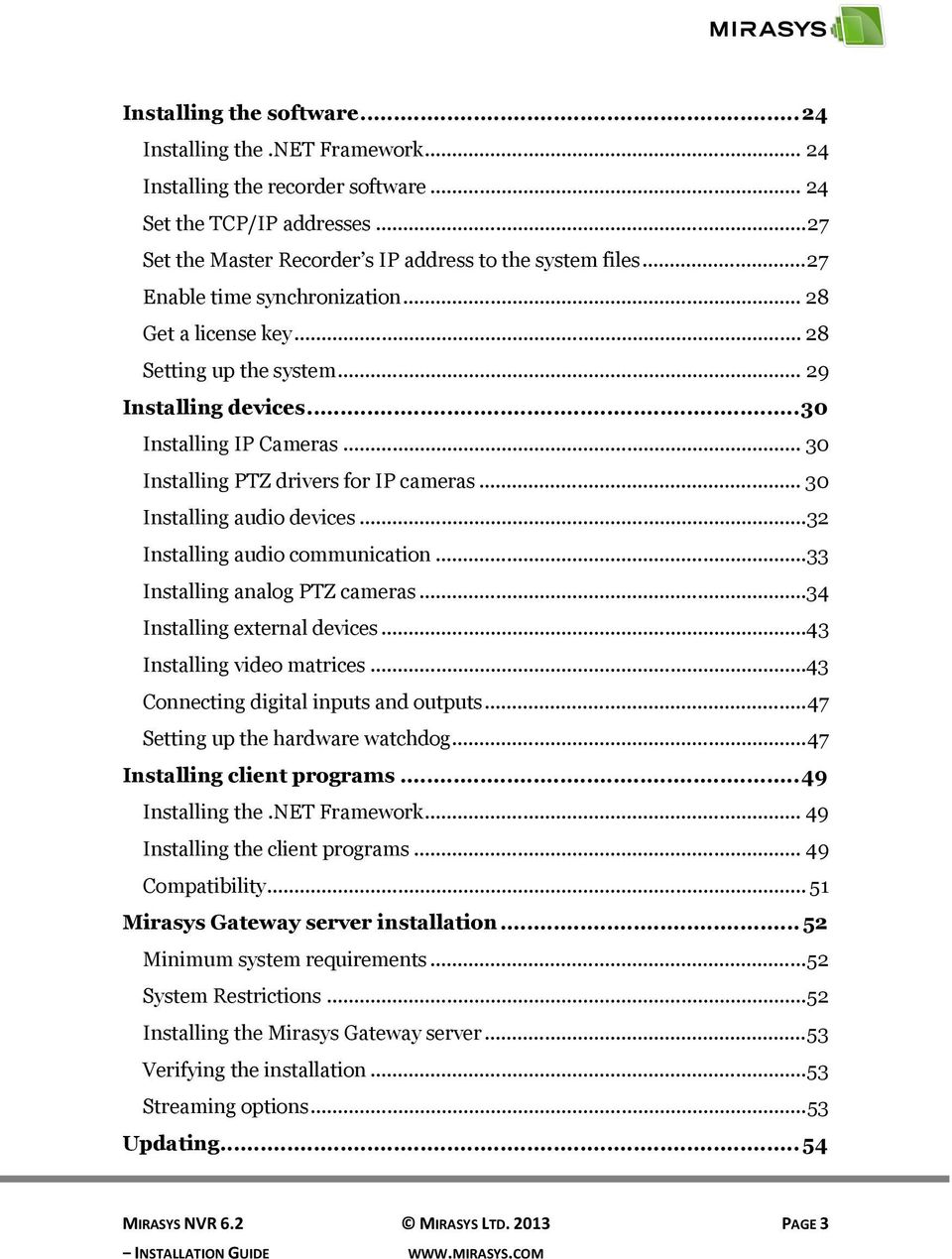
3 Installing the software Installing the.net Framework Installing the recorder software Set the TCP/IP addresses Set the Master Recorder s IP address to the system files Enable time synchronization Get a license key Setting up the system Installing devices Installing IP Cameras Installing PTZ drivers for IP cameras Installing audio devices Installing audio communication Installing analog PTZ cameras Installing external devices Installing video matrices Connecting digital inputs and outputs Setting up the hardware watchdog Installing client programs Installing the.net Framework Installing the client programs Compatibility Mirasys Gateway server installation Minimum system requirements System Restrictions Installing the Mirasys Gateway server Verifying the installation Streaming options Updating MIRASYS NVR 6.2 MIRASYS LTD PAGE 3
4 Updating a recorder Updating client programs Installing VCA components Database installation Adding license keys Camera configuration Text channel configuration VCA installation Supported capture cards for analog VCA Appendix A: Networking recommendations Introduction Mirasys NVR system components TCP Ports Applications Servers...63 IP Addresses or Hostnames Public IP Addresses Virtual Private Network (VPN) Firewall with NAT / Port Forwarding Appendix B: Controlling dome cameras through a video matrix.. 69 Installation Pelco dome camera settings Installing the camera driver Communication settings Copyrights MIRASYS NVR 6.2 MIRASYS LTD PAGE 4

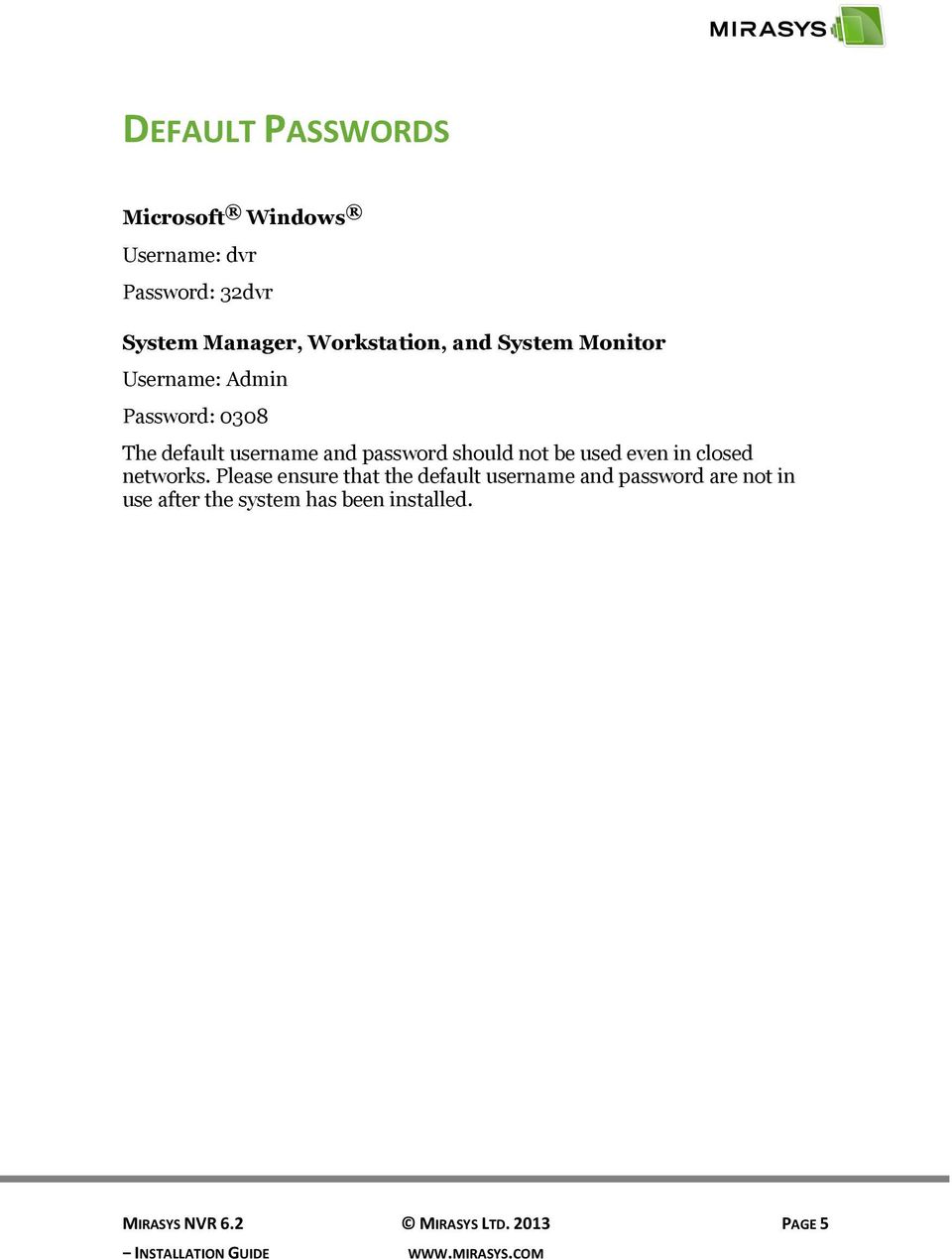
5 DEFAULT PASSWORDS Microsoft Windows Username: dvr Password: 32dvr System Manager, Workstation, and System Monitor Username: Admin Password: 0308 The default username and password should not be used even in closed networks. Please ensure that the default username and password are not in use after the system has been installed. MIRASYS NVR 6.2 MIRASYS LTD PAGE 5
6 BEFORE YOU START Mirasys NVR software is a distributed, digital video management system (DVMS) for video and audio surveillance applications. The software can be used for monitoring real-time and recorded video, audio and text data, and to control dome cameras, I/O devices and IP cameras. The software supports systems consisting of both analog and/or digital surveillance cameras, supporting the creation of analog (DVR), digital (NVR) or hybrid (consisting of both analog and digital) surveillance systems. A centralized surveillance system can consist of up to 100 local or remote recorders. This guide gives instructions for setting up the recorders and for installing audio devices, IP cameras, dome cameras, video matrices, digital inputs and outputs, and client programs (System Manager and Workstation). HELP DOCUMENTATION This help documentation is available: Installation Guide: Shows how to install the recorders, dome cameras and video matrices, and how to connect digital inputs and outputs. Administrator s Guide: Shows how to use the System Manager program for configuring the system. User s Guide: Shows how to use the Workstation program for video and audio surveillance. The PDF help documentation is on the DVMS Installation CD. You can also access the Administrator s Guide and the User s Guide by clicking Help in System Manager or Workstation. MANUALS FOR THIRD PARTY DEVICES When installing third party devices (audio devices, IP cameras, dome cameras, and video matrices), follow the manufacturer s instructions. MIRASYS NVR 6.2 MIRASYS LTD PAGE 6

7 TECHNICAL SUPPORT For technical support and warranty issues, please contact the system supplier. WHAT S NEW IN 6.2 New features in version 6.2.: Compression changes: In previous versions, video streams from analog cameras that stream through uncompressing capture cards have been compressed to either WMC9 or JPEG format on the recorder. In 6.2 and onwards, Mirasys NVR does not support WMC9 compression, and the streams will be automatically compressed in JPEG format. Note: This change only affects video streams from analog cameras through uncompressing capture cards. This change only affects new installations: old installations that are upgraded to 6.2 can still use WMC9. VCA functionality in System Manager: Various VCA functionalities can now be enabled or disabled in System Manager on the camera configuration settings. Please see The Administrator s Guide for further information. WHAT S NEW IN 6.1 New features in version 6.1: Mirasys Spotter: Mirasys NVR 6.1 includes a new end client application for viewing real-time and playback video and exporting video feed and images. Mirasys Spotter is intended to provide an easy-to-use, light interface for video viewing, providing an all-new GUI and usability scheme. Please see Mirasys Spotter Quick Guide for further information. WHAT S NEW IN 6.0 New features in version 6.0: LICENSE UPGRADE: The Mirasys NVR 6.X software is not compatible with Mirasys NVR 5.X or earlier licenses. If you are upgrading from Mirasys NVR 5.X or earlier, it is important to update the license key before continuing to install the software. If the MIRASYS NVR 6.2 MIRASYS LTD PAGE 7
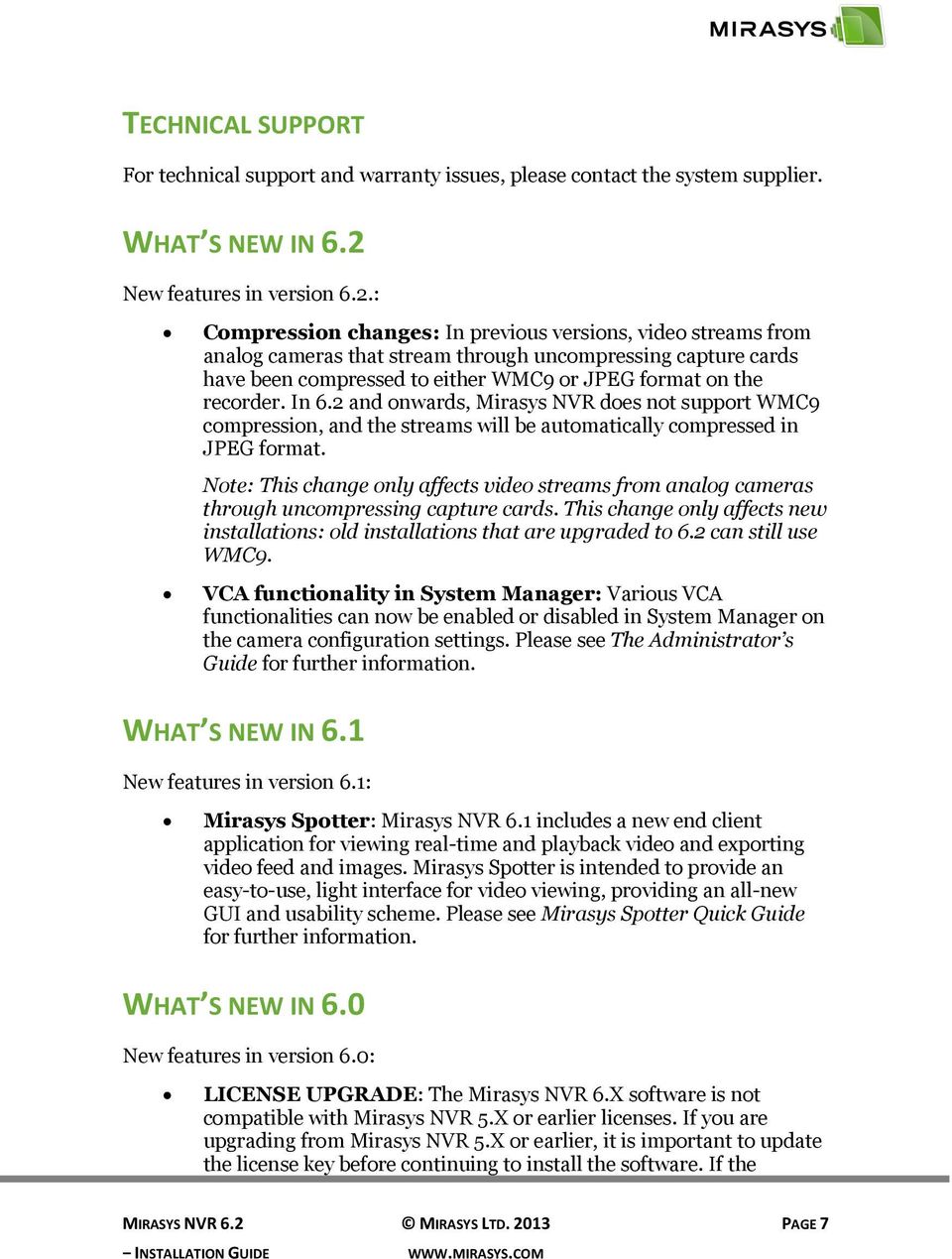
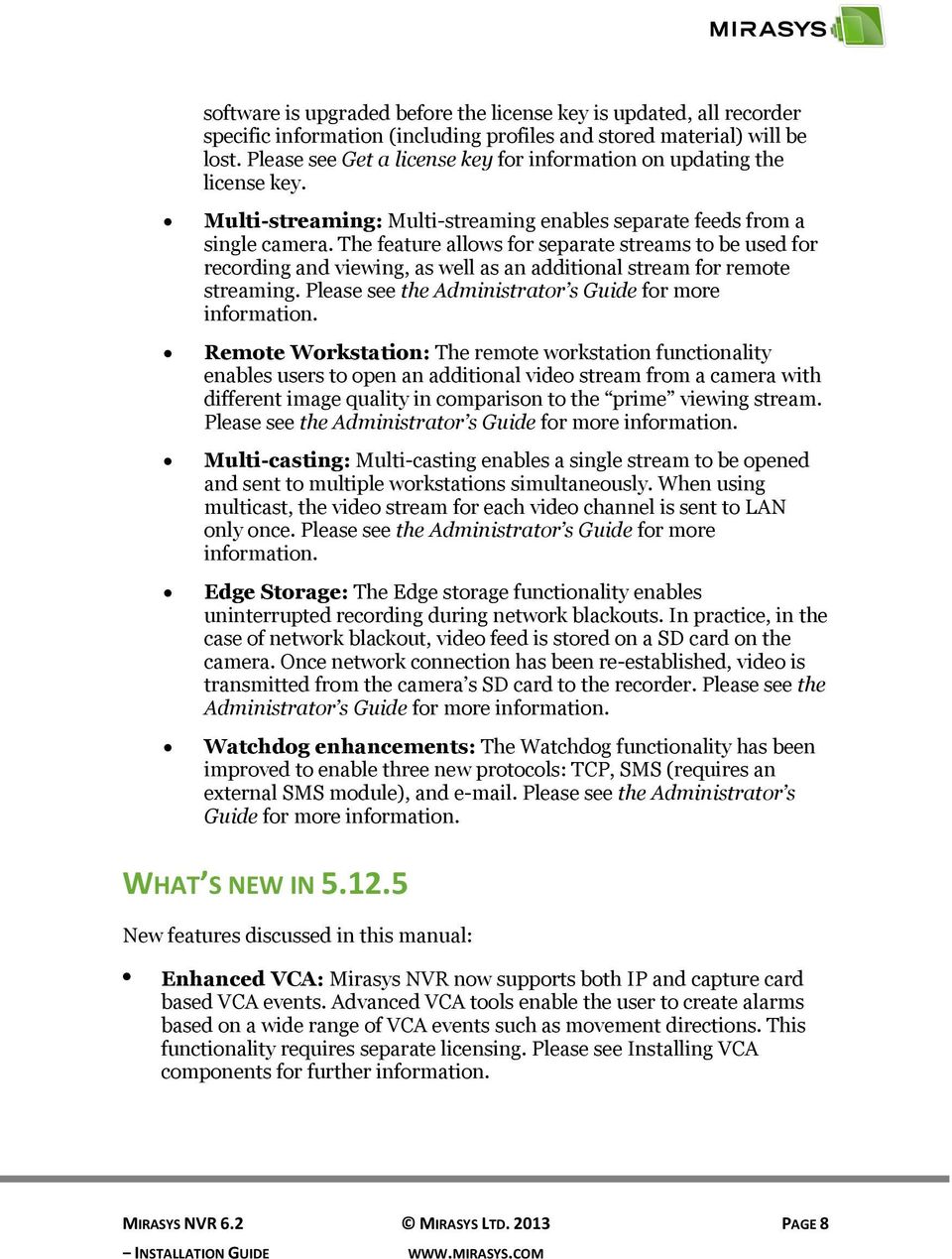
8 software is upgraded before the license key is updated, all recorder specific information (including profiles and stored material) will be lost. Please see Get a license key for information on updating the license key. Multi-streaming: Multi-streaming enables separate feeds from a single camera. The feature allows for separate streams to be used for recording and viewing, as well as an additional stream for remote streaming. Please see the Administrator s Guide for more information. Remote Workstation: The remote workstation functionality enables users to open an additional video stream from a camera with different image quality in comparison to the prime viewing stream. Please see the Administrator s Guide for more information. Multi-casting: Multi-casting enables a single stream to be opened and sent to multiple workstations simultaneously. When using multicast, the video stream for each video channel is sent to LAN only once. Please see the Administrator s Guide for more information. Edge Storage: The Edge storage functionality enables uninterrupted recording during network blackouts. In practice, in the case of network blackout, video feed is stored on a SD card on the camera. Once network connection has been re-established, video is transmitted from the camera s SD card to the recorder. Please see the Administrator s Guide for more information. Watchdog enhancements: The Watchdog functionality has been improved to enable three new protocols: TCP, SMS (requires an external SMS module), and . Please see the Administrator s Guide for more information. WHAT S NEW IN New features discussed in this manual: Enhanced VCA: Mirasys NVR now supports both IP and capture card based VCA events. Advanced VCA tools enable the user to create alarms based on a wide range of VCA events such as movement directions. This functionality requires separate licensing. Please see Installing VCA components for further information. MIRASYS NVR 6.2 MIRASYS LTD PAGE 8
9 WHAT S NEW IN 5.12 WebClient native streaming: The users can choose to view the WebClient streams in JPEG format (default) or in the native format in which they are received by the recorders. This does not require any action on the server side. Please see Streaming options for further information. New languages: Mirasys NVR user interface now supports Chinese (simplified). WHAT S NEW IN 5.11 Support for VCA events and metadata database: The NVR software supports using VCA events as alarm triggers. This feature is currently offered as manually configurable and intended only for advanced users. Please see Installing VCA components for further information. Carbon License: Mirasys NVR can be upgraded to Mirasys Carbon license providing Carbon specific features such as 64 simultaneous video channels on a recorder, and 64 simultaneous real-time windows and 16 simultaneous playback windows in a single group on Workstation. Please contact [email protected] for further information. WHAT S NEW IN 5.10 Core optimization: The NVR has been optimized for new Intel Core i3 and i7 processors, increase the computing power by 30-50% compared to previous processors. Windows 7: Mirasys NVR Workstation is now compatible with both 32 and 64 bit Microsoft Windows 7. Please see OS Compatibility for further details. New languages: Mirasys NVR user interface now supports Arabic. WHAT S NEW IN 5.9 New languages: Mirasys NVR user interface now supports Russian and Thai. MIRASYS NVR 6.2 MIRASYS LTD PAGE 9
10 WHAT S NEW IN 5.4 New features discussed in this manual: Firewall exceptions: The DVMS installer can automatically create exceptions for the Windows firewall. Please see Installing the software for further information. System Monitor: The system administrators can now monitor the system status and the functionality of the recorders through a new light weight application, System Monitor. Please see Mirasys System Monitor Quick Guide for further help on using the application. WHAT S NEW IN 5.0 New features discussed in this manual: LICENSE UPGRADE: The Mirasys NVR 5.X software is not compatible with Mirasys NVR 4.8 or earlier licenses. If you are upgrading from Mirasys NVR 4.8 or earlier, it is important to update the license key before continuing to install the software. If the software is upgraded before the license key is updated, all recorder specific information (including profiles and stored material) will be lost. Please see Get a license key for information on updating the license key. Mirasys V/N series is now Mirasys NVR. The old Mirasys V and N user interface skins have been replaced by a new green skin. Support for H.264 video compression. Mirasys NVR 5.0 supports the H.264 compression method, enabling cameras with H.264 support to transfer the video data in the highly compressed format. Please see Mirasys NVR 5.0 System Administrator s Guide for information on using H.264. WHAT S NEW IN 4.8 New features in version 4.8: The default unregistered license is now time limited. A valid license key should be entered within 60 days of system installation. Please see Get a license key for further information. Mirasys NVR client applications (Workstation and System Manager) are now fully Windows Vista compatible. Note: Due to limited functionality, MIRASYS NVR 6.2 MIRASYS LTD PAGE 10

11 it is strongly recommended that the Mirasys NVR recorder software should not be installed on Windows Vista. MIRASYS NVR 6.2 MIRASYS LTD PAGE 11

12 INTRODUCTION This chapter describes the system architecture. SYSTEM ARCHITECTURE The system has these components: digital video recorders (DVRs) or network video recorders (NVRs) Master Recorder (one of the recorders) Client programs Mirasys NVR System Manager Mirasys NVR Workstation Mirasys NVR System Monitor RECORDERS The DVRs and NVRs record video and audio from multiple cameras and audio channels and write the data on hard disks. You can access a recorder locally or over a network by using the System Manager and Workstation programs, and monitor recorder functionality through the System Monitor application. A recorder contains the computer, the operating system, the recorder software, video capture cards (only DVRs), their drivers, and cameras. An NVR does not have video capture cards. Instead, it records video from IP cameras connected to a network. In addition, you can connect these devices to a recorder: Dome cameras Dome camera keyboard External devices, such as sensors, to the digital inputs of a DVR External devices, such as doors, lights, and gates, to the digital outputs of a DVR Video monitors (only DVRs) MIRASYS NVR 6.2 MIRASYS LTD PAGE 12

13 Printer Backup unit (NAS or RAID) MASTER RECORDER One of the recorders must be a Master Recorder. If the system contains only one recorder, that recorder is the Master Recorder. If there is more than one recorder, you can select the Master Recorder freely. The Master Recorder is set when you install the client programs. The Master Recorder does these things: It verifies the identity of all programs and users who try to log on to the system (authentication). It writes all system configuration data and user data on disk. It monitors the system. It synchronizes the clocks on all recorders. It produces reports. CLIENT PROGRAMS End users use the Workstation program, for example, for these tasks: Monitoring real-time video and examining recorded video. Exporting video and audio clips to local media. Receiving and handling alarm notifications. System administrators use the System Manager program for these tasks: Configuring the recorders. Adding user accounts and user profiles. Monitoring the system. End users use the WebClient or Spotter Mobile programs, for example, for these tasks: Monitoring real-time video and examining recorded video through a Web browser (WebClient) or smart phone application (Spotter Mobile). In addition, system administrators can use the System Monitor application to monitor the status of the recorders. MIRASYS NVR 6.2 MIRASYS LTD PAGE 13
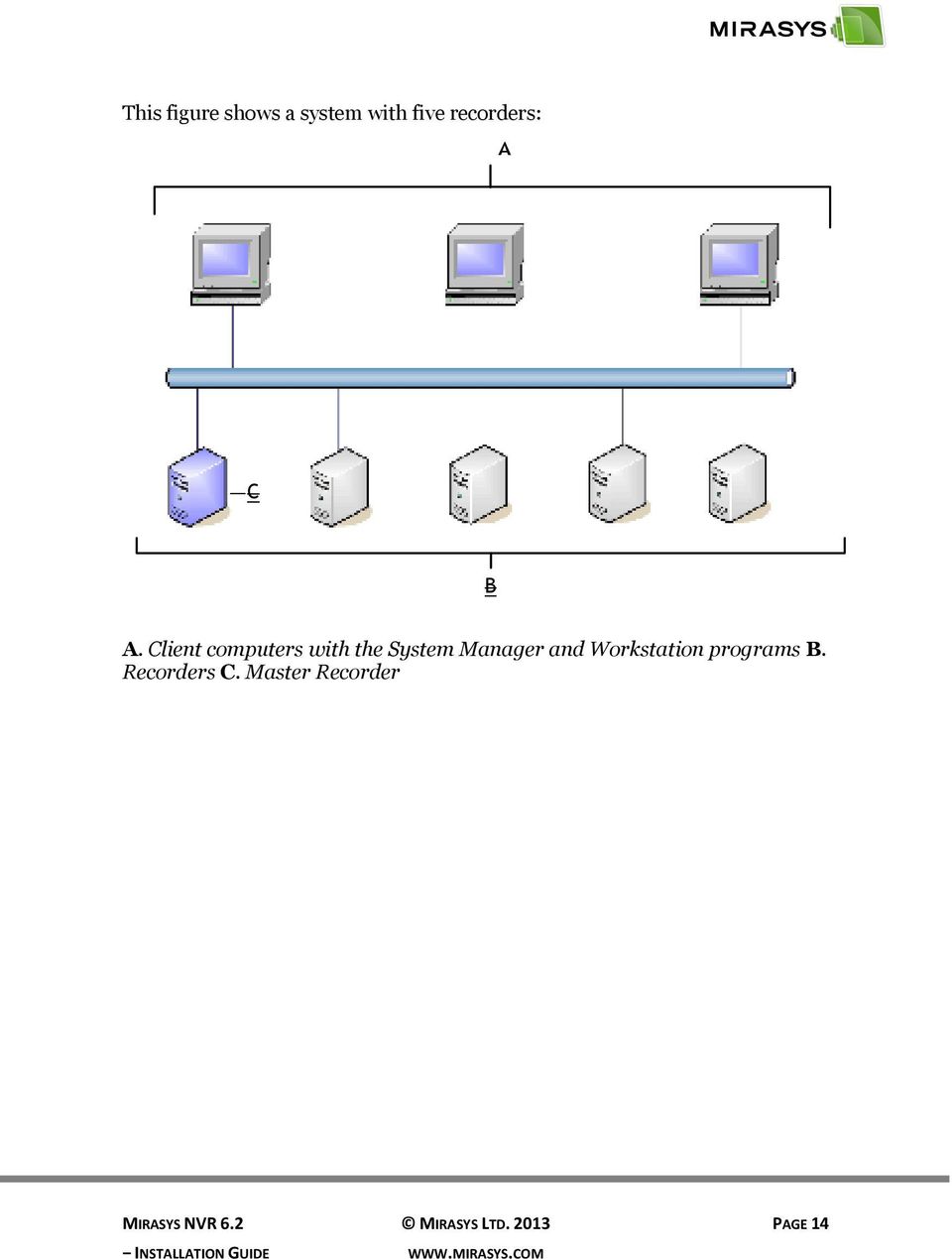
14 This figure shows a system with five recorders: C B A. Client computers with the System Manager and Workstation programs B. Recorders C. Master Recorder MIRASYS NVR 6.2 MIRASYS LTD PAGE 14
15 SYSTEM REQUIREMENTS RECORDERS The recorders require this minimum system configuration: Hardware: Intel Pentium 4 HT 3.2 GHz processor 2048 MB RAM At least 40 GB hard disk space. Note: The recorder reserves 90% of disk space on other drives than drive C for its use. It does not use drive C for storage except when it is the only drive. Display adapter with at least 128 MB memory (a dual-head display adapter is optional) Capture card for DVR models (please see Installing capture cards for the list of supported capture cards). Capture cards are not used in NVR models. Software: Microsoft Windows 7 or XP (See OS Compatibility) Microsoft.NET Framework 4.0 Microsoft DirectX 9.0c (installed automatically with the DVMS software) Microsoft DirectX for Managed Code (installed automatically with the DVMS software) CLIENT PROGRAMS The client programs (System Manager, Workstation, and System Monitor) require this minimum system configuration: Intel Pentium 4 HT 3.2 GHz processor (when using H.264 cameras in the system, quad core processors are recommended) 2048 MB RAM 20 GB hard disk space MIRASYS NVR 6.2 MIRASYS LTD PAGE 15

16 Display adapter with at least 64 MB memory Microsoft Windows 7 orwindows XP (See OS Compatibility) Microsoft.NET Framework 4.0 Microsoft DirectX 9.0c (installed automatically with the DVMS software) Microsoft DirectX for Managed Code (installed automatically with the DVMS software) NETWORK REQUIREMENTS These network requirements apply to systems where users access the recorders over a network. GENERAL 1Gb Ethernet is required on both the client and the server side (see Bandwidth requirements). Data can be transmitted over the Internet, intranet, LAN, WAN, WLAN, ISDN, ADSL, or any other network using TCP/IP. NETWORK CARD SETTINGS Network card setting requirements: Interrupt Moderation Rate --> Extreme Receive Buffers/Receive Descriptors --> 2048 Transmit Buffers/Transmit Descriptors --> 2048 IP ADDRESSES The recorders must have static IP addresses, so that the client programs can connect to them. You can use some NAT solutions with the system but not all: Static network address translation (NAT) can be used between the recorders and the client programs. Dynamic NAT cannot be used because the IP addresses can change. MIRASYS NVR 6.2 MIRASYS LTD PAGE 16

17 Single-address NAT works if there is only one recorder in the NAT system. It does not work if there is more than one recorder in the same system. PORTS These ports must be open on the recorders: 5008 (TCP), between SM Server and client programs Port rule: open inbound 5009 (TCP), between DVR Server and client programs Port rule: open inbound 5010 (TCP), between Watchdog Service and client programs Port rule: open inbound 5011 (TCP), between Streaming Service and client programs Port rule: open inbound Please see Appendix A: Networking recommendations for further information on ports and network information. NOTE: If you are using Windows Firewall, the DVMS installer can automatically create exceptions for the required ports. Please see Installing the recorder software for further information. BANDWIDTH REQUIREMENTS The bandwidth requirements for the network between the recorders and client programs depend on a number of factors. Here are a few aspects to think about: Data transmission from the recorders to the client computers (uplink) requires more bandwidth than data transmission from the client computers to the recorder (downlink). The connection does not have to be symmetric. Real-time monitoring requires more bandwidth than transmitting recorded video or audio. In addition, signaling and protocols increase the required bandwidth. Please refer to Mirasys NVR Series Bandwidth Usage Description for further information on bandwidth usage. MIRASYS NVR 6.2 MIRASYS LTD PAGE 17

18 DATA SECURITY The system uses a light data protection mechanism and user authentication. However, using public networks always includes a security risk because there are no completely secure systems available on the Internet. For this reason, dedicated networks should be used whenever possible to prevent unauthorized access to the system. Consider using a Virtual Private Network (VPN) to create a secure connection between computers on a public network. Antivirus programs should also be used if the system units are on a public network (Internet, intranet). OS COMPATIBILITY Mirasys NVR supports the following operating systems: Operating System DVR NVR Applications Gateway Spotter Windows XP SP 32bit X X X X - Windows Vista Windows 7 Pro / Enterprise 32bit Windows 7 Pro / Enterprise 64bit (in 32bit mode) - X X X X X X X X X Windows 2003 Server Windows 2008 Server Windows 2008 Server R2 Enterprise 64bit (in 32bit mode) Windows 2008 Server R2 Foundation 64bit (in 32bit mode) X X X X - X X X X - MIRASYS NVR 6.2 MIRASYS LTD PAGE 18

19 RECORDER INSTALLATION This chapter shows how to install the video capture cards and the recorder software on a computer that has no previous Mirasys NVR software. To set up a pre-installed recorder: 1. Connect the display, mouse, and keyboard to the computer. 2. Connect the network cable to the computer (for network use). 3. Connect cameras to the BNC connectors. 4. Connect all power cords and turn on the power. 5. The recorder starts automatically and begins to record images from the connected cameras with the default settings. To set up a recorder: 1. If your recorder has analog cameras, install the capture card(s) for the cameras. Please see chapter Installing capture cards for information on installing capture cards. 2. Install the recorder software. Please see chapter Installing the software for information on installing the required software. 3. Install cameras and other devices. Please see chapter Installing devices for further information. 4. Install the client applications. Please see chapter Installing client programs for further information. 5. If your system will utilize WebClient or Spotter Mobile users, you will need to install the Mirasys Gateway server. For further information, please see chapter Mirasys Gateway server installation. 6. For advanced users only: if your system contains VCA components, install and configure the required software. Please see chapter Installing VCA components for further details. To update recorder software and client applications: 1. Please see chapter Updating for information on updating recorder or client software. MIRASYS NVR 6.2 MIRASYS LTD PAGE 19

20 INSTALLING CAPTURE CARDS These capture cards and capture card drivers are used on DVMS DVRs: Capture Card Channels Max. ips (PAL, GIF) Driver Files MiraCap MiraSV.inf, MiraSV.sys MiraCap1606LP MiraSV.inf, MiraSV.sys MiraCap ecpsvd.inf, ECPSVD.sys MiraCap ecpsvc.inf, ECPSVC.sys MiraCapO ecpsv.inf, ECPSV.sys MiraCapO1625D * ecpsvu.inf, ECPSVU.sys MiraCapOC0825H 8 200** HPSV.inf, HPSV.sys * = at D1 resolution ** = at D1 resolution in H.264 format The.inf files that are used by MiraCap capture cards start the installation. The.sys file must be present in the same folder. MIRACAP0405LP, MIRACAP1606LP, MIRACAPO1625, MIRACAP1625D, AND MIRACAPOC0825H To install the capture card: 1. Put the capture card to a PCI bus. 2. Connect the video cable connectors to the connectors on the capture card. 3. Connect the cameras to the BNC connectors on the video cables. To install the capture card driver: 1. Start the computer. MIRASYS NVR 6.2 MIRASYS LTD PAGE 20

21 2. In Found New Hardware wizard, select No, not this time and click Next. 3. Select Install from a list or specific location and click Next. 4. Select Search for the best driver in these locations and Include this location in the search. Click Browse and, on the DVMS Installation CD, open the folder Drivers and then select the folder with the same name as the capture card. 5. Click Next. If a dialog box about Windows Logo testing is shown, click Continue Anyway. Windows installs the driver. 6. Click Finish. NOTE: The MiraCap1606 card has four video components and four audio components. MiraCapOC0825 has one video component and one component for compression. Repeat the driver installation until you have installed the driver for all components. MiraCap3206 and MiraCapO1612 have only one component each. To make sure that the capture card is correctly installed: 1. Click Start, point to Settings, click Control Panel, and then double-click System. 2. On the Hardware tab, click Device Manager. 3. Make sure that DVR-Devices is correctly installed. MIRASYS NVR 6.2 MIRASYS LTD PAGE 21
22 A correctly installed MiraCap1606 capture card. PICOLO TYMO To install the capture card: 1. Put the capture card to a PCI bus. MIRASYS NVR 6.2 MIRASYS LTD PAGE 22
23 2. Connect the video cable connector to the D-15 connector on the capture card. 3. Connect the cameras to the BNC connectors. To install the MultiCam capture card driver: 1. Start the computer. The Found New Hardware wizard is shown. 2. Click Cancel. 3. On the DVMS Installation CD, in the folder Drivers\Euresys\, double-click the file Multicam_X_X.exe and follow the instructions on the screen. NOTE: In the Setup Type dialog box, select Typical. To make sure that the capture card is correctly installed: 1. Click Start, point to Settings, click Control Panel and then double-click System. 2. On the Hardware tab, click Device Manager. 3. Make sure that the card is shown as in the following figure. A correctly installed Picolo Tymo capture card. MIRASYS NVR 6.2 MIRASYS LTD PAGE 23
24 INSTALLING THE SOFTWARE INSTALLING THE.NET FRAMEWORK Install.NET Framework 4.0, and all critical updates on the computer. To install.net Framework: 1. Click Start and then click Windows Update. 2. Install these components (you cannot install them all at one time):.net Framework 4.0 Security updates and critical updates 3. Start Windows Update again until you have installed all the necessary components. INSTALLING THE RECORDER SOFTWARE During recorder software installation, the installer designates the material disks used to store the recorded data. Effectually, the recorder installer designs the largest available HDD as a material disk, as well as any other HDD that approximately matches the largest available HDD in size. After designating the material disks, the installer defines available space on the smallest designated HDD, appropriates ~90% it for data storage, and appropriates the same amount of space from the other disks. For example, if a recorder has one 1TB HDD and one 2TB HDD, the installer appropriates 900MB of disk space from both disks. In this example, it would be recommendable to split the 2TB HDD into two 1TB logical disks, effectually providing the recorder with three 1TB disks, each with 900MB worth of designated data storage. It is highly recommended not to use USB HDDs in the recorder, as they will be used as data storage disks in addition to other HDDs. If, however, you need to have USB HDDs connected to the recorder, it is highly suggested that you disconnect them before installing Mirasys NVR recorder software. You can attach them after installing the software, and they will not be used as material disks unless specifically designated through System Manager. (The same applies to other HDDs added after recorder installation.) If you do not disconnect the USB HDDs before software installation, the recorder software will automatically use them to store recorder media files. MIRASYS NVR 6.2 MIRASYS LTD PAGE 24
25 To install the recorder software: 1. Put the DVMS Installation CD into the CD drive. The setup program starts automatically. If the setup program does not start automatically, you can also start it by double-clicking the file dvms_x.x.x.msi (X.X.X is the version number). NOTE: The Mirasys NVR 6.X software is not compatible with Mirasys NVR 5.X or earlier licenses. If you are upgrading from Mirasys NVR 5.X or earlier, it is important to update the license key before continuing to install the software. If the software is upgraded before the license key is updated, all recorder specific information (including profiles and stored material) will be lost. Please see Get a license key for information on updating the license key. 2. In Welcome to the DVMS Installation Wizard, click Next. 3. The Firewall settings information screen opens. After reading, click Next. 4. By default, the setup program installs the recorder and the applications System Manager, Workstation, and System Monitor: a. If you do not want to install the applications on the recorder, open the menu next to Applications and select Entire feature will be unavailable. MIRASYS NVR 6.2 MIRASYS LTD PAGE 25
26 b. If you want the Workstation application to start automatically, open the menu next to Start Workstation automatically and select Will be installed on local hard drive. c. If you want the System Monitor application to start automatically, open the menu next to Start System Monitor automatically and select Will be installed on local hard drive. d. If you want firewall exceptions set automatically for Windows Firewall, open the menu next to Set firewall exceptions and select Will be installed on local hard drive. Do not select this option if you are not using Windows Firewall. 5. Click Next. 6. Select the destination folder and click Next. 7. In the Installation Configuration dialog box, specify the IP address or DNS name of the Master Recorder. The Master Recorder is the recorder where all system configuration data is stored when more than one recorder is used in the same system. Click MASTER_RECORDER and click Set. In the Property value box, type the IP address or DNS name of the Master Recorder. (This dialog box is not shown if only the recorder is installed). If the Master Recorder is the local computer, use the default value Then click Next. 8. Select the video standard and click Next. Then click Next to start the installation. 9. After DirectX 9.0c installation has started, select I accept the agreement and click Next. 10. When the recorder has been installed, the dialog box Recorder has been successfully installed is shown. 11. Click Finish. For information about setting up the recorder, see Recorder installation. For information about how to install the client programs, see Installing client programs. MIRASYS NVR 6.2 MIRASYS LTD PAGE 26
27 SET THE TCP/IP ADDRESSES To set the TCP/IP addresses in Windows XP: 1. Click Start, point to Settings and then click Control Panel. 2. Double-click Network Connections. 3. Right-click Local Area Connection and choose Properties. 4. Click Internet Protocol (TCP/IP) and then click Properties. 5. Select Use the following IP address and type a static IP address. Also specify the Subnet Mask, Default Gateway and DNS Server address. SET THE MASTER RECORDER S IP ADDRESS TO THE SYSTEM FILES If the recorder will function as the Master Recorder of a system, and if it will be accessed over a network, you have to set the recorder s IP address through the System Manager application. To set the IP address through System Manager: 1. Start System Manager locally on the Master Recorder as instructed in the Administrator s Guide. 2. In the System tab, click Change recorder addresses. 3. Click on Local Recorder. 4. Click the Change recorder address button. 5. Type the new IP address or DNS name of the recorder into the New recorder address field. 6. Click OK. NOTE: You only need to set the local IP address for the Master Recorder of a system if the recorder can be accessed over a network. If the recorder is accessed locally, there is no need to set the address. MIRASYS NVR 6.2 MIRASYS LTD PAGE 27
28 ENABLE TIME SYNCHRONIZATION When more than one recorder is used in the same system, the Master Recorder keeps the clocks of all recorders synchronized. For this reason, one recorder should not belong to more than one system. The Master Recorder synchronizes the clocks once a day. However, if the time difference between the clock on the Master Recorder and the clock on the other recorder is more than 29 minutes, the clocks are not synchronized. For the time synchronization to work correctly, the Windows time synchronization must be disabled on the other recorders. However, it can be enabled on the Master Recorder. To disable Windows time synchronization: 1. Click Start, point to Settings, click Control Panel, and then double-click Date and Time. 2. On the Internet Time tab, make sure that the check-box Automatically synchronize with an Internet time server is not selected. GET A LICENSE KEY By default, the recorder supports only one IP camera. To get the full functionality, get a license key from Mirasys. For the license key, you need the MAC address of the recorder. NOTE: The Mirasys NVR 6.X software is not compatible with Mirasys NVR 5.X or earlier licenses. If you are upgrading from Mirasys NVR 5.X or earlier, it is important to update the license key before continuing to install the software. If the software is upgraded before the license key is updated, all recorder specific information (including profiles and stored material) will be lost. MIRASYS NVR 6.2 MIRASYS LTD PAGE 28
29 To get a license key: 1. Start System Manager. The License Information dialog box is automatically shown when no license key has been specified. 1. On the System tab, under Licenses, double-click the recorder that you want to update. 2. In the License Information dialog box, copy the MAC address and send it to [email protected] In return, you will receive the license key as a text file. 3. Click Import license from file. 4. Click OK. The system is updated immediately. NOTE: The default unregistered state that allows the use of one IP camera has been time limited. The unregistered state can be active for up to 60 days, after which a valid license key is required. Unless a valid license key is not added to the system within 60 days after the installation, the system will cease to operate. NOTE: For information on acquiring VCA feed source licenses, please refer to Installing VCA feed source licenses. SETTING UP THE SYSTEM After connecting the cameras and other devices to the recorders, configure the system settings and add user accounts and user profiles. To configure the system: 1. Start System Manager locally or over a network (click the DVMS System Manager icon on the desktop). 2. Add recorders to the system and configure their settings on the Recorders tab. 3. Add user profiles on the Profiles tab. 4. Add user accounts on the Users tab. 5. Install the client programs on the end users computers. See Installing client programs. For more information about how to configure the system, see the Administrator s Guide. MIRASYS NVR 6.2 MIRASYS LTD PAGE 29
30 INSTALLING DEVICES INSTALLING IP CAMERAS You can connect supported IP cameras and video servers to a recorder over a TCP/IP network. An IP camera has a built-in component for capturing video images. The camera is connected directly to a local area network, and it has its own IP address. You can also use video servers to change analog cameras into IP cameras. Video servers are also connected directly to the local area network, and they have their own IP addresses. Depending on the software license, you can connect analog and IP cameras to the same recorder. Alternatively, all cameras can be IP cameras. For a list of supported cameras, see the document Supported IP Cameras on the DVMS Installation CD. Please see the Administrator s Guide for instructions on installing IP cameras to the system. NOTE: A 4-camera video server must be configured to start from camera number 1, 5, 9 or 13 etc. INSTALLING PTZ DRIVERS FOR IP CAMERAS The recorders support the PTZ (pan, tilt, and zoom) functions for IP cameras and video servers. It is important to note, that for most IP dome cameras, the dome functionality is installed simultaneously with the camera driver through automatic camera search or IP camera finder. Please see the Administrator s Guide for further information. In some cases, however, especially for some older camera models, the PTZ functionality driver needs to be installed separately. For information about these camera models, see the documents Supported IP Cameras and Supported Dome Cameras & Plugins on the DVMS Installation CD. To install the PTZ driver for a camera not supported through automatic camera search or IP camera finder: 1. To install the driver, double-click the driver installer <driver name>_xx.msi, where XX is the version number. For information about MIRASYS NVR 6.2 MIRASYS LTD PAGE 30
31 the drivers, see the document Supported Analog Dome Cameras & Plugins on the DVMS Installation CD. 2. Click Next until you get to the Destination Folder dialog box. Make sure that you select the same folder as where the recorder is installed. 3. Click Next until the DVMS Driver Configuration tool starts. Configure the driver as follows: a. Select the option Show Dome camera drivers. b. From the drop-down list, select the driver that you just installed. c. Type the number of the camera in the DVR camera ID box. 4. Click Configure and do the following: a. In the dialog box that is shown, click Add Connection. b. In the Connection Name dialog box, type a descriptive name for the connection and click OK. c. Click Add Camera. d. Type or select at least the necessary settings. See more details below. 5. Click OK and Close to close all dialog boxes. NOTE: In the camera setup dialog box, type or select at least these settings: Type a descriptive name for the camera. Type the IP address of the camera (and the port). Type the user name and password that are in the camera's settings (by clicking Launch camera setup application, you can access the camera's settings). The user name and password that you type here are written to the recorder s settings. For some cameras, you must choose the camera s mounting type, ceiling or desktop. If you select the incorrect option, the camera will move to the opposite direction when the user tries to control it. For some cameras, you can click Menu to access additional camera settings. The menu opens on the video window. To see the menu, open a web browser and type the IP address of the camera in the address bar. Use the Up, Down, Left, and Right buttons to navigate in the menu. MIRASYS NVR 6.2 MIRASYS LTD PAGE 31
32 If the dome camera is connected to an Axis video server, select the Camera connected to Axis video server check box. Then select the number of the camera input (ID) on the Axis server. To make sure that the camera s IP address is correct and to access other camera settings that are not shown in the dialog box, click Launch camera setup application. Some models have a Reset Camera button for restarting the camera. Some models (some Bosch PTZ IP cameras) require additional ports to be opened to the recorder s firewall. Please refer to the camera manuals for further information. NOTE: The PTZ driver installs only the camera control functions. For instructions on how to install and configure an IP camera or a video server, see Installing IP Cameras. NOTE 2: The Axis PTZ driver makes it possible to control not only the Axis 213 PTZ IP camera, but also analog dome cameras that are connected to an Axis 241Q or 241S video server. Note that the dome cameras must be supported by Axis. Contact Axis to get the dome camera driver and load it on the Axis video server. INSTALLING AUDIO DEVICES Audio recording requires the following: A digital recording interface, for example, a PCI audio card or a USB device A preamplifier, if necessary For more information about suitable audio devices, please contact the system supplier. To install an audio device: 1. Connect the device to the recorder. 2. Install the audio driver (capture driver). For more information about installing an audio device, see the manual supplied with the device. To configure audio channels: 1. Start System Manager. MIRASYS NVR 6.2 MIRASYS LTD PAGE 32
33 2. In Hardware Settings, on the Audio tab, click Add. 3. Select the capture driver from the list. 4. Select one of these options: Mono. Select to use two mono channels. Stereo. Select to combine two mono channels into one stereo channel. 5. Click OK. For information about how to change audio detection settings, see the Administrator s Guide. INSTALLING AUDIO COMMUNICATION You can connect a call button, a microphone and a (loud)speaker to a recorder and use them as a door or gate phone. Each recorder can have one such audio communication channel. Audio is transmitted over a TCP/IP network. When the call button is pushed, the system sends a call signal to the Workstation program. This is shown by an animated telephone icon on the user s desktop and a ringing sound. The user can then answer the call, which opens a direct, two-way communication channel between the user and the person who pushed the call button. The users can also open the communication channel from Workstation when there is no call signal. To connect the devices: 1. Connect a call button or an equivalent device to one of the digital inputs on the recorder. 2. Make sure that the user s workstation has audio hardware that supports two-way audio. For example, the audio device can be an integrated sound card. 3. Connect a microphone and a speaker or an earphone to the recorder and to the user s workstation. To set up audio communication: 1. Start System Manager. MIRASYS NVR 6.2 MIRASYS LTD PAGE 33
34 2. In Hardware Settings, on the Audio Communication tab, select the capture driver and the playback device used on the recorder. 3. In Audio Communication Settings, type a name for the communication channel (or use the default name). 4. Type a general description and an administrative description of the channel. All users can see the general description, whereas only system administrators can see the administrative description. 5. Select the digital input that the call button is connected to. INSTALLING ANALOG PTZ CAMERAS NOTE: Supported dome camera models are listed in the document plugin.pdf on the DVMS Installation CD. HARDWARE INSTALLATION Connect the dome camera to the RS-232 serial port of the recorder and the video cable to a BNC connector. Because most dome cameras use the RS-485 or RS-422 standard for transferring control data, use an RS-232/RS-485 or RS-232/RS-422 converter. MIRASYS NVR 6.2 MIRASYS LTD PAGE 34
35 Connecting a dome camera to a recorder. For wiring instructions, see Wiring. INSTALLING MULTIPLE DOME CAMERAS Use one of these options to connect more than one dome camera to a recorder: A multiport serial board. A daisy chain configuration (each camera is connected in a series from the previous camera). A daisy chain configuration together with a multiport serial board NOTE: If you connect more than one camera directly to the same serial port (star configuration), the control signal from the recorder can become too weak. USING A MULTIPORT SERIAL BOARD You can use a multiport serial board to connect more than one dome camera to a recorder. Usually, such a board is put into one of the PCI slots of the MIRASYS NVR 6.2 MIRASYS LTD PAGE 35
36 recorder or plugged to a USB port. Use a board that has RS-422/485 ports. Connect the cameras to the ports by using 2- or 4-wire connectors. Multiport serial boards are available, for example, from Moxa. Using a multiport serial board to connect multiple dome cameras MIRASYS NVR 6.2 MIRASYS LTD PAGE 36
37 USING A DAISY CHAIN CONFIGURATION In a daisy chain configuration, the cameras are connected in one line. It is important that you do these: Give each camera a unique address by using the switches or dials on the camera. Terminate the last camera in the chain. Using a daisy chain configuration to connect multiple dome cameras COMBINATION You can also use a configuration that combines a multiport serial board with daisy- chained cameras. Using a combination of daisy chained cameras with a multiport serial board MIRASYS NVR 6.2 MIRASYS LTD PAGE 37
38 WIRING RS-232 pin assignment Connect the RS-232/RS-485 or RS-232/422 converter to the RS-232 port on the recorder using a 9-pin D-connector. If you make the connections yourself, connect the conductor wires as shown in this table. Recorder RS-232 port RS-232/RS-485 or RS-232/422 converter Pin Signal Signal 1 Not used 2 Receive Data (Rx) Tx 3 Transmit Data (Tx) Rx 4 Not used 5 Signal ground Signal ground 6 Not used 7 Not used 8 Not used 9 Not used SIMPLEX WIRING Wire the dome camera to the RS-232/RS-485 converter. Connect pins as shown in this table and figure. RS-232/RS-485 converter Tx- Tx+ Camera pin Rx- Rx+ MIRASYS NVR 6.2 MIRASYS LTD PAGE 38
39 MIRASYS NVR 6.2 MIRASYS LTD PAGE 39
40 DUPLEX WIRING Wire the dome camera to the RS-232/RS2-485 converter. Connect the pins as shown in this table and figure. RS-232/RS-485 converter Tx- Tx+ Rx- Rx+ Camera pin Rx- Rx+ Tx- Tx+ MIRASYS NVR 6.2 MIRASYS LTD PAGE 40
41 MIRASYS NVR 6.2 MIRASYS LTD PAGE 41
42 CAMERA ADDRESSES When cameras are daisy chained, each camera must have a unique address. Set the address by using the switches or dials on the camera. See the camera manual for more details. NOTE: Terminate the last camera in each chain by using the termination switch or jumper on the camera. INSTALLING ANALOG PTZ CAMERA DRIVERS Available dome camera drivers are on the DVMS Installation CD, in the folder Plug-in. To install the dome camera driver: 1. Double-click the driver installer <driver name>_xx.msi, where xx is the version number. For more information about the driver names, see the document plugin.pdf on the DVMS Installation CD. 2. Click Next until you get to the Destination Folder dialog box. Make sure that you select the same folder where the recorder is installed. 3. Click Next until the DVMS Driver Configuration tool starts. Configure the driver as follows: a. Select the option Show dome camera drivers. b. From the drop-down list, select the driver that you just installed. c. Type the number of the camera in the DVR camera ID box. The number is the same as the number of the video input and the number of the camera in the client programs. 4. Click Configure and do the following: a. In the dialog box that is shown, click Create New. b. In the Connection Setup dialog box, type a descriptive name for the connection, and select the C0M port that the dome camera is connected to. Then click OK. c. In the Choose Connection for the New Camera dialog box, select the connection and click OK. 5. In the camera setup dialog box, do the following: a. Type a descriptive name for the camera. MIRASYS NVR 6.2 MIRASYS LTD PAGE 42
43 b. Type the camera s address in the Camera address box. The camera address is set by using the switches or dials on the camera. Usually, the default address is 0 or Close all dialog boxes. For more information about the drivers, see the document Supported Dome Cameras & Plugins on the DVMS Installation CD. INSTALLING EXTERNAL DEVICES External devices - such as joystick controllers for dome cameras - can be configured through Workstation. The control devices can be configured to support customized controls for axis movement and buttons / keys. Please note that the driver for the external device has to be installed in the system. The drivers for Pelco KBD300A keyboard and DirectX compatible control devices (such as DirectX joystics) are included in the default installation. Please see Mirasys NVR series User s Guide for further information on configuring external devices. PELCO KBD300A KEYBOARD The system supports the Pelco KBD300A keyboard, which you can use to control dome cameras locally or over a TCP/IP network. The keyboard has a joystick, a numerical keypad, and keys for different functions. You can use the keyboard to pan, tilt, and zoom a dome camera. In addition, you can move a dome camera to a preset position or start a camera tour. The Pelco KBD300A drivers are included in the standard installation package, and the keyboard can be installed directly through the Workstation application. Please see Mirasys NVR series User s Guide for further information on configuring Pelco KBD300A the keyboard. INSTALLING VIDEO MATRICES The Mirasys NVRs support the use of external video monitors for analog cameras. These video matrices are supported: Pelco CM6700 and CM6800 Bewator Visilynx 3i MIRASYS NVR 6.2 MIRASYS LTD PAGE 43
44 Video matrices are connected to the recorder s serial port, for example, to COM1. In addition, you can control dome cameras through these video matrices: Pelco CM6700 Bewator Visilynx 3i Bosch Allegiant Appendix A shows a sample installation of dome camera control for Pelco CM6700. INSTALLING THE PELCO CM6700 VIDEO MATRIX The Pelco CM6700 series has these video matrix models: CM6700-MXB2 CM6700-MXB2-X CM6700-MXB4 CM6700-MXB4-X NTSC, 16 video inputs, 2 video outputs PAL, 16 video inputs, 2 video outputs NTSC, 16 video inputs, 4 video outputs PAL, 16 video inputs, 4 video outputs To connect the Pelco CM6700 video matrix: Connect one end of a null modem cable to the COM port (RS-232) of the recorder and the other end to the COM2 port of the Pelco video matrix. NOTE: If the distance between the recorder and the matrix is more than 15 meters, use an RS-422/485 line and an RS-232 converter to RS-422/485. MIRASYS NVR 6.2 MIRASYS LTD PAGE 44
45 Pin diagram for connecting the Pelco CM6700 Switch to a recorder using a RS-232 connection. To install the matrix driver: 1. To install the matrix driver, double-click the file PelcoCM6700G3_XXX.msi. 2. Click Next until you get to the Destination Folder dialog box. Make sure that you select the same folder where the recorder is installed. 3. Click Next until the DVMS Driver Configuration tool starts. Do the following: a. Select the option Show video switch drivers. b. From the drop-down list, select the driver that you just installed. 4. Click Configure and then type or select these settings in the Switch Setup dialog box: MIRASYS NVR 6.2 MIRASYS LTD PAGE 45
46 Switch ID: You cannot change the ID because the driver supports only one matrix at a time. Name: The default name is Switch 1, but you can type a more descriptive name for the matrix. Serial port: Select the serial port that the Pelco CMC6700 is connected to. Setting DVR date/time on CM6700: Sets the CM6700 date and time so that they are the same as the date and time on the recorder. CM6700 Camera Names: Here you can give a name for each camera that is connected to CM6700. NOTE: These names are saved only on CM6700. They have no connection to the camera names set in the recorder s camera settings. Click Send to save the names on CM6700. Number of CM6700 video outputs: Type the number of available video outputs. 5. Close all dialog boxes. INSTALLING THE BEWATOR VISILYNX 3I VIDEO MATRIX The Visilynx 3i video matrix contains 32 loop-through video inputs and 8 outputs. To connect the matrix to the recorder: Connect one end of a null modem cable (female female) to the PCCON port on the Visilynx 3i rear panel and the other end to the recorder s serial port (either to COM1 or COM2). To install the matrix driver: 1. To install the matrix driver, double-click the file Visilynx3iG3_XX.msi. 2. Click Next until you get to the Destination Folder dialog box. Make sure that you select the same folder where the recorder is installed. 3. Click Next until the DVMS Driver Configuration tool starts. Do the following: a. Select the option Show video matrix drivers. MIRASYS NVR 6.2 MIRASYS LTD PAGE 46
47 b. From the drop-down list, select the driver that you just installed. 4. Click Configure and then type or select these settings in the Switch Setup dialog box: Switch ID: It is not necessary to change the ID because the recorder supports only one matrix at a time. Name: The default name is Switch 1, but you can type a more descriptive name for the matrix. Serial port: Select the serial port that Visilynx3i is connected to. Setting DVR date/time on Visilynx3i: Sets the Visilynx3i date and time so that they are the same as the date and time on the recorder. Ping button and response time indication: Shows the response time from the video matrix. Number of video outputs: Type the number of available video outputs in the video switch. 5. Close all dialog boxes. CONNECTING DIGITAL INPUTS AND OUTPUTS You can connect external devices to the digital inputs and outputs of a recorder by using an I/O card. Available cards and the default configuration depend on the recorder model. For more information about the cards, see the folder Manuals on the DVMS Installation CD. SETTING UP THE HARDWARE WATCHDOG MiraCap capture cards have a hardware watchdog, which restarts the computer if it stops responding. The watchdog is not in use by default. To use the watchdog: If the computer has an external reset cable, connect the cable from the PC s reset switch to one of the two watchdog pins on the capture card. Connect the reset cable provided with the capture card from one of the two watchdog pins on the capture card to the reset pin on the mother MIRASYS NVR 6.2 MIRASYS LTD PAGE 47
48 board. The location of the reset pin on the mother board depends on the type of motherboard. For more information, see the motherboard manual. A sample watchdog connection MIRASYS NVR 6.2 MIRASYS LTD PAGE 48
49 INSTALLING CLIENT PROGRAMS There are two Mirasys NVR client programs: System Manager. This is used by the system administrators for configuring the system and the recorders and for creating user accounts and user profiles. Workstation. This is the end users program. System Monitor. This is used by the system administrators for monitoring the system and the recorders. You can use the client programs locally on the recorder or on a computer that has a network connection to the recorder system. INSTALLING THE.NET FRAMEWORK Install DirectX 9.0c,.NET Framework 4.0 and all critical updates on client computers. To install.net Framework: 1. Click Start and then click Windows Update. 2. Install these components (you can not install them all at one time):.net Framework 4.0 Security updates and critical updates 3. Start Windows Update again until you have installed all the necessary components. INSTALLING THE CLIENT PROGRAMS To install the client programs: 1. Put the installation CD into the CD drive. The setup program starts automatically. If the setup program does not start automatically, you can also start it by opening the folder Setup and double-clicking the file dvms_x.x.x (X.X.X is the version number). 2. In Welcome to the DVMS Applications Installation Wizard, click Next. MIRASYS NVR 6.2 MIRASYS LTD PAGE 49
50 3. The Firewall settings information screen opens. After reading, click Next. 4. By default, the setup program installs the recorder and the applications System Manager, Workstation, and System Monitor: a. To refrain from installing the recorder components, open the menu next to Recorder and select Entire feature will be unavailable. b. If you want the Workstation application to start automatically, open the menu next to Start Workstation automatically and select Will be installed on local hard drive. c. If you want the System Manager application to start automatically, open the menu next to Start System Monitor automatically and select Will be installed on local hard drive. d. If you want firewall exceptions set automatically for Windows Firewall, open the menu next to Set firewall exceptions and select Will be installed on local hard drive. Do not select this option if you are not using Windows Firewall. 5. Click Next. 6. Select the destination folder and click Next. MIRASYS NVR 6.2 MIRASYS LTD PAGE 50
51 7. In the Installation Configuration dialog box, specify the IP address of the Master Recorder. Click MASTER_RECORDER, click Set, and type the IP address or DNS name of the Master Recorder in the Property Value box. The Master Recorder can be any of the recorders in the system. Then click Next. 8. After DirectX 9.0c installation has started, select I accept the agreement and click Next. 9. When the recorder has been installed, the dialog box Recorder has been successfully installed is shown. 10. Click Finish. COMPATIBILITY Mirasys NVRs are compatible with Mirasys RMC 2.2 and later versions. Mirasys Workstation is not compatible with Mirasys DINA DVRs. Mirasys NVRs are not compatible with DINA DVR client programs (Controller or Viewer). MIRASYS NVR 6.2 MIRASYS LTD PAGE 51
52 MIRASYS GATEWAY SERVER INSTALLATION Mirasys WebClient is a browser-based application that is used for viewing video from Mirasys recorders over a network. Mirasys WebClient uses the same user profiles, user names, and passwords as Mirasys System Manager and Workstation. To be able to use Mirasys WebClient, the Mirasys Gateway server must be first installed on a computer running a HTTP server. Mirasys NVR recorder software is not required on the server. The Gateway server needs to be able to connect to the Mirasys NVR master server. MINIMUM SYSTEM REQUIREMENTS Client: Internet Explorer 6 or Mozilla Firefox 2.0 or newer Java Runtime Environment 6 Server: Windows XP, Windows 7 Enterprise, or Windows 2008 Server HTTP server software Intel Core 2 Duo processor 2 GB RAM NOTE: Please note also that the minimum system requirements are recommended for mostly live viewing. If multiple users access the same WebClient server simultaneously mainly for search and play back functions, a more powerful processor is required, for example, Intel Core 2 Quad or better. SYSTEM RESTRICTIONS The Mirasys NVR Gateway server can be installed on any Microsoft Windows XP, 7 Enterprise, or 2008 Server that meets the system requirements. Mirasys NVR software is not required on the server. The Gateway server has a limitation of 32 simultaneous streams for all WebClient connections. The limit is universal and user independent; if, for example, User A has 30 open video streams and User B has 2 open video MIRASYS NVR 6.2 MIRASYS LTD PAGE 52
53 streams, neither can open any more streams unless one or more of the currently open streams are closed. INSTALLING THE MIRASYS GATEWAY SERVER To install the Mirasys Gateway server: 1. Double-click the Gateway.exe installation packet to start the installation. 2. After the DVMS Gateway Setup screen has loaded, select the destination folder and click Next. 3. Type the SMServer IP address (the IP address of the master recorder) into the SM Server IP field. 4. Click Next 5. When the software has been installed, click Finish. VERIFYING THE INSTALLATION To verify that the server has been correctly installed: Open a compatible web browser and type the following address: SERVER URL]:[PORT]/ For example, if the WebClient server is on the same computer: If the server is correctly installed, the logon screen is displayed. Type a user name and password in the corresponding boxes and click Log On. The user name and password are set in the Mirasys System Manager program. STREAMING OPTIONS The users can view the WebClient streams in JPEG format (default) or in the native format in which they are received by the recorders. This does not require any action on the server side: the users can decide to view the streams in native format by adding?video=native to the end of the WebClient URL. For example, if the WebClient server is on the same computer: MIRASYS NVR 6.2 MIRASYS LTD PAGE 53
54 UPDATING UPDATING A RECORDER To update a recorder, first remove the current software version and then install the new software version. IMPORTANT: Backup system settings and recorder settings in System Manager before removing the current version and then restore the settings after the update is completed. To remove the current recorder version: 1. Click Start, point to Settings, click Control Panel, and then double-click Add or Remove Programs. 2. Click DVMS and then click Remove. To install the new recorder version: Follow the instructions in Installing the recorder software. UPDATING CLIENT PROGRAMS The client programs are updated automatically to the same program version as the recorder when they are started. To manually update the client programs, first remove the current version and then install the new version by running the file DVMS_setup_X.X.X.msi. To remove the current version: 1. Click Start, point to Settings, click Control Panel, and then double-click Add or Remove Programs. 2. Click DVMS and then click Remove. To install the new version: See Installing the client programs. MIRASYS NVR 6.2 MIRASYS LTD PAGE 54
55 INSTALLING VCA COMPONENTS Mirasys provides configuration services for the VCA functionality; for further information, please contact This section of the manual only covers installing basic VCA functionality. Please refer to Mirasys VMS VCA Manual for more information on using VCA with Mirasys products. Mirasys NVR supports both analog and IP based VCA services. The VCA functionality allows using VCA metadata for creating alarms based on metadata information. This functionality requires separate licensing (see below). If you are using the VCA functionality through analog capture cards,, please see Supported capture cards for analog VCA for a list of supported capture cards. Installing VCA components to a Mirasys NVR system requires the following steps: 1. Installing a database to each Mirasys NVR recorder with VCA streams 2. Adding the license keys: a. Adding VCA channel license keys to each recorder with VCA streams b. Adding capture card / IP capture specific licenses to each recorder with VCA streams 3. Configuring the VCA cameras 4. Configuring the text channels for VCA streams in System Manager 5. Configuring alarm events based on VCA messages in System Manager These steps are further discussed below. IMPORTANT: It is important to note that the licenses and the database are recorder specific and need to be installed on the recorder(s) on which the VCA feeds are situated. If a system contains multiple recorders, the licenses and database must be installed separately on each recorder with VCA feeds. MIRASYS NVR 6.2 MIRASYS LTD PAGE 55
56 DATABASE INSTALLATION Install MS SQL Server with ExpressInstaller.exe (found in the Setup folder in the DVMS installation package). If you are using Windows XP, you may need to update to MSI 4.5 before installing the database. MSI 4.5 is included on the installation CD. The database must be installed separately on each recorder with VCA feeds. ADDING LICENSE KEYS The VCA functionality requires two types of licenses: 1. VCA channel licenses for each VCA camera feed 2. VCA feed source license for each VCA source: a license for each capture card with VCA feeds (if analog cameras are used), and a license for IP VCA capture (if IP cameras are used). The VCA license keys can be acquired at the same time as the recorder license key (see Get a license key for further information). INSTALLING VCA CHANNEL LICENSES The recorder license must include a VCA channel licenses for each VCA camera feed. VCA channel licenses can be added during default NVR license addition or separately (see Get a license key for further information). You can see the recorder specific VCA license situation in the System Manager: MIRASYS NVR 6.2 MIRASYS LTD PAGE 56
57 INSTALLING VCA FEED SOURCE LICENSES The system requires a VCA feed source license for each VCA source; i.e. for each capture card with VCA feeds and for IP camera based VCA feeds. These licenses can be acquired by contacting [email protected] and sending a feed source specific hwguid.txt file for each capture device (capture cards and IP capture) for which you want to add VCA channels. For analog VCA, each capture card needs a separate license. Using VCA through IP cameras requires its own license. To acquire VCA feed source licenses: 1. Start VCAConfigurator (in the DVMS folder) NOTE: Starting VCAConfigurator automatically pauses Mirasys NVR recorder functions. Exiting VCAConfigurator automatically restarts the recorder functions. 2. On the upper side of the VCAConfigurator window, select the devices for which you want to create hwguid.txt files. Each device will have its own hwguid file. 3. Contact Mirasys to get the VCA capture card licenses. Attach the device specific hwguid.txt files to the mail. MIRASYS NVR 6.2 MIRASYS LTD PAGE 57
58 4. After getting the capture device specific licenses, use VCAConfigurator to import each license. CAMERA CONFIGURATION After importing the licenses, you can configure the cameras with VCA functionality in the Camera tab in the VCAConfigurator application. To configure VCA zones and calibration: 1. Calibrate the VCA functionality. 2. Create zones and rules. 3. Test the functionality of your rules. As the configuration rules and parameters are extremely flexible and it is easy to do user errors, Mirasys can take no responsibility for the functionality of any user specified configurations. However, Mirasys provides configuration services for the VCA functionality. TEXT CHANNEL CONFIGURATION Configure the metadata driver. The configuration is done through System Manager by adding a new text channel (see Administrator s Guide for further details). NOTE: The port 5151 is used in Mirasys NVR configuration files and should not be changed without consulting Mirasys ([email protected]). VCA INSTALLATION The VCA based alarms are configured through System Manager through the default alarm management functionality. The VCA events are used as alarm start and end triggers. Please see the Mirasys NVR Administrator s Guide for information on creating alarms. MIRASYS NVR 6.2 MIRASYS LTD PAGE 58
59 SUPPORTED CAPTURE CARDS FOR ANALOG VCA The VCA functionality is supported by the following cards: MiraCapO1612 MiraCapO1625 MiraCapO1625D MiraCapOC0825H MiraCapOC1625H MIRASYS NVR 6.2 MIRASYS LTD PAGE 59
60 APPENDIX A: NETWORKING RECOMMENDATIONS INTRODUCTION This document contains a brief description of the network configurations used in Mirasys NVR systems. It should be noted that the document concentrates in providing a general overview on building working surveillance systems in various network models. All data communication within the Mirasys NVR system use TCP/IP protocol and networks. The network itself can be LAN, WAN or DSL. The use of virtual private networks (VPN) and effective firewalls is highly recommended. If a computer within the system network is used for other than surveillance purposes and is vulnerable to viruses or other harmful attacks, anti-virus protection is heavily recommended. Building a functional and secure surveillance system requires a clear and detailed understanding of the network and its elements. If there is any doubt regarding the network or its elements, consulting the company s internal IT department or the ISP is heavily recommended. MIRASYS NVR SYSTEM COMPONENTS Mirasys NVR system components can be divided into applications and servers. Applications are used to open communication with and between the servers, and to send connection requests to servers, while servers accept connection requests from applications or from other servers. Communication between the system components is implemented with TCP/IP protocol through TCP ports MIRASYS NVR 6.2 MIRASYS LTD PAGE 60
61 Workstation and System Manager WebClient Port 5008 towards SMServer Ports 5009, 5011 towards DVRServer Ports 9999 and 9000 towards GatewayServer TCP/IP Network Ports 5009, 5011 towards Workstation Ports 5009, 5010 towards SMServer Port 5001 towards RMC and SDK Ports 5009, 5010 towards DVRServer Port 5008 towards Workstation and WebClient Port 9999 and 9000 towards WebClient users Port 5008 towards SMServer Ports 5009, 5011 towards DVRServer DVRServer, WDServer SMServer, WDServer, (DVRServer) GatewayServer Figure 1 - Mirasys NVR communication ports. Notice that the servers and applications can be installed on a single computer. TCP PORTS In all NVR installations, the following TCP ports must be open on all recorders for the applications and servers to function correctly: 5008, between SMServer and client applications Port rule: open inbound MIRASYS NVR 6.2 MIRASYS LTD PAGE 61
62 5009, between DVRServer and client applications, and between SMServer and DVRServers Port rule: open inbound 5010, between Watchdog Server and client applications, and between Watchdog Server and DVRServers Port rule: open inbound 5011, between Streaming Service and client applications Port rule: open inbound Optional ports: 5001, only used if the system includes SDK or RMC. Between DVRServer and SDK or RMC. Port rule: open inbound WebClient and GatewayServer specific ports: 9000 and 9999, between WebClient and GatewayServer. Port rule: open inbound APPLICATIONS VAU VAU is an invisible application. It is used to automatically update the user applications (Workstation and System Manager) to the latest versions from the Master Recorder SMServer. VAU is installed during the application installation, and the application is started automatically when either Workstation or System Manager is run. VAU uses the Master Recorder IP Address or hostname to contact SMServer (TCP port 5008). After VAU has connected to SMServer, it downloads the latest version information. If the version information differs from the previous application startup, VAU downloads all files needed to update the application. If the downloaded version information matches the local version information, only the configuration files will be downloaded. The configuration information includes for example the SMServer address to which Workstation or System Manager will contact at startup. After updating the version or downloading the configuration files, Workstation or System Manager will be started and VAU will close. MIRASYS NVR 6.2 MIRASYS LTD PAGE 62
63 WORKSTATION AND SYSTEM MANAGER When the Workstation or System Manager application is started, the user s username and password are used to download the corresponding user profile from the the SMServer (TCP port 5008). The profile data includes all information regarding the DVRs connected to the system and available for the user profile. The applications access the DVRs through TCP port Video, audio and data streams requested through the applications use TCP port WEBCLIENT The WebClient application can be used with IE 6 or later, or Mozilla Firefox 2 or later from any computer in the Internet. If the GatewayServer server application is installed with the default values, TCP ports 9999 and 9000 must be open between the WebClient browser computer and the GatewayServer server computer. The default ports can be changed during the GatewayServer installation. SERVERS SMSERVER SMServer is the server application used in the Master Recorder (i.e. the NVR or DVR that acts as the focal point in communicating with the client applications and other recorders in the system). SMServer listens on TCP port 5008 for the client applications. SMServer uses TCP port 5009 to connect to the other DVRs for time synchronization, settings changes etc. DVRSERVER DVRServer listens on TCP port Video, audio and data streams require TCP port 5011 to be open. If the system includes SDK or RMC, DVRServer also listens on TCP port DVRServer never contacts the applications or SMServer. However, if IP cameras are installed in the system, DVRServer contacts the IP cameras using TCP or UDP (TCP port 80) depending on the camera model. MIRASYS NVR 6.2 MIRASYS LTD PAGE 63
64 WATCHDOG SERVER Watchdog Server provides system monitoring functions. In severe situations such as system malfunction or hard disk failure, Watchdog can for example restart the computer or send containing information about the malfunction. Watchdog Server is automatically installed with SMServer and DVRServer. Watchdog Server takes care of the connections and operational reliability of the DVR system through TCP port WEBCLIENT GATEWAYSERVER The optional WebClient GatewayServer server application must be installed on a computer with Windows XP, Vista, or 2003 Server operating system. Mirasys NVR software is not required on the server. The WebClient Gateway Server contacts the SMServer through TCP port When the WebClient applet is used from any computer, the WebClient Gateway Server and the WebClient applet communicate by default through TCP ports 9999 (applet download) and 9000 (direct communication between the server and the applet). These TCP ports can be changed during the GatewayServer installation. IP ADDRESSES OR HOSTNAMES The system can be configured to contact the DVRs through their IP address or hostname. If the system is intended to be used from outside a closed network, it is recommended to build the system using DVR hostnames instead of IP Addresses. This makes it possible to contact the system from outside the local network with minimal effort. Please refer to Mirasys NVR System Administrator s Guide for further information on setting the recorder hostnames through the System Manager application. Even if the system uses public IP Address, is run in a closed network, or is used through VPN, using hostnames instead of IP addresses can enhance general usability. CLOSED NETWORK The most secure way to build a surveillance system is to use a dedicated network that does not allow outside connections. This may not be feasible in MIRASYS NVR 6.2 MIRASYS LTD PAGE 64
65 all cases, for example if alerts are used in the system, or if Internet access is required. PUBLIC IP ADDRESSES Using public IP Addresses with the Workstation and System Manager applications outside the local network, one address is required for each DVR and for the SMServer. A better way to use a limited number of public IP Addresses is by using the WebClient application. By providing a public IP Address fort the WebClient Server, it is possible to access cameras in realtime and playback modes through Internet Explorer 7. VIRTUAL PRIVATE NETWORK (VPN) VPN (Virtual Private Network) can be used to establish secure connections between two or more LANs, or to have a well-protected point-to-point connection over the Internet. VPN tunnels can be created using hardware-to-hardware connections, usually firewalls. VPN tunnels are typically created with the combination of a hardware firewall VPN server and software VPN client connections. VPN uses encryption and authentication protocols preventing unknown computers from accessing data delivered between two or more computer sites. After VPN is configured, Mirasys NVR can be installed and used as if in a closed network. CONFIGURING A VPN When Mirasys NVR system is used with VPN, communication links (tunnels) are created between DVRs, SMServer and Workstation/System Manager. An easy way to use VPN is to create a LAN to LAN connection. The DVRs should be on the VPN server network, and the clients on the VPN client network, as DVRs do not automatically send data to the applications. All data connections are initiated by the client applications. To configure a VPN: Create a VPN tunnel on the LAN where Mirasys NVR system is located. This is the VPN server. MIRASYS NVR 6.2 MIRASYS LTD PAGE 65
66 Create a similar tunnel on the client site LAN (Workstation/System Manager). Select a VPN mode that allows continuous connection. Test the connection. Once connected, start configuring the Mirasys NVR system. FIREWALL WITH NAT / PORT FORWARDING Firewall devices and programs protect computers by controlling communication between LAN (local area network) and WAN (Internet). Firewalls can be used to multiply IP Address space in a network and to manage NAT changes. In this section, we consider firewalls as local network firewalls protecting all computers in the network in which the DVRs and the SMServer are located. In a Mirasys NVR system with a firewall with NAT / Port Forwarding, server names should be used instead of IP Addresses. CONFIGURING EXTERNAL CLIENT COMPUTERS If a firewall with NAT or port forwarding is used, the client computers (containing the Workstation or System Manager applications) need to be configured to use server names instead of their IP Addresses. Configuration changes should be made only to the external client computer. To change the SMServer and DVR IP addresses to their hostnames, open the file C:\WINDOWS\system32\drivers\etc\hosts with a simple text editor such as Notepad. The contents of file should read as: # Copyright (c) Microsoft Corp. # # This is a sample HOSTS file used by Microsoft TCP/IP for Windows. # # This file contains the mappings of IP addresses to host names. Each # entry should be kept on an individual line. The IP address should # be placed in the first column followed by the corresponding host name. MIRASYS NVR 6.2 MIRASYS LTD PAGE 66
67 # The IP address and the host name should be separated by at least one # space. # # Additionally, comments (such as these) may be inserted on individual # lines or following the machine name denoted by a '#' symbol. # # For example: # # rhino.acme.com # source server # x.acme.com # x client host localhost Add SMServer and DVRServers IP Addresses and names in the following format: localhost SMServer DVRServer DVRServer2 Note - Write first the SMServer s or DVR s IP Address, press TAB, and write the hostname. The IP Addresses in the example above are for the dedicated SMServer and two dedicated DVRs. Thus, with this configuration, the system needs three public IP Addresses. If there is only one public IP Address (NAT, port forwarding) there can be only one DVR at the site, and the SMServer needs to be installed in the same DVR computer (the Master Recorder). Inside a local LAN, the Workstation and System Manager applications need no extra configuration. CONFIGURING THE FIREWALL If the system is behind a firewall, and the Workstation or System Manager applications are located outside the local network, necessary communication ports have to be opened in the firewall. If a software firewall is used, make sure that the dedicated ports are open on all Mirasys NVR system computers. MIRASYS NVR 6.2 MIRASYS LTD PAGE 67
68 Follow these guidelines: In the client application computers run from outside the local network, change the settings in the file hosts as described above. Allow ports to be open in the firewall to enable connections from outside the LAN (the client applications). Use static IP Addresses. If port forwarding technique is used, define the SMServer and DVR addresses to be WAN site firewall addresses. In the local network, no additional changes to the settings need to be done. WebClient Server needs ports 9000 and 9999 to be open outside the local network. If notification is used, allow SMTP port 25 to be open. If IP cameras are used, allow port 80 to be open to the DVRs. Figure 2 - Mirasys NVR System with firewalls DOMAIN Building a Mirasys NVR system in a domain does not differ considerably from other networks. In a domain, only administrative user can install DVRs, SMServer and the client applications. When client applications are used, restricted user can access the applications depending on the user rights policies. In a domain, all computers are named, and the DVRs can be named according to the domain infrastructure. Use static IP Addresses with the DVRs and the SMServer MIRASYS NVR 6.2 MIRASYS LTD PAGE 68
69 APPENDIX B: CONTROLLING DOME CAMERAS THROUGH A VIDEO MATRIX Users can control Pelco dome cameras that are connected to a Pelco CM6700 video matrix from the Workstation program. The cameras are connected to the matrix using coaxial cabling, and control messages are transmitted in the same cable. The Pelco ASCII protocol is used for dome camera control. This figure shows the configuration: A sample system INSTALLATION To connect the matrix to the DVR: 1. Connect one end of a serial cable to the COM port (RS-232) of the DVR and the other end to the COM2 port of the Pelco video matrix. NOTE: If the distance between the DVR and the matrix is more than 15 meters, use an RS-422/485 line and an RS-232 converter to RS-422/485. MIRASYS NVR 6.2 MIRASYS LTD PAGE 69
70 2. Set the connection type with the DIP switch SW5 on the matrix. 3. Select Coaxitron as receiver protocol for each dome camera. 4. Set other video matrix parameters. For more information, see the matrix manual. NOTE: The RS connection speed must be the same on the DVR and the matrix. The default speed on the DVR is RS-232 port wiring. Pelco MIRASYS NVR 6.2 MIRASYS LTD PAGE 70
71 RS-422/485 port wiring. Pelco Set the DIP Switch SW5 (COM2) for RS-232 or RS-422/485. Pelco MIRASYS NVR 6.2 MIRASYS LTD PAGE 71
72 PELCO DOME CAMERA SETTINGS Pelco dome cameras recognize the used protocol automatically. Therefore, it is not necessary to configure the dome cameras or change the identifier DIP switches. Cameras are identified by the video matrix connection ID. In other words, a camera that is connected to video input 1 has 1 as camera address. INSTALLING THE CAMERA DRIVER To install the dome camera driver and to configure the dome cameras, perform these steps: 5. Install the dome camera driver and configure the first dome camera. 6. Configure the remaining dome cameras. The more detailed instructions are given below. INSTALLING THE DOME CAMERA DRIVER To install the dome camera driver: 1. To install the driver, double-click the file PelcoG3_ASCII_XX.msi on the DVMS Installation CD. 2. Click Next until you get to the Destination Folder dialog box. Make sure that you select the same folder where the recorder is installed. The default is C:\Program Files\DVMS. 3. Click Next until the DVMS Driver Configurator tool starts. Do the following: Select the option Show dome camera drivers. Type the number of the first dome camera in the DVR camera ID box. The number is the same as the camera number in the user interface. From the drivers drop-down list, select PelcoG3_ASCII. 4. Click Configure and do the following: e. In the dialog box that is shown, click Create New. MIRASYS NVR 6.2 MIRASYS LTD PAGE 72
73 f. In the Connection Setup dialog box, type a descriptive name for the connection and then select the COM port that the dome camera is connected to. Then click OK. g. In the Camera Setup dialog box, type or select the necessary settings. For more information about the options, see Camera setup options. h. Click OK. CONFIGURING THE REMAINING CAMERAS To configure the remaining cameras: 1. Type the subsequent camera number in the DVMS Driver Configuration utility. 2. From the drivers drop-down list, select Pelco_ASCII and click Configure. 3. The Camera setup dialog is shown. 4. Type or select the necessary settings. 5. Add the remaining cameras. When completed, all dome cameras must be shown in the driver setup dialog box as shown in the figure below. 6. Click Close. MIRASYS NVR 6.2 MIRASYS LTD PAGE 73
74 A sample setup of configured dome cameras. CAMERA SETUP OPTIONS DVR camera ID. This is the camera number on the DVR. The correct ID is shown automatically. Connection. Shows the name of the connection and the COM port that the matrix is connected to. Name. Type a descriptive name for the camera. Ping. To make sure that the video matrix is connected to the DVR, click Ping. Note that this command tests only the connection to the matrix. It does not test the connection to each camera that is connected to the matrix. Auxiliary video selection. When users control the dome camera, video from the dome camera is sent to the video output (monitor) that is selected here. Camera address selection. The number of the video input on the video matrix that the dome camera is connected to. Number of presets. The number of preset positions that the camera supports. The number is usually 32 but see the camera manual for more MIRASYS NVR 6.2 MIRASYS LTD PAGE 74
75 information. If you are configuring a new camera, it is not necessary to click Set. If you are editing a camera setup, click Set to apply the change. Camera speed. The user can pan and tilt a dome camera at three different speeds. To adjust the speeds, select Custom, and drag the slider either to Min or Max. To use the default speed, select Default. Camera menu. Click Show menu to access additional camera settings. To see the camera menu, connect a video monitor to the video output. For more information about the parameters, see the camera manual. Number of relays. Type the number of relays that the camera supports in this box. To find out the supported number of relays, see the camera manual. The DVR supports eight relays at the most. If you are configuring a new camera, it is not necessary to click Set. If you are editing a camera setup, click Set to apply the change. The figure below shows an sample driver setup. In the example, two video matrices, connected to COM1 and COM2, are used. The driver connections are shown on the first level and the cameras are shown on the second level. Preset positions and camera tours are shown on the third level. You can set positions and camera tours in the Workstation program. For more information, see the User s Guide. A sample driver setup. MIRASYS NVR 6.2 MIRASYS LTD PAGE 75
76 COMMUNICATION SETTINGS The default communication settings are 9600 b/s, 8 bits, 1 stop bit and odd parity. MIRASYS NVR 6.2 MIRASYS LTD PAGE 76
77 COPYRIGHTS Mirasys Ltd. All rights reserved. No part of this document may be reproduced for any purpose, even in part, without an explicit permission from Mirasys Ltd. TRADEMARKS Mirasys, Mirasys DINA, Mirasys N, Mirasys V, Mirasys NVR, Mirasys NVR Pro, Mirasys NVR Enterprise, and Mirasys Carbon are the trademarks of Mirasys Ltd. Microsoft and Windows are either trademarks or registered trademarks of Microsoft Corporation in the United States and/or other countries. Other product and company names may be the registered trademarks of their owners. COPYRIGHT Portions of this software are copyrighted by others, as follows: DirectSkin OCX WindowBlinds: DirectSkin OCX Stardock log4net Copyright The Apache Software Foundation MD5 Copyright RSA Data Security, Inc. Created All rights reserved. License to copy and use this software is granted provided that it is identified as the "RSA Data Security, Inc. MD5 Message-Digest Algorithm" in all material mentioning or referencing this software or this function. License is also granted to make and use derivative works provided that such works are identified as "derived from the RSA Data Security, Inc. MD5 Message-Digest Algorithm" in all material mentioning or referencing the derived work. RSA Data Security, Inc. makes no representations concerning either the merchantability of this software or the suitability of this software for any particular purpose. It is provided "as is" without express or implied warranty of any kind. These notices must be retained in any copies of any part of this documentation and/or software. Windows Media Format Components This product includes technology owned by Microsoft Corporation and under a license from Microsoft Licensing, GP. Use or distribution of such technology outside of this product is prohibited without a license from Microsoft Corporation and/or Microsoft Licensing, GP as applicable. Xerces This product includes software developed by the Apache Software Foundation ( Copyright 1999 The Apache Software Foundation. All rights reserved. MIRASYS NVR 6.2 MIRASYS LTD PAGE 77
Mirasys NVR 5.10 Installation Guide
 Mirasys NVR 5.10 Installation Guide 2005-2010 Mirasys Ltd. All rights reserved. No part of this document may be reproduced for any purpose, even in part. TRADEMARKS Mirasys, Mirasys DINA, Mirasys N, Mirasys
How To Use The Workstation Program On A Pc Or Mac Or Macbook Or Macintosh (Aero) With A Computer Or Ipa (A2) With An Ipa Or Ipad (A3) With The Powerpoint 2.
 Mirasys NVR 6.1 User s Guide CONTENTS Contents... 2 Before you start... 3 Introduction... 6 Logging in... 9 User interface... 13 Navigator... 16 Cameras... 25 Video outputs... 41 Digital outputs... 46
AXIS Camera Station Quick Installation Guide
 AXIS Camera Station Quick Installation Guide Copyright Axis Communications AB April 2005 Rev. 3.5 Part Number 23997 1 Table of Contents Regulatory Information.................................. 3 AXIS Camera
ivms-4200 Client Software Quick Start Guide V1.02
 ivms-4200 Client Software Quick Start Guide V1.02 Contents 1 Description... 2 1.1 Running Environment... 2 1.2 Surveillance System Architecture with an Performance of ivms-4200... 3 2 Starting ivms-4200...
User Manual V1.0. Remote Software
 User Manual V1.0 Notice: The information in this manual was current when published. The manufacturer reserves the right to revise and improve its products. All specifications are therefore subject to change
ivms-5200 Professional Web Manager User Manual
 ivms-5200 Professional Web Manager User Manual UD.6L0202D1651A01 Hikvision ivms-5200 Professional Web Manager User Manual This manual, as well as the software described in it, is furnished under license
JKW-IP. IP Video Entry System. QuikStart Guide
 1210 JKW-IP IP Video Entry System QuikStart Guide This is an abbreviated instruction manual for installation purposes. Please see the JKW-IP Installation Manual and JKW-IP Operation Manual for complete
Additional Requirements for ARES-G2 / RSA-G2. One Ethernet 10 Base T/100 Base TX network card required for communication with the instrument.
 TA Instruments TRIOS Software Installation Instructions Installation Requirements Your TRIOS Instrument Control software includes all the components necessary to install or update the TRIOS software, as
Table of Contents. Chapter1. Introduction...1. 1.1 Before Installation... 1 1.2 System Requirements... 1
 Table of Contents Chapter1. Introduction...1 1.1 Before Installation... 1 1.2 System Requirements... 1 Chapter2. IVS-110 1-Channel Internet Video Server...2 2.1 Package Content... 2 2.2 Physical Installation...
ACS CLIENT SOFTWARE USER MANUAL
 ACS CLIENT SOFTWARE USER MANUAL 1 ACS USER GUIDE 1.1 System Requirement Recommended System Requirement OS CPU VGA RAM HDD WindowXP, Vista Pentium 4, 2Ghz 1024*768, 64MB 24bit color graphic card 1GB 20MB
SEC-PCC10 SEC-PCC20 SEC-PCC30 PCI SECURITY CARD
 SEC-PCC10 SEC-PCC20 SEC-PCC30 PCI SECURITY CARD ADVANCED ENGLISH MANUAL 0 Installation 1. Turn off the PC s power and unplug the power cable. 2. Open the PC s cover and plug the capture card into an empty
CMS-DH CENTRAL MANAGEMENT SOFTWARE
 CMS-DH CENTRAL MANAGEMENT SOFTWARE CMS-DH is a central management software that allows you to view and manage up to 300 DH200 series DVRs. System Requirements Your system must meet the system requirements
AXIS 262+ Network Video Recorder
 31433/EN/R4/0803 Complete Network Video Recording Solution Complete Network Video Recording Solution Picture this: A simple and reliable, plug-and-play video surveillance system for hotels, shops, banks,
Metasys System Direct Connection and Dial-Up Connection Application Note
 Metasys System Direct Connection and Dial-Up Connection Application Note Code No. LIT-1201639 Software Release 5.1 Issued August 27, 2013 Supersedes October 4 2010 Refer to the QuickLIT website for the
Multi-Site 4200. Remote Viewing Software. User Guide
 Multi-Site 4200 Remote Viewing Software User Guide Document 800-12064V1 Rev A 09/2012 User Guide Revisions Issue Date Revisions A 07/2012 New document. V1 Rev A 09/2012 Updated the description of the
OPERATION MANUAL. MV-410RGB Layout Editor. Version 2.1- higher
 OPERATION MANUAL MV-410RGB Layout Editor Version 2.1- higher Table of Contents 1. Setup... 1 1-1. Overview... 1 1-2. System Requirements... 1 1-3. Operation Flow... 1 1-4. Installing MV-410RGB Layout
INSTALLATION GUIDE. AXIS Camera Station
 INSTALLATION GUIDE AXIS Camera Station About this Guide This guide is intended for administrators and users of the AXIS Camera Station, and is applicable for software release 3.50 and later. It covers
Central Management Software CV3-M1024
 Table of Contents Chapter 1. User Interface Overview...5 Chapter 2. Installation...6 2.1 Beginning Installation...6 2.2 Starting the CMS software...10 2.3 Starting it from the Start menu...10 2.4 Starting
Quick Start Guide NVR DS-7104NI-SL/W NVR. www.hikvision.com. First Choice For Security Professionals
 Quick Start Guide NVR DS-7104NI-SL/W NVR NOTE: For more detailed information, refer to the User s Manual on the CD-ROM. You must use your PC or MAC to access the files. www.hikvision.com Quick Start 1.
Ultra Thin Client TC-401 TC-402. Users s Guide
 Ultra Thin Client TC-401 TC-402 Users s Guide CONTENT 1. OVERVIEW... 3 1.1 HARDWARE SPECIFICATION... 3 1.2 SOFTWARE OVERVIEW... 4 1.3 HARDWARE OVERVIEW...5 1.4 NETWORK CONNECTION... 7 2. INSTALLING THE
SMS (Server Management Software) Digital Video Recorder. User s Manual
 SMS (Server Management Software) Digital Video Recorder User s Manual Contents 1 - Introduction 2 1.1 About this manual 2 1.2 Configuration 2 1.3 SMS Functions 2 1.4 Product Information 2 1.5 System Requirements
INTELLECT TM Software Package
 AxxonSoft INTELLECT TM Software Package Quick Start Guide Version 1.0.0 Moscow 2010 1 Contents CONTENTS... 2 1 INTRODUCTION... 3 1.1 Document purpose... 3 1.2 Purpose of the Intellect software package...
Preface Version 1.0 (1808. rev. 2)
 A brand that is integrated into Samsung s network products, stands for a convenient world (Polis) made safe (Polis) through Samsung s superior network performance (Internet protocol). With products, clear
CX Series. Video Recording Server. Quick Start Guide CX784 / CX788 / CX7816. Version 1.05.00
 CX Series Video Recording Server CX784 / CX788 / CX7816 Quick Start Guide Version 1.05.00 Contents 1.Introduction...1 1.1.Packages Contents...1 1.2.Hardware Features...2 1.3.Functional Features...4 1.4.Hard
Version 3.8. Installation Guide
 Version 3.8 Installation Guide Copyright 2007 Jetro Platforms, Ltd. All rights reserved. This document is being furnished by Jetro Platforms for information purposes only to licensed users of the Jetro
Appendix A. CMS(Client Management Software)
 Appendix A. CMS(Client Management Software) A-1. Install CMS for Windows PC CMS is a program for communication between DVR and PC to control signal and video. Insert the enclosed CD, and go to CD-ROM Drive
LOREX CLIENT Remote Software 4.0
 LOREX CLIENT Remote Software 4.0 Instruction Manual English Version 2.0 MODEL: L20WD800 Series www.lorexcctv.com Copyright 2008 LOREX Technology Inc. Table of Contents Table of Contents Software Installation...
Manual Client Management Software HDR50-CMS
 Manual Client Management Software HDR50-CMS HDR50-CMS (Client Management Software) A-1. Install HDR50-CMS for Windows PC HDR50-CMS is a program for communication between DVR and PC to control signal and
GV-Keyboard. User's Manual V2.0
 GV-Keyboard User's Manual V2.0 Before attempting to connect or operate this product, please read these instructions carefully and save this manual for future use. 2007 GeoVision, Inc. All rights reserved.
SeeTec ExpansionPackage
 SeeTec ExpansionPackage Contents Contents 1 SeeTec WebClient...1 1.1 System requirements... 2 1.1.1 Server requirements for Apache HTTP Server, SeeTec TranscodingEngine (STE) and SeeTec ApplicationGateway
ImagineWorldClient Client Management Software. User s Manual. (Revision-2)
 ImagineWorldClient Client Management Software User s Manual (Revision-2) (888) 379-2666 US Toll Free (905) 336-9665 Phone (905) 336-9662 Fax www.videotransmitters.com 1 Contents 1. CMS SOFTWARE FEATURES...4
BlackHawk for MAC Software User Guide
 BlackHawk for MAC Software User Guide Products: BLK-DH2 Series and BLK-HD Series DVRs Please read this manual before using your software, and always follow the instructions for safety and proper use. Save
PowerVideo Plus. EverFocus Central Management Software. for Networked Video Devices Management. User s Manual
 EverFocus Central Management Software for Networked Video Devices Management User s Manual Copyright EverFocus Electronics Corp. Release Date: January, 2013 Copyright 2012 EverFocus Electronics Corp. All
Central Management System
 Central Management System Software Installation Guide Ver. 1.5.0.101115.001 ... ii System Introduction... 3 Client/Server Architecture...3 System Requirements... 4 System Setup...4 Multiple Monitor Configuration...5
DVR-4TL/8TL/16TL Setup Guide
 Package Content DVR-4TL/8TL/16TL Setup Guide Inspect the DVR s packaging. Make sure that the DVR-4TL/8TL/16TL is packed properly. Remove all items from the box and make sure it contains the following items.
EV-1000 Series DVR. Quick Operation Guide. Version 1.0.0
 EV-1000 Series DVR Quick Operation Guide Version 1.0.0 Thank you for purchasing our product. If there is any question or request, please do not hesitate to contact dealer. This manual is applicable to
IDIS Solution Suite. Backup Service. Software Manual. Powered by
 Solution Suite Software Manual Backup Service Powered by Before reading this manual This Operation Manual provides instructions for using Solution Suite, a network integration solution enabling remote
1. Hardware Installation
 4 Port 10/100M Internet Broadband Router with USB Printer server Quick Installation Guide #4824904AXZZ0 1. Hardware Installation A. System Requirement Before you getting started, make sure that you meet
Guest PC. for Mac OS X. User Guide. Version 1.6. Copyright 1996-2005 Lismore Software Systems, Ltd. All rights reserved.
 Guest PC for Mac OS X Version 1.6 User Guide Copyright 1996-2005 Lismore Software Systems, Ltd. All rights reserved. Table of Contents About Guest PC... 1 About your Virtual Computer... 1 Creating a Virtual
DIGICLIENT 8.0 Remote Agent Software
 DIGICLIENT 8.0 Remote Agent Software MODEL: D17800 Series Instruction Manual English Version 1.0 Copyright 2007 Digimerge Technologies Inc Table of Contents Table of Contents About the DigiClient 8.0...
Network Video Recorder. User s Manual v1.0.0. Model: SVR-504/508/516/516+
 User s Manual v1.0.0 Model: SVR-504/508/516/516+ Table of Contents Product Description 6 Install Hard Disk 7 Hardware Illustration 10 I/O Ports and RS-485 12 LEDs Definition 13 Connect to the NVR 15 2
Installing an Omnicast System Omnicast version 3.5
 Installing an Omnicast System Omnicast version 3.5 INST-9001 Version 1.0 INST-9001 Page 1 Omnicast Install Table of Contents 1 PREAMBLE...3 1.1 DOCUMENT REVISIONS...3 1.2 OMNICAST OVERVIEW...3 1.3 SUPPORTED
IDIS Solution Suite. Backup Service. Software Manual. Powered by
 Solution Suite Software Manual Backup Service Powered by Before reading this manual This Operation Manual provides instructions for using Solution Suite, a network integration solution enabling remote
Network Projector Operation Guide
 Network Projector Operation Guide Table of contents Preparation...3 Connecting the projector with your computer...3 Wired connection... 3 Wireless connection (for selective models)... 4 QPresenter...7
Core Protection for Virtual Machines 1
 Core Protection for Virtual Machines 1 Comprehensive Threat Protection for Virtual Environments. Installation Guide e Endpoint Security Trend Micro Incorporated reserves the right to make changes to this
2005-5 Edition. Copyright 2005 by X-Vision
 Digital Video Recorder TECHNICAL MANUAL 2005-5 Edition Copyright 2005 by 2 Chapter 1 Setup Introduction 3 1.1 System Specification Recommendation The below is the recommended computer specification to
Installing the Microsoft Network Driver Interface
 Installing the Microsoft Network Driver Interface Overview This guide explains how to install the PictureTel Live200 Microsoft Network Driver Interface (NDIS) software you have downloaded from PictureTel's
Digital telephony. Softphone Getting Started Guide. Business Edition TEL-GDA-AFF-002-0902
 Digital telephony Business Edition Softphone Getting Started Guide TEL-GDA-AFF-002-0902 Contents ABOUT THIS GUIDE 3 911 EMERGENCY SERVICES 3 DOWNLOADING THE SOFTWARE 3 CONFIGURING THE SOFTWARE 5 INITIALIZING
Digital Sentry DS ControlPoint
 O P E R A T I O N Digital Sentry DS ControlPoint C3674M-I (5/11) 2 C3674M-I (5/11) C3674M-I (5/11) 3 Contents Description...........................................................................................................
AXIS 211A Network Camera
 PRODUCT REVIEW GUIDE TABLE OF CONTENTS 1 PRODUCT BRIEF... 3 2 REQUIREMENTS FOR TEST... 4 3 INSTALLATION... 5 3.1 Installing the AXIS 211A... 5 3.2 Set the IP address with AXIS IP Utility... 5 3.2.1 Automatic
Unified Communications Installation & Configuration Guide
 Unified Communications Installation & Configuration Guide Table of contents Page Applications License 1 Mitel 5110 Softphone 5 Click to Dial Application 22 Applications License Obtaining and Configuration
aseries DVR04/DVR08 DIGITAL VIDEO RECORDER Quick Operations Guide
 aseries DVR04/DVR08 DIGITAL VIDEO RECORDER Quick Operations Guide UD.7L0202B1365B01 Thank you for purchasing our product. If there is any question or request, please do not hesitate to contact dealer.
Important. Please read this User s Manual carefully to familiarize yourself with safe and effective usage.
 Important Please read this User s Manual carefully to familiarize yourself with safe and effective usage. About This Manual This manual describes how to install and configure RadiNET Pro Gateway and RadiCS
Guide to Installing BBL Crystal MIND on Windows 7
 Guide to Installing BBL Crystal MIND on Windows 7 Introduction The BBL Crystal MIND software can not be directly installed on the Microsoft Windows 7 platform, however it can be installed and run via XP
Amcrest 960H DVR Quick Start Guide
 Amcrest 960H DVR Quick Start Guide Welcome Thank you for purchasing our Amcrest 960H DVR! This quick start guide will help you become familiar with our DVR in a very short time. Before installation and
Avigilon Control Center Server User Guide
 Avigilon Control Center Server User Guide Version 4.10 PDF-SERVER-D-Rev1 Copyright 2011 Avigilon. All rights reserved. The information presented is subject to change without notice. No copying, distribution,
Features Reference. About Unified Communication System. Before Using This Machine. Starting a Meeting. What You Can Do During the Meeting
 Features Reference About Unified Communication System Before Using This Machine Starting a Meeting What You Can Do During the Meeting Leaving a Meeting Managing Address Book Changing Network Configuration
Quick Start Guide. GV-Redundant Server GV-Failover Server. 1 Introduction. Packing List
 1 Introduction Quick Start Guide GV-Redundant Server GV-Failover Server Welcome to the GV-Redundant Server / Failover Server Quick Start Guide. In the following sections, you will be guided through the
User s Manual of DVR DVS Remote Client Software V 4.0.1
 User s Manual of DVR DVS Remote Client Software V 4.0.1 Index Version description...4 1 Introduction...8 2 Software Install, Uninstall and use...9 2.1 Install remote client software ver4.0.1...9 2.2 Uninstall
Table of Contents. Introduction...9. Installation...17. Program Tour...31. The Program Components...10 Main Program Features...11
 2011 AdRem Software, Inc. This document is written by AdRem Software and represents the views and opinions of AdRem Software regarding its content, as of the date the document was issued. The information
Remote Backup Software User Manual V 2.0
 Remote Backup Software User Manual V 2.0 Table of Contents Chapter 1 Welcome to Remote Backup Software... 2 1.1 Overview... 2 1.2 Computer Disposition Request... 2 1.3 Convention... 2 Chapter 2 Installing
RSM Web Gateway RSM Web Client INSTALLATION AND ADMINISTRATION GUIDE
 RSM Web Gateway RSM Web Client INSTALLATION AND ADMINISTRATION GUIDE Installation and Administration Guide RSM Web Client and RSM Web Gateway 17 August, 2004 Page 1 Copyright Notice 2004 Sony Corporation.
Network Video Recorder Quick Operation Guide
 Network Video Recorder Quick Operation Guide UD.6L0202B1283A01 TABLE OF CONTENTS NVR Pre-Installation... 2 NVR Installation... 2 Hard Disk Installation... 2 Front Panel... 4 Rear Panel... 5 Specifications...
for Windows 7 Laplink Software, Inc. Quick Start Guide h t t p : / / w w w. l a p l i n k. c o m / h e l p MN-LLG-EN-15 (REV.
 1 for Windows 7 Laplink Software, Inc. Customer Service/Technical Support: Web: http://www.laplink.com/help E-mail: [email protected] Laplink Software, Inc. 14335 NE 24th Street, Suite 201 Bellevue,
Network Setup Guide. Introduction. Setting up for use over LAN
 Network Setup Guide This manual contains the setup information required to use the machine over wired LAN. If you use the machine with USB connection, refer to your setup sheet. Introduction To use the
USER GUIDE. Ethernet Configuration Guide (Lantronix) P/N: 2900-300321 Rev 6
 KRAMER ELECTRONICS LTD. USER GUIDE Ethernet Configuration Guide (Lantronix) P/N: 2900-300321 Rev 6 Contents 1 Connecting to the Kramer Device via the Ethernet Port 1 1.1 Connecting the Ethernet Port Directly
AS-525. AxTrax Access Control Management Software. Software Manual
 AS-525 AxTrax Access Control Management Software Software Manual August 2010 Table of Contents Table of Contents 1. Introduction... 5 1.1 System Features... 5 1.1.1. Access Control... 6 1.1.2. Access
IP Camera Centralization Management. Client Application. (IPCMonitor) Feb, 2013 Version 1.9. User Manual
 IP Camera Centralization Management Client Application (IPCMonitor) Feb, 2013 Version 1.9 User Manual INDEX 1 Introduction...3 2 Computer Requirement...3 3 Installation...4 4 Devices list...4 4.1 Adding
DVR4C Remote Viewer Operation Manual Table of Contents EN 3 1. OVERVIEW...5 1.1 MINIMUM PC REQUIREMENTS...5 2. INSTALLING THE PROGRAM...
 DVR4x4RemoteViewer.book Page 3 Tuesday, February 15, 2005 9:19 AM DVR4C Remote Viewer Operation Manual Table of Contents EN 3 1. OVERVIEW...5 1.1 MINIMUM PC REQUIREMENTS...5 2. INSTALLING THE PROGRAM...5
Chapter 4 Control Center
 Chapter 4 Control Center Control Center is a central monitoring station solution (CMS) that provides the CMS operator with these major features: Access to client DVRs (See Remote DVR) Access to remote
ACTi NVR Config Converter User s Manual. Version 1.0.0.17 2012/06/07
 ACTi NVR Config Converter User s Manual Version 1.0.0.17 2012/06/07 Legal Notice Disclaimer The information contained in this document is intended for general information purposes. ACTi Corporation shall
Local Playback Software User Manual (V2.0)
 User Manual (V2.0) Thank you for purchasing our product. This manual applies to Local Playback software, please read it carefully for the better use of this software. The contents in this manual are subject
Ethernet Radio Configuration Guide
 Ethernet Radio Configuration Guide for Gateway, Endpoint, and Repeater Radio Units April 20, 2015 Customer Service 1-866-294-5847 Baseline Inc. www.baselinesystems.com Phone 208-323-1634 FAX 208-323-1834
Deploying Windows Streaming Media Servers NLB Cluster and metasan
 Deploying Windows Streaming Media Servers NLB Cluster and metasan Introduction...................................................... 2 Objectives.......................................................
User s Manual. Copyright 2010 Vantec Thermal Technologies. All Rights Reserved.
 Copyright 2010 Vantec Thermal Technologies. All Rights Reserved. User s Manual Package Contents: 1 NextStar FX Gigabit NAS Adapter x1 2 AC Adapter x1 3 Installation Guide x1 4 Rubber Feet x4 5 User s CD
TRBOnet Enterprise 3.0
 TRBOnet Enterprise 3.0 Installation and Configuration Guide TRBOnet Enterprise Installation and Configuration Guide 2 Contents: Architecture Overview 1 1.1. Architecture Overview 1 1.2. System Diagram
Server Application. ACTi NVR v2.2. Quick Installation Guide
 Server Application ACTi NVR v2.2 Quick Installation Guide ACTi APP-2000 This document is copyrighted, 2003-2008 by ACTi Corporation. All rights are reserved. ACTi Corporation reserves the right to make
Information in this document, including URL and other Internet Web site references, is subject to change without notice. Unless otherwise noted, the
 Information in this document, including URL and other Internet Web site references, is subject to change without notice. Unless otherwise noted, the example companies, organizations, products, domain names,
Software Operations Manual
 Software Operations Manual Version 5.0 BinMaster 7201 North 98th Street Lincoln, NE 68507 Phone: 402-434-9102 / Fax: 402-434-9133 [email protected] - www.binmaster.com System Requirements PC with 1GHz
NVMS-1200. User Manual
 NVMS-1200 User Manual Contents 1 Software Introduction... 1 1.1 Summary... 1 1.2 Install and Uninstall... 1 1.2.1 Install the Software... 1 2 Login Software... 3 2.1 Login... 3 2.2 Control Panel Instruction...
Table of Contents. Chapter 5 Backed-up Video Playback & Exportation... 29 5.1 Playing back Backed-up Video... 29 5.2 Exporting Backed-up Video...
 inex Backup Table of Contents Chapter 1 Introduction... 1 1.1 System Diagram... 2 Backup Service Registered on Administration Service... 2 Backup Service Registered on Federation Service... 3 Chapter 2
Topaz Installation Sheet
 Topaz Installation Sheet P/N 460924001E ISS 08FEB12 Content Introduction... 3 Recommended minimum requirements... 3 Setup for Internet Explorer:... 4 Topaz installation... 10 Technical support... 14 Copyright
Point of Sale 2015 Enterprise. Installation Guide
 Point of Sale 2015 Enterprise Installation Guide Contents About this guide 3 System Requirements - Microsoft SQL Server 2008 R2 Express 3 System Requirements - POS Enterprise 2015 (Administrator) 3 System
How To Set Up Flir Cloud Client For Pc Or Mac Or Mac (For Pc Or Ipad) On A Pc Or Pc Or Mouse (For Mac) On An Iphone Or Ipa) On Pc Or Tv (For Ipa
 Instruction Manual FLIR Cloud Services Client Instruction Manual FLIR Cloud Services Client #LX400018; r. 2.0/14567/14568; en-us iii Table of contents 1 Setting up FLIR Cloud Client for PC or Mac...1
SMS Remote Software User Manual. Pro Series & Contender Series DVRs
 SMS Remote Software User Manual Pro Series & Contender Series DVRs Table of Contents Chapter 1 Overview 1 1.1 In This Manual 1 1.2 Overview 1 1.3 SMS Features 1 1.4 Product Information 1 1.5 System Requirements
2 Setting Up the Hardware for a Wired Ethernet Network... 13. 3 Setting Up the Software for an Ethernet Network... 21
 Contents 1 Networking Basics............................................... 1 Selecting a network connection........................................ 2 Wired Ethernet network...........................................
Contents. Section A Networking Basics... 1. 1 Learning the Basics... 3. Section B Wired Ethernet Networking... 17
 Contents Section A Networking Basics...................................... 1 1 Learning the Basics............................................. 3 Selecting a network connection........................................
AxTraxNG Access Control Management Software
 AxTraxNG Access Control Management Software ARCHITECTURAL AND ENGINEERING SPECIFICATIONS April 2013 Experience the Difference www.rosslaresecurity.com 5505-0228701-00 Table of Contents 1. General... 4
LockView 4.2 CompX Database & Network Configuration & Installation Manual
 LockView 4.2 CompX Database & Network Configuration & Installation Manual Table of Contents CompX Database & Network Configuration & Installation Manual Introduction... 4 Installation Requirements... 5
Magaya Software Installation Guide
 Magaya Software Installation Guide MAGAYA SOFTWARE INSTALLATION GUIDE INTRODUCTION Introduction This installation guide explains the system requirements for installing any Magaya software, the steps to
7. Mobile Phone Support
 7. Mobile Phone Support A state-of-the-art feature of this DVR device is transmitting live feed from the CCTV cameras to your mobile phone, so that you can have on the go access to your surveillance system
NVMS - 1000 USER MANUAL. Version 2.1.0
 NVMS - 1000 USER MANUAL Version 2.1.0 Contents 1 Software Introduction... 1 1.1 Summary... 1 1.2 Operation Environment... 1 1.3 Install and Uninstall... 2 1.3.1 Install the Software... 2 1.3.2 Uninstall
Avigilon Control Center 5 System Integration Guide. for Software House C Cure 9000
 Avigilon Control Center 5 System Integration Guide for Software House C Cure 9000 2011-2015 Avigilon Corporation. All rights reserved. Unless expressly granted in writing, no license is granted with respect
MJPEG Camera Client User Manual
 MJPEG Camera Client User Manual CONTENTS User Manual 1 WELCOME... 3 1.1Features... 3 1.2Installation Requirements... 3 1.3 Software Installation... 3 2 Software Operation... 5 2.1 Tab bar... 6 2.2 Device
GV-IP Decoder Box and GV-Pad
 GV-IP Decoder Box and GV-Pad User s Manual V1.01 Before attempting to connect or operate this product, please read these instructions carefully and save this manual for future use. DBV101-A-EN 2012 GeoVision,
VMS A1 Client Software. User Manual (V2.0)
 VMS A1 Client Software User Manual (V2.0) Contents Chapter 1 Overview...4 1.1 Description...4 1.2 Running Environment...4 1.3 Function Modules...5 Chapter 2 Live View...7 2.1 User Registration and Login...7
TENVIS Technology Co., Ltd. User Manual. For H.264 Cameras. Version 2.0.0
 TENVIS Technology Co., Ltd User Manual For H.264 Cameras Version 2.0.0 Catalogue Basic Operation... 3 Hardware Installation... 3 Search Camera... 3 Get live video... 5 Camera Settings... 8 System... 8
Quick Start Guide. Hybrid DVR DS-9000 Series Hybrid DVR DS-7600 Series Hybrid DVR. NVR DS-9600 Series NVR
 Quick Start Guide Hybrid DVR DS-9000 Series Hybrid DVR DS-7600 Series Hybrid DVR NVR DS-9600 Series NVR Analog DVR DS-9100 Series DS-8100 Series DS-7300 Series DS-7200 Series NOTE: For more detailed information,
EPSON Scan Server & EPSON TWAIN Pro Network
 EPSON Scan Server & EPSON TWAIN Pro Network EPSON Scan Server & EPSON TWAIN Pro Network SCANNER UTILITY PROGRAMS All rights reserved. No part of this publication may be reproduced, stored in a retrieval
User Manual. Onsight Management Suite Version 5.1. Another Innovation by Librestream
 User Manual Onsight Management Suite Version 5.1 Another Innovation by Librestream Doc #: 400075-06 May 2012 Information in this document is subject to change without notice. Reproduction in any manner