
Instruction Manual. EPM 6010 Multi-function Power Metering System. Chapter 1: * A1* GE Energy ISO 9001 LISTED
|
|
|
- Tamsin Knight
- 10 years ago
- Views:
Transcription
1 GE Energy EPM 6010 Multi-function Power Metering System Chapter 1: Instruction Manual Software Revision: 1.17 Manual P/N: A1 Manual Order Code: GEK Copyright 2012 GE Digital Energy GE Digital Energy 215 Anderson Avenue, Markham, Ontario Canada L6E 1B3 Tel: (905) Fax: (905) Internet: * A1* LISTED ISO 9001 REGISTERED G E M U LT I N I L GE Digital Energy's Quality Management System is registered to ISO9001:2000 QMI #

2 Note General Safety Precautions Failure to observe and follow the instructions provided in the equipment manual(s) could cause irreversible damage to the equipment and could lead to property damage, personal injury and/or death. Before attempting to use the equipment, it is important that all danger and caution indicators are reviewed. If the equipment is used in a manner not specified by the manufacturer or functions abnormally, proceed with caution. Otherwise, the protection provided by the equipment may be impaired and can result in Impaired operation and injury. Caution: Hazardous voltages can cause shock, burns or death. Installation/service personnel must be familiar with general device test practices, electrical awareness and safety precautions must be followed. Before performing visual inspections, tests, or periodic maintenance on this device or associated circuits, isolate or disconnect all hazardous live circuits and sources of electric power. Failure to shut equipment off prior to removing the power connections could expose you to dangerous voltages causing injury or death. All recommended equipment that should be grounded and must have a reliable and un-compromised grounding path for safety purposes, protection against electromagnetic interference and proper device operation. Equipment grounds should be bonded together and connected to the facility s main ground system for primary power. Keep all ground leads as short as possible. At all times, equipment ground terminal must be grounded during device operation and service. In addition to the safety precautions mentioned all electrical connections made must respect the applicable local jurisdiction electrical code. Before working on CTs, they must be short-circuited. To be certified for revenue metering, power providers and utility companies must verify that the billing energy meter performs to the stated accuracy. To confirm the meter s performance and calibration, power providers use field test standards to ensure that the unit s energy measurements are correct.

3 Safety Words and Definitions The following symbols used in this document indicate the following conditions: Note Indicates a hazardous situation which, if not avoided, will result in death or serious injury. Note Indicates a hazardous situation which, if not avoided, could result in death or serious injury. Note Indicates a hazardous situation which, if not avoided, could result in minor or moderate injury. Note Indicates significant issues and practices that are not related to personal injury. Indicates general information and practices, including operational information and practices, that are not related to personal injury. NOTE This product cannot be disposed of as unsorted municipal waste in the European union. For proper recycling return this product to your supplier or a designated collection point. For more information go to

4

5 Table of Contents 1: THREE-PHASE POWER MEASUREMENT THREE-PHASE SYSTEM CONFIGURATIONS WYE CONNECTION DELTA CONNECTION BLONDELL S THEOREM AND THREE PHASE MEASUREMENT POWER, ENERGY AND DEMAND DEMAND REACTIVE ENERGY AND POWER FACTOR REAL, REACTIVE, AND APPARENT POWER POWER FACTOR HARMONIC DISTORTION INDUCTIVE AND CAPACITIVE IMPEDANCE VOLTAGE AND CURRENT MONITORING WAVEFORM CAPTURE POWER QUALITY : OVERVIEW AND SPECIFICATIONS HARDWARE OVERVIEW VOLTAGE AND CURRENT INPUTS ORDER CODES MEASURED VALUES UTILITY PEAK DEMAND SPECIFICATIONS : MECHANICAL INSTALLATION INTRODUCTION ANSI INSTALLATION STEPS DIN INSTALLATION STEPS EPM6010 TRANSDUCER INSTALLATION : ELECTRICAL INSTALLATION CONSIDERATIONS WHEN INSTALLING METERS CT LEADS TERMINATED TO METER CT LEADS PASS-THROUGH (NO METER TERMINATION) QUICK CONNECT CRIMP CT TERMINATIONS VOLTAGE AND POWER SUPPLY CONNECTIONS GROUND CONNECTIONS VOLTAGE FUSES ELECTRICAL CONNECTION DIAGRAMS DESCRIPTION (1) WYE, 4-WIRE WITH NO PTS AND 3 CTS, NO PTS, 3 ELEMENT (1A) DUAL PHASE HOOKUP (1B) SINGLE PHASE HOOKUP (2) WYE, 4-WIRE WITH NO PTS AND 3 CTS, 2.5 ELEMENT (3) WYE, 4-WIRE WITH 3 PTS AND 3 CTS, 3 ELEMENT (4) WYE, 4-WIRE WITH 2 PTS AND 3 CTS, 2.5 ELEMENT (5) DELTA, 3-WIRE WITH NO PTS, 2 CTS (6) DELTA, 3-WIRE WITH 2 PTS, 2 CTS (7) DELTA, 3-WIRE WITH 2 PTS, 3 CTS (8) CURRENT-ONLY MEASUREMENT (THREE-PHASE) EPM 6010 MULTI-FUNCTION POWER METERING SYSTEM USER GUIDE TOC 1

6 (9) CURRENT-ONLY MEASUREMENT (DUAL-PHASE) (10) CURRENT-ONLY MEASUREMENT (SINGLE-PHASE) : COMMUNICATION INSTALLATION EPM6010 COMMUNICATION IRDA COMMUNICATION CONFIGURING THE EPM6010 METER RESETTING THE ETHERNET CARD EPM6010T TRANSDUCER COMMUNICATION AND PROGRAMMING OVERVIEW FACTORY DEFAULT IP PARAMETERS EPM6010 PROFILE SETTINGS : USING THE METER INTRODUCTION METER FACE ELEMENTS METER FACE BUTTONS % OF LOAD BAR WATT-HOUR ACCURACY TESTING (VERIFICATION) INFRARED & KYZ PULSE CONSTANTS FOR ACCURACY TESTING (KH) BACNET/IP EPM6010 METER S BACNET OBJECTS USING THE EPM6010 METER S WEB INTERFACE HOME WEB PAGE BACNET OBJECTS STATUS WEB PAGE CHANGE PASSWORD WEB PAGE STATISTICS WEB PAGE RESET CONFIGURATION WEB PAGE USING THE EPM6010 IN A BACNET APPLICATION : CONFIGURING THE METER USING THE FRONT PANEL OVERVIEW START UP CONFIGURATION MAIN MENU RESET MODE CONFIGURATION MODE CONFIGURING THE SCROLL FEATURE PROGRAMMING THE CONFIGURATION MODE SCREENS CONFIGURING THE CT SETTING CONFIGURING THE PT SETTING CONFIGURING THE CONNECTION (CNCT) SETTING CONFIGURING THE COMMUNICATION PORT SETTING OPERATING MODE APPENDIX A: EPM6010 NAVIGATION MAPS INTRODUCTION... A-1 NAVIGATION MAPS (SHEETS 1 TO 4)... A-2 EPM6010 NAVIGATION MAP TITLES:... A-2 APPENDIX B: MODBUS MAPPING FOR EPM6010 INTRODUCTION... B-1 MODBUS REGISTER MAP SECTIONS... B-2 DATA FORMATS... B-3 FLOATING POINT VALUES... B-4 MODBUS REGISTER MAP... B-5 TOC 2 EPM 6010 MULTI-FUNCTION POWER METERING SYSTEM USER GUIDE

7 APPENDIX C: DNP MAPPING FOR EPM6010 INTRODUCTION... C-1 DNP MAPPING (DNP-1 TO DNP-2)... C-2 APPENDIX D: DNP 3.0 PROTOCOL ASSIGNMENTS FOR EPM6010 DNP IMPLEMENTATION... D-1 DATA LINK LAYER... D-2 TRANSPORT LAYER... D-3 APPLICATION LAYER... D-4 OBJECT AND VARIATION... D-5 EPM 6010 MULTI-FUNCTION POWER METERING SYSTEM USER GUIDE TOC 3

8 TOC 4 EPM 6010 MULTI-FUNCTION POWER METERING SYSTEM USER GUIDE

9 Digital Energy EPM 6010 Multi-function Power Metering System Chapter 1: Three-Phase Power Measurement Three-Phase Power Measurement This introduction to three-phase power and power measurement is intended to provide only a brief overview of the subject. The professional meter engineer or meter technician should refer to more advanced documents such as the EEI Handbook for Electricity Metering and the application standards for more in-depth and technical coverage of the subject. 1.1 Three-Phase System Configurations Three-phase power is most commonly used in situations where large amounts of power will be used because it is a more effective way to transmit the power and because it provides a smoother delivery of power to the end load. There are two commonly used connections for three-phase power, a wye connection or a delta connection. Each connection has several different manifestations in actual use. When attempting to determine the type of connection in use, it is a good practice to follow the circuit back to the transformer that is serving the circuit. It is often not possible to conclusively determine the correct circuit connection simply by counting the wires in the service or checking voltages. Checking the transformer connection will provide conclusive evidence of the circuit connection and the relationships between the phase voltages and ground Wye Connection The wye connection is so called because when you look at the phase relationships and the winding relationships between the phases it looks like a wye (Y). Fig. 1.1 depicts the winding relationships for a wye-connected service. In a wye service the neutral (or center point of the wye) is typically grounded. This leads to common voltages of 208/120 and 480/277 (where the first number represents the phase-to-phase voltage and the second number represents the phase-to-ground voltage). EPM 6010 MULTI-FUNCTION POWER METERING SYSTEM USER GUIDE 1 1

10 CHAPTER 1: THREE-PHASE POWER MEASUREMENT A Ia B Vbn Van Vcn N C FIGURE 1 1: Three-phase Wye winding The three voltages are separated by 120 o electrically. Under balanced load conditions with unity power factor the currents are also separated by 120 o. However, unbalanced loads and other conditions can cause the currents to depart from the ideal 120 o separation. Three-phase voltages and currents are usually represented with a phasor diagram. A phasor diagram for the typical connected voltages and currents is shown below. Vcn Ic Van Ia Ib Vbn FIGURE 1 2: Three-phase Voltage and Current Phasors for Wye Winding The phasor diagram shows the 120 angular separation between the phase voltages. The phase-to-phase voltage in a balanced three-phase wye system is times the phaseto-neutral voltage. The center point of the wye is tied together and is typically grounded. 1 2 EPM 6010 MULTI-FUNCTION POWER METERING SYSTEM USER GUIDE

11 CHAPTER 1: THREE-PHASE POWER MEASUREMENT The following table indicates the common voltages used in the United States for wye connected systems. Table 1 1: Common Phase Voltages on Wye Services Phase-to-Ground Voltage Phase-to-Phase Voltage 120 volts 208 volts 277 volts 480 volts 2400 volts 4160 volts 7200 volts volts 7620 volts volts Usually, a wye-connected service will have four wires: three wires for the phases and one for the neutral. The three-phase wires connect to the three phases. The neutral wire is typically tied to the ground or center point of the wye (refer to the Three-Phase Wye Winding diagram above). In many industrial applications the facility will be fed with a four-wire wye service but only three wires will be run to individual loads. The load is then often referred to as a deltaconnected load but the service to the facility is still a wye service; it contains four wires if you trace the circuit back to its source (usually a transformer). In this type of connection the phase to ground voltage will be the phase-to-ground voltage indicated in the table above, even though a neutral or ground wire is not physically present at the load. The transformer is the best place to determine the circuit connection type because this is a location where the voltage reference to ground can be conclusively identified Delta Connection Delta connected services may be fed with either three wires or four wires. In a three-phase delta service the load windings are connected from phase-to-phase rather than from phase-to-ground. The following figure shows the physical load connections for a delta service. EPM 6010 MULTI-FUNCTION POWER METERING SYSTEM USER GUIDE 1 3
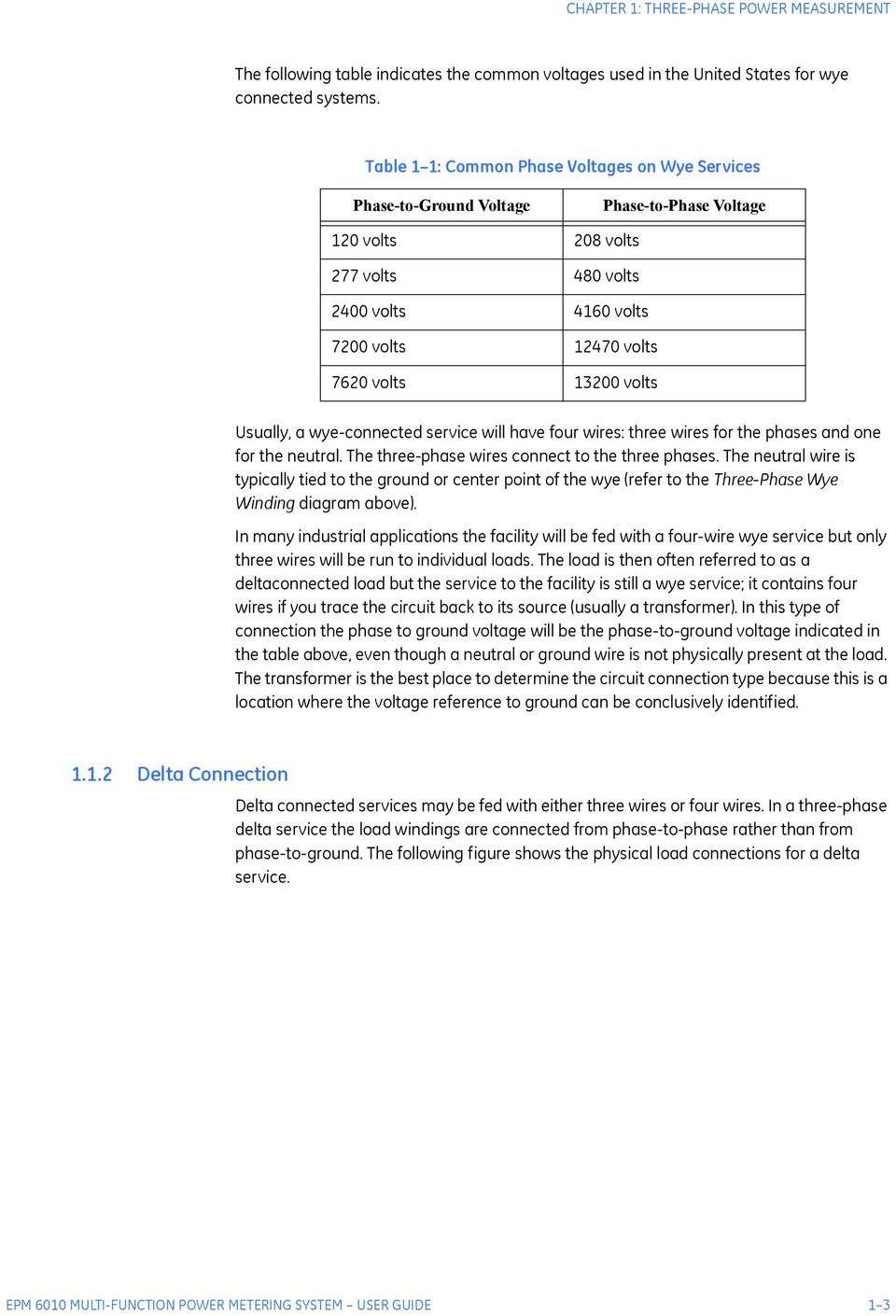
12 CHAPTER 1: THREE-PHASE POWER MEASUREMENT A Ia Vab Iab Vca B Ib Ica Vbc Ibc C Ic FIGURE 1 3: Three-phase Delta Winding Relationship In this example of a delta service, three wires will transmit the power to the load. In a true delta service, the phase-to-ground voltage will usually not be balanced because the ground is not at the center of the delta. The following diagram shows the phasor relationships between voltage and current on a three-phase delta circuit. In many delta services, one corner of the delta is grounded. This means the phase to ground voltage will be zero for one phase and will be full phase-to-phase voltage for the other two phases. This is done for protective purposes. Ic Vca Vbc Ia Ib Vab FIGURE 1 4: Three-Phase Voltage and Current Phasors for Delta Winding Another common delta connection is the four-wire, grounded delta used for lighting loads. In this connection the center point of one winding is grounded. On a 120/240 volt, fourwire, grounded delta service the phase-to-ground voltage would be 120 volts on two phases and 208 volts on the third phase. The phasor diagram for the voltages in a threephase, four-wire delta system is shown below. 1 4 EPM 6010 MULTI-FUNCTION POWER METERING SYSTEM USER GUIDE

13 CHAPTER 1: THREE-PHASE POWER MEASUREMENT 120 V Vnc Vca Vbc 120 V Vbn Vab FIGURE 1 5: Three-Phase, Four-Wire Delta Phasors Blondell s Theorem and Three Phase Measurement In 1893 an engineer and mathematician named Andre E. Blondell set forth the first scientific basis for poly phase metering. His theorem states: If energy is supplied to any system of conductors through N wires, the total power in the system is given by the algebraic sum of the readings of N wattmeters so arranged that each of the N wires contains one current coil, the corresponding potential coil being connected between that wire and some common point. If this common point is on one of the N wires, the measurement may be made by the use of N-1 wattmeters. The theorem may be stated more simply, in modern language: In a system of N conductors, N-1 meter elements will measure the power or energy taken provided that all the potential coils have a common tie to the conductor in which there is no current coil. Three-phase power measurement is accomplished by measuring the three individual phases and adding them together to obtain the total three phase value. In older analog meters, this measurement was accomplished using up to three separate elements. Each element combined the single-phase voltage and current to produce a torque on the meter disk. All three elements were arranged around the disk so that the disk was subjected to the combined torque of the three elements. As a result the disk would turn at a higher speed and register power supplied by each of the three wires. According to Blondell's Theorem, it was possible to reduce the number of elements under certain conditions. For example, a three-phase, three-wire delta system could be correctly measured with two elements (two potential coils and two current coils) if the potential coils were connected between the three phases with one phase in common. In a three-phase, four-wire wye system it is necessary to use three elements. Three voltage coils are connected between the three phases and the common neutral conductor. A current coil is required in each of the three phases. EPM 6010 MULTI-FUNCTION POWER METERING SYSTEM USER GUIDE 1 5

14 CHAPTER 1: THREE-PHASE POWER MEASUREMENT In modern digital meters, Blondell's Theorem is still applied to obtain proper metering. The difference in modern meters is that the digital meter measures each phase voltage and current and calculates the single-phase power for each phase. The meter then sums the three phase powers to a single three-phase reading. Some digital meters calculate the individual phase power values one phase at a time. This means the meter samples the voltage and current on one phase and calculates a power value. Then it samples the second phase and calculates the power for the second phase. Finally, it samples the third phase and calculates that phase power. After sampling all three phases, the meter combines the three readings to create the equivalent three-phase power value. Using mathematical averaging techniques, this method can derive a quite accurate measurement of three-phase power. More advanced meters actually sample all three phases of voltage and current simultaneously and calculate the individual phase and three-phase power values. The advantage of simultaneous sampling is the reduction of error introduced due to the difference in time when the samples were taken. Blondell's Theorem is a derivation that results from Kirchhoff's Law. Kirchhoff's Law states that the sum of the currents into a node is zero. Another way of stating the same thing is that the current into a node (connection point) must equal the current out of the node. The law can be applied to measuring three-phase loads. Figure 1-6 shows a typical connection of a three-phase load applied to a three-phase, four-wire service. Krichhoff's Laws hold that the sum of currents A, B, C and N must equal zero or that the sum of currents into Node "n" must equal zero. C B Phase B Phase C Node "n" Phase A A N FIGURE 1 6: Three-Phase Load Illustrating Kirchhoff s Law and Blondell s Theorem If we measure the currents in wires A, B and C, we then know the current in wire N by Kirchhoff's Law and it is not necessary to measure it. This fact leads us to the conclusion of Blondell's Theorem that we only need to measure the power in three of the four wires if they are connected by a common node. In the circuit of Figure 1-6 we must measure the 1 6 EPM 6010 MULTI-FUNCTION POWER METERING SYSTEM USER GUIDE

15 CHAPTER 1: THREE-PHASE POWER MEASUREMENT power flow in three wires. This will require three voltage coils and three current coils (a three element meter). Similar figures and conclusions could be reached for other circuit configurations involving delta-connected loads. EPM 6010 MULTI-FUNCTION POWER METERING SYSTEM USER GUIDE 1 7

16 CHAPTER 1: THREE-PHASE POWER MEASUREMENT 1.2 Power, Energy and Demand It is quite common to exchange power, energy and demand without differentiating between the three. Because this practice can lead to confusion, the differences between these three measurements will be discussed. Power is an instantaneous reading. The power reading provided by a meter is the present flow of watts. Power is measured immediately just like current. In many digital meters, the power value is actually measured and calculated over a one second interval because it takes some amount of time to calculate the RMS values of voltage and current. But this time interval is kept small to preserve the instantaneous nature of power. Energy is always based on some time increment; it is the integration of power over a defined time increment. Energy is an important value because almost all electric bills are based, in part, on the amount of energy used. Typically, electrical energy is measured in units of kilowatt-hours (kwh). A kilowatt-hour represents a constant load of one thousand watts (one kilowatt) for one hour. Stated another way, if the power delivered (instantaneous watts) is measured as 1,000 watts and the load was served for a one hour time interval then the load would have absorbed one kilowatt-hour of energy. A different load may have a constant power requirement of 4,000 watts. If the load were served for one hour it would absorb four kwh. If the load were served for 15 minutes it would absorb ¼ of that total or 1 kwh. The following figure shows a graph of power and the resulting energy that would be transmitted as a result of the illustrated power values. For this illustration, it is assumed that the power level is held constant for each minute when a measurement is taken. Each bar in the graph will represent the power load for the one-minute increment of time. In real life the power value moves almost constantly kilowatts Time (minutes) FIGURE 1 7: Power Use Over Time 1 8 EPM 6010 MULTI-FUNCTION POWER METERING SYSTEM USER GUIDE

17 CHAPTER 1: THREE-PHASE POWER MEASUREMENT The data from Figure 1-7 is reproduced in the table below to illustrate the calculation of energy. Since the time increment of the measurement is one minute and since we specified that the load is constant over that minute, we can convert the power reading to an equivalent consumed energy reading by multiplying the power reading times 1/60 (converting the time base from minutes to hours). Table 1 2: Power and Energy Relationship Over Time Time Interval (Minutes) Power (kw) Energy (kwh) Accumulated Energy (kwh) As in Table 1-2, the accumulated energy for the power load profile of 1-7 is kwh. Demand is also a time-based value. The demand is the average rate of energy use over time. The actual label for demand is kilowatt-hours/hour but this is normally reduced to kilowatts. This makes it easy to confuse demand with power. But demand is not an instantaneous value. To calculate demand it is necessary to accumulate the energy readings (as illustrated in Figure 1-7 above) and adjust the energy reading to an hourly value that constitutes the demand. In the example, the accumulated energy is kwh. But this measurement was made over a 15-minute interval. To convert the reading to a demand value, it must be normalized to a 60-minute interval. If the pattern were repeated for an additional three 15- minute intervals the total energy would be four times the measured value or kwh. The same process is applied to calculate the 15-minute demand value. The demand value associated with the example load is kwh/hr or kwd. Note that the peak instantaneous value of power is 80 kw, significantly more than the demand value. EPM 6010 MULTI-FUNCTION POWER METERING SYSTEM USER GUIDE 1 9

18 CHAPTER 1: THREE-PHASE POWER MEASUREMENT Figure 1-8 shows another example of energy and demand. In this case, each bar represents the energy consumed in a 15-minute interval. The energy use in each interval typically falls between 50 and 70 kwh. However, during two intervals the energy rises sharply and peaks at 100 kwh in interval number 7. This peak of usage will result in setting a high demand reading. For each interval shown the demand value would be four times the indicated energy reading. So interval 1 would have an associated demand of 240 kwh/ hr. Interval 7 will have a demand value of 400 kwh/hr. In the data shown, this is the peak demand value and would be the number that would set the demand charge on the utility bill. As can be seen from this example, it is important to recognize the relationships between power, energy and demand in order to control loads effectively or to monitor use correctly Demand Demand is also a time-based value. The demand is the average rate of energy use over time. The actual label for demand is kilowatt-hours/hour but this is normally reduced to kilowatts. This makes it easy to confuse demand with power. But demand is not an instantaneous value. To calculate demand it is necessary to accumulate the energy readings (as illustrated in the Power Use Over Time figure above) and adjust the energy reading to an hourly value that constitutes the demand. In the example, the accumulated energy is kwh. But this measurement was made over a 15-minute interval. To convert the reading to a demand value, it must be normalized to a 60-minute interval. If the pattern were repeated for an additional three 15- minute intervals the total energy would be four times the measured value or kwh. The same process is applied to calculate the 15-minute demand value. The demand value associated with the example load is kwh/hour or kwd. Note that the peak instantaneous value of power is 80 kw, significantly more than the demand value. The following figure illustrates another example of energy and demand. In this case, each bar represents the energy consumed in a 15-minute interval. The energy use in each interval typically falls between 50 and 70 kwh. However, during two intervals the energy rises sharply and peaks at 100 kwh in interval #7. This peak of usage will result in setting a high demand reading. For each interval shown the demand value would be four times the indicated energy reading. So interval 1 would have an associated demand of 240 kwh/hr. Interval #7 will have a demand value of 400 kwh/hr. In the data shown, this is the peak demand value and would be the number that would set the demand charge on the utility bill EPM 6010 MULTI-FUNCTION POWER METERING SYSTEM USER GUIDE

19 CHAPTER 1: THREE-PHASE POWER MEASUREMENT kilowatt-hours Intervals (15 mins.) FIGURE 1 8: Energy Use and Demand Intervals As seen in this example, it is important to recognize the relationships between power, energy and demand in order to effectively control loads or to correctly monitor use. EPM 6010 MULTI-FUNCTION POWER METERING SYSTEM USER GUIDE 1 11

20 CHAPTER 1: THREE-PHASE POWER MEASUREMENT 1.3 Reactive Energy and Power Factor Real, Reactive, and Apparent Power The real power and energy measurements discussed in the previous section relate to the quantities that are most used in electrical systems. But it is often not sufficient to only measure real power and energy. Reactive power is a critical component of the total power picture because almost all real-life applications have an impact on reactive power. Reactive power and power factor concepts relate to both load and generation applications. However, this discussion will be limited to analysis of reactive power and power factor as they relate to loads. To simplify the discussion, generation will not be considered. Real power (and energy) is the component of power that is the combination of the voltage and the value of corresponding current that is directly in phase with the voltage. However, in actual practice the total current is almost never in phase with the voltage. Since the current is not in phase with the voltage, it is necessary to consider both the inphase component and the component that is at quadrature (angularly rotated 90o or perpendicular) to the voltage. Figure 1-9 shows a single-phase voltage and current and breaks the current into its in-phase and quadrature components. I R V θ I X I FIGURE 1 9: Voltage and Complex Current The voltage (V) and the total current (I) can be combined to calculate the apparent power or VA. The voltage and the in-phase current (IR) are combined to produce the real power or watts. The voltage and the quadrature current (IX) are combined to calculate the reactive power. The quadrature current may be lagging the voltage (as shown in Figure 1-9) or it may lead the voltage. When the quadrature current lags the voltage the load is requiring both real power (watts) and reactive power (VARs). When the quadrature current leads the voltage the load is requiring real power (watts) but is delivering reactive power (VARs) back into the system; that is VARs are flowing in the opposite direction of the real power flow. Reactive power (VARs) is required in all power systems. Any equipment that uses magnetization to operate requires VARs. Usually the magnitude of VARs is relatively low compared to the real power quantities. Utilities have an interest in maintaining VAR requirements at the customer to a low value in order to maximize the return on plant invested to deliver energy. When lines are carrying VARs, they cannot carry as many watts EPM 6010 MULTI-FUNCTION POWER METERING SYSTEM USER GUIDE

21 CHAPTER 1: THREE-PHASE POWER MEASUREMENT So keeping the VAR content low allows a line to carry its full capacity of watts. In order to encourage customers to keep VAR requirements low, most utilities impose a penalty if the VAR content of the load rises above a specified value Power Factor A common method of measuring reactive power requirements is power factor. Power factor can be defined in two different ways. The more common method of calculating power factor is the ratio of the real power to the apparent power. This relationship is expressed in the following formula: : real power watts Total PF = = (EQ 1.1) apparent power VA This formula calculates a power factor quantity known as Total Power Factor. It is called Total PF because it is based on the ratios of the power delivered. The delivered power quantities will include the impacts of any existing harmonic content. If the voltage or current includes high levels of harmonic distortion the power values will be affected. By calculating power factor from the power values, the power factor will include the impact of harmonic distortion. In many cases this is the preferred method of calculation because the entire impact of the actual voltage and current are included. A second type of power factor is Displacement Power Factor. Displacement PF is based on the angular relationship between the voltage and current. Displacement power factor does not consider the magnitudes of voltage, current or power. It is solely based on the phase angle differences. As a result, it does not include the impact of harmonic distortion. Displacement power factor is calculated using the following equation: Displacement PF = cosθ Where θ is the angle between the voltage and the current (see Fig. 1.9). (EQ 1.2) In applications where the voltage and current are not distorted, the Total Power Factor will equal the Displacement Power Factor. But if harmonic distortion is present, the two power factors will not be equal. EPM 6010 MULTI-FUNCTION POWER METERING SYSTEM USER GUIDE 1 13
22 CHAPTER 1: THREE-PHASE POWER MEASUREMENT 1.4 Harmonic Distortion Harmonic distortion is primarily the result of high concentrations of non-linear loads. Devices such as computer power supplies, variable speed drives and fluorescent light ballasts make current demands that do not match the sinusoidal waveform of AC electricity. As a result, the current waveform feeding these loads is periodic but not sinusoidal. Figure 1-10 shows a normal, sinusoidal current waveform. This example has no distortion Current (amps) a 2a t 1000 FIGURE 1 10: Non-distorted current waveform Figure 1-11 shows a current waveform with a slight amount of harmonic distortion. The waveform is still periodic and is fluctuating at the normal 60 Hz frequency. However, the waveform is not a smooth sinusoidal form as seen in Figure Current (amps) a 2a t FIGURE 1 11: Distorted current wave The distortion observed in Figure 1-11 can be modeled as the sum of several sinusoidal waveforms of frequencies that are multiples of the fundamental 60 Hz frequency. This modeling is performed by mathematically disassembling the distorted waveform into a 1 14 EPM 6010 MULTI-FUNCTION POWER METERING SYSTEM USER GUIDE
23 CHAPTER 1: THREE-PHASE POWER MEASUREMENT collection of higher frequency waveforms. These higher frequency waveforms are referred to as harmonics. Figure 1-12 shows the content of the harmonic frequencies that make up the distortion portion of the waveform in Figure Current (amps) a t FIGURE 1 12: Waveforms of the harmonics The waveforms shown in Figure 1-12 are not smoothed but do provide an indication of the impact of combining multiple harmonic frequencies together. When harmonics are present it is important to remember that these quantities are operating at higher frequencies. Therefore, they do not always respond in the same manner as 60 Hz values Inductive and capacitive impedance Inductive and capacitive impedance are present in all power systems. We are accustomed to thinking about these impedances as they perform at 60 Hz. However, these impedances are subject to frequency variation. X L = jωl and X C = 1 jωc (EQ 1.3) At 60 Hz, ω = 377; but at 300 Hz (5th harmonic) ω = 1,885. As frequency changes impedance changes and system impedance characteristics that are normal at 60 Hz may behave entirely different in presence of higher order harmonic waveforms. Traditionally, the most common harmonics have been the low order, odd frequencies, such as the 3rd, 5th, 7th, and 9th. However newer, non-linear loads are introducing significant quantities of higher order harmonics Voltage and Current Monitoring Since much voltage monitoring and almost all current monitoring is performed using instrument transformers, the higher order harmonics are often not visible. Instrument transformers are designed to pass 60 Hz quantities with high accuracy. These devices, when designed for accuracy at low frequency, do not pass high frequencies with high EPM 6010 MULTI-FUNCTION POWER METERING SYSTEM USER GUIDE 1 15
24 CHAPTER 1: THREE-PHASE POWER MEASUREMENT accuracy; at frequencies above about 1200 Hz they pass almost no information. So when instrument transformers are used, they effectively filter out higher frequency harmonic distortion making it impossible to see. However, when monitors can be connected directly to the measured circuit (such as direct connection to 480 volt bus) the user may often see higher order harmonic distortion. An important rule in any harmonics study is to evaluate the type of equipment and connections before drawing a conclusion. Not being able to see harmonic distortion is not the same as not having harmonic distortion Waveform Capture It is common in advanced meters to perform a function commonly referred to as waveform capture. Waveform capture is the ability of a meter to capture a present picture of the voltage or current waveform for viewing and harmonic analysis. Typically a waveform capture will be one or two cycles in duration and can be viewed as the actual waveform, as a spectral view of the harmonic content, or a tabular view showing the magnitude and phase shift of each harmonic value. Data collected with waveform capture is typically not saved to memory. Waveform capture is a real-time data collection event. Waveform capture should not be confused with waveform recording that is used to record multiple cycles of all voltage and current waveforms in response to a transient condition EPM 6010 MULTI-FUNCTION POWER METERING SYSTEM USER GUIDE
25 CHAPTER 1: THREE-PHASE POWER MEASUREMENT 1.5 Power Quality Power quality can mean several different things. The terms power quality and power quality problem have been applied to all types of conditions. A simple definition of power quality problem is any voltage, current or frequency deviation that results in mis-operation or failure of customer equipment or systems. The causes of power quality problems vary widely and may originate in the customer equipment, in an adjacent customer facility or with the utility. In his book Power Quality Primer, Barry Kennedy provided information on different types of power quality problems. Some of that information is summarized in Table 1-3 below. Table 1 3: Typical Power Quality Problems and Sources Cause Disturbance Type Source(s) Impulse transient Oscillatory transient with decay Sag/swell Interruptions Undervoltage/Overvoltage Voltage flicker Harmonic distortion Transient voltage disturbance, sub-cycle duration Transient voltage, sub-cycle duration RMS voltage, multiple cycle duration RMS voltage, multiple second or longer duration RMS voltage, steady state, multiple second or longer duration RMS voltage, steady state, repetitive condition Steady-state current or voltage, long term duration Lightning; Electrostatic discharge; Load switching; Capacitor switching Line/cable switching; Capacitor switching; Load switching Remote system faults System protection; Circuit breakers; Fuses; Maintenance Motor starting; Load variations; Load dropping Intermittent loads; Motor starting; Arc furnaces Non-linear loads; System resonance It is often assumed that power quality problems originate with the utility. While it is true that may power quality problems can originate with the utility system, many problems originate with customer equipment. Customer-caused problems may manifest themselves inside the customer location or they may be transported by the utility system to another adjacent customer. Often, equipment that is sensitive to power quality problems may in fact also be the cause of the problem. If a power quality problem is suspected, it is generally wise to consult a power quality professional for assistance in defining the cause and possible solutions to the problem. EPM 6010 MULTI-FUNCTION POWER METERING SYSTEM USER GUIDE 1 17
26 CHAPTER 1: THREE-PHASE POWER MEASUREMENT 1 18 EPM 6010 MULTI-FUNCTION POWER METERING SYSTEM USER GUIDE
27 Digital Energy EPM 6010 Multi-function Power Metering System Chapter 2: Overview and Specifications Overview and Specifications Note In European Union member state countries, this meter is NOT certified for revenue metering. See the Safety Precautions section for meter certification details. 2.1 Hardware Overview EPM6010 Meter/Digital Transducer The EPM6010 monitor is a multifunction power meter designed to be used in electrical substations, panel boards and as a power meter for OEM equipment. The unit provides multifunction measurement of all electrical parameters. The Building Automation and Control Network (BACnet), described in the ANSI/ASHRAE Standard , is one of the most widely used building management systems protocols. The EPM6010 meter has embedded BACnet IP communication. It communicates in native BACnet IP over Ethernet to seamlessly integrate with most building automation/ control systems. The EPM6010 meter's BACnet IP has 40 predefined BACnet objects that let you track up to 40 measurements. No programming or mapping is necessary to use the BACnet objects. The EPM6010 meter also comes with a Web interface that is very easy to set up and use. This lets you remotely configure BACnet IP and track energy usage through the Internet using a standard browser. You can also access all of the EPM6010 meter s readings through GE Communicator software. See Chapter 5 for more information on the BACnet IP web pages and GE Communicator software. Note The EPM6010 comes standard with RJ45 Ethernet. It does not have an RS485 Option. See Chapter 6 for detailed instructions on using the EPM6010. The unit is designed with advanced measurement capabilities, allowing it to achieve high performance accuracy. The EPM6010 meter is specified as a 0.2% class energy meter for billing applications as well as a highly accurate panel indication meter. EPM 6010 MULTI-FUNCTION POWER METERING SYSTEM USER GUIDE 2 1
28 CHAPTER 2: OVERVIEW AND SPECIFICATIONS The EPM6010 meter provides a host of additional capabilities, including RJ45 Ethernet, DNP Protocols and an IrDA Port for remote interrogation. EPM6010 meter features that are detailed in this manual are as follows: 0.2% Class Revenue Certifiable Energy and Demand Metering Meets ANSI C12.20 (0.2%) and IEC 687 (0.2%) Classes Multifunction Measurement including Voltage, Current, Power, Frequency, Energy, etc. Power Quality Measurements (%THD and Alarm Limits) Percentage of Load Bar for Analog Meter Perception Easy to Use Faceplate Programming IrDA Port for PC Remote Read RJ45 Ethernet Communication BACnet IP Communication The EPM6010 comes in either of two models - the Meter/Digital Transducer or the Digital Transducer only. EPM6010 Meter / Digital Transducer: Meter and transducer in one compact unit. Features an IrDA port as well as an RJ45 port, and can be programmed using the faceplate of the meter. ANSI or DIN mounting may be used. FIGURE 2 1: EPM6010T EPM6010T Digital Transducer: A Digital Transducer only unit providing Ethernet RJ45 communication via Modbus RTU, Modbus ASCII and DNP 3.0 protocols. The unit is designed to install using DIN Rail Mounting (see Section 3.3). 2 2 EPM 6010 MULTI-FUNCTION POWER METERING SYSTEM USER GUIDE
29 CHAPTER 2: OVERVIEW AND SPECIFICATIONS Voltage and Current Inputs Universal Voltage Inputs Voltage Inputs allow measurement to 416 Volts Line-to-Neutral and 721 Volts Line-to-Line. This insures proper meter safety when wiring directly to high voltage systems. One unit will perform to specification on 69 Volt, 120 Volt, 230 Volt, 277 Volt, 277 Volt and 347 Volt power systems. Current Inputs The EPM6010 meter s Current Inputs use a unique dual input method: Method 1: CT Pass Through. The CT passes directly through the meter without any physical termination on the meter. This insures that the meter cannot be a point of failure on the CT circuit. This is preferable for utility users when sharing relay class CTs. No Burden is added to the secondary CT circuit. Method 2: Current Gills. This unit additionally provides ultra-rugged Termination Pass Through Bars that allow CT leads to be terminated on the meter. This, too, eliminates any possible point of failure at the meter. This is a preferred technique for insuring that relay class CT integrity is not compromised (the CT will not open in a fault condition) Order Codes The order codes for the EPM 6010 and EPM6010T are indicated below. Table 2 1: EPM 6010 Order Codes PL6010 * * THD * Base Unit PL6010 EPM 6010 Power Metering System System 5 50 Hz AC frequency system Frequency 6 60 Hz AC frequency system Current Input 1A 1 A secondary CT 5A 5 A secondary CT Software THD THD, limit alarms, and 1 KYZ pulse output Power Supply HI AC/DC Power Supply: 90 to 265 V AC or 100 to 370 V DC LDC Low Voltage (24 to 48) V DC Power Supply EPM 6010 MULTI-FUNCTION POWER METERING SYSTEM USER GUIDE 2 3
30 CHAPTER 2: OVERVIEW AND SPECIFICATIONS Table 2 2: EPM 6010T Order Codes PL6010T * * THD * Base Unit PL6010T EPM 6010 Power Metering System - no display System 5 50 Hz AC frequency system Frequency 6 60 Hz AC frequency system Current Input 1A 1 A secondary CT 5A 5 A secondary CT Software THD THD, limit alarms, and 1 KYZ pulse output Power Supply HI AC/DC Power Supply: 90 to 265 V AC or 100 to 370 V DC LDC Low Voltage (24 to 48) V DC Power Supply For example, to order an EPM 6010 for 60 Hz system with a 1 A secondary CT input with THD and pulse output (standard), and including a standard Ethernet communications option, select order code PL A-THD-HI. The standard unit includes display, all current/voltage/power/frequency/energy counters, percent load bar, and IrDA communication ports. 2 4 EPM 6010 MULTI-FUNCTION POWER METERING SYSTEM USER GUIDE
31 CHAPTER 2: OVERVIEW AND SPECIFICATIONS Measured Values The following table lists the measured values available in real time, average, maximum, and minimum. Table 2 3: EPM 6010 Measured Values Measured Values Real Time Average Maximum Minimum Voltage L-N X X X Voltage L-L X X X Current per phase X X X X Watts X X X X VARs X X X X VA X X X X Power Factor (PF) X X X X Positive watt-hours Negative watt-hours Net watt-hours Positive VAR-hours Negative VAR-hours Net VAR-hours VA-hours X X X X X X X Frequency X X X %THD X X X Voltage angles Current angles X X % of load bar X Utility Peak Demand The EPM 6010 provides user-configured Block (fixed) or Rolling window demand. This feature allows you to set up a customized demand profile. Block window demand is demand used over a user-defined demand period (usually 5, 15, or 30 minutes). Rolling window demand is a fixed window demand that moves for a user-specified subinterval period. For example, a 15-minute demand using 3 subintervals and providing a new demand reading every 5 minutes, based on the last 15 minutes. Utility demand features can be used to calculate kw, kvar, kva and PF readings. All other parameters offer maximum and minimum capability over the user-selectable averaging period. Voltage provides an instantaneous maximum and minimum reading which displays the highest surge and lowest sag seen by the meter. EPM 6010 MULTI-FUNCTION POWER METERING SYSTEM USER GUIDE 2 5
32 CHAPTER 2: OVERVIEW AND SPECIFICATIONS 2.2 Specifications POWER SUPPLY Range:...HI Option: Universal, 90 to 265 V AC at 50/60Hz, or 100 to 370 V DC LDC Option: 18 to 60 V DC Power consumption:...5 VA, 3.5 W (+20% max) Connection:...3-pin 0.300" pluggable terminal block Torque: 3.5 lb-in AWG #12 to 24, solid or stranded VOLTAGE INPUTS (MEASUREMENT CATEGORY III) Range:...Universal, Auto-ranging up to 69 to 347 V L-N (+20% max) 600 V AC L-L (+20% max) Supported hookups:...3-element Wye, 2.5-element Wye, 2-element Delta, 4-wire Delta Input impedance:...1 MOhm/phase Burden: VA/phase at 120 Volts Pickup voltage:...10 V AC Connection:...Screw terminal Maximum input wire gauge:...awg #12 / 2.5 mm 2 Torque:...5 lb-in Transient Withstand:...Meets IEEE C (Surge Withstand Capability) Reading:...Programmable full-scale to any PT ratio CURRENT INPUTS Class 10:...5 A nominal, 10 A maximum Class 2:...1 A nominal, 2 A maximum Burden: VA per phase maximum at 11 A Pickup current:...0.1% of nominal Connections:...O or U lug electrical connection Tighten with #2 Phillips screwdriver Torque- 8 Lb-In Pass-through wire, 0.177" / 4.5 mm maximum diameter Quick connect, 0.25" male tab Fault Withstand (at 23 C): A / 10 seconds, 300 A / 3 seconds, 500 A / 1 second Reading:...Programmable full-scale to any CT ratio MEASUREMENT METHODS Voltage and current:...true RMS Power:...Sampling at 400+ samples/cycle on all channels measured; readings simultaneously A/D conversion:...6 simultaneous 24-bit analog-to-digital converters UPDATE RATE Watts, VAR, and VA: ms (10 times per second) All other parameters:...1 second COMPLIANCE IEC (0.2% accuracy) 2 6 EPM 6010 MULTI-FUNCTION POWER METERING SYSTEM USER GUIDE
33 CHAPTER 2: OVERVIEW AND SPECIFICATIONS ANSI C12.20 (0.2% accuracy) Test Reference Standard Level/Class Electrostatic Discharge EN/IEC Level 3 RF Immunity EN/IEC V/min Fast Transient Disturbance EN/IEC Level 3 Surge Immunity EN/IEC Level 3 Conducted RF Immunity EN/IEC Level 3 Radiated and Conductive Emissions EN/IEC Class A Voltage Dip & Interruption EN/IEC , 40, 70, 100% dips, 250/300 cycle interrupts APPROVALS CE Compliance North America ISO Applicable Council Directive Low Voltage Directive EMC Directive UL Recognized Manufactured under a registered quality program EN According to: EN EN EN (PICQ) UL C22.2. No (PICQ7) ISO9001 ACCURACY For 23 0 C, 3 Phase balanced Wye or Delta load, at 50 or 60 Hz (as per order), 5A (Class 10 nominal unit: Parameter Accuracy Accuracy Input Range Voltage L-N [V] 0.1% of reading 2 69 to 480 V Voltage L-L [V} 0.1% of reading 120 to 600 V Current Phase [A] 0.1% of reading to 5 A Current Neutral (calculated) [A] 2.0% of Full Scale to 5 45 to 65 Hz Active Power Total [W] 0.2% of reading 1, to 5 69 to 480 +/- 0.5 to 1 lag/lead PF Active Energy Total [Wh] 0.2% of reading 1, to 5 69 to 480 +/- 0.5 to 1 lag/lead PF Reactive Power Total [VAR] 0.2% of reading 1, to 5 69 to 480 +/- 0 to 0.8 lag/lead PF Reactive Energy Total [VARh] 0.2% of reading 1, to 5 69 to 480 +/- 0 to 0.8 lag/lead PF Apparent Power Total [VA] 0.2% of reading 1, to 5 69 to 480 +/- 0.5 to 1 lag/lead PF Apparent Energy Total [VAh] 0.2% of reading 1, to 5 69 to 480 +/- 0.5 to 1 lag/lead PF Power Factor 0.2% of reading 1, to 5 69 to 480 +/- 0.5 to 1 lag/lead PF Frequency +/- 0.01Hz 45 to 65 Hz EPM 6010 MULTI-FUNCTION POWER METERING SYSTEM USER GUIDE 2 7
34 CHAPTER 2: OVERVIEW AND SPECIFICATIONS Total Harmonic Distortion (%) 5.0% to 10 A or 69 to 480 V, measurement range - 1 to 99.99% Load Bar +/- 1 segment to 6 A 1 For 2.5 element programmed units, degrade accuracy by an additional 0.5% of reading. For 1A (Class 2) Nominal, degrade accuracy by an additional 0.5% of reading. For 1A (Class 2) Nominal, the input current range for Accuracy specification is 20% of the values listed in the table. 2 For unbalanced voltage inputs where at least one crosses the 150V auto-scale threshold (for example, 120V/120V/208V system), degrade accuracy by additional 0.4%. ISOLATION All Inputs and Outputs are galvanically isolated to 2500 V AC ENVIRONMENTAL Storage: to 70 C Operating: to 70 C Humidity:...up to 95% RH, non-condensing Faceplate rating:...nema 12 (water resistant), mounting gasket included COMMUNICATIONS FORMAT Types:...RJ45 port through back plate IrDA port through face plate Wh PULSE KYZ output contacts (and infrared LED light pulses through face plate): Pulse Width:...40ms Full Scale Frequency:...~6Hz Contact type:...solid State SPDT (NO C NC) Relay type:...solid state Peak switching voltage:...dc ±350V Continuous load current:...120ma Peak load current:...350ma for 10ms On resistance, max.:...35ω Leakage current:...1μa@350v Isolation:...AC 3750V Reset State:...(NC - C) Closed; (NO - C) Open Infrared LED: Peak Spectral Wavelength:...940nm Reset State:...Off 2 8 EPM 6010 MULTI-FUNCTION POWER METERING SYSTEM USER GUIDE
35 CHAPTER 2: OVERVIEW AND SPECIFICATIONS FIGURE 2 2: Internal Schematic (De-energized State) EPM 6010 MULTI-FUNCTION POWER METERING SYSTEM USER GUIDE 2 9
36 CHAPTER 2: OVERVIEW AND SPECIFICATIONS FIGURE 2 3: Output Timing COMMUNICATIONS PORTS Protocols:...Modbus RTU, Modbus ASCII, DNP 3.0 (V3 and V4) Port address: to 247 MECHANICAL PARAMETERS Dimensions: " 4.85" 4.65" (L W H) mm mm mm (L W H) Mounting:...mounts in 92 mm square DIN or ANSI C39.1, 4-inch round cut-out Weight:...2 pounds / kg 2 10 EPM 6010 MULTI-FUNCTION POWER METERING SYSTEM USER GUIDE
37 Digital Energy EPM 6010 Multi-function Power Metering System Chapter 3: Mechanical Installation Mechanical Installation 3.1 Introduction The EPM6010 meter can be installed using a standard ANSI C39.1 (4" Round) or an IEC 92mm DIN (Square) form. In new installations, simply use existing DIN or ANSI punches. For existing panels, pull out old analog meters and replace with the EPM6010 meter. The various models use the same installation. See Chapter 4 for wiring diagrams. POTENTIAL ELECTRICAL EXPOSURE - The EPM6010/T must be installed in an electrical enclosure where any access to live electrical wiring is restricted only to authorized service personnel. EPM 6010 MULTI-FUNCTION POWER METERING SYSTEM USER GUIDE 3 1
38 CHAPTER 3: MECHANICAL INSTALLATION ANSI Mounting Rods (screw-in) METER SIDE TRANSDUCER SIDE DIN Mounting Brackets FIGURE 3 1: EPM6010 Mounting Information Recommended Tools for EPM6010 Meter Installation: #2 Phillips screwdriver, small wrench and wire cutters. EPM6010T Transducer Installation requires no tools. Mount the meter in a dry location free from dirt and corrosive substances. The meter is designed to withstand harsh environmental conditions. (See Environmental Specifications in Chapter 2.) 3 2 EPM 6010 MULTI-FUNCTION POWER METERING SYSTEM USER GUIDE
39 CHAPTER 3: MECHANICAL INSTALLATION 3.2 ANSI Installation Steps 1. Insert 4 threaded rods by hand into the back of meter. Twist until secure. 2. Slide ANSI 12 Mounting Gasket onto back of meter with rods in place. 3. Slide meter with Mounting Gasket into panel. 4. Secure from back of panel with lock washer and nut on each threaded rod. Use a small wrench to tighten. Do not overtighten. The maximum installation torque is 0.4 Newton-Meter (3.5 lb-in). FIGURE 3 2: ANSI Mounting Procedure EPM 6010 MULTI-FUNCTION POWER METERING SYSTEM USER GUIDE 3 3
40 CHAPTER 3: MECHANICAL INSTALLATION 3.3 DIN Installation Steps 1. Slide meter with NEMA 12 Mounting Gasket into panel. (Remove ANSI Studs, if in place.) 2. From back of panel, slide 2 DIN Mounting Brackets into grooves in top and bottom of meter housing. Snap into place. 3. Secure meter to panel with lock washer and a #8 screw through each of the 2 mounting brackets. Tighten with a #2 Phillips screwdriver. Do not overtighten. The maximum installation torque is 0.4 Newton-Meter (3.5 lb-in). FIGURE 3 3: DIN Mounting Procedure 3 4 EPM 6010 MULTI-FUNCTION POWER METERING SYSTEM USER GUIDE
41 CHAPTER 3: MECHANICAL INSTALLATION 3.4 EPM6010 Transducer Installation The EPM6010T Transducer model is installed using DIN Rail Mounting. Specs for DIN Rail Mounting: International Standards: DIN 46277/3 DIN Rail (Slotted) Dimensions: x x 3 (inches) [7.55mm x 35mm x 76.2mm (millimeters)]. DIN Rail Installation Steps: 1. Slide top groove of meter onto the DIN Rail. 2. Press gently until the meter clicks into place. Release Clip (below) FIGURE 3 4: DIN Rail Mounting Procedure Note If mounting with the DIN Rail provided, use the Black Rubber Stoppers (also provided). NOTE EPM 6010 MULTI-FUNCTION POWER METERING SYSTEM USER GUIDE 3 5
42 CHAPTER 3: MECHANICAL INSTALLATION Black Rubber Stoppers FIGURE 3 5: DIN Rail Detail To Remove Meter from DIN Rail: Pull down on Release Clip to detach the unit from the DIN Rail. Note NOTE DIN Rails are commonly used as a mounting channel for most terminal blocks, control devices, circuit protection devices and PLCs. DIN Rails are made of cold rolled steel electrolytically plated, and are also available in aluminum, PVC, stainless steel and copper. 3 6 EPM 6010 MULTI-FUNCTION POWER METERING SYSTEM USER GUIDE
43 Digital Energy EPM 6010 Multi-function Power Metering System Chapter 4: Electrical Installation Electrical Installation 4.1 Considerations When Installing Meters POTENTIAL ELECTRICAL EXPOSURE - The EPM6010/T must be installed in an electrical enclosure where any access to live electrical wiring is restricted only to authorized service personnel. Installation of the EPM6010 Meter must be performed only by qualified personnel who follow standard safety precautions during all procedures. Those personnel should have appropriate training and experience with high voltage devices. Appropriate safety gloves, safety glasses and protective clothing is recommended. During normal operation of the EPM6010 Meter, dangerous voltages are present in many parts of the meter, including: Terminals, CTs, PTs, I/O Modules. All Primary and Secondary circuits can, at times, produce lethal voltages and currents. Avoid contact with any current-carrying surfaces. Do not use the meter or any I/O Output Device for primary protection or in an energy-limiting capacity. The meter can only be used as secondary protection. Do not use the meter for applications where failure of the meter may cause harm or death. Do not use the meter for any application where there may be a risk of fire. All meter terminals should be inaccessible after installation. Do not apply more than the maximum voltage the meter or any attached device can withstand. Refer to meter and/or device labels and to the Specifications for all devices before applying voltages. Do not HIPOT/Dielectric test any Outputs, Inputs or Communications terminals. GE recommends the use of Shorting Blocks and Fuses for voltage leads and power supply to prevent hazardous voltage conditions or damage to CTs, if the meter needs to be removed from service. CT grounding is optional. If the equipment is used in a manner not specified by the manufacturer, the protection provided by the equipment may be impaired. EPM 6010 MULTI-FUNCTION POWER METERING SYSTEM USER GUIDE 4 1
44 CHAPTER 4: ELECTRICAL INSTALLATION Note There is no required preventive maintenance or inspection necessary for safety. however, any repair or maintenance should be performed by the factory. DISCONNECT DEVICE: A switch or circuit-breaker shall be included in the end-use equipment or building installation. The switch shall be in close proximity to the equipment and within easy reach of the operator. The switch shall be marked as the disconnecting device for the equipment CT Leads Terminated to Meter The EPM 6010 is designed to have Current Inputs wired in one of three ways. Figure 4 1: below, shows the most typical connection where CT Leads are terminated to the meter at the Current Gills. This connection uses Nickel-Plated Brass Studs (Current Gills) with screws at each end. This connection allows the CT wires to be terminated using either an O or a U lug. Tighten the screws with a #2 Phillips screwdriver. The maximum installation torque is 1 Newton- Meter (8.8 lb-in). FIGURE 4 1: CT leads terminated to meter, #8 screw for lug connection Wiring diagrams are detailed in the diagrams shown below in this chapter. Communications connections are detailed in Chapter EPM 6010 MULTI-FUNCTION POWER METERING SYSTEM USER GUIDE
45 CHAPTER 4: ELECTRICAL INSTALLATION CT Leads Pass-Through (No Meter Termination) The second method allows the CT wires to pass through the CT Inputs without terminating at the meter. In this case, remove the current gills and place the CT wire directly through the CT opening. The opening will accommodate up to 0.177" / 4.5 mm maximum diameter CT wire. FIGURE 4 2: Pass-Through Wire Electrical Connection Quick Connect Crimp CT Terminations For quick termination or for portable applications, a quick connect crimp CT connection can also be used. EPM 6010 MULTI-FUNCTION POWER METERING SYSTEM USER GUIDE 4 3
46 CHAPTER 4: ELECTRICAL INSTALLATION FIGURE 4 3: Quick Connect Electrical Connection Voltage and Power Supply Connections Voltage Inputs are connected to the back of the unit via a optional wire connectors. The connectors accommodate up to AWG#12 / 2.5 mm wire. 4 4 EPM 6010 MULTI-FUNCTION POWER METERING SYSTEM USER GUIDE
47 CHAPTER 4: ELECTRICAL INSTALLATION FIGURE 4 4: Voltage Connection Ground Connections The EPM 6010 ground terminals ( ) should be connected directly to the installation's protective earth ground. Use 2.5 mm wire for this connection Voltage Fuses GE Multilin recommends the use of fuses on each of the sense voltages and on the control power, even though the wiring diagrams in this chapter do not show them. Use a 0.1 Amp fuse on each voltage input. Use a 3.0 Amp fuse on the Power Supply. EPM 6010 MULTI-FUNCTION POWER METERING SYSTEM USER GUIDE 4 5
48 CHAPTER 4: ELECTRICAL INSTALLATION 4.2 Electrical Connection Diagrams Description Choose the diagram that best suits your application and maintains the CT polarity. 1. Three-phase, four-wire system Wye with no PTs (direct voltage), 3 CTs, 3 element. 1a. Dual Phase Hookup. 2b. Single Phase Hookup. 2. Three-phase, four-wire system Wye with no PTs (direct voltage), 3 CTs, 2.5 element. 3. Three-phase, four-wire Wye with 3 PTs, 3 CTs, 3 element. 4. Three-phase, four-wire Wye with 2 PTs, 3 CTs, 2.5 element. 5. Three-phase, three-wire Delta with no PTs (direct voltage), 2 CTs. 6. Three-phase, three-wire Delta with 2 PTs, 2 CTs. 7. Three-phase, three-wire Delta with 2 PTs, 3 CTs. 8. Current-only measurement (three-phase). 9. Current-only measurement (dual-phase). 10. Current-only measurement (single-phase). These diagrams are presented in the sections following. 4 6 EPM 6010 MULTI-FUNCTION POWER METERING SYSTEM USER GUIDE
49 CHAPTER 4: ELECTRICAL INSTALLATION (1) Wye, 4-Wire with no PTs and 3 CTs, no PTs, 3 Element For this wiring type, select 3 EL WYE (3-element Wye) in the meter programming setup. FIGURE 4 5: 4-Wire Wye with no PTs and 3 CTs, 3 Element EPM 6010 MULTI-FUNCTION POWER METERING SYSTEM USER GUIDE 4 7
50 CHAPTER 4: ELECTRICAL INSTALLATION (1a) Dual Phase Hookup 4 8 EPM 6010 MULTI-FUNCTION POWER METERING SYSTEM USER GUIDE
51 CHAPTER 4: ELECTRICAL INSTALLATION (1b) Single Phase Hookup EPM 6010 MULTI-FUNCTION POWER METERING SYSTEM USER GUIDE 4 9
52 CHAPTER 4: ELECTRICAL INSTALLATION (2) Wye, 4-Wire with no PTs and 3 CTs, 2.5 Element For this wiring type, select 2.5EL WYE (2.5-element Wye) in the meter programming setup. FIGURE 4 6: 4-Wire Wye with no PTs and 3 CTs, 2.5 Element 4 10 EPM 6010 MULTI-FUNCTION POWER METERING SYSTEM USER GUIDE
53 CHAPTER 4: ELECTRICAL INSTALLATION (3) Wye, 4-Wire with 3 PTs and 3 CTs, 3 Element For this wiring type, select 3 EL WYE (3-element Wye) in the meter programming setup. FIGURE 4 7: 4-Wire Wye with 3 PTs and 3 CTs, 3 Element EPM 6010 MULTI-FUNCTION POWER METERING SYSTEM USER GUIDE 4 11
54 CHAPTER 4: ELECTRICAL INSTALLATION (4) Wye, 4-Wire with 2 PTs and 3 CTs, 2.5 Element For this wiring type, select 2.5EL WYE (2.5-element Wye) in the meter programming setup. FIGURE 4 8: 4-Wire Wye with 2 PTs and 3 CTs, 2.5 Element 4 12 EPM 6010 MULTI-FUNCTION POWER METERING SYSTEM USER GUIDE
55 CHAPTER 4: ELECTRICAL INSTALLATION (5) Delta, 3-Wire with no PTs, 2 CTs For this wiring type, select 2 Ct del (2 CT Delta) in the meter programming setup. FIGURE 4 9: 3-Wire Delta with no PTs and 2 CTs EPM 6010 MULTI-FUNCTION POWER METERING SYSTEM USER GUIDE 4 13
56 CHAPTER 4: ELECTRICAL INSTALLATION (6) Delta, 3-Wire with 2 PTs, 2 CTs For this wiring type, select 2 Ct del (2 CT Delta) in the meter programming setup. FIGURE 4 10: 3-Wire Delta with 2 PTs and 2 CTs 4 14 EPM 6010 MULTI-FUNCTION POWER METERING SYSTEM USER GUIDE
57 CHAPTER 4: ELECTRICAL INSTALLATION (7) Delta, 3-Wire with 2 PTs, 3 CTs For this wiring type, select 2 Ct del (2 CT Delta) in the meter programming setup. FIGURE 4 11: 3-Wire Delta with 2 PTs and 3 CTs EPM 6010 MULTI-FUNCTION POWER METERING SYSTEM USER GUIDE 4 15
58 CHAPTER 4: ELECTRICAL INSTALLATION (8) Current-Only Measurement (Three-Phase) For this wiring type, select 3 EL WYE (3 Element Wye) in the meter programming setup. FIGURE 4 12: Current-Only Measurement (Three-Phase) Note Even if the meter is used only for current measurement, the unit requires a AN volts reference. Please ensure that the voltage input is attached to the meter. AC control power can be used to provide the reference signal EPM 6010 MULTI-FUNCTION POWER METERING SYSTEM USER GUIDE
59 CHAPTER 4: ELECTRICAL INSTALLATION (9) Current-Only Measurement (Dual-Phase) For this wiring type, select 3 EL WYE (3 Element Wye) in the meter programming setup. FIGURE 4 13: Current-Only Measurement (Dual-Phase) Note Even if the meter is used only for current measurement, the unit requires a AN volts reference. Please ensure that the voltage input is attached to the meter. AC control power can be used to provide the reference signal. EPM 6010 MULTI-FUNCTION POWER METERING SYSTEM USER GUIDE 4 17
60 CHAPTER 4: ELECTRICAL INSTALLATION (10) Current-Only Measurement (Single-Phase) For this wiring type, select 3 EL WYE (3 Element Wye) in the meter programming setup. FIGURE 4 14: Current-Only Measurement (Single-Phase) Note Even if the meter is used only for current measurement, the unit requires a AN volts reference. Please ensure that the voltage input is attached to the meter. AC control power can be used to provide the reference signal EPM 6010 MULTI-FUNCTION POWER METERING SYSTEM USER GUIDE
61 Digital Energy EPM 6010 Multi-function Power Metering System Chapter 5: Communication Installation Communication Installation 5.1 EPM6010 Communication The basic form of the EPM6010 meter offers the capability of communicating over BACnet/ IP. This allows the meter to act as a BACnet server and to transfer data to a BACnet client over an IP architecture. This meter also provides a basic web interface and a Modbus TCP connection IrDA Communication The EPM6010 meter s IrDA Port allows the unit to be set up and programmed using a remote laptop without the need for a communication cable. Just point at the meter with an IrDA-equipped PC and configure it. FIGURE 5 1: Simultaneous Dual Communication Paths EPM 6010 MULTI-FUNCTION POWER METERING SYSTEM USER GUIDE 5 1
62 CHAPTER 5: COMMUNICATION INSTALLATION The settings for Com 1 (IrDA Port) are as follows: Address: 1 Baud Rate: 57.6k Protocol: Modbus ASCII Additional settings are configured using GE Communicator software. 5 2 EPM 6010 MULTI-FUNCTION POWER METERING SYSTEM USER GUIDE
63 CHAPTER 5: COMMUNICATION INSTALLATION 5.2 Configuring the EPM6010 Meter You must first set the Network configuration so you can communicate with the 6010 meter. Follow these steps: 1. Configure your LAN connection to IP address , subnet mask : Click Start > Control Panel > Network Connections. You will see a screen like the one shown below.. EPM 6010 MULTI-FUNCTION POWER METERING SYSTEM USER GUIDE 5 3
64 CHAPTER 5: COMMUNICATION INSTALLATION 2. Right-click on the LAN connection you want to use and click Properties. You will see the screen shown below. Scroll and highlight Internet Protocol TCP/IP, then click the Properties button. You will see the screen shown below. 5 4 EPM 6010 MULTI-FUNCTION POWER METERING SYSTEM USER GUIDE
65 CHAPTER 5: COMMUNICATION INSTALLATION Click the Use the Following IP Address radio button and enter: IP Address: Subnet Mask: Click OK. The Local Area Connection Properties screen redisplays. Click OK. 3. Use an Ethernet cable to connect the meter to your LAN port. 4. Open your web browser and connect to the meter at the default address by typing Note NOTE If this doesn t work, reset the meter to this default address by pressing the Reset button for 30 seconds. See Section for instructions. 5. You will see a User Authentication screen. Enter the following default settings: User name: admin Password: admin EPM 6010 MULTI-FUNCTION POWER METERING SYSTEM USER GUIDE 5 5
66 CHAPTER 5: COMMUNICATION INSTALLATION 6. Click OK. You will see the BACnet Home web page, shown below. 7. Click BACnet/IP Settings on the left side of the web page to see the page shown below. Use this page to change the default IP address ( ) to an IP address in the same subnet as your Network. Contact your System Administrator if you are unsure of the correct address to use. 5 6 EPM 6010 MULTI-FUNCTION POWER METERING SYSTEM USER GUIDE
67 CHAPTER 5: COMMUNICATION INSTALLATION 8. You can also change the following fields: Network Mask - the subnet mask. The default is Default Gateway - the IP address of the gateway. The default is BACnet UDP Port - the BACnet/IP UDP port number. The default is In some cases, e.g., if it is necessary for two groups of BACnet devices to be set up independently on the same IP subnet, the UDP port can be configured locally to a different value. BACnet Device Number - a numeric code used to identify the meter. This number is auto-generated from the MAC address. BBMD IP Address - when a BBMD IP address is entered here it enables Foreign Device mode. BACnet Device Location/Application - a readable string of up to 63 characters that you can use to find the Device Object Name. Meter Description - optional field where you can enter a description of up to 63 characters which will be added as a prefix in the name of all registers representing the meter s BACnet objects. EPM 6010 MULTI-FUNCTION POWER METERING SYSTEM USER GUIDE 5 7
68 CHAPTER 5: COMMUNICATION INSTALLATION Modbus TCP Port for TCP to RTU Router - the default port is 502. As long as this field is not 0, the router is enabled, which lets the meter communicate with Modbus TCP Master devices. Enable BACnet/IP Control Objects - Check this box to allow direct access to Modbus registers. If enabled, the Control Objects are represented by the following three Analog-Value BACnet Objects: a writeable object called MOD_ID_TARGET ( target device identifier to be read/written ). Since the meter has a hardcoded Modbus address of 1 only this value needs to be entered before first access to a Modbus register. The default = also means do not execute # (neither read nor write) a writeable object called MOD_REGISTER ( register to be read/written ); for example, 9999 to access the first register of Volts A-N. The default = -1.0 after any reboot also means do not execute # (neither read nor write) a readable/writeable value called MOD_VALUE ( value to be read from or written to select register ). The MOD_REGISTER resets with -1.0 after each Read/Write (whether or not successful), from/to MOD_VALUE with valid MOD_ID_TARGET and MOD_REGISTER. MOD_REGISTER will also be set to seconds after it is written to. 9. Click the Advanced button to display additional settings. We recommend you do not change any Advanced setting. 10. Click OK to process your changes. You will see the following message You still need to activate the configuration for the changes to take effect. 5 8 EPM 6010 MULTI-FUNCTION POWER METERING SYSTEM USER GUIDE
69 CHAPTER 5: COMMUNICATION INSTALLATION Note NOTE You can change all settings back to their default by clicking the Restore Default button at the bottom of the page. 11. Click Activate Configuration from the left side of the web page to implement any changes you made. You will see the page shown below. 12. Click the Confirm button to process the changes. You will see the message shown below. The meter resets. 13. Connect the meter s Ethernet cable to your Network (remove it from your PC). You can now connect to the meter through your Network using the new IP address. EPM 6010 MULTI-FUNCTION POWER METERING SYSTEM USER GUIDE 5 9
70 CHAPTER 5: COMMUNICATION INSTALLATION Resetting the Ethernet Card The Ethernet card s Reset Button is accessed from the back of the EPM6010 meter. See figure below for button location. Reset Button FIGURE 5 2: Backplate of EPM6010 meter, showing Reset Button placement Using an implement such as a ballpoint pen tip, press and hold the Reset button for 30 seconds. The Ethernet card will be reset to its default settings EPM 6010 MULTI-FUNCTION POWER METERING SYSTEM USER GUIDE
71 CHAPTER 5: COMMUNICATION INSTALLATION 5.3 EPM6010T Transducer Communication and Programming Overview The EPM6010T Transducer model does not include a display on the front face of the meter, so there are no buttons or IrDA Port on the face of the meter. Programming and communication use the connection on the back face of the meter. Once a connection is established, GE Communicator software can be used to program the meter and communicate to EPM6010 slave devices. Meter Connection To provide power to the meter, use one of the wiring diagrams in Chapter 4 or attach an Aux cable to GND, L( + ) and N( - ) Factory Default IP Parameters Although the EPM6010 meter comes with a Factory Default IP parameters, these should be changed to suit the user s requirements, as shown in section 5.2 above. How to Connect 1. Open the GE Communicator software. 2. Click the Connect button on the tool bar. FIGURE 5 3: Connect Button The Connect screen appears, showing the Default IP parameters. Use the pull-down windows to make changes. 3. Click the Connect button on the screen. The Device Status screen appears, confirming a connection. EPM 6010 MULTI-FUNCTION POWER METERING SYSTEM USER GUIDE 5 11
72 CHAPTER 5: COMMUNICATION INSTALLATION FIGURE 5 4: Device Status screen Click OK. The main screen of GE Communicator software reappears. 4. Click the Profile button on the left of the toolbar. A set of EPM6010 Profile Programming Screens appears: 5 12 EPM 6010 MULTI-FUNCTION POWER METERING SYSTEM USER GUIDE
73 CHAPTER 5: COMMUNICATION INSTALLATION 5. Click the Communication tab. The Communication Settings appear. Use pull-down menus to change settings, if desired. Communication Settings COM1 (IrDA) Response Delay (0-750 msec) 6. When changes are complete, click the Update button to send a new profile to the meter. 7. Click Cancel to Exit the Profile (or) 8. Click other tabs to update other aspects of the Profile (see section below) EPM6010 Profile Settings Note NOTE Only the basic EPM6010 meter Device Profile settings are explained in this manual. Refer to Chapter 5 in the GE Communicator User Manual for detailed instructions on configuring all settings of the meter s Device Profile. You can view the manual online by clicking Help > Contents from the GE Communicator Main screen. EPM 6010 MULTI-FUNCTION POWER METERING SYSTEM USER GUIDE 5 13
74 CHAPTER 5: COMMUNICATION INSTALLATION CT, PT Ratios and System Wiring The screen fields and acceptable entries are as follows: CT Ratios CT Numerator (Primary): CT Denominator (Secondary): 5 or 1 Amp Note This field is display only. NOTE CT Multiplier: 1, 10 or 100 Current Full Scale: Calculations based on selections. Click Recalculate to see the result of changes. PT Ratios PT Numerator (Primary): PT Denominator (Secondary): PT Multiplier: 1, 10, 100, or 1000 Voltage Full Scale: Calculations based on selections. Click Recalculate to see the result of changes. System Wiring 3 Element Wye; 2.5 Element Wye; 2 CT Delta Phases Displayed 5 14 EPM 6010 MULTI-FUNCTION POWER METERING SYSTEM USER GUIDE
75 CHAPTER 5: COMMUNICATION INSTALLATION A, AB, or ABC Note Voltage Full Scale = PT Numerator x PT Multiplier NOTE Example: A 14400/120 PT would be entered as: PT Num: 1440 PT Denom: 120 Multiplier: 10 This example would display a 14.40kV. Example CT Settings: 200/5 Amps: Set the Ct-n value for 200, Ct-Multiplier value for /5 Amps: Set the Ct-n value for 800, Ct-Multiplier value for 1. 2,000/5 Amps: Set the Ct-n value for 2000, Ct-Multiplier value for 1. 10,000/5 Amps: Set the Ct-n value for 1000, Ct-Multiplier value for 10. Example PT Settings: 277/277 Volts Pt-n value is 277, Pt-d value is 277, Pt-Multiplier is 1. 14,400/120 Volts: Pt-n value is 1440, Pt-d value is 120, Pt-Multiplier value is ,000/69 Volts: Pt-n value is 1380, Pt-d value is 69, Pt-Multipier value is ,000/115 Volts: Pt-n value is 3470, Pt-d value is 115, Pt-Multiplier value is ,000/69 Volts: Pt-n value is 345, Pt-d value is 69, Pt-Multiplier value is Note Settings are the same for Wye and Delta configurations. NOTE ENERGY AND DISPLAY The settings on this screen determine the display configuration of the meter s faceplate. Note NOTE For an EPM6010T transducer, the Display Configuration setting does not apply as there is no display. EPM 6010 MULTI-FUNCTION POWER METERING SYSTEM USER GUIDE 5 15
76 CHAPTER 5: COMMUNICATION INSTALLATION The screen fields and acceptable entries are as follows: Power and Energy Format Power Scale: Unit, kilo (k), Mega (M), or auto. Energy Digits: 5, 6, 7, or 8 Energy Decimal Places: 0-6 Energy Scale: Unit, kilo (k), or Mega (M) For Example: a reading for Digits: 8; Decimals: 3; Scale: k would be formatted: k Power Direction: View as Load or View as Generator Demand Averaging Averaging Method: Block or Rolling Interval (Minutes): 5, 15, 30, or 60 Sub Interval (if Rolling is selected): 1-4 Auto Scroll Click to set On or Off. Display Configuration: Click Values to be displayed. Note You MUST select at least ONE. NOTE 5 16 EPM 6010 MULTI-FUNCTION POWER METERING SYSTEM USER GUIDE
77 CHAPTER 5: COMMUNICATION INSTALLATION Note NOTE If incorrect values are entered on this screen the following message appears: WARNING: Current, CT, PT and Energy Settings will cause invalid energy accumulator values. Change the settings until the message disappears. SETTINGS The screen fields are as follows: Password Note NOTE The meter is shipped with Password Disabled. There is NO DEFAULT PASSWORD. Enable Password for Reset: click to Enable. Enable Password for Configuration: click to Enable. Change Password: click to Change. Device Designation: optional user-assigned label. EPM 6010 MULTI-FUNCTION POWER METERING SYSTEM USER GUIDE 5 17
78 CHAPTER 5: COMMUNICATION INSTALLATION 5 18 EPM 6010 MULTI-FUNCTION POWER METERING SYSTEM USER GUIDE
79 Digital Energy EPM 6010 Multi-function Power Metering System Chapter 6: Using the Meter Using the Meter 6.1 Introduction The EPM6010 meter can be configured and a variety of functions can be accomplished simply by using the Elements and the Buttons on the meter face. This chapter will review Front Panel Navigation. Complete Navigation Maps can be found in Appendix A of this manual. Reading type indicator Parameter designator IRDA communications port % of Load Bar Watt-hour pulse Scale Selector FIGURE 6 1: Faceplate of EPM6010 Meter with Elements Meter Face Elements Reading Type Indicator: Indicates Type of Reading IrDA Communication Port: Com 1 Port for Wireless Communication EPM 6010 MULTI-FUNCTION POWER METERING SYSTEM USER GUIDE 6 1
80 CHAPTER 6: USING THE METER % of Load Bar: Graphic Display of Amps as % of the Load Parameter Designator: Indicates Reading Displayed Watt-Hour Test Pulse: Energy Pulse Output to Test Accuracy Scale Selector: Kilo or Mega multiplier of Displayed Readings MENU button ENTER button DOWN button RIGHT button FIGURE 6 2: EPM 6010 Faceplate Buttons Meter Face Buttons Using Menu, Enter, Down and Right Buttons, perform the following functions: View Meter Information Enter Display Modes Configure Parameters (Password Protected) Perform Resets Perform LED Checks Change Settings View Parameter Values Scroll Parameter Values View Limit States Enter Button: Press and release to enter one of four Display Modes Operating Mode (Default), Reset Mode (ENTER once, then Down) Settings Mode (ENTER twice, then Down) Configuration Mode (ENTER three times, then Down) Menu Button: Press and release to navigate Config Menu, return to Main Menu Right Button: Operating Mode - Max, Min, %THD, Del kw, Net kw, Total kw 6 2 EPM 6010 MULTI-FUNCTION POWER METERING SYSTEM USER GUIDE
81 CHAPTER 6: USING THE METER Reset Mode - Yes, No Settings Mode - On, Off, Settings Config Mode - Password Digits, Available Values, Digits Down Button: Scroll DOWN through Mode menus Use Buttons in Modes of Operation: Operating Mode (default): View Parameter Values Reset Mode: Reset Stored Max and Min Values Settings Mode: View Meter Setting Parameters and Change Scroll Setting Configuration Mode: Change Meter Configuration (Can be Password Protected) Note NOTE The above is a brief overview of the use of the Buttons. For Programming, refer to Chapter 7. For complete Navigation Maps, refer to Appendix A of this manual. EPM 6010 MULTI-FUNCTION POWER METERING SYSTEM USER GUIDE 6 3
82 CHAPTER 6: USING THE METER 6.2 % of Load Bar The 10-segment LED bargraph at the bottom of the EPM6010 unit s display provides a graphic representation of Amps. The segments light according to the load in the %Load Segment Table below. When the Load is over 120% of Full Load, all segments flash On (1.5 secs) and Off (0.5 secs). Table 6 1: % Load Segments Segments Load % Full Load None No Load 1 1% % % % % % % % % % All Blink >120% 6 4 EPM 6010 MULTI-FUNCTION POWER METERING SYSTEM USER GUIDE
83 CHAPTER 6: USING THE METER 6.3 Watt-hour Accuracy Testing (Verification) To be certified for revenue metering, power providers and utility companies have to verify that the billing energy meter will perform to the stated accuracy. To confirm the meter's performance and calibration, power providers use field test standards to ensure that the unit's energy measurements are correct. Since the EPM 6010 is a traceable revenue meter, it contains a utility grade test pulse that can be used to gate an accuracy standard. This is an essential feature required of all billing grade meters. Watt-Hour Test Pulse FIGURE 6 3: Watt-hour Test Pulse Refer to the figure below for an example of how this test works. Refer to Table 6-2 below for the Wh/Pulse Constant for Accuracy Testing. Test Pulses EnergyPulses Energy Standard Comparator Results FIGURE 6 4: Using the Watt-Hour Test Pulse EPM 6010 MULTI-FUNCTION POWER METERING SYSTEM USER GUIDE 6 5
84 CHAPTER 6: USING THE METER Infrared & KYZ Pulse Constants for Accuracy Testing (Kh) Table 6 2: Infrared & KYZ Pulse Constants for Accuracy Testing Voltage Level Class 10 Models Class 2 Models Below 150 V Above 150 V Note NOTE Minimum pulse width is 40 ms. Refer to section 2.2 for Wh Pulse specifications. 6 6 EPM 6010 MULTI-FUNCTION POWER METERING SYSTEM USER GUIDE
85 CHAPTER 6: USING THE METER 6.4 BACnet/IP The EPM6010 meter has native BACnet/IP that lets it act as a BACnet server in any BACnet application. The meter has a Web interface you can use to remotely set up the BACnet/IP and Modbus configuration and track energy readings through the Internet using any standard Web browser. BACnet is a data communication protocol developed for Building Control applications in BACnet allows applications to process data from many different kinds of equipment and manufacturers. Originally it was used for HVAC control systems, but it has been extended to other building systems, including lighting and energy management. Today BACnet is one of the two most widely used Building Automation protocols in use. It is an ASHRAE/ANSI/ISO standard protocol. The BACnet protocol consists of Objects that contain different kinds of information. Each Object has properties that contain data related to it. Below is the example of an Object for Total Watts: Object_Name, PWR_ELEC Object_Type, Analog Input Object_Instance, AI Present_Value, watt, tot (value in watts) BACnet operates in a client-server environment. A client machine sends a service request (message) to a server machine; once the service is performed the results are reported back to the client machine. BACnet defines 5 groups (or classes) of 35 message types. For example, one class contains messages for retrieving and manipulating the object properties described above. An example of a common service request in this class is "ReadProperty." When the server machine receives this message from a client machine, it locates the requested property of the requested object and sends the value to the client. Other classes of service requests have to do with alarms and events; file uploading/ downloading; managing remote device operation; and virtual terminal functions. BACnet/IP, which is used by the EPM6010 meter, is a newer implementation of the BACnet standard, which allows users to perform BACnet communication through the Internet or Intranet. For more detailed information, visit the BACnet website at EPM 6010 MULTI-FUNCTION POWER METERING SYSTEM USER GUIDE 6 7
86 CHAPTER 6: USING THE METER 6.5 EPM6010 meter s BACnet Objects The EPM6010 meter's BACnet IP has 40 predefined objects of electrical measurements. No programming or mapping is necessary to use the BACnet objects. The object s names easily identify the measurements they contain. All of the objects, with the exception of Modbus Meter and POLL_DELAY are AI (Analog Input) Object type. The following table lists each of the objects with their units of measurement and description. Object Name Unit of Measurement Description Modbus Meter none (Addr. 1) POLL_DELAY AV-1 Polling Delay VOLTAGE_LN-A volt Voltage A-N VOLTAGE_LN-B volt Voltage B-N VOLTAGE_LN-C volt Voltage C-N VOLTAGE_LL-AB volt Voltage A-B VOLTAGE_LL-BC volt Voltage B-C VOLTAGE_LL-CA volt Voltage C-A CURRENT_LN-A amp Current A CURRENT_LN-B amp Current B CURRENT_LN-C amp Current C PWR_ELEC watt Total Active Power PWR_ELEC_REACT volt-amp-reactive Total Reactive Power PWR_ELEC_APPAR volt-amp Total Apparent Power PWR_FACTOR --- Total Power Factor FREQUENCY Hertz Frequency CURRENT_NG amp Neutral Current ENERGY_ELEC_ACCUM_REC* watt-hour Active Energy Received ENERGY_ELEC_ACCUM_DEL* watt-hour Active Energy Delivered ENERGY_ELEC_ACCUM_NET* watt-hour Active Energy Net ENERGY_ELEC_ACCUM* watt-hour Total Active Energy ENERGY_ELEC_ACCUM_REACT_REC* watt-hour Positive Reactive Energy ENERGY_ELEC_ACCUM_REACT_DEL* watt-hour Negative Reactive Energy ENERGY_ELEC_ACCUM_REACT_NET* watt-hour Reactive Energy Net ENERGY_ELEC_ACCUM_REACT* watt-hour Total Reactive Energy ENERGY_ELEC_ACCUM_APPAR* watt-hour Total Apparent Energy 6 8 EPM 6010 MULTI-FUNCTION POWER METERING SYSTEM USER GUIDE
87 CHAPTER 6: USING THE METER Object Name Unit of Measurement Description DEMAND_POS watt Positive Active Demand, 3- Phase, Average Demand DEMAND_REACT_POS volt-amp-reactive Positive Reactive Demand, 3-phase, Average Demand DEMAND_NEG watt Negative Active Demand, 3-Phase, Average Demand DEMAND_REACT_NEG volt-amp-reactive Negative Reactive Demand, 3-Phase, Average Demand DEMAND_APPAR volt-amp Apparent Demand, 3- Phase, Average Demand DEMAND_PEAK_POS watt Positive Active Demand, 3- Phase, Max Average Demand DEMAND_REACT_PEAK_POS volt-amp-reactive Positive Reactive Demand, 3-phase, Max Average Demand DEMAND_PEAK_NEG watt Negative Active Demand, 3-Phase, Max Average Demand DEMAND_REACT_PEAK_NEG volt-amp-reactive Negative Reactive Demand, 3-Phase, Max Average Demand DEMAND_APPAR_PEAK volt-amp Apparent Demand, 3- Phase, Max Average Demand VOLTAGE_THD-A percent Voltage A-N %THD VOLTAGE_THD-B percent Voltage, B-N %THD VOLTAGE_THD-C percent Voltage, C-N % THD CURRENT-THD-A percent Current, A %THD CURRENT-THD-B percent Current, B % THD CURRENT-THD-C percent Current, C % THD * For optimal accuracy and resolution the accumulators attributes are factory preset to: 6 digits, no fractions zero decimal places and kilo multiplier (Modbus register address: 30,006, decimal). We recommended you maintain these settings all of the time. EPM 6010 MULTI-FUNCTION POWER METERING SYSTEM USER GUIDE 6 9
88 CHAPTER 6: USING THE METER 6.6 Using the EPM6010 Meter s Web Interface As shown in Section 5.2, you can use the meter s web interface to change the IP address and other Network parameters. You can also view information and readings using the web interface. This section explains the web pages other than the BACnet/IP Settings and Activate Configuration web pages, which are explained in Section Home web page The Home web page is shown at the top of page 6. It is the first page you see when you connect to the meter. Note NOTE To access this web page from any of the other pages, click Home on the left side of the page. This web page shows the current power, power factor, accumulated energy, and peak demand readings from the meter. You can download all of the meter s BACnet data by clicking the Download data.csv button. You will see the following screen: This screen gives you the option to open or save an Excel file with the BACnet meter data. Click Open to open an Excel file with the meter s BACnet data. Click Save to save a copy of the Excel file. Click Cancel to close the screen without opening or saving the file. An example file is shown below: 6 10 EPM 6010 MULTI-FUNCTION POWER METERING SYSTEM USER GUIDE
89 CHAPTER 6: USING THE METER BACnet Objects Status web page Click BACnet Objects Status on the left side of the web page to view readings for the meter s embedded BACnet objects. You will see a screen like the one shown below. EPM 6010 MULTI-FUNCTION POWER METERING SYSTEM USER GUIDE 6 11
90 CHAPTER 6: USING THE METER Scroll to see all of the objects on the screen. The following items are shown for each BACnet Object: Name Object Value Units OK (Reliability) Description Change Password web page Click Change Password on the left side of the web page to access the page shown below EPM 6010 MULTI-FUNCTION POWER METERING SYSTEM USER GUIDE
91 CHAPTER 6: USING THE METER Use this page to change the Administrator Login and Password for this interface. We recommend that you change the Login and Password rather than continuing to use the default sign-on (be sure to store this information someplace safe) Statistics web page Click Statistics on the left side of the web page to access the page shown below. EPM 6010 MULTI-FUNCTION POWER METERING SYSTEM USER GUIDE 6 13
92 CHAPTER 6: USING THE METER This page lists information and any Error log for the meter. To erase the Error log, click the Clear Log button Reset Configuration web page Click Reset Configuration on the left side of the web page if you want to set the configuration back to its default or last configuration. You will see the page shown below EPM 6010 MULTI-FUNCTION POWER METERING SYSTEM USER GUIDE
93 CHAPTER 6: USING THE METER Click the Restore Default button to restore all settings to the factory default values. Click the Discard Changes button to restore all settings to the last saved configuration. EPM 6010 MULTI-FUNCTION POWER METERING SYSTEM USER GUIDE 6 15
94 CHAPTER 6: USING THE METER 6.7 Using the EPM6010 in a BACnet Application Once you have configured the 6010 meter, you can use it as a standard BACnet server in any BACnet application. As there are many kinds of BACnet applications, we recommend you consult your application s instructions for details. In addition to integrating with BACnet applications, the 6010 meter can also be accessed through GE Communicator software (see Chapter 5 and the GE Communicator User Manual). Additionally, all of the BACnet data can be polled through the Modbus registers (see Appendix B for the Modbus map) EPM 6010 MULTI-FUNCTION POWER METERING SYSTEM USER GUIDE
95 Digital Energy EPM 6010 Multi-function Power Metering System Chapter 7: Configuring the Meter Using the Front Panel Configuring the Meter Using the Front Panel 7.1 Overview The EPM6010 front panel can be used to configure the meter. The EPM6010 has three MODES: Operating Mode (Default) Reset Mode Configuration Mode. The MENU, ENTER, DOWN and RIGHT buttons navigate through the MODES and navigate through all the SCREENS in each mode. Reading Type Indicator Parameter Designator IrDA Comm Port Watt-Hour Test Pulse % of Load Bar Scale Selector FIGURE 7 1: EPM6010 Label EPM 6010 MULTI-FUNCTION POWER METERING SYSTEM USER GUIDE 7 1
96 CHAPTER 7: CONFIGURING THE METER USING THE FRONT PANEL In this chapter, a typical set up will be demonstrated. Other settings are possible. The complete Navigation Map for the Display Modes is in Appendix A of this manual. The meter can also be configured with software (see GE Communicator 3.0 Manual). 7 2 EPM 6010 MULTI-FUNCTION POWER METERING SYSTEM USER GUIDE
97 CHAPTER 7: CONFIGURING THE METER USING THE FRONT PANEL 7.2 Start Up Upon Power Up, the meter will display a sequence of screens. The sequence includes the following screens: Lamp Test Screen where all LEDs are lighted Lamp Test Screen where all digits are lighted Firmware Screen showing build number Error Screen (if an error exists) EPM6010 will then automatically Auto-Scroll the Parameter Designators on the right side of the front panel. Values are displayed for each parameter. The KILO or MEGA LED lights, showing the scale for the Wh, VARh and VAh readings. An example of a Wh reading is shown here. An example of a Wh reading is shown below. FIGURE 7 2: Typical Wh Reading The EPM6010 will continue to scroll through the Parameter Designators, providing readings until one of the buttons on the front panel is pushed, causing the meter to enter one of the other MODES. EPM 6010 MULTI-FUNCTION POWER METERING SYSTEM USER GUIDE 7 3
98 CHAPTER 7: CONFIGURING THE METER USING THE FRONT PANEL 7.3 Configuration Main Menu Push MENU from any of the Auto-Scrolling Readings. The MAIN MENU Screens appear. The String for Reset Mode (rst) appears (blinking) in the A Screen. If you push DOWN, the MENU scrolls and the String for Configuration Mode (CFG) appears (blinking) in the A Screen. If you push DOWN again, the String for Operating Mode (OPr) appears (blinking) in the A Screen. If you push DOWN again, the MENUscrolls back to Reset Mode (rst). If you push ENTER from the Main Menu, the meter enters the Mode that is in the A Screen and is blinking. See Appendix A for Navigation Map. FIGURE 7 3: Main Menu Screens Reset Mode If you push ENTER from the Main Menu, the meter enters the Mode that is in the A Screen and is blinking. Reset Mode is the first mode to appear on the Main Menu. Push ENTER hile (rst) is in the A Screen and the RESETALL? no screen appears. Reset ALL resets all Max and Min values. See Appendix A for Navigation Map.. If you push ENTER again, the Main Menu continues to scroll. The DOWNbutton does not change the screen. 7 4 EPM 6010 MULTI-FUNCTION POWER METERING SYSTEM USER GUIDE
99 CHAPTER 7: CONFIGURING THE METER USING THE FRONT PANEL If you push the RIGHT button, the RESET All? YES screen appears.. To Reset All, you must enter a 4-digit Password, if Enabled in the software (see section 5.2.2). Push ENTER; the following Password screen appears Enter Password (ONLY IF ENABLED IN SOFTWARE) To enter a Password: If PASSWORD is Enabled in the software (see section to Enable/Change Password), a screen appears requesting the Password. PASS appears in the A Screen and 4 dashes in the B Screen. The LEFT digit is flashing. Use the DOWN button to scroll from 0 to 9 for the flashing digit. When the correct number appears for that digit, use the RIGHT button to move to the next digit. Example: On the Password screens below: On the left screen, four dashes appear and the left digit is flashing. On the right screen, 2 digits have been entered and the third digit is flashing.. PASS or FAIL: When all 4 digits have been entered, push ENTER. If the correct Password has been entered, rst ALL done appears and the screen returns to Auto-Scroll the Parameters. (In other Modes, the screen returns to the screen to be changed. The left digit of the setting is flashing and the Program (PRG) LED flashes on the left side of the meter face.) EPM 6010 MULTI-FUNCTION POWER METERING SYSTEM USER GUIDE 7 5
100 CHAPTER 7: CONFIGURING THE METER USING THE FRONT PANEL. If an incorrect Password has been entered, PASS ---- FAIL appears and the screen returns to Reset ALL? YES Configuration Mode The following procedure describes how to navigate the configuration mode menu. 1. Press the MENU Button from any of the auto-scrolling readings. 2. Press DOWN to display the Configuration Mode (CFG) string in the A screen. 3. Press ENTER to scroll through the configuration parameters, starting at the SCrL Ct Pt screen. 7 6 EPM 6010 MULTI-FUNCTION POWER METERING SYSTEM USER GUIDE
101 CHAPTER 7: CONFIGURING THE METER USING THE FRONT PANEL 4. Push the DOWN Button to scroll all the parameters: scroll, CT, PT, connection (Cnct) and port. The active parameter is always flashing and displayed in the A screen Configuring the Scroll Feature Use the following procedure to configure the scroll feature. 1. Press the ENTER button to display the SCrL no message. 2. Press the RIGHT button to change the display to SCrL YES as shown below. FIGURE 7 4: Scroll Mode Configuration When in scroll mode, the unit scrolls each parameter for 7 seconds on and 1 second off. The meter can be configured through software to only display selected screens. In this case, it will only scroll the selected displays. 3. Push ENTER to select YES or no. The screen scrolls to the CT parameters Programming the Configuration Mode Screens Use the following procedure to program the screen for configuration mode. 1. Press the DOWN or RIGHT button (for example, from the Ct-n message below) to display the password screen, if enabled in the software. 2. Use the DOWN and RIGHT buttons to enter the correct password (refer to Reset Mode above, for steps on password entry). EPM 6010 MULTI-FUNCTION POWER METERING SYSTEM USER GUIDE 7 7
102 CHAPTER 7: CONFIGURING THE METER USING THE FRONT PANEL 3. Once the correct password is entered, push ENTER. The Ct-n message will reappear, the PRG faceplate LED will flash, and the first digit of the B screen will also flash. 4. Use the DOWN button to change the first digit. 5. Use the RIGHT button to select and change the successive digits. 6. When the new value is entered, push ENTER twice. This will display the Stor ALL? no screen. 7. Use the RIGHT button to scroll to change the value from no to YES. 8. When the Stor ALL? YES message is displayed, press ENTER to change the setting. The Stor ALL done message will appear and the meter will reset. 7 8 EPM 6010 MULTI-FUNCTION POWER METERING SYSTEM USER GUIDE
103 CHAPTER 7: CONFIGURING THE METER USING THE FRONT PANEL Configuring the CT Setting Use the following procedure to program the CT setting. 1. Push the DOWN Button to scroll through the configuration mode parameters. Press ENTER when Ct is the active parameter (i.e. it is in the A screen and flashing). This will display the and the Ct-n (CT numerator) screen. 2. Press ENTER again to change to display the Ct-d (CT denominator) screen. The Ct-d value is preset to a 1 or 5 A at the factory and cannot be changed. 3. Press ENTER again to select the to Ct-S (CT scaling) value. The Ct-S value can be 1, 10, or 100. Refer to Programming the Configuration Mode Screens above, for instructions on changing values. EPM 6010 MULTI-FUNCTION POWER METERING SYSTEM USER GUIDE 7 9
104 CHAPTER 7: CONFIGURING THE METER USING THE FRONT PANEL Example settings for the Ct-S value are shown below: 200/5 A: set the Ct-n value for 200 and the Ct-S value for 1 800/5 A: set the Ct-n value for 800 and the Ct-S value for /5 A: set the Ct-n value for 2000 and the Ct-S value for /5 A: set the Ct-n value for 1000 and the Ct-S value for 10. Note The value for amps is a product of the Ct-n and the Ct-S values. NOTE 4. Press ENTER to scroll through the other CFG parameters. Pressing DOWN or RIGHT displays the password screen (see Reset Mode above, for details). 5. Press MENU to return to the main configuration menu. Note NOTE Ct-n and Ct-S are dictated by Primary Voltage. Ct-d is secondary Voltage Configuring the PT Setting Use the following procedure to program the PT setting. 1. Push the DOWN Button to scroll through the configuration mode parameters. 2. Press ENTER when Pt is the "active" parameter (i.e. it is in the A screen and flashing) as shown below. This will display the Pt-n (PT numerator) screen. 3. Press ENTER again to change to display the Pt-d (PT denominator) screen. 4. Press ENTER again to select the to Pt-S (PT scaling) value EPM 6010 MULTI-FUNCTION POWER METERING SYSTEM USER GUIDE
105 CHAPTER 7: CONFIGURING THE METER USING THE FRONT PANEL The Pt-S value can be 1, 10, or 100. Refer to Programming the Configuration Mode Screens above, for instructions on changing values. Example settings for the Pt-n, Pt-d, and Pt-S values are shown below: 277/277 Volts: Pt-n value is 277, Pt-d value is 277, Pt-Multiplier is /120 Volts: Pt-n value is 1440, Pt-d value is 120, Pt-S value is /69 Volts: Pt-n value is 1380, Pt-d value is 69, Pt-S value is /115 Volts: Pt-n value is 3450, Pt-d value is 115, Pt-S value is /69 Volts: Pt-n value is 345, Pt-d value is 69, Pt-S value is Press ENTER to scroll through the other CFG parameters. 6. Press DOWN or RIGHT to display the password screen (see Reset Mode above, for details). 7. Press MENU to return to the Main Configuration Menu. Note NOTE Pt-n and Pt-S are dictated by primary voltage. Pt-d is secondary voltage Configuring the Connection (Cnct) Setting Use the following procedure to program the connection (Cnct) setting. 1. Push the DOWN Button to scroll through the Configuration Mode parameters: Scroll, CT, PT, Connection (Cnct), and Port. The "active" parameter is in the A screen and is flashing 2. Press ENTER when Cnct is the "active" parameter (i.e. it is in the A screen and flashing). This will display the Cnct (Connection) screen. To change this setting, use the RIGHT button to scroll through the three settings. Select the setting that is right for your meter. The possible Connection configurations are 3-element Wye (3 EL WYE) 2.5-element Wye (2.5EL WYE) 2 CT Delta (2 Ct del) as shown below: EPM 6010 MULTI-FUNCTION POWER METERING SYSTEM USER GUIDE 7 11
106 CHAPTER 7: CONFIGURING THE METER USING THE FRONT PANEL 3-Element Wye 2.5-Element Wye 2 CT Delta 3. Press ENTER to scroll through the other CFG parameters. 4. Press DOWN or RIGHT to display the Password screen (see Reset Mode above for details). 5. Press MENU to return to the main Configuration menu Configuring the Communication Port Setting Use the following procedure to program the communication port (POrt) settings. 1. Push the DOWN Button to scroll through the configuration mode parameters. 2. Press ENTER when POrt is the active parameter (i.e. it is in the A screen and flashing) as shown below. The following parameters can be configured through the POrt menu The meter Address (Adr, a 3-digit number). The Baud Rate (baud). Select from 9600, 19.2, 38.4, and 57.6 for 9600, 19200, 38400, and kbps, respectively. The Communications Protocol (Prot). Select rtu for Modbus RTU, ASCI for Modbus ASCII, and dnp for the DNP 3.0 protocol. The first POrt screen is Meter Address (Adr). The current address appears on the screen. Follow the programming steps in section Select a three-digit number for the address EPM 6010 MULTI-FUNCTION POWER METERING SYSTEM USER GUIDE
107 CHAPTER 7: CONFIGURING THE METER USING THE FRONT PANEL Address 005 Refer to Programming the Configuration Mode Screens above, for details on changing values. The next POrt screen is the baud rate (baud). The current baud rate is displayed on the B screen. Refer to Programming the Configuration Mode Screens above, for details on changing values. The possible baud rate screens are shown below. The final POrt screen is the Communications Protocol (Prot). The current protocol is displayed on the B screen. EPM 6010 MULTI-FUNCTION POWER METERING SYSTEM USER GUIDE 7 13
108 CHAPTER 7: CONFIGURING THE METER USING THE FRONT PANEL Refer to Programming the Configuration Mode Screens above, for details on changing values. The three protocol selections are shown below. 3. Press ENTER to scroll through the other CFG parameters. 4. Press DOWN or RIGHT to display the Password screen (see Reset Mode above, for details). 5. Press MENU to return to the main Configuration menu Operating Mode Operating mode is the EPM 6010 meter s default mode. If scrolling is enabled, the meter automatically scrolls through these parameter screens after startup. The screen changes every 7 seconds. Scrolling is suspended for 3 minutes after any button is pressed. Push the DOWN button to scroll all the parameters in operating mode. The active parameter has the indicator light next to it on the right face of the meter. Push the RIGHT button to view additional displays for that parameter. A table of the possible displays in the operating mode is below. Refer to Appendix A for a detailed navigation map of the operating mode. Table 7 1: Operating Mode Parameter Readings Parameter designator Available by THD and Pulse Output (Software) Option (see Order Code table) Possible Readings THD Option Only VOLTS L-N 0, THD VOLTS_LN VOLTS_LN_ MAX VOLTS_LN_ MIN VOLTS_LN_ THD VOLTS L-L 0, THD VOLTS_LL VOLTS_LL_ MAX VOLTS_LL_ MIN AMPS 0, THD AMPS AMPS_NEUTRAL AMPS_MAX AMPS_MIN AMPS_THD W/VAR/PF 0, THD W_VAR_PF W_VAR_PF _MAX_POS W_VAR_PF _MIN_POS W_VAR_PF _MAX_NEG W_VAR_PF _MIN_NEG VA/Hz 0, THD VA_FREQ VA_FREQ_ MAX VA_FREQ_ MIN Wh 0, THD KWH_REC KWH_DEL KWH_NET KWH_TOT VARh 0, THD KVARH_ POS KVARH_ NEG KVARH_ NET KVARH_TOT VAh 0, THD KVAH Note NOTE Readings or groups of readings are skipped if not applicable to the meter type or hookup, or if explicitly disabled in the programmable settings EPM 6010 MULTI-FUNCTION POWER METERING SYSTEM USER GUIDE
109 Digital Energy EPM 6010 Multi-function Power Metering System Appendix A: EPM6010 Navigation Maps EPM6010 Navigation Maps A.1 Introduction The EPM6010 meter can be configured and a variety of functions performed using the BUTTONS on the meter face. An Overview of the Elements and Buttons on the meter face can be found in Chapter 6. An Overview of Programming using the BUTTONS can be found in Chapter 7. The meter can also be programmed using software (see GE Communicator 3.0 Manual). EPM 6010 MULTI-FUNCTION POWER METERING SYSTEM USER GUIDE A 1
110 A: EPM6010 NAVIGATION MAPS A.2 Navigation Maps (Sheets 1 to 4) The EPM6010 Navigation Maps begin on the next page. They show in detail how to move from one screen to another and from one Display Mode to another using the buttons on the face of the meter. All Display Modes will automatically return to Operating Mode after 10 minutes with no user activity. A.2.1 EPM6010 Navigation Map Titles: Main Menu Screens (Sheet 1) Operating Mode Screens (Sheet 2) Reset Mode Screens (Sheet 3) Configuration Mode Screens (Sheet 4) A 2 EPM 6010 MULTI-FUNCTION POWER METERING SYSTEM USER GUIDE
111 A: EPM6010 NAVIGATION MAPS EPM 6010 MULTI-FUNCTION POWER METERING SYSTEM USER GUIDE A 3
112 A: EPM6010 NAVIGATION MAPS A 4 EPM 6010 MULTI-FUNCTION POWER METERING SYSTEM USER GUIDE
113 A: EPM6010 NAVIGATION MAPS EPM 6010 MULTI-FUNCTION POWER METERING SYSTEM USER GUIDE A 5
114 A: EPM6010 NAVIGATION MAPS A 6 EPM 6010 MULTI-FUNCTION POWER METERING SYSTEM USER GUIDE
115 Digital Energy EPM 6010 Multi-function Power Metering System Appendix B: Modbus Mapping for EPM6010 Modbus Mapping for EPM6010 B.1 Introduction The Modbus Map for the EPM6010 Meter gives details and information about the possible readings of the meter and about the programming of the meter. The EPM6010 can be programmed using the buttons on the face plate of the meter (Chapter 7). The meter can also be programmed using software. For a Programming Overview, see section 5.2 of this manual. For further details see the GE Communicator 3.0 Manual. EPM 6010 MULTI-FUNCTION POWER METERING SYSTEM USER GUIDE B 1
116 B: MODBUS MAPPING FOR EPM6010 B.2 Modbus Register Map Sections The EPM6010 Modbus Register Map includes the following sections: Fixed Data Section, Registers 1-47, details the Meter s Fixed Information described in Section 7.2. Meter Data Section, Registers , details the Meter s Readings, including Primary Readings, Energy Block, Demand Block, Maximum and Minimum Blocks, THD Block, Phase Angle Block and Status Block. Operating Mode readings are described in Section Commands Section, Registers , details the Meter s Resets Block, Programming Block, Other Commands Block and Encryption Block. Programmable Settings Section, Registers , details the Meter s Basic Setups. Secondary Readings Section, Registers , details the Meter s Secondary Readings Setups. B 2 EPM 6010 MULTI-FUNCTION POWER METERING SYSTEM USER GUIDE
117 B: MODBUS MAPPING FOR EPM6010 B.3 Data Formats ASCII: ASCII characters packed 2 per register in high, low order and without any termination charcters. Example: EPM6010 would be 4 registers containing 0x5378, 0x6172, 0x6B31, 0x3030. SINT16/UINT16:16-bit signed/unsigned integer. SINT32/UINT32:32-bit signed/unsigned integer spanning 2 registers. The lower-addressed register is the high order half. FLOAT:32-bit IEEE floating point number spanning 2 registers. The lower-addressed register is the high order half (i.e., contains the exponent). EPM 6010 MULTI-FUNCTION POWER METERING SYSTEM USER GUIDE B 3
118 B: MODBUS MAPPING FOR EPM6010 B.4 Floating Point Values Floating Point Values are represented in the following format: Register 0 1 Byte Bit Meaning s e e e e e e e e m m m m m m m m m m m m m m m m m m m m m m m sign exponent mantissa The formula to interpret a Floating Point Value is: -1 sign x 2 exponent-127 x 1.mantissa = 0x0C4E11DB9-1 sign x x x 2 10 x Register 0x0C4E1 0x01DB9 Byte 0x0C4 0x0E1 0x01D 0x0B9 Bit Meaning s e e e e e e e e m m m m m m m m m m m m m m m m m m m m m m m sign exponent mantissa 1 0x089 = 137 0b Formula Explanation C4E11DB9 (hex) (binary) The sign of the Mantissa (and therefore the number) is 1, which represents a negative value. The Exponent is (binary) or 137 decimal. The Exponent is a value in excess of 127, so the Exponent value is 10. The Mantissa is binary. With the implied leading 1, the Mantissa is (1).C23B72 (hex). The Floating Point Representation is therefore x 2 10 Decimal equivalent: Note Exponent = the whole number before the decimal point NOTE Mantissa = the positive fraction after the decimal point B 4 EPM 6010 MULTI-FUNCTION POWER METERING SYSTEM USER GUIDE
119 B: MODBUS MAPPING FOR EPM6010 B.5 Modbus Register Map Table B 1: Modbus Register Map (Sheet 1 of 8) Hex Decimal Description 1 Format Range 6 Units or Resolution Comments # R e g Fixed Data Section Identification Block read-only Meter Name ASCII 16 char none F 9-16 Meter Serial Number ASCII 16 char none Meter Type UINT16 bit-mapped t t = transducer model (1=yes, 1 0=no) Firmware Version ASCII 4 char none Map Version UINT16 0 to none Meter Configuration UINT16 bit-mapped ffffff ffffff = calibration frequency 1 (50 or 60) ASIC Version UINT none Reserved E GE Part Number ASCII 16 char none 8 Block Size: 47 Meter Data Section 2 Primary Readings Block, 6 cycles (IEEE Floating read-only Watts, 3-Ph total FLOAT M to M watts VARs, 3-Ph total FLOAT M to M VARs VAs, 3-Ph total FLOAT M to M VAs 2 Block Size: 6 Primary Readings Block, 60 cycles (IEEE Floating Point) read-only 03E7-03E Volts A-N FLOAT 0 to 9999 M volts 2 03E9-03EA Volts B-N FLOAT 0 to 9999 M volts 2 03EB - 03EC Volts C-N FLOAT 0 to 9999 M volts 2 03ED - 03EE Volts A-B FLOAT 0 to 9999 M volts 2 03EF - 03F Volts B-C FLOAT 0 to 9999 M volts 2 03F1-03F Volts C-A FLOAT 0 to 9999 M volts 2 03F3-03F Amps A FLOAT 0 to 9999 M amps 2 03F5-03F Amps B FLOAT 0 to 9999 M amps 2 03F7-03F Amps C FLOAT 0 to 9999 M amps 2 03F9-03FA Watts, 3-Ph total FLOAT M to M watts 2 03FB - 03FC VARs, 3-Ph total FLOAT M to M VARs 2 03FD - 03FE VAs, 3-Ph total FLOAT M to M VAs 2 03FF Power Factor, 3-Ph FLOAT to none 2 total Frequency FLOAT 0 to Hz Neutral Current FLOAT 0 to 9999 M amps 2 Block Size: 30 EPM 6010 MULTI-FUNCTION POWER METERING SYSTEM USER GUIDE B 5
120 B: MODBUS MAPPING FOR EPM6010 Table B 1: Modbus Register Map (Sheet 2 of 8) Hex Decimal Description 1 Format Range 6 Units or Resolution Primary Energy Block 044B - 044C W-hours, Received SINT32 0 to or 0 to D - 044E W-hours, Delivered SINT32 0 to or 0 to F W-hours, Net SINT to Wh per energy format Wh per energy format Wh per energy format W-hours, Total SINT32 0 to Wh per energy format VAR-hours, Positive SINT32 0 to VARh per energy format Comments # R e g read-only * Wh received & delivered 2 always have opposite signs * Wh received is positive for 2 "view as load", delivered is positive for "view as 2 generator" * 5 to 8 digits 2 * decimal point implied, per energy format VAR-hours, Negative SINT32 0 to VARh per energy * resolution of digit before 2 format decimal point = units, kilo, or VAR-hours, Net SINT to VARh per energy mega, per energy format format A VAR-hours, Total SINT32 0 to VARh per energy 2 format 045B - 045C VA-hours, Total SINT32 0 to VAh per energy * see note 10 2 format Block Size: 18 2 Primary Demand Block (IEEE Floating Point) read-only 07CF - 07D Amps A, Average FLOAT 0 to 9999 M amps 2 07D1-07D Amps B, Average FLOAT 0 to 9999 M amps 2 07D3-07D Amps C, Average FLOAT 0 to 9999 M amps 2 07D5-07D Positive Watts, 3-Ph, FLOAT M to M watts 2 Average 07D7-07D Positive VARs, 3-Ph, FLOAT M to M VARs 2 Average 07D9-07DA Negative Watts, 3-Ph, FLOAT M to M watts 2 Average 07DB - 07DC Negative VARs, 3-Ph, FLOAT M to M VARs 2 Average 07D - 07DE VAs, 3-Ph, Average FLOAT M to M VAs 2 D 07DF - 07E Positive PF, 3-Ph, FLOAT to none 2 Average 07E1-07E Negative PF, 3-PF, FLOAT to none 2 Average Block Size: 20 Primary Minimum Block (IEEE Floating Point) read-only 0BB7-0BB Volts A-N, Minimum FLOAT 0 to 9999 M volts 2 0BB9-0BBA Volts B-N, Minimum FLOAT 0 to 9999 M volts 2 0BBB - 0BBC Volts C-N, Minimum FLOAT 0 to 9999 M volts 2 0BB - 0BBE Volts A-B, Minimum FLOAT 0 to 9999 M volts 2 D 0BBF - 0BC Volts B-C, Minimum FLOAT 0 to 9999 M volts 2 0BC1-0BC Volts C-A, Minimum FLOAT 0 to 9999 M volts 2 0BC3-0BC Amps A, Minimum Avg FLOAT 0 to 9999 M amps 2 Demand 0BC5-0BC Amps B, Minimum Avg FLOAT 0 to 9999 M amps 2 Demand 0BC7-0BC Amps C, Minimum Avg FLOAT 0 to 9999 M amps 2 Demand 0BC9-0BCA Positive Watts, 3-Ph, FLOAT 0 to M watts 2 Minimum Avg Demand 0BCB - 0BCC Positive VARs, 3-Ph, Minimum Avg Demand FLOAT 0 to M VARs 2 B 6 EPM 6010 MULTI-FUNCTION POWER METERING SYSTEM USER GUIDE
121 B: MODBUS MAPPING FOR EPM6010 Table B 1: Modbus Register Map (Sheet 3 of 8) Hex Decimal Description 1 Format Range 6 Units or Resolution Comments # R e g 0BC - 0BCE Negative Watts, 3-Ph, FLOAT 0 to M watts 2 D Minimum Avg Demand 0BCF - 0BD Negative VARs, 3-Ph, FLOAT 0 to M VARs 2 Minimum Avg Demand 0BD1-0BD VAs, 3-Ph, Minimum FLOAT M to M VAs 2 Avg Demand 0BD3-0BD Positive Power Factor, FLOAT to none 2 3-Ph, Minimum Avg Demand 0BD5-0BD Negative Power Factor, FLOAT to none 2 3-Ph, Minimum Avg Demand 0BD7-0BD Frequency, Minimum FLOAT 0 to Hz 2 Block Size: 34 Primary Maximum Block (IEEE Floating Point) read-only 0C1B - 0C1C Volts A-N, Maximum FLOAT 0 to 9999 M volts 2 0C1D - 0C1E Volts B-N, Maximum FLOAT 0 to 9999 M volts 2 0C1F - 0C Volts C-N, Maximum FLOAT 0 to 9999 M volts 2 0C21-0C Volts A-B, Maximum FLOAT 0 to 9999 M volts 2 0C23-0C Volts B-C, Maximum FLOAT 0 to 9999 M volts 2 0C25-0C Volts C-A, Maximum FLOAT 0 to 9999 M volts 2 0C27-0C Amps A, Maximum Avg FLOAT 0 to 9999 M amps 2 Demand 0C29-0C2A Amps B, Maximum Avg FLOAT 0 to 9999 M amps 2 Demand 0C2B - 0C2C Amps C, Maximum Avg FLOAT 0 to 9999 M amps 2 Demand 0C2D - 0C2E Positive Watts, 3-Ph, FLOAT 0 to M watts 2 Maximum Avg Demand 0C2F - 0C Positive VARs, 3-Ph, FLOAT 0 to M VARs 2 Maximum Avg Demand 0C31-0C Negative Watts, 3-Ph, FLOAT 0 to M watts 2 Maximum Avg Demand 0C33-0C Negative VARs, 3-Ph, FLOAT 0 to M VARs 2 Maximum Avg Demand 0C35-0C VAs, 3-Ph, Maximum FLOAT M to M VAs 2 Avg Demand 0C37-0C Positive Power Factor, FLOAT to none 2 3-Ph, Maximum Avg Demand 0C39-0C3A Negative Power Factor, FLOAT to none 2 3-Ph, Maximum Avg Demand 0C3B - 0C3C Frequency, Maximum FLOAT 0 to Hz 2 Block Size: 34 read-only 7, 13 THD Block 0F9F - 0F9F Volts A-N, %THD UINT16 0 to 9999, or % 1 0FA0-0FA Volts B-N, %THD UINT16 0 to 9999, or % 1 0FA1-0FA Volts C-N, %THD UINT16 0 to 9999, or % 1 0FA2-0FA Amps A, %THD UINT16 0 to 9999, or % 1 0FA3-0FA Amps B, %THD UINT16 0 to 9999, or % 1 0FA4-0FA Amps C, %THD UINT16 0 to 9999, or % 1 0FA5-0FA Phase A Current 0th harmonic magnitude UINT16 0 to none 1 EPM 6010 MULTI-FUNCTION POWER METERING SYSTEM USER GUIDE B 7
122 B: MODBUS MAPPING FOR EPM6010 Table B 1: Modbus Register Map (Sheet 4 of 8) Hex Decimal Description 1 Format Range 6 Units or Resolution Comments # R e g 0FA6-0FA Phase A Current 1st UINT16 0 to none 1 harmonic magnitude 0FA7-0FA Phase A Current 2nd UINT16 0 to none 1 harmonic magnitude 0FA8-0FA Phase A Current 3rd UINT16 0 to none 1 harmonic magnitude 0FA9-0FA Phase A Current 4th UINT16 0 to none 1 harmonic magnitude 0FAA - 0FAA Phase A Current 5th UINT16 0 to none 1 harmonic magnitude 0FAB - 0FAB Phase A Current 6th UINT16 0 to none 1 harmonic magnitude 0FAC - 0FAC Phase A Current 7th UINT16 0 to none 1 harmonic magnitude 0FAD - 0FAD Phase A Voltage 0th UINT16 0 to none 1 harmonic magnitude 0FAE - 0FAE Phase A Voltage 1st UINT16 0 to none 1 harmonic magnitude 0FAF - 0FAF Phase A Voltage 2nd UINT16 0 to none 1 harmonic magnitude 0FB0-0FB Phase A Voltage 3rd UINT16 0 to none 1 harmonic magnitude 0FB1-0FB Phase B Current same as Phase A Current 0th to 7th harmonic magnitudes 8 0FB9-0FBC Phase B Voltage same as Phase A Voltage 0th to 3rd harmonic magnitudes 4 0FBD - 0FC Phase C Current same as Phase A Current 0th to 7th harmonic magnitudes 8 0FC5-0FC Phase C Voltage same as Phase A Voltage 0th to 3rd harmonic magnitudes 4 Block Size: 42 Phase Angle Block 14 read-only Phase A Current SINT to degree Phase B Current SINT to degree Phase C Current SINT to degree Angle, Volts A-B SINT to degree Angle, Volts B-C SINT to degree Angle, Volts C-A SINT to degree 1 Block Size: 6 Status Block read-only Meter Status UINT16 bit-mapped --exnpch exnpch = EEPROM block OK 1 ssssssss flags (e=energy, x=max, n=min, p=programmable settings, c=calibration, h=header), ssssssss = state (1=Run, 2=Limp, 10=Prog Set Update via buttons, 11=Prog Set Update via IrDA, 12=Prog Set Update via COM2) Limits Status 7 UINT16 bit-mapped high byte is setpt 1, 0=in, =out low byte is setpt 2, 0=in, 1=out A Time Since Reset UINT32 0 to msec wraps around after max 2 count Block Size: 4 B 8 EPM 6010 MULTI-FUNCTION POWER METERING SYSTEM USER GUIDE
123 B: MODBUS MAPPING FOR EPM6010 Table B 1: Modbus Register Map (Sheet 5 of 8) Hex Decimal Description 1 Format Range 6 Units or Resolution Commands Section 4 Comments # R e g Resets Block 9 write-only 4E1F - 4E1F Reset Max/Min Blocks UINT16 password 5 1 4E20-4E Reset Energy UINT16 password 5 1 Accumulators Block Size: 2 Meter Programming Block read/conditional write 55EF - 55EF Initiate Programmable UINT16 password 5 meter enters PS update 1 Settings Update mode 55F0-55F Terminate UINT16 any value meter leaves PS update 1 Programmable Settings Update 3 mode via reset 55F1-55F Calculate UINT16 meter calculates checksum 1 Programmable Settings Checksum 3 on RAM copy of PS block 55F2-55F Programmable UINT16 read/write checksum 1 Settings Checksum 3 register; PS block saved in EEPROM on write 8 55F3-55F Write New Password 3 UINT to 9999 write-only register; always reads zero 1 59D7-59D Initiate Meter Firmware Reprogramming UINT16 password 5 1 Block Size: 6 Other Commands Block read/write 61A7-61A Force Meter Restart UINT16 password 5 causes a watchdog reset, 1 always reads 0 Block Size: 1 Encryption Block 658F - 659A Perform a Secure Operation UINT16 read/write encrypted command to 12 read password or change meter type Block Size: 12 Programmable Settings Section (See note 15) Basic Setups Block write only in PS update mode 752F - 752F CT multiplier & UINT16 bit-mapped dddddddd high byte is denominator (1 1 denominator mmmmmmmm or 5, read-only), low byte is multiplier (1, 10, or 100) CT numerator UINT16 1 to 9999 none PT numerator UINT16 1 to 9999 none PT denominator UINT16 1 to 9999 none PT multiplier & hookup UINT16 bit-mapped mmmmmmmm MMMMhhhh MMMMmmmmmmmm is PT multiplier (1, 10, 100, 1000), hhhh is hookup enumeration (0 = 3 element wye[9s], 1 = delta 2 CTs[5S], 3 = 2.5 element wye[6s]) Averaging Method UINT16 bit-mapped --iiiiii b----sss iiiiii = interval (5,15,30,60) b = 0-block or 1-rolling sss = # subintervals (1,2,3,4) 1 1 EPM 6010 MULTI-FUNCTION POWER METERING SYSTEM USER GUIDE B 9
124 B: MODBUS MAPPING FOR EPM6010 Table B 1: Modbus Register Map (Sheet 6 of 8) Hex Decimal Description 1 Format Range 6 Units or Resolution Power & Energy Format UINT16 bit-mapped pppp--nn -eeeddd Comments # R e g pppp = power scale (0-unit, 3-kilo, 6-mega, 8-auto) nn = number of energy digits (5-8 --> 0-3) eee = energy scale (0-unit, 3-kilo, 6-mega) ddd = energy digits after decimal point (0-6) See note Operating Mode UINT16 bit-mapped eeeeeeee = op mode screen 1 Screen Enables eeeeeeee rows on(1) or off(0), rows top to bottom are bits low order to high order D Reserved 7 753E - 753E User Settings Flags UINT16 bit-mapped ---g--nn srp--wf- g = enable alternate full scale bargraph current (1=on, 0=off) nn = number of phases for voltage & current screens (3=ABC, 2=AB, 1=A, 0=ABC) s = scroll (1=on, 0=off) r = password for reset in use (1=on, 0=off) p = password for configuration in use (1=on, 0=off) w = pwr dir (0-view as load, 1-view as generator) f = flip power factor sign (1=yes, 0=no) 1 753F - 753F Full Scale Current (for load % bargraph) UINT16 0 to 9999 none If non-zero and user settings bit g is set, this value replaces CT numerator in the full scale current calculation Meter Designation ASCII 16 char none COM1 setup UINT16 bit-mapped ----dddd COM2 setup UINT16 bit-mapped ----dddd -pppbbb dddd = reply delay (* 50 msec) ppp = protocol (1-Modbus RTU, 2-Modbus ASCII, 3- DNP) bbb = baud rate (1-9600, , , ) 754A - 754A COM2 address UINT16 1 to 247 none 1 754B - 754B Limit #1 Identifier UINT16 0 to use Modbus address as the 1 identifier (See notes 7, 11, 754C - 754C Limit #1 Out High Setpoint SINT to % of full scale Setpoint for the "above" 1 limit (LM1), see notes D - 754D Limit #1 In High Threshold 754E - 754E Limit #1 Out Low Setpoint SINT to SINT to % of full scale Threshold at which "above" 1 limit clears; normally less than or equal to the "above" setpoint; see notes % of full scale Setpoint for the "below" 1 limit (LM2), see notes B 10 EPM 6010 MULTI-FUNCTION POWER METERING SYSTEM USER GUIDE
125 B: MODBUS MAPPING FOR EPM6010 Table B 1: Modbus Register Map (Sheet 7 of 8) Hex Decimal Description 1 Format Range 6 Units or Resolution 754F - 754F Limit #1 In Low Threshold SINT to % of full scale Threshold at which "below" 1 limit clears; normally greater than or equal to the "below" setpoint; see notes Limit #2 SINT16 same as Limit #1 same as Limit #1 same as Limit # Limit #3 SINT A - 755E Limit #4 SINT F Limit #5 SINT Limit #6 SINT D Limit #7 SINT E Limit #8 SINT16 5 Block Size: Bit Readings Section 12-Bit Block read-only except as noted 9C40-9C System Sanity UINT16 0 or 1 none 0 indicates proper meter 1 Indicator operation 9C41-9C Volts A-N UINT to 4095 volts 2047= 0, 4095= C42-9C Volts B-N UINT to 4095 volts volts = 150 * (register - 1 9C43-9C Volts C-N UINT to 4095 volts 2047) / C44-9C Amps A UINT16 0 to 4095 amps 0= -10, 2047= 0, 4095= C45-9C Amps B UINT16 0 to 4095 amps amps = 10 * (register ) 1 9C46-9C Amps C UINT16 0 to 4095 amps / C47-9C Watts, 3-Ph total UINT16 0 to 4095 watts 0= -3000, 2047= 0, 4095= C48-9C VARs, 3-Ph total UINT16 0 to 4095 VARs watts, VARs, VAs = 1 9C49-9C VAs, 3-Ph total UINT to 4095 VAs 3000 * (register ) / 1 9C4A - 9C4A Power Factor, 3-Ph UINT to 3047 none 1047= -1, 2047= 0, 3047= 1 total +1 pf = (register ) / C4B - 9C4B Frequency UINT16 0 to 2730 Hz 0= 45 or less, 2047= 60, = 65 or more freq = 45 + ((register / 4095) * 30) 9C4C - 9C4C Volts A-B UINT to 4095 volts 2047= 0, 4095= C4D - 9C4D Volts B-C UINT to 4095 volts volts = 300 * (register - 1 9C4E - 9C4E Volts C-A UINT to 4095 volts 2047) / C4F - 9C4F CT numerator UINT16 1 to 9999 none CT = numerator * multiplier 1 9C50-9C CT multiplier UINT16 1, 10, 100 none / denominator 1 9C51-9C CT denominator UINT16 1 or 5 none 1 9C52-9C PT numerator UINT16 1 to 9999 none PT = numerator * multiplier 1 9C53-9C PT multiplier UINT16 1, 10, 100 none / denominator 1 9C54-9C PT denominator UINT16 1 to 9999 none 1 9C55-9C W-hours, Positive UINT32 0 to Wh per energy * 5 to 8 digits 2 format 9C57-9C W-hours, Negative UINT32 0 to Wh per energy format 9C59-9C5A VAR-hours, Positive UINT32 0 to VARh per energy format 9C5B - 9C5C VAR-hours, Negative UINT32 0 to VARh per energy format Comments # R e g * decimal point implied, per 2 energy format * resolution of digit before 2 decimal point = units, kilo, or mega, per energy format 2 9C5D - 9C5E VA-hours UINT32 0 to VAh per energy * see note 10 2 format 9C5F - 9C5F Neutral Current UINT16 0 to 4095 amps see Amps A/B/C above 1 9C60-9CA Reserved N/A N/A none 67 EPM 6010 MULTI-FUNCTION POWER METERING SYSTEM USER GUIDE B 11
126 B: MODBUS MAPPING FOR EPM6010 Table B 1: Modbus Register Map (Sheet 8 of 8) Hex Decimal Description 1 Format Range 6 Units or Resolution 9CA3-9CA Reset Energy Accumulators UINT16 password 5 Comments # R e g write-only register; always 1 reads as 0 Block Size: 100 Data Formats ASCII SINT16 / UINT16 SINT32 / UINT32 FLOAT ASCII characters packed 2 per register in high, low order and without any termination characters. 16-bit signed / unsigned integer. 32-bit signed / unsigned integer spanning 2 registers. The lower-addressed register is the high order half. 32-bit IEEE floating point number spanning 2 registers. The lower-addressed register is the high order half (i.e., Notes 1 All registers not explicitly listed in the table read as 0. Writes to these registers will be accepted but won't actually change the 2 Meter Data Section items read as 0 until first readings are available or if the meter is not in operating mode. Writes to these registers will be accepted but won't actually change the register. 3 Register valid only in programmable settings update mode. In other modes these registers read as 0 and return an illegal data 4 Meter command registers always read as 0. They may be written only when the meter is in a suitable mode. The registers return an illegal data address exception if a write is attempted in an incorrect mode. 5 If the password is incorrect, a valid response is returned but the command is not executed. Use 5555 for the password if passwords are disabled in the programmable settings. 6 M denotes a 1,000,000 multiplier. 7 Not applicable to EPM Writing this register causes data to be saved permanently in EEPROM. If there is an error while saving, a slave device failure exception is returned and programmable settings mode automatically terminates via reset. 9 Reset commands make no sense if the meter state is LIMP. An illegal function exception will be returned. 10 Energy registers should be reset after a format change. 11 Entities to be monitored against limits are identified by Modbus address. Entities occupying multiple Modbus registers, such as floating point values, are identified by the lower register address. If any of the 8 limits is unused, set its identifier to zero. If the indicated Modbus register is not used or is a non-sensical entity for limits, it will behave as an unused limit. 12 There are 2 setpoints per limit, one above and one below the expected range of values. LM1 is the "too high" limit, LM2 is "too low". The entity goes "out of limit" on LM1 when its value is greater than the setpoint. It remains "out of limit" until the value drops below the in threshold. LM2 works similarly, in the opposite direction. If limits in only one direction are of interest, set the in threshold on the "wrong" side of the setpoint. Limits are specified as % of full scale, where full scale is automatically set appropriately for the curren FS = CT numerator * voltag FS = PT numerator * power FS = CT numerator * freque FS = 60 (or 50) power FS = 1.0 perce FS = angle FS = THD not available shows (=0xFFFF) in all THD and harmonic magnitude registers for the channel when the THD and Pulse Output (Software) Option =THD. THD may be unavailable due to low V or I amplitude, or delta hookup (V only). 14 All 3 voltage angles are measured for Wye and Delta hookups. For 2.5 Element, Vac is measured and Vab & Vbc are calculated. If a voltage phase is missing, the two voltage angles in which it participates are set to zero. A and C phase current angles are measured for all hookups. B phase current angle is measured for Wye and is zero for other hookups. If a voltage phase is missing, its current angle is zero. 15 If any register in the programmable settings section is set to a value other than the acceptable value then the meter will stay in LIMP mode. Please read the comments section or the range for each register in programmable settings section for acceptable. B 12 EPM 6010 MULTI-FUNCTION POWER METERING SYSTEM USER GUIDE
127 Digital Energy EPM 6010 Multi-function Power Metering System Appendix C: DNP Mapping for EPM6010 DNP Mapping for EPM6010 C.1 Introduction The DNP Map for the EPM6010 Meter shows the client-server relationship in the EPM6010 s use of DNP Protocol. EPM 6010 MULTI-FUNCTION POWER METERING SYSTEM USER GUIDE C 1
128 C: DNP MAPPING FOR EPM6010 C.2 DNP Mapping (DNP-1 to DNP-2) The EPM6010 DNP Point Map follows. Binary Output States, Control Relay Outputs, Binary Counters (Primary) and Analog Inputs are described on Page 1. Internal Indication is described on Page 2. Object Point Var Description Format Range Multiplier Units Comments Binary Output States Reset Energy Counters BYTE Always 1 N/A none Change to Modbus RTU BYTE Always 1 N/A none Protocol Read via Class 0 only Control Relay Outputs Reset Energy Counters N/A N/A N/A none Responds to Function 5 (Direct Operate), Qualifier Code 17x or 28x, Control Code 3, Count 0, On 0 msec, Change to Modbus RTU Protocol N/A N/A N/A none Responds to Function 6 (Direct Operate - No Ack), Qualifier Code 17x, Control Code 3, Count 0, On 0 msec, Binary Counters (Primary) Read via Class 0 only W-hours, Positive UINT32 0 to multiplier = 10 (nd), where n and d W hr example: W-hours, Negative UINT32 0 to are derived from W hr energy format = 7.2K and W- the energy hours counter = format. n = 0, 3, VAR-hours, Positive UINT32 0 to or 6 per energy VAR hr n=3 (K scale), d=2 ( 2 digits format scale after decimal point), VAR-hours, Negative UINT32 0 to and d = number VAR hr multiplier = 10 (3-2) = 10 1 = 10, VA-hours, Total UINT32 0 to of decimal VA hr so energy is * 10 places. Whrs, or KWhrs Analog Inputs (Secondary) Read via Class 0 only Meter Health SINT16 0 or 1 N/A none 0 = OK Volts A-N SINT16 0 to (150 / 32768) V Values above 150V Volts B-N SINT16 0 to (150 / 32768) V secondary read Volts C-N SINT16 0 to (150 / 32768) V Volts A-B SINT16 0 to (300 / 32768) V Values above 300V Volts B-C SINT16 0 to (300 / 32768) V secondary read Volts C-A SINT16 0 to (300 / 32768) V Amps A SINT16 0 to (10 / 32768) A Values above 10A secondary read Amps B SINT16 0 to (10 / 32768) A Amps C SINT16 0 to (10 / 32768) A C 2 EPM 6010 MULTI-FUNCTION POWER METERING SYSTEM USER GUIDE
129 C: DNP MAPPING FOR EPM6010 Object Point Var Description Format Range Multiplier Units Comments Watts, 3-Ph total SINT to (4500 / 32768) W VARs, 3-Ph total SINT to (4500 / 32768) VAR VAs, 3-Ph total SINT16 0 to (4500 / 32768) VA Power Factor, 3-Ph total SINT to none Frequency SINT16 0 to Hz Positive Watts, 3-Ph, Maximum Avg Demand SINT to (4500 / 32768) W Positive VARs, 3-Ph, Maximum Avg Demand Negative Watts, 3-Ph, Maximum Avg Demand Negative VARs, 3-Ph, Maximum Avg Demand VAs, 3-Ph, Maximum Avg Demand SINT to (4500 / 32768) VAR SINT to (4500 / 32768) W SINT to (4500 / 32768) VAR SINT to (4500 / 32768) VA Angle, Phase A Current SINT to degree Angle, Phase B Current SINT to degree Angle, Phase C Current SINT to degree Angle, Volts A-B SINT to degree Angle, Volts B-C SINT to degree Angle, Volts C-A SINT to degree CT numerator SINT16 1 to 9999 N/A none CT ratio = CT multiplier SINT16 1, 10, or 100 N/A none (numerator * multiplier) / denominator CT denominator SINT16 1 or 5 N/A none PT numerator SINT16 1 to 9999 N/A none PT ratio = PT multiplier SINT16 1, 10, or 100 N/A none (numerator * multiplier) / denominator PT denominator SINT16 1 to 9999 N/A none Neutral Current SINT16 0 to (10 / 32768) A For 1A model, multiplier is (2 / 32768) and values above 2A secondary read Internal Indication Device Restart Bit N/A N/A N/A none Clear via Function 2 (Write), Qualifier Code 0. EPM 6010 MULTI-FUNCTION POWER METERING SYSTEM USER GUIDE C 3
130 C: DNP MAPPING FOR EPM6010 C 4 EPM 6010 MULTI-FUNCTION POWER METERING SYSTEM USER GUIDE
131 Digital Energy EPM 6010 Multi-function Power Metering System Appendix D: DNP 3.0 Protocol Assignments for EPM6010 DNP 3.0 Protocol Assignments for EPM6010 D.1 DNP Implementation PHYSICAL LAYER The EPM6010 meter is capable of using RS-485 as the physical layer. This is accomplished by connecting a PC to the EPM6010 with the RS-485 connection on the back face of the meter. RS-485 RS-485 provides multi-drop network communication capabilities. Multiple meters may be placed on the same bus, allowing for a Master device to communicate with any of the other devices. Appropriate network configuration and termination should be evaluated for each installation to insure optimal performance. Communication Parameters EPM6010 meters communicate in DNP 3.0 using the following communication settings: 8 Data Bits No Parity 1 Stop Bit Baud Rates EPM6010 meters are programmable to use several standard baud rates, including: 9600 Baud Baud Baud Baud EPM 6010 MULTI-FUNCTION POWER METERING SYSTEM USER GUIDE D 1
132 D: DNP 3.0 PROTOCOL ASSIGNMENTS FOR EPM6010 D.2 Data Link Layer The Data Link Layer as implemented on EPM6010 meters is subject to the following considerations: Control Field The Control Byte contains several bits and a Function Code. Specific notes follow. Control Bits Communication directed to the meter should be Primary Master messages ( DIR = 1, PRM = 1 ). Response will be primary Non-Master messages ( DIR = 0, PRM = 1 ). Acknowledgment will be Secondary Non-Master messages ( DIR = 0, PRM = 0 ). Function Codes EPM6010 meters support all of the Function Codes for DNP 3.0. Specific notes follow. Reset of Data Link ( Function 0 ) Before confirmed communication with a master device, the Data Link Layer must be reset. This is necessary after a meter has been restarted, either by applying power to the meter or reprogramming the meter. The meter must receive a RESET command before confirmed communication may take place. Unconfirmed communication is always possible and does not require a RESET. User Data ( Function 3 ) After receiving a request for USER DATA, the meter will generate a Data Link CONFIRMATION, signaling the reception of that request, before the actual request is processed. If a response is required, it will also be sent as UNCONFIRMED USER DATA. Unconfirmed User Data ( Function 4 ) After receiving a request for UNCONFIRMED USER DATA, if a response is required, it will be sent as UNCONFIRMED USER DATA. Address DNP 3.0 allows for addresses from ( 0x0000-0xFFFE ) for individual device identification, with the address ( 0xFFFF ) defined as an all stations address. EPM6010 meters' addresses are programmable from ( 0x0000-0x00F7 ), and will recognize address ( 0xFFFF ) as the all stations address. D 2 EPM 6010 MULTI-FUNCTION POWER METERING SYSTEM USER GUIDE
133 D: DNP 3.0 PROTOCOL ASSIGNMENTS FOR EPM6010 D.3 Transport Layer The Transport Layer as implemented on EPM6010 meters is subject to the following considerations: Transport Header Multiple-frame messages are not allowed for EPM6010 meters. Each Transport Header should indicate it is both the first frame ( FIR = 1 ) as well as the final frame ( FIN = 1 ). EPM 6010 MULTI-FUNCTION POWER METERING SYSTEM USER GUIDE D 3
134 D: DNP 3.0 PROTOCOL ASSIGNMENTS FOR EPM6010 D.4 Application Layer The Application Layer contains a header ( Request or Response Header, depending on direction ) and data. Specific notes follow. Application Headers Application Headers contain the Application Control Field and the Function Code. Application Control Field Multiple-fragment messages are not allowed for EPM6010 meters. Each Application Header should indicate it is both the first fragment ( FIR = 1 ) as well as the final fragment (FIN = 1). Application-Level confirmation is not used for EPM6010 meters. Function Codes The following Function codes are implemented on EPM6010 meters. Read ( Function 1 ) Objects supporting the READ function are: Binary Outputs ( Object 10 ) Counters ( Object 20 ) Analog Inputs ( Object 30 ) Class ( Object 60 ) These Objects may be read either by requesting a specific Variation available as listed in this document, or by requesting Variation 0. READ request for Variation 0 of an Object will be fulfilled with the Variation listed in this document. Write ( Function 2 ) Objects supporting the WRITE function are: Internal Indications ( Object 80 ) Direct Operate ( Function 5 ) Objects supporting the DIRECT OPERATE function are: Control Relay Output Block ( Object 12 ) Direct Operate - No Acknowledgment ( Function 6 ) Objects supporting the DIRECT OPERATE - NO ACKNOWLEDGMENT function are: Change to MODBUS RTU Protocol Response ( Function 129 ) Application responses from EPM6010 meters use the RESPONSE function. Application Data Application Data contains information about the Object and Variation, as well as the Qualifier and Range. D 4 EPM 6010 MULTI-FUNCTION POWER METERING SYSTEM USER GUIDE
135 D: DNP 3.0 PROTOCOL ASSIGNMENTS FOR EPM6010 D.4.1 Object and Variation The following Objects and Variations are supported on EPM6010 meters: Binary Output Status ( Object 10, Variation 2) Control Relay Output Block ( Object 12, Variation 1 ) 32-Bit Binary Counter Without Flag ( Object 20, Variation 5 ) 16-Bit Analog Input Without Flag ( Object 30, Variation 4 ) Class 0 Data ( Object 60, Variation 1 ) Internal Indications ( Object 80, Variation 1 ) READ requests for Variation 0 will be honored with the above Variations. D Binary Output Status ( Obj. 10, Var. 2 ) Binary Output Status supports the following functions: Read ( Function 1 ) A READ request for Variation 0 will be responded to with Variation 2. Binary Output Status is used to communicate the following data measured by EPM6010 meters: Energy Reset State Change to MODBUS RTU Protocol State Energy Reset State ( Point 0 ) EPM6010 meters accumulate power generated or consumed over time as Hour Readings, which measure positive VA Hours and positive and negative W Hours and VAR Hours. These readings may be reset usinga Control Relay Output Block object ( Obj. 12 ). This Binary Output Status point reports whether the Energy Readings are in the process of being reset, or if they are accumulating. Normally, readings are being accumulated and the state of this point is read as '0'. If the readings are in the process of being reset, the state of this point is read as '1'. Change to Modbus RTU Protocol State ( Point 1 ) EPM6010 meters are capable of changing from DNP Protocol to Modbus RTU Protocol. This enables the user to update the Device Profile of the meter. This does not change the Protocol setting. A meter reset brings you back to DNP. Status reading of "1" equals Open, or de-energized. A reading of "0" equals Closed, or energized. D Control Relay Output Block ( Obj. 12, Var. 1 ) Control Relay Output Block supports the following functions: Direct Operate ( Function 5 ) Direct Operate - No Acknowledgment ( Function 6 ) Control Relay Output Blocks are used for the following purposes: Energy Reset Change to MODBUS RTU Protocol EPM 6010 MULTI-FUNCTION POWER METERING SYSTEM USER GUIDE D 5
136 D: DNP 3.0 PROTOCOL ASSIGNMENTS FOR EPM6010 Energy Reset ( Point 0 ) EPM6010 meters accumulate power generated or consumed over time as Hour Readings, which measure positive VA Hours and positive and negative W Hours and VAR Hours. These readings may be reset using Point 0. Use of the DIRECT OPERATE ( Function 5 ) function will operate only with the settings of Pulsed ON ( Code = 1 of Control Code Field ) once (Count = 0x01) for ON 1 millisecond and OFF 0 milliseconds. D 6 EPM 6010 MULTI-FUNCTION POWER METERING SYSTEM USER GUIDE
Shark 200-S. Installation & Operation Manual Revision 1.02. Electronic Submeter with WIFI Ethernet Capability and Datalogging
 Shark 200-S Electronic Submeter with WIFI Ethernet Capability and Datalogging Installation & Operation Manual Revision 1.02 June 5, 2009 Doc #: E149721 V1.02 e Electro Industries/GaugeTech 1800 Shames
RISH EM 3490 DS Dual Source Energy Meter RISH EM 3490 DS. Application : Product Features:
 Application : RISH Master 3490 DS measures important electrical parameters of Utility (in normal mode) & Generators (in Power back up) in three phase and single phase Network & replaces the multiple analog
Power-monitoring unit PowerLogic System. Technical data sheet. Power Meter Series 800
 Power-monitoring unit PowerLogic System Technical data sheet 2003 Power Meter Series 800 Function and characteristics PB100313 The PowerLogic Power Meter Series 800 offers all the high-performance measurement
Power Meter Series 700
 PowerLogic power-monitoring units Power Meter Series 700 Technical data sheet 2007 Functions and characteristics E90463 The PowerLogic Power Meter Series 700 offers all the measurement capabilities required
Multilin EPM 6000. GE Grid Solutions. High Accuracy Power & Energy Measurement. Monitoring & Metering. Advanced Communications.
 GE Grid Solutions Multilin EPM 6000 High Accuracy Power & Energy Measurement The Multilin EPM 6000 is one of the industry s highest performance revenue grade panel meters with superior cost to performance
Features. Display. Measurements. Intelligent. Accuracy. Models. Installation DEIF A/S. Multi-instrument 4921210109D
 7000/7000C/7020 Multi-instrument 4921210109D Features Measurements All 3-phase AC measurements True RMS Replaces analogue meters Demand on each phase current Accuracy U, I and F class 0.5 Other values
Three phase circuits
 Three phase circuits THREE PHASE CIRCUITS THREE-PHASE ADVANTAGES 1. The horsepower rating of three-phase motors and the kva rating of three-phase transformers are 150% greater than single-phase motors
Chapter 24. Three-Phase Voltage Generation
 Chapter 24 Three-Phase Systems Three-Phase Voltage Generation Three-phase generators Three sets of windings and produce three ac voltages Windings are placed 120 apart Voltages are three identical sinusoidal
Lecture Notes ELE A6
 ecture Notes EE A6 Ramadan El-Shatshat Three Phase circuits 9/12/2006 EE A6 Three-phase Circuits 1 Three-phase Circuits 9/12/2006 EE A6 Three-phase Circuits 2 Advantages of Three-phase Circuits Smooth
SECTION 26 09 13 - POWER MONITOR FOR ELECTRICAL, STEAM CONDENSATE, AND WATER PART I - GENERAL
 SECTION 26 09 13 - POWER MONITOR FOR ELECTRICAL, STEAM CONDENSATE, AND WATER PART I - GENERAL 1.1 SUMMARY A. This section describes the requirements for the installation of Power Monitors and associated
Application/Connection Examples
 This Quick Start Guide is designed to familiarize the user with the connection and configuration of the DTS-305 DIN rail mounted single / 3 phase power & energy meter with RS-485 or TCP communications.
Digital Energy ITI. Instrument Transformer Basic Technical Information and Application
 g Digital Energy ITI Instrument Transformer Basic Technical Information and Application Table of Contents DEFINITIONS AND FUNCTIONS CONSTRUCTION FEATURES MAGNETIC CIRCUITS RATING AND RATIO CURRENT TRANSFORMER
Single-phase (220...240 V) voltage monitoring: Undervoltage Overvoltage Window mode (overvoltage + undervoltage) Voltage fault memory selectable
 Features 70.11 70.31 70.41 Electronic voltage monitoring relays for single and three-phase applications Multifunctional types, providing the flexibility of monitoring Undervoltage, Overvoltage, Window
Quick Connect. quick - simple - efficient. www.g-mw.de
 Quick Connect quick - simple - efficient www.g-mw.de Phone: +49 9103 7129-0 Fax: +49 9103 7129-207 Innovative connection technology to plug three single-phase current transformers to multifunctional power
User Manual V1.0 2014 SDM220MODBUS. Single-Phase Two Module DIN rail Meters
 SDM220MODBUS Single-Phase Two Module DIN rail Meters Measures kwh, Kvarh, KW, Kvar, KVA, PF, Hz, dmd, V, A, etc. Di-directional measurement IMP & EXP Two pulse outputs RS485 Modbus Din rail mounting 36mm
Three-phase monitoring relay CM-PFE
 Data sheet Three-phase monitoring relay CM-PFE The CM-PFE is a three-phase monitoring relay that monitors the phase parameter phase sequence and phase failure in three-phase mains. 2CDC 251 005 S0012 Characteristics
Electronic timer CT-AHD.12 OFF-delayed with 1 c/o (SPDT) contact
 Data sheet Electronic timer CT-AHD.12 OFF-delayed with 1 c/o (SPDT) contact The CT-AHD.12 is an electronic time relay with OFF-delay. It is from the CT-D range. With their MDRC profile and a width of only
A project to optimise quality and energy efficiency must include metering
 EMDX 3 : Energy Metering A project to optimise quality and energy efficiency must include metering Metering upstream identifies the critical points and ensures optimum targeting of the actions to be taken,
www.electroind.com. March 15th 2005 EI Solutions - Submetering 1
 . March 15th 2005 EI Solutions - Submetering 1 What is Submetering? Electric Service Master Meter Utility Owned POCC Utility Billing Point Sub Meter Electric Distribution Sub Meter Sub Meter Sub Meter
Power Quality Standards for Electric Service
 Power Quality Standards for Electric Service Effective June 1, 2008 A transition period will exist from June 1 through December 31, 2008 in which installations may be approved and connected as long as
Understanding Power Factor and How it Affects Your Electric Bill. Presented by Scott Peele PE
 Understanding Power Factor and How it Affects Your Electric Bill Presented by Scott Peele PE Understanding Power Factor Definitions kva, kvar, kw, Apparent Power vs. True Power Calculations Measurements
SmartBlock Power and Energy Monitor With Rogowski Coil (di/dt) Support HE579ACM302
 MA0961-02 25 ovember 2013 PAGE 1 SmartBlock Power and Energy Monitor With Rogowski oil (di/dt) Support The SmartBlock AM302 is a Power and Energy Monitor designed to interface with Rogowski oil and OT
3-Phase AC Calculations Revisited
 AN110 Dataforth Corporation Page 1 of 6 DID YOU KNOW? Nikola Tesla (1856-1943) came to the United States in 1884 from Yugosiavia. He arrived during the battle of the currents between Thomas Edison, who
CONTROLS DATA MANAGEMENT PROCESS AUTOMATION EUROCUBE. General purpose single phase thyristors and solid state relays Product data.
 425 CONTROLS DATA MANAGEMENT PROCESS AUTOMATION EUROCUBE General purpose single phase thyristors and solid state relays Product data abc 425 EUROCUBE A complete range of low cost solid state relays and
Product Description Full Voltage Starting Electric Fire Pump Controllers FTA1000
 Product Description Full Voltage Starting Electric Fire Pump Controllers FTA1000 Description Firetrol FTA1000 Full Voltage Fire Pump Controllers are intended for use with electric motor driven fi re pumps
LTR Series Uninterruptible Power Systems 700 VA - 2.1 KVA. General Specification
 08/17/12 Rev2 LTR Series General Specification 700 VA to 2.1 KVA 1.0 General LTR Series Uninterruptible Power Systems 700 VA - 2.1 KVA General Specification This specification describes the features and
21 st Century Facilities
 Electrical Testing 21 st Century Facilities Facility Owners face tough challenges 24 X 7 reliability needed Non linear loads cause harmonics VFD Computers Switching transients disrupt operations Less customer
Communicate and view data from meters with one simple device
 Communicate and view data from meters with one simple device PowerLogic EGX300 integrated gateway-server Web Monitoring Communications Plug and Play Plug into your energy usage with a simple mouse click
POWER SYSTEM HARMONICS. A Reference Guide to Causes, Effects and Corrective Measures AN ALLEN-BRADLEY SERIES OF ISSUES AND ANSWERS
 A Reference Guide to Causes, Effects and Corrective Measures AN ALLEN-BRADLEY SERIES OF ISSUES AND ANSWERS By: Robert G. Ellis, P. Eng., Rockwell Automation Medium Voltage Business CONTENTS INTRODUCTION...
Power quality monitoring and analysis with reliability
 Power quality monitoring and analysis with reliability PowerLogic CM4000 series circuit monitors Buildings Industry Data Center Intelligent metering and control devices Whether in offices, classrooms,
Model 8220. POWER QUALITY ANALYZERS, METERS & LOGGERS Power Quality Meter
 Special product features '''' ENERGY METER ''' MEASURES RPM POWER QUALITY ANALYZERS, METERS & LOGGERS Power Quality Meter Model A measurement tool for electrical parameters and distribution network disturbances
Product Data Bulletin
 Product Data Bulletin Power System Harmonics Causes and Effects of Variable Frequency Drives Relative to the IEEE 519-1992 Standard Raleigh, NC, U.S.A. INTRODUCTION This document describes power system
Energy Management Energy Meter Type EM23 DIN
 Energy Management Energy Meter Type EM23 DIN Class 1 (kwh) according to EN62053-21 Class B (kwh) according to EN50470-3 Class 2 (kvarh) according to EN62053-23 Accuracy ±0.5 RDG (current/voltage) Energy
Automation System TROVIS 6400 TROVIS 6493 Compact Controller
 Automation System TROVIS 6400 TROVIS 6493 Compact Controller For panel mounting (front frame 48 x 96 mm/1.89 x 3.78 inch) Application Digital controller to automate industrial and process plants for general
Power measurement in balanced 3 phase circuits and power factor improvement. 1 Power in Single Phase Circuits. Experiment no 1
 Experiment no 1 Power measurement in balanced 3 phase circuits and power factor improvement 1 Power in Single Phase Circuits Let v = m cos(ωt) = cos(ωt) is the voltage applied to a R-L circuit and i =
Three-Phase AC Power Circuits
 Electricity and New Energy Three-Phase AC Power Circuits Student Manual 86360-F0 Order no.: 86360-00 Revision level: 10/2014 By the staff of Festo Didactic Festo Didactic Ltée/Ltd, Quebec, Canada 2010
TDMS Test & Data Management Software
 Test & Data Management Software TDMS protective relays energy meters transducers power quality CT-VT-PT transformers ground grid circuit breakers batteries surge arresters The Integrated Testing Solution
Line to Ground Voltage Monitoring on Ungrounded and Impedance Grounded Power Systems
 Line to Ground Voltage Monitoring on Ungrounded and Impedance Grounded Power Systems by Reza Tajali, P.E. Square D Company, Power Systems Engineering Group 295 Tech Park Drive LaVergne, Tennessee 37086
Selecting Current Transformers Part 1 By Darrell G. Broussard, P.E.
 By Darrell G. Broussard, P.E. Introduction: As engineers, we are aware that electrical power systems have grown. How much have they grown? When was the last time you specified a 2400-volt system, a 4160-volt
Arc Terminator Active Arc-Resistant Switchgear
 Arc Terminator Active Arc-Resistant Switchgear Increasing safety and productivity by extinguishing internal arcing faults within the switchgear. The Square D Arc Terminator from Schneider Electric offers
Temperature monitoring relays CM-TCS Monitoring relays for monitoring temperatures with a PT100 sensor (2- or 3-wire connection)
 Data sheet Temperature monitoring relays CM-TCS Monitoring relays for monitoring temperatures with a PT100 sensor (2- or 3-wire connection) The temperature monitoring relays CM-TCS monitor overtemperature,
VOLTAGE REGULATOR AND PARALLEL OPERATION
 VOLTAGE REGULATOR AND PARALLEL OPERATION Generator sets are operated in parallel to improve fuel economy and reliability of the power supply. Economy is improved with multiple paralleled generators by
38 Series - Relay interface modules 0.1-2 - 3-5 - 6-8 A
 38 Series - Relay interface modules 0.1-2 - 3-5 - 6-8 A Common features Instant ejection of relay by plastic retaining clip Integral coil indication and protection circuit EMR Electromechanical Relays
Thermistor motor protection relays CM-MSS.22 and CM-MSS.23
 Data sheet Thermistor motor protection relays CM-MSS.22 and CM-MSS.23 The thermistor motor protection relays CM-MSS.22 and CM-MSS.23 monitor the winding temperature of motors and protect them from overheating,
ABB 1. Three-phase monitoring relay CM-PFS. Data sheet. Features. Approvals. Marks. Order data. Order data - Accessories. Application.
 1SR 430 824 F9300 Features Monitoring of three-phase mains for phase sequence and failure Powered by the measuring circuit 2 c/o (SPDT) contacts 1 LED for status indication Approvals R: yellow LED - relay
Gain energy insight and control with PowerLogic. PowerLogic EGX300 integrated gateway-server
 Gain energy insight and control with PowerLogic PowerLogic EGX300 integrated gateway-server Plug into your energy usage with a simple mouse click The PowerLogic EGX300 is an integrated gateway-server that
Test & Data Management Software
 Test & Data Management Software TDMS protective relays energy meters transducers power quality CT-VT-PT transformers ground grid circuit breakers batteries surge arresters The Integrated Testing Solution
Voltage monitoring relays CM-ESS.M For single-phase AC/DC voltages
 Data sheet Voltage monitoring relays CM-ESS.M For single-phase AC/DC voltages The CM-ESS.M is an electronic voltage monitoring relay that provides reliable monitoring of voltages as well as detection of
Current valve. for AC 24 V pulse/pause control of electrical loads up to 30 kw
 4 937 DESIO Current valve for AC 24 V pulse/pause control of electrical loads up to 30 kw SEA45.1 Use The current valve is used for the control of electric heating elements in heating, ventilation and
ABB 1 NEW. Three-phase monitoring relay for grid feeding CM-UFS.1. Data sheet. Features. Approvals. Marks. Order data. Order data - Accessories
 2CDC 251 014 F0t09 Features Monitoring of three-phase mains for grid feeding Type-tested in accordance with DIN V VDE V 0126-1-1: February 2006 Neutral conductor connection configurable Can also be used
1. INTRODUCTION FEATURES 2. PROGRAMMING
 1. INTRODUCTION Mono phase compensation systems are not useful in plants where unbalanced loads exist. In such plants compensation has to be done by measuring all 3 phase parameters individually. Devices,
RC NETWORKS SALES GUIDE
 SALES GUIDE INTRODUCTION TO Recent developments in electronic equipment have shown the following trends: Increasing demands for numerical control machines, robotics and technically advanced appliances
38 Series - Relay interface modules 0.1-2 - 3-5 - 6-8 - 16 A
 38 Series - Relay interface modules 0.1-2 - 3-5 - 6-8 - 16 A 38 SERIES Common features Instant ejection of relay by plastic retaining clip Integral coil indication and protection circuit EMR Electromechanical
Metering Devices IQ Analyzer 6400/6600 Series
 Metering Devices IQ Analyzer 6400/6600 Series Technical Data Supersedes TD.17.02A.T.E pages 1-8 dated May 2000 Description Page General Description............................................. 2 Applications....................................................
SOLARCARE SERIES PRODUCT AND APPLICATION GUIDE
 SOLARCARE SERIES PRODUCT AND APPLICATION GUIDE for solar energy management LEATEC Delivering Solutions for Energy Management SOLAR ENERGY DATA CENTER BUILDING 4 to8 String Monitoring with 0.% Accuracy
Three-phase AC circuits
 Three-phase AC circuits This worksheet and all related files are licensed under the Creative Commons Attribution License, version 1.0. To view a copy of this license, visit http://creativecommons.org/licenses/by/1.0/,
Neutral Currents in Three Phase Wye Systems
 POWER SYSTEMS ENGINEERING DATA PUBLISHED BY SQUARE D, OSHKOSH, WISCONSIN Subject: Neutral Currents in Three Phase Wye Systems by Robert Arthur Square D Company Oshkosh, Wisconsin (414) 46-80 and R. A.
Applications. diris_826_a_1_gb_cat
 Measurement units NEW diris_824_a_1_cat Energy monitoring and management of low voltage/ high voltage electrical installations Function are measurement units which can provide all the functions offered
Harmonics and Noise in Photovoltaic (PV) Inverter and the Mitigation Strategies
 Soonwook Hong, Ph. D. Michael Zuercher Martinson Harmonics and Noise in Photovoltaic (PV) Inverter and the Mitigation Strategies 1. Introduction PV inverters use semiconductor devices to transform the
Everything you need for protection scheme testing
 Power System Simulator for Testing Protection Relays and Schemes Everything you need for protection scheme testing The is the only instrument with the high power, flexibility and software to perform full
Square D Clipsal DIN-Rail Four-Channel Auxiliary Input Unit
 Square D Clipsal DIN-Rail Four-Channel Auxiliary Input Unit SLCLE5504AUX for Use with Wired C-Bus Networks Instruction Bulletin Retain for future use. Square D Clipsal DIN-Rail Four-Channel Auxiliary Input
Chrome DIN Rail Power Supply 24V 30W 1 Phase (Class II & NEC Class 2) / DRC-24V30W1AZ
 Highlights & Features Protection Class II, Double Isolation (No Earth connection is required) Universal AC input voltage without power de-rating Efficiency > 87.0% @ 115Vac & 230Vac NEC Class 2 / Limited
Voltage monitoring relays CM-ESS.2 For single-phase AC/DC voltages
 Data sheet Voltage monitoring relays CM-ESS.2 For single-phase AC/DC voltages The CM-ESS.2 is an electronic voltage monitoring relay that provides reliable monitoring of voltages as well as detection of
Measurement of Power in single and 3-Phase Circuits. by : N.K.Bhati
 Measurement of Power in single and 3-Phase Circuits by : N.K.Bhati A specifically designed programme for Da Afghanistan Breshna Sherkat (DABS) Afghanistan 1 Areas Covered Under this Module 1. Power in
38 SERIES. Relay interface modules 0.1-2 - 3-5 - 6-8 - 16 A. EMR Electromechanical Relays. Common features. SSR Solid State Relays. 6.
 38 Relay interface modules 0.1-2 - 3-5 - 6-8 - 16 A 38 Common features Instant ejection of relay by plastic retaining clip Integral coil indication and protection circuit 6.2 mm wide EMR - DC, AC or AC/DC
Panel Meters and Controllers Modular Panel Meter Type EDM 35
 Panel Meters and Controllers Modular Panel Meter Type EDM 35 Modular digital panel meter, 3 1/2-digit Indicating or controlling current, voltage, resistance, temperature, tacho or frequency. Easy programming
Chrome DIN Rail Power Supply 12V 54W 1 Phase (Class II & NEC Class 2) / DRC-12V60W1AG
 Highlights & Features Protection Class II, Double Isolation (No Earth connection is required) Universal AC input voltage and full power up to 55 C Power will not de-rate for the entire input voltage range
Power System Harmonics
 Pacific Gas and Electric Company Power System Harmonics What are power system harmonics? Ideally, voltage and current waveforms are perfect sinusoids. However, because of the increased popularity of electronic
Thermistor motor protection
 Thermistor motor protection CM-E Range Thermistor motor protection Thermistor motor protection relays Benefits and advantages Selection table Operating principle and fields of application for thermistor
This page intentionally left blank.
 This page intentionally left blank. Nexus 1500 Meter Installation and Operation Manual Version 1.10 Published by: 1800 Shames Drive Westbury, NY 11590 All rights reserved. No part of this publication may
RISH CON - Hz. Salient Features : Application : Product Features: FREQUENCY TRANSDUCER
 Application : The RISH CON - Hz transducer is used for frequency measurement. The output signal is proportional to measured frequency and is either load independent DC Current or load independent DC Voltage.
Fundamentals of Power
 Fundamentals of Power Fundamentals of Power 2008 American Power Conversion Corporation. All rights reserved. All trademarks provided are the property of their respective owners. Learning Objectives At
Type: EASY719 DC RC Article No.: 274119. Ordering information Relay outputs Quantity 6 Power supply V DC 24 V DC. Description
 Type: EASY719 DC RC Article.: 274119 Ordering information Relay outputs Quantity 6 Power supply V DC 24 V DC Description 12 digital inputs (4 inputs available as analog inputs) 6 relay outputs LCD display
Introduction. Harmonics and IEEE 519 Page 1 of 19
 Introduction In an ideal power system, the voltage supplied to customer equipment, and the resulting load current are perfect sine waves. In practice, however, conditions are never ideal, so these waveforms
Short Circuit Current Calculations
 Introduction Several sections of the National Electrical Code relate to proper overcurrent protection. Safe and reliable application of overcurrent protective devices based on these sections mandate that
Voltage Regulator SPAU 341 C. Product Guide
 Issued: July 1998 Status: Updated Version: D/25.04.2006 Data subject to change without notice Features Comprehensive voltage regulation for power transformers with on-load tapchangers in distribution substations
TRANSFORMER LOSS COMPENSATION FOR METERMEN PRESENTED BY: MICHAEL K. BEARDEN
 TRANSFORMER LOSS COMPENSATION FOR METERMEN PRESENTED BY: MICHAEL K. BEARDEN WHAT are transformer losses? TRANSFORMER LOSS COMPENSATION THE WHAT, WHEN, WHO, WHERE AND HOW Transformer losses can be viewed
80 Series - Modular timers 16 A. Features 80.01 80.11
 80 Series - Modular timers 16 A Features 80.11 Multi-function and mono-function timer range - Multi-function & multi-voltage 80.11 - On-delay, multi-voltage 17.5 mm wide Six time scales from 0.1s to 24h
T 3000. Substation Maintenance and Commissioning Test Equipment
 T 3000 Substation Maintenance and Commissioning Test Equipment Multi function system for testing substation equipment such as: current, voltage and power transformers, all type of protection relays, energy
HSP GmbH Zum Handwerkerhof 2 90530 Wendelstein Tel. 09129 / 2852-0 Fax: 09129 / 2852-11 Web: www.hsshsp.de EMAIL: [email protected] NTG-3000.
 NTG-3000 Transducer Data Sheet Document Version 2.8 Page 1 of 10 Versions / Revisions: Document Creation Author Description version date 2.0 2012-07-25 P. Compensis First official version 2.1 2012-08-24
UNIVERSITY OF WASHINGTON Facilities Services Design Guide. Electrical. Metering and Monitoring. Basis of Design
 Basis of Design This section applies to the design, installation and integration of metering and monitoring equipment, including: hardware installed in the electrical service and distribution equipment,
MCR1900 Media Converter 19-Slot Chassis
 MCR1900 Media Converter 19-Slot Chassis Installation Guide Part #5500304-11 Copyright Statement This document must not be reproduced in any way whatsoever, either printed or electronically, without the
7. Reactive energy compensation
 593 7. Reactive energy compensation 594 7. REACTIVE ENERGY COMPENSATION Reactive energy compensation is an important element for reducing the electricity bill and improving the quality of the electrical
Chrome DIN Rail Power Supply 24V 91.2W 1 Phase (Class II & NEC Class 2) / DRC-24V100W1AZ
 Highlights & Features Protection Class II, Double Isolation (No Earth connection is required) Universal AC input voltage without power de-rating Efficiency > 87.0% @ 115Vac, > 89.0% @ 230Vac NEC Class
Trip circuit supervision relay. Type RXTCS
 Trip circuit supervision relay Type RXTCS ABB a global technology leader ABB is a global leader in Power and Automation technologies that enable utility and industry customers to improve performance while
15 Series - Electronic step relay and dimmer. Features 15.91 15.51 15.81 SERIE
 Series - Electronic step relay and dimmer SERIE Features.91.51.81 Electronic step relay and dimmer for control of lighting levels Suitable for incandescent and halogen lighting loads (with or without transformer
Electronic timer CT-VBS.17+18 OFF-delayed without auxiliary voltage, for DC contactors Data sheet
 Characteristics Single-function OFF-delay timer for DC contactors, without auxiliary voltage Width.5 mm CDC 5 6 F3 Approvals A culus E CCC CT-VBS a Circuit diagram b Marker label Marks a CE b C-Tick Order
Eaton s E-Series protective relay family
 E-Series protective relays Feeder distribution relays Motor relays Transformer relays Generator relays Eaton s E-Series protective relay family Microprocessor-based design Eaton s E-Series relay family
The Basics of Digital Multimeters
 IDEAL INDUSTRIES INC. The Basics of Digital Multimeters A guide to help you understand the basic Features and Functions of a Digital Multimeter. Author: Patrick C Elliott Field Sales Engineer IDEAL Industries,
Digital input modules
 8 172 TX-I/O Digital input modules TXM1.8D TXM1.16D Two fully compatible versions: TXM1.8D: 8 inputs, each with a three-color LED (green, yellow or red) TXM1.16D: As TXM1.8X, but 16 inputs, each with a
Bypass transfer switch mechanisms
 Power topic #6013 Technical information from Cummins Power Generation transfer switch mechanisms > White paper By Gary Olson, Director, Power Systems Development This paper describes the configuration
Chapter 12: Three Phase Circuits
 Chapter 12: Three Phase Circuits 12.1 What Is a Three Phase Circuit? 12.2 Balance Three Phase Voltages 12.3 Balance Three Phase Y to Y Connection 12.4 Other Balance Three Phase Connections 12.5 Power in
PowerLogic power-monitoring units. PM5350 power meter. Technical data sheet
 PowerLogic power-monitoring units PM5350 power meter Technical data sheet Mid-range metering PM5350 Functions and characteristics PE86278 The PowerLogic PM5350 power meter offers all the measurement capailities
ABB i-bus KNX Switch Actuator, x-fold, 16/20 A, MDRC SA/S x.16.6.1, 2CDG 110 1xx R0011
 , 2CDG 110 1xx R0011 SA/S 8.16.6.1 2CDC 071 006 S0010 The 16/20 A Switch actuators are modular installation devices in Pro M Design for installation in the distribution board. The devices are especially
Rule 5.500 Fast Track Analysis for National Life Insurance Co.
 Rule 5.500 Fast Track Analysis for National Life Insurance Co. For a 500 kw Solar array to be located at 155 Northfield Street in Montpelier, Vermont Green Mountain Power Pam Allen Date: 5/31/13 SECTION
APC Smart-UPS RT. GUIDE SPECIFICATIONS FOR 3000VA, 5000VA and 6000 VA Smart-UPS RT 230VAC Uninterruptible Power Supply
 APC Smart-UPS RT GUIDE SPECIFICATIONS FOR 3000VA, 5000VA and 6000 VA Smart-UPS RT 230VAC Uninterruptible Power Supply PART 1 - GENERAL 1.1 SUMMARY A. This specification describes the operation and functionality
Circulating Current Relay. Type IRXm
 Circulating Current Relay Type IRXm ABB a global technology leader ABB is a global leader in Power and Automation technologies that enable utility and industry customers to improve performance while lowering
DRTS 33. The new generation of advanced test equipments for Relays, Energy meters, Transducers and Power quality meters
 The new generation of advanced test equipments for Relays, Energy meters, Transducers and Power quality meters Testing all relay technologies: electromechanical, solid state, numerical and IEC61850 Manual
M2M The measure of efficiency
 M2M The measure of efficiency The importance of control Measurement and advanced analysis of electrical parameters To make equipment as efficient as possible, it is essential to know the details of its
EM-PQ 1500 Power Quality Monitor. Operating Manual
 EM-PQ 1500 Power Quality Monitor Operating Manual 1 User notes: 2 Contents Page Page 1. Quick start... 5 2. Description... 6 2.1 Operating principle... 6 3. Installation... 8 3.1 Mounting... 8 3.2 Electrical