
Tecniche a scansione di sonda per nanoscopia e nanomanipolazione: STM, AFM e derivati
|
|
|
- Ira Stevenson
- 10 years ago
- Views:
Transcription
1 LS Scienza dei Materiali - a.a. 2006/07 Fisica delle Nanotecnologie part 5.1 Version 5a, Nov 2006 Francesco Fuso, tel , [email protected] Tecniche a scansione di sonda per nanoscopia e nanomanipolazione: STM, AFM e derivati 3/11/ room T1 10/11/ room T1 Fisica delle Nanotecnologie 2006/7 -ver.5a- parte5.1 -pag. 1

2 Introduction: need for higher resolution tools I Due to diffraction, optical methods fail in poviding the required space resolution Nanometer or even sub-nanometer resolution can be achieved by using electron microscopy (SEM, TEM)... BUT... Contrast mechanism in electron microscopy are often indirect (they imply many effects) Morphology can be quantitatively derived only for the in-plane features (poor info on the relative height) Samples must be frequently prepared (made conductive, cut in thin slices, ) Specific physical quantities (e.g., the local density of states, the magnetic or electrical polarization, the surface optical properties, ) cannot be directly measured Ability to measure local ( point ) physical quantities is required to investigate nanotechnology products Fisica delle Nanotecnologie 2006/7 -ver.5a- parte5.1 -pag. 2

3 Introduction: need for higher resolution tools II ON THE OTHER HAND Optical lithography is unable to provide material control at the desired level In a conventional context, electron beam lithography (EBL) can be used with excellent space resolution results BUT Both optical and electron lithographies are thought essentially for top-down approaches EBL involves accelerated charges, in a process inherently destructive Bottoms-up approaches, based, e.g., on nanoparticles, nanotubes, organics, are hardly compatible with the aggressive technology which has been developed for inorganics (silicon technologies) New, more flexible and more gentle techniques must be designed to access the full potential of nanotechnologies, at least in the laboratory environment (i.e., not necessarily suited for the industry) Ability to manipulate the matter at the nanometer level is required to produce new nanotechnology Fisica delle Nanotecnologie 2006/7 -ver.5a- parte5.1 -pag. 3

4 Basics of Scanning Probe Microscopy (SPM) Scanning: piezoelectric translator Probe: tip probing local properties Microscopy: sub-micrometer resolution (+ system to control tip/sample distance + electronics for instrument operation) Developed starting since 80s thanks to: Piezo translators with sub-nm resolution; sub-nm probes Various physical quantities can be measured point-by-point during the scan and an image (i.e., a map of the quantity) can be built up Fisica delle Nanotecnologie 2006/7 -ver.5a- parte5.1 -pag. 4

5 A few examples of SPMs Technique Probed quantity Resolution SFM STM AFM SFFM MFM EFM SNOM Ap-SNOM... Electron tunneling Mechanical force Friction force Local magnetization Local polarization Optical properties Optical properties... atomic 1 nm 10 nm 50 nm Depending on the probe and on its interaction with the surface, a variety of physical effects can be investigated Fisica delle Nanotecnologie 2006/7 -ver.5a- parte5.1 -pag. 5

6 A few preliminary considerations on scans Normally, a raster scan is applied: Slow Fast forward Fast bacward - Scan addresses an array of discrete, equispaced pixels (e.g., 64x64, 128x128, 256x256, ); - Scan speed is different for one and the other directions (fast and slow scans, respectively); - Forward (trace) and backward (retrace) scans along the fast axis are typically acquired; - Forward/backward comparison is routinely used to assess the scan quality (unless it is used to derive some physical quantity, as in LFM) The acquisition speeds depends on: - Time response of the scanner (typically a few ms for nm-sized displacements); - The signal-to-noise of the quantity to be probed and acquired (through μs to s depending on the nature of the measurement) Rule of thumb: fast acquisition are more suited to higher resolution (in order to prevent thermal and mechanical drifts) Fisica delle Nanotecnologie 2006/7 -ver.5a- parte5.1 -pag. 6

7 A few details: piezoelectric scanner Typ: hollow tubes made of PZTbased ceramics with a multielectrode configuration aimed at controlling the displacement along different directions. Main issues: Linearity (possibly closed loop); Hysteresis; Distorted motion (artifacts). Displacement as small as ~ nm/v (along Z) are possible Typical scanner sensitivity : ~1-10 nm/v (along Z) ~1-100 nm/v (along XY) Typical driving voltages up to ±250 V Typical min driving step size (16 bit) ~10 mv Da C. Bai, STM and its applications (Springer, 1995) Fisica delle Nanotecnologie 2006/7 -ver.5a- parte5.1 -pag. 7

8 Scanner-related artifacts I Artifacts mean the presence of spurious information in an SPM image The easiest way to approach the artifact problem is in AFM (we ll see soon how it works!) Fisica delle Nanotecnologie 2006/7 -ver.5a- parte5.1 -pag. 8

9 Scanner-related artifacts II (Image) post-processing can help (but can also introduce new artifacts, as well ) Fisica delle Nanotecnologie 2006/7 -ver.5a- parte5.1 -pag. 9

10 Closed-loop scanners Problems associated with the scanner geometry can be solved by using different scanner configurations (e.g., non cylindrical) Problems associated with non-linearity, hysteresis, drifts, can be solved by using closedloop scanners (displacement is indipendently measured, e.g., by capacitive or interferometric or resistive means, and a loop is applied) Excellent performances presently achievable Nanometer Accuracy in 1 Millisecond with 50-Picometer Resolution PicoCube systems provide resolution of 50 picometers and below. The ultra-fast XY/XYZ piezo drives offer resonant frequencies of 9.8 khz in Z and >3 khz in X and Y! The high resonant frequency and high-bandwidth capacitive feedback allow step and settle to 1% accuracy in as little as one millisecond. Fisica delle Nanotecnologie 2006/7 -ver.5a- parte5.1 -pag. 10

11 Outlook 1. The mother of all SPMs: Scanning Tunneling Microscopy (STM): mechanisms and instruments to investigate local electronic properties 2. SPM based on probing mechanical forces: A. Atomic Force Microscopy (AFM): contact and non contact modes B. Variants (lateral, electrostatic, magnetic forces,...) 3. Sub-diffraction properties of electromagnetic waves: A. Scanning Near Field Optical Microscopy (SNOM); B. Polarization-Modulation SNOM 4. Lithographies (better denoted as nanomanipulations ) associated with: A. STM; B. AFM; C. SNOM Fisica delle Nanotecnologie 2006/7 -ver.5a- parte5.1 -pag. 11

12 1. Scanning Tunneling Microscopy (STM) Scanning STM Tunneling Atomic AFMForce Microscope Microscope (STM) (AFM) Scanning SNOMNear field Optical Microscope Electron tunneling Force microscopy Optical near-field Locally probed quantity (SNOM) Historically, STM is the first working realization of SPM, and probably the simplest Fisica delle Nanotecnologie 2006/7 -ver.5a- parte5.1 -pag. 12

13 STM tip (probe) preparation Electrochemical etching of W or Pt/Ir typically used Very sharp tips can be obtained (ideally, terminated by a single atom) Fisica delle Nanotecnologie 2006/7 -ver.5a- parte5.1 -pag. 13

14 Basics of Scanning Tunneling Microscopy The feedback provides a true (absolute) measurement of the height (topography) BIAS voltage STM: Probe is a conductive tip Sample (surface) is mostly conductive or semiconductive A bias voltage is applied between sample and tip Tip is kept at small distance from the surface (typ < 1 nm) Tunneling current (typ in the pa range) is measured Fisica delle Nanotecnologie 2006/7 -ver.5a- parte5.1 -pag. 14

15 Reminders of tunnel effect I Da Eisberg Resnick, Quantum Physics Wiley (1985) Depends on E/V 0 and a (exponentially) Depends on E/V 0 and a Fisica delle Nanotecnologie 2006/7 -ver.5a- parte5.1 -pag. 15

16 Reminders of tunnel effect II Da Eisberg Resnick, Quantum Physics Wiley (1985) SIngle barrier tunneling (Single barrier) tunneling of electrons through tip and surface (or vice versa, depending on bias polarity) is the key point of STM Fisica delle Nanotecnologie 2006/7 -ver.5a- parte5.1 -pag. 16

17 More on tunneling current Extinction length Exponential decrease Typ κ ~ m -1 Local density of states (a definition) Fisica delle Nanotecnologie 2006/7 -ver.5a- parte5.1 -pag. 17

18 Bardeen (quantum) approach to tunneling Quantum mech. Treatment Tunneling current involves both local density of states (of tip and saample) and tip distance Holes can also tunnel! Fisica delle Nanotecnologie 2006/7 -ver.5a- parte5.1 -pag. 18

19 Lateral resolution in STM Atomic resolution achievable in STM Fisica delle Nanotecnologie 2006/7 -ver.5a- parte5.1 -pag. 19

20 Tunneling current and STM Extension to high bias Da R. Waser Ed., Nanoelectronics and information technology (Wiley- VCH, 2003) Fisica delle Nanotecnologie 2006/7 -ver.5a- parte5.1 -pag. 20

21 Modes of operation in STM Constant current Constant height Feedback loop used to keep constant the tunneling current absolute topography map Fisica delle Nanotecnologie 2006/7 -ver.5a- parte5.1 -pag. 21
22 Atomic resolution in STM Highly Oriented Pyrolithic Graphite (HOPG) substrates well suited as test samples A few examples 0.34 nm STM image - 3D view Cs on HOPG (bias 0.5 V) 8 h after dep. 2 Å 0.25 nm 0.14 nm STM image plan view HOPG substrate, p < 10-8 mbar 5 nm x 5 nm scan (bias 0.5 V) Surface electronrelated features can be easily observed 2D-FFT 2D-FFT Fisica delle Nanotecnologie 2006/7 -ver.5a- parte5.1 -pag. 22
23 Bias polarity-related contrast mechanisms Contrast mechanisms related to bias polarity Fisica delle Nanotecnologie 2006/7 -ver.5a- parte5.1 -pag. 23
24 STM spectroscopy I At one point over the surface, I vs V and I vs Z curves can be acquired STM offers analytical tool with unique space resolution capabilities Fisica delle Nanotecnologie 2006/7 -ver.5a- parte5.1 -pag. 24
25 STM spectroscopy II: an example I-V curves can be acquired at different positions STM image - plan view Cs on HOPG (bias 0.5 V) 8 h after dep. Tunneling current (conversion factor 10 8 ) Typical STM I-V curvesof different regions (covered/uncovered) Bias Possibility to discriminate conductivity of small-sized samples with an excellent space resolution Fisica delle Nanotecnologie 2006/7 -ver.5a- parte5.1 -pag. 25
26 2. Scanning force microscopy (AFM and relatives) Scanning STM Tunneling Atomic AFMForce Microscope Microscope (STM) (AFM) Scanning SNOMNear field Optical Microscope Electron tunneling Force microscopy Optical near-field Locally probed quantity (SNOM) AFM is probably the most straightforward (and easy to understand/interpret) probe microscopy Fisica delle Nanotecnologie 2006/7 -ver.5a- parte5.1 -pag. 26
27 AFM probes The local character of AFM relies on the availability of suitable probes Fisica delle Nanotecnologie 2006/7 -ver.5a- parte5.1 -pag. 27
28 Cantilever/tip fabrication: examples Lithography Anisotropic etching Removal etching Nitride growth (Metallization) Fisica delle Nanotecnologie 2006/7 -ver.5a- parte5.1 -pag. 28
29 Examples of commercial cantilevers Many different cantilevers are commercially available They are different for: -Dimensions and shape, typ mm: -Elastic constant (materials and design, typ N/m; -Tip coating (conductive, super-hard, etc.) Cantilever choice depends for instance on: -Operation mode (contact/non contact); -Quantities to be probed (e.g., if an electric field is needed, a conductive tip has to be used); -Possible material manipulation (e.g., nanoindentation requires super-hard tips) Fisica delle Nanotecnologie 2006/7 -ver.5a- parte5.1 -pag. 29
30 Basics of tip/sample interaction When the tip is approached to the sample (at sub-nm distance!), forces depend roughly on van der Waals interaction between the apical tip atoms and the surface At large distance forces are weakly attractive, at short distance they are repulsive Surface topography (height variations) can be sensed by monitoring the force, i.e., the cantilever deflection When tip/sample distance is kept in the repulsive region, contact operating mode is achieved When tip/sample distance is kept (mostly) in the attractive region, non-contact operating mode is achieved Fisica delle Nanotecnologie 2006/7 -ver.5a- parte5.1 -pag. 30
31 Scanning Force Microscopy An optical lever method is used to detect the cantilever deflection Fisica delle Nanotecnologie 2006/7 -ver.5a- parte5.1 -pag. 31
32 Force vs distance curves In the approaching step, force (i.e., cantilever deflection) vs distance plots have a typical behavior Force vs distance curves can be used to get local information on the mechanical properties of the surface (force spectroscopy) Probe distance from sample Note: we are discussing of the contact mode operation and tip might penetrate into the sample (as in nanoindentation we will see later!) Fisica delle Nanotecnologie 2006/7 -ver.5a- parte5.1 -pag. 32
33 Contact mode of operation Realistic tip/surface potential In the contact mode of operation, mechanical interaction leads to tip displacement, i.e., to cantilever deflection related to topography changes Contact mode is suitable for rather rigid surfaces As in STM (constant gap), typical operation foresees a feedback system, acting on the Z direction of the piezoscanner, which keeps constant the cantilever deflection during the scan The error signal of the feedback system provides a topography map (with a calibrated sub-nm space resolution) Fisica delle Nanotecnologie 2006/7 -ver.5a- parte5.1 -pag. 33
34 Non-contact mode of operation Tapping mode Dynamic operation In non-contact (tapping) mode, the tip/sample distance is continuously modulated thanks to a vibrating tip Tip vibration is typically achieved by using a piezoelectric transducer fed by an oscillating voltage and mechanically coupled to the cantilver Oscillation frequency is typically set around the mechanical resonance frequency of the system (cantilever+tip), i.e., hundreds of khz The vibration reflects in an oscillation of the position-sensitive detector (multiquadrant diode) and amplitude is monitored Tip/sample interaction leads to a damping (and phase shift) of the recorded oscillation when the distance gets small Non-contact modes suitable for soft surfaces No sample preparation is needed!! Suitably conditioned electronic signals are sent into the feedback system in order to stabilize the distance and to derive the topography map Fisica delle Nanotecnologie 2006/7 -ver.5a- parte5.1 -pag. 34
35 A very few examples of AFM images Multi-phase systems 1.2 nm μm YBCO/YSZ/Ni μm See Fisica delle Nanotecnologie 2006/7 -ver.5a- parte5.1 -pag. 35
36 Animations at Phase imaging techniques Dephasing between mechanical oscillation (e.g., the tapping oscillation) and the response of the surface (affecting the tip deflection) depends on the viscoleasticity of the surface (purely elastic vs Newton fluid) Interpretation similar to a forced and damped mechanical oscillator Topography map Phase map Phase imaging: - adds a contast mechanism; - allows for local material analyses Materiale tratto da seminario PhD di Michele Alderighi, 2005 Fisica delle Nanotecnologie 2006/7 -ver.5a- parte5.1 -pag. 36
37 2.B. Force microscopies derived from AFM We have seen how AFM, based on the occurrence of tip/surface van der Waals forces, can map the local topography of the sample No sample preparation is needed, and the topography map is obtained with absolute calibration The achievable space resolution can reach the atomic level, even though most common instruments are capable of a slightly smaller resolution (in the nm range, depending also on the sample properties!) The close vicinity between tip and surface realized in AFM opens the way for probing physical quantities other than the van der Waals interaction force For instance, tribological and material quantities can be measured (e.g., friction, viscoelaticity, Young modulus, etc.) With suitable tips (conductive, magnetic), static and quasi-static electromagnetic forces locally occurring at the sample surface can be analyzed Fisica delle Nanotecnologie 2006/7 -ver.5a- parte5.1 -pag. 37
38 Lateral Force Microscopy (LFM, SFFM) During the scan, the tip is continuously displaced with respect to the surface Friction forces occur, resulting in a twisting of the cantilever Cantilever twist can be recorded by a two-dimension position sensitive detector (i.e., a 4-quadrant photodetector) Friction effects can be corrected by the topographical artifacts by comparing forward and backward scans (A+B)-(C+D) = normal force (AFM signal) (A+C)-(B+D) = lateral force (LFM signal) Materiale tratto dal seminario di Cinzia Rotella, 2006 Fisica delle Nanotecnologie 2006/7 -ver.5a- parte5.1 -pag. 38
39 Friction and topography: artifacts and genuine Trace (forward scan) Retrace (backward scan) Friction force is always oriented against motion! From topography data (the space derivative ) Lateral force data (Local) friction data Lateral force data are always convuleted with topography (slope), but genuine information of the local friction can be derived by comparing trace and retrace and considering simultaneously acquired topography data Da B. Bhushan, Handbook of nanotechnology (Springer, 2003) Fisica delle Nanotecnologie 2006/7 -ver.5a- parte5.1 -pag. 39
40 Examples of LFM/SFFM images A B A B LFM/SFFM offers an additional contrast mechanism Possibility to discriminate different materials at the atom level Nanotribology investigations can be carried out Da B. Bhushan, Handbook of nanotechnology (Springer, 2003) Fisica delle Nanotecnologie 2006/7 -ver.5a- parte5.1 -pag. 40
41 A few words on nanotribology Sliding motion of the AFM tip in contact with the surface turns out affected by tribological mechanisms at the atomic scale: - Adhesion; - Ploughing; - Deformation Friction models at the atomic scale must account for local tip /surface interaction Fisica delle Nanotecnologie 2006/7 -ver.5a- parte5.1 -pag. 41
42 Stick-slip mechanism during the scan Interaction potential accounts for the periodic surface potential KBr : theory KBr :LFM image Detailed and quantitative info can be achieved at the atomic level Fisica delle Nanotecnologie 2006/7 -ver.5a- parte5.1 -pag. 42
43 Magnetic Force Microscopy (MFM) Fisica delle Nanotecnologie 2006/7 -ver.5a- parte5.1 -pag. 43
44 Electrostatic Force Microscopy (EFM) Basic idea: application of a ddp between tip at sample in order to be sensitive to electric forces, thus to the space distribution of charges on the sample surface and to its electrostatic potential Modulation/demodulation techniques used to get direct information on various surface/tip interaction features Excellent sensitivity to local charges Application to electronic devices (also in operating conditions) Application to ferroelectric materials (also know as Piezoelectric Force Microscopy - PFM) Fisica delle Nanotecnologie 2006/7 -ver.5a- parte5.1 -pag. 44
45 Operating modes in EFM Double-pass technique to get rid of topography Materiale tratto dal seminario di Nicola Paradiso, 2006 Fisica delle Nanotecnologie 2006/7 -ver.5a- parte5.1 -pag. 45
46 Examples of EFM images Electronic devices Ferroelectric materials Fisica delle Nanotecnologie 2006/7 -ver.5a- parte5.1 -pag. 46
47 Conclusions Scanning Probe techniques have been developed thanks to advances in material fabrication (atomic probes), electronics (and piezoelectric translators), and methods of operation (e.g., the role of feedback) Space resolution is excellent in SPMs (at the atomic level for some of them) Most important: physical quantities can be measured (in quantitative terms) with SPM, as topographical height, surface density of states, optical properties,... STM is a powerful method to access local electronic properties of a surface (and, through a suitable feedback system, topography at the atomic level) AFM extends STM capabilities to any kind of material surfaces (not restricted to conductive as in STM) AFM relatives open the way to a wide variety of local measurements and imaging methods Fisica delle Nanotecnologie 2006/7 -ver.5a- parte5.1 -pag. 47
Tecniche a scansione di sonda per nanoscopia e nanomanipolazione 2: AFM e derivati
 LS Scienza dei Materiali - a.a. 2008/09 Fisica delle Nanotecnologie part 5.2 Version 7, Nov 2008 Francesco Fuso, tel 0502214305, 0502214293 - [email protected] http://www.df.unipi.it/~fuso/dida Tecniche
STM and AFM Tutorial. Katie Mitchell January 20, 2010
 STM and AFM Tutorial Katie Mitchell January 20, 2010 Overview Scanning Probe Microscopes Scanning Tunneling Microscopy (STM) Atomic Force Microscopy (AFM) Contact AFM Non-contact AFM RHK UHV350 AFM/STM
Lecture 4 Scanning Probe Microscopy (SPM)
 Lecture 4 Scanning Probe Microscopy (SPM) General components of SPM; Tip --- the probe; Cantilever --- the indicator of the tip; Tip-sample interaction --- the feedback system; Scanner --- piezoelectric
Scanning Probe Microscopy
 Ernst Meyer Hans Josef Hug Roland Bennewitz Scanning Probe Microscopy The Lab on a Tip With 117 Figures Mß Springer Contents 1 Introduction to Scanning Probe Microscopy f f.1 Overview 2 f.2 Basic Concepts
Piezoelectric Scanners
 Piezoelectric Scanners Piezoelectric materials are ceramics that change dimensions in response to an applied voltage and conversely, they develop an electrical potential in response to mechanical pressure.
Lecture 6 Scanning Tunneling Microscopy (STM) General components of STM; Tunneling current; Feedback system; Tip --- the probe.
 Lecture 6 Scanning Tunneling Microscopy (STM) General components of STM; Tunneling current; Feedback system; Tip --- the probe. Brief Overview of STM Inventors of STM The Nobel Prize in Physics 1986 Nobel
ATOMIC FORCE MICROSCOPY
 ATOMIC FORCE MICROSCOPY Introduction The atomic force microscope, or AFM, is a member of the family of instruments known as scanning probe microscopes. The AFM operates under a completely different principle
Tecniche a scansione di sonda per nanoscopia e nanomanipolazione: SNOM e litografie
 LS Scienza dei Materiali - a.a. 2007/08 Fisica delle Nanotecnologie part 5.2 Version 6, Nov 2007 Francesco Fuso, tel 0502214305, 0502214293 - [email protected] http://www.df.unipi.it/~fuso/dida Tecniche
5. Scanning Near-Field Optical Microscopy 5.1. Resolution of conventional optical microscopy
 5. Scanning Near-Field Optical Microscopy 5.1. Resolution of conventional optical microscopy Resolution of optical microscope is limited by diffraction. Light going through an aperture makes diffraction
Atomic Force Microscopy. Long Phan Nanotechnology Summer Series May 15, 2013
 Atomic Force Microscopy Long Phan Nanotechnology Summer Series May 15, 2013 1 World s Smallest Movie 2 Outline What is AFM? How does AFM Work? 3 Modes: Contact mode Non contact mode Tapping mode Imaging
Usage of Carbon Nanotubes in Scanning Probe Microscopes as Probe. Keywords: Carbon Nanotube, Scanning Probe Microscope
 International Journal of Arts and Sciences 3(1): 18-26 (2009) CD-ROM. ISSN: 1944-6934 InternationalJournal.org Usage of Carbon Nanotubes in Scanning Probe Microscopes as Probe Bedri Onur Kucukyildirim,
Multi-mode Atomic Force Microscope (with High Voltage Piezo Force Microscope and +/- 8000 Oe Variable Field module.)
 Multi-mode Atomic Force Microscope (with High Voltage Piezo Force Microscope and +/- 8000 Oe Variable Field module.) Main specifications of the proposed instrument: 1 Instrument Resolution: 1.1 The instrument
A METHOD OF PRECISE CALIBRATION FOR PIEZOELECTRICAL ACTUATORS
 Uludağ Üniversitesi Mühendislik-Mimarlık Fakültesi Dergisi, Cilt 9, Sayı, 24 A METHOD OF PRECISE CALIBRATION FOR PIEZOELECTRICAL ACTUATORS Timur CANEL * Yüksel BEKTÖRE ** Abstract: Piezoelectrical actuators
Tecniche a scansione di sonda per nanoscopia e nanomanipolazione 3: SNOM e litografie
 LS Scienza dei Materiali - a.a. 2009/10 Fisica delle Nanotecnologie part 5.3 Version 7b, Dec 2009 Francesco Fuso, tel 0502214305, 0502214293 - [email protected] http://www.df.unipi.it/~fuso/dida Tecniche
7/3/2014. Introduction to Atomic Force Microscope. Introduction to Scanning Force Microscope. Invention of Atomic Force Microscope (AFM)
 Introduction to Atomic Force Microscope Introduction to Scanning Force Microscope Not that kind of atomic Tien Ming Chuang ( 莊 天 明 ) Institute of Physics, Academia Sinica Tien Ming Chuang ( 莊 天 明 ) Institute
SCANNING PROBE MICROSCOPY NANOS-E3 SCHOOL 29/09/2015 An introduction to surface microscopy probes
 SCANNING PROBE MICROSCOPY NANOS-E3 SCHOOL 29/09/2015 An introduction to surface microscopy probes SPM is ubiquitous in modern research Physics Nanotechnology/chemistry Nature Nanotechnology 10, 156 160
Scanning probe microscopy AFM, STM. Near field Scanning Optical Microscopy(NSOM) Scanning probe fabrication
 Scanning probe microscopy AFM, STM Near field Scanning Optical Microscopy(NSOM) Scanning probe fabrication Scanning Probe Microscopy 1986 Binning and Rohrer shared Nobel Prize in Physics for invention.stm
Calibration of AFM with virtual standards; robust, versatile and accurate. Richard Koops VSL Dutch Metrology Institute Delft
 Calibration of AFM with virtual standards; robust, versatile and accurate Richard Koops VSL Dutch Metrology Institute Delft 19-11-2015 VSL Dutch Metrology Institute VSL is the national metrology institute
1 Introduction. 1.1 Historical Perspective
 j1 1 Introduction 1.1 Historical Perspective The invention of scanning probe microscopy is considered one of the major advances in materials science since 1950 [1, 2]. Scanning probe microscopy includes
Keysight Technologies How to Choose your MAC Lever. Technical Overview
 Keysight Technologies How to Choose your MAC Lever Technical Overview Introduction Atomic force microscopy (AFM) is a sub-nanometer scale imaging and measurement tool that can be used to determine a sample
CREOL, College of Optics & Photonics, University of Central Florida
 OSE6650 - Optical Properties of Nanostructured Materials Optical Properties of Nanostructured Materials Fall 2013 Class 3 slide 1 Challenge: excite and detect the near field Thus far: Nanostructured materials
INTRODUCTION TO SCANNING TUNNELING MICROSCOPY
 INTRODUCTION TO SCANNING TUNNELING MICROSCOPY SECOND EDITION C. JULIAN CHEN Department of Applied Physics and Applied Mathematics, Columbia University, New York OXJORD UNIVERSITY PRESS Contents Preface
Near-field scanning optical microscopy (SNOM)
 Adviser: dr. Maja Remškar Institut Jožef Stefan January 2010 1 2 3 4 5 6 Fluorescence Raman and surface enhanced Raman 7 Conventional optical microscopy-limited resolution Two broad classes of techniques
UNIVERSITY OF SOUTHAMPTON. Scanning Near-Field Optical Microscope Characterisation of Microstructured Optical Fibre Devices.
 UNIVERSITY OF SOUTHAMPTON Scanning Near-Field Optical Microscope Characterisation of Microstructured Optical Fibre Devices. Christopher Wyndham John Hillman Submitted for the degree of Doctor of Philosophy
(Nano)materials characterization
 (Nano)materials characterization MTX9100 Nanomaterials Lecture 8 OUTLINE 1 -What SEM and AFM are good for? - What is the Atomic Force Microscopes Contribution to Nanotechnology? - What is Spectroscopy?
Basic principles and mechanisms of NSOM; Different scanning modes and systems of NSOM; General applications and advantages of NSOM.
 Lecture 16: Near-field Scanning Optical Microscopy (NSOM) Background of NSOM; Basic principles and mechanisms of NSOM; Basic components of a NSOM; Different scanning modes and systems of NSOM; General
NEAR FIELD OPTICAL MICROSCOPY AND SPECTROSCOPY WITH STM AND AFM PROBES
 Vol. 93 (1997) A CTA PHYSICA POLONICA A No. 2 Proceedings of the 1st International Symposium on Scanning Probe Spectroscopy and Related Methods, Poznań 1997 NEAR FIELD OPTICAL MICROSCOPY AND SPECTROSCOPY
Force Spectroscopy with the Atomic Force Microscope
 Force Spectroscopy with the Atomic Force Microscope Application Note Wenhai Han, Agilent Technologies F. Michael Serry Figure 1. In Force spectroscopy raster-scanning is disabled temporarily or indefinitely
Nano-Spectroscopy. Solutions AFM-Raman, TERS, NSOM Chemical imaging at the nanoscale
 Nano-Spectroscopy Solutions AFM-Raman, TERS, NSOM Chemical imaging at the nanoscale Since its introduction in the early 80 s, Scanning Probe Microscopy (SPM) has quickly made nanoscale imaging an affordable
Non-Contact Vibration Measurement of Micro-Structures
 Non-Contact Vibration Measurement of Micro-Structures Using Laser Doppler Vibrometry (LDV) and Planar Motion Analysis (PMA) to examine and assess the vibration characteristics of micro- and macro-structures.
Preface Light Microscopy X-ray Diffraction Methods
 Preface xi 1 Light Microscopy 1 1.1 Optical Principles 1 1.1.1 Image Formation 1 1.1.2 Resolution 3 1.1.3 Depth of Field 5 1.1.4 Aberrations 6 1.2 Instrumentation 8 1.2.1 Illumination System 9 1.2.2 Objective
The Design and Characteristic Study of a 3-dimensional Piezoelectric Nano-positioner
 SICE Annual Conference August 8-,, The Grand Hotel, Taipei, Taiwan The Design and Characteristic Study of a -dimensional Piezoelectric Nano-positioner Yu-Chi Wang Department of Mechanical Engineering National
It has long been a goal to achieve higher spatial resolution in optical imaging and
 Nano-optical Imaging using Scattering Scanning Near-field Optical Microscopy Fehmi Yasin, Advisor: Dr. Markus Raschke, Post-doc: Dr. Gregory Andreev, Graduate Student: Benjamin Pollard Department of Physics,
Nano Meter Stepping Drive of Surface Acoustic Wave Motor
 Proc. of 1st IEEE Conf. on Nanotechnology, Oct. 28-3, pp. 495-5, (21) Maui, Hawaii Nano Meter Stepping Drive of Surface Acoustic Wave Motor Takashi Shigematsu*, Minoru Kuribayashi Kurosawa*, and Katsuhiko
SPM 150 Aarhus with KolibriSensor
 Customied Systems and Solutions Nanostructures and Thin Film Deposition Surface Analysis and Preparation Components Surface Science Applications SPM 150 Aarhus with KolibriSensor Atomic resolution NC-AFM
Surface Analysis with STM and AFM
 Sergei N. Magonov, Myung-Hwan Whangbo Surface Analysis with STM and AFM Experimental and Theoretical Aspects of Image Analysis VCH Weinheim New York Basel Cambridge Tokyo Preface V 1 Introduction 1 1.1
Tecnologie convenzionali nell approccio top-down; I: metodi e problematiche per la deposizione di film sottili
 LS Scienza dei Materiali - a.a. 2005/06 Fisica delle Nanotecnologie part 8 Version 4, Dec 2005 Francesco Fuso, tel 0502214305, 0502214293 - [email protected] http://www.df.unipi.it/~fuso/dida Tecnologie
Surface Profilometry as a tool to Measure Thin Film Stress, A Practical Approach. Gianni Franceschinis, RIT MicroE Graduate Student
 1 Surface Profilometry as a tool to Measure Thin Film Stress, A Practical Approach. Gianni Franceschinis, RIT MicroE Graduate Student Abstract-- As the film decreases in thickness the requirements of more
Atomic Force Microscopy Observation and Characterization of a CD Stamper, Lycopodium Spores, and Step-Height Standard Diffraction Grating
 Atomic Force Microscopy Observation and Characterization of a CD Stamper, Lycopodium Spores, and Step-Height Standard Diffraction Grating Michael McMearty and Frit Miot Special Thanks to Brendan Cross
Nanometer-scale imaging and metrology, nano-fabrication with the Orion Helium Ion Microscope
 [email protected] Nanometer-scale imaging and metrology, nano-fabrication with the Orion Helium Ion Microscope Bin Ming, András E. Vladár and Michael T. Postek National Institute of Standards and Technology
IBM's Millipede. Conor Walsh Friction and Wear of Materials RPI Hartford 12/13/12
 IBM's Millipede Conor Walsh Friction and Wear of Materials RPI Hartford 12/13/12 The Millipede data storage device was developed by IBM and first demonstrated as a prototype at the 2005 CeBIT computer
Nano-Microscopy: Lecture 1. Pavel Zinin HIGP, University of Hawaii, Honolulu, USA
 GG 711: Advanced Techniques in Geophysics and Materials Science Nano-Microscopy: Lecture 1 Scanning Tunneling and Atomic Force Microscopies Principles Pavel Zinin HIGP, University of Hawaii, Honolulu,
Fast Z-stacking 3D Microscopy Extended Depth of Field Autofocus Z Depth Measurement 3D Surface Analysis
 Cam CANIMPEX CPX-SOLUTIONS 3D Digital Microscope Camera FAST PRECISE AFFORDABLE 3D CAMERA FOR MICROSCOPY Fast Z-stacking 3D Microscopy Extended Depth of Field Autofocus Z Depth Measurement 3D Surface Analysis
nanovea.com MECHANICAL TESTERS Indentation Scratch Wear
 MECHANICAL TESTERS Indentation Scratch Wear nanovea.com MECHANICAL TESTER INTRO Nanovea Mechanical Testers provide unmatched multi-function Nano and Micro/Macro modules on a single platform. Both the Nano
Atomic Force Microscope Physics Assignment
 Atomic Force Microscope Physics Assignment Group Members: İbrahim Mert DARICI Syed Arslan Afzal HASHMI Ali ZAREI Sudhakar Murthy MOLLI Materials Processing 2006 PHYSICS ASSIGNMENT 1 Content 1 Introduction...
Agilent 5500 AFM. Data Sheet. Features and Benefits
 Agilent 5500 AFM Data Sheet Figure 1. STM image of HOPG showing atomic structure. Scan size: 4 nm. Features and Benefits Exceptional environmental and temperature control Superior scanning in fluids, gases,
Charge injection and detection in semiconducting nanostructures studied by Atomic Force Microscopy
 Raphaëlle Dianoux injection in semiconducting nanostructures studied by Atomic Force Microscopy CEA Grenoble / DRFMC / SP2M / SiNaPS ESRF / Surface Science Laboratory 2XWOLQH Electrostatic Force Microscopy
Microscopic Techniques
 Microscopic Techniques Outline 1. Optical microscopy Conventional light microscopy, Fluorescence microscopy, confocal/multiphoton microscopy and Stimulated emission depletion microscopy 2. Scanning probe
AFM (Atomic Force Microscope) Instructions
 AFM (Atomic Force Microscope) Instructions Contact Mode AFM Advantages: High scan speeds (throughput) Contact mode AFM is the only AFM technique, which can obtain "atomic resolution" images. Rough samples
Unsteady Pressure Measurements
 Quite often the measurements of pressures has to be conducted in unsteady conditions. Typical cases are those of -the measurement of time-varying pressure (with periodic oscillations or step changes) -the
Practical Application of Industrial Fiber Optic Sensing Systems
 Practical Application of Industrial Fiber Optic Sensing Systems John W. Berthold and David B. Needham Davidson Instruments, Inc. P.O. Box 130100, The Woodlands, TX 77393 ABSTRACT In this presentation,
Traceable cantilever stiffness calibration method using a MEMS nano-force transducer
 Traceable cantilever stiffness calibration method using a MEMS nano-force transducer Sai Gao 1, Uwe Brand 1, Wolfgang Engl 2, Thomas Sulzbach 2 1 PTB, 5.11 Hardness and tactile probing methods 2 Nanoworld
Atomic Force Microscope and Magnetic Force Microscope Background Information
 Atomic Force Microscope and Magnetic Force Microscope Background Information Lego Building Instructions There are several places to find the building instructions for building the Lego models of atomic
Laser-induced surface phonons and their excitation of nanostructures
 CHINESE JOURNAL OF PHYSICS VOL. 49, NO. 1 FEBRUARY 2011 Laser-induced surface phonons and their excitation of nanostructures Markus Schmotz, 1, Dominik Gollmer, 1 Florian Habel, 1 Stephen Riedel, 1 and
Microscopie à champs proche: et application
 Microscopie à champs proche: Théorie et application STM, effet tunnel et applications AFM, interactions et applications im2np, Giens 2010 Optical microscopy: resolution limit resolution limit: d min =
Sensors & Instruments for station. returned samples. Chun Chia Tan
 Sensors & Instruments for station based materials characterization of returned samples Chun Chia Tan 04/01/2009 Outline Introduction to materials characterization General overview of the equipment used
ENS 07 Paris, France, 3-4 December 2007
 ENS 7 Paris, France, 3-4 December 7 FRICTION DRIVE SIMULATION OF A SURFACE ACOUSTIC WAVE MOTOR BY NANO VIBRATION Minoru Kuribayashi Kurosawa, Takashi Shigematsu Tokyou Institute of Technology, Yokohama
Scanning Near-Field Optical Microscopy for Measuring Materials Properties at the Nanoscale
 Scanning Near-Field Optical Microscopy for Measuring Materials Properties at the Nanoscale Outline Background Research Design Detection of Near-Field Signal Submonolayer Chemical Sensitivity Conclusions
Compact mobilized and low-cost scanning tunneling microscope for educational use
 A. Compact mobilized and low-cost scanning tunneling microscope for educational use Eli Flaxer AFEKA - Tel-Aviv Academic College of Engineering, 69107 Tel-Aviv, Israel. We developed a mobile, compact and
Atomic Force Microscopy. July, 2011 R. C. Decker and S. Qazi
 Atomic Force Microscopy July, 2011 R. C. Decker and S. Qazi Learning through Visualization Visualization of physical phenomena can confirm hypothesis Observation provides opportunities for study without
SEM/FIB Workbench. Klocke Nanotechnik. Microtechnology Network. Motion from the Nanoworld. One of 279 members in a. Pascalstr. 17 Aachen, Germany
 Intro_0 SEM/FIB Workbench Motion from the Nanoworld One of 279 members in a Pascalstr. 17 Aachen, Germany Microtechnology Network Centimeter Stroke Atomic Resolution Modular Nanorobotics Modular Nanorobotics
Nanotribology of Hard Thin Film Coatings: A Case Study Using the G200 Nanoindenter
 Nanotribology of Hard Thin Film Coatings: A Case Study Using the G200 Nanoindenter Application Note Introduction Thin film coatings are extensively used in various applications, such as microelectronics,
Optical Measurement Techniques for Dynamic Characterization of MEMS Devices
 Technical Paper Optical Measurement Techniques for Dynamic Characterization of MEMS Devices Eric Lawrence, Polytec, Inc. March 2012 Polytec GmbH Polytec-Platz 1-7 D-76337 Waldbronn Germany Tel. + 49 (0)
Drive an Atomic Force Microscope using LabVIEW software
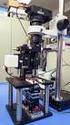 Fachhochschule Regensburg Prüfeninger Straße 58 93049 Regensburg DEUTSCHLAND April 2001 June 2001 Drive an Atomic Force Microscope using LabVIEW software Students names: CAMUS Nicolas PERDU Nicolas Professors
Electron Microscopy 3. SEM. Image formation, detection, resolution, signal to noise ratio, interaction volume, contrasts
 Electron Microscopy 3. SEM Image formation, detection, resolution, signal to noise ratio, interaction volume, contrasts 3-1 SEM is easy! Just focus and shoot "Photo"!!! Please comment this picture... Any
- particle with kinetic energy E strikes a barrier with height U 0 > E and width L. - classically the particle cannot overcome the barrier
 Tunnel Effect: - particle with kinetic energy E strikes a barrier with height U 0 > E and width L - classically the particle cannot overcome the barrier - quantum mechanically the particle can penetrated
Counting and imaging bacteria using fluorescent microscopy & Electron Microscopy and Atomic Force Microscopy (AFM)
 Counting and imaging bacteria using fluorescent microscopy & Electron Microscopy and Atomic Force Microscopy (AFM) Bruce E. Logan Kappe Professor of Environmental Engineering Department of Civil and Environmental
Scanning Near Field Optical Microscopy: Principle, Instrumentation and Applications
 Scanning Near Field Optical Microscopy: Principle, Instrumentation and Applications Saulius Marcinkevičius Optics, ICT, KTH 1 Outline Optical near field. Principle of scanning near field optical microscope
Microscopy and Nanoindentation. Combining Orientation Imaging. to investigate localized. deformation behaviour. Felix Reinauer
 Combining Orientation Imaging Microscopy and Nanoindentation to investigate localized deformation behaviour Felix Reinauer René de Kloe Matt Nowell Introduction Anisotropy in crystalline materials Presentation
Characterization of surfaces by AFM topographical, mechanical and chemical properties
 Characterization of surfaces by AFM topographical, mechanical and chemical properties Jouko Peltonen Department of physical chemistry Åbo Akademi University Atomic Force Microscopy (AFM) Contact mode AFM
FRT - setting the standard
 FRT - setting the standard Surface Analysis Metrology Instruments Process Control Chromatic white light sensor Weißlicht Specs: Linse blauer Fokus roter Fokus max height range 300 µm 600 µm 3 mm 10 mm
A More Efficient Way to De-shelve 137 Ba +
 A More Efficient Way to De-shelve 137 Ba + Abstract: Andrea Katz Trinity University UW REU 2010 In order to increase the efficiency and reliability of de-shelving barium ions, an infrared laser beam was
Scanning Probe Investigations Of Magnetic Thin Films And Nanostructures
 Scanning Probe Investigations Of Magnetic Thin Films And Nanostructures by Jonathan Fetting Reviewers: Prof. Dr. G. Reiss Prof. Dr. D. Anselmetti Department of Physics University of Bielefeld October 2012
PHYSICAL METHODS, INSTRUMENTS AND MEASUREMENTS Vol. IV Femtosecond Measurements Combined With Near-Field Optical Microscopy - Artyom A.
 FEMTOSECOND MEASUREMENTS COMBINED WITH NEAR FIELD OPTICAL MICROSCOPY Artyom A. Astafiev, Semyonov Institute of Chemical Physics, Moscow, Russian Federation. Keywords: diffraction limit nearfield scanning
NP-AFM. Samples as large as 200 x 200 x 20 mm are profiled by the NP-AFM system, and several stage options are available for many types of samples.
 NP-AFM The NP-AFM is a complete nanoprofiler tool including everything required for scanning samples: microscope stage, electronic box, control computer, probes, manuals, and a video microscope. Samples
Spin-flip excitation spectroscopy with STM excitation of allowed transition adds an inelastic contribution (group of Andreas Heinrich, IBM Almaden)
 Magnetism at the atomic scale by Scanning Probe Techniques Kirsten von Bergmann Institute of Applied Physics Magnetism with SPM Spin-polarized scanning tunneling microscopy SP-STM density of states of
Atomic Force Microscopy - Basics and Applications
 Astrid Kronenberger School of Engineering and Science Atomic Force Microscopy - Basics and Applications Summer School June 2006 Complex Materials: Cooperative Projects of the Natural, Engineering and Biosciences
Safakcan Tuncdemir 1, William M. Bradley *2. 1. Introduction
 Modeling and Experimental Verification of the Power Transfer and Thermal Characteristics of Piezoelectric Transformers Subjected to Combined Mechanical and Electrical Loading Safakcan Tuncdemir 1, William
Microscopy. MICROSCOPY Light Electron Tunnelling Atomic Force RESOLVE: => INCREASE CONTRAST BIODIVERSITY I BIOL1051 MAJOR FUNCTIONS OF MICROSCOPES
 BIODIVERSITY I BIOL1051 Microscopy Professor Marc C. Lavoie [email protected] MAJOR FUNCTIONS OF MICROSCOPES MAGNIFY RESOLVE: => INCREASE CONTRAST Microscopy 1. Eyepieces 2. Diopter adjustment
Atomic Force Microscope
 Atomic Force Microscope (Veeco Nanoman) User Manual Basic Operation 4 th Edition Aug 2012 NR System Startup If the system is currently ON To start the NanoScope software, double-click the NanoScope startup
STM, LEED and Mass spectrometry
 STM, LEED and Mass spectrometry R. Schloderer, S. Griessl, J. Freund, M. Edelwirth, W.M. Heckl Introduction TDS UHV technique Preparation STM LEED QMS Concept of new UHV chamber Conclusion P. Cole, M.
Application Note 58 Crystal Considerations with Dallas Real Time Clocks
 www.dalsemi.com Application Note 58 Crystal Considerations with Dallas Real Time Clocks Dallas Semiconductor offers a variety of real time clocks (RTCs). The majority of these are available either as integrated
1. Photon Beam Damage and Charging at Solid Surfaces John H. Thomas III
 1. Photon Beam Damage and Charging at Solid Surfaces John H. Thomas III 1. Introduction............................. 2. Electrostatic Charging of Samples in Photoemission Experiments............................
Procon Engineering. Technical Document PELR 1002. TERMS and DEFINITIONS
 Procon Engineering Technical Document PELR 1002 TERMS and DEFINITIONS The following terms are widely used in the weighing industry. Informal comment on terms is in italics and is not part of the formal
Alternative Linear Motion Systems. Iron Core Linear Motors
 Alternative Linear Motion Systems ME EN 7960 Precision Machine Design Topic 5 ME EN 7960 Precision Machine Design Alternative Linear Motion Systems 5-1 Iron Core Linear Motors Provide actuation forces
Laminar and Turbulent flow. Flow Sensors. Reynolds Number. Thermal flow Sensor. Flow and Flow rate. R = Mass Flow controllers
 Flow and Flow rate. Laminar and Turbulent flow Laminar flow: smooth, orderly and regular Mechanical sensors have inertia, which can integrate out small variations due to turbulence Turbulent flow: chaotic
Microscopy: Principles and Advances
 Microscopy: Principles and Advances Chandrashekhar V. Kulkarni University of Central Lancashire, Preston, United kingdom May, 2014 University of Ljubljana Academic Background 2005-2008: PhD-Chemical Biology
CSCI 4974 / 6974 Hardware Reverse Engineering. Lecture 8: Microscopy and Imaging
 CSCI 4974 / 6974 Hardware Reverse Engineering Lecture 8: Microscopy and Imaging Data Acquisition for RE Microscopy Imaging Registration and stitching Microscopy Optical Electron Scanning Transmission Scanning
Nanoelectronics 09. Atsufumi Hirohata Department of Electronics. Quick Review over the Last Lecture
 Nanoelectronics 09 Atsufumi Hirohata Department of Electronics 12:00 Wednesday, 4/February/2015 (P/L 006) Quick Review over the Last Lecture ( Field effect transistor (FET) ): ( Drain ) current increases
Nanoceanal Spectroscopy of Vibrariums and Electariums
 FEM-Simulationen von Feldverteilungen im elektrischen Rasterkraft-Mikroskop Falk Müller 100 nm 2,93 nm 0 nm Experimental set-up Results Results on gold Application on silicon Numerical umerical simulations
Indiana's Academic Standards 2010 ICP Indiana's Academic Standards 2016 ICP. map) that describe the relationship acceleration, velocity and distance.
 .1.1 Measure the motion of objects to understand.1.1 Develop graphical, the relationships among distance, velocity and mathematical, and pictorial acceleration. Develop deeper understanding through representations
Self-Mixing Differential Laser Vibrometer
 Self-Mixing Differential Laser Vibrometer Michele Norgia e Informazione, Politecnico di Milano, Italy Guido Giuliani,, Silvano Donati -,, Italy [email protected] Outline Conventional Laser Doppler
Acoustic GHz-Microscopy: Potential, Challenges and Applications
 Acoustic GHz-Microscopy: Potential, Challenges and Applications A Joint Development of PVA TePLa Analytical Systems GmbH and Fraunhofer IWM-Halle Dr. Sebastian Brand (Ph.D.) Fraunhofer CAM Fraunhofer Institute