
Blue Pelican Alg II First Semester
|
|
|
- Chester Melvyn Hardy
- 10 years ago
- Views:
Transcription
1 Blue Pelican Alg II First Semester Teacher Version 1.01 Copyright 2009 by Charles E. Cook; Refugio, Tx (All rights reserved)

2 Alg II Syllabus (First Semester) Unit 1: Solving linear equations and inequalities Lesson 01: Solving linear equations Lesson 02: Solving linear inequalities (See Calculator Appendix A and associated video.) Lesson 03: *Solving combined (compound) inequalities Lesson 04: Converting words to algebraic expressions Lesson 05: Solving word problems with linear equations Lesson 06: *Working with linear absolute value expressions Lesson 07: *Graphing calculator solutions of absolute value problems (See Calculator Appendix D and associated video.) Unit 1 review Test: Unit 1 test Unit 2: Slope; Solving a linear system of two equations Lesson 01: Slopes of lines: four different points of view Lesson 02: Two forms for the equation of a line Lesson 03: Graphical meaning of the solution to two linear equations Lesson 04: Algebraic solutions (elimination & substitution) for two linear equations Lesson 05: Word problems involving two linear equations Lesson 06: Graphing calculator solutions of linear systems (See Calculator Appendix C and associated video.) Unit 2 review Test: Unit 2 test Unit 3: Graphing linear inequalities in two variables Lesson 01: Graphing single linear inequalities in two variables Lesson 02: Graphing systems of linear inequalities in two variables
3 Lesson 03: *Graphing calculator- graphing systems of linear inequalities in two variables (See Calculator Appendices B & E and associated videos.) Lesson 04: *Applications of systems of linear inequalities in two variables Cumulative review, unit 3 Unit 3 review Test: Unit 3 test Unit 4: Multiplying and Factoring Polynomials Lesson 01: Simple polynomial multiplication and factoring Lesson 02: (a + b) 2, (a b) 2, (a b)(a + b)--- multiplying and factoring Lesson 03: More trinomial factoring (Leading coefficient not one) Lesson 04: Solving equations by factoring Lesson 05: *Solving word problems with factoring Cumulative review, unit 4 Unit 4 review Unit 4 test Unit 5: Exponents and radicals Lesson 01: Exponent rules (This lesson will likely span two days) Lesson 02: Negative exponents Lesson 03: More exponent problems Lesson 04: Simplifying radical expressions Lesson 05: Fractional exponents Lesson 06: *Solving equations having rational & variable exponents Lesson 07: *Solving radical equations Lesson 8: Rationalizing denominators

4 Cumulative review, unit 5 Unit 5 review Unit 5 test Unit 6: Completing the square, the quadratic formula Lesson 1: Solving equations by taking the square root Lesson 2: Completing the square Lesson 3: *Deriving the quadratic formula Lesson 4: Using the quadratic formula Cumulative review, unit 6 Unit 6 review Unit 6 test Unit 7: Relations and functions Lesson 1: Representations of relations and functions Lesson 2: Independent & dependent variables; Domain & range (See Calculator Appendix F and associated video.) Lesson 3: Function notation; Evaluating functions Lesson 4: Even and odd functions (See Calculator Appendix G and associated video.) Lesson 5: Putting it all together: x & y axis associations Cumulative review, unit 7 Unit 7 review Unit 7 test Unit 8: Analyzing and graphing quadratic functions Lesson 1: Forms of quadratic functions Lesson 2: Finding intercepts and graphing quadratic equations

5 Lesson 3: Analysis of quadratic functions Lesson 4: Using graphs to analyze quadratic transformations (See Calculator Appendix A and associated video.) Lesson 5: Writing quadratic functions Lesson 6: Analyzing quadratic functions with a graphing calculator (See Calculator Appendices A, I, & J and associated videos.) Cumulative review, unit 8 Unit 8 review Unit 8 test Unit 9: Reflections, translations, and inverse functions Lesson 1: Reflection fundamentals Lesson 2: Translations and reflection of relations Lesson 3: *Inverse function fundamentals Lesson 4: *Determining if two relations are inverses of each other (See Calculator Appendix H and associated video.) Cumulative review, unit 9 Unit 9 review Unit 9 test
6 Alg II, Unit 1 Solving linear equations and inequalities

7 Alg II, Unit 1, Lesson1_teacher, page 1 Solving linear equations Solve this linear equation: 3x 4 = 5x +1 The goal is to first get all the x s on the left side of the equation and all the other stuff on the right side. In earlier courses we did this by first adding -5x to both sides as follows: In this course we will begin taking short-cuts to speed things along. Beginning again with 3x 4 = 5x + 1, we say that we will transpose (move) the 5x to the left side. When we do, we change its sign. The result that is equivalent to the above is: Combine the 5x and 3x and then transpose the 4 to the right side and change its sign to get: Notice the last step where we divided both sides by 2.

8 Alg II, Unit 1, Lesson1_teacher, page 2 In the following examples, solve for x: Example 1: 2(4x 9) = x +2 Example 2: x 5x = 2( 3x + 4) Example 3: Example 4:

9 Alg II, Unit 1, Lesson1_teacher, page 3 Assignment: In problems 1 18, solve for the variable: )

10 Alg II, Unit 1, Lesson1_teacher, page

11 Alg II, Unit 1, Lesson1_teacher, page Simplify 18. Simplify 19. Simplify (11 2)y 20. Simplify

12 Alg II, Unit 1, Lesson2_teacher, page 1 Solving linear inequalities To solve an inequality, treat it just like an equation with this one exception: when multiplying or dividing both sides by a negative number, reverse the inequality. It is suggested that when solving, the variable be isolated on the left side. In the following examples, algebraically solve for x and then graph on a number line. (Be sure to graph with closed circles and with open circles): Example 1: Example 2: Example 3: The teacher s age (t) is at least more than 3 times your age (y). Write an inequality to express this inequality in terms of t and y.

13 Example 4: Example 5: Alg II, Unit 1, Lesson2_teacher, page 2

14 Alg II, Unit 1, Lesson2_teacher, page 3 Assignment: In problems 1 18, solve for the variable:

15 Alg II, Unit 1, Lesson2_teacher, page

16 Alg II, Unit 1, Lesson2_teacher, page My weight (m) is at least as much as your weight (y). Express this inequality in terms of m and y. 14. Four times the number of hamburgers Bill ate (B) is still no more than what Lucas ate (L). Express this statement as an inequality in terms of B and L.

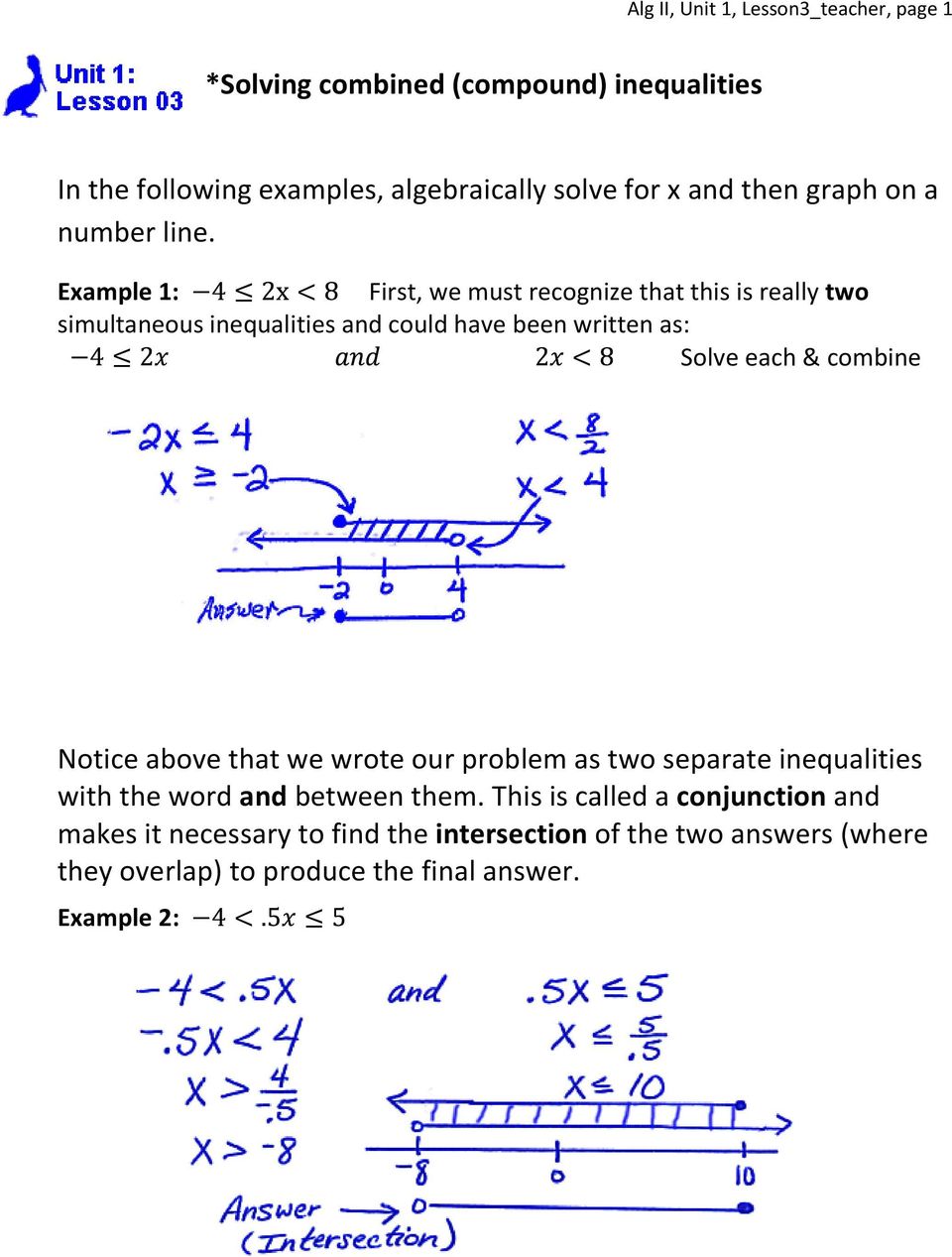
17 Alg II, Unit 1, Lesson3_teacher, page 1 *Solving combined (compound) inequalities In the following examples, algebraically solve for x and then graph on a number line. Example 1: First, we must recognize that this is really two simultaneous inequalities and could have been written as: Solve each & combine Notice above that we wrote our problem as two separate inequalities with the word and between them. This is called a conjunction and makes it necessary to find the intersection of the two answers (where they overlap) to produce the final answer. Example 2:
18 Alg II, Unit 1, Lesson3_teacher, page 2 In the next two examples the word or indicates a disjunction so we take the union of the two answers. Example 3: Example 4:

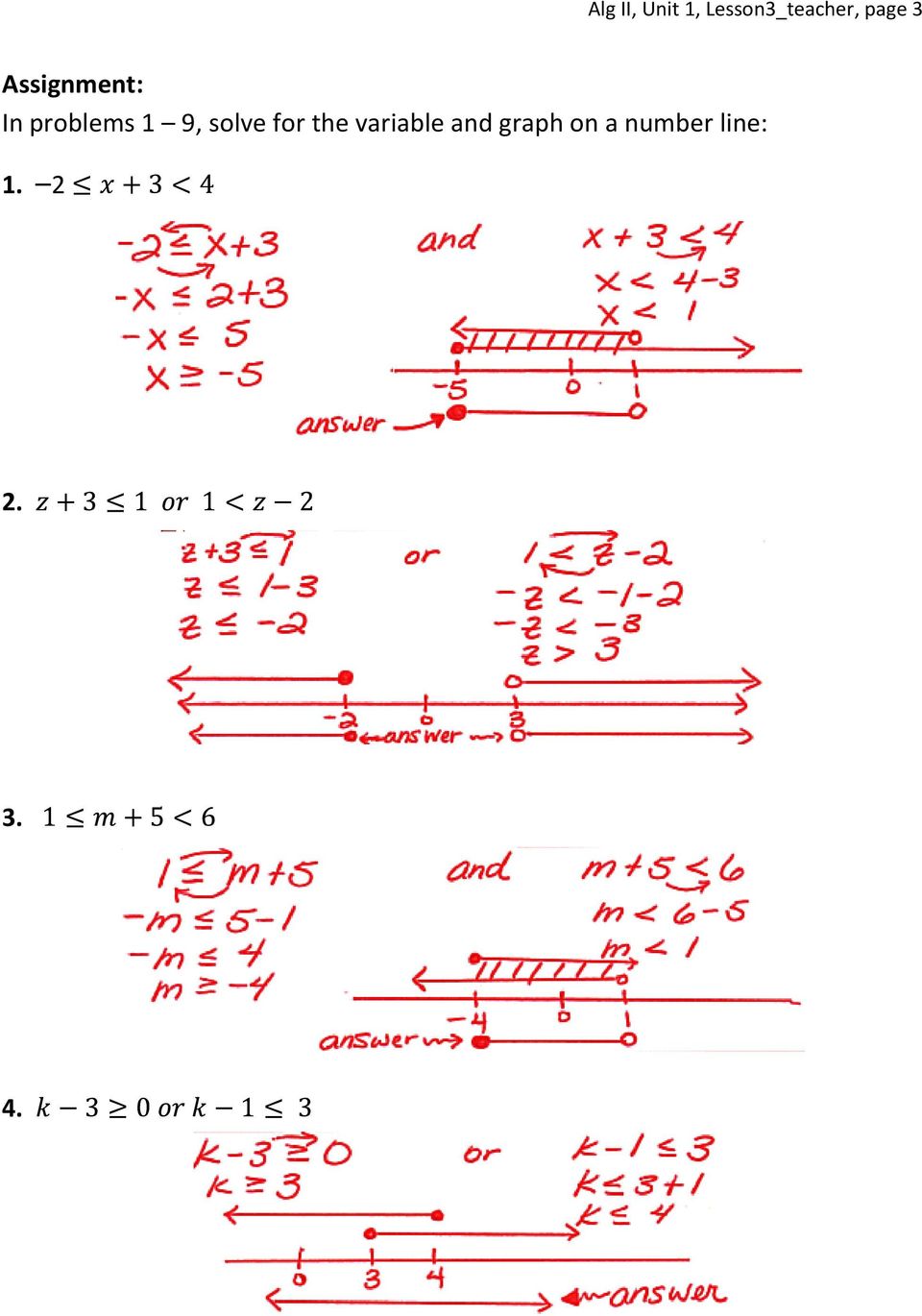
19 Alg II, Unit 1, Lesson3_teacher, page 3 Assignment: In problems 1 9, solve for the variable and graph on a number line:
20 Alg II, Unit 1, Lesson3_teacher, page

21 Alg II, Unit 1, Lesson3_teacher, page Fill in the blanks below with either and or or. Conjunction is associated with Disjunction is associated with what? what?
22 Alg II, Unit 1, Lesson 4_teacher, page 1 Converting words to an algebraic expression Before actually doing word problems where a variable is ultimately solved, it is necessary to become proficient at converting those words into mathematical language. Define all variables. Example 1. What is the sum of three consecutive integers? Example 2. What is the product of three consecutive odd integers? Example 3. Consider an isosceles triangle. What is the measure of the third angle if the two congruent angles measure x degrees? Example 4. What is the perimeter of a square with sides of length x? Example 5. A car travels for h hours at 50 mph. What is the total distance traveled? Example 6. What is the number that is 5 more than twice n?
23 Alg II, Unit 1, Lesson 4_teacher, page 2 Example 7. What is the perimeter of an isosceles triangle whose base is b and the other two sides each being 2 cm longer than the base? Example 8. What is the cost of t movie tickets if the cost of each is $8.00?
24 Alg II, Unit 1, Lesson 4_teacher, page 3 Assignment: In the following problems express the answer in terms of the variable given. Simplify when possible: 1. Let n be the first of 3 consecutive even integers. What is the sum of those integers? 2. Let i be the first of four consecutive integers. What is 3 less than the sum of those integers? 3. Consider four consecutive odd integers. What is the sum of the 2 nd and fourth numbers if the first number is n? 4. A playing field is 10 m longer that it is wide, w. What is its area?
25 Alg II, Unit 1, Lesson 4_teacher, page 4 5. If the length of a side of an equilateral triangle is x, what is half of the perimeter? 6. What is the distance traveled by a train moving at a rate of 45mph in t hours? 7. Jim is twice as old as his sister. If s is the sister s age, what is the sum of their ages? 8. Three siblings are one year apart in age. If the oldest is x years old, what is the average of their ages? 9. A car travels for 2 hours at r mph and then decreases its speed by 5 mph for the next 3 hours. What is the total distance traveled? 10. Two buses leave town at the same time going in opposite directions. Bus A travels at v mph while bus B is 10mph faster. How far apart are they in 3 hours?
26 Alg II, Unit 1, Lesson 4_teacher, page A group of g students have detention and one girl left early. If 8 girls remain, how many boys remain? **12. How long is the diagonal in a rectangle whose length, L, is three more than twice its width? 13. What is the average of y plus 1 and three times x? 14. If a factory can produce p parts per hour, what would be the production in an 8 hour day?
27 Alg II, Unit 1, Lesson 5_teacher, page 1 Solving word problems with linear equations Read each problem, set up an equation with an appropriate variable and then solve. Be sure to define the variable and make drawings when appropriate. Example 1: Find three consecutive odd integers whose sum is 81. Example 2: An angle is 8 times its supplement. What is the angle?
28 Alg II, Unit 1, Lesson 5_teacher, page 2 Example 3: A board game is 6 cm longer than it is wide. If the perimeter is 152 find both dimensions. Example 4. Two planes leave an airport at 1:00 PM and flying in opposite directions. The plane going East flies at 300 mph and the one going West has a speed of 400 mph. How long does it take for them to be 850 miles apart? *According to the clock, what time will that be?
29 Alg II, Unit 1, Lesson 5_teacher, page 3 Assignment: Read each problem, set up an equation with an appropriate variable and then solve. Be sure to define the variable and make drawings when appropriate. 1. Two planes that are initially 800 mi apart are flying directly toward each other. One flies at 250 mph and the other at 150 mph. How long will it be before they meet? 2. Bill s number is 4 more than Mary s. The average of their numbers is 36. What is each persons number? 3. Initially the first bank account is $5 less than the second account. After a month the first account had tripled and the second account had doubled. At that time they were equal. What was the amount originally in each account?
30 Alg II, Unit 1, Lesson 5_teacher, page 4 4. In an isosceles triangle the base angles are 30 degrees less than the other angle. What is the measure of the third angle? 5. The sum of 3 consecutive integers is 153. What are the three integers? 6. The sum of 4 consecutive even integers is 44. What is the largest of those four integers? 7. An angle is exactly half its complement. What is the angle?
31 Alg II, Unit 1, Lesson 5_teacher, page 5 8. A number is multiplied by 2 and then this product is increased by 5. The result is 14 less than twice the opposite of the number. What is the original number? 9. The average of three consecutive integers is 17. what are the integers. 10. Long distance runner A averages 6 mph, while runner B averages 7 mph. They both start from the same starting position; however, runner B begins an hour after A leaves. How long will it take B to catch A?
32 Alg II, Unit 1, Lesson 6_teacher, page 1 *Working with linear absolute value expressions In the following three examples, we show how to rewrite the problem without using the absolute value symbols. From that point the problem can be solved by techniques with which we are already familiar. Example 1: When an absolute value is equal to a number, create two separate equations as follows and take the union (or) of the answers. Example 2: When an absolute value is < or a number, create two separate inequalities as follows and take the intersection (and) of the two answers.
33 Alg II, Unit 1, Lesson 6_teacher, page 2 Example 3: When an absolute value is > or a number, create two separate inequalities as follows and take the union (or) of the two answers.
34 Alg II, Unit 1, Lesson 6_teacher, page 3 Assignment: Solve for the variable and graph the answer on a number line:
35 Alg II, Unit 1, Lesson 6_teacher, page
36 Alg II, Unit 1, Lesson 6_teacher, page
37 Alg II, Unit 1, Lesson7_teacher, page 1 **Graphing calculator solutions: absolute value problems Consider the solutions to the three problems:,, and. To solve these on the calculator, all will require us to graph two functions: Y1 = abs(x 4) (absolute value bars are replaced with abs from the Math Num menu) Y2 = 5 Using a 6. ZStandard zoom, the simultaneous graph of these two is the following where the intersection points have been determined on the calculator with 2 nd Calc intersect (See Calculator Appendix D for instructions and a video.): Example1: For this problem, the answers are 1 and 9 as determined in the drawing above. Example 2:
38 Example 3: Alg II, Unit 1, Lesson7_teacher, page 2
39 Alg II, Unit 1, Lesson7_teacher, page 3 Assignment: Solve each problem on the graphing calculator. Make a sketch of the x-y plot and finally draw the solution to the problem on a number line Review for test on Unit 1
40 Unit 1: Review_teacher, page 1 In problems 1-4, solve for the variable and show all work: 1. 4(x 7) = x (x 5) = x x(6 3) + 4 = x 2 4. In problems 5 and 6 algebraically solve for the variable and graph the answer on a number line. Show your work. 5. 5(x + 7) > (p + 1) 2p
41 Unit 1: Review_teacher, page 2 7. Write an expression for Bob s age. He is 5 years older than 3 times Amy s age (A). 8. Make two associations groups from the words intersection, union, disjunction, conjunction, and, & or. 9. If x is the first even number, write an expression for the average of three consecutive even numbers. 10. An angle is one more than twice its complement. What is the angle? 11. The new court house is 11 meters longer than it is wide. The perimeter of the court house is 175 meters. What are its dimensions? 12. If twice the amount of flour in the pantry exceeds the amount of corn meal by two pounds, what is the amount of flour? There are 15 pounds of corn meal in the pantry.
42 Unit 1: Review_teacher, page 3 **13. Solve 3x 1 = 11 for x. **14. Solve 7 6x < 12 for x. Solve algebraically and then present the answer both algebraically and on a number line. *15. Solve for x. Solve algebraically and then present the answer both algebraically and on a number line.
43 Unit 1: Review_teacher, page 4 *16. Solve for x. Solve algebraically and then present the answer both algebraically and on a number line.
44 Alg II, Unit 2 Slope, solving a linear system of two equations
45 AlgII, Unit 2: Lesson1_teacher, page 1 Slopes of lines: four different points of view The slope (m) of a line is simply a measure of its steepness; therefore, a horizontal line has a slope of m = 0 since it has no steepness. A vertical line is the ultimate in steepness so its slope is infinity (undefined). What about lines that are neither horizontal nor vertical? We are going to look at how to determine the slope four different ways. First method: The two-point slope formula Given two points (x 1, y 1 ) and (x 2, y 2 ) Example 1: Find the slope of the line connecting the points (2, 3) and (5, 6). Example 2: Find the slope of the line connecting the points ( 2, 4) and ( 2, 17) Second method: Simply find two places on the line and create a triangle. The horizontal line segment is the run (always considered positive) while the vertical segment is the rise. It can be either positive or negative depending on if it is rising or falling when moving from left to right.
46 AlgII, Unit 2: Lesson1_teacher, page 2 Example 3: Example 4: Third method: Just by looking at a line, moving from left to right, determine if the line is going up (positive slope), is going down (negative slope), is horizontal (zero slope), or is vertical (no slope, undefined). Example 5: Example 6:
47 AlgII, Unit 2: Lesson1_teacher, page 3 Example 7: Example 8: Fourth method: Convert the equation of a line to slope-intercept form (y=mx + b). The coefficient of x is the slope, m. Example 9: What is the slope of the line? Example 10: What is the slope of the line? Slope relationships: If the slopes of two different lines are equal, the lines are parallel. If the slopes are negative reciprocals of each other (they multiply to give 1), the lines are perpendicular. Example 11: Determine if the following two lines are parallel, perpendicular or neither: y = 3x 1 and y 3x = 5 Example 12: Determine if the following two lines are parallel, perpendicular or neither: y = 3x 1 and 3y = x + 2
48 AlgII, Unit 2: Lesson1_teacher, page 4 Assignment: 1. Find the slope of the line connecting the points (44, 1) and ( 11, 6). 2. Find the slope of the line connecting the points ( 1, 1) and ( 1, 4). 3. A cone is 486 ft tall. From the bottom of the outside of the cone, the horizontal distance to the center of the cone is 230 ft. What is the slope of the cone? 4. What is the slope of a vertical flagpole? 5. Find the slope of the line connecting the points ( 4, 12) and (10, 6). 6. Identify the slope of this line as positive, negative, zero, or undefined.
49 AlgII, Unit 2: Lesson1_teacher, page 5 7. Identify the slope of this line as positive, negative, zero, or undefined. 8. Identify the slope of this line as positive, negative, zero, or undefined. 9. Identify the slope of this line as positive, negative, zero, or undefined. 10. Use rise/run to determine the slope. 11. What is the slope of the line given by? 12. What is the slope of the line given by?
50 AlgII, Unit 2: Lesson1_teacher, page What is the slope of the line given by? 14. What is the slope of the line given by? 15. What is the slope of the line given by? 16. Find the slope of the line connecting the points (1,-2) and (-3, 4). 17. Determine if the following two lines are parallel, perpendicular or neither: y = 4x 2 and y 4x = Determine if the following two lines are parallel, perpendicular or neither: y = 3x 1 and the line connecting (1, 7) and (4, 6).
51 Alg II, Unit 2, Lesson2_teacher, page 1 Two forms for the equation of a line Attention teachers: This lesson is a bit lengthy--- you might want to make two lessons if the class is a little slow. Slope-intercept form: y= mx + b where m is the slope and b is the y intercept (where the line crosses the x axis) Standard form: Ax + By = C In both forms notice that x and y both are raised to the one power. Formally, we say they both are of degree one. Special cases: For a horizontal line the equation is y = a number that is the y-intercept. For a vertical line the equation is x = a number that is the x-intercept. In the following problems, use the provided information to write the slope-intercept form of the equation of the line. Example 1: Slope is 2 and the y intercept is 5. Example 2: Slope is 4 and the line passes through the point (11, 2).
52 Alg II, Unit 2, Lesson2_teacher, page 2 Example 3: Example 4: Slope is undefined and the line passes through the point (4/5, 33). Use a graphing calculator to graph two lines at the same time so as to compare the effect of different y-intercepts and slopes. (See Calculator Appendix A for instructions and a video.) Example 5: Slope is 2 and the x intercept is 4. Example 6: The line passes through the points (1, 1) and (2, 7).
53 Alg II, Unit 2, Lesson2_teacher, page 3 Example 7: Parallel to the line given by 3x 2y = 17 and passing (1, 2). Example 8: Perpendicular to the line given by y =.5x + 3 and having a y intercept of 2. Example 9: x-intercept 5 and y- intercept 6 Example 10: Parallel to x + y 1= 0 and having a y intercept of 100. Example 11: Convert y = 8x + 2 to standard form. Example 12: Convert 44x 2y = 9 to slope-intercept form.
54 Alg II, Unit 2, Lesson2_teacher, page 4 Assignment: In each problems 1-10 find the equation of the line. 1. Slope is 3 and the y intercept is Slope is 2 and the line passes through the point (5, 6) Slope is undefined and the line passes through the point (2, 10). 5. Slope is 1 and the x intercept is The line passes through the points (1, 0) and ( 1, 7).
55 Alg II, Unit 2, Lesson2_teacher, page 5 7. Parallel to the line given by 3x 2y = 17 and passing (3, 9). 8. Perpendicular to the line given by y = 2x + 3 and having a y intercept of 1. 9: x-intercept 3 and y-intercept Parallel to x + 7y 1= 0 and having a y intercept of Convert y = 6x + 5 to standard form. 12. Convert 28x 2y = 8 to slopeintercept form.
56 Alg II, Unit 2, Lesson3_teacher, page 1 Graphical meaning of the solution to two linear equations Consider the following two equations: 2x 4y = 9 11x 5y = 8 What does it mean to solve this system of equations? Very simply, it means to find all the points of intersection of these two lines. There are three distinct possibilities as shown below: The two lines intersect in a single point. The x and y values of that point are the solutions to the system. The two lines never intersect because the lines are parallel but separate. The two lines are directly on top of each resulting in an infinite number of intersection points. So, how can we tell by just looking at the equations of two lines which of the three pictures above represents their orientation? If the slopes of the two lines are different, then it s the left picture above and we have only one point of intersection. If the slopes are the same and the y intercepts are different, then it s the middle picture above and we have no points of intersection. If the slopes are the same and the y intercepts are the same (they are actually the same line), then it s the right-hand picture above and there are infinitely many points of intersection.
57 Alg II, Unit 2, Lesson3_teacher, page 2 In each example below, examine the slope and y-intercept. Then tell how many points are in the solution set of the system. Make a rough sketch of the lines. Example 1: Example 2:
58 Example 3: Alg II, Unit 2, Lesson3_teacher, page 3
59 Alg II, Unit 2, Lesson3_teacher, page 4 Assignment: In the following problems, examine the slope and y-intercept of the two lines and then tell how many points are in the solution set of the system. Make a rough sketch of the lines The line given by (1, 5) & (6, 10) and
60 Alg II, Unit 2, Lesson3_teacher, page 5 4. Line A has a slope of 3/5 and crosses the y axis at 8. Line B has a slope of 3/5 and crosses the y axis at Line A has a slope of 1 and crosses the y axis at 3. Line B has a slope of 3 and crosses the x axis at The product of the slope of the two lines is 1. Hint: This has something to do with the orientation of the line (parallel, perpendicular, etc). 7.
61 Alg II, Unit 2, Lesson3_teacher, page 6 8. The line connecting (0, 0) & (1,1) and the line connecting ( 2, 2) & (5, 5) 9. y = 3 and x = y = 4 and y = 5
62 Alg II, Unit 2, Lesson4_teacher, page 1 Algebraic solutions for two linear equations (elimination & substitution) There are two primary algebraic ways to find the intersection point (the solution) of a system of two linear equations: Substitution and elimination Substitution method: Example 1: y = 3x 2 and x + y = 6 Example 2: x + 2y = 9 and x + y = 4 Elimination method: Example 3: 5x 2y = 8 and 3x + 2y = 0 Example 4: 2x 3y = 1 and 5x + 2y = 0
63 Alg II, Unit 2, Lesson4_teacher, page 2 Special cases: Case 1: If during the process of solving two linear equations, both variables cancel out and we are left with a true statement: The interpretation is that we have two lines right on top of each other. There are infinitely many solutions and can be specified by giving the equation of either line. Case 2: If during the process of solving two linear equations, both variables cancel out and we are left with an untrue statement: The interpretation is that we have two parallel lines that are separated by some distance and never meet. Therefore, there are no solutions. Example 5: 7x + y = 6 and 2y = 14x + 12 Example 6.
64 Alg II, Unit 2, Lesson4_teacher, page 3 Assignment: In the following problems, solve for the intersection point(s) of the systems of linear equations using the substitution method: x y 1 =
65 Alg II, Unit 2, Lesson4_teacher, page 4 In the following problems, solve for the intersection point(s) of the systems of linear equations using the elimination method:
66 Alg II, Unit 2, Lesson4_teacher, page 5 In the following problems, use any technique. Hint: Make a sketch of the two lines in which case you might be able to see the answer. This is called solving by inspection
67 Alg II, Unit 2, Lesson05_teacher, page 1 Solving word problems with two linear equations Solve the following word problems by first defining the two variables. Then set up two linear equations in the two variables and solve by either substitution or elimination. Note that when we solve for two variables we must have two equations. Later, when we have three variables, we will need three equations, etc. Example 1: Larry has $1.15 worth of coins in nickels and quarters. He has one more quarter than nickels. How many of each coin does he have?
68 Alg II, Unit 2, Lesson05_teacher, page 2 Example 2: Four years ago Bob was twice as old as his little sister. Five years from now he will be six years older than his sister. How old is each now?
69 Alg II, Unit 2, Lesson05_teacher, page 3 Assignment: Solve the following word problems by first defining the two variables. Then set up two linear equations in the two variables and solve by either substitution or elimination. 1. The sum of two integers is 16 and their difference is 12. What are the numbers? 2. An airplane flying into the wind can go 2000 miles in 6 hrs. On the return trip with the wind the flight time is 5 hr. What is the speed of the plane in still air and the speed of the wind?
70 Alg II, Unit 2, Lesson05_teacher, page 4 3. The difference of two supplementary angles is 32 degrees. What are the angles? 4. Juan is 8 years older than his brother Two. In another 5 years, Juan will be twice as old as Two. How old are they now? 5. Twins Jose and HoseB have a combined weight of 430 pounds. HoseB is 58 pounds heavier than Jose. How much does each weigh?
71 Alg II, Unit 2, Lesson05_teacher, page 5 6. A pile of 34 coins is worth $5.10. There are two nickels and the remainder are quarters and dimes. How many quarters and dimes are there? 7. The 10 s digit of a number is four more that the units digit of the number. The sum of the digits is 10. What is the number?
72 Alg II, Unit 2, Lesson06_teacher, page 1 Graphing calculator solutions of linear systems Finding the intersection point of two lines: Using the Y= button, enter the two linear equations as Y1 and Y2. Press the Graph button to display the two lines simultaneously. If the intersection point of the lines is not visible, use the Zoom button and then zoom In or Out. The ZStandard zoom will often be the most useful. If none of these show the intersection point, make an estimate of where it is and use the Window button to adjust the max and min values accordingly. With the intersection point displayed, access 2 nd Calc 5.intersect. You will then be asked to identify the first curve. Move the blinker with the left and right arrows until it is clearly on one of the lines. Press Enter. You will then be asked to similarly identify the 2 nd curve. Finally, you are asked to guess the intersection. Move the blinker until it is very close to the intersection point and press Enter. The x and y values of the intersection point will be given at the bottom of the display. See Calculator Appendix C for more details and a video on the finding the intersection of points.
73 Alg II, Unit 2, Lesson06_teacher, page 2 Using the techniques described above, find the intersection point of the following systems of linear equations. Make a rough sketch of the calculator display. Example 1: y= 3x + 4 and y= 2x 9 Example 2: y = -3 and 2y 4 + x = 0
74 Alg II, Unit 2, Lesson06_teacher, page 3 Assignment: Using a graphing calculator, find the intersection point of the following systems of linear equations. Make a rough sketch of the calculator display y = 6x and y = x + 55
75 Alg II, Unit 2, Lesson06_teacher, page y = x + 99 and y x = x +.2 =.3y and y = x y = 5x 55 and y= 4x 17
76 Unit 2: Review_teacher, page 1 1. What is the slope of the line containing the origin and ( 3, 5)? 2. What is the slope of a horizontal line after being rotated 90 degrees? 3. A hill falls 30 feet in altitude when moving from left to right. The horizontal distance covered is 150 feet. What is the mathematical slope of the hill? 4. Convert y = 8x + 2 to general form. 5. What is the slope and y-intercept of the line given by 12x 5y = 7? 6. How many points are there in the solution for the system, y = 5x 8 and 3y 15x = 11? 7. How many points are there in the solution for the system, y = 7x + 5 and y = 7x 5 8. State whether the following two lines are parallel, perpendicular, or neither: y = 4x 1 and 4y = x +2
77 Unit 2: Review_teacher, page 2 9. Solve by elimination: 5x 2y = 8 and -3x + 2y =2 10. Solve by substitution: y = 3x 4 and x y = What is the intersection point of the horizontal line with y-intercept 6 and a vertical line with x-intercept 3? 12. Solve with substitution: x + y = 4 and 6x + 7y = The nerds in Saturday detention outnumbered the geeks by 6. Altogether there were 22 nerds and geeks. How many nerds and how many geeks were there? Define two variables and then set up two equations. Solve using either substitution or elimination.
78 Unit 2: Review_teacher, page The smaller of two supplementary angles is exactly one-third the larger one. What are the two angles? Define two variables and then set up two equations. Solve using either substitution or elimination. 15. Using a graphing calculator, solve 13x 5y = 1.8 and x + y = Using a graphing calculator, solve y = 5 and y = x
79 Alg II, Unit 3 Graphing linear inequalities in two variables
80 Alg II, Unit 3, Lesson01_teacher, page 1 Graphing a linear inequality in two variables To graph an inequality like y < 3x 5, we first draw the line y = 3x 5. Then do the following: If the inequality is or make the line solid. If the inequality is < or > make it dotted. If the inequality is or <, shade below the line. If it is or >, shade above the line. If the line is vertical then, or <, dictates that we shade to the left. Shade to the right if or >. All the shaded points and/or a solid line are the solutions to the inequality. In examples 1 and 2, identify those points that that are solutions to the inequality. Example 1: Example 2: C, D A, B, C In examples 3 and 4, determine algebraically if the point is part of the solution to the inequality. Example 3: 3x 7y 2 ( 4, 10) Example 4: x < 2y 17 ( 8, 1)
81 Alg II, Unit 3, Lesson01_teacher, page 2 In examples 5 and 6, graph the inequality. Remember when dividing or multiplying by a negative number to reverse the inequality. Example 5: 2x y 5 Example 6: x + y > 2
82 Alg II, Unit 3, Lesson01_teacher, page 3 Assignment: In problems 1 and 2, identify those points that that are solutions to the inequality B A, C, D In problems 3 and 4, determine algebraically if the point is part of the solution to the inequality x y < 2x 1 (0, 0) x 7y ( 1, 2) In problems 5 12 graph the inequality. 5. x 2 6. y < 7
83 Alg II, Unit 3, Lesson01_teacher, page 4 7. y 3x 4 8. x y > x π 10. x < y y < 12x 12. y <
84 Alg II, Unit 3, Lesson01_teacher, page 5 In problems 13 and 14 state the inequality represented by the graph
85 Alg II, Unit 3, Lesson02_teacher, page 1 Graphing systems of linear inequalities in two variables In this lesson we will simultaneously graph more than one linear inequality in two variables. The solution to this system will be the region in which they all intersect (overlap). In the following examples sketch the graph of the inequalities on the same coordinate system and then with heavier shading, show where they all intersect (overlap). Example 1: Example 2: y > 2x 6 and y x + 2 3x y > 4, x 2, and y x
86 Alg II, Unit 3, Lesson02_teacher, page 2 Assignment: In the following examples sketch the graph of the inequalities on the same coordinate system and then with heavier shading, show where they all intersect x > 0, y 2 y < x, y < x y x + 2, x 2.5 y > 5, y x y < 1, 2y + x 10 y < x +3, y > x 3
87 Alg II, Unit 3, Lesson02_teacher, page x + y + 1 0, y x 2 x 7 < 0, x + y 0 *9. *10. y > x + 6, y = x y = x 2, y y > x, y < x + 2, and x < 3 x < 4, x > 6, y > 0, and y < 8
88 Alg II, Unit 3, Lesson03_teacher, page 1 *Graphing calculator- linear inequalities in two variables The basics of graphing an inequality: To graph an inequality in two variables on the calculator enter the function with the Y= button. After the function has been entered as Y1, use the left arrow to move the cursor to the left of Y1. Repeatedly press Enter until a short diagonal line segment is displayed to the left of Y1 with shading above the segment icon( ). This, in effect, converts Y1 = into Y1. Similarly, a short diagonal segment icon with shading below ( ) means. Select an appropriate zoom level (either with Zoom and/or Window buttons and then press Graph. The line will be drawn with the proper shading. You are on your own with regard to the difference between & < and & >. The calculator makes no distinction between them. Multiple inequalities (Y1, Y2, etc.) can be displayed with this technique. The intersection representing the solution of the system will be evidenced by a dark cross-hatched region. See Calculator Appendix E for more details and a video. How to graph a vertical line and associated inequality: Strictly speaking, a vertical line cannot be graphed on a TI 84 or similar graphing calculator because a vertical line is multi-valued; therefore it is not a function (these calculators only graph functions). It is possible, however to closely approximate a vertical line. Suppose we need to graph the line x = 5 for Y2. The calculator won t allow a perfectly vertical line; however, we can approximate one with a very steep line passing through the point (5, 0). This would suggest the point slope form y 0 = m(x 5).
89 Alg II, Unit 3, Lesson03_teacher, page 2 Let the very steep slope, m, be Solving for y we get the following line that will become Y2 for the calculator. Y2 = (x 5) By using a negative slope this vertical line will be properly shaded to the left of Y2 using the technique described above ( ). In effect, this turns the line into x < 5. Similarly, with ( to the right. ), we are graphing x > 5 and the shading will be See Calculator Appendix B for more details and a video on graphing vertical lines.
90 Alg II, Unit 3, Lesson03_teacher, page 3 Assignment: Use a graphing calculator to produce the solution set to the following systems of inequalities. Make a rough sketch of the answers. (These are the same problems from Lesson 2.) 1. x > 0, y 2 2. y < x, y < x 3. y x + 2, x y > 5, y 6 5. x y < 1, 2y + x y < x +3, y > x 3 7. x + y + 1 0, y x 2 8. x 7 < 0, x + y 0
91 Alg II, Unit 3, Lesson03_teacher, page 4 9. y > 2x 6 and y x x y > 4, x 2, and y x
92 Alg II, Unit 3, Lesson04_teacher, page 1 * Applications of linear inequality systems in 2 variables Systems of linear equations in two variables can often represent real life situations, especially in the business world. These inequalities are known as restrictions and when graphed represent an appropriate area for operation. After a shaded region is produced and the corner points identified, a function of the two variables can be minimized or maximized by evaluating the function at the corner points, and then by inspection, demonstrating which is greatest or smallest. This process is known as linear programming. An example from the business world is shown on the next page. Linear programming is used to solve it.
93 Alg II, Unit 3, Lesson04_teacher, page 2 Example: A custom auto maker has the facilities to produce a total of 22 vehicles a month (cars and trucks). Parts for the trucks cost $15,000 each and $10,000 for a car. Due to tight credit, they can only borrow a total of $240,000 per month for parts. The labor cost per truck is $2,000 and the labor for a car is $1,800. Labor costs are restricted to only $75,000 per month; otherwise, it would be necessary to pay overtime which would cut excessively into profit margins. Create three inequalities from the above data using x as the number of cars and y as the number of trucks. The assumption is made that x 0 and y 0 since it would make no sense to consider a negative number of cars or trucks. We need not graph these two inequalities; just restrict all graphs to the first quadrant. Assuming a profit of $3200 per car and $2300 per truck, what should be the production of each per month in order to realize the greatest profit?
94 Alg II, Unit 3, Lesson04_teacher, page 3
95 Alg II, Unit 3, Lesson04_teacher, page 4 Assignment: 1. A football team runs no more than 46 running and passing plays per game. The coach insists on no more than 30% passing plays. Let x be the number of runs per game and y be the number of passing plays. Express the solution to the above system of inequalities as a shaded region on an x-y coordinate system. 2. Assume for this particular team that a run results (on the average) in.12 points on the score board while a pass results in.3 points. Examine the corner points of the shaded region from problem 1 and determine the optimum number of runs and passes so as to maximize the number of points earned by the team per game.
96 Unit 3: Cumulative Review_teacher, page 1 1. Solve for x: 4x x + 2 = 5 x 2. Solve 3 x 18 and present the answer on a number line. 3. What is the slope of the line containing the points ( 4, 2) and (6, 17)? 4. What is the equation of the line parallel to x + y = 17 and containing the point ( 3, 1)? 5. Find the point of intersection of the lines x + y = 5 and y = 6x 1 6. Determine if the lines 3x y = 5 and 6x = 2y + 27 are parallel, perpendicular or neither.
97 Unit 3: Cumulative Review_teacher, page 2 7. What is the relationship between the slopes of two lines that are perpendicular to each other? 8. Solve for x.
98 Unit 3: Review_teacher, page 1 1. Consider the inequality x < 4. Which of these points are solutions to this inequality? ( 6, 2), ( 4, 7), ( 1, 13), (1, 4) 2. Consider the inequality y 2. Which of these points are solutions to this inequality? ( 8, 2), (4, 7), (0, 0), ( 2, 6) 3. Determine algebraically if the point is included in the solution to the inequality. 2x 5y > 2 (3, 1) 4. Determine algebraically if the point is included in the solution to the inequality. 5x y + 1 (0, 1) 5. Graph the solution to x y Graph the solution to y < x + 2.
99 Unit 3: Review_teacher, page 2 7. Graph the solution to x < Graph the solution to x y 2 and 3x + 1 < y. 9. Graph the solution to y > x and y x. 10. Use a graphing calculator to show the solution to x 0, y 0, and y > x.
100 Alg II, Unit 4 Multiplying and Factoring Polynomials
101 Alg II, Unit 4, Lesson01_teacher, page 1 Simple polynomial multiplication & factoring An essential fact to remember here is to add exponents when multiplying like variables: x 2 x 3 = x 5 GCF stands for greatest common factor Example 1: Multiply 3x(x 2 + 1) Example 2: Multiply 3(5x 7y + 1) Example 3: Factor out a GCF. 6x 2 2x 12 Example 4: Factor out a GCF. x 4 3x 3 17x 2 Example 5: Multiply (x 5)(x + 3) Example 6: Multiply (x + 4)(x 7) Example 7: Factor x 2 + 4x + 3 Example 8: Factor x 2 + 3x 10
102 Alg II, Unit 4, Lesson01_teacher, page 2 Assignment: 1. Multiply 2( x 11) 2. Multiply 23(x 2 + 2) 3. Multiply 2x(x + y + 2) 4. Multiply ab(b 2 2b + 1) 5. Multiply 5x(2x 2 x + 8) 6. Multiply 2y( y 3 4) 7. Factor out a GCF x 4 2x 2 + x 8. Factor out a GCF x 2 + z + y 2 9. Factor out a GCF 2x 2 + 2z 2 + 4y Factor out a GCF 45z 2 15z 30yz
103 Alg II, Unit 4, Lesson01_teacher, page Multiply (x 11)(x + 2) 12. Multiply (x + 2)(x + 3) 13. Multiply (x + 7)(x 20) 14. Multiply (x + 9)(x 3) 15. Multiply (x 3)(x 3) 16. Multiply (x + 7)(x 7) 17. Factor x 2 + 2x Factor x 2 + 4x + 4
104 Alg II, Unit 4, Lesson01_teacher, page Factor x x Factor x 2 + 7x + 14 *21. Factor 3x 2 24x + 36 *22. Factor 2x 2 14x 60
105 Alg II, Unit 4, Lesson02_teacher, page 1 (a + b) 2, (a b) 2, (a b)(a + b)--- multiplying and factoring Consider the multiplication of (a + b) 2. There are two ways to do this: However, in this and all future lessons, we will use the following shortcut formula: (a + b) 2 = a 2 + 2ab + b 2 Similarly, we will also use: (a b) 2 = a 2 2ab + b 2 and (a b)(a + b) = a 2 b 2 When applying any of these rules to a problem, always factor out a GCF first. Example 1: Multiply (x + 3) 2 Example 2: Multiply (3x 2) 2 Example 3: Multiply (5 y)(5 + y) Example 4: Multiply (2x + 5y 2 )(2x 5y 2 )
106 Alg II, Unit 4, Lesson02_teacher, page 2 Example 5: Factor x 2 10x + 25 Example 6: Factor h h + 49 Example 7: Factor x Example 8: Factor 3xy 2 48x
107 Alg II, Unit 4, Lesson02_teacher, page 3 Assignment: When factoring, be sure to factor completely. 1. Multiply (x 4) 2 2. Multiply (y + 9) 2 3. Multiply (x 3)(x 3) 4. Multiply (z + 5)(z 5) 5. Multiply 2(x 6) 2 6. Multiply 2d(x 12)(x + 12) 7. Factor x Factor x 2 100
108 Alg II, Unit 4, Lesson02_teacher, page 4 9. Factor 2x Factor 100 9x Factor and simplify (x + 2) 2 y Factor and simplify 3x 2 y 27y 13. Factor x 2 16x Factor x 2 10x Factor x Factor z 2 + 2z + 1
109 Alg II, Unit 4, Lesson02_teacher, page 5 *17. Factor completely x 4 81 *18. Multiply ( (x 3) 2 + 4) 2 *19. Factor x 2p 25 *20. Multiply ( (y + 2) + z ) ( (y + 2) z ) 21. Factor x 2 + 4x Factor completely 10m
110 Alg II, Unit 4, Lesson03_teacher, page 1 More trinomial factoring. Leading coefficient not one Consider a trinomial with a leading coefficient of 1: Example, x 2 + 4x + 3 All we need to do is find two numbers that multiply to give 3 and add to give 4. The numbers 1 and 3 satisfy those requirements; therefore, the factors are (x + 1)(x+ 3). Factoring is not quite as simple if the leading coefficient is not 1: Example, 12x 2 17x 5 Begin by thinking of all the ways to multiply to produce 12x 2 : 12x(1x), 3x(4x), 6x(2x) Now think of all the ways to produce 5 with multiplication: 5( 1), 5(1). Next, build some trial factors from these possibilities: for example, (6x + 5)(2x 1) and test to see if the full multiplication produces the original middle term ( 17x).
111 Alg II, Unit 4, Lesson03_teacher, page 2 Example 1: 2x 2 1x 10 Example 2: 14x 2 + 4x 10
112 Alg II, Unit 4, Lesson03_teacher, page 3 Assignment: Factor completely. Remember to first factor out a GCF if possible and be aware that some problems are from the previous lesson. 1. 4x 2 13x x 2 + 2x x x 2 6x x x 2 10x x 2 x x 2 12x 5 9. x x 2 30x + 12
113 Alg II, Unit 4, Lesson03_teacher, page 4 *11. 6x 4 7x 2 20 *12. 72x 2 54x x 2 7x x 2 + 3x + 3
114 Alg II, Unit 4, Lesson04_teacher, page 1 Solving equations by factoring A quadratic equation is one in which the highest power of x (the degree of the equation) is two. That predicts that it will have two solutions. Similarly, a degree three equation (example: 4x 3 6x 2 + 2x 1 = 0) will have three solutions. If an equation can be factored, it can easily be solved. Even if it can t be factored there are more advanced techniques that we will learn later by which it can be solved. Step 1: Get all terms on the left side of the equation with 0 remaining on the right side. Step 2: Factor Step 3: Set each factor involving x equal to 0 and solve for x. The solutions are also called roots or zeros. In the following examples, factor and solve for x. Example 1: x 2 9 = 0 Example 2: x 2 = 3x + 10
115 Alg II, Unit 4, Lesson04_teacher, page 2 Example 3: 3x 2 + x = 0 Example 4: 2x 2 + 4x 126 = 0
116 Alg II, Unit 4, Lesson04_teacher, page 3 Assignment: Factor and solve for x. 1. x 2 4 = 0 2. x 2 = x 2 18 = 0 4. x 3 25x = 0 5. (x 5) 2 = 0 6. x 2 13x + 36 = 0 7. (x + 2)(x 5)(x + 11) = 0 8. x 2 = 1
117 Alg II, Unit 4, Lesson04_teacher, page x = 2x 10. 2x 2 + 1x 15 = x 2 + 9x 22 = x 2 + 2x 35 = x 2 6 = 7x 14. x 2 49 = How many solutions does this equation have? x 7 2x 6 + 3x 2 = How many roots does this equation have? x 3 22x + 5x 6 2x = 0
118 Alg II, Unit 4, Lesson04_teacher, page What is the degree of the polynomial in problem 15? 18. What is the degree of the polynomial in problem 16?
119 Alg II, Unit 4, Lesson05_teacher, page 1 *Solving word problems with factoring Word problems can be solved by setting up an equation (often a quadratic) which can then be solved by factoring. In all such problems be sure to define the variables used. If a drawing can be made, then variables can often be defined by labeling the drawing. When solving be aware of meaningless answers. For example, when solving for the length of a rectangle, a negative answer would be meaningless. Example: A rectangle is one foot longer than it is wide. Its area is 20. What are the dimensions?
120 Alg II, Unit 4, Lesson05_teacher, page 2 Assignment: 1. A rectangle of area 50 ft 2 is twice as long as it is wide. What are the the dimensions of the rectangle? *2. If the radius of a circle is decreased by 6, the old area is 9 times the new area. What was the original radius?
121 Alg II, Unit 4, Lesson05_teacher, page 3 3. The volume of a box 2 in high is 160 in 3. If the length is two more than the width, what is the length and width? 4. Bob claims that if you square his age and then subtract 38 times his age, the result is 80. How old is Bob?
122 Alg II, Unit 4, Lesson05_teacher, page 4 *5. The first number is two more than twice a second number. If their product is 24, what are the numbers?
123 Unit 4: Cumulative Review_teacher, page 1 1. Solve x 3 25x = 0 2. What is the equation of a line perpendicular to 3x y = 4 and having the same y-intercept as x + 2y = 15? 3. Convert 17x 8y = 2 to slopeintercept form. 4. Sketch the graph of 8x 2y 11
124 Unit 4: Cumulative Review_teacher, page 2 5. What is the equation of a line parallel to the line given by x 6 = 0 and passing through the x-axis at 5? 6. What is the slope of the line containing ( 11, 5) and ( 11, 2)? 7. Graph the solution to 2x > 5x + 14 on a number line. 8. Graph the solution to the following system of inequalities. y > 3x x < y + 2
125 Unit 4: Review_teacher, page 1 1. Multiply (3x + 2)( x) 2. Factor 2x 3 + 7x 2 9x 3. Multiply (3x 2)(2x + 4) 4. Factor x 2 3x Factor 36 z 2 6. Factor 4x 2 y 2 7. Factor 4xy 2 11xy 3x 8. Multiply (x + 11)(x 2)
126 Unit 4: Review_teacher, page 2 9. Factor x x Factor x 2 13x Multiply (p 8) Multiply (q 5m) Multiply (3x + 1)(6x 4) 14. Factor and solve 6x 2 24 = Factor 12x 2 + 2x Factor 3x 2 19x 22
127 Unit 4: Review_teacher, page Factor and solve x 2 + 6x + 5 = Factor and solve 3x 2 + x 2 = 0 In the following problems define any variables you use (can sometimes be done by labeling a drawing). Set up an equation and solve by factoring. 19. A rectangle s short side is two feet less than the long side. Its area is 24. What are the dimensions of the rectangle? 20. The new ticket number is one more than the square of the old ticket number. If the new ticket number is 10, what was the old ticket number?
128 Alg II, Unit 5 Exponents and Radicals
129 Alg II, Unit 5, Lesson01_teacher, page 1 Exponent rules Rule 1: x p x q = x p+q Rule 4: (xy) p = x p y p Rule 2: Rule 5: Rule 3: (x p ) q = x pq Rule 6: x 0 = 1, x 0 Example 1: [( 3) 3 ] 2 Example 2: ( 2) 4 ( 2) Example 3: Example 4: (2 2 xy 3 ) 2 Example 5: (3x 5 y 7 ) 0 Example 6: zx 2 (4x 2 +yz) Example 7: Example 8: 5 x+4 5 3
130 Alg II, Unit 5, Lesson01_teacher, page 2 Assignment: Simplify 1. (5x 2 y 3 ) 2 2. ( 4 2 ) m 3 (3m 8 ) 4. 3x(x 2 8x 2 2) (-2xm 2 n 3 ) (2xy 4 z 3 ) 4
131 Alg II, Unit 5, Lesson01_teacher, page (11x 3 y) p 2 (2pq 4 ) ( j 4 ) (10x 2 z) 2 /(5xz 9 ) ( c 2 ) 3
132 Alg II, Unit 5, Lesson01_teacher, page (8/( a 2 b 2 ) ) xy 2 z 3 (x 2 4y) x 2 y 4 + 3(xy 2 ) x 5 x p+3
133 Alg II, Unit 5, Lesson02_teacher, page 1 Negative exponents Rule: When moving an expression having an exponent either up (to the numerator) or down (to the denominator), change the sign of the exponent. Example 1: (3 2 ) 3 Example 2: Example 3: Example 4: On this problem use this shortcut: If a fraction is raised to a power as in example 3, invert the fraction and change the sign of the exponent.
134 Alg II, Unit 5, Lesson02_teacher, page 2 Example 5. Example 6. Example 7.
135 Alg II, Unit 5, Lesson02_teacher, page 3 Assignment: Simplify and leave the answer with all positive exponents. 1. (2 3 ) 3 2. (3) 2 (3) 4 3. m 5 m 3 4. (z 5 ) 2 5. (p 4 ) x 2 z 7. ( 5x 2 q) 3 8. (x 3 y 3 ) 2
136 Alg II, Unit 5, Lesson02_teacher, page 4 9. (5xy 2 ) ( 2b 2 ) 4
137 Alg II, Unit 5, Lesson02_teacher, page b 0 c x 3 y
138 Alg II, Unit 5, Lesson03_teacher, page 1 More exponent problems Assignment: Simplify and manipulate the answers so that all exponents are positive x 3 x 84 x x 4 4. (2z) (3a 5 ) 2 8.
139 Alg II, Unit 5, Lesson03_teacher, page ( 3a 2 b 3 c 5 ) (3x 2 ) (pq 4 ) (5x 3 y 5 ) 2(2xy) 2
140 Alg II, Unit 5, Lesson03_teacher, page x 7 4y 1 x ( a 2 b 5 ) ( 2a 3 b 5 ) 2
141 Alg II, Unit 5, Lesson03_teacher, page 4
142 Alg II, Unit 5, Lesson04_teacher, page 1 Simplifying radical expressions In simplifying radicals, think of this: The square root of something squared is that something. Similarly, the cube root of something cubed is that something. Example 1: Example 2: Example 3: Example 4: Multiplication and division rules:
143 Alg II, Unit 5, Lesson04_teacher, page 2 Example 5: Example 6: Example 7: Example 8: Rule: Radicals can only be added or subtracted when both the index and radicands are the same. (p is the index and r is the radicand) Example 9: Example 10:
144 Alg II, Unit 5, Lesson04_teacher, page 3 Assignment: In the following problems simplify the radicals
145 Alg II, Unit 5, Lesson04_teacher, page
146 Alg II, Unit 5, Lesson04_teacher, page
147 Alg II, Unit 5, Lesson05_teacher, page 1 Fractional exponents Consider. It could also be written as and finally as Similarly, The expression can be rewritten as In examples 1-3 rewrite each radical using exponents. In 4-6, rewrite using radicals. Example 1: Example 2: Example 3: Example 4: Example 5: Example 6:
148 Alg II, Unit 5, Lesson05_teacher, page 2 Simplify the following problems without using a calculator. Example 7: Example 8: Example 9: Example 10: Example 11: Example 12: Example 13: Example 14:
149 Alg II, Unit 5, Lesson05_teacher, page 3 Assignment: Rewrite the following problems in radical form Rewrite the following problems with fractional (rational) exponents
150 Alg II, Unit 5, Lesson05_teacher, page 4 Evaluate and simplify without using a calculator. Leave only positive exponents in the answer
151 Alg II, Unit 5, Lesson05_teacher, page
152 Alg II, Unit 5, Lesson06_teacher, page 1 * Solving equations having rational & variable exponents Many times it is desirable to get rid of an exponent in the process of solving and equation. For example, consider: (x 2) 1/3 = 5 Simply raise both sides to the 3 power and x 2 will be left with no exponent. From that point it is easy to solve for x. Rule: When raising both sides of an equation to an even power (or if the numerator of a fractional power is even), extraneous roots (answers) can be produced. In this case substitute prospective roots back into the original equation to see if they really work. Example 1: x 3/4 = 8 Example 2: (4x) 1/2 + 5 = 0
153 Alg II, Unit 5, Lesson06_teacher, page 2 If in the process of solving a problem a quantity is raised to a fractional power and the denominator is an even number (for example ½, ¼, etc.), we must precede that quantity with ±. Recall that, for example, the ½ power indicates a square root. Take particular note of this in example 3 below. Example 3: x 2/5 + 2 = 11 Example 4: 2(3x 4) 3/4 + 5 = 59 If bases are the same on both sides of an equation as in 3 a = 3 b, then drop the bases and set exponents equal a = b. This is illustrated in examples 5 and 6 below:
154 Example 5. 2 x 6 = 2 4x Example 6. (3 x ) = 9 Alg II, Unit 5, Lesson06_teacher, page 3
155 Alg II, Unit 5, Lesson06_teacher, page 4 Assignment: Solve for the variable and check for extraneous roots when appropriate. 1. x 2/3 18 = (2x 1) 1/3 2 = 0 3. (2x 5) 2/3 = x 2/3 = 125
156 Alg II, Unit 5, Lesson06_teacher, page 5 5. (4x + 2) 1/2 + 5 = x 3/5 = (x + 1) 3/2 + 5 = (x 1) 1/2 + 6 = 12
157 Alg II, Unit 5, Lesson06_teacher, page (x 1) 1/4 = 2 *10. (1/3)(x+ 1) 5/ = 101/ x 2 = x 5 2 = 5 3x + 1
158 13. 4 x 4 2 = 16 *14. Alg II, Unit 5, Lesson06_teacher, page 7
159 Alg II, Unit 5, Lesson07_teacher, page 1 *Solving radical equations To solve an equation containing a radical follow these steps: Isolate the term containing the radical. Raise both side of the equation to a power that eliminate the radical. For example, if the radical is a square root, raise both sides to the 2 power. Solve for the variable. Example 1: Example 2:
160 Alg II, Unit 5, Lesson07_teacher, page 2 Example 3: Example 4: Note to Teachers: The assigment will likley be diffiucult for some students. It might be wise to spread this over two days so as to be able to give in-class assistance. In that event, consider assigning either the unit review or the cumulative review with one of the half-lessons. Those problem would more likely be done with little teacher- assistance.
161 Alg II, Unit 5, Lesson07_teacher, page 3 Assignment: Solve for the variable in each problem. Be sure to check your solution when necessary
162 Alg II, Unit 5, Lesson07_teacher, page
163 Alg II, Unit 5, Lesson07_teacher, page 5 7. *8. 9.
164 **10. Alg II, Unit 5, Lesson07_teacher, page 6
165 Alg II, Unit 5, Lesson08_teacher, page 1 Rationalizing denominators It is generally not considered simple to leave a fraction under a radical or to have a radical in the denominator of a fraction: or In both cases above the expression can be simplified so as to neither have a fraction under a radical or to have a radical in a denominator. This is known as rationalizing the denominator: Example 1: Example 2: Example 3: Example 4:
166 Example 5: Alg II, Unit 5, Lesson08_teacher, page 2
167 Alg II, Unit 5, Lesson08_teacher, page 3 Assignment: Simplify and arrange each expression so as to not have a radical in the denominator or a fraction under a radical:
168 Alg II, Unit 5, Lesson08_teacher, page *
169 Alg II, Unit 5, Lesson08_teacher, page **14.
170 Unit 5: Cumulative Review_Teacher, page 1 1. Find the equation of the line parallel to the x axis and passing through the point (0, 12). 2. Find the equation of the line with x- intercept 3 and y-intercept A total of 1806 tickets to a concert were sold which amounted to $20,040. The price of a regular ticket was $12 while a balcony ticket was $10. How many of each type ticket was sold? 4. Produce the solution to the following system of equations on a graphing calculator. Graph the lines and find their intersection point..33x 5y = and x +.908y = Multiply (3x 5z)(2x + 7z)
171 Unit 5: Cumulative Review_Teacher, page 2 6. Factor x 2 81y 2 a 2 7. Multiply (5x 2y 2 ) 2 8. Factor a 4 b Simplify 11. Vertical line A passes through (18, 22) while horizontal line B passes through (5.7,.3). What is the intersection point of these two lines?
172 Unit 5: Review_teacher, page 1 1. Simplify (3x 4 y 3 ) 3 2. Simplify 4 x+3 4 2x+1 3. Simplify 4. Simplify 5. Simplify (xy 15 ) 0 4x 2 x 3 6. Simplify 7. Simplify 8. Simplify
173 Unit 5: Review_teacher, page 2 9. Simplify 10. Simplify 11. Express in radical form. 12. Express in exponential form. 13. Simplify and leave in radical form. 14. Simplify and leave in exponential form.
174 Unit 5: Review_teacher, page Simplify 17. Simplify
175 Alg II, Unit 6 Completing the square, The quadratic formula
176 Alg II, Unit 6, Lesson01_teacher, page 1 Solving equations by taking the square root There are some situations in which an equation must be solved by taking the square root of both sides. When creating an even root, be sure to put a ± in front of the radical. Solve for x by taking the square root. Example 1: x 2 9 = 0 Example 2: x 2 50 = 0 Example 3: 7x = 0 Example 4: x 2 6x + 9 = 2 Teachers: Since this is a fairly short assignment (if the starred problems are skipped), you might consider also assigning the cumulative review included in this unit as homework.
177 Alg II, Unit 6, Lesson01_teacher, page 2 Assignment: Solve by taking the square root. 1. x 2 3 = 0 2. x 2 3 = 2 3. x 2 25 = 0 4. (5/2)x 2 7/5 = 0 5. x 2 8x + 16 = 0 *6. (x 4) 2 2x = 9
178 Alg II, Unit 6, Lesson01_teacher, page 3 7. (x 2) 2 /4 4 = 0 **8. x 2 22x = (x + 2) 2 36 = 0 *10. (11x 4/3) 2 = 17
179 11. (x 22) 2 = (x +.101) 2 = 9 Alg II, Unit 6, Lesson01_teacher, page 4
180 Alg II, Unit 6, Lesson02_teacher, page 1 Completing the square Consider the following perfect squares. Notice the pattern: (x + 3) 2 = x 2 + 6x + 9 (half of 6) 2 is 9 (x - 4) 2 = x 2 8x + 16 (half of 8) 2 is 16 (x + 5) 2 = x x + 25 (half of 10) 2 is 25 Example 1: What would we need to add to x 2 + 8x in order to make it a perfect square? Example 2: What would we need to add to x 2 + 9x in order to make it a perfect square? Quadratics can be solved by adding the appropriate quantity to both sides so as to complete the square: Now take the square root of both sides and solve for x. Be sure to put a ± in front of the numerical square root.
181 Alg II, Unit 6, Lesson02_teacher, page 2 Example 3: Solve by completing the square. x x = 13 Example 4: Solve by completing the square. x 2 = 11x 2 The completing the square rule of taking adding half of the linear coefficient squared only works when the coefficient of the squared term is 1. If that coefficient is other than one, then begin by dividing by that coefficient: Example 5: Solve 2x x = 2
182 Alg II, Unit 6, Lesson02_teacher, page 3 Assignment: What needs to be added to the following polynomials in order to make them a perfect square? 1. x x 2. x x Solve the following equations by completing the square. 3. x 2 + 2x = 8 4. x 2 12x = 4 5. x 2 + x = 3/4 6. x 2 18x + 4 = 0
183 Alg II, Unit 6, Lesson02_teacher, page 4 **7. x 2 +.5x = x x = x x 2 = x + 1 = x 2
184 Alg II, Unit 6, Lesson02_teacher, page x 2 30 x = x 2x = x x =106 **14. ax 2 + bx + c (Your answer will be in terms of a, b, and c.)
185 Alg II, Unit 6, Lesson03_teacher, page 1 *Deriving the quadratic formula General form of the quadratic equation: ax 2 + bx + c = 0 Solve by completing the square. The first step is to divide by (a) so as to cause the squared coefficient to be 1. Move the constant term (c/a) to the right side: Next, calculate half of the linear coefficient and then square: Now add this quantity to both sides. This completes the square.
186 Alg II, Unit 6, Lesson03_teacher, page 2 Recognize that the left side is a perfect square so express it as such: Take the square root of both sides and simplify. Solve for x and simplify: This result,, is known as the quadratic formula and is arguably the most important formula in algebra. Memorize the following: ax 2 + bx + c = 0 general form of the quadratic equation quadratic formula (solution to the above)
187 Alg II, Unit 6, Lesson03_teacher, page 3 Practice: Begin with the general form of the quadratic equation and derive the quadratic formula.
188 Alg II, Unit 6, Lesson03_teacher, page 4 Assignment: 1. Begin with ax 2 + bx + c = 0 and derive the quadratic formula. If you have trouble, glance back at your notes occasionally as you proceed through the derivation.
189 Alg II, Unit 6, Lesson03_teacher, page 5 2. Consider the general form of the quadratic equation, ax 2 + bx + c = 0. What is the coefficient of the squared term? 3. Consider the general form of the quadratic equation, ax 2 + bx + c = 0. What is the coefficient of the linear term?
190 Alg II, Unit 6, Lesson04_teacher, page 1 Using the quadratic formula Use the quadratic formula to solve quadratic equations such as 3x 2 4x 5 = 0 Step 1: Identify a, b, and c Step 2: Substitute a, b, and c into the quadratic formula Solve the following quadratic equations using the quadratic formula. Example 1: 3x 2 + 6x 2 = 0 Example 2: 7x = 1 + 2x 2
191 Alg II, Unit 6, Lesson04_teacher, page 2 Example 3: x 2 + 4x 21 = 0 Example 4: x 2 + 2x + 8 = 0
192 Alg II, Unit 6, Lesson04_teacher, page 3 Assignment: Solve the following quadratic equation using the quadratic formula. 1. x 2 + x 2 = x 2 + x 2 = 0 3. x 2 + x + 1 = x = 4x
193 Alg II, Unit 6, Lesson04_teacher, page 4 5. x 2 + 2x + 1 = x + 4x = x x 2 + 2x.5 = 0 (Use a calculator to produce final numerical answers.) 8. x 2 + x = 0
194 Alg II, Unit 6, Lesson04_teacher, page 5 9. x 2 16 = 0 *10. fx 2 + gx + h = 0 where f, g, and h are constants.
195 Unit 6: Cumulative Review_teacher, page 1 1. What is the equation of a line with x-intercept 4 and y-intercept 2? 2. Consider the line 3x 2y = 8. What would be the equation of this line if it is translated vertically upward by 2 units? 3. Solve by factoring: x 2 81 = 0 4. Simplify
196 Unit 6: Cumulative Review_teacher, page 2 5. Solve the system 4x + 5y = 2, 2x 7y = 1 6. Solve 7. Simplify 8. If the slope of a line is negative, would a line perpendicular to it have a negative, positive, zero, or no slope?
197 Unit 6: Review_teacher, page 1 *1. Beginning with the general form of the quadratic equation, derive the quadratic formula.
198 Unit 6: Review_teacher, page 2 Solve by taking the square root. 2. (x + 6) 2 47 = 0 3. (2x 7) 2 = 49 Solve by completing the square. 4. 4x 2 24x + 1 = 0 5. x 2 9x = 2
199 Unit 6: Review_teacher, page 3 Solve using the quadratic formula. 6. 4x 2 24x + 1 = 0 7. x 2 9x = 2 8. x 2 2x + 8 = x 2x 2 = 4
200 Alg II, Unit 7 Relations and Functions
201 Alg II, Unit 7, Lesson01_teacher, page 1 Representations of Relations and Functions Relation definition: A relation is a collection of points (officially called a set of points). There are five ways to show such a collection (set). 1 st way: Let s begin with the most familiar: { ( 5, 2), (3, 3), (3, 2), (6, 8) } 2 nd way: Graph 3 rd way: Mapping 4 th way: Table x y th way: Formula rule (This example does not apply to the above examples.) y = 3x + 5 Function definition: A function is a relation (a set of points) that has no two x-coordinates alike. An equivalent definition would be, a relation that passes the vertical line test. The vertical line test is failed if a vertical line passes through more than one point on the graph. Look at the table above. It is not a function because of the repeated 3 s in the x column. Notice in the graph above that a vertical line would pass through the points (3, 3) and (3, 2); therefore, it is not a function.
202 Alg II, Unit 7, Lesson01_teacher, page 2 In the following examples, determine if the relation is a function or not. Example 1: Example 2: Example3: Example 4: Example 5: { (11, 2), ( 4, 13), (11, 1), (3, 18) } Example 6: { (12, 2), ( 4, 2), (11, 2), (16, 2) }
203 Alg II, Unit 7, Lesson01_teacher, page 3 Assignment: 1. Define a mathematical relation. 2. Define a mathematical function 3. Draw a graph that is an example of a relation that is not a function because it fails the vertical line test. 4. Draw a graph that is an example of a relation that is also a function because it passes the vertical line test. In the following problems, represent this relation in the form indicated: { ( 2, 5), (5, 6), (2, 4), ( 2, 4) } 5. Represent with a graph. 6. Represent with a table.
204 Alg II, Unit 7, Lesson01_teacher, page 4 7. Represent with a mapping. 8. Is the relation above a function? In the following problems, determine if the relation is a function or not. 9. { (4, 7), (3, 3), (6, 14), (3, 11) } 10. { (1, 7), (2, 7), (3, 7), (4, 7) } 11. { (7, 1), (7, 2), (7, 3), (7, 4) }
205 Alg II, Unit 7, Lesson01_teacher, page
206 Alg II, Unit 7, Lesson01_teacher, page The line given by y = 2x The line given by x = 6
207 Alg II, Unit 7, Lesson02_teacher, page 1 Independent & dependent variables; Domain & Range The independent variable (typically x) for a relation corresponds to the input values. The dependent variable (typically y) for a relation corresponds to the output values. Example 1: Consider the relation (and also a function) y = x 2 Generate a few of the points on this relation with a table as follows: The domain of a relation is the permissible values of the independent variable (typically x). The range of a relation is the permissible values of the dependent variable (typically y). Example 2: Find the domain and range. Is it a function? Example 3: Find the domain and range. Is it a function?
208 Alg II, Unit 7, Lesson02_teacher, page 2 Example 4: Find the domain and range. Is it a function? Example 5: Find the domain and range. Is it a function? { (3, 7), (6, 2), (11, 9), (6, 7) } Example 6: Find the domain and range. Is it a function? x y Example 7: Find the domain and range. Is it a function? y = 3x + 4 It is possible to restrict the domain of a function on a graphing calculator so that only a portion of the graph displays (that permitted by the domain). See Calculator Appendix F for details and a video on how to do this.
209 Alg II, Unit 7, Lesson02_teacher, page 3 Assignment: 1. In the relation z = 3w 2 4w + 6 which is the independent and which is the dependent variable? 2. The dependent variable is normally graphed as the horizontal or vertical axis? 3. What is meant by the domain of a relation? 4. What is meant by the range of a relation? 5. If a relation has a domain given by 3 x < 4 and a range given by y > 1, which of the following points could not possibly be a point on the relation? 6. Which is considered to be the input of a function or relation, the independent or the dependent variable? ( 3, 15), (4, 12), (0, 0), (-3, -4), (3.5, 1) 7. What is the domain and range of the function y = 2x 8? Is it a function? 8. What is the domain and range of the vertical line given by x = 7? Is it a function?
210 Alg II, Unit 7, Lesson02_teacher, page 4 9. What is the domain and range of the relation given by this table? Is it a function? x y What is the domain and range of the relation given by this table? Is it a function? x y What is the domain and range of this relation? Is it a function? 12. What is the domain and range of this relation? Is it a function?
211 Alg II, Unit 7, Lesson02_teacher, page What is the domain and range of this relation? Is it a function? 14. What is the domain and range of this relation? Is it a function? 15. What is the domain and range of this relation? Is it a function? 16. What is the domain and range of this relation? Is it a function? 17. What is the domain and range of y = 3x? Is it a function? 18. What is the domain and range of y = x 1? Is it a function?
212 Alg II, Unit 7, Lesson03_teacher, page 1 Function notation; Evaluating functions Consider the function f = 3x + 2. This is more conventionally written as f(x) = 3x + 2. f(x) does not mean f time x. In this context we read it f of x. f(x) = 3x + 2 could be rewritten in a more familiar form as y = 3x + 2. Since y is the dependent variable and x is the independent variable, we conclude the following about the f(x) version: f is the dependent variable x is the independent variable To evaluate the function f(x) = 5x 2 + 2x 7 at a specific x value (for example, 3), we use the following notation: Relations and functions do not have to be called f. Consider the following example using g(x) = 4x 2 evaluated at x = 2: Example 1: Find g( 4) where g(x) = 2x 2 5 Example 2: Find h(z+2) where h(x) = (2x 1)/3
213 Alg II, Unit 7, Lesson03_teacher, page 2 In the following examples use f(x) = and g(x) = 2x + 1 *Example 3: Composite function f(g(x)) *Example 4: Composite function g(f(x))
214 Alg II, Unit 7, Lesson03_teacher, page 3 Assignment: 1. In the function h(x) = 4x 3 2x 2 x + 2 what is the independent variable and what is the dependent variable? 2. In the function g(y) = 4y 3 2y 2 y + 2 what is the independent variable and what is the dependent variable? 3. If f( 7) does not mean f times 7, what does it mean? 4. Write out in words how we would say f( g(x) ). In the following problems use f(x) = x 2 x 1 and g(x) = (x 5)/x 5. Evaluate f( 3) 6. Evaluate f(5)
215 Alg II, Unit 7, Lesson03_teacher, page 4 7. Evaluate g(2) 8. Evaluate g( 1) 9. Evaluate f(0) + g(2) 10. Evaluate g(3) g( 2) *11. Simplify f( g(x) ) *12. Simplify g( f(x) )
216 Alg II, Unit 7, Lesson03_teacher, page f( 2)/2 14. g(x/2) 15. f(w) *16. g( g(x) ) 17. f(x 1) *18. g(x)/f(x)
217 Alg II, Unit 7, Lesson04_teacher, page 1 Even and odd functions An even function is one that has symmetry ( balance ) with respect to (w.r.t.) the vertical axis: Examples: An odd function is one that has symmetry ( balance ) w.r.t. the origin: Examples: Since even functions have symmetry w.r.t. the vertical axis, it is a common mistake to think of odd functions as being defined as having symmetry w.r.t. the horizontal axis; however, a relation that has such symmetry is not a function (fails the vertical line test). Another common mistake is to think that all functions must be either even or odd. Functions can be neither even nor odd. In the following examples identify which functions are odd, even, or neither:
218 Alg II, Unit 7, Lesson04_teacher, page 2 Example 1: Example 2: Example 3: Example 4: Example 5: Complete the drawing so as to create an even function. Example 6: Complete the drawing so as to create an odd function.
219 Alg II, Unit 7, Lesson04_teacher, page 3 Besides the graphical tests for even and odd functions discussed above, there are algebraic tests: Even test: f(x) = f( x) Odd test: f(x) = f( x) Example 7: Show that f(x) = 5x 4 + x 2 1 is an even function. Example 8: Show that f(x) = 2x 3 x is an odd function. It is often possible, but not always (be careful), to look at the exponents of a polynomial and tell if it s even or odd. For example, f(x) = 3x 6 x 4 is even. notice the exponents are all even. For example, f(x) = x 5 4x 3 is odd. notice the exponents are all odd. See Calculator Appendix G for more discussion and a video regarding even and odd functions.
220 Alg II, Unit 7, Lesson04_teacher, page 4 Assignment: 1. Complete the drawing so as to create an odd function. 2. Complete the drawing so as to create an even function. 3. Complete the drawing so as to create an odd function. 4. Complete the drawing so as to create an even function. 5. Is this an even or an odd function (or neither)? 6. Is this an even or an odd function (or neither)?
221 Alg II, Unit 7, Lesson04_teacher, page 5 7. Is this an even or an odd function (or neither)? 8. Is this an even or an odd function (or neither)? 9. Is this an even or an odd function (or neither)? 10. Is this an even or an odd function (or neither)? 11. Algebraically test f(x) = x 5 2x to see if it is even, odd, or neither. 12. Algebraically test f(x) = x 4 4 to see if it is even, odd, or neither.
222 Alg II, Unit 7, Lesson04_teacher, page Algebraically test f(x) = 6 to see if it is even, odd or neither. 14. Algebraically test x = 3 to see if it is even, odd or neither. 15. Algebraically test f(x) = x 2 x to see if it is even, odd or neither. 16. Algebraically test f(x) = 1/x 3 2 to see if it is even, odd, or neither.
223 Alg II, Unit 7, Lesson05_teacher, page 1 Putting it all together: x & y axis associations The association of the x axis with domain & independent variables and the association of the y axis with range & dependent variables can be confusing. The bad news is that there are a number of other things to associate with these axes. These are summarized below: Frankly, this doesn t help much. What we need is some other way to memorize these associations. Consider the following chart: x horizontal abscissa H cos domain input independent y vertical ordinate K sin range output dependent Several of these items have not been studied yet; however, most will come up at some point in this course. Notice that each side-by-side pair in this table is in alphabetical order (except for the last row) which makes them all easy to associate with x & y.
224 Alg II, Unit 7, Lesson05_teacher, page 2 Unfortunately this alphabetical-order miracle fails with the words independent and dependent. They are in reverse alphabeticalorder when correctly placed in the table above. That s the only exception.
225 Alg II, Unit 7, Lesson05_teacher, page 3 Assignment: Even though you may not know the meaning of some of the following terms, it is possible to determine the answer from the alphabetical chart. Try not to look at the chart. Rather, just think of the alphabetical sequence. 1. The trig function sine (abbreviated sin) is the projection of a rotating unit vector on which axis? 2. The trig function cosine (abbreviated cos) is the projection of a rotating unit vector on which axis? 3. The x axis is generically referred to as the abscissa or ordinate? 4. The y axis is generically referred to as the abscissa or ordinate? 5. Relations are translated left/right by replacing x with x h or x k? 6. Relations are translated up/down by replacing y with y h or y k? 7. Is the domain the permissible values for the x or y axis? 8. Is the range the permissible values for the x or y axis? 9. For a function f(x) are the x values the input or output? 10. For a function f(x) are the f values the input or output?
226 Alg II, Unit 7, Lesson05_teacher, page Is the domain the permissible values for the abscissa or ordinate? 12. Is the range the permissible values for the abscissa or ordinate? 13. The x axis is typically the vertical or horizontal axis? 14. The y axis is typically the vertical or horizontal axis? 15. The domain is associated with x or y? 16. The range is associated with x or y? 17. The range of a relation or function is associated with the dependent or the independent variables? 18. The domain of a relation or function is associated with the dependent or the independent variables? 19. Another name for the horizontal axis is the abscissa or ordinate? 20. Another name for the vertical axis is the abscissa or ordinate? Do the chapter review as an additional part of the homework.
227 Unit 7: Cumulative Review_teacher, page 1 1. Solve 2x 2 12x 9 = 0 by completing the square. 2. Solve x 2 + x 56 = 0 using the quadratic formula. 3. What would be the equation of 4x + 3y 11 = 0 when translated up 2 units? 4. Solve.
228 Unit 7: Cumulative Review_teacher, page 2 5. Simplify leaving only positive exponents in the answer. 6. Simplify and express in radical form. 7. Simplify and express in exponential form. 8. Solve. 9. Solve x 2/5 + 1 = Expand (2y 3 6xc) 2 and simplify.
229 Unit 7: Cumulative Review_teacher, page Factor 4x Graph 3y + 12x What is the slope of a line perpendicular to 3x 5y = 17? 14. A rectangle of area 21m 2 has a width 3m shorter than its length. What are the dimensions of the rectangle?
230 Unit 7: Review_teacher, page 1 In the following problems identify the domain and range. Then tell whether it is a function or not x y x y
231 Unit 7: Review_teacher, page 2 7. { (1, 4), (3, 5), (2, 6), (1, 1), (9,.3) } 8. {(11, 11), (2, 2), (0, 0), ( 1, 1), ( 2, 2)}
232 Unit 7: Review_teacher, page y = 4x y = 5 In the following problems use f(x) = 3x 2 1 and g(x) = (x + 4)/2 15. Evaluate f(1) 16. Evaluate g( 2) 17. Evaluate f(2) g(1) *18. Simplify f( g(x) ) 19. Identify the dependent and independent variables in y = 7x Identify the dependent and independent variables in g(y) = 8y 3 2y 1
233 Alg II, Unit 8 Analyzing and Graphing Quadratic Functions
234 Alg II, Unit 8, Lesson01_teacher, page 1 Forms of quadratic functions Quadratic functions form parabolas when graphed. A quadratic function is always recognizable because there will be only one y term and its exponent will be 1. The other side of the equation will be a polynomial with variable x of degree 2 (highest power is 2). Example 1: Which of the following are quadratic functions that form parabolas? (a) y = 3x 2 2x + 6 (b) 3y -6x + 2x 2 = 5 (c) y 2 = 5x x (d) y = (e) y = 1/x (f) y = cos(x 2 + x 9) The simplest parabola is the parent function: Make an x-y chart using x as the independent variable. Then graph the points to form the points of this parent function parabola: General form: y = f(x) = ax 2 + bx + c Vertex If a is positive the parabola goes up: If a is negative the parabola goes down:
235 Alg II, Unit 8, Lesson01_teacher, page 2 Example 2: Find the vertex of f(x) = 2x 2 4x + 5 and then make a rough sketch of the graph of the parabola. Vertex form: y = f(x) = a(x h) 2 + k Vertex (h, k) If a is positive the parabola goes up: If a is negative the parabola goes down: Example 3: Find the vertex of y= 3(x + 4) 2 3 and then make a rough sketch of the graph of the parabola. Root form: y = f(x) = a(x r 1 )(x r 2 ) r 1 and r 2 are the roots If a is positive the parabola goes up: If a is negative the parabola goes down:
236 Alg II, Unit 8, Lesson01_teacher, page 3 Example 4: Identify the roots for y = f(x) = 4(x 2)(x + 7) and then make a rough sketch of the graph of the parabola.
237 Alg II, Unit 8, Lesson01_teacher, page 4 Assignment: Identify the vertex and make a rough sketch of the graphs of the parabolas. 1. y = 3x 2 2x f(x) = 5x 2 6x f(x) = 4(x + 11) y = 2(x 7) 2 + 1
238 Alg II, Unit 8, Lesson01_teacher, page 5 Identify the roots and make a rough sketch of the graphs of the parabolas. 5. f(x) = 4(x 2)(x + 1) 6. y = (x +12)(x 6) In the following problems identify the functions that are parabolas. It is possible to have more than one answer on each problem (a) f(x) = 32x 16x 2 +1 (a) (b) y = 6x (b) y = 1/(x 2 + 2x + 3) (c) y = x 2 + x + x 3 (c) k(x) = x 2 + 1/x (d) g(x) = 1/(x 2 + 1) (d) y = x 2 + 1/x + 10 (e) h(x) = 1/(x -2 ) (e) y = 2 x + x Write the general form of a quadratic function. 10. Write the vertex form of a quadratic function having vertex (h, k). 11. Write the root form of quadratic function having roots r 1 and r Write the simplest equation for a parabola (it s called the quadratic parent function).
239 Alg II, Unit 8, Lesson02_teacher, page 1 Finding intercepts and graphing quadratic equations Locating the x-intercepts (roots) and the y-intercepts helps establish the position of the parabola. To find the x-intercepts, set y = 0 and solve for x. There will be two solutions. To find the y-intercept, set x = 0 and solve for y. There will be one solution. Example 1: Find the intercepts of y = f(x) = 2(x 4) 2 4 and use them to graph the parabola. When given the root form of parabolic function, it is necessary to find the vertex in order to graph the function. The x value of the vertex is the average of the two roots. To find the y value of the vertex, substitute in the x value and then solve for y. k = f(h)
240 Alg II, Unit 8, Lesson02_teacher, page 2 Example 2: Find the intercepts and vertex of y = f(x) = 4(x 2)( x + 6) and use them to graph the parabola.
241 Alg II, Unit 8, Lesson02_teacher, page 3 Assignment: In the following problems sketch the parabola and label all intercepts and the vertex: 1. f(x) = (x 4) y = (x + 1) f(x) = 5(x 4)(x 6)
242 Alg II, Unit 8, Lesson02_teacher, page y = (x + 2)(x + 8) 5. y + (x + 3) 2 = 4 6. f(x) = 2 3(x + 7)(x + 7)
243 Alg II, Unit 8, Lesson02_teacher, page 5 7. y = (x 5)(x + 15) 8. f(x) = (4 + x)( 6 + x) 9. y = (x 14) 2
244 Alg II, Unit 8, Lesson03_teacher, page 1 Analysis of quadratic functions Consider a parabola with vertex (h, k) = ( 5, 3): Draw the axis of symmetry. It s a vertical line drawn through the vertex whose equation is x = h (x = 5 in this case). Example 1: For the quadratic function y = f(x) = x 2 + 6x + 8 find the following information and graph & label the parabola: Vertex: ( 3, 1) Axis of Sym: x = 3 Min or Max: 1 Domain: ARX Range: y 1 Y-intercept: 8 Roots: 2, 4
245 Alg II, Unit 8, Lesson03_teacher, page 2 Example 2: For the quadratic function y = f(x) = 2(x 4) find the following information and graph & label the parabola: Vertex: (4, 8) Axis of Sym: x = 4 Min or Max: 8 Domain: ARX Range: y 8 Y-intercept: 24 Roots: 2, 6 Example 3: For the quadratic function y = f(x) = 2(x + 6)(x 2) find the following information and graph & label the parabola: Vertex: ( 2, 32) Axis of Sym: x = 2 Min or Max: 32 Domain: ARX Range: y 32 Y-intercept: 24 Roots: 6, 2
246 Alg II, Unit 8, Lesson03_teacher, page 3 Assignment: 1. For the quadratic function y = f(x) = (x + 5)(x + 11) find the following information and graph & label the parabola: Vertex: ( 8, 9) Axis of Sym: x = 8 Min or Max: 9 Domain: ARX Range: y 9 Y-intercept: 55 Roots: 11, 5 2. For the quadratic function y = f(x) = 3(x 5) 2 find the following information and graph & label the parabola: Vertex: (5, 0) Axis of Sym: x = 5 Min or Max: 0 Domain: ARX Range: y 0 Y-intercept: 75 Roots: 5 (double)
247 Alg II, Unit 8, Lesson03_teacher, page 4 3. For the quadratic function y = f(x) = x 2 3x + 5 find the following information and graph & label the parabola: Vertex:(1.5, 11/4) Axis of Sym: x=1.5 Min or Max: 11/4 Domain: ARX Range: y 11/4 Y-intercept: 5 Roots: no real rts *4. For the quadratic function y = f(x) = 2x(12 x) find the following information and graph & label the parabola: Vertex: (6, 72) Axis of Sym: x = 6 Min or Max: 72 Domain: ARX Range: y 72 Y-intercept: 0 Roots: 0, 12
248 Alg II, Unit 8, Lesson04_teacher, page 1 Using graphs to analyze quadratic transformations By simultaneously graphing a parent quadratic function and then another transformed quadratic we can visually observe: Shifting left or right (a translation) Shifting up or down (a translation) Example 1: Use a graphing calculator to simultaneously graph y = x 2 (the parent function) and y = (x 5) Sketch the calculator graph-display. How has the second function been transformed? (See Calculator Appendix A for details.) By simultaneously graphing a parent quadratic function and then another transformed quadratic we can visually observe: Upside down (reflection across the x-axis) Example 2: Use a graphing calculator to simultaneously graph y = x 2 (the parent function) and y = (x + 7) 2 3. Sketch the calculator graph-display. How has the second function been transformed?
249 Alg II, Unit 8, Lesson04_teacher, page 2 By simultaneously graphing a parent quadratic function and then another transformed quadratic we can visually observe: Multiplication by a factor greater than 1 (stretch in the vertical direction) Multiplication by a factor less than 1 (shrink in the vertical direction) Example 3: Use a graphing calculator to simultaneously graph y = x 2 (the parent function) and y = 3(x 2) 2 4. Sketch the calculator graph-display. How has the second function been transformed? Example 4: Without graphing the function y = ( 1/5)(x + 6) 2 17 describe the transformations on its parent function.
250 Alg II, Unit 8, Lesson04_teacher, page 3 Assignment: In the following two problems state the transformation on the parent function f(x) = x 2. The tic-marks on both axes are in increments of 1. Write the equation of the function In the following problems, describe the transformations on the parent function ( f(x) = x 2 ) that produces these functions. Sketch the function and label the vertex. 3. y = (x + 3) f(x) = (x 2) f(x) = (x + 4) 2 6. y = x 2 + 6
251 Alg II, Unit 8, Lesson04_teacher, page 4 7. y = x f(x) = (4/5)(x 2) w(x) = 3(x + 10) g(x) = 4x 2 In the following problems transformations on the parent function, y = x 2, are described. Write the new, transformed function. Sketch the function and label the vertex. 11. Translate right 2 and down Translate left 6 and up 4.
252 Alg II, Unit 8, Lesson04_teacher, page Reflected across the x-axis and shifted down Reflected across the x-axis, vertically stretched by a factor of 2, and translated left 3 units. 15. Vertically shrunk by a factor of 2 and translated down Reflected across the x-axis, vertically stretched by a factor of 3, shifted right 11 units, 2 units up. In the following problems, describe the transformations on the parent function ( f(x) = x 2 ) that produces these functions. Sketch the function and label the vertex. 17. y x 2 3 = (x 4) 2 = y + 2
253 Alg II, Unit 8, Lesson04_teacher, page y 16x = 0 *20. y = 2x 2 12x + 29 *21. Use a graphing calculator to find the two places where the graph of y = 3x 2 intersects the graph of y = 2(x 3) Make a sketch of the calculator display.
254 Alg II, Unit 8, Lesson05_teacher, page 1 Writing quadratic functions Decide which of the following two forms of quadratic function can be used based on the given information in a problem: Vertex form: f(x) = a(x h) 2 + k Root form: f(x) = a(x r 1 )(x r 2 ) Example 1: Write the quadratic function having vertex ( 7, 2) and passing through point (1, 5). Example 2: Write the equation for the parabola having roots 1 & 6 and passing through the point (0, 4).
255 Alg II, Unit 8, Lesson05_teacher, page 2 Assignment: In each problem below write the equation of the parabola (quadratic function) that has the given characteristics. 1. Vertex ( 8, 2) and passing through (5, 22). 2. Roots 4 & 7 and passing through ( 1, 6). 3. Vertex down three units from the origin and passing through ( 11, 3). 4. Roots 0, and 4 and passing through (1, 1).
256 Alg II, Unit 8, Lesson05_teacher, page 3 5. Vertex ( 6, 4) and having a root at x = Having no roots, y-intercept 1, and with vertex ( 1, 22). 7. Having root 16 & 1, f(2) = -8. *8. f( 2) = 1, f( 6) = 0, and having a root at x = 1.
257 Alg II, Unit 8, Lesson05_teacher, page 4 9. Double root at x = 7 and passing through (3, 2). 10. Vertex at (2, 5) and passing through the y-intercept of 5x 5y = 15. *11. The line y = 2x + 1 intersects the parabola at x = 2. The vertex of the parabola is at the origin. *12. A horizontal line at y = 6 intersects the parabola at (5, 6) & (9, 6). The vertex is 4 units above this line.
258 Alg II, Unit 8, Lesson05_teacher, page 5 In the following two problems, use the information from the graphs to write the corresponding quadratic functions. The tic marks represent 1 unit
259 Alg II, Unit 8, Lesson06_teacher, page 1 Analyzing quadratic functions with a graphing calculator Simultaneously graph the following pairs on a graphing calculator. (Use zoom 6. ZStandard.) Make a sketch of the calculator display and comment about the differences between the two curves. (For more details and a video on this, see Calculator Appendix A.) Example 1: y = x 2 and y = 5x 2 Example 2: y = x 2 and y = (x + 2) 2 4 Find the roots of a quadratic equation (for example, 3x 2 4x 6 = 0) with the following technique: Replace the 0 with y Graph the function (a parabola) Find where the parabola crosses the x axis using 2 nd Calc 2. zero on the calculator. For details (and a video) on finding roots, see Calculator Appendix I. Example 3: Find the roots of 3x 2 4x 6 = 0. Sketch the graph.
260 Alg II, Unit 8, Lesson06_teacher, page 2 The vertex of a parabola can be located by realizing that the minimum point (if the parabola is going up ) is the vertex. On a graphing calculator use 2 nd calc 3. minimum The vertex of a parabola can be located by realizing that the maximum point (if the parabola is going down ) is the vertex: On a graphing calculator use 2 nd calc 4. maximum For details (and a video) on finding maximum and minimum points, see Calculator Appendix J. Example 4: Use a calculator to find the vertex of y =(x +2) 2 4. Do this by finding the minimum or maximum point (which ever is appropriate).
261 Alg II, Unit 8, Lesson06_teacher, page 3 Assignment: Graph the following pairs in problems 1 and 4 simultaneously on a calculator and sketch the display. Identify each curve by labeling and comment on the differences. 1. y = -.3x 2 and y = 6x y = x 2 and y = (x 3) y = x and y = x y = (1/5)x 2 and y = (9/10)x 2 5. Find the roots of 4x 2 11x 2 = 0 by graphing the corresponding parabola on a calculator and then finding the zero s. Sketch the calculator display(s).
262 Alg II, Unit 8, Lesson06_teacher, page 4 6. Find the roots of 3x 2 10x +12 = 0 by graphing the corresponding parabola on a calculator and then finding the zero s. Sketch the calculator display(s). 7. Use a calculator to find the vertex of y = 4x 2 + 5x +4. Do this by finding the minimum or maximum point (which ever is appropriate). Sketch the display. 8. Use a calculator to find the vertex of y = 3x x + 4. Do this by finding the minimum or maximum point (which ever is appropriate). Sketch the display.
263 Unit 8: Cumulative Review_teacher, page 1 1. Multiply (5x 2y)(5x + 2y) 2. Factor 3z 4 27x 2 3. Find the intersection point of these two lines: 2x + 8y = 9 and 3x 2y = 1/2 using elimination. 4. Find the equation of a line that passes through the vertex of y = 4(x 7) and is parallel to y + x = 7.2.
264 Unit 8: Cumulative Review_teacher, page 2 5. Simplify and leave in radical form. 6. Determine if ( 7, 8) is part of the solution of 3x 3y > Use the quadratic formula to find the roots of 5x 2 2x 7 = Use completing-the-square to solve x 2 6x 7 = Use factoring to solve x 2 6x 7 = What would be the new equation of y = 3x 2 if translated up 5 units?
265 Unit 8: Cumulative Review_teacher, page What is the domain and range of this relation. Which variable is the dependent and which is the independent? Is it a function? 12. Simplify 4(2x 3 y 4 ) 2 (3xy) 3
266 Unit 8: Review_teacher, page 1 1. Give the following forms of the equation for a parabola in terms of a, h, k, r 1, and/or r 2 : General form: 2. Is the following equation a quadratic function? y + x 2 = 3x 8 Vertex form: Root form: 3. Does the following equation produce a parabola when graphed? y 3/x 2 = 4x 2/5 4. What is the (h, k) vertex point of the parabola produced by the following function? f(x) +2 = (x +3)(x +3) 6 5. What are the roots of the following quadratic function? y = 22(x 13)(x +2) 6. What is the vertex of the parabola produced by the following function? f(x) = 4x x In the following two problems, give the transformations on the parent function, f(x) = x 2, that produces these functions. 7. f(x) = 3(x 7) 2 5 *8. y =2(x + 1)(x 7)
267 Unit 8: Review_teacher, page 2 In the following two problems, the given transformation is applied to the parent function, f(x) = x 2. What is the new, resulting function? 9. Reflect across the x-axis, translate left 5 and up Vertically stretch by a factor of 3, shift up For the quadratic function y = f(x) = 4(x 1)(x + 9) find the following information and graph & label the parabola: Vertex: ( 4, 100) Axis of Sym: x = 4 Min or Max: 100 Domain: ARX Range: y 100 Y-intercept: 36 Roots: 1, 9
268 Unit 8: Review_teacher, page For the quadratic function y = f(x) = (6 + x) find the following information and graph & label the parabola: Vertex: ( 6, 4) Axis of Sym: x = 6 Min or Max: 4 Domain: ARX Range: y 4 Y-intercept: 40 Roots: none In the following two problems use the given information to find the equation of the parabola Roots at 5 and 2, passing through ( 1, 3).
269 Alg II, Unit 9 Reflections, tnaslations, and inverse functions
270 Alg II, Unit 9, Lesson01_teacher, page 1 Reflection fundamentals Example 1: Graphically reflecting a function across the x-axis: Example 2: Graphically reflecting a function across the y-axis: Example 3: Graphically reflecting a function across the line y = x (45 o line): Reflections of the type done in example 3 above are important in the study of inverse functions. Notice that all three examples above produce reflections of the original function across a line.
271 Alg II, Unit 9, Lesson01_teacher, page 2 Example 4: Using a table of points, produce a reflection across the x- axis. Make a new table in which we change the signs of the y values. x y x y Example 5: Using a table of points, produce a reflection across the y- axis. Make a new table in which we change the signs of the x values. x y x y Example 6: Using a table of points, produce a reflection across the line y = x. Make a new table in which we interchange the x and y values. x y x y
272 Alg II, Unit 9, Lesson01_teacher, page 3 Assignment: 1. Sketch the reflection of the function across the x-axis: 2. Sketch the reflection of the function across the x-axis: 3. Sketch the reflection of the function across the x-axis: 4. Sketch the reflection of the function across the x-axis: 5. Sketch the reflection of the function across the y-axis: 6. Sketch the reflection of the function across the y-axis:
273 Alg II, Unit 9, Lesson01_teacher, page 4 7. Sketch the reflection of the function across the y-axis: 8. Sketch the reflection of the function across the y-axis: 9. Sketch the reflection of the function across the line given by y = x: 10. Sketch the reflection of the function across the line given by y = x: 11. Sketch the reflection of the function across the line given by y = x: 12. Sketch the reflection of the function across the line given by y = x:
274 Alg II, Unit 9, Lesson01_teacher, page 5 Fill in the blanks of the second table so as to produce the indicated reflection. Sketch the reflection alongside the graph of the provided graph of the original function. 13. Reflection across the x-axis x y x y Reflection across the y-axis x y x y Reflection across the line y = x x y x y
275 Alg II, Unit 9, Lesson01_teacher, page Reflection across the x-axis x y x y Reflection across the y-axis x y x y Reflection across the line y = x x y x y
276 Alg II, Unit 9, Lesson02_teacher, page 1 Translations and reflections of relations Translating a relation or function means to move (shift) all the points in the indicated direction. Example 1: Sketch the relation that s translated right 2 units and down 3. Example 2: A function is described by line segments connecting the points in the table below. Create a new table in which the points have been translated left 4 units and up 2. Sketch the translated function. x y x y Consider a relation described by a formula involving x & y. It is algebraically translated left/right h units by replacing all x s in the function with x h and up/down by replacing all y s with y k. Positve vlaues of h and k result in a translation right and up. Negative values will result in left and down shifts.
277 Alg II, Unit 9, Lesson02_teacher, page 2 *Example 3: Write a relation that is the result of translating xy 5x 2 = 23 left 3 units and up 14. To simultaneously reflect a function, f(x) across the x axis and translate left/right h and up/down k units do the following: Multiply f(x) by 1. Replace x in the function with x h Replace y ( also called f(x) ) with y k Solve for y Example 4: Consider the function. Write the equation of a function, g(x), that reflects this function across the x-axis and then move it left 4 units and up 101 units. Example 5: The left graph below describes the original function while the right graph shows it translated. Describe the translation.
278 Alg II, Unit 9, Lesson02_teacher, page 3 Example 6: The left graph below describes the original function while the right graph shows a transformation. Completely describe the transformation.
279 Alg II, Unit 9, Lesson02_teacher, page 4 Assignment: 1. Sketch the relation that is translated 5 units left and 3 units up. 2. Sketch the relation that is translated 4 units right and 7 units down. 3. A function is described by line segments connecting the points in the table below. Create a new table in which the points have been translated left 2 units and up 4. Sketch the translated function. x y x y
280 Alg II, Unit 9, Lesson02_teacher, page 5 *4. The end points of a horizontal diameter of a circle are given in the table. Create a new table in which the points have been translated so the new center is at the old circle s right end point of diameter. Sketch the translated circle. x y x y Write the equation of a function, g(x), that reflects this function across the x-axis and then move it right 1 unit and down 6 units. 6. Write the equation of a function, h(x), that translates this function 7 units left. 7. The left graph below describes the original function while the right graph shows a transformation. Completely describe the transformation.
281 Alg II, Unit 9, Lesson02_teacher, page 6 8. The left graph below describes the original function while the right graph shows a transformation. Completely describe the transformation. 9. Generally describe the technique for translating a relation with variables x and y so that the new center is at coordinates (h, k). 10. Generally describe the technique for reflecting a function about the x axis.
282 Alg II, Unit 9, Lesson03_teacher, page 1 *Inverse function fundamentals Plot the points given in the left table and connect with a smooth curve. Fill in the second table with the x and y values of the first table interchanged. Plot these new points and connect with a smooth curve. Draw the line y = x (45 o line). What notable thing do you notice about the two curves? x y x y In the above example, we say that each relation is the inverse of the other. Graphically (using a picture) determine the inverse of the following relations by reflecting each across the line y = x (45 o line). Example 1: Example 2:
283 Alg II, Unit 9, Lesson03_teacher, page 2 Algebraic determination of inverse relations: Exchange x & y in the equation Solve for y Example 3: Find the inverse function of f(x) = 5x + 2 Example 4: Find the inverse function of y = 4x 2 6 One-to one functions (horizontal line test): A one-to-one function is one that passes the horizontal line test (a horizontal line passes through no more than one point). The reason this is important is that when a function that does not pass this test and is reflected across the y = x line, the resulting inverse is not a function because it now fails the vertical line test. The following example demonstrates this. Example 5: Draw a horizontal line that demonstrates that the function is not one-to-one. Reflect the function across the y = x line and demonstrate with a vertical line that this resulting inverse of the original is not a function.
284 Alg II, Unit 9, Lesson03_teacher, page 3 In the following two examples a relation is drawn. Decide if the original is one-to-one. Decide if the original is a function. Without drawing the inverse, decide if the inverse would be a function or not. Example 6. Example 7. Is original one-to-one? Yes Is original a function? No Is inverse a function? Yes Is original one-to-one? No Is original a function? Yes Is inverse a function? No The inverse of f(x) is symbolically written as f -1 (x) Example 8. Write the equation for the inverse of y = f(x) = 2x + 3. Then graph the original function, f 1 (x), and the line y = x. Is the original relation a function? Is the inverse a function?
285 Alg II, Unit 9, Lesson03_teacher, page 4 Assignment: In the following two problems, fill in the second table by interchanging the x & y coordinates values of the first table. Plot and connect the points of the first table with line segments. Similarly, plot and connect the points of the second table with line segments. Draw the line described by y = x. 1. x y x y x y x y For problems 3 & 4, same instructions as above but connect points with a smooth curve. 3. x y x y
286 Alg II, Unit 9, Lesson03_teacher, page 5 4. x y x y In the above four problems, what significant thing can be said about a relation and its inverse relative to the line y = x? 6. If a relation crosses the line y = x at a particular location, what can be said about its inverse concerning that point? (Look at problems 2 & 3 above and the answer should be obvious.) 7. Find f 1 (x) where f(x) = 5x Find the inverse of y = x Find the inverse of f(x) = 2x Find the inverse of y = x.
287 Alg II, Unit 9, Lesson03_teacher, page 6 *11. Find the inverse of the linear function that passes through (1, 4) and is parallel to the line given by y = x 11. *12. Find f 1 (x) where f(x) = 1/x Find the inverse of y = 22x Find the inverse of f(x) = 9x Write the equation for the inverse of y = 2x + 4. Then graph the original function, its inverse, and the line y = x. Is the original relation a function? Is the inverse a function?
288 Alg II, Unit 9, Lesson03_teacher, page Write the equation for the inverse of y = x 2 6. Then graph the original function, its inverse, and the line y = x. Is the original relation a function? Is the inverse a function?
289 Alg II, Unit 9, Lesson04_teacher, page 1 *Determining if two relations are inverses of each other If all we have is the graphs of two relations, draw a 45 0 line (y = x) and observe if they are reflections of each other across the line. If they are, they are inverses. Determine if the two relations in each of the following examples are inverses of each other. Example 1: Example 2: Note in Example 2 above they are not inverses of each other because they do not cross the 45 o line at the same place. If we have two functions ( f(x) and g(x) ), passing the following tests will algebraically prove they are inverses of each other: f(g(x)) = x and g(f(x)) = x Both tests must be passed. It is possible to pass one test and fail the other. In that case the functions are not inverses. See Calculator Appendix H for a unique look at inverse functions.
290 Alg II, Unit 9, Lesson04_teacher, page 2 Example 3: Determine if f(x) = 2x 3 and g(x) = (1/2)x + 3/2 are inverses. Example 4: Determine if f(x) = x + 1 and g(x) = x + 2 are inverses. If we have two sets of points that represent two different relations, it can be determined if they are inverses of each other by noting if the coordinates are reversed between the two sets. In the following two examples, determine if the two sets of points represent inverse relations. Example 5: f = { (3, 4), (5, 6), ( 1, 5) } Example 6: and g = { (4, 3), (5, 1), (6, 5) } x y = f(x) x y = g(x) Teachers: This lesson is typically done very quickly. It is suggested that the unit review or cumulative review also be assigned.
291 Alg II, Unit 9, Lesson04_teacher, page 3 Assignment: Determine if the two relations in each of the following examples are inverses of each other In the following problems two functions ( f(x) and g(x) ) are given. Determine algebraically if they are inverses of each other. 5. f(x) = 2x 2 and g(x) = (x + 2)/2 6. f(x) = x and g(x) = x
292 Alg II, Unit 9, Lesson04_teacher, page 4 7. f(x) = x 2 3x and g(x) = x 3 2x 8. f(x) = x + 6 g(x) = x 6 9. f(x) = 4x 17 and g(x) = x/4 + 17/4 10. f(x) = x + 3 and g(x) = 2x In the following problems determine if the relations represented by the sets of points are inverses of each other. 11. { (1, 5), (11, -23), (0, 1), ( 4, 9) } and 12. { (0, 0), (1, 1), (2, 3) } and { ( 23, 11), (5, 1), (9, 4), (1, 0) } { (0, 0), (1, 1), (3, 2) }
293 Alg II, Unit 9, Lesson04_teacher, page x y x y x y x y Consider two functions of z, w(z) and v(z). What is the test to determine if these two functions are inverses of each other? *16. If a function is one-to-one, is there a possibility that it s inverse might not be a function. 17. In which of problems 1 4, are both relations also functions? 18. In which of problems 1 4, are both relations not functions?
294 Unit 9: Cumulative Review_teacher, page 1 1. Solve (4/5)x x +2 =0 2. Write the equation (in standard form) of the line passing through ( 1, 3) and the root of 4x y = Sketch the solution set of y > x and y 2x Determine algebraically if the point ( 4, 2) is part of the solution of y.5x Factor 9x 2 g 4y 2 g 6. Factor m 2 + 4m 45
295 Unit 9: Cumulative Review_teacher, page 2 7. Solve 12x 2 21x = 6 by factoring. 8. Solve x 2 10x + 21 = 0 using the quadratic formula. 9. Multiply 2x(x 5)(x + 11) 10. Simplify and leave in radical form: 11. Solve x 2 + 6x 11 = 0 by completing the square. 12. The sum of three even integers is 36. What are the integers?
296 Unit 9: Cumulative Review_teacher, page Solve 14. Solve 15. For the quadratic function y = f(x) = 3x 2 4x 1 find the following information and graph & label the parabola: Vertex: (2, 5) Axis of Sym: x = 2 Min or Max: 5 Domain: ARX Range: y Y-intercept: 1 Roots:
297 Unit 9: Cumulative Review_teacher, page State the domain and range of this relation. Is it a function? 17. State the domain and range of this relation. Is it a function? x y
298 Unit 9: Review_teacher, page 1 1. Sketch the reflection of the function across the x-axis: 2. Sketch the reflection of the function across the y-axis: 3. Sketch the inverse of this relation. 4. Translate 5 right and 6 up. 5. Fill in the second table so as to produce a reflection across the y-axis. The original function is provided in the drawing. Draw the reflection. x y x y
299 Unit 9: Review_teacher, page 2 6. Fill in the second table so as to produce a reflection across the x-axis. The original function is provided in the drawing. Draw the reflection. x y x y Fill in the second table so as to produce a translation 3 units to the right and 2 units up. The original function is provided in the drawing. Draw the translated function. x y x y Fill in the second table so as to produce the inverse of the relation represented by the nodes in the left table. The original function is provided in the drawing. Draw the inverse relation. x y x y
300 Unit 9: Review_teacher, page 3 *9. For the function g(x) shown to the left below, what would be the algebraic transformation on g(x) that would yield the function shown to the right? 10. Rewrite y = 4(x 5) so that it will be reflected across the x axis and translated 4 units down and 6 units to the right. 11. Find the function g(x) that is the inverse of f(x) = 22x Find the inverse of y = x Prove that f(x) = 7x 9 is the inverse of g(x) =(x + 9)/7
301 Unit 9: Review_teacher, page Fill in the second table by interchanging the x & y coordinates values of the first table. Plot and connect the points of the first table with line segments. Similarly, plot and connect the points of the second table with line segments. Draw the line described by y = x. x y Is it a function? x y Is it a function? 15. In problem 14 above, the second function is the inverse of the first? 16. What is the general algebraic technique of translating a function f(x) h units to the left/right and k units up/down. 17. What test can be applied to a relation that will predict if its inverse will be a function? 18. What statement concerning symmetry can be made about the two relations in problem 14?
302 Unit 9: Review_teacher, page Are these two functions inverses of each other? 20. Are these two functions inverses of each other? m(y) = 8y 3 and n(y) = (1/8)y 1/3 21. Are the following two relations inverses of each other? Are they functions? f(x) = { (97, 2 ), (5,.2), (.2, 5), (6, 2)} g(x) = { ( 2, 97), (.2, 5), (5,.2), ( 2, 6)} 22. Are the relations given by these two tables inverses of each other? Are they functions? x y x y
303 Sem 1: Review_teacher, page 1 1. Solve and graph the solution to 4(1 + x) 2x on a number line. 2. Find the equation of the line having the same slope as 2x 3y = 17 and passing through ( 1, 2). 3. Solve and graph the solution to 15 5x < 45 on a number line. 4. Four times the supplement of an angle is still only half of the angle. What is the angle?
304 Sem 1: Review_teacher, page 2 *5. Solve 3x and graph the solution on a number line. 6. Consider lines A, B, C, and D below. Which has a positive slope? B Which has a negative slope? A Which has a slope of 0? D Which has an undefined slope? C 7. Find the equation of the line passing through (4, 9) and ( 2, 3). 8. Solve the following system of equations by elimination. 2p 3q = 1 5 p + 2q = 0
305 Sem 1: Review_teacher, page 3 9. Solve the following system of equations by substitution. x + y 4 = 0 and x 9 + 2y = Ten times the number of nickels is one more than the number of dimes. The total value of the coins is $7.25. How many of each is there? 11. Use a graphing calculator to produce the solution to this system of linear equations. Sketch the display of the calculator. y = -5x and y = x Determine algebraically if ( 7, 1) is part of the solution of 2x y Factor 4j 2 9 k 2 y 2
306 Sem 1: Review_teacher, page Sketch the solution to 2x y > 5 and x + y Factor x 2 + 9x Factor 6x 2 13xy + 5y Multiply (4x 1)(3x + 2) 18. Solve by factoring 3x 2 27 = Simplify 20. Simplify
307 Sem 1: Review_teacher, page Simplify and leave in radical form. 22. Express 13 3/5 in radical form. 23. Express in exponential form. 24. Solve (x 3) 1/3 = Solve (4x 2) 3/5 = Solve
308 Sem 1: Review_teacher, page Solve 7x 2 14 = 0 by taking the square root. 28. How many solutions are there to x 5 + 6x 7 2x +1 = 0? 29. Derive the quadratic formula. 30. Solve 3x 2 6x + 2 = 0 by completing the square.
309 Sem 1: Review_teacher, page Solve 3x 2 6x + 2 = 0 using the qudratic formula. Unit 7 problems start here: 32. Is { (1, 2), ( 1, 2), (2, 1), (1, 2) } a function? 33. Find f( 2) where f(x) = x 2 4x Find the domain and range of this relation. Is it a function? 35. Complete this function so that it will be an even function.
310 Sem 1: Review_teacher, page Divide the follwing terms into two separate groups, one associated with the x-axis and the other with the y-axis: { independent, dependent, vertical-axis, horizontal-axis, range, domain, input, output, h, k, ordinate, abcissa, cos, sin} 37. In the function g(a) =3a 2 2a + 9 which is the dependent and which is the independent variable? 38. What requirement concerning symmetry is necessary in order that a function be even? Unit 8 problems start here: 39. For the quadratic function y = f(x) = (x 12 )(x + 2) find the following information and graph & label the parabola: Vertex: (5, 49) Axis of Sym: x = 5 Min or Max: 49 Domain: ARX Range: y 49 Y-intercept: 24 Roots: 2, 12
311 Sem 1: Review_teacher, page Find the equation of a parabola with vertex (3, 8) and passing through (1, 2). 41. Use a graphing calculator to find the roots of y = 4x 2 3x 5. Unit 9 problems start here: 42. Fill in the right table so that it represents the inverse function of the left table. x f(x) x f -1 (x) Fill in the right table so that it represents the left table translated 4 units up and 2 units to the left. x f(x) x f(x) Find f 1 (x) when f(x) =(1/7)x Determine if f(x) = 2x 5 and g(x) = (1/2)x + 3/2 are inverses of each other.
1) (-3) + (-6) = 2) (2) + (-5) = 3) (-7) + (-1) = 4) (-3) - (-6) = 5) (+2) - (+5) = 6) (-7) - (-4) = 7) (5)(-4) = 8) (-3)(-6) = 9) (-1)(2) =
 Extra Practice for Lesson Add or subtract. ) (-3) + (-6) = 2) (2) + (-5) = 3) (-7) + (-) = 4) (-3) - (-6) = 5) (+2) - (+5) = 6) (-7) - (-4) = Multiply. 7) (5)(-4) = 8) (-3)(-6) = 9) (-)(2) = Division is
Big Bend Community College. Beginning Algebra MPC 095. Lab Notebook
 Big Bend Community College Beginning Algebra MPC 095 Lab Notebook Beginning Algebra Lab Notebook by Tyler Wallace is licensed under a Creative Commons Attribution 3.0 Unported License. Permissions beyond
What are the place values to the left of the decimal point and their associated powers of ten?
 The verbal answers to all of the following questions should be memorized before completion of algebra. Answers that are not memorized will hinder your ability to succeed in geometry and algebra. (Everything
Math 0980 Chapter Objectives. Chapter 1: Introduction to Algebra: The Integers.
 Math 0980 Chapter Objectives Chapter 1: Introduction to Algebra: The Integers. 1. Identify the place value of a digit. 2. Write a number in words or digits. 3. Write positive and negative numbers used
Vocabulary Words and Definitions for Algebra
 Name: Period: Vocabulary Words and s for Algebra Absolute Value Additive Inverse Algebraic Expression Ascending Order Associative Property Axis of Symmetry Base Binomial Coefficient Combine Like Terms
MATH 21. College Algebra 1 Lecture Notes
 MATH 21 College Algebra 1 Lecture Notes MATH 21 3.6 Factoring Review College Algebra 1 Factoring and Foiling 1. (a + b) 2 = a 2 + 2ab + b 2. 2. (a b) 2 = a 2 2ab + b 2. 3. (a + b)(a b) = a 2 b 2. 4. (a
Mathematics Placement
 Mathematics Placement The ACT COMPASS math test is a self-adaptive test, which potentially tests students within four different levels of math including pre-algebra, algebra, college algebra, and trigonometry.
Algebra I Vocabulary Cards
 Algebra I Vocabulary Cards Table of Contents Expressions and Operations Natural Numbers Whole Numbers Integers Rational Numbers Irrational Numbers Real Numbers Absolute Value Order of Operations Expression
Review of Intermediate Algebra Content
 Review of Intermediate Algebra Content Table of Contents Page Factoring GCF and Trinomials of the Form + b + c... Factoring Trinomials of the Form a + b + c... Factoring Perfect Square Trinomials... 6
Higher Education Math Placement
 Higher Education Math Placement Placement Assessment Problem Types 1. Whole Numbers, Fractions, and Decimals 1.1 Operations with Whole Numbers Addition with carry Subtraction with borrowing Multiplication
1.1 Practice Worksheet
 Math 1 MPS Instructor: Cheryl Jaeger Balm 1 1.1 Practice Worksheet 1. Write each English phrase as a mathematical expression. (a) Three less than twice a number (b) Four more than half of a number (c)
MATH 60 NOTEBOOK CERTIFICATIONS
 MATH 60 NOTEBOOK CERTIFICATIONS Chapter #1: Integers and Real Numbers 1.1a 1.1b 1.2 1.3 1.4 1.8 Chapter #2: Algebraic Expressions, Linear Equations, and Applications 2.1a 2.1b 2.1c 2.2 2.3a 2.3b 2.4 2.5
CRLS Mathematics Department Algebra I Curriculum Map/Pacing Guide
 Curriculum Map/Pacing Guide page 1 of 14 Quarter I start (CP & HN) 170 96 Unit 1: Number Sense and Operations 24 11 Totals Always Include 2 blocks for Review & Test Operating with Real Numbers: How are
Answer Key for California State Standards: Algebra I
 Algebra I: Symbolic reasoning and calculations with symbols are central in algebra. Through the study of algebra, a student develops an understanding of the symbolic language of mathematics and the sciences.
MATH 095, College Prep Mathematics: Unit Coverage Pre-algebra topics (arithmetic skills) offered through BSE (Basic Skills Education)
 MATH 095, College Prep Mathematics: Unit Coverage Pre-algebra topics (arithmetic skills) offered through BSE (Basic Skills Education) Accurately add, subtract, multiply, and divide whole numbers, integers,
of surface, 569-571, 576-577, 578-581 of triangle, 548 Associative Property of addition, 12, 331 of multiplication, 18, 433
 Absolute Value and arithmetic, 730-733 defined, 730 Acute angle, 477 Acute triangle, 497 Addend, 12 Addition associative property of, (see Commutative Property) carrying in, 11, 92 commutative property
Algebra Cheat Sheets
 Sheets Algebra Cheat Sheets provide you with a tool for teaching your students note-taking, problem-solving, and organizational skills in the context of algebra lessons. These sheets teach the concepts
Algebra I. In this technological age, mathematics is more important than ever. When students
 In this technological age, mathematics is more important than ever. When students leave school, they are more and more likely to use mathematics in their work and everyday lives operating computer equipment,
Brunswick High School has reinstated a summer math curriculum for students Algebra 1, Geometry, and Algebra 2 for the 2014-2015 school year.
 Brunswick High School has reinstated a summer math curriculum for students Algebra 1, Geometry, and Algebra 2 for the 2014-2015 school year. Goal The goal of the summer math program is to help students
Summer Math Exercises. For students who are entering. Pre-Calculus
 Summer Math Eercises For students who are entering Pre-Calculus It has been discovered that idle students lose learning over the summer months. To help you succeed net fall and perhaps to help you learn
A Quick Algebra Review
 1. Simplifying Epressions. Solving Equations 3. Problem Solving 4. Inequalities 5. Absolute Values 6. Linear Equations 7. Systems of Equations 8. Laws of Eponents 9. Quadratics 10. Rationals 11. Radicals
EQUATIONS and INEQUALITIES
 EQUATIONS and INEQUALITIES Linear Equations and Slope 1. Slope a. Calculate the slope of a line given two points b. Calculate the slope of a line parallel to a given line. c. Calculate the slope of a line
Florida Math for College Readiness
 Core Florida Math for College Readiness Florida Math for College Readiness provides a fourth-year math curriculum focused on developing the mastery of skills identified as critical to postsecondary readiness
Math Review. for the Quantitative Reasoning Measure of the GRE revised General Test
 Math Review for the Quantitative Reasoning Measure of the GRE revised General Test www.ets.org Overview This Math Review will familiarize you with the mathematical skills and concepts that are important
MATD 0390 - Intermediate Algebra Review for Pretest
 MATD 090 - Intermediate Algebra Review for Pretest. Evaluate: a) - b) - c) (-) d) 0. Evaluate: [ - ( - )]. Evaluate: - -(-7) + (-8). Evaluate: - - + [6 - ( - 9)]. Simplify: [x - (x - )] 6. Solve: -(x +
HIBBING COMMUNITY COLLEGE COURSE OUTLINE
 HIBBING COMMUNITY COLLEGE COURSE OUTLINE COURSE NUMBER & TITLE: - Beginning Algebra CREDITS: 4 (Lec 4 / Lab 0) PREREQUISITES: MATH 0920: Fundamental Mathematics with a grade of C or better, Placement Exam,
Algebra and Geometry Review (61 topics, no due date)
 Course Name: Math 112 Credit Exam LA Tech University Course Code: ALEKS Course: Trigonometry Instructor: Course Dates: Course Content: 159 topics Algebra and Geometry Review (61 topics, no due date) Properties
Factoring Polynomials
 UNIT 11 Factoring Polynomials You can use polynomials to describe framing for art. 396 Unit 11 factoring polynomials A polynomial is an expression that has variables that represent numbers. A number can
Understanding Basic Calculus
 Understanding Basic Calculus S.K. Chung Dedicated to all the people who have helped me in my life. i Preface This book is a revised and expanded version of the lecture notes for Basic Calculus and other
1.3 Algebraic Expressions
 1.3 Algebraic Expressions A polynomial is an expression of the form: a n x n + a n 1 x n 1 +... + a 2 x 2 + a 1 x + a 0 The numbers a 1, a 2,..., a n are called coefficients. Each of the separate parts,
Florida Math 0028. Correlation of the ALEKS course Florida Math 0028 to the Florida Mathematics Competencies - Upper
 Florida Math 0028 Correlation of the ALEKS course Florida Math 0028 to the Florida Mathematics Competencies - Upper Exponents & Polynomials MDECU1: Applies the order of operations to evaluate algebraic
Introduction to Quadratic Functions
 Introduction to Quadratic Functions The St. Louis Gateway Arch was constructed from 1963 to 1965. It cost 13 million dollars to build..1 Up and Down or Down and Up Exploring Quadratic Functions...617.2
Algebraic expressions are a combination of numbers and variables. Here are examples of some basic algebraic expressions.
 Page 1 of 13 Review of Linear Expressions and Equations Skills involving linear equations can be divided into the following groups: Simplifying algebraic expressions. Linear expressions. Solving linear
Students will be able to simplify and evaluate numerical and variable expressions using appropriate properties and order of operations.
 Outcome 1: (Introduction to Algebra) Skills/Content 1. Simplify numerical expressions: a). Use order of operations b). Use exponents Students will be able to simplify and evaluate numerical and variable
LAKE ELSINORE UNIFIED SCHOOL DISTRICT
 LAKE ELSINORE UNIFIED SCHOOL DISTRICT Title: PLATO Algebra 1-Semester 2 Grade Level: 10-12 Department: Mathematics Credit: 5 Prerequisite: Letter grade of F and/or N/C in Algebra 1, Semester 2 Course Description:
MTH 092 College Algebra Essex County College Division of Mathematics Sample Review Questions 1 Created January 17, 2006
 MTH 092 College Algebra Essex County College Division of Mathematics Sample Review Questions Created January 7, 2006 Math 092, Elementary Algebra, covers the mathematical content listed below. In order
Examples of Tasks from CCSS Edition Course 3, Unit 5
 Examples of Tasks from CCSS Edition Course 3, Unit 5 Getting Started The tasks below are selected with the intent of presenting key ideas and skills. Not every answer is complete, so that teachers can
Expression. Variable Equation Polynomial Monomial Add. Area. Volume Surface Space Length Width. Probability. Chance Random Likely Possibility Odds
 Isosceles Triangle Congruent Leg Side Expression Equation Polynomial Monomial Radical Square Root Check Times Itself Function Relation One Domain Range Area Volume Surface Space Length Width Quantitative
Thnkwell s Homeschool Precalculus Course Lesson Plan: 36 weeks
 Thnkwell s Homeschool Precalculus Course Lesson Plan: 36 weeks Welcome to Thinkwell s Homeschool Precalculus! We re thrilled that you ve decided to make us part of your homeschool curriculum. This lesson
FACTORING QUADRATICS 8.1.1 and 8.1.2
 FACTORING QUADRATICS 8.1.1 and 8.1.2 Chapter 8 introduces students to quadratic equations. These equations can be written in the form of y = ax 2 + bx + c and, when graphed, produce a curve called a parabola.
COMPETENCY TEST SAMPLE TEST. A scientific, non-graphing calculator is required for this test. C = pd or. A = pr 2. A = 1 2 bh
 BASIC MATHEMATICS COMPETENCY TEST SAMPLE TEST 2004 A scientific, non-graphing calculator is required for this test. The following formulas may be used on this test: Circumference of a circle: C = pd or
Algebra 2 PreAP. Name Period
 Algebra 2 PreAP Name Period IMPORTANT INSTRUCTIONS FOR STUDENTS!!! We understand that students come to Algebra II with different strengths and needs. For this reason, students have options for completing
MTH 100 College Algebra Essex County College Division of Mathematics Sample Review Questions 1 Created June 6, 2011
 MTH 00 College Algebra Essex County College Division of Mathematics Sample Review Questions Created June 6, 0 Math 00, Introductory College Mathematics, covers the mathematical content listed below. In
IV. ALGEBRAIC CONCEPTS
 IV. ALGEBRAIC CONCEPTS Algebra is the language of mathematics. Much of the observable world can be characterized as having patterned regularity where a change in one quantity results in changes in other
SUNY ECC. ACCUPLACER Preparation Workshop. Algebra Skills
 SUNY ECC ACCUPLACER Preparation Workshop Algebra Skills Gail A. Butler Ph.D. Evaluating Algebraic Epressions Substitute the value (#) in place of the letter (variable). Follow order of operations!!! E)
MATH 10034 Fundamental Mathematics IV
 MATH 0034 Fundamental Mathematics IV http://www.math.kent.edu/ebooks/0034/funmath4.pdf Department of Mathematical Sciences Kent State University January 2, 2009 ii Contents To the Instructor v Polynomials.
Florida Algebra 1 End-of-Course Assessment Item Bank, Polk County School District
 Benchmark: MA.912.A.2.3; Describe the concept of a function, use function notation, determine whether a given relation is a function, and link equations to functions. Also assesses MA.912.A.2.13; Solve
( ) ( ) Math 0310 Final Exam Review. # Problem Section Answer. 1. Factor completely: 2. 2. Factor completely: 3. Factor completely:
 Math 00 Final Eam Review # Problem Section Answer. Factor completely: 6y+. ( y+ ). Factor completely: y+ + y+ ( ) ( ). ( + )( y+ ). Factor completely: a b 6ay + by. ( a b)( y). Factor completely: 6. (
Unit 7 Quadratic Relations of the Form y = ax 2 + bx + c
 Unit 7 Quadratic Relations of the Form y = ax 2 + bx + c Lesson Outline BIG PICTURE Students will: manipulate algebraic expressions, as needed to understand quadratic relations; identify characteristics
SPECIAL PRODUCTS AND FACTORS
 CHAPTER 442 11 CHAPTER TABLE OF CONTENTS 11-1 Factors and Factoring 11-2 Common Monomial Factors 11-3 The Square of a Monomial 11-4 Multiplying the Sum and the Difference of Two Terms 11-5 Factoring the
MATH 100 PRACTICE FINAL EXAM
 MATH 100 PRACTICE FINAL EXAM Lecture Version Name: ID Number: Instructor: Section: Do not open this booklet until told to do so! On the separate answer sheet, fill in your name and identification number
TSI College Level Math Practice Test
 TSI College Level Math Practice Test Tutorial Services Mission del Paso Campus. Factor the Following Polynomials 4 a. 6 8 b. c. 7 d. ab + a + b + 6 e. 9 f. 6 9. Perform the indicated operation a. ( +7y)
Algebra I Credit Recovery
 Algebra I Credit Recovery COURSE DESCRIPTION: The purpose of this course is to allow the student to gain mastery in working with and evaluating mathematical expressions, equations, graphs, and other topics,
6 EXTENDING ALGEBRA. 6.0 Introduction. 6.1 The cubic equation. Objectives
 6 EXTENDING ALGEBRA Chapter 6 Extending Algebra Objectives After studying this chapter you should understand techniques whereby equations of cubic degree and higher can be solved; be able to factorise
Math 1. Month Essential Questions Concepts/Skills/Standards Content Assessment Areas of Interaction
 Binghamton High School Rev.9/21/05 Math 1 September What is the unknown? Model relationships by using Fundamental skills of 2005 variables as a shorthand way Algebra Why do we use variables? What is a
1.3 LINEAR EQUATIONS IN TWO VARIABLES. Copyright Cengage Learning. All rights reserved.
 1.3 LINEAR EQUATIONS IN TWO VARIABLES Copyright Cengage Learning. All rights reserved. What You Should Learn Use slope to graph linear equations in two variables. Find the slope of a line given two points
Students Currently in Algebra 2 Maine East Math Placement Exam Review Problems
 Students Currently in Algebra Maine East Math Placement Eam Review Problems The actual placement eam has 100 questions 3 hours. The placement eam is free response students must solve questions and write
ALGEBRA I (Created 2014) Amherst County Public Schools
 ALGEBRA I (Created 2014) Amherst County Public Schools The 2009 Mathematics Standards of Learning Curriculum Framework is a companion document to the 2009 Mathematics Standards of Learning and amplifies
In this section, you will develop a method to change a quadratic equation written as a sum into its product form (also called its factored form).
 CHAPTER 8 In Chapter 4, you used a web to organize the connections you found between each of the different representations of lines. These connections enabled you to use any representation (such as a graph,
Algebra 1 Course Title
 Algebra 1 Course Title Course- wide 1. What patterns and methods are being used? Course- wide 1. Students will be adept at solving and graphing linear and quadratic equations 2. Students will be adept
Lyman Memorial High School. Pre-Calculus Prerequisite Packet. Name:
 Lyman Memorial High School Pre-Calculus Prerequisite Packet Name: Dear Pre-Calculus Students, Within this packet you will find mathematical concepts and skills covered in Algebra I, II and Geometry. These
The program also provides supplemental modules on topics in geometry and probability and statistics.
 Algebra 1 Course Overview Students develop algebraic fluency by learning the skills needed to solve equations and perform important manipulations with numbers, variables, equations, and inequalities. Students
Anchorage School District/Alaska Sr. High Math Performance Standards Algebra
 Anchorage School District/Alaska Sr. High Math Performance Standards Algebra Algebra 1 2008 STANDARDS PERFORMANCE STANDARDS A1:1 Number Sense.1 Classify numbers as Real, Irrational, Rational, Integer,
Section 1.1 Linear Equations: Slope and Equations of Lines
 Section. Linear Equations: Slope and Equations of Lines Slope The measure of the steepness of a line is called the slope of the line. It is the amount of change in y, the rise, divided by the amount of
Factoring and Applications
 Factoring and Applications What is a factor? The Greatest Common Factor (GCF) To factor a number means to write it as a product (multiplication). Therefore, in the problem 48 3, 4 and 8 are called the
Solving Quadratic Equations
 9.3 Solving Quadratic Equations by Using the Quadratic Formula 9.3 OBJECTIVES 1. Solve a quadratic equation by using the quadratic formula 2. Determine the nature of the solutions of a quadratic equation
Geometry and Measurement
 The student will be able to: Geometry and Measurement 1. Demonstrate an understanding of the principles of geometry and measurement and operations using measurements Use the US system of measurement for
KEANSBURG SCHOOL DISTRICT KEANSBURG HIGH SCHOOL Mathematics Department. HSPA 10 Curriculum. September 2007
 KEANSBURG HIGH SCHOOL Mathematics Department HSPA 10 Curriculum September 2007 Written by: Karen Egan Mathematics Supervisor: Ann Gagliardi 7 days Sample and Display Data (Chapter 1 pp. 4-47) Surveys and
Indiana State Core Curriculum Standards updated 2009 Algebra I
 Indiana State Core Curriculum Standards updated 2009 Algebra I Strand Description Boardworks High School Algebra presentations Operations With Real Numbers Linear Equations and A1.1 Students simplify and
Algebra 1 Course Information
 Course Information Course Description: Students will study patterns, relations, and functions, and focus on the use of mathematical models to understand and analyze quantitative relationships. Through
Successful completion of Math 7 or Algebra Readiness along with teacher recommendation.
 MODESTO CITY SCHOOLS COURSE OUTLINE COURSE TITLE:... Basic Algebra COURSE NUMBER:... RECOMMENDED GRADE LEVEL:... 8-11 ABILITY LEVEL:... Basic DURATION:... 1 year CREDIT:... 5.0 per semester MEETS GRADUATION
A Second Course in Mathematics Concepts for Elementary Teachers: Theory, Problems, and Solutions
 A Second Course in Mathematics Concepts for Elementary Teachers: Theory, Problems, and Solutions Marcel B. Finan Arkansas Tech University c All Rights Reserved First Draft February 8, 2006 1 Contents 25
SECTION 1-6 Quadratic Equations and Applications
 58 Equations and Inequalities Supply the reasons in the proofs for the theorems stated in Problems 65 and 66. 65. Theorem: The complex numbers are commutative under addition. Proof: Let a bi and c di be
CORRELATED TO THE SOUTH CAROLINA COLLEGE AND CAREER-READY FOUNDATIONS IN ALGEBRA
 We Can Early Learning Curriculum PreK Grades 8 12 INSIDE ALGEBRA, GRADES 8 12 CORRELATED TO THE SOUTH CAROLINA COLLEGE AND CAREER-READY FOUNDATIONS IN ALGEBRA April 2016 www.voyagersopris.com Mathematical
Number Sense and Operations
 Number Sense and Operations representing as they: 6.N.1 6.N.2 6.N.3 6.N.4 6.N.5 6.N.6 6.N.7 6.N.8 6.N.9 6.N.10 6.N.11 6.N.12 6.N.13. 6.N.14 6.N.15 Demonstrate an understanding of positive integer exponents
Math Placement Test Study Guide. 2. The test consists entirely of multiple choice questions, each with five choices.
 Math Placement Test Study Guide General Characteristics of the Test 1. All items are to be completed by all students. The items are roughly ordered from elementary to advanced. The expectation is that
Polynomial Operations and Factoring
 Algebra 1, Quarter 4, Unit 4.1 Polynomial Operations and Factoring Overview Number of instructional days: 15 (1 day = 45 60 minutes) Content to be learned Identify terms, coefficients, and degree of polynomials.
G r a d e 1 0 I n t r o d u c t i o n t o A p p l i e d a n d P r e - C a l c u l u s M a t h e m a t i c s ( 2 0 S ) Final Practice Exam
 G r a d e 1 0 I n t r o d u c t i o n t o A p p l i e d a n d P r e - C a l c u l u s M a t h e m a t i c s ( 2 0 S ) Final Practice Exam G r a d e 1 0 I n t r o d u c t i o n t o A p p l i e d a n d
Polynomial Degree and Finite Differences
 CONDENSED LESSON 7.1 Polynomial Degree and Finite Differences In this lesson you will learn the terminology associated with polynomials use the finite differences method to determine the degree of a polynomial
Unit 1 Equations, Inequalities, Functions
 Unit 1 Equations, Inequalities, Functions Algebra 2, Pages 1-100 Overview: This unit models real-world situations by using one- and two-variable linear equations. This unit will further expand upon pervious
BookTOC.txt. 1. Functions, Graphs, and Models. Algebra Toolbox. Sets. The Real Numbers. Inequalities and Intervals on the Real Number Line
 College Algebra in Context with Applications for the Managerial, Life, and Social Sciences, 3rd Edition Ronald J. Harshbarger, University of South Carolina - Beaufort Lisa S. Yocco, Georgia Southern University
http://www.aleks.com Access Code: RVAE4-EGKVN Financial Aid Code: 6A9DB-DEE3B-74F51-57304
 MATH 1340.04 College Algebra Location: MAGC 2.202 Meeting day(s): TR 7:45a 9:00a, Instructor Information Name: Virgil Pierce Email: [email protected] Phone: 665.3535 Teaching Assistant Name: Indalecio
Common Core Unit Summary Grades 6 to 8
 Common Core Unit Summary Grades 6 to 8 Grade 8: Unit 1: Congruence and Similarity- 8G1-8G5 rotations reflections and translations,( RRT=congruence) understand congruence of 2 d figures after RRT Dilations
Welcome to Math 7 Accelerated Courses (Preparation for Algebra in 8 th grade)
 Welcome to Math 7 Accelerated Courses (Preparation for Algebra in 8 th grade) Teacher: School Phone: Email: Kim Schnakenberg 402-443- 3101 [email protected] Course Descriptions: Both Concept and Application
Algebra 2 Year-at-a-Glance Leander ISD 2007-08. 1st Six Weeks 2nd Six Weeks 3rd Six Weeks 4th Six Weeks 5th Six Weeks 6th Six Weeks
 Algebra 2 Year-at-a-Glance Leander ISD 2007-08 1st Six Weeks 2nd Six Weeks 3rd Six Weeks 4th Six Weeks 5th Six Weeks 6th Six Weeks Essential Unit of Study 6 weeks 3 weeks 3 weeks 6 weeks 3 weeks 3 weeks
FACTORING OUT COMMON FACTORS
 278 (6 2) Chapter 6 Factoring 6.1 FACTORING OUT COMMON FACTORS In this section Prime Factorization of Integers Greatest Common Factor Finding the Greatest Common Factor for Monomials Factoring Out the
Algebra 2 Chapter 1 Vocabulary. identity - A statement that equates two equivalent expressions.
 Chapter 1 Vocabulary identity - A statement that equates two equivalent expressions. verbal model- A word equation that represents a real-life problem. algebraic expression - An expression with variables.
7.2 Quadratic Equations
 476 CHAPTER 7 Graphs, Equations, and Inequalities 7. Quadratic Equations Now Work the Are You Prepared? problems on page 48. OBJECTIVES 1 Solve Quadratic Equations by Factoring (p. 476) Solve Quadratic
Algebra 1 2008. Academic Content Standards Grade Eight and Grade Nine Ohio. Grade Eight. Number, Number Sense and Operations Standard
 Academic Content Standards Grade Eight and Grade Nine Ohio Algebra 1 2008 Grade Eight STANDARDS Number, Number Sense and Operations Standard Number and Number Systems 1. Use scientific notation to express
is the degree of the polynomial and is the leading coefficient.
 Property: T. Hrubik-Vulanovic e-mail: [email protected] Content (in order sections were covered from the book): Chapter 6 Higher-Degree Polynomial Functions... 1 Section 6.1 Higher-Degree Polynomial Functions...
Linear Equations. Find the domain and the range of the following set. {(4,5), (7,8), (-1,3), (3,3), (2,-3)}
 Linear Equations Domain and Range Domain refers to the set of possible values of the x-component of a point in the form (x,y). Range refers to the set of possible values of the y-component of a point in
Midterm 2 Review Problems (the first 7 pages) Math 123-5116 Intermediate Algebra Online Spring 2013
 Midterm Review Problems (the first 7 pages) Math 1-5116 Intermediate Algebra Online Spring 01 Please note that these review problems are due on the day of the midterm, Friday, April 1, 01 at 6 p.m. in
How do you compare numbers? On a number line, larger numbers are to the right and smaller numbers are to the left.
 The verbal answers to all of the following questions should be memorized before completion of pre-algebra. Answers that are not memorized will hinder your ability to succeed in algebra 1. Number Basics
Algebra 1 If you are okay with that placement then you have no further action to take Algebra 1 Portion of the Math Placement Test
 Dear Parents, Based on the results of the High School Placement Test (HSPT), your child should forecast to take Algebra 1 this fall. If you are okay with that placement then you have no further action
Algebra 1 End-of-Course Exam Practice Test with Solutions
 Algebra 1 End-of-Course Exam Practice Test with Solutions For Multiple Choice Items, circle the correct response. For Fill-in Response Items, write your answer in the box provided, placing one digit in
Pre-Algebra 2008. Academic Content Standards Grade Eight Ohio. Number, Number Sense and Operations Standard. Number and Number Systems
 Academic Content Standards Grade Eight Ohio Pre-Algebra 2008 STANDARDS Number, Number Sense and Operations Standard Number and Number Systems 1. Use scientific notation to express large numbers and small
Definitions 1. A factor of integer is an integer that will divide the given integer evenly (with no remainder).
 Math 50, Chapter 8 (Page 1 of 20) 8.1 Common Factors Definitions 1. A factor of integer is an integer that will divide the given integer evenly (with no remainder). Find all the factors of a. 44 b. 32
13. Write the decimal approximation of 9,000,001 9,000,000, rounded to three significant
 æ If 3 + 4 = x, then x = 2 gold bar is a rectangular solid measuring 2 3 4 It is melted down, and three equal cubes are constructed from this gold What is the length of a side of each cube? 3 What is the
IOWA End-of-Course Assessment Programs. Released Items ALGEBRA I. Copyright 2010 by The University of Iowa.
 IOWA End-of-Course Assessment Programs Released Items Copyright 2010 by The University of Iowa. ALGEBRA I 1 Sally works as a car salesperson and earns a monthly salary of $2,000. She also earns $500 for
Biggar High School Mathematics Department. National 5 Learning Intentions & Success Criteria: Assessing My Progress
 Biggar High School Mathematics Department National 5 Learning Intentions & Success Criteria: Assessing My Progress Expressions & Formulae Topic Learning Intention Success Criteria I understand this Approximation