
Kop. Platte tekst. Mac Version. Full manual available in EN / NL / DE / FR from creatrhs.lpfrg.com
|
|
|
- Arnold Cole
- 10 years ago
- Views:
Transcription
1 Kop Platte tekst Mac Version Full manual available in EN / NL / DE / FR from creatrhs.lpfrg.com

2 Follow us online! facebook.com/lpfrg twitter.com/leapfrog_3d instagram.com/leapfrog_3d Sign up for our newsletter

3 Dear Customer, Congratulations with your very own Leapfrog Creatr HS! In this document we will help you get started with your first print and with all the prints to come after that. Also, we would like to help you get acquainted with the Leapfrog 3D Printers Ecosystem. We will be by your side when you are setting up your printer and help you with any questions you might have during printing. We will also cheer you on when you are making your amazing and value-added prints. The Ecosystem: tips and tricks, installation video s, and support The ecosystem You are now officially part of The Ecosystem: the place where all Leapfrog 3D printer users gather to help each other and to interact with the Leapfrog 3D Printers support team. Here are a few valuable tips on what you are able to find there. The Ecosystem can be entered through creatrhs.lpfrg.com. The Ecosystem is constantly growing in content and users. Here are some of the most important things you can find: Installation and support videos, as well as the manual for all the printers The latest software settings for all materials (posted under knowledgebase ) Solutions for the most common issues Our forum, where users help each other and where you can post your amazing prints (every once in a while, we will highlight a few in our newsletter and on our website, we will always mention you of course!) The Leapfrog 3D Printers support team: if you have any questions you can just submit a ticket online ( request help ) and we will get you on your way. Are you all set to start? To get started you need the following items: Your Creatr HS At least one filament Print stickers Your Materialise Creatr license key that you received with the Leapfrog 3D Printer We will keep you up to date on our social media platforms (left page) about print settings and other Leapfrog 3D Printers news. You are also invited to share your prints on our pages. Now let s start, Happy printing! The Leapfrog team 1

4

5 Table of content 1. Making your very first 3D print Quick Print Guide 1.1 Unpacking your Creatr HS and finding the right place for it Getting to know your printer Plugging in your Creatr HS Preheating the printer Loading filament Checking and adjusting the bed Printing 8 2. Preparing for your next print 2.1 Removing your print and replacing your print sticker Changing filament Creating your own printable file: from STL to gcode 3.1 The 3D printing workflow from idea to print Installing Materialise Creatr Materialise Creatr software overview Printer setup Materialise Creatr workflow Export to file or print directly Profile Editor Calibrating your printer using Materialise Creatr Frequently Asked Questions 4.1 How can I solve the issue of the print not sticking to the bed? What should I do when I cannot get my filament to go through the filament guiding tube? What can I do if my filament does not come out of the extruder? My print surface is very rough, how can I solve this? Where do I go with my other questions? Glossary of 3D printing vocabulary 5.1 3D printing vocabulary Getting to know your printer 31 3

6 1. Making your very first 3D print Quick Print Guide We know you cannot wait to start 3D printing! In this guide we will take you on the easiest journey from box to print. This section contains the following information: 1.1 Unpacking your Creatr HS and finding the right place for it 1.2 Getting to know your printer 1.3 Plugging in your Creatr HS 1.4 Preheating the printer 1.5 Loading filament 1.6 Checking and adjusting the bed 1.7 Printing 1.1. Unpacking your Creatr HS and finding the right place for it Unpacking your Creatr HS carefully, according to the following steps, ensures that the machine stays calibrated (although in some cases decalibration might occur during transport). These steps you only have to follow when your brand new Creatr HS arrives at your doorstep for the first time. Before you start, make sure that you have cleared a spot where you want to place the printer. We advise you to find a place at room temperature, where there is no draft (for example next to a window) and where the printer cannot get wet. Choose a surface which is sturdy (so the printer cannot move) and supports the weight of the machine. It is useful to have another set of hands to help out, the machine is quite heavy. STEP 1: Cut the tie cords and lift the top of the box from where the handles are. STEP 1: Cut the tie cords and lift the top box. 4 Making your very first 3D print Quick Print Guide

7 STEP 2: Pull off the tape from the plastic bag wrap on the top of the printer and push the plastic down and away from the printer. NOTE: Do not grab the Creatr HS by the top cover as this can damage it. Lift the machine from the bottom. STEP 3: Place the printer in its new location and make sure it sits firmly on all four rubber feet. If necessary adjust their length by unscrewing the feet slightly. STEP 2: Remove plastic wrap Step 4: Remove three sets of tie-wraps with a cutting tool: at the front of the carriage, in the corner of the carriage and in the back of the printer. STEP 4: Cut the tie wraps at the front and back of the carriage and in the back of the printer 1.2 Getting to know your printer 1. Printing head and extruders 2. Filament guiding tube 3. Filament drive unit 2 4. Axes 5. Print bed 6. Print bed levelling knobs Display 8. Quick release knob (back) 9. USB port for USB stick 10. USB port for connecting to the computer (back) Belt (inside the printer) Z-sensor adjustment knob (only to be used when bed levelling cannot be achieved using the print bed knobs!) The Creatr HS Large image including close ups on page 26. Making your very first 3D print Quick Print Guide 5

8 1.3 Plugging in your Creatr HS OPTIONAL: If you want to use the printer connected to your computer, use the USB cable supplied with the printer, insert the USB-A (flat rectangular connector) cable in your computer and insert the USB-B (square connector) cable in the backside of the Creatr HS. In this Quick Guide we will use the stand-alone modus, therefore the cable does not have to be plugged in. NOTE: If your printer has a USB-A optional: connect USB cable to port (flat rectangular) backside connection, make sure you only use the USB-A cable with the built in FTDI chip that is included in the box. Any other USB might interfere with the communication. STEP 5: Plug the power cord in the outlet and turn on your Creatr HS Preheating the printer Before you start loading your filament, it is necessary to preheat your printer. Heating your extruders will make sure that your filament will melt and feed through. You are also preheating your print bed. This will make sure your print will stick to your bed. STEP 6: To preheat, scroll to the preheat icon on your screen, and push the button. If the colour of the icon changes, your nozzles and bed are preheating Loading filament The Creatr HS is compatible with a wide range of 1.75 mm filaments. All filaments provided by Leapfrog 3D Printers are of high quality and are thoroughly tested by us. For every filament, we also provide standard profiles for Materialise Creatr Software. STEP 6: Preheat STEP 7: Unpack your role of filament and cut the end into a sharp point. STEP 7: Cut to a sharp point 6 Making your very first 3D print Quick Print Guide

9 STEP 8: Home the printer so you can reach the bottom where the filament has to be fed through. To do this, select the home icon on your screen and press the button to start homing. STEP 9: Make sure your nozzles are preheated to at least 180 degrees Celsius. Place your role of filament in the bottom of the printer. Start feeding the filament through the hole. STEP 8: Home the printer STEP 10: Once you reach the filament drive unit, pull out the quick release knob on the back, and feed the filament through further until they reach the printer head. STEP 9: Feed filament in hole TIP: If you have problems with feeding your filament, there is a possibility that your filament has trouble to pass the filament guiding tubes connection. Take the top connections out by turning them counter-clockwise. Manually feed some filament while pulling the quick release knob, and put the connections back. Put the filament guiding tubes back in place. STEP 11: On your screen, select the filament icon and push the button. STEP 10: Pull the quick release knob STEP 11: Select filament icon STEP 12: Select your extruder and press Load. After a few seconds, filament should be flowing out of the extruder. Remove the printed filament once the extrusion is finished. STEP 12: Extruder load NOTE: Do not touch the bed or the tip of the extruder with your fingers, this is very hot. STEP 13: To go back to the main menu turn the button counter-clockwise Checking and adjusting the bed Each Creatr HS is carefully calibrated before it leaves Leapfrog 3D Printers headquarters. However, during transport, calibration might get shifted. Calibration means that your extruder is at the correct distance from the bed to print smoothly, and that your bed is exactly levelled. Here is explained how you can slightly adjust the calibration during printing. If a full recalibration is necessary, the steps described in Chapter 3.9 should be followed. Making your very first 3D print Quick Print Guide 7

10 In the next paragraph you are going to start printing. During this print you can manually adjust the bed while printing. Check if the bed is levelled during the first 2 or 3 layers of the print and verify if the filament is adhering well to the bed. If a corner of the bed is too far from the nozzle you observe filament being extruded too loosely in this area of the print bed, causing your print not to stick. If a corner of the bed is too close to the nozzle the extruder scratches through the print sticker, or (almost) no filament comes out of the nozzle. You can manually adjust the four corners of the bed where necessary during printing by very carefully turning the bed levelling knobs. Only turn it slightly! Usually not more than a quarter of a turn is necessary. Looking from the top, slightly turn the knob clockwise in the corner where no filament is flowing or where the nozzle is scratching the print sticker. Turn the knob counter-clockwise in the corner where the filament is not pressed enough onto the bed and comes loose easily. If these steps are not sufficient to successfully calibrate the printer, it can be recalibrated using the computer, which is explained in Section 3. Calibrating the printer. 1.7 Printing STEP 14: Surf to creatrhs.lpfrg.com and click on Demo Print Downloads. Select the single extruder print. STEP 15: Insert your USB stick in the front USB port of your printer. STEP 16: On your screen, select the USB stick icon and press the button. STEP 17: Find your file, select it and press the button. It can take a few seconds for the files to be displayed if there are many files on the USB stick. The printer will now start to heat up to the required heat encrypted in the file. Once it hits that temperature, it will start printing! STEP 17: USB port and display in one screen TIP: The first layers of a print are always the most difficult and it is best to carefully observe them. Slight adjustments to the level of the bed during the first print layers might be necessary to obtain a successful print. 8 Making your Preparing very first for 3D your print next Quick printprint Guide

11 2. Preparing for your next print In this chapter we will take you through the processes of preparing your printer for your next print. We will take you through the processes of replacing your print sticker, exchanging your filament and we will offer you to methods of calibrating your machine: manually and through using Materialise Creatr software Removing your print and replacing your print sticker 2.2. Changing filament 2.1 Removing your print and replacing your print sticker The print bed of the Creatr HS is made out of glass to ensure that it is as flat as possible. However, it is sometimes difficult to keep your print stuck to it. To make sure that your print sticks to the bed, you need to apply a print sticker. You can re-use your sticker for prints over and over again as long as it is not damaged. Even when it is damaged, you could opt to place your print on another section of the bed where the sticker is not damaged yet (in order to learn how to do this, revert to Chapter 4 where we cover the Materialise Creatr software). TIP: Removing your print from the bed: You can use a putty knife to make it easier to remove your printed object. If the print still sticks on the print bed, heating up the print bed to 40 degrees Celsius (see quick start) can make it easier to remove prints. STEP 1: Check whether your print sticker is damaged or not. If it is damaged in one place, you may also position your print on a different, undamaged area of the bed (you can do this while slicing your print in Materialise Creatr). STEP 2: If the print sticker is damaged and you cannot position your print on an undamaged spot, remove the sticker by lifting one of the corners of the sticker and pealing it off. If you remove it too quickly, the sticker is more likely to tear. STEP 3: Remove the sticker glue by applying sticker remover or glass cleaner on the print bed. Be sure to remove the whole sticker and all of the sticker glue so you will end up with a clean glass plate. If residue is left behind, this could affect your print quality. Tip: Use some abrasive soap with your putty knife on a cold (non-heated) print bed. STEP 4: Apply the new sticker by placing the sticker on your print bed. If you are satisfied with the position, take of the small part of the sticker. Use a plastic card to apply the sticker, work from the inside to the outside and avoid air bubbles. Take off the big part slowly and use a plastic card to apply the sticker, work from the inside to the outside. Preparing for your next print 9

12 STEP 4: Apply the new sticker 2.2 Changing filament If you are ready to use a different role of filament for your next print, follow these steps to remove your current role of filament. STEP 1: Preheat your printer by selecting the preheat icon in your screen and pushing the button. Make sure the nozzle which contains the filament you are about to exchange heats up to at least 180 degrees Celsius. STEP 2: Select the filament icon in your screen and enter this menu by pushing the button. Select the extruder from which you want to remove the filament and select unload. The drive unit will retract the filament. STEP 3: Pull the quick release knob on the back and pull the filament out all the way from the feeding hole on the bottom. Make sure you roll up your role of filament carefully and that the end cannot get loose. Tangled filament can affect the print the next time you use it. STEP 1: Preheat your printer STEP 2: Select unload STEP 3: Pull the quick release knob. 10 Preparing for your next print

13 3. Creating your own printable file: from STL to gcode In this chapter we will teach you how to slice (create your own 3D printable file name gcode ) using your 3D part (or stl ) as input. The slicing software we will be using to do so is Materialise Creatr In the gcode, all movements of your printer and characteristics of the different layers are encrypted. With Materialise Creatr, you have the possibility to print with either standard print settings that we prefabricated for you, or (as you get more advanced) you can tweak your own settings for your print. Among the many options that Materialise offers, there are options to change the temperature, the layer height, the infill (how massive or how hollow you want your object to be), as well as options for support structures (for structures with an overhang of more than 45 degrees). In Section 4.6. we will go over the most important options. If you want more information on advanced printing options, or support for your software, please revert to full Materialise Creatr manual We will go over the following: 3.1 The 3D printing workflow from idea to print 3.2 Installing Materialise Creatr 3.3 Materialise Creatr software overview 3.4 Printer setup 3.5 Materialise Creatr workflow 3.6 Export to file or print directly 3.7 Profile Editor 3.8 Calibrating your printer using Materialise Creatr 3.1 The 3D printing workflow from idea to print Below is a schematic workflow on how you get from an idea to a print. In this chapter, we will take you through the last four steps: from STL to print. 3.2 Installing Materialise Creatr The preferred software for your Leapfrog 3D printer is Materialise Creatr. This software package prepares your 3D part into machine instructions for your 3D printer. Materialise Creatr is not sold separately but bundled together with your 3D-Printer. So together with your 3D-Printer, you also received a voucher code. You should use this voucher code to register the software. Creating your own printable file: from STL to gcode 11

14 1. Open the installer (.dmg) and drag and drop the application to your Applications folder. 2. After installing Creatr, right click the application and press open. 3. Click Open in the dialog box. If prompted, enter an administrator name and password. 4. Approve the end-user license agreement. 5. Enter the voucher code that you have received with the Leapfrog 3D printer and press validate. 6. The software will be registered and you will get notified of the validity period of the voucher. 7.Press finish to complete the installation. 3.3 Creatr software overview Here we will familiarize you with the Materialise Creatr software. When you open the software, you see the following screen. There are 5 sections in this screen that are important to get familiar with: 1. Part List 2. Flow toolbar 3. Function-toolbar 4. Printer selection 5. Workspace 6. Main toolbar 12 Creating your own printable file: from STL to gcode

15 TIP: For more detailed info, please revert to the Materialise Creatr Manual via The Flow: A. Click the Import Part flow button to load your STL-files B. Click the Transform flow button if you want to translate, rotate, rescale or duplicate part(s) C. Click the Print button if you want to build your part(s) on your 3D-Printer 3.4 Printer setup STEP 1: Navigate to print -> Edit profiles STEP 2: Proflie editor window opens STEP 3: Press up to get the latest Leapfrog profiles (internet is required) If you don t have access to the internet you can load a default profile by clicking here: STEP 4: The latest Leapfrog profiles are loaded in the software Creating your own printable file: from STL to gcode 13

16 3.5 Materialise Creatr Workflow STEP 1: New Project In the top left corner you can find the new project button. This function will remove all parts and scenes from the current project and generates a new, empty project. The user is asked to save the current project (parts and scenes) before closing. If you want to work in two (or more) parallel Creatr sessions, just open Creatr a second time. STEP 2: Click on import part and select the part you want to add to the platform. STEP 3: The part will be added to your part list STEP 4: You can select/deselect a part by clicking on the selection checkbox in the part list or on the part on the build platform. TIP: for successful printing, be sure to position the print on a point where the sticker is not damaged. TIP: If your stl model has overhang angles of more than 45 degrees, the printer will not be able to print it without a support structure (simply because the printer cannot lay down layers of plastic in mid-air). If you want to learn how to add support structures, revert to section 14 Creating your own printable file: from STL to gcode

17 The Transform tools by pressing on the transform button in the flow toolbar. The transform tools will appear in the function toolbars on the right-hand side of the screen. Autoplacement This command will automatically place parts on the build platform. The part interval will define the space between the parts when placing the parts automatically. The platform margin will indicate how far the parts need to be placed from the borders of the platform. The parts to nest selection will give the user the possibility to select all parts or just the selected ones. Move The move operation allows you to interactively move a part (or a group of selected parts) to another position. Grab an Axis or the blue plane on the platform to move the selected part(s) in one or two dimensions while visualizing in 3D view. Rotate Grab one of the circles to interactively rotate about the chosen axis. You can also change your part selection during operation. Use the Enable Snapping checkbox to move parts in defined increments. You can specify the step size yourself. In addition, you can specify a relative rotation, fill in your desired degrees to rotate about the X,Y or Z axis. Press apply to rotate. Use the lock icons to counter movement about the specified axis. Rescale The Rescale Factor is a multiplying percentage for the dimensions in that direction. When the factor is 100%, no rescaling is performed, when the factor is 200%, size is doubled. A factor larger than 100 will enlarge the part, a factor smaller than 100 will shrink the part. Enable Uniform rescale when you want to use an identical factor in all directions. Disable this option if you want to specify a different value in X, Y and Z. Creating your own printable file: from STL to gcode 15

18 Lay flat The Bottom/Top function allows easy orientation of the selected part by indicating a plane as the bottom/top plane. This plane will automatically be oriented parallel to the platform (i.e. the XY-plane). Click the Indicate Plane button to select you reference plane (the selected plane is indicated in green). The selected plane will be orientated parallel to the platform facing the upper or bottom (depending on your selection). Duplicate This command automatically duplicates the selected part(s). You can specify the number of extra parts you like to create, the spacing between the duplicated parts and the direction you like to duplicate in. 3.6 Export to file or print directly Once you are happy with your part(s) you can generate a file which you can save to your computer or USB drive. However, you can also directly send the part(s) to the printer when it s connected to the computer. In the latter case, additional printer control settings such as temperature, extrusion and calibration are available. 16 Creating your own printable file: from STL to gcode

19 3.6.1 Export to file The export to file functions creates a machine instruction file (.gcode) for your 3D printer. To generate a file that is appropriate for your print job you will have to choose the right profiles and a print mode. The original manufacturer profiles (OEM) are set as default, but customized profiles can be selected for: Material: filament related parameters such as filament diameter, extrusion temperature and print speed, etc. Slicing strategy: parameters of slice thickness and accuracy. Build Strategy: parameters for printing contours (or perimeters), upskin and downskin layers and infill (fill density of a part). Support Strategy: parameters for support material generation. This section also includes settings of raft and skirt Print mode: The print mode is a specific option for printing with 2 nozzles to indicate for witch purpose you would like to use the nozzle. Part Part: the printer will use both nozzles to print parts. You can assign a nozzle to a part by changing the color in the part list. Part Support: the nozzle that is in partmode will print the actual part, the other nozzle will be in support mode and will print the support material. Contour-infill: the nozzle that is in contour mode will print the contours of a layer and the other nozzle will print the infill. Creating your own printable file: from STL to gcode 17

20 3.6.2 Send to printer The send to printer functions makes it possible to directly send your print job to the 3D printer via USB. In this functions we have 3 big sections: Connecting to a 3D printer Print settings: preparing a print job Printer control: perform manual printer movements, temperature settings, First you will have to select the COM port where your 3D printer is connected to. To be sure that it is the right one you can insert the USB cable and press refresh. The port that appears should be connected to your 3D printer. Port- selection: select the com port where your 3D printer is connected to. Press refresh if the com port you like to connect with isn t in the list. Note: If the port isn t appearing in the list please check if you have the right drivers installed. 18 Connect/disconnect button: By pressing this button you are going to setup a serial connection with your 3D printer. If you are connected the button will change to a disconnect button. Print settings tab menu To submit a print job that is appropriate for your 3D printer you will have to choose the right profiles and a print mode. Material: filament related parameters such as filament diameter, extrusion temperature and print speed, etc. Slicing strategy: parameters of slice thickness and accuracy. Build Strategy: parameters for printing contours (or perimeters), upskin and downskin layers and infill (fill density of a part). Support Strategy: parameters for support material generation. This section also includes settings of raft and skirt. To change the profiles you need to press the edit profiles button. For specific information about the parameters in the profiles please refer to the profile editor section. Print mode The print mode is a specific option for printing with 2 nozzles to indicate for witch purpose you would like to use the nozzle. Creating your own printable file: from STL to gcode

21 Part Part: the printer will use both nozzles to print parts. You can assign a nozzle to a part by changing the color in the part list. Part Support: the nozzle that is in partmode will print the actual part, the other nozzle will be in support mode and will print the support material. Contour-Infill: the nozzle that is in contour mode will print the contours of a layer and the other nozzle will print the infill. Start printing When you are connected you can press start printing, the button flips and a turns in a pause and stop button. While printing a process bar appears to indicate the printing status. The first 37% of the bar is indicating the slicing progress, from that point on the bar moves by the progress of the print job. The nozzle temperature will change to the ones that are set in the g-code. During a print you can monitor and manually change the temperature. The pause button will pause a print job. On pause the printer will move up for 10 mm and to X/Y home. Creating your own printable file: from STL to gcode 19
22 Printer control tab menu In the manual control tab menu you are able to control the hardware of your 3D printer directly. At the top you see the printer temperature status The extruder and print bed blocks allow it to change the temperature. The temperature can be set either by changing the value on the right text field or by clicking on the up and down arrows. If you change it in the text field, you need to press return or leave the field to set the value. By clicking the On/Off button the extruder or the bed is deactivated or reactivated. In the first column you can monitor the actual temperature nozzle and bed temperature. Note: You are also able to change the temperature while printing, but if a temperature is set in the machine control file this will overwrite you manual set temperature. The extrude filament controls are designed to let you manually extrude material out of the nozzle. In the textbox you can adjust the length of the filament you like to extrude out of the nozzle. The out arrow will let the material be extruded out of the nozzle on to the bed, the in arrow will retract the material back in to the tube.\ The next block controls the positioning of the extruder. With the arrow keys you move the extruder relative in any direction. The distance of one click on the arrows is specified in the text box before the arrows. 20 Creating your own printable file: from STL to gcode
23 3.7 Profile Editor The profile editor allows the user to setup and manage the print and printer parameters. These parameters are grouped into logical sections called profiles. Each profile has a parameter list attached to it that allow to make settings to the way the build processor behaves. Slicing The slice profile section will allow the user to edit, manage and define the profiles that influence the slicing behavior of the build processor. Layer thickness: defines the thickness of the slicing process in mm Border accuracy: defines the maximum deviation in mm a toolpath is allowed to have towards the real toolpath. TIP: For full description of all the available options in the profile editor, please refer to the Materialise Creatr Manual Creating your own printable file: from STL to gcode 21
24 Material The material profile section will allow the user to edit, manage and define the profiles that define a material filament used for building a part. Extrusion temperature: here the user can set the temperature the nozzle needs to have to process the filament Bed temperature: here the user can set the temperature of the bed necessary to process the filament Diameter filament: here the user can set the diameter of the filament. Print speed: here the user can set the nominal speed at which the filament will print. Material density: here the user can set the density of the filament in order to calculate the consumed material during a print In the section below we will discuss the materials that Leapfrog 3D Printers offer and give you a general idea on how to use them. Material PLA Description Poly(lactic acid) or polylactide (PLA) is a thermoplastic aliphatic polyester derived from renewable sources, such as corn starch, tapioca products or sugarcanes. After printing, the surface is instantly smooth. There are no toxic fumes coming heated PLA, so printing with this filament is safe (although it is always advisable to print in a ventilated area). PLA PRO PLA PRO is a PLA variety which provides more intense colouring as well as UV-, draught- and heat resistance. This makes it very suitable for architects and industrial designers. ABS Acrylonitrile butadiene styrene (ABS) is a common thermoplastic. This is the same material as LEGO bricks are made of. After printing you can smooth the surface of ABS using sand paper or acetone. ABS is commonly used in engineering applications, since it can handle much more stress than PLA. When printing with ABS, a very small amount of toxic fumes may get into the air. It is advisable to print in a ventilated environment or with a (fume) cover. PVA Polyvinyl alcohol (PVOH, PVA, or PVAl) is a water-soluble synthetic polymer. It is used as a support material for PLA in 3D printing because it can be easily removed. HIPS High Impact Polystyrene (HIPS) is used as a support material for ABS in 3D printing. HIPS can be solved using D-Limonene 22 Creating your own printable file: from STL to gcode
25 Hybrid Hybrid is high in strength and toughness, extremely suitable for printing moving parts since it has an improved temperature resistance. This also means Hybrid has to be printed on a higher temperature to reach the right viscosity. It is a high strength engineering plastic which is also food safe (FDA approved). There are no toxic fumes vaporizing when printing with hybrid. Nylon Nylon is a generic designation for a family of synthetic polymers known generically as aliphatic polyamides. Nylon is one of the most commonly used polymers. It has self-lubricating properties which can be useful in for example bearings. The material is very tough and light. It is also able to withstand higher stress than most other printable plastics making it more suitable for engineering applications. Build strategy In the build strategy you can adjust the following parameters: Number of contours: here the user can set the number of contours that will be used to build up the model. Up skin/ Down skin Pattern: here the user can set the pattern that will be used for processing the infill area. There are 4 different patterns that can be used for infill: Raft: here the user can activate the generation of a raft structure. Skirt: here the user can activate the generation of a skirt for priming the nozzles. Base layer:here the user can set the layer thickness of the base layer. Creating your own printable file: from STL to gcode 23
26 Support Strategy Support material is added during the printing process in order to support the overhanging parts of your design. Both the objects in the image are not printable without support (as some of the angles are more than 45 degrees). If you would print these designs without support material, the print material would just fall on the bed. You can build two types of support structures; breakaway support and soluble support. Breakaway support is a support type that Structure with support overhang adds support material in the same material and color as the material you use to print your object. In this image the support material is printed with the second extruder. After the print is finished you have to breakaway the support structure manually. Using breakaway support simplifies the slicing and printing process, however, it is not suitable when the support is in places you can not reach. It will be difficult to remove if your print is small. Soluble support is only possible if you have two extruders (with your Creatr HS you are the lucky owner of a dual extrusion 3D printer). The advantage of soluble support is that you can dissolve your support structure after printing, and it hardly leaves any marks on the surface of your print. At this moment, we support two types of support material: PVA, to be used to support a PLA print. PVA is solvable in ordinary tab water. The soluble support material needs to be inserted in the second extruder. PVA is the safest material to dissolve since you only need water. HIPS, to be used to support an ABS print. HIPS can be solved using D-Limonene. TIP: If you take care of a few things before or after using PVA or HIPS, you will ensure the highest quality of your prints. Before using PVA or HIPS to print, make sure you extrude the PVA or HIPS generously to flush away any remaining material in the nozzle. TIP: After using PVA or HIPS, make sure you unload the filament after the print. Also, clean out the nozzle thoroughly by loading another material (PLA or ABS for example) through the nozzle and having it extrude. This will minimize the amount of residue left over in your nozzle. After your Creatr HS is finished printing, you need to remove your print [including the support material] from the bed. Place your object together with the support material in the correct solvent for your support material and the support structures will dissolve. You do need some patience for this, as it might take up to a few hours to dissolve. NOTE: we sometimes get feedback from clients that want to speed up the dissolving of PVA by using hotter water. Hot water might damage your print. 24 Creating your own printable file: from STL to gcode
27 Support options Enabled: here the user can activate the support generation function Add border: here the user can activate the generation of a border around the support structure. Z-offset: here the user can set an additional offset on the layer height used to print the support structure. Line angle: here the user can set the angle that will be used to draw the support structure lines. Line distance: here the user can set the distance between 2 lines of the support structure pattern XY extension: here the user can set the offset in X & Y that will be used to generate the support structure. The support structure will be extended in X&Y Distance to part: here the user can set the distance the support structure needs to keep from the part(s) during generation of the support structure. Self-supporting angle: here the user can set the self-supporting angle that will be used to determine which parts of a model need support and which not during the support generation. All areas that have a support angle lower than the self-supporting angle will be supported. TIP: For full description of all the available support options, please refer to the Materialise Creatr Manual. Creating your own printable file: from STL to gcode 25
28 3.8 Calibrate printer This wizard consists out of two tabs: calibrate platform calibrate heads. Calibrate platform For a successful print it is important that the table is properly calibrated. The distance between the nozzle and table should be the same at every x,y position. The leveling mechanism of the table can be adjusted by turning the nuts underneath the heated bed. It is important to check it first, because the leveling can change during shipment. Move the nozzle to all the points and check that the distance between the nozzle and the platform is equal across all the points. If it isn t adjust the nuts underneath the platform. Calibrate heads (extra calibration for dual nozzle printers) 1. If both separate extruders have proven to print well, it is time to calibrate the distances between them. Print out the calibration parts by pressing the print calibration parts button. In this print 2 layers of squares are printed. Layer one is printed with extruder 1 and layer 2 is printed with extruder 2 and shifted. 2. After you have selected the squares that align on top of each other, you will send these settings to the eeprom of the printer by pressing the finish calibration button. 3. You finished the calibration and you should be able to print successfully with your dual head printer. 26 Creating your own printable file: from STL to gcode
29 4. Frequently Asked Questions Although our instructions in this manual are of course highly brilliant ;-) we can imagine that you run into some questions while you are printing. This section of the manual is devoted to that. Note that you can find much more help and support in The Ecosystem, which you can access through creatrhs.lpfrg.com/. This section contains the answers to the following frequently asked questions. 4.1 How can I solve the issue of the print not sticking to the bed? 4.2 What should I do when I cannot get my filament to go through the filament guiding tube? 4.3 What can I do if my filament does not come out of the extruder? 4.4 My print surface is very rough, how can I solve this? 4.5 Where do I go with my other questions? 4.1 How can I solve the issue of the print not sticking to the bed? If your prints do not stick to the printing glass there are several steps you have to check on: The distance between the extruder and the printing bed: If the distance is too big the layers will not stick and when the distance is too small the extruder will scratch the previous layer causing it to come off. The temperature of the bed and the nozzle: Make sure they are at the right temperature for your material. Material Bed Temperature Nozzle Temperature PLA C (when using the printing sticker). Turn off your bed after layer C Depending on printing speed. The lower the speed the lower the temperature. ABS C (Keep your bed heat turned on for the entire print) C Depending on printing speed. The lower the speed the lower the temperature. (For all recommended settings, please visit: creatrhs.lpfrg.com) The tension of the filament drive on the filament: The filament drive is located at the back of the printer. Too much tension of the drive gear on the filament causes small cuts on the filament. If there is too little tension the drive gear wheel will slip and unsufficient material reaches the extruder. You can adjust the tension by loosening or tightening the knob. Adjust tension with the knob If the problem persists even after you level the extruders please try to calibrate the printing glass as well (as explained in section 1.6.) Creating your Frequently own printable Asked file: Questions from STL to gcode 27
30 4.2 What should I do when I cannot get my filament to go through the filament guiding tube? If you cannot get the filament to go through the guiding tube remove the push in-coupling at the top of the drive unit push the filament through and then screw back the push in coupling and push the filament all the way to the printhead. 4.3 What can I do if my filament does not come out of the extruder? The first thing to check is if the drive wheel is slipping and not pushing the filament through. If the pressure on the filament is ok, remove the guiding tube from the print head and heat up the extruder. Then use a 1.5 mm thin steel tool to push through the extruder tube to remove any remaining filament out of the extruder. Then reload the filament and extrude. Push-in coupling 4.4 My print surface is very rough, how can I solve this? Are you using the right settings for your material (are you printing with PLA with PLA settings?) And are you using the latest settings for your material? The latest settings for your material can be found here: creatrhs.lpfrg.com/. In section 3.4 you can read the instructions on how to import these into the Materialise Creatr slicing software. 1.5mm steel tool in nozzle 4.5 Where do I go with my other questions? As a Leapfrog 3D printer owner, you are now officially part of The Ecosystem: the place where all Leapfrog 3D printer users gather to help each other and to interact with the Leapfrog 3D Printers support team. Here are a few valuable tips on what you are able to find there. The Ecosystem can be entered through creatrhs.lpfrg.com/. The Ecosystem is constantly growing in content and users. Here are some of the most important things you can find there: Installation and support videos, as well as the latest version of the manual for all the printers The latest software settings for all materials (posted under knowledgebase ) Solutions for the most common issues Our forum, where users help each other and where you can post your amazing prints (every once in a while, we will highlight a few in our newsletter and on our website, we will always mention you of course!) The Leapfrog 3D Printers support team: if you have any questions you can just submit a ticket online ( request help ) and we will get you on your way. 28 Glossary Frequently of 3D Asked printing Questions vocabulary
31 5. Glossary of 3D printing vocabulary 5.1 3D printing vocabulary Slicing what?! We know that the vocabulary of 3D printing may be quite new to you. That s why we are proving you with a short glossary below. Extruder The extruders of your Creatr HS can be found in your printhead. They handle the feeding and extruding of the filaments. They consist of two assemblies: a cold end to pull and feed the thermoplastic from the spool, and a hot end (nozzle and hot end) that melts and extrudes the thermoplastic. The Creatr HS is fitted with a dual extrusion system allowing it to use two plastics in the same print. Extruding Extruding is the term for the process during which filament feeds through the nozzle. It is the opposite of retracting. Extruder handle The extruder handles are the two parts at the back of your Creatr HS that you pull out to feed the filament through. FDM or FFF Fused Deposition Modelling (FDM) or Fused Filament Fabrication (FFF) is the 3D printing technique that is used in your Creatr HS. FDM/FFF works on an additive principle by laying down material in layers; a plastic filament is unwound from a coil and supplies material to produce a part. Filament Filament is the material that is used by the 3D printer to build the 3D object. The Creatr HS uses spools of filament with a thickness of 1.75mm of a variety of plastics and composites. For an overview of different filaments and their characteristics, revert to page 18. Filament drive unit This is the part at the back of the printer with the quick release knob which is designed for easy feeding of the filament. Filament guiding tube These are the white tubes that guide your filament from the feeding hole in the bottom all the way to the extruder. Gcode The computer language that the Creatr HSunderstands and receives its instructions from. The Materialise creatr software is used to create a gcode out of a stl file. The instructions encrypted within a gcode can range from moving the printing head in X and Y direction to setting the temperature of the hot-end. Glossary Frequently of 3D Asked printing Questions vocabulary 29
32 Hot end The heated portion of the extruder mechanism, which gets hot enough to melt plastic (or potentially other materials). The hot end used in the Creatr HS can withstand temperatures of up to about 270 C. (Heated) Print bed A build surface that is warmed in order to keep the base of an extruded part from cooling (and shrinking) too quickly. If the base layers of a print shrink too quickly, this will lead to so-called warping : the most common result is corners of parts lifting off the build surface. Heated beds usually yield higher quality of finished prints. You can heat the bed to a maximum of 90 degrees. Nozzle The nozzle is the part of the extruder where the filaments exits from: The default nozzle orifice diameter of the Creatr HS is 0.35mm, but this part can be replaced with different sizes to create a larger or smaller flow of filament. Print head The print head is the part of the printer that moves along the x- and y-axes to build up the print. The print head contains the nozzle, extruder and the hot end. Print Sticker Since the print bed is made out of glass (to keep it as straight as possible), you need to place a print sticker on the bed before printing, to make sure your print sticks to the bed. Retracting Retracting means that the filament is pulled out of the extruder. It is the opposite of extruding. Slicing Slicing is the process through which the stl file (or the 3D model) is transferred into a gcode (printable file). Materialise Creatr is the slicing software that comes with your Creatr HS. STL STL is a file format in which you have to save your 3D model in order to be able to convert it to a printable file. STL files describe only the surface geometry of a three dimensional object without any representation of color, texture or other common CAD model attributes. Support material Due to the printing technique used, the Creatr HS has limitations in printing objects with more than 45 degrees overhang. To overcome this problem the printer can print a support structure which literally supports your actual print. 30 Glossary of 3D printing vocabulary
33 5.2 Getting to know your printer The Creatr HS 8 10 positioned at the back of the printer Glossary of 3D printing vocabulary 31
34 1. Printing head and extruders 2. Filament guiding tubes 3. Filament drive unit 4. Axes 5. Print bed 6. Print bed levelling knobs 7. Display 8. Quick release knob 9. USB port for USB stick (front) 10. USB port for computer (back) 11. Belt 12. Z-sensor adjustment knob* *(only to be used when bed levelling cannot be achieved using the print bed knobs!) 32 Making your Glossary very of first 3D 3D printing vocabulary Quick Print Guide
35 Leapfrog 3D Printers H. Kamerlingh Onnesweg 10 PO Box AW Alphen aan den Rijn The Netherlands T +31 (0) W E [email protected] Making your very Leapfrog first 3D 3D print Printers Quick Print Guide 33
Follow us online! facebook.com/lpfrg. twitter.com/leapfrog_3d. instagram.com/leapfrog_3d. Sign up for our newsletter www.lpfrg.com
 Kop Platte tekst Follow us online! facebook.com/lpfrg twitter.com/leapfrog_3d instagram.com/leapfrog_3d Sign up for our newsletter www.lpfrg.com Dear Customer, Congratulations with your very own Leapfrog
Leapfrog 3D Printers - Manual Xeed 1
 Leapfrog 3D Printers - Manual Xeed 1 Leapfrog 3D Printers - Manual Xeed 2 Dear customer, Congratulations with the purchase of your very own Leapfrog Xeed 3d-printer. We want to help you make your first
Creator Start-up Guide
 www.ff3dp.com Creator Start-up Guide Zhejiang Flashforge 3D Technology Co., Ltd. www.ff3dp.com Contents Precautions:... 1 1. What's in the box?...1 2. Unboxing... 2 3. Initial Hardware Installation...5
Manual Leapfrog Creatr
 1 Leapfrog BV Dear customer, Congratulations with the purchase of your very own Leapfrog Creatr Single or Dual Extruder! We would like to help you get started so you can make your first 3D print on the
Printrbot Getting Started Guide. For models: Printrbot Plus (v2) Printrbot LC (v2) Printrbot jr
 Printrbot Getting Started Guide For models: Printrbot Plus (v2) Printrbot LC (v2) Printrbot jr Contents 4 Chapter 1: Welcome 4 Overview 4 Support 5 Chapter 2: Your Printrbot has arrived... now what? 5
Printrbot Getting Started Guide. For models: Simple
 Printrbot Getting Started Guide For models: Simple Contents 4 4 4 5 5 5 6 6 6 6 7 8 Chapter 1: Welcome Overview Support Chapter 2: Your Printrbot has arrived... now what? Printrbot Kits Pre-Assembled Printrbots
Cura for Type A Machines Quick Start Guide
 Cura for Type A Machines Quick Start Guide 1 Table of Contents About Cura for Type A Machines Downloading Cura for Type A Machines Installing Cura for Type A Machines Mac Windows Linux About the Configuration
2014 Simplify3D. Quick Start Guide
 Quick Start Guide Preparation Installing Simplify3D Software 3 The Configuration Assistant 4 The Interface Layout 5 3D Printing Workflow Import Process Settings Preview Print! Import 7 Process Settings
Manual Premium Builder
 Manual Premium Builder Version 1.0 We all become builders Specifications Printing Printer Print technology FDM / FFF Fused Deposition Method Weight: Small: 18 KG Medium: 22 KG Large: 24 KG Buildvolume
WINDOWS 7/8 instruction guide for your Printrbot printer and computer software
 Software To start printing with your Printrbot Simple 3d printer, you need to download 3 pieces of software and two digital models (STL files). 1. The teensy Serial Driver. This connects the printer to
Hot-End Replacement Guide. BFB 3000 plus & 3D Touch
 Hot-End Replacement Guide BFB 3000 plus & 3D Touch Pre assembly checks: Testing the hot-end before fitting: Check the heating cable: Set the multi-meter to read resistance (2000 ohms) Test the two outside
Quick Start Guide See Inside for Use and Safety Information
 3 rd Generation Personal 3D Printer Quick Start Guide See Inside for Use and Safety Information The USB Mass Storage Device Contains the User Guide and Quick Start Guide in other Languages Congratulations
Safety and Compliance 05 About the MakerBot Replicator 07
 USER MANUAL table of contents 1 WELCOME 04 Safety and Compliance 05 About the MakerBot Replicator 07 2 getting started 10 Accessory Checklist 11 Unpacking the MakerBot Replicator 12 Setting up the MakerBot
WINBO 3D PRINTER USER MANUAL VERSION: WB20141117
 WINBO 3D PRINTER USER MANUAL VERSION: WB20141117 Table of Contents A. MACHINE SPECIFICATIONS... 2 B. SOFTWARE INSTALLATION... 2 B.1 SOFTWARE INSTALLTION... 2 B.2 SOFTWARE CONFIGURATION... 3 C. SOFTWARE
MAKERBOT DESKTOP. All instructions in this tutorial are for use with a Flashforge Creator X (replicator single) using Makerbot Desktop.
 MAKERBOT DESKTOP All instructions in this tutorial are for use with a Flashforge Creator X (replicator single) using Makerbot Desktop. Download Software Download software fromhttps://www.makerbot.com/desktop
FOLGER TECHNOLOGIES, LLC 2020 i3 3D Printer Kit
 FOLGER TECHNOLOGIES, LLC 2020 i3 3D Printer Kit CONFIG GUIDE Rev. A http://www.folgertech.com 2020 Prusa i3 Config Guide Page: 1 / 15 You did it! You built your Folger Tech 2020 i3 Printer and now you
Cura 13.11.2. User manual. Ultimaker s software for making 3D prints. English Version 1.0
 Cura 13.11.2 Ultimaker s software for making 3D prints User manual English Version 1.0 Table of Contents A. Welcome to Cura A1. Cura for your Ultimaker A2. Latest upgrade and fixes B. Installing and configuring
Mastercam Instructions. KTH School of Architecture Digital Fabrication Lab - CNC Router Version 2.1 2014-02-06
 Mastercam Instructions KTH School of Architecture Digital Fabrication Lab - CNC Router Version 2.1 2014-02-06 CONTENTS: 1. Setup in Rhino and Mastercam 2. Creating A Drilling Operation 3. Creating A Contour
How the uprint Rapidprotyping Machine Works
 The University of New Haven Tagliatela College of Engineering Industrial and System Engineering Laboratory, Buckman B225 How the uprint Rapidprotyping Machine Works Prepared By: Carolina White, MS Industrial
Autodesk Fusion 360 Badge Guide: Design an F1 in Schools Trophy
 Autodesk Fusion 360 Badge Guide: Design an F1 in Schools Trophy Abstract: Gain basic understanding of creating 3D models in Fusion 360 by designing an F1 in Schools trophy. This badge may be claimed by
Introduction to Autodesk Inventor for F1 in Schools
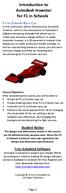 Introduction to Autodesk Inventor for F1 in Schools F1 in Schools Race Car In this course you will be introduced to Autodesk Inventor, which is the centerpiece of Autodesk s digital prototyping strategy
Zebra GC420t User Guide VIF-NA-BG-125, V3.0
 VIF - Maintenance of computer systems infrastructure Zebra GC420t User Guide VIF-NA-BG-125, V3.0 IZUM, 2016 COBISS, COMARC, COBIB, COLIB, IZUM are registered trademarks owned by IZUM. CONTENTS 1 Introduction...
Rapid Prototyping with the MakerBot Replicator 2X
 PURDUE MECHANICAL ENGINEERING Rapid Prototyping with the MakerBot Replicator 2X (MakerBot 2X & Makerbot Desktop v3.3) This document contains information and instructions on how to bring your computer designed
FTDI VCP DRIVER (free) (WIN/MAC/LINUX) http://www.ftdichip.com/drivers/vcp.htm
 002 - CONNECTING THE PRINTER Now that you have an idea what 3D printing entails, we can continue and connect the printer to your computer. First make sure you have a computer with a decent amount of RAM
MANUAL BUILDER. We all become builders. Version 3.02. Website link
 MANUAL Version 3.02 We all become builders Website link PRINTING SPECIFICATIONS PRINTER Print technology FDM / FFF Fused Deposition Method Dimensions printer (LxWxH): Solo/Dual: 385x370x400 mm (15.16x14.57x15.75
H-ITT CRS V2 Quick Start Guide. Install the software and test the hardware
 H-ITT CRS V2 Quick Start Guide Revision E Congratulations on acquiring what may come to be one of the most important technology tools in your classroom! The H-ITT Classroom Response System is quite easy
5. Tutorial. Starting FlashCut CNC
 FlashCut CNC Section 5 Tutorial 259 5. Tutorial Starting FlashCut CNC To start FlashCut CNC, click on the Start button, select Programs, select FlashCut CNC 4, then select the FlashCut CNC 4 icon. A dialog
Introduction to Autodesk Inventor for F1 in Schools
 F1 in Schools race car Introduction to Autodesk Inventor for F1 in Schools In this course you will be introduced to Autodesk Inventor, which is the centerpiece of Autodesk s Digital Prototyping strategy
Quick Start Guide to computer control and robotics using LEGO MINDSTORMS for Schools
 Quick Start Guide to computer control and robotics using LEGO MINDSTORMS for Schools www.lego.com/education/mindstorms LEGO, the LEGO logo and MINDSTORMS are trademarks of the LEGO Group. 2004 The LEGO
3D Printing Design Guidelines Sierra College CACT
 3D Printing Design Guidelines Sierra College CACT Prepared by ARW Consulting June 30, 2009 Table of Contents Scope of this Document.. 1 General Overview... 2 File Format.. 3 SST Support Material.. 4 Venting
SMART Board User Guide for Mac
 SMART Board User Guide for Mac What is it? SMART Board is an interactive whiteboard available in an increasing number of classrooms at the University of Tennessee. While your laptop image is projected
Basic 2D Design Be sure you have the latest information!
 Basic 2D Design mastercam x getting started tutorials Basic 2D Design December 2011 Be sure you have the latest information! Information might have been changed or added since this document was published.
CONTENTS. 2 CHAPTER I: Welcome to Your ROBO 3D Experience! 3 CHAPTER II: Installing Software. 4 CHAPTER III: Connecting Your R1 3D Printer
 CONTENTS 2 CHAPTER I: Welcome to Your ROBO 3D Experience! 3 CHAPTER II: Installing Software 4 CHAPTER III: Connecting Your R1 3D Printer 8 CHAPTER IV: Software Navigation 21 CHAPTER V: Slice 34 CHAPTER
ipad 2 GSM Headphone Jack & SIM Slot Replacement
 ipad 2 GSM Headphone Jack & SIM Slot Replacement Replace the Headphone jack/sim slot in your ipad 2 GSM. Written By: Walter Galan INTRODUCTION Use this guide to replace a broken headphone jack or SIM card
Ink Bag Solution for Seiko/HP9000 Installation and Operation Manual
 Ink Bag Solution for Seiko/HP9000 Installation and Operation Manual Cartridge Solution for Seiko Colorpainter, Oce CS 6060 and HP9000 Revised 27 August 2009 TABLE OF CONTENTS: Introduction...2 Package
idex Manual Contact details Producer: FOCI BV. The Netherlands www.foci.nl [email protected]
 idex USB Manual Contact details Producer: FOCI BV. The Netherlands www.foci.nl [email protected] 2 Index Index... 3 1. General... 4 2. Get started!... 5 3. First use... 7 4. FOCI idex Software... 14 5. Operating
Win 7 - STIMA CLS / CMP Driver Installation Quick Guide
 Win 7 - STIMA CLS / CMP Driver Installation Quick Guide This guide is intended to demonstrate a quick installation and setup of ticket alignment under Windows 7 for the Stima CLS and CMP printers using
Checking the Package Contents. Installing the Printer Software. Connecting. Unpacking the. the Printer. Printer. Attaching
 Installing the Printer Software Checking the Package Contents Connecting the Printer Unpacking the Printer Installing the Ink Cartridges Plugging in the Printer Attaching the Printer Parts 4032216-00 EUL
Be careful not to scratch or hit front edge of the side viewing micro prisms onto hard objects!
 Instructions Manual Flexia BGA Inspection Systems This manual describes how to use Flexia BGA Inspection System Optilia Instruments 1 AB Contents 1. Safety and maintenance Instructions 3 2. About Flexia
Laser cutter setup instructions:
 Laser cutter setup instructions: 1. Cut your material to 18 x 24 or smaller. 2. Turn on the laser cutter by flipping the wall switch on the right behind Station B. You will hear the cooling fan and air
Royal Mail Despatch Manager Online Printer Installation Guide
 Royal Mail Despatch Manager Online Printer Installation Guide Getting you started Thank you for opting to use Royal Mail s Despatch Manager Online (DMO) system. To help get you started successfully please
SpaceClaim Introduction Training Session. A SpaceClaim Support Document
 SpaceClaim Introduction Training Session A SpaceClaim Support Document In this class we will walk through the basic tools used to create and modify models in SpaceClaim. Introduction We will focus on:
Appendix C. Vernier Tutorial
 C-1. Vernier Tutorial Introduction: In this lab course, you will collect, analyze and interpret data. The purpose of this tutorial is to teach you how to use the Vernier System to collect and transfer
SketchUp Instructions
 SketchUp Instructions Every architect needs to know how to use SketchUp! SketchUp is free from Google just Google it and download to your computer. You can do just about anything with it, but it is especially
POSEIDON 2-29, 2-25 & 2-22 POSEIDON 2-29, 2-25 & 2-22 XT
 POSEION 2-29, 2-25 & 2-22 POSEION 2-29, 2-25 & 2-22 XT Repair Manual Index A. Safety precautions 3 B. Technical data 4 C. Structure 5-6. Service / Repair 7-23 E. Tools 24 F. Function 25-26 G. Electric
SMART Board User Guide for PC
 SMART Board User Guide for PC What is it? The SMART Board is an interactive whiteboard available in an increasing number of classrooms at the University of Tennessee. While your laptop image is projected
Computer Lane Monitor HOW TO MAKE A TAPE AND HOW TO READ A TAPE
 Computer Lane Monitor T M HOW TO MAKE A TAPE AND HOW TO READ A TAPE April, 2003 SP03-8 General Description The Brunswick Lane Monitor System is designed to permanently record and read the amount of dressing
THE TRIMLINE 10' x 20' CANOPY
 THE TRIMLINE 10' x 20' CANOPY Instructions for Assembly Please, assemble the TrimLine at home the first time, not at an event. Before beginning assembly of your TrimLine, please take time to review the
An introduction to 3D draughting & solid modelling using AutoCAD
 An introduction to 3D draughting & solid modelling using AutoCAD Faculty of Technology University of Plymouth Drake Circus Plymouth PL4 8AA These notes are to be used in conjunction with the AutoCAD software
Computer Lane Monitor for Windows
 Computer Lane Monitor for Windows User Guide Supplement BRUNSWICK SERVICE PARTS & SUPPLIES MUSKEGON, MICHIGAN 1995, Brunswick Bowling and Billiards Corporation, 525 W. Laketon Avenue, P.O. Box 329, Muskegon,
Original. The fast, easy to use, Open-source 3D printer. User manual. English Version 1.1
 Original The fast, easy to use, Open-source 3D printer User manual English Version 1.1 Table of Contents A. Welcome to the Ultimaker Original A1. The Ultimaker experience A2. Specifications of the Ultimaker
3D Modeling in Vectorworks 2009 by Jonathan Pickup. mple
 3D Modeling in Vectorworks 2009 by Jonathan Pickup mple 3D Modeling in Vectorworks 2009 by Jonathan Pickup 3D Modeling Vectorworks 2009 Published by Nemetschek North America 2008 Jonathan Pickup Vectorworks
HITT101 H-ITT Audience Response System 101
 HITT101 H-ITT Audience Response System 101 Hardware Setup First Time Hardware Setup - WARNING this does take a few minutes Please note that the first time you insert the USB cable from the H-ITT receiver
Pro/ENGINEER Wildfire 4.0 Basic Design
 Introduction Datum features are non-solid features used during the construction of other features. The most common datum features include planes, axes, coordinate systems, and curves. Datum features do
User Manual. Thermo Scientific Orion
 User Manual Thermo Scientific Orion Orion Star Com Software Program 68X637901 Revision A April 2013 Contents Chapter 1... 4 Introduction... 4 Star Com Functions... 5 Chapter 2... 6 Software Installation
Installation and Setup Guides
 Installation and Setup Guides For Bar Code Label Printers with Freezerworks Unlimited 5.2 Freezerworks Basic version 7 PO Box 174 Mountlake Terrace, WA 98043 www.dwdev.com [email protected] 425-673-1974
CubeX. 3D printer User guide. See inside for use and safety information.
 CubeX TM 3D printer User guide See inside for use and safety information. INTRODUCTION Copyright... 3 FCC notice..............................................................................................................
LCD MONITOR TOUCH PANEL DRIVER 2 OPERATION MANUAL. for Mac. Version 1.0 PN-L703A/PN-70TA3/PN-L703B/PN-70TB3/PN-L603A/PN-60TA3/PN-L603B/PN-60TB3
 LCD MONITOR TOUCH PANEL DRIVER 2 OPERATION MANUAL for Mac Version 1.0 Applicable models PN-L703A/PN-70TA3/PN-L703B/PN-70TB3/PN-L603A/PN-60TA3/PN-L603B/PN-60TB3 Contents Introduction...3 System Requirements...3
EPSON Stylus. Start Here
 EPSON Stylus C84 EPSON Stylus Start Here C84 CPD-16675R1 4043482-00 XXX 1 Unpack 1 Remove everything from the box. Paper support Printer Manual Power cord Ink cartridges CD-ROM 2 Remove all the blue tape
MET 306 Activity 6. Using Pro/MFG Milling Operations Creo 2.0. Machining a Mast Step
 Using Pro/MFG Milling Operations Creo 2.0 Machining a Mast Step If the Trim option is grayed out when trimming the mill volume, Save (making sure the.asm file is going to the correct subdirectory), Exit
Juice Box Stages 1&2 135&335 Installation Guide 5/10/08
 Tools Required: 8mm socket or nut driver Small flat head screwdriver Electrical tape, masking tape, or shrink tube Pep talk: Although the install looks daunting at first, once you get the learning curve
3D Printer Extruder. Application Note. Martez Steverson ECE 480. Design Team 8 3/28/14. Abstract
 3D Printer Extruder Abstract Application Note By Martez Steverson ECE 480 Design Team 8 3/28/14 The purpose of this paper is to instruct the reader on how to construct an extruder for a 3D printer and
Atomic Force Microscope and Magnetic Force Microscope Background Information
 Atomic Force Microscope and Magnetic Force Microscope Background Information Lego Building Instructions There are several places to find the building instructions for building the Lego models of atomic
House Design Tutorial
 Chapter 2: House Design Tutorial This House Design Tutorial shows you how to get started on a design project. The tutorials that follow continue with the same plan. When we are finished, we will have created
How To Write A Cq5 Authoring Manual On An Ubuntu Cq 5.2.2 (Windows) (Windows 5) (Mac) (Apple) (Amd) (Powerbook) (Html) (Web) (Font
 Adobe CQ5 Authoring Basics Print Manual SFU s Content Management System SFU IT Services CMS Team ABSTRACT A summary of CQ5 Authoring Basics including: Setup and Login, CQ Interface Tour, Versioning, Uploading
Lesson Four 3D Modeling
 Lesson Four 3D Modeling In this lesson you will learn how to: Easily Rotate the UCS to model in different planes Model lines in a method similar to drawing isometrics Create 3D Router Lines Automatically
Ultimaker 2 Extended+ OUR MOST ADVANCED 3D PRINTER JUST GOT EVEN BETTER
 Ultimaker 2 Extended+ OUR MOST ADVANCED 3D PRINTER JUST GOT EVEN BETTER INSTALLATION AND USER MANUAL Original manual V1.0 2015 DISCLAIMER Please read and understand the contents of this installation and
TBS Help Index / On Board Software User Manual
 TBS Help Index / On Board Software User Manual The TBS 2000 Functional Testing Systems Software has a convenient, quick and easy access on board software help manual. While a hard copy of on board TBS
product. Please read this instruction before setup your VenomXTM.
 Tuact Corp. Ltd. TM Venom X mouse controller combo Setup Software Instruction Thank you for purchasing our VenomXTM product. Please read this instruction before setup your VenomXTM. Introduction Venom
Legal Notes. Regarding Trademarks. Model supported by the KX printer driver. 2010 KYOCERA MITA Corporation
 Legal Notes Unauthorized reproduction of all or part of this guide is prohibited. The information in this guide is subject to change for improvement without notice. We cannot be held liable for any problems
HP Scanjet G4000 series. User Guide
 HP Scanjet G4000 series User Guide Contents 1 How to use the scanner...2 Where to get additional information...2 Accessibility...2 How to use the HP Photosmart software...3 Front panel and accessories
ScanPro 3000 High Definition Microfilm Scanner. Help Guide
 ScanPro 3000 High Definition Microfilm Scanner Help Guide Table of Contents Getting Started 3 Loading the Film 4-5 Viewing Your Film 6-7 Motorized Roll Film Control 6 Crop Box 7 Using the Toolbar Controls
Snap 9 Professional s Scanning Module
 Miami s Quick Start Guide for Using Snap 9 Professional s Scanning Module to Create a Scannable Paper Survey Miami s Survey Solutions Snap 9 Professional Scanning Module Overview The Snap Scanning Module
Zenbot CNC User s guide www.zenbotcnc.com
 Zenbot CNC User s guide www.zenbotcnc.com Note: If at any point you are unsure what to do or would like assistance, don t hesitate to email [email protected], or call 559-901-8329. Customer satisfaction
TABLE OF CONTENTS. I. TROUBLESHOOTING... 2 - Section 1.01: Common Problems/Solutions... 2
 BAL Accu-Slide System I. Table of Contents TABLE OF CONTENTS I. TROUBLESHOOTING... 2 - Section 1.01: Common Problems/Solutions... 2 II. GETTING STARTED... 5 - Section 2.01: Tools You Will Need... 5 - Section
SMART Board Interactive Whiteboard Setup with USB Cable
 SMART Board Interactive Whiteboard Setup with USB Cable The instructions below are for the SMART Board interactive whiteboard 500 series and apply to both desktop and laptop computers. Ready Light USB
Laser Cutter User Manual
 Laser Cutter User Manual frequently asked questions... the laser is cutting weird! it s cutting a thick line or not cutting through at all! Table Of Contents Section 1: Materials Guide 1.1 Can I Cut this?
Make your own glass jewellery, anyone can do it!
 User manual Make your own glass jewellery, anyone can do it! INTRODUCTION With the HotPot you can melt glass in a microwave to create jewellery or glass components for jewellery and other creative purposes.
Mail Chimp Basics. Glossary
 Mail Chimp Basics Mail Chimp is a web-based application that allows you to create newsletters and send them to others via email. While there are higher-level versions of Mail Chimp, the basic application
To Purchase This Item, Visit BMI Gaming www.bmigaming.com 1-800-746-2255 + 1-561-391-7200
 Table of Contents General Description and Play 2 Game Set Up 2 Loading Balloons 2 Technical Operation-General 3 Adjusting Balloon Sensor Wire 4 Programming Instructions 4 Default Settings Troubleshooting
LCD MONITOR TOUCH DISPLAY DRIVER OPERATION MANUAL. for Mac. Version 1.0 PN-K322B/PN-K322BH/LL-S201A. Applicable models
 LCD MONITOR TOUCH DISPLAY DRIVER OPERATION MANUAL for Mac Version 1.0 Applicable models PN-K322B/PN-K322BH/LL-S201A Contents Introduction...3 System Requirements...3 Setting up the Computer...4 Installing
Autodesk Fusion 360: Assemblies. Overview
 Overview In this module you will learn how different components can be put together to create an assembly. We will use several tools in Fusion 360 to make sure that these assemblies are constrained appropriately
Creating Drawings in Pro/ENGINEER
 6 Creating Drawings in Pro/ENGINEER This chapter shows you how to bring the cell phone models and the assembly you ve created into the Pro/ENGINEER Drawing mode to create a drawing. A mechanical drawing
USER S MANUAL. AXIS Mobile Monitor
 USER S MANUAL AXIS Mobile Monitor AXIS Mobile Monitor Overview Main window Main menu Find Devices Find Devices menu Monitor window Monitor menu Sequence window Sequence menu How to Use AXIS Mobile Monitor
C O N V E Y O R C O M P O N E N T S C H A I N S B E L T S B E A R I N G S
 C O N V E Y O R C O M P O N E N T S C H A I N S B E L T S B E A R I N G S January 2009 Issue 6 Valu Guide Brackets The Ultimate in Adjustability and Cost Savings Valu Guide brackets are part of a family
Navico-Northstar 2kW JRC Radar Package, Scanner Cable Removal and Replacement
 Navico-Northstar 2kW JRC Radar Package, Scanner Cable Removal and Replacement This work instruction describes the methods and means for which to remove and reinstall optional scanner cable configurations
Manual. Sealer Monitor Software. Version 0.10.7
 Manual Sealer Monitor Software Version 0.10.7 Contents 1 Introduction & symbols 1 2 Installation 2 2.1 Requirements 2 2.2 Installation process 2 3 Menu & Tooblar 5 3.1 File menu 5 3.2 Print menu 6 3.3
PRODUCT: WASHER / WASHER-DRYER COMBO MODEL: AW 120 / AW 122 / AW 125 AWD 120 / AWD 121 / AWD 129
 PRODUCT: WASHER / WASHER-DRYER COMBO MODEL: The information included in this Splendide Repair Manual may change without notice. Please see our web site www.splendide.com/service/docs.html for updates,
Rack installation instructions
 Rack installation instructions Review the documentation that comes with the rack cabinet for safety and cabling information. Before you install the server in a rack cabinet, review the following guidelines:
Watch Your Garden Grow
 Watch Your Garden Grow The Brinno GardenWatchCam is a low cost, light weight, weather resistant, battery operated time-lapse camera that captures the entire lifecycle of any garden season by taking photos
User Guide LUXXOR VIDEO MICROSCOPE. 2 Luxxor Video Microscope Set Up
 2 Luxxor Video Microscope Set Up User Guide LUXXOR VIDEO MICROSCOPE Column When removed from its packaging, the Luxxor Video Microscope will be configured as shown, with the Vertical Slide and Slide Stop
Business Plus Accounting Hardware Setup Guide For Windows XP
 Business Plus Accounting Hardware Setup Guide For Windows XP 1 Contents Chapter 1 - Description of Computer Ports...3 Chapter 2 - Connecting Your Touch Screen...4 Chapter 3 Setting Up Your Printers In
Smart Cam, CC-Smart-Cam, and Smart Cam Packages Installation and Quick Start Operating Instructions
 Smart Cam, CC-Smart-Cam, and Smart Cam Packages Installation and Quick Start Operating Instructions 12/12/2013 FRONT VIEW BACK VIEW TYPICAL PACKAGE 1 Installation Assemble video coupler to the zoom body
FlashForge Creator Quick Start Manual
 FlashForge Creator Quick Start Manual Safety Information... 1 Please always check power setting before plug in... 1 Unboxing... 3 Package Contents... 3 Unboxing... 3 Initial Hardware Setup... 5 The First
FCC COMPLIANCE STATEMENT FOR AMERICAN USERS
 FCC COMPLIANCE STATEMENT FOR AMERICAN USERS This equipment has been tested and found to comply with the limits for a CLASS A digital device, pursuant to Part 15 of the FCC Rules. These limits are designed
The fast, easy to use, Open-source 3D printer. User manual. English Version 1.13
 The fast, easy to use, Open-source 3D printer User manual English Version 1.13 Table of Contents A. Welcome to the Ultimaker 2 A1. The Ultimaker experience A2. Specifications of the Ultimaker 2 B. Get