
Program of Studies Classes of 2013, 2014, 2015
|
|
|
- Penelope Douglas
- 10 years ago
- Views:
Transcription
1 Program of Studies Classes of 201, 2014, 2015 Policies Procedures Course Descriptions

2 TABLE OF CONTENTS GENERAL INFORMATION Academic Letters Page 9 Alternative School Harris Academy Page 6 Career/Technical Programs Page 11 Changes in Pre Enrolled Class Selections Page 7 Class Rank (Valedictorian & Salutatorian) Page 8 College Admissions Examinations Page 6 College Credit Opportunities Page 6 Course Change Request Page 7 Course Weighting Page 8 Diploma Types Page 2 Early Mid Year Graduates Page 7 End of Course Assessments (ECA) Page 4 General Fees Page 6 General Information Page 4 Grade Point Average Page 7 Graduation Requirements Page 2 Guidelines for College Bound Students Page 5 IHSAA Academic Regulations Page 10 Indiana Career Clusters & Pathways Page 12 Naviance Succeed Page 6 NCAA Division I/II Eligibility Page 9 Off Campus Credit Page 10 Removal from a Course Page 10 Repeating a Course Page 4 Scheduling Year Page 1 Student Resource Time (SRT) Page 10 Study Halls Page 10 Teacher Assistant s Program Page 10 Transfer Students Enrollment/Credits Page 10 COURSE DESCRIPTIONS Area 1 Career Programs (See counselor for more information about Area 1) Pages Business Education Pages 19 2 English Pages 24 1 Family Consumer Science Pages 2 6 Fine Arts Visual Arts Pages 7 42 Performing Arts Pages 4 49 Instrumental Music Pages Vocal Music (Choir) Page 45 Dance Pages Theatre Page 48 General Music Pages Mathematics Pages PE/Health Pages Science Pages Social Studies Pages Special Education/Resource Pages World Languages Pages Technology Education/Broadcasting Pages

3 GRADUATION REQUIREMENTS Core 40 Diploma Core 40 with Technical Core 40 with Academic Honors Diploma Honors Diploma The Avon School Board acknowledges that some students are pursuing educational goals which may require graduation from high school at an earlier date than their designated class. Application for early graduation shall be in accordance with state regulations. The principal may honor this request if all conditions for graduation are met and the student fulfills the graduation requirements. Section 5464 requires full time attendance of eight (8) semesters unless a seven semester waiver request (Semester 1 Grad) is approved by the guidance department. The student may participate in the graduation ceremonies with his/her designated class. A student requesting to graduate earlier than the seventh semester must submit his/her request in writing to the principal. Upon school board approval, the student should understand that he/she will not be permitted to participate in the commencement ceremony. (See Early Mid Year Graduate on page 7). 2. Students receiving a diploma from Avon High School must take required units of study from Avon, Harris Academy, or an approved online program. Required units of study will be accepted from other accredited high schools for students moving into the district (Refer to section 546). If a student fails a required course, he/she may retake the course in summer school, and/or by an approved online course and/or through Plato courses available in the Online Education Center at Avon High School.. All credits required for graduation must be satisfactorily completed in order to participate in graduation exercises. Students are expected to participate in graduation exercises in order to receive a diploma though this requirement may be waived at the discretion of the principal. 4. Indiana high school students in the classes of 2012 and beyond must pass the End of Course Assessment (ECA) in the subjects of English 10 and Algebra I in order to receive a high school diploma. DIPLOMA TYPES INDIANA CORE 40 Indiana CORE 40 is a single, flexible curriculum that, except for elective courses, is based upon a single set of agreed upon competencies. Core 40 is not just for students who want to go to college. However, you need to complete Core 40 to be considered for regular admissions to Indiana public colleges offering bachelor s (4 yr) degrees. The same Core 40 courses are strongly recommended for admission to public colleges offering associate s (2 yr) degrees and certificates, or for entry into the workforce. The Core 40 diploma is the MINIMUM diploma for Indiana high school students. The following courses fulfill CORE 40: 1. English/Language Arts 8 credits in Literature, Composition, & Speech Mathematics 6 credits 2 credits: Algebra I 2 credits: Geometry 2 credits: Algebra II (Note: All students are required to take a math or physics course during their junior or senior year) Science 6 credits 2 credits: Biology I 2 credits: Chemistry, Physics, or Integrated Chemistry/Physics 2 credits: Any Core 40 science course Social Studies 6 credits 2 credits: US History 1 credit: US Government 1 credit: Economics 2 credits: World History & Civilization or Geography & History of the World 2. Directed Electives 5 credits World Languages* Fine Arts 2
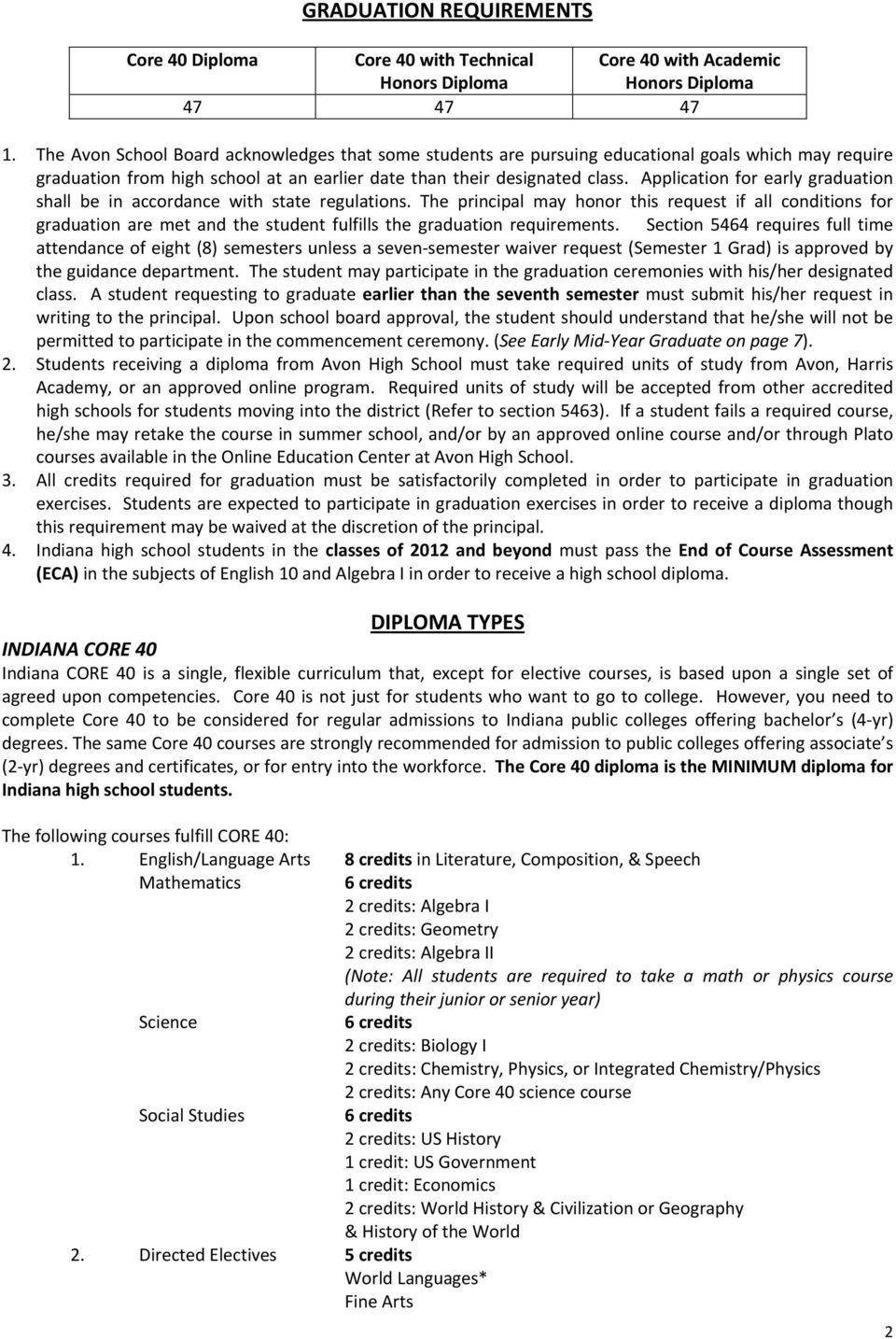
4 Career/Technical. Physical Education 2 credits 4. Health and Wellness 1 credit 5. Preparing for College & Careers^ 1 credit 6. Electives 12 credits (Career Academic Sequence Recommended) 47 total credits ^formerly Career Planning & Success Skills *Entrance into some college programs may require additional courses. For example, many engineering programs require four years of high school math. Some colleges now require 2 years foreign language to be accepted into certain programs. Remember that while many advanced courses are not absolutely necessary for college entrance, they may be helpful in preparing you for college work. It is recommended that each student work closely with his/her guidance counselor when planning programs. CORE 40 with ACADEMIC HONORS DIPLOMA For the Core 40 with Academic Honors diploma, students must meet core 40 requirements and must also: Earn 2 additional Core 40 math credits Earn 6 8 Core 40 world language credits (6 credits in one language or 4 credits each in two languages) Earn 2 Core 40 fine arts credits Earn a grade of C or above in courses that will count toward the diploma Have a grade point average of B or above, and Complete one of the following: - Complete AP courses (4 credits) and corresponding AP exams - Complete dual high school/college credit courses from an accredited postsecondary institution (6 transferrable college credits) - Complete a combination of AP courses (2 credits) and corresponding AP exams and dual high school/college credit course(s) from an accredited postsecondary institution ( transferable college credits) - Score 1200 or higher combined SAT critical reading and mathematics - Score a 26 or higher composite on the ACT - Complete IB (Higher Level) courses (4 credits) and corresponding IB exams (not offered at Avon High School) Only courses in which a student has earned a grade of C or above may count toward a Core 40 with academic honors diploma. If a student earns a grade lower than a C, that course cannot count toward the total 47 required credits and the student will need to earn additional credits with a C or above to achieve the total 47 credits. A student may repeat a course for a better grade (see Repeating a Course on page 5), or may take another course that will meet the standard, if another choice is available in that subject. For example, if a student earns a D in Intro 2 D Art, he/she may take Technical Theatre and attempt to earn a C or better (for the fine art credit). If a student is interested in the academic honors diploma, he/she is strongly encouraged to discuss an exact course of study with a guidance counselor. CORE 40 with TECHNICAL HONORS DIPLOMA For the Core 40 with Technical Honors diploma, student must meet core 40 requirements and must also: Earn a grade of C or above in courses that will count toward the diploma Have a grade point average of B or above Complete a career technical program (8 or more related credits) Complete two of the following, one must be A or B: A. Score at or above the following levels on WorkKeys: Reading for Information Level 6; Applied Mathematics Level 6; Location Information Level 5 B. Complete dual high school/college credit courses in a technical area (6 college credits) C. Complete a Professional Career Internship course or Cooperative Education course (2 credits) D. Complete an industry based work experience as part of two year technical education program (minimum 140 hours)

5 E. Earn a state approved, industry recognized certification Only courses in which a student has earned a grade of C or above may count toward a Core 40 with technical honors diploma. If a student earns a grade lower than a C, that course cannot count toward the total 47 required credits and the student will need to earn additional credits with a C or above to achieve the total 47 credits. A student may repeat a course for a better grade (see Repeating a Course on page 5), or may take another course that will meet the standard, if another choice is available in that subject. For example, if a student earns a D in Geography, he/she may take World History & Civilization and attempt to earn a C or better. To graduate with less than a Core 40 diploma, the following formal opt out process must be completed: The student, the student s parent/guardian, and the student s counselor (or another staff member who assists students in course selection) meet to discuss the student s progress. The student s career and course plan is reviewed. The student s parent/guardian determines whether the student will achieve greater educational benefits by completing the general curriculum or the Core 40 curriculum. If the decision is made to opt out of Core 40, the student is required to complete the course and credit requirements for a general diploma and the career/academic sequence the student will pursue is determined. A Core 40 Opt out Form must be completed and signed by all participants; a copy of the form must be placed in the student s permanent record. GENERAL INFORMATION 1. Students are expected to take seven subjects each semester. (Only ONE study hall per year is permitted). 2. For a student to be in good standing at his/her grade level, the following number of credits should be completed at the end of each of the following grades: 9 th grade 11 credits 10 th grade 2 credits 11 th grade 4 credits. Students should select an academic program and should consult with the guidance department to prepare for college. Admission requirements of the college(s) being considered should be checked carefully. This is the responsibility of the student. (See Guidelines of College Bound Students on page 5). The State of Indiana has implemented CORE 40 as the preferred minimum course of study. END OF COURSE ASSESSMENT (ECA) What if a student earns enough credits to graduate, but does not pass the ECA for Algebra I and English 10? State law provides that a student who successfully meets Core 40 may still graduate without passing the ECA s. State law also provides that a student may graduate without passing the ECA s by successfully appealing the student s test results under criteria adopted by the State Board. The State Board adopted a rule that provides that a student may be eligible to graduate if all of the following have occurred (IC ); The student must have: taken the graduation test in the subject area or areas in which the student did not achieve a passing score at least one (1) time every year during his sophomore, junior, and senior years in high school. completed remediation opportunities provided by the school. maintained a minimum attendance rate of 95 percent. maintained a C average (this will include a 1.7 GPA) in the courses that make up the twenty four (24) credits specifically required for graduation and obtained a written recommendation supporting the request for the appeal from the student s teacher(s) in the subject area(s) in which the student has not achieved a passing score. For more information on the End of Course Assessments, visit REPEATING A COURSE 1. Students must repeat a failed course that is required for graduation. 2. Students may choose to repeat any course in which they have received a D+, D, D, F, or WF. 4

6 . When repeating a course, the initial grade will be changed to R (which designates a repeated course) on the transcript andwill not count in the cumulative GPA. Only the second grade will count in the cumulative GPA because the initial credit will have been removed. 4. A student may repeat a lower level of the same course (providing the academic standards are the same for the two courses). For example, a student who earns a D+ in English 10 Honors may opt to take English 10 for a higher grade and replace the D+ with an R. RETROACTIVE GUIDELINES FOR THE CLASS OF 201 ONLY: Any failed REQUIRED course that a student repeated for a passing grade will be changed to R on the transcript and will not count in the cumulative GPA. GUIDELINES FOR COLLEGE BOUND STUDENTS Due to the wide variations in college entrance requirements, students are urged to check with the admission office of the chosen college, visit the individual college websites, and/or use the college catalogs located in the guidance office, when planning their high school programs. College catalogs are available online at most college websites. Most colleges require at least 28 of the credits earned for high school graduation to be devoted to academic courses. Be aware that college entrance requirements do change. To prepare for college, students should do the following: 1. Take recommended college preparatory courses. The preferred curriculum for the best preparation for college is the Academic Honors Diploma. Indiana Core 40 is the minimum standard to be followed. 2. Maintain the best possible grade point average (GPA).. Take PLAN in the fall of the sophomore year and take the PSAT in the fall of the sophomore and junior years. Have SAT and ACT scores sent to Avon High School (CEEB school code is ) as well as to colleges being considered. It is recommended that students take the SAT and/or ACT in the spring of the junior year and once again in late fall of the senior year. 4. Apply to colleges early during the senior year. Some colleges and some highly competitive programs require early application. 5. Complete the FAFSA form after January 1 and submit by March 1, to be considered for state and federal financial aid. Visit for more information on the FAFSA. Student Financial Aid and Curriculum The Frank O Bannon Grant Program is a need based college financial aid program administered by the State Student Assistance Commission of Indiana (SSACI). The SSACI awards may provide increased funds to eligible high school graduates earning a Core 40 with Academic Honors Diploma or a Core 40 with Technical Honors Diploma. Graduating with these types of diplomas does not guarantee financial aid. For more information visit When choosing my classes for next year, should I take easier classes and get higher grades or more difficult ones and get lower grades? Ideally, you would take harder classes AND get higher grades. You need to remember that what college admission officers will ask when reviewing your application is: Can you handle college level academics? One way they answer this question is by reviewing your transcript. Keep in mind, however, that they look not only at the grades you received but also the classes in which you received them. It is, therefore, important that you challenge yourself with honors, dual credit, and Advanced Placement (AP) classes that are seen as being on par with college freshman level courses. When you take advanced classes, this is a strong indication that you are ready for college level classes. The bottom line is that it is better to challenge yourself with tougher courses and earn slightly lower grades than to take easier courses. Students do need to strike a balance between rigorous courses and maintaining academic standing since it obviously would not be in the student s best interest to fail any AP classes. Students should try to challenge themselves with as a course load as rigorous as they feel they can reasonably handle even if it means earning a "B" instead of an "A." This way students can demonstrate to colleges that they can handle the college s academic course load. 5

7 NAVIANCE SUCCEED Naviance Succeed is a web based program that promotes college and career readiness for high school students. All Avon High School students and their parents have access to the Family Connection in Naviance. Registration and information is available on the guidance page of the high school website. Naviance Succeed applications include: College Planner Students can research colleges, enrichment programs, and scholarships. They can access school forms and can request that transcripts and school profiles be sent electronically to more than 1,000 colleges. Career Planner Students can learn more about themselves, research careers, and understand the academic preparation required to ensure workplace readiness. ALTERNATIVE SCHOOL HARRIS ACADEMY The Harris Academy provides a performance based alternative educational setting to encourage and enable high school students to complete their high school education. Harris is located in Brownsburg. The program is designed to provide flexibility to meet the individual needs of the students enrolled. Students who meet Avon High School s graduation requirements may earn a diploma from AHS and participate in Avon s commencement ceremony; however, Harris seniors requesting to graduate at the end of the first quarter must submit their request in writing to the principal. Upon school board approval, the student should understand that he/she will not be permitted to participate in the commencement ceremony. Students who are interested in Harris should see their guidance counselor for more information. COLLEGE ADMISSIONS EXAMINATIONS Avon High School Guidance Department recommends the following minimum testing program for college bound students. Students may check published test dates and registration deadlines for the ACT and SAT in the guidance office or on line at and Avon High School s CEEB school code is: Grade 10 PLAN test in the fall PSAT test in October Grade 11 PSAT/NMSQT test in October ACT and/or SAT in late spring Avon High School is a June test site for the SAT Grade 12 ACT and/or SAT in October/November/December Please Note: AHS is a test site for the SAT in JUNE and a test site for the ACT in both DECEMBER and APRIL GENERAL FEES In addition to fees specific to each course (listed in the course descriptions), each student is assessed fee amounts related to standardized testing, student activities, and materials. Below is a breakdown of those fees per gradelevel: Grade Student Activity Fee Grade Specific Fee Laptop Rental Senior $18.00 $18.00 $ Junior $18.00 $15.00 N/A Sophomore $18.00 $12.00 N/A Freshman $18.00 $12.00 N/A COLLEGE CREDIT OPPORTUNITIES I. Project Excel Dual high school/college credit course Project Excel is a cooperative program between Vincennes University and Avon High School. Currently Avon offers VU Math 102 College Algebra, VU Math 104 Trigonometry, VU English Introduction to Composition 101, VU Literature 100, VU Physics 105, VU American History 19/140, and VU Math 118 Calculus with Analytic Geometry. Students are responsible for the tuition fees paid to Vincennes University. Students can earn both college credits and high school credits with these courses. Students must meet the criteria set by Vincennes University to receive the college credit, which is based on certain PSAT/SAT/ACT scores and/or the ACCUPLACER test. These courses are listed on the Indiana Core Transfer Library list, and should therefore transfer to the other Indiana public colleges and many of the Indiana private colleges. Also, these courses allow the student to meet the additional requirements for earning a Core 40 with Academic Honors Diploma. II. Advanced Placement Program (AP) The College Board s Advanced Placement Program enables students to pursue college level studies while still in high school. Currently Avon offers AP English Lit & Composition, AP English Language & Composition, AP U.S. History, AP U.S. Government, 6

8 AP Economics, AP World History, AP European History, AP Psychology, AP Chemistry, AP Physics, AP Biology, AP Environmental Science, AP Statistics, AP Calculus AB, AP Calculus BC, AP Music Theory, AP Art History, AP Computer Science, AP German Language, AP Spanish Language, AP French Language, and new to the school year, AP Studio Art and AP Japanese. Based on their performance on rigorous AP exams, which are taken at the school in May, students can earn credit, advanced placement, or both for college. Each college has their own policy on using AP exam results. The 2012 exam fee is $87.00 per exam. In the past, the state of Indiana has paid for the science and math exams. All other exam fees are the responsibility of the student. The College Board provides a fee reduction ($57.00 per exam) for qualified students with acute financial need. Students who enroll in AP courses are expected to take the corresponding AP exam for each subject. III. Special Programs for Academic Nurturing (SPAN) SPAN is a division of the Honors Program at Indiana University Purdue University Indianapolis (IUPUI). This program allows motivated high school students to get started on their college education or just take courses that are not available at their local high school. Acceptance to the program is based on class rank and SAT/ACT scores. Certain courses may be taken for dual credit however this is at the discretion of the high school. If a student is accepted into SPAN, they are responsible for transportation and costs. For more information, go to SPAN courses that transfer as high school credits are NOT weighted. CHANGES IN PRE ENROLLED CLASS SELECTIONS The type and number of courses offered at Avon High School are based upon course selections made by students during the pre enrollment process in Jan/Feb. Therefore, it is important for students to give serious thought to their class selections and commit to completing these classes. There will be no schedule changes to accommodate a student s choice of instructor. The administration and/or guidance counselor may consider an exception on an individual basis if a student has previously failed a course with an instructor. Course verification sheets will be given to students in April. In the event that a student would think it necessary to make a change in a course selection, the student must do so by April 2. It is in everyone s best interest, the student, the teacher, and the counselor, to have schedules finalized before the start of school, in order to have a smooth, uninterrupted start to the school year. Guidance counselors will make adjustments to the students course selections based on courses failed in the second semester. COURSE CHANGE REQUEST After the school year has started, students should not expect to change one course for another in their schedule. Students requesting to UPGRADE a course must have a completed Course Change Request Form turned in to their counselor within the first FIVE days of the semester. The change will be considered, provided there is seat availability for the requested course. Students requesting to withdraw from a course, due to extenuating circumstances, must have a completed Course Change Request Form turned in to their counselor within the first FIVE days of the semester. Removal from a course after the first FIVE days of the semester, will result in a WF for the course, which will appear on the student s transcript and factor into their cumulative GPA. EARLY MID YEAR GRADUATES Seven (7) semesters of full time attendance are required for graduation; however eight (8) semesters are highly recommended. If a student wishes to graduate after seven (7) semesters, he/she must meet all graduation requirements by the end of the seven (7) semesters and provide reasons and written consent signed by his/her parents/guardians. Written consent must be provided to the guidance department before the first day of the student s senior year. Students, who are applying for early graduation must carry a full course load. The student may participate in the commencement ceremony. A student requesting to graduate earlier than the seventh semester must submit his/her request in writing to the superintendent. Upon school board approval, the student should understand that he/she will not be permitted to participate in the commencement ceremony. GRADE POINT AVERAGE (GPA) Grade Point Averages are calculated at the end of each semester and are based on the semester grade. A student s cumulative GPA is the average of all semester grades completed by the student throughout the high school years. To calculate the GPA, each semester grade is given a point. The total points are then added together and divided by the number of credits attempted (A grade of F or WF is considered a credit attempted). Each grade receives the following points: A 9-100% 4.0 B 8-86%.0 C 7-76% 2.0 D 6-66% 1.0 A 90-92%.7 B 80-82% 2.7 C 70-72% 1.7 D 60-62% 0.7 B %. C % 2. D % 1. F 59-0% 0.0 7

9 CLASS RANK (VALEDICTORIAN & SALUTATORIAN) The weighted cumulative GPA (see course weighting below) is used to determine class rank at the completion of each semester. The senior Valedictorian (class rank of 1) and the senior Salutatorian (class rank of 2) is determined at the end of the seventh semester of the senior year. COURSE WEIGHTING Avon High School has adopted a cumulative GPA weighting system. In this system of weighting courses, points are added to the cumulative GPA. The weighted cumulative GPA is then used to determine class rank. Because Honors and Advanced Placement courses do not have the same level of difficulty, it was determined there would be three levels of weighted courses. The chart below shows the three levels of weighted courses and the weighting factor that is used in the formula. Students must earn a C or higher in the course in order for it to be weighted. LEVEL I (0.1 Factor) II (0.2 Factor) III (0. Factor) Math Ace Geometry Geometry Hon Algebra II Hon Pre Calculus Hon Trigonometry Ace College Alg VU Math 102 Trigonometry VU Math 104 College Algebra II Ace VU Math 118 Calculus with Analytic Geometry Science Biology I Hon Chemistry I Hon Physics I Hon Physics 105 VU English English 9 Hon English 10 Hon English 101 VU Literature 100 VU Social Studies Geography and History VU American History 19/140 of the World Hon AP Calculus A/B Ace AP Calculus B/C Ace AP Calculus A/B AP Statistics AP Biology AP Chemistry AP Physics AP Environmental Science AP Language & Composition AP Literature & Composition AP US History AP Government AP Economics AP Psychology AP World History AP European History World Language Any Level IV Language Any AP Language Business AP Computer Science Fine Arts AP Music Theory AP Art History AP Studio Art The add on formula used to calculate the points added to the cumulative GPA takes into account the number of credits earned at each of the three levels and the number of trimesters/semesters a student has completed in high school. The points added will change each semester as more weighted credits are earned and more semesters toward graduation are completed. 0.1 X number of Lev I credits earned X number of Lev II credits earned + 0. X number of Lev III credits earned Trimesters/Semesters completed SUM OF ALL LEVELS TRIMESTERS/SEMESTERS COMPLETED = TOTAL POINTS ADDED TO THE CUMULATIVE GPA Please Note: Students, who transfer to Avon with honors courses on their transcript, will have their transcript reviewed by the guidance office. Upon verification from the student s former school that the course(s) target higher ability students and are considered more rigorous and would prepare a student for the next level, such as Advanced Placement, the course will receive weighted value, provided it is offered and considered a weighted course at Avon High School. AP courses will be transferred and counted as weighted, provided the course is offered at Avon High School. 8

10 ACADEMIC LETTERS The Academic Excellence Committee made a proposal to the school board in June 2004 to honor those students who demonstrate outstanding academic achievement with an academic letter; the same letter and chevrons that are given to students for other accomplishments, such as athletics and music. Athletic chevrons are gold on white; music chevrons are gold on black, and academic chevrons are black on gold. Academic letters and/or chevrons are awarded two times a year: Juniors who achieve a GPA of at least.75 at the end of their sophomore year will be eligible to receive an award in the fall ceremony. Likewise, seniors who achieve a GPA of at least.7 at the end of their junior year will be eligible to receive an award at the fall ceremony. Additionally, seniors who achieve a GPA of at least.65 at the end of the first semester of their senior year will be eligible to receive an award at Honors Night in the spring of the senior year; thus, it is possible for a student to qualify for an academic letter three times during the latter portion of high school. NAIA & NCAA DIVISION I/II ELIGIBILTY Students who plan to enroll in a Division I college on or after August 1, 2008 and want to participate in athletics or receive an athletic scholarship during their first year must: Graduate from high school Complete 16 core courses including 4 yrs of English, yrs of math (algebra 1 or higher), 2 yrs of natural or physical science, 1 additional yr of English, math, or science, 2 yrs of social studies, and 4 yrs of additional courses from previous mentioned subjects or foreign language. Earn a minimum required grade point average in core courses; and Earn a combined SAT or ACT sum score that matches their core course GPA and test score sliding scale (found on website). For example, a.0 GPA needs a 620 SAT, a 2.4 GPA needs an 860 SAT, and a 2.0 GPA needs a 1010 SAT. Students who plan to enroll in a Division II college on or after August 1, 2008 and want to participate in athletics or receive an athletic scholarship during their first year must: Graduate from high school Complete 14 core courses (beginning in 201, 16 core courses will be required) including yrs of English, 2 yrs of math (Algebra I or higher), 2 yrs of natural/physical science, 2 yrs of additional English, math, or science, 2 yrs of social studies, and yrs of additional courses (from previous mentioned subjects or foreign language. Have a minimum core grade point average of 2.0 and a minimum SAT score of 820 (verbal and math only) or a minimum ACT sum score of 68 (sum of math, reading, science, and English). Please Note: All SAT and ACT scores must be reported directly to the NCAA Eligibility Center by the testing agency. Test scores that appear on transcripts will no longer be used. When registering for the SAT or ACT, use the code of 9999 to make sure the score is reported to the NCAA Eligibility Center. Division I and II student athletes must be certified by the NCAA Eligibility Center. Students should register at NCAA Division III students must gain admissions to the college, but do not have to register with the eligibility center. NAIA students must register at prior to college enrollment, and must have their SAT/ACT scores sent to the NAIA Eligibility Center using the following code, In order to be eligible with NAIA, a student must complete 2 out of the following : 2.0 GPA Graduate in top 50% of class Have a minimum 860 on SAT (math & verbal) or minimum 18 composite on the ACT Division I schools include Indiana University, Purdue University, and Ball State University. Division II schools include University of Indianapolis, Saint Joseph s College Division III schools include Wabash College, DePauw University, and Anderson University NAIA schools include Marian University, University of Saint Francis, and Taylor University Students should consult with their coaches and the guidance office at the end of the junior year or the fall of the senior year for more information. 9
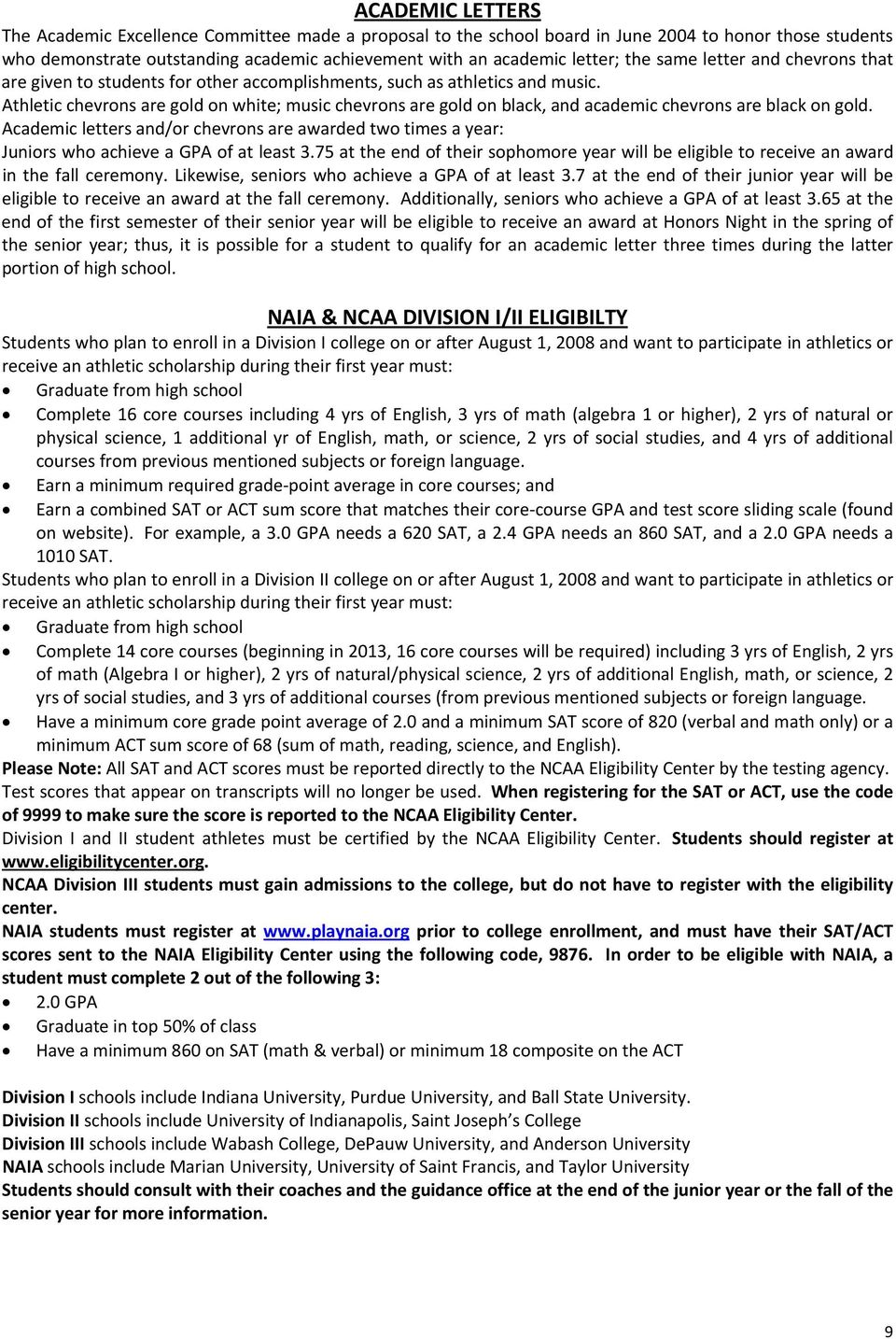
11 INDIANA HIGH SCHOOL ATHLETIC ASSOCIATION ACADEMIC REGULATIONS The Indiana High School Athletic Association regulations determine the minimum standards that a student must meet in order to participate in athletic contests with students of other schools. These regulations require a student, at the time of participating in such a contest, to have received passing grades at the end of their last grading period in a minimum of five (5) full credit courses. Semester grades take precedence. Athletes must be enrolled in a minimum of five (5) full credit courses. All students representing Avon High School in extracurricular athletic activities are subject to these standards. OFF CAMPUS CREDIT A student considering completing coursework online through an institution such as IU Independent Studies, Indiana Online Academy, or Brigham Young University, should discuss this option with his/her guidance counselor. The guidance counselor must give written permission for the approval of the online credit toward graduation requirements. A maximum of four (4) credits by online/night school may be applied toward graduation requirements. A student may be enrolled in a maximum of nine (9) credit bearing classes during any given semester (seven (7) at Avon High School and two (2) off campus). All online course work should be completed by May 24. REMOVAL FROM A COURSE In the event that a student is removed from a course due to attendance, discipline, or any other reason determined by an administrator, the student will receive a grade of WF (withdraw with an F) for the course. This grade will appear on the student s transcript and factor into the student s cumulative GPA. In order to remove the WF from the transcript, the student must repeat the same course for a passing grade. STUDENT RESOURCE TIME (SRT) Student Resource Time (SRT) is a period built into the school schedule that allows students the opportunity to meet with their teachers for academic support. During SRT students will be able to make up tests or quizzes, as well as, receive additional help from teachers. SRT will meet every third day and will be 70 minutes in length. Each student will be assigned an SRT teacher. A pass system will be in place for students to maximize the use of SRT. To meet with a teacher, a student must obtain a pass from that teacher prior to SRT. The student will show that pass to their SRT teacher who will have the student sign out; the receiving teacher will have the student sign in and take the pass they issued the student prior to SRT. A student may obtain two passes for any one SRT. There will be an A and a B session which allows a student to meet with two teachers during any single SRT. Freshmen will be limited to B SRT assistance. During the A SRT freshmen will be participating in the freshmen mentoring program. STUDY HALLS Students may elect to take one (1) study hall as one of their fourteen classes during the year. Students may choose the semester in which they would like the study hall. Grade 11 and 12 students, with multiple Honors (pre AP)/AP courses, may petition to take a study hall per semester. Students are expected to follow the rules and guidelines set forth by the study hall instructor. This scheduled time is to be used for homework, reading assignments, test preparation, etc. in order to help the student be successful in his/her remaining classes. Students are not permitted to have a study hall and be a TA in the same semester. TEACHER ASSISTANT PROGRAM A student must apply through a guidance counselor to be a teacher assistant, with final approval given by administration. Students must not have any D s or F s in courses from the prior grading period, in order to qualify. Students who fail a course will be placed in study hall for the remainder of the semester. Students are not permitted to have a study hall and be a TA in the same semester. TRANSFER/ENROLLMENT/CREDITS Students transferring to Avon High School must make an appointment with the guidance office. Class selections, enrollment forms, and health forms will be completed with the guidance counselor. Students removed for disciplinary reasons from another school will be denied admission to Avon High School during the 10

12 trimester/semester in which the disciplinary action occurred. The principal will make the final decision in this situation. School Board Policy 546 states the following regarding the transferring of credits: In recognizing its responsibility to uphold the minimum educational standards of the State of Indiana, the School Board establishes the following policy and criteria regarding the acceptance of credits from nonpublic schools whether they be State chartered, special, or non chartered schools. Credits earned by students attending other high schools accredited by an official state department of education will be accepted by Avon High School. For credit or course work to be accepted for courses taken in such schools, either a copy of the charter or other assurance of compliance with minimum requirements established by the State must be provided. Recognition of credits or course work shall be granted when the proper assurance and the student's transcript has been received. The Corporation reserves the right to assess such transfer students in order to determine proper placement and to be assured the student can demonstrate the learning which is prerequisite to a placement. When a student transfers into the School Corporation from a non accredited high school, his/her previous courses will be evaluated by a panel consisting of the guidance director, principal, and a department head. Examinations may be administered for the subject(s) in question if the panel deems it appropriate. The student will be responsible for supplying an outline or syllabus for the courses that s/he has completed. All Indiana and School Corporation graduation requirements must be met. Although credits from nonpublic schools may be granted and placed on a student's transcript, no grades will be entered on the transcript or considered for class ranking. Only grades awarded for courses taken at the Corporation or at a school approved or certified by a State education agency shall be considered in class ranking and for entering on the transcript. In order to graduate from Avon High School, the student must be enrolled in and attain his/her last (4) credits at Avon High School. Students enrolled in schools that are non public, whether accredited or non accredited and not otherwise approved by the Indiana State Board of Education may not enroll in a particular educational program or participate in a particular educational initiative offered by the Avon Community School Corporation unless the student s enrollment or participation in such program or initiative is approved by the Superintendent and the Board of School Trustees. CAREER/TECHNICAL PROGRAMS Career/Technical education is available through Area 1 Career Center for interested junior and senior students. A student enrolling in these programs is strongly encouraged to complete the entire two years of the program. Sophomores who are part of the special education program may qualify for a Pre Occupations course. The majority of the programs at Area 1 Career Center are two year programs. Students may earn two or three credits per course based on the vocational school semester. Students should be planning a career in the program selected before applying. Students enrolled in this program spend half of their school day at the Ben Davis High School Area 1 Career Center (or another designated site) and half of their day at Avon High School. Course descriptions of the various career programs offered at the Area 1 Career Center can be found in this Program of Studies. 11
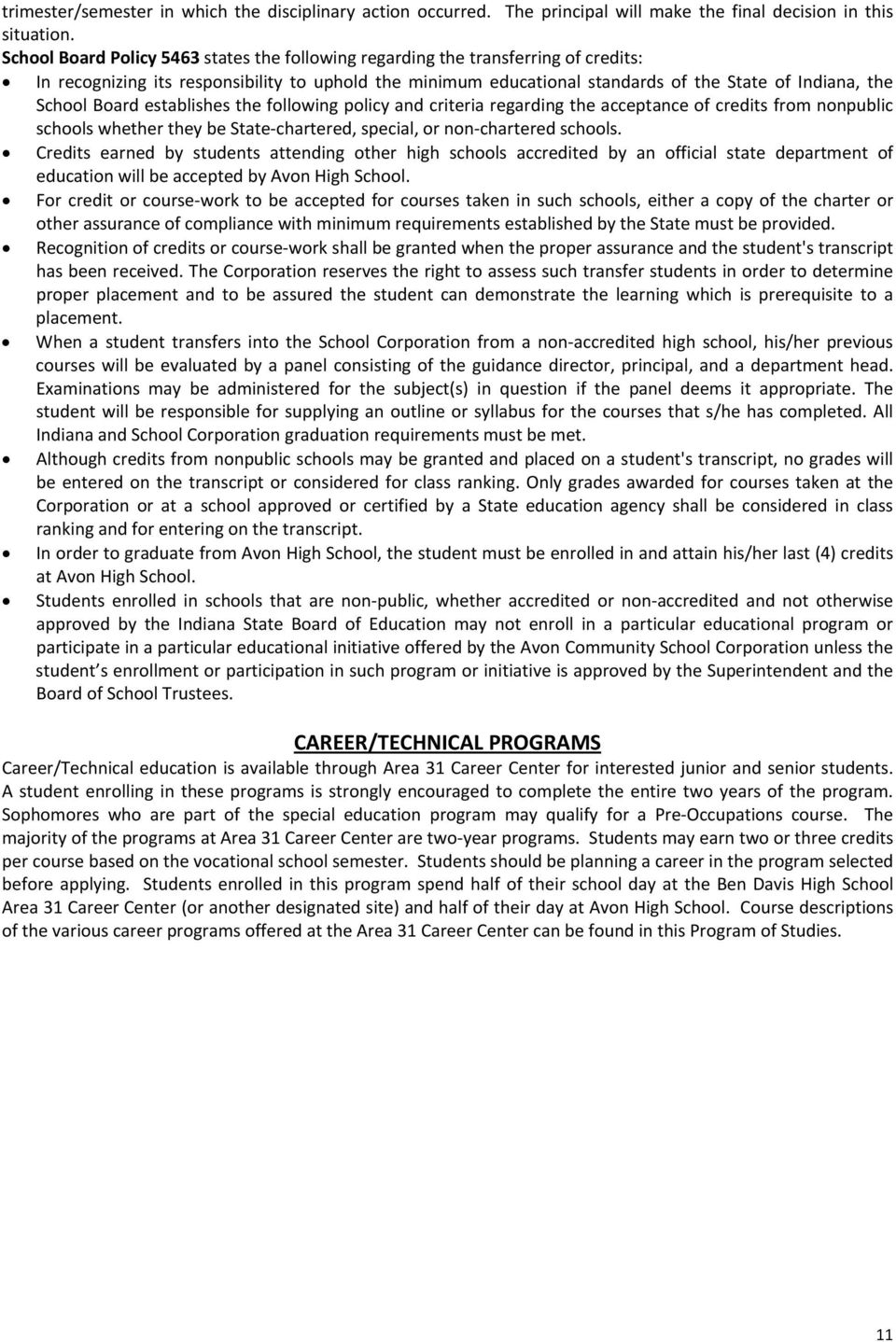
13 Indiana College and Career Pathways Visit to learn more about the Indian College and Career Pathways. Once on the webpage, you can click on your choice of icons below to go to Pathway Plans and Course Frameworks. 12

14 AVON HIGH SCHOOL SCHEDULING YEAR BUSINESS EDUCATION 0207 Professional Career Internship 0208 Professional Career Internship/Cadet Teaching MU 174 Prof Career Int Cadet 0209 Entrepreneurship Academy IT Prog & Software Dev Beg Tech Intern Sports, Recreation, and Entertainment Marketing 02 Marketing Management AP Computer Science 0240 Preparing for College and Careers Business & Personal Law 0271 Computer Applications Computer App Adv Accounting I Accounting II Marketing Foundations Bus Tech Lab II ENGLISH English English 9 Hon English English 10 Hon English English VU English VU Literature Eng Lit & Comp AP Eng Lang Comp AP 1770 Creative Writing 1781 Adv Speech and Communication 1782 Debate 1784 Public Speaking 1785 Journalism 1789 Etymology Yearbook Newspaper Eng New Lang 2400 SAT Preparation FAMILY & CONSUMER SCIENCE 0501 Interpersonal Relationships 0508 Early Child Ed Intern 0521 Nutrition & Wellness 0522 Adv Nutrition & Foods I 052 Adv Nutrition & Foods II 0524 Intro to Culinary Arts 0541 Child Development 0542 Adv Child Development 0550 Housing & Interiors I 0551 Housing & Interiors II 0580 Adult Roles & Responsibilities FINE ARTS (Visual Art) 0110 Intro to D Art 0111 Intro to 2 D Art AP Art History AP Studio Art 012 Drawing I 0147 Drawing II 0149 Drawing III 0150 Drawing IV 0124 Painting I 0125 Painting II 0148 Visual Communications 0164 Digital Photography I 0165 Digital Photography II 0171 Jewelry I 017 Jewelry II 0175 Jewelry III 0172 Ceramics I 0174 Ceramics II 0176 Ceramics III FINE ARTS PERFORMANCE (Band, Choir, Dance) Beginning Concert Band Intermediate Concert Band Advanced Concert Band Jazz Ensemble Beg Ins Ens Percussion Int Ins Ens Percussion Adv Ins Ens Percussion Beg Ins Music Orchestra Int Ins Music Orchestra Adv Ins Music Orchestra Beg Instrumental Music Brass Beg Instrumental Music Woodwinds Int Instrumental Music Brass Int Instrumental Music Woodwinds Adv Instrumental Music Brass Adv Instrumental Music Woodwinds Dance Performance Color Guard Beginning Chorus Male Beginning Chorus Female Intermediate Chorus Female Advanced Chorus Female Female Vocal Jazz Intermediate Mixed Chorus Advanced Mixed Chorus Choral Chamber Ensemble 080 Music Theory & Composition I AP Music Theory 0860 Piano & Electric Keyboard I 0861 Piano & Electric Keyboard II 0862 Adv Piano 0852 Dance Choreography I 085 Dance Choreography II 0854 Dance Choreography III 0855 Dance Choreography IV 0851 Dance Choreography V Dance Company I & II Advanced Dance Technique FINE ARTS PERFORMANCE (Theatre) 1760 Technical Theatre 1761 Theatre Arts 1762 Advanced Theatre Arts MATH Algebra Enrichment Algebra I Geometry Geometry Honors Algebra II Algebra II Honors Discrete Math 070 Probability & Stats AP Statistics 0751 VU Math 102 College Algebra 0751N College Algebra 0752 VU Math 104 Trigonometry 0752N Trigonometry Pre Calculus Honors 0781 Pre Calc H VU Math 102 College Alg 0782 Pre Calc H VU Math 104 Trigonometry VU Math 118 Calc/Analytic Geometry AP Calculus AB Geometry Ace College Algebra II Ace 0740 Trigonometry Ace AP Calculus AB Ace AP Calculus BC Ace 2400 SAT Preparation PE/HEALTH 1101 Health Ed 1122 Phys Ed I 112 Phys Ed II 1121 Physical Fitness I 1126 Physical Fitness II 1129 Physical Fitness III 111 Physical Fitness IV 114 Physical Fitness V 1140 Team Sports I 1141 Team Sports II 1142 Team Sports III 1119 Aerobic Training I 1151 Lifetime Activities 1152 Lifetime Activities II 1161 Swimming 1171 Water Sports 1181 Advanced Health 1114 Adv Physical Conditioning I 1115 Adv Physical Conditioning II 1116 Adv Physical Conditioning III 1187 Adv Physical Conditioning IV 1188 Adv Physical Conditioning V 1189 Adv Physical Conditioning VI 1190 Adv Physical Conditioning VII 1191 Adv Physical Conditioning VIII 1192 Adv Physical Conditioning IX 119 Adv Physical Conditioning X 1107 Lifeguard Training 111 Lifeguard II Continued on next page 1

15 RESOURCE Resource Room Behavior Dev Program 185 Character Education Resource English 1 14 Resource Math Resource Earth Science Resource Biology US History *Credit 18 Government *Credit 186 World History *Credit 2075 Adaptive Recreation & PE IEP English IEP Math 2092 IEP Health 209 IEP Keyboarding 2095 IEP Daily Living Skills 2100 IEP PVE IEP Consumer Math Resource Work Study SCIENCE Biology I Biology I Honors AP Biology 090 Biology II: Botany 0907 Biology II: Human Genetics 0925 Biology II: Zoology Principles of Biomedical Sciences Project Lead The Way Human Body Systems Project Lead The Way Medical Interventions Project Lead The Way Biomedical Innovations Project Lead The Way Integrated Chemistry/Physics Chemistry I Chemistry I Honors 0947 Adv Science: Organic Chemistry 0948 Adv Science: Intro to Forensic Entomology 0949 Adv Science: Science and Society Chemistry AP Physics I Physics I Honors VU Physics 105/105L AP Physics Environmental Science AP SOCIAL STUDIES Geography/History of the World Honors Geography/History of the World World History & Civilization AP World History AP European History US History VU American Hist 19/140 I II AP US History 101 Psychology AP Psychology 1041 US Government AP US Government 1051 Sociology 1061 Economics AP Economics TECHNOLOGY EDUCATION 1611 Technology Systems 161 Design Processes 1619 Construction Systems 1621 Construction Processes Manufacturing Processes 1625 Manufacturing Systems 1627 Transportation Systems Transportation Processes Computer Design & Production Systems 165 Fundamentals of Engineering 167 Technology Enterprises Intro Engineering Design Project Lead The Way Principles of Engineering Project Lead The Way Digital Electronics Project Lead The Way Comp Integrated Manufacturing Project Lead The Way Engineering Design & Dev Project Lead The Way 1642V 164V VU Digital Logic V 1645V VU CIMT V Broadcast: Mass Media 418V Broadcasting I 419V Broadcasting II 420V Broadcasting III 421V Broadcasting IV 424V 425V VU Beg TV Prod 140 CAREER/TECHNICAL EDUCATION Pre Occupations Advanced Career and Technical Education Advanced Manufacturing Auto Service Technology Aviation Flight Technology Aviation Maint Technology Aviation Mgt Technology Aerospace Engineering Tech Building Trades Business Coop Cisco Network Academy Collision Repair Tech Comp Repair/Network Cosmetology Criminal Justice 1 2 Culinary Arts Dental Assisting Early Childhood Education Electronic Technology Emergency Medical Services Fire and Rescue Graphic Imaging Health Occupations Heating & Air Conditioning Interactive Media Landscape Management Machine Tool Technology Marketing Co op Medical Assisting 7 74 Pharmacy Technology Radio Broadcasting 08 Tractor Trailer Driving TV Broadcasting Web Page Design Welding WORLD LANGUAGES Lang for Heritage Speakers Lang for Heritage Speakers II French Lev I French Lev II 0415N 0416N French Lev III 0417N 0418N French Lev IV AP French Language German Lev I German Lev II 0425N 0426N German Lev III 0427N 0428N German Lev IV AP German Language Spanish Lev I Spanish Lev II 045N 046N Spanish Lev III 047N 048N Spanish Lev IV AP Spanish Language Japanese Lev I Japanese Lev II Japanese Lev III Japanese Lev IV AP Japanese Language ADDITIONAL COURSES Study Hall 1698 Mid Year Graduate 14
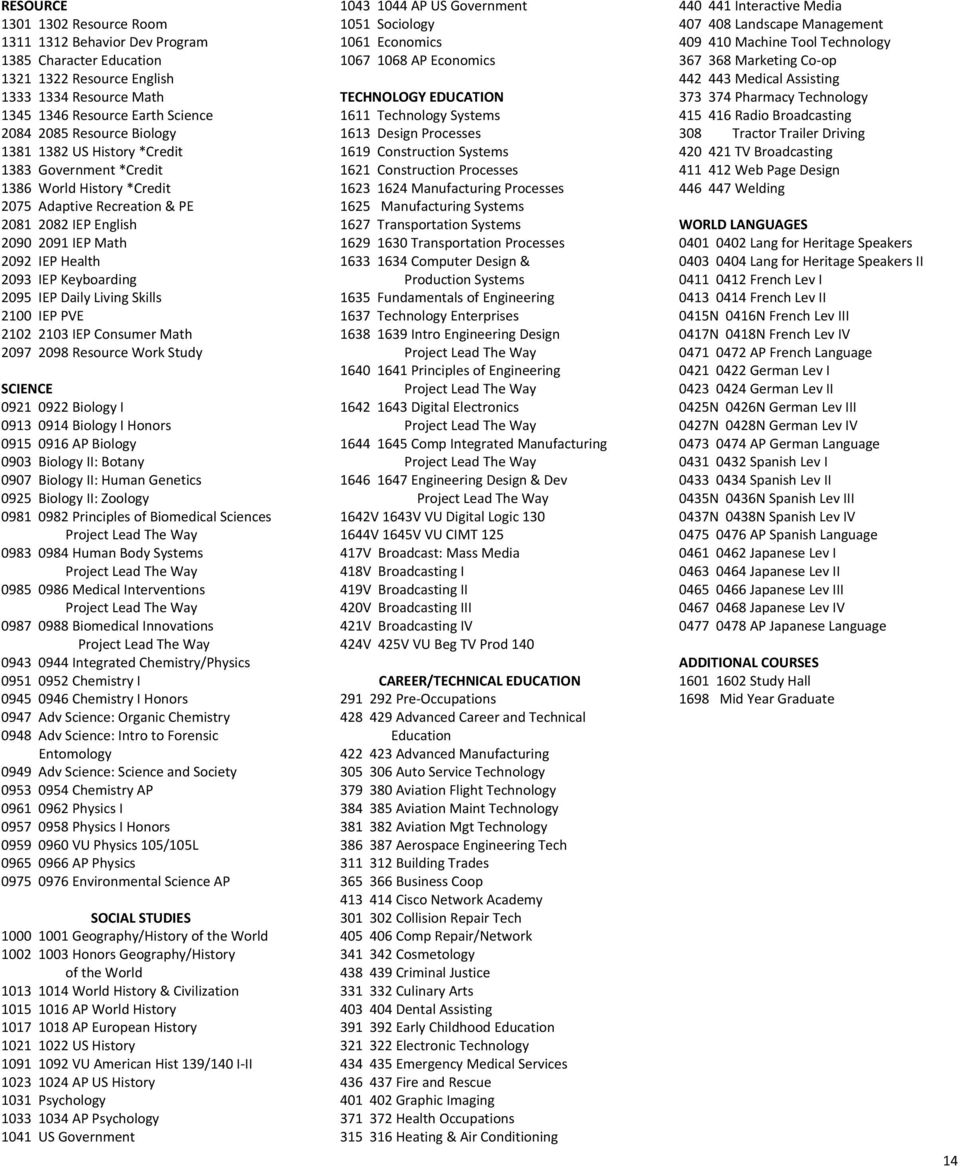
16 Career & Technical Education Business & Information Technology Communications Construction, Engineering & Manufacturing Business Co op Graphic Imaging Advanced Manufacturing Business Technology Lab Radio Broadcasting Building Trades CISCO Networking Academy TV Broadcasting Electronics Computer Repair & Networking Engineering Interactive Media Heating & Air Marketing Co op Web Page Design Education & Training Landscape Management Machine Tool Technology Welding (Manufact. Processes) Advanced CTE Cadet Teaching Co op Early Childhood Education Pre Occupations Health Science & Human Services Law & Public Safety Transportation, Distribution & Logistics Biomedical Sciences Aerospace Engineering Cosmetology Criminal Justice Automotive Service Culinary Foundations Fire and Rescue Aviation Flight Culinary Arts Aviation Management Dental Assisting Aviation Maintenance Health Occupations Collision Repair Emergency Medical Services Tractor Trailer Driving Medical Assisting Pharmacy Tech 15

17 AREA 1 CAREER PROGRAMS Area 1 Career Programs prepare students for careers and/or for further study at a post-secondary institution after completion of high school. Most of the programs are offered at the Career Center at Ben Davis High School. Opportunities exist for students of all abilities in a variety of programs. Local employers provide curriculum direction and employment, including co-op experiences. Many career and technical education programs enable a student to receive college credit while in high school. Each of the courses offered meet a course requirement for all of the following: Core 40 Diploma Academic Honors Diploma Core 40 with Technical Honors Diploma Diploma Elective (general) Directed Elective Career Academic Sequence Career Technical Program Flex Credit NOTE: Before enrolling in any Career and Technical Education program, the student must secure an enrollment information sheet from a counselor, fill it out and return it to a counselor. Course offerings include: Advanced CTE (college credit available) Advanced Manufacturing (college credit available) Aerospace Engineering (college credit available) Automotive Service Technology (college credit available) Aviation Flight Technology (college credit available) Aviation Management Technology (college credit available) Aviation Maintenance Technology (college credit available) Biomedical Sciences Building Trades (college credit available) Business Co-Op Business Technology Lab (college credit available) Cadet Teaching Co-Op Experience Cisco Networking Academy (college credit available) Collision Repair Technology (college credit available) Computer Repair and Network Administration (college credit available) Cosmetology (college credit available) Criminal Justice (college credit available) Culinary Foundations Culinary Arts (college credit available) Dental Assisting (college credit available) Early Childhood Foundations Early Childhood Education (college credit available) Electronics (college credit available) Emergency Medical Services (college credit available) Engineering (Project Lead the Way) (college credit available) Fire and Rescue (college credit available) Graphic Imaging (college credit available) Health Occupations (college credit available) Heating and Air Conditioning (HVACR) (college credit available) Information Technology: Interactive Media Information Technology: (Web Page Design) (college credit available) Landscape Management (college credit available) Machine Tool Technology (college credit available) Marketing Field Experience (Co-op) Medical Assisting (college credit available) Pharmacy Tech (college credit available) Pre-Occupations 16

18 Radio Broadcasting (college credit available) TV Broadcasting (college credit available) Tractor Trailer Driver Training (college credit available) Welding (Manufacturing Processes) (college credit available) The following dual credit course offerings are available during the school year for dual credit. Indiana college credit is generally transferable from one Indiana educational institution to another; however, students and parents should research the transfer themselves just to be sure. One educational institution cannot make a transfer call for another. Students and parents should contact an advisor at the institution where they want to attend and ask if the credit being offered will count toward the degree of their choice. College Course # College Course Title College Credits Cost of Credit To Student Postsecondary Institution High School Program ME 295 Intro to Adv. Manufacturing IUPUI Advanced Career & Technical Education ADMF 101 Principles of Adv Mfg Ivy Tech Advanced Manufacturing ADMF 102 Technology in Adv Mfg AUTC 105 AUTC 127 AUTC 109 AU 126 AU 127 Powertrain Service Engine Repair Engine Performance Suspension & Steering Hydraulic Brake System 6 6 Ivy Tech Ivy Tech Ivy Tech U of NW Ohio U of NW Ohio Auto Service Technology AFLT 110 AFLT 160 AFLT 100 AMNT 100 AFLT 258 AFLT 190 AMNT 10 AMNT 102 AMNT 106 AMNT 164 AMNT 166 BCOT 104 BCOT 105 BCOT 114 CONT 101 CONT 102 Flight Maneuvers Power Plant Primary Ground School Intro to Aviation Air Transportation Aircraft Propulsion & System Aircraft Science Aviation Maintenance Materials, Process, Welding Aircraft Systems Composite & Nonmetallic Floor & Wall Layout Roof Construction Exterior Trim Intro to Construction Construction Materials & Spec Vincennes University Vincennes University Vincennes University Vincennes University Ivy Tech Richmond Aviation Flight Technology Aviation Management Technology Aerospace Engineering Technician Aviation Maintenance Technology Building Trades COMP 110 Intro to Computer Concepts $75 Vincennes University Business Tech Lab BODY 100 BODY 100L AUTO 105 Body Repair I Body Repair I Lab Transportation Fundamentals 5 2 Vincennes University Collision Repair CMET240 ECET 299 ECET 24 CPNS 101 CPNS 102 COSM 100 COSM 150 COSM 200 COSM 250 LAWE 100 LAWE 225 LAWE 160 LAWE 106 CULN 110 REST 100 REST 120 REST 155 DAKL 151 DAW 151 DAY 151 DAG 151 ECED 101 ECED 100 ECED 10 EECT 101 EECT 112 ECET 109 ELEC 10 ELEC 110 EMTB 212 PARM 102 Computer Maintenance I Special Projects PC Systems I LAN Basics & OSI Model WAN Basic & Routers Cosmetology I (75 hours) Cosmetology II (750 hours) Cosmetology III (1125 hours) Cosmetology IV (1500) Survey of Criminal Justice Intro to Forensic Science Criminal Investigation Intro to Traffic Control Quality food Production Intro to Hospitality Mgmt Food Service Sanitation Quantity food Purchasing Found Skills for Dental Assist Tech & Term. for Dental Diagnostic Assisting Patient Interaction Health, Safety, Nutrition Intro to Early Childhood Ed Curriculum in Classroom Intro to Electronics Digital Principles Digital Fundamentals Digital Logic I Basic Component & Circuit Emergency Med. Tech Basic Emergency Med. Tech Basic Vincennes IUPUI IUPUI Vincennes University P J s College of Cosmetology Vincennes University Vincennes University Kaplan College Ivy Tech Ivy Tech Ivy Tech IUPUI Vincennes University Vincennes University Vincennes University Ivy Tech Computer Repair CISCO Academy Cosmetology Criminal Justice Culinary Arts Dental Assisting Early Childhood Education Electronics Emergency Medical Services 17

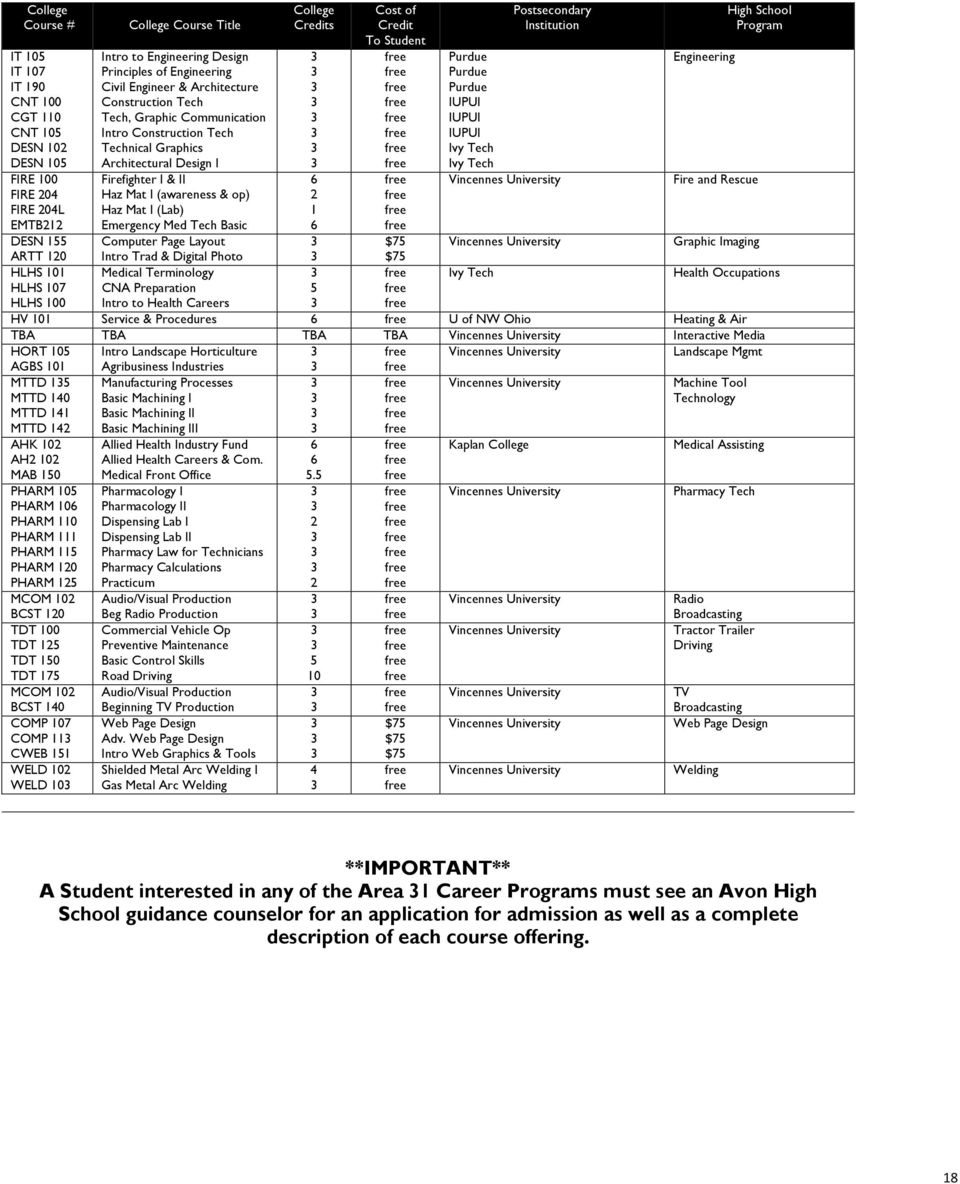
19 College Course # IT 105 IT 107 IT 190 CNT 100 CGT 110 CNT 105 DESN 102 DESN 105 FIRE 100 FIRE 204 FIRE 204L EMTB212 DESN 155 ARTT 120 HLHS 101 HLHS 107 HLHS 100 College Course Title Intro to Engineering Design Principles of Engineering Civil Engineer & Architecture Construction Tech Tech, Graphic Communication Intro Construction Tech Technical Graphics Architectural Design I Firefighter I & II Haz Mat I (awareness & op) Haz Mat I (Lab) Emergency Med Tech Basic Computer Page Layout Intro Trad & Digital Photo Medical Terminology CNA Preparation Intro to Health Careers College Credits Cost of Credit To Student $75 $75 Postsecondary Institution Purdue Purdue Purdue IUPUI IUPUI IUPUI Ivy Tech Ivy Tech Vincennes University Vincennes University Ivy Tech Engineering Fire and Rescue Graphic Imaging High School Program Health Occupations HV 101 Service & Procedures 6 U of NW Ohio Heating & Air TBA TBA TBA TBA Vincennes University Interactive Media HORT 105 Intro Landscape Horticulture Vincennes University Landscape Mgmt AGBS 101 Agribusiness Industries MTTD 15 MTTD 140 MTTD 141 MTTD 142 Manufacturing Processes Basic Machining I Basic Machining II Basic Machining III Vincennes University Machine Tool Technology AHK 102 AH2 102 MAB 150 PHARM 105 PHARM 106 PHARM 110 PHARM 111 PHARM 115 PHARM 120 PHARM 125 MCOM 102 BCST 120 TDT 100 TDT 125 TDT 150 TDT 175 MCOM 102 BCST 140 COMP 107 COMP 11 CWEB 151 WELD 102 WELD 10 Allied Health Industry Fund Allied Health Careers & Com. Medical Front Office Pharmacology I Pharmacology II Dispensing Lab I Dispensing Lab II Pharmacy Law for Technicians Pharmacy Calculations Practicum Audio/Visual Production Beg Radio Production Commercial Vehicle Op Preventive Maintenance Basic Control Skills Road Driving Audio/Visual Production Beginning TV Production Web Page Design Adv. Web Page Design Intro Web Graphics & Tools Shielded Metal Arc Welding I Gas Metal Arc Welding $75 $75 $75 Kaplan College Vincennes University Vincennes University Vincennes University Vincennes University Vincennes University Vincennes University Medical Assisting Pharmacy Tech Radio Broadcasting Tractor Trailer Driving TV Broadcasting Web Page Design Welding **IMPORTANT** A Student interested in any of the Area 1 Career Programs must see an Avon High School guidance counselor for an application for admission as well as a complete description of each course offering. 18
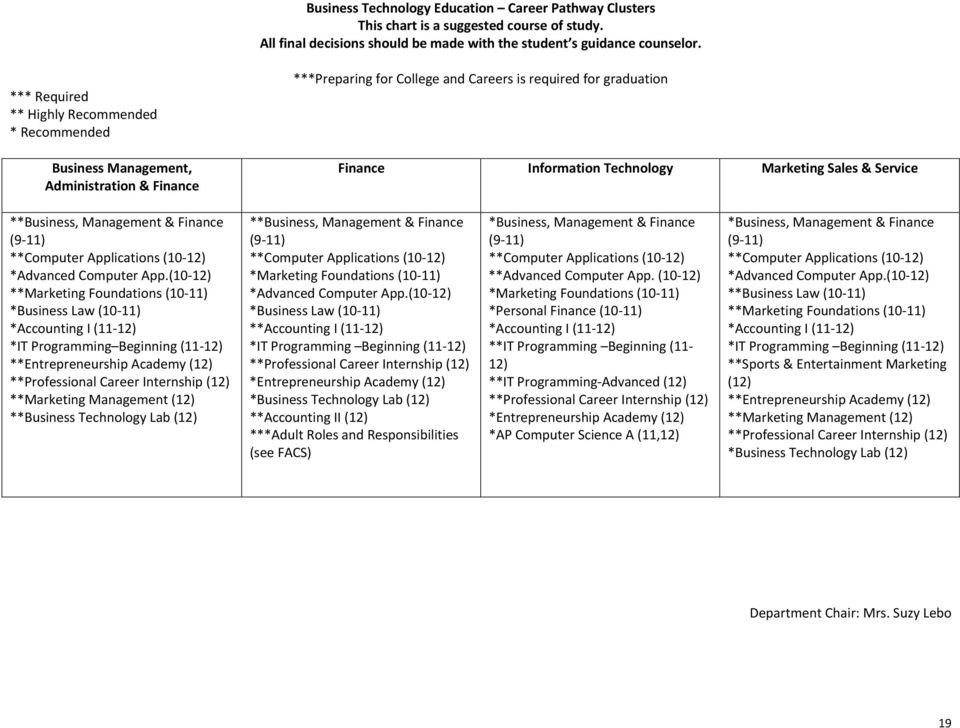
20 Business Technology Education Career Pathway Clusters This chart is a suggested course of study. All final decisions should be made with the student s guidance counselor. *** Required ** Highly Recommended * Recommended Business Management, Administration & Finance ***Preparing for College and Careers is required for graduation Finance Information Technology Marketing Sales & Service **Business, Management & Finance (9 11) **Computer Applications (10 12) *Advanced Computer App.(10 12) **Marketing Foundations (10 11) *Business Law (10 11) *Accounting I (11 12) *IT Programming Beginning (11 12) **Entrepreneurship Academy (12) **Professional Career Internship (12) **Marketing Management (12) **Business Technology Lab (12) **Business, Management & Finance (9 11) **Computer Applications (10 12) *Marketing Foundations (10 11) *Advanced Computer App.(10 12) *Business Law (10 11) **Accounting I (11 12) *IT Programming Beginning (11 12) **Professional Career Internship (12) *Entrepreneurship Academy (12) *Business Technology Lab (12) **Accounting II (12) ***Adult Roles and Responsibilities (see FACS) *Business, Management & Finance (9 11) **Computer Applications (10 12) **Advanced Computer App. (10 12) *Marketing Foundations (10 11) *Personal Finance (10 11) *Accounting I (11 12) **IT Programming Beginning (11 12) **IT Programming Advanced (12) **Professional Career Internship (12) *Entrepreneurship Academy (12) *AP Computer Science A (11,12) *Business, Management & Finance (9 11) **Computer Applications (10 12) *Advanced Computer App.(10 12) **Business Law (10 11) **Marketing Foundations (10 11) *Accounting I (11 12) *IT Programming Beginning (11 12) **Sports & Entertainment Marketing (12) **Entrepreneurship Academy (12) **Marketing Management (12) **Professional Career Internship (12) *Business Technology Lab (12) Department Chair: Mrs. Suzy Lebo 19
21 BUSINESS EDUCATION COURSE DESCRIPTIONS Accounting I ( ) Core 40, AHD, THD, Elective Grade Level: Prerequisite: Algebra I Text: $14.00; Consumables: $65.00 Accounting I is a business course that introduces the language of business using Generally Accepted Accounting Principles (GAAP) and procedures for proprietorships and partnerships using double entry accounting. Emphasis is placed on accounting principles as they relate to both manual and automated financial systems. This course involves understanding, analyzing, and recording business transactions and preparing, analyzing, and interpreting financial reports as a basis for decision making. Instructional strategies should include the use of computers, projects, simulations, case studies, and business experiences requiring the application of accounting theories and principles. Accounting II ( ) Core 40, AHD, THD, Elective Grade Level: 12 Required Prerequisite: Accounting I Text: $14.00 Accounting II is an advanced level business course that building upon the Generally Accepted Accounting Principles (GAAP) and procedures learned in Accounting I. Emphasis is placed on managerial decisions made in corporate accounting, including in depth analysis of financial statements. The importance of making ethical business decisions is emphasized. Instructional strategies must include the use of spreadsheets, word processing and accounting software. Projects, simulations, case studies, and business experience are used to apply accounting principles and produce appropriate financial reports. AP Computer Science ( ) Core 40, AHD, THD Elective Grade Level: 11, 12 Required Prerequisite: Algebra II Text: $19.00; Consumables: $19.00 The expectation is that students taking this course will take the corresponding AP exam at the end of the school year. Computer Science, Advanced Placement is a business course that provides students with the content established by the College Board. Topics include: object oriented program design, program implementation, program analysis, standard data structures, standard algorithms, and computing in context. Computer Science A emphasizes the objectoriented programming methodology with a concentration on problem solving and algorithm development. Business and Personal Law ( ) Core 40, AHD, THD, Elective Grade Level: Text: $14.00 Business and Personal Law provides an overview of the legal system. Topics covered include: Basics of the Law, Contract Law, Employment Law, Personal Law, and Property Law. Both criminal and civil trial procedures are presented. Instructional strategies should include mock trials, case studies, professional mentoring, job shadowing, field trips, guest speakers, and Internet projects. Business, Management, and Finance ( ) Core 40, AHD, THD, Elective Grade Level: 9 11 Text: $14.00; Consumables: $45.00 Business, Management, and Finance is a career and technical education business course that prepares students to plan, organize, direct, and control the functions and processes of a firm or organization and to perform business related functions. Students are provided opportunities to management, and finance. Individual experiences will be based upon the student s career and educational goals. Instruction strategies should include in baskets, mini baskets, LAPS, field trips, guest speakers, internet searches, simulations, internships, and cooperative ventures between school and community. Business Professionals of America or DECA, is the co curricular organization associated with this course and integrates its programs and services into the business classroom 20
22 Business Technology Lab II ( ) Core 40, AHD, THD, Elective Two semesters 2 credits per semester Potential hours college credit through Ivy Tech Grade Level: 12 Required Prerequisite: Computer Applications plus two additional business credits Text: $2.00; Consumables: $14.00; Materials: $5.00 Business Technology Lab II is a career and technical education business course. As a capstone program, this course prepares students for employment in business occupations and/or to continue study in a post secondary institution. Educational experience will be based upon the student s individual career and educational goals. Business Professionals of America is a co curricular organization associated with the course and integrates its programs and services into the business classroom. Through BPA, students will have the opportunity to participate/compete in business related activities. Instructional strategies will include in baskets, minibaskets, LAPS, workflow simulations, real world experiences school based enterprises, industry certification, and field experience (job shadowing, mentoring, and/or internships). Preparing for College and Careers (0240) THIS COURSE IS REQUIRED FOR GRADUATION Grade Level: 9 Text: $11.00; Materials: $1.00 Career Planning and Success Skills is a career and technical education business course that is designed to address the knowledge, skills, and behaviors all students need to live, plan, and work successfully in today s society. This course includes exploring career clusters, developing leadership/teamwork skills, researching/collecting labor market data, and developing career plans. The employment process is explored through searching for employment opportunities, completing applications, developing resumes, participating in interview, gaining jobsurvival skills, and understanding employee evaluations. Business Professionals of America is the co curricular organization associated with this course and integrates its programs and services into the business classroom. Computer Applications (0271) Core 40, AHD, THD, Elective Grade Level: Materials: $1.00 Computer Applications is a business course that provides instruction in software concepts using a Windows based professional suite, which includes word processing, spreadsheet, database, graphics, and presentation applications. Instruction in basic computer hardware and operating systems that support software applications is provided. Additional concepts and applications dealing with software integration, Internet use, and information about future technology trends are included. Instructional strategies should include teacher demonstrations, collaborative instruction, interdisciplinary and/or culminating projects, problem solving and criticalthinking activities, simulations, and mini baskets/inbasket projects. Computer Applications, Advanced (027) Core 40, AHD, THD, Elective Grade Level: Required Prerequisite: Computer Applications Text: $10.00 Computer Applications, Advanced is a business course that integrates computer technology, decision making, and problem solving skills. Areas of instruction include advanced applications and integration of professional suite voice recognition, and the use of emerging technology. Students will be given the skills to seek business/industry certification such as Microsoft Office Specialist (MOS) certification. Instructional strategies may include collaborative instruction, peer teaching, inbaskets, mini baskets, LAPs, school and community projects, and a school based enterprise. Entrepreneurship Academy (0209) Core 40, AHD, THD, Elective Grade Level: 12 Recommended Prerequisite: Computer Applications Text: $1.00; Consumables: $17.00 Entrepreneurship Academy is designed as the capstone course in a specialized sequence of marketing and marketing related courses, which provide instruction in marketing, management, and 21
23 entrepreneurial fundamentals as they relate to starting and operating a business. Topics addressed include assessment of entrepreneurial skills, the importance of business ethics, and the role of entrepreneurs in a global economy. Instructional strategies may include a school based enterprise, computer/technology applications, real and/or simulated occupational experiences, and projects available through the BPA/DECA program of cocurricular activities. Students will develop a written business plan for a business of their choice. Curriculum should be incorporated into development of a business plan throughout the term of the course. Information Technology: Programming & Software Development, Beginning ( ) Core 40, AHD, THD, Elective Grade Level: Prerequisites: Algebra I Text: $10.00 Students will be exposed to several types of IT environments including Web Design using HTML; JavaScript; CSS; online programming; Flash; and Microsoft Visual Studio. Marketing Foundations ( ) Core 40, AHD, THD, Elective Grade Level: Text: $14.00 Marketing Foundations is a marketing course that provides a basic introduction to the scope and importance of marketing in the global economy. Emphasis is placed on oral and written communications, mathematic applications, problem solving, and critical thinking skills as they relate to advertising/promotion/selling, distribution, financing, marketing information management, pricing, and product/service management. Instructional strategies may include a school based enterprise, computer/technology applications, real and/or simulated occupational experiences, and projects in the marketing functions such as those available through the BPA/DECA program of cocurricular activities. Marketing Management (02) Core 40, AHD, THD, Elective Course may be repeated for a second semester Grade Level: 12 Text: $11.00 Due to the independent nature and high expectations of this class, a student s character and ability to remain in good standing at the high school along with the application process will be taken into consideration for enrollment in the class. Marketing Management Seminar is a marketing course that proves an opportunity for college bound students to study marketing outside the traditional marketing education course offerings. Emphasis is placed on the functions of marketing. All students will be required to prepare and present a marketing research project utilizing the decision making process. Additional instructional areas include leadership,, management skills, and risk management. Instructional strategies may include a school based enterprise, computer/technology applications, real and/or simulated marketing experiences, and projects in the marketing functions such as those available through the BPA or DECA program of co curricular activities. Adult Roles and Responsibilities (0580) SEE Family and Consumer Science section of the Program of Studies. Professional Career Internship (0207) Core 40, AHD, THD, Elective One semester credits Course may be repeated for a second semester in a new internship placement Grade Level: 12 Required Prerequisite: Approved Application, Student must acquire an internship position approved by the teacher if accepted to the program. Materials: $11.00 Professional Career Internship is a Career and Technical Education Business and Information Technology course that is designed to provide opportunities for students to explore careers that require additional degrees or certification following high school. The emphasis of the experience is on applying skills developed through instruction and on learning new career competencies at the internship site. The internship is tailored to the unique needs and interests of the student and is considered a high school capstone experience towards fulfillment of the student's meaningful future plan. Upon completion of the internship, students will review 22
24 and revise their career plans. A training agreement outlines the expectations of all parties: the intern, parent/guardian, site supervisor/mentor, internship supervisor, and the school. Students participating in these structured experiences will follow class, school, business/industry/organization, State, and Federal guidelines. Internships may be paid or unpaid and must include a classroom component (such as a series of seminars, workshops, or class meetings) and regular contact between the interns and internship coordinator. Business Professionals of America is the co curricular organization associated with this course and integrates its programs and services into the business classroom. Professional Career Internship Cadet Teaching (0208) Core 40, AHD, THD, Elective One semester credits Course may be repeated for a second semester Grade Level: 12 Text: $2.00; Materials: $5.00 Dual Credit Course with Marian University $00.00 Due to the independent nature and high expectations of this class, a student s character and ability to remain in good standing at both the high school and the cooperating school will be taken into consideration for enrollment and for the length of time that the student is participating in the class. Professional Career Internship is a Career and Technical Education Business and Information Technology course that is designed to provide opportunities for students to explore careers that require additional degrees or certification following high school. The emphasis of the experience is on applying skills developed through instruction and on learning new career competencies at the internship site. The internship is tailored to the unique needs and interests of the student and is considered a high school capstone experience towards fulfillment of the student's meaningful future plan. Upon completion of the internship, students will review and revise their career plans. A training agreement outlines the expectations of all parties: the intern, parent/guardian, site supervisor/mentor, internship supervisor, and the school. Students participating in these structured experiences will follow class, school, business/industry/organization, State, and Federal guidelines. Internships may be paid or unpaid and must include a classroom component (such as a series of seminars, workshops, or class meetings) and regular contact between the interns and internship coordinator. Business Professionals of America is the co curricular organization associated with this course and integrates its programs and services into the business classroom. Sports, Recreation & Entertainment Marketing (021) Core 40, AHD, THD, Elective Grade Level: 12 Text: $6.00 Sports, Recreation, and Entertainment Marketing is a specialized marketing course providing students with the opportunity to apply marketing principles in the fields of Sports, Recreation, and Entertainment. Students will produce and market activities for athletic and entertainment programs at the high school. A plan to increase attendance and support for athletic and entertainment (music and theatre) functions in the school will be developed. The class will research and work with the private sector and community to help market recreation and entertainment programs. Instructions strategies may include computer/technology applications, event planning, real and/or simulated occupational experiences, and projects in the marketing functions such as those available through the BPA/DECA program of co curricular activities. Tech Intern ( ) Core 40, AHD, THD, Elective Grade Level: 12 Prerequisite: Department Chair Invitation Fee: $50.00 (Dell Certification) Invited students will be trained as technology technicians and will be utilized in the Advanced Learning Center. The student technicians will provide manpower and technical support to the district initiative of incorporating laptops for students and other technologies in the Advanced Learning Center. Once students have completed the Dell Certification program, they will trouble shoot issues on student computers as they arise in the ALC. Students will be assigned to a teacher through an internship class and receive appropriate credit. 2
25 ENGLISH COURSES This chart is a suggested course of study. All final decisions should be made with the student s guidance counselor. HONORS (Pre AP)/AP CORE 40 Available Electives at each grade level NINTH GRADE TENTH GRADE ENGLISH 9 HONORS ENGLISH 9 ENGLISH 10 HONORS ENGLISH 10 BASIC SKILLS JOURNALISM BASIC SKILLS JOURNALISM ETYMOLOGY SPEECH ADVANCED SPEECH DEBATE PUBLICATIONS: Yearbook/Newspaper SAT PREP (with permission) ELEVENTH GRADE CHOOSE ONE: ENGLISH 11 AP LANGUAGE ENGLISH 11 JOURNALISM ETYMOLOGY CREATIVE WRITING SPEECH ADVANCED SPEECH DEBATE PUBLICATIONS: Yearbook/Newspaper SAT PREP TWELFTH GRADE CHOOSE ONE: AP LITERATURE VU ENGLISH 101 and VU LITERATURE 100 CHOOSE ONE: ENGLISH 12 VU ENGLISH 101 and VU LITERATURE 100 JOURNALISM ETYMOLOGY CREATIVE WRITING SPEECH ADVANCED SPEECH DEBATE PUBLICATIONS: Yearbook/Newspaper Department Chair: Mr. Andy Johnson 24
26 ENGLISH COURSE DESCRIPTIONS English 9 ( ) Core 40 and AHD Course Prerequisites: None Grade: 9 Text: $20.00 This course offers an integrated study of literature, composition, and oral communications. Students write for various audiences and purposes while strengthening skills in paragraph and multiparagraph writing through assignments dealing with multiple types of writing, including expository essays of persuasion and literary analysis and technical writing assignments in various forms. The formal study of grammar, usage, spelling and language mechanics is integrated into this study of writing. Structured vocabulary assignments allow the students to increase their fluency in both reading and writing. Oral expectations emphasize both making presentations and being critical participants and listeners. All writing will reflect the MLA manual of style. Students read short stories, novels, plays, poems and nonfiction. In addition to selections in their textbook, representative longer works include: Romeo and Juliet; excerpts from The Odyssey; and Night. English 9 Honors (Pre AP) ( ) Core 40 and AHD Course Prerequisites: Qualifying scores on various school administered assessment tests Grade: 9 Text: $20.00 The English 9 Honors course is for students who have been identified by the selection process used by the Avon School Corporation for identifying gifted and talented students and/or for those who have demonstrated exceptional ability and interest in the study of English. A key part of the selection process includes recent NWEA and ISTEP scores as well as evidence of achievement in previous English classes. While the minimum standards and works covered remain the same for English 9 and Honors English 9, there are differences in depth, speed and methodology between the sections. These differences are also reflected in the class structure, amount of independent work required, assignments, and texts used. Students who enroll in the Honors Sections of English should be aware that they are preparing to take Advanced Placement English in their junior year. This course offers an integrated study of literature, composition, and oral communications. Students will write for various audiences and purposes while strengthening skills in paragraph and multiparagraph writing through assignments dealing with multiple types of writing, including expository essays of persuasion and literary analysis and technical writing assignments in various forms. The formal study of grammar, usage, spelling and language mechanics is integrated into this study of writing structured vocabulary assignments will allow the students to increase their fluency in both reading and writing. Oral expectations emphasize both making presentations and being critical participants and listeners. All writing will reflect the MLA manual of style. Students read short stories, novels, plays, poems and nonfiction. In addition to selections from their textbook, representative longer works include: Romeo and Juliet; excerpts from The Odyssey; Night; student directed Literature Circles involving at least one companion piece to one of the longer works. All students enrolled in this class will be assigned a mandatory summer reading novel by the end of the school year. This reading will be assessed by a test given at the start of the school year. Basic Skills (070R 0704R) Prerequisites: Placement is based upon literacy assessments conducted during the 8 th and 9 th grade years. Grade: 9, 10 Consumables: $8.00 This is a course designed to enhance the reading skills of qualifying students. Teacher led programs such as READ 180 or Sonday are used to reinforce the essential skills necessary to succeed in the rigors of the high school English curriculum, the English 10 ECA necessary for graduation, and other standardized tests such as the SAT and ACT. Placement is based upon student achievement on standardized literacy assessments conducted during the 8 th and 9 th grade years. 25
27 English 10 ( ) Prerequisite: Satisfactory completion of Eng. 9 Grade: 10 Text: $26.00 English 10 continues to make full use of many of the activities and skills of English 9 by offering an integrated study of literature, composition, and oral communications. Literature instruction focuses on opportunities to respond critically, reflectively, and imaginatively to literature and recognize the relevance of literature in today s world. Students write for various audiences and purposes. Students identify and employ various elements of good writing in well organized and grammatically correct descriptive, expository, and narrative writings. The formal study of grammar, usage, spelling and language mechanics is integrated into this study of writing. Structured vocabulary assignments allow the students to increase their fluency in both reading and writing. The oral communication component provides opportunities for students to develop a greater facility with choosing and employing different elements of effective oral communications. All writing reflects the MLA manual of style. Students will read short stories, novels, plays, poems and nonfiction. In addition to selections in their textbooks, representative longer works include: To Kill a Mockingbird and Antigone. Additionally, to prepare them for the challenges of reading on standardized tests and in their upper level high school classes, they will use both classroom instruction and individual practice, to work through the Reading for College workbook designed for their level. English 10 Honors (Pre AP) ( ) Core 40 and AHD Course Prerequisite: Successful completion of English 9 Honors or special permission Grade: 10 Text: $26.00 While the minimum standards covered remain the same for English 10 and Honors English 10, there are differences in depth, speed and methodology between the sections. These differences are also reflected in the class structure, amount of independent work required, assignments, and texts used. Students who enroll in the Honors Sections of English should be aware that they are preparing to take Advanced Placement English in their junior year. English 10 Honors continues to make full use of many of the activities and skills of English 9 Honors by offering an integrated study of literature, composition, and oral communications. Literature instruction focuses on opportunities to respond critically, reflectively, and imaginatively to literature and recognize the relevance of literature in today s world. Students write for various audiences and purposes. Students identify and employ various elements of good writing in well organized and grammatically correct descriptive, expository, and narrative writings. The formal study of grammar, usage, spelling and language mechanics is integrated into this study of writing. Structured vocabulary assignments allow the students to increase their fluency in both reading and writing. The oral communication component provides opportunities for students to develop a greater facility with choosing and employing different elements of effective oral communications. All writing reflects the MLA manual of style. Students will read short stories, novels, plays, poems and nonfiction. In addition to selections in their textbooks, representative longer works include: To Kill a Mockingbird; Julius Caesar; Animal Farm. Additionally, to prepare them for the challenges of reading on standardized tests and in their upper level high school classes, they will use both classroom instruction and individual practice, to work through the Reading for College workbook designed for their level. All students enrolled in this class will be assigned a mandatory summer reading novel by the end of the school year. This reading will be assessed by a test given at the start of the school year. English 11 ( ) Core 40 and AHD Course Prerequisites: Successful completion of four credits of grade specific English either Honors or General level. Grade: 11 Text: $20.00; Consumables: $17.00 This course continues an integrated study of literature, composition, and oral communications where the students can further develop their use of language as a tool for learning and thinking and as a source of pleasure. In English 11, students move 26
28 from predominately analyzing and using the elements of written language to making judgments based on those analyses. All students use a grammatically correct style to produce a variety of forms including persuasive writing, synthesis and analysis of information from a variety of sources, completing complex forms, describing procedures, giving directions, and using graphic forms to support a thesis. In addition, students develop greater facility with the back and forth movement between analysis and synthesis. Structured vocabulary assignments allow the students to increase their fluency in both reading and writing. The formal study of grammar, usage, spelling, and language mechanics will be integrated into the study of writing.. The oral communication component will continue to emphasize effective listening and speaking techniques. Students use the MLA style manual for all writing. The emphasis of the course is on American literature, both contemporary and classic, and students will read short stories, novels, plays, poems and nonfiction from American authors from various periods. In addition to selections from the textbook, representative longer works include: The Adventures of Huckleberry Finn, The Joy Luck club, Raisin in the Sun, and Of Mice and Men. English 12 ( ) Core 40 and AHD Course Prerequisites: Successful completion of six credits of grade specific English either Honors or General level. Grade: 12 Text: $21.00 This course will continue to refine students ability and desire to learn and communicate about language and literature. While students developed judgments informed by keen literary analysis in Grades 9 11, in Grade 12 they practice explaining and defending their readings to others. The Composition semester of English 12 provides students with opportunities to hone their writing skills including research and intelligent analysis. Students who complete this semester successfully will be well equipped to enroll in an introductory composition course in college. Using technology, students are able to produce polished final documents. Polished writing requires following through with all phases of the writing process at which all students should be proficient. Students are also able to complete complex forms, describe procedures, give directions, and use graphic forms to support a thesis. The formal study of grammar, usage, spelling, and language mechanics is integrated into the study of writing. Structured vocabulary assignments allow the students to increase their fluency in both reading and writing. Students use the MLA style manual. The second semester allows students to use their knowledge of the English language in a practical manner. Students learn to identify and communicate about the broad themes, trends, and cultural issues present in the world today through articles and activities present in the textbook Acting Out Culture. Oral Communication continues to emphasize the organization of ideas, awareness of audience, and sensitivity to context by careful research. Students will also explore other ways (both verbal and non verbal; electronic and written) to express themselves to others. Students who complete this semester successfully will be able to use these skills both in college and in everyday life. English Language and Composition, Advanced Placement ( ) Prerequisite: English 10 Honors and some tangible proof of exceptional English skills. This might include previous verbal GT identification; outstanding ISTEP, PSAT or PLAN scores, recommendation of previous English teacher. Students who have successfully completed English 9 Honors and English 10 Honors should register for this course their junior year. Grade: 11 Text: $12.00; Consumables: $0.00 The expectation is that students taking this course will take the corresponding AP exam at the end of the school year. Students who enroll in the course are expected to take the AP Language and Composition Examination at the end of their junior year. The cost of the exam (approximately $75) will be assessed in the spring, at the time of the registration for the test. Students who score high enough on the examination will be able to receive college credit for this work. AP Language will take the place of the integrated English 11 course in the junior year or may replace the other options available to seniors. AP is a college level course; therefore, the pace of the course is more intensive than other junior level courses. The assignments provide preparation for 27
29 the mastery of skills required to pass the AP Composition and Language exam in May. This course is based on the content established by the College Board. Students enrolled in this course become skilled readers of prose written in a variety of periods, disciplines, and rhetorical contexts. They become skilled writers who write in a variety of forms narrative, exploratory, expository, and argumentative and on a variety of subjects. Students will be expected to purchase the books for this class rather than rent them so they can annotate ly. Much of the reading for the class is in the form of nonfiction essays, but some longer works are also included. A representative longer work is Black Boy. All students enrolled in this class will be assigned a mandatory summer reading novel by the end of the school year. This reading will be assessed by a test given at the start of the school year. English Literature and Composition Advanced Placement ( ) Prerequisite: English 10 Honors and some tangible proof of exceptional English skills. This might include previous verbal GT identification; outstanding ISTEP, PSAT or PLAN scores, recommendation of previous English teacher. Students who have successfully completed English 9 Honors and English 10 Honors and the AP English Language and Composition course (see above) during the junior year are recommended to take this class Grade: 12 Text: $12.00; Consumables: $27.00 The expectation is that students taking this course will take the corresponding AP exam at the end of the school year. Students who enroll in the course are expected to take the AP Literature and Composition Examination at the end of their senior year. The cost of the exam (about $75) will be assessed in the spring, at the time of the registration for the test. Students who score high enough on the examination will be able to receive college credit for this work AP is a college level course; therefore, the pace of the course is more intensive than other senior level courses. The assignments provide preparation for the mastery of skills required to pass the AP English Literature and Composition exam given in May. Advanced Placement Literature and Composition follows the College Board Entrance Examination guidelines for Advanced Placement English. According to the College Board, students will "engage in careful reading of literary works. Through such study they will sharpen their awareness of language and their understanding of the writer's craft. They will also develop critical standards for the independent appreciation of any literary work, and increase their sensitivity to literature as a shared experience. To achieve these goals, they study the individual work, its language, characters, action, and theme. They consider its structure, meaning, and value, and its relationship to contemporary experience as well as to the context in which it was written. Works of recognized literary merit are likely to be taught in an introductory college literature course and will be used as primary texts." Writing assignments that focus on the critical analysis of literature will be frequent, including in class essays. Students are expected to participate fully during class discussions and make presentations using technological resources for both researching and producing their papers. Students will be expected to purchase many of the books for this class rather than rent them so they can annotate ly. Most of the reading in this class will be British fiction, nonfiction, poetry and plays. Representative longer works include: Pride and Prejudice; Turn of the Screw; The Scarlet Letter and a Shakespearean play. All students enrolled in this class will be assigned a mandatory summer reading novel by the end of the school year. This reading will be assessed by a test given at the start of the school year. SAT Preparation (2400) This course does not count toward the English or Math credit requirement for graduation. Prerequisites: Grades 11 & 12 must have completed 4 credits of English and Geometry; Grade 10 must have special permission only (see guidance counselor). Grades 10,11,12 Consumables: $15.00 The course will be devoted to preparing students to take the Scholastic Aptitude Test (SAT) and/or the Preliminary Scholastic Aptitude Test (PSAT). A team of English and math teachers will review the subject matter covered on the SAT as well as provide various test taking tips and strategies. 28
30 English 101 Vincennes University (1755) Core 40 and AHD Course One semester 1 high school credit and/or Vincennes University credits Prerequisites: Successful completion of 6 credits of English plus one of the following: ACT Reading score of at least 21 and an ACT Writing Score of at least 16 SAT Critical Reading score of at least 420 and an SAT Writing score of at least 80 Accuplacer Reading Comprehension score of at least 89 and an Accuplacer Sentence Skills score of at least 80 Grade 12 Materials: $70.00 (VU textbooks) College tuition: $75, payable to VU, if student desires VU credits English 101 is a college level course in writing designed to help students develop their ability to think, to organize, and to express their ideas clearly and effectively. Emphasis is placed on the various forms of expository writing such as process, description, narration, comparison, analysis, persuasion, and argumentation. Numerous in class writing assignments are required in addition to extended essays written outside of class. Qualified students have the opportunity to earn three hours of transferable college credit in English by registering at the start of the course and paying the $75 tuition at that time. Students must earn a C or better in the course to receive college credit. Literature 100 Vincennes University (1757) Core 40 and AHD Course One semester 1 high school credit (HS) and/or Vincennes University credits Prerequisites: English 101 Vincennes University (1755) Grade 12 Consumables: $8.00 College tuition: $75, payable to VU, if student desires VU credits An introduction to literature and to three major genres: fiction, poetry, and drama. Emphasis is placed on the ability to read critically and gain an appreciation for literature. Qualified students have the opportunity to earn three hours of transferable college credit in English by registering at the start of the course and paying the $75 tuition at that time. Students must earn a C or better in the course to receive college credit. Etymology (1789) Core 40 and AHD Course This course does not count toward the English credit requirement for graduation Prerequisite: Minimum of 2 English credits successfully completed Grades: 10,11,12 (Grade 10 is the ideal time to complete this course in order to prepare for the PSAT) Consumables: $8.00 Etymology provides instruction in the derivation of English words and word families from their Latin and Greek roots. Students study the origins and meanings of English words, including roots, prefixes, suffixes, and reasons for language change. This course introduces students to tools and resources for etymological study and encourages them to be curious about the English language. Note: All college bound students are encouraged to take this class, for it is designed to help students improve verbal skills on the PLAN, PSAT, SAT, and ACT exams. Creative Writing (1770) This course does not count toward the English credit requirement for graduation Prerequisite: Four credits of grade specific English completed Grade: 11, 12 No fee Creative Writing provides students with ample opportunities to combine literary creativity with the discipline of written discourse. Students become familiar with standard literary elements through the reading and study of published prose and poetry and are taught to use those elements in their own writing. Additionally, students learn strategies for evaluation and responding to their own writing and the writing of others in a peer sharing component. In this peer sharing component, students receive specific training in providing constructive, substantial feedback, while role playing as likely readers of each creative work. Representative models of literary excellence will also be studied. 29
31 Public Speaking (1784) Core 40 and AHD Course This course does not count toward the English credit requirement for graduation Prerequisites: Two credits of grade specific English completed satisfactorily. Grades 10, 11, 12 Text: $10.00 Public speaking is valuable to students who are interested in attending college and/or entering business experiences and who might be interested in continuing to study of speech in high school. Speech provides for the study of and practice in the basic principles and techniques of effective oral communication. Instruction in adapting speech to different audiences and purposes is also emphasized. Students have opportunities to make different types of oral presentations Students practice and develop critical listening skills. In addition, the course emphasizes emphasize research using technology and careful organization and preparation. Debate (1782) Core 40 and AHD Course This course does not count toward the English credit requirement for graduation Prerequisite: Public Speaking; permission of instructor Grades: 10, 11, 12 Text: $9.00 In Debate, students gain an understanding of argumentation and persuasion theories and develop skills in logic and analysis. Students also research topics using a variety of literary and technical genre, organize research, write persuasive cases, and practice public speaking. Skills are developed in rhetorical analysis, application of varying forms of logic, and formal debate. Advanced Speech (1786) Core 40 and AHD Course This course does not count toward the English credit requirement for graduation Prerequisite: Public Speaking Grades: 10,11,12 No Fee Advanced Speech builds on the concepts learned in Public Speaking. Students expand speaking opportunities to include interpretation, expression, specialized speaking, panels/forums, and additional persuasive speaking. Students research topics using a variety of literary and technical genres, organized research, and enhanced public speaking. Improve platform movement, extemporaneous speaking, vocal inflection, and timing. Journalism (1785) Prerequisites: None This course does not count toward the English credit requirement for graduation Grades: 9,10,11,12 Text: $15.00 Journalism is the study of the art of reporting and the profession of journalists. This course includes the process involved in: 1) news gathering; 2) reporting and writing news stories; ) the legal and social responsibilities involved in newspaper publications; and 4) the ethics of accurate and fair reporting. This course includes extensive reading of models of excellent journalistic techniques and evaluating and analyzing journalistic writing through discussions and critiques. The course will acquaint the student with the basics of producing a high school newspaper and yearbooks. It will concentrate on the print media including copy writing and editing, layout design, production processes, and the media s effect upon society and the individual. The course is strongly recommended for students who wish to enroll in any student publications class in their later high school study. 0
32 Student Publications Newspaper ( ) Yearbook ( ) May be repeated with defined standards These courses do not count toward the English credit requirement for graduation. Prerequisite: Journalism, Photography (if applicable), application, instructor permission Grades: 10,11,12 No Fee Student publication's two sections provide practical training in publishing the school newspaper and yearbook. Both sections provide the study of and practice in gathering and analyzing information, interviewing, and note taking for the purpose of: 1) writing; 2) editing; ) publishing for print; and 4) broadcast media, including student publications. All sections include instruction and practice in effective journalistic writing forms and techniques as well as layout, design, and typography. Representative samples of amateur and professional journalism are studied and student publications will conform to the appropriate style guide. The concept of responsible journalism is also discussed. A journalism lab and other desktop publishing technologies are used to support the curriculum. All sections plan, publish, market, and distribute their respective publications. Since the sections are all co curricular, after school work and fund raising are required. English As A New Language ( ) A maximum of four (4) credits Prerequisite: Teacher approval Grades: 9,10,11,12 No Fee English as a New Language provides Limited English Proficient (LEP) students with instruction in English that would improve their proficiency in listening, speaking, reading, and writing. Emphasis is placed on helping students to function within the regular school setting and within an English speaking society. The content of the course is student driven, based on their needs and level of understanding. 1
33 FAMILY AND CONSUMER SCIENCE This chart is a suggested course of study. All final decisions should be made with the student s guidance counselor. Choose for the following courses per grade level. Grade 9 Grade 10 Grade 11 Grade 12 Interpersonal Relationships^ Nutrition and Wellness^ Preparing for College and Careers*** Interpersonal Relationships^ Nutrition and Wellness^ Advanced Nutrition and Foods I * Advanced Nutrition and Foods II * Child Development^ Advanced Child Development * Nutrition and Wellness^ Advanced Nutrition and Foods I * Advanced Nutrition and Foods II * Introduction to Culinary Arts* Child Development^ Advanced Child Development * Early Childhood Education Internship* Housing and Design Foundations I Adult Roles and Responsibilities^ Nutrition and Wellness^ Advanced Nutrition and Foods I * Advanced Nutrition and Foods II * Introduction to Culinary Arts* Child Development ^ Advanced Child Development * Early Childhood Education Internship* Housing and Design Foundations I Housing and Design Foundations II* *Prerequisite required ^Note: This course is one of six FACS courses from which students may choose three () to fulfill the required Health and Safety credit as per state rule 511 IAC (6).) ***Required for Graduation (SEE Business Department section in Program of Studies) Dept. Chair: Mrs. Tina Morgan 2
34 FAMILY AND CONSUMER SCIENCE COURSE DESCRIPTIONS Interpersonal Relationships (0501) Core 40 directed elective as part of a technical career area One Semester 1 credit Prerequisites: None Grades: 9,10 Text $12.00 Interpersonal Relationships addresses the knowledge, skills, attitudes, and behaviors all students need to participate in positive, caring and respectful relationships in the family and with individuals at school, in the community, and in the workplace. A project based approach that utilizes higher order thinking, communication, leadership, and management processes is recommended in order to integrate suggested topics into the study of individual and family issues. Topics include components of healthy relationships, roles, and responsibilities in the relationships; functions and expectations of various relationships; ethics in relationships; factors that impact relationships (e.g., power, conflicting interests, peer pressure, life events); establishing and maintaining relationships; building self esteem and self image through healthy relationships; communication styles; techniques for effective communication, leadership, and teamwork; individual and group goal setting and decision making; preventing and managing stress and conflict; addressing violence and abuse; and related resources, services, and agencies. Adult Roles and Responsibilities (0580) Core 40 directed elective as a part of a technical career area One Semester 1 credit Prerequisites: None Grades: 12 Materials $.00 Adult Roles and Responsibilities is recommended for all students as life foundations and academic enrichment, and as a career sequence course for students with interest in family and community services, personal and family finance, and similar areas. This course builds knowledge, skills, attitudes, and behaviors that students will need as they complete high school and prepares to take the next steps toward adulthood in today s society. The course includes the study of interpersonal standards, lifespan roles and responsibilities, individual and family resource management, and financial responsibility and resources. A project based approach that utilizes higher order thinking, communication, leadership, management processes, and fundamentals to college and career success is recommended in order to integrate these topics into the study of adult roles and responsibilities. Direct, concrete mathematics andlanguage arts proficiencies will be applied. Service learning and other authentic applications are strongly recommended. This course provides the foundation for continuing and post secondary education in all career areas related to individual and family life. Preparing for College and Careers (0240) SEE Business Department section of Program of Studies. Nutrition and Wellness (0521) Core 40 directed elective as part of a technical career area One Semester 1 credit Prerequisites: None Grades: 9, 10, 11, 12 Text:$11.00;Consumables:$1.00;Materials: $18.00 Nutrition and Wellness enables students to realize the components and lifelong benefits of sound nutrition and wellness practices and empowers them to apply these principles in their everyday lives. A project based approach that utilizes higher order thinking, communication, leadership and management processes is recommended in order to integrate suggested topics into the study of individual and family issues. Topics include: impact of daily nutrition and wellness practices on longterm health and wellness; physical, social, and psychological aspects of healthy nutrition and wellness choices; planning for wellness and fitness; selection and preparation of nutritious meals and snacks based on USDA Dietary Guidelines including the Food Guide Pyramid; safety, sanitation, storage, and recycling processes and issues associated with nutrition and wellness; impacts of science and technology on nutrition and wellness issues; and nutrition and wellness career paths. Laboratory experiences are required components of this course.
35 Advanced Nutrition and Foods I (0522) Core 40 directed elective as part of a technical career area One Semester 1 credit Prerequisite: Nutrition and Wellness Grades: 10,11,12. Text: $11.00; Consumables: $12.00; Materials $0.00 Advanced Nutrition and Foods is a sequential course that addresses more complex concepts in nutrition and foods, with emphasis on contemporary economic, social, psychological, cultural and global issues. In Advanced Nutrition and Foods I emphasis is given to topics related to nutrition and wellness for individuals and families across the life span; community and world food concerns, including hunger; impacts of technology on nutrition, foods, and related tools and equipment; management of food related resources; acquiring, organizing, and evaluating information about foods and nutrition. Laboratory experiences, which emphasize advanced applications, are required. Advanced Nutrition and Foods II (052) Core 40 directed elective as part of a technical career area One Semester 1 credit Prerequisite: Advanced Nutrition and Foods I Grades: 10, 11, and 12. Text: $11.00; Materials $48.00 Advanced Nutrition and Foods is a sequential course that addresses more complex concepts in nutrition and foods, with emphasis on contemporary economic, social, psychological, cultural and global issues. In Advanced Nutrition and Foods II emphasis is given to topics related to nutrition and wellness for individuals and families across the life span; community and world food concerns, including hunger; impacts of technology on nutrition, foods, and related tools and equipment; management of food related resources; acquiring, organizing, and evaluating information about foods and nutrition; and exploration of careers in all aspects of the food industry. Laboratory experiences, which emphasize advanced applications, are required. Introduction to Culinary Arts (0524) Core 40 directed elective as part of a technical career area One Semester 1 credit Prerequisite: Advanced Nutrition and Foods I & II Grades: 11, 12. Text: $14.00; Consumables: $2.00; Materials $48.00 Introduction to Culinary Arts is recommended for all students regardless of their career cluster or pathway, in order to build basic culinary arts knowledge and skills. It is especially appropriate for students with an interest in careers related to Hospitality, Tourism, and Culinary Arts. A projectbased approach that utilizes higher order thinking, communication, leadership, and management processes is recommended. Topics include basic culinary skills in the foodservice industry, safety and sanitation, nutrition, customer relations and career investigation. Students are able to explore this industry and examine their own career goals in light of their findings. Laboratory experiences that emphasize industry practices and develop basic skills are required components of this course. Housing and Interior Designs I (0550) Core 40 directed elective as part of a technical career area One Semester 1 credit Perquisite: None Grades: 11, 12 Text: $11.00; Consumables: $16.00; Materials $6.00 Housing and Interiors I is sequential course that will address selecting and planning living environments to meet the needs and wants of individuals and families throughout the family life cycle. Students will consider a broad range of economic, social, cultural, technological, environmental, maintenance, and aesthetic factors. The project based approach in this course utilizes higher order thinking, communication, leadership, and management processes to integrate housing and interior design content. Topics to be studied include: housing styles, locations, zones, restrictions, and ownership options; managing resources (including financing options and tax considerations) to provide shelter; impacts of technology; elements and principles of design related to interiors, housing, and architecture; historical aspects and contemporary trends in housing, interiors, furniture, and appliances. Direct, concrete applications of mathematics proficiencies in projects are 4
36 encouraged. This course is recommended for any student for enrichment and as a foundation for students with interests in any career or profession related to housing, interiors, and furnishings. Housing and Interior Designs II (0551) Core 40 directed elective as part of a technical career area. One Semester 1 credit Prerequisite: Housing and Interiors I Grade 12 Text: $11.00; Materials $6.00 Housing and Interiors I is sequential course that will address selecting and planning living environments to meet the needs and wants of individuals and families throughout the family life cycle. Students will consider a broad range of economic, social, cultural, technological, environmental, maintenance, and aesthetic factors. The project based approach in this course utilizes higher order thinking, communication, leadership, and management processes to integrate housing and interior design content. Topics to be studied include: contemporary housing issues, including homelessness; environmental and energy issues; impacts of technology; the application of elements and principles of design related in interiors; application of trends in interiors, furniture, and fixtures; housing to meet special needs; creating functional, safe, and aesthetic spaces; drafting skills; exploration of housing related careers. Direct, concrete applications of mathematics proficiencies in projects are encouraged. This course is recommended for any student for enrichment and as a foundation for students with interests in any career or profession related to housing, interiors, and furnishings. Child Development (0541) Core 40 directed elective as part of a technical career area One Semester 1 credit Prerequisites: None Grades: 10, 11, 12 Text: $11.00; Consumables: $1.00; Materials $2.00 Child Development and Parenting addresses the knowledge, skills, attitudes, and behaviors associated with supporting and promoting optimal growth and development of infants and children. A project based approach that utilizes higher order thinking, communication, leadership, and management processes is recommended in order to integrate suggested topics into the study of individual and family issues. The focus is on research based nurturing and parenting practices and skills that support positive development of children. Topics include: consideration of the roles, responsibilities, and challenges of parenthood; human sexuality; adolescent pregnancy; prenatal development; birth defects; preparation for birth; the birth process; meeting the physical, social, emotional, intellectual, moral and cultural growth and developmental needs of infants and children; impacts of heredity, environment, and family and societal crisis on development of the child; meeting children s needs for food, clothing, shelter, and care giving; caring for children with special needs; parental resources, services, and agencies; and career awareness. Applications through authentic settings such as volunteer experiences, internships, and service learning are encouraged. Advanced Child Development (0542) Core 40 directed elective as part of a technical career area One Semester 1 credit Prerequisite: Child Development and Parenting or Teacher Approval Grades: 10, 11, 12 Text: $11.00; Materials: $2.00 Advanced Child Development is a sequential course that addresses more complex issues of child development and early childhood education with emphasis on guiding physical, social, emotional, intellectual, moral, and cultural development throughout childhood, focusing on preschool children. Authentic applications are required through field based or school based experiences with children in locations such as observation/interaction laboratories, preschools, elementary schools, or daycare settings. Service learning experiences are highly recommended. Early Childhood Education Internship (0508) Core 40 directed elective as part of a technical career area One or Prerequisites: Child Development and Advanced Child Development Grades: 11, 12 Materials: $.00 Early Childhood Education prepares students for employment in early childhood education and 5
37 related services and provides the foundations for study in higher education that leads to early childhood education and other child related careers. A project based approach that utilizes higher order thinking, communication, leadership, and management processes is recommended in order to integrate suggested topics into the study of early childhood education and services. The course of study includes, but is not limited to: planning and guiding developmentally appropriate activities for young children; developmentally appropriate practices of guidance and discipline; application of basic health and safety principles when working with children; overview of management and operation of licensed child care facilities or educational settings; Indiana state child care regulations and licensing requirements and employability skills. Intensive experiences in one or more child care / preschool or school laboratories, resumes, and career portfolios are required components. A standards based plan for each student guides the student's laboratory/field experiences. Students are monitored in their laboratory/field experiences by the Early Childhood Education & Services teacher. Student laboratory/field experiences may be either school based or "on the job" in community based early childhood education centers or in a combination of the two. Foundation work is included for students to meet content knowledge requirements for the CDA (Child Development Associate) credential. Standards and course specifications are compatible with on the job training and related instruction components of the CCDS (Child Care Development Specialist) registered apprenticeship, which is available through the USDOL/BAT. Articulation with postsecondary programs is encouraged. This course is recommended for students with interests in early childhood education and services career paths and provides the foundation for study in higher education that leads to child related and/or education careers. 6
38 FINE ARTS VISUAL ARTS Introduction to 2 D Art Introduction to D Art Drawing I Jewelry I Ceramics I Visual Communications Painting I Drawing II Jewelry II Ceramics II Painting II Drawing III Jewelry III Ceramics III Drawing IV AP Studio Art Must be a senior to take this course Only recommended for students interested in pursuing art as a career Visual Elective Course Options AP Art History Digital Photography Digital Photography II Department Chair: Mrs. Lindsay Frey 7
39 FINE ARTS VISUAL ART COURSE DESCRIPTIONS Introduction to Two Dimensional Art (0111) One Semester 1 credit Prerequisite: none Grade Levels: 9,10,11,12 Materials: Approximately $0.00 This course is designed to give students a foundation of various art skills needed to take advanced art courses. The primary focus of this course will include the elements and principles of art, basic drawing skills, and painting techniques. Students will explore their own problem solving techniques and styles while working with a variety of media in the development of 2D works. Throughout the semester students will gain knowledge in the areas of art history, art criticism, aesthetics, and art production. The combination of these four areas will allow the students to gain a well rounded foundation and appreciation of art. Introduction to Three Dimensional Art (0110) One Semester 1 credit Prerequisite: none Grade Levels: 9,10,11,12 Materials: Approximately $40.00 This course is designed to give students a foundation of various art skills needed to take advanced art courses. The primary focus of this course will include the elements and principles of art and basic building and sculpting techniques. Students will explore their own problem solving techniques and styles while working with a variety of media in the development of D works. Throughout this semester students will gain knowledge in the areas of art history, art criticism, aesthetics, and art production. The combination of these four areas will allow the students to gain a well rounded foundation and appreciation of art. Drawing I (012) One Semester 1 credit Prerequisite: Intro to 2 D, C or higher Grade Levels: 9,10,11,12 Materials: Approximately $5.00 Students at this level begin the foundational drawing portion of their portfolio. Students should have a sincere desire to learn to improve their direct observation skills in regards to drawing. Emphasis will be placed on the production of sketches and drawings from direct observation (still life objects). Students will be expected to work out of class on sketchbook assignments. Drawing II (0147) One Semester 1 credit Prerequisite: Drawing I, C or higher Grade Levels Eligible: 10,11,12 Materials: Approximately $40.00 Students at this level should be focused on higher education and scholarship opportunities. The primary focus of the course will be to concentrate on the students ability to refine their own techniques and enhance their drawing ability from direct observation. This may also include sketches and drawings of portraiture and the human figure. Drawing III (0149) One Semester 1 credit Prerequisite: Drawing II, C or higher Grade Levels Eligible: 10,11,12 Materials: Approximately $40.00 Students at this level should be focused on higher education and scholarship opportunities. The primary focus of the course will be to concentrate on the students ability to refine their own techniques and enhance the drawing portion of their portfolio. Emphasis will be placed on sketches and drawings in which the main focus will be portraiture and the human figure. Students should start to develop a direction or theme in their artwork. 8
40 Drawing IV (0150) One Semester 1 credit Prerequisite: Drawing III, C or better Grade Levels Eligible: 11,12 Materials: Approximately $40.00 Students at this level should be focused on higher education and scholarship opportunities. The primary focus of the course will be to concentrate on the students ability to refine their own techniques and enhance the drawing portion of their portfolio. Emphasis will be placed on students independently deciding on what direction they want to continue exploring various drawing mediums and themes. Visual Communication (0148) One Semester 1 credit Prerequisite: Intro 2 D, C or higher Grade Levels Eligible: 10,11,12 Materials: Approximately $45.00 This course was designed to give students the opportunity to work with the graphic design portion of art. Emphasis will be placed on the creation of advertising designs and creatively conveying ideas visually, utilizing graphic design, typography, illustration, and computer technologies. Students must think clearly through the relationship between artist and consumer in developing artwork designed to relay a message in an artistically enticing yet efficient format. AP Studio Art ( ) Prerequisite: Art Dept. Approval Grade:12 Materials: Approximately $ The expectation is that students taking this course will submit the appropriate portfolio materials for review to the College Board at the end of the school year. AP Studio Art is a course based on the content established by the College Board. Portfolios are designed for students who are seriously interested in the practical experience of art. AP Studio Art is not based on a written examination; instead, students submit portfolios for evaluation at the end of the school year. Students must be prepared to work many hours outside of class on each project in order to complete the College Board requirement of at least 0 AP quality artworks for the year. The AP program is a cooperative endeavor that helps high school students complete college level courses and permits colleges to evaluate, acknowledge, and encourage that accomplishment through the granting of appropriate credit and placement. Summer portfolio work and associated assignments are required as well as approval from the art department. AP 2 D Design: This portfolio is intended to address a very broad interpretation of two dimensional design issues. This type of design involves purposeful decision making about how to use the elements and principles of art in an integrative way. For this portfolio, students are asked to demonstrate proficiency in 2 D design using a variety of art forms. Any work that makes use of photographs, published images, and/or other artists work must show substantial and significant development beyond duplication. Painting I (0124) One Semester 1 credit Prerequisite: Drawing I, C or higher Grade Levels Eligible: 10,11,12 Materials: Approximately $60.00 Students at this level continue to develop their portfolio, specifically the painting portion. The focus of Painting I will include concepts regarding composition, canvas preparation, color theory and the color mixing process in relation to oil paints, acrylics and watercolor. Painting II (0125) One Semester 1 credit Prerequisite: Painting I, C or higher Grade Levels Eligible: 10,11,12 Materials: Approximately $65.00 Students at this level continue developing the painting portion of their portfolio. Students will continue the exploration of watercolor, acrylic and oil paint. Students will work from direct observation as well as reference other sources. 9
41 AP Art History ( ) Prerequisite: None Grade Levels Eligible: 10,11,12 Text: $20.00 The expectation is that students taking this course will take the corresponding AP exam at the end of the school year. This course is designed to further students understanding of works of art and those who create them. Similar to a collegiate course in art history, students will focus solely on the historical background of periods and styles of art from Prehistoric to Contemporary. Students who enroll in AP Art History should possess a strong interest in history and the arts, as well as the ability to read and process large amounts of text. This two semester course was created to prepare students to take the Advanced Placement Art History exam. This course will require reading from college level art history texts and other materials. It is highly recommended for students who are serious about continuing their art studies, all college bound students and students pursuing an academic honors diploma. Ceramics I (0172) One Semester 1 credit Prerequisite: Introduction to D Art beginning with the class of 2012; C or higher Grade Levels Eligible: 10,11,12 Materials: Approximately $40.00 This studio oriented class enables students to creatively explore possibilities of clay work using various methods of hand built construction, wheel throwing, glazing techniques, and firing processes. Emphasis will be placed upon developing skills, the proper use of techniques and equipment, and creative problem solving associated with the ceramics craft. Students will also engage in learning experiences that encompass art history, art criticism and aesthetics. Reading, writing and research are involved. This is a messy course and students must be prepared to work on the wheel everyday! Ceramics II (0174) One Semester 1 credit Prerequisite: Ceramics I, C or higher Grade Levels Eligible: 10,11,12 Materials: Approximately $40.00 This studio oriented class enables students the opportunity to further explore the possibilities of clay and to produce a variety of both sculptural and functional forms. A continued development of throwing skills on the potter s wheel and more advanced work associated with the craft and art of ceramics will be covered in this course. Such as, expanded glaze application and hand built techniques. Students will continue their study of art history, art criticism and aesthetics. Reading, writing and research are involved. Ceramics III (0176) One Semester 1 credit Prerequisite: Ceramics II, C or higher, and instructor approval Grade Levels Eligible: 11,12 Materials: Approximately $40.00 This studio oriented class enables students to design works of art using creative problem solving skills. Students will independently decide on what direction they want to continue exploring with clay creating a few of their own projects. Wheel throwing, hand built, glazing and firing techniques will be further explored. Students will study current ceramic trends as inspiration for ideas and decoration. Reading, writing and research are involved. Digital Photography I (0164) One Semester 1 credit Prerequisite: None Grade Levels Eligible: Materials: Approximately $45.00 Note: an 8GB flash drive is strongly recommended for this course This course is the study of photography and its role in our lives. The students will begin developing a photographic portfolio, which includes concentrated subject matter. The course emphasizes the correct use of a digital SLR camera, composition, Photoshop processes, printing techniques, and the professional 40
42 presentation of developed prints. Students can borrow a camera from the school or can use their own digital SLR. Students interested in photography must understand that they will be required to complete shooting assignments outside of school while under a time constraint. Digital Photography II (0165) One Semester 1 credit Prerequisite: Digital Photography I, C or higher Grade Levels Eligible: 10,11,12 Materials: Approximately $45.00 Note: an 8GB flash drive is strongly recommended for this course This is the second level of digital photography. Students will continue to develop a refine their photo portfolio. The course emphasizes composition, digital processes, traditional and creative printing techniques, and professional presentation of processes prints. Students must complete shooting assignments outside of school while under a time constraint. Jewelry I (0171) One Semester 1 credit Prerequisite: Introduction to 2D Art, C or higher Intro. to D beginning with the class of 2012 Grade Levels Eligible: 10,11,12 Materials: Approximately $55.00 Includes all basic metals, saw blades, compounds, and acids. The course fee does not does not include 4 wax rings, or 1oz sterling silver casting grain which fluctuates with the stock market. This course does not cover student selected stones for the final exam ring. Stones are relatively inexpensive, but could be high if precious stones are selected. This course concentrates on fine art jewelry focusing on the hand built and centrifugal creation of jewelry and the understanding of metals, tools, torches, buffs, and stones. Emphasis will be placed upon, but not limited to Design and production of pendants involving metals of nickel silver, brass, and copper Production of a set of earrings including setting the stones Production of 4 rings in sterling silver Refinement of pendants, earrings, and rings are critical in receiving a good grade in this class. Students interested in Jewelry must understand although a fun and exciting course, it is dangerous, just as other courses that use machinery and sharp tools. Accidents happen. Students who injure themselves due to carelessness, lack of ability, or loss of control cannot blame the school or instructor for their injury. This course requires a lot of patience, and fine motor skills are a must. Jewelry II (017) One Semester 1 credit Prerequisite: Jewelry II, C or higher Grade Levels Eligible: 10,11,12 Materials: Approximately $60.00 Includes all basic metals, saw blades, compounds, acids, bracelet supplies, 4x8mm CZ stone, 4x8mm sterling silver setting for engagement ring, and the use of a variety of tools in a jeweler s bench. Additional optional costs could be incurred depending upon the choice of casting in gold and the selection of stones. This course builds upon those principles and skills taught in Jewelry I to extend the students knowledge of fine jewelry. Emphasis will be placed upon, but not limited to Creative, original design and production of ring containing a 4mm stone Construction of sterling silver bracelet including stones Casting, refining, and setting of stones in sterling silver rings produced from wax molds Introduction to the fine art of glass blowing Refinement of jewelry produced in class is critical in receiving a good grade in this class. Students interested in Jewelry II must understand although a fun and exciting course, it is dangerous, just as other courses that use machinery and sharp tools. Accidents happen. Students who injure themselves due to carelessness, lack of ability, or loss of control cannot blame the school or instructor for their injury. Jewelry III (0175) One Semester 1 credit Prerequisite: Jewelry II, C or higher and instructor approval Grade Levels Eligible: 10,11,12 Materials: Approximately $60.00 Includes all basic metals, saw blades, compounds, and acids. Additional optional costs could be incurred 41
43 depending on the choice of casting in gold and the selection of stones. In this course focus is placed on developing a portfolio for higher education and the possibility of a career as a Jeweler. Emphasis will be placed on, but not limited to Design and production of 2 creative and original pendants Design, carving, casting, refinement, and stone setting of a marketable silver ring Application of basic jewelry repairs Advance instruction of the fine art of glass blowing Refinement of jewelry produced in class is critical in receiving a good grade in this class. Students interested in Jewelry III must understand although a fun and exciting course, it is dangerous, just as other courses that use machinery and sharp tools. Accidents happen. Students who injure themselves due to carelessness, lack of ability, or loss of control cannot blame the school or instructor for their injury. 42
44 PERFORMING ARTS Instrumental, Vocal, Dance and Theatre SEQUENCING Incoming Freshman Suggested Course of Study Choose from the following. Instrumental Music Vocal Music Dance Percussion Theatre Instrumental Music Orchestra Beginning Chorus Male Dance Choreography I Marchers Semester 1 No Classes offered Beginning, Intermediate or Advanced (Director Placement) Advanced Concert Music Beginning Concert Music Band (required) Beginning Chorus Female Dance Choreography II Percussion Band Elective: Dance Choreography III NON Marchers Semester 1 Beginning Concert Music Brass Beginning Concert Music Dance Choreography IV Percussion Beginning Concert Music Woodwinds Dance Choreography V All Percussion Semester 2 Jazz Ensemble Beginning Concert Music Dance Performance Avon Gold Dance Team Percussion Adv. Dance Technique Grades 10, 11, and 12 Suggested Course of Study Choose from the following. Instrumental Music Vocal Music Dance Percussion Theatre Instrumental Music Orchestra Intermediate Chorus Mixed Dance Choreography I Marchers Semester 1 Technical Theatre Beginning, Intermediate or Advanced (Director Placement) Advanced Concert Music Intermediate Concert Music Band Advanced Chorus Female Dance Choreography II Percussion Theatre Arts (required) Marchers Semester 2 Band Elective: Advanced Mixed Chorus Dance Choreography III Intermediate Concert Music Intermediate Concert Music Brass Percussion "A" Drumline Choral Chamber Ensemble Dance Choreography IV Advanced Concert Music Intermediate Concert Music Percussion "World" Drumline Woodwinds Dance Choreography V Jazz Ensemble NON Marchers Semester 1 Dance Performance Avon Gold Intermediate Concert Music Dance Team Advanced Concert Music Band Percussion (required) Adv. Dance Technique NON Marchers Semester 2 Advanced Concert Music Brass Beginning Concert Music Percussion Advanced Concert Music Woodwinds SEE ALL DESCRIPTIONS FOR PERFORMING ARTS BEFORE CHOOSING COURSES. Department Chair: Rick Wagoner 4
45 INSTRUMENTAL MUSIC One Semester 1 credit Successive semesters must be taken Prerequisites: Middle School Band and Orchestra and Auditions Grades: 9, 10, 11,12 Materials fee $14.00; fees do not include possible performance fees throughout the year. Students taking these courses are provided with a balanced comprehensive study of instrumental ensemble and solo literature. Time outside of the school day may be scheduled for dress rehearsals and performances. A limited number of public performances may serve as a culmination of daily rehearsal and musical goals. Students are required to participate in performance opportunities, outside of the school day that support and extend learning in the classroom. Choose from the following INSTRUMENTALS: Beginning Instrumental Music Band ( ) Grade: 9 This is the required yearlong Band Class of all 9 th grade Brass and Woodwind players. Beginning Instrumental Music Brass ( ) Grade 9 This is a Recommended Partner class that may be taken along with the required Band Class for Brass players. Beginning Instrumental Music Woodwinds ( ) Grade 9 This is a Recommended Partner class that may be taken along with the required Band Class for Woodwind players. 9 TH GRADE BAND Materials: $14.00 Jazz Ensemble ( ) Audition Only Grades: 9,10,11,12 JAZZ BAND Materials: $12.00 Intermediate Instrumental Music Band ( ) Grade: 10, 11, 12 This is the required yearlong Band Class of all upper class Brass and Woodwind players. Intermediate Instrumental Music Brass ( ) Grade: 10, 11, 12 This is a Recommended Partner class that may be taken along with the required Band Class for Brass players. Intermediate Instrumental Music Woodwinds ( ) Grade: 10, 11, 12 This is a Recommended Partner class that may be taken along with the required Band Class for Woodwind players. INTERMEDIATE BAND Materials: $14.00 Advanced Instrumental Music Band ( ) Grade: 10, 11, 12 This is the required yearlong Band Class of all upper class Brass and Woodwind players. Audition Only Advanced Instrumental Music Brass ( ) Grade: 10, 11, 12 This is a Recommended Partner class that may be taken along with the required Band Class for Brass players. Audition Only Advanced Instrumental Music Woodwinds ( ) Grade: 10, 11, 12 This is a Recommended Partner class that may be taken along with the required Band Class for Woodwind players. Audition Only ADVANCED BAND Materials: $
46 Fall Marching Band PERCUSSION students must take Advanced Instrumental Music Percussion during semester 1. Beginning Instrumental Music Percussion ( ) Intermediate Instrumental Music Percussion ( ) Advanced Instrumental Music Percussion ( ) Audition Only PERCUSSION Materials: $20.00 Beginning Instrumental Music Orchestra ( ) Grades: 9,10,11,12 Intermediate Instrumental Music Orchestra ( ) Grades: 9, 10, 11, 12 Advanced Instrumental Music Orchestra ( ) Grades: 9. 10, 11, 12 ORCHESTRA Materials: $14.00 VOCAL MUSIC Successive semesters must be taken Prerequisites: None Grades: 9,10,11,12 Materials: $17.00; fees do not include possible performance fees throughout the year. Students enrolled in choir develop musicianship and specific vocal and performance skills. Activities in this class are designed to increase individual vocal skills and to give the singer experience in diverse styles of choral literature. The difficulty and range of the music in Beginning Choir is tailored for younger singers while the difficulty and range of the music in Intermediate and Advanced Choir is tailored for more advanced singers. Choir provides instruction in basic vocal development, performing, conducting, listening and analyzing music, in addition to understanding the specific text being sung. Students have the opportunity to experience live performances by professionals during and outside of the school day. A limited amount of time, outside of the school day, may be scheduled for dress rehearsals and performances. A limited number of public performances will serve as a culmination of daily rehearsal and music goals. Students must participate in performance opportunities, outside of the school day, that support and extend learning in the classroom. The Advanced classes require more outside time than the beginning and intermediate classes. Choose from the following VOCALS: Beginning Chorus Female I ( ) Grades: Females 9, 10, 11, 12 Beginning Chorus Male ( ) Grades: Females 9, 10, 11, 12 Intermediate Chorus Mixed Grades: Females 10, 11, 12 Advanced Chorus Female ( ) Grades: Females 10, 11, 12 Advanced Mixed Chorus I, II, III ( ) Grades: 10, 11, 12 Choral Chamber Ensemble ( ) Prerequisites: audition only Grades: 10, 11, 12 45
47 DANCE The following credited Dance courses are not associated with the non credited, extra curricular activity, Avon Dance Team. Learning activities in choreography are sequential and systematic and allow students to express themselves. A wide variety of materials and experiences are used in order to provide students with the knowledge, skills, and appreciation of the multi styled and multicultural dance expressions. Activities are designed to develop students ability to: translate ideas, images, emotions, perceptions, and personal experiences into movement improvise, using immediate and spontaneous responses: experiment and apply concrete and abstract concepts; produce a concept and design using a selection of style, content, and accompaniment; understand musical phrasing, rhythmic structures, meters, and musical application within choreography; research production and technical skills required for an actual performance;make interpretive decisions; and create and include accompaniment rehearsals, costume and props, and set and lighting design identify ways that dance reflects, records, and influences history. identify patterns, relationships, and trends dance plays in at least two different cultures and discuss how aesthetic judgments vary between them. research the origins of and the universal themes of dance. Using a modern dance based approach, Dance courses explore movement as a creative art form. Student learning includes opportunities to develop kinesthetic awareness, proper body alignment, physical strength, flexibility, endurance, and care of the dance instrument while exploring improvisational and expressive movement and basic modern dance technique. Dance elements and basic principles of composition are studied and practiced. Through dance ensemble work, students use creative and critical thinking skills to create and communicate meaning through dance movement. Students experience the role of both choreographer and dancer and have opportunities to present their work. Through the study of dance in various cultures and historical periods, students broaden their understanding of dance as an art form. Students will explore a variety of career opportunities in dance as well as connections with other art forms and subject areas. Students will create a portfolio which contains written and/or visual examples of their work. Choreographic activities provide students opportunities to participate in roles as soloist, a choreographer or leader, and in a subject role. Students explore a wide variety of choreographic philosophies as well as administrative and media skills necessary for the promotion and documentation of works to be performed. Students experience and learn to use appropriate terminology to describe, analyze, interpret, and critique dance compositions by professional individuals or companies. Dance Choreography I (0852) Successive semesters may be taken. Prerequisites: Classes will be in SEQUENTIAL order Grades: 9,10,11,12 Materials: $ (costume) Dance Choreography II (085) Successive semesters may be taken. Prerequisites: Dance I Grades: 9,10,11,12 Materials: $ (costume) Dance Choreography III (0854) One Semester 1 credit Successive semesters may be taken. Prerequisites: Students must complete Dance Choreography I and II Grades: 9,10,11,12 Materials: $ (costume) Dance Choreography IV (0855) One Semester 1 credit Successive semesters may be taken. Prerequisites: Students must complete Dance Choreography I, II, and III Grades:10,11,12 Materials: $ (costume) 46
48 Dance Choreography V (0851) Successive semesters may be taken Prerequisites: Students must complete Dance Choreography I, II, III, and IV Grades: 10, 11, 12 Materials: $ (costume) Advanced Dance Technique ( ) Two semesters is recommended Required: Two semesters of dance Prerequisites: Placement Test Grades: 9,10,11,12 Materials Fee: $ per semester (costume) At the advanced level students are expected to learn phrases more quickly. Students work to develop an articulate, alert and neutral body, ready for precise dancing with intricate coordination. Clarity, simplicity of movement, and attention to detail are key objectives. Advanced dancers are encouraged to take risks to expand the range of their movement practice. This class will focus on technique, strength, and flexibility. Dance Company I & II ( ) Required: Year round Course Prerequisites: Audition Grades: 9,10,11,12 Materials: $ per semester (costume) This class is designed for members of the Avon Gold Dance Team. Students have the opportunity to experience professional performances and master classes during and outside of the school day. A limited amount of time, outside of the school day, may be scheduled for additional rehearsals and performances. A limited number of public performances will serve as a culmination of daily rehearsal and dance goals. Students must participate in performance opportunities, outside of the school day, that support and extend learning in the classroom. Dance Performance COLOR GUARD ( ) This is the Dance Course associated with the AHS Marching Black and Gold. Required: Two semesters per year is required for this course Prerequisites: Audition Grades: 9,10,11,12 Dance Performance COLOR GUARD provides students with instruction in the development of skills in the art of performing various bodily movements in rhythm using musical accompaniment. Course content will include music terminology, note values, rhythms, meter, tempo, melodic content and contrast, music listening, performance techniques, choreography, costuming and makeup, and safety practices (warm up and cool down). The Avon color guards, which include dance, flags, rifles, and sabers, are a part of this curriculum. The dance class performs with the marching band in the fall and is a member of the Indiana High School Color Guard Association (IHSCGA) and Winter Guard International (WGI) during the winter months. Students are required to participate in performance opportunities, outside of the school day, that support and extend the learning in the classroom. THEATRE Technical Theatre (1760) Core 40 and AHD Course Prerequisite: None Grades: 10, 11, 12 Text: $5.00; Materials: approximately $10.00 Technical Theatre instruction combines the theories of design and stagecraft with the construction and operation of the various elements of technical theatre. Students are provided with opportunities to: 1) develop stage craft skills; 2) learn various techniques in scenery, lighting, sound, properties, costumes and makeup; ) practice theatre safety; 4) learn effective stage management and business plans. Career opportunities in Stage Production are also explored. Since this is a laboratory course, a minimum of fifty percent of the total instructional 47
49 time is devoted to laboratory activities in which the pupil personally uses appropriate procedures and equipment in accomplishing the learning tasks. Theatre Arts (1761) Prerequisite: None Grades: 10, 11, 12 Text: $5.00; Materials: approximately $15.00 Theatre Arts instruction enables a student to: 1) improvise and write plays or scenes; 2) imaginatively express thoughts, feelings, moods, and characters; ) apply techniques involving voice, gesture, facial expression, and body movements to reproduce the subtleties of language and voice inflection in conveying emotion and meaning. Students are introduced to warm up activities for body and voice, including mime activities. Students develop skills enabling them to speak clearly and expressively with: 1) appropriate articulation; 2) pronunciation; ) volume; 4) stress; 5) rate; 6) pitch; 7) intonation. Using knowledge gained through the study of performance and production, students focus on solving the problems faced by actors, directors, and technicians. They refine their abilities to collaborate on performances, and they learn to constructively evaluate their own and other s efforts. Study includes activities from a variety of historical and cultural contexts. Students develop critical thinking skills through studying examples of theatre criticism followed by analyzing and evaluating live performances. Advanced Theatre Arts (1762) Prerequisite: None Grades: 11, 12 Materials: approximately $15.00 Students enrolled in Advanced Theatre Arts read and analyze plays and apply criteria to make informal judgments. They draw on events and experiences to create scripted monologues, scenes, and one acts. They create production designs including make up, costume, set, and publicity for a play. They will build characters through observation, improvisation, and script analysis. These activities should incorporate elements of theatre history, culture analysis, response, creative process, and integrated studies. Additionally, students explore careers in theatre arts and begin to develop a portfolio of their work. They also attend and critique theatre productions and identify ways to support the theatre in their community. GENERAL MUSIC: PIANO AND MUSIC THEORY Piano and Electronic Keyboard I (0860) Prerequisites: None Grades: 9, 10, 11, 12 Consumables: $12.00 Piano and Electronic Keyboard II (0861) Prerequisites: Beginning Piano and Electronic Keyboard or Audition Grades: 9, 10, 11, 12 Consumables: $12.00 Advanced Piano (0862) Prerequisites: Beginning Piano and Electronic Keyboard I & II or Audition Grades: 11,12 High school students taking this course are offered keyboard classes, including piano and electronic keyboard in order to develop music proficiency and musicianship. The Beginning course focuses on music readings and rudiments of the piano where the Intermediate and Advanced courses focus on skill training and preparation for collegiate level proficiency exams. Instruction is designed so that students are enabled to connect, examine, imagine, define, try, extend, refine, and integrate music study in other subject areas on a beginning level. Students: (1) perform with proper posture, hand position, fingering, rhythm, and articulation; (2) compose and improvise melodic and harmonic material; () create an perform simple accompaniments; (4) listen to, analyze, sight read, and study the literature performed; (5) study the elements of music as exemplified in a variety of styles; and (6) make interpretive decisions. 48
50 Music Theory and Composition I (080) Prerequisites: None Grades: 9,10,11,12 Consumables: $1.00 Students taking these courses develop skills in the analysis of music and theoretical concepts. Students: (1) develop ear training and dictation skills, (2) compose works that illustrate mastered concepts, () understand harmonic structures and analysis, (4) understand modes and scales, (5) study a wide variety of musical styles, (6) study traditional and nontraditional music notation and sound sources as tools for musical composition, and (7) receive detailed instruction in other basic elements of music. Students have the opportunity to experience live performances, by professionals, during and/or outside of the school day. This course is a prerequisite for AP Music Theory. as: compositions of a bass line for a given melody, implying appropriate harmony, realization of a figured bass, realization of a Roman numeral progression and analysis of repertoire, including study of motive treatment, examination of rhythmic and melodic interaction between individual voices of a composition, and harmonic analysis of functional tonal passages. This course will emphasize procedures based on common practice tonality: functional triadic harmony in traditional four voice texture (with vocabulary including non harmonic tones, seventh chords, and secondary dominants), tonal relationships, and modulation to closely related keys. Emphasis will also be placed on standard rhythms and meters, phrase structure, and small forms (e.g. rounded binary, simple ternary, theme and variation and strophic). Advanced Placement (AP) Music Theory ( ) Two semesters 2 credits Successive semesters must be taken. Prerequisites: Music Theory and Composition I Grades: 11,12 Consumables: $65.00 The expectation is that students taking this course will take the corresponding AP exam at the end of the school year. AP Music Theory focuses on musicianship, theory, musical materials, and procedures. AP Music Theory students will be required to read, notate, compose, perform and listen to music. The development of aural skills is one primary objective of the course. The student ability to read and write musical notation is fundamental. It is also assumed that the student has acquired performance skills in voice or on an instrument. The ultimate goal of this course is to develop a student s ability to recognize, understand, and describe the basic materials and processes of music that are heard or present in a score. The course will instill mastery, speed, and fluency of various rudiments and terminologies of music, including: notation, intervals, scales and keys, chords, metric organization and rhythmic patterns. From these basic skills, the course will progress to include more sophisticated and creative tasks, such 49
51 Mathematics Courses THIS CHART IS A SUGGESTED COURSE OF STUDY. ALL FINAL DECISIONS SHOULD BE DISCUSSED WITH THE STUDENT S GUIDANCE COUNSELOR. Algebra I in 7 th grade ACE/AP Algebra I in 8 th grade Honors (Pre AP)/AP CORE 40 NINTH GRADE COLLEGE ALGEBRA II ACE GEOMETRY ACE GEOMETRY HONORS ALGEBRA I GEOMETRY TENTH GRADE Trigonometry ACE (only in spring semester, another math elective such as AP Statistics may be taken) COLLEGE ALGEBRA II ACE ALGEBRA II HONORS GEOMETRY ALGEBRA II ELEVENTH GRADE AP CALCULUS AB ACE TRIGONOMETRY ACE and AP CALCULUS AB ACE PRECALCULUS HONORS ALGEBRA II VU MATH 102/104 TWELFTH GRADE AP CALCULUS BC ACE AP CALCULUS BC ACE AP CALCULUS AB VU MATH 102/104 VU MATH 118 Electives Available at each grade level (all have prerequisites) SAT PREP DISCRETE MATH PROBABILITY &STATISTICS AP STATISTICS SAT PREP DISCRETE MATH PROBABILITY &STATISTICS AP STATISTICS SAT PREP Department Chair: Mr. Jeff Osterman 50
52 MATHEMATICS COURSE DESCRIPTIONS All students enrolled in any math course at Avon High School are expected to have a scientific calculator. (Business or statistical calculators are not recommended) In addition to the standard scientific functions, the calculator should have the capability to handle fractions, nth root, permutations (npr button), and combinations (ncr button). Any model equivalent to the calculators in the Texas Instrument TI 0X series will suffice. A passing grade in the first semester of all math courses* is required to continue into the second semester of the course. Algebra Enrichment ( ) Prerequisites: Placement is based upon math assessments conducted during the 8th and 9thgrade years. Enrollment in Algebra I is required Grades: 9, 10 Consumables: $45.00 Algebra Enrichment is a mathematics support course for Algebra I. The course provides students with additional time to build the foundations necessary for high school math courses, while concurrently having access to rigorous, grade level appropriate courses. The five critical areas of Algebra Enrichment align with the critical areas of Algebra I: Relationships between Quantities and Reasoning with Equations; Linear and Exponential Relationships; Descriptive Statistics; Expressions and Equations; and Quadratic Functions and Modeling. However, whereas Algebra I contains exclusively grade level content, Algebra Enrichment combines standards from high school courses with foundational standards from the middle grades. Algebra I (07 074) Prerequisite: None Grades: 9, 10, 11, 12 Text: $19.00 Algebra I will provide a formal development of algebraic skills and concepts. The concept of a function is emphasized throughout the course. The topics include: properties of real numbers, solution sets, basic operations with polynomials, solving quadratic equations and systems, use of exponents, and introductory topics from statistics and probability. Geometry Honors ( ) Prerequisites: Algebra I with at least a B Grades: 9, 10 Text: $20.00 Geometry Honors provides experiences that deepen the understanding of shapes and their properties. Deductive and inductive reasoning as well as investigative strategies in drawing conclusions are stressed. Properties and relationships of geometric figures include the study of angles, lines, planes, congruent and similar triangles, trigonometric ratios, polygons, circles, and spatial drawings. An understanding of proof and logic is developed. An emphasis will be placed on the theory as well as the practice of geometry. Geometry ( ) Prerequisites: Algebra I Grades: 9,10,11,12 Text: $20.00 Geometry provides experiences that deepen the understanding of shapes and their properties. Deductive and inductive reasoning as well as investigative strategies in drawing conclusions are stressed. Properties and relationships of geometric figures include the study of angles, lines, planes, congruent and similar triangles, trigonometric ratios, polygons, circles, and spatial drawings. An understanding of proof and logic is developed. SAT Preparation (2400) This course does not count toward the English or Math credit requirement for graduation. Prerequisites: Grades 11 & 12 must have completed 4 credits of English and Geometry; Grade 10 must have special permission only (see guidance counselor). Grades 10,11,12 Consumables: $15.00 The course will be devoted to preparing students to take the Scholastic Aptitude Test (SAT) and/or the Preliminary Scholastic Aptitude Test (PSAT). A team of English and math teachers will review the subject matter covered on the SAT as well as provide various test taking tips and strategies. 51
53 Algebra II Honors ( ) Prerequisites: Algebra I Grades: 10, 11, 12 Text: $20.00 Algebra II Honors is a course that expands on the topics of Algebra I Honors and provides further development of the concept of a function. The expanded topics of the course include: the theorems and algorithms of algebra, polynomials and polynomial functions, rational exponents, complex numbers, sequences and series, conic sections, permutations and combinations, matrices, exponential functions and logarithmic functions. An emphasis will be placed on the theory as well as the practice of algebra. Algebra II ( ) Prerequisites: Algebra I Grade: 10, 11, 12 Text: $20.00 Algebra II is a course that expands on the topics of Algebra I and provides further development of the concept of a function. The expanded topics of the course include: the theorems and algorithms of algebra, polynomials and polynomial functions, rational exponents, complex numbers, sequences and series, conic sections, permutations and combinations, matrices, exponential functions and logarithmic functions. Discrete Mathematics ( ) Core 40 and AHD One semester each 1 credit per semester Prerequisites: Algebra II, Geometry, (a C or better is recommended) Grades: 11, 12 Text: (0728) $22.00 Text: (0729) $25.00 Students may take either semester of this class or both semesters. Discrete Mathematics is an umbrella of mathematical topics. Essential to the study of discrete mathematics are the topics of counting, matrices, and recursion. These three topics are unifying themes and will be the center of the class. As time allows, additional topics should be included from a group including graph theory, social choice, linear programming, game theory, logic, coding theory, queuing theory, set theory, growth patterns, or mathematical induction. The course is designed for those students who plan to pursue a nontechnical career in college (such as business, social sciences, etc.) or those students interested in a unique math elective. College Algebra (0751N) Trigonometry (0752N) One semester each 1 credit per semester Prerequisites: Alg. II, or Alg. II Honors and Geom., or Geom. Honors Grades: 11, 12 Text: $25.00 A passing grade in 0751N is required to take 0752N. The College Algebra and Trigonometry courses will blend the concepts and skills that must be mastered prior for a college level calculus course. Topics include: trigonometry, the relationship of equations and graphs of linear, quadratic and parametric equations, translations of axes, locus, vectors, exponential and logarithmic functions, and matrices. If a student would rather choose to take College Algebra and/or Trigonometry as a DUAL CREDIT course, the student should register for the corresponding Vincennes courses below. College Algebra: Vincennes University Math 102 (0751) Trigonometry: Vincennes University Math 104 (0752) One semester each 1 high school credit per semester plus VU credits per semester. See a guidance counselor for details. The expectation is for students who choose these courses to do so for DUAL CREDIT. Each semester course is $75 for the Vincennes University credits. Prerequisites: Alg, or Alg.II Honors and Geom or Geom. Honors and at least a 74 on the VU Elementary Algebra placement test, Accuplacer. Grades: 11, 12 Text: $25.00 A passing grade in 0751 is required to take 0752 The College Algebra and Trigonometry courses will blend the concepts and skills that must be mastered prior for a college level calculus course. Topics include: trigonometry, the relationship of equations and graphs of linear, quadratic and parametric equations, translations of axes, locus, vectors, exponential and logarithmic functions, and matrices. 52
54 Pre Calculus Honors ( ) Prerequisites: Geometry Honors, Algebra II Honors Grade: 11, 12 Text: $25.00 Pre Calculus Honors will blend the concepts and skills that must be mastered for a college level calculus course. Topics include: trigonometry, the relationship of equations and graphs of linear, quadratic and parametric equations, translations of axes, locus, vectors, exponential and logarithmic functions, and matrices. An emphasis will be placed on the theory as well as the practice of Pre calculus. If a student would rather choose to take Pre Calculus Honors as a DUAL CREDIT course, the student should register for the corresponding Vincennes courses below. Pre Calculus Honors: Vincennes University Math 102 College Algebra (0781) Pre Calculus Honors: Vincennes University Math 104 Trigonometry (0782) One semester each 1 high school credit per semester plus VU credits per semester The expectation is for students who choose these courses to do so for DUAL CREDIT. Each semester course is $75 for the Vincennes University credits. VU enrollment prerequisite: score of 74 on the VU elementary algebra placement test, Accuplacer. See your guidance counselor for details. Text: $25.00 A passing grade in 0781 is required to take Pre Calculus Honors will blend the concepts and skills that must be mastered for a college level calculus course. Topics include: trigonometry, the relationship of equations and graphs of linear, quadratic and parametric equations, translations of axes, locus, vectors, exponential and logarithmic functions, and matrices. An emphasis will be placed on the theory as well as the practice of Pre Calculus. Calculus with Analytic Geometry I; VU MATH 118 ( ) plus 5 VU credits for the year (NOT per semester) The expectation is for students who choose these courses to do so for DUAL CREDIT. The course is $125 for the 5 Vincennes University credits. Prerequisites: VU MATH 102 and VU MATH 104 ( B is recommended) or a score of 55 on CLM portion of the Accuplacer exam Grade: 12 Text: $5.00; Materials: $25.00 This class is a typical first year college Calculus course. Five credits may be earned from Vincennes University. Topics to be covered include limits, derivatives of a variety of functions, integrals, and their applications. Advanced Placement Calculus AB ( ) Prerequisites: Pre Calculus Honors with at least a C (a B is recommended) Grade: 12 Text: $5.00;Consumables: $2.00;Materials: $25.00 The expectation is that students taking this course will take the corresponding AP exam at the end of the school year. Topics in differential and integral calculus appropriate for the Calculus AB Advanced Placement exam are offered in this course. Topics will include: limits, continuity, derivatives, definite integrals, and techniques of integration. Every effort is made to keep the curriculum and appropriate technology updated with the current AP course description. Probability and Statistics (070) Prerequisites: Algebra II (a C or better is strongly recommended) Grades: 11, 12 Text: $24.00 This course develops appreciation for and skill in applying statistical techniques in the decisionmaking process. Topics included are: methods of data collection, organization of data, measures of central tendency and variation, basic laws of probability, sampling theory, and hypothesis testing, and making inferences from a sample. Advanced Placement Statistics ( ) Prerequisites: Algebra II Honors or ACE (a B or better is strongly recommended) Grades: 11, 12 Text: $0.00;Consumables: $25.00;Materials: $
55 The expectation is that students taking this course will take the corresponding AP exam at the end of the school year. AP Statistics develops appreciation for and skill in applying statistical techniques in the decisionmaking process. Topics included are: methods of data collection, organization of data, measures of central tendency and variation, basic laws of probability, sampling theory, hypothesis testing, and making inferences from a sample. Additional topics will be added to prepare students to take the Advanced Placement exam. Geometry (ACE) ( ) Prerequisites: Algebra I and acceptance into the ACE program Grade: 9 Text: $20.00 Geometry ACE provides experiences that deepen the understanding of shapes and their properties. Deductive and inductive reasoning as well as investigative strategies in drawing conclusions are stressed. Properties and relationships of geometric figures include the study of: angles, lines, planes, congruent and similar triangles, trigonometric ratios, polygons, circles, and spatial drawings. An understanding of proof and logic is developed. The class is designed to provide enrichment and stimulation to the students enrolled. College Algebra II ACE ( ) Prerequisites: Algebra I, Geometry ACE or Honors, and acceptance into the ACE program Grades 9, 10 Text: $25.00 College Algebra II is a course that expands on the topics of Algebra I and provides the in depth development of the topics needed to be successful in the study of calculus. The expanded topics of the course include: the theorems and algorithms of algebra, polynomials and polynomial functions, rational exponents, complex numbers, sequences and series, conic sections, permutations and combinations, matrices, and exponential and logarithmic functions. The class is designed to provide enrichment and stimulation to the students enrolled. Trigonometry ACE (0740) Prerequisites: College Algebra II ACE, Geometry ACE or Honors Grade: 11 Offered during semester 1 only Text: $1.00 Trigonometry ACE is a course which will develop all of the trigonometric topics needed to be successful in a college level calculus course. Topics will include trigonometric functions & graphs, parametric equations, polar coordinates, and vectors. The class is designed to provide enrichment and stimulation to the students enrolled. Advanced Placement Calculus AB ACE ( ) Prerequisites: College Algebra II ACE and Trigonometry ACE (may be taken concurrently with Calculus) Grade 11 Text: $5.00;Consumables:$2.00;Materials: $25.00 The expectation is that students taking this course will take the corresponding AP exam at the end of the school year. Topics in differential and integral calculus appropriate for the Calculus AB Advanced Placement exam are offered in this course. Topics will include: limits, continuity, derivatives, definite integrals, and techniques of integration. Every effort is made to keep the curriculum and appropriate technology updated with the current AP course description. Advanced Placement Calculus BC ACE ( ) Two semester 1 credit per semester Prerequisites: AP Calculus AB (ACE) Grade 12 Text: $5.00;Consumables: $24.00;Materials: $25.00 The expectation is that students taking this course will take the corresponding AP exam at the end of the school year. Topics will be those specified by the College Board for AP Calculus Level BC. AP test taking skills will be covered. 54
56 Health and Physical Education Physical Education I^ Physical Education II^ ^Both courses are required for graduation. A student may then take any of the following courses to enhance physical fitness Physical Fitness I Advanced Physical Team Sports I Lifetime Activities Swimming Conditioning (APC) I Physical Fitness II APC II X Team Sports II Lifetime Activities II Lifeguard Training Physical Fitness III Team Sports III Aerobic Training Water Sports Physical Fitness IV Physical Fitness V Health Education* *This course is required for graduation. A student may then take the following course to enhance knowledge of health and fitness. Advanced Health: Inside Sports and Fitness Department Chair: Mr. Jason Young 55
57 PHYSICAL EDUCATION AND HEALTH COURSE DESCRIPTIONS Physical Education I (1122) Core 40 and AHD Prerequisite: None Suggested Grade: 9 Materials: $25.00 This course is required for graduation. Physical Education I will emphasize health related fitness and development of the skills and habits necessary for a lifetime of activity. This program includes skill development and the application of rules and strategies of complex difficulty in at least three of the following different movement forms: (1) health related fitness activities (cardio respiratory endurance, muscular strength and endurance, flexibility, and body composition); (2) aerobic exercise; () team sports; (4) individual and dual sports; (5) gymnastics; (6) outdoor pursuits; (7) selfdefense; (8) aquatics; (9) dance; and (10) recreational games. Ongoing assessment includes both written and performance based skill evaluations. Students will be required to complete 15 hours of swimming. Swimming with goggles is recommended. Classes are coeducational unless the activity involves bodily contact or groupings are based on an objective standard of individual performance developed and applied without regard to gender. Adapted physical education must be offered, as needed, in the least restricted environment and must be based on individual assessment. Physical Education II (112) Core 40 and AHD Prerequisite: Physical Education I Suggested Grade: 9 No Fee This course is required for graduation. Physical Education II continues to emphasize a personal commitment to lifetime activity and fitness for enjoyment, challenge, self expression, and social interaction. This course provides students with opportunities to achieve and maintain a healthenhancing level of physical fitness and increases their knowledge of fitness concepts. It includes at least three different movement forms without repeating those offered in Physical Education I. Movement forms may include: (1) health related fitness activities, (cardio respiratory endurance, muscular strength and endurance, flexibility, and body composition); (2) aerobic exercise; () team sports, (4) individual and dual sports; (5) gymnastics, (6) outdoor pursuits; (7) self defense; (8) aquatics; (9) dance; and (10) recreational games. Ongoing assessment includes both written and performancebased skill evaluations. This course will also include a discussion of related careers. Classes are coeducational unless the activity involves bodily contact or groupings are based on an objective standard of individual performance developed and applied without regard to gender. Adapted physical education must be offered, as needed, in the least restricted environment and must be based on individual assessment. Health Education (1101) Core 40 and AHD Prerequisite: None Suggested Grade: 9 or 10 Text: $1.00; Materials: $16.00 This course is required for graduation. High school health education provides the basis for continued methods of developing knowledge, concepts, skills, behaviors, and attitudes related to student health and well being. This course includes the major content areas in a planned, sequential, comprehensive health education curriculum as expressed in the Indiana Health Education Guide: (1) growth and development; (2) mental and emotional health; () community and environmental health; (4) nutrition; (5) family life; (6) consumer health; (7) personal health; (8) alcohol, tobacco, and other drugs; (9) intentional and unintentional injury; and (10) health promotion and disease prevention. Students are provided with opportunities to explore the effect of health behaviors on an individual s quality of life. This course assists students to understand that health is a lifetime commitment, by analyzing individual risk factors and health decisions that promote health and prevent disease. Students are also encouraged to assume individual responsibility for becoming competent health consumers. A variety of instructional strategies, including technology, are used to further develop health literacy 56
58 Advanced Health: Inside Sports & Fitness (1181) Prerequisite: Health Education, Biology I Grade Levels Eligible: 10, 11, 12 No Fee Inside sports and fitness is an elective health course aimed towards educating students with high with and specific interest in the sport and fitness industry. It is highly recommended to those students who are particularly interested in pursuing careers in athletics; specifically coaching, training, sports psychology and many more. This course is designed for those students who have an interest in advancing their knowledge of different aspects of sport and fitness. Activities will involve classroom work, group projects, and book reports. Classroom work will include; current events in sports and fitness today, studying the bones and muscles of the body, proper nutrition, different types of conditioning and the mental side of sports. Group projects will include designing conditioning programs, nutrition analysis, and group presentations. Book reports will be done on the philosophies of sports and fitness. These may include reading about a specific coach, trainer or athlete. Physical Fitness I (1121) Prerequisite: PE I & PE II Grade Levels: 10, 11, 12 No Fee This course is designed for the student who does not receive vigorous activity during an athletic season. Physical Fitness is an elective physical education course. Daily participation and proper dress is required. Failure to comply may result in removal from the course. Physical Fitness is designed to improve fitness levels and knowledge about fitness and training. Using a variety of cardiovascular devices, resistance exercises (weight lifting, calisthenics, or plyoball training), and fitness routines similar to those at health clubs, students will gain firsthand knowledge on how to create productive routines that are safe and progressive. Students will experience a variety of activities designed to increase cardio vascular fitness and muscular strength. These programs will be designed to improve body composition on an individual basis through exercise and diet. Periodic fitness testing will test cardiovascular endurance, muscular endurance, and muscular strength. The second purpose of this course is to help the student gain knowledge in the area of fitness that will lead to lifelong fitness habits. Students will investigate topics such as establishing a training heart rate, balanced diets, dietary supplements, choosing a fitness club, and creating fitness workouts that meet individual goals. The program may include resistance training, jogging, plyometrics training, aerobic activities, flexibility routines, yoga, tai chi, and Pilates. Physical Fitness II (1126) Physical Fitness III (1129) Physical Fitness IV (111) Physical Fitness V (114) Prerequisites: (1126) PE I, PE II, Physical Fitness I (1129) PE I, PE II, Physical Fitness II (111) PE I, PE II, Physical Fitness III (114) PE I, PE II, Physical Fitness IV Grade Levels: 10, 11, 12 No Fee This course is designed for the student who does not receive vigorous physical activity during the athletic season. Physical Fitness is an elective physical education course. Daily participation and proper dress is required. Failure to comply may result in removal from the course. The purpose of this course is to improve fitness levels and help the student gain knowledge in the area of fitness that will lead to lifelong fitness habits. Students will investigate topics such as maintaining a working heart rate range, joining a local fitness club, and designing physical activity workouts that meet their specific needs. The class will include participation of activities such as aerobic fitness training, plyometrics and agility training, core body strength, and resistance training. Team Sports I (1140) Prerequisite: PE I, PE II Grade Levels: 10, 11, 12 No Fee Team Sports is an elective physical education course. Daily participation and proper dress is required. Failure to comply may result in removal from the course. Team Sports is an elective physical education course. Daily participation and proper dress is required. Failure to comply may result in removal from the course. This course is designed for indoor and outdoor activities depending on the time of the year. This course covers the fundamentals of games such as softball, flag football, soccer, basketball, and volleyball. A one mile fitness run is also included. Rules, skills, and strategies of the various games are stressed. 57
59 Team Sports II (1141) Team Sports III (1142) Prerequisite: (1141) PE I, PE II, Team Sports I (1142) PE I, PE II, Team Sports II Grade Levels: 10, 11, 12 Course Fee: $.00 Team Sports is an elective physical education course. Daily participation and proper dress is required. Failure to comply may result in removal from the course. Team Sports is an elective physical education course. Daily participation and proper dress is required. Failure to comply may result in removal from the course. This course is designed for indoor and outdoor activities depending on the time of the year. This course covers the fundamentals of games such as softball, flag football, soccer, basketball, and volleyball. A one mile fitness run is also included. Rules, skills, and strategies of the various games are stressed. Lifetime Activities (1151) Lifetime Activities II (1152) Prerequisite: (1151)PE I, PE II (1152) PE I, PEII, Lifetime Activities Grade Levels: 10,11,12 No Fee Lifetime Activities is an elective physical education course. Daily participation and proper dress is required. Failure to comply may result in removal from the course. Lifetime Activities is a course that is designed to keep lifelong participation in mind. Students will participate in a variety of activities including golf, bowling, tennis, aerobics, pickle ball, badminton, corn hole, ladder golf, bocce ball, and ping pong. The goal of this course is not to encourage students to participate in high intensity games, but to take part in activities that they may use for the rest of their adult life. Students will learn, understand, and implement rules to all of the activities listed. Students or teachers may also create alternative ways to participate in the same activities. Advanced PE: Aerobic Training I (1119) One semester 1 credit Prerequisite: PE I and PE II Grade Levels: 10, 11, 12 No Fee This course is designed to teach students how to improve their overall cardiovascular fitness and endurance. The course will introduce students to various lifetime fitness activities. *Aerobic dance, Zumba, bench training, walking, jogging, jumping rope, use of light hand weights, circuit training, yoga, Pilates, P90x, and Tae Bo are some of the activities that may be included in the course. Students should be prepared to work out every day. Swimming (1161) Prerequisites: Physical Education I Grades: 9,10,11,12 No Fee Swimming is an elective physical education course. Daily participation and proper dress is required. Failure to comply may result in removal from the course. The class is designed for students who wish to improve their swimming technique. Focus is placed on improving stroke technique and swimming conditioning. Swimming with goggles will be required. Water Sports (1171) One semester 1 credit Prerequisites: PEI, PEII Grades: 10,11,12 No Fee Water Sports is an elective physical education course. Daily participation and proper dress is required. Failure to comply may result in removal from the course. Water Sports is designed for the student who has an interest in water activities. Focus is placed on water games that can be played as lifetime activities. Examples are water polo, water basketball, water volleyball scuba diving, diving, and swimming. Swimmers in this class will improve on their cardiovascular conditioning while in the pool. Swimmers should be comfortable in deep water and swimming goggles are required. Lifeguard Training (1107) Prerequisite: None Grades: 9,10,11,12 Materials: $65 Lifeguard Training is an elective physical education course. Daily participation and proper dress is required. Failure to comply may result in removal from the course. 58
60 This course is open to all students who are strong swimmers and have a desire to be a lifeguard. All lifeguard candidates must be able to swim 12 lengths of the pool in both style and breaststroke as well as retrieve a ten pound object from the bottom of the deep end of the pool before being considered for admission to the class. Students must be 15 years of age by the end of the semester in which the course is taken. You will become a certified American Red Cross lifeguard. The course also includes certification in CPR, first aid, and use of a defibrillator. Advanced Physical Conditioning I (1114) Prerequisites: PE I and II or teacher recommendation This course is for athletes who are preparing for a competitive season. Grades: 9,10,11,12 Advanced Physical Conditioning is an elective physical education course. Daily participation and proper dress is required. Failure to comply may result in removal from the course. This course is designed for those students who have little or no knowledge of weight lifting and physical conditioning. Activities will involve classroom work, drills, conditioning, and weight lifting. The classroom work will involve the history of weight training, lifting technique, spotting technique, and safety awareness. The drills will involve basic stretching, form running, interval training, and weight training. Advanced Physical Conditioning II (1115) Advanced Physical Conditioning III (1116) Advanced Physical Conditioning IV (1187) Advanced Physical Conditioning V (1188) Advanced Physical Conditioning VI (1189) Advanced Physical Conditioning VII (1190) Advanced Physical Conditioning VIII (1191) Advanced Physical Conditioning IX (1192) Advanced Physical Conditioning X (119) Prerequisites: (1115) APC I and teacher recommendation (1116) APC II and teacher recommendation (1187) APC III and teacher recommendation (1188) APC IV and teacher recommendation (1189) APC V and teacher recommendation (1190) APC VI and teacher recommendation (1191) APC VII and teacher recommendation (1192) APC VIII and teacher recommendation (119) APC IX and teacher recommendation These courses are for athletes who are preparing for a competitive season. Grades: 10, 11, 12 Advanced Physical Conditioning is an elective physical education course. Daily participation and proper dress is required. Failure to comply may result in removal from the course. This course is designed for those students who are at an advanced level of training and conditioning. Due to the advanced level of this course and for the safety of the student, the instructor must approve the students participation. The student must have also successfully completed a semester of APC prior to enrolling.. This course is designed for the serious student who wishes to learn advanced methods of weight lifting and physical conditioning. Classroom work will also include the study of various drugs, diet supplements, and over training. The drills will involve advanced methods of stretching, agility, plyometrics, SAQ training, conditioning, and weight training. Lifeguard II Audit (111) Prerequisites: Lifeguard Training One semester No credit, Paid Position Grades: 9,10,11,12 To be hired, a student must be a certified Red Cross lifeguard or have successfully completed Lifeguard Training. Students taking this course may not take a study hall during the same semester. A student, who is certified, may forfeit the one semester allowed study hall to work as a lifeguard for PE classes held in the pool. The student may be required to have an employment application (work permit) on file with the school corporation to be eligible for this paid position. 59
61 SCIENCE COURSES This chart is a suggested course of study. All final decisions should be made with the student s guidance counselor. HONORS (Pre AP) AND AP CORE 40 AVAILABLE ELECTIVES AT THIS LEVEL (PREREQUISITE/S REQUIRED FOR ALL ELECTIVES COURSES) 9 th GRADE CHEMISTRY I HONORS BIOLOGY I HONORS BIOLOGY I PLTW: PRINCIPLES OF BIOMED * 10 th GRADE **CHOOSE ONE: AP CHEMISTRY AP ENVIRONMENTAL SCIENCE PHYSICS I HONORS BIO II HON: ANATOMY & PHYS. **CHOOSE ONE: CHEMISTRY I HONORS PHYSICS I HONORS BIO II HON: ANATOMY & PHYS. CHOOSE ONE: INTEGRATED CHEMISTRY AND PHYSICS CHEMISTRY I PHYSICS I **INTRODUCTION TO FORENSIC SCIENCE ORGANIC CHEMISTRY PLTW: PRINCIPLES OF BIOMED * PLTW: HUMAN BODY SYSTEMS * 11 th GRADE **CHOOSE FROM: BIO II: HON ANAT AND PHYS AP BIOLOGY (IF TAKEN BIO II: HON ANAT AND PHYS OR PLTW: HBS) AP CHEMISTRY AP ENVIRONMENTAL SCIENCE AP PHYSICS PHYSICS I HONORS (IF NOT TAKEN IN 10 TH GRADE) VU PHYSICS 105/105L **CHOOSE FROM: BIO II: HON ANAT AND PHYS AP BIOLOGY (IF TAKEN BIO II: HON ANAT AND PHYS OR PLTW: HBS) AP CHEMISTRY AP ENVIRONMENTAL SCIENCE AP PHYSICS PHYSICS I HONORS (IF NOT TAKEN IN 10 TH GRADE) VU PHYSICS 105/105L ELECTIVES OR INTEGRATED CHEMISTRY AND PHYSICS CHEMISTRY I PHYSICS I **BOTANY GENETICS INTRODUCTION TO FORENSIC SCIENCE PLTW: PRINCIPLES OF BIOMED PLTW: HUMAN BODY SYSTEMS PLTW: MEDICAL INTERVENTIONS ZOOLOGY ORGANIC CHEMISTRY SCIENCE AND SOCIETY 12 th GRADE **CHOOSE FROM: AP BIOLOGY AP CHEMISTRY AP ENVIRONMENTAL SCIENCE AP PHYSICS VU PHYSICS 105/105L ELECTIVES **CHOOSE FROM: AP BIOLOGY AP CHEMISTRY AP ENVIRONMENTAL SCIENCE AP PHYSICS VU PHYSICS 105/105L ELECTIVES ELECTIVES **BOTANY GENETICS PLTW: HUMAN BODY SYSTEMS PLTW: MEDICAL INTERVENTIONS PLTW: BIOMEDICAL INNOVATIONS ZOOLOGY ORGANIC CHEMISTRY SCIENCE AND SOCIETY * Project Lead the Way: These are the only science elective course offered at grade 9. Principles of Biomed must be taken concurrently with Biology I Honors, or Chemistry I Honors, if enrolled during 9 th grade OR Chemistry I Honors, Chemistry I or Integrated Chemistry and Physics if enrolled during 10 th grade. **All prerequisites must be met in order to enroll in any course (both elective and required) Department Chair: Mrs. Amy Keller 60
62 SCIENCE COURSE DESCRIPTIONS A passing grade in the first semester of all science courses is required to continue into the second semester of the course. Biology I ( ) Core 40 and AHD Course Prerequisite: none Grades: 9,10,11,12 Text: $1.00; Materials: $10.00 Biology I provides for a study of the structures and functions of living organisms and their interactions with their environment. At a minimum, this study explores the functions and processes of cells, tissues, organs, and systems within various species of living organisms and the roles and interdependencies of organisms within populations, communities, ecosystems, and the biosphere. Students will be exposed to the history of the development of biological knowledge, various biological careers and questions and problems related to personal needs and social issues. Laboratory and field investigations will be used in these studies. Biology I Honors (Pre AP) ( ) Core 40 and AHD Course Prerequisite: Grade of B or better in Science 8 Grades: 9 Text: $2.00; Materials: $10.00 Students who enroll in these classes are expected to continue in an honors/accelerated course of study to prepare them for enrollment in AP Biology. It is expected that students who enroll in Honors Biology would have been successful students, receiving either an A or B in all science courses. Biology I provides for a study of the structures and functions of living organisms and their interactions with their environment. At a minimum, this study explores the functions and processes of cells, tissues, organs, and systems within various species of living organisms and the roles and interdependencies of organisms within populations, communities, ecosystems, and the biosphere. Students will be exposed to the history of the development of biological knowledge, various biological careers and questions and problems related to personal needs and social issues. While the minimum academic standards covered remain the same for Biology I and Biology I Honors, there will be differences in depth, speed and methodology. These differences are also reflected in the structure of the class, amount of independent work required, assignments to be completed and textbooks being used. Accelerated curriculum will be used and laboratory and field investigations will be extensive, in depth and will be approached in an accelerated fashion. Biology Honors is recommended for students interested in careers in science, math, engineering, technology, medicine, or other related fields. Biology II: Anatomy and Physiology Honors ( ) Core 40 and AHD Course Prerequisite: Biology I Honors, Chemistry I Honors (may be taken concurrently) Grades: 10, 11 Text: $4.00; Materials: $0.00 Students who intend to take AP Biology MUST first enroll and be successful in this course. Biology II Honors Anatomy and Physiology is an extended laboratory, field and dissection based course. Students enrolled in this course will examine the internal structures, functions and processes of living organisms as well as the biochemistry involved in these processes. Students will also analyze and describe the relationship of Earth s living organisms to each other and to the environment in which they live. Students will refine their scientific inquiry skills as they collaboratively and independently apply their knowledge of unifying themes of AP Biology to biological questions and problems. Students who take this class are expected to take AP Biology either the same year or the following year. Earth and Space Science (09 094) Core 40 Course Prerequisite: none Grades: 9,10 (Offered in OEC only) Earth and Space Science provides a study of the earth's lithosphere, atmosphere, hydrosphere, and its celestial environment. This course emphasizes the study of energy at work in forming and modifying earth materials, land forms, and continents through geological time. Students have opportunities to gain an understanding of the history of the development of the earth and space sciences, to explore the uses of knowledge of the earth and its environment in various careers, and to cope with problems related to personal needs and social issues. Students will also investigate the disciplines of astronomy, climatology, geology, meteorology, mineralogy and oceanography. 61
63 Integrated Chemistry Physics ( ) Core 40 and AHD Course Prerequisite: Algebra I or Algebra I may be taken in conjunction with this course Grades: 10,11,12 Text: $2.00; Materials: $14.00 Integrated Chemistry Physics introduces the fundamental concepts of scientific inquiry, the structure of matter, chemical reactions, forces, motion, and the interactions between energy and matter. This course will serve students as a laboratory based introduction to possible future course work in chemistry or physics. The ultimate goal of the course is to produce scientifically literate citizens capable of using their knowledge of physical science to solve real world problems and to make personal, social, and ethical decisions that have consequences beyond the classroom walls. This course is for students who are not interested in pursuing a career that requires the study of chemistry or physics. Chemistry I ( ) Core 40 and AHD Course Prerequisites: Algebra I Grades: 10,11,12 Text: $1.00; Materials: $20.00 Chemistry I allows students to synthesize useful models of the structure of matter and the mechanisms of its interactions through laboratory investigations of matter and its chemical reactions. Students have opportunities to: (1) gain an understanding of the history of chemistry, (2) explore the uses of chemistry in various careers () cope with chemical questions and problems related to personal needs and social issues, and (4) learn and practice laboratory safety. Emphasis is placed on the process of learning skills needed for problem solving. Chemistry Honors ( ) Core 40 and AHD Course Prerequisites: Algebra I and Biology I Honors Grades: 9,10, 11, 12 Text: $1.00; Materials: $20.00 Students who enroll in these classes are expected to continue in an honors/accelerated course of study to prepare them for enrollment in AP Chemistry. Math is a critical portion of this course. Chemistry Honors is an in depth course that allows students to synthesize useful models of the structure of matter and the mechanisms of its interactions through laboratory investigations of matter and its chemical reactions. Students have opportunities to: 1) gain an understanding of the history of chemistry; 2) explore the uses of chemistry in various careers; ) explore the chemical questions and problems related to personal needs and social issues; and 4) learn and practice laboratory safety. Emphasis is placed on the process of learning skills needed for problem solving. While the minimum academic standards covered remain the same for Chemistry I and Chemistry I Honors, there will be differences in depth, speed and methodology. These differences are also reflected in the structure of the class, amount of independent work required, assignments to be completed and textbooks being used. Accelerated curriculum will be used and laboratory and field investigations will be extensive, in depth and will be approached in an accelerated fashion. Chemistry Honors is recommended for students interested in careers in science, math, engineering, technology, medicine, or other related fields. Physics I ( ) Core 40 and AHD Course Prerequisite: Algebra I Grades: 10, 11,12 Text: $17.00; Materials: $12.00 Physics I aids students in synthesizing the fundamental concepts and principles concerning matter and energy through the laboratory study of mechanics, wave motion, heat, light, electricity, magnetism, electromagnetism, and atomic and nuclear physics. Primary emphasis is placed on mechanics and waves and on their physical principles by developing descriptive analysis and problem solving skills. Students will also have opportunities to: 1) acquire an awareness of the history of physics and its role in the birth of technology, 2) explore the uses of its models, theories, and laws in various careers, and ) cope with physics questions and problems related to personal needs and social issues. Physics I Honors ( ) Core 40 and AHD Course Prerequisite: Algebra II Honors Grade: 11,12 Text: $20.00; Materials: $12.00 Students who enroll in these classes are expected to continue in an honors/accelerated course of study to prepare them for enrollment in AP Physics. Math is a critical portion of this course. 62
64 Physics Honors aids students in synthesizing the fundamental concepts ad principles concerning matter and energy through the laboratory study of mechanics, wave motion, heat, light, electricity, magnetism, electromagnetism, and atomic and nuclear physics. Primary emphasis is placed on mechanics and waves and on their physical principles by developing descriptive analysis and problem solving skills. Students will also have opportunities to: 1) acquire an awareness of the history of physics and its role in the birth of technology; 2) explore the uses of its models, theories, and laws in various careers; and ) explore physics questions and problems related to personal needs and social issues. While the minimum academic standards covered remain the same for Physics I and Physics I Honors, there will be differences in depth, speed and methodology. These differences are also reflected in the structure of the class, amount of independent work required, assignments to be completed and textbooks being used. Accelerated curriculum will be used while investigating possible answers to problems throughout the world. Laboratory and field investigations will be extensive, in depth and will be approached in an accelerated fashion. Physics Honors is recommended for students interested in careers in science, math, engineering, technology, medicine, or other related fields. Project Lead the Way: Principles of Biomedical Sciences ( ) Core 40 and AHD Course Prerequisites: Biology I, Concurrent enrollment in Biology I Honors, Chemistry I Honors, Chemistry I, or Integrated Chemistry Physics Grades: 9, 10, 11 Materials: $60.00 Students explore the concepts of human medicine and are introduced to research processes and to bioinformatics. Hands on projects enable students to investigate human body systems and various health conditions, including heart disease, diabetes, sicklecell anemia, hypercholesterolemia, and infectious diseases. Over the length of the course, students work together to determine the factors that led to the death of a fictional person. After pinpointing those factors, students will then investigate lifestyle choices and medical treatments that might have prolonged the person s life. The course is designed to lay the scientific foundation necessary for student success in subsequent courses. The key biological concepts embedded in the curriculum include homeostasis, inheritance of traits, metabolism and feedback systems. Project Lead the Way: Human Body Systems ( ) Core 40 and AHD Course Prerequisite: Project Lead the Way: Principles of Biomedical Sciences (OR AP Biology only with Science Department Chair approval) Grades: 10, 11, 12 Text: $4.00; Materials: $50.00 Human Body Systems is a course designed to engage student in the study of basic human physiology and the care and maintenance required to support the complex systems. Using a focus on human health, students will employ a variety of monitors to examine body systems (respiratory, circulatory, and nervous) at rest and under stress, and observe the interactions between the various body systems. Students will use appropriate software to design and build systems to monitor body functions. Project Lead the Way: Medical Interventions ( ) Core 40 and AHD Course Prerequisite: Project Lead the Way: Human Body Systems (AP Biology with Science Department Chair approval) Grades: 11,12 Materials: $60.00 Students investigate the variety of interventions involved in the prevention, diagnosis and treatment of disease as they follow the lives of a fictitious family. The course is a How To manual for maintaining overall health and homeostasis in the body as students explore how to prevent and fight infection, how to screen and evaluate the code in human DNA, how to prevent, diagnose and treat cancer, and how to prevail when the organs of the body begin to fail. Through these scenarios, students are exposed to the wide range of interventions related to immunology, surgery, genetics, pharmacology, medical devices, and diagnostics. Each family case scenario introduces multiple types of interventions and reinforces concepts learned in the previous two courses, as well as presenting new content. Interventions may range from simple diagnostic tests to treatment of complex diseases and disorders. These interventions are showcased across the generations of the family and provide a look at the past, present and future of biomedical science. 6
65 Lifestyle choices and preventive measures are emphasized throughout the course as well as the important roles scientific thinking and engineering design play in the development of interventions of the future. Project Lead the Way: Biomedical Innovations ( ) Core 40 and AHD Course Prerequisite: PLTW: Principles of Biomedical Sciences; PLTW: Human Body Systems; PLTW: Medical Interventions Grade: 12 Materials: $60.00 In this capstone course, students apply their knowledge and skills to answer questions or solve problems related to the biomedical sciences. Students design innovative solutions for the health challenges of the 21st century as they work through progressively challenging open ended problems, addressing topics such as clinical medicine, physiology, biomedical engineering, and public health. They have the opportunity to work on an independent project and may work with a mentor or advisor from a university, hospital, physician s office, or industry. Throughout the course, students are expected to present their work to an adult audience that may include representatives from the local business and healthcare community. Biology II, Zoology The Study of Animals (0925) Core 40 and AHD Course Prerequisite: Biology I, Chemistry I or Integrated Chemistry Physics Grade: 11, 12 Materials: $20.00 Biology II, Zoology will provide students a project and dissection based investigation into animal life. Laboratory and field investigations will be used to introduce the taxonomy of animals. The internal and external anatomy of animals from most of the phyla will be studied in lab format. Most Zoology labs will be centered around the dissection of many different animal organisms. Students will be exposed to the relationship between animals and their environment. In addition to this, students will study the various reproductive cycles, evolution of the animal kingdom, life cycles of animal phyla and the organization of these animals. Biology II, Botany The Study of Plants (090) Core 40 and AHD Course Prerequisite: Biology I, Chemistry I or Integrated Chemistry Physics Grades: 11, 12 Materials: $.00 Students enrolled in this course engage in an indepth study of the application of science concepts, principles, and unifying themes that are unique to that particular science discipline and that address specific technological, environmental or healthrelated issues. Topics will include: plant taxonomy/classification, plant physiology and anatomy, plant tissue and vascular make up, plants and how they relate to the ecosystem, horticulture and the effect of plants on our economy. Biology II, Human Genetics (0907) Core 40 and AHD Course Prerequisite: Biology I, Chemistry I or Integrated Chemistry Physics Grades: 11, 12 Materials: $5.00 Students enrolled in this course engage in an indepth study of the application of science concepts, principles, and unifying themes that are unique to that particular science discipline and that address specific technological, environmental, or healthrelated issues. Students will learn about their genetic inheritance and how this inheritance influences who they are, their health, and their future children. Topics discussed include: Cell Cycle and Cell Reproduction; Inheritance (Mendelian and beyond); DNA Structure; Gene Expression; Gene and Chromosome Mutations and Genetic Testing; and Genetic Technology. Students will complete a semester project over topics such as Cancer, Immunity, Genetic Testing, and Genomics. Biology, Advanced Placement ( ) Core 40 and AHD Life Science Course Prerequisites: Biology I Honors, Chemistry I Honors, and Biology II: Anatomy and Physiology Honors (concurrent enrollment is suggested) and/or PLTW: Human Body Systems (recommend B or higher) Grades: 11, 12 Text: $5.00; Materials: $40.00 The expectation is that students taking this course will take the corresponding AP exam at the end of the school year. 64
66 This course requires summer reading and assignments that will need to be completed. A meeting will be held in the spring to discuss these assignments with all students enrolled. Biology, Advanced Placement is a title covering a course that follows College Board entrance examination guidelines for Biology Advanced Placement. It follows a syllabus that is an accepted Advanced Placement Curriculum and parallels the first semester (with many second semester topics) of the major state universities for students going into science related careers. Topics to be discussed include: 1) molecules and cells; 2) genetics of organisms and heredity of traits; ) evolution; 4) meiosis and mitosis; 5) diffusion and osmosis; 6) cellular respiration; 7) transpiration; 8) animal behavior; 9) aquatic primary productivity; 10) enzyme activity; 11) plant pigments and photosynthesis; and 12) population genetics. Environmental Science, Advanced Placement ( ) Core 40 and AHD Life Science Course Prerequisites: Biology I Honors and Chemistry I Honors (recommend grades of B or higher in both) Grades: 11, 12 Materials: $6.00 The expectation is that students taking this course will take the corresponding AP exam at the end of the school year. Environmental Science, Advanced Placement is a course based on content established by the College Board. Students enrolled in AP Environmental Science investigate the scientific principles, concepts, and methodologies required to understand the interrelationships of the natural world, to identify and analyze environmental problems both natural and human made, to evaluate the relative risks associated with these problems, and to examine alternative solutions for resolving and/or preventing them. The AP Environmental Science course is designed to be the equivalent of a one semester, introductory college course in environmental science. Unlike most other introductory level college science courses, environmental science is offered from a wide variety of departments, including geology, biology, environmental studies, environmental science, chemistry, and geography. This course will emphasize the study of environmental issues from a sociological or political perspective but will also contain a heavy emphasis on laboratory skills, techniques and will require knowledge in laboratory techniques. Chemistry, Advanced Placement ( ) Core 40 and AHD Course Two Semesters 1 credit per semester Prerequisites: Chemistry I Honors or teacher permission, (recommended grade of a B or higher in Chemistry I Honors) Grades: 10, 11, 12 Materials: $0.00 The expectation is that students taking this course will take the corresponding AP exam at the end of the school year. Chemistry AP is a course that follows College Board entrance examination guidelines for Advanced Placement Chemistry. It follows a syllabus that is an accepted Advanced Placement Curriculum and parallels the first semester (with many second semester topics) of the major state universities for students going into science related careers. Advanced Science: Organic Chemistry (0947) Core 40 and AHD Course Prerequisite: Chemistry I Honors Grades: 10, 11, 12 Materials: $.00 This course is designed for students who have expressed an interest in a medical, pharmacy or chemical engineering career. Organic chemistry is the study of carbon containing compounds and their chemical and physical properties. The organic portion of this course will study hydrocarbon nomenclature, functional groups, substituted hydrocarbons and polymers. This course will also explore biochemistry, which is a branch of organic chemistry that studies compounds such as carbohydrates, lipids and proteins and the chemical reactions that are involved in the synthesis, maintenance and reproduction of living organisms. Physics, Advanced Placement ( ) Core 40 and AHD Course Prerequisites: Algebra II Honors and Physics I Honors (recommended grade of a B or higher in both courses) Grade: 11,12 Text: $4.00; Materials: $2.00 The expectation is that students taking this course will take the corresponding AP exam at the end of the school year. Physics, Advanced Placement is a title covering a course that follows College Board entrance examination guidelines for Advanced Placement Physics. Laws and principles in mechanics, electricity, 65
67 magnetism, and electromagnetism will be reformulated using calculus. The course will prepare students for taking the College Board Entrance Examination tests, Physics C. It is also a college preparatory course intended for future science and/or engineering majors. The content covered in this course will mirror content discussed in the first semester of most college Physics courses. Physics 105/105L Vincennes University ( ) Core 40 and AHD Life Science Course Two semesters 1 high school credit per semester and 4 VU lecture hours and VU lab hours Prerequisites: Physics I Honors/Physics I and Algebra II Honors (with grade of B or higher in both courses) PLUS a score of a 74+ on the ACCU EA = Accuplacer (CPTS) Elementary Algebra Grades: 11, 12 Text: $50.00; Materials: $10.00 The expectation is for students who choose these courses to do so for DUAL CREDIT. Each semester course is $75 for the Vincennes University credits. Advanced Science: Introduction to Forensic Entomology (0948) Core 40 and AHD Course Prerequisite: Biology I and Chemistry I Grades: 10, 11, 12 Materials: $15.00 This course will require an extensive amount of outdoor laboratory work. Students who enroll should enjoy doing hands on lab work with carcasses and other lab kits. This course will enhance student s interests in the forensic science aspect of the scientific community. Students will be able to learn basic bug entomology, how insect s effect decomposition, and the basic skills and techniques forensic scientists use to solve cases. The other areas of forensic science will be explored (latent prints, blood stains, etc.). PHYS 105 The course covers mechanics, heat, and sound. It is further expected that the students be proficient in basic trigonometry (sin, cos, tan, Pythagorean Theorem). This course is a transferin course (4 lecture hours). PHYS 105L Corequisite: PHYS 105. Examines principles of PHYS 105. This course is a transferin course ( laboratory hours). Advanced Science: Science and Society (0949) Core 40 and AHD Course Prerequisite: Biology I and Chemistry I Grades: 11,12 Materials: $2.00 This course will require an extensive amount of reading, writing and reflection. Students who enroll should have strong reading and writing skills. Science in Society will provide students the opportunity to learn about how science affects politics, geography, culture, and other aspects of our everyday lives through discussions, readings, essays, and conversations with community members. Topics to be discussed will include, but are not limited to, genetic testing, drug resistant bacterial strains, alternative energy sources and their viability, materials engineering, nanoparticles, and stem cell research. Students will use mass media sources as well as scientific journals to read, write, and discuss science and its relevance to our lives. Successful completion of this course will help students become thoughtful, critical, scientifically literate citizens. 66
68 SOCIAL STUDIES This chart is a suggested course of study. All final decisions should be made with the student s guidance counselor. Grade Level Honors (Pre AP)/AP/VU Core 40 Available Electives at each grade level Ninth Grade Honors Geog. & Hist. of the World (Prerequisite for AP World History) Geography & History of the World Tenth Grade AP World History (Prerequisite for AP US History) World History & Civilization (Use as recovery credits for Geography and History of the World or the honors equivalent if unsuccessful in grade 9) Eleventh Grade AP US History (Prerequisite for AP Government & AP Economics) AP Psychology VU American History 19/140 US History World History & Civilization Psychology Twelfth Grade AP Economics AP Government AP European History AP Psychology US Government Economics World History & Civilization Psychology Sociology Note: A minimum diploma requires successful completion of 2 credits of US History, 1 credit of Government, and 1 other Social Studies credit. Department Chair: Mr. Philip Schmidt 67
69 SOCIAL STUDIES COURSE DESCRIPTIONS The Indiana Academic Standards for Social Studies provide standards for specific courses that focus on one of the five areas that make up the core of the social studies curriculum: History; Civics and Government; Geography; Economics; and Individuals, Society, and Culture (psychology, sociology, and anthropology). One of these content areas is the major focus of the course while the other areas play supporting roles or become completely integrated into the course content. Each high school course continues to develop skills for thinking, inquiry and research, and participation in a democratic society. Geography and History of the World ( ) Core 40 and AHD Course Prerequisite: None Grade: 9 Text: $20.00; Materials: $2.00 This is a required Social Studies course for graduation. Students must successfully complete both semesters of this course or complete World History and Civilization sometime during grade 10, 11, and 12. Students will develop and use elements of geography to better understand current events and issues facing the world today. These elements are: The World in Spatial Terms, Places and Regions, Physical Systems, Human Systems, Environment and Society, and the Uses of Geography. Students will demonstrate an understanding of these elements of geography in a context of world history. Honors Geography and History of the World (Pre AP) ( ) Core 40 and AHD Course Prerequisites: Qualifying scores on various school administered assessment tests Grade: 9 Text: $20.00; Materials: $2.00 This is a required Social Studies course for graduation. Students must successfully complete both semesters of this course or complete World History and Civilization sometime during grade 10, 11, and 12. Students will develop the skills needed to think geographically and historically: ask geographic and historical questions; acquire geographic and historical information relevant to these questions; produce maps, timelines, and other graphic representations to organize and display the information acquired; interpret maps, timelines, and other graphic representations to solve geographic and historical problems and to analyze world events and suggest feasible solutions to world problems; reach conclusions about the geographic and historical questions posed and give verbal, written, graphic, and cartographic expression to conclusions. Being an honors course, students will be asked to complete a much larger amount of reading and writing than in Geography and History of the World. World History & Civilization ( ) Prerequisite: None Grades: 10,11,12 Text: $21.00 This course emphasizes events and developments throughout history that have greatly affected large numbers of people across broad areas of the earth and that significantly influenced peoples and places in subsequent eras. Topics will cover all regions of the world from ancient history to the modern world. Students are expected to practice skills and processes of historical thinking and inquiry that involve chronological thinking, comprehension, analysis and interpretation, research, issues analysis, and decision making. They are expected to compare and contrast events and developments involving diverse peoples and civilizations in different regions of the world various peoples and cultures from the past to the present. Advanced Placement World History ( ) Prerequisite: Successful completion of Honors Geography and History of the World or approval by the Social Studies Department Chair Grade: 10 Text: $24.00; Consumables: $24.00 The expectation is that students taking this course will take the corresponding AP exam at the end of the school year. 68
70 The purpose of the AP World History course is to develop greater understanding of the evolution of global processes and contacts, in interaction with different types of human societies. This understanding is advanced through a combination of selective factual knowledge and appropriate analytical skills. The course highlights the nature of changes in international frameworks and their causes and consequences, as well as comparisons among major societies. The course emphasizes relevant factual knowledge used in conjunction with leading interpretive issues and types of historical evidence. The course builds on an understanding of cultural, institutional, and technological precedents that, along with geography, set the human stage. Periodization, explicitly discussed, forms the organizing principle for dealing with change and continuity from that point to the present. Specific themes, mentioned above, provide further organization to the course, along with the consistent attention to contacts among societies that form the core of world history as a field of study. The course content is established by the College Board. U.S. History ( ) Prerequisite: None Grade: 11 This course or the AP equivalent is required for graduation. Text: $20.00 The course builds upon concepts developed in previous studies of American history and emphasizes national development from the late 19 th Century to the 21 st Century. After review of fundamental themes in the early development of the nation, students study the key events, persons, groups, and movements in the late 19 th Century, the 20 th Century, and the early 21 st Century as they relate to life in Indiana and the United States. VU American History 19/140 ( ) Prerequisite: Must meet minimum score on PSAT or Accuplacer Grade: 11 Text: $2.00 The expectation is for students who choose these courses to do so for DUAL CREDIT. Each semester course is $75 for the Vincennes University credits. All students receiving a grade of C or higher in this course will be eligible for college credit at any Indiana public institution. The student s grade in this course is weighted at Avon High School. The curriculum for this course is largely established by Vincennes University. Major themes and development, in addition to significant people and events of American History, from the 15 th to the 21 st century will be studied. This course is designed and taught as an entry level college course with an emphasis on test grades. Students considering this class are encouraged to be strong readers and writers. This class includes a significant amount of classroom discussion and critical thinking. Advanced Placement U.S. History ( ) Prerequisite: Successful completion of AP World History or approval by the Social Studies Department Chair Grade: 11 Text: $20.00; Consumables: $6.00 The expectation is that students taking this course will take the corresponding AP exam at the end of the school year. This course utilizes all the Indiana State Standards for U.S History, building upon concepts developed in previous studies of American history and emphasizing national development from the late 19 th Century, the 20 th Century, and the early 21 st Century. The course content is established by the College Board. Additionally, this course is designed to prepare students to take for college credit the Advanced Placement U. S. History Exam. The demands of this course for academic excellence are equivalent to a full year introductory college course. Students learn to assess historical materials and to weigh the evidence and interpretations presented in historical scholarship. This course demands that students be able to draw from a reservoir of systematic factual knowledge in order to exercise analytic skills intelligently. Intensive reading and writing will be a fundamental aspect of this course. 69
71 Psychology (101) Prerequisite: None Grades: 11,12 Text: $19.00 This course provides students the opportunity to explore psychology as the scientific study of mental processes and behavior. Areas of study include the scientific method, development, cognition, personality, assessment and mental health, and the socio cultural and biological bases of behavior. Advanced Placement Psychology (10 104) Prerequisite: Successful completion of an honors or AP science course or approval by the Social Studies Department Chair Grade: 11, 12 Text: $24.00; Consumables: $14.00 The expectation is that students taking this course will take the corresponding AP exam at the end of the school year. Advanced Placement Psychology is a course based on content established by the College Board. This course is designed to introduce students to the systematic and scientific study of the behavior and mental processes. Topics include: history of and approaches towards human behavior, research methods, biological bases of behavior, sensation and perception, states of consciousness, learning and cognition, motivation and emotion, developmental psychology, personality, testing and individual differences, abnormal psychology, treatment of psychological disorders, and social psychology. This course places significant emphasis on the physiological aspects of the human brain and its functions so a strong understanding of this physiology is required for successful completion of the course. United States Government (1041) Core 40 and AHD Course Prerequisite: None Grade: 12 This course or the AP equivalent is required for graduation. Text: $20.00 This course provides a framework for understanding the purposes, principles, and practices of American government as established by the United States Constitution. Students are expected to understand their rights and responsibilities as citizens and how to exercise these rights and responsibilities in local, state, and national government. Advanced Placement Government ( ) Prerequisite: Successful completion of AP U.S. History or approval by the Social Studies Department Chair Grade: 12 Text: $4.00; Consumables: $2.00 The expectation is that students taking this course will take the corresponding AP exam at the end of the school year. This course provides a framework for understanding the purposes, principles, and practices of American government as established by the United States Constitution. Students are expected to understand their rights and responsibilities as citizens and how to exercise these rights and responsibilities in local, state, and national government. In addition, this course prepares students for the Advanced Placement exam. There is a significant amount of analyzing and synthesizing of complex material. This course is the equivalent to a freshmen/sophomore university course. Focus will be placed on the interrelation between U.S. foreign policy implementation and domestic political pressures. The role and challenges of the U.S. in the international community will be a critical issue that will be examined in detail. The course is discussionbased with projects and papers regularly assigned. The course content is established by the College Board. Sociology (1051) Prerequisite: None Grade: 12 Text: $22.00 Students study human social behavior from a group perspective, including recurring patterns of attitudes and actions and how these patterns vary across time, among cultures, and in social groups. Students examine society, group behavior, and social 70
72 structures, as well as the impact of cultural change on society, through research methods using scientific inquiry. Economics (1061) Core 40 and AHD Course Prerequisite: None Grade: 12 Text: $20.00 This course examines the allocation of scarce resources and the economic reasoning used by people as consumers, producers, savers, investors, workers, voters, and as government agencies. Key elements include the study of scarcity, supply and demand, market structures, the role of government, national income determination, money and the role of financial institutions, economic stabilization, and trade. Advanced Placement Economics ( ) Core 40 and AHD Course Prerequisite: Successful completion of AP US History or an advanced Mathematics course or approval by the Social Studies Department Chair Grade: 12 Text: $42.00 The expectation is that students taking this course will take the AP Microeconomics and the AP Macroeconomics exam at the end of the school year. This course is unique in that it will prepare students to take TWO AP exams that can count for college credit. Semester one: AP Microeconomics This portion of the course provides students with the content for the AP Microeconomics exam as established by the College Board. Topics include: basic economic concepts, the nature and functions of product markets, factor markets, and efficiency, equity, and the role of government. Students will rely upon their ability to analyze the concepts of microeconomics and then to logically connect those concepts to real world economic applications faced by individual and businesses. economic performance, national income and price determination, economic growth, and international finance, exchange rates, and balance of payments. Students will rely upon their ability to analyze the characteristics of macroeconomics and then to logically connect those characteristics to real world economic applications. Significant emphasis will be placed on the policies and actions taken by the government and agents of the government to establish a stable and productive economy. Advanced Placement European History ( ) Prerequisite: None Grade: 12 Text: $26.00; Consumables: $15.00 The expectation is that students taking this course will take the corresponding AP exam at the end of the school year. The study of European history since 1450 introduces students to cultural, economic, political, and social developments that played a fundamental role in shaping the world in which they live. Without this knowledge, we would lack the context for understanding the development of contemporary institutions, the role of continuity and change in present day society and politics, and the evolution of current forms of artistic expression and intellectual discourse. In addition to providing a basic narrative of events and movements, the goals of AP European History are to develop 1)an understanding of some of the principal themes in modern European history; 2) an ability to analyze historical evidence and historical interpretation; and ) an ability to express historical understanding in writing. Semester two: AP Macroeconomics This portion of the course provides students with the content for the AP Macroeconomics exam as established by the College Board. Topics include: Basic economic concepts, measurement of 71
73 SPECIAL EDUCATION: Resource Department All course selections will be made during discussions in a Special Education case conference. General Information: A continuum of services and courses designed to meet the unique needs of a student on an Individual Evaluation Plan is offered by the resource department. Students identified with moderate or severe disabilities participate in a functional life skills curriculum with an emphasis on independent living and community based instruction. Students with mild disabilities on a certificate of completion course of study will participate in programming designed to develop academic, vocational, and employability skills. Programming is available for students whose needs require self contained special education classes as well as students whose needs are best met through inclusive support within the general education curriculum. Consultative support is provided by teachers of record and a resource support room is available for students throughout the school day. The resource department also serves as consultative support to faculty, staff, parents, and the community. The purpose of the Special Education Department of Avon High School is to meet the individual needs of any student identified under federal and state guidelines with a specific disability or multiple disabilities. It is the responsibility of the case conference committee to develop an Individual Education Program (IEP) based upon the academic, social, emotional, and transition needs of a student. A teacher of record, licensed in the specific area of eligibility, is assigned to each student. It is the responsibility of each student s teacher of record to implement and monitor the IEP. A case conference is convened annually for the purpose of determining continued eligibility, evaluating progress, and developing an individual education program for the upcoming year. The resource department offers a continuum of services designed to meet the specific needs of a student. Students identified with moderate or severe disabilities participate in a functional life skills curriculum with an emphasis on independent living and community based instruction. Students with mild disabilities participate in programming designed to develop academic, vocational, and employability skills. Programming is available for students whose needs require self contained special education classes as well as students whose needs are best met through inclusive support within the general education curriculum. The special education department offers consultative support for students and maintains a resource support room which is open throughout the day. The resource department also serves as consultative support to faculty, staff, and parents in the community. All decisions regarding programming for individual students are made in the case conference. Selection of any of the following courses is determined through a case conference committee. Credited Course(s) U.S. Government Credit (18) World History Credit (186) Non Credit Courses Athletes taking these courses must be passing 5 other credited courses to remain eligible. Resource Biology 2 Semesters ( ) IEP Math 2 Semesters ( ) IEP Consumer Math 2 Semesters ( ) IEP English 2 Semesters ( ) IEP Keyboarding 1 Semester (209) IEP Health 1 Semester (2092) IEP Pre Vocational Education 2 Semesters ( ) IEP Daily Living Skills 1 Semester (2095) Character Education 1 Semester (185) Resource Work Study ( ) Adapt. Academics (2070) Behavior Development ( ) Adapt. Academics (2070) Adapt. Recreation & PE (2075) Adapt. Social Skills (2074) Adapt. Vocational Skills (2072) Adapt. Life Skills (2058) Resource Study Hall ( ) Department Chair: Mrs. Kim Pecar 72
74 SPECIAL EDUCATION RESOURCE PROGRAM Government Credit (18) Prerequisite: None Grades: 11, 12 Text: $20.00; Consumables: $2.00 This course is an adapted U.S. Government curriculum that meets state standards for credit. This course provides a framework for understanding the purposes, principles, and practices of American government as established by the United States Constitution. Students are expected to understand their rights and responsibilities as citizens and how to exercise these rights and responsibilities in local, state, and national government. This course is not appropriate for a student pursing a Core 40 diploma. World History Credit (186) One Semester 1 credit Prerequisite: None Grades: 11, 12 Text: $15.00; Consumables: $2.00 This course is an adapted World History and Civilization curriculum that meets state standards for credit. This course emphasizes key events and developments in the past that influenced peoples and places in subsequent eras. Students are expected to practice skills and processes of historical thinking and inquiry that involve chronological thinking, comprehension, analysis and interpretation, research, issue analysis, and decision making. This course is not appropriate for a student pursuing a Core 40 diploma. Resource Biology ( ) Two semesters non credit Prerequisite: None Grades: 9, 10, 11 Text: $6.00; Consumables: $14.00; Materials: $1.00 This course is a modified Biology curriculum and is not for credit. This course includes the study of the structure and function of living organisms and their interactions with the environment. Resource Study Hall ( ) One or Two semesters non credit Prerequisite: Teacher of Record recommendation Grades: 9 12 No Fee This course is a supported study hall. Placement is a case conference committee decision and is not for credit. IEP Math ( ) Two Semesters non credit Prerequisite: None Grades: 9, 10 Text: $14.00; Consumables: $25.00 IEP Math is a modified math curriculum and is not for credit. The emphasis in IEP Math is on building basic foundation math skills necessary to master higher level work in Consumer Math. IEP Consumer Math ( ) Two Semesters non credit Prerequisite: IEP Math Grades 11, 12 Text: $8.00; Consumables: $25.00 IEP Consumer Math is a modified math curriculum and is not for credit. IEP Consumer Math is designed to help student s master skills necessary to be successful in daily living as independent adults. Math skills that relate to money management/banking, time management, and vocational/employability skills are emphasized. IEP English ( ) Two Semesters non credit Prerequisites: None Grades: 9 12 Text: $10.00; Consumables: $1.00; Materials: $4.00 IEP English is a modified curriculum and is not for credit. IEP English emphasizes basic reading, writing, and language arts skills necessary to function independently as adults in daily living and the work place. IEP Keyboarding (209) One Semesters non credit Prerequisites: None Grades: 9, 10 Materials: $1.00 This course is a modified curriculum and is not for credit. IEP Keyboarding emphasizes instruction in basic keyboarding and software concepts including word processing, spreadsheets, and presentation 7
75 software. Additionally, this course emphasizes career exploration and planning. IEP Health (2092) One Semesters non credit Grade: 9 Text: $9.00; Materials: $1.00 IEP Health is a modified curriculum and is not for credit. This course emphasizes knowledge, concepts, skills, behaviors, and attitudes related to student health. This course assists students in understanding that health is a lifetime commitment. IEP Pre Vocational Education ( ) Two Semesters non credit Prerequisite: None Grades: 9 11 Materials: $14.00 IEP Pre Vocational Education is a modified curriculum and is not for credit. This course emphasizes the employment process and the skills needed to maintain successful employment. Employment opportunities, completing applications, resume development, interview skills, and gaining job survival skills are addressed. IEP Daily Living Skills (2095) One Semesters non credit Prerequisite: None Grades: 9 11 Text: $9.00; Consumables: $20.00 IEP Daily Living Skills is a modified curriculum and is not for credit. IEP Daily Living Skills emphasizes skills necessary to live independently as adults. Instruction and practice are provided in managing resources, operating a safe and efficient home environment, and being a responsible participant in family, community, and career settings. Character Education (185) One Semesters non credit Prerequisite: Teacher of Record Recommendation Grades: 9 12 Materials: $5.00 This course is a modified curriculum and is not for credit. Character Education is appropriate for a student identified through the IEP process as having a need in relation to the development of character. Course curriculum includes instruction in conflict, stress, and anger management. Emphasis is on making good choices, peer relationships, and understanding and controlling emotions. Also addressed are substance abuse, study skills, time management, and organization. Resource Work Study ( ) Two Semesters non credit Prerequisite: Teacher of Record Recommendation Grades: No Fees This course is a modified curriculum and is noncredit. Work Study gives upper classmen an opportunity to build employability skills through job opportunities. Work experience is tailored to the unique needs and interests of the student. Students must demonstrate basic employability skills such as the ability to accept direction, maintain focus, and manage transition. Experiences can be volunteer or paid. Experiences can be within the school environment or out in the community. Job coaching is provided with the understanding the coach will be faded and the student will sustain consistent effort and productivity. Placement in Work Study is a case conference committee decision. Behavior Development ( ) Two Semesters non credit Prerequisite: Teacher of Record Recommendation Grades: 9 12 Materials: $15.00 This course is a directed study hall with emphasis placed on organizational skills, academic progress, and citizenship. Curriculum includes character lessons, community experiences, and an incentives program for positive behavior, academic progress, and compliance with school rules. Adaptive Vocational Skills (2072) Two Semesters non credit Grades: Materials: $1.00 Adaptive Vocational Skills is a modified curriculum and is non credit. Adaptive Vocational Skills is tailored to meet the unique needs of students in the Life Skills Program. Emphasis in this course is on building basic vocational/employability skills. Students participate in tasks designed to foster interest and basic skills in the area of employment. 74
76 Adaptive Academics (2070) Two Semesters non credit Grades: Materials: $5.00 Adaptive Academics is a modified curriculum and is non credit. Adaptive Academics is tailored to meet the unique needs of students in the Life Skills Program. Emphasis in this course is on building basic academic skills in the areas of functional math and functional reading/writing. This course is designed to guide students in developing and maintaining the academic skills needed to foster independence and personal safety in the home, community, and work setting. Adaptive Life Skills (2058) Two Semesters non credit Grades: Materials: $10.00 Adaptive Life Skills is a modified curriculum and is non credit. Adaptive Life Skills is tailored to meet the unique needs of students in the Life Skills program. Emphasis in the course is on basic cooking skills, personal grooming, social interaction, communication, and problem solving. Adaptive Recreation & PE (2075) Two Semesters non credit Grades: Materials: $No Fee Adaptive Recreation & PE is a modified curriculum and is non credit. Adaptive Recreation & PE is tailored to meet the unique needs of students in the Life Skills Program. This course emphasizes fitness and the development of social skills necessary for a lifetime of activity and social interaction. This course is designed to provide a variety of opportunities for practicing physical fitness. Consideration of student s physical needs and safety are a top priority. Adaptive Social Skills (2074) Two Semesters non credit Grades: Materials: $7.00 Adaptive Social Skills is a modified curriculum and is non credit. Adaptive Social Skills is tailored to meet the unique needs of students in the Life Skills program. Emphasis in this course is on fostering the social skills necessary for students to interact appropriately and effectively in the home, school, community, and work setting. Opportunities are provided in a variety of leisure activities to demonstrate and reinforce social skills. 75
77 WORLD LANGUAGES: German, French, Spanish and Japanese THIS CHART IS A SUGGESTED COURSE OF STUDY. ALL FINAL DECISIONS SHOULD BE DISCUSSED WITH THE STUDENT'S GUIDANCE COUNSELOR. Grade Course 9 Level II ** Level I A student who changes world languages at grade 10 is still able to complete the courses needed for an AHD. 10 Level III Level II Level I 11 Level IV Level III Level II Level I 12 AP World Language Level IV Level III Level II *Only freshmen who have successfully completed a Level I of Spanish or Japanese in middle school may begin Spanish or Japanese Level II courses at AHS. **Native or heritage speakers of the languages offered may test into advanced levels as per departmental procedure (Tests should be taken in the AHS Guidance office prior to enrollment in a World Language course.) ***Native or heritage Spanish speakers may enroll in the "Language for Heritage Speakers" course. Department Chair: Mrs. Lisa Richardson 76
78 WORLD LANGUAGES COURSE DESCRIPTIONS World Language courses encompass five goal areas that explain the reasons for their study: Communication, Cultures, Connections, Comparisons, and Communities as defined below: Communication, or communicating in languages other than English, is at the heart of second language study, whether the communication takes place face to face, in writing, or across centuries through reading of literature. Through the study of other languages, students gain a knowledge and understanding of the cultures that use that language; in fact students cannot truly master the language until they have also mastered the cultural contexts in which the language occurs. Learning languages provides connections to additional bodies of knowledge that are unavailable to monolingual English speakers. Through comparisons and contrasts with the language studied, students develop greater insight into their own language and culture, and realize that multiple ways of the world exist. Together, these elements enable the student of languages to participate in multilingual communities at home and around the world in a variety of contexts and in culturally appropriate ways (Standards for World Language Learning in the 21 st Century; 2006, p. 1). World Language study is intended to be completed as a sequence. At the end of this sequence, students will be able to listen to and read various selections in the target language, combine the language with other content areas to enhance the use of the target language, utilize the target language in multiple situations and understand the essence of language usage in various cultural contexts. French, I ( ) German I ( ) Japanese I ( ) Spanish I ( ) Core 40 elective and AHD courses No prerequisites first semester; passing grade in previous semester is required to continue. Students earning a grade of D+ or lower will be reviewed before progressing to the next semester. Alternative placement due to previous non high school study, world exchange student status, or native language may be granted based upon performance tests and department chair/liaison principal approval. Grades: 9, 10, or 11 Level I World Language courses provide students with opportunities to: Respond to and give oral directions and commands and to make routine requests in the classroom and public places; Understand and use appropriate forms of address in courtesy expressions and be able to tell about daily routines and events; Ask and answer simple questions and participate in brief guided conversations related to their needs and interests; Read isolated words and phrases in a situational context, such as menus, signs, and schedules; Comprehend brief written directions and information; Read short narrative texts on simple topics; and Write familiar words and phrases in appropriate contexts and respond in writing to various stimuli. Additionally students learn: About nonverbal communication, such as gestures and body language; An awareness of current events in the cultures; The major holidays and geographical features of the countries being studied; Greeting and leave taking behaviors in a variety of social situations; The appropriate way to respond to introductions and use courtesy behaviors; and Appropriate etiquette in a variety of social settings. Language Text Rental Materials French $16.00 $9.00 German $10.00 $4.00 Japanese $22.00 $4.00 Spanish $16.00 $
79 French II ( ) German II ( ) Japanese II ( ) Spanish II (04 044) Core 40 elective and AHD courses Prerequisite for first semester: passing grade in both semesters of Level I study; passing grade in previous semester is required to continue. Students earning a grade of D+ or lower will be reviewed before progressing to the next semester. Only students earning a grade of C or higher in the second semester will be able to progress to Level. Alternative placement due to previous non high school study, world exchange student status, or native language may be granted based upon performance tests and department chair/liaison principal approval. Grades: 9, 10, 11 or 12 Level II World Language courses enable students to: Ask questions regarding routine activities; Participate in conversations on a variety of topics; Relate a simple narrative about a personal experience or event; Interact in a variety of situations to meet personal needs, such as asking permission, asking for or responding to an offer of help, and expressing preferences pertaining to everyday life; Understand main ideas and facts from simple texts over familiar topics; Read aloud with appropriate intonation and pronunciation; and Write briefly in response to given situations, for example postcards, personal notes, phone messages, and directions, as well as write letters using culturally appropriate format and style. Additionally, students become: Familiar with major geographic features, historical events, and political structures of the countries being studied; Familiar with different aspects of the culture, including the visual arts, architecture, literature and music, using the World Language when appropriate; Able to extend and respond to hospitality as a host or a guest; and Aware of time expectations, such as arriving for appointments and social engagements. Language Text Rental Materials French $16.00 $29.00 German $10.00 $4.00 Japanese $22.00 $4.00 Spanish $16.00 $4.00 French III ( ) German III ( ) Japanese III ( ) Spanish III ( ) Core 40 elective and AHD courses Prerequisite for first semester: a grade of C or higher in the second semester of Level II. Students earning a grade of D+ or lower in the first semester of Level III will be reviewed before progressing to the next semester. Alternative placement due to previous non high school study, world exchange student status, or native language may be granted based upon performance tests and department chair/liaison principal approval. Grades: 9, 10, 11 or 12 Level III World Language courses enable students to: Respond to factual and interpretive questions and interact in a variety of social situations; such as expressing regrets, condolences, and complaints, and using more than rote memory formula phrases; Read for comprehension from a variety of authentic materials, such as advertisements in newspapers and magazines, cartoons and personal correspondence; Read short literary selections of poetry, plays, and short stories; Complete authentic forms and documents and take notes that require familiar vocabulary and structures; Write paraphrases, summaries, and brief compositions; Describe different aspects of the culture, using the World Language where appropriate, including: 1) major historical events, 2) political structures, ) value systems 4) visual arts, 5) architecture, 6) literature, and music; Seek help in crisis situations; and Participate appropriately at special family occasions, such as birthdays, weddings, funerals, and anniversaries. 78
80 Language Text Rental Materials French $16.00 $9.00 German $6.00 $4.00 Japanese $2.00 $4.00 Spanish $16.00 $4.00 French IV ( ) German IV ( ) Japanese IV ( ) Spanish IV ( ) Core 40 elective and AHD courses Prerequisite for first semester: passing grade in all semesters of Levels I, II and III study; passing grade in previous semester is required to continue. Students earning a grade of D+ or lower will be reviewed before progressing to the next semester. Alternative placement due to previous non high school study, world exchange student status, or native language may be granted based upon performance tests and department chair/liaison principal approval. Grades: 9, 10, 11 or 12 Level IV World Language courses enable students to: Respond to factual and interpretive questions, interact in complex social situations, and express opinions and make judgments; Give presentations on cultural topics including: 1) traditions, 2) historical and contemporary events, and ) major historical and artistic figures; Paraphrase or restate what someone else has said; Read for comprehension from a variety of longer authentic materials, such as newspapers and magazine articles, novels, and essays, as well as make judgments about what is read; Write well organized compositions on a given topic; and Begin using the language creatively in writing simple poetry and prose. Students are also: Aware of the relationships between various art forms in at least one major historical period; Aware of the major literary, musical, and artistic periods and genres of at least one of the cultures in which the language is spoken; Able to adjust speech appropriate to the situation and audience; and Able to participate appropriately in a variety of specific circumstances, which could include a public meeting, attending concerts, and using public transportation. Language Text Consumables Materials Rental French $16.00 $15.00 $5.00 German $10.00 $0.00 $4.00 Japanese $2.00 $0.00 $4.00 Spanish $16.00 $0.00 $4.00 AP French Language ( ) AP German Language ( ) AP Spanish Language ( ) AP Japanese Language ( ) Core 40 elective and AHD course Prerequisite for first semester: passing grade in all semesters of Levels I, II, III and IV study; passing grade in previous semester is required to continue. Students earning a grade of D+ or lower will be reviewed before progressing to the next semester. Alternative placement due to previous non high school study, world exchange student status, or native language may be granted based upon performance tests and department chair/liaison principal approval. Grades: 9, 10, 11 or 12 The expectation is that students taking this course will take the corresponding AP exam at the end of the school year. AP World Language courses follow the College Board examination guidelines in preparation for Advanced Placement Language. AP World Language courses are intended to be roughly equivalent both in content and difficulty to advanced level college world language courses. The exam presupposes extensive language development (four years) leading to an additional year of advanced course work. The courses will emphasize the use of the language for active communication. Instructional content will reflect interests shared by the students and the teachers. The courses will help prepare students to demonstrate interpersonal, interpretive and presentational communication, as well as the aforementioned goal areas for all world language levels. 79
81 Language Text Consumables Materials Rental French $25.00 $2.00 $5.00 German $22.00 $0.00 $4.00 Spanish $7.00 $0.00 $4.00 Japanese $0.00 $0.00 $4.00 Language for Heritage Speakers I ( ) Core 40 elective and AHD courses No prerequisites first semester; passing grade in previous semester is required to continue. Students earning a grade of D+ or lower will be reviewed before progressing to the next semester. Grades: 9, 10, 11 or 12 in the advancement of language in areas such as listening, reading, and writing. This course may also enhance cultural competency and promote the importance of bilingualism in the United States and in the local community. Placement of students and development of the course curriculum is dependent upon the population of students enrolled in the course. Language Text Rental Consumables Materials LHS I $16.00 $0.00 $4.00 LHS II $21.00 $0.00 $4.00 Language for Heritage Speakers I is a course designed for heritage speakers of Spanish who have demonstrated some degree of oral proficiency. The purpose of this course is to enable Heritage Language Learners to increase proficiency and biliteracy in their native language by providing opportunities to improve reading and listening comprehension, as well as writing and grammar skills. Special attention will be given to grammar and vocabulary of the standard language, as well as to the importance of biculturalism and bilingualism in the United States today. Placement of students and development of the course curriculum is dependent upon the population of students enrolled in this course. Language for Heritage Speakers II ( ) Core 40 elective and AHD courses Prerequisite: Passing grade in both semesters of Language for Heritage Speakers I Grades: 10, 11 or 12 Language for Heritage Speakers II is a course designed for students who are native or Heritage speakers of Spanish and have demonstrated oral proficiency in Spanish and who have successfully completed the Language for Heritage Speakers I course. This course will continue to assist students 80
82 Engineering & Technology Education Flow Chart Technology Education Track Tech Systems 9, 10, 11 2 Semesters Project Lead The Way Track Introduction to Engineering & Design 9, 10, 11 2 Semesters Construction Systems 9, 10, 11, 12 1 Semester Manufacturing Systems 9, 10, 11, 12 1 Semester Transportation Systems 9, 10, 11, 12 1 Semester Principles of Engineering 10, 11, 12 2 Semesters Construction Processes 10, 11, 12 1 Semester Manufacturing Processes 10, 11, 12 2 Semesters Transportation Processes 10, 11, 12 2 Semesters Digital Electronics 11, 12 2 Semesters Computer Integrated Manufacturing 11, 12 2 Semesters Tech Enterprise 11, 12 1 Semester Engineering Design & Development 12 2 Semesters Department Chair: Mrs. Suzy Lebo 81
83 ENGINEERING & TECHNOLOGY EDUCATION COURSE DESCRIPTIONS Construction Systems (1619) Core 40 directed elective as part of a technical career area. One Semester 1 credit Prerequisite: Technology Systems Grade Levels: 9, 10, 11, 12 Text: $9.00; Materials: Approximately $24.00 Construction technology involves using resources efficiently to produce a structure on a site. Construction projects include building and heavy engineering projects. In this course, students will explore the application of tools, materials, and energy in designing, producing, using, and assessing constructed works. Classroom activities introduce students to techniques used in applying technology to the production of residential, commercial, and industrial buildings in addition to a variety of civil structures. Opportunities should be provided for students to learn how ideas are converted into projects and how projects are managed during construction. Manufacturing Systems (1625) Core 40 directed elective as part of a technical career area. One Semester 1 credit Prerequisite: Technology Systems Manufacturing Processes Grade Levels: 9, 10, 11, 12 Text: $11.00; Materials: $20.00 This course provides students with an introduction to manufacturing technology and its relationship to society, individuals, and the environment. It will also provide students with an overview of practices used in designing products and working with creative designing problems. An understanding of Manufacturing provides a base for technological literacy and competence. This understanding is developed through the study of the two major technologies, material processing and management technology, used by all manufacturing enterprises. Activities should allow students to study techniques used in identifying and obtaining resources in addition to developing an understanding of the primary and secondary processes used to convert raw material into finished products. The students will design a product, design and build tooling, design and build quality control checks, and set up a production line in order to mass produce their designed product. Transportation Systems (1627) Core 40 directed elective as part of a technical career area. One Semester 1 credit Prerequisite: Technology Systems Grade Levels: 9, 10, 11, 12 Text: $5.00; Materials: $0.00 Transportation is one of the basic human productive activities and is essential for societal development. Commerce is based on fast, efficient movement of goods and people. In this course, students will explore systems and techniques used to apply technology to move people and cargo in vehicles, and by other means, on land and in water, air, and space. Activities should allow students to understand a variety of transportation systems and investigate the processes and energy resources used to move people and products from one location to another. Construction Processes (1621) Core 40 directed elective as part of a technical career area. One Semester 1 credit Prerequisite: Construction Systems Grade Levels: 10, 11, 12 Text: $6.00; Materials: $16.00 This course was designed to help students understand how technology was used to produce our constructed environment. Buildings provide physical conditions people want and need for themselves, their activities, and their things. Structures in our environment include residential, commercial, institutional, and industrial buildings in addition to special purpose facilities built for displays, sports contests, and transportation terminals. Students will study construction topics such as preparing the site, doing earthwork, setting footings and foundations, building the superstructure, enclosing the structure, installing systems, finishing the structure, and completing the site. Students will also investigate buying and maintaining a structure. 82
84 Manufacturing Processes ( ) Core 40 directed elective as part of a technical career area. Two Semesters 1 credit per Semester (Student must pass the first Semester prior to taking the second Semester) Prerequisite: Manufacturing Systems Grade Levels: 10,11,12 Text: $11.00; Materials: $40.00 Manufacturing Processes is a specialized course that explores the technological processes used to obtain resources and change them into industrial materials and finished industrial and consumer products. Activities should provide an understanding of the characteristics and properties of industrial material and the processing of materials into consumer goods. The students will investigate the properties of four solid engineering materials: metallics, polymers, ceramics, and composites. After gaining a working knowledge of these materials, students will study six major types of material processes: casting and molding; forming; separating; conditioning; finishing; and assembling. In this course, each of these processes is a major body of content. It is through the study of common principles, supported by related laboratory and problem solving activities, that understanding is developed and reinforced. Other activities will involve using a robotic arm, using CAD (computer aided drafting) and use CNC (Computer Numerically Controlled) lathe and mill to produce parts. Transportation Processes ( ) Core 40 directed elective as part of a technical career area. Two Semester 1 credit per Semester Prerequisite: Transportation Systems Grade Levels: 10, 11, 12 Text: $11.00; Materials: $22.00 Transportation is that part of society that deals with the moving of people and goods from one location to another. It is a designed and managed system that begins with a human need or want and uses inputs, processes, and outputs to meet those needs or wants. Because of the various impacts that transportation systems have on the individual, society, and the environment, these systems require some type of continual assessment or feedback to control the system. This course deals with the following six basic elements in the transportation process involved in moving people and cargo on land and in air, water, and space: receiving/storing, routing, loading, transporting, unloading; and, storing and delivering. Technology Enterprises (167) Core 40 directed elective as part of a technical career area. One Semester 1 credit Prerequisite: Manufacturing Processes 2 or teacher approval Grade Levels: 11, 12 Text: $11.00 Technology Enterprise is a synthesis course that allows students to apply technological and managerial principles in organizing, financing, and operating a company to produce a product. The students as a group will form a company to research, design, and manufacture a class designed product to sell. In a competitive marketplace, today s enterprises must be developed and operated in an efficient manner. This class will focus on these areas by allowing students to structure and operate a reallife enterprise in a classroom environment. The students will: identify human needs and wants; obtain resources; apply produce develop use activities to make artifacts and services; and, assess their impacts on individuals, society, and the environment. The students will work in the area of their choice, either in the management area or production areas. Technology Systems (1611) Core 40 directed elective as part of a technical career area. One Semester 1 credit Prerequisite: None Grade Levels: 9, 10, 11, 12 Text: $11.00; Materials: $6.00 Technology Systems is a study of the technologies used in industrial engineering, modern business and information systems, health and human services professions, and various art or humanities occupations. Instructional strategies include creative problem solving activities that address real world problems and opportunities. Computer experiences are used to incorporate graphics, simulations, networking, and control systems. Students are also introduced to, and engaged in, investigating career opportunities within a career cluster of their choice. Systems thinking skills are used by students to study, diagram, and test a solution to a scenario related to 8
85 their concerns and career interests. This course will provide unique and beneficial hands on experiences for students interested in careers in Computer Aided Drafting (CAD), Computer Aided Manufacturing (CAM), Computer Numerical Controlled Machinery (CNC), Mechanical Engineering, Architecture, and Engineering. Project Lead The Way: Introduction To Engineering Design ( ) Core 40 directed elective as part of a technical career area or an AHD elective Two Semesters 1 credit per semester Prerequisite: Interest in Engineering and Algebra I (may be taken concurrently with Algebra I) Grade Levels: 9, 10, 11, 12 Text: $10.00; Materials: $2.00 Introduction to Engineering Design is the first of a series of courses for the program Project Lead the Way. It is a college preparation course as part of a pre engineering program. Students are also expected to complete a college preparatory sequence of courses in mathematics. This course is included as a component of the Engineering, Science, and technologies career cluster and may also be included as a component of other related career clusters. Introduction to Engineering Design is an introductory course which develops student problem solving skills with emphasis placed on the development of threedimensional solid models. Students will work from sketching simple geometric shapes to applying a solid modeling computer software package. They will learn a problem solving design process and how it is used in industry to manufacture a product. The Computer Aided Design System (CAD) will also be used to analyze and evaluate the product design. The techniques learned and equipment used is state of the art and are currently being used by engineers throughout the United States. Project Lead The Way: Principles Of Engineering ( ) Core 40 elective as part of a technical career area or an AHD elective Two Semesters 1 credit per semester Prerequisite: (PLTW) Introduction to Engineering Design Grade Levels: 10, 11, 12 Text: $10.00; Materials: $0.00 Principles of Engineering is the second class of a series of courses for the program Project Lead the Way. It is a college preparation course as part of a pre engineering program. Students are also expected to complete a college preparatory sequence of courses in mathematics. This course is included as a component of the Engineering, Science, and technologies career cluster and may also be included as a component of other related career clusters. Principles of Engineering is a broadbased survey course designed to help students understand the field of engineering and engineering technology and its career possibilities. Students will develop engineering problem solving skills that are involved in postsecondary education programs and engineering careers. They will also learn how engineers address concerns about the social and political consequences of technological change. Project Lead The Way: Digital Electronics ( ) VU Digital Logic 10 (1642V 164V) Core 40 elective as part of a technical career area or an AHD elective Two Semesters 1 credit per semester Prerequisite for non VU: (PLTW) Introduction to Engineering Design and (PLTW) Principles of Engineering Prerequisite for VU: courses listed above as well as a score of 40 on the Accuplacer for math. Grade Levels: 11, 12 The expectation is for students who choose the DUAL CREDIT option of this course to complete BOTH semesters to be eligible to earn the 4 Vincennes University credits at no cost Materials: $0.00 Digital Electronics is the third class of a series of courses for the program Project Lead the Way. It is a college preparation course as part of a preengineering program. Students are also expected to complete a college preparatory sequence of courses in mathematics. This course is included as a component of the Engineering, Science, and technologies career cluster and may also be included as a component of other related career clusters. This course introduces students to applied digital logic, a key element of careers in engineering and engineering technology. This course explores the smart circuits found in watches, calculators, video games, and computers. Students use industry standard computer software in testing and analyzing digital circuitry. They design circuits to solve 84
86 problems, export their designs to a printed circuit auto routing program that generates printed circuit boards, and use appropriate components to build their designs. Students use mathematics and science in solving real world engineering problems. This course covers several topics including: Analog and digital fundamentals; Number systems and binary addition; Logic gates and functions; Boolean algebra and circuit Project Lead The Way: Computer Integrated Manufacturing ( ) VU CIMT 125 (1644V 1645V) Core 40 elective as part of a technical career area or an AHD elective Two Semesters 1 credit per semester Prerequisite: (PLTW) Introduction to Engineering Design, (PLTW) Principles of Engineering, and (PLTW) Digital Electronics (may take concurrently with (PLTW) Digital Electronics) Prerequisite for VU: courses listed above as well as a score of 40 on the Accuplacer for math. Grade Levels: 11, 12 The expectation is for students who choose the DUAL CREDIT option of this course to complete BOTH semesters to be eligible to earn the 4 Vincennes University credits at no cost Materials: $0.00 Computer Integrated Manufacturing (CIM) is an advanced course within the program Project Lead the Way. It is a college preparation course as part of a pre engineering program. Students are also expected to complete a college preparatory sequence of courses in mathematics. This course is included as a component of the Engineering, Science, and technologies career cluster and may also be included as a component of other related career clusters. In this course students will study manufacturing planning, integration and implementation of automation. This course follows the model of modern manufacturing, including working with finance, ethics, and engineering design. Students will study modern applications of automation and learn how to program, operate and maintain several automated machines. As a final problem students will design, build and operate a factory system, using both automation and manual operated tooling. Project Lead The Way: Engineering Design and Development ( ) Core 40 directed elective as part of a technical career area or an AHD elective Two Semesters 1 credit per semester Prerequisite: PLTW courses: POE, IED, and DE or CIM Grade Levels: 12 Materials: approximately $24.00 Due to the nature of the course and the idea that the student will design, develop, make, test, evaluate, and present a project of their own choosing they will be responsible for any purchasing or supplying any other materials and/or supplies needed to complete their stated project. Engineering Design and Development is designed to introduce students to the fundamental aspects of engineering and engineering technology. Instruction will emphasize underlying principles of engineering processes and the development of threedimensional solid models. Instructional activities will build skills ranging from sketching simple geometric shapes to applying a solid modeling computer software package. Students will develop critical thinking and problem solving skills through instructional activities that pose design and application challenges for which they develop solutions. The techniques learned, and equipment used, should be state of the art and reflect equipment and processes currently being used by engineers throughout the United States. 85
87 BROADCASTING EDUCATION COURSE DESCRIPTIONS Broadcasting Mass Media (417V) One Semester 1 credit Prerequisite: None Grades: 9,10,11,12 Text: $22.00; Materials: $14.00 Broadcasting Mass Media provides a study of television and radio media and its history as sources of information, persuasion, and creative expression. This course helps students to develop an awareness of audience and purpose as well as an opportunity to observe the production process. This course will help a student judge media critically and understand the use of persuasive language and strategies. Students will be introduced to studio production. Broadcasting I (418V) One Semester 1 credit Prerequisite: Broadcasting Mass Media or Instructor Approval Grades: 10,11,12 Text: $8.00; Materials: $14.00 Broadcasting I provides students the opportunity to learn the components of television camera operations, audio, lighting, writing, and editing. This class is a production, project oriented class providing a hands on approach to learning. Broadcasting II (419V) One Semester 1 credit Prerequisite: Broadcasting I or Instructor Approval Grades: 10,11,12 Text: $8.00; Materials: $10.00 Student will have the opportunity to use the skills developed in Broadcasting I and provide the content for and the production of programs to be aired on closed circuit television at Avon High School, including announcement newscasts. This course requires students to work independently and to be professional at all times Broadcasting III (420V) Broadcasting IV (421V) One Semester 1 credit Prerequisites: Broadcasting III (420V): Successful completion of Mass Media and Broadcasting I & II Broadcasting IV (421V): Successful completion of Mass Media and Broadcasting I, II, & III Grades: 10, 11, 12 Materials: $14.00 for 420V; $14.00 for 421V Broadcasting III and IV are college level introductory television production courses which include field and studio camera techniques, video post production and studio production. Laboratory exercises will be conducted in and around the AHS television studios. This is a two semester program. VU Beginning TV Production 140 (424V 425V) Prerequisites: Successful completion of Mass Media, Broadcasting I & II.and meets PSAT cut scores for English and a 40 or better on the Accuplacer for math. Grades: 10, 11, 12 Materials: $28.00 The expectation is for students who choose the DUAL CREDIT option of this course to complete BOTH semesters to be eligible to earn the Vincennes University credits at no cost VU Beginning TV Production 140 is a Dual Credit college level introductory television production course which includes field and studio camera techniques, video post production and studio production. Laboratory exercises will be conducted in and around the AHS television studios. This is a two semester program and upon successful completion of the course the student will receive credit applied to their Vincennes University course of study.. 86
88 Notes 87
89 AVON HIGH SCHOOL 7575 E. Oriole Avenue Avon, IN 4612 (17) schools.org Principal: Mr. Mike Swank Assistant Principals: Mrs. Stephanie Bode Mr. Jim Ludlow Mr. Frank Meyer Mrs. Kellie Rodkey Dean of Students: Mr. Lance Larkey Guidance Counselors: Mrs. Judy Garcia Guidance Chair Mrs. Linda Christy Grade 12 (A Fe) Mrs. KaNeasha Koebcke Grade 12 (Fi R) Mrs. Lani Johnston Grades 9 11 (A De) Mrs. Lyndsay Corya Grades 9 11 (Dh Je) Mrs. Melinda Hatchett Grades 9 11 (Ji Mo) Mr. Steve Binkley Grades 9 11 (Mu Sm) Mr. Dave Shelbourne Grades 9 11 (Sn Z); Grade 12 (S Z) Visit Avon Guidance Website at hs.schoolfusion.us (Counselor and administrator alphabet assignments may change in August 2012) Revised: December 2011
How To Help Your Child With College Preparation
 DMS Preparing for College Parent Meeting What are some of the program options at DCHS? November 18, 2014 Welcome Thank you for coming tonight. We have several things on our agenda to accomplish tonight.
8 th Grade Parent Meeting
 8 th Grade Parent Meeting Indiana s Graduation Requirements (Class of 2016 & Beyond) Rigorous Preparation Core 40 with Academic Honors Core 40 Core 40 with Technical Honors Postsecondary Success College
COURSE SELECTION PROCESS
 COURSE SELECTION PROCESS Franklin Central High School Our vision is to have the most sought after graduates by colleges, universities, and the world of work! Diploma Options Class of 2016+ Core 40 Requirements
INDIANA S NEW HIGH SCHOOL COURSE AND CREDIT REQUIREMENTS
 Updated 6/15/06 Indiana State Board of Education FREQUENTLY ASKED QUESTIONS REGARDING INDIANA S NEW HIGH SCHOOL COURSE AND CREDIT REQUIREMENTS June 2006 TABLE OF CONTENTS General Information and Brief
A Guide to Course Selection and Program Planning COURSE DESCRIPTIONS POLICIES & PROCEDURES
 BROWNSBURG HIGH SCHOOL PROGRAM OF STUDIES A Guide to Course Selection and Program Planning 2012-201 COURSE DESCRIPTIONS POLICIES & PROCEDURES Teamwork Makes the Dream Work TABLE OF CONTENTS Introduction...
EDUCATIONAL RECORDS TRANSCRIPTS AND REPORT CARDS... 17 TRANSFER STUDENTS CREDITS... 17 PERMANENT RECORD MAINTENANCE... 17 FULL TIME ENROLLMENT...
 TABLE OF CONTENTS INTRODUCTION...3 GRADUATION REQUIREMENTS...5 QUANTITATIVE REASONING COURSES...7 CLASS RANK CALCULATION...7 TESTS REQUIRED FOR GRADUATION: END OF COURSE ASSESSMENTS (ECA)...8 GRADE WEIGHTING...8
Technical Honors Diploma at a Glance: Class of 2016 (as of 6/09, dual credits may also be used toward Academic Honors Diploma) 10/10/13
 Career Center Classes Auto Service Technology 1 5510 Auto Service Technology II 5546 AUTC100 (1) Introduction to Automotive (sem 1) AUTC107 (3) Engine Fundamentals (sem 2) AUTC 122 (3) Braking Systems
PLAINFIELD HIGH SCHOOL
 2016 2017 PLAINFIELD HIGH SCHOOL PATHFINDER CURRICULUM HANDBOOK Policies, Procedures and Course Descriptions TABLE OF CONTENTS PCSC Mission Statement.... 3 Introduction to Plainfield High School.. 3 Message
SCHEDULING PRESENTATION
 SCHEDULING PRESENTATION Class of 2017 Credits Earn 1 credit for every semester class you pass. Passing is a D- Should have 20 by end of soph. year to be on track for Core 40 Need to make up credits? Summer
PLAINFIELD HIGH SCHOOL
 2015 2016 PLAINFIELD HIGH SCHOOL PATHFINDER CURRICULUM HANDBOOK Policies, Procedures and Course Descriptions TABLE OF CONTENTS PCSC Mission Statement.... 3 Introduction to Plainfield High School.. 3 Message
WELCOME TO WASHINGTON HIGH SCHOOL
 WELCOME TO WASHINGTON HIGH SCHOOL CLASS OF 2019 [email protected] remember to update parent email info 1 Choices Are you ready for all of the choices that you have to make? The things you do in high
IKF Administrative Regulation
 IKF GRADUATION REQUIREMENTS Section A. GRADUATION STANDARDS CORE 40 1. In order to be eligible to graduate from high school with a Core 40 Diploma, a student shall satisfy the following requirements: English/Language
Class of 2016. Finding Success at Hellgate
 Class of 2016 Finding Success at Hellgate Learning Goals Understand graduation requirements and number of credits needed Learn about classes offered through Hellgate Learn about Q (formerly Zangle) Understand
This course is not open to students who have already earned credit in IT Essentials.
 COMPUTER TECH SUPPORT 1 & 2 Prerequisite: Required completion of Freshmen Algebra course Open to: 9, 10, 11, 12 This course is not open to students who have already earned credit in IT Essentials. Computer
Things You Need To Know
 Things You Need To Know Civil Rights Compliance Statement Garrett High School has a policy of providing equal opportunity. All Courses are open to all students regardless of race, color, gender, disabilities,
Course Selection for 2016-17
 Course Selection for 2016-17 You can access Course Planner through the district website www.slcs.us select South Lyon East High School. The link Career Cruising/Course Planner is under Career Cruising
Cover design by Ben Durcholz. Carmel High School
 Cover design by Ben Durcholz Carmel High School 1 TABLE OF CONTENTS Class of 2016 (and beyond) Graduation Requirements and Qualifying Exam Class of 2013, 2014, 2015 Graduation Requirements and Qualifying
Indiana Department of Education Guidance Document for Priority Dual Credit Courses http://www.transferin.net/high-school-students/ctl.
 Agriculture Agriculture ALS: Plants & Soils Agribusiness Management Food Science Horticulture Landscape Management Natural Resource Mgmt Indiana Department of Education Guidance Document for Priority Dual
Graduation Requirements
 Senior Registration Graduation Requirements College Entrance Requirements Course Offerings TITLE A-G YR SEM 1 SEM 2 GR TITLE A-G YR SEM 1 SEM 2 GR ART ENGLISH Draw ing/painting + Y 0154 1154 9-12 English
t^iqebo=`eofpqf^k=^`^abjv=
 t^iqebo=`eofpqf^k=^`^abjv= FOUR YEAR CURRICULUM REQUIREMENTS AND ELECTIVES - 2015-2016 Revised 3/11/15 The following requirements have been adopted in order to ensure that our students are prepared for
ZIONSVILLE COMMUNITY HIGH SCHOOL COURSE DESCRIPTIONS. For 2016-2017
 ZIONSVILLE COMMUNITY HIGH SCHOOL COURSE DESCRIPTIONS For 2016-2017 Updated 11-06 It is the policy of the Zionsville Community School Corporation not to discriminate on the basis of sex, race, color, age,
Section 4 GRADUATION AND DEGREE REqUIREMENTS
 Section 4 GRADUATION and DEGREE Requirements 42 Catalog Rights marin.edu Catalog Rights The catalog sets forth graduation requirements for achieving an associate degree, and these requirements may change
Indiana s Graduation Requirements. (Class of 2016 & Beyond)
 Indiana s Graduation Requirements (Class of 2016 & Beyond) Education in the US The national average high school graduation rate is 70% 1/3 of students are dropping out 1/3 are graduating but are unprepared
How To Get A High School Diploma
 Sullivan High School 902 N. Section Street Sullivan, IN 47882 812-268-6301 Principal: David Springer Asst. Principal/Dean: Sarah Hannon Athletic Director: Otto Clements Guidance Director: David Lisman
FULTON COUNTY BOARD OF EDUCATION
 FULTON COUNTY BOARD OF EDUCATION Alpharetta High School 3595 Webb Bridge Road, Alpharetta, GA 30005 Phone: 470-254-7640 FAX: 470-254-7653 http://school.fultonschools.org/hs/alpharetta Home of the Raiders
Godley High School Class of 2019 Course Selection Guide
 Godley High School Class of 09 Course Selection Guide 0-06 Plan for the future because that s where you are going to spend the rest of your life. ~Mark Twain~ TO THE STUDENTS Students: This Course Catalog
High School Academic Guide. 2015-16 Shelby County Schools. updated 12-16-15
 High School Academic Guide 2015-16 Shelby County Schools updated 12-16-15 FOREWORD This publication is designed as a guide for parents, students, counselors, teachers and administrators to assist in planning
EDEN PRAIRIE HIGH SCHOOL REGISTRATION GUIDE for the 2013-2014 School Year
 EDEN PRAIRIE HIGH SCHOOL REGISTRATION GUIDE for the 2013-2014 School Year Class of 2015/2016/2017 INTRODUCTION This registration packet and the annual Course Offerings Guide have been prepared to assist
School Counselors. Alphabet represented: Ms. Stengel. LHHS Presenters: Mrs. Pressley Mrs. Krueger. Asst. Principal, Athletic Director
 LHHS Presenters: School Counselors Alphabet represented: Mr. Becker Principal Ms. Stengel A-D Mr. Burger Mrs. Thompson Asst. Principal, Athletic Director Math Dept. Chair Mrs. Pressley Mrs. Krueger Ms.
EDEN PRAIRIE HIGH SCHOOL REGISTRATION GUIDE. 2015-2016 School Year
 EDEN PRAIRIE HIGH SCHOOL REGISTRATION GUIDE 2015-2016 School Year INTRODUCTION This registration packet and the annual Course Offerings Guide have been prepared to assist students with making important
ASSOCIATE IN ARTS DEGREE GENERAL EDUCATION 2010-2011
 ASSOCIATE IN ARTS DEGREE GENERAL EDUCATION 2010-2011 Revised 2.23.11 Graduation from Santa Monica College with the Associate in Arts degree is granted upon successful completion of a program of study of
Indiana s. Requirements (Class of 2016 & Beyond)
 Indiana s Graduation Requirements (Class of 2016 & Beyond) The Importance of Academic Rigor A rigorous high school academic curriculum is the singlemost significant factor determining a student s success
GODLEY HIGH SCHOOL 2015-2016 Dual Credit Parent Night
 GODLEY HIGH SCHOOL 2015-2016 Dual Credit Parent Night May 6, 2015 What is Dual Credit? Dual Credit IS college. Students will be exposed to college-level material and are considered college students Students
2015-2016 NATICK HIGH SCHOOL COURSE SEQUENCES. WELLNESS DEPARTMENT Grade 9 Grade 10 Grade 11 Grade 12 Physical Education 24
 Freshman Fitness 14 2015-2016 NATICK HIGH SCHOOL COURSE SEQUENCES WELLNESS DEPARTMENT Physical Education 24 Health 31 Awake Personal Fitness 14 Group Fitness 34 Recreational Activities for Life 34 Team
Boonville R-I High School. Senior Enrollment Presentation
 Boonville R-I High School Senior Enrollment Presentation Enrollment Form Unit of Credit Course Selection Teacher Approval Teacher Comments Communication Arts Elective Elective Elective Elective Elective
Ms. Frammartino-Kotlyn School Counselor
 Ms. Frammartino-Kotlyn School Counselor Course Description Guide This booklet contains information concerning classes, credits, graduation requirements and much more. Students will use this book throughout
TABLE OF CONTENTS DEPARTMENT COURSES:
 TABLE OF CONTENTS Mission Statement of Educational Apostolate 02 Beckman System Exit Standards 03 Semester Hour Credit 04 Graduation Requirements 04 Graduation Ceremony Participation 04 Postsecondary Requirements
CONCURRENT ENROLLMENT LOS ANGELES COMMUNITY COLLEGE DISTRICT ARTICULATION AGREEMENT
 CONCURRENT ENROLLMENT LOS ANGELES COMMUNITY COLLEGE DISTRICT ARTICULATION AGREEMENT *Course titles and descriptions may vary among campuses. The community college course must align with the high school
How To Get To College
 Guidelines for High School Students How To Get To College A Guide to Preparing for the California State University Sponsored by: The California State University and the Boeing Company What Classes Should
Graduation Toolkit. Texas Education Agency. Foundation High School Program. Information for Planning Your High School Years & Beyond
 Texas Education Agency Graduation Toolkit Information for Planning Your High School Years & Beyond including information about the new Foundation High School Program Overview Benefits Choices Checklists
Review your plan of study each year after adjusting to the current course schedule.
 Develop a Four-Year Plan of Study Your School Counselor will help you plan your four years of high school in such a manner that your course selections will meet graduation requirements and help you in
GRADUATION REQUIREMENTS
 GRADUATION REQUIREMENTS The Virginia Board of Education of the Commonwealth of Virginia establishes graduation requirements for all Virginia public schools. The Board of Education of the Chesapeake Public
Dual Credit in Indiana Q & A. Version 7.8 October 30, 2012
 Dual Credit in Indiana Q & A Version 7.8 October 30, 2012 Dual Credit in Indiana Q&A GENERAL INFORMATION 1. What is dual credit? In Indiana, dual credit is the term given to courses in which high school
High School Registration Graduation Requirements
 High School Registration Graduation Requirements Beginning with the class of 2013, students will complete the Future-Ready course of study. These courses are designed so that all students graduate prepared
ONLINE up in the library February 27 28 during THEOLOGY class. This is only 3 weeks away!!
 Sophomore Year You will request sophomore classes ONLINE up in the library on Thursday or Friday, February 27 or 28 during THEOLOGY class. This is only 3 weeks away!! Registration Fee Reserves your spot
Welcome to the Sioux Falls School District High Schools!
 Welcome to the Sioux Falls School District High Schools! Dear Students, We welcome you and your parents/guardians to the Sioux Falls School District High Schools. We believe that high school can be full
SEVEN LAKES HIGH SCHOOL. Course Selection Process
 SEVEN LAKES HIGH SCHOOL Course Selection Process CALENDAR: SLHS COURSE SELECTION PROCESS Jan 30: Feb.4: Students receive course selection information during Spartan time. Completed course selection worksheet
GUIDELINES RELATED TO SCHEDULING
 GUIDELINES RELATED TO SCHEDULING SENIOR PRIVILEGE AM/ SENIOR PRIVILEGE PM Seniors who can meet ALL graduation requirements with a shortened schedule, and who have confirmation that personal transportation
CURRICULUM FRAMEWORK,
 ` CURRICULUM FRAMEWORK, SCHOOLS OF STUDY, AND MAJORS SMAJORS Wando High School 1000 Warrior Way Mount Pleasant, South Carolina 29466 (843) 881-8200 www.wandohigh.com Sherry M. Eppelsheimer, Interim Principal
Course selections will be completed online. In February and March, their counselors will review student course requests on an individual basis.
 INTRODUCTION Center Grove High School has prepared this handbook to assist you in course selections for the coming school year. It contains information on graduation requirements, the classes that are
UNDERGRADUATE APPLICATION AND REQUIREMENTS
 www.nku.edu E-Mail: [email protected] Office of Admissions, Lucas Administrative Center 400 Nunn Drive, Highland Heights, KY 41099 UNDERGRADUATE APPLICATION AND REQUIREMENTS Northern Kentucky University
SCIENCE, TECHNOLOGY, ENGINEERING & MATHEMATICS (STEM) ENDORSEMENT A STEM
 SCIENCE, TECHNOLOGY, ENGINEERING & MATHEMATICS (STEM) ENDORSEMENT A STEM endorsement can be earned by completing the foundation program general endorsement requirements including algebra II, chemistry,
WELCOME INCOMING FRESHMEN CLASS OF 2019!
 WELCOME INCOMING FRESHMEN CLASS OF 2019! Signature Programs Dysart Automotive Tech AVID Cambridge JROTC Photo Imaging Willow Canyon Valley Vista Shadow Ridge Allied Health Cambridge Academy International
Joint School District No. 2, Meridian. EDUCATIONAL PROGRAM Series 600. Policy Title: High School Credits & Graduation Code No. 603.
 1 2 3 4 5 6 7 8 9 10 11 12 13 14 15 16 17 18 19 20 21 22 23 24 25 26 27 28 29 30 31 32 33 34 35 36 37 38 39 40 41 42 43 44 45 46 47 48 49 50 51 52 53 Joint School District No. 2, Meridian EDUCATIONAL PROGRAM
Sullivan Central High School 131 Shipley Ferry Road Blountville, TN 37617. Student Registration 2015-2016
 Sullivan Central High School 131 Shipley Ferry Road Blountville, TN 37617 Student Registration 2015-2016 Main Office (423) 354-1200 Attendance (423) 354-1231 Counseling (423) 354-1226 Principal Mr. Loren
T.C. WILLIAMS HIGH SCHOOL SCHOOL COUNSELOR S HANDBOOK 2011-2012 FULFILL THE PROMISE.
 T.C. WILLIAMS HIGH SCHOOL SCHOOL COUNSELOR S HANDBOOK 2011-2012 FULFILL THE PROMISE. T.C. Williams High School 3330 King Street Alexandria, VA 22302-3099 (703) 824-6800 Non-Discrimination Compliance The
CURRICULUM FRAMEWORK,
 ` CURRICULUM FRAMEWORK, SCHOOLS OF STUDY, AND MAJORS SMAJORS Wando High School 1000 Warrior Way Mount Pleasant, South Carolina29466 (843) 881-8200 www.wandohigh.com Lucy G. Beckham, Principal 2014-2015
I Don t Know a Thing about Going to College! Your Army Education Guide on College
 I Don t Know a Thing about Going to College! Your Army Education Guide on College THINGS TO KNOW AND ASK ABOUT Keep it simple You may want to complete a Bachelors degree in something, but you are here
COURSE SELECTION AND ELECTIVE CHOICE
 COURSE SELECTION AND ELECTIVE CHOICE Some examples of forms and approaches used to help students make informed choices about course selections and elective choices Examples include resources from the following
Columbus North High School CLASS OF 2019. Freshman Course Guide
 Columbus North High School CLASS OF 2019 Freshman Course Guide The freshman year in English includes a study of various literary genres: short stories, poems, novellas, plays and novels. Freshmen students
DUAL CREDIT COURSE OPPORTUNITIES. Vincennes University. Purdue University IUPUI
 DUAL CREDIT COURSE OPPORTUNITIES Hamilton Southeastern High School offers many opportunities for students to earn college credit while in high school. Some of the courses are high school courses for which
Joint School District No. 2, Meridian. EDUCATIONAL PROGRAM Series 600. Policy Title: High School Credits & Graduation Code No. 603.
 1 2 3 4 5 6 7 8 9 10 11 12 13 14 15 16 17 18 19 20 21 22 23 24 25 26 27 28 29 30 31 32 33 34 35 36 37 38 39 40 41 42 43 44 45 46 47 48 49 50 51 52 53 54 55 Joint School District No. 2, Meridian EDUCATIONAL
Class of 2018 Graduation Requirements
 8 th Grade Parent Orientation January 23, 2014 Class of 2018 Graduation Requirements Language Arts Core Credits 4 Science Core Credits 4 Mathematics Core Credits 4 Social Studies Core Credits 4 World Language
Michigan Merit Curriculum
 Michigan Merit Curriculum East Grand Rapids Public Schools Educating and inspiring each student to navigate successfully in a global community East Grand Rapids Public Schools 2915 Hall Street SE Grand
Florida s Guide to Public High School Graduation
 Florida s Guide to Public High School Graduation It s a Major Opportunity! For Students Entering Ninth Grade in 2008-2009 Florida Department of Education 2008 1 High School Graduation Programs Overview
Graduation Toolkit. Graduation Program - Overview. Distinguished Level of Achievement - Benefits. Texas High School Diploma - Steps
 Texas Education Agency Graduation Toolkit Graduation Program - Overview Distinguished Level of Achievement - Benefits Texas High School Diploma - Steps Endorsements - Choices Graduation Program - Checklists
SENIOR YEAR SCHEDULING. Class of 2016 PRESENTATION
 SENIOR YEAR SCHEDULING Class of 2016 PRESENTATION CORE 40 = 44 TOTAL CREDITS English 8 credits Math 6 credits Algebra I, Geometry, Algebra II Science 6 credits Biology I, Core 40 science, Chemistry or
STUDENT-ATHLETES: ADMISSIONS
 502B:1 STUDENT-ATHLETES: ADMISSIONS The Department of Athletics adheres to the University's admission policy, as defined in the current LSU General Catalog. Entering freshmen and transfer student-athletes
Within the context of this policy, the following definitions apply:
 GRADUATION REQUIREMENTS BOARD OF EDUCATION Effective: July 1, 2015 I. Policy Statement The Board of Education is committed to ensuring that each student in the Howard County Public School System (HCPSS)
Miami-Dade County Public Schools
 Please note that the information included in this document may be revised, pending legislative changes resulting from the 2016 legislative session. The changes would be in effect for the 2016-2017 school
Santa Fe High School 2013-2014 Programs of Study
 Santa Fe High School 2013-2014 Programs of Study Graduation Requirements - Class of 2017 Credits: 24.5 units 4 units English 4 units Math (One Unit = or > Algebra II) 3 units Science (2 w/lab) 3.5 units
POLICY 8030 GRADUATION REQUIREMENTS. I. Policy Statement
 GRADUATION REQUIREMENTS BOARD OF EDUCATION Effective: July 1, 2014 I. Policy Statement The Board of Education is committed to ensuring that each student in the Howard County Public School System meets
MPS DIPLOMA PATHS OVERVIEW
 MPS DIPLOMA PATHS OVERVIEW A world-class school district facilitates student goal-setting. High school students in the Millard Public Schools will choose a diploma path to pursue during their high school
OFFERINGS GUIDE HIGH SCHOOL COURSE SPOTSYLVANIA COUNTY PUBLIC SCHOOLS CHANCELLOR HIGH 2014-2015 COURTLAND HIGH MASSAPONAX HIGH RIVERBEND HIGH
 SPOTSYLVANIA COUNTY PUBLIC SCHOOLS HIGH SCHOOL COURSE 2014-2015 OFFERINGS GUIDE CHANCELLOR HIGH COURTLAND HIGH MASSAPONAX HIGH RIVERBEND HIGH SPOTSYLVANIA HIGH CAREER & TECH CENTER WWW.SPOTSYLVANIA.K12.VA.US
Gainesville High School Options and Opportunities College Credit Now Dual Enrollment
 Gainesville High School Options and Opportunities College Credit Now Dual Enrollment 2014-2015 College Credit Now Advanced Placement Courses Gainesville High School Dual Academic Course Credit ACCEL University
Art. Basic Art II. 2-D Mixed Media. Painting Drawing Digital Photography. Metal Smithing. Advanced Workshop
 Art Basic Art I Graphic Design Basic Art II Ceramics Jewelry & Metal Smithing Painting Drawing Digital Photography 2-D Mixed Media Textiles Sculpture Advanced Workshop Business Computer Applications Introduction
SOPHOMORES AND JUNIORS: PARENT/STUDENT GUIDE FOR TRANSITIONING TO COLLEGE/ CAREER PREP. Lake Havasu High School
 SOPHOMORES AND JUNIORS: PARENT/STUDENT GUIDE FOR TRANSITIONING TO COLLEGE/ CAREER PREP Lake Havasu High School Subject: Class of 2014 and 2015 Grad. Requirements Class of 2013+ Graduation Requirements
Approved Electives. Approved Humanities Transfer Electives. Educational Information. Minimum Requirements for Associate Degrees in the VCCS
 Educational Information General Education Minimum Requirements for Associate Degrees in the VCCS AA AS AA&S AAA/AAS Communication (a) 6 6 6 3 Humanities / Fine Arts 6 6 6 3 Foreign Language 6 0 0 0 (Intermediate
Scappoose High School Graduation Requirements. Scappoose High School Class of 2008 Scholars Diploma
 PURPOSE OF THE CIM The purpose of the Certificate of Initial Mastery (CIM) is to assure that each student has mastered key academic knowledge and skills at high proficiency levels. This purpose emphasizes
Twelfth Grade Student Intervention and Support Courses AP Courses: AP Independent Study: Concurrent Enrollment Courses GTI Career Courses
 Cyprus High School As a 12 th grade student, you are almost ready to graduate! It s time to review your first three years and make sure you are online to graduate and prepared for college and/or a career
Belton ISD Secondary Course Planning Guide 2016-2017
 Belton ISD Secondary Course Planning Guide 2016-2017 Belton High School 600 Lake Road Belton, TX 76513 254.215.2200 Belton New Tech High School @ Waskow 320 N. Blair Belton, TX 76513 254.215.2500 Lake
Global Academy: Online High School Course
 1 Global Academy: Online High School Course BU124 Accelerated Office Applications CAREER & TECHNICAL EDUCATION Prerequisite: Recommend keyboarding speed of 30 words per minute. This course will meet the
LOS ANGELES UNIFIED SCHOOL DISTRICT Policy Bulletin
 TITLE: NUMBER: ISSUER: Graduation Requirements for the Graduating Classes of 2014 and 2015 BUL-5186.0 DATE: February 11, 2011 Judy Elliott, Chief Academic Officer Office of Curriculum, Instruction, and
CHANGING LIVES. MAKING INDIANA GREAT. www.ivytech.edu
 High School Seniors - Take a Course On Us! Ivy Tech Community College Northeast is pleased to offer Take a Course on Us again this year for high school seniors. ALL high school seniors are eligible to
SOUTH DAKOTA OPPORTUNITY SCHOLARSHIP
 1 APPROVED COURSES 4 UNITS OF ENGLISH English s that Meet the SD Opportunity Scholarship Criteria (s with major emphasis upon grammar, composition, or literary analysis. One year of debate instruction
Texas Private High School Certification. Admission to a Texas Public University Top 10 Percent Scholarship
 Texas Private High School Certification Admission to a Texas Public University Top 10 Percent Scholarship UPDATED 4-2014 - EFFECTIVE FALL 2014 Certification of Course Completion Equivalent BACKGROUND INFORMATION
Michigan s High School Graduation requirements Guide for Parents
 D i c k i n s o n - I r o n I n t e r m e d i a t e S c h o o l D i s t r i c t Michigan s High School Graduation requirements Guide for Parents Important Notice Information is subject to change. For the
Course Selection Class of 2016
 Course Selection Class of 2016 2014-2015 School Year High School Graduation Requirements English--4 Credits Math 3 Credits Science 3 Credits Phy Ed 1.5 Credits Health.5 Credits Personal Finance.5 Credits
All schedule changes must be submitted in writing to the Counseling Center by May 29, 2015.
 Grade 9 Name: Franklin Regional Senior High School Course Selections 2015-2016 Rev 3/25/14 Students must schedule 7 periods per semester. Students wishing to take online courses must contact their counselor
Heritage High School Home of the Coyotes. Class of 2015 Registration for Senior Classes
 Heritage High School Home of the Coyotes Class of 2015 Registration for Senior Classes Your Four-Year Plan! Last year during registration, you should have completed your course selections for senior year!
Olathe Public Schools Culinary Arts Program (ProStart Kansas Restaurant Association Curriculum) Les Arts Culinaires
 Olathe Public Schools Culinary Arts Program (ProStart Kansas Restaurant Association Curriculum) Les Arts Culinaires Course Work for Students Freshman and Sophomores Baking and Food Science Culinary Preparation
PREPARING FOR LIFE AFTER HIGH SCHOOL
 PREPARING FOR LIFE AFTER HIGH SCHOOL A College/Career Preparation Checklist Produced by the Winter Haven Academic Booster Club To complete online visit www.whhsabc.com WELCOME TO WINTER HAVEN! The Winter
Overview of USI s College Achievement Program (CAP) for Prospective Instructors and School Administrators
 Overview of USI s College Achievement Program (CAP) for Prospective Instructors and School Administrators What is CAP? CAP is a concurrent credit program available to high school juniors & seniors, taught
Highlands Christian Academy Counseling and Guidance Department
 Highlands Christian Academy Counseling and Guidance Department Academic and College Advisement 501 NE 48 th Street Pompano Beach, FL 33064 Tel: 954-421-1747 Fax: 954- highlandschristian.org Contents Introduction