
High School Academic Guide Shelby County Schools. updated
|
|
|
- Laurel Brooke Conley
- 10 years ago
- Views:
Transcription
1 High School Academic Guide Shelby County Schools updated

2

3 FOREWORD This publication is designed as a guide for parents, students, counselors, teachers and administrators to assist in planning high school courses and graduation. Included you will find course requirements, graduation requirements and other course information. Careful steps should be taken in planning the student s high school courses. After a diploma option has been chosen, students and parents still need to review progress on a yearly basis ensuring that the student is on track to graduate and to adjust should the student s goals change.
4

5 Table of Contents Diploma Options Diploma Options for Class of Endorsement Requirements for Class of Alabama High School Diploma with Advanced Academic Endorsement... 2 Alabama High School Diploma for Class of Alabama High School Diploma (Effective with Class of 2017)... 4 Advanced Academic Endorsement... 5 Alabama High School Diploma (Essentials Pathway)... 6 Additional Academic Information Valedictorian and Salutatorian Selection... 7 Class Rank and Grade Point Average... 7 Guidelines for Students Transferring into Shelby County Schools... 8 High School Gifted Education Program Middle School Offerings for High School Credit Dual Enrollment and Dual Enrollment/Dual Credit Advanced Placement Program Guidelines Credit Recovery Summer School Academics First (Extracurricular Activity Eligibility Guidelines) NCAA Regulations/Clearinghouse Course Descriptions Course Listings/Descriptions English/Language Arts English as a Second Language (ESL) Speech/Debate Mathematics Science Social Studies Foreign Language Fine Arts Band/Choir/Music Theory Drama Physical Education and Other Electives Driver Education Freshman Forum Health Computer Science Dual Enrollment/Dual Credit a
6 Table of Contents Course Descriptions (continued) Career and Technical Education Substitute Courses for Students on the Essentials Pathway Career and Technical Education CTE Course Offerings Agriscience Architecture and Construction Business and Marketing Education Family and Consumer Sciences Education Teacher and Training Career and Technical Education Programs Offered at Selected High Schools and the Shelby County College and Career Center Carpentry Construction Culinary Arts and Hospitality Health Science Technology Military Science (Jr. ROTC) STEM Career and Technical Education Programs Offered at the Shelby County College and Career Center Agriscience Automotive Service Technology Collision Repair Technology Construction Technology Cosmetology Culinary Arts and Hospitality Design Technology Health Science Technology Public Service Academy Robotics and Automated Manufacturing Welding Technology Fees... i b

7 DIPLOMA OPTIONS FOR CLASS OF 2016 Alabama High School Diploma with Advanced Academic Endorsement Alabama High School Diploma with Advanced Academic Endorsement with Distinction Alabama High School Diploma with Advanced Academic Endorsement with Honors Alabama High School Diploma with Advanced Academic Endorsement with Merit Standard Alabama High School Diploma Standard Alabama High School Diploma with Career/Technical Endorsement Standard Alabama High School Diploma with Advanced Career Technical Endorsement ENDORSEMENT REQUIREMENTS FOR CLASS OF 2016 Consistent with requirements of the Alabama State Board of Education, the Shelby County Board of Education recognizes and will award the following types of diplomas and certificates based on the requirements as set out herein: Advanced Academic Endorsement Must take Algebra II with Trigonometry and Two Foreign Language Courses Advanced Academic Endorsement With Distinction (Students Taking 4 or More AP Courses) Advanced Academic Endorsement With Honors (Students Taking 3 AP Courses) Advanced Academic Endorsement With Merit (Students Taking 2 AP Courses) Career Technical Endorsement All Coursework and Pass Three Career Tech Courses Advanced Career Technical Endorsement All Coursework, Including Courses in the Advanced Academic Endorsement Except for Foreign Language; Must Also Pass Three Career Tech Courses If a student does not pass all required courses necessary for graduation, they may not participate in the Commencement Exercises. 1

8 Alabama High School Diploma with Advanced Academic Endorsement Minimum Credits 24 Carnegie Units Class of 2016 Algebra I and foreign language may be taken in the eighth grade so that students may accelerate their math and foreign language courses of study. However, students will not be granted a Carnegie unit for these courses. Students will be required to take four math courses and two foreign language courses in grades nine through twelve. English* 4 Credits 1 English 9 1 English 10 1 English 11 1 English 12 Social Studies* 4 Credits 1 World History 1 U.S. History to U.S. History from 1877 ½ U.S. Government ½ Economics Mathematics* 4 Credits 1 Algebra I 1 Geometry 1 Algebra II with Trigonometry 1 of the following or 2 if Algebra I taken in 8 th grade: Analytical Math Mathematical Investigations Pre-Calculus Calculus Statistics Discrete Math Science* 4 Credits 1 Biology 1 Physical Science or Chemistry 2 of the following: Chemistry Physics Anatomy (Any AP science course) Physical Education** 1 Credit Foreign Language 2 Credits in the Same Language Health ½ Credit Fine Arts (Arts Education) ½ Credit Computer Applications*** ½ Credit Electives 3 ½ Credits Total Credits 24 Credits *Course selection must be at general level or above. Neither embedded credit nor applied academic course credit will satisfy the core curriculum requirements for a diploma with Advanced Academic Endorsement. Students are encouraged to take the most demanding courses offered. **Students must receive one full year of the LIFE Physical Education curriculum. Waivers are offered through 1 year of JROTC and 2 years of marching band. Students are granted credit when they pass the end of course test for the LIFE Physical Education course administered by a certified physical education teacher. ***Students who have not taken BTA/Computer Applications will take the year long Career Preparedness course (1 credit). All students must enroll in 4 core academic subjects each year. Shelby County Approved 5/13 2

9 Alabama High School Diploma Minimum Credits 24 Carnegie Units Class of 2016 This diploma represents the minimum requirements set forth by the Alabama State Board of Education. Students have the option to pursue higher-level courses. Algebra I may be taken in the eighth grade so that students may accelerate their math course of study. However, students will not be granted a Carnegie unit for this course and will be required to take four math courses in grades nine through twelve. English 4 Credits 1 English 9 1 English 10 1 English 11 1 English 12 Social Studies 4 Credits 1 World History 1 U.S. History to U.S. History from 1877 ½ Economics ½ U.S. Government Mathematics 4 Credits 1 Algebra I (or equivalent Algebra IA/Algebra IB) 1 Geometry 2 Additional Math Courses (see math section) *11 th graders must complete Algebra II or Algebra II/Trig + 1 Additional Math Course Science 4 Credits 1 Biology 1 Physical Science 2 Science Electives (see science section) Physical Education** 1 Credit Fine Arts (Arts ½ Credit Education) Health ½ Credit Computer Applications*** ½ Credit Electives 5 ½ Credits Total Credits 24 Credits **Students must receive one full year of the LIFE Physical Education curriculum. Waivers are offered through one year of JROTC and two years of marching band. Students are granted credit when they pass the end of course test for the LIFE Physical Education course administered by a certified physical education teacher. ***Students who have not taken BTA/Computer Applications will take the year long Career Preparedness course (1 credit). All students must enroll in 4 core academic subjects each year. 3

10 ALABAMA HIGH SCHOOL GRADUATION REQUIREMENTS (Alabama Administrative Code (8) and (8)(a)) Effective for students in the ninth grade in the school year, all students shall earn the required credits for the Alabama High School Diploma. A local board of education may establish requirements for receipt of diplomas and endorsements, but any diploma or endorsement shall include the requirements of the Alabama High School Diploma. The Alabama courses of study shall be followed in determining minimum required content in each discipline. COURSE REQUIREMENTS Four credits to include: Clarified Feb., 2014 English 9 1 Credits English Language Arts English 10 1 English 11 1 English 12 1 Equivalent/substitute options may include: Advanced Placement/International Baccalaureate/postsecondary courses/sde approved courses English Language Arts Total Credits 4 Mathematics Science Three credits to include: Credits Algebra I or its equivalent/substitute 1 Geometry or its equivalent/substitute 1 Algebra II w/trigonometry or Algebra II, or its equivalent/substitute 1 Equivalent/substitute options may include: Career and Technical Education/Advanced Placement/International Baccalaureate/postsecondary courses/sde approved courses. One credit from: Alabama Course of Study for Mathematics or equivalent/substitute courses from Career and Technical Education/Advanced Placement/International Baccalaureate/postsecondary courses/sde approved courses. 1 Two credits to include: Mathematics Total Credits 4 Credits Biology 1 A physical science (Chemistry, Physics, Physical Science) 1 Equivalent/substitute options may include: Career and Technical Education/Advanced Placement/International Baccalaureate/postsecondary courses/sde approved courses. Two credits from: Alabama Course of Study for Science or equivalent/substitute courses from Career and Technical Education/Advanced Placement/International Baccalaureate/postsecondary courses/sde approved courses 2 Science Total Credits 4 Four credits to include: Credits World History 1 United States History I 1 Social Studies United States History II 1 United States Government 0.5 Economics 0.5 Equivalent /substitute options may include: Advanced Placement/International Baccalaureate/postsecondary courses/sde approved courses 4 Social Studies Total Credits 4 Physical Education* Lifelong Individualized Fitness Education (LIFE) or one JROTC Credit 1 Health Education 0.5 Career Preparedness 1 Career and Technical Education and/or Foreign Language and/or Arts Education 3 Electives 2.5 Total Credits 24

11 *Students must receive one full year of the LIFE Physical Education curriculum. Waivers are offered through one year of JROTC or two years of marching band. Students are granted credit when they pass the end of course test for the LIFE Physical Education course administered by a certified physical education teacher. ADVANCED ACADEMIC ENDORSEMENT AVAILABLE FOR 9 TH, 10 TH AND 11 TH GRADERS This endorsement would follow all of the requirements for the Alabama High School Diploma and would also require: Minimum of Algebra II/Trig Chemistry Foreign Language - two years of the same foreign language One half credit of Fine Art Minimum of two AP courses with one in a core content or the equivalent (dual enrollment, dual credit, or IB) If a student does not pass all required courses necessary for graduation, they may not participate in the Commencement Exercises. 5

12 Alabama High School Diploma (Essentials Pathway) English Language Arts 4 credits *English Essentials 9 or **AAS English 9 *English Essentials 10 or **AAS English 10 *English Essentials 11 or **AAS English 11 *English Essentials 12 or **AAS English 12 Social Studies 4 credits *World History for Living or **AAS Social Studies 9 *U.S. History for Living 10 or **AAS Social Studies 10 *U.S. History for Living 11 or **AAS Social Studies 11 *½ Economics for Living / ½ U.S. Government for Living or **AAS Social Studies 12 Mathematics 4 credits *Algebraic Essentials A or **AAS Mathematics 9 *Algebraic Essentials B or **AAS Mathematics 10 *Geometry Essentials A or **AAS Mathematics 11 *Geometry Essentials B (Students taking Algebraic Concepts in Grade 9 are not required to take Geometry B) or **AAS Mathematics 12 Science 4 credits *Life Skills Science I or **AAS Science 9 *Life Skills Science II or **AAS Science 10 *Life Skills Science III or **AAS Science 11 *Life Skills Science IV or **AAS Science 12 Physical Education 1 credit PE LIFE or Adapted Physical Education or JROTC Health Education.5 credit **AAS Pre-Vocational, AAS Vocational, AAS Community Based Instruction, and/or AAS Elective Course Career Preparedness 1 credit Career Preparedness Course (Career and Academic Planning, Computer Applications and Financial Literacy) or **AAS Life Skills CTE and/or Foreign Language and/or Arts Education 3 credits *Two CTE courses and Workforce Essentials or **AAS Life Skills Electives 2.5 credits *Students earning core credit through the Essentials/Life Skills courses are required to take Cooperative Education Seminar/Work-Based Experience or **AAS Pre-Vocational, AAS Vocational, AAS Community Based Instruction, and/or AAS Elective Course. Total Credits 24 credits *This course sequence is for students with disabilities earning core credit through the Essentials/Life Skills courses. Students pursuing an Alabama High School Diploma through this pathway must participate in Community-Based Work Training or have documentation of previous work experience in addition to the course requirements described above. **This course sequence is for students with significant cognitive disabilities earning core credit through Alternate Achievement Standards (AAS) courses. ***General Education students are not eligible to take Life Skills courses, or earn a diploma on the Essentials Pathway. If a student does not pass all required courses necessary for graduation, they may not participate in the Commencement Exercises. 6

13 Valedictorian and Salutatorian for Students Entering Grades 9-12 The Shelby County School district encourages all students to attempt the most challenging coursework available. The following criteria are used in the selection of the Valedictorian, Salutatorian, and Honor Graduates: Valedictorian - The student at each Shelby County high school who satisfies the requirements for the Advanced Academic Diploma and who attains the highest grade point average in his/her graduating class. Salutatorian - The student with the next highest grade point average who satisfies the requirements for the Advanced Academic Diploma. Honor Graduates - Students who satisfy the requirements for an Alabama High School Diploma or Advanced Academic Diploma and who also attain a grade point average of 4.0, or are in the top 5% of the graduating class. This determination will be made after the posting of first semester grades. Class Rank and Grade Point Average Class rank is determined by ranking each student s overall grade point average within the graduating class. Final senior class ranking is done at the end of the first semester of the senior year. The grade point average (GPA) is computed using the following: Regular Courses Honors Courses AP Courses A = 4.0 A = 4.5 A = 5.0 B = 3.0 B = 3.5 B = 4.0 C = 2.0 C = 2.5 C = 3.0 D = 1.0 D = 1.5 D = 2.0 F = 0.0 F = 0.0 F = 0.0 7

14 Guidelines for Students Transferring Into Shelby County Schools 1. Transfer student coming in with AP/IB courses: Students receive the weight indicated on the transcript for AP/IB/Honors courses. The transcript is not changed. Weight is not to exceed 1.0 for AP/IB and.5 for Honors. Weighted credit of 1.0 will be given for AP/IB courses even if former school did not award additional quality point. If former school did not award additional quality points for Honors courses, no additional quality points will be awarded by Shelby County schools. Students transferring into Shelby County during their senior year are not eligible for valedictorian designation. 2. Transfers from Non-Accredited Schools (to include home schools): The evaluation of any student entering a Shelby County high school from a non-accredited institution shall begin with a thorough review of all available standardized test data. In the absence of a transcript from an accredited school, such data provides an objective snapshot of the student s abilities and achievement. Standardized test data that may be considered include the following: ACT and any of its products, SAT, and any other nationally-normed standardized instrument that may be deemed appropriate; Elective credits (defined as any credits earned in non-core courses) will be accepted without any validation beyond the transcript; Credits earned in core courses shall be validated in the following way(s): Any student whose standardized test results demonstrate benchmark-level proficiency in a given core area will be awarded credit for courses completed in that subject area. For example, if a student has scored a 19 on the English subtest of the ACT, his or her English credits earned at the non-accredited school will be deemed valid; In the absence of satisfactory standardized test data, students will be required to earn a passing score on targeted exams to demonstrate proficiency in various core academic areas. For example, if a student coming from a non-accredited school has most recently completed Geometry, he or she would be asked to take a cumulative exam provided by the school in which the student wishes to enroll; Whenever possible, the most advanced courses completed in each core academic area will be used to validate the credits earned in the respective natural prerequisites. For example, if a student earns a passing score on a Chemistry exam, then his or her Physical Science credit would also be considered valid without an additional exam because both are physical sciences. When courses in the same academic area are qualitatively different based on standards associated with the subject, additional exams shall be required to validate credits. For 8

15 example, if a student earns a passing score on a Chemistry exam, his or her credit for that course will be accepted. However, a Biology exam will be required to validate the credit earned for that course because the two courses focus on separate standards. While Chemistry was taken more recently, the additional exam is necessary because the two courses are qualitatively different; one is a physical science while the other is a life science. This may be true of other courses regardless of the grade level taught. 3. PE LIFE Requirement: Students who transfer and have not had PE LIFE must take 1 full credit of PE LIFE. Students who transfer to a Shelby County high school from another school must meet the Alabama graduation requirements to receive a diploma from the State of Alabama. Students transferring from another state for their senior year who cannot meet Alabama s graduation requirements because of time restraints may earn a diploma from the school previously attended if so permitted by that school. Shelby County Schools are accredited by the Southern Association of Colleges and Schools. This is the only accreditation organization recognized by the Alabama State Board of Education. Transfer credits from other schools will be accepted from other regionally accredited associations as verified in AdvancED without further validation. However, the procedures for awarding credit to students coming to a Shelby County high school from a nonaccredited school or home school will follow the Alabama Administrative Code (7)(j) (7)(L). 9

16 High School Gifted Education Program The Shelby County School System High School Gifted Education Program provides indirect services for 9 th -12 th grade students identified (according to the Alabama State Department of Education guidelines) for gifted education placement. The goals are: To maintain each student s gifted identity. To meet students academic needs through Honors courses, Advanced Placement (AP) courses, and various extra-curricular activities. College and career counseling is available through the high school guidance department. The high school counselors will also help students, who are interested, to make arrangements for options like ACCESS on-line high school courses or the opportunity to take post-secondary Dual Enrollment or Dual Enrollment/Dual Credit courses. All students enrolled in gifted education courses at the middle school will remain on the gifted education rolls at the high school level. Any students who have been placed in gifted education, but have chosen not to receive services in middle school, may be re-enrolled. Middle School Offerings for High School Credit Effective with the school year, 8 th grade students completing Algebra I or Spanish I with a final grade of 70 or above (a minimum of 60 each semester) will receive high school credit. While middle schools currently use yearly averages, high schools use semester averages. Therefore, a student s transcript will be recalculated to reflect a semester grade. Semester grades are a simple average of the two grading periods within a given term. 10

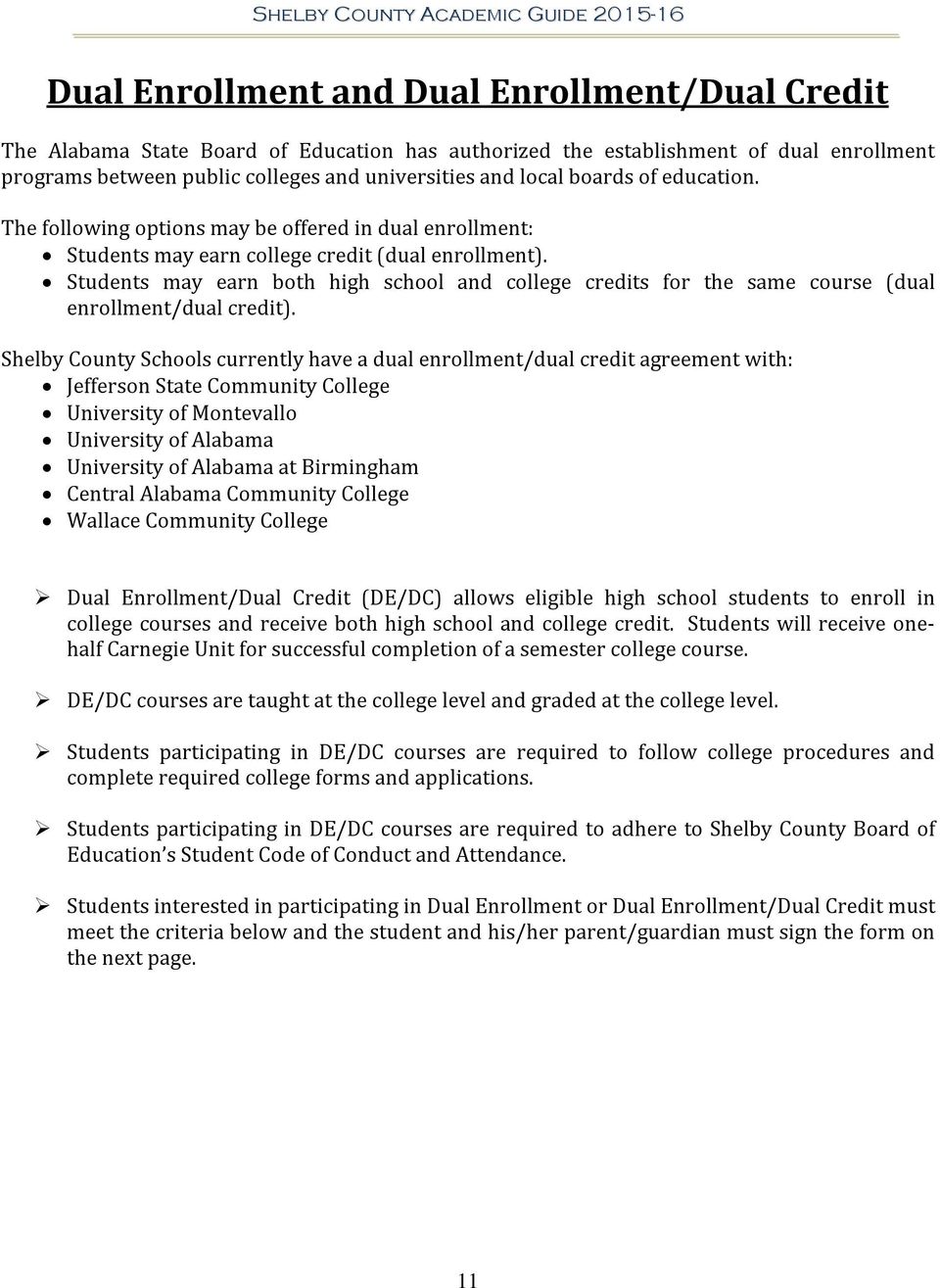
17 Dual Enrollment and Dual Enrollment/Dual Credit The Alabama State Board of Education has authorized the establishment of dual enrollment programs between public colleges and universities and local boards of education. The following options may be offered in dual enrollment: Students may earn college credit (dual enrollment). Students may earn both high school and college credits for the same course (dual enrollment/dual credit). Shelby County Schools currently have a dual enrollment/dual credit agreement with: Jefferson State Community College University of Montevallo University of Alabama University of Alabama at Birmingham Central Alabama Community College Wallace Community College Dual Enrollment/Dual Credit (DE/DC) allows eligible high school students to enroll in college courses and receive both high school and college credit. Students will receive onehalf Carnegie Unit for successful completion of a semester college course. DE/DC courses are taught at the college level and graded at the college level. Students participating in DE/DC courses are required to follow college procedures and complete required college forms and applications. Students participating in DE/DC courses are required to adhere to Shelby County Board of Education s Student Code of Conduct and Attendance. Students interested in participating in Dual Enrollment or Dual Enrollment/Dual Credit must meet the criteria below and the student and his/her parent/guardian must sign the form on the next page. 11
18 Shelby County Schools Dual Enrollment Dual Enrollment/Dual Credit (DE/DC) Requirements (Per Shelby County Board of Education Guidelines) Dual Enrollment (DE) courses are taken for college credit. Dual Enrollment/Dual Credit courses (DE/DC) are taken for high school and college credit. A student is eligible for Dual Enrollment or Dual Enrollment/Dual Credit in the Shelby County School System, if the student meets the following criteria: 1. The student must meet the entrance requirements and Benchmark Standards for admission established by the post-secondary school. 2. The student must have and must maintain a 3.0 GPA in high school courses. 3. The student must maintain a 2.5 in the college course. 4. The student must have written approval of the superintendent, high school principal, high school counselor, and the student s parent/guardian. 5. The student must be in grade 11 or 12, or have an exception granted by the participating postsecondary institution upon the recommendation of the student s principal and superintendent and in accordance with Alabama Administrative Code regarding gifted and talented students. 6. Post-secondary English 101 and 102 taken during the academic year can be used for English 12 high school credit (DE/DC). College courses taken during the summer can only be used for college credit (DE). The student needs to adhere to the college requirements for admission to these courses: Jeff State: English 101 and 102 ACT English Subscore of at Least 20 UA: Pass the UA Early College Gateway Course (UA EC200) UM: ACT English Subscore of Post-secondary Pre-Calculus course taken during the academic year can be used for high school Pre- Calculus (DE/DC). College courses taken during the summer can only be used for college credit (DE). The student needs to adhere to the college requirements for admission to these courses: Jeff State: Math 112 and 113 ACT Math Subscore of 24 or Higher or Approved Placement Test Score UA: Math 112 and 113 Pass the UA Early College Gateway Course and Also Have an Approved Math Placement Test Score or ACT Math Subscore 24 or Higher UM: Math 144 and 149 ACT Math Subscore of Students taking post-secondary foreign language courses: Spanish or French Can only earn college credit (DE) College Level Spanish or French cannot be substituted for the foreign language requirement of the Advanced Diploma. College level Japanese, Chinese, Arabic, etc. Substitution for the foreign language requirement may be considered upon individual request and approval. 12

19 9. Students planning to take courses through UA s Early College Program must pass the UA Early College Gateway class (UA EC200) before enrolling in any UA Early College class. 10. Students may enroll in Dual Enrollment courses if they have the pre-requisites stated by the college for the post-secondary course and have met the post-secondary requirements for enrollment: Dual Enrollment courses do not receive additional weight toward the student s GPA. Dual Enrollment courses taken just for college credit are not factored into the GPA. Dual Enrollment courses taken for high school elective credit are factored into the student s GPA and will impact the total GPA score. 11. Students may enroll in occupational/technical courses/programs in accordance with guidelines of the Department of Postsecondary Education. 12. Students participating in DE or DE/DC courses are required to adhere to Shelby County Board of Education Student Code of Conduct & Attendance and board policy regarding DE - DE/DC. 13. All travel to off-campus sites is a parent responsibility. Parents will be required to give permission for students to check out. Students will be required to follow regular check out procedures each day. All costs associated with student transportation, including insurance, would accrue to the student. The college or the school system assumes no responsibility or liability for students during the times they are commuting to the DE or DE/DC site. 14. Ten quarter/six semester credit hours at the postsecondary level shall equal one credit at the high school level in the same or related subject for DE/DC. 15. Payment of the current rate of tuition and fees per credit hour will be the responsibility of the student. 16. Payment and acquisition of the book required for the DE/DC course will be the responsibility of the student. Signatures: (Parent/ Guardian) Date: (Student) Date: 13

20 Advanced Placement Program Guidelines The Advanced Placement Program is an academic program of college-level courses and examinations for high school students. Students enrolled in AP courses take the College Board AP Exam and have an opportunity to earn college credit and/or advanced standing in college based on their scores on the AP exam. All students enrolled in Advanced Placement courses are required to take the AP Exam or complete an art portfolio for AP art only. The curriculum of an AP course is challenging and goes into greater depth with the academic material than regular courses. AP courses require students to use analytical thinking, reading, writing, and problem solving skills. AP courses are taught using college level materials and teaching strategies. Students must meet the following criteria to enroll in AP courses: 1. The student must complete all prerequisite courses. 2. The student must meet all application requirements. 3. The student must have the recommendation of the subject area teacher of the course. 4. The student should have an above-average GPA with B s or better in core academic subjects and A/B in the area of the AP subject. 5. The student should be highly motivated with good study habits and above-average writing skills. 6. The student must have the consent of the parent/guardian. 7. The student must take the AP exam at the end of the year. 8. The student is required to sign a contract. The following AP courses are offered in Shelby County: AP Biology AP Calculus AB AP Calculus BC AP Chemistry AP Economics: Macro AP English Language & Composition AP English Literature & Composition AP Environmental Science AP European History AP French Language AP Government & Politics: US AP Latin Vergil AP Music Theory AP Physics 1 AP Physics C AP Psychology AP Spanish AP Statistics AP Studio Art: Drawing AP Studio Art: 2D Design AP Studio Art: 3D Design AP United States History AP World History The AP courses scheduled depend upon the demand at each high school. If a student is interested in an AP course not offered, the student needs to contact his/her local high school counselor. Honors courses are offered at each high school to provide students with the academic skills and habits of mind needed to be successful in challenging Advanced Placement courses. 14

21 Advanced Placement Program --- Program Agreement The Advanced Placement Program is an academic program of college-level courses and examinations for high school students. Students enrolled in AP courses take the College Board AP Exam and have an opportunity to earn college credit and/or advanced standing in college based on their scores on the AP Exam. The curriculum of an AP course is challenging and goes into greater depth with the academic material than regular courses. AP courses require students to use analytical thinking, reading, writing, and problem solving skills. AP courses are taught using college level materials and teaching strategies. These demanding courses require more effort, time and skills than Honors or regular level classes and are recommended for highly motivated students. We are delighted that you are considering enrolling in an AP course. However, we want all parents and students to completely understand the rigor of the course and the commitment required by the student. For this reason, we require that the student and his/her parent(s)/guardian(s) read and sign this agreement. Unlike most high school curriculums that are separated by semesters, learning AP course material is an ongoing process culminating in the AP Exam. *Students who sign this agreement are committing to remain in an AP class for the entire year (or semester for AP Economics or Government) and take the AP Exam. Requirements: Students must meet the following criteria to enroll in an AP course: a) complete all prerequisite courses; b) meet all of the application requirements; c) have the recommendation of subject area teacher of the course; d) have recommended score on PSAT/ACT Plan/ACT Aspire; e) have above average GPA, with B s or better in core academic subjects and an A/B in the area of the AP subject; f) be highly motivated with good study habits and above-average writing skills; g) have consent of the parent/guardian; h) must take the AP exam at the end of the year; and i) sign AP Program Agreement. For many AP classes, AP students will be expected to complete required summer reading or review before the course begins. Students may exit an AP class (with signed permission of the principal) during the first 10 days or at midterm if failing. Students may not enter an AP class after the first 10 days. Grading: For students enrolled in an AP course, the GPA is weighted: A = 5 points D = 2 points B = 4 points F = 0 points C = 3 points The grading policies for each AP course are given to the students the first week of school. Homework: The daily homework will be required. Students are often assigned reading or long-term projects that require them to plan their time so that they are not overwhelmed by deadlines. Developing self-discipline in the area of time management is a goal of all AP classes. 15
22 Late Work: Students who elect to take AP courses are expected to do the work required on time; there should be no late work for AP courses. Honor Code: The nature of AP work often requires that students complete graded assignments outside of class. Students are expected to complete their own work (assignments and homework included) without the assistance of others unless the instructor specifically allows collaboration. Sharing work with another student or using another student s work as his/her own may result in removal from that AP course. Violation of the school Honor Code may also be grounds for removal from any AP course as well as disciplinary action. Parent/Teacher/Student Expectations: AP classes are college-level courses and the students are expected to be responsible for their behavior, assignments and any conflict resolution. Parents are welcome to conference with AP teachers, but students are expected to use this opportunity to develop the independence needed in the college setting they will shortly experience. The goal of all AP classes is to give students the opportunity to develop the academic and personal skills needed for success in high school and college. Parents need to encourage their children to plan their schedules wisely so that they do not take an over-load of AP courses during any one year. Absences: AP students will often be involved in academic and extra-curricular field trips and school business activities. However, too many absences of any type are detrimental to successful performance in AP classes where the pace of the class is faster in order to prepare students for the AP exams in early May. Parents and students are asked to be selective in their requests for absences and should consider the following: Any class work missed must be made up to the teacher s specifications and timeline. Field trips and school business activities can be separated into those required by the curriculum and non-essential activities. Students must take responsibility for their choices. Parents should encourage their children to be balanced in their activities and academics and not become overly committed. Exam Policy for Advanced Placement Courses: Students are required to take the AP exam or complete the AP Portfolio in May for each AP course for which they are enrolled or completed in the first semester The College Board s AP exam schedule will be made available at the beginning of the school year; the AP exam schedule is also on the school system s website. It is the student s responsibility to plan his/her schedule to avoid conflicts. Consequences for failure to take an AP Exam: If the student does not take the College Board AP exam in May, the student will not receive weighted credit for the AP course and the student still needs to take a final exam for the course. If the student does not take a final exam, the student will receive a test grade of F to be averaged into the last nine weeks course grade. In the rare instance that the student s reason for not taking the AP exam is allowed by the College Board, the student may take an alternate AP exam for AP credit. The exam must be ordered the same week as the original exam and administered on the specific dates and times set by the College Board for late testing. 16
23 Please give this form with the signatures to your school counselor. AP Program Agreement: My child and I have read the agreement and my child would like to enroll in an AP course. We understand the level work required and the policies explained on the previous pages and are prepared to fulfill these requirements. Student Name (print): Student Signature: Parent/Guardian Signature: Date: Grade Level: School Year: Please list the AP courses registered for: Students who plan to register for more than 3 AP courses in one year need the principal s signature also. Principal s Signature: 17
24 Credit Recovery and Summer School Credit Recovery Credit Recovery during the academic school year is intended for seniors and select freshmen. Sophomores, juniors, and most freshmen are expected to attend summer school for failed courses. Beginning with freshmen during the school year, a maximum of one (1) credit per subject area and four (4) total credits may be earned through credit recovery during a student s academic career. Summer School A blended model featuring both direct instruction and use of A+ will be utilized. The credit recovery model used throughout the school year will not be used for summer school. Two terms will be available for students. Each term will be four (4) hours a day for two (2) weeks. In order to make up a lost credit, students will be required to attend the entire term. Absences are not allowed. The school administrator responsible for summer school should be contacted about cost. No distinction between credit recovery and full course will be made. Students from other schools may attend a Shelby County Summer School session provided there is space and provided the student lives in Shelby County. Courses taken during summer school will not count as one of the four (4) credits that may be earned during school-year credit recovery. 18
25 Academics First (Extracurricular Activity Eligibility Guidelines) The Shelby County Board of Education recognizes the value of extracurricular activities as they relate to the total education of the students; however, the students' pursuit of their academics must be first and foremost and take a priority over participation in extracurricular activities. The following guidelines shall apply to determine eligibility to participate in extracurricular activities: 1. The term "extracurricular activities" as used in this policy refers to, athletic activities that are recognized and sanctioned by the Alabama High School Athletic Association as well as other activities which are sanctioned by the Shelby County Board of Education, which are not related to a student s academic requirements or success in the course, Extracurricular activities include but are not limited to, activities offered by the school through math, science, band, choral music, and other courses of events such as athletic events (pre-game, half-time or other breaks), clubs conventions, parades, amusement park trips, competitions, tours, and performances which are not required for the student s academic success in a course. 2. It is not the intent of this policy to classify as an extracurricular activity, activities which are ancillary to a credited classroom course, if such activity is required for satisfactory course completion and grading of that course. (For example, a district choir competition or a science class field trip.) 3. The Superintendent and/or his designee has the authority to determine on a case-by- case basis whether or not certain activities not specifically mentioned above, qualify as extracurricular activities as used in this policy and whether or not a student has met the eligibility requirements to participate in extracurricular activities as outlined herein. 4. The standards established herein are minimum standards for participation in extracurricular activities. Any group or organization may establish even stronger academic standards for participation in extracurricular activities; however, such standards must be submitted in writing to the Superintendent and/or his designee for approval. 5. In order for students in grades 10 through 12 to be eligible to participate in extracurricular activities during an academic school year, the students must for the immediately preceding school year, have maintained a passing grade in each of at least six Carnegie unit credit courses and a composite numerical average of 70 for all of the Carnegie unit credit courses. 6. For grades 10-12, of the courses used to determine eligibility, students must have at least 4 credits for the four core curriculum courses (English, Science, Social Studies and Math). A student may be exempt from the core curriculum requirements if the student is otherwise on track with the Shelby County Board of Education graduation requirements in the core curriculum courses. 7. In order for students in grades 8 and 9 to be eligible to participate in extracurricular activities during an academic year, the student must for the immediately preceding year have a passing grade in at least five subjects with a composite grade average of 70 or higher in the five courses. Students promoted to the seventh grade for the first time are eligible. 8. Physical education and other related courses may only count as one of the subjects used to determine eligibility. 9. The use of up to two Carnegie unit credits and the accompanying cumulative grades obtained during summer school may be used in computing the credits needed for eligibility. 19
26 Academics First (continued) 10. At the end of each grading period, the head coach and/or sponsor of each extracurricular activity shall check the current grades of all students participating in their extracurricular activity. If a student fails to maintain a passing grade in all of his/her current courses during the preceding grading period, the student will be placed on probation from extracurricular activities. 11. When a student is placed on probation from extracurricular activities, the head coach and/or sponsor of the extracurricular activity will notify the principal. The principal or his designee will then meet with the student (and the student's parent/guardian if deemed necessary) to implement a mandated academic remediation program to address the academic performance of the student. 12. When a student is on probation from extracurricular activities, the principal may also mandate modifications in the student's participation in extracurricular activities if the principal feels that the modification is necessary to insure the student's ability to increase his/her academic performance during the probation period. 13. If, at the end of any subsequent grading period, the student makes another failing grade in the same subject, the student must show evidence of satisfactory participation in the remediation program in order to maintain participation in all extracurricular activities. A student who fails to show evidence of satisfactory participation in the mandated remediation program will automatically be suspended for all extracurricular activities. 14. Mandatory academic remediation will last for a minimum of one grading period. 15. The Community Education Program will make available its resources to assist with remedial plans such as non-school hour tutoring. Ref: Alabama Administrative Code (17) Approved by the Shelby County Board of Education on 8/21/97, Revised on 10/15/98, in accordance with the State Board of Education's Policy 20
27 NCAA Division I Initial-Eligibility Requirements Core Courses o o NCAA Division I requires 16 core courses. See the charts below for the breakdown of this 16 core-course requirement. For students enrolling on or after August 1, 2016, NCAA Division I will require 10 core courses to be completed prior to the seventh semester (seven of the 10 must be a combination of English, math or natural or physical science that meet the distribution requirements below). These 10 courses become "locked in" at the seventh semester and cannot be retaken for grade improvement. o Beginning August 1, 2016, it will be possible for a Division I college-bound student-athlete to still receive athletics aid and the ability to practice with the team if he or she fails to meet the 10 course requirement, but would not be able to compete. Test Scores o o o o Division I uses a sliding scale to match test scores and core grade-point averages (GPA). The sliding scale for those requirements is shown on Page No. 2 of this sheet. The SAT score used for NCAA purposes includes only the critical reading and math sections. The writing section of the SAT is not used. The ACT score used for NCAA purposes is a sum of the following four sections: English, mathematics, reading and science. When you register for the SAT or ACT, use the NCAA Eligibility Center code of 9999 to ensure all SAT and ACT scores are reported directly to the NCAA Eligibility Center from the testing agency. Test scores that appear on transcripts will not be used. Grade-Point Average o Be sure to look at your high school s List of NCAA Courses on the NCAA Eligibility Center's website ( Only courses that appear on your school's List of NCAA Courses will be used in the calculation of the core GPA. Use the list as a guide. o Division I students enrolling full time before August 1, 2016, should use Sliding Scale A to determine eligibility to receive athletics aid, practice and competition during the first year. o Division I core GPA required to receive athletics aid and practice on or after August 1, 2016, is between and (corresponding test-score requirements are listed on the Sliding Scale on Page No. 2 of this sheet). o Division I core GPA required to be eligible for competition on or after August 1, 2016, is (corresponding test-score requirements are listed on the Sliding Scale on Page No. 2 of this sheet). o Remember, the core GPA is calculated using the best 16 NCAA core courses only. DIVISION I 16 Core Courses 4 years of English 3 years of mathematics (Algebra I or higher) years of natural/physical science (1 year of lab if offered by high 2 school) year of additional English, mathematics or natural/physical 1 science 2 years of social science 4 years of additional courses (from any area above, foreign language or comparative religion/philosophy) 21
28 Core GPA Sliding Scale A Use for Division I prior to August 1, 2016 SAT Verbal & Math Only NCAA Division I Sliding Scale ACT Sum Core GPA SAT Verbal & Math Only ACT Sum & above
29 Core GPA Sliding Scale B Use for Division I beginning August 1, 2016 SAT Verbal & Math Only NCAA Division I Sliding Scale ACT Sum Core GPA SAT Verbal & Math Only ACT Sum For more information, visit the NCAA Eligibility Center website at or 23
30 Core Courses Division II Initial-Eligibility Requirements o o Division II currently requires 16 core courses. See the chart below. Beginning August 1, 2018, to become a full or partial qualifier for Division II, all college-bound studentathletes must complete the 16 core-course requirement. Test Scores o Division II currently requires a minimum SAT score of 820 or an ACT sum score of 68. Beginning August 1, 2018, Division II will use a sliding scale to match test scores and core-course grade-point averages (GPA). The sliding scale for those requirements is shown on Page No. 2 of this sheet. o The SAT score used for NCAA purposes includes only the critical reading and math sections. The writing section of the SAT is not used. o The ACT score used for NCAA purposes is a sum of the following four sections: English, mathematics, reading and science. o When you register for the SAT or ACT, use the NCAA Eligibility Center code of 9999 to ensure all SAT and ACT scores are reported directly to the NCAA Eligibility Center from the testing agency. Test scores that appear on transcripts will not be used. Grade-Point Average o Be sure to look at your high school s List of NCAA Courses on the NCAA Eligibility Center's website ( Only courses that appear on your school's approved List of NCAA Courses will be used in the calculation of the core GPA. Use the list as a guide. o The current Division II core GPA requirement is a minimum of Division II core GPA required to be eligible for competition on or after August 1, 2018, is (corresponding test-score requirements are listed on the Sliding Scale on Page No. 2 of this sheet). o The minimum Division II core GPA required to receive athletics aid and practice as a partial qualifier on or after August 1, 2018, is (corresponding test-score requirements are listed on the Sliding Scale on Page No. 2 of this sheet). o Remember, the NCAA core GPA is calculated using NCAA core courses only. DIVISION II 16 Core Courses 3 years of English 2 years of mathematics (Algebra I or higher) years of natural/physical science (1 year of lab if offered by high 2 school) year of additional English, mathematics or natural/physical 3 science 2 years of social science 4 years of additional courses (from any area above, foreign language or comparative religion/philosophy) 24
31 Core GPA SAT Verbal & Math Only Division II COMPETITION SLIDING SCALE Use for Division II beginning August 1, 2018 ACT Sum 25 Core GPA SAT Verbal & Math Only ACT Sum & above & above 70 & above Division II PARTIAL QUALIFIER SLIDING SCALE Core GPA SAT Verbal & Math Only Use for Division II beginning August 1, 2018 ACT Sum Core GPA SAT Verbal & Math Only ACT Sum & above & above 70 & above
32
33 Shelby County Schools Course Listings/Descriptions 26
34
35 English/Language Arts English courses offered by the high schools of Shelby County have been developed to meet the needs and interests of all students and include the content standards from the Alabama College and Career Readiness Standards for English and Language Arts. Different levels of English are offered, and placement in these levels is the responsibility of the school. In the four units of English required, the students will be involved in the study and practice of writing/composition, reading, listening, speaking, viewing, and presenting. Emphasis will be on demonstration of language and reading skills as presented in the writing of sentences, paragraphs, and other types of composition. Students will conduct individual research using all aspects of the research process. An effective blend of literature and writing will be included. Vocabulary gained through reading and word study will be incorporated into the compositions required. Some courses have a summer reading requirement for students prior to the beginning of that particular course. Parents and students need to check with each school to secure this reading list. English Grades: 9 English 9 develops student competency in English usage and mechanics. Oral and written communication is developed through the reading of classical and contemporary literature. Basic grammar skills are practiced in student writings. Students utilize analytical and critical thinking skills while examining the various literary forms. The course is appropriate for students considering all types of post-secondary education and for students planning to enter the work force immediately after high school. Students receive at this grade level a thorough unit on library and research skills which will be needed at the next level. English 9, Honors Grade: 9 Prerequisite: Teacher Approval The Honors program is designed for students who have the highest level of English achievement and aptitude. This course is a prerequisite for the Advanced Placement English courses. Critical thinking, expression and understanding are expected from students to work at an accelerated pace. Prior summer reading is a requirement for this course. Students will receive a.5 extra quality point for successfully completing this course. English Grade: 10 Prerequisite: Successful Completion of English 9 This course is appropriate for students considering all types of post-secondary education and for students planning to enter the work force immediately after high school. Students will study all the content standards in the Course of Study and will read supplementary selections. This course will give a comprehensive study of world literature, early American literature, and English grammar through traditional and contemporary selections. English 10, Honors Grade: 10 Prerequisite: Teacher Approval The Honors program is designed for students who have the highest level of English achievement and aptitude. This course will give a comprehensive study of world literature, early American literature, and English grammar through traditional and contemporary selections. This course is a prerequisite for the Advanced Placement English courses. The workload in this course requires students to work at an accelerated pace. Students will be required to produce a research paper. Prior summer reading is a requirement for this course. Students will receive a.5 extra quality point for successfully completing this course. 27
36 English Grade: 11 Prerequisite: Successful Completion of English 10 This course is appropriate for students considering all types of post-secondary education and for students planning to enter the work force immediately after high school. This course focuses on developing reading, writing, comprehension and critical thinking skills. Literature covers a survey of American works from 1900 to the present. Students will be required to complete a research paper. English 11, Honors Grade: 11 Prerequisite: Teacher Approval The Honors program is designed for students who have the highest level of English achievement and aptitude. This course is a prerequisite for the Advanced Placement English courses. Students are provided opportunities to enhance abilities in written and oral communication through the study of composition and American literature. Students participate in research activities, original writing and critical analysis of modern and contemporary literature, particularly American works from 1900 to the present. Students review skills necessary for success on scholastic aptitude tests, and college or postsecondary school admission. The workload of this course requires students to work at an accelerated pace. Prior summer reading is a requirement for this course. Students will receive a.5 extra quality point for successfully completing this course. English 11, AP Language and Composition Grade: 11 Prerequisite: English 10 Honors/Teacher Approval AP Exam: $91 approx. This course is designed to help students become skilled readers of prose written in a variety of periods, disciplines and rhetorical contexts and to become skilled writers who can compose for a variety of purposes. By their writing and reading in this course, students should become aware of the interactions among a writer's purposes, audience expectations and subjects, as well as the way generic conventions and the resources of language contribute to effective writing. Prior summer reading is a requirement for this course. Students are required to take the AP exam. Completion of the course and a score of 3 or better on the AP exam may earn college credit. Students will receive a 1.0 extra quality point for successfully completing this course. English Grade: 12 Prerequisite: Successful Completion of English 11 While this course is appropriate for students considering all types of post-secondary education, it is especially aimed towards students planning to enter the work force immediately after high school. English 12 combines the study of British literature and communication in the workplace. Students survey British authors and works of these literary types: short story, novel, poetry, drama and essay. Students are required to complete a research project and will review skills necessary for success on scholastic aptitude tests and post-secondary admission tests. English 12, AP Literature and Composition Grade: 12 Prerequisite: English 11 Honors/Teacher Approval AP Exam: $91 approx. Advanced Placement English affords high school students the opportunity to replace college freshman English courses. Extensive reading is required as well as a variety of writing assignments throughout the course. Literary studies include classical and contemporary works from Europe, Great Britain and the United States. Students read extensively for written and verbal analysis. The workload in this course requires students to work at an accelerated pace. Prior summer reading is a requirement for this course. Students are required to take the AP English Literature and Composition Exam. A score of 3 or better on the AP exam may earn college credit. Students will receive a 1.0 extra quality point for successfully completing this course. Mythology Literature Grade: 9-12 This course introduces students to the mythology and fables in Greece, Rome, Egypt, Mesopotamia, China, Japan and India. 28
37 Creative Writing I aa Grade: Prerequisite: Grade A/B in English/Teacher Approval This course provides students opportunities to write creative, original works of prose, poetry and drama. Students will learn to critically evaluate their own work and the works of others. Students may submit their works for publication and competitions. Creative Writing II ab Grade: Prerequisite: Creative Writing I This course is designed to enhance students' abilities in critical reading and analysis. Students are encouraged to enter writing contests, to submit original works for publications and competition, and to complete novels or other lengthy works. Southern Literature Grade: This elective course focuses on works by renowned Southern writers since the early 1800s. Students will examine the South's literary heritage through the study of poetry, fiction, non-fiction and drama. The course identifies major sources and themes of nineteenth and twentieth century writers as well as contemporary authors and how their works have contributed to society from a historical, political and social perspective. Students will recognize the contribution of Southern writers to American literature and recognize that Southern writing is an expression of a particular place, which achieves universality. Group discussions, readings, presentations and writing experiences are suggested for the course. Shakespearean Literature aa Grade: Students study and analyze the works of William Shakespeare including comedies, tragedies, histories and play analysis. Library Science ad Grade: 9-12 Prerequisite: Teacher Approval Students learn library skills including automation systems, basic cataloging skills, Alabama Virtual Library use, Internet searching and analyzing, electronic resources, Dewey decimal system, audiovisual, citation methods and bibliographies. Journalism I Grade: 9-12 Prerequisite: Teacher Approval This course is designed to give students exposure to journalistic concepts. These concepts include the study and practice of skills necessary for writing news articles, features, editorials, sports articles and layout. Journalism II Grade: Prerequisite: Journalism I/Teacher Approval This journalism course incorporates language arts and graphic skills with such practical skills as word processing, record keeping, and business management as it relates to newspaper careers. Journalism III Grade: Prerequisite: Journalism II/Teacher Approval Students taking this course have the responsibilities in the areas of theme selection, basic layout design, writing techniques, captions, headlines, type-fitting, cropping pictures and preparation for printing. Students will gain journalistic skills in photography, sales techniques and organization. 29
38 Journalism IV aa Grade: Prerequisite: Journalism III/Teacher Approval This course is designed for those students seeking a career in journalism. Students gain an advanced understanding of school newspaper management including layout, editing, publishing, proofreading and finance. Newspaper Grade: Prerequisite: Teacher Approval Newspaper journalism incorporates language arts and graphic skills with such practical skills as word processing, record keeping and business management. This course assumes the responsibility of compiling the school's newspaper. Students are given instruction in the following: the freedom and responsibility of the press; interviewing; understanding and gathering news; writing news and feature stories, editorials and headlines; photojournalism; typography; and advertising sales and design. Yearbook I aa Grade: Prerequisite: Teacher Approval This course assumes the responsibility of compiling and designing the school's yearbook. Continued emphasis is placed on the production of a quality yearbook. Staff responsibilities include financing, publication costs through the sale of advertisements and yearbooks. Emphasis is placed both on the production of a quality yearbook and the development of student responsibility and leadership. Yearbook II ab Grade: Prerequisite: Yearbook I/Teacher Approval Students continue with the responsibility of compiling and designing the school's yearbook. Continued emphasis is placed on the production of a quality yearbook. Staff responsibilities include financing publication cost through the sale of advertisements and books. In accomplishing the ultimate goal of producing a quality yearbook, students who are part of the organization gain journalistic training and skills in photography, sales techniques and organizing materials. Literary Magazine ab Grade: 9-12 Prerequisite: Creative Writing/Application/Teacher Approval Students produce the school's literary magazine which is composed entirely of students' creative works. The magazine is produced using the latest in design software, computer technology and digital reproduction of artwork and photographs. Students will study these cutting edge techniques of magazine layout and design along with the creative components of the literary magazine including fiction, nonfiction, poetry, artwork and photography. Broadcast Journalism I aa Grade: Prerequisite: Journalism/Application and Audition This course exposes students to the basics of producing a broadcast. Students learn the skills necessary for success in this profession including listening, analyzing, writing and discussing television stories. 30
39 English as a Second Language (ESL) English for Speakers of Other Languages aa Grades: 9-12 The English as a Second Language program is designed for students who have limited English proficiency as determined by the ACCESS for ELLS or MODEL assessment, and the decision of the ESL committee. Students will focus on the development of listening, speaking, reading and writing skills in English while mastering the content standards in the Alabama English Language Acquisition Standards. 31
40 Speech/Debate The speech and debate curriculum will provide opportunities for students to strengthen fundamental listening and speaking skills. Research and organization skills will be required as students present informative and accurate presentations through prose, poetry, oratory, dramatic interpretation, humorous interpretation, extemporaneous speaking, and participate in all types of debate. Public Speaking Grade: 9-12 The major goal of this course is to build self-confidence by providing students an opportunity to learn and practice public speaking. Students will also learn the process of evaluating self and their peers. Speech I Grade: 9-12 This course allows students to explore the many areas of speech communication to improve speaking and listening skills, and to build self-confidence through participation in oral communication activities. Studies include public speaking, storytelling, parliamentary procedure, oral interpretation, theater, and mass communication. Speech II Grade: Prerequisite: Speech I This course is designed to build upon those skills learned in Speech I. Students will participate in in-depth studies of various types of communications that affect the individuals in their relationships with themselves and with others. Debate Grade: 9-12 Prerequisite: Application/Try-out This course offers students opportunities to learn and refine skills for interscholastic debate and individual events competition. Communication skills are taught and practiced so that each student may perform at his/her highest skill level. Students will be encouraged to participate in interscholastic debate contests. 32
41 Mathematics The courses offered by the high schools of Shelby County have been developed to meet the needs and interests of all students and include the content standards from the Alabama College and Career Readiness Standards. Whether planning to pursue postsecondary education or to enter the workforce, all Alabama students must earn four credits in high school mathematics. Some students who strive to complete the entire mathematics sequence through Calculus choose to take Algebra I in the eighth grade. These students should demonstrate a successful background in mathematics and show aptitude for taking the advanced classes necessary to successfully fulfill the four-year requirement and demonstrate proficiency in the course. All students must complete four mathematics credits Recommended Course Sequence for Math Below are the options by which a student can earn the four credits in mathematics for graduation when successfully completing Algebra I in the 8 th grade. If you complete Algebra I in 8 th grade, it is strongly recommended that you take 4 years of math in high school: OPTION I OPTION II OPTION III OPTION IV 9 th - Geometry/Honors 9 th - Geometry/Honors 9 th - Geometry/Honors Geometry Geometry Geometry 9 th - Geometry 10 th - Algebra II with Trigonometry/ Honors Algebra II with Trigonometry 10 th - Algebra II with Trigonometry/ Honors Algebra II with Trigonometry 10 th - Algebra II with Trigonometry/ Honors Algebra II with Trigonometry 11 th - Analytical Math 12 th - Pre-Calculus/Honors Pre-Calculus or DE/DC 11 th - Pre-Calculus/Honors Pre-Calculus or DE/DC 12 th - Analytical Math 11 th - Pre-Calculus/Honors Pre-Calculus or DE/DC 12 th - AP Math Course (Calculus AB, Calculus BC or AP Statistics) 10 th - Algebraic Connections 11th - Algebra II with Trigonometry/ Honors Algebra II with Trigonometry 12 th - Pre-Calculus or DE/DC Below are the options by which a student can earn the four credits in mathematics for graduation in grades OPTION I OPTION II OPTION III 9 th - Algebra IA 9 th - Algebra I 9 th - Algebra I 10 th - Algebra IB 10 th - Geometry/Honors 10 th - Geometry/Honors Geometry Geometry 11 th - Geometry 11 th - Algebraic Connections 11 th - Algebra II with Trigonometry/ Honors Algebra II with Trigonometry 12 th - Algebra II or Algebra II with Trigonometry or Algebra with Finance 12 th - Algebra II or Algebra II with Trigonometry or Honors Algebra II with Trigonometry or Algebra with Finance 12 th - Analytical Math or Mathematical Investigations or Discrete Math 33
42 Algebra I Grades: 9 Prerequisite: Pre-Algebra/Teacher Recommended Algebra I is a formal, in-depth study of algebraic concepts and the real number system. Topics of study include variables, expressions, linear and non-linear equations, inequalities, ratio, proportion, factoring, polynomials, graphing on the number line and in the coordinate plane, properties of slope and operations involving exponents. Algebra IA Grades: 9 Prerequisite: Pre-Algebra/Teacher Approval The first of two-year Algebra I sequence, Algebra IA, is designed for students who need extra practice and learning time. The prescribed course of study for Algebra I is followed over a two-year period. Topics include solving equations, operations with polynomials, factoring and word problems. This course does not meet requirements for the AdvancED endorsement. Algebra IB Grades: 10 Prerequisite: Algebra IA In this second year of the prescribed Algebra I course of study, students continue studying solving equations and other topics begun in Algebra IA. This two-year sequence satisfies the Algebra I requirement for graduation. The student receives two high school credits for successful completion of the series. This course does not meet requirements for the AdvancED endorsement. Geometry Grade: 9-11 Prerequisite: Algebra I/Teacher Recommended Geometry covers the topics in geometry with major emphasis on deductive reasoning taught through the use of proofs and the integration of algebraic and geometric concepts. Properties of two-dimensional and three-dimensional figures, coordinate geometry, transformations, and properties and theorems related to lines, circles, triangles, and polygons will be studied as students develop an understanding of the axiomatic systems of geometry. Geometry, Honors Grade: 9-11 Prerequisite: Algebra I/Teacher Recommended Honors Geometry is designed for the students who excelled in Algebra I. This course covers the same topics as Geometry with a more in-depth and challenging analysis of the major concepts and more emphasis on theory. Logical thinking is developed through concentration on direct and indirect proofs. Students will receive a.5 extra quality point for successfully completing this course. Algebraic Connections Grade: Prerequisite: Algebra I/Geometry/Teacher Recommended Algebraic Connections is a course that provides students with a bridge to courses beyond the level of Algebra I and Geometry and to the mathematical empowerment needed to make responsible financial and economic decisions. It is designed for students who need additional mathematical experiences prior to enrollment in Algebra II, with or without Trigonometry, and/or for students for whom this will be a final high school mathematics course. Algebra II Grade: 12 Prerequisite: Algebra I/Geometry/Teacher Recommended Algebra II is designed to extend students' algebraic knowledge and skills. Topics include number and operations, analyzing family of functions, operations on functions, solving equations and inequalities, solving systems of linear equations, coordinate geometry, data analysis and probability. This course does not provide sufficient background to prepare students to pursue higher-level mathematics courses; therefore, it is considered a terminal high school mathematics course. This course does not meet requirements for the AdvancED endorsement. 34
43 Algebra II with Trigonometry Grade: Prerequisite: Algebra I/Geometry/Teacher Recommended Algebra II with Trigonometry is required for all students seeking the Advanced Diploma and/or students planning on pursuing postsecondary studies. This course focuses on problem-solving skills that use a variety of methods to encourage the development of improved communication skills and foster a deeper understanding of the content area. Topics include properties of real numbers, linear relations and functions, systems of equations, irrational and complex numbers, quadratic functions, exponential and logarithmic functions, triangle and circular trigonometry. Algebra II with Trigonometry, Honors aa Grade: Prerequisite: Algebra I/Geometry/Teacher Recommended The Honors Algebra II with Trigonometry course focuses on problem-solving skills that use a variety of methods to encourage the development of improved communications skills and foster a deeper understanding of the content area. Topics include properties of real numbers, linear relations and functions, systems of equations, irrational and complex numbers, quadratic functions, exponential and logarithmic functions, triangle and circular trigonometry. Students will receive a.5 extra quality point for successfully completing this course. Analytical Math Grade: Prerequisite: Algebra I/Geometry/Teacher Recommended This course is designed for students who have successfully completed the Algebra II with Trigonometry course. It is considered to be parallel in rigor to Pre-Calculus. This course provides a structured introduction to important areas of emphasis in most postsecondary studies that pursue a concentration in Mathematics. Algebra with Finance Grade: 12 Prerequisite: Algebra I/Geometry/Teacher Recommended This course is a college and career preparatory course that integrates algebra, pre-calculus, probability and statistics, calculus and geometry to solve financial problems that occur in everyday life. Real world problems in investing, credit banking auto insurance, mortgages, employment, income taxes, budgeting and planning for retirement are solved by applying the relevant mathematics that are taught at a higher level. Mathematical Investigations Grade: Prerequisite: Algebra II with Trigonometry Mathematical Investigations is a course designed for students who have successfully completed the Algebra II With Trigonometry course and who choose not to continue mathematics study in the Pre-Calculus or Analytical Mathematics courses. Pre-Calculus Grade: Prerequisite: Algebra II with Trigonometry/Teacher Recommended Pre-Calculus is designed primarily for those students considering careers in mathematical or scientific fields of study. This challenging curriculum includes an expanded study of polynomial functions, conic sections, logarithmic and exponential equations, and real-life applications of these topics. Pre-Calculus, Honors aa Grade: Prerequisite: Pre-Calculus/Teacher Recommended Honors Pre-Calculus is designed for students who are considering careers in mathematical or scientific fields of study and who plan to pursue AP Calculus AB or BC in high school. This course is fast-paced and covers topics more in-depth than regular Pre-Calculus. There is emphasis on graphing functions and relations from the equation, polynomial theory, conics, logarithms, vectors, matrices, exponential equations, and limits. A more complete study of the unit circle and trigonometry is undertaken as well as many topics from Calculus. Students will receive a.5 extra quality point for successfully completing this course. 35
44 Calculus Grade: Prerequisite: Pre-Calculus/Teacher Recommended Calculus is designed to prepare students for college calculus courses. Topics covered include limits, continuity, graphing using calculus, differentiation with application and integration with applications. Calculus AB, AP Grade: Prerequisite: Honors Pre-Calculus/Teacher Recommended AP Exam: $91 approx. This Advanced Placement course fulfills the requirements of a first semester college calculus class. It introduces differential and integral calculus. Topics covered include limits, continuity, differentiation and applications, integration and applications, and curve sketching. Students are required to take the AP exam. A score of 3 or better on the AP exam may earn college credit. Students will receive a 1.0 extra quality point for successfully completing this course. Calculus BC, AP Prerequisite: Honors Pre-Calculus/Teacher Recommended Grade: AP Exam: $91 approx. This Advanced Placement class covers the same material as the AB course and includes additional material that would be covered in a second semester college calculus class. Additional topics include infinite series, parametric equations, polar equations and vectors. Students are required to take the AP exam. A score of 3 or better on the AP exam may earn college credit. Students will receive a 1.0 extra quality point for successfully completing this course. Discrete Math Grade: Prerequisite: Algebra I, Geometry, and Algebra II with Trigonometry Discrete Mathematics is a course designed for students who have successfully completed the Algebra II w/ Trigonometry course and who choose not to continue mathematics study in the Pre-Calculus or Analytical Mathematics courses. Discrete Mathematics expands upon the topics of matrices, combinational reasoning, counting techniques, algorithms, sequences, series, and their applications. Students are expected to work in both individual and group settings to apply problem-solving strategies and to incorporate technological tools that extend beyond traditional instructional practices. Statistics, AP Grades: Prerequisite: Honors Pre-Calculus/Teacher Recommended AP Exam: $91 approx. This Advanced Placement course is a college level advanced math course following the curriculum established by the College Board Advanced Program (AP) Program for statistics. Students are required to take the AP exam. A score of 3 or better on the AP exam may earn college credit. Students will receive a 1.0 extra quality point for successfully completing this course. 36
45 Science The courses offered by the high schools of Shelby County have been developed to meet the needs and interests of all students and include the content standards from the Alabama Course of Study for Science. **See course descriptions for prerequisites OPTION I 9 th Biology 9 th Biology OPTION II (Math: C avg. or below) OPTION III (Math: A or B avg.) 9 th Choice of: Biology Honors Biology 10 th Physical Science 10 th Physical Science 10 th Choice of: Chemistry Honors Chemistry 11 th Choice of: Chemistry (co-requisite Alg. II) Earth and Space Science Environmental Science Zoology Marine Science Forensic Science Physics Anatomy and Physiology 11 th Choice of: Chemistry Honors Chemistry Anatomy and Physiology 11 th Choice of: Physics Anatomy and Physiology AP Biology AP Chemistry AP Environmental Science 12 th Choice of: Chemistry (co-requisite Alg. II) Earth and Space Science Environmental Science Physics Anatomy and Physiology Zoology Marine Science Forensic Science 12 th Choice of: Anatomy and Physiology Physics AP Biology AP Environmental Science 12 th Choice of: Anatomy and Physiology Physics AP Biology AP Chemistry AP Environmental Science AP Physics AP Physics C 37
46 Physical Science Grades: 9-12 Physical Science is a survey course of the concepts taught in Chemistry and Physics. Emphasis is placed on the study of matter, mechanics, heat, energy, light and magnetism. Chemical concepts such as physical and chemical properties of matter and the changes it undergoes are also covered. This course includes the demonstrations of concepts and related lab activities. Chemistry Grade: Prerequisite: "B" Average in Algebra I (Algebra II/Trig Recommended) Chemistry is an advanced physical science that involves the study of the structure and properties of matter and the changes they undergo. This course also develops problem-solving skills by placing major emphasis on solving chemical equations/problems. Due to this emphasis, a strong background in Algebra I is essential for successful completion of this course. This course is classified as a physical science. Chemistry, Honors Grade: Prerequisite: "B" Average in Algebra I (Algebra II/Trig Recommended) and Teacher Approval Honors Chemistry is designed for students who are highly motivated and interested in seeking a career in a science-related field. This course moves at a much faster pace than the regular chemistry class and, as a result, a greater range and depth of material will be covered. Students will receive a.5 extra quality point for successfully completing this course. This course is classified as a physical science. Chemistry, AP Grade: Prerequisite: "B" Average in Honors Chemistry or "B" Average in Regular AP Exam: $91 approx. Chemistry; "B" Average in Algebra II/Trig and Teacher Approval This course is designed to be the equivalent of the general chemistry course usually taken during the first year of college. AP Chemistry differs from the other chemistry courses in the kind of textbook used, the topics covered, the emphasis on chemical calculations and the mathematical formulations of principles, kind of laboratory work done, and the overall time spent on the course by students. In this course, students should attain a greater depth of understanding of fundamentals and a reasonable competence in dealing with chemical problems. Students will need a scientific calculator and an AP study guide. Students are required to take the AP exam. A score of 3 or better on the AP exam may earn college credit. Students will receive a 1.0 extra quality point for successfully completing this course. This course is classified as a physical science. Earth and Space Science Grade: Prerequisite: Biology/Physical Science The Earth and Space Science elective course introduces students to an advanced study of Earth and perspectives of the universe from Earth as well as future challenges and technologies required for space exploration. This course is classified as a physical science. Biology Grade: 9 Biology is a college prep course that covers Biology core content standards including cell processes, cell theory, photosynthesis and cellular respiration, genetics, classification, plants, animals, ecology and biogeochemical cycles. This course is classified as a life science. Biology, Honors Grade: 9 Prerequisite: Teacher Approval This course is intended for students who are interested in an accelerated program. Honors Biology will prepare students who may consider taking AP Biology or are interested in a science-related career after high school. Due to the pace of this course, a student must have demonstrated academic excellence in previous science and math courses. Students will receive a.5 extra quality point for successfully completing this course. This course is classified as a life science. 38
47 Biology, AP Grade: Prerequisite: "B" Average in Honors Biology; "B" Average in Chemistry and Teacher Approval AP Exam: $91 approx. AP Biology is a college-level course that follows the guidelines of The College Board. It will differ significantly from the usual high school biology regarding the kind of textbook used, the range and depth of topics covered, the kind of lab work done, and the time and effort required of students. The main goals of AP Biology are to help students develop a conceptual framework of modern biology, to help students gain appreciation of science as a process, and to prepare the students for the national exam. Students are required to take the AP exam. A score of 3 or better on the AP exam may earn college credit. Students will receive a 1.0 extra quality point for successfully completing this course. This course is classified as a life science. Environmental Science Grade: Prerequisite: Biology/Physical Science Environmental Science is an applied science that uses information from previous science courses to identify and provide solutions to problems. Students will explore topics including weather, ecosystems, biodiversity, environmental issues and resources and conservation of natural resources. Students completing this course will have a better understanding of the interrelationships of living organisms and their environment. This course is classified as a life science. Environmental Science, AP Grade: Prerequisite: "B" in Biology, "B" in Chemistry, Algebra I, Teacher Approval AP Exam: $91 approx. This course is designed to be equivalent to a college introductory course in environmental science. Emphasis is placed on scientific principles and analysis; lab and field work with scientific equipment will be included. Students completing this course will understand the interrelationships of the natural world, be able to identify environmental problems and have knowledge of alternative solutions to these problems. Students are required to take the AP exam. A score of 3 or better on the AP exam may earn college credit. Students will receive a 1.0 extra quality point for successfully completing this course. This course is a life science. Marine Science Grade: Prerequisite: Biology/Physical Science Marine Science is an introductory course to marine life that provides students the opportunity to build on their existing knowledge. Students will explore marine organisms and specific habitats including marshes, mangrove swamps, rocky shorelines, sandy shorelines, coral reefs, kelp forests, and hydrothermal vents. Basic principles of oceanography will include topography, currents, and tides. This course is classified as a life science. Zoology Grade: Prerequisite: Biology/Physical Science Zoology is a course that provides students with an in-depth view of the animal kingdom, from the simplest form to the most complex form of animal. Students will learn the different organization levels within taxonomy and why they are used. This knowledge will help students to understand other topics of interest as they relate to animals. These additional topics concerning animals will include anatomy and physiology, distribution, diversity and environmental relationships. This course is classified as a life science. Anatomy and Physiology Grade: Prerequisite: Biology/Teacher Approval This elective course is a second year biology course that is designed to accommodate students with a strong interest in the human biology/medical field and who plan to study science beyond high school. Studies include the major anatomical and physiological systems of the human body, including muscular-skeletal, neurological, endocrine, reproductive and cardiovascular systems as well as exercise physiology. Lab and dissection activities are included in this class. This course is classified as a life science. 39
48 Forensic Science Grade: Prerequisite: Biology/Physical Science The Forensic Science elective course focuses on the analysis of evidence collection, the decomposition process, crime scenes, skeletal remains, toxicology, and document validity. Case studies and crime scenarios help students understand the implications and complicated issues that are emerging as the science of forensics continues to develop. This course is classified as a physical science. Physics Grade: Prerequisite: Algebra II/Trig/Chemistry and Teacher Approval Physics is an advanced physical science that deals with the relationship between matter and energy in the universe. Besides covering physics concepts such as force and motion, heat, waves, electricity, and magnetism, it is also an applied math course that develops problem solving strategies. Strong math skills are essential for success in this course. A calculator with trigonometric functions is required. This course is classified as a physical science. AP Physics 1: Algebra Based Grade: Prerequisite: "B" in Pre-Calculus/"B" in Physics/Teacher Approval AP Exam: $91 approx. AP Physics 1 is an algebra-based, introductory college-level physics course that explores topics such as Newtonian mechanics (including rational motion); work, energy and power; mechanical waves and sounds; and introductory, simple circuits. Through inquiry-based learning, students will develop scientific critical thinking and reasoning skills. Students are required to take the AP exam. A score of 3 or better on the AP exam may earn college credit. Students will receive a 1.0 extra quality point for successfully completing this class. This course is classified as a physical science. AP Physics C: Mechanics Grade: 12 Co-requisite: Calculus, AP AP Exam: $91 approx. This is a second year physics course designed for students interested in majoring in science, engineering or in a technology-related field. Students who have never taken Physics may take this course with the permission of the instructor. The course is calculusbased and requires critical thinking skills and is intended to be a college level course. Students must be concurrently enrolled in Calculus (preferably A/B or B/C). The course covers Newtonian mechanics in depth and provides instruction in each of the following six content areas outlined in the Course Description: Kinematics, Newton s laws of motion, Work, energy, and power, Systems of particles, linear momentum, Circular motion and rotation Oscillations and gravitation. Students are required to take the AP exam. A score of 3 or better on the AP exam may earn college credit. Students will receive a 1.0 extra quality point for successfully completing this course. This course is classified as a physical science. 40
49 Social Studies Social Studies is the integrated study of the social sciences and humanities to promote civic competence. The emphasis on civic responsibility encourages students to become informed, responsible, participating citizens. The course requirements are the following: Grade 9 World History: 1500 to the Present Grade 10 United States History to 1877 Grade 11 United States History from 1877 Grade 12 United States Government/Economics All courses encompass four program goals: Historic Literacy Geographic Literacy Economic Literacy Political Literacy World History: 1500 to Present Grades: 9 This course directs students to think critically about the various forces that combine to shape the world today. Emphasis will be placed on geographic impact, development of civic knowledge/responsibilities, and emerging economic systems within a chronological context. Students will gain an understanding and appreciation of history as an exciting story of people much like them at other times and places. World History: 1500 to Present, Honors Honors Prerequisite: Teacher Approval Grade: 9 Students choosing to take this course at the honors level will cover more material, in-depth, and at an accelerated rate. Students explore the same topics as the World History and Geography course, but the students will have a higher emphasis placed on critical thinking and examinations of historical texts. Students will receive a.5 extra quality point for successfully completing this course. United States History to Grades: 10 The standards for tenth grade students cover the historic development of American ideas and institutions from the Age of Exploration to While focusing on political and economic history, the standards provide students with a basic knowledge of American culture through a chronological survey of major issues, movements, people, and events in United States and Alabama History. United States History from 1877 to Present Grade: 11 Prerequisite: United States History to 1877 The study of the history of the United States in Grade 11 continues the journey begun in Grade 10 through the economic, geographic, social, and political development of the United States. Beginning with the post-reconstruction United States and its shift into a more industrialized society, the course continues through the twentieth century to the present. Students are involved in a chronological study of major events, issues, movements, and leaders of the United States through the present from both a national and an Alabama perspective. Students are actively involved in and are challenged by the level of expectation inherent in the required content of this course. With more fully developed skills in abstract thinking, students compare, analyze, and explain events and developments rather than simply list or identify them. 41
50 United States History, Grade 10 AP ab Grade: 10 Prerequisite: World History Honors/Teacher Approval No AP Exam AP U.S. History is a two year program. The first part is taken in grade 10 and covers ; the second part is taken in grade 11 and covers 1877 to the present. This is a college level course designed to provide students with the analytical skills and factual knowledge necessary to deal critically with events and themes in United States history. Students will learn to assess historical documents, weigh evidence, analyze interpretations of events and write scholarly analyses of historical information. This course also requires students to read extensively outside the classroom and demonstrate excellent writing skills. Students are required to take the AP U.S. History exam in grade 11. A score of 3 or better on the AP exam may earn college credit. Students need to take the AP exam in order to earn an additional 1.0 quality point for both the 10 th and 11 th grade courses. United States History, Grade 11 AP ac Grade: 11 Prerequisite: United States History, AP Grade 10/Teacher Approval AP Exam: $91 approx. AP U.S. History is a two year program. The first part is taken in grade 10 and covers ; the second part is taken in grade 11 and covers 1877 to the present. This is a college level course designed to provide students with the analytical skills and factual knowledge necessary to deal critically with events and themes in United States history. Students will learn to assess historical documents, weigh evidence, analyze interpretations of events and write scholarly analyses of historical information. This course also requires students to read extensively outside the classroom and demonstrate excellent writing skills. Students are required to take the AP U.S. History exam in grade 11. A score of 3 or better on the AP exam may earn college credit. Students need to take the AP exam in order to earn an additional 1.0 quality point for both the 10 th and 11 th grade courses. European History, AP Grade: 10, 11, 12 Prerequisite: Overall "B" Average/Teacher Approval AP Exam: $91 approx. The study of AP European History focuses on events since 1450 and introduces students to cultural, economic, political, and social developments that played a fundamental role in shaping the world in which they live. This course builds the context for understanding the development of contemporary institutions, the role of conflict and continuity in present-day society and politics. Students also examine the evolution of current forms of artistic expressions and intellectual discourse. In addition to providing a basic narrative of events and movements, the goals of AP European History are to develop: a) an understanding of principle themes in modern European history; b) an ability to analyze historical evidence; and c) an ability to analyze and to express historical understanding in writing. This course also requires students to read extensively outside the classroom, and students should possess excellent writing skills. Students are required to take the AP exam. A score of 3 or better on the AP exam may earn college credit. Students will receive a 1.0 extra quality point for successfully completing this course. This course will count for elective credit only. 1 term/½ credit Economics Grade: 12 Economics provides students with detailed knowledge in the workings of modern-day economic systems, in particular the American capitalist system. Students acquire information about basic economic concepts and skills in the interpretation of graphic economic date. Students apply information and skills to the analysis of issues and problems in contemporary economic systems. The study of economics includes the use and interpretation of maps, charts, graphs, tables, and other expressions of statistical date. 1 term/½ credit Economics, Honors Grade: 12 Prerequisite: Successful Completion of English 10 Honors Economics will go far beyond the regular course in scope and preparation time for the student. Economics provides students with detailed knowledge in the workings of modern-day economic systems, in particular the American capitalist system. Students acquire information about basic economic concepts and skills in the interpretation of graphic economic data. Students apply information and skills to the analysis of issues and problems in contemporary economic systems. The study of economics includes the use and interpretation of maps, charts, graphs, tables, and other expressions of statistical date. Students will receive a.5 extra quality point for successfully completing this course. 42
51 1 term/½ credit Macroeconomics, AP Grade: 12 Prerequisite: Teacher Approval AP Exam: $91 approx. The focus of this macroeconomics course is on the U.S. capitalist system. The content will help students develop critical thinking skills through the understanding, application, and analysis of fundamental economic concepts. Students will weigh the merits of different economic theories and understand the divergent policies that ensue. This course will illustrate the derivation of major statistical measures and how to use models such as graphs to predict the outcome of domestic and foreign policy decisions. Students will be taught the explanation of Keynesian Economics, as well as the use of monetary and fiscal policy. Students are required to take the AP exam. A score of 3 or better on the AP exam may earn college credit. Students will receive a 1.0 extra quality point for successfully completing this course. 1 term/½ credit United States Government Grade: 12 This course serves as the capstone of the K-12 curriculum. Students in this course gain the knowledge and skills necessary for civic responsibility. In United States Government, students draw on the knowledge and skills from their previous study of United States, world history, and geography as background information. The course focuses on the origins and functions of government as well as the intellectual influences in the development of representative democracy in America. Through a detailed study of the United States Constitution, students become knowledgeable of the structure and workings of government at all levels in the state and nation. 1 term/½ credit United States Government and Politics, AP Grade: 12 Prerequisite: Teacher Approval AP Exam: $91 approx. This is a college-level survey course dealing with the foundations of our democratic government. It is designed to provide students with the skills and factual knowledge to deal with material and evidence concerning government and politics. Students are required to take the AP exam. A score of 3 or better on the AP exam may earn college credit. Students will receive a 1.0 extra quality point for successfully completing this course. 1 term/½ credit Psychology Grade: This is an elective course designed as an introduction to human behavior. Personality, behavior, development, and methods of measuring intellectual abilities are topics that are included in the psychology part of the course. The process of thinking, general principles of learning, and factors involved in efficient learning are also addressed. 1 term/½ credit Sociology Grade: Sociology is the study of people in their environments. This part of the course emphasizes the importance of social relationships in human behavior and a study of problems in our society. 1 term/½ credit Contemporary Issues Grade: In this course, students will study the current events of local, state, national, and international interests; media information analysis, political coverage, and techniques; analysis of current events from geographical, historical, political, social, and cultural perspectives. 1 term/½ credit Comparative Religion Grade: This is the study of the major religions such as Christianity, Islam, Hinduism, Buddhism and Judaism. Other smaller religions are also studied. This course examines the history, development, practices, beliefs, and current role each religion plays in the world today. 43
52 Street Law/Ethics term/½ credit Grade: This course will provide an in-depth look into ethics and law, especially looking at what is right and what is wrong. Students will focus on the origins and functions of law and what part street law had in influencing today s society. Psychology, AP Grade: 12 Prerequisite: Teacher Approval AP Exam: $91 approx. Coursework is on a college level and examines topics in great depth related to human behavior development, personality, and methods of measuring intellectual abilities. The process of thinking, general principles of learning, and factors involved in efficient learning are also addressed. Students are required to take the AP exam. A score of 3 or better may earn college credit. Students will receive a 1.0 extra quality point for successfully completing this course. World History, AP Grade: 9-12 Prerequisite: Teacher Approval AP Exam: $91 approx. This is a college level course following the curriculum established by the College Board Advanced Placement Program for world history. Students are required to take the AP exam. A score of 3 or better on the AP exam may earn college credit. Students will receive a 1.0 extra quality point for successfully completing this course. 44
53 Foreign Language (Languages Other Than English) Effective with the Class of 2019, students taking a Level I language course in the 8 th grade will be awarded a high school credit. Spanish I Grades: 9-12 Listening and speaking are emphasized at the beginning of this course. As students progress, writing and reading skills are added. Basic vocabulary and grammatical principles are continually stressed. Controlled dialogues provide students with opportunities to communicate in the language. A study of family life, food, and other aspects of Spanish culture is also an integral part of the course. Spanish II Grades: 9-12 Prerequisite: Spanish I This course is a continuation of skills developed in the four language areas. Much emphasis is directed toward increased fluency in speaking. Cultural material provided through textbooks, resource lecturers, and teachers enhance students' knowledge of the target language. Students participate in skits and narratives at a more advanced level. Spanish III, Honors Grade: Prerequisite: Spanish II This course is designed for the students to acquire advanced skills in comprehending materials at increasing rates of speech and with variations of speaker and intonation. Students will display increased ability to express themselves both orally and in writing. Short stories are included to increase reading comprehension in the target language. Students will receive a.5 extra quality point for successfully completing this course. Spanish IV, Honors Grade: Prerequisite: Spanish III Honors This course is designed for students to increase advanced skills in comprehending materials at increasing rates of speech and with variations of speaker and intonation. Students will build proficiency in reading, writing, speaking and listening from an advanced level to a superior level. Students will receive a.5 extra quality point for successfully completing this course. Spanish, AP - Language Grade: 12 Prerequisite: Grade "B" or Better in Spanish III Honors or Successful Completion AP Exam: $91 approx. of Spanish IV Honors Spanish AP continues to build on those foundations students have developed in Spanish I, II, and III. It includes a rigorous review in Spanish grammar as well as consistent practice in comprehension through listening to and reading authentic texts. Students will also receive training in how to express themselves in various contexts through speaking and formal and informal writing. Students are required to take the AP exam. A score of 3 or better on the AP exam may earn college credit. Students will receive a 1.0 extra quality point for successfully completing this course. 45
54 Spanish for Heritage Speakers Grade: 9-12 The Spanish for Heritage Speakers course is designed to provide a learning opportunity for students whose heritage language is Spanish. A heritage language learner is defined as a student raised in a home where a language other than English is spoken and who speaks or merely understands the heritage language and to some degree is bilingual in English and the heritage language. Spanish for Heritage Speaker students are first, second, and third generation immigrants or students from interethnic families. The course is intended to broaden and deepen participants understanding of linguistic and cultural knowledge while assuring that students will complete the course having moved beyond verbal proficiency to beginning intermediate literacy in Spanish. French I Grade: 9-12 Listening and speaking are emphasized at the beginning of this course. As students progress, writing and reading skills are added. Basic vocabulary and grammatical principles are continually stressed. Controlled dialogues provide students with opportunities to communicate in the language. A study of family life, food, and other aspects of French culture is also an integral part of the course. French II Grade: 9-12 Prerequisite: French I This course is a continuation of skills developed in the four language areas. Much emphasis is directed toward increased fluency in speaking. Cultural material provided through textbooks, resource lecturers, and teachers enhance students' knowledge of the target language. Students participate in skits and narratives at an advanced level. French III, Honors Grade: Prerequisite: French II This course is designed for students to acquire advanced skills in comprehending materials at increasing rates of speech and with variations of speaker and intonation. Students will display increased ability to express themselves both orally and in writing. Students will receive a.5 extra quality point for successfully completing this course. French IV, Honors Grade: Prerequisite: French III Honors This course is designed for students to increase advanced skills in comprehending materials at increasing rates of speech and with variations of speaker and intonation. Students will build proficiency in reading, writing, speaking and listening from an advanced level to a superior level. Students will receive a.5 extra quality point for successfully completing this course. French, AP Language Grade: 12 Prerequisite: Grade "B" or Better in French III Honors or Successful Completion AP Exam: $91 approx. of French IV Honors AP French continues to build on those foundations students have developed in French I, II, and III Honors. It includes a rigorous review in French grammar as well as consistent practice in comprehension through listening to and reading authentic texts. Students will also receive training in how to express themselves in various contexts through speaking and formal and informal writing. Students are required to take the AP exam. A score of 3 or better on the AP exam may earn college credit. Students will receive a 1.0 extra quality point for successfully completing this course. 46
55 German I Grade: 9-12 Listening and speaking are emphasized at the beginning of this course. As students progress, writing and reading skills are added. Basic vocabulary and grammatical principles are continually stressed. Controlled dialogues provide students with opportunities to communicate in the language. A study of family life, food, and other aspects of the German culture is also an integral part of the course. German II Grade: 9-12 Prerequisite: German I This course is a continuation of skills developed in the four language areas. Much emphasis is directed toward increased fluency in speaking. Cultural material provided through textbooks, resource lecturers, and teachers enhance students' knowledge of the target language. Students participate in skits and narratives at an advanced level. German III, Honors Grade: Prerequisite: German II This course is designed for students to acquire advanced skills in comprehending materials at increasing rates of speech and with variations of speaker and intonation. Students will display increased ability to express themselves both orally and in writing. Students will receive a.5 extra quality point for successfully completing this course. German IV, Honors Grade: Prerequisite: German III Honors This course is designed for students to increase advanced skills in comprehending materials at increasing rates of speech and with variations of speaker and intonation. Students will build proficiency in reading, writing, speaking and listening from an advanced level to a superior level. Students will receive a.5 extra quality point for successfully completing this course. Latin I Grade: Prerequisite: Grade of "C" or Better in Previous Year's English Class Latin I provides students the opportunity to begin the study of the Latin language and introduces them to Roman culture and its influence on the cultures of the Western world. Emphasis in Latin I is placed on acquiring basic grammar, vocabulary, and translations skills. Latin II Grade: Prerequisite: Grade "C" or Better in Latin I/Teacher Recommendation Latin II includes a more advanced study of the knowledge and skills previously gained through the use of stories of Roman life, history, and mythology. Coursework involves a study of advanced grammar, additional vocabulary, and some translation of works of authentic Roman authors. Aspects of Roman culture, including important persons, places, and events, continue to be taught during the second year of Latin study. Latin III, Honors Grade: Prerequisite: Grade "B" or Better in Latin II/Teacher Recommendation Students in Latin III build upon knowledge and skills acquired in Latin II. They focus on employing advanced grammar and vocabulary to read primary prose sources that illuminate the history and culture of Rome during the period of the golden age of Latin literature, the death of the Republic, and the formation of the Roman Empire. Students will receive a.5 extra quality point for successfully completing this course. 47
56 Latin IV, Honors Grade: Prerequisite: Grade "B" or Better in Latin III Honors/Teacher Recommendation Students in Latin IV focus on employing advanced grammar and vocabulary to read Latin prose and poetry. There is also an emphasis on metrical patterns and poetic devices. Students will receive a.5 extra quality point for successfully completing this course. Latin, AP Vergil Grade: 12 Prerequisite: Grade "B" or Better in Latin III Honors or Successful Completion of Latin IV Honors AP Exam: $91 approx. Students in Latin AP Vergil incorporate all aspects of previous study of the Latin language and literature, Western culture, mythology, and ancient history to read, translate, comprehend, analyze, and interpret selections of the Latin text of Vergil's Aeneid. Students continue to review and learn additional grammar and literary skills in preparation for the AP Latin Vergil examination. Students are required to take the AP exam. A score of 3 or better on the AP exam may earn college credit. Students will receive a 1.0 extra quality point for successfully completing this course. American Sign Language I Grade: 9-12 Students will develop communicative skills through the American Sign Language system. American Sign Language II Grade: Students will improve their communicative skills that were taught in American Sign Language I using the American Sign Language system. American Sign Language III Grade: Students will improve their communicative skills that were taught in American Sign Language II using the American Sign Language system. American Sign Language IV Grade: 12 Students will improve their communicative skills that were taught in American Sign Language III using the American Sign Language system. 48
57 Fine Arts (Arts Education) This section lists Arts Education courses in the areas of Arts Survey, Dance, Music (music, instrumental music, and vocal music), Theatre, and Visual Arts. This section includes the courses from which the onehalf arts education credit required for graduation may be selected. Some of the listed courses cannot be used to meet the one-half arts education credit required for graduation. Each arts discipline has its own subject matter, concepts, skills, vocabulary, and means of communication and expression. Students will develop both the creative and appreciative dimensions of the arts disciplines. The arts education programs provide our students with the opportunity to fulfill their individual needs, talents, and dreams. Fine Arts courses must contain the three strands produce, respond, and understanding as found in the Alabama Course of Study: Arts Education. These courses may serve to fulfill the CTE and/or foreign language and/or arts education area of study. Fine Arts courses lacking these three strands may serve only as elective credit. Arts Survey term/½ credit Grades: 9-12 The Arts Survey course comprehensively introduces students to the four arts disciplines - dance, music, theatre, and visual arts - and helps them develop an awareness of the contributions artists have made to society across the years. Visual Arts Level I Grades: 9-12 This course is designed to give students exposure to the disciplines of visual art. With emphasis on the elements of art and principles of design, the students will be exposed to a variety of studio methods, such as drawing, painting, printmaking, graphic design, and sculpture. Cultural connections and art history will serve as a foundation for the course. Visual Arts Level II Grades: Prerequisite: Visual Arts Level I This course focuses on increasing skills in drawing, painting, printmaking, and sculpture. Emphasis will be placed on developing ideas and personal expression. This course is designed for the more serious art student. Art history, art criticism, and aesthetics will be an integral part of the curriculum. Visual Arts Level III Grades: Prerequisite: Visual Arts Level II/Teacher Approval This course is designed for the student who has demonstrated discipline, technical skill, and commitment to the visual arts. Emphasis will be placed on originality and execution of ideas through a wide range of art media and techniques. Art history, art criticism, and aesthetics will serve as a foundation for self-expression and analysis. Student will have the opportunity to exhibit work and develop a portfolio. Visual Arts Level IV Grade: 12 Prerequisite: Visual Arts Level III/Teacher Approval The fourth level of art is designed for senior students who wish to continue with their arts education, are interested in an artrelated career, and who do not wish to take the AP art course. Students are encouraged to enter exhibitions, seek scholarships, and continue to build on their portfolio. 49
58 Photography Grades: 9-12 This is an introductory course in both the practical and creative aspects of photography. This class is designed to give students the basic skills in areas such as manual camera functions and personal expression. The use of photography as an expressive medium will be explored through guided studio projects, discussion, critiques, and lectures. Students will be encouraged to enter exhibitions, seek scholarships, and build a portfolio. Photography, Advanced aa Grades: Prerequisite: Photography This course is designed for students to build upon the basic technical skills introduced in the beginning photography class. Students are encouraged to enter exhibitions, seek scholarships, and build a portfolio. Emphasis is placed on the elements and principles of design; evaluation of artwork; integration of appropriate media and techniques; communication of ideas; solution of artistic problems; use of technology. Studio Art: 2-Dimensional Design, AP Studio Art: 3-Dimensional Design, AP Studio Art: Drawing, AP Grades: Prerequisite: Teacher Approval AP Exam: $91 approx. For the serious art student, these courses offer an opportunity to develop a portfolio in one of three areas: Drawing, 2-D Design or 3-D Design. Each course emphasizes growth as an artist and the execution of ideas through various media. This level encourages independence, and working on art projects outside of class will be necessary. Students are required to submit a final portfolio which will be evaluated by an outside AP review committee to determine the possibility of college credit. An AP fee is required in addition to the regular art fee. Completion of the course and a score of 3 or better on the AP portfolio may earn college credit. Students will receive a 1.0 extra quality point for successfully completing this course. Sculpture I ab Grades: Prerequisite: Visual Arts Level I This course is designed as an introduction to three-dimensional design. The first semester will be dedicated to creative, historical, criticism, and aesthetic issues with clay. Skills covered include hand-building, wheel-throwing, firing, and glazing of functional and non-functional art. Sculpture II ab Grades: Prerequisite: Sculpture I This course continues improving on skills acquired in the first course. Students will explore many areas of sculptural expression. Students will also be encouraged to enter exhibitions, seek scholarships, and build a portfolio. Photography, Digital ac Grades: 9-12 This course is designed to give students the basic skills in digital photography. Students will be exposed to various features of the camera as well as photo editing software. Crafts aa Grades: 9-12 Prerequisite: Visual Arts Level I This course introduces students to the various crafts that will provide them with lifetime enjoyment. Students in this course will respond to personal experiences and conceptualize ideas as they learn to manipulate the elements of art and the principles of design through the use of a variety of processes, techniques, and media. 50
59 Graphic Arts I ab Grades: Prerequisite: Visual Arts Level I This course introduces students to the elements and principles of design using the appropriate media. Attention is given to the techniques and/or processes needed to create specific aesthetic works. Graphic Arts II ac Grades: Prerequisite: Graphic Arts I Students continue their study of graphic art adding the integration of technology at this level. Improvement of techniques and/or processes is stressed. Band/Choir/Music Theory Jazz Band ah Grades: 9-12 Prerequisite: Band Director Approval; Current Membership in Band/Wind Ensemble, Band/Symphonic, or Band/Concert The Jazz Ensemble performs jazz music as well as current music. Students are taught to improvise with their instruments and jazz theory is emphasized. Performances include public concerts, school functions and local/regional band competitions. Attendance is required at all practices and performances. Students in this course receive an elective credit only. This course does not fulfill the fine arts endorsement requirement. Concert Band ab Grades: 9-12 Prerequisite: Director Approval Students in the Concert Band perform at varsity football games, attend and perform at pep rallies, compete in marching contests, and other events. Students are required to attend a preschool marching camp held to teach marching and musical fundamentals. Students are also required to attend after school practices in preparation for their performance. Assessments are based on student performance, attendance and participation at all marching contests and practices. Concert Band instruction focuses strongly on the fundamentals of playing an instrument. This ensemble is designed to develop students musical skills and to give students an opportunity to express themselves as they relate music to their everyday experiences. Great emphasis is placed on performance and perfection of musical fundamentals. Students are required to perform in various concerts throughout the year including the Music Performance Assessment. Attendance is required at all practices and performances. 51
60 Symphonic Band ac Grades: 9-12 Prerequisite: Director Approval Students in the Symphonic Band perform at varsity football games, attend and perform at pep rallies, compete in marching contests, and participate in local parades. Students are required to attend a pre-school marching camp held to teach marching and musical fundamentals. Students are also required to attend after school practices in preparation for their performance. Assessments are based on student performance, attendance and participation at all marching contests and practices. Symphonic Band is also designed to develop students musical skills and to give students an opportunity to express themselves as they relate music to their everyday experiences. Great emphasis is placed on performance and perfection of musical fundamentals. Students are required to perform in various concerts throughout the year including the Music Performance Assessment. Attendance is required at all practices and performances. Band Techniques aa Grades: 9-12 Prerequisite: Band Director Approval; Current Membership in Band/Wind Ensemble, Band/Symphonic, or Band/Concert This course is designed to provide small group and individual instruction. Emphasis is placed on sight reading and theory. Students use this time to increase proficiency on their chosen instruments. This course does not fulfill the fine arts endorsement requirement. Wind Ensemble aa Grades: 9-12 Prerequisite: Director Approval Students in the Wind Ensemble perform at varsity football games, attend and perform at pep rallies, compete in marching contests, and participate in local parades. Students are required to attend a pre-school marching camp held to teach marching and musical fundamentals. Students are also required to attend after school practices in preparation for their performance. Assessments are based on student performance, attendance and participation at all marching contests and practices. The Wind Ensemble is designed for the most advanced musicians and attempts more advanced literature than the Symphonic Band. Membership is subject to audition and director approval. Great emphasis is placed on performance and perfection of musical fundamentals. Students are required to perform in various concerts throughout the year including the Music Performance Assessment. Attendance is required at all practices and performances. Percussion Ensemble ab Grades: 9-12 Prerequisite: Director Approval/Current Member of a Band Performing Group This course allows students an opportunity for small group and individual instruction in the various techniques for playing percussion instruments. Performances may be required throughout the school year. Students must also participate in Marching Band/Wind Ensemble, Marching Band/Symphonic Band, or Marching Band/Concert Band. This course does not fulfill the fine arts endorsement requirement Guitar I ac Grades: 9-12 This course is designed to provide small group and individual instruction. Students use this time to increase their proficiency with the guitar. Guitar II ad Grades: Prerequisite: Guitar I This elective builds on the fundamentals of Guitar I using an interactive approach. Technical goals include: performing a chromatic scale, performing music containing first and second endings, codas, and repeats and demonstrating alternate chord positions for common chords. Students will perform interactive group pieces as well as solos. 52
61 Guitar III ae Grades: 9-12 Prerequisite: Guitar II This course includes further development of the skills necessary to become independent as a guitarist. Technical goals include: demonstrating string techniques as it relates to tonal enrichment and establishing proper balance when playing as a member of an ensemble. Students will demonstrate compositional skills by performing an 8 measure melody. The course includes investigation of the relationship between music and society. Guitar IV ai Grades: Prerequisite: Guitar III This course includes further development of the skills necessary to become independent as a guitarist. This course emphasizes the development of style, articulation, dynamics, rhythmic ability and skills inherent to performance. Students will receive guidance and direction in solving problems related to playing the guitar on an advanced level and will learn many of the different styles, skills and techniques required to become a successful guitarist. Areas of concentration include: correct posture, note reading, aural skills, flat picking, rhythmic patterns, chord study, finger picking styles, musical forms, improvisation, and performing experiences. A progression of technical proficiency is expected. This elective course for high school may be repeated for credit. Visual Ensemble aq Grades: 9-12 Prerequisite: Audition The High School Visual Ensemble includes all students involved with the color guard, dance team, or majorettes. Students who have been selected through the visual ensemble audition are required to take this course to work on upcoming performances, technique, and fitness. All members will participate in marching band practices and performances. Each subgroup may also participate in winter guard competitions, competitive dance, or competitive twirling. Because of the performance activity involved in this course, students may receive the one-half credit fine arts requirement for graduation. In order to receive the Life Physical Education credit, students must take this course for two years, be taught the Life Physical Education curriculum, and pass the end-of-course test. Concert Choir ab Grades: 9-12 This course is open to all students who are interested in studying music fundamentals and learning basic singing techniques. A variety of music literature is studied, including sacred, secular, and popular. Performances and student attendance are required. Students will perform a variety of songs from unison to two, three, and four part singing with an emphasis placed on vocal and choral development. Music theory and sight reading concepts will also be covered. Performances include regional festivals, solo/ensemble festivals, choral concerts, and community performances. Cantor Choir Grades: 9-12 Prerequisite: Vocal Level I/Director Approval This special chorus is designed for advanced and experienced students. The focus for this course is on a variety of musical styles while helping to build a strong sense of confidence in their personal vocal abilities, as well as stage presence as it relates to becoming a professional performer. Students will be engaged using high quality and challenging choral literature. Performances include regional festivals, solo/ensemble festivals, choral concerts, and community performances. Chamber Choir aa Grades: 9-12 Prerequisite: Vocal Level I/Director Approval This course is designed for the most advanced and experienced choral students. Students must be able to sight read. Students will be engaged in high quality and challenging choral literature. Performances include regional festivals, solo/ensemble festivals, choral concerts, and community performances. 53
62 Show Choir aa Grades: 9-12 Prerequisite: Audition Show Choir is a mixed ensemble that combines the movement of dance and singing to perform literature from various musical genres. Through this course, students will develop greater musicianship, interpretation, postures, stage presence, and the other important musical disciplines. Students will learn the art of movement and dance as well as the enhancement of the vocal rendition of various works. This course does not fulfill the fine arts endorsement requirement. Men s Choir Grades: 9-12 This course is designed for male students of all levels of vocal experience. Students will learn to sharpen sight-reading, vocal and performance skills. Performances include regional festivals and all choral concerts throughout the school year. Women s Choir aa Grades: 9-12 This courseis designed for female students of all levels of vocal experience. Students will learn to sharpen sight-reading, vocal and performance skills. Performances include regional festivals and all choral concerts throughout the school year. Women s Show Choir ab Grades: 9-12 Prerequisite: Audition This course is a female show choir that combines the movement of dance and singing to perform literature from various musical genres. Through this course, students will develop greater musicianship, interpretation, postures, stage presence, and the other important musical disciplines. Students will learn the art of movement and dance as well as the enhancement of the vocal rendition of various works. This course does not fulfill the fine arts endorsement requirement. Music Theory, AP Grades: 9-12 AP Exam: $91 approx. This course seeks to instill mastery of the rudiments and terminology of music, including hearing and notating of pitches, intervals, scales, keys, chords, meter and rhythm. The course will address these basic concepts through listening to a wide variety of music, including not only music from standard Western tonal repertoire but also twentieth-century art music, jazz, popular music, and the music of non-western cultures. The course will address the system of major-minor tonality as well as incorporate at least a brief introduction to modal, pentatonic, whole-tone, and other scales. In the course, attention is given to the students acquisition of correct notational skills. Speed and fluency with basic materials will be emphasized. Building on this foundation, the course progresses to include more sophisticated and creative tasks, such as: melodic and harmonic dictation, composition of a bass line for a given melody (implying appropriate harmony), realization of a figured bass, realization of a Roman numeral progression, analysis of repertoire (including melody, harmony, rhythm, texture, and form), and sight-singing. Students are required to take the AP exam. A score of 3 or better on the AP exam may earn college credit. Students will receive a 1.0 extra quality point for successfully completing this course. 1 term/½ credit Exploring Contemporary Music aa Grades: 9-12 This half credit elective will introduce students to the fundamentals of musicianship by utilizing a variety of musical styles and artists. Through exposure to material from historically and culturally significant musical genres and periods, focusing on contemporary styles relevant to today s student, students will develop an awareness of how music occurs and influences everyday life. Students in this course will be encouraged to develop critical listening skills and learn to describe what they listen to in musical terms. Creative opportunities may include projects and/or assignments utilizing multimedia, student compositions, etc. 54
63 Drama Theatre I Grades: 9-10 This introductory course is an overview of all aspects of drama including: improvisation; acting; technical theater; theater history, auditioning techniques and play production. Students gain experience through participation in improvisation, scene-work, monologues, oral interpretation, and end of the year one-act plays. Theatre II Grades: Prerequisite: Theatre I/Teacher Approval This course s emphasis is placed on acting techniques, lighting, sound, make-up, costuming, stage setting, interpretive skills and leadership development in theater. Reading, reviewing, and producing plays, skits, and small shows are the focus of this course. Students are required to be a part of theatrical competitions and participate in theatrical productions throughout the school year. Theatre, Production aa Grades: Prerequisite: Theatre I and II/Teacher Approval This course is designed to give advanced theater students the opportunity to gain hands-on production experience. Students will learn the skills necessary for managing people, resources, and time in a variety of creative environments. Theatre III Grades: Prerequisite: Theatre I and II/Teacher Approval This course is designed for advanced drama students placing emphasis on acting, directing, casting, blocking, sound, and lighting techniques, set design and production organization. Students are required to be a part of theatrical competitions and participate in theatric productions throughout the school year. Theatre, Acting aa Grades: Prerequisite: Theatre I/Teacher Approval These course further advances the skills learned in the Theatre I class. It is designed for advanced drama students placing emphasis on acting. Students are required to be a part of theatrical competitions and participate in theatric productions throughout the school year. This course does not fulfill the fine arts endorsement requirement. Theatre IV Grades: Prerequisite: Theatre I, II, and III/Teacher Approval This advanced theatrical course includes the detailed study of directing and performing including casting; blocking; sound and lighting techniques; set design; and production organization. Students are required to be a part of theatrical competitions and participate in theatre productions throughout the year. Theatre, Designing/Technical Grades: Prerequisite: Director Approval This course is designed to give students hands-on experience with behind the scenes work with theatric productions and assembly programs. Students work with sound and lighting design, stage make-up and costuming, scene design, set construction, counterweight fly system operation, house management and theatre safety. Requirements for the course include working with the school s theatric productions. This course does not fulfill the fine arts endorsement requirement. 55
64 Art of Cinema Grades: Prerequisite: None This course introduces students to the elements and principles of cinema photography focusing work on the artistic using the appropriate media. 56
65 Physical Education and Other Electives Physical education is an essential element in the educational preparation of Alabama students. The purpose of the physical education curriculum is to reinforce the need for students to become better informed regarding health issues and to become more physically active. Individuals who are physically active and who practice healthy life choices are better prepared to meet personal health and physical fitness challenges throughout their lives. Students must receive one full year of the LIFE Physical Education curriculum. Waivers are offered through one year of JROTC and 2 years of marching band. Students are granted credit when they pass the end of course test for the LIFE Physical Education course administered by a certified physical education teacher. The elective courses offered are appropriate for students in grades 10, 11, and 12 after completion of the required LIFE course in grade 9. Physical education elective courses provide students opportunities to develop a commitment to an active lifestyle during the school day and beyond. These courses allow students to continue to refine or perhaps develop skills in areas of individual interest, including sports, games, athletics, or dance. Physical Education (LIFE) Grades: 9-12 Lifelong Individualized Fitness Education (LIFE) is the foundation course for all high school students. The goal of the LIFE course is for students to make physical activity a part of their lives beyond high school. The focus of the required high school physical education course is health-enhancing activity. LIFE provides a blueprint for a lifetime of healthy living. Students learn to apply various aspects of fitness and to assess their own fitness levels. Students are required to develop and maintain an individual level of fitness that forms the foundation for a healthy future. Physical Education Grades: Prerequisite: LIFE PE This course is designed for those students who have completed the LIFE physical education and wish to continue to take a physical education class. Team activities offered in this course are football, basketball, soccer, tennis, softball, and other team oriented activities. Students will be offered opportunities to compete in intramural activities in the various sports. PE Weight Training aa Grades: Prerequisite: LIFE PE This course introduces students to the benefits of strength training using various apparatus to increase the students strength and endurance. Proper lifting techniques for weight training will be stressed for safety purposes so that students realize maximum benefits. Students will also learn the value of warm-up and stretching activities. PE Aerobics ab Grade: Prerequisite: LIFE PE This course is for students who wish to begin a regimen of regular aerobic exercise. It will focus on basic criteria essential for success in an aerobics program and begin with a level of difficulty appropriate for participants. Information and activities to encourage a healthy lifestyle will be incorporated into this course. PE Intramurals ac Grades: 9-12 Prerequisite: LIFE PE Emphasis is placed on team sports with students working on skills development and competing on teams within the class period. 57
66 PE Recreational Sports ad Grades: Prerequisite: LIFE PE Badminton, floor tennis, rhythmic activities, shuffleboard, and table tennis as well as board games are activities played in this class. The activity level is less in this course than in other PE courses; therefore, dressing out is permitted but is not required except when physical fitness testing is done. PE Lifetime Sports ae Grades: Prerequisite: LIFE PE Students in this course will be introduced to activities such as golf, tennis, bowling, handball, racquetball, cycling, and other lifetime activities that can be carried over into their adult lives. PE Dance af Grades: Prerequisite: LIFE PE/Teacher Approval Students will study the history of dance and theories of movement. Students will learn skill development in style, techniques and exploration of dance elements. Baseball ac Grades: 9-12 Prerequisite: LIFE PE/Teacher Approval Students who have been selected through team try-outs take this course to work on skills development, strength training, and conditioning. This course may be taken more than once. Basketball ad Grades: 9-12 Prerequisite: LIFE PE/Teacher Approval Students who have been selected through team try-outs take this course to work on skills development, strength training, and conditioning. This course may be taken more than once. Football ah Grades: 9-12 Prerequisite: LIFE PE/Teacher Approval Students who have been selected through team try-outs take this course to work on skills development, strength training, and conditioning. This course may be taken more than once. Soccer al Grades: 9-12 Prerequisite: LIFE PE/Teacher Approval Students who have been selected through team try-outs take this course to work on skills development, strength training, and conditioning. This course may be taken more than once. Cheerleading ae Grades: 9-12 Prerequisite: LIFE PE/Teacher Approval Students who have been selected through team try-outs take this course to work on skills development, strength training, and conditioning. This course may be taken more than once. Volleyball ar Grades: 9-12 Prerequisite: LIFE PE/Teacher Approval Students who have been selected through team try-outs take this course to work on skills development, strength training, and conditioning. This course may be taken more than once. 58
67 Wrestling as Grades: 9-12 Prerequisite: LIFE PE/Teacher Approval Students who have been selected through team try-outs take this course to work on skills development, strength training, and conditioning. This course may be taken more than once. Track ap Grades: 9-12 Prerequisite: LIFE PE/Teacher Approval Students who have been selected through team try-outs take this course to work on skills development, strength training, and conditioning. This course may be taken more than once. Softball am Grades: 9-12 Prerequisite: LIFE PE/Teacher Approval Students who have been selected through team try-outs take this course to work on skills development, strength training, and conditioning. This course may be taken more than once. Tennis ao Grades: 9-12 Prerequisite: LIFE PE/Teacher Approval Students who have been selected through team try-outs take this course to work on skills development, strength training, and conditioning. This course may be taken more than once. Golf ai Grades: 9-12 Prerequisite: LIFE PE/Teacher Approval Students who have been selected through team try-outs take this course to work on skills development, strength training, and conditioning. This course may be taken more than once. Cross Country af Grades: 9-12 Prerequisite: LIFE PE/Teacher Approval Students who have been selected through team try-outs take this course to work on skills development, strength training, and conditioning. This course may be taken more than once. Athletic Trainer ab Grades: Prerequisite: LIFE PE/Teacher Approval This course is designed for those students interested in a career as an athletic trainer. Emphasis is placed on the proper care of injuries, taping techniques, proper nutrition, hydration, and preparation for athletic practices and events. 59
68 Driver Education 1 term/½ credit Driver and Traffic Safety Education Grades: 10 This course presents the basic components of traffic safety. Participation requires that students have their driver s permit prior to the beginning of the class. Students will first attain 30 hours of classroom instruction. Afterwards, the students will receive actual on the road driving experience under the supervision of a certified driver education teacher in an approved program. Behind-the-wheel experiences will include pre-start checks, starting, stopping, turning, parking, following and meeting traffic, passing and safely driving in both urban and rural areas. Students may opt to have their teacher administer the driving portion for an Alabama State Driver s License. This will require an additional $20.00 fee. Licenses will be administered to the students twice a year (at the end of each semester). Freshman Forum Freshman Forum Grades: 9 This freshman orientation course is designed to assist 9 th grade students in making the academic and social transition from the middle school team approach to the open approach of high school. Students will review a range of skills necessary for academic and social success and will be exposed to a variety of elective disciplines. Students may receive individualized academic planning with their teacher/advisor, spend time with a peer mentor, have opportunities to hear guest speakers, go on field trips, acquire leadership skills, improve study skills, practice test taking skills, and review advanced reading and writing skills. The course name and skills covered will vary from school to school. Health 1 term/½ credit Health Grades: 10 The focus of the Health Education course is to provide students with further opportunities to apply health-related knowledge to personal life. After completing the semester course, students should be able to implement a personal health plan designed to decrease adolescent health risks. In addition, students gain knowledge of the interdependence among environmental factors, learn to administer first-aid procedures (including CPR), and gain an understanding of the importance of recognizing, avoiding and reporting verbal, physical, sexual and emotional abuse. Computer Science Fundamentals of Computer Science Using JavaScript ah Grades: Prerequisite: Algebra I and Career Preparedness This CodeHS course is an online course designed and administered by Stanford University Computer Science graduates. The content and approach were designed specifically for high school students who have no previous background in computer programming. For more information on the CodeHS approach, read their FAQ page at The CodeHS approach focuses on problem solving and critical thinking. It teaches the building blocks of programming by focusing on problem solving, rather than syntax. These skills can be applied to any coding language. 60
69 Dual Enrollment/Dual Credit These four courses are offered as dual enrollment/dual credit for core high school courses. Students successfully completing the following courses will be awarded high school credit and may satisfy graduation requirements for English 12 and/or Pre-Calculus. Please see the Dual Enrollment/Dual Credit information on page 10 of this guide for additional details. ENG 101: English Composition I term/½ credit Grades: ENG 102: English Composition II term/½ credit Grades: Pre-Calculus Algebra term/½ credit Grades: Pre-Calculus Trigonometry term/½ credit Grades:
70 Substitute Courses for Students on the Essentials Pathway English Essentials Grades: 9 English Essentials Grades: 10 English Essentials Grades: 11 English Essentials Grades: 12 AAS: English Language Arts Grades: 9 AAS: English Language Arts Grades: 10 AAS: English Language Arts Grades: 11 AAS: English Language Arts Grades: 12 Algebraic Explorations II* Grades: 10 Algebraic Concepts Grades: 9 Algebraic Essentials A Grades: 9 Algebraic Essentials B Grades: 10 Geometry Essentials A Grades: 11 Geometry Essentials B Grades: 12 AAS: Mathematics Grades: 9 AAS: Mathematics Grades: 10 AAS: Mathematics Grades: 11 AAS: Mathematics Grades: 12 *ALSDE Deleting Course Following School Year 62
71 LS I: Physical Science Grades: 10 LS II: Biology Grades: 9 LS III: Earth and Space Science Grades: 11 LS IV: Environmental Science Grades: 12 AAS: Science Grades: 9 AAS: Science Grades: 10 AAS: Science Grades: 11 AAS: Science Grades: 12 Essentials I: World History Grades: 9 Essentials II: U.S. History to Grades: 10 Essentials III: U.S. History from Grades: 11 1 term/½ credit Essentials IV: Economics Grades: 12 1 term/½ credit Essentials IV: U.S. Government Grades: 12 AAS: Social Studies Grades: 9 AAS: Social Studies Grades: 10 AAS: Social Studies Grades: 11 AAS: Social Studies Grades: 12 63
72 Career and Technical Education For Career Technical Education courses, refer to the Cluster Program Grid in determining course sequencing. A career pathway program is defined by three courses in a two-year period. You may refer to and type in cluster grid in the search box for further information. Shelby County Career and Technical Education offers career-themed programs that link core academics with careers projected to be in demand for the next ten to twenty years. Each program provides a rigorous and enriching curriculum, and actively involves employers and post-secondary institutions. The goal is to ready students for both college AND career, while also providing them with a purpose for continued learning. Each CTE program provides hands-on activities that require problem-solving and critical thinking skills, particularly in mathematics, science, and English. Also, they help students develop skills currently noted by business and industry as lacking in today s young workforce such as teamwork, communication, and positive work ethic. Students completing a CTE program will have the opportunity to earn work-ready credentials that significantly enhance future career options. These credentials also provide an enriched foundation to facilitate advancement in post-secondary studies. Articulated post-secondary credit and/or dual enrollment options are available in a number of the Career/Tech programs. A unique part of Career/Tech programs is the opportunity to participate in Career Technical Student Organizations (CTSOs). These are co-curricular components of each CTE course. They serve to enhance classroom instruction while helping students develop leadership abilities, expand workplace-readiness skills, and broaden opportunities for personal and professional growth. Three courses in a coherent sequence are required for students wishing a Career/Technical Endorsement on their diploma. All Career/Technical programs offered by Shelby County are Business and Industry Certified (BIC) through a rigorous process of onsite reviews administered by the Alabama State Department of Education. Alabama Career and Technical Education programs and pathways are aligned with the 16 National Career Clusters. Presently in Shelby County, courses in 14 of these clusters are offered to students. Shelby County Career Clusters: Agriculture, Food, and Natural Resources Architecture and Construction Business, Management and Administration Education and Training Finance Government and Public Administration Health Science Hospitality and Tourism Human Services Law, Public Safety, Corrections and Security Manufacturing Marketing, Sales and Service Science, Technology, Engineering and Mathematics (STEM) Transportation, Distribution and Logistics 64
73 CTE Course Offerings The following courses are available to all students in all CTE programs. Career Preparedness Grades: This course is required for graduation and should be taken in 9 th grade. Through this course, students will gain content knowledge and skills to prepare them for college and career readiness. It focuses on three integrated components academic planning and career development, financial literacy, and computer skill application. Cooperative Education Work-Based Experience / & / terms/2 credits Grades: Prerequisite: Career Preparedness/Teacher Approval Cooperative Education is a structured component of the Career and Technical Education (CTE) curriculum that integrates classroom instruction with productive, progressive, supervised, work-based experiences through paid employment outside of school related to students career objectives. Content is planned for students through a cooperative arrangement between the school and employer as a component of work-based learning. Students must work a minimum of 140 documented hours per semester in order to receive credit for the course. Agriscience (Agriculture, Food and Natural Resources Cluster) In the Agriculture, Food, and Natural Resources cluster, students choose one of five pathways Power, Structural, and Technical Systems; Environmental and Natural Resources Systems; AgriBusiness Systems; Animal Systems; or Plant Systems. Specific content standards describe what students will know and be able to do at the end of each course. The Foundation Course, Agriscience, may be offered to all ninth through twelfth-grade students. It is recommended that students take it prior to entering a specific pathway, but it is not required. Classes in this cluster offer students appropriate classroom/laboratory instruction, supervised agricultural experiences, and personal development. Laboratory settings, such as greenhouse, aquatic, mechanic, and computer labs, further enhance classroom instruction. Students are encouraged to participate in the career and technical student organization associated with these classes, Future Farmers of America (FFA). Participation in FFA expands leadership opportunities and agriscience skills development for students term/½ credit Agriscience-Foundations Grades: Agriscience-Foundations is a course that provides students with a general overview of the Agriculture, Food and Natural Resources Cluster, which contains five pathways: Power, Structure and Technical Systems; Environmental and Natural Resources Systems; Animal Systems; Plant Systems; and AgriBusiness Systems. Students are involved in classroom and laboratory activities in each of the five pathway areas. Topics included in this course include career opportunities, safety, technology applications, agribusiness leadership, environmental science, soil science, plant science, forestry, animal science, aquaculture, wildlife science, pest management, woodworking, metalworking, small engines, electrical wiring, and plumbing. 65
74 1 term/½ credit Fundamentals of Agriscience Grades: Fundamentals of Agriscience is a course that provides students with a fundamental overview of the Agriculture, Food, and Natural Resources cluster, which contains five pathways Power, Structure, and Technical Systems; Environmental and Natural Resources Systems; Animal Systems; Plant Systems; and Agribusiness Systems. Students are involved in classroom and laboratory activities in each of the five pathway areas. The emphasis for Fundamentals of Agriscience is based around the NCCER Core Curriculum including basic safety, construction math, hand tools, power tools, construction drawings, basic rigging, communication skills, employability skills, and materials handling. Agriscience, Intermediate Grades: 9-12 Prerequisite: Agriscience-Foundations Intermediate Agriscience is a course that provides students with an intermediate understanding of the Agriculture, Food and Natural Resources cluster, which contains five pathways-power, Structure, and Technical Systems; Environmental and Natural Resources Systems; Animal Systems; Plant Systems; and Agribusiness Systems. Students are involved in classroom and laboratory activities in each of the five pathway areas. The emphasis for Intermediate Agriscience is plant systems. The curriculum will provide opportunities for credentials utilizing resources from the Alabama Green Industry Training Center and NCCER. Agriscience, Advanced Grade: 9-12 Prerequisite: Agriscience-Foundations and Agriscience, Intermediate Advanced Agriscience is a course that provides students with an advanced understanding of the Agriculture, Food and Natural Resources cluster, which contains five pathways-power, Structure, and Technical Systems; Environmental and Natural Resources Systems; Animal Systems; Plant Systems; and Agribusiness Systems. Students are involved in classroom and laboratory activities in each of the five pathway areas. The emphasis for Advanced Agriscience is animal systems. The curriculum will provide opportunities for credentials utilizing resources from the Alabama Green Industry Training Center, NCCER, and various others term/½ credit AgriBusiness Management Grades: 9-12 AgriBusiness Management is a course that provides students with a basis for making effective decisions, setting goals, assessing and solving problems, appraising financial progress and success, evaluating the management of resources, and gaining skills useful in the agricultural industry. Students also evaluate national and international policies, regulations, and values that affect the production and trade of agricultural commodities. Topics include career opportunities, safety, principles of agribusiness economics, financial management, marketing agricultural products, business regulations and entrepreneurship. AgriBusiness Marketing Grade: 9-12 The AgriBusiness Marketing course provides students with the opportunity to develop an understanding of the principles and practices of marketing as they relate to agriculture-related products and services. Fish and Wildlife Management Grade: 9-12 Fish and Wildlife Management is a course that provides students with the opportunity to become knowledgeable of natural resources including fish and wildlife ecology, endangered species, and pest management. Specific content standards to be included in each of the courses are indicated in the Course of Study chart. 66
75 Architecture and Construction NCCER Building Construction 1 Construction Framing Grades: This course is designed to complete all Core requirements for NCCER Core credentialing and to facilitate students understanding of the framing components of typical structures. Emphasis is placed on safety, floor systems, wall and ceiling framing, stair construction, and roof framing. Senior Career Pathway Project Architecture and Construction Grades: This course is designed for students who have completed a minimum of two career and technical education courses to select an area of interest; engage in in-depth exploration of the area; employ problem-solving, decision-making, and independent learning skills; and present a culminating pathway project before a selected audience. 67
76 Business and Marketing Education The Business and Marketing Education program area consists of specialized instructional pathways with sequential classes structured to prepare students for a career in business or marketing professions. These pathways prepare individuals for occupations in accounting, finance, management, administration, advertising, marketing and computer information processing. Students are encouraged to participate in the service organization Future Business Leaders of America (FBLA) or DECA, which stand for an Association of Marketing Students. FBLA and DECA are youth organizations that expand leadership opportunities and business marketing skills development for students. Three career clusters make up the Business and Marketing Education program area: Business, Management, and Administration; Finance; Marketing, Sales, and Service. Business, Management and Administration In the Business, Management and Administration cluster, students choose one of three pathways Corporate and General Management, Administrative Services, or Business Information Technology. The foundation course for this cluster is Business Technology Applications (BTA) or Career Preparedness. Finance In the Finance cluster, students choose one of four pathways Accounting, Banking Services, Insurance or Corporate Finance. A foundation course, Business Technology Applications (BTA) or Career Preparedness, is recommended before students enter a pathway. Marketing, Sales and Service In the Marketing, Sales, and Service cluster, students choose one of three pathways Professional Sales, Service and Management; Merchandising; or Marketing Communications and Promotion. This diverse career cluster prepares learners for careers in planning, managing, and performing marketing activities to reach organizational objectives. The foundation course for this cluster is Business Technology Applications (BTA) or Career Preparedness. Career Preparedness Grades: This course is required for graduation and should be taken in 9 th grade. Through this course, students will gain content knowledge and skills to prepare them for college and career readiness. It focuses on three integrated components academic planning and career development, financial literacy, and computer skill application. Accounting Grades: 9-12 Accounting is a one-credit course designed to help students understand the basic principles of the accounting cycle. This course provides a comprehensive introduction to basic financial accounting, including analyzing and recording business transactions, preparing and interpreting financial statements, demonstrating generally accepted accounting principles, and performing banking and payroll activities. Advanced Accounting Grades: Prerequisite: Accounting Advanced Accounting is a one-credit course designed to provide students with an increased emphasis on accounting principles and techniques for solving business problems and making financial decisions. This course includes adjusting inventory control systems; applying accounting procedures for revenues, expenses, and loans; and enhancing accounting skills. The prerequisite for this course is Accounting. 68
77 Banking and Financial Services Grade: 9-12 Banking and Financial Services is a one-credit course designed to help students develop skills related to banking and related services as they process customer transactions, maintain cash drawer, process documents, and respond to customer requests to provide other customer services. Students employ technical skills to perform data processing functions as well as to perform new account functions. Applicable skills are utilized by practicing lending functions, including aiding the customer in determining the best loan alternative, processing the customer s application to include appropriate information, and processing the loan to complete transactions. Business Essentials Grades: 9-12 Business Essentials is designed to help students develop an understanding of how academic skills in mathematics, economics, and written and oral communications are integral components of success in commerce and information technology careers. Students examine current events to determine their impact on business and industry and legal and ethical behavior, acquire knowledge of safe and secure environmental controls to enhance productivity, determine how resources are managed to achieve company goals, and identify employability and personal skills needed to obtain a career and be successful in the workplace. As students learn about different types of business ownership, they interpret industry laws and regulations to ensure compliance, identify principles of business management, and analyze business practices to determine ethical and social responsibilities. Business Finance term/½ credit Grades: 9-12 Business Finance is designed to provide students with an overview of the principles of business finance. The curriculum focuses on major areas of study, including economics, marketing, accounting procedures, and the global financial market. An integral component of the curriculum is the application of decision-making skills that enable students to become more responsible consumers, producers, or business entrepreneurs. Business Technology Applications (BTA) Grades: 9-12 Business Technology Applications (BTA) is a one-credit course designed to assist students in developing technological proficiencies in word processing, spreadsheets, databases, presentations, communications, Internet use, ethics and careers using technology applications. Simulations and projects promoting teamwork, leadership, and workplace skills offer further opportunities for applications of knowledge and skills. Business Technology Applications (BTA)-Advanced Grades: Prerequisite: Business Technology Applications (BTA) or Career Preparedness Business Technology Applications (BTA)-Advanced provides students with project-based applications of concepts learned in Business Technology Applications. Personal computing and business skills are integrated throughout the course as students use a variety of software applications to produce and prepare documents for publication and learn how to select appropriate software for generating information. A major emphasis is placed on guiding students through real-world experiences to aid in the schoolto-career transition. The prerequisite for this course is Business Technology Applications. College Accounting Grade: 9-12 College Accounting is a one-credit course designed to provide students with how accounting serves as an information system for both individuals and businesses. Students will acquire knowledge of the four business processes: business organization and strategy, operating, capital resources, and performance measurement and management. They will learn how these processes are used to provide long-term direction for a business as well as how they are used to evaluate a business s success. Students will also learn how to use the balanced scorecard approach to take a company s strategy and relate it to measurable objectives in the areas of financial, internal, customer, and learning and growth so that management has a tool to evaluate performance and plan for the future. 69
78 term/½ credit Commerce Communications Grades: Prerequisite: Business Technology Applications (BTA) or Career Preparedness Commerce Communications deals with the operation and management of advertising and promotion functions within the marketing system. Students learn how to utilize standard processes to move, store, locate and transfer ownership of goods and services. Students also learn how to disseminate information about products and services of a company to achieve a desired outcome. Students develop an advertising plan, utilize various forms of publicity to promote a product or service, exhibit an understanding of ethical behavior when promoting a product or service, and use appropriate terminology to exhibit a clear and concise understanding of promotion to market a product or service. Computer Management and Support Grades: Prerequisite: Business Technology Applications (BTA) or Career Preparedness Recommended Computer Management and Support provides students with skills necessary to manage a stand-alone computer on a home network. Topics in this course include computer hardware, computer operating systems, network architecture, network protocols, career opportunities, and network design and security. Entrepreneurship Grades: 9-12 Entrepreneurship is designed to provide students with the skills needed to effectively organize, develop, create, and manage a business. This course includes business management and entrepreneurship, communication and interpersonal skills, economics, and professional development foundations. Instructional strategies may include the development of a business plan, a schoolbased enterprise, computer and technology applications, real and simulated occupational experiences, or projects related to business ownership. Financial Management Grades: 9-12 Financial Management is designed to provide students with an overview of financial and investment planning procedures. Students interpret financial data to develop short- and long-term budgetary plans, produce accurate reports, and make informed business decisions. Students develop product knowledge related to financial and investment planning by examining characteristics for distinguishing among stocks, bonds, and commodities and between insurance and annuity products. Insurance Services Grades: Insurance Services is designed to help students develop skills related to insurance services, including life, health, and property insurance, as they gain product knowledge of the industry. Students learn to distinguish between policy types and coverage, and create and complete insurance-related documents to process information. Students develop effective techniques used to gather client information and serve customers, including providing timely, accurate information to meet customer needs; resolve customer complaints; and effectively answer consumer questions. Internet Marketing Grades: Internet Marketing is a one-credit course which focuses on applying tools, strategies and processes to communicate digitally with targeted customers. Emphasis is placed on creating, implementing, and critiquing online advertising, marketing, websites, social media, mobile marketing, search-engine optimization, video/images and podcasts/webcasts. Students will apply project management techniques to guide and control digital communications efforts. They will also create and repurpose content for use in digital environments. Technology, employability skills, leadership and communications will be incorporated in classroom activities. 70
79 term/½ credit Law in Society Grades: 9-12 Law in Society is designed to acquaint students with the basic legal principles common to business and personal activities. This course is an overview of criminal, civil, contract, and consumer law. Topics include evaluating contracts, purchasing appropriate insurance, interpreting state and federal criminal law, and representing other business as employee or contractor. Management Principles term/½ credit Grades: 9-12 Management Principles is designed to provide students with an understanding of the organizational functions of business, including quality concepts, project management and problem solving. Topics include analyzing functions of management, examining leadership styles and reviewing organizational structures. Marketing Principles Grades: 9-12 Marketing Principles is designed to provide students with an overview of in-depth marketing concepts. Students develop a foundational knowledge of marketing and its functions, including marketing information management, pricing, product and service management, entrepreneurship, and promotion and selling. Students examine the need for sales and marketing strategies. Students practice customer relationship skills, ethics, technology applications, and communicating in the workplace. Multimedia Design Grades: Prerequisite: Business Technology Applications (BTA) Multimedia Design is designed to provide students with hands-on skills involving graphic design, digital photography, Web publishing, and digital video production. Students use various hardware peripherals and software for completing documents. Multimedia Publications Grades: 9-12 Multimedia Publications is designed to provide students with the ability to utilize digital equipment and multimedia digital imaging software, produce interactive media projects, and develop publication layouts. Students use various hardware peripherals as well as the Internet for integrating skills to create a variety of publications. Sales and Promotion Planning Grades: 9-12 Sales and Promotion Planning provides the tools necessary for the development, implementation, and management of promotional programs. The focus of this course is on utilizing promotional knowledge and skills for communicating information to achieve a desired outcome. Students develop skills related to advertising, publicity, special events, visual merchandising, displays, promotional campaigns, and advertisements to aid in promotional planning. They learn to manage the sales function to determine client needs and wants and to respond through planned, personalized communication. Sports and Entertainment Management Grades: 9-12 Sports and Entertainment Management deals with the skills and knowledge to manage business enterprises that are specifically related to the sports and entertainment industries. 71
80 Sports and Entertainment Marketing Fundamentals Grades: 9-12 Sports and Entertainment Marketing Fundamentals is a one-credit specialized course designed to offer students an opportunity to gain knowledge and develop skills related to the growing sports and entertainment industry. Sports Marketing addresses such diverse products as the sporting event itself, its athletes, sports facilities or locations, sporting goods, personal training, and sports information. Entertainment marketing includes events such as fairs, concerts, trade shows, festivals, plays, product launches, and causes. Students will develop skills in the areas of merchandising, advertising, public relations/publicity, event marketing, sponsoring, ticket distribution, and career opportunities as they relate to the sports and entertainment industry. Students will foster a realistic understanding of the business environment in which marketing activities are performed and develop an understanding and appreciation of business ethics. Technology, employability skills, leadership and communications will be incorporated in classroom activities. 72
81 Family and Consumer Sciences Education Family and Consumer Sciences Education addresses challenges faced by individuals and families in the home, school, work place, and community. Individuals need to develop abilities to think, communicate, manage, and lead in order to address the issues of a changing, technological, diverse, and global society. The mission of the programs in Family and Consumer Sciences is to prepare students for family life, work, and careers in the Culinary, Teaching, Hospitality, Interior Design, and Fashion fields. Students are encouraged to participate in the service organization Family, Career, and Community Leaders of America (FCCLA). Three career clusters make up the Family and Consumer Sciences Education program area: Education and Training; Hospitality and Tourism; and Human Services. In Shelby County, two of the three are offered. Hospitality and Tourism Cluster In the Hospitality and Tourism cluster, students choose one of three pathways Recreation, Travel, and Tourism; Lodging; or Restaurant and Food and Beverage Services. One required foundation course, three related pathway courses, and five specialized pathway courses are offered in this cluster. At this time, Shelby County offers the Restaurant and Food and Beverage pathway (Culinary Arts) only at the School County College and Career Center and Montevallo High School. Human Services Cluster In the Human Services cluster, students choose one of seven pathways Consumer Services; Fashion; Interior Design; Food, Wellness, and Dietetics; Early Childhood Development and Services; Family Studies and Community Services; or Personal Care Services. One foundation course, ten related pathway courses, and twelve specialized pathway courses are offered in this cluster. At this time, Shelby County offers the Personal Care pathway (Cosmetology) only at the College and Career Center in Columbiana. Chemistry of Food Grades: 9-12 Chemistry of Food provides in-depth study of the application of science principles to scientific investigation of the production, processing, preparation, evaluation, and utilization of food. The course utilizes the scientific method to study scientific concepts and theories in the context of nutrition and foods. Students are expected to achieve academic standards and competencies from chemistry, biochemistry, biology, and some physics at the analysis, synthesis, and evaluation levels in his specialized area of study. Students develop critical reasoning and mathematical and writing skills through a variety of higher-level learning strategies and laboratory experiments that require measuring, recording, graphing, and analyzing data; predicting and evaluating laboratory results; and writing laboratory reports. The course highlights nutrition concepts and explores the various relationships between food science and nutrition. Family, Career and Community Leaders of America (FCCLA), an integral part of the curriculum, provides opportunities to apply instructional competencies and workplace readiness skills, enhances leadership development skills, and provides opportunities for community service. Child Development term/½ credit Grades: 9-12 Child Development helps students develop skills related to the physical, social, intellectual, and emotional development of children. Course content provides opportunities for exploring benefits of studying children, stages of development, child development theories, child health and safety, behavior management, child abuse, needs of exceptional children, childcare services, community resources, technology, and career opportunities related to working with children. Observational experiences are encouraged in this course. Family, Career and Community Leaders of America (FCCLA), an integral part of the curriculum, provides opportunities to apply instructional competencies and workplace readiness skills, enhances leadership development skills, and provides opportunities for community service. 73
82 Dietetics Grades: 9-12 Dietetics is a one-credit course. The course provides students with advanced knowledge and skills used in nutrition and dietetics. Major topics include nutrition, meal planning, safety, food science, and professional behavior. Family and Consumer Sciences Foundations Grades: 9-12 Family and Consumer Sciences Foundations is designed to assist students in recognizing the roles, responsibilities, and importance of the family. Course content provides opportunities for students to explore characteristics of strong families; family customs and traditions; healthy relationships; marriage readiness; parenting issues; consumer behavior; clothing, housing, and food needs throughout the life span; effects of technology on the family; and career options related to family and consumer sciences and human services. Family Wellness Grade: 9-12 Family Wellness is designed for students interested in health issues that impact individuals, families, and communities. Course content provides opportunities for students to explore family health throughout the stages of the life span. Topics include personal and family health goals; health promotion; health risks; communication skills needed in healthy relationships; consumerism; advocacy; mental and emotional health; relationship between nutrition and health; emergency care, first aid, and home safety; disease prevention; chronic health issues; substance abuse; technology used in health services; and careers related to individual and family health and wellness. Family, Career and Community Leaders of America (FCCLA), an integral part of the curriculum, provides opportunities to apply instructional competencies and workplace readiness skills, enhances leadership development skills, and provides opportunities for community service. Fashion term/½ credit Grades: 9-12 Fashion may be taught as a one-credit or half-credit instructional-hour course. For a half-credit course specific content standards must be included. The course introduces students to the selection and care of clothing and accessories for individuals and families. Course content provides opportunities for students to explore factors that influence apparel choice, apparel history, current fashion trends, proper care and maintenance of apparel, laws and legislation regarding the apparel industry, apparel design, apparel repair and construction, wardrobe planning, technology in the apparel and textiles industry, and career options in the apparel and textile industries. Fashion Design Grades: 9-12 Fashion Design is for students interested in fashion, fashion design, and apparel and textile design technology. Course content provides opportunities for students to explore historic costumes, research current fashion styles and trends, analyze fibers and textiles, design clothing and accessories, utilize technology in fashion design, and explore career options in the apparel and textiles industry. Fashion Merchandising Grades: 9-12 Fashion Merchandising is for students who are interested in the fashion and retail industry. Course content provides opportunities for students to explore factors related to the retail industry, examine structure and organization of fashion business operations, study merchandising techniques, utilize technology in fashion merchandising, and explore career options in the apparel and textiles industry. 74
83 term/½ credit Food and Nutrition Grades: 9-12 Food and Nutrition is a one-credit or half-credit course. Topics include the impact of daily nutrition and wellness practices on long-term health and wellness; physical, social, and psychological aspects of healthy nutrition and wellness choices; selection and preparation of nutritious meals and snacks based on USDA Dietary Guidelines, including the Food Guide Pyramid; safety, sanitation, storage, and recycling processes and issues associated with nutrition and wellness; impacts of science and technology on nutrition and wellness issues; and nutrition and wellness career paths. Housing term/½ credit Grades: 9-12 Housing may be taught as a one-credit or half-credit course. For a half-credit course specific content standards must be included. The course introduces students to the selection and planning of living environments to meet the needs and wants of individuals and families across the life span. Course content provides opportunities for students to explore housing options, architectural styles of housing, factors that influence housing selection, housing legislation and regulations, ownership options, home construction and repairs, home furnishings and accessories, home maintenance, landscape design, home safety, environmental and energy issues, technology, and career options related to the housing industry. Interior Design I Grades: 9-12 Interior Design I is a one-credit course. The course introduces students to the historical aspects and contemporary trends in housing and interior design. Course content provides opportunities for students to explore elements and principles of design; blueprinting; space planning by creating functional, safe, and aesthetic spaces for individuals and families across the life span; furniture style; furniture and accessory selection; technology; and careers in the field of Interior Design. Family, Career and Community Leaders of America (FCCLA), an integral part of the curriculum, provides opportunities to apply instructional competencies and workplace readiness skills, enhances leadership development skills, and provides opportunities for community service. Interior Design II Grades: Prerequisite: Interior Design I Interior Design II is a one-credit course. The course introduces students to the business practices and procedures of the interior design business. Course content provides opportunities for students to explore design project development, business planning and operations, interior design techniques by applying drawing skills and elements and principles of design, technology, and careers in the field of Interior Design. Life Connections term/½ credit Grades: 9-12 Life Connections may be taught as a one-credit or half-credit course. For a half-credit course, specific content standards must be included. The course focuses on practical problems related to nurturing human development throughout the life span and life cycle. Course content provides opportunities for students to explore basic needs of individuals regarding human growth and development; stages across the life span; career planning; dating and marriage; financial management; parent decisions; relationship adjustments; middle-age, retirement issues, and intergenerational living; balancing work, family, and community responsibilities; improving the quality of life, community resources and services; technology; and careers related to families as they progress through the life cycle. 75
84 term/½ credit Parenting Grades: 9-12 Parenting may be taught as a one-credit or half-credit course. For a half-credit course specific content standards must be included. The course allows students to focus on parenting roles and responsibilities. Course content provides opportunities for students to explore family structures and stages of the family life cycle; roles and responsibilities of parents across the life span; factors influencing the decision to become a parent; preparation for parenthood; birth defects; challenges of teen pregnancy and parenthood; signs and changes in pregnancy; prenatal development, labor, and delivery; stages of child development; children with exceptionalities; meeting physical, health, and safety needs of children and adolescents; positive parent-child relations; guidance and discipline of children and adolescents; sources of parenting information, support, and assistance; technology impacting parenting; and career opportunities related to parenting. Observational experiences are encouraged in this course term/½ credit Personal Finance Grades: 9-12 Personal Finance may be taught as a one-credit or half-credit course. For a half-credit course specific content standards must be included. The course introduces students to the management of personal and family resources to achieve personal goals and financial literacy. Course content provides opportunities for students to explore consumer behavior, laws, and legislation, consumer protection, consumer rights and responsibilities, consumer decision making, advertising and promotional techniques, individual and family money management, banking services, use of credit, income tax, technology, and careers in providing financial services to individuals and families. Sports Nutrition Grades: 9-12 Sports Nutrition is a one-credit course. The course provides students with knowledge and skills related to health, physical fitness and nutrition as it relates to sports and athletic training. Teacher and Training Education and Training Grades: 9-12 A one-credit foundation course designed for students who are interested in pursuing a career in education. The required schoolbased laboratory is a well-equipped classroom. This course is a prerequisite for Early Childhood Education I, Teaching I, Educational Leadership, and Professional Support Services in Education. Teaching I Grades: 9-12 Prerequisite: Education and Training A one-credit course that aids students in implementing the teaching and learning processes. The prerequisite for this course is Education and Training. The required school-based laboratory is a well-equipped classroom. 76
85 Career and Technical Education Programs Offered at Selected High Schools and the Shelby County College and Career Center In addition to the Career and Technical Education programs in Agriscience, Architecture and Construction, Business and Marketing Education, Family and Consumer Sciences Education, and Teacher and Training offered in Shelby County high schools, tenth, eleventh, and twelfth grade students may also enroll in programs offered in various comprehensive high schools and the College and Career Center in Columbiana. Students attending the College and Career Center also have the option to take core classes. All math, science, English, and social studies classes are offered. Carpentry (Architecture and Construction Cluster) Architecture, Construction, and Manufacturing Grades: 9-12 Available at Calera High School and College and Career Center A one-credit course that introduces students to core knowledge and skills in the areas of design, preconstruction, construction, maintenance, operations, and installation and repair which are foundational to courses related to careers in the architecture and construction and manufacturing industries. This course is not a prerequisite for entering a specific pathway. Safety and Health Regulations Grades: 9-12 Available at Calera High School and College and Career Center A one-credit course designed to provide students with an understanding of basic safety standards, governmental and industry regulations, and individual responsibilities in workplace safety and health practices. Content focuses on identifying common safety hazards and minimizing or avoiding unsafe practices. NCCER Carpentry Grades: 9-12 Available at Calera High School and College and Career Center This is the first of 3 required one-credit courses in the Carpentry pathway. It is designed to complete all core requirements for NCCER Core credentialing and to provide students with fundamental knowledge and skills emphasizing use of hand and power tools, building materials, fasteners, adhesives, and flooring systems needed for NCCER Carpentry Level I Credentialing. NCCER Carpentry Grades: 9-12 Prerequisite: NCCER Carpentry 1 Available at Calera High School and College and Career Center A one-credit course designed to provide students with advanced knowledge and skills emphasizing floor wall, ceiling, and basic construction layout needed for NCCER Carpentry Level I Credentialing. 77
86 NCCER Carpentry Grades: 9-12 Prerequisite: NCCER Carpentry 2 Available at Calera High School and College and Career Center A one-credit course designed to provide students with advanced knowledge, skills and practice emphasizing wall, ceiling, and roof framing, windows, entrance doors, and stair layout needed for NCCER Carpentry Level I Credentialing. Senior Career Pathway Project Architecture and Grades: 9-12 Construction Available at Calera High School and College and Career Center A one-credit course designed for students who have completed a minimum of two career and technical education courses to select an area of interest; engage in in-depth exploration of the area; employ problem-solving, decision-making, and independent learning skills; and present a culminating pathway project before a selected audience. Construction (Architecture and Construction Cluster) Agriscience-Foundations Grades: Available at Vincent Middle High School Agriscience-Foundations is a course that provides students with a general overview of the Agriculture, Food and Natural Resources Cluster, which contains five pathways: Power, Structure and Technical Systems; Environmental and Natural Resources Systems; Animal Systems; Plant Systems; and AgriBusiness Systems. Students are involved in classroom and laboratory activities in each of the five pathway areas. Topics included in this course include career opportunities, safety, technology applications, agribusiness leadership, environmental science, soil science, plant science, forestry, animal science, aquaculture, wildlife science, pest management, woodworking, metalworking, small engines, electrical wiring, and plumbing. Construction Framing Grades: 9-12 Available at Vincent Middle High School Construction Framing is a one-credit course designed to facilitate students understanding of the framing components of a structure. Emphasis is placed on floor systems, wall and ceiling framing, stair construction, and roof framing. Construction Site Prep and Foundations Grades: 9-12 Available at Vincent Middle High School Construction Site Prep and Foundations is a one-credit course designed to facilitate students understanding of the first phases of construction including types of structures and their uses. Introduction to Metal Fabrication term/1/2 credit Grades: 9-12 Available at Vincent Middle High School Introduction to Metal Fabrication is a one-credit course that provides students with opportunities to examine safety and technical information in metal fabrication and additional opportunities to participate in hands-on activities in the laboratory. Specific content standards to be included in each course are indicated in the Course of Study chart. 78
87 Culinary Arts and Hospitality (Hospitality and Tourism Cluster) Hospitality and Tourism Foundation Grades: Available at the College and Career Center and Montevallo High School Hospitality and Tourism Foundations is a one-credit course. This course is the prerequisite for all pathways included in the Hospitality and Tourism cluster. Major topics include introduction to hospitality and tourism, recreation, travel and tourism, lodging, restaurants and food and beverage services, safety and sanitation, customer relations, and quality services. The required school-based laboratory for the Hospitality and Tourism cluster is a commercial food service kitchen with a food serving and dining area. School-based laboratory experiences are essential for students to develop skills in the hospitality and tourism industry. Chemistry of Food Grades: Prerequisite: Hospitality and Tourism Foundation Available at Montevallo High School Chemistry of Food is a one-credit course. The course provides in-depth study of the application of science principles to scientific investigation of the production, processing, preparation, evaluation, and utilization of food. The course utilizes the scientific method to study scientific concepts and theories in the context of nutrition and foods. Students are expected to achieve academic standards and competencies from chemistry, biochemistry, biology, and some physics at the analysis, synthesis, and evaluation levels in this specialized area of study. Students develop critical reasoning and mathematical and writing skills through a variety of higher-level learning strategies and laboratory experiments that require measuring, recording, graphing, and analyzing data; predicting and evaluating laboratory results; and writing laboratory reports. The course highlights nutrition concepts and explores the various relationships between food science and nutrition. Food and Nutrition term/½ credit Grades: Prerequisite: Hospitality and Tourism Foundation Available at Montevallo High School Food and Nutrition is a one-credit or half-credit course. Topics include the impact of daily nutrition and wellness practices on long-term health and wellness; physical, social, and psychological aspects of healthy nutrition and wellness choices; selection and preparation of nutritious meals and snacks based on USDA Dietary Guidelines, including the Food Guide Pyramid; safety, sanitation, storage, and recycling processes and issues associated with nutrition and wellness; impacts of science and technology on nutrition and wellness issues; and nutrition and wellness career paths. Culinary Arts I Grade: Prerequisite: Hospitality and and Tourism Foundation Available at the College and Career Center and Montevallo High School Culinary Arts I is a one-credit course that introduces students to basic food production, management, and service activities in both the back- and- front-of-the house. Emphasis is placed on sanitation, safety, and basic food preparation. Skills in mathematics, science, and communication are reinforced in this course. The required school-based laboratory for the Hospitality and Tourism cluster is a commercial food service kitchen with a food serving and dining area. School-based laboratory experiences are essential for students to develop skills in the hospitality and tourism industry. Family, Career and Community Leaders of America (FCCLA), an integral part of the curriculum, provides opportunities to apply instructional competencies and workplace readiness skills, enhances leadership development skills, and provides opportunities for community service. 79
88 1 term/½ credit Culinary Arts II Grades: 9-12 Prerequisite: Culinary Arts I Available at the College and Career Center and Montevallo High School Culinary Arts II is a one-credit course. Culinary II provides advanced experiences in food production, management and service. Topics include food service operations, advanced food production, and professionalism. Skills in mathematics, communication, creative thinking, and entrepreneurship are reinforced in this course. The required school-based laboratory for the Hospitality and Tourism cluster is a commercial food service kitchen with a food serving and dining area. School-based laboratory experiences are essential for students to develop skills in the hospitality and tourism industry. Family, Career and Community Leaders of America (FCCLA), an integral part of the curriculum, provides opportunities to apply instructional competencies and workplace readiness skills, enhances leadership development skills, and provides opportunities for community service. Baking and Pastry Arts Grades: 9-12 Available at the College and Career Center and Montevallo High School Baking and Pastry Arts is a one-credit course designed to provide the principles of baking and pastry techniques. The course includes baking technologies, equipment, preparation procedures, production methods, pastry methods, chocolate and candy productions, science of bread baking, confections and desserts, showpieces, cost control, food safety, and presentation techniques to create fundamental baking to the latest pastry trends. Career and technical student organizations are integral, co-curricular components of each career and technical education course. These organizations serve as a means to enhance classroom instruction while helping students develop leadership abilities, expand workplace-readiness skills, and broaden opportunities for personal and professional growth. Event Planning Grades: 9-12 Available at the College and Career Center and Montevallo High School Event Planning is a one-credit course taught in grades Students will learn to organize and plan all aspects of business and social events including the food, location, and décor associated with hiring an event planner. Concepts taught in the course to meet the needs of clients include planning for the event with activities, establishing a budget, determining the theme, planning the guest list, determining the location, developing an event plan schedule, planning transportation needs, training of staff, staging the event, calculating room and space requirements, providing necessary technology and equipment, planning food and beverage services, securing entertainment, understanding legal issues in event planning, and conducting post-evaluations of events. Students demonstrate leadership characteristics and make decisions based on integrating knowledge of financial, human resources, promotion, and event management principals. Students are prepared for various career opportunities in event planning. 80
89 Health Science Technology (Health Science Cluster) Shelby County offers programs in Health Science that introduce students to the healthcare system, assist students in making realistic career decisions, develop students leadership skills, and prepare students for acceptance in a post-secondary healthcare education program. It is critical that students prepare for careers in health sciences to meet the increasing and changing demands within the biomedical industry. Students in these programs must achieve academic goals and meet the expectations of business and industry. This cluster encompasses integrated academics and technology and includes a variety of course selections with materials relevant to the 21 st century. Programs emphasize the importance of project, service, and work-based learning experiences. Because of legalities, liabilities, and responsibilities of professional health care workers and patient rights, students will not be assigned to the clinical experiences contained within courses until they are considered competent in basic skills in their chosen health area as determined by the classroom instructor. The Health Science program offered at Helena High School is a Sports Medicine focus. A unique partnership with the Lemak Group, a well-known and respected orthopedic firm, allows students unprecedented access to practitioners in the field. Students have hands-on opportunities at local Lemak clinics, partnered hospitals and school-based athletic events. The Health Science program at the College and Career Center is transitioning to a three-year Emergency Medicine and Nursing focus. Students will have the opportunity to study in a state-of-the-art learning environment. Partnerships with local paramedics, the Alabama Fire College and post-secondary institutions will provide innovative educational experiences for students enrolled in this program. Health Science Foundations Grades: 9-12 Available at the College and Career Center and Helena High School Health Science Foundations is a required one-credit course that introduces students to a wide range of health careers. Integrated academics combined with health care knowledge and skills provide the framework for a strong health care delivery system in the twenty-first century. This course is the prerequisite for all the health science courses. It is recommended for all students who want to prepare for further study in an array of health-related fields at the postsecondary level. Therapeutic Services Grade: Prerequisite: Health Science Foundations Available at the College and Career Center and Helena High School Therapeutic Services is designed to keep abreast of the rapid changes in business and industry by offering students a rigorous array of coursework and work-based experience to help prepare them for advanced learning and a wide range of health career opportunities. This course is designed to provide the local education agency flexibility to meet health care demands in the community. Students are introduced to careers in therapeutic services including, but not limited to, nursing, medicine, physical therapist, surgical technologist, respiratory therapist, emergency medical technician, and others. 81
90 terms/2 credits Health Science Internship Grades: Prerequisite: Health Science Foundations Available at the College and Career Center and Helena High School Health Science Internship includes a variety of knowledge and skills necessary for becoming a health care worker or for preparing students for postsecondary health care education programs. Health Science Internship is designed to be completed in a hospital, extended care facility, rehabilitation center, medical office, imagery laboratory, or other health care facilities. Theory and laboratory components comprise at least ten percent of the Health Science Internship course. Medical Terminology Grades: Prerequisite: Health Science Foundations Available at the College and Career Center and Helena High School Medical Terminology is a course designed for students to develop health care-specific knowledge for a career in the medical field. The course uses an integrated approach for teaching the language by incorporating medical terminology with anatomy and physiology and the disease process. Sports Medicine Grades: Prerequisite: Health Science Foundations Available at Helena High School Sports Medicine introduces students to the sports medicine profession. Course content specifies core knowledge and skills needed by workers in the sports medicine field. Sports Medicine is offered to students in grades as a sequence course in a specific health sciences program. Upon successful completion of the course, students may enroll in the Advanced Health Seminar or the Work-Based Experience Seminar. Sports Medicine Intermediate Grades: 9-12 Prerequisite: Health Science Foundations Available at Helena High School Sports Medicine Intermediate is a course that teaches fundamental skills to include therapeutic exercise regimens within the field of sports medicine. Students will explore the study of sports medicine and the relationship to risk management and injury prevention. Students will demonstrate an understanding of anatomy and physiology, with emphasis on the musculoskeletal system. The importance of health promotion, wellness, injury and disease prevention will be emphasized. Students will examine sports medicine facilities, policies, procedures, and protocols utilized in patient care. Sports Medicine Advanced Grades: Prerequisite: Health Science Foundations Available at Helena High School Sports Medicine Advanced is a course with strong emphasis on musculoskeletal injuries as well as the psychological and sociological responses to injuries and illness. Students will demonstrate critical thinking skills, patient care skills related to prevention, rehabilitation, and management, and communicate appropriate outcomes through oral and written communication. Course content will include an understanding of basic pathophysiology, kinesiology, and principles of treatment. An analysis of a variety of health situations involved in the sports medicine pathway will be conducted through project based learning, laboratory, simulation, and clinical experiences. 82
91 Military Science (Jr. ROTC) (Government and Public Administration Cluster) The aim of the ROTC program is to help students become better and more productive citizens, make them aware of the value of community service, and inform them of military mission, history, and opportunities. ROTC promotes citizenship through commitment and responsibility, increases awareness of military opportunities, encourages academic excellence and student body leadership, and gives students special insight into the latest technological advances. Army JROTC Available at Vincent High School Army ROTC I Army ROTC II Army ROTC III Grades: 9-12 Army ROTC IV A student may take 1, 2, 3, or 4 years as an elective credit in sequence. This course may also be substituted for the required physical education credit. Academic topics include military history, geography/map reading, principles of leadership, physical wellness, responsible citizenship, individual financial planning, and army organization and structure. Leadership topics include communication skills, understanding individual and group behavior, leadership theory, personnel management, responsible citizenship, drill and ceremonies, and planning one s future. Curriculum-in-action trips to civilian and military facilities are offered to students. The course has specific dress and grooming standards as well as the requirements to wear the Army uniform one day each week for students enrolled in the course. Naval Science JROTC Available at Calera High School Naval Science I (ROTC I) Naval Science II (ROTC II) Naval Science III (ROTC III) Grades: 9-12 Naval Science IV (ROTC IV) The purpose of Naval Science is to introduce students to the meaning of citizenship, the elements of leadership, and the value of scholarship in attaining life goals; to engender a sound appreciation for the heritage and traditions of America, with recognition that the historically significant role of sea power is important in America s future; to develop in each cadet a growing sense of pride in his/her organization, associates, and self. These elements are pursued at the fundamental level. Content of the course includes the following; an introduction to the NJROTC program; ongoing instruction in leadership theory; discussion of the nation in relation to the Navy and sea power; history of maritime events and American maritime heritage from ancient Greece through the War of 1812; introduction to ships, basic seamanship, navigation, and maritime geography; principles of health education; drills, commands, and ceremonies. This course may also be substituted for the required physical education credit. The course has specific dress and grooming standards as well as the requirements to wear the Navy uniform one day each week for students enrolled in the course. 83
92 STEM (Science, Technology, Engineering and Mathematics Cluster) STEM education is defined as an interdisciplinary approach to learning that combines academic concepts coupled with real-world lessons as students apply science, technology, engineering, and math in contexts that make connections between school, community, and the larger world known as today s global economy. Incorporation of STEM programs has increased over the past five years due to the lack of qualified people trained to work in the STEM field. As the global economy changes and evolves, new workers are needed to replace the aging workforce population. Shelby County s STEM programs incorporate 21 st century learning in general and specific engineering programs. Advanced Aerospace Technology Grades: 9-12 Prerequisite: Fundamentals of Aerospace Technology Available at Oak Mountain High School Advanced Aerospace Technology builds on the topics explored in the Fundamentals of Aerospace Technology and is recommended for students with continuing interest in the field of aerospace. Aerospace Engineering Applications Grades: 9-12 Prerequisite: Advanced Aerospace Technology Available at Oak Mountain High School Aerospace Engineering Applications is the third sequences course in the Aerospace Engineering program at Oak Mountain High School. This course will allow students to further enhance their knowledge of engineering and space through engaging projects that required extensive research, concept application and prototype development. The capstone project will be present and defended before a select panel of reviewers. Introduction to Engineering Design Project Lead The Way (PLTW) Grades: 9-12 Available at Oak Mountain High School Introduction to Engineering Design - PLTW is a one-credit course that uses a design development process while enriching problem-solving skills. Students create and analyze models using specialized computer software. 84
93 Career and Technical Education Programs Offered at the Shelby County College and Career Center Shelby County is proud to have one of the foremost Career and Technical Education Centers in Alabama. The College and Career Center is appropriately named because the programs housed there offer students a chance to get ahead on plans for post-secondary education and entrance into a rewarding career. Some career programs, due to the size and scope of equipment required, are available exclusively on the College and Career Center campus. Career/Tech Programs Shelby County students may apply for academy-type programs offered at the College and Career Center. In these programs, Career/Tech teachers and core subject teachers work cooperatively to develop the curriculum for their students chosen career. Exclusive programs are offered in: Agriculture, Food, and Natural Resources (Agriscience) Architecture and Construction (Construction, Design Technology and Welding) Human Services (Cosmetology) Law, Public Safety, Corrections, and Security (Public Service Academy Criminal Justice, Police and Fire Science) Manufacturing (Robotics and Automated Manufacturing) Transportation, Distribution, and Logistics (Automotive Service Technology and Collision Repair) Additionally, these programs are offered: Hospitality and Tourism (Culinary Arts and Hospitality) Health Science (Emergency Medicine and Nursing Focus) Agriscience (Agriculture, Food and Natural Resources Cluster) Floral Design and Interiorscaping Grades: 9-12 Floral Design and Interiorscaping is designed to introduce students to the floral industry. Topics include career opportunities, safety, floral design, and interiorscaping. Greenhouse Production and Management term/½ credit Grades: 9-12 Greenhouse Production and Management is a one-credit course relating to the production of greenhouse crops. Topics include plant propagation, growing media, plant identification, greenhouse production, pest control, business management, and equipment and facilities. Horticulture Science term/½ credit Grades: 9-12 Topics in Horticultural Science include career opportunities, safety, plant physiology, growing media, greenhouse facilities, greenhouse and nursery crop production, plant identification and classification, pest management, hydroponics and vegetable gardening, and technological applications. 85
94 term/½ credit Landscape Design and Management Grades: 9-12 The Landscape Design and Management sector of the horticulture industry is a growing area in agriscience. Landscapers influence our lives as well as the Earth s ecosystem. This course allows students to become more knowledgeable about and appreciative of landscape design and management. Topics include career opportunities, safety, landscape design, plant selection, landscape growth and the environment, landscape establishment and management, interior plantscaping and xeriscaping, landscape business management, and technology. Sports Turfgrass Production Management Grade: 9-12 Sports Turfgrass Production Management is a one-credit course that prepares students for sports turfgrass careers. Emphasis is placed on turfgrass growth, turfgrass management, sports fields, turfgrass tools and equipment, business management, and technology. Automotive Service Technology (Transportation, Distribution and Logistics Cluster) This program provides instruction in the basic operations, functions, and repairs of automobiles. The National Automotive Technician Education Foundation (NATEF) has certified the program, and an Automotive Service Excellence (ASE) certified instructor teaches all classes. Students who successfully complete the program of studies can also receive ASE certification. Eligible students can be placed with local automobile dealerships for on-the-job training. Automotive Engine Performance I Grades: Automotive Engine Performance I provides students with the knowledge and skills regarding general engine diagnosis, computerized engine controls, ignition systems, and emission control systems. Strong emphasis is placed on system and component operations. Upon successful completion of the course, students are able to diagnose and repair engine performancerelated systems. Hands-on work experiences and SkillsUSA leadership activities provide many opportunities to enhance classroom instruction and career development. Automotive Engine Performance II Grades: Prerequisite: Automotive Engine Performance I Automotive Engine Performance II provides advanced students with in-depth information regarding general engine diagnosis, computerized engine controls, ignition systems, fuel systems, and emission control systems. Emphasis is placed on system and component operations and diagnosis. Upon successful completion of this course, students are able to diagnose and repair engine performance-related systems. Hands-on work experiences and SkillsUSA leadership activities provide many opportunities to enhance classroom instruction and career development. Automotive Electrical and Electronic Systems I Grades: Automotive Electrical and Electronic Systems I provides students with classroom and laboratory instruction in electrical and electronic system operations, diagnosis, and repairs. Emphasis is placed on system operations, circuit diagnosis, wiring diagrams, and equipment usage. Upon successful completion of the course, students are able to diagnose and repair electrical and electronic systems. Hands-on work experiences and SkillsUSA leadership activities provide many opportunities to enhance classroom instruction and career development. 86
95 Automotive Electrical and Electronic Systems II Grade: Prerequisite: Automotive Electrical and Electronic Systems I Automotive Electrical and Electronic Systems II provides students with classroom and laboratory instruction in electrical components operation, diagnosis, and repairs. Hands-on experiences and SkillsUSA leadership activities provide many opportunities to enhance classroom instruction and career development. Upon successful completion of this course, students are able to perform minimum tasks required by the National Automotive Technicians Education Foundation (NATEF) and Automotive Service Excellence (ASE) list. Automotive Brakes Prerequisite: Automotive Electrical and Electronic Systems I Grade: Automotive Brakes is a one-credit course that provides students with classroom and laboratory instruction in electrical accessories and brake system operations, diagnosis, and repairs. Students gain hands-on experience in brake assist assemblies, and anti-lock systems. Automotive Heating and Air-Conditioning Grade: Prerequisite: Automotive Electrical and Electronic Systems I Automotive Heating and Air-Conditioning provides students with classroom and laboratory experiences regarding system operations, repairs, and service procedures. Topics include electrical, plumbing, and component replacement. Upon successful completion of the course, students are able to remove, install, diagnose, and perform basic heating and air-conditioning repairs. This course incorporates all personal and environmental safety practices associated with clothing, eye protection, hand tools, power equipment, proper ventilation, and the handling, storage, and disposal of chemicals and materials with local, state, and federal safety and environmental regulations. 87
96 Collision Repair Technology (Transportation, Distribution and Logistics Cluster) This program provides instruction in the basic fundamentals for the repair of automobiles. The program meets all industry certification standards. Students who successfully complete the program of studies become eligible for placement with local automobile dealerships or privately owned businesses for on-thejob training. Painting and Refinishing I Grades: Painting and Refinishing I is designed to provide students with an introduction to current technologies in the basic principles of automotive finishes. This course incorporates all personal and environmental safety practices associated with clothing, respiratory protection, eye protection, tools, power equipment, proper ventilation, and the handling, storage, and disposal of chemicals in accordance with local, state, and federal safety and environmental regulations. Painting and Refinishing II Grades: Prerequisite: Painting and Refinishing I Painting and Refinishing II provides students with specialized classroom and laboratory experiences in the application of various topcoats. Instruction and practice are provided regarding the diagnosis and repair of automotive surface defects. Upon successful completion of the course, students properly apply automotive topcoats. Painting and Refinishing III Grades: Prerequisite: Painting and Refinishing I & II Painting and Refinishing III is designed to provide advanced students with the technology associated with automotive final detail finishes. This course provides students with instruction in the principles of collision cost estimating. This course incorporates all personal and environmental safety practices associated with clothing, respiratory protection, eye protection, tools, power equipment, proper ventilation, and the handling, storage, and disposal of chemicals and materials in accordance with local, state, and federal safety and environmental regulations. Painting and Refinishing I and Painting and Refinishing II are prerequisites for this course. Nonstructural Analysis and Damage Repair I Grade: Nonstructural Analysis and Damage Repair I provides students with current and emerging technologies in analysis and repair of collision-damaged nonstructural components. Emphasis is placed on methods, equipment, and processes used to inspect, measure, repair, and replace nonstructural components. Upon successful completion of the course, students perform basic repairs on automotive nonstructural components. This course incorporates all personal and environmental safety practices associated with clothing, respiratory protection, eye protection, and the handling, storage, and disposal of chemicals and materials in accordance with local, state, and federal safety and environmental regulations. Structural Analysis and Damage Repair Grades: Structural Analysis and Damage Repair provides students with classroom and laboratory instruction in methods of determining structural misalignment and the processes used to effect repairs. Emphasis is placed on methods, techniques, and equipment employed in the inspection, measurement, and repair of automotive structures, including frame and body and glass components. Upon successful completion of the course, students locate, identify, and repair structural components to factory specifications. This course incorporates all personal and environmental safety practices associated with clothing, respiratory protection, eye protection, hand tools, power equipment, proper ventilation, and the handling, storage, and disposal of chemicals and materials in accordance with local, state, and federal safety and environmental regulations. 88
97 Construction Technology (Architecture and Construction Cluster) This program is designed to provide training in planning, managing, building and maintaining the construction industry. Carpentry I Grades: Carpentry I is designed to provide students with the fundamental knowledge and skills for this area of the construction industry. Emphasis is placed on job safety, use of hand and power tools, building materials, fasteners, adhesives, and flooring systems. Students are introduced to concrete forms and reinforcing materials, blueprint reading, and site preparations. Leadership activities, co-curricular opportunities, and employability skills are emphasized in appropriate career and technical education organization affiliations. Carpentry II Grade: Prerequisite: Carpentry I Carpentry II is designed to provide students with advanced knowledge and skills for this area of the construction industry. Emphasis is placed on job safety, wall, ceiling, and roof framing, windows, entrance doors, and basic stair layout. Leadership activities, co-curricular opportunities, and employability skills are emphasized in appropriate career and technical education organization affiliations. Carpentry for Residential Interiors Grades: Carpentry for Residential Interiors is designed to provide students with the fundamental knowledge and skills for this area of the construction industry. Emphasis is placed on job safety, wall covering, drywall finishing, and interior door, ceiling, window, and cabinet installations. Leadership activities, co-curricular opportunities, and employability skills are emphasized in appropriate career and technical education organization affiliations. Carpentry for Residential Exteriors Grades: Prerequisite: Basic Carpentry Carpentry for Residential Exteriors is designed to provide students with the fundamental knowledge and skills for this area of the construction industry. Emphasis is placed on job safety, exterior finishes, roofing applications and thermal and moisture protection. Leadership activities, co-curricular opportunities, and employability skills are emphasized in appropriate career and technical education organization affiliations. Construction Site Prep and Foundation Grades: Construction Site Prep and Foundation is designed to facilitate student understanding of the first phases of construction, including types of structures and their uses. Topics include career opportunities, safety, planning, location, layout, concrete and masonry, and foundations of various structures. Construction Framing Grades: 9-12 Construction Framing is a one-credit course designed to facilitate student understanding of the framing phase of a structure. Students become familiar with the framing components of a structure. Topics include career opportunities, safety, lumber, material estimation, floor systems, wall framing, ceiling framing, stair construction, roof framing, and roof materials in various structures. Construction Finishing and Interior Systems Grades: Construction Finishing and Interior Systems is designed to facilitate student understanding of the exterior and interior finishing phase of a structure. Topics include career opportunities, safety, windows, doors, plumbing, electrical wiring, insulation, wall coverings, storage and finishing. 89
98 Introduction to Metal Fabrication term/½ credit Grades: 9-12 Introduction to Metal Fabrication is a course that provides students with opportunities to examine safety and technical information in metal fabrication and to participate in hands-on activities in the laboratory. Topics include career opportunities, safety, identification and selection, metal preparation and finishing, metal cutting, weld quality, and shielded metal arc welding (SMAW). Safety and Health Regulations Grades: Prerequisite: Construction Finishing and Interior Systems Safety and Health Regulations is designed to help students gain valuable information that serves as a foundation for further study in this area. Students learn the importance of government and industry regulations as well as individual responsibilities for performing activities from a safety perspective. Students identify common safety hazards found in the workplace and their role in minimizing and avoiding unsafe practices. Specific topics include flammable and combustible liquids, egress and fire protection, electrical safety, environmental control, machine guarding, tool safety, first aid, hazard communication, personal protective equipment, walking and working surfaces, and material handling and storage. Cosmetology (Human Services Cluster) The cosmetology program provides students with a sequencing of courses that help prepare them for passing the state testing given by the Cosmetology State Testing Board. Introduction to Cosmetology Grades: Introduction to Cosmetology provides students with a study of concepts related to the cosmetology profession. Specific topics include cosmetology history and opportunities, professional image, infection control, basic fundamentals, and principles of hair design. Students also gain initial practical experience in sanitation, shampooing, hair shaping, and hairstyling. Upon successful completion of this course, students are able to practice safety and sanitary precautions as they perform basic procedures. Students participate in SkillsUSA as an integral part of this instructional program. Introduction to Cosmetology is the prerequisite to Chemical Services, Hair Coloring, Introduction to Spa Techniques, Advanced Spa Techniques Applications, Salon Practices and Management, and State Board Practicum. 1 term/½ credit Hair Coloring Grades: Prerequisite: Introduction to Cosmetology Hair Coloring provides students with study and experience in hair coloring and lightening. Emphasis is placed on color application, laws, levels and classifications of color, and problem solving. Upon successful completion of this course, students are able to identify all phases of hair coloring and its effects upon the hair and perform procedures for hair coloring and lightening. Problem-solving and critical-thinking skills are essential, and many opportunities are provided for growth in student s level of competence. Students participate in SkillsUSA as an integral part of this instructional program. 90
99 Chemical Services Grades: Chemical Services focuses on the theory of chemical services related to chemical hair texturing. Specific topics include basics of chemistry and electricity, properties of the hair and scalp, and chemical texture services. Students also gain initial practical experience in performing various chemical texturing activities. Emphasis is placed on safety, chemical use and handling, hair and scalp analysis, and client consultation. Upon successful completion of this course, students are able to practice safety and sanitary precautions as they perform these chemical services. Students participate in SkillsUSA as an integral part of this instructional program. Introduction to Nail Care and Application Grade: Introduction to Nail Care and Application focuses on all aspects of the nail care industry. Specific topics include nail care history and opportunities, nail and skin services, sanitation and bacteriology, and salon conduct. Upon successful completion of this course, students are able to demonstrate professional conduct, recognize nail disorders and diseases, and identify and perform procedures for sanitation and nail care services. Students participate in SkillsUSA as an integral part of this instructional program. This course is a prerequisite for Nair Art and Applications and State Board Practicum Pathway B. Salon Practices and Management Grades: Prerequisite: Introduction to Cosmetology Salon Practices and Management enables students to develop entry level management skills for the cosmetology industry. Students practice all phases of cosmetology in a salon setting. Upon successful completion of this course, students are able to demonstrate professional work ethics and communication skills, job-seeking and management skills, and exhibit knowledge of the technology used in salons. Students participate in Skills USA as an integral part of this instructional program. State Board Practicum Grades: Prerequisite: Introduction to Cosmetology The State Board Practicum is a one-credit culminating course designed to provide students with a comprehensive study of State Board procedures and practical applications in cosmetology and nail care. The course consists of Pathway A-Cosmetology (content standards 1-17) and Pathway B-Nail Care Services (content standards 1-11 and 18-20). The prerequisites for this course depend upon the licensure the student is pursuing. Culinary Arts and Hospitality (Hospitality and Tourism Cluster) Hospitality and Tourism Foundation Grades: Hospitality and Tourism Foundations is a one-credit course. This course is the prerequisite for all pathways included in the Hospitality and Tourism cluster. Major topics include introduction to hospitality and tourism, recreation, travel and tourism, lodging, restaurants and food and beverage services, safety and sanitation, customer relations, and quality services. The required school-based laboratory for the Hospitality and Tourism cluster is a commercial food service kitchen with a food serving and dining area. School-based laboratory experiences are essential for students to develop skills in the hospitality and tourism industry. 91
100 Culinary Arts I Grade: Prerequisite: Hospitality and Tourism Foundation Culinary I is a one-credit course that introduces students to basic food production, management, and service activities in both the back- and- front-of-the house. Emphasis is placed on sanitation, safety, and basic food preparation. Skills in mathematics, science, and communication are reinforced in this course. The required school-based laboratory for the Hospitality and Tourism cluster is a commercial food service kitchen with a food serving and dining area. School-based laboratory experiences are essential for students to develop skills in the hospitality and tourism industry. Family, Career and Community Leaders of America (FCCLA), an integral part of the curriculum, provides opportunities to apply instructional competencies and workplace readiness skills, enhances leadership development skills, and provides opportunities for community service. 1 term/½ credit Culinary Arts II Grades: 9-12 Prerequisite: Culinary Arts I Culinary Arts II is a one-credit course. Culinary II provides advanced experiences in food production, management and service. Topics include food service operations, advanced food production, and professionalism. Skills in mathematics, communication, creative thinking, and entrepreneurship are reinforced in this course. The required school-based laboratory for the Hospitality and Tourism cluster is a commercial food service kitchen with a food serving and dining area. School-based laboratory experiences are essential for students to develop skills in the hospitality and tourism industry. Family, Career and Community Leaders of America (FCCLA), an integral part of the curriculum, provides opportunities to apply instructional competencies and workplace readiness skills, enhances leadership development skills, and provides opportunities for community service. Baking and Pastry Arts Grades: 9-12 Baking and Pastry Arts is a one-credit course designed to provide the principles of baking and pastry techniques. The course includes baking technologies, equipment, preparation procedures, production methods, pastry methods, chocolate and candy productions, science of bread baking, confections and desserts, showpieces, cost control, food safety, and presentation techniques to create fundamental baking to the latest pastry trends. Event Planning Grades: 9-12 Event Planning is a one-credit course taught in grades Students will learn to organize and plan all aspects of business and social events including the food, location, and décor associated with hiring an event planner. Concepts taught in the course to meet the needs of clients include planning for the event with activities, establishing a budget, determining the theme, planning the guest list, determining the location, developing an event plan schedule, planning transportation needs, training of staff, staging the event, calculating room and space requirements, providing necessary technology and equipment, planning food and beverage services, securing entertainment, understanding legal issues in event planning, and conducting post-evaluations of events. Students demonstrate leadership characteristics and make decisions based on integrating knowledge of financial, human resources, promotion, and event management principals. Students are prepared for various career opportunities in event planning. 92
101 Design Technology (Architecture and Construction Cluster) This program is designed to provide training for students interested in pursuing a profession in engineering, architecture, design, and construction related fields. Computer-aided drafting is used extensively throughout coursework and knowledge and skills in this area help prepare students for postsecondary courses in CAD. Introduction to Drafting Design Grades:10-12 This course serves as an introduction to the drafting design technology field. It provides essential information that builds a strong foundation for the entire program. Emphasis is placed on student orientation, safety, tools and procedures, geometric construction, sketching, dimensioning practices, visualization, and orthographic projection concepts. Computer-Aided Drafting (CAD) functions and techniques using CAD software applications are introduced. Upon successful completion of this course, students are able to utilize tools and interpret basic drafting standards to complete a multi-view drawing. Leadership activities, co-curricular opportunities, and employability skills are emphasized in appropriate career and technical education organization affiliations. This entry-level course is a prerequisite to all other drafting design technology courses. Intermediate Drafting Design Grades: Prerequisite: Introduction to Drafting Design Intermediate Drafting Design is designed to further the development of students knowledge regarding the use of drafting design practices and procedures. Students expand their ability to illustrate more complex objects using the Computer-Aided Drafting (CAD) system. Topics include sectioning, auxiliary views, threads and fasteners, pictorials, and the continuation of conventional dimensioning practices. Upon successful completion of the course students are able to develop section views, primary auxiliary views, thread representations and pictorial views, and apply dimensions properly on a drawing. Advanced Drafting Design Grades: Prerequisite: Intermediate Drafting Design Advanced Drafting Design is for students who are interested in engineering and related mechanical drafting areas that provide more in-depth study of mechanical design. Emphasis is placed on detailed parts drawings, bill of materials, and assembly drawings. Students are introduced to basic geometric dimensioning and tolerancing (GD&T) applications. Through intersections and development, students acquire basic sheet metal forming knowledge. Using this knowledge, students lay out and form models of geometric figures. Career readiness projects allow students opportunities to research industry standards and practices. Leadership activities, co-curricular opportunities, and employability skills are emphasized in appropriate career and technical education organization affiliations. Structural Drafting Grades: Prerequisite: Intermediate Drafting Design Structural Drafting is a one-credit course that covers the theory and practical applications necessary to understand the basic design and terminology of structural steel components used in commercial buildings. Students will produce engineering and shop drawings using the American Institute of Steel Construction (A.I.S.C.) manual. The prerequisite for this course is Intermediate Drafting Design. 93
102 Introduction to Architectural Design Grade: Prerequisite: Intermediate Drafting Design Introduction to Architectural Design introduces students to the basic terminology, concepts, and principles of the architectural design field. Students are introduced to various careers involving architecture and principles of architectural design. Emphasis is placed on floor plan layout, electrical plans, foundation plans, wall sections, roof design, and evaluations. Upon successful completion of this course, students are able to draw a basic residential architectural construction drawing. Leadership activities, co-curricular opportunities and opportunities to enhance employability skills are emphasized in appropriate career and technical education organization affiliations. Intermediate Architectural Design Grades: Prerequisite: Introduction to Architectural Design Intermediate Architectural Design is a one-credit course that provides students with instruction regarding more advanced and detailed architectural plans. Topics include introduction to multilevel residential design, plumbing plans, Heating, Ventilation, Air-Conditioning (HVAC) plans, site plans, and stair construction. Upon successful completion of this course, students are able to organize, lay-out, and draw more advanced level residential architectural plans. The prerequisite for this course is Introduction to Architectural Design. Three-Dimensional Solid Model Design I Grades: Prerequisite: Intermediate Drafting Design Three-Dimensional Solid Model Design I is a one-credit course intended to introduce students to three-dimensional modeling utilizing three-dimensional capabilities of CAD software. The prerequisite for this course is Intermediate Drafting Design. Three-Dimensional Solid Model Design II Grades: Prerequisite: Three-Dimensional Solid Model Design I Three-Dimensional Solid Model Design II is a one-credit course intended for advanced students in three-dimensional (3-D) design modeling. The prerequisite for this course is Three-Dimensional Solid Model Design I. Sr. Career Pathway Project Architecture & Construction Grades: Prerequisite: Three-Dimensional Solid Model Design II Sr. Career Pathway Project-Architecture & Construction is a one-credit course designed for students who have completed a minimum of two career and technical education courses to select an area of interest; engage in in-depth exploration of the area; employ problem-solving, decision-making, and independent learning skills; and present a culminating pathway project before a selected audience. 94
103 Health Science Technology (Health Science Cluster) Shelby County offers programs in Health Science that introduce students to the healthcare system, assist students in making realistic career decisions, develop students leadership skills, and prepare students for acceptance in a post-secondary healthcare education program. It is critical that students prepare for careers in health sciences to meet the increasing and changing demands within the biomedical industry. Students in these programs must achieve academic goals and meet the expectations of business and industry. This cluster encompasses integrated academics and technology and includes a variety of course selections with materials relevant to the 21 st century. Programs emphasize the importance of project, service, and work-based learning experiences. Because of legalities, liabilities, and responsibilities of professional health care workers and patient rights, students will not be assigned to the clinical experiences contained within courses until they are considered competent in basic skills in their chosen health area as determined by the classroom instructor. The Health Science program at the College and Career Center is transitioning to a three-year Emergency Medicine and Nursing focus. Students will have the opportunity to study in a state-of-the-art learning environment. Partnerships with local paramedics, the Alabama Fire College and post-secondary institutions will provide innovative educational experiences for students enrolled in this program. Health Science Foundations Grades: 9-12 Health Science Foundations is a required one-credit course that introduces students to a wide range of health careers. Integrated academics combined with health care knowledge and skills provide the framework for a strong health care delivery system in the twenty-first century. This course is the prerequisite for all the health science courses. It is recommended for all students who want to prepare for further study in an array of health-related fields at the postsecondary level. Therapeutic Services Grade: Prerequisite: Health Science Foundations Therapeutic Services is designed to keep abreast of the rapid changes in business and industry by offering students a rigorous array of coursework and work-based experience to help prepare them for advanced learning and a wide range of health career opportunities. This course is designed to provide the local education agency flexibility to meet health care demands in the community. Students are introduced to careers in therapeutic services including, but not limited to, nursing, medicine, physical therapist, surgical technologist, respiratory therapist, emergency medical technician, and others. Health Science Internship terms/2 credits Grades: Prerequisite: Health Science Foundations Health Science Internship includes a variety of knowledge and skills necessary for becoming a health care worker or for preparing students for postsecondary health care education programs. Health Science Internship is designed to be completed in a hospital, extended care facility, rehabilitation center, medical office, imagery laboratory, or other health care facilities. Theory and laboratory components comprise at least ten percent of the Health Science Internship course. 95
104 Medical Terminology Grades: Prerequisite: Health Science Foundations Medical Terminology is a course designed for students to develop health care-specific knowledge for a career in the medical field. The course uses an integrated approach for teaching the language by incorporating medical terminology with anatomy and physiology and the disease process. Emergency Services Grades: Prerequisite: Health Science Foundations Emergency Services introduces students to the emergency medical profession. Course content emphasizes safety, human structure and function, assessment of emergency clients, ethical behavior and emergency care procedures. Emergency Medical Technician Grades: Prerequisite: Health Science Foundations This course is required to apply for certification as an Emergency Medical Technician. This course provides students with insights into the theory and application of concepts related to the profession of emergency medical services. Specific topics include: EMS preparatory, airway maintenance, patient assessment, management of trauma patients, management of medical patients, treating infants and children, and various EMS operations. This course is based on the NHTSA National Emergency Medical Services Education Standards. Emergency Medical Technician Clinical Grades: Prerequisite: Health Science Foundations This course is required to apply for certification as an EMT. This course provides students with clinical education experiences to enhance knowledge and skills learned in the EMS 118, Emergency Medical Technician Theory and Lab. This course helps students prepare for the National Registry Exam. 96
105 Public Service Academy (Law, Public Safety, Corrections and Security Cluster) Introduction to Criminal Justice Grades: Introduction to Criminal Justice is designed specifically for students interested in criminal justice. Students, through this onecredit course, learn about careers, ethics and professionalism, constitutional and criminal laws, court system, trial processes, juvenile justice and correctional systems, and human diversity. Forensic and Criminal Investigations Grades: Forensic and Criminal Investigations is a growing area in law, public safety, and security. Forensic and criminal investigators influence our lives by providing assistance to fire fighters and law enforcement officers as well as the criminal justice system. This one-credit course focuses on career opportunities, safety, history of forensic science, criminal investigation, forensic serology and DNA, forensic studies in anthropology, toxicology, fingerprinting, firearms, physics, and document examination. Police Patrol Grades: Police Patrol is developed to assist students in choosing police patrol as a career. Additional areas of instruction in this onecredit course are safety, patrol procedures, written reports, traffic control procedures, defensive tactics, physical wellness and job-related health issues, business security, and drug enforcement. Introduction to Law and the American Legal System Grade: Introduction to Law and the American Legal System provides students with an opportunity to develop an understanding of the principles and practices of the American legal system. Students learn fundamental aspects of career opportunities, history and development of law, sources of law in society, civil law, criminal law and procedure, ethics and the justice system, reasoning skills, trial procedures, and communication and research skills. Introduction to Fire Science Grades: Introduction to Fire Science provides students with competencies related to a cluster of public service job preparatory programs and helps students develop knowledge and skills necessary for success and advancement in a specialized public service job preparatory program. Students study possible careers, employability skills, leadership, basic first aid, blood-borne pathogens, fire management services, legal services, and law enforcement services. Firefighting Grades: Prerequisite: Introduction to Fire Science Firefighting is designed to provide students with information regarding career possibilities in firefighting, including instruction in techniques of firefighting. Topics include career opportunities, safety, fire prevention and control, hazardous materials, sprinkler systems, first responder, and public relations. 97
106 Robotics and Automated Manufacturing (Manufacturing Cluster) This innovative program is designed to prepare students for the one of the fastest growing career fields in America. Automation systems are now running manufacturing production lines with complex functions and technologies much of today s manufacturing work is done by industrial robots. Classes taught in the RAM program will introduce students to these technologies. This program is a partnership with Lawson State Community College and students will benefit from instruction by post-secondary teachers and opportunities for dual enrollment college credit. Introduction to Engineering and DC Fundamentals Grades: Introduction to Engineering and DC Fundamentals is designed to provide students with the fundamental knowledge and skills in working with electrical currents within the automated manufacturing and engineering industries. Emphasis is placed on job safety, sources, terminology and symbols, components of a basic circuit, electrical quantities and measurements, characteristics of resistors, Ohm s law in direct current circuits, circuit construction and troubleshooting. Introduction to Manufacturing Grade: Prerequisite: Introduction to Engineering and DC Fundamentals Introduction to Manufacturing follows Introduction to Engineering and DC Fundamentals in the Robotics and Automated Manufacturing program. Students will gain basic knowledge and skills in working with manufacturing materials (to include industrial robots), primary manufacturing processes, secondary manufacturing processes and automated manufacturing processes. Introduction to Robotics Grades: Prerequisite: Introduction to Manufacturing Introduction to Robotics will build upon skills and knowledge gained in Introduction to Manufacturing and will allow students to further their learning as it deals with building and programming robots to perform required tasks on a manufacturing line. Robotics Applications Grades: Prerequisite: Introduction to Robotics Robotics Applications is a course with emphasis placed on applications of a variety of robotic systems. Students will learn to construct a robotic system with peripheral devices. Senior Career Pathway Project - Manufacturing Grade: Prerequisite: Robotics Applications Senior Career Pathway Project-Manufacturing is considered the capstone course in the Robotics and Automated Manufacturing program and is offered to seniors who have completed all other program requirements. In this course, students will utilize their RAM coursework through an experience that showcases their learning. It provides an opportunity for a student to choose an area of interest and engage in an in-depth exploration of the area while demonstrating problem solving, decision-making and independent learning skills. Students will work with coordinating teacher, academic teachers and with a product or process mentor who has expertise in the student s field of study. 98
107 Welding Technology (Architecture and Construction Cluster) This program is designed to provide students with a fundamental knowledge and skills required in the welding field. Architecture, Construction, and Manufacturing Grades: A one-credit course that introduces students to core knowledge and skills in the areas of design, preconstruction, construction, maintenance, operations, and installation and repair which are foundational to courses related to careers in the architecture and construction and manufacturing industries. This course is not a prerequisite for entering a specific pathway. Safety and Health Regulations Grade: A one-credit course designed to provide students with an understanding of basic safety standards, governmental and industry regulations, and individual responsibilities in workplace safety and health practices. Content focuses on identifying common safety hazards and minimizing or avoiding unsafe practices. NCCER Welding Grade: This is the first of 4 required one-credit courses in the Welding Technologies Pathway. It is designed to complete all core requirements for NCCER Core credentialing and to provide students with fundamental knowledge and skills emphasizing use of hand tools, power tools, welding theory and practice for use in the manufacturing and construction industry. This entry-level course is required for NCCER Welding Level I credentialing and may be taken as one of the optional technical courses with credit applied to the Industrial Maintenance Technology area. NCCER Welding Grade: Prerequisite: NCCER Welding 1 This is the second of 4 required one-credit courses in the welding Technologies pathway. Topics include: basic shielded metal arc welding, blueprint reading, weld symbols and joint identification and print reading. Emphasis is placed on fundamental knowledge guided practice and NCCER Welding Level I requirements. NCCER Welding Grade: Prerequisite: NCCER Welding 2 This is the third of 4 required one-credit courses in the Welding Technologies pathway. It is designed to provide students with theory, practice, and skills development. Emphasis is placed on application and operation of shielded metal arc welding (SMAW) equipment in the vertical, 3-F and overhead, 4-F positions leading to NCCER Welding Level I Credentialing. NCCER Welding Grades: Prerequisite: NCCER Welding 3 This is the fourth of 4 required one-credit courses in the Welding Technologies pathway. It is designed to provide students with additional practice, and skills development. Emphasis is placed on application and operation of shielded metal arc welding (SMAW) equipment and mastery in the vertical, 3-F and overhead, 4-F positions leading to NCCER Welding Level I Credentialing and AWS Plate certification. Senior Career Pathway Project Architecture and Construction terms/1 credit Grades: 9-12 A one-credit course designed for students who have completed a minimum of two career and technical education courses to select an area of interest; engage in in-depth exploration of the area; employ problem-solving, decision-making, and independent learning skills; and present a culminating pathway project before a selected audience. 99
108
109 Fees Cost HIGH SCHOOL FEES AP Classes AP Biology (plus cost of AP exam) $25.00 AP Calculus AB (plus cost of AP exam) $20.00 AP Calculus BC (plus cost of AP exam) $20.00 AP Chemistry (plus cost of AP exam) $25.00 AP English, Language and Literature (plus cost of AP exam) $20.00 AP Environmental Science (plus cost of AP exam) $25.00 AP European History (plus cost of AP exam) $20.00 AP French (plus cost of AP exam) $20.00 AP Latin (plus cost of AP exam) $20.00 AP Macroeconomics (plus cost of AP exam) $20.00 AP Music Theory (plus cost of AP exam) $20.00 AP Physics (plus cost of AP exam) $25.00 AP Psychology (plus cost of AP exam) $20.00 AP Spanish (plus cost of AP exam) $20.00 AP Statistics (plus cost of AP exam) $20.00 AP Studio Art: 2-Dimensional Design, 3-Dimensional Design, and Drawing (plus cost of AP exam) $40.00 AP U.S. Government and Politics (plus cost of AP exam) $20.00 AP U.S. History (plus cost of AP exam in Grade 11) $20.00 AP World History (plus cost of AP exam) $20.00 English/Language Arts Broadcast Journalism I $20.00 Creative Writing I, II $15.00 Journalism I, II, III, IV $20.00 Literary Magazine $20.00 Mythology Literature $20.00 Newspaper $20.00 Shakespearean Literature $20.00 Southern Literature $20.00 Yearbook II $20.00 Fine Arts (Additional fees may be collected as needed to cover costs of competition.) Art of Cinema $35.00 Arts, Visual I $30.00 Arts, Visual II, III, IV $35.00 Band (Concert, Jazz, Percussion, Symphonic, Wind, Visual Ensemble) Band Fees Determined Locally Chamber Choir $25.00 Concert Choir $25.00 Crafts $40.00 i
110 Fees Cost HIGH SCHOOL FEES Fine Arts (continued) (Additional fees may be collected as needed to cover costs of competition.) Exploring Contemporary Music (Helena High School) $15.00 Guitar I, II, III, IV $25.00 Photography, Advanced $25.00 Photography, Digital $25.00 Sculpture I, II $30.00 Show Choir $25.00 Theater I, II, III, IV $20.00 Theater, Acting $20.00 Theater, Designing/Technical $20.00 Theater, Production $20.00 Women s Choir $25.00 Women s Show Choir $25.00 Foreign Language American Sign Language I, II, III, IV $15.00 French I, II, III, IV $15.00 German I, II, III, IV $15.00 Latin I, II, III, IV $15.00 Spanish I, II, III, IV $15.00 Spanish for Heritage Speakers $15.00 Physical Education and Other Electives Athletic Trainer $20.00 Driver and Traffic Safety Education $40.00 Freshman Forum $10.00 Physical Education (LIFE) Suggested Donation $5.00 Physical Education (All Other Physical Education Electives) $10.00 Science Anatomy and Physiology $20.00 Biology (Suggested Donation) $15.00 Biology, Honors $20.00 Chemistry $20.00 Chemistry, Honors $20.00 Earth and Space Science $15.00 Environmental Science $15.00 Forensic Science $30.00 Physical Science (Suggested Donation) $10.00 Physics $15.00 Zoology $15.00 ii
111 Fees Cost HIGH SCHOOL FEES Social Studies Comparative Religion $15.00 Contemporary Issues $15.00 Psychology $15.00 Sociology $15.00 Street Law/Ethics $15.00 Speech/Debate Debate $15.00 Speech II $20.00 iii
112 Fees Cost CAREER/TECH HIGH SCHOOL FEES Agriscience Agriscience-Foundations (year) $40.00 Agriscience-Foundations (semester) $20.00 Agriscience, Intermediate $40.00 Agriscience, Advanced $40.00 AgriBusiness Management (year) $40.00 AgriBusiness Management (semester) $20.00 AgriBusiness Marketing $40.00 Fish and Wildlife Management (year) $40.00 Fish and Wildlife Management (semester) $20.00 Architecture and Construction Construction Finishing and Interior Systems $40.00 Construction Framing $40.00 Construction Site Prep and Foundations $40.00 Introduction to Metal Fabrication (year) $40.00 Introduction to Metal Fabrication (semester) $20.00 NCCER Building Construction 1 Construction Framing $40.00 NCCER Carpentry I $40.00 Senior Career Pathway Project Architecture and Construction $40.00 Business/Marketing Accounting $30.00 Advanced Accounting $30.00 Banking and Financial Services $30.00 Business Essentials $30.00 Business Finance $30.00 Business Technology Applications (BTA) $30.00 Business Technology Applications (BTA)-Advanced (year) $30.00 College Accounting Fees, If Any, Will Be Handled Through Jeff State Commerce Communications $30.00 Computer Management and Support $30.00 Entrepreneurship $30.00 Financial Management $30.00 Insurance Services $30.00 Internet Marketing $30.00 Law in Society (year) $30.00 Law in Society (semester) $15.00 Management Principles $30.00 Marketing Principles $30.00 Multimedia Design $30.00 Multimedia Publications $30.00 iv
113 Fees Cost CAREER/TECH HIGH SCHOOL FEES Business/Marketing (continued) Sales and Promotion Planning $30.00 Sports and Entertainment Management $30.00 Sports and Entertainment Marketing Fundamentals $30.00 Family and Consumer Sciences Baking and Pastry Arts $ Chemistry of Food $30.00 Child Development (year) $25.00 Child Development (semester) $15.00 Culinary Arts I (MHS) $75.00 Culinary Arts II (MHS) $75.00 Culinary Program (CCC) (year) $ Dietetics $40.00 Education and Training $30.00 Event Planning $ Family and Consumer Sciences Foundation $40.00 Family Wellness (year) $50.00 Family Wellness (semester) $25.00 Fashion (year) $40.00 Fashion (semester) $20.00 Fashion Design $40.00 Fashion Merchandising $40.00 Food and Nutrition (year) $50.00 Food and Nutrition (semester) $25.00 Hospitality and Tourism Foundation $50.00 Housing (year) $40.00 Housing (semester) $20.00 Interior Design I, II $40.00 Life Connections (year) $30.00 Life Connections (semester) $15.00 Parenting (year) $25.OO Parenting (semester) $15.00 Personal Finance (year) $25.00 Personal Finance (semester) $15.00 Sports Nutrition $50.00 Teaching I $30.00 Health Sciences Health Sciences Foundations (HHS) $50.00 Sports Medicine (HHS) $50.00 Sports Medicine Advanced (HHS) $50.00 v
114 Fees Cost CAREER/TECH HIGH SCHOOL FEES Health Sciences (continued) Sports Medicine Intermediate (HHS) $50.00 STEM Advanced Aerospace Technology $40.00 Aerospace Engineering Applications $40.00 Introduction to Engineering Design Project Lead The Way (PLTW) $40.00 College and Career Programs Agriscience Program $40.00 Automotive Service Technology (year) $ Baking and Pastry Arts $ Collision Repair Technology (year) $ Construction Technology (year) $75.00 Cosmetology (year) $ Culinary Arts and Hospitality Program $ Design Technology (year) $75.00 Health Science Technology $ Public Service Academy (year) $75.00 Robotics and Automated Manufacturing (year) $75.00 Welding Technology (year) $ vi
115
GRADUATION REQUIREMENTS
 GRADUATION REQUIREMENTS The Virginia Board of Education of the Commonwealth of Virginia establishes graduation requirements for all Virginia public schools. The Board of Education of the Chesapeake Public
High School Registration Graduation Requirements
 High School Registration Graduation Requirements Beginning with the class of 2013, students will complete the Future-Ready course of study. These courses are designed so that all students graduate prepared
Diploma Requirements Procedure (up to the Class of 2016) Hoover City Schools September 2013
 Note: These requirements apply to students who enrolled in the ninth (9 th ) grade before the 2013-14 school year. Graduation Credential Options The following sections describe the various options for
IKF Administrative Regulation
 IKF GRADUATION REQUIREMENTS Section A. GRADUATION STANDARDS CORE 40 1. In order to be eligible to graduate from high school with a Core 40 Diploma, a student shall satisfy the following requirements: English/Language
Within the context of this policy, the following definitions apply:
 GRADUATION REQUIREMENTS BOARD OF EDUCATION Effective: July 1, 2015 I. Policy Statement The Board of Education is committed to ensuring that each student in the Howard County Public School System (HCPSS)
INDIANA S NEW HIGH SCHOOL COURSE AND CREDIT REQUIREMENTS
 Updated 6/15/06 Indiana State Board of Education FREQUENTLY ASKED QUESTIONS REGARDING INDIANA S NEW HIGH SCHOOL COURSE AND CREDIT REQUIREMENTS June 2006 TABLE OF CONTENTS General Information and Brief
WELCOME INCOMING FRESHMEN CLASS OF 2019!
 WELCOME INCOMING FRESHMEN CLASS OF 2019! Signature Programs Dysart Automotive Tech AVID Cambridge JROTC Photo Imaging Willow Canyon Valley Vista Shadow Ridge Allied Health Cambridge Academy International
South Brunswick High School PATHWAYS TO GRADUATION. Understanding Option II: A Guide for Students and Parents
 South Brunswick High School PATHWAYS TO GRADUATION Understanding Option II: A Guide for Students and Parents Table of Contents Graduation Requirements. Page 2 Options. Page 2 Option II: Course Registration.
POLICY 8030 GRADUATION REQUIREMENTS. I. Policy Statement
 GRADUATION REQUIREMENTS BOARD OF EDUCATION Effective: July 1, 2014 I. Policy Statement The Board of Education is committed to ensuring that each student in the Howard County Public School System meets
Shelby County Board of Education GRADUATION REQUIREMENTS
 Shelby County Board of Education GRADUATION REQUIREMENTS 5004 Issued Date: 08/26/10 Revised: 05/28/13 Effective: 07/01/13 I. PURPOSE To identify requirements for graduation for Shelby County Schools. II.
HIGH SCHOOL ACADEMIC GUIDE
 HIGH SCHOOL ACADEMIC GUIDE Course Descriptions BALDWIN COUNTY PUBLIC SCHOOLS Building Excellence Class of 2019 Issued 2015 DIVISION OF INSTRUCTIONAL SUPPORT 0 FOREWORD This book serves as a guide for parents,
WELCOME TO WASHINGTON HIGH SCHOOL
 WELCOME TO WASHINGTON HIGH SCHOOL CLASS OF 2019 [email protected] remember to update parent email info 1 Choices Are you ready for all of the choices that you have to make? The things you do in high
CMCSS Academic Catalog 2012-2013 Table of Contents
 CMCSS Academic Catalog 2012-2013 Table of Contents Planning for High School and Future Careers Introduction..ii EXPLORE, PLAN, ACT Readiness Benchmark Scores.......ii Graduation Requirements.....iii Focused
COURSE SELECTION PROCESS
 COURSE SELECTION PROCESS Franklin Central High School Our vision is to have the most sought after graduates by colleges, universities, and the world of work! Diploma Options Class of 2016+ Core 40 Requirements
6.9 6.9.1. GRADING SYSTEMS
 6.9 The professional staff will develop a program of studies which encourages students to continually strive for self-improvement and success in their academic work. 6.9.1. GRADING SYSTEMS Periodic grade
SECONDARY CHESAPEAKE PUBLIC SCHOOLS CATALOG A STUDENT HANDBOOK & COURSE OF STUDY GUIDE. Secondary Student Catalog 1
 CHESAPEAKE PUBLIC SCHOOLS A STUDENT HANDBOOK & COURSE OF STUDY GUIDE SECONDARY CATALOG 2013 REVISED 2/2013 Secondary Student Catalog 1 Secondary Student Catalog 2 The most current revisions to this publication
GRADUATION REQUIREMENTS FOR THE ALABAMA OCCUPATIONAL DIPLOMA
 GRADUATION REQUIREMENTS FOR THE ALABAMA OCCUPATIONAL DIPLOMA This diploma is available for student with disabilities as defined by the Individuals with Disabilities Education Act (Public Law 101-576).
Florida s Guide to Public High School Graduation
 Florida s Guide to Public High School Graduation It s a Major Opportunity! For Students Entering Ninth Grade in 2008-2009 Florida Department of Education 2008 1 High School Graduation Programs Overview
OFFERINGS GUIDE HIGH SCHOOL COURSE SPOTSYLVANIA COUNTY PUBLIC SCHOOLS CHANCELLOR HIGH 2015-2016 COURTLAND HIGH MASSAPONAX HIGH RIVERBEND HIGH
 SPOTSYLVANIA COUNTY PUBLIC SCHOOLS HIGH SCHOOL COURSE 2015-2016 OFFERINGS GUIDE CHANCELLOR HIGH COURTLAND HIGH MASSAPONAX HIGH RIVERBEND HIGH SPOTSYLVANIA HIGH CAREER & TECH CENTER WWW.SPOTSYLVANIA.K12.VA.US
Byne Christian School 2014-15
 Byne Christian School 2014-15 Guidance Manual 2013-14 A Year of Excellence at Byne Christian School 2832 Ledo Road, Albany, GA 31707 www.bcssaints.org (229) 436-0173 Guidance Department Byne Christian
GRADUATION REQUIREMENTS
 SOUTH LYON COMMUNITY SCHOOLS 5460/page 1 of 8 GRADUATION REQUIREMENTS Credits Twenty-three (23) credits in grades 9-12 are required for graduation. One-half (1/2) credit will be awarded for successful
Auburn Junior High School. What you need to know
 Auburn Junior High School What you need to know 9 th Grade Facts 9 th grade is considered high school! Credits are earned for all courses! Grades count/gpa begins! 9 th Grade Facts Grade Point Average
TABLE OF CONTENTS DEPARTMENT COURSES:
 TABLE OF CONTENTS Mission Statement of Educational Apostolate 02 Beckman System Exit Standards 03 Semester Hour Credit 04 Graduation Requirements 04 Graduation Ceremony Participation 04 Postsecondary Requirements
CLARK COUNTY SCHOOL DISTRICT REGULATION HIGH SCHOOL GRADUATION REQUIREMENTS R-5127
 CLARK COUNTY SCHOOL DISTRICT REGULATION HIGH SCHOOL GRADUATION REQUIREMENTS R-5127 I. Graduation Requirements To receive a diploma signifying graduation from a Clark County School District high school,
THE MISSION OF CHESAPEAKE PUBLIC SCHOOLS TABLE OF CONTENTS
 The most current revisions to this publication may be located on the Chesapeake Public Schools website www.cpschools.com. The copy may be found under the handbook/guidelines tab. THE MISSION OF CHESAPEAKE
Admission Standards 2011-2012 FIRST-TIME ENTERING STUDENTS
 FIRST-TIME ENTERING STUDENTS Minimum High School Performance Criteria for Admission of First-Time-Entering Students Option 2 Option 3 Option 1 Minimum GPA and Minimum GPA 1 in the Minimum ACT/ SAT Class
Course Selection for 2016-17
 Course Selection for 2016-17 You can access Course Planner through the district website www.slcs.us select South Lyon East High School. The link Career Cruising/Course Planner is under Career Cruising
Admission Standards 2015-2016 FIRST-TIME ENTERING STUDENTS
 Oklahoma State University Oklahoma State Regents for Higher Education FIRST-TIME ENTERING STUDENTS Minimum High School Performance Criteria for Admission of First-Time-Entering Students Minimum ACT/ SAT
Florida s Guide to Public High School Graduation
 Florida s Guide to Public High School Graduation It s a Major Opportunity! For Students Entering Ninth Grade in 2007-2008 Florida Department of Education 2007 High School Graduation Programs Overview If
CURRICULUM. Texas Association of School Administrators
 HB 5 Aycock Accountability, Assessment, and Curriculum Requirements Due to the dense content of HB 5, the following summary is organized into four broad categories: (1) curriculum, (2) assessment, (3)
DISTRICT ADMINISTRATIVE RULE
 DISTRICT ADMINISTRATIVE RULE IHF-R Graduation Requirements 7/3/14 The District complies with all State Board Rules and policies regarding graduation requirements, credit transfers, and awarding of credits
Review your plan of study each year after adjusting to the current course schedule.
 Develop a Four-Year Plan of Study Your School Counselor will help you plan your four years of high school in such a manner that your course selections will meet graduation requirements and help you in
Michigan Merit Curriculum
 Michigan Merit Curriculum East Grand Rapids Public Schools Educating and inspiring each student to navigate successfully in a global community East Grand Rapids Public Schools 2915 Hall Street SE Grand
Graduation & Promotion
 NOTICE OF Graduation & Promotion Hampton City Schools School Year 2015-2016 REQUIREMENTS Updated August 2015 Penny W. Petersen Director of School Counseling One Franklin Street Hampton, Virginia 23669
Michigan s High School Graduation requirements Guide for Parents
 D i c k i n s o n - I r o n I n t e r m e d i a t e S c h o o l D i s t r i c t Michigan s High School Graduation requirements Guide for Parents Important Notice Information is subject to change. For the
CLARK COUNTY SCHOOL DISTRICT REGULATION HIGH SCHOOL GRADUATION REQUIREMENTS R-5127
 CLARK COUNTY SCHOOL DISTRICT REGULATION HIGH SCHOOL GRADUATION REQUIREMENTS R-5127 I. Graduation Requirements To receive a diploma signifying graduation from a Clark County School District high school,
Miami-Dade County Public Schools
 Please note that the information included in this document may be revised, pending legislative changes resulting from the 2016 legislative session. The changes would be in effect for the 2016-2017 school
OFFERINGS GUIDE HIGH SCHOOL COURSE SPOTSYLVANIA COUNTY PUBLIC SCHOOLS CHANCELLOR HIGH 2014-2015 COURTLAND HIGH MASSAPONAX HIGH RIVERBEND HIGH
 SPOTSYLVANIA COUNTY PUBLIC SCHOOLS HIGH SCHOOL COURSE 2014-2015 OFFERINGS GUIDE CHANCELLOR HIGH COURTLAND HIGH MASSAPONAX HIGH RIVERBEND HIGH SPOTSYLVANIA HIGH CAREER & TECH CENTER WWW.SPOTSYLVANIA.K12.VA.US
10 Different State Diploma Structures from Across the Country. October 28, 2014
 10 Different State Diploma Structures from Across the Country October 28, 2014 Guiding Questions How do other states compare on issues of rigor, complexity of course requirements, and college and career
Godley High School Class of 2019 Course Selection Guide
 Godley High School Class of 09 Course Selection Guide 0-06 Plan for the future because that s where you are going to spend the rest of your life. ~Mark Twain~ TO THE STUDENTS Students: This Course Catalog
TENNESSEE STATE BOARD OF EDUCATION
 TENNESSEE STATE BOARD OF EDUCATION HIGH SCHOOL POLICY 2.103 ELEMENTS OF SCHOOL-WIDE REFORM The following policy will be effective beginning with the ninth grade class entering high school during the 2009-2010
THE WORLD IS YOUR CLASSROOM.
 THE WORLD IS YOUR CLASSROOM. GO AHEAD. WHAT IS FLVS? Florida Virtual School (FLVS ) is a fully accredited public school district with an established history of successfully educating students. An award-winning,
Admissions Standards for the Massachusetts State University System and the University of Massachusetts. Guidance Document. Updated April 2015
 Admissions Standards for the Massachusetts State University System and the University of Massachusetts Guidance Document Updated April 2015 Massachusetts Department of Higher Education One Ashburton Place,
LOS ANGELES UNIFIED SCHOOL DISTRICT Policy Bulletin
 TITLE: NUMBER: ISSUER: Graduation Requirements for the Graduating Classes of 2014 and 2015 BUL-5186.0 DATE: February 11, 2011 Judy Elliott, Chief Academic Officer Office of Curriculum, Instruction, and
SOUTH HARDIN HIGH SCHOOL
 SOUTH HARDIN HIGH SCHOOL GRADUATION REQUIREMENTS There are minimum requirements* established by the State of Iowa and the local Board of Education. South Hardin requires a minimum* of 50 credits for graduation.
The Ohio Core. Purpose of the Ohio Core The stated purposes of the Ohio Core are:
 Purpose of the Ohio Core The stated purposes of the Ohio Core are: The Ohio Core To establish the Ohio Core as the standard expectation for all students graduating from high school; To prepare Ohioans
High School Diploma Requirements. Beginning with the 2013-2014 Freshman Class
 High School Diploma Requirements Beginning with the 2013-2014 Freshman Class Alabama High School Diploma Requirements The Alabama High School diploma removes the need for endorsements and the Alabama Occupational
Requirements for Admission
 Requirements for Admission 25 Requirements for Admission Admissions Office Cope Administration Building 208 Application Filing Deadlines The deadline for Fall Semester applications is July 1. The deadline
FAIRFIELD HIGH SCHOOL ACADEMIC HANDBOOK
 FAIRFIELD HIGH SCHOOL ACADEMIC HANDBOOK It is the policy of Fairfield High School not to discriminate on the basis of race, color, national origin, sex, age, or handicap in all courses and programs as
QUESTIONS AND ANSWERS MassCore Updated October 16, 2015
 GENERAL QUESTIONS 1. What is? is a recommended, rigorous course of study based on standards in Massachusetts s curriculum frameworks that aligns high school coursework with college and career expectations.
Joint School District No. 2, Meridian. EDUCATIONAL PROGRAM Series 600. Policy Title: High School Credits & Graduation Code No. 603.
 1 2 3 4 5 6 7 8 9 10 11 12 13 14 15 16 17 18 19 20 21 22 23 24 25 26 27 28 29 30 31 32 33 34 35 36 37 38 39 40 41 42 43 44 45 46 47 48 49 50 51 52 53 Joint School District No. 2, Meridian EDUCATIONAL PROGRAM
Graduation Toolkit. Texas Education Agency. Foundation High School Program. Information for Planning Your High School Years & Beyond
 Texas Education Agency Graduation Toolkit Information for Planning Your High School Years & Beyond including information about the new Foundation High School Program Overview Benefits Choices Checklists
Oak Mountain High School. Curriculum Guide
 Oak Mountain High School Curriculum Guide 2015-2016 OAK MOUNTAIN HIGH SCHOOL CURRICULUM GUIDE 2015-2016 5476 Caldwell Mill Road Birmingham, Alabama 35242 Office: (205) 682-5200 Fax: (205) 682-5205 Dr.
8 th Grade Parent Meeting
 8 th Grade Parent Meeting Indiana s Graduation Requirements (Class of 2016 & Beyond) Rigorous Preparation Core 40 with Academic Honors Core 40 Core 40 with Technical Honors Postsecondary Success College
House Bill 5 and High School Graduation Requirements
 House Bill 5 and High School Graduation Requirements Foundation High School Program HB 5 gives the SBOE decision-making authority in a number of areas related to the new high school graduation requirements.
STUDENT-ATHLETES: ADMISSIONS
 502B:1 STUDENT-ATHLETES: ADMISSIONS The Department of Athletics adheres to the University's admission policy, as defined in the current LSU General Catalog. Entering freshmen and transfer student-athletes
Michigan Merit Curriculum High School Graduation Requirements
 Michigan Merit Curriculum High School Graduation Requirements 45 Understanding Michigan s graduation requirements will enable you to help your child obtain a high school diploma and ultimately succeed
Admission to the College
 Admission to the College Admission of Curriculum Students College of The Albemarle follows the open door admissions policy of the State Board of Community Colleges. This policy provides for the admission
SCHEDULING PRESENTATION
 SCHEDULING PRESENTATION Class of 2017 Credits Earn 1 credit for every semester class you pass. Passing is a D- Should have 20 by end of soph. year to be on track for Core 40 Need to make up credits? Summer
GODLEY HIGH SCHOOL 2015-2016 Dual Credit Parent Night
 GODLEY HIGH SCHOOL 2015-2016 Dual Credit Parent Night May 6, 2015 What is Dual Credit? Dual Credit IS college. Students will be exposed to college-level material and are considered college students Students
EDEN PRAIRIE HIGH SCHOOL REGISTRATION GUIDE. 2015-2016 School Year
 EDEN PRAIRIE HIGH SCHOOL REGISTRATION GUIDE 2015-2016 School Year INTRODUCTION This registration packet and the annual Course Offerings Guide have been prepared to assist students with making important
Gainesville High School Options and Opportunities College Credit Now Dual Enrollment
 Gainesville High School Options and Opportunities College Credit Now Dual Enrollment 2014-2015 College Credit Now Advanced Placement Courses Gainesville High School Dual Academic Course Credit ACCEL University
Indiana s. Requirements (Class of 2016 & Beyond)
 Indiana s Graduation Requirements (Class of 2016 & Beyond) The Importance of Academic Rigor A rigorous high school academic curriculum is the singlemost significant factor determining a student s success
Virtual School Option TWO RIVERS VIRTUAL SCHOOL HANDBOOK
 Virtual School Option TWO RIVERS VIRTUAL SCHOOL HANDBOOK 2014-2015 Overview The Two Rivers Virtual School Option was implemented in the 2011-2012 school year for students in grades 9-12. Providing students
Performance Based Credit Policy
 Performance Based Credit Policy In addition to Carnegie Units, Madison Southern students may earn credit toward graduation through the following methods consistent with Madison County Schools Policy 08.113
VHS Dual Enrollment Procedures and Guidelines
 VHS Dual Enrollment Procedures and Guidelines Steps you need to take in order to become a dual enrollment student: 1. You need to meet with your counselor to discuss all of the aspects of dual enrollment.
NORWIN SCHOOL DISTRICT 105. CURRICULUM PROCEDURES OPTIONS TO ACHIEVING CREDITS
 NORWIN SCHOOL DISTRICT 105. CURRICULUM PROCEDURES OPTIONS TO ACHIEVING CREDITS The Board recognizes the need to allow students flexibility to accelerate through courses and has established the following
MANSFIELD CHRISTIAN SCHOOL
 MANSFIELD CHRISTIAN SCHOOL SECONDARY SCHOOL ACADEMIC HANDBOOK 2015-2016 CONTENTS Academic Information Diploma Options Course Descriptions by Department 1 TABLE OF CONTENTS Advanced Placement 4 Class Rank
Graduation Toolkit. Graduation Program - Overview. Distinguished Level of Achievement - Benefits. Texas High School Diploma - Steps
 Texas Education Agency Graduation Toolkit Graduation Program - Overview Distinguished Level of Achievement - Benefits Texas High School Diploma - Steps Endorsements - Choices Graduation Program - Checklists
Things You Need To Know
 Things You Need To Know Civil Rights Compliance Statement Garrett High School has a policy of providing equal opportunity. All Courses are open to all students regardless of race, color, gender, disabilities,
T.C. WILLIAMS HIGH SCHOOL SCHOOL COUNSELOR S HANDBOOK 2011-2012 FULFILL THE PROMISE.
 T.C. WILLIAMS HIGH SCHOOL SCHOOL COUNSELOR S HANDBOOK 2011-2012 FULFILL THE PROMISE. T.C. Williams High School 3330 King Street Alexandria, VA 22302-3099 (703) 824-6800 Non-Discrimination Compliance The
Oh, that explains it. Michigan Merit Curriculum High School Graduation Requirements
 Oh, that explains it Michigan Merit Curriculum High School Graduation Requirements November 2006 Table of Contents Introduction... 1 Overview... 2 Non-Public and Home School Requirements... 4 Earning Credit...
ROADMAP TO INITIAL ELIGIBILITY FOR GUIDANCE COUNSELORS. NCAA Eligibility Center Expires September 1, 2010
 ROADMAP TO INITIAL ELIGIBILITY FOR GUIDANCE COUNSELORS NCAA Eligibility Center Expires September 1, 2010 Eligibility Center Responsibilities The NCAA Eligibility Center is responsible for determining the
Joint School District No. 2, Meridian. EDUCATIONAL PROGRAM Series 600. Policy Title: High School Credits & Graduation Code No. 603.
 1 2 3 4 5 6 7 8 9 10 11 12 13 14 15 16 17 18 19 20 21 22 23 24 25 26 27 28 29 30 31 32 33 34 35 36 37 38 39 40 41 42 43 44 45 46 47 48 49 50 51 52 53 54 55 Joint School District No. 2, Meridian EDUCATIONAL
Zachary High School Class of 2018 Parent Meeting. February 3, 2015
 Zachary High School Class of 2018 Parent Meeting February 3, 2015 Objectives for Tonight s Meeting To share information regarding academic resources for ZHS students and parents To review Graduation Requirements
GLOUCESTER ONLINE ACADEMY OF LEARNING (GOAL)
 GLOUCESTER ONLINE ACADEMY OF LEARNING (GOAL) Gloucester County Public Schools STUDENT HANDBOOK Page 1 Table of Contents Welcome Letter...3 Site Information...4 Admission and Enrollment...5 Mission, Model,
Madison County School System High School Academic Guide & Course Catalog 2015-2016
 Madison County School System High School Academic Guide & Course Catalog 2015-2016 School Board Members Dan Nash District 1 Angie Bates, Vice-President District 2 Mary Louise Stowe District 3 David Vess
The Office of Admissions Sheeler Lawson, Director
 The Office of Admissions Sheeler Lawson, Director Programs of Study The UNCSA college division is accredited by the Commission on Colleges of the Southern Association of Colleges and Schools to award the
Admissions. Office of Admissions. Admission. When to Apply. How to Apply. Undergraduate Admission Directly from High School
 Iowa State University 2015-2016 1 Admissions Office of Admissions Director Katharine Johnson Suski Admission When to Apply Applicants for the fall semester are encouraged to apply during the fall of the
High School Graduation Requirements
 High School Graduation Requirements Procedure No. 2410A A student graduating from a Longview high school shall receive a diploma indicating essential skills competency and exit outcomes proficiency. In
Welcome to the Sioux Falls School District High Schools!
 Welcome to the Sioux Falls School District High Schools! Dear Students, We welcome you and your parents/guardians to the Sioux Falls School District High Schools. We believe that high school can be full
Class of 2016. Finding Success at Hellgate
 Class of 2016 Finding Success at Hellgate Learning Goals Understand graduation requirements and number of credits needed Learn about classes offered through Hellgate Learn about Q (formerly Zangle) Understand
2011-2012 Online High School Courses. Broward Virtual School
 2011-2012 Online High School Courses Broward Virtual School Broward County students have the opportunity to take courses for middle and high school credit taught online by Broward County teachers. Florida
DoDEA Administrators Guide April 2010 8. GRANTING MIDDLE SCHOOL AND HIGH SCHOOL CREDIT
 8. GRANTING MIDDLE SCHOOL AND HIGH SCHOOL CREDIT DoDEA Administrators Guide References: (a) DoDEA Regulation 2000.1, High School Graduation Requirements, July 29, 2004 (b) DoD Instruction 1342.12, Provision
TITLE 133 PROCEDURAL RULE WEST VIRGINIA HIGHER EDUCATION POLICY COMMISSION
 TITLE 133 PROCEDURAL RULE WEST VIRGINIA HIGHER EDUCATION POLICY COMMISSION SERIES 23 STANDARDS AND PROCEDURES FOR UNDERGRADUATE ADMISSIONS AT FOUR-YEAR COLLEGES AND UNIVERSITIES 133-23-1. General. 1.1.
How To Pass A Gw.A.S.A
 AWARDING UNITS OF CREDIT AND ACCEPTANCE OF TRANSFER CREDIT AND/OR GRADES The Cherokee County School District s secondary schools shall accept student course credit earned in an accredited school. The school
A. Supervised work experience or other outside school experience in accordance with Education Code 51760.3 and 5 CCR 1635.
 INSTRUCTION CORONA-NORCO UNIFIED SCHOOL DISTRICT 6522 PROMOTION AND GRADUATION REQUIREMENTS HIGH SCHOOL GRADUATION REQUIREMENTS ALTERNATIVE CREDITS TOWARD GRADUATION In order to meet individual student
EDEN PRAIRIE HIGH SCHOOL REGISTRATION GUIDE for the 2013-2014 School Year
 EDEN PRAIRIE HIGH SCHOOL REGISTRATION GUIDE for the 2013-2014 School Year Class of 2015/2016/2017 INTRODUCTION This registration packet and the annual Course Offerings Guide have been prepared to assist
Admissions Standards for the Massachusetts State University System and the University of Massachusetts. Guide for High School Guidance Counselors
 Admissions Standards for the Massachusetts State University System and the University of Massachusetts Guide for High School Guidance Counselors Massachusetts Department of Higher Education One Ashburton
UNDERGRADUATE APPLICATION AND REQUIREMENTS
 www.nku.edu E-Mail: [email protected] Office of Admissions, Lucas Administrative Center 400 Nunn Drive, Highland Heights, KY 41099 UNDERGRADUATE APPLICATION AND REQUIREMENTS Northern Kentucky University
ASSOCIATE IN ARTS DEGREE GENERAL EDUCATION 2010-2011
 ASSOCIATE IN ARTS DEGREE GENERAL EDUCATION 2010-2011 Revised 2.23.11 Graduation from Santa Monica College with the Associate in Arts degree is granted upon successful completion of a program of study of
PLAINFIELD HIGH SCHOOL
 2015 2016 PLAINFIELD HIGH SCHOOL PATHFINDER CURRICULUM HANDBOOK Policies, Procedures and Course Descriptions TABLE OF CONTENTS PCSC Mission Statement.... 3 Introduction to Plainfield High School.. 3 Message
Coastal Carolina University Catalog 2004/2005 ADMISSIONS
 ADMISSIONS 25 ADMISSION INFORMATION The Office of Admissions is committed to marketing the University and attracting students who seek to attend a comprehensive liberal arts institution. As a team, we