
EDUCATIONAL RECORDS TRANSCRIPTS AND REPORT CARDS TRANSFER STUDENTS CREDITS PERMANENT RECORD MAINTENANCE FULL TIME ENROLLMENT...
|
|
|
- Julian Lyons
- 10 years ago
- Views:
Transcription
1

2 TABLE OF CONTENTS INTRODUCTION...3 GRADUATION REQUIREMENTS...5 QUANTITATIVE REASONING COURSES...7 CLASS RANK CALCULATION...7 TESTS REQUIRED FOR GRADUATION: END OF COURSE ASSESSMENTS (ECA)...8 GRADE WEIGHTING...8 ADVANCED PLACEMENT (AP)...10 PRE-AP...10 DISTINGUISHED AP SCHOLARS RECOGNITION DUAL CREDIT COURSES...12 DUAL CREDIT TESTING & PREREQUISITE REQUIREMENTS...14 SENIOR ACADEMY CADRE...15 COLLEGE AND CAREER READINESS...15 COLLEGE AND CAREER PATHWAYS...16 ENROLLMENT POLICIES...17 EDUCATIONAL RECORDS TRANSCRIPTS AND REPORT CARDS TRANSFER STUDENTS CREDITS PERMANENT RECORD MAINTENANCE FULL TIME ENROLLMENT SCHEDULING POLICIES...17 ONLINE HIGH SCHOOL COURSE CREDIT AS AN EXTENSION OF THE BHS CURRICULUM COLLEGE COURSES NOT TAKEN AT BROWNSBURG HIGH SCHOOL COURSE RECOMMENDATIONS ALTERNATIVE PE I & II CREDIT CHANGES IN PRE ENROLLED CLASS SELECTIONS DEADLINES DROP AND/OR ADD COURSES RETAKE POLICY INCOMPLETE GRADES MIDYEAR GRADUATES ATHLETIC ELIGIBILITY...20 BHS ATHLETIC ELIGIBILITY NCAA DIVISION I/II ELIGIBILTY NAIA ELIGIBILITY... 23

3 FRESHMAN COURSE OFFERINGS...24 SOPHOMORE COURSE OFFERINGS...25 JUNIOR COURSE OFFERINGS...26 SENIOR COURSE OFFERINGS...27 BUSINESS & MARKETING...28 BUSINESS TECHNICAL EDUCATION...32 CAREER AND TECHNICAL EDUCATION...34 ENGLISH...35 FAMILY & CONSUMER SCIENCE...40 FINE ARTS: PERFORMING ARTS...43 FINE ARTS: PUBLICATIONS...49 FINE ARTS: THEATRE ARTS...50 FINE ARTS: VISUAL ARTS...51 MATHEMATICS...56 MULTI-DISCIPLINARY COURSES...61 PHYSICAL EDUCATION AND HEALTH...61 PROJECT LEAD THE WAY: BIOMEDICAL SCIENCES...64 PROJECT LEAD THE WAY: COMPUTER SCIENCE...65 PROJECT LEAD THE WAY: ENGINEERING...66 SCIENCE...68 SOCIAL STUDIES...74 WORLD LANGUAGES...80 SPECIAL EDUCATION SERVICES...82 HARRIS ACADEMY...84 AREA 31 CAREER PROGRAMS

4 INTRODUCTION Brownsburg High School is preparing students for the future by delivering instruction at the high school that is infused with engaging and relevant learning for the 21 st Century. The BHS Program of Studies provides students and parents a brief description of the courses and learning opportunities at Brownsburg High School. Each student is encouraged to take time to focus on career and college goals while planning his or her academic schedule. Most BHS graduates earn a CORE 40 with Academic Honors (47 credits), CORE 40 with Technical Honors (47 credits) or a CORE 40 diploma (43 credits). Students must also pass the ISTEP+ End-of-Course Assessment in Algebra 1 and English 10 to earn a high school diploma in Indiana. KEY PRACTICES AT BROWNSBURG HIGH SCHOOL FOR EACH STUDENT High personal expectations for each student A Program of Studies consisting of a challenging academic core and a career pathway major Problem-solving activities that actively engage students Challenging curriculum to serve a diverse student body Academic studies that teach concepts from the 4-year or 2-year college preparatory curriculum Blending of academic and career learning for college and career readiness Advisement including guidance counselors, teachers, and parents Brownsburg High School wants to provide support and assistance throughout this process. Following are the ways assistance will be provided: January 12, 2015: An Advanced Placement (AP) and Dual Credit meeting will be held in the BHS auditorium at 6:30 p.m. This meeting is designed for parents and students in grades 8-11 who are interested in AP and Dual Credit opportunities at BHS. January 20, 2015: A junior parent meeting will be held at 6:30 p.m. in the Brownsburg High School auditorium. Counselors, administrators, and teachers will be available to provide information about the Senior Academy and programs offered to seniors. January 22-23, 2015: A junior class scheduling video will be shown during the school day. This video will provide 11th grade students with information regarding course offerings at the Senior Academy, the online scheduling process, and graduation requirements. Scheduling worksheets distributed. January 29, 2015: Counselors will assist juniors in making course selections online through their PowerSchool accounts. Teacher recommendations and course prerequisites will guide placement in courses. Parents can view student selections through their child s PowerSchool account. January 29-30, 2015: A sophomore class scheduling video will be shown during the school day. This video will provide 10th grade students with information regarding course offerings, the online scheduling process, and graduation requirements. Scheduling worksheets distributed. February 5-6, 2015: Counselors will assist sophomores in making course selections online through their PowerSchool accounts. Teacher recommendations and course prerequisites will guide placement in courses. Parents can view student selections through their child s PowerSchool account. February 5-6, 2015: A freshman class scheduling video will be shown during the school day. This video will provide 9th grade students with information regarding course offerings, the online scheduling process, and graduation requirements. Scheduling worksheets distributed. February 9, 2015: Eighth grade student scheduling meetings will be held at West Middle School. Counselors, Chain Link student government, and administrators will provide an overview of the scheduling process, academic expectations and requirements, student life and activities, and transition to the high school. February 9, 2015: An eighth grade parent meeting will be held in the auditorium of Brownsburg High School at 6:30 p.m. This meeting is for East and West Middle School parents. Counselors, administrators, and teachers will be available to answer parent questions and provide assistance with the planning of the program of studies. 3
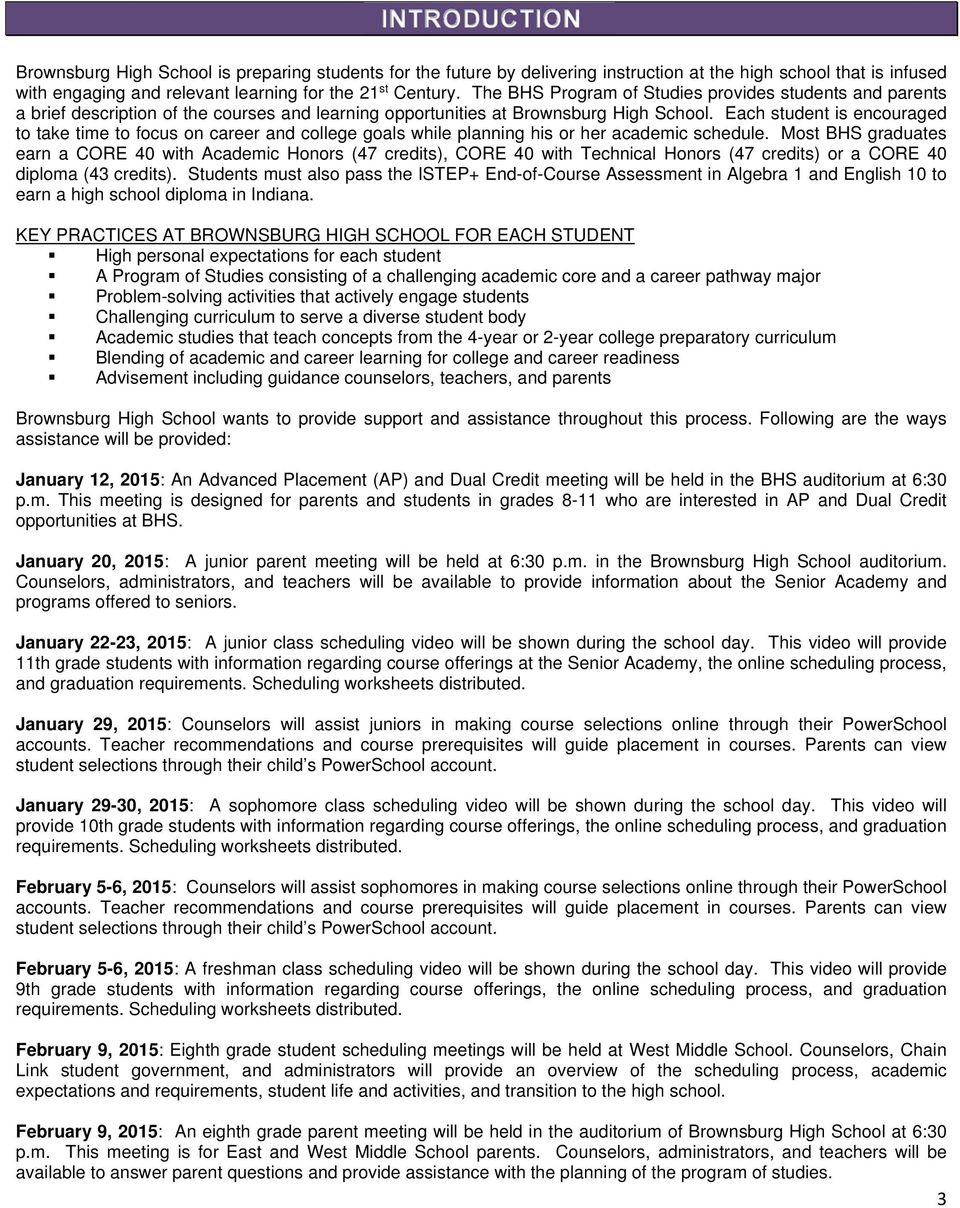
5 February 10, 2015: Eighth grade student scheduling meetings will be held at East Middle School. Counselors, Chain Link student government, and administrators will provide an overview of the scheduling process, academic expectations and requirements, student life and activities, and transition to the high school. February 12-13, 2015: Counselors will assist freshmen in making course selections online through their PowerSchool accounts. Teacher recommendations and course prerequisites will guide placement in courses. Parents can view student selections through their child s PowerSchool account. February 24, 2015: Counselors will assist BWMS eighth grade students in making course selections online through their PowerSchool accounts. Parents can view student selections through their child s PowerSchool account. Scheduling worksheets will be distributed one week prior. February 26, 2015: Counselors will assist BEMS eighth grade students in making course selections online through their PowerSchool accounts. Parents can view student selections through their child s PowerSchool account. Scheduling worksheets will be distributed one week prior. Contact the school if you have any questions concerning the Program of Studies or Brownsburg High School s overall program. The opportunity to talk with you about the programs offered to the students at Brownsburg High School is welcomed. As we work together, this will be a great educational experience for all students. 4
6 GRADUATION REQUIREMENTS CORE 40 Diploma Indiana's Core 40 is the academic foundation all students need to succeed in college, apprenticeship programs, military training and the workforce. Earn the Core 40 by earning 40 (43 at BHS) credits and completing the following requirements: ENGLISH 9 credits English 9, or Pre-AP English 9 Hon English 10, or Pre-AP English 10 Hon English 11, or AP English Lang & Comp English 12, or AP English Lit & Comp Speech MATH 6 credits (in grades 9-12) Students who earn high school credit for Algebra I, Geometry, or other higher level high school math courses in middle school must earn 6 additional credits in math courses above the level in which they have already earned credit. Students must also take a math or quantitative reasoning course each year in high school. Math credits earned prior to entering grade nine may meet specific course requirements and may count toward the credit requirements for a diploma, but six math credits must be earned while in high school. Minimum math courses required: Algebra I Geometry Algebra II SCIENCE 6 credits (in grades 9-12) SOCIAL STUDIES PHYSICAL ED HEALTH FINE ARTS PRACTICAL ARTS 6 credits Biology Chemistry I, or Pre-AP Chemistry I Hon, or Physics I, or Pre-AP Physics I Hon, or Integrated Chemistry-Physics (ICP) Any additional Core 40 Science course U.S. History, Dual Credit U.S. History, or AP U.S. History U.S. Government or AP U.S. Government & Politics Economics, or AP Microeconomics World History, or Geography/History of the World, or AP World History 2 credits 2 credits 2 credits 2 credits 1 credit 2 credits 2 credits 2 credits 2 credits 2 credits 2 credits 2 credits 1 credit 1 credit 2 credits 2 credits PE I & II 2 credits 1 credit Health Education 1 credit 1 credit Visual, Performing, Publications, or Theatre Arts 1 credit 1 credit DIRECTED ELECTIVES 5 credits Business, FACS, PLTW, Career-Technical 1 credit World Languages Fine Arts Career & Technical Education (Business, FACS, PLTW, Area 31) 5 credits ELECTIVES 6 credits 6 credits 5

7 With Academic Honors (min. 47 credits) For the Core 40 with Academic Honors diploma, students must: Complete all requirements for Core 40. Earn 2 additional Core 40 math credits. Earn 6-8 Core 40 world language credits. (6 credits in one language or 4 credits each in two languages). Earn 2 Core 40 fine arts credits. Earn a grade of a C or better in courses that will count toward the diploma. Have a grade point average of a B or better. Complete one of the following: A. Earn 4 credits in 2 or more AP courses and take corresponding AP exams B. Earn 6 verifiable, transcripted college credits in dual credit courses from priority course list C. Earn two of the following: 1. A minimum of 3 verifiable, transcripted college credits from the priority course list, 2. 2 credits in AP courses and corresponding AP exams, 3. 2 credits in IB standard level courses and corresponding IB exams. (BHS does not offer IB) D. Earn a combined score of 1750 or higher on the SAT critical reading, mathematics and writing sections and a minimum score of 530 on each. E. Earn an ACT composite score of 26 or higher and complete written section. F. Earn 4 credits in IB courses and take corresponding IB exams. (BHS does not offer IB) With Technical Honors (min. 47 credits) For the Core 40 with Technical Honors diploma, students must: Complete all requirements for Core 40. Earn 6 credits in the college and career preparation courses in a state-approved College & Career Pathway and one of the following: 1. Pathway designated industry-based certification or credential, or 2. Pathway dual credits from the lists of priority courses resulting in 6 transcripted college credits Earn a grade of C or better in courses that will count toward the diploma. Have a grade point average of a B or better. Complete one of the following, A. Any one of the options (A - F) of the Core 40 with Academic Honors B. Earn the following scores or higher on WorkKeys; a. Reading for Information Level 6 b. Applied Mathematics Level 6 c. Locating Information-Level 5 C. Earn the following minimum score(s) on Accuplacer: a. Writing 80 b. Reading 90 c. Math 75 D. Earn the following minimum score(s) on Compass; a. Algebra 66 b. Writing 70 c. Reading 80 6

8 QUANTITATIVE REASONING COURSES Students pursuing the Core 40, Academic Honors (AHD), and Technical Honors (THD) diplomas must take a mathematics course or a quantitative reasoning course each year they are enrolled in high school. A quantitative reasoning course is a high school course that "advances a student's ability to apply mathematics in real world situations and contexts" and that "deepens a student's understanding of high school mathematics standards." The chart below provides a list of courses that have been determined to meet the criteria for quantitative reasoning courses for Any mathematics course would also fulfill this requirement. A quantitative reasoning course does not fulfill a mathematics course required for graduation or academic honors. Business Courses Accounting I Accounting II Computer Programming: Java Computer Programming: C++ Engineering PLTW Courses Aerospace Engineering Civil Engineering and Architecture Digital Electronics Engineering Design and Development Principles of Engineering Social Studies Courses Economics Macroeconomics, AP Microeconomics, AP Ben Davis Area 31 Courses Advanced Manufacturing II Construction Technology: Electrical II Construction Technology: HVAC II Electronics and Computer Technology II Precision Machining I Precision Machining II Science Courses Biology, Advanced Placement Chemistry I Chemistry, AP Environmental Science, AP Integrated Chemistry-Physics Physics I Physics C, AP CLASS RANK CALCULATION Classes of 2016 & 2017 The cumulative GPA is used to determine class ranking. Updates to class rank occur at the end of each semester as the semester grade is that which is factored into the GPA. The cumulative GPA includes all courses and credits earned in grades 9 through 12. It may also include high school courses and credits that were earned while in middle school. Final decisions regarding acceptance of middle school credits must be made by the end of grade 9. The senior with the highest class rank will be designated as the graduating Valedictorian. The senior with the second highest class rank will be designated as Salutatorian. The Valedictorian and Salutatorian is determined at the end of the 8 th high school semester. Classes of 2018 & Beyond Class rank calculation for the class of 2018 and beyond is identical to previous years with one exception. Only grades and credits earned in grades 9 through 12 will be factored into the high school class rank. Grades and credits earned below grade 9 will not be included in ranking, but may still be used to meet high school graduation requirements and cumulative GPA calculation. A separately calculated rank GPA will determine a student s rank status and will be updated at the end of each semester. 7

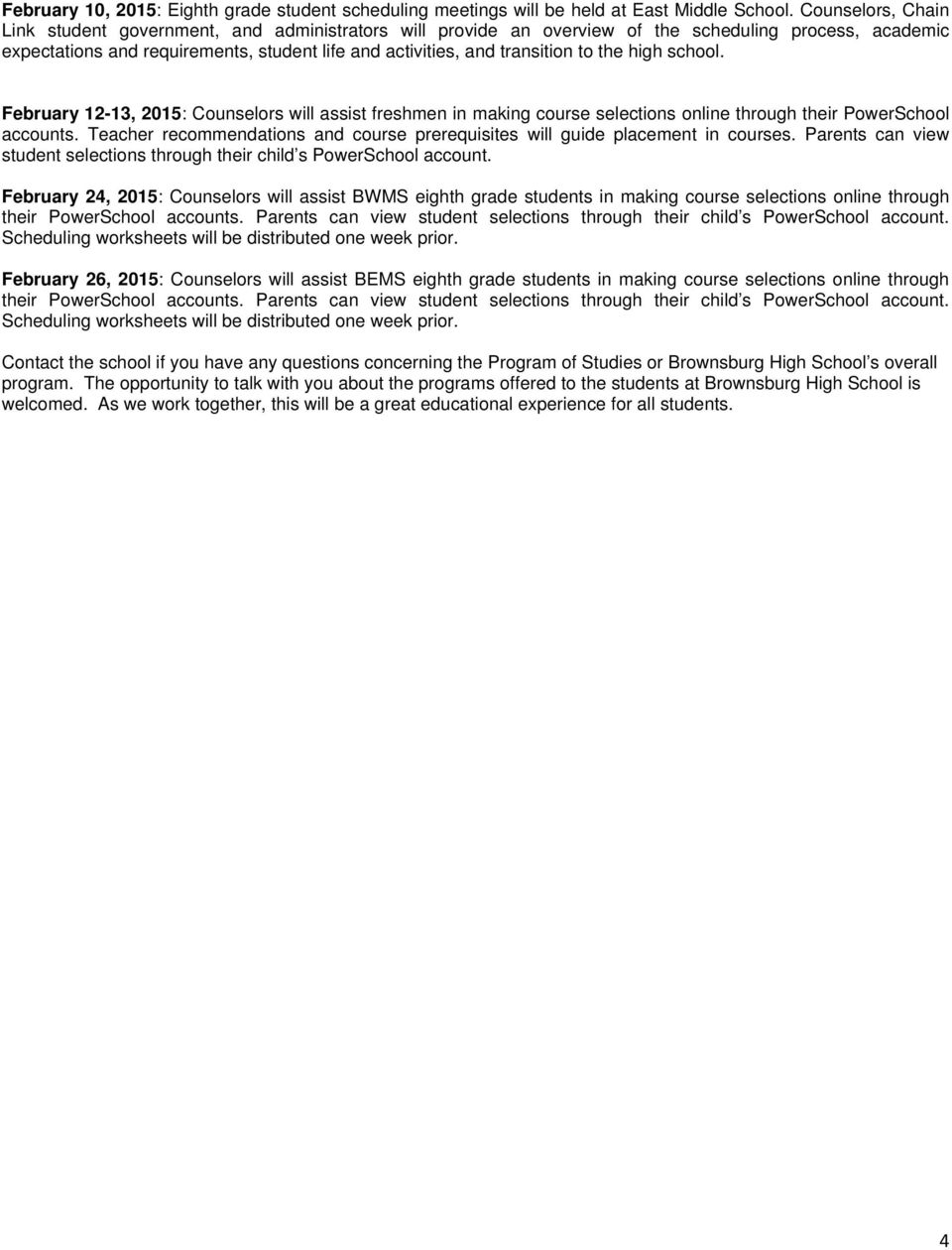
9 TESTS REQUIRED FOR GRADUATION: END OF COURSE ASSESSMENTS (ECA) All students will take End of Course Assessments (ECAs) in English 10, Algebra I, and Biology to meet graduation testing requirements. Students who do not meet state graduation standards will be given two additional opportunities in grade 11 and two additional opportunities in grade 12 to demonstrate proficiency. English 10: Required passing cut score = 360 Algebra 1: Required passing cut score = 564 Biology: Passing cut score = 509 The State of Indiana has a unique expectation for the Biology exam in the fact that students are simply required to take the exam, but do not have to meet a minimum score. However, the exam score does reflect learning and may be used as an evaluation tool for a semester grade and course placement. State law provides that a student who successfully meets the Core 40 requirements may still graduate without passing the End of Course Assessments (ECA) by successfully appealing the student s test results under State Board criteria (IC ). The student must have: Taken the graduation test in the subject area or areas in which the student did not achieve a passing score at least one (1) time every year during his sophomore, junior, and senior years in high school. Complete remediation opportunities provided by the school. Maintain a minimum attendance rate of 95 percent. Maintain a C average in the courses that make up the thirty-four (34) credits specifically required for graduation and Obtain a written recommendation supporting the request for the appeal from the student s teacher(s) in the subject area(s) in which the student has not achieved a passing score. For more information on the End-of-Course Assessments, visit GRADE WEIGHTING Brownsburg High School maintains a two-tiered grade weighting system. Please review the chart below for the grade weighting scale followed by a list of all weighted courses and their weight value. Not all courses carry the same weight. For dual credit courses, students must qualify and enroll through the coordinating university to receive a grade weight. Students must earn a C- or higher in the course to receive a grade weight. AP Students must take the AP exam. See course description for additional course requirements. GRADE WEIGHTING SCALE Unweighted A A A B B B C C C D F
10 Department Course # Course Name - Weight = 1 Point Course # Course Name - Weight =.5 Point Business Career English Fine Arts Math Project Lead The Way Science Social Studies World Language Principles of Business Management Principles of Marketing Adv CC/MU 174 Cadet Teach AP Eng Lang & Comp Pre-AP English 9 Honors AP Eng Lit & Comp Pre-AP English 10, Honors Adv Eng CC/VU Eng 101/ Art History Wind Ensemble, Honors (Gr 11&12 only) AP Studio Art, 2D & Drawing Symphony Orchestra, Honors (Gr 11&12 only) AP Studio Art, 3D Design Madrigals, Honors (Gr 11&12 only) AP Music Theory AP Calculus AB Algebra II Honors AP Statistics Pre-Calculus Honors AP Calculus BC 2421 Adv Math CC/VU Math Adv Math CC/VU Math Adv Math CC/BSU M Pre-Calculus Honors BC Intro to Engineering Design Principles of Engineering Digital Electronics Civil Engineering & Architecture Aerospace Engineering Engineering Design & Development Principles of Biomedical Science Human Body Systems Medical Interventions Biomedical Innovation Computer Science & Software Engineering AP Biology Pre-AP Chemistry I Honors AP Chemistry Pre-AP Physics I Honors AP Environmental Science Pre-AP Biology II Honors AP Physics C Adv Sci CC/VU Bio 111/ AP US History Adv SS CC/VU HIST 139/ AP US Gov & Politics 422 AP Microeconomics 424 AP Macroeconomics AP World History 429 AP Psychology AP Human Geography AP German Adv French CC/VU FRENCH 101/ AP French Adv Germ CC/VU GRMN 101/ Adv Span CC/VU SPAN 201/ AP Spanish AP Chinese 9

11 ADVANCED PLACEMENT (AP) The Advanced Placement Program is sponsored by the College Board, a non-profit membership organization. The Advanced Placement Program (AP) gives students an opportunity to experience college-level courses and exams while they are still in high school. The AP tests are scored on a one to five scale. Through this program, students may earn college credit, accelerated placement, or both for college. Because Advanced Placement courses are equivalent to a college level course, students who take AP courses should expect to spend a considerable amount of time outside the classroom devoted to this rigorous coursework. As a general rule, expect to spend one hour of work per day outside the class per period. Indiana PL 91 requires all Indiana public colleges and universities (including all two and four year institutions and accompanying satellites) to award college credits for Indiana secondary school students that earn a score of 3 or higher on College Board s Advanced Placement (AP) examination. Indiana public colleges and universities may require a score higher than 3 to award credits for a course that is a requirement for a student s major If a university chooses to do so, it must still award a student elective credits that count toward his/her overall degree requirements to graduate from college. Families may visit for the most current transfer information. Advanced Placement courses are grade weighted. In order to receive the grade weight, students must receive a grade of C- or higher and take the AP examination in May. Cumulative class ranks and GPA s will be retroactively recalculated for students who do not complete the scheduled AP exams. Book rental fees are usually higher for College Board AP courses because students must purchase their own college textbook. At the present time, the Indiana Department of Education pays for science and math exams for juniors and seniors only. Therefore, there is no exam fee to BHS students in these grade levels for these exams. All other tests require a fee; approximately $91 per test ($91 in 2015). Students receiving free or reduced meal benefits qualify for fee waivers for AP examinations. For a complete course description and other information regarding AP courses go to: Students enrolled in Pre-AP honors and AP courses are expected to complete the summer reading and writing requirements at each level. AP Art History AP Biology AP Calculus AB AP Calculus BC AP Chemistry AP Chinese Language AP English Language & AP English Literature & AP Environmental Science Composition Composition AP French Language AP German Language AP U.S. Government & Politics AP Human Geography AP Macroeconomics AP Microeconomics AP Music Theory AP Physics C AP Psychology AP Spanish Language AP Statistics AP Studio Art (Drawing Portfolio) AP Studio Art (2D Design Portfolio) AP United States History AP World History PRE-AP The College Board strongly encourages high schools offering AP programs to give all willing and academically prepared students the opportunity to participate in AP. In the same manner, the College Board maintains that all students should have access to academically challenging coursework which can prepare them for AP success before they enroll in AP classes. Brownsburg High School is committed to preparing students for AP through Pre-AP classes. Students must complete Pre-AP prerequisite courses prior to enrollment in AP. Transfer students and those wishing to enroll in AP without Pre- AP prerequisites must demonstrate readiness through assessment or other means. In such instances, placement in AP is not guaranteed. The student s best assurance for placement in AP is through success in Pre-AP classes. 10

12 Pre-AP course curricula are aligned with AP and emphasize higher-order thinking skills in problem solving and critical analysis. As students transition from Pre-AP to AP, they are better prepared for the college level standard of work required for success. The following chart outlines the Pre-AP course offerings and their corresponding AP courses: English Mathematics Science Social Studies AP AP English Lit & Comp AP Calculus BC AP Chemistry AP US Gov & Politics AP English Lang & Comp AP Calculus AB AP Physics C AP Macroeconomics AP Statistics AP Biology AP Microeconomics AP Environmental Science AP Psychology AP US History AP World History AP Human Geography Pre-AP Pre-AP English 10 Hon Pre-Cal Hon BC Pre-AP Chemistry I Hon Pre-AP English 10 Hon Pre-AP English 9 Hon Pre-Cal Hon AB Pre-AP Physics I Hon Pre-AP English 9 Hon Algebra II Hon Pre-AP Biology II Hon Students enrolled in Pre-AP honors and AP courses are expected to complete the summer reading and writing requirements at each level. DISTINGUISHED AP SCHOLARS RECOGNITION AP is a rigorous academic program built on the commitment, passion, and hard work of students and educators from both secondary schools and higher education. A 2008 study found that AP students had better four-year college graduation rates than those who did not take AP. % of Students Who Earn a Bachelor s Degree Within 4 Years AP Exam Score Avg.= 4 or 5 50% AP Exam Score Avg.= 3 44% AP Exam Score Avg.= 2 32% Dual Enrollment Courses 24% AP Exam Score Avg.= 1 21% Neither AP or Dual Enrollment Courses 11% Source: Hargrove, Godin & Dodd (2008) Taking AP also increases eligibility for scholarships and makes candidates more attractive to colleges: 31 percent of colleges and universities consider a student's AP experience when making decisions about which students will receive scholarships. 85 percent of selective colleges and universities report that a student's AP experience favorably impacts admissions decisions. Beginning with the class of 2016 and subsequent classes, Brownsburg High School will recognize students who pursue our most rigorous AP curriculum. AP courses are offered in 6 academic disciplines including English, Fine Arts, Math, Science, Social Studies, and World Language. Students who earn a minimum of 6 AP credits in 3 or more academic disciplines with grades of B- or higher in each semester will be recognized at graduation ceremonies as Distinguished AP Scholars. Students will receive special notation on the high school transcript, a special medallion to adorn the cap and gown, and will be 11

13 recognized in the commencement program publication. Students who earn 10 or more AP credits (also with grades of B- or higher in 3 academic disciplines) will also receive a sash to be worn. The following table outlines the grade levels in which particular AP classes may be taken. Prerequisite policies apply for all AP courses, so please plan accordingly. Please contact the student s guidance counselor with specific questions. English Fine Arts Math Science Social Studies World Lang 9 Statistics World History Art History Statistics Environmental Sci World History 10 Chemistry Human Geography US History* Lang & Comp Art History Statistics Biology US History Spanish 11 Music Theory Calculus AB Environmental Sci Human Geography Physics Psychology Chemistry Lit & Comp Art History Calculus AB Biology US Government Spanish Music Theory Calculus BC Environmental Sci Microeconomics German 12 Studio Art Statistics Physics Macroeconomics French Chemistry Human Geography Chinese Psychology Students are advised to plan a balanced approach to AP selections each year. Students should take advantage of opportunities in grades 9 and 10, if ready, to minimize undue stress by overloading the junior and senior year. This also allows students to pursue other interests including band, choir, art, etc. *Students who take AP World History in Grade 9 may take AP US History one year earlier in Grade DUAL CREDIT COURSES AT BROWNSBURG HIGH SCHOOL Dual credit courses allow students to earn credit toward a high school diploma as well as a college degree. Though these courses may seem expensive for a high school class, they offer a significant savings to many families when compared to tuition at post-secondary institutions. In addition to their financial advantages, dual credit courses prepare students for the rigor of college work, and help many students qualify for an Academic Honors Diploma. BHS offers courses from Vincennes University (VU), Ball State University (BSU), Indiana University (IU), Indiana University Purdue University Indianapolis (IUPUI), Marian University (MU), and Ivy Tech (IVY). There are a few details to keep in mind when considering a specific dual credit course: Some courses have certain criteria that must be met, such as minimum test scores on the PSAT, SAT, or ACT test. Some courses require that university-specific tests must be passed in order to qualify for dual credit. Prerequisites and testing requirements may be found on page 16. Students must meet entry requirements and take the course for college credit to receive any grade weighting. 12

14 Some courses may transfer as college hours, but do not transfer as the identical course at another university. This is known as undistributed credit. However, in most cases, a class will transfer into the accepting university. See for additional information regarding specific transferability questions. Textbooks for dual credit courses are dictated by the universities and are added to book rental. Be advised college textbooks are expensive. Families may utilize 529 savings plans for dual credit related expenses. Cost per credit hour is set by the university and subject to change. University University Course High School Companion Course If Available AHD Priority List THD Priority List Core Transfer Library Credit Hours Est. Cost** Vincennes ENGL 101 & 102, English Composition Yes Yes Yes 6/yr. $420 Vincennes MATH 111, Finite Math Yes Yes Yes 3/sem. $145 Vincennes Math 102, College Algebra Yes Yes Yes 3/sem. $145 Vincennes HIST 139 & 140, American History I & II Yes Yes Yes 3/sem. $280 Ball State MATH M161, Applied (Short) Calculus I Yes Yes Yes 3/sem. $300 Vincennes BIOL /111L-112L, Anatomy & Physiology Yes Yes No 8/yr. $200 IU ECON E201, Intro to Microeconomics AP Microeconomics Yes Yes Yes 3/sem. $100 Ivy Tech MKTG 101, Principles of Marketing Marketing Yes Yes No 3/sem. $35 Ivy Tech BUSN 101, Intro to Business Principles of Business Management Ivy Tech DESN 102, Technical Graphics Introduction to Engineering Design* Yes Yes Yes 3/yr. $6 Yes Yes No 3/yr. $40 Ivy Tech DESN 104, Mechanical Graphics Principles of Engineering* Yes Yes No 3/yr. $30 Ivy Tech EECT 112, Digital Fundamentals Digital Electronics* Yes Yes No 3/yr. $30 Ivy Tech DESN 105, Architectural Design I Civil Engineering & Architecture*Yes Yes No 3/yr. $35 Vincennes SPAN 201/203 Spanish Level IV (grade only) Yes Yes Yes 8/yr. $360 Vincennes GERM 101/103 German Level III Yes Yes Yes 8/yr. $275 Vincennes FREN 101/103 French III Yes Yes Yes 8/yr. $200 Vincennes PSYC 142, General Psychology AP Psychology Yes Yes Yes 3/sem. $80 Marian MU 174 Observation and Description of the Child Cadet Teaching Yes Yes No 6/yr. $495 *Purdue University and Rochester Institute of Technology are also options for these courses; the best fit for each student should be discussed with the student s counselor and PLTW instructor / ** Costs estimated based on 2014 and past practice; includes tuition and books. 13

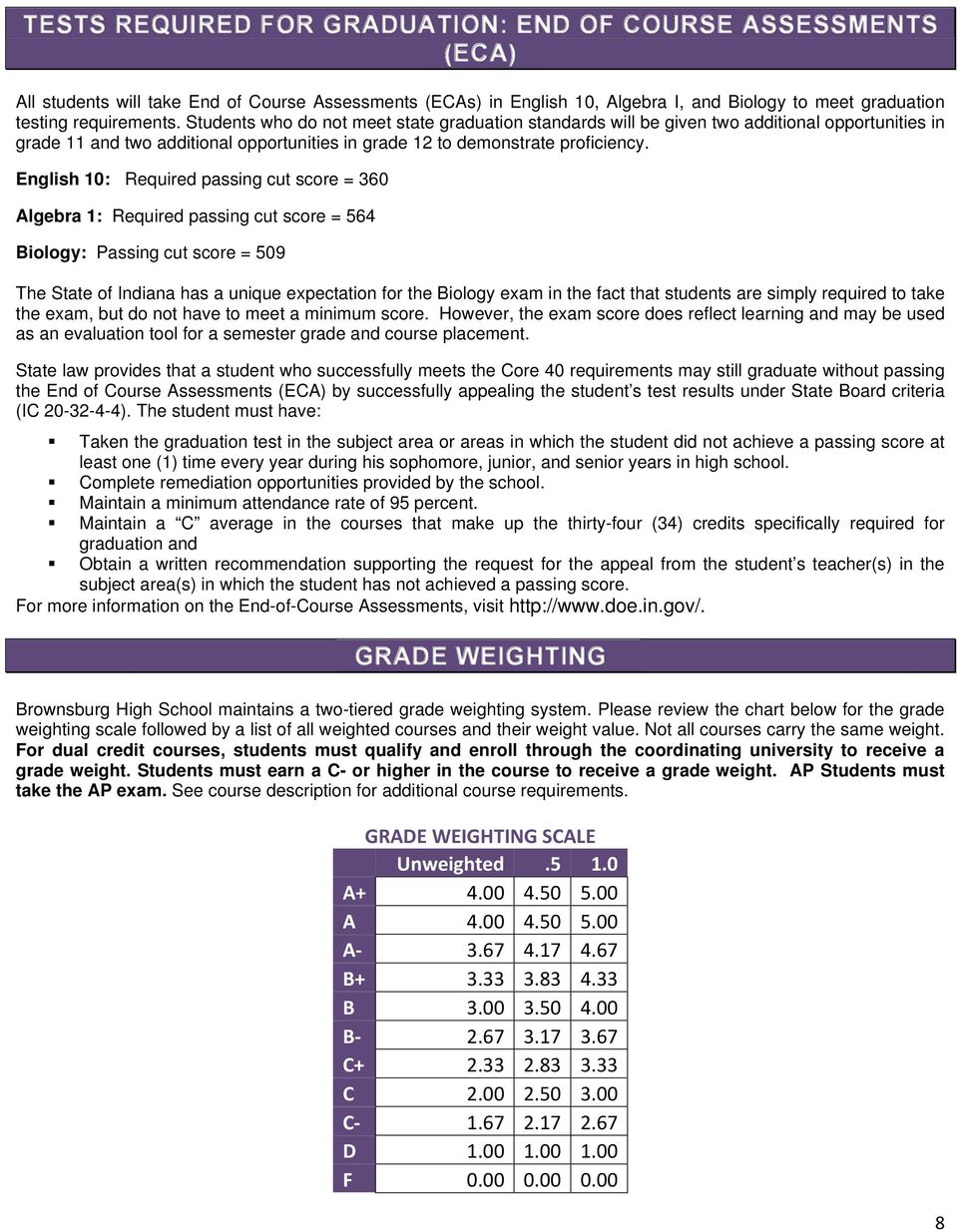
15 DUAL CREDIT TESTING & PREREQUISITE REQUIREMENTS The chart below outlines the testing and prerequisite requirements for dual credit courses offered at Brownsburg High School. Where testing requirements are required in reading, writing, or math, only one qualifying test score is needed in each category. Students must meet entry requirements and take the course for college credit to receive any grade weighting. Please review course descriptions for additional information. Reading Writing Math University University Course ACT R PSAT CR SAT CR Accuplacer ACT E PSAT SAT Accuplacer ACT PSAT SAT Accuplacer ENGL 101 & 102, English Vincennes Composition N/A Vincennes HIST 139 & 140, American History I & II N/A Vincennes MATH 111, Finite Math Prerequisite: Qualifying Accuplacer math score only 74 Vincennes Math 102, College Algebra Prerequisite: Qualifying Accuplacer math score only 74 Vincennes PSYC 142, General Psychology BIOL /111L 112L, Vincennes Anatomy & Physiology Ivy Tech MKTG 101, Principles of Marketing Ivy Tech BUSN 101, Intro to Business N/A EECT 112, Digital Fundamentals Ivy Tech (DE) Prerequisite: Qualifying math score only Ivy Tech DESN 102, Technical Graphics (IED) DESN 104, Mechanical Graphics Ivy Tech (POE) DESN 105, Architectural Design I Ivy Tech (CEA) MU 174 Observation and Marian Description of the Child Vincennes SPAN 201/203 Vincennes GERM 101/103 Vincennes FREN 101/103 MATH M161, Applied (Short) Ball State Calculus I ECON E201, Intro to IU Microeconomics N/A Prerequisite: IED Prerequisite: IED and POE Prerequisite: 19 ACT Composite or 910 SAT (CR+MA) or 91 PSAT (CR+MA); GPA 3.0 Prerequisite: Spanish 1, 2, 3 and placement exam Prerequisite: German 1, 2 Prerequisite: French 1, 2 Prerequisite: GPA 3.0; SAT scores above state average or 21 ACT composite Prerequisite: GPA
16 SENIOR ACADEMY CADRE The culminating Senior Academy experience is the Senior Academy Cadre program. The Senior Academy Cadre program is linked to courses with career-related experiences and a Senior Project. Cadre Experience Components Complete a Senior Project with the guidance of a community consultant to extend learning into the real world. Complete career-related experiences such as an internship, job shadowing, or service learning project. Take at least one AP, dual credit, or online course during high school. Complete an online graduation portfolio which showcases a postsecondary plan, high school accomplishments, and a personal mission statement. Students may also submit a personal learning plan that encompasses the above learning experiences. Senior Cadre courses are paired with an additional course, Senior Project. A credit will be awarded for each course and will be displayed independently on the student transcript. These combined courses provide a blocked class time when students can work on their coursework, senior project, career-related experiences, and graduation portfolio. Senior Academy Cadre Courses Advanced TV & Video Production Cadet Teaching Engineering Design & Development Anatomy and Physiology* Advanced Business Management Professional Career Internship Biomedical Innovations* (DECA) Early Childhood Center *Cadre optional students may take this course without the senior project component. COLLEGE AND CAREER READINESS Due to the wide variations in college entrance requirements, students are urged to check with the admission office of the chosen college and visit the individual college websites when planning their high school programs. College catalogs are available online at most college websites. Most colleges require at least 28 of the credits earned for high school graduation to be devoted to academic courses. Be aware that college entrance requirements do change. The 11th grade and 12 th grade years are when students should take the SAT and ACT college readiness tests. Additionally, juniors have the opportunity to earn scholarship monies through the National Merit program by taking the PSAT Examination. For more information about the SAT and ACT programs, please visit and To prepare for college, students should do the following: Take recommended college preparatory courses. The preferred curriculum for the best preparation for college is the Academic Honors Diploma. Indiana Core 40 is the minimum standard to be followed. Maintain the best possible grade point average (GPA). Take the PSAT test in the fall of the sophomore year. Beginning in 2015, all juniors will retake the PSAT in the fall. Juniors are recommended to then take the SAT and/or ACT in the spring, and once again in late fall of the senior year. Have SAT and ACT scores sent to Brownsburg High School (CEEB school code is ) as well as to colleges being considered. Apply to colleges early during the fall of the senior year. Some colleges and some highly competitive programs require early application. Complete the FAFSA form after January 1 and submit by March 10, to be considered for state and federal financial aid. Visit for more information on the FAFSA. NAVIANCE - Naviance Family Connection is a web-based program that promotes college and workplace readiness for high school students. All Brownsburg High School students and their parents have access to Naviance Family Connection. Incoming ninth grade students will receive their registration information during freshman orientation. Family Connection applications include: 15
17 College Planner Students can research colleges, enrichment programs, and scholarships. They can access school forms and can request transcripts and school profiles to be sent electronically to more than 1,000 colleges. Career Planner Students can learn more about themselves, research careers, and understand the academic preparation required to ensure workplace readiness. GRADE 9 AND 10 COLLEGE AND CAREER PLANNING AT BROWNSBURG HIGH SCHOOL It may be difficult for 9th and 10th grade students to choose a specific Career Major Pathway; however, the kinds of course choices and the success at the 9th and 10th grade level begins to form the career pathway choice for the eleventh grade. For this reason, the high school curriculum becomes a 9th and 10th grade formative/evaluative program, and the 11th and 12th grade becomes a career-focused preparatory program. All 9th and 10th grade students will schedule English, mathematics, social studies, science, physical education (9), speech (10) and health (10). Students will take End of Course Assessments (ECA) after the completion of Algebra I, Biology and English 10. Electives chosen during these foundation years should parallel the career cluster and diploma level desired. College readiness testing for this formative stage includes the PSAT test which is taken in the fall of the sophomore year. GRADE 11 AND 12 COLLEGE AND CAREER PLANNING AT BROWNSBURG HIGH SCHOOL The decision for the proper program concentration requires team planning for the 11th &12th grade years. This should involve the student, parent, and high school personnel. Post high school educational experiences in today s technical world will be mandatory for all students regardless of program selection. Individual preparation, ability, interest, and motivation will determine success during one s entire lifetime. It must be the goal of the educational team (studentparent-school) to correctly place each student in the courses and sequence level of their chosen Career Pathway. Each Career Pathway has a degree of flexibility built into it for supporting electives and core course academic leveling. The Career Major is composed of classes which offer a sequential preparation of knowledge and skills in the core content area. When successfully completed, these courses should present opportunities at graduation to advance to the next level of continuing education and/or employment. As you choose the Career Major of interest, remember to take into account past demonstrated ability in core-proficiency content classes (math, english, science, and social studies.) Choice of a specific Career Pathway and supporting electives must be attainable based on demonstrated past academic success and an attitude of sincere interest. The Senior Academy Cadre program is linked to courses with career-related experiences and a capstone Senior Project. COLLEGE AND CAREER PATHWAYS College and Career Pathways provide a way for schools to organize instruction and student experiences around twelve broad categories that encompass virtually all occupations from entry through professional levels. Students may utilize Naviance Family Connection to research pathways and create 4-Year Course Plans based upon an intended pathway. Explore Careers & Clusters may be found under the Careers tab in Naviance. LearnMore Indiana is an additional online resource with career exploration information. LearnMore may be accessed at Indiana College & Career Pathway Courses by Cluster The state-approved Career Clusters and College & Career Pathways, along with the sequence of courses recommended for each Pathway and the Course Frameworks can be accessed at below or through Naviance Family Connection. Agriculture Architecture & Construction Arts, AV Technology & Communication Business & Marketing Education & Training Health Science Hospitality & Human Services Information Technology Manufacturing Public Safety STEM Transportation 16

18 ENROLLMENT POLICIES EDUCATIONAL RECORDS TRANSCRIPTS AND REPORT CARDS Brownsburg High School has transitioned to electronic submission of transcripts. Students who need transcripts sent to colleges and universities make their requests in Naviance. Alumni should make their requests via Parchment.com. The counselor will then confirm the request and forward the transcript electronically. This transcript will serve as an official transcript when this process is followed. Parents and students are encouraged to use PowerSchool to check grades and to print report cards. PowerSchool user names and passwords are provided at registration. Paper report cards are no longer provided. If you need your PowerSchool user name or password please contact the administrative assistant of the grade level team. TRANSFER STUDENTS-CREDITS Brownsburg High School will evaluate and accept credits of students transferring based on the following policy: 1. If the transferring student attended a school in Indiana or another state, approved/accredited by that state s department of education, coursework will be accepted at face value if those courses are approved curriculum offerings. 2. For credit or coursework to be accepted from a nonpublic school (including home schools) there must be verification that: a. The course was taught by a certified teacher. b. Course content is comparable to corporation-established courses of study. All students entering from a nonpublic school may be given individual achievement tests or end-of-course examinations in core subjects as an aid in placement. Recognition of credits or coursework from a nonpublic school shall be granted when the above-stated criteria are met and upon satisfactory completion of any achievement tests given by the administration. 3. Only grades awarded for courses taken at the corporation or from a school accredited by the Indiana Department of Education or such departments in other states shall be considered in class ranking and for entering on the transcript. If credits from a non-accredited school are granted, no grades will be entered on the transcript or considered for class ranking. PERMANENT RECORD MAINTENANCE The Registrar will maintain two copies of each student s permanent record. Copies of records will be released according to the Family Rights and Privacy Acts. Expelled students will have the notation I.C placed on the high school transcript and will receive a "W" as the final grade in enrolled courses unless otherwise directed by the expulsion examiner. FULL TIME ENROLLMENT Students must maintain at least six (6) credit generating classes per semester in order to maintain a timely progress toward high school graduation. The Superintendent or School Board will not grant approval per IC for students to enroll in less than six (6) credit generating courses unless an I.E.P. or 504 plan is in effect. Students must attend a minimum of six semesters to receive a diploma. SCHEDULING POLICIES ONLINE HIGH SCHOOL COURSE CREDIT AS AN EXTENSION OF THE BHS CURRICULUM A student desiring to earn high school credit through online coursework should give this choice careful thought and discuss this option with the high school counselor. Prior approval is required for the acceptance of online credit toward graduation requirements. Online courses that are requested to replace courses that are teacher-led at Brownsburg High School will not be approved unless an academic necessity is warranted. In these instances, students will be required to complete a 4-year academic course plan documenting the need for online course flexibility. 17

19 A maximum of four (4) credits through online or other correspondence courses may be applied toward graduation. It is recommended that students enroll in no more than two courses in this manner at a given time. Likewise, it is recommended that the coursework be completed during the high school semester timeline. Cost of online courses is the responsibility of the family. Only courses that are offered by accredited institutions approved by the State of Indiana will be approved. Brownsburg High School students who are potential NCAA Division I or II athletes should verify that all online course enrollment meets NCAA eligibility guidelines. See website for more information: COLLEGE COURSES NOT TAKEN AT BROWNSBURG HIGH SCHOOL A student may enroll in on-campus or online courses offered by an accredited college or university in grades 11 or 12. All grades will be transcripted in a manner indicating that they were earned through an eligible post-secondary institution. In order for credits earned directly through a college or university to be applied toward high school graduation requirements, approval is required by the guidance counselor prior to enrollment in the course. If approved, grades earned from such courses may be factored into the high school cumulative GPA, but will not factor into class rank - except in rare circumstances where a student has exhausted an academic department s curriculum. A grade weight will only be granted in courses for which there is a Brownsburg High School equivalent that is also weighted. COURSE RECOMMENDATIONS At Brownsburg High School, student course placement is based upon a variety of factors including student performance in preceding classes, standardized test scores, potential, and teacher recommendation. Teacher recommendation is a required prerequisite for many courses. Recommendations by teachers are greatly valued as they have personal knowledge of their students and of the curriculum in their departments. Procedures have been developed to address disagreements between families and staff regarding course recommendations. Students may submit a Course Recommendation Override Form to their team office for review. In most cases, a meeting will be coordinated with the student and parent, counselor or assistant principal, and the department head of the academic course in question to determine final placement. A student that enrolls in a course that is contrary to the final staff recommendation may not withdraw from the course at a later date without receiving a WF on the academic transcript. ALTERNATIVE PE I & II CREDIT The Indiana State Board of Education allows local high schools flexibility in determining the manner in which Physical Education proficiencies may be met. In order to maximize educational scheduling opportunities for students, Brownsburg High School has adopted a policy through which Physical Education I & II credit may be earned through alternative means. Alternative PE credit options will begin with the school year. Credits will not be granted for any previous school year. A complete season of the following student activities has been approved for Alternative PE Credit: o o o o o Any BHS sponsored IHSAA sanctioned sport (Freshman athletes are encouraged to enroll in the PE Athletic Development course during the freshman year) BHS Cheerleading Marching Band Color Guard Starlight Voices/Competitive Show Choir (grade 10 only) Students may earn one (1) credit in PE I per school year for one (1) activity listed above. A student may repeat the same activity during the sophomore year to receive one (1) credit in PE II to fulfill the PE requirements for graduation. A student may complete two (2) different activities from the list above in the same year to receive one (1) credit in PE I and one (1) credit in PE II, thus fulfilling the PE requirements for graduation. Both PE I and PE II credits must be earned by the end of the sophomore year. 18
20 Retroactive credits will not be awarded. Student activity in any event not listed above is not eligible for the Alternative PE Credit. A complete season is defined as: first practice to final event. The student must remain on the active roster for the entire season or the duration of the activity. The student must attend all required practices, rehearsals, or competitions as dictated by the activity s coach or director. The student will participate regularly in physical activity, demonstrated by participation in over 90% of group activities (injury free). Injuries or disciplinary or academic suspensions that result in withdrawal or dismissal from the team or activity will result in forfeiture of Alternative PE credit as determined by the coach or director. Students with injuries or those who are removed or withdrawn from their activity may not be placed into a regular PE course after the second week of a semester. Alternative PE credit and Athletic Development PE credit may not be earned in the same semester. A grade of A will be granted for the Alternative PE credit to all students who meet the requirements listed above. Additional Student Requirements & Information: Students must indicate their desire to earn Alternative PE credit in PowerSchool during the course registration process in February. Students must submit the Brownsburg High School Application for Alternative PE I or PE II Credit form by March 13, Forms will be distributed during scheduling sessions or may be downloaded from the BHS Guidance Office website. The BHS Director of Guidance will maintain forms and will verify team or activity rosters with the athletic office or activity directors. PE credits will be entered into PowerSchool once seasons have been completed and verified. Students that do not participate in the activity indicated on their application should notify their counselor prior to the start of the semester in which the activity takes place so that they may be enrolled in a regular PE course. Alternative PE credits may not count as an enrolled course toward IHSAA athletic eligibility. BHS requires that students enroll in a minimum of 6 credit generating courses during each academic semester. CHANGES IN PRE-ENROLLED CLASS SELECTIONS - DEADLINES The course offerings at Brownsburg High School are based upon student requests during pre-enrollment. Therefore, it is necessary for students to determine their class choices with a commitment to complete those classes. In the event a student would find it necessary to request a change in their course selections, students should make an appointment to see their guidance counselor. All requests for schedule changes must be made by May 1, Requests for changes between March 15 and May 1 will be honored if space is still available in the course. The guidance staff may need to use alternate classes if (1) an original class choice is not offered due to insufficient enrollment or (2) the student has selected two classes which conflict on the student s schedule. Once schedules are built for the entire school, counselors may change a student s schedule to obtain balanced class sizes. DROP AND/OR ADD COURSES If a student wishes to request a schedule change that involves adding or dropping a course, he/she must complete a Schedule Change Request form within the first FIVE days of a semester. Schedule changes are discouraged and such requests will be given close scrutiny. All changes must be approved by the grade level team (assistant principal, counselor, academic coach). There will be no schedule changes to accommodate a teacher preference. Students may not drop a class and then request to be a teacher assistant. Drops after the first FIVE days of a semester will result in a WF for the course. Schedule change requests will be considered for the following reasons: Request to take courses to qualify for the Academic Honors Diploma Failure of a course required for graduation Add a seventh course to replace a study hall Failure of a course with a particular teacher; student has been assigned the same teacher for the exact same course Drop a seventh course for a study hall 19

21 Dropping a course may endanger athletic eligibility (See Athletic Eligibility). Students cannot schedule more than one study hall during any semester. RETAKE POLICY A student must demonstrate proficiency in each course required for graduation. Students may repeat a course where they have received a D+, D, or D- in order to earn a better grade. The following rules will apply: 1. When repeating a course either failed F or already passed with a D+, D, or D-, the second grade will replace the first grade on the transcript. The first grade will appear as an R for no credit, and will not factor into the GPA. (Exception: In the event a student fails a previously passed course, both the F for the second grade and the first passing grade will appear on the transcript and both will count toward cumulative GPA). 2. When repeating a course, a student may go from an honors level course to a regular level (provided academic standards are the same for the two courses). For example, a student who earns a D+ in English 10 Honors may opt to take English 10 for a higher grade. INCOMPLETE GRADES An Incomplete (I) may be given under certain situations in lieu of a grade when a student does not complete the requirements of the course. The student must make arrangements with the teacher to fulfill those requirements. Teachers must submit final grades for each student upon completion of the course or indicate to the principal what arrangements have been made to remove the incomplete. Accommodations for individual situations shall be made by the building principal as the need arises. Each student has two weeks, 10 school days, after the last day of the grading period to fulfill the requirements of the course upon returning from an extended absence (three days or more). Any work not made up will be recorded as failing. Exceptions to this policy must be approved by the principal. MIDYEAR GRADUATES Midyear graduates are to comply with the following policies: May not enroll in career technical classes at Ben Davis during the seventh semester. Must enroll in one (1) semester classes only during the seventh semester. Must be approved for midyear graduation at pre-enrollment time in the spring. Must have passed the graduation qualifying tests (Algebra I ECA and English 10 ECA). Must file a completed request form, properly signed by the parent, student, and Principal by June 1st, prior to the beginning of the senior year. Students who do not meet this deadline will not have the eighth semester of attendance waived. ATHLETIC ELIGIBILITY BHS ATHLETIC ELIGIBILITY In order to participate in athletics a student must be in good standing with the school academically. This means to participate in extra-curricular contests, a student must meet the IHSAA standard of being enrolled in and passing at least 70% of the maximum number of full credit subjects (or equivalent) that a student can take (5 out of 7 classes) at the end of each nine weeks and the semester. If a student does not meet these standards he/she will not participate in extra-curricular contests during the next nine weeks grading period. Students not academically eligible are permitted to practice. A student not meeting these standards during the last nine weeks and semester of a school year will not participate in extra-curricular contests during the first nine weeks of the next school year except under the following limited conditions: 1. Fourth nine week failure but passes the course for the second semester: Student must pass a Brownsburg High School approved summer school course in a subject for which he/she has not previously received credit. 2. Second semester failure but passes the fourth nine weeks grading period: Student must retake the class and pass. The course must be a Brownsburg High School approved summer school course. 3. Second semester failure and nine week failure in the same course: Student must retake the class and pass. The course must be a Brownsburg High School approved summer school course. ATHLETIC SUSPENSION (2.0 GPA Minimum) The Brownsburg Community School Corporation believes that a student-athlete s education should be their top priority and therefore, requires that a student participating in athletics carry a 2.0 GPA. While the athlete is 20
22 technically academically eligible (by IHSAA standards), he/she will be suspended from participation in extra-curricular contests until the student demonstrates a 2.0 GPA at the end of the grading period, or until academic probation is granted. (See Academic Probation below.) A student not meeting the 2.0 GPA standard during the last nine weeks of a school year will not participate in extracurricular contests during the first nine weeks of the next school year except under the following limited conditions: 1. If a student-athlete does not meet the 2.0 GPA average, he/she may enroll in an approved summer school course in which he/she has not previously received credit. The combined GPA of the fourth nine weeks and the summer course must meet the 2.0 GPA average threshold. 2. Students that have been suspended from contest competition, due to the 2.0 GPA rule, are permitted to practice. ATHLETIC PROBATION If a student-athlete meets the IHSAA standard as outlined above, yet is below the corporation s required 2.0 GPA, he/she may apply for Academic Probation at any point after three weeks of the current grading period. This probationary status shall not be granted to any student more than two (2) times during the four (4) years the student is enrolled in Brownsburg High School. To qualify for probationary status a student-athlete must meet the following four conditions: 1. Have remained with the team during the first three weeks of academic ineligibility, missing practices and games for academic reasons only. 2. Apply for academic probation on the appropriate form (including documentation of grades for all enrolled classes). 3. Have earned a grade point average of 2.25 or greater at the time of application. 4. Attend two BHS athletic study table sessions (30 minutes each) per week during the probationary period. ATHLETIC STUDY TABLE 1. In-Season-Athletes: Any student earning a grade below a "C- in any one class will be required to attend a MINIMUM of two Athletic Department Study Table help sessions per week. 2. Out-of-Season Athletes: Coaches will monitor their athletes grades and let them know they are keeping an eye on their academic progress. Coaches will strongly encourage attendance at the Athletic Department Study Table sessions. 21
23 NCAA DIVISION I/II ELIGIBILTY The initial-eligibility standards for NCAA Division I college-bound student-athletes are changing. College-bound student-athletes first entering a Division I college or university on or after August 1, 2016, will need to meet new academic rules in order to receive athletics aid (scholarship), practice or compete during their first year. These are the Division I requirements for a full qualifier (may receive athletics aid, practice, and compete in the first year of enrollment at the Division I college or university): 1. Complete 16 core courses* 4 years of English; 3 years of Mathematics (Algebra I or higher); 2 years of Natural/Physical Science (1 year of lab); 1 year of additional English, Mathematics, or Natural/Physical Science; 2 years of Social Science; 4 years of additional courses (from any aforementioned area, foreign language, or comparative religion/philosophy). a. Ten of the 16 core courses must be completed before the seventh semester (senior year) of high school. i. Seven of the 10 core courses must be English, math or science. 2. Have a minimum core-course GPA of 2.3. a. Grades earned in the 10 required courses required before the senior year are locked in for purposes of GPA calculation. i. A repeat of one of the locked in courses will not be used to improve the GPA if taken after the seventh semester begins. 3. Meet the competition sliding scale requirement of GPA and ACT/SAT score (this is a new scale with increased GPA/test score requirements). Visit the NCAA Eligibility Center website at for specific GPA/testing specifics 4. Graduate from high school. Students who plan to enroll in a Division II college and want to participate in athletics or receive an athletic scholarship during their first year must: 1. Complete 16 core courses* 3 years of English; 2 years of Mathematics (Algebra I or higher); 2 years of Natural/Physical Science (1 year of lab); 3 years of additional English, Mathematics, or Natural/Physical Science; 2 years of Social Science; 4 years of additional courses (from any aforementioned area, foreign language, or comparative religion/philosophy). 2. Have a minimum core-course GPA of Have a minimum SAT score of 820 (Critical Reading/Math only) or an ACT sum of 68. *A list of BHS approved core-courses may be found on the NCAA Eligibility Center website at Please Note: All SAT and ACT scores must be reported directly to the NCAA Eligibility Center by the testing agency. Test scores that appear on transcripts will no longer be used. When registering for the SAT or ACT, use the code of 9999 to make sure the score is reported to the NCAA Eligibility Center. Division I and II student athletes must be certified by the NCAA Eligibility Center. Students should register at 22
24 NAIA ELIGIBILITY An entering freshman must: Be a graduate of an accredited high school or be accepted as a regular student in good standing as defined by the enrolling institution Meet two of the three following requirements. If as an entering freshman you do not meet at least two of the three standards, you cannot participate in athletics for the first full year of attendance (2 semesters, 3 quarters, or equivalent). 23
25 FRESHMAN COURSE OFFERINGS REQUIRED COURSES: Appropriate Math Course by Recommendation English 9 or Pre-AP English 9 Honors Biology, Pre-AP Biology II Honors, Chemistry, or Pre-AP Chemistry I Honors Completion of 2 credits of social studies at the conclusion of 10 th grade year Physical Education Business, Marketing & Information Mathematics Technology Education Algebra *Web Design Geometry 7011 *Preparing for College & Careers Algebra **Principles of Business Management #Algebra 2 Honors #Statistics, AP Career and Technical Education Intro to TV & Video Production Physical Education/Health Physical Education 1 & 2 English Physical Education, Athletic Development English #Pre-AP English 9 Honors PLTW: Biomedical Sciences 167 *Journalism #Principles of Biomedical Sciences Student Publications - Yearbook PLTW: Computer Science Family & Consumer Science #Computer Science & Softw are Engineering 7011 *Preparing for College & Careers 703 *Fashion & Textiles PLTW: Engineering 704 *Fashion & Textiles II **#Intro to Engineering Design 709 *Nutrition & Wellness Science Fine Arts: Music Biology Freshman Orchestra #Pre-AP Biology II Honors Instrumental Ensemble Percussion Chemistry Intermediate Concert Band Purple #Pre-AP Chemistry I Honors Intermediate Concert Band White Intermediate Concert Band Gold Social Studies Dance Performance Color Guard World History & Civilization Beginning Chorus Choralaires (Women) Geography & History of the World Beginning Chorus Men s Choir #World History, AP Fine Arts: Theater World Languages 173 *Theatre Arts Chinese *Technical Theatre French German 1 Fine Arts: Visual Arts Spanish *Intro to 2-Dimensional Art Spanish *Intro to 3-Dimensional Art 602 *Ceramics 1 Miscellaneous 605 *Draw ing Study Hall 607 *Sculpture *Digital Design 1 *One Semester Course #Weighted Course, See page 9 **Dual Credit Course 24
26 SOPHOMORE COURSE OFFERINGS REQUIRED COURSES: English 10 or Pre-AP English 10 Honors Speech Health & Wellness Appropriate sequential math course Appropriate science course Completion of 2 credits of social studies at the conclusion of 10 th grade year Business, Marketing & Information Fine Arts: Theatre PLTW: Computer Science Technology Education 173 *Theatre Arts #Computer Science & Softw are Engineering 7011 *Preparing for College & Careers 183 *Theatre Arts *Web Design 184 *Technical Theatre PLTW: Engineering **#Marketing/CC Ivy Tech 188 *Adv Technical Theatre **#Intro to Engineering Design **Principles of Business Mgmt **#Principles of Engineering Java Programming Fine Arts: Visual Arts Adv Web Design 601 *Intro to 2-Dimensional Art Science 661 *Accounting I 616 *Intro to 3-Dimensional Art Biology 662 *Accounting II 602 *Ceramics #Pre-AP Biology II Honors 6671 *Business Law & Ethics 609 *Ceramics Chemistry 605 *Draw ing #Pre-AP Chemistry I Honors Career and Technical Education 610 *Draw ing Integrated Chemistry-Physics Intro to TV & Video Production 606 *Painting Physics Advanced TV & Video Production 611 *Painting #Pre-AP Physics 1 Honors 607 *Sculpture Anatomy & Physiology English 617 *Sculpture Advanced Science: Zoology English *Digital Design #Chemistry, AP #Pre-AP English 10 Honors 625 *Digital Design #Environmental Science, AP 176 *Speech 626 *Photography *Journalism #Art History, AP Social Studies Student Publications New spaper World History & Civilization Student Publications Yearbook Mathematics Geography & History of the 165 *Etymology Algebra #World History, AP Geometry #Human Geography, AP Family & Consumer Science Algebra #US History, AP 7011 *Preparing for College & Careers #Algebra 2 Honors 703 *Fashion & Textiles Pre-Calculus/Trigonometry World Languages 704 *Fashion & Textiles II #Pre-Calculus/Trigonometry Chinese *Nutrition & Wellness Honors (AB) Chinese *Culinary Arts & Hospitality #Pre-Calculus/Trigonometry Chinese *Child Development Honors (BC) French #Statistics, AP French 2 Fine Arts: Performing Arts German *Piano & Electronic Keyboard Multidisciplinary German Intermediate Orchestra Peer Tutoring Spanish Symphony Orchestra Spanish Instrumental Ensemble Percussion Physical Education/Health Spanish Advanced Concert Band Wind 803 *Health & Wellness Intermediate Concert Band Purple *Physical Education 1 & 2 Miscellaneous Intermediate Concert Band White *Adv Physical Fitness 897 Study Hall Intermediate Concert Band Gold *Adv Athletic Development Dance Performance Color Guard Athletes, Except Football and Wrestling Beginning Chorus Choralaires *Adv Athletic Development (Women) Football and Wrestlers Intermediate Chorus Women s *Modern Fitness Choir *Team Sports Beginning Chorus Men s Choir 816 *Lifeguarding Concert Choir The Blend PLTW: Biomedical Sciences Bel Canto Voices #Principles of Biomedical Sciences Madrigals #Human Body Systems Starlight Voices Music Theory & Composition *One Semester Course #Weighted Course, See page 9 **Dual Credit Course 25
27 JUNIOR COURSE OFFERINGS REQUIRED COURSES: English 11 or AP English Language & Comp United States History, Dual Credit US History, or AP United States History Appropriate sequential math course Appropriate science course Business, Marketing & Information Fine Arts: Theater PLTW: Computer Science Technology Education 173 *Theatre Arts #Computer Science & Softw are Engineering 6673 *Web Design 183 *Theatre Arts **#Marketing/CC Ivy Tech 184 *Technical Theatre PLTW: Engineering **Principles of Business Mgmt 188 *Adv Technical Theatre **#Intro to Engineering Design 661 *Accounting **#Principles of Engineering 662 *Accounting II Fine Arts: Visual Arts #Aerospace Engineering Technology 6671 *Business Law & Ethics 601 *Intro to 2-Dimensional Art **#Civil Engineering & Architecture **Entrepreneurship & New Ventures 616 *Intro to 3-Dimensional Art 695 *Sports & Entertainment Marketing 602 *Ceramics 1 Science Java Programming 609 *Ceramics Biology Adv Web Design 605 *Draw ing #Pre-AP Biology II Honors 6828 *C++ Programming 610 *Draw ing Chemistry 606 *Painting #Pre-AP Chemistry I Honors Career and Technical Education 611 *Painting Integrated Chemistry-Physics Intro to TV & Video Production 607 *Sculpture Earth Systems Advanced TV & Video Production 617 *Sculpture Physics *Digital Design #Pre-AP Physics 1 Honors English 625 *Digital Design Anatomy & Physiology English *Photography Zoology #English Lang & Comp, AP 628 *Photography Intro to Forensic Science 165 *Etymology Adv. 2-Dimensional Art #Biology, AP 167 *Journalism #Art History, AP #Chemistry, AP Student Publications New spaper #Studio Art, AP 2D/Draw ing #Environmental Science, AP Student Publications Yearbook #Studio Art, AP 3D Design #Physics C, AP Family & Consumer Science Multidisciplinary Social Studies 703 *Fashion & Textiles Peer Tutoring #World History, AP 704 *Fashion & Textiles II #Human Geography, AP 709 *Nutrition & Wellness Mathematics US History 7101 *Culinary Arts & Hospitality Algebra **#Adv SS CC - US History 712 *Child Development Geometry #US History, AP Algebra *Psychology Fine Arts: Music #Algebra 2 Honors 429 **#Psychology, AP 765 *Piano & Electronic Keyboard Pre-Calculus/Trigonometry 413 *Sociology Intermediate Orchestra #Pre-Calculus/Trigonometry 437 *International Relations #Symphony Orchestra Honors (AB) Instrumental Ensemble Percussion #Pre-Calculus/Trigonometry World Languages #Advanced Concert Band Wind Honors (BC) Chinese Intermediate Concert Band Purple Finite Math (non dual Chinese Intermediate Concert Band White credit) Chinese Intermediate Concert Band Gold #Statistics, AP Chinese Dance Performance Color Guard #Calculus AB, AP #Chinese, AP Beginning Chorus Choralaires #Calculus BC, AP French 1 (Women) French Intermediate Chorus Women s Physical Education/Health **#Adv. French CC/VU Choir *Adv Physical Fitness FREN 101/ Beginning Chorus Men s Choir *Adv Athletic Development German Concert Choir Athletes, Except Football and Wrestling German The Blend *Adv Athletic Development **#Adv. German CC/VU Bel Canto Voices Football and Wrestlers GRMN 101/ #Madrigals 811 *Adv Health Education- Sports Medicine Spanish Starlight Voices *Modern Fitness Spanish Music Theory & Composition *Team Sports Spanish #Music Theory, AP 816 *Lifeguarding **#Adv Span CC/VU SPAN 201/203 PLTW: Biomedical Sciences #Spanish, AP #Principles of Biomedical Sciences #Human Body Systems Miscellaneous #Medical Interventions 897 Study Hall *One Semester Course #Weighted Course, See page 9 **Dual Credit Course 26
28 REQUIRED COURSES: SENIOR COURSE OFFERINGS SENIOR ACADEMY CADRES: US Government AP or US Government Advanced TV & Video Production Anatomy & Physiology - cadre optional Economics or Microeconomics AP or Biomedical Innovations - cadre optional Early Childhood Center Macroeconomics AP Professional Career Internship Cadet Teaching English 12 or English 101/102 or Lang & Comp AP Engineering Design & Development Advanced Business Mgmt (DECA) Business, Marketing & Information Fine Arts: Visual Arts PLTW: Engineering Technology Education 601 *Intro to 2-Dimensional Art **#Intro to Engineering Design 6673 *Web Design 616 *Intro to 3-Dimensional Art **#Principles of Engineering **#Marketing/CC Ivy Tech 602 *Ceramics #Aerospace Engineering Technology **#Principles of Business Mgmt 609 *Ceramics **#Civil Engineering & Architecture Entrepreneurship & New Ventures 605 *Draw ing #Engineering Design & Dev 695 *Sports & Entertainment Marketing 610 *Draw ing *Accounting I 606 *Painting 1 Science 662 *Accounting II 611 *Painting Biology 6671 *Business Law & Ethics 607 *Sculpture #Pre-AP Bio II Honors Java Programming 617 *Sculpture Chemistry Adv Web Design 619 *Digital Design #Pre-AP Chemistry I Honors 6828 *C++ Programming 625 *Digital Design Integrated Chemistry-Physics WBL: Professional Career Internship 626 *Photography Earth Systems Advanced Business Mgmt (DECA) 628 *Photography Physics I Adv. 2-Dimensional Art #Pre-AP Physics I Honors Career and Technical Education #Art History, AP Anatomy & Physiology Advanced TV & Video Production #Studio Art, AP 2D/Draw ing Zoology #Studio Art, AP 3D Design Intro to Forensic Science English #Biology, AP English 12 Mathematics #Chemistry, AP #English Lit & Comp, AP Algebra #Environmental Science, AP **#Adv. Eng CC/VU ENGL 101/ Geometry #Physics C, AP 165 *Etymology Algebra **#Anatomy & Physiology 167 *Journalism #Algebra 2 Honors CC/VU BIOL L/ L Student Publications New spaper Pre-Calculus/Trigonometry Student Publications Yearbook #Pre-Calculus/Trigonometry Social Studies Honors (AB) #World History, AP Family & Consumer Science #Pre-Calculus/Trigonometry #Human Geography, AP 703 *Fashion & Textiles Honors (BC) 407 *US Government 704 *Fashion & Textiles II Finite Math (non dual credit) 421 *#US Government & Politics, AP 709 *Nutrition & Wellness #Statistics, AP 408 *Economics 7101 *Culinary Arts & Hospitality 2421 **#*Adv Math CC Finite 422 **#*Microeconomics, AP 712 *Child Development 2422 **#*Adv Math CC - Applied Calc 424 *#Macroeconomics, AP 708 *Adult Roles & Responsibilities 2426 **#*Adv Math CC - College Algebra 411 *Psychology #Calculus AB, AP 429 **#*Psychology, AP Fine Arts: Music #Calculus BC, AP 413 *Sociology 765 *Piano & Electronic Keyboard 437 *International Relations Intermediate Orchestra Multidisciplinary 435 *Law Education #Symphony Orchestra **#Adv Cadet Teach CC/MU Instrumental Ensemble Percussion WBL: Senior Project World Languages #Advanced Concert Band Wind WBL: Early Childhood Center (3prd) Chinese Intermediate Concert Band Purple Peer Tutoring Chinese Intermediate Concert Band White Chinese Intermediate Concert Band Gold Physical Education/Health #Chinese, AP Dance Performance Color Guard *Adv Physical Fitness French Beginning Chorus Choralaires *Adv Athletic Development French 2 (Women) Athletes, Except Football and Wrestling **#Adv. French CC/VU Intermediate Chorus Women s *Adv Athletic Development FREN 101/103 Choir Football and Wrestlers #French, AP Beginning Chorus Men s Choir 811 *Adv Health Education- Sports Medicine German Concert Choir *Modern Fitness German The Blend *Team Sports **#Adv. German CC/VU GRMN 101/ Bel Canto Voices 816 *Lifeguarding GRMN 101/ #Madrigals #German, AP Starlight Voices PLTW: Biomedical Sciences Spanish Music Theory & Composition #Principles of Biomedical Sciences Spanish #Music Theory, AP #Human Body Systems Spanish #Medical Interventions **#Adv Span CC/VU Fine Arts: Theater #Biomedical Innovations SPAN 201/ *Theatre Arts #Spanish, AP 183 *Theatre Arts 2 PLTW: Computer Science 184 *Technical Theatre #Computer Science & Softw are Engineering Miscellaneous 188 *Adv Technical Theatre 897 Study Hall *One Semester Course #Weighted Course, See page 9 **Dual Credit Course 27
29 BUSINESS & MARKETING Business & Marketing Course Sequencing This chart illustrates a variety of study sequences. There are multiple paths that students may take. All final decisions should be made with the student s guidance counselor. Preparing for College & Careers (1 sem) (9 or 10) Principles of Business Management (full yr) (9) Business Law & Ethics (1 sem) and/or Accounting (1 sem) (10) Marketing (full yr) (10) Marketing (full yr) (11) Business Law & Ethics (1 sem) and/or Accounting (1 sem) (11) Entrepreneurship & New Ventures (full yr) (11) Sports & Entertainment Marketing (1 sem) (11) Entrepreneurship & New Ventures (full yr) (12) Entrepreneurship & New Ventures (full yr) (12) Sports & Entertainment Marketing (1 sem) (12) Entrepreneurship & New Ventures (full yr) (11) Advanced Business Management (DECA) (full yr) (12) Sports & Entertainment Marketing (1 sem) (12) Advanced Business Management (DECA) (full yr) (12) Advanced Business Management (DECA) (full yr) (12) Sports & Entertainment Marketing (1 sem) (12) Advanced Business Management (DECA) (full yr) (12) Professional Career Internship (full yr) (12) Professional Career Internship (full yr) (12) Professional Career Internship (full yr) (12) Professional Career Internship (full yr) (12) Business Law & Ethics (1 sem) and/or Accounting (1 sem) (12) Business Law & Ethics (1 sem) and/or Accounting (1 sem) (12) Accounting II (12) Accounting II (12) Dual Credit Finite Math & Applied Calculus is a recommended complementary course in grade 12 for students planning to major in Business in college. 28
30 PREPARING FOR COLLEGE AND CAREERS (Microsoft Office/Business Based) Course Number: 7011 Grade 9-10 CORE 40, AHD, & THD elective & directed elective course Preparing for College and Careers, a gateway class to all business courses, addresses the knowledge, skills, and behaviors all students need to be prepared for success in college, career, and life. The focus of the course is the impact of today s choices on tomorrow s possibilities. This project-based course will utilize Microsoft Office (Word, Excel, PowerPoint) to enhance business skills needed in school and the workplace. Topics to be addressed include twenty-first century life and career skills; higher order thinking, communication, leadership, and management processes; exploration of personal aptitudes, interests, values, and goals; examining multiple life roles and responsibilities as individuals and family members; planning and building employability skills; transferring school skills to life and work; and managing personal resources. This course includes reviewing the 16 national career clusters and Indiana's College and Career Pathways, in-depth investigation of one or more pathways, reviewing graduation plans, developing career plans, and developing personal and career portfolios. PRINCIPLES OF BUSINESS MANAGEMENT Course Number: Grade 9-12 CORE 40, AHD, & THD elective & directed elective course Dual Credit available with Ivy Tech This is a grade weighted course. Students must have qualifying test scores, take the course for college credit, and receive a grade of C- or higher to receive a grade weight. Required test scores for dual credit; One must be from A and one must be from B: A. Reading: PSAT Critical Reading 46, OR SAT Critical Reading 460, OR ACT R 18, OR Accuplacer 76 B. Writing: PSAT Writing 44, OR SAT Writing 440, OR ACT E 18, OR Accuplacer 80 Students that do not have the prerequisite test scores may still take the course for high school credit, but college credit and grade weight would not be available. Principles of Business Management focuses on the roles and responsibilities of managers as well as opportunities and challenges of ethically managing a business in the free enterprise system. Students will also learn about personal finance, credit, and consumer decisions. Students will attain an understanding of management, team building, leadership, problem solving steps and processes that contribute to the achievement of organizational goals. The management of human and financial resources is emphasized. DECA is the co-curricular club for students enrolled in marketing courses. Activities include social, civic, and competitive opportunities for the students. Students will compete in the competency-based series of DECA events based on the Marketing Education Framework. Student s class work, DECA participation, and attitude will be used in determining a recommendation for Advanced Business Management. PRINCIPLES OF MARKETING/ IVY MKTG 101 (DECA Membership) Course Number: Grade CORE 40, AHD, & THD elective & directed elective course Dual Credit available with Ivy Tech This is a grade weighted course. Students must have qualifying test scores, take the course for college credit, and receive a grade of C- or higher to receive a grade weight. Required test scores for dual credit; One qualifying score is required from each A, B, and C: A. Reading: PSAT Critical Reading 46, OR SAT Critical Reading 460, OR ACT R 18, OR Accuplacer 76 B. Writing: PSAT Writing 44, OR SAT Writing 440, OR ACT E 18, OR Accuplacer 80 C. Math: PSAT Math 46, OR SAT Math 460, OR ACT M 18, OR Accuplacer 40 Students that do not have the prerequisite test scores may still take the course for high school credit, but college credit and grade weight would not be available. Marketing is a business course, which provides a basic introduction to the scope and importance of marketing in the global economy. Topics covered include distribution, financing, marketing information management, pricing, product/service management, promotion, and selling. In addition to the establishment of basic marketing principles and practices, students will have the opportunity to individually explore selected marketing careers. These goals will be attained through the combined efforts of classroom instruction and students participation in DECA. DECA is the cocurriculum club required of all marketing education students. DECA participation includes competition in events that can advance to international competition held in locations such as Orlando, FL and Anaheim, CA. 29
31 ENTREPRENEURSHIP AND NEW VENTURES Course Number: Grade CORE 40, AHD, & THD elective & directed elective course Prerequisite: Marketing Entrepreneurship and New Ventures introduces entrepreneurship and development skills and tools critical for starting and succeeding in a new venture. The entrepreneurial process of opportunity recognition, innovation, value proposition, competitive advantage, venture concept, feasibility analysis, and go to market strategies will be explored through mini case studies of successful and unsuccessful entrepreneurial start-ups. Additionally, topics of government and legal restrictions, intellectual property, franchising location, basic business accounting, raising startup funding, sales and revenue forecasting and business plan development will be presented through extensive use of word processing, spreadsheet and presentation software. SPORTS AND ENTERTAINMENT MARKETING Course Number: 695 Grade CORE 40, AHD, & THD elective & directed elective course Prerequisite: Marketing or Principles of Business Management Recommended Sports and Entertainment Marketing is a specialized marketing course that develops student understanding of the sport/event industries, their economic impact, and products; distribution systems and strategies; pricing considerations; product/service management, and promotion. Students acquire an understanding for planning and promoting an event. Throughout the course, students are presented problem-solving situations for which they must apply academic and critical-thinking skills. DECA is the co-curricular club for students enrolled in marketing courses. Activities include social, civic, and competitive opportunities for the students. Students will compete in the competency-based series of DECA events based on the Marketing Education Framework. Student s class work, DECA participation, and attitude will be used in determining a recommendation for Advanced Business Management. ACCOUNTING I Course Number: 661 Grade CORE 40, AHD, & THD elective & directed elective course Accounting introduces the language of business using Generally Accepted Accounting Principles (GAAP) and procedures for proprietorships and partnerships using double-entry accounting. Emphasis is placed on accounting principles as they relate to both manual and automated financial systems. This course involves understanding, analyzing, and recording business transactions and preparing, analyzing, and interpreting financial reports as a basis for decision making. ACCOUNTING II Course Number: 662 Grade CORE 40, AHD, & THD elective & directed elective course Prerequisite: Accounting I (may be taken in the same academic year) Accounting II is a course that will continue to build on a student s current knowledge and understanding of concepts learned in Accounting I. Accounting II will focus on completing the accounting cycle for a merchandising corporation. In addition to utilizing the general journal, students will be introduced to the following special journals: sales, cash receipts, purchases, cash payments. By the end of the semester, the students will be able to prepare financial statements for a Corporation, calculate depreciation, bad debt and inventory values. BUSINESS LAW AND ETHICS Course Number: 6671 Grade CORE 40, AHD, & THD elective & directed elective course Business Law and Ethics provides an overview of the legal system in the business setting. Topics covered include: basics of the judicial system, contract, personal, employment and property law. Application of legal principles and ethical decision-making techniques are presented through problem-solving methods and situation analyses. DECA is the co-curricular club for students enrolled in marketing courses. Activities include social, civic, and competitive opportunities for the students. Students will compete in the competency-based series of DECA events based on the Marketing Education Framework. A student s class work, DECA participation, and attitude will be used in determining a recommendation for Advanced Business Management. 30
32 WORK BASED LEARNING - PROFESSIONAL CAREER INTERNSHIP Course Number: Grade 12 4 Credits CORE 40, AHD, & THD elective & directed elective course Prerequisite: Teacher Recommendation This is a two period blocked course. Professional Career Internship is a Career and Technical Education Business and Information Technology course that is designed to provide opportunities for students to explore careers that require additional degrees or certification following high school. The emphasis of the experience is on applying skills developed through instruction and on learning new career competencies at the internship site. The internship is tailored to the unique needs and interests of the student and is considered a high school capstone experience toward fulfillment of the student's meaningful future plan. Upon completion of the internship, students will review and revise their career plans. A training agreement outlines the expectations of all parties: the intern, parent/guardian, site supervisor/mentor, internship supervisor, and the school. Students participating in these structured experiences will follow class, school, business/industry/organization, State, and Federal guidelines. Internships may be paid or unpaid and must include a classroom component. ADVANCED BUSINESS MANAGEMENT Course Number: Grade 12 4 Credits CORE 40, AHD, & THD elective & directed elective course Prerequisite: Marketing AND Teacher Recommendation This is a two period blocked course and is associated with the DECA Depot. Advanced Business Management is a career and technical education business course that prepares students to plan, organize, direct, and control the functions and processes of a firm or organization and to perform business-related functions. Students are provided opportunities to develop attitudes and apply skills and knowledge in the areas of business administration, management, and finance. Individual experiences will be based upon the student s career and educational goals. Instructional strategies should include in-baskets, mini-baskets, LAPS, field trips, guest speakers, Internet searches, simulations, internships, and cooperative ventures between school and community. DECA, An Association of Marketing Students, is the co-curricular organization associated with this course and integrates its programs and services into the business classroom. 31
33 BUSINESS TECHNICAL EDUCATION Computer Course Sequencing This chart is a suggested sequence of study. Crossover between tracks is common. All final decisions should be made with the student s guidance counselor. INTERACTIVE MEDIA: WEB DESIGN Course Number: 6673 Grade 9-12 CORE 40, AHD, & THD elective & directed elective course Web Design is a business course that provides instruction in the principles of web design using HTML/XHTML and current/emerging software programs. Areas of instruction include audience analysis, web page layout and design techniques, software integration, and publishing. Instructional strategies should include peer teaching, collaborative instruction, project-based learning activities, and school and community projects. 32
34 INTERACTIVE MEDIA: ADVANCED WEB DESIGN Course Number: Grade CORE 40, AHD, & THD elective & directed elective course Prerequisite: INTERACTIVE MEDIA: WEB DESIGN Additional textbook fees are assessed for this course. Course may be taken more than once. This class is offered as a second level class to Web Design. It is designed to offer the student an opportunity to learn advanced computer topics and Internet applications. Topics covered are advanced web design concepts, computer programming for the web, advanced graphic design, layout and design techniques, future technology trends, computer-related careers and career/educational paths. COMPUTER SCIENCE & SOFTWARE ENGINEERING (PLTW) Course Number: Grade 9-12 CORE 40, AHD, & THD Life Science, elective & directed elective course This is a grade weighted course. Students must receive a grade of C- or higher to receive a grade weight. Computer Science and Software Engineering (CSE) is a new PLTW course being offered for the school year. Students work in teams to develop computational thinking and solve problems. The course covers the College Board s new CS Principles framework. The course does not aim to teach mastery of a single programming language but aims instead to develop computational thinking, to generate excitement about the field of computing, and to introduce computational tools that foster creativity. The course also aims to build students awareness of the tremendous demand for computer specialists and for professionals in all fields who have computational skills. Each unit focuses on one or more computationally intensive career paths. The course also aims to engage students to consider issues raised by the present and future societal impact of computing. Students practice problem solving with structured activities and progress to open-ended projects and problems that require them to develop planning, documentation, communication, and other professional skills. Problems aim for ground-level entry with no ceiling so that all students can successfully engage the problems. Students with greater motivation, ability, or background knowledge will be challenged to work further. FUTURE PLTW COMPUTER SCIENCE COURSES IN DEVELOPMENT: COMPUTER SCIENCE APPLICATIONS SIMULATION & MODELING ARTIFICIAL INTELLIGENCE CYBERSECURITY COMPUTATIONAL PROBLEM SOLVING, CAPSTONE COURSE, COMPUTER PROGRAMMING: JAVA Course Number: Grade CORE 40, AHD, & THD elective & directed elective course Prerequisite: Algebra I and strong mathematics grades Programming is a business course designed to primarily introduce students to computer programming using the Java programming language. Students will have the opportunity to solve programming problems along with writing their own basic programs. Throughout the course, additional information regarding programming-related careers and career/educational paths will be provided. Emphasis on necessary logical thinking processes is required for problem analysis and solving.. COMPUTER PROGRAMMING: C++ Course Number: 6828 Grade CORE 40, AHD, & THD elective & directed elective course Prerequisite: JAVA PROGRAMMING C++: This course introduces the fundamental concepts of object-oriented programming, programming methodology, and advanced data structures and algorithms using the C++ programming language. Microcomputer experience will be beneficial as the various features of this language are explored. 33
35 CAREER AND TECHNICAL EDUCATION INTRO TO TV & VIDEO PRODUCTION Course Number: Grade 9-11 CORE 40, AHD, & THD elective & directed elective course Intro to TV & Video Production is designed to introduce students to the world of video production, as well as develop and enhance competencies in various forms of video production. Students will get a broad understanding of the production process, as well as the different roles included in that process. They will also get a basic knowledge of the different types of equipment used in the production process including cameras, tripods, microphones, lights, sets, studio equipment, video switchers and video editing software. They will also learn basic techniques for using the equipment. This class uses a hands-on approach to experience the creation of media messages and the building blocks of video production. ADVANCED TV & VIDEO PRODUCTION Course Number: Grade Credits CORE 40, AHD, & THD elective & directed elective course Prerequisite: C or higher in Intro to TV & Video Production or teacher recommendation Two Period Block Advanced Broadcast/Television is designed for students to build upon the knowledge they already have from Intro to TV & Video Production. Students should already know the basics and will be going more in-depth into production. Students will be advancing their knowledge of the equipment and using more advanced techniques in each of the production phases. Students will be responsible for helping to create unique content for various BHS & BCSC outlets including the announcements newscast, BCSC-TV cable channel, BHS-TV YouTube Channel and more. Students will hear from guest speakers that work or have worked in various aspects of TV & Video Production, as well as have the opportunity to visit and tour local television stations, sporting venues, and other production facilities. This class prepares students for admission to television production programs at institutions of higher learning. WORK BASED LEARNING: EARLY CHILDHOOD CENTER Course Number: Grade 12 6 Credits (3 period block each semester) CORE 40, AHD, & THD elective & directed elective course Prerequisite: Child Development, Early Childhood Education, or other related work experience. Application required available in the Team 2016 office. Strong high school attendance record. Able to lift up to 50 lbs. Must submit to a criminal history check. Must have reliable transportation to and from the pre-school center. Students will be asked to assist with student support and instruction of preschool children at the Brownsburg Early Childhood Center. Students will plan and implement a small group lesson at least once a week, after an introductory time. Students may be asked to assist with the cleanliness of the classroom environment. Students should be professional, responsible, and on time, with an understanding of student privacy. 34
36 ENGLISH BHS requires nine credits in English/Language Arts to graduate. Students will complete two semesters of English each year and one semester of Speech during 10 th grade. Honors classes are available at each level and are as follows: 9 th grade Pre-AP English 9 Honors; 10 th grade Pre-AP English 10 Honors; 11 th grade - AP Language & Composition; 12 th grade - AP Literature & Composition or Advanced English/Language Arts for college credit. Teachers will recommend students for Honors classes. ENGLISH SEQUENCE This chart is a suggested sequence of study. All final decisions should be made with the student s guidance counselor. Pre AP Honors & AP Pre AP English 9 Pre AP English 10 Speech (Required) AP English Lang & Comp (11) AP English Lit & Comp (12) Electives: Journalism ENL Language Arts Lab Electives: Journalism Etymology Newspaper Yearbook ENL Electives: Journalism Etymology Newspaper Yearbook ENL Electives: Journalism Etymology Newspaper Yearbook ENL English 9 Block English 9 Electives: Journalism ENL Language Arts Lab Core 40 English 10 Speech (Required) English 11 Electives: Journalism Etymology Newspaper Yearbook ENL Electives: Journalism Etymology Newspaper Yearbook ENL Adv. Eng CC/VU Eng 101/102 English 12 Electives: Journalism Etymology Newspaper Yearbook ENL 35
37 ENGLISH AS A NEW LANGUAGE (ENL) Course Number: 193 Grade 9-12 Max. 4 Credits Core 40, AHD, & THD English/Language Arts course English as a New Language provides Limited English Proficiency (LEP) students with instruction in English intended to improve their proficiency in listening, speaking, reading, and writing. Emphasis is placed on helping students to function within the regular school setting and within an English-speaking society. A maximum of four (4) credits may be earned through this course title in the foreign language area, or English as a New Language in the language arts area, or a combination of the two areas, provided that defined standards are utilized. Students who complete four credits in English as a New Language will be permitted to audit additional semesters of this course if approved by the school administration. ENGLISH 9 Course Numbers: Grade 9 Core 40, AHD, & THD English/Language Arts course Through the integrated study of literature, composition, and oral communication, English 9 students further develop their use of language as a tool for learning and thinking and as a source of pleasure. Students practice identifying, analyzing, and composing with different elements, structures, and genres of written language. Literature instruction focuses on opportunities to read and comprehend a broad variety of literature, applying appropriate reading strategies to enhance reading skills and literary appreciation. The composition component of language arts requires students to write for various audiences and purposes while strengthening skills in paragraph and multi-paragraph writing. Using technology, students receive instruction and practice in the writing process. This process includes: (1) prewriting; and outlining; (2) drafting; (3) revising, which includes obtaining, evaluating, and using feedback to rewrite the substance of the document; (4) editing, which includes attending to issues of spelling, grammar, punctuation, and style using the Modern Language Association [MLA]. Composition also provides opportunities to create multiple types of writing. PRE-AP ENGLISH 9 HONORS Course Numbers: Grade 9 Core 40, AHD, & THD English/Language Arts course Prerequisite: Earned an A- or higher in Eng. 8 or B- or higher in HA Eng. 8, passed 8 th E/LA ISTEP, and Teacher Recommendation This is a grade weighted course. Students must receive a grade of C- or higher to receive a grade weight. This is a required prerequisite course for future enrollment in AP English Language & Composition. The Pre-AP English 9 curriculum includes a balance of vocabulary, grammar, writing, and reading. Reading includes a wide array of classical literature with emphasis on the Romantic Period. Pre-AP English 9 students are required to do a summer reading of two thematic selections and be prepared for assessments in the fall. Throughout the year the students work collaboratively on presentations which must incorporate technology while tying the historical background of literature to various selections representing different genres. Students will focus on the six traits of writing when constructing different types of written responses throughout the year, including well-organized and developed short answer and essay responses. Students enrolled in Pre-AP Honors and AP courses are expected to complete the summer reading and writing requirements at each level. SPEECH (Required 10 th grade course) Course Number: 176 Grade 10 Core 40, AHD, & THD English/Language Arts course Speech provides the study of and practice in the basic principles and techniques of effective public speaking. This course includes instruction in adapting speeches according to different audiences and purposes. Students will be required as individuals and groups to make different types of presentations including: 1) Informative, 2) Demonstration, 3) Research, 4) Entertainment, 5) Persuasive, and 6) Impromptu, 7) Media and 8) Special Occasion. Assignments will require students to express knowledge through creative, persuasive, and expository writing, with emphasis on development of organization skills in outline form. Students will also practice and develop critical listening skills as well as skills for citing sources in MLA format for researched work. 36
38 ENGLISH 10 Course Numbers: Grade 10 Core 40, AHD, & THD English/Language Arts course Prerequisite: English 9 English 10 reinforces and continues to make full use of many of the activities and skills of English 9. Literature instruction focuses on the following opportunities: respond critically, reflectively, and imaginatively to multicultural literature from around the world; recognize the relevance of this literature to today s world; distinguish the purpose of a text; and identify the various genres of writing. In addition, students should be responsible for taking personal time for both instructional and recreational reading. The composition component of language arts provides students with opportunities to write for various audiences and purposes. Students identify and employ various elements of good writing in well-organized descriptive, expository, persuasive, and narrative writings. As a part of the writing process, students develop writing skills focused on the six traits of writing. PRE-AP ENGLISH 10 HONORS Grade 10 Course Numbers: Core 40, AHD, & THD English/Language Arts course This is a grade weighted course. Students must receive a grade of C- or higher to receive a grade weight. This is a required prerequisite course for future enrollment in AP English Language & Composition. Prerequisite: Earned an A- or higher in Eng 9 or B- or higher in Pre-AP Eng 9 Honors and Teacher Recommendation Pre-AP English 10 Honors is a course designed to provide an educational challenge for students. Pre-AP English 10 Honors students are expected to read from a variety of literary genres to broaden their perspectives, to become critical thinkers, and to communicate proficiently through a variety of writing assignments and thematic units. Students enrolled in Pre-AP English 10 Honors analyze a variety of texts from narrative, expository, and argumentative genres. Students hone their ability to analyze how authors employ literary elements and rhetorical devices for a purpose. This critical reading and writing focus is the basis for AP-level reading and writing. As a part of the writing process, students also develop writing skills focused on the six traits of writing. Students enrolled in Pre-AP Honors and AP courses are expected to complete the summer reading and writing requirements at each level. ENGLISH 11 Course Numbers: Grade 11 Core 40, AHD, & THD English/Language Arts course Prerequisite: English 10 Through the integrated study of literature, composition, and oral communication, English 11 students further develop their use of language as a tool for learning and thinking and as a source of pleasure. In English 11, students move from predominantly analyzing and using the elements of written language to making judgments based on those analyses. English 11 also incorporates a literary canon, much of which is from a culture or time period different from that of the students American literature from different periods. Literature instruction focuses on opportunities to: develop criteria for judging and analyzing literary works, speeches, essays, and poetry. Students also have opportunities to select appropriate reading skills and strategies to: 1) distinguish elements in literature that make it a reflection of the social, economic, political thinking, or condition of the times; 2) analyze literature as it reflects divergent points of view; and 3) identify how contemporary writing reflects past tradition and movements, respond critically, reflectively, and imaginatively to American literature. The variety of texts to which students are exposed include major authors from the Puritan Era, Age of Reason, the Romantic Period, the Civil War Era, the Twenties, Modern Black Literature, the Forties, the Fifties, and Modern Drama. Students will be challenged to recognize the relevance of this literature in today s world. They will also work to develop vocabulary through: 1) decoding vocabulary that will be assessed on standardized tests (such as PSAT, SAT and ACT), 2) the use of Greek and Latin roots, 3) literary terms and the use of glossaries, 4) contextual clues, 5) recognizing analogies, and 6) independent reading. ENGLISH LANGUAGE & COMPOSITION, ADVANCED PLACEMENT Course Numbers: Grade 11 Core 40, AHD, & THD English/Language Arts course Prerequisite: Earned an A- or higher in English 10 or a B- or higher in Pre-AP English 10 HONORS and Teacher Recommendation. This is a grade weighted course. Students must receive a grade of C- or higher to receive a grade weight. 37
39 Students are also required to take the Advanced Placement exams in May in order to receive the grade weight. Additional textbook fees are assessed for this course. This is a required prerequisite course for future enrollment in AP English Literature & Composition. This AP Language and Composition course assumes that students already understand and use Standard English grammar and conventions. The nonfiction literature of this course functions as the means for creating student understanding of rhetorical and linguistic choices, rather than as a means for studying literary conventions as are common to traditional English literature courses. This course will focus on the advanced development of critical reading, analytical writing, and argumentative writing skills appropriate for academic writing at an elementary collegiate level. Daily instruction requires students to read critically from a vast selection of nonfiction works outside of class as the basis for daily discussion and in-class activities. Discussions will explore and analyze various techniques and strategies used by writers to achieve a wide variety of purposes on numerous topics. Students will be required to demonstrate ability to utilize effective writing techniques through argumentation essays, persuasive essays, analysis essays, a research paper and various other projects throughout the course. Book rental fees are usually higher for College Board AP courses because students must purchase the books. Students enrolled in Pre-AP Honors and AP courses are expected to complete the summer reading and writing requirements at each level. ENGLISH LITERATURE AND COMPOSITION, ADVANCED PLACEMENT Course Number: Grade 12 Core 40, AHD, & THD English/Language Arts course Prerequisite: Earned an A- or higher in English 11 or a B- or higher in AP English Language & Composition and Teacher Recommendation. This is a grade weighted course. Students must receive a grade of C- or higher to receive a grade weight. Students are also required to take the Advanced Placement exams in May in order to receive the grade weight. Additional textbook fees are assessed for this course. English Literature and Composition, Advanced Placement is a course based on the content established by the College Board. Students enrolled in the course will be expected to approach literature aggressively close, critical reading, detailed annotations, and an eye for literary techniques and their effects. The course curriculum includes challenging texts from multiple time periods, cultures, and genres; students should be ready to encounter poetry, Shakespeare, multiple complex short stories and novels, and contemporary drama. Students will write well-developed and organized essays that are clear, coherent and argumentative in nature. Argumentative writing is stressed to prepare students for collegiate-level composition. AP Literature is a great arena for those students seeking a challenge in the exploration of literature and written responses to it. Students enrolled in Pre-AP Honors and AP courses are expected to complete the summer reading and writing requirements at each level. ADVANCED ENGLISH CC/VU ENGL 101 Course Number: 1861 Grade 12 1 HS Credit & 3 VU Credits Core 40, AHD, & THD English/Language Arts course Prerequisite: English 11 AND Teacher recommendation. Students who have completed AP English Language & Composition should not enroll in this course as the college credit received for AP and Dual Credit are typically the same. Must have A and B below to enroll: A) Reading: PSAT Critical Reading 42, OR SAT Critical Reading 420, OR ACT R 21; B) Writing: PSAT Writing 44, OR SAT Writing 440, OR ACT E 18. Dual Credit Course: Core Transfer Library (CTL), Credit through Vincennes University See page 13 for course fee information; Tuition fees waived for students on free-reduced lunch. This is a grade weighted course. Students must receive a grade of C or higher to receive a grade weight. Students are also required to enroll and pay for dual credit in order to receive the grade weight. This is a college level course in writing designed to help students develop their ability to think, to organize, and to express their ideas clearly and effectively. Emphasis is placed on the various forms of expository writing such as process, description, narration, comparison, analysis, and persuasion. Numerous in-class writing assignments are required in addition to extended essays written outside of class. 38
40 ADVANCED ENGLISH CC/VU ENGL 102 Course Number: 1901 Grade 12 Core 40, AHD, & THD English/Language Arts course Prerequisite: Earned a grade of C or higher in ENGL 101. Dual Credit Course: Core Transfer Library (CTL), Credit through Vincennes University See page 13 for course fee information; This is a grade weighted course. Students must receive a grade of C or higher to receive a grade weight. Students are also required to enroll and pay for dual credit in order to receive the grade weight. English Composition II (ENGL 102) is a literature-based college composition course that is a continuation of work started in English Composition I (ENGL 101) to help students develop their abilities to think, to organize, and to express their thoughts and ideas effectively. This course applies skills learned in ENGL 101 to a wider range of expository and argumentative writing culminating in the preparation of an investigative paper. ENGLISH 12 Course Number: Grade 12 Core 40, AHD, & THD English/Language Arts course English/Language Arts for Grade 12 is a study of language, literature, composition, and oral communication focusing on an exploration of point of view or perspective across a wide variety of genres. Students use literary interpretation, analysis, comparisons, and evaluation to read and respond to representative works of historical or cultural significance for Grade 12 in classic and contemporary literature balanced with nonfiction. Students write fictional narratives, short stories, responses to literature, reflective compositions, historical investigation reports, resumes and technical documents incorporating visual information in the form of pictures, graphs, and tables. Students write and deliver grade-appropriate multimedia presentations and access, analyze, and evaluate online information. ENGLISH ELECTIVES ETYMOLOGY Course Number: 165 Grade Core 40, AHD, & THD elective course Etymology is the study and application of the derivation of English words and word families from their roots in ancient and modern languages (Latin, Greek, Germanic, Romance Languages). Students analyze meanings of English words by examining roots, prefixes, and suffixes. Students analyze the connotative and denotative meaning of words in a variety of contexts and the reasons for language change. Students write about word history and semantics in texts that require etymological sensitivity, such as Renaissance poetry or works in translation. This course is beneficial in helping students prepare for the SAT. JOURNALISM I Course Number: 167 Grade 9-12 Core 40, AHD, & THD elective course This course is a recommended prerequisite for student publications, and it is recommended for students interested in communications careers or desiring to improve their writing skills. Students will be taught news gathering techniques and will write news, features, editorials, and sports stories. Students will also study journalism history, interviewing skills, advertising, photography, copy editing, desktop publishing, design, media law and media ethics. Students should have a C average or better in English courses. STUDENT PUBLICATIONS - NEWSPAPER Course Number: Grade Fulfills a Core 40, AHD, & THD Fine Art Requirement; Core 40, AHD, & THD elective & directed elective course Prerequisite: Earned a grade of B- or higher in Journalism I and adviser recommendation. Students use the skills learned in Journalism I in the planning, writing, editing, managing and production of the school newspaper, The Reveille. This course includes instruction and practice in effective journalistic writing forms and techniques as well as layout, design and typography. Representative examples of amateur and professional 39
41 journalism are studied. Word processing and desktop publishing are used in the production of the school newspaper. Students follow writing style guidelines as set forth in the Associated Press Stylebook and Libel Manual. Students also continue to develop their skills in writing, design, business management and desktop publishing. The nature of this course allows for successive semesters of instruction at an advanced level. STUDENT PUBLICATIONS - YEARBOOK Course Number: Grade 9-12 Fulfills a Core 40, AHD, & THD Fine Art Requirement; Core 40, AHD, & THD elective & directed elective course Prerequisite: See Yearbook adviser for application. Preference given to those who have taken or are taking Journalism, Photography, and/or AP or Honors English classes. In this course, students use the skills learned in Journalism I in the planning, writing, editing, managing and production of the school s yearbook, The Tempo. This course includes instruction and practice in effective journalistic writing forms and techniques, as well as layout, design and typography. Representative examples of amateur and professional journalism are studied. Students are trained in desktop publishing, advertising sales, photography, graphic design, interviewing and feature writing. The nature of this course allows for successive semesters of instruction at an advanced level. FAMILY & CONSUMER SCIENCE PREPARING FOR COLLEGE AND CAREERS Course Number: 7011 Grade 9-10 CORE 40, AHD, & THD elective & directed elective course Preparing for College and Careers addresses the knowledge, skills, and behaviors all students need to be prepared for success in college, career, and life. The focus of the course is the impact of today s choices on tomorrow s possibilities. Topics to be addressed include twenty-first century life and career skills; higher order thinking, communication, leadership, and management processes; exploration of personal aptitudes, interests, values, and goals; examining multiple life roles and responsibilities as individuals and family members; planning and building employability skills; transferring school skills to life and work; and managing personal resources. This course includes reviewing the 16 national career clusters and Indiana's College and Career Pathways, in-depth investigation of one or more pathways, reviewing graduation plans, developing career plans, and developing personal and career portfolios along with understanding the different post-secondary options. INTRODUCTION TO FASHION AND TEXTILES Course Number: 703 Grade 9-12 CORE 40, AHD, & THD elective & directed elective course The focus of this class relates to care and maintenance of fabrics, equipment and tools; impacts of technology; construction and alteration skills; and textiles principles and applications. Portfolio activities are required. This course includes a study of the following areas: body measurement, sizes of patterns, zippers, buttonholes, hems, sleeves, cuff and collars, with samples done of each and the construction of two clothing pieces. Another topic included is a career in the fashion industry. Students are required to furnish their own fabrics and materials for completing projects. FASHION AND TEXTILES 2 Course Number: 704 Grade 9-12 CORE 40, AHD, & THD elective & directed elective course Prerequisite: Textiles and Fashion Note: Offered in ; Not offered in The focus of this class relates to knowledge and skills related to design, production, and distribution in the textiles and fashion arenas. Topics include: clothing and textile products for people with special needs; care and maintenance of fabrics, equipment and tools; impacts of technology; construction and alteration skills; and textiles principles and applications. Portfolio activities are required. Service learning is also included, as are careers in the fashion industry. A student uses the knowledge and techniques acquired in Textiles & Fashion Technologies 1 to properly construct three outfits using different fabrics and techniques. Students are required to furnish their own fabrics and materials for completing projects. 40
42 ADULT ROLES & RESPONSIBILITIES Course Number: 708 Grade 12 CORE 40, AHD, & THD elective & directed elective course The focus of this class is on becoming independent and becoming contributing and responsible adults. The course of study will include: living away from home for the first time (apartments, dorm life), managing your finances (banking, credit, etc.), managing your clothing needs (purchasing, care of clothing), nutrition and food preparation, time management skills (studying in college, job/career skills,) as well as other topics that will help students transition from high school to the adult world. NUTRITION & WELLNESS Course Number: 709 Grade 9-12 CORE 40, AHD, & THD elective & directed elective course Nutrition and Wellness focuses on nutrition and wellness practices, empowering students to apply these principles in their everyday lives. Using a project-based approach for lab activities and projects allows students to integrate related topics into the study of individual and family issues. Topics of study include: healthy choices, selection, planning and preparation of various foods; safety, sanitation, and storage processes; and nutrition and wellness career paths. Laboratory experiences emphasizing accuracy in measurement and food preparation are required components of this course. This course is designed to improve and increase the knowledge of good nutrition, menu planning, and food budgeting. Techniques are taught in the preparation of fruits, vegetables, eggs, cheese, frozen desserts, quick breads, yeast breads, and cookies. INTRODUCTION TO CULINARY ARTS & HOSPITALITY Course Number: 7101 Grade CORE 40, AHD, & THD elective & directed elective course Prerequisite: Nutrition and Wellness Introduction to Culinary is an exploratory course for students considering career pathways related to culinary arts. Using a project-based approach for lab activities and projects allows students to build upon the food preparation skills learned in Nutrition and Wellness. Topics include: safety, sanitation, and storage processes in the culinary arts industry; impacts of science and technology on careers in culinary arts; and career pathways in culinary arts. Students are able to explore this industry in depth and examine how it fits into their career goals. Laboratory experiences that emphasize industry practices and develop basic industry skills are required components of this course. This course is recommended for students interested in careers in culinary arts, foods and nutrition. Techniques are taught in the preparation of breakfast foods, soups, sauces, meat, poultry, and sandwiches. CHILD DEVELOPMENT Course Number: 712 Grade CORE 40, AHD, & THD elective & directed elective course The focus of this class is on nurturing and parenting practices and skills that support positive development of children from pre-natal development through one year of age. Topics include: Consideration of the roles, responsibilities and challenges of parenthood; human sexuality; adolescent pregnancy; prenatal development; preparation for birth, the birth process; meeting the physical, social, emotional, intellectual, moral and cultural growth and developmental needs of infants and children.; impacts of heredity and environment on the development of the child; history of child development; ethical impacts of technology related to birth of child; careers relating to child development, abuse and neglect. Meeting the needs of children for food, clothing, shelter and care giving will also be addressed. 41
43 INTRODUCTION TO HOUSING & INTERIOR DESIGN Course Number: 713 Grade 9-12 CORE 40, AHD, & THD elective & directed elective course Note: Not offered in ; Offered in This project based course examines housing and interior decisions that individuals and families make based on their needs and wants, the environment, and technology. It also is intended to encourage an extensive understanding of the housing and interior design fields. Topics include: meeting needs through housing; different influences on housingtechnological, economic, environmental, and etc.; innovative solutions in housing; house and furniture construction; understanding house plans; using textiles; and selecting and arranging furniture. A design portfolio will be created on the following topics: principles of design, elements of design, and color. Careers in housing will also be covered in this class. The students will examine the different career opportunities and career levels in the Housing Industry. WORK BASED LEARNING: SENIOR PROJECT Course Number: Grade 12 CORE 40, AHD, & THD elective & directed elective course The focus for this course is to allow students the opportunity to pursue self-directed projects using collaboration with community members. Emphasis is placed on career exploration or projects based on specific interests of the individual. The students will also be expected to participate in career related experiences such as community service, job shadowing, internships, and other opportunities that will help students gain a better understanding of areas of career interest. This course also emphasizes the personal growth of the individual as they transition from high school to the adult world. WORK BASED LEARNING: EARLY CHILDHOOD CENTER Course Number: Grade 12 6 Credits CORE 40, AHD, & THD elective & directed elective course 3 period block each semester Prerequisite: Child Development, Early Childhood Education, or other related work experience. Application required available in the Team 2016 office. Strong high school attendance record. Able to lift up to 50 lbs. Must submit to a criminal history check. Must have reliable transportation to and from the pre-school center. Students will be asked to assist with student support and instruction of preschool children at the Brownsburg Early Childhood Center. Students will plan and implement a small group lesson at least once a week, after an introductory time. Students may be asked to assist with the cleanliness of the classroom environment. Students should be professional, responsible, and on time, with an understanding of student privacy. 42
44 FINE ARTS: PERFORMING ARTS In order to provide a quality education for every child in Indiana, it is important to provide for all aspects of human growth. The artistic, expressive, and cultural aspects of each child s intellectual, emotional, physical, and social development are vital components of this growth. Research involving the impact of arts education upon mental functions supports the convictions of many educators, parents, and business leaders that the fine arts are essential due to their ability to provide students with the means to think, feel, and understand the world around them in unique ways. Literacy in the arts strengthens a person s participation in society by enhancing problem solving and communication skills as well as fostering self-expression, aesthetic awareness, and multiple points of view. For these reasons, a curriculum in each of the fine arts should be available to all students so that they may become self-directed toward lifelong learning in the arts. Students who are proficient in the fine arts grow in their ability to think and learn independently. Their view of the world expands as creative avenues to expression and understanding are developed. Ultimately, the entire community benefits through the creativity, vision, and empathy fostered in the fine arts. INSTRUMENTAL MUSIC ORCHESTRA FRESHMAN ORCHESTRA Course Number: Grade 9 Fulfills a Core 40, AHD, & THD Fine Art Requirement; Core 40, AHD, & THD elective & directed elective course Freshman Orchestra will consist of all incoming freshmen. This class will provide a continued study of music through instruction, practice, and performance. Ensemble activities are designed to develop elements of musicianship, including but not limited to: tone production, technical skills, intonation, music reading skills, critical listening skills, and sight-singing. INTERMEDIATE ORCHESTRA Course Number: Grade Fulfills a Core 40, AHD, & THD Fine Art Requirement; Core 40, AHD, & THD elective & directed elective course Intermediate Orchestra provides a continued study of music through instruction, practice, and performance. Ensemble activities are designed to develop elements of musicianship, including but not limited to: tone production, technical skills, intonation, music reading skills, critical listening skills, and sight singing. Acceptance into the Intermediate Orchestra is based on audition only. Materials will be provided to all current string students and upon request during the semester prior to registration. SYMPHONY ORCHESTRA Course Number: Grade 10 Course Number: Grade Fulfills a Core 40, AHD, & THD Fine Art Requirement; Core 40, AHD, & THD elective & directed elective course This course will receive a.5 grade weight for students in grades 11 & 12. Symphony Orchestra provides a comprehensive study of music through instruction, practice, and performance. Ensemble activities are designed to develop elements of musicianship, including but not limited to: tone production, technical skills, intonation, music reading skills, critical listening skills, and sight singing. Acceptance into the Symphony Orchestra is based on audition only. Materials will be provided to all current string students and upon request during the semester prior to registration. Mandatory weekly rehearsal(s) outside of school time are required of all students accepted into the advanced Symphony Orchestra program. 43
45 INSTRUMENTAL MUSIC BAND INTERMEDIATE CONCERT BAND - PURPLE Course Number: Grade 9-10 Fulfills a Core 40, AHD, & THD Fine Art Requirement; Core 40, AHD, & THD elective & directed elective course Students may receive one (1) credit in Physical Education (PE I & II) per year in grades 9 and 10 with marching band participation. Students taking this course are provided with a balanced comprehensive study of music through the concert band, which develops skills in the psychomotor, cognitive, and affective domains. Instruction is designed so that students are enabled to connect, examine, imagine, define, try, extend, refine, and integrate music study into other subject areas. Ensemble and solo activities are designed to develop elements of musicianship including, but not limited to: (1) tone production, (2) technical skills, (3) intonation, (4) music reading skills, (5) listening skills, (6) analyzing music, and (7) studying historically significant styles of literature. This instrumental band is an elite group of Freshman and Sophomores who are not a member of the Wind Ensemble. This group will learn the finer points in instrumental music and is used as a prerequisite to the Wind Ensemble. All first year band members must understand they are in an activity that requires participation in activities outside the normal school day. INTERMEDIATE CONCERT BAND - WHITE & GOLD Course Numbers: WHITE: GOLD: Grade 9-12 Fulfills a Core 40, AHD, & THD Fine Art Requirement; Core 40, AHD, & THD elective & directed elective course Students may receive one (1) credit in Physical Education (PE I & II) per year in grades 9 and 10 with marching band participation. Students taking this course are provided with a balanced comprehensive study of music through the concert band, which develops skills in the psychomotor, cognitive, and affective domains. Instruction is designed so that students are enabled to connect, examine, imagine, define, try, extend, refine, and integrate music study into other subject areas. Ensemble and solo activities are designed to develop elements of musicianship including, but not limited to: (1) tone production, (2) technical skills, (3) intonation, (4) music reading skills, (5) listening skills, (6) analyzing music, and (7) studying historically significant styles of literature. These bands are made up of all students not members of Wind Ensemble. Intermediate Band will be used as the teaching tool to the finer points in instrumental music and as a prerequisite to the Wind Ensemble. All first year band members must understand they are in an activity that requires participation in activities outside of the school day. INSTRUMENTAL ENSEMBLE - PERCUSSION Course Number: Grade 9-12 ONE OR TWO SEMESTERS 1 or Fulfills a Core 40, AHD, & THD Fine Art Requirement; Core 40, AHD, & THD elective & directed elective course Students in Advanced Wind Ensemble but enrolled in Advanced Percussion may receive a.5 grade weight in grades 11 & 12. Participation in marching band is required. Students may receive one (1) credit in Physical Education (PE I & II) per year in grades 9 and 10. Students taking this course are provided with a balanced comprehensive study of chamber ensemble and solo literature, which develops skills in the psychomotor, cognitive and affective domains. Instruction is designed to enable students to connect, examine, imagine, define, try, extend, refine, and integrate music study into other subject areas. Student participation will develop elements of musicianship including, but not limited to: (1) tone production, (2) technical skills, (3) intonation, (4) music reading skills, (5) listening skills, (6) analyzing music, and (7) studying historically significant styles of literature as pertaining to chamber ensemble and solo literature. This ensemble will meet the first semester of every school year. The first nine weeks will concentrate on Rudimental Drum Ensemble and the second nine weeks will be dedicated to small and large ensembles. This group will give percussionists more understanding of all percussion instruments and more variety in terms of music and performances. All first year percussion students are required to sign up for this class. Also members must understand they are in an organization which requires participation in activities outside of the normal school day. 44
46 The second semester ensemble will be a select group of musicians. All students are selected from the previous year with the numbers of students enrolled varying from year to year. Students in this course will participate in a Concert Band but are not required to be a member of the band unless there is room in their schedule. All members must understand that they are enrolled in an organization which requires participation in activities outside of the normal school day. ADVANCED CONCERT BAND - WIND ENSEMBLE Course Number: Grade 10 Course Number: Grade Fulfills a Core 40, AHD, & THD Fine Art Requirement; Core 40, AHD, & THD elective & directed elective course AUDITION ONLY This course will receive a.5 grade weight for students in grades 11 & 12. Participation in marching band is required. Sophomores may receive one (1) credit in Physical Education (PE I or II). Advanced Concert Band provides students with a balanced comprehensive study of music through the concert band, which develops skills in the psychomotor, cognitive, and affective domains. Instruction is designed so that students are enabled to connect, examine, imagine, define, try, extend, refine, and integrate music study into other subject areas. Ensemble and solo activities are designed to develop elements of musicianship including, but not limited to: (1) tone production, (2) technical skills, (3) intonation, (4) music reading skills, (5) listening skills, (6) analyzing music, and (7) studying historically significant styles of literature. This concert band will be the premier performing group of the Instrumental Music Department. All students are selected by audition from the previous school year with numbers varying from year to year on talent. All members must understand they are in an organization, which requires participation in activities outside of the normal school day. DANCE DANCE PERFORMANCE - MARCHING BAND COLOR GUARD Course Number: Grade 9-12 Fulfills a Core 40, AHD, & THD Fine Art Requirement; Core 40, AHD, & THD elective & directed elective course AUDITION ONLY Participation in marching band and winter guard is required. Students may receive two (2) credits in Physical Education (PE I & II) in grade 9 or 10. Sequential and systematic learning experiences are provided in the specific genre offered, whether it is Ballet, Modern, Jazz, or Ethnic-Folk. Activities utilize a wide variety of materials and experiences and are designed to develop techniques appropriate within the genre, including individual and group instruction in performance repertoire and skills. Students develop the ability to express their thoughts, perceptions, feelings, and images through movement. The performance class provides opportunities for students to experience degrees of physical prowess, technique, flexibility, and the study of dance performance as an artistic discipline and as a form of artistic communication. Ballet, Modern, Jazz, and Ethnic-Folk experiences will be provided with activities selected that will lead to sequential and systematic learning experiences. The students will: 1. Have individual and group instruction in performance repertoire and skills; 2. Develop the ability to express their thoughts, perception, feelings, and images through movement; 3. Understand musical phrasing, rhythmic structures, and meters; and 4. Have opportunities to choreograph. The class members are expected to join other performing ensembles and perform at all fall band performances and contests. All students enrolled in this class must be a member of the related summer, fall and winter extracurricular activities. 45
47 CHORAL MUSIC Students taking Beginning, Intermediate and Advanced Chorus develop musicianship and specific performance skills through ensemble and solo singing. Beginning, Intermediate and Advanced ensembles may be composed of (1) male voices, (2) female voices or (3) mixed voices. Activities in this class create the development of quality repertoire in the diverse styles of choral literature appropriate in difficulty and range for the students. Instruction is designed so that students are enabled to connect, examine, imagine, define, try, extend, refine, and integrate music study into other subject areas. Chorus classes provide instruction in creating, performing, conducting, listening to, and analyzing, in addition to focusing on the specific subject matter. Students develop the ability to understand and convey the composers intent in order to connect the performer with the audience. Students have the opportunity to experience live performances by professionals during and outside of the school day. A number of public performances may serve as a culmination of daily rehearsal and music goals. Students must participate in performance opportunities, outside of the school day, that support and extend the learning in the classroom. BEGINNING CHORUS - CHORALAIRES Course Number: Grade 9-12 Fulfills a Core 40, AHD, & THD Fine Art Requirement; Core 40, AHD, & THD elective & directed elective course NON-AUDITION Choralaires is a non-auditioned course for voices beginning choral music. Girls wishing to participate in future intermediate or advanced ensembles should take Choralaires in their freshmen year. All types and styles of music will be studied, as well as vocal techniques necessary for quality, healthful singing. This group appears approximately four times per year with other groups at public concerts. Attendance at all rehearsals and concerts is part of the basic requirement for class credit. Fees will be charged for new music, dry cleaning, and costume rental. BEGINNING CHORUS - MEN S CHOIR Course Number: Grade 9-12 Fulfills a Core 40, AHD, & THD Fine Art Requirement; Core 40, AHD, & THD elective & directed elective course MALE VOICES ONLY NON-AUDITION Men s Choir is designed especially for male voices wishing to continue their choral music experience by further developing their sight singing abilities, ear training skills and proper vocal techniques. Boys wishing to participate in future Intermediate or Advanced ensembles should enroll in Men s Choir. The Men s Choir will perform approximately four times per year. Attendance at all rehearsals and performances is required as part of the basic requirements for class credit. Fees include charges for new music, dry cleaning, and costume rental. INTERMEDIATE CHORUS - WOMEN'S CHOIR Course Number: Grade Fulfills a Core 40, AHD, & THD Fine Art Requirement; Core 40, AHD, & THD elective & directed elective course FEMALE VOICES AUDITION REQUIRED This choir is an auditioned choir designed for females grades who have had previous choral experience. Rudiments of music as well as basic vocal and choral techniques will be covered in this class. This group will perform in the Fall, Holiday, Spring and Finale concerts. This group may also be asked to participate in ISSMA activities as determined by the director. Fees will be charged for new music, transportation, dry cleaning, and costume rental. Additional rehearsals may be a component of this class. INTERMEDIATE CHORUS - CONCERT CHOIR Course Number: Grade Fulfills a Core 40, AHD, & THD Fine Art Requirement; Core 40, AHD, & THD elective & directed elective course MIXED VOICES AUDITION REQUIRED The Concert Choir is composed of both male and female voices wishing to continue their experiences in choral music. Students will work toward enhancing sight reading skills, vocal technique, and ear training, as well as theory concepts. 46
48 The Concert Choir performs in the Fall, Holiday, Spring and Finale concerts. This group may also perform in ISSMA activities and invitational competitions. Attendance at all rehearsals and concerts is required for course credit. Fees will include charges for new music, transportation, dry cleaning, and outfit rental. ADVANCED CHORUS - THE BLEND Course Number: Grade Fulfills a Core 40, AHD, & THD Fine Art Requirement; Core 40, AHD, & THD elective & directed elective course MALE VOICES ONLY AUDITION REQUIRED The Blend is composed of male students who wish to continue their choral experience with more challenging repertoire, concepts and performing opportunities. Students will continue sight reading and music activities at an advanced level. This group will perform at all high school concerts as well as ISSMA festivals and invitational competitions. This group also is involved in community performances and athletic events. Attendance at all out of class rehearsals and performances are a part of the requirement for earning class credit. To be eligible to audition for this group, students must have a 2.0 GPA and maintain a minimum 2.0 GPA throughout the year. Fees will include new music, transportation, dry cleaning, and tux rental. ADVANCED CHORUS - BEL CANTO VOICES Course Number: Grade Fulfills a Core 40, AHD, & THD Fine Art Requirement; Core 40, AHD, & THD elective & directed elective course FEMALE VOICES ONLY AUDITION REQUIRED Bel Canto Voices is composed of female voices who exhibit a high degree of musical skill and vocal ability. Bel Canto Voices study a wide variety of choral styles and genres. Sight-reading, ear training and advanced choral concepts are studied in this class. Bel Canto will perform in all school concerts as well as ISSMA activities and invitational concert choir competitions. This group may also appear at community and athletic events. Attendance at rehearsals and performing events is required for class credit. Students must have a 2.0 GPA to audition for Bel Canto. Fees will be assessed for new music, transportation, dry cleaning, and costume rental. ADVANCED CHORUS - MIXED VOICES/MADRIGAL SINGERS Course Number: Grade 11 Course Number: Grade 12 Fulfills a Core 40, AHD, & THD Fine Art Requirement; Core 40, AHD, & THD elective & directed elective course AUDITION REQUIRED This course will receive a.5 grade weight for students in grades 11 & 12. Madrigal Singers is a mixed ensemble of singers with a high level of ability and desire for a quality choral experience. The group performs a wide variety of styles and genres of choral music. Emphasis is placed on a cappella singing and the technical skill necessary for excellence. Membership in this ensemble requires a major time commitment as this group performs frequently throughout the larger metropolitan area. This group is responsible for the Madrigal Dinner held in December. Madrigal Singers also participate in all concerts at the high school as well as ISSMA activities and invitational competitions. This group appears frequently at community and athletic events. Attendance at all rehearsals and performances is required for class credit. Fees include new music, transportation, dry cleaning and, costume rental and participation in the ensemble. Each student will be responsible for providing their own Madrigal Dinner costuming. This group also performs as the Show Choir. All students will learn and perform a variety of dance styles and songs for a competitive show. Three to four competitions will be scheduled for the show choir.. Students must have a 2.0 GPA to audition for Madrigal Singers. INTERMEDIATE CHORUS - WOMEN S SHOW CHOIR, STARLIGHT VOICES Course Number: Grade Fulfills a Core 40, AHD, & THD Fine Art Requirement; Core 40, AHD, & THD elective & directed elective course FEMALE VOICES ONLY AUDITION REQUIRED Sophomores may receive one (1) credit in Physical Education (PE I or II). Women s Show Choir (Starlight Voices) is a select group of female voices with a high level of singing and dancing ability. Selections into this group will be based on singing and dancing proficiency, congeniality, and Teacher 47
49 Recommendation. The choir will perform for community events, school concerts, and competitions. Attendance at all rehearsals and performances is a requirement for earning course credit. Students must have a 2.0 GPA to audition for Starlight Voices. A 2.0 GPA must be maintained throughout the year to continue performing with the ensemble. Fees will be assessed for new music, transportation, dry cleaning, costume rental, and participation. Students will be asked to purchase their own dance shoes, jewelry, and other accessories. CHORAL MUSIC MUSIC ELECTIVES PIANO AND ELECTRONIC KEYBOARD, BEGINNING Course Number: 765 Grade Fulfills a Core 40, AHD, & THD Fine Art Requirement; Core 40, AHD, & THD elective & directed elective course Piano and Electronic Keyboard is based on the Indiana Academic Standards for High School Music Technology and Instrumental Music. Students taking this course are offered keyboard classes in order to develop music proficiency and musicianship. Students perform with proper posture, hand position, fingering, rhythm, and articulation; compose and improvise melodic and harmonic material; create and perform simple accompaniments; listen to, analyze, sight-read, and study a variety of keyboard literature; study the elements of music as exemplified in a variety of styles; and make interpretive decisions. MUSIC THEORY AND COMPOSITION Course Number: Grade Fulfills a Core 40, AHD, & THD Fine Art Requirement; Core 40, AHD, & THD elective & directed elective course Prerequisite: Teacher Recommendation if not in band or choir Music Theory and Composition is based on the Indiana Academic Standards for Music and standards for this specific course. Students develop skills in music analysis and learn about various musical paradigms. They develop ear training and dictation skills, compose works that illustrate mastered concepts, understand harmonic structures and analysis, understand different types of scales, study a wide variety of musical styles, study traditional and nontraditional music notation as tools for musical composition, and receive detailed instruction in other basic elements of music. MUSIC THEORY, ADVANCED PLACEMENT Course Number: Grade Fulfills a Core 40, AHD, & THD Fine Art Requirement; Core 40, AHD, & THD elective & directed elective course Prerequisite: Three years of music study and Teacher Recommendation This is a grade weighted course. Students must receive a grade of C- or higher to receive a grade weight. Students are also required to take the Advanced Placement exams in May in order to receive the grade weight. Music Theory, Advanced Placement is a course based on the content established by the College Board. Music Theory is intended for secondary school students who have completed music studies comparable to a first-year college course in music theory. The guidelines for the course that are published by The College Board may not match any particular college program, but they do reflect the coverage of content and level of skills typical of most first-year college courses. This course should integrate aspects of melody, harmony, texture, rhythm, form, musical analysis, elementary composition, and, to some extent, history and style. The student's ability to read and write musical notation is fundamental to this course, and it is also assumed that the student has acquired at least basic performance skills in voice or on an instrument. 48
50 FINE ARTS: PUBLICATIONS STUDENT PUBLICATIONS - NEWSPAPER Course Number: Grade Fulfills a Core 40, AHD, & THD Fine Art Requirement; Core 40, AHD, & THD elective & directed elective course Prerequisite: Earned a grade of B- or higher in Journalism I and adviser recommendation. Students use the skills learned in Journalism I in the planning, writing, editing, managing and production of the school newspaper, The Reveille. This course includes instruction and practice in effective journalistic writing forms and techniques as well as layout, design and typography. Representative examples of amateur and professional journalism are studied. Word processing and desktop publishing are used in the production of the school newspaper. Students follow writing style guidelines as set forth in the Associated Press Stylebook and Libel Manual. Students also continue to develop their skills in writing, design, business management and desktop publishing. The nature of this course allows for successive semesters of instruction at an advanced level. STUDENT PUBLICATIONS - YEARBOOK Course Number: Grade 9-12 Fulfills a Core 40, AHD, & THD Fine Art Requirement; Core 40, AHD, & THD elective & directed elective course Prerequisite: See Yearbook adviser for application. Preference given to those who have taken or are taking Journalism, Photography, and/or AP or Honors English classes. In this course, students use the skills learned in Journalism I in the planning, writing, editing, managing and production of the school s yearbook, The Tempo. This course includes instruction and practice in effective journalistic writing forms and techniques, as well as layout, design and typography. Representative examples of amateur and professional journalism are studied. Students are trained in desktop publishing, advertising sales, photography, graphic design, interviewing and feature writing. The nature of this course allows for successive semesters of instruction at an advanced level. 49
51 FINE ARTS: THEATRE ARTS THEATRE ARTS 1 Course Number: 173 Grade 9-12 Fulfills a Core 40, AHD, & THD Fine Art Requirement; Core 40, AHD, & THD elective & directed elective course Theatre Arts is based on the Indiana Academic Standards for Theatre. Students enrolled in Theatre Arts read and analyze plays, create scripts and theatre pieces, and develop acting skills. These activities incorporate elements of theatre history, culture, analysis, response, creative process, and integrated studies. Additionally, students explore career opportunities in the theatre, attend and critique theatrical productions, and recognize the responsibilities and the importance of individual theatre patrons in their community. ADVANCED THEATRE ARTS Course Number: 183 Grade Fulfills a Core 40, AHD, & THD Fine Art Requirement; Core 40, AHD, & THD elective & directed elective course Prerequisite: Theatre Arts or Teacher Recommendation Instruction in this course builds upon the skills developed in the Theatre Arts (L) course. Activities enable students to: improvise dialogue which produces characterizations in a variety of settings and forms; identify the physical, social, and psychological dimensions and qualities of characters in texts of plays; create consistent characters from a variety of theatrical works, either in class or in informal productions, demonstrating effective management of emotions as an individual and as a character; construct personal meanings from a variety of performances, including the selfevaluation of personal work, which leads to further development of various skills and abilities; write scripts for theatre, film, or television, in both traditional and new forms; demonstrate analytical skills by explaining roles, comparing various forms of artistic expression and interpretation, and discussing their relationship to cultural values and historical contexts. This is a one-semester class for the student who is interested in further experience in theatre. The focus will be on preparing and presenting a program of one-act plays complete with scenery, costumes, sound, lights, and makeup. TECHNICAL THEATRE Course Number: 184 Grade 9-12 Fulfills a Core 40, AHD, & THD Fine Art Requirement; Core 40, AHD, & THD elective & directed elective course Technical Theatre is based on the Indiana Academic Standards for Theatre. Students enrolled in Technical Theatre actively engage in the process of designing, building, managing, and implementing the technical aspects of a production. These activities should incorporate elements of theatre history, culture, analysis, response, creative process, and integrated studies. Additionally, students explore career opportunities in the theatre, attend and critique theatrical productions, and recognize the responsibilities and the importance of individual theatre patrons in their community. ADVANCED TECHNICAL THEATRE Course Number: 188 Grades Prerequisite: Technical Theatre Advanced Technical Theatre is based on the Indiana Academic Standards for Theatre. Students enrolled in Advanced Technical Theatre actively lead and supervise in the process of designing, building, managing, programming, drafting, and implementing the technical aspects of a production. These activities should incorporate elements of theatre history, culture, analysis, response, creative process, and integrated studies. Additionally, students investigate technical theatre careers then develop a plan for potential employment or further education through audition, interview or presentation of a portfolio. Students also attend and critique theatrical productions and volunteer to support theatre in their community. 50
52 FINE ARTS: VISUAL ARTS Introduction to Two-Dimensional Art or Introduction to Three-Dimensional Art is a Brownsburg High School prerequisite to all other art classes. Students should select either Introduction to Two-Dimensional Art or Introduction to Three-Dimensional Art as a foundational course. Students taking Intro to Two-Dimensional Art should consider taking other 2D courses in the future such as; Drawing, Painting, Photography, Digital Design, and AP Studio Drawing or 2D Design. Students taking Intro to Three-Dimensional Art should consider taking other 3D courses in the future such as; Ceramics, Sculpture, and AP Studio 3D Design. INTRODUCTION TO TWO-DIMENSIONAL ART Course Number: 601 Grade 9-12 Fulfills a Core 40, AHD, & THD Fine Art Requirement; Core 40, AHD, & THD elective & directed elective course Students who enroll in Intro to Two-Dimensional Art may not enroll in Intro to Three-Dimensional Art. This introductory course provides students with an overview of the visual arts and the tools necessary to succeed in subsequent art courses. Students will create two-dimensional works of art utilizing such media as pencil, charcoal, pastel, marker, and paint, while reflecting upon the outcomes and revising their work. They will engage in sequential learning experiences that encompass art history, art criticism, aesthetics, and production and lead to the creation of portfolio quality works. INTRODUCTION TO THREE-DIMENSIONAL ART Course Number: 616 Grade 9-12 Fulfills a Core 40, AHD, & THD Fine Art Requirement; Core 40, AHD, & THD elective & directed elective course Students who enroll in Intro to Three-Dimensional Art may not enroll in Intro to Two-Dimensional Art. This introductory course provides the students with an overview of Visual Art. In this class, elements and principles of visual design are identified and applied to a series of three-dimensional problems, leading to an appreciation and use of formal structure in art. The class consists of a variety of handbuilding mediums used in a sculpture fashion. Medium included but not limited to: wood, wire, metal, plaster, yarn, clay, and wax. ADVANCED TWO-DIMENTIONAL ART Course Number: Grade Fulfills a Core 40, AHD, & THD Fine Art Requirement; Core 40, AHD, & THD elective & directed elective course Prerequisite: Intro to Two or Three-Dimensional Art and Teacher Recommendation. This course is for students who really enjoy the visual arts or who are considering a career in the arts. Students will create a college level portfolio of artwork using a variety of 2D media such as oil paint, colored pencil, pastels, and graphite while also exploring a variety of subject matter from portraiture and life drawing to multi-media and abstract concepts. Students creating a 2D portfolio may also include photography and computer imagery into their portfolio. The work created during this course is heavily student directed and as such students must be able to meet strict deadlines and to work beyond the confines of the classroom, as needed, to complete class projects. ART HISTORY, ADVANCED PLACEMENT Course Number: Grade Fulfills a Core 40, AHD, & THD Fine Art Requirement; Core 40, AHD, & THD elective & directed elective course This is a grade weighted course. Students must receive a grade of C- or higher to receive a grade weight. Students are also required to take the Advanced Placement exams in May in order to receive the grade weight. Recommended: Honors English 10 or B or higher in English 10; AP English Lang & Comp and AP World History also provide a strong foundation for success in AP Art History. In this course the class will be studying art history from the Prehistoric period all the way up to the Contemporary period. Course content is established by the College Board and will lead students through an understanding and knowledge of architecture, sculpture, painting, and other art forms within diverse historical and cultural contexts. Students will learn to look at works of art critically, with intelligence and sensitivity, and to analyze what they see from a historical and fundamental perspective. The class will involve lecture, critique, student led presentation and discussion. There will be intermittent projects, quizzes, and tests throughout the year. The AP Exam has a large writing component, so strong writing skills will be an expectation for each assignment. 51
53 CERAMICS 1 Course Number: 602 Grade 9-12 Fulfills a Core 40, AHD, & THD Fine Art Requirement; Core 40, AHD, & THD elective & directed elective course Prerequisite: Intro to Two or Three-Dimensional Art This introduction to ceramics introduces students to fundamental methods of forming clay. The basic technique for handbuilding (pinch pot, slab construction, and coil construction) will be demonstrated. Special emphasis is placed on the development of basic technique for throwing pots on the potter s wheel. Craftsmanship, creativity, and an appreciation for the elements that are inherent to well-made functional pottery are emphasized in this class. Students will learn how to finish their pieces with various types of glaze and firing techniques. The terminology and definitions of materials and ceramic processes as well as ceramic art history will be presented. CERAMICS 2 Course Number: 609 Grade Fulfills a Core 40, AHD, & THD Fine Art Requirement; Core 40, AHD, & THD elective & directed elective course Prerequisite: Ceramics 1 This intermediate course with an emphasis on throwing pots on the potter s wheel will explore new and various techniques for wheel throwing that will allow the students to make larger and more complex pieces. Handbuilding techniques (the use of slabs and coils) will also be reviewed and students will be encouraged to incorporate them into their wheel thrown pieces. The students will also refine the techniques learned in the beginner s class so that their results will be more consistent and aesthetically pleasing. Decorating with underglazes and more sophisticated glazing techniques will be introduced. The students will acquire a better understanding of the nature of clay, glazes, and ceramic processes and equipment. DIGITAL DESIGN 1 Course Number: 619 Grade 9-12 Fulfills a Core 40, AHD, & THD Fine Art Requirement; Core 40, AHD, & THD elective & directed elective course Prerequisite: Intro to Two or Three-Dimensional Art Students will learn the program basics of Adobe Photoshop and Adobe Illustrator. Students will create fine art images, advertisements, and design pieces utilizing these two programs. The student s previous knowledge of the elements and principals of design will be expanded upon in this course. Students will reflect upon and refine their work, explore cultural and historical connections, and analyze, interpret, theorize, and make informed judgments about their artwork. DIGITAL DESIGN 2 Course Number: 625 Grade Fulfills a Core 40, AHD, & THD Fine Art Requirement; Core 40, AHD, & THD elective & directed elective course Prerequisite: Digital Design 1 Students will expand upon their program knowledge of Adobe Photoshop and Adobe Illustrator while also learning the program basics of Adobe Flash. Students will create fine art images, advertisements, design pieces, and animations utilizing these three programs. The student s previous knowledge of the elements and principals of design will be expanded upon in this course as students continue to reflect upon and refine their work to make informed judgments. DRAWING 1 Course Number: 605 Grade 9-12 Fulfills a Core 40, AHD, & THD Fine Art Requirement; Core 40, AHD, & THD elective & directed elective course Prerequisite: Intro to Two or Three-Dimensional Art Beginning drawing introduces the student to basic drawing materials, techniques and skills. An emphasis is placed on developing the ability to see, to focus on the observation of three-dimensional forms and translate this to the twodimensional picture plane. Students work on a variety of exercises and assignments designed to enhance this process. This involves working from still-life and the model. Basic approaches include mark-making, line quality, value, volume, toning, texture and the various methods that emphasize spatial qualities. Compositional strategies are also covered. Students explore the usage of drawing media such as charcoal, pencil, pen, brush/ink, pastel and color. 52
54 DRAWING 2 Course Number: 610 Grade Fulfills a Core 40, AHD, & THD Fine Art Requirement; Core 40, AHD, & THD elective & directed elective course Prerequisite: Drawing 1 Students will build from the knowledge gained in Drawing 1 as they continue to improve their ability to draw from observation and also their own creative thoughts and ideas. Emphasis will be on students making informed judgments and decisions concerning their work as they continue to master technique in a variety of media such as graphite, charcoal, pencil, pen, brush/ink, pastel, and color. Students will analyze, interpret, theorize, and make informed judgments about their art as they work to produce a portfolio of quality works. PAINTING 1 Course Number: 606 Grade Fulfills a Core 40, AHD, & THD Fine Art Requirement; Core 40, AHD, & THD elective & directed elective course Prerequisite: Intro to Two or Three-Dimensional Art and Drawing 1 Students will explore a variety of paint mediums including watercolor, acrylic paint, and oil paint. A broad range of subject matter will be examined including but not limited to realism, abstraction, portraiture, landscape, and still life. Art historical connections will be made through research of various paint mediums and subject matters. Students will analyze, interpret, theorize, and make informed judgments about artwork and engage in the production of portfolio quality works. PAINTING 2 Course Number: 611 Grade Fulfills a Core 40, AHD, & THD Fine Art Requirement; Core 40, AHD, & THD elective & directed elective course Prerequisite: Painting 1 Students will expand upon their knowledge of watercolor, acrylic paint, and oil paint through the exploration of a variety of subject matter and painting styles. Art historical connections will be made and contemporary painting styles will be explored as students work to improve upon their previous painting skills. Students will analyze, interpret, theorize, and make informed judgments about artwork and engage in the production of portfolio quality works. PHOTOGRAPHY 1 Course Number: 626 Grade Fulfills a Core 40, AHD, & THD Fine Art Requirement; Core 40, AHD, & THD elective & directed elective course Prerequisite: Intro to Two or Three-Dimensional Art Requirement: Students must provide their own digital camera, camera phone, or tablet camera, an 8GB SD Card, and internet access for at-home assignments. Students in Photography 1 will learn the basic principles of exposure, composition, and creative picture-taking. Students will explore digital photography and Adobe Photoshop using their own digital camera with manual functions or a BCSC provided camera. Students will photograph subjects outdoors to learn natural lighting techniques and indoors to learn studio lighting. A digital camera or camera phone, along with internet access, will be required for weekly assignments. Additionally, this course may include the use of a traditional black and white darkroom with a BCSC provided manual 35mm film cameras. In this instance, students will explore darkroom chemistry and will learn to mix unique chemicals that will be used on their film and photographs. By the end of the class the students will have created a portfolio of quality works while engaging in sequential learning experiences that encompass the elements and principles of art, art history, art criticism, and aesthetics. PHOTOGRAPHY 2 Course Number: 628 Grade Fulfills a Core 40, AHD, & THD Fine Art Requirement; Core 40, AHD, & THD elective & directed elective course Prerequisite: Photography 1 and Teacher Recommendation Requirement: Students must provide their own digital camera, camera phone, or tablet camera, an 8GB SD Card, and internet access for at-home assignments and a DSLR camera, 12 megapixel or higher, is strongly encouraged. Students in Photography 2 will expand on previously learned concepts from Photography 1 including: digital photography, Adobe Photoshop, 35mm black and white film, and advanced darkroom techniques. The equipment 53
55 requirements for Photography 1 will also apply for Photography 2. However, Photography 2 students are strongly encouraged to purchase a DSLR camera with at least 12 megapixels for the highest quality work. The focus of student work will narrow toward concept application, as students will develop a specific concentration for their work. Images will be created to support future portfolio work in an AP Studio course. By the end of the class the students will have created a portfolio of quality works while engaging in sequential learning experiences that encompass the elements and principles of art, art history, art criticism, and aesthetics. SCULPTURE 1 Course Number: 607 Grade 9-12 Fulfills a Core 40, AHD, & THD Fine Art Requirement; Core 40, AHD, & THD elective & directed elective course Prerequisite: Intro to Two or Three-Dimensional Art In beginning sculpture students are introduced to materials and methods of working with three-dimensional forms. This course gives a historical overview of sculpture and covers various aspects of 3-dimensional works, such as the production of simple and complex forms, subtractive work, contextual considerations and found objects. Students are introduced to hand and power tools along with safe shop practices. Mediums and methods include plaster, clay, stone, metal, wood, casting techniques, wire forms and welding. Regular assessment promotes a solid theoretical and practical/technical understanding of the process of making sculptural forms. SCULPTURE 2 Course Number: 617 Grade Fulfills a Core 40, AHD, & THD Fine Art Requirement; Core 40, AHD, & THD elective & directed elective course Prerequisite: Sculpture 1 Advanced sculpture students are familiar to materials and methods of working with three-dimensional forms. This course gives a review of sculpture and covers various aspects of 3-dimensional works, such as the production of simple and complex forms, subtractive work, contextual considerations, installations, and found objects. Mediums and methods include plaster, clay, stone, metal, wood, casting techniques, wire forms and welding. Regular assessment promotes a solid theoretical and practical/technical understanding of the process of making sculptural forms. STUDIO ART, ADVANCED PLACEMENT 2D DESIGN or DRAWING Course Number: Grade Fulfills a Core 40, AHD, & THD Fine Art Requirement; Core 40, AHD, & THD elective & directed elective course Prerequisite: Intro to Two or Three-Dimensional Art, Drawing I, a third art course, and Teacher Recommendation. This is a grade weighted course. Students must receive a grade of C- or higher to receive a grade weight. Students are also required to take the Advanced Placement exams in May in order to receive the grade weight. This course is designed for students who are seriously interested in a visual arts career or whom are committed to furthering their skill and passion in 2D art. Students will create a college level portfolio of 27 works of art using a variety of 2D media such as oil paint, colored pencil, pastels, and graphite while also exploring a variety of subject matter from portraiture and life drawing to multi-media and abstract concepts. Students creating a 2D Design portfolio may also include photography and computer imagery into their portfolio. The work created during this course is heavily student directed and as such students must be able to meet strict deadlines and to work beyond the confines of the classroom to complete class projects. This course involves a significant commitment of time and energy and students must work outside the classroom to complete the portfolio requirements at a collegiate level. STUDIO ART, ADVANCED PLACEMENT 3D DESIGN Course Number: Grade Fulfills a Core 40, AHD, & THD Fine Art Requirement; Core 40, AHD, & THD elective & directed elective course Prerequisite: Intro to Two or Three-Dimensional Art, two additional 3D art courses (Sculpture 1 and 2 or Ceramics 1 and 2) and Teacher Recommendation. This is a grade weighted course. Students must receive a grade of C- or higher to receive a grade weight. Students are also required to take the Advanced Placement exams in May in order to receive the grade weight. This portfolio is intended to address sculptural issues as related to depth and space. Design involves purposeful decision making about how to use the elements and principles of art in an integrative way. For this portfolio, students are asked to demonstrate proficiency of 3-D design through any three-dimensional approach, including, but not limited to, figurative or nonfigurative sculpture, architectural models, metal work, ceramics, and three-dimensional fiber arts. 54
56 Any work that makes use of (appropriates) other artists works (including photographs) and/or published images must show substantial and significant development beyond duplication. INTRO TO TV & VIDEO PRODUCTION Course Number: Grade 9-11 CORE 40, AHD, & THD elective & directed elective course Intro to TV & Video Production is designed to introduce students to the world of video production, as well as develop and enhance competencies in various forms of video production. Students will get a broad understanding of the production process, as well as the different roles included in that process. They will also get a basic knowledge of the different types of equipment used in the production process including cameras, tripods, microphones, lights, sets, studio equipment, video switchers and video editing software. They will also learn basic techniques for using the equipment. This class uses a hands-on approach to experience the creation of media messages and the building blocks of video production. ADVANCED TV & VIDEO PRODUCTION Course Number: Grade Credits CORE 40, AHD, & THD elective & directed elective course Prerequisite: C or higher in Intro to TV & Video Production or teacher recommendation Two Period Block Advanced Broadcast/Television is designed for students to build upon the knowledge they already have from Intro to TV & Video Production. Students should already know the basics and will be going more in-depth into production. Students will be advancing their knowledge of the equipment and using more advanced techniques in each of the production phases. Students will be responsible for helping to create unique content for various BHS & BCSC outlets including the announcements newscast, BCSC-TV cable channel, BHS-TV YouTube Channel and more. Students will hear from guest speakers that work or have worked in various aspects of TV & Video Production, as well as have the opportunity to visit and tour local television stations, sporting venues, and other production facilities. This class prepares students for admission to television production programs at institutions of higher learning. 55
57 MATHEMATICS Those students who desire to take five years of mathematics may find it necessary to "double up"; that is, take two mathematics courses in one year. This doubling should take place after the freshman year has been successfully completed, and, then only with Teacher Recommendation. PREREQUISITES The Brownsburg High School mathematics curriculum is defined by successful completion of sequential math courses. Mastery of sequential mathematical skills and concepts is of primary importance. Algebra I is the foundation of the mathematics curriculum. To advance to the next sequential course, students must demonstrate proficiency in Algebra I concepts. Students who do not pass Algebra I will be placed in a credit recovery, as a means to gain proficiency, as they continue with their required Math courses. RECOMMENDATIONS In all mathematics courses the teachers utilize their best professional judgment and recommend, to each student, the mathematics course for the following year. Prerequisites are also to be considered in the Teacher Recommendation. We emphasize to the students that prerequisites, including grade requirements, and Teacher Recommendations are critical in placement in appropriate courses. Teacher Recommendations are subject to change based on changes in student performance following the original recommendation. MATH SEQUENCE The charts below are suggested paths of study based upon a student s Algebra 1 starting point. All final decisions should be discussed with the student s guidance counselor and/or current mathematics teacher. 56
58 ALGEBRA I Course Number: Grade 9-12 Core 40, AHD, & THD Mathematics course Algebra I formalizes and extends the mathematics that students learned in the middle grades. Five critical areas comprise Algebra I: Relations and Functions; Linear Equations and Inequalities; Quadratic and Nonlinear Equations; Systems of Equations and Inequalities; and Polynomial Expressions. The critical areas deepen and extend understanding of linear and exponential relationships by contrasting them with each other and by applying linear models to data that exhibit a linear trend, and students engage in methods for analyzing, solving, and using quadratic functions. The Mathematical Practice Standards apply throughout each course and, together with the content standards, prescribe that students experience mathematics as a coherent, useful, and logical subject that makes use of their ability to make sense of problem situations. GEOMETRY Course Number: Grade 9-12 Core 40, AHD, & THD Mathematics course Prerequisite: Algebra I Geometry provides students with experiences that deepen the understanding of two- and three-dimensional objects and their properties. Deductive and inductive reasoning as well as investigative strategies in drawing conclusions are stressed. Properties and relationships of geometric objects include the study of the following: (1) points, lines, angles and planes; (2) polygons, with a special focus on quadrilaterals, triangles, right triangles; (3) circles; and (4) polyhedral and other solids. An understanding of proof and logic is developed. 57
59 ALGEBRA II Course Number: Grade 9-12 Core 40, AHD, & THD Mathematics course Prerequisite: Algebra I and Geometry Algebra II builds on work with linear, quadratic, and exponential functions and allows for students to extend their repertoire of functions to include polynomial, rational, and radical functions. Students work closely with the expressions that define the functions, and continue to expand and hone their abilities to model situations and to solve equations, including solving quadratic equations over the set of complex numbers and solving exponential equations using the properties of logarithms. Algebra II is a course that expands on the topics of Algebra I and provides further development of the concept of a function. Topics include: (1) relations, functions, equations and inequalities; (2) conic sections; (3) polynomials; (4) algebraic fractions; (5) logarithmic and exponential functions; (6) sequences and series; and (7) counting principles and probability. ALGEBRA II, HONORS Course Number: Grade 9-12 Core 40, AHD, & THD Mathematics course Prerequisite: B or higher in Algebra I and Geometry and Teacher Recommendation This is a grade weighted course. Students must receive a grade of C- or higher to receive a grade weight. Algebra II builds on work with linear, quadratic, and exponential functions and allows for students to extend their repertoire of functions to include polynomial, rational, and radical functions. Students work closely with the expressions that define the functions, and continue to expand and hone their abilities to model situations and to solve equations, including solving quadratic equations over the set of complex numbers and solving exponential equations using the properties of logarithms. Algebra II is a course that expands on the topics of Algebra I and provides further development of the concept of a function. Topics include: (1) relations, functions, equations and inequalities; (2) conic sections; (3) polynomials; (4) algebraic fractions; (5) logarithmic and exponential functions; (6) sequences and series; and (7) counting principles and probability. This course enriches the same material as Algebra II with more emphasis on theory, a higher degree of difficulty in problem solving and independent study. This course also includes additional topics such as matrices, conic sections, and basic trigonometry. PRE-CALCULUS/TRIGONOMETRY Course Number: Grade Core 40, AHD, & THD Mathematics course Prerequisite: Recommended C in Geometry and Algebra II and Teacher Recommendation TI 83 or TI 84 graphing calculator required for this course. Pre-Calculus/Trigonometry blends the concepts and skills that must be mastered before enrollment in a college-level calculus course. The course includes the study of (1) relations and functions, (2) exponential and logarithmic functions, (3) trigonometry in triangles, (4) trigonometric functions, (5) trigonometric identities and equations, (6) polar coordinates, (7) sequences and series, and (8) data analysis. PRE-CALCULUS/TRIGONOMETRY, HONORS for the AB Calculus Student Course Number: Grade PRE-CALCULUS/TRIGONOMETRY, HONORS for the BC Calculus Student Course Number: Grade Core 40, AHD, & THD Mathematics course Prerequisite: Teacher Recommendation TI 83 or TI 84 graphing calculator required for this course This is a grade weighted course. Students must receive a grade of C- or higher to receive a grade weight. Pre-Calculus/Trig Honors AB blend the concepts and skills that must be mastered before enrollment in a college-level course. The course includes the study of (1) relations and functions, (2) exponential and logarithmic functions, (3) trigonometry in triangles, (4) trigonometric functions, (5) trigonometric identities and equations, (6) polar coordinates and complex numbers, (7) sequences and series, and (8) data analysis. This course will cover the preceding topics, in greater depth, with a higher degree of difficulty in problem solving and theory than Regular Pre-Calculus. 58
60 This is a grade weighted course. Students must receive a grade of C- or higher to receive a grade weight. Pre-Calculus/Trig Honors BC will include the additional topics of limits and an introduction to the derivative. This course is the pre-requisite for AP Calculus BC. This sequence of classes would be Pre-AP Algebra II Honors, AP Statistics, Pre-Calculus Honors BC, AP Calculus BC. FINITE MATHEMATICS (Non-Dual Credit) Course Number: Grade Core 40, AHD, & THD Mathematics course Prerequisite: Algebra II & Teacher Recommendation TI 83 or TI 84 graphing calculator required for this course. Finite Mathematics is an umbrella of mathematical topics. It is a course designed for students who will undertake higher-level mathematics in college that may not include calculus. Topics include: (1) counting techniques, (2) matrices, (3) recursion, (4) graph theory, (5) social choice, (6) linear programming, and (7) game theory. Technology, such as computers and graphing calculators, should be used frequently. ADVANCED MATHEMATICS, CC/VU M111, FINITE MATH Course Number: 2421 Grade (FALL) Core 40, AHD, & THD Mathematics course Prerequisite: Grade of C or higher in Algebra II & Teacher Recommendation; Qualifying Math score on the Vincennes University placement test students will be tested in March Core Transfer Library (CTL), Dual credit course through Vincennes University See page 13 for course fee information; Tuition fees waived for students on free-reduced lunch. This is a grade weighted course. Students must receive a grade of C or higher to receive a grade weight. Students are also required to enroll and pay for dual credit in order to receive the grade weight. TI 83 or TI 84 graphing calculator required for this course. Systems of equations, matrices, determinants, applications to linear systems, and linear programming. For students in social sciences, business, and other applied areas. ADVANCED MATHEMATICS, CC/BSU M161, APPLIED CALCULUS Course Number: 2422 Grade (SPRING) Core 40, AHD, & THD Mathematics course Prerequisite: Grade of C or higher in Pre-Calculus & Teacher Recommendation Core Transfer Library (CTL), Dual credit course through Ball State University See page 13 for course fee information; Tuition fees waived for students on free-reduced lunch. This is a grade weighted course. Students must receive a grade of C or higher to receive a grade weight. Students are also required to enroll and pay for dual credit in order to receive the grade weight. TI 83 or TI 84 graphing calculator required for this course. Discussion of limits, derivatives, differentials, and definite and indefinite integrals. Focuses on the application of these topics in the applied sciences. No placement testing required for M161. ADVANCED MATHEMATICS, CC/VU M102, COLLEGE ALGEBRA Course Number: 2426 Grade 12 (SPRING) Core 40, AHD, & THD Mathematics course Prerequisite: Grade of C or higher in Algebra II & Teacher Recommendation; Qualifying Math score on the Vincennes University placement test students will be tested in March Core Transfer Library (CTL), Dual credit course through Vincennes University See page 13 for course fee information; Tuition fees waived for students on free-reduced lunch. This is a grade weighted course. Students must receive a grade of C or higher to receive a grade weight. Students are also required to enroll and pay for dual credit in order to receive the grade weight. TI 83 or TI 84 graphing calculator required for this course. 59
61 Includes the study of functions (including polynomial, rational, exponential, and logarithmic) and their graphs; includes transformations of functions, operations on functions, solution methods for linear and nonlinear equations, systems, and inequalities, and selected topics from analytic geometry. Utilizes graphing technology. STATISTICS, ADVANCED PLACEMENT Course Number: Grade 9-12 Core 40, AHD, & THD Mathematics course Prerequisite: Grade of B- or higher in Algebra II or C- or higher in Algebra II Honors & Teacher Recommendation This is a grade weighted course. Students must receive a grade of C- or higher to receive a grade weight. Students are also required to take the Advanced Placement exams in May in order to receive the grade weight. TI 83 or TI 84 graphing calculator required for this course. Students will be introduced to the major concepts for collecting, analyzing, and drawing conclusions from data. Students will be exposed to the concept of exploring data. Students will collect, organizes and make conclusions about various data. Students will plan a study; decide what to measure and how to go about measuring the data. Students will produce models using probability theory and simulation and confirm their models by using statistical inference. CALCULUS AB, ADVANCED PLACEMENT Course Number: Grade Core 40, AHD, & THD Mathematics course Prerequisite: Grade of B- or higher in Pre-Calculus or Grade of C or higher in Honors Pre-Calculus; Students will be given a placement exam in May of the previous school year ( ) to further aid in determining the best Calculus placement. This is a grade weighted course. Students must receive a grade of C- or higher to receive a grade weight. Students are also required to take the Advanced Placement exams in May in order to receive the grade weight. Core Transfer Library (CTL), Dual credit course through Indiana University TI 83 or TI 84 graphing calculator required for this course. Calculus AB is a course that provides students with content established by the College Board. Topics include: 1) limits, 2) derivatives, 3) application of derivatives, 4) integrals, and 5) application of integrals. AP Calculus AB is equivalent to one and one-half semesters of a college level calculus for mathematics or engineering majors. AP Calculus also satisfies the calculus requirements for college business and life science majors. CALCULUS BC, ADVANCED PLACEMENT Course Number: Grade Core 40, AHD, & THD Mathematics course Prerequisite: Honors Pre-Calculus BC or AP Calculus AB & Teacher Recommendation This is a grade weighted course. Students must receive a grade of C- or higher to receive a grade weight. Students are also required to take the Advanced Placement exams in May in order to receive the grade weight. TI 83 or TI 84 graphing calculator required for this course. Calculus BC a course that provides students with the content established by the College Board. Topics include: (1) functions, graphs, and limits, (2) derivatives, (3) integrals, and (4) polynomial approximations and series. The use of graphing technology is required. 60
62 MULTI-DISCIPLINARY COURSES ADV CTE CC/MU 174 CADET TEACHING EXPERIENCE Course Number: Grade 12 4 Credits Core 40, AHD, & THD elective course Prerequisite: 3.0 GPA and 19 ACT Composite-or-910 SAT (critical reading and math) Dual credit available through Marian University Two Period Block in the Senior Academy. Scheduled concurrently with Senior Project, , as a part of this Senior Academy Cadre. This is a grade weighted course. Students must receive a grade of C- or higher to receive a grade weight. Students are also required to enroll and pay for dual credit in order to receive the grade weight. Cadet Teaching encourages self-scrutiny in relation to the teaching profession, helping students to understand whether teaching is a profession they would want to pursue. The course helps students realize that choosing a career path involves self-assessment, career exploration, and planning. Students will explore teaching as a profession, classroom management, and issues in education. Teaching will be scrutinized from diverse perspectives, integrating key concepts with real life experiences. Students will also be required to complete a minimum of 30 hours in a K-8 classroom. Students will be assigned to an elementary or middle school in the Brownsburg Community School Corporation during the last period of the day. (Students must provide their own transportation.) Professional dress and demeanor are expected; students who fail to meet the policies will be removed from the class. PEER TUTORING Course Number: Grade Core 40, AHD, & THD elective course Application Required Peer tutoring is an elective class for students without disabilities to gain experience in working with peers with cognitive and physical disabilities within an educational setting. Peer tutoring allows for positive social interactions and social relationships to develop between students with and without disabilities. Peer tutors will help, interact, and learn with many different people. Being a peer tutor increases access for students with disabilities to both the general curriculum and to all of the activities of a typical high school student. Students will be required to complete assignments throughout the semester assigned by the classroom teacher. This class is very beneficial for students interested in pursuing a teaching career. Students interested in becoming a peer tutor must complete an application, available in their team office. A limited number of students are accepted into the program. PHYSICAL EDUCATION AND HEALTH Two semesters of PE and one semester of Health are required for graduation. PHYSICAL EDUCATION I & II Course Number: Grade 9 Fulfills Core 40, AHD, & THD Physical Education Requirement Physical Education I emphasizes health-related fitness and developing the skills and habits necessary for a lifetime of activity. This program includes skill development and the application of rules and strategies of complex difficulty in at least three of the following different movement forms: (1) health-related fitness activities (cardio respiratory endurance, muscular strength and endurance, flexibility, and body composition, (2) aerobic exercise, (3) team sports, (4) individual and dual sports, (5) gymnastics, (6) outdoor pursuits, (7) self-defense, (8) aquatics, (9) dance, and (10) recreational games. An aquatics unit is included in PE I. Ongoing assessment includes both written and performance-based skill evaluations. Physical Education II emphasizes a personal commitment to lifetime activity and fitness for enjoyment, challenge, selfexpression, and social interaction. This course provides students with opportunities to achieve and maintain a healthenhancing level of physical fitness and increase their knowledge of fitness concepts. It includes at least three different movement forms without repeating those offered in Physical Education I. Movement forms may include: (1) health- 61
63 related fitness activities (cardio respiratory endurance, muscular strength and endurance, flexibility, and body composition), (2) aerobic exercise, 3) team sports, (4) individual and dual sports, (5) gymnastics, (6) outdoor pursuits, (7) self-defense, (8) aquatics, (9) dance, and (10) recreational games. Ongoing assessment includes both written and performance-based skill evaluations. This course will also include a discussion of related careers. An aquatics unit is included in PE II. A one piece swimming suit is required. Students with special medical or religious needs must notify the counselor during pre-enrollment of the need. The instructor will plan a program of activities to meet course objectives. PHYSICAL EDUCATION, ATHLETIC DEVELOPMENT Course Number: Grade 9 Fulfills Core 40, AHD, & THD Physical Education Requirement Prerequisite: BHS Athletic team participation on an IHSAA sanctioned school sports team and BHS team coach recommendation. Physical Education, Physical Conditioning incorporates the components of Physical Education I & II ( ) with an additional emphasis on weight training, speed, and agility. ALTERNATIVE PE I & II Course Number: 8015 PE I Grade 9 Course Number: 8016 PE II Grade 9-10 Fulfills Core 40, AHD, & THD Physical Education Requirement BHS Alternative PE Credit Policy on page 18 Alternative PE credit options will begin with the school year. Credits will not be granted for any previous school year. A complete season of the following student activities has been approved for Alternative PE Credit: Any BHS sponsored IHSAA sanctioned sport (Freshman athletes are encouraged to enroll in the PE Athletic Development course during the freshman year) BHS Cheerleading Marching Band Color Guard Starlight Voices/Competitive Show Choir (grade 10 only) HEALTH & WELLNESS Course Number: 803 Grade 10 Fulfills Core 40, AHD, & THD Health Education requirement High school health education provides the basis for continued methods of developing knowledge, concepts, skills, behaviors, and attitudes related to student health and well-being. This course includes the major content areas in a planned, sequential, comprehensive health education curriculum as expressed in the Indiana Health Education Standards Guide: (1) Growth and Development; (2) Mental and Emotional Health; (3) Community and Environmental Health; (4) Nutrition; (5) Family Life; (6) Consumer Health; (7) Personal Health; (8) Alcohol, Tobacco, and Other Drugs; (9) Intentional and Unintentional Injury; and (10) Health Promotion and Disease Prevention. Students are provided with opportunities to explore the effect of health behaviors on an individual s quality of life. This course assists students in understanding that health is a lifetime commitment by analyzing individual risk factors and health decisions that promote health and prevent disease. Students are also encouraged to assume individual responsibility for becoming competent health consumers. A variety of instructional strategies, including technology, are used to further develop health literacy. ADVANCED HEALTH EDUCATION SPORTS MEDICINE Course Number: 811 Grade Core 40, AHD, & THD elective course Prerequisite: Health Education This course is designed for students interested in fields such as athletic training, physical therapy, medicine, fitness, kinesiology, nutrition, and other sports medicine related fields. Course topics will include prevention, treatment, and rehabilitation of sports injuries, taping and wrapping of injuries, first aid/cpr, emergency procedures, and sports medicine careers. 62
64 ADVANCED PHYSICAL FITNESS Course Number: Grade May be taken as or /Sem Core 40, AHD, & THD elective course Prerequisite: Grade of C in PE I & II or teacher recommendation Note: A maximum of six credits may be earned in the advanced Physical Education courses This course is designed for the student who does not receive vigorous activity during an athletic season. Physical Fitness is an elective course. Daily participation and proper dress is required. Failure to comply may result in removal from the class. Physical fitness is designed to improve fitness levels and knowledge about fitness and training. Using a variety of cardiovascular devices, resistance exercises, plyometrics, and fitness routines students will learn how to perform resistance exercises properly and gain first-hand knowledge on how to create productive routines that are safe, progressive and well balanced. Students will experience a variety of activities designed to increase cardiovascular fitness and muscular strength. These programs will be designed to improve body composition on an individual basis through exercise and diet. ADVANCED ATHLETIC DEVELOPMENT Course Numbers: Special Permission Grade Course Numbers: Special Permission May be taken as or /Sem Core 40, AHD, & THD elective course Prerequisite: PE I & II, BHS Athletic team participation on an IHSAA sanctioned school sports team and BHS team coach recommendation. Note: A maximum of six credits may be earned in the advanced Physical Education courses Advanced athletic development provides an emphasis on weight training, speed, and agility development. LIFEGUARDING Course Number: 816 Grade Core 40, AHD, & THD elective course May not be repeated Prerequisite: Successful completion of Basic Physical Education (2 semesters), be at least 15 years of age, advanced swimming skills to pass a 500 yard swim test without stopping using front crawl, breaststroke, elementary backstroke, and sidestroke (Level 6), submerge to a minimum depth of 9 feet to retrieve a 10 pound object and return it to the surface of the water, and tread water for 2 minutes using legs only. An A.E.D., O2, and P.D.T. course will be included. Note: A maximum of six credits may be earned in the advanced Physical Education courses Course content will include CPR for the professional rescuer, first aid, swimming skill development, and the swimming rescues necessary for lifeguarding. Upon completion of the course, participants will become certified lifeguards if all American Red Cross skills and written work guidelines are met. MODERN FITNESS Course Number: Grade May be taken as or /Sem Prerequisite: Grade of C in PE I & II or teacher recommendation Note: A maximum of six credits may be earned in the advanced Physical Education courses Core 40, AHD, & THD elective course Students in this course will participate in physical fitness activities that will provide personal goal setting, nutrition, and learning about taking preventative measures to avoid health and fitness problems as an adult. Daily participation and proper dress is required. Students will develop a personal fitness profile, set personal goals, and learn the importance of including exercise in their lives. Fitness activities include aerobics, step aerobics, water aerobics, flexibility, jogging, speed walking, Pilates, Yoga, and toning. TEAM SPORTS Course Number: Grade May be taken as or /Sem Prerequisite: Grade of C in PE I & II or teacher recommendation Note: A maximum of six credits may be earned in the advanced Physical Education courses 63
65 Core 40, AHD, & THD elective course This is a co-educational course designed for students that wish to participate in physical activity beyond their freshman year. Daily participation and proper dress is required. Failure to comply may result in removal from the course. This course covers cardiovascular fitness and the fundamentals of games including, but not limited to: basketball, soccer, flag football, volleyball, softball, floor hockey, and water sports. PROJECT LEAD THE WAY: BIOMEDICAL SCIENCES PRINCIPLES OF BIOMEDICAL SCIENCES Course Number: Grade 9-12 CORE 40, AHD, & THD Life Science, elective & directed elective course College credit by examination available through IUPUI - BIOL Does NOT qualify as a dual credit course for AHD or THD This is a grade weighted course. Students must receive a grade of C- or higher to receive a grade weight. This course provides an introduction to the biomedical sciences through exciting hands-on projects and problems. Student work involves the study of human medicine, research processes and an introduction to bio-informatics. Students investigate the human body systems and various health conditions including heart disease, diabetes, sicklecell disease, hypercholesterolemia, and infectious diseases. A theme through the course is to determine the factors that led to the death of a fictional person. After determining the factors responsible for the death, the students investigate lifestyle choices and medical treatments that might have prolonged the person s life. Key biological concepts including: homeostasis, metabolism, inheritance of traits, feedback systems, and defense against disease are embedded in the curriculum. Engineering principles including: the design process, feedback loops, fluid dynamics, and the relationship of structure to function are incorporated in the curriculum where appropriate. The course is designed to provide an overview of all the courses in the Biomedical Sciences program and to lay the scientific foundation necessary for student success in the subsequent courses. Throughout the course students will engage with classmates in a collaborative learning environment that will allow students to gain skills relating to teamwork, presentation and research. HUMAN BODY SYSTEMS Course Number: Grade CORE 40, AHD, & THD Life Science, elective & directed elective course Prerequisite: Biomedical Sciences OR Department Head Recommendation College credit by examination available through IUPUI - BIOL Does NOT qualify as a dual credit course for AHD or THD This is a grade weighted course. Students must receive a grade of C- or higher to receive a grade weight. Human Body Systems is a course designed to engage students in the study of basic human physiology and the care and maintenance required to support the complex systems. Using a focus on human health, students will employ a variety of monitors to examine body systems (respiratory, circulatory, and nervous) at rest and under stress, and observe the interactions between the various body systems. Students will use appropriate software to design and build systems to monitor body functions. MEDICAL INTERVENTIONS Course Number: Grade CORE 40, AHD, & THD Life Science, elective & directed elective course Prerequisite: Human Body Systems OR Department Head Recommendation College credit by examination available through IUPUI - BIOL Does NOT qualify as a dual credit course for AHD or THD This is a grade weighted course. Students must receive a grade of C- or higher to receive a grade weight. Medical Intervention is a course that studies medical practices including interventions to support humans in treating disease and maintaining health. Using a project-based learning approach, students will investigate various medical interventions that extend and improve quality of life, including gene therapy, pharmacology, surgery, prosthetics, rehabilitation, and supportive care. Students will also study the design and development of various interventions including vascular stents, cochlear implants, and prosthetic limbs. Lessons will cover the history of organ transplants and gene therapy with additional readings from current scientific literature addressing cutting edge developments. 64
66 Using 3-D imaging software, students will design and build a model of a therapeutic protein. Students are encouraged to be independent thinkers and will gain both laboratory and research skills to prepare them for the capstone course. BIOMEDICAL INNOVATIONS Course Number: Grade 12 CORE 40, AHD, & THD Life Science, elective & directed elective course Prerequisite: Principles of Biomedical Sciences, Human Body Systems, and Medical Interventions OR Department Head Recommendation College credit by examination available through IUPUI - BIOL Does NOT qualify as a dual credit course for AHD or THD Additional textbook fees are assessed for this course. Optional - May be scheduled concurrently with Senior Project, , as a part of this Senior Academy Cadre. This is a grade weighted course. Students must receive a grade of C- or higher to receive a grade weight. In this research based capstone course, students apply their knowledge and skills to answer questions or solve problems related to the biomedical sciences. Students design innovative solutions for the health challenges of the 21 st century as they work through progressively challenging open-ended problems, addressing topics such as clinical medicine, physiology, biomedical engineering and public health. They have the opportunity to work on an independent project and may work with a mentor or advisor from a university, hospital, physician s office, or industry. Throughout the course, students are expected to present their work to an adult audience that may include representatives from the local business and healthcare community. PROJECT LEAD THE WAY: COMPUTER SCIENCE COMPUTER SCIENCE & SOFTWARE ENGINEERING Course Number: Grade 9-12 CORE 40, AHD, & THD Life Science, elective & directed elective course This is a grade weighted course. Students must receive a grade of C- or higher to receive a grade weight. Computer Science and Software Engineering (CSE) is a new PLTW course being offered for the school year. Students work in teams to develop computational thinking and solve problems. The course covers the College Board s new CS Principles framework. The course does not aim to teach mastery of a single programming language but aims instead to develop computational thinking, to generate excitement about the field of computing, and to introduce computational tools that foster creativity. The course also aims to build students awareness of the tremendous demand for computer specialists and for professionals in all fields who have computational skills. Each unit focuses on one or more computationally intensive career paths. The course also aims to engage students to consider issues raised by the present and future societal impact of computing. Students practice problem solving with structured activities and progress to open-ended projects and problems that require them to develop planning, documentation, communication, and other professional skills. Problems aim for ground-level entry with no ceiling so that all students can successfully engage the problems. Students with greater motivation, ability, or background knowledge will be challenged to work further. FUTURE PLTW COMPUTER SCIENCE COURSES IN DEVELOPMENT: COMPUTER SCIENCE APPLICATIONS SIMULATION & MODELING ARTIFICIAL INTELLIGENCE CYBERSECURITY COMPUTATIONAL PROBLEM SOLVING, CAPSTONE COURSE,
67 PROJECT LEAD THE WAY: ENGINEERING INTRODUCTION TO ENGINEERING DESIGN Course Number: Grade 9-12 CORE 40, AHD, & THD Life Science, elective & directed elective course College credit available upon admission and enrollment at Purdue, or dual credit through Ivy Tech - IVY ADMF 103, not in CTL (Core Transfer Library) This is a grade weighted course. Students must receive a grade of C- or higher to receive a grade weight. Introduction to Engineering Design is an introductory course which develops student problem solving skills with emphasis placed on the development of three-dimensional solid models. Students will work from sketching simple geometric shapes to applying a solid modeling computer software package. They will learn a problem solving design process and how it is used in industry to manufacture a product. The Computer Aided Design System (CAD) will also be used to analyze and evaluate the product design. The techniques learned, and equipment used, is state of the art and is currently being used by engineers throughout the United States. Throughout the course of the year students will have the opportunity to prepare for industry certification in Autodesk Inventor. PRINCIPLES OF ENGINEERING Course Number: Grade CORE 40, AHD, & THD Life Science, elective & directed elective course Prerequisite: Grade of C or better in Algebra I & Introduction to Engineering Design College credit available upon admission and enrollment at Purdue, or dual credit through Ivy Tech - IVY ADMF 105, not in CTL (Core Transfer Library) This is a grade weighted course. Students must receive a grade of C- or higher to receive a grade weight. POE is a broad-based survey course designed to help students understand the field of engineering technology and its career possibilities. Students will develop engineering problem solving skills that are involved in post-secondary education programs and engineering careers. They will explore various engineering systems and manufacturing processes. Students will also learn how engineers address concerns about social and political consequences of technological changes. DIGITAL ELECTRONICS Course Number: Grade CORE 40, AHD, & THD Life Science, elective & directed elective course Prerequisite: Introduction to Engineering Design (grade of C or better) and Principles of Engineering (grade of C or better) or Department Head Recommendation. College credit available upon admission and enrollment at Purdue, or dual credit through Ivy Tech - IVY ADMF 113, not in CTL (Core Transfer Library) This is a grade weighted course. Students must receive a grade of C- or higher to receive a grade weight. Note: Not offered in ; Offered in Digital Electronics Technology is a course of study in applied digital logic that encompasses the design and application of electronic circuits and devices found in video games, watches, calculators, digital cameras, and thousands of other devices. Instruction includes the application of engineering and scientific principles as well as the use of Boolean algebra to solve design problems. Using computer software that reflects current industry standards, activities should provide opportunities for students to design, construct, test, and analyze simple and complex digital circuitry. CIVIL ENGINEERING & ARCHITECTURE Course Number: Grade CORE 40, AHD, & THD Life Science, elective & directed elective course Prerequisite: Previous PLTW courses preferred (C or better) or Department Head Recommendation. Principles of Engineering and Introduction to Engineering Design College credit available upon admission and enrollment at Purdue, or dual credit through Ivy Tech - IVY DESN 105, not in CTL (Core Transfer Library) This is a grade weighted course. Students must receive a grade of C- or higher to receive a grade weight. 66
68 This course should introduce students to the fundamental design and development aspects of civil engineering and architectural planning activities. Application and design principles will be used in conjunction with mathematical and scientific knowledge. Computer software programs allow students opportunities to design, simulate, and evaluate the construction of buildings and communities. During the planning and design phases, instructional emphasis is placed on related transportation, water resource, and environmental issues. Activities include the preparation of cost estimates as well as a review of regulatory procedures that would affect the project design. AEROSPACE ENGINEERING TECHNOLOGY Course Number: Grade CORE 40, AHD, & THD Life Science, elective & directed elective course Prerequisite: Introduction to Engineering Design (grade of C or better) and Principles of Engineering (grade of C or better); or Department Head Recommendation. Note: Offered in ; Not offered in This is a grade weighted course. Students must receive a grade of C- or higher to receive a grade weight. Aerospace Engineering should provide students with the fundamental knowledge and experience to apply mathematical, scientific, and engineering principles to the design, development, and evaluation of aircraft, space vehicles and their operating systems. Emphasis should include investigation and research on flight characteristics, analysis of aerodynamic design, and impact of this technology on the environment. Classroom instruction should provide creative thinking and problem-solving activities using software that allows students to design, test, and evaluate a variety of air and space vehicles, their systems, and launching, guidance and control procedures. ENGINEERING DESIGN AND DEVELOPMENT Course Number: Grade 12 4 Credits CORE 40, AHD, & THD Life Science, elective & directed elective course Prerequisite: Introduction to Engineering Design (grade of C or better) and Principles of Engineering (grade of C or better) and an additional PLTW Course (Digital Electronics, Aerospace Engineering or Civil Engineering and Architecture with a grade of C or better in each class) or Department Head Recommendation. Must have completed 3 years of PLTW Two Period Block in the Senior Academy. Scheduled concurrently with Senior Project, , as a part of this Senior Academy Cadre. This is a grade weighted course. Students must receive a grade of C- or higher to receive a grade weight. Engineering Design and Development is designed to introduce students to the fundamental aspects of engineering and engineering technology. Instruction will emphasize underlying principles of engineering processes and the development of three-dimensional solid models. Instructional activities will build skills ranging from sketching simple geometric shapes to applying a solid modeling computer software package. Students will develop critical thinking and problem-solving skills through instructional activities that pose design and application challenges for which they develop solutions. Students will apply principles developed in previous PLTW courses and are guided by a community mentor. Students must present progress reports, submit a final written report and defend their solutions to a panel of outside reviewers at the end of the school year. The techniques learned, and equipment used, should be state of the art and reflect equipment and processes currently being used by engineers throughout the United States. 67
69 SCIENCE The following charts are suggested sequences of study. All final decisions should be made with the student s guidance counselor. All prerequisites must be met in order to enroll in any course. AP/AHD PATHWAYS *6 science credits must be earned in grades A full year of Chemistry, ICP, or Physics must be included. CORE 40 & ADDITIONAL AHD PATHWAYS 68
70 BIOLOGY I Course Number: Grade 9-12 Core 40, AHD, & THD Science course Major biological concepts such as cell physiology, genetics, evolution, ecology, and the unity of life are stressed. Much class time is devoted to laboratory work including the 8 common labs completed by all students. Biology I is designed to meet the requirement of one year of life science and includes a state-mandated end-of-course assessment (ECA). PRE-AP BIO II, HONORS Course Number: Grade 9-12 Core 40, AHD, & THD Science course Prerequisite: B+ in Biology I and Teacher Recommendation This is a grade weighted course. Students must receive a grade of C- or higher to receive a grade weight. Biology II is an advanced laboratory and literature investigations-based course. Students enrolled in Biology II examine in greater depth the structures, functions, and processes of living organisms. Students also analyze and describe the relationship of Earth s living organisms to each other and to the environment in which they live. In this course, students refine their scientific inquiry skills as they collaboratively and independently apply their knowledge of the unifying themes of biology to biological questions and problems related to personal and community issues in the life sciences. This course is a prerequisite for AP Biology. PRE-AP CHEMISTRY I, HONORS Course Number: Grade 9-12 Core 40, AHD, & THD Science course Prerequisite: B or higher in Algebra II or Concurrent enrollment in Algebra II or Algebra II Honors This is a grade weighted course. Students must receive a grade of C- or higher to receive a grade weight. Pre-AP Chemistry I, Honors is a fast paced, inquiry based course that covers all aspects of regular Chemistry I with additional topics covered to support students wishing to advance to AP Biology and AP Chemistry in future years. At least 35% of the course will be spent in the laboratory, allowing students to experience advanced inquiry lab skills that will prepare the students for their future AP courses. A summer homework assignment will be required. CHEMISTRY I Course Number: Grade 9-12 Core 40, AHD, & THD Science course Prerequisite: B- or higher in Algebra I; Recommended concurrent with Algebra II First Year Chemistry allows students to analyze the structure of matter and observe how matter interacts through laboratory investigations in the classroom. Students have opportunities to (1) gain an understanding of the history of chemistry, (2) explore the uses of chemistry in various careers, (3) investigate chemical topics and how they relate to the everyday world, and (4) learn and practice proper laboratory safety. Since much of this course involves solving problems, a strong math background is needed. INTEGRATED CHEMISTRY-PHYSICS Course Number: Grade Core 40, AHD, & THD Science course Integrated Chemistry-Physics introduces the fundamental concepts of scientific inquiry, the structure of matter, chemical reactions, forces, motion, and the interactions between energy and matter. This course will serve students as a laboratory-based introduction to possible future coursework in chemistry or physics while ensuring a mastery of the basics of each discipline. The ultimate goal of the course is to produce scientifically literate citizens capable of using their knowledge of physical science to solve real-world problems and to make personal, social, and ethical decisions that have consequences beyond the classroom walls. 69
71 ADVANCED SCIENCE TOPICS: EARTH SYSTEMS Course Number: Grade Core 40, AHD, & THD Science course Earth Systems science will explore three main themes: Earth as an Interactive System, Understanding Earth's Spheres, and Human Impact & the Environment. This course takes a 21st Century approach to studying Earth Science by studying the Earth through an environmental lens and focusing on how events, natural and man-made, impact Earth's spheres. Classroom activities include investigating current issues, modeling Earth's processes, exploring Earth's features, and exploring how different events impact Earth's spheres. Students will consider human impact on Earth's spheres as well as each sphere's impact on humans. Understanding the interconnectedness of Earth's spheres and human impact on those spheres will allow us to be better stewards of our planet. PRE-AP PHYSICS I, HONORS Course Number: Grade Core 40 & AHD Science course Prerequisite: B or higher in Algebra II and Teacher Recommendation This is a grade weighted course. Students must receive a grade of C- or higher to receive a grade weight. PRE-AP PHYSICS I, HONORS aids students in synthesizing the fundamental concepts and principles concerning matter and energy through the laboratory study of mechanics, wave motion, heat, light, electricity, magnetism, electromagnetism, and atomic and nuclear physics. Students have opportunities to: (1) acquire an awareness of the history of physics and its role in the birth of technology, (2) explore the uses of its models, theories, and laws in various careers, and (3) investigate physics questions and problems related to personal needs and social issues. Projects outside the classroom may be assigned each marking period. Curriculum may be compacted to provide more time for in depth study of current topics or presentation of additional topics not usually found in the regular classroom. Students will complete at least one independent research paper during the year. Students may be in contact with research or industrial scientists via distance learning experiences or other appropriate means. Thirty-five percent of the course will be spent in laboratory exercises that provide students with the in-depth lab experience needed to support AP science course labs. A summer reading assignment may be required. Students taking Honors Physics should realize that there is an obligation to do a considerable amount of work outside the classroom, both in individual studies and in group work. PHYSICS I Course Number: Grade Core 40, AHD, & THD Science course Prerequisite: Algebra II recommended Physics I aids students in synthesizing the fundamental concepts and principles concerning matter and energy through the laboratory study of mechanics, wave motion, heat, light, electricity, magnetism, electromagnetism, and atomic and nuclear physics. Students have opportunities to: (1) acquire an awareness of the history of physics and its role in the birth of technology, (2) explore the uses of its models, theories, and laws in various careers, and (3) investigate physics questions and problems related to personal needs and social issues. Projects outside the classroom may be assigned each marking period. ANATOMY & PHYSIOLOGY Course Number: Grade Core 40, AHD, & THD Science course Prerequisite: C or higher in Biology I or Teacher Recommendation Anatomy and Physiology is an advanced science course taken at the high school level for college credit. Students taking this course should be interested in pursuing a degree in the health sciences, biological sciences, or medical field. The course covers the major systems of human body. The course focuses on anatomical terminology, anatomical identification, and physiological processes of human body systems. Students enrolled in this course should realize that this course requires an extensive amount of time, effort, reading, and memorization. Successful completion of this class requires dedication and commitment from the student. 70
72 ADVANCED SCIENCE, SPECIAL TOPICS: ZOOLOGY Course Number: Grade Core 40, AHD, & THD Science course Prerequisite: C or higher in Biology I or Teacher Recommendation This courses focuses on the evolution and ecology of animals beginning with invertebrates and continuing through vertebrates. Zoology provides extended laboratory and literary investigations into the internal structures, functions and process of animals with an emphasis on their interactions with the environment. ADVANCED SCIENCE, SPECIAL TOPICS: INTRODUCTION TO FORENSIC SCIENCE Course Number: Grade Core 40, AHD, & THD Science course Prerequisite: B or higher in all semesters of Biology and Chemistry Advanced Science Topics: Introduction to Forensic Science is a course designed to explain "how science helps solve crimes." In this course, students will learn how different types of evidence are analyzed, the procedures for processing a crime scene, and how scientific principles are applied to legal matters. This course will cover a variety of topics, including: crime scene sketching/processing, fingerprinting, DNA analysis, blood spatter analysis, drug chemistry, arson, and more, in addition to how the science of each is applied to the law. This course will also include guest speakers from various fields of crime scene investigation/labs and will culminate with a project where students will apply their skills to fully investigate a mock crime scene. Class materials provide scientific reading and writing opportunities as well as being a lab oriented course. BIOLOGY, ADVANCED PLACEMENT Course Number: Grade Core 40, AHD, & THD Science course Prerequisite: B or higher in Pre-AP Biology II and Pre-AP Chemistry (or A- in regular Chemistry) This is a grade weighted course. Students must receive a grade of C- or higher to receive a grade weight. Students are also required to take the Advanced Placement exams in May in order to receive the grade weight. Biology, Advanced Placement is a fast paced, college level course based on content established by the College Board. Students enrolled in Biology, Advanced Placement will use inquiry skills to explore the topics of Biochemistry, Evolution, Cells, Genetics, Ecology, and Plant/Animal Form and Function. Students will spend at least 25% of the class in the laboratory environment. A summer homework assignment will be required. Students taking Biology, Advanced Placement should realize that there is an obligation to do a considerable amount of work outside the classroom to keep pace with the class schedule. ENVIRONMENTAL SCIENCE, ADVANCED PLACEMENT Course Number: Grade Core 40, AHD, & THD Science course Prerequisite: B- or higher in both semesters of Biology and Chemistry; Prior Pre-AP or Honors science courses or Earth Systems recommended; PSAT Critical Reading score of 48 or higher recommended This is a grade weighted course. Students must receive a grade of C- or higher to receive a grade weight. Students are also required to take the Advanced Placement exams in May in order to receive the grade weight. Environmental Science, Advanced Placement is a course based on content established by the College Board. Students enrolled in AP Environmental Science investigate the scientific principles, concepts, and methodologies required to understand the interrelationships of the natural world, to identify and analyze environmental problems both natural and human-made, to evaluate the relative risks associated with these problems, and to examine alternative solutions for resolving and/or preventing them. CHEMISTRY, ADVANCED PLACEMENT Course Number: Grade Core 40, AHD, & THD Science course Prerequisite: B- or higher in Pre-AP Chemistry I Honors or A- or higher in Chemistry 1 Physics taken concurrently or prior to AP Chemistry is recommended This is a grade weighted course. Students must receive a grade of C- or higher to receive a grade weight. Students are also required to take the Advanced Placement exams in May in order to receive the grade weight. 71
73 Chemistry, Advanced Placement is a continuation of Chemistry I. Those topics introduced in Chemistry I will be reviewed and developed to a greater depth. AP Chemistry is designed to be the equivalent of a college general chemistry course. PHYSICS C, MECHANICS, ADVANCED PLACEMENT Course Number: Grade Core 40, AHD, & THD Science course Prerequisite: Physics 1 or Pre-AP Physics with B- or higher in all semesters; Calculus or concurrent Calculus enrollment This is a grade weighted course. Students must receive a grade of C- or higher to receive a grade weight. Students are also required to take the Advanced Placement exams in May in order to receive the grade weight. Physics C Mechanics, Advanced Placement is a course based on content established by the College Board. Physics C Mechanics covers the classical mechanics area of physics. This includes one and two dimensional motion, forces and Newton s laws, energy, momentum, rotational motion, gravitation, and oscillations. The course broadens and generalizes the concepts explored in Physics I and incorporates calculus into the study of physics. This course is designed to prepare the student for a college level engineering physics or calculus based physics course. ADVANCED SCIENCE, CC/VU BIOL 111/112L, ANATOMY & PHYSIOLOGY I Course Number: Grade 12 Core 40, AHD, & THD Science course Prerequisite: B or higher in Biology I and Chemistry I recommended Must have one qualifying score from A, B, and C below to enroll: A) Reading: PSAT Critical Reading 42, OR SAT Critical Reading 420, OR ACT R 21; B) Writing: PSAT Writing 44, OR SAT Writing 440, OR ACT E 18. C) Math: Accuplacer 40 Dual credit available from Vincennes University, not in CTL Optional - May be scheduled concurrently with Senior Project, , as a part of this Senior Academy Cadre. This is a grade weighted course. Students must receive a grade of C or higher to receive a grade weight. Students are also required to enroll and pay for dual credit in order to receive the grade weight. Students enrolling in this will be required to take the Vincennes University placement Math test, called Accuplacer, in March. Students must receive a qualifying Math score, in addition to the required standardized test scores, to earn dual credit. Anatomy and Physiology is an advanced science course taken at the high school level for college credit. Students taking this course should be interested in pursuing a degree in the health sciences, biological sciences, or medical field. The course covers the major systems of human body. The course focuses on anatomical terminology, anatomical identification, and physiological processes of human body systems. Students enrolled in this course should realize that this course requires an extensive amount of time, effort, reading, and memorization. Successful completion of this class requires dedication and commitment from the student. The following Biomedical Sciences courses may also be used to fulfill Science elective requirements: PRINCIPLES OF BIOMEDICAL SCIENCES Course Number: Grade 9-12 CORE 40, AHD, & THD Life Science, elective & directed elective course College credit by examination available through IUPUI - BIOL Does NOT qualify as a dual credit course for AHD or THD This is a grade weighted course. Students must receive a grade of C- or higher to receive a grade weight. This course provides an introduction to the biomedical sciences through exciting hands-on projects and problems. Student work involves the study of human medicine, research processes and an introduction to bio-informatics. Students investigate the human body systems and various health conditions including heart disease, diabetes, sicklecell disease, hypercholesterolemia, and infectious diseases. A theme through the course is to determine the factors that led to the death of a fictional person. After determining the factors responsible for the death, the students investigate lifestyle choices and medical treatments that might have prolonged the person s life. Key biological concepts including: homeostasis, metabolism, inheritance of traits, feedback systems, and defense against disease 72
74 are embedded in the curriculum. Engineering principles including: the design process, feedback loops, fluid dynamics, and the relationship of structure to function are incorporated in the curriculum where appropriate. The course is designed to provide an overview of all the courses in the Biomedical Sciences program and to lay the scientific foundation necessary for student success in the subsequent courses. Throughout the course students will engage with classmates in a collaborative learning environment that will allow students to gain skills relating to teamwork, presentation and research. HUMAN BODY SYSTEMS Course Number: Grade CORE 40, AHD, & THD Life Science, elective & directed elective course Prerequisite: Biomedical Sciences OR Department Head Recommendation College credit by examination available through IUPUI - BIOL Does NOT qualify as a dual credit course for AHD or THD This is a grade weighted course. Students must receive a grade of C- or higher to receive a grade weight. Human Body Systems is a course designed to engage students in the study of basic human physiology and the care and maintenance required to support the complex systems. Using a focus on human health, students will employ a variety of monitors to examine body systems (respiratory, circulatory, and nervous) at rest and under stress, and observe the interactions between the various body systems. Students will use appropriate software to design and build systems to monitor body functions. MEDICAL INTERVENTIONS Course Number: Grade CORE 40, AHD, & THD Life Science, elective & directed elective course Prerequisite: Human Body Systems OR Department Head Recommendation College credit by examination available through IUPUI - BIOL Does NOT qualify as a dual credit course for AHD or THD This is a grade weighted course. Students must receive a grade of C- or higher to receive a grade weight. Medical Intervention is a course that studies medical practices including interventions to support humans in treating disease and maintaining health. Using a project-based learning approach, students will investigate various medical interventions that extend and improve quality of life, including gene therapy, pharmacology, surgery, prosthetics, rehabilitation, and supportive care. Students will also study the design and development of various interventions including vascular stents, cochlear implants, and prosthetic limbs. Lessons will cover the history of organ transplants and gene therapy with additional readings from current scientific literature addressing cutting edge developments. Using 3-D imaging software, students will design and build a model of a therapeutic protein. Students are encouraged to be independent thinkers and will gain both laboratory and research skills to prepare them for the capstone course. BIOMEDICAL INNOVATIONS Course Number: Grade 12 CORE 40, AHD, & THD Life Science, elective & directed elective course Prerequisite: Principles of Biomedical Sciences, Human Body Systems, and Medical Interventions OR Department Head Recommendation College credit by examination available through IUPUI - BIOL Does NOT qualify as a dual credit course for AHD or THD Additional textbook fees are assessed for this course. Optional - May be scheduled concurrently with Senior Project, , as a part of this Senior Academy Cadre. This is a grade weighted course. Students must receive a grade of C- or higher to receive a grade weight. In this research based capstone course, students apply their knowledge and skills to answer questions or solve problems related to the biomedical sciences. Students design innovative solutions for the health challenges of the 21 st century as they work through progressively challenging open-ended problems, addressing topics such as clinical medicine, physiology, biomedical engineering and public health. They have the opportunity to work on an independent project and may work with a mentor or advisor from a university, hospital, physician s office, or industry. Throughout the course, students are expected to present their work to an adult audience that may include representatives from the local business and healthcare community. 73
75 SOCIAL STUDIES These charts are a suggested sequence of study. Students often combine courses from both tracks. See course descriptions for prerequisite information. All final decisions should be made with the student s guidance counselor. 74
76 All students must take two semesters of one of the following courses: World History, AP World History, or Geography & History of the World WORLD HISTORY AND CIVILIZATION Course Number: Grade 9-10 Core 40, AHD, & THD Social Studies course World History emphasizes events and developments in the past that greatly affected large numbers of people across broad areas and that significantly influenced peoples and places in subsequent eras. Key events related to people and places as well as trans-cultural interaction and exchanges are examined in this course. Students are expected to compare and contrast events and developments involving diverse peoples and civilizations in different regions of the world. They will examine examples of continuity and change, universality and particularity, and unity and diversity among various peoples and cultures from the past to the present. Students are also expected to practice skills and process of historical thinking and research and apply content knowledge to the practice of thinking and inquiry skills and processes. There will be continuous and pervasive interactions of processes and content, skills and substance, in the teaching and learning of history. WORLD HISTORY, ADVANCED PLACEMENT Course Number: Grade 9-12 Core 40, AHD, & THD Social Studies course 8 th grade Prerequisites: B or higher in Language Arts 8HA and History 8HA; or A in Language Arts 8 and History 8; Social Studies Teacher Recommendation 9 th grade or higher Prerequisites: B or higher in Pre-AP English Honors Additional textbook fees are assessed for this course. This is a grade weighted course. Students must receive a grade of C- or higher to receive a grade weight. Students are also required to take the Advanced Placement exams in May. World History, Advanced Placement is a course that provides students with the content established by the College Board. The course will have a chronological frame from the periods 8000 B.C.E. to the present. AP World History focuses on five overarching themes (1) interaction between humans and the environment, (2) development and interaction of cultures, (3) state-building, expansion, and conflict, (4) creation, expansion, and interaction of economic systems, and (5) development and transformation of social structures GEOGRAPHY & HISTORY OF THE WORLD Course Number: Grade 9-10 Core 40, AHD, & THD Social Studies course Geography and History of the World is designed to enable students to use the geographic way of looking at the world to deepen their understanding of major global themes that have manifested themselves over time for example, the origin and spread of world religions; exploration; conquest, and imperialism; urbanization; and innovations and revolutions. In Geography and History of the World, specific geographic and historical skills and concepts of historical geography are used to explore these global themes primarily but not exclusively for the period beginning in 1000 CE. The skills are grouped into five sets, each representing a fundamental step in a comprehensive investigative/inquiry procedure. They are: forming research questions, acquiring information by investigating a variety of primary and secondary sources, organizing information by creating graphic representations, analyzing information to determine and explain patterns and trends, and presenting and documenting findings orally and/or in writing. The historical geography concepts used to explore the global themes in Geography and History of the World include change over time, origin, diffusion, physical systems, cultural landscapes, and spatial distribution and interaction. By using these skills, concepts and the processes associated with them, students are able to analyze, evaluate, and make predictions about major global developments. Geography and History of the World is designed to nurture perceptive, responsible citizenship, encourage and support the development of critical thinking skills and lifelong learning, and to help prepare Indiana students for employment in the 21st Century. 75
77 All students are required to take one of the following United States history courses: UNITED STATES HISTORY Course Number: Grade 11 Core 40, AHD, & THD Social Studies course United States History builds upon concepts developed in previous studies of U.S. History. Students are expected to identify and review significant events, persons, and movements in the early development of the nation. The course then gives major emphasis to the interaction of key events, people, and political, economic, social, and cultural influences in national developments from the late nineteenth century through the present. Students are expected to trace and analyze chronological periods and examine the significant themes and concepts in U.S. History. They will develop historical thinking and research skills and use primary and secondary sources to explore topical issues and to understand the cause for changes in the nation over time. UNITED STATES HISTORY, DUAL CREDIT ADV SS CC/VU HIST 139/140 Course Number: Grade 11 Core 40, AHD, & THD Social Studies course Prerequisites: C+ or higher in English 10 or Pre-AP English 10 Honors Must have A and B below to enroll: A) Reading: PSAT Critical Reading 38, OR SAT Critical Reading 380, OR ACT R 17, OR Accuplacer Reading 59 B) Writing: PSAT Writing 38, OR SAT Writing 380, OR ACT E 15, OR Accuplacer Sentence Skills 68 Dual Credit Course: Core Transfer Library (CTL), Credit through Vincennes University See page 13 for course fee information; This is a grade weighted course. Students must receive a grade of C or higher to receive a grade weight. Students are also required to enroll and pay for dual credit in order to receive the grade weight. The colonial period; causes and results of the American Revolution; the development of the federal system of government; the growth of democracy; early popular American culture; territorial expansion; slavery and its effects; sectionalism; causes and effects of the Civil War; Reconstruction, political and economic. Industrial growth of the nation and its effects, agrarian and urban discontent and attempts at reform, World War I, the Roaring Twenties, social and governmental changes of the thirties, World War II and its consequences, the growth of the federal government, social and political upheaval in the sixties and seventies, and the conservatism of the eighties. UNITED STATES HISTORY, ADVANCED PLACEMENT Course Number: Grade *10 Course Number: Grade 11 Core 40, AHD, & THD Social Studies course Prerequisite: A in English 10 or B or higher in Pre-AP English 10 Honors and B or higher in either World History or Geography of the World. *Sophomores may enroll in AP US History if they have taken AP World History as freshmen with a teacher recommendation. This is a grade weighted course. Students must receive a grade of C- or higher to receive a grade weight. Students are also required to take the Advanced Placement exams in May in order to receive the grade weight. AP U.S. History is a course based on the content established by the College Board. Students will learn to assess historical materials their relevance to a given interpretive problem, reliability, and importance and to weigh the evidence and interpretations presented in historical scholarship. An AP U.S. History course should thus develop the skills necessary to arrive at conclusions on the basis of an informed judgment and to present reasons and evidence clearly and persuasively in essay format. The course has a chronological frame from 1492 to the present and focuses on multiple causation and change in United States history over time. 76
78 All students are required to complete one semester of Government and one semester of Economics UNITED STATES GOVERNMENT Course Number: 407 Grade 12 Core 40, AHD, & THD Social Studies course United States Government provides a framework for understanding the purposes, principles, and practices of constitutional representative democracy in the United States. Responsible and effective participation of citizens is stressed. Students will understand the nature of citizenship, politics, and governments; and understand the rights and responsibilities of citizens; and how these are part of local, state, and national government. Students will examine how the United States Constitution protects rights and provides the structure and functions of various levels of government. The United States interactions with other nations and the government s role in world affairs will be examined. Using primary and secondary resources, students will articulate, evaluate, and defend positions on political issues. As a result, they will be able to explain the role of individuals and groups in government, politics, and civic activities and the need for civic and political engagement of citizens in the United States. US GOVERNMENT AND POLITICS, ADVANCED PLACEMENT Course Number: 421 Grade 12 Core 40, AHD, & THD Social Studies course Prerequisite: AP U.S. History or an A in regular U.S. History This is a grade weighted course. Students must receive a grade of C- or higher to receive a grade weight. Students are also required to take the Advanced Placement exams in May in order to receive the grade weight. The AP US Government and Politics course offers students an analytical perspective on government and politics in the United States, including the study of general concepts used to interpret U.S. politics and the analysis of specific examples. The topics of study include constitutional underpinnings of U.S. government; political beliefs and behaviors; political parties, interest groups, and mass media; institutions of national government; public policy; and civil rights and civil liberties. ECONOMICS Course Number: 408 Grade 12 Core 40, AHD, & THD Social Studies course Economics examines the allocation of resources and their uses for satisfying human needs and wants. The course analyzes economic reasoning and behaviors of consumers, producers, savers, investors, workers, voters, institutions, governments, and societies in making decisions. Students will explain that because resources are limited, people must make choices and understand the role that supply, demand, prices, and profits play in a market economy. Key elements of the course include the study of scarcity and economic reasoning, supply and demand, market structures, the role of government, national economic performance, the role of financial institutions, economic stabilization, and trade. MICROECONOMICS, ADVANCED PLACEMENT Course Number: 422 Grade 12 Core 40, AHD, & THD Social Studies course This is a grade weighted course. Students must receive a grade of C- or higher to receive a grade weight. Dual credit through Indiana University ACP available - IU ECON E201; Core Transfer Library (CTL); A 2.7 cumulative GPA is required to earn dual credit. Students not taking this course for dual credit are required to take the Advanced Placement exams in May in order to receive the grade weight. Microeconomics is a course based on content established by the College Board. The course gives students a thorough understanding of the principles of economics that apply to the functions of individual decision makers, both consumers and producers, within the economics system. Topics include: (1) basic economic concepts, (2) the nature and functions of product markets, (3) factor markets, and (4) market failure and the role of government. 77
79 MACROECONOMICS, ADVANCED PLACEMENT Course Number: 424 Grade 12 Core 40, AHD, & THD Social Studies course Prerequisite: Microeconomics, Advanced Placement This is a grade weighted course. Students must receive a grade of C- or higher to receive a grade weight. Students are also required to take the Advanced Placement exams in May in order to receive the grade weight. Macroeconomics is a course based on the content established by the College Board. The course places particular emphasis on the study of national income and price-level determinations, and also develops students familiarity with economic performance measures, the financial sector, stabilization policies, economic growth, and international economics. Topics include: (1) Basic economic concepts, (2) measurement of economic performance, (3) national income and price determination, (4) economic growth, and (5) international finance, exchange rates, and balance of payments. SOCIAL STUDIES ELECTIVES HUMAN GEOGRAPHY, ADVANCED PLACEMENT Course Number: Grade Core 40, AHD, & THD Social Studies elective course. Prerequisite: B- or higher average in English This is a grade weighted course. Students must receive a grade of C- or higher to receive a grade weight. Students are also required to take the Advanced Placement exams in May in order to receive the grade weight. Human Geography, Advanced Placement is a course based on the content established by the College Board. The purpose of the AP Human Geography course is to introduce students to the systematic study of patterns and processes that have shaped human understanding, use, and alteration of Earth s surface. Students employ spatial concepts and landscape analysis to examine human social organization and its environmental consequences. They also learn about the methods and tools geographers use in their science and practice. Topics include: (1) Geography: its nature and perspectives, (2) population, (3) cultural patterns and processes, (4) political organization of space, (5) agriculture and rural land use, (6) industrialization and economic development, and (7) cities and urban land use. Students will be expected to complete the summer reading and writing requirements. PSYCHOLOGY Course Number: 411 Grade Core 40, AHD, & THD Social Studies elective course Psychology is the scientific study of mental processes and behavior. The course is divided into eight content areas. History & Scientific Method explores the history of psychology, the research methods used, and the ethical considerations that must be utilized. Biological Basis for Behavior focuses on the way the brain and nervous system function, including sensation, perception, motivation and emotion. Development looks at all the changes through one s life; physical, cognitive, as well as emotional, social and moral development. Cognition focuses on learning, memory, information processing, and language development. Personality and Assessment looks at the approaches used to explain one s personality and the assessment tools used. Abnormal Psychology explores psychological disorders and the various treatments used for them. Socio-Cultural Dimensions of Behavior covers topics such as conformity, obedience, perceptions, attitudes and influence of the group on the individual. Psychological Thinking explores how to think like a psychologist and expand critical thinking skills needed in the day-to-day life of a psychologist. 78
80 PSYCHOLOGY, ADVANCED PLACEMENT Course Number: 429 Grade Core 40, AHD, & THD Social Studies elective course Dual credit through Vincennes University available PSYC 142; Core Transfer Library (CTL) Must have A, B, and C below to enroll for dual credit: A) Reading: PSAT Critical Reading 38, OR SAT Critical Reading 380, OR ACT R 17; B) Writing: PSAT Writing 38, OR SAT Writing 380, OR ACT E 15. C) Accuplacer Math (given by BHS): 40 This is a grade weighted course. Students must receive a grade of C or higher to receive a grade weight. Students not taking this course for dual credit are required to take the Advanced Placement exams in May in order to receive the grade weight. Psychology, Advanced Placement is a course that provides students with the content established by the College Board. Topics include: (1) history and approaches, (2) research methods, (3) biological bases of behavior, (4) sensation and perception, (5) states of consciousness, (6) learning, (7) cognition, (8) motivation and emotion, (9) developmental psychology, (10) personality, (11) testing and individual differences, (12) abnormal psychology, (13) treatment of psychological disorders, and (14) social psychology. SOCIOLOGY Course Number: 413 Grade Core 40, AHD, & THD Social Studies elective course Sociology allows students to study human social behavior from a group perspective. The sociological perspective is a method of studying recurring patterns in people s attitudes and actions and how these patterns vary across time, cultures, and in social settings and groups. Students will describe the development of sociology as a social science and identify methods of research. Through research methods such as scientific inquiry students will examine society, group behavior, and social structures. The influence of culture on group behavior is addressed through institutions such as the family, religion, education, economics, community organizations, government, and political and social groups. The impact of social groups and institutions on group and individual behavior and the changing nature of society will be examined. Influences on group behavior and social problems are included in the course. Students will also analyze the role of individuals in the community and social problems in today s world. INTERNATIONAL RELATIONS Course Number: 437 Grade Core 40, AHD, & THD elective course International Relations provides a survey of the formal relations among sovereign states in the international system, emphasizing the operation of diplomacy. The procedures for settlement of disputes and various methods of international conflict resolution are included. This course examines power, interdependence, global development, and international organizations. LAW EDUCATION Course Number: 435 Grade 12 Core 40, AHD, & THD Social Studies elective course Law Education provides an understanding of the American legal system and its basis in the United States Constitution. The course is designed to promote an understanding of society and its system of laws by indicating how citizens may effectively function within the law. Ways of dealing with interpersonal conflict in order to secure constructive change are included, along with the development of critical thinking and problem solving skills. Case studies, field trips, simulations, and mock trials will be used in this course whenever feasible. 79
81 WORLD LANGUAGES CHINESE I FRENCH I GERMAN I SPANISH I Course Number: Course Number: Course Number: Course Number: Core 40, AHD, & THD World Language required course; Core 40, AHD, & THD elective and directed elective course World Language I is a course based on Indiana s Academic Standards for World Languages, introduces students to effective strategies for beginning language learning, and to various aspects of the speaking culture. This course encourages interpersonal communication through speaking and writing, providing opportunities to make and respond to basic requests and questions, understand and use appropriate greetings and forms of address, participate in brief guided conversations on familiar topics, and write short passages with guidance. This course also emphasizes the development of reading and listening comprehension skills, such as reading isolated words and phrases in a situational context and comprehending brief written or oral directions. Additionally, students will examine the practices, products and perspectives of the speaking culture; recognize basic routine practices of the target culture; and recognize and use situation-appropriate non-verbal communication. This course further emphasizes making connections across content areas and the application of understanding the language and culture outside of the classroom. CHINESE II FRENCH II GERMAN II SPANISH II Course Number: Course Number: Course Number: Course Number: Core 40, AHD, & THD World Language required course; Core 40, AHD, & THD elective and directed elective course Prerequisite: C- or higher in World Language I (in the language studied) or teacher recommendation World Language II is a course based on Indiana s Academic standards for World Languages, builds upon effective strategies for the language learning by encouraging the use of the language and cultural understanding for selfdirected purposes. This course encourages interpersonal communication through speaking and writing, providing opportunities to make and respond to requests and questions in expanded contexts, participate independently in brief conversations on familiar topics, and write cohesive passages with greater independence and using appropriate formats. This course also emphasizes the development of reading and listening comprehension skills, such as using contextual clues to guess meaning and comprehending longer written or oral directions. Students will address the presentational mode by presenting prepared material on a variety of topics, as well as reading aloud to practice appropriate pronunciation and intonation. Additionally, students will describe the practices, products and perspectives of the speaking culture; report on basic family and social practices of the target culture; and describe contributions from the target culture. This course further emphasizes making connections across content areas and the application of understanding the language and culture outside of the classroom. CHINESE III ADVANCED FRENCH, ADVANCED GERMAN, SPANISH III CC VU FREN 101/103 CC VU GRMN 101/103 Course Number: Course Number: Course Number: Course Number: Core 40, AHD, & THD World Language required course; Core 40, AHD, & THD elective and directed elective course Prerequisite: B- or higher in World Language II (in the language studied) is recommended; C- or higher is required or teacher recommendation World Language III, a course based on Indiana s Academic Standards for World Languages, builds upon effective strategies for the language learning by facilitating the use of the language and cultural understanding for self-directed purposes. This course encourages interpersonal communication through speaking and writing, providing opportunities to initiate, sustain and close conversations; exchange detailed information in oral and written form; and write cohesive information with greater detail. This course also emphasizes the continued development of reading and listening comprehension skills, such as using cognates, synonyms and antonyms to derive meaning from written and oral information, as well as comprehending detailed written or oral directions. Students will address the presentational mode by presenting student-created material on a variety of topics, as well as reading aloud to practice appropriate pronunciation and intonation. Additionally, students will continue to develop understanding of speaking culture through recognition of the interrelations among the practices, products and perspectives of the target culture; discussion of significant events in the target culture; and investigation of elements that shape cultural identity in the target culture. This course further emphasizes making connections across content areas as well the application of understanding the language and culture outside of the classroom. 80
82 CHINESE IV Course Number: Grade 11 Core 40, AHD, & THD World Language required course; Core 40, AHD, & THD elective and directed elective course Prerequisite: C- or higher in Chinese III Chinese IV is a continuation of Chinese III and focuses on building students' command of oral communication structures in more sophisticated contexts. Instruction enables students to understand and appreciate other cultures by comparing social behaviors and values of people using Chinese. Chinese IV is open to any student in high school who has successfully completed Chinese III. Continued use of the Kuile Hanyu interactive lessons allows students to increase their vocabulary on numerous useful topics. In addition, students continue using the Hanban Chinese Culture series to practice communication skills. The accompanying CD-ROM contains video-recorded exchanges between non-native learners of Chinese and native Chinese students and residents in Beijing. In class, students 1) respond to factual and interpretive questions presented in social situations; 2) read for comprehension from authentic materials; 3) read literacy selections; 4) write compositions; 5) write for formats that include business and other authentic materials; 6) describe aspects of the culture; 7) participate fully in native traditions and emergency situations; and 8) consider opportunities to study abroad in China. In class and at home, students practice their skills by preparing short videos, completing online exercises, and by engaging in Skype conversations with students in China. Students participate in instruction in which 20% of the instruction is cultural and 80% is rooted in language skills (writing, reading, listening, and speaking). The goal for Chinese IV is that students learn to recognize a total of characters. CHINESE LANGUAGE & CULTURE, ADVANCED PLACEMENT Course Number: Grade Core 40, AHD, & THD World Language required course; Core 40, AHD, & THD elective and directed elective course Prerequisite: C- or higher in Chinese IV This is a grade weighted course. Students must receive a grade of C- or higher to receive a grade weight. Students are also required to take the Advanced Placement exams in May in order to receive the grade weight. The AP Chinese Language and Culture course is designed to be comparable to fourth semester (or the equivalent) college/university courses in Mandarin Chinese. These college courses, which deepen students immersion into the language and culture of the Chinese-speaking world, typically represent the point at which students complete approximately 250 hours of college-level classroom instruction. Coursework provides students with opportunities to perform Intermediate- to Advanced-level tasks, and students are expected to achieve proficiencies throughout, and sometimes beyond, the Intermediate range, as described in the American Council on the Teaching of Foreign Languages (ACTFL) Proficiency Guidelines. The AP course prepares students to demonstrate their level of Chinese proficiency across the three communicative modes (Interpersonal, Interpretive, and Presentational) and the five goal areas (Communication, Cultures, Connections, Comparisons, and Communities) as outlined in the Standards for Foreign Language Learning in the 21st Century. GERMAN LANGUAGE & CULTURE, ADVANCED PLACEMENT Course Number: Grade 12 Core 40, AHD, & THD World Language required course; Core 40, AHD, & THD elective and directed elective course Prerequisite: C- or higher in Advanced German CC VU GRMN 101/103 This is a grade weighted course. Students must receive a grade of C- or higher to receive a grade weight. Students are also required to take the Advanced Placement exams in May in order to receive the grade weight. German Language, Advanced Placement is a course based on content established by the College Board. Emphasizing the use of the German language for active communication, the AP German Language course has as its objective the development of Spoken Interpersonal Communication, Written Interpersonal Communication, Audio, Visual, and Audiovisual Interpretive Communication, Written and Print Interpretive Communication, Spoken Presentational Communication, Written Presentational Communication. Course content might best reflect interests shared by the students and the teacher, e.g. the arts, current events, sports, etc. The AP German Language course seeks to develop language skills that are useful in themselves and that can be applied to various activities and disciplines rather than being limited to any specific body of subject matter. Extensive practice in the organization and writing of compositions should also be emphasized. A comprehensive description of this course can be found on the College Board AP Central Course Description web page at: 81
83 FRENCH LANGUAGE & CULTURE, ADVANCED PLACEMENT Course Number: Grade 12 Core 40, AHD, & THD World Language required course; Core 40, AHD, & THD elective and directed elective course Prerequisite: C- or higher in Advanced French CC VU FREN 101/103 This is a grade weighted course. Students must receive a grade of C- or higher to receive a grade weight. Students are also required to take the Advanced Placement exams in May in order to receive the grade weight. French Language, Advanced Placement is a course based on the content established by the College Board. French Language covers the equivalent of a third-year college course in French composition and conversation or a third-year college course in introduction to French literature. French Language, AP, emphasizing the use of French for active communication, has as its objective the development of the following competencies: the ability to comprehend spoken French in various contexts; a French vocabulary sufficiently ample for reading newspaper and magazine articles, literary texts, and other non-technical writings without dependence on a dictionary; and the ability to express oneself coherently, resourcefully, and with reasonable accuracy and fluency in both written and spoken French. Course content might best reflect interests shared by the students and the teacher, e.g., the arts, current events, literature, culture, sports, etc. The focus of the course is developing language skills that are useful in themselves and that can be applied to various activities and disciplines rather than being limited to any specific body of subject matter. Extensive practice in the organization and writing of compositions should also be emphasized. ADVANCED SPANISH, CC/VU SPAN 201/203 Course Number: Grade Core 40, AHD, & THD World Language required course; Core 40, AHD, & THD elective and directed elective course Prerequisite: C- or higher in Spanish III This is a grade weighted course. Students must receive a grade of C- or higher to receive a grade weight. Students are also required to earn concurrent credit with the University for Grade weighting. SPAN 201 Emphasis on reading. Conversation coordinated with reading of cultural text, written and oral reports. Continued study of grammar structures, vocabulary building. SPAN 203 A continuation of SPAN 201 with emphasis on writing. Cultural and contemporary topics. SPANISH LANGUAGE & CULTURE, ADVANCED PLACEMENT Course Number: Grade Core 40, AHD, & THD World Language required course; Core 40, AHD, & THD elective and directed elective course Prerequisite: C- or higher in preceding Spanish course; Recommendation is required forjuniors This is a grade weighted course. Students must receive a grade of C- or higher to receive a grade weight. Students are also required to take the Advanced Placement exams in May in order to receive the grade weight. Spanish Language, Advanced Placement is a course based on the content established by the College Board. Spanish Language, AP covers the equivalent of a third-year college course in advanced Spanish writing and conversation. It encompasses aural/oral skills, reading comprehension, grammar, and composition. Spanish Language, Advanced Placement, emphasizing the use of Spanish for active communication, has as its objective in the development of the following competencies: the ability to comprehend formal and informal spoken Spanish; the acquisition of vocabulary and a grasp of structure to allow the easy, accurate reading of newspaper and magazine articles, as well as of modern literature in Spanish; the ability to compose expository passages, and the ability to express ideas orally with accuracy and fluency. Course content might best reflect interests shared by the students and the teacher, e.g., the arts, current events, literature, culture, sports, etc. Spanish Language, Advanced Placement seeks to develop language skills that are useful in themselves and that can be applied to various activities and disciplines rather than being limited to any specific body of subject matter. Extensive practice in the organization and writing of compositions should also be emphasized. SPECIAL EDUCATION SERVICES Eligibility for special education services is determined by an evaluation team. Students may be determined eligible for special education programs in one of several categories. Categories specified in Article 7 for Special Education include Autism, Deaf-blindness, Deafness, Hearing Impairment, Emotional Disturbance, Cognitive Disability, Multiple Disabilities, Orthopedic Impairment, Other Health Impairment, Specific Learning Disability, Speech or Language Impairment, Traumatic Brain Injury, and Visual Impairment. Once eligibility is determined an Individualized Education Program (IEP) is developed by a team, Case Conference Committee, of people knowledgeable about the student. The 82
84 IEP specifies annual goals and short-term objectives for the student, along with the special education services and/or classes needed to work toward those goals. An annual review is held to review the student s progress and to develop another IEP, if appropriate, for the following year. Classes for students with disabilities are available in the following academic areas; English, Math, Science, Social Studies, and Health. Students with disabilities who participate in general education classes may receive support as needed from a special education teacher. These teachers are available to modify and accommodate classroom materials and to provide occasional in-class support. Vocational Social Studies - Directed at special education students, this social studies class facilitates students knowledge of civic duty. Some topics include voting, taxes, getting a driver s license, and volunteerism. Students are given the opportunity to apply what they ve learned in real-world situations in the community. Secondary topics may include such themes as Indiana history or Indiana authors. Consumer Math - Directed at special education students, Consumer Math utilizes the basic functions of add, subtract. multiply, and divide. Students apply these functions in problem solving and functional skills. Topics may include calculating wages, calculating tax and tip in a restaurant, ordering online, checking, budgeting, grocery shopping, and understanding a pay check. Students have opportunities to apply what they learn in Consumer Math in real-life situations. Vocational English - Directed at special education students, Vocational English concentrates on functional uses of the English language. Topics may include completing job applications, writing a resume, constructing a paragraph describing his employment attributes, interview skills, job vocabulary, learning to navigate in a store by reading the aisle signs, making and reading from lists, organizational skills. Sub topics may include readings from Shakespeare, Indiana authors or classics such as The Odyssey. Community Based Instruction (CBI) - Community-based Instructed is directed at special education students who wish to increase their functional or life skills. Students have hands-on experiences daily in cooking, working with tools, household chores, laundry, shopping, and learning office skills such as using a copier. Students also work at least three hours per week on a job site in the community with support of school personnel to learn skills they can use in multiple job settings. Career Prep - Directed at special education students, Career Prep provides hands-on opportunities for students to work in various settings in in-school jobs. Topics include interviewing, how to take messages, inter-office communication, how to contact the human resource department for various situations such as sexual harassment, benefits, work ethic, being timely, personal hygiene, working as a member of a team, working unsupervised, and overseeing others work. Co-Teaching - specific classes in the BHS curriculum are taught by a general education teacher and a special education teacher as a team. The special education teacher is present to monitor and reinforce comprehension, promote effective work habits and provide the necessary modifications and accommodations for students. BASIC SKILLS DEVELOPMENT Course Number: Grade 9-12 Core 40 & AHD elective course Elective for all special education diplomas. SPECIAL PERMISSION ONLY Basic Skills Development is a multidisciplinary course which provides students continuing opportunities to develop the basic skills including: (1) reading, (2) writing, (3) listening, (4) speaking, (5) mathematical computation, (6) note taking, (7) study and organizational skills, and (8) problem-solving skills that are essential for high school coursework achievement. Determination of the skills to be emphasized in this course is based on the Indiana State proficiencies, individual school corporation general curriculum plans, and student Individualized Education Programs (IEP). BUSINESS MATH Course Number: Grade SPECIAL PERMISSION ONLY Fulfills a mathematics requirement for a general diploma only, or may be considered a Core 40 & AHD elective General Diploma Mathematics Requirement 83
85 Business Math may fulfill up to two credits of the minimum mathematics requirement for General Diploma students with IEP's. Business Math is a business course designed to develop the ability to solve real world problems in order to become productive citizens and workers in a technological society. Areas of study to be included are number relationships and operations; patterns and algebra; measurements; and statistics and probability. Problem-solving applications will be used to analyze and solve business problems for such areas as taxation; savings and investments; payroll records; cash management; financial statements; purchases; sales; inventory records; and depreciation. HARRIS ACADEMY Harris Academy provides a performance-based, non-traditional education environment to entice and enable individuals in grades 9-12 to complete their high school education. The non-traditional program is designed with maximum flexibility to meet the diverse needs of enrolled students. Each applicant must be committed to earning a high school diploma. Consent to enroll in the alternative high school is given by the High School Principal based on prescribed criteria. Harris Academy offers courses that are teacher directed and courses through Plato, an online, self-paced curriculum, correlating with the content standards identified by the State of Indiana. Teacher led courses in English, Math, Social Studies, Business, and Science are available on a quarterly basis, and are dependent on student enrollment. For the most current schedule and/or courses that are offered, visit the website: 84
86 AREA 31 CAREER PROGRAMS Career & Technical Education
87 Career and Technical Education (CTE) Programs prepare students for careers and/or further study at a postsecondary institution. Most programs are offered at the Area 31 Career Center at Ben Davis High School. Opportunities exist for students of all abilities in a variety of programs. Local employers provide curriculum direction and employment, including work based learning experiences. Most career and technical education programs enable a student to receive college credit. Some programs offer state approved industry certifications that can be used to meet technical honors diploma requirements. Other departments including Business, Communications, Science, and Engineering and Technology Education have course offerings that will help students choose a career pathway. NOTE: Before enrolling in any Career and Technical Education program, the student must secure an enrollment form from a counselor, fill it out and return it to a counselor. Course offerings include: Advanced Manufacturing I & II** American Sign Language ** Automotive Service Technology I & II** Aviation Flight** Aviation Operations Management** Aerospace Engineering** Aviation Maintenance Technology I & II** CISCO Networking Academy I & II** Collision Repair Technology I & II** Computer Tech Support** Construction Trades I & II** Cosmetology I & II** Criminal Justice I** Introduction to Culinary Arts Culinary Arts I (Culinary Arts and Hospitality Mgmt)** Culinary Arts II (Advance Culinary Arts)** Dental Careers I** Early Childhood Education I** Early Childhood Education II (Co-op)** Electronics and Computers I & II** Emergency Medical Services (Fire & Rescue II)** Fire and Rescue I** Graphic Imaging Technology I & II** Health Science Education I** Health Science Education II (CNA Co-op)** Heating and Air (HVAC I & II)** Horticulture & Landscape Mgmt I & II** Medical Assisting** Pharmacy Tech** Precision Machining I & II** Radio Broadcasting I & II** Television Broadcasting I & II** Tractor/Trailer Operation** Welding Technology** **College credit available Note: Indiana college credit is generally transferable from one Indiana educational institution to another; however, students and parents should research the transfer themselves just to be sure. One educational institution cannot make a transfer call for another. Students and parents should contact an advisor at the institution where they want to attend and ask if the credit being offered will count toward the degree of their choice. 86
88 ADVANCED MANUFACTURING I Length/Credits: 1 period 1 credit Offered: 2 semester program Open to: Grade 10, 11, 12 Prerequisite: None Dual Credit: Ivy Tech Community College 9 credits Use modern manufacturing processes to obtain resources and change them into industrial materials and consumer products Investigate properties of engineered materials such as: metallics; polymers; ceramics; and composites Study six major types of material processes: casting and molding; forming; separating; conditioning; finishing; and assembling Gain a basic understanding of tooling, electrical skills, operation skills, inventory principles, Material Safety Data Sheets, chart and graph reading, and Manufacturing Skills Standards Council (MSSC) concepts Obtain APICS Certificate: Logistics; APICS Certificate: Operations; MSSC Certificate: Certified Logistics Associate Ivy Tech Community College credit can be earned for the following courses: MPRO 100 Intro to Plant Floor & CNC 3 credits MPRO 106 Intro to Workplace Safety 3 credits ADMF 101 Key Princ of Manufacturing 3 credits ADVANCED MANUFACTURING II Length/Credits: 3 period block; 3 credits Offered: 2 semester program Open to: Grade 11, 12 Prerequisite: Advanced Manufacturing I Dual Credit: Ivy Tech Community College 12 credits Introduce to basic blueprint reading, Computer Numerical Control (CNC) operation, and commonly used skills in the manufacturing industry Use Computer Aided Design software (CAD) to create 3D models and working drawings. Setup and operate a CNC mill and lathe using multiple machine tool controllers Study robotics, automation and Computer Integrated Manufacturing Technology (CIMT) Obtain MSSC Certificate: Safety; Quality, Mfg. Processes and Production, and Maintenance Awareness. (Certified Production Technician Accreditation) Ivy Tech Community College credit can be earned for the following course: MPRO 122 Mech/Elect 3 credits MPRO 102 Print Reading 3 credits MPRO 201 Lean Mfg. 3 credits ADMF 102 Tech in Adv. 3 credits AMERICAN SIGN LANGUAGE I Length/Credits: 3 period block; 3 credits Offered: 2 semester program Open to: Grades 11, 12 Prerequisite: none Dual Credit: Vincennes University - 16 credits Note: Fulfills a World Language requirement for the Core 40 with Academic Honors diploma or counts as a Directed Elective or Elective for any diploma Learn and use American Sign Language (ASL) to communicate with others Study the deaf and hard of hearing community Identify careers that involve knowledge and use of American Sign Language 87
89 Study teaching strategies and how knowledge of ASL can improve the field of education Vincennes University credits may be earned for the following courses: ASLG 101 American Sign Language I 5 credits ASLG 111 The Deaf Community 3 credits ASLG 103 American Sign Language II 5 credits ASLG 215 Careers in American Sign Language 3 credits AUTOMOTIVE SERVICE TECHNOLOGY I & II Length/Credits: 3 period block; 3 credits Offered: 4 semester program Open to: Grades 11, 12 Prerequisite: None Dual Credit: Ivy Tech Community College 18 credits; University of Northwestern Ohio- 12 credits; Lincoln Tech 12 credits; Vincennes University 7 credits Develop skills for entry level positions in eight specialty areas based on National Institute for Automotive Service Excellence: automatic transmission/transaxle, brakes, electrical systems, engine performance, engine repair, heating and air conditioning, manual drive train and axles, and suspension and steering Work with customers to service real vehicles Work based learning experience possible for second year seniors with recommendation; transportation required to worksite Ivy Tech credit can be earned for the following courses: AUTC 100 Intro to Transportation 3 credits AUTC 109 Engine Performance 3 credits AUTC 127 Engine Repair 3 credits AUTC 107 Engine Fundamentals 3 credits AUTC 113 Electrical & Electrics 3 credits AUTC 122 Braking System 3 credits University of Northwestern Ohio credit can be earned for the following courses: AU126 Suspension & Steering 6 credits AU127 Hydraulic Brake System 6 credits Vincennes credit can be earned for the following courses: AUTO 105 Intro to Transportation 3 credits AUTO 110 Transport. Electrical 3 credits AUTO 110L Transport. Electrical Lab 1 credit Lincoln Tech College credit can be earned for the following courses: AT 110 Automotive Brake Syst. 3 credits AT 111 Steering & Suspension 3 credits AT 101 Gasoline Engines 3 credits AT 106 Transmission/Drive Lines 3 credits AVIATION FLIGHT Length/Credits: 1 period; 1 credit Offered: 2 semester program Open to: Grades 11, 12 Prerequisite: None Dual Credit: Vincennes University - 9 credits Learn skills needed to pass the Federal Aviation Agency written pilot examination 88
90 Study theory of aerodynamics, aircraft performance specifications, weight and balance, Airman s Information Manual, ground and flight maneuvers required for flight, complete study of piston type aircraft engines, accessories and propellers Develop skills for navigation, meteorology, radio, communications, and Federal Air Regulations Vincennes credit may be earned for the following courses during the first hour: Sem. 1 AFLT 210 Instruments, Radios, Systems 2 credits AFLT 160 Powerplant Lecture 2 credits Sem. 2 AFLT 100 Primary Ground School 5 credits AVIATION OPERATIONS MANAGEMENT Length/Credits: 1 period; 1 credit Offered: 2 semester program Open to: Grades 11, 12 Prerequisite: None Dual Credit: Vincennes University 5 credits Explore employment opportunities and careers IN AVIATION Develop skills in aviation safety practices, aviation regulations, regulatory process, federal regulatory systems Acquire initial skills required for a career and degree in Airport Management, Airline Management and Air Traffic Control Vincennes credit may be earned for the following courses during the second hour: AMNT 100 Intro to Aviation 2 credits AFLT 258 Air Transportation 3 credits AVIATION AEROSPACE ENGINEERING (PLTW) Length/Credits: 1 period; 1 credit Offered: 2 semester program Open to: Grades 11, 12 Prerequisite: None Dual Credit: Vincennes University -7 credits Apply mathematical, scientific, and engineering principles to aerospace concepts Design, develop, and evaluate aircraft, space vehicles and their operating systems Design, test, and evaluate a variety of air and space vehicles with creative thinking and problem-solving skills Investigate characteristics of flight and aerodynamics Vincennes University credit can be earned for the following: AFLT 190 Aircraft Propulsion & System 4 credits AMNT 103 Aircraft Science 3 credits AVIATION MAINTENANCE I & II Length/Credits: 3 period block; 3 credits Offered: 2 semester program Open to: Grade 12 Prerequisite: None Dual Credit: Vincennes University -32 credits Note: Students must provide their own transportation to ATC, 2175 S. Hoffman Road, Indianapolis Study the mechanics of an airplane engine; how it works, and how to repair Study and experience aircraft servicing, operations, general electricity, publications, instrumentation, fire protection, cabin atmosphere, fuel systems and welding 89
91 Learn from instruction by Vincennes University at the Aviation Technology Center at Indianapolis International Airport Requires excellent attendance (missed instructional time must be made up as required by F.A.A. regulations). Acquire own set of tools (approximately $650.00); tool list provided by instructor Vincennes credit can be earned for the following courses: Sem. 1 AMNT 102 Aviation maintenance 4 credits AMNT 106 Materials, Process, & Welding 4 credits Sem. 2 AMNT 162 Sheet Metal 4 credits AMNT 166 Composite Structures 4 credits Sem. 3 AMNT 104 Intro to Electricity 4 credits AMNT 167 Aircraft Electrical 4 credits Sem. 4 AMNT 266 Aircraft Inspection 4 credits AMNT 287 FAA Certification 4 credits CISCO NETWORKING ACADEMY I & II Length/Credits: 1 period, 1 credit per period Offered: 4 semester program Open to: Grades 11, 12 Prerequisite: Algebra I, Dual Credit: Vincennes University 6 credits Learn Internet theory and networking skills: build network cables, pull cables, use switches and routers, IP addressing (including subnet masks), router configurations and protocols Develop skills to troubleshoot network systems Become competent working with CISCO Networking program Use online technology for learning networking concepts Earn CISCO certification upon successfully completion of course material and certification test Vincennes University credit can be earned for the following courses: CPNS 101 LAN Basics & OSI Model 3 credits CPNS 102 WAN Basics & Routers 3 credits COLLISON REPAIR TECHNOLOGY I & II Length/Credits: 3 period block; 3 credits Offered: 4 semester program Open to: Grades 11, 12 Prerequisite: None Dual Credit: Vincennes University 16 credits Note: Juniors are scheduled into the morning class; seniors are scheduled into the afternoon class. Transform dents and dings into works of art Learn to work on the bodies of cars and move into a wide variety of job possibilities Learn computerized frame measuring; computerized estimate writing; shrinking and stretching methods; alignment work; use of spray painting equipment, computerized mixing and matching of paints (solvent and water based) 90
92 Develop skills in MIG welding and plasma cutting Provide required work clothing and shoes Work based learning experience possible for second year seniors with recommendation; transportation required to worksite; basic hand tools required for employment Vincennes University credits may be earned for the following courses: BODY 100 Body Repair I 3 credits BODY 100L Body Repair Lab 4 credits AUTO 105 Transportation Fundamentals 2 credits BODY 150 Body Repair II 3 credits BODY 150L Body Repair II Lab 4 credits COMPUTER TECH SUPPORT (COMPUTER REPAIR) Length/Credits: 2 period block; 2 credits Offered: 2 semester program Open to: Grades 11, 12 Prerequisite: None Dual Credit: Vincennes University 6 credits Create a network, hack your rivals, and win if you keep them out too! Troubleshoot and repair real computer hardware and software Learn basic systems technology concepts and management, personal computer components, common problems Learn to network operating systems: install, administer, control, manage and diagnose problems on a variety of systems Earn A+ Certification and Basic Network Essentials Certification from Microsoft Engage in work based learning experience for second year seniors with recommendation; transportation required Vincennes University credits may be earned for the following course: CMET 140 Computer Maintenance I 6 credits CONSTRUCTION TRADES I & II Length/Credits: 3 period block; 3 credits Offered: 4 semester program Open to: Grades 11, 12 Prerequisite: None Dual Credit: Ivy Tech (Richmond) 18 credits Experience construction from the foundation up Explore career possibilities in the construction industry: carpentry, masonry, electrical, plumbing, concrete, painting, roofing, and drywall Build a new home/building or renovate an existing building; emphasis placed on construction and practice Work in the heat and cold and everything in between; will need coveralls and winter clothing Possible work based learning experience for second year seniors with recommendation and transportation to job site Ivy Tech - Richmond credits for the following courses: BCOT 104 Floor & Wall Layout 3 credits BCOT 105 Roof Construction 3 credits BCOT 114 Exterior Trim 3 credits CONT 101 Intro to Construction 3 credits CONT 102 Const. Materials & Spec 3 credits BCOT 113 Interior Trim 3 credits 91
93 COSMETOLOGY I & II Length/Credits: 4 period block; 3 credits Offered: 4 semester program Open to: Grades 11, 12 Prerequisite: None Note: Applicants must have a cumulative GPA of 2.0 (C average) and good attendance record Dual Credit: Vincennes University 30 credits Develop proficiency in all skills of beauty culture to qualify for the State Board of Beauty Culture examination Attend 4-hour class, am or pm at Ben Davis High School for first year students Attend P. J. s Beauty College in Plainfield or Brownsburg for second year students; must have own transportation and attend on Saturdays Demonstrate skills in shampoos and sets, iron outs, updos, permanents, relaxers, scalp treatments, facial treatments, haircuts, haircolor, manicures, pedicures, waxing, proper sanitation, and personal hygiene Complete required 1500 hours in two-year period; Provide services on manikins, other students, and clients hair, skin and nails Purchase beautician kit before the start of school; contains supplies and materials used every day; 1st year cost is approximately $500; 2nd year cost is approximately $250 Provide a Non-refundable deposit of $50 by June 1st; credited toward the cost of the kit Indiana State Board of Cosmetology Certification Vincennes University credit can be earned for the following courses: COSM 100 Cosmetology I 7 credits COSM 150 Cosmetology II 7 credits COSM 200 Cosmetology III 7 credits COSM 250 Cosmetology IV 9 credits CRIMINAL JUSTICE I Length/Credits: 3 period block; 3 credits Offered: 2 semester program Open to: Grades 11, 12 Prerequisite: None Dual Credit: Vincennes University- 12 credits Study fundamentals of criminal investigation, theory and history; and techniques appropriate to specific crime scenes Learn traffic administration and control: its impact as a control method, driver licensing local traffic control systems, accident causation and investigation, identification and analysis of traffic problems, traffic safety coordination, and the use of selective enforcement as a method of traffic control Study US criminal justice system Explore forensic science and its value in the courtroom: laboratory procedures and capabilities; crime scene searching and sketching; photography; firearms and tool mark identification; fingerprints; shoe and tire impressions; headlamp examination; arson; analysis and preservation of trace evidence Uniform required (approximately $150) Vincennes University credits may be earned for the following courses: LAWE 100 Survey of Criminal Justice 3 credits LAWE 150 Introduction to Criminology 3 credits LAWE 160 Criminal Investigation 3 credits LAWE 106 Intro to Traffic Control 3 credits INTRODUCTION TO CULINARY ARTS AND HOSPITALITY Length/Credits: 1 period; 1 credit Offered: 2 semester program 92
94 Open to: Grades 10, 11, 12 Prerequisite: None Get in touch with your inner chef! Establish understanding of kitchen Sanitation and Safety, food safety, culinary math, nutrition, recipe conversions, uniform knife cuts, stocks and sauces, soups, basic cooking techniques, table service, food and culture, and careers possibilities Cook in regular kitchen to gain hands on experiences Learn skills and techniques necessary to succeed in a professional kitchen Uniform Required: clean work pants; clean closed toed work shoes; both essential for success in this class Fees include the purchase of a hat and aprons CULINARY ARTS AND HOSPITALITY MANAGEMENT (I) ADVANCED CULINARY ARTS (II) Length/Credits: 3 period block; 3 credits Offered: 4 semester program Open to: Grades 11, 12 Prerequisite: None Dual Credit: Vincennes University 14 credits; Sullivan University 14 credits Prepare for entry level positions in the culinary field, and who knows... maybe even open your own restaurant one day! Learn safety and sanitation, food costs, management skills, and continued exploration of basic cooking techniques, table service, food and culture, and careers Gain first hand kitchen and dining room experience by operating a student run restaurant open for the public Explore employment opportunities include prep cook, line cook, kitchen manager, sous chef, or chef host/hostess, servers assistant, server, assistant manager, or manager. Earn nationally recognized ServSafe Certification Required uniform: chef coat (3), hat (2), pants (1), and apron (2); approximate cost $120 Vincennes University credit can be earned for the following courses: CULN 110 Qualify Food Production 5 credits REST 100 Intro to Hospitality Mgmt 3 credits REST 120 Food Service Sanitation 3 credits REST 155 Quantity Food Purchasing 3 credits Sullivan University credit can be earned for the following courses: BDS 104 Basic Culinary Skills Theory 4 credits BFS 106 Basic Culinary Skills Lab 6 credits CAM 134 Food Service Sanitation 4 credits DENTAL CAREERS I Length/Credits: 3 period block; 3 credits Offered: 2 semester program Open to: Grade 12 Prerequisite: None Dual Credit: Kaplan College 23.5 credits Participate in one of the fastest-growing occupations in the nation through the year Receive hands-on training to develop skills necessary to succeed on the job as a dental assistant Perform duties such as instrument sterilization, tray setups, four-handed dentistry, equipment maintenance, impressions, model trimming, charting, and dental reception duties 93
95 Required to wear uniforms, white leather tennis shoes, and name tag Required to provide a TB and Hepatitis B health certificate Kaplan College credit can be earned for the following courses: DAKL 151 Foundation Skills Dental Asst 6 credits DAW 151 Tech & Terminology for Dental 6 credits DAY 151 Diagnostic Assisting 5 credits DAG 151 Patient Interaction 6.5 credits EARLY CHILDHOOD EDUCATION I Length/Credits: 2 period block; 2 credits Offered: 2 semester program Open to: Grades 11, 12 Prerequisite: None Dual Credit: Ivy Tech Community College 9 credits Employment of preschool teachers is expected to grow by 25 percent from 2010 to 2020, faster than the average for all occupations Learn stages of a child's physical, emotional, social, and cognitive development, and skills in instruction and observation Develop skills and techniques for providing appropriate environments and care for young children Participate at Giant Preschool Learning Center (ages 3, 4, and 5) and Chapelwood Elementary school: observing, teaching, and working one-on-one with students Students must complete: physical, TB test and documentation, and an Indiana State Police Criminal History Complete training in: First Aid, CPR, and Universal Precautions Ivy Tech Community College credits upon successful completion of coursework with a grade of A or B: Sem. 1 (12 weeks) ECED 101 Health, Safety, & Nutrition 3 credits Sem. 1 and 2 (12 weeks) ECED 100 Intro to Early Childhood Ed 3 credits Sem. 2 (12 weeks) ECED 103 Curriculum in the Classroom 3 credits EARLY CHILDHOOD EDUCATION II (Coop) Length/Credits: 3 period block; 3 credits Offered: 2 semester program Open to: Grade 12 Prerequisite: Early Childhood Education I and teacher recommendation Dual Credit: Ivy Tech Community College 3 credits Work and receive high school credit while gaining work experience for CDA credentialing Students work in a day care center in the community Teacher recommendation is required for second year enrollment and participation in the program Personal transportation required to jobsite Competitive placement Grades, classroom performance, and attendance are reviewed before acceptance in the second year work based learning program Ivy Tech Community College credits can be earned for the following course: ECED 105 CDA Process 3 credits 94
96 ELECTRONICS AND COMPUTERS I & II Length/Credits: 3 period block; 3 credits Offered: 4 semester program Open to: Grades 11, 12 Prerequisite: None Dual Credit: Ivy Tech Community College 6 credits IUPUI-Purdue 3 credits Vincennes University 10 credits Cars, computers, security systems, televisions and more function due to the fundamentals of electronics Two year program is divided into Analog Electronics Technology and Digital Electronics Technology Analog Electronics Technology provides instruction and lab activities in the following areas: direct (DC) and alternating (AC) current fundamentals, semiconductor devices, electronic circuits, reading schematic diagrams Digital Electronics Technology teaches Boolean algebra, Karnaugh maps, basic gates, logic families and combinational logic Design and build an electronic game and gain experience with computers, programming Use scientific principles to design, install, and repair electrical/electronic equipment including digital circuits Computer software used to perform troubleshooting operations Configure and setup a computer using available software packages Work based learning experience possible for second year seniors with recommendation; transportation required IUPUI-Purdue School of Engineering and Technology credits may be earned for the following courses if students receive a grade of A or B: ELEC 109 Digital Fundamentals 3 credits Students may also earn Vincennes University credits for the following courses: ELEC 110 Basic Component & Circuit 6 credits ELEC 130 Digital Logic I 4 credits EMERGENCY MEDICAL SERVICES (FIRE & RESCUE II) Length/Credits: 2 period block; 2 credits Offered: 2 semester program Open to: Grade 12 Prerequisite: None Dual Credit: Vincennes University 6 credits / Ivy Tech 7.5 credits Note: Students must be 18 years of age prior to completion of clinical experiences for certification as an EMT. Learn about life and death situations, spontaneous decision making, and careers in advanced medical positions Prepare for further study for an associate degree in Emergency Medical Services Learn to recognize a patient s condition; the seriousness, and how to use appropriate emergency care techniques and equipment to stabilize the patient Earn certifications which include American Heart Association (AHA) Healthcare Provider CPR or American Red Cross (ARC) Professional Rescuer CPR Document clinical experiences, some to be completed on student s own time (evenings and weekends) Provide a limited criminal history check and immunization records State of Indiana Emergency Medical Technicians Certification available upon completion of standards and state test Required uniform will cost approximately $60 Vincennes University credits may be earned for the following course: EMTB 212 Emergency Medical Technician - Basic 6 credits 95
97 Ivy Tech Community College credits may be earned for the following course: PARM 102 Emergency Medical Technician - Basic 7.5 credits FIRE AND RESCUE I Length/Credits: 3 period block; 3 credits Offered: 2 semester program Open to: Grades 11, 12 Prerequisite: None Dual Credit: Ivy Tech 12 credits Note: Classes at the ESEC (Emergency Service Education Center) at 700 North High School Road; Students must provide their own transportation to ESEC. Adrenaline rush, burning buildings, blazing fires and YOU! Prepare for entry-level positions or further study in fire service Study fire protection systems, fire prevention and safety education, building construction and floor plans, fire, safety and construction codes Focus on Fire Service Accreditation Service (IFSAS) curriculum that prepares students for Firefighter I & II certifications exams Learn the importance of on-scene and on-the-job firefighter health, safety and fitness Earn credits toward an associate degree program in Fire Science Uniform required: shirts and safety glasses; approximately $36 Physical may be required. Ivy Tech credits may be earned for the following courses: HSPS 106 Fire Suppression 3 credits HSPS 165 Firefighter I 3 credits HSPS 167 Firefighter II 3 credits PSAF 115 Hazmat Awareness 3 credits NOTE: Second year students should enroll in the Emergency Medical Services program. This will give students the opportunity to earn an additional 7.5 college credits toward a fire science associate degree. GRAPHIC IMAGING TECHNOLOGY I & II Length/Credits: 3 period block; 3 credits Offered: 4 semester program Open to: Grades 11, 12 Prerequisite: None Dual Credit: Vincennes University 9 credits What's your brand? Create your own logo, then sport it, spread it, promote it! Provide hands-on training utilizing current graphic arts fundamentals Create computer-generated imagery and image assembly, graphic reproduction methods, and current technology available in finishing and bindery Experience real time production work in a graphics laboratory Train on state-of-the-art equipment in the most technically current printing facility available in a high school setting Work based learning experience possible for second year seniors with acceptable grades, good attendance, and a recommendation; transportation required to work site Vincennes University credit may be earned at $25 per credit for the following courses: DESN 155 Computer Page Layout 3 credits ARTT 120 Intro Traditional & Digital Photo 3 credits DESN 120 Computer Illustration 3 credits 96
98 HEALTH SCIENCE EDUCATION I Length/Credits: 3 period block; 3 credit Offered: 2 semester program Open to: Grades 11, 12 Prerequisite: None Dual Credit: Ivy Tech Community College 11 credits Welcome to the high demand health care field Build foundational skills in preparation to enter the medical field: medical, dental, laboratory, or nursing Focus on medical terminology, anatomy/ physiology, professional development (career investigation, job search, medical hands-on tasks, leadership, etc.), and Certified Nurse Aide (CNA) training Grades, classroom performance, and attendance are reviewed before acceptance in a second year program Following CNA skill training, students have the opportunity to complete a clinical experience at an approved health care facility under the supervision of a licensed nurse Costs for clinical experience is approximately $250 Other costs possible: transportation and the state certification exam (approximately $75.00) Required uniform cost is approximately $50 Ivy Tech Community College credits may be earned in the following courses if the student completes the course with a grade of A or B and passes Accuplacer test in the areas of math, reading, and writing. HLHS 101 Medical Terminology 3 credits HLHS 107 CNA Preparation 5 credits HLHS 100 Intro to Health Careers 3 credits HEALTH SCIENCE EDUCATION II (CNA CO-OP) Length/Credits: 3 period block; 3 credit Offered: 2 semester program Open to: Grades 12 Prerequisite: Teacher recommendation and State CNA Certification On the job training; work in a health-related environment or enroll in medical assisting, dental assisting, pharmacy technician, or emergency medical services programs Completion of the CNA certification will increase employment possibilities Students must furnish their own transportation to job sites HEATING AND AIR - HVAC I & II Length/Credits: 3 period block; 3 credits Offered: 4 semester program Open to: Grades 11, 12 Prerequisite: None Dual Credit: Ivy Tech Community College 9 credits / U of NW Ohio 6 credits Prepare and explore careers in the field of Heating and Air Study tools, safety, electrical circuits, proper handling of equipment, temperature control, installation of equipment, sheet metal layout and design, and work attitudes Work based learning experience possible for second year seniors with recommendation and transportation to job site and personal tools required Ivy Tech Community College credits may be earned for the following course: HVAC 101 Heating Fundamentals 3 credits HVAC 103 Refrigeration I 3 credits INDT 113 Basic Electricity 3 credits University of NW Ohio credits may be earned for the following course: 97
99 HV 101 Service & Procedures 6 credits HORTICULTURE & LANDSCAPE MANAGEMENT I Length/Credits: 3 period block; 3 credits Offered: 4 semester program Open to: Grades 11, 12 Prerequisite: None Dual Credit: Vincennes University 6 credits Study basic landscape skills and career opportunities Practice landscaping, study weed problems and control, non-pathogenic problems and diseases, and management of these problems Identify plants for landscaping and turf management Analyze growth characteristics of grass species used in lawns in the Midwest and Great Lakes areas Experience landscape labs that include greenhouse and outdoor work Vincennes University credits may be earned for the following courses: HORT 105 Intro to Horticulture 3 credits AGBS 101 Intro to Agribusiness Mgt 3 credits MEDICAL ASSISTING Length/Credits: 3 period block; 3 credits Offered: 2 semester program Open to: Grade 12 Prerequisite: None Dual Credit: Kaplan College 21 credits Note: Students must provide a TB and Hepatitis B health certificate. Complete part of the Kaplan Medical Assisting curriculum in this one year program Learn duties and responsibilities of administrative and clinical medical assistants Learn to assist in minor surgical procedures, record vital signs, perform venipuncture, administer EKGs and injections Understand anatomy and physiology: all body systems and organization Study exam room procedures, aseptic practices, spelling and terminology, and law and ethics Learn to implement basic accounting procedures, file insurance claims, bill and schedule patients, prepare medical charts, reports, keyboarding and dictation and correspondence Requirements: Kaplan approved uniform, shoes, nametag, TB and Hepatitis B health certificate. After graduation, students will need to complete the program at Kaplan as well as a 2-3 month externship Taught by Kaplan College at Area 31 Career Center Kaplan College credit can be earned for the following courses: AH 101 Fundamentals of Allied Health 3 credits AH102 Intro to Allied Health Careers 4 credits CS 101 Academic Strategies 4 credits CS 102 Academic Skills 4 credits MAY 150 Integumentary, Urinary, & Repro 6 credits PHARMACY TECH Length/Credits: 3 period block; 3 credits Offered: 2 semester program Open to: Grade 12 Prerequisite: None Dual Credit: Vincennes University 19 credits Note: Students must provide a background check in order to apply for Indiana Technician in Training License. 98
100 Learn how to assist licensed pharmacists and provide medication and other healthcare products to patients Perform routine duties such as counting tablets, labeling bottles, updating patient information and contacting insurance companies Learn about patient confidentiality and ethics governing pharmacy practice; policies and procedures related to a pharmacy tech position; purchasing, inventory control, and record keeping involved in drug orders Conduct labs including storage, packaging, and labeling requirements of drugs, prescriptions, and drug orders Apply arithmetic calculations required for dosage determinations Job shadow and include other work based learning activities Students may earn Vincennes University credits for the following courses: PHARM 105 Pharmacology I 3 credits PHARM 106 Pharmacology II 3 credits PHARM 110 Dispensing Lab I 2 credits PHARM 111 Dispensing Lab II 3 credits PHARM 115 Pharmacy Law for Tech 3 credits PHARM 120 Pharmacy Calculations 3 credits PHARM 125 Practicum 2 credits PRECISION MACHINING I & II Length/Credits: 3 period block; 3 credits Offered: 4 semester program Open to: Grades 11, 12 Prerequisite: Algebra I Dual Credit: Vincennes University 18 credits Develop skills to become employed immediately out of school Prepare for employment within the machine tool technology industry Content includes measurement, layout and inspection; machine tool processes and operations; metallurgy, welding, shop math, and reading blueprints Learn operation of band saw, drill press, lathe, milling machine and surface grinder College Credits transferable into Vincennes University s Machine Trades Technology programs Vincennes University credits may be earned for the following courses: PMTD 110 Manufacturing Processes 3 credits PMTD 111 General Machine Lab 3 credits PMTD 117 Basic Machining I 3 credits PMTD 118 Basic Machining II 3 credits PMTD 119 Basic Machining III 3 credits PMTD 125 CNC Programming 3 credits RADIO BROADCASTING I Length/Credits: 1, 2 or 3 periods; up to 3 credits Offered: 2 semester program Open to: Grades 11, 12 Prerequisite: None Dual Credit: Vincennes University 3 credits You could be on the air, 90.9, "First on your dial for variety," Learn firsthand on WBDG, a student run 400 Watt FCC-licensed FM radio station Learn basic operation of a radio station, radio programming, voice and diction, organization, time management, and teamwork Specialty areas include: sports announcing, disc jockeying, voice-over work, news casting, news reporting, broadcast writing, non-commercial fundraising, and audio production 99
101 Complete real-world projects and learn by doing, by correcting mistakes, and by improving on a daily basis May require before, during, and after school assignments as a part of the course curriculum Vincennes University credit may be earned for the following courses: MCOM 102 Audio/Visual Production 3 credits RADIO BROADCASTING II Length/Credits: 1, 2, or 3 periods; up to 3 credits Offered: 2 semester program Open to: Grades 12 Prerequisite: Instructor s approval Dual Credit: Vincennes University 3 credits Broadcast your own radio show on the air Members become leaders in the WBDG program Management opportunities available Internships possible Projects and skills in Radio Broadcasting Day-to-day WBDG management responsibilities May require before, during, and after school assignments as a part of the course curriculum Vincennes University credit may be earned for the following courses: MDIA 120 Audio Production I 3 credits TELEVISION BROADCASTING I Length/Credits: 2 or 3 periods; up to 3 credits Offered: 2 semester program Open to: Grades 11, 12 Prerequisite: Instructor s approval Dual Credit: Vincennes University 3 credits Be a star on WBDTV or work behind the scenes; lights, cameras, action! Learn television camera operations, audio, lighting, writing, and editing Hands-on approach to learning about studio production: anchoring, directing, producing, studio cameras, audio, and studio lighting Produce programming that will be aired on closed-circuit television at Ben Davis High School Vincennes University credits may be earned for the following courses: MCOM 102 Audio/Visual Production 3 credits TELEVISION BROADCASTING II Length/Credits: 2 or 3 periods; up to 3 credits Offered: 2 semester program Open to: Grades 11, 12 Prerequisite: Instructor s approval Dual Credit: Vincennes University 3 credits Live from Ben Davis, it s WBDTV! Continue working with the components of television broadcasting and studio production in this project oriented class Provide content for and the production of programs produced by BDTV including the announcement newscast and any cable programs Use everything you learned in the previous semesters Opportunity for work based learning experiences at local TV stations 100
102 Vincennes University credits may be earned for the following courses: MDIA 140 Visual Production I 3 credits TRACTOR/TRAILER OPERATION Length/Credits: 3 period block, 3 credits Offered: 1 semester program (spring) Open to: Grades 12 Prerequisite: Note Dual Credit: Vincennes University 16 credits NOTE: Students must provide their own transportation to Vincennes Logistic and Training Center, 853 S. Columbia Rd., Plainfield, Indiana Offered Semester 2 only - must be 18 years old by April 1 Learn to drive a rig and start making money before you know it Provided by Vincennes University at the Logistic & Training Center Participate in classroom instruction - Monday through Friday from 1:00 p.m. to 4:00 p.m. (First 11 weeks of the semester) Remaining weeks: minimum of 25 hours of road driving experience including day and night hours Must pass a DOT physical exam and drug screen. Approximate expenses include: $16 (CDL) Learners Permit $125 Final driving tests conducted by Vincennes University State CDL Skills Exam $30 Commercial Driver s License Students will be qualified to operate Class A Commercial vehicles on Indiana highways. Vincennes University credits may be earned in the following courses upon successful completion of the program with a grade of A or B: TTDT 100 Basic Commercial Operations 3 credits TTDT 125 Preventive Maintenance 3 credits TTDT 150 Basic Control Skills 5 credits TTDT 175 Road Driving 5 credits WELDING TECHNOLOGY I Length/Credits: 2 periods 2 credits Offered: 2 semester program Open to: Grades 11, 12 Prerequisite: None Dual Credit: Vincennes University 6 credits Become proficient in welding technique and primary bonding processes Study shielded arc metal welding technology, how it is applied in industry, and gas metal arc welding technology Earn American Welding Society (AWS) certification upon completing the course and passing certification test Vincennes college credit may be earned for the following courses: WELD 102 Shielded Metal Arc Weld I 3 credits WELD 103 Gas Megal Arc Weld 3 credits 101
A Guide to Course Selection and Program Planning COURSE DESCRIPTIONS POLICIES & PROCEDURES
 BROWNSBURG HIGH SCHOOL PROGRAM OF STUDIES A Guide to Course Selection and Program Planning 2012-201 COURSE DESCRIPTIONS POLICIES & PROCEDURES Teamwork Makes the Dream Work TABLE OF CONTENTS Introduction...
COURSE SELECTION PROCESS
 COURSE SELECTION PROCESS Franklin Central High School Our vision is to have the most sought after graduates by colleges, universities, and the world of work! Diploma Options Class of 2016+ Core 40 Requirements
WELCOME TO WASHINGTON HIGH SCHOOL
 WELCOME TO WASHINGTON HIGH SCHOOL CLASS OF 2019 [email protected] remember to update parent email info 1 Choices Are you ready for all of the choices that you have to make? The things you do in high
8 th Grade Parent Meeting
 8 th Grade Parent Meeting Indiana s Graduation Requirements (Class of 2016 & Beyond) Rigorous Preparation Core 40 with Academic Honors Core 40 Core 40 with Technical Honors Postsecondary Success College
PLAINFIELD HIGH SCHOOL
 2016 2017 PLAINFIELD HIGH SCHOOL PATHFINDER CURRICULUM HANDBOOK Policies, Procedures and Course Descriptions TABLE OF CONTENTS PCSC Mission Statement.... 3 Introduction to Plainfield High School.. 3 Message
Indiana s. Requirements (Class of 2016 & Beyond)
 Indiana s Graduation Requirements (Class of 2016 & Beyond) The Importance of Academic Rigor A rigorous high school academic curriculum is the singlemost significant factor determining a student s success
PLAINFIELD HIGH SCHOOL
 2015 2016 PLAINFIELD HIGH SCHOOL PATHFINDER CURRICULUM HANDBOOK Policies, Procedures and Course Descriptions TABLE OF CONTENTS PCSC Mission Statement.... 3 Introduction to Plainfield High School.. 3 Message
INDIANA S NEW HIGH SCHOOL COURSE AND CREDIT REQUIREMENTS
 Updated 6/15/06 Indiana State Board of Education FREQUENTLY ASKED QUESTIONS REGARDING INDIANA S NEW HIGH SCHOOL COURSE AND CREDIT REQUIREMENTS June 2006 TABLE OF CONTENTS General Information and Brief
Things You Need To Know
 Things You Need To Know Civil Rights Compliance Statement Garrett High School has a policy of providing equal opportunity. All Courses are open to all students regardless of race, color, gender, disabilities,
How To Help Your Child With College Preparation
 DMS Preparing for College Parent Meeting What are some of the program options at DCHS? November 18, 2014 Welcome Thank you for coming tonight. We have several things on our agenda to accomplish tonight.
Indiana s Graduation Requirements. (Class of 2016 & Beyond)
 Indiana s Graduation Requirements (Class of 2016 & Beyond) Education in the US The national average high school graduation rate is 70% 1/3 of students are dropping out 1/3 are graduating but are unprepared
SCHEDULING PRESENTATION
 SCHEDULING PRESENTATION Class of 2017 Credits Earn 1 credit for every semester class you pass. Passing is a D- Should have 20 by end of soph. year to be on track for Core 40 Need to make up credits? Summer
IKF Administrative Regulation
 IKF GRADUATION REQUIREMENTS Section A. GRADUATION STANDARDS CORE 40 1. In order to be eligible to graduate from high school with a Core 40 Diploma, a student shall satisfy the following requirements: English/Language
GRADUATION REQUIREMENTS
 GRADUATION REQUIREMENTS The Virginia Board of Education of the Commonwealth of Virginia establishes graduation requirements for all Virginia public schools. The Board of Education of the Chesapeake Public
This course is not open to students who have already earned credit in IT Essentials.
 COMPUTER TECH SUPPORT 1 & 2 Prerequisite: Required completion of Freshmen Algebra course Open to: 9, 10, 11, 12 This course is not open to students who have already earned credit in IT Essentials. Computer
Course Selection for 2016-17
 Course Selection for 2016-17 You can access Course Planner through the district website www.slcs.us select South Lyon East High School. The link Career Cruising/Course Planner is under Career Cruising
Dual Credit in Indiana Q & A. Version 7.8 October 30, 2012
 Dual Credit in Indiana Q & A Version 7.8 October 30, 2012 Dual Credit in Indiana Q&A GENERAL INFORMATION 1. What is dual credit? In Indiana, dual credit is the term given to courses in which high school
2012 2013 Program of Studies Classes of 2013, 2014, 2015
 2012 201 Program of Studies Classes of 201, 2014, 2015 Policies Procedures Course Descriptions TABLE OF CONTENTS GENERAL INFORMATION Academic Letters Page 9 Alternative School Harris Academy Page 6 Career/Technical
THE MISSION OF CHESAPEAKE PUBLIC SCHOOLS TABLE OF CONTENTS
 The most current revisions to this publication may be located on the Chesapeake Public Schools website www.cpschools.com. The copy may be found under the handbook/guidelines tab. THE MISSION OF CHESAPEAKE
Cover design by Ben Durcholz. Carmel High School
 Cover design by Ben Durcholz Carmel High School 1 TABLE OF CONTENTS Class of 2016 (and beyond) Graduation Requirements and Qualifying Exam Class of 2013, 2014, 2015 Graduation Requirements and Qualifying
How To Get A High School Diploma
 Sullivan High School 902 N. Section Street Sullivan, IN 47882 812-268-6301 Principal: David Springer Asst. Principal/Dean: Sarah Hannon Athletic Director: Otto Clements Guidance Director: David Lisman
South Brunswick High School PATHWAYS TO GRADUATION. Understanding Option II: A Guide for Students and Parents
 South Brunswick High School PATHWAYS TO GRADUATION Understanding Option II: A Guide for Students and Parents Table of Contents Graduation Requirements. Page 2 Options. Page 2 Option II: Course Registration.
Florida s Guide to Public High School Graduation
 Florida s Guide to Public High School Graduation It s a Major Opportunity! For Students Entering Ninth Grade in 2008-2009 Florida Department of Education 2008 1 High School Graduation Programs Overview
Review your plan of study each year after adjusting to the current course schedule.
 Develop a Four-Year Plan of Study Your School Counselor will help you plan your four years of high school in such a manner that your course selections will meet graduation requirements and help you in
Joint School District No. 2, Meridian. EDUCATIONAL PROGRAM Series 600. Policy Title: High School Credits & Graduation Code No. 603.
 1 2 3 4 5 6 7 8 9 10 11 12 13 14 15 16 17 18 19 20 21 22 23 24 25 26 27 28 29 30 31 32 33 34 35 36 37 38 39 40 41 42 43 44 45 46 47 48 49 50 51 52 53 54 55 Joint School District No. 2, Meridian EDUCATIONAL
FAIRFIELD HIGH SCHOOL ACADEMIC HANDBOOK
 FAIRFIELD HIGH SCHOOL ACADEMIC HANDBOOK It is the policy of Fairfield High School not to discriminate on the basis of race, color, national origin, sex, age, or handicap in all courses and programs as
ACC Early College Start, Dual Credit, and Concurrent Enrollment Classes
 ACC Early College Start, Dual Credit, and Concurrent Enrollment Classes Juniors and seniors, you can start earning college credit before graduating from high school. Austin Community College enrolls eligible
Joint School District No. 2, Meridian. EDUCATIONAL PROGRAM Series 600. Policy Title: High School Credits & Graduation Code No. 603.
 1 2 3 4 5 6 7 8 9 10 11 12 13 14 15 16 17 18 19 20 21 22 23 24 25 26 27 28 29 30 31 32 33 34 35 36 37 38 39 40 41 42 43 44 45 46 47 48 49 50 51 52 53 Joint School District No. 2, Meridian EDUCATIONAL PROGRAM
TABLE OF CONTENTS DEPARTMENT COURSES:
 TABLE OF CONTENTS Mission Statement of Educational Apostolate 02 Beckman System Exit Standards 03 Semester Hour Credit 04 Graduation Requirements 04 Graduation Ceremony Participation 04 Postsecondary Requirements
UNDERGRADUATE APPLICATION AND REQUIREMENTS
 www.nku.edu E-Mail: [email protected] Office of Admissions, Lucas Administrative Center 400 Nunn Drive, Highland Heights, KY 41099 UNDERGRADUATE APPLICATION AND REQUIREMENTS Northern Kentucky University
Bexley High School College Credit Plus 2015-16
 Dear Parent/Guardian, I hope you are having a wonderful spring. It s difficult to believe that we are more than 75% through this school year, and before we know it, your student will be a senior at BHS!
Course selections will be completed online. In February and March, their counselors will review student course requests on an individual basis.
 INTRODUCTION Center Grove High School has prepared this handbook to assist you in course selections for the coming school year. It contains information on graduation requirements, the classes that are
Pre-Registration 2016-2017. Class of 2017 SENIORS
 Pre-Registration 2016-2017 Class of 2017 SENIORS You should have: Pre-Registration Booklet Course Description Booklet Educational Planning Transcript (will also serve as pre-registration form) College
Graduation Requirements High School Program Options Course Descriptions For Harmony School of Advancement Students, Grades 9 12
 Graduation Requirements High School Program Options Course Descriptions For Harmony School of Advancement Students, Grades 9 12 Dear Students and Parents, Careful course selection is critical for a successful
Dual Credit in Indiana Q & A
 Dual Credit in Indiana Q & A Version 7.7 2/29/2012 4:04 PM 1 Dual Credit in Indiana Q&A GENERAL INFORMATION 1. What is dual credit? Dual credit is the term given to courses in which high school students
NONTRADITIONAL CREDIT East Tennessee State University Office of Admissions
 NONTRADITIONAL CREDIT East Tennessee State University Office of Admissions Undergraduate, degree-seeking students enrolled at East Tennessee State University may establish advanced standing credit through
Ms. Frammartino-Kotlyn School Counselor
 Ms. Frammartino-Kotlyn School Counselor Course Description Guide This booklet contains information concerning classes, credits, graduation requirements and much more. Students will use this book throughout
STUDENT-ATHLETES: ADMISSIONS
 502B:1 STUDENT-ATHLETES: ADMISSIONS The Department of Athletics adheres to the University's admission policy, as defined in the current LSU General Catalog. Entering freshmen and transfer student-athletes
POLICY 8030 GRADUATION REQUIREMENTS. I. Policy Statement
 GRADUATION REQUIREMENTS BOARD OF EDUCATION Effective: July 1, 2014 I. Policy Statement The Board of Education is committed to ensuring that each student in the Howard County Public School System meets
SHAWNEE HIGH SCHOOL COLLEGE CREDIT PLUS PROGRAM GUIDELINES 2015-2016
 SHAWNEE HIGH SCHOOL COLLEGE CREDIT PLUS PROGRAM GUIDELINES 2015-2016 Prepared by: The Shawnee High School College Credit Plus Committee The Shawnee High School Guidance Department The Shawnee High School
t^iqebo=`eofpqf^k=^`^abjv=
 t^iqebo=`eofpqf^k=^`^abjv= FOUR YEAR CURRICULUM REQUIREMENTS AND ELECTIVES - 2015-2016 Revised 3/11/15 The following requirements have been adopted in order to ensure that our students are prepared for
ZIONSVILLE COMMUNITY HIGH SCHOOL COURSE DESCRIPTIONS. For 2016-2017
 ZIONSVILLE COMMUNITY HIGH SCHOOL COURSE DESCRIPTIONS For 2016-2017 Updated 11-06 It is the policy of the Zionsville Community School Corporation not to discriminate on the basis of sex, race, color, age,
CLARK COUNTY SCHOOL DISTRICT REGULATION HIGH SCHOOL GRADUATION REQUIREMENTS R-5127
 CLARK COUNTY SCHOOL DISTRICT REGULATION HIGH SCHOOL GRADUATION REQUIREMENTS R-5127 I. Graduation Requirements To receive a diploma signifying graduation from a Clark County School District high school,
Michigan Merit Curriculum
 Michigan Merit Curriculum East Grand Rapids Public Schools Educating and inspiring each student to navigate successfully in a global community East Grand Rapids Public Schools 2915 Hall Street SE Grand
High School Registration Graduation Requirements
 High School Registration Graduation Requirements Beginning with the class of 2013, students will complete the Future-Ready course of study. These courses are designed so that all students graduate prepared
Overview of USI s College Achievement Program (CAP) for Prospective Instructors and School Administrators
 Overview of USI s College Achievement Program (CAP) for Prospective Instructors and School Administrators What is CAP? CAP is a concurrent credit program available to high school juniors & seniors, taught
Foundation + Endorsement = Distinguished Level of Achievement
 What does this mean for my learner? A learner entering Grade 9 in the 2014-2015 school year and thereafter shall enroll in the courses necessary to complete the curriculum requirements for the Foundation
Campuses shall follow the current NCA Higher Learning Commission guidelines in awarding prior learning credit.
 Student Policy - Credit for Military Training State Board Policy: Institutions may allow students to earn course credits without enrolling in the course offering by evaluating their competency with locally
Within the context of this policy, the following definitions apply:
 GRADUATION REQUIREMENTS BOARD OF EDUCATION Effective: July 1, 2015 I. Policy Statement The Board of Education is committed to ensuring that each student in the Howard County Public School System (HCPSS)
Appendix II Advanced Placement (AP) Examinations
 Appendix II Advanced Placement (AP) Examinations UMBC will award credit and/or placement based on the scores indicated below in the approved Advanced Placement (AP) examinations listed. To receive credit
SECONDARY CHESAPEAKE PUBLIC SCHOOLS CATALOG A STUDENT HANDBOOK & COURSE OF STUDY GUIDE. Secondary Student Catalog 1
 CHESAPEAKE PUBLIC SCHOOLS A STUDENT HANDBOOK & COURSE OF STUDY GUIDE SECONDARY CATALOG 2013 REVISED 2/2013 Secondary Student Catalog 1 Secondary Student Catalog 2 The most current revisions to this publication
Gainesville High School Options and Opportunities College Credit Now Dual Enrollment
 Gainesville High School Options and Opportunities College Credit Now Dual Enrollment 2014-2015 College Credit Now Advanced Placement Courses Gainesville High School Dual Academic Course Credit ACCEL University
Graduation Toolkit. Texas Education Agency. Foundation High School Program. Information for Planning Your High School Years & Beyond
 Texas Education Agency Graduation Toolkit Information for Planning Your High School Years & Beyond including information about the new Foundation High School Program Overview Benefits Choices Checklists
CLARK COUNTY SCHOOL DISTRICT REGULATION HIGH SCHOOL GRADUATION REQUIREMENTS R-5127
 CLARK COUNTY SCHOOL DISTRICT REGULATION HIGH SCHOOL GRADUATION REQUIREMENTS R-5127 I. Graduation Requirements To receive a diploma signifying graduation from a Clark County School District high school,
ASSOCIATE IN ARTS DEGREE GENERAL EDUCATION 2010-2011
 ASSOCIATE IN ARTS DEGREE GENERAL EDUCATION 2010-2011 Revised 2.23.11 Graduation from Santa Monica College with the Associate in Arts degree is granted upon successful completion of a program of study of
Coastal Carolina University Catalog 2004/2005 ADMISSIONS
 ADMISSIONS 25 ADMISSION INFORMATION The Office of Admissions is committed to marketing the University and attracting students who seek to attend a comprehensive liberal arts institution. As a team, we
Florida s Guide to Public High School Graduation
 Florida s Guide to Public High School Graduation It s a Major Opportunity! For Students Entering Ninth Grade in 2007-2008 Florida Department of Education 2007 High School Graduation Programs Overview If
High School Curriculum Certification Admission to a Texas Public University OR Top 10 Percent Scholarship OR TEXAS Grant
 High School Curriculum Certification Admission to a Texas Public University OR Top 10 Percent Scholarship OR TEXAS Grant UPDATED 11 26 09 EFFECTIVE FALL 2009 Certification of Course Completion Equivalent
ONLINE up in the library February 27 28 during THEOLOGY class. This is only 3 weeks away!!
 Sophomore Year You will request sophomore classes ONLINE up in the library on Thursday or Friday, February 27 or 28 during THEOLOGY class. This is only 3 weeks away!! Registration Fee Reserves your spot
GRADUATION REQUIREMENTS EARNING A HIGH SCHOOL DIPLOMA!
 Welcome Parents! GRADUATION REQUIREMENTS EARNING A HIGH SCHOOL DIPLOMA! Earning Credits What is a credit? - a unit earned per class passed - determined by hours in class 1 = full year ½ = semester ¼ =
TENNESSEE STATE BOARD OF EDUCATION
 TENNESSEE STATE BOARD OF EDUCATION HIGH SCHOOL POLICY 2.103 ELEMENTS OF SCHOOL-WIDE REFORM The following policy will be effective beginning with the ninth grade class entering high school during the 2009-2010
TO Pike Central High School
 TO Pike Central High School Principal: Mrs. Fiscus Assistant Principal: Mrs. Tharp Athletic Director: Mr. Hewig Resource Officer: Mr. McKinney Freshman Counselors: Mr. Hadley : A-J Mrs. Ruxer: K-Z Social
Diploma Requirements Procedure (up to the Class of 2016) Hoover City Schools September 2013
 Note: These requirements apply to students who enrolled in the ninth (9 th ) grade before the 2013-14 school year. Graduation Credential Options The following sections describe the various options for
Requirements for Admission
 Requirements for Admission 25 Requirements for Admission Admissions Office Cope Administration Building 208 Application Filing Deadlines The deadline for Fall Semester applications is July 1. The deadline
SOUTH HARDIN HIGH SCHOOL
 SOUTH HARDIN HIGH SCHOOL GRADUATION REQUIREMENTS There are minimum requirements* established by the State of Iowa and the local Board of Education. South Hardin requires a minimum* of 50 credits for graduation.
Class of 2016. Finding Success at Hellgate
 Class of 2016 Finding Success at Hellgate Learning Goals Understand graduation requirements and number of credits needed Learn about classes offered through Hellgate Learn about Q (formerly Zangle) Understand
CARMEL HIGH SCHOOL PROGRAM OF STUDIES
 CARMEL HIGH SCHOOL PROGRAM OF STUDIES 2013-2014 Table of Contents Class of 2016 (and beyond) Graduation Requirements and Qualifying Exam 2 Class of 2013, 2014, 2015 Graduation Requirements and Qualifying
Credit Programs and Awards
 Credit Programs and Awards The college offers programs of instruction designed to meet a variety of educational and vocational needs of students. Students who wish to earn a baccalaureate degree may complete
Welcome to the Sioux Falls School District High Schools!
 Welcome to the Sioux Falls School District High Schools! Dear Students, We welcome you and your parents/guardians to the Sioux Falls School District High Schools. We believe that high school can be full
Graduation Toolkit. Graduation Program - Overview. Distinguished Level of Achievement - Benefits. Texas High School Diploma - Steps
 Texas Education Agency Graduation Toolkit Graduation Program - Overview Distinguished Level of Achievement - Benefits Texas High School Diploma - Steps Endorsements - Choices Graduation Program - Checklists
Admission to the College
 Admission to the College Admission of Curriculum Students College of The Albemarle follows the open door admissions policy of the State Board of Community Colleges. This policy provides for the admission
A Student Guide to the Associate of Arts in General Studies Degree. Ivy Tech Community College, East Central School of Liberal Arts and Sciences
 A Student Guide to the Associate of Arts in General Studies Degree Ivy Tech Community College, East Central School of Liberal Arts and Sciences Revised July 8, 2011 1 Contents Is the Associate of Arts
10 Different State Diploma Structures from Across the Country. October 28, 2014
 10 Different State Diploma Structures from Across the Country October 28, 2014 Guiding Questions How do other states compare on issues of rigor, complexity of course requirements, and college and career
Katy ISD/HCC Dual Credit Program. A cooperative effort between Katy ISD and Houston Community College SPRING 2015
 Katy ISD/HCC Dual Credit Program A cooperative effort between Katy ISD and Houston Community College SPRING 2015 This presentation will be posted on the Katy ISD website. www.katyisd.org Departments GT
Miami-Dade County Public Schools
 Please note that the information included in this document may be revised, pending legislative changes resulting from the 2016 legislative session. The changes would be in effect for the 2016-2017 school
UNIVERSITY, TECHNICAL COLLEGE/ APPRENTICESHIP, AND MILITARY ENTRANCE REQUIREMENTS. University of Wisconsin System: Preparing for College
 UNIVERSITY, TECHNICAL COLLEGE/ APPRENTICESHIP, AND MILITARY ENTRANCE REQUIREMENTS University of Wisconsin System: Preparing for College UW-Colleges (13 WI freshman/sophomore campuses) offer smaller classes
ONLINE up in the library February 27 28 during THEOLOGY class. This is only 3 weeks away!!
 Sophomore Year Students will request sophomore classes ONLINE up in the library on Thursday or Friday, February 27 or 28 during THEOLOGY class. This is only 3 weeks away!! Registration Fee Reserves one
How To Get A College Degree In Michigan
 Conditional Payment Q #1 A #1 May the district require a pupil to successfully complete the college course prior to tuition and fees being paid by the district? No. The language in MCL 388.514(4) and MCL
NORWIN SCHOOL DISTRICT 105. CURRICULUM PROCEDURES OPTIONS TO ACHIEVING CREDITS
 NORWIN SCHOOL DISTRICT 105. CURRICULUM PROCEDURES OPTIONS TO ACHIEVING CREDITS The Board recognizes the need to allow students flexibility to accelerate through courses and has established the following
Graduation Requirements
 Senior Registration Graduation Requirements College Entrance Requirements Course Offerings TITLE A-G YR SEM 1 SEM 2 GR TITLE A-G YR SEM 1 SEM 2 GR ART ENGLISH Draw ing/painting + Y 0154 1154 9-12 English
SENIOR YEAR SCHEDULING. Class of 2016 PRESENTATION
 SENIOR YEAR SCHEDULING Class of 2016 PRESENTATION CORE 40 = 44 TOTAL CREDITS English 8 credits Math 6 credits Algebra I, Geometry, Algebra II Science 6 credits Biology I, Core 40 science, Chemistry or
Twelfth Grade Student Intervention and Support Courses AP Courses: AP Independent Study: Concurrent Enrollment Courses GTI Career Courses
 Cyprus High School As a 12 th grade student, you are almost ready to graduate! It s time to review your first three years and make sure you are online to graduate and prepared for college and/or a career
Admissions. Office of Admissions. Admission. When to Apply. How to Apply. Undergraduate Admission Directly from High School
 Iowa State University 2015-2016 1 Admissions Office of Admissions Director Katharine Johnson Suski Admission When to Apply Applicants for the fall semester are encouraged to apply during the fall of the
Graduation Plans Students who entered 9 th grade before the 2014-2015 school year
 Graduation Plans Students who entered 9 th grade before the 2014-2015 school year All students should plan to graduate on the Recommended or Distinguished Achievement Program. Students should take rigorous
Shelby County Board of Education GRADUATION REQUIREMENTS
 Shelby County Board of Education GRADUATION REQUIREMENTS 5004 Issued Date: 08/26/10 Revised: 05/28/13 Effective: 07/01/13 I. PURPOSE To identify requirements for graduation for Shelby County Schools. II.
2015-2016 Articulation Manual
 2015-2016 Articulation Manual Ringling College of Art and Design For more information please visit: www.ringling.edu Mission Ringling College of Art and Design recognizes that artists and designers play
Issue Brief. Planning for Life After High School
 Issue Brief June 2013 iyi.org 603 East Washington Street, Suite 800 Indianapolis, IN 46204 Planning for Life After High School Planning for life after high school can seem daunting. According to the landmark
Section 4 GRADUATION AND DEGREE REqUIREMENTS
 Section 4 GRADUATION and DEGREE Requirements 42 Catalog Rights marin.edu Catalog Rights The catalog sets forth graduation requirements for achieving an associate degree, and these requirements may change
College Credit Plus A GUIDE FOR STUDENTS
 College Credit Plus A GUIDE FOR STUDENTS 2015-2016 College Credit Plus (CCP) is a statewide program that provides an opportunity for qualified high school students to take college courses for both high
The High School Experience
 The High School Experience GENERAL GRADUATION REQUIREMENTS Pass Reading FCAT in 10 th Grade New requirement is Level 3 No longer 300 to pass Pass appropriate End-of-Course Exams Including Algebra I, Geometry,
Fletcher Technical Community College Associate of General Studies Transfer Degree Program Handbook
 Fletcher Technical Community College Associate of General Studies Transfer Degree Program Handbook A Cooperative Agreement with Nicholls State University 2015 2016 Table of Contents Introduction... 4 Application
8 TH GRADE PARENT COLLEGE INFORMATION PROGRAM
 8 TH GRADE PARENT COLLEGE INFORMATION PROGRAM Amy Skinner, MJHS Counselor Pam Tackett, MHS Counselor, Grades 9-10 Amanda Leszczuk, MHS Counselor, Grades 11 12 LEARNING TARGETS 1. Familiarize yourself with
High School Graduation Requirements
 High School Graduation Requirements Procedure No. 2410A A student graduating from a Longview high school shall receive a diploma indicating essential skills competency and exit outcomes proficiency. In