
USER S MANUAL. AXIS Camera Station
|
|
|
- Myles Dawson
- 10 years ago
- Views:
Transcription
1 USER S MANUAL AXIS Camera Station
2 About this Guide This guide is intended for administrators and users of the AXIS Camera Station, and is applicable for software release It covers the configuration of AXIS Camera Station Server and AXIS Camera Station Client as well as instructions for using and managing the AXIS Camera Station on your network. Later versions of this document will be posted to the Axis Website, as required. See also the product s help pages. Safety Notices Used In This Manual Important! - Indicates a hazard that can seriously impair operation. Do not proceed beyond the above notice until you have fully understood the implications. Intellectual Property Rights Axis AB has intellectual property rights relating to technology embodied in the product described in this document. In particular, and without limitation, these intellectual property rights may include one or more of the patents listed at and one or more additional patents or pending patent applications in the US and other countries. Legal Considerations Camera surveillance can be regulated by laws that vary from country to country. Check the laws in your local region before using this product for surveillance purposes. Liability Every care has been taken in the preparation of this manual; Please inform your local Axis office of any inaccuracies or omissions. Axis Communications AB cannot be held responsible for any technical or typographical errors and reserves the right to make changes to the product and manuals without prior notice. Axis Communications AB makes no warranty of any kind with regard to the material contained within this document, including, but not limited to, the implied warranties of merchantability and fitness for a particular purpose. Axis Communications AB shall not be liable nor responsible for incidental or consequential damages in connection with the furnishing, performance or use of this material. Trademark Acknowledgments Internet Explorer, Linux, Macintosh, Microsoft, Mozilla, Netscape Navigator, OS/2, UNIX, Windows, WWW are registered trademarks of the respective holders. Java and all Java-based trademarks and logos are trademarks or registered trademarks of Sun Microsystems, Inc. in the United States and other countries. UPnP is a certification mark of the UPnP TM Implementers Corporation. Axis Communications AB is independent of Sun Microsystems Inc. Axis Customer Services Should you require any technical assistance, please contact your Axis reseller. If your questions cannot be answered immediately, your reseller will forward your queries through the appropriate channels to ensure a rapid response. If you are connected to the Internet, you can: download user documentation and software updates find answers to resolved problems in the FAQ database. Search by product, category, or phrases report problems to Axis support staff by logging in to your private support area visit the Axis Support Web at AXIS Camera Station User s Manual Rev. 5.6 Copyright Axis Communications AB, 2008 December 2008 Part no

3 AXIS Camera Station - Contents Contents Minimum Recommended Requirements 4 Introduction 5 AXIS Camera Station Server 5 AXIS Camera Station Client 6 Workspaces 9 Start page 9 Live view 9 Recording and Playback 12 Logs 16 Configuration 17 Licenses 18 License modes 18 Registering licenses 18 License type 19 Support 19 License transition 19 Decoders 20 AXIS 295 Video Surveillance Joystick 21 How to Add cameras/video encoders 22 Create views 23 Add a preset position 25 Set up recording storage 26 Set up recording 26 Configure media profile settings 29 Add Inputs and Outputs 29 Set up schedules 30 Send notification on system alarm 31 Event Configuration Wizard 32 Create a rule 32 Add an I/O trigger 32 Add actions 33 Setting a schedule 34 Rule details 35 Network and Security Configuration 36 Server port configuration 36 Cameras outside of the local network 36 AXIS Camera Station Client behind a firewall 37 User permissions 39 AXIS Camera Station Service Control 40 Modify server settings 40 AXIS Camera Station Service Administration 43 Supported operations 43 Troubleshooting 44 Symptoms, possible causes and remedial actions 44 3

4 AXIS Camera Station - Minimum Recommended Requirements Minimum Recommended Requirements For best performance and stability these minimum requirements must be met. Hardware Client PC: Windows Vista Business, XP Professional Windows Media Player 11 CPU: Intel Pentium 4 or higher, 2 GHz (Intel Core 2 Quad recommended for larger systems) RAM: 1 GB (4 GB recommended for larger systems) Screen: 1024 x 768 Graphics card with DirectX 9.0c; Onboard video memory of 256 MB Important! Use latest graphics card driver. Microsoft.NET runtime environment (included in installation package) Hardware Server PC: Windows Vista Business, XP Professional, Server 2008, Server 2003 CPU: Intel Pentium 4, 2 GHz (Intel Xeon recommended for larger systems) RAM: 1 GB (4 GB recommended for larger systems) Microsoft.NET runtime environment (included in installation package) Network: 100 Megabit Network (Gigabit Network recommended for larger systems) Hard disk configuration: At 30 fps in VGA up to 15 cameras per hard disk Note: Make sure to always have the latest service packs installed on your system. 4
5 AXIS Camera Station - Introduction Introduction AXIS Camera Station is a complete monitoring and recording system for up to 50 cameras. It is comprised of AXIS Camera Station Server, which handles the communication with the cameras/video encoders and recordings, and AXIS Camera Station Client, which enables remote viewing and control from anywhere on the Internet or corporate network. AXIS Camera Station One has all the basic features of AXIS Camera Station for one camera/video channel. This chapter provides a brief description of AXIS Camera Station Server and AXIS Camera Station Client workspaces, tools and menu options. For a more detailed description of buttons and menu items, refer to the context-sensitive Help. To add your cameras and video encoders, see How to..., on page 22 for detailed instructions. AXIS Camera Station Server AXIS Camera Station Client AXIS Camera Station Client AXIS Camera Station Server AXIS Camera Station Server handles all communication with the cameras that are included in the system. It also handles recordings, events and user management in the system. Once AXIS Camera Station Server has been installed on your computer, the Service Control allows you to start and stop the server as well as modify server settings if needed. If AXIS Camera Station Server and any cameras in the system are separated by a proxy server, you may need to open the Service Control to manually enter the appropriate proxy settings. See AXIS Camera Station Service Control Help for more information. An icon in the system taskbar shows if the service has stopped, or is running. To modify server settings you can double-click the icon to open AXIS Camera Station Service Control, see AXIS Camera Station Service Control, on page 40 and AXIS Camera Station Service Administration, on page 43. 5

6 AXIS Camera Station - Introduction AXIS Camera Station Client The user interface is developed with a focus on ease-of-use and intuitive handling with navigation tools providing quick access to cameras and recording in the system. AXIS Camera Station is divided into five areas called workspaces. They are Start page, Live View, Recordings, Logs and Configuration. Menu Toolbar Recording Indicator Links to Workspaces View Groups Camera Views Audio & PTZ Controls, Camera Status Alarm log Alarm procedure, Acknowledge alarm, Playback Menu items File Disconnect - Disconnects AXIS Camera Station from the server. Connect to AXIS Camera Station dialog automatically becomes active. Exit - Disconnects and closes AXIS Camera Station application. Edit Menu items become active in Live View for editing Views. Add View Group - Adds a new group folder in a selected views folder. Add Split View - Opens a dialog to add a split view to a selected group. Add Sequence - Opens a dialog to add a sequence view to a selected group. A Sequence view automatically switches views between chosen cameras included in your AXIS Camera Station. Add Map - Opens a dialog to add a map to a selected group. A map is an imported image on which cameras and view groups can be placed. Edit View - Opens a dialog to edit the selected view, group or sequence. Remove View - Removes the selected view, group or sequence from AXIS Camera Station. 6

7 AXIS Camera Station - Introduction View Actions Navigates to Start Page, Live View, Recordings, Logs, and Configuration workspaces. While in Live View menu items Full Screen, Refresh Live View, and Stop Live View become active. Record Manually - Opens a dialog to start and stop manual recordings. I/O Monitoring - Opens a list of Input/Output ports available to the user in the cameras added to AXIS Camera Station with their current status. See Add Inputs and Outputs, on page 29. Configuration Add/Edit Cameras - Add, edit or remove cameras in AXIS Camera Station. Live View Settings - Set camera profiles for format, resolution, compression, frame rate and audio (if available) for live viewing. Recording Settings - Set up recording settings for one or more cameras for manual, continuous and motion detection. For more options and better flexibility use Event Configuration instead. Event Configuration - Event Configuration Wizard steps you through setting up triggers and actions in AXIS Camera Station. System Alarm - Enable notification on system alarms. Add and remove recipients. User Permissions - Activate security and set user and group permissions for viewing, recording, access to input/outputs, pan/tilt/zoom (PTZ) functionality and audio. Recording Storage - Define where to store recordings and how much of the disk to use. I/O Settings - Add, edit or remove available I/O ports and their settings. PTZ Settings - Add and remove PTZ preset positions. Schedules - Add or remove time tables used in the Event Configuration Wizard and Camera Recording Settings. Bookmarks - Play, edit and remove bookmarks. Options Set Master Credentials - Enter an administrator user name and password to access multiple cameras. Log Settings - Specify number of days to save logs. SMTP Servers - Set up one or more SMTP servers to enable AXIS Camera Station to send messages. Licenses - Add, register and activate licenses for Axis network cameras. Install Decoders - If you are running AXIS Camera Station in Licensed version, installation of missing decoders can be done easily through this menu item. Customize - Customize the look of AXIS Camera Station at Startup, Playback options, where to save snapshots and the sound played when an alarm occurs. Help Help - Displays help. Online support - Opens the AXIS Camera Station support web page in your Internet browser. Your computer must be connected to the Internet for this menu option. Configuration Sheet - Compiles a report in HTML format containing an overview of the system configuration. This includes general configuration information, camera, recording, storage and event configuration settings. This report is useful in support issues. Server Report - If you are in need of support, this option prepares a.zip file containing parameter and log files that should be sent to Axis Support for analysis of your system. About - Information about this product. For a complete description of menu items and toolbar buttons see the AXIS Camera Station Help files. 7

8 AXIS Camera Station - Introduction Alarm log At the bottom of workspaces Live view and Recordings is a list of server alarms. The alarms are listed by date/time, a title and a description of the alarm. See Alarms, on page 16, for a description of the toolbar buttons on the right-hand side of the list. 8

9 AXIS Camera Station - Workspaces Workspaces For easy navigation, AXIS Camera Station is divided into workspaces that can easily be accessed by simply clicking on the navigation button in the toolbar or under the menu item View. Start page The Start page gives you a quick overview and what s new in AXIS Camera Station. Live view Provides a single interface to organize and monitor Axis network cameras and video encoders on your network. From Live view workspace you can set up view groups, record, and control the cameras audio and pan/tilt/zoom. 9
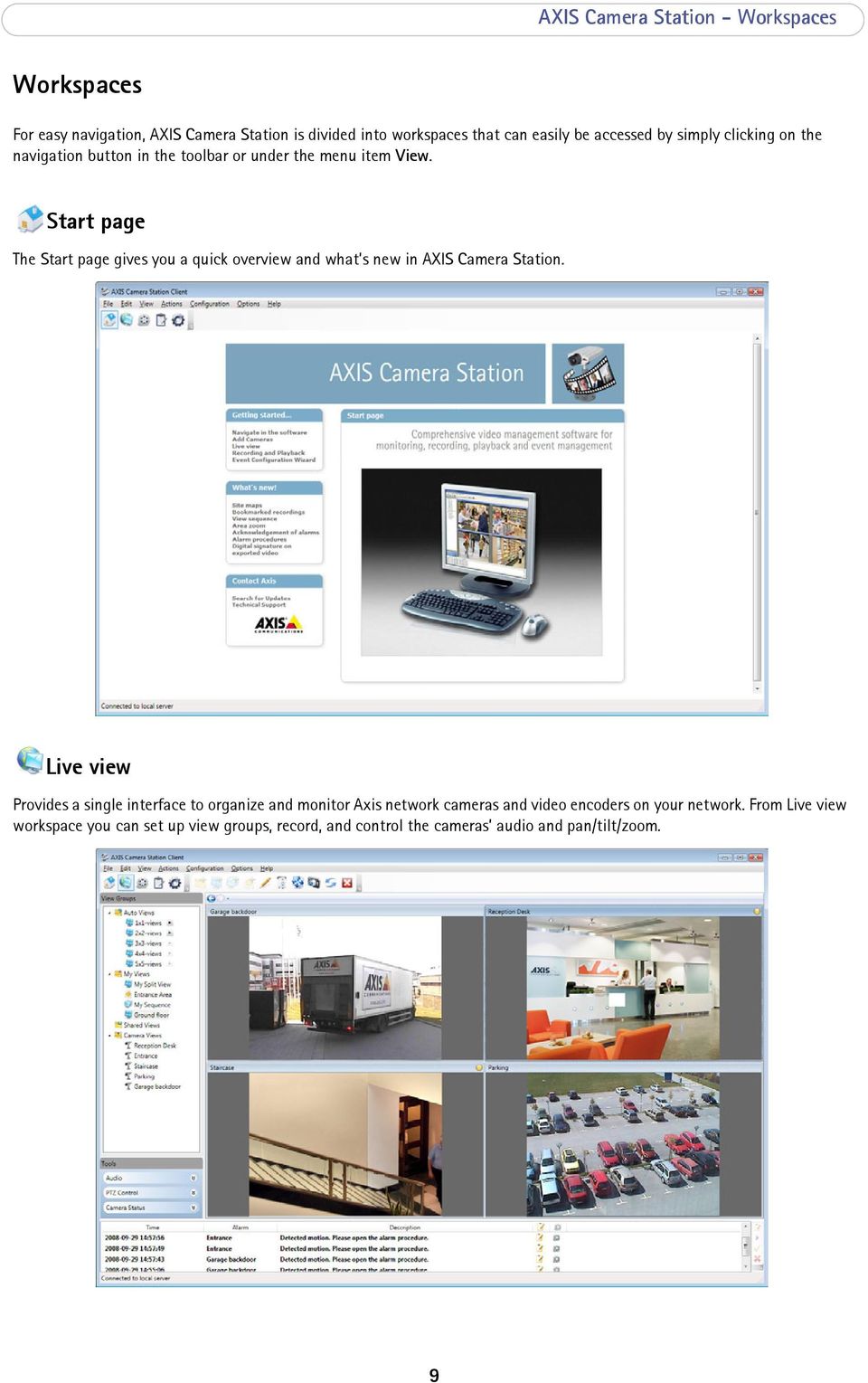
10 AXIS Camera Station - Workspaces View groups View groups is divided into four parts; Auto Views, My Views, Shared Views and Camera Views. For instructions on setting up custom views in My views and Shared views see Create views, on page 23 in the How to section. Auto Views - Live views from cameras and video encoders are automatically added here as they are added to AXIS Camera Station. My Views - Views can be custom designed by the current user to be viewed by the current user. Shared Views - Views created by an administrator or operator that are accessible by all users. Camera Views - Includes a list of all the cameras and video encoders added to AXIS Camera Station. Click a specific camera to open its Live View. For information on how to add devices to the system, see page 22. View group types Split Views - Set up split views in Live View to meet your needs. Sequences - Set up sequences with a unique combination of camera views, split views and maps, and with variable dwell times. Sequences are also called salvos. Maps - Arrange views (camera views, split views, sequences and maps) on imported maps. For instructions on how to add split views, sequences and maps to My Views and Shared Views, see page 23. Tools Audio Includes Master Volume and Mute controls for cameras with audio capability. A volume control becomes visible and active for individually selected cameras that have audio capability. To activate a volume control in the Live view image, place the mouse cursor over the desired camera s live view image and an overlay control appears. Notes: The audio controls will be inactive but visible in Tools and will not appear in the image if the user does not have proper authority for audio, seeuser permissions, on page 39. Audio is not available in M-JPEG streams. Manual recording button Master audio control Digital PTZ control Audio control in image 10

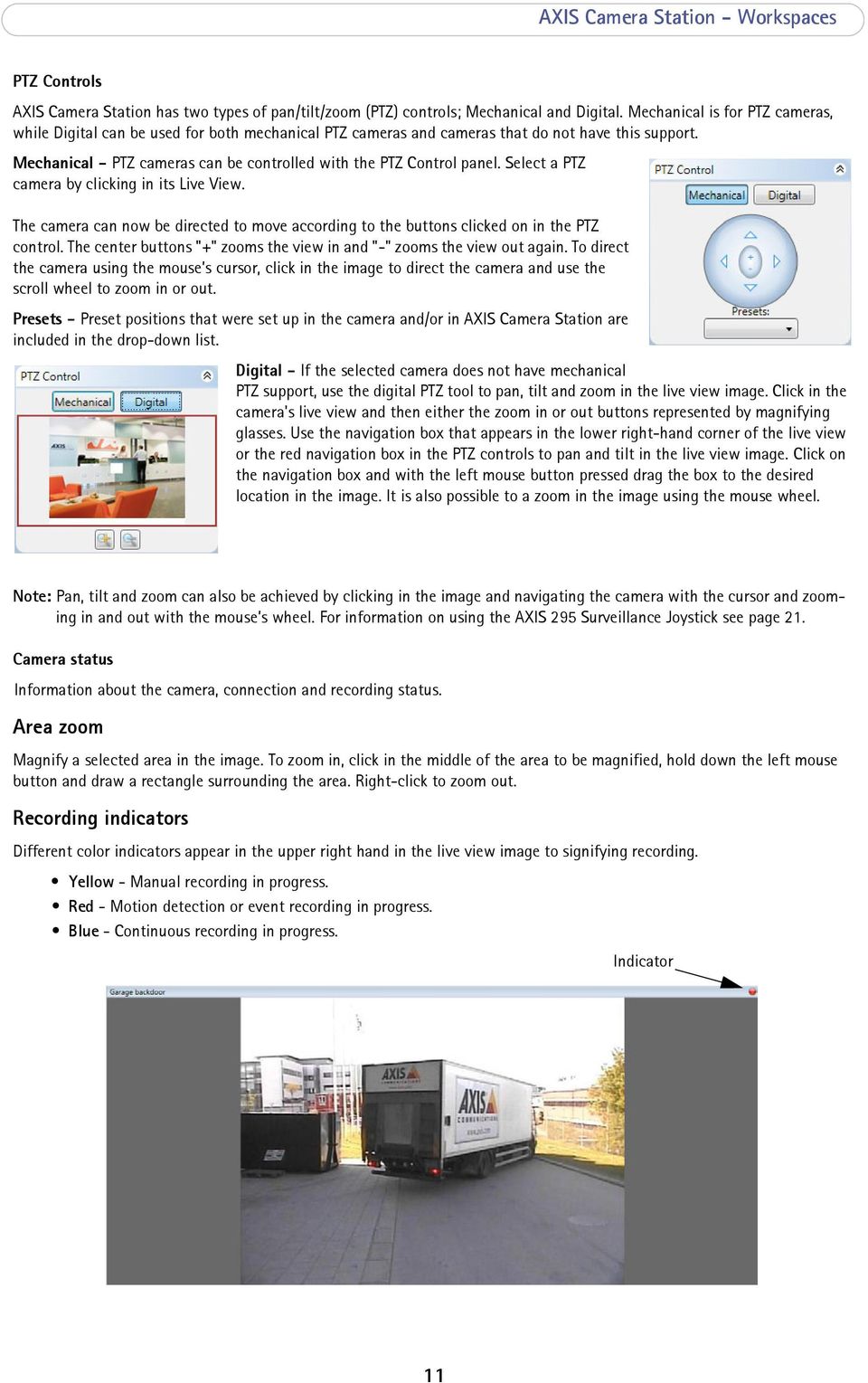
11 AXIS Camera Station - Workspaces PTZ Controls AXIS Camera Station has two types of pan/tilt/zoom (PTZ) controls; Mechanical and Digital. Mechanical is for PTZ cameras, while Digital can be used for both mechanical PTZ cameras and cameras that do not have this support. Mechanical - PTZ cameras can be controlled with the PTZ Control panel. Select a PTZ camera by clicking in its Live View. The camera can now be directed to move according to the buttons clicked on in the PTZ control. The center buttons "+" zooms the view in and "-" zooms the view out again. To direct the camera using the mouse s cursor, click in the image to direct the camera and use the scroll wheel to zoom in or out. Presets - Preset positions that were set up in the camera and/or in AXIS Camera Station are included in the drop-down list. Digital - If the selected camera does not have mechanical PTZ support, use the digital PTZ tool to pan, tilt and zoom in the live view image. Click in the camera's live view and then either the zoom in or out buttons represented by magnifying glasses. Use the navigation box that appears in the lower right-hand corner of the live view or the red navigation box in the PTZ controls to pan and tilt in the live view image. Click on the navigation box and with the left mouse button pressed drag the box to the desired location in the image. It is also possible to a zoom in the image using the mouse wheel. Note: Pan, tilt and zoom can also be achieved by clicking in the image and navigating the camera with the cursor and zooming in and out with the mouse s wheel. For information on using the AXIS 295 Surveillance Joystick see page 21. Camera status Information about the camera, connection and recording status. Area zoom Magnify a selected area in the image. To zoom in, click in the middle of the area to be magnified, hold down the left mouse button and draw a rectangle surrounding the area. Right-click to zoom out. Recording indicators Different color indicators appear in the upper right hand in the live view image to signifying recording. Yellow - Manual recording in progress. Red - Motion detection or event recording in progress. Blue - Continuous recording in progress. Indicator 11
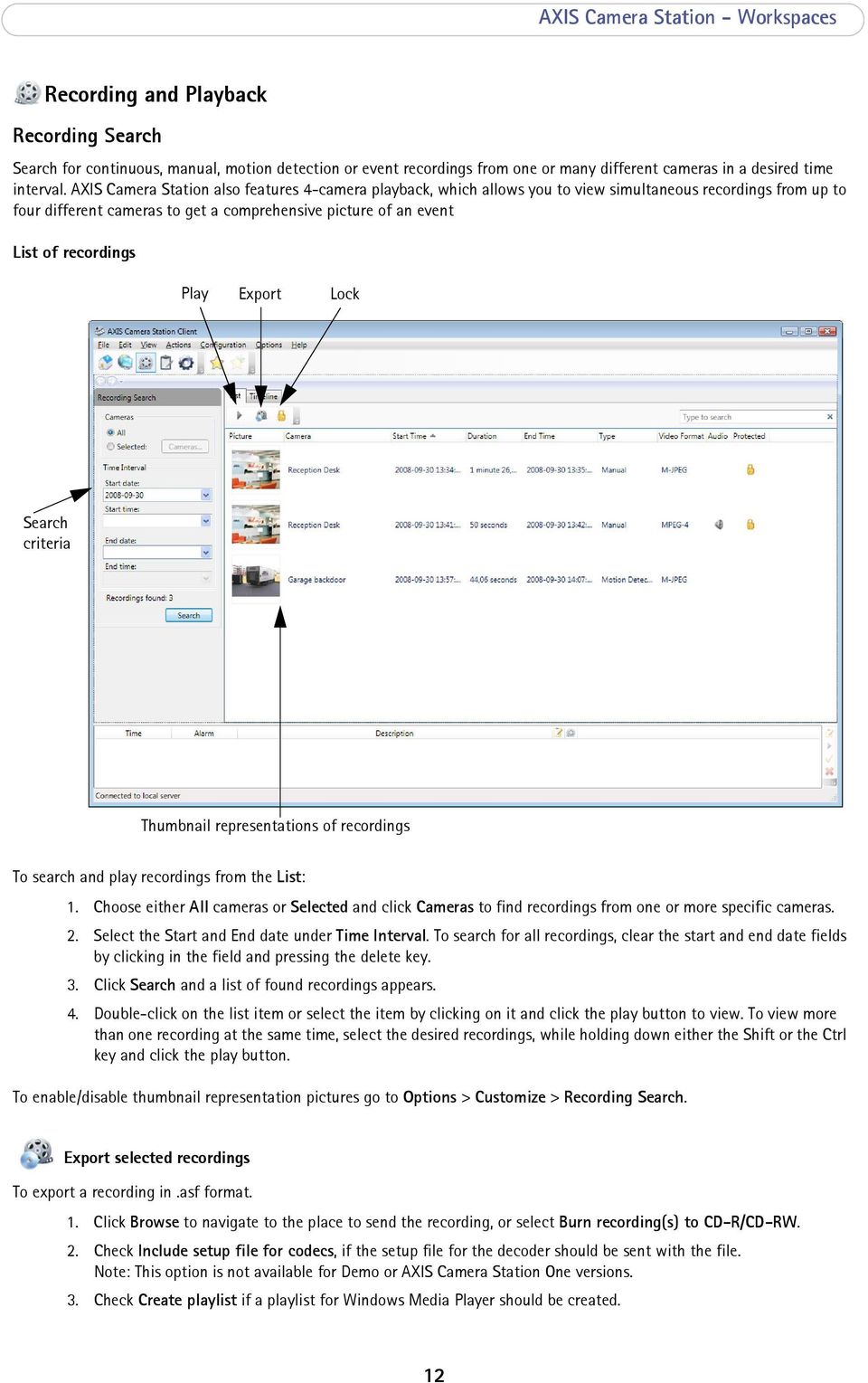
12 AXIS Camera Station - Workspaces Recording and Playback Recording Search Search for continuous, manual, motion detection or event recordings from one or many different cameras in a desired time interval. AXIS Camera Station also features 4-camera playback, which allows you to view simultaneous recordings from up to four different cameras to get a comprehensive picture of an event List of recordings Play Export Lock Search criteria Thumbnail representations of recordings To search and play recordings from the List: 1. Choose either All cameras or Selected and click Cameras to find recordings from one or more specific cameras. 2. Select the Start and End date under Time Interval. To search for all recordings, clear the start and end date fields by clicking in the field and pressing the delete key. 3. Click Search and a list of found recordings appears. 4. Double-click on the list item or select the item by clicking on it and click the play button to view. To view more than one recording at the same time, select the desired recordings, while holding down either the Shift or the Ctrl key and click the play button. To enable/disable thumbnail representation pictures go to Options > Customize > Recording Search. Export selected recordings To export a recording in.asf format. 1. Click Browse to navigate to the place to send the recording, or select Burn recording(s) to CD-R/CD-RW. 2. Check Include setup file for codecs, if the setup file for the decoder should be sent with the file. Note: This option is not available for Demo or AXIS Camera Station One versions. 3. Check Create playlist if a playlist for Windows Media Player should be created. 12
13 AXIS Camera Station - Workspaces 4. Check Add digital signature if a digital signature should be included. Select Include AXIS File Signature Tool to include a signature tool to verify the digital signature. 5. Click Export. To export part of a longer recording, using the timeline function, zoom in on the portion of the recording or under Time Interval enter the desired start and end time of the recording and click the search button again and then click Export. AXIS File Signature Tool is used to verify that recording files have not been tampered. Open the tool from Start > All Programs > AXIS Camera Station 3 > AXIS Camera Station Tools. For more information, see the AXIS File Signature Tool Help. Timeline The search results can also be viewed in a timeline presentation. Follow the recording search steps under List of recordings and click the Timeline tab. Toolbar Search criteria Recordings are color coded: Red - Motion detection recording Yellow - Manual recording Blue - Continuous recording Timeline toolbar A toolbar appears at the top of the search dialog with buttons to navigate the results. Play - Play selected recording. Export - Export to an.asf file. See Export selected recordings, on page 12. Zoom in - Zoom in on an area in the timeline. Zoom out - Zoom out of an area in the timeline. Select zoom area - To zoom in on a period of time, click this button and then select the desired time in the timeline. Pan left/right - Pan or move left and right in the timeline. Playback will also start by double-clicking the recording. To view recordings from more than one camera, select the desired recordings by clicking on the rows, while holding down either the Shift or the Ctrl key and click the play button. 13

14 AXIS Camera Station - Workspaces Playback How to start playback: 1. To start recordings from a specific time click at the top of the timeline. 2. A red line appears that can be placed at a desired point in time. 3. Click the play button to start playback. A timeline appears at the bottom of the view with the camera's name, date and time of the recording Playback control panel includes the following buttons from left to right: Play/Pause - Starts, resumes and pauses playback Stop - Stop playback Step Back - Step to previous frame in selected recording Step Forward - Step to next frame in selected recording Playback speed - Set playback speed Jump to previous recording's start Jump to next recording's start Master Mute - Mute audio for all recordings Master Volume Control - Volume control for all recordings In Playback mode you can pan/tilt/zoom by clicking in the image and scrolling in and out by scrolling with your mouse wheel. You can also click and draw a rectangle to magnify a selected part of the image, see Area zoom, on page 11. A navigation box appears in the lower right-hand corner to use to navigate around the image. If audio was included in the recording a volume control appears in the playback image. Smart search Snapshot Bookmark Audio control Navigation box 14

15 AXIS Camera Station - Workspaces Playback toolbar During playback the following toolbar buttons become active: Return to recording search - Click this button to return to the recording search results. Smart search With Smart search you can search for motion in a specific area in recordings. This is especially useful when searching continuous recordings. Click the Smart search button in the toolbar, a Smart search next button will appear in the playback panel, a motion window will appear in the image and a sensitivity slider will appear in the lower right-hand corner 1. Drag and size the motion window to the desired area of the image. 2. Adjust slider to the proper sensitivity. A high value indicates high sensitivity to motion. 3. Click the Smart search next button to jump to the place in the recording where motion takes place. Save selected snapshot to file - Open a dialog to save the selected snapshot as a.jpg image to file. Zoom in Zoom out Show bookmarks - Open the bookmarks list. Click on a bookmark to start playback. Right-click to edit or remove a bookmark. Add bookmark - Create a new bookmark. Bookmarks can be placed anywhere in a recording; playback will start from the bookmarked time. Recording details To obtain information of the recordings under the Timeline tab, right-click on the recording to open a Recording Details dialog. Information provided includes starting and ending date/time, playback, export and save image buttons. 15

16 AXIS Camera Station - Workspaces Logs For easy navigation and an instant overview of the system, the Logs workspace includes alarm, event and audit logs. When Live logs is enabled, it shows all current alarms, events and user audits. To list a specific time period, select the Search radio button and enter the date and/or time and click Search. Logs shows all alarms, events and user actions. Alarms - A list of alarms that have been triggered which were set up under Event Configuration and system alarms, such as disk errors and lost connections. Events - All camera and server events such as recordings and triggers. If errors occurred, error events are also listed here. Audit - Shows all user actions in AXIS Camera Station, such as manual recordings or additions to Event Configuration Rules. Export a log Logs can be saved as a text file by clicking the Export button. Alarms The Alarms tab shows all event and system alarms that were triggered. Listed are the date/time, title and description of the alarm. A toolbar appears at the top of the list with the following buttons for alarm handling. Go to Recordings - Start a playback of the event that triggered the alarm. Show Alarm Procedure - Display instructions for the camera operator. Acknowledge Alarm - Recognize the alarm. Remove Alarm Entry - (Live logs only.) Delete the alarm entry from the list. For information on setting up an alarm see Event Configuration Wizard, on page
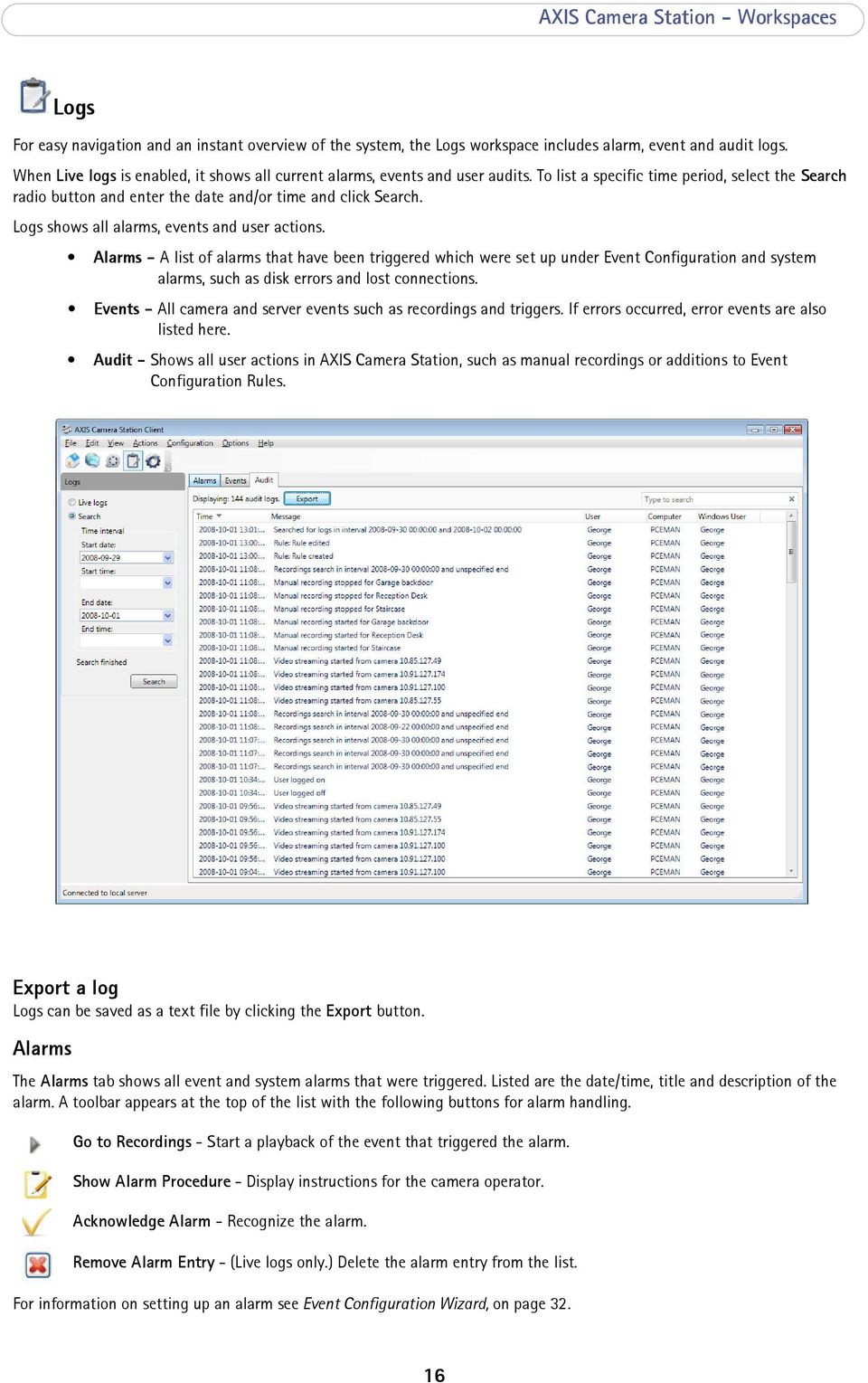
17 AXIS Camera Station - Workspaces Events The Events tab shows all camera and server events such as recording, triggers, alarms and system messages. Listed is the date and time the event took place, plus a short description of the event. Audit The Audit tab shows all user actions in AXIS Camera Station, such as manual recordings, video streaming started or stopped, and event configuration. Configuration Configuration is a collection of all the important links to get AXIS Camera Station up and running. Add/Edit Cameras - Add, edit and remove cameras in AXIS Camera Station. Live View Settings - Set format, resolution, compression, frame rate and audio (if applicable) for Live View. Recording Settings - Set up recording settings for one or more cameras for manual, continuous and motion detection. For more options and better flexibility, use Event Configuration instead. Event Configuration Wizard - Set up recordings and alarms by defining triggers and actions. User Permissions - Activate security and set up users with access rights to cameras. Recording Storage - Define where to store recordings and how much of the disk to use. Input/Output Settings - Add, edit and remove input and output ports for cameras that have been added to AXIS Camera Station. Schedules - Set up timetables to be used in event configuration and recording settings. Licenses - Add more licenses to AXIS Camera Station Server for more cameras or extended support date. Customize - Customize the look of AXIS Camera Station at Startup, the sound played when an alarm or event occurs, where to store snapshots and Playback behavior. PTZ Settings - Add new or modify existing pan/tilt/zoom preset positions. Bookmarks - Play, edit and remove bookmarks. 17

18 AXIS Camera Station - Licenses Licenses License modes When starting the application for the first time, AXIS Camera Station offers a choice between three license modes: Licensed version: Complete version of AXIS Camera Station allowing up to 50 camera channels. Demo: A 30 day evaluation version of AXIS Camera Station with up to four camera channels and full functionality. AXIS Camera Station One: A free version of AXIS Camera Station with one camera channel. Registering licenses Multiple licenses can be added to AXIS Camera Station to install up to 50 camera channels. Contact your local Axis resellers to purchase more licenses. AXIS Camera Station offers two ways to add and register a license: an automatic process within the application or a form on AXIS web site. If AXIS Camera Station Server is installed on a computer with Internet connection, the automatic registration is the easiest and fastest way to activate a new license. 18
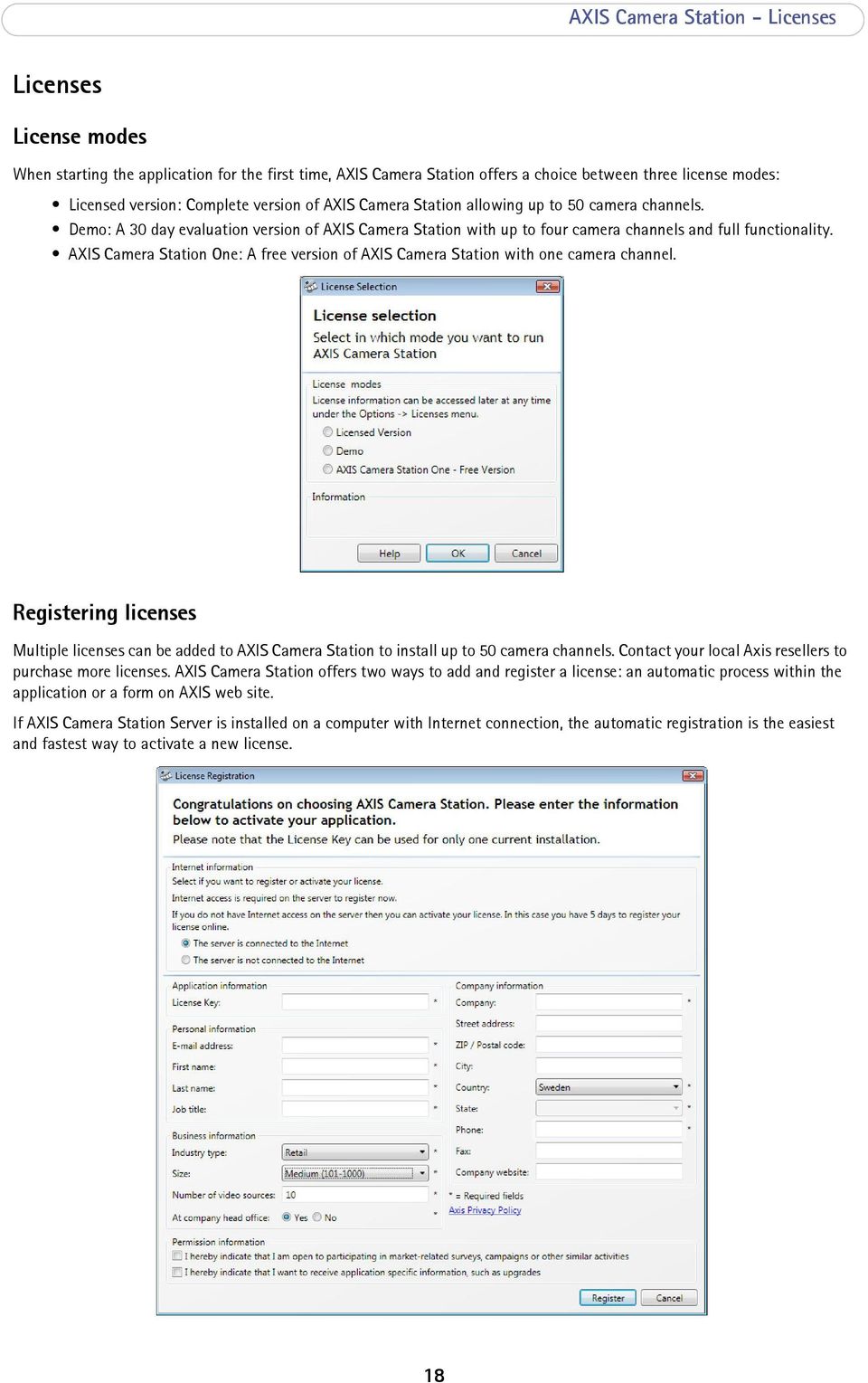
19 AXIS Camera Station - Licenses If AXIS Camera Station Server has no connection to the Internet, you can still add the license to AXIS Camera Station. License will start in Grace mode, which means that you have 5 days to activate it on Axis web site: Note carefully the server ID given in the License Registration dialog as you will need it to register your license on the web form. Once you have retrieved the Access Code, enter it in the dialog shown below and your license will be fully registered. License type AXIS Camera Station allows different kinds of licenses to be added: Base license: Allow adding a set of camera channels (4 or 10). The first license installed on the system must be a base license. Upgrade license: Allow adding more camera channels (1, 5 or 20). Support license: Add one year to the support period of the product. Support The initial base license includes one year free support and software upgrades for AXIS Camera Station. For access to support and upgrades after the first year has expired a yearly support license is required. A support license will grant you one year additional support and upgrades from the day when the new support license is registered. License transition AXIS Camera Station allows changing the license mode. Refer to the following table for more information about possible transitions: From/to Licensed version Demo AXIS Camera Station One Licensed version - No No Demo Yes - Yes AXIS Camera Station One Yes Yes - 19

20 AXIS Camera Station - Licenses Decoders If you are running AXIS Camera Station in Licensed version, installation of missing decoders can be done easily through the menu Options > Install Decoders or in the Live View workspace from the view itself. Due to licensing issues, decoders are not included in Demo mode and AXIS Camera Station One. Decoders can be installed from the cameras if the licensing terms are accepted. 20

21 AXIS Camera Station - AXIS 295 Video Surveillance Joystick AXIS 295 Video Surveillance Joystick The AXIS 295 is a USB device that gives responsive and accurate control of the pan, tilt, zoom functionality in PTZ and dome cameras. A newly installed joystick is detected on startup or when the refresh button is clicked in Live View. Button F1 F2 F3 F4 F5 F6 F7 F8 F9 F10 F11 F12 Function PTZ Preset 1 from camera PTZ Preset 2 from camera PTZ Preset 3 from camera PTZ Preset 4 from camera Go to previous camera view while in a split view Go to next camera view while in a split view Toggle Monitor mode Open a selected camera s view into a single view -N/A- Start and Stop manual recording Slow Fast Buttons F1-F4 are the PTZ preset positions as defined in the setup pages of the current camera the joystick is controlling. For more information, refer to the camera s online help. Buttons F5 and F6 allow you to toggle between camera views while in a split view. F7 opens the current camera in Monitor mode and F8 opens the Single camera view. F10 Starts and stops manual recording in Live view. On the joystick handle, F11 and F12 control the speed of the Pan/Tilt/Zoom. 21
22 AXIS Camera Station - How to... How to... After installing the software, it must be configured for your cameras and video encoders. Among other things, this chapter describes how to configure and maintain AXIS Camera Station as well as how to set up recording, motion detection, and alarms. For installation instructions, refer to AXIS Camera Station Installation Guide. Add cameras/video encoders The first time AXIS Camera Station is started, a search function automatically finds and adds cameras/video encoders that are on your network to AXIS Camera Station. If there are more cameras on your network than you have a license for, you will need to go to Configuration > Add/Edit Cameras from the menu. Follow the directions for either using Add a camera/video encoder - using search or Add a camera/video encoder - manually. Add a camera/video encoder - using search 1. From AXIS Camera Station, select Configuration > Add/Edit Cameras from the menu. 2. Click the Search button, a Search List window opens with a list of the cameras found on your local subnet and all the devices with routers that support multicast traffic. 3. Check the boxes of the desired camera/video encoder. Note: If there is a problem adding a camera, look at the status field in the search result list to see if the camera has, for example, obsolete firmware or credentials mismatch. Add a camera/video encoder - manually 1. Select Configuration > Add/Edit Cameras from the menu. 2. Click the Add button to open the Add Camera dialog. 3. Under Settings, enter the required information. Name - Enter a descriptive name for the camera Address - Enter the camera s IP address or host name Port - Enter the port number, if different than the default port 80 Video port - Video port number, if the device being entered is a multiport video encoder 22
23 AXIS Camera Station - How to... Enabled - The Enabled box should be checked. Recordings and Live View are not possible from this device, if this box is not checked 4. A valid administrator user name and password are required to access and configure Axis network cameras and video encoders. Master Credentials is the default user name and password to access a device and can be set under the menu item Options > Set Master Credentials. You also have the option of using specific credentials for a device. In this case, check the radio button Use specific credentials and enter the specific user name and password. 5. Click OK to save. Create views Create a new view group In Live View customize your own view layout or share views with other users. 1. Right-click in My Views or Shared Views under View Groups in the Live View workspace. 2. Choose Add View Group from the pop-up menu. 3. Enter an appropriate name for the group. 4. Click OK to save and close the dialog. To add a Map, Sequence or Split view follow the instructions Create a Map, Create a Sequence or Create a Split View. Create a split view 1. Right-click on My Views, Shared Views or a created view from the Live View workspace and choose Split View from the pop-up menu. 2. Enter a descriptive name and choose a layout from the drop-down list. 3. Drag-and-drop cameras, views and maps to the desired camera views into place. You can define a frame in the view as a Hotspot that will automatically load the view from a camera when it s clicked on and it receives the Live View of a camera that is defined in Event Configuration under Alarm Action, for more information refer to the help pages. This is particularly useful for asymmetric views with one large view frame and a number of smaller views. The large view frame is typically defined as the hotspot. To define a hotspot click in the desired section of the view and click Set Hotspot. 4. Click OK to save settings and close dialog. 23
24 AXIS Camera Station - How to... Create a sequence With AXIS Camera Station, you can set up sequenced views from multiple cameras. Each sequence can be set with a unique combination of camera views and variable dwell time. 1. Right-click on My Views, Shared Views or a created group under View Groups in the Live view workspace and choose Add Sequence from the pop-up menu. 2. Enter a descriptive name. 3. Drag-and-drop the cameras, views and maps you would like included into Sequence Items. 4. To include PTZ presets, select a PTZ camera and click Set Properties. 5. To set the number of seconds the sequence will dwell on a camera s Live View, click on the camera and click Set Properties. 6. Click OK to save settings and close dialog. Create a map A map gives a visual overview of the cameras in your installation. A map is an image, for example a drawing or a photograph, on which you place cameras and views. Maps can also be placed on other maps to create a hierarchical structure. 1. Right-click on My Views, Shared Views or a created group under View Groups in the Live view workspace and choose Add Map from the pop-up menu. 2. Enter a descriptive name. 3. Click Import Map... and enter the file name or browse to locate the file. 24
25 AXIS Camera Station - How to Drag-and-drop cameras, views and other maps on the map. 5. To delete a view on the map, select the view and click Delete View. 6. Click OK to save settings and close the dialog. Add a preset position For cameras with pan/tilt/zoom (PTZ) functionality, preset positions provide quick access to predefined camera views. Preset positions can be added to Sequence Views and used with the mechanical PTZ control. Follow these steps to add a preset position 1. Select Configuration > PTZ Settings. Select a PTZ camera and click Configure. 2. Steer the camera to the desired view using the mechanical PTZ control or clicking in the Preview window. 3. Click Add and type a descriptive name. Click OK. Note: Presets can also be added and configured using the camera s web interface. The listed presets include preset positions configured both in AXIS Camera Station and in the camera. Click Refresh to update the list. 25
26 AXIS Camera Station - How to... Set up recording storage To specify where to store your recordings select Configuration > Recording Storage. To prevent the hard drive from becoming full a maximum disk capacity should be set. Additional server and network disks can be added for security and more space. 1. Click on Add server disk or Add network disk. 2. Enter the path of the disk and click OK to save. 3. Select the newly added disk. 4. With the slidebar set the maximum disk space to be used by AXIS Camera Station. To change the location of where recordings will be stored, click Edit and enter a new directory. Recording storage settings for cameras To enter or change storage settings for individual cameras from Configuration > Recording Storage: 1. Select the camera by clicking on it under Cameras. 2. Click Edit and the Edit Camera Recording Storage Settings dialog opens. 3. Choose the disk to save recordings to from the drop-down list Record to disk. 4. Set the number of days to keep recordings. By default the recordings are set to Unlimited. 5. Click OK to save settings. To enter default storage settings for all newly added cameras, click Default Settings under Cameras. Note: Maximum drive space has precedence over the number of days to keep recordings. Recordings will be deleted if there is no room left in the allotted drive space. Set up recording Recordings can be continuous, scheduled, manual or triggered by motion or alarm. Media profiles can be created for each type of recording for, among other settings, optimal frame rate and resolution. See Configure media profile settings, on page 29 for more information. Continuous recording With this option, the server is set to continuously save video. Note that this option uses more disk space than a triggered recording. 1. Click on menu items Configuration > Recording Settings. 2. Select the camera and click the Continuous button. 3. Check the Enabled box and choose a Video setting from the drop-down list or click Change to make a new video setting. 4. Click OK to save settings. 26
27 AXIS Camera Station - How to... Scheduled recording 1. To set up a scheduled recording, start with the Continuous Recording Settings above and select the Custom schedule radio button. 2. Choose a schedule from the drop-down list, click Edit to revise an existing schedule, or click New to create a schedule. 3. Click OK to save settings. See Set up schedules, on page 30 for more information on setting up schedules for recording or events. Manual recording With AXIS Camera Station you can manually record whenever you need to by clicking on the button in the camera's Live view frame. Follow these instructions to set up manual recording for a device. 1. Click on menu items Configuration > Recording Settings. 2. Select the camera and click the Manual button to open Edit Manual Recording Settings. 3. Click the Change button to adjust the video setting profile. For additional information see Help. 4. Use the slidebars to set the number of seconds to include before (prebuffer) and after (postbuffer) the manual recording. 5. Click OK to save settings. To record, click on the button that appears in the upper right corner when the cursor is over the camera's live view frame. The camera is recording when a yellow indicator appears. Click the button again to stop recording. You can also go through the menu item Actions and open the Record Manually dialog. Click the Start button to begin recording and the Stop button to end. Motion triggered recording Motion can be detected by Axis network cameras that have built-in motion detection software. Recording only when motion is detected will save hard disk space compared to other options such as recording continuously. Motion Detection Recording can be configured using the Event Configuration Wizard or the Recording Settings dialog as described here. 1. Click on menu items Configuration > Recording Settings. Select the camera and click the Motion Detection button. 2. Check the Enabled box. Motion detection settings These instructions will step you through setting up the motion detection window with object size, history, and sensitivity. 1. Set the Trigger period to the number of seconds between events. For example, in cases where there is continuous motion to prevent many alarms being sent, set the slidebar to the desired amount of seconds between events. 27
28 AXIS Camera Station - How to Click the Motion Settings button to configure motion detection windows. 3. Set the area for motion detection by clicking on the Add button. 4. Select the Include radio button. 5. Position the window in the desired area of the camera s view. The motion detection window can be resized and moved by clicking on the sides of the box. 6. Under Settings the Include radio button should be selected by default. 7. The Object size, History and Sensitivity can be set manually or by using predefined settings. Begin with a predefined setting and if needed fine adjust the settings using the slidebars while looking in the Activity window while there is a desired amount of motion in the window. Object size - Object size is relative to the region size. At a high level, only very large objects are detected. At a low level even very small objects trigger an event History - History defines how long an object needs to be in a region before it is considered to be non-moving. At a high level an object that appears in the region will trigger the motion detection for a long period. At a low level an object that appears in the region will trigger motion detection for only a very short period. Sensitivity - Sensitivity defines the difference in luminance between the background and the object. At a high level ordinary colored object on ordinary backgrounds will trigger motion. At a low level only very bright objects on a dark background will trigger an event 8. Click OK to save settings. Configure exclude windows An Exclude window will mask an area in an Include window where detected motion will be ignored. The area of exclude window is shaded white. Movement outside the include window is automatically ignored. Follow these steps to set up an Exclude window. 1. Click the Add button and then select the Exclude radio button. 2. Move and size the Exclude window over the desired area of the Include window. 3. Click OK to save settings and close dialog. 28
29 AXIS Camera Station - How to... Configure media profile settings Media profiles are entered to be used in Live View and Recording Settings. The available formats are automatically loaded in the drop-down list. Enter Profile settings 1. Choose a Format for your media profile from the drop-down list. The options that appear in the list depend on the formats supported in the camera. Note: Cameras configured for MPEG-4 can only have one MPEG-4 profile at one time. 2. Select the Resolution to use. Depending on the camera, resolution can fall into different ranges. Resolution is a measure of how much detail a digital image can hold; the greater the resolution, the greater the level of detail. 3. Changing the Compression level affects the amount of bandwidth required. Lower compression improves image quality, but uses more bandwidth and storage space. 4. Specify the desired Frame rate. The actual frame rate depends on the model of camera, network conditions and your PC configuration. Check Max if you like to always use the maximum frame rate possible. 5. Audio is only visible if the selected camera supports audio and is only available for MPEG-4 and H.264. Select this option to enable audio in live view or in recordings. When using split views with more than 6 cameras in Live View, media profiles are overridden to improve performance. Navigate to Configuration > Live View Settings and click Advanced to change the default settings. Add Inputs and Outputs External devices such as window sensors, glass break detectors or PIRs (Passive Infrared Detector) can be connected to camera inputs and used for triggering alarms, recordings or messages. An output s main function is to trigger external devices such as a door relay that controls door locks, or an alarm siren. For more information about input/output ports, refer to the camera's User's Manual. To add an I/O port to AXIS Camera Station: 1. To open the I/O Settings dialog, choose menu item Configuration > I/O Settings. 2. Click Add to open a dialog with list of available I/O ports in existing devices. 3. Highlight the desired input or output port by clicking on it. 4. Click OK. The Add I/O port dialog opens. Here you give your input or output port descriptive names to appear under Logs, I/O Monitoring dialog and Event Configuration Wizard. Refer to your camera and its User's Manual about how the I/O ports were defined for setting descriptive names to the active/inactive states. 29
30 AXIS Camera Station - How to... Initial State Output ports can be set to an initial state upon startup and when AXIS Camera Station establishes contact with the camera. Check On startup set to to enable setting the initial state of the output port and choose the initial state of the Output port from the drop-down list. The names for the states were defined under Names. Set up schedules Timetables can be set up to be used in Event Configuration Wizard and Recording Settings. Once a schedule has been entered, it can be reused as often as necessary. On special dates, for example public holidays, special schedules can be used. Follow these steps to set up a schedule: 1. Navigate to Configuration > Schedules from the menu. 2. Click Add to open the Schedule Editor. 3. Enter a descriptive name for the schedule. 4. Click and drag on the timelines to define intervals. A blue bar means the schedule is on while white means the schedule is off. 5. To use a different schedule for special dates, click Override... Select the special dates and click Edit... to set up the schedule. 6. Click OK to save. 30
31 AXIS Camera Station - How to... Send notification on system alarm A system alarm occurs when connection is lost to a camera, access to a recording disk is denied, or when a recording disk is full. Here you can set up an notification when a system alarm occurs. 1. Navigate to Configuration > System Alarm... from the menu. 2. Check Send on system alarm to the following recipients. 3. Enter the addresses alarm messages should be sent to. 4. Under New recipient, choose if the address should be in the To, CC or BCC field of the and enter the address. 5. Click Add to enter the address into the Recipients box. 6. Click OK to save. Note: To send s, an SMTP server must first be added. Go to Options > SMTP Servers to add an SMTP server. 31
32 AXIS Camera Station - Event Configuration Wizard Event Configuration Wizard Event Configuration Wizard helps you set up rules for triggers and actions in AXIS Camera Station. By setting up a rule you can design actions to events; for instance when motion is detected, a siren will sound and recording will begin on designated cameras. Triggers are classified as Motion detection, Input/Output and System event. A Motion detection trigger is when an Axis camera detects motion within its defined area. Detection is performed by the camera which means no processing load to the server. Input/Output is when a camera's I/O port receives a signal from an external device, such as a doorbell, smoke detector or switch. A System event occurs when connection to a camera is lost, access to the recording disk is denied or when the recording disk is full. Actions are classified as Record, Raise alarm, Set Output, Send and Live view. Record starts a recording with a defined recording profile. Raise alarm sends an alarm, including an uploaded alarm procedure, to all connected clients. Set Output sets the state of an output port and can be used to control an external device connected to the port. Send sends an , with attached snapshots, to one or more recipients. The Live view action brings all clients to front and opens a specified camera view or PTZ preset position. I/O ports must be added to AXIS Camera Station before being used in the Event Configuration Wizard. See Add Inputs and Outputs, on page 29. Create a rule In this example, a camera s input port is connected to a switch for a door. When the door is opened, a recording will start, an alarm will be raised and s will be sent to selected recipients. Select Configuration > Event Configuration from the menu to open the Event Configuration Wizard. Click New to open the New Rule dialog. The Event Configuration Wizard helps you set up a rule for the event. The steps are highlighted on the left side of the dialog. Add an I/O trigger The first step is to add one or more triggers. 1. Click Add and a dialog opens to choose a trigger type. For this example, choose Input/Output and the Create I/O Trigger dialog opens. 32
33 AXIS Camera Station - Event Configuration Wizard 2. Choose the port and the trigger s state to activate an event from the drop-down lists. In this example, the door switch is connected to the input port of the camera viewing the Garage backdoor. The event should be triggered when the door is opened. Note: The contents of the drop-down lists depend on how the port was defined under Configuration > I/O Settings. See Add Inputs and Outputs, on page 29 for more information. 3. Since the trigger can go off many times and create unwanted events, an option is to set the Trigger period slider so that any triggers that come in under this period will be treated as one trigger. 4. Click OK to save the trigger settings. At this point more triggers can be added or you can go back and edit or remove this trigger with the buttons on the right-hand side of the Rules dialog. When using several triggers, only one of the triggers needs to become active to initiate an action. Add actions The next step is to add event actions. In this example, three actions will be created. Record action 1. Click Next to go to the Actions section and click Add. 2. Select Record. 3. In Create Recording Action choose the camera that should start recording. In this example, Garage backdoor. 4. Select the Video setting profile from the drop-down list or click Change to enter a new profile. See Configure media profile settings, on page 29 for more information. 5. With the slidebars select the number of seconds to include before the trigger (Prebuffer) and after the trigger stops (Postbuffer). 6. Click OK 33
34 AXIS Camera Station - Event Configuration Wizard Raise alarm action 1. In the New Rule dialog, Actions step, click Add and select Raise alarm. 2. Type a title for the alarm message and a description. The alarm message will be displayed in the alarm log in the Live View and Logs workspaces. An alarm procedure containing instructions for the camera operator can be included in the message. The alarm procedure is an uploaded file, for example a text or image file. 3. To include an alarm procedure, check the box under Alarm procedure, click Upload and browse to locate the file. 4. Click OK to save. Send action 1. In the New Rule dialog, Actions step, click Add and select Send Enter the addresses that alarm messages should be sent to. Under New Recipient, choose if the address should be in the To, Cc or Bcc field of the and enter the address. 3. Click Add to enter the address into the Recipients box. 4. Enter an appropriate description for the in the Subject field. 5. Enter a short message to the recipient. 6. To attach camera snapshots, click Select Cameras... and choose the cameras to include snapshots from. 7. Click OK to save the . Note: s cannot be sent by AXIS Camera Station if an SMTP server has not been added. Go to SMTP servers under Options. Setting a schedule The next step is to set a schedule for the event. Click Next to go to the Schedule section. Select Always to let the rule be active at all times or select a Custom Schedule from the drop-down list. For more information about schedules, see Set up schedules, on page
35 AXIS Camera Station - Event Configuration Wizard Rule details Click Next to go to the Details section. Type a descriptive name for the Rule and make sure the Enable this rule box is checked. Click Finish to complete the rule. 35
36 AXIS Camera Station - Network and Security Configuration Network and Security Configuration Server port configuration The ports (control) and (media streaming) are used on the AXIS Camera Station Server computer for communication between the server and the AXIS Camera Station Client. These ports are used on the AXIS Camera Station Server computer for communication between the server and the AXIS Camera Station Client. If these are not the appropriate port assignments open AXIS Camera Station Service Control from Start > All Programs > AXIS Camera Station 3 > AXIS Camera Station Tools > Server Control. Under Proxy settings the radio button for Direct connection should be enabled. Cameras outside of the local network To include cameras in AXIS Camera Station that lie on the other side of a proxy server you must configure AXIS Camera Station to use the proxy. AXIS Camera Station Server AXIS Camera Station Client 1. Open AXIS Camera Service Control from Start > All Programs > AXIS Camera Station 3 > AXIS Camera Station Tools. 2. Under Proxy settings the radio button for Use manual proxy settings should be enabled. 3. Enter the address and port number of the proxy server. This is usually the same address and port number as under Internet Options in Windows Control Panel. 4. If there are local cameras that do not go through the proxy server, check Bypass proxy for local addresses and enter the cameras addresses in the box separated by semicolons. Note: If you don t know your proxy server settings contact your network administrator. 36
37 AXIS Camera Station - Network and Security Configuration AXIS Camera Station Client behind a firewall AXIS Camera Station Server AXIS Camera Station Client From the AXIS Camera Station Client connection dialog, select the appropriate option depending on your setup. Direct connection - Select this option if there is no proxy server between AXIS Camera Station Client and AXIS Camera Station Server. Use Internet Explorer settings - AXIS Camera Station will use the same settings as Internet Explorer. Use manual proxy settings - This option allows you to fill in the required information manually under Manual settings. 37
38 AXIS Camera Station - Network and Security Configuration Manual settings Address - Enter the address or host name of the proxy server. Port - Enter the port number of the proxy server. Do not use proxy server for addresses beginning with - Allows you to exclude certain servers from access by the proxy. Use semicolons to separate the entries. Wildcards can be used in the addresses or hostnames, for example: "192.*" or "*.mydomain.com" 38
39 AXIS Camera Station - Network and Security Configuration User permissions Using Windows Active Directory, a high level of security can be implemented in AXIS Camera Station when granting user permissions. Before users can be granted access to AXIS Camera Station, they must be added to the local computer or have an Active Directory user account. A user can be granted access as an individual or as part of a group. In cases where a user is granted access as an individual he will retain this right plus receive the rights he receives as part of a group. For example, a user is given access to camera X as an individual. The user is also a member of a group. The group is given access to cameras Y and Z. The user then has access to cameras X, Y and Z. Administrators of the computer on which the AXIS Camera Station server is installed are automatically given administrator privileges to AXIS Camera Station. It is not possible to change or remove the administrators group's privileges. Local security By default, local security is Disabled which means all users, who log onto AXIS Camera Station Server installed on the same computer as the AXIS Camera Station Client, will be given Administrator access. When local security is Enabled, access to AXIS Camera Station is restricted to trusted users and groups for both remote and local clients. Click Security Settings to change local security settings. For remote clients, local security is always enabled. Add User/Group To add a user or a group, click Local Server or Domain. The available users and groups are listed under Available domain users/groups. To narrow the search, check or uncheck the appropriate boxes Users or Groups under Show. The list of available users/groups automatically refreshes. Select the user or group from the list and click Add to open the User/Group Privileges dialog. Note: If the domain user search fails, make sure the user has access to the Active Directory. Users can be changed in Windows under Control Panel > Administrative Tools > Services. User/Group Privileges Give users an access level to AXIS Camera Station, selected cameras, and I/O ports. The authority level given the user/group: Administrator - Full access to all functionality of AXIS Camera Station and added cameras Operator - Full access to all functionality of AXIS Camera Station except Configuration pages and access to audit logs. Full access to selected cameras and I/O ports Viewer - Access to selected Live Views and I/O ports. For Input/Output ports to be visible here, they must be added first through I/O Settings. See Add Inputs and Outputs, on page
40 AXIS Camera Station - AXIS Camera Station Service Control AXIS Camera Station Service Control AXIS Camera Station Service Control is the application that controls AXIS Camera Station Service. The Service Control is started when the user logs on to Windows and is located in the system tray. In most installations, the Service Control s default settings are sufficient, but in those cases where AXIS Camera Station Server and AXIS Camera Station Client or cameras are separated by a proxy server then settings will need to be adjusted accordingly. The system tray icon will display service changes, e.g. if the service is started or stopped. There are three ways to open the service control; double-click the icon in the system tray, right-click and select Open AXIS Camera Station Service Control from the pop-up menu or from Windows Start > All Programs > AXIS Camera Station 3 > AXIS Camera Station Tools > Service Control. In addition to modifying the server settings, the AXIS Camera Station Server Control allows you to start, stop and restart the server. See also AXIS Camera Station Service Administration, on page 43. Modify server settings To change service settings, check the box Modify server settings. Click Restore Default Settings to restore the default values for the server, streaming ports and proxy settings. Server settings Under Server settings enter the ports the server will use to communicate with the clients. The streaming port is used for video streaming, for example sending live video or playback from the server to the client. If there is a NAT or proxy between the server and clients, the ports must be configured to let communication pass through. Note: A server port number must lie between Once satisfied with the changes click Save. You will be prompted to restart the service for the changes to take effect. 40
41 AXIS Camera Station - AXIS Camera Station Service Control Database backup The database stores information about configurations, recordings etc that is needed for AXIS Camera Station to work properly. The database is backed up every night. The backups are saved to a Backup folder which can be located on the local computer or the network. To change the backup folder, click Browse and navigate to the desired location. The oldest backup will be deleted when the number of saved backups exceeds the value specified in Number of backups to keep. Up to 30 backups can be kept in the same folder. Notes: The backup will be saved to the default location if it cannot be written to the folder specified, for example if the server cannot access the folder. The default location is Windows XP C:\Documents and Settings\All Users\Application Data\Axis Communications\AXIS Camera Station Server\backup Windows Vista C:\ProgramData\Axis Communications\AXIS Camera Station Server\backup The backup files are named acs_system_<date_time>.fdb and license_system_<date_time>.fdb. Recordings are stored in the location specified in Configuration > Recording storage and not in the database, see Set up recording storage, on page 26. Recordings should be backed up separately. Proxy settings If there is a direct connection with the Client and cameras in the system the default Direct connection radio button should be selected. If AXIS Camera Station Server is behind a proxy server, and cameras and/or clients are outside the proxy server, modify the proxy settings manually by selecting Use manual proxy settings. The proxy settings entered here are probably the same as those entered in the Internet Options in the Control Panel. Check the box Bypass proxy for local addresses and enter local addresses or host names of local cameras where communication does not need to pass through the proxy server. For more information, see Cameras outside of the local network, on page
42 AXIS Camera Station - AXIS Camera Station Service Control Server status Server status shows the current status of the AXIS Camera Station Server. The buttons Start, Stop or Restart change the server status. 42
43 AXIS Camera Station - AXIS Camera Station Service Administration AXIS Camera Station Service Administration The console application AcsAdminConsole.exe is located under Program Files/Axis Communications/AXIS Camera Station 3 if the default path was used when installing AXIS Camera Station Server. This console application can be used when wanting to integrate control of the AXIS Camera Station Service in environments where AXIS Camera Station Server is installed. AcsAdminConsole can be used by other applications to backup, start or stop the service. Everything the AXIS Camera Station Service Control can do AcsAdminConsole can do. To begin open the Command Prompt and navigate to Program Files/Axis Communications/AXIS Camera Station 3. Supported operations Command AcsAdminConsole --help AcsAdminConsole --backup AcsAdminConsole --backupcount=<number> --backupdir=<path> AcsAdminConsole --start AcsAdminConsole --stop AcsAdminConsole --restart AcsAdminConsole --port=<port number> AcsAdminConsole --manualproxy --proxyaddress=<proxy> --proxyport=<port> --bypassproxy=<true/false> --bypassproxyaddresses=<addresses> --disableproxy Description List a summary of the supported operations Back up the database. Each backup generates two timestamped files named acs_user_<date_time>.fdb and license_user_<date_time>.fdb. For information on how to restore the database, see Lost data, on page 46. Specify the number of backups to keep (this number affects the automatically generated backups discussed on page 41, not the ones generated by the --backup command). Specify the folder where the backups will be stored. Start service Stop service Restart service Set server port (e.g. AcsAdminConsole --port=55762) Use manual proxy settings. Set the proxy address and port (default 80). Bypass proxy for local addresses. Example: bypassproxyaddress=192.*, *mydomain.com Note: AcsAdminConsole backs up configurations and metadata but not recordings. 43
44 AXIS Camera Station - Troubleshooting Troubleshooting Symptoms, possible causes and remedial actions Area zoom Area zoom does not work. Audio There is no audio from one or more cameras in Live View Area zoom is not supported by AXIS 209MFD and AXIS 212 PTZ. Use the digital or mechanical PTZ controls instead. Follow these steps to troubleshoot audio. - Make sure the camera has audio capabilities - Check that audio is activated in Live view settings: 1. Go to Configuration > Live View Settings from the main menu 2. Click on the desired camera and then Edit to open Live View Settings 3. Click Change 4. Check the Audio box Note: Audio is not possible in M-JPEG. Choose another format if you desire audio. - Make sure the user has access rights to audio. Note: To follow these steps you must have administrator rights to AXIS Camera Station 1. Go to Configuration > User Permissions from the main menu 2. Click on the User or Group and Edit 3. Click the Advanced button. Make sure that Audio is checked in the desired camera - Check that your computer has an audio card and that it hasn't been disabled. There is no audio in views larger than 6 split Audio is not available in views with more than 6 split views using the default Live View Settings. Views larger than 6 splits use the M-JPEG video format, which does not support audio. To change the default settings 1. Go to Configuration > Live View Settings from the main menu. 2. Click on the desired camera and then Edit to open Live View Settings. 3. Click Advanced. 4. Change the settings under Overrides. Enable audio by changing the media profiles or uncheck the appropriate boxes to disable the overrides. Note: Audio is not possible in M-JPEG; choose MPEG-4 or H.264. There is no audio in playback Missing AAC decoder Domain user search fails Graphics card The Graphics card driver is more than 3/12 months old If audio was not enabled there will not be audio in the playback. Go through the steps above, but select Recording Settings instead of Live View Settings, to make sure audio has been enabled. A proper decoder must be installed for the AAC audio format. In licensed mode, click on the link to launch the decoder installation. In AXIS Camera Station One or Demo mode, download the decoder from the camera s Live View page. If the Domain user search fails, make sure that the user that logged on to the service has access to the Active Directory. Users can be changed under Windows Control Panel > Administration tools > Services. For AXIS Camera Station to run properly, it's important that the graphics card in your computer has been updated with the latest driver. To find out what graphics card is installed in your computer, a diagnostic program called dxdiag can be used. In Windows XP 1. Select Start 2. Choose Run 3. Enter dxdiag in the Run dialog and click OK 4. If a prompt appears for the Diagnostic Tool, click Yes 5. Select the Display tab. The name of the Graphics card appears under Device 44
45 AXIS Camera Station - Troubleshooting The Graphics card driver is more than 3/12 months old. (cont) In Windows Vista 1. Select Start 2. Enter dxdiag in the Start Search field 3. If a prompt appears for the Diagnostic Tool, click Yes 4. Select the Display tab. The name of the Graphics card appears under Device To download the latest driver you need to visit the graphics card manufacturer's web site. Some of the more common ones are nvidia - ATI - S3 - To upgrade the graphics card drivers on your computer: Live View No image from camera 1. Download the driver from the manufacturers web site to your hard drive 2. Make sure that there are no other programs running on your computer. 3. Uninstall the existing drivers 4. Run the installer and follow the wizard to install necessary files 5. Reboot to activate the change Proper decoders must be installed for MPEG-4 and H.264 video formats. In licensed mode, click on the link provided where the camera s Live View should be to launch the installation of codecs. In AXIS Camera Station One or Demo mode, download the proper codecs from the camera s Live View page. Repeated error message "Media Failed" Try reducing the load to the CPU by modifying the Live View Settings for each camera under Configuration. Reduce the resolution, increase the compression setting and lower the frame rate. Logon/connecting to server User is not authorized to login on server! Check that your computer is not running low on memory. Check that the user name and password are valid Check that the user has access rights to AXIS Camera Station Server If AXIS Camera Station client is running on Microsoft Vista and the user has not been added to the server, but is a member of the local administrators group on the server, the client can be started by right-clicking on the shortcut and selecting Run As Administrator. To avoid this, make sure that the user is added to AXIS Camera Station server using the User Permissions dialog AXIS Camera Station Server was unable to verify message security. Please make sure server and client UTC times are reasonably synchronized The clocks in AXIS Camera Station server and client are not synchronized. Adjust the clock in either the server or client so that they have the same date and time properties. For more information on setting up time in your computer consult the Window s help files. Connection refused, server is not accepting any connections. Check that a NAT/firewall is not blocking a connection to the server No connection, unable to locate server. Check the address and port of the AXIS Camera Station server is correct. Check that a NAT/firewall is not blocking a connection to the server Check that the server is running. One way is to click on the AXIS Camera Station Server icon in the system tray. Check the Server Status at the bottom of AXIS Camera Station Service Control. If status Shows "Stopped", click Start. Failed to connect to server! Verify that the computer the server and client are installed on is up to date and has the latest service packs/patches from Microsoft Verify that the network is correctly installed and configured on the server and client computer(s) Verify that no NAT/firewalls are blocking connection between AXIS Camera Station client and server Menu items I can't see the configuration menu You do not have administrator privileges. Menu items are hidden from users that are not granted access under User Permissions. 45
46 AXIS Camera Station - Troubleshooting Recording storage Network disk is listed as "Unavailable" Lost data Data lost due to hardware failure or other problems The computer that AXIS Camera Station Server is installed on, should be part of the same domain as the shared folder that is entered as a Network disk. The AXIS Camera Station database contains information about recordings and other meta data that is needed for the system to work properly. This database is backed up every evening. Recordings are not stored in the database and should be backed up separately from the locations designated in Set up recording storage, on page 26. If for some reason the database is lost due to hardware failure or other problems, the database can be restored either with the latest backup or you can use a prior backup. To restore the database follow these instructions: 1. Open AXIS Camera Station Service Control and click Stop. 2. Navigate to the folder where the backup files are stored. The path to this folder is found under Database backup in AXIS Camera Station Service Control. The backup folder contains timestamped backup files named acs_<user>_<date_time>.fdb and license_<user>_<date_time>.fdb 3. Copy the acs_<user>_<date_time>.fdb and license_<user>_<date_time>.fdb files with the desired date to Windows XP: C:\Documents and Settings\All Users\Application Data\Axis Communication\AXIS Camera Station Server\ Windows Vista: C:\ProgramData\AXIS Communication\AXIS Camera Station Server\ 4. Delete the files ACS.FDB and LICENSE.FDB. 5. Rename acs_<user>_<date_time>.fdb to ACS.FDB and license_<user>_<date_time>.fdb to LICENSE.FDB. 6. Click Start in AXIS Camera Station Service Control. Move AXIS Camera Station installation How do I move my AXIS Camera Station installation to another server? To move your current installation to another server please follow these steps: Install AXIS Camera Station (same version) on the new server 1. Open AXIS Camera Station at the new location and do a new license registration. Make sure to register licenses for all camera channels being used. 2. Stop AXIS Camera Station Service, see AXIS Camera Station Service Control, on page Move the file named ACS.FDB to the new location. - In Windows XP the file is located at C:\Documents and Settings\All Users\Application Data\Axis Communications\AXIS Camera Station Server - In Windows Vista the file is located at C:\ProgramData\AXIS Communication\AXIS Camera Station Server. 4. Move your recordings from the recording paths e.g C:\Recordings\ to the new location. Note: The recording paths must be exactly the same on the new server. Firewall exclusions My Windows temporary directory grows AXIS Camera Station does not create any temporary files, on the other hand a firewall will. Make sure that the following AXIS Camera Station programs are excluded in your Firewall: server.exe acsservice.exe acsadmin.exe acsadminconsole.exe setupactions.exe 46
47 AXIS Camera Station - Troubleshooting Contact Customer Support Before contacting technical support create a Server Report of your system by selecting Help > Server Report from AXIS Camera Station's main menu. Screenshots (copying what is currently displayed on a screen to a file) will assist Customer Support in assessing your problem. 1. Press Alt - Prt Scr 2. Open Paint 3. In Paint select Edit > Paste 4. Save file Attach the screenshot and Server Report to your support case. 47
INSTALLATION GUIDE. AXIS Camera Station
 INSTALLATION GUIDE AXIS Camera Station About this Guide This guide is intended for administrators and users of the AXIS Camera Station, and is applicable for software release 3.50 and later. It covers
How To Use An Axis Camera Station (For Pc) On A Pc Or Mac Or Mac)
 USER'S MANUAL AXIS Camera Station About this document This manual is intended for administrators and users of AXIS Camera Station and is applicable for software release 3.40 and later. It covers configuration
AXIS Camera Station Quick Installation Guide
 AXIS Camera Station Quick Installation Guide Copyright Axis Communications AB April 2005 Rev. 3.5 Part Number 23997 1 Table of Contents Regulatory Information.................................. 3 AXIS Camera
AXIS Camera Station. User Manual
 User Manual About This Document This manual is intended for administrators and users of AXIS Camera Station and is applicable for software release 4.00 and later. It covers configuration of AXIS Camera
ACS CLIENT SOFTWARE USER MANUAL
 ACS CLIENT SOFTWARE USER MANUAL 1 ACS USER GUIDE 1.1 System Requirement Recommended System Requirement OS CPU VGA RAM HDD WindowXP, Vista Pentium 4, 2Ghz 1024*768, 64MB 24bit color graphic card 1GB 20MB
AXIS Camera Station User s Manual
 AXIS Camera Station User s Manual AXIS Camera Station User s Manual 1 Regulatory Information About This Document This manual is intended for administrators and operators of AXIS Camera Station and is applicable
Multi-Site 4200. Remote Viewing Software. User Guide
 Multi-Site 4200 Remote Viewing Software User Guide Document 800-12064V1 Rev A 09/2012 User Guide Revisions Issue Date Revisions A 07/2012 New document. V1 Rev A 09/2012 Updated the description of the
NVMS-1200. User Manual
 NVMS-1200 User Manual Contents 1 Software Introduction... 1 1.1 Summary... 1 1.2 Install and Uninstall... 1 1.2.1 Install the Software... 1 2 Login Software... 3 2.1 Login... 3 2.2 Control Panel Instruction...
USER S MANUAL. AXIS Media Control
 USER S MANUAL AXIS Media Control AXIS Media Control - Notices Notices About This Document This manual is intended for administrators and users of the AXIS cameras and video encoders that want more detailed
Central Management Software CV3-M1024
 Table of Contents Chapter 1. User Interface Overview...5 Chapter 2. Installation...6 2.1 Beginning Installation...6 2.2 Starting the CMS software...10 2.3 Starting it from the Start menu...10 2.4 Starting
SMS (Server Management Software) Digital Video Recorder. User s Manual
 SMS (Server Management Software) Digital Video Recorder User s Manual Contents 1 - Introduction 2 1.1 About this manual 2 1.2 Configuration 2 1.3 SMS Functions 2 1.4 Product Information 2 1.5 System Requirements
NVMS - 1000 USER MANUAL. Version 2.1.0
 NVMS - 1000 USER MANUAL Version 2.1.0 Contents 1 Software Introduction... 1 1.1 Summary... 1 1.2 Operation Environment... 1 1.3 Install and Uninstall... 2 1.3.1 Install the Software... 2 1.3.2 Uninstall
VMS A1 Client Software. User Manual (V2.0)
 VMS A1 Client Software User Manual (V2.0) Contents Chapter 1 Overview...4 1.1 Description...4 1.2 Running Environment...4 1.3 Function Modules...5 Chapter 2 Live View...7 2.1 User Registration and Login...7
How To Set Up Flir Cloud Client For Pc Or Mac Or Mac (For Pc Or Ipad) On A Pc Or Pc Or Mouse (For Mac) On An Iphone Or Ipa) On Pc Or Tv (For Ipa
 Instruction Manual FLIR Cloud Services Client Instruction Manual FLIR Cloud Services Client #LX400018; r. 2.0/14567/14568; en-us iii Table of contents 1 Setting up FLIR Cloud Client for PC or Mac...1
ImagineWorldClient Client Management Software. User s Manual. (Revision-2)
 ImagineWorldClient Client Management Software User s Manual (Revision-2) (888) 379-2666 US Toll Free (905) 336-9665 Phone (905) 336-9662 Fax www.videotransmitters.com 1 Contents 1. CMS SOFTWARE FEATURES...4
LOREX CLIENT Remote Software 4.0
 LOREX CLIENT Remote Software 4.0 Instruction Manual English Version 2.0 MODEL: L20WD800 Series www.lorexcctv.com Copyright 2008 LOREX Technology Inc. Table of Contents Table of Contents Software Installation...
DVR4C Remote Viewer Operation Manual Table of Contents EN 3 1. OVERVIEW...5 1.1 MINIMUM PC REQUIREMENTS...5 2. INSTALLING THE PROGRAM...
 DVR4x4RemoteViewer.book Page 3 Tuesday, February 15, 2005 9:19 AM DVR4C Remote Viewer Operation Manual Table of Contents EN 3 1. OVERVIEW...5 1.1 MINIMUM PC REQUIREMENTS...5 2. INSTALLING THE PROGRAM...5
RASplus (Remote Administration System)
 RASplus (Remote Administration System) Digital Video Recorder Software User Guide Document 900.0857 Rev 1.01 Revisions Issue Date Revisions 1.00 New document. 1.01 Minor changes. Rev 1.01 ii Document 900.0857
User Manual V1.0. Remote Software
 User Manual V1.0 Notice: The information in this manual was current when published. The manufacturer reserves the right to revise and improve its products. All specifications are therefore subject to change
PowerVideo Plus. EverFocus Central Management Software. for Networked Video Devices Management. User s Manual
 EverFocus Central Management Software for Networked Video Devices Management User s Manual Copyright EverFocus Electronics Corp. Release Date: January, 2013 Copyright 2012 EverFocus Electronics Corp. All
BlackHawk for MAC Software User Guide
 BlackHawk for MAC Software User Guide Products: BLK-DH2 Series and BLK-HD Series DVRs Please read this manual before using your software, and always follow the instructions for safety and proper use. Save
USER S MANUAL. AXIS Mobile Monitor
 USER S MANUAL AXIS Mobile Monitor AXIS Mobile Monitor Overview Main window Main menu Find Devices Find Devices menu Monitor window Monitor menu Sequence window Sequence menu How to Use AXIS Mobile Monitor
MDMS Multiple Device Monitor System v1.0 User Manual
 MDMS Multiple Device Monitor System v1.0 User Manual Copyright 2014 All rights reserved. No part of this document may be reproduced, republished, or retransmitted in any form or by any means whatsoever,
User Manual (V1.03) UD.6L0201D1056A01
 ivms-4200 PCNVR User Manual (V1.03) UD.6L0201D1056A01 Thank you for purchasing our product. If there is any question or request, please do not hesitate to contact the dealer. This manual applies to ivms-4200
RSM Web Gateway RSM Web Client INSTALLATION AND ADMINISTRATION GUIDE
 RSM Web Gateway RSM Web Client INSTALLATION AND ADMINISTRATION GUIDE Installation and Administration Guide RSM Web Client and RSM Web Gateway 17 August, 2004 Page 1 Copyright Notice 2004 Sony Corporation.
Contents. Introduction 3. Installation 4
 VMS User Manual Contents Introduction 3 Installation 4 Minimum Recommended Requirements 4 Login 4 Main Window 5 Menu Items 5 Toolbar Items 6 Play Bar Items 7 Configuration 8 Add network cameras/ digital
TVI End User Guide. Version: Summer 2009 Release
 TVI End User Guide Version: Summer 2009 Release Table of Contents Control Center for Windows...2 TVI Control Center for Windows XP/Vista...2 Features...2 System Requirements...3 Installing Control Center...3
Chapter 4 Control Center
 Chapter 4 Control Center Control Center is a central monitoring station solution (CMS) that provides the CMS operator with these major features: Access to client DVRs (See Remote DVR) Access to remote
IP Surveillance System. User s manual
 IP Surveillance System User s manual IP Surveillance system Table of Contents TABLE OF CONTENTS TABLE OF CONTENTS...1 SYSTEM REQUIREMENT...3 INSTALLATION...4 1. MAIN CONSOLE...12 1.1 Start...14 1.2 Information
CX Series. Video Recording Server. Quick Start Guide CX784 / CX788 / CX7816. Version 1.05.00
 CX Series Video Recording Server CX784 / CX788 / CX7816 Quick Start Guide Version 1.05.00 Contents 1.Introduction...1 1.1.Packages Contents...1 1.2.Hardware Features...2 1.3.Functional Features...4 1.4.Hard
OPERATION MANUAL. MV-410RGB Layout Editor. Version 2.1- higher
 OPERATION MANUAL MV-410RGB Layout Editor Version 2.1- higher Table of Contents 1. Setup... 1 1-1. Overview... 1 1-2. System Requirements... 1 1-3. Operation Flow... 1 1-4. Installing MV-410RGB Layout
Central Management System (CMS) USER MANUAL
 Central Management System (CMS) USER MANUAL LEGAL INFORMATION Reproduction, transfer, distribution or storage of part or all of the contents in this document in any form without the prior written permission
INSTALLATION GUIDE. Assign an IP Address and Access the Video Stream
 INSTALLATION GUIDE Assign an IP Address and Access the Video Stream Liability Every care has been taken in the preparation of this document. Please inform your local Axis office of any inaccuracies or
Professional Surveillance System User s Manual
 Professional Surveillance System User s Manual \ 1 Content Welcome...4 1 Feature...5 2 Installation...6 2.1 Environment...6 2.2 Installation...6 2.3 Un-installation...8 3 Main Window...9 3.1 Interface...9
Network Camera. User s Guide Software Version 1.3 Before operating the unit, please read this manual thoroughly and retain it for future reference.
 4-194-204-14 (1) Network Camera User s Guide Software Version 1.3 Before operating the unit, please read this manual thoroughly and retain it for future reference. SNC-CH110/CH210 SNC-DH110/DH110T/DH210/DH210T
How To Use A Pew V.V.V (Windows) V.A.1.1 (Windows 8) (Windows 7) (Powerpoint) (For Windows) (Win Xp) (V.A) (Amd)
 VIDEO VIEWER USER MANUAL Please read instructions thoroughly before operation and retain it for future reference. Video_viewer_V1.0 LEGAL INFORMATION Reproduction, transfer, distribution or storage of
Network Camera. User s Guide Software Version 1.2 Before operating the unit, please read this manual thoroughly and retain it for future reference.
 4-194-204-13 (1) Network Camera User s Guide Software Version 1.2 Before operating the unit, please read this manual thoroughly and retain it for future reference. SNC-CH110/CH210 SNC-DH110/DH110T/DH210/DH210T
Digital Sentry DS ControlPoint
 O P E R A T I O N Digital Sentry DS ControlPoint C3674M-I (5/11) 2 C3674M-I (5/11) C3674M-I (5/11) 3 Contents Description...........................................................................................................
How To Use The Workstation Program On A Pc Or Mac Or Macbook Or Macintosh (Aero) With A Computer Or Ipa (A2) With An Ipa Or Ipad (A3) With The Powerpoint 2.
 Mirasys NVR 6.1 User s Guide CONTENTS Contents... 2 Before you start... 3 Introduction... 6 Logging in... 9 User interface... 13 Navigator... 16 Cameras... 25 Video outputs... 41 Digital outputs... 46
ENLTV-FM3. PCI TV Tuner Adapter with FM Radio. User s Guide
 ENLTV-FM3 PCI TV Tuner Adapter with FM Radio User s Guide User s Notice No part of this manual, including the products and software described in it, may be reproduced, transmitted, transcribed, stored
Video Client. en Software manual
 Video Client en Software manual Video Client Table of Contents en 3 Table of contents 1 Introduction 6 1.1 System requirements 6 1.2 Software installation 6 1.3 Conventions used in the application 6 2
ivms-4200 Client Software Quick Start Guide V1.02
 ivms-4200 Client Software Quick Start Guide V1.02 Contents 1 Description... 2 1.1 Running Environment... 2 1.2 Surveillance System Architecture with an Performance of ivms-4200... 3 2 Starting ivms-4200...
SeeTec ExpansionPackage
 SeeTec ExpansionPackage Contents Contents 1 SeeTec WebClient...1 1.1 System requirements... 2 1.1.1 Server requirements for Apache HTTP Server, SeeTec TranscodingEngine (STE) and SeeTec ApplicationGateway
SEC-PCC10 SEC-PCC20 SEC-PCC30 PCI SECURITY CARD
 SEC-PCC10 SEC-PCC20 SEC-PCC30 PCI SECURITY CARD ADVANCED ENGLISH MANUAL 0 Installation 1. Turn off the PC s power and unplug the power cable. 2. Open the PC s cover and plug the capture card into an empty
1. Central Monitoring System Software
 1. Central Monitoring System Software 1-1. General information CMS program is an application with which users not only watch and control remote DVRs, but also receive video/audio data or alarm signals
DIGICLIENT 8.0 Remote Agent Software
 DIGICLIENT 8.0 Remote Agent Software MODEL: D17800 Series Instruction Manual English Version 1.0 Copyright 2007 Digimerge Technologies Inc Table of Contents Table of Contents About the DigiClient 8.0...
Avigilon View User Guide
 Avigilon View User Guide Legal Notices 2014 Avigilon Corporation. All rights reserved. Unless expressly granted in writing, no license is granted with respect to any copyright, industrial design, trademark,
1. Central Monitoring System Software
 1. Central Monitoring System Software 1-1. General information CMS program is an application with which users not only watch and control remote DVRs, but also receive video/audio data or alarm signals
Remote Backup Software User Manual V 2.0
 Remote Backup Software User Manual V 2.0 Table of Contents Chapter 1 Welcome to Remote Backup Software... 2 1.1 Overview... 2 1.2 Computer Disposition Request... 2 1.3 Convention... 2 Chapter 2 Installing
USER MANUAL. AXIS Camera Companion
 USER MANUAL AXIS Camera Companion About this Document This document is intended for users of AXIS Camera Companion. It contains a compilation of the program s help pages. Legal Considerations Video and
Access to remote DVR from IE USER S MANUAL CONTENT
 Access to remote DVR from IE CONTENT... 2 Preface... 2 1. Introduction... 2 2. System requirement and executing environment... 2 2.1. Supported operating System:... 2 2.2. Hardware requirement (recommend):...
Manual Client Management Software HDR50-CMS
 Manual Client Management Software HDR50-CMS HDR50-CMS (Client Management Software) A-1. Install HDR50-CMS for Windows PC HDR50-CMS is a program for communication between DVR and PC to control signal and
How to Use Motion Detection in ACTi Cameras
 ACTi Knowledge Base Category: Installation & Configuration Note Sub-category: Application Model: All Firmware: N/A Software: N/A Author: Ando.Meritee Published: 2010/11/19 Reviewed: 2011/03/02 How to Use
User Manual. IP Camera Recorder. www.allthings.com.au
 User Manual IP Camera Recorder I. Preface IP Camera Recorder is a 36 Channel Camera recording software which supports IP Camera, and Camera Server. Users use this software to monitor real-time Camera,
Preface Version 1.0 (1808. rev. 2)
 A brand that is integrated into Samsung s network products, stands for a convenient world (Polis) made safe (Polis) through Samsung s superior network performance (Internet protocol). With products, clear
CDVS-7000 Series Remote Software Users Guide
 CDVS-7000 Series Remote Software Users Guide Crest Electronics, Inc. Version 12.1005 Remote Surveillance Program The remote surveillance program enables users of the Crest 7000 series DVRs to connect remotely
Avigilon Control Center Web Client User Guide
 Avigilon Control Center Web Client User Guide Version: 4.12 Enterprise OLH-WEBCLIENT-E-E-Rev2 Copyright 2013 Avigilon. All rights reserved. The information presented is subject to change without notice.
CompleteView Alarm Client User s Manual. Version 3.8
 CompleteView Alarm Client User s Manual Version 3.8 Table Of Contents Introduction... 1 Overview... 2 System Requirements... 2 Configuration... 3 Starting the Alarm Client... 3 Menus... 3 File Menu...
ivms-4500 (Android) Mobile Client Software User Manual (V3.1)
 ivms-4500 (Android) Mobile Client Software User Manual (V3.1) UD.6L0202D1111A01 Thank you for purchasing our product. This manual applies to ivms-4500 (Android) V3.1 mobile client software; please read
DVS Net (Integration)
 DVS Net (Integration) Installation and User s Guide Ver 11.10.x Digital Video Security System Digital Video Recorder www.tuniss.com PLEASE CALL TUNISS COMPUTER AT: 650-401-6138 FOR ANY QUASTIONS REGARDING
Remote Client Program... 3. Web Client... 39
 Remote Client / Web Client USER MANUAL T Series Digital Video Recorder Remote Client Program... 3 Remote Client Program Installation... 4 Remote Client... 6 Main Window... 6 Site Registration... 7 Group
idvr-pro Viewer Software for Mac User Manual ver 0.1
 idvr-pro Viewer Software for Mac User Manual ver 0.1 1 Contents 1. Introduction... Error! Bookmark not defined. 1.1 Summary... Error! Bookmark not defined. 2. Install... Error! Bookmark not defined. 2.1
KViewCenter Software User Manual 2012 / 04 / 20 Version 2.2.1.0
 KViewCenter Software User Manual 2012 / 04 / 20 Version 2.2.1.0 Table of Contents Chapter 1. KViewCenter Interface... 5 1.1. Log in.... 5 1.2. Log out... 5 1.3. Control Panel... 6 1.4. Control Panel (Preview
ivms-4200 Client Software User Manual Version 1.02
 ivms-4200 Client Software User Manual Version 1.02 Contents Chapter 1. Overview... 3 1.1 Description... 3 1.2 Running Environment... 3 Chapter 2. Starting ivms-4200... 4 2.1 User Registration... 4 2.2
Features Reference. About Unified Communication System. Before Using This Machine. Starting a Meeting. What You Can Do During the Meeting
 Features Reference About Unified Communication System Before Using This Machine Starting a Meeting What You Can Do During the Meeting Leaving a Meeting Managing Address Book Changing Network Configuration
USER S GUIDE. AXIS Video Motion Detection 2
 USER S GUIDE AXIS Video Motion Detection 2 - Notices This manual is intended for administrators and users of AXIS Video Motion Detection 2. It includes instructions for using and managing the product on
CompleteView Alarm Client User Manual. CompleteView Version 4.3
 CompleteView Alarm Client User Manual CompleteView Version 4.3 Table of Contents Introduction...1 Overview... 2 System Requirements... 2 Configuration...3 Starting the Alarm Client... 3 Menus... 3 File
ivms-4200 Client Software User Manual (V2.0.0)
 ivms-4200 Client Software User Manual (V2.0.0) UD.6L0201D1034A01 Contents Chapter 1 Overview... 3 1.1 Description... 3 1.2 Running Environment... 3 1.3 Function Modules... 3 1.4 Updates Instruction...
ENR-2000 Series. User s Manual. For V4.00.02 Firmware 2014/01/29
 ENR-2000 Series User s Manual For V4.00.02 Firmware 2014/01/29 Legal Notice Disclaimer The information contained in this document is intended for general information purposes. ACTi Corporation shall not
Network Video Monitor Software
 Network Video Monitor Software V1.0.0.0 Operation menu Chapter 1 Product Overview 1.1 Performance instruction Network video monitoring software is a centralized management tool for I8 protocol surveillance
CMS Pro. User`s Manual. Professional Central Monitoring Software. Full-featured Enterprise Class Surveillance Solution MADE IN KOREA
 Professional Central Monitoring Software CMS Pro Full-featured Enterprise Class Surveillance Solution User`s Manual MADE IN KOREA M11131CMSProDR This document contains preliminary information and is subject
Notification messages
 AXIS P8221 Network I/O Audio Module TECHNICAL NOTE Notification messages How to integrate AXIS P8221 Updated: August 19, 2011 Rev: 1.1 TABLE OF CONTENTS 1 INTRODUCTION 3 1.1 HTTP and TCP 3 1.2 VAPIX 3
NetClient software user manual
 NetClient software user manual 1-1. General information Net Client is an application which provides users not only viewing and controling remote DVRs, but also receiving realtime event data or alarm signals
MAC CMS User Manual 1
 1 TABLE OF CONTENTS Chapter 1. Overview... 4 Chapter 2. Starting CMS Client... 4 2.1 User Registration... 4 2.2 Wizard for Importing Device... 4 2.3 User Login... 9 2.4 Control Panel and Main Menu Bar
Integrated Intelligent Video Surveillance Management System. User's Manual V2.0
 Integrated Intelligent Video Surveillance Management System User's Manual V2.0 1 Contents 1. Product Description... 4 1.1. General Information... 4 1.2. System Topology... 5 1.3. Operating Environment...
Appendix A. CMS(Client Management Software)
 Appendix A. CMS(Client Management Software) A-1. Install CMS for Windows PC CMS is a program for communication between DVR and PC to control signal and video. Insert the enclosed CD, and go to CD-ROM Drive
User s Manual of DVR DVS Remote Client Software V 4.0.1
 User s Manual of DVR DVS Remote Client Software V 4.0.1 Index Version description...4 1 Introduction...8 2 Software Install, Uninstall and use...9 2.1 Install remote client software ver4.0.1...9 2.2 Uninstall
ACTi Central Management System
 ACTi Central Management System User s Manual Version 1.1.05.06 2012/10/12 Table of Contents 1 Overview 5 Software Architecture... 5 2 Installation 6 Requirements... 6 Operating System... 6 Hardware System
SMS (Server Management Software) Digital Video Recorder. User s Manual
 SMS (Server Management Software) Digital Video Recorder User s Manual 1 Table of Contents Chapter 1 Overview.....03 1.1 In This Manual..03 1.2 Overview 03 1.3 SMS Features...03 1.4 Product Information..03
RASplus (Remote Administration System)
 RASplus (Remote Administration System) Digital Video Recorder Software User Guide Document 800-05056 Rev C 11/09 Revisions Issue Date Revisions A 09/09 New document based on 900.0857 rev 6.00 with updates
CMS Basic User s Manual
 CMS Basic User s Manual Central Management Solution For Multi-sites Applications V1.0.0 2 CMS Basic User s Manual Table of Contents User Interface Overview... 4 CMS UI Overview... 4 Installation... 6 Begin
ivms-5200 Professional Web Manager User Manual
 ivms-5200 Professional Web Manager User Manual UD.6L0202D1651A01 Hikvision ivms-5200 Professional Web Manager User Manual This manual, as well as the software described in it, is furnished under license
AXIS Camera Station Comprehensive video management software for monitoring, recording, playback and event management
 Station Comprehensive video management software for monitoring, recording, playback and event management Get the full picture Endless video management possibilities, wherever you are Station is a comprehensive
CMS-DH CENTRAL MANAGEMENT SOFTWARE
 CMS-DH CENTRAL MANAGEMENT SOFTWARE CMS-DH is a central management software that allows you to view and manage up to 300 DH200 series DVRs. System Requirements Your system must meet the system requirements
ivms-4500(windows Mobile) Mobile Client Software User Manual Version 1.0
 ivms-4500(windows Mobile) Mobile Client Software User Manual Version 1.0 Thank you for purchasing our product. This manual applies to ivms-4500 (Windows Mobile) mobile client software, please read it carefully
Please check www.milestonesys.com for updates to make sure you install the most recent version of our software.
 Guide Contents Dear Milestone Customer, With the purchase of Milestone XProtect Central you have chosen a very powerful central monitoring solution, providing instant overview of any number of Milestone
DIGIMobile V2 User Manual
 DIGIMobile V2 User Manual Information in this document is subject to change without notice. 2014 Copyright, DIGIEVER Corporation. All rights reserve 1 Table of Contents CHAPTER1. OVERVIEW... 1 CHAPTER2.
Table of Contents. Chapter 5 Backed-up Video Playback & Exportation... 29 5.1 Playing back Backed-up Video... 29 5.2 Exporting Backed-up Video...
 inex Backup Table of Contents Chapter 1 Introduction... 1 1.1 System Diagram... 2 Backup Service Registered on Administration Service... 2 Backup Service Registered on Federation Service... 3 Chapter 2
WebEx Remote Access User s Guide
 About This Guide This guide introduces you to WebEx Remote Access and its features. This guide assumes that you have a user account for your Remote Access service. Note To obtain a user account, contact
This document is aimed at users of the Milestone XProtect Professional s Monitor application, including users of the Monitor application s Viewer.
 milestone XProtect Professional 4.6 Monitor & Viewer User s Manual Target Audience for this Document This document is aimed at users of the Milestone XProtect Professional s Monitor application, including
Using Avaya Flare Experience for Windows
 Using Avaya Flare Experience for Windows Release 9.0 Issue 02.01 September 2013 Contents Chapter 1: About Flare Experience... 5 About Flare Experience... 5 Main window... 6 Button descriptions... 10 Chapter
How To Use Hvs Pc Client Software On A Pc Or Mac Or Ipa (For Acedo) With A Tvc (For Mac) Or Ipc (Fordee) (For An Ipc) (Powerbook) (Windows
 Hills Video Security CCTV PC Client User Manual V1.1 Contents Chapter 1 Overview... 3 1.1 Description... 3 1.2 Running Environment... 3 1.3 Function Modules... 4 1.4 Updates Instruction... 6 Chapter 2
Camera Control for Windows
 Camera Control for Windows 1910011253 REV1.0.0 Contents Chapter 1 Introduction... 1 1.1 Overview... 1 1.2 System Requirement... 1 Chapter 2 Software Installation... 2 Chapter 3 Quick Start... 5 3.1 Create
User Manual ivms-4200 Client Software. Version 1.02
 User Manual ivms-4200 Client Software Version 1.02 TABLE OF CONTENTS Chapter 1. Overview... 3 Chapter 2. Starting ivms-4200... 3 2.1 User Registration... 3 2.2 Wizard for Importing Device... 3 2.3 User
REMOTE AGENT USER S MANUAL
 REMOTE AGENT USER S MANUAL Revision Date : 2006.10.02. 0 INDEX CHAPTER 1. Installation-------------------------------------------------------- 2 CHAPTER 2. Function introduction------------------------------------------------
User`s Manual. CMS Pro. Professional Central Monitoring Software. Full-featured Enterprise Class Surveillance Solution
 Professional Central Monitoring Software CMS Pro Full-featured Enterprise Class Surveillance Solution User`s Manual This document contains preliminary information and is subject to change without notice.
User Guide. Live Meeting. MailStreet Live Support: 866-461-0851
 User Guide Live Meeting Information in this document, including URL and other Internet Web site references, is subject to change without notice. Unless otherwise noted, the example companies, organizations,
1. Central Monitoring System Software
 1. Central Monitoring System Software 1-1. General information CMS program is an application with which users not only watch and control remote DVRs, but also receive video/audio data or alarm signals
ACTi NVR User s Manual. Version 2.3.01 2011/1/24
 ACTi NVR User s Manual Version 2.3.01 2011/1/24 Table of Contents 1 Overview 9 ACTi NVR Architecture... 9 ACTi NVR Server... 9 ACTi NVR Workstation... 10 NVR Web Client... 10 System Requirements... 11