
Chordates -> Vertebrates. From basal Deuterostomes
|
|
|
- Ariel Webster
- 9 years ago
- Views:
Transcription
1 Chordates -> Vertebrates From basal Deuterostomes
2 Outline Origins of Deuterostomes & Chordates Characteristics of Deuterostomes & Chordates Themes in Chordate evolution? Vertebrate adaptations? How are Vertebrates related? Who are the contemporary Vertebrates?
3 Deuterostome ancestors & characters What kind of traits are these?
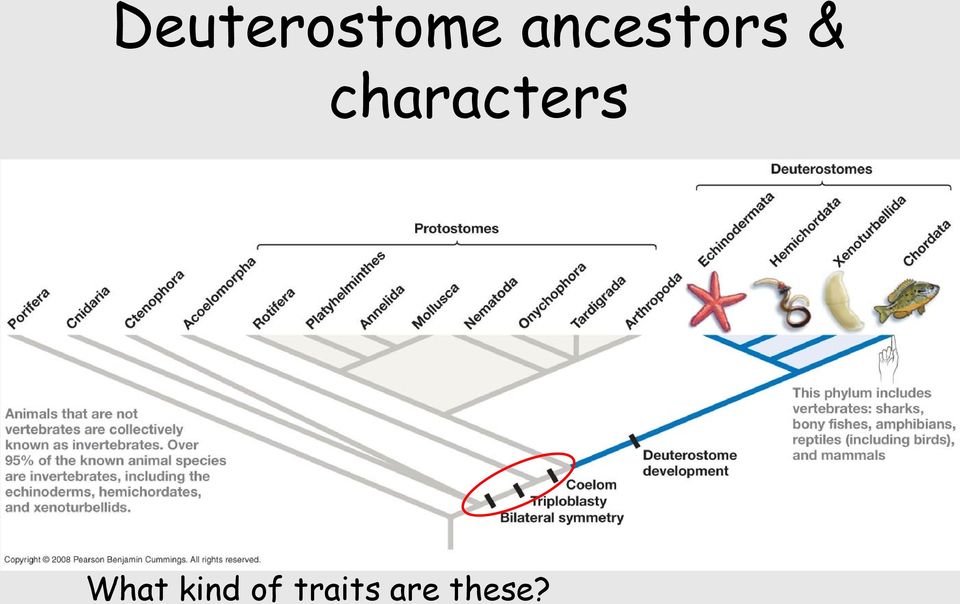
4

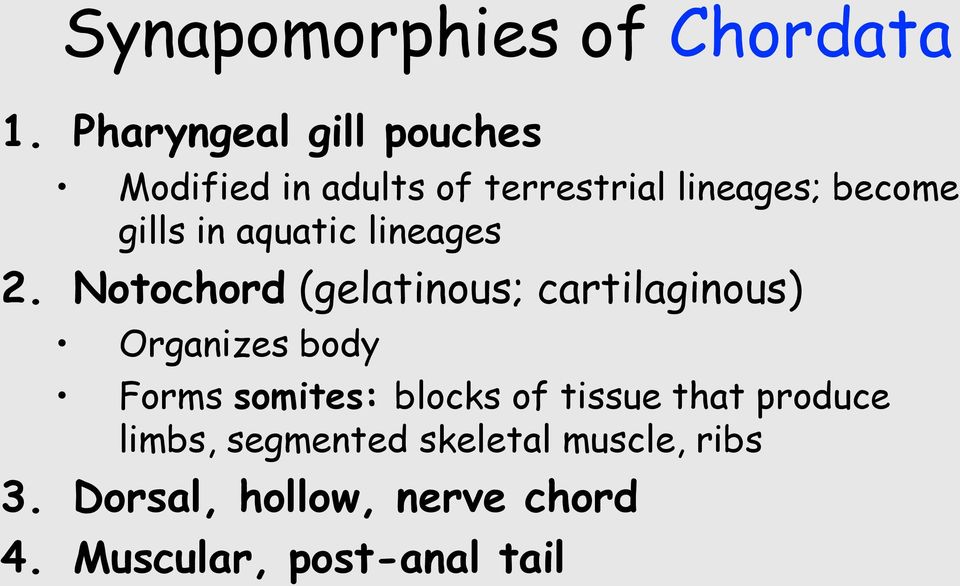
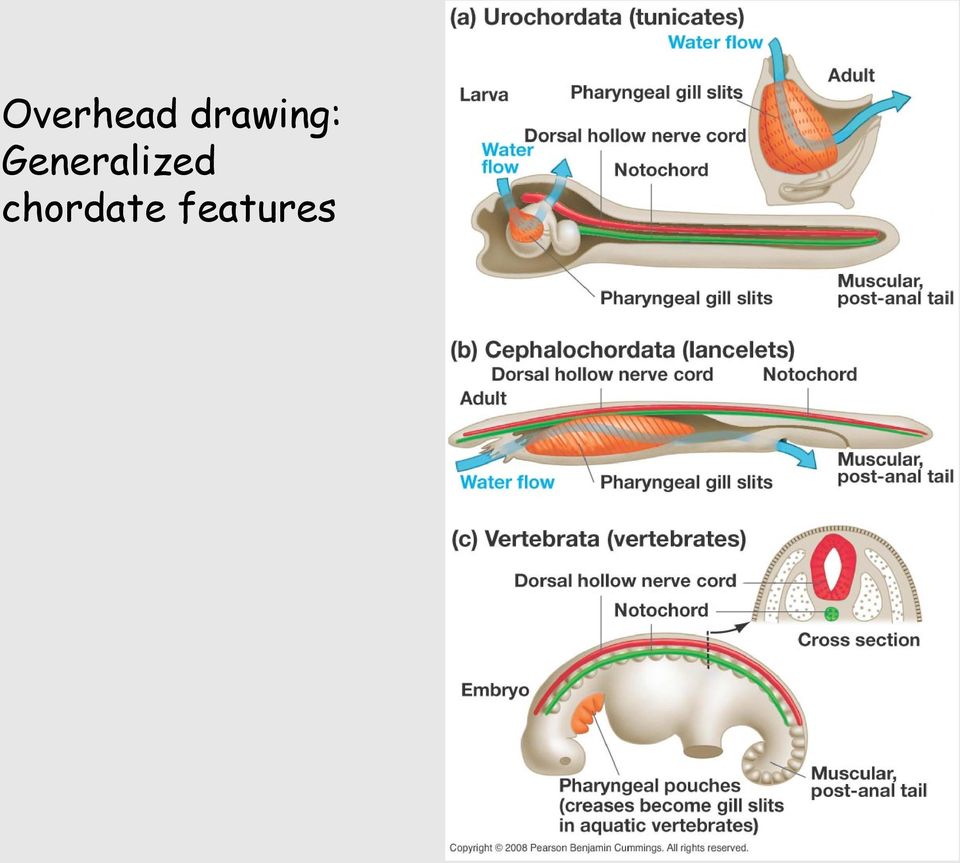
5 Synapomorphies of Chordata 1. Pharyngeal gill pouches Modified in adults of terrestrial lineages; become gills in aquatic lineages 2. Notochord (gelatinous; cartilaginous) Organizes body Forms somites: blocks of tissue that produce limbs, segmented skeletal muscle, ribs 3. Dorsal, hollow, nerve chord 4. Muscular, post-anal tail
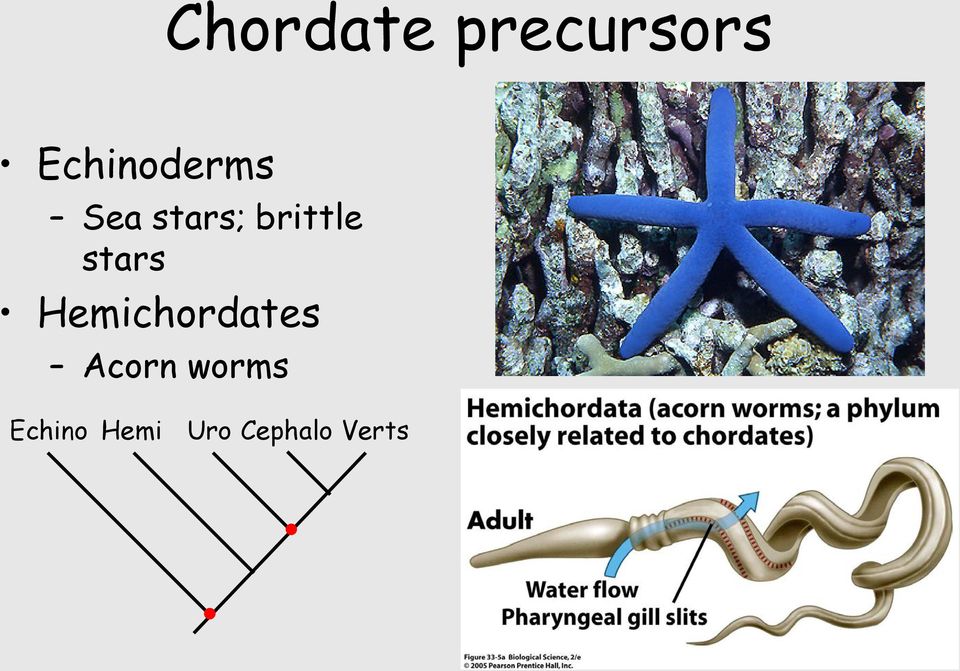
6 Chordate precursors Echinoderms Sea stars; brittle stars Hemichordates Acorn worms Echino Hemi Uro Cephalo Verts
7 Overhead drawing: Generalized chordate features
8 Themes in evolution of Chordates Increasing cephalization Gaining teeth, jaws, and diversifying them. Vertebrate structures from invertebrate bodies Skeletons (endo), cephalization of DHNC, limbs Morphological innovations that allowed invasion of land

9 Fossils mark major innovations
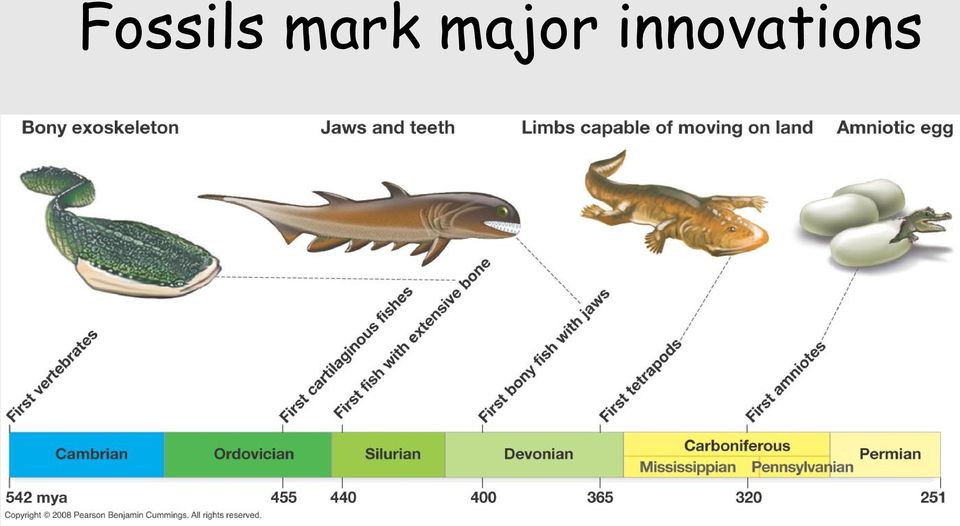
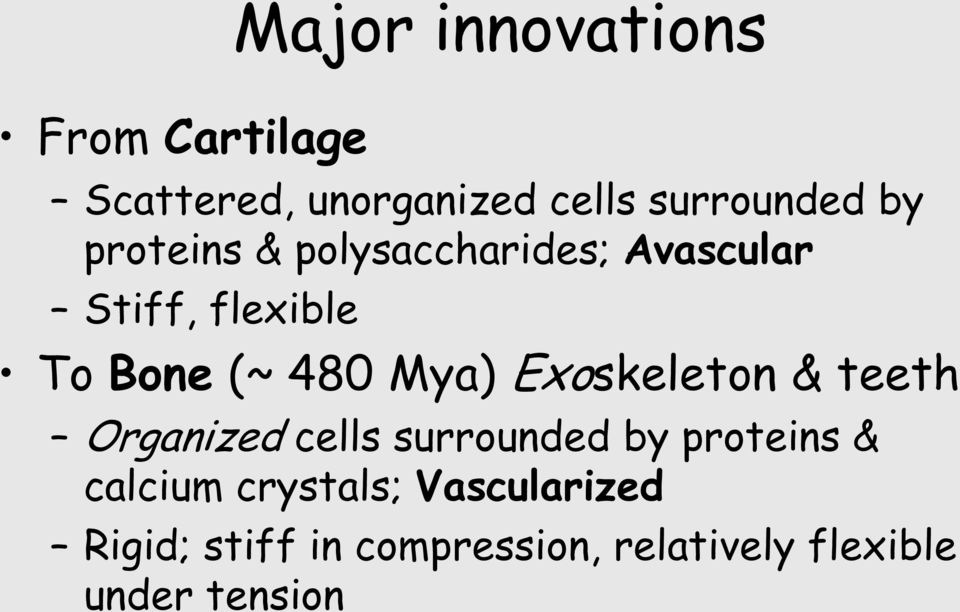
10 From Cartilage Major innovations Scattered, unorganized cells surrounded by proteins & polysaccharides; Avascular Stiff, flexible To Bone (~ 480 Mya) Exoskeleton & teeth Organized cells surrounded by proteins & calcium crystals; Vascularized Rigid; stiff in compression, relatively flexible under tension
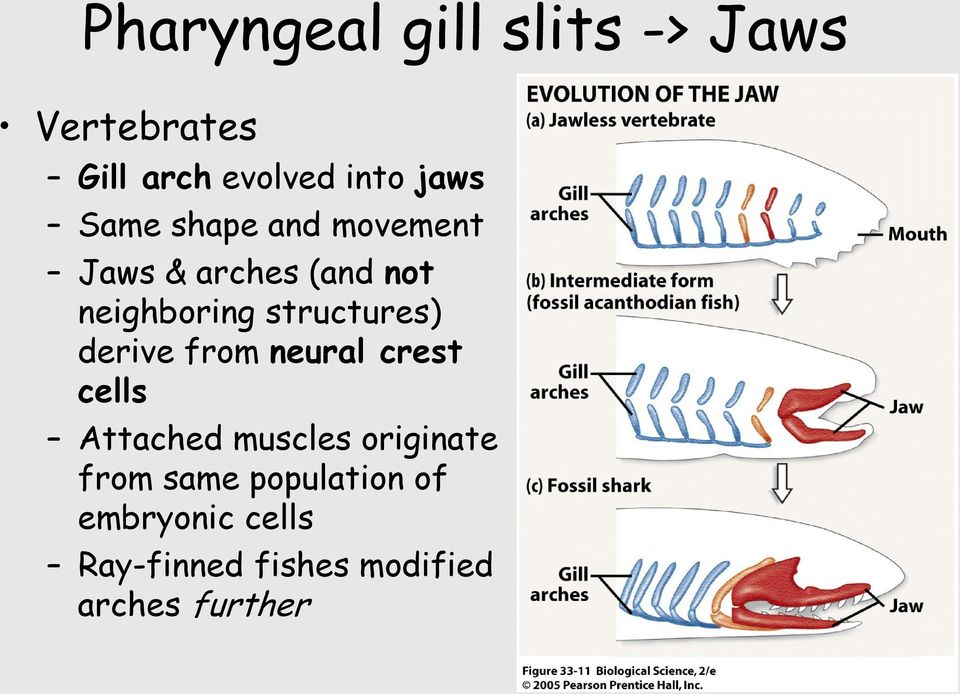
11 Major innovations From Pharyngeal gill arches (& slits) For acquiring O 2 & some filter feeding One gill arch becomes modified -> To Jaws (~ 430 Mya) Now we can bite! Goodbye suspension feeding Eat big stuff Not just floating rice grains Eat attached stuff

12 Pharyngeal gill slits -> Jaws Vertebrates Gill arch evolved into jaws Same shape and movement Jaws & arches (and not neighboring structures) derive from neural crest cells Attached muscles originate from same population of embryonic cells Ray-finned fishes modified arches further
13 Major innovations From Fins Great for propulsion or steering in water To 4 limbs (~ 375 Mya) Tetrapods Allowed access to terrestrial environments
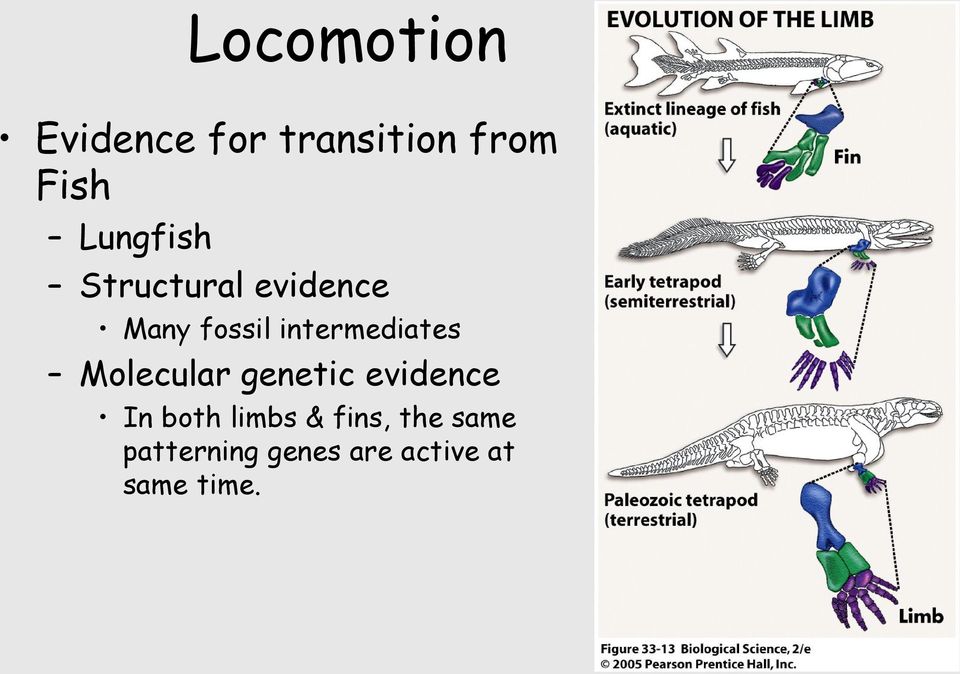
14 Locomotion Evidence for transition from Fish Lungfish Structural evidence Many fossil intermediates Molecular genetic evidence In both limbs & fins, the same patterning genes are active at same time.
15 Major innovations From unbound gelatinous egg Fine if bathed in water To Amniotic egg (~ 355 Mya) Amniotes Watertight shell (or case) enclosing food supply, water supply & waste repository Provides freedom from aquatic environments Now you can live anywhere, because egg (membrane or shell) resists desiccation
16 Amniotic egg Early Tetrapods = Amphibian-like eggs Contemporary Amniotes have encased, membranebound eggs Watertight Albumen layer: water supply Amnion: cushions embryo Yolk sac: nutrients Allantois: waste container Chorion: SA for gas exchange

17 Major innovations From smooth, moist epithelia Good for exchanging H 2 Oand O 2 and waste in water To hard, keratinized epithelia Necessary for preventing desiccation

18

19 Clicker Q What challenges did Vertebrates face in moving from an aquatic to a terrestrial environment? 1. Resisting desiccation 2. Exchanging gases in a new media (air vs. water) 3. Moving through an environment dominated by gravity 4. All of the above

20 Vertebrate diversity

21 Vertebrate Diversity Feeding Jaws Locomotion Tetrapod limb Reproduction Amniotic egg
22 Echinoderms Suspension feeding Deposit feeding Harvesting Feeding Basal Vertebrates -jawless Deposit feeding Ectoparasites
23 Locomotion Aquatic Vertebrates Fins & lateral undulation Lungfish Limb-like fins: short distance excursions Lungs: additional O 2 Burrow in mud: survive droughts Tetrapods Fully functional limbs
24 Reproduction 1. Amniotic egg 2. Placenta 3. Parental care
25 Placenta Placenta replaces yolk sac & allantois Highly vascularized for nutrient & gas exchange Probably represents a trade-off Invest lots in few offspring Invest little in many offspring
26 Parental care Widespread in vertebrates Any energy output that increases survival of offspring Highly developed & consistent in birds & mammals Feeding; warming; protecting Lactation: offspring totally dependent on mother for nutrition Placentation & Lactation represent highest energy provisioning & output of any animal
27 Agnathans 110 species Hagfish Scavengers and predators Carcass and buried prey Lampreys Ectoparasites Attach, rasp, drink
28 840 species Cartilagenous skeletons Mostly marine Cartilagenous Fish Feeding: Mostly predators Sharks Movement: Lateral undulation Active predators Skates, Rays Locomotion: pectoral fin flapping Feeding: Sit & wait. Electrocute/stun prey
29 Ray-finned fishes 24,000 species Huge diversity Feeding Locomotion Reproduction Ray-finned Fish
30 8 species Coelocanth Omnivorous; fish & plant matter Lungfish Limbs made of distinguishable bones & muscle Lungs Movement: Lateral undulation Repro: Oviparous Lobe-finned Fish
31 Amphibia 4800 species Frogs & toads; Salamanders; Caecilians Feeding: Carnivorous adults Mostly sit & wait Movement: Lateral undulation; hopping; burrowing Repro: Oviparous External fert. (F&T) Internal fert. (Sallys, Caecilians)
32 Monotremes (3) Mammalia Oviparous; nutritious sweat Marsupials (275) Viviparous; prolonged lactation Placentals (4300) Viviparous; prolonged gestation Movement: Swim, walk, glide, fly, brachiate, burrow, hop Feeding: Carnivores, herbivores, omnivores
33 Turtles & Tortoises 271 species Feeding: Herbivores; carnivores Reproduction: Oviparous; Temp-dependent sex determination; no care Movement: Swim; walk; burrow Turtles Marine & freshwater Tortoises Terrestrial
34 Archosauria Repro: Oviparous; extensive parental care Crocodilians (crocs, alligators, caimans) 21 species Locomotion: Walk, gallop, lateral undulation Feeding: predators Birds 9700 species Locomotion: Fly, run, swim Feeding: omnivores, herbivores (nectar, seeds), predators
35 Lepidosauria Squamata ( lizards & snakes) 6800 species Many limb reductions Feeding: Predators sit & wait & active Constriction, venom injection, twist & shear Herbivores Movement: Lateral undulation Repro: oviparous, ovoviviparous; some parthenogenesis in whiptails
Chordata- vertebrates
 Chordata- vertebrates Animal phylogeny based on sequencing of SSU-rRNA Phylum Chordata Distinguishing Features 1. Pharyngeal gill slits 2. Dorsal hollow nerve cord 3. Notochord 4. Muscular postanal tail
Chordates (phylum Chordata) are bilaterian animals that belong to the clade of animals known as Deuterostomia
 Ch 34 Origin & Evolution of Vertebrates Chordates Chordates (phylum Chordata) are bilaterian animals that belong to the clade of animals known as Deuterostomia Chordates comprise all vertebrates and two
Diversity of Vertebrate Animals
 Diversity of Vertebrate Animals Over the last 400 million years, vertebrate animals have evolved a diverse array of adaptations for life on earth. Vertebrate animals are those with which people are most
Unique reproductive strategies have developed to ensure maximum reproductive success.
 Animal Reproductive Strategies The ultimate goal of each species is to produce the maximum number of surviving offspring using the least amount of energy. This is called the reproductive effort. Asexual
Introduction to Animals
 Introduction to Animals Unity and Diversity of Life Q: What characteristics and traits define animals? 25.1 What is an animal? WHAT I KNOW SAMPLE ANSWER: Animals are different from other living things
Problem Set 5 BILD10 / Winter 2014 Chapters 8, 10-12
 Chapter 8: Evolution and Natural Selection 1) A population is: a) a group of species that shares the same habitat. b) a group of individuals of the same species that lives in the same general location
many diverse adaptations to life -
 Introduction to Fish Biology About 25,000 species of fish have been described this is the most numerous group of vertebrates approximately 45%-50% of all vertebrate species are fish dominant life form
Biology 170: Exam 3. Multiple choice (2 pts each). Mark (bubble-in) the correct answer on your scantron.
 Name Biology 170: Exam 3 Multiple choice (2 pts each). Mark (bubble-in) the correct answer on your scantron. 1. All of the following are unique (only found in) mammalian characters, EXCEPT: a. Hair b.
Lab #10 Invertebrates 2 and Vertebrates 1 (Exercises 39, 40)
 Name Bio 182-General Biology Lab #10 Invertebrates 2 and Vertebrates 1 (Exercises 39, 40) Answer the questions in the space provided. You need to turn this sheet at the end of the lab. In general know
Phylum Chordata. very diverse phylum but considerably less diverse than eg. arthropods or molluscs
 48,000 species Phylum Chordata very diverse phylum but considerably less diverse than eg. arthropods or molluscs also many fewer species than most other major phyla most advanced phylum of animal kingdom;
A. key traits: deuterostomes with notochord, jointed appendages, and segmentation
 Topic 16: Deuterostomes: Phylum Chordata (Ch. 34) I. Phylum Chordata (chordates) [clade] general features A. key traits: deuterostomes with notochord, jointed appendages, and segmentation B. four key features
Observing Vertebrate Skeletons
 Name Class Date Chapter 33 Comparing Chordates Observing Vertebrate Skeletons Introduction One characteristic common to all vertebrates is the presence of a skeleton. The endoskeleton provides support,
nucleus cytoplasm membrane wall A cell is the smallest unit that makes up living and nonliving things.
 1 In nature there are living things and nonliving things. Living things depend on three basic life processes: nutrition, sensitivity and reproduction. Living things are made up of cells. 1. Match the two
UNIT TWO TURTLE BIOLOGY
 UNIT TWO TURTLE BIOLOGY 43 44 Science Expectations met in this unit: UNIT TWO: TURTLE BIOLOGY Activity Number: Activity Name Strand Grade 2 Growth and Changes in Animals Grade 4 Habitats and 5: Camouflage
Reptile reproduction. ALL Reptiles have internal fertilization. Intromission organs. Hemipenes. Sperm storage
 ALL Reptiles have internal fertilization Reptile reproduction Intromission organs hemipenes in squamates (paired evaginations in the wall of cloaca that are everted to expose a complex surface) proper
Evidence for evolution factsheet
 The theory of evolution by natural selection is supported by a great deal of evidence. Fossils Fossils are formed when organisms become buried in sediments, causing little decomposition of the organism.
Bony Fish Anatomy Worksheet
 Educational Material Bony Fish Anatomy Worksheet Teacher Information This activity is designed to be team-taught by the classroom and art teacher. Use this guide in conjunction with fish-related art to
Four features characterize the chordates and have played an important role in the evolution of the phylum:
 THE VERTEBRATES Chordates (phylum Chordata) are deuterostome coelomates whose nearest relatives in the animal kingdom are the echinoderms, the only other deuterostomes. However, unlike echinoderms, chordates
Chapter 47: Animal Development
 Name Period Overview 1. An organism s development is controlled by the genome of the zygote as well as by molecules from the mother that are in the cytoplasm of the egg. What are these proteins and RNAs
Can You Tell a 'Gator From a Croc? by Guy Belleranti
 Can You Tell a 'Gator From a Croc? Look closely at the reptiles pictured below. Can you tell which one is the crocodile and which is the alligator? Many people confuse crocodiles and alligators, and it's
Lab # 6 on Taxonomy and the Animal Kingdom Pre Lab Questions:
 Bio 10 Animal Lab #6 61 Lab # 6 on Taxonomy and the Animal Kingdom Pre Lab Questions: 1. Name one pro and one con for the use of taxonomy in Biology? 2. Name 3 domains and 4 eukaryotic kingdoms. 3. From
Fish: One-of-a-kind Animals (30 minute activity)
 FISH HEALTH/Activity Fish: One-of-a-kind Animals (30 minute activity) Objectives Materials Background I have known you in your streams and rivers where your fish flashed and danced in the sun, where the
Chapter 34 Vertebrates Multiple-Choice Questions 1) Which of the following is a shared characteristic of all chordates? A) scales B) jaws C) vertebrae
 Chapter 34 Vertebrates Multiple-Choice Questions 1) Which of the following is a shared characteristic of all chordates? A) scales B) jaws C) vertebrae D) dorsal, hollow nerve cord E) four-chambered heart
Human Embryonic Development. Human fetal development
 Human Embryonic Development Day 1: 1 st cleavage 1 cell becomes 2 (2-cell stage) Day 2: 2 nd cleavage 4-cell stage Day 3: 6-12 cell stage can test at this stage for genetic diseases if done by IVF Day
Bio 103 Lecture Dr. Largen
 1 Evolution of Animal Diversity Bio 103 Lecture Dr. Largen 2 What Am I? Of some 1.5 million species of organisms known to science over two-thirds are animals Humans have a long history of studying animal
Life processes. All animals have to carry out seven life processes. These are: 2. Respiration taking in one gas and getting rid of another
 Food chains Life processes All animals have to carry out seven life processes. These are: 1. Movement being able to move its body 2. Respiration taking in one gas and getting rid of another 3. Reproduction
Vertebrate Development Chapter 60
 Vertebrate Development Chapter 60 Copyright McGraw-Hill Companies Permission required for reproduction or display Raven - Johnson - Biology: 6th Ed. - All Rights Reserved - McGraw Hill Companies Stages
www.irishseedsavers.ie Natural surface water on earth includes lakes, ponds, streams, rivers, estuaries, seas and oceans.
 www.irishseedsavers.ie POND LIFE FACT SHEET Natural surface water on earth includes lakes, ponds, streams, rivers, estuaries, seas and oceans. A pond is a small body of fresh water shallow enough for sunlight
Animal skeletons. The museum holds hundreds of skeletons - of fish, amphibians, reptiles, birds and mammals.
 Animal skeletons All animals have skeletons of one sort or another. Mammals, birds, reptiles, amphibians and fish have bony skeletons. These skeletons come in all shapes and sizes, but they also share
Pond Vocabulary Words and Meanings
 Pond Vocabulary Words and Meanings Adapt: to adjust to a use or situation Aquatic: from or in the water Bacteria: tiny organisms, too small to be seen with the naked eye Carnivore: an animal that eats
5/18/2012. Animal Complexity and Body Plans. Organization of Animal Complexity. Organization of Animal Complexity
 Animal Complexity and Body Plans 34 different phyla of multicellular animals About 100 phyla generated during Cambrian explosion Animal body plans well-defined and established early in evolutionary history
... Date Starting your search in the Rainforest if it s open, keep an eye out for:
 Museum-Wide Reptiles include turtles, lizards, snakes, crocodiles, and all of their relatives. There are over 9,000 different kinds of reptiles with amazing adaptations that help them find food and protect
Reptiles and Amphibians by Guy Belleranti
 Name: Take a look at the four animals pictures below. Do you know which ones are reptiles and which ones are amphibians? The chameleon is an unusual lizard that can change the color of its scaly body.
1. Over the past century, several scientists around the world have made the following observations:
 Evolution Keystone Review 1. Over the past century, several scientists around the world have made the following observations: New mitochondria and plastids can only be generated by old mitochondria and
Nutrition and Zoo Animals
 Nutrition and Zoo Animals Nutrition All animals need nutrition to survive. Nutrition can have a large effect on basic health as well as physical and mental development, ability to reproduce, emotions and
Theory of Evolution. A. the beginning of life B. the evolution of eukaryotes C. the evolution of archaebacteria D. the beginning of terrestrial life
 Theory of Evolution 1. In 1966, American biologist Lynn Margulis proposed the theory of endosymbiosis, or the idea that mitochondria are the descendents of symbiotic, aerobic eubacteria. What does the
Anatomy PHL 212. By Dr Tajdar Husain Khan
 Anatomy PHL 212 By Dr Tajdar Husain Khan Overview of Anatomy Anatomy(from the Greek word anatome,"dissection") is a branch of natural science dealing with the structural organization of living things The
This is a series of skulls and front leg fossils of organisms believed to be ancestors of the modern-day horse.
 Evidence of Evolution Background When Charles Darwin first proposed the idea that all new species descend from an ancestor, he performed an exhaustive amount of research to provide as much evidence as
Invertebrate Diversity. between the two terms. INVERTEBRATE DIVERSITY Vocabulary Practice
 CHAPTER 23 INVERTEBRATE DIVERSITY Vocabulary Practice collagen deuterostome radula homeotic sessile hemocoel homeobox filter feeder segmentation vertebrate polyp coelom invertebrate medusa cuticle phylum
The first steps to forming a new organism Descriptive embryology 2. Cleavage, Gastrulation, Neurulation and Organogenesis
 Developmental Biology BY1101 P. Murphy Lectures 4 and 5 The first steps to forming a new organism Descriptive embryology 2 Cleavage, Gastrulation, Neurulation and Organogenesis Early animal development
Animals The Diversity of Life 3 What Is an Animal? What Is an Animal? Animal Types: The Family Tree. Essay: Redrawing the Family Tree
 Animals The Diversity of Life 3 What Is an Animal? Characteristics of Animals. Are multicellular, exhibit embryonic development; fertilized egg turns into multicellular embryo (balls of cells called blastula)
Introduction to Plants
 Introduction to Plants Unity and Diversity of Life Q: What are the five main groups of plants, and how have four of these groups adapted to life on land? 22.1 What are of plants? WHAT I KNOW SAMPLE ANSWER:
Activity Sheet A - Getting Sorted (Cont) Diet (in the wild) Herbivore Carnivore Omnivore Habitat Terrestrial/ground dwelling Arboreal/tree living Aqua
 Activity Sheet A - Getting Sorted Duration: 45 minutes Locate the animals listed below and find out their scientific name. Remember that the scientific name is usually written in italics or is underlined.
How Organisms Exchange Gases: Simple Diffusion. How Organisms Exchange Gases: Simple Diffusion. How Organisms Exchange Gases: Respiratory Organs
 How Organisms Exchange Gases: Simple Diffusion Gas is exchanged between respiratory medium and body fluids through diffusion across a respiratory surface To effectively exchange gases, the surface must
World Oceans Day at ZSL Whipsnade Zoo
 World Oceans Day at ZSL Whipsnade Zoo Teachers notes KS 1 & KS 2 This booklet will help you to focus your self guided trail on ocean animals, looking at the adaptations of the species and focusing in on
Ecology 1 Star. 1. Missing from the diagram of this ecosystem are the
 Name: ate: 1. Missing from the diagram of this ecosystem are the 5. ase your answer(s) to the following question(s) on the diagram below and on your knowledge of biology.. biotic factors and decomposers.
What is a fossil? 1. What does the name of your dinosaur mean? 2. In which geological time period did your dinosaur live?
 Name: School: Date: 1. What does the name of your dinosaur mean? 2. In which geological time period did your dinosaur live? 3. Where in the world are the fossil remains of your dinosaur found today? 4.
NOTE TO TEACHER: It is appropriate to introduce the mitochondria (where energy is made) as a major structure common to all cells.
 5.2.1 Recall the cell as the smallest unit of life and identify its major structures (including cell membrane, cytoplasm, nucleus, and vacuole). Taxonomy level: 1.1 and 1.2-A Remember Factual Knowledge
Frog Scavenger Hunt Activity
 Frog Scavenger Hunt Activity Materials: Frog questions worksheet (pages 2-3) 18 frog fact cards (pages 4-8) Scissors and scotch tape Preparation: Print the frog fact cards and cut them apart. Make copies
Fishy Adaptations. Adapted from: Fashion a Fish in Project Wild Aquatic Education Activity Guide. The Council for Environmental Education, 1992
 Fishy Adaptations Adapted from: Fashion a Fish in Project Wild Aquatic Education Activity Guide. The Council for Environmental Education, 1992 Physical Structure Grade Level: Basic Duration: 45 minutes
Evolution (18%) 11 Items Sample Test Prep Questions
 Evolution (18%) 11 Items Sample Test Prep Questions Grade 7 (Evolution) 3.a Students know both genetic variation and environmental factors are causes of evolution and diversity of organisms. (pg. 109 Science
Table 1: Kingdom Worksheet
 KINGDOM WORKSHEET Table 1: Kingdom Worksheet Kingdom Bacteria Archaea Protista Fungi Plantae Animalia Cell Type prokaryotic prokaryotic eukaryotic eukaryotic eukaryotic eukaryotic Cell Wall often present,
2. Predators have bilateral symmetry, good musculature sense organs and a well developed nervous system.
 A. A.INTRODUCTION 1. Animals are heterotrophic; they must take in food. 2. Predators have bilateral symmetry, good musculature sense organs and a well developed nervous system. 3. Bilareral symmetry (cut
Animals and Adaptation
 Animals and Adaptation From: http://www.learninghaven.com/science/articles/animals_and_adaptation.htm In order for animals to survive, they need to be able to adapt. In this lesson we will look at the
These pages build on Units 2B & C and introduce predator-prey relationships and food chains.
 Unit 4B Habitats Teaching Notes These pages build on Units 2B & C and introduce predator-prey relationships and food chains. Curriculum, resource and other links Sc1 & Sc2 Resources Associated with this
Animal Tissues. I. Epithelial Tissue
 Animal Tissues There are four types of tissues found in animals: epithelial tissue, connective tissue, muscle tissue, and nervous tissue. In this lab you will learn the major characteristics of each tissue
Animal Systems: The Musculoskeletal System
 Animal Systems: The Musculoskeletal System Tissues, Organs, and Systems of Living Things Cells, Cell Division, and Animal Systems and Plant Systems Cell Specialization Human Systems The Digestive The Circulatory
The Art of the Tree of Life. Catherine Ibes & Priscilla Spears March 2012
 The Art of the Tree of Life Catherine Ibes & Priscilla Spears March 2012 from so simple a beginning endless forms most beautiful and most wonderful have been, and are being, evolved. Charles Darwin, The
DOG Pets cat - dog - horse - hamster - rabbit - fish
 CAT Pets cat - dog - horse - hamster - rabbit - fish DOG Pets cat - dog - horse - hamster - rabbit - fish HORSE Pets cat - dog - horse - hamster - rabbit - fish HAMSTER Pets cat - dog - horse - hamster
Is That a Frog or Toad?
 Name: _ Is That a Frog or Toad? by Guy Belleranti What's the first thing you think of when you see or hear the words frog and toad? Loud "ribbits" or "croaking" calls? Tadpoles swimming in a pond? Long-legged
Wildlife for the Workforce Part II:
 Wildlife for the Workforce Part II: Turtles and Tortoises, Snakes, Bees, and Exotic Animals Sarasota County Parks and Recreation Turtles and Tortoises Common cooter Green sea turtle Gopher tortoise Terrapin
FOOD CHAINS, FOOD WEBS AND ECOLOGICAL PYRAMIDS
 FOOD CHAINS, FOOD WEBS AND ECOLOGICAL PYRAMIDS SECTION 1 In an ecosystem, plants capture the sun's energy and use it to convert inorganic compounds into energy-rich organic compounds. This process of using
ANIMAL COVERINGS Lesson Plan
 ANIMAL COVERINGS Lesson Plan TARGET AUDIENCE Kindergarten through Second grade STANDARDS VA Grades K-1: Scientific investigation, reasoning and logic; Matter; Life processes; Earth patterns, cycles and
2. What kind of energy is stored in food? A. chemical energy B. heat energy C. kinetic energy D. light energy
 Assessment Bank Matter and Energy in Living Things SC.8.L.18.4 1. What is energy? A. anything that takes up space B. anything that has mass C. the ability to conduct current D. the ability to do work 2.
Fish, Amphibians, and Reptiles
 Fish, Amphibians, and Reptiles sections 1 Chordates and Vertebrates Lab Endotherms and Exotherms 2 Fish 3 Amphibians 4 Reptiles Lab Water Temperature and the Respiration Rate of Fish Virtual Lab How are
Pond Water Web Lesson Plan
 Pond Water Web Lesson Plan Purpose: As a result of this lesson, students will become familiar with common organisms found in a pond and discover their importance in a balanced aquatic habitat as they create
Prairie Food Chains & Webs Producers, Consumers & Decomposers
 Kansas Prairies s, s & Decomposers Science, Life Science, Reading, Math Materials Vocabulary worksheet Food Chain worksheet Overview To explore the organisms found on a prairie and identify the various
Name: DUE: May 2, 2013 Ms. Galaydick. Geologic Time Scale Era Period End date (in millions of years) Cenozoic Quaternary present
 Name: DUE: May 2, 2013 Ms. Galaydick Objective: Use the diagrams to answer the questions for each set: USING SCIENCE SKILLS PART #1 Geologic Time Scale Era Period End date (in millions of years) Cenozoic
Chapter 3. 3.3 Energy Flow in Ecosystems
 Chapter 3 3.3 Energy Flow in Ecosystems Key Questions: 1) What happens to energy stored in body tissues when one organism eats another? 2) How does energy flow through an ecosystem? 3) What do the three
Third Grade Science Vocabulary Investigation Design & Safety
 recycle dispose reuse goggles data conclusion predict describe observe record identify investigate evidence analyze mass matter float sink attract force magnet magnetic magnetism pole pull push repel Third
Carnivore, omnivore or herbivore?
 Carnivore, omnivore or herbivore? Physical adaptations of the giant panda Student booklet (ST) October 2010 panda_st_student.doc Context The Giant Panda is a species that is faced with extinction. It is
Dino Data Adapted from Dino Data Activity www.ucmp.berkeley.edu/education/lessons/dinodata/dino_data.html
 Dino Data Adapted from Dino Data Activity www.ucmp.berkeley.edu/education/lessons/dinodata/dino_data.html Grade Level: Grades 6-8 Preparation Time: less than 5 minutes Activity Duration: up to five classroom
Manatee Anatomy and Physiology
 Manatee Anatomy and Physiology Grade level: Elementary 5 Subject Area: Biology, Anatomy and Physiology, Marine Biology Duration: Teach: 15 minutes, Activity: 20 minutes, Discussion: 20 minutes. Setting:
Ecosystems and Food Webs
 Ecosystems and Food Webs How do AIS affect our lakes? Background Information All things on the planet both living and nonliving interact. An Ecosystem is defined as the set of elements, living and nonliving,
Behaviour. Age 6-11 years. Contents
 SEA LIFE for schools Behaviour Age 6-11 years Self-guided learning This guide provides you with information linked to key displays throughout SEA LIFE Loch Lomond which can be used to explore the key behaviour
2. Fill in the blank. The of a cell is like a leader, directing and telling the different parts of the cell what to do.
 1. Plant and animal cells have some similarities as well as differences. What is one thing that plant and animal cells have in common? A. cell wall B. chlorophyll C. nucleus D. chloroplasts 2. Fill in
CRETACEOUS ALBERTA SCIENCE HALL. Changing Earth. What is Palaeontology. Changing Time. 1. This exhibit is based on a discovery made in
 Worksheet Level 2 p. 1 CRETACEOUS ALBERTA 1. This exhibit is based on a discovery made in 2. What type of dinosaur was found at this site and how many individuals were there? 3. What was their age range?
Prairie Food Chains & Webs Producers, Consumers, & Decomposers
 Kansas Prairies Prairie Food Chains & Webs Producers, s, & Decomposers Life Science, Math, Reading, Science Materials Student Worksheet A: Vocabulary Student Worksheet B: Food Chain Overview To explore
Educator's Guide to the Assembly Program: RAINFORESTS ALIVE! www.reptilesalive.com ReptilesAlive! LLC 1/15
 Educator's Guide to the Assembly Program: RAINFORESTS ALIVE! www.reptilesalive.com ReptilesAlive! LLC 1/15 Program Overview Tropical rainforests are the most biologically diverse terrestrial ecosystems
Dinosaur Hall Second Grade Dinosaur Lesson Teacher Pages Pre Visit On site Visit
 Dinosaur Hall Second Grade Dinosaur Lesson Teacher Pages Pre Visit Earth Sciences 3d. Students know that fossils provide evidence about the plants and animals that lived long ago and that scientists learn
Unit 3L.4: Body Parts and Functions
 Unit 3L.4: Organs in the Human body Keeping Healthy The Skeleton Science skills: Classification Observing Making models Data collection By the end of this unit you should: Compare the structure of humans
Georgia Performance Standards Framework for Science GRADE 7 DICHOTOMOUS KEYS AND CLASSIFICATION
 The following instructional plan is part of a GaDOE collection of Unit Frameworks, Performance Tasks, examples of Student Work, and Teacher Commentary. Many more GaDOE approved instructional plans are
[chime plays] [music plays]
![[chime plays] [music plays]](/thumbs/40/20934652.jpg "[chime plays] [music plays]") [chime plays] [CLARKE (narration):] The animal kingdom is made up of major groups, recognized by key traits. Fish have fins. Some land animals have four legs, others six, and several different groups have
[chime plays] [CLARKE (narration):] The animal kingdom is made up of major groups, recognized by key traits. Fish have fins. Some land animals have four legs, others six, and several different groups have
Animal Classification K-4
 Animal Classification K-4 Introduction: The theme of this self-guided experience is classification of animals. Students will learn to use body coverings as an aid to classification. As the group tours
10.1 The function of Digestion pg. 402
 10.1 The function of Digestion pg. 402 Macromolecules and Living Systems The body is made up of more than 60 % water. The water is found in the cells cytoplasm, the interstitial fluid and the blood (5
Macroevolution: Change above the species level NABT 2006 Evolution Symposium
 Introduction Macroevolution: Change above the species level NABT 2006 Evolution Symposium The basic concept of evolution change over time can be examined in two different time frames. The first, which
Name That Adaptation. Background: Link to the Plan Read Section 5 (Whooping Crane Ecology and Biology) in the Management Plan
 Summary Students will explore structural, physiological, and behavioral adaptations of whooping cranes. Objectives: Students will be able to: Define an adaptation Describe several whooping crane adaptations
6. Which of the following is not a basic need off all animals a. food b. *friends c. water d. protection from predators. NAME SOL 4.
 NAME SOL 4.5 REVIEW - Revised Habitats, Niches and Adaptations POPULATION A group of the same species living in the same place at the same time. COMMUNITY-- All of the populations that live in the same
LOCOMOTION AND MOVEMENT
 UNIT - HUMAN PHYSIOLOGY Chapter 18 LOCOMOTION AND MOVEMENT Movement is an important feature of living organism. Both the microbes and macrobes show wide range of movements. The movements results in change
Kindergarten Science Unit B: Life Science Chapter 4: Plant and Animal Parts Lesson 1: What do plant parts do?
 Insert Photo or Graphic for Unit or Lesson Theme Kindergarten Science Unit B: Life Science Chapter 4: Plant and Animal Parts Lesson 1: What do plant parts do? Insert Photo/Graphic parts Insert Photo/Graphic
Animal Classification. Contents. Preparation
 Animal Classification A collaborative sorting activity for Key stages 2 & 3 Teachers notes Contents Animal Cards: 8 Pictures per card (54 +2 blanks) Alphabetical list of pictured animals Group cards: VERTEBRATE/INVERTEBRATE
Biology 170: Exam 2. Multiple choice (2 pts each). Mark (bubble-in) the correct answer on your scantron.
 Biology 170: Exam 2 Name Multiple choice (2 pts each). Mark (bubble-in) the correct answer on your scantron. 1. Which of the following Phyla have radial symmetry? a. Arthropoda (insects, spiders, crustaceans)
Grassland Food Webs: Teacher Notes
 Grassland Food Webs: Teacher Notes Alan Henderson ecosystem Objectives After completing this activity students will be able to: Create a food web and identify producers and consumers. Assign organisms
Introduction to Ecology
 Introduction to Ecology Ecology is the scientific study of the interactions between living organisms and their environment. Scientists who study ecology are called ecologists. Because our planet has many
PLANT EVOLUTION DISPLAY Handout
 PLANT EVOLUTION DISPLAY Handout Name: TA and Section time Welcome to UCSC Greenhouses. This sheet explains a few botanical facts about plant reproduction that will help you through the display and handout.
ENVIRONMENTAL CHANGES
 reflect How do you respond to environmental changes? Maybe you wear different types of clothes in different seasons. Maybe you only ride your bike during certain times of the year. What if you moved to
Anatomy and Physiology Warm up questions Fall 2013
 Anatomy and Physiology Warm up questions Fall 2013 QUESTION POSSIBLE ANSWERS : Chapter 1 Introduction and Regions Chapter 2 Chemistry I can name systems of the I can identify regions of the I can describe