
Reptile reproduction. ALL Reptiles have internal fertilization. Intromission organs. Hemipenes. Sperm storage
|
|
|
- Hilary Jefferson
- 9 years ago
- Views:
Transcription


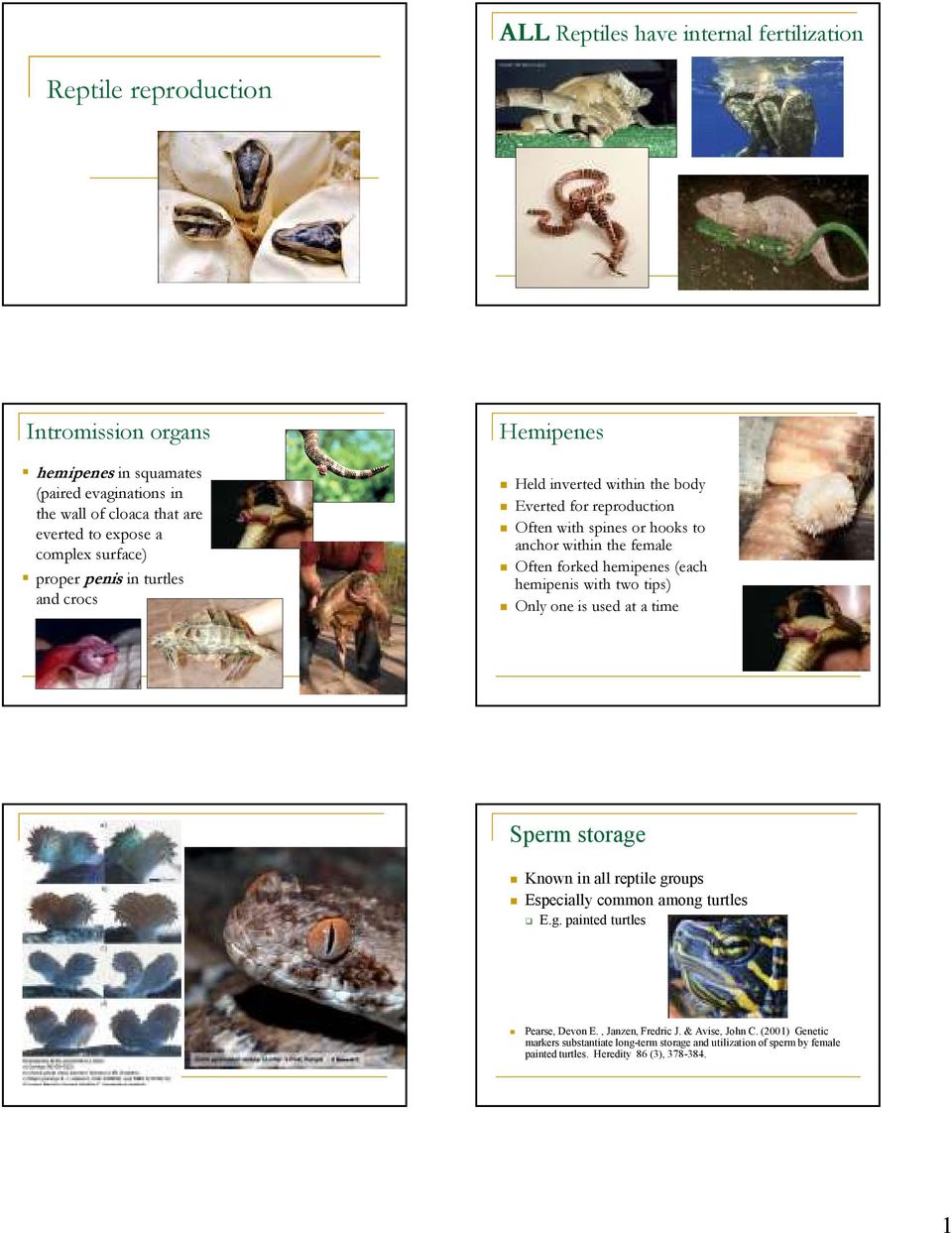
1 ALL Reptiles have internal fertilization Reptile reproduction Intromission organs hemipenes in squamates (paired evaginations in the wall of cloaca that are everted to expose a complex surface) proper penis in turtles and crocs Hemipenes Held inverted within the body Everted for reproduction Often with spines or hooks to anchor within the female Often forked hemipenes (each hemipenis with two tips) Only one is used at a time Sperm storage Known in all reptile groups Especially common among turtles E.g. painted turtles Pearse, Devon E., Janzen, Fredric J. & Avise, John C. (2001) Genetic markers substantiate long-term storage and utilization of sperm by female painted turtles. Heredity 86 (3),

2 Findings Microsatellite markers on free-ranging population over four years Genotyped 113 clutches: 80.5% remated each year But some females used sperm stored for up to three years to fertilize some or all eggs laid in consecutive nesting seasons. 13.2% of all clutches examined showed evidence of multiple paternity Suggests 'last in, first out' operation of the females' sperm storage tubules Reptiles have two reproductive modes Reptile Eggs Oviparity: egg laying All turtles, crocodiles (and birds) Some squamates (snakes, lizards and amphisbaenids) Viviparity: live-bearing Only found in snakes, lizards and amphisbaenids Has evolved independently more than 100 times Reptile eggs Huge size variation among spcies Largest eggs ~ 300 g (pythons) smallest eggs ~ 0.1 g (geckos) Two layers: outer mineral layer of calcium carbonate inner layer or shell membrane Respiration occurs through the shell Basic reptile egg structure Embryo Amnion= cushion membrane Yolk sac= nutrition Allantois= waste sac Chorion= membrane immediately inside shell Albumin = egg white Shell: hard or leathery 2

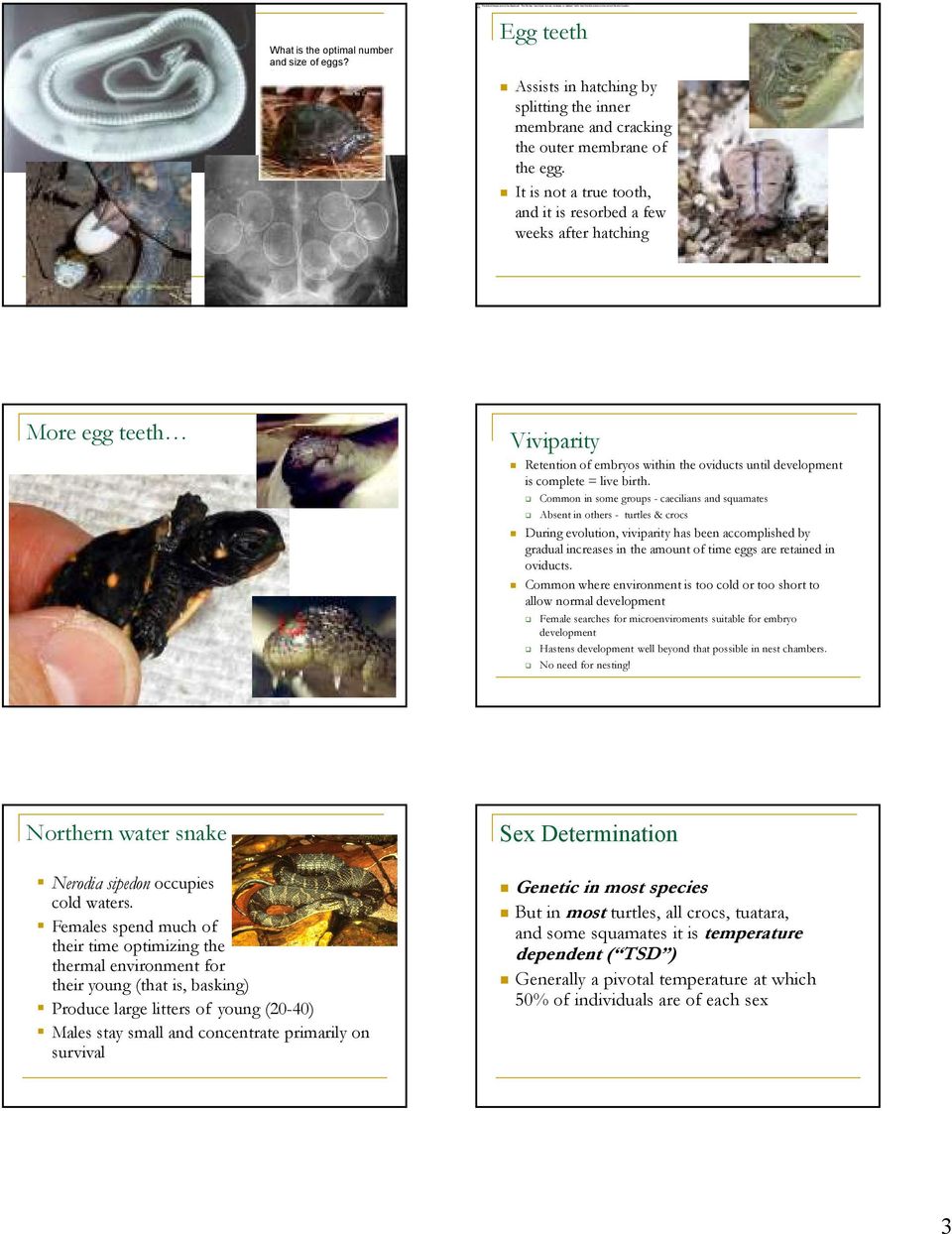
3 The linked image cannot be displayed. The file may have been moved, renamed, or deleted. Verify that the link points to the correct file and location. What is the optimal number and size of eggs? Egg teeth Assists in hatching by splitting the inner membrane and cracking the outer membrane of the egg. It is not a true tooth, and it is resorbed a few weeks after hatching More egg teeth Viviparity Retention of embryos within the oviducts until development is complete = live birth. Common in some groups - caecilians and squamates Absent in others - turtles & crocs During evolution, viviparity has been accomplished by gradual increases in the amount of time eggs are retained in oviducts. Common where environment is too cold or too short to allow normal development Female searches for microenviroments suitable for embryo development Hastens development well beyond that possible in nest chambers. No need for nesting! Northern water snake Nerodia sipedon occupies cold waters. Females spend much of their time optimizing the thermal environment for their young (that is, basking) Produce large litters of young (20-40) Males stay small and concentrate primarily on survival Sex Determination Genetic in most species But in mos turtles, all crocs, tuatara, and some squamates it is temperature dependent ( TSD ) Generally a pivotal temperature at which 50% of individuals are of each sex 3

4 Incubation temperature and sex ratio in the red-eared slider (Trachemys scripta) Type Ia TSD More females than males are produced at higher temperatures e.g., many species of turtles (e.g. Loggerhead sea turtle Caretta caretta). Type Ib TSD More males than females are produced at higher temperatures Typical of some crocodilians and some lizards Proportion males Proportion males Temperature Temperature Type II Females are produced at low and high incubation temperatures with males at intermediate temperatures -- observed in some lizards (Eublepharis macularis), some crocodilians (Crocodylus johnstoni), and some turtles (Chelydra serpentina). Proportion males Temperature Mechanisms of TSD? Still poorly known Likely a link to temperature control of production of sex hormones in embryo Possibly related to males and females being more fit if raised at different temperatures Permits female to choose the sex of her offspring by nesting in cooler or warmer sites Latest news SD may continue into hatchling stage! 4

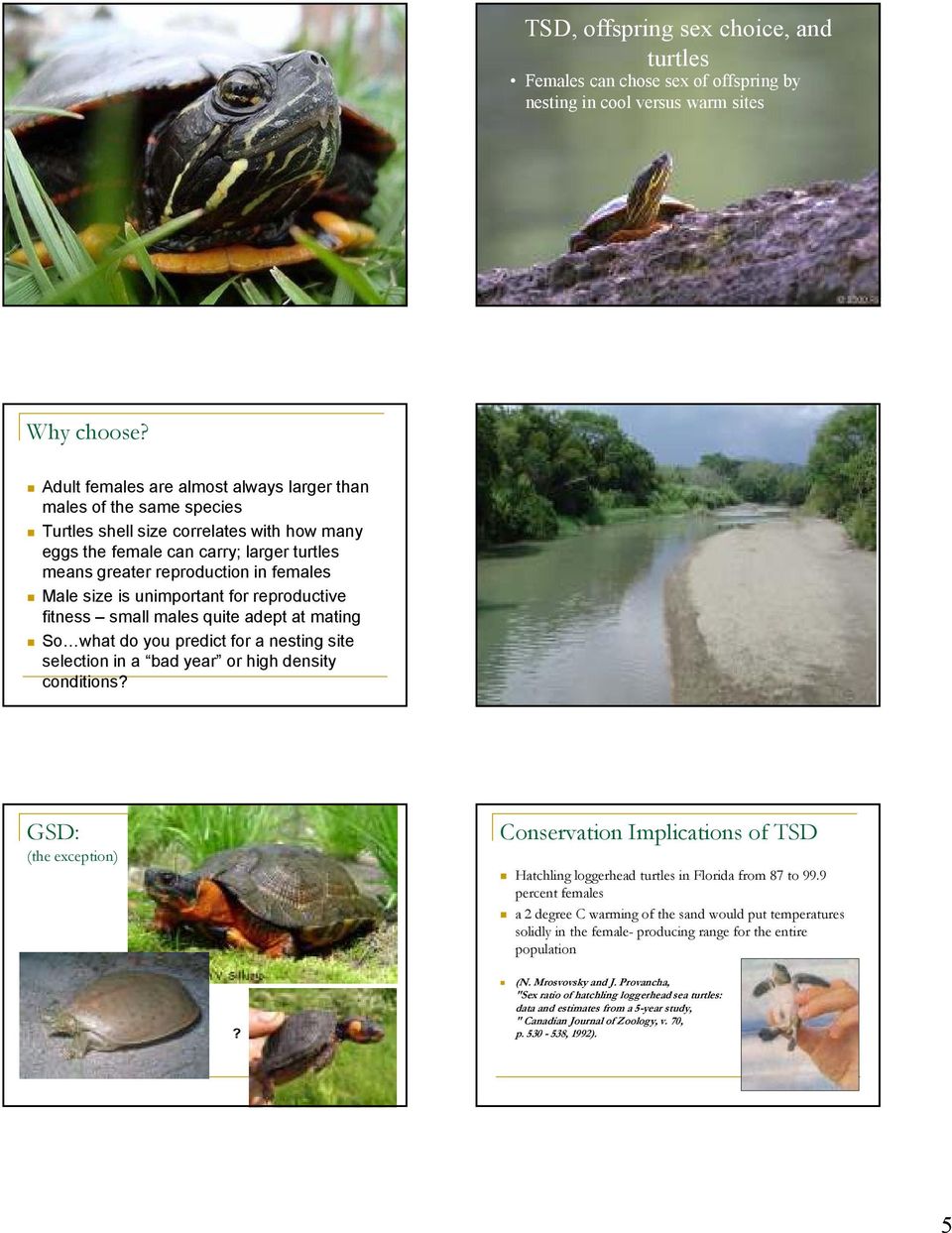
5 TSD, offspring sex choice, and turtles Females can chose sex of offspring by nesting in cool versus warm sites Why choose? Adult females are almost always larger than males of the same species Turtles shell size correlates with how many eggs the female can carry; larger turtles means greater reproduction in females Male size is unimportant for reproductive fitness small males quite adept at mating So what do you predict for a nesting site selection in a bad year or high density conditions? GSD: (the exception) Conservation Implications of TSD Hatchling loggerhead turtles in Florida from 87 to 99.9 percent females a 2 degree C warming of the sand would put temperatures solidly in the female- producing range for the entire population? (N. Mrosvovsky and J. Provancha, "Sex ratio of hatchling loggerhead sea turtles: data and estimates from a 5-year study, " Canadian Journal of Zoology, v. 70, p , 1992). 5
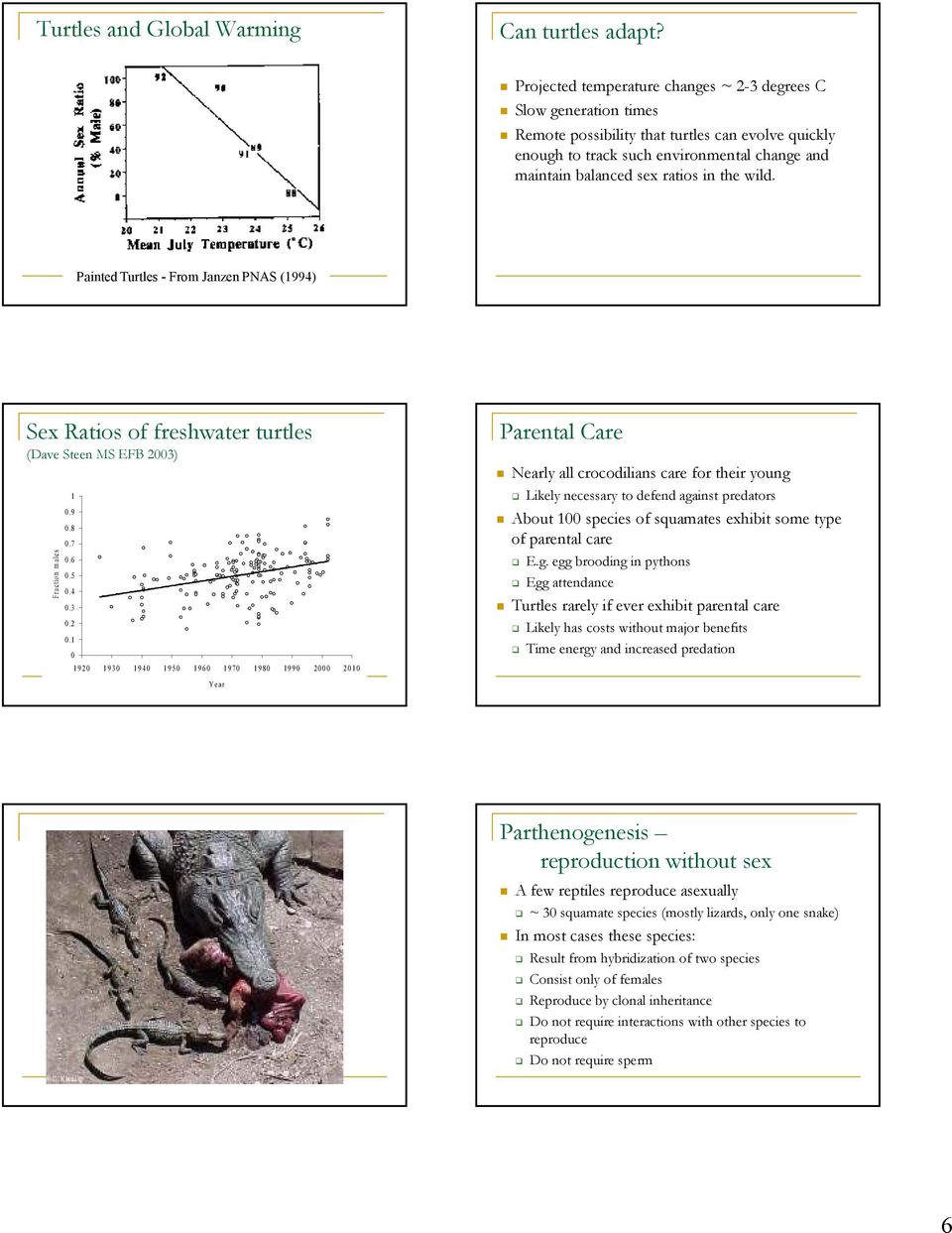
6 Turtles and Global Warming Can turtles adapt? Projected temperature changes ~ 2-3 degrees C Slow generation times Remote possibility that turtles can evolve quickly enough to track such environmental change and maintain balanced sex ratios in the wild. Painted Turtles - From Janzen PNAS (1994) Sex Ratios of freshwater turtles (Dave Steen MS EFB 2003) Fra c tio n m a le s Parental Care Nearly all crocodilians care for their young Likely necessary to defend against predators About 100 species of squamates exhibit some type of parental care E.g. egg brooding in pythons Egg attendance Turtles rarely if ever exhibit parental care Likely has costs without major benefits Time energy and increased predation Y e a r Parthenogenesis reproduction without sex A few reptiles reproduce asexually ~ 30 squamate species (mostly lizards, only one snake) In most cases these species: Result from hybridization of two species Consist only of females Reproduce by clonal inheritance Do not require interactions with other species to reproduce Do not require sperm 6
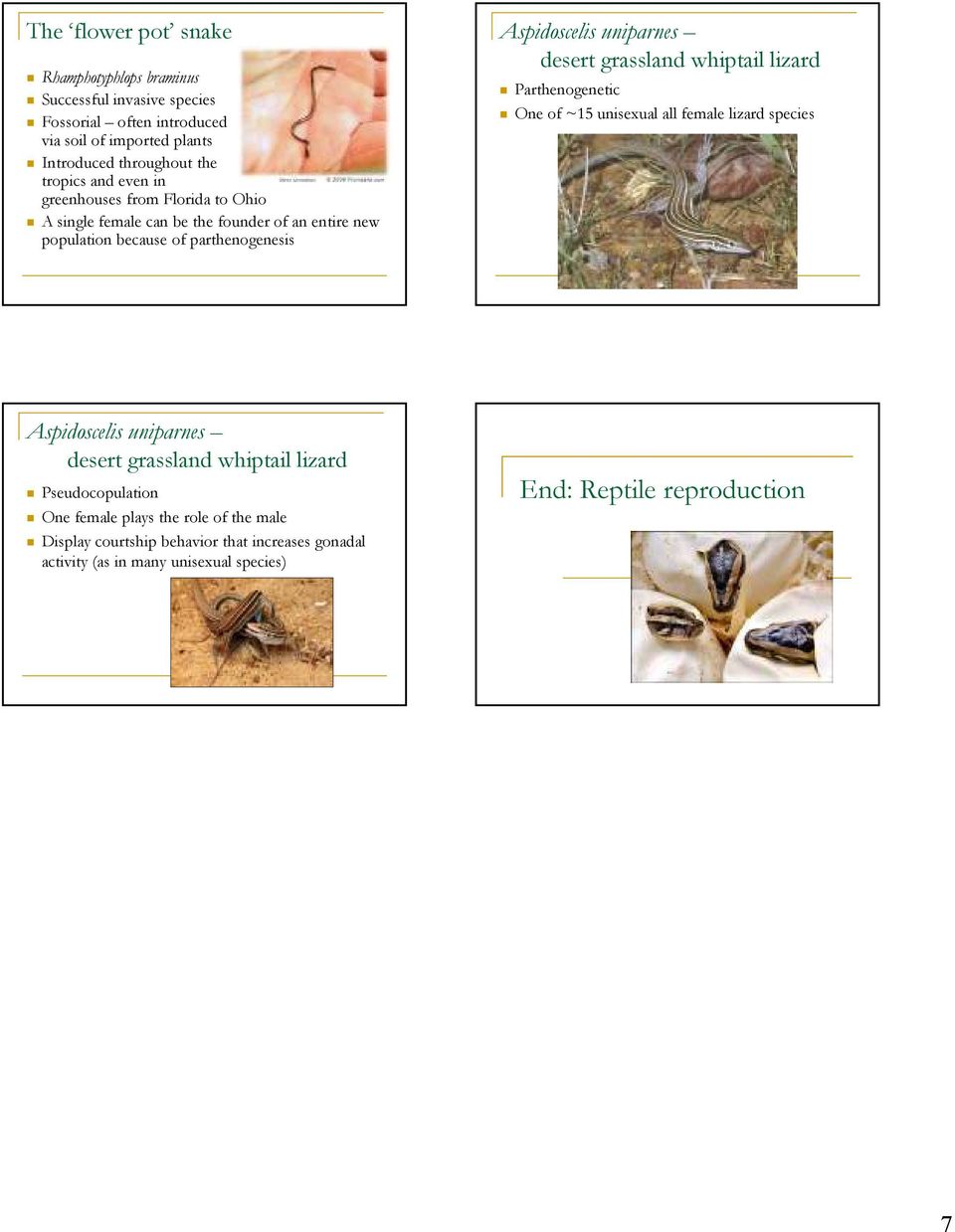
7 The flower pot snake Rhamphotyphlops braminus Successful invasive species Fossorial often introduced via soil of imported plants Introduced throughout the tropics and even in greenhouses from Florida to Ohio A single female can be the founder of an entire new population because of parthenogenesis Aspidoscelis uniparnes desert grassland whiptail lizard Parthenogenetic One of ~15 unisexual all female lizard species Aspidoscelis uniparnes desert grassland whiptail lizard Pseudocopulation One female plays the role of the male Display courtship behavior that increases gonadal activity (as in many unisexual species) End: Reptile reproduction 7
Unique reproductive strategies have developed to ensure maximum reproductive success.
 Animal Reproductive Strategies The ultimate goal of each species is to produce the maximum number of surviving offspring using the least amount of energy. This is called the reproductive effort. Asexual
Chordates -> Vertebrates. From basal Deuterostomes
 Chordates -> Vertebrates From basal Deuterostomes Outline Origins of Deuterostomes & Chordates Characteristics of Deuterostomes & Chordates Themes in Chordate evolution? Vertebrate adaptations? How are
Animals and Adaptation
 Animals and Adaptation From: http://www.learninghaven.com/science/articles/animals_and_adaptation.htm In order for animals to survive, they need to be able to adapt. In this lesson we will look at the
Biology 170: Exam 3. Multiple choice (2 pts each). Mark (bubble-in) the correct answer on your scantron.
 Name Biology 170: Exam 3 Multiple choice (2 pts each). Mark (bubble-in) the correct answer on your scantron. 1. All of the following are unique (only found in) mammalian characters, EXCEPT: a. Hair b.
... Date Starting your search in the Rainforest if it s open, keep an eye out for:
 Museum-Wide Reptiles include turtles, lizards, snakes, crocodiles, and all of their relatives. There are over 9,000 different kinds of reptiles with amazing adaptations that help them find food and protect
Parental care and sexual conflict. Email: [email protected]
 Parental care and sexual conflict René van Dijk Email: [email protected] Papers for 15 November Team 1 Royle,, N. J., I. R. Hartley & G. A. Parker. 2002. Sexual conflict reduces offspring fitness
2. Fill in the blank. The of a cell is like a leader, directing and telling the different parts of the cell what to do.
 1. Plant and animal cells have some similarities as well as differences. What is one thing that plant and animal cells have in common? A. cell wall B. chlorophyll C. nucleus D. chloroplasts 2. Fill in
Course Outline. Parental care and sexual conflict. Papers for 22 October. What is sexual conflict? 10/19/2009
 Parental and sexual conflict Course Outline 1. Sexual selection * 2. Parent offspring conflict * 3. Sexual conflict over parental René van Dijk Email: [email protected] 19 October 2009 4. Genomic
Can You Tell a 'Gator From a Croc? by Guy Belleranti
 Can You Tell a 'Gator From a Croc? Look closely at the reptiles pictured below. Can you tell which one is the crocodile and which is the alligator? Many people confuse crocodiles and alligators, and it's
Practice Questions 1: Evolution
 Practice Questions 1: Evolution 1. Which concept is best illustrated in the flowchart below? A. natural selection B. genetic manipulation C. dynamic equilibrium D. material cycles 2. The diagram below
Signs of a Gravid Tortoise
 Signs of a Gravid Tortoise Indications that a tortoise is gravid may vary from tortoise to tortoise, but can include any or all of the following:- Loss of appetite The physical space occupied in the body
Science 10-Biology Activity 14 Worksheet on Sexual Reproduction
 Science 10-Biology Activity 14 Worksheet on Sexual Reproduction 10 Name Due Date Show Me NOTE: This worksheet is based on material from pages 367-372 in Science Probe. 1. Sexual reproduction requires parents,
Ecology - scientific study of how individuals interact with their environment 34.1
 Biology 1407 Exam 4 Notes - Ecology Ch.35-36 Ecology - scientific study of how individuals interact with their environment 34.1 - organisms have adapted to - evolved in - a particular set of conditions;
Asexual Reproduction Grade Six
 Ohio Standards Connection: Life Sciences Benchmark B Describe the characteristics of an organism in terms of a combination of inherited traits and recognize reproduction as a characteristic of living organisms
PLANT EVOLUTION DISPLAY Handout
 PLANT EVOLUTION DISPLAY Handout Name: TA and Section time Welcome to UCSC Greenhouses. This sheet explains a few botanical facts about plant reproduction that will help you through the display and handout.
Grade 5 Standard 5 Unit Test Heredity. 1. In what way will a kitten always be like its parents? The kitten will...
 Grade 5 Standard 5 Unit Test Heredity Multiple Choice 1. In what way will a kitten always be like its parents? The kitten will... A. be the same color. B. learn the same things. C. have the same body structures.
REVIEW UNIT 10: ECOLOGY SAMPLE QUESTIONS
 Period Date REVIEW UNIT 10: ECOLOGY SAMPLE QUESTIONS A. Sample Multiple Choice Questions Complete the multiple choice questions to review this unit. 1. All of the following are density-dependent factors
Sexual Reproduction. The specialized cells that are required for sexual reproduction are known as. And come from the process of: GAMETES
 Sexual Reproduction Sexual Reproduction We know all about asexual reproduction 1. Only one parent required. 2. Offspring are identical to parents. 3. The cells that produce the offspring are not usually
Reptiles and Amphibians by Guy Belleranti
 Name: Take a look at the four animals pictures below. Do you know which ones are reptiles and which ones are amphibians? The chameleon is an unusual lizard that can change the color of its scaly body.
Recommended Resources: The following resources may be useful in teaching this
 Unit B: Anatomy and Physiology of Poultry Lesson 4: Artificial Poultry Reproduction Student Learning Objectives: Instruction in this lesson should result in students achieving the following objectives:
TLC Online Curriculum
 TLC Online Curriculum Lesson Title: Reptile Adaptations Grade level: 4-5 Subject Area: Animals Duration: Two or three class periods Objectives: Students will understand the following: 1. Adaptation describes
Dinosaur Time-line. What other animals lived then? How long ago did the dinosaurs live? Did dinosaurs live at the same time as people?
 Dinosaur Time-line How long ago did the dinosaurs live? The Age of Dinosaurs began nearly 250 million years ago, but the first true dinosaurs appeared closer to 220 million years ago. Some dinosaurs evolved
Elementary School Sea Turtle Lesson Plan Developed by Cathy Payne
 Elementary School Sea Turtle Lesson Plan Developed by Cathy Payne Background: Elementary school-aged children are very drawn to stories, both fiction and nonfiction, about sea turtles, but there are limited
Summary. 16 1 Genes and Variation. 16 2 Evolution as Genetic Change. Name Class Date
 Chapter 16 Summary Evolution of Populations 16 1 Genes and Variation Darwin s original ideas can now be understood in genetic terms. Beginning with variation, we now know that traits are controlled by
Meiosis is a special form of cell division.
 Page 1 of 6 KEY CONCEPT Meiosis is a special form of cell division. BEFORE, you learned Mitosis produces two genetically identical cells In sexual reproduction, offspring inherit traits from both parents
Worksheet: The theory of natural selection
 Worksheet: The theory of natural selection Senior Phase Grade 7-9 Learning area: Natural Science Strand: Life and living Theme: Biodiversity, change and continuity Specific Aim 1: Acquiring knowledge of
Introduction to Animals
 Introduction to Animals Unity and Diversity of Life Q: What characteristics and traits define animals? 25.1 What is an animal? WHAT I KNOW SAMPLE ANSWER: Animals are different from other living things
Animal Classification K-4
 Animal Classification K-4 Introduction: The theme of this self-guided experience is classification of animals. Students will learn to use body coverings as an aid to classification. As the group tours
Name Class Date. Adapting to the Environment Adaptations and Survival
 CHAPTER 3 4 SECTIN Adapting to the Environment Adaptations and Survival EFRE YU READ After you read this section, you should be able to answer these questions: What adaptations help animals survive? What
Lecture 10 Friday, March 20, 2009
 Lecture 10 Friday, March 20, 2009 Reproductive isolating mechanisms Prezygotic barriers: Anything that prevents mating and fertilization is a prezygotic mechanism. Habitat isolation, behavioral isolation,
In your last science lesson, you used posters to learn about five of the classes of vertebrates.
 Science 4 Physical Life Earth and Space LESSON 31 Identifying characteristics of classes of vertebrates Lesson Preparation Program Materials Child s Booklet C Investigating Characteristics of Animals (pp.
Biology 1406 - Notes for exam 5 - Population genetics Ch 13, 14, 15
 Biology 1406 - Notes for exam 5 - Population genetics Ch 13, 14, 15 Species - group of individuals that are capable of interbreeding and producing fertile offspring; genetically similar 13.7, 14.2 Population
nucleus cytoplasm membrane wall A cell is the smallest unit that makes up living and nonliving things.
 1 In nature there are living things and nonliving things. Living things depend on three basic life processes: nutrition, sensitivity and reproduction. Living things are made up of cells. 1. Match the two
Living with Alligators: A Florida Reality 1
 WEC203 Living with Alligators: A Florida Reality 1 Elizabeth Swiman, Mark Hostetler, Martin Main, and Sarah Webb Miller 2 Living in Florida, we have to share our space with a very large reptile, the American
Title. Euphausia superba. Author. Sophia Erb
 Title Using geometric probability to compare the random and actual mating success of Atlantic Krill, Euphausia superba Author Sophia Erb Abstract Currently the most abundant species on Earth, Atlantic
J. K. WEBB,* G. P. BROWN and R. SHINE
 Functional Ecology 2001 Body size, locomotor speed and antipredator behaviour in Blackwell Science, Ltd a tropical snake (Tropidonophis mairii, Colubridae): the influence of incubation environments and
Complete tests for CO 2 and H 2 Link observations of acid reactions to species
 Acids and Bases 1. Name common acids and bases found at home and at school 2. Use formulae for common acids and bases 3. Give examples of the uses of acids and bases 4. State that all solutions are acidic,
Lesson 3: Fish Life Cycle
 Lesson 3: Fish Life Cycle Activity: Diagram fish life cycle. Grade level: 4-8 Subjects: Science, social studies Setting: Classroom Duration: 50 minutes Key Terms: Fry, life cycle, life history, spawn,
Section 24 1 Reproduction With Cones and Flowers (pages 609 616)
 Chapter 24 Reproduction of Seed Plants Section 24 1 Reproduction With Cones and Flowers (pages 609 616) This section describes the reproductive structures of gymnosperms and angiosperms. It also explains
EGG FORMATION AND EGGSHELL QUALITY IN LAYERS
 EGG FORMATION AND EGGSHELL QUALITY IN LAYERS Amy Halls, Monogastric Nutritionist Shur-Gain, Nutreco Canada Inc. 01/05 1 EGG FORMATION AND EGGSHELL QUALITY IN LAYERS Amy Halls, Monogastric Nutritionist
Class Insecta - The insects
 A Introduction 1. Very species rich 2. Characteristics a. 3 pairs of legs b. 2 pairs of wings (most) except flies (1 pair of wings - Diptera) B. Distribution 1. All habitats except saltwater - replaced
240Tutoring Life Science Study Material
 240Tutoring Life Science Study Material This information is a sample of the instructional content and practice questions found on the 240Tutoring GACE Early Childhood Education. This information is meant
Cell Growth and Reproduction Module B, Anchor 1
 Cell Growth and Reproduction Module B, Anchor 1 Key Concepts: - The larger a cell becomes, the more demands the cell places on its DNA. In addition, a larger cell is less efficient in moving nutrients
Reproduction Multiple Choice questions
 Reproduction Multiple Choice questions 1. In mammals that are seasonal breeders, females are receptive only once a year. This is called A) a follicular cycle B) an estrous cycle C) a menstrual cycle D)
ENVIRONMENTAL CHANGES
 reflect How do you respond to environmental changes? Maybe you wear different types of clothes in different seasons. Maybe you only ride your bike during certain times of the year. What if you moved to
Evolution by Natural Selection 1
 Evolution by Natural Selection 1 I. Mice Living in a Desert These drawings show how a population of mice on a beach changed over time. 1. Describe how the population of mice is different in figure 3 compared
GRADE 6 SCIENCE. Demonstrate a respect for all forms of life and a growing appreciation for the beauty and diversity of God s world.
 GRADE 6 SCIENCE STRAND A Value and Attitudes Catholic Schools exist so that curriculum may be taught in the light of Gospel teachings. Teachers must reinforce Gospel truths and values so that students
Species-of-the-Week. Blanding s Turtle (Emydoidea blandingii) Species of Special Concern in Michigan
 Species-of-the-Week Blanding s Turtle (Emydoidea blandingii) Habitat Productive & clean shallow water (soft substrates) = ponds, marshes, swamps, bogs, wet prairies, slow rivers Spring & summer = terrestrial
Heredity - Patterns of Inheritance
 Heredity - Patterns of Inheritance Genes and Alleles A. Genes 1. A sequence of nucleotides that codes for a special functional product a. Transfer RNA b. Enzyme c. Structural protein d. Pigments 2. Genes
What is a fossil? 1. What does the name of your dinosaur mean? 2. In which geological time period did your dinosaur live?
 Name: School: Date: 1. What does the name of your dinosaur mean? 2. In which geological time period did your dinosaur live? 3. Where in the world are the fossil remains of your dinosaur found today? 4.
honey bee By Henry Touray
 honey bee By Henry Touray Introduction For my project I have chosen to research Bees. I chose to find out about the bee because bees have been in the news lately. Lots of hives have died out and scientists
Wildlife for the Workforce Part II:
 Wildlife for the Workforce Part II: Turtles and Tortoises, Snakes, Bees, and Exotic Animals Sarasota County Parks and Recreation Turtles and Tortoises Common cooter Green sea turtle Gopher tortoise Terrapin
ECOSYSTEM RESPONSES. reflect
 reflect There is a saying, No man is an island, which means that people need one another in order to survive. Everyone on Earth is interconnected in some way. This is not only true of human beings, but
UNIT SIX ADDITIONAL RESOURCES
 UNIT SIX ADDITIONAL RESOURCES 127 128 UNIT SIX: ADDITIONAL RESOURCES Science Expectations met in this unit: Activity Number: Activity Name 23: At The Zoo Turtle Scavenger Hunt 24: New Turtle Species Discovered!
Bio EOC Topics for Cell Reproduction: Bio EOC Questions for Cell Reproduction:
 Bio EOC Topics for Cell Reproduction: Asexual vs. sexual reproduction Mitosis steps, diagrams, purpose o Interphase, Prophase, Metaphase, Anaphase, Telophase, Cytokinesis Meiosis steps, diagrams, purpose
Poultry Sample Questions from Animals In Pursuit
 Q. What is barring on a chicken s feather? A. Two alternating colors on a feather, running across its width Q. What commercial strain of layers is best for egg production? A. White Leghorn strains Q. How
1 Characteristics of Living Things
 CHAPTER 2 1 Characteristics of Living Things SECTION It s Alive!! Or Is It? BEFORE YOU READ After you read this section, you should be able to answer these questions: What are all living things made of?
Key Idea 2: Ecosystems
 Key Idea 2: Ecosystems Ecosystems An ecosystem is a living community of plants and animals sharing an environment with non-living elements such as climate and soil. An example of a small scale ecosystem
IDENTIFICATION OF ORGANISMS
 reflect Take a look at the pictures on the right. Think about what the two organisms have in common. They both need food and water to survive. They both grow and reproduce. They both have similar body
Biology Keystone (PA Core) Quiz Ecology - (BIO.B.4.1.1 ) Ecological Organization, (BIO.B.4.1.2 ) Ecosystem Characteristics, (BIO.B.4.2.
 Biology Keystone (PA Core) Quiz Ecology - (BIO.B.4.1.1 ) Ecological Organization, (BIO.B.4.1.2 ) Ecosystem Characteristics, (BIO.B.4.2.1 ) Energy Flow 1) Student Name: Teacher Name: Jared George Date:
2. What kind of energy is stored in food? A. chemical energy B. heat energy C. kinetic energy D. light energy
 Assessment Bank Matter and Energy in Living Things SC.8.L.18.4 1. What is energy? A. anything that takes up space B. anything that has mass C. the ability to conduct current D. the ability to do work 2.
UNIT TWO TURTLE BIOLOGY
 UNIT TWO TURTLE BIOLOGY 43 44 Science Expectations met in this unit: UNIT TWO: TURTLE BIOLOGY Activity Number: Activity Name Strand Grade 2 Growth and Changes in Animals Grade 4 Habitats and 5: Camouflage
Logistic Paradigm. Logistic Paradigm. Paradigms. How should we consider them?
 Harvesting Paradigms Sustained Yield Harvesting Paradigms Net-Annual Increment Paradigm The Myth of MSY How should we consider them? The logistic paradigm obviously arises from logistic model. Says that
2 nd Grade Science Unit B: Life Sciences Chapter 3: Plants and Animals in Their Environment Lesson 1: How are plants and animals like their parents?
 2 nd Grade Science Unit B: Life Sciences Chapter 3: Plants and Animals in Their Environment Lesson 1: How are plants and animals like their parents? offspring Offspring are young plants and animals. Offspring
Basic Biological Principles Module A Anchor 1
 Basic Biological Principles Module A Anchor 1 Key Concepts: - Living things are made of units called cells, are based on a universal genetic code, obtain and use materials and energy, grow and develop,
GCSE BITESIZE Examinations
 GCSE BITESIZE Examinations General Certificate of Secondary Education AQA SCIENCE A BLY1B Unit Biology B1b (Evolution and Environment) AQA BIOLOGY Unit Biology B1b (Evolution and Environment) FOUNDATION
ENDANGERED AND THREATENED
 ENDANGERED AND THREATENED Understand how species in the Sonoran Desert Region may become endangered or threatened and what is being done to protect them. ARIZONA SCIENCE STANDARDS SC03-S4C3-03&04, SC08-S1C3-07,
Name Date Hour. Plants grow in layers. The canopy receives about 95% of the sunlight leaving little sun for the forest floor.
 Name Date Hour Directions: You are to complete the table by using your environmental text book and the example given here. You want to locate all the abiotic (non-living) and biotic (living) factors in
Germ cell formation / gametogenesis And Fertilisation
 Developmental Biology BY1101 P. Murphy Lecture 3 The first steps to forming a new organism Descriptive embryology I Germ cell formation / gametogenesis And Fertilisation Why bother with sex? In terms of
Chapter 13: Meiosis and Sexual Life Cycles
 Name Period Concept 13.1 Offspring acquire genes from parents by inheriting chromosomes 1. Let s begin with a review of several terms that you may already know. Define: gene locus gamete male gamete female
Talking About Penguins by Guy Belleranti
 Talking About Penguins Penguins are one of the world s most interesting birds. They waddle when they walk, and have flippers instead of wings. The bones in a penguin s flippers are heavier and more solid
Name That Adaptation. Background: Link to the Plan Read Section 5 (Whooping Crane Ecology and Biology) in the Management Plan
 Summary Students will explore structural, physiological, and behavioral adaptations of whooping cranes. Objectives: Students will be able to: Define an adaptation Describe several whooping crane adaptations
4 SEX CHROMOSOMES AND SEX DETERMINATION
 4 SEX CHROMOSOMES AND SEX DETERMINATION 4.1 Sex chromosomes and Sex Determination Sex- chromosomes. If present, sex chromosomes may not have the same size, shape, or genetic potential. In humans, females
7A The Origin of Modern Genetics
 Life Science Chapter 7 Genetics of Organisms 7A The Origin of Modern Genetics Genetics the study of inheritance (the study of how traits are inherited through the interactions of alleles) Heredity: the
Given these characteristics of life, which of the following objects is considered a living organism? W. X. Y. Z.
 Cell Structure and Organization 1. All living things must possess certain characteristics. They are all composed of one or more cells. They can grow, reproduce, and pass their genes on to their offspring.
LAB 8 EUKARYOTIC CELL DIVISION: MITOSIS AND MEIOSIS
 LAB 8 EUKARYOTIC CELL DIVISION: MITOSIS AND MEIOSIS Los Angeles Mission College Biology 3 Name: Date: INTRODUCTION BINARY FISSION: Prokaryotic cells (bacteria) reproduce asexually by binary fission. Bacterial
Disney Worldwide Conservation Fund Allows Teachers to Broaden Awareness of the Plight of the Diamondback Terrapin
 Disney Worldwide Conservation Fund Allows Teachers to Broaden Awareness of the Plight of the Diamondback Terrapin Maggie Dugan: Upper Township Elementary School Jane Krajewski: Quinton Township School
Managing Heat Stress in Poultry
 Managing Heat Stress in Poultry Amy E. Halls, Monogastric Nutritionist Shur-Gain, Nutreco Canada Inc. Heat stress has several serious and economical effects on poultry. In broilers and turkeys, it can
Name: Class: Date: ID: A
 Name: Class: _ Date: _ Meiosis Quiz 1. (1 point) A kidney cell is an example of which type of cell? a. sex cell b. germ cell c. somatic cell d. haploid cell 2. (1 point) How many chromosomes are in a human
Activity 12 Zoos: Past and Present
 Activity 12 Zoos: Past and Present Objective & Overview: Through surveys and research, students will learn about the evolution of zoos, from menageries to educational and conservation institutions. Teacher
1. Why is mitosis alone insufficient for the life cycle of sexually reproducing eukaryotes?
 Chapter 13: Meiosis and Sexual Life Cycles 1. Why is mitosis alone insufficient for the life cycle of sexually reproducing eukaryotes? 2. Define: gamete zygote meiosis homologous chromosomes diploid haploid
CCR Biology - Chapter 5 Practice Test - Summer 2012
 Name: Class: Date: CCR Biology - Chapter 5 Practice Test - Summer 2012 Multiple Choice Identify the choice that best completes the statement or answers the question. 1. If a cell cannot move enough material
www.irishseedsavers.ie Natural surface water on earth includes lakes, ponds, streams, rivers, estuaries, seas and oceans.
 www.irishseedsavers.ie POND LIFE FACT SHEET Natural surface water on earth includes lakes, ponds, streams, rivers, estuaries, seas and oceans. A pond is a small body of fresh water shallow enough for sunlight
Use this diagram of a food web to answer questions 1 through 5.
 North arolina Testing Program EO iology Sample Items Goal 4 Use this diagram of a food web to answer questions 1 through 5. coyotes 3. If these organisms were arranged in a food pyramid, which organism
SEA CHANGE: GULF ISLANDS NATIONAL SEASHORE. Sea Turtles Hurdles. Objectives: Grade Level: 4th-8th grade Activity Time: Two, 45-minute lessons
 Grade Level: 4th-8th grade Activity Time: Two, 45-minute lessons Subject Area: Biology Life Sciences Day 1 Discuss sea turtles found in the Gulf of Mexico, to include natural versus human dangers. Day
Chapter 38: Angiosperm Reproduction and Biotechnology
 Name Period Concept 38.1 Flowers, double fertilization, and fruits are unique features of the angiosperm life cycle This may be a good time for you to go back to Chapter 29 and review alternation of generation
Master Curriculum Topic Study: Human Body Systems
 Master Curriculum Topic Study: Human Body Systems Session C Section I: Culminating Ideas for Adult Literacy 1. The fundamental building block of organisms is cells. a. Cells combine to form tissues, which
Connected Experience: Evolution and the Galápagos Tortoise
 Connected Experience: Evolution and the Galápagos Tortoise GRADE LEVELS 6 th -8 th ; California Content Standards for 7 th and High School Biology Objectives SUBJECTS Life Sciences DURATION Pre-Visit:
Invasive Reptiles and Amphibians of Florida!
 1 Invasive Reptiles and Amphibians of Florida! 2 Created by: Thompson Antony Lauren Diaz Sean McKnight Alana Palau JoAnna Platzer Illustrated by Lauren Diaz Invasive Ecology of Reptiles and Amphibians
Plants, like all other living organisms have basic needs: a source of nutrition (food),
 WHAT PLANTS NEED IN ORDER TO SURVIVE AND GROW: WATER Grades 3 6 I. Introduction Plants, like all other living organisms have basic needs: a source of nutrition (food), water, space in which to live, air,
Worksheets. (Caterpillars of Singapore s Butterflies) Worksheet Title Recommended level. Adaptations of the caterpillar defence mechanism
 Worksheets (Caterpillars of Singapore s Butterflies) Worksheet Title Recommended level 1 Life cycle of a butterfly P3 2 Am I an insect? P3 3 4 Adaptations of the caterpillar defence mechanism The butterfly
Incubating Eggs. Percent Hatchability is the percentage of fertile eggs which actually hatch out as live young.
 Incubating Eggs Phillip J. Clauer, Poultry Extension Specialist, Animal and Poultry Sciences Introduction Many domestic bird owners incubate eggs to help sustain their flock over time. This fact sheet
A Swim Through the Sea A B Sea Crinkleroots Guide to Knowing Animal Habitats
 HABITAT - Children ages 5-8 The Magic School Bus Hops Home: A Book About Animal Habitats by Patricia Relf, Scholastic Trade, 1995 ISBN: 0590484133 Ms. Frizzle is up to her adventurous ways of teaching
Controlling Late Egg Weight in Broiler Breeders
 Controlling Late Egg Weight in Broiler Breeders Ali Yavuz, Senior Technical Service Manager and Dr. Antonio Kalinowski, Nutritionist October 2014 Summary Controlling egg weight in broiler breeders late
Biological Science, 5e (Freeman) Chapter 1 Biology and the Tree of Life
 Biological Science, 5e (Freeman) Chapter 1 Biology and the Tree of Life 1) Pasteur s experiments proved that A) Cells cannot survive in swan necked flasks B) In order to grow, cells need to be supplied
Grade Level Expectations for the Sunshine State Standards
 for the Sunshine State Standards FLORIDA DEPARTMENT OF EDUCATION http://www.myfloridaeducation.com/ The seventh grade student: The Nature of Matter uses a variety of measurements to describe the physical
Each person normally has 23 pairs of chromosomes, or 46 in all. We inherit one chromosome per pair from our mother and one from our father.
 AP Psychology 2.2 Behavioral Genetics Article Chromosomal Abnormalities About 1 in 150 babies is born with a chromosomal abnormality (1, 2). These are caused by errors in the number or structure of chromosomes.
The Pennsylvania System of School Assessment
 The Pennsylvania System of School Assessment 2005 2006 Science Item and Scoring Sampler Grade 8 Pennsylvania Department of Education Bureau of Assessment and Accountability 2005 2006 TABLE OF CONTENTS
FARM INNOVATORS GUIDE TO INCUBATION
 FARM INNOVATORS GUIDE TO INCUBATION WHERE TO GET HATCHING EGGS Obtaining fertile eggs may present a problem, especially if you live in an urban area. Most of the eggs sold in grocery stores are not fertile