
Astrology s Mirror: Full-Phase Aspects
|
|
|
- Caroline Copeland
- 9 years ago
- Views:
Transcription
1 1

2 Astrology s Mirror Full-Phase Aspects By Michael Erlewine 2

3 An ebook from Startypes.com 315 Marion Avenue Big Rapids, Michigan Fist published 1998 Michael Erlewine 1998 ISBN All rights reserved. No part of the publication may be reproduced, stored in a retrieval system, or transmitted, in any form or by any means, electronic, mechanical, photocopying, recording, or otherwise, without the prior permission of the publisher. Cover and Graphics by Michael Erlewine Some images 2007JupiterImages Corporation 3

4 This book is dedicated to Dane Rudhyar L. Edward Johndro Layla Hill Champions of Full-Phase Aspects 4

5 Table of Contents Table of Contents... 5 Astrology s Mirror: Full-Phase Aspects What Are Aspects? Why These Points? The Other Shoe The Message about Aspects Waxing and Waning Aspects Inconvenient Aspects An Analogy The Standard Aspect Cycle What about Orbs? Phase Relationships The Open-Wheel Full-Phase Charts Phase Cycles The Four Hemispheres The Waxing Aspects The Waning Aspects Astrologer's Heaven The Moon Full-Phase Wheel The Sweet Sixteen The Four Aspect Hemispheres Cycle Phases Sixteen Phases of the Aspect Cycle The Sweet Sixteen The Conjunction (000 Degrees) The Semi-Sextile (030 Degrees) The Semi-Square (045 Degrees) The Waxing Sextile (060 Degrees) The Waxing Square (090 Degrees) The Waxing Trine (120 Degrees)

6 The Waxing Sesquiquadrate (135 Degrees) The Waxing Inconjunct (150 Degrees) The Opposition (180 Degrees) The Inconjunct (210 Degrees) The Waning Sesquiquadrate (225 Degrees) The Waning Trine (240 Degrees) The Waning Square (270 Degrees) The Waning Sextile (300 Degrees) The Waning SemiSquare (315 Degrees) The Waning SemiSextile (330 Degrees) Looking at the Full-Phase Wheel What to Look For The Four Hemispheres The Inner and the Outer Giving and Receiving Whole Chart Emphasis Planet-by-Planet Emphasis The Hemispheres The Other Side Getting Started Full-Phase Resources Full-Phase Aspects The Lights: Sun and Moon Giving and Taking Waxing and Waning Hemispheres Waxing Hemisphere Emphasis Waxing Hemisphere: First Quarter Emphasis.. 90 Waxing Hemisphere: 2nd Quarter Emphasis Waxing Hemisphere Giver: Somewhat Giver: Moderate Giver: Extreme Taking, Receiving

7 Waning hemisphere: Third Quarter Emphasis. 95 Waning Hemisphere: Fourth Quarter Emphasis95 Waning Hemisphere Taker: Somewhat Taker: Moderate Taker: Extreme Introvert / Extrovert Inner and Outer Hemispheres Introvert Chart First Quarter Emphasis Second Quarter Emphasis Introvert Hemisphere Introverted: Somewhat Introverted: Moderate Introvert: Extreme Extrovert Extrovert Hemisphere Extrovert: Second Quarter emphasis Extrovert: Third Quarter emphasis Extrovert: Somewhat Extrovert: Moderate Extrovert: Extreme The Four Quadrants or Quarters First Quadrant or Quarter First Quadrant The Second Quadrant or Quarter Second Quadrant The Third Quadrant or Quarter Third Quadrant The Fourth Quadrant or Quarter The Fourth Quadrant The Four Aspect Groups The Energy Group: Green The Turning Point Group: Yellow The Challenge Group: Red

8 The Subtle Group: Blue The Sweet Sixteen Aspects Conjunction: 0 Degrees Waxing Semisextile: 30 Degrees Waxing Semisextile: 45 Degrees Waxing Sextile: 60 Degrees Waxing Square: 90 Degrees Waxing Trine: 120 Degrees Waxing Sesquiquadrate: 135 Degrees Waxing Inconjunct: 150 Degrees Opposition: 180 Degrees Waning Inconjunct: 210 Degrees Waning Sesquiquadrate 225 Degrees Waning Trine: 240 Degrees Waning Square: 270 Degrees Waning Sextile: 300 Degrees Waning Semisquare: 315 Degrees Waning Semisextile: 330 Degrees The Four Aspect Groups Energy Group: Low Energy Group: Good Energy Group: Strong Turning Point Group: Low Turning Point: Good Turning Point Group: Strong Challenge Group: Low Challenge Group: Average Challenge Group: Strong Transitional Group: Low Transitional Group: Average Transitional Group: Strong The Four Sectors Active Sector Active or Outgoing Sector Responsive Sector

9 Responsive or Ingoing Sector Public Sector Public or Outer Sector Private Sector Private Sector StarType Patterns How StarTypes Came To Be Sun-Centered Astrology Two Indispensable Charts Large-Scale Planetary Patterns Green Lines and Red Lines Major Patterns Sun Cross The Receivers Michael Erlewine. Error! Bookmark not defined. A Brief Bio of Michael Erlewine Error! Bookmark not defined. Example Astro*Image Card Error! Bookmark not defined. Personal Astrology Readings... Error! Bookmark not defined. The Heart Center House.. Error! Bookmark not defined. Heart Center Library... Error! Bookmark not defined. The All-Music Guide / All-Movie Guide... Error! Bookmark not defined. Heart Center Meditation Room. Error! Bookmark not defined. Heart Center Symbol... Error! Bookmark not defined. Music Career... Error! Bookmark not defined Error! Bookmark not defined. 9

10 Astrology s Mirror: Full-Phase Aspects Here is a new way to look at aspects, using the same astrological tools you have always been using. There is nothing new added from outside, just some rearranging of what you already know. When I came across it, I was amazed. All of these years I had been playing with the various aspects, like most astrologers, and then one day they began to fit together in a new way, like pieces in a crossword puzzle. Before I knew it, all of these parts I knew so well came together, and before me was a picture of my own chart I had never seen so clearly. I want to share that technique with you, and it is all about how to use the aspects. This book makes it easy for you to learn to look at aspects in a new light and see for yourself. Most astrologers have a particular set of aspects and orbs that they use. Some just use the standard 10

11 Ptolemaic aspects, and others of us add to that list, even to the point of wandering into the various harmonic series. The aspect orbs that we use determine whether that aspect is going to show up on our radar screen when we look at a chart, especially if we are using a computer. Obviously, the tighter the orbs, the less aspects that show up on the screen, and with wider orbs, we, of course, see more aspects. 11

12 What Are Aspects? Before we go any further into this, let's agree what we mean by aspects. Take any two heavenly bodies; it does not matter if it is the Sun or Moon, or one of the planets. One of any two bodies is moving faster and the other moves more slowly. The net effect is that the faster-moving planet describes a 360-degree circle or cycle of aspects to the slower moving body. The fastermoving planet goes from a conjunction with the slower body through a circle/cycle of 360-degrees and back around to the next conjunction. That is called the aspect cycle, and is what aspects are all about. Let's take the familiar solunar cycle as an example. The solunar cycle (and astronomers call this a "synodic" cycle) begins with the Sun and Moon conjunct in the same zodiac degree at the moment of the New Moon. The Moon, being the faster-moving body, then begins to move away from the conjunction with the Sun and starts 12

13 to form aspects (angular arcs of separation) with the Sun, the most familiar being the First Quarter Moon (90 degrees), the Full Moon (180 degrees), and the Fourth Quarter Moon (270 degrees), after which the Moon moves to conjunct the Sun again, for another New Moon. The cycle continues on around, month after month. This same type of synodic cycle of aspects takes place with any two heavenly bodies; it makes no difference which two you select. There is always one that moves faster, and one that moves more slowly. Aspects are formed, endlessly. It is happening now in the sky above. Each planet out there is in the process of forming or separating from one aspect or another with all the other planets. In fact, the Sun, Moon, and planets are always involved with one another in these various aspect cycles, some 45 pairs of them (geocentrically), all going on at once. 13

14 Why These Points? Perhaps because there are so many aspects to consider all at once, astrologers have over the centuries picked certain points on the 360-degree aspect cycle and found them to be especially significant. We mentioned (using the solunar cycle) the 90-degree points (Square), and the halfway point (Opposition), which is the 180 degree point in the circle. Most astrologers add to this list, the 60-degree points (Sextile) and the 120-degree points (Trine). Still others want to include the 45-degree points (Semi-Square), and so on it goes. If we kept adding points along the circle or cycle, we would eventually have all 360 degrees marked out. Some folks do, and the Sabian Symbols by Marc Edmund Jones has an interpretation for all 360 degrees of the zodiac. But let's back up a moment. 14

15 We mentioned the 90-degree or Square points on the cycle, but there are two of these in any cycle. In the solunar cycle, there is the 90-degree point that marks the First Quarter, but there is also the 90-degree point that marks the Fourth Quarter. Each of these aspects is 90 degrees, and few astrologers would want to confuse a First Quarter Moon with a Fourth Quarter Moon. One leads to the light of the Full Moon, and the other to the dark of the New Moon. The same is true for the 60- degree (Sextile) and 120-degree (Trine) aspects. There are two of these in each cycle, as well. What are we to do with this fact that there are two of most aspects? The Other Shoe In modern astrology, almost all astrologers treat the 90- degree or square aspect as the same thing, whether it is that first 90-degree aspect (the waxing Square) or the second 90-degree aspect (the waning Square). The interpretation is the same. Yes, many astrologers would 15

16 perhaps make an exception with the familiar solunar cycle, and differentiate between a First Quarter Moon and a Fourth Quarter Moon, but when it gets to the planets, in all their various combinations, there is usually only one interpretation given. A Square is a Square is a Square, and so on. However, not everyone agrees. It is true that a very few astrologers have pointed out to the rest of us that, reasonably speaking, we ought to interpret a waxing Square differently from a waning Square, just as we do in the solunar cycle, most notably L. Edward Johndro and in particular Dane Rudhyar. Both of these authors writings have made it clear that we are missing something very important by grouping all squares, all sextiles, all trines, etc. together and interpreting each pair in the same manner. What are they trying to tell us? 16

17 The Message about Aspects If we read these authors (and I have), and others on this subject, here is their message to us. I will paraphrase and summarize what they have said: These cycles are living events in the heavens above, with a beginning, a middle, and an end, starting at the point of the conjunction of the two bodies, extending to the opposition, and then back to the next conjunction. It can be important for us to know, when we speak of an aspect like a Square, whether we are referring to the square at the beginning or the square at the end of the cycle. If you asked me to help you plan a social outing, and I told you to have your social event "after" the Square aspect between the Sun and the Moon, it would be important, according to the tradition of astrology, to designate that it is the waxing Square, after which you should hold the party, and not the waning Square. If you 17

18 threw the party after the waning Square, you would be holding it right before the New Moon, and the dark of the Moon in both Eastern and Western astrology is more of a time to hunker down, and not a time to celebrate. Everyone knows that the Full Moon is when to get together. You get the idea, and I believe most of you would agree. We have this discrimination for the solunar cycle, but we don't extend this to the planetary aspects. Why is that? Waxing and Waning Aspects The point is that, according to Dane Rudhyar and others, we should discriminate in our interpretation between what are called waxing and waning aspects. An aspect is waxing if it occurs before the Opposition point (180 degrees), and it is waning if it takes place after the Opposition. There is the going out to the opposition, and the coming back from the Opposition. Therefore, we 18

19 would have a waxing Square and a waning Square, and same goes for Sextiles (60 degree), Trines (120 degree), Semi-Squares (45 degree), Sesqui-Quadrates (135 degree), Inconjunct (150 degree), and any other aspects you might care to use. The only aspects that are not mirrored in this way are the Conjunction (zero degrees) and Opposition (180 degrees). They are the beginning and mid points of the cycle, and, in that sense, they stand alone. Discriminating between waxing and waning aspects takes us a long way to re-invigorating our astrological interpretations. The question of how the interpretations differ between waxing and waning aspects is something I want to get to, but first there is a more important point to be made about the wholeness of cycles as they relate to individual aspects. 19

20 Inconvenient Aspects While it may have been a great convenience to astrologers over the centuries to have fixed upon a series of aspects, like the Square and Trine, and to have more-or-less ignored whatever takes place in between those aspects, we now need to take a good look at what we have been ignoring, and that is: the essential wholeness or continuum of these planetary cycles. If we use aspect orbs, and most astrologers do, then no matter what orbs we use, there will always be the case where a planet is just one degree out of orb, and that aspect will not be taken into consideration by us. This is particularly true if we are using computerized astrology, which will simply not list an aspect if it is out-of-orb. What are we to do with these unlisted aspects? We do know by looking at the chart that the unlisted aspect is either an aspect waiting to happen or an 20

21 aspect that has just happened recently. It certainly is not any other aspect, and the fact that the aspect is very close to the particular aspect we have set orbs to, we can know it is at the very least in the same ballpark. Regardless of what orbs we may have set, each and every planet is somewhere in its journey or relationship with every other planet. It is never "not out there," and it never somehow drops out of the cycle, but it always continues, degree by degree, on its appointed round of the zodiac. In the entire 360-degree orbit, every degree is essential. We can't get along without each one of them. An Analogy Here is a simple analogy that will point out two areas where we, as astrologers, may be missing out. Suppose I were to send one of my daughters on a round trip to Ann Arbor, by way of Kalamazoo on the outgoing leg and Flint on the ingoing. 21
Doing Solstice Readings with Solar Fire
 Doing Solstice Readings with Solar Fire Below are detailed instructions that will enable you to do solstice readings much more easily. If you follow them, you will also master some of Solar Fire s most
PUSD High Frequency Word List
 PUSD High Frequency Word List For Reading and Spelling Grades K-5 High Frequency or instant words are important because: 1. You can t read a sentence or a paragraph without knowing at least the most common.
Forecasting Report for: Mark Zuckerberg Jan 01, 2011 to Mar 31, 2011
 Interpretations by Michael Erlewine Forecasting Report for: Jan 0, 0 to Mar, 0 Copyright 0 Matrix Software . Introduction. The Lights Forecast. About the Communications and Connections Forecast. in Your
Interpret Astrology The House Combinations. By Michael Erlewine
 Interpret Astrology The House Combinations By Michael Erlewine An e-book from Startypes.com 315 Marion Avenue Big Rapids, Michigan 49307 First published 2006 2006 Michael Erlewine/StarTypes.com ISBN 978978-0-9798328-1-9
Activity 3: Observing the Moon
 Activity 3: Observing the Moon Print Name: Signature: 1.) KEY. 2.). 3.). 4.). Activity: Since the dawn of time, our closest neighbor the moon has fascinated humans. In this activity we will explore the
The Lunar Phase Wheel
 The Lunar Phase Wheel A lunar phase wheel is a simple device to help you to visualize the positions of the Earth, Moon, and Sun at various times of the day or month, and then predict the phases and the
CELESTIAL CLOCK - THE SUN, THE MOON, AND THE STARS
 INTRODUCTION CELESTIAL CLOCK - THE SUN, THE MOON, AND THE STARS This is a scientific presentation to provide you with knowledge you can use to understand the sky above in relation to the earth. Before
Relative and Absolute Change Percentages
 Relative and Absolute Change Percentages Ethan D. Bolker Maura M. Mast September 6, 2007 Plan Use the credit card solicitation data to address the question of measuring change. Subtraction comes naturally.
Night Sky III Planetary Motion Lunar Phases
 Night Sky III Planetary Motion Lunar Phases Astronomy 1 Elementary Astronomy LA Mission College Spring F2015 Quotes & Cartoon of the Day Everything has a natural explanation. The moon is not a god, but
Journey to other celestial objects. learning outcomes
 The eight planets Journey to other celestial objects C 44 time 80 minutes. learning outcomes To: know which planets have moons know which planets have rings know the colours of the different planets know
California Treasures High-Frequency Words Scope and Sequence K-3
 California Treasures High-Frequency Words Scope and Sequence K-3 Words were selected using the following established frequency lists: (1) Dolch 220 (2) Fry 100 (3) American Heritage Top 150 Words in English
Astrology: Fact or Fiction? 50-60 minutes, for 9th-12th grades
 Astrology: Fact or Fiction? 50-60 minutes, for 9th-12th grades Notice This lesson plan was created by Digitalis Education Solutions (DigitalisEducation.com) and is provided free of charge as a public service
7 Super Solar Fire Tips and Tricks. Tip 1 Browsing through Time with Chart Animation
 7 Super Solar Fire Tips and Tricks Welcome to our first installment of Solar Fire Tips and Tricks. Solar Fire is very user-friendly making it fun to explore all the various features in the program. Our
Cycles in the Sky. Teacher Guide: Cycles in the Sky Page 1 of 8 2008 Discovery Communications, LLC
 Cycles in the Sky What is a Fun damental? Each Fun damental is designed to introduce your younger students to some of the basic ideas about one particular area of science. The activities in the Fun damental
Phases of the Moon. Preliminaries:
 Phases of the Moon Sometimes when we look at the Moon in the sky we see a small crescent. At other times it appears as a full circle. Sometimes it appears in the daylight against a bright blue background.
Chapter 3 The Science of Astronomy
 Chapter 3 The Science of Astronomy Days of the week were named for Sun, Moon, and visible planets. What did ancient civilizations achieve in astronomy? Daily timekeeping Tracking the seasons and calendar
Lesson 1: Phases of the Moon
 Lesson 1: Phases of the Moon The moon takes 29.5 days to revolve around the earth. During this time, the moon you see in the sky appears to change shape. These apparent changes, which are called phases,
Matrix Software. How to use your
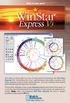 ow to use your Get ready to jump right into the exciting world of Astrology with Win Star Express V3. Combining the most sophisticated calculation routines with easily grasped, pop-up chart interpretations,
EDMONDS COMMUNITY COLLEGE ASTRONOMY 100 Winter Quarter 2007 Sample Test # 1
 Instructor: L. M. Khandro EDMONDS COMMUNITY COLLEGE ASTRONOMY 100 Winter Quarter 2007 Sample Test # 1 1. An arc second is a measure of a. time interval between oscillations of a standard clock b. time
26A Phases of the Moon
 Phases of the Moon Investigation 26A 26A Phases of the Moon What causes the lunar cycle? Why does the Moon appear to change shape over the course of a month? In this investigation you will model the lunar
Drills to Improve Football Skills www.ulster.gaa.ie 1
 Drills to Improve Football Skills www.ulster.gaa.ie 1 Drills to Improve Football Skills Drills to Improve Football Skills has been designed with the intention that the coach should step back to take a
FIRST GRADE 1 WEEK LESSON PLANS AND ACTIVITIES
 FIRST GRADE 1 WEEK LESSON PLANS AND ACTIVITIES UNIVERSE CYCLE OVERVIEW OF FIRST GRADE UNIVERSE WEEK 1. PRE: Describing the Universe. LAB: Comparing and contrasting bodies that reflect light. POST: Exploring
Fry Phrases Set 1. TeacherHelpForParents.com help for all areas of your child s education
 Set 1 The people Write it down By the water Who will make it? You and I What will they do? He called me. We had their dog. What did they say? When would you go? No way A number of people One or two How
Phases of the Moon. Objective. Materials. Procedure. Name Date Score /20
 Name Date Score /20 Phases of the Moon Objective Working with models for the Earth-Moon-Sun system, the student will simulate the phases the Moon passes through each month. Upon completion of this exercise,
LILLIAN PITAWANAKWAT LESSON PLAN 2006 All Rights Reserved 4D Interactive Inc. 416-530-2752 1
 Elder Lillian Pitawanakwat Nation Ojibwe/Potawotami Lesson Plan Grade Level Junior (Grades 1-6) Time Required 3 4 hours Subject Strand Links Geography Natural Science Astronomy Traditional Teachings The
Importance of TRANSIT Astrology
 1 Importance of TRANSIT Astrology Transit astrology (gochara) refers to the influence of a transiting planet when in contact with the birth time position of itself or of other planets in the natal chart.
Explain the Big Bang Theory and give two pieces of evidence which support it.
 Name: Key OBJECTIVES Correctly define: asteroid, celestial object, comet, constellation, Doppler effect, eccentricity, eclipse, ellipse, focus, Foucault Pendulum, galaxy, geocentric model, heliocentric
Exploring the Phases of the Moon
 Exploring the Phases of the Moon Activity UCIObs 5 Grade Level: 3 5 Source: Copyright (2009) by Tammy Smecker-Hane. Contact [email protected] with questions. Standards: This activity addresses these California
ALIGNMENT WITH THE HIGHER SELF & MEETING SPIRIT GUIDES
 ALIGNMENT WITH THE HIGHER SELF & MEETING SPIRIT GUIDES Experiencing Spiritual Connection This becomes more and more obvious to you with practice you will get a distinct feeling and knowing when you are
God is Eternal Lesson 1
 Preschool Curriculum (4K / 5K) August 15 th & 16 th, 2009 God is Eternal Lesson 1 Divine Attribute: Heart Response: God is Eternal Be Amazed Memory Verse: Jesus Christ is the same yesterday, today and
Devotion NT267 CHILDREN S DEVOTIONS FOR THE WEEK OF: LESSON TITLE: The Second Coming. THEME: Jesus is coming again. SCRIPTURE: Matthew 24:27-31
 Devotion NT267 CHILDREN S DEVOTIONS FOR THE WEEK OF: LESSON TITLE: The Second Coming THEME: Jesus is coming again. SCRIPTURE: Matthew 24:27-31 Dear Parents Welcome to Bible Time for Kids. Bible Time for
(Refer Slide Time: 2:03)
 Control Engineering Prof. Madan Gopal Department of Electrical Engineering Indian Institute of Technology, Delhi Lecture - 11 Models of Industrial Control Devices and Systems (Contd.) Last time we were
Tim Bost s Basic Stock Market Astrology Home Study Course
 Tim Bost s Basic Stock Market Astrology Home Study Course There are 12 complete lessons in the course-- more than 30 full hours of money-making taped instruction from one of the world s top experts in
Moon. & eclipses. Acting out celestial events. (oh my)
 phasestides & eclipses Moon (oh my) Acting out celestial events Developed by: Betsy Mills, UCLA NSF GK-12 Fellow Title of Lesson: Moon Phases, Tides, & Eclipses (oh my)! Grade Level: 8 th grade Subject(s):
Lunar Phase Simulator Student Guide
 Name: Lunar Phase Simulator Student Guide Part I: Background Material Answer the following questions after reviewing the background pages for the simulator. Page 1 Introduction to Moon Phases Is there
Self-Acceptance. A Frog Thing by E. Drachman (2005) California: Kidwick Books LLC. ISBN 0-9703809-3-3. Grade Level: Third grade
 Self-Acceptance A Frog Thing by E. Drachman (2005) California: Kidwick Books LLC. ISBN 0-9703809-3-3 This Book Kit was planned by Lindsay N. Graham Grade Level: Third grade Characteristic Trait: Self Acceptance
Coordinate Systems. Orbits and Rotation
 Coordinate Systems Orbits and Rotation Earth orbit. The earth s orbit around the sun is nearly circular but not quite. It s actually an ellipse whose average distance from the sun is one AU (150 million
Thank you for downloading these samples from the Teacher to Parent Workbooks for Fourth Grade.
 Thank you for downloading these samples from the Teacher to Parent Workbooks for Fourth Grade. We offer a variety of workbooks such as Reading, Math, Science and Social Studies, Grammar, Vocabulary and
The Solar System. Unit 4 covers the following framework standards: ES 10 and PS 11. Content was adapted the following:
 Unit 4 The Solar System Chapter 7 ~ The History of the Solar System o Section 1 ~ The Formation of the Solar System o Section 2 ~ Observing the Solar System Chapter 8 ~ The Parts the Solar System o Section
Overarching questions
 Moon phases Eclipses (Section. in textbook) Overarching questions What are the names of the Moon s phases? What causes these phases? What causes eclipses? What does the Moon look like during eclipses?
My Favorite Futures Setups. By John F. Carter www.tradethemarkets.com
 My Favorite Futures Setups By John F. Carter www.tradethemarkets.com Recognizing Momentum Incredibly easy to do in hindsight. Get in Before the Move? I m a big believer in not chasing markets. By the time
Unit 1 Number Sense. In this unit, students will study repeating decimals, percents, fractions, decimals, and proportions.
 Unit 1 Number Sense In this unit, students will study repeating decimals, percents, fractions, decimals, and proportions. BLM Three Types of Percent Problems (p L-34) is a summary BLM for the material
Angel Guidance Messages of Love and Guidance
 A beautiful expanded collection of messages inspired from the daily Angel Wisdom that Sharon Taphorn channels and shares with thousands of readers around the world. Each message contains thought provoking
Science Benchmark: 06 : 01 Standard 01: THE MYSTICAL MOON axis of rotation,
 Science Benchmark: 06 : 01 The appearance of the lighted portion of the moon changes in a predictable cycle as a result of the relative positions of Earth, the moon, and the sun. Standard 01: Students
INDEPENDENT PROJECT: The Spring Night Sky
 INDEPENDENT PROJECT: The Spring Night Sky Your Name: What is the difference between observing and looking? As John Rummel said to the Madison Astronomical Society, January 11, 2002: Looking implies a passive
1.2 Investigations and Experiments
 Science is about figuring out cause and effect relationships. If we do something, what happens? If we make a ramp steeper, how much faster will a car roll down? This is an easy question. However, the process
LIGHT SECTION 6-REFRACTION-BENDING LIGHT From Hands on Science by Linda Poore, 2003.
 LIGHT SECTION 6-REFRACTION-BENDING LIGHT From Hands on Science by Linda Poore, 2003. STANDARDS: Students know an object is seen when light traveling from an object enters our eye. Students will differentiate
Old Testament. Part One. Created for use with young, unchurched learners Adaptable for all ages including adults
 Old Testament Part One Created for use with young, unchurched learners Adaptable for all ages including adults Mission Arlington Mission Metroplex Curriculum Lesson 9 Page 1 M ISSION ARLINGTON MISSION
All sessions were observed at each of the Academy Venues
 These Academy coaching sessions have been delivered by UEFA A and B Licence coaches from Liverpool, Manchester United, Blackburn Rovers, Bolton and Preston. All sessions were observed at each of the Academy
Astronomy 1140 Quiz 1 Review
 Astronomy 1140 Quiz 1 Review Prof. Pradhan September 15, 2015 What is Science? 1. Explain the difference between astronomy and astrology. (a) Astrology: nonscience using zodiac sign to predict the future/personality
Space Exploration Classroom Activity
 Space Exploration Classroom Activity The Classroom Activity introduces students to the context of a performance task, so they are not disadvantaged in demonstrating the skills the task intends to assess.
ADDITION LESSON Excerpts
 Activities for Learning, Inc. RIGHTSTART MATHEMATICS by Joan A Cotter Ph D ADDITION LESSON Excerpts TRANSITION LESSONS Special thanks to Dustin Sailer who restructured and updated this manual. Copyright
Changes in Our Sky Grade Two
 Ohio Standards Connection: Earth and Space Sciences Benchmark A Observe constant and changing patterns of objects in the day and night sky. Indicator 2 Observe and describe how the sun, moon and stars
Star signs and horoscopes
 Star signs and horoscopes Looking at constellations * 54 time 70 minutes learning outcomes To: recognise the star signs in horoscopes know that the star signs are part of the zodiac know that the stars
astronomy 2008 1. A planet was viewed from Earth for several hours. The diagrams below represent the appearance of the planet at four different times.
 1. A planet was viewed from Earth for several hours. The diagrams below represent the appearance of the planet at four different times. 5. If the distance between the Earth and the Sun were increased,
Class Registration 101
 Class Registration 101 This guide will teach you the process for the following: Finding out who your advisor is/obtaining your registration PIN Finding out when your enrollment dates are Checking your
Douglas Adams The Hitchhikers Guide to the Galaxy
 There is a theory which states that if ever anybody discovers exactly what the Universe is for and why it is here, it will instantly disappear and be replaced by something even more bizarre and inexplicable.
SECRET LOVE. Wonderful Illusion
 SECRET LOVE Wonderful Illusion Waiting for the moment to be right All I m asking for is a ray of light Wait and see Somewhere down the road You never know I don t wanna say goodbye It s hard to leave this
Writing Thesis Defense Papers
 Writing Thesis Defense Papers The point of these papers is for you to explain and defend a thesis of your own critically analyzing the reasoning offered in support of a claim made by one of the philosophers
MATH STUDENT BOOK. 8th Grade Unit 6
 MATH STUDENT BOOK 8th Grade Unit 6 Unit 6 Measurement Math 806 Measurement Introduction 3 1. Angle Measures and Circles 5 Classify and Measure Angles 5 Perpendicular and Parallel Lines, Part 1 12 Perpendicular
Module 9. Building Communication Skills
 Module 9 Building Communication Skills Essential Ideas to Convey To apply a facilitative approach to supervision, supervisors have to approach the people they manage in a different way, by using certain
Chunking? Sounds like psychobabble!
 Chunking? Sounds like psychobabble! By Sarah Frossell Published in Rapport Magazine Winter 1998 So much of the business world depends on the fast, free flow of information but does the unit size the information
At the core of this relationship there are the three primary pigment colours RED, YELLOW and BLUE, which cannot be mixed from other colour elements.
 The Colour Wheel The colour wheel is designed so that virtually any colours you pick from it will look good together. Over the years, many variations of the basic design have been made, but the most common
The theory of the six stages of learning with integers (Published in Mathematics in Schools, Volume 29, Number 2, March 2000) Stage 1
 The theory of the six stages of learning with integers (Published in Mathematics in Schools, Volume 29, Number 2, March 2000) Stage 1 Free interaction In the case of the study of integers, this first stage
Math Games For Skills and Concepts
 Math Games p.1 Math Games For Skills and Concepts Original material 2001-2006, John Golden, GVSU permission granted for educational use Other material copyright: Investigations in Number, Data and Space,
Solving the Rubik's Revenge (4x4x4) Home Pre-Solution Stuff Step 1 Step 2 Step 3 Solution Moves Lists
 Solving your Rubik's Revenge (4x4x4) 07/16/2007 12:59 AM Solving the Rubik's Revenge (4x4x4) Home Pre-Solution Stuff Step 1 Step 2 Step 3 Solution Moves Lists Turn this... Into THIS! To solve the Rubik's
Link: University of Canberra http://www.canberra.edu.au/studyskills/learning/oralpres.html#preparing
 6. Voice, speech and body language: The way you speak, the way you act and the way you move around can be very important to succeed in your presentation. Here you will find some useful advices and links
OA3-10 Patterns in Addition Tables
 OA3-10 Patterns in Addition Tables Pages 60 63 Standards: 3.OA.D.9 Goals: Students will identify and describe various patterns in addition tables. Prior Knowledge Required: Can add two numbers within 20
LESSON TITLE: Jesus is the Way, the Truth, and the Life
 Devotion NT271 CHILDREN S DEVOTIONS FOR THE WEEK OF: LESSON TITLE: Jesus is the Way, the Truth, and the Life THEME: We can always trust Jesus. SCRIPTURE: John 14:1-6 Dear Parents Welcome to Bible Time
Using games to support. Win-Win Math Games. by Marilyn Burns
 4 Win-Win Math Games by Marilyn Burns photos: bob adler Games can motivate students, capture their interest, and are a great way to get in that paperand-pencil practice. Using games to support students
Lesson Plans: Stage 3 - Module One
 Lesson Plans: Stage 3 - Module One TM Music Completes the Child 1 Stage Three Module One Contents Week One Music Time Song 2 Concept Development Focus: Tempo 4 Song Clap Your Hands 5 George the Giant Pitch
Today FIRST HOMEWORK DUE NEXT TIME. Seasons/Precession Recap. Phases of the Moon. Eclipses. Lunar, Solar. Ancient Astronomy
 Today FIRST HOMEWORK DUE NEXT TIME Seasons/Precession Recap Phases of the Moon Eclipses Lunar, Solar Ancient Astronomy How do we mark the progression of the seasons? We define four special points: summer
View Through a Telescope Classroom Activity
 View Through a Telescope Classroom Activity The Classroom Activity introduces students to the context of a performance task, so they are not disadvantaged in demonstrating the skills the task intends to
Earth in the Solar System
 Copyright 2011 Study Island - All rights reserved. Directions: Challenge yourself! Print out the quiz or get a pen/pencil and paper and record your answers to the questions below. Check your answers with
Cathy Benedict, Ed.D Florida International University NAfME Nashville, 2013 Doing Away With Classroom Management: Teaching for Musical Transitions
 Cathy Benedict, Ed.D Florida International University NAfME Nashville, 2013 Doing Away With Classroom Management: Teaching for Musical Transitions The following can be made appropriate for 1st-5th grade
Worksheets for Teachers. The Lowry
 Worksheets for Teachers The Lowry Worksheets LS Lowry Worksheets for Primary & Secondary Pupils The following pages contain worksheets for you to use with your class. They can be photocopied for each person
Going Deeper into Retrogrades
 1 Going Deeper into Retrogrades In our annual Hot Degrees tables we list eclipses, major aspects and all the points at which planets make retrograde and direct stations during the coming year. At these
Today. Solstices & Equinoxes Precession Phases of the Moon Eclipses. Ancient Astronomy. Lunar, Solar FIRST HOMEWORK DUE NEXT TIME
 Today Solstices & Equinoxes Precession Phases of the Moon Eclipses Lunar, Solar Ancient Astronomy FIRST HOMEWORK DUE NEXT TIME The Reason for Seasons Hypothesis check: How would seasons in the northern
LESSON TITLE: A Story about Investing. THEME: We should share the love of Jesus! SCRIPTURE: Luke 19:11-27 CHILDREN S DEVOTIONS FOR THE WEEK OF:
 Devotion NT258 CHILDREN S DEVOTIONS FOR THE WEEK OF: LESSON TITLE: A Story about Investing THEME: We should share the love of Jesus! SCRIPTURE: Luke 19:11-27 Dear Parents Welcome to Bible Time for Kids!
Space Poems For Preschool Children
 Space Poems Hey Diddle Diddle Hey diddle diddle, The cat and the fiddle, The cow jumped over the moon. The little dog laughed To see such sport, And the dish ran away With the spoon. Twinkle, Twinkle Little
Phonics. High Frequency Words P.008. Objective The student will read high frequency words.
 P.008 Jumping Words Objective The student will read high frequency words. Materials High frequency words (P.HFW.005 - P.HFW.064) Choose target words. Checkerboard and checkers (Activity Master P.008.AM1a
COASTLINING THE ZODIAC
 COASTLINING THE ZODIAC Astronomy books and skywatching guides offer a wide variety of charts for naked-eye observation of the skies. What works best for each person will depend on various factors such
Unit 6 Number and Operations in Base Ten: Decimals
 Unit 6 Number and Operations in Base Ten: Decimals Introduction Students will extend the place value system to decimals. They will apply their understanding of models for decimals and decimal notation,
The Secret to Playing Your Favourite Music By Ear
 The Secret to Playing Your Favourite Music By Ear By Scott Edwards - Founder of I ve written this report to give musicians of any level an outline of the basics involved in learning to play any music by
1. The Fly In The Ointment
 Arithmetic Revisited Lesson 5: Decimal Fractions or Place Value Extended Part 5: Dividing Decimal Fractions, Part 2. The Fly In The Ointment The meaning of, say, ƒ 2 doesn't depend on whether we represent
Phrasal Verbs and collocations
 1 Sample: American Phrasal Verbs, 2006. Barlow and Burdine American English Phrasal Verbs and collocations Michael Barlow and Stephanie Burdine 1 2 Sample: American Phrasal Verbs, 2006. Barlow and Burdine
Eurusdd s TZ/RZ Clues & Lessons
 Eurusdd s TZ/RZ Clues & Lessons Firstly I give thanks for the information presented by Eurusdd in the Similarity thread. I take no claim for ANY of these notes. I just find it easier to see them collected
Expert Color Choices for Presenting Data
 Expert Color Choices for Presenting Data Maureen Stone, StoneSoup Consulting The problem of choosing colors for data visualization is expressed by this quote from information visualization guru Edward
VIDEO TRANSCRIPT: Content Marketing Analyzing Your Efforts 1. Content Marketing - Analyzing Your Efforts:
 VIDEO TRANSCRIPT: Content Marketing Analyzing Your Efforts 1 Content Marketing - Analyzing Your Efforts: This is a transcript of a presentation originally given live at the Growth Powered by Risdall Fall
Astrock, t he A stronomical Clock
 Astrock, t he A stronomical Clock The astronomical clock is unlike any other clock. At first glance you ll find it has similar functions of a standard clock, however the astronomical clock can offer much
Using sentence fragments
 Lesson 8 Descriptive Essays Description is not a distinct mode of writing, like expository, narrative, and persuasive, but the ability to write descriptively is essential to a host of writing genres. Many
Lesson #13 Congruence, Symmetry and Transformations: Translations, Reflections, and Rotations
 Math Buddies -Grade 4 13-1 Lesson #13 Congruence, Symmetry and Transformations: Translations, Reflections, and Rotations Goal: Identify congruent and noncongruent figures Recognize the congruence of plane
Overall summary of changes since Solar Fire Gold Version 8.1.4
 Overall summary of changes since Solar Fire Gold Version 8.1.4 Major Features Primary Directions (in Dynamic Reports) Primary Mundane / Primary Zodiacal options Placidus or Regiomontanus methods for computing
Prime Time: Homework Examples from ACE
 Prime Time: Homework Examples from ACE Investigation 1: Building on Factors and Multiples, ACE #8, 28 Investigation 2: Common Multiples and Common Factors, ACE #11, 16, 17, 28 Investigation 3: Factorizations:
MiSP CYCLIC PHENOMENA TIDES AND MOON PHASES Teacher Guide, L1 L3. Introduction
 MiSP CYCLIC PHENOMENA TIDES AND MOON PHASES Teacher Guide, L1 L3 Introduction This unit will be implemented a little differently than most of the other MiSP units. Instead of day 1 including an introduction
Forces between charges
 Forces between charges Two small objects each with a net charge of Q (where Q is a positive number) exert a force of magnitude F on each other. We replace one of the objects with another whose net charge
Are Those Sunspots Really on the Sun?
 Are Those Sunspots Really on the Sun? Summary of Activity: Students will acquire solar images (or draw sunspots), and record coordinates of sunspots. They will calculate and plot their apparent movement