
Unit 6 Number and Operations in Base Ten: Decimals
|
|
|
- Kevin Joseph
- 9 years ago
- Views:
Transcription
1 Unit 6 Number and Operations in Base Ten: Decimals Introduction Students will extend the place value system to decimals. They will apply their understanding of models for decimals and decimal notation, and they will extend their knowledge to comparing, adding, and subtracting multi-digit numbers. Students will also multiply fractions and decimals by whole numbers. There is some confusion in naming decimal fractions. We use the convention that 1/, for example, is one hundredth, not one onehundredth. When this causes confusion, as in 350/1,000 (three hundred fifty thousandths) compared to 300/50,000 (three hundred fifty thousandths), always clarify by showing the fraction you are referring to. Note that 350/1,000 would be confused with 300/51,000 if we did read the one in one-thousandths, therefore doing so would not eliminate the confusion. Another way to avoid confusion is to not shorten decimal point to decimal. Shortening to decimal creates confusion between two different concepts: decimal (a number) and decimal point (the symbol separating parts of the number). Make sure students use proper terminology. Number and Operations in Base Ten G-1
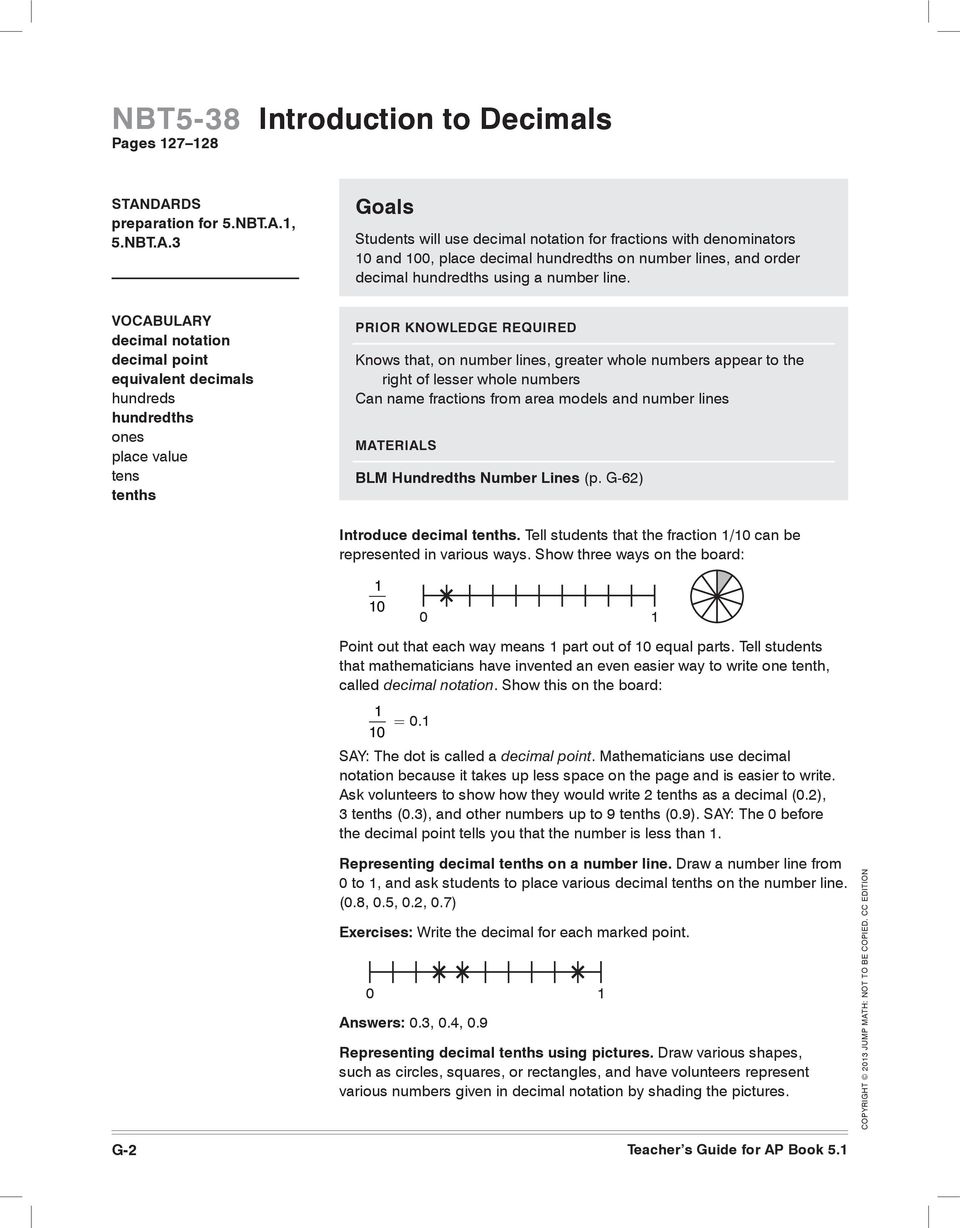
2 NBT5-38 Introduction to Decimals Pages STANDARDS preparation for 5.NBT.A.1, 5.NBT.A.3 Goals Students will use decimal notation for fractions with denominators and, place decimal hundredths on number lines, and order decimal hundredths using a number line. Vocabulary decimal notation decimal point equivalent decimals hundreds hundredths ones place value tens tenths PRIOR KNOWLEDGE REQUIRED Knows that, on number lines, greater whole numbers appear to the right of lesser whole numbers Can name fractions from area models and number lines MATERIALS BLM Hundredths Number Lines (p. G-62) Introduce decimal tenths. Tell students that the fraction 1/ can be represented in various ways. Show three ways on the board: Point out that each way means 1 part out of equal parts. Tell students that mathematicians have invented an even easier way to write one tenth, called decimal notation. Show this on the board: 1 = 0.1 SAY: The dot is called a decimal point. Mathematicians use decimal notation because it takes up less space on the page and is easier to write. Ask volunteers to show how they would write 2 tenths as a decimal (0.2), 3 tenths (0.3), and other numbers up to 9 tenths (0.9). SAY: The 0 before the decimal point tells you that the number is less than 1. Representing decimal tenths on a number line. Draw a number line from 0 to 1, and ask students to place various decimal tenths on the number line. (0.8, 0.5, 0.2, 0.7) Exercises: Write the decimal for each marked point. 0 1 Answers: 0.3, 0.4, 0.9 Representing decimal tenths using pictures. Draw various shapes, such as circles, squares, or rectangles, and have volunteers represent various numbers given in decimal notation by shading the pictures. G-2 Teacher s Guide for AP Book 5.1
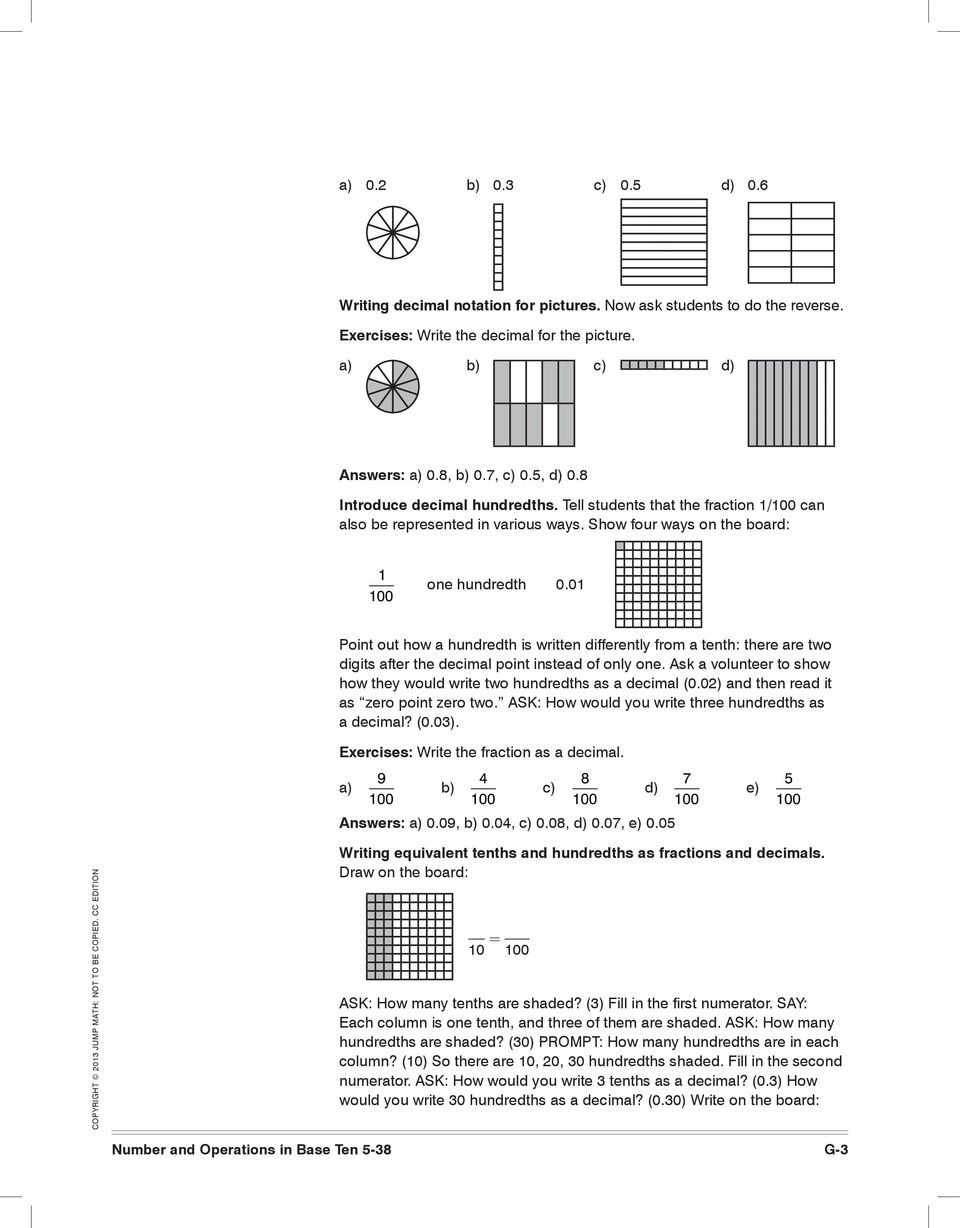
3 a) 0.2 b) 0.3 c) 0.5 d) 0.6 Writing decimal notation for pictures. Now ask students to do the reverse. Exercises: Write the decimal for the picture. a) b) c) d) Answers: a) 0.8, b) 0.7, c) 0.5, d) 0.8 Introduce decimal hundredths. Tell students that the fraction 1/ can also be represented in various ways. Show four ways on the board: 1 one hundredth 0.01 Point out how a hundredth is written differently from a tenth: there are two digits after the decimal point instead of only one. Ask a volunteer to show how they would write two hundredths as a decimal (0.02) and then read it as zero point zero two. ASK: How would you write three hundredths as a decimal? (0.03). Exercises: Write the fraction as a decimal. a) 9 b) 4 c) 8 Answers: a) 0.09, b) 0.04, c) 0.08, d) 0.07, e) 0.05 d) 7 e) 5 Writing equivalent tenths and hundredths as fractions and decimals. Draw on the board: = ASK: How many tenths are shaded? (3) Fill in the first numerator. SAY: Each column is one tenth, and three of them are shaded. ASK: How many hundredths are shaded? (30) PROMPT: How many hundredths are in each column? () So there are, 20, 30 hundredths shaded. Fill in the second numerator. ASK: How would you write 3 tenths as a decimal? (0.3) How would you write 30 hundredths as a decimal? (0.30) Write on the board: Number and Operations in Base Ten 5-38 G-3
4 0.3 = 0.30 SAY: These decimals are called equivalent decimals because one decimal equals the other decimal, just as equivalent fractions equal each other. Exercises: Write two equivalent fractions and two equivalent decimals for the amount shaded. a) b) c) d) Answers: a) 5/ = 50/ = 0.5 = 0.50, b) 2/ = 20/ = 0.2 = 0.20, c) 7/ = 70/ = 0.7 = 0.70, d) 4/ = 40/ = 0.4 = 0.40 Using a picture to show a combination of tenths and hundredths. Draw the first picture below on the board. ASK: How many hundredths are shaded? (30) How many tenths are shaded? (3) Then shade two more hundredths. ASK: Now how many hundredths are shaded? (32) Summarize by saying that 32 hundredths equals 3 tenths and 2 more hundredths. Write on the board: 32 hundredths = 3 tenths + 2 hundredths Exercises: Describe the fraction shaded as hundredths, and as tenths and hundredths. Bonus a) b) c) d) Answers: a) 64 hundredths = 6 tenths + 4 hundredths, b) 47 hundredths = 4 tenths + 7 hundredths, Bonus: c) 85 hundredths = 8 tenths + 5 hundredths, d) 86 hundredths = 8 tenths + 6 hundredths Comparing dimes and pennies to tenths and hundredths. Write the decimals 0.2 and 0.17 on the board and ask students to say which decimal is greater and why they think so. Some students may think that 0.17 is greater than 0.2 because 17 is greater than 2. Tell students that they may find it easier to compare decimals that represent tenths and hundredths if they think of the decimals as representing amounts of money. Write on the board: $0.56 = 56 cents = 5 dimes and 6 pennies G-4 Teacher s Guide for AP Book 5.1

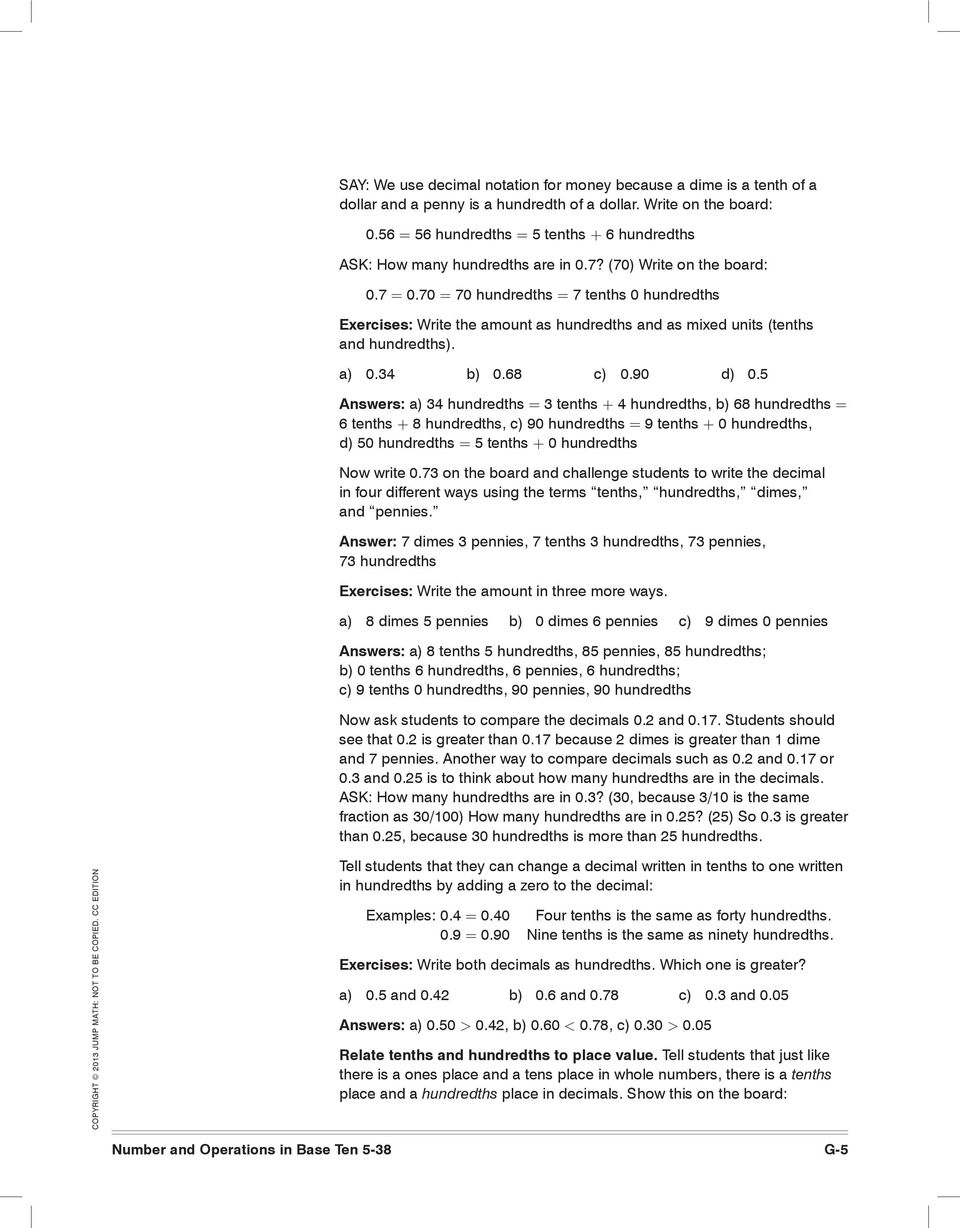
5 SAY: We use decimal notation for money because a dime is a tenth of a dollar and a penny is a hundredth of a dollar. Write on the board: 0.56 = 56 hundredths = 5 tenths + 6 hundredths ASK: How many hundredths are in 0.7? (70) Write on the board: 0.7 = 0.70 = 70 hundredths = 7 tenths 0 hundredths Exercises: Write the amount as hundredths and as mixed units (tenths and hundredths). a) 0.34 b) 0.68 c) 0.90 d) 0.5 Answers: a) 34 hundredths = 3 tenths + 4 hundredths, b) 68 hundredths = 6 tenths + 8 hundredths, c) 90 hundredths = 9 tenths + 0 hundredths, d) 50 hundredths = 5 tenths + 0 hundredths Now write 0.73 on the board and challenge students to write the decimal in four different ways using the terms tenths, hundredths, dimes, and pennies. Answer: 7 dimes 3 pennies, 7 tenths 3 hundredths, 73 pennies, 73 hundredths Exercises: Write the amount in three more ways. a) 8 dimes 5 pennies b) 0 dimes 6 pennies c) 9 dimes 0 pennies Answers: a) 8 tenths 5 hundredths, 85 pennies, 85 hundredths; b) 0 tenths 6 hundredths, 6 pennies, 6 hundredths; c) 9 tenths 0 hundredths, 90 pennies, 90 hundredths Now ask students to compare the decimals 0.2 and Students should see that 0.2 is greater than 0.17 because 2 dimes is greater than 1 dime and 7 pennies. Another way to compare decimals such as 0.2 and 0.17 or 0.3 and 0.25 is to think about how many hundredths are in the decimals. ASK: How many hundredths are in 0.3? (30, because 3/ is the same fraction as 30/) How many hundredths are in 0.25? (25) So 0.3 is greater than 0.25, because 30 hundredths is more than 25 hundredths. Tell students that they can change a decimal written in tenths to one written in hundredths by adding a zero to the decimal: Examples: 0.4 = 0.40 Four tenths is the same as forty hundredths. 0.9 = 0.90 Nine tenths is the same as ninety hundredths. Exercises: Write both decimals as hundredths. Which one is greater? a) 0.5 and 0.42 b) 0.6 and 0.78 c) 0.3 and 0.05 Answers: a) 0.50 > 0.42, b) 0.60 < 0.78, c) 0.30 > 0.05 Relate tenths and hundredths to place value. Tell students that just like there is a ones place and a tens place in whole numbers, there is a tenths place and a hundredths place in decimals. Show this on the board: Number and Operations in Base Ten 5-38 G-5
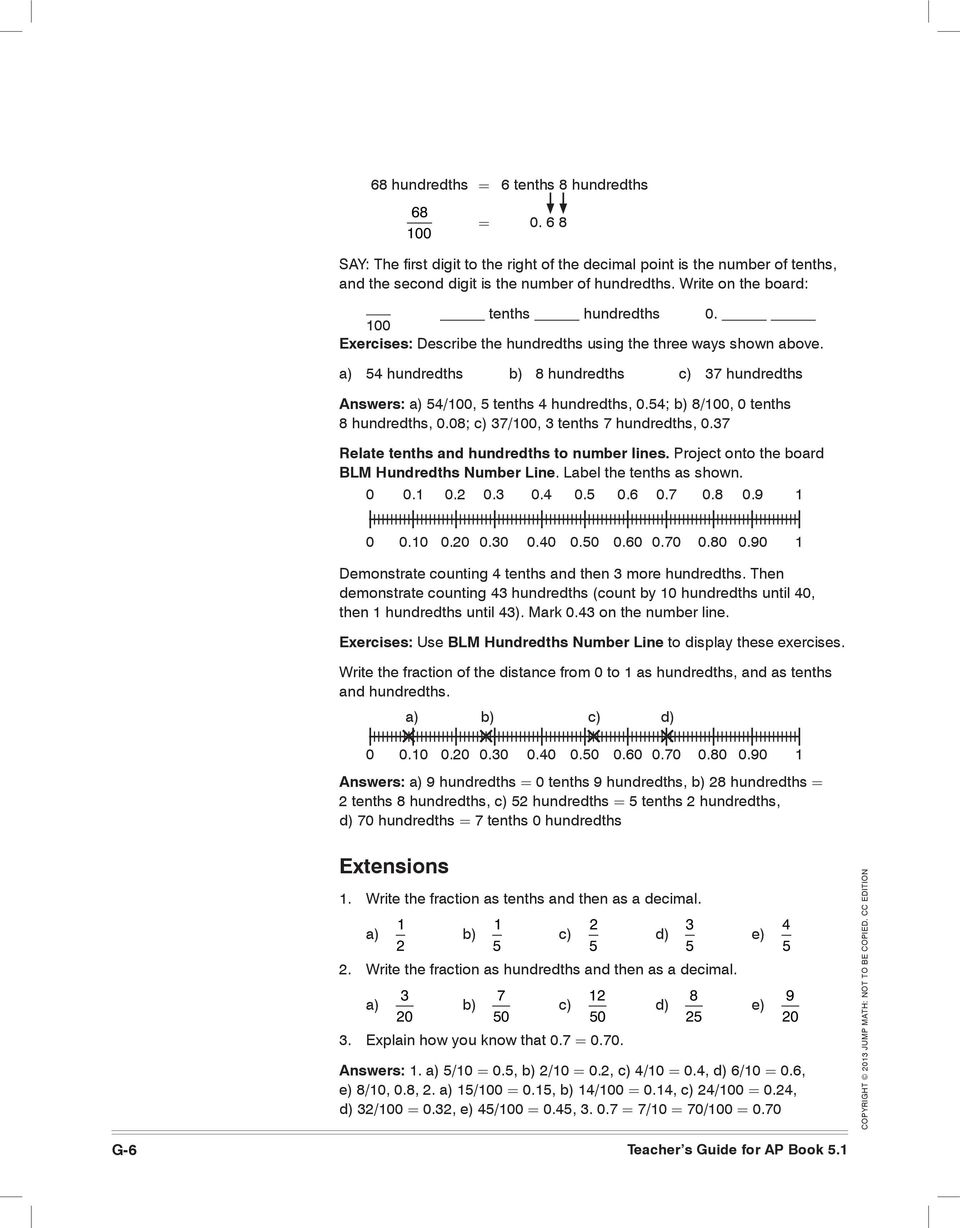
6 68 hundredths = 6 tenths 8 hundredths 68 = SAY: The first digit to the right of the decimal point is the number of tenths, and the second digit is the number of hundredths. Write on the board: tenths hundredths 0. Exercises: Describe the hundredths using the three ways shown above. a) 54 hundredths b) 8 hundredths c) 37 hundredths Answers: a) 54/, 5 tenths 4 hundredths, 0.54; b) 8/, 0 tenths 8 hundredths, 0.08; c) 37/, 3 tenths 7 hundredths, 0.37 Relate tenths and hundredths to number lines. Project onto the board BLM Hundredths Number Line. Label the tenths as shown Demonstrate counting 4 tenths and then 3 more hundredths. Then demonstrate counting 43 hundredths (count by hundredths until 40, then 1 hundredths until 43). Mark 0.43 on the number line. Exercises: Use BLM Hundredths Number Line to display these exercises. Write the fraction of the distance from 0 to 1 as hundredths, and as tenths and hundredths. a) b) c) d) Answers: a) 9 hundredths = 0 tenths 9 hundredths, b) 28 hundredths = 2 tenths 8 hundredths, c) 52 hundredths = 5 tenths 2 hundredths, d) 70 hundredths = 7 tenths 0 hundredths Extensions 1. Write the fraction as tenths and then as a decimal. a) 1 2 b) Write the fraction as hundredths and then as a decimal. a) 3 20 b) 7 50 c) c) Explain how you know that 0.7 = Answers: 1. a) 5/ = 0.5, b) 2/ = 0.2, c) 4/ = 0.4, d) 6/ = 0.6, e) 8/, 0.8, 2. a) 15/ = 0.15, b) 14/ = 0.14, c) 24/ = 0.24, d) 32/ = 0.32, e) 45/ = 0.45, = 7/ = 70/ = 0.70 d) d) e) e) G-6 Teacher s Guide for AP Book 5.1
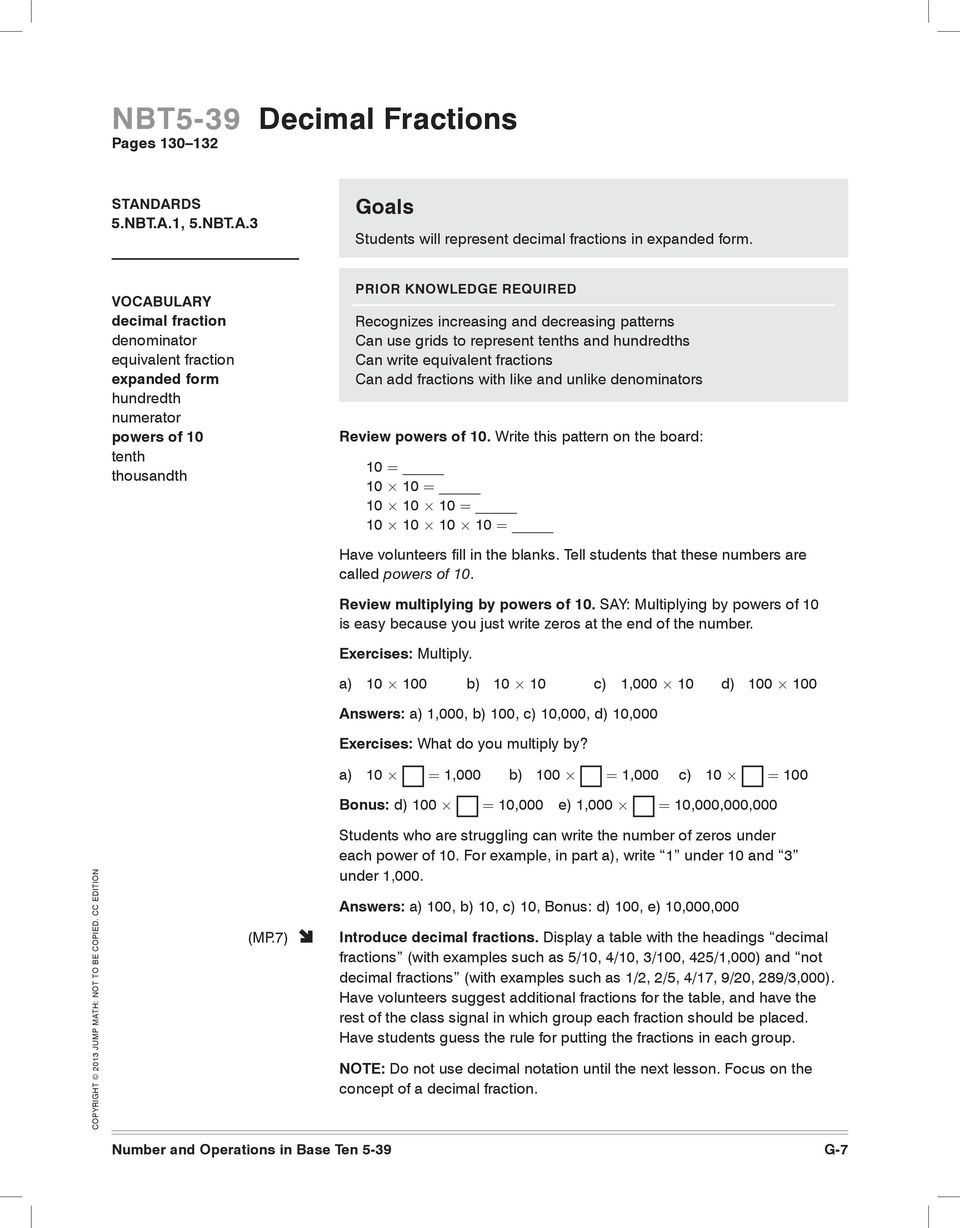
7 NBT5-39 Decimal Fractions Pages STANDARDS 5.NBT.A.1, 5.NBT.A.3 Goals Students will represent decimal fractions in expanded form. Vocabulary decimal fraction denominator equivalent fraction expanded form hundredth numerator powers of tenth thousandth PRIOR KNOWLEDGE REQUIRED Recognizes increasing and decreasing patterns Can use grids to represent tenths and hundredths Can write equivalent fractions Can add fractions with like and unlike denominators Review powers of. Write this pattern on the board: = = = = Have volunteers fill in the blanks. Tell students that these numbers are called powers of. Review multiplying by powers of. SAY: Multiplying by powers of is easy because you just write zeros at the end of the number. Exercises: Multiply. a) b) c) 1,000 d) Answers: a) 1,000, b), c),000, d),000 Exercises: What do you multiply by? a) = 1,000 b) = 1,000 c) = Bonus: d) =,000 e) 1,000 =,000,000,000 (MP.7) Students who are struggling can write the number of zeros under each power of. For example, in part a), write 1 under and 3 under 1,000. Answers: a), b), c), Bonus: d), e),000,000 Introduce decimal fractions. Display a table with the headings decimal fractions (with examples such as 5/, 4/, 3/, 425/1,000) and not decimal fractions (with examples such as 1/2, 2/5, 4/17, 9/20, 289/3,000). Have volunteers suggest additional fractions for the table, and have the rest of the class signal in which group each fraction should be placed. Have students guess the rule for putting the fractions in each group. NOTE: Do not use decimal notation until the next lesson. Focus on the concept of a decimal fraction. Number and Operations in Base Ten 5-39 G-7
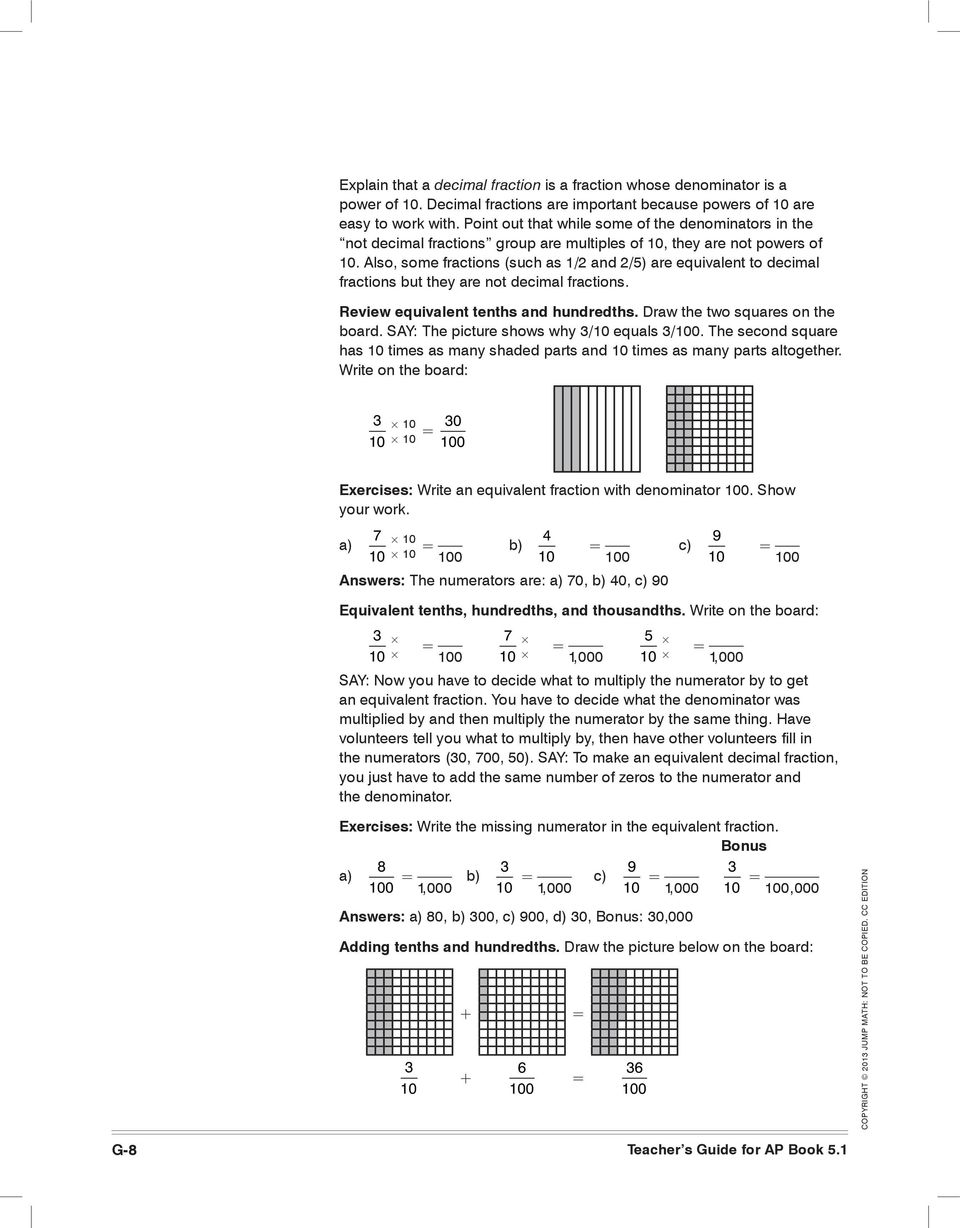
8 Explain that a decimal fraction is a fraction whose denominator is a power of. Decimal fractions are important because powers of are easy to work with. Point out that while some of the denominators in the not decimal fractions group are multiples of, they are not powers of. Also, some fractions (such as 1/2 and 2/5) are equivalent to decimal fractions but they are not decimal fractions. Review equivalent tenths and hundredths. Draw the two squares on the board. SAY: The picture shows why 3/ equals 3/. The second square has times as many shaded parts and times as many parts altogether. Write on the board: 3 = 30 Exercises: Write an equivalent fraction with denominator. Show your work. a) 7 = b) 4 = c) Answers: The numerators are: a) 70, b) 40, c) 90 9 = Equivalent tenths, hundredths, and thousandths. Write on the board: 3 7 = 5 = 1,000 = 1,000 SAY: Now you have to decide what to multiply the numerator by to get an equivalent fraction. You have to decide what the denominator was multiplied by and then multiply the numerator by the same thing. Have volunteers tell you what to multiply by, then have other volunteers fill in the numerators (30, 700, 50). SAY: To make an equivalent decimal fraction, you just have to add the same number of zeros to the numerator and the denominator. Exercises: Write the missing numerator in the equivalent fraction. Bonus 8 a) = 1,000 b) 3 = 9 c) 1,000 = 3 1,000 =,000 Answers: a) 80, b) 300, c) 900, d) 30, Bonus: 30,000 Adding tenths and hundredths. Draw the picture below on the board: 3 + = + 6 = 36 G-8 Teacher s Guide for AP Book 5.1
9 SAY: If you can add hundredths, and if you can change tenths to hundredths, then you can add tenths and hundredths. For example, 3 tenths is 30 hundredths, and 6 more hundredths is 36 hundredths. Remind students that they can change the tenths to hundredths without using a picture: = = 36 Exercises: Add. Show your work. a) b) c) Answers: a) 47/, b) 74/, c) 58/, Bonus: 93/ Bonus Adding tenths, hundredths, and thousandths. Write on the board: = 6 ASK: How can you change the fractions to make them easier to add? (change all denominators to 1,000) Write underneath: 1, , ,000 = 1,000 Have volunteers complete the equation: 300/1, /1, /1,000 = 396/1,000. Point out how adding fractions with denominators,, and 1,000 is easy because it s just using expanded form. Exercises: Add. 4 a) b) c) Bonus: For the bonus, students will need to carefully look at the denominators. Answers: a) 439/1,000, b) 521/1,000, c) 978/1,000, Bonus: 438/1,000 Adding decimal fractions with missing tenths or hundredths. Write the equation on the board but without the answer shown in italics = 1,000 ASK: How many thousandths are in 4/? (400) So, how many thousandths are there altogether? ( = 409) Write the answer, then SAY: 4 tenths, 0 hundredths, and 9 thousandths add to 409 thousandths. Have students add more tenths and thousandths. Exercises: Add. 3 a) b) + 1 c) Answers: a) 307/1,000, b) 901/1,000, c) 206/1, Number and Operations in Base Ten 5-39 G-9

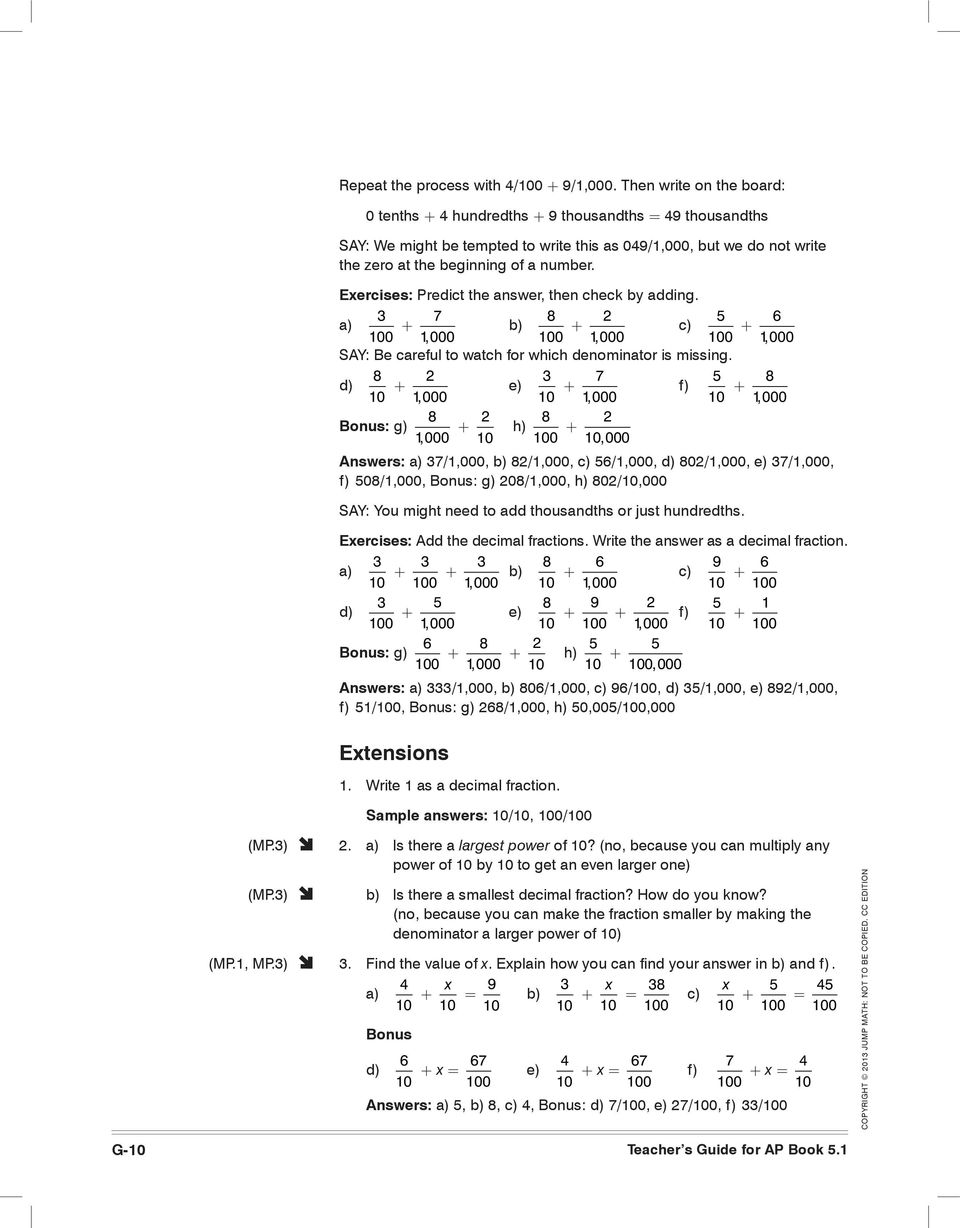
10 Repeat the process with 4/ + 9/1,000. Then write on the board: 0 tenths + 4 hundredths + 9 thousandths = 49 thousandths SAY: We might be tempted to write this as 049/1,000, but we do not write the zero at the beginning of a number. Exercises: Predict the answer, then check by adding. 3 a) b) c) + 6 SAY: Be careful to watch for which denominator is missing. 8 d) e) f) Bonus: g) h) + 2, 000 Answers: a) 37/1,000, b) 82/1,000, c) 56/1,000, d) 802/1,000, e) 37/1,000, f) 508/1,000, Bonus: g) 208/1,000, h) 802/,000 SAY: You might need to add thousandths or just hundredths. Exercises: Add the decimal fractions. Write the answer as a decimal fraction. 3 a) b) c) d) e) f) Bonus: g) h) 5 + 5, 000 Answers: a) 333/1,000, b) 806/1,000, c) 96/, d) 35/1,000, e) 892/1,000, f) 51/, Bonus: g) 268/1,000, h) 50,005/,000 Extensions 1. Write 1 as a decimal fraction. Sample answers: /, / (MP.3) (MP.3) (MP.1, MP.3) 2. a) Is there a largest power of? (no, because you can multiply any power of by to get an even larger one) b) Is there a smallest decimal fraction? How do you know? (no, because you can make the fraction smaller by making the denominator a larger power of ) 3. Find the value of x. Explain how you can find your answer in b) and f). 4 a) + x = 9 3 b) + x = 38 x c) + 5 = 45 Bonus 6 d) + x = 67 4 e) + x = 67 7 f) + x = 4 Answers: a) 5, b) 8, c) 4, Bonus: d) 7/, e) 27/, f) 33/ G- Teacher s Guide for AP Book 5.1
11 NBT5-40 Place Value and Decimals Pages STANDARDS 5.NBT.A.1, 5.NBT.A.3 Goals Students will represent decimals in expanded form. Vocabulary decimal decimal fraction decimal point denominator hundredth place value placeholder tenth thousandth PRIOR KNOWLEDGE REQUIRED Knows the definition of a decimal fraction Understands place value for whole numbers and the use of zero as a placeholder Can write expanded form for whole numbers Can write equivalent fractions Can add fractions with like and unlike denominators Review the place value system. Write on the board: 5,834 = 5, SAY: We use place value to write numbers. That means that where a digit is placed in the number tells you its value. Because the digit 5 is in the thousands place, it is worth 5,000. Exercises: What does the digit 7 represent? a) 6,742 b) 9,017 c) 6,572 d) 7,904 Answers: a) 700, b) 7, c) 70, d) 7,000 Point out that the place value system extends to include tenths. Write on the board: thousands hundreds tens ones SAY: The place values get times as big. For example, tens are times as big as ones, hundreds are times as big as tens, and so on. Tell students that you want to continue using the place value system so that you can use place value for fractions, too. ASK: What is 1 ten times as big as? PROMPT: Ten of what make one whole? (a tenth) To guide students, draw pictures of equal parts fitting into 1 whole. Tell students that there is way to show 1/ that uses place value. Write on the board: 1 = = = = 27.4 SAY: We call these numbers decimals. The dot between the whole numbers and the number of tenths is called a decimal point. Decimals are like mixed numbers. Point to 3/ = 0.3 on the board and SAY: There s a wholenumber part to the left of the decimal point and a fractional part to the Number and Operations in Base Ten 5-40 G-11

12 right. However, when the number is less than one whole, we write 0 as the whole-number part. Exercises: Write the decimal for the number. a) 5 b) 3 8 c) 74 6 Answers: a) 0.5, b) 3.8, c) 74.6, Bonus: Bonus Extending the place value system beyond tenths. Write the following sequence on the board: hundreds tens ones tenths ASK: What should the next place value be? (hundredths) PROMPT: Ten of what fit into a tenth? Point out that there is symmetry in the place value names: to some extent, they mirror each other on either side of the ones : hundreds tens ones tenths hundredths SAY: There is also symmetry in the values; in other words, what each place is worth is mirrored on either side of the ones. Draw on the board the picture below. Ask volunteers to continue the place values in both directions Show students how to write decimals for one-digit hundredths and one-digit thousandths: 3 = = SAY: The next place value after tenths is for hundredths. The one after that is for thousandths. Exercises: Write the decimal for the fraction. a) 7 b) 4 c) 5 d) 8 Answers: a) 0.07, b) 0.004, c) 0.05, d) 0.008, e) e) 6 Expressing decimal fractions in different ways. Tell students that there are two ways to say 0.03 out loud: zero point zero three and three hundredths. We use the second way to spell the number out in words, on paper. Exercises: Write the decimal in words. a) 0.04 b) 0.8 c) d) 0.07 e) Answers: a) four hundredths, b) eight tenths, c) nine thousandths, d) seven hundredths, e) three thousandths G-12 Teacher s Guide for AP Book 5.1
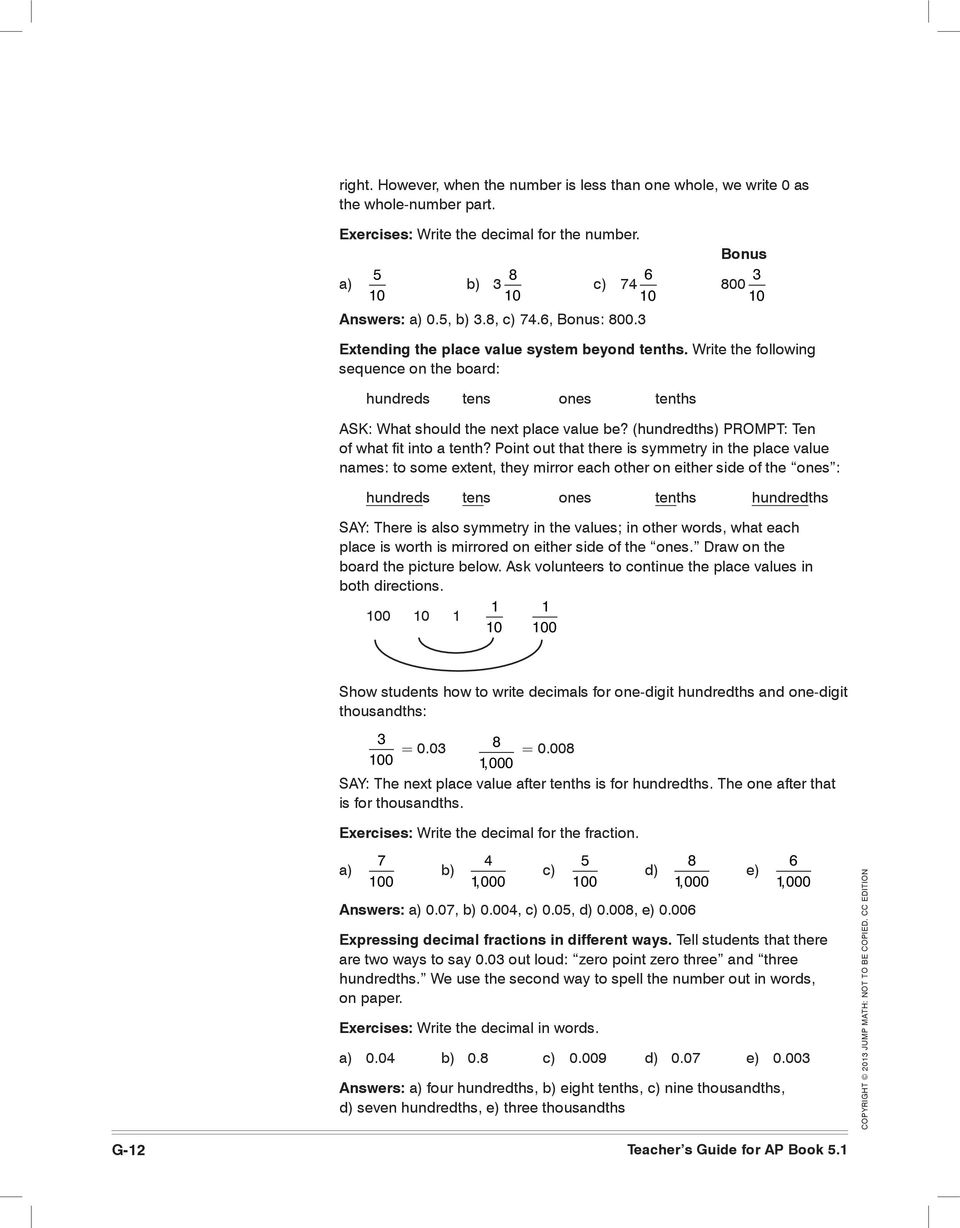
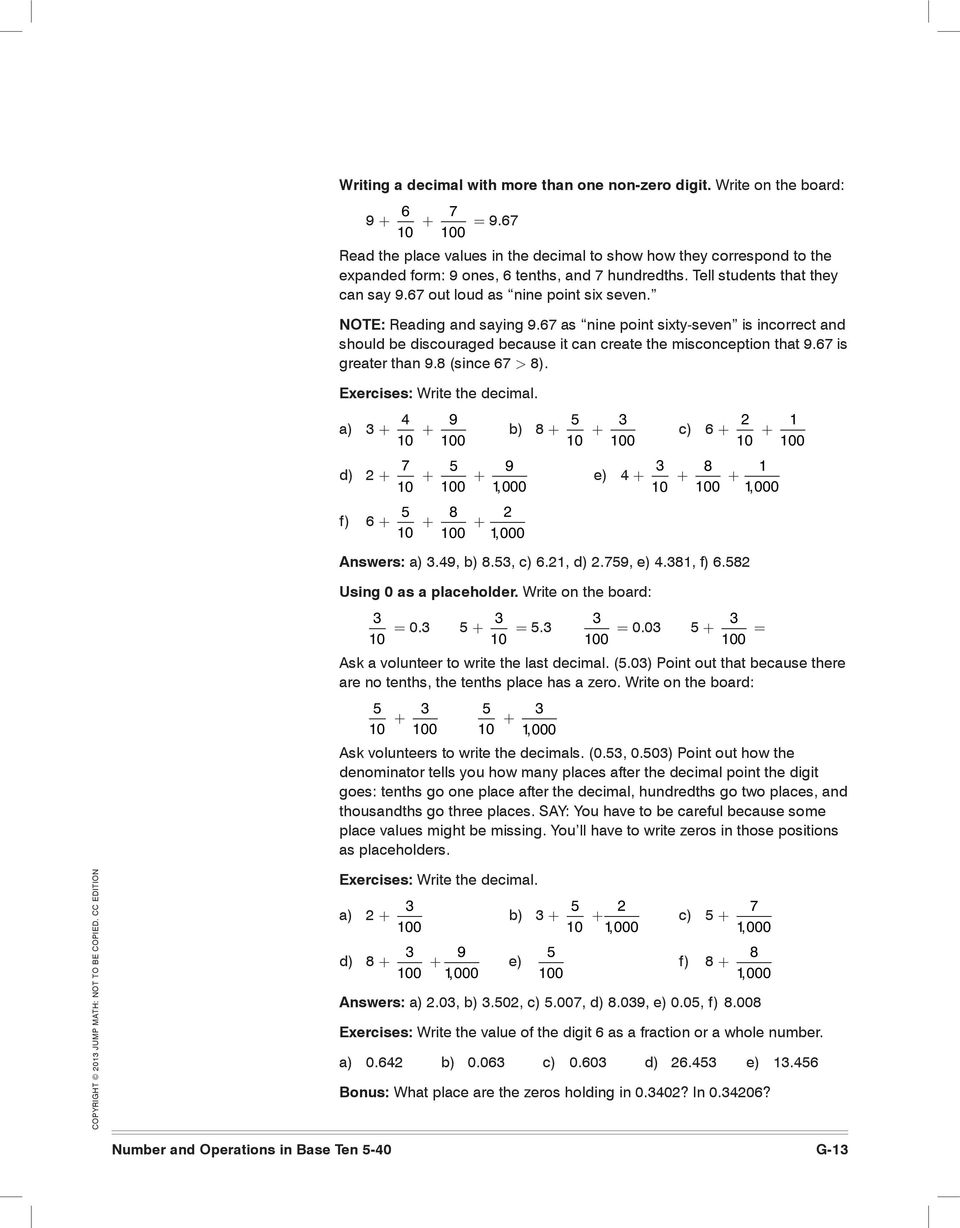
13 Writing a decimal with more than one non-zero digit. Write on the board: = 9.67 Read the place values in the decimal to show how they correspond to the expanded form: 9 ones, 6 tenths, and 7 hundredths. Tell students that they can say 9.67 out loud as nine point six seven. NOTE: Reading and saying 9.67 as nine point sixty-seven is incorrect and should be discouraged because it can create the misconception that 9.67 is greater than 9.8 (since 67 > 8). Exercises: Write the decimal. a) d) f) b) c) e) Answers: a) 3.49, b) 8.53, c) 6.21, d) 2.759, e) 4.381, f) Using 0 as a placeholder. Write on the board: 3 = = = = Ask a volunteer to write the last decimal. (5.03) Point out that because there are no tenths, the tenths place has a zero. Write on the board: Ask volunteers to write the decimals. (0.53, 0.503) Point out how the denominator tells you how many places after the decimal point the digit goes: tenths go one place after the decimal, hundredths go two places, and thousandths go three places. SAY: You have to be careful because some place values might be missing. You ll have to write zeros in those positions as placeholders. Exercises: Write the decimal. 3 a) 2 + b) d) e) c) 5 + f) Answers: a) 2.03, b) 3.502, c) 5.007, d) 8.039, e) 0.05, f) Exercises: Write the value of the digit 6 as a fraction or a whole number. a) b) c) d) e) Bonus: What place are the zeros holding in ? In ? Number and Operations in Base Ten 5-40 G-13
14 Answers: a) 6/, b) 6/, c) 6/, d) 6, e) 6/1,000, Bonus: ones place and thousandths place in , ones place and ten-thousandths place in Extensions (MP.8) 1. How much more is the 2 worth than the 5 in the decimal ? Answer: Because each place value is times the next value to the right, the relative values between the 2 and the 5 are the same as for 240,675. In 240,675, the 2 is worth 200,000 and the 5 is worth 5. How many times as much as 5 is 200,000 worth? Draw the table in the on the board: Number How many times as much as 5? , ,000 4, ,000 40,000 So the 2 is worth 40,000 times as much as the 5. (MP.1) 2. Write the correct decimal: $700 + $ = $. Answer: $ G-14 Teacher s Guide for AP Book 5.1

15 NBT5-41 Decimals Greater Than 1 Pages STANDARDS 5.NBT.A.1, 5.NBT.A.3 Goals Students will write mixed numbers as decimals and decimals greater than one as mixed numbers, to thousandths. Vocabulary decimal decimal point digit fraction improper fraction mixed number PRIOR KNOWLEDGE REQUIRED Understands place value for whole numbers and the use of zero as a placeholder Can write an improper fraction as a mixed number Can write expanded form for whole numbers Can write mixed numbers and decimals Writing decimals in words. Tell students that just as they can write whole numbers and fractions in words, they can also write decimals in words. SAY: Just as a decimal point separates the whole-number part and the fractional part, we can use the word and to separate the whole number from the fractional part. Write on the board: three and seventeen hundredths Exercises: Write the missing words. a) 4.08 = and eight hundredths b) 17.6 = and six tenths c) 16.5 = sixteen and tenths d) 3.07 = three and hundredths e) = thirty-eight and hundredths f) 30.8 = thirty and eight g) 3.08 = three and eight h) 4.17 = four seventeen Answers: a) four; b) seventeen; c) five; d) seven; e) fourteen; f) tenths; g) hundredths; h) and, hundredths Exercises: Write the decimal in words. a) 3.8 b) c) d) 41.5 Bonus: 3,000, Answers: a) three and eight tenths, b) twenty-six and nine hundredths, c) thirty and forty hundredths, d) forty-one and five tenths, Bonus: three million and forty-five hundredths Writing the decimal for the word. Refer to the picture on the board: three and seventeen hundredths Number and Operations in Base Ten 5-41 G-15
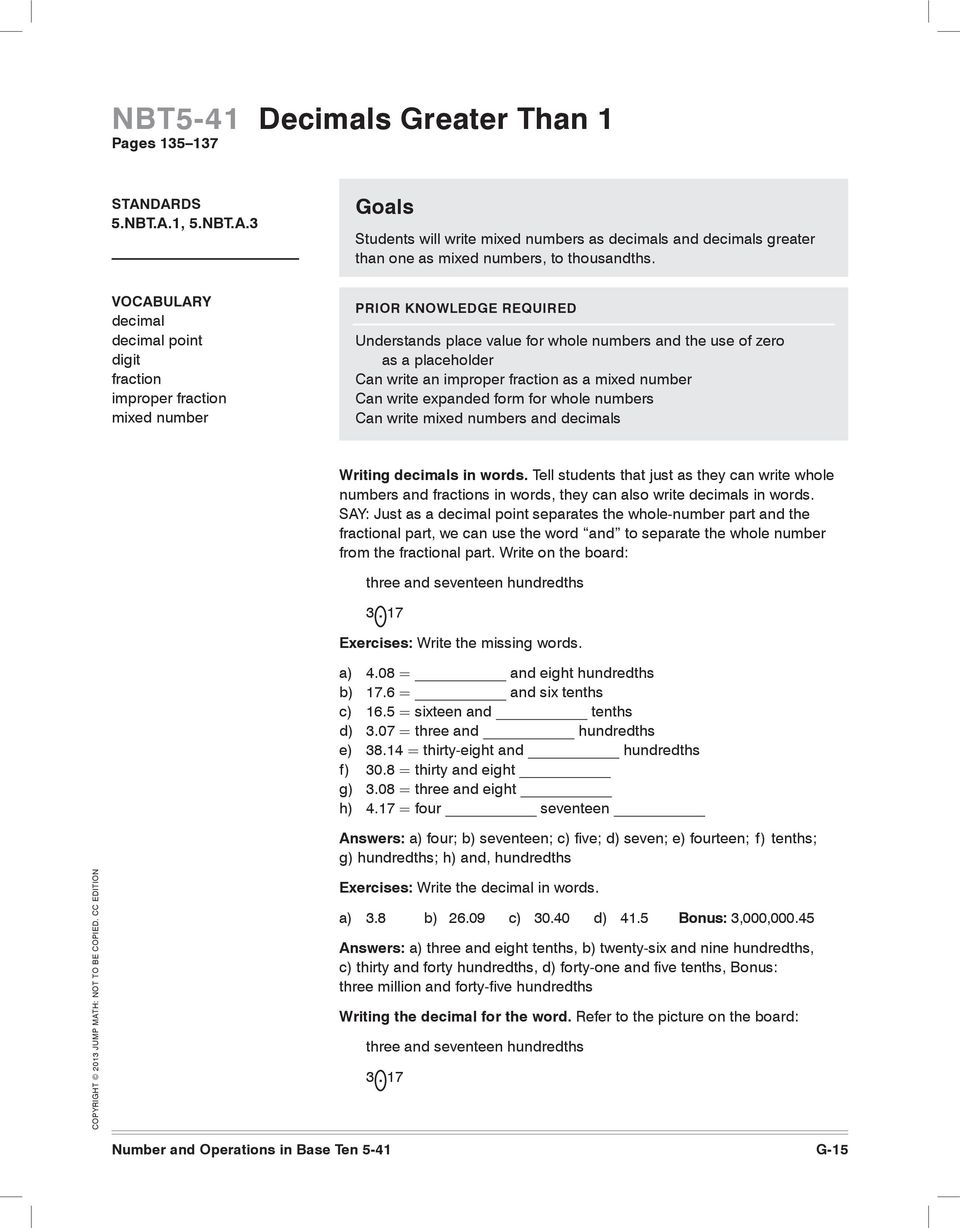
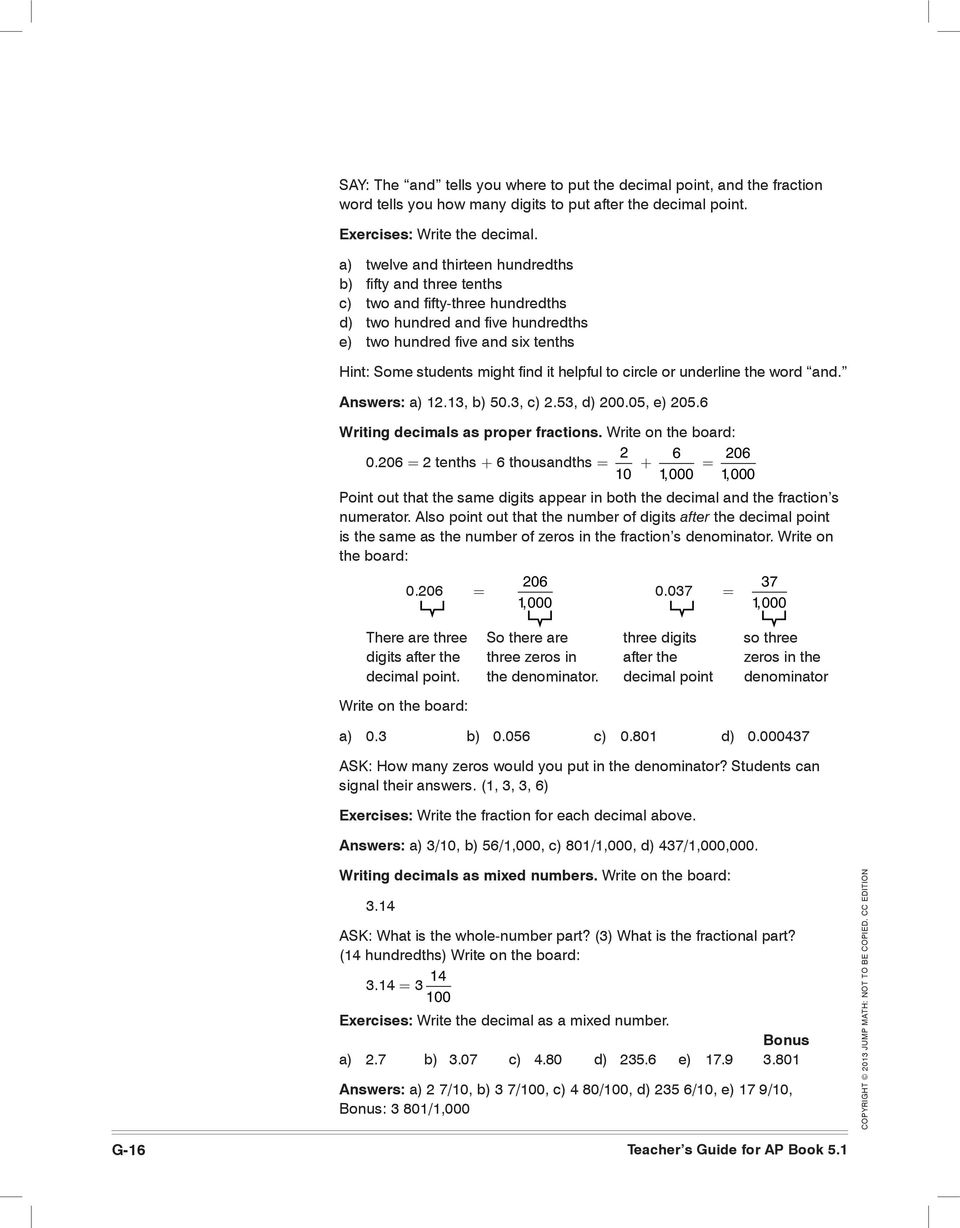
16 SAY: The and tells you where to put the decimal point, and the fraction word tells you how many digits to put after the decimal point. Exercises: Write the decimal. a) twelve and thirteen hundredths b) fifty and three tenths c) two and fifty-three hundredths d) two hundred and five hundredths e) two hundred five and six tenths Hint: Some students might find it helpful to circle or underline the word and. Answers: a) 12.13, b) 50.3, c) 2.53, d) , e) Writing decimals as proper fractions. Write on the board: = 2 tenths + 6 thousandths = = 206 Point out that the same digits appear in both the decimal and the fraction s numerator. Also point out that the number of digits after the decimal point is the same as the number of zeros in the fraction s denominator. Write on the board: = = 37 There are three digits after the decimal point. So there are three zeros in the denominator. three digits after the decimal point so three zeros in the denominator Write on the board: a) 0.3 b) c) d) ASK: How many zeros would you put in the denominator? Students can signal their answers. (1, 3, 3, 6) Exercises: Write the fraction for each decimal above. Answers: a) 3/, b) 56/1,000, c) 801/1,000, d) 437/1,000,000. Writing decimals as mixed numbers. Write on the board: 3.14 ASK: What is the whole-number part? (3) What is the fractional part? (14 hundredths) Write on the board: 3.14 = 3 14 Exercises: Write the decimal as a mixed number. Bonus a) 2.7 b) 3.07 c) 4.80 d) e) Answers: a) 2 7/, b) 3 7/, c) 4 80/, d) 235 6/, e) 17 9/, Bonus: 3 801/1,000 G-16 Teacher s Guide for AP Book 5.1
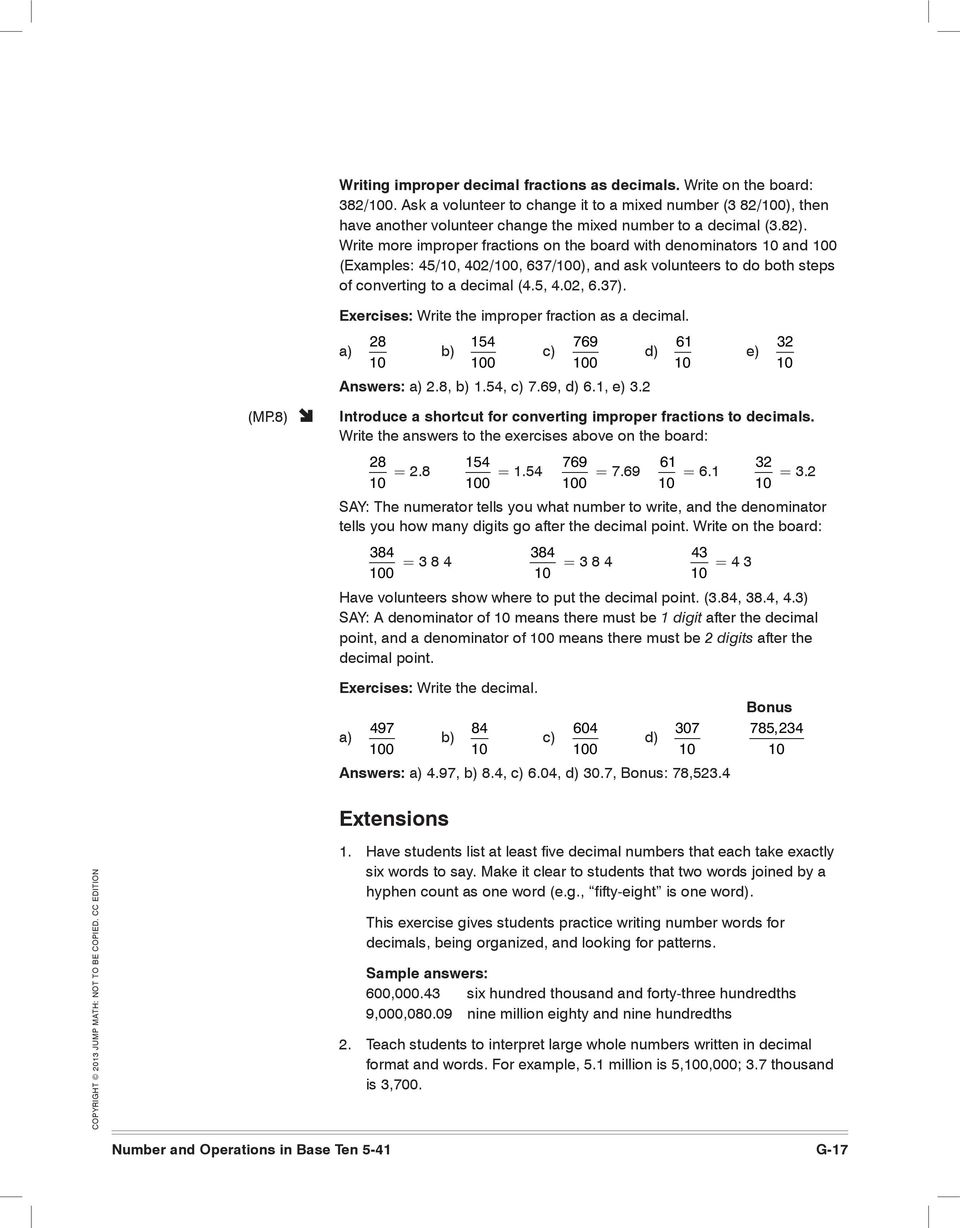
17 Writing improper decimal fractions as decimals. Write on the board: 382/. Ask a volunteer to change it to a mixed number (3 82/), then have another volunteer change the mixed number to a decimal (3.82). Write more improper fractions on the board with denominators and (Examples: 45/, 402/, 637/), and ask volunteers to do both steps of converting to a decimal (4.5, 4.02, 6.37). Exercises: Write the improper fraction as a decimal. a) 28 b) 154 c) 769 Answers: a) 2.8, b) 1.54, c) 7.69, d) 6.1, e) 3.2 d) 61 e) 32 (MP.8) Introduce a shortcut for converting improper fractions to decimals. Write the answers to the exercises above on the board: 28 = = = = = 3.2 SAY: The numerator tells you what number to write, and the denominator tells you how many digits go after the decimal point. Write on the board: 384 = = = 4 3 Have volunteers show where to put the decimal point. (3.84, 38.4, 4.3) SAY: A denominator of means there must be 1 digit after the decimal point, and a denominator of means there must be 2 digits after the decimal point. Exercises: Write the decimal. a) 497 b) 84 c) 604 d) 307 Answers: a) 4.97, b) 8.4, c) 6.04, d) 30.7, Bonus: 78,523.4 Bonus 785, 234 Extensions 1. Have students list at least five decimal numbers that each take exactly six words to say. Make it clear to students that two words joined by a hyphen count as one word (e.g., fifty-eight is one word). This exercise gives students practice writing number words for decimals, being organized, and looking for patterns. Sample answers: 600, six hundred thousand and forty-three hundredths 9,000, nine million eighty and nine hundredths 2. Teach students to interpret large whole numbers written in decimal format and words. For example, 5.1 million is 5,,000; 3.7 thousand is 3,700. Number and Operations in Base Ten 5-41 G-17
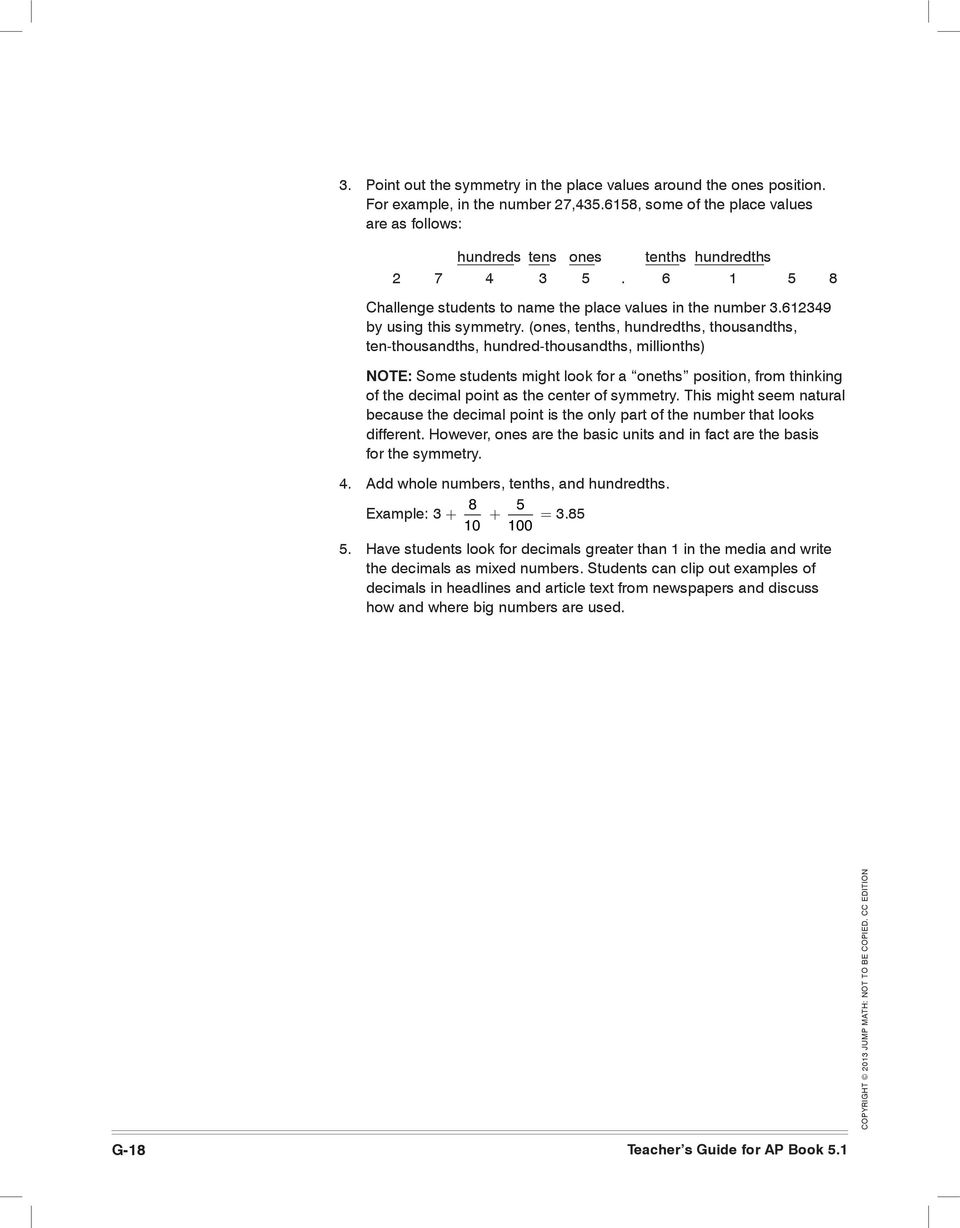
18 3. Point out the symmetry in the place values around the ones position. For example, in the number 27, , some of the place values are as follows: hundreds tens ones tenths hundredths Challenge students to name the place values in the number by using this symmetry. (ones, tenths, hundredths, thousandths, ten-thousandths, hundred-thousandths, millionths) NOTE: Some students might look for a oneths position, from thinking of the decimal point as the center of symmetry. This might seem natural because the decimal point is the only part of the number that looks different. However, ones are the basic units and in fact are the basis for the symmetry. 4. Add whole numbers, tenths, and hundredths. Example: = Have students look for decimals greater than 1 in the media and write the decimals as mixed numbers. Students can clip out examples of decimals in headlines and article text from newspapers and discuss how and where big numbers are used. G-18 Teacher s Guide for AP Book 5.1
19 NBT5-42 Expanded Form and Place Value Pages STANDARDS 5.NBT.A.1, 5.NBT.A.3 Goals Students will write numbers in many different, but equivalent, forms. Vocabulary decimal decimal fraction equivalent decimal equivalent fraction expanded form lowest terms PRIOR KNOWLEDGE REQUIRED Understands place value for whole numbers and the use of zero as a placeholder Can write the expanded form for whole numbers Can write mixed numbers and decimals Can write the expanded form for whole numbers and decimals Introduce equivalent decimals. Write on the board: 3 = 30 = 1,000 SAY: Three tenths is the same as thirty hundredths. ASK: How many thousandths is that? (300) Fill in the missing numerator, then ask volunteers to write the decimal for each fraction on the board (0.3, 0.30, 0.300). Explain that these are called equivalent decimals, because the fractions they are equal to are equivalent. Exercises: Write the equivalent decimals from the equivalent fractions. a) d) 4 = 40 2 = 20 b) = = 70 c) e) 6 = 60 8 = 80 = 800 Answers: a) 0.4 = 0.40, b) 0.7 = 0.70, c) 0.6 = 0.60, d) 0.2 = 0.20 = 0.200, e) 0.8 = 0.80 = Tell students that saying 0.3 = 0.30 is the same as saying 3 tenths is equal to 30 hundredths or 3 tenths and 0 hundredths. Point out that 3 tenths and 0 hundredths or 0 thousandths and so on is the same as 3 tenths. ASK: How many hundredths is 8 tenths equal to? (80) Have a volunteer write the equivalent decimals on the board. (0.8 = 0.80) Write five ways to write seven tenths on the board: seven tenths seventy hundredths Ask students to write more ways. Then ask volunteers to show ways on the board. Sample answers: 0.7, 0.70, 0.700, 70/, 700/1,000, seven hundred thousandths. Exercises: Some of these are wrong. Which ones? How do you know? a) 0.37 = 37 b) 0.05 = 50 c) = 47 d) 0.62 = 62 Number and Operations in Base Ten 5-42 G-19

20 Answers: Parts b) and d) are incorrect: in part b), the numerator should be 5 or the decimal should be 0.50; in part d), the denominator should be or the decimal should be Review decimal fractions in lowest terms. Remind students what it means for a fraction to be in lowest terms. ASK: Is 6/9 in lowest terms? (no, because 6 and 9 both divide by 3, so you can reduce the fraction): 6 = Is 2/3 in lowest terms? (yes, because the only whole number that divides both 2 and 3 is 1) Remind students that when you divide a power of by a smaller power of, you remove as many zeros from the dividend as there are in the divisor, for example,,000 = 1,000. Exercises: Divide. a) 1,000 b),000 c),000 Bonus: 1,000 1,000 Answers: a), b), c),000, Bonus: 1 SAY: Suppose I want to reduce the fraction /1,000 to lowest terms. ASK: Will my answer be in lowest terms if I divide the numerator and denominator by? Demonstrate what happens when you divide by : = ASK: Is the result in lowest terms? (no, because you can divide the numerator and denominator by again) 1 = What number should we have divided by, rather than? () Ask students to say what number they would divide by to reduce the following fractions to lowest terms:, 000 Students should notice the following: if the numerator and denominator of a fraction are both powers of, then when you divide both by the smaller power of, the resulting fraction is in lowest terms. Ask students to show how they would reduce the fractions above: 1 = = = 1 and so on. 1 NOTE: Many people reduce decimal fractions by crossing out an equal number of zeros in the numerator and denominator: = = 1 G-20 Teacher s Guide for AP Book 5.1
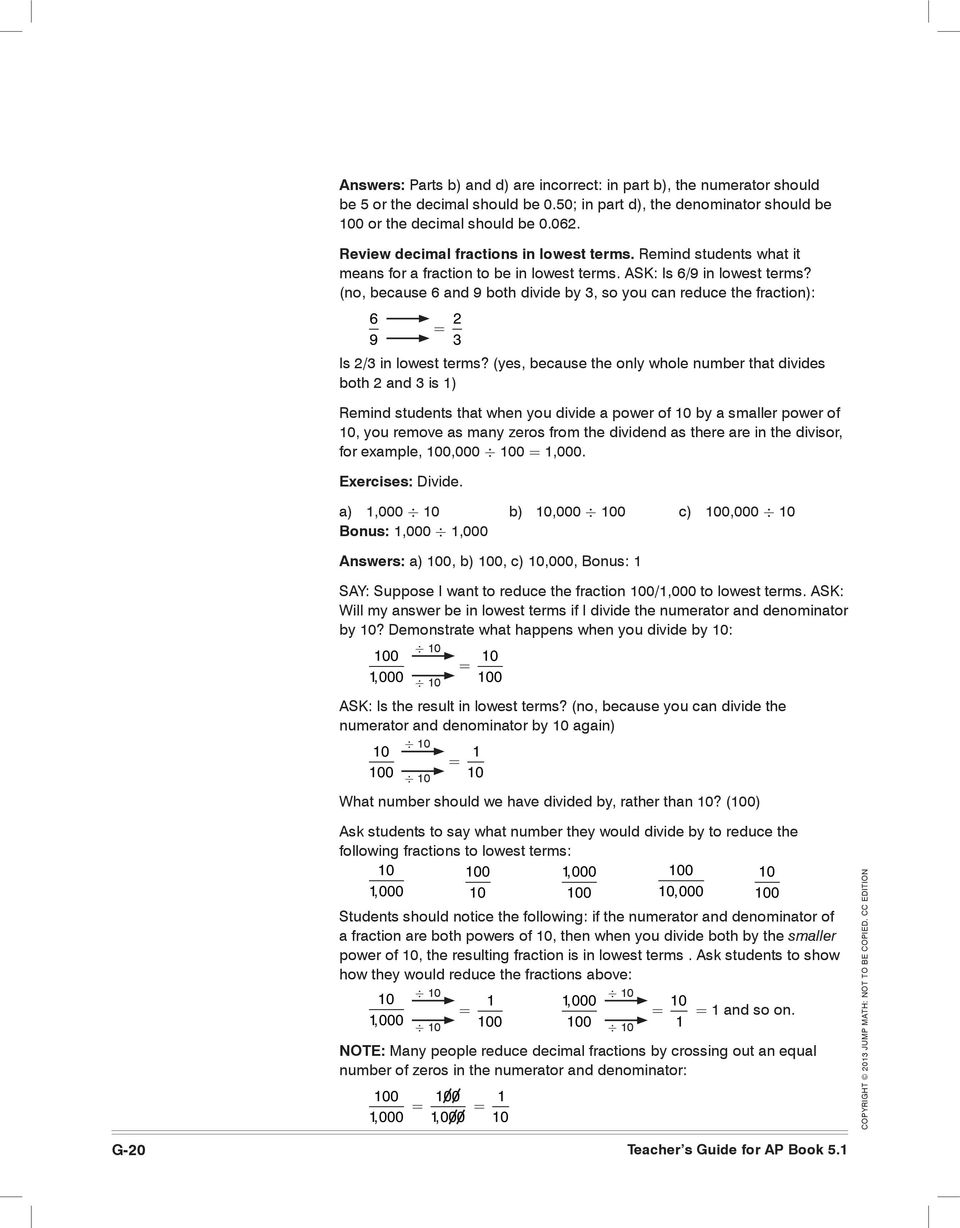
21 Students can use this method, but they should be able to explain why it works. In the example, you cross out two zeros in the numerator and two zeros in the denominator because to reduce the fraction you divide both by. Multiplying by powers of. Remind students that when you multiply a fraction by a whole number, you multiply the numerator by the whole number and leave the denominator the same: = = 3 2 = Exercises: Find the product and reduce your answer to lowest terms. a) 1 b) 1,000 1 c) 1 d),000 1 Answers: a), b) 1, c) 1, d) 1 1, Ask students say how they could find the products above mentally. They should be able to articulate the following kind of strategy: 1 There are 2 zeros in the whole number. There are 3 zeros in the fraction. 1 There will be 3 2 = 1 zero left in the 2 zeros 3 zeros denominator, so the answer is 1. Make sure that students know that if there are more zeros in the whole number than in the fraction, the answer will be a whole number. Also note for students that any number divided by 1 is the same number. Exercises: Solve the puzzle. 1 1 a) = b) 1 d) 1, 000 = 1 Answers: a), b), c) 1,000, d) = 1 c) 1, 000 = 1 Comparing place values. Students are now prepared to compare place values. Use the following steps to show them how. ASK: How many times as large as is? Step 1: If any of the numbers you are comparing are decimals, write them as fractions: = Step 2: ASK: What number do you need to multiply the smaller number by to produce the larger number? Solve the problem by writing an expression as shown below: 1 1? = so,000 = Number and Operations in Base Ten 5-42 G-21
22 Exercises: How many times as large as the smaller number is the larger number? Show your work. a) 0.1 and 0.01 b) 0.01 and c) and 0.01 d) and Answers: a), b), c) 1,000, d),000 Remind students that in a multi-digit number, a digit in one place represents times as much as it represents in the place to its immediate right and 1/ of what it represents in the place to its immediate left. Students can use this knowledge to compare digits that are farther apart. Example: In the number , how many times as much as the 3 on the right is the 3 on the left? Step 1: Write the value of each 3. The first (left) 3 has value 30 and the second (right) 3 has value. Step 2: Write an expression and find the missing number in the box.? 3 = 30 so 3 = 30 Students can also compare place values by using the following diagram: hundreds tens ones tenths hundredths thousandths Exercise: In the number , how many times as large as the value of the 7 on the right is the value of the 7 on the left? Answer: The first 7 is 4 place values to the left of the second 7: so the value of the 7 on the left is =,000 times as large as the value of the 7 on the right. Review writing decimals in expanded form. Write on the board: = 8 tenths + 3 hundredths + 7 thousandths = Tell students that writing like this as a sum of decimal fractions is writing it in expanded form. Exercises: Write the decimal in expanded form. Bonus a) b) 0.45 c) d) Answers: a) 6/ + 7/ +2/1,000, b) 4/ + 5/, c) 2/ + 3/1,000, d) 8/ + 9/1,000, Bonus 2/ + 2/1,000,000 G-22 Teacher s Guide for AP Book 5.1
23 Students can use their knowledge of multiplication to write a decimal in expanded form in two ways. For example, 0.7 can be written as 0.7 = 7 Extension or Decimals can be written in three different ways using fractions. For example, 0.03 can be written as: = or 0.03 = 3 or 0.03 = 3 2 Ask students to write the decimal in three different ways. a) 0.05 b) c) d) e) Answers: a), 5 1, ; b), 7, 7 ; c), 6, 6 ; d), 17, 17 ;, 000, e), 323, 000 1, 000, Number and Operations in Base Ten 5-42 G-23
24 NBT5-43 Comparing Decimal Fractions and Decimals Pages STANDARDS 5.NBT.A.1, 5.NBT.A.3 Goals Students will place decimal numbers and mixed fractions on number lines and compare them. Vocabulary decimal equivalent decimal improper fraction mixed number PRIOR KNOWLEDGE REQUIRED Understands decimals and fractions on number lines Understands decimal numbers with up to two decimal places and their equivalent fractions (proper or mixed) Can use number lines Review number lines with fractions. Draw on the board: Have students count out loud with you from 0 to 1 by tenths: zero, one tenth, two tenths,, nine tenths, one. Then have a volunteer write the equivalent decimal for 1/ on top of the number line: Continue in random order until all the equivalent decimals have been added to the number line. Then have students write in their notebooks the equivalent decimals and fractions for the spots marked on these number lines: Answers: a) 0.7, b) 0.2, c) 0.5, d) 0.6, 1.2, 1.9, 2.6 Draw the number line below on the board and ask students to draw it in their notebooks. Have volunteers mark the location of the following numbers on the number line with an and the corresponding letter. A. 0.7 B. 2 7 C D. 8 E Invite any students who don t volunteer to participate. Help them with prompts and questions such as: Is the number more than 1 or less than 1? How do you know? Is the number between 1 and 2 or between 2 and 3? How do you know? Review writing improper fractions as mixed numbers. Then ask students to write the following improper fractions as mixed numbers and then place them on a number line from 0 to 3: a) 17/ b) 23/ c) 14/ d) 28/ e) 11/ Answers: a) 1 7/, b) 2 3/, c) 1 4/, d) 2 8/, e) 1 1/ G-24 Teacher s Guide for AP Book 5.1
25 When students are done, ASK: When the denominator is, what is an easy way to tell whether the improper fraction is between 1 and 2 or between 2 and 3? (look at the number of tens in the numerator; it tells you how many ones are in the number) ASK: How many tens are in 34? (3) 78? (7) 123? (12) 345? (34) How many ones are in 34/? (3) 78/? (7) 123/? (12) 345/? (34) Exercises: Which two whole numbers is each fraction between? a) 29/ b) 24/ c) 127/ d) 81/ e) 143/ f) 318/ Answers: a) 2 and 3, b) 2 and 3, c) 12 and 13, d) 8 and 9, e) 14 and 15, f) 31 and 32 Invite volunteers to answer a) and b) on the board, then have students do the rest in their notebooks. Tell students that there are two different ways of saying the number We can say twelve decimal four or twelve and four tenths. Both are correct. (Note that twelve point four is also commonly used. However, we recommend students use the word decimal point. ) Point out the word and between the ones and the tenths, and tell students that we always include it when a number has both a whole-number part and a fraction part. Have students place the following fractions on a number line from 0 to 3: a) three tenths b) two and five tenths c) one and seven tenths d) one decimal point two e) two decimal point eight Draw a number line from 0 to 3 on the board. Mark the following points with an no numbers and have students write the number words for the points you marked: Draw a line on the board with endpoints 0 and 1 marked: 0 1 Ask volunteers to mark the approximate position of each number with an : a) 0.4 b) 6/ c) 0.9 Then draw a number line from 0 to 3 with whole numbers marked: Ask volunteers to mark the approximate positions of these numbers with an : a) 2.1 b) 13/ c) 29/ d) 0.4 e) 22/ Number and Operations in Base Ten 5-43 G-25
26 Continue with more numbers and number lines until all students have had a chance to participate. (Example: Draw a number line from 0 to 2 with whole numbers marked. Ask students to mark the approximate positions of 0.5, 1.25, and others.) Bonus: Use larger whole numbers and/or longer number lines. Extensions 1. Fill in the missing numbers Show 1.5: G-26 Teacher s Guide for AP Book 5.1
27 NBT5-44 Comparing Fractions and Decimals Pages STANDARDS 5.NBT.A.1, 5.NBT.A.3 Goals Students will use fractions (one half, one quarter, and three quarters) as benchmarks for decimals. Vocabulary decimal equivalent fraction PRIOR KNOWLEDGE REQUIRED Can place decimals and fractions on number lines Understands decimal numbers with up to two decimal places and their equivalent fractions (proper or mixed) MATERIALS string colored thread clothespins Review number lines with decimals. Draw on the board: NOTE: Invite students, in small groups if necessary, to gather near the board as you go through the first part of the lesson. Have a volunteer show where 1/2 is on the number line. Draw another number line the same length and divided into two equal parts, and superimpose that second number line over the first number line so that students see that 1/2 is exactly at the 0.5 mark. ASK: Which decimal is equal to 1/2? Is 0.2 between 0 and 1/2 or between 1/2 and 1? Is 0.7 between 0 and 1/2 or between 1/2 and 1? What about 0.6? 0.4? 0.3? 0.9? Go back to the decimal 0.2 and ASK: We know that 0.2 is between 0 and 1/2, but is it closer to 0 or to 1/2? Draw on the board: ASK: Is 0.6 between 0 and 1/2 or between 1/2 and 1? (1/2 and 1) Which number is it closer to, 1/2 or 1? (1/2) Have a volunteer show the distance to each number with arrows. Which arrow is shorter? Which number is 0.4 closest to, 0, 1/2, or 1? (1/2) Which number is 0.8 closest to?(1) Repeat the questioning for all of the remaining decimal tenths between 0 and 1. Creating number lines. On grid paper, have students draw a line squares long. Then have them cut out the line leaving space above and below for writing and fold it in half so that the two endpoints meet. They Number and Operations in Base Ten 5-44 G-27
28 should mark the points 0, 1/2, and 1 on their line. Now have students re-fold the line, and then fold it in half a second time. Have them unfold the line and look at the folds. ASK: What fraction is exactly halfway between 0 and 1/2? (1/4) How do you know? (the sheet is folded into 4 equal parts, so the first fold must be 1/4 the distance from 0 to 1) SAY: So every half is two quarters. ASK: What fraction is halfway between 1/2 and 1? How do you know? (3/4, because the sheet is folded into 4 equal parts, so the third fold must be 3/4 of the distance from 0 to 1) Have students mark the fractions 1/4 and 3/4 on their number line. Then have students write the decimal numbers from 0.1 to 0.9 in the correct places on their number line using the squares on the grid paper to help them. Comparing numbers on number lines. Tell students to look at the number line they ve created and to fill in the blanks in the following questions by writing less than or greater than in their notebooks. Exercises: Write less than or greater than. a) 0.4 is 1/4. b) 0.4 is 1/2. c) 0.8 is 3/4. d) 0.2 is 1/4. e) 0.3 is 1/2. f) 0.7 is 3/4. Answers: a) greater than, b) less than, c) greater than, d) less than, e) less than, f) less than Have students rewrite each statement using the greater than and less than symbols: > and <. Exercises: Which whole number is each decimal, mixed fraction, or improper fraction closest to? a) 0.7 b) c) 2.3 d) e) 2 6 f) g) 17.2 h) 16.8 i) 16 3 j) 174 e) 15.9 f) 15.3 Answers: a) 1, b) 1, c) 2, d) 2, e) 3, f) 1, g) 17, h) 17, i) 16, j) 17, k) 16, l) 15 Exercises: Which decimal is halfway between a) 1 and 2? b) 17 and 18? c) 31 and 32? d) 0 and 3? e) 15 and 18? f) 30 and 33? g) 25 and 28? Bonus: Which whole number is each decimal closest to? h) 23.4 i) 39.8 j) k) l) m) Answers: a) 1.5, b) 17.5, c) 31.5, d) 1.5, e) 16.5, f) 31.5, g) 26.5, Bonus: h) 23, i) 40, j) 314, k) 236, l) 981, m) 1,000 G-28 Teacher s Guide for AP Book 5.1
29 Draw on the board: Ask volunteers to write two different fractions for the amount shaded in the pictures. Have other volunteers change the fractions to decimals. ASK: Do these four numbers all have the same value? How do you know? What symbol do we use to show that different numbers have the same value? (the equal sign) Write on the board: 0.9 = 0.90 = 9/ = 90/. Comparing numbers. Have students change more decimals to fractions with denominator. Exercises: Write as a fraction with denominator. a) 0.6 b) 0.1 c) 0.4 d) 0.8 e) 0.35 f) 0.42 Answers: a) 60/, b) /, c) 40/, d) 80/, e) 35/, f) 42/ Exercises: Put the group of numbers in order from smallest to largest by first changing all numbers to fractions with denominator. a) 0.3, 0.7, 0.48 b) 38/, 4/, 0.39 c) 2 17/, 2 3/, 2.2 Answers: a) 30/, 48/, 70/; b) 38/, 39/, 40/; c) 217/, 220/, 230/ Now show a hundreds block with half the squares shaded: SAY: This hundreds block has equal squares. How many of the squares are shaded? (50) So what fraction of the block is shaded? (50/) Challenge students to give equivalent answers with different denominators, namely and 2. PROMPTS: If we want a fraction with denominator, how many equal parts do we have to divide the block into? () What are the equal parts in this case and how many of them are shaded? (the rows; 5) What fraction of the block is shaded? (5/) What are the equal parts if we divide the block up into 2? (blocks of 50) What fraction of the block is shaded now? (1/2) Ask students to identify which fraction of the following blocks is shaded: Number and Operations in Base Ten 5-44 G-29
30 Challenge students to find a suitable denominator by asking themselves: How many equal parts the size of the shaded area will make up the whole? For example, is the shaded part equal to 1/5 of the whole? 1/2? Have students convert their fractions into equivalent fractions with denominator. (1/5 = 20/, 1/4 = 25/, 1/20 = 5/) Finding equivalent fractions. Write on the board: 2 4 =, 3 4 = and have volunteers fill in the blanks. Then have students copy the following questions into their notebooks and fill in the blanks. a) b) 2 5 = 2 20 = 3 5 = 3 20 = 4 5 = 4 20 = Bonus: = Answers: a) 40, 60, 80,, b), 15, 20, 25, Bonus: = 5 20 = Exercises: Circle the larger number. First change the numbers to fractions with denominator. a) 1/2 or 0.43 b) 3/2 or 1.6 c) 3.7 or 3 1/2 d) 1/2 or.57 e) 1/4 or 0.23 f) 3/5 or 0.7 Answers: a) 1/2, b) 1.6, c) 3.7, d) 0.57, e) 1/4, f) 0.7 Give students groups of fractions and decimals to order from least to greatest by first changing all numbers to fractions with denominator. Include mixed, proper, and improper fractions. Start with groups of only three numbers and then move to groups of more numbers. ACTIVITY Make a number line divided into five equal parts from string that is any length. Students could mark the whole numbers with thread. Have students use clothespins to mark the following numbers in the most appropriate location: 13/ / Extensions 1. Have students rearrange the following words to create different numbers. What are the smallest and largest numbers that can be made using all the words? hundredths hundred thousand two five nine thirty-seven and G-30 Teacher s Guide for AP Book 5.1
31 Answers: Greatest number: Thirty-seven thousand nine hundred five and two hundredths, Least number: Two thousand five hundred nine and thirty-seven hundredths 2. Write a decimal for each fraction by first changing the fraction to an equivalent fraction with denominator. a) 2/5 b) 1/2 c) 1/4 d) 3/5 e) 11/25 f) 47/50 Answers: a) 0.4, b) 0.5, c) 0.25, d) 0.6, e) 0.44, f) If you can run 12 km in an hour, how many kilometers can you run in a minute? Write your answer as a decimal number. (Hint: Reduce the fraction and then change to a fraction with denominator.) Answer: 0.2 km 4. Compare without using pictures, and determine which number is larger in the pair: a) 2 3/4 and 17 sevenths b) 1.7 and 17 elevenths c) 1.5 and 15 ninths d) 2.9 and 26 ninths NOTE: Students will have to convert all of the numbers into fractions in order to compare them. Is it best to use improper or mixed fractions? You can invite students to try both and see which types of fractions are easier to work with in this case (Mixed numbers work better for parts a) and d); improper fractions work better for parts b) and c).) Answers: a) 2 3/4, b) 1.7, c) 15 ninths, d) Write digits in the boxes that will make the statement true..5 <.3 Answer: any numbers a and b so that a < b (Example: 2 and 3) Number and Operations in Base Ten 5-44 G-31
32 NBT5-45 Ordering Decimals Pages STANDARDS 5.NBT.A.1, 5.NBT.A.3 Goals Students will use fractions (one half, one quarter, and three quarters) as benchmarks for decimals. Vocabulary decimal equivalent fractions PRIOR KNOWLEDGE REQUIRED Can order whole numbers Can write equivalent fractions and decimals Can order proper and improper fractions with the same denominator Understands decimal place values Can translate between fractions with denominator,, or 1,000 and decimals MATERIALS play money (dimes and pennies) Comparing decimals by comparing their equivalent fractions. Write on the board: ASK: Which fraction is greater? (7/) So which decimal is greater? (0.7) SAY: You can compare decimals by comparing the fractions they are equivalent to. Exercises: Write the decimals as fractions. In the pair, which decimal is greater? a) 0.4 or 0.3 b) 0.35 or 0.27 c) 0.8 or 0.9 d) 0.76 or 0.84 Answers: a) 0.4 b) 0.35, c) 0.9, d) 0.84 Comparing different place values. Write on the board: Have students signal which number is the larger in each pair, starting from the bottom pair. SAY: You can compare decimals by writing them as fractions with the same denominator. Exercises: Write the decimals as fractions with the same denominator. Then decide which decimal is greater. NOTE: Students who struggle comparing decimals with one and two decimal places (e.g., students who are saying that 0.17 > 0.2) can use play dimes and pennies. G-32 Teacher s Guide for AP Book 5.1
33 a) 0.3 and 0.24 b) 0.57 and Bonus: and Answers: a) 0.3, b) 0.614, Bonus: Ordering decimals by rewriting them to the smallest place value. Write on the board: 0.7 = SAY: I want to compare 0.7 to Writing them both as hundredths makes comparing them easy 70 is more than 64. Write the > sign between the decimals: 0.7 > 0.64 Exercises: Write both decimals in the pair as hundredths. Then compare them with the greater than or less than symbol. a) b) c) Answers: a) 0.40 < 0.51, b) 0.50 > 0.47, c) 0.30 > 0.28 Write on the board: Ask a volunteer to write 0.5 as thousandths, in decimal form. (0.500) ASK: What s greater, 500 thousandths or 487 thousandths? (500 thousandths) Write the inequality 0.5 > on the board. Exercises: Make both decimals have the same number of digits after the decimal point. Then compare them. a) 0.35 and 0.4 b) and 0.03 c) and 0.31 Bonus: 0.24 and Answers: a) 0.35 < 0.40, b) < 0.030, c) > 0.3, Bonus: > Comparing decimals with the same whole-number part. SAY: When the whole-number parts of a number are the same, you just have to compare the decimal parts. When the whole-number parts are different, you only need to compare the whole numbers. Write on the board: (MP.6) 0.5 > 0.36, so 4.5 > > 3, so 5.16 > Exercises: Compare the pair of numbers. Which is larger? a) 3.4 and b) 8.56 and c) and d) 0.54 and e) 0.3 and f) 61.3 and 62.4 Bonus: and 88.4 Answers: a) 3.4, b) , c) 20.05, d) 0.54, e) 0.3, f) 62.4, Bonus: 88.4 Contrast the importance of digits after the decimal point with that of digits before the decimal point. NOTE: Many students have difficulty comparing and ordering decimals. A common mistake is regarding decimals with more digits after the decimal point as larger. Number and Operations in Base Ten 5-45 G-33
34 Write on the board: ASK: Which number is greater? (364.3) How do you know? (because 364 is greater than 37) Point out that more digits on the whole-number side of a decimal mean a larger number, but more digits on the fraction side of a decimal do not necessarily mean a larger number. Identifying a decimal between two other decimals. Write 0.4 and 0.9 on the board. Have students name a decimal between these two numbers. Write 4.3 and 4.4 on the board. ASK: Are there any numbers between 4.3 and 4.4? (yes) See what students say. Some may say no because they are only thinking about the tenths. Write the two decimals as hundredths: 4.30 and ASK: Are there any numbers between 4.30 and 4.40? (yes) Have students identify a few decimals between 4.30 and 4.40 (for example, 4.35). SAY: 4.35 is between 4.30 and Is it also between 4.3 and 4.4? (yes) SAY: If there are no decimal tenths between the numbers, you can always change them to hundredths. If there are no hundredths between them, you can always change them to thousandths. Exercises: Find a decimal between a) 7.8 and 7.9 b) 0.25 and 0.26 c) 0.2 and 0.24 d) 6.3 and 6.37 Bonus: e) and 3.79 f) and Sample answers: a) 7.83, b) 0.251, c) 0.22, d) 6.34, Bonus: e) , f) Using place value to compare decimals. Write on the board: SAY: You can compare 0.48 to by comparing 480 to 473, because 0.48 is 480 thousandths and is 473 thousandths. Then, you can compare 480 to 473 by using place value. Write on the board: SAY: When we compare 480 to 473, they both have 4 hundreds, but 8 tens is more than 7 tens. We can compare the decimals in the same way. They both have 4 tenths, but 8 hundredths is more than 7 hundredths, so 0.48 is greater than Point out how lining up the place values made it easy to find the first place value where the numbers are different. Then SAY: You can line up the place values by lining up the decimal points because the decimal point is always between the ones and the tenths. G-34 Teacher s Guide for AP Book 5.1
35 Write on the board: For each pair, ASK: What is the largest place value where the decimals are different? (hundredths, thousandths, tens) Which decimal is greater? (0.71, , 13.41) Exercises: Order the decimals from least to greatest by lining up the decimal points. a) 0.6, 0.78, b) 0.25, 0.234, c) 2.3, 2.04, 20.1, Make sure students align the place values, not only the decimal points. Encourage them to write each digit in its own cell on grid paper. Answers: a) 0.254, 0.6, 0.78; b) 0.219, 0.234, 0.25; c) 2.04, 2.195, 2.3, 20.1 Extensions (MP.1) 1. Use each of the digits 1 to 5 only once to make the statement true. Create as many different answers as you can. a) 0. > 0. b) 0. < 0. Sample answers: a) 0.31 > b) > 0.5 (MP.1) 2. Use the digits 0, 1, and 2 once each to create as many different decimals as you can that are Answer a) larger than 1.2 b) between 0.1 and 0.2 c) between 1.0 and 2.0 Hint: can be also written as.201; 2.1 can be written as 2.. Answers: a) 2.01, 2.,.2, 12.0, 20.1, 21.0; b) 0.12 or.2; c) 1.20 or a) Draw two squares so that 0.2 shaded in one is more than 0.3 shaded in the other. Sample answer 1.2 < 3.4; 95.8 > 7.06 (MP.1) b) Research to find what is worth more when comparing currency: 0.2 US dollars or 0.3 Brazilian reals. 4. Find the number halfway between a) 0.4 and 0.7 b) 0.2 and 0.3 c) 0.2 and +0.3 d) 0.56 and 0.57 e) 1.35 and 1.36 f) 0.2 and 0.36 Answers: a) 0.55, b) 0.25, c) +0.05, d) 0.565, e) 1.355, f) Have students use each of the digits from 0 to 9 once to fill in the spaces and make these statements true.. <.. >. Number and Operations in Base Ten 5-45 G-35
36 NBT5-46 Adding Decimals Pages STANDARDS 5.NBT.B.7 Goals Students will add decimals. Vocabulary algorithm hundredth regrouping tenth thousandth PRIOR KNOWLEDGE REQUIRED Can represent decimals using base ten materials Can add fractions with the same denominator Understands decimal place values Can translate between fractions with denominator,, or 0 and decimals Can add multi-digit whole numbers Using a hundreds block as a whole. Tell students that they can use a hundreds block as one whole. Draw this picture on the board: 1 whole 1 tenth 1 hundredth SAY: Tenths and hundredths work just like other place values each value is times the next when moving to the left and 1/ times the next when moving to the right. So you can regroup them the same way. Exercises: Use base ten blocks to regroup so that each place value has a single digit. Work through one question with students. a) 3 tenths + 12 hundredths b) 7 ones + 18 tenths c) 7 ones + 15 tenths + 14 hundredths Answers: a) 4 tenths + 2 hundredths, b) 8 ones + 8 tenths, c) 8 ones + 6 tenths + 4 hundredths SAY: You can regroup thousandths in the same way. Exercises: In your head, regroup without using base ten blocks. a) 7 hundredths + 13 thousandths b) 1 hundredth + 35 thousandths c) 3 tenths + 25 thousandths You may need to regroup twice. d) 6 tenths + 14 hundredths + 13 thousandths e) 5 tenths + 34 hundredths + 26 thousandths Answers: a) 8 hundredths + 3 thousandths, b) 4 hundredths + 5 thousandths, c) 3 tenths + 2 hundredths + 5 thousandths, d) 7 tenths + 5 hundredths + 3 thousandths, e) 8 tenths + 6 hundredths + 6 thousandths G-36 Teacher s Guide for AP Book 5.1
37 Review aligning place values in vertical addition. Write the incorrectly aligned vertical addition question below on the board: ASK: Have I written the addition correctly? (no) Have students explain what you should change. Review how to align the digits and how to perform the sum. SAY: We align the place values and then add each place value separately. Adding decimals. Write on the board: = = = 35 Write the first equation in vertical format and then ask volunteers to write the other two equations in vertical format, as decimals: Explain that you can add decimals the same way you add whole numbers line up the place values but instead of adding whole numbers, you re adding tenths, hundredths, thousandths, and so on. Exercises: Add by lining up the place values on grid paper. Bonus a) b) c) Answers: a) 4.9, b) 6.7, c) 9.89, Bonus: Adding decimals with regrouping, with the same number of digits to the right of the decimal point. Work through the first two questions together. Then have students work individually to add the numbers. Remind students to align the place values. Exercises a) b) c) d) Answers: a) 25.3, b) 6.32, c) 208.2, d) 5.41, e) 17. NOTE: Point out that in e) the answer can be written as e) Adding decimals with a different number of digits to the right of the decimal point. Write on the board: Tell students that when they are using the standard algorithm, they should use the same structure as in the place value chart, aligning the place Number and Operations in Base Ten 5-46 G-37
38 values. And as in the place value chart, when a digit is missing, we regard it as zero. For example, to add , you can line up the place values Remind students that 3.7 is equivalent to 3.70, so regarding the empty spot after the 7 as a zero makes perfect sense. Have students check the addition. ASK: Does adding give the same result as you ve got? (yes) Do the first few exercises below together before students work individually. Exercises: Add. a) b) c) d) Answers: a) 1.18, b) 0.865, c) 99.95, d) Adding whole numbers and decimals. Write on the board: ASK: How can you line up the decimal points when 32 has no decimal point? PROMPT: Where should the decimal point go in 32? (after the 2) SAY: You can look at 32 as 32.0, or 32 and 0 tenths. A whole number is always understood to have a decimal point immediately to the right of the ones digit even if it is not shown. Now you can line up the decimal points and add. Have a volunteer do so: Exercises: Add. a) b) c) Answers: a) 17.7, b) 18.3, c) (MP.4) (MP.3) SAY: You can check your answers by adding the fractions. Write on the board: = = 36 7 = 36.7 Exercises: Check your answers to the exercises above by adding the fractions. Word problems practice. Mario placed a 1.23-m-long table along a wall 3 m long. If his bed is 2.13 m long, will it fit along the same wall? Explain. Answer: no; 1.23 m m = 3.36 m G-38 Teacher s Guide for AP Book 5.1
39 Extensions 1. a) Add mentally. i) ii) iii) b) Add the two numbers that are easiest to add first. Then find the total: (MP.5) c) Would you use pencil and paper to add or would you add mentally? i) ii) iii) Answers: a) i) 6, ii) 20, iii) 11, b) = and = 17.9; c) i) mentally, ii) paper and pencil, iii) mentally 2. Make up two decimals that add to Check your answer by adding them. 3. Write the numbers as decimals and add: Answer: Continue the pattern: a) 0.1, 0.4, 0.7,, b) 3.2, 3.5, 3.8,, c) 5.07, 5.12, 5.17,, Answers: a) 1.0, 1.3, b) 4.1, 4.4, c) 5.22, 5.27 Number and Operations in Base Ten 5-46 G-39
40 NBT5-47 Adding and Subtracting Decimals Pages STANDARDS 5.NBT.B.7 Goals Students will add and subtract decimals. Vocabulary regrouping thousandth PRIOR KNOWLEDGE REQUIRED Can represent decimals using base ten materials Can add fractions with the same denominator Understands decimal place values Can translate between fractions with denominator,, or 1,000 and decimals Can add multi-digit whole numbers Subtracting decimals. Explain that subtraction with decimals works in a similar way to addition with decimals: you need to line up the place values, and then perform the operation as if you had whole numbers. Show an example without regrouping, such as = Exercises: Subtract using grid paper. a) b) c) d) Answers: a) 5.3, b) 2.41, c) 5.12, d) 3.5 Subtracting decimals with regrouping. Subtract with an example that requires regrouping, such as = Then have students practice individually. Tell students that sometimes they will be able to rewrite the answer with fewer digits to the right of the decimal point for example, = 0.20, so you can rewrite the answer as 0.2. Exercises: Subtract. a) b) c) d) e) f) g) h) Answers: a) 0.27 b) 0.08 c) d) e) 0.48 f) 7.6 g) h) Subtracting decimals with different numbers of digits to the right of the decimal point. Present the following example: Invite a volunteer to write it in a place value chart. ASK: How do I subtract the thousandths? What is the thousandths digit in 1.987? (7) What is the thousandths digit in 0.45? (there is no thousandths digit, so it is zero) Have students tell you what to do in each step as you perform the subtraction. ( = 1.537) Now have students write the subtraction in the place value chart. ASK: Should I start by subtracting the ones or the thousandths? (thousandths) ASK: How do I subtract the thousandths? What is the thousandths digit in 7.8? (there is no thousandths digit, so it is zero) Remind students that you can put zeros after the last place value to the right of the decimal point to make subtraction easier. Put zeros where they will make the subtraction easier and have students tell you what to do at G-40 Teacher s Guide for AP Book 5.1
41 each next step as you perform the subtraction. Then demonstrate how you would perform the same subtraction without the place value chart, simply by aligning the place values on grid paper. Remind students that they can add the decimal point after a whole number, so 1 = 1. = Demonstrate how to subtract Then have students practice subtraction individually. Exercises: Subtract. a) b) c) d) e) f) Answers: a) 34.25, b) 4.092, c) 1.28, d) , e) 1.48, f) Students can check their answers using addition. Word problems with decimals. Solve the first problem as a class, then have students work on the other one individually. Exercises a) Jennifer made a 0.8 L milkshake by adding ice cream to 0.67 L of milk. How much ice cream did she add? b) Julie cut a piece of wood board that is 0.79 m long to make a shelf. The leftover piece of board is 1.27 m long. How long was the board before she cut the wood for the shelf? Answers: a) 0.13 L milk added (0.8 L 0.67 L = 0.13 L), b) 2.06 m Extensions 1. Continue the pattern: a) 17.32, 17.27, 17.22,, b) 3.9, 3.5, 3.1,, c) 6.09, 6.06, 6.03,, Answers: a) 17.17, 17.12, b) 2.7, 2.3, c) 6.00, Kim s house and Janis s house are 11 km apart. Kim started walking toward Janis s house. Kim walked 4.9 km in the first hour and 4.4 km in the second hour. How many kilometers did Kim walk in 2 hours? What distance does she still have to go to get to Janis s house? Answers: 9.3 km and 1.7 km 3. Show students how to subtract decimals from 1 by first subtracting from 0.99: = = = 0.26 Then ask students to subtract. a) b) c) d) Answers: a) 0.63, b) 0.81, c) 0.92, d) 0.99 Number and Operations in Base Ten 5-47 G-41
42 NBT5-48 Money Pages STANDARDS 5.NBT.B.7 Goals Students will be able to add or subtract money amounts and solve word problems involving money. Vocabulary cent dime dollar nickel penny quarter regrouping PRIOR KNOWLEDGE REQUIRED Can add and subtract decimals Can add and subtract with regrouping Is familiar with money and US currency Review adding 2-digit numbers and regrouping. Remind students of how to add 2-digit numbers. Demonstrate the steps: line up the numbers correctly according to place values and add the digits in each column starting from the right. Start with some examples that would not require regrouping, and then move on to some that do. Examples: , , Have volunteers demonstrate adding 3- and 4-digit numbers, first without regrouping and then with regrouping. Examples: , , , , , Go over the steps for adding money. Tell students that you will now add money. Compared with other addition, the big difference is in lining up the numbers using the decimal point. ASK: Are the ones still lined up over the ones? (yes) The tens over the tens? (yes) The dimes over the dimes? (yes) SAY: if the decimal point is lined up, all the other digits must be lined up correctly too, because the decimal point is between the ones and the dimes. Students can model regrouping of terms using play money: for instance, in $ $2.74 they will have to group dimes as a dollar. $ $ $ Ask students to add these numbers on grid paper. Exercises: Add. a) $ b) $ c) $ d) $ $ $ $ $ $ $ $ $ Answers: a) $6.59, b) $6.11, c) $25.96, d) $66.23 Adding money in word problems. Use volunteers to solve several word problems, such as: Ying spent $14.98 for a T-shirt and $5.78 for a sandwich. How much did she spend in total? ($20.76) Students should also practice adding coins and writing the amount in dollar notation. G-42 Teacher s Guide for AP Book 5.1
43 Examples: There are 19 pennies, 23 nickels, and 7 quarters in Jane s piggybank. How much money does she have? ($3.09) Helen has a five-dollar bill, 12 dollar bills, and 9 quarters in her pocket. How much money does she have? ($19.25) Randy paid 2 twenty-dollar bills, 18 dollar bills, 5 quarters, and 7 dimes for a parrot. How much did his parrot cost? ($59.95) A mango fruit costs 69. I have 2 dollar bills. How many mangos can I buy? If I add a dime, will it be enough for another one? (2, yes) Exercises: Add. a) $ $71.46 b) $ $67.23 c) $ $8.87 d) $ $4.79 Answers: a) $89.89, b) $91.12, c) $53.95, d) $83.16 Word problems practice. Sheila saved 6 dollar bills, 7 dimes, and 8 pennies from babysitting. Her brother Noah saved a five-dollar bill, a dollar bill, and 3 quarters from mowing a lawn. a) Who has saved more money? b) They want to share their money to buy a present for their mother. How much money do they have altogether? c) They ve chosen a teapot for $ Do they have enough money? Answers: a) Sheila (Sheila saved $6.78 and Noah saved $6.75), b) $13.53, c) no Subtracting money. Begin by explaining that you will be learning how to subtract money today. Start with a review of 2-digit and 3-digit subtraction questions. Model a few examples on the board and involve volunteers if possible. As you demonstrate, show some examples on the board of numbers lined up correctly or incorrectly and have students decide which ones are aligned correctly. Start with some examples that do not require regrouping. Demonstrate the steps: line up the numbers correctly and subtract the digits in each column in turn, starting from the right. Examples: 45 23, 78 67, , Move on to questions that require regrouping. Examples: 86 27, , , , Have students subtract money. Number and Operations in Base Ten 5-48 G-43
44 Exercises: Subtract. a) $ $71.64 b) $ $67.23 c) $ $38.87 d) $ $9.79 Answers: a) $27.25, b) $21.77, c) $6.13, d) $68.58 Next, teach students the following fast way of subtracting from powers of (such as,, 1,000, and so on) to help them avoid regrouping: For example, you can subtract any money amount from a dollar by taking the amount away from 99 and then adding 1 back to the result = = = 0.43 = 43 Another example is that you can subtract any money amount from $.00 by taking the amount away from $9.99 and adding one cent to the result = = 1.39 NOTE: If students know how to subtract any 1-digit number from 9, then they can easily perform the subtractions shown above mentally. Exercises: 1. Subtract. a) $ $71.64 b) $ $61.23 c) $ $39.88 d) $ $ Ava went to a grocery store with $ She would like to buy buns for $1.69, ice cream for $6.99, and tomatoes for $2.50. Does she have enough money? If yes, how much change will she get? Answers: 1. a) $25.21, b) $13.77, c) $15.12, d) $68.49; 2. yes; $3.82 ACTIVITY Bring in flyers from local businesses. Ask students to select items to buy for a friend or relative as a birthday gift. They must choose at least two items. They have a $20.00 budget. What is the total cost of their gifts? Extensions 1. Fill in the missing information in the story problem and then solve the problem. a) Ben bought pairs of shoes for each. How much did he spend? G-44 Teacher s Guide for AP Book 5.1
45 b) Kim bought apples for each. How much did she spend? c) Kevin bought brooms for each. How much did he spend? d) Blake bought comic books for each. How much did he spend? 2. Solve the problem. a) Ravi spent $4.90 for a notebook and pencils. He bought 5 pencils. How much did the notebook cost? b) Camille spent $6.50 for a bottle of juice and 3 apples. How much did the juice cost? c) Bo spent $9.70 for 2 novels and a dictionary. How much did the dictionary cost? d) Nina spent $16.40 for 2 movie tickets and a small bag of popcorn. How much did her popcorn cost? Sample answers: a) notebook 90 and pencil 80 each, b) juice 50 and apple $2 each, c) $4 for each novel and $1.70 for the dictionary, d) $1.40 for the popcorn and $7.50 for each ticket Number and Operations in Base Ten 5-48 G-45
46 NBT5-49 Rounding Decimals Pages STANDARDS 5.NBT.A.4 Goals Students will round decimals to the nearest one (nearest whole number), tenth, hundredth, or thousandth. Vocabulary regrouping rounding PRIOR KNOWLEDGE REQUIRED Can round whole numbers to any place value, including regrouping Can add and subtract with regrouping Introduce rounding decimals. Draw a number line on the board from 1.0 to 3.0, with 1.0, 2.0, and 3.0 a different color than the other numbers Circle the numbers 1.3, 1.8, 2.1, and 2.6, one at a time, and ask volunteers to draw an arrow showing which whole number is closest to the number you just circled. Tell students that sometimes people think of a number in terms of the closest whole number because they don t need to be precise at that time and whole numbers are easier to work with. This is called rounding. Exercises: Round to the nearest whole number. a) 1.4 b) 1.9 c) 2.7 d) 2.2 Answers: a) 1.0, b) 2.0, c) 3.0, d) 2.0 Write on the board: 3.7 SAY: 3.7 is between 3.0 and 4.0. Is 3.7 closer to 3.0 or to 4.0? (4.0) Repeat with 9.4. (9.4 is between 9.0 and.0; it is closer to 9.0) Exercises: Round to the nearest whole number. a) 9.7 b) 3.4 c) 4.6 d) 7.2 e) 8.1 f) 6.9 g) 0.3 h) 0.7 Answers: a).0, b) 3.0, c) 5.0, d) 7.0, e) 8.0, f) 7.0, g) 0, h) 1.0 Rounding decimals to the nearest whole number. Make a table with two headings: Closer to 3.00 and Closer to Name several decimals (3.42, 3.56, 3.12, 3.85, 3.52, 3.31, 3.27, 3.90, 3.09, 3.51), and ask students to signal whether the decimals are closer to 3 (thumbs down) or to 4 (thumbs up). Place the decimals in their correct table column as students answer. ASK: What digit are you looking at to decide? (the tenths digit) SAY: When the tenths digit is 0, 1, 2, 3, or 4, round down. When the tenths digit is 5, 6, 7, 8, or 9, round up. G-46 Teacher s Guide for AP Book 5.1
47 Exercises: What is the nearest whole number? a) 4.57 b) 6.12 c) 9.08 d) 7.92 e) 7.29 Answers: a) 5, b) 6, c) 9, d) 8, e) 7 Tell students that numbers less than 3.50 are rounded down to 3 and numbers more than 3.50 are rounded up to 4. ASK: Is 3.50 closer to 3 or to 4? (neither, it is the same distance from both) SAY: I want to pick 3 or 4 anyway, and I only want to have to look at the tenths digit to decide. ASK: Where are all the other decimals with the tenths digit 5? (in the closer to 4 columns) SAY: When a decimal is equally close to both whole numbers, round up. Exercises: Round to the nearest whole number. a) 2.50 b) 0.50 c) 8.50 d) 9.50 e) 6.50 Answers: a) 3, b) 1, c) 9, d), e) 7 SAY: Do the same thing when rounding decimals with one digit after the decimal point. Exercises: Round to the nearest whole number by looking at the tenths digit. a) 2.5 b) 4.5 c) 9.5 d) 0.5 e) 5.5 f) 7.5 g) 3.5 Answers: a) 3.0, b) 5.0, c).0, d) 1.0, e) 6.0, f) 8.0, g) 4.0 Rounding decimals. Tell students that you use the same rule to round to decimals as you do to round to whole numbers. Example: Round to the nearest tenth. Step 1: Underline the digit you are rounding to Step 2: Put your pencil on the digit to the right of the one you are rounding to Step 3: Beside the grid write round up if the digit under your pencil is 5, 6, 7, 8, or 9 and round down if the digit is 0, 1, 2, 3, or 4. round up Number and Operations in Base Ten 5-49 G-47
48 Step 4: Round the underlined digit up or down according to the instruction you have written. Write your answer in the grid Step 5: Copy all digits to the left of the rounded digit as they were SAY: So rounded to the nearest tenth is 2.4. That makes sense because the number is between 2.3 and 2.4, but it is closer to 2.4 than to 2.3. Exercises: Round to the underlined place value. a) b) c) d) Answers: a) 13.5, b) 38, c) , d) Rounding with regrouping. Write on the board: Demonstrate rounding to the nearest tenth. round up SAY: rounded to the nearest tenth is 3.0. Exercises: Round to the stated place value. Use grid paper. a) , hundredths b) , tenths c) , ones d) , thousandths (MP.3, MP.6) Answers: a) 43.70, b) 75.0, c) 60, d) 84. Extensions 1. Round to the nearest one. Then round it to the nearest tenth. Finally round it to the nearest hundredth. Answers: 628, 628.3, Decide what place value it makes sense to round each of the following to. Round to the place value you selected. Justify your decisions. NOTE: students should remember that they made similar decisions in Unit 4, when they interpreted remainders. G-48 Teacher s Guide for AP Book 5.1
49 Height of person: m Height of tree: m Length of bug: cm Distance between Kansas City and Hong Kong: 12, km Distance today between Earth and the Moon: 384,403 km Population of Kolkata, India, in 2011: 4,486,679 Floor area of an apartment: square meters Area of California: 403, km2 Angle between two streets: Time it takes to blink: 0.33 seconds Speed of a car: km/h Answers: Answers will vary. The larger the number, the less important the smaller place values become. The use to which the measurement will be put is also a factor. For example, the time it takes to ski a downhill course would be noted with greater precision to determine a world record than to keep training records. Number and Operations in Base Ten 5-49 G-49
50 NS6-50 Estimating Sums and Differences Pages for Decimals STANDARDS 5.NBT.A.4 Goals Students will round to the nearest whole number to estimate sums and differences. Vocabulary approximately approximately equal to ( ) estimating exactly reasonable regrouping rounding PRIOR KNOWLEDGE REQUIRED Can round whole numbers to any place value, including regrouping Can add and subtract decimals with regrouping Estimating sums and differences by rounding to the nearest whole number to check for reasonableness. Tell students that they can check whether the answers to sums and differences are reasonable by rounding to the nearest whole number. Write on the board: = 178 Exercises: Somebody punched these numbers into a calculator and got these answers. Are they reasonable? a) = b) = 5.21 Answers: a) yes, b) no Estimating sums and differences in word problems. Teach students that, for estimating sums and differences of decimal numbers, they can round to various place values the nearest ten, one, tenth, hundredth, and so on. Also teach students to reflect on whether their estimate will be higher or lower than the actual answer. For example, consider the problem: Mike had $ He paid $11.02 for a book. Approximately how much does he have? How much does he have exactly? $15.87 $11.02 is about $16 $11 = $5, but he has exactly $4.85. Exercises: Estimate the answer. a) Avi wants to buy three items that cost $14.79, $12.25, and $ If she has $65 with her, does she have enough money to buy all three items? b) Mars is about million kilometers from the Sun. Earth is about million kilometers from the Sun. How much farther from the Sun is Mars? c) A weather station reports an average high temperature in Anchorage, AK, of F. It is F hotter in Fort Worth, TX. What is the average high temperature in Fort Worth? d) There are approximately million people living in Beijing, China. Approximately million people live in Hunan province in China. How many more people live in Hunan? Answers: a) yes, b) around 80 million kilometers, c) around 90 F, d) around 47 million G-50 Teacher s Guide for AP Book 5.1
51 Extensions 1. To insert the decimal point, estimate the answer (rather than carrying out the operation). a) = b) = Answers: a) , b) Without calculating the sum, how can you tell whether the sum is greater than or less than 375? Answer: The sum is less than = 373, so it is less than 375. (MP.6) 3. Estimate the value of by rounding both numbers to the nearest a) ten b) one c) tenth d) hundredth What place value did you round to that made estimating the difference the fastest? What place value made estimating the difference the most accurate? Answers: a) = 0, b) = 1, c) = 0.6, d) = 0.58; rounding to the nearest ten or one makes estimating the fastest, but rounding to the nearest hundredth makes it most accurate. NOTE: There is always a trade-off between speed and accuracy. Number and Operations in Base Ten 5-50 G-51
52 NBT5-51 Multiplying Decimals by Powers of Pages STANDARDS 5.NBT.A.2 Goals Students will multiply decimals by,, and 1,000. Vocabulary decimal point hundredth tenth thousandth PRIOR KNOWLEDGE REQUIRED Knows the commutative property of multiplication Can multiply whole numbers by,, and 1,000 Understands decimal place value Can regroup Can read decimals in terms of smallest place value MATERIALS small cards with a large dot (MP.6) Review multiplying whole numbers by. Ask students to describe how they can multiply a whole number by. Students might say add a zero. In this case, ask them to be more specific. Write an incorrect statement, such as 34 = 304, and ASK: Is this correct? (no) In other words, require that students clearly state that the zero has to be added at the end, as in 34 = 340, so that the ones digit becomes the tens digit and the zero becomes the ones digit. Discuss how this pattern makes sense because each place value gets replaced by the place value that is times as great: 34 = 3 tens + 4 ones, so 34 = 3 hundreds + 4 tens = 340 Using place value to multiply decimals by. Write on the board and underline as shown: 0.4 = 4 tenths ASK: Which place value is times the tenths? (ones) Write on the board: = 4 ones = 4 Draw the picture below to remind students of the connection between place values: tens ones tenths hundredths thousandths Exercises: Multiply the place value by. a) hundredths b) ones c) tenths d) thousandths Bonus: tens G-52 Teacher s Guide for AP Book 5.1
53 Answers: a) tenths, b) tens, c) ones, d) hundredths, Bonus: hundreds Exercises: Use place value to multiply the number by. a) 3 hundredths b) 4 tenths c) 5 ones d) 7 thousandths Answers: a) 3 tenths or 0.3, b) 4 ones or 4, c) 5 tens or 50, d) 7 hundredths or 0.07 Write on the board: = 0.05 SAY: If 5 is in the thousandths position, then after multiplying by, it will be in the hundredths position. Exercises: Multiply using place value. a) 0.5 b) 0.02 c) d) 0.09 Answers: a) 5, b) 0.2, c) 0.06, d) 0.9 Moving the decimal point to multiply decimals by. Ahead of time, draw a large decimal point on several small cards. Write the numbers below on the board and tape the cards to the board so that they act as a decimal point Ask volunteers to move the decimal point to show multiplying by Ask the rest of the class to look for a pattern in how the decimal point is being moved. (Multiplying a number by always means moving the decimal point one place to the right.) Exercises: Move the decimal point one place to the right to multiply by. a) 3.2 b) 0.58 c) d) 7.46 Bonus: 98, (MP.1) Answers: a) 32, b) 5.8, c) 2.16, d) 74.76, Bonus: 987, Moving the decimal point to multiply decimals by and 1,000. Write on the board: = SAY: Move the decimal point once to multiply by and then once more to multiply by again. Show this on the board: So = SAY: To multiply by, move the decimal point 2 places to the right. Number and Operations in Base Ten 5-51 G-53
54 Exercises: Move the decimal point 2 places to the right to multiply by. a) 3.62 b) c) d) Answers: a) 362, b) 72.5, c) 167.3, d) 8.5 (MP.8) SAY: We moved the decimal point once to multiply by, and twice to multiply by. ASK: How many times do we move the decimal point to multiply by 1,000? (3 times) Show this on the board: So ,000 = 2,467 Exercises: Move the decimal to multiply by 1,000. a) ,000 b) ,000 c) ,000 Answers: a) 462, b) 11,241, c) 9, Using a zero as a placeholder when multiplying decimals. Write ,000 in a grid on the board, using the card with a large dot for the decimal point so that it can be moved, as shown: ASK: How many places do I have to move the decimal point when I multiply by 1,000? (3) Move the decimal point 3 times, as shown. ASK: Are we finished writing the number? (no) Why not what s missing? (the zero) SAY: Each digit is worth 1,000 times as much as it was before multiplying. Pointing to each digit in the first grid, SAY: The number was 3 ones, 4 tenths, and 2 hundredths. Pointing to each digit in the second grid, SAY: Now it is 3 thousands, 4 hundreds, and 2 tens. So the number is 3,420. For the exercises below, encourage students who are struggling to write each place value in its own cell on a grid. Suggest students draw arrows to show how they moved the decimal point. An example is shown below for b). Exercises: Multiply. a) 0.4 1,000 b) ,000 c) ,000 d) , Answers: a) 400, b) 5,240, c) 23,600, d) Exercises: Multiply. a) 0.6 b) 7.28 c) ,000 d) 1.8 e) ,000 f) ,000 g) Bonus: 2.3,000 Answers: a) 60 b) 72.8 c) 25,600, d) 180 e) 21,900 f) 326,300, g) 0.02, Bonus: 23,000 G-54 Teacher s Guide for AP Book 5.1
55 (MP.1) Connect multiplying whole numbers by to multiplying decimals by. Write the number 34 on the board, leaving enough room to place the card with the decimal point between the digits. ASK: What is 34? (340) SAY: We can also multiply 34 by moving the decimal point. Write on the board 34.0, but place the card in the position of the decimal point. Move it one place right and point out that this is the same answer you get the other way SAY: Multiplying whole numbers is really the same method we use to multiply decimals. (MP.4) Word problems practice. a) Sarah makes $12.50 an hour mowing lawns. How much does she make in hours? b) A clothing-store owner wants to buy coats for $32.69 each. How much will the coats cost? c) A dime is cm thick. How tall would a stack of dimes be? d) A necklace has beads. Each bead has a diameter of 1.32 mm. How long is the necklace? Answers: a) $125, b) $ , c) 13.5 cm, d) 132 mm Extensions 1. Fill in the blanks. a) = 38.2 b) = 6.74 c) 42.3 = 4,230 d) 0.08 = 0.8 Answers: a) 3.82, b) , c), d) (MP.7) 2. Complete the patterns. a) , 0.007, 0.07,, b) 3.895, 38.95, 389.5,, (MP.2) (MP.4) (MP.4) Answers: a) 0.7, 7; b) 3,895, 38, Find the answers mentally by multiplying the numbers in the easiest order. a) (3.2 5) 20 b) (6.73 2) 50 c) ( ) (25 8) Answers: a) 320, b) 673, c) 7, Create a word problem with decimals that requires multiplying by 1,000. Have a partner solve the problem. 5. One marble weighs 3.5 g. The marble bag weighs.6 g. How much does the bag weigh with marbles in it? Answer: g Number and Operations in Base Ten 5-51 G-55
56 NBT5-52 Multiplying and Dividing by Powers of Pages STANDARDS 5.NBT.A.2 Goals Students will multiply and divide decimals by,, and 1,000 by shifting the decimal point. Vocabulary decimal point hundredth tenth PRIOR KNOWLEDGE REQUIRED Can multiply whole numbers and decimals by,, and 1,000 Understands decimal place value Knows that multiplication and division are opposite operations Can read decimals in terms of smallest place value MATERIALS small cards with a large dot Dividing by using base ten materials. Draw on the board: Tell students that you will represent one whole by a big square, so one tenth is a column or row, and one hundredth is a little square. Write several picture equations on the board and have volunteers write the decimal equations shown below the pictures: = 2.0 = 0.2 = 0.5 = 0.5 = 3.1 = 0.31 G-56 Teacher s Guide for AP Book 5.1
57 Exercises: Draw pictures on grid paper, or use base ten blocks, to divide. a) 3.0 b) 0.4 c) 3.4 d) 2.7 Answers: a) 0.3, b) 0.04, c) 0.34, d) 0.27 Dividing by by inverting the rule for multiplying by. Write the following digits on the board and use the card with the large dot to show the decimal point as follows: Invite a volunteer to move the decimal point to multiply by. (342.5) Write on the board: = 342.5, so = ASK: What number goes in the blank? (34.25) How do you know? (the multiplication and division equations are in the same fact family) Now write on the board: Have a volunteer move the card with the decimal point in to get the answer for (In other words, move the decimal point one place to the left.) SAY: Division is the opposite of multiplication. Division undoes the effects of multiplication. When you multiply by, you move the decimal point one place to the right. When you divide by, you move the decimal point one place to the left. Exercises: Divide by. a) 14.5 b) 64.8 c) 9.22 d) 0.16 Answers: a) 1.45, b) 6.48, c) 0.922, d) Dividing by. Write on the board: = 583.1, so = Ask a volunteer to fill in the blank. (5.831) Point out that the equations are in the same fact family, so knowing how to multiply by also tells us how to divide by. ASK: How do we move the decimal point to divide by? (we move it two places left) Point out that you had to move it two places right to multiply by and then, to get back, you needed to move it left two places. Exercises: Divide by. a) 14.5 b) c) 9.22 d) 0.6 Answers: a) 0.145, b) 4.648, c) , d) Dividing whole numbers by and. Write the number 67 on the board, again leaving room for the decimal point card between the digits. Tell students you want to know is the answer to 67. Then SAY: I would Number and Operations in Base Ten 5-52 G-57
58 do the division by moving the decimal point, but I don t see any decimal point here. What should I do? (add the decimal point to the right of the ones, because 67 = 67.0) Do so, using the decimal point card, then invite a volunteer to move the decimal point one place to the left to get 67 = 6.7. Repeat the process with 18 and 1,987. Exercises: Divide by or. a) 236 b) 573 c) 1,230 d) 14,889 Answers: a) 23.6, b) 5.73, c) 12.3, d) 1,488.9 Dividing by 1,000. ASK: How would you shift the decimal point to divide by 1,000? (move it 3 places to the left) Show an example done on a grid So 45 1,000 = Exercises: Divide by 1,000. a) 2,934 1,000 b) 423 1,000 c) ,000 d) ,000 Bonus: 423,000 Answers: a) 2.934, b) 0.423, c) , d) , Bonus: (MP.1) Using strategies for remembering which way to move the decimal point. SAY: Remember: Multiplying by,, or 1,000 makes the number bigger, so the decimal point moves right. Dividing makes the number smaller, so the decimal point moves left. If students have trouble deciding which direction to move the decimal point when multiplying and dividing by,, or 1,000, one hint that some students might find helpful is to use the case of whole numbers as an example. Which way is the decimal point moving when multiplying 34 = 340? Exercises: Multiply or divide. (MP.4) a) 78,678 1,000 b) c) 18.9 d) ,000 e) 6 f) g) 0.2 h) 5.1 i) ,000 Bonus:j) 31, ,000,000 k) 31, ,000,000 Answers: a) , b) 242.3, c) 1.89, d) 13.00, e) 0.06, f) 0.82, g) 0.002, h) 5, i) 3, Bonus: j) , k) 31,498,765,320 Remind students who are struggling to write each place value in its own cell of grid paper when multiplying or dividing decimals by powers of. Word problems practice. a) In months, a charity raises $26, through fund-raising. How much does the charity raise each month on average? G-58 Teacher s Guide for AP Book 5.1
59 b) A stack of cardboard sheets is 13 cm high. How thick is a sheet of the cardboard? c) A thousand people attended a pay what you can event. The total money paid was $5750. Roy paid $0.60. Did he pay more or less than average? (MP.2) (MP.6) d) A hundred walruses weigh metric tons (1 metric ton = 1,000 kg). How much does one walrus weigh on average, in kilograms? e) A box of 1,000 nails costs $ i) How much did each nail cost, to the nearest cent? ii) A hundred of the nails have been used. What is the cost for the nails that are left, to the nearest cent? Hint: Use the actual cost of a nail in your calculations, not the rounded cost from part i). Answers: a) $2,657.58; b) 0.13 cm; c) the average was $5.75, so he paid less than average; d) 1,215 kg; e) i) 1, ii) $11.66 Extensions 1. A US penny has a width of mm. How long would a line of,000 US pennies laid end-to-end be, in millimeters, centimeters, meters, and kilometers? Answer: 190,500 mm, 19,050 cm, m, km (MP.2) 2. a) Ten of an object laid end-to-end have a length of 48 cm. How long is the object? What might the object be? b) of an object laid end-to-end have a length of 2.38 m. How long is the object, in centimeters? What might the object be? c) 1,000 of an object laid end-to-end have a length of 274 m. How long is the object, in centimeters? What might the object be? Sample answers: a) 4.8 cm; an eraser b) 2.38 cm; a quarter (coin) c) 27.4 cm; a shoe (MP.4) (MP.4) (MP.3) 3. Create your own word problems that require multiplying and/or dividing decimals by powers of. Then trade with a partner and solve the problems. 4. Find the mass of 1 bean by weighing or 1,000 beans. Use a calculator to determine how many beans are in a 2-lb (908 g) package. 5. How would you shift the decimal point to divide by,000,000? Explain. Answer: Move it seven places to the left. Number and Operations in Base Ten 5-52 G-59
60 NBT5-53 Decimals Review Pages STANDARDS 5.NBT.A.1, 5.NBT.A.2, 5.NBT.A.3 Goals Students will see connections between numbers and real-life situations, and review concepts learned to date and use them to solve word problems using decimals. Vocabulary decimals PRIOR KNOWLEDGE REQUIRED Understands decimal numbers Understands times as many Can solve word problems with whole numbers Can add and subtract decimals with regrouping Can multiply and divide decimals by powers of Knows that every metric ton is 1,000 kilograms and every kilogram is 1,000 grams MATERIALS BLM Always, Sometimes, Never True (Decimals) (p. G-63) Reviewing decimals. This lesson is mostly a cumulative review. Here are some additional problems that you can use for cumulative review. a) Two friends ate 6/ of a pizza. Write the fraction of the pizza they ate as a decimal. b) A carpenter used 4/ of a box of nails on Monday and 3/ of the box on Tuesday. Write the total fraction of the nails used as a decimal. c) A carpenter used 0.5 of the nails in a box of 0 nails. How many nails did the carpenter use? d) Tom ran 2.51 km, Jessie ran km, and Kay ran 2.6 km. Who ran the farthest? (MP.3) e) Three plants are 0.6 m, m, and 0.56 m tall. Order the heights of the plants from least to greatest. f) Write a decimal between the two given decimals: and There are several correct answers. Answers: a) 0.6; b) 0.43; c) 500; d) Kay; e) m, 0.56 m, 0.6 m; Sample answers: f) ACTIVITY Give each student an index card and a card from BLM Always, Sometimes, Never True (Decimals). Have students decide whether the statement on the card is always true, sometimes true, or never true. G-60 Teacher s Guide for AP Book 5.1
61 They should write reasons for their answers, such as an explanation for always true or never true statements, and two examples (one true, one false) for the statements that are sometimes true on the index card and glue the card with the statement to the other side of the index card. Have students pair up. Partners exchange cards and verify each other s answers. Then players exchange cards and seek a partner with a card they have not seen yet. Extension Doctors study the body. Here are some facts a doctor might know: a) FACT: The heart pumps about 0.06 L of blood with each beat. How much blood would the heart pump in 3 beats? b) FACT: The heart beats about 80 times a minute. How long would it take the heart to beat 240 times? c) FACT: Each minute, your heart pumps all of your blood. How many times in one day would your heart pump all your blood? d) FACT: About 55/ of human blood is a pale yellow liquid called plasma. How much plasma would there be in 2 L of blood? Answers: a) 0.18 L, b) 3 minutes, c) 1,440, d) 1.1 L Number and Operations in Base Ten 5-53 G-61
Unit 1 Number Sense. In this unit, students will study repeating decimals, percents, fractions, decimals, and proportions.
 Unit 1 Number Sense In this unit, students will study repeating decimals, percents, fractions, decimals, and proportions. BLM Three Types of Percent Problems (p L-34) is a summary BLM for the material
Accuplacer Arithmetic Study Guide
 Accuplacer Arithmetic Study Guide Section One: Terms Numerator: The number on top of a fraction which tells how many parts you have. Denominator: The number on the bottom of a fraction which tells how
NBT4-1 Place Value Ones, Tens, Hundreds, Page 24
 NBT4-1 Place Value Ones, Tens, Hundreds, Page 24 and Thousands STANDARDS 4.NBT.A.2 Goals Students will identify the place value of digits in 2-, 3-, and 4-digit numbers. Vocabulary hundreds ones place
Unit 7 The Number System: Multiplying and Dividing Integers
 Unit 7 The Number System: Multiplying and Dividing Integers Introduction In this unit, students will multiply and divide integers, and multiply positive and negative fractions by integers. Students will
Unit 2 Number and Operations in Base Ten: Place Value, Addition, and Subtraction
 Unit 2 Number and Operations in Base Ten: Place Value, Addition, and Subtraction Introduction In this unit, students will review the place value system for reading and writing numbers in base ten. Students
OA3-10 Patterns in Addition Tables
 OA3-10 Patterns in Addition Tables Pages 60 63 Standards: 3.OA.D.9 Goals: Students will identify and describe various patterns in addition tables. Prior Knowledge Required: Can add two numbers within 20
NS6-50 Dividing Whole Numbers by Unit Fractions Pages 16 17
 NS6-0 Dividing Whole Numbers by Unit Fractions Pages 6 STANDARDS 6.NS.A. Goals Students will divide whole numbers by unit fractions. Vocabulary division fraction unit fraction whole number PRIOR KNOWLEDGE
Using Proportions to Solve Percent Problems I
 RP7-1 Using Proportions to Solve Percent Problems I Pages 46 48 Standards: 7.RP.A. Goals: Students will write equivalent statements for proportions by keeping track of the part and the whole, and by solving
Pre-Algebra Lecture 6
 Pre-Algebra Lecture 6 Today we will discuss Decimals and Percentages. Outline: 1. Decimals 2. Ordering Decimals 3. Rounding Decimals 4. Adding and subtracting Decimals 5. Multiplying and Dividing Decimals
OA4-13 Rounding on a Number Line Pages 80 81
 OA4-13 Rounding on a Number Line Pages 80 81 STANDARDS 3.NBT.A.1, 4.NBT.A.3 Goals Students will round to the closest ten, except when the number is exactly halfway between a multiple of ten. PRIOR KNOWLEDGE
5 Mathematics Curriculum
 New York State Common Core 5 Mathematics Curriculum G R A D E GRADE 5 MODULE 1 Topic B Decimal Fractions and Place Value Patterns 5.NBT.3 Focus Standard: 5.NBT.3 Read, write, and compare decimals to thousandths.
Five daily lessons. Page 23. Page 25. Page 29. Pages 31
 Unit 4 Fractions and decimals Five daily lessons Year 5 Spring term Unit Objectives Year 5 Order a set of fractions, such as 2, 2¾, 1¾, 1½, and position them on a number line. Relate fractions to division
Unit 11 Fractions and decimals
 Unit 11 Fractions and decimals Five daily lessons Year 4 Spring term (Key objectives in bold) Unit Objectives Year 4 Use fraction notation. Recognise simple fractions that are Page several parts of a whole;
Whole Number and Decimal Place Values
 Whole Number and Decimal Place Values We will begin our review of place values with a look at whole numbers. When writing large numbers it is common practice to separate them into groups of three using
Unit 2 Number and Operations Fractions: Multiplying and Dividing Fractions
 Unit Number and Operations Fractions: Multiplying and Dividing Fractions Introduction In this unit, students will divide whole numbers and interpret the answer as a fraction instead of with a remainder.
NF5-12 Flexibility with Equivalent Fractions and Pages 110 112
 NF5- Flexibility with Equivalent Fractions and Pages 0 Lowest Terms STANDARDS preparation for 5.NF.A., 5.NF.A. Goals Students will equivalent fractions using division and reduce fractions to lowest terms.
Mathematical goals. Starting points. Materials required. Time needed
 Level N of challenge: B N Mathematical goals Starting points Materials required Time needed Ordering fractions and decimals To help learners to: interpret decimals and fractions using scales and areas;
PAYCHEX, INC. BASIC BUSINESS MATH TRAINING MODULE
 PAYCHEX, INC. BASIC BUSINESS MATH TRAINING MODULE 1 Property of Paychex, Inc. Basic Business Math Table of Contents Overview...3 Objectives...3 Calculator...4 Basic Calculations...6 Order of Operation...9
MD5-26 Stacking Blocks Pages 115 116
 MD5-26 Stacking Blocks Pages 115 116 STANDARDS 5.MD.C.4 Goals Students will find the number of cubes in a rectangular stack and develop the formula length width height for the number of cubes in a stack.
5.1 Introduction to Decimals, Place Value, and Rounding
 5.1 Introduction to Decimals, Place Value, and Rounding 5.1 OBJECTIVES 1. Identify place value in a decimal fraction 2. Write a decimal in words 3. Write a decimal as a fraction or mixed number 4. Compare
Decimal Notations for Fractions Number and Operations Fractions /4.NF
 Decimal Notations for Fractions Number and Operations Fractions /4.NF Domain: Cluster: Standard: 4.NF Number and Operations Fractions Understand decimal notation for fractions, and compare decimal fractions.
Sunny Hills Math Club Decimal Numbers Lesson 4
 Are you tired of finding common denominators to add fractions? Are you tired of converting mixed fractions into improper fractions, just to multiply and convert them back? Are you tired of reducing fractions
Introduce Decimals with an Art Project Criteria Charts, Rubrics, Standards By Susan Ferdman
 Introduce Decimals with an Art Project Criteria Charts, Rubrics, Standards By Susan Ferdman hundredths tenths ones tens Decimal Art An Introduction to Decimals Directions: Part 1: Coloring Have children
Fourth Grade Math Standards and "I Can Statements"
 Fourth Grade Math Standards and "I Can Statements" Standard - CC.4.OA.1 Interpret a multiplication equation as a comparison, e.g., interpret 35 = 5 x 7 as a statement that 35 is 5 times as many as 7 and
WSMA Decimal Numbers Lesson 4
 Thousands Hundreds Tens Ones Decimal Tenths Hundredths Thousandths WSMA Decimal Numbers Lesson 4 Are you tired of finding common denominators to add fractions? Are you tired of converting mixed fractions
Introduction to Decimals
 Introduction to Decimals Reading and Writing Decimals: Note: There is a relationship between fractions and numbers written in decimal notation. Three-tenths 10 0. 1 zero 1 decimal place Three- 0. 0 100
How do you compare numbers? On a number line, larger numbers are to the right and smaller numbers are to the left.
 The verbal answers to all of the following questions should be memorized before completion of pre-algebra. Answers that are not memorized will hinder your ability to succeed in algebra 1. Number Basics
DECIMAL COMPETENCY PACKET
 DECIMAL COMPETENCY PACKET Developed by: Nancy Tufo Revised: Sharyn Sweeney 2004 Student Support Center North Shore Community College 2 In this booklet arithmetic operations involving decimal numbers are
1 3 7 5. 2 3 1 6. The pattern going to the right or the left from the decimal point is the same but there are two big differences:
 Review of Place Values in Decimal Numbers A decimal number includes a decimal point and digit(s) to the right of the decimal point. Saying a decimal number aloud is very similar to saying a whole number
MathSphere MATHEMATICS. Equipment. Y6 Fractions 6365 Round decimals. Equivalence between decimals and fractions
 MATHEMATICS Y6 Fractions 6365 Round decimals. Equivalence between decimals and fractions Paper, pencil, ruler Fraction cards Calculator Equipment MathSphere 6365 Round decimals. Equivalence between fractions
5 th Grade Common Core State Standards. Flip Book
 5 th Grade Common Core State Standards Flip Book This document is intended to show the connections to the Standards of Mathematical Practices for the content standards and to get detailed information at
Mathematics Navigator. Misconceptions and Errors
 Mathematics Navigator Misconceptions and Errors Introduction In this Guide Misconceptions and errors are addressed as follows: Place Value... 1 Addition and Subtraction... 4 Multiplication and Division...
MATHS ACTIVITIES FOR REGISTRATION TIME
 MATHS ACTIVITIES FOR REGISTRATION TIME At the beginning of the year, pair children as partners. You could match different ability children for support. Target Number Write a target number on the board.
Arithmetic 1 Progress Ladder
 Arithmetic 1 Progress Ladder Maths Makes Sense Foundation End-of-year objectives page 2 Maths Makes Sense 1 2 End-of-block objectives page 3 Maths Makes Sense 3 4 End-of-block objectives page 4 Maths Makes
BPS Math Year at a Glance (Adapted from A Story Of Units Curriculum Maps in Mathematics K-5) 1
 Grade 4 Key Areas of Focus for Grades 3-5: Multiplication and division of whole numbers and fractions-concepts, skills and problem solving Expected Fluency: Add and subtract within 1,000,000 Module M1:
EE6-5 Solving Equations with Balances Pages 77 78
 EE6-5 Solving Equations with Balances Pages 77 78 STANDARDS 6.EE.B.5, 6.EE.B.6 Goals Students will use pictures to model and solve equations. Vocabulary balance equation expression sides (of an equation)
This lesson introduces students to decimals.
 NATIONAL MATH + SCIENCE INITIATIVE Elementary Math Introduction to Decimals LEVEL Grade Five OBJECTIVES Students will compare fractions to decimals. explore and build decimal models. MATERIALS AND RESOURCES
Progressions for the Common Core State Standards in Mathematics (draft)
 Progressions for the Common Core State Standards in Mathematics (draft) cthe Common Core Standards Writing Team 2 April 202 K 5, Number and Operations in Base Ten Overview Students work in the base-ten
The gas can has a capacity of 4.17 gallons and weighs 3.4 pounds.
 hundred million$ ten------ million$ million$ 00,000,000 0,000,000,000,000 00,000 0,000,000 00 0 0 0 0 0 0 0 0 0 Session 26 Decimal Fractions Explain the meaning of the values stated in the following sentence.
Solve addition and subtraction word problems, and add and subtract within 10, e.g., by using objects or drawings to represent the problem.
 Solve addition and subtraction word problems, and add and subtract within 10, e.g., by using objects or drawings to represent the problem. Solve word problems that call for addition of three whole numbers
Produce legible text. Use a capital letter for proper nouns. Order and compare numbers up to 10, including zero
 Teacher s notes Skills and curriculum references Wt/E1.1 & Wt/E2.1 Use written words and phrases to record or present information Ws/E1.2 Punctuate a simple sentence with a capital letter and a full stop
4 9 7, 5 4 8, 6 0 1, 3 7 2.
 1.1 Digits and Place Value 1. Understand Digits and Place Value Digits are mathematical symbols that are arranged in a specific order to represent numeric values. There are ten different digits in our
The Crescent Primary School Calculation Policy
 The Crescent Primary School Calculation Policy Examples of calculation methods for each year group and the progression between each method. January 2015 Our Calculation Policy This calculation policy has
NUMBERS AND THE NUMBER SYSTEM
 NUMBERS AND THE NUMBER SYSTEM Pupils should be taught to: Know the number names and recite them in order, from and back to zero As outcomes, Year 1 pupils should, for example: Join in rhymes like: One,
NWT Apprenticeship Support Materials
 NWT Apprenticeship Support Materials Math Reading Comprehension Science * Module 1 Foundations * Module 2 Patterns and Relations * Module 3 Variables and Equations * Module 4 Measuring Time, Shapes and
Mathematics Success Grade 6
 T276 Mathematics Success Grade 6 [OBJECTIVE] The student will add and subtract with decimals to the thousandths place in mathematical and real-world situations. [PREREQUISITE SKILLS] addition and subtraction
CCSS Mathematics Implementation Guide Grade 5 2012 2013. First Nine Weeks
 First Nine Weeks s The value of a digit is based on its place value. What changes the value of a digit? 5.NBT.1 RECOGNIZE that in a multi-digit number, a digit in one place represents 10 times as much
Grade 5 Math Content 1
 Grade 5 Math Content 1 Number and Operations: Whole Numbers Multiplication and Division In Grade 5, students consolidate their understanding of the computational strategies they use for multiplication.
Grade 5 Common Core State Standard
 2.1.5.B.1 Apply place value concepts to show an understanding of operations and rounding as they pertain to whole numbers and decimals. M05.A-T.1.1.1 Demonstrate an understanding that 5.NBT.1 Recognize
Permission is given for the making of copies for use in the home or classroom of the purchaser only.
 Copyright 2005 Second Edition 2008 Teresa Evans. All rights reserved. Permission is given for the making of copies for use in the home or classroom of the purchaser only. Part 1 Math Card Games to Play
REVIEW SHEETS BASIC MATHEMATICS MATH 010
 REVIEW SHEETS BASIC MATHEMATICS MATH 010 A Summary of Concepts Needed to be Successful in Mathematics The following sheets list the key concepts that are taught in the specified math course. The sheets
Place Value of Whole Numbers Through One Million
 Place Value of Whole Numbers Through One Million Brief Overview: This learning unit develops and reviews place value concepts through millions. It involves the utilization of manipulatives. The lessons
10-4-10 Year 9 mathematics: holiday revision. 2 How many nines are there in fifty-four?
 DAY 1 Mental questions 1 Multiply seven by seven. 49 2 How many nines are there in fifty-four? 54 9 = 6 6 3 What number should you add to negative three to get the answer five? 8 4 Add two point five to
Mathematics Instructional Cycle Guide
 Mathematics Instructional Cycle Guide Fractions on the number line 3NF2a Created by Kelly Palaia, 2014 Connecticut Dream Team teacher 1 CT CORE STANDARDS This Instructional Cycle Guide relates to the following
1 BPS Math Year at a Glance (Adapted from A Story of Units Curriculum Maps in Mathematics P-5)
 Grade 5 Key Areas of Focus for Grades 3-5: Multiplication and division of whole numbers and fractions-concepts, skills and problem solving Expected Fluency: Multi-digit multiplication Module M1: Whole
Counting Money and Making Change Grade Two
 Ohio Standards Connection Number, Number Sense and Operations Benchmark D Determine the value of a collection of coins and dollar bills. Indicator 4 Represent and write the value of money using the sign
5 Mathematics Curriculum
 New York State Common Core 5 Mathematics Curriculum G R A D E GRADE 5 MODULE 1 Topic C Place Value and Rounding Decimal Fractions 5.NBT.4 Focus Standard: 5.NBT.4 Use place value understanding to round
Calculation Policy Fractions
 Calculation Policy Fractions This policy is to be used in conjunction with the calculation policy to enable children to become fluent in fractions and ready to calculate them by Year 5. It has been devised
Measuring with a Ruler
 Measuring with a Ruler Objective To guide children as they measure line segments to the nearest inch, _ inch, _ inch, centimeter, _ centimeter, and millimeter. www.everydaymathonline.com epresentations
Decimals and other fractions
 Chapter 2 Decimals and other fractions How to deal with the bits and pieces When drugs come from the manufacturer they are in doses to suit most adult patients. However, many of your patients will be very
Minnesota Academic Standards
 A Correlation of to the Minnesota Academic Standards Grades K-6 G/M-204 Introduction This document demonstrates the high degree of success students will achieve when using Scott Foresman Addison Wesley
Representing Decimals (pages 102 105)
 A Representing Decimals (pages 102 105) Decimals are numbers that are expressed using a decimal point. The decimal point separates the whole number part of the decimal from the part that is less than one.
COMMON CORE STATE STANDARDS FOR MATHEMATICS 3-5 DOMAIN PROGRESSIONS
 COMMON CORE STATE STANDARDS FOR MATHEMATICS 3-5 DOMAIN PROGRESSIONS Compiled by Dewey Gottlieb, Hawaii Department of Education June 2010 Operations and Algebraic Thinking Represent and solve problems involving
Oral and mental starter
 Lesson Objectives Order fractions and position them on a number line (Y6) Vocabulary gauge, litre numerator, denominator order Resources OHT. individual whiteboards (optional) Using fractions Oral and
Scope and Sequence KA KB 1A 1B 2A 2B 3A 3B 4A 4B 5A 5B 6A 6B
 Scope and Sequence Earlybird Kindergarten, Standards Edition Primary Mathematics, Standards Edition Copyright 2008 [SingaporeMath.com Inc.] The check mark indicates where the topic is first introduced
LESSON PLANS FOR PERCENTAGES, FRACTIONS, DECIMALS, AND ORDERING Lesson Purpose: The students will be able to:
 LESSON PLANS FOR PERCENTAGES, FRACTIONS, DECIMALS, AND ORDERING Lesson Purpose: The students will be able to: 1. Change fractions to decimals. 2. Change decimals to fractions. 3. Change percents to decimals.
Fractions to decimals
 Worksheet.4 Fractions and Decimals Section Fractions to decimals The most common method of converting fractions to decimals is to use a calculator. A fraction represents a division so is another way of
1 ST GRADE COMMON CORE STANDARDS FOR SAXON MATH
 1 ST GRADE COMMON CORE STANDARDS FOR SAXON MATH Calendar The following tables show the CCSS focus of The Meeting activities, which appear at the beginning of each numbered lesson and are taught daily,
5 3.00 0.60 5 3.00-30 00 1 3 = 3 5 = Step 1: Divide the numerator by the denominator to get a decimal.
 Mixed Numbers Decimals Changing A MIXED NUMBER TO A DECIMAL: Step 1: Divide the numerator by the denominator to get a decimal. whole number numerator denominator 1 3 3 5 numerator denominator decimal 5
Brain Game. 3.4 Solving and Graphing Inequalities HOW TO PLAY PRACTICE. Name Date Class Period. MATERIALS game cards
 Name Date Class Period Brain Game 3.4 Solving and Graphing Inequalities MATERIALS game cards HOW TO PLAY Work with another student. Shuffle the cards you receive from your teacher. Then put them face down
Calculator Practice: Computation with Fractions
 Calculator Practice: Computation with Fractions Objectives To provide practice adding fractions with unlike denominators and using a calculator to solve fraction problems. www.everydaymathonline.com epresentations
LESSON 5 - DECIMALS INTRODUCTION
 LESSON 5 - DECIMALS INTRODUCTION Now that we know something about whole numbers and fractions, we will begin working with types of numbers that are extensions of whole numbers and related to fractions.
Everyday Mathematics CCSS EDITION CCSS EDITION. Content Strand: Number and Numeration
 CCSS EDITION Overview of -6 Grade-Level Goals CCSS EDITION Content Strand: Number and Numeration Program Goal: Understand the Meanings, Uses, and Representations of Numbers Content Thread: Rote Counting
1004.6 one thousand, four AND six tenths 3.042 three AND forty-two thousandths 0.0063 sixty-three ten-thousands Two hundred AND two hundreds 200.
 Section 4 Decimal Notation Place Value Chart 00 0 0 00 000 0000 00000 0. 0.0 0.00 0.000 0.0000 hundred ten one tenth hundredth thousandth Ten thousandth Hundred thousandth Identify the place value for
Grade 4 - Module 5: Fraction Equivalence, Ordering, and Operations
 Grade 4 - Module 5: Fraction Equivalence, Ordering, and Operations Benchmark (standard or reference point by which something is measured) Common denominator (when two or more fractions have the same denominator)
YOU MUST BE ABLE TO DO THE FOLLOWING PROBLEMS WITHOUT A CALCULATOR!
 DETAILED SOLUTIONS AND CONCEPTS - DECIMALS AND WHOLE NUMBERS Prepared by Ingrid Stewart, Ph.D., College of Southern Nevada Please Send Questions and Comments to [email protected]. Thank you! YOU MUST
Grade 4 Unit 3: Multiplication and Division; Number Sentences and Algebra
 Grade 4 Unit 3: Multiplication and Division; Number Sentences and Algebra Activity Lesson 3-1 What s My Rule? page 159) Everyday Mathematics Goal for Mathematical Practice GMP 2.2 Explain the meanings
Chapter 5. Decimals. Use the calculator.
 Chapter 5. Decimals 5.1 An Introduction to the Decimals 5.2 Adding and Subtracting Decimals 5.3 Multiplying Decimals 5.4 Dividing Decimals 5.5 Fractions and Decimals 5.6 Square Roots 5.7 Solving Equations
Translating between Fractions, Decimals and Percents
 CONCEPT DEVELOPMENT Mathematics Assessment Project CLASSROOM CHALLENGES A Formative Assessment Lesson Translating between Fractions, Decimals and Percents Mathematics Assessment Resource Service University
1 ENGAGE. 2 TEACH and TALK GO. Round to the Nearest Ten or Hundred
 Lesson 1.2 c Round to the Nearest Ten or Hundred Common Core Standard CC.3.NBT.1 Use place value understanding to round whole numbers to the nearest 10 or 100. Lesson Objective Round 2- and 3-digit numbers
DIVISION OF DECIMALS. 1503 9. We then we multiply by the
 Tallahassee Community College 0 DIVISION OF DECIMALS To divide 9, we write these fractions: reciprocal of the divisor 0 9. We then we multiply by the 0 67 67 = = 9 67 67 The decimal equivalent of is. 67.
CBA Fractions Student Sheet 1
 Student Sheet 1 1. If 3 people share 12 cookies equally, how many cookies does each person get? 2. Four people want to share 5 cakes equally. Show how much each person gets. Student Sheet 2 1. The candy
Dr Brian Beaudrie pg. 1
 Multiplication of Decimals Name: Multiplication of a decimal by a whole number can be represented by the repeated addition model. For example, 3 0.14 means add 0.14 three times, regroup, and simplify,
MMLA Student Test/MathAssessments.MSCenters.Org. MMLA Mathematics Assessment Items
 Page 1 of 42 MMLA Mathematics Assessment Items Name: Date: Multiple Choice Questions Select the one best answer for each question. 1. Which of the following sets of numbers are all of the factors of 24?
Version 01 7540004661. Part 1 Addition
 Version 01 7540004661 Part 1 Addition Survive Math 5 Part 1 Addition Survive Math 5 Addition and Subtraction i This content is Copyright 2005 Open School BC, all rights reserved. Open School BC content
Fraction Tools. Martin Kindt & Truus Dekker. ------------ 3n 4 -----
 Fraction Tools - + - 0 - n + n Martin Kindt & Truus Dekker 0 Section A Comparing Fractions - Parts and pieces (). Of each figure, color part. Be as precise as possible.. Of each figure, color part. Each
Arithmetic Review ORDER OF OPERATIONS WITH WHOLE NUMBERS
 Arithmetic Review The arithmetic portion of the Accuplacer Placement test consists of seventeen multiple choice questions. These questions will measure skills in computation of whole numbers, fractions,
Fractions as Numbers INTENSIVE INTERVENTION. National Center on. at American Institutes for Research
 National Center on INTENSIVE INTERVENTION at American Institutes for Research Fractions as Numbers 000 Thomas Jefferson Street, NW Washington, DC 0007 E-mail: [email protected] While permission to reprint this
Charlesworth School Year Group Maths Targets
 Charlesworth School Year Group Maths Targets Year One Maths Target Sheet Key Statement KS1 Maths Targets (Expected) These skills must be secure to move beyond expected. I can compare, describe and solve
Rational Number Project
 Rational Number Project Fraction Operations and Initial Decimal Ideas Lesson : Overview Students estimate sums and differences using mental images of the 0 x 0 grid. Students develop strategies for adding
Everyday Mathematics GOALS
 Copyright Wright Group/McGraw-Hill GOALS The following tables list the Grade-Level Goals organized by Content Strand and Program Goal. Content Strand: NUMBER AND NUMERATION Program Goal: Understand the
Session 7 Fractions and Decimals
 Key Terms in This Session Session 7 Fractions and Decimals Previously Introduced prime number rational numbers New in This Session period repeating decimal terminating decimal Introduction In this session,
r the COR Common Core State Standards Learning Pathways
 BUI LT fo COM r the MON COR E 2015 2016 Common Core State Standards Learning Pathways Table of Contents Grade 3...3 Grade 4...8 Grade 5... 13 Grade 6... 18 Grade 7...26 Grade 8...32 Algebra Readiness...36
Introduction to Fractions, Equivalent and Simplifying (1-2 days)
 Introduction to Fractions, Equivalent and Simplifying (1-2 days) 1. Fraction 2. Numerator 3. Denominator 4. Equivalent 5. Simplest form Real World Examples: 1. Fractions in general, why and where we use
Math 0306 Final Exam Review
 Math 006 Final Exam Review Problem Section Answers Whole Numbers 1. According to the 1990 census, the population of Nebraska is 1,8,8, the population of Nevada is 1,01,8, the population of New Hampshire
6.4 Normal Distribution
 Contents 6.4 Normal Distribution....................... 381 6.4.1 Characteristics of the Normal Distribution....... 381 6.4.2 The Standardized Normal Distribution......... 385 6.4.3 Meaning of Areas under
Lesson 1: Fractions, Decimals and Percents
 Lesson 1: Fractions, Decimals and Percents Selected Content Standards Benchmarks Addressed: N-2-H Demonstrating that a number can be expressed in many forms, and selecting an appropriate form for a given
PREPARATION FOR MATH TESTING at CityLab Academy
 PREPARATION FOR MATH TESTING at CityLab Academy compiled by Gloria Vachino, M.S. Refresh your math skills with a MATH REVIEW and find out if you are ready for the math entrance test by taking a PRE-TEST
Five daily lessons. Page 8 Page 8. Page 12. Year 2
 Unit 2 Place value and ordering Year 1 Spring term Unit Objectives Year 1 Read and write numerals from 0 to at least 20. Begin to know what each digit in a two-digit number represents. Partition a 'teens'