
Finite Element Simulation of Simple Bending Problem and Code Development in C++
|
|
|
- Oswin Paul
- 9 years ago
- Views:
Transcription
1 EUROPEAN ACADEMIC RESEARCH, VOL. I, ISSUE 6/ SEPEMBER 013 ISSN 86-48, IMPACT FACTOR: (GIF) Finite Element Simulation of Simple Bending Problem and Code Development in C++ ABDUL WASY Department of Mechanical Engineering Changwon National University, Changwon Republic of Korea MUNAWAR IQBAL Centre for High Energy Physics University of the Punjab, Quaid-e-Azam, Campus, Lahore Pakistan JUNG IL SONG Department of Mechanical Engineering Changwon National University, Changwon Republic of Korea Abstract: In this study, the simulation of simple bending problem is performed using an example of cantilever beam which is an important structural member. The author executed numerical simulations for simple and cracked cantilever beams using finite element stiffness method, analytical beam theory, finite element package (ANSYS) and then verified results with code generated in C++ language. In conclusions, the comparison of results is tabulated and the graphs suggested that the finite element method give less deflection as compared with the results obtained using beam theory for any specific location along span length. MD-Solid software is used to draw bending moment and shear force diagram. Key words: Cantilever Beam, Crack UDL, Beam Theory, FEM Simulation, C++, coating, Plasma 1 Introduction Cantilever beams are fixed from one end. They carry loads to the fixed support where shear stresses, deflections and 1391

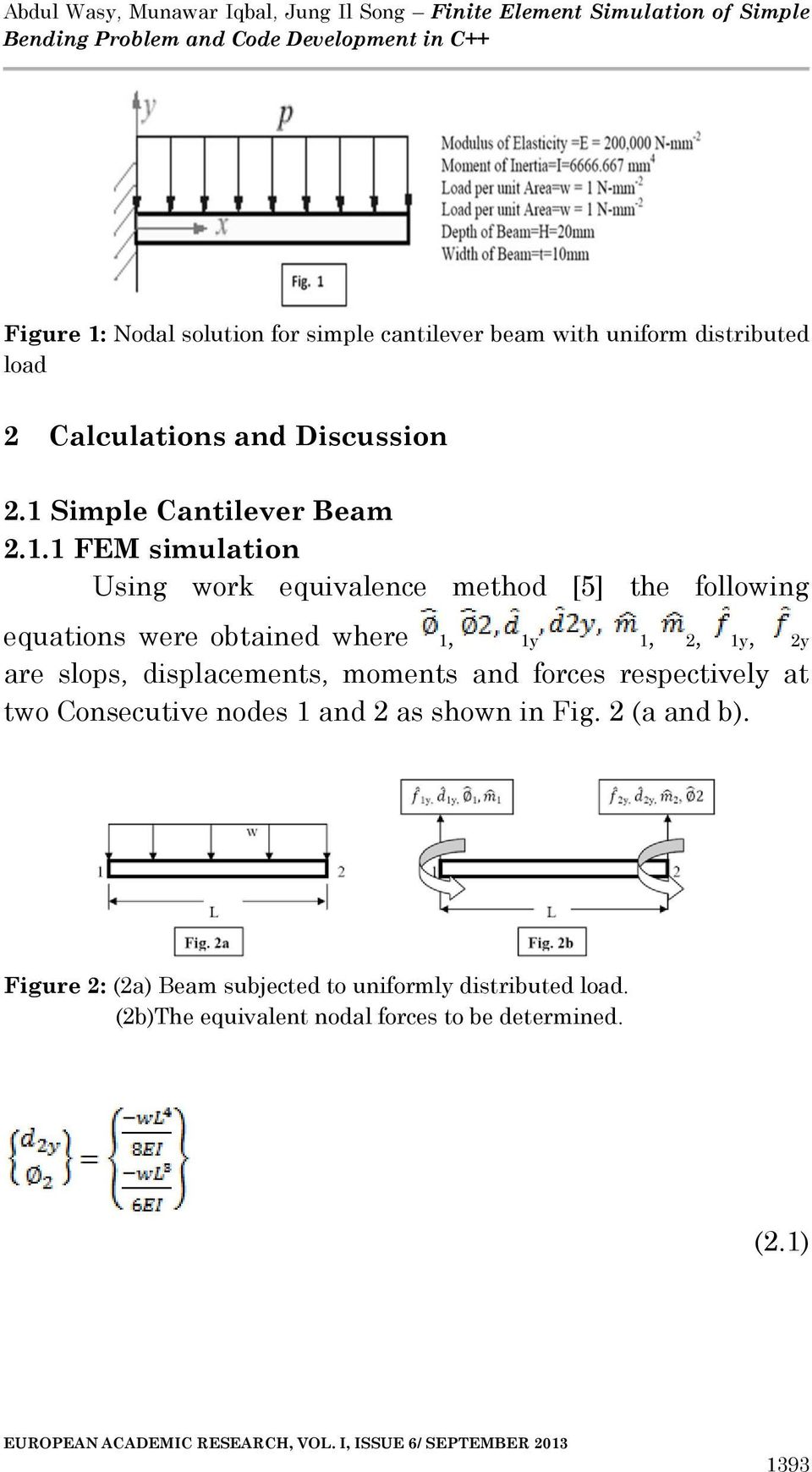
2 bending moments are opposed. (Hool and Johnson 190) Cantilever beams are used in manufacturing of micro and macro overhanging structures e.g. trusses, slabs balconies and bridges. Cracks have unfavorable and negative effects that might appear on a structure during its utilization. They should be detected as soon as possible, as they may significantly decrease the global stiffness over the local reduction of flexural rigidity. (Skrinar and Plibersk 008) Since in inverse identification of crack only a limited amount of measured data is available, it is thus usually not possible to obtain the information of crack directly but as a result of some gradual and systematic computational model modifications. In order to make the computational model more adaptable and a faster analysis process, it is reasonable to neglect all the irrelevant information from the computational model. Therefore, in simplified model a non-propagating crack beam can be analyzed for static conditions. Cantilevers beams are commonly used in bridge structures, where the cantilevers are made in form of pairs for supporting the central section. The Elland Road Stadium in Leeds and Forth Bridge in Scotland are famous examples of cantilever structures. The largest cantilever in Europe is located at St James' Park in Newcastle-Upon-Tyne and the home stadium of Newcastle United F.C. (Cf. James's Park 1999 and Existing stadiums: St James' Park, Newcastle 005) In micro structures, the topic is focused due to use of small cantilever beam component near high temperature devices as plasma and laser beam sources. The author consider a cantilever beam whose modulus of elasticity (E) is 00,000 N- mm -, moment of inertia (I) is mm 4, effective moment of inertia (Ie) is mm 4 and load per unit area (w) is 1 N- mm -, for cracked cantilever beam (CCB) a crack of 0*1*1mm is considered. Fig.1 shows nodal deflection of simple cantilever beam (SCB). EUROPEAN ACADEMIC RESEARCH, VOL. I, ISSUE 6/ SEPTEMBER

3 Figure 1: Nodal solution for simple cantilever beam with uniform distributed load Calculations and Discussion.1 Simple Cantilever Beam.1.1 FEM simulation Using work equivalence method [5] the following equations were obtained where 1, 1y 1,, 1y, y are slops, displacements, moments and forces respectively at two Consecutive nodes 1 and as shown in Fig. (a and b). Figure : (a) Beam subjected to uniformly distributed load. (b)the equivalent nodal forces to be determined. (.1) EUROPEAN ACADEMIC RESEARCH, VOL. I, ISSUE 6/ SEPTEMBER

4 = = (.) 1y is the vertical force reaction and 1 is the moment reaction as applied by the clamp support at node 1. The results for displacement given by eq..1 and the global nodal forces given by the above eq.. are sufficient to complete the solution for the cantilever problem. The shear force (F), bending moment (M), displacement (d), slop ( ) were calculated by using following equations F = w * L M = ½ [w * L ] (.4) (.5) (.6) (.7).1. Beam Theory To obtain the solution from beam theory, double integration method (Logan 007) is used. Therefore, the moment curvature equation is given below, M ( x) y EI (.8) Where the double prime superscript indicates differentiation with respect to x and M is expressed as a function of x by using a section of the beam as described below, EUROPEAN ACADEMIC RESEARCH, VOL. I, ISSUE 6/ SEPTEMBER
![The shear force (F), bending moment (M), displacement (d), slop ( ) were calculated by using following equations F = w * L M = ½ [w * L ] (.4) (.5) (.6) (.7).1.](/docs-images/46/21697842/images/page_4.jpg "Beam Theory To obtain the solution from beam theory, double integration method (Logan 007) is used. Therefore, the moment curvature equation is given below, M ( x) y EI (.")
5 F y 0; M 0; V( x) wl wx wl M ( x) x wlx ( wx) Solving the above equations yield following relation, 1 wl x y EI 4 wlx 6 3 wx 4 4 (.9) (.10) (.11) From eq..11 deflection obtained by substituting respective parameters. Values of displacement and load at different locations along the beam spam were calculated by using the assumed cubic displacement function vˆ ( x) x 3x Ld 3 y ( x L x L ) 3 L L (.1) The deflection of beams is necessary to make several real world decisions. Many times, maximum deflection on a beam under a set of loads is required and where it occurs as well. By using the boundary conditions 1y = 1= 0 in above equation, displacement at certain length of the beam was calculated. Bending moments and shear forces in the present problem were evaluated based on FEM simulation and beam theory. The bending moment is given by d ( Nd) ( d N) EIv EI EI d dx dx M (.17) As d is not a function of x. Or in terms of the gradient matrix B we have EIBd M (.18) EUROPEAN ACADEMIC RESEARCH, VOL. I, ISSUE 6/ SEPTEMBER

6 B d N dx 6 1x 4 6x 6 3 L L L L L 1x 6x 3 L L L (.19) The shape functions are used to obtain the recent above equation for the B matrix. For the single element solution, the bending moment is then evaluated by substituting this above equation into M = EIB d and by multiplying B by d to obtain M 6 1x ˆ 4 6x ˆ 6 1x ˆ 6x EI d ˆ x d x (.0) L L L L L L L L By evaluating the moment at the fixed end, x = 0, with d1x = 1 = 0 and dx and are given by eq..6 and eq..7 we have, 10wL M ( x) 1wLx 4 (.1) Shear forces was calculated by using formulas of beam theory and FEM simulation, by using eq..4; F = w*l. Beam normal stresses are computed from the flexure formula, which relates the internal moment and the beam cross-sectional properties to the normal stress. Transverse shear stresses were computed from the shear formula for beams, which relates the internal shear force and the beam cross-sectional properties to the shear stress. The internal forces and moments were used to compute the shear stress and normal stress, which were found from the shear force and bending moment diagrams. Fig. 3 showed BMD and SFD of cantilever beam in MD Solid software. The bending moment was derived by taking two derivatives on the displacement function. It took more elements to model the second derivative of the displacement function. Therefore, the finite element solution function does not predict the bending moment as well as it does the displacement. EUROPEAN ACADEMIC RESEARCH, VOL. I, ISSUE 6/ SEPTEMBER


7 Figure 3: BMD and SFD of cantilever beam in MD Solid. Cracked Cantilever Beam Regardless of the method used for calculating deflections, a careful calculation is required to measure the moment of inertia for cracked cantilever beam. The trouble lies in the amount of cracking that has not occurred. If the bending moment is less than the cracking moment (that is, if the flexural stress is less than the modulus of rupture of about 7.5 for normal-weight concrete), the full un-cracked section provides rigidity, and the moment of inertia for the gross section Ig is available. When larger moments are present, variable sized tension cracks occurred and the position of natural axis varies. Effective moment of inertia was calculated by using Brandon equation. (Pytel and Singer 1987) = *Igt + *Icr (.3) Where: m = experimentally determined exponent = effective moment of inertia Icr = cracked moment of inertia Igt = Moment of inertia of transformed cross-section Ma = applied moment Mcr = cracking moment Now values of above mentioned variables were calculated as mentioned below: EUROPEAN ACADEMIC RESEARCH, VOL. I, ISSUE 6/ SEPTEMBER

8 (.33) (.33) Ig = gross moment of Inertia = N-mm = N-mm- (.34) Where is modulus of rupture and is load factor having specific value for each material. mm 4 (.35) mm 4 (.36) While practical results for rectangular cross-section give m= 3 and putting the values in equation.3 = * mm 4 (.37) Now all calculations will be done using the effect moment of inertia = mm (.38) The slope can be calculated by using the formula = rad (.39) The shear force and bending moment will be same as calculated for simple cantilever beam using because shear force and bending moment are not function of moment of inertia. By using the boundary conditions 1y = 1= 0 in eq..11 and eq.1, deflections at specified spam length were calculated. EUROPEAN ACADEMIC RESEARCH, VOL. I, ISSUE 6/ SEPTEMBER


9 .3 Analysis using ANSYS ANSYS (006, 1) academic version is used for finite element analysis. This software is being used for solving structural, dynamic, electromagnetic and fluid flow problems. The Results obtained by ANSYS simulations are shown in Fig. 4 (a-b) for specific node. Figure 4: (4a) Nodal results of deflection in SCB (4b) Graphical representation of deflection in CCB.4 Computer Programming A specific programming code was made in C++ computer language, which can generate results for deflection, bending moment and shear force at any points by entering its EUROPEAN ACADEMIC RESEARCH, VOL. I, ISSUE 6/ SEPTEMBER


10 location along beam length and moment of inertia. Fig. 5 showed result windows for considered node. Figure 5: Result window of C++ at x=150mmfor CCB 3 Conclusion The theoretical and software based simulation work for simple bending problem were performed by considering example of cantilever beam. Numerical simulations for simple and cracked cantilever beams using finite element stiffness method, analytical beam theory and finite element package (ANSYS) were evaluated and then results were verified with code generated in C++ language. The results gathered by mathematical modeling are very beneficial. They enable a better understanding and ability to predict deformation process; however, when using the mathematical modeling assumptions may have to be made. In order to compensate, a factor of safety is always added into the equations when the results are going to be used in applications. The author concluded that the beam theory solution for the mid length displacement y = mm is greater than the finite element solution for displacement v = mm. In general, the displacements evaluated using the cubic function for v are lower as predicted by the beam theory at particular EUROPEAN ACADEMIC RESEARCH, VOL. I, ISSUE 6/ SEPTEMBER

11 nodes. The variations in deflection, shear force and bending moment results for simple and cracked cantilever beam obtained from finite element method and beam theory are presented in Fig. 6, Fig. 7, Fig. 8 and Fig. 9. Figure 6: Comparison of displacement obtained by FEM simulation and beam theory for SCB Figure 7: Comparison of moment obtained by FEM simulation and beam theory for SCB EUROPEAN ACADEMIC RESEARCH, VOL. I, ISSUE 6/ SEPTEMBER

12 Figure 8: Comparison of shear force obtained by FEM simulation and beam theory for SCB Figure 9: Comparison of displacement obtained by FEM simulation and beam theory for CCB The comparison of all results obtained from finite element method, beam theory, ANSYS and C++ code are summarized in Table 1. EUROPEAN ACADEMIC RESEARCH, VOL. I, ISSUE 6/ SEPTEMBER


13 Table 1: Detailed results obtained by comparative study of simple and cracked cantilever beam. This is always true for the beam subjected to some form of distributed load that were modeled using the cubic function displacement. The exception to this result at the nodes where the beam theory and the finite element results are identical because of the work equivalence concept use which was used to replace the distributed load by work equivalent discrete loads at the nodes. The analytical or exact solution gives results at any point or at any location in the structures. While the numerical solution is capable of generating results only at nodes, it is not capable of finding results between the two consecutive nodes. The FEM simulation shows less deflection at any specific point as compared with beam theory. The shear force curve shown in Fig. 8 represents the comparison between FEM simulation and beam theory, the curve of FEM simulation is a straight line representing constant value for shear force, which is due to the fact that the FEM does not have the capacity of evaluating results in between the nodes, while the slope of beam theory predicts results for all desired locations. This work hopes to be helpful in macro to micro designs to consider bending problems. EUROPEAN ACADEMIC RESEARCH, VOL. I, ISSUE 6/ SEPTEMBER

14 BIBLIOGRAPHY ANSYS, Inc., ANSYS FLOTRAN CFD Analysis Guide. Release p Existing stadiums: St James' Park, Newcastle. The Architects' Journal. 1 July James's Park. The Structural Engineer 77: 1. Hool, George A., and Nathan Clarke Johnson Handbook of Building Construction. Vol. 1. 1st edition. New York: McGraw-Hill. Logan, Daryl L A First Course in Finite Element Method. 4 th edition. Delhi: Thompson. Pytel, A. and F. L. Singer Strength of Materials. 4 th edition. New York: Harper Collins Publishers. Skrinar, M., and T. Plibersk Transversely cracked beam's finite elements with a hinged. American Journal of Applied Sciences, Jan, 008. Research Highlights Simple bending problem was analyses using simple and cracked cantilever beam example. Theoretical and Software based simulations were performed using finite element method, beam theory, ANSYS and code generated in C++. A competitive approach was developed to understand the results and there reliability obtained by theoretical and software methods. The constraints of finite element method and benefits of beam theory were highlighted. Special C++ code was developed to obtain instant results of deflection, shear force and bending moments by putting moment of inertia and any location along spam length EUROPEAN ACADEMIC RESEARCH, VOL. I, ISSUE 6/ SEPTEMBER

15 Figure Captions Figure 1: Nodal solution for simple cantilever beam with uniform distributed load Figure : (a) Beam subjected to uniformly distributed load. (b)the equivalent nodal forces to be determined Figure 3: BMD and SFD of cantilever beam in MD Solid Figure 4: (4a) Nodal results of deflection in SCB, (4b) Graphical representation of deflection in CCB Figure 5: Result window of C++ at x=150mmfor CCB Figure 6: Comparison of displacement obtained by FEM simulation and beam theory for SCB Figure 7: Comparison of moment obtained by FEM simulation and beam theory for SCB Figure 8: Comparison of shear force obtained by FEM simulation and beam theory for SCB Figure 9: Comparison of displacement obtained by FEM simulation and beam theory for CCB ACKNOWLEDGMENTS This Research was supported by Basic Science Research Program through the National Research Foundation of Korea (NRF) funded by Ministry of Education, Science and Technology under grant no and EUROPEAN ACADEMIC RESEARCH, VOL. I, ISSUE 6/ SEPTEMBER

The Basics of FEA Procedure
 CHAPTER 2 The Basics of FEA Procedure 2.1 Introduction This chapter discusses the spring element, especially for the purpose of introducing various concepts involved in use of the FEA technique. A spring
Deflections. Question: What are Structural Deflections?
 Question: What are Structural Deflections? Answer: The deformations or movements of a structure and its components, such as beams and trusses, from their original positions. It is as important for the
Approximate Analysis of Statically Indeterminate Structures
 Approximate Analysis of Statically Indeterminate Structures Every successful structure must be capable of reaching stable equilibrium under its applied loads, regardless of structural behavior. Exact analysis
INTRODUCTION TO BEAMS
 CHAPTER Structural Steel Design LRFD Method INTRODUCTION TO BEAMS Third Edition A. J. Clark School of Engineering Department of Civil and Environmental Engineering Part II Structural Steel Design and Analysis
Finite Element Formulation for Beams - Handout 2 -
 Finite Element Formulation for Beams - Handout 2 - Dr Fehmi Cirak (fc286@) Completed Version Review of Euler-Bernoulli Beam Physical beam model midline Beam domain in three-dimensions Midline, also called
Finite Element Method (ENGC 6321) Syllabus. Second Semester 2013-2014
 Finite Element Method Finite Element Method (ENGC 6321) Syllabus Second Semester 2013-2014 Objectives Understand the basic theory of the FEM Know the behaviour and usage of each type of elements covered
Module 2. Analysis of Statically Indeterminate Structures by the Matrix Force Method. Version 2 CE IIT, Kharagpur
 Module Analysis of Statically Indeterminate Structures by the Matrix Force Method esson 11 The Force Method of Analysis: Frames Instructional Objectives After reading this chapter the student will be able
DESIGN OF SLABS. 3) Based on support or boundary condition: Simply supported, Cantilever slab,
 DESIGN OF SLABS Dr. G. P. Chandradhara Professor of Civil Engineering S. J. College of Engineering Mysore 1. GENERAL A slab is a flat two dimensional planar structural element having thickness small compared
2. Axial Force, Shear Force, Torque and Bending Moment Diagrams
 2. Axial Force, Shear Force, Torque and Bending Moment Diagrams In this section, we learn how to summarize the internal actions (shear force and bending moment) that occur throughout an axial member, shaft,
8.2 Elastic Strain Energy
 Section 8. 8. Elastic Strain Energy The strain energy stored in an elastic material upon deformation is calculated below for a number of different geometries and loading conditions. These expressions for
Shear Forces and Bending Moments
 Chapter 4 Shear Forces and Bending Moments 4.1 Introduction Consider a beam subjected to transverse loads as shown in figure, the deflections occur in the plane same as the loading plane, is called the
MECHANICS OF SOLIDS - BEAMS TUTORIAL 2 SHEAR FORCE AND BENDING MOMENTS IN BEAMS
 MECHANICS OF SOLIDS - BEAMS TUTORIAL 2 SHEAR FORCE AND BENDING MOMENTS IN BEAMS This is the second tutorial on bending of beams. You should judge your progress by completing the self assessment exercises.
Mechanics of Materials. Chapter 4 Shear and Moment In Beams
 Mechanics of Materials Chapter 4 Shear and Moment In Beams 4.1 Introduction The term beam refers to a slender bar that carries transverse loading; that is, the applied force are perpendicular to the bar.
SLAB DESIGN. Introduction ACI318 Code provides two design procedures for slab systems:
 Reading Assignment SLAB DESIGN Chapter 9 of Text and, Chapter 13 of ACI318-02 Introduction ACI318 Code provides two design procedures for slab systems: 13.6.1 Direct Design Method (DDM) For slab systems
New approaches in Eurocode 3 efficient global structural design
 New approaches in Eurocode 3 efficient global structural design Part 1: 3D model based analysis using general beam-column FEM Ferenc Papp* and József Szalai ** * Associate Professor, Department of Structural
FUNDAMENTAL FINITE ELEMENT ANALYSIS AND APPLICATIONS
 FUNDAMENTAL FINITE ELEMENT ANALYSIS AND APPLICATIONS With Mathematica and MATLAB Computations M. ASGHAR BHATTI WILEY JOHN WILEY & SONS, INC. CONTENTS OF THE BOOK WEB SITE PREFACE xi xiii 1 FINITE ELEMENT
9.3 Two-way Slabs (Part I)
 9.3 Two-way Slabs (Part I) This section covers the following topics. Introduction Analysis and Design Features in Modeling and Analysis Distribution of Moments to Strips 9.3.1 Introduction The slabs are
The elements used in commercial codes can be classified in two basic categories:
 CHAPTER 3 Truss Element 3.1 Introduction The single most important concept in understanding FEA, is the basic understanding of various finite elements that we employ in an analysis. Elements are used for
MCE380: Measurements and Instrumentation Lab. Chapter 9: Force, Torque and Strain Measurements
 MCE380: Measurements and Instrumentation Lab Chapter 9: Force, Torque and Strain Measurements Topics: Elastic Elements for Force Measurement Dynamometers and Brakes Resistance Strain Gages Holman, Ch.
An Overview of the Finite Element Analysis
 CHAPTER 1 An Overview of the Finite Element Analysis 1.1 Introduction Finite element analysis (FEA) involves solution of engineering problems using computers. Engineering structures that have complex geometry
Stresses in Beam (Basic Topics)
 Chapter 5 Stresses in Beam (Basic Topics) 5.1 Introduction Beam : loads acting transversely to the longitudinal axis the loads create shear forces and bending moments, stresses and strains due to V and
Bending Stress in Beams
 936-73-600 Bending Stress in Beams Derive a relationship for bending stress in a beam: Basic Assumptions:. Deflections are very small with respect to the depth of the beam. Plane sections before bending
Optimum proportions for the design of suspension bridge
 Journal of Civil Engineering (IEB), 34 (1) (26) 1-14 Optimum proportions for the design of suspension bridge Tanvir Manzur and Alamgir Habib Department of Civil Engineering Bangladesh University of Engineering
Finite Element Formulation for Plates - Handout 3 -
 Finite Element Formulation for Plates - Handout 3 - Dr Fehmi Cirak (fc286@) Completed Version Definitions A plate is a three dimensional solid body with one of the plate dimensions much smaller than the
Statics of Structural Supports
 Statics of Structural Supports TYPES OF FORCES External Forces actions of other bodies on the structure under consideration. Internal Forces forces and couples exerted on a member or portion of the structure
Structural Axial, Shear and Bending Moments
 Structural Axial, Shear and Bending Moments Positive Internal Forces Acting Recall from mechanics of materials that the internal forces P (generic axial), V (shear) and M (moment) represent resultants
Modeling Beams on Elastic Foundations Using Plate Elements in Finite Element Method
 Modeling Beams on Elastic Foundations Using Plate Elements in Finite Element Method Yun-gang Zhan School of Naval Architecture and Ocean Engineering, Jiangsu University of Science and Technology, Zhenjiang,
Introduction to Beam. Area Moments of Inertia, Deflection, and Volumes of Beams
 Introduction to Beam Theory Area Moments of Inertia, Deflection, and Volumes of Beams Horizontal structural member used to support horizontal loads such as floors, roofs, and decks. Types of beam loads
Numerical and Experimental Analysis of a Cantilever Beam: a Laboratory Project to Introduce Geometric Nonlinearity in Mechanics of Materials*
 Int. J. Engng Ed. Vol. 19, No. 6, pp. 885±892, 2003 0949-149X/91 $3.00+0.00 Printed in Great Britain. # 2003 TEMPUS Publications. Numerical and Experimental Analysis of a Cantilever Beam: a Laboratory
Advanced Structural Analysis. Prof. Devdas Menon. Department of Civil Engineering. Indian Institute of Technology, Madras. Module - 5.3.
 Advanced Structural Analysis Prof. Devdas Menon Department of Civil Engineering Indian Institute of Technology, Madras Module - 5.3 Lecture - 29 Matrix Analysis of Beams and Grids Good morning. This is
CHAP 4 FINITE ELEMENT ANALYSIS OF BEAMS AND FRAMES INTRODUCTION
 CHAP FINITE EEMENT ANAYSIS OF BEAMS AND FRAMES INTRODUCTION We learned Direct Stiffness Method in Chapter imited to simple elements such as D bars we will learn Energ Method to build beam finite element
16. Beam-and-Slab Design
 ENDP311 Structural Concrete Design 16. Beam-and-Slab Design Beam-and-Slab System How does the slab work? L- beams and T- beams Holding beam and slab together University of Western Australia School of Civil
How To Calculate Tunnel Longitudinal Structure
 Calculation and Analysis of Tunnel Longitudinal Structure under Effect of Uneven Settlement of Weak Layer 1,2 Li Zhong, 2Chen Si-yang, 3Yan Pei-wu, 1Zhu Yan-peng School of Civil Engineering, Lanzhou University
MECHANICS OF SOLIDS - BEAMS TUTORIAL 1 STRESSES IN BEAMS DUE TO BENDING. On completion of this tutorial you should be able to do the following.
 MECHANICS OF SOLIDS - BEAMS TUTOIAL 1 STESSES IN BEAMS DUE TO BENDING This is the first tutorial on bending of beams designed for anyone wishing to study it at a fairly advanced level. You should judge
Numerical Analysis of Independent Wire Strand Core (IWSC) Wire Rope
 Numerical Analysis of Independent Wire Strand Core (IWSC) Wire Rope Rakesh Sidharthan 1 Gnanavel B K 2 Assistant professor Mechanical, Department Professor, Mechanical Department, Gojan engineering college,
Back to Elements - Tetrahedra vs. Hexahedra
 Back to Elements - Tetrahedra vs. Hexahedra Erke Wang, Thomas Nelson, Rainer Rauch CAD-FEM GmbH, Munich, Germany Abstract This paper presents some analytical results and some test results for different
ENGINEERING SCIENCE H1 OUTCOME 1 - TUTORIAL 3 BENDING MOMENTS EDEXCEL HNC/D ENGINEERING SCIENCE LEVEL 4 H1 FORMERLY UNIT 21718P
 ENGINEERING SCIENCE H1 OUTCOME 1 - TUTORIAL 3 BENDING MOMENTS EDEXCEL HNC/D ENGINEERING SCIENCE LEVEL 4 H1 FORMERLY UNIT 21718P This material is duplicated in the Mechanical Principles module H2 and those
COMPARISON OF STRESS BETWEEN WINKLER-BACH THEORY AND ANSYS FINITE ELEMENT METHOD FOR CRANE HOOK WITH A TRAPEZOIDAL CROSS-SECTION
 COMPARISON OF STRESS BETWEEN WINKLER-BACH THEORY AND ANSYS FINITE ELEMENT METHOD FOR CRANE HOOK WITH A TRAPEZOIDAL CROSS-SECTION Yogesh Tripathi 1, U.K Joshi 2 1 Postgraduate Student, 2 Associate Professor,
Section 16: Neutral Axis and Parallel Axis Theorem 16-1
 Section 16: Neutral Axis and Parallel Axis Theorem 16-1 Geometry of deformation We will consider the deformation of an ideal, isotropic prismatic beam the cross section is symmetric about y-axis All parts
The Bending Strength of Pasta
 The Bending Strength of Pasta 1.105 Lab #1 Louis L. Bucciarelli 9 September, 2003 Lab Partners: [Name1] [Name2] Data File: Tgroup3.txt On the cover page, include your name, the names of your lab partners,
DYNAMIC ANALYSIS OF THICK PLATES SUBJECTED TO EARTQUAKE
 DYNAMIC ANALYSIS OF THICK PLATES SUBJECTED TO EARTQUAKE ÖZDEMİR Y. I, AYVAZ Y. Posta Adresi: Department of Civil Engineering, Karadeniz Technical University, 68 Trabzon, TURKEY E-posta: [email protected]
EDEXCEL NATIONAL CERTIFICATE/DIPLOMA MECHANICAL PRINCIPLES AND APPLICATIONS NQF LEVEL 3 OUTCOME 1 - LOADING SYSTEMS TUTORIAL 3 LOADED COMPONENTS
 EDEXCEL NATIONAL CERTIICATE/DIPLOMA MECHANICAL PRINCIPLES AND APPLICATIONS NQ LEVEL 3 OUTCOME 1 - LOADING SYSTEMS TUTORIAL 3 LOADED COMPONENTS 1. Be able to determine the effects of loading in static engineering
Deflection Calculation of RC Beams: Finite Element Software Versus Design Code Methods
 Deflection Calculation of RC Beams: Finite Element Software Versus Design Code Methods G. Kaklauskas, Vilnius Gediminas Technical University, 1223 Vilnius, Lithuania ([email protected]) V.
SMIP05 Seminar Proceedings VISUALIZATION OF NONLINEAR SEISMIC BEHAVIOR OF THE INTERSTATE 5/14 NORTH CONNECTOR BRIDGE. Robert K.
 VISUALIZATION OF NONLINEAR SEISMIC BEHAVIOR OF THE INTERSTATE 5/14 NORTH CONNECTOR BRIDGE Robert K. Dowell Department of Civil and Environmental Engineering San Diego State University Abstract This paper
Tutorial for Assignment #2 Gantry Crane Analysis By ANSYS (Mechanical APDL) V.13.0
 Tutorial for Assignment #2 Gantry Crane Analysis By ANSYS (Mechanical APDL) V.13.0 1 Problem Description Design a gantry crane meeting the geometry presented in Figure 1 on page #325 of the course textbook
Chapter 8. Shear Force and Bending Moment Diagrams for Uniformly Distributed Loads.
 hapter 8 Shear Force and ending Moment Diagrams for Uniformly Distributed Loads. 8.1 Introduction In Unit 4 we saw how to calculate moments for uniformly distributed loads. You might find it worthwhile
How To Write An Analysis System For Bridge Test
 Study of Analysis System for Bridge Test Chen Ke, Lu Jian-Ming, Research Institute of Highway, 100088, Beijing, China ([email protected], [email protected]) Summary Analysis System for Bridge Test (Chinese
CAE -Finite Element Method
 16.810 Engineering Design and Rapid Prototyping Lecture 3b CAE -Finite Element Method Instructor(s) Prof. Olivier de Weck January 16, 2007 Numerical Methods Finite Element Method Boundary Element Method
Differential Relations for Fluid Flow. Acceleration field of a fluid. The differential equation of mass conservation
 Differential Relations for Fluid Flow In this approach, we apply our four basic conservation laws to an infinitesimally small control volume. The differential approach provides point by point details of
CLASSIFICATION BOUNDARIES FOR STIFFNESS OF BEAM-TO- COLUMN JOINTS AND COLUMN BASES
 Nordic Steel Construction Conference 2012 Hotel Bristol, Oslo, Norway 5-7 September 2012 CLASSIFICATION BOUNDARIES FOR STIFFNESS OF BEAM-TO- COLUMN JOINTS AND COLUMN BASES Ina Birkeland a,*, Arne Aalberg
Finite Element Method
 16.810 (16.682) Engineering Design and Rapid Prototyping Finite Element Method Instructor(s) Prof. Olivier de Weck [email protected] Dr. Il Yong Kim [email protected] January 12, 2004 Plan for Today FEM Lecture
Design of reinforced concrete columns. Type of columns. Failure of reinforced concrete columns. Short column. Long column
 Design of reinforced concrete columns Type of columns Failure of reinforced concrete columns Short column Column fails in concrete crushed and bursting. Outward pressure break horizontal ties and bend
Numerical modelling of shear connection between concrete slab and sheeting deck
 7th fib International PhD Symposium in Civil Engineering 2008 September 10-13, Universität Stuttgart, Germany Numerical modelling of shear connection between concrete slab and sheeting deck Noémi Seres
Recitation #5. Understanding Shear Force and Bending Moment Diagrams
 Recitation #5 Understanding Shear Force and Bending Moment Diagrams Shear force and bending moment are examples of interanl forces that are induced in a structure when loads are applied to that structure.
EDEXCEL NATIONAL CERTIFICATE/DIPLOMA MECHANICAL PRINCIPLES OUTCOME 2 ENGINEERING COMPONENTS TUTORIAL 1 STRUCTURAL MEMBERS
 ENGINEERING COMPONENTS EDEXCEL NATIONAL CERTIFICATE/DIPLOMA MECHANICAL PRINCIPLES OUTCOME ENGINEERING COMPONENTS TUTORIAL 1 STRUCTURAL MEMBERS Structural members: struts and ties; direct stress and strain,
Lab for Deflection and Moment of Inertia
 Deflection and Moment of Inertia Subject Area(s) Associated Unit Lesson Title Physics Wind Effects on Model Building Lab for Deflection and Moment of Inertia Grade Level (11-12) Part # 2 of 3 Lesson #
EFFECTS ON NUMBER OF CABLES FOR MODAL ANALYSIS OF CABLE-STAYED BRIDGES
 EFFECTS ON NUMBER OF CABLES FOR MODAL ANALYSIS OF CABLE-STAYED BRIDGES Yang-Cheng Wang Associate Professor & Chairman Department of Civil Engineering Chinese Military Academy Feng-Shan 83000,Taiwan Republic
When the fluid velocity is zero, called the hydrostatic condition, the pressure variation is due only to the weight of the fluid.
 Fluid Statics When the fluid velocity is zero, called the hydrostatic condition, the pressure variation is due only to the weight of the fluid. Consider a small wedge of fluid at rest of size Δx, Δz, Δs
Design Analysis and Review of Stresses at a Point
 Design Analysis and Review of Stresses at a Point Need for Design Analysis: To verify the design for safety of the structure and the users. To understand the results obtained in FEA, it is necessary to
Laterally Loaded Piles
 Laterally Loaded Piles 1 Soil Response Modelled by p-y Curves In order to properly analyze a laterally loaded pile foundation in soil/rock, a nonlinear relationship needs to be applied that provides soil
Cylinder Head Gasket Contact Pressure Simulation for a Hermetic Compressor
 Purdue University Purdue e-pubs International Compressor Engineering Conference School of Mechanical Engineering 2006 Cylinder Head Gasket Contact Pressure Simulation for a Hermetic Compressor Pavan P.
MATERIALS AND SCIENCE IN SPORTS. Edited by: EH. (Sam) Froes and S.J. Haake. Dynamics
 MATERIALS AND SCIENCE IN SPORTS Edited by: EH. (Sam) Froes and S.J. Haake Dynamics Analysis of the Characteristics of Fishing Rods Based on the Large-Deformation Theory Atsumi Ohtsuki, Prof, Ph.D. Pgs.
THE COMPUTATIONAL MODEL OF THE LOAD DISTRIBUTION BETWEEN ELEMENTS IN A PLANETARY ROLLER SCREW
 JOURNAL OF THEORETICAL AND APPLIED MECHANICS 52, 3, pp. 699-705, Warsaw 204 THE COMPUTATIONAL MODEL OF THE LOAD DISTRIBUTION BETWEEN ELEMENTS IN A PLANETARY ROLLER SCREW Jan Ryś, Filip Lisowski Cracow
PREDICTION OF MACHINE TOOL SPINDLE S DYNAMICS BASED ON A THERMO-MECHANICAL MODEL
 PREDICTION OF MACHINE TOOL SPINDLE S DYNAMICS BASED ON A THERMO-MECHANICAL MODEL P. Kolar, T. Holkup Research Center for Manufacturing Technology, Faculty of Mechanical Engineering, CTU in Prague, Czech
CAE -Finite Element Method
 16.810 Engineering Design and Rapid Prototyping CAE -Finite Element Method Instructor(s) Prof. Olivier de Weck January 11, 2005 Plan for Today Hand Calculations Aero Æ Structures FEM Lecture (ca. 45 min)
Course in. Nonlinear FEM
 Course in Introduction Outline Lecture 1 Introduction Lecture 2 Geometric nonlinearity Lecture 3 Material nonlinearity Lecture 4 Material nonlinearity continued Lecture 5 Geometric nonlinearity revisited
MATERIALS AND MECHANICS OF BENDING
 HAPTER Reinforced oncrete Design Fifth Edition MATERIALS AND MEHANIS OF BENDING A. J. lark School of Engineering Department of ivil and Environmental Engineering Part I oncrete Design and Analysis b FALL
Introduction to Mechanical Behavior of Biological Materials
 Introduction to Mechanical Behavior of Biological Materials Ozkaya and Nordin Chapter 7, pages 127-151 Chapter 8, pages 173-194 Outline Modes of loading Internal forces and moments Stiffness of a structure
EFFICIENT NUMERICAL SIMULATION OF INDUSTRIAL SHEET METAL BENDING PROCESSES
 ECCOMAS Congress 06 VII European Congress on Computational Methods in Applied Sciences and Engineering M. Papadrakakis, V. Papadopoulos, G. Stefanou, V. Plevris (eds.) Crete Island, Greece, 5 0 June 06
The Point-Slope Form
 7. The Point-Slope Form 7. OBJECTIVES 1. Given a point and a slope, find the graph of a line. Given a point and the slope, find the equation of a line. Given two points, find the equation of a line y Slope
In-situ Load Testing to Evaluate New Repair Techniques
 In-situ Load Testing to Evaluate New Repair Techniques W.J. Gold 1 and A. Nanni 2 1 Assistant Research Engineer, Univ. of Missouri Rolla, Dept. of Civil Engineering 2 V&M Jones Professor, Univ. of Missouri
Dispersion diagrams of a water-loaded cylindrical shell obtained from the structural and acoustic responses of the sensor array along the shell
 Dispersion diagrams of a water-loaded cylindrical shell obtained from the structural and acoustic responses of the sensor array along the shell B.K. Jung ; J. Ryue ; C.S. Hong 3 ; W.B. Jeong ; K.K. Shin
DESIGN OF SLABS. Department of Structures and Materials Engineering Faculty of Civil and Environmental Engineering University Tun Hussein Onn Malaysia
 DESIGN OF SLABS Department of Structures and Materials Engineering Faculty of Civil and Environmental Engineering University Tun Hussein Onn Malaysia Introduction Types of Slab Slabs are plate elements
Aluminium systems profile selection
 Aluminium systems profile selection The purpose of this document is to summarise the way that aluminium profile selection should be made, based on the strength requirements for each application. Curtain
Structural Analysis - II Prof. P. Banerjee Department of Civil Engineering Indian Institute of Technology, Bombay. Lecture - 02
 Structural Analysis - II Prof. P. Banerjee Department of Civil Engineering Indian Institute of Technology, Bombay Lecture - 02 Good morning. Today is the second lecture in the series of lectures on structural
Simulation of Residual Stresses in an Induction Hardened Roll
 2.6.4 Simulation of Residual Stresses in an Induction Hardened Roll Ludwig Hellenthal, Clemens Groth Walzen Irle GmbH, Netphen-Deuz, Germany CADFEM GmbH, Burgdorf/Hannover, Germany Summary A heat treatment
Reinforced Concrete Design
 FALL 2013 C C Reinforced Concrete Design CIVL 4135 ii 1 Chapter 1. Introduction 1.1. Reading Assignment Chapter 1 Sections 1.1 through 1.8 of text. 1.2. Introduction In the design and analysis of reinforced
Optimising plate girder design
 Optimising plate girder design NSCC29 R. Abspoel 1 1 Division of structural engineering, Delft University of Technology, Delft, The Netherlands ABSTRACT: In the design of steel plate girders a high degree
The Analysis of Open Web Steel Joists in Existing Buildings
 PDHonline Course S117 (1 PDH) The Analysis of Open Web Steel Joists in Existing Buildings Instructor: D. Matthew Stuart, P.E., S.E., F.ASCE, F.SEI, SECB, MgtEng 2013 PDH Online PDH Center 5272 Meadow Estates
Vibrations of a Free-Free Beam
 Vibrations of a Free-Free Beam he bending vibrations of a beam are described by the following equation: y EI x y t 4 2 + ρ A 4 2 (1) y x L E, I, ρ, A are respectively the Young Modulus, second moment of
Tower Cross Arm Numerical Analysis
 Chapter 7 Tower Cross Arm Numerical Analysis In this section the structural analysis of the test tower cross arm is done in Prokon and compared to a full finite element analysis using Ansys. This is done
SEISMIC UPGRADE OF OAK STREET BRIDGE WITH GFRP
 13 th World Conference on Earthquake Engineering Vancouver, B.C., Canada August 1-6, 2004 Paper No. 3279 SEISMIC UPGRADE OF OAK STREET BRIDGE WITH GFRP Yuming DING 1, Bruce HAMERSLEY 2 SUMMARY Vancouver
Module 5 (Lectures 17 to 19) MAT FOUNDATIONS
 Module 5 (Lectures 17 to 19) MAT FOUNDATIONS Topics 17.1 INTRODUCTION Rectangular Combined Footing: Trapezoidal Combined Footings: Cantilever Footing: Mat foundation: 17.2 COMMON TYPES OF MAT FOUNDATIONS
SECTION 5 ANALYSIS OF CONTINUOUS SPANS DEVELOPED BY THE PTI EDC-130 EDUCATION COMMITTEE LEAD AUTHOR: BRYAN ALLRED
 SECTION 5 ANALYSIS OF CONTINUOUS SPANS DEVELOPED BY THE PTI EDC-130 EDUCATION COMMITTEE LEAD AUTHOR: BRYAN ALLRED NOTE: MOMENT DIAGRAM CONVENTION In PT design, it is preferable to draw moment diagrams
Technical Notes 3B - Brick Masonry Section Properties May 1993
 Technical Notes 3B - Brick Masonry Section Properties May 1993 Abstract: This Technical Notes is a design aid for the Building Code Requirements for Masonry Structures (ACI 530/ASCE 5/TMS 402-92) and Specifications
Basics of Reinforced Concrete Design
 Basics of Reinforced Concrete Design Presented by: Ronald Thornton, P.E. Define several terms related to reinforced concrete design Learn the basic theory behind structural analysis and reinforced concrete
ETABS. Integrated Building Design Software. Composite Floor Frame Design Manual. Computers and Structures, Inc. Berkeley, California, USA
 ETABS Integrated Building Design Software Composite Floor Frame Design Manual Computers and Structures, Inc. Berkeley, California, USA Version 8 January 2002 Copyright The computer program ETABS and all
SEISMIC DESIGN. Various building codes consider the following categories for the analysis and design for earthquake loading:
 SEISMIC DESIGN Various building codes consider the following categories for the analysis and design for earthquake loading: 1. Seismic Performance Category (SPC), varies from A to E, depending on how the
Preliminary steel concrete composite bridge design charts for Eurocodes
 Preliminary steel concrete composite bridge 90 Rachel Jones Senior Engineer Highways & Transportation Atkins David A Smith Regional Head of Bridge Engineering Highways & Transportation Atkins Abstract
SIMPLE ANALYSIS OF FRAMED-TUBE STRUCTURES WITH MULTIPLE INTERNAL TUBES
 SIMPLE ANALYSIS OF FRAMED-TUBE STRUCTURES WITH MULTIPLE INTERNAL TUBES By Kang-Kun Lee, Yew-Chaye Loo 2, and Hong Guan 3 ABSTRACT: Framed-tube system with multiple internal tubes is analysed using an orthotropic
Problem 1: Computation of Reactions. Problem 2: Computation of Reactions. Problem 3: Computation of Reactions
 Problem 1: Computation of Reactions Problem 2: Computation of Reactions Problem 3: Computation of Reactions Problem 4: Computation of forces and moments Problem 5: Bending Moment and Shear force Problem
Shear Force and Moment Diagrams
 C h a p t e r 9 Shear Force and Moment Diagrams In this chapter, you will learn the following to World Class standards: Making a Shear Force Diagram Simple Shear Force Diagram Practice Problems More Complex
Reliable FE-Modeling with ANSYS
 Reliable FE-Modeling with ANSYS Thomas Nelson, Erke Wang CADFEM GmbH, Munich, Germany Abstract ANSYS is one of the leading commercial finite element programs in the world and can be applied to a large
Numerical Analysis of the Moving Formwork Bracket Stress during Construction of a Curved Continuous Box Girder Bridge with Variable Width
 Modern Applied Science; Vol. 9, No. 6; 2015 ISSN 1913-1844 E-ISSN 1913-1852 Published by Canadian Center of Science and Education Numerical Analysis of the Moving Formwork Bracket Stress during Construction