
Recitation #5. Understanding Shear Force and Bending Moment Diagrams
|
|
|
- Winifred Ward
- 9 years ago
- Views:
Transcription
1 Recitation #5 Understanding Shear Force and Bending Moment Diagrams Shear force and bending moment are examples of interanl forces that are induced in a structure when loads are applied to that structure. Loading tends to cause failure in two main ways: a) by shearing the beam across its cross-section. b) by bending the beam to an excessive amount. Shear force may be defined as "the algebraic sum of the loads to the left or right of a point (such that the addition of this force restores vertical equilbrium)". The accepted sign convention is:

2 +ve shear sum of forces to the left is upwards (+ve) sum of forces to the right is downwards (- ve) -ve shear sum of forces to the left is downwards (- ve) sum of forces to the right is upwards (+ve) A shear force diagram is one which shows variation in shear force along the length of the beam. Bending moment may be defined as "the sum of moments about that section of all external forces acting to one side of that section". Moments, at any point, are calculated by multiplying the magnitude of the external forces (loads or reactions) by the distance between the point at which moment is being determined and the point at which the external forces (loads or reactions) are being applied. The accepted sign convention is: Note: +ve bending moment sum of moments to the left is clockwise sum of moments to the right is anticlockwise -ve bending moment sum of moments to the left is anti-clockwise sum of moments to the right is clockwise For beams spanning between two simple pin-jointed supports (i.e. no cantilevers) moment will always be positive and, although the beam sags, moment is drawn above the axis. The maximum bending moment occurs at the point of zero shear force.

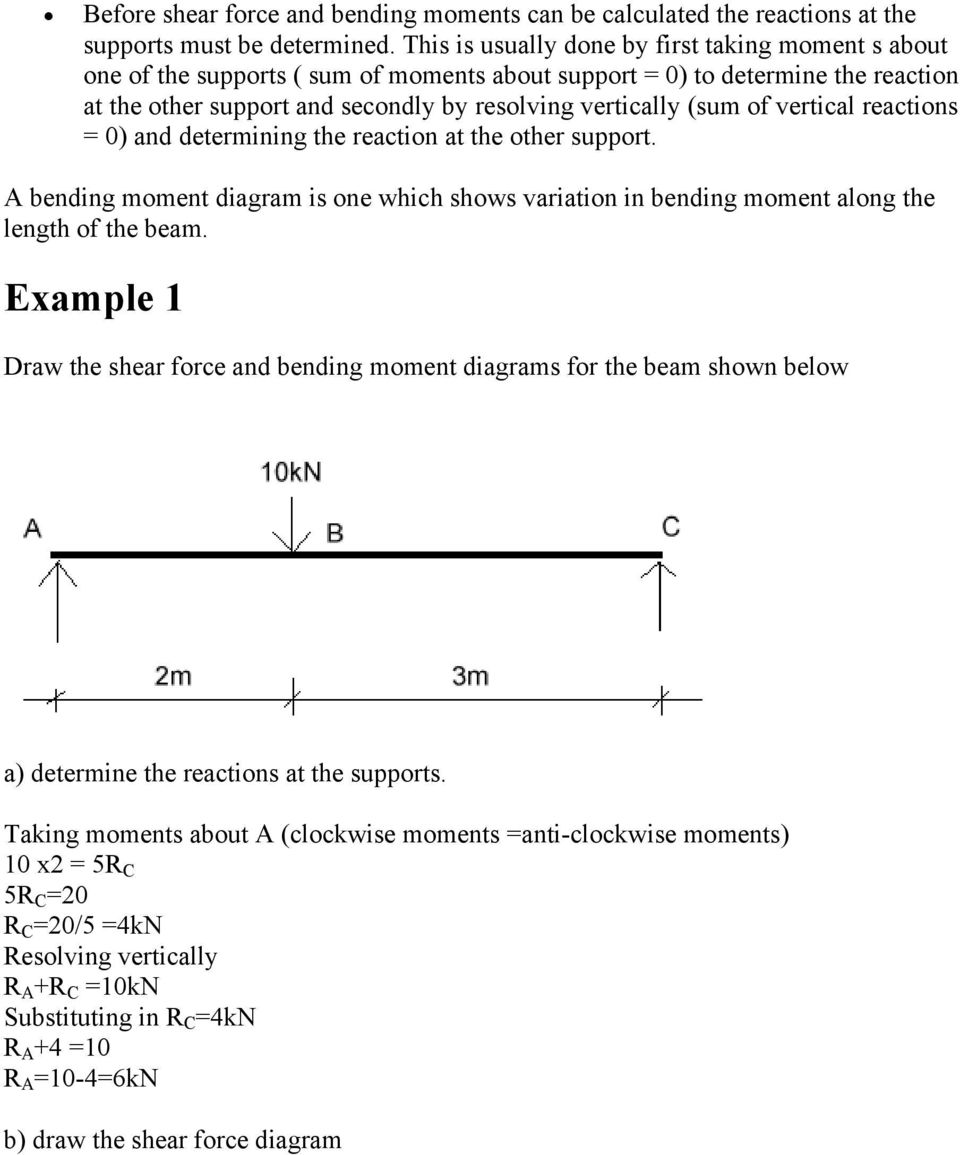
3 Before shear force and bending moments can be calculated the reactions at the supports must be determined. This is usually done by first taking moment s about one of the supports ( sum of moments about support = 0) to determine the reaction at the other support and secondly by resolving vertically (sum of vertical reactions = 0) and determining the reaction at the other support. A bending moment diagram is one which shows variation in bending moment along the length of the beam. Example 1 Draw the shear force and bending moment diagrams for the beam shown below a) determine the reactions at the supports. Taking moments about A (clockwise moments =anti-clockwise moments) 10 x2 = 5R C 5R C =20 R C =20/5 =4kN Resolving vertically R A +R C =10kN Substituting in R C =4kN R A +4 =10 R A =10-4=6kN b) draw the shear force diagram
4 working from left to right: the reaction at A=+6kN the shear force remains constant between A and B (i.e. 6kN) and so the shear force diagram is horizontal between these points at point B where the 10kN point load is applied the shear force changes from +6kN to +6-10= -4kN the shear force remains constant between B and C (i.e. -4kN) and so the shear force diagram is horizontal between these points.

5 at support C the reaction of 4kN brings the value of shear force back to zero and the diagram is complete. c) draw the bending moment diagram: The moments at the supports A and C are zero. The maximum moment occurs at B (point of zero shear force). Taking moments at B (to the left) M B =6 x 2 =12kNm Bending moment varies uniformly between A and B and between B and C (i.e. the bending moment diagram is a straight line). For example, the bending moment midway between A and B = 6 x1 =6kNm which is half the value of the bending moment at B.

6 Therefore the bending moment diagram is: Example 2 Draw the shear force and bending moment diagrams for the beam show below: a) determine the reactions at the supports Taking moments about A (clockwise moments = anti-clockwise moments) (10 x 6) x 3 = 6R C where 10 x 6 =60kN = total load and 3m =distance from A to where the load is acting. 6R C =180 R C =180/6 =30kN Resolving vertically R A +R C = 10 x 6 =60kN Substituting in R C =30kN R A +30=60 R A =60-30=30kN Note In this example, because the loading is applied symmetrically the reactions at each support must be equal and are therefore half the load. It is acceptable to assume this and not necessary to calculate the reactions. b) draw the shear force diagram

7 Working from left to right: the reaction at A = +30kN Moving from left to right the shear force reduces by 10kN per metre and so changes from +30kN at A to +30-(6x10)=-30kN at C. The shear force diagram is sloping between A and C and the point aof zero shear force occurs at B, the centre point. At support C the reaction of 30kN brings the value of shear force back to zero and the diagram is complete. c) draw the bending moment diagram

8 The moments at the supports A and C are zero. The maximum moment occurs at B (point of zero shear force). Taking moments about B (to the left) M B =(30 x3)-(10x3x[3/2]) = = 45kNm where 10 x3 =30kN is the value of uniform load contributing to the moment at B and 3/2 is the distance from B to the point where this load is assumed to act. Bending moment does not vary uniformly between A and B and between B and C but the bending moment diagram is parabolic (curved). This can be demonstrated by calculating the bending moment at 1m intervals, measured from A: BM 1 =(30 x1)-(10x1 x [1/2])=25kNm BM 2 =(30x2)-(10x2 x [2/2])=40kNm BM 3 =(30x3)-(10x3 x [3/2])=45kNm BM 4 =(30x4)-(10x4 x [4/2])=40kNm BM 5 =(30x5)-(10x5 x [5/2])=25kNm Note It is usually sufficient to calculate the maximum moment only. Note: The Bending Moment is Parabolic (CURVED) when you are applying a uniform load, q, to the beam. SO, Now you can combine these two types of loads, uniform q and your P loads. (don t forget the loads at the pins need to be taken into account).

9 SO, SUMMARY Now you know that for your simple beam system: Use the Free Body Diagram of section at x (you define your system) SHEAR DIAGRAMS Use Fy = LoadA + LoadB V = 0 Concentrated Load P flat line Uniform Load, q, some slope on your line (either decreasing or increasing if you have a flat uniform q like the example above) (we haven t discussed the shear diagram if your q increases by some slope over your beam) BENDING MOMENT DIAGRAMS M = LoadA*distance + LoadB*distance + M = 0 Solve for M Concentrated Load P inc. or decrease linearly to the applied P. Uniform Load, q Parabolic

MECHANICS OF SOLIDS - BEAMS TUTORIAL 2 SHEAR FORCE AND BENDING MOMENTS IN BEAMS
 MECHANICS OF SOLIDS - BEAMS TUTORIAL 2 SHEAR FORCE AND BENDING MOMENTS IN BEAMS This is the second tutorial on bending of beams. You should judge your progress by completing the self assessment exercises.
ENGINEERING SCIENCE H1 OUTCOME 1 - TUTORIAL 3 BENDING MOMENTS EDEXCEL HNC/D ENGINEERING SCIENCE LEVEL 4 H1 FORMERLY UNIT 21718P
 ENGINEERING SCIENCE H1 OUTCOME 1 - TUTORIAL 3 BENDING MOMENTS EDEXCEL HNC/D ENGINEERING SCIENCE LEVEL 4 H1 FORMERLY UNIT 21718P This material is duplicated in the Mechanical Principles module H2 and those
Chapter 8. Shear Force and Bending Moment Diagrams for Uniformly Distributed Loads.
 hapter 8 Shear Force and ending Moment Diagrams for Uniformly Distributed Loads. 8.1 Introduction In Unit 4 we saw how to calculate moments for uniformly distributed loads. You might find it worthwhile
Shear Forces and Bending Moments
 Chapter 4 Shear Forces and Bending Moments 4.1 Introduction Consider a beam subjected to transverse loads as shown in figure, the deflections occur in the plane same as the loading plane, is called the
2. Axial Force, Shear Force, Torque and Bending Moment Diagrams
 2. Axial Force, Shear Force, Torque and Bending Moment Diagrams In this section, we learn how to summarize the internal actions (shear force and bending moment) that occur throughout an axial member, shaft,
Problem 1: Computation of Reactions. Problem 2: Computation of Reactions. Problem 3: Computation of Reactions
 Problem 1: Computation of Reactions Problem 2: Computation of Reactions Problem 3: Computation of Reactions Problem 4: Computation of forces and moments Problem 5: Bending Moment and Shear force Problem
CHAPTER 3 SHEARING FORCE AND BENDING MOMENT DIAGRAMS. Summary
 CHAPTER 3 SHEARING FORCE AND BENDING MOMENT DIAGRAMS Summary At any section in a beam carrying transverse loads the shearing force is defined as the algebraic sum of the forces taken on either side of
Shear and Moment Diagrams. Shear and Moment Diagrams. Shear and Moment Diagrams. Shear and Moment Diagrams. Shear and Moment Diagrams
 CI 3 Shear Force and Bending oment Diagrams /8 If the variation of and are written as functions of position,, and plotted, the resulting graphs are called the shear diagram and the moment diagram. Developing
EDEXCEL NATIONAL CERTIFICATE/DIPLOMA MECHANICAL PRINCIPLES AND APPLICATIONS NQF LEVEL 3 OUTCOME 1 - LOADING SYSTEMS
 EDEXCEL NATIONAL CERTIFICATE/DIPLOMA MECHANICAL PRINCIPLES AND APPLICATIONS NQF LEVEL 3 OUTCOME 1 - LOADING SYSTEMS TUTORIAL 1 NON-CONCURRENT COPLANAR FORCE SYSTEMS 1. Be able to determine the effects
BEAMS: SHEAR AND MOMENT DIAGRAMS (GRAPHICAL)
 LECTURE Third Edition BES: SHER ND OENT DIGRS (GRPHICL). J. Clark School of Engineering Department of Civil and Environmental Engineering 3 Chapter 5.3 by Dr. Ibrahim. ssakkaf SPRING 003 ENES 0 echanics
HØGSKOLEN I GJØVIK Avdeling for teknologi, økonomi og ledelse. Løsningsforslag for kontinuasjonseksamen i Mekanikk 4/1-10
 Løsningsforslag for kontinuasjonseksamen i 4/1-10 Oppgave 1 (T betyr tension, dvs. strekk, og C betyr compression, dvs. trykk.) Side 1 av 9 Leif Erik Storm Oppgave 2 Løsning (fra http://www.public.iastate.edu/~statics/examples/vmdiags/vmdiaga.html
Mechanics of Materials. Chapter 4 Shear and Moment In Beams
 Mechanics of Materials Chapter 4 Shear and Moment In Beams 4.1 Introduction The term beam refers to a slender bar that carries transverse loading; that is, the applied force are perpendicular to the bar.
Structural Axial, Shear and Bending Moments
 Structural Axial, Shear and Bending Moments Positive Internal Forces Acting Recall from mechanics of materials that the internal forces P (generic axial), V (shear) and M (moment) represent resultants
Shear Force and Moment Diagrams
 C h a p t e r 9 Shear Force and Moment Diagrams In this chapter, you will learn the following to World Class standards: Making a Shear Force Diagram Simple Shear Force Diagram Practice Problems More Complex
Deflections. Question: What are Structural Deflections?
 Question: What are Structural Deflections? Answer: The deformations or movements of a structure and its components, such as beams and trusses, from their original positions. It is as important for the
Module 2. Analysis of Statically Indeterminate Structures by the Matrix Force Method. Version 2 CE IIT, Kharagpur
 Module Analysis of Statically Indeterminate Structures by the Matrix Force Method esson 11 The Force Method of Analysis: Frames Instructional Objectives After reading this chapter the student will be able
When the fluid velocity is zero, called the hydrostatic condition, the pressure variation is due only to the weight of the fluid.
 Fluid Statics When the fluid velocity is zero, called the hydrostatic condition, the pressure variation is due only to the weight of the fluid. Consider a small wedge of fluid at rest of size Δx, Δz, Δs
Statics of Structural Supports
 Statics of Structural Supports TYPES OF FORCES External Forces actions of other bodies on the structure under consideration. Internal Forces forces and couples exerted on a member or portion of the structure
Plot the following two points on a graph and draw the line that passes through those two points. Find the rise, run and slope of that line.
 Objective # 6 Finding the slope of a line Material: page 117 to 121 Homework: worksheet NOTE: When we say line... we mean straight line! Slope of a line: It is a number that represents the slant of a line
Bending Stress in Beams
 936-73-600 Bending Stress in Beams Derive a relationship for bending stress in a beam: Basic Assumptions:. Deflections are very small with respect to the depth of the beam. Plane sections before bending
Torque and Rotational Equilibrium
 Torque and Rotational Equilibrium Name Section Torque is the rotational analog of force. If you want something to move (translation), you apply a force; if you want something to rotate, you apply a torque.
Advanced Structural Analysis. Prof. Devdas Menon. Department of Civil Engineering. Indian Institute of Technology, Madras. Module - 5.3.
 Advanced Structural Analysis Prof. Devdas Menon Department of Civil Engineering Indian Institute of Technology, Madras Module - 5.3 Lecture - 29 Matrix Analysis of Beams and Grids Good morning. This is
Solving Simultaneous Equations and Matrices
 Solving Simultaneous Equations and Matrices The following represents a systematic investigation for the steps used to solve two simultaneous linear equations in two unknowns. The motivation for considering
Modeling Beams on Elastic Foundations Using Plate Elements in Finite Element Method
 Modeling Beams on Elastic Foundations Using Plate Elements in Finite Element Method Yun-gang Zhan School of Naval Architecture and Ocean Engineering, Jiangsu University of Science and Technology, Zhenjiang,
1 of 7 9/5/2009 6:12 PM
 1 of 7 9/5/2009 6:12 PM Chapter 2 Homework Due: 9:00am on Tuesday, September 8, 2009 Note: To understand how points are awarded, read your instructor's Grading Policy. [Return to Standard Assignment View]
Chapter 27: Taxation. 27.1: Introduction. 27.2: The Two Prices with a Tax. 27.2: The Pre-Tax Position
 Chapter 27: Taxation 27.1: Introduction We consider the effect of taxation on some good on the market for that good. We ask the questions: who pays the tax? what effect does it have on the equilibrium
Chapter 11 Equilibrium
 11.1 The First Condition of Equilibrium The first condition of equilibrium deals with the forces that cause possible translations of a body. The simplest way to define the translational equilibrium of
Stresses in Beam (Basic Topics)
 Chapter 5 Stresses in Beam (Basic Topics) 5.1 Introduction Beam : loads acting transversely to the longitudinal axis the loads create shear forces and bending moments, stresses and strains due to V and
Physics: Principles and Applications, 6e Giancoli Chapter 2 Describing Motion: Kinematics in One Dimension
 Physics: Principles and Applications, 6e Giancoli Chapter 2 Describing Motion: Kinematics in One Dimension Conceptual Questions 1) Suppose that an object travels from one point in space to another. Make
Chapter 04 Firm Production, Cost, and Revenue
 Chapter 04 Firm Production, Cost, and Revenue Multiple Choice Questions 1. A key assumption about the way firms behave is that they a. Minimize costs B. Maximize profit c. Maximize market share d. Maximize
MECHANICS OF SOLIDS - BEAMS TUTORIAL 1 STRESSES IN BEAMS DUE TO BENDING. On completion of this tutorial you should be able to do the following.
 MECHANICS OF SOLIDS - BEAMS TUTOIAL 1 STESSES IN BEAMS DUE TO BENDING This is the first tutorial on bending of beams designed for anyone wishing to study it at a fairly advanced level. You should judge
Phys222 Winter 2012 Quiz 4 Chapters 29-31. Name
 Name If you think that no correct answer is provided, give your answer, state your reasoning briefly; append additional sheet of paper if necessary. 1. A particle (q = 5.0 nc, m = 3.0 µg) moves in a region
ENGINEERING MECHANICS STATIC
 EX 16 Using the method of joints, determine the force in each member of the truss shown. State whether each member in tension or in compression. Sol Free-body diagram of the pin at B X = 0 500- BC sin
8.2 Elastic Strain Energy
 Section 8. 8. Elastic Strain Energy The strain energy stored in an elastic material upon deformation is calculated below for a number of different geometries and loading conditions. These expressions for
Module 7 (Lecture 24 to 28) RETAINING WALLS
 Module 7 (Lecture 24 to 28) RETAINING WALLS Topics 24.1 INTRODUCTION 24.2 GRAVITY AND CANTILEVER WALLS 24.3 PROPORTIONING RETAINING WALLS 24.4 APPLICATION OF LATERAL EARTH PRESSURE THEORIES TO DESIGN 24.5
Chapter 5: Distributed Forces; Centroids and Centers of Gravity
 CE297-FA09-Ch5 Page 1 Wednesday, October 07, 2009 12:39 PM Chapter 5: Distributed Forces; Centroids and Centers of Gravity What are distributed forces? Forces that act on a body per unit length, area or
4.2 Free Body Diagrams
 CE297-FA09-Ch4 Page 1 Friday, September 18, 2009 12:11 AM Chapter 4: Equilibrium of Rigid Bodies A (rigid) body is said to in equilibrium if the vector sum of ALL forces and all their moments taken about
Graphing Motion. Every Picture Tells A Story
 Graphing Motion Every Picture Tells A Story Read and interpret motion graphs Construct and draw motion graphs Determine speed, velocity and accleration from motion graphs If you make a graph by hand it
PLANE TRUSSES. Definitions
 Definitions PLANE TRUSSES A truss is one of the major types of engineering structures which provides a practical and economical solution for many engineering constructions, especially in the design of
Statics problem solving strategies, hints and tricks
 Statics problem solving strategies, hints and tricks Contents 1 Solving a problem in 7 steps 3 1.1 To read.............................................. 3 1.2 To draw..............................................
INTRODUCTION TO BEAMS
 CHAPTER Structural Steel Design LRFD Method INTRODUCTION TO BEAMS Third Edition A. J. Clark School of Engineering Department of Civil and Environmental Engineering Part II Structural Steel Design and Analysis
Copyright 2011 Casa Software Ltd. www.casaxps.com. Centre of Mass
 Centre of Mass A central theme in mathematical modelling is that of reducing complex problems to simpler, and hopefully, equivalent problems for which mathematical analysis is possible. The concept of
Physics 121 Sample Common Exam 3 NOTE: ANSWERS ARE ON PAGE 6. Instructions: 1. In the formula F = qvxb:
 Physics 121 Sample Common Exam 3 NOTE: ANSWERS ARE ON PAGE 6 Signature Name (Print): 4 Digit ID: Section: Instructions: Answer all questions 24 multiple choice questions. You may need to do some calculation.
Elements of a graph. Click on the links below to jump directly to the relevant section
 Click on the links below to jump directly to the relevant section Elements of a graph Linear equations and their graphs What is slope? Slope and y-intercept in the equation of a line Comparing lines on
DISTRIBUTION OF LOADSON PILE GROUPS
 C H A P T E R 7 DISTRIBUTION OF LOADSON PILE GROUPS Section I. DESIGN LOADS 7-1. Basic design. The load carried by an individual pile or group of piles in a foundation depends upon the structure concerned
SECTION 5 ANALYSIS OF CONTINUOUS SPANS DEVELOPED BY THE PTI EDC-130 EDUCATION COMMITTEE LEAD AUTHOR: BRYAN ALLRED
 SECTION 5 ANALYSIS OF CONTINUOUS SPANS DEVELOPED BY THE PTI EDC-130 EDUCATION COMMITTEE LEAD AUTHOR: BRYAN ALLRED NOTE: MOMENT DIAGRAM CONVENTION In PT design, it is preferable to draw moment diagrams
Map Patterns and Finding the Strike and Dip from a Mapped Outcrop of a Planar Surface
 Map Patterns and Finding the Strike and Dip from a Mapped Outcrop of a Planar Surface Topographic maps represent the complex curves of earth s surface with contour lines that represent the intersection
1. Units of a magnetic field might be: A. C m/s B. C s/m C. C/kg D. kg/c s E. N/C m ans: D
 Chapter 28: MAGNETIC FIELDS 1 Units of a magnetic field might be: A C m/s B C s/m C C/kg D kg/c s E N/C m 2 In the formula F = q v B: A F must be perpendicular to v but not necessarily to B B F must be
A Case Study Comparing Two Approaches for Applying Area Loads: Tributary Area Loads vs Shell Pressure Loads
 1 A Case Study Comparing Two Approaches for Applying Area Loads: Tributary Area Loads vs Shell Pressure Loads By Dr. Siriwut Sasibut (Application Engineer) S-FRAME Software Inc. #1158 13351 Commerce Parkway
13 EXPENDITURE MULTIPLIERS: THE KEYNESIAN MODEL* Chapter. Key Concepts
 Chapter 3 EXPENDITURE MULTIPLIERS: THE KEYNESIAN MODEL* Key Concepts Fixed Prices and Expenditure Plans In the very short run, firms do not change their prices and they sell the amount that is demanded.
Approximate Analysis of Statically Indeterminate Structures
 Approximate Analysis of Statically Indeterminate Structures Every successful structure must be capable of reaching stable equilibrium under its applied loads, regardless of structural behavior. Exact analysis
Stack Contents. Pressure Vessels: 1. A Vertical Cut Plane. Pressure Filled Cylinder
 Pressure Vessels: 1 Stack Contents Longitudinal Stress in Cylinders Hoop Stress in Cylinders Hoop Stress in Spheres Vanishingly Small Element Radial Stress End Conditions 1 2 Pressure Filled Cylinder A
Structural Analysis. EUROCODE 2 Background and Applications
 Dissemination of information for training Brussels, 20-21 October 2011 1 Prof. Dr.-Ing. Manfred Curbach TU Dresden, Institute for Concrete Structures M.Sc. Martin Just TU Dresden, Institute for Concrete
Optimum proportions for the design of suspension bridge
 Journal of Civil Engineering (IEB), 34 (1) (26) 1-14 Optimum proportions for the design of suspension bridge Tanvir Manzur and Alamgir Habib Department of Civil Engineering Bangladesh University of Engineering
Review Questions PHYS 2426 Exam 2
 Review Questions PHYS 2426 Exam 2 1. If 4.7 x 10 16 electrons pass a particular point in a wire every second, what is the current in the wire? A) 4.7 ma B) 7.5 A C) 2.9 A D) 7.5 ma E) 0.29 A Ans: D 2.
Chapter 18 Static Equilibrium
 Chapter 8 Static Equilibrium 8. Introduction Static Equilibrium... 8. Lever Law... Example 8. Lever Law... 4 8.3 Generalized Lever Law... 5 8.4 Worked Examples... 7 Example 8. Suspended Rod... 7 Example
p atmospheric Statics : Pressure Hydrostatic Pressure: linear change in pressure with depth Measure depth, h, from free surface Pressure Head p gh
 IVE1400: n Introduction to Fluid Mechanics Statics : Pressure : Statics r P Sleigh: [email protected] r J Noakes:[email protected] January 008 Module web site: www.efm.leeds.ac.uk/ive/fluidslevel1
Finite Element Simulation of Simple Bending Problem and Code Development in C++
 EUROPEAN ACADEMIC RESEARCH, VOL. I, ISSUE 6/ SEPEMBER 013 ISSN 86-48, www.euacademic.org IMPACT FACTOR: 0.485 (GIF) Finite Element Simulation of Simple Bending Problem and Code Development in C++ ABDUL
PHY121 #8 Midterm I 3.06.2013
 PHY11 #8 Midterm I 3.06.013 AP Physics- Newton s Laws AP Exam Multiple Choice Questions #1 #4 1. When the frictionless system shown above is accelerated by an applied force of magnitude F, the tension
STRUCTURAL ANALYSIS II (A60131)
 LECTURE NOTES ON STRUCTURAL ANALYSIS II (A60131) III B. Tech - II Semester (JNTUH-R13) Dr. Akshay S. K. Naidu Professor, Civil Engineering Department CIVIL ENGINEERING INSTITUTE OF AERONAUTICAL ENGINEERING
DESIGN OF SLABS. 3) Based on support or boundary condition: Simply supported, Cantilever slab,
 DESIGN OF SLABS Dr. G. P. Chandradhara Professor of Civil Engineering S. J. College of Engineering Mysore 1. GENERAL A slab is a flat two dimensional planar structural element having thickness small compared
Graphing Linear Equations
 Graphing Linear Equations I. Graphing Linear Equations a. The graphs of first degree (linear) equations will always be straight lines. b. Graphs of lines can have Positive Slope Negative Slope Zero slope
2.75 6.525 Problem Set 1 Solutions to ME problems Fall 2013
 2.75 6.525 Problem Set 1 Solutions to ME problems Fall 2013 2. Pinned Joint problem Jacob Bayless a) Draw a free-body diagram for the pin. How is it loaded? Does the loading depend on whether the pin is
Algebra 1 Course Title
 Algebra 1 Course Title Course- wide 1. What patterns and methods are being used? Course- wide 1. Students will be adept at solving and graphing linear and quadratic equations 2. Students will be adept
1) Write the following as an algebraic expression using x as the variable: Triple a number subtracted from the number
 1) Write the following as an algebraic expression using x as the variable: Triple a number subtracted from the number A. 3(x - x) B. x 3 x C. 3x - x D. x - 3x 2) Write the following as an algebraic expression
Chapter 4. Moment - the tendency of a force to rotate an object
 Chapter 4 Moment - the tendency of a force to rotate an object Finding the moment - 2D Scalar Formulation Magnitude of force Mo = F d Rotation is clockwise or counter clockwise Moment about 0 Perpendicular
Design Manual to BS8110
 Design Manual to BS8110 February 2010 195 195 195 280 280 195 195 195 195 195 195 280 280 195 195 195 The specialist team at LinkStudPSR Limited have created this comprehensive Design Manual, to assist
Module 5 (Lectures 17 to 19) MAT FOUNDATIONS
 Module 5 (Lectures 17 to 19) MAT FOUNDATIONS Topics 17.1 INTRODUCTION Rectangular Combined Footing: Trapezoidal Combined Footings: Cantilever Footing: Mat foundation: 17.2 COMMON TYPES OF MAT FOUNDATIONS
Mechanical Principles
 Unit 4: Mechanical Principles Unit code: F/601/1450 QCF level: 5 Credit value: 15 OUTCOME 4 POWER TRANSMISSION TUTORIAL 2 BALANCING 4. Dynamics of rotating systems Single and multi-link mechanisms: slider
UNIVERSITY OF CALIFORNIA AT BERKELEY College of Engineering Department of Electrical Engineering and Computer Sciences. EE105 Lab Experiments
 UNIVERSITY OF CALIFORNIA AT BERKELEY College of Engineering Department of Electrical Engineering and Computer Sciences EE15 Lab Experiments Bode Plot Tutorial Contents 1 Introduction 1 2 Bode Plots Basics
BEAMS: SHEAR FLOW, THIN WALLED MEMBERS
 LECTURE BEAMS: SHEAR FLOW, THN WALLED MEMBERS Third Edition A. J. Clark School of Engineering Department of Civil and Environmental Engineering 15 Chapter 6.6 6.7 by Dr. brahim A. Assakkaf SPRNG 200 ENES
Design Of Reinforced Concrete Structures ii Two-Way Slabs
 1. Inroduction When the ratio (L/S) is less than 2.0, slab is called two-way slab, as shown in the fig. below. Bending will take place in the two directions in a dish-like form. Accordingly, main reinforcement
SECTION 3 DESIGN OF POST TENSIONED COMPONENTS FOR FLEXURE
 SECTION 3 DESIGN OF POST TENSIONED COMPONENTS FOR FLEXURE DEVELOPED BY THE PTI EDC-130 EDUCATION COMMITTEE LEAD AUTHOR: TREY HAMILTON, UNIVERSITY OF FLORIDA NOTE: MOMENT DIAGRAM CONVENTION In PT design,
Designing a Structural Steel Beam. Kristen M. Lechner
 Designing a Structural Steel Beam Kristen M. Lechner November 3, 2009 1 Introduction Have you ever looked at a building under construction and wondered how the structure was designed? What assumptions
LCWM Glossary. Mettler Toledo LCWM Glossary
 Mettler Toledo LCWM Glossary LCWM Glossary Accuracy A measure of a Scale s ability to provide a weight reading equal to the actual weight placed on the Scale. A Scale s accuracy is usually measured against
Chapter 3 Falling Objects and Projectile Motion
 Chapter 3 Falling Objects and Projectile Motion Gravity influences motion in a particular way. How does a dropped object behave?!does the object accelerate, or is the speed constant?!do two objects behave
Figure 1.1 Vector A and Vector F
 CHAPTER I VECTOR QUANTITIES Quantities are anything which can be measured, and stated with number. Quantities in physics are divided into two types; scalar and vector quantities. Scalar quantities have
New approaches in Eurocode 3 efficient global structural design
 New approaches in Eurocode 3 efficient global structural design Part 1: 3D model based analysis using general beam-column FEM Ferenc Papp* and József Szalai ** * Associate Professor, Department of Structural
Exam 1 Review Questions PHY 2425 - Exam 1
 Exam 1 Review Questions PHY 2425 - Exam 1 Exam 1H Rev Ques.doc - 1 - Section: 1 7 Topic: General Properties of Vectors Type: Conceptual 1 Given vector A, the vector 3 A A) has a magnitude 3 times that
Universal Law of Gravitation
 Universal Law of Gravitation Law: Every body exerts a force of attraction on every other body. This force called, gravity, is relatively weak and decreases rapidly with the distance separating the bodies
Analysis of Stresses and Strains
 Chapter 7 Analysis of Stresses and Strains 7.1 Introduction axial load = P / A torsional load in circular shaft = T / I p bending moment and shear force in beam = M y / I = V Q / I b in this chapter, we
Examples of Scalar and Vector Quantities 1. Candidates should be able to : QUANTITY VECTOR SCALAR
 Candidates should be able to : Examples of Scalar and Vector Quantities 1 QUANTITY VECTOR SCALAR Define scalar and vector quantities and give examples. Draw and use a vector triangle to determine the resultant
Lecture Note 17 PRESTRESS CONCRETE
 8 ecture Note 17 RESTRESS CONCRETE Code: IS1343: 1980 Introduction: Definition of restress: restress is defined as a method of applying pre-compression to control the stresses resulting due to external
SOLID MECHANICS BALANCING TUTORIAL BALANCING OF ROTATING BODIES
 SOLID MECHANICS BALANCING TUTORIAL BALANCING OF ROTATING BODIES This work covers elements of the syllabus for the Edexcel module 21722P HNC/D Mechanical Principles OUTCOME 4. On completion of this tutorial
7.7 Solving Rational Equations
 Section 7.7 Solving Rational Equations 7 7.7 Solving Rational Equations When simplifying comple fractions in the previous section, we saw that multiplying both numerator and denominator by the appropriate
2After completing this chapter you should be able to
 After completing this chapter you should be able to solve problems involving motion in a straight line with constant acceleration model an object moving vertically under gravity understand distance time
Why should we learn this? One real-world connection is to find the rate of change in an airplane s altitude. The Slope of a Line VOCABULARY
 Wh should we learn this? The Slope of a Line Objectives: To find slope of a line given two points, and to graph a line using the slope and the -intercept. One real-world connection is to find the rate
Questions: Does it always take the same amount of force to lift a load? Where should you press to lift a load with the least amount of force?
 Lifting A Load 1 NAME LIFTING A LOAD Questions: Does it always take the same amount of force to lift a load? Where should you press to lift a load with the least amount of force? Background Information:
P4 Stress and Strain Dr. A.B. Zavatsky MT07 Lecture 3 Statically Indeterminate Structures
 4 Stress and Strain Dr... Zavatsky MT07 ecture 3 Statically Indeterminate Structures Statically determinate structures. Statically indeterminate structures (equations of equilibrium, compatibility, and
DESCRIPTIVE STATISTICS. The purpose of statistics is to condense raw data to make it easier to answer specific questions; test hypotheses.
 DESCRIPTIVE STATISTICS The purpose of statistics is to condense raw data to make it easier to answer specific questions; test hypotheses. DESCRIPTIVE VS. INFERENTIAL STATISTICS Descriptive To organize,
The Short-Run Macro Model. The Short-Run Macro Model. The Short-Run Macro Model
 The Short-Run Macro Model In the short run, spending depends on income, and income depends on spending. The Short-Run Macro Model Short-Run Macro Model A macroeconomic model that explains how changes in
Chapter 10. Key Ideas Correlation, Correlation Coefficient (r),
 Chapter 0 Key Ideas Correlation, Correlation Coefficient (r), Section 0-: Overview We have already explored the basics of describing single variable data sets. However, when two quantitative variables
In order to describe motion you need to describe the following properties.
 Chapter 2 One Dimensional Kinematics How would you describe the following motion? Ex: random 1-D path speeding up and slowing down In order to describe motion you need to describe the following properties.
Motion Graphs. It is said that a picture is worth a thousand words. The same can be said for a graph.
 Motion Graphs It is said that a picture is worth a thousand words. The same can be said for a graph. Once you learn to read the graphs of the motion of objects, you can tell at a glance if the object in
CHAPTER 15 FORCE, MASS AND ACCELERATION
 CHAPTER 5 FORCE, MASS AND ACCELERATION EXERCISE 83, Page 9. A car initially at rest accelerates uniformly to a speed of 55 km/h in 4 s. Determine the accelerating force required if the mass of the car
SECTION 3 DESIGN OF POST- TENSIONED COMPONENTS FOR FLEXURE
 SECTION 3 DESIGN OF POST- TENSIONED COMPONENTS FOR FLEXURE DEVELOPED BY THE PTI EDC-130 EDUCATION COMMITTEE LEAD AUTHOR: TREY HAMILTON, UNIVERSITY OF FLORIDA NOTE: MOMENT DIAGRAM CONVENTION In PT design,
Candidate Number. General Certificate of Education Advanced Level Examination June 2010
 entre Number andidate Number Surname Other Names andidate Signature General ertificate of Education dvanced Level Examination June 1 Physics PHY4/1 Unit 4 Fields and Further Mechanics Section Friday 18
Problem Solving 5: Magnetic Force, Torque, and Magnetic Moments
 MASSACHUSETTS INSTITUTE OF TECHNOLOY Department of Physics Problem Solving 5: Magnetic Force, Torque, and Magnetic Moments OBJECTIVES 1. To start with the magnetic force on a moving charge q and derive
Week 1: Functions and Equations
 Week 1: Functions and Equations Goals: Review functions Introduce modeling using linear and quadratic functions Solving equations and systems Suggested Textbook Readings: Chapter 2: 2.1-2.2, and Chapter