
Nilpotent Lie and Leibniz Algebras
|
|
|
- Leo Skinner
- 9 years ago
- Views:
Transcription
1 This article was downloaded by: [North Carolina State University] On: 03 March 2014, At: 08:05 Publisher: Taylor & Francis Informa Ltd Registered in England and Wales Registered Number: Registered office: Mortimer House, Mortimer Street, London W1T 3JH, UK Communications in Algebra Publication details, including instructions for authors and subscription information: Nilpotent Lie and Leibniz Algebras Chelsie Batten Ray a, Alexander Combs a, Nicole Gin a, Allison Hedges a, J. T. Hird b & Laurie Zack c a Department of Mathematics, North Carolina State University, Raleigh, North Carolina, USA b Department of Mathematics, West Virginia University, Institute of Technology, Montgomery, West Virginia, USA c Department of Mathematics and Computer Science, High Point University, High Point, North Carolina, USA Published online: 01 Feb To cite this article: Chelsie Batten Ray, Alexander Combs, Nicole Gin, Allison Hedges, J. T. Hird & Laurie Zack (2014) Nilpotent Lie and Leibniz Algebras, Communications in Algebra, 42:6, , DOI: / To link to this article: PLEASE SCROLL DOWN FOR ARTICLE Taylor & Francis makes every effort to ensure the accuracy of all the information (the Content ) contained in the publications on our platform. However, Taylor & Francis, our agents, and our licensors make no representations or warranties whatsoever as to the accuracy, completeness, or suitability for any purpose of the Content. Any opinions and views expressed in this publication are the opinions and views of the authors, and are not the views of or endorsed by Taylor & Francis. The accuracy of the Content should not be relied upon and should be independently verified with primary sources of information. Taylor and Francis shall not be liable for any losses, actions, claims, proceedings, demands, costs, expenses, damages, and other liabilities whatsoever or howsoever caused arising directly or indirectly in connection with, in relation to or arising out of the use of the Content. This article may be used for research, teaching, and private study purposes. Any substantial or systematic reproduction, redistribution, reselling, loan, sub-licensing, systematic supply, or distribution in any form to anyone is expressly forbidden. Terms & Conditions of access and use can be found at

2 Communications in Algebra, 42: , 2014 Copyright Taylor & Francis Group, LLC ISSN: print/ online DOI: / NILPOTENT LIE AND LEIBNIZ ALGEBRAS Chelsie Batten Ray 1, Alexander Combs 1, Nicole Gin 1, Allison Hedges 1, J. T. Hird 2, and Laurie Zack 3 1 Department of Mathematics, North Carolina State University, Raleigh, North Carolina, USA 2 Department of Mathematics, West Virginia University, Institute of Technology, Montgomery, West Virginia, USA 3 Department of Mathematics and Computer Science, High Point University, High Point, North Carolina, USA We extend results on finite dimensional nilpotent Lie algebras to Leibniz algebras and counterexamples to others are found. One generator algebras are used in these examples and are investigated further. 1. INTRODUCTION Results on nilpotent Lie algebras have been extended to Leibniz algebras by various authors. We focus on necessary and sufficient conditions for determining whether a Leibniz algebra A is nilpotent. Previous results on this topic include: Engel s Theorem ([2], [6], [8], [13]), the nilpotency of algebras which admit a prime period automorphism without nonzero fixed points, and the equivalence of (a) nilpotency, (b) the normalizer condition, (c) the right normalizer condition, (d) that all maximal subalgebras are ideals, and (e) that all maximal subalgebras are right ideals (which follows from material in [5]). In this work we show that a Leibniz algebra A is nilpotent exactly when it has a nilpotent ideal N such that A/N 2 is nilpotent, when A satisfies condition k (as defined in [11]), and when A is an S algebra (using a generalized version of the definition in [10]). We also show several nilpotency conditions which fail to extend from Lie to Leibniz algebras, using cyclic Leibniz algebras as counterexamples. We study these algebras in Section 4, characterizing maximal subalgebras, Frattini subalgebras, Cartan subalgebras and various ideals of these algebras in terms of annihilating polynomials for left multiplication by the generator. Finally, we consider Leibniz algebras whose center or right center is one dimensional and extend non-embedding results from Lie theory ([9], [14]). There are results in [1] for when the left center is one dimensional. In this work we consider only finite dimensional Leibniz algebras. Received July 16, 2012; Revised July 25, Communicated by K. Misra. Address correspondence to Chelsie Batten, Department of Mathematics, North Carolina State University, Raleigh, NC 27695, USA; [email protected] 2404

3 NILPOTENT LIE AND LEIBNIZ ALGEBRAS PRELIMINARIES Let A be the Frattini subalgebra of the Leibniz algebra A, which is the intersection of all maximal subalgebras of A. As in Lie theory, A is an ideal when the algebra is of characteristic 0 [7], but not generally, even if the algebra is solvable [7], which is counter to the case for solvable Lie algebras. We will consider left Leibniz algebras, following Barnes [5]. Hence a Leibniz algebra is an algebra that satisfies the identity x yz = xy z + y xz. We consider only finite dimensional algebras over a field. Let A be a Leibniz algebra. The center of A will be denoted by Z A and R A will be the right center, a A Aa= 0. We let A 2 = AA and define the lower central series by A j+1 = AA j. It is known that A j is the space of all linear combination of products of j elements no matter how associated. Thus it is often sufficient to consider only left-normed products of elements. A is nilpotent of class t if A t+1 = 0 but A t 0. When A has class t, then A t Z A. 3. EXTENDING LIE NILPOTENCY PROPERTIES In this section we extend several properties equivalent to nilpotency in Lie theory to Leibniz algebras. We show two properties that hold for Leibniz algebras as in the Lie algebra case, one property which fails to extend, and one which holds for Leibniz algebras when we generalize a definition from Lie theory. Theorem 3.1. Let A be a Leibniz algebra and N be a nilpotent ideal of A. Then A is nilpotent if and only if A/N 2 is nilpotent. The proof of this theorem is identical to the Lie algebra case, shown in [10], and we omit it here. The following corollary is a consequence of the proof of Theorem 3.1. Corollary 3.2. Let A be a Leibniz algebra and N be an ideal of A. Suppose that N is nilpotent of class c and A/N 2 is nilpotent of class d + 1. Then A is nilpotent of class at most ( ) c+1 2 d c 2. We say that a Leibniz algebra A satisfies condition k if the only subalgebra K of A with the property K + A 2 is K = A. Theorem 3.3. condition k. Let A be a Leibniz algebra. Then A is nilpotent if and only if A satisfies The proof of this result is the same as in the Lie algebra case [11], and follows from the result of [5] mentioned in the introduction. The following two examples are of concepts that when applied to Leibniz algebras are no longer equivalent to nilpotency. Let S be a subset of the Lie algebra A. The normal closure, S A,ofS is the smallest ideal of A that contains S. A Lie algebra, A, is nilpotent if and only if there is exactly one non-zero nilpotent subalgebra whose normal closure is A [11] (there is a requirement that the dimension of A is large compared to the cardinality of the field). This result fails for Leibniz algebras when the normal closure is defined as above.
![We will consider left Leibniz algebras, following Barnes [5]. Hence a Leibniz algebra is an algebra that satisfies the identity x yz = xy z + y xz.](/docs-images/46/21695298/images/page_3.jpg "We consider only finite dimensional algebras over a field. Let A be a Leibniz algebra. The center of A will be denoted by Z A and R A will be the right center, a A Aa= 0.")
4 2406 BATTEN RAY ET AL. Example 3.4. Let A be a Leibniz algebra with basis a a 2, and aa 2 = a 2. H = spn a a 2 is a nilpotent subalgebra and, since Ha is not contained in H, H A = A. H is unique with respect to this property. For any proper subalgebra is of the form J = spn a + a 2, and J is a subalgebra if and only if = 1. Therefore, although A is not nilpotent, the nilpotent subalgebra whose normal closure is A is unique. A Lie algebra is an S algebra if each non-abelian subalgebra H has dim H/H 2 2. A Lie algebra is an S algebra if and only if it is nilpotent [10]. This result does not extend directly to Leibniz algebras. Example 3.5. Let A be a Leibniz algebra with basis a a 2, and aa 2 = 0. Then A is nilpotent, however dim A/A 2 = 1. We can alter the definition of an S algebra to obtain a property equivalent to nilpotency which restricts to the original definition in the Lie algebra case. Define a Leibniz algebra to be an S algebra if every non-abelian subalgebra H has either dim H/H 2 2orH is nilpotent and generated by one element. Theorem 3.6. A Leibniz algebra is an S algebra if and only if it is nilpotent. Lemma 3.7. Let A be a non-abelian nilpotent Leibniz algebra. Then either dim A/A 2 2 or A is generated by one element. Proof. Since A is nilpotent, A 2 = A, the Frattini subalgebra of A. Clearly, dim A/A 2 0 since A is nilpotent. If dim A/A 2 = 1, then A is generated by one element. Otherwise, dim A/A 2 2. Lemma 3.8. If A is not nilpotent but all proper subalgebras of A are nilpotent, then dim A/A 2 1. Proof. Suppose that dim A/A 2 2. Then there exist distinct maximal subalgebras, M and N which contain A 2. Hence M and N are ideals and A = M + N is nilpotent, a contradiction. Proof of Theorem 3.6. If A is nilpotent, then every subalgebra is nilpotent, so A is an S algebra by Lemma 3.7. Conversely, suppose that there exists an S algebra that is not nilpotent. Let A be one of smallest dimension. All proper subalgebras of A are S algebras, hence are nilpotent. Thus dim A/A 2 1 by Lemma 3.8. Since A is an S algebra, it is generated by one element and is nilpotent, a contradiction. 4. CYCLIC LEIBNIZ ALGEBRA In the last section, we found that Leibniz algebras generated by one element provide counterexamples to the extension of several results from Lie to Leibniz algebras. It would seem to be of interest to find properties of these algebras. In this section, we study them in their own right. Let A be a cyclic Leibniz algebra generated by a, and let L a denote left multiplication on A by a. Let a a 2 a n be a basis for A and aa n = 1 a + +

5 NILPOTENT LIE AND LEIBNIZ ALGEBRAS 2407 n a n. The Leibniz identity on a, a 2, and a shows that 1 = 0. Thus A 2 has basis a 2 a n. Let T be the matrix for L a with respect to a a 2 a n. T is the companion matrix for p x = x n n x n 1 2 x = p 1 x n 1 ps x n s, where the p j are the distinct irreducible factors of p x. We will continue using this notation throughout this section. We will show the following theorem. Theorem 4.1. Let A be a cyclic Leibniz algebra generated by a, and notation as in the last paragraph. Then A = b A q L a b = 0 where q x = p 1 x n 1 1 p s x ns 1. Proof. Let A = W 1 W s be the associated primary decomposition of A with respect to L a. Then W j = b A p j L a n j b = 0. Here p x is also the minimal polynomial for L a on A, and therefore, each W j is of the form 0 U j 1 U j nj = W j, where U j i = b A p j L a i b = 0, each U j i+1 /U j i is irreducible under the induced action of L a, and dim U j i = ideg p j x. Since x is a factor of p x, we let p 1 x = x. For j 2, W j A 2 and for i n 1, U 1 i A 2. A 2 is abelian, and left multiplication by b A 2 has L b = 0onA. Hence W j W k = 0 for 1 j k s W j W 1 = 0 for 2 j W 1 W j W j for 1 j s U 1 n1 1 W j = 0 for 2 j Hence each U j i except U 1 n1 = W 1 is an ideal in A. W 1 is generally not a right ideal. Let M j = W 1 U j nj 1 W s. Since dim A/A 2 = 1, A 2 = U 1 n1 1 W 2 W s, and M 1 is a maximal subalgebra of A. We show that M j, j 2, is a maximal subalgebra of A. Since a = b + c, where b W 1 and c A 2, L a = L b.it follows that any subalgebra that contains W 1 is L a invariant. If M is a subalgebra of A that contains M j properly, then M U j nj contains U j nj 1 properly. Since U j nj /U j nj 1 is irreducible in A/U j nj 1, M U j nj = U j nj and M = A. Thus each M j is maximal in A and A M j. Let M be a maximal subalgebra of A. IfM = A 2, then M = b g L a b = 0 where g x = p x /x, som = M 1. Suppose that M A 2. Then A = M + A 2. Hence a = m + c, m M, and c A 2, and L a = L m. Hence M is invariant under L a. Thus the minimum polynomial g x for L a on M divides p x. If there is a polynomial h x properly between g x and p x, then the space H annihilated by h L a is properly between M and A, is invariant under left multiplications by a and by any element in A 2, hence by any element in A so it is a subalgebra. Since the minimum polynomial and characteristic polynomial for L a on A are equal, the same is true of invariant subspaces. Hence dim H = deg h x and H is properly between M and A, a contradiction. Hence M is the space annihilated by g x = p x /p j x for some j and M = M j. Therefore, A = s j=1 M j = b A q L a b = 0 where q x = p 1 x n 1 1 p s x ns 1. As a special case, we obtain Corollary 3 of [12]. Corollary 4.2. A = 0 if and only if p x is the product of distinct prime factors.

6 2408 BATTEN RAY ET AL. Corollary 4.3. The maximal subalgebras of A are precisely the null spaces of r j L a, where r j x = p x /p j x for j = 1 s. Now let A 0 and A 1 be the Fitting null and one components of L a acting on A. Since L a is a derivation of A, A 0 is a subalgebra of A. L a acts nilpotently on A 0 and L b = 0 when b A 2. Therefore, for each c A, L c is nilpotent on A 0, and A 0 is nilpotent by Engel s theorem. Let a = b + c, where b A 0 and c A 1. Then L a = L b since A 1 A 2 yields that L c = 0. Then ba 1 = aa 1 = A 1. For any nonzero x A 1, bx is nonzero in A 1, and x is not in the normalizer of A 0. Hence A 1 N A A 0 = 0 and A 0 = N A A 0. Hence A 0 is a Cartan subalgebra of A. Conversely, let C be a Cartan subalgebra of A and c C. Then c = d + e, d A 0, and e A 1. Since A 1 A 2, A 1 A 1 = A 1 A 0 = 0, A 0 A 1 = A 1, and A 0 A 0 A 0. Therefore, A 1 is an abelian subalgebra of A. Now 0 = L n c c = Ln d c = Ln d d + e = L n d e = Ln c e, where we used that ea = 0 and d A 0 which is nilpotent. Since L c is non-singular on A 1, e = 0 and c = d. Hence C A 0. Since C is a Cartan subalgebra and A 0 is nilpotent, C = A 0, and A 0 is the unique Cartan subalgebra of A. Theorem 4.4. A has a unique Cartan subalgebra. It is the Fitting null component of L a acting on A. Using these same ideas, the following corollary can be shown. Corollary 4.5. The minimal ideals of A are precisely I j = b A p j L a b = 0 for j>1 and, if n 1 > 1, I 1 = b A p 1 L a b = 0 Corollary 4.6. Asoc A = b A u L a b = 0, where u x = p 2 x p s x if n 1 = 1 and u x = p 1 x p s x otherwise. Corollary 4.7. The unique maximal ideal of A is M 1 = b A t L a b = 0, where t x = p x /p 1 x. 5. NON-EMBEDDING Non-abelian Lie algebras with one dimensional centers cannot be embedded as certain ideals in the derived algebra of any nilpotent Lie algebra [9], [14]. In this section, we extend these results to Leibniz algebras. Let A be a Leibniz algebra. Define the upper central series as usual; that is, let Z 1 A = z A za= Az = 0 and inductively, Z j+1 A = z A Azand za Z j A. IfA is an ideal in a Leibniz algebra N, then the terms in the upper central series of A are ideals in N. Suppose that A is nilpotent of dimension greater than one and dim Z 1 A is 1. We will show that A cannot be any N i i 2, for any nilpotent Leibniz algebra N. This is an extension of the Lie algebra result in [9]. Suppose to the contrary that A = N i, where N is nilpotent of class t, and let z be a basis for Z 1 A. For n N, nz = nz z and zn = zn z. If one of these coefficients is not 0, then N is not nilpotent. Hence, Z 1 A Z 1 N. Since N t is an ideal in A, N t Z 1 A. Then, since dim Z 1 A = 1 N t = Z 1 A. Our initial assumptions guarantee that N t 1 A. Hence there exists a y N t 1 A, y Z 1 A, such that yu = yu z and uy = uy z for all u N. Let w also be in N. Then y uw = yu w + u yw = yu zw +

7 NILPOTENT LIE AND LEIBNIZ ALGEBRAS 2409 u yw z = 0. Similarly uw y = 0. Since A N i, it follows that y is in the center of A. Since y and z are linearly independent, this is a contradiction. Hence, we have the following theorem. Theorem 5.1. Let A be a nilpotent non-abelian Leibniz algebra with one-dimensional center. Then A cannot be any N i i 2 for any nilpotent Leibniz algebra N. Let A be a Leibniz algebra. Define R 1 A = r A Ar= 0 and, inductively, R j+1 A = r A Ar R j A. The R j A are left ideals of A. Let B be an ideal in A, and let L be the homomorphism from A into the Lie algebra of derivations of B given by L a = L a, left multiplication of B by a. Let E B A be the image of L. E B A is a Lie algebra, and E B B is an ideal in E B A. For any left ideal, C, of A that is contained in B, let E B A C = E E B A E C = 0. E B A C is an ideal in E B A, and E B A /E B A C is isomorphic to E C A. Theorem 5.2. Let B be a nilpotent Leibniz algebra with dim R 1 B = 1 and dim B 2. Then B is not an ideal of any Leibniz algebra A in which B A. Proof. Suppose that B is an ideal in A that contradicts the theorem. Then E B B = L B L A L A = E B A. Let z 1 z 2 z k be a basis for R 2 B and z k be a basis for R 1 B. Let be the restriction map from E B A to E R 2 B A. Since E B B + E B A R 2 B /E B A R 2 B = E B B / E B A R 2 B E B B = E B B /E B B R 2 B = E R 2 B B, it follows that E R 2 B B = E B B E B A E R 2 B A. Now we show that E R 2 B B is not contained in E R 2 B A by showing that E R 2 B B is complemented by a subalgebra in E R 2 B A. For i = 1 k, let e i z j = ij z k for j = i k, where ij is the Kronecker delta. Let S = spn e 1 e k 1. We claim that S = E R 2 B B. Since BR 2 B R 1 B, it follows that E R 2 B B S. To show equality, we show dim E R 2 B B = k 1 = dim S. For x B, L x induces a linear functional on R 2 B ; that is, E R 2 B B is contained in the dual of R 2 B. Hence dim E R 2 B B = dim R 2 B dim R 2 B B, where R 2 B B = z R 2 B L x z = 0 for all x B = R 1 B. Hence dim E R 2 B B = k 1 = dim S, and S = E R 2 B B. We now show that S is complemented in E R 2 B A. Let M = E E R 2 B A E z i = k 1 j=1 ijz j ij F i = 1 k 1. M is a subalgebra of E R 2 B A and M S = 0. We claim that M + S = E R 2 B A. Let E E R 2 B A. Then E z i = k 1 j=1 ijz j + ik z k for i = 1 k 1 and E z k = k z k. Now E = E k 1 i=1 i ke i + k 1 i=1 i ke i M + S. Therefore, E R 2 B A = M + S. Suppose that M = 0. Then E R 2 B A = E R 2 B B, which contradicts E R 2 B B E R 2 B A. Thus, M 0. Hence, S is complemented in E R 2 B A, which contradicts S E R 2 B A. This contradiction establishes the result. ACKNOWLEDGMENTS This work was completed as part of a Research Experience for Graduate Students at North Carolina State University, supported by the National Science

8 2410 BATTEN RAY ET AL. Foundation. The authors would like to thank Professor E. L. Stitzinger for his guidance and support. The work of the first three authors was supported by NSF grant DMS REFERENCES [1] Albeverio, S., Ayupov, A., Omirov, B. (2005). On nilpotent and simple Leibniz algebras. Comm. Algebra 33: [2] Ayupov, S. A., Omirov, B. A. (1998). On Leibniz algebras. Algebra and Operator Theory. Proceedings of the Colloquium in Tashkent, Kluwer. [3] Barnes, D., Lattices of subalgebras of Leibniz algebras. Comm. Algebra To appear. arxiv: [4] Barnes, D. On Levi s theorem for Leibniz algebras. Bull. Austral. Math. Soc. To appear. arxiv: [5] Barnes, D. (2011). Some theorems on Leibniz algebras. Comm. Algebra 39: [6] Barnes, D. (2012). On Engel s theorem for Leibniz algebras. Comm. Algebra 40: [7] Batten, C., Bosko-Dunbar, L., Hedges, A., Hird, J. T., Stagg, K., Stitzinger, E. A Frattini theory for Leibniz algebras. Comm. Algebra To appear. arxiv: [8] Bosko, L., Hedges, A., Hird, J. T., Schwartz, N., Stagg, K. (2011). Jacobson s refinement of Engel s theorem for Leibniz algebras. Involve. 3: [9] Chao, C.-Y. (1967). A nonimbedding theorem of nilpotent Lie algebras. Pacific J. Math. (22) 2: [10] Chao, C.-Y. (1968). Some characterizations of nilpotent Lie algebras. Math Z. 103: [11] Chao, C.-Y., Stitzinger, E. (1976). On nilpotent Lie algebras. Arch. Math. 27: [12] Hedges, A., Stitzinger, E. More on the Frattini subalgebra of a Leibniz algebra. arxiv: [13] Patsourakos, A. (2007). On nilpotent properties of Leibniz algebras. Comm. Algebra. 35: [14] Stitzinger, E. (1970). On the Frattini subalgebra of a Lie algebra. J. London Math. Soc. 2:
![Algebra and Operator Theory. Proceedings of the Colloquium in Tashkent, Kluwer. [3] Barnes, D., Lattices of subalgebras of Leibniz algebras. Comm. Algebra To appear. arxiv:1102.5464. [4] Barnes, D.](/docs-images/46/21695298/images/page_8.jpg "On Levi s theorem for Leibniz algebras. Bull. Austral. Math. Soc. To appear. arxiv:1109.1060. [5] Barnes, D. (2011). Some theorems on Leibniz algebras. Comm. Algebra 39:2463 2472. [6] Barnes, D.")
Online publication date: 19 May 2010 PLEASE SCROLL DOWN FOR ARTICLE
 This article was downloaded by: [Patterson, David A.] On: 19 May 2010 Access details: Access Details: [subscription number 922426156] Publisher Routledge Informa Ltd Registered in England and Wales Registered
Published online: 17 Jun 2010.
 This article was downloaded by: [Sam Houston State University] On: 07 August 2014, At: 15:09 Publisher: Taylor & Francis Informa Ltd Registered in England and Wales Registered Number: 1072954 Registered
I. GROUPS: BASIC DEFINITIONS AND EXAMPLES
 I GROUPS: BASIC DEFINITIONS AND EXAMPLES Definition 1: An operation on a set G is a function : G G G Definition 2: A group is a set G which is equipped with an operation and a special element e G, called
IRREDUCIBLE OPERATOR SEMIGROUPS SUCH THAT AB AND BA ARE PROPORTIONAL. 1. Introduction
 IRREDUCIBLE OPERATOR SEMIGROUPS SUCH THAT AB AND BA ARE PROPORTIONAL R. DRNOVŠEK, T. KOŠIR Dedicated to Prof. Heydar Radjavi on the occasion of his seventieth birthday. Abstract. Let S be an irreducible
THE DIMENSION OF A VECTOR SPACE
 THE DIMENSION OF A VECTOR SPACE KEITH CONRAD This handout is a supplementary discussion leading up to the definition of dimension and some of its basic properties. Let V be a vector space over a field
LEARNING OBJECTIVES FOR THIS CHAPTER
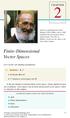 CHAPTER 2 American mathematician Paul Halmos (1916 2006), who in 1942 published the first modern linear algebra book. The title of Halmos s book was the same as the title of this chapter. Finite-Dimensional
Daring Greatly: How the Courage to Be Vulnerable Transforms the Way We Live, Love, Parent, and Lead. Click for updates
 This article was downloaded by: [184.100.72.114] On: 19 January 2015, At: 17:22 Publisher: Routledge Informa Ltd Registered in England and Wales Registered Number: 1072954 Registered office: Mortimer House,
Section 6.1 - Inner Products and Norms
 Section 6.1 - Inner Products and Norms Definition. Let V be a vector space over F {R, C}. An inner product on V is a function that assigns, to every ordered pair of vectors x and y in V, a scalar in F,
Group Theory. Contents
 Group Theory Contents Chapter 1: Review... 2 Chapter 2: Permutation Groups and Group Actions... 3 Orbits and Transitivity... 6 Specific Actions The Right regular and coset actions... 8 The Conjugation
T ( a i x i ) = a i T (x i ).
 Chapter 2 Defn 1. (p. 65) Let V and W be vector spaces (over F ). We call a function T : V W a linear transformation form V to W if, for all x, y V and c F, we have (a) T (x + y) = T (x) + T (y) and (b)
Finite dimensional C -algebras
 Finite dimensional C -algebras S. Sundar September 14, 2012 Throughout H, K stand for finite dimensional Hilbert spaces. 1 Spectral theorem for self-adjoint opertors Let A B(H) and let {ξ 1, ξ 2,, ξ n
(a) Write each of p and q as a polynomial in x with coefficients in Z[y, z]. deg(p) = 7 deg(q) = 9
![(a) Write each of p and q as a polynomial in x with coefficients in Z[y, z]. deg(p) = 7 deg(q) = 9](/thumbs/40/21231804.jpg "(a) Write each of p and q as a polynomial in x with coefficients in Z[y, z]. deg(p) = 7 deg(q) = 9") Homework #01, due 1/20/10 = 9.1.2, 9.1.4, 9.1.6, 9.1.8, 9.2.3 Additional problems for study: 9.1.1, 9.1.3, 9.1.5, 9.1.13, 9.2.1, 9.2.2, 9.2.4, 9.2.5, 9.2.6, 9.3.2, 9.3.3 9.1.1 (This problem was not assigned
Homework #01, due 1/20/10 = 9.1.2, 9.1.4, 9.1.6, 9.1.8, 9.2.3 Additional problems for study: 9.1.1, 9.1.3, 9.1.5, 9.1.13, 9.2.1, 9.2.2, 9.2.4, 9.2.5, 9.2.6, 9.3.2, 9.3.3 9.1.1 (This problem was not assigned
RINGS WITH A POLYNOMIAL IDENTITY
 RINGS WITH A POLYNOMIAL IDENTITY IRVING KAPLANSKY 1. Introduction. In connection with his investigation of projective planes, M. Hall [2, Theorem 6.2]* proved the following theorem: a division ring D in
Factoring of Prime Ideals in Extensions
 Chapter 4 Factoring of Prime Ideals in Extensions 4. Lifting of Prime Ideals Recall the basic AKLB setup: A is a Dedekind domain with fraction field K, L is a finite, separable extension of K of degree
The Prevalence and Prevention of Crosstalk: A Multi-Institutional Study
 This article was downloaded by: [65.186.78.206] On: 10 April 2014, At: 17:16 Publisher: Routledge Informa Ltd Registered in England and Wales Registered Number: 1072954 Registered office: Mortimer House,
Orthogonal Diagonalization of Symmetric Matrices
 MATH10212 Linear Algebra Brief lecture notes 57 Gram Schmidt Process enables us to find an orthogonal basis of a subspace. Let u 1,..., u k be a basis of a subspace V of R n. We begin the process of finding
FOUNDATIONS OF ALGEBRAIC GEOMETRY CLASS 22
 FOUNDATIONS OF ALGEBRAIC GEOMETRY CLASS 22 RAVI VAKIL CONTENTS 1. Discrete valuation rings: Dimension 1 Noetherian regular local rings 1 Last day, we discussed the Zariski tangent space, and saw that it
it is easy to see that α = a
 21. Polynomial rings Let us now turn out attention to determining the prime elements of a polynomial ring, where the coefficient ring is a field. We already know that such a polynomial ring is a UF. Therefore
Quotient Rings and Field Extensions
 Chapter 5 Quotient Rings and Field Extensions In this chapter we describe a method for producing field extension of a given field. If F is a field, then a field extension is a field K that contains F.
FINITE DIMENSIONAL ORDERED VECTOR SPACES WITH RIESZ INTERPOLATION AND EFFROS-SHEN S UNIMODULARITY CONJECTURE AARON TIKUISIS
 FINITE DIMENSIONAL ORDERED VECTOR SPACES WITH RIESZ INTERPOLATION AND EFFROS-SHEN S UNIMODULARITY CONJECTURE AARON TIKUISIS Abstract. It is shown that, for any field F R, any ordered vector space structure
1 Homework 1. [p 0 q i+j +... + p i 1 q j+1 ] + [p i q j ] + [p i+1 q j 1 +... + p i+j q 0 ]
![1 Homework 1. [p 0 q i+j +... + p i 1 q j+1 ] + [p i q j ] + [p i+1 q j 1 +... + p i+j q 0 ]](/thumbs/40/21231772.jpg "1 Homework 1. [p 0 q i+j +... + p i 1 q j+1 ] + [p i q j ] + [p i+1 q j 1 +... + p i+j q 0 ]") 1 Homework 1 (1) Prove the ideal (3,x) is a maximal ideal in Z[x]. SOLUTION: Suppose we expand this ideal by including another generator polynomial, P / (3, x). Write P = n + x Q with n an integer not
1 Homework 1 (1) Prove the ideal (3,x) is a maximal ideal in Z[x]. SOLUTION: Suppose we expand this ideal by including another generator polynomial, P / (3, x). Write P = n + x Q with n an integer not
5. Linear algebra I: dimension
 5. Linear algebra I: dimension 5.1 Some simple results 5.2 Bases and dimension 5.3 Homomorphisms and dimension 1. Some simple results Several observations should be made. Once stated explicitly, the proofs
ALGEBRA HW 5 CLAY SHONKWILER
 ALGEBRA HW 5 CLAY SHONKWILER 510.5 Let F = Q(i). Prove that x 3 and x 3 3 are irreducible over F. Proof. If x 3 is reducible over F then, since it is a polynomial of degree 3, it must reduce into a product
Linear Algebra. A vector space (over R) is an ordered quadruple. such that V is a set; 0 V ; and the following eight axioms hold:
 Linear Algebra A vector space (over R) is an ordered quadruple (V, 0, α, µ) such that V is a set; 0 V ; and the following eight axioms hold: α : V V V and µ : R V V ; (i) α(α(u, v), w) = α(u, α(v, w)),
NOTES ON LINEAR TRANSFORMATIONS
 NOTES ON LINEAR TRANSFORMATIONS Definition 1. Let V and W be vector spaces. A function T : V W is a linear transformation from V to W if the following two properties hold. i T v + v = T v + T v for all
On the representability of the bi-uniform matroid
 On the representability of the bi-uniform matroid Simeon Ball, Carles Padró, Zsuzsa Weiner and Chaoping Xing August 3, 2012 Abstract Every bi-uniform matroid is representable over all sufficiently large
Chapter 13: Basic ring theory
 Chapter 3: Basic ring theory Matthew Macauley Department of Mathematical Sciences Clemson University http://www.math.clemson.edu/~macaule/ Math 42, Spring 24 M. Macauley (Clemson) Chapter 3: Basic ring
3. Prime and maximal ideals. 3.1. Definitions and Examples.
 COMMUTATIVE ALGEBRA 5 3.1. Definitions and Examples. 3. Prime and maximal ideals Definition. An ideal P in a ring A is called prime if P A and if for every pair x, y of elements in A\P we have xy P. Equivalently,
ZORN S LEMMA AND SOME APPLICATIONS
 ZORN S LEMMA AND SOME APPLICATIONS KEITH CONRAD 1. Introduction Zorn s lemma is a result in set theory that appears in proofs of some non-constructive existence theorems throughout mathematics. We will
Matrix Representations of Linear Transformations and Changes of Coordinates
 Matrix Representations of Linear Transformations and Changes of Coordinates 01 Subspaces and Bases 011 Definitions A subspace V of R n is a subset of R n that contains the zero element and is closed under
1. Prove that the empty set is a subset of every set.
 1. Prove that the empty set is a subset of every set. Basic Topology Written by Men-Gen Tsai email: [email protected] Proof: For any element x of the empty set, x is also an element of every set since
GROUP ALGEBRAS. ANDREI YAFAEV
 GROUP ALGEBRAS. ANDREI YAFAEV We will associate a certain algebra to a finite group and prove that it is semisimple. Then we will apply Wedderburn s theory to its study. Definition 0.1. Let G be a finite
How To Prove The Dirichlet Unit Theorem
 Chapter 6 The Dirichlet Unit Theorem As usual, we will be working in the ring B of algebraic integers of a number field L. Two factorizations of an element of B are regarded as essentially the same if
ADDITIVE GROUPS OF RINGS WITH IDENTITY
 ADDITIVE GROUPS OF RINGS WITH IDENTITY SIMION BREAZ AND GRIGORE CĂLUGĂREANU Abstract. A ring with identity exists on a torsion Abelian group exactly when the group is bounded. The additive groups of torsion-free
F. ABTAHI and M. ZARRIN. (Communicated by J. Goldstein)
 Journal of Algerian Mathematical Society Vol. 1, pp. 1 6 1 CONCERNING THE l p -CONJECTURE FOR DISCRETE SEMIGROUPS F. ABTAHI and M. ZARRIN (Communicated by J. Goldstein) Abstract. For 2 < p
FACTORING CERTAIN INFINITE ABELIAN GROUPS BY DISTORTED CYCLIC SUBSETS
 International Electronic Journal of Algebra Volume 6 (2009) 95-106 FACTORING CERTAIN INFINITE ABELIAN GROUPS BY DISTORTED CYCLIC SUBSETS Sándor Szabó Received: 11 November 2008; Revised: 13 March 2009
Commutative Algebra Notes Introduction to Commutative Algebra Atiyah & Macdonald
 Commutative Algebra Notes Introduction to Commutative Algebra Atiyah & Macdonald Adam Boocher 1 Rings and Ideals 1.1 Rings and Ring Homomorphisms A commutative ring A with identity is a set with two binary
Linear Maps. Isaiah Lankham, Bruno Nachtergaele, Anne Schilling (February 5, 2007)
 MAT067 University of California, Davis Winter 2007 Linear Maps Isaiah Lankham, Bruno Nachtergaele, Anne Schilling (February 5, 2007) As we have discussed in the lecture on What is Linear Algebra? one of
BABY VERMA MODULES FOR RATIONAL CHEREDNIK ALGEBRAS
 BABY VERMA MODULES FOR RATIONAL CHEREDNIK ALGEBRAS SETH SHELLEY-ABRAHAMSON Abstract. These are notes for a talk in the MIT-Northeastern Spring 2015 Geometric Representation Theory Seminar. The main source
Matrix generators for exceptional groups of Lie type
 J. Symbolic Computation (2000) 11, 1 000 Matrix generators for exceptional groups of Lie type R. B. HOWLETT, L. J. RYLANDS AND D. E. TAYLOR School of Mathematics and Statistics, University of Sydney, Australia
Gröbner Bases and their Applications
 Gröbner Bases and their Applications Kaitlyn Moran July 30, 2008 1 Introduction We know from the Hilbert Basis Theorem that any ideal in a polynomial ring over a field is finitely generated [3]. However,
Max-Min Representation of Piecewise Linear Functions
 Beiträge zur Algebra und Geometrie Contributions to Algebra and Geometry Volume 43 (2002), No. 1, 297-302. Max-Min Representation of Piecewise Linear Functions Sergei Ovchinnikov Mathematics Department,
Beijing, China b CMOE Key Laboratory of Petroleum Engineering in China University
 This article was downloaded by: [Zhejiang University On: 21 September 2014, At: 03:04 Publisher: Taylor & Francis Informa Ltd Registered in England and Wales Registered Number: 1072954 Registered office:
Mathematics Course 111: Algebra I Part IV: Vector Spaces
 Mathematics Course 111: Algebra I Part IV: Vector Spaces D. R. Wilkins Academic Year 1996-7 9 Vector Spaces A vector space over some field K is an algebraic structure consisting of a set V on which are
Solutions to Math 51 First Exam January 29, 2015
 Solutions to Math 5 First Exam January 29, 25. ( points) (a) Complete the following sentence: A set of vectors {v,..., v k } is defined to be linearly dependent if (2 points) there exist c,... c k R, not
Similarity and Diagonalization. Similar Matrices
 MATH022 Linear Algebra Brief lecture notes 48 Similarity and Diagonalization Similar Matrices Let A and B be n n matrices. We say that A is similar to B if there is an invertible n n matrix P such that
COMBINATORIAL PROPERTIES OF THE HIGMAN-SIMS GRAPH. 1. Introduction
 COMBINATORIAL PROPERTIES OF THE HIGMAN-SIMS GRAPH ZACHARY ABEL 1. Introduction In this survey we discuss properties of the Higman-Sims graph, which has 100 vertices, 1100 edges, and is 22 regular. In fact
MATH 304 Linear Algebra Lecture 20: Inner product spaces. Orthogonal sets.
 MATH 304 Linear Algebra Lecture 20: Inner product spaces. Orthogonal sets. Norm The notion of norm generalizes the notion of length of a vector in R n. Definition. Let V be a vector space. A function α
THE AVERAGE DEGREE OF AN IRREDUCIBLE CHARACTER OF A FINITE GROUP
 THE AVERAGE DEGREE OF AN IRREDUCIBLE CHARACTER OF A FINITE GROUP by I. M. Isaacs Mathematics Department University of Wisconsin 480 Lincoln Dr. Madison, WI 53706 USA E-Mail: [email protected] Maria
Groups of Prime Power Order
 de Gruyter Expositions in Mathematics 56 Groups of Prime Power Order Volume 3 Bearbeitet von Yakov Berkovich, Zvonimir Janko 1. Auflage 2011. Buch. XXV, 639 S. Hardcover ISBN 978 3 11 020717 0 Format (B
Galois Theory III. 3.1. Splitting fields.
 Galois Theory III. 3.1. Splitting fields. We know how to construct a field extension L of a given field K where a given irreducible polynomial P (X) K[X] has a root. We need a field extension of K where
NASPE Sets the Standard
 This article was downloaded by: [Bowling Green SU] On: 25 March 2015, At: 09:45 Publisher: Routledge Informa Ltd Registered in England and Wales Registered Number: 1072954 Registered office: Mortimer House,
Irreducibility criteria for compositions and multiplicative convolutions of polynomials with integer coefficients
 DOI: 10.2478/auom-2014-0007 An. Şt. Univ. Ovidius Constanţa Vol. 221),2014, 73 84 Irreducibility criteria for compositions and multiplicative convolutions of polynomials with integer coefficients Anca
4. CLASSES OF RINGS 4.1. Classes of Rings class operator A-closed Example 1: product Example 2:
 4. CLASSES OF RINGS 4.1. Classes of Rings Normally we associate, with any property, a set of objects that satisfy that property. But problems can arise when we allow sets to be elements of larger sets
Notes on Determinant
 ENGG2012B Advanced Engineering Mathematics Notes on Determinant Lecturer: Kenneth Shum Lecture 9-18/02/2013 The determinant of a system of linear equations determines whether the solution is unique, without
Associativity condition for some alternative algebras of degree three
 Associativity condition for some alternative algebras of degree three Mirela Stefanescu and Cristina Flaut Abstract In this paper we find an associativity condition for a class of alternative algebras
MATH 304 Linear Algebra Lecture 18: Rank and nullity of a matrix.
 MATH 304 Linear Algebra Lecture 18: Rank and nullity of a matrix. Nullspace Let A = (a ij ) be an m n matrix. Definition. The nullspace of the matrix A, denoted N(A), is the set of all n-dimensional column
26 Ideals and Quotient Rings
 Arkansas Tech University MATH 4033: Elementary Modern Algebra Dr. Marcel B. Finan 26 Ideals and Quotient Rings In this section we develop some theory of rings that parallels the theory of groups discussed
PLEASE SCROLL DOWN FOR ARTICLE. Full terms and conditions of use: http://www.informaworld.com/terms-and-conditions-of-access.pdf
 This article was downloaded by: On: 6 January 2010 Access details: Access Details: Free Access Publisher Taylor & Francis Informa Ltd Registered in England and Wales Registered Number: 1072954 Registered
CONSEQUENCES OF THE SYLOW THEOREMS
 CONSEQUENCES OF THE SYLOW THEOREMS KEITH CONRAD For a group theorist, Sylow s Theorem is such a basic tool, and so fundamental, that it is used almost without thinking, like breathing. Geoff Robinson 1.
An inequality for the group chromatic number of a graph
 Discrete Mathematics 307 (2007) 3076 3080 www.elsevier.com/locate/disc Note An inequality for the group chromatic number of a graph Hong-Jian Lai a, Xiangwen Li b,,1, Gexin Yu c a Department of Mathematics,
Ideal Class Group and Units
 Chapter 4 Ideal Class Group and Units We are now interested in understanding two aspects of ring of integers of number fields: how principal they are (that is, what is the proportion of principal ideals
Using Learning from Work for Progression to Higher Education: a degree of experience
 This article was downloaded by: [148.251.235.206] On: 27 August 2015, At: 21:16 Publisher: Routledge Informa Ltd Registered in England and Wales Registered Number: 1072954 Registered office: 5 Howick Place,
Vector and Matrix Norms
 Chapter 1 Vector and Matrix Norms 11 Vector Spaces Let F be a field (such as the real numbers, R, or complex numbers, C) with elements called scalars A Vector Space, V, over the field F is a non-empty
Online publication date: 11 March 2010 PLEASE SCROLL DOWN FOR ARTICLE
 This article was downloaded by: [Modoi, George Ciprian] On: 12 March 2010 Access details: Access Details: [subscription number 919828804] Publisher Taylor & Francis Informa Ltd Registered in England and
4.5 Linear Dependence and Linear Independence
 4.5 Linear Dependence and Linear Independence 267 32. {v 1, v 2 }, where v 1, v 2 are collinear vectors in R 3. 33. Prove that if S and S are subsets of a vector space V such that S is a subset of S, then
MATH10212 Linear Algebra. Systems of Linear Equations. Definition. An n-dimensional vector is a row or a column of n numbers (or letters): a 1.
 MATH10212 Linear Algebra Textbook: D. Poole, Linear Algebra: A Modern Introduction. Thompson, 2006. ISBN 0-534-40596-7. Systems of Linear Equations Definition. An n-dimensional vector is a row or a column
SOLUTIONS TO ASSIGNMENT 1 MATH 576
 SOLUTIONS TO ASSIGNMENT 1 MATH 576 SOLUTIONS BY OLIVIER MARTIN 13 #5. Let T be the topology generated by A on X. We want to show T = J B J where B is the set of all topologies J on X with A J. This amounts
Finite dimensional topological vector spaces
 Chapter 3 Finite dimensional topological vector spaces 3.1 Finite dimensional Hausdorff t.v.s. Let X be a vector space over the field K of real or complex numbers. We know from linear algebra that the
α = u v. In other words, Orthogonal Projection
 Orthogonal Projection Given any nonzero vector v, it is possible to decompose an arbitrary vector u into a component that points in the direction of v and one that points in a direction orthogonal to v
GENERATING SETS KEITH CONRAD
 GENERATING SETS KEITH CONRAD 1 Introduction In R n, every vector can be written as a unique linear combination of the standard basis e 1,, e n A notion weaker than a basis is a spanning set: a set of vectors
POLYNOMIAL RINGS AND UNIQUE FACTORIZATION DOMAINS
 POLYNOMIAL RINGS AND UNIQUE FACTORIZATION DOMAINS RUSS WOODROOFE 1. Unique Factorization Domains Throughout the following, we think of R as sitting inside R[x] as the constant polynomials (of degree 0).
Duality of linear conic problems
 Duality of linear conic problems Alexander Shapiro and Arkadi Nemirovski Abstract It is well known that the optimal values of a linear programming problem and its dual are equal to each other if at least
The Markov-Zariski topology of an infinite group
 Mimar Sinan Güzel Sanatlar Üniversitesi Istanbul January 23, 2014 joint work with Daniele Toller and Dmitri Shakhmatov 1. Markov s problem 1 and 2 2. The three topologies on an infinite group 3. Problem
California Published online: 09 Jun 2014.
 This article was downloaded by: [Mr Neil Ribner] On: 10 June 2014, At: 20:58 Publisher: Routledge Informa Ltd Registered in England and Wales Registered Number: 1072954 Registered office: Mortimer House,
Business Security Architecture: Weaving Information Security into Your Organization's Enterprise Architecture through SABSA
 This article was downloaded by: [188.204.15.66] On: 20 February 2012, At: 01:40 Publisher: Taylor & Francis Informa Ltd Registered in England and Wales Registered Number: 1072954 Registered office: Mortimer
Solutions to TOPICS IN ALGEBRA I.N. HERSTEIN. Part II: Group Theory
 Solutions to TOPICS IN ALGEBRA I.N. HERSTEIN Part II: Group Theory No rights reserved. Any part of this work can be reproduced or transmitted in any form or by any means. Version: 1.1 Release: Jan 2013
by the matrix A results in a vector which is a reflection of the given
 Eigenvalues & Eigenvectors Example Suppose Then So, geometrically, multiplying a vector in by the matrix A results in a vector which is a reflection of the given vector about the y-axis We observe that
Row Ideals and Fibers of Morphisms
 Michigan Math. J. 57 (2008) Row Ideals and Fibers of Morphisms David Eisenbud & Bernd Ulrich Affectionately dedicated to Mel Hochster, who has been an inspiration to us for many years, on the occasion
k, then n = p2α 1 1 pα k
 Powers of Integers An integer n is a perfect square if n = m for some integer m. Taking into account the prime factorization, if m = p α 1 1 pα k k, then n = pα 1 1 p α k k. That is, n is a perfect square
RINGS OF ZERO-DIVISORS
 RINGS OF ZERO-DIVISORS P. M. COHN 1. Introduction. A well known theorem of algebra states that any integral domain can be embedded in a field. More generally [2, p. 39 ff. ], any commutative ring R with
COMMUTATIVITY DEGREE, ITS GENERALIZATIONS, AND CLASSIFICATION OF FINITE GROUPS
 COMMUTATIVITY DEGREE, ITS GENERALIZATIONS, AND CLASSIFICATION OF FINITE GROUPS ABSTRACT RAJAT KANTI NATH DEPARTMENT OF MATHEMATICS NORTH-EASTERN HILL UNIVERSITY SHILLONG 793022, INDIA COMMUTATIVITY DEGREE,
Continued Fractions and the Euclidean Algorithm
 Continued Fractions and the Euclidean Algorithm Lecture notes prepared for MATH 326, Spring 997 Department of Mathematics and Statistics University at Albany William F Hammond Table of Contents Introduction
ON GALOIS REALIZATIONS OF THE 2-COVERABLE SYMMETRIC AND ALTERNATING GROUPS
 ON GALOIS REALIZATIONS OF THE 2-COVERABLE SYMMETRIC AND ALTERNATING GROUPS DANIEL RABAYEV AND JACK SONN Abstract. Let f(x) be a monic polynomial in Z[x] with no rational roots but with roots in Q p for
MCS 563 Spring 2014 Analytic Symbolic Computation Wednesday 9 April. Hilbert Polynomials
 Hilbert Polynomials For a monomial ideal, we derive the dimension counting the monomials in the complement, arriving at the notion of the Hilbert polynomial. The first half of the note is derived from
G = G 0 > G 1 > > G k = {e}
 Proposition 49. 1. A group G is nilpotent if and only if G appears as an element of its upper central series. 2. If G is nilpotent, then the upper central series and the lower central series have the same
Math 4310 Handout - Quotient Vector Spaces
 Math 4310 Handout - Quotient Vector Spaces Dan Collins The textbook defines a subspace of a vector space in Chapter 4, but it avoids ever discussing the notion of a quotient space. This is understandable
FUNCTIONAL ANALYSIS LECTURE NOTES: QUOTIENT SPACES
 FUNCTIONAL ANALYSIS LECTURE NOTES: QUOTIENT SPACES CHRISTOPHER HEIL 1. Cosets and the Quotient Space Any vector space is an abelian group under the operation of vector addition. So, if you are have studied
Suk-Geun Hwang and Jin-Woo Park
 Bull. Korean Math. Soc. 43 (2006), No. 3, pp. 471 478 A NOTE ON PARTIAL SIGN-SOLVABILITY Suk-Geun Hwang and Jin-Woo Park Abstract. In this paper we prove that if Ax = b is a partial signsolvable linear
160 CHAPTER 4. VECTOR SPACES
 160 CHAPTER 4. VECTOR SPACES 4. Rank and Nullity In this section, we look at relationships between the row space, column space, null space of a matrix and its transpose. We will derive fundamental results
COMMUTATIVE RINGS. Definition: A domain is a commutative ring R that satisfies the cancellation law for multiplication:
 COMMUTATIVE RINGS Definition: A commutative ring R is a set with two operations, addition and multiplication, such that: (i) R is an abelian group under addition; (ii) ab = ba for all a, b R (commutative
Algebra of the 2x2x2 Rubik s Cube
 Algebra of the 2x2x2 Rubik s Cube Under the direction of Dr. John S. Caughman William Brad Benjamin. Introduction As children, many of us spent countless hours playing with Rubiks Cube. At the time it