
Associativity condition for some alternative algebras of degree three
|
|
|
- Hillary Booker
- 10 years ago
- Views:
Transcription
1 Associativity condition for some alternative algebras of degree three Mirela Stefanescu and Cristina Flaut Abstract In this paper we find an associativity condition for a class of alternative algebras of degree three. This is given in the last two statements of the paper. AMS Subject Classification: 17A0. Key words: Alternative algebra, composition algebra, isotopic subspace, bilinear form. The algebras A over a field K satisfying the identities x 2 y = x xy) and yx 2 = yx)x, x, y A, are called alternative algebras. It is obvious that an alternative algebra is powerassociative: x 2 x = xx 2 = x, for all x A. An algebra A over a field K is called a composition algebra if we have a quadratic form n : A K satisfying the relation nxy) = n x) n y), for every x, y A, and the associated bilineare form f : A A K, f x, y) = 1 n x + y) n x) n y)) 2 is non-degenerate. An alternative algebra A is of degree three, if, for every x A, a polynomial relation of degree three is satisfied, namely: x T x) x 2 + S x) x N x) 1 = 0, where T is a linear mapping, called the generic trace, S is a bilinear form and N is a cubic form, called the norm form. The subset A 0 = {x A / T x) = 0} is a subspace of A called the isotopic subspace of the algebra A and A = K 1 A 0. Editor Gr.Tsagas Proceedings of The Conference of Applied Differential Geometry - General Relativity and The Workshop on Global Analysis, Differential Geometry and Lie Algebras, 2002, c 2004 Balkan Society of Geometers, Geometry Balkan Press

2 122 M. Stefanescu and C. Flaut We suppose the field K has the characteristic 2,. Let ω be the cubic root of unity, q be the solution of equation x 2 +=0 and µ be the root of the equation x 2 x + 1 = 0. We consider two cases: Case 1. ω K, therefore q, µ K. We recall now some necessary results. Proposition 1. [] Let A be an alternative algebra of degree three and A 0 be its isotopic subspace. The bilinear form S is nondegenerate on A if and only if S is nondegenerate on A 0. Proposition 2. [] Let A be a finite dimensional alternative algebra of degree three over the field K. On A 0 we define the multiplication : a b = ωab ω 2 ba 2ω + 1 T ab) 1. 1) Then S preserves the composition, that is S a b) = S a) S b). If A is a separable algebra over K i.e. A F = F K A is a direct sum of simple ideals, for every extension F of K) then the quadratic form S is nondegenerate and we find an operation such that A 0, ) is a Hurwitz algebra. If dim A =, then A 0, ) is an octonion algebra. Here, the operation is: a b = u a) b u), with Su) 0. 2) Proposition. [2] Let A be an alternative algebra of degree three over the field K with the generic minimum polynomial : P x λ) = λ T x) λ 2 + S x) λ N x) 1. On the isotopic subspace A 0, the operation is defined as in Proposition 2. Then we have: i) a b) a = a b a) = S a) b, for every a, b A 0. ) ii) S preserves composition and S x y, z) = S x, y z), for all x, y, z A 0. iii) A 0, ) does not have a unit element. iv) There exists an element a A 0, such that {a, a a} is a linearly independent system. A is finite dimensional and separable if and only if S is nondegenerate. The Proposition has a converse statement and we see this in the next proposition. These two propositions show us that always in an alternative algebra of degree three
![We recall now some necessary results. Proposition 1. [] Let A be an alternative algebra of degree three and A 0 be its isotopic subspace.](/docs-images/51/14041804/images/page_2.jpg "The bilinear form S is nondegenerate on A if and only if S is nondegenerate on A 0. Proposition 2. [] Let A be a finite dimensional alternative algebra of degree three over the field K.")
3 Associativity condition for some alternative algebras 12 we can find a flexible i.e. xyx) = xy) x, x, y A) and composition subalgebra and its symmetric associated bilinear form is associative. Proposition 4. [2] Let B, ) be a nonunitary algebra over the field K with quadratic form S satisfying the condition ) from above. If B has an element b 0 such that the system {b 0, b 0 b 0 } is linearly independent, then we find an alternative algebra A of degree three over K such that B, ) is isomorphic to the algebra A 0, ) defined in Proposition 2. If S x, y) is the symmetric bilinear form associated to the quadratic form S and A = K 1 B, for x A, x = α + a, α K, a B, then define the multiplication on A: 2S a, b) ab= 1+ 1 [ ω 2-1 ) a b- ω-1) b a], a, b B, 4) and 1x = x1 = x, x A. We show, by straightforward calculation, that A is an alternative algebra of degree three over K., we obtain If we take T x)=α, S x)=α 2 +S a), N x)=α +S a) α-ρ x T x) x 2 + S x) x N x) 1 = 0, x A 2Sa a, a) and B = A 0 = {x A/ T x) = 0}. Then A is the asked algebra of degree three. Proposition 5. [2] With the assumptions and the notations from Proposition 4, the algebras B 1, ), B 2, ) are isomorphic if and only if the corresponding alternative algebras of degree three are isomorphic. We need some more properties of the computation. Proposition 6. With the notations from Proposition 4., the algebra A = K 1 B is associative if and only if the following condition holds : where a, b, c) = a b) c a b c). a, c, b) + b, a, c) = a, b, c), a, b, c B, 5) Proof. Let a, b, c B, then we have: c ab)=c 2S a, b) ω 2-1 ) a b- ω-1) b a ) = = + ω2-1 2S a, b) c+ ω2-1 2S c, a b) - c a b)+ ω-1 1+ ω2-1 c b a)= c b a) - ω-1 2S a, b) c+ b a) c -

4 124 M. Stefanescu and C. Flaut - ω-1 2S c, b a) - ca) b= 2S c, a) - + ω c b a) - ω-1 b a) c. ω 2 1 ) c a ω 1) a c ) b= = + ω2-1 - ω-1 2S c, a) b+ ω2-1 2S c a, b) - 2S a c, b) - c a) b ω-1 1+ ω ω2-1 a c) b=- c a) b- ω-1 a c) b- ω-1 In the following, we use the relations: a b) c + c b) a = 2S a, c) b = 2S c, a) b 2S c, a) b+ b c a) - b a c). a c) b + b c) a = 2S a, b) c, ω 2 1 ) 2 = ω 2, ω 2 1 ) ω 1) =, ω 1) 2 = ω. Then: c ab) ca) b=- 2S a, b) c- 2 ω 2-1 ) S c, a b)+ ω 2-1 ) 2 c a b)- - ω 2-1 ) ω-1) + ω-1)2 a b) c+ 2 ω-1) b a) c+ 2S c, a) S c, b a)- b+ 2 ω 2-1 ) ω 2-1 ) ω-1) Sc a, b) c b a)+ ω 2-1 ) 2 c a) b+ ω 2-1 ) ω-1) b c a)- 2 ω-1) S a c, b) + + ω 2-1 ) ω-1) a c) b ω-1)2 = 1 a c) b- 1 b c) a- 2 ω 2-1 ) b a c)= S c, a b)-

5 Associativity condition for some alternative algebras ω2 c a b)- 1 a b) c+ 2 ω 1) S c, b a)- 1 - ω b a) c+ 1 a b) c+ 1 c b) a+ 2 ω 2-1 ) c b a)- S c a, b)+ + ω2 c a) b + 1 b c a) 2 ω 1) S a c, b) a c) b + ω b a c). Since S is associative over B, we have: S c, a b) = Sc a, b) şi S c, b a) = S b a, c) = S b, a c). We get : c ab) ca) b = 1 [b c) a b c a)] ω [b a) c b a c)] + 1 [c b) a c b a)] ω2 c a b) + ω2 c a) b = = 1 b, c, a) ω b, a, c) + 1 c, b, a) + + ω2 c, a, b) ω2 c a) b + ω2 c a) b = = 1 b, c, a) + 1 c, b, a) + 1 b, a, c). Here, we used for the flexible algebra, A that a, b, c) = c, b, a). Case 2. We consider the field K such that ω / K; therefore q / K. Let F = K ω) = = Kq) and A be an alternative algebra of degree three over the field K, equipped with an involution J of second kind. Then J is an automorphism J : A A, J xy) =J y) J x), J αx) =α J J x), J k) =k, k K, α F. Since K F is an extension of second degree, the associated Galois group has the degree two, and α α J is a K-morphism over F of second degree, which differs of
![We get : c ab) ca) b = 1 [b c) a b c a)] ω [b a) c b a c)] + 1 [c b) a c b a)] ω2 c a b) + ω2 c a) b = = 1 b, c, a) ω b, a, c) + 1 c, b, a) + + ω2 c, a, b) ω2 c a) b + ω2 c a) b = = 1 b, c, a) + 1 c,](/docs-images/51/14041804/images/page_5.jpg "b, a) + 1 b, a, c). Here, we used for the flexible algebra, A that a, b, c) = c, b, a). Case 2. We consider the field K such that ω / K; therefore q / K.")
6 126 M. Stefanescu and C. Flaut identity, since ω J = ω 2 and q J = q. Let Ā 0 = {x A/ T x) = 0 and J x) = x}. First we recall a result given by Elduque and Myung: Proposition 7. [2] Let a, b Ā0, such that a b = ωab ω 2 ba 2ω + 1 T ab) 1. Then Ā 0, ) is a K-algebra, S Ā0 is a nondegenerate quadratic form over K and S permits composition over Ā 0, ). Proposition 8. With the same assumptions and notations as above, the following equalities hold: i) A = Ā q Ā F K Ā. ii) A 0 = F K Ā 0. Remark. i) By Proposition 7 we have that S/ Ā and S/ Ā0 are quadratic forms over K. Since the F -algebra A 0, ) satisfies the conditions i)-iii) in Proposition, Ā0, ) satisfies the same conditions, Ā 0 being a K-subalgebra of A 0. Then we have: 1) a b) a = a b a) = S a) b, a, b Ā 0, ). 2) S permits composition and is associative over Ā 0, ). ) Ā 0, ) does not have the unity element. We prove a property of the alternative algebras in both cases 1 and 2. Propozition 10. Let A, ) be a nonunitary algebra over the field K, which has a bilinear nondegenerate form S satisfying the condition ). If the elements {x, x x} are linearly dependent for each x A, then x x = α x) x, and α : A K defined by this relations is a K-algebra morphism. Proof. If in the relation ) we take a = b = x, we get: x x) x = S x) x. It results α x) x) x = S x) x so α 2 x) x = S x) x, and we have α 2 x) = S x) 6) Let x, y A be arbitrary elements. Then: x + y) x + y) = α x + y) x + y), therefore x x + x y + y x + y y = α x + y) x + α x + y) y, hence α x) x + α y) y + x y + y x = α x + y) x + α x + y) y, and we obtain: Since α x+y) -α x)) x+ α x+y) -α y)) y=x y+y x, x, y A. 7)

7 Associativity condition for some alternative algebras 127 S x, y)= 1 2 S x+y) S x) S y))= 1 2 we have: α 2 x+y) α 2 x) α 2 y) ), α 2 x + y) = α 2 x) + α 2 y) + 2S x, y), x, y A. 8) Applying S., x) to the relation 7), we obtain: α x + y) α x)) S x, x) + α x + y) α y)) S x, y) = = S x y, x)+s y x, x). The conditions from the hypothesis involve that S.,.) is associative and permits composition, no matter whether ω is in K or not we use the Proposition and the Remark i)). So S x y, x) = S x, x y) = S x x, y) = α x) S x, y), and S y x, x) = S y, x x) = α x) S x, y). We have, for all x, y A: αx+y)-αx))α 2 x)+αx+y)-αy))sx, y)=2αx)sx, y). ) We note that α x + y) = z, α x) = a, α y) = b. Then 8) and ) become respectively: z 2 = a 2 + b 2 + 2S x, y), 10) z a) a 2 = b + 2a z) S x, y). 11) We suppose that α x) 0. If b + 2a z = 0, then α y) + 2α x) = α x + y), for all x, y A, x 0. If we take y = 0, we obtain 2α x) = α x), so α x) = 0, false. Then b + 2a z 0. By the relation 11), we have S x, y) = z a) a2 b + 2a z and replace it in the relation 10). We get z 2 = a 2 + b 2 z a) a2 + 2 b + 2a z, so b+2a-z) z2 = = a 2 +b 2) b+2a-z)+2a 2 z-a) and we have z + b + 2a) z 2 + b 2 a 2) z b a + b) 2 = 0. The polynomial P Z)=-Z +b+2a) Z 2 + b 2 -a 2) Z-b a+b) 2 has the decomposition in irreducible factors: P Z)=-Z-a-b) 2 Z+b). It results that z 1 =a + b and z 2 = b are the different roots of the polynomial P. If z = a+b, we have α x + y) = α x)+α y). If z= b, we obtain α x + y) = α y) and, for y = 0, it result α x) = 0, which is a contradiction. Therefore α x + y) = α x) + α y), x, y A,

8 128 M. Stefanescu and C. Flaut with α x) 0. If α x) = 0, by relation ), we have z b) S x, y) = 0, for all y A and x A with α x) = 0. If z = b, then α x + y) = α y) = α y) + α x). If S x, y) = 0, y A, we obtain x = 0 and α 0) = 0, therefore α x + y) = α x) + α y), x, y A. 12) By the relation 7), for y = ax, with a K, we have α a + 1) x) x α x) x + aα a + 1) x) x aα ax) x = 2aα x) x, hence α ax) x + α x) x α x) x + aα ax) x + aα x) x aα ax) x = 2aα x) x, and we get α ax) = aα x). 1) Since S.,.) permits composition, it results that S x y, x y) = = S x, x) S y, y), hence S x y) = S x, x) S y, y).therefore α x y) = α x) α y). 14) By relations 12), 1), 14) it results that α is a K-morphism. With the notations in the Proposition 10, we note that S is nondegenerate over Ā if and only if S is nondegenerate over A. Moreover, we have: Proposition 11. [2] Let A, A 0, Ā, Ā0 be the algebras defined above. Then there exists a Ā0 such that {a, a a} is linearly independent and A is finite-dimensional and separable if and only if S is nondegenerate. Proposition 12. [2] Let B, ) be an algebra over the field K, q / K. If B has a quadratic form S over K satisfying the relation ), for all a, b B, and there exists x 0 B such that {x 0, x 0 x 0 } is a linearly independent system, then there exists an alternative algebra A of degree three over F = K q) equipped with an involution J of second kind such that B, ) is isomorphic with the algebra Ā 0, ) defined above. Proposition 1. [2] The algebras B 1, ), B 2, ) in Proposition 12 are isomorphic if and only if the alternative algebras of degree three with the corresponding involution are isomorphic. Now we can state the main results of the paper. Proposition 14. The algebra A in Proposition 12 is associative if and only if a, c, b) + b, a, c) = a, b, c), a, b, c B. Proof. If the relation in the hypothesis is true for all a, b, c B, it results that the this proposition is true and for all x, y, z F K B. Then we use the Proposition 6 and A is an associative F -algebra. Indeed, let x, y, z F K B, x = α a, y = β b, z = γ c, α, β, γ F, a, b, c B. Then in F K B, we have x, y, z) =α a) β b)) γ c)-α a) β b) γ c))=

9 Associativity condition for some alternative algebras 12 = αβγ a b) c αβγ a b c) = αβγ a, b, c). Proposition 15. Let K be a field, ω / K and F =K ω). If A is a finite dimensional algebra of degree three equipped with an involution J of second kind, Ā 0 = {x A/ T x) = 0, J x) = x } then the multiplication: a b = ωab ω 2 ba 2ω + 1 T ab) 1, a, b Ā0can be defined. If A is separable, then the quadratic form S is nondegenerate and Ā 0, ) becomes a composition K-algebra. If dim A =, then we may define the multiplication on Ā0 such that Ā 0, ) is an octonionic K-algebra. If a, c, b) + b, a, c) = a, b, c), a, b, c Ā0, then A is associative. Proof. By Proposition 7, we have that Ā0 is a K-algebra and S/ Ā0 is a quadratic form over K permitting composition. By Proposition 11, we have that Ā 0, ) is flexible, and the associated bilinear form to S is associative. If S is nondegenerate, then Ā 0, ) is a non-unitary composition algebra and there exists u Ā0, such that S u) 0. Then we define: a b = u a) b u), with a, b Ā0 and we get that Ā 0, ) is a unitary composition algebra, with the unity e = u u, therefore it is a Hurwitz algebra. If dim A =, then, by Proposition 8, we have that dim A = dim Ā = dim A = dim Ā0 + 1, therefore dim Ā0 = 8 and Ā0 is an octonion algebra. References [1] Elduque, A., Myung, H.C., Flexible composition algebras and Okubo algebras, Comm. Algebra, 1, 4 11) [2] Elduque, A., Myung, H.C., On flexible composition algebras, Comm. Algebra, 21, 7 1) [] Faulkner, J.R., Finding octonion algebras in associative algebras, Proc. Amer. Math. Soc., 104, 4 188) [4] Kostrikin, A. I., Shafarevich, I.R. Eds), Algebra VI, Springer-Verlag, 15. [5] McCrimmon, K., Generically algebraic algebras, Trans. Amer. Math. Soc., ) [6] Okubo, S., Introduction to Octonion and other Non-Associative Algebras in Physics, Cambridge University Press, Cambridge, 15.

10 10 M. Stefanescu and C. Flaut [7] Okubo, S., Myung, H. C., Some new classes of division algebras, J. of Algebra, ) [8] Okubo, S., Osborne, J.M., Algebras with nondegenerate associative symmetric bilinear forms permitting composition, I, Comm. Algebra,, ) [] Okubo, S., Osborne, J.M., Algebras with nondegenerate associative symmetric bilinear forms permitting composition, II, Comm. Algebra,, ) [10] Schafer, R. D., An Introduction to Nonassociative Algebras, Academic Press, New-York, 166. Authors address: Mirela Stefanescu and Cristina Flaut Departament of Mathematics, Ovidius University, Bd. Mamaia 124, 8700-Constantza, Romania cristina
![[10] Schafer, R. D., An Introduction to Nonassociative Algebras, Academic Press, New-York, 166.](/docs-images/51/14041804/images/page_10.jpg "Authors address: Mirela Stefanescu and Cristina Flaut Departament of Mathematics, Ovidius University, Bd. Mamaia 124, 8700-Constantza, Romania E-mail: mirelast@univ-ovidius.")
SOME PROPERTIES OF SYMBOL ALGEBRAS OF DEGREE THREE
 SOME PROPERTIES OF SYMBOL ALGEBRAS OF DEGREE THREE CRISTINA FLAUT and DIANA SAVIN Communicated by the former editorial board In this paper, we study some properties of the matrix representations of the
Row Ideals and Fibers of Morphisms
 Michigan Math. J. 57 (2008) Row Ideals and Fibers of Morphisms David Eisenbud & Bernd Ulrich Affectionately dedicated to Mel Hochster, who has been an inspiration to us for many years, on the occasion
minimal polyonomial Example
 Minimal Polynomials Definition Let α be an element in GF(p e ). We call the monic polynomial of smallest degree which has coefficients in GF(p) and α as a root, the minimal polyonomial of α. Example: We
MATH 304 Linear Algebra Lecture 20: Inner product spaces. Orthogonal sets.
 MATH 304 Linear Algebra Lecture 20: Inner product spaces. Orthogonal sets. Norm The notion of norm generalizes the notion of length of a vector in R n. Definition. Let V be a vector space. A function α
A characterization of trace zero symmetric nonnegative 5x5 matrices
 A characterization of trace zero symmetric nonnegative 5x5 matrices Oren Spector June 1, 009 Abstract The problem of determining necessary and sufficient conditions for a set of real numbers to be the
The Notebook Series. The solution of cubic and quartic equations. R.S. Johnson. Professor of Applied Mathematics
 The Notebook Series The solution of cubic and quartic equations by R.S. Johnson Professor of Applied Mathematics School of Mathematics & Statistics University of Newcastle upon Tyne R.S.Johnson 006 CONTENTS
Lecture 18 - Clifford Algebras and Spin groups
 Lecture 18 - Clifford Algebras and Spin groups April 5, 2013 Reference: Lawson and Michelsohn, Spin Geometry. 1 Universal Property If V is a vector space over R or C, let q be any quadratic form, meaning
1 = (a 0 + b 0 α) 2 + + (a m 1 + b m 1 α) 2. for certain elements a 0,..., a m 1, b 0,..., b m 1 of F. Multiplying out, we obtain
 Notes on real-closed fields These notes develop the algebraic background needed to understand the model theory of real-closed fields. To understand these notes, a standard graduate course in algebra is
ON GALOIS REALIZATIONS OF THE 2-COVERABLE SYMMETRIC AND ALTERNATING GROUPS
 ON GALOIS REALIZATIONS OF THE 2-COVERABLE SYMMETRIC AND ALTERNATING GROUPS DANIEL RABAYEV AND JACK SONN Abstract. Let f(x) be a monic polynomial in Z[x] with no rational roots but with roots in Q p for
Generic Polynomials of Degree Three
 Generic Polynomials of Degree Three Benjamin C. Wallace April 2012 1 Introduction In the nineteenth century, the mathematician Évariste Galois discovered an elegant solution to the fundamental problem
FACTORING POLYNOMIALS IN THE RING OF FORMAL POWER SERIES OVER Z
 FACTORING POLYNOMIALS IN THE RING OF FORMAL POWER SERIES OVER Z DANIEL BIRMAJER, JUAN B GIL, AND MICHAEL WEINER Abstract We consider polynomials with integer coefficients and discuss their factorization
Factoring of Prime Ideals in Extensions
 Chapter 4 Factoring of Prime Ideals in Extensions 4. Lifting of Prime Ideals Recall the basic AKLB setup: A is a Dedekind domain with fraction field K, L is a finite, separable extension of K of degree
How To Prove The Dirichlet Unit Theorem
 Chapter 6 The Dirichlet Unit Theorem As usual, we will be working in the ring B of algebraic integers of a number field L. Two factorizations of an element of B are regarded as essentially the same if
Mathematics Course 111: Algebra I Part IV: Vector Spaces
 Mathematics Course 111: Algebra I Part IV: Vector Spaces D. R. Wilkins Academic Year 1996-7 9 Vector Spaces A vector space over some field K is an algebraic structure consisting of a set V on which are
17. Inner product spaces Definition 17.1. Let V be a real vector space. An inner product on V is a function
 17. Inner product spaces Definition 17.1. Let V be a real vector space. An inner product on V is a function, : V V R, which is symmetric, that is u, v = v, u. bilinear, that is linear (in both factors):
Inner Product Spaces
 Math 571 Inner Product Spaces 1. Preliminaries An inner product space is a vector space V along with a function, called an inner product which associates each pair of vectors u, v with a scalar u, v, and
WHEN DOES A CROSS PRODUCT ON R n EXIST?
 WHEN DOES A CROSS PRODUCT ON R n EXIST? PETER F. MCLOUGHLIN It is probably safe to say that just about everyone reading this article is familiar with the cross product and the dot product. However, what
SECRET sharing schemes were introduced by Blakley [5]
![SECRET sharing schemes were introduced by Blakley [5]](/thumbs/24/4404980.jpg "SECRET sharing schemes were introduced by Blakley [5]") 206 IEEE TRANSACTIONS ON INFORMATION THEORY, VOL. 52, NO. 1, JANUARY 2006 Secret Sharing Schemes From Three Classes of Linear Codes Jin Yuan Cunsheng Ding, Senior Member, IEEE Abstract Secret sharing has
206 IEEE TRANSACTIONS ON INFORMATION THEORY, VOL. 52, NO. 1, JANUARY 2006 Secret Sharing Schemes From Three Classes of Linear Codes Jin Yuan Cunsheng Ding, Senior Member, IEEE Abstract Secret sharing has
RINGS WITH A POLYNOMIAL IDENTITY
 RINGS WITH A POLYNOMIAL IDENTITY IRVING KAPLANSKY 1. Introduction. In connection with his investigation of projective planes, M. Hall [2, Theorem 6.2]* proved the following theorem: a division ring D in
NONASSOCIATIVE ALGEBRAS SATISFYING IDENTITIES OF DEGREE THREE(i)
 NONASSOCIATIVE ALGEBRAS SATISFYING IDENTITIES OF DEGREE THREE(i) BY FRANK ROSIER AND J. MARSHALL OSBORN A number of different authors have studied classes of nonassociative algebras or rings satisfying
MATH 304 Linear Algebra Lecture 9: Subspaces of vector spaces (continued). Span. Spanning set.
 MATH 304 Linear Algebra Lecture 9: Subspaces of vector spaces (continued). Span. Spanning set. Vector space A vector space is a set V equipped with two operations, addition V V (x,y) x + y V and scalar
Chapter 13: Basic ring theory
 Chapter 3: Basic ring theory Matthew Macauley Department of Mathematical Sciences Clemson University http://www.math.clemson.edu/~macaule/ Math 42, Spring 24 M. Macauley (Clemson) Chapter 3: Basic ring
Introduction to Algebraic Geometry. Bézout s Theorem and Inflection Points
 Introduction to Algebraic Geometry Bézout s Theorem and Inflection Points 1. The resultant. Let K be a field. Then the polynomial ring K[x] is a unique factorisation domain (UFD). Another example of a
ON GENERALIZED RELATIVE COMMUTATIVITY DEGREE OF A FINITE GROUP. A. K. Das and R. K. Nath
 International Electronic Journal of Algebra Volume 7 (2010) 140-151 ON GENERALIZED RELATIVE COMMUTATIVITY DEGREE OF A FINITE GROUP A. K. Das and R. K. Nath Received: 12 October 2009; Revised: 15 December
it is easy to see that α = a
 21. Polynomial rings Let us now turn out attention to determining the prime elements of a polynomial ring, where the coefficient ring is a field. We already know that such a polynomial ring is a UF. Therefore
Inner Product Spaces and Orthogonality
 Inner Product Spaces and Orthogonality week 3-4 Fall 2006 Dot product of R n The inner product or dot product of R n is a function, defined by u, v a b + a 2 b 2 + + a n b n for u a, a 2,, a n T, v b,
Linear Algebra Done Wrong. Sergei Treil. Department of Mathematics, Brown University
 Linear Algebra Done Wrong Sergei Treil Department of Mathematics, Brown University Copyright c Sergei Treil, 2004, 2009, 2011, 2014 Preface The title of the book sounds a bit mysterious. Why should anyone
FINITE DIMENSIONAL ORDERED VECTOR SPACES WITH RIESZ INTERPOLATION AND EFFROS-SHEN S UNIMODULARITY CONJECTURE AARON TIKUISIS
 FINITE DIMENSIONAL ORDERED VECTOR SPACES WITH RIESZ INTERPOLATION AND EFFROS-SHEN S UNIMODULARITY CONJECTURE AARON TIKUISIS Abstract. It is shown that, for any field F R, any ordered vector space structure
Cyclotomic Extensions
 Chapter 7 Cyclotomic Extensions A cyclotomic extension Q(ζ n ) of the rationals is formed by adjoining a primitive n th root of unity ζ n. In this chapter, we will find an integral basis and calculate
The cover SU(2) SO(3) and related topics
 The cover SU(2) SO(3) and related topics Iordan Ganev December 2011 Abstract The subgroup U of unit quaternions is isomorphic to SU(2) and is a double cover of SO(3). This allows a simple computation of
Continuity of the Perron Root
 Linear and Multilinear Algebra http://dx.doi.org/10.1080/03081087.2014.934233 ArXiv: 1407.7564 (http://arxiv.org/abs/1407.7564) Continuity of the Perron Root Carl D. Meyer Department of Mathematics, North
ON TORI TRIANGULATIONS ASSOCIATED WITH TWO-DIMENSIONAL CONTINUED FRACTIONS OF CUBIC IRRATIONALITIES.
 ON TORI TRIANGULATIONS ASSOCIATED WITH TWO-DIMENSIONAL CONTINUED FRACTIONS OF CUBIC IRRATIONALITIES. O. N. KARPENKOV Introduction. A series of properties for ordinary continued fractions possesses multidimensional
SOLUTIONS TO PROBLEM SET 3
 SOLUTIONS TO PROBLEM SET 3 MATTI ÅSTRAND The General Cubic Extension Denote L = k(α 1, α 2, α 3 ), F = k(a 1, a 2, a 3 ) and K = F (α 1 ). The polynomial f(x) = x 3 a 1 x 2 + a 2 x a 3 = (x α 1 )(x α 2
CURVES WHOSE SECANT DEGREE IS ONE IN POSITIVE CHARACTERISTIC. 1. Introduction
 Acta Math. Univ. Comenianae Vol. LXXXI, 1 (2012), pp. 71 77 71 CURVES WHOSE SECANT DEGREE IS ONE IN POSITIVE CHARACTERISTIC E. BALLICO Abstract. Here we study (in positive characteristic) integral curves
3 1. Note that all cubes solve it; therefore, there are no more
 Math 13 Problem set 5 Artin 11.4.7 Factor the following polynomials into irreducible factors in Q[x]: (a) x 3 3x (b) x 3 3x + (c) x 9 6x 6 + 9x 3 3 Solution: The first two polynomials are cubics, so if
LINEAR ALGEBRA W W L CHEN
 LINEAR ALGEBRA W W L CHEN c W W L Chen, 1997, 2008 This chapter is available free to all individuals, on understanding that it is not to be used for financial gain, and may be downloaded and/or photocopied,
Modern Optimization Methods for Big Data Problems MATH11146 The University of Edinburgh
 Modern Optimization Methods for Big Data Problems MATH11146 The University of Edinburgh Peter Richtárik Week 3 Randomized Coordinate Descent With Arbitrary Sampling January 27, 2016 1 / 30 The Problem
Factoring Cubic Polynomials
 Factoring Cubic Polynomials Robert G. Underwood 1. Introduction There are at least two ways in which using the famous Cardano formulas (1545) to factor cubic polynomials present more difficulties than
Math 4310 Handout - Quotient Vector Spaces
 Math 4310 Handout - Quotient Vector Spaces Dan Collins The textbook defines a subspace of a vector space in Chapter 4, but it avoids ever discussing the notion of a quotient space. This is understandable
Linear Maps. Isaiah Lankham, Bruno Nachtergaele, Anne Schilling (February 5, 2007)
 MAT067 University of California, Davis Winter 2007 Linear Maps Isaiah Lankham, Bruno Nachtergaele, Anne Schilling (February 5, 2007) As we have discussed in the lecture on What is Linear Algebra? one of
THREE DIMENSIONAL GEOMETRY
 Chapter 8 THREE DIMENSIONAL GEOMETRY 8.1 Introduction In this chapter we present a vector algebra approach to three dimensional geometry. The aim is to present standard properties of lines and planes,
SOLVING POLYNOMIAL EQUATIONS BY RADICALS
 SOLVING POLYNOMIAL EQUATIONS BY RADICALS Lee Si Ying 1 and Zhang De-Qi 2 1 Raffles Girls School (Secondary), 20 Anderson Road, Singapore 259978 2 Department of Mathematics, National University of Singapore,
On the representability of the bi-uniform matroid
 On the representability of the bi-uniform matroid Simeon Ball, Carles Padró, Zsuzsa Weiner and Chaoping Xing August 3, 2012 Abstract Every bi-uniform matroid is representable over all sufficiently large
7. Some irreducible polynomials
 7. Some irreducible polynomials 7.1 Irreducibles over a finite field 7.2 Worked examples Linear factors x α of a polynomial P (x) with coefficients in a field k correspond precisely to roots α k [1] of
Equations, Inequalities & Partial Fractions
 Contents Equations, Inequalities & Partial Fractions.1 Solving Linear Equations 2.2 Solving Quadratic Equations 1. Solving Polynomial Equations 1.4 Solving Simultaneous Linear Equations 42.5 Solving Inequalities
JUST THE MATHS UNIT NUMBER 1.8. ALGEBRA 8 (Polynomials) A.J.Hobson
 JUST THE MATHS UNIT NUMBER 1.8 ALGEBRA 8 (Polynomials) by A.J.Hobson 1.8.1 The factor theorem 1.8.2 Application to quadratic and cubic expressions 1.8.3 Cubic equations 1.8.4 Long division of polynomials
NOTES ON LINEAR TRANSFORMATIONS
 NOTES ON LINEAR TRANSFORMATIONS Definition 1. Let V and W be vector spaces. A function T : V W is a linear transformation from V to W if the following two properties hold. i T v + v = T v + T v for all
THE FUNDAMENTAL THEOREM OF ALGEBRA VIA PROPER MAPS
 THE FUNDAMENTAL THEOREM OF ALGEBRA VIA PROPER MAPS KEITH CONRAD 1. Introduction The Fundamental Theorem of Algebra says every nonconstant polynomial with complex coefficients can be factored into linear
Modern Algebra Lecture Notes: Rings and fields set 4 (Revision 2)
 Modern Algebra Lecture Notes: Rings and fields set 4 (Revision 2) Kevin Broughan University of Waikato, Hamilton, New Zealand May 13, 2010 Remainder and Factor Theorem 15 Definition of factor If f (x)
Linear Algebra. A vector space (over R) is an ordered quadruple. such that V is a set; 0 V ; and the following eight axioms hold:
 Linear Algebra A vector space (over R) is an ordered quadruple (V, 0, α, µ) such that V is a set; 0 V ; and the following eight axioms hold: α : V V V and µ : R V V ; (i) α(α(u, v), w) = α(u, α(v, w)),
Irreducibility criteria for compositions and multiplicative convolutions of polynomials with integer coefficients
 DOI: 10.2478/auom-2014-0007 An. Şt. Univ. Ovidius Constanţa Vol. 221),2014, 73 84 Irreducibility criteria for compositions and multiplicative convolutions of polynomials with integer coefficients Anca
ON UNIQUE FACTORIZATION DOMAINS
 ON UNIQUE FACTORIZATION DOMAINS JIM COYKENDALL AND WILLIAM W. SMITH Abstract. In this paper we attempt to generalize the notion of unique factorization domain in the spirit of half-factorial domain. It
Characterization Of Polynomials Using Reflection Coefficients
 Applied Mathematics E-Notes, 4(2004), 114-121 c ISSN 1607-2510 Available free at mirror sites of http://www.math.nthu.edu.tw/ amen/ Characterization Of Polynomials Using Reflection Coefficients José LuisDíaz-Barrero,JuanJosé
α = u v. In other words, Orthogonal Projection
 Orthogonal Projection Given any nonzero vector v, it is possible to decompose an arbitrary vector u into a component that points in the direction of v and one that points in a direction orthogonal to v
6.2 Permutations continued
 6.2 Permutations continued Theorem A permutation on a finite set A is either a cycle or can be expressed as a product (composition of disjoint cycles. Proof is by (strong induction on the number, r, of
Algebra 3: algorithms in algebra
 Algebra 3: algorithms in algebra Hans Sterk 2003-2004 ii Contents 1 Polynomials, Gröbner bases and Buchberger s algorithm 1 1.1 Introduction............................ 1 1.2 Polynomial rings and systems
Linear Algebra I. Ronald van Luijk, 2012
 Linear Algebra I Ronald van Luijk, 2012 With many parts from Linear Algebra I by Michael Stoll, 2007 Contents 1. Vector spaces 3 1.1. Examples 3 1.2. Fields 4 1.3. The field of complex numbers. 6 1.4.
calculating the result modulo 3, as follows: p(0) = 0 3 + 0 + 1 = 1 0,
 Homework #02, due 1/27/10 = 9.4.1, 9.4.2, 9.4.5, 9.4.6, 9.4.7. Additional problems recommended for study: (9.4.3), 9.4.4, 9.4.9, 9.4.11, 9.4.13, (9.4.14), 9.4.17 9.4.1 Determine whether the following polynomials
FOUNDATIONS OF ALGEBRAIC GEOMETRY CLASS 22
 FOUNDATIONS OF ALGEBRAIC GEOMETRY CLASS 22 RAVI VAKIL CONTENTS 1. Discrete valuation rings: Dimension 1 Noetherian regular local rings 1 Last day, we discussed the Zariski tangent space, and saw that it
The Australian Journal of Mathematical Analysis and Applications
 The Australian Journal of Mathematical Analysis and Applications Volume 7, Issue, Article 11, pp. 1-14, 011 SOME HOMOGENEOUS CYCLIC INEQUALITIES OF THREE VARIABLES OF DEGREE THREE AND FOUR TETSUYA ANDO
Tim Kerins. Leaving Certificate Honours Maths - Algebra. Tim Kerins. the date
 Leaving Certificate Honours Maths - Algebra the date Chapter 1 Algebra This is an important portion of the course. As well as generally accounting for 2 3 questions in examination it is the basis for many
Indiana State Core Curriculum Standards updated 2009 Algebra I
 Indiana State Core Curriculum Standards updated 2009 Algebra I Strand Description Boardworks High School Algebra presentations Operations With Real Numbers Linear Equations and A1.1 Students simplify and
BILINEAR FORMS KEITH CONRAD
 BILINEAR FORMS KEITH CONRAD The geometry of R n is controlled algebraically by the dot product. We will abstract the dot product on R n to a bilinear form on a vector space and study algebraic and geometric
Definitions 1. A factor of integer is an integer that will divide the given integer evenly (with no remainder).
 Math 50, Chapter 8 (Page 1 of 20) 8.1 Common Factors Definitions 1. A factor of integer is an integer that will divide the given integer evenly (with no remainder). Find all the factors of a. 44 b. 32
Fiber sums of genus 2 Lefschetz fibrations
 Proceedings of 9 th Gökova Geometry-Topology Conference, pp, 1 10 Fiber sums of genus 2 Lefschetz fibrations Denis Auroux Abstract. Using the recent results of Siebert and Tian about the holomorphicity
Høgskolen i Narvik Sivilingeniørutdanningen STE6237 ELEMENTMETODER. Oppgaver
 Høgskolen i Narvik Sivilingeniørutdanningen STE637 ELEMENTMETODER Oppgaver Klasse: 4.ID, 4.IT Ekstern Professor: Gregory A. Chechkin e-mail: [email protected] Narvik 6 PART I Task. Consider two-point
MATH PROBLEMS, WITH SOLUTIONS
 MATH PROBLEMS, WITH SOLUTIONS OVIDIU MUNTEANU These are free online notes that I wrote to assist students that wish to test their math skills with some problems that go beyond the usual curriculum. These
Section 6.1 - Inner Products and Norms
 Section 6.1 - Inner Products and Norms Definition. Let V be a vector space over F {R, C}. An inner product on V is a function that assigns, to every ordered pair of vectors x and y in V, a scalar in F,
Similarity and Diagonalization. Similar Matrices
 MATH022 Linear Algebra Brief lecture notes 48 Similarity and Diagonalization Similar Matrices Let A and B be n n matrices. We say that A is similar to B if there is an invertible n n matrix P such that
Quotient Rings and Field Extensions
 Chapter 5 Quotient Rings and Field Extensions In this chapter we describe a method for producing field extension of a given field. If F is a field, then a field extension is a field K that contains F.
LEARNING OBJECTIVES FOR THIS CHAPTER
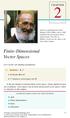 CHAPTER 2 American mathematician Paul Halmos (1916 2006), who in 1942 published the first modern linear algebra book. The title of Halmos s book was the same as the title of this chapter. Finite-Dimensional
1.5. Factorisation. Introduction. Prerequisites. Learning Outcomes. Learning Style
 Factorisation 1.5 Introduction In Block 4 we showed the way in which brackets were removed from algebraic expressions. Factorisation, which can be considered as the reverse of this process, is dealt with
s-convexity, model sets and their relation
 s-convexity, model sets and their relation Zuzana Masáková Jiří Patera Edita Pelantová CRM-2639 November 1999 Department of Mathematics, Faculty of Nuclear Science and Physical Engineering, Czech Technical
ON COMPLETELY CONTINUOUS INTEGRATION OPERATORS OF A VECTOR MEASURE. 1. Introduction
 ON COMPLETELY CONTINUOUS INTEGRATION OPERATORS OF A VECTOR MEASURE J.M. CALABUIG, J. RODRÍGUEZ, AND E.A. SÁNCHEZ-PÉREZ Abstract. Let m be a vector measure taking values in a Banach space X. We prove that
GROUP ALGEBRAS. ANDREI YAFAEV
 GROUP ALGEBRAS. ANDREI YAFAEV We will associate a certain algebra to a finite group and prove that it is semisimple. Then we will apply Wedderburn s theory to its study. Definition 0.1. Let G be a finite
Limits and Continuity
 Math 20C Multivariable Calculus Lecture Limits and Continuity Slide Review of Limit. Side limits and squeeze theorem. Continuous functions of 2,3 variables. Review: Limits Slide 2 Definition Given a function
Linear Algebra Done Wrong. Sergei Treil. Department of Mathematics, Brown University
 Linear Algebra Done Wrong Sergei Treil Department of Mathematics, Brown University Copyright c Sergei Treil, 2004, 2009, 2011, 2014 Preface The title of the book sounds a bit mysterious. Why should anyone
Eigenvalues, Eigenvectors, Matrix Factoring, and Principal Components
 Eigenvalues, Eigenvectors, Matrix Factoring, and Principal Components The eigenvalues and eigenvectors of a square matrix play a key role in some important operations in statistics. In particular, they
EMBEDDING DEGREE OF HYPERELLIPTIC CURVES WITH COMPLEX MULTIPLICATION
 EMBEDDING DEGREE OF HYPERELLIPTIC CURVES WITH COMPLEX MULTIPLICATION CHRISTIAN ROBENHAGEN RAVNSHØJ Abstract. Consider the Jacobian of a genus two curve defined over a finite field and with complex multiplication.
FACTORISATION YEARS. A guide for teachers - Years 9 10 June 2011. The Improving Mathematics Education in Schools (TIMES) Project
 9 10 YEARS The Improving Mathematics Education in Schools (TIMES) Project FACTORISATION NUMBER AND ALGEBRA Module 33 A guide for teachers - Years 9 10 June 2011 Factorisation (Number and Algebra : Module
ON THE NUMBER OF REAL HYPERSURFACES HYPERTANGENT TO A GIVEN REAL SPACE CURVE
 Illinois Journal of Mathematics Volume 46, Number 1, Spring 2002, Pages 145 153 S 0019-2082 ON THE NUMBER OF REAL HYPERSURFACES HYPERTANGENT TO A GIVEN REAL SPACE CURVE J. HUISMAN Abstract. Let C be a
(a) Write each of p and q as a polynomial in x with coefficients in Z[y, z]. deg(p) = 7 deg(q) = 9
![(a) Write each of p and q as a polynomial in x with coefficients in Z[y, z]. deg(p) = 7 deg(q) = 9](/thumbs/40/21231804.jpg "(a) Write each of p and q as a polynomial in x with coefficients in Z[y, z]. deg(p) = 7 deg(q) = 9") Homework #01, due 1/20/10 = 9.1.2, 9.1.4, 9.1.6, 9.1.8, 9.2.3 Additional problems for study: 9.1.1, 9.1.3, 9.1.5, 9.1.13, 9.2.1, 9.2.2, 9.2.4, 9.2.5, 9.2.6, 9.3.2, 9.3.3 9.1.1 (This problem was not assigned
Homework #01, due 1/20/10 = 9.1.2, 9.1.4, 9.1.6, 9.1.8, 9.2.3 Additional problems for study: 9.1.1, 9.1.3, 9.1.5, 9.1.13, 9.2.1, 9.2.2, 9.2.4, 9.2.5, 9.2.6, 9.3.2, 9.3.3 9.1.1 (This problem was not assigned
FACTORING IN QUADRATIC FIELDS. 1. Introduction. This is called a quadratic field and it has degree 2 over Q. Similarly, set
 FACTORING IN QUADRATIC FIELDS KEITH CONRAD For a squarefree integer d other than 1, let 1. Introduction K = Q[ d] = {x + y d : x, y Q}. This is called a quadratic field and it has degree 2 over Q. Similarly,
Finite dimensional C -algebras
 Finite dimensional C -algebras S. Sundar September 14, 2012 Throughout H, K stand for finite dimensional Hilbert spaces. 1 Spectral theorem for self-adjoint opertors Let A B(H) and let {ξ 1, ξ 2,, ξ n
6 EXTENDING ALGEBRA. 6.0 Introduction. 6.1 The cubic equation. Objectives
 6 EXTENDING ALGEBRA Chapter 6 Extending Algebra Objectives After studying this chapter you should understand techniques whereby equations of cubic degree and higher can be solved; be able to factorise
Polynomial Invariants
 Polynomial Invariants Dylan Wilson October 9, 2014 (1) Today we will be interested in the following Question 1.1. What are all the possible polynomials in two variables f(x, y) such that f(x, y) = f(y,
Nilpotent Lie and Leibniz Algebras
 This article was downloaded by: [North Carolina State University] On: 03 March 2014, At: 08:05 Publisher: Taylor & Francis Informa Ltd Registered in England and Wales Registered Number: 1072954 Registered
FIBER PRODUCTS AND ZARISKI SHEAVES
 FIBER PRODUCTS AND ZARISKI SHEAVES BRIAN OSSERMAN 1. Fiber products and Zariski sheaves We recall the definition of a fiber product: Definition 1.1. Let C be a category, and X, Y, Z objects of C. Fix also
Section 4.4 Inner Product Spaces
 Section 4.4 Inner Product Spaces In our discussion of vector spaces the specific nature of F as a field, other than the fact that it is a field, has played virtually no role. In this section we no longer
Math 312 Homework 1 Solutions
 Math 31 Homework 1 Solutions Last modified: July 15, 01 This homework is due on Thursday, July 1th, 01 at 1:10pm Please turn it in during class, or in my mailbox in the main math office (next to 4W1) Please
IRREDUCIBLE OPERATOR SEMIGROUPS SUCH THAT AB AND BA ARE PROPORTIONAL. 1. Introduction
 IRREDUCIBLE OPERATOR SEMIGROUPS SUCH THAT AB AND BA ARE PROPORTIONAL R. DRNOVŠEK, T. KOŠIR Dedicated to Prof. Heydar Radjavi on the occasion of his seventieth birthday. Abstract. Let S be an irreducible
Mathematics Review for MS Finance Students
 Mathematics Review for MS Finance Students Anthony M. Marino Department of Finance and Business Economics Marshall School of Business Lecture 1: Introductory Material Sets The Real Number System Functions,
GROUPS WITH TWO EXTREME CHARACTER DEGREES AND THEIR NORMAL SUBGROUPS
 GROUPS WITH TWO EXTREME CHARACTER DEGREES AND THEIR NORMAL SUBGROUPS GUSTAVO A. FERNÁNDEZ-ALCOBER AND ALEXANDER MORETÓ Abstract. We study the finite groups G for which the set cd(g) of irreducible complex
BEGINNING ALGEBRA ACKNOWLEDMENTS
 BEGINNING ALGEBRA The Nursing Department of Labouré College requested the Department of Academic Planning and Support Services to help with mathematics preparatory materials for its Bachelor of Science