
Conditional Probability
|
|
|
- Pierce Phelps
- 9 years ago
- Views:
Transcription
1 6.042/18.062J Mathematics for Computer Science Srini Devadas and Eric Lehman April 21, 2005 Lecture Notes Conditional Probability Suppose that we pick a random person in the world. Everyone has an equal chance of being selected. Let A be the event that the person is an MIT student, and let B be the event that the person lives in Cambridge. What are the probabilities of these events? Intuitively, we re picking a random point in the big ellipse shown below and asking how likely that point is to fall into region A or B: A B set of all people in the world set of MIT students set of people who live in Cambridge The vast majority of people in the world neither live in Cambridge nor are MIT students, so events A and B both have low probability. But what is the probability that a person is an MIT student, given that the person lives in Cambridge? This should be much greater but what it is exactly? What we re asking for is called a conditional probability; that is, the probability that one event happens, given that some other event definitely happens. Questions about conditional probabilities come up all the time: What is the probability that it will rain this afternoon, given that it is cloudy this morning? What is the probability that two rolled dice sum to 10, given that both are odd? What is the probability that I ll get four of a kind in Texas No Limit Hold Em Poker, given that I m initially dealt two queens? There is a special notation for conditional probabilities. In general, Pr (A B) denotes the probability of event A, given that event B happens. So, in our example, Pr (A B) is the probability that a random person is an MIT student, given that he or she is a Cambridge resident.

2 2 Conditional Probability How do we compute Pr (A B)? Since we are given that the person lives in Cambridge, we can forget about everyone in the world who does not. Thus, all outcomes outside event B are irrelevant. So, intuitively, Pr (A B) should be the fraction of Cambridge residents that are also MIT students; that is, the answer should be the probability that the person is in set A B (darkly shaded) divided by the probability that the person is in set B (lightly shaded). This motivates the definition of conditional probability: Pr (A B) = Pr (A B) Pr (B) If Pr (B) = 0, then the conditional probability Pr (A B) is undefined. Probability is generally counterintuitive, but conditional probability is the worst! Conditioning can subtly alter probabilities and produce unexpected results in randomized algorithms and computer systems as well as in betting games. Yet, the mathematical definition of conditional probability given above is very simple and should give you no trouble provided you rely on formal reasoning and not intuition. 1 The Halting Problem The Halting Problem is the canonical undecidable problem in computation theory that was first introduced by Alan Turing in his seminal 1936 paper. The problem is to determine whether a Turing machine halts on a given blah, blah, blah. Anyway, much more importantly, it is the name of the MIT EECS department s famed C league hockey team. In a best of three tournament, the Halting Problem wins the first game with probability 1. In subsequent games, their probability of winning is determined by the outcome of the 2 previous game. If the Halting Problem won the previous game, then they are envigorated by victory and win the current game with probability 2. If they lost the previous game, 3 then they are demoralized by defeat and win the current game with probablity only 1. 3 What is the probability that the Halting Problem wins the tournament, given that they win the first game? 1.1 Solution to the Halting Problem This is a question about a conditional probability. Let A be the event that the Halting Problem wins the tournament, and let B be the event that they win the first game. Our goal is then to determine the conditional probability Pr (A B). We can tackle conditional probability questions just like ordinary probability problems: using a tree diagram and the four step method. A complete tree diagram is shown below, followed by an explanation of its construction and use.

3 Conditional Probability 3 W 2/3 W 1/3 WW WLW 1/3 1/18 1/2 W L 1/3 L 2/3 WLL 1/9 L 1/2 1st game outcome W 1/3 W 2/3 L 2/3 L 1/3 2nd game outcome 3rd game outcome LWW LWL LL outcome event A: win the series? event B: win the 1st game? 1/9 1/18 1/3 outcome probability Step 1: Find the Sample Space Each internal vertex in the tree diagram has two children, one corresponding to a win for the Halting Problem (labeled W ) and one corresponding to a loss (labeled L). The complete sample space is: S = {W W, W LW, W LL, LW W, LW L, LL } Step 2: Define Events of Interest The event that the Halting Problem wins the whole tournament is: T = {W W, W LW, LW W} And the event that the Halting Problem wins the first game is: F = {W W, W LW, W LL} The outcomes in these events are indicated with checkmarks in the tree diagram. Step 3: Determine Outcome Probabilities Next, we must assign a probability to each outcome. We begin by labeling edges as specified in the problem statement. Specifically, The Halting Problem has a 1/2 chance of winning the first game, so the two edges leaving the root are each assigned probability 1/2. Other edges are labeled 1/3 or 2/3 based on the outcome of the preceding game. We then find the probability of each outcome by multiplying all probabilities along the corresponding root to leaf path. For example, the probability of outcome W LL is: =

4 4 Conditional Probability Step 4: Compute Event Probabilities We can now compute the probability that The Halting Problem wins the tournament, given that they win the first game: Pr (A B) Pr (A B) = Pr (B) Pr ({W W, W LW }) = Pr ({W W, W LW, W LL}) 1/3 + 1/18 = 1/3 + 1/18 + 1/9 7 = 9 We re done! If the Halting Problem wins the first game, then they win the whole tournament with probability 7/ Why Tree Diagrams Work We ve now settled into a routine of solving probability problems using tree diagrams. But we ve left a big question unaddressed: what is the mathematical justficiation behind those funny little pictures? Why do they work? The answer involves conditional probabilities. In fact, the probabilities that we ve been recording on the edges of tree diagrams are conditional probabilities. For example, consider the uppermost path in the tree diagram for the Halting Problem, which corresponds to the outcome W W. The first edge is labeled 1/2, which is the probability that the Halting Problem wins the first game. The second edge is labeled 2/3, which is the probability that the Halting Problem wins the second game, given that they won the first that s a conditional probability! More generally, on each edge of a tree diagram, we record the probability that the experiment proceeds along that path, given that it reaches the parent vertex. So we ve been using conditional probabilities all along. But why can we multiply edge probabilities to get outcome probabilities? For example, we concluded that: Why is this correct? 1 2 Pr (W W ) = = 3 The answer goes back to the definition of conditional probability. Rewriting this in a slightly different form gives the Product Rule for probabilities:

5 Conditional Probability 5 Rule (Product Rule for 2 Events). If Pr (A 2 ) = 0, then: Pr (A 1 A 2 ) = Pr (A 1 ) Pr (A 2 A 1 ) Multiplying edge probabilities in a tree diagram amounts to evaluating the right side of this equation. For example: Pr (win first game win second game) = Pr (win first game) Pr (win second game win first game) 1 2 = 2 3 So the Product Rule is the formal justification for multiplying edge probabilities to get outcome probabilities! To justify multiplying edge probabilities along longer paths, we need a more general form the Product Rule: Rule (Product Rule for n Events). If Pr (A 1... A n 1 ) = 0, then: Pr (A 1... A n ) = Pr (A 1 ) Pr (A 2 A 1 ) Pr (A 3 A 1 A 2 ) Pr (A n A 1... A n 1 ) Let s interpret this big formula in terms of tree diagrams. Suppose we want to compute the probability that an experiment traverses a particular root to leaf path of length n. Let A i be the event that the experiment traverses the i th edge of the path. Then A 1... A n is the event that the experiment traverse the whole path. The Product Rule says that the probability of this is the probability that the experiment takes the first edge times the probability that it takes the second, given it takes the first edge, times the probability it takes the third, given it takes the first two edges, and so forth. In other words, the probability of an outcome is the product of the edge probabilities along the corresponding root to leaf path. 2 A Posteriori Probabilities Suppose that we turn the hockey question around: what is the probability that the Halting Problem won their first game, given that they won the series? This seems like an absurd question! After all, if the Halting Problem won the series, then the winner of the first game has already been determined. Therefore, who won the first game is a question of fact, not a question of probability. However, our mathematical theory of probability contains no notion of one event preceding another there is no notion of time at all. Therefore, from a mathematical perspective, this is a perfectly valid question. And this is also a meaningful question from a practical perspective. Suppose that you re told that the Halting Problem won the series, but not told the results of individual games. Then, from your perspective, it makes perfect sense to wonder how likely it is that The Halting Problem won the first game.

6 6 Conditional Probability A conditional probability Pr (B A) is called an a posteriori if event B precedes event A in time. Here are some other examples of a posteriori probabilities: The probability it was cloudy this morning, given that it rained in the afternoon. The probability that I was initially dealt two queens in Texas No Limit Hold Em poker, given that I eventually got four of a kind. Mathematically, a posteriori probabilities are no different from ordinary probabilities; the distinction is only at a higher, philosophical level. Our only reason for drawing attention to them is to say, Don t let them rattle you. Let s return to the original problem. The probability that the Halting Problem won their first game, given that they won the series is Pr (B A). We can compute this using the definition of conditional probability and our earlier tree diagram: Pr (B A) Pr (B A) = Pr (A) 1/3 + 1/18 = 1/3 + 1/18 + 1/9 7 = 9 This answer is suspicious! In the preceding section, we showed that Pr (A B) was also 7/9. Could it be true that Pr (A B) = Pr (B A) in general? Some reflection suggests this is unlikely. For example, the probability that I feel uneasy, given that I was abducted by aliens, is pretty large. But the probability that I was abducted by aliens, given that I feel uneasy, is rather small. Let s work out the general conditions under which Pr (A B) = Pr (B A). By the definition of conditional probability, this equation holds if an only if: Pr (A B) Pr (A B) = Pr (B) Pr (A) This equation, in turn, holds only if the denominators are equal or the numerator is 0: Pr (B) = Pr (A) or Pr (A B) = 0 The former condition holds in the hockey example; the probability that the Halting Problem wins the series (event A) is equal to the probability that it wins the first game (event B). In fact, both probabilities are 1/ A Coin Problem Suppose you have two coins. One coin is fair; that is, comes up heads with probability 1/2 and tails with probability 1/2. The other is a trick coin; it has heads on both sides, and so

7 Conditional Probability 7 always comes up heads. Now you choose a coin at random so that you re equally likely to pick each one. If you flip the coin you select and get heads, then what is the probability that you flipped the fair coin? This is another a posteriori problem since we want the probability of an event (that the fair coin was chosen) given the outcome of a later event (that heads came up). Intuition may fail us, but the standard four step method works perfectly well. Step 1: Find the Sample Space The sample space is worked out in the tree diagram below. H 1/2 1/4 fair 1/2 T 1/2 1/4 1/2 unfair choice of coin result flip H 1/2 event A: event B: event outcome chose outcome A B? probability fair coin? heads? Step 2: Define Events of Interest Let A be the event that the fair coin was chosen. Let B the event that the result of the flip was heads. The outcomes in each event are marked in the figure. We want to compute Pr(A B), the probability that the fair coin was chosen, given that the result of the flip was heads. Step 2: Compute Outcome Probabilities First, we assign probabilities to edges in the tree diagram. Each coin is chosen with probability 1/2. If we choose the fair coin, then head and tails each come up with probability 1/2. If we choose the trick coin, then heads comes up with probability 1. By the Product Rule, the probability of an outcome is the product of the probabilities on the corresponding root to leaf path. All of these probabilities are shown in the tree diagram.
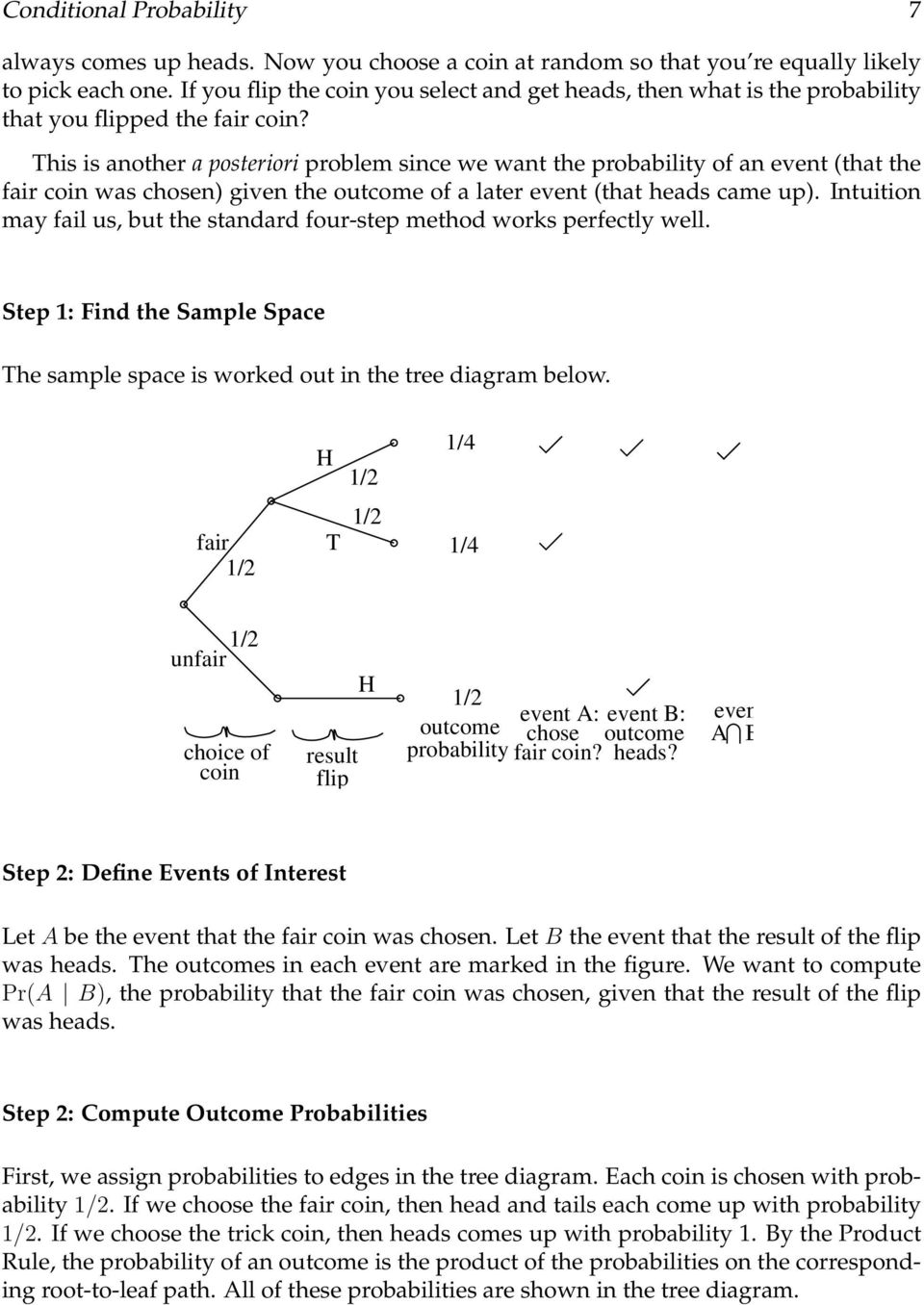
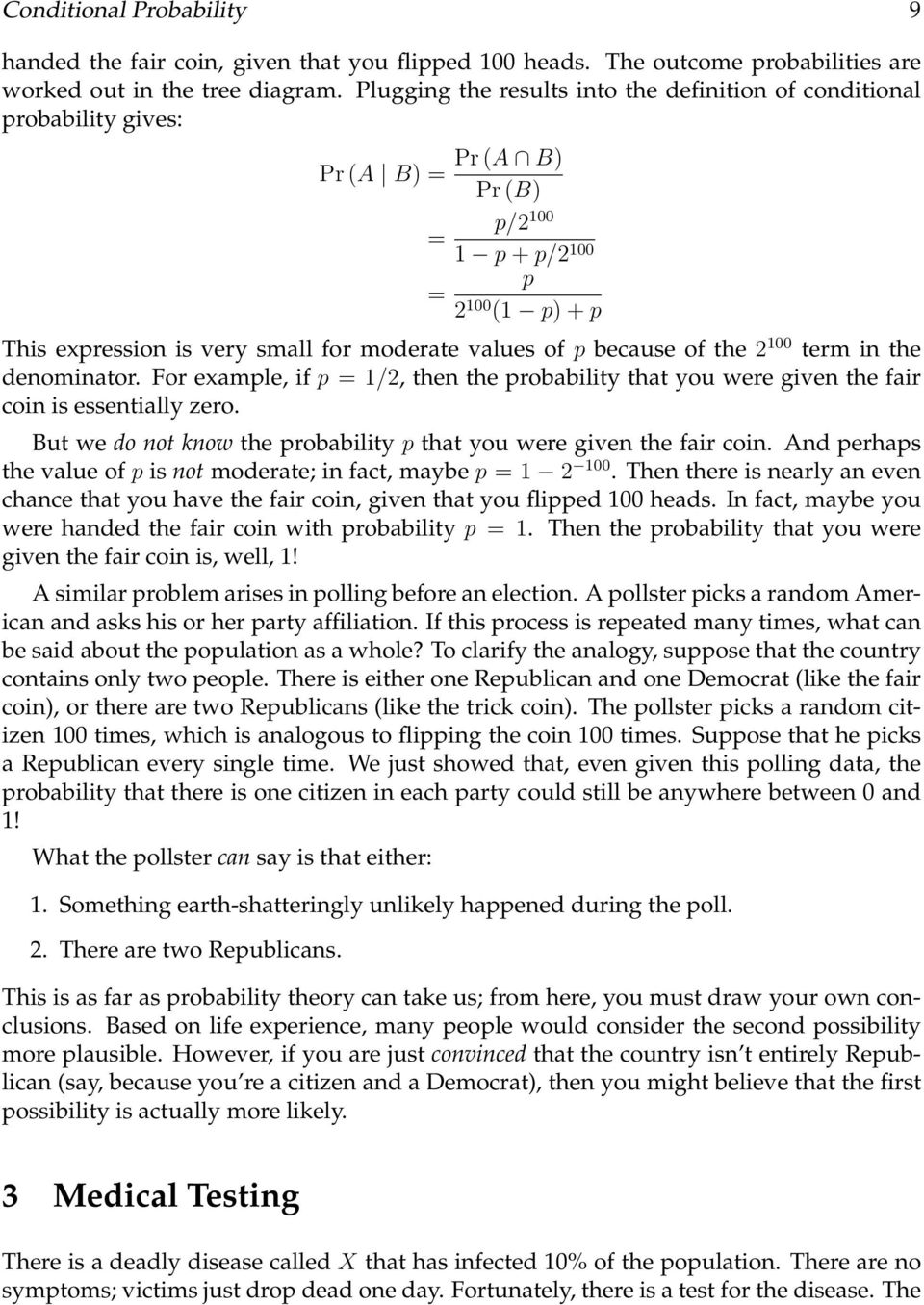
8 8 Conditional Probability Step 4: Compute Event Probabilities Pr(A B) Pr(A B) = Pr(B) 1 4 = = 3 The first equation uses the Product Rule. On the second line, we use the fact that the probability of an event is the sum of the probabilities of the outcomes it contains. The final line is simplification. The probability that the fair coin was chosen, given that the result of the flip was heads, is 1/ A Variant of the Two Coins Problem Let s consider a variant of the two coins problem. Someone hands you either a fair coin or a trick coin with heads on both sides. You flip the coin 100 times and see heads every time. What can you say about the probability that you flipped the fair coin? Remarkably nothing! In order to make sense out of this outrageous claim, let s formalize the problem. The sample space is worked out in the tree diagram below. We do not know the probability that you were handed the fair coin initially you were just given one coin or the other so let s call that p. coin given to you fair coin result of 100 flips all heads 1/2 100 event A: given fair coin? X event B: flipped all heads? X probability p / p some tails /2 X p p / p trick coin 1/2 100 X 1 p all heads Let A be the event that you were handed the fair coin, and let B be the event that you flipped 100 heads. Now, we re looking for Pr(A B), the probability that you were

9 Conditional Probability 9 handed the fair coin, given that you flipped 100 heads. The outcome probabilities are worked out in the tree diagram. Plugging the results into the definition of conditional probability gives: Pr (A B) Pr (A B) = Pr (B) p/2 100 = 1 p + p/2 100 p = (1 p) + p This expression is very small for moderate values of p because of the term in the denominator. For example, if p = 1/2, then the probability that you were given the fair coin is essentially zero. But we do not know the probability p that you were given the fair coin. And perhaps the value of p is not moderate; in fact, maybe p = Then there is nearly an even chance that you have the fair coin, given that you flipped 100 heads. In fact, maybe you were handed the fair coin with probability p = 1. Then the probability that you were given the fair coin is, well, 1! A similar problem arises in polling before an election. A pollster picks a random American and asks his or her party affiliation. If this process is repeated many times, what can be said about the population as a whole? To clarify the analogy, suppose that the country contains only two people. There is either one Republican and one Democrat (like the fair coin), or there are two Republicans (like the trick coin). The pollster picks a random citizen 100 times, which is analogous to flipping the coin 100 times. Suppose that he picks a Republican every single time. We just showed that, even given this polling data, the probability that there is one citizen in each party could still be anywhere between 0 and 1! What the pollster can say is that either: 1. Something earth shatteringly unlikely happened during the poll. 2. There are two Republicans. This is as far as probability theory can take us; from here, you must draw your own conclusions. Based on life experience, many people would consider the second possibility more plausible. However, if you are just convinced that the country isn t entirely Republican (say, because you re a citizen and a Democrat), then you might believe that the first possibility is actually more likely. 3 Medical Testing There is a deadly disease called X that has infected 10% of the population. There are no symptoms; victims just drop dead one day. Fortunately, there is a test for the disease. The
10 10 Conditional Probability test is not perfect, however: If you have the disease, there is a 10% chance that the test will say you do not. (These are called false negatives.) If you do not have disease, there is a 30% chance that the test will say you do. (These are false positives.) A random person is tested for the disease. If the test is positive, then what is the probability that the person has the disease? Step 1: Find the Sample Space The sample space is found with the tree diagram below. pos.9.09 yes.1 neg.1.01 no.9 pos.3.27 person has X? neg.7 test result.63 outcome probability event A: event B: has test disease? positive? event A B? Step 2: Define Events of Interest Let A be the event that the person has the disease. Let B be the event that the test was positive. The outcomes in each event are marked in the tree diagram. We want to find Pr (A B), the probability that a person has disease X, given that the test was positive. Step 3: Find Outcome Probabilities First, we assign probabilities to edges. These probabilities are drawn directly from the problem statement. By the Product Rule, the probability of an outcome is the product of the probabilities on the corresponding root to leaf path. All probabilities are shown in the figure.

11 Conditional Probability 11 Step 4: Compute Event Probabilities Pr (A B) Pr(A B) = Pr (B) 0.09 = = 4 If you test positive, then there is only a 25% chance that you have the disease! This answer is initially surprising, but makes sense on reflection. There are two ways you could test positive. First, it could be that you are sick and the test is correct. Second, it could be that you are healthy and the test is incorrect. The problem is that almost everyone is healthy; therefore, most of the positive results arise from incorrect tests of healthy people! We can also compute the probability that the test is correct for a random person. This event consists of two outcomes. The person could be sick and the test positive (probability 0.09), or the person could be healthy and the test negative (probability 0.63). Therefore, the test is correct with probability = This is a relief; the test is correct almost three quarters of the time. But wait! There is a simple way to make the test correct 90% of the time: always return a negative result! This test gives the right answer for all healthy people and the wrong answer only for the 10% that actually have the disease. The best strategy is to completely ignore the test result! There is a similar paradox in weather forecasting. During winter, almost all days in Boston are wet and overcast. Predicting miserable weather every day may be more accurate than really trying to get it right! 4 Conditional Probability Pitfalls The remaining sections illustrate some common blunders involving conditional probability. 4.1 Carnival Dice There is a gambling game called Carnival Dice. A player picks a number between 1 and 6 and then rolls three fair dice. The player wins if his number comes up on at least one die. The player loses if his number does not appear on any of the dice. What is the probability that the player wins? This problem sounds simple enough that we might try an intuitive lunge for the solution.

12 12 Conditional Probability False Claim 1. The player wins with probability 1. 2 Proof. Let A i be the event that the i th die matches the player s guess. Pr(win) = Pr (A 1 A 2 A 3 ) = Pr (A 1 ) Pr (A 2 ) Pr (A 3 ) = = 2 The only justification for the second equality is that it looks vaguely reasonable; in fact, equality does not hold. Let s examine the expression Pr(A 1 A 2 A 3 ) to see exactly what is happening. Recall that the probability of an event is the sum of the probabilities of the outcomes it contains. Therefore, we could argue as follows: Pr (A 1 A 2 A 3 ) = Pr (w) w A 1 A 2 A 3 = Pr (w) + Pr (w) + Pr (w) w A 1 w A 2 w A 3 = Pr (A 1 ) + Pr (A 2 ) + Pr (A 3 ) This argument is valid provided that the events A 1, A 2, and A 3 are disjoint; that is, there is no outcome in more than one event. If this were not true for some outcome, then a term would be duplicated when we split the one sum into three. Subject to this caveat, the argument generalizes to prove the following theorem: Theorem 2. Let A 1, A 2,... A n be disjoint events. Then: Pr (A 1 A 2... A n ) = Pr (A 1 ) + Pr (A 2 ) Pr (A n ) We can evaluate the probability of a union of events that are not necessarily disjoint using a theorem analogous to Inclusion Exclusion. Here is the special case for a union of three events. Theorem 3. Let A 1, A 2, and A 3 be events, not necessarily disjoint. Then: Pr (A 1 A 2 A 3 ) = Pr (A 1 ) + Pr (A 2 ) + Pr (A 3 ) Pr (A 1 A 2 ) Pr (A 1 A 3 ) Pr (A 2 A 3 ) + Pr (A 1 A 2 A 3 )

13 Conditional Probability 13 We can use this theorem to compute the real chance of winning at Carnival Dice. The probability that one die matches the player s guess is 1/6. The probability that two dice both match the player s guess is 1/36 by the Product Rule. Similarly, the probability that all three dice match is 1/216. Plugging these numbers into the preceding theorem gives: Pr (win) = % These are terrible odds for a gambling game; you d be much better off playing roulette, craps, or blackjack! 4.2 Other Identities There is a close relationship between computing the size of a set and computing the probability of an event. Theorem 3 is one example; the probability of a union of events and the cardinality of a union of sets are computed using similar formulas. In fact, all of the methods we developed for computing sizes of sets carry over to computing probabilities. This is because a probability space is just a weighted set; the sample space is the set and the probability function assigns a weight to each element. Earlier, we were counting the number of items in a set. Now, when we compute the probability of an event, we are just summing the weights of items. We ll see many examples of the close relationship between probability and counting over the next few weeks. Many general probability identities still hold when all probabilities are conditioned on the same event. For example, the following identity is analogous to the Inclusion Exclusion formula for two sets, except that all probabilities are conditioned on an event C. Pr (A B C) = Pr (A C) + Pr (A C) Pr (A B C) Be careful not to mix up events before and after the conditioning bar! For example, the following is not a valid identity: Pr (A B C) = Pr (A B) + Pr (A C) (B C = φ) A counterexample is shown below. In this case, Pr (A B) = 1, Pr (A C) = 1, and Pr (A B C) = 1. However, since 1 = 1 + 1, the equation above does not hold.

14 14 Conditional Probability sample space B A C So you re convinced that this equation is false in general, right? Let s see if you really believe that. 4.3 Discrimination Lawsuit Several years ago there was a sex discrimination lawsuit against Berkeley. A female professor was denied tenure, allegedly because she was a woman. She argued that in every one of Berkeley s 22 departments, the percentage of male applicants accepted was greater than the percentage of female applicants accepted. This sounds very suspicious! However, Berkeley s lawyers argued that across the whole university the percentage of male tenure applicants accepted was actually lower than the percentage of female applicants accepted. This suggests that if there was any sex discrimination, then it was against men! Surely, at least one party in the dispute must be lying. Let s simplify the problem and express both arguments in terms of conditional probabilities. Suppose that there are only two departments, EE and CS, and consider the experiment where we pick a random applicant. Define the following events: Let A be the event that the applicant is accepted. Let F EE the event that the applicant is a female applying to EE. Let F CS the event that the applicant is a female applying to CS. Let M EE the event that the applicant is a male applying to EE. Let M CS the event that the applicant is a male applying to CS. Assume that all applicants are either male or female, and that no applicant applied to both departments. That is, the events F EE, F CS, M EE, and M CS are all disjoint. In these terms, the plaintiff is make the following argument: Pr (A F EE ) < Pr (A M EE ) Pr (A F CS ) < Pr (A M CS )

15 Conditional Probability 15 That is, in both departments, the probability that a woman is accepted for tenure is less than the probability that a man is accepted. The university retorts that overall a woman applicant is more likely to be accepted than a man: Pr (A F EE F CS ) > Pr (A M EE M CS ) It is easy to believe that these two positions are contradictory. In fact, we might even try to prove this by adding the plaintiff s two inequalities and then arguing as follows: Pr (A F EE ) + Pr (A F CS ) < Pr (A M EE ) + Pr (A M CS ) Pr (A F EE F CS ) < Pr (A M EE M CS ) The second line exactly contradicts the university s position! But there is a big problem with this argument; the second inequality follows from the first only if we accept the false identity from the preceding section. This argument is bogus! Maybe the two parties do not hold contradictory positions after all! In fact, the table below shows a set of application statistics for which the assertions of both the plaintiff and the university hold: CS 0 females accepted, 1 applied 0% 50 males accepted, 100 applied 50% EE 70 females accepted, 100 applied 70% 1 male accepted, 1 applied 100% Overall 70 females accepted, 101 applied 51 males accepted, 101 applied 70% 51% In this case, a higher percentage of males were accepted in both departments, but overall a higher percentage of females were accepted! Bizarre! 4.4 On Time Airlines Newspapers publish on time statistics for airlines to help travelers choose the best carrier. The on time rate for an airline is defined as follows: # flights less than 15 minutes late on time rate = # flights total This seems reasonable, but actually can be badly misleading! Here is some on time data for two airlines in the late 80 s. Alaska Air America West Airport #on time #flights % #on time #flights % Los Angeles Phoenix San Diego San Francisco Seattle OVERALL

16 16 Conditional Probability America West had a better overall on time percentage, but Alaska Airlines did better at every single airport! This is the same paradox as in the Berkeley tenure lawsuit. The problem is that Alaska Airlines flew proportionally more of its flights to bad weather airports like Seattle, whereas America West was based in fair weather, low traffic Phoenix!

Introduction to Probability
 Massachusetts Institute of Technology Course Notes 0 6.04J/8.06J, Fall 0: Mathematics for Computer Science November 4 Professor Albert Meyer and Dr. Radhika Nagpal revised November 6, 00, 57 minutes Introduction
6.3 Conditional Probability and Independence
 222 CHAPTER 6. PROBABILITY 6.3 Conditional Probability and Independence Conditional Probability Two cubical dice each have a triangle painted on one side, a circle painted on two sides and a square painted
6.042/18.062J Mathematics for Computer Science. Expected Value I
 6.42/8.62J Mathematics for Computer Science Srini Devadas and Eric Lehman May 3, 25 Lecture otes Expected Value I The expectation or expected value of a random variable is a single number that tells you
Discrete Mathematics and Probability Theory Fall 2009 Satish Rao, David Tse Note 10
 CS 70 Discrete Mathematics and Probability Theory Fall 2009 Satish Rao, David Tse Note 10 Introduction to Discrete Probability Probability theory has its origins in gambling analyzing card games, dice,
Probability and Expected Value
 Probability and Expected Value This handout provides an introduction to probability and expected value. Some of you may already be familiar with some of these topics. Probability and expected value are
Bayesian Tutorial (Sheet Updated 20 March)
 Bayesian Tutorial (Sheet Updated 20 March) Practice Questions (for discussing in Class) Week starting 21 March 2016 1. What is the probability that the total of two dice will be greater than 8, given that
AP Stats - Probability Review
 AP Stats - Probability Review Multiple Choice Identify the choice that best completes the statement or answers the question. 1. I toss a penny and observe whether it lands heads up or tails up. Suppose
Conditional Probability, Independence and Bayes Theorem Class 3, 18.05, Spring 2014 Jeremy Orloff and Jonathan Bloom
 Conditional Probability, Independence and Bayes Theorem Class 3, 18.05, Spring 2014 Jeremy Orloff and Jonathan Bloom 1 Learning Goals 1. Know the definitions of conditional probability and independence
A Few Basics of Probability
 A Few Basics of Probability Philosophy 57 Spring, 2004 1 Introduction This handout distinguishes between inductive and deductive logic, and then introduces probability, a concept essential to the study
Chapter 11 Number Theory
 Chapter 11 Number Theory Number theory is one of the oldest branches of mathematics. For many years people who studied number theory delighted in its pure nature because there were few practical applications
WRITING PROOFS. Christopher Heil Georgia Institute of Technology
 WRITING PROOFS Christopher Heil Georgia Institute of Technology A theorem is just a statement of fact A proof of the theorem is a logical explanation of why the theorem is true Many theorems have this
Discrete Mathematics and Probability Theory Fall 2009 Satish Rao, David Tse Note 2
 CS 70 Discrete Mathematics and Probability Theory Fall 2009 Satish Rao, David Tse Note 2 Proofs Intuitively, the concept of proof should already be familiar We all like to assert things, and few of us
Stat 20: Intro to Probability and Statistics
 Stat 20: Intro to Probability and Statistics Lecture 16: More Box Models Tessa L. Childers-Day UC Berkeley 22 July 2014 By the end of this lecture... You will be able to: Determine what we expect the sum
Betting systems: how not to lose your money gambling
 Betting systems: how not to lose your money gambling G. Berkolaiko Department of Mathematics Texas A&M University 28 April 2007 / Mini Fair, Math Awareness Month 2007 Gambling and Games of Chance Simple
The overall size of these chance errors is measured by their RMS HALF THE NUMBER OF TOSSES NUMBER OF HEADS MINUS 0 400 800 1200 1600 NUMBER OF TOSSES
 INTRODUCTION TO CHANCE VARIABILITY WHAT DOES THE LAW OF AVERAGES SAY? 4 coins were tossed 1600 times each, and the chance error number of heads half the number of tosses was plotted against the number
Question: What is the probability that a five-card poker hand contains a flush, that is, five cards of the same suit?
 ECS20 Discrete Mathematics Quarter: Spring 2007 Instructor: John Steinberger Assistant: Sophie Engle (prepared by Sophie Engle) Homework 8 Hints Due Wednesday June 6 th 2007 Section 6.1 #16 What is the
Pascal is here expressing a kind of skepticism about the ability of human reason to deliver an answer to this question.
 Pascal s wager So far we have discussed a number of arguments for or against the existence of God. In the reading for today, Pascal asks not Does God exist? but Should we believe in God? What is distinctive
Gaming the Law of Large Numbers
 Gaming the Law of Large Numbers Thomas Hoffman and Bart Snapp July 3, 2012 Many of us view mathematics as a rich and wonderfully elaborate game. In turn, games can be used to illustrate mathematical ideas.
The Math. P (x) = 5! = 1 2 3 4 5 = 120.
 The Math Suppose there are n experiments, and the probability that someone gets the right answer on any given experiment is p. So in the first example above, n = 5 and p = 0.2. Let X be the number of correct
Video Poker in South Carolina: A Mathematical Study
 Video Poker in South Carolina: A Mathematical Study by Joel V. Brawley and Todd D. Mateer Since its debut in South Carolina in 1986, video poker has become a game of great popularity as well as a game
In the situations that we will encounter, we may generally calculate the probability of an event
 What does it mean for something to be random? An event is called random if the process which produces the outcome is sufficiently complicated that we are unable to predict the precise result and are instead
MTH6120 Further Topics in Mathematical Finance Lesson 2
 MTH6120 Further Topics in Mathematical Finance Lesson 2 Contents 1.2.3 Non-constant interest rates....................... 15 1.3 Arbitrage and Black-Scholes Theory....................... 16 1.3.1 Informal
CS 3719 (Theory of Computation and Algorithms) Lecture 4
 CS 3719 (Theory of Computation and Algorithms) Lecture 4 Antonina Kolokolova January 18, 2012 1 Undecidable languages 1.1 Church-Turing thesis Let s recap how it all started. In 1990, Hilbert stated a
The Binomial Distribution
 The Binomial Distribution James H. Steiger November 10, 00 1 Topics for this Module 1. The Binomial Process. The Binomial Random Variable. The Binomial Distribution (a) Computing the Binomial pdf (b) Computing
Decision Making under Uncertainty
 6.825 Techniques in Artificial Intelligence Decision Making under Uncertainty How to make one decision in the face of uncertainty Lecture 19 1 In the next two lectures, we ll look at the question of how
14.4. Expected Value Objectives. Expected Value
 . Expected Value Objectives. Understand the meaning of expected value. 2. Calculate the expected value of lotteries and games of chance.. Use expected value to solve applied problems. Life and Health Insurers
Pigeonhole Principle Solutions
 Pigeonhole Principle Solutions 1. Show that if we take n + 1 numbers from the set {1, 2,..., 2n}, then some pair of numbers will have no factors in common. Solution: Note that consecutive numbers (such
Standard 12: The student will explain and evaluate the financial impact and consequences of gambling.
 TEACHER GUIDE 12.1 GAMBLING PAGE 1 Standard 12: The student will explain and evaluate the financial impact and consequences of gambling. Risky Business Priority Academic Student Skills Personal Financial
5.1 Radical Notation and Rational Exponents
 Section 5.1 Radical Notation and Rational Exponents 1 5.1 Radical Notation and Rational Exponents We now review how exponents can be used to describe not only powers (such as 5 2 and 2 3 ), but also roots
Probabilistic Strategies: Solutions
 Probability Victor Xu Probabilistic Strategies: Solutions Western PA ARML Practice April 3, 2016 1 Problems 1. You roll two 6-sided dice. What s the probability of rolling at least one 6? There is a 1
Definition and Calculus of Probability
 In experiments with multivariate outcome variable, knowledge of the value of one variable may help predict another. For now, the word prediction will mean update the probabilities of events regarding the
MA 1125 Lecture 14 - Expected Values. Friday, February 28, 2014. Objectives: Introduce expected values.
 MA 5 Lecture 4 - Expected Values Friday, February 2, 24. Objectives: Introduce expected values.. Means, Variances, and Standard Deviations of Probability Distributions Two classes ago, we computed the
5544 = 2 2772 = 2 2 1386 = 2 2 2 693. Now we have to find a divisor of 693. We can try 3, and 693 = 3 231,and we keep dividing by 3 to get: 1
 MATH 13150: Freshman Seminar Unit 8 1. Prime numbers 1.1. Primes. A number bigger than 1 is called prime if its only divisors are 1 and itself. For example, 3 is prime because the only numbers dividing
Question 1 Formatted: Formatted: Formatted: Formatted:
 In many situations in life, we are presented with opportunities to evaluate probabilities of events occurring and make judgments and decisions from this information. In this paper, we will explore four
! Insurance and Gambling
 2009-8-18 0 Insurance and Gambling Eric Hehner Gambling works as follows. You pay some money to the house. Then a random event is observed; it may be the roll of some dice, the draw of some cards, or the
Problem of the Month: Fair Games
 Problem of the Month: The Problems of the Month (POM) are used in a variety of ways to promote problem solving and to foster the first standard of mathematical practice from the Common Core State Standards:
Mathematical goals. Starting points. Materials required. Time needed
 Level S2 of challenge: B/C S2 Mathematical goals Starting points Materials required Time needed Evaluating probability statements To help learners to: discuss and clarify some common misconceptions about
Minimax Strategies. Minimax Strategies. Zero Sum Games. Why Zero Sum Games? An Example. An Example
 Everyone who has studied a game like poker knows the importance of mixing strategies With a bad hand, you often fold But you must bluff sometimes Lectures in Microeconomics-Charles W Upton Zero Sum Games
Vieta s Formulas and the Identity Theorem
 Vieta s Formulas and the Identity Theorem This worksheet will work through the material from our class on 3/21/2013 with some examples that should help you with the homework The topic of our discussion
26 Integers: Multiplication, Division, and Order
 26 Integers: Multiplication, Division, and Order Integer multiplication and division are extensions of whole number multiplication and division. In multiplying and dividing integers, the one new issue
Ch. 13.2: Mathematical Expectation
 Ch. 13.2: Mathematical Expectation Random Variables Very often, we are interested in sample spaces in which the outcomes are distinct real numbers. For example, in the experiment of rolling two dice, we
1.6 The Order of Operations
 1.6 The Order of Operations Contents: Operations Grouping Symbols The Order of Operations Exponents and Negative Numbers Negative Square Roots Square Root of a Negative Number Order of Operations and Negative
Contemporary Mathematics- MAT 130. Probability. a) What is the probability of obtaining a number less than 4?
 Contemporary Mathematics- MAT 30 Solve the following problems:. A fair die is tossed. What is the probability of obtaining a number less than 4? What is the probability of obtaining a number less than
Chapter 4 Lecture Notes
 Chapter 4 Lecture Notes Random Variables October 27, 2015 1 Section 4.1 Random Variables A random variable is typically a real-valued function defined on the sample space of some experiment. For instance,
Lab 11. Simulations. The Concept
 Lab 11 Simulations In this lab you ll learn how to create simulations to provide approximate answers to probability questions. We ll make use of a particular kind of structure, called a box model, that
Lecture 13. Understanding Probability and Long-Term Expectations
 Lecture 13 Understanding Probability and Long-Term Expectations Thinking Challenge What s the probability of getting a head on the toss of a single fair coin? Use a scale from 0 (no way) to 1 (sure thing).
AP STATISTICS TEST #2 - REVIEW - Ch. 14 &15 Period:
 AP STATISTICS Name TEST #2 - REVIEW - Ch. 14 &15 Period: 1) The city council has 6 men and 3 women. If we randomly choose two of them to co-chair a committee, what is the probability these chairpersons
Solving Rational Equations
 Lesson M Lesson : Student Outcomes Students solve rational equations, monitoring for the creation of extraneous solutions. Lesson Notes In the preceding lessons, students learned to add, subtract, multiply,
6th Grade Lesson Plan: Probably Probability
 6th Grade Lesson Plan: Probably Probability Overview This series of lessons was designed to meet the needs of gifted children for extension beyond the standard curriculum with the greatest ease of use
3. Mathematical Induction
 3. MATHEMATICAL INDUCTION 83 3. Mathematical Induction 3.1. First Principle of Mathematical Induction. Let P (n) be a predicate with domain of discourse (over) the natural numbers N = {0, 1,,...}. If (1)
1. The Fly In The Ointment
 Arithmetic Revisited Lesson 5: Decimal Fractions or Place Value Extended Part 5: Dividing Decimal Fractions, Part 2. The Fly In The Ointment The meaning of, say, ƒ 2 doesn't depend on whether we represent
ECON 459 Game Theory. Lecture Notes Auctions. Luca Anderlini Spring 2015
 ECON 459 Game Theory Lecture Notes Auctions Luca Anderlini Spring 2015 These notes have been used before. If you can still spot any errors or have any suggestions for improvement, please let me know. 1
2. How many ways can the letters in PHOENIX be rearranged? 7! = 5,040 ways.
 Math 142 September 27, 2011 1. How many ways can 9 people be arranged in order? 9! = 362,880 ways 2. How many ways can the letters in PHOENIX be rearranged? 7! = 5,040 ways. 3. The letters in MATH are
Game Theory and Algorithms Lecture 10: Extensive Games: Critiques and Extensions
 Game Theory and Algorithms Lecture 0: Extensive Games: Critiques and Extensions March 3, 0 Summary: We discuss a game called the centipede game, a simple extensive game where the prediction made by backwards
Continued Fractions and the Euclidean Algorithm
 Continued Fractions and the Euclidean Algorithm Lecture notes prepared for MATH 326, Spring 997 Department of Mathematics and Statistics University at Albany William F Hammond Table of Contents Introduction
SAT Math Facts & Formulas Review Quiz
 Test your knowledge of SAT math facts, formulas, and vocabulary with the following quiz. Some questions are more challenging, just like a few of the questions that you ll encounter on the SAT; these questions
Easy Casino Profits. Congratulations!!
 Easy Casino Profits The Easy Way To Beat The Online Casinos Everytime! www.easycasinoprofits.com Disclaimer The authors of this ebook do not promote illegal, underage gambling or gambling to those living
Solutions to Math 51 First Exam January 29, 2015
 Solutions to Math 5 First Exam January 29, 25. ( points) (a) Complete the following sentence: A set of vectors {v,..., v k } is defined to be linearly dependent if (2 points) there exist c,... c k R, not
Statistics 100A Homework 3 Solutions
 Chapter Statistics 00A Homework Solutions Ryan Rosario. Two balls are chosen randomly from an urn containing 8 white, black, and orange balls. Suppose that we win $ for each black ball selected and we
Pre-Algebra Lecture 6
 Pre-Algebra Lecture 6 Today we will discuss Decimals and Percentages. Outline: 1. Decimals 2. Ordering Decimals 3. Rounding Decimals 4. Adding and subtracting Decimals 5. Multiplying and Dividing Decimals
Math/Stats 425 Introduction to Probability. 1. Uncertainty and the axioms of probability
 Math/Stats 425 Introduction to Probability 1. Uncertainty and the axioms of probability Processes in the real world are random if outcomes cannot be predicted with certainty. Example: coin tossing, stock
Expected Value and the Game of Craps
 Expected Value and the Game of Craps Blake Thornton Craps is a gambling game found in most casinos based on rolling two six sided dice. Most players who walk into a casino and try to play craps for the
Formal Languages and Automata Theory - Regular Expressions and Finite Automata -
 Formal Languages and Automata Theory - Regular Expressions and Finite Automata - Samarjit Chakraborty Computer Engineering and Networks Laboratory Swiss Federal Institute of Technology (ETH) Zürich March
Fundamentals of Probability
 Fundamentals of Probability Introduction Probability is the likelihood that an event will occur under a set of given conditions. The probability of an event occurring has a value between 0 and 1. An impossible
Lies My Calculator and Computer Told Me
 Lies My Calculator and Computer Told Me 2 LIES MY CALCULATOR AND COMPUTER TOLD ME Lies My Calculator and Computer Told Me See Section.4 for a discussion of graphing calculators and computers with graphing
The Taxman Game. Robert K. Moniot September 5, 2003
 The Taxman Game Robert K. Moniot September 5, 2003 1 Introduction Want to know how to beat the taxman? Legally, that is? Read on, and we will explore this cute little mathematical game. The taxman game
You will by now not be surprised that a version of the teleological argument can be found in the writings of Thomas Aquinas.
 The design argument The different versions of the cosmological argument we discussed over the last few weeks were arguments for the existence of God based on extremely abstract and general features of
LAMC Beginners Circle: Parity of a Permutation Problems from Handout by Oleg Gleizer Solutions by James Newton
 LAMC Beginners Circle: Parity of a Permutation Problems from Handout by Oleg Gleizer Solutions by James Newton 1. Take a two-digit number and write it down three times to form a six-digit number. For example,
Week 2: Conditional Probability and Bayes formula
 Week 2: Conditional Probability and Bayes formula We ask the following question: suppose we know that a certain event B has occurred. How does this impact the probability of some other A. This question
CHAPTER 2 Estimating Probabilities
 CHAPTER 2 Estimating Probabilities Machine Learning Copyright c 2016. Tom M. Mitchell. All rights reserved. *DRAFT OF January 24, 2016* *PLEASE DO NOT DISTRIBUTE WITHOUT AUTHOR S PERMISSION* This is a
Preliminary Mathematics
 Preliminary Mathematics The purpose of this document is to provide you with a refresher over some topics that will be essential for what we do in this class. We will begin with fractions, decimals, and
Ch. 13.3: More about Probability
 Ch. 13.3: More about Probability Complementary Probabilities Given any event, E, of some sample space, U, of a random experiment, we can always talk about the complement, E, of that event: this is the
Hoover High School Math League. Counting and Probability
 Hoover High School Math League Counting and Probability Problems. At a sandwich shop there are 2 kinds of bread, 5 kinds of cold cuts, 3 kinds of cheese, and 2 kinds of dressing. How many different sandwiches
$2 4 40 + ( $1) = 40
 THE EXPECTED VALUE FOR THE SUM OF THE DRAWS In the game of Keno there are 80 balls, numbered 1 through 80. On each play, the casino chooses 20 balls at random without replacement. Suppose you bet on the
6.042/18.062J Mathematics for Computer Science December 12, 2006 Tom Leighton and Ronitt Rubinfeld. Random Walks
 6.042/8.062J Mathematics for Comuter Science December 2, 2006 Tom Leighton and Ronitt Rubinfeld Lecture Notes Random Walks Gambler s Ruin Today we re going to talk about one-dimensional random walks. In
Section 4.1 Rules of Exponents
 Section 4.1 Rules of Exponents THE MEANING OF THE EXPONENT The exponent is an abbreviation for repeated multiplication. The repeated number is called a factor. x n means n factors of x. The exponent tells
AN ANALYSIS OF A WAR-LIKE CARD GAME. Introduction
 AN ANALYSIS OF A WAR-LIKE CARD GAME BORIS ALEXEEV AND JACOB TSIMERMAN Abstract. In his book Mathematical Mind-Benders, Peter Winkler poses the following open problem, originally due to the first author:
Elementary Statistics and Inference. Elementary Statistics and Inference. 16 The Law of Averages (cont.) 22S:025 or 7P:025.
 Elementary Statistics and Inference 22S:025 or 7P:025 Lecture 20 1 Elementary Statistics and Inference 22S:025 or 7P:025 Chapter 16 (cont.) 2 D. Making a Box Model Key Questions regarding box What numbers
Probability. a number between 0 and 1 that indicates how likely it is that a specific event or set of events will occur.
 Probability Probability Simple experiment Sample space Sample point, or elementary event Event, or event class Mutually exclusive outcomes Independent events a number between 0 and 1 that indicates how
Unit 19: Probability Models
 Unit 19: Probability Models Summary of Video Probability is the language of uncertainty. Using statistics, we can better predict the outcomes of random phenomena over the long term from the very complex,
Session 7 Fractions and Decimals
 Key Terms in This Session Session 7 Fractions and Decimals Previously Introduced prime number rational numbers New in This Session period repeating decimal terminating decimal Introduction In this session,
AMS 5 CHANCE VARIABILITY
 AMS 5 CHANCE VARIABILITY The Law of Averages When tossing a fair coin the chances of tails and heads are the same: 50% and 50%. So if the coin is tossed a large number of times, the number of heads and
36 Odds, Expected Value, and Conditional Probability
 36 Odds, Expected Value, and Conditional Probability What s the difference between probabilities and odds? To answer this question, let s consider a game that involves rolling a die. If one gets the face
MATH 140 Lab 4: Probability and the Standard Normal Distribution
 MATH 140 Lab 4: Probability and the Standard Normal Distribution Problem 1. Flipping a Coin Problem In this problem, we want to simualte the process of flipping a fair coin 1000 times. Note that the outcomes
Logic and Reasoning Practice Final Exam Spring 2015. Section Number
 Logic and Reasoning Practice Final Exam Spring 2015 Name Section Number The final examination is worth 100 points. 1. (5 points) What is an argument? Explain what is meant when one says that logic is the
Probability, statistics and football Franka Miriam Bru ckler Paris, 2015.
 Probability, statistics and football Franka Miriam Bru ckler Paris, 2015 Please read this before starting! Although each activity can be performed by one person only, it is suggested that you work in groups
Integers are positive and negative whole numbers, that is they are; {... 3, 2, 1,0,1,2,3...}. The dots mean they continue in that pattern.
 INTEGERS Integers are positive and negative whole numbers, that is they are; {... 3, 2, 1,0,1,2,3...}. The dots mean they continue in that pattern. Like all number sets, integers were invented to describe
Graph Theory Problems and Solutions
 raph Theory Problems and Solutions Tom Davis [email protected] http://www.geometer.org/mathcircles November, 005 Problems. Prove that the sum of the degrees of the vertices of any finite graph is
MULTIPLE CHOICE. Choose the one alternative that best completes the statement or answers the question.
 Practice Test Chapter 9 Name MULTIPLE CHOICE. Choose the one alternative that best completes the statement or answers the question. Find the odds. ) Two dice are rolled. What are the odds against a sum
Session 8 Probability
 Key Terms for This Session Session 8 Probability Previously Introduced frequency New in This Session binomial experiment binomial probability model experimental probability mathematical probability outcome
0.8 Rational Expressions and Equations
 96 Prerequisites 0.8 Rational Expressions and Equations We now turn our attention to rational expressions - that is, algebraic fractions - and equations which contain them. The reader is encouraged to
1.7 Graphs of Functions
 64 Relations and Functions 1.7 Graphs of Functions In Section 1.4 we defined a function as a special type of relation; one in which each x-coordinate was matched with only one y-coordinate. We spent most
MATH 13150: Freshman Seminar Unit 10
 MATH 13150: Freshman Seminar Unit 10 1. Relatively prime numbers and Euler s function In this chapter, we are going to discuss when two numbers are relatively prime, and learn how to count the numbers
Mathematical Induction. Mary Barnes Sue Gordon
 Mathematics Learning Centre Mathematical Induction Mary Barnes Sue Gordon c 1987 University of Sydney Contents 1 Mathematical Induction 1 1.1 Why do we need proof by induction?.... 1 1. What is proof by
Book Review of Rosenhouse, The Monty Hall Problem. Leslie Burkholder 1
 Book Review of Rosenhouse, The Monty Hall Problem Leslie Burkholder 1 The Monty Hall Problem, Jason Rosenhouse, New York, Oxford University Press, 2009, xii, 195 pp, US $24.95, ISBN 978-0-19-5#6789-8 (Source
3.3 Real Zeros of Polynomials
 3.3 Real Zeros of Polynomials 69 3.3 Real Zeros of Polynomials In Section 3., we found that we can use synthetic division to determine if a given real number is a zero of a polynomial function. This section
Decimal Notations for Fractions Number and Operations Fractions /4.NF
 Decimal Notations for Fractions Number and Operations Fractions /4.NF Domain: Cluster: Standard: 4.NF Number and Operations Fractions Understand decimal notation for fractions, and compare decimal fractions.
Teaching & Learning Plans. Plan 1: Introduction to Probability. Junior Certificate Syllabus Leaving Certificate Syllabus
 Teaching & Learning Plans Plan 1: Introduction to Probability Junior Certificate Syllabus Leaving Certificate Syllabus The Teaching & Learning Plans are structured as follows: Aims outline what the lesson,
Chapter 3. Cartesian Products and Relations. 3.1 Cartesian Products
 Chapter 3 Cartesian Products and Relations The material in this chapter is the first real encounter with abstraction. Relations are very general thing they are a special type of subset. After introducing