
11 Multivariate Polynomials
|
|
|
- Silas West
- 9 years ago
- Views:
Transcription
1 CS 487: Intro. to Symbolic Computation Winter 2009: M. Giesbrecht Script 11 Page 1 (These lecture notes were prepared and presented by Dan Roche.) 11 Multivariate Polynomials References: MC: Section 16.6 and Chapter 21 lgorithms for Computer lgebra (Geddes, Czapor, Labahn): Section 3.4 and Chapter 10 Ideals, Varieties, and lgorithms (Cox, Little, O Shea): Chapters 1 & 2 Solving a linear system is the same as finding a solution to a system of degree-1 multivariate polynomial equations. That is, given an n n matrix and a n 1 vector b, solving x = b for x is the same as finding a set of values for the variables x 1, x 2,..., x n that satisfy the set of equations { i1 x 1 + i2 x in x n = b i } 1 i n. But what if we want to solve a system of non-linear multivariate polynomial equations? Such systems arise frequenty in various engineering and physical science applications. We start with some basic terminology for multivariate polynomials: Definition Let F be a field and n N. Every exponent vector e = (e 1, e 2,..., e n ) N n defines a monomial in F[x 1, x 2,..., x n ]: x e = x e 1 1 xe 2 2 xen n. term in F[x 1, x 2,..., x n ] is the product of a nonzero coefficient c F \ {0} and a monomial, i.e. c x e. polynomial f F[x 1, x 2,..., x n ] is a finite sum of terms. We write #f for the number of terms in f. The max degree of a monomial is the largest exponent: maxdeg x e := e = max 1 i n e i. The max degree of a polynomial is the largest max degree of a term that appears in the polynomial Representations The choice of what data structure we use to represent objects is always of crucial importance in computer science. In mathematical computing, there is a tendency to ignore this and focus only on the mathematical structures at hand. Our computer algebra system (e.g. Maple) will usually make a default choice for us, but it isn t always the best. Let s examine a few options for representing multivatiate polynomials Completely Dense Representation This is the extension of the usual dense univariate polynomial representation that we have covered extensively: Definition The completely dense representation of a multivariate polynomial f F[x 1, x 2,..., x n ] with deg xi f < d i for i = 1,..., n is a d 1 d 2 d n array with entries in F, such that the entry at index i = (i 1, i 2,..., i n ) is the coefficient of x i in f. 1

2 CS 487: Intro. to Symbolic Computation Winter 2009: M. Giesbrecht Script 11 Page 2 When comparing polynomial representations, we will assume that each coefficient is stored in a single machine word. This is useful even when coefficients take up more space, since we might reasonably suppose then that each coefficient is represented by a pointer to the actual storage, and the size of the coefficient storage will be the same no matter what the polynomial representation scheme is. Under this model, the size of the completely dense representation is d 1 d 2 d n ; if m N such that m > maxdeg f, this is at most m n. The completely dense representation allows constant-time access to any coefficient, and all fast methods for dense univariate arithmetic are easily applied. Note that if the array is stored contiguously in row-major order, the representation of f(x 1, x 2,..., x n ) is the same as that for the dense univariate polynomial over F[y] given by ( ) f y d 2d 3 d n, y d 3d 4 d n,..., y dn, y. If we set the dimensions high enough to make room for the result, converting from multivariate to univariate in this fashion is the most obvious way of using fast univariate arithmetic methods for multivariate computation (known as Kronecker substitution ) Recursive Dense Representation This is similar to the completely dense representation, except that zero polynomials are trimmed from the storage. Definition polynomial f F[x 1, x 2,..., x n ] is stored in the recursive dense representation as either: f, if n = 0 (since this means f F), null pointer, if f = 0, or dense array (f 0, f 1, f 2,...), where f = f 0 +f 1 x n +f 2 x 2 n + and each f i F[x 1, x 2,..., x n 1 ] is also stored in the recursive dense representation. Consider the size of the recursive dense representation. ssuming, as before, that each coefficient in F can be stored with a single machine word, and letting deg xi f < d i for each i, the following is an upper bound of the recursive dense representation, easily proven by induction: ((((d 1 + 1) d 2 + 1) ) d n 1 + 1) d n = n n i=1 j=i Under the reasonable assumption that each variable x i occurs in at least one term of f, each d i 2. This means the above expression is always less than 2d 1 d 2 d n, and hence is never twice as large as the size of the completely dense representation. polynomial with a single term will have size d 1 + d d n in the recursive dense representation. If t = #f is the total number of terms in f, the total size is at most (d 1 + d d n )t. The following theorem summarizes these two bounds. Theorem Let f F[x 1, x 2,..., x n ] and m, t N such that m > maxdeg f and t = #f. Then the size of the recursive dense representation of f is bounded above by min(2m n, mnt). d j 2

3 CS 487: Intro. to Symbolic Computation Winter 2009: M. Giesbrecht Script 11 Page 3 So the recursive dense representation can be exponentially smaller than the completely dense one. Unfortunately, the recursive dense size is dependent on the order of the indeterminates, as illustrated in the following example. Example. Let m N be arbitrary and f = y m 1 + xy m 1 + x 2 y m x m 1 y m 1. (Notice that m > maxdeg f.) If we treat f as over the ring F[x, y], then the recursive dense representation corresponds to the m-tuple (0, 0,, 0, 1 + x + x x m 1 ). The total size in this case is 2m. On the other hand, if we reverse the variable order so that f F[y, x], the representation corresponds to (y m 1, y m 1,..., y m 1 ), with total size m 2. In fact, the preceding example is as bad as it can get, in terms of variance in size between different variable orderings. Theorem Let f F[x 1, x 2,..., x n ] with max degree maxdeg f < m. If a, b N are the sizes of the recursive dense representations of f under two different orderings of the n variables, then a mb. Unfortunately, with the smaller size comes a higher cost of computation. Coefficient access costs O(n) in the recursive dense representation. Polynomial arithmetic again reduces (this time recursively) to the univariate case, but operation speed can be slightly greater due to branching (checking whether polynomials are zero) Sparse Representation This corresponds to the default representation of polynomials in most computer algebra systems such as Maple. Definition Let f F[x 1, x 2,..., x n ] Write f = c 1 x e 1 + c 2 x e c t x e 3, with each c i F \ {0} and all the e i s distinct elements of N n. Then the sparse representation of f is list of t coefficient-exponent tuples, specifically ((c 1, e 1 ), (c 2, e 2 ),..., (c t, e t )). Notice that the exponents in this case could be very large, and so we should account for their length in this representation. Writing t = #f and maxdeg f < m, the size of the sparse representation is thus O(nt log m). gain, this could be exponentially smaller than the size of the recursive dense representation. s usual, we pay for the decreased representation size with increased operation costs. Typically, operations on sparse polynomials are counted in terms of the number of monomial comparisons required. (The cost of each comparison depends on the specific monomial order chosen, but is usually O(n log m).) Naïvely, coefficient access then costs O(t) and addition of two polynomials with s and t terms costs O(st) monomial comparisons. If the terms are stored in some sorted order, however, arithmetic becomes more efficient. Using binary search, coefficient access costs O(log t), and addition is equivalent to merging two sorted lists, at cost O(s + t) monomial comparisons. Multiplication of sparse polynomials with s and t terms can be performed by adding (merging) t intermediate products of s terms each. If we always merge polynomials with the same number of terms, this can be performed with O(st log t) monomial comparisons. 3

4 CS 487: Intro. to Symbolic Computation Winter 2009: M. Giesbrecht Script 11 Page Monomial Orderings The question remains as to how exactly we should order the monomials. The following conditions are sufficient for the correctness of the algorithms we present here, and also correspond to intuition. Definition relation on exponent tuples in N n is an admissible monomial order iff it satisfies the following conditions: For any a, b N n with a b, either a b or b a. This means that is a total order. (0,..., 0) e for any e N n. (Note that (0,..., 0) corresponds to the monomial 1). This means that is a well order. For any a, b, c N n with a b, (a + c) (b + c) also. The most common admissible monomial order corresponds to the standard alphabetic ordering used in dictionaries. Definition The pure lexicographic order lex is given by: (a 1, a 2,..., a n ) lex (b 1, b 2,..., b n ) iff there exists j {1, 2,..., n} such that a j < b j and for each i {1, 2,..., j 1}, a i = b i. We also use the symbol to apply the order to monomials and terms (not just exponent tuples). So, for instance, over F[x, y, z], x 2 y 3 z 4 lex x 4 z 2 and 1000xy 2 z 3 lex 3xy 2 z 8. There are many other monomial orderings used for various reasons, but for simplicity we will just concentrate on lex, and use to denote this ordering from now on. This leads to some more new terminology for multivariate polynomials. Definition Let f F[x 1, x 2,..., x n ] and write f = t i=1 c ix e i, with t = #f and each c i F \ {0}. The multidegree of f, written mdeg f, is the largest exponent tuple under, that is, the unique e j such that e i e j for all i j. If mdeg f = e j for j {1,..., t}, then the leading term of f, denoted lt(f), is c i x e j. The leading coefficient of f, denoted lc(f), is c i, and the leading monomial of f, denoted lm(f), is x e j. Example. Let f F[x, y, z] with f = 2xy 2 z + 3y 5xy 3. Then f would be stored in the sorted sparse representation as ( 5xy 3, 2xy 2 z, 3y). This shows that mdeg(f) = (1, 3, 0), lt(f) = 5xy 3, lc(f) = 5, and lm(f) = xy Reduction and Normal Forms Consider a single step in the ordinary long division of two univariate polynomials, say f divided by g. We examine the leading terms of f and g. If deg f < deg g then we are done, so assume deg f deg g; this means that lm(g) divides lm(f) (since they are both just powers of the single indeterminate). So we write lt(f)/ lt(g) as the first term of the quotient, and proceed to compute h = f (lt(f)/ lt(g))g and then divide h by g. To generalize this process to multivariate polynomials, we first notice that for f, g F[x 1, x 2,..., x n ], lm(g) does not necessarily divide lm(f), even when mdeg g mdeg f. If, however, this condition does hold, then we can perform a single step of long division as above; this is called a reduction. 4

5 CS 487: Intro. to Symbolic Computation Winter 2009: M. Giesbrecht Script 11 Page 5 Definition For f, g, h F[x 1, x 2,..., x n ], we say f reduces to h with respect to g and write f h iff lm(g) lm(f) and g h = f lt(f) lt(g) g. Example. Let g = 3x 2 yz 3 + 5xyz 5. Then 15x 3 y 3 z 3 2x 3 z g 2x 3 z 25x 2 y 3 z 5 Having a whole family of polynomials, rather than a single g, can allow us to do more reductions. Definition Let F[x 1, x 2,..., x n ] be a family of polynomials, and f, h F[x 1, x 2,..., x n ]. f h iff g such that f g h. f h iff h 1, h 2,... s.t. f h 1 h 2 h. Example. Let = {g 1, g 2, g 3 } F[x, y, z] with g 1 = x 2 y 2yz + 1 g 2 = xy 2 + 2x z 2 g 3 = y 2 z y Now write f = 3x 2 y 2 + 7y 1. We have f g1 6y 2 z + 4y 1 g3 6y 2 + 4y 31 := h 1 f g2 6x 2 + 3xz 2 + 7y 1 := h 2 Note that both h 1 and h 2 cannot be reduced any further with respect to. Of course we have a name for this condition: Definition Let F[x 1, x 2,..., x n ]. Then the set of normal forms with respect to, denoted N F, is the set of polynomials which cannot be reduced by any polynomial in. That is, N F = {f F[x 1, x 2,..., x n ] : h F[x 1, x 2,..., x n ] s.t. f h}. Since each reduction decreases the multidegree of the polynomial with respect to, it should be clear that for any f F[x 1, x 2,..., x n ] and a finite subset F[x 1, x 2,..., x n ], we can always find an h F[x 1, x 2,..., x n ] such that f h and h N F, just by repeatedly reducing f by elements of until we can t anymore. If we further specify some algorithmic way of choosing the order of reductions (say by ordering the polynomials in ), then the h we find will always be the same. Without giving a formal definition, let s assume some such algorithm is understood, and write N F (f) = h in this case. 5

6 CS 487: Intro. to Symbolic Computation Winter 2009: M. Giesbrecht Script 11 Page Ideals and Bases Recall the notion of an ideal from algebra: Definition Let R with operations (+, ) be a ring. n ideal I of R is a subset of R satisfying: a + b I, for all a, b I a r I, for all a I and r R Note that having some elements of R in an ideal requires that many other elements must be in the ideal also. Hence we have the following: Definition subset S = {s 1, s 2,...} of a ring R is a generator for an ideal, which we denote as S or s 1, s 2,... : The set S is called a basis for the ideal S. S := {r 1 s 1 + r 2 s 2 + : r 1, r 2,... R}. Note that S is the smallest ideal in R which contains S. lso, a single ideal can have many different bases. For example, over Z, you can convince yourself that 4, 6 is just the set of even integers, and so is the same as 2. In fact, from the extended Euclidean algorithm, we can see that any ideal in Z is generated by a single integer, which is just the gcd of all the integers in the ideal. Here, we re interested in the ring F[x 1, x 2,..., x n ], where things are not so simple, and most ideals don t have a single-element basis. But it s not too bad: Theorem (Hilbert, 1888). Every ideal I of F[x 1, x 2,..., x n ] has a finite basis. This is known as Hilbert s basis theorem and is crucial for the correctness of our methods here (but says nothing about the complexity because there s no concrete limit on the size of the basis). Now let s try an extend the idea of modular equivalence to multivariate polynomials. Over Z, a b mod m iff m (a b). This is the same as saying that (a b) m. So for f, h F[x 1, x 2,..., x n ] and F[x 1, x 2,..., x n ], we say that f h mod iff (f h). From this definition, it follows immediately that f h implies f h mod, and in particular f N F (f) Gröbner Bases Consider the ideal membership problem: given polynomials f, g 1, g 2,..., g k F[x 1, x 2,..., x n ], can f be written as a sum of multiples of g i s, i.e. is f g 1, g 2,..., g k? Setting = {g 1,..., g k }, we know this is the case iff f 0 mod. nd clearly 0 N F. But there may be many elements of N F which are equivalent to f, and there is no guarantee that our deterministic strategy for choosing N F (f) will produce 0, or even that f 0. Gröbner bases provide such a guarantee. Definition set G F[x 1, x 2,..., x n ] is a Gröbner Basis for an ideal I if and only if f, h N F G, f h mod I f = h. 6

7 CS 487: Intro. to Symbolic Computation Winter 2009: M. Giesbrecht Script 11 Page 7 This implies immediately that for any f F[x 1, x 2,..., x n ], there is only one choice for N F G (f), regardless of the order of reductions. nd it also proves that G is actually a basis for I: for any h I, since h 0 mod I and 0 N F G, h 0, which means that h G. G Since the choice of N F G (f) is unique, we now have a canonical normal form for polynomials modulo I. So having a finite Gröbner Basis for an ideal I gives us a way to determine whether f g mod I for any f, g F[x 1, x 2,..., x n ], and in particular solves the ideal membership problem. But how can we compute a finite Gröbner basis for an ideal I = f 1, f 2,..., f k? We ll breifly outline the approach taken by Bruno Buchberger, who actually coined the term Gröbner Basis in his 1965 Ph.D. thesis. We start with the following definition: Definition Let f, g F[x 1, x 2,..., x n ]\{0} and u = lcm(lt(f), lt(g)). Then the s-polynomial of f and g is s-poly(f, g) = u lt(f) f u lt(g) g. Intuitively, s-poly(f, g) is the smallest polynomial in f, g with the leading terms of f and g stripped out. s-polynomials also give a straightworward test for Gröbner bases: Theorem (MC, Theorem 21.31). G F[x 1, x 2,..., x n ] is a Gröbner basis for the ideal G iff N F G (s-poly(g 1, g 2 )) = 0 for all g 1, g 2 G. See the book for a proof. Given a finite set G F[x 1, x 2,..., x n ], Buchberger s algorithm to compute a Gröbner basis for the ideal G is based around this theorem. Choose the first pair g i, g j G in the basis such that N F G (s-poly(g i, g j )) 0. If no such pair exists, then G is a Gröbner basis and we are done. Otherwise, add N F G (s-poly(g i, g j )) to G and repeat. (This is presented more formally as lgorithm in MC.) Example. Let s use Buchberger s algorithm to find a Gröbner basis for {g 1, g 2 } with g 1 = 3x 2 y + 5y z, g 2 = yz. Initially there is just one pair of polynomials in the basis. So compute N F G (s-poly(g 1, g 2 )) = N F G (5yz z 2 ) = z 2 So set g 3 = z 2 (dividing out the content) and update G = G g 3. Then we just need to confirm that N F G (s-poly(g 1, g 3 )) = N F G (5yz 2 z 3 ) = 0, N F G (s-poly(g 2, g 3 )) = N F G (0) = 0. So {g 1, g 2, g 3 } is a Gröbner basis for the original set G. Theorem Buchberger s algorithm terminates. Proof. Let M i be the ideal generated by the leading monomials of G after the i th iteration. Since each new polynomial added to G is in normal form, each M i M i+1. Hence we have an ascending chain of ideals. By Hilbert s basis theorem, the ideal i 0 M i has a finite basis, say G. We must have G M i for some i 0. But then M i = M i+1, a contradiction unless there are only i iterations. 7

8 CS 487: Intro. to Symbolic Computation Winter 2009: M. Giesbrecht Script 11 Page 8 Unfortunately, Gröbner bases can be very large, especially under the lexicographical ordering. We can reduce the size of G somewhat by removing any basis element that is not in N F G, and further reduction is possible by so-called interior reductions that do not always involve the leading monomials. We ve already seen how a Gröbner basis allows us to test ideal membership and equivalence modulo an ideal. nother very useful application is solving a multivariate polynomial system. Consider the system S = (f i = v i ) i=1,2,...,k with each f i F[x 1, x 2,..., x n ] and v i F. This is of course equivalent to the system (f i v i = 0) i=1,2,...,k, so without loss of generality assume each v i = 0. Let G be a Gröbner basis for the ideal generated by {f i : i = 1,..., k}, under the pure lexicographical ordering lex. I claim (without proof) that if the system is zero-dimensional (i.e. it has finitely many solutions), then G contains a polynomial which only contains x n, one containing only x n 1 and x n, and so forth. There is a name for such a set: Definition set T = {t 1, t 2,..., t n } F[x 1, x 2,..., x n ] is a triangular set iff t i F[x i, x i+1,..., x n ] for i = 1, 2,..., n. With this triangular set, we can solve the univariate polynomial t n for x n, then use backsubstitution into t n 1 to solve for x n 1, and so forth. So Gröbner bases can be used to solve zero-dimensional systems of multivariate polynomials. It is worth noting that Buchberger s algorithm has been more or less superceded by more efficient approaches, especially the F4 and F5 algorithms by Jean-Charles Faugère. There are alternative methods to compute triangular sets for a given polynomial system as well. 8

Gröbner Bases and their Applications
 Gröbner Bases and their Applications Kaitlyn Moran July 30, 2008 1 Introduction We know from the Hilbert Basis Theorem that any ideal in a polynomial ring over a field is finitely generated [3]. However,
3 Monomial orders and the division algorithm
 3 Monomial orders and the division algorithm We address the problem of deciding which term of a polynomial is the leading term. We noted above that, unlike in the univariate case, the total degree does
fg = f g. 3.1.1. Ideals. An ideal of R is a nonempty k-subspace I R closed under multiplication by elements of R:
 30 3. RINGS, IDEALS, AND GRÖBNER BASES 3.1. Polynomial rings and ideals The main object of study in this section is a polynomial ring in a finite number of variables R = k[x 1,..., x n ], where k is an
Reduction Modulo Ideals and Multivariate Polynomial Interpolation
 UNIVERSITÀ DEGLI STUDI DI PADOVA UNIVERSITE BORDEAUX 1 Facoltà di Scienze MM. FF. NN U.F.R. Mathématiques et Informatique Master Thesis Vo Ngoc Thieu Reduction Modulo Ideals and Multivariate Polynomial
Continued Fractions and the Euclidean Algorithm
 Continued Fractions and the Euclidean Algorithm Lecture notes prepared for MATH 326, Spring 997 Department of Mathematics and Statistics University at Albany William F Hammond Table of Contents Introduction
Quotient Rings and Field Extensions
 Chapter 5 Quotient Rings and Field Extensions In this chapter we describe a method for producing field extension of a given field. If F is a field, then a field extension is a field K that contains F.
8 Divisibility and prime numbers
 8 Divisibility and prime numbers 8.1 Divisibility In this short section we extend the concept of a multiple from the natural numbers to the integers. We also summarize several other terms that express
Math 4310 Handout - Quotient Vector Spaces
 Math 4310 Handout - Quotient Vector Spaces Dan Collins The textbook defines a subspace of a vector space in Chapter 4, but it avoids ever discussing the notion of a quotient space. This is understandable
MATH10212 Linear Algebra. Systems of Linear Equations. Definition. An n-dimensional vector is a row or a column of n numbers (or letters): a 1.
 MATH10212 Linear Algebra Textbook: D. Poole, Linear Algebra: A Modern Introduction. Thompson, 2006. ISBN 0-534-40596-7. Systems of Linear Equations Definition. An n-dimensional vector is a row or a column
Lecture 3: Finding integer solutions to systems of linear equations
 Lecture 3: Finding integer solutions to systems of linear equations Algorithmic Number Theory (Fall 2014) Rutgers University Swastik Kopparty Scribe: Abhishek Bhrushundi 1 Overview The goal of this lecture
Algebra 3: algorithms in algebra
 Algebra 3: algorithms in algebra Hans Sterk 2003-2004 ii Contents 1 Polynomials, Gröbner bases and Buchberger s algorithm 1 1.1 Introduction............................ 1 1.2 Polynomial rings and systems
Vector and Matrix Norms
 Chapter 1 Vector and Matrix Norms 11 Vector Spaces Let F be a field (such as the real numbers, R, or complex numbers, C) with elements called scalars A Vector Space, V, over the field F is a non-empty
WRITING PROOFS. Christopher Heil Georgia Institute of Technology
 WRITING PROOFS Christopher Heil Georgia Institute of Technology A theorem is just a statement of fact A proof of the theorem is a logical explanation of why the theorem is true Many theorems have this
COMP 250 Fall 2012 lecture 2 binary representations Sept. 11, 2012
 Binary numbers The reason humans represent numbers using decimal (the ten digits from 0,1,... 9) is that we have ten fingers. There is no other reason than that. There is nothing special otherwise about
MCS 563 Spring 2014 Analytic Symbolic Computation Wednesday 9 April. Hilbert Polynomials
 Hilbert Polynomials For a monomial ideal, we derive the dimension counting the monomials in the complement, arriving at the notion of the Hilbert polynomial. The first half of the note is derived from
So let us begin our quest to find the holy grail of real analysis.
 1 Section 5.2 The Complete Ordered Field: Purpose of Section We present an axiomatic description of the real numbers as a complete ordered field. The axioms which describe the arithmetic of the real numbers
15. Symmetric polynomials
 15. Symmetric polynomials 15.1 The theorem 15.2 First examples 15.3 A variant: discriminants 1. The theorem Let S n be the group of permutations of {1,, n}, also called the symmetric group on n things.
Notes on Complexity Theory Last updated: August, 2011. Lecture 1
 Notes on Complexity Theory Last updated: August, 2011 Jonathan Katz Lecture 1 1 Turing Machines I assume that most students have encountered Turing machines before. (Students who have not may want to look
26 Integers: Multiplication, Division, and Order
 26 Integers: Multiplication, Division, and Order Integer multiplication and division are extensions of whole number multiplication and division. In multiplying and dividing integers, the one new issue
(a) Write each of p and q as a polynomial in x with coefficients in Z[y, z]. deg(p) = 7 deg(q) = 9
![(a) Write each of p and q as a polynomial in x with coefficients in Z[y, z]. deg(p) = 7 deg(q) = 9](/thumbs/40/21231804.jpg "(a) Write each of p and q as a polynomial in x with coefficients in Z[y, z]. deg(p) = 7 deg(q) = 9") Homework #01, due 1/20/10 = 9.1.2, 9.1.4, 9.1.6, 9.1.8, 9.2.3 Additional problems for study: 9.1.1, 9.1.3, 9.1.5, 9.1.13, 9.2.1, 9.2.2, 9.2.4, 9.2.5, 9.2.6, 9.3.2, 9.3.3 9.1.1 (This problem was not assigned
Homework #01, due 1/20/10 = 9.1.2, 9.1.4, 9.1.6, 9.1.8, 9.2.3 Additional problems for study: 9.1.1, 9.1.3, 9.1.5, 9.1.13, 9.2.1, 9.2.2, 9.2.4, 9.2.5, 9.2.6, 9.3.2, 9.3.3 9.1.1 (This problem was not assigned
Lecture 1: Course overview, circuits, and formulas
 Lecture 1: Course overview, circuits, and formulas Topics in Complexity Theory and Pseudorandomness (Spring 2013) Rutgers University Swastik Kopparty Scribes: John Kim, Ben Lund 1 Course Information Swastik
Formal Languages and Automata Theory - Regular Expressions and Finite Automata -
 Formal Languages and Automata Theory - Regular Expressions and Finite Automata - Samarjit Chakraborty Computer Engineering and Networks Laboratory Swiss Federal Institute of Technology (ETH) Zürich March
CS 3719 (Theory of Computation and Algorithms) Lecture 4
 CS 3719 (Theory of Computation and Algorithms) Lecture 4 Antonina Kolokolova January 18, 2012 1 Undecidable languages 1.1 Church-Turing thesis Let s recap how it all started. In 1990, Hilbert stated a
Chapter 3. Cartesian Products and Relations. 3.1 Cartesian Products
 Chapter 3 Cartesian Products and Relations The material in this chapter is the first real encounter with abstraction. Relations are very general thing they are a special type of subset. After introducing
CONTENTS 1. Peter Kahn. Spring 2007
 CONTENTS 1 MATH 304: CONSTRUCTING THE REAL NUMBERS Peter Kahn Spring 2007 Contents 2 The Integers 1 2.1 The basic construction.......................... 1 2.2 Adding integers..............................
8 Primes and Modular Arithmetic
 8 Primes and Modular Arithmetic 8.1 Primes and Factors Over two millennia ago already, people all over the world were considering the properties of numbers. One of the simplest concepts is prime numbers.
I. GROUPS: BASIC DEFINITIONS AND EXAMPLES
 I GROUPS: BASIC DEFINITIONS AND EXAMPLES Definition 1: An operation on a set G is a function : G G G Definition 2: A group is a set G which is equipped with an operation and a special element e G, called
Number Theory. Proof. Suppose otherwise. Then there would be a finite number n of primes, which we may
 Number Theory Divisibility and Primes Definition. If a and b are integers and there is some integer c such that a = b c, then we say that b divides a or is a factor or divisor of a and write b a. Definition
U.C. Berkeley CS276: Cryptography Handout 0.1 Luca Trevisan January, 2009. Notes on Algebra
 U.C. Berkeley CS276: Cryptography Handout 0.1 Luca Trevisan January, 2009 Notes on Algebra These notes contain as little theory as possible, and most results are stated without proof. Any introductory
God created the integers and the rest is the work of man. (Leopold Kronecker, in an after-dinner speech at a conference, Berlin, 1886)
 Chapter 2 Numbers God created the integers and the rest is the work of man. (Leopold Kronecker, in an after-dinner speech at a conference, Berlin, 1886) God created the integers and the rest is the work
Lecture 13 - Basic Number Theory.
 Lecture 13 - Basic Number Theory. Boaz Barak March 22, 2010 Divisibility and primes Unless mentioned otherwise throughout this lecture all numbers are non-negative integers. We say that A divides B, denoted
ECE 842 Report Implementation of Elliptic Curve Cryptography
 ECE 842 Report Implementation of Elliptic Curve Cryptography Wei-Yang Lin December 15, 2004 Abstract The aim of this report is to illustrate the issues in implementing a practical elliptic curve cryptographic
Some facts about polynomials modulo m (Full proof of the Fingerprinting Theorem)
 Some facts about polynomials modulo m (Full proof of the Fingerprinting Theorem) In order to understand the details of the Fingerprinting Theorem on fingerprints of different texts from Chapter 19 of the
Basics of Polynomial Theory
 3 Basics of Polynomial Theory 3.1 Polynomial Equations In geodesy and geoinformatics, most observations are related to unknowns parameters through equations of algebraic (polynomial) type. In cases where
Systems of Linear Equations
 Systems of Linear Equations Beifang Chen Systems of linear equations Linear systems A linear equation in variables x, x,, x n is an equation of the form a x + a x + + a n x n = b, where a, a,, a n and
MATRIX ALGEBRA AND SYSTEMS OF EQUATIONS
 MATRIX ALGEBRA AND SYSTEMS OF EQUATIONS Systems of Equations and Matrices Representation of a linear system The general system of m equations in n unknowns can be written a x + a 2 x 2 + + a n x n b a
3. Mathematical Induction
 3. MATHEMATICAL INDUCTION 83 3. Mathematical Induction 3.1. First Principle of Mathematical Induction. Let P (n) be a predicate with domain of discourse (over) the natural numbers N = {0, 1,,...}. If (1)
Solving Systems of Linear Equations
 LECTURE 5 Solving Systems of Linear Equations Recall that we introduced the notion of matrices as a way of standardizing the expression of systems of linear equations In today s lecture I shall show how
Computing divisors and common multiples of quasi-linear ordinary differential equations
 Computing divisors and common multiples of quasi-linear ordinary differential equations Dima Grigoriev CNRS, Mathématiques, Université de Lille Villeneuve d Ascq, 59655, France [email protected]
Linear Codes. Chapter 3. 3.1 Basics
 Chapter 3 Linear Codes In order to define codes that we can encode and decode efficiently, we add more structure to the codespace. We shall be mainly interested in linear codes. A linear code of length
Reading 13 : Finite State Automata and Regular Expressions
 CS/Math 24: Introduction to Discrete Mathematics Fall 25 Reading 3 : Finite State Automata and Regular Expressions Instructors: Beck Hasti, Gautam Prakriya In this reading we study a mathematical model
DIFFERENTIABILITY OF COMPLEX FUNCTIONS. Contents
 DIFFERENTIABILITY OF COMPLEX FUNCTIONS Contents 1. Limit definition of a derivative 1 2. Holomorphic functions, the Cauchy-Riemann equations 3 3. Differentiability of real functions 5 4. A sufficient condition
CHAPTER 5. Number Theory. 1. Integers and Division. Discussion
 CHAPTER 5 Number Theory 1. Integers and Division 1.1. Divisibility. Definition 1.1.1. Given two integers a and b we say a divides b if there is an integer c such that b = ac. If a divides b, we write a
Finite dimensional topological vector spaces
 Chapter 3 Finite dimensional topological vector spaces 3.1 Finite dimensional Hausdorff t.v.s. Let X be a vector space over the field K of real or complex numbers. We know from linear algebra that the
The Geometry of Polynomial Division and Elimination
 The Geometry of Polynomial Division and Elimination Kim Batselier, Philippe Dreesen Bart De Moor Katholieke Universiteit Leuven Department of Electrical Engineering ESAT/SCD/SISTA/SMC May 2012 1 / 26 Outline
1. Prove that the empty set is a subset of every set.
 1. Prove that the empty set is a subset of every set. Basic Topology Written by Men-Gen Tsai email: [email protected] Proof: For any element x of the empty set, x is also an element of every set since
Zeros of Polynomial Functions
 Zeros of Polynomial Functions The Rational Zero Theorem If f (x) = a n x n + a n-1 x n-1 + + a 1 x + a 0 has integer coefficients and p/q (where p/q is reduced) is a rational zero, then p is a factor of
Lecture 2: Universality
 CS 710: Complexity Theory 1/21/2010 Lecture 2: Universality Instructor: Dieter van Melkebeek Scribe: Tyson Williams In this lecture, we introduce the notion of a universal machine, develop efficient universal
Chapter 4, Arithmetic in F [x] Polynomial arithmetic and the division algorithm.
![Chapter 4, Arithmetic in F [x] Polynomial arithmetic and the division algorithm.](/thumbs/26/8276997.jpg "Chapter 4, Arithmetic in F [x] Polynomial arithmetic and the division algorithm.") Chapter 4, Arithmetic in F [x] Polynomial arithmetic and the division algorithm. We begin by defining the ring of polynomials with coefficients in a ring R. After some preliminary results, we specialize
Chapter 4, Arithmetic in F [x] Polynomial arithmetic and the division algorithm. We begin by defining the ring of polynomials with coefficients in a ring R. After some preliminary results, we specialize
CSE373: Data Structures and Algorithms Lecture 3: Math Review; Algorithm Analysis. Linda Shapiro Winter 2015
 CSE373: Data Structures and Algorithms Lecture 3: Math Review; Algorithm Analysis Linda Shapiro Today Registration should be done. Homework 1 due 11:59 pm next Wednesday, January 14 Review math essential
Practice with Proofs
 Practice with Proofs October 6, 2014 Recall the following Definition 0.1. A function f is increasing if for every x, y in the domain of f, x < y = f(x) < f(y) 1. Prove that h(x) = x 3 is increasing, using
HOMEWORK 5 SOLUTIONS. n!f n (1) lim. ln x n! + xn x. 1 = G n 1 (x). (2) k + 1 n. (n 1)!
 Math 7 Fall 205 HOMEWORK 5 SOLUTIONS Problem. 2008 B2 Let F 0 x = ln x. For n 0 and x > 0, let F n+ x = 0 F ntdt. Evaluate n!f n lim n ln n. By directly computing F n x for small n s, we obtain the following
Computability Theory
 CSC 438F/2404F Notes (S. Cook and T. Pitassi) Fall, 2014 Computability Theory This section is partly inspired by the material in A Course in Mathematical Logic by Bell and Machover, Chap 6, sections 1-10.
it is easy to see that α = a
 21. Polynomial rings Let us now turn out attention to determining the prime elements of a polynomial ring, where the coefficient ring is a field. We already know that such a polynomial ring is a UF. Therefore
11 Ideals. 11.1 Revisiting Z
 11 Ideals The presentation here is somewhat different than the text. In particular, the sections do not match up. We have seen issues with the failure of unique factorization already, e.g., Z[ 5] = O Q(
Notes on Factoring. MA 206 Kurt Bryan
 The General Approach Notes on Factoring MA 26 Kurt Bryan Suppose I hand you n, a 2 digit integer and tell you that n is composite, with smallest prime factor around 5 digits. Finding a nontrivial factor
Number Theory Hungarian Style. Cameron Byerley s interpretation of Csaba Szabó s lectures
 Number Theory Hungarian Style Cameron Byerley s interpretation of Csaba Szabó s lectures August 20, 2005 2 0.1 introduction Number theory is a beautiful subject and even cooler when you learn about it
Notes 11: List Decoding Folded Reed-Solomon Codes
 Introduction to Coding Theory CMU: Spring 2010 Notes 11: List Decoding Folded Reed-Solomon Codes April 2010 Lecturer: Venkatesan Guruswami Scribe: Venkatesan Guruswami At the end of the previous notes,
Notes on Determinant
 ENGG2012B Advanced Engineering Mathematics Notes on Determinant Lecturer: Kenneth Shum Lecture 9-18/02/2013 The determinant of a system of linear equations determines whether the solution is unique, without
MATH 22. THE FUNDAMENTAL THEOREM of ARITHMETIC. Lecture R: 10/30/2003
 MATH 22 Lecture R: 10/30/2003 THE FUNDAMENTAL THEOREM of ARITHMETIC You must remember this, A kiss is still a kiss, A sigh is just a sigh; The fundamental things apply, As time goes by. Herman Hupfeld
FUNCTIONAL ANALYSIS LECTURE NOTES: QUOTIENT SPACES
 FUNCTIONAL ANALYSIS LECTURE NOTES: QUOTIENT SPACES CHRISTOPHER HEIL 1. Cosets and the Quotient Space Any vector space is an abelian group under the operation of vector addition. So, if you are have studied
CS 103X: Discrete Structures Homework Assignment 3 Solutions
 CS 103X: Discrete Structures Homework Assignment 3 s Exercise 1 (20 points). On well-ordering and induction: (a) Prove the induction principle from the well-ordering principle. (b) Prove the well-ordering
5 Homogeneous systems
 5 Homogeneous systems Definition: A homogeneous (ho-mo-jeen -i-us) system of linear algebraic equations is one in which all the numbers on the right hand side are equal to : a x +... + a n x n =.. a m
7. Some irreducible polynomials
 7. Some irreducible polynomials 7.1 Irreducibles over a finite field 7.2 Worked examples Linear factors x α of a polynomial P (x) with coefficients in a field k correspond precisely to roots α k [1] of
CHAPTER SIX IRREDUCIBILITY AND FACTORIZATION 1. BASIC DIVISIBILITY THEORY
 January 10, 2010 CHAPTER SIX IRREDUCIBILITY AND FACTORIZATION 1. BASIC DIVISIBILITY THEORY The set of polynomials over a field F is a ring, whose structure shares with the ring of integers many characteristics.
by the matrix A results in a vector which is a reflection of the given
 Eigenvalues & Eigenvectors Example Suppose Then So, geometrically, multiplying a vector in by the matrix A results in a vector which is a reflection of the given vector about the y-axis We observe that
minimal polyonomial Example
 Minimal Polynomials Definition Let α be an element in GF(p e ). We call the monic polynomial of smallest degree which has coefficients in GF(p) and α as a root, the minimal polyonomial of α. Example: We
Polynomial Invariants
 Polynomial Invariants Dylan Wilson October 9, 2014 (1) Today we will be interested in the following Question 1.1. What are all the possible polynomials in two variables f(x, y) such that f(x, y) = f(y,
Some Polynomial Theorems. John Kennedy Mathematics Department Santa Monica College 1900 Pico Blvd. Santa Monica, CA 90405 [email protected].
 Some Polynomial Theorems by John Kennedy Mathematics Department Santa Monica College 1900 Pico Blvd. Santa Monica, CA 90405 [email protected] This paper contains a collection of 31 theorems, lemmas,
Mathematics Course 111: Algebra I Part IV: Vector Spaces
 Mathematics Course 111: Algebra I Part IV: Vector Spaces D. R. Wilkins Academic Year 1996-7 9 Vector Spaces A vector space over some field K is an algebraic structure consisting of a set V on which are
Factoring & Primality
 Factoring & Primality Lecturer: Dimitris Papadopoulos In this lecture we will discuss the problem of integer factorization and primality testing, two problems that have been the focus of a great amount
LEARNING OBJECTIVES FOR THIS CHAPTER
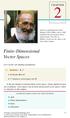 CHAPTER 2 American mathematician Paul Halmos (1916 2006), who in 1942 published the first modern linear algebra book. The title of Halmos s book was the same as the title of this chapter. Finite-Dimensional
Discrete Mathematics, Chapter 4: Number Theory and Cryptography
 Discrete Mathematics, Chapter 4: Number Theory and Cryptography Richard Mayr University of Edinburgh, UK Richard Mayr (University of Edinburgh, UK) Discrete Mathematics. Chapter 4 1 / 35 Outline 1 Divisibility
14.1 Rent-or-buy problem
 CS787: Advanced Algorithms Lecture 14: Online algorithms We now shift focus to a different kind of algorithmic problem where we need to perform some optimization without knowing the input in advance. Algorithms
FACTORING POLYNOMIALS IN THE RING OF FORMAL POWER SERIES OVER Z
 FACTORING POLYNOMIALS IN THE RING OF FORMAL POWER SERIES OVER Z DANIEL BIRMAJER, JUAN B GIL, AND MICHAEL WEINER Abstract We consider polynomials with integer coefficients and discuss their factorization
Math 319 Problem Set #3 Solution 21 February 2002
 Math 319 Problem Set #3 Solution 21 February 2002 1. ( 2.1, problem 15) Find integers a 1, a 2, a 3, a 4, a 5 such that every integer x satisfies at least one of the congruences x a 1 (mod 2), x a 2 (mod
Solving Systems of Linear Equations
 LECTURE 5 Solving Systems of Linear Equations Recall that we introduced the notion of matrices as a way of standardizing the expression of systems of linear equations In today s lecture I shall show how
Handout NUMBER THEORY
 Handout of NUMBER THEORY by Kus Prihantoso Krisnawan MATHEMATICS DEPARTMENT FACULTY OF MATHEMATICS AND NATURAL SCIENCES YOGYAKARTA STATE UNIVERSITY 2012 Contents Contents i 1 Some Preliminary Considerations
1 if 1 x 0 1 if 0 x 1
 Chapter 3 Continuity In this chapter we begin by defining the fundamental notion of continuity for real valued functions of a single real variable. When trying to decide whether a given function is or
k, then n = p2α 1 1 pα k
 Powers of Integers An integer n is a perfect square if n = m for some integer m. Taking into account the prime factorization, if m = p α 1 1 pα k k, then n = pα 1 1 p α k k. That is, n is a perfect square
Discrete Mathematics and Probability Theory Fall 2009 Satish Rao, David Tse Note 2
 CS 70 Discrete Mathematics and Probability Theory Fall 2009 Satish Rao, David Tse Note 2 Proofs Intuitively, the concept of proof should already be familiar We all like to assert things, and few of us
C H A P T E R Regular Expressions regular expression
 7 CHAPTER Regular Expressions Most programmers and other power-users of computer systems have used tools that match text patterns. You may have used a Web search engine with a pattern like travel cancun
Solution to Homework 2
 Solution to Homework 2 Olena Bormashenko September 23, 2011 Section 1.4: 1(a)(b)(i)(k), 4, 5, 14; Section 1.5: 1(a)(b)(c)(d)(e)(n), 2(a)(c), 13, 16, 17, 18, 27 Section 1.4 1. Compute the following, if
SUM OF TWO SQUARES JAHNAVI BHASKAR
 SUM OF TWO SQUARES JAHNAVI BHASKAR Abstract. I will investigate which numbers can be written as the sum of two squares and in how many ways, providing enough basic number theory so even the unacquainted
Operations on ideals in polynomial rings
 U.U.D.M. Project Report 2014:5 Operations on ideals in polynomial rings Christofer Östlin Examensarbete i matematik, 15 hp Handledare och examinator: Veronica Crispin Februari 2014 Department of Mathematics
The Goldberg Rao Algorithm for the Maximum Flow Problem
 The Goldberg Rao Algorithm for the Maximum Flow Problem COS 528 class notes October 18, 2006 Scribe: Dávid Papp Main idea: use of the blocking flow paradigm to achieve essentially O(min{m 2/3, n 1/2 }
1 Homework 1. [p 0 q i+j +... + p i 1 q j+1 ] + [p i q j ] + [p i+1 q j 1 +... + p i+j q 0 ]
![1 Homework 1. [p 0 q i+j +... + p i 1 q j+1 ] + [p i q j ] + [p i+1 q j 1 +... + p i+j q 0 ]](/thumbs/40/21231772.jpg "1 Homework 1. [p 0 q i+j +... + p i 1 q j+1 ] + [p i q j ] + [p i+1 q j 1 +... + p i+j q 0 ]") 1 Homework 1 (1) Prove the ideal (3,x) is a maximal ideal in Z[x]. SOLUTION: Suppose we expand this ideal by including another generator polynomial, P / (3, x). Write P = n + x Q with n an integer not
1 Homework 1 (1) Prove the ideal (3,x) is a maximal ideal in Z[x]. SOLUTION: Suppose we expand this ideal by including another generator polynomial, P / (3, x). Write P = n + x Q with n an integer not
Every Positive Integer is the Sum of Four Squares! (and other exciting problems)
 Every Positive Integer is the Sum of Four Squares! (and other exciting problems) Sophex University of Texas at Austin October 18th, 00 Matilde N. Lalín 1. Lagrange s Theorem Theorem 1 Every positive integer
2.1 Complexity Classes
 15-859(M): Randomized Algorithms Lecturer: Shuchi Chawla Topic: Complexity classes, Identity checking Date: September 15, 2004 Scribe: Andrew Gilpin 2.1 Complexity Classes In this lecture we will look
How To Prove The Dirichlet Unit Theorem
 Chapter 6 The Dirichlet Unit Theorem As usual, we will be working in the ring B of algebraic integers of a number field L. Two factorizations of an element of B are regarded as essentially the same if
The last three chapters introduced three major proof techniques: direct,
 CHAPTER 7 Proving Non-Conditional Statements The last three chapters introduced three major proof techniques: direct, contrapositive and contradiction. These three techniques are used to prove statements
Math 223 Abstract Algebra Lecture Notes
 Math 223 Abstract Algebra Lecture Notes Steven Tschantz Spring 2001 (Apr. 23 version) Preamble These notes are intended to supplement the lectures and make up for the lack of a textbook for the course
Basic Algorithms In Computer Algebra
 Basic Algorithms In Computer Algebra Kaiserslautern SS 2011 Prof. Dr. Wolfram Decker 2. Mai 2011 References Cohen, H.: A Course in Computational Algebraic Number Theory. Springer, 1993. Cox, D.; Little,
Applied Algorithm Design Lecture 5
 Applied Algorithm Design Lecture 5 Pietro Michiardi Eurecom Pietro Michiardi (Eurecom) Applied Algorithm Design Lecture 5 1 / 86 Approximation Algorithms Pietro Michiardi (Eurecom) Applied Algorithm Design
Short Programs for functions on Curves
 Short Programs for functions on Curves Victor S. Miller Exploratory Computer Science IBM, Thomas J. Watson Research Center Yorktown Heights, NY 10598 May 6, 1986 Abstract The problem of deducing a function
The Division Algorithm for Polynomials Handout Monday March 5, 2012
 The Division Algorithm for Polynomials Handout Monday March 5, 0 Let F be a field (such as R, Q, C, or F p for some prime p. This will allow us to divide by any nonzero scalar. (For some of the following,