
COMP 250 Fall 2012 lecture 2 binary representations Sept. 11, 2012
|
|
|
- Rose Maxwell
- 9 years ago
- Views:
Transcription
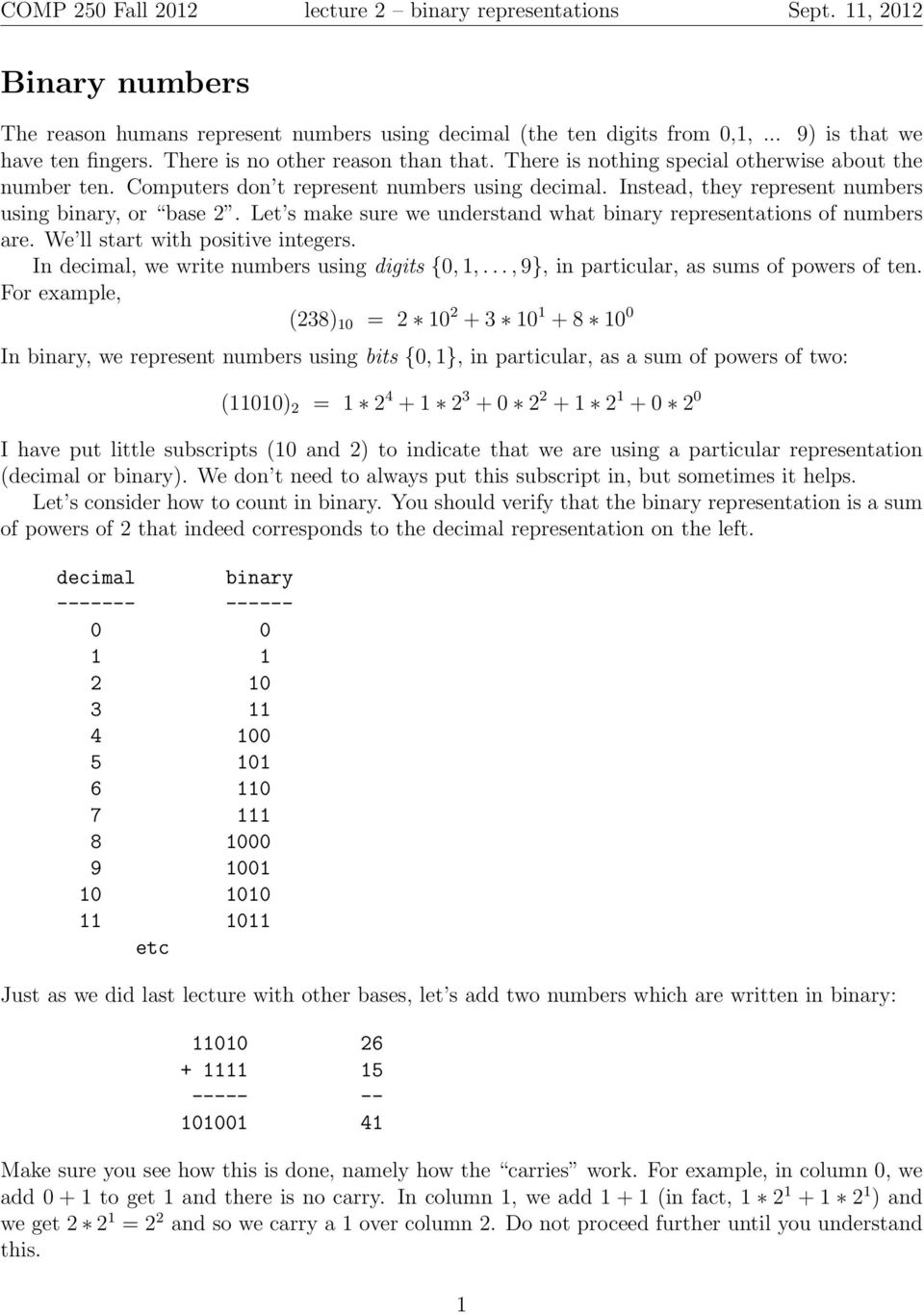
1 Binary numbers The reason humans represent numbers using decimal (the ten digits from 0,1,... 9) is that we have ten fingers. There is no other reason than that. There is nothing special otherwise about the number ten. Computers don t represent numbers using decimal. Instead, they represent numbers using binary, or base 2. Let s make sure we understand what binary representations of numbers are. We ll start with positive integers. In decimal, we write numbers using digits {0, 1,..., 9}, in particular, as sums of powers of ten. For example, (238) 10 = In binary, we represent numbers using bits {0, 1}, in particular, as a sum of powers of two: (11010) 2 = I have put little subscripts (10 and 2) to indicate that we are using a particular representation (decimal or binary). We don t need to always put this subscript in, but sometimes it helps. Let s consider how to count in binary. You should verify that the binary representation is a sum of powers of 2 that indeed corresponds to the decimal representation on the left. decimal binary etc Just as we did last lecture with other bases, let s add two numbers which are written in binary: Make sure you see how this is done, namely how the carries work. For example, in column 0, we add to get 1 and there is no carry. In column 1, we add (in fact, ) and we get = 2 2 and so we carry a 1 over column 2. Do not proceed further until you understand this. 1
2 Converting from decimal to binary It is trivial to convert a number from a binary representation to a decimal representation. You just need to know the decimal representation of the various powers of = 1, 2 1 = 2, 2 2 = 4, 2 3 = 8, 2 4 = 16, 2 5 = 32, 2 6 = 64, 2 7 = 128, 2 8 = 256, 2 9 = 512, 2 10 = 1024,... Then, for any binary number, you write each of its bits as a power of 2 (in decimal) and then you add up these decimal numbers, e.g = = 26. The other direction is more challenging. How do you convert from a decimal number to a binary number? Here is an algorithm for doing so which is so simple you could have learned it in grade school. The algorithm repeatedly divides by 2 and the remainder bits give us the binary representation. Recall that / is the integer division operation which ignores the remainder i.e. fractions. If you want the remainder of the division, use % which is sometimes called the mod (or modulus) operator. Algorithm 1 Convert decimal to binary INPUT: a number m expressed in base 10 (decimal) OUTPUT: the number m expressed in base 2 using a bit array b[ ] i 0 while m > 0 do b[i] m%2 m m/2 i i + 1 end while Example: Convert 241 to binary i m b[ ] : : 2
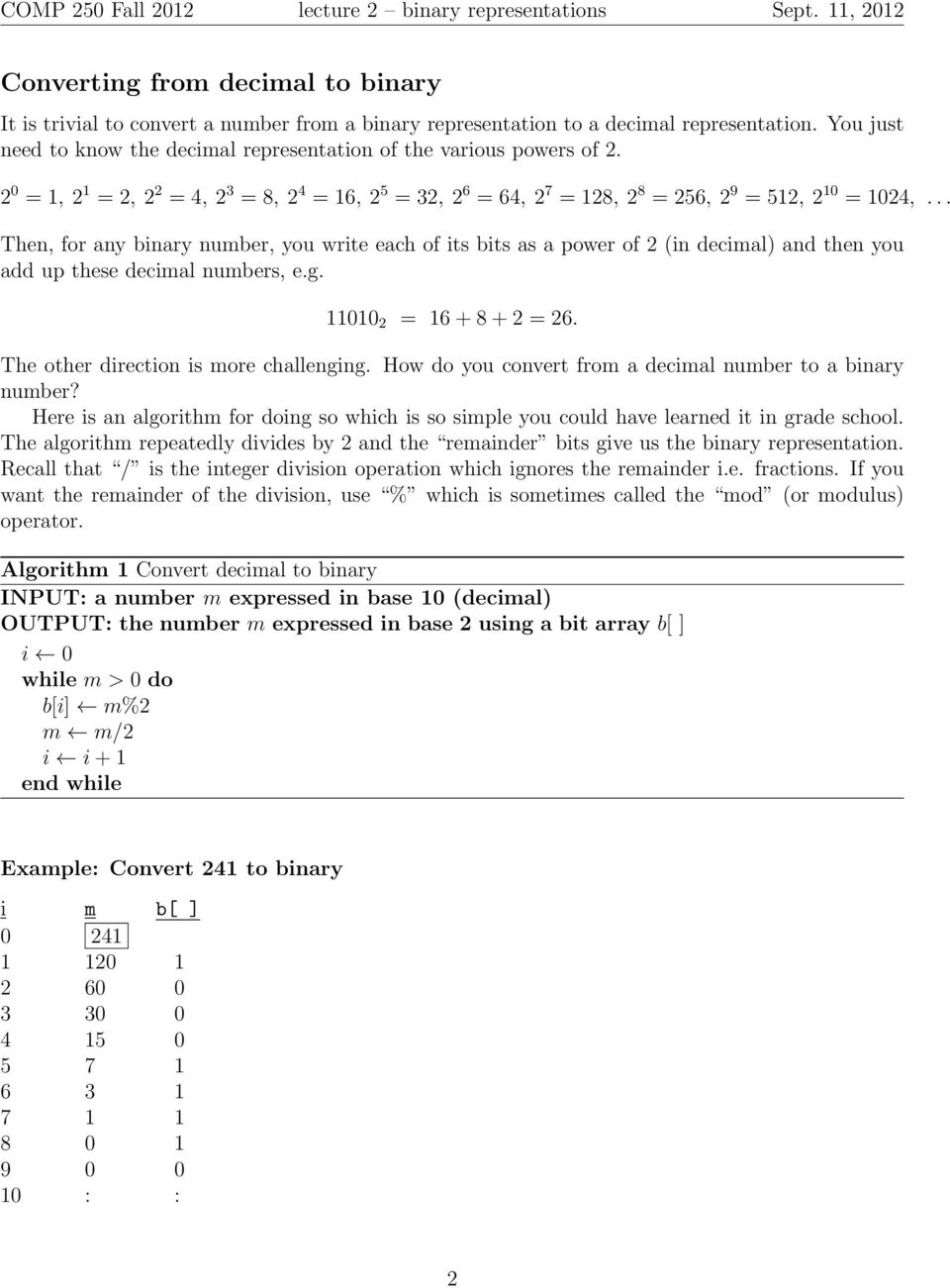
3 and so (241) 10 = ( ) 2. Note that there are an infinite number of 0 s on the left which are higher powers of 2 which we ignore. What does this algorithm work? To answer this question, it helps to recall a few properties of multiplication and division. Let s go back to base 10 where we have a better intuition. Suppose we have a positive integer m which is written in decimal (as a sum of powers of 10) and we then multiply m by 10. There is a simple way to get the result, 10 m, namely shift the digits left by one place and put a 0 in the rightmost position. So, = 2380 and the reason is = ( ) 10 = Similarly, to divide a number m by 10, we shift the digits to the right 238/10 = ( )/10 = We have dropped the rightmost digit 8 (which becomes the remainder) since we are doing integer division, and thus ignoring terms with negative powers of 10 i.e In binary, the same idea holds. If we represent a number m in binary and multiply by 2, we shift the bits to the left by one position and put a 0 in the rightmost position. So, e.g. if then multiplying by 2 gives m = (11010) 2 = (110100) 2 = If we divide by 2, then we shift right by one position and drop the rightmost bit (which becomes the remainder). Let s put the left shift and right shifts together. For any positive integer m, we can write for example, m = 10 (m/10) + (m%10), 549 = = 10 (549/10) + (549 % 10). More generally, for any positive integer call it base we can write and in particular, in binary we use base = 2, so m = base (m/base) + (m % base), m = 2 (m/2) + (m % 2). Now let s apply these ideas to the algorithm. Representing a positive integer m in binary means that we write it m = n 1 i=0 b i 2 i 3
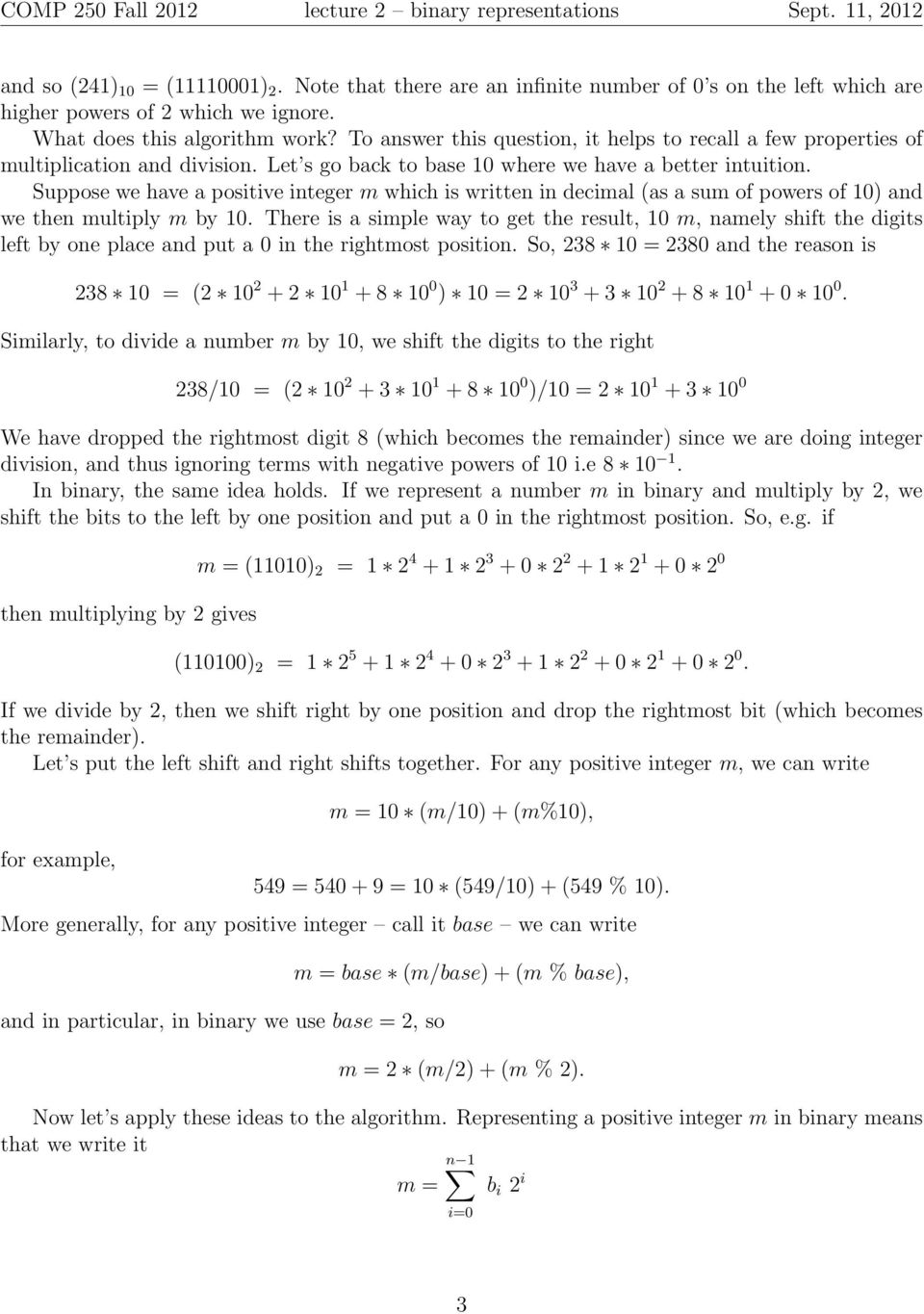
4 where b i is a bit, i.e either 0 or 1. So we write m in binary as a bit sequence (b n 1 b n 2... b 2 b 1 b 0 ). In particular, m % 2 = b 0 m / 2 = (b n 1... b 2 b 1 ) Thus, the algorithm essentially just uses repeated division and mod to read off the bits of the binary representation of the number. If you are still not convinced, let s run another example where we know the answer from the start and we ll see that the algorithm does the correct thing. Suppose our number is m = 241, which is ( ) 2 in binary. i m b[i] and so the remainders are just the bits used in the binary representation of the number. Interestingly, the same algorithm works for any base. For example, let s convert 238 from decimal to base 5, that is, let s write 238 as a sum of powers of 5. We apply the same algorithm as earlier but now we divide by 5 at each step and take the remainder and so (238) 10 = (1423) 5. Verify this by converting the latter back into decimal by summing powers of 5. Binary fractions Up to now we have only talked about integers. We next talk about binary representations of fractional numbers, that is, numbers that lie between the integers. Take a decimal number such as We write this as: The. is called the decimal point. (26.375) 10 =
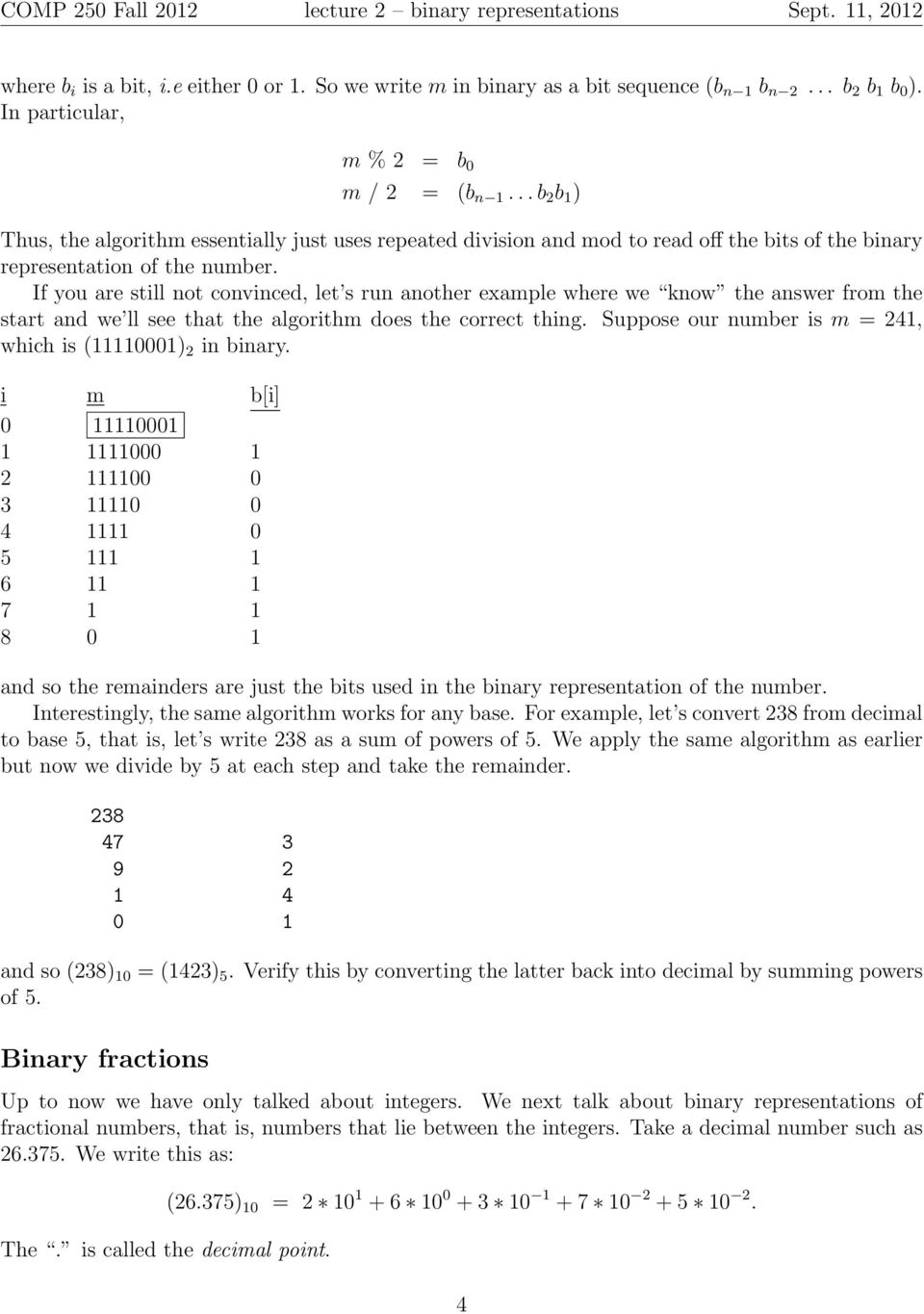
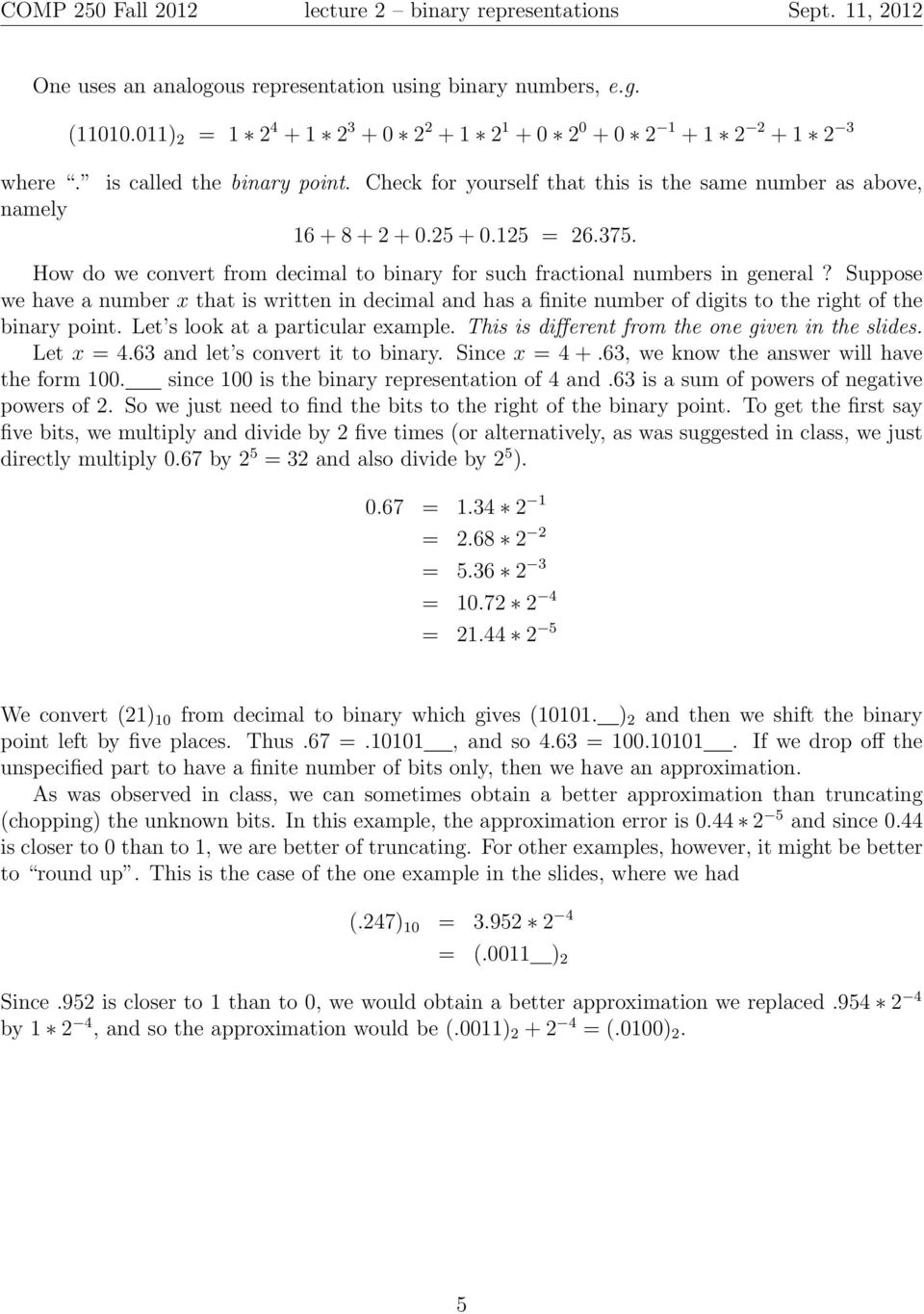
5 One uses an analogous representation using binary numbers, e.g. ( ) 2 = where. is called the binary point. Check for yourself that this is the same number as above, namely = How do we convert from decimal to binary for such fractional numbers in general? Suppose we have a number x that is written in decimal and has a finite number of digits to the right of the binary point. Let s look at a particular example. This is different from the one given in the slides. Let x = 4.63 and let s convert it to binary. Since x = , we know the answer will have the form 100. since 100 is the binary representation of 4 and.63 is a sum of powers of negative powers of 2. So we just need to find the bits to the right of the binary point. To get the first say five bits, we multiply and divide by 2 five times (or alternatively, as was suggested in class, we just directly multiply 0.67 by 2 5 = 32 and also divide by 2 5 ) = = = = = We convert (21) 10 from decimal to binary which gives ( ) 2 and then we shift the binary point left by five places. Thus.67 =.10101, and so 4.63 = If we drop off the unspecified part to have a finite number of bits only, then we have an approximation. As was observed in class, we can sometimes obtain a better approximation than truncating (chopping) the unknown bits. In this example, the approximation error is and since 0.44 is closer to 0 than to 1, we are better of truncating. For other examples, however, it might be better to round up. This is the case of the one example in the slides, where we had (.247) 10 = = (.0011 ) 2 Since.952 is closer to 1 than to 0, we would obtain a better approximation we replaced by 1 2 4, and so the approximation would be (.0011) = (.0100) 2. 5
Binary Number System. 16. Binary Numbers. Base 10 digits: 0 1 2 3 4 5 6 7 8 9. Base 2 digits: 0 1
 Binary Number System 1 Base 10 digits: 0 1 2 3 4 5 6 7 8 9 Base 2 digits: 0 1 Recall that in base 10, the digits of a number are just coefficients of powers of the base (10): 417 = 4 * 10 2 + 1 * 10 1
NUMBER SYSTEMS. William Stallings
 NUMBER SYSTEMS William Stallings The Decimal System... The Binary System...3 Converting between Binary and Decimal...3 Integers...4 Fractions...5 Hexadecimal Notation...6 This document available at WilliamStallings.com/StudentSupport.html
6 3 4 9 = 6 10 + 3 10 + 4 10 + 9 10
 Lesson The Binary Number System. Why Binary? The number system that you are familiar with, that you use every day, is the decimal number system, also commonly referred to as the base- system. When you
Computer Science 281 Binary and Hexadecimal Review
 Computer Science 281 Binary and Hexadecimal Review 1 The Binary Number System Computers store everything, both instructions and data, by using many, many transistors, each of which can be in one of two
CSI 333 Lecture 1 Number Systems
 CSI 333 Lecture 1 Number Systems 1 1 / 23 Basics of Number Systems Ref: Appendix C of Deitel & Deitel. Weighted Positional Notation: 192 = 2 10 0 + 9 10 1 + 1 10 2 General: Digit sequence : d n 1 d n 2...
Binary Adders: Half Adders and Full Adders
 Binary Adders: Half Adders and Full Adders In this set of slides, we present the two basic types of adders: 1. Half adders, and 2. Full adders. Each type of adder functions to add two binary bits. In order
Lecture 2. Binary and Hexadecimal Numbers
 Lecture 2 Binary and Hexadecimal Numbers Purpose: Review binary and hexadecimal number representations Convert directly from one base to another base Review addition and subtraction in binary representations
Useful Number Systems
 Useful Number Systems Decimal Base = 10 Digit Set = {0, 1, 2, 3, 4, 5, 6, 7, 8, 9} Binary Base = 2 Digit Set = {0, 1} Octal Base = 8 = 2 3 Digit Set = {0, 1, 2, 3, 4, 5, 6, 7} Hexadecimal Base = 16 = 2
1. Give the 16 bit signed (twos complement) representation of the following decimal numbers, and convert to hexadecimal:
 Exercises 1 - number representations Questions 1. Give the 16 bit signed (twos complement) representation of the following decimal numbers, and convert to hexadecimal: (a) 3012 (b) - 435 2. For each of
Session 7 Fractions and Decimals
 Key Terms in This Session Session 7 Fractions and Decimals Previously Introduced prime number rational numbers New in This Session period repeating decimal terminating decimal Introduction In this session,
THE BINARY NUMBER SYSTEM
 THE BINARY NUMBER SYSTEM Dr. Robert P. Webber, Longwood University Our civilization uses the base 10 or decimal place value system. Each digit in a number represents a power of 10. For example, 365.42
6.4 Normal Distribution
 Contents 6.4 Normal Distribution....................... 381 6.4.1 Characteristics of the Normal Distribution....... 381 6.4.2 The Standardized Normal Distribution......... 385 6.4.3 Meaning of Areas under
MATH10212 Linear Algebra. Systems of Linear Equations. Definition. An n-dimensional vector is a row or a column of n numbers (or letters): a 1.
 MATH10212 Linear Algebra Textbook: D. Poole, Linear Algebra: A Modern Introduction. Thompson, 2006. ISBN 0-534-40596-7. Systems of Linear Equations Definition. An n-dimensional vector is a row or a column
Digital System Design Prof. D Roychoudhry Department of Computer Science and Engineering Indian Institute of Technology, Kharagpur
 Digital System Design Prof. D Roychoudhry Department of Computer Science and Engineering Indian Institute of Technology, Kharagpur Lecture - 04 Digital Logic II May, I before starting the today s lecture
To convert an arbitrary power of 2 into its English equivalent, remember the rules of exponential arithmetic:
 Binary Numbers In computer science we deal almost exclusively with binary numbers. it will be very helpful to memorize some binary constants and their decimal and English equivalents. By English equivalents
Unit 1 Number Sense. In this unit, students will study repeating decimals, percents, fractions, decimals, and proportions.
 Unit 1 Number Sense In this unit, students will study repeating decimals, percents, fractions, decimals, and proportions. BLM Three Types of Percent Problems (p L-34) is a summary BLM for the material
Number Systems and Radix Conversion
 Number Systems and Radix Conversion Sanjay Rajopadhye, Colorado State University 1 Introduction These notes for CS 270 describe polynomial number systems. The material is not in the textbook, but will
Solutions of Linear Equations in One Variable
 2. Solutions of Linear Equations in One Variable 2. OBJECTIVES. Identify a linear equation 2. Combine like terms to solve an equation We begin this chapter by considering one of the most important tools
Base Conversion written by Cathy Saxton
 Base Conversion written by Cathy Saxton 1. Base 10 In base 10, the digits, from right to left, specify the 1 s, 10 s, 100 s, 1000 s, etc. These are powers of 10 (10 x ): 10 0 = 1, 10 1 = 10, 10 2 = 100,
Fractions to decimals
 Worksheet.4 Fractions and Decimals Section Fractions to decimals The most common method of converting fractions to decimals is to use a calculator. A fraction represents a division so is another way of
Pre-Algebra Lecture 6
 Pre-Algebra Lecture 6 Today we will discuss Decimals and Percentages. Outline: 1. Decimals 2. Ordering Decimals 3. Rounding Decimals 4. Adding and subtracting Decimals 5. Multiplying and Dividing Decimals
Activity 1: Using base ten blocks to model operations on decimals
 Rational Numbers 9: Decimal Form of Rational Numbers Objectives To use base ten blocks to model operations on decimal numbers To review the algorithms for addition, subtraction, multiplication and division
YOU MUST BE ABLE TO DO THE FOLLOWING PROBLEMS WITHOUT A CALCULATOR!
 DETAILED SOLUTIONS AND CONCEPTS - DECIMALS AND WHOLE NUMBERS Prepared by Ingrid Stewart, Ph.D., College of Southern Nevada Please Send Questions and Comments to [email protected]. Thank you! YOU MUST
3. Convert a number from one number system to another
 3. Convert a number from one number system to another Conversion between number bases: Hexa (16) Decimal (10) Binary (2) Octal (8) More Interest Way we need conversion? We need decimal system for real
Oct: 50 8 = 6 (r = 2) 6 8 = 0 (r = 6) Writing the remainders in reverse order we get: (50) 10 = (62) 8
 ECE Department Summer LECTURE #5: Number Systems EEL : Digital Logic and Computer Systems Based on lecture notes by Dr. Eric M. Schwartz Decimal Number System: -Our standard number system is base, also
This Unit: Floating Point Arithmetic. CIS 371 Computer Organization and Design. Readings. Floating Point (FP) Numbers
 This Unit: Floating Point Arithmetic CIS 371 Computer Organization and Design Unit 7: Floating Point App App App System software Mem CPU I/O Formats Precision and range IEEE 754 standard Operations Addition
1. The Fly In The Ointment
 Arithmetic Revisited Lesson 5: Decimal Fractions or Place Value Extended Part 5: Dividing Decimal Fractions, Part 2. The Fly In The Ointment The meaning of, say, ƒ 2 doesn't depend on whether we represent
Addition Methods. Methods Jottings Expanded Compact Examples 8 + 7 = 15
 Addition Methods Methods Jottings Expanded Compact Examples 8 + 7 = 15 48 + 36 = 84 or: Write the numbers in columns. Adding the tens first: 47 + 76 110 13 123 Adding the units first: 47 + 76 13 110 123
Binary Division. Decimal Division. Hardware for Binary Division. Simple 16-bit Divider Circuit
 Decimal Division Remember 4th grade long division? 43 // quotient 12 521 // divisor dividend -480 41-36 5 // remainder Shift divisor left (multiply by 10) until MSB lines up with dividend s Repeat until
5.4 Solving Percent Problems Using the Percent Equation
 5. Solving Percent Problems Using the Percent Equation In this section we will develop and use a more algebraic equation approach to solving percent equations. Recall the percent proportion from the last
NUMBER SYSTEMS. 1.1 Introduction
 NUMBER SYSTEMS 1.1 Introduction There are several number systems which we normally use, such as decimal, binary, octal, hexadecimal, etc. Amongst them we are most familiar with the decimal number system.
Recall the process used for adding decimal numbers. 1. Place the numbers to be added in vertical format, aligning the decimal points.
 2 MODULE 4. DECIMALS 4a Decimal Arithmetic Adding Decimals Recall the process used for adding decimal numbers. Adding Decimals. To add decimal numbers, proceed as follows: 1. Place the numbers to be added
1 Description of The Simpletron
 Simulating The Simpletron Computer 50 points 1 Description of The Simpletron In this assignment you will write a program to simulate a fictional computer that we will call the Simpletron. As its name implies
Discrete Mathematics and Probability Theory Fall 2009 Satish Rao, David Tse Note 2
 CS 70 Discrete Mathematics and Probability Theory Fall 2009 Satish Rao, David Tse Note 2 Proofs Intuitively, the concept of proof should already be familiar We all like to assert things, and few of us
We can express this in decimal notation (in contrast to the underline notation we have been using) as follows: 9081 + 900b + 90c = 9001 + 100c + 10b
 In this session, we ll learn how to solve problems related to place value. This is one of the fundamental concepts in arithmetic, something every elementary and middle school mathematics teacher should
Positional Numbering System
 APPENDIX B Positional Numbering System A positional numbering system uses a set of symbols. The value that each symbol represents, however, depends on its face value and its place value, the value associated
The Graphical Method: An Example
 The Graphical Method: An Example Consider the following linear program: Maximize 4x 1 +3x 2 Subject to: 2x 1 +3x 2 6 (1) 3x 1 +2x 2 3 (2) 2x 2 5 (3) 2x 1 +x 2 4 (4) x 1, x 2 0, where, for ease of reference,
Number Conversions Dr. Sarita Agarwal (Acharya Narendra Dev College,University of Delhi)
 Conversions Dr. Sarita Agarwal (Acharya Narendra Dev College,University of Delhi) INTRODUCTION System- A number system defines a set of values to represent quantity. We talk about the number of people
Binary Representation. Number Systems. Base 10, Base 2, Base 16. Positional Notation. Conversion of Any Base to Decimal.
 Binary Representation The basis of all digital data is binary representation. Binary - means two 1, 0 True, False Hot, Cold On, Off We must be able to handle more than just values for real world problems
Lecture 11: Number Systems
 Lecture 11: Number Systems Numeric Data Fixed point Integers (12, 345, 20567 etc) Real fractions (23.45, 23., 0.145 etc.) Floating point such as 23. 45 e 12 Basically an exponent representation Any number
23. RATIONAL EXPONENTS
 23. RATIONAL EXPONENTS renaming radicals rational numbers writing radicals with rational exponents When serious work needs to be done with radicals, they are usually changed to a name that uses exponents,
Stanford Math Circle: Sunday, May 9, 2010 Square-Triangular Numbers, Pell s Equation, and Continued Fractions
 Stanford Math Circle: Sunday, May 9, 00 Square-Triangular Numbers, Pell s Equation, and Continued Fractions Recall that triangular numbers are numbers of the form T m = numbers that can be arranged in
Today. Binary addition Representing negative numbers. Andrew H. Fagg: Embedded Real- Time Systems: Binary Arithmetic
 Today Binary addition Representing negative numbers 2 Binary Addition Consider the following binary numbers: 0 0 1 0 0 1 1 0 0 0 1 0 1 0 1 1 How do we add these numbers? 3 Binary Addition 0 0 1 0 0 1 1
LSN 2 Number Systems. ECT 224 Digital Computer Fundamentals. Department of Engineering Technology
 LSN 2 Number Systems Department of Engineering Technology LSN 2 Decimal Number System Decimal number system has 10 digits (0-9) Base 10 weighting system... 10 5 10 4 10 3 10 2 10 1 10 0. 10-1 10-2 10-3
CS321. Introduction to Numerical Methods
 CS3 Introduction to Numerical Methods Lecture Number Representations and Errors Professor Jun Zhang Department of Computer Science University of Kentucky Lexington, KY 40506-0633 August 7, 05 Number in
Basic Proof Techniques
 Basic Proof Techniques David Ferry [email protected] September 13, 010 1 Four Fundamental Proof Techniques When one wishes to prove the statement P Q there are four fundamental approaches. This document
a 11 x 1 + a 12 x 2 + + a 1n x n = b 1 a 21 x 1 + a 22 x 2 + + a 2n x n = b 2.
 Chapter 1 LINEAR EQUATIONS 1.1 Introduction to linear equations A linear equation in n unknowns x 1, x,, x n is an equation of the form a 1 x 1 + a x + + a n x n = b, where a 1, a,..., a n, b are given
Lecture 13 - Basic Number Theory.
 Lecture 13 - Basic Number Theory. Boaz Barak March 22, 2010 Divisibility and primes Unless mentioned otherwise throughout this lecture all numbers are non-negative integers. We say that A divides B, denoted
Chapter 7 Lab - Decimal, Binary, Octal, Hexadecimal Numbering Systems
 Chapter 7 Lab - Decimal, Binary, Octal, Hexadecimal Numbering Systems This assignment is designed to familiarize you with different numbering systems, specifically: binary, octal, hexadecimal (and decimal)
MATRIX ALGEBRA AND SYSTEMS OF EQUATIONS
 MATRIX ALGEBRA AND SYSTEMS OF EQUATIONS Systems of Equations and Matrices Representation of a linear system The general system of m equations in n unknowns can be written a x + a 2 x 2 + + a n x n b a
Normal distribution. ) 2 /2σ. 2π σ
 Normal distribution The normal distribution is the most widely known and used of all distributions. Because the normal distribution approximates many natural phenomena so well, it has developed into a
Number Representation
 Number Representation CS10001: Programming & Data Structures Pallab Dasgupta Professor, Dept. of Computer Sc. & Engg., Indian Institute of Technology Kharagpur Topics to be Discussed How are numeric data
Continued Fractions and the Euclidean Algorithm
 Continued Fractions and the Euclidean Algorithm Lecture notes prepared for MATH 326, Spring 997 Department of Mathematics and Statistics University at Albany William F Hammond Table of Contents Introduction
Preliminary Mathematics
 Preliminary Mathematics The purpose of this document is to provide you with a refresher over some topics that will be essential for what we do in this class. We will begin with fractions, decimals, and
Decimal Notations for Fractions Number and Operations Fractions /4.NF
 Decimal Notations for Fractions Number and Operations Fractions /4.NF Domain: Cluster: Standard: 4.NF Number and Operations Fractions Understand decimal notation for fractions, and compare decimal fractions.
Lecture 3: Finding integer solutions to systems of linear equations
 Lecture 3: Finding integer solutions to systems of linear equations Algorithmic Number Theory (Fall 2014) Rutgers University Swastik Kopparty Scribe: Abhishek Bhrushundi 1 Overview The goal of this lecture
Mathematical Induction
 Mathematical Induction In logic, we often want to prove that every member of an infinite set has some feature. E.g., we would like to show: N 1 : is a number 1 : has the feature Φ ( x)(n 1 x! 1 x) How
2010/9/19. Binary number system. Binary numbers. Outline. Binary to decimal
 2/9/9 Binary number system Computer (electronic) systems prefer binary numbers Binary number: represent a number in base-2 Binary numbers 2 3 + 7 + 5 Some terminology Bit: a binary digit ( or ) Hexadecimal
Grade 6 Math Circles. Binary and Beyond
 Faculty of Mathematics Waterloo, Ontario N2L 3G1 The Decimal System Grade 6 Math Circles October 15/16, 2013 Binary and Beyond The cool reality is that we learn to count in only one of many possible number
The string of digits 101101 in the binary number system represents the quantity
 Data Representation Section 3.1 Data Types Registers contain either data or control information Control information is a bit or group of bits used to specify the sequence of command signals needed for
8 Divisibility and prime numbers
 8 Divisibility and prime numbers 8.1 Divisibility In this short section we extend the concept of a multiple from the natural numbers to the integers. We also summarize several other terms that express
Every Positive Integer is the Sum of Four Squares! (and other exciting problems)
 Every Positive Integer is the Sum of Four Squares! (and other exciting problems) Sophex University of Texas at Austin October 18th, 00 Matilde N. Lalín 1. Lagrange s Theorem Theorem 1 Every positive integer
Solution to Exercise 2.2. Both m and n are divisible by d, som = dk and n = dk. Thus m ± n = dk ± dk = d(k ± k ),som + n and m n are divisible by d.
 [Chap. ] Pythagorean Triples 6 (b) The table suggests that in every primitive Pythagorean triple, exactly one of a, b,orc is a multiple of 5. To verify this, we use the Pythagorean Triples Theorem to write
Goals. Unary Numbers. Decimal Numbers. 3,148 is. 1000 s 100 s 10 s 1 s. Number Bases 1/12/2009. COMP370 Intro to Computer Architecture 1
 Number Bases //9 Goals Numbers Understand binary and hexadecimal numbers Be able to convert between number bases Understand binary fractions COMP37 Introduction to Computer Architecture Unary Numbers Decimal
Multiplying and Dividing Signed Numbers. Finding the Product of Two Signed Numbers. (a) (3)( 4) ( 4) ( 4) ( 4) 12 (b) (4)( 5) ( 5) ( 5) ( 5) ( 5) 20
 SECTION.4 Multiplying and Dividing Signed Numbers.4 OBJECTIVES 1. Multiply signed numbers 2. Use the commutative property of multiplication 3. Use the associative property of multiplication 4. Divide signed
26 Integers: Multiplication, Division, and Order
 26 Integers: Multiplication, Division, and Order Integer multiplication and division are extensions of whole number multiplication and division. In multiplying and dividing integers, the one new issue
Measures of Error: for exact x and approximation x Absolute error e = x x. Relative error r = (x x )/x.
 ERRORS and COMPUTER ARITHMETIC Types of Error in Numerical Calculations Initial Data Errors: from experiment, modeling, computer representation; problem dependent but need to know at beginning of calculation.
Binary, Hexadecimal, Octal, and BCD Numbers
 23CH_PHCalter_TMSETE_949118 23/2/2007 1:37 PM Page 1 Binary, Hexadecimal, Octal, and BCD Numbers OBJECTIVES When you have completed this chapter, you should be able to: Convert between binary and decimal
Math Review. Numbers. Place Value. Rounding Whole Numbers. Place value thousands hundreds tens ones
 Math Review Knowing basic math concepts and knowing when to apply them are essential skills. You should know how to add, subtract, multiply, divide, calculate percentages, and manipulate fractions. This
CS201: Architecture and Assembly Language
 CS201: Architecture and Assembly Language Lecture Three Brendan Burns CS201: Lecture Three p.1/27 Arithmetic for computers Previously we saw how we could represent unsigned numbers in binary and how binary
Chapter 11 Number Theory
 Chapter 11 Number Theory Number theory is one of the oldest branches of mathematics. For many years people who studied number theory delighted in its pure nature because there were few practical applications
3 Some Integer Functions
 3 Some Integer Functions A Pair of Fundamental Integer Functions The integer function that is the heart of this section is the modulo function. However, before getting to it, let us look at some very simple
Multiplication and Division with Rational Numbers
 Multiplication and Division with Rational Numbers Kitty Hawk, North Carolina, is famous for being the place where the first airplane flight took place. The brothers who flew these first flights grew up
8 Primes and Modular Arithmetic
 8 Primes and Modular Arithmetic 8.1 Primes and Factors Over two millennia ago already, people all over the world were considering the properties of numbers. One of the simplest concepts is prime numbers.
MATH 4330/5330, Fourier Analysis Section 11, The Discrete Fourier Transform
 MATH 433/533, Fourier Analysis Section 11, The Discrete Fourier Transform Now, instead of considering functions defined on a continuous domain, like the interval [, 1) or the whole real line R, we wish
Paramedic Program Pre-Admission Mathematics Test Study Guide
 Paramedic Program Pre-Admission Mathematics Test Study Guide 05/13 1 Table of Contents Page 1 Page 2 Page 3 Page 4 Page 5 Page 6 Page 7 Page 8 Page 9 Page 10 Page 11 Page 12 Page 13 Page 14 Page 15 Page
JobTestPrep's Numeracy Review Decimals & Percentages
 JobTestPrep's Numeracy Review Decimals & Percentages 1 Table of contents What is decimal? 3 Converting fractions to decimals 4 Converting decimals to fractions 6 Percentages 6 Adding and subtracting decimals
Digital Design. Assoc. Prof. Dr. Berna Örs Yalçın
 Digital Design Assoc. Prof. Dr. Berna Örs Yalçın Istanbul Technical University Faculty of Electrical and Electronics Engineering Office Number: 2318 E-mail: [email protected] Grading 1st Midterm -
2 Number Systems. Source: Foundations of Computer Science Cengage Learning. Objectives After studying this chapter, the student should be able to:
 2 Number Systems 2.1 Source: Foundations of Computer Science Cengage Learning Objectives After studying this chapter, the student should be able to: Understand the concept of number systems. Distinguish
EE 261 Introduction to Logic Circuits. Module #2 Number Systems
 EE 261 Introduction to Logic Circuits Module #2 Number Systems Topics A. Number System Formation B. Base Conversions C. Binary Arithmetic D. Signed Numbers E. Signed Arithmetic F. Binary Codes Textbook
3 Monomial orders and the division algorithm
 3 Monomial orders and the division algorithm We address the problem of deciding which term of a polynomial is the leading term. We noted above that, unlike in the univariate case, the total degree does
WRITING PROOFS. Christopher Heil Georgia Institute of Technology
 WRITING PROOFS Christopher Heil Georgia Institute of Technology A theorem is just a statement of fact A proof of the theorem is a logical explanation of why the theorem is true Many theorems have this
CSE 135: Introduction to Theory of Computation Decidability and Recognizability
 CSE 135: Introduction to Theory of Computation Decidability and Recognizability Sungjin Im University of California, Merced 04-28, 30-2014 High-Level Descriptions of Computation Instead of giving a Turing
Multiplication. Year 1 multiply with concrete objects, arrays and pictorial representations
 Year 1 multiply with concrete objects, arrays and pictorial representations Children will experience equal groups of objects and will count in 2s and 10s and begin to count in 5s. They will work on practical
COMPSCI 210. Binary Fractions. Agenda & Reading
 COMPSCI 21 Binary Fractions Agenda & Reading Topics: Fractions Binary Octal Hexadecimal Binary -> Octal, Hex Octal -> Binary, Hex Decimal -> Octal, Hex Hex -> Binary, Octal Animation: BinFrac.htm Example
Conversions between percents, decimals, and fractions
 Click on the links below to jump directly to the relevant section Conversions between percents, decimals and fractions Operations with percents Percentage of a number Percent change Conversions between
Chapter 2. Binary Values and Number Systems
 Chapter 2 Binary Values and Number Systems Numbers Natural numbers, a.k.a. positive integers Zero and any number obtained by repeatedly adding one to it. Examples: 100, 0, 45645, 32 Negative numbers A
Representation of functions as power series
 Representation of functions as power series Dr. Philippe B. Laval Kennesaw State University November 9, 008 Abstract This document is a summary of the theory and techniques used to represent functions
Clock Arithmetic and Modular Systems Clock Arithmetic The introduction to Chapter 4 described a mathematical system
 CHAPTER Number Theory FIGURE FIGURE FIGURE Plus hours Plus hours Plus hours + = + = + = FIGURE. Clock Arithmetic and Modular Systems Clock Arithmetic The introduction to Chapter described a mathematical
3.3 Addition and Subtraction of Rational Numbers
 3.3 Addition and Subtraction of Rational Numbers In this section we consider addition and subtraction of both fractions and decimals. We start with addition and subtraction of fractions with the same denominator.
Partial Fractions. p(x) q(x)
 Partial Fractions Introduction to Partial Fractions Given a rational function of the form p(x) q(x) where the degree of p(x) is less than the degree of q(x), the method of partial fractions seeks to break
Arkansas Tech University MATH 4033: Elementary Modern Algebra Dr. Marcel B. Finan
 Arkansas Tech University MATH 4033: Elementary Modern Algebra Dr. Marcel B. Finan 3 Binary Operations We are used to addition and multiplication of real numbers. These operations combine two real numbers
Divide: Paper & Pencil. Computer Architecture ALU Design : Division and Floating Point. Divide algorithm. DIVIDE HARDWARE Version 1
 Divide: Paper & Pencil Computer Architecture ALU Design : Division and Floating Point 1001 Quotient Divisor 1000 1001010 Dividend 1000 10 101 1010 1000 10 (or Modulo result) See how big a number can be
Section IV.1: Recursive Algorithms and Recursion Trees
 Section IV.1: Recursive Algorithms and Recursion Trees Definition IV.1.1: A recursive algorithm is an algorithm that solves a problem by (1) reducing it to an instance of the same problem with smaller
CS101 Lecture 11: Number Systems and Binary Numbers. Aaron Stevens 14 February 2011
 CS101 Lecture 11: Number Systems and Binary Numbers Aaron Stevens 14 February 2011 1 2 1 3!!! MATH WARNING!!! TODAY S LECTURE CONTAINS TRACE AMOUNTS OF ARITHMETIC AND ALGEBRA PLEASE BE ADVISED THAT CALCULTORS
Playing with Numbers
 PLAYING WITH NUMBERS 249 Playing with Numbers CHAPTER 16 16.1 Introduction You have studied various types of numbers such as natural numbers, whole numbers, integers and rational numbers. You have also
Indices and Surds. The Laws on Indices. 1. Multiplication: Mgr. ubomíra Tomková
 Indices and Surds The term indices refers to the power to which a number is raised. Thus x is a number with an index of. People prefer the phrase "x to the power of ". Term surds is not often used, instead
Lecture 8: Binary Multiplication & Division
 Lecture 8: Binary Multiplication & Division Today s topics: Addition/Subtraction Multiplication Division Reminder: get started early on assignment 3 1 2 s Complement Signed Numbers two = 0 ten 0001 two
Linear Programming. March 14, 2014
 Linear Programming March 1, 01 Parts of this introduction to linear programming were adapted from Chapter 9 of Introduction to Algorithms, Second Edition, by Cormen, Leiserson, Rivest and Stein [1]. 1
Handout #1: Mathematical Reasoning
 Math 101 Rumbos Spring 2010 1 Handout #1: Mathematical Reasoning 1 Propositional Logic A proposition is a mathematical statement that it is either true or false; that is, a statement whose certainty or