
A repeated measures concordance correlation coefficient
|
|
|
- Norma Johns
- 9 years ago
- Views:
Transcription
1 A repeated measures concordance correlation coefficient Presented by Yan Ma July 20,2007 1

2 The CCC measures agreement between two methods or time points by measuring the variation of their linear relationship from the 45 o line through the origin. (Lin (1989),A CCC to Evaluate Reproducibility, Biometrics). 2
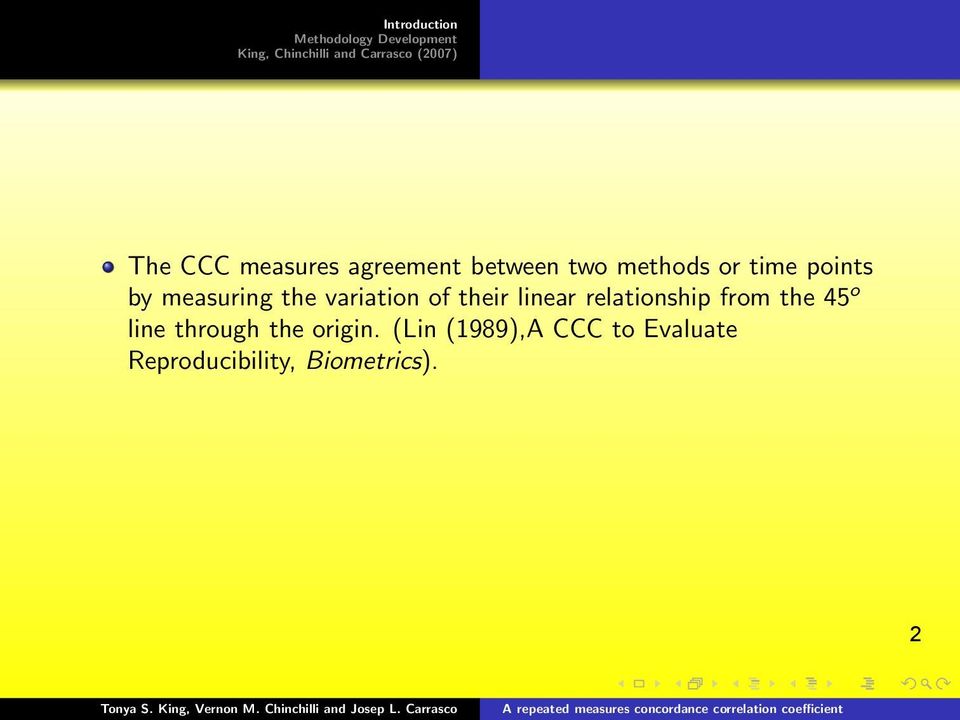
3 The CCC measures agreement between two methods or time points by measuring the variation of their linear relationship from the 45 o line through the origin. (Lin (1989),A CCC to Evaluate Reproducibility, Biometrics). Blood draw data example 3

4 Background Example (Y 1, Y 2 ) = {(1, 2.8), (2, 2.9), (3, 3), (4, 3.1), (5, 3.2)} Y Y1 4

5 Background Example (Y 1, Y 2 ) = {(1, 2.8), (2, 2.9), (3, 3), (4, 3.1), (5, 3.2)} t-test: H 0 : Means are equal. (p-value=1); 5

6 Background Example (Y 1, Y 2 ) = {(1, 2.8), (2, 2.9), (3, 3), (4, 3.1), (5, 3.2)} t-test: H 0 : Means are equal. (p-value=1); Pearson correlation coefficient=1; 6
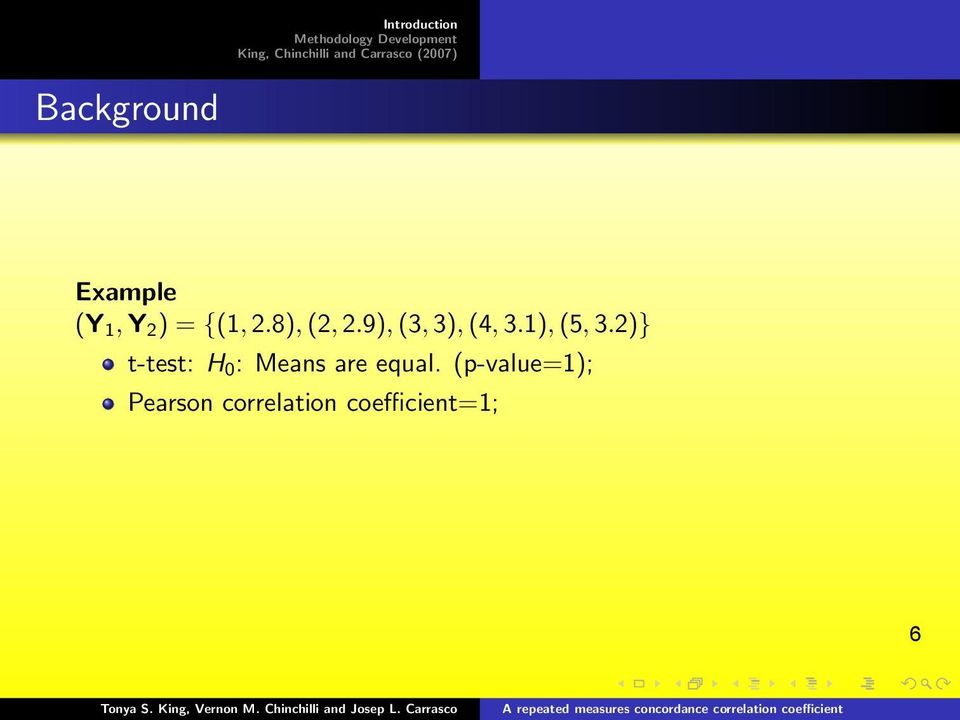
7 Background Example (Y 1, Y 2 ) = {(1, 2.8), (2, 2.9), (3, 3), (4, 3.1), (5, 3.2)} t-test: H 0 : Means are equal. (p-value=1); Pearson correlation coefficient=1; Kendall s tau =1; 7

8 Background Example (Y 1, Y 2 ) = {(1, 2.8), (2, 2.9), (3, 3), (4, 3.1), (5, 3.2)} t-test: H 0 : Means are equal. (p-value=1); Pearson correlation coefficient=1; Kendall s tau =1; Spearman s rho=1. 8

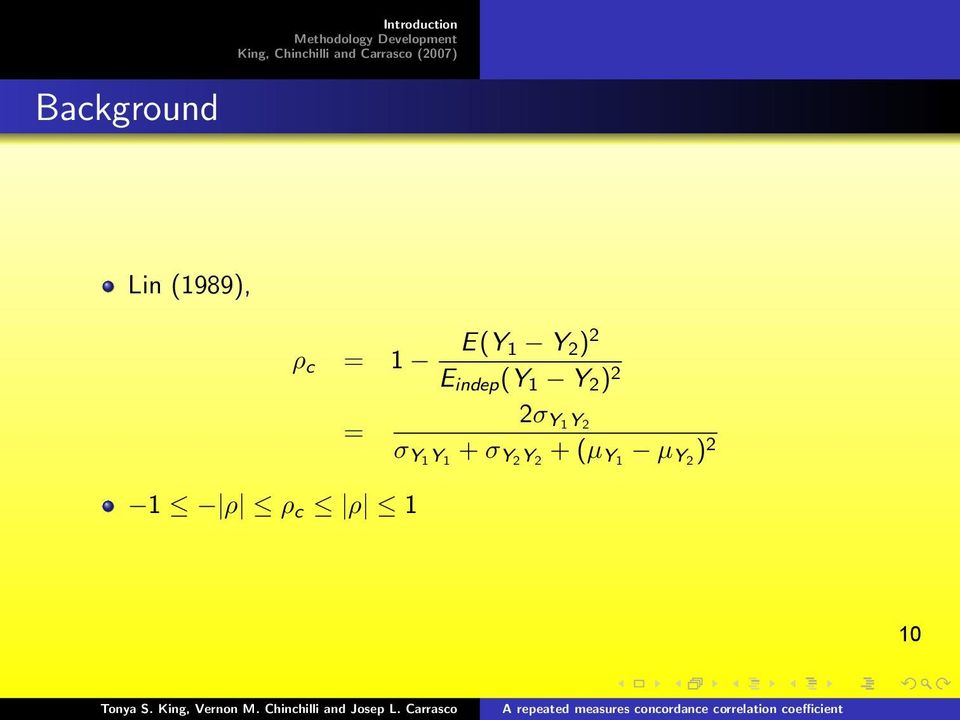
9 Background Lin (1989), ρ c = 1 E(Y 1 Y 2 ) 2 E indep (Y 1 Y 2 ) 2 = 2σ Y1Y 2 σ Y1Y 1 + σ Y2Y 2 + (µ Y1 µ Y2 ) 2 9

10 Background Lin (1989), ρ c = 1 E(Y 1 Y 2 ) 2 E indep (Y 1 Y 2 ) 2 = 2σ Y1Y 2 σ Y1Y 1 + σ Y2Y 2 + (µ Y1 µ Y2 ) 2 1 ρ ρ c ρ 1 10
11 ρ c = ρc b where C b = [(v + 1/v + u 2 )/2] 1, v = σ 1 /σ 2, u = (µ 1 µ 2 )/ σ 1 σ 2. 11
![)/2] 1, v = σ 1 /σ 2,](/docs-images/46/21516964/images/page_11.jpg "u = (µ 1 µ 2 )/ σ 1 σ")
12 ρ c = ρc b where C b = [(v + 1/v + u 2 )/2] 1, v = σ 1 /σ 2, u = (µ 1 µ 2 )/ σ 1 σ 2. ˆρ c =

13 Table 1: A comparison of CCC, Pearson CC, Kendall s tau and Spearman s rho Ex1. (Y 1, Y 2 ) = {(1, 2.8), (2, 2.9), (3, 3), (4, 3.1), (5, 3.2)} Ex2. (Y 1, Y 2 ) = {(1, 21), (2, 22), (3, 23), (4, 24), (5, 25)} Ex3. (Y 1, Y 2 ) = {(1, 1), (2, 12), (3, 93), (4, 124), (5, 95)} Example CCC Pearson CC Kendall s tau Spearman s rho

14 Development Introduction Since its introduction, the coefficient has been used sample size calculations for assay validation studies (Lin, 1992); 14

15 Development Introduction Since its introduction, the coefficient has been used sample size calculations for assay validation studies (Lin, 1992); repeated measures studies resulting in a weighted version of the coefficient (Chinchilli et al., 1996); 15

16 Development Introduction Since its introduction, the coefficient has been used sample size calculations for assay validation studies (Lin, 1992); repeated measures studies resulting in a weighted version of the coefficient (Chinchilli et al., 1996); assessing goodness of fit in generalized linear and nonlinear mixed-effect models (Vonesh et al., 1996); 16

17 Development Introduction Since its introduction, the coefficient has been used sample size calculations for assay validation studies (Lin, 1992); repeated measures studies resulting in a weighted version of the coefficient (Chinchilli et al., 1996); assessing goodness of fit in generalized linear and nonlinear mixed-effect models (Vonesh et al., 1996); has been generalized to a class of CCCs whose estimators better handle data with outliers (King and Chinchilli, 2001); 17

18 Development Introduction Since its introduction, the coefficient has been used sample size calculations for assay validation studies (Lin, 1992); repeated measures studies resulting in a weighted version of the coefficient (Chinchilli et al., 1996); assessing goodness of fit in generalized linear and nonlinear mixed-effect models (Vonesh et al., 1996); has been generalized to a class of CCCs whose estimators better handle data with outliers (King and Chinchilli, 2001); has been expanded to assess the amount of agreement among more than two raters or methods (King and Chinchilli,2001; and Barnhart et al., 2002); 18
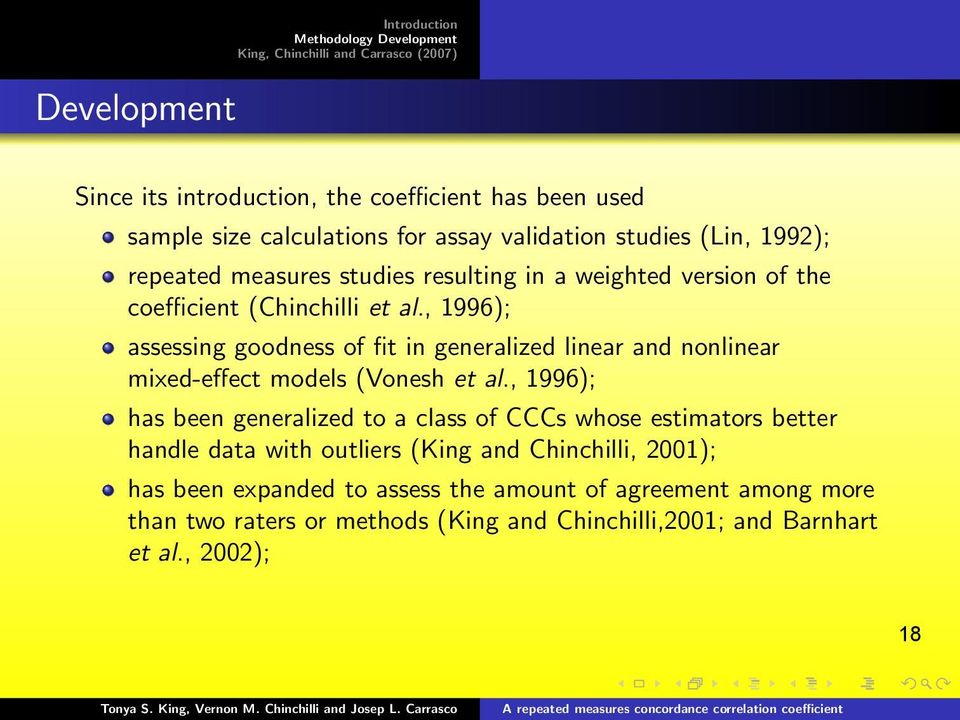
19 Development Introduction Since its introduction, the coefficient has been used sample size calculations for assay validation studies (Lin, 1992); repeated measures studies resulting in a weighted version of the coefficient (Chinchilli et al., 1996); assessing goodness of fit in generalized linear and nonlinear mixed-effect models (Vonesh et al., 1996); has been generalized to a class of CCCs whose estimators better handle data with outliers (King and Chinchilli, 2001); has been expanded to assess the amount of agreement among more than two raters or methods (King and Chinchilli,2001; and Barnhart et al., 2002); has been shown to be equivalent to a particular specification of the intraclass correlation coefficient (ICC) (Carrasco and Jover, 2003). 19

20 King et al., 2007 Introduction Abstract Statistical Methodology Simulation Study Applications Discussion This paper proposes an approach to assessing agreement between two responses in the presence of repeated measures which is based on obtaining population estimates. We incorporate an unstructured correlation structure of the repeated measurements, and use the population estimates, rather than subject-specific estimates, to construct a repeated measures CCC. 20

21 Notations and Assumptions Abstract Statistical Methodology Simulation Study Applications Discussion X(Y)(x(y) ij ): ith subject and jth repeated measure of the first (second) method of measurement,i = 1, 2,.., n; j = 1, 2,..., p. 21
22 Notations and Assumptions Abstract Statistical Methodology Simulation Study Applications Discussion X(Y)(x(y) ij ): ith subject and jth repeated measure of the first (second) method of measurement,i = 1, 2,.., n; j = 1, 2,..., p. Assume [X i, Y i ] are selected from a multivariate normal population with 2p 1 mean vector [µ X, µ Y ], and 2p 2p covariance matrix Σ, which consists of the following four p p matrices: Σ XX, Σ XY, Σ YX and Σ YY. 22
23 A repeated measures CCC Abstract Statistical Methodology Simulation Study Applications Discussion ρ c,rm = 1 E[(X-Y) D(X-Y)] E indep [(X-Y) D(X-Y)] P p P p j=1 k=1 = d jk(σ Xj Y k + σ Yj X k ) P p j=1 P p k=1 d jk(σ Xj X k + σ Yj Y k ) + P p j=1 P p k=1 d jk(µ Xj µ Yj )(µ Xk µ Yk ) where D is a p p non-negative definite matrix of weight between the different repeated measurements. This parameter is a generalization of that described by Lin (1989), and reduces to Lins CCC if p = 1 for i = 1, 2,..., n 23
24 Abstract Statistical Methodology Simulation Study Applications Discussion To consider the measurement of agreement in a variety of paired and unpaired data situations, we can specify different definitions of D which incorporate strictly within-visit (X j versus Y j ) or between- and within-visit agreement (X j versus Y k ). Four options we consider for the D matrix are as follows: 24
25 Abstract Statistical Methodology Simulation Study Applications Discussion An estimator of ρ c ˆρ c,rm = P p P p j=1 k=1 d jk(ˆσ Xj Y k + ˆσ Yj X k ) P p P P p j=1 k=1 d p jk(ˆσ Xj X k + ˆσ Yj P Y k ) + p j=1 k=1 d jk(ˆµ Xj ˆµ Yj )(ˆµ Xk ˆµ Yk ) A basic consideration for statistical inference concerning ρ c,rm is to recognize that the estimator ˆρ c,rm can be expressed as a ratio of functions of U-statistics. 25
26 Abstract Statistical Methodology Simulation Study Applications Discussion ˆρ c,rm = (n 1)(V U) U + (n 1)V Apply the theory of U-statistics,ˆρ c,rm has a normal distribution asymptotically with mean ρ c,rm and a variance that can be consistently estimated using the delta method with Var(ˆρ c,rm ) = dσd Ẑ = 1 ( ) ln ˆρc,rm 1 ˆρ c,rm 26
27 Scenario Introduction Abstract Statistical Methodology Simulation Study Applications Discussion The simulation was performed for three cases evaluating different location and scale shifts, with sample sizes of n = 20, 40 and 80, considering scenarios with three repeated measurements per unit. Case 1: Means µ x = (4, 6, 8) and µ y = (5, 7, 9), within-visit covariance matrix ( and a 3 3 compound symmetric within-subject correlation structure with ρ = 0.4. ) 27
28 Scenario Introduction Abstract Statistical Methodology Simulation Study Applications Discussion Case 2:Means µ x = (4, 6, 8) and µ y = (6, 8, 12), within-visit covariance matrix ( ) 28
29 Scenario Introduction Abstract Statistical Methodology Simulation Study Applications Discussion Case 2:Means µ x = (4, 6, 8) and µ y = (6, 8, 12), within-visit covariance matrix ( Case 3:Means µ x = (4, 6, 8) and µ y = (7, 9, 11), within-visit covariance matrix ( ) ) 29
30 Abstract Statistical Methodology Simulation Study Applications Discussion 30
31 Abstract Statistical Methodology Simulation Study Applications Discussion 31
32 Abstract Statistical Methodology Simulation Study Applications Discussion Penn State Young Women s Health Study Body fat was estimated from skinfolds calipers and DEXA on a cohort of 90 adolescent girls whose initial visit occurred at age 12; 32
33 Abstract Statistical Methodology Simulation Study Applications Discussion Penn State Young Women s Health Study Body fat was estimated from skinfolds calipers and DEXA on a cohort of 90 adolescent girls whose initial visit occurred at age 12; Skinfolds calipers and DEXA measurements were taken for the subsequent visits, which occurred every 6 months. 33
34 Abstract Statistical Methodology Simulation Study Applications Discussion 34
35 Abstract Statistical Methodology Simulation Study Applications Discussion This paper proposes a repeated measures CCC that can handle both few or many repeated measurements, has a variance that can be estimated in a straightforward manner by U-statistic methodology, and performs well with small samples. 35
36 Abstract Statistical Methodology Simulation Study Applications Discussion This paper proposes a repeated measures CCC that can handle both few or many repeated measurements, has a variance that can be estimated in a straightforward manner by U-statistic methodology, and performs well with small samples. Weighted average of the pair-wise estimates of the CCC among the repeated measurements of the two variables X and Y. ρ c,w = p j=1 k=1 p w jk ρ cjk intuitively more appealing, based on a distance function, similar to Lin s original coefficient; The asymptotic variance of ρ c,w would be difficult to derive. 36
37 Abstract Statistical Methodology Simulation Study Applications Discussion ρ c,rm is an aggregated index. 37
38 Abstract Statistical Methodology Simulation Study Applications Discussion ρ c,rm is an aggregated index. If there is a pattern in these pair-wise CCCs, one may be interested in modeling agreement over time(barnhart and Williamson, 2001). 38
Econometrics Simple Linear Regression
 Econometrics Simple Linear Regression Burcu Eke UC3M Linear equations with one variable Recall what a linear equation is: y = b 0 + b 1 x is a linear equation with one variable, or equivalently, a straight
Section 3 Part 1. Relationships between two numerical variables
 Section 3 Part 1 Relationships between two numerical variables 1 Relationship between two variables The summary statistics covered in the previous lessons are appropriate for describing a single variable.
Correlation Coefficient The correlation coefficient is a summary statistic that describes the linear relationship between two numerical variables 2
 Lesson 4 Part 1 Relationships between two numerical variables 1 Correlation Coefficient The correlation coefficient is a summary statistic that describes the linear relationship between two numerical variables
Nonparametric Statistics
 Nonparametric Statistics References Some good references for the topics in this course are 1. Higgins, James (2004), Introduction to Nonparametric Statistics 2. Hollander and Wolfe, (1999), Nonparametric
Introduction: Overview of Kernel Methods
 Introduction: Overview of Kernel Methods Statistical Data Analysis with Positive Definite Kernels Kenji Fukumizu Institute of Statistical Mathematics, ROIS Department of Statistical Science, Graduate University
Analysing Questionnaires using Minitab (for SPSS queries contact -) [email protected]
 Analysing Questionnaires using Minitab (for SPSS queries contact -) [email protected] Structure As a starting point it is useful to consider a basic questionnaire as containing three main sections:
Basic Statistics and Data Analysis for Health Researchers from Foreign Countries
 Basic Statistics and Data Analysis for Health Researchers from Foreign Countries Volkert Siersma [email protected] The Research Unit for General Practice in Copenhagen Dias 1 Content Quantifying association
Some probability and statistics
 Appendix A Some probability and statistics A Probabilities, random variables and their distribution We summarize a few of the basic concepts of random variables, usually denoted by capital letters, X,Y,
An Introduction to Machine Learning
 An Introduction to Machine Learning L5: Novelty Detection and Regression Alexander J. Smola Statistical Machine Learning Program Canberra, ACT 0200 Australia [email protected] Tata Institute, Pune,
Lecture 3: Linear methods for classification
 Lecture 3: Linear methods for classification Rafael A. Irizarry and Hector Corrada Bravo February, 2010 Today we describe four specific algorithms useful for classification problems: linear regression,
MULTIVARIATE PROBABILITY DISTRIBUTIONS
 MULTIVARIATE PROBABILITY DISTRIBUTIONS. PRELIMINARIES.. Example. Consider an experiment that consists of tossing a die and a coin at the same time. We can consider a number of random variables defined
The Basics of Regression Analysis. for TIPPS. Lehana Thabane. What does correlation measure? Correlation is a measure of strength, not causation!
 The Purpose of Regression Modeling The Basics of Regression Analysis for TIPPS Lehana Thabane To verify the association or relationship between a single variable and one or more explanatory One explanatory
Fitting Subject-specific Curves to Grouped Longitudinal Data
 Fitting Subject-specific Curves to Grouped Longitudinal Data Djeundje, Viani Heriot-Watt University, Department of Actuarial Mathematics & Statistics Edinburgh, EH14 4AS, UK E-mail: [email protected] Currie,
Sections 2.11 and 5.8
 Sections 211 and 58 Timothy Hanson Department of Statistics, University of South Carolina Stat 704: Data Analysis I 1/25 Gesell data Let X be the age in in months a child speaks his/her first word and
Notes on Applied Linear Regression
 Notes on Applied Linear Regression Jamie DeCoster Department of Social Psychology Free University Amsterdam Van der Boechorststraat 1 1081 BT Amsterdam The Netherlands phone: +31 (0)20 444-8935 email:
Spatial Statistics Chapter 3 Basics of areal data and areal data modeling
 Spatial Statistics Chapter 3 Basics of areal data and areal data modeling Recall areal data also known as lattice data are data Y (s), s D where D is a discrete index set. This usually corresponds to data
Least Squares Estimation
 Least Squares Estimation SARA A VAN DE GEER Volume 2, pp 1041 1045 in Encyclopedia of Statistics in Behavioral Science ISBN-13: 978-0-470-86080-9 ISBN-10: 0-470-86080-4 Editors Brian S Everitt & David
We are often interested in the relationship between two variables. Do people with more years of full-time education earn higher salaries?
 Statistics: Correlation Richard Buxton. 2008. 1 Introduction We are often interested in the relationship between two variables. Do people with more years of full-time education earn higher salaries? Do
SF2940: Probability theory Lecture 8: Multivariate Normal Distribution
 SF2940: Probability theory Lecture 8: Multivariate Normal Distribution Timo Koski 24.09.2015 Timo Koski Matematisk statistik 24.09.2015 1 / 1 Learning outcomes Random vectors, mean vector, covariance matrix,
Efficiency and the Cramér-Rao Inequality
 Chapter Efficiency and the Cramér-Rao Inequality Clearly we would like an unbiased estimator ˆφ (X of φ (θ to produce, in the long run, estimates which are fairly concentrated i.e. have high precision.
Module 3: Correlation and Covariance
 Using Statistical Data to Make Decisions Module 3: Correlation and Covariance Tom Ilvento Dr. Mugdim Pašiƒ University of Delaware Sarajevo Graduate School of Business O ften our interest in data analysis
The Bivariate Normal Distribution
 The Bivariate Normal Distribution This is Section 4.7 of the st edition (2002) of the book Introduction to Probability, by D. P. Bertsekas and J. N. Tsitsiklis. The material in this section was not included
Covariance and Correlation
 Covariance and Correlation ( c Robert J. Serfling Not for reproduction or distribution) We have seen how to summarize a data-based relative frequency distribution by measures of location and spread, such
Exploratory Factor Analysis and Principal Components. Pekka Malo & Anton Frantsev 30E00500 Quantitative Empirical Research Spring 2016
 and Principal Components Pekka Malo & Anton Frantsev 30E00500 Quantitative Empirical Research Spring 2016 Agenda Brief History and Introductory Example Factor Model Factor Equation Estimation of Loadings
Illustration (and the use of HLM)
 Illustration (and the use of HLM) Chapter 4 1 Measurement Incorporated HLM Workshop The Illustration Data Now we cover the example. In doing so we does the use of the software HLM. In addition, we will
東 海 大 學 資 訊 工 程 研 究 所 碩 士 論 文
 東 海 大 學 資 訊 工 程 研 究 所 碩 士 論 文 指 導 教 授 楊 朝 棟 博 士 以 網 路 功 能 虛 擬 化 實 作 網 路 即 時 流 量 監 控 服 務 研 究 生 楊 曜 佑 中 華 民 國 一 零 四 年 五 月 摘 要 與 的 概 念 一 同 發 展 的, 是 指 利 用 虛 擬 化 的 技 術, 將 現 有 的 網 路 硬 體 設 備, 利 用 軟 體 來 取 代 其
Understanding and Applying Kalman Filtering
 Understanding and Applying Kalman Filtering Lindsay Kleeman Department of Electrical and Computer Systems Engineering Monash University, Clayton 1 Introduction Objectives: 1. Provide a basic understanding
Hypothesis testing - Steps
 Hypothesis testing - Steps Steps to do a two-tailed test of the hypothesis that β 1 0: 1. Set up the hypotheses: H 0 : β 1 = 0 H a : β 1 0. 2. Compute the test statistic: t = b 1 0 Std. error of b 1 =
Statistiek II. John Nerbonne. October 1, 2010. Dept of Information Science [email protected]
 Dept of Information Science [email protected] October 1, 2010 Course outline 1 One-way ANOVA. 2 Factorial ANOVA. 3 Repeated measures ANOVA. 4 Correlation and regression. 5 Multiple regression. 6 Logistic
Introduction to General and Generalized Linear Models
 Introduction to General and Generalized Linear Models General Linear Models - part I Henrik Madsen Poul Thyregod Informatics and Mathematical Modelling Technical University of Denmark DK-2800 Kgs. Lyngby
containing Kendall correlations; and the OUTH = option will create a data set containing Hoeffding statistics.
 Getting Correlations Using PROC CORR Correlation analysis provides a method to measure the strength of a linear relationship between two numeric variables. PROC CORR can be used to compute Pearson product-moment
Additional sources Compilation of sources: http://lrs.ed.uiuc.edu/tseportal/datacollectionmethodologies/jin-tselink/tselink.htm
 Mgt 540 Research Methods Data Analysis 1 Additional sources Compilation of sources: http://lrs.ed.uiuc.edu/tseportal/datacollectionmethodologies/jin-tselink/tselink.htm http://web.utk.edu/~dap/random/order/start.htm
Sample Size Calculation for Longitudinal Studies
 Sample Size Calculation for Longitudinal Studies Phil Schumm Department of Health Studies University of Chicago August 23, 2004 (Supported by National Institute on Aging grant P01 AG18911-01A1) Introduction
UNIVERSITY OF NAIROBI
 UNIVERSITY OF NAIROBI MASTERS IN PROJECT PLANNING AND MANAGEMENT NAME: SARU CAROLYNN ELIZABETH REGISTRATION NO: L50/61646/2013 COURSE CODE: LDP 603 COURSE TITLE: RESEARCH METHODS LECTURER: GAKUU CHRISTOPHER
SF2940: Probability theory Lecture 8: Multivariate Normal Distribution
 SF2940: Probability theory Lecture 8: Multivariate Normal Distribution Timo Koski 24.09.2014 Timo Koski () Mathematisk statistik 24.09.2014 1 / 75 Learning outcomes Random vectors, mean vector, covariance
An introduction to Value-at-Risk Learning Curve September 2003
 An introduction to Value-at-Risk Learning Curve September 2003 Value-at-Risk The introduction of Value-at-Risk (VaR) as an accepted methodology for quantifying market risk is part of the evolution of risk
Outline. Topic 4 - Analysis of Variance Approach to Regression. Partitioning Sums of Squares. Total Sum of Squares. Partitioning sums of squares
 Topic 4 - Analysis of Variance Approach to Regression Outline Partitioning sums of squares Degrees of freedom Expected mean squares General linear test - Fall 2013 R 2 and the coefficient of correlation
Multivariate normal distribution and testing for means (see MKB Ch 3)
 Multivariate normal distribution and testing for means (see MKB Ch 3) Where are we going? 2 One-sample t-test (univariate).................................................. 3 Two-sample t-test (univariate).................................................
Goodness of fit assessment of item response theory models
 Goodness of fit assessment of item response theory models Alberto Maydeu Olivares University of Barcelona Madrid November 1, 014 Outline Introduction Overall goodness of fit testing Two examples Assessing
A Basic Introduction to Missing Data
 John Fox Sociology 740 Winter 2014 Outline Why Missing Data Arise Why Missing Data Arise Global or unit non-response. In a survey, certain respondents may be unreachable or may refuse to participate. Item
Example: Credit card default, we may be more interested in predicting the probabilty of a default than classifying individuals as default or not.
 Statistical Learning: Chapter 4 Classification 4.1 Introduction Supervised learning with a categorical (Qualitative) response Notation: - Feature vector X, - qualitative response Y, taking values in C
Simple Linear Regression Inference
 Simple Linear Regression Inference 1 Inference requirements The Normality assumption of the stochastic term e is needed for inference even if it is not a OLS requirement. Therefore we have: Interpretation
Longitudinal Data Analysis
 Longitudinal Data Analysis Acknowledge: Professor Garrett Fitzmaurice INSTRUCTOR: Rino Bellocco Department of Statistics & Quantitative Methods University of Milano-Bicocca Department of Medical Epidemiology
Statistics for Sports Medicine
 Statistics for Sports Medicine Suzanne Hecht, MD University of Minnesota ([email protected]) Fellow s Research Conference July 2012: Philadelphia GOALS Try not to bore you to death!! Try to teach
Chapter 1. Longitudinal Data Analysis. 1.1 Introduction
 Chapter 1 Longitudinal Data Analysis 1.1 Introduction One of the most common medical research designs is a pre-post study in which a single baseline health status measurement is obtained, an intervention
Understanding the Impact of Weights Constraints in Portfolio Theory
 Understanding the Impact of Weights Constraints in Portfolio Theory Thierry Roncalli Research & Development Lyxor Asset Management, Paris [email protected] January 2010 Abstract In this article,
Correlation in Random Variables
 Correlation in Random Variables Lecture 11 Spring 2002 Correlation in Random Variables Suppose that an experiment produces two random variables, X and Y. What can we say about the relationship between
Web-based Supplementary Materials for Bayesian Effect Estimation. Accounting for Adjustment Uncertainty by Chi Wang, Giovanni
 1 Web-based Supplementary Materials for Bayesian Effect Estimation Accounting for Adjustment Uncertainty by Chi Wang, Giovanni Parmigiani, and Francesca Dominici In Web Appendix A, we provide detailed
Confidence Intervals for Spearman s Rank Correlation
 Chapter 808 Confidence Intervals for Spearman s Rank Correlation Introduction This routine calculates the sample size needed to obtain a specified width of Spearman s rank correlation coefficient confidence
Models for Longitudinal and Clustered Data
 Models for Longitudinal and Clustered Data Germán Rodríguez December 9, 2008, revised December 6, 2012 1 Introduction The most important assumption we have made in this course is that the observations
Regression Analysis. Regression Analysis MIT 18.S096. Dr. Kempthorne. Fall 2013
 Lecture 6: Regression Analysis MIT 18.S096 Dr. Kempthorne Fall 2013 MIT 18.S096 Regression Analysis 1 Outline Regression Analysis 1 Regression Analysis MIT 18.S096 Regression Analysis 2 Multiple Linear
200628 - DAIC - Advanced Experimental Design in Clinical Research
 Coordinating unit: Teaching unit: Academic year: Degree: ECTS credits: 2015 200 - FME - School of Mathematics and Statistics 1004 - UB - (ENG)Universitat de Barcelona MASTER'S DEGREE IN STATISTICS AND
Linear Models for Continuous Data
 Chapter 2 Linear Models for Continuous Data The starting point in our exploration of statistical models in social research will be the classical linear model. Stops along the way include multiple linear
SPSS ADVANCED ANALYSIS WENDIANN SETHI SPRING 2011
 SPSS ADVANCED ANALYSIS WENDIANN SETHI SPRING 2011 Statistical techniques to be covered Explore relationships among variables Correlation Regression/Multiple regression Logistic regression Factor analysis
Factor Analysis. Factor Analysis
 Factor Analysis Principal Components Analysis, e.g. of stock price movements, sometimes suggests that several variables may be responding to a small number of underlying forces. In the factor model, we
Introduction to Matrix Algebra
 Psychology 7291: Multivariate Statistics (Carey) 8/27/98 Matrix Algebra - 1 Introduction to Matrix Algebra Definitions: A matrix is a collection of numbers ordered by rows and columns. It is customary
Poisson Models for Count Data
 Chapter 4 Poisson Models for Count Data In this chapter we study log-linear models for count data under the assumption of a Poisson error structure. These models have many applications, not only to the
Clustering in the Linear Model
 Short Guides to Microeconometrics Fall 2014 Kurt Schmidheiny Universität Basel Clustering in the Linear Model 2 1 Introduction Clustering in the Linear Model This handout extends the handout on The Multiple
Tail-Dependence an Essential Factor for Correctly Measuring the Benefits of Diversification
 Tail-Dependence an Essential Factor for Correctly Measuring the Benefits of Diversification Presented by Work done with Roland Bürgi and Roger Iles New Views on Extreme Events: Coupled Networks, Dragon
II. DISTRIBUTIONS distribution normal distribution. standard scores
 Appendix D Basic Measurement And Statistics The following information was developed by Steven Rothke, PhD, Department of Psychology, Rehabilitation Institute of Chicago (RIC) and expanded by Mary F. Schmidt,
Part 2: Analysis of Relationship Between Two Variables
 Part 2: Analysis of Relationship Between Two Variables Linear Regression Linear correlation Significance Tests Multiple regression Linear Regression Y = a X + b Dependent Variable Independent Variable
Analysis of Questionnaires and Qualitative Data Non-parametric Tests
 Analysis of Questionnaires and Qualitative Data Non-parametric Tests JERZY STEFANOWSKI Instytut Informatyki Politechnika Poznańska Lecture SE 2013, Poznań Recalling Basics Measurment Scales Four scales
Randomization Based Confidence Intervals For Cross Over and Replicate Designs and for the Analysis of Covariance
 Randomization Based Confidence Intervals For Cross Over and Replicate Designs and for the Analysis of Covariance Winston Richards Schering-Plough Research Institute JSM, Aug, 2002 Abstract Randomization
October 3rd, 2012. Linear Algebra & Properties of the Covariance Matrix
 Linear Algebra & Properties of the Covariance Matrix October 3rd, 2012 Estimation of r and C Let rn 1, rn, t..., rn T be the historical return rates on the n th asset. rn 1 rṇ 2 r n =. r T n n = 1, 2,...,
Analysis of Data. Organizing Data Files in SPSS. Descriptive Statistics
 Analysis of Data Claudia J. Stanny PSY 67 Research Design Organizing Data Files in SPSS All data for one subject entered on the same line Identification data Between-subjects manipulations: variable to
1 Portfolio mean and variance
 Copyright c 2005 by Karl Sigman Portfolio mean and variance Here we study the performance of a one-period investment X 0 > 0 (dollars) shared among several different assets. Our criterion for measuring
Stat 412/512 CASE INFLUENCE STATISTICS. Charlotte Wickham. stat512.cwick.co.nz. Feb 2 2015
 Stat 412/512 CASE INFLUENCE STATISTICS Feb 2 2015 Charlotte Wickham stat512.cwick.co.nz Regression in your field See website. You may complete this assignment in pairs. Find a journal article in your field
Week 5: Multiple Linear Regression
 BUS41100 Applied Regression Analysis Week 5: Multiple Linear Regression Parameter estimation and inference, forecasting, diagnostics, dummy variables Robert B. Gramacy The University of Chicago Booth School
15.062 Data Mining: Algorithms and Applications Matrix Math Review
 .6 Data Mining: Algorithms and Applications Matrix Math Review The purpose of this document is to give a brief review of selected linear algebra concepts that will be useful for the course and to develop
business statistics using Excel OXFORD UNIVERSITY PRESS Glyn Davis & Branko Pecar
 business statistics using Excel Glyn Davis & Branko Pecar OXFORD UNIVERSITY PRESS Detailed contents Introduction to Microsoft Excel 2003 Overview Learning Objectives 1.1 Introduction to Microsoft Excel
Lecture 10. Finite difference and finite element methods. Option pricing Sensitivity analysis Numerical examples
 Finite difference and finite element methods Lecture 10 Sensitivities and Greeks Key task in financial engineering: fast and accurate calculation of sensitivities of market models with respect to model
5. Linear Regression
 5. Linear Regression Outline.................................................................... 2 Simple linear regression 3 Linear model............................................................. 4
Lecture 14: GLM Estimation and Logistic Regression
 Lecture 14: GLM Estimation and Logistic Regression Dipankar Bandyopadhyay, Ph.D. BMTRY 711: Analysis of Categorical Data Spring 2011 Division of Biostatistics and Epidemiology Medical University of South
Chapter 7 Factor Analysis SPSS
 Chapter 7 Factor Analysis SPSS Factor analysis attempts to identify underlying variables, or factors, that explain the pattern of correlations within a set of observed variables. Factor analysis is often
Implementing Propensity Score Matching Estimators with STATA
 Implementing Propensity Score Matching Estimators with STATA Barbara Sianesi University College London and Institute for Fiscal Studies E-mail: [email protected] Prepared for UK Stata Users Group, VII
Topic 3. Chapter 5: Linear Regression in Matrix Form
 Topic Overview Statistics 512: Applied Linear Models Topic 3 This topic will cover thinking in terms of matrices regression on multiple predictor variables case study: CS majors Text Example (NKNW 241)
Logit Models for Binary Data
 Chapter 3 Logit Models for Binary Data We now turn our attention to regression models for dichotomous data, including logistic regression and probit analysis. These models are appropriate when the response
X X X a) perfect linear correlation b) no correlation c) positive correlation (r = 1) (r = 0) (0 < r < 1)
 CORRELATION AND REGRESSION / 47 CHAPTER EIGHT CORRELATION AND REGRESSION Correlation and regression are statistical methods that are commonly used in the medical literature to compare two or more variables.
Simple Predictive Analytics Curtis Seare
 Using Excel to Solve Business Problems: Simple Predictive Analytics Curtis Seare Copyright: Vault Analytics July 2010 Contents Section I: Background Information Why use Predictive Analytics? How to use
MATH 304 Linear Algebra Lecture 20: Inner product spaces. Orthogonal sets.
 MATH 304 Linear Algebra Lecture 20: Inner product spaces. Orthogonal sets. Norm The notion of norm generalizes the notion of length of a vector in R n. Definition. Let V be a vector space. A function α
Principle Component Analysis and Partial Least Squares: Two Dimension Reduction Techniques for Regression
 Principle Component Analysis and Partial Least Squares: Two Dimension Reduction Techniques for Regression Saikat Maitra and Jun Yan Abstract: Dimension reduction is one of the major tasks for multivariate
Dependence Concepts. by Marta Monika Wawrzyniak. Master Thesis in Risk and Environmental Modelling Written under the direction of Dr Dorota Kurowicka
 Dependence Concepts by Marta Monika Wawrzyniak Master Thesis in Risk and Environmental Modelling Written under the direction of Dr Dorota Kurowicka Delft Institute of Applied Mathematics Delft University
UNDERSTANDING THE TWO-WAY ANOVA
 UNDERSTANDING THE e have seen how the one-way ANOVA can be used to compare two or more sample means in studies involving a single independent variable. This can be extended to two independent variables
U-statistics on network-structured data with kernels of degree larger than one
 U-statistics on network-structured data with kernels of degree larger than one Yuyi Wang 1, Christos Pelekis 1, and Jan Ramon 1 Computer Science Department, KU Leuven, Belgium Abstract. Most analysis of
Extreme Value Modeling for Detection and Attribution of Climate Extremes
 Extreme Value Modeling for Detection and Attribution of Climate Extremes Jun Yan, Yujing Jiang Joint work with Zhuo Wang, Xuebin Zhang Department of Statistics, University of Connecticut February 2, 2016
A LONGITUDINAL AND SURVIVAL MODEL WITH HEALTH CARE USAGE FOR INSURED ELDERLY. Workshop
 A LONGITUDINAL AND SURVIVAL MODEL WITH HEALTH CARE USAGE FOR INSURED ELDERLY Ramon Alemany Montserrat Guillén Xavier Piulachs Lozada Riskcenter - IREA Universitat de Barcelona http://www.ub.edu/riskcenter
STANDARDISATION OF DATA SET UNDER DIFFERENT MEASUREMENT SCALES. 1 The measurement scales of variables
 STANDARDISATION OF DATA SET UNDER DIFFERENT MEASUREMENT SCALES Krzysztof Jajuga 1, Marek Walesiak 1 1 Wroc law University of Economics, Komandorska 118/120, 53-345 Wroc law, Poland Abstract: Standardisation
A Mixed Model Approach for Intent-to-Treat Analysis in Longitudinal Clinical Trials with Missing Values
 Methods Report A Mixed Model Approach for Intent-to-Treat Analysis in Longitudinal Clinical Trials with Missing Values Hrishikesh Chakraborty and Hong Gu March 9 RTI Press About the Author Hrishikesh Chakraborty,
To give it a definition, an implicit function of x and y is simply any relationship that takes the form:
 2 Implicit function theorems and applications 21 Implicit functions The implicit function theorem is one of the most useful single tools you ll meet this year After a while, it will be second nature to
A Log-Robust Optimization Approach to Portfolio Management
 A Log-Robust Optimization Approach to Portfolio Management Dr. Aurélie Thiele Lehigh University Joint work with Ban Kawas Research partially supported by the National Science Foundation Grant CMMI-0757983
Multivariate Analysis of Ecological Data
 Multivariate Analysis of Ecological Data MICHAEL GREENACRE Professor of Statistics at the Pompeu Fabra University in Barcelona, Spain RAUL PRIMICERIO Associate Professor of Ecology, Evolutionary Biology
Spazi vettoriali e misure di similaritá
 Spazi vettoriali e misure di similaritá R. Basili Corso di Web Mining e Retrieval a.a. 2008-9 April 10, 2009 Outline Outline Spazi vettoriali a valori reali Operazioni tra vettori Indipendenza Lineare
Department of Mathematics, Indian Institute of Technology, Kharagpur Assignment 2-3, Probability and Statistics, March 2015. Due:-March 25, 2015.
 Department of Mathematics, Indian Institute of Technology, Kharagpur Assignment -3, Probability and Statistics, March 05. Due:-March 5, 05.. Show that the function 0 for x < x+ F (x) = 4 for x < for x
A MULTIVARIATE TEST FOR SIMILARITY OF TWO DISSOLUTION PROFILES
 Journal of Biopharmaceutical Statistics, 15: 265 278, 2005 Copyright Taylor & Francis, Inc. ISSN: 1054-3406 print/1520-5711 online DOI: 10.1081/BIP-200049832 A MULTIVARIATE TEST FOR SIMILARITY OF TWO DISSOLUTION
Summary of Formulas and Concepts. Descriptive Statistics (Ch. 1-4)
 Summary of Formulas and Concepts Descriptive Statistics (Ch. 1-4) Definitions Population: The complete set of numerical information on a particular quantity in which an investigator is interested. We assume
SAS Software to Fit the Generalized Linear Model
 SAS Software to Fit the Generalized Linear Model Gordon Johnston, SAS Institute Inc., Cary, NC Abstract In recent years, the class of generalized linear models has gained popularity as a statistical modeling
Multiple group discriminant analysis: Robustness and error rate
 Institut f. Statistik u. Wahrscheinlichkeitstheorie Multiple group discriminant analysis: Robustness and error rate P. Filzmoser, K. Joossens, and C. Croux Forschungsbericht CS-006- Jänner 006 040 Wien,
The Basic Two-Level Regression Model
 2 The Basic Two-Level Regression Model The multilevel regression model has become known in the research literature under a variety of names, such as random coefficient model (de Leeuw & Kreft, 1986; Longford,