
A LONGITUDINAL AND SURVIVAL MODEL WITH HEALTH CARE USAGE FOR INSURED ELDERLY. Workshop
|
|
|
- Maximillian Hawkins
- 9 years ago
- Views:
Transcription
1 A LONGITUDINAL AND SURVIVAL MODEL WITH HEALTH CARE USAGE FOR INSURED ELDERLY Ramon Alemany Montserrat Guillén Xavier Piulachs Lozada Riskcenter - IREA Universitat de Barcelona Funding and insurance in long-term care Workshop September 1st, London

2 CONTENTS 1 INTRODUCTION AND GOALS 2 DATABASE: SPANISH HEALTH INSURANCE COMPANY 3 JOINT MODELING TECHNIQUES 4 RESULTS 5 DISCUSSION AND FUTURE RESEARCH Joint modeling health care usage R.Alemany, M.Guillén, X.Piulachs

3 Contents 1 INTRODUCTION AND GOALS 2 DATABASE: SPANISH HEALTH INSURANCE COMPANY 3 JOINT MODELING TECHNIQUES 4 RESULTS 5 DISCUSSION AND FUTURE RESEARCH Joint modeling health care usage R.Alemany, M.Guillén, X.Piulachs

4 1. INTRODUCTION AND GOALS Scope of the work: Health insurance companies The reasons leading to putting down this study are based on the following points: The gradual development of medical science leads to a larger number of years lived with disabilities (Robine and Michel, 2010). Policy holders are generally supposed to have a higher socio-economic level (Schoen et al, 2010). There is consequently a need of knowing how a greater elderly people cohort will evolve, as they are the principal beneficiaries of life expectancy improvements. Proposed longitudinal variable of interest for a policy holder: y = ANNUAL CUMULATIVE NUMBER OF REQUESTS AT SPECIFIC TIME POINTS WITHIN STUDY PERIOD Joint modeling health care usage R.Alemany, M.Guillén, X.Piulachs

5 1. INTRODUCTION AND GOALS Motivation (I) MOTIVATION: Longitudinal study with 2 outcomes, based on a) Repeated measurements of response variable and b) Time until a particular event. Joint modeling health care usage R.Alemany, M.Guillén, X.Piulachs
6 1. INTRODUCTION AND GOALS Motivation (I) MOTIVATION: Longitudinal study with 2 outcomes, based on a) Repeated measurements of response variable and b) Time until a particular event. Start 1 Jan 2010 OBSERVATION WINDOW OF STUDY t F = Final 1 Feb Jan Dec Dec Dec Dec Feb 2014 T

7 1. INTRODUCTION AND GOALS Motivation (I) MOTIVATION: Longitudinal study with 2 outcomes, based on a) Repeated measurements of response variable and b) Time until a particular event. Start 1 Jan 2010 OBSERVATION WINDOW OF STUDY t F = Final 1 Feb 2014 LONGITUDINAL PROFILE SURVIVAL PROFILE 1 Jan Dec Dec Dec Dec Feb 2014 T Joint modeling health care usage R.Alemany, M.Guillén, X.Piulachs

8 1. INTRODUCTION AND GOALS Motivation (I) MOTIVATION: Longitudinal study with 2 outcomes, based on a) Repeated measurements of response variable and b) Time until a particular event. Start 1 Jan 2010 OBSERVATION WINDOW OF STUDY t F = Final 1 Feb 2014 LONGITUDINAL PROFILE SURVIVAL PROFILE t =? 1 Jan Dec Dec Dec Dec Feb 2014 T Joint modeling health care usage R.Alemany, M.Guillén, X.Piulachs


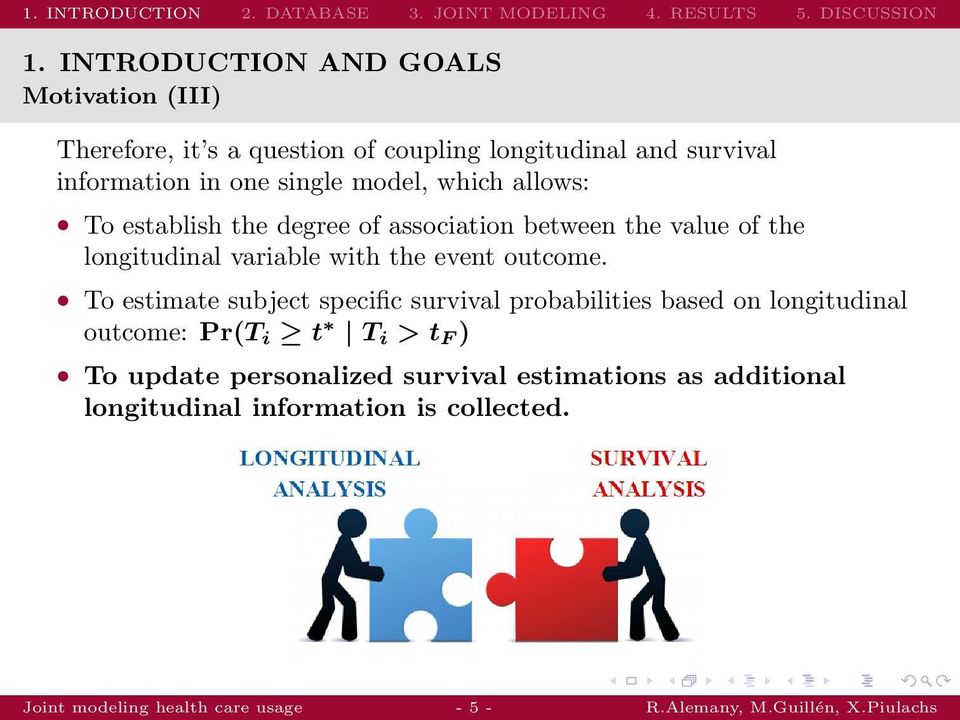
9 1. INTRODUCTION AND GOALS Motivation (III) Therefore, it s a question of coupling longitudinal and survival information in one single model, which allows: To establish the degree of association between the value of the longitudinal variable with the event outcome. To estimate subject specific survival probabilities based on longitudinal outcome: Pr(T i t T i > t F ) To update personalized survival estimations as additional longitudinal information is collected. Joint modeling health care usage R.Alemany, M.Guillén, X.Piulachs
10 1. INTRODUCTION AND GOALS Motivation (IV) However, the coupling of longitudinal and survival information is not without difficulties... If missing improperly handled, biased results (Prentice, 1982). The longitudinal response is often an endogenous variable. In some cases, the event of interest is only known to occur after a certain t right-censored data. So, how to achieve a simultaneous modeling of two processes? Joint modeling health care usage R.Alemany, M.Guillén, X.Piulachs

11 1. INTRODUCTION AND GOALS Motivation (IV) However, the coupling of longitudinal and survival information is not without difficulties... If missing improperly handled, biased results (Prentice, 1982). The longitudinal response is often an endogenous variable. In some cases, the event of interest is only known to occur after a certain t right-censored data. So, how to achieve a simultaneous modeling of two processes? Joint Modeling for Longitudinal and Survival Data Joint modeling health care usage R.Alemany, M.Guillén, X.Piulachs
12 Contents 1 INTRODUCTION AND GOALS 2 DATABASE: SPANISH HEALTH INSURANCE COMPANY 3 JOINT MODELING TECHNIQUES 4 RESULTS 5 DISCUSSION AND FUTURE RESEARCH Joint modeling health care usage R.Alemany, M.Guillén, X.Piulachs

13 2. DATABASE: SPANISH HEALTH INSURANCE COMPANY Main characteristics of the study Spanish insurance company where the study period is fixed from 1 Jan 2010 and 1 Feb Monitoring of elderly 65 annual cumulative requests. Subjects requests during the four years before their study entry are treated as a baseline covariate. Distribution by sex: men (39%) with 409 events (3.4%) women (61%) with 933 events (5.0%). GOAL: To evaluate, in a personalized way, the existing degree of association between the frequency of use of medical services with the risk of mortality. Joint modeling health care usage R.Alemany, M.Guillén, X.Piulachs

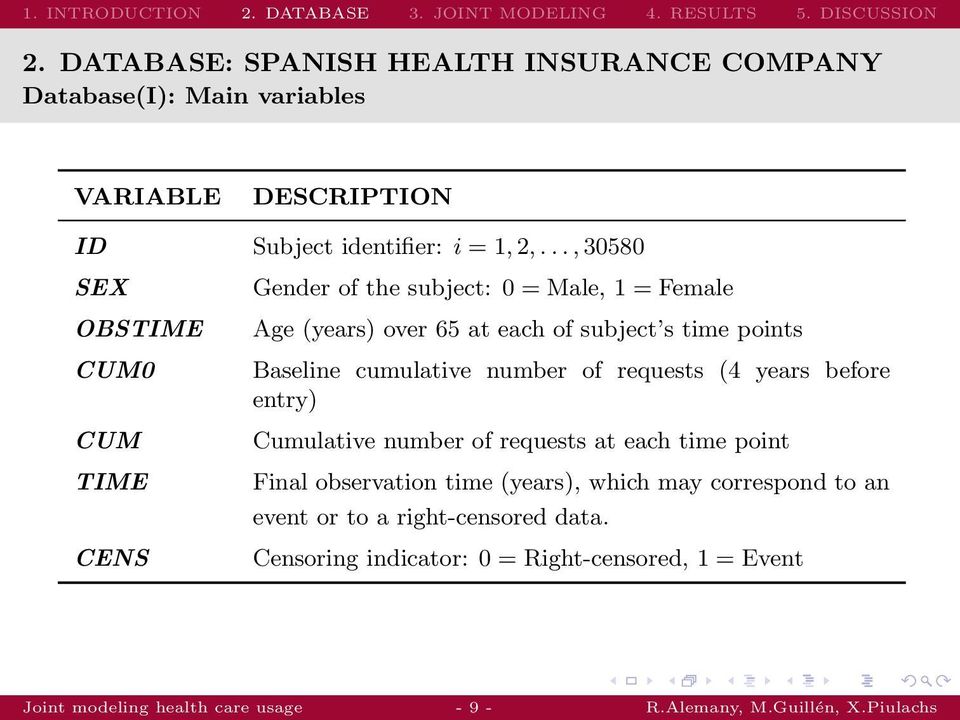
14 2. DATABASE: SPANISH HEALTH INSURANCE COMPANY Database(I): Main variables VARIABLE DESCRIPTION ID Subject identifier: i = 1, 2,..., SEX OBSTIME CUM0 CUM TIME CENS Gender of the subject: 0 = Male, 1 = Female Age (years) over 65 at each of subject s time points Baseline cumulative number of requests (4 years before entry) Cumulative number of requests at each time point Final observation time (years), which may correspond to an event or to a right-censored data. Censoring indicator: 0 = Right-censored, 1 = Event Joint modeling health care usage R.Alemany, M.Guillén, X.Piulachs
15 Contents 1 INTRODUCTION AND GOALS 2 DATABASE: SPANISH HEALTH INSURANCE COMPANY 3 JOINT MODELING TECHNIQUES 4 RESULTS 5 DISCUSSION AND FUTURE RESEARCH Joint modeling health care usage R.Alemany, M.Guillén, X.Piulachs

16 3. JOINT MODELING TECHNIQUES Longitudinal data analysis (I): Assumptions LONGITUDINAL APPROACH To obtain the effect of covariates on an outcome when there is an association between outcomes. Association between outcomes. Let denote y ij the response variable on the i th subject, i = 1,..., n, observed at time point t ij, j = 1,..., n i. The outcome is linearly related to a set of p explanatory covariates and q random effects Let assume that the longitudinal outcomes for the i th subject, y i = (y i1, y i2,..., y ini ) T, are normally distributed. Joint modeling health care usage R.Alemany, M.Guillén, X.Piulachs

17 3. JOINT MODELING TECHNIQUES Longitudinal data analysis (II): General equation Linear mixed model equation: y i = X i β + Z i b i + ε i b i N q (0, D) ε i N ni (0, σ 2 I ni ) X i and Z i design matrices for fixed and random effects, respectively. β and b i vectors for the fixed effects and random effects, respectively. {b 1, b 2,..., b n } independent of {ε 1, ε 2,..., ε n }. (Laird and Ware, 1982) (Verbeke and Molenberghs, 2000) Joint modeling health care usage R.Alemany, M.Guillén, X.Piulachs
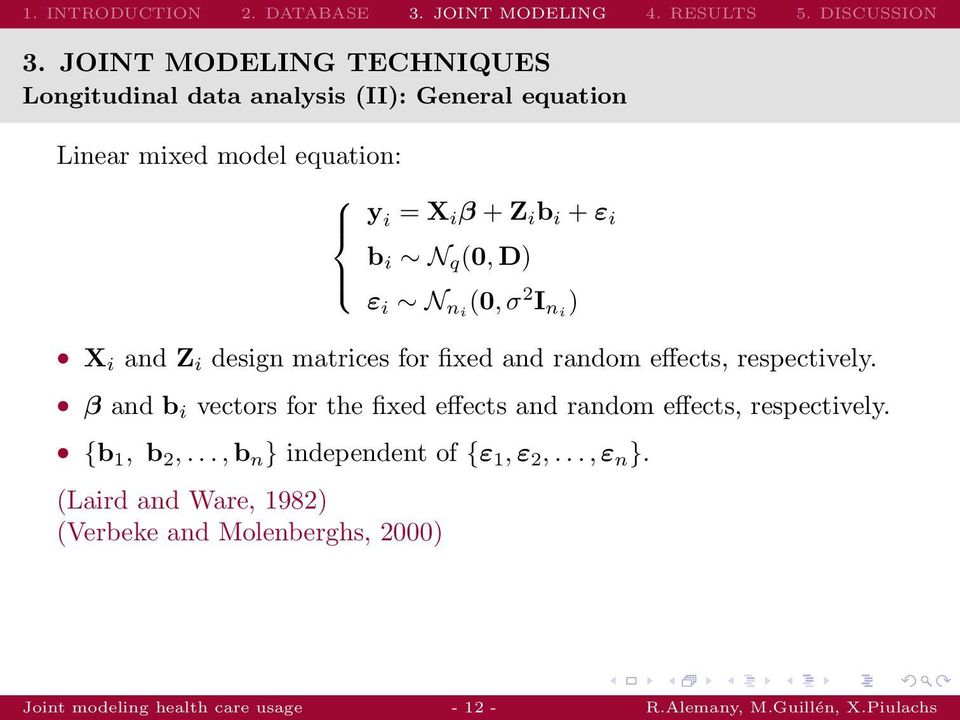
18 3. JOINT MODELING TECHNIQUES Longitudinal data analysis (III): Graphic illustration y = LOG.CUM Independent data? OBSTIME (years over 65) Joint modeling health care usage R.Alemany, M.Guillén, X.Piulachs
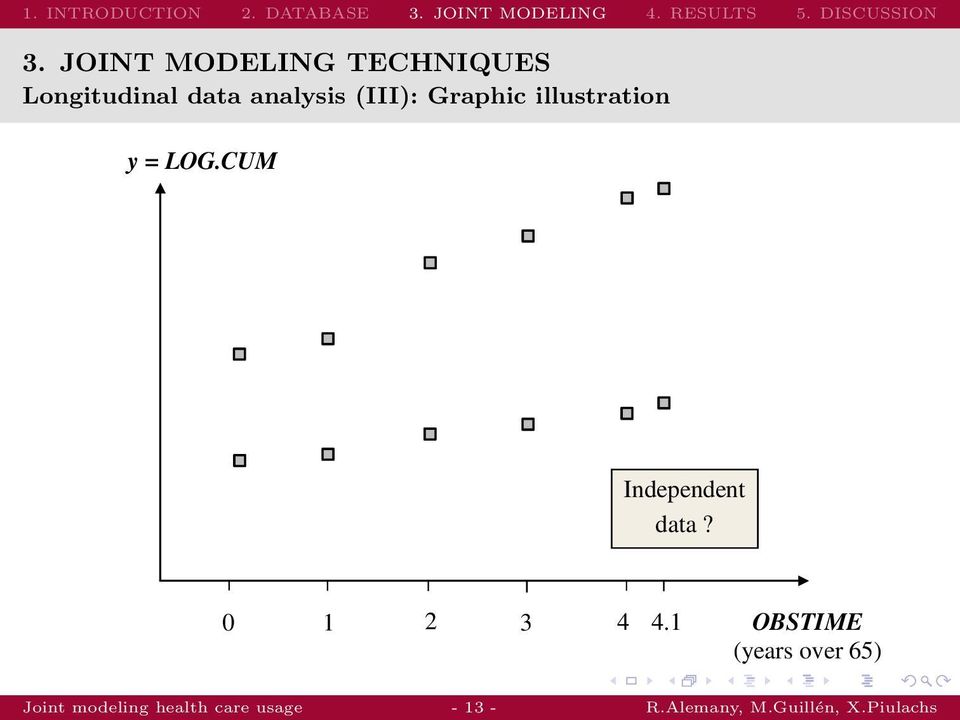
19 3. JOINT MODELING TECHNIQUES Longitudinal data analysis (III): Graphic illustration y = LOG.CUM Subject 1 Subject OBSTIME (years over 65) Joint modeling health care usage R.Alemany, M.Guillén, X.Piulachs
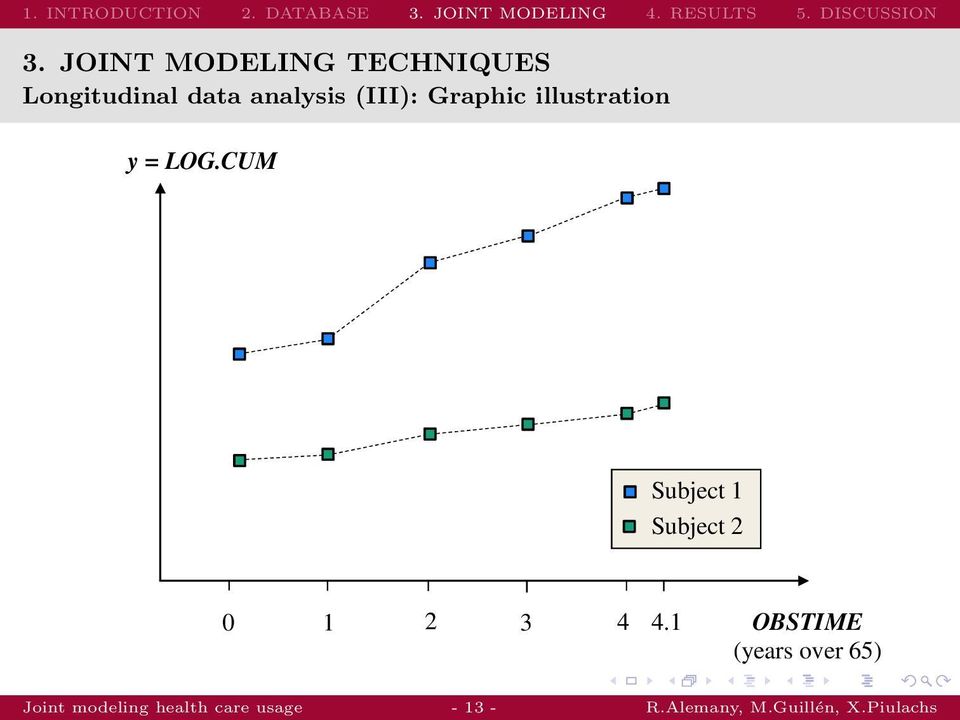
20 3. JOINT MODELING TECHNIQUES Longitudinal data analysis (III): Graphic illustration y = LOG.CUM Subject 1 Subject OBSTIME (years over 65) Joint modeling health care usage R.Alemany, M.Guillén, X.Piulachs

21 3. JOINT MODELING TECHNIQUES Longitudinal data analysis (III): Graphic illustration y = LOG.CUM Subject 1 trend Subject 2 trend Subject 1 Subject OBSTIME (years over 65) Joint modeling health care usage R.Alemany, M.Guillén, X.Piulachs
22 3. JOINT MODELING TECHNIQUES Survival analysis (I): Notation and definitions SURVIVAL APPROACH Let consider for the i-th subject: T is a non-negative continuous random variable denoting the true survival time. C is the potential right-censoring time. For the i th subject, we define the observed survival time: Y i = min{t i, C i } and δ i = I(T i C i ). Joint modeling health care usage R.Alemany, M.Guillén, X.Piulachs
23 3. JOINT MODELING TECHNIQUES Survival analysis (II): PH Cox Model Semi-parametric estimation: PH Cox Model (Cox, 1972) w i = (w i1, w i2,..., w ip ) T γ = (γ 1, γ 2,..., γ p ) T h i (t w i ) = h 0 (t) exp(γ T w i ), The Cox model can be extended to handle exogenous time-dependent covariates (Andersen and Gill, 1982). But often measurements taken on the subjects are related to inherent biological changes: endogenous covariates. Joint modeling health care usage R.Alemany, M.Guillén, X.Piulachs
24 3. JOINT MODELING TECHNIQUES Survival analysis (II): PH Cox Model Semi-parametric estimation: PH Cox Model (Cox, 1972) w i = (w i1, w i2,..., w ip ) T γ = (γ 1, γ 2,..., γ p ) T h i (t w i ) = h 0 (t) exp(γ T w i ), The Cox model can be extended to handle exogenous time-dependent covariates (Andersen and Gill, 1982). But often measurements taken on the subjects are related to inherent biological changes: endogenous covariates. It is therefore necessary to implement: JOINT MODELING TECHNIQUES (Tsiatis et al., 1995; Rizopoulos, 2012) Joint modeling health care usage R.Alemany, M.Guillén, X.Piulachs
25 3. JOINT MODELING TECHNIQUES Joint Modeling framework: Fitted joint model In our particular database: { For the i th man, i = 1,..., 11912, at time t For the i th woman, i = 1,..., 18668, at time t Longitudinal submodel LOG.CUM i(t) = β 0 + b i0 + β 1t + ε i(t) β = (β 0, β 1) T Survival submodel b i0 N (0, σ 2 b 0 ) ε i(t) N (0, σ 2 ) h i(t w i) = h 0(t)R i(t) exp{γlog.cumfent i}. Joint modeling health care usage R.Alemany, M.Guillén, X.Piulachs
26 3. JOINT MODELING TECHNIQUES Joint Modeling framework: Fitted joint model In our particular database: { For the i th man, i = 1,..., 11912, at time t For the i th woman, i = 1,..., 18668, at time t Longitudinal submodel LOG.CUM i(t) = β 0 + b i0 + β 1t + ε i(t) β = (β 0, β 1) T Survival submodel JOINT MODEL b i0 N (0, σ 2 b 0 ) ε i(t) N (0, σ 2 ) h i(t w i) = h 0(t)R i(t) exp{γlog.cumfent i}. h i(t M i(t), w i) = h 0(t)R i(t) exp{γlog.cumf ENT i + α(β 0 + b i0 + β 1t)} Joint modeling health care usage R.Alemany, M.Guillén, X.Piulachs
27 Contents 1 INTRODUCTION AND GOALS 2 DATABASE: SPANISH HEALTH INSURANCE COMPANY 3 JOINT MODELING TECHNIQUES 4 RESULTS 5 DISCUSSION AND FUTURE RESEARCH Joint modeling health care usage R.Alemany, M.Guillén, X.Piulachs
28 4. RESULTS FOR THE DATABASE Joint modeling results (I): Estimation by sex h i(t M i(t), w i) = h 0(t)R i(t) exp{γlog.cumf ENT i + α(β 0 + b i0 + β 1t)} JM for men JM for women Parameters Estimate 95% CI Estimate 95% CI Longitudinal β (2.100, 2.180) (2.123, 2.192) β (0.167, 0.172) (0.155, 0.159) σ (0.329, 0.334) (0.312, 0.316) σ b (1.597, 1.698) (1.748, 1.834) Survival γ (-1.306,-1.042) (-1.042, ) Association α (1.275, 1.598) (1.179, 1.367) Joint modeling health care usage R.Alemany, M.Guillén, X.Piulachs
29 4. RESULTS FOR THE DATABASE Joint modeling results (I): Estimation by sex h i(t M i(t), w i) = h 0(t)R i(t) exp{γlog.cumf ENT i + α(β 0 + b i0 + β 1t)} JM for men JM for women Parameters Estimate 95% CI Estimate 95% CI Longitudinal β (2.100, 2.180) (2.123, 2.192) β (0.167, 0.172) (0.155, 0.159) σ (0.329, 0.334) (0.312, 0.316) σ b (1.597, 1.698) (1.748, 1.834) Survival γ (-1.306,-1.042) (-1.042, ) Association α (1.275, 1.598) (1.179, 1.367) Joint modeling health care usage R.Alemany, M.Guillén, X.Piulachs
30 4. RESULTS FOR THE DATABASE Joint modeling results (I): Estimation by sex h i(t M i(t), w i) = h 0(t)R i(t) exp{γlog.cumf ENT i + α(β 0 + b i0 + β 1t)} JM for men JM for women Parameters Estimate 95% CI Estimate 95% CI Longitudinal β (2.100, 2.180) (2.123, 2.192) β (0.167, 0.172) (0.155, 0.159) σ (0.329, 0.334) (0.312, 0.316) σ b (1.597, 1.698) (1.748, 1.834) Survival γ (-1.306,-1.042) (-1.042, ) Association α (1.275, 1.598) (1.179, 1.367) Joint modeling health care usage R.Alemany, M.Guillén, X.Piulachs
31 4. RESULTS FOR THE DATABASE Joint modeling results (I): Estimation by sex h i(t M i(t), w i) = h 0(t)R i(t) exp{γlog.cumf ENT i + α(β 0 + b i0 + β 1t)} JM for men JM for women Parameters Estimate 95% CI Estimate 95% CI Longitudinal β (2.100, 2.180) (2.123, 2.192) β (0.167, 0.172) (0.155, 0.159) σ (0.329, 0.334) (0.312, 0.316) σ b (1.597, 1.698) (1.748, 1.834) Survival γ (-1.306,-1.042) (-1.042, ) Association α (1.275, 1.598) (1.179, 1.367) Joint modeling health care usage R.Alemany, M.Guillén, X.Piulachs
32 4. RESULTS FOR THE DATABASE Joint modeling results (II): Dynamic predictions Comparison: Two women aged 65 at 1st Jan 2010 with 25 baseline requests Survival prediction for a woman aged 65 at 1 Jan 2010, with VERY LOW growth in requests y = LOG.CUM Jan Survival probability Age (years) y = LOG.CUM Survival prediction for a woman aged 65 at 1 Jan 2010, with STRONG growth in requests Age (years) 1 Jan 2010 Joint modeling health care usage R.Alemany, M.Guillén, X.Piulachs Survival probability
33 4. RESULTS FOR THE DATABASE Joint modeling results (II): Dynamic predictions Comparison: Two women aged 65 at 1st Jan 2010 with 25 baseline requests Survival prediction for a woman aged 65 at 1 Jan 2010, with VERY LOW growth in requests y = LOG.CUM Dec Survival probability Age (years) y = LOG.CUM Survival prediction for a woman aged 65 at 1 Jan 2010, with STRONG growth in requests Age (years) 31 Dec 2010 Joint modeling health care usage R.Alemany, M.Guillén, X.Piulachs Survival probability
34 4. RESULTS FOR THE DATABASE Joint modeling results (II): Dynamic predictions Comparison: Two women aged 65 at 1st Jan 2010 with 25 baseline requests Survival prediction for a woman aged 65 at 1 Jan 2010, with VERY LOW growth in requests y = LOG.CUM Dec Survival probability Age (years) y = LOG.CUM Survival prediction for a woman aged 65 at 1 Jan 2010, with STRONG growth in requests Age (years) 31 Dec 2011 Joint modeling health care usage R.Alemany, M.Guillén, X.Piulachs Survival probability
35 4. RESULTS FOR THE DATABASE Joint modeling results (II): Dynamic predictions Comparison: Two women aged 65 at 1st Jan 2010 with 25 baseline requests Survival prediction for a woman aged 65 at 1 Jan 2010, with VERY LOW growth in requests y = LOG.CUM Dec Survival probability Age (years) y = LOG.CUM Survival prediction for a woman aged 65 at 1 Jan 2010, with STRONG growth in requests Age (years) 31 Dec 2012 Joint modeling health care usage R.Alemany, M.Guillén, X.Piulachs Survival probability
36 4. RESULTS FOR THE DATABASE Joint modeling results (II): Dynamic predictions Comparison: Two women aged 65 at 1st Jan 2010 with 25 baseline requests Survival prediction for a woman aged 65 at 1 Jan 2010, with VERY LOW growth in requests y = LOG.CUM Dec Survival probability Age (years) y = LOG.CUM Survival prediction for a woman aged 65 at 1 Jan 2010, with STRONG growth in requests Age (years) 31 Dec 2013 Joint modeling health care usage R.Alemany, M.Guillén, X.Piulachs Survival probability
37 4. RESULTS FOR THE DATABASE Joint modeling results (II): Dynamic predictions Comparison: Two women aged 65 at 1st Jan 2010 with 25 baseline requests Survival probability for a woman aged 65 at 1 Jan 2010, with VERY LOW growth in requests Pr(T i t * T i > t F ) Jan Feb Survival probability Age (years) Survival probability for a woman aged 65 at 1 Jan 2010, with STRONG growth in requests Pr(T i t * T i > t F ) Jan Feb Survival probability Age (years) Joint modeling health care usage R.Alemany, M.Guillén, X.Piulachs
38 Contents 1 INTRODUCTION AND GOALS 2 DATABASE: SPANISH HEALTH INSURANCE COMPANY 3 JOINT MODELING TECHNIQUES 4 RESULTS 5 DISCUSSION AND FUTURE RESEARCH Joint modeling health care usage R.Alemany, M.Guillén, X.Piulachs
39 5. DISCUSSION AND FUTURE RESEARCH Discussion and Conclusions CONCLUSIONS The fitted joint model indicates that the observed number of cumulated requests is highly associated with the risk of death (event of interest). The baseline cumulated acts has a protective effect. The joint modeling techniques allow to obtain an unbiased and personalized estimate of the the impact of y = LOG.CUM trajectories on time to mortality event. As longitudinal information was collected for all subjects, the joint modeling methodology has allowed to continuously update the predictions of their survival probabilities. Joint modeling health care usage R.Alemany, M.Guillén, X.Piulachs
40 5. DISCUSSION AND FUTURE RESEARCH Future Research TO GO FURTHER... Different types of requests need to be distinguished To relate the subject specific profile to an estimated cost. To consider extensions of the standard joint modeling approach (e.g. the subject-specific slope m i (t)). Joint modeling health care usage R.Alemany, M.Guillén, X.Piulachs
41 REFERENCES MAIN REFERENCES: Modeling of Policyholder Behavior for Life Insurance and Annuity Products, (Campbell et al., 2014) Regression models and life-tables, (Cox et al., 2014) Joint Models for Longitudinal and Time-to-Event Data, (Rizopoulos, 2012) Looking Forward to a General Theory on Population Aging, (Robine and Michel, 2004) How Health Insurance Design Affects Access To Care And Costs, By Income, In Eleven Countries, (Schoen et al., 2010) Joint modeling of longitudinal and time-to-event data: An overview, (Tsiatis et al., 2004) Linear Mixed Models for Longitudinal Data, (Verbeke and Mohlenbergs, 2010) Draft working paper: Joint modeling health care usage R.Alemany, M.Guillén, X.Piulachs
42 ACKNOWLEDGEMENTS THANK YOU VERY MUCH FOR YOUR ATTENTION! Joint modeling health care usage R.Alemany, M.Guillén, X.Piulachs
Introduction to mixed model and missing data issues in longitudinal studies
 Introduction to mixed model and missing data issues in longitudinal studies Hélène Jacqmin-Gadda INSERM, U897, Bordeaux, France Inserm workshop, St Raphael Outline of the talk I Introduction Mixed models
Statistical Analysis of Life Insurance Policy Termination and Survivorship
 Statistical Analysis of Life Insurance Policy Termination and Survivorship Emiliano A. Valdez, PhD, FSA Michigan State University joint work with J. Vadiveloo and U. Dias Session ES82 (Statistics in Actuarial
7.1 The Hazard and Survival Functions
 Chapter 7 Survival Models Our final chapter concerns models for the analysis of data which have three main characteristics: (1) the dependent variable or response is the waiting time until the occurrence
Overview. Longitudinal Data Variation and Correlation Different Approaches. Linear Mixed Models Generalized Linear Mixed Models
 Overview 1 Introduction Longitudinal Data Variation and Correlation Different Approaches 2 Mixed Models Linear Mixed Models Generalized Linear Mixed Models 3 Marginal Models Linear Models Generalized Linear
Statistics in Retail Finance. Chapter 6: Behavioural models
 Statistics in Retail Finance 1 Overview > So far we have focussed mainly on application scorecards. In this chapter we shall look at behavioural models. We shall cover the following topics:- Behavioural
Lecture 15 Introduction to Survival Analysis
 Lecture 15 Introduction to Survival Analysis BIOST 515 February 26, 2004 BIOST 515, Lecture 15 Background In logistic regression, we were interested in studying how risk factors were associated with presence
IMPACT EVALUATION: INSTRUMENTAL VARIABLE METHOD
 REPUBLIC OF SOUTH AFRICA GOVERNMENT-WIDE MONITORING & IMPACT EVALUATION SEMINAR IMPACT EVALUATION: INSTRUMENTAL VARIABLE METHOD SHAHID KHANDKER World Bank June 2006 ORGANIZED BY THE WORLD BANK AFRICA IMPACT
Analysis of Correlated Data. Patrick J. Heagerty PhD Department of Biostatistics University of Washington
 Analysis of Correlated Data Patrick J Heagerty PhD Department of Biostatistics University of Washington Heagerty, 6 Course Outline Examples of longitudinal data Correlation and weighting Exploratory data
On Marginal Effects in Semiparametric Censored Regression Models
 On Marginal Effects in Semiparametric Censored Regression Models Bo E. Honoré September 3, 2008 Introduction It is often argued that estimation of semiparametric censored regression models such as the
Tips for surviving the analysis of survival data. Philip Twumasi-Ankrah, PhD
 Tips for surviving the analysis of survival data Philip Twumasi-Ankrah, PhD Big picture In medical research and many other areas of research, we often confront continuous, ordinal or dichotomous outcomes
17. SIMPLE LINEAR REGRESSION II
 17. SIMPLE LINEAR REGRESSION II The Model In linear regression analysis, we assume that the relationship between X and Y is linear. This does not mean, however, that Y can be perfectly predicted from X.
Missing data and net survival analysis Bernard Rachet
 Workshop on Flexible Models for Longitudinal and Survival Data with Applications in Biostatistics Warwick, 27-29 July 2015 Missing data and net survival analysis Bernard Rachet General context Population-based,
SPSS TRAINING SESSION 3 ADVANCED TOPICS (PASW STATISTICS 17.0) Sun Li Centre for Academic Computing [email protected]
 SPSS TRAINING SESSION 3 ADVANCED TOPICS (PASW STATISTICS 17.0) Sun Li Centre for Academic Computing [email protected] IN SPSS SESSION 2, WE HAVE LEARNT: Elementary Data Analysis Group Comparison & One-way
R 2 -type Curves for Dynamic Predictions from Joint Longitudinal-Survival Models
 Faculty of Health Sciences R 2 -type Curves for Dynamic Predictions from Joint Longitudinal-Survival Models Inference & application to prediction of kidney graft failure Paul Blanche joint work with M-C.
Introduction to Fixed Effects Methods
 Introduction to Fixed Effects Methods 1 1.1 The Promise of Fixed Effects for Nonexperimental Research... 1 1.2 The Paired-Comparisons t-test as a Fixed Effects Method... 2 1.3 Costs and Benefits of Fixed
A Basic Introduction to Missing Data
 John Fox Sociology 740 Winter 2014 Outline Why Missing Data Arise Why Missing Data Arise Global or unit non-response. In a survey, certain respondents may be unreachable or may refuse to participate. Item
An Application of the G-formula to Asbestos and Lung Cancer. Stephen R. Cole. Epidemiology, UNC Chapel Hill. Slides: www.unc.
 An Application of the G-formula to Asbestos and Lung Cancer Stephen R. Cole Epidemiology, UNC Chapel Hill Slides: www.unc.edu/~colesr/ 1 Acknowledgements Collaboration with David B. Richardson, Haitao
Standard errors of marginal effects in the heteroskedastic probit model
 Standard errors of marginal effects in the heteroskedastic probit model Thomas Cornelißen Discussion Paper No. 320 August 2005 ISSN: 0949 9962 Abstract In non-linear regression models, such as the heteroskedastic
Econometrics Simple Linear Regression
 Econometrics Simple Linear Regression Burcu Eke UC3M Linear equations with one variable Recall what a linear equation is: y = b 0 + b 1 x is a linear equation with one variable, or equivalently, a straight
Analyzing Intervention Effects: Multilevel & Other Approaches. Simplest Intervention Design. Better Design: Have Pretest
 Analyzing Intervention Effects: Multilevel & Other Approaches Joop Hox Methodology & Statistics, Utrecht Simplest Intervention Design R X Y E Random assignment Experimental + Control group Analysis: t
Fitting Subject-specific Curves to Grouped Longitudinal Data
 Fitting Subject-specific Curves to Grouped Longitudinal Data Djeundje, Viani Heriot-Watt University, Department of Actuarial Mathematics & Statistics Edinburgh, EH14 4AS, UK E-mail: [email protected] Currie,
SUMAN DUVVURU STAT 567 PROJECT REPORT
 SUMAN DUVVURU STAT 567 PROJECT REPORT SURVIVAL ANALYSIS OF HEROIN ADDICTS Background and introduction: Current illicit drug use among teens is continuing to increase in many countries around the world.
Latent class mixed models for longitudinal data. (Growth mixture models)
 Latent class mixed models for longitudinal data (Growth mixture models) Cécile Proust-Lima & Hélène Jacqmin-Gadda Department of Biostatistics, INSERM U897, University of Bordeaux II INSERM workshop 205
Survival Distributions, Hazard Functions, Cumulative Hazards
 Week 1 Survival Distributions, Hazard Functions, Cumulative Hazards 1.1 Definitions: The goals of this unit are to introduce notation, discuss ways of probabilistically describing the distribution of a
Parametric Survival Models
 Parametric Survival Models Germán Rodríguez [email protected] Spring, 2001; revised Spring 2005, Summer 2010 We consider briefly the analysis of survival data when one is willing to assume a parametric
problem arises when only a non-random sample is available differs from censored regression model in that x i is also unobserved
 4 Data Issues 4.1 Truncated Regression population model y i = x i β + ε i, ε i N(0, σ 2 ) given a random sample, {y i, x i } N i=1, then OLS is consistent and efficient problem arises when only a non-random
Joint Modelling for Longitudinal and Time-to-Event Data. Application to Liver Transplantation Data
 Master s Thesis Joint Modelling for Longitudinal and Time-to-Event Data. Application to Liver Transplantation Data Author: Laura Calaza Díaz Supervisors: Carmen Cadarso Suárez Francisco Gude Sampedro Master
 α α λ α = = λ λ α ψ = = α α α λ λ ψ α = + β = > θ θ β > β β θ θ θ β θ β γ θ β = γ θ > β > γ θ β γ = θ β = θ β = θ β = β θ = β β θ = = = β β θ = + α α α α α = = λ λ λ λ λ λ λ = λ λ α α α α λ ψ + α =
LCMM: a R package for the estimation of latent class mixed models for Gaussian, ordinal, curvilinear longitudinal data and/or time-to-event data
 . LCMM: a R package for the estimation of latent class mixed models for Gaussian, ordinal, curvilinear longitudinal data and/or time-to-event data Cécile Proust-Lima Department of Biostatistics, INSERM
Sample Size Calculation for Longitudinal Studies
 Sample Size Calculation for Longitudinal Studies Phil Schumm Department of Health Studies University of Chicago August 23, 2004 (Supported by National Institute on Aging grant P01 AG18911-01A1) Introduction
Solución del Examen Tipo: 1
 Solución del Examen Tipo: 1 Universidad Carlos III de Madrid ECONOMETRICS Academic year 2009/10 FINAL EXAM May 17, 2010 DURATION: 2 HOURS 1. Assume that model (III) verifies the assumptions of the classical
Lecture 2 ESTIMATING THE SURVIVAL FUNCTION. One-sample nonparametric methods
 Lecture 2 ESTIMATING THE SURVIVAL FUNCTION One-sample nonparametric methods There are commonly three methods for estimating a survivorship function S(t) = P (T > t) without resorting to parametric models:
I L L I N O I S UNIVERSITY OF ILLINOIS AT URBANA-CHAMPAIGN
 Beckman HLM Reading Group: Questions, Answers and Examples Carolyn J. Anderson Department of Educational Psychology I L L I N O I S UNIVERSITY OF ILLINOIS AT URBANA-CHAMPAIGN Linear Algebra Slide 1 of
ECON 142 SKETCH OF SOLUTIONS FOR APPLIED EXERCISE #2
 University of California, Berkeley Prof. Ken Chay Department of Economics Fall Semester, 005 ECON 14 SKETCH OF SOLUTIONS FOR APPLIED EXERCISE # Question 1: a. Below are the scatter plots of hourly wages
The 3-Level HLM Model
 James H. Steiger Department of Psychology and Human Development Vanderbilt University Regression Modeling, 2009 1 2 Basic Characteristics of the 3-level Model Level-1 Model Level-2 Model Level-3 Model
Lecture 3: Differences-in-Differences
 Lecture 3: Differences-in-Differences Fabian Waldinger Waldinger () 1 / 55 Topics Covered in Lecture 1 Review of fixed effects regression models. 2 Differences-in-Differences Basics: Card & Krueger (1994).
Illustration (and the use of HLM)
 Illustration (and the use of HLM) Chapter 4 1 Measurement Incorporated HLM Workshop The Illustration Data Now we cover the example. In doing so we does the use of the software HLM. In addition, we will
Exam C, Fall 2006 PRELIMINARY ANSWER KEY
 Exam C, Fall 2006 PRELIMINARY ANSWER KEY Question # Answer Question # Answer 1 E 19 B 2 D 20 D 3 B 21 A 4 C 22 A 5 A 23 E 6 D 24 E 7 B 25 D 8 C 26 A 9 E 27 C 10 D 28 C 11 E 29 C 12 B 30 B 13 C 31 C 14
Chapter 3: The Multiple Linear Regression Model
 Chapter 3: The Multiple Linear Regression Model Advanced Econometrics - HEC Lausanne Christophe Hurlin University of Orléans November 23, 2013 Christophe Hurlin (University of Orléans) Advanced Econometrics
Introduction to Longitudinal Data Analysis
 Introduction to Longitudinal Data Analysis Longitudinal Data Analysis Workshop Section 1 University of Georgia: Institute for Interdisciplinary Research in Education and Human Development Section 1: Introduction
M1 in Economics and Economics and Statistics Applied multivariate Analysis - Big data analytics Worksheet 1 - Bootstrap
 Nathalie Villa-Vialanei Année 2015/2016 M1 in Economics and Economics and Statistics Applied multivariate Analsis - Big data analtics Worksheet 1 - Bootstrap This worksheet illustrates the use of nonparametric
Checking proportionality for Cox s regression model
 Checking proportionality for Cox s regression model by Hui Hong Zhang Thesis for the degree of Master of Science (Master i Modellering og dataanalyse) Department of Mathematics Faculty of Mathematics and
Chapter 7: Dummy variable regression
 Chapter 7: Dummy variable regression Why include a qualitative independent variable?........................................ 2 Simplest model 3 Simplest case.............................................................
Life Table Analysis using Weighted Survey Data
 Life Table Analysis using Weighted Survey Data James G. Booth and Thomas A. Hirschl June 2005 Abstract Formulas for constructing valid pointwise confidence bands for survival distributions, estimated using
Survival Analysis of Left Truncated Income Protection Insurance Data. [March 29, 2012]
![Survival Analysis of Left Truncated Income Protection Insurance Data. [March 29, 2012]](/thumbs/25/5205543.jpg "Survival Analysis of Left Truncated Income Protection Insurance Data. [March 29, 2012]") Survival Analysis of Left Truncated Income Protection Insurance Data [March 29, 2012] 1 Qing Liu 2 David Pitt 3 Yan Wang 4 Xueyuan Wu Abstract One of the main characteristics of Income Protection Insurance
Survival Analysis of Left Truncated Income Protection Insurance Data [March 29, 2012] 1 Qing Liu 2 David Pitt 3 Yan Wang 4 Xueyuan Wu Abstract One of the main characteristics of Income Protection Insurance
Electronic Theses and Dissertations UC Riverside
 Electronic Theses and Dissertations UC Riverside Peer Reviewed Title: Bayesian and Non-parametric Approaches to Missing Data Analysis Author: Yu, Yao Acceptance Date: 01 Series: UC Riverside Electronic
Chapter 13 Introduction to Nonlinear Regression( 非 線 性 迴 歸 )
 Chapter 13 Introduction to Nonlinear Regression( 非 線 性 迴 歸 ) and Neural Networks( 類 神 經 網 路 ) 許 湘 伶 Applied Linear Regression Models (Kutner, Nachtsheim, Neter, Li) hsuhl (NUK) LR Chap 10 1 / 35 13 Examples
Modeling the Claim Duration of Income Protection Insurance Policyholders Using Parametric Mixture Models
 Modeling the Claim Duration of Income Protection Insurance Policyholders Using Parametric Mixture Models Abstract This paper considers the modeling of claim durations for existing claimants under income
Introduction to Path Analysis
 This work is licensed under a Creative Commons Attribution-NonCommercial-ShareAlike License. Your use of this material constitutes acceptance of that license and the conditions of use of materials on this
Package JM. R topics documented: November 9, 2015
 Package JM November 9, 2015 Title Joint Modeling of Longitudinal and Survival Data Version 1.4-2 Date 2015-11-09 Author Dimitris Rizopoulos Maintainer Dimitris Rizopoulos
Chapter 4: Statistical Hypothesis Testing
 Chapter 4: Statistical Hypothesis Testing Christophe Hurlin November 20, 2015 Christophe Hurlin () Advanced Econometrics - Master ESA November 20, 2015 1 / 225 Section 1 Introduction Christophe Hurlin
Applying Survival Analysis Techniques to Loan Terminations for HUD s Reverse Mortgage Insurance Program - HECM
 Applying Survival Analysis Techniques to Loan Terminations for HUD s Reverse Mortgage Insurance Program - HECM Ming H. Chow, Edward J. Szymanoski, Theresa R. DiVenti 1 I. Introduction "Survival Analysis"
Using Repeated Measures Techniques To Analyze Cluster-correlated Survey Responses
 Using Repeated Measures Techniques To Analyze Cluster-correlated Survey Responses G. Gordon Brown, Celia R. Eicheldinger, and James R. Chromy RTI International, Research Triangle Park, NC 27709 Abstract
Multilevel Models for Longitudinal Data. Fiona Steele
 Multilevel Models for Longitudinal Data Fiona Steele Aims of Talk Overview of the application of multilevel (random effects) models in longitudinal research, with examples from social research Particular
UNTIED WORST-RANK SCORE ANALYSIS
 Paper PO16 UNTIED WORST-RANK SCORE ANALYSIS William F. McCarthy, Maryland Medical Research Institute, Baltime, MD Nan Guo, Maryland Medical Research Institute, Baltime, MD ABSTRACT When the non-fatal outcome
A course on Longitudinal data analysis : what did we learn? COMPASS 11/03/2011
 A course on Longitudinal data analysis : what did we learn? COMPASS 11/03/2011 1 Abstract We report back on methods used for the analysis of longitudinal data covered by the course We draw lessons for
Least Squares Estimation
 Least Squares Estimation SARA A VAN DE GEER Volume 2, pp 1041 1045 in Encyclopedia of Statistics in Behavioral Science ISBN-13: 978-0-470-86080-9 ISBN-10: 0-470-86080-4 Editors Brian S Everitt & David
Logit Models for Binary Data
 Chapter 3 Logit Models for Binary Data We now turn our attention to regression models for dichotomous data, including logistic regression and probit analysis. These models are appropriate when the response
Nominal and ordinal logistic regression
 Nominal and ordinal logistic regression April 26 Nominal and ordinal logistic regression Our goal for today is to briefly go over ways to extend the logistic regression model to the case where the outcome
Basic Statistics and Data Analysis for Health Researchers from Foreign Countries
 Basic Statistics and Data Analysis for Health Researchers from Foreign Countries Volkert Siersma [email protected] The Research Unit for General Practice in Copenhagen Dias 1 Content Quantifying association
VI. Introduction to Logistic Regression
 VI. Introduction to Logistic Regression We turn our attention now to the topic of modeling a categorical outcome as a function of (possibly) several factors. The framework of generalized linear models
Univariate Regression
 Univariate Regression Correlation and Regression The regression line summarizes the linear relationship between 2 variables Correlation coefficient, r, measures strength of relationship: the closer r is
Modeling Customer Lifetime Value Using Survival Analysis An Application in the Telecommunications Industry
 Paper 12028 Modeling Customer Lifetime Value Using Survival Analysis An Application in the Telecommunications Industry Junxiang Lu, Ph.D. Overland Park, Kansas ABSTRACT Increasingly, companies are viewing
Problems for Chapter 9: Producing data: Experiments. STAT 145-023. Fall 2015.
 How Data are Obtained The distinction between observational study and experiment is important in statistics. Observational Study Experiment Observes individuals and measures variables of interest but does
Binary Logistic Regression
 Binary Logistic Regression Main Effects Model Logistic regression will accept quantitative, binary or categorical predictors and will code the latter two in various ways. Here s a simple model including
A random point process model for the score in sport matches
 IMA Journal of Management Mathematics (2009) 20, 121 131 doi:10.1093/imaman/dpn027 Advance Access publication on October 30, 2008 A random point process model for the score in sport matches PETR VOLF Institute
Exploratory Factor Analysis and Principal Components. Pekka Malo & Anton Frantsev 30E00500 Quantitative Empirical Research Spring 2016
 and Principal Components Pekka Malo & Anton Frantsev 30E00500 Quantitative Empirical Research Spring 2016 Agenda Brief History and Introductory Example Factor Model Factor Equation Estimation of Loadings
Part 2: Analysis of Relationship Between Two Variables
 Part 2: Analysis of Relationship Between Two Variables Linear Regression Linear correlation Significance Tests Multiple regression Linear Regression Y = a X + b Dependent Variable Independent Variable
Predicting Customer Churn in the Telecommunications Industry An Application of Survival Analysis Modeling Using SAS
 Paper 114-27 Predicting Customer in the Telecommunications Industry An Application of Survival Analysis Modeling Using SAS Junxiang Lu, Ph.D. Sprint Communications Company Overland Park, Kansas ABSTRACT
Web-based Supplementary Materials for Bayesian Effect Estimation. Accounting for Adjustment Uncertainty by Chi Wang, Giovanni
 1 Web-based Supplementary Materials for Bayesian Effect Estimation Accounting for Adjustment Uncertainty by Chi Wang, Giovanni Parmigiani, and Francesca Dominici In Web Appendix A, we provide detailed
COUNTING SUBSETS OF A SET: COMBINATIONS
 COUNTING SUBSETS OF A SET: COMBINATIONS DEFINITION 1: Let n, r be nonnegative integers with r n. An r-combination of a set of n elements is a subset of r of the n elements. EXAMPLE 1: Let S {a, b, c, d}.
Auxiliary Variables in Mixture Modeling: 3-Step Approaches Using Mplus
 Auxiliary Variables in Mixture Modeling: 3-Step Approaches Using Mplus Tihomir Asparouhov and Bengt Muthén Mplus Web Notes: No. 15 Version 8, August 5, 2014 1 Abstract This paper discusses alternatives
Analysis of Survey Data Using the SAS SURVEY Procedures: A Primer
 Analysis of Survey Data Using the SAS SURVEY Procedures: A Primer Patricia A. Berglund, Institute for Social Research - University of Michigan Wisconsin and Illinois SAS User s Group June 25, 2014 1 Overview
Row vs. Column Percents. tab PRAYER DEGREE, row col
 Bivariate Analysis - Crosstabulation One of most basic research tools shows how x varies with respect to y Interpretation of table depends upon direction of percentaging example Row vs. Column Percents.
Introduction. Survival Analysis. Censoring. Plan of Talk
 Survival Analysis Mark Lunt Arthritis Research UK Centre for Excellence in Epidemiology University of Manchester 01/12/2015 Survival Analysis is concerned with the length of time before an event occurs.
Multinomial and Ordinal Logistic Regression
 Multinomial and Ordinal Logistic Regression ME104: Linear Regression Analysis Kenneth Benoit August 22, 2012 Regression with categorical dependent variables When the dependent variable is categorical,
Problem of Missing Data
 VASA Mission of VA Statisticians Association (VASA) Promote & disseminate statistical methodological research relevant to VA studies; Facilitate communication & collaboration among VA-affiliated statisticians;
LOGISTIC REGRESSION ANALYSIS
 LOGISTIC REGRESSION ANALYSIS C. Mitchell Dayton Department of Measurement, Statistics & Evaluation Room 1230D Benjamin Building University of Maryland September 1992 1. Introduction and Model Logistic
MULTIPLE REGRESSION EXAMPLE
 MULTIPLE REGRESSION EXAMPLE For a sample of n = 166 college students, the following variables were measured: Y = height X 1 = mother s height ( momheight ) X 2 = father s height ( dadheight ) X 3 = 1 if
The Use of Event Studies in Finance and Economics. Fall 2001. Gerald P. Dwyer, Jr.
 The Use of Event Studies in Finance and Economics University of Rome at Tor Vergata Fall 2001 Gerald P. Dwyer, Jr. Any views are the author s and not necessarily those of the Federal Reserve Bank of Atlanta
IAPRI Quantitative Analysis Capacity Building Series. Multiple regression analysis & interpreting results
 IAPRI Quantitative Analysis Capacity Building Series Multiple regression analysis & interpreting results How important is R-squared? R-squared Published in Agricultural Economics 0.45 Best article of the
Survival analysis methods in Insurance Applications in car insurance contracts
 Survival analysis methods in Insurance Applications in car insurance contracts Abder OULIDI 1-2 Jean-Marie MARION 1 Hérvé GANACHAUD 3 1 Institut de Mathématiques Appliquées (IMA) Angers France 2 Institut
Instabilities using Cox PH for forecasting or stress testing loan portfolios
 Instabilities using Cox PH for forecasting or stress testing loan portfolios Joseph L Breeden Prescient Models LLC [email protected] Aleh Yablonski Belarusian State University [email protected]
1. Suppose that a score on a final exam depends upon attendance and unobserved factors that affect exam performance (such as student ability).
 Examples of Questions on Regression Analysis: 1. Suppose that a score on a final exam depends upon attendance and unobserved factors that affect exam performance (such as student ability). Then,. When
Randomization Based Confidence Intervals For Cross Over and Replicate Designs and for the Analysis of Covariance
 Randomization Based Confidence Intervals For Cross Over and Replicate Designs and for the Analysis of Covariance Winston Richards Schering-Plough Research Institute JSM, Aug, 2002 Abstract Randomization
Overview of Violations of the Basic Assumptions in the Classical Normal Linear Regression Model
 Overview of Violations of the Basic Assumptions in the Classical Normal Linear Regression Model 1 September 004 A. Introduction and assumptions The classical normal linear regression model can be written
11. Analysis of Case-control Studies Logistic Regression
 Research methods II 113 11. Analysis of Case-control Studies Logistic Regression This chapter builds upon and further develops the concepts and strategies described in Ch.6 of Mother and Child Health:

Section 14 Simple Linear Regression: Introduction to Least Squares Regression
 Slide 1 Section 14 Simple Linear Regression: Introduction to Least Squares Regression There are several different measures of statistical association used for understanding the quantitative relationship
Draft 1, Attempted 2014 FR Solutions, AP Statistics Exam
 Free response questions, 2014, first draft! Note: Some notes: Please make critiques, suggest improvements, and ask questions. This is just one AP stats teacher s initial attempts at solving these. I, as
The Landmark Approach: An Introduction and Application to Dynamic Prediction in Competing Risks
 Landmarking and landmarking Landmarking and competing risks Discussion The Landmark Approach: An Introduction and Application to Dynamic Prediction in Competing Risks Department of Medical Statistics and