
Mitigation Works. 0 Earthquakes move mountains. But so do imagination and ingenuity when matched with implementation.
|
|
|
- Daniella Carter
- 9 years ago
- Views:
Transcription
1 0 Earthquakes move mountains. But so do imagination and ingenuity when matched with implementation. 0 Earthquakes have long been feared as one of nature s most damaging hazards. Earthquakes continue to remind us that nature still can strike without warning and, after only a few seconds, leave casualties and damage in their wake. 0 Although earthquakes cannot be prevented, current science and engineering provide tools that can be used to reduce their damage. Science can now identify, with considerable accuracy, where earthquakes are likely to occur and what forces they will generate. Engineering provides design and construction techniques so that buildings and other structures can survive the tremendous forces of earthquakes. 0 Earthquakes are ferocious events. They can shake the ground loose. They can shatter the earth. Earthquakes can, quite literally, move mountains. But the extent of the damage an earthquake causes will be a direct result of the extent of our knowledge the extent of our planning and the extent to which we employ both to protect our people. 0 FEMA s goal for the National Earthquake Hazard Reduction Program (NEHRP) is to spearhead a comprehensive effort to make our structures safer, our citizens better informed and more secure, and to place mitigation and preparedness at the center of earthquake policy. That means we must improve our ability to understand and forecast earthquakes and their impacts. It means we must improve model building codes and land use practices. 0 Today, fundamental questions are being raised over the degree of exposure to seismic risk throughout the United States. There is a growing recognition that regions with low seismic hazard may actually have high seismic risk. 0 An examination of recent earthquakes around the world reveals a pattern of steadily escalating damages and losses. While the seismic hazard has remained

2 relatively constant over time, the seismic risk has increased substantially. This is primarily because there has been a significant increase in urban development in seismic prone areas and because aging building stock is particularly vulnerable to earthquakes. 0In the past, we have focused on the earthquake hazard, the location and type of faulting and ground failure and the distribution of strong ground motion. We must now turn to an examination of the earthquake risk, the exposure of buildings, infrastructure, and the population to the potential effects of earthquakes, as we develop mitigation policies, priorities, and strategies. Senior FEMA Officials 0 There is an old saying: Earthquakes don t kill people buildings do! 0 Earthquakes do not injure or kill people. Poorly built manmade structures injure and kill people. 0 During the 20th Century, on average 20,000 people died from earthquakes each year. With the United States having four percent of the world s population, 760 of those deaths should have been in this country. Will we be as lucky in the 21st Century? 0 Based on worldwide statistics, there is a one percent chance of an earthquake causing one million fatalities in the 21st Century. There are only 125 cities in the world where this could occur and 20 of them are in the United States. 0 During the 20th Century, worldwide, 5000 people lost their lives every 900 days in a single earthquake. What s in store for the United States in the 21st Century? 2

3 0 To reduce earthquake risk we must mitigate. To mitigate we must implement. 0 We as earthquake engineers take great pride in our building codes; however, until they are tested we will not know what we have achieved. They will be tested. It is only a matter of time. James E. Beavers, Deputy Director, Mid-America Earthquake Center 0 We keep being surprised by earthquakes. We were surprised at Northridge in 1994 when a previously unappreciated thrust fault moved in an earthquake that saw accelerations well in excess of gravity. We were also surprised at how poorly some of the steel-frame buildings performed during that earthquake and at how much risk certain insurance companies had assumed. In 1999 we were surprised that over 15,000 people lost their lives in Turkey in an area where building codes and standards were supposed to have been as good as in this country. And in September 2000 we were surprised that a relatively small earthquake, a magnitude 5.2, caused over $50 million in damage near Napa, California, on yet another fault that hadn t been recognized as being active. How surprised will we be, in terms of business recovery, insurance and mortgage liability, infrastructure vulnerability, emergency preparedness and response, structural engineering, and Earth science, when the next damaging earthquake occurs? How surprised will we be when a magnitude 5 earthquake hits New York City? Or when a magnitude 6 quake hits Montreal or Boston? Or when a magnitude 7 quake hits Las Vegas? Or when a magnitude 8 earthquake again hits the San Francisco Bay area or Memphis? Or when a magnitude 9 earthquake simultaneously hits Seattle, Portland, and Vancouver? I think I can safely predict that we will be tremendously surprised, unless we are better prepared for the inevitable earthquakes. 0 Over one million people throughout the world lost their lives from earthquakes in the last 100 years. We can hypothesize about the reasons why earthquakes in the United States appear to have had relatively few deaths. Perhaps it is due to our 3

4 good understanding of the hazard and risk, or our economy is so good that we can afford to have strong building codes and enforce them well. But perhaps it is simply luck. Had the Northridge earthquake in 1994 struck while kids were in school, we would have almost assuredly seen many more deaths. If a major earthquake were to strike again in places that 100 or 200 years ago were not nearly as populated as they are today, and that includes almost everywhere in the U.S. - St. Louis, Seattle, and Reno - just how lucky would we be? Dr. Jonathan G. Price, President, Association of American State Geologists 0 Earthquakes in an area of low probability but high consequence, such as the central U.S., create their own special needs. 0 Earthquakes will always find the weak link in our communities infrastructure. 0 For all that we know about earthquakes, they are still one of nature s most unpredictable hazards. 0 Earthquakes are not just a west coast problem. 0 Only through collaboration and coordination can the earthquake problem be truly addressed. Jim Wilkinson, Executive Director, Central US Earthquake Consortium 0 Earthquakes and other natural events have devastated the places we live throughout our existence. In the 21 st Century we have the opportunity, and the means, to change those longstanding patterns of destruction, and forge a new worldwide paradigm of sustainable resistance. Jill Stevens-Johnston, Mitigation Coordinator for the Central US Earthquake Consortium 0 Earthquakes represent the largest single potential for casualties and damages from a natural hazard facing this country. They represent a national threat, as all but 4

5 seven states in the US are at some level of risk. In our most recent earthquake disaster, Northridge, a moderate earthquake centered on the fringe of a major metropolitan area caused an estimated $40 billion in damage. FEMA statement before the Subcommittee on Basic Research, Committee on Science, United States House of Representatives, 2/23/99 0 While casualties have been dramatically reduced in recent US earthquakes, the dollar losses of widespread, non-life threatening damage are gigantic over $30 billion in Northridge and this damage also leads to business interruption, loss of housing, insurance instability, and loss of jobs. Estimates are that future single earthquakes...may result in losses of $ billion. Thus, our codes and design and construction practices are only partially successful if the war against death is almost won, the war against destruction is far from over. 0 While improved codes and design practices have made great advances possible in the design of new buildings; the main threat lies in the nation s inventory of vulnerable existing buildings. 0 Like other social problems, the earthquake hazard will not be addressed adequately until we understand both the social processes that produce earthquake vulnerability and the policy steps that need to be taken to reverse those processes. 0 Studies of the effects of a 7.0 magnitude earthquake in the Hayward fault in the east San Francisco Bay show that as many as 100,000 (housing) units could be lost and around 50,000 units of temporary housing could be needed. To our knowledge, no plans are in place, at state or federal levels, to deal with this level of temporary housing need. We believe that this is a potential social disaster waiting to happen. 0 The most effective ways of reducing the seismic hazard are to construct wellengineered new buildings and seismically to rehabilitate hazardous existing buildings. The same principles apply to our transportation and utility infrastructure. 5

6 The first involves the adoption and maintenance of good codes and building practices in all seismic regions. Good progress is being made in this area. The second is much more difficult, because investments in earthquake risk reduction do not result in immediate paybacks and financial returns to the investor. Therefore, building owners are often reluctant to upgrade existing structures and instead elect to invest money in projects that offer a more immediate prospect of financial return. Also, there are currently no financial incentives in place, such as tax credits or lowinterest loans, to make these investments more attractive. 0 Over the next twenty years, most of the nation s seismic risk will be the result of vulnerability that already exists in our existing infrastructure. Unless ways are found to encourage the active reduction of this risk, progress in this area is likely to be quite slow. 0 I believe that the earthquake risk can be substantially reduced, but it will take generations, and continuous planning and effort by government agencies, institutions, professions, owners and the general public...it is necessary also to improve our disaster response methods and management. 0...we must ensure that the pace of urban development does not overtake our mitigation efforts, so that we are running fast but standing still. Thus, we must continue to plan and work on all fronts and the federal government must continue to provide the support that is needed at the local level and to the design professions. Chris Arnold, Earthquake Engineering Research Institute, Testimony and answes before the House Committee on Science, Subcommittee on Basic Research, February 23, most pervasive images and lessons from both the Turkey and Taiwan earthquakes are...thousands of failures on non-ductile concrete buildings. Nonductile concrete structures are a serious problem for the US. Not only do we have a 6

7 significant inventory of non-ductile concrete buildings in California, but we have a very significant inventory of non-ductile concrete buildings outside California in places like Washington State, the New Madrid area (Missouri, Tennessee, Arkansas adjacent to the Mississippi River, Charleston, SC, and Boston, MA, etc. This places a substantial portion of the US building stock at risk from high impact, low recurrence earthquakes. 0 We should not think that we are safe because our code adoption and compliance are better than Turkey s. Upwards of 80 percent of the US building stock in earthquake-vulnerable areas was designed before modern ductile design principles were incorporated in codes. 0 There is an urgent need to develop an inventory of buildings in seismically active areas of the US to identify where non-ductile concrete buildings and other vulnerable structures (e.g., unreinforced masonry and open first story wood frame apartments) are located. All citizens should have access to knowledge about the buildings they live and/or work in, but this type of inventory is not currently available. 0 We can do little to reduce the hazard embodies in an active fault or a major earthquake, but we can do a lot about the risk to the structures that we design and build. It is important to remember the frequently quoted observation that earthquakes do not kill, but collapsed buildings and facilities do. Professor Thomas O Rourke, Cornell University, Testimony and answers before the House Committee on Science, Subcommittee on Basic Research, Hearing on the Turkey, Taiwan and Mexico City Earthquakes: Lessons Learned 7

February 28 Earthquake: We got off easy
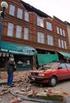 February 28 Earthquake: We got off easy State Geologist John Beaulieu Lucky may not be the first word that comes to mind after an earthquake that injured more than 200 and caused more than $1 billion damage,
After the Shaking Stops: A Communitywide Approach to Managing Post-Quake Fires
 After the Shaking Stops: A Communitywide Approach to Managing Post-Quake Fires By Rem Brown, P.E., IBHS Senior Engineering Manager, and Brent Henzi, IBHS Communications Associate Earthquakes are a destructive
Earthquakes: Risk and Insurance Issues
 Page 1 of 8 HOT TOPICS & INSURANCE ISSUES Earthquakes: Risk and Insurance Issues THE TOPIC JULY 2003 An earthquake is a sudden and rapid shaking of the earth caused by the breaking and shifting of rock
How do scientists measure earthquakes?
 Name: Source: http://www.scholastic.com/browse/article.jsp?id=4892 http://gizmodo.com/5833688/what-do-earthquake-magnitudes-mean http://www.kids-fun-science.com/moment-magnitude-scale.html http://tremor.nmt.edu/faq/how.html
Earthquakes: Risk & Insurance Issues
 Earthquakes: Risk & Insurance Issues An earthquake is a sudden and rapid shaking of the earth caused by the breaking and shifting of rock beneath the earth s surface. This shaking can sometimes trigger
Prepared For San Francisco Community College District 33 Gough Street San Francisco, California 94103. Prepared By
 Project Structural Conditions Survey and Seismic Vulnerability Assessment For SFCC Civic Center Campus 750 Eddy Street San Francisco, California 94109 Prepared For San Francisco Community College District
ENGINEERING-BASED EARTHQUAKE RISK MANAGEMENT
 ENGINEERING-BASED EARTHQUAKE RISK MANAGEMENT MRP Engineering Newsletter February 2012 The world recently experienced several major earthquakes, which caused severe local impacts and major worldwide repercussions.
Five reasons buildings fail in an earthquake and how to avoid them
 Five reasons buildings fail in an earthquake and how to avoid them by Jeff White, AIA Published in Healthcare Design magazine There s a saying among seismologists: Earthquakes don t kill people. Buildings
PRESENTERS: BACHELOR OF ARTS- PSYCHOLOGY
 KIBET J. NELLY PRESENTERS: MAGAI N. DORCAS BACHELOR OF ARTS- PSYCHOLOGY DISASTER? A serious disruption of the functioning of a community or society causing widespread human, material, economic or environmental
Presentations. Session 1. Slide 1. Earthquake Risk Reduction. 1- Concepts & Terminology
 Earthquake Risk Reduction Presentations Session 1 Slide 1 Earthquake Risk Reduction 1- Concepts & Terminology Welcome to the World Bank Institute s (WBI) Distance Learning (DL) course on Earthquake Risk
Earthquake Preparedness Tips & Strategies
 Earthquake Preparedness Tips & Strategies What to Do BEFORE an Earthquake What to Do DURING an Earthquake BE PREPARED! For more information, log onto: www.gema.ga.gov www.ready.ga.gov www.geophysics.eas.gatech.edu
Earthquake Hazards and Risks
 Page 1 of 7 EENS 3050 Tulane University Natural Disasters Prof. Stephen A. Nelson Earthquake Hazards and Risks This page last updated on 28-Aug-2013 Earthquake Risk Many seismologists have said that "earthquakes
CHAPTER SEISMIC RISK MITIGATION PRACTICES IN SCHOOL BUILDINGS IN ISTANBUL, TURKEY
 CHAPTER 13 SEISMIC RISK MITIGATION PRACTICES IN SCHOOL BUILDINGS IN ISTANBUL, TURKEY Özal Yüzügüllü, Gülay Barbarosoglu and Mustafa Erdik Kandilli Observatory and Earthquake Research Institute Bogaziçi
KCC Event Brief: 2014 La Habra Earthquake
 KAREN CLARK & COMPANY KCC Event Brief: 2014 La Habra Earthquake June 2014 2 COPLEY PLACE BOSTON, MA 02116 T: 617.423.2800 F: 617.423.2808 Overview On Friday, March 28, 2014 at 9:09pm, a magnitude 5.1 earthquake
THE FINANCIAL CRISIS: Is This a REPEAT OF THE 80 S FOR AGRICULTURE? Mike Boehlje and Chris Hurt, Department of Agricultural Economics
 THE FINANCIAL CRISIS: Is This a REPEAT OF THE 80 S FOR AGRICULTURE? Mike Boehlje and Chris Hurt, Department of Agricultural Economics The current financial crisis in the capital markets combined with recession
Chapter 7 Earthquake Hazards Practice Exam and Study Guide
 Chapter 7 Earthquake Hazards Practice Exam and Study Guide 1. Select from the following list, all of the factors that affect the intensity of ground shaking. a. The magnitude of the earthquake b. Rather
Dollars, deaths, and downtime: understand your building's seismic risk and how to evaluate it
 Dollars, deaths, and downtime: understand your building's seismic risk and how to evaluate it SEAOSC Strengthening Our Cities Summit 5 Nov 2015, Los Angeles, CA Keith Porter, PE PhD University of Colorado
Peace of mind that no earthquake can shake.
 California Earthquake Authority Your Guide to Earthquake Insurance Peace of mind that no earthquake can shake. Policy information for owners of Homes and Mobilehomes. Five reasons to buy a CEA policy.
Understanding the Student Loan Explosion. Implications for students and their families. Sponsored by:
 Understanding the Student Loan Explosion Implications for students and their families Sponsored by: Understanding the Student Loan Explosion: Implications for students and their families True wisdom is
CHAPTER 11 STRATEGY FOR SURVIVAL
 CHAPTER 11 STRATEGY FOR SURVIVAL Copyright 2008 Tom T. Moore If you re reading this several months in advance, there are a number of things that you can do to prepare for these coming earthquakes. I realize
Chincha and Cañete, Peru, Based
 Reconstruction of Ica, Pisco, Chincha and Cañete, Peru, Based on Updated Hazard Maps Julio Kuroiwa Professor emeritus National University of Engineering and UNDP Reconstruction Program/Sustainable Cities.
PACIFIC CATASTROPHE RISK ASSESSMENT AND FINANCING INITIATIVE
 PACIFIC CATASTROPHE RISK ASSESSMENT AND FINANCING INITIATIVE NIUE SEPTEMBER 11 COUNTRY RISK PROFILE: NIUE Niue is expected to incur, on average,.9 million USD per year in losses due to earthquakes and
It Is In Your Interest
 STUDENT MODULE 7.2 BORROWING MONEY PAGE 1 Standard 7: The student will identify the procedures and analyze the responsibilities of borrowing money. It Is In Your Interest Jason did not understand how it
Storms Assessment LESSON
 LESSON 8 Storms Assessment What will happen to the helix above a hot lamp? TERRY G. McCREA/SMITHSONIAN INSTITUTION INTRODUCTION You have now completed Storms, the first part of Catastrophic Events. After
Earthquake Risk Shakes Mortgage Industry
 Earthquake Risk Shakes Mortgage Industry by Haresh C. Shah and Daniel Rosenbaum THE SEISMIC SHOCK THAT rolled through Northridge, CA, on January 17, 1994, lasted less than half a minute, but the financial
ISTANBUL SEISMIC RISK MITIGATION AND EMERGENCY PREPAREDNESS PROJECT (ISMEP)
 ISTANBUL SEISMIC RISK MITIGATION AND EMERGENCY PREPAREDNESS PROJECT (ISMEP) Kazım Gökhan ELGİN Director Istanbul Governorship Istanbul Project Coordination Unit (IPCU) TURKEY is prone to mainly three Earthquakes;
EARTHQUAKE PREDICTION
 Lecture 15 Earthquake Prediction EARTHQUAKE PREDICTION To successfully predict an earthquake we would like to know:- PLACE TIME MAGNITUDE (rather like a weather forecast) 1 Evidence must be integrated
Protecting Cultural Heritage against Earthquake
 Protecting Cultural Heritage against Earthquake Miloš Drdácký Institute of Theoretical and Applied Mechanics of the Academy of Sciences of the Czech Republic European Centre of Excellence Advanced Research
FOURTH GRADE EARTHQUAKES 1 WEEK LESSON PLANS AND ACTIVITIES
 FOURTH GRADE EARTHQUAKES 1 WEEK LESSON PLANS AND ACTIVITIES PLATE TECTONIC CYCLE OVERVIEW OF FOURTH GRADE VOLCANOES WEEK 1. PRE: Comparing different structures of volcanoes. DURING: Modeling three types
Is Gold Worth Its Weight in a Portfolio?
 ADVISOR BYLINE By Bryan Harris Dimensional Fund Advisors June 2012 Is Gold Worth Its Weight in a Portfolio? During a weak global economy and uncertain financial markets, many investors tout the benefits
Evaluating an Illinois Earthquake
 Evaluating an Illinois Earthquake Grade Level: 7-8 Adapted from an activity by Robert A. Bauer, GeoActivity HAZD-1, ISGS GeoActivities Series, Activities and Other Resources for Teaching Geology, Illinois
PROPOSAL OF A SYSTEM TO PROMOTE RETROFITTING OF VULNERABLE MASONRY HOUSES IN DEVELOPING COUNTRIES
 Institute of Industrial Science, University of Tokyo Bulletin of ERS, No. 41 PROPOSAL OF A SYSTEM TO PROMOTE RETROFITTING OF VULNERABLE MASONRY HOUSES IN DEVELOPING COUNTRIES Satoshi IRITANI 1, Paola MAYORCA
Fire Sprinkler Incentive Act of 2003
 A Tax Incentive For Life Safety Fire Sprinkler Incentive Act of 2003 Ad Hoc Committee Members American Fire Sprinkler Association Campus Firewatch Congressional Fire Services Institute International Association
Earthquakes: Interesting Facts and F.A.Q.
 Earthquakes: Interesting Facts and F.A.Q. Earthquakes kill approximately 8,000 people each year and have caused an estimated 13 million deaths in the past 4,000 years. The moment magnitude scale (MMS)
HOW TO EVALUATE BUILDINGS AND DETERMINE RETROFIT COSTS
 David Bell PJHM Architects, Inc. Young Nam Daniel Traub Thornton Tomasetti how to evaluate buildings and determine retrofit costs HOW TO EVALUATE BUILDINGS AND DETERMINE RETROFIT COSTS Presented by: David
PROCEDURES BUSINESS CONTINUITY MANAGEMENT FRAMEWORK PURPOSE INTRODUCTION. 1 What is Business Continuity Management? 2 Link to Risk Management
 PROCEDURES BUSINESS CONTINUITY MANAGEMENT FRAMEWORK PURPOSE This Framework has been developed in support of both the Business Continuity and Crisis Management Policy and the Emergency and Fire Evacuation
Disaster Risk Reduction (DRR)
 Disaster Risk Reduction (DRR) A. Introduction 1. In order to address the impacts of the May 12 Wenchuan Earthquake, the Government of China will implement an effective, comprehensive and sustainable recovery
Testimony of Glenn Pomeroy Chief Executive Officer, California Earthquake Authority
 Testimony of Glenn Pomeroy Chief Executive Officer, California Earthquake Authority Before the House Committee on Financial Services Subcommittee on Housing and Community Opportunity Subcommittee on Capital
Written Testimony of Frederick Tombar Senior Advisor for Disaster Recovery to Secretary of U.S. Department of Housing and Urban Development (HUD)
 U.S. DEPARTMENT OF HOUSING AND URBAN DEVELOPMENT WASHINGTON, DC 20410 Written Testimony of Frederick Tombar Senior Advisor for Disaster Recovery to Secretary of U.S. Department of Housing and Urban Development
Integrated Earthquake Risk Assessment
 Socio- Vulnerability Index for Risk Analysis Mohsen Ghafory-Ashtiany Affiliated Faculty: Disaster Management Research Institute of Shakhes Pajooh Professor: International Institute of Earthquake Engineering
Ageing OECD Societies
 ISBN 978-92-64-04661-0 Trends Shaping Education OECD 2008 Chapter 1 Ageing OECD Societies FEWER CHILDREN LIVING LONGER CHANGING AGE STRUCTURES The notion of ageing societies covers a major set of trends
Natural Disaster Impact on Business and Communities in Taiwan. Dr. Chung-Sheng Lee. NCDR Chinese Taipei
 Natural Disaster Impact on Business and Communities in Taiwan Dr. Chung-Sheng Lee NCDR Chinese Taipei 1 Brief Introduction of NCDR 2 Organizational Chart of NCDR NDPPC: National Disaster Preparation and
Digging Deeper into Safety and Injury Prevention Data
 Digging Deeper into Safety and Injury Prevention Data Amanda Schwartz: Have you ever wondered how you could make your center safer using information you already collect? I'm Amanda Schwartz from the Head
ISTANBUL EARTHQUAKE RISK AND MITIGATION STUDIES
 ISTANBUL EARTHQUAKE RISK AND MITIGATION STUDIES O. Metin Ilkisik, M. Nilay Ergenc and Murat T. Turk Disaster Coordination Center, Istanbul Metropolitan Municipality, Istanbul, Turkey e-mail: [email protected]
Earthquakes. Earthquakes: Big Ideas. Earthquakes
 Earthquakes Earthquakes: Big Ideas Humans cannot eliminate natural hazards but can engage in activities that reduce their impacts by identifying high-risk locations, improving construction methods, and
SECOND GRADE PLATE TECTONICS 1 WEEK LESSON PLANS AND ACTIVITIES
 SECOND GRADE PLATE TECTONICS 1 WEEK LESSON PLANS AND ACTIVITIES PLATE TECTONIC CYCLE OVERVIEW OF SECOND GRADE VOLCANOES WEEK 1. PRE: Investigating the parts of a volcano. LAB: Comparing the parts of a
Tuesday, March 27, 2007. Thank you Chairwoman Waters and Ranking Member Biggert for holding
 THE HONORABLE TIM MAHONEY TESTIMONY BEFORE THE U.S. HOUSE FINANCIAL SERVICES SUBCOMMITTEE ON HOUSING AND COMMUNITY OPPORTUNITY REGARDING PERSPECTIVES ON NATURAL DISASTER INSURANCE Tuesday, March 27, 2007
Disaster Debris Removal Operations. October 26, 2011
 Association of Conservation Engineers 2011 Conference Disaster Debris Removal Operations October 26, 2011 Presenters s Keith Forrester, Debris Monitoring Operations Manager Over 8 years of experience managing
CEDIM Forensic Disaster Analysis Group & CATDAT and Earthquake-Report.com. Philippines (Bohol) Earthquake Report #2
 CEDIM Forensic Disaster Analysis Group & CATDAT and Earthquake-Report.com Philippines (Bohol) Earthquake Report #2 Report Contributors: James Daniell (Earthquake Report & KIT); Armand Vervaeck, Carlos
Strategic Plan. National Earthquake Hazards Reduction Program
 Strategic Plan for the National Earthquake Hazards Reduction Program Fiscal Years 2009 2013* October 2008 *Plan remains in effect and will be updated in accordance with future NEHRP Reauthorization This
Deficits as far as the eye can see
 Testimony of Mark A. Calabria, Ph.D. Director, Financial Regulation Studies, Cato Institute Submitted to the Subcommittee on Insurance, Housing, & Community Opportunity House Committee on Financial Services
 Testimony of Mr. Robert J. Fenton, Jr. Assistant Administrator for Response, Office of Response and Recovery Federal Emergency Management Agency U.S. Department of Homeland Security Before House Committee
The U.S. Economy after September 11. 1. pushing us from sluggish growth to an outright contraction. b and there s a lot of uncertainty.
 Presentation to the University of Washington Business School For delivery November 15, 2001 at approximately 8:05 AM Pacific Standard Time (11:05 AM Eastern) By Robert T. Parry, President and CEO of the
Recent Earthquakes: Implications for U.S. Water Utilities [Project #4408]
![Recent Earthquakes: Implications for U.S. Water Utilities [Project #4408]](/thumbs/25/5582528.jpg "Recent Earthquakes: Implications for U.S. Water Utilities [Project #4408]") Recent Earthquakes: Implications for U.S. Water Utilities [Project #4408] ORDER NUMBER: 4408 DATE AVAILABLE: July 2012 PRINCIPAL INVESTIGATORS: John Eidinger and Craig A. Davis PROJECT PURPOSE: The purpose
Recent Earthquakes: Implications for U.S. Water Utilities [Project #4408] ORDER NUMBER: 4408 DATE AVAILABLE: July 2012 PRINCIPAL INVESTIGATORS: John Eidinger and Craig A. Davis PROJECT PURPOSE: The purpose
Structural Retrofitting For Earthquake Resistance
 Structural Retrofitting For Earthquake Resistance Ruben Boroschek WHO Disaster Mitigation in Health Facilities University of Chile [email protected] www.hospitalseguro.cl The following paper is part
2015 International Building Code
 Public Comment E97-15 LOVELL-B: Proponent : Vickie Lovell, InterCode Incorporated, representing Fire Safe North America ([email protected]) requests Approve as Modified by this Public Comment. Modify
An Overview of Professional Directors and Officers Liability in Disaster Preparedness and Recovery Planning
 An Overview of Professional Directors and Officers Liability in Disaster Preparedness and Recovery Planning Eric Martin Scott Southern University Law Center Preparation for disasters involves a variety
Improved Warnings for Natural Hazards: A Prototype System for Southern California
 Improved Warnings for Natural Hazards: A Prototype System for Southern California Yehuda Bock Research Geodesist Scripps Institution of Oceanography University of California San Diego, La Jolla, Calif.
SEISMIC RETROFITTING STRATEGIES FOR BRIDGES IN MODERATE EARTHQUAKE REGIONS
 SEISMIC RETROFITTING STRATEGIES FOR BRIDGES IN MODERATE EARTHQUAKE REGIONS ABSTRACT Ayaz H. Malik, P.E. Project Engineer New York State Department of Transportation Certain parts of the United States have
Earthquakes. What to Do Before an Earthquake
 EARTHQUAKES Earthquakes What to Do Before an Earthquake Earthquakes strike suddenly, violently and without warning. Identifying potential hazards ahead of time and advance planning can reduce the dangers
American Planning Association
 American Planning Association Planning for Post-Disaster Recovery Session 1 Moderator: Tim Gelston, FEMA Region 8 Speakers: Kenneth C. Topping, FAICP, Topping Associates International J. Barry Hokanson,
New Heavens and a New Earth Isaiah 65:17-25
 Stories on the Way: Lesson Plans for Small Sunday Schools New Heavens and a New Earth Isaiah 65:17-25 page The Story 1 The Lessons 1. New Heavens and a New Earth 2 2. Worth Waiting For 4 Written by Rhonda
Talking to our children about Violence and Terrorism: Living in Anxious times
 Talking to our children about Violence and Terrorism: Living in Anxious times Living in Anxious Times: Introductory Remarks Since the September 11 attack America has changed. Children and adults alike
Catastrophe risk and the cost of real estate insurance
 Catastrophe risk and the cost of real estate insurance Catastrophe risk and the cost of real estate insurance Any real estate company that owns property in states exposed to hurricanes or earthquakes is
A short Research Paper. Affordable Solution for Earthquake Resistant Building Construction in Haiti. Dawang Sherpa
 Earthquake Resistant Building Construction - 1 A short Research Paper on Affordable Solution for Earthquake Resistant Building Construction in Haiti by Dawang Sherpa Submitted to Southern Alberta Institute
S&P/Case-Shiller Home Price Indices
 Some More Seasonal Improvement in Home Prices According to the S&P/Case-Shiller Home Price Indices New York, July 26, 2011 Data through May 2011, released today by S&P Indices for its S&P/Case- Shiller
Becoming a Pilot. Questions Answered by a Professional Pilot.
 Becoming a Pilot. Questions Answered by a Professional Pilot. By Mario Sabogal Introduction My name is Mario Sabogal, and I am a professional pilot. I have worked as a pilot in various corners of the aviation
TESTIMONY OF JANICE OCHENKOWSKI ON BEHALF OF THE RISK AND INSURANCE MANAGEMENT SOCIETY, INC. (RIMS) BEFORE THE
 TESTIMONY OF JANICE OCHENKOWSKI ON BEHALF OF THE RISK AND INSURANCE MANAGEMENT SOCIETY, INC. (RIMS) BEFORE THE U.S HOUSE OF REPRESENTATIVES COMMITTEE ON FINANCIAL SERVICES SUBCOMMITTEE ON INSURANCE, HOUSING
Frequently Asked Questions About Property Damage Insurance Claims in Alabama
 Roadmap to Recovery Program Frequently Asked Questions About Property Damage Insurance Claims in Alabama This publication offers general guidance and answers to common questions people ask after a loss
SBA Administrator Maria Contreras-Sweet. Yolanda Garcia Olivarez Regional Administrator SBA Region VI 1
 SBA Administrator Maria Contreras-Sweet Yolanda Garcia Olivarez Regional Administrator SBA Region VI 1 A Stronger U.S. Economy Unemployment rate 5.3% - More people entering the workforce. More jobs 215,000
Multifamily Market Commentary July 2014 The Nation s Aging Multifamily Housing Stock
 Multifamily Market Commentary July 2014 The Nation s Aging Multifamily Housing Stock Although America s population is rising at its slowest pace in more than 70 years, and it has taken 76 months for employment