
REVIEW QUESTIONS Chapter 8
|
|
|
- Sharlene Sherman
- 9 years ago
- Views:
Transcription
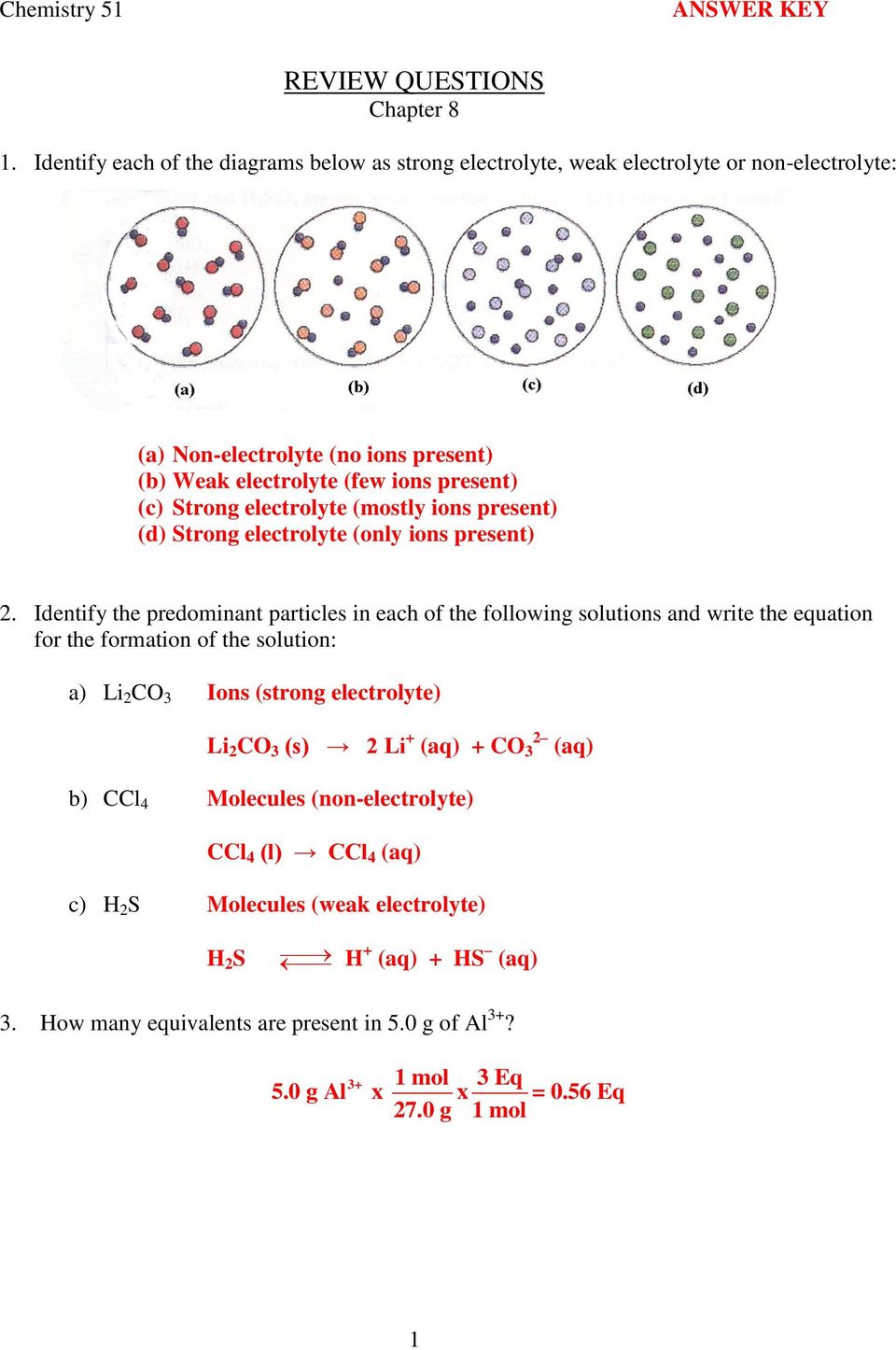
1 Chemistry 51 ANSWER KEY REVIEW QUESTIONS Chapter 8 1. Identify each of the diagrams below as strong electrolyte, weak electrolyte or non-electrolyte: (a) Non-electrolyte (no ions present) (b) Weak electrolyte (few ions present) (c) Strong electrolyte (mostly ions present) (d) Strong electrolyte (only ions present). Identify the predominant particles in each of the following solutions and write the equation for the formation of the solution: a) Li CO Ions (strong electrolyte) Li CO (s) Li + (aq) + CO (aq) b) CCl 4 Molecules (non-electrolyte) CCl 4 (l) CCl 4 (aq) c) H S Molecules (weak electrolyte) H S H + (aq) + HS (aq). How many equivalents are present in 5.0 g of Al +? + 1 mol Eq 5.0 g Al x x = 0.56 Eq 7.0 g 1 mol 1
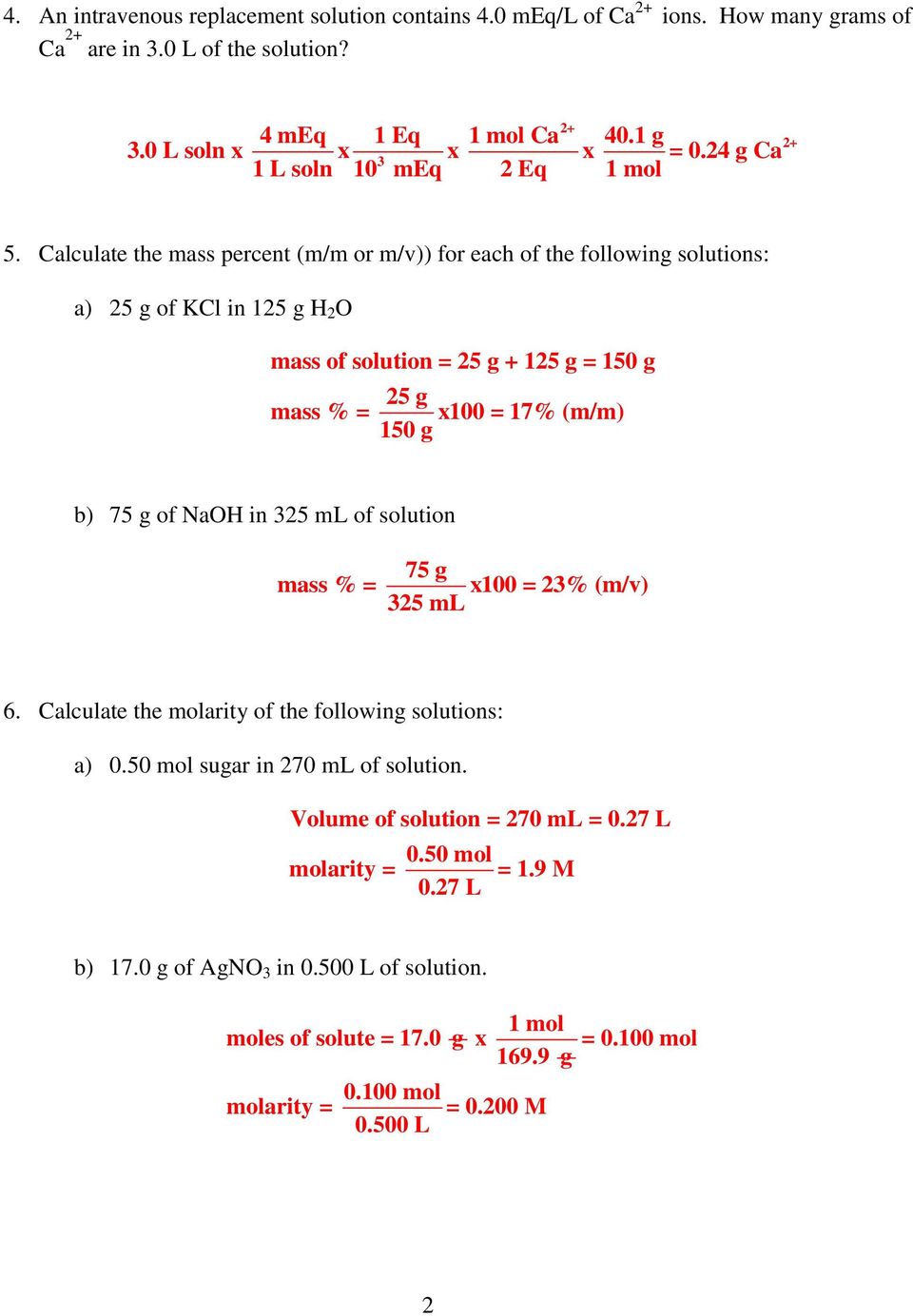
2 4. An intravenous replacement solution contains 4.0 meq/l of Ca + ions. How many grams of Ca + are in.0 L of the solution? 4 meq 1 Eq + 1 mol Ca 40.1 g 1 L soln 10 meq Eq 1 mol.0 L soln x x x x = 0.4 g Ca + 5. Calculate the mass percent (m/m or m/v)) for each of the following solutions: a) 5 g of KCl in 15 g H O mass of solution = 5 g + 15 g = 150 g 5 g mass % = x100 = 17% (m/m) 150 g b) 75 g of NaOH in 5 ml of solution 75 g mass % = x100 = % (m/v) 5 ml 6. Calculate the molarity of the following solutions: a) 0.50 mol sugar in 70 ml of solution. Volume of solution = 70 ml = 0.7 L 0.50 mol molarity = = 1.9 M 0.7 L b) 17.0 g of AgNO in L of solution. moles of solute = 17.0 g 1 mol x g = mol molarity = mol = 0.00 M L
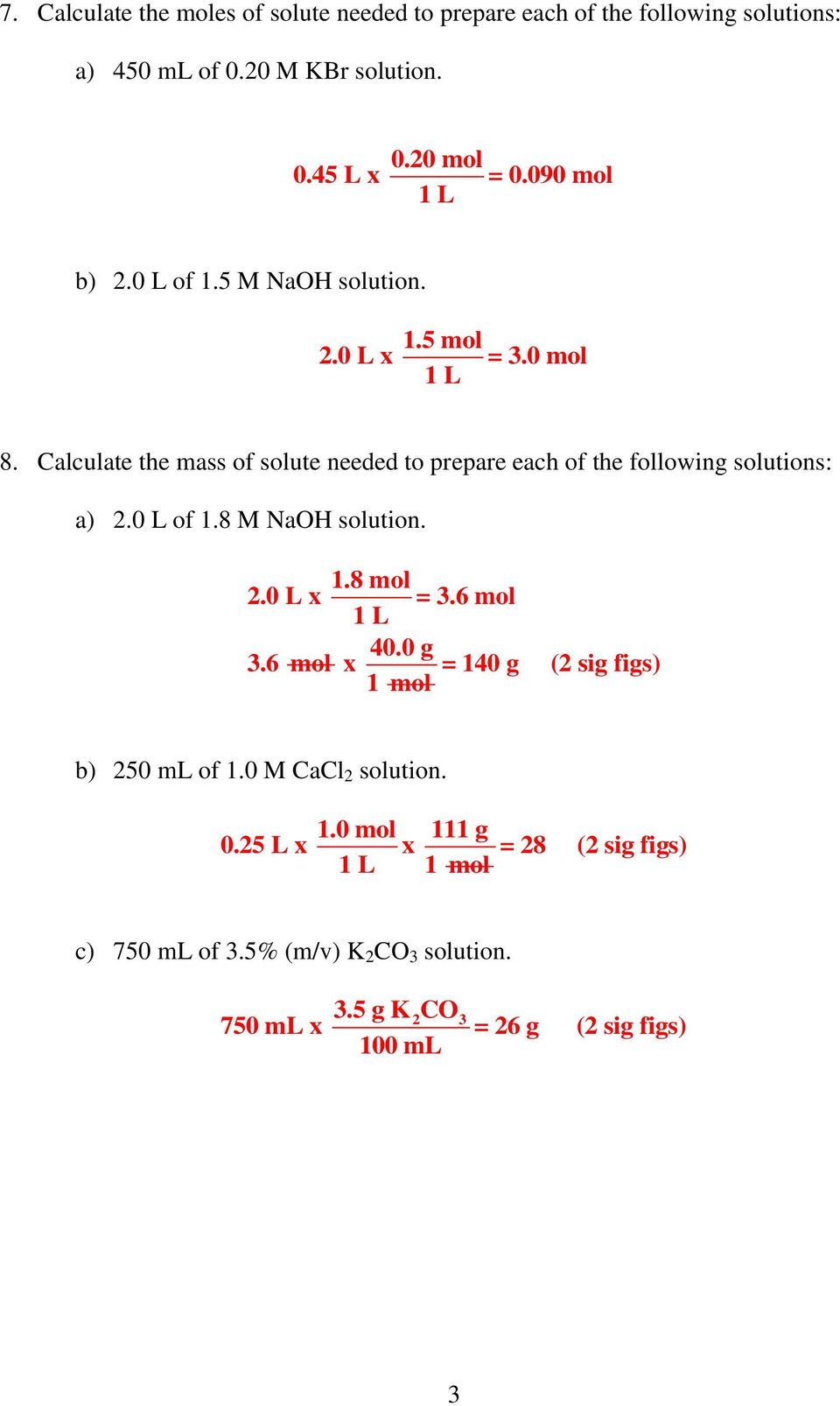
3 7. Calculate the moles of solute needed to prepare each of the following solutions: a) 450 ml of 0.0 M KBr solution. 0.0 mol 0.45 L x = mol 1 L b).0 L of 1.5 M NaOH solution. 1.5 mol.0 L x =.0 mol 1 L 8. Calculate the mass of solute needed to prepare each of the following solutions: a).0 L of 1.8 M NaOH solution. 1.8 mol.0 L x =.6 mol 1 L 40.0 g.6 mol x = 140 g 1 mol ( sig figs) b) 50 ml of 1.0 M CaCl solution. 1.0 mol 111 g 0.5 L x x 1 L 1 mol = 8 ( sig figs) c) 750 ml of.5% (m/v) K CO solution..5 g K CO 750 ml x = 6 g ( sig figs) 100 ml
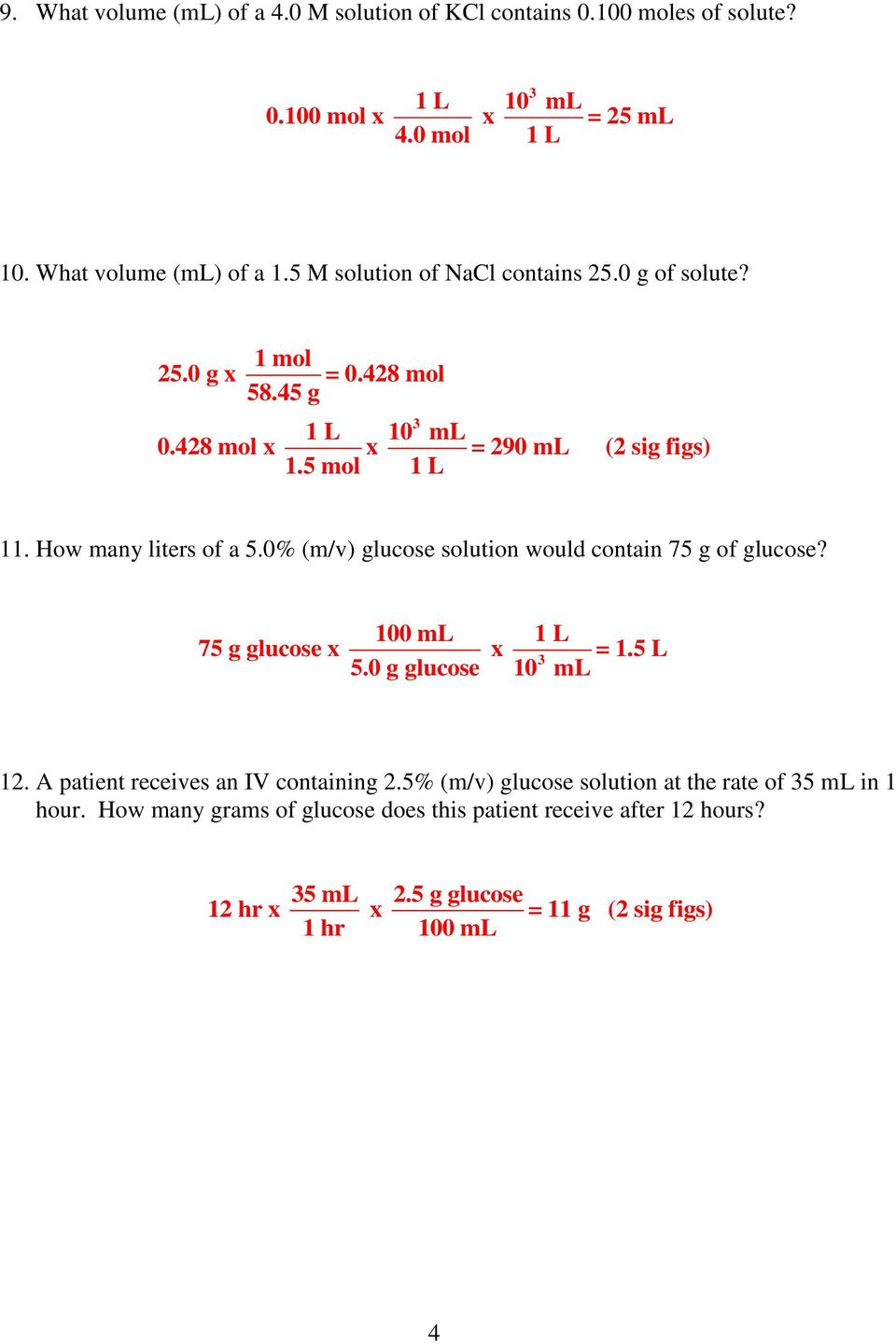
4 9. What volume (ml) of a 4.0 M solution of KCl contains moles of solute? 1 L 10 ml mol x x = 5 ml 4.0 mol 1 L 10. What volume (ml) of a 1.5 M solution of NaCl contains 5.0 g of solute? 1 mol 5.0 g x = 0.48 mol g 1 L 10 ml 0.48 mol x x = 90 ml ( sig figs) 1.5 mol 1 L 11. How many liters of a 5.0% (m/v) glucose solution would contain 75 g of glucose? 100 ml 1 L 75 g glucose x x = 1.5 L 5.0 g glucose 10 ml 1. A patient receives an IV containing.5% (m/v) glucose solution at the rate of 5 ml in 1 hour. How many grams of glucose does this patient receive after 1 hours? 5 ml.5 g glucose 1 hr x x = 11 g ( sig figs) 1 hr 100 ml 4
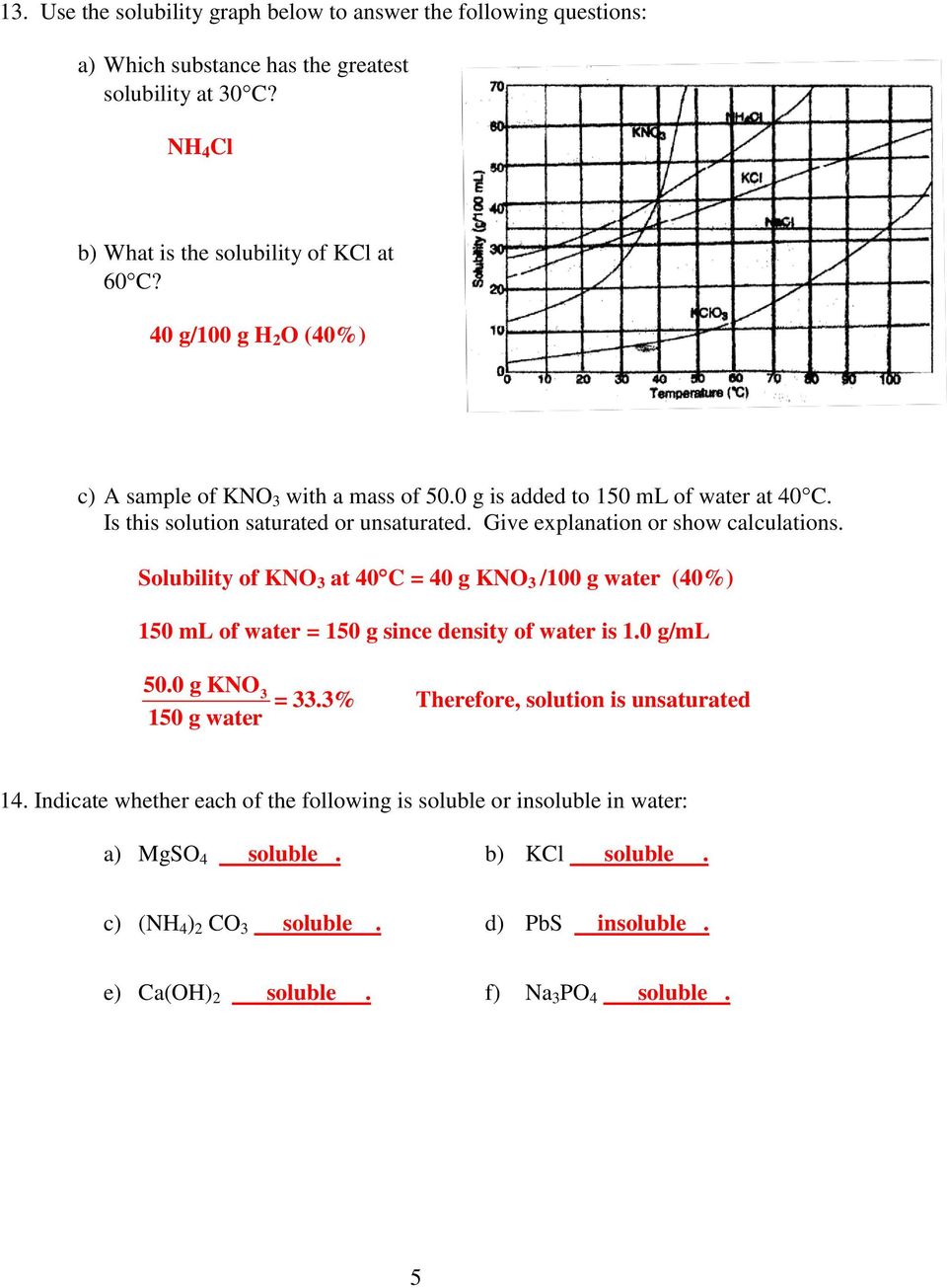
5 1. Use the solubility graph below to answer the following questions: a) Which substance has the greatest solubility at 0 C? NH 4 Cl b) What is the solubility of KCl at 60 C? 40 g/100 g H O (40%) c) A sample of KNO with a mass of 50.0 g is added to 150 ml of water at 40 C. Is this solution saturated or unsaturated. Give explanation or show calculations. Solubility of KNO at 40 C = 40 g KNO /100 g water (40%) 150 ml of water = 150 g since density of water is 1.0 g/ml 50.0 g KNO =.% 150 g water Therefore, solution is unsaturated 14. Indicate whether each of the following is soluble or insoluble in water: a) MgSO 4 soluble. b) KCl soluble. c) (NH 4 ) CO soluble. d) PbS insoluble. e) Ca(OH) soluble. f) Na PO 4 soluble. 5
6 15. For each reaction below, write the net ionic equation to show the formation of a precipitate. If no precipitate occurs, write No Reaction after the arrow. a) Pb(NO ) (aq) + NaI (aq) PbI (s) + NaNO (aq) Pb + + NO + Na + + I PbI (s) + Na + + NO Net Ionic Equation Pb + + I PbI (s) b) NaCl (aq) + (NH 4 ) SO 4 (aq) No Reaction No precipitate forms since the two possible products formed (Na SO 4 and NH 4 Cl) are both soluble c) CaCl (aq) + Na PO 4 (aq) Ca (PO 4 ) (s) + 6 NaCl (aq) Ca Cl + 6 Na + + PO 4 Ca (PO 4 ) (s) + 6 Na Cl Net Ionic Equation Ca + + PO 4 Ca (PO 4 ) (s) d) Ca(NO ) (aq) + Na S (aq) CaS (s) + NaNO (aq) Ca + + NO + Na + + S CaS (s) + Na + + NO Net Ionic Equation Ca + + S CaS (s) 16. Complete and balance the following chemical equations: a) HCl (aq) + Ca(OH) (aq) CaCl (aq) + H O (l) b) CaCO (s) + HNO (aq) Ca(NO ) (aq) + CO (g) + H O (l) c) H SO 4 (aq) + LiOH (aq) Li SO 4 (aq) + H O (l) 6

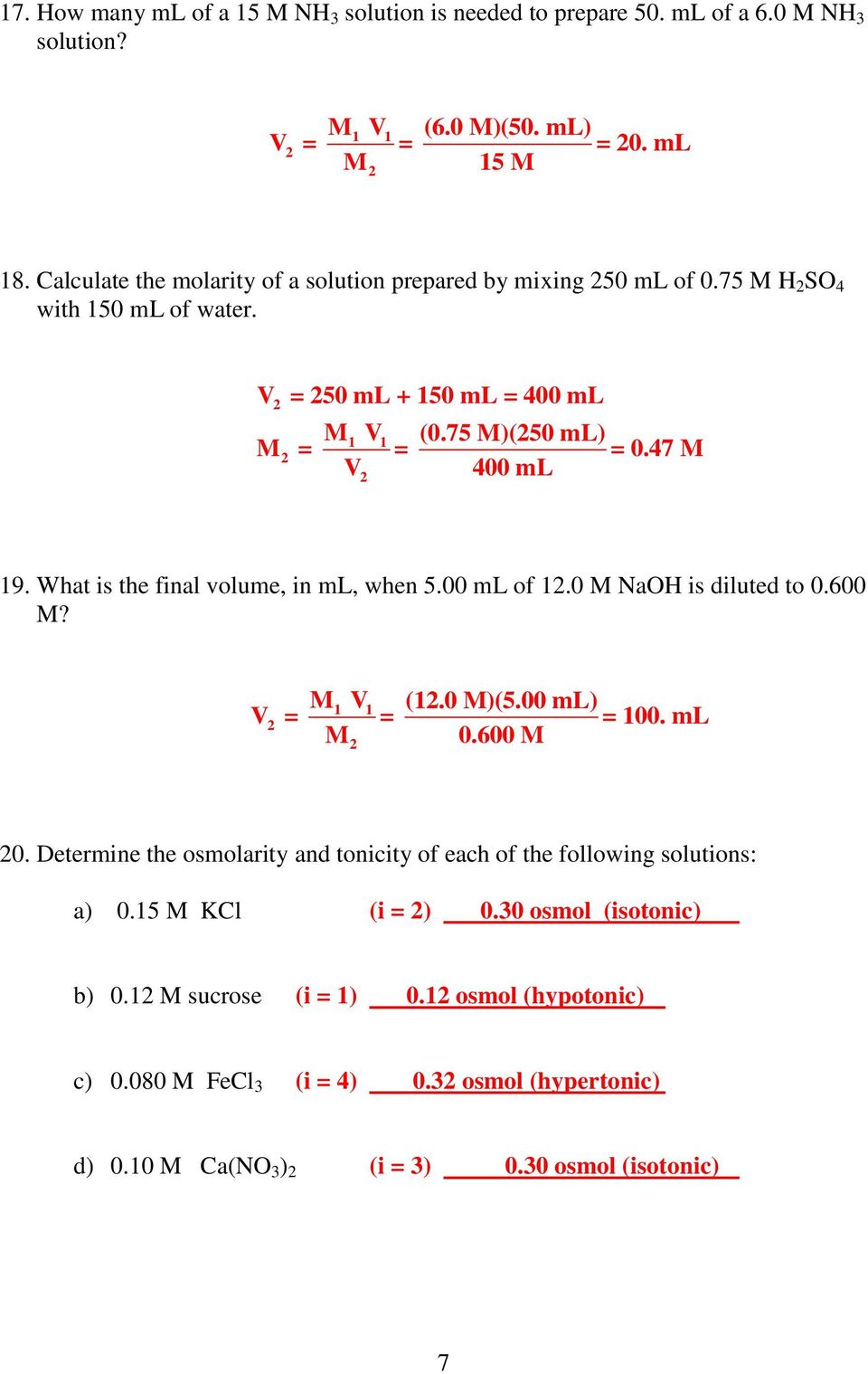
7 17. How many ml of a 15 M NH solution is needed to prepare 50. ml of a 6.0 M NH solution? M V (6.0 M)(50. ml) 1 1 V = = = 0. ml M 15 M 18. Calculate the molarity of a solution prepared by mixing 50 ml of 0.75 M H SO 4 with 150 ml of water. V = 50 ml ml = 400 ml M V (0.75 M)(50 ml) 1 1 M = = = 0.47 M V 400 ml 19. What is the final volume, in ml, when 5.00 ml of 1.0 M NaOH is diluted to M? M V (1.0 M)(5.00 ml) 1 1 V = = = 100. ml M M 0. Determine the osmolarity and tonicity of each of the following solutions: a) 0.15 M KCl (i = ) 0.0 osmol (isotonic) b) 0.1 M sucrose (i = 1) 0.1 osmol (hypotonic) c) M FeCl (i = 4) 0. osmol (hypertonic) d) 0.10 M Ca(NO ) (i = ) 0.0 osmol (isotonic) 7
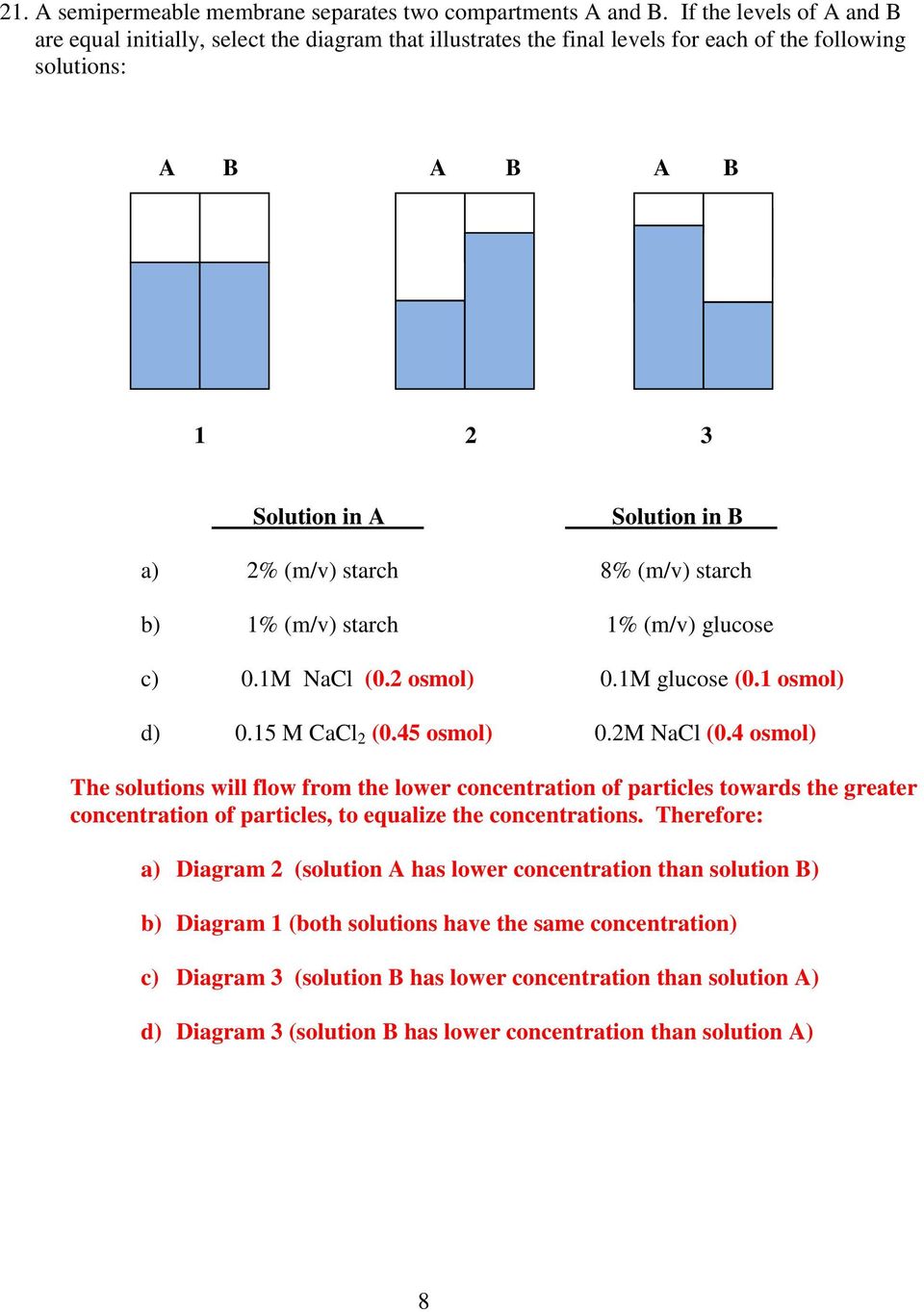
8 1. A semipermeable membrane separates two compartments A and B. If the levels of A and B are equal initially, select the diagram that illustrates the final levels for each of the following solutions: A B A B A B 1 Solution in A Solution in B a) % (m/v) starch 8% (m/v) starch b) 1% (m/v) starch 1% (m/v) glucose c) 0.1M NaCl (0. osmol) 0.1M glucose (0.1 osmol) d) 0.15 M CaCl (0.45 osmol) 0.M NaCl (0.4 osmol) The solutions will flow from the lower concentration of particles towards the greater concentration of particles, to equalize the concentrations. Therefore: a) Diagram (solution A has lower concentration than solution B) b) Diagram 1 (both solutions have the same concentration) c) Diagram (solution B has lower concentration than solution A) d) Diagram (solution B has lower concentration than solution A) 8
Chemistry 51 Chapter 8 TYPES OF SOLUTIONS. A solution is a homogeneous mixture of two substances: a solute and a solvent.
 TYPES OF SOLUTIONS A solution is a homogeneous mixture of two substances: a solute and a solvent. Solute: substance being dissolved; present in lesser amount. Solvent: substance doing the dissolving; present
SAMPLE PROBLEM 8.1. Solutions of Electrolytes and Nonelectrolytes SOLUTION STUDY CHECK
 Solutions of Electrolytes and Nonelectrolytes SAMPLE PROBLEM 8.1 Indicate whether solutions of each of the following contain only ions, only molecules, or mostly molecules and a few ions: a. Na 2 SO 4,
Answers and Solutions to Text Problems
 9 Answers and Solutions to Text Problems 9.1 a. δ O δ + δ + H H In a water molecule, the oxygen has a partial negative charge and the hydrogens have partial positive charges. b. δ δ + O H δ + δ + δ H H
stoichiometry = the numerical relationships between chemical amounts in a reaction.
 1 REACTIONS AND YIELD ANSWERS stoichiometry = the numerical relationships between chemical amounts in a reaction. 2C 8 H 18 (l) + 25O 2 16CO 2 (g) + 18H 2 O(g) From the equation, 16 moles of CO 2 (a greenhouse
Chapter 14 Solutions
 Chapter 14 Solutions 1 14.1 General properties of solutions solution a system in which one or more substances are homogeneously mixed or dissolved in another substance two components in a solution: solute
Ch 8.5 Solution Concentration Units % (m/m or w/w) = mass of solute x 100 total mass of solution mass of solution = mass solute + mass solvent
 1 Ch 8.5 Solution Concentration Units % (m/m or w/w) = mass of solute x 100 total mass of solution mass of solution = mass solute + mass solvent % (v/v) = volume of solute x 100 volume of solution filled
Name: Class: Date: 2 4 (aq)
 Name: Class: Date: Unit 4 Practice Test Multiple Choice Identify the choice that best completes the statement or answers the question. 1) The balanced molecular equation for complete neutralization of
Steps for balancing a chemical equation
 The Chemical Equation: A Chemical Recipe Dr. Gergens - SD Mesa College A. Learn the meaning of these arrows. B. The chemical equation is the shorthand notation for a chemical reaction. A chemical equation
Aqueous Solutions. Water is the dissolving medium, or solvent. Some Properties of Water. A Solute. Types of Chemical Reactions.
 Aqueous Solutions and Solution Stoichiometry Water is the dissolving medium, or solvent. Some Properties of Water Water is bent or V-shaped. The O-H bonds are covalent. Water is a polar molecule. Hydration
Tutorial 4 SOLUTION STOICHIOMETRY. Solution stoichiometry calculations involve chemical reactions taking place in solution.
 T-27 Tutorial 4 SOLUTION STOICHIOMETRY Solution stoichiometry calculations involve chemical reactions taking place in solution. Of the various methods of expressing solution concentration the most convenient
n molarity = M = N.B.: n = litres (solution)
 1. CONCENTRATION UNITS A solution is a homogeneous mixture of two or more chemical substances. If we have a solution made from a solid and a liquid, we say that the solid is dissolved in the liquid and
a. Cherry Garcia ice cream: heterogeneous mixture b. mayonnaise: colloid c, d, e. seltzer water, nail polish remover, and brass: solutions
 Chapter 8 1 Chapter 8 Solutions Solutions to In-Chapter Problems 8.1 A heterogeneous miture does not have a uniform composition throughout a sample. A solution is a homogeneous miture that contains small
Balance the following equation: KClO 3 + C 12 H 22 O 11 KCl + CO 2 + H 2 O
 Balance the following equation: KClO 3 + C 12 H 22 O 11 KCl + CO 2 + H 2 O Ans: 8 KClO 3 + C 12 H 22 O 11 8 KCl + 12 CO 2 + 11 H 2 O 3.2 Chemical Symbols at Different levels Chemical symbols represent
1. Read P. 368-375, P. 382-387 & P. 429-436; P. 375 # 1-11 & P. 389 # 1,7,9,12,15; P. 436 #1, 7, 8, 11
 SCH3U- R.H.KING ACADEMY SOLUTION & ACID/BASE WORKSHEET Name: The importance of water - MAKING CONNECTION READING 1. Read P. 368-375, P. 382-387 & P. 429-436; P. 375 # 1-11 & P. 389 # 1,7,9,12,15; P. 436
Chemistry Ch 15 (Solutions) Study Guide Introduction
 Chemistry Ch 15 (Solutions) Study Guide Introduction Name: Note: a word marked (?) is a vocabulary word you should know the meaning of. A homogeneous (?) mixture, or, is a mixture in which the individual
Liquid phase. Balance equation Moles A Stoic. coefficient. Aqueous phase
 STOICHIOMETRY Objective The purpose of this exercise is to give you some practice on some Stoichiometry calculations. Discussion The molecular mass of a compound is the sum of the atomic masses of all
2. DECOMPOSITION REACTION ( A couple have a heated argument and break up )
 TYPES OF CHEMICAL REACTIONS Most reactions can be classified into one of five categories by examining the types of reactants and products involved in the reaction. Knowing the types of reactions can help
Milliequivalents, Millimoles,, and Milliosmoles
 Milliequivalents, Millimoles,, and Milliosmoles Electrolytes vs Nonelectrolytes Compounds in solution are often referred to as either electrolytes or nonelectrolytes - Electrolytes are compounds that in
General Chemistry II Chapter 20
 1 General Chemistry II Chapter 0 Ionic Equilibria: Principle There are many compounds that appear to be insoluble in aqueous solution (nonelectrolytes). That is, when we add a certain compound to water
CHEM 110: CHAPTER 3: STOICHIOMETRY: CALCULATIONS WITH CHEMICAL FORMULAS AND EQUATIONS
 1 CHEM 110: CHAPTER 3: STOICHIOMETRY: CALCULATIONS WITH CHEMICAL FORMULAS AND EQUATIONS The Chemical Equation A chemical equation concisely shows the initial (reactants) and final (products) results of
Answers and Solutions to Text Problems
 Chapter 7 Answers and Solutions 7 Answers and Solutions to Text Problems 7.1 A mole is the amount of a substance that contains 6.02 x 10 23 items. For example, one mole of water contains 6.02 10 23 molecules
Solution a homogeneous mixture = A solvent + solute(s) Aqueous solution water is the solvent
 Solution a homogeneous mixture = A solvent + solute(s) Aqueous solution water is the solvent Water a polar solvent: dissolves most ionic compounds as well as many molecular compounds Aqueous solution:
Aqueous Ions and Reactions
 Aqueous Ions and Reactions (ions, acids, and bases) Demo NaCl(aq) + AgNO 3 (aq) AgCl (s) Two clear and colorless solutions turn to a cloudy white when mixed Demo Special Light bulb in water can test for
Stoichiometry and Aqueous Reactions (Chapter 4)
 Stoichiometry and Aqueous Reactions (Chapter 4) Chemical Equations 1. Balancing Chemical Equations (from Chapter 3) Adjust coefficients to get equal numbers of each kind of element on both sides of arrow.
Chapter 8: Chemical Equations and Reactions
 Chapter 8: Chemical Equations and Reactions I. Describing Chemical Reactions A. A chemical reaction is the process by which one or more substances are changed into one or more different substances. A chemical
1. When the following equation is balanced, the coefficient of Al is. Al (s) + H 2 O (l)? Al(OH) 3 (s) + H 2 (g)
 1. When the following equation is balanced, the coefficient of Al is. Al (s) + H 2 O (l)? Al(OH) (s) + H 2 (g) A) 1 B) 2 C) 4 D) 5 E) Al (s) + H 2 O (l)? Al(OH) (s) + H 2 (g) Al (s) + H 2 O (l)? Al(OH)
EXPERIMENT # 3 ELECTROLYTES AND NON-ELECTROLYTES
 EXPERIMENT # 3 ELECTROLYTES AND NON-ELECTROLYTES Purpose: 1. To investigate the phenomenon of solution conductance. 2. To distinguish between compounds that form conducting solutions and compounds that
NET IONIC EQUATIONS. A balanced chemical equation can describe all chemical reactions, an example of such an equation is:
 NET IONIC EQUATIONS A balanced chemical equation can describe all chemical reactions, an example of such an equation is: NaCl + AgNO 3 AgCl + NaNO 3 In this case, the simple formulas of the various reactants
Chemical Equations. Chemical Equations. Chemical reactions describe processes involving chemical change
 Chemical Reactions Chemical Equations Chemical reactions describe processes involving chemical change The chemical change involves rearranging matter Converting one or more pure substances into new pure
Chemical Reactions 2 The Chemical Equation
 Chemical Reactions 2 The Chemical Equation INFORMATION Chemical equations are symbolic devices used to represent actual chemical reactions. The left side of the equation, called the reactants, is separated
Chemistry B11 Chapter 6 Solutions and Colloids
 Chemistry B11 Chapter 6 Solutions and Colloids Solutions: solutions have some properties: 1. The distribution of particles in a solution is uniform. Every part of the solution has exactly the same composition
Molarity of Ions in Solution
 APPENDIX A Molarity of Ions in Solution ften it is necessary to calculate not only the concentration (in molarity) of a compound in aqueous solution but also the concentration of each ion in aqueous solution.
Experiment 8 - Double Displacement Reactions
 Experiment 8 - Double Displacement Reactions A double displacement reaction involves two ionic compounds that are dissolved in water. In a double displacement reaction, it appears as though the ions are
CHM1 Review for Exam 12
 Topics Solutions 1. Arrhenius Acids and bases a. An acid increases the H + concentration in b. A base increases the OH - concentration in 2. Strong acids and bases completely dissociate 3. Weak acids and
Chemistry 151 Final Exam
 Chemistry 151 Final Exam Name: SSN: Exam Rules & Guidelines Show your work. No credit will be given for an answer unless your work is shown. Indicate your answer with a box or a circle. All paperwork must
Moles. Balanced chemical equations Molar ratios Mass Composition Empirical and Molecular Mass Predicting Quantities Equations
 Moles Balanced chemical equations Molar ratios Mass Composition Empirical and Molecular Mass Predicting Quantities Equations Micro World atoms & molecules Macro World grams Atomic mass is the mass of an
Balancing Chemical Equations Worksheet Intermediate Level
 Balancing Chemical Equations Worksheet Intermediate Level Neutralization Reactions Salts are produced by the action of acids. Salts are written metal first, then non-metal. Eg. NaCl not ClNa Acid + Base
Solution concentration = how much solute dissolved in solvent
 Solutions 1 Solutions Concentration Solution concentration = how much solute dissolved in solvent Coffee crystal = solute Water = solvent Liquid Coffee = solution so a solute is dissolved in solvent to
Chapter 4. Chemical Composition. Chapter 4 Topics H 2 S. 4.1 Mole Quantities. The Mole Scale. Molar Mass The Mass of 1 Mole
 Chapter 4 Chemical Composition Chapter 4 Topics 1. Mole Quantities 2. Moles, Masses, and Particles 3. Determining Empirical Formulas 4. Chemical Composition of Solutions Copyright The McGraw-Hill Companies,
Name period Unit 9: acid/base equilibrium
 Name period Unit 9: acid/base equilibrium 1. What is the difference between the Arrhenius and the BronstedLowry definition of an acid? Arrhenious acids give H + in water BronstedLowry acids are proton
Acid/base Definitions. Acid/Base Definitions. Acid / Base Chemistry. Acid/Base Definitions. Identifying Acids and Bases
 Acids Identifying Acids and Bases Acid (anhydrides) contains H+ ions as the cation, with and other element as the anion Non-metal oxide H2SO4 HI P2O5 Bases Base (anhydrides) Contains OH- as the anion Combined
PART I: MULTIPLE CHOICE (30 multiple choice questions. Each multiple choice question is worth 2 points)
 CHEMISTRY 123-07 Midterm #1 Answer key October 14, 2010 Statistics: Average: 74 p (74%); Highest: 97 p (95%); Lowest: 33 p (33%) Number of students performing at or above average: 67 (57%) Number of students
Concentration of a solution
 Revision of calculations Stoichiometric calculations Osmotic pressure and osmolarity MUDr. Jan Pláteník, PhD Concentration of a solution mass concentration: grams of substance per litre of solution molar
Redox and Electrochemistry
 Name: Thursday, May 08, 2008 Redox and Electrochemistry 1. A diagram of a chemical cell and an equation are shown below. When the switch is closed, electrons will flow from 1. the Pb(s) to the Cu(s) 2+
Molar Mass Worksheet Answer Key
 Molar Mass Worksheet Answer Key Calculate the molar masses of the following chemicals: 1) Cl 2 71 g/mol 2) KOH 56.1 g/mol 3) BeCl 2 80 g/mol 4) FeCl 3 162.3 g/mol 5) BF 3 67.8 g/mol 6) CCl 2 F 2 121 g/mol
Description of the Mole Concept:
 Description of the Mole Concept: Suppose you were sent into the store to buy 36 eggs. When you picked them up you would get 3 boxes, each containing 12 eggs. You just used a mathematical device, called
4.1 Aqueous Solutions. Chapter 4. Reactions in Aqueous Solution. Electrolytes. Strong Electrolytes. Weak Electrolytes
 Chapter 4 Reactions in Aqueous Solution 4.1 Aqueous Solutions Solution homogeneous mixture of 2 or more substances Solute the substance present in a smaller amount (usually solid in Chap. 4) Solvent the
MOLARITY = (moles solute) / (vol.solution in liter units)
 CHEM 101/105 Stoichiometry, as applied to Aqueous Solutions containing Ionic Solutes Lect-05 MOLES - a quantity of substance. Quantities of substances can be expressed as masses, as numbers, or as moles.
Solutions. Chapter 13. Properties of Solutions. Lecture Presentation
 Lecture Presentation Chapter 13 Properties of Yonsei University homogeneous mixtures of two or more pure substances: may be gases, liquids, or solids In a solution, the solute is dispersed uniformly throughout
ATOMS. Multiple Choice Questions
 Chapter 3 ATOMS AND MOLECULES Multiple Choice Questions 1. Which of the following correctly represents 360 g of water? (i) 2 moles of H 2 0 (ii) 20 moles of water (iii) 6.022 10 23 molecules of water (iv)
UNIT (4) CALCULATIONS AND CHEMICAL REACTIONS
 UNIT (4) CALCULATIONS AND CHEMICAL REACTIONS 4.1 Formula Masses Recall that the decimal number written under the symbol of the element in the periodic table is the atomic mass of the element. 1 7 8 12
Appendix D. Reaction Stoichiometry D.1 INTRODUCTION
 Appendix D Reaction Stoichiometry D.1 INTRODUCTION In Appendix A, the stoichiometry of elements and compounds was presented. There, the relationships among grams, moles and number of atoms and molecules
Stoichiometry. 1. The total number of moles represented by 20 grams of calcium carbonate is (1) 1; (2) 2; (3) 0.1; (4) 0.2.
 Stoichiometry 1 The total number of moles represented by 20 grams of calcium carbonate is (1) 1; (2) 2; (3) 01; (4) 02 2 A 44 gram sample of a hydrate was heated until the water of hydration was driven
Calculations for Solutions Worksheet and Key
 Calculations for Solutions Worksheet and Key 1) 23.5g of NaCl is dissolved in enough water to make.683. a) What is the molarity (M) of the solution? b) How many moles of NaCl are contained in 0.0100 L
4 theoretical problems 2 practical problems
 1 st 4 theoretical problems 2 practical problems FIRST INTERNATIONAL CHEMISTRY OLYMPIAD PRAGUE 1968 CZECHOSLOVAKIA THEORETICAL PROBLEMS PROBLEM 1 A mixture of hydrogen and chlorine kept in a closed flask
Chemical Reactions in Water Ron Robertson
 Chemical Reactions in Water Ron Robertson r2 f:\files\courses\1110-20\2010 possible slides for web\waterchemtrans.doc Properties of Compounds in Water Electrolytes and nonelectrolytes Water soluble compounds
Experiment 1 Chemical Reactions and Net Ionic Equations
 Experiment 1 Chemical Reactions and Net Ionic Equations I. Objective: To predict the products of some displacement reactions and write net ionic equations. II. Chemical Principles: A. Reaction Types. Chemical
10 Cl atoms. 10 H2O molecules. 8.3 mol HCN = 8.3 mol N atoms 1 mol HCN. 2 mol H atoms 2.63 mol CH2O = 5.26 mol H atoms 1 mol CH O
 Chem 100 Mole conversions and stoichiometry worksheet 1. How many Ag atoms are in.4 mol Ag atoms? 6.0 10 Ag atoms 4.4 mol Ag atoms = 1.46 10 Ag atoms 1 mol Ag atoms. How many Br molecules are in 18. mol
Chapter 13: Properties of Solutions
 Chapter 13: Properties of Solutions Problems: 9-10, 13-17, 21-42, 44, 49-60, 71-72, 73 (a,c), 77-79, 84(a-c), 91 solution: homogeneous mixture of a solute dissolved in a solvent solute: solvent: component(s)
Mass of thoroughly dried filter paper. Mass of filter paper + precipitate after third drying. Mass of filter paper + precipitate after second drying
 Mass of KI tablet Mass of thoroughly dried filter paper Mass of filter paper + precipitate after first drying Mass of filter paper + precipitate after second drying Mass of filter paper + precipitate after
Chapter 7: Chemical Reactions
 Chapter 7 Page 1 Chapter 7: Chemical Reactions A chemical reaction: a process in which at least one new substance is formed as the result of a chemical change. A + B C + D Reactants Products Evidence that
Calculation of Molar Masses. Molar Mass. Solutions. Solutions
 Molar Mass Molar mass = Mass in grams of one mole of any element, numerically equal to its atomic weight Molar mass of molecules can be determined from the chemical formula and molar masses of elements
The Mole. 6.022 x 10 23
 The Mole 6.022 x 10 23 Background: atomic masses Look at the atomic masses on the periodic table. What do these represent? E.g. the atomic mass of Carbon is 12.01 (atomic # is 6) We know there are 6 protons
Balancing Chemical Equations Worksheet
 Balancing Chemical Equations Worksheet Student Instructions 1. Identify the reactants and products and write a word equation. 2. Write the correct chemical formula for each of the reactants and the products.
Chemical Calculations
 Moles and Molecules Moles and Chemical Reactions Moles, Chemical Reactions, and Molarity All done as UNIT CONVERSIONS!!! and practice, practice, practice CHM 1010 Sinex 1 Mass moles particles conversions
CHEMICAL REACTIONS. Chemistry 51 Chapter 6
 CHEMICAL REACTIONS A chemical reaction is a rearrangement of atoms in which some of the original bonds are broken and new bonds are formed to give different chemical structures. In a chemical reaction,
Chapter 5. Chemical Reactions and Equations. Introduction. Chapter 5 Topics. 5.1 What is a Chemical Reaction
 Introduction Chapter 5 Chemical Reactions and Equations Chemical reactions occur all around us. How do we make sense of these changes? What patterns can we find? 1 2 Copyright The McGraw-Hill Companies,
CHEMISTRY COMPUTING FORMULA MASS WORKSHEET
 CHEMISTRY COMPUTING FORMULA MASS WORKSHEET Directions: Find the formula mass of the following compounds. Round atomic masses to the tenth of a decimal place. Place your final answer in the FORMULA MASS
Name Class Date. Section: Calculating Quantities in Reactions. Complete each statement below by writing the correct term or phrase.
 Skills Worksheet Concept Review Section: Calculating Quantities in Reactions Complete each statement below by writing the correct term or phrase. 1. All stoichiometric calculations involving equations
Chapter 17. The best buffer choice for ph 7 is NaH 2 PO 4 /Na 2 HPO 4. 19)
 Chapter 17 2) a) HCl and CH 3 COOH are both acids. A buffer must have an acid/base conjugate pair. b) NaH 2 PO 4 and Na 2 HPO 4 are an acid/base conjugate pair. They will make an excellent buffer. c) H
Chemistry: Chemical Equations
 Chemistry: Chemical Equations Write a balanced chemical equation for each word equation. Include the phase of each substance in the equation. Classify the reaction as synthesis, decomposition, single replacement,
Common Ion Effects. CH 3 CO 2 (aq) + Na + (aq)
 Common Ion Effects If two reactions both involve the same ion, then one reaction can effect the equilibrium position of the other reaction. The ion that appears in both reactions is the common ion. Buffers
CP Chemistry Review for Stoichiometry Test
 CP Chemistry Review for Stoichiometry Test Stoichiometry Problems (one given reactant): 1. Make sure you have a balanced chemical equation 2. Convert to moles of the known substance. (Use the periodic
Chapter 13 Properties of Solutions
 Chemistry, The Central Science, 10th edition Theodore L. Brown; H. Eugene LeMay, Jr.; and Bruce E. Bursten Chapter 13 Properties of are homogeneous mixtures of two or more pure substances. In a solution,
2. The percent yield is the maximum amount of product that can be produced from the given amount of limiting reactant.
 UNIT 6 stoichiometry practice test True/False Indicate whether the statement is true or false. moles F 1. The mole ratio is a comparison of how many grams of one substance are required to participate in
EXPERIMENT 10 Chemistry 110. Solutions Part 2 ACIDS, BASES, AND ELECTROLYTES
 EXPERIMENT 10 Chemistry 110 Solutions Part 2 ACIDS, BASES, AND ELECTROLYTES PURPOSE: The purpose of this experiment is to determine the properties of solutions of acids, bases and electrolytes. Students
Chapter 13 & 14 Practice Exam
 Name: Class: Date: Chapter 13 & 14 Practice Exam Multiple Choice Identify the choice that best completes the statement or answers the question. 1. Acids generally release H 2 gas when they react with a.
Copyright 2009 by Pearson Education, Inc. Upper Saddle River, New Jersey 07458 All rights reserved.
 Sample Exercise 17.1 Calculating the ph When a Common Ion is Involved What is the ph of a solution made by adding 0.30 mol of acetic acid and 0.30 mol of sodium acetate to enough water to make 1.0 L of
Chemistry B11 Chapter 4 Chemical reactions
 Chemistry B11 Chapter 4 Chemical reactions Chemical reactions are classified into five groups: A + B AB Synthesis reactions (Combination) H + O H O AB A + B Decomposition reactions (Analysis) NaCl Na +Cl
Summer 2003 CHEMISTRY 115 EXAM 3(A)
 Summer 2003 CHEMISTRY 115 EXAM 3(A) 1. In which of the following solutions would you expect AgCl to have the lowest solubility? A. 0.02 M BaCl 2 B. pure water C. 0.02 M NaCl D. 0.02 M KCl 2. Calculate
Calculating Atoms, Ions, or Molecules Using Moles
 TEKS REVIEW 8B Calculating Atoms, Ions, or Molecules Using Moles TEKS 8B READINESS Use the mole concept to calculate the number of atoms, ions, or molecules in a sample TEKS_TXT of material. Vocabulary
Chemical Equations and Chemical Reactions. Chapter 8.1
 Chemical Equations and Chemical Reactions Chapter 8.1 Objectives List observations that suggest that a chemical reaction has taken place List the requirements for a correctly written chemical equation.
Acid/Base Definition. Acid/Base Reactions. Major vs. Minor Species. Terms/Items you Need to Know. you need to memorize these!!
 Acid/Base Reactions some covalent compounds have weakly bound H atoms and can lose them to water (acids) some compounds produce OH in water solutions when they dissolve (bases) acid/base reaction are very
Chapter 13. Properties of Solutions
 Sample Exercise 13.1 (p. 534) By the process illustrated below, water vapor reacts with excess solid sodium sulfate to form the hydrated form of the salt. The chemical reaction is Na 2 SO 4(s) + 10 H 2
CHAPTERS 15 FAKE TEST QUESTIONS. 1. According to the Brønsted Lowry definition, which species can function both as an acid and as a base?
 You might need to know the following K values: CHAPTERS 15 FAKE TEST QUESTIONS CH 3 COOH K a = 1.8 x 10 5 Benzoic Acid K a = 6.5 x 10 5 HNO 2 K a = 4.5 x 10 4 NH 3 K b = 1.8 x 10 5 HF K a = 7.2 x 10 4
Tuesday, November 27, 2012 Expectations:
 Tuesday, November 27, 2012 Expectations: Sit in assigned seat Get out Folder, Notebook, Periodic Table Have out: Spiral (notes), Learning Target Log (new) No Backpacks on tables Listen/Pay Attention Learning
Chapter 3. Chemical Reactions and Reaction Stoichiometry. Lecture Presentation. James F. Kirby Quinnipiac University Hamden, CT
 Lecture Presentation Chapter 3 Chemical Reactions and Reaction James F. Kirby Quinnipiac University Hamden, CT The study of the mass relationships in chemistry Based on the Law of Conservation of Mass
CHAPTER 3 Calculations with Chemical Formulas and Equations. atoms in a FORMULA UNIT
 CHAPTER 3 Calculations with Chemical Formulas and Equations MOLECULAR WEIGHT (M. W.) Sum of the Atomic Weights of all atoms in a MOLECULE of a substance. FORMULA WEIGHT (F. W.) Sum of the atomic Weights
Chemical Calculations: Formula Masses, Moles, and Chemical Equations
 Chemical Calculations: Formula Masses, Moles, and Chemical Equations Atomic Mass & Formula Mass Recall from Chapter Three that the average mass of an atom of a given element can be found on the periodic
Acid-Base Titrations. Setup for a Typical Titration. Titration 1
 Titration 1 Acid-Base Titrations Molarities of acidic and basic solutions can be used to convert back and forth between moles of solutes and volumes of their solutions, but how are the molarities of these
13.3 Factors Affecting Solubility Solute-Solvent Interactions Pressure Effects Temperature Effects
 Week 3 Sections 13.3-13.5 13.3 Factors Affecting Solubility Solute-Solvent Interactions Pressure Effects Temperature Effects 13.4 Ways of Expressing Concentration Mass Percentage, ppm, and ppb Mole Fraction,
STOICHIOMETRY UNIT 1 LEARNING OUTCOMES. At the end of this unit students will be expected to:
 STOICHIOMETRY LEARNING OUTCOMES At the end of this unit students will be expected to: UNIT 1 THE MOLE AND MOLAR MASS define molar mass and perform mole-mass inter-conversions for pure substances explain
Formulas, Equations and Moles
 Chapter 3 Formulas, Equations and Moles Interpreting Chemical Equations You can interpret a balanced chemical equation in many ways. On a microscopic level, two molecules of H 2 react with one molecule
CST Practice Test. Multiple Choice Questions
 CST Practice Test Young NAME CST Practice Test Multiple Choice Questions 1) At 1 atm and 298 K, which of the K a values listed below represents the strongest acid? 5) Which electron-dot symbol represents
Stoichiometry. Unit Outline
 3 Stoichiometry Unit Outline 3.1 The Mole and Molar Mass 3.2 Stoichiometry and Compound Formulas 3.3 Stoichiometry and Chemical Reactions 3.4 Stoichiometry and Limiting Reactants 3.5 Chemical Analysis
W1 WORKSHOP ON STOICHIOMETRY
 INTRODUCTION W1 WORKSHOP ON STOICHIOMETRY These notes and exercises are designed to introduce you to the basic concepts required to understand a chemical formula or equation. Relative atomic masses of
6) Which compound is manufactured in larger quantities in the U.S. than any other industrial chemical?
 MULTIPLE CHOICE. Choose the one alternative that best completes the statement or answers the question. 1) Which statement concerning Arrhenius acid-base theory is not correct? A) Acid-base reactions must
Unit 10A Stoichiometry Notes
 Unit 10A Stoichiometry Notes Stoichiometry is a big word for a process that chemist s use to calculate amounts in reactions. It makes use of the coefficient ratio set up by balanced reaction equations