
Step Response of RC Circuits
|
|
|
- Rosaline Bradley
- 9 years ago
- Views:
Transcription
1 Step Response of RC Circuits 1. OBJECTIVES REFERENCE CIRCUITS COMPONENTS AND SPECIFICATIONS...3 QUANTITY...3 DESCRIPTION...3 COMMENTS DISCUSSION SOURCE RESISTANCE STEP RESPONSE AND TIMING PARAMETERS DELAY MODELS OF GATES AND INTERCONNECTS USING RC CIRCUITS PRELAB EQUATION FOR EXTRACTING SOURCE RESISTANCE EQUATIONS FOR TIMING PARAMETERS OF THE STEP RESPONSE PARAMETER EXTRACTION VIA LINEAR LEAST-SQUARE-FIT TECHNIQUE VALUES OF RESISTORS EXPERIMENTAL PROCEDURES INSTRUMENTS NEEDED FOR THIS EXPERIMENT EFFECT OF INTERNAL RESISTANCE OF FUNCTION GENERATOR STEP RESPONSE OF FIRST-ORDER RC CIRCUITS STEP RESPONSE OF CASCADED RC SECTIONS MANUFACTURING TEST TIME AND TEST COST CONSIDERATIONS DATA ANALYSIS EXTRACTING INTERNAL RESISTANCE OF FUNCTION GENERATOR STEP RESPONSE OF FIRST-ORDER RC CIRCUITS STEP RESPONSE OF CASCADED RC SECTIONS FURTHER RESEARCH SELF-TEST
2 1. Objectives Measure the internal resistance of a signal source (e.g. a function generator). Measure the output waveform of simple RC circuits excited by step functions. Calculate and measure various timing parameters of switching waveforms (time constant, delay time, rise time, and fall time) common in computer systems. Compare theoretical calculations and experimental data, and explain any discrepancies. 2. Reference The step response of RC circuits is covered in the textbook. Review the appropriate sections, look at signal waveforms, and review the definition and formula for the time constant. Review the usage of laboratory instruments. 3. Circuits Figure 1 shows a simple circuit of a function generator driving a resistive load. This circuit is used to illustrate and measure the internal resistance of a function generator. Figure 2 shows the first-order RC circuit whose step response will be studied in this lab. Figure 3 shows two sections of the first-order RC circuit connected in series to illustrate a simple technique to model computer bus systems (PCI bus, SCSI bus, etc.). Function generator Rs Vout Vs R1=50 GND Figure 1. Internal resistance of a function generator

3 Function generator Rs R Vout Vs C GND Function generator Figure 2. Simple RC circuit. Rs R R Vout Vs C C GND 4. Components and specifications Figure 3. Two cascaded RC sections. Quantity Description Comments 1 50 Ω resistor 2 10 KΩ resistor 1 27 KΩ resistor µf capacitor 5. Discussion 5.1 Source resistance The function generator is a voltage source V s with a finite non-zero source resistance R s. The generator assumes a loading of 50 Ω connected to its output (see Figure 1). The display of signal - 3 -

4 amplitude on the front panel reflects this assumption. The output voltage V out might be very different to V s depending on the resistive load R Step response and timing parameters The step response of a simple RC circuit, illustrated in Figure 4, is an exponential signal with time constant τ = RC. Besides this timing parameter, four other timing parameters are important in describing how fast or how slow an RC circuit responds to a step input. These timing parameters are marked in Figure 4, at three voltage levels: a. The 10%-point is the point at which the output voltage is 10% of the maximum output voltage. b. The 50%-point is the point at which the output voltage is 50% of the maximum output voltage. c. The 90%-point is the point at which the output voltage is 90% of the maximum output voltage Vin 0.9 Vout 0.8 t(fall) 0.7 Voltage tplh tphl t(rise) Time Figure 4. Timing parameters of signal waveforms. The three timing parameters are defined as follows: a. Rise time: the time interval between the 10%-point and the 90%-point of the waveform when the signal makes the transition from low voltage (L) to high voltage (H). Notation: t r. b. Fall time: the time interval between the 90%-point and the 10%-point of the waveform when the signal makes the transition from high voltage (H) to low voltage (L). Notation: t f
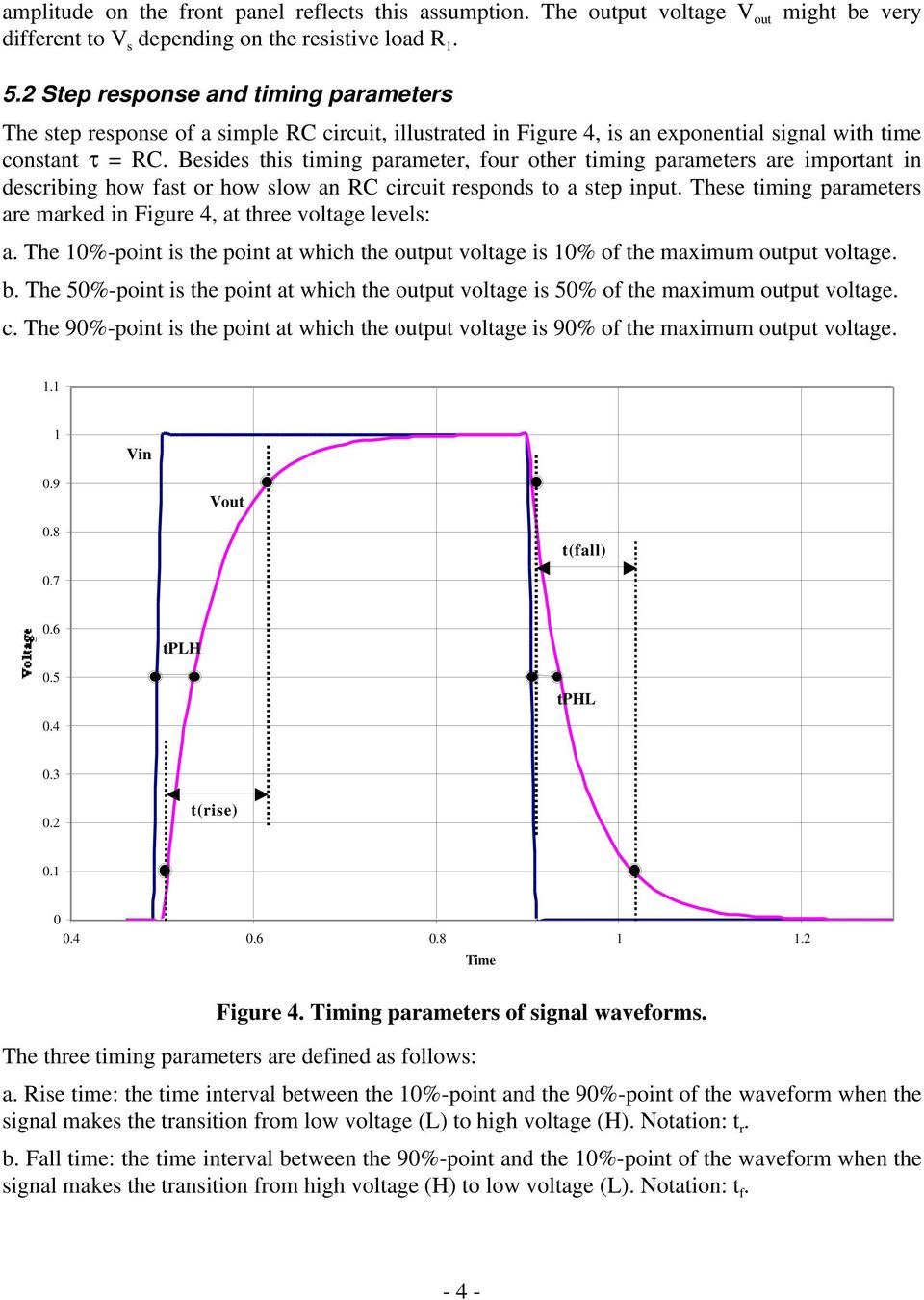
5 c. Delay time (or propagation delay time): the time interval between the 50%-point of the input signal and the 50%-point of the output signal when both signals make a transition. There are two delay times depending on whether the output signal is going from L to H (delay notation t PLH ) or from H to L (delay notation t PHL ). The subscript P stands for propagation. Note that the rise time and the fall time are defined using a single waveform (the output waveform) while the delay time is defined between two waveforms: the input waveform and the corresponding output waveform. 5.3 Delay models of gates and interconnects using RC circuits RC circuits are frequently used to model the timing characteristics of computer systems. When one logic gate drives another gate, the input circuit of the second gate can be modeled as an RC load. The propagation delay through the first gate can then be calculated assuming ideal square wave input and the RC load. The longer the delay time, the slower the circuit can be switched and the slower the computer is. Conversely, the shorter the delay time, the faster the computer is. This delay time is called gate delay since it relates to driving characteristics of a logic gate. Another use of RC circuits is to model wiring characteristics of bus lines on integrated circuits (IC) or on printer-circuit boards (PCB). A wire can be modeled as many cascaded sections of simple RC circuits as shown in Figure 3 using 2 sections. When a square wave is applied to one end of the bus, it takes time for the signal to propagate to the other end. This delay time due to the wire can be calculated based on the values of R and C in each section and the number of sections used to model the wire. The longer the wire, the more sections are needed for accurate model. A wire is also referred to as interconnect and the delay due to a wire is also called interconnect delay. In high-frequency systems, the interconnect delay tends to dominate the gate delay and is a fundamental constraint on how fast a computer can operate. 6. Prelab 6.1 Equation for extracting source resistance 1. Derive an equation for V out in Figure 1 in terms of V s, R s, and R For the circuit in Figure 1, given that V s = 1 V, compute V out for these two cases: (a) R 1 = R s, and (b) R 1» R s. 6.2 Equations for timing parameters of the step response The input signal to the circuit in Figure 2 is a perfect square wave with amplitude A (from 0 V to A), and period T where T >> RC. You may also assume that R >> R s (the internal resistance of the function generator). Using only symbolic parameters (e.g. R, C, A; not numerical values), derive the equations for the following quantities: a. V out (t). What is the maximum value of V out (t)? What is the minimum value of V out (t)? b. The time values when the output reaches 10%, 50%, and 90% of its final value. c. Rise time t r of V out (t). d. Fall time t f of V out (t)

6 e. Delay times t PHL and t PLH. 6.3 Parameter extraction via linear least-square-fit technique The important parameters of V out (t) are the maximum amplitude and the time constant τ. The maximum amplitude is easily measured using the oscilloscope. To measure the time constant directly and accurately is more difficult since the waveform is an exponential function of time. A linear least-square-fit procedure can be used in the lab to extract the time constant from measured voltage and time values as follows. From the equation for V out (t) during the time interval when V out (t) falls with time, write the equation for log{ V out (t)} as function of t. This equation should be linear in terms of t. What is the slope of this line in terms of the time constant τ? Alternatively, from the equation for V out (t) during the time interval when V out (t) rises with time, manipulate this equation so that the final form looks like: 1 V out(t) = e A t/τ where A is the amplitude of the step. Now you can write the equation for log{1- V out (t)/a} as function of t. This equation should be linear in terms of t. What is the slope of this line in terms of the time constant τ? Either technique can be used to extract the time constant. In the lab, you will measure a set of data points (t,v). These values, after the appropriate manipulation as above, can be used to plot a straight line, whose slope is a function of τ. You can use any procedure or a calculator to plot and extract the slope. The slope value will then be used to calculate the time constant τ. Make sure you understand this procedure and be ready to use it in the lab. Note that the more points you measure, the more accurate the extracted value for τ. 6.4 Values of resistors Use the digital multimeter (DMM) to measure the correct values of the resistors used in this lab. Record these measurements. Also record the internal resistance R s of the function generator when it is measured in the lab and used it whenever necessary. 7. Experimental procedures 7.1 Instruments needed for this experiment The instruments needed for this experiment are: a function generator, a multimeter, and an oscilloscope. 7.2 Effect of internal resistance of function generator 1. Build the circuit in Figure 1 using a 50 Ω resistor as load. Set the function generator to provide a square wave with amplitude 400 mv and frequency 1 KHz

7 2. Use the scope to display the signal V out on channel 1, using DC coupling. Set the horizontal timebase to display 3 or 4 complete cycles of the signal. 3. Use the scope to measure the amplitude of V out. Record this value in your report. Is it the same as the amplitude displayed by the function generator? Explain any difference. 4. Vary the square wave amplitudes from 400 mv to 1 V, using 100 mv step size (e.g. the amplitudes are 400 mv, 500 mv, up to 1 V). Repeat step 3 to measure the amplitude of V out on the scope for each setting. Get a hardcopy for the case of 500 mv amplitude only. 5. Remove the 50 Ω resistor and replace it with a 27 KΩ resistor. Repeat the steps 1 through 4 above. Observe and explain any difference in signal amplitudes when the loading on the function generator is changed from 50 Ω to 27 KΩ. 7.3 Step response of first-order RC circuits 1. Build the circuit in Figure 2 using R = 10 KΩ and C = 0.01 µf. Set the function generator to provide a square wave input as follows: a. Period T 3 ms (to ensure that T >> RC). This value of T guarantees that the output signal has sufficient time to reach a final value before the next input transition. Record the value of T. b. Amplitude from 0 V to 5 V. Note that you need to set the offset to achieve this waveform. Use the oscilloscope to display this waveform on Channel 1 to make sure the amplitude is correct. We use this amplitude since it is common in computer systems. 2. Use Channel 2 of the oscilloscope to display the output signal waveform. Adjust the timebase to display 2 complete cycles of the signals. Record the maximum and the minimum values of the output signal. 3. Use the measurement capability of the scope to measure the period T of the input signal, the time value of the 10%-point of V out, the time value of the 90%-point of V out, and the time value of the 50%-point of V out. 4. Get a hardcopy output from the scope display with both waveforms and the measured values. Turn this hardcopy in as part of your lab report. 5. Clear all the measurements. Use the measurement capability of the scope to measure the rise time of V out, the fall time of V out, and the two delay times t PHL and t PLH between the input and output signals. 6. Get a hardcopy output from the scope display with both waveforms and the measured values. Turn this hardcopy in as part of your lab report. 7. Clear all the measurements. Use the paired measurement capability of the scope to measure the voltage and time values at 10 points on the V out waveform during one interval when V out rises or falls with time (pick one interval only). Note that the time values should be referred to time t = 0 at the point where the input signal rises from 0 V to 5 V or falls from 5 V to 0 V. Record these 10 measurements

8 7.4 Step response of cascaded RC sections 1. Build the circuit in Figure 3, using 2 identical resistors R = 10 KΩ and 2 identical capacitors C = 0.01 µf. Use the same square input as in item 1, section 7.3 above and display it on Channel Display V out on Channel 2 and adjust the timebase to display 2 complete cycles of the signals. 3. Use the scope measurement capability to measure the two delay times t PHL and t PLH between the input and output signals. 4. Get a hardcopy output from the scope display with both waveforms and the measured values. Turn this hardcopy in as part of your lab report. 7.5 Manufacturing test time and test cost considerations 1. The more points you measure on a waveform, the more accurate the measured results but this also takes more time and increases the test cost. This is an important tradeoff in measurement accuracy and test cost. Given the circuit in Figure 2, ten data points per waveform were collected in section 7.3 item 7. Should you collect more or fewer than 10 points to extract a good estimate of the rise or fall time of the circuit (as defined above)? Good estimate means the estimated value is within 10% of the correct value (from computation or simulation). 2. What is the minimum number of data points do you need to collect to get a good estimate? Compare your minimum number of points with other teams answers. Do they collect more or fewer points? Are their results better than yours? Include this discussion in your report. 8. Data analysis 8.1 Extracting internal resistance of function generator 1. From the equation for V out and using the amplitude of V s as 500 mv, compute the amplitude of V out for both cases R 1 = 50 Ω and R 1 = 27 KΩ. Do these values agree with the recorded data in the lab? Include the hardcopies from the scope display to justify your answers. 2. From the data recorded in section 7.2, can you compute the internal resistance R s of the function generator? What is the estimated value of R s? 3. Are the values for V s (as displayed by the function generator panel) and the measured values on the scope the same? Explain any difference. 8.2 Step response of first-order RC circuits Use the component values in section 7.3 for the following data analysis. Remember to use the measured values of the external resistors in section 6.4 if they are significantly different than the marked values (more than 5%). 1. From the Pre-lab equation for V out (t), compute the maximum and minimum values of the output. Compare with the measured values in section 7.3 item 2. Explain the sources of errors leading to the differences. 2. Using the numerical values for R and C in the Prelab equations in section 6.2 item b, compare the time values when the output voltage reaches the 10%-point, the 50%-point, and the 90%-point - 8 -
9 with the measured values in section 7.3 item 3. Explain the sources of errors leading to the differences. How much error is committed by neglecting the internal resistance of the function generator? 3. Using the numerical values for R and C in the Prelab equations in section 6.2 items c, d, and e, compare the computed values of the 4 timing parameters (the rise time, the fall time, and the two delay times t PHL and t PLH ) with the measured values in section 7.3 item 5. Explain the sources of errors leading to the differences. How much error is committed by neglecting the internal resistance of the function generator? 4. From the 10 data points (V,t) measured in section 7.3 item 7, select 5 data points and use the best-fit line technique to extract the time constant τ of the output signal. Compare this value with the expected value RC and compute the difference in percent. Plot the best-fit line and the measured data points on the same plot. 5. Use all 10 data points in section 7.3 item 7, and repeat the best-fit line technique to extract the time constant. Is this new value different than the value computed in item 4 above by more than 5%? Plot the best-fit line and the measured data points on the same plot. Assuming that this new value for τ is the more accurate, use it to compute the correct value of the capacitor C. Compare the computed value of the capacitor with the marked value. 8.3 Step response of cascaded RC sections 1. From the measurements in section 7.4 item 3, are the delay times for the cascaded circuit in Figure 3 (of 2 identical RC sections) twice as large as the delay times for the simple RC circuit? Do the delay times scale with the number of sections? Explain. 2. Estimate the number of cascaded RC sections so that the propagation delay time is about T/2 (T is the period of the input square wave). Explain how you arrive at this estimate. How would you verify that this is a good estimate (i.e. within 10% of the correct number of sections)? This estimate basically is related to the longest bus line that can be driven by the signal before there is a timing error in the system. 9. Further research You do not have to turn this section in. 1. Check papers in industry trade journals (Electronic Design, EDN, etc.) and research journals (e.g. IEEE Transactions on Circuits and Systems, IEEE Transactions on Computer-Aided Design of Integrated Circuits and Systems) in the Engineering Library to find formulas for estimating the propagation delay as function of the number of cascaded RC sections. Use one formula and set the number of sections to 6. Calculate the delay using this formula and compare to the measured value in section 7.4 above. 2. Below the frequency 500 MHz or so, the RC model for wire delay is very good. For very highfrequency systems (f > 1 GHz), the RC model is not as accurate. Another circuit incorporating the inductive effect (using the inductor L in series with the resistor R in Figure 2) is used to model interconnect delay. Check the papers in the journals mentioned above to see how the delay is calculated using this model

10 10. Self-test 1. Use a different input signal (e.g. a ramp waveform from the function generator) in Figure 2. Repeat the measurements of the timing parameters and see what the waveforms look like on the scope. 2. How do you check your own measurements to reduce errors? Can you come up with two different ways to measure the same parameter so that the results can be compared?

EXPERIMENT NUMBER 8 CAPACITOR CURRENT-VOLTAGE RELATIONSHIP
 1 EXPERIMENT NUMBER 8 CAPACITOR CURRENT-VOLTAGE RELATIONSHIP Purpose: To demonstrate the relationship between the voltage and current of a capacitor. Theory: A capacitor is a linear circuit element whose
RC & RL Transient Response
 EE 2006 University of Minnesota Duluth ab 8 1. Introduction R & R Transient Response The student will analyze series R and R circuits. A step input will excite these respective circuits, producing a transient
Inductors in AC Circuits
 Inductors in AC Circuits Name Section Resistors, inductors, and capacitors all have the effect of modifying the size of the current in an AC circuit and the time at which the current reaches its maximum
Laboratory 4: Feedback and Compensation
 Laboratory 4: Feedback and Compensation To be performed during Week 9 (Oct. 20-24) and Week 10 (Oct. 27-31) Due Week 11 (Nov. 3-7) 1 Pre-Lab This Pre-Lab should be completed before attending your regular
Operational Amplifier - IC 741
 Operational Amplifier - IC 741 Tabish December 2005 Aim: To study the working of an 741 operational amplifier by conducting the following experiments: (a) Input bias current measurement (b) Input offset
RC Circuits and The Oscilloscope Physics Lab X
 Objective RC Circuits and The Oscilloscope Physics Lab X In this series of experiments, the time constant of an RC circuit will be measured experimentally and compared with the theoretical expression for
School of Engineering Department of Electrical and Computer Engineering
 1 School of Engineering Department of Electrical and Computer Engineering 332:223 Principles of Electrical Engineering I Laboratory Experiment #4 Title: Operational Amplifiers 1 Introduction Objectives
Frequency Response of Filters
 School of Engineering Department of Electrical and Computer Engineering 332:224 Principles of Electrical Engineering II Laboratory Experiment 2 Frequency Response of Filters 1 Introduction Objectives To
The Time Constant of an RC Circuit
 The Time Constant of an RC Circuit 1 Objectives 1. To determine the time constant of an RC Circuit, and 2. To determine the capacitance of an unknown capacitor. 2 Introduction What the heck is a capacitor?
LABORATORY 2 THE DIFFERENTIAL AMPLIFIER
 LABORATORY 2 THE DIFFERENTIAL AMPLIFIER OBJECTIVES 1. To understand how to amplify weak (small) signals in the presence of noise. 1. To understand how a differential amplifier rejects noise and common
EE 1202 Experiment #4 Capacitors, Inductors, and Transient Circuits
 EE 1202 Experiment #4 Capacitors, Inductors, and Transient Circuits 1. Introduction and Goal: Exploring transient behavior due to inductors and capacitors in DC circuits; gaining experience with lab instruments.
First Order Circuits. EENG223 Circuit Theory I
 First Order Circuits EENG223 Circuit Theory I First Order Circuits A first-order circuit can only contain one energy storage element (a capacitor or an inductor). The circuit will also contain resistance.
Lab 3 Rectifier Circuits
 ECET 242 Electronic Circuits Lab 3 Rectifier Circuits Page 1 of 5 Name: Objective: Students successfully completing this lab exercise will accomplish the following objectives: 1. Learn how to construct
ε: Voltage output of Signal Generator (also called the Source voltage or Applied
 Experiment #10: LR & RC Circuits Frequency Response EQUIPMENT NEEDED Science Workshop Interface Power Amplifier (2) Voltage Sensor graph paper (optional) (3) Patch Cords Decade resistor, capacitor, and
Lab E1: Introduction to Circuits
 E1.1 Lab E1: Introduction to Circuits The purpose of the this lab is to introduce you to some basic instrumentation used in electrical circuits. You will learn to use a DC power supply, a digital multimeter
Reading: HH Sections 4.11 4.13, 4.19 4.20 (pgs. 189-212, 222 224)
 6 OP AMPS II 6 Op Amps II In the previous lab, you explored several applications of op amps. In this exercise, you will look at some of their limitations. You will also examine the op amp integrator and
Pulse Width Modulation (PWM) LED Dimmer Circuit. Using a 555 Timer Chip
 Pulse Width Modulation (PWM) LED Dimmer Circuit Using a 555 Timer Chip Goals of Experiment Demonstrate the operation of a simple PWM circuit that can be used to adjust the intensity of a green LED by varying
Physics 3330 Experiment #2 Fall 1999. DC techniques, dividers, and bridges R 2 =(1-S)R P R 1 =SR P. R P =10kΩ 10-turn pot.
 Physics 3330 Experiment #2 Fall 1999 DC techniques, dividers, and bridges Purpose You will gain a familiarity with the circuit board and work with a variety of DC techniques, including voltage dividers,
Output Ripple and Noise Measurement Methods for Ericsson Power Modules
 Output Ripple and Noise Measurement Methods for Ericsson Power Modules Design Note 022 Ericsson Power Modules Ripple and Noise Abstract There is no industry-wide standard for measuring output ripple and
MADR-009443-0001TR. Quad Driver for GaAs FET or PIN Diode Switches and Attenuators. Functional Schematic. Features. Description. Pin Configuration 2
 Features Functional Schematic High Voltage CMOS Technology Four Channel Positive Voltage Control CMOS device using TTL input levels Low Power Dissipation Low Cost 4x4 mm, 20-lead PQFN Package 100% Matte
MATERIALS. Multisim screen shots sent to TA.
 Page 1/8 Revision 0 9-Jun-10 OBJECTIVES Learn new Multisim components and instruments. Conduct a Multisim transient analysis. Gain proficiency in the function generator and oscilloscope. MATERIALS Multisim
Lab #4 Thevenin s Theorem
 In this experiment you will become familiar with one of the most important theorems in circuit analysis, Thevenin s Theorem. Thevenin s Theorem can be used for two purposes: 1. To calculate the current
Electronics. Discrete assembly of an operational amplifier as a transistor circuit. LD Physics Leaflets P4.2.1.1
 Electronics Operational Amplifier Internal design of an operational amplifier LD Physics Leaflets Discrete assembly of an operational amplifier as a transistor circuit P4.2.1.1 Objects of the experiment
Tutorial 12 Solutions
 PHYS000 Tutorial 2 solutions Tutorial 2 Solutions. Two resistors, of 00 Ω and 200 Ω, are connected in series to a 6.0 V DC power supply. (a) Draw a circuit diagram. 6 V 00 Ω 200 Ω (b) What is the total
DIODE CIRCUITS LABORATORY. Fig. 8.1a Fig 8.1b
 DIODE CIRCUITS LABORATORY A solid state diode consists of a junction of either dissimilar semiconductors (pn junction diode) or a metal and a semiconductor (Schottky barrier diode). Regardless of the type,
Operational Amplifier as mono stable multi vibrator
 Page 1 of 5 Operational Amplifier as mono stable multi vibrator Aim :- To construct a monostable multivibrator using operational amplifier 741 and to determine the duration of the output pulse generated
LABORATORY 10 TIME AVERAGES, RMS VALUES AND THE BRIDGE RECTIFIER. Bridge Rectifier
 LABORATORY 10 TIME AVERAGES, RMS VALUES AND THE BRIDGE RECTIFIER Full-wave Rectification: Bridge Rectifier For many electronic circuits, DC supply voltages are required but only AC voltages are available.
LM 358 Op Amp. If you have small signals and need a more useful reading we could amplify it using the op amp, this is commonly used in sensors.
 LM 358 Op Amp S k i l l L e v e l : I n t e r m e d i a t e OVERVIEW The LM 358 is a duel single supply operational amplifier. As it is a single supply it eliminates the need for a duel power supply, thus
Bipolar Transistor Amplifiers
 Physics 3330 Experiment #7 Fall 2005 Bipolar Transistor Amplifiers Purpose The aim of this experiment is to construct a bipolar transistor amplifier with a voltage gain of minus 25. The amplifier must
Lab 1: DC Circuits. Student 1, [email protected] Partner : Student 2, [email protected]
 Lab Date Lab 1: DC Circuits Student 1, [email protected] Partner : Student 2, [email protected] I. Introduction The purpose of this lab is to allow the students to become comfortable with the use of lab
CHAPTER 11: Flip Flops
 CHAPTER 11: Flip Flops In this chapter, you will be building the part of the circuit that controls the command sequencing. The required circuit must operate the counter and the memory chip. When the teach
Step response of an RLC series circuit
 School of Engineering Department of Electrical and Computer Engineering 332:224 Principles of Electrical Engineering II Laboratory Experiment 5 Step response of an RLC series circuit 1 Introduction Objectives
Transistor Amplifiers
 Physics 3330 Experiment #7 Fall 1999 Transistor Amplifiers Purpose The aim of this experiment is to develop a bipolar transistor amplifier with a voltage gain of minus 25. The amplifier must accept input
CIRCUITS LABORATORY EXPERIMENT 3. AC Circuit Analysis
 CIRCUITS LABORATORY EXPERIMENT 3 AC Circuit Analysis 3.1 Introduction The steady-state behavior of circuits energized by sinusoidal sources is an important area of study for several reasons. First, the
Lab 5 Operational Amplifiers
 Lab 5 Operational Amplifiers By: Gary A. Ybarra Christopher E. Cramer Duke University Department of Electrical and Computer Engineering Durham, NC. Purpose The purpose of this lab is to examine the properties
AC CIRCUITS - CAPACITORS AND INDUCTORS
 EXPRIMENT#8 AC CIRCUITS - CAPACITORS AND INDUCTORS NOTE: Two weeks are allocated for this experiment. Before performing this experiment, review the Proper Oscilloscope Use section of Experiment #7. Objective
Annex: VISIR Remote Laboratory
 Open Learning Approach with Remote Experiments 518987-LLP-1-2011-1-ES-KA3-KA3MP Multilateral Projects UNIVERSITY OF DEUSTO Annex: VISIR Remote Laboratory OLAREX project report Olga Dziabenko, Unai Hernandez
SERIES-PARALLEL DC CIRCUITS
 Name: Date: Course and Section: Instructor: EXPERIMENT 1 SERIES-PARALLEL DC CIRCUITS OBJECTIVES 1. Test the theoretical analysis of series-parallel networks through direct measurements. 2. Improve skills
Experiment1: Introduction to laboratory equipment and basic components.
 Experiment1: Introduction to laboratory equipment and basic components. 1 OBJECTIVES. This experiment will provide exposure to the various test equipment to be used in subsequent experiments. A primary
= V peak 2 = 0.707V peak
 BASIC ELECTRONICS - RECTIFICATION AND FILTERING PURPOSE Suppose that you wanted to build a simple DC electronic power supply, which operated off of an AC input (e.g., something you might plug into a standard
Experiment #11: LRC Circuit (Power Amplifier, Voltage Sensor)
 Experiment #11: LRC Circuit (Power Amplifier, Voltage Sensor) Concept: circuits Time: 30 m SW Interface: 750 Windows file: RLC.SWS EQUIPMENT NEEDED Science Workshop Interface Power Amplifier (2) Voltage
EXPERIMENT NUMBER 5 BASIC OSCILLOSCOPE OPERATIONS
 1 EXPERIMENT NUMBER 5 BASIC OSCILLOSCOPE OPERATIONS The oscilloscope is the most versatile and most important tool in this lab and is probably the best tool an electrical engineer uses. This outline guides
MADR-009190-0001TR. Quad Driver for GaAs FET or PIN Diode Switches and Attenuators Rev. 4. Functional Schematic. Features.
 Features High Voltage CMOS Technology Four Channel Positive Voltage Control CMOS device using TTL input levels Low Power Dissipation Low Cost Lead-Free SOIC-16 Plastic Package Halogen-Free Green Mold Compound
Electrical Resonance
 Electrical Resonance (R-L-C series circuit) APPARATUS 1. R-L-C Circuit board 2. Signal generator 3. Oscilloscope Tektronix TDS1002 with two sets of leads (see Introduction to the Oscilloscope ) INTRODUCTION
Lecture 24. Inductance and Switching Power Supplies (how your solar charger voltage converter works)
 Lecture 24 Inductance and Switching Power Supplies (how your solar charger voltage converter works) Copyright 2014 by Mark Horowitz 1 Roadmap: How Does This Work? 2 Processor Board 3 More Detailed Roadmap
See Horenstein 4.3 and 4.4
 EE 462: Laboratory # 4 DC Power Supply Circuits Using Diodes by Drs. A.V. Radun and K.D. Donohue (2/14/07) Department of Electrical and Computer Engineering University of Kentucky Lexington, KY 40506 Updated
Keywords: input noise, output noise, step down converters, buck converters, MAX1653EVKit
 Maxim > Design Support > Technical Documents > Tutorials > Power-Supply Circuits > APP 986 Keywords: input noise, output noise, step down converters, buck converters, MAX1653EVKit TUTORIAL 986 Input and
Oscilloscope, Function Generator, and Voltage Division
 1. Introduction Oscilloscope, Function Generator, and Voltage Division In this lab the student will learn to use the oscilloscope and function generator. The student will also verify the concept of voltage
Lab #9: AC Steady State Analysis
 Theory & Introduction Lab #9: AC Steady State Analysis Goals for Lab #9 The main goal for lab 9 is to make the students familar with AC steady state analysis, db scale and the NI ELVIS frequency analyzer.
Germanium Diode AM Radio
 Germanium Diode AM Radio LAB 3 3.1 Introduction In this laboratory exercise you will build a germanium diode based AM (Medium Wave) radio. Earliest radios used simple diode detector circuits. The diodes
MADR-009269-0001TR. Single Driver for GaAs FET or PIN Diode Switches and Attenuators Rev. V1. Functional Schematic. Features.
 Features High Voltage CMOS Technology Complementary Outputs Positive Voltage Control CMOS device using TTL input levels Low Power Dissipation Low Cost Plastic SOIC-8 Package 100% Matte Tin Plating over
RLC Series Resonance
 RLC Series Resonance 11EM Object: The purpose of this laboratory activity is to study resonance in a resistor-inductor-capacitor (RLC) circuit by examining the current through the circuit as a function
Physics 120 Lab 6: Field Effect Transistors - Ohmic region
 Physics 120 Lab 6: Field Effect Transistors - Ohmic region The FET can be used in two extreme ways. One is as a voltage controlled resistance, in the so called "Ohmic" region, for which V DS < V GS - V
Problem Solving 8: RC and LR Circuits
 MASSACHUSETTS INSTITUTE OF TECHNOLOGY Department of Physics Problem Solving 8: RC and LR Circuits Section Table and Group (e.g. L04 3C ) Names Hand in one copy per group at the end of the Friday Problem
ENGINEERING COMMITTEE Interface Practices Subcommittee AMERICAN NATIONAL STANDARD ANSI/SCTE 46 2007. Test Method for AC to DC Power Supplies
 ENGINEERING COMMITTEE Interface Practices Subcommittee AMERICAN NATIONAL STANDARD ANSI/SCTE 46 2007 Test Method for AC to DC Power Supplies NOTICE The Society of Cable Telecommunications Engineers (SCTE)
22.302 Experiment 5. Strain Gage Measurements
 22.302 Experiment 5 Strain Gage Measurements Introduction The design of components for many engineering systems is based on the application of theoretical models. The accuracy of these models can be verified
LAB 7 MOSFET CHARACTERISTICS AND APPLICATIONS
 LAB 7 MOSFET CHARACTERISTICS AND APPLICATIONS Objective In this experiment you will study the i-v characteristics of an MOS transistor. You will use the MOSFET as a variable resistor and as a switch. BACKGROUND
Diode Applications. by Kenneth A. Kuhn Sept. 1, 2008. This note illustrates some common applications of diodes.
 by Kenneth A. Kuhn Sept. 1, 2008 This note illustrates some common applications of diodes. Power supply applications A common application for diodes is converting AC to DC. Although half-wave rectification
Objectives The purpose of this lab is build and analyze Differential amplifiers based on NPN transistors (or NMOS transistors).
 1 Lab 03: Differential Amplifiers (BJT) (20 points) NOTE: 1) Please use the basic current mirror from Lab01 for the second part of the lab (Fig. 3). 2) You can use the same chip as the basic current mirror;
EXPERIMENT 3: TTL AND CMOS CHARACTERISTICS
 EXPERIMENT 3: TTL AND CMOS CHARACTERISTICS PURPOSE Logic gates are classified not only by their logical functions, but also by their logical families. In any implementation of a digital system, an understanding
L and C connected together. To be able: To analyse some basic circuits.
 circuits: Sinusoidal Voltages and urrents Aims: To appreciate: Similarities between oscillation in circuit and mechanical pendulum. Role of energy loss mechanisms in damping. Why we study sinusoidal signals
LAB4: Audio Synthesizer
 UC Berkeley, EECS 100 Lab LAB4: Audio Synthesizer B. Boser NAME 1: NAME 2: The 555 Timer IC SID: SID: Inductors and capacitors add a host of new circuit possibilities that exploit the memory realized by
BJT Characteristics and Amplifiers
 BJT Characteristics and Amplifiers Matthew Beckler [email protected] EE2002 Lab Section 003 April 2, 2006 Abstract As a basic component in amplifier design, the properties of the Bipolar Junction Transistor
Lab Session 4 Introduction to the DC Motor
 Lab Session 4 Introduction to the DC Motor By: Professor Dan Block Control Systems Lab Mgr. University of Illinois Equipment Agilent 54600B 100 MHz Ditizing Oscilloscope (Replacement model: Agilent DSO5012A
A Lesson on Digital Clocks, One Shots and Counters
 A Lesson on Digital Clocks, One Shots and Counters Topics Clocks & Oscillators LM 555 Timer IC Crystal Oscillators Selection of Variable Resistors Schmitt Gates Power-On Reset Circuits One Shots Counters
Understanding Power Impedance Supply for Optimum Decoupling
 Introduction Noise in power supplies is not only caused by the power supply itself, but also the load s interaction with the power supply (i.e. dynamic loads, switching, etc.). To lower load induced noise,
A Lesson on Digital Clocks, One Shots and Counters
 A Lesson on Digital Clocks, One Shots and Counters Topics Clocks & Oscillators LM 555 Timer IC Crystal Oscillators Selection of Variable Resistors Schmitt Gates Power-On Reset Circuits One Shots Counters
PHYSICS 360 - LAB #2 Passive Low-pass and High-pass Filter Circuits and Integrator and Differentiator Circuits
 PHYSICS 360 - LAB #2 Passie Low-pass and High-pass Filter Circuits and Integrator and Differentiator Circuits Objectie: Study the behaior of low-pass and high-pass filters. Study the differentiator and
LAB 12: ACTIVE FILTERS
 A. INTRODUCTION LAB 12: ACTIVE FILTERS After last week s encounter with op- amps we will use them to build active filters. B. ABOUT FILTERS An electric filter is a frequency-selecting circuit designed
Lab Exercise 1: Acoustic Waves
 Lab Exercise 1: Acoustic Waves Contents 1-1 PRE-LAB ASSIGNMENT................. 2 1-3.1 Spreading Factor: Spherical Waves........ 2 1-3.2 Interference In 3-D................. 3 1-4 EQUIPMENT........................
Experiment 8 : Pulse Width Modulation
 Name/NetID: Teammate/NetID: Experiment 8 : Pulse Width Modulation Laboratory Outline In experiment 5 we learned how to control the speed of a DC motor using a variable resistor. This week, we will learn
Building the AMP Amplifier
 Building the AMP Amplifier Introduction For about 80 years it has been possible to amplify voltage differences and to increase the associated power, first with vacuum tubes using electrons from a hot filament;
Optical Fibres. Introduction. Safety precautions. For your safety. For the safety of the apparatus
 Please do not remove this manual from from the lab. It is available at www.cm.ph.bham.ac.uk/y2lab Optics Introduction Optical fibres are widely used for transmitting data at high speeds. In this experiment,
Common Emitter BJT Amplifier Design Current Mirror Design
 Common Emitter BJT Amplifier Design Current Mirror Design 1 Some Random Observations Conditions for stabilized voltage source biasing Emitter resistance, R E, is needed. Base voltage source will have finite
V out. Figure 1: A voltage divider on the left, and potentiometer on the right.
 Living with the Lab Fall 202 Voltage Dividers and Potentiometers Gerald Recktenwald v: November 26, 202 [email protected] Introduction Voltage dividers and potentiometers are passive circuit components
Measuring Electric Phenomena: the Ammeter and Voltmeter
 Measuring Electric Phenomena: the Ammeter and Voltmeter 1 Objectives 1. To understand the use and operation of the Ammeter and Voltmeter in a simple direct current circuit, and 2. To verify Ohm s Law for
Use and Application of Output Limiting Amplifiers (HFA1115, HFA1130, HFA1135)
 Use and Application of Output Limiting Amplifiers (HFA111, HFA110, HFA11) Application Note November 1996 AN96 Introduction Amplifiers with internal voltage clamps, also known as limiting amplifiers, have
Physics 623 Transistor Characteristics and Single Transistor Amplifier Sept. 13, 2006
 Physics 623 Transistor Characteristics and Single Transistor Amplifier Sept. 13, 2006 1 Purpose To measure and understand the common emitter transistor characteristic curves. To use the base current gain
More Op-Amp Circuits; Temperature Sensing
 ECE 2A Lab #5 Lab 5 More OpAmp Circuits; Temperature Sensing Overview In this lab we will continue our exploration of opamps but this time in the context of a specific application: temperature sensing.
The 2N3393 Bipolar Junction Transistor
 The 2N3393 Bipolar Junction Transistor Common-Emitter Amplifier Aaron Prust Abstract The bipolar junction transistor (BJT) is a non-linear electronic device which can be used for amplification and switching.
CAN Bus Transceivers Operate from 3.3V or 5V and Withstand ±60V Faults
 CAN Bus Transceivers Operate from 3.3V or 5V and Withstand ±6 Faults Ciaran Brennan design features The LTC2875 is a robust CAN bus transceiver that features ±6 overvoltage and ±25kV ESD tolerance to reduce
Apprentice Telecommunications Technician Test (CTT) Study Guide
 Apprentice Telecommunications Technician Test (CTT) Study Guide 1 05/2014 Study Guide for Pacific Gas & Electric Company Apprentice Telecommunications Technician Qualifying Test (CTT) About the Test The
A Simple Current-Sense Technique Eliminating a Sense Resistor
 INFINITY Application Note AN-7 A Simple Current-Sense Technique Eliminating a Sense Resistor Copyright 998 A SIMPE CURRENT-SENSE TECHNIQUE EIMINATING A SENSE RESISTOR INTRODUCTION A sense resistor R S,
Chapter 22 Further Electronics
 hapter 22 Further Electronics washing machine has a delay on the door opening after a cycle of washing. Part of this circuit is shown below. s the cycle ends, switch S closes. t this stage the capacitor
Electronic WorkBench tutorial
 Electronic WorkBench tutorial Introduction Electronic WorkBench (EWB) is a simulation package for electronic circuits. It allows you to design and analyze circuits without using breadboards, real components
Experiment 2 Diode Applications: Rectifiers
 ECE 3550 - Practicum Fall 2007 Experiment 2 Diode Applications: Rectifiers Objectives 1. To investigate the characteristics of half-wave and full-wave rectifier circuits. 2. To recognize the usefulness
Input and Output Capacitor Selection
 Application Report SLTA055 FEBRUARY 2006 Input and Output Capacitor Selection Jason Arrigo... PMP Plug-In Power ABSTRACT When designing with switching regulators, application requirements determine how
Conversion Between Analog and Digital Signals
 ELET 3156 DL - Laboratory #6 Conversion Between Analog and Digital Signals There is no pre-lab work required for this experiment. However, be sure to read through the assignment completely prior to starting
A Low-Cost, Single Coupling Capacitor Configuration for Stereo Headphone Amplifiers
 Application Report SLOA043 - December 1999 A Low-Cost, Single Coupling Capacitor Configuration for Stereo Headphone Amplifiers Shawn Workman AAP Precision Analog ABSTRACT This application report compares
Rectifier circuits & DC power supplies
 Rectifier circuits & DC power supplies Goal: Generate the DC voltages needed for most electronics starting with the AC power that comes through the power line? 120 V RMS f = 60 Hz T = 1667 ms) = )sin How
FREQUENCY RESPONSE OF AN AUDIO AMPLIFIER
 2014 Amplifier - 1 FREQUENCY RESPONSE OF AN AUDIO AMPLIFIER The objectives of this experiment are: To understand the concept of HI-FI audio equipment To generate a frequency response curve for an audio
EE362L, Power Electronics Triac Light Dimmer
 1 EE362L, Power Electronics Triac Light Dimmer Rochelle Stortz and Brian Taraba, Team 277 2/2/05 Abstract - This document presents the construction of a light dimmer circuit that utilizes the current-regulating
Tutorial 2: Using Excel in Data Analysis
 Tutorial 2: Using Excel in Data Analysis This tutorial guide addresses several issues particularly relevant in the context of the level 1 Physics lab sessions at Durham: organising your work sheet neatly,
11: AUDIO AMPLIFIER I. INTRODUCTION
 11: AUDIO AMPLIFIER I. INTRODUCTION The properties of an amplifying circuit using an op-amp depend primarily on the characteristics of the feedback network rather than on those of the op-amp itself. A
These help quantify the quality of a design from different perspectives: Cost Functionality Robustness Performance Energy consumption
 Basic Properties of a Digital Design These help quantify the quality of a design from different perspectives: Cost Functionality Robustness Performance Energy consumption Which of these criteria is important
Sequential Logic: Clocks, Registers, etc.
 ENEE 245: igital Circuits & Systems Lab Lab 2 : Clocks, Registers, etc. ENEE 245: igital Circuits and Systems Laboratory Lab 2 Objectives The objectives of this laboratory are the following: To design
LDS8720. 184 WLED Matrix Driver with Boost Converter FEATURES APPLICATION DESCRIPTION TYPICAL APPLICATION CIRCUIT
 184 WLED Matrix Driver with Boost Converter FEATURES High efficiency boost converter with the input voltage range from 2.7 to 5.5 V No external Schottky Required (Internal synchronous rectifier) 250 mv
Fox-2 MPPT Unit Testing
 P13271 Fox-2 MPPT Unit Testing Final Engineering Specifications Testing Author: Brenton Salmi P13271 Team Members: Brenton Salmi, Bryce Salmi, Ian MacKenzie, Daniel Corriero 5/10/2013 This test document
Properties of electrical signals
 DC Voltage Component (Average voltage) Properties of electrical signals v(t) = V DC + v ac (t) V DC is the voltage value displayed on a DC voltmeter Triangular waveform DC component Half-wave rectifier