
Experiment 5. Strain Gage Measurements
|
|
|
- Kerry Morrison
- 9 years ago
- Views:
Transcription
1 Experiment 5 Strain Gage Measurements Introduction The design of components for many engineering systems is based on the application of theoretical models. The accuracy of these models can be verified through testing. One way of validating a math model is to use a strain gage measurement system to measure the strain at the surface of a structure. The sensor used to transfer a mechanical strain to a quantifiable output is the strain gage. The strain gage has a resistance which changes as a function of mechanical strain. Although the change in resistance can be quantified using an ohm meter, signal conditioning is used to convert the change in resistance to a voltage. The voltage may then be amplified, thus reducing quantization errors. The relationship between the input strain and the output voltage may be determined using the system sensitivity. The objective of this assignment is to experimentally determine the system sensitivity and compare it to the ideal sensitivity of a strain gage measurement system. The actual system sensitivity will then be used to determine the modulus of elasticity of a cantilever beam. Pre-Lab Assignment 1. Determine the ideal system sensitivity of a strain gage system expressed in millivolts per microstrain, given the following: Sg = 2.085, Ei = 2 Vdc, G = Also, determine the ideal slope of the calibration equation in microstrain per millivolt. 2. Calculate the deflection required to produce 100, 200, 300, 400, 500, 600, 700, 800, and 900 microstrain at a strain gage mounted to a cantilever beam. The geometry of the beam and location of the gage is as follows: b = 1.0" t = 0.125" L = 10.0" x = 9.0" (beam width) (beam thickness) (length of cantilever beam) (distance from the strain gage to the micrometer) 3. Determine ten different beam loading values that will be used in lab to end load a cantilever beam using a platform and weights. Load values should increase by 100 gram intervals with an initial load of approximately 173 grams. Calculate the stress levels generated at the strain gage location for each load. The weights available are as follows: gram platform gram weight gram weights1-500 gram weight 4. Read Section 8.1 and 8.6 in text. ME Strain Gage Measurement Lab 1 Rev

2 Assignment 1: Equipment Configuration & Initialization Prior to calibrating the strain gage measurement system, the signal conditioning module must be connected to the strain gage and initialized. The four major components of the 2311 Signal Conditioner Amplifier are the variable DC power supply, wheatstone bridge, low pass filter, and amplifier. The power supply is used to excite the wheatstone bridge which converts a change in the strain gage resistance to a corresponding change in voltage. The amplifier is used to amplify the output signal from the wheatstone bridge reducing possible quantization errors. The lowpass filter is used to filter out undesired frequencies associated with background noise. Procedure 1. Install the cantilever beam into the Flexor. The beam should be placed with the strain gage on the upper surface closest to the clamp. Adjust the free end of the beam so that motion is not impeded by the sides of the Flexor. 2. Connect the lead wires of the strain gage to the binding posts of the Flexor as shown in figure 1. Connect leads numbered 1, 2, and 3 of the Flexor to the input cable of the 2311 Signal Conditioning Amplifier at points "S-", "D-120", and "P+" respectively. 3. Measure and record the following cantilever beam dimensions: x - distance from the center of the strain gage to the micrometer load point. L - distance from the clamped end of the beam to the micrometer load point. b - beam width t - beam thickness Figure 1 - Strain Gage System Initialization 4. Compare the measured values with dimensions used in the pre-lab assignment. Adjust the length of the cantilever beam so that it coincides with the pre-lab value used. If the values of x, b, and t differ, pre-lab calculations must be recalculated. ME Strain Gage Measurement Lab 2 Rev

3 5. Check that the power to the 2311 Signal Conditioner is shut off. Plug the power cord from the bottom rear of the 2311 into the bench power strip. 6. Connect the Bendix connector attached to the wire junction to the rear of the The +/- 10 volt BNC output on the top rear of the 2311 should be connected to the oscilloscope and digital multimeter. 7. Set the LOW PASS FILTER to 10 Hz. Shut the EXCITATION switch to OFF. 8. Turn the 2311 on using the POWER button at the bottom of the module. 9. Balance the power amplifier by setting the gain to X100. Check that the dial to the left of the gain buttons is set to 1. Adjustment will result in a fractional value of the set gain. 10. Examine the two lights at the top of the front panel. If either is lit, turn the AMP BAL adjustment screw located below the EXCITATION toggle switch so that both lamps are fully extinguished. 11. Balance the internal wheatstone bridge by first setting the EXCITATION voltage to 2 Vdc. Turn the EXCITATION switch to ON. One of the two output lamps at the top of the module should light indicating that the wheatstone bridge is out of balance. Press the AUTO BAL switch to the RESET position for a second then release. After a few seconds the lamps should extinguish indicating the bridge is balanced. 12. Set the amplifier GAIN to X1000. If either of the output lamps are lit, turn the TRIM knob until the lamps are extinguished. The multimeter should be reading zero volts. The strain gage system is now initialized and ready to make measurements. 13. Manually load the beam. Note the change in output voltage on the multimeter as well as the two output lamps on the front of the As the strain gage is mechanically strained, the change in resistance is sensed by the wheatstone bridge and a resultant output voltage is generated. Figure 2 shows the major components of the 2311 Signal Conditioning Amplifier used to convert the input resistance to an output voltage. ME Strain Gage Measurement Lab 3 Rev

4 Figure Signal Conditioning Amplifier Assignment 2: Determine the System Sensitivity The system sensitivity of the strain gage measurement system can be determined by displacing the free end of the cantilever beam a known distance and recording the output voltage generated by the signal conditioning module. The strain induced in the beam at the strain gage location is determined using the following equation: where is the strain at the surface of the beam at the gage location, is the deflection at the free end of the beam, is the beam's thickness, is the distance from the strain gage to the point where the load is applied, and is the cantilever beam length. Procedure 1. With the wheatstone bridge balanced, an output voltage of 0 Volts DC should be displayed on the multimeter. Adjust the TRIM knob if necessary. 2. Adjust the micrometer on the Flexor so that the tip is just touching the cantilever beam. The multimeter and output lamps can be used to determine when contact occurs. Record the reading on the micrometer and the multimeter as the initial displacement and corresponding output voltage for the undeflected beam. 3. Using the micrometer, deflect the beam an amount that will produce a strain of 100 microstrain at the strain gage. Record the ideal strain level, the micrometer setting, and the output voltage indicated by the multimeter. 4. Deflect the beam an amount that will produce strain levels of 200, 300, 400, 500, 600, 700, 800, and 900 microstrain at the strain gage. Record the ideal strain level, beam deflection, and output voltage from the system. 5. Unload the beam and record the final output voltage. The output should return to ME Strain Gage Measurement Lab 4 Rev

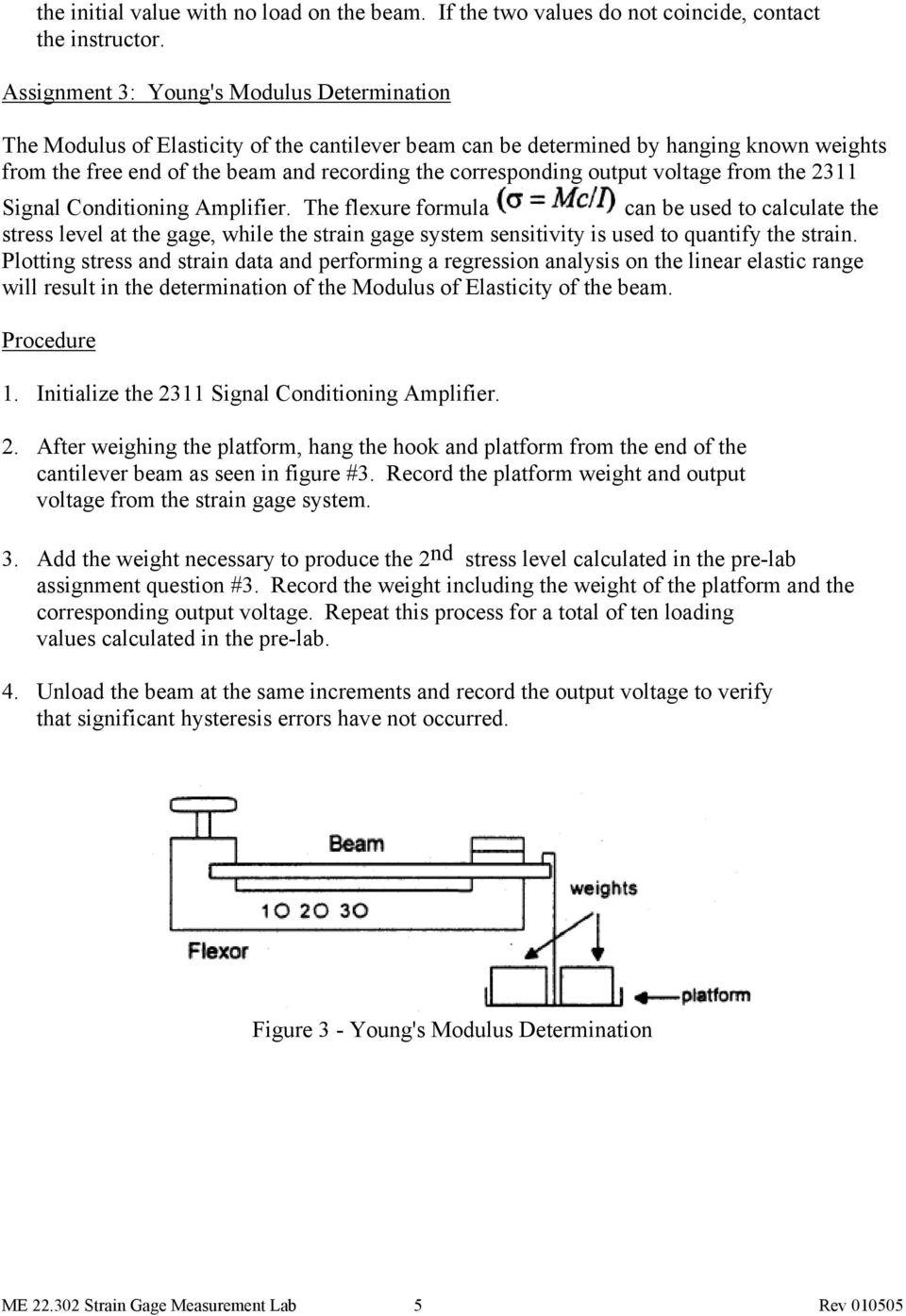
5 the initial value with no load on the beam. If the two values do not coincide, contact the instructor. Assignment 3: Young's Modulus Determination The Modulus of Elasticity of the cantilever beam can be determined by hanging known weights from the free end of the beam and recording the corresponding output voltage from the 2311 Signal Conditioning Amplifier. The flexure formula can be used to calculate the stress level at the gage, while the strain gage system sensitivity is used to quantify the strain. Plotting stress and strain data and performing a regression analysis on the linear elastic range will result in the determination of the Modulus of Elasticity of the beam. Procedure 1. Initialize the 2311 Signal Conditioning Amplifier. 2. After weighing the platform, hang the hook and platform from the end of the cantilever beam as seen in figure #3. Record the platform weight and output voltage from the strain gage system. 3. Add the weight necessary to produce the 2 nd stress level calculated in the pre-lab assignment question #3. Record the weight including the weight of the platform and the corresponding output voltage. Repeat this process for a total of ten loading values calculated in the pre-lab. 4. Unload the beam at the same increments and record the output voltage to verify that significant hysteresis errors have not occurred. Figure 3 - Young's Modulus Determination ME Strain Gage Measurement Lab 5 Rev
6 Post-lab Analysis 1. Determine the strain gage system sensitivity. Compare the actual system sensitivity to the ideal value determined from the pre-lab assignment. Discuss possible sources of error. 2. Plot the strain produced at the strain gage and the corresponding output voltage from the 2311 Signal Conditioning Amplifier. Properly distinguish experimental data from curve fit data. 3. Using the calibrated system sensitivity, determine the strain produced at the strain gage in assignment #3. 4. Compare the ten values of strain obtained while loading the beam to those obtained during unloading. Discuss why differences may have occurred. Are these differences acceptable? 5. Calculate the stress levels generated from end loading the cantilever beam in assignment #3. 6. Plot the stress vs. strain from assignment #3. Perform a regression analysis on the data to determine Young's Modulus. 7. What type of material is the beam made of? Support conclusions with theoretical and experimental proof as well as listing any publications referenced. 8. Explain to methods of increasing the strain gage system sensitivity. Why would the strain gage measurement system sensitivity be increased. ME Strain Gage Measurement Lab 6 Rev

7 Strain Gage Experiment #5 for ME Lab I (scanned document) 8 Department of Mechanical Engineering

8 Strain Gage Experiment #5 for ME Lab I (scanned document) 9 Department of Mechanical Engineering

9 Strain Gage Experiment #5 for ME Lab I (scanned document) 10 Department of Mechanical Engineering

10 Strain Gage Experiment #5 for ME Lab I (scanned document) 11 Department of Mechanical Engineering

11 Strain Gage Experiment #5 for ME Lab I (scanned document) 12 Department of Mechanical Engineering

12 Strain Gage Experiment #5 for ME Lab I (scanned document) 13 Department of Mechanical Engineering

13 Strain Gage Experiment #5 for ME Lab I (scanned document) 14 Department of Mechanical Engineering

14 Strain Gage Experiment #5 for ME Lab I (scanned document) 15 Department of Mechanical Engineering

15 Strain Gage Experiment #5 for ME Lab I (scanned document) 16 Department of Mechanical Engineering

16 Strain Gage Experiment #5 for ME Lab I (scanned document) 17 Department of Mechanical Engineering

17 Strain Gage Experiment #5 for ME Lab I (scanned document) 18 Department of Mechanical Engineering

18 Strain Gage Experiment #5 for ME Lab I (scanned document) 19 Department of Mechanical Engineering

19 Strain Gage Experiment #5 for ME Lab I (scanned document) 20 Department of Mechanical Engineering

20 Strain Gage Experiment #5 for ME Lab I (scanned document) 21 Department of Mechanical Engineering

21 Strain Gage Experiment #5 for ME Lab I (scanned document) 22 Department of Mechanical Engineering
22 Strain Gage Experiment #5 for ME Lab I (scanned document) 23 Department of Mechanical Engineering
23 Strain Gage Experiment #5 for ME Lab I (scanned document) 24 Department of Mechanical Engineering
24 Strain Gage Experiment #5 for ME Lab I (scanned document) 25 Department of Mechanical Engineering
25 Strain Gage Experiment #5 for ME Lab I (scanned document) 26 Department of Mechanical Engineering
26 Strain Gage Experiment #5 for ME Lab I (scanned document) 27 Department of Mechanical Engineering
27 Strain Gage Experiment #5 for ME Lab I (scanned document) 28 Department of Mechanical Engineering
28 Strain Gage Experiment #5 for ME Lab I (scanned document) 29 Department of Mechanical Engineering
29 Strain Gage Experiment #5 for ME Lab I (scanned document) 30 Department of Mechanical Engineering
30 Strain Gage Experiment #5 for ME Lab I (scanned document) 31 Department of Mechanical Engineering
31 Strain Gage Experiment #5 for ME Lab I (scanned document) 32 Department of Mechanical Engineering
32 Strain Gage Experiment #5 for ME Lab I (scanned document) 33 Department of Mechanical Engineering
33 Strain Gage Experiment #5 for ME Lab I (scanned document) 34 Department of Mechanical Engineering
Calibration and Use of a Strain-Gage-Instrumented Beam: Density Determination and Weight-Flow-Rate Measurement
 Chapter 2 Calibration and Use of a Strain-Gage-Instrumented Beam: Density Determination and Weight-Flow-Rate Measurement 2.1 Introduction and Objectives This laboratory exercise involves the static calibration
Lab E1: Introduction to Circuits
 E1.1 Lab E1: Introduction to Circuits The purpose of the this lab is to introduce you to some basic instrumentation used in electrical circuits. You will learn to use a DC power supply, a digital multimeter
THE STRAIN GAGE PRESSURE TRANSDUCER
 THE STRAIN GAGE PRESSURE TRANSDUCER Pressure transducers use a variety of sensing devices to provide an electrical output proportional to applied pressure. The sensing device employed in the transducers
MCE380: Measurements and Instrumentation Lab. Chapter 9: Force, Torque and Strain Measurements
 MCE380: Measurements and Instrumentation Lab Chapter 9: Force, Torque and Strain Measurements Topics: Elastic Elements for Force Measurement Dynamometers and Brakes Resistance Strain Gages Holman, Ch.
THERMAL ANEMOMETRY ELECTRONICS, SOFTWARE AND ACCESSORIES
 TSI and TSI logo are registered trademarks of TSI Incorporated. SmartTune is a trademark of TSI Incorporated. THERMAL ANEMOMETRY ELECTRONICS, SOFTWARE AND ACCESSORIES IFA 300 Constant Temperature Anemometry
Inductors in AC Circuits
 Inductors in AC Circuits Name Section Resistors, inductors, and capacitors all have the effect of modifying the size of the current in an AC circuit and the time at which the current reaches its maximum
RLC Series Resonance
 RLC Series Resonance 11EM Object: The purpose of this laboratory activity is to study resonance in a resistor-inductor-capacitor (RLC) circuit by examining the current through the circuit as a function
Electrical Resonance
 Electrical Resonance (R-L-C series circuit) APPARATUS 1. R-L-C Circuit board 2. Signal generator 3. Oscilloscope Tektronix TDS1002 with two sets of leads (see Introduction to the Oscilloscope ) INTRODUCTION
Environmental Monitoring with Sensors: Hands-on Exercise
 Environmental Monitoring with Sensors: Hands-on Exercise Now that you ve seen a few types of sensors, along with some circuits that can be developed to condition their responses, let s spend a bit of time
Frequency Response of Filters
 School of Engineering Department of Electrical and Computer Engineering 332:224 Principles of Electrical Engineering II Laboratory Experiment 2 Frequency Response of Filters 1 Introduction Objectives To
International Journal of Engineering Research-Online A Peer Reviewed International Journal Articles available online http://www.ijoer.
 RESEARCH ARTICLE ISSN: 2321-7758 DESIGN AND DEVELOPMENT OF A DYNAMOMETER FOR MEASURING THRUST AND TORQUE IN DRILLING APPLICATION SREEJITH C 1,MANU RAJ K R 2 1 PG Scholar, M.Tech Machine Design, Nehru College
Oscilloscope, Function Generator, and Voltage Division
 1. Introduction Oscilloscope, Function Generator, and Voltage Division In this lab the student will learn to use the oscilloscope and function generator. The student will also verify the concept of voltage
MODEL 2202IQ (1991-MSRP $549.00)
 F O R T H E L O V E O F M U S I C F O R T H E L O V E O F M U S I C MODEL 2202IQ (1991-MSRP $549.00) OWNER'S MANUAL AND INSTALLATION GUIDE INTRODUCTION Congratulations on your decision to purchase a LINEAR
Physics 3330 Experiment #2 Fall 1999. DC techniques, dividers, and bridges R 2 =(1-S)R P R 1 =SR P. R P =10kΩ 10-turn pot.
 Physics 3330 Experiment #2 Fall 1999 DC techniques, dividers, and bridges Purpose You will gain a familiarity with the circuit board and work with a variety of DC techniques, including voltage dividers,
Picture 1 Lead Color Code Lead Function V-Link Function V-Link Pin Table 2 Picture 2 Node Commander software
 TN-W0026 MicroStrain Technical Note Connecting and Calibrating a Load Cell with V-Link V-Link and Futek LSB300 Load Cell (Applies to V-Link, SG-Link, SG-Link OEM, HS-Link ) Overview MicroStrain s V-Link
ε: Voltage output of Signal Generator (also called the Source voltage or Applied
 Experiment #10: LR & RC Circuits Frequency Response EQUIPMENT NEEDED Science Workshop Interface Power Amplifier (2) Voltage Sensor graph paper (optional) (3) Patch Cords Decade resistor, capacitor, and
Experiment #11: LRC Circuit (Power Amplifier, Voltage Sensor)
 Experiment #11: LRC Circuit (Power Amplifier, Voltage Sensor) Concept: circuits Time: 30 m SW Interface: 750 Windows file: RLC.SWS EQUIPMENT NEEDED Science Workshop Interface Power Amplifier (2) Voltage
RC Circuits and The Oscilloscope Physics Lab X
 Objective RC Circuits and The Oscilloscope Physics Lab X In this series of experiments, the time constant of an RC circuit will be measured experimentally and compared with the theoretical expression for
Objectives. Experimentally determine the yield strength, tensile strength, and modules of elasticity and ductility of given materials.
 Lab 3 Tension Test Objectives Concepts Background Experimental Procedure Report Requirements Discussion Objectives Experimentally determine the yield strength, tensile strength, and modules of elasticity
PRODUCT SHEET OUT1 SPECIFICATIONS
 OUT SERIES Headphones OUT2 BNC Output Adapter OUT1 High Fidelity Headphones OUT1A Ultra-Wide Frequency Response Headphones OUT3 see Stimulators OUT100 Monaural Headphone 40HP Monaural Headphones OUT101
Measuring Electric Phenomena: the Ammeter and Voltmeter
 Measuring Electric Phenomena: the Ammeter and Voltmeter 1 Objectives 1. To understand the use and operation of the Ammeter and Voltmeter in a simple direct current circuit, and 2. To verify Ohm s Law for
Isolated AC Sine Wave Input 3B42 / 3B43 / 3B44 FEATURES APPLICATIONS PRODUCT OVERVIEW FUNCTIONAL BLOCK DIAGRAM
 Isolated AC Sine Wave Input 3B42 / 3B43 / 3B44 FEATURES AC averaging technique used to rectify, amplify, and filter 50 Hz to 400 Hz sine-wave signals. Accepts inputs of between 20 mv to 550 V rms to give
Table of Contents. The Basics of Electricity 2. Using a Digital Multimeter 4. Testing Voltage 8. Testing Current 10. Testing Resistance 12
 Table of Contents The Basics of Electricity 2 Using a Digital Multimeter 4 IDEAL Digital Multimeters An Introduction The Basics of Digital Multimeters is designed to give you a fundamental knowledge of
Step Response of RC Circuits
 Step Response of RC Circuits 1. OBJECTIVES...2 2. REFERENCE...2 3. CIRCUITS...2 4. COMPONENTS AND SPECIFICATIONS...3 QUANTITY...3 DESCRIPTION...3 COMMENTS...3 5. DISCUSSION...3 5.1 SOURCE RESISTANCE...3
EXPERIMENT NUMBER 5 BASIC OSCILLOSCOPE OPERATIONS
 1 EXPERIMENT NUMBER 5 BASIC OSCILLOSCOPE OPERATIONS The oscilloscope is the most versatile and most important tool in this lab and is probably the best tool an electrical engineer uses. This outline guides
Loop Calibration and Maintenance
 Loop Calibration and Maintenance Application Note Introduction Process instrumentation requires periodic calibration and maintenance to ensure that it is operating correctly. This application note contains
AMPLIFIED HIGH SPEED FIBER PHOTODETECTOR USER S GUIDE
 AMPLIFIED HIGH SPEED FIBER PHOTODETECTOR USER S GUIDE Thank you for purchasing your Amplified High Speed Fiber Photodetector. This user s guide will help answer any questions you may have regarding the
User's Manual. Research Isometric Transducer 0 to 5 grams and 0 to 50 grams
 Research Isometric Transducer 0 to 5 grams and 0 to 50 grams User's Manual Research Isometric Transducer 0 to 5 g and 0 to 50 g, 110 VAC/60 Hz MA1 72-4481 Research Isometric Transducer 0 to 5 g and 0 to
Contents. Document information
 User Manual Contents Document information... 2 Introduction... 3 Warnings... 3 Manufacturer... 3 Description... Installation... Configuration... Troubleshooting...11 Technical data...12 Device Scope: PCB
EXPERIMENT 7 OHM S LAW, RESISTORS IN SERIES AND PARALLEL
 260 7- I. THEOY EXPEIMENT 7 OHM S LAW, ESISTOS IN SEIES AND PAALLEL The purposes of this experiment are to test Ohm's Law, to study resistors in series and parallel, and to learn the correct use of ammeters
The Time Constant of an RC Circuit
 The Time Constant of an RC Circuit 1 Objectives 1. To determine the time constant of an RC Circuit, and 2. To determine the capacitance of an unknown capacitor. 2 Introduction What the heck is a capacitor?
FREE FALL. Introduction. Reference Young and Freedman, University Physics, 12 th Edition: Chapter 2, section 2.5
 Physics 161 FREE FALL Introduction This experiment is designed to study the motion of an object that is accelerated by the force of gravity. It also serves as an introduction to the data analysis capabilities
Physics 42 Lab 4 Fall 2012 Cathode Ray Tube (CRT)
 Physics 42 Lab 4 Fall 202 Cathode Ray Tube (CRT) PRE-LAB Read the background information in the lab below and then derive this formula for the deflection. D = LPV defl 2 SV accel () Redraw the diagram
In-situ Load Testing to Evaluate New Repair Techniques
 In-situ Load Testing to Evaluate New Repair Techniques W.J. Gold 1 and A. Nanni 2 1 Assistant Research Engineer, Univ. of Missouri Rolla, Dept. of Civil Engineering 2 V&M Jones Professor, Univ. of Missouri
GROUND DETECTION CIRCUITS FOR STATIONARY APPLICATIONS (IN PLAIN DOWN TO EARTH LANGUAGE)
 GROUND DETECTION CIRCUITS FOR STATIONARY APPLICATIONS (IN PLAIN DOWN TO EARTH LANGUAGE) Matthew Theriault Designer Hindle Power Inc. Easton, PA SCOPE AND PURPOSE OF THE PAPER Why do we bother to monitor
Bipolar Transistor Amplifiers
 Physics 3330 Experiment #7 Fall 2005 Bipolar Transistor Amplifiers Purpose The aim of this experiment is to construct a bipolar transistor amplifier with a voltage gain of minus 25. The amplifier must
Lab 5 Operational Amplifiers
 Lab 5 Operational Amplifiers By: Gary A. Ybarra Christopher E. Cramer Duke University Department of Electrical and Computer Engineering Durham, NC. Purpose The purpose of this lab is to examine the properties
Ampere's Law. Introduction. times the current enclosed in that loop: Ampere's Law states that the line integral of B and dl over a closed path is 0
 1 Ampere's Law Purpose: To investigate Ampere's Law by measuring how magnetic field varies over a closed path; to examine how magnetic field depends upon current. Apparatus: Solenoid and path integral
FORCE ON A CURRENT IN A MAGNETIC FIELD
 7/16 Force current 1/8 FORCE ON A CURRENT IN A MAGNETIC FIELD PURPOSE: To study the force exerted on an electric current by a magnetic field. BACKGROUND: When an electric charge moves with a velocity v
Lab 1: The Digital Oscilloscope
 PHYSICS 220 Physical Electronics Lab 1: The Digital Oscilloscope Object: To become familiar with the oscilloscope, a ubiquitous instrument for observing and measuring electronic signals. Apparatus: Tektronix
Instruction Manual. 2in1 LAN Tester & Multimeter. Model: LA-1011
 Instruction Manual 2in1 LAN Tester & Multimeter Model: LA-1011 1 Contents Introduction... Features... Safety Precautions.. Meter Description... Electrical Specification... Operation.. AutoRanging Multimeter.
GENERAL SCIENCE LABORATORY 1110L Lab Experiment 6: Ohm s Law
 GENERAL SCIENCE LABORATORY 1110L Lab Experiment 6: Ohm s Law OBJECTIVES: To verify Ohm s law, the mathematical relationship among current, voltage or potential difference, and resistance, in a simple circuit.
Experiment 4 ~ Newton s Second Law: The Atwood Machine
 xperiment 4 ~ Newton s Second Law: The twood Machine Purpose: To predict the acceleration of an twood Machine by applying Newton s 2 nd Law and use the predicted acceleration to verify the equations of
OPERATION MANUAL. Pen type, separate electrode SOIL PH METER Model : PH-220S
 Pen type, separate electrode SOIL PH METER Model : PH-220S Your purchase of this SOIL PH METER marks a step forward for you into the field of precision measurement. Although this METER is a complex and
DPI 260 SERIES: Digital Pressure Indicators
 DPI 260 SERIES: Digital Pressure Indicators INTRODUCTION The DPI 260, 261 and 262 range of digital pressure instruments measure and indicate pressure in any specified scale units and provide accuracies
OPERATIONAL AMPLIFIERS
 INTRODUCTION OPERATIONAL AMPLIFIERS The student will be introduced to the application and analysis of operational amplifiers in this laboratory experiment. The student will apply circuit analysis techniques
Electronics. Discrete assembly of an operational amplifier as a transistor circuit. LD Physics Leaflets P4.2.1.1
 Electronics Operational Amplifier Internal design of an operational amplifier LD Physics Leaflets Discrete assembly of an operational amplifier as a transistor circuit P4.2.1.1 Objects of the experiment
Transistor Amplifiers
 Physics 3330 Experiment #7 Fall 1999 Transistor Amplifiers Purpose The aim of this experiment is to develop a bipolar transistor amplifier with a voltage gain of minus 25. The amplifier must accept input
PS 29M DUAL CHANNEL BELTPACK IN METAL CASE
 PS 29M DUAL CHANNEL BELTPACK IN METAL CASE USER MANUAL October 2013 This product is designed and manufactured by: ASL Intercom BV Zonnebaan 42 3542 EG Utrecht The Netherlands Phone: +31 (0)30 2411901 Fax:
Activity P13: Buoyant Force (Force Sensor)
 July 21 Buoyant Force 1 Activity P13: Buoyant Force (Force Sensor) Concept DataStudio ScienceWorkshop (Mac) ScienceWorkshop (Win) Archimedes Principle P13 Buoyant Force.DS P18 Buoyant Force P18_BUOY.SWS
The Sonometer The Resonant String and Timbre Change after plucking
 The Sonometer The Resonant String and Timbre Change after plucking EQUIPMENT Pasco sonometers (pick up 5 from teaching lab) and 5 kits to go with them BK Precision function generators and Tenma oscilloscopes
Lab Exercise 1: Acoustic Waves
 Lab Exercise 1: Acoustic Waves Contents 1-1 PRE-LAB ASSIGNMENT................. 2 1-3.1 Spreading Factor: Spherical Waves........ 2 1-3.2 Interference In 3-D................. 3 1-4 EQUIPMENT........................
SERIES-PARALLEL DC CIRCUITS
 Name: Date: Course and Section: Instructor: EXPERIMENT 1 SERIES-PARALLEL DC CIRCUITS OBJECTIVES 1. Test the theoretical analysis of series-parallel networks through direct measurements. 2. Improve skills
The Do s and Don ts of Pressure Transducers
 The Do s and Don ts of Pressure Transducers ABSTRACT When specifying a pressure transducer for a process measurement, a number of items have to be considered. Some of the more important ones are discussed
Electricity. Confirming Coulomb s law. LD Physics Leaflets P3.1.2.2. 0909-Wie. Electrostatics Coulomb s law
 Electricity Electrostatics Coulomb s law LD Physics Leaflets Confirming Coulomb s law P3... Measuring with the force sensor and newton meter Objects of the experiments Measuring the force between two charged
************* OWNER'S MANUAL BAMF800/2 BAMF1250/2 BAMF1800/2 BAMF2200/2 BAMF2600/2 BAMF1200/4 BAMF1600/4 BAMF2000/1D BAMF4000/1D BAMF5500/1D
 ************* OWNER'S MANUAL BAMF800/2 BAMF1250/2 BAMF1800/2 BAMF2200/2 BAMF2600/2 BAMF1200/4 BAMF1600/4 BAMF2000/1D BAMF4000/1D BAMF5500/1D INTRODUCTION Power Acoustik amplifiers provide high-performance
Amplified High Speed Fiber Photodetectors
 Amplified High Speed Fiber Photodetectors User Guide (800)697-6782 [email protected] www.eotech.com Page 1 of 7 EOT AMPLIFIED HIGH SPEED FIBER PHOTODETECTOR USER S GUIDE Thank you for purchasing your Amplified
EE 186 LAB 2 FALL 2004. Network Analyzer Fundamentals and Two Tone Linearity
 Network Analyzer Fundamentals and Two Tone Linearity Name: Name: Name: Objective: To become familiar with the basic operation of a network analyzer To use the network analyzer to characterize the in-band
Configuring the 930A for Common PBX Metallic Signaling Interfaces
 Product: 930A Communications Test Set APPLICATION NOTE # Configuring the 930A for Common PBX Metallic Signaling Interfaces TABLE OF CONTENTS Introduction...1 Primer...1 LOOP START...2 General...2 Trunk
6/2016 E&M forces-1/8 ELECTRIC AND MAGNETIC FORCES. PURPOSE: To study the deflection of a beam of electrons by electric and magnetic fields.
 6/016 E&M forces-1/8 ELECTRIC AND MAGNETIC FORCES PURPOSE: To study the deflection of a beam of electrons by electric and magnetic fields. APPARATUS: Electron beam tube, stand with coils, power supply,
Multimeter measurements on variable frequency drives using the new Fluke 289 DMM
 Multimeter measurements on variable frequency drives using the new Fluke 289 DMM Application Note Editor s note: For similar instructions using the Fluke 87V DMM, reference Fluke article 12345. In the
Application Note Noise Frequently Asked Questions
 : What is? is a random signal inherent in all physical components. It directly limits the detection and processing of all information. The common form of noise is white Gaussian due to the many random
IDEAL INDUSTRIES, INC. TECHNICAL MANUAL MODELS: 61-763 61-765
 IDEAL INDUSTRIES, INC. TECHNICAL MANUAL MODELS: 61-763 61-765 The Service Information provides the following information: Precautions and safety information Specifications Performance test procedure Calibration
2 Ohm Nominal Coaxial Speaker OWNER S MANUAL
 2 Ohm Nominal Coaxial Speaker OWNER S MANUAL 1 page 1 SPL 65 Coaxial Speaker Congratulations on your purchase of the Soundstream SPL 65 Coaxial Speaker. When used with a high quality 2 ohm rated power
Physics 3 Summer 1989 Lab 7 - Elasticity
 Physics 3 Summer 1989 Lab 7 - Elasticity Theory All materials deform to some extent when subjected to a stress (a force per unit area). Elastic materials have internal forces which restore the size and
Errors Due to Shared Leadwires in Parallel Strain Gage Circuits
 Micro-Measurements Strain Gages and Instruments Errors Due to Shared Leadwires in Parallel Strain Gage Circuits TN-516 1. Introduction The usual, and preferred, practice with multiple quarterbridge strain
E/M Experiment: Electrons in a Magnetic Field.
 E/M Experiment: Electrons in a Magnetic Field. PRE-LAB You will be doing this experiment before we cover the relevant material in class. But there are only two fundamental concepts that you need to understand.
Resistance, Ohm s Law, and the Temperature of a Light Bulb Filament
 Resistance, Ohm s Law, and the Temperature of a Light Bulb Filament Name Partner Date Introduction Carbon resistors are the kind typically used in wiring circuits. They are made from a small cylinder of
Procon Engineering. Technical Document PELR 1002. TERMS and DEFINITIONS
 Procon Engineering Technical Document PELR 1002 TERMS and DEFINITIONS The following terms are widely used in the weighing industry. Informal comment on terms is in italics and is not part of the formal
NUCLEAR MAGNETIC RESONANCE. Advanced Laboratory, Physics 407, University of Wisconsin Madison, Wisconsin 53706
 (revised 4/21/03) NUCLEAR MAGNETIC RESONANCE Advanced Laboratory, Physics 407, University of Wisconsin Madison, Wisconsin 53706 Abstract This experiment studies the Nuclear Magnetic Resonance of protons
PS4-24 OWNERS MANUAL 24 VAC 90 WATT WALL MOUNTED CCTV POWER SUPPLY
 PS4-24 OWNERS MANUAL 24 VAC 90 WATT WALL MOUNTED CCTV POWER SUPPLY 7320 Ashcroft, Suite 104 Houston, Texas 77081 p: 713-772-1404 f: 713-772-7360 e: [email protected] www.juicegoose.com 06-06 CONGRATULATIONS
Essential Electrical Concepts
 Essential Electrical Concepts Introduction Modern vehicles incorporate many electrical and electronic components and systems: Audio Lights Navigation Engine control Transmission control Braking and traction
BOARD-LEVEL TEST PROCEDURE GYROSCOPE SUSPENSION SYSTEM (GSS) HV AMPLIFIER AND BRIDGE (HVA) ASSEMBLY. GP-B Procedure P0829 Rev A
 P0829 Rev. A September 26, 2001 W. W. Hansen Experimental Physics Laboratory STANFORD UNIVERSITY STANFORD, CALIFORNIA 94305-4085 Gravity Probe B Relativity Mission BOARD-LEVEL TEST PROCEDURE GYROSCOPE
Pulse Width Modulation (PWM) LED Dimmer Circuit. Using a 555 Timer Chip
 Pulse Width Modulation (PWM) LED Dimmer Circuit Using a 555 Timer Chip Goals of Experiment Demonstrate the operation of a simple PWM circuit that can be used to adjust the intensity of a green LED by varying
PART 1 PRODUCT (GENERAL)...1.
 TABLE OF CONTENTS PART 1 PRODUCT (GENERAL)...1. 1.1--PRODUCT INTRODUCTION...1. 1.2--PRODUCT FEATURES...1. 1.3--TECHNICAL SPECIFICATIONS...2. 1.4--PHOTOMETRIC DATA...3. 1.5--SAFETY WARNING...4. PART 2 INSTALLATION...5.
Voltech DC1000. Precision DC Bias Current Source
 DC1000 Precision DC Bias Current Source DC1000 Precision DC Bias Current Source TM Integral Rack Mount Lugs High Contrast Green LED Display Easy Control Rotary Knob Output LED Indicator DC 1000 OUTPUT
Experiment #4, Ohmic Heat
 Experiment #4, Ohmic Heat 1 Purpose Physics 18 - Fall 013 - Experiment #4 1 1. To demonstrate the conversion of the electric energy into heat.. To demonstrate that the rate of heat generation in an electrical
Photovoltaic Cell: Converting Light to Electricity
 Photovoltaic Cell: Converting Light to Electricity Outcomes: 1. Understand that a photovoltaic cell produces DC voltage when light shines on its surface. 2. Understand that the electrical voltage produced
Stand Alone POTS Fiber Optic System. P31372 Station (Subscriber) Unit P31379 Remote (Exchanger) Unit. Description & Installation
 Stand Alone POTS Fiber Optic System P31372 Station (Subscriber) Unit P31379 Remote (Exchanger) Unit Description & Installation Printed in USA 09/11 TO466 Rev. A Table of Contents Page 1.0 SCOPE 2 2.0 PRODUCT
Precision Miniature Load Cell. Models 8431, 8432 with Overload Protection
 w Technical Product Information Precision Miniature Load Cell with Overload Protection 1. Introduction The load cells in the model 8431 and 8432 series are primarily designed for the measurement of force
DIODE CIRCUITS LABORATORY. Fig. 8.1a Fig 8.1b
 DIODE CIRCUITS LABORATORY A solid state diode consists of a junction of either dissimilar semiconductors (pn junction diode) or a metal and a semiconductor (Schottky barrier diode). Regardless of the type,
Renewable Energy Monitor User Manual And Software Reference Guide. [email protected] (979) 703-1925
 Renewable Energy Monitor User Manual And Software Reference Guide [email protected] (979) 703-1925 1 Introducing the Horizon Renewable Energy Monitor The Renewable Energy Monitor is an educational
Analogue Input, 4-fold, MDRC AE/S 4.1, GH Q605 0054 R0001
 Analogue Input, -fold, MDRC, GH Q605 005 R0001 The analogue input is a DIN rail mounted device for insertion in the distribution board. It is connected to the EIB via the bus connecting terminal supplied.
Research RF Sputtering Packages
 Research RF Sputtering Packages Shown with 3" Polaris Adjustable Position Source with Tilt and Shutter 300 or 600 Watt Low Cost Packages for Those With Limited Budgets Desiring Full Capability 13.56 MHz
Measuring Temperature withthermistors a Tutorial David Potter
 NATIONAL INSTRUMENTS The Software is the Instrument Application Note 065 Measuring Temperature withthermistors a Tutorial David Potter Introduction Thermistors are thermally sensitive resistors used in
Lymon C. Reese & Associates LCR&A Consulting Services Tests of Piles Under Axial Load
 Lymon C. Reese & Associates LCR&A Consulting Services Tests of Piles Under Axial Load Nature of Services The company has a long history of performance of tests of piles and pile groups under a variety
Experiment 3: Magnetic Fields of a Bar Magnet and Helmholtz Coil
 MASSACHUSETTS INSTITUTE OF TECHNOLOGY Department of Physics 8.02 Spring 2009 Experiment 3: Magnetic Fields of a Bar Magnet and Helmholtz Coil OBJECTIVES 1. To learn how to visualize magnetic field lines
Maximum value. resistance. 1. Connect the Current Probe to Channel 1 and the Differential Voltage Probe to Channel 2 of the interface.
 Series and Parallel Circuits Computer 23 Components in an electrical circuit are in series when they are connected one after the other, so that the same current flows through both of them. Components are
Series 6000 Torque measured metal bellow coupling
 Properties Free of float metal bellow coupling with integrated torque measurement Non-contact measurement system, high robustness High torsional stiffness Limited torque of inertia Performance Measurement
Unit 7: Electrical devices LO2: Understand electrical sensors and actuators Sensors temperature the thermistor
 Unit 7: Electrical devices LO2: Understand electrical sensors and actuators Sensors temperature the thermistor Instructions and answers for teachers These instructions should accompany the OCR resource
Multi-Range Programmable DC Power Supplies 9115 Series
 Data Sheet Multi-Range Programmable DC Power Supplies 1200 W / 3000 W Multi-Range DC Power Supplies Features & Benefits Any model can replace several supplies on your bench or in your rack. Unlike conventional
Lab 1: DC Circuits. Student 1, [email protected] Partner : Student 2, [email protected]
 Lab Date Lab 1: DC Circuits Student 1, [email protected] Partner : Student 2, [email protected] I. Introduction The purpose of this lab is to allow the students to become comfortable with the use of lab
Lectric Enterprises 5905 Sprucepine Drive Winston Salem, NC. 27105 Telephone 336-655-4801 e-mail: [email protected]
 KNIGHT RIDER DASH ELECTRONICS PILOT\SEASON 2-2 TV DASH INSTALLATION INSTRUCTION MANUAL Bezel Overlay Voice Box Instructions Relay connection for a dash startup delay. Connect to the +12v side of relay
What is a multimeter?
 What is a multimeter? A multimeter is a devise used to measure voltage, resistance and current in electronics & electrical equipment It is also used to test continuity between to 2 points to verify if
OPERATING INSTRUCTIONS
 PIPELINE INSPECTION COMPANY LTD. OPERATING INSTRUCTIONS Wet Sponge Holiday Detectors 670,673, and MSRB Wet Sponge Holiday Detectors Portable and In-Plant Detectors Table of Contents General Information.......................3
LOXONE 12 Channel Amplifier
 LOXONE 12 Channel Amplifier Item no.: 200110 Thank you for purchasing the Loxone Twelve Channel Amplifier. The versatility of the Amplifier makes it the perfect choice for almost every type of custom multi-room
Equipment: Power Supply, DAI, Transformer (8341), Variable resistance (8311), Variable inductance (8321), Variable capacitance (8331)
 Lab 5: Single-phase transformer operations. Objective: to examine the design of single-phase transformers; to study the voltage and current ratios of transformers; to study the voltage regulation of the
Practical Application of Industrial Fiber Optic Sensing Systems
 Practical Application of Industrial Fiber Optic Sensing Systems John W. Berthold and David B. Needham Davidson Instruments, Inc. P.O. Box 130100, The Woodlands, TX 77393 ABSTRACT In this presentation,
Streaming Potential System (SPT1000, SPD1000)
 Streaming Potential System (SPT1000, SPD1000) User's Manual Sentrol Systems, Inc. 3949 Cotswold Dr. SW, Lilburn, GA 30047-2371 Tel: 770-564-1541, Fax: 770-564-8605 www.sentrolsystems.com Since the streaming
AC Transport constant current vs. low impedance modes
 Application Note 184-42 AC Transport constant current vs. low impedance modes The AC Transport option offers the user the ability to put the current source in a low output impedance mode. This mode is