
Title The Key to Them All
|
|
|
- Scot Potter
- 9 years ago
- Views:
Transcription
1

2 Title The Key to Them All Investigative Question What are dichotomous keys and how are they used to identify organisms? Overview Identification is the most important step in biology. Students are introduced to dichotomous keys, learn how to create them, and use sample keys to identify certain groups of plants and animals. Objective Students construct a dichotomous key to identify an object or an organism and use other keys to identify small groups of plants and animals. Materials Student Pages 1,2,3,4; five familiar objects from the classroom; Tree branches with leaves for the Assessment Activity, The branches must be from trees that are found in the key (Student Page 2). Time Two 50-minute class periods (Less if part done as homework assignments). Advance Preparation 1. Choose five objects (a book, a pencil, a chalkboard eraser, etc.) in your classroom to introduce the lesson. 2. Copy the student pages. 3. Collect tree branches, with leaves attached, as noted above. Introducing the Activity Hand out copies of Student Page 1 and allow students to read. To familiarize students with dichotomous keys and key writing, choose five items in the classroom and together write a key to those items. Each couplet must include statements of the opposite condition wings present, wings absent; legs fuzzy, legs smooth. When working through a key, the reader will either identify the object from a given couplet, continue down to the next couplet, or jump ahead to another designated couplet. Each character in the key must be directly observable. For example, can fly is not a character, but presence of wings is. An easy way to begin is to make five separate lists on the board of observable characters about the objects you have chosen. Use those characters in constructing your key. Example: book, pencil, chalkboard eraser, chalk, box of colored pencils 1. object has a square or rectangular shape with corners... 2 object not as above (cylindrical or round) object cannot be opened and has a soft, porous surface... eraser object can be opened object flat on both ends, usually white, has no core, leaves residue on hands... chalk object usually comes to a point on one end, has a central core of dark material, does not leave residue on hands... pencil 4. object has a number of paper sheets between hard covers... book object not as above*... box of pencils *Notice in this key that the final statement need not be very specific because it applies only to the object that has not been identified.

3 For an example of how to construct a more complicated key, consider the taxonomy of the caterpillar of the monarch butterfly, the Illinois state insect. The monarch belongs in the animal kingdom (kingdom Animalia). It has an exoskeleton and paired jointed legs. All organisms with these characteristics including lobsters, millipedes, and insects belong to the phylum Arthropoda. Further, the monarch has six legs and two antennae (very small in caterpillars) and thus belongs to the class Insecta. It has no more than five pairs of fleshy prolegs on the abdomen (order Lepidoptera), has smooth skin, eats only milkweed, and has cross bands of black and yellow on its body (family Danaidae). In addition, these caterpillars have long filaments (threadlike structures) on their bodies (genus Danaus). The monarch caterpillar has only two such filaments (species plexippus). As you can see, by the time we reach the species level, we have accumulated considerable information about the monarch. The information presented in the previous paragraph can be summarized by the following sample key. Note that paired choices reflect opposite characters (with wings or without wings; antennae present or antennae absent). Also note that a character can be any feature that allows you to separate organisms, or groups of organisms, from one another. 1. Motile and free-living... go to 2 (Animal Kingdom) Nonmotile... Plant Kingdom 2. Exoskeleton with paired, jointed legs... go to 3 (Phylum Arthopoda) Other...numerous other phyla 3. Six legs, 2 antennae...go to 4 (Class Insecta) Other...numerous other classes 4. Up to 5 fleshy prolegs on abdomen...go to 5 (Order Lepidoptera) No prolegs or more than 5 on abdomen...other orders 5. Body smooth, crossed bands of black and yellow on body (Family Danaidae)...go to 6 Not as above...numerous other families (Note: We cannot use feeds on milkweed as a character because other caterpillars also eat it.) 6. Body has long filaments...go to 7 (Genus Danaus) Body without long filaments...other genera 7. Body has 2 long filaments...species plexippus Body without 2 long filaments...other species

4 Procedure 1. Distribute copies of My, How You ve Grown! (Student Page 2). Students match the young on the left with the adults on the right. Field guides or other references may be used to complete the matching. Answers: 12-duck-H, 8-frog-A, 7- caddisfly-g, 10-dragonfly-J, 2-osprey- D, 9-mosquito-K, 5-beaver-I, 1-June beetle-c, 6-grasshopper-B, 11-oak tree- E, 4-butterfly-L, 3-mussel-F 2. Discuss the difficulties of matching adults and young in natural settings such as a rainforest, a tropical jungle, or even a relatively well-known place like Illinois. Ask students how they would go about determining what the young and adults of various groups of organisms look like. For example, they might collect immature insects and rear them to adults or observe adult birds feeding their nestlings. Explain that they will now construct two biological keys, one for the adults and another for the young. These keys will allow the 12 organisms to be distinguished from each other. Students must construct their keys based on the information they observe from the pictures of the organisms. Characters such as warm-blooded or lays eggs cannot be determined from the pictures and are not valid. Students keys will be different, depending on the characters they choose. Sample keys are provided below. 4. Exchange keys among individuals or small groups. Can students find invalid (unacceptable) characters in each other s keys? Discuss why these characters fail to distinguish among species or do not hold true in all situations. If time permits, create a key on the chalkboard that represents commonly used characters. For example, did all students use the presence or absence of fur or hooked vs. flat beaks as characters? For older students, conclude the evaluation by showing actual keys to species of organisms. The point here is not to introduce the technical vocabulary and refinements used in these keys but to help students understand that their keys represent a very simple example of a biological key. 3. Present your own version of the material in the background information on Student Page 1. A good place to start is to list characteristics of each organism that could be used to construct a key. Explain that a valid character must hold true in all situations. Lives in water and flies in the air are not good characters because if the animal is dead, the character is useless. Alternatives to these characters would be the presence of gills or fins and wings.

5 Assessing the Activity 1. Distribute Student Page 3 and allow time for students to complete it. You may elect to have students work in pairs or do this as a homework assignment. Circulate about the room and be available to answer questions. The three unknown trees should be identified as oak, maple, elm. 2. Ask each student to make a key to the five animals shown on Student Page 4. (This could be done as a homework assignment) They should devise their own characters. If time permits, exchange the keys and test them. If a key fails, is the fault with the key or with the student-attempting to make the identification? 3. Display the tree branches with leaves that you have brought in. Ask students to use the key on Student Page 3 to identify the trees from which the branches came. Make sure you have brought in examples that are used in the key! Extending the Activity Bring in field guides and other books that contain keys. Have students look through them to get an idea of the complexity of some keys. Help them to develop an appreciation for the terminology with which they must become familiar in order to use biological keys. List some of these terms on the chalkboard and offer definitions. State Goals 11,12 Concept Biological classifications are based on how organisms are related. Organisms are classified into a hierarchy of groups and subgroups based on similarities. The characteristics that separate organisms can then be used to develop a key that will identify each organism (white oak tree) or group of organisms (all oak trees). Safety and Waste Disposal Compost the branches and leaves.

6 Sample Key to Adults 1. Plant...oak tree Animal...go to 2 2. Feathers present...go to 3 Feathers absent...go to 4 3. Hooked beak...osprey Flat beak...duck 4. Antennae present...go to 5 Antennae absent...go to Hind legs larger than other legs...grasshopper Hindlegs same size as other legs...go to 6 6. Wings with hairs...caddisfly Wings without hairs...go to 7 7. Wings held out from body or easily visible...go to 8 Wings held against body or hidden...june beetle (Note: June beetles wings are hidden except during flight. The drawing shows one wing extended in an artificial pose.) 8. Two wings...mosquito Four wings...go to 9 9. Antennae half as long as body...butterfly Antennae less than half as long as body...dragonfly 10. Body covered with fur...beaver Body naked...go to Body with legs and obvious head...frog Body legless without obvious head...mussel Sample Key to Young 1. Beak present...go to 2 Beak absent...go to 3 2. Beak hooked...osprey Beak flat...duck 3. Body without appendages (legs, etc.)...go to 4 Body with appendages...go to 5 4. Body V-shaped...mussel Body not V-shaped...oak tree (acorn) 5. Fur present...beaver Fur absent...go to 6 6. Rear of body encased in a shell...caddisfly Rear of body not encased in a shell...go to 7 7. Small tufts of hair on body...mosquito Body naked...go to 8 8. Wormlike body...go to 9 Body not wormlike...go to Body comma-shaped...june beetle Body not comma-shaped...butterfly 10. Six legs present...go to 11 Other than six legs...frog 11. All legs same size...dragonfly Hind legs larger than other legs...grasshopper

7 Student Page 1 Background Information Scientists who locate, describe, name, and determine the relationsips among species are called taxonomists or systematists. The two terms as used here are synonomous. In biology, the purpose of classification is to provide a system for organizing a large body of information about living organisms. We rely on a hierarchical system, a series of levels that become increasingly exclusive. As information becomes more specific, fewer organisms can be included (and more excluded) until an individual unit, the species, has been identified. During the early days of the science of taxonomy, the young and the adults as well as males and females of a single species were often described as different species. Thanks to modern techniques, this mistake is not often made today. The following activity has two parts. The first is the relatively simple task of matching the adult with its young. The second introduces the more complex concept of biological keys. To identify organisms, scientists assemble taxonomic information, and arrange it in a logical form called a key. Although there are dozens of types of keys, we will use a dichotomous key: dich meaning two parts, and tomous, to divide. Thus, each step in a dichotomous key requires the observer to choose between two alternatives, each associated with other alternatives. Keys are usually written to particular groups of organisms. Thus, while you will not likely find a key to all the beetles, you will find keys to families of beetles or perhaps a key to species of beetles that occur in the same family, subfamily, or genus. It is very important to use the proper key so that you correctly identify the organism in question. A silly example would be an attempt to identify a snake by using a key to the trees!

8 Student Page 2: My How You ve Grown! Match the young on the left with its adult on the right.
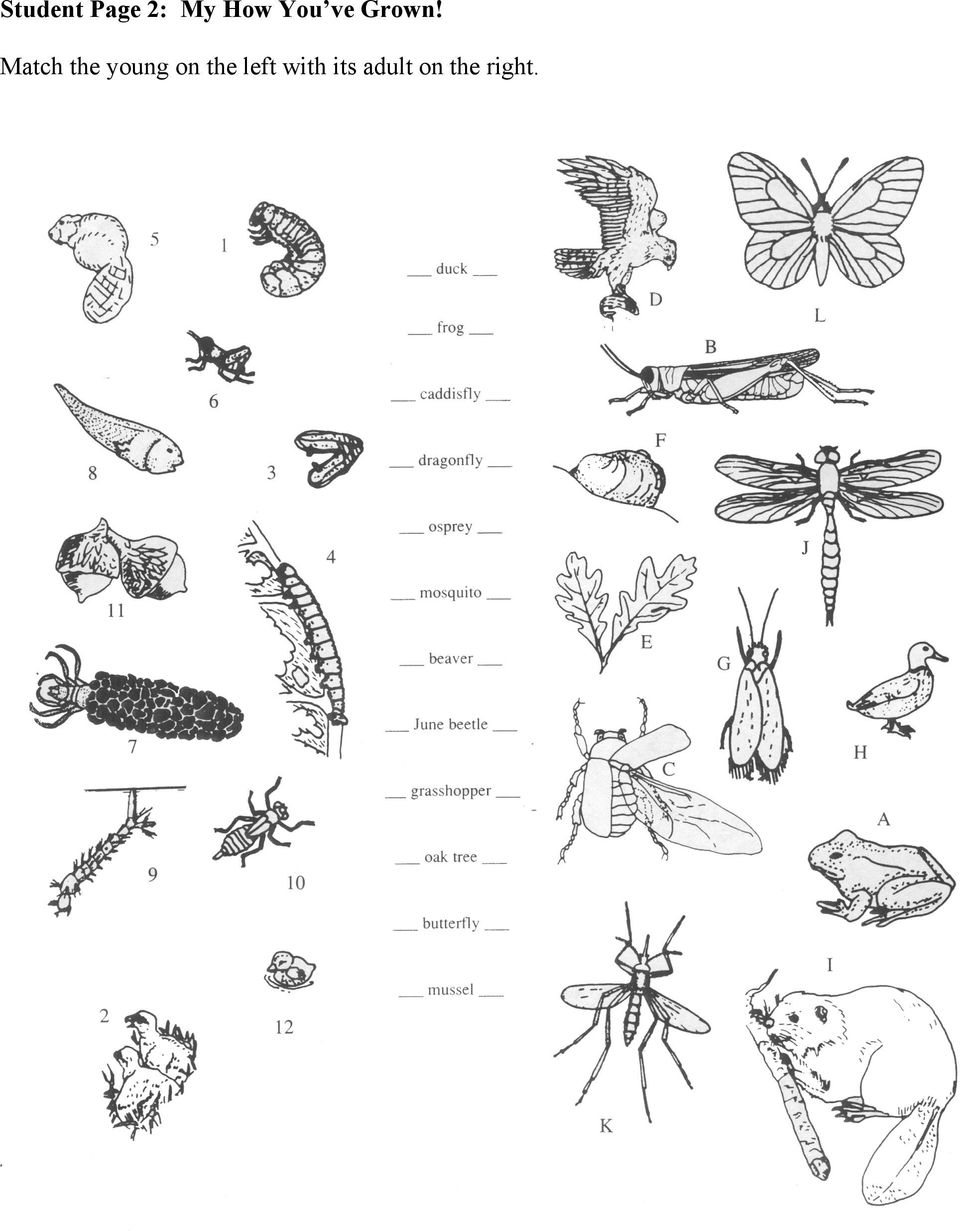
9 Student Page 3: What Tree Is That? Name Use the key to identify the three unknown trees whose leaves are shown below. 1. Leaves alternate... 2 Leaves opposite or whorled Leaves simple... 3 Leaves compound Leaves fan-shaped with notch at tip...gingko Leaves not fan-shaped, lacking notch at tip Leaves entire... magnolias Leaves lobed or toothed Leaveslobed... oaks Leaves toothed... elms 6. Leaflets small... honeylocust Leaflets large... yellowwood 7. Leaves whorled... catalpa Leaves opposite Leaves simple Leaves compound...: Leaves palmately lobed... maples Leaves entire... dogwoods 10. Leaves palmately compound... buckeyes Leaves pinnately compound...ashes Unknowns:

10 Student Page 4: Aquatic Macroinvertebrate Key Name Below are drawings of five organisms and a key. Write a key to identify these animals. Questions to think about: 1. For which group of animals would it be easier to write a key, all the mammals found in Illinois or all the rodents found in Illinois? Explain your choice. 2. Is it easier to write a key to organisms that are very different from each other or to organisms that are very similar? What difficulties would you encounter in each case? 3. If you were to write a key to all the mammals found in Illinois, what kind of information would you need to create a useful, accurate key? a useful, accurate key?

Writing a Dichotomous Key to Wildflowers
 Writing a Dichotomous Key to Wildflowers Objectives: 1. Understand how to use and make dichotomous keys. 2. Understand common terminology of plant morphology. 3. Learn to recognize some fall wildflowers.
Identifying Vertebrates Using Classification Keys
 Name Class Date Chapter 18 Classification Identifying Vertebrates Using Classification Keys Introduction Organisms such as vertebrates (animals with backbones) are classified into groups according to certain
Life Cycle of a Butterfly
 Name: Date: Life Cycle of a Butterfly Life cycle refers to the stages of development, growth and reproduction that a living thing goes through. The butterfly's life cycle is made up of four stages: egg,
IDENTIFICATION OF ORGANISMS
 reflect Take a look at the pictures on the right. Think about what the two organisms have in common. They both need food and water to survive. They both grow and reproduce. They both have similar body
Dichotomous Keys. Lab Exercise. Contents. Objectives. Introduction
 Lab Exercise Dichotomous Keys Contents Objectives 1 Introduction 1 Activity.1 Key to the Animal Kingdom 4 Activity.2 Creating a Key 6 Resutls Section 7 Objectives - Understand the concept of classification
Building a Dichotomous Key: Take home Assignment. - Copy of Aliens Handout - Question Sheet - Dichotomous Key Sheet
 Materials: uilding a Dichotomous Key: Take home Assignment - Copy of Aliens Handout - Question Sheet - Dichotomous Key Sheet Introduction: A dichotomous key is a very useful tool. It helps you identify
Classification. Living Things. bacteria and blue green algae: (single celled organisms without a nucleus)
 Teacher Discovery Card Classification Information There are millions different kinds plants and animals in the world Each different kind plant and animal is called a species We can group species together
Monarch Butterfly Life Cycle and Migration
 This website would like to remind you: Your browser (Apple Safari 7) is out of date. Update your browser for more security, comfort and the best experience on this site. Activitydevelop Monarch Butterfly
Lab #10 Invertebrates 2 and Vertebrates 1 (Exercises 39, 40)
 Name Bio 182-General Biology Lab #10 Invertebrates 2 and Vertebrates 1 (Exercises 39, 40) Answer the questions in the space provided. You need to turn this sheet at the end of the lab. In general know
2. Name of Inquiry: Where do I belong? : An Introduction to the Use of Dichotomous Keys (Part 1)
 ECOS Inquiry 1. Contributor s Name: Sarah Bisbing 2. Name of Inquiry: Where do I belong? : An Introduction to the Use of Dichotomous Keys (Part 1) 3. Goals and Objectives: a. Inquiry Questions: Why do
Task 2 Multi-text reading: Interesting facts about butterflies
 Task 2 Multi-text reading: Interesting facts about butterflies Level: ISE III Focus: Task 2 Multi-text reading Aims: To read for gist and specific information and to deduce meaning from context Objectives:
Animal Classification K-4
 Animal Classification K-4 Introduction: The theme of this self-guided experience is classification of animals. Students will learn to use body coverings as an aid to classification. As the group tours
Student worksheet. Bugs. Complete metamorphosis Dung Beetle lifecycle. Incomplete metamorphosis Leafhopper lifecycle
 Complete metamorphosis Dung Beetle lifecycle Incomplete metamorphosis Leafhopper lifecycle Museum Victoria Bugs Classroom Activities Section 3 6 A Diving Beetle s story Museum Victoria Bugs Classroom Activities
Butterflies and Moths
 Delta Science Reader Butterflies and Moths Delta Science Readers are nonfiction student books that provide science background and support the experiences of hands-on activities. Every Delta Science Reader
nucleus cytoplasm membrane wall A cell is the smallest unit that makes up living and nonliving things.
 1 In nature there are living things and nonliving things. Living things depend on three basic life processes: nutrition, sensitivity and reproduction. Living things are made up of cells. 1. Match the two
Materials For each student (or group of students): Caterpillar data sheets Pencil For teacher: Chart paper Markers
 Insects! Concepts Life cycles and metamorphosis are common to all insects. Butterflies, like most insects, go through complete metamorphosis involving four distinct phases egg, caterpillar (larva), chrysalis
Assign: Unit 1: Preparation Activity page 4-7. Chapter 1: Classifying Life s Diversity page 8
 Assign: Unit 1: Preparation Activity page 4-7 Chapter 1: Classifying Life s Diversity page 8 1.1: Identifying, Naming, and Classifying Species page 10 Key Terms: species, morphology, phylogeny, taxonomy,
Dichotomous Keys for the Arboretum Walk. Plant List
 1 Dichotomous Keys for the Arboretum Walk Plant List Common name 1. Pin oak 2. Sweet gum 3. Red maple 4. Bur oak 5. River birch 6. Black cherry 7. Tulip poplar 8. Kentucky coffeetree 9. Catalpa 10. Honeylocust
Monarch Butterflies: Beautiful But Poisonous by Kelly Hashway
 by Kelly Hashway If you ve ever seen a monarch butterfly, then you ve probably noticed their bright orange and black colors. It makes them easy to see in the sky. You may think this would put the Monarch
The Art of the Tree of Life. Catherine Ibes & Priscilla Spears March 2012
 The Art of the Tree of Life Catherine Ibes & Priscilla Spears March 2012 from so simple a beginning endless forms most beautiful and most wonderful have been, and are being, evolved. Charles Darwin, The
Focused Learning Lesson Science Grades 10-12 LS-H-C4
 Focused Learning Lesson Science Grades 10-12 LS-H-C4 Overview: This lesson is to be used to help students to understand how to use a dichotomous key in classification. Students will use a dichotomous key
2 nd Grade Science Unit B: Life Sciences Chapter 3: Plants and Animals in Their Environment Lesson 1: How are plants and animals like their parents?
 2 nd Grade Science Unit B: Life Sciences Chapter 3: Plants and Animals in Their Environment Lesson 1: How are plants and animals like their parents? offspring Offspring are young plants and animals. Offspring
Butterfly or Moth? Made for 2nd Graders... Project Bibliography
 Butterfly or Moth? Made for 2nd Graders... Project Bibliography Butterfly or Moth? Today you will learn about a Painted Lady Butterfly and a Robin (Cecropia) Moth. What is a butterfly? Click the butterfly
Name That Adaptation. Background: Link to the Plan Read Section 5 (Whooping Crane Ecology and Biology) in the Management Plan
 Summary Students will explore structural, physiological, and behavioral adaptations of whooping cranes. Objectives: Students will be able to: Define an adaptation Describe several whooping crane adaptations
Animal Adaptations Investigation (K-3)
 Animal Adaptations Investigation (K-3) At a glance Students explore the Zoo in search of animals that fit certain categories and discover their adaptations. Time requirement One Zoo visit of at least 60
Animal Classification. Contents. Preparation
 Animal Classification A collaborative sorting activity for Key stages 2 & 3 Teachers notes Contents Animal Cards: 8 Pictures per card (54 +2 blanks) Alphabetical list of pictured animals Group cards: VERTEBRATE/INVERTEBRATE
Insects in the Classroom Lesson Plan No. 101
 University of Kentucky Entomology Insects in the Classroom Lesson Plan No. 101 Flour Beetles Prepared by Caroline Stetter Neel Extension Specialist Activity Description Hands-on Discovery Lab Age Group:
Exhibit Inquiry. Rainforest. Aug 11
 Exhibit Inquiry Exhibit Inquiry Have students look for the following exhibits related to living things during their visit to the Ontario Science Centre: Where to go: (Level 6) What it's about: Tropical
Lesson Title: Constructing a Dichotomous Key and Exploring Its Relationship to Evolutionary Patterns
 Lesson Title: Constructing a Dichotomous Key and Exploring Its Relationship to Evolutionary Patterns NSF GK-12 Fellow: Tommy Detmer Grade Level: 4 th and 5 th grade Type of Lesson: STEM Objectives: The
Grade Level Content Expectations addressed: Activities: Schedule of Field Trip Activities at the Detroit Zoo 8:15 am Board Bus at School
 Title: Comparing and Contrasting Ecosystem Biodiversity Submitted by: Tracy Ortiz Email: [email protected] School: Coffey K-8 Educational Learning Community Date: May 12, 2010 Target Grade: 6 Duration:
Mammal Scavenger Hunt Activity
 Mammal Scavenger Hunt Activity Materials: Mammal questions worksheet (pages 2-3) 18 Mammal fact cards (pages 4-8) Tape and scissors Preparation: Print the fact cards on card stock or brightly-colored paper
Worksheets. (Caterpillars of Singapore s Butterflies) Worksheet Title Recommended level. Adaptations of the caterpillar defence mechanism
 Worksheets (Caterpillars of Singapore s Butterflies) Worksheet Title Recommended level 1 Life cycle of a butterfly P3 2 Am I an insect? P3 3 4 Adaptations of the caterpillar defence mechanism The butterfly
Title: Create A New Animal. Grade Level: 3 rd -5 th. Subject: Biology. Time: 60-90 minutes
 Title: Create A New Animal Grade Level: 3 rd -5 th Subject: Biology Time: 60-90 minutes Objective: Students will better understand physical adaptations of certain animals, and how those adaptations increase
In your last science lesson, you used posters to learn about five of the classes of vertebrates.
 Science 4 Physical Life Earth and Space LESSON 31 Identifying characteristics of classes of vertebrates Lesson Preparation Program Materials Child s Booklet C Investigating Characteristics of Animals (pp.
Build Vocabulary Students will have a more successful lab experience if they understand these terms.
 Chapter 18 Lab Dichotomous Keys Open-Ended Inquiry Design Your Own Lab Problem Can you construct a dichotomous key that could be used to identify organisms? Introduction In May 2007, scientists and other
Worksheets. (Caterpillars of Singapore s Butterflies) Worksheet Title Recommended level. Adaptations of the caterpillar defence mechanism
 Worksheets (Caterpillars of Singapore s Butterflies) Worksheet Title Recommended level 1 Life cycle of a butterfly P3 2 Am I an insect? P3 3 4 Adaptations of the caterpillar defence mechanism The butterfly
Zoo Connections Curriculum
 Zoo Connections Curriculum We Like to Move It, Move It: Classifying animals by features 1 st grade Curriculum is aligned with the Mississippi Academic Framework. Lessons and support material are provided
Classification: Spots and stripes
 Biology Classification: Spots and stripes Zebras have a distinctive pattern that makes them easily recognisable to most people, but they also display features common to other animals. So how can we easily
Using and Constructing a Dichotomous Key
 Name Class Date Chapter 18 Classification Using and Constructing a Dichotomous Key You may want to refer students to Chapter 18 in the textbook for a discussion of the classification system used in biology.
Lesson 3 Biodiversity
 Biodiversity Cachalú Biological Reserve, Colombia Concept Rainforests are comprised of an extraordinary diversity of plants and animals. Diversity of life is an essential ingredient to healthy ecosystems
Kindergarten Science Unit B: Life Science Chapter 4: Plant and Animal Parts Lesson 1: What do plant parts do?
 Insert Photo or Graphic for Unit or Lesson Theme Kindergarten Science Unit B: Life Science Chapter 4: Plant and Animal Parts Lesson 1: What do plant parts do? Insert Photo/Graphic parts Insert Photo/Graphic
www.lakeshorelearning.com
 Get kids excited about science with this fun-filled quiz game! We ve provided 20 sample questions covering a variety of engaging topics. Just download the free game cards and follow the instructions below
Smithsonian Books, 2001. 1 Groves, Colin P. Primate Taxonomy. Smithsonian Series in Comparative Evolutionary Biology. Washington, D.C.
 Primates at Woodland Park Zoo Pre-visit Information for Teachers If you are planning a field trip to the zoo and wish to have your students focus on or study primates during their zoo visit, this pre-visit
ARTHROPOD DICHOTOMOUS KEY
 The following instructional plan is part of a GaDOE collection of Unit Frameworks, Performance Tasks, examples of Student Work, and Teacher Commentary. Many more GaDOE approved instructional plans are
Phonics. High Frequency Words P.008. Objective The student will read high frequency words.
 P.008 Jumping Words Objective The student will read high frequency words. Materials High frequency words (P.HFW.005 - P.HFW.064) Choose target words. Checkerboard and checkers (Activity Master P.008.AM1a
TAXONOMIC (DICHOTOMOUS) KEYS
 TAXONOMIC (DICHOTOMOUS) KEYS One method of classifying and identifying objects includes using a taxonomic key, sometimes called a dichotomous key. A taxonomic key looks at the similarities and differences
Break down material outside their body and then absorb the nutrients. Most are single-celled organisms Usually green. Do not have nuclei
 Name Date Class CHAPTER 9 REINFORCEMENT WORKSHEET Keys to the Kingdom Complete this worksheet after you have finished reading Chapter 9, Section 2. Patty dropped her notes while she was studying the six
A MIDDLE SCHOOL LESSON FOR CREATING AND USING DICHOTOMOUS KEYS By Sharon Donovan
 A MIDDLE SCHOOL LESSON FOR CREATING AND USING DICHOTOMOUS KEYS By Sharon Donovan INTRODUCTION One of my most enjoyable lessons is on the concept of dichotomous keys. It not only addresses a multitude of
Identifying Aquatic Insects From Your Pond
 Identifying Aquatic Insects From Your Pond Penobscot County Soil & Water Conservation District Natural Resources Conservation Service 28 Gilman Plaza, Suite #2 Bangor, ME 04401 Tel: (207) 990-3676 Fax:
Name Class Date. Adapting to the Environment Adaptations and Survival
 CHAPTER 3 4 SECTIN Adapting to the Environment Adaptations and Survival EFRE YU READ After you read this section, you should be able to answer these questions: What adaptations help animals survive? What
Materials and Resources:
 Keywords: class classification family genus invertebrates kingdom order phylum species 1. Engage: Introduction: Students investigate different questioning techniques through a classification game. Materials
Invertebrate Comparative Anatomy Lab
 Invertebrate Comparative Anatomy Lab Background: Scientists group animals by their similarities. We will be looking at different phyla of animals today. These animals will have things in common and they
Making and using keys Teacher Guidance
 Teacher Guidance Activities in earlier sections should have laid foundations that lead children to these more complex activities, in which they apply their observation and sorting skills to the practical
Grade 5 Standard 5 Unit Test Heredity. 1. In what way will a kitten always be like its parents? The kitten will...
 Grade 5 Standard 5 Unit Test Heredity Multiple Choice 1. In what way will a kitten always be like its parents? The kitten will... A. be the same color. B. learn the same things. C. have the same body structures.
Looking at life cycles
 Using a selection of the Discovery cards in this section, children can learn more about insect lifecycles and how to sequence the lifestages of a butterfly correctly. They can also explore metamorphosis.
EMPOWERING TEACHERS TEACHER EXPLAINS TASK TEACHER MODELS TASK
 Benchmarks: Second Grade Comprehension: Identify and Discuss the Author s Purpose Preparation/Materials: Preparation/Materials: large graph, large copy of each story, highlighter, pictures of a U.S. map,
If you would like more biome reading comprehensions like this, check out my Biome Bundle. It is on sale for 50% off for 3 days only!
 If you would like more biome reading comprehensions like this, check out my Biome Bundle. It is on sale for 50% off for 3 days only! Includes: Coral Reefs Deserts Grasslands Arctic Tundra Wetlands Rainforest
Fish: One-of-a-kind Animals (30 minute activity)
 FISH HEALTH/Activity Fish: One-of-a-kind Animals (30 minute activity) Objectives Materials Background I have known you in your streams and rivers where your fish flashed and danced in the sun, where the
The Toledo Zoo Aviary
 The Toledo Zoo Aviary Look at the Birdie Bird Adaptations Lesson Learning Strategies Background Knowledge Vocabulary Comprehension Application/ Extension Problem Solution Guide Personal Clues Questions
Insect Record. Date. Observations
 Insect Record Date Observations Investigation 1: Mealworms No. 1 Notebook Master Stages in the Life Cycle of the Darkling Beetle 1. Cut apart the pictures. 2. Glue the pictures in a column in your science
reflect What about other living things? Do all animals look the same as their parents?
 reflect Look at the boy and his father. How do they look the same? They both have two arms and two legs. They both have eyes and a nose. They look a lot alike! People can look like their parents. We get
Fishy Adaptations. Adapted from: Fashion a Fish in Project Wild Aquatic Education Activity Guide. The Council for Environmental Education, 1992
 Fishy Adaptations Adapted from: Fashion a Fish in Project Wild Aquatic Education Activity Guide. The Council for Environmental Education, 1992 Physical Structure Grade Level: Basic Duration: 45 minutes
ELEMENTARY-LEVEL SCIENCE TEST
 4THE UNIVERSITY OF THE STATE OF NEW YORK SPRING 2008 GRADE 4 ELEMENTARY-LEVEL SCIENCE TEST WRITTEN TEST Student Name School Name Print your name and the name of your school on the lines above. The test
Science Life Cycle of the Butterfly
 Science Life Cycle of the Butterfly Here is a big word for you to remember: metamorphosis. Metamorphosis means that an animal changes in the way it looks and behaves as it develops. Most insects go through
Butterflies and Plants Grades: K and up
 Butterflies and Plants Grades: K and up Purpose: To focus exploration on the butterfly life cycle and how that life cycle is related to plants in the garden. Students should be exposed to the 4 stages
Cursos: Iniciada el curs 2007-08 i revisada en diverses ocasions. Versió actual: curs 2010-2011.
 PROGRAMACIÓ: VERTEBRATES NIVELL: 5è de primària Mestres que hi han intervingut: Àngels Balañá, Àngels Mata, Raquel López, Marta Cuevas, Imma Torres. Cursos: Iniciada el curs 2007-08 i revisada en diverses
Carnivore, omnivore or herbivore?
 Carnivore, omnivore or herbivore? Physical adaptations of the giant panda Student booklet (ST) October 2010 panda_st_student.doc Context The Giant Panda is a species that is faced with extinction. It is
How Insects Feed from Flowers
 The Pollinator Garden: www.foxleas.com How Insects Feed from Flowers The main insect groupings that include species that use flowers as a food source are: Butterflies and Moths (Lepidoptera), Bees and
Georgia Performance Standards Framework for Science GRADE 7 DICHOTOMOUS KEYS AND CLASSIFICATION
 The following instructional plan is part of a GaDOE collection of Unit Frameworks, Performance Tasks, examples of Student Work, and Teacher Commentary. Many more GaDOE approved instructional plans are
Interaction at a Distance
 Interaction at a Distance Lesson Overview: Students come in contact with and use magnets every day. They often don t consider that there are different types of magnets and that they are made for different
2. Identify each using the letters below using BD for the Bald Eagle, G for the Golden Eagle, H for the Harpy Eagle, and BT for the Bateleur Eagle.
 Eagle Quest Name SITE: American Eagle Foundation 1. How many species of eagles are found on Earth? 2. Identify each using the letters below using BD for the Bald Eagle, G for the Golden Eagle, H for the
LAB 11 Drosophila Genetics
 LAB 11 Drosophila Genetics Introduction: Drosophila melanogaster, the fruit fly, is an excellent organism for genetics studies because it has simple food requirements, occupies little space, is hardy,
Understanding by Design. Title: BIOLOGY/LAB. Established Goal(s) / Content Standard(s): Essential Question(s) Understanding(s):
 Understanding by Design Title: BIOLOGY/LAB Standard: EVOLUTION and BIODIVERSITY Grade(s):9/10/11/12 Established Goal(s) / Content Standard(s): 5. Evolution and Biodiversity Central Concepts: Evolution
Building a phylogenetic tree
 bioscience explained 134567 Wojciech Grajkowski Szkoła Festiwalu Nauki, ul. Ks. Trojdena 4, 02-109 Warszawa Building a phylogenetic tree Aim This activity shows how phylogenetic trees are constructed using
Mythical Monsters Made Real!
 Mythical Monsters Made Real! A Cooperative Lesson on Physical and Behavioral Adaptations Purpose (Teacher Version): The purpose of this lesson is use the skills and knowledge learned in previous adaptation
WJEC AS Biology Biodiversity & Classification (2.1 All Organisms are related through their Evolutionary History)
 Name:.. Set:. Specification Points: WJEC AS Biology Biodiversity & Classification (2.1 All Organisms are related through their Evolutionary History) (a) Biodiversity is the number of different organisms
Practice Questions 1: Evolution
 Practice Questions 1: Evolution 1. Which concept is best illustrated in the flowchart below? A. natural selection B. genetic manipulation C. dynamic equilibrium D. material cycles 2. The diagram below
Taxonomy and Classification
 Taxonomy and Classification Taxonomy = the science of naming and describing species Wisdom begins with calling things by their right names -Chinese Proverb museums contain ~ 2 Billion specimens worldwide
Name Class Date. binomial nomenclature. MAIN IDEA: Linnaeus developed the scientific naming system still used today.
 Section 1: The Linnaean System of Classification 17.1 Reading Guide KEY CONCEPT Organisms can be classified based on physical similarities. VOCABULARY taxonomy taxon binomial nomenclature genus MAIN IDEA:
Flower Model: Teacher Instructions Sepals Anther Stamens (male) Filament Stigma Pistil Style (female) Ovary Petals sepals petals stamens pistil
 Flower Model: Teacher Instructions In order to better understand the reproductive cycle of a flower, take a look at some flowers and note the male and female parts. Most flowers are different; some have
Activity Sheet A - Getting Sorted (Cont) Diet (in the wild) Herbivore Carnivore Omnivore Habitat Terrestrial/ground dwelling Arboreal/tree living Aqua
 Activity Sheet A - Getting Sorted Duration: 45 minutes Locate the animals listed below and find out their scientific name. Remember that the scientific name is usually written in italics or is underlined.
Animal Colors and Shapes Teacher s Guide
 Teacher s Guide Grade Level: K 2 Curriculum Focus: Math, Science Lesson Duration: 1 2 class periods Program Description Animals come in all colors, shapes, and sizes. Learn about the shapes animals have
Analyzing A DNA Sequence Chromatogram
 LESSON 9 HANDOUT Analyzing A DNA Sequence Chromatogram Student Researcher Background: DNA Analysis and FinchTV DNA sequence data can be used to answer many types of questions. Because DNA sequences differ
Pond Vocabulary Words and Meanings
 Pond Vocabulary Words and Meanings Adapt: to adjust to a use or situation Aquatic: from or in the water Bacteria: tiny organisms, too small to be seen with the naked eye Carnivore: an animal that eats
FOOD CHAINS, FOOD WEBS AND ECOLOGICAL PYRAMIDS
 FOOD CHAINS, FOOD WEBS AND ECOLOGICAL PYRAMIDS SECTION 1 In an ecosystem, plants capture the sun's energy and use it to convert inorganic compounds into energy-rich organic compounds. This process of using
A Method of Population Estimation: Mark & Recapture
 Biology 103 A Method of Population Estimation: Mark & Recapture Objectives: 1. Learn one method used by wildlife biologists to estimate population size of wild animals. 2. Learn how sampling size effects
Classification Why Things are Grouped classify Methods of Classification
 Classification What features do biologists use to group living things? You know that most plants are green and do not more around. You also know that most animals are not green and do move around. The
The Butterfly Life Cycle
 The Butterfly Life Cycle A Reading A Z Level H Leveled Book Word Count: 233 LEVELED BOOK H The Butterfly Life Cycle Visit for thousands of books and materials. Photo Photo Credits: Credits: Photo Credits:
Zoos Classroom Activity
 Zoos Classroom Activity The Classroom Activity introduces students to the context of a performance task so they are not disadvantaged in demonstrating the skills the task intends to assess. Contextual
Table of Contents. Unit 2
 Table of Contents Introduction............................................................3 About the Book and Lessons....................................................4 Common Core State Standards Correlations...........................................
English Language Arts Materials Collections 2015-16 Instructionally Embedded Assessment Window
 English Language Arts Materials Collections 2015-16 Instructionally Embedded Assessment Window DLM testlets sometimes call for the use of specific materials or manipulatives. Materials are identified in
version if desired, and Teacher Preparation Notes are available at http://serendip.brynmawr.edu/sci_edu/waldron/.
 Using a Dichotomous Key to Identify Flowers (and the murderer) Adapted and Excerpted from Constructing a Dichotomous Key by Margaret Bankhead of Robert A. Black Magnet School, Making a Dichotomous Key
The Cricket Lab. Introduction
 The Cricket Lab Introduction Humans have always been fascinated by crickets, mostly because crickets sing. Movie producers add their songs to sound tracks. The Chinese have used them for medicinal purposes,
Silent, Nighttime Hunters By Guy Belleranti
 By Guy Belleranti Owls are raptors, or birds of prey. They are carnivores who quickly and silently swoop down on their prey from above. Most raptors such as eagles, hawks and falcons are day hunters. They
Protists and Fungi. What color are the cells in the living culture?
 Protists and Fungi Objectives 1. Recognize and identify (to genus) the organisms covered in lab. 2. Describe the characteristics of each organism. 3. Correctly classify the organisms. I. Protists The protists
Student Handout 1: Dichotomous Key Introduction
 Assignment 2: Big 6 Lesson Plan Roberta T. Jordan EDU566: Media Utilization and Curriculum Dr. Jane McGinn, Professor Student Handout 1: Dichotomous Key Introduction What is a Dichotomous Key? Instructions:
GRADE 4 English Language Arts Proofreading: Lesson 5
 GRADE 4 English Language Arts Proofreading: Lesson 5 Read aloud to the students the material that is printed in boldface type inside the boxes. Information in regular type inside the boxes and all information
The H-Map: An Alternative to the Venn Diagram
 The H-Map: An Alternative to the Venn Diagram H Fossil Fuels 1. 2. 3. 4. 5. Both? 1. 2. 3. Solar Power 1. 2. 3. 4. 5. Venn Diagram Fossil Fuels Solar Energy Source: Holt Elements of Literature (2005) Word
BUTTERFLY SCIENCE. 9 Science Activities for PreK, K & 1-3. 1 800 698 4438 EarthsBirthday.org
 BUTTERFLY SCIENCE 9 Science Activities for PreK, K & 1-3 1 800 698 4438 EarthsBirthday.org CONTENTS Butterfly Life Cycle Song 4 Changing Butterfly Dance 5 What Is a Caterpillar? 6 Caterpillar & Pupa Timelines
Get Ready for IELTS Writing. About Get Ready for IELTS Writing. Part 1: Language development. Part 2: Skills development. Part 3: Exam practice
 About Collins Get Ready for IELTS series has been designed to help learners at a pre-intermediate level (equivalent to band 3 or 4) to acquire the skills they need to achieve a higher score. It is easy