
A MIDDLE SCHOOL LESSON FOR CREATING AND USING DICHOTOMOUS KEYS By Sharon Donovan
|
|
|
- Theodora Wade
- 9 years ago
- Views:
Transcription
1 A MIDDLE SCHOOL LESSON FOR CREATING AND USING DICHOTOMOUS KEYS By Sharon Donovan INTRODUCTION One of my most enjoyable lessons is on the concept of dichotomous keys. It not only addresses a multitude of subjects in the science standards, but also is just plain fun for my students and me. The lesson is based on the students participation in naming preposterous critters, creating a dichotomous key for them, testing the results and then creating their own unique group of critters to key out. The results of the lesson are that I have a class of students who can successfully use dichotomous keys and, more importantly, create keys of their own. OBJECTIVES The students will be able to Use a dichotomous key to identify unknown organisms. Create a dichotomous key for a group of unknown organisms. PROCEDURE To begin, draw at least five critters on the board before the students enter the room. These critters must not resemble any known creature on this planet because they will be introduced to the students as aliens from another planet, which has just been discovered. Here are some critters I have used: GLOP BIP GLIP FOOP NOP The critters are unnamed when the students arrive to take their seats. Much laughter and discussion usually result when the students spy the drawings. Allow a few minutes for the students to make some natural observations.
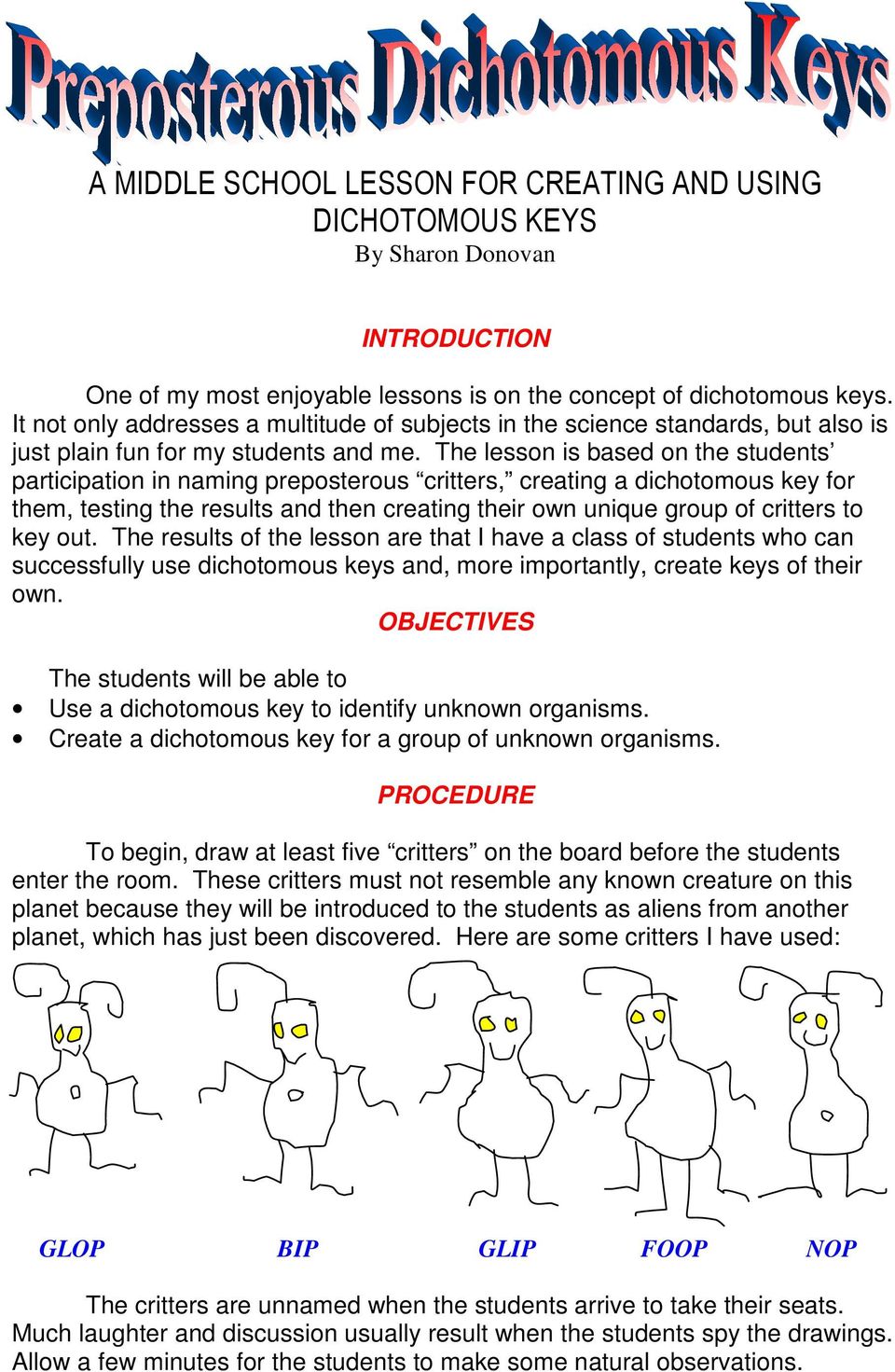
2 2.IN THE BEGINNING. Begin the class by telling the students that they are going to be scientists on a special mission to a newly discovered planet. Their job is to study the life forms on the planet, record all their observable characteristics and bring this information back to earth. Ask the students to name this new planet. However, they cannot use any known word from earth to name it. The students love this and come up with some pretty nonsensical names. Let s say they call the planet BEBONK. Next, ask them to think of some interesting names for the critters that the scientists found. I love throwing in some language arts here by telling them they can only use one-syllable names that make absolutely no sense. I ll use the names I have given under the critters as an example. UH-OH Tell the students that, when they get back to earth, they realize that the scientists who travel to Bebonk on the next mission will not know how to identify the critters very quickly when they see them, even with the information that the first team gave them. They will need to use some sort of identification key to help them. Explain that scientists use a dichotomous key to identify living things, by splitting a group of organisms into two groups based on a difference in a particular characteristic (you can play with the definition of dichotomous here, depending on the level of your students). Each group is then divided into two more groups based on another characteristic. This continues until only one organism is left and this leads the scientist to the name of the organism. WHAT S SO DIFFERENT? Ask the students to make a list of all the different characteristics they observe for these critters. They may come up with the following: Number of hairs Number of legs Belly button Arms Crooked smile Small Fat You can see that the students could come up with more, but these will do. Next, ask the students which of these characteristics could change because of age, eating habits or emotions and which ones are almost impossible to change. Hopefully, they will see that physical structures like arms, legs, belly buttons and hair usually don t change (well maybe hair).

3 3 CREATE THE KEY Ask the students to pick one structural characteristic that they could use to divide the critters into two main groups. There are several possibilities: One hair two hairs Two legs four legs Belly button no belly button Arms no arms Guide the students to choose a characteristic that will divide the group into two smaller groups that have more than one member. Suppose they choose the number of hairs. Write the choices on the board in this way: 1. Has one hair Has two hairs.. Explain to the students that every key starts with the number one, with two choices listed. Each choice will direct the user to another number, which will divide the organisms with each characteristic into two more groups based on another characteristic. Place the number 2 at the end of the first statement. Has two hairs.. Ask the students to give a characteristic that will divide the group with one hair into two groups. Tell them they will have to leave the second choice alone until they finish with the first one. Suppose they choose belly buttons. Write the number 2 under the first group of choices and write the two statements that describe the difference. 1. Has one hair. 2. Has two hairs 2. Has a belly button.... Has no belly button.. Ask the students if they can divide all the critters with one hair and a belly button into two more groups. They will discover that there is only one critter. Ask them for the name of the critter they have described. When the students tell you, say YES!! with enthusiasm, write the name after has a belly button and tell them that they have just identified one of the critters. The alien with one hair and a belly button is BIP.

4 4 1. Has one hair. 2. Has two hairs Has no belly button. How about the group with one hair and no belly button? The students should see that it needs to be divided again and will also see that the difference is in the number of legs. Place the number 3 after no belly button, write the two remaining choices after the number 3 below the other two steps. The students will see that, just like BIP, two more critters have been identified because there is only one of each. The key should now look like this: Has two hairs.. Has no belly button Has two legs GLIP Has four legs FOOP Now, tell the students that they can go back and divide the group with two hairs, but that they need to use the number 4, because 2 and 3 have already been used. Place the number 4 after has two hairs and put a number 4 under the third step. The students will be able to see that there are only 2 remaining critters and they are different because one has no arms. Adding two more statements to distinguish this characteristic will result in their key looking like this: Has two hairs.. 4. Has no belly button Has two legs GLIP Has four legs FOOP 4. Has arms.. GLOP Has no arms NOP

5 5 The last important job that the students need to do is create a title for the key. How about Key to the Critters on Bebonk? KEY TO THE CRITTERS ON BEBONK Has two hairs.. 4. Has no belly button Has two legs GLIP Has four legs FOOP 4. Has arms. GLOP Has no arms NOP Now, the fun begins! Erase the names of the aliens from under their pictures. Tell the students that they are now members of the second mission to Bebonk. Their job is to estimate the populations of Glops, Bips, Glips, Foops and Nops by using the dichotomous key to identify the specimens and then counting, using sampling techniques (which is another lesson). Ask for a volunteer to pick one of the critters on the board and identify it, using the key that we just created. Direct the volunteer to read through the key out loud, so that we can all follow his or her thinking. Continue to have volunteers identify the critters, using the key, until all five are identified. Ask the students who originally named each critter if we identified them correctly. We never have a problem! ASSESSMENT This is one instance in which the assessment is actually more fun than the lesson! Tell the students that they are now going to create their own aliens from an imaginary planet. They must name the planet and the aliens. Supply paper and markers, colored pencils or crayons for the students to draw five aliens. After their artwork is finished, they must create a dichotomous key for their critters. Each student should keep the names of the critters a secret and then test their key on another student to see if they can be identified correctly. Display the aliens in the classroom for all to see. Students at this age enjoy creating the weird space creatures. Some create very detailed drawings with rather unusual physical characteristics. Encourage imagination. In most biological keys, a diagram of the organism is included, with important structures labeled. You may want to include that in your assignment, as well.

6 6.AND ANOTHER THING. I have used this lesson in 4 th, 5 th, 6 th, 7 th and 8 th grade science classes with great success. I have found that it is a great demonstration lesson when visitors are expected because the students are so enthusiastic. If you have ever used the GEMS guide called OOBLECK, imagine how easily a dichotomous key could be incorporated into the unit. Students could create drawings of several different creatures from OOBLECK and make a key for them. A Key to the Freshwater Fish of South Carolina, created by Dr. Ed Donovan, et. al., is a logical unit to go to next. The key matches the poster of Freshwater Fish of South Carolina, which can be purchased from the South Carolina Department of Natural Resources. I have also followed this lesson up with a Key to the Trees of South Carolina, which can be found at the South Carolina Forest Commission. Other connections to this lesson are Scientific Naming and the Binomial System of Classification. Older students could use Latin words (or Latin sounding words) to make up Genus and species names for their creatures.

Adam and Eve. Man Walked with God Man Disobeyed God Man was Sent Away from God God Promised a Savior (Jesus)
 Adam and Eve Teacher Pep Talk: Where did we come from? The origins of the Universe lie in God. He created all things and that includes the first human: Adam. Knowing God made us on purpose is a singularly
Parable of The Prodigal Son
 Parable of The Prodigal Son Teacher Pep Talk: Children need to know that they are loved unconditionally. In fact, we all need to know it! In the Parable of the Prodigal Son, Jesus assures us that God will
Lesson Title: Constructing a Dichotomous Key and Exploring Its Relationship to Evolutionary Patterns
 Lesson Title: Constructing a Dichotomous Key and Exploring Its Relationship to Evolutionary Patterns NSF GK-12 Fellow: Tommy Detmer Grade Level: 4 th and 5 th grade Type of Lesson: STEM Objectives: The
Focused Learning Lesson Science Grades 10-12 LS-H-C4
 Focused Learning Lesson Science Grades 10-12 LS-H-C4 Overview: This lesson is to be used to help students to understand how to use a dichotomous key in classification. Students will use a dichotomous key
First Grade Animal Research Project
 First Grade Animal Research Project Dear Parents: As you probably know, our first graders have been learning all about animals. We have spent the last couple of weeks learning to group different animals
GRADE 5 SUPPLEMENT. Set A2 Number & Operations: Primes, Composites & Common Factors. Includes. Skills & Concepts
 GRADE 5 SUPPLEMENT Set A Number & Operations: Primes, Composites & Common Factors Includes Activity 1: Primes & Common Factors A.1 Activity : Factor Riddles A.5 Independent Worksheet 1: Prime or Composite?
2. Name of Inquiry: Where do I belong? : An Introduction to the Use of Dichotomous Keys (Part 1)
 ECOS Inquiry 1. Contributor s Name: Sarah Bisbing 2. Name of Inquiry: Where do I belong? : An Introduction to the Use of Dichotomous Keys (Part 1) 3. Goals and Objectives: a. Inquiry Questions: Why do
Kindergarten Respect Unit Lesson Seven Respect The Environment
 Kindergarten Respect Unit Lesson Seven Respect The Environment PURPOSE/OBJECTIVE Students will learn that respect must also be shown to the environment. Students will identify specific ways care and concern
God is Eternal Lesson 1
 Preschool Curriculum (4K / 5K) August 15 th & 16 th, 2009 God is Eternal Lesson 1 Divine Attribute: Heart Response: God is Eternal Be Amazed Memory Verse: Jesus Christ is the same yesterday, today and
My Game. Or I say, I m in the window. Or else, I m out the door. I m on top of the table, Or I m under the floor.
 My Game I have a little pretend game I play When Daddy calls to me. I say, I m right here, Daddy! I m under the sea! Or I say, I m in the window. Or else, I m out the door. I m on top of the table, Or
Lesson 2: How to Give Compliments to Tutees
 Kids As Reading Helpers: A Peer Tutor Training Manual Copyright 2002 by Jim Wright www.interventioncentral.org L2-1 Lesson 2: How to Give Compliments to Tutees Introduction When correctly used, compliments
Section 1.5 Exponents, Square Roots, and the Order of Operations
 Section 1.5 Exponents, Square Roots, and the Order of Operations Objectives In this section, you will learn to: To successfully complete this section, you need to understand: Identify perfect squares.
Pushes and Pulls. TCAPS Created June 2010 by J. McCain
 Pushes and Pulls K i n d e r g a r t e n S c i e n c e TCAPS Created June 2010 by J. McCain Table of Contents Science GLCEs incorporated in this Unit............... 2-3 Materials List.......................................
Lesson plan Primary. Why is handwashing. important?
 Lesson plan Primary Why is handwashing important? 1 Introduction Each day, 2000 children die as a result of diseases caused by unclean water and poor sanitation in the developing world. The simple act
2. Provide the scoring guide/rubric for the culminating task (summative assessment).
 2. Provide the scoring guide/rubric for the culminating task (summative assessment). Criteria Oral Presentation- Group project Poster Presentation display/ visual aids 1 - Attempts the standard use the
Section 2 Scientific Methods in Earth Science
 Section 2 Scientific Methods in Earth Science Key Concept Scientists conduct careful investigations by following standard methods that allow them to collect data and communicate results. What You Will
Nick s Plan. My case study child is a young boy in the third grade. I will call him Nick. Nick is a
 Jamie Oliver Nick s Plan My case study child is a young boy in the third grade. I will call him Nick. Nick is a student who has cerebral palsy. He remains in a wheelchair all day long while in school.
Lesson 6: Solomon Writes Many Proverbs
 Lesson 6: Solomon Writes Many Proverbs Bible Point: Wisdom means following God s word. 1 Kings 4:29-34; Proverbs 1:1-7 Key Verse: The fear of the Lord is the beginning of wisdom, and knowledge of the Holy
LESSON PLAN. KEY WORDS comic book, comic strip, cartoon, speech bubble, thought bubble, artist, story, edit
 Comic Strip LESSON PLAN SUMMARY Students will practice writing skills in a fun and creative manner. They will create their own comic strip using the templates provided in this lesson plan. OBJECTIVES Students
Using sentence fragments
 Lesson 8 Descriptive Essays Description is not a distinct mode of writing, like expository, narrative, and persuasive, but the ability to write descriptively is essential to a host of writing genres. Many
Mythical Monsters Made Real!
 Mythical Monsters Made Real! A Cooperative Lesson on Physical and Behavioral Adaptations Purpose (Teacher Version): The purpose of this lesson is use the skills and knowledge learned in previous adaptation
Moses and Pharaoh (The Ten Plagues)
 Moses and Pharaoh (The Ten Plagues) Teacher Pep Talk: Stubborn Pharaoh was stubborn. In fact, he was SO stubborn that, after he hardened his heart so many times, God finally hardened it for him. God had
Cookie University for Brownies: Learning Has Never Been So Tasty
 Cookie University for Brownies: Learning Has Never Been So Tasty Dear Girl Scout Volunteers, As you may know, the Girl Scout Cookie Sale is the largest girl-led Business & Entrepreneurship program in the
Zoos Classroom Activity
 Zoos Classroom Activity The Classroom Activity introduces students to the context of a performance task so they are not disadvantaged in demonstrating the skills the task intends to assess. Contextual
Fad Diets & Healthy Weight Management
 Fad Diets & Healthy Weight Management GOAL: Participants will gain an understanding of the principles of weight management, including the dangers of fad dieting, healthy weight gain, and weight loss. Each
Creation. Then God spoke and Creation came into being. God formed everything: Creation Week God called all that He had created good.
 Creation Teacher Pep Talk: Imagine darkness and emptiness and nothing else except God. God in His own time decides that He is going to create something wonderful: something which will eventually cost Him
Sailing the 7 C s The C of Commitment: Noah
 Sailing the 7 C s The C of Commitment: Noah LESSON OVERVIEW Key Point: Go against the flow Obey God. Bible Story: Noah Bible Reference: Genesis 6:9-22 Challenge Verse: For all have sinned and fall short
Lesson 3 Biodiversity
 Biodiversity Cachalú Biological Reserve, Colombia Concept Rainforests are comprised of an extraordinary diversity of plants and animals. Diversity of life is an essential ingredient to healthy ecosystems
Endangered Species: What and Where?
 Endangered Species: What and Where? Summary: Students learn about North American endangered species through creation of a species book. Older students will locate endangered species on a map and explore
Temptation. A Youth Lesson for Grades 3-5, 6-8, & 9-12
 Scripture Lesson: Genesis 2: 15-17, 3: 1-7 Temptation A Youth Lesson for Grades 3-5, 6-8, & 9-12 Theme: Today s focus is on temptation. The question to be asked is: what is temptation all about? What is
Plant Identification: Using Dichotomous Keys
 Plant Identification: Using Dichotomous Keys Grade Level: 5-12 Subject Area: Biology, Botany, Taxonomy Time: Preparation: 20 minutes Activity: 45-60 minutes Clean-up: 10 minutes Student Performance Standards
Animals that move slowly, animals that move quickly
 Unit Three Time 74 Animals that move slowly, animals that move quickly Unit 3: Time Image courtesy of: Microsoft clipart Focus: Animals that move slowly and quickly linked with time Whole class activity
How can you tell rocks apart?
 How can you tell rocks apart? Grade Range: 4-7 G.L.E Focus: 1.1.5 Time Budget: 1 1.5 hours WASL Vocabulary: Overview: Different rocks have different characteristics because of their minerals, the ways
Alphabet Antonyms Table Literacy Skills / Vocabulary
 Alphabet Antonyms Table 1. Alphabet-Antonyms table for each student 2. Copies of a thesaurus, a synonym dictionary, or other word resource. 1.2, 1.10, 2.2, 3.2 1. Select words beginning with the same letter
Joseph and the Coat of Many Colors
 Joseph and the Coat of Many Colors Teacher Pep Talk: Joseph was called a dreamer by his brothers. But are you really a dreamer just because God chooses to speak to you in a dream? Joseph s brothers hated
Intro to the Art of Computer Science
 1 LESSON NAME: Intro to the Art of Computer Science Lesson time: 45 60 Minutes : Prep time: 15 Minutes Main Goal: Give the class a clear understanding of what computer science is and how it could be helpful
Excellent Teachers Have Excellent Resources. Literacy Resource Reading. Terms & Conditions Copyright
 Jack and Jill Literacy Resource Reading Terms & Conditions Copyright Except where otherwise stated, all intellectual property rights, including copyright, in this document and all material on the From
Assign: Unit 1: Preparation Activity page 4-7. Chapter 1: Classifying Life s Diversity page 8
 Assign: Unit 1: Preparation Activity page 4-7 Chapter 1: Classifying Life s Diversity page 8 1.1: Identifying, Naming, and Classifying Species page 10 Key Terms: species, morphology, phylogeny, taxonomy,
Grade: 3 to 5 Length: one hour Subjects: life science, classification Topics: weed identification, dichotomous keys
 Grade: 3 to 5 Length: one hour Subjects: life science, classification Topics: weed identification, dichotomous keys Objectives Exercises in this lesson help students achieve the following objectives: Practice
Song Writing. Main Goal: Learn how to define and call functions. OVERVIEW: PREPARATION: VOCABULARY: OBJECTIVE: MATERIALS: LESSON NAME:
 12 LESSON NAME: Song Writing Lesson time: 45 60 Minutes : 5 minutes (With song intros over several days, if possible) Main Goal: Learn how to define and call functions. OVERVIEW: Reading lyrics is a pretty
Science Grade 1 Forces and Motion
 Science Grade 1 Forces and Motion Description: The students in this unit will use their inquiry skills to explore pushing, pulling, and gravity. They will also explore the different variables which affect
Force and Motion: Ramp It Up
 Force and Motion: Grade Level: 4-5 Time: 3 class periods By: Carrie D. Perry (Bedford County Public Schools) Overview After watching an engaging video on Olympic alpine skiers, students then participate
Step 1: Come Together
 THE STORY FOR LITTLE ONES: Preschool LESSON GUIDE: Lesson 2 5 ABRAHAM FOLLOWS GOD Bible Basis: Genesis 12:1 9, 17; 21:1 7 Bible Verse: Abram believed the Lord. The Lord accepted Abram because he believed.
YOUTH SOCCER COACHES GUIDE TO SUCCESS Norbert Altenstad
 The Reason Why Most Youth Soccer Coaches Fail Lack of knowledge to make and keep practice fun and enjoyable for the kids is really the primary cause for failure as a youth soccer coach, it s sad. It s
Green Eggs and Ham. by Dr. Seuss. overview THE WHEATLEY PORTFOLIO. overview TeXT-DepenDenT questions assessment fluency. Rationale
 TEXT STUDY Green Eggs and Ham by Dr. Seuss map Grade 1 Unit 3 Unit Life Lessons Type Literary Text (Lexile 30L) overview Rationale overview TeXT-DepenDenT questions assessment fluency This text is one
Subject: Math Grade Level: 5 Topic: The Metric System Time Allotment: 45 minutes Teaching Date: Day 1
 Subject: Math Grade Level: 5 Topic: The Metric System Time Allotment: 45 minutes Teaching Date: Day 1 I. (A) Goal(s): For student to gain conceptual understanding of the metric system and how to convert
How can I improve my interviewing skills? MATERIALS
 Mock Interviews 6 Finding a job The BIG Idea How can I improve my interviewing skills? AGENDA Approx. 45 minutes I. Warm Up: Model an Interview (10 minutes) II. Interview Practice (30 minutes) III. Wrap
Science Rocks Grade Six
 Ohio Standards Connections: Earth and Space Sciences Benchmark D Identify that the lithosphere contains rocks and minerals and that minerals make up rocks. Describe how rocks and minerals are formed and/or
Expressive Objective: Realize the importance of using polite expressions in showing respect when communicating with others
 QUARTER 4 - WEEK 1 Theme: My School and Friends TARGET SKILLS : At the end of the lesson the students should be able to: Expressive Objective: Realize the importance of using polite expressions in showing
GRADE 4 English Language Arts Proofreading: Lesson 5
 GRADE 4 English Language Arts Proofreading: Lesson 5 Read aloud to the students the material that is printed in boldface type inside the boxes. Information in regular type inside the boxes and all information
A Flag for Your Planet
 by Andrew Fraknoi LEADER INSTRUCTIONS A Flag for Your Planet An Activity for the Whole Family from Project ASTRO Copyright 2001, Project ASTRO, Astronomical Society of the Pacific, 390 Ashton Ave., San
Week 4 Lesson Plan. Pre-K. Animals in the Wild. Macmillan /McGraw-Hill. Extend. the Unit
 Lesson Plan Extend Unit the Unit Pre-K Animals in the Wild Alphabet Time.....................2-3 Book Time.........................-5 Retelling Puppets................... 6 Content Area......................7-8
Goal To develop a classification scheme based on the structural features of organisms and then use the scheme to classify newly-discovered organisms.
 Creepy Critters facilitator What if you discovered a completely new life form? Would you be able to determine what existing organisms it might be related to? What would you look for? How would you organize
Getting to Know God: Who God Is Week 7: God Is Unchanging LEADER PREPARATION
 Getting to Know God: Who God Is Week 7: God Is Unchanging This includes: Leader Preparation Lesson Guide LEADER PREPARATION BIBLE BASIS What an amazing thought! While everything else around us is changing,
Animal Colors and Shapes Teacher s Guide
 Teacher s Guide Grade Level: K 2 Curriculum Focus: Math, Science Lesson Duration: 1 2 class periods Program Description Animals come in all colors, shapes, and sizes. Learn about the shapes animals have
Classroom Management Plan Nicole Short EDUC 360
 Classroom Management Plan Nicole Short EDUC 360 The purpose of this classroom management plan is to address my philosophy and beliefs about discipline, state classroom procedures, and the implementation
Geometry Fundamentals Triangle Project Triangle Artwork
 Geometry Fundamentals Triangle Project Triangle Artwork Introduction: For this project you will work individually creating a project using nothing but triangles. You will create a piece of original artwork
Starting a Booktalk Club: Success in Just 12 Weeks!
 Starting a Booktalk Club: Success in Just 12 Weeks! It s wonderful that you re interested in starting a booktalk club at your school! Before you even begin, you may want to familiarize yourself with some
Project Based Learning First Grade: Science- Plants and Animals By: Nikki DiGiacomo
 Project Based Learning First Grade: Science- Plants and Animals By: Nikki DiGiacomo How do plants and animals live? Essential Question Sub Questions What are plants? What are animals? What are the basic
THEME: God wants us to walk as children of light.
 Devotion NT330 CHILDREN S DEVOTIONS FOR THE WEEK OF: LESSON TITLE: Children of Light THEME: God wants us to walk as children of light. SCRIPTURE: Ephesians 5:1-18 Dear Parents Welcome to Bible Time for
Cheshire Public Schools Spelling Program. Practice Strategies
 Cheshire Public Schools Spelling Program Practice Strategies This booklet suggests more than twenty different ideas for practicing spelling words. We suggest that students write, spell, and pronounce the
Building a Dichotomous Key: Take home Assignment. - Copy of Aliens Handout - Question Sheet - Dichotomous Key Sheet
 Materials: uilding a Dichotomous Key: Take home Assignment - Copy of Aliens Handout - Question Sheet - Dichotomous Key Sheet Introduction: A dichotomous key is a very useful tool. It helps you identify
1. The RSA algorithm In this chapter, we ll learn how the RSA algorithm works.
 MATH 13150: Freshman Seminar Unit 18 1. The RSA algorithm In this chapter, we ll learn how the RSA algorithm works. 1.1. Bob and Alice. Suppose that Alice wants to send a message to Bob over the internet
Jesus is The Way. A copy of the activity sheet for each child A hole-punch Crayons, scissors, yarn, and double-sided tape Duct tape for one activity
 Jesus is The Way Teacher Pep Talk: How do we get to heaven? It seems like such a simple question, and it deserves a straightforward answer. Jesus gave that answer to His disciples on the night before His
Why Can t We All Just Get Along?
 Why Can t We All Just Get Along? Why Can t We All Just Get Along? Key Faith Foundation: God s Plan for Handling Family Conflict Key Scriptures: Genesis 4:1-12; Psalm 133; Colossians 3:12-15 Bible basis
What Have I Learned In This Class?
 xxx Lesson 26 Learning Skills Review What Have I Learned In This Class? Overview: The Learning Skills review focuses on what a learner has learned during Learning Skills. More importantly this lesson gives
Thinking, Doing, Talking Science
 Thinking, Doing, Talking Science Can we use our skills to train teachers in a way that has measurable impact? [email protected] Oxford Brookes University research with 16 primary schools
Junior Soldiers. Unit 4 : Lesson 8
 Junior Soldiers Unit 4 : Lesson 8 One body: many parts! PURPOSE : For children to explore and understand that even though those who follow Jesus are all different in some way, God loves each of us and
THE FORGIVING FATHER
 BOOK 1, PART 3, LESSON 4 THE FORGIVING FATHER THE BIBLE: Luke 15:11-32 THEME: We can discover what Jesus wants us to do and be by hearing the parables Jesus told. PREPARING FOR THE LESSON MAIN IDEA: Jesus
MATHEMATICS: REPEATING AND GROWING PATTERNS First Grade. Kelsey McMahan. Winter 2012 Creative Learning Experiences
 MATHEMATICS: REPEATING AND GROWING PATTERNS Kelsey McMahan Winter 2012 Creative Learning Experiences Without the arts, education is ineffective. Students learn more and remember it longer when they are
Elicit Me too and Me neither by asking students if they have a sister or brother (or dog, cat ) and then responding appropriately.
 All about me. Topic: Personal interests, likes and dislikes Aims: To help students focus on fluency when speaking To develop students communication skills To develop students listening skills Level: Pre-intermediate
Phonics. High Frequency Words P.008. Objective The student will read high frequency words.
 P.008 Jumping Words Objective The student will read high frequency words. Materials High frequency words (P.HFW.005 - P.HFW.064) Choose target words. Checkerboard and checkers (Activity Master P.008.AM1a
Animal Adaptations. Standards. Multiple Intelligences Utilized. Teaching First Step Nonfiction. Titles in this series: Reading.
 Teaching First Step Nonfiction Animal Adaptations K 2nd Grade Interest Level 1st Grade ing Level Titles in this series: What Can Live in a Desert? What Can Live in a Forest? What Can Live in a Grassland?
How To Kit. Picture Bingo
 How To Kit Picture Bingo Steps to Organizing a Picture Bingo Community Event 1. Find a space in the community to hold the event. (school, band office, nursing station, library, community hall) 2. Advertise
GOD S BIG STORY Week 1: Creation God Saw That It Was Good 1. LEADER PREPARATION
 This includes: 1. Leader Preparation 2. Lesson Guide GOD S BIG STORY Week 1: Creation God Saw That It Was Good 1. LEADER PREPARATION LESSON OVERVIEW Exploring the first two chapters of Genesis provides
Shapes in Agriculture
 My American Farm Lesson - Agriculture is Everywhere www.myamericanfarm.org Shapes in Agriculture Lesson Snapshot Related My American Farm Game In My Barn available at www.myamericanfarm.org Grade Levels
INTRODUCING STEWARDSHIP TO CHILDREN
 INTRODUCING STEWARDSHIP TO CHILDREN Using Well What God Gives Me Matthew 25: 14-30 Introduction Most everyone knows that as the weather starts to get colder the trees get ready for winter by dropping their
Jacob Marries Rachel
 Jacob Marries Rachel Teacher Pep Talk: Jacob, escaping from the wrath of his older brother, Esau, traveled to the home of his mother s relatives. There Jacob, the trickster, who had gotten both Esau s
What are the Different Types of Landforms?
 What are the Different Types of Landforms? Social Studies 1 st Grade 5 Lessons, approx. 25 minutes each Miss Emily Schreiner November 2013 P a g e 2 Table of Contents Rationale page 3 Stage 1 page 4 Stage
Persuasive Writing Persuasive Paragraph
 183 Persuasive Writing Persuasive Paragraph How would you complete the next sentence? The best event at school is... Would you say hat day, grandparents day, the school carnival? A special event can make
Suggested Grade Level: Third Grade. Measurable Objects: Instructional Input: Prior Knowledge: Sink, float, predict or guess, writing
 Sink or Float? Suggested Grade Level: Third Grade Concept: Recording data, learning what sinks and floats Materials: Water Big clear bin (that can hold water) Smaller clear water-holding containers (for
Describe the action you took in this cycle.
 Describe the action you took in this cycle. 1. The What s for Lunch? Unit Plan Cycle Two s unit plan (See Appendix E for specific learning activities) centered on a theme titled WHAT S FOR LUNCH? First
Atomic Structure OBJECTIVES SCHEDULE PREPARATION VOCABULARY MATERIALS. For each team of four. The students. For the class.
 activity 4 Atomic Structure OBJECTIVES Students are introduced to the structure of the atom and the nature of subatomic particles. The students are introduced to the properties of protons, neutrons, and
Games and Team Building Activities
 Games and Team Building Activities Getting to Know you Better/ Exploring Interests Affirmation circle: All those in the group form a circle. A leader will throw out get-to-know-you questions, and everyone
Fun Learning Activities for Mentors and Tutors
 Fun Learning Activities for Mentors and Tutors Mentors can best support children s academic development by having fun learning activities prepared to engage in if the child needs a change in academic/tutoring
What Time is it Mr. Wolf? Written by: Ryan Gobeil & Kyla Bassingthwaite Illustrations by: Dickson Tomyn
 What Time is it Mr. Wolf? Written by: Ryan Gobeil & Kyla Bassingthwaite Illustrations by: Dickson Tomyn Note To Teachers, Parents and Caregivers Why Health Literacy? form? Health literacy is important
On Your Marks: Under-5s Day 2 Jesus heals Bartimaeus Mark 10: 46-52
 On Your Marks: Under-5s Day 2 Jesus heals Bartimaeus Mark 10: 46-52 Simple Story An enlarged copy of the 'Bart' picture on A4 card; three extra faces (available as a web download: Day 2 resource sheets
Junior Business Owner Badge Activity Plan 1
 Junior Business Owner Badge Activity Plan 1 Badge Purpose: When girls have earned this badge, they ll know the basic steps to plan and create a new business. Program Essentials Link: Financial Literacy
Build Vocabulary Students will have a more successful lab experience if they understand these terms.
 Chapter 18 Lab Dichotomous Keys Open-Ended Inquiry Design Your Own Lab Problem Can you construct a dichotomous key that could be used to identify organisms? Introduction In May 2007, scientists and other
Materials: Student-paper, pencil, circle manipulatives, white boards, markers Teacher- paper, pencil, circle manipulatives, worksheet
 Topic: Creating Mixed Numbers and Improper Fractions SOL: 5.7- The student will add and subtract with fractions and mixed numbers, with and without regrouping, and express answers in simplest form. Problems
Science Fiction Creature Feature Performance Task Lesson Plan
 Performance Lesson Plan Science Fiction Creature Feature was created for and used as a two-class period learning and assessment task for a seventh grade Life Science unit called Structured for Survival.
Lesson 3. Branches of Government. Student Materials OBJECTIVE FOUNDATIONS UNIT
 Teacher Materials Clue leaves Government tree Branches of Government Chart He Does It All Scenario - Three Student Copies also Student Materials Paper & pencils Constitutions or copies of Article 1, 2,
TeachingEnglish Lesson plans
 Topic: Sleep Aims: - To help students talk about sleep and how it affects our lives - To develop students reading and listening skills - To develop students communication skills - To develop students debating
6th Grade Lesson Plan: Probably Probability
 6th Grade Lesson Plan: Probably Probability Overview This series of lessons was designed to meet the needs of gifted children for extension beyond the standard curriculum with the greatest ease of use
Jesus and Nicodemus Lesson Aim: To know God loves the world.
 Teacher s Guide: Ages 4-5 Kings & Kingdoms Part 1: The Life of Jesus Unit 2, Lesson 8 Jesus and Nicodemus Lesson Aim: To know God loves the world. THE WORSHIP Who God is: The King Who Serves THE WORD Bible
Objective: God is all Powerful! Bible Memory Verse: Matthew 19:26b With man this is impossible, but with God all things are THEME OVERVIEW
 Jesus the Magnificent Scripture: Luke 8:40-56 and Luke 18:35-43 Objective: God is all Powerful! Bible Memory Verse: Matthew 19:26b With man this is impossible, but with God all things are possible. THEME
FAMILY LIFE EDUCATION ACPS Fifth Grade
 Table of Contents UNIT I FAMILY...2 Relatives and Family Friends...2 Similarities and Differences among Families...2 UNIT II PERSONAL AND SEXUAL SAFETY... 3 Sexual Safety Good and Bad Touching... 3 UNIT
Wise Men. Lesson At-A-Glance. Gather (10 minutes) Arrival Activity Kids help each other follow a path of stars.
 Wise Men Lesson At-A-Glance Scripture Reference Matthew 2:1-12 Lesson Focus All paths lead to Jesus. Bible Memory Verse And you, Bethlehem, in the land of Judah, are by no means least among the rulers