
Invertebrate Comparative Anatomy Lab
|
|
|
- Kory Hodges
- 9 years ago
- Views:
Transcription
1 Invertebrate Comparative Anatomy Lab Background: Scientists group animals by their similarities. We will be looking at different phyla of animals today. These animals will have things in common and they will have differences. We will be looking at various characteristics of animals and comparing them. Two of these characteristics are as follows: (p. 374): There are three types of body symmetry. Radial Asymmetry Questions: 1. Based on the pictures above explain the difference between these three types of symmetry. 2. Based on the pictures below explain the difference between the two types of guts. ** Describe each kind on your own sheet of paper drawing a picture of each and writing a definition. : There are two types of guts. s with Two Openings s eat through mouth and get rid of waste through anus. s with One Opening s eat and get rid of waste through the same opening. Part 1: Comparing/Contrasting Characteristics of s (make sure you treat the live animals with care): 1) Compare and contrast the animals in the pictures provided below and the living specimens at your station. On your own sheet of paper copy the charts below and write down your observations.

2 Js,, and Hookworm (Roundworm) Planarian (flatworm) Earthworm (segmented worm) see live specimen (p. 390) Hookworm (Roundworm) Planarian (flatworm) Earthworm (segmented worm) Three Phyla of Worms Phyla of Worms Spider - Class Arachnid Fly Class Insecta Millipede Class Myriapoda Cricket Class Insecta (see living specimen)

3 Sand Crab (Pacific Mole Crab; Class Crustacea) Crayfish (Class Crustacea p. 409) Four Classes of Differences Between Four Classes of Spider Fly; Cricket Millipede Sand Crab; Crayfish Snail Class Gastropoda Octopus Class Cephalopda

4 Snail Octopus Clam Clam Class Bivalvia Three Classes of Mollusks Classes of Mollusks 2) Copy the chart below on your paper and write down similarities between the matching phylums. The boxes should be left blank. Invertebrate s Similarities: 3) Copy the chart below on your paper and write down differences between the matching phylums. The boxes should be left blank. Invertebrate s Differences: Part 2 (Time Permitting): Designing your own observational experiment 1. Develop an experiment to learn about one aspect of each living specimen at your station (i.e. reaction to warm/cold places, how it moves, how it eats, etc.). 2. Write a hypothesis for your experiment. 3. Write a procedure for your experiment. 4. Write down a list of materials you will need to conduct your experiment. 5. After you have done steps 2-4, show your plan to your teacher (you must do this BEFORE you do the experiment). 6. Do the experiment, collect data, and write a conclusion about what you observed in your experiment. Clean-Up: 1. Bring your living specimens and materials back to the teacher lab station. 2. Wipe down your lab station, dry it, and place everything back where it belongs. 3. Raise your hand so your teacher can check your lab group for completion of the lab.

5 Invertebrate Comparative Anatomy Lab Questions: 1. Based on the pictures on the lab sheet explain the difference between these three types of symmetry. Draw examples for each. 2. Based on the pictures on the lab sheet explain the difference between the two types of guts. Draw examples for each. Data Charts: s,, and Three Phyla of Worms Hookworm (Roundworm) Planarian (flatworm) Earthworm (segmented worm) Phyla of Worms Spider Fly; Cricket Millipede Sand Crab; Crayfish Four Classes of Differences Between Four Classes of Snail Octopus Clam Three Classes of Mollusks Classes of Mollusks
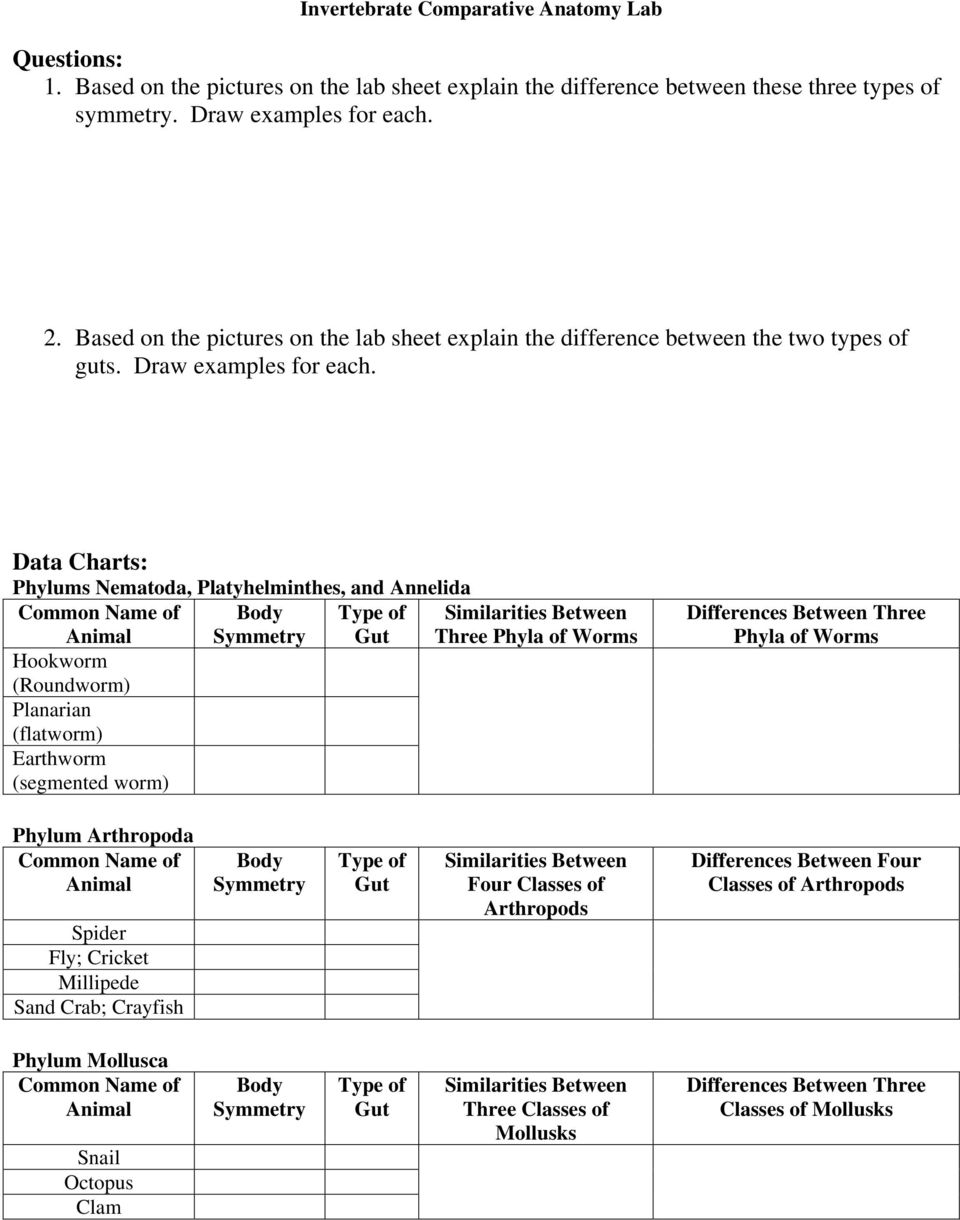
6 Analysis/Conclusion: Write down similarities (at least 2) between the matching phyla. The boxes should be left blank. Invertebrate Phyla Similarities: Write down differences (at least 2) between the matching phyla. The boxes should be left blank. Invertebrate Phyla Differences:

7 Invertebrate Comparative Anatomy Lab Questions: 1. Based on the pictures on the lab sheet explain the difference between these three types of symmetry. Draw examples for each. Radial Asymmetry Many lines cut the organism (like a pizza/pie) and the slices look similar/alike. One line cuts the organism in half and the halves look similar/alike. Cannot be cut into pieces that look alike. 2. Based on the pictures on the lab sheet explain the difference between the two types of guts. Draw examples for each. s with Two Openings s eat through mouth and get rid of waste through anus. s with One Opening s eat and get rid of waste through the same opening.

8 Data Charts: Phyla,, and Three Phyla of Worms Hookworm (Roundworm) Planarian (flatworm) Earthworm (segmented worm) Incomplete All bilateral Segmented and Roundworms are round in shape. All have no legs/arms. All have heads/tails. Phyla of Worms Flatworms have incomplete digestive system. Segmented worms have segments. Flatworms are flat. Spider Fly; Cricket Millipede Sand Crab; Crayfish Snail Asymmetric Octopus Radial Clam Asymmetric Four Classes of All bilateral. All have a complete digestive tract. All have body segments. Three Classes of Mollusks All have a complete digestive tract. All classes have marine species. All have a foot. Differences Between Four Classes of Spider has 8 legs. Fly and cricket has 6 legs. Millipede has legs. Different number of body sections (Spider 2, Fly/Cricket 3, Millipede many). Classes of Mollusks Snail/Clam are asymmetric while octopus has radial symmetry. Snails have one shell, clams two shells, octopus no shell. Octopus has 8 feet and clam/snail has 1 foot.

9 Analysis/Conclusion: Write down similarities (at least 2) between the matching phylums. The boxes should be left blank. Invertebrate s Similarities: Digestive Tract Both can be Both can be Both can be Digestive Tract Both have segmented bodies. Both can be Both can be Both can be Both have appendages. Write down differences (at least 2) between the matching phylums. The boxes should be left blank. Invertebrate s Similarities: has segments. is flat. have appendages. Mollusks have a foot. Annelid bodies contract and extend. is flat. have appendages. Mollusks have a foot. has an incomplete gut. has an incomplete gut. has an incomplete gut. has an incomplete gut. is not segmented. Annelid bodies contract and extend. have appendages. have an exoskeleton. Mollusks have a mantle. Annelid bodies contract and extend. Mollusks have a mantle. have an exoskeleton.

Classification. Living Things. bacteria and blue green algae: (single celled organisms without a nucleus)
 Teacher Discovery Card Classification Information There are millions different kinds plants and animals in the world Each different kind plant and animal is called a species We can group species together
Lab #10 Invertebrates 2 and Vertebrates 1 (Exercises 39, 40)
 Name Bio 182-General Biology Lab #10 Invertebrates 2 and Vertebrates 1 (Exercises 39, 40) Answer the questions in the space provided. You need to turn this sheet at the end of the lab. In general know
Animal Adaptations & Behavior By Krista Granieri
 Animal Adaptations & Behavior By Krista Granieri The Kingdom Animalia is divided into many distinct groups of organisms. There are 9 major phyla based primarily on characteristics related to embryonic
Letter to the Student... 5 Letter to the Family... 6 Ohio Academic Content Standards Correlation Chart... 7 Investigation 1... 11
 Table of Contents Letter to the Student...................................... 5 Letter to the Family....................................... 6 Ohio Academic Content Standards Correlation Chart...........
Lab # 6 on Taxonomy and the Animal Kingdom Pre Lab Questions:
 Bio 10 Animal Lab #6 61 Lab # 6 on Taxonomy and the Animal Kingdom Pre Lab Questions: 1. Name one pro and one con for the use of taxonomy in Biology? 2. Name 3 domains and 4 eukaryotic kingdoms. 3. From
Animals The Diversity of Life 3 What Is an Animal? What Is an Animal? Animal Types: The Family Tree. Essay: Redrawing the Family Tree
 Animals The Diversity of Life 3 What Is an Animal? Characteristics of Animals. Are multicellular, exhibit embryonic development; fertilized egg turns into multicellular embryo (balls of cells called blastula)
Dichotomous Keys. Lab Exercise. Contents. Objectives. Introduction
 Lab Exercise Dichotomous Keys Contents Objectives 1 Introduction 1 Activity.1 Key to the Animal Kingdom 4 Activity.2 Creating a Key 6 Resutls Section 7 Objectives - Understand the concept of classification
nucleus cytoplasm membrane wall A cell is the smallest unit that makes up living and nonliving things.
 1 In nature there are living things and nonliving things. Living things depend on three basic life processes: nutrition, sensitivity and reproduction. Living things are made up of cells. 1. Match the two
World s Most Awesome Invertebrate
 World s Most Awesome Invertebrate Video Title: This lesson is not connected to a specific video title. Students will be searching shapeoflife.org for video in the Phyla category: Sponges; Cnidarians; Flatworms;
Bio 103 Lecture Dr. Largen
 1 Evolution of Animal Diversity Bio 103 Lecture Dr. Largen 2 What Am I? Of some 1.5 million species of organisms known to science over two-thirds are animals Humans have a long history of studying animal
Pond Water Web Lesson Plan
 Pond Water Web Lesson Plan Purpose: As a result of this lesson, students will become familiar with common organisms found in a pond and discover their importance in a balanced aquatic habitat as they create
Seashells and Their Mollusk Inhabitants
 Seashells and Their Mollusk Inhabitants Topic Seashells can generally be classified as the shells of either bivalves or gastropods. Introduction Seashells are the habitats of animals that belong to the
There s no place like home!
 2Discovery Card Teacher Time: 2.5 hours (split into two sessions) Information (suitable for 7-12 year olds) This is an opportunity for children to make their own bug boxes and test the habitat preference
Georgia Performance Standards Framework for Science GRADE 7 DICHOTOMOUS KEYS AND CLASSIFICATION
 The following instructional plan is part of a GaDOE collection of Unit Frameworks, Performance Tasks, examples of Student Work, and Teacher Commentary. Many more GaDOE approved instructional plans are
Biology 170: Exam 2. Multiple choice (2 pts each). Mark (bubble-in) the correct answer on your scantron.
 Biology 170: Exam 2 Name Multiple choice (2 pts each). Mark (bubble-in) the correct answer on your scantron. 1. Which of the following Phyla have radial symmetry? a. Arthropoda (insects, spiders, crustaceans)
Invertebrate Animals. Underwater Rhy thmic Dancers
 Academic Standard 4: Students recognize that plants and animals obtain energy in different ways, and they can describe some of the internal structures of organisms related to this function. They examine
Crabs. Focus Question
 Topics Crabs, Adaptations Crabs Grades PreK-2 Site Indoors Duration 30 minutes (minimum) Materials Crab Cards Clay or foil Pipe cleaners Egg carton sections, small boxes, jars, lids, food cups, yogurt
6 Kingdoms of Life. Prokaryotes. Prokaryotes & Eukaryotes. DO HAVE: DNA Ribosomes Cytoplasm Cell membrane
 6 Kingdoms of Life The grouping of organisms into kingdoms is based on 3 factors: 1. Cell Type 2. Cell Number 3. Feeding Type Prokaryotes 1. Cell Type- The presence or absence of cellular structures such
Comparative Physiology Symmetry in Marine Organisms
 Series 1 Name Date Don t forget to have your worksheet stamped at the front desk when you finish! Comparative Physiology Symmetry in Marine Organisms Part One: Learning Symmetry The body plans of organisms
Cornell Institute for Biology Teachers
 Cornell Institute for Biology Teachers 2015 CIBT, Cornell University, Ithaca, NY 14853. Distribution of this laboratory exercise is permitted if (i) distribution is for non-profit purposes only and (ii)
2. Predators have bilateral symmetry, good musculature sense organs and a well developed nervous system.
 A. A.INTRODUCTION 1. Animals are heterotrophic; they must take in food. 2. Predators have bilateral symmetry, good musculature sense organs and a well developed nervous system. 3. Bilareral symmetry (cut
Introduction to Animals
 Introduction to Animals Unity and Diversity of Life Q: What characteristics and traits define animals? 25.1 What is an animal? WHAT I KNOW SAMPLE ANSWER: Animals are different from other living things
Living Things Share Certain Characteristics and Are Distinctly Different In Other Ways Grade Seven
 Ohio Standards Connection: Life Sciences Benchmark A Explain that the basic functions of organisms are carried out in cells, and groups of specialized cells form tissues and organs; the combination of
Chapter 32: An Introduction to Animal Diversity
 Name Period Concept 32.1 Animals are multicellular, heterotrophic eukaryotes with tissues that develop from embryonic layers 1. Like the fungi, animals are multicellular heterotrophs. How do they feed?
Unit 3L.4: Body Parts and Functions
 Unit 3L.4: Organs in the Human body Keeping Healthy The Skeleton Science skills: Classification Observing Making models Data collection By the end of this unit you should: Compare the structure of humans
II. Germ Layers Ontogeny can reveal a great deal about evolutionary relationships. Answer and discuss the following:
 Workshop: The Evolution of Animalia by Dana Krempels Perhaps even more than the other Eukarya, Animalia is characterized by a distinct progression of complexity in form and function as one moves from the
4-H Marine Biology and Oceanography Proficiency Program A Member s Guide
 4-H Marine Biology and Oceanography Proficiency Program A Member s Guide OVERVIEW The 4 H Marine Biology and Oceanography Proficiency program helps you learn what you need to know about your 4 H project.
FOURTH GRADE ORGANISMS
 FOURTH GRADE ORGANISMS 2 WEEKS LESSON PLANS AND ACTIVITIES LIFE CYCLE OVERVIEW OF FOURTH GRADE ORGANISMS WEEK 1. PRE: Exploring the components of a cell. LAB: Comparing cells, tissues, and organs. POST:
Chapters 32, 33 / Introduction to the Animal Kingdom and Invertebrates
 Randa, Bio1151 1 Chapters 32, 33 / Introduction to the Animal Kingdom and Invertebrates I. Introduction to Animals 1. multicellular eukaryotes 2. cells are specialized to perform specific functions; cells
Mollusks and Annelids
 45 Mollusks and Annelids Concept Outline 45.1 Mollusks were among the first coelomates. Coelomates. Next to the arthropods, mollusks comprise the second most diverse phylum and include snails, clams, and
Building a Dichotomous Key: Take home Assignment. - Copy of Aliens Handout - Question Sheet - Dichotomous Key Sheet
 Materials: uilding a Dichotomous Key: Take home Assignment - Copy of Aliens Handout - Question Sheet - Dichotomous Key Sheet Introduction: A dichotomous key is a very useful tool. It helps you identify
Introduction to Planaria
 Introduction to Planaria Planarians are free-living flatworms and form the class Turbellarians in the Phylum Platyhelminthes. The Other two classes of flatworms are parasitic (flukes and tape worms). Flatworms
The Dawn of Diversity
 LESSON #4: What am I? Trying to interpret the fossil evidence of an enigmatic species 42 Focus questions 1. How do scientists interpret data? 2. Why do scientific theories and hypotheses often change?
AP Biology Review. ame: Class: Date:
 Class: Date: AP Biology Review Modified True/False Indicate whether the statement is true or false. If false, change the identified word or phrase to make the statement tr ue. 1. The branches of a cladogram
Student worksheet. Bugs. Complete metamorphosis Dung Beetle lifecycle. Incomplete metamorphosis Leafhopper lifecycle
 Complete metamorphosis Dung Beetle lifecycle Incomplete metamorphosis Leafhopper lifecycle Museum Victoria Bugs Classroom Activities Section 3 6 A Diving Beetle s story Museum Victoria Bugs Classroom Activities
These pages build on Units 2B & C and introduce predator-prey relationships and food chains.
 Unit 4B Habitats Teaching Notes These pages build on Units 2B & C and introduce predator-prey relationships and food chains. Curriculum, resource and other links Sc1 & Sc2 Resources Associated with this
This booklet was prepared by the Conservation Education Department at The National Aquarium in Baltimore.
 This booklet was prepared by the Conservation Education Department at The National Aquarium in Baltimore. Nancy Hotchkiss, Director Dianne Wilkes, Administrative Assistant Susi Ridenour, Librarian Staff:
Animal & Plant Cell Slides
 Animal & Plant Cell Slides Category: Biology Type: Class Experiment, 60 min class Materials: 2 Glass Slides 2 Cover Slips 1 Bottle of methylene blue (optional) 1 Plastic tray 1 Bottle of iodine 1 Plastic
Everything You Wanted to Know About Spiders!
 Everything You Wanted to Know About Spiders! How do spiders fit into the Animal Kingdom? Spiders are arthropods, a group of invertebrates containing insects, crustaceans, millipedes, centipedes, arachnids
Explorer Education Programme. Lesson Plan: Line Symmetry Class: Third / Fourth Class Strand: Shape and Space Strand Units: Symmetry
 Lesson Plan: Line Symmetry Strand Units: Symmetry TITLE: SYMMETRY AND THE SEA Aim / Description: The aim of this lesson plan is to teach students about line symmetry in the marine environment and familiarise
Food Web Crasher. An introduction to food chains and food webs
 Food Web Crasher An introduction to food chains and food webs Activity Students create a physical food web and watch what happens when an aquatic nuisance species is introduced into the ecosystem. Grade
2 CELLULAR RESPIRATION
 2 CELLULAR RESPIRATION What factors affect the rate of cellular respiration in multicellular organisms? BACKGROUND Living systems require free energy and matter to maintain order, to grow, and to reproduce.
Objectives: Teach children the basic parts and different types of insects. Make fun bug snacks and play games to learn about bugs.
 Objectives: Teach children the basic parts and different types of insects. Make fun bug snacks and play games to learn about bugs. Materials: Insect pictures Word Search (attached) Corrugated cardboard
ROCKS, FOSSILS AND SOILS SECTION 8: FOSSILS From Hands on Science by Linda Poore, 2003
 ROCKS, FOSSILS AND SOILS SECTION 8: FOSSILS From Hands on Science by Linda Poore, 2003 STANDARDS: Westminster College Students will write or draw descriptions of a sequence of steps, events and observations,
Get to Know Your Watershed. McMillan Creek
 Get to Know Your Watershed McMillan Creek Where is McMillan Creek? McMillan Creek is found in the northeastern portion of the City of Prince George, know as the Hart and Shady Valley. It is located entirely
Year 2 Science: The Human Body Resource Pack
 Year 2 Science: The Human Body Resource Pack Body Systems II Body Systems Digestion our bodies break down food and use Skeletal system the skeleton is made up of bones that support our the nutrients to
The Scientific Controversy Over the Cambrian Explosion
 The Scientific Controversy Over the Cambrian Explosion Center for Science and Culture/Discovery Institute, 1511 Third Avenue, Suite 808, Seattle, WA 98101 Darwin called his theory "descent with modification."
5/18/2012. Animal Complexity and Body Plans. Organization of Animal Complexity. Organization of Animal Complexity
 Animal Complexity and Body Plans 34 different phyla of multicellular animals About 100 phyla generated during Cambrian explosion Animal body plans well-defined and established early in evolutionary history
10.1 The function of Digestion pg. 402
 10.1 The function of Digestion pg. 402 Macromolecules and Living Systems The body is made up of more than 60 % water. The water is found in the cells cytoplasm, the interstitial fluid and the blood (5
Who Eats What in the Woods?
 Who Eats What in the Woods? Developed with teachers at Tolworth Junior School in Kingston upon Thames in 2000. The webaddress for this activity is; Last updated 26th February 2008 This activity has now
Butterfly or Moth? Made for 2nd Graders... Project Bibliography
 Butterfly or Moth? Made for 2nd Graders... Project Bibliography Butterfly or Moth? Today you will learn about a Painted Lady Butterfly and a Robin (Cecropia) Moth. What is a butterfly? Click the butterfly
Focused Learning Lesson Science Grades 10-12 LS-H-C4
 Focused Learning Lesson Science Grades 10-12 LS-H-C4 Overview: This lesson is to be used to help students to understand how to use a dichotomous key in classification. Students will use a dichotomous key
ARTHROPOD DICHOTOMOUS KEY
 The following instructional plan is part of a GaDOE collection of Unit Frameworks, Performance Tasks, examples of Student Work, and Teacher Commentary. Many more GaDOE approved instructional plans are
1. Over the past century, several scientists around the world have made the following observations:
 Evolution Keystone Review 1. Over the past century, several scientists around the world have made the following observations: New mitochondria and plastids can only be generated by old mitochondria and
Theory of Evolution. A. the beginning of life B. the evolution of eukaryotes C. the evolution of archaebacteria D. the beginning of terrestrial life
 Theory of Evolution 1. In 1966, American biologist Lynn Margulis proposed the theory of endosymbiosis, or the idea that mitochondria are the descendents of symbiotic, aerobic eubacteria. What does the
Classification Why Things are Grouped classify Methods of Classification
 Classification What features do biologists use to group living things? You know that most plants are green and do not more around. You also know that most animals are not green and do move around. The
Looking at life cycles
 Using a selection of the Discovery cards in this section, children can learn more about insect lifecycles and how to sequence the lifestages of a butterfly correctly. They can also explore metamorphosis.
Students will have an opportunity to examine a variety of fruit to discover that each has
 Botanical Garden Programs: Discovering Plants I. Introduction Students will have an opportunity to examine a variety of fruit to discover that each has seeds. Even cotton and some vegetables are considered
What is an Oil Spill?
 What is an Oil Spill? An oil spill is occurs when liquid petroleum (also known as fossil fuels or commonly, oil) is accidentally released into the environment. Oil spills can occur during the extraction
What is it? Dichotomous Keys Teacher Information
 STO-110 What is it? Dichotomous Keys Teacher Information Summary Students use a dichotomous key to identify a collection of plastic frogs. They design and test a dichotomous key that could be used to identify
Creating A Dichotomous Key by Cassie Zanca
 Creating A Dichotomous Key by Cassie Zanca GOAL The students will explore the benefits of creating dichotomous keys as a means of identifying an organism or object. OBJECTIVE The student will create a
Time Required: 45 minutes
 Benthic Macroinvertebrate Study Concept/Topic to Teach: The presence or absence of benthic macroinvertebrates can be used to indicate water quality. Standards: Discipline: Science and Technology Strand:
Dinosaur Hall Second Grade Dinosaur Lesson Teacher Pages Pre Visit On site Visit
 Dinosaur Hall Second Grade Dinosaur Lesson Teacher Pages Pre Visit Earth Sciences 3d. Students know that fossils provide evidence about the plants and animals that lived long ago and that scientists learn
Internal Parasites Donna K. Carver, DVM, PhD, ACPV
 Internal Parasites Donna K. Carver, DVM, PhD, ACPV Parasites are organisms that live in or on another organism (host) and gain an advantage at the expense of the host. Internal parasites live inside their
The Digestive System: Where does food go? Teacher Version
 The Digestive System: Where does food go? Teacher Version In this lab you will learn about your digestive system. We will use everyday objects like yarn and a ziplock bag to understand how long our digestive
Cherokee County School District Student Performance Standards Unit Guides - Science: Fifth Grade
 Characteristics of Science 1 Cherokee County School District Habits of Mind S5CS1. Students will be aware of the importance of curiosity, honesty, openness, and skepticism in science and will exhibit these
Animal Classification. Contents. Preparation
 Animal Classification A collaborative sorting activity for Key stages 2 & 3 Teachers notes Contents Animal Cards: 8 Pictures per card (54 +2 blanks) Alphabetical list of pictured animals Group cards: VERTEBRATE/INVERTEBRATE
Bountiful Beetles Lesson Plan
 Bountiful Beetles Lesson Plan Lesson Title: Bountiful Beetles Objectives: Students will identify the life cycle, anatomy and other characteristics of beetles. Students will conduct a simple research using
You are What You Eat
 You are What You Eat By: Tanja Schollmeier, marine biologist, School of Fisheries and Ocean Sciences, University of Alaska Fairbanks Grade level: 6-8th grade Context: This lesson emphasizes human impacts
LESSON PLAN: Macro- and Meso-fauna Extraction
 LESSON PLAN: Macro- and Meso-fauna Extraction Introduction: S o i l 4 Y o u t h soilweb.landfood.ubc.ca/youth/ 1 There is a lot of life below our feet a single teaspoon of soil can hold over one billion
FOOD CHAINS AND FOOD WEBS PHYTOPLANKTON ZOOPLANKTON SILVERSIDE BLUEFISH
 FOOD CHAINS AND FOOD WEBS Food Chains All living organisms (plants and animals) must eat some type of food for survival. Plants make their own food through a process called photosynthesis. Using the energy
Elementary School Sea Turtle Lesson Plan Developed by Cathy Payne
 Elementary School Sea Turtle Lesson Plan Developed by Cathy Payne Background: Elementary school-aged children are very drawn to stories, both fiction and nonfiction, about sea turtles, but there are limited
Comparing Plant and Animal Cells
 1.2 Comparing Plant and Animal Cells Here is a summary of what you will learn in this section: Plant and animal cell structures are called organelles. Plant and animal cells perform some similar functions,
What is a food chain?
 3 What is a food chain? Learning Intention Understand that plants and animals in a habitat are dependent on each other. National Curriculum Skills Science Interdependence of living organisms in those 2
Swirl by Swirl: Spirals in Nature By Joyce Sidman
 Swirl by Swirl: Spirals in Nature By Joyce Sidman Reader's Guide SUGGESTIONS FOR READING ALOUD Swirl by Swirl is a book about a shape (the spiral) that is found over and over in nature. As you are reading,
Chapter 3. Cellular Structure and Function Worksheets. 39 www.ck12.org
 Chapter 3 Cellular Structure and Function Worksheets (Opening image copyright by Sebastian Kaulitzki, 2010. Used under license from Shutterstock.com.) Lesson 3.1: Introduction to Cells Lesson 3.2: Cell
LESSONS: 1. Students will listen to It Takes Guts and complete a lyric note- sheet.
 It Takes Guts: A Multimedia Digestive System Journey Teacher Lesson Plan and Student activity package Learning Objectives: 1. Students will listen to It Takes Guts and complete a lyric note- sheet. 2.
Animal Adaptations Investigation (K-3)
 Animal Adaptations Investigation (K-3) At a glance Students explore the Zoo in search of animals that fit certain categories and discover their adaptations. Time requirement One Zoo visit of at least 60
TAXONOMIC (DICHOTOMOUS) KEYS
 TAXONOMIC (DICHOTOMOUS) KEYS One method of classifying and identifying objects includes using a taxonomic key, sometimes called a dichotomous key. A taxonomic key looks at the similarities and differences
In your last science lesson, you used posters to learn about five of the classes of vertebrates.
 Science 4 Physical Life Earth and Space LESSON 31 Identifying characteristics of classes of vertebrates Lesson Preparation Program Materials Child s Booklet C Investigating Characteristics of Animals (pp.
Elizabeth Evans Riverside Elementary 6 th Grade. Teaching Objectives To use tangrams to build figures that have symmetry. To identify line symmetry.
 Elizabeth Evans Riverside Elementary 6 th Grade Teaching Objectives To use tangrams to build figures that have symmetry. To identify line symmetry. Instructional Activities (designed for groups of 4) 1.
The Need Is Mutual: The Importance of Biological Interactions
 The Need Is Mutual: The Importance of Biological Interactions Science Topic: Food Webs Grades: 6 th -8 th Essential Question: What kinds of relationships are involved in biological interactions? Lesson
Identifying Vertebrates Using Classification Keys
 Name Class Date Chapter 18 Classification Identifying Vertebrates Using Classification Keys Introduction Organisms such as vertebrates (animals with backbones) are classified into groups according to certain
Totally Termites (Grades 3 5)
 Lesson Overview Students will explore the world of termites. This lesson includes a close-up look at termite specimens, special termite adaptations and insect anatomy. Students will also learn about property
PRINCIPLES OF OCEANOGRAPHY AND MARINE ECOLOGY
 BRIEF PREFACE XIV PRINCIPLES OF OCEANOGRAPHY AND MARINE ECOLOGY CHAPTER 1 Sounding the Deep 1 C H A P T E R 2 The Oceanic Environment 13 CHAPTER 3 Ecological and Evolutionary Principles of Marine Biology
Grade 6 Life Science: Diversity of Life
 LIFE SCIENCE: DIVERSITY OF LIFE Grade 6 Life Science: Diversity of Life 163 LIFE SCIENCE: DIVERSITY OF LIFE Unit Overview Introduction Students are able to recognize that living things can be subdivided
Prokaryotic and Eukaryotic Cells
 Lab 2- Bio 201 Prokaryotic and Eukaryotic Cells Name: OBJECTIVES To explore cell structure and morphology in prokaryotes and eukaryotes. To gain more experience using the microscope, and in particular,
Making Tracks Elementary School 5-E Lesson
 Making Tracks Elementary School 5-E Lesson Objectives -Student will analyze fossil footprints of two and four legged dinosaurs to learn more about how these animals lived. -Students will experiment with
Table 1: Kingdom Worksheet
 KINGDOM WORKSHEET Table 1: Kingdom Worksheet Kingdom Bacteria Archaea Protista Fungi Plantae Animalia Cell Type prokaryotic prokaryotic eukaryotic eukaryotic eukaryotic eukaryotic Cell Wall often present,
DISPERSAL BINGO Grade 4
 DISPERSAL BINGO Grade 4 ÿöhiÿa Project / Exploring the Islands Essential Questions How did the ancestors of native plants and animals reach the isolated Hawaiian Islands? What characteristics enabled colonizing
Life processes. All animals have to carry out seven life processes. These are: 2. Respiration taking in one gas and getting rid of another
 Food chains Life processes All animals have to carry out seven life processes. These are: 1. Movement being able to move its body 2. Respiration taking in one gas and getting rid of another 3. Reproduction
Dinosaurs and Fossils
 Dinosaurs and Fossils T ABLE OF CONTENTS ABOUT DELTA SCIENCE MODULES Program Introduction................... iii Teacher s Guide..................... iv Delta Science Readers............... vi Equipment
Dinosaur Time-line. What other animals lived then? How long ago did the dinosaurs live? Did dinosaurs live at the same time as people?
 Dinosaur Time-line How long ago did the dinosaurs live? The Age of Dinosaurs began nearly 250 million years ago, but the first true dinosaurs appeared closer to 220 million years ago. Some dinosaurs evolved
Genre Mini Unit. Writing Informational Nonfiction By Joyce Dunning
 Genre Mini Unit Writing Informational Nonfiction By Joyce Dunning Grade Level: 2 nd Grade State Core Standards: Standard 2, Objective 1: Demonstrate an understanding that print carries the message. Standard
Bony Fish Anatomy Worksheet
 Educational Material Bony Fish Anatomy Worksheet Teacher Information This activity is designed to be team-taught by the classroom and art teacher. Use this guide in conjunction with fish-related art to