
LAB 3 Use of the Microscope
|
|
|
- Shonda Harrington
- 9 years ago
- Views:
Transcription
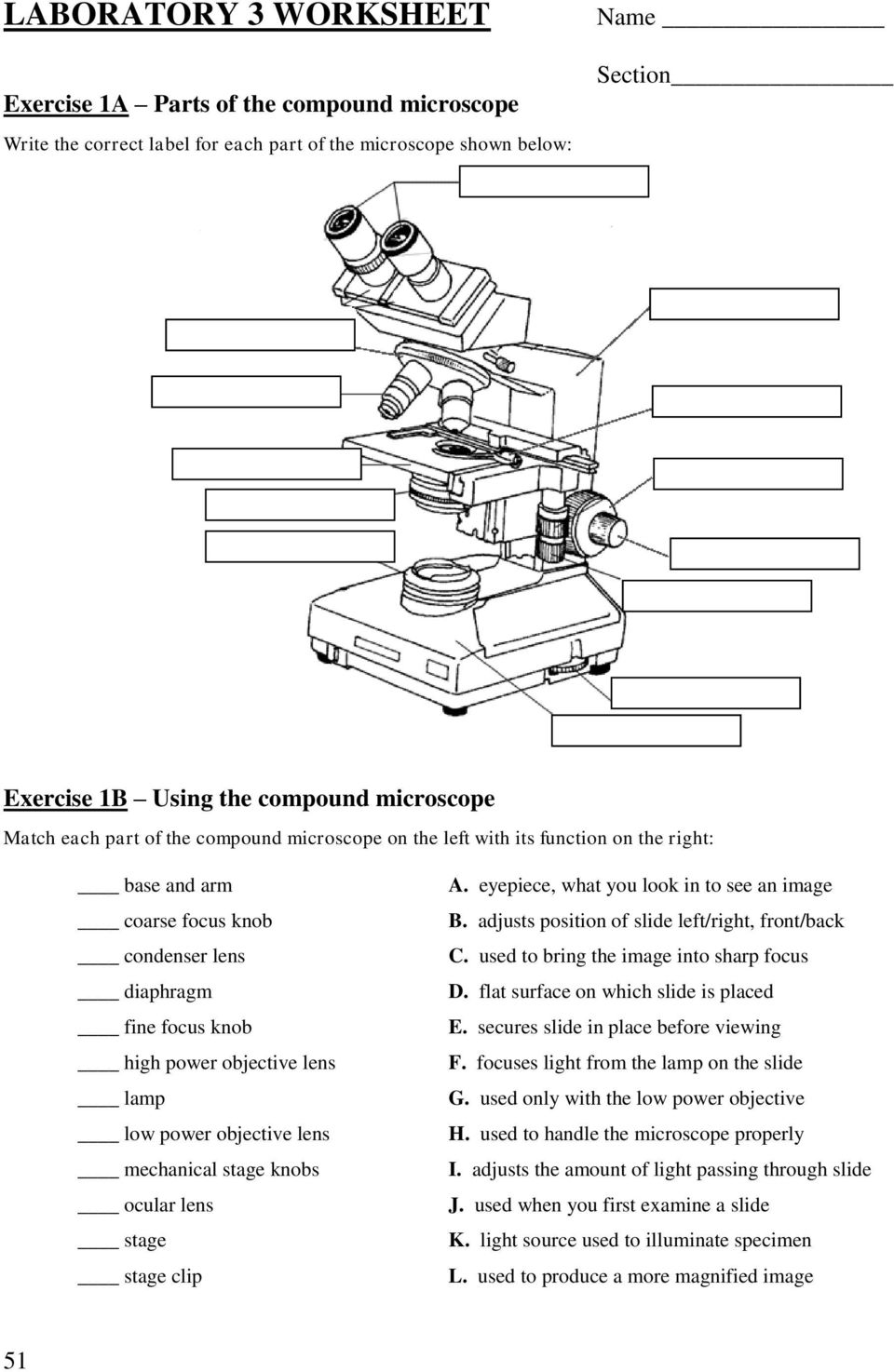
1 LAB 3 Use of the Microscope Introduction In this laboratory you will be learning how to use one of the most important tools in biology the compound light microscope to view a variety of specimens. You will also use a slightly different type of light microscope called a stereoscopic dissecting microscope. The first lens used to magnify things was developed in the first century A.D. These were pieces of glass shaped in a convex form thicker in the middle and tapering off to the sides and were the first magnifying glasses that could increase the image of an object about X. The creation of glass lenses improved dramatically at the end of the 16 th century, vastly improving the magnifying power. By 1609, Galileo Galilei refined the methods of lens making in an effort to view objects in the sky. About half a century later, the Dutchman Anton van Leeuwenhoek further improved the art of lens making, allowing him to view objects in pond water that had never been viewed by humans microorganisms life at a tiny level. At the same time, an English physicist named Robert Hooke improved the technology of van Leeuwenhoek and confirmed the existence of tiny organisms in pond water. He also famously examined a piece of cork and observed tiny boxes arranged in such a way that they looked like the cells (rooms) in a monastery if you removed the roof and looked in from above. Today the best compound light microscopes are able to magnify objects up to 2,500X without losing their resolution the sharpness of the image itself. Part 1: THE COMPOUND LIGHT MICROSCOPE The Parts of the Compound Light Microscope *Exercise 1A Getting familiar with the microscope You will first get acquainted with the major parts of the compound light microscope before learning the proper way to use it. Get a microscope from the cabinet below your lab bench, being sure to handle it by the arm and base (refer to image on page 2), and place it on the bench in front of you. Remove the cover and place it below, out of the way, and then plug in the microscope. The ocular lens (eyepiece) and stage should be facing you. Read the description of each part of your microscope on the next two pages being sure to follow all instructions, and then complete the matching exercise on your worksheet. 37

2 OCULAR LENS (eyepiece) Your microscope will have either one (monocular) or two (binocular) ocular lenses. These are the lenses you will look through when examining a specimen with the microscope. Take a look at the side of your ocular lens and you will notice a label of 10X. This indicates that each ocular lens magnifies the image by a factor of 10 or 10X. OBJECTIVE LENSES Notice the set of objective lenses on the revolving nosepiece. These lenses allow you to change the degree of magnification. Some of our microscopes have four objective lenses while others have only three. The degree of magnification for each objective lens is indicated on its side. Let s take a look at each progressing from the shortest to longest objective lenses, being sure to rotate the revolving nosepiece to click each objective lens into position above the stage before examining it: 38 4X This objective magnifies the image by a factor of 4. It is referred to as the scanning objective since it is used to scan the slide to locate the specimen before viewing it at higher magnification. Your microscope may not have this objective lens, in which case you can begin with the 10X objective. 10X This objective magnifies the image by a factor of 10 and is referred to as the low power objective. 43X (or 45X) This objective magnifies the image by a factor of 43 (or 45) and is referred to as the high power objective. 100X This objective magnifies the image by a factor of 100. It is referred to as the oil immersion objective since it requires a drop of immersion oil on the slide to provide good resolution. You will not be using this objective lens. For now, make sure that the low power objective is clicked into position above the stage, and keep in mind that you will only be using the low power and high power objectives. Also keep in mind that the total magnification of any image you see through the ocular lens is the product of the objective and ocular lens magnifications (for example, when using the lower power lens the total magnification is: 10X ocular x 10X low power objective = 100X).

3 STAGE and STAGE CLIP The stage is the flat surface upon which you will place each slide you will examine. Notice that there is a moveable stage clip that can be used to secure the slide on the stage. Open and close the stage clip to see how it will snugly hold your slide in position. MECHANICAL STAGE KNOBS To move the slide on the stage when it is secured in the stage clip, you will use the mechanical stage knobs on the underside of the stage to move the slide backward/forward and right/left. Adjust each knob to see how one knob controls backward/forward movement and the other knob controls right/left movement. COARSE FOCUS and FINE FOCUS KNOBS In order for a specimen on a slide to be in focus, the distance between the specimen and the objective lens must be just right. The coarse focus knob, the larger of the two, will move the stage or objective lens (depending on the microscope) up and down quickly and quite visibly, altering the distance between them. It is very important that the coarse focus knob is only used with the low power or scanning objective lenses, otherwise the microscope or objective lenses could be damaged. Adjust the coarse focus knob to observe how quickly the focal distance changes. In contrast, the fine focus knob will move the stage or objective lens such a small amount that it is hardly noticeable to the naked eye. This is the knob you will use to get the perfect focal distance so the image will be crystal clear. CONDENSER LENS Just underneath the stage is the condenser lens. This lens serves to capture and focus light from the lamp below onto the slide mounted on the stage. On many microscopes the condenser lens can be adjusted up or down with a knob beneath the stage. Examine the condenser on your microscope to see if it is adjustable. If so, be sure to adjust it as high (close to the stage) as possible since, for our purposes, this is where it should be set. DIAPHRAGM The diaphragm is located within the condenser and is one of the most important pieces of the microscope, though it is often neglected by many students. The diaphragm allows you to adjust the amount of light passing through the slide by adjusting the diaphragm lever. Most of the time the diaphragm will be all the way open to allow the maximum passage of light. However it is important to adjust the diaphragm at times to reduce the amount of light passing through your specimen should the image be too bright or dim, and also to increase the contrast to allow you to see the specimen more easily against the background. For now, open the diaphragm all the way, and when using the microscope, do not forget to use the diaphragm. LAMP The lamp emits light to illuminate the specimen so that you can actually see something. BASE and ARM The base is the bottom of the microscope that sits on the table, and the arm is the vertical framework ascending from the base along the back of the microscope. When handling the microscope always hold the arm while supporting the base with your other hand. 39 Proper Use of the Compound Light Microscope *Exercise 1B Steps to follow when using the microscope If you really want to be able to see a specimen on a slide, you must follow the steps on the next page every time you look at a new slide. The microscope will be your friend if you always use the following steps in their proper order. Before you begin, be sure your microscope is plugged in and the power is on. Before you start, clean all of the lenses with special lens paper which is soft enough to not scratch the lens. Do not use anything else for this purpose (paper towel, shirt, backpack..) or you will scratch the lenses.

4 Step 1. Get a slide of the letter e from the tray on the side counter. This an example of a prepared slide, a slide that is already made for you and meant to be reused. (i.e., don t dispose of it, please return it to the tray when you are finished!) Step 2. Use a piece of lens paper to clean any smudges (fingerprints, grease, etc.) off the slide. Place the slide on a white piece of paper find the specimen (the letter e ) on the slide with your naked eye, noticing its location and orientation. Step 3. Lock the low power objective lens into place (it should snap into place) if you have not already done so. You will always (always, always, always ) start with either the low power or scanning objective when you want to view a slide. Step 4. Use the coarse focus knob to move the stage (or objective lens) so that they are as far apart from each other as possible. Open the stage clip and place the slide snugly in the corner of the stage clip (make sure the slide is completely flat) before releasing the clip to hold the slide firmly in place. Then use the mechanical stage knobs to position the slide so that the specimen (i.e., letter e ) is centered over the condenser and the light that passes through it. Step 5. Next, using the coarse focus knob once again, move the slide and objective lens as close together as the knob will allow. (NOTE: To this point, you have not yet looked into the oculars. This may be surprising, but this is the proper way to use a microscope so that you will actually see something!) Step 6. Now, look into the ocular lens(es). Using the coarse focus knob, SLOWLY increase the distance between the slide and objective until the specimen is in focus. If the light is too intense, adjust the diaphragm lever (or dial near the lamp if present) until the light level is comfortable before trying to locate the specimen. If you have difficulty locating and focusing on your specimen (the letter e ), make sure that it is properly centered and you may need to adjust the course focus more slowly. If you still can t locate it, ask your instructor for assistance. Step 7. Adjust the diaphragm lever so there is sufficient contrast between the specimen and the background, closing it no more than is necessary. This step is especially important for live specimens since you may not be able to see them otherwise. Step 8. Now use the fine focus knob to get the specimen in proper focus. You should now be able to see the object clearly. Before going to the next step (increasing the magnification), be sure to center your specimen in the field of view as best you can. Step 9. Now that you have centered and focused the object as best you can at low power, rotate the high power objective into place over the slide being sure it clicks into position. Use the fine focus knob (NOT the coarse focus) to bring the object into perfect focus. (NOTE AGAIN: You should only use the coarse adjustment knob with the low power objective) 40 FOLLOW THESE STEPS EVERY TIME YOU WANT TO VIEW A NEW SLIDE AND YOU WILL BECOME A GOOD MICROSCOPIST!

5 Part 2: PROPERTIES OF LIGHT MICROSCOPY In this section we will focus on some of the key properties relating to light microscopy. To help you understand each property you will first read an explanation and then do an exercise to illustrate that particular property. Let us begin with the property of magnification Total Magnification The total magnification of an image is quite simple it is the product of the ocular lens magnification times the magnification of the objective lens you are using: magnification of ocular x magnification of objective = total magnification For example, if the ocular lens magnifies the image by a factor of 10 (10X), and the objective lens magnifies the image by a factor of 50 (50X), the total magnification of the image is 500X: 10X x 50X = 500X Many students make the mistake of adding the two magnifications, so remember that total magnification is the product (multiplication) of the ocular and objective lens magnifications. *Exercise 2A Determining total magnification On your worksheet, calculate the total magnifications for the examples given, then calculate the total magnification when using each of the objective lenses on your own microscope. Field of View (optional) The field of view (FOV) is the actual circle you see when looking in the microscope. Although this circular field of view appears to be the same no matter which objective lens you are using, this is not the case. The circular area you are actually viewing will decrease as you increase the magnification: total magnification 40X 100X 450X 1000X field of view 41

6 A good analogy is to imagine yourself viewing the Earth from space as you gradually move closer and closer to Mission College. Initially your field of view is the entire western hemisphere, but as you approach the Earth s surface your field of view will progressively shrink to encompass the western United States, Southern California, the San Fernando Valley, Sylmar, etc. Although your field of view is shrinking, the image in your field of view is becoming increasingly magnified. This is really no different than looking into your microscope at increasing levels of magnification. It is also useful to know the diameter of the field of view (FOV diameter) at a particular magnification, since you can use this information to estimate the size of the specimen you are viewing. The FOV diameter at low power for your microscope (100X) is ~1.8 mm. Using this FOV diameter, you can calculate the FOV diameter at other magnifications. This is done by multiplying by the ratio of the magnifications: known FOV diameter x total mag. (known FOV) = unknown FOV diameter total mag. (unknown FOV) If you want to know the FOV diameter at 500X, you could calculate it as follows: 1.8 mm x 100X/500X = 1.8 mm x 1/5 = 0.36 mm = 360 m Once you know the FOV diameter, you can estimate the dimensions of your specimen. For example, assume you are viewing the specimen below at 500X total magnification and, based on your calculation above, you know FOV diameter to be 360 m. It appears that ~4 of your specimens would fit across the FOV end to end (i.e., length = 1/4 of FOV), and ~10 side to side (i.e., width = 1/10 of FOV). Thus you would estimate the dimensions of your specimen to be: LENGTH = 1/4 x 360 m = 90 m WIDTH = 1/10 x 360 m = 36 m 360 m ~90 m ~36 m 500X 500X 500X 42

7 *Exercise 2B Field of view and estimating size (optional) Before you can estimate the size of a microscopic specimen, you must first determine the diameter of the field of view at the magnification you are using. Once you have that information you are prepared to estimate the size of any specimen you observe at that magnification: 1) Calculate the FOV diameter for each possible total magnification on your microscope given the FOV diameter at low power (100X) is 1.8 mm. 2) Examine a prepared slide of Paramecium at low power and estimate the length and width of a single Paramecium. 3) Examine a prepared slide of Euglena at high power and estimate the length of a single Euglena. Depth of Focus (optional) Once you have a specimen in focus under the microscope, if you adjust the fine focus knob up and down the specimen will come in and out of focus. Thus, there is a range in the vertical dimension in which the specimen on your slide will appear in focus. The thickness of the vertical range in which the specimen remains in focus is referred to as the depth of focus. As it turns out, the depth of focus decreases as the magnification increases as illustrated below: total magnification 40X 100X 450X 1000X depth of focus To make sure this concept is clear, imagine the range in which you can adjust the distance between the objective lens and the slide (via the focus knobs) to be a loaf of bread standing on end. The image produced in your microscope will only be in focus if the objective lens is positioned within a particular slice of that loaf of bread. This slice of bread is the depth of focus, and it will get thinner as you increase the magnification. This property of microscopy becomes very noticeable if the specimen you are examining is actually thicker than the depth of focus at the magnification you are currently using. For example, if the depth of focus is only 1 m thick and the specimen you are observing is 2 m thick, there will always be a portion of the specimen outside the depth of focus. This portion will thus be out of focus and cause the image to appear blurry no matter how carefully you adjust the fine focus knob. 43 observed specimen magnification depth of focus image high power low power blurry focused

8 In this example, the image will look blurry when viewed at high power magnification no matter what you do. To get a focused image in this case you will have to increase the depth of focus and thus lower the magnification. To help you understand and appreciate the concept of depth of focus, complete the exercises that follow: *Exercise 2C Depth of focus in the vertical dimension (optional) Obtain prepared slides of Paramecium and colored threads and observe them as follows: 1) Observe a single Paramecium at low power (100X) and then at high power (430X or 450X), and answer the corresponding questions on your worksheet. 2) Examine the colored thread slide at low power (100X), and determine the vertical order (top to bottom) of the three colored threads as you slowly adjust the focus up and down through the threads. Part 3: A MICROSCOPIC VIEW OF CELLS Review of Cell Structure All living organisms consist of one or more cells and come in a tremendous variety. There are single-celled prokaryotic organisms such as the bacteria, single-celled eukaryotic organisms such as the protozoa (e.g, Paramecium) and yeasts (a type of fungus), and multicellular eukaryotes such as most fungi (e.g., molds, mushrooms) and all members of the plant and animal kingdoms. Before you examine cells from some of these organisms, let s review some of the general features of our three basic cell types: 44 Prokaryotic Cell

9 Notice that a prokaryotic cell does not have any distinct internal compartments. This does not mean that prokaryotic cells have no internal organization, they simply do not have any structures we refer to as organelles. In contrast, animal and plant cells contain a variety of organelles. Take a moment to review the functions of the various cell structures and organelles shown and then complete the next exercise on your worksheet: STRUCTURE/ORGANELLE plasma membrane cell wall capsule flagellum nucleus endoplasmic reticulum Golgi apparatus mitochondria chloroplast central vacuole centrioles ribosomes FUNCTION barrier between inside/outside of cell extracellular structure that protects and supports cell protective gelatinous outer layer of some prokaryotes large cellular extension used for motility organelle containing the genetic material (DNA) synthesis of lipids, proteins in secretory pathway modification, sorting of secretory pathway proteins organelle in which cellular respiration occurs organelle in which photosynthesis occurs storage of water and other materials in plant cells structures involved in animal cell division small structures that carry out protein synthesis *Exercise 3A Review of cellular structures and organelles 1) Fill in the correct labels for each cell diagram on your worksheet. 2) Complete the matching exercise on your worksheet relating each cell structure and organelle with its function in cells. 3) Fill in the chart on your worksheet indicating which structures and organelles are found in which cell types. Now that you are well acquainted with the structures and organelles found in cells, you will use your microscope to observe cells of organisms in most of the major groupings. The most comprehensive groupings are the domains, of which there are three: the Bacteria, Archaea and Eukarya. All species in the domains Bacteria and Archaea are single-celled prokaryotes. Until recently, the bacteria and archaea were grouped into a single kingdom called Monera. However, research in the last few decades has revealed that these organisms, though similar in microscopic appearance, are vastly different in DNA sequence and physiology. As a result they are now placed into entirely different domains. The domain Eukarya consists of all eukaryotes i.e., organisms made of cells with a nucleus and other organelles. Within the domain Eukarya are the four traditional kingdoms still in use: Protista, Fungi, Plantae and Animalia. 45

10 Let us now take a look at cells from organisms in these major groups. Bacteria By far the most abundant organisms on our planet are the single-celled prokaryotes known as the bacteria and archaea. Since archaea are very difficult to culture in a laboratory setting, the only prokaryotes you will observe are bacteria. You will observe two species of bacteria, one having a round or coccus shape and the other having a rod or bacillus shape. Since bacteria are much smaller than eukaryotic cells, you will need to observe them at 1000X under the oil immersion lens in order to see them clearly. *Exercise 3B Examining bacteria Slides showing two distinct types of bacteria have been set up on the side counters. The bacteria are not alive and have been stained different colors to add contrast and help you distinguish between the two types. 1) There should be two distinct types of bacteria on your slide. Draw a sample of each type of bacteria on your worksheet and answer the corresponding questions. 46 Protozoa The kingdom Protista consists of two general types of eukaryotic organisms: the protozoa and the algae. The protozoa (literally before animals ) are single-celled eukaryotes that have animal-like qualities, whereas the algae are photosynthetic organisms that do not have the features of true plants. In the next exercise, you will observe a variety of live protozoa as you learn how to prepare your own wet mounts of these organisms:

11 *Exercise 3C Examining protozoa You will prepare three different wet mounts of live protozoa as outlined below: Paramecium (view at low power), Euglena (view at high power) and a sample of pond water or hay infusion (low or high power). The protozoa you will see can move quite fast under the microscope, so prepare each wet mount as follows to ensure that they are slowed enough for you to view them: 1) Place one drop of protoslo on a clean glass slide (this will help slow the critters down!) 2) Using a transfer pipet, add one drop of sample (from the bottom of the container) to the protoslo and slowly add a cover slip over the sample, laying it down gently at an angle. 3) Mount the slide on your microscope and prepare to view the slide at low power. 4) To help you find the level of focus for the protozoa you want to examine, focus on either a bubble or the edge of the cover slip. 5) Close the diaphragm lever almost all the way to increase the contrast, and locate a specimen. Unless you do this, there will not be enough contrast to see any specimens. Yeast The kingdom Fungi includes multicellular fungi such as molds and mushrooms, as well as single-celled fungi which are collectively known as the yeasts. Yeasts are immensely important to humanity. They are essential for producing certain foods and beverages (e.g., bread, beer, wine, chocolate), and have allowed scientists to effectively study the nature of eukaryotic cells and to produce commercial medicines such as insulin for diabetics. In the next exercise you will look at the species of yeast commonly referred to as baker s yeast or brewer s yeast : Saccharomyces cerevisiae. *Exercise 3D Examining yeast Your instructor will set up a wet mount of live yeast to be viewed at 1000X at your table. The dye methylene blue will be added to provide contrast between the yeast and the background. 1) Examine the slide for live yeast, which should look like golden eggs on a bluish background. You may also see some dead yeast cells which will be dark blue. Draw a few of the live yeast cells on your worksheet and identify the nucleus in each. 47 Plant Cells The kingdom Plantae includes organisms such as mosses and ferns as well as the familiar cone-bearing plants (Gymnosperms) and flowering plants (Angiosperms). All plants are multicellular and sustain themselves by the process of photosynthesis. Most plants have distinct organs and tissues consisting of different cell types. Despite their differences, most plant cells have the same basic structures as illustrated on page 9. For the next exercise, you will observe live plant cells in a leaf from the aquatic plant Elodea:

12 *Exercise 3E Examining plant cells Prepare and observe your own wet mount of a leaf from the aquatic plant Elodea as instructed below, and answering the corresponding questions on your worksheet: 1) At the front of the lab, obtain a clean glass slide and place a drop of water on it. 2) Using a pair of tweezers, break off a single Elodea leaf and place it in the drop of water on the slide, making sure it is as flattened out as possible. 3) Obtain a single glass cover slip and placing it at angle next to the leaf, gently and slowly lay it down over the leaf at an angle until it lies flat on top of it. 4) Observe the leaf at low power and draw a sample of what you see on your worksheet. 5) Observe the leaf at high power and draw several cells including whatever organelles you can see. Be sure the label the nucleus, chloroplasts, central vacuole, and cell wall. Animal Cells All species in the kingdom Animalia are multicellular, consisting of a wide variety of organs, tissues and cell types. Like the protists, fungi and plants, animals belong to the domain Eukarya since their cells have a nucleus and other organelles as shown in the diagram on page 9. The animal cells you will observe today will actually be your own (Yes, you are a member of the kingdom Animalia!). *Exercise 3F Examining animal cells Prepare a wet mount of your own cheek cells as described below, and answer the corresponding questions on your worksheet. Since your cheek cells are transparent, you will add the dye methylene blue to provide contrast between your cells and the background. 1) At the front of the lab, obtain a clean glass slide and place one drop of water and one drop of the dye methylene blue on the slide. 2) Obtain a toothpick and gently rub one end of it on its side along the inside of your cheek. 3) Place the end of the toothpick that made contact with your cheek in the mixture of methylene blue and water on the slide, and move it around to transfer some cheek cells. 4) Discard the toothpick in the biohazard bag, and gently place a cover slip over the slide as you did before. 5) Observe your cheek cells at low and high power and draw samples of cheek cells you see at each magnification, being sure to identify the cell nucleus. 48

13 Part 4: THE STEREOSCOPIC DISSECTING MICROSCOPE Up until now you have been exclusively using a compound light microscope. While it is ideal for viewing tiny microbes that can be mounted on a slide, there are biological specimens that are too large and/or thick to be mounted on a slide and viewed with the compound microscope (yet too small for the naked eye). In this case you will want to use the stereoscopic dissecting microscope or dissecting microscope for short. Two advantages of this microscope are 1) you can manipulate your specimen (turn, flip, dissect) using your hands or tools while viewing it under magnification (hence term dissecting ), and 2) by looking through both oculars you can see the image in three dimensions ( stereoscopic ). The dissecting microscope is a simple light microscope since the image you see is magnified through a single magnification lens. Your microscope has two such lenses that you can switch between, allowing you to view your specimen at 15X or 30X. While the total magnifications possible on this microscope are low, they provide the advantages of a very large field of view and a very thick depth of focus. This will allow you to see most, if not all, of your specimen clearly and in three dimensions. Your dissecting microscope contains a single focus knob and two different light sources controlled by knobs on either side of the arm of your microscope. Turn them on and you will notice that one light source is below the stage and the other is above the stage. The light below the stage produces light that will pass through a transparent specimen, what we call transmitted light. The light above the stage produces light that will bounce or reflect off the specimen. We refer to this as reflected light, which is used to illuminate a non-transparent specimen from above. 49

14 You will first examine some 3-dimensional biological objects to get used to using the dissecting microscope, and then you will examine some samples of the fruit fly Drosophila. Drosophila has been an incredibly valuable organism for over a century in the study of genetic inheritance and embryological development. *Exercise 4 Using the stereoscopic dissecting microscope Examine the samples indicated below, and as you do so, adjust the lighting to give you the best image, and answer the corresponding questions on your worksheet. 1) Examine the letter e slide at 30X, noting its orientation viewed with the microscope relative to your naked eye. 2) To become more familiar with viewing specimens under the dissecting microscope, examine the objects provided on your bench at both 15X and 30X with transmitted and/or reflected light. 3) Using the tweezers provided, carefully and very gently place one Drosophila fruit fly from each container onto the stage, and note the eye color of each fly (optional). 50

15 LABORATORY 3 WORKSHEET Exercise 1A Parts of the compound microscope Write the correct label for each part of the microscope shown below: Name Section Exercise 1B Using the compound microscope Match each part of the compound microscope on the left with its function on the right: base and arm coarse focus knob condenser lens diaphragm fine focus knob high power objective lens lamp low power objective lens mechanical stage knobs ocular lens stage stage clip A. eyepiece, what you look in to see an image B. adjusts position of slide left/right, front/back C. used to bring the image into sharp focus D. flat surface on which slide is placed E. secures slide in place before viewing F. focuses light from the lamp on the slide G. used only with the low power objective H. used to handle the microscope properly I. adjusts the amount of light passing through slide J. used when you first examine a slide K. light source used to illuminate specimen L. used to produce a more magnified image 51
16 Exercise 1B Using the microscope Answer the following questions as you work through this exercise: How is the letter e on the slide oriented when you see it with the naked eye as you mount it on the stage (i.e., is it right side up or upside down)? How is the letter e on the slide oriented when you see it under low or high power magnification? What effect, if any, does the compound light microscope have on the orientation of the image? Exercise 2A Total Magnification Fill in the charts below. For your actual microscope, you will find the magnifications of the ocular and objective lenses printed on the side of each lens. If your microscope does not have a scanning objective lens, leave that line blank. SAMPLES ocular lens objective lens total ocular lens objective magnification magnification magnification magnification lens name 5X 50X scanning 5X 100X low power 10X 50X high power 20X 20X oil immersion Exercise 2B (optional) Field of View and Estimation of Size YOUR MICROSCOPE objective lens magnification total magnification Calculate the diameter of the field of view for each total magnification on your microscope in millimeters (mm) and then convert this value to micrometers ( m): Scanning (40X): Low power (100X): High power ( X): Oil immersion (1000X): 1.8 mm x 100X/40X = mm = m FOV diameter = 1.8 mm = m 1.8 mm x 100X/ X = mm = m 1.8 mm x 100X/1000X = mm = m Draw and estimate the length of a single Euglena (high power) and Paramecium (low power): Paramecium Euglena total magn. FOV diam. m length m total magn. FOV diam. m length m 52

17 Exercise 2C (optional) Depth of Focus Answer the following questions as you complete this exercise: Describe the clarity of images of Paramecium at low power vs high power. Explain why the image at high power was less clear than at low power (assuming that s the case). Indicate the order of colored threads on your slide from top to bottom. Exercise 3A Cell Structure Label each structure for the plant and animal cell diagrams below: Match each cell structure/organelle on the left with its function on the right: nucleus A. modification, sorting of proteins endoplasmic reticulum B. where cellular respiration occurs Golgi apparatus C. gelatinous outer layer of prokaryotic cells mitochondrion D. small structure that carries out protein synthesis chloroplast E. projection used for motility plasma membrane F. synthesis of lipids, secretory pathway proteins cell wall G. stores water and other materials in plant cells capsule H. contains the genetic material (DNA) flagellum I. where photosynthesis occurs ribosome J. provides external support/structure in some cells centriole K. barrier between inside/outside of cell central vacuole L. plays an important role in cell division Place a check mark or X indicating a structure/organelle is present in the indicated cell type: CELL TYPE bacteria plant animal nucleus endoplasmic reticulum Golgi apparatus mitochondrion chloroplast central vacuole plasma membrane cell wall capsule 53

18 Exercise 3B Bacteria Draw samples of each of the two types of bacterial cells seen in the microscope, and be sure your drawing represents the arrangement of cells as well as cell shape. Describe the arrangement of the round bacteria (cocci) relative to each other. Describe the arrangement of the rod-shaped bacteria (bacilli) relative to each other. total magnification 1000X Exercise 3C Protozoa Draw samples of live Paramecium and Euglena as seen in the microscope Euglena Paramecium total magn. total magn. Exercise 3D Yeast Draw samples of yeast cells seen in the microscope, and be sure to identify and label the cell nucleus. total magnification 1000X 54

19 Exercise 3E Plant Cells Draw Elodea cells at low and high power and estimate the length and width of a typical Elodea cell at high power: Elodea (low power) Elodea (high power) total magnification total magnification Exercise 3F Animal Cells Draw several cheek cells at low and high power and estimate the length of a typical cheek cell at high power: Cheek cells (low power) Cheek cells (high power) total magnification total magnification Exercise 4 Dissecting Microscope Answer the following questions: How is the letter e oriented when viewed in the dissecting microscope relative to your naked eye? How does this compare to the compound microscope? OPTIONAL: Draw a sample of an object as seen under the dissecting microscope. 55

20 56

Care and Use of the Compound Microscope
 Revised Fall 2011 Care and Use of the Compound Microscope Objectives After completing this lab students should be able to 1. properly clean and carry a compound and dissecting microscope. 2. focus a specimen
EXPERIMENT #1: MICROSCOPY
 EXPERIMENT #1: MICROSCOPY Brightfield Compound Light Microscope The light microscope is an important tool in the study of microorganisms. The compound light microscope uses visible light to directly illuminate
Exercise 2. The Compound Light Microscope
 6 Exercise 2 The Compound Light Microscope INTRODUCTION: Student Learning Objectives: After completing this exercise students will: a. Demonstrate proficient use of the microscope using low, high dry,
BIO 10 Lab 1 Introduction Pre Lab Test
 BIO 10 Lab 1 Introduction Pre Lab Test 1. Why is the microscope in our lab called a compound microscope? 2. How do you calculate total magnification? 3. What is the lowest and the maximal magnification
Cell Biology Prokaryotic and eukaryotic cells
 Cell Biology Prokaryotic and eukaryotic cells Observation of cells and organelles In this lab you will be looking at an example of a Prokaryotic cell (Bacillus cereus) and a some examples of Eukaryotic
Name Class Date Laboratory Investigation 4B Chapter 4: Cell Structure
 Name Class Date Laboratory Investigation 4B Chapter 4: Cell Structure The Microscope: A Tool of the Scientist You may refer to pages 66-67, 72-73 in your textbook for a general discussion of microscopes.
MICROSCOPY. To demonstrate skill in the proper utilization of a light microscope.
 MICROSCOPY I. OBJECTIVES To demonstrate skill in the proper utilization of a light microscope. To demonstrate skill in the use of ocular and stage micrometers for measurements of cell size. To recognize
OBJECTIVES PROCEDURE. Lab 2- Bio 160. Name:
 Lab 2- Bio 160 Name: Prokaryotic and Eukaryotic Cells OBJECTIVES To explore cell structure and morphology in prokaryotes and eukaryotes. To gain more experience using the microscope. To obtain a better
Prokaryotic and Eukaryotic Cells
 Lab 2- Bio 201 Prokaryotic and Eukaryotic Cells Name: OBJECTIVES To explore cell structure and morphology in prokaryotes and eukaryotes. To gain more experience using the microscope, and in particular,
Animal & Plant Cell Slides
 Animal & Plant Cell Slides Category: Biology Type: Class Experiment, 60 min class Materials: 2 Glass Slides 2 Cover Slips 1 Bottle of methylene blue (optional) 1 Plastic tray 1 Bottle of iodine 1 Plastic
Microscopy and Cellular Morphology
 Microscopy and Cellular Morphology As we discussed in class, many organisms on the planet exist as single cells and are referred to as microorganisms bacteria, protozoans, among others. When a single microorganism
MITOSIS IN ONION ROOT TIP CELLS: AN INTRODUCTION TO LIGHT MICROSCOPY
 MITOSIS IN ONION ROOT TIP CELLS: AN INTRODUCTION TO LIGHT MICROSCOPY Adapted from Foundations of Biology I; Lab 6 Introduction to Microscopy Dr. John Robertson, Westminster College Biology Department,
Use of the Microscope and Cytology
 Use of the Microscope and Cytology Introduction: A true study of anatomy not only considers the large, visible structures of an organism, but also the small structures that provide the organism its form
MICROSCOPY OF LIVING MICROBES
 EXPERIMENT 1 MICROSCOPY OF LIVING MICROBES Many students taking microbiology for the first time feel that they are going to have a hard time with the microscope. This lab as an experiment is intended to
Microscopes and the Metric System
 Microscopes and the Metric System BIO162 Fall 2007 Sizes of Microorganisms: -Viruses: 0.01 0.3 um -Bacteria: 1 3 um -Fungi: 3 30 um -Protozoa: 5 1000 um 1 Measuring Microorganisms Ocular Micrometer The
Microscope Lab Introduction to the Microscope Lab Activity
 Microscope Lab Introduction to the Microscope Lab Activity Wendy Kim 3B 24 Sep 2010 http://www.mainsgate.com/spacebio/modules/gs_resource/ CellDivisionMetaphase.jpeg 1 Introduction Microscope is a tool
Comparing Plant and Animal Cells
 1.2 Comparing Plant and Animal Cells Here is a summary of what you will learn in this section: Plant and animal cell structures are called organelles. Plant and animal cells perform some similar functions,
Using a Microscope to See Different Types of Cells
 Using a Microscope to See Different Types of Cells copyright 2003 by Dr. Vivianne Nachmias, University of Pennsylvania All organisms are made up of cells - a cell is the simplest collection of matter that
THE COMPOUND MICROSCOPE
 THE COMPOUND MICROSCOPE In microbiology, the microscope plays an important role in allowing us to see tiny objects that are normally invisible to the naked eye. It is essential for students to learn how
7.2 Cell Structure. Lesson Objectives. Lesson Summary. Cell Organization Eukaryotic cells contain a nucleus and many specialized structures.
 7.2 Cell Structure Lesson Objectives Describe the structure and function of the cell nucleus. Describe the role of vacuoles, lysosomes, and the cytoskeleton. Identify the role of ribosomes, endoplasmic
Chapter 4: A Tour of the Cell. 1. Cell Basics. Limits to Cell Size. 1. Cell Basics. 2. Prokaryotic Cells. 3. Eukaryotic Cells
 Chapter 4: A Tour of the Cell 1. Cell Basics 2. Prokaryotic Cells 3. Eukaryotic Cells 1. Cell Basics Limits to Cell Size There are 2 main reasons why cells are so small: If cells get too large: 1) there
Students will identify these animal cell structures: Students should properly answer the pre-activity cell membrane, nucleus. questions.
 WHAT DO PLANT & ANIMAL CELLS LOOK LIKE? Grade Levels: 10-12 Time Frame: 2 periods Big Idea: Students will compare various plant epithelial cells (onion and elodea) with human epithelial cells (cheek lining
7.1 What Are Cells? You are made of cells. A cell is the basic unit of structure and function in a living thing. CHAPTER 7
 CELL STRUCTURE AND FUNCTION 7.1 What Are Cells? Look closely at the skin on your arm. Can you see that it is made of cells? Of course not! Your skin cells are much too small to see with your eyes. Now
Compound microscope (Hund)
 1 2 3 4 5 6 7 8 9 10 11 12 13 14 Compound microscope (Hund) 15 16 17 18 19 20 1) Eyepieces (magnifies 10x), one with diopter adjustment, 2) Interp[upillary adjustment, 3) Head, 4) Revolving nosepiece,
Pre-Lab Questions. 1. What is cell theory? 2. What do all cells contain? 3. What is a prokaryote? 4. What is a eukaryote? 5. What is an organelle?
 Name: TOC# Background Ever since the first microscope was used, biologists have been interested in studying the cellular organization of all living things. After hundred s of years of observations by many
Chapter 4. Microscopy, Staining, and Classification. Lecture prepared by Mindy Miller-Kittrell North Carolina State University
 Chapter 4 Microscopy, Staining, and Classification 2012 Pearson Education Inc. Lecture prepared by Mindy Miller-Kittrell North Carolina State University Microscopy and Staining 2012 Pearson Education Inc.
Biology 101 Chapter 4 Cells as the Basic Unit of Life. The Cell Theory Major Contributors: Galileo = first observations made with a microscope
 Biology 101 Chapter 4 Cells as the Basic Unit of Life The Cell Theory Major Contributors: Galileo = first observations made with a microscope Robert Hooke = first to observe small compartments in dead
The microscope is an important tool.
 KEY CONCEPT Microscopes allow us to see inside the cell. BEFORE, you learned Some organisms are unicellular and some are multicellular A microscope is necessary to study most cells The cell theory describes
MT-30 & MT-90 Series. Advanced Academic Microscopes/ Advanced Academic Polarizing Microscope INSTRUCTION MANUAL
 Introduction With your purchase of an MT-30/MT-90 series type microscope you have chosen for a quality product. The MT-30/MT-90 series type microscopes are developed for use at schools and laboratories.
Given these characteristics of life, which of the following objects is considered a living organism? W. X. Y. Z.
 Cell Structure and Organization 1. All living things must possess certain characteristics. They are all composed of one or more cells. They can grow, reproduce, and pass their genes on to their offspring.
An Overview of Cells and Cell Research
 An Overview of Cells and Cell Research 1 An Overview of Cells and Cell Research Chapter Outline Model Species and Cell types Cell components Tools of Cell Biology Model Species E. Coli: simplest organism
COMPARING PLANT AND ANIMAL CELLS
 COMPARING PLANT AND ANIMAL CELLS OBJECTIVES: Distinguish between plant and animals cells by their structures Demonstrate the benefit of stains Acquire ability to prepare wet mounts SAFETY: Methylene blue
Chapter 3. Cellular Structure and Function Worksheets. 39 www.ck12.org
 Chapter 3 Cellular Structure and Function Worksheets (Opening image copyright by Sebastian Kaulitzki, 2010. Used under license from Shutterstock.com.) Lesson 3.1: Introduction to Cells Lesson 3.2: Cell
Cells. Introduction WSBCTC 1
 Cells Cells are the fundamental unit of life. All living things are composed of cells. While there are several characteristics that are common to all cells, such as the presence of a cell membrane, cytoplasm,
Introduction to the Cell: Plant and Animal Cells
 Introduction to the Cell: Plant and Animal Cells Tissues, Organs, and Systems of Living Things Cells, Cell Division, and Animal Systems and Plant Systems Cell Specialization Human Systems All organisms
Living things: Cells Living things:
 unit 1 The cell is the smallest unit capable of living an independent existence. Most cells contain a nucleus which controls the way they work; the only cells in the human body with no nuclei are the red
Question Bank Five Kingdom Classification
 Question Bank Five Kingdom Classification 1. Who proposed Five Kingdom Classification? Give the bases of classification. Ans. Whittaker in 1969 proposed five kingdom classification based on :- (i) Cell
The Cell Teaching Notes and Answer Keys
 The Cell Teaching Notes and Answer Keys Subject area: Science / Biology Topic focus: The Cell: components, types of cells, organelles, levels of organization Learning Aims: describe similarities and differences
GRADE 7: Life science 1. UNIT 7L.1 7 hours. Specialised cells. Resources. About this unit. Previous learning. Key vocabulary and technical terms
 GRADE 7: Life science 1 Specialised cells UNIT 7L.1 7 hours About this unit This unit is the first of six units on life science for Grade 7. This unit is designed to guide your planning and teaching of
14 The ability of the lenses to distinguish fine detail and structure is called a. Illumination b. Magnification c. Refractive index d.
 1 2 Assume you stain Bacillus by applying malachite green with heat and then counterstain with safranin. Through the microscope, the green structures are a. cell walls. b. capsules. c. endospores. d. flagella.
7.2 Cells: A Look Inside
 CHAPTER 7 CELL STRUCTURE AND FUNCTION 7.2 Cells: A Look Inside Imagine a factory that makes thousands of cookies a day. Ingredients come into the factory, get mixed and baked, then the cookies are packaged.
Plant and Animal Cells
 Plant and Animal Cells a. Explain that cells take in nutrients in order to grow, divide and to make needed materials. S7L2a b. Relate cell structures (cell membrane, nucleus, cytoplasm, chloroplasts, and
The Cell Interior and Function
 The Cell Interior and Function 5 5.0 CHAPTER PREVIEW Investigate and understand the organization and function of the cell interior. Define the differences between eukaryotic and prokaryotic cell structure.
Cells & Cell Organelles
 Cells & Cell Organelles The Building Blocks of Life H Biology Types of cells bacteria cells Prokaryote - no organelles Eukaryotes - organelles animal cells plant cells Cell size comparison Animal cell
Plant and Animal Cells
 Plant and Animal Cells Cell Scientists Hans and Zacharias Janssen Dutch lens grinders, father and son produced first compound microscope (2 lenses) Robert Hooke (1665) English Scientist looked at a thin
3.1 Cells and cell function
 BTEC s own resources 3.1 Cells and cell function In this section: P1 How you are made Key terms Tissue a group of similar cells acting together to perform a particular function. Epithelial cells one of
Plant and Animal Cells
 Plant and Animal Cells Strand Topic Life Systems Investigating organelles and their functions in cells of living things Primary SOL LS.2 The student will investigate and understand that all living things
Biology 13A Lab #3: Cells and Tissues
 Biology 13A Lab #3: Cells and Tissues Lab #3 Table of Contents: Expected Learning Outcomes.... 28 Introduction...... 28 Activity 1: Eukaryotic Cell Structure... 29 Activity 2: Perspectives on Tissue Preparations.
The Cell: Organelle Diagrams
 The Cell: Organelle Diagrams Fig 7-4. A prokaryotic cell. Lacking a true nucleus and the other membrane-enclosed organelles of the eukaryotic cell, the prokaryotic cell is much simpler in structure. Only
Prokaryotic and Eukaryotic Cells
 Why? Prokaryotic and Eukaryotic Cells Do all cells have the same structure? An efficiency apartment is a one-room apartment. This one room is where you sleep, eat, shower, and entertain your guests. It
Discovering cells. The fi rst drawing of cells
 Discovering cells Living things are made of cells. Just as bricks and planks of wood are the building blocks for houses, cells are the building blocks of living things. Cells, although they are very small,
1. Examine the metric ruler. This ruler is 1 meter long. The distance between two of the lines with numbers on this ruler is 1 centimeter.
 Nano Scale How small is small? It depends on your point of reference. A human is very small compared to the earth. A grain of salt is very small compared to a human. However, a grain of salt is very large
But what about the prokaryotic cells?
 Chapter 32: Page 318 In the past two chapters, you have explored the organelles that can be found in both plant and animal s. You have also learned that plant s contain an organelle that is not found in
Chapter 5 Organelles. Lesson Objectives List the organelles of the cell and their functions. Distinguish between plant and animal cells.
 Chapter 5 Organelles Lesson Objectives List the organelles of the cell and their functions. Distinguish between plant and animal cells. Check Your Understanding What is a cell? How do we visualize cells?
Gymnázium, Brno, Slovanské nám. 7, WORKBOOK - Biology WORKBOOK. www.gymnaslo.agb.cz
 WORKBOOK www.gymnaslo.agb.cz Subjekt: Biology Teacher: Iva Kubištová Student:.. School year:../. This material was prepared with using http://biologygmh.com/ Topics: 1. 2. 3. Cell Structure and Function
Cytology. Living organisms are made up of cells. Either PROKARYOTIC or EUKARYOTIC cells.
 CYTOLOGY Cytology Living organisms are made up of cells. Either PROKARYOTIC or EUKARYOTIC cells. A. two major cell types B. distinguished by structural organization See table on handout for differences.
called a cell wall. The cell wall protects against mechanical stress and keeps the cell from becoming over-filled with water.
 What are Cells? By: Byron Norelius About Cells A cell is the basic unit of life. All living organisms are composed of one (unicellular) or more (multicellular) cells. In unicellular organisms, like many
The Living Cell from the Biology: The Science of Life Series. Pre-Test
 1 Pre-Test Directions: Answer each question TRUE OR FALSE. 1. The instructions for making proteins are stored in molecules of DNA. 2. Proteins are made in the nucleus. 3. All cells are surrounded by a
PLANT AND ANIMAL CELLS GRADE 5. All living things are made up of cells. The structures of different types of cells are related to their functions.
 PLANT AND ANIMAL CELLS GRADE 5 BACKGROUND In order for students to understand life science they must understand the most basic form of life, which is the cell. They must understand what it is made of and
D.U.C. Assist. Lec. Faculty of Dentistry Medical Biology Ihsan Dhari. Kingdoms of life
 Kingdoms of life The earliest classification system recognized only two kingdoms : plants and animals but the use of microscope led to discovery of microorganisms, so the two kingdoms system was no longer
Cell Division Simulation: Bacteria Activity One
 Cell Division Simulation: Bacteria Activity One Introduction All living things are made of cells. Some living things, like plants and animals, are made of millions of cells. But some living things are
National Optical & Scientific Instruments Inc. 11113 Landmark 35 Drive San Antonio, Texas 78233 Phone (210) 590-9010 Fax (210) 590-1104
 National Optical & Scientific Instruments Inc. 11113 Landmark 35 Drive San Antonio, Texas 78233 Phone (210) 590-9010 Fax (210) 590-1104 INSTRUCTIONS FOR MODELS 106, 106-L 107, 107-L 108, 108-L 109-L ELEMENTARY
Microscopes. Eukaryotes Eukaryotic cells are characterized by having: DNA in a nucleus that is bounded by a membranous nuclear envelope
 CH 6 The Cell Microscopy Scientists use microscopes to visualize cells too small to see with the naked eye. In a light microscope (LM), visible light is passed through a specimen and then through glass
Biology. STANDARD II: Objective 3. Osmosis Inquiry Labs
 Biology STANDARD II: Objective 3 Osmosis Inquiry Labs Background Knowledge: Students should have used a microscope before and be familiar with the parts. They should also know how to make a wet mount slide.
Biology I. Chapter 7
 Biology I Chapter 7 Interest Grabber NOTEBOOK #1 Are All Cells Alike? All living things are made up of cells. Some organisms are composed of only one cell. Other organisms are made up of many cells. 1.
Protists and Fungi. What color are the cells in the living culture?
 Protists and Fungi Objectives 1. Recognize and identify (to genus) the organisms covered in lab. 2. Describe the characteristics of each organism. 3. Correctly classify the organisms. I. Protists The protists
Fifth Grade Cells: Structures and Processes Assessment
 Fifth Grade Cells: Structures and Processes Assessment 1a. All living things are made up of. a. cells b. tissues c. organisms d. systems 1b. All living things are made up of. 1c. Explain what cells are
CLIL lesson for TKT CLIL Chiara Cappa Liceo Scientifico Respighi - Piacenza. CLIL lesson on cells
 CLIL lesson on cells Time: 1 hour Number of students: 20 Age: 14-15 Level: Pre-intermediate (B1) Subject: Biology Learning outcomes: at the end of the lesson students should be able to: o describe the
IDENTIFICATION OF ORGANISMS
 reflect Take a look at the pictures on the right. Think about what the two organisms have in common. They both need food and water to survive. They both grow and reproduce. They both have similar body
Eukaryotic Cell Structure: Organelles in Animal & Plant Cells Why are organelles important and how are plants and animals different?
 Why? Eukaryotic Cell Structure: Organelles in Animal & Plant Cells Why are organelles important and how are plants and animals different? The cell is the basic unit and building block of all living things.
DIFFUSION (HYPERTONIC, HYPOTONIC, & ISOTONIC SOLUTIONS) THE GUMMY BEAR LAB PASS
 DIFFUSION (HYPERTONIC, HYPOTONIC, & ISOTONIC SOLUTIONS) THE GUMMY BEAR LAB PASS Have you ever wondered why your fingers have wrinkles after soaking in a bath tub? Your students have probably wondered the
Review of the Cell and Its Organelles
 Biology Learning Centre Review of the Cell and Its Organelles Tips for most effective learning of this material: Memorize the names and structures over several days. This will help you retain what you
Video Links: Differences Between Plant and Animal Cells http://www.youtube.com/watch?v=mwz4ptp_qeu
 Comparing Animal and Plant Cells by Annie Plant and animal cells are known as Eukaryotic cells which contain a nucleus and other genetic material enclosed within membranes. (Science Daily, n.d.) The primary
LIGHT SECTION 6-REFRACTION-BENDING LIGHT From Hands on Science by Linda Poore, 2003.
 LIGHT SECTION 6-REFRACTION-BENDING LIGHT From Hands on Science by Linda Poore, 2003. STANDARDS: Students know an object is seen when light traveling from an object enters our eye. Students will differentiate
The Cell Grade Ten. Estimated Duration: Three hours
 Ohio Standards Connection: Life Sciences Benchmark A Explain that cells are the basic unit of structure and function of living organisms, that once life originated all cells come from pre-existing cells,
Fifth Grade, Cells: Structures and Processes 2005 Colorado Summer Writing Institute 1
 Cells: Structures and Processes Grade Level or Special Area: Fifth Grade Written by: Ellie Luyombya, The Academy, Denver, CO Length of Unit: Nine lessons (approximately nine to eleven days 45 minutes each
Cells are tiny building blocks that make up all living things. Cells are so small that you need a microscope to see them.
 FC01 CELLS s are tiny building blocks that make up all living things. s are so small that you need a microscope to see them. ANIMAL CELL PLANT CELL This is the control centre of the cell. It contains chromosomes
tissues are made of cells that work together, organs are )
 Study Guide Cells Unit Test Matching. Write the letter of the correct response on the line. You may use the responses more than once. A. proteins B. simple carbohydrates C. complex carbohydrates D. lipids
Biology 3A Laboratory MITOSIS Asexual Reproduction
 Biology 3A Laboratory MITOSIS Asexual Reproduction OBJECTIVE To study the cell cycle and understand how, when and why cells divide. To study and identify the major stages of cell division. To relate the
A Fishy Tale. Observing the Circulatory System of a Goldfish with a Compound Light Microscope
 A Fishy Tale Observing the Circulatory System of a Goldfish with a Compound Light Microscope A Fishy Tale About this Lesson In this lesson, students will explore a computer animation of the human body
Break down material outside their body and then absorb the nutrients. Most are single-celled organisms Usually green. Do not have nuclei
 Name Date Class CHAPTER 9 REINFORCEMENT WORKSHEET Keys to the Kingdom Complete this worksheet after you have finished reading Chapter 9, Section 2. Patty dropped her notes while she was studying the six
Objective: On a team of no more than (2). Build to illustrate a 3D model of a PLANT or ANIMAL cell. 10 pts.
 THE CELL model: Activity 4.1 Science / Biology Objective: On a team of no more than (2). Build to illustrate a 3D model of a PLANT or ANIMAL cell. - Your models should clearly demonstrate the following
Name Score /64. Microorganisms Test. 1. Which of the following CORRECTLY describes the size of fungi compared to the size of bacteria?
 Name Score /64 Multiple Choice Microorganisms Test 1. Which of the following CORRECTLY describes the size of fungi compared to the size of bacteria? A. Fungi are larger. B. Bacteria are larger. C. They
Fig. 1. Background. Name: Class: Date:
 Background Bubbles make a great stand in for cell membranes. They re fluid, flexible, and can self-repair. Bubbles and cell membranes are alike because their parts are so similar. If you could zoom down
CORAL REEF ECOLOGY. Objectives Students will learn that coral is an animal. Students will learn the differences between plant and animal cells.
 CORAL REEF ECOLOGY Concepts Scientific method Difference between plants and animals cells HCPS III Benchmarks SC 4.1.2 SC 4.4.1 Duration 2 hours Source Material PRISM Vocabulary Cell Cell Membrane Cytosol
Georgia Performance Standards Framework for Science GRADE 7 DICHOTOMOUS KEYS AND CLASSIFICATION
 The following instructional plan is part of a GaDOE collection of Unit Frameworks, Performance Tasks, examples of Student Work, and Teacher Commentary. Many more GaDOE approved instructional plans are
CELL/ PHOTOSYNTHESIS/ CELLULAR RESPIRATION Test 2011 ANSWER 250 POINTS ANY WAY IN WHICH YOU WANT
 CELL/ PHOTOSYNTHESIS/ CELLULAR RESPIRATION Test 2011 ANSWER 250 POINTS ANY WAY IN WHICH YOU WANT Completion: complete each statement. (1 point each) 1. All cells arise from. 2. The basic unit of structure
EXTRACTION OF DNA FROM CALF THYMUS CELLS Revised 2/1/96 Introduction
 Revised 2/1/96 Introduction Cells may be classified into two primary types depending on whether they have a discrete nucleus (eukaryotic) or do not (prokaryotic). Prokaryotes include bacteria, such as
Microscopy. MICROSCOPY Light Electron Tunnelling Atomic Force RESOLVE: => INCREASE CONTRAST BIODIVERSITY I BIOL1051 MAJOR FUNCTIONS OF MICROSCOPES
 BIODIVERSITY I BIOL1051 Microscopy Professor Marc C. Lavoie [email protected] MAJOR FUNCTIONS OF MICROSCOPES MAGNIFY RESOLVE: => INCREASE CONTRAST Microscopy 1. Eyepieces 2. Diopter adjustment
Chapter 2: Cell Structure and Function pg. 70-107
 UNIT 1: Biochemistry Chapter 2: Cell Structure and Function pg. 70-107 Organelles are internal structures that carry out specialized functions, interacting and complementing each other. Animal and plant
Chemical reaction (slow): Enzyme-catalyzed reaction (much faster):
 1 Enzymes Introduction Enzymes are Biological Catalysts Recall that a catalyst is an agent which speeds up a chemical reaction without actually being consumed or changed by the reaction. Enzymes are proteins
Cellular Structure and Function
 Chapter Test A CHAPTER 7 Cellular Structure and Function Part A: Multiple Choice In the space at the left, write the letter of the term or phrase that best answers each question. 1. Which defines a cell?
The illustrations below reflect other scientists results in identifying and counting the stages of the onion root tip and the whitefish blastula.
 Abstract: The purpose of this laboratory experiment was to identify in what stage of mitosis viewed cells were in. The stages of mitosis include prophase, metaphase, anaphase and telophase. Although the
Eukaryotes. www.njctl.org PSI Biology Eukaryotes & Gene Expression
 Eukaryotes The Eukaryotic Cell Classwork 1. Identify two characteristics that are shared by all cells. 2. Suppose you are investigating a cell that contains a nucleus. Would you categorize this cell as
the plant & animal cell
 6.1 Basic unit of life Biology Biology Structure & functions of 06 the plant & animal cell In 1665, Robert Hooke observed a section of a cork using a microscope prepared by him. He discovered a structure
Biology Chapter 7 Practice Test
 Biology Chapter 7 Practice Test Multiple Choice Write the letter that best answers the question or completes the statement on the line provided. 1. The work of Schleiden and Schwann can be summarized by
Introduction to Medical Microbiology
 Introduction to Medical Microbiology Course Medical Microbiology Unit I Introduction to Microbiology Essential Question What is Medical Microbiology? TEKS 130.207(c) 2A, 3D Prior Student Learning n/a Estimated
Cells and Systems Unit 2 Test
 Cells and Systems Unit 2 Test Student Name Class 1. Characteristics of living organisms include all of the following, EXCEPT... A. they need energy and produce wastes B. they reproduce and grow C. they
BROWARD COUNTY ELEMENTARY SCIENCE BENCHMARK PLAN
 activity 10 Plant and Animal Cells BROWARD COUNTY ELEMENTARY SCIENCE BENCHMARK PLAN Grade 5 Quarter 1 Activity 10 SC.A.2.2.1 The student knows that materials may be made of parts too small to be seen without
CHAPTER 2 : CELL AS THE BASIC UNIT OF LIFE
 CHAPTER 2 : CELL AS THE BASIC UNIT OF LIFE Parts of microscope : An instrument that magnifies minute objects so they can be seen easily. It is one of the most important tools of science. Physicians and