
Mathematics Syllabus Primary
|
|
|
- Damon Shepherd
- 9 years ago
- Views:
Transcription
1 Mathematics Syllabus Primary Ministry of Education SINGAPORE Copyright 2006 Curriculum Planning and Development Division. This publication is not for sale. All rights reserved. No part of this publication may be reproduced without the prior permission of the Ministry of Education, Singapore. Year of implementation: from

2 FOREWORD The 2007 Primary Mathematics syllabus reflects the recent developments and trends in mathematics education. The revised syllabus continues to emphasise conceptual understanding, skill proficiencies and thinking skills in the teaching and learning of mathematics. These components are integral to the development of mathematical problem solving ability. Emphasis is also given to reasoning, applications, and use of technology. Advances in technology have changed the way we teach and learn mathematics. The computer and hand-held calculator, for example, offer great potential to enhance the teaching and learning of mathematics. Students will have opportunities to discover, reason and communicate mathematics. They will engage in stimulating discussions and activities where they can explore possibilities and make connections. These qualitative changes require a change in the teaching and learning approaches; incorporating activity-based and learnercentred methodologies. The syllabuses are conceptualised after extensive consultation with teachers. We hope that teachers will find the document useful and continue to provide us with valuable feedback on syllabus matters. We wish you an enjoyable and successful teaching experience. Mathematics Unit Curriculum Planning and Development Division March

3 CONTENTS Preface 4 PART A INTRODUCTION 1 Rationale 5 2 Aims of Mathematics Education in Schools 5 3 Mathematics Framework Concepts 3.2 Skills 3.3 Processes 3.4 Attitudes 3.5 Metacognition PART B PRIMARY MATHEMATICS CURRICULUM 4 Objectives of the Primary Mathematics Curriculum 10 5 Use of Calculator and Technology 11 6 Syllabus s 6.1 Primary Primary Primary Primary Primary Primary Primary 5 (Foundation Mathematics) Primary 6 (Foundation Mathematics) 38 3

4 PREFACE This document consists of two parts. Part A explains the philosophy of the syllabus and the spirit in which it should be implemented. It also spells out the aims of the mathematics curriculum. The framework of the mathematics curriculum summarises the essence of mathematics teaching and learning in schools. The learning of mathematics at all levels involves more than the basic acquisition of concepts and skills. It also crucially involves an understanding of the underlying mathematical thinking, the general strategies of problem solving and positive attitudes to and appreciation of mathematics as an important and powerful tool in everyday life. The framework serves as a guide for mathematics teaching and learning in schools. Part B spells out the objectives of the mathematics curriculum and provides the syllabus content for each level. A comparison of the specific topics covered in the Mathematics and Foundation Mathematics is also provided to assist teachers in planning their lessons according to students proficiency and aptitude in the subjects. Care has been taken to ensure that there is continuity from the primary to the secondary levels. Using a spiral design of the curriculum, each topic is revisited and introduced in increasing depth from one level to the next. This enables students to consolidate the concepts and skills learned and then further develop them. The concrete-pictorial-abstract development of concepts is advocated and this is evident in the teaching and learning approaches in the syllabus. The content for Mathematics includes all the topics covered from P1 to P6. The content for Foundation Mathematics repeats some of the important topics covered from P1 to P4. This is to ensure that students doing Foundation Mathematics have a good understanding of basic mathematical concepts covered in P1 to P4. The pace of the Foundation Mathematics curriculum is also slower, giving more time and emphasis on hands-on activities to provide the concrete experience in the concretepictorial-abstract learning sequence. This syllabus is a guide for teachers to plan their mathematics programmes. Teachers need not be bound by the sequence of topics presented but should ensure that the hierarchy and linkage are maintained. Schemes of work should be developed with the interests and abilities of the students uppermost in mind. Teachers should exercise flexibility and creativity when using the syllabus. They are encouraged to use a wide variety of strategies and resources to meet students diverse range of abilities and needs, and to enhance the learning of mathematics. 4

5 PART A INTRODUCTION 1 RATIONALE Mathematics is an excellent vehicle for the development and improvement of a person s intellectual competence in logical reasoning, spatial visualisation, analysis and abstract thought. Students develop numeracy, reasoning, thinking skills, and problem solving skills through the learning and application of mathematics. These are valued not only in science and technology, but also in everyday living and in the workplace. The development of a highly skilled scientifically- and technologically-based manpower requires a strong grounding in mathematics. An emphasis on mathematics education will ensure that we have an increasingly competitive workforce to meet the challenges of the 21 st century. Mathematics is also a subject of enjoyment and excitement, which offers students opportunities for creative work and moments of enlightenment and joy. When ideas are discovered and insights gained, students are spurred to pursue mathematics beyond the classroom walls. 2 AIMS OF MATHEMATICS EDUCATION IN SCHOOLS Mathematics education aims to enable students to: (1) Acquire the necessary mathematical concepts and skills for everyday life, and for continuous learning in mathematics and related disciplines. (2) Develop the necessary process skills for the acquisition and application of mathematical concepts and skills. (3) Develop the mathematical thinking and problem solving skills and apply these skills to formulate and solve problems. (4) Recognise and use connections among mathematical ideas, and between mathematics and other disciplines. (5) Develop positive attitudes towards mathematics. (6) Make effective use of a variety of mathematical tools (including information and communication technology tools) in the learning and application of mathematics. (7) Produce imaginative and creative work arising from mathematical ideas. (8) Develop the abilities to reason logically, communicate mathematically, and learn cooperatively and independently. 5

6 3 MATHEMATICS FRAMEWORK This framework shows the underlying principles of an effective mathematics programme that is applicable to all levels, from the primary to A-levels. It sets the direction for the teaching, learning, and assessment of mathematics. Beliefs Interest Appreciation Confidence Perseverance Monitoring of one s own thinking Self-regulation of learning Numerical calculation Algebraic manipulation Spatial visualisation Data analysis Measurement Use of mathematical tools Estimation Reasoning, communication and connections Thinking skills and heuristics Application and modelling Numerical Algebraic Geometrical Statistical Probabilistic Analytical Mathematical problem solving is central to mathematics learning. It involves the acquisition and application of mathematics concepts and skills in a wide range of situations, including non-routine, open-ended and real-world problems. The development of mathematical problem solving ability is dependent on five inter-related components, namely, Concepts, Skills, Processes, Attitudes and Metacognition. 6

7 3.1 CONCEPTS Mathematical concepts cover numerical, algebraic, geometrical, statistical, probabilistic, and analytical concepts. Students should develop and explore the mathematics ideas in depth, and see that mathematics is an integrated whole, not merely isolated piece of knowledge. They should be given a variety of learning experiences to help them develop a deep understanding of mathematical concepts, and to make sense of various mathematical ideas, as well as their connections and applications, in order to participate actively in learning mathematics and to become more confident in exploring and applying mathematics. The use of manipulatives (concrete materials), practical work, and use of technological aids should be part of the learning experiences of the students. 3.2 SKILLS Mathematical skills include procedural skills for numerical calculation, algebraic manipulation, spatial visualisation, data analysis, measurement, use of mathematical tools, and estimation. The development of skill proficiencies in students is essential in the learning and application of mathematics. Although students should become competent in the various mathematical skills, over-emphasising procedural skills without understanding the underlying mathematical principles should be avoided. Skill proficiencies include the ability to use technology confidently, where appropriate, for exploration and problem solving. It is important also to incorporate the use of thinking skills and heuristics in the process of developing skill proficiencies. 3.3 PROCESSES Mathematical processes refer to the knowledge skills (or process skills) involved in the process of acquiring and applying mathematical knowledge. This includes reasoning, communication and connections, thinking skills and heuristics, and application and modelling. 7

8 Reasoning, communication and connections Mathematical reasoning refers to the ability to analyse mathematical situations and construct logical arguments. It is a habit of mind that can be developed through the applications of mathematics in different contexts. Communication refers to the ability to use mathematical language to express mathematical ideas and arguments precisely, concisely and logically. It helps students develop their own understanding of mathematics and sharpen their mathematical thinking. Connections refer to the ability to see and make linkages among mathematical ideas, between mathematics and other subjects, and between mathematics and everyday life. This helps students make sense of what they learn in mathematics. Mathematical reasoning, communication and connections should pervade all levels of mathematics learning, from the primary to A-levels. Thinking skills and heuristics Students should use various thinking skills and heuristics to help them solve mathematical problems. Thinking skills are skills that can be used in a thinking process, such as classifying, comparing, sequencing, analysing parts and wholes, identifying patterns and relationships, induction, deduction and spatial visualisation. Some examples of heuristics are listed below and grouped in four categories according to how they are used: To give a representation, e.g. draw a diagram, make a list, use equations To make a calculated guess, e.g. guess and check, look for patterns, make suppositions To go through the process, e.g. act it out, work backwards, before-after To change the problem, e.g. restate the problem, simplify the problem, solve part of the problem Application and modelling Application and modelling play a vital role in the development of mathematical understanding and competencies. It is important that students apply mathematical problem-solving skills and reasoning skills to tackle a variety of problems, including real-world problems. Mathematical modelling is the process of formulating and improving a mathematical model to represent and solve real-world problems. Through mathematical modelling, students learn to use a variety of representations of data, and to select and apply appropriate mathematical methods and tools in solving real-world problems. The opportunity to deal with empirical data and use mathematical tools for data analysis should be part of the learning at all levels. 8

9 3.4 ATTITUDES Attitudes refer to the affective aspects of mathematics learning such as: Beliefs about mathematics and its usefulness Interest and enjoyment in learning mathematics Appreciation of the beauty and power of mathematics Confidence in using mathematics Perseverance in solving a problem Students attitudes towards mathematics are shaped by their learning experiences. Making the learning of mathematics fun, meaningful and relevant goes a long way to inculcating positive attitudes towards the subject. Care and attention should be given to the design of the learning activities, to build confidence in and develop appreciation for the subject. 3.5 METACOGNITION Metacognition, or thinking about thinking, refers to the awareness of, and the ability to control one's thinking processes, in particular the selection and use of problem-solving strategies. It includes monitoring of one's own thinking, and self-regulation of learning. The provision of metacognitive experience is necessary to help students develop their problem solving abilities. The following activities may be used to develop the metacognitive awareness of students and to enrich their metacognitive experience: Expose students to general problem solving skills, thinking skills and heuristics, and how these skills can be applied to solve problems. Encourage students to think aloud the strategies and methods they use to solve particular problems. Provide students with problems that require planning (before solving) and evaluation (after solving). Encourage students to seek alternative ways of solving the same problem and to check the appropriateness and reasonableness of the answer. Allow students to discuss how to solve a particular problem and to explain the different methods that they use for solving the problem. 9

10 PART B PRIMARY MATHEMATICS CURRICULUM 4 OBJECTIVES OF THE PRIMARY MATHEMATICS CURRICULUM PRIMARY 1 TO PRIMARY 4, PRIMARY 5 AND PRIMARY 6 (including Foundation Mathematics) The objectives of the primary mathematics programme are to enable pupils to: Develop understanding of mathematical concepts: Numerical Geometrical Statistical Algebraic Recognise spatial relationships in two and three dimensions Recognise patterns and relationships in mathematics Use common systems of units Use mathematical language, symbols and diagrams to represent and communicate mathematical ideas Perform operations with Whole numbers Fractions Decimals Use geometrical instruments Perform simple algebraic manipulation Use calculators Develop ability to perform mental calculation Develop ability to perform estimation Develop ability to check reasonableness of results Present and interpret information in written, graphical, diagrammatic and tabular forms Use mathematical concepts learnt to solve problems Use appropriate heuristics to solve problems Apply mathematics to everyday life problems Think logically and derive conclusions deductively Develop an inquiring mind through investigative activities Enjoy learning mathematics through a variety of activities 10

11 5 USE OF CALCULATOR AND TECHNOLOGY Calculators and other technology tools are tools for learning and doing mathematics. The introduction of calculators at P5 and P6 reflects a shift to give more focus to processes such as problem solving skills. The rationale for introducing calculators at the upper primary levels is to: (1) Achieve a better balance between the emphasis on computational skills and problem solving skills in teaching and learning and in assessment (2) Widen the repertoire of teaching and learning approaches to include investigations and problems in authentic situations (3) Help students, particularly those with difficulty learning mathematics, develop greater confidence in doing mathematics The introduction of calculators would not take away the importance of mental and manual computations. These skills are still emphasised as students need to have good number sense and estimation skills to check the reasonableness of answers obtained using the calculator. The use of scientific calculators is encouraged, although only the basic keys are required. Students can continue to use the same calculator when they are in secondary schools. There are many softwares and open tools that teachers can use to enhance the teaching and learning of mathematics. Basic word processing and spreadsheets skills would support the different strategies and activities that students could engage in. Technology also has an inherent motivating and empowering effect on students. Teachers and students should harness technology in the teaching and learning of mathematics. 11

12 6 SYLLABUS CONTENTS 6.1 PRIMARY 1 Topics/Sub-topics Primary 1 1 WHOLE NUMBERS Numbers up to 100 counting to tell the number of objects in a given set, comparing the number of objects in two or more sets, use of ordinal numbers (first, second, up to tenth) and symbols (1st, 2nd, 3rd, etc.), number notation and place values (tens, ones), reading and writing numbers in numerals and in words, comparing and ordering numbers, number patterns. Exclude: use of the terms cardinal number and ordinal number, use of the symbols > and <. Addition and subtraction concepts of addition and subtraction, use of the addition symbol (+) or subtraction symbol ( ) to write a mathematical statement for a given situation, comparing two numbers within 20 to tell how much one number is greater (or smaller) than the other, recognising the relationship between addition and subtraction, building up the addition bonds up to and committing to memory, solving 1-step word problems involving addition and subtraction within 20, addition of more than two 1-digit numbers, addition and subtraction within 100 involving a 2-digit number and ones, a 2-digit number and tens, two 2-digit numbers, addition and subtraction using formal algorithms. Mental calculation addition and subtraction within 20, addition and subtraction involving a 2-digit number and ones without renaming, a 2-digit number and tens. 12

13 Primary 1 Multiplication and division multiplication as repeated addition (within 40), use of the multiplication symbol ( ) to write a mathematical statement for a given situation, division of a quantity (not greater than 20) into equal sets: given the number of objects in each set, given the number of sets, solving 1-step word problems with pictorial representation. Exclude: use of multiplication tables, use of the division symbol ( ). 2 MEASUREMENT Length and mass measurement and comparison of the lengths/ masses of two or more objects in non-standard units, use of the following terms: long, longer, longest short, shorter, shortest tall, taller, tallest high, higher, highest heavy, heavier, heaviest light, lighter, lightest Exclude finding the difference in length/ mass. Time Include telling and writing time to the hour/ half hour. Exclude 24-hour clock. Money identifying coins and notes of different denomination, matching a coin/ note of one denomination to an equivalent set of coins/ notes of another denomination, telling the amount of money in cents up to $1, in dollars up to $100. use of the symbols $ and, solving word problems involving addition and subtraction of money in dollars only (or in cents only). Exclude combinations of dollars and cents. 13

14 Primary 1 3 GEOMETRY Basic shapes: rectangle square circle triangle Patterns identifying and naming the 4 basic shapes from 2-D and 3-D objects, describing and classifying shapes. making/ completing patterns with 2-D cut-outs according to one or two of the following attributes shape size colour making / completing patterns with 3-D models: cube cuboid (rectangular block) cone cylinder 4 DATA ANALYSIS Picture graphs collecting and organising data, making picture graphs, use of a symbol/picture to represent one object, reading and interpreting picture graphs in both horizontal and vertical forms. Exclude picture graphs with scales. 14

15 6.2 PRIMARY 2 Topics/Sub-topics Primary 2 1 WHOLE NUMBERS Numbers up to 1000 counting in tens/ hundreds, number notation and place values (hundreds, tens, ones), reading and writing numbers in numerals and in words, comparing and ordering numbers, number patterns. Addition and subtraction addition and subtraction of numbers up to 3 digits, solving up to 2-step word problems involving addition and subtraction. Multiplication and division building up the multiplication tables of 2, 3, 4, 5 and 10 and committing to memory, use of the division symbol ( ) to write a mathematical statement for a given situation, recognising the relationship between multiplication and division, multiplication and division within the multiplication tables, solving 1-step word problems involving multiplication and division within the multiplication tables. Exclude division with remainder. Mental calculation Include addition and subtraction involving a 3-digit number and ones, a 3-digit number and tens, a 3-digit number and hundreds. multiplication and division within the multiplication tables of 2, 3, 4, 5 and FRACTIONS Fraction of a whole interpretation of fraction as part of a whole, reading and writing fractions, comparing and ordering unit fractions, like fractions. (Denominators of given fractions should not exceed 12.) Exclude fraction of a set of objects. 15

16 Primary 2 Addition and subtraction Include addition and subtraction of like fractions within one whole. (Denominators of given fractions should not exceed 12.) 3 MEASUREMENT Length, mass and volume estimation and measurement of length in metres/ centimetres, mass in kilograms/ grams, volume of liquid in litres, drawing a straight line of given length, use of the appropriate measures and their abbreviations cm, m, g, kg,, comparing lengths, masses, volumes, solving word problems involving length/ mass/ volume. Exclude: conversion of units, measurement in compound units, capacity of container, volume of solid. Time telling and writing time to 5 minutes, use of a.m. and p.m., use of abbreviations h and min, drawing hands on the clock face to show time, duration of one hour/ half hour from an o clock time. Exclude finding the duration of a time interval. Money counting the amount of money in a given set of notes and coins, reading and writing money in decimal notation, comparing two or three amounts of money, converting an amount of money in decimal notation to cents only, and vice versa, solving word problems involving money in dollars only (or in cents only). 16

17 Primary 2 4 GEOMETRY 2-D and 3-D figures identifying, naming and describing semicircle quarter circle, identifying the basic shapes that make up a given figure, forming different 2-D figures with cut-outs of rectangle square triangle semicircle quarter circle, forming different 3-D figures with concrete models of cube cuboid cone cylinder, copying figures on dot grid or square grid. Patterns Include making/ completing patterns with 2-D cut-outs according to one or two of the following attributes shape size orientation colour Line, curve and surface identifying lines (straight lines) and curves, identifying flat faces of a 3-D object. 5 DATA ANALYSIS Picture graphs making picture graphs with scales, reading and interpreting picture graphs with scales, solving problems using information presented in picture graphs. Exclude use of an incomplete symbol/picture. 17

18 6.3 PRIMARY 3 Topics/Sub-topics Primary 3 1 WHOLE NUMBERS Numbers up to number notation and place values (thousands, hundreds, tens, ones), reading and writing numbers in numerals and in words, comparing and ordering numbers, odd and even numbers, number patterns. Addition and subtraction addition and subtraction of numbers up to 4 digits, use of the terms sum and difference, solving up to 2-step word problems involving addition and subtraction. Multiplication and division building up the multiplication tables of 6, 7, 8 and 9 and committing to memory, use of the terms product, quotient and remainder, multiplication and division within the multiplication tables, division with remainder, multiplication and division of numbers up to 3 digits by 1 digit, solving up to 2-step word problems involving the 4 operations. Mental calculation addition and subtraction involving two 2-digit numbers, multiplication and division within the multiplication tables. 2 FRACTIONS Equivalent fractions recognising and naming equivalent fractions, listing the first 8 equivalent fractions of a given fraction, writing the equivalent fraction of a fraction given the denominator or the numerator, expressing a fraction in its simplest form, comparing fractions with respect to half, comparing and ordering unlike fractions. (Denominators of given fractions should not exceed 12.) 18

19 Primary 3 Addition and subtraction Include addition and subtraction of two related fractions within one whole. (Denominators of given fractions should not exceed 12.) 3 MEASUREMENT Length, mass and volume measurement of length in kilometres (km), volume of liquid in millilitres (ml), measurement of length/ mass/ volume (of liquid) in compound units, conversion of a measurement in compound units to the smaller unit, and vice versa, kilometres and metres, metres and centimetres, kilograms and grams, litres and millilitres. solving word problems involving length/ mass/ volume/ capacity. Exclude the 4 operations and word problems involving compound units. Time telling and writing time to 1 minute, use of the terms past and to, e.g. 10 minutes past 5 and 15 minutes to 12, measurement of time in hours and minutes, conversion of time in hours and minutes to minutes only, and vice versa, finding the duration of a time interval, finding the starting time/ finishing time, solving word problems involving addition and subtraction of time given in hours and minutes. Money addition and subtraction of money in decimal notation, solving word problems involving addition and subtraction of money in decimal notation. 19

20 Primary 3 Area and perimeter concepts of area and perimeter of a plane figure, measurement of area in square units, measurement of area in square centimetres (cm 2 ) / square metres (m 2 ), calculation of the perimeter of rectilinear figure rectangle square use of formula to calculate the area of a rectangle/ square, solving word problems involving the area/ perimeter of squares and rectangles. Exclude conversion between cm 2 and m 2. 4 GEOMETRY Perpendicular and parallel lines identifying and naming perpendicular and parallel lines, drawing perpendicular and parallel lines on square grids. Angles angle as an amount of turning, identifying angles in 2-D and 3-D objects, identifying angles in 2-D figures, identifying right angles, angles greater than/ smaller than a right angle. Exclude use of the terms acute, obtuse and 'reflex angles. 5 DATA ANALYSIS Bar graphs reading and interpreting bar graphs in both horizontal and vertical forms, reading scales, completing a bar graph from given data, solving problems using information presented in bar graphs. 20

21 6.4 PRIMARY 4 Topics/Sub-topics Primary 4 1 Whole Numbers Numbers up to number notation and place values (ten thousands, thousands, hundreds, tens, ones), reading and writing numbers in numerals and in words, comparing and ordering numbers, number patterns, rounding off numbers to the nearest 10 or 100, use of the approximation symbol ( ). Multiplication and division multiplication of a 4-digit number by a 1-digit number, multiplication of a 3-digit number by a 2-digit number, division of a 4-digit number by a 1-digit number, solving up to 3-step word problems involving the 4 operations, estimation of answers in calculations involving the 4 operations, checking reasonableness of answers. Factors and multiples determining if a 1-digit number is a factor of a given number, listing all factors of a given number up to 100, finding the common factors of two given numbers, recognising the relationship between factor and multiple, determining if a number is a multiple of a given 1-digit number, listing the first 12 multiples of a given 1-digit number, finding the common multiples of two given 1-digit numbers. Exclude 'highest common factor' (H.C.F.) and 'lowest common multiple (L.C.M.). 2 FRACTIONS Mixed numbers and improper fractions concepts of mixed numbers and improper fractions, expressing an improper fraction as a mixed number, and vice versa, expressing an improper fraction/mixed number in its simplest form. (Denominators of given fractions should not exceed 12.) 21
22 Primary 4 Addition and subtraction Include addition and subtraction of like fractions, related fractions. (Denominators of given fractions should not exceed 12.) Exclude calculations involving more than 2 different denominators. Fraction of a set of objects Multiplication Include interpretation of fraction as part of a set of objects. multiplication of a proper/improper fraction and a whole number, solving up to 2-step word problems involving addition, subtraction and multiplication, using unitary method to find the whole given a fractional part. 3 DECIMALS Decimals up to 3 decimal places notation and place values (tenths, hundredths, thousandths), identifying the values of the digits in a decimal, use of the number line to display decimals, comparing and ordering decimals, conversion of a decimal to a fraction, conversion of a fraction whose denominator is a factor of 10 or 100 to a decimal, rounding off decimals to the nearest whole number, 1 decimal place, 2 decimal places. Addition and subtraction addition and subtraction of decimals (up to 2 decimal places), estimation of answers in calculations, checking reasonableness of answers. 22
23 Primary 4 Multiplication and division division of a whole number by a whole number with answer in decimal form, multiplication and division of decimals (up to 2 decimal places) by a 1-digit whole number, solving up to 2-step word problems involving the 4 operations, rounding off answers to a specified degree of accuracy, estimation of answers in calculations, checking reasonableness of answers. 4 MEASUREMENT Time measurement of time in seconds (s), 24-hour clock, solving word problems involving time in 24-hour clock. Money multiplication and division of money in decimal notation, solving word problems involving the 4 operations of money in decimal notation. Area and perimeter finding the area of a composite figure made up of rectangles and squares, finding one dimension of a rectangle given the other dimension and its area/ perimeter, finding the length of one side of a square given its area/ perimeter, solving word problems involving the area/ perimeter of squares and rectangles. Exclude use of the symbol. 5 GEOMETRY Perpendicular and parallel lines drawing of perpendicular and parallel lines using ruler and set squares, use of the terms vertical and horizontal. 23
24 Primary 4 Angles using notation such as ABC and x to name angles, estimation and measurement of angles in degrees, drawing an angle using a protractor, associating 1 turn/ right angle with 90 o 4 1 turn with 180 o 2 3 turn with 270 o 4 a complete turn with 360 o 8-point compass. Exclude: drawing and measuring reflex angles, use of the notation x. Rectangle and square properties of rectangle and square, finding unknown angles. Exclude: the term diagonal and its related properties, finding angles involving additional construction of lines. Symmetry identifying symmetric figures, determining whether a straight line is a line of symmetry of a symmetric figure, completing a symmetric figure with respect to a given horizontal/vertical line of symmetry, designing and making patterns. Exclude: finding the number of lines of symmetry of a symmetric figure, rotational symmetry. Tessellation recognising shapes that can tessellate, identifying the unit shape in a tessellation, making different tessellations with a given shape, drawing a tessellation on dot paper, designing and making patterns. 24
25 Primary 4 6 DATA ANALYSIS Tables completing a table from given data, reading and interpreting tables, solving problems using information presented in tables. Line graphs reading and interpreting line graphs, solving problems using information presented in line graphs. Exclude the distance-time graph. 25
26 6.5 PRIMARY 5 Topics/Sub-topics Primary 5 (Calculator is allowed unless otherwise stated.) 1 WHOLE NUMBERS Numbers up to 10 million reading and writing numbers in numerals and in words, rounding off numbers to the nearest Four operations multiplication and division by tens, hundreds and thousands without using calculators, solving word problems involving the 4 operations, estimation of answers in calculations, checking reasonableness of answers. Order of operations combined operations involving the 4 operations, use of brackets. 2 FRACTIONS Concept of fraction as division association of a fraction with division, conversion between fractions and decimals. Four operations Include * addition and subtraction of proper fractions without using calculators, * addition and subtraction of mixed numbers, multiplication of a proper fractions and a proper/ improper fraction without using calculators, multiplication of an improper fraction and an improper fraction, multiplication of a mixed number and a whole number, division of a proper fraction by a whole number without using calculators, solving word problems involving the 4 operations. Exclude: calculations involving more than 2 different denominators, multiplication of a mixed number by a proper fraction/improper fraction/mixed number, division of an improper fraction/mixed number by a whole number/ proper fraction. division by an improper fraction/ mixed number * (Denominators of given fractions should not exceed 12, for calculations without using calculators.) 26
27 Primary 5 (Calculator is allowed unless otherwise stated.) 3 DECIMALS Four operations multiplication and division of decimals (up to 3 decimal places) by tens, hundreds and thousands without using calculators, solving word problems involving the 4 operations, rounding off answers to a specified degree of accuracy, estimation of answers in calculations, checking reasonableness of answers. Exclude multiplication and division by a decimal. 4 PERCENTAGE Percentage expressing a part of a whole as a percentage, use of the percentage symbol (%), writing fractions and decimals as percentages, and vice versa, finding a percentage part of a whole, solving up to 2-step word problems involving percentage, discount, GST and annual interest. Exclude: expressing one quantity as a percentage of another, e.g. A is 60% of B. comparison of two quantities by percentage, e.g. A is 20% more than B. 5 RATIO Ratio interpretation of a : b and a : b : c, where a, b and c are whole numbers, writing equivalent ratios, expressing a ratio in its simplest form, finding the ratio of two or three given quantities, finding the missing term in a pair of equivalent ratios, finding one quantity given the other quantity and their ratio, solving up to 2-step word problems involving ratio. Exclude ratios involving fractions and decimals. 27
28 Primary 5 (Calculator is allowed unless otherwise stated.) 6 MEASUREMENT Length, mass and volume conversion of a measurement from a smaller unit to a larger unit in decimal form, and vice versa, kilometres and metres metres and centimetres kilograms and grams litres and millilitres Area of triangle identifying the base of a triangle and its corresponding height, use of formula to calculate the area of a triangle. Exclude finding the base/ height of a triangle given its area. Volume of cube and cuboid building solids with unit cubes, measurement of volume in cubic units, drawing cubes and cuboids on an isometric grid, measurement of volume in cubic centimetres (cm 3 )/ cubic metres (m 3 ), use of formula to calculate the volume of a cube/ cuboid, finding the volume of liquid in a rectangular tank, conversion between, ml and cm 3, solving up to 3-step word problems involving the volume of a cube/ cuboid. Exclude conversion between cm 3 and m 3. 7 GEOMETRY Angles Include use of the following properties to find unknown angles: angles on a straight line, angles at a point, vertically opposite angles. 28
29 Primary 5 (Calculator is allowed unless otherwise stated.) Triangle identifying and naming the following types of triangles isosceles triangle, equilateral triangle, right-angled triangle, use of the property that the angle sum of a triangle is 180 o, finding unknown angles, drawing a triangle from given dimensions using ruler, protractor and set squares. Exclude: geometrical construction where the use of compasses is required, finding angles involving additional construction of lines, exterior angles. Parallelogram, rhombus and trapezium identifying and naming parallelogram, rhombus and trapezium, properties of parallelogram, rhombus and trapezium, finding unknown angles, drawing a square/rectangle/parallelogram/rhombus/trapezium from given dimensions using ruler, protractor and set squares. Exclude: the term diagonal and its related properties, geometrical construction where the use of compasses is required, finding angles involving additional construction of lines. 8 DATA ANALYSIS Average of a set of data interpretation of average as "total amount number of items", calculation of the average number/quantity, finding the total amount given the average and the number of items, solving word problems involving average. 29
30 6.6 PRIMARY 6 Topics/Sub-topics Primary 6 (Calculator is allowed unless otherwise stated.) 1 FRACTIONS Four operations Include division of a whole number/proper fraction by a proper fraction without using calculators. Exclude: division of an improper fraction/mixed number by a proper fraction, division by an improper fraction/mixed number. 2 PERCENTAGE Percentage finding the whole given a part and the percentage, finding percentage increase/decrease, solving word problems involving percentage. Exclude finding percentage profit/loss. 3 RATIO Ratio expressing one quantity as a fraction of another, given their ratio, and vice versa, finding how many times one quantity is as large as another, given their ratio, and vice versa, expressing one quantity as a fraction of another given the two quantities, finding the whole/ one part when a whole is divided into parts in a given ratio, solving word problems involving 2 pairs of ratios. 4 SPEED Distance, time and speed concepts of speed and average speed, relationship between distance, time and speed Distance = Speed Time, Speed = Distance Time, Time = Distance Speed, calculation of speed, distance or time given the other two quantities, writing speed in different units such as km/h, m/min, m/s and cm/s, solving up to 3-step word problems involving speed and average speed. Exclude conversion of units, e.g. km/h to m/min. 30
31 Primary 6 (Calculator is allowed unless otherwise stated.) 5 MEASUREMENT Area and circumference of circle use of formulae to calculate the area and circumference of a circle, finding the area and perimeter of semicircle (half circle) quarter circle solving word problems involving area and perimeter. Exclude finding the radius/ diameter of a circle given its area or circumference. Area and perimeter of composite figure Include finding the area and perimeter of a figure made up of some of the following shapes: square, rectangle, triangle, semicircle and quarter circle. Volume of cube and cuboid finding one dimension of a cuboid given its volume and the other dimensions, finding the length of one edge of a cube given its volume, finding the height of a cuboid given its volume and base area, finding the area of a face of a cuboid given its volume and one dimension, use of the symbols and 3, solving word problems involving volume of a cube/ cuboid. 6 GEOMETRY Geometrical figures Include finding unknown angles in geometrical figures involving square, rectangle, parallelogram, rhombus, trapezium and triangle. Nets 2-D representation of cube, cuboid, cone, cylinder, prism and pyramid, identifying nets of the following solids cube, cuboid, prism, pyramid, identifying the solid which can be formed by a given net, making 3-D solids from given nets. Exclude nets of cylinder and cone. 31
32 Primary 6 (Calculator is allowed unless otherwise stated.) 7 DATA ANALYSIS Pie charts reading and interpreting pie charts, solving 1-step problems using information presented in pie charts. Exclude use of degrees for calculation. 8 ALGEBRA Algebraic expressions in one variable representation of an unknown number using a letter, simple algebraic expressions such as y ± 2, 6 ± y y + y 3y y 2 3 ± y 5 interpreting 3y as y + y + y or 3 y y 2 as y 2 or 1 y 2 3 ± y 1 as (3 ± y) 5 or (3 ± y) 5 5 simplification of algebraic expressions, evaluation of simple algebraic expressions by substitution, solving word problems involving algebraic expressions. Exclude: evaluation of expressions involving variable in the denominator such as 1 x, simplification of expressions involving fractional coefficients brackets 32
33 6.7 PRIMARY 5 FOUNDATION MATHEMATICS Topics/Sub-topics Primary 5 Foundation Mathematics (Calculator is allowed unless otherwise stated) 1 Whole Numbers Numbers up to 10 million reading and writing numbers in numerals and in words, comparing and ordering numbers up to , rounding off numbers to the nearest 10, 100 or Four operations addition and subtraction involving two 3-digit numbers without using calculators, multiplication and division of a 2-digit number by a 1-digit number without using calculators, solving up to 3-step word problems involving the 4 operations, estimation of answers in calculations, checking reasonableness of answers. Mental calculation Include addition and subtraction involving a 3-digit number and ones, tens or hundreds without using calculators, multiplication and division within the multiplication tables without using calculators. Factors and multiples determining if a 1-digit number is a factor of a given number, listing all factors of a given number up to 100, finding the common factors of two given numbers, recognising the relationship between factor and multiple, determining if a number is a multiple of a given 1-digit number, listing the first 12 multiples of a given 1-digit number, finding the common multiples of two given numbers up to 12. Exclude 'highest common factor' (H.C.F.) and 'lowest common multiple (L.C.M.). Order of operations combined operations involving the 4 operations, use of brackets. 33
34 Primary 5 Foundation Mathematics (Calculator is allowed unless otherwise stated) 2 FRACTIONS Concepts of fractions fraction of a whole, fraction of a set of objects. Equivalent fractions recognising and naming equivalent fractions, listing the first 8 equivalent fractions of a given fraction, writing the equivalent fraction of a fraction given the denominator or the numerator, expressing a fraction in its simplest form, comparing fractions with respect to half, comparing and ordering unlike fractions. (Denominators of given fractions should not exceed 12.) Mixed numbers and improper fractions expressing an improper fraction as a mixed number, and vice versa, expressing an improper fraction/mixed number in its simplest form. (Denominators of given fractions should not exceed 12.) Four operations * addition and subtraction of proper fractions without using calculators, addition and subtraction of mixed numbers, multiplication of a proper/improper fraction and a whole number without using calculators, multiplication of two proper/improper fractions, solving up to 2-step word problems involving addition, subtraction and multiplication, using unitary method to find the whole given a fractional part. Exclude: calculations involving more than 2 different denominators multiplication involving mixed numbers. * (Denominators of given fractions should not exceed 12, for calculations without using calculators) 34
35 Primary 5 Foundation Mathematics (Calculator is allowed unless otherwise stated) 3 DECIMALS Decimals up to 3 decimal places notation and place values (tenths, hundredths, thousandths), identifying the values of the digits in a decimal, use of the number line to display decimals, comparing and ordering decimals, conversion of a decimal to a fraction, conversion of a fraction whose denominator is a factor of 10 or 100 to a decimal, rounding off decimals to the nearest whole number, 1 decimal place, 2 decimal places. Addition and subtraction addition and subtraction of decimals (up to 2 decimal places) without using calculators, estimation of answers in calculations, checking reasonableness of answers, solving up to 2-step word problems involving addition and subtraction (including problems involving money). 4 MEASUREMENT Length, mass and volume Include conversion of a measurement from a smaller unit to a larger unit in decimal form, and vice versa, kilometres and metres metres and centimetres kilograms and grams litres and millilitres Time finding the duration of a time interval, 24-hour clock, solving up to 3-step word problems involving addition and subtraction of time given in hours and minutes. 35
36 Primary 5 Foundation Mathematics (Calculator is allowed unless otherwise stated) Area and perimeter finding the perimeter of a rectilinear figure, finding the area of a figure made up of rectangles and squares, finding one dimension of a rectangle given the other dimension and its area/ perimeter, finding the length of one side of a square given its area/ perimeter, solving up to 3-step word problems involving the area/ perimeter of squares and rectangles. Volume of cube and cuboid building solids with unit cubes, measurement of volume in cubic units, drawing cubes and cuboids on an isometric grid, measurement of volume in cubic centimetres (cm 3 )/ cubic metres (m 3 ), Exclude conversion between cm 3 and m 3. 5 GEOMETRY Perpendicular and parallel lines identifying and naming perpendicular and parallel lines drawing of perpendicular and parallel lines using ruler and set squares, use of the terms vertical and horizontal. Angles using notation such as ABC and x to name angles, estimation and measurement of angles in degrees, drawing an angle using a protractor, use of the following properties to find unknown angles * angles on a straight line, * angles at a point, * vertically opposite angles. Exclude: drawing and measuring reflex angles, use of the notation x. Rectangle and square properties of rectangle and square, drawing a rectangle/square from given dimensions using ruler, protractor and set squares, Exclude the term diagonal and its related properties. 36
37 Primary 5 Foundation Mathematics (Calculator is allowed unless otherwise stated) 6 DATA ANALYSIS Tables, bar graphs, line graphs reading and interpreting tables, bar graphs and line graphs, completing a table/ bar graph from given data, solving problems using information presented in tables/ bar graphs/ line graphs. Average of a set of data interpretation of average as "total amount number of items", calculation of the average number/ quantity, finding the total amount given the average and the number of items, solving up to 3-step word problems involving average. 37
38 6.8 PRIMARY 6 FOUNDATION MATHEMATICS Topics/Sub-topics Primary 6 Foundation Mathematics (Calculator is allowed unless otherwise stated) 1 FRACTIONS Concept of fraction as division association of a fraction with division, conversion between fractions and decimals. Division division of a whole number/proper fraction by a whole number/proper fraction, solving up to 3-step word problems involving the 4 operations. Exclude: division of an improper fraction/mixed number by a whole number/proper fraction, division by an improper fraction/mixed number. 2 DECIMALS Multiplication and division multiplication and division of decimals (up to 2 decimal places) by a 1-digit whole number without using calculators, division of a whole number by a whole number with answer in decimal form, solving up to 3-step word problems involving the 4 operations (including problems involving money), rounding off answers to a specified degree of accuracy, estimation of answers in calculations, checking reasonableness of answers. Exclude multiplication and division by a decimal. 38
39 Primary 6 Foundation Mathematics (Calculator is allowed unless otherwise stated) 3 PERCENTAGE Percentage expressing a part of a whole as a percentage, use of the percentage symbol (%), writing fractions and decimals as percentages, and vice versa, finding a percentage part of a whole, solving up to 2-step word problems involving percentage, discount, GST and annual interest. Exclude: finding percentage profit/loss, finding percentage increase/ decrease, expressing one quantity as a percentage of another, e.g. A is 60% of B, comparison of two quantities by percentage, e.g. A is 20% more than B. 4 MEASUREMENT Area of triangle identifying the base of a triangle and its corresponding height, use of formula to calculate the area of a triangle. Exclude finding the base/ height of a triangle given its area. Area and perimeter of composite figure Include finding the area and perimeter of a figure made up of some of the following shapes: square, rectangle and triangle. Volume of cube and cuboid use of formula to calculate the volume of a cube/ cuboid, finding the volume of liquid in a rectangular tank, conversion between, ml and cm 3, solving up to 3-step word problems involving the volume of a cube/ cuboid. 39
40 Primary 6 Foundation Mathematics (Calculator is allowed unless otherwise stated) 5 GEOMETRY Triangle identifying and naming the following types of triangles isosceles triangle, equilateral triangle, right-angled triangle, use of the property that the angle sum of a triangle is 180 o, drawing a triangle from given dimensions using ruler, protractor and set squares. Exclude: geometrical construction where the use of compasses is required, exterior angles. Angles in geometric figures Include finding unknown angles in geometrical figures using the properties of: * angles on a straight line, * angles at a point, * vertically opposite angles, * a square, a rectangle and a triangle. Exclude: properties related to diagonals of square and rectangle, finding angles involving additional construction of lines. 6 DATA ANALYSIS Pie charts reading and interpreting pie charts, solving 1-step problems using information presented in pie charts. Exclude use of degrees for calculation. 40
Charlesworth School Year Group Maths Targets
 Charlesworth School Year Group Maths Targets Year One Maths Target Sheet Key Statement KS1 Maths Targets (Expected) These skills must be secure to move beyond expected. I can compare, describe and solve
Scope and Sequence KA KB 1A 1B 2A 2B 3A 3B 4A 4B 5A 5B 6A 6B
 Scope and Sequence Earlybird Kindergarten, Standards Edition Primary Mathematics, Standards Edition Copyright 2008 [SingaporeMath.com Inc.] The check mark indicates where the topic is first introduced
Primary Curriculum 2014
 Primary Curriculum 2014 Suggested Key Objectives for Mathematics at Key Stages 1 and 2 Year 1 Maths Key Objectives Taken from the National Curriculum 1 Count to and across 100, forwards and backwards,
Mathematics K 6 continuum of key ideas
 Mathematics K 6 continuum of key ideas Number and Algebra Count forwards to 30 from a given number Count backwards from a given number in the range 0 to 20 Compare, order, read and represent to at least
MATHS LEVEL DESCRIPTORS
 MATHS LEVEL DESCRIPTORS Number Level 3 Understand the place value of numbers up to thousands. Order numbers up to 9999. Round numbers to the nearest 10 or 100. Understand the number line below zero, and
FOREWORD. Executive Secretary
 FOREWORD The Botswana Examinations Council is pleased to authorise the publication of the revised assessment procedures for the Junior Certificate Examination programme. According to the Revised National
My Year 1 Maths Targets
 My Year 1 Maths Targets Number number and place value I can count to and across 100, forwards and backwards, beginning with 0 or 1, or from any given number. I can count in multiples of twos, fives and
Bridging Documents for Mathematics
 Bridging Documents for Mathematics 5 th /6 th Class, Primary Junior Cycle, Post-Primary Primary Post-Primary Card # Strand(s): Number, Measure Number (Strand 3) 2-5 Strand: Shape and Space Geometry and
In mathematics, there are four attainment targets: using and applying mathematics; number and algebra; shape, space and measures, and handling data.
 MATHEMATICS: THE LEVEL DESCRIPTIONS In mathematics, there are four attainment targets: using and applying mathematics; number and algebra; shape, space and measures, and handling data. Attainment target
The National Curriculum 2014 Programmes of Study for Mathematics
 The National Curriculum 2014 Programmes of Study for Mathematics Information inserted by the Lancashire Mathematics Team to support schools and teachers in identifying elements of the curriculum that have
CAMI Education linked to CAPS: Mathematics
 - 1 - TOPIC 1.1 Whole numbers _CAPS curriculum TERM 1 CONTENT Mental calculations Revise: Multiplication of whole numbers to at least 12 12 Ordering and comparing whole numbers Revise prime numbers to
Republic of the Philippines Department of Education DepEd Complex, Meralco Avenue Pasig City. K to 12 Curriculum Guide MATHEMATICS
 Republic of the Philippines Department of Education DepEd Complex, Meralco Avenue Pasig City K to 12 Curriculum Guide MATHEMATICS (Grade 1 to Grade 10) January 31, 2012 CONCEPTUAL FRAMEWORK Mathematics
numerical place value additional topics rounding off numbers power of numbers negative numbers addition with materials fundamentals
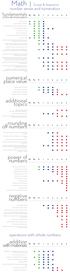 Math Scope & Sequence fundamentals number sense and numeration of the decimal system Count to 10 by units Associate number to numeral (1-10) KN 1 KN 1 KN 2 KN 2 Identify odd and even numbers/numerals and
Level 1 - Maths Targets TARGETS. With support, I can show my work using objects or pictures 12. I can order numbers to 10 3
 Ma Data Hling: Interpreting Processing representing Ma Shape, space measures: position shape Written Mental method s Operations relationship s between them Fractio ns Number s the Ma1 Using Str Levels
Mathematics standards
 Mathematics standards Grade 6 Summary of students performance by the end of Grade 6 Reasoning and problem solving Students represent and interpret routine and non-routine mathematical problems in a range
Numeracy Targets. I can count at least 20 objects
 Targets 1c I can read numbers up to 10 I can count up to 10 objects I can say the number names in order up to 20 I can write at least 4 numbers up to 10. When someone gives me a small number of objects
Numeracy and mathematics Experiences and outcomes
 Numeracy and mathematics Experiences and outcomes My learning in mathematics enables me to: develop a secure understanding of the concepts, principles and processes of mathematics and apply these in different
Everyday Mathematics CCSS EDITION CCSS EDITION. Content Strand: Number and Numeration
 CCSS EDITION Overview of -6 Grade-Level Goals CCSS EDITION Content Strand: Number and Numeration Program Goal: Understand the Meanings, Uses, and Representations of Numbers Content Thread: Rote Counting
Everyday Mathematics GOALS
 Copyright Wright Group/McGraw-Hill GOALS The following tables list the Grade-Level Goals organized by Content Strand and Program Goal. Content Strand: NUMBER AND NUMERATION Program Goal: Understand the
Biggar High School Mathematics Department. National 5 Learning Intentions & Success Criteria: Assessing My Progress
 Biggar High School Mathematics Department National 5 Learning Intentions & Success Criteria: Assessing My Progress Expressions & Formulae Topic Learning Intention Success Criteria I understand this Approximation
Tennessee Mathematics Standards 2009-2010 Implementation. Grade Six Mathematics. Standard 1 Mathematical Processes
 Tennessee Mathematics Standards 2009-2010 Implementation Grade Six Mathematics Standard 1 Mathematical Processes GLE 0606.1.1 Use mathematical language, symbols, and definitions while developing mathematical
NEW MEXICO Grade 6 MATHEMATICS STANDARDS
 PROCESS STANDARDS To help New Mexico students achieve the Content Standards enumerated below, teachers are encouraged to base instruction on the following Process Standards: Problem Solving Build new mathematical
Mathematics Scope and Sequence, K-8
 Standard 1: Number and Operation Goal 1.1: Understands and uses numbers (number sense) Mathematics Scope and Sequence, K-8 Grade Counting Read, Write, Order, Compare Place Value Money Number Theory K Count
Illinois State Standards Alignments Grades Three through Eleven
 Illinois State Standards Alignments Grades Three through Eleven Trademark of Renaissance Learning, Inc., and its subsidiaries, registered, common law, or pending registration in the United States and other
Unit 8 Angles, 2D and 3D shapes, perimeter and area
 Unit 8 Angles, 2D and 3D shapes, perimeter and area Five daily lessons Year 6 Spring term Recognise and estimate angles. Use a protractor to measure and draw acute and obtuse angles to Page 111 the nearest
MINISTRY OF EDUCATION, SPORT AND CULTURE PRIMARY SCHOOL MATHEMATICS SYLLABUS GRADES 4 5 FIRST EXAMINATION 2008
 MINISTRY OF EDUCATION, SPORT AND CULTURE PRIMARY SCHOOL MATHEMATICS SYLLABUS GRADES 4 5 FIRST EXAMINATION 2008 Curriculum Development Unit P. O. Box MP 133 Mount Pleasant HARARE All Rights Reserved 2006
Prentice Hall Mathematics: Course 1 2008 Correlated to: Arizona Academic Standards for Mathematics (Grades 6)
 PO 1. Express fractions as ratios, comparing two whole numbers (e.g., ¾ is equivalent to 3:4 and 3 to 4). Strand 1: Number Sense and Operations Every student should understand and use all concepts and
of surface, 569-571, 576-577, 578-581 of triangle, 548 Associative Property of addition, 12, 331 of multiplication, 18, 433
 Absolute Value and arithmetic, 730-733 defined, 730 Acute angle, 477 Acute triangle, 497 Addend, 12 Addition associative property of, (see Commutative Property) carrying in, 11, 92 commutative property
ISAT Mathematics Performance Definitions Grade 4
 ISAT Mathematics Performance Definitions Grade 4 EXCEEDS STANDARDS Fourth-grade students whose measured performance exceeds standards are able to identify, read, write, represent, and model whole numbers
Glencoe. correlated to SOUTH CAROLINA MATH CURRICULUM STANDARDS GRADE 6 3-3, 5-8 8-4, 8-7 1-6, 4-9
 Glencoe correlated to SOUTH CAROLINA MATH CURRICULUM STANDARDS GRADE 6 STANDARDS 6-8 Number and Operations (NO) Standard I. Understand numbers, ways of representing numbers, relationships among numbers,
COMMON CORE STATE STANDARDS FOR MATHEMATICS 3-5 DOMAIN PROGRESSIONS
 COMMON CORE STATE STANDARDS FOR MATHEMATICS 3-5 DOMAIN PROGRESSIONS Compiled by Dewey Gottlieb, Hawaii Department of Education June 2010 Operations and Algebraic Thinking Represent and solve problems involving
EVERY DAY COUNTS CALENDAR MATH 2005 correlated to
 EVERY DAY COUNTS CALENDAR MATH 2005 correlated to Illinois Mathematics Assessment Framework Grades 3-5 E D U C A T I O N G R O U P A Houghton Mifflin Company YOUR ILLINOIS GREAT SOURCE REPRESENTATIVES:
Geometry Progress Ladder
 Geometry Progress Ladder Maths Makes Sense Foundation End-of-year objectives page 2 Maths Makes Sense 1 2 End-of-block objectives page 3 Maths Makes Sense 3 4 End-of-block objectives page 4 Maths Makes
Cambridge Primary Mathematics Curriculum Framework (with codes)
 Cambridge Primary Mathematics Curriculum Framework (with codes) Contents Introduction Stage 1...1 Stage 2...5 Stage 3...9 Stage 4...14 Stage 5...18 Stage 6...24 Note on codes Each learning objective has
1A: Understand numbers, ways of representing numbers, relationships among numbers, and number systems.
 NCTM STANDARD 1: Numbers and Operations Kindergarten Grade 2 1A: Understand numbers, ways of representing numbers, relationships among numbers, and number systems. Kindergarten Grade One Grade Two 1. Count
Unit 9. Unit 10. Unit 11. Unit 12. Introduction Busy Ant Maths Year 2 Medium-Term Plans. Number - Geometry - Position & direction
 Busy Ant Maths Year Medium-Term Plans Unit 9 Geometry - Position & direction Unit 0 ( Temperature) Unit Statistics Unit Fractions (time) 8 Busy Ant Maths Year Medium-Term Plans Introduction Unit Geometry
Key Stage 2 Mathematics Programme of Study
 Deeloping numerical reasoning Identify processes and connections Represent and communicate Reiew transfer mathematical to a ariety of contexts and eeryday situations identify the appropriate steps and
Standards and progression point examples
 Mathematics Progressing towards Foundation Progression Point 0.5 At 0.5, a student progressing towards the standard at Foundation may, for example: connect number names and numerals with sets of up to
Section 1: How will you be tested? This section will give you information about the different types of examination papers that are available.
 REVISION CHECKLIST for IGCSE Mathematics 0580 A guide for students How to use this guide This guide describes what topics and skills you need to know for your IGCSE Mathematics examination. It will help
ModuMath Basic Math Basic Math 1.1 - Naming Whole Numbers Basic Math 1.2 - The Number Line Basic Math 1.3 - Addition of Whole Numbers, Part I
 ModuMath Basic Math Basic Math 1.1 - Naming Whole Numbers 1) Read whole numbers. 2) Write whole numbers in words. 3) Change whole numbers stated in words into decimal numeral form. 4) Write numerals in
BPS Math Year at a Glance (Adapted from A Story Of Units Curriculum Maps in Mathematics K-5) 1
 Grade 4 Key Areas of Focus for Grades 3-5: Multiplication and division of whole numbers and fractions-concepts, skills and problem solving Expected Fluency: Add and subtract within 1,000,000 Module M1:
Grade 5 Math Content 1
 Grade 5 Math Content 1 Number and Operations: Whole Numbers Multiplication and Division In Grade 5, students consolidate their understanding of the computational strategies they use for multiplication.
Measurement with Reasoning
 compare, describe and solve practical problems for: * lengths and heights [e.g. long/short, longer/shorter, tall/short, double/half] * mass/weight [e.g. heavy/light, heavier than, lighter than] * capacity
Math 5th grade. Create your own number and explain how to use expanded form to show place value to the ten millions place.
 Number Properties and Operations Whole number sense and addition and subtraction are key concepts and skills developed in early childhood. Students build on their number sense and counting sense to develop
NCTM Curriculum Focal Points for Grade 5. Everyday Mathematics, Grade 5
 NCTM Curriculum Focal Points and, Grade 5 NCTM Curriculum Focal Points for Grade 5 Number and Operations and Algebra: Developing an understanding of and fluency with division of whole numbers Students
Algebra Geometry Glossary. 90 angle
 lgebra Geometry Glossary 1) acute angle an angle less than 90 acute angle 90 angle 2) acute triangle a triangle where all angles are less than 90 3) adjacent angles angles that share a common leg Example:
The symbols indicate where the topic is first introduced or specifically addressed.
 ingapore Math Inc. cope and equence U: U.. Edition : ommon ore Edition : tandards Edition : ommon ore tandards 1 2 3 4 5 Reviews in ommon ore Edition cover just the unit whereas those in U.. and tandards
Number Sense and Operations
 Number Sense and Operations representing as they: 6.N.1 6.N.2 6.N.3 6.N.4 6.N.5 6.N.6 6.N.7 6.N.8 6.N.9 6.N.10 6.N.11 6.N.12 6.N.13. 6.N.14 6.N.15 Demonstrate an understanding of positive integer exponents
National curriculum tests. Key stage 2. Mathematics test framework. National curriculum tests from 2016. For test developers
 National curriculum tests Key stage 2 Mathematics test framework National curriculum tests from 2016 For test developers Crown copyright 2015 2016 key stage 2 mathematics test framework: national curriculum
The Australian Curriculum Mathematics
 The Australian Curriculum Mathematics Mathematics ACARA The Australian Curriculum Number Algebra Number place value Fractions decimals Real numbers Foundation Year Year 1 Year 2 Year 3 Year 4 Year 5 Year
Everyday Mathematics. Grade 4 Grade-Level Goals CCSS EDITION. Content Strand: Number and Numeration. Program Goal Content Thread Grade-Level Goal
 Content Strand: Number and Numeration Understand the Meanings, Uses, and Representations of Numbers Understand Equivalent Names for Numbers Understand Common Numerical Relations Place value and notation
Autumn - 12 Weeks. Spring 11 Weeks. Summer 12 Weeks. Not As We Know It Limited 2014
 A Year 5 Mathematician Planning of coverage and resources. Autumn - 12 Weeks Spring 11 Weeks Summer 12 Weeks TARGETS NHM YR 5 Collins 5 Abacus 5 Abacus 6 LA Prior Step NHM 4 CPM 4 Ginn 4 Number, place
Fourth Grade Math Standards and "I Can Statements"
 Fourth Grade Math Standards and "I Can Statements" Standard - CC.4.OA.1 Interpret a multiplication equation as a comparison, e.g., interpret 35 = 5 x 7 as a statement that 35 is 5 times as many as 7 and
WORK SCHEDULE: MATHEMATICS 2007
 , K WORK SCHEDULE: MATHEMATICS 00 GRADE MODULE TERM... LO NUMBERS, OPERATIONS AND RELATIONSHIPS able to recognise, represent numbers and their relationships, and to count, estimate, calculate and check
Everyday Mathematics. Grade 4 Grade-Level Goals. 3rd Edition. Content Strand: Number and Numeration. Program Goal Content Thread Grade-Level Goals
 Content Strand: Number and Numeration Understand the Meanings, Uses, and Representations of Numbers Understand Equivalent Names for Numbers Understand Common Numerical Relations Place value and notation
Mathematics. Programme of study for key stage 3 and attainment targets (This is an extract from The National Curriculum 2007)
 Mathematics Programme of study for key stage 3 and attainment targets (This is an extract from The National Curriculum 2007) Crown copyright 2007 Qualifications and Curriculum Authority 2007 Curriculum
9 Area, Perimeter and Volume
 9 Area, Perimeter and Volume 9.1 2-D Shapes The following table gives the names of some 2-D shapes. In this section we will consider the properties of some of these shapes. Rectangle All angles are right
Minnesota Academic Standards
 A Correlation of to the Minnesota Academic Standards Grades K-6 G/M-204 Introduction This document demonstrates the high degree of success students will achieve when using Scott Foresman Addison Wesley
Assessment For The California Mathematics Standards Grade 4
 Introduction: Summary of Goals GRADE FOUR By the end of grade four, students understand large numbers and addition, subtraction, multiplication, and division of whole numbers. They describe and compare
Such As Statements, Kindergarten Grade 8
 Such As Statements, Kindergarten Grade 8 This document contains the such as statements that were included in the review committees final recommendations for revisions to the mathematics Texas Essential
Open-Ended Problem-Solving Projections
 MATHEMATICS Open-Ended Problem-Solving Projections Organized by TEKS Categories TEKSING TOWARD STAAR 2014 GRADE 7 PROJECTION MASTERS for PROBLEM-SOLVING OVERVIEW The Projection Masters for Problem-Solving
Vocabulary Cards and Word Walls Revised: June 29, 2011
 Vocabulary Cards and Word Walls Revised: June 29, 2011 Important Notes for Teachers: The vocabulary cards in this file match the Common Core, the math curriculum adopted by the Utah State Board of Education,
How To Learn To Understand And Understand The Math Of The Year
 Year R Maths Objectives In order to meet the Early Learning Goals at the end of Year R children must be able to: Numbers Count reliably with numbers from -0, place them in order and say which number is
Dŵr y Felin Comprehensive School. Perimeter, Area and Volume Methodology Booklet
 Dŵr y Felin Comprehensive School Perimeter, Area and Volume Methodology Booklet Perimeter, Area & Volume Perimeters, Area & Volume are key concepts within the Shape & Space aspect of Mathematics. Pupils
Math 0980 Chapter Objectives. Chapter 1: Introduction to Algebra: The Integers.
 Math 0980 Chapter Objectives Chapter 1: Introduction to Algebra: The Integers. 1. Identify the place value of a digit. 2. Write a number in words or digits. 3. Write positive and negative numbers used
MINISTRY OF EDUCATION
 Republic of Namibia MINISTRY OF EDUCATION NAMIBIA SENIOR SECONDARY CERTIFICATE (NSSC) MATHEMATICS SYLLABUS ORDINARY LEVEL SYLLABUS CODE: 4324 GRADES 11-12 FOR IMPLEMENTATION IN 2006 FOR FIRST EXAMINATION
Possible Stage Two Mathematics Test Topics
 Possible Stage Two Mathematics Test Topics The Stage Two Mathematics Test questions are designed to be answerable by a good problem-solver with a strong mathematics background. It is based mainly on material
Secondary Mathematics Syllabuses
 Secondary Mathematics Syllabuses Copyright 006 Curriculum Planning and Development Division. This publication is not for sale. All rights reserved. No part of this publication may be reproduced without
Prentice Hall: Middle School Math, Course 1 2002 Correlated to: New York Mathematics Learning Standards (Intermediate)
 New York Mathematics Learning Standards (Intermediate) Mathematical Reasoning Key Idea: Students use MATHEMATICAL REASONING to analyze mathematical situations, make conjectures, gather evidence, and construct
Chapter 111. Texas Essential Knowledge and Skills for Mathematics. Subchapter A. Elementary
 Elementary 111.A. Chapter 111. Texas Essential Knowledge and Skills for Mathematics Subchapter A. Elementary Statutory Authority: The provisions of this Subchapter A issued under the Texas Education Code,
Voyager Sopris Learning Vmath, Levels C-I, correlated to the South Carolina College- and Career-Ready Standards for Mathematics, Grades 2-8
 Page 1 of 35 VMath, Level C Grade 2 Mathematical Process Standards 1. Make sense of problems and persevere in solving them. Module 3: Lesson 4: 156-159 Module 4: Lesson 7: 220-223 2. Reason both contextually
Manitoba Curriculum. Alignment with Mathletics. Supported by independent evidence-based research and practice. Powerful reporting.
 Supported by independent evidence-based research practice. Follows provincial curricula Powerful reporting Student centred Content Kindergarten Grade 1 Grade 2 02 04 08 Grade 10 Applied & Pre-Calculus
Connections Across Strands Provides a sampling of connections that can be made across strands, using the theme (fractions) as an organizer
 Overview Context Connections Positions fractions in a larger context and shows connections to everyday situations, careers, and tasks Identifies relevant manipulatives, technology, and web-based resources
Senior Phase Grade 8 Today Planning Pack MATHEMATICS
 M780636110236 Senior Phase Grade 8 Today Planning Pack MATHEMATICS Contents: Work Schedule: Page Grade 8 2 Lesson Plans: Grade 8 4 Rubrics: Rubric 1: Recognising, classifying and representing numbers...22
Current Standard: Mathematical Concepts and Applications Shape, Space, and Measurement- Primary
 Shape, Space, and Measurement- Primary A student shall apply concepts of shape, space, and measurement to solve problems involving two- and three-dimensional shapes by demonstrating an understanding of:
1 ST GRADE COMMON CORE STANDARDS FOR SAXON MATH
 1 ST GRADE COMMON CORE STANDARDS FOR SAXON MATH Calendar The following tables show the CCSS focus of The Meeting activities, which appear at the beginning of each numbered lesson and are taught daily,
r the COR Common Core State Standards Learning Pathways
 BUI LT fo COM r the MON COR E 2015 2016 Common Core State Standards Learning Pathways Table of Contents Grade 3...3 Grade 4...8 Grade 5... 13 Grade 6... 18 Grade 7...26 Grade 8...32 Algebra Readiness...36
Geometry and Measurement
 The student will be able to: Geometry and Measurement 1. Demonstrate an understanding of the principles of geometry and measurement and operations using measurements Use the US system of measurement for
Teacher Page Key. Geometry / Day # 13 Composite Figures 45 Min.
 Teacher Page Key Geometry / Day # 13 Composite Figures 45 Min. 9-1.G.1. Find the area and perimeter of a geometric figure composed of a combination of two or more rectangles, triangles, and/or semicircles
LESSON 4 Missing Numbers in Multiplication Missing Numbers in Division LESSON 5 Order of Operations, Part 1 LESSON 6 Fractional Parts LESSON 7 Lines,
 Saxon Math 7/6 Class Description: Saxon mathematics is based on the principle of developing math skills incrementally and reviewing past skills daily. It also incorporates regular and cumulative assessments.
Quick Reference ebook
 This file is distributed FREE OF CHARGE by the publisher Quick Reference Handbooks and the author. Quick Reference ebook Click on Contents or Index in the left panel to locate a topic. The math facts listed
Problem of the Month: William s Polygons
 Problem of the Month: William s Polygons The Problems of the Month (POM) are used in a variety of ways to promote problem solving and to foster the first standard of mathematical practice from the Common
Intermediate Phase New Day-by-Day Planning Pack MATHEMATICS
 Intermediate Phase Planning Pack MATHEMATICS Contents: Work Schedules: Page Grade 4 2 Grade 5 4 Grade 6 5 Lesson Plans: Grade 4 6 Grade 5 21 Grade 6 36 Milestones: Grade 4... 52 Grade 5 57 Grade 6 62 Rubrics:
Annotated work sample portfolios are provided to support implementation of the Foundation Year 10 Australian Curriculum.
 Work sample portfolio summary WORK SAMPLE PORTFOLIO Annotated work sample portfolios are provided to support implementation of the Foundation Year 10 Australian Curriculum. Each portfolio is an example
CCSS Mathematics Implementation Guide Grade 5 2012 2013. First Nine Weeks
 First Nine Weeks s The value of a digit is based on its place value. What changes the value of a digit? 5.NBT.1 RECOGNIZE that in a multi-digit number, a digit in one place represents 10 times as much
What You ll Learn. Why It s Important
 These students are setting up a tent. How do the students know how to set up the tent? How is the shape of the tent created? How could students find the amount of material needed to make the tent? Why
Chapter 111. Texas Essential Knowledge and Skills for Mathematics. Subchapter B. Middle School
 Middle School 111.B. Chapter 111. Texas Essential Knowledge and Skills for Mathematics Subchapter B. Middle School Statutory Authority: The provisions of this Subchapter B issued under the Texas Education
Math 0306 Final Exam Review
 Math 006 Final Exam Review Problem Section Answers Whole Numbers 1. According to the 1990 census, the population of Nebraska is 1,8,8, the population of Nevada is 1,01,8, the population of New Hampshire
CURRICULUM FOR THE COMMON CORE SUBJECT OF MATHEMATICS
 CURRICULUM FOR THE COMMON CORE SUBJECT OF Dette er ei omsetjing av den fastsette læreplanteksten. Læreplanen er fastsett på Nynorsk Established as a Regulation by the Ministry of Education and Research
For examination in June and November 2016. Also available for examination in March 2016 for India only.
 SYLLABUS Cambridge IGCSE Mathematics 0580 For examination in June and November 2016. Also available for examination in March 2016 for India only. This syllabus is approved for use in England, Wales and
Discovering Math: Exploring Geometry Teacher s Guide
 Teacher s Guide Grade Level: 6 8 Curriculum Focus: Mathematics Lesson Duration: Three class periods Program Description Discovering Math: Exploring Geometry From methods of geometric construction and threedimensional
Day 1. 1. What number is five cubed? 2. A circle has radius r. What is the formula for the area of the circle?
 Mental Arithmetic Questions 1. What number is five cubed? KS3 MATHEMATICS 10 4 10 Level 7 Questions Day 1 2. A circle has radius r. What is the formula for the area of the circle? 3. Jenny and Mark share
The Crescent Primary School Calculation Policy
 The Crescent Primary School Calculation Policy Examples of calculation methods for each year group and the progression between each method. January 2015 Our Calculation Policy This calculation policy has
GRADES 7, 8, AND 9 BIG IDEAS
 Table 1: Strand A: BIG IDEAS: MATH: NUMBER Introduce perfect squares, square roots, and all applications Introduce rational numbers (positive and negative) Introduce the meaning of negative exponents for
Common Core State Standards for Mathematics Accelerated 7th Grade
 A Correlation of 2013 To the to the Introduction This document demonstrates how Mathematics Accelerated Grade 7, 2013, meets the. Correlation references are to the pages within the Student Edition. Meeting
Medium term Plan for Summer Year 3
 Medium term Plan for Summer Year 3 Week Main focus of teaching and activities each day Starter Outcomes of each day 1 Place Value and number Day 1: Partition and represent 3-digit numbers using Place Value
SCOPE & SEQUENCE. Kindergarten, First Grade, and Second Grade. Skills and Activities
 SCOPE & SEQUENCE Kindergarten, First Grade, and Second Grade Skills and Activities INNOVATIVE LEARNING CONCEPTS INC. creators of TOUCHMATH TouchMath materials were first published in 1975. Innovative Learning
Georgia Standards Alignment Grades One through Six
 Georgia Standards Alignment Grades One through Six Trademark of Renaissance Learning, Inc., and its subsidiaries, registered, common law, or pending registration in the United States and other countries.
1 BPS Math Year at a Glance (Adapted from A Story of Units Curriculum Maps in Mathematics P-5)
 Grade 5 Key Areas of Focus for Grades 3-5: Multiplication and division of whole numbers and fractions-concepts, skills and problem solving Expected Fluency: Multi-digit multiplication Module M1: Whole
Pocantico Hills School District Grade 1 Math Curriculum Draft
 Pocantico Hills School District Grade 1 Math Curriculum Draft Patterns /Number Sense/Statistics Content Strands: Performance Indicators 1.A.1 Determine and discuss patterns in arithmetic (what comes next