
The symbols indicate where the topic is first introduced or specifically addressed.
|
|
|
- Melina Freeman
- 9 years ago
- Views:
Transcription
1 ingapore Math Inc. cope and equence U: U.. Edition : ommon ore Edition : tandards Edition : ommon ore tandards Reviews in ommon ore Edition cover just the unit whereas those in U.. and tandards Editions are cumulative. The U.. and tandards Editions have periodic practice pages but the ommon ore Edition does not; the problems from the practices have been incorporated into the lessons instead. ommon ore and tandards Editions have reviews after each and every unit; the U.. Edition does not. There is a Teacher s Guide for each level of all three editions. Only the ommon ore Edition guide has reduced-size images of the textbook and workbook pages. There is a Home Instructor s Guide for each level 1-5 of the U.. Edition and the tandards Edition Whole numbers Number notation and place value Give a number to indicate the number of objects in a set 1.NBT.1 Represent a given number by a set of objects Use ordinal numbers such as first, second, third up to tenth 1.NBT.2 ount to 100 by tens and ones 1.NBT.1 Read and write numbers up to 100 in numerals, words, and expanded form 1.NBT.2 Recognize the place-value of tens and ones Make a reasonable estimate of sets of objects within 100 Describe and extend regular number patterns within NBT.1 ount to 120 and read and write numbers to NBT.3 ompare two 2-digit numbers using place-value 1.NBT.3 Use the symbols > and < to compare two numbers within 100 U ompare and order numbers within MD.6 Represent whole numbers within 100 on a number line 2.MD.6 how sums and differences on a number line 2.NBT.2 ount to 1,000 by hundreds, tens, and ones 2.NBT.3 Read and write numbers up to 1,000 in numerals, words, and expanded form 2.NBT.1 Recognize place values of hundreds, tens, and ones 2.NBT.4 ompare two 3-digit numbers using place-value and use the symbols > and < ompare and order numbers within 1,000 Read and write numbers up to 10,000 in numerals, words, and expanded form, and recognize the place value of each digit ompare and order numbers within 10,000 3.OA.9 Describe and extend regular number patterns within 10,000 3.NBT.1 Round numbers within 10,000 to the nearest 10 or 100 Round numbers within 10,000 to the nearest 1,000 Read and write numbers up to 100,000 in numerals, words, and expanded form, and recognize the place value of each digit [email protected] 1 U

2 ingapore Math Inc. cope and equence U: U.. Edition : ommon ore Edition : tandards Edition NBT.1 4.NBT.2 ompare and order numbers within 100,000 Recognize that in a multi-digit whole number, a digit in one place represents ten times what it represent in the place to its right Read and write whole numbers up to 1,000,000 using base-ten numerals, number names, and expanded form, and recognize the place value of each digit [email protected] 2 U 4.NBT.2 ompare two numbers within 1,000,000 based on place-values, using >, <, and = 4.NBT.3 Round numbers within 1,000,000 to any place Read and write numbers up to 10,000,000 in numerals, words, and expanded form, and recognize the place value of each digit Round numbers within 10,000,000 to the nearest 1,000 Read and write numbers within 1,000,000,000 in numerals, words, and expanded form and recognize the place value of each digit omplete or extend regular number patterns for numbers within 1,000,000,000 ompare and order numbers within 100,000,000 Round numbers within 100,000,000 to the closest million Read and write numbers within 1 trillion in numerals, words, and expanded form, and recognize the place value of each digit Round numbers within 1 billion to any place 4.OA.5 Generate a number pattern that follows a given rule 4.OA.5 Generate a shape pattern that follows a given rule 4.OA.5 Identify apparent features of the pattern that were not evident in the rule itself 4.OA.4 List the factors of a whole number up to OA.4 Recognize that a whole number is a multiple of its factors 4.OA.4 Identify composite and prime numbers within 100 Identify common factors of two numbers within OA.4 Determine if a whole number is a multiple of a given 1-digit whole number 5.OA.1 5.OA.2 5.NBT.2 Identify common multiples of two numbers within 100 Find the greatest common factor of two numbers within 200 Find the lowest common multiple of two numbers within 10 Determine the prime factors of numbers within 100 Understand the use of exponents and write numbers as products of prime numbers using exponents tate and use the order of operations arry out combined operations involving the 4 operations, including the use of parentheses (no nested parentheses) Use parentheses, brackets, or braces in numerical expressions and evaluate the expressions (including nested) Write simple expressions that record calculations with numbers, and interpret numerical expressions without evaluating them Explain patterns in the number of zeros of the product when multiplying a number by powers of 10 5.NBT.2 Use whole number exponents to denote powers of 10 U U

3 ingapore Math Inc. cope and equence U: U.. Edition : ommon ore Edition : tandards Edition Addition and ubtraction of Whole Numbers 1.OA.1 Illustrate the meaning of addition and subtraction 1.OA.5 Relate counting to addition and subtraction 1.OA.1 Write mathematical statements for given situations involving addition or subtraction Build addition bonds up to OA.7 Understand the meaning of the equal sign 1.OA.4 Recognize the relationship between addition and subtraction 1.OA.7 Determine if equations involving addition and subtraction are true or false 1.OA.3 Apply properties of operations as strategies to add and subtract 1.OA.6 Add or subtract within 20 using various strategies including properties of operations 1.OA.1 olve 1-step word problems on addition and subtraction within 20 1.OA.2 olve word problems on addition of three 1-digit numbers 2.OA.2 Mentally add or subtract within 20 using various strategies 2.OA.2 ommit addition within 20 to memory 1.OA.8 ommit subtraction within 20 to memory Determine an unknown addend in an addition equation Determine the unknown number in addition and subtraction in any position in the equation 1.NBT.5 Mentally find 10 more or 10 less than a number within NBT.6 Add/subtract tens to/from a 2-digit number using various strategies 1.NBT.4 2.NBT.5 2.NBT.5 Add within 100 using concrete models or drawing and strategies based on placevalue concepts and properties of operations, and/or relationship between addition and subtraction Fluently add/subtract 2-digit numbers using concrete models or drawing and strategies based on place-value concepts and properties of operations, and/or relationship between addition and subtraction ubtract 2-digit numbers using strategies based on place-value, properties of operations, and relationship between addition and subtraction 2.NBT.6 Add up to four 2-digit numbers Add up to three 3-digit numbers within 1, OA.1 olve 1-step word problems on addition and subtraction within NBT.7 Add and subtract within 1,000 using concrete models and various strategies based on place-value 2.NBT.9 Explain why various addition and subtraction strategies work 2.NBT.8 Mentally add or subtract 10 or 100 to or from a number NBT.2 3.OA.8 Add and subtract within 1,000 using various strategies based on place-value and order of operations Use estimation to verify the reasonableness of calculated results in addition and subtraction 4.NBT.4 Add and subtract multi-digit whole numbers using the standard algorithm Mentally add or subtract 2-digit numbers [email protected] 3

4 ingapore Math Inc. cope and equence U: U.. Edition : ommon ore Edition : tandards Edition OA.3 2.OA.4 2.G.2 Mentally subtract a number up to 2-digits from 100 Mentally add/subtract 3-digit numbers with easy calculations Mentally subtract a number up to 3-digits from 1,000 Mentally add/subtract a number close to 100 Mentally add/ subtract a number close to 1,000 Mentally add/subtract a number close to a multiple of 100 (e.g. 498) Mentally add/ subtract 4-digit numbers with easy calculations Mentally add/subtract a number close to a multiple of 1,000 Multiplication and division of whole numbers Illustrate the meaning of multiplication as repeated addition Multiply numbers whose product is not greater than 40, using repeated addition to find the answer olve 1-step word problems with pictorial illustrations on multiplication Divide quantities not greater than 20 into equal sets given the number of objects in each set or the number of sets Determine whether a group of objects within 20 has an odd or even number of members Use addition to find the total number of objects in a rectangular array up to 5 rows and 5 columns Partition a rectangle into rows and columns of squares and count to find the total number 2.NBT.2 ount in steps of 5 and 10 ount in steps of 2, 3, and 4 Build the multiplication tables of 2, 3, 4, 5 and 10 and commit to memory Relate division to multiplication with a missing factor Divide numbers within the multiplication tables for 2, 3, 4, 5, and 10 within 100 Divide using drawings or objects to find a remainder for division by 2, 3, 4, or 5 olve 1-step word problems involving the four operations 3.MD.7b Represent whole number of products as rectangular arrays 3.OA.1 Interpret products of whole numbers as the total number of objects in equal groups 3.OA.2 3.OA.3 Interpret whole number quotients of whole numbers as sharing into equal groups or making equal groups olve word problems involving multiplication/division within 100 using drawings and equations with symbol for unknown 3.OA.4 Determine the unknown number in a multiplication or division equation 3.OA.5 Apply properties of operations as strategies to multiply and divide 3.OA.6 Understand division as unknown factor problems 3.OA.7 Multiply/divide within 100 using various strategies and properties of operations 3.OA.7 Build the multiplication tables up to 10 x 10 and commit to memory 3.OA.9 Recognize and extend regular linear patters involving multiplication [email protected] 4

5 ingapore Math Inc. cope and equence U: U.. Edition : ommon ore Edition : tandards Edition OA.8 olve up to 2-step word problems involving the four operations on whole numbers 3.OA.8 3.OA.8 Write equations for word problem situations using a letter to stand for the unknown quantity Use estimation to verify the reasonableness of calculated results in multiplication and division 3.NBT.3 Multiply tens within the range by a 1-digit number 4.OA.1 Interpret multiplication equation as a comparison (times as many) 4.OA.2 Distinguish additive comparison from multiplicative comparison 4.NBT.5 4.NBT.5 4.NBT.5 4.NBT.6 4.NBT.6 4.OA.2 Multiply a whole number within 1,000 by a 1-digit whole number using strategies based on place-value and properties of operations and illustrate using equations and arrays Multiply a whole number within 10,000 by a 1-digit whole number using strategies based on place-value and properties of operations and illustrate using equations Multiply two 2-digit numbers, using strategies based on place-value and properties of operations and illustrate using equations Illustrate multiplication of 10,000 by a 1-digit whole number and multiplication of two 2-digit numbers with arrays and/or area models Multiply numbers within 10,000 by a 2-digit number Mentally multiply by a number up to one less than a multiple of 10 or 100 (e.g. 49, 499) Identify odd and even numbers within 10,000 Divide a whole number within 1,000 by a 1-digit whole number, using strategies based on place value, properties of operation, and relationship between multiplication and division and illustrate with equations Divide a number within 1,000 number by a 1-digit whole number using the standard algorithm Divide a number within 10,000 by a 1-digit whole number, using strategies based on place-value and properties of operations, and relationship between multiplication and division and illustrate with equations Illustrate division of a whole number within 10,000 by a 1-digit whole number with arrays and/or area models Divide a number within 10,000 number by a 1-digit whole number using the standard algorithm Multiply or divide to solve word problems involving multiplicative comparison (times as many) using drawings and equations with a symbol for the unknown number 4.OA.3 olve multi-step word problems involving the 4 operations on whole numbers 4.OA.3 4.OA.3 Represent word problems using equations with a letter standing for the unknown quantity Assess the reasonableness of answers to multi-step word problems involving the four operations using mental computation and estimation 5.NBT.5 Multiply multi-digit whole numbers using the standard algorithm 5.NBT.6 Find whole number quotients of whole numbers with up to 4-digit dividends and 2-digit divisors, using strategies base on place value, properties of operations, relationship between multiplication and division and illustrate using equations [email protected] 5

6 ingapore Math Inc. cope and equence U: U.. Edition : ommon ore Edition : tandards Edition NBT.6 Fractions 1.G.3 2.G.3 3.G.2 Illustrate 4-digit by 2-digit division with whole number quotients using rectangular arrays and/or area models Mentally multiply and divide by tens, hundreds and thousands Divide whole numbers up to 4 digits by whole numbers up to 2-digits, with whole number remainders, using the standard algorithm Mentally multiply and divide by tens, hundreds and thousands Mentally multiply by a number one less than a multiple of 10 or 100 (e.g. 49, 499) Divide a shape into halves or fourths. ount the number of parts (2 or 4) in the whole Partition shapes into up to 4 equal shares in different ways and use the words halves, thirds, etc. Recognize, understand, and name unit fractions up to 1/12 ompare and order unit fractions Recognize, interpret, and name fractions of a whole in shapes partitioned into up to 12 equal parts Partition shapes into parts with equal area and express the area as a unit fraction of the whole 3.NF.1 Understand unit fractions and multiples of unit fractions Represent fractions with bar models 3.NF.2 Represent and understand fractions on number lines U 3.NF.3a Recognize and name equivalent fractions using number lines 3.NF.3b Write equivalent fractions of a given fraction 3.NF.3c 3.NF.3d Express whole numbers as a fraction and recognize fractions that are equivalent to whole numbers ompare two fractions with the same numerator or denominator, and use the symbols >, < and = ompare and order related fractions with denominators up to 12 4.NF.1 Use diagrams to explain equivalent fractions 4.NF.1 Recognize and generate equivalent fractions Express a fraction in simplest form 4.NF.2 ompare two unrelated fractions of the same whole using >, <, and = 4.NF.2 ompare a fraction to benchmark fractions such as 1/2 4.NF.3a 4.NF.3b Express improper fractions as mixed numbers and vice versa Addition and subtraction of fractions Understand adding and subtracting fractions as joining and separating fractions of the same whole Decompose a fraction into the sum of fractions with the same denominator in different ways Add and subtract like fractions within a sum of 1 Add and subtract related fractions within a sum of 1 and solve word problems 4.NF.3c Add and subtract mixed numbers with like fractions U [email protected] 6

7 ingapore Math Inc. cope and equence U: U.. Edition : ommon ore Edition : tandards Edition NF.3d olve word problems involving addition and subtraction of like fractions 4.MD.4 Add and subtract fractions in fourths, halves, and eighths 4.NF.5 Express a fraction with a denominator of 10 as an equivalent fraction with denominator of 100, and add/subtract fractions with denominators of 10 or NF.1 Add and subtract unlike fractions, including mixed numbers 5.NF.2 5.NF.2 olve word problems involving addition and subtraction of fractions using visual fraction models or equations Use benchmark fractions and number sense of fractions to estimate and assess reasonableness of answers involving addition and subtraction of fractions Multiplication and division of fractions 4.NF.4a Understand fractions as a multiple of unit fractions 4.NF.4b 4.NF.4c 5.NF.3 Multiply fractions by a whole number using understanding of fractions as multiples of multiples of unit fractions olve word problems involving multiplication of fractions by a whole number using concepts of multiples of a unit fraction Interpret a fraction as division of the numerator by the denominator and solve word problems involving division of whole numbers, expressing the quotient as a mixed number Recognize and name a fraction of a set 5.NF.4a Find fraction of a set by interpreting a/b x q as a x q b (whole number answers) 5.NF.4a 5.NF.4b Find fraction of a set by interpreting a/b x q as a x q b (including mixed number answers) olve word problems involving fractions, including fraction of a set Find the area of a rectangle with fractional side lengths by tiling it with unit squares of unit fractions and show that area is the same as would be found by multiplying the side lengths 5.NF.4b Represent fraction product as rectangular areas Interpret product of two proper fractions using visual models 5.NF.5a ompare the size of the product to the size of one factor, without multiplying 5.NF.5b 5.NF.5b Explain why multiplying a number by a fraction greater than 1 results in a product greater than the given number Explain why multiplying a number by a fraction smaller than 1 results in a product smaller than the given number 5.NF.5b Relate fractions equivalence a/b = (ma)/(mb) to multiplying by 1 5.NF.6 olve real world problems involving multiplication of fractions and mixed numbers using fraction models or equations 5.NF.7a Interpret division of a unit fraction by a whole number and find the quotient 5.NF.7b Interpret division of a whole number by a unit fraction and find the quotient 5.NF.7c olve real world problems involving division of unit fractions by a whole number or whole number by a unit fraction using fraction models and equations Divide a proper fraction by a whole number olve multistep word problems involving adding and subtracting mixed numbers, multiplying proper fractions, and dividing a proper fraction by a whole number U [email protected] 7

8 ingapore Math Inc. cope and equence U: U.. Edition : ommon ore Edition : tandards Edition Money Divide a whole number by a proper fraction Divide a fraction by a fraction olve multi-step word problems involving the four operations on fractions Tell the different denominations of coins and bills Match one coin or bill of one denomination to an equivalent set of coins and bills of another denomination ount combinations of coins up to 100 cents or bills up to 100 dollars Add and subtract money in dollars only or cents only olve 1-step word problems involving money in the same unit 2.MD.8 Use $ and symbols appropriately 2.MD.8 4.MD.2 Decimals 4.NF.6 olve word problems involving counting the amount in dollar bills, quarters, dimes, nickels and pennies ount combinations of bills and coins to $10.00 Read and write money using decimal notation onvert from dollars and cents to cents only and vice-versa Add and subtract money within $10.00 in decimal notation, including making change olve 1-step word problems involving addition and subtraction of money in decimal notation within $10.00 Add and subtract money within $ in using decimal notation Multiply and divide money amounts within $10.00 in decimal notation by a whole number olve up to 2-step word problems involving money in decimal notation olve word problems involving the four operations and money, including simple fractions or decimals, converting from larger to smaller unit Use decimal notation for fractions with denominators of 10 or 100, locate on a number line 4.NF.7 ompare two decimals to hundredths using >, <, = 5.NBT.1 5.NBT.3a Recognize that in a multi-digit number, a digit in one place represents ten times what it represent in the place to its right and 1/10 of what it represents to the left Read and write decimals to thousandths using base-ten numerals, number names, and expanded form 5.NBT.3b ompare two decimals to thousandths based on place value using symbols >, <, and = ompare and order decimals to thousandths Round decimals to the nearest whole number or 1 decimal place 5.NBT.4 Round decimals to any place onvert a decimal to a fraction and simplify onvert a fraction to a decimal number (denominators are a factor of 10, 100, or 1000) [email protected] 8

9 ingapore Math Inc. cope and equence U: U.. Edition : ommon ore Edition : tandards Edition MD.2 5.NBT.7 5.NBT.2 5.NBT.7 Time ompare and order a mixed list of decimals and fractions Use the four operations to solve word problems involving measurement and simple decimals Add and subtract decimals to hundredths, using concrete models or drawings and strategies based on place value, properties of operation Mentally add and subtract tenths or hundredths from decimals or whole numbers Multiply and divide decimals up to 2 decimal places by a 1-digit whole number including decimal quotients Round quotients to up to 1 decimal places olve up to 2-step word problems involving decimals Use estimation to check reasonableness of answers Explain patterns in the placement of the decimal point when a decimal is multiplied or divided by a power of 10 Multiply and divide decimals to hundredths, using concrete models or drawings and strategies based on place value, properties of operation Round quotients to up to 2 decimal places olve word problems involving decimals and check reasonableness of answers Tell time in terms of on the hour or half-past using analog clocks 1.MD.3 Tell and write time in hours and half-hours using analog and digital clocks Relate time to events of the day Estimate reasonable time intervals 2.MD.7 Tell and write time to the nearest 5 minutes from analog and digital clocks 2.MD.7 Use a.m and p.m. Find the duration of time intervals in minutes (counting by 5s) or hours Know relationships of time (years, months, days, weeks, hours, and seconds) 3.MD.1 Tell time to the minute 3.MD.1 4.MD.1 4.MD.2 olve word problems involving the addition and subtraction of time in minutes using a number line Find the duration of time intervals in hours and minutes and solve word problems involving time duration in hours and minutes Visualize the relative magnitudes of hours, minutes, and seconds and convert from the larger unit to the smaller unit onvert hours and minutes to minutes, and minutes and seconds to seconds, and vice-versa olve word problems involving the four operations and time including simple fractions or decimals Length, Mass, Weight, and apacity 1.MD.1 ompare the length of two or more objects in non-standard units 1.MD.2 Measure length in non-standard units 2.MD.1 Measure length using appropriate tools such as rulers, yardsticks, meter sticks, and measuring tools [email protected] 9 U U

10 ingapore Math Inc. cope and equence U: U.. Edition : ommon ore Edition : tandards Edition MD.2 Measure the length of an object using different units and describe how the measurement relates to the unit size 2.MD.3 Estimate and measure length in meters, centimeters, feet, or inches 2.MD.4 2.MD.5 Measure to find out how much longer one object is than another and find the difference in length Use addition and subtraction within 100 to solve word problems using lengths given in the same unit 3.MD.2 ompare the mass of two or more objects in non-standard units U 3.MD.2 Estimate and measure mass in kilograms or grams U ompare the capacity of two or more containers in non-standard units U 3.MD.2 Estimate and measure capacity in liters U 3.MD.2 olve 1-step word problems involving mass or volume in only one unit 4.MD.1 Visualize the relative magnitudes of standard measurements of length, mass, capacity, weight, and time [email protected] 10 U 4.MD.1 onvert a measure in a larger unit to a smaller unit 4.MD.1 Record measurement equivalencies in a two-column table 4.MD.2 Estimate and measure in length, mass, weight, and capacity, in compound units onvert between kilometer and meter, meter and centimeter, kilograms and grams, liter and milliliter, feet and inches, pounds and ounces, gallons, quarts, and cups Add and subtract length, mass, weight, and capacity compound units olve up to 2-step word problems involving length, mass, capacity, weight, and time in compound units Multiply and divide length, mass, weight, capacity, and time in compound units olve word problems involving the four operations and length, mass, weight, and capacity olve word problems involving the four operations and length, capacity and mass, including simple fractions or decimals, converting from larger to smaller representing the measurements using diagrams such as number lines featuring a measurement scale onvert between measurements within the same system using fractions U U 5.MD.1 onvert between measurements within the same system using decimals Average and rate Ratio and proportion alculate the average Find the total amount given the average and number of items Understand and calculate rate olve 3-step word problems involving average and rate Use ratio to show relative size of 2 or 3 quantities Interpret ratios Find equivalent ratios Reduce a ratio to lowest terms olve 2-step problems involving ratio

11 ingapore Math Inc. cope and equence U: U.. Edition : ommon ore Edition : tandards Edition Percentage hange fractions and decimals to percentage, and vice versa Express part of a whole as a percentage alculate part of the whole given the percentage and the whole olve 2-step word problems involving percentage Perimeter, Area, and Volume 3.MD.5 Find the area of shapes by covering them with unit squares or by counting squares U 3.MD.6 Measure areas by counting squares in nonstandard units U 3.MD.6 Visualize the relative sizes of square centimeter and square meter, and square inch and square foot Measure areas by counting squares in standard units (square cm, square in., square ft.) 3.MD.7a Find the area of a rectangle by tiling it 3.MD.7a Derive the formula for area of a rectangle 3.MD.7b Use the formula to calculate the area of rectangles with whole number side lengths 3.MD.7c Use tiling and area to illustrate the distributive property 3.MD.7d Find the area of simple composite figures made up of rectangles and solve problems U 3.MD.8 Find the perimeter of polygons 3.MD.8 Find an unknown side length of a polygon given the length of the other sides 3.MD.8 4.MD.3 Exhibit rectangles with same perimeter and different area, or same area and different perimeter Use the area and perimeter formulas for rectangles in real world and mathematical problems Derive the formula for the area of a triangle and find the area of a triangle given the base and height olve problems involving area of a triangle Derive the formula for area of a parallelogram and find the area of parallelograms Find the area of compound shapes made of quadrilaterals Find the surface area of rectangular prisms 5.MD.3 Understand that volume can be measured with unit cubes 5.MD.4 Measure volumes by counting unit cubes of nonstandard units Visualize and identify new solids formed by increasing or decreasing the number of cubes of a given solid drawn on an isometric grid Visualize the relative sizes of a cubic meter, centimeter, inch, foot, and yard 5.MD.4 Measure volume by counting unit cubes of standard units 5.MD.5a Derive the formulas V = l x w x h 5.MD.5a Derive the formula V = b x h 5.MD.5b 5.MD.5c Find the volume of right rectangle prisms with whole number side length given the lengths and solve word problems Find to volume of compound figures made of right rectangular prisms and solve word problems [email protected] 11

12 ingapore Math Inc. cope and equence U: U.. Edition : ommon ore Edition : tandards Edition Geometry Find one dimension of a right rectangular prism given its volume and the other two dimensions Recognize the equivalence of 1 liter/1000 ml and 1000 cm 3 U olve 2-step word problems involving the volume in rectangular tanks and liquid in liters and milliliters or cubic centimeters olve word problems involving finding the volume of a solid using the volume of displaced liquid Find the radius and diameter of a circle Give and follow directions about location Arrange and describe objects in space by proximity, position, and direction Identify and name squares, rectangles, circles, and triangles; identify corners and sides 1.G.1 Determine if a shape is open or closed Determine whether solid objects can stack, roll, or slide 1.G.2 reate a composite shape with 2-dimensional figures 1.G.2 reate a composite shape with solids 1.G.1 Group triangles, circles, squares, and rectangles according to shape, size, or color 1.G.1 Group simple shapes according to orientation Identify flat and curved surfaces Identify straight lines and curves 2.G.1 Identify triangles, quadrilaterals, pentagons and hexagons Identify octagons 2.G.1 Identify cubes omplete a pattern according to shape, size, color, or orientation omplete a pattern according to two of the attributes of shape, size, and orientation Identify and name semicircles and quarter circles Identify squares, rectangles, triangles, circles, semicircles, and quarter circles within a given figure Draw a straight line of a given length 2.G.1 Recognize and draw shapes having specified attributes 3.G.1 ategorize some shapes, including quadrilaterals 3.G.1 Identify rhombuses, rectangles, and squares as examples of quadrilaterals 3.G.1 Draw quadrilaterals that are not rhombuses, rectangles, or squares Associate an angle as a certain amount of turning Identify right angles Tell whether an angle is greater or smaller than a right angle 4.MD.5 Recognize angles as shapes formed whenever two rays share an endpoint 4.MD.5a Understand that angles are measured with reference to degree of turning in a circle U [email protected] 12

13 ingapore Math Inc. cope and equence U: U.. Edition : ommon ore Edition : tandards Edition MD.5a Understand that 1 degree is 1/360 of a circle 4.MD.5b Understand that that an angle that turns through n degrees has a measure of n degrees. 4.MD.6 Measure angles with a protractor 4.MD.6 Draw angles of specified measure 4.MD.7 Recognize that the angle measure of an angle divided into parts is the sum of the parts. olve addition and subtraction problems to find unknown angles. Write equations using a symbol to stand for the unknown angle. Associate quarter turns with 90, half turn with 180, and three-quarter turn with G.1 Identify and draw perpendicular and parallel lines 4.G.1 Identify and draw acute and obtuse angles 4.G.1 Identify and draw points, line segments, and rays 4.G.3 Recognize symmetric figures and lines of symmetry, draw lines of symmetry 4.G.2 omplete a symmetric figure with respect to a given line of symmetry lassify 2-D figures based on presence or absence of parallel or perpendicular lines, or angles of a specified size Recognize and name parallelograms Recognize and name trapezoids, using the exclusive definition of a trapezoid 4.G.2 Recognize and name trapezoids, using the inclusive definition of a trapezoid 4.G.2 Recognize and name right triangles 5.G.3 Understand that attributes belonging to a category of 2-dimensional figures belong to all subcategories of that category 5.G.3 lassify 2-D figures in a hierarchy based on properties Recognize and name isosceles and equilateral triangles Recognize and name scalene triangles Identify and name angles on a straight line, angles at a point, vertically opposite angles Recognize that angles on a straight line add to 180, angles around a point add to 360, and vertically opposite angles are equal Find unknown angles involving angles on a straight line, angles at a point, and vertically opposite angles tate and find unknown angles involving the properties of parallelograms, rhombuses, and trapezoids Recognize and use the property that the angle sum of a triangle is 180 tate and find unknown angles using angle properties of isosceles triangles, equilateral triangles, and right triangles Draw squares, rectangles, parallelograms and triangles given dimensions (side lengths and angles) Identify congruent figures Recognize shapes that can tessellate, identify the shape in a tessellation, draw a tessellation on dot paper U U U [email protected] 13

14 ingapore Math Inc. cope and equence U: U.. Edition : ommon ore Edition : tandards Edition oordinate graphs 5.G.1 5.OA.3 Data and tatistics Recognize figures that have rotational symmetry Identify prisms, pyramids, cylinders, cones, and spheres Identify cylinders Identify rectangular and triangular prisms and pyramids Identify nets of prisms and pyramids, or solids from nets Understand the coordinate plane, x and y axis and coordinates, and plot ordered pairs (first quadrant) Generate numerical patterns using two given rules, identify relationships between corresponding terms, create ordered pairs, and graph on a coordinate plane Find the length of horizontal and vertical lines on the coordinate grid 1.MD.4 Organize, represent, and interpret data in a picture graph with up to 3 categories 2.MD.10 Organize, represent, and interpret data in a picture graph with up to 4 categories 2.MD.10 2.MD.9 Organize, represent, and interpret data in a bar graph with up to 4 categories and single unit scale Repeatedly measure lengths of objects to the nearest whole units and plot the data on a line plot 3.MD.3 Organize, represent, and interpret data in picture graphs with a scale representation 3.MD.3 Organize, represent, and interpret data in a bar graph with a scaled axis 3.MD.4 Generate measurement data by measuring lengths to the nearest half or fourth of an inch and record the data in a line plot 4.MD.4 Make a line plot to display a data set of measurements in fractions (1/2, 1/4, or 1/8). olve problems involving addition or subtraction of fractions using information in the line plots. ollect, organize, and present data in line plots olve word problems using data presented in bar graphs and tables 5.MD.2 Make a line plot to display a data set of measurements in fractions (1/2, 1/4, or 1/8). Use operations on fractions to solve problems involving information in the line plot, such as finding the average 5.G.2 Graph points on a coordinate plane and interpret values in context of real-world and mathematical situation Read and interpret line graphs U ollect, organize and display data in pie charts ollect, organize and display data in histograms Identify the mode and median of categorical data Understand, find, and compare mean, median, and mode of a set of data Identify whether common events are certain, likely, unlikely, or impossible Record the possible outcomes for a simple event and systematically keep track of the outcome when it is repeated many times [email protected] 14

15 ingapore Math Inc. cope and equence U: U.. Edition : ommon ore Edition : tandards Edition Algebra ummarize and display results of simple probability experiments, use the results to predict future events Represent all possible outcomes for simple probability experiments Express all possible outcome of experimental probability situations verbally and numerically and as fractions Write simple equations involving related changes in quantities (e.g. y = 3x + 5) and solve for the dependent value when given the independent value Write and evaluate simple algebraic expressions in one variable using substitution Use the distributive property in expressions with variables implify algebraic expressions in one variable olve problems involving simple linear functions with whole numbers values, write the equation, and graph the resulting ordered pairs on a grid Understand and interpret negative numbers, locate negative numbers on a number line, compare and order integers Recognize and extend regular number patterns that include negative numbers Find the numerical value of negative numbers Add and subtract positive and negative integers olve problems involving linear functions with integer values, write the equation, and graph the resulting ordered pairs on a grid [email protected] 15

Scope and Sequence KA KB 1A 1B 2A 2B 3A 3B 4A 4B 5A 5B 6A 6B
 Scope and Sequence Earlybird Kindergarten, Standards Edition Primary Mathematics, Standards Edition Copyright 2008 [SingaporeMath.com Inc.] The check mark indicates where the topic is first introduced
COMMON CORE STATE STANDARDS FOR MATHEMATICS 3-5 DOMAIN PROGRESSIONS
 COMMON CORE STATE STANDARDS FOR MATHEMATICS 3-5 DOMAIN PROGRESSIONS Compiled by Dewey Gottlieb, Hawaii Department of Education June 2010 Operations and Algebraic Thinking Represent and solve problems involving
CCSS Mathematics Implementation Guide Grade 5 2012 2013. First Nine Weeks
 First Nine Weeks s The value of a digit is based on its place value. What changes the value of a digit? 5.NBT.1 RECOGNIZE that in a multi-digit number, a digit in one place represents 10 times as much
Charlesworth School Year Group Maths Targets
 Charlesworth School Year Group Maths Targets Year One Maths Target Sheet Key Statement KS1 Maths Targets (Expected) These skills must be secure to move beyond expected. I can compare, describe and solve
of surface, 569-571, 576-577, 578-581 of triangle, 548 Associative Property of addition, 12, 331 of multiplication, 18, 433
 Absolute Value and arithmetic, 730-733 defined, 730 Acute angle, 477 Acute triangle, 497 Addend, 12 Addition associative property of, (see Commutative Property) carrying in, 11, 92 commutative property
r the COR Common Core State Standards Learning Pathways
 BUI LT fo COM r the MON COR E 2015 2016 Common Core State Standards Learning Pathways Table of Contents Grade 3...3 Grade 4...8 Grade 5... 13 Grade 6... 18 Grade 7...26 Grade 8...32 Algebra Readiness...36
Mathematics Scope and Sequence, K-8
 Standard 1: Number and Operation Goal 1.1: Understands and uses numbers (number sense) Mathematics Scope and Sequence, K-8 Grade Counting Read, Write, Order, Compare Place Value Money Number Theory K Count
Everyday Mathematics CCSS EDITION CCSS EDITION. Content Strand: Number and Numeration
 CCSS EDITION Overview of -6 Grade-Level Goals CCSS EDITION Content Strand: Number and Numeration Program Goal: Understand the Meanings, Uses, and Representations of Numbers Content Thread: Rote Counting
Everyday Mathematics GOALS
 Copyright Wright Group/McGraw-Hill GOALS The following tables list the Grade-Level Goals organized by Content Strand and Program Goal. Content Strand: NUMBER AND NUMERATION Program Goal: Understand the
Grade 5 Common Core State Standard
 2.1.5.B.1 Apply place value concepts to show an understanding of operations and rounding as they pertain to whole numbers and decimals. M05.A-T.1.1.1 Demonstrate an understanding that 5.NBT.1 Recognize
Voyager Sopris Learning Vmath, Levels C-I, correlated to the South Carolina College- and Career-Ready Standards for Mathematics, Grades 2-8
 Page 1 of 35 VMath, Level C Grade 2 Mathematical Process Standards 1. Make sense of problems and persevere in solving them. Module 3: Lesson 4: 156-159 Module 4: Lesson 7: 220-223 2. Reason both contextually
Illinois State Standards Alignments Grades Three through Eleven
 Illinois State Standards Alignments Grades Three through Eleven Trademark of Renaissance Learning, Inc., and its subsidiaries, registered, common law, or pending registration in the United States and other
Math - 5th Grade. two digit by one digit multiplication fact families subtraction with regrouping
 Number and Operations Understand division of whole numbers N.MR.05.01 N.MR.05.02 N.MR.05.03 Understand the meaning of division of whole numbers with and without remainders; relate division to and to repeated
GRADE 5 SKILL VOCABULARY MATHEMATICAL PRACTICES Evaluate numerical expressions with parentheses, brackets, and/or braces.
 Common Core Math Curriculum Grade 5 ESSENTIAL DOMAINS AND QUESTIONS CLUSTERS Operations and Algebraic Thinking 5.0A What can affect the relationship between numbers? round decimals? compare decimals? What
EVERY DAY COUNTS CALENDAR MATH 2005 correlated to
 EVERY DAY COUNTS CALENDAR MATH 2005 correlated to Illinois Mathematics Assessment Framework Grades 3-5 E D U C A T I O N G R O U P A Houghton Mifflin Company YOUR ILLINOIS GREAT SOURCE REPRESENTATIVES:
Primary Curriculum 2014
 Primary Curriculum 2014 Suggested Key Objectives for Mathematics at Key Stages 1 and 2 Year 1 Maths Key Objectives Taken from the National Curriculum 1 Count to and across 100, forwards and backwards,
MATHS LEVEL DESCRIPTORS
 MATHS LEVEL DESCRIPTORS Number Level 3 Understand the place value of numbers up to thousands. Order numbers up to 9999. Round numbers to the nearest 10 or 100. Understand the number line below zero, and
Math 5th grade. Create your own number and explain how to use expanded form to show place value to the ten millions place.
 Number Properties and Operations Whole number sense and addition and subtraction are key concepts and skills developed in early childhood. Students build on their number sense and counting sense to develop
BPS Math Year at a Glance (Adapted from A Story Of Units Curriculum Maps in Mathematics K-5) 1
 Grade 4 Key Areas of Focus for Grades 3-5: Multiplication and division of whole numbers and fractions-concepts, skills and problem solving Expected Fluency: Add and subtract within 1,000,000 Module M1:
Fourth Grade Math Standards and "I Can Statements"
 Fourth Grade Math Standards and "I Can Statements" Standard - CC.4.OA.1 Interpret a multiplication equation as a comparison, e.g., interpret 35 = 5 x 7 as a statement that 35 is 5 times as many as 7 and
ISAT Mathematics Performance Definitions Grade 4
 ISAT Mathematics Performance Definitions Grade 4 EXCEEDS STANDARDS Fourth-grade students whose measured performance exceeds standards are able to identify, read, write, represent, and model whole numbers
MAFS: Mathematics Standards GRADE: K
 MAFS: Mathematics Standards GRADE: K Domain: COUNTING AND CARDINALITY Cluster 1: Know number names and the count sequence. CODE MAFS.K.CC.1.1 Count to 100 by ones and by tens. MAFS.K.CC.1.2 MAFS.K.CC.1.3
Mathematics K 6 continuum of key ideas
 Mathematics K 6 continuum of key ideas Number and Algebra Count forwards to 30 from a given number Count backwards from a given number in the range 0 to 20 Compare, order, read and represent to at least
numerical place value additional topics rounding off numbers power of numbers negative numbers addition with materials fundamentals
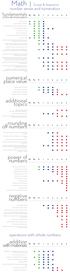 Math Scope & Sequence fundamentals number sense and numeration of the decimal system Count to 10 by units Associate number to numeral (1-10) KN 1 KN 1 KN 2 KN 2 Identify odd and even numbers/numerals and
1A: Understand numbers, ways of representing numbers, relationships among numbers, and number systems.
 NCTM STANDARD 1: Numbers and Operations Kindergarten Grade 2 1A: Understand numbers, ways of representing numbers, relationships among numbers, and number systems. Kindergarten Grade One Grade Two 1. Count
PUBLIC SCHOOLS OF EDISON TOWNSHIP DIVISION OF CURRICULUM AND INSTRUCTION ELEMENTARY MATH GRADE 2 MATH IN FOCUS
 PUBLIC SCHOOLS OF EDISON TOWNSHIP DIVISION OF CURRICULUM AND INSTRUCTION ELEMENTARY MATH GRADE 2 MATH IN FOCUS Length of Course: Term Elective / Required: Required Schools: Elementary Student Eligibility:
My Year 1 Maths Targets
 My Year 1 Maths Targets Number number and place value I can count to and across 100, forwards and backwards, beginning with 0 or 1, or from any given number. I can count in multiples of twos, fives and
1 BPS Math Year at a Glance (Adapted from A Story of Units Curriculum Maps in Mathematics P-5)
 Grade 5 Key Areas of Focus for Grades 3-5: Multiplication and division of whole numbers and fractions-concepts, skills and problem solving Expected Fluency: Multi-digit multiplication Module M1: Whole
Grade 5 Math Content 1
 Grade 5 Math Content 1 Number and Operations: Whole Numbers Multiplication and Division In Grade 5, students consolidate their understanding of the computational strategies they use for multiplication.
NEW MEXICO Grade 6 MATHEMATICS STANDARDS
 PROCESS STANDARDS To help New Mexico students achieve the Content Standards enumerated below, teachers are encouraged to base instruction on the following Process Standards: Problem Solving Build new mathematical
Quick Reference ebook
 This file is distributed FREE OF CHARGE by the publisher Quick Reference Handbooks and the author. Quick Reference ebook Click on Contents or Index in the left panel to locate a topic. The math facts listed
Quarter One: August-October
 Quarter One: August-October (Chapters 1 3, 5-6, 10) August - December Quarterly Addition facts with sums through 20 General Math Content 1. Write sums through 20. 1. Choose and enter the appropriate answer.
Tennessee Mathematics Standards 2009-2010 Implementation. Grade Six Mathematics. Standard 1 Mathematical Processes
 Tennessee Mathematics Standards 2009-2010 Implementation Grade Six Mathematics Standard 1 Mathematical Processes GLE 0606.1.1 Use mathematical language, symbols, and definitions while developing mathematical
How do you compare numbers? On a number line, larger numbers are to the right and smaller numbers are to the left.
 The verbal answers to all of the following questions should be memorized before completion of pre-algebra. Answers that are not memorized will hinder your ability to succeed in algebra 1. Number Basics
Everyday Mathematics. Grade 4 Grade-Level Goals CCSS EDITION. Content Strand: Number and Numeration. Program Goal Content Thread Grade-Level Goal
 Content Strand: Number and Numeration Understand the Meanings, Uses, and Representations of Numbers Understand Equivalent Names for Numbers Understand Common Numerical Relations Place value and notation
Minnesota Academic Standards
 A Correlation of to the Minnesota Academic Standards Grades K-6 G/M-204 Introduction This document demonstrates the high degree of success students will achieve when using Scott Foresman Addison Wesley
Number Sense and Operations
 Number Sense and Operations representing as they: 6.N.1 6.N.2 6.N.3 6.N.4 6.N.5 6.N.6 6.N.7 6.N.8 6.N.9 6.N.10 6.N.11 6.N.12 6.N.13. 6.N.14 6.N.15 Demonstrate an understanding of positive integer exponents
Numeracy Targets. I can count at least 20 objects
 Targets 1c I can read numbers up to 10 I can count up to 10 objects I can say the number names in order up to 20 I can write at least 4 numbers up to 10. When someone gives me a small number of objects
Such As Statements, Kindergarten Grade 8
 Such As Statements, Kindergarten Grade 8 This document contains the such as statements that were included in the review committees final recommendations for revisions to the mathematics Texas Essential
CAMI Education linked to CAPS: Mathematics
 - 1 - TOPIC 1.1 Whole numbers _CAPS curriculum TERM 1 CONTENT Mental calculations Revise: Multiplication of whole numbers to at least 12 12 Ordering and comparing whole numbers Revise prime numbers to
ModuMath Basic Math Basic Math 1.1 - Naming Whole Numbers Basic Math 1.2 - The Number Line Basic Math 1.3 - Addition of Whole Numbers, Part I
 ModuMath Basic Math Basic Math 1.1 - Naming Whole Numbers 1) Read whole numbers. 2) Write whole numbers in words. 3) Change whole numbers stated in words into decimal numeral form. 4) Write numerals in
Prentice Hall Mathematics: Course 1 2008 Correlated to: Arizona Academic Standards for Mathematics (Grades 6)
 PO 1. Express fractions as ratios, comparing two whole numbers (e.g., ¾ is equivalent to 3:4 and 3 to 4). Strand 1: Number Sense and Operations Every student should understand and use all concepts and
Everyday Mathematics. Grade 4 Grade-Level Goals. 3rd Edition. Content Strand: Number and Numeration. Program Goal Content Thread Grade-Level Goals
 Content Strand: Number and Numeration Understand the Meanings, Uses, and Representations of Numbers Understand Equivalent Names for Numbers Understand Common Numerical Relations Place value and notation
Georgia Standards Alignment Grades One through Six
 Georgia Standards Alignment Grades One through Six Trademark of Renaissance Learning, Inc., and its subsidiaries, registered, common law, or pending registration in the United States and other countries.
Students are able to represent and solve problems involving multiplication and division.
 Grade 3 Learning Targets and I Can Statements Operations and Algebraic Thinking Students are able to represent and solve problems involving multiplication and division. o I understand the product of multiplication
Arizona s College and Career Ready Standards Mathematics
 Arizona s College and Career Ready Mathematics Mathematical Practices Explanations and Examples Third Grade ARIZONA DEPARTMENT OF EDUCATION HIGH ACADEMIC STANDARDS FOR STUDENTS State Board Approved June
Level 1 - Maths Targets TARGETS. With support, I can show my work using objects or pictures 12. I can order numbers to 10 3
 Ma Data Hling: Interpreting Processing representing Ma Shape, space measures: position shape Written Mental method s Operations relationship s between them Fractio ns Number s the Ma1 Using Str Levels
Republic of the Philippines Department of Education DepEd Complex, Meralco Avenue Pasig City. K to 12 Curriculum Guide MATHEMATICS
 Republic of the Philippines Department of Education DepEd Complex, Meralco Avenue Pasig City K to 12 Curriculum Guide MATHEMATICS (Grade 1 to Grade 10) January 31, 2012 CONCEPTUAL FRAMEWORK Mathematics
Chapter 111. Texas Essential Knowledge and Skills for Mathematics. Subchapter A. Elementary
 Elementary 111.A. Chapter 111. Texas Essential Knowledge and Skills for Mathematics Subchapter A. Elementary Statutory Authority: The provisions of this Subchapter A issued under the Texas Education Code,
Mathematical Practices
 The New Illinois Learning Standards for Mathematics Incorporating the Common Core Mathematical Practices Grade Strand Standard # Standard K-12 MP 1 CC.K-12.MP.1 Make sense of problems and persevere in
2nd Grade Math Common Core Curriculum
 Quarter 1 I. Number 2.1.2.B.1 To allow for refinement of curricular content and to guide the creation of quality aligned assessments, the Objectives column is intentionally incomplete. The District s Curriculum
Indicator 2: Use a variety of algebraic concepts and methods to solve equations and inequalities.
 3 rd Grade Math Learning Targets Algebra: Indicator 1: Use procedures to transform algebraic expressions. 3.A.1.1. Students are able to explain the relationship between repeated addition and multiplication.
for the Common Core State Standards 2012
 A Correlation of for the Common Core State s 2012 to the Common Core Georgia Performance s Grade 2 FORMAT FOR CORRELATION TO THE COMMON CORE GEORGIA PERFORMANCE STANDARDS (CCGPS) Subject Area: K-12 Mathematics
The Australian Curriculum Mathematics
 The Australian Curriculum Mathematics Mathematics ACARA The Australian Curriculum Number Algebra Number place value Fractions decimals Real numbers Foundation Year Year 1 Year 2 Year 3 Year 4 Year 5 Year
Manitoba Curriculum. Alignment with Mathletics. Supported by independent evidence-based research and practice. Powerful reporting.
 Supported by independent evidence-based research practice. Follows provincial curricula Powerful reporting Student centred Content Kindergarten Grade 1 Grade 2 02 04 08 Grade 10 Applied & Pre-Calculus
Mathematics Florida Standards (MAFS) Grade 2
 Mathematics Florida Standards (MAFS) Grade 2 Domain: OPERATIONS AND ALGEBRAIC THINKING Cluster 1: Represent and solve problems involving addition and subtraction. MAFS.2.OA.1.1 Use addition and subtraction
Progressing toward the standard
 Report Card Language: The student can add and subtract fluently within 20. CCSS: 2.OA.2 Fluently add and subtract within 20 using mental strategies, by end of grade, know from memory all sums of two one-digit
Math 0980 Chapter Objectives. Chapter 1: Introduction to Algebra: The Integers.
 Math 0980 Chapter Objectives Chapter 1: Introduction to Algebra: The Integers. 1. Identify the place value of a digit. 2. Write a number in words or digits. 3. Write positive and negative numbers used
Solve addition and subtraction word problems, and add and subtract within 10, e.g., by using objects or drawings to represent the problem.
 Solve addition and subtraction word problems, and add and subtract within 10, e.g., by using objects or drawings to represent the problem. Solve word problems that call for addition of three whole numbers
The National Curriculum 2014 Programmes of Study for Mathematics
 The National Curriculum 2014 Programmes of Study for Mathematics Information inserted by the Lancashire Mathematics Team to support schools and teachers in identifying elements of the curriculum that have
Common Core Unit Summary Grades 6 to 8
 Common Core Unit Summary Grades 6 to 8 Grade 8: Unit 1: Congruence and Similarity- 8G1-8G5 rotations reflections and translations,( RRT=congruence) understand congruence of 2 d figures after RRT Dilations
Glencoe. correlated to SOUTH CAROLINA MATH CURRICULUM STANDARDS GRADE 6 3-3, 5-8 8-4, 8-7 1-6, 4-9
 Glencoe correlated to SOUTH CAROLINA MATH CURRICULUM STANDARDS GRADE 6 STANDARDS 6-8 Number and Operations (NO) Standard I. Understand numbers, ways of representing numbers, relationships among numbers,
Analysis of California Mathematics standards to Common Core standards- Kindergarten
 Analysis of California Mathematics standards to Common Core standards- Kindergarten Strand CA Math Standard Domain Common Core Standard (CCS) Alignment Comments in reference to CCS Strand Number Sense
Algebra Geometry Glossary. 90 angle
 lgebra Geometry Glossary 1) acute angle an angle less than 90 acute angle 90 angle 2) acute triangle a triangle where all angles are less than 90 3) adjacent angles angles that share a common leg Example:
In mathematics, there are four attainment targets: using and applying mathematics; number and algebra; shape, space and measures, and handling data.
 MATHEMATICS: THE LEVEL DESCRIPTIONS In mathematics, there are four attainment targets: using and applying mathematics; number and algebra; shape, space and measures, and handling data. Attainment target
NCTM Curriculum Focal Points for Grade 5. Everyday Mathematics, Grade 5
 NCTM Curriculum Focal Points and, Grade 5 NCTM Curriculum Focal Points for Grade 5 Number and Operations and Algebra: Developing an understanding of and fluency with division of whole numbers Students
SCOPE & SEQUENCE. Kindergarten, First Grade, and Second Grade. Skills and Activities
 SCOPE & SEQUENCE Kindergarten, First Grade, and Second Grade Skills and Activities INNOVATIVE LEARNING CONCEPTS INC. creators of TOUCHMATH TouchMath materials were first published in 1975. Innovative Learning
LESSON 4 Missing Numbers in Multiplication Missing Numbers in Division LESSON 5 Order of Operations, Part 1 LESSON 6 Fractional Parts LESSON 7 Lines,
 Saxon Math 7/6 Class Description: Saxon mathematics is based on the principle of developing math skills incrementally and reviewing past skills daily. It also incorporates regular and cumulative assessments.
Grade 6 Mathematics Performance Level Descriptors
 Limited Grade 6 Mathematics Performance Level Descriptors A student performing at the Limited Level demonstrates a minimal command of Ohio s Learning Standards for Grade 6 Mathematics. A student at this
Exercise Worksheets. Copyright. 2002 Susan D. Phillips
 Exercise Worksheets Copyright 00 Susan D. Phillips Contents WHOLE NUMBERS. Adding. Subtracting. Multiplying. Dividing. Order of Operations FRACTIONS. Mixed Numbers. Prime Factorization. Least Common Multiple.
Mathematics standards
 Mathematics standards Grade 6 Summary of students performance by the end of Grade 6 Reasoning and problem solving Students represent and interpret routine and non-routine mathematical problems in a range
Geometry and Measurement
 The student will be able to: Geometry and Measurement 1. Demonstrate an understanding of the principles of geometry and measurement and operations using measurements Use the US system of measurement for
Grade 5 Mathematics Curriculum Guideline Scott Foresman - Addison Wesley 2008. Chapter 1: Place, Value, Adding, and Subtracting
 Grade 5 Math Pacing Guide Page 1 of 9 Grade 5 Mathematics Curriculum Guideline Scott Foresman - Addison Wesley 2008 Test Preparation Timeline Recommendation: September - November Chapters 1-5 December
K-5 Definitions of Math Terms
 TERM acute angle acute triangle addend addition adjacent angle algebraic expression algebraic form/notation algorithm analog clock angle angle measure DEFINITION An angle with measure between zero degrees
NUMBER CORNER YEARLONG CONTENT OVERVIEW
 August & September Workouts Calendar Grid Quilt Block Symmetries Identifying shapes and symmetries Calendar Collector Two Penny Toss Probability and data analysis Computational Fluency Mental Math Fluently
CCSS-M Critical Areas: Kindergarten
 CCSS-M Critical Areas: Kindergarten Critical Area 1: Represent and compare whole numbers Students use numbers, including written numerals, to represent quantities and to solve quantitative problems, such
Possible Stage Two Mathematics Test Topics
 Possible Stage Two Mathematics Test Topics The Stage Two Mathematics Test questions are designed to be answerable by a good problem-solver with a strong mathematics background. It is based mainly on material
Grade 4 Unit 3: Multiplication and Division; Number Sentences and Algebra
 Grade 4 Unit 3: Multiplication and Division; Number Sentences and Algebra Activity Lesson 3-1 What s My Rule? page 159) Everyday Mathematics Goal for Mathematical Practice GMP 2.2 Explain the meanings
Vocabulary Cards and Word Walls Revised: June 29, 2011
 Vocabulary Cards and Word Walls Revised: June 29, 2011 Important Notes for Teachers: The vocabulary cards in this file match the Common Core, the math curriculum adopted by the Utah State Board of Education,
Cambridge Primary Mathematics Curriculum Framework (with codes)
 Cambridge Primary Mathematics Curriculum Framework (with codes) Contents Introduction Stage 1...1 Stage 2...5 Stage 3...9 Stage 4...14 Stage 5...18 Stage 6...24 Note on codes Each learning objective has
Biggar High School Mathematics Department. National 5 Learning Intentions & Success Criteria: Assessing My Progress
 Biggar High School Mathematics Department National 5 Learning Intentions & Success Criteria: Assessing My Progress Expressions & Formulae Topic Learning Intention Success Criteria I understand this Approximation
Assessment For The California Mathematics Standards Grade 4
 Introduction: Summary of Goals GRADE FOUR By the end of grade four, students understand large numbers and addition, subtraction, multiplication, and division of whole numbers. They describe and compare
1) (-3) + (-6) = 2) (2) + (-5) = 3) (-7) + (-1) = 4) (-3) - (-6) = 5) (+2) - (+5) = 6) (-7) - (-4) = 7) (5)(-4) = 8) (-3)(-6) = 9) (-1)(2) =
 Extra Practice for Lesson Add or subtract. ) (-3) + (-6) = 2) (2) + (-5) = 3) (-7) + (-) = 4) (-3) - (-6) = 5) (+2) - (+5) = 6) (-7) - (-4) = Multiply. 7) (5)(-4) = 8) (-3)(-6) = 9) (-)(2) = Division is
Grade 6 Mathematics Assessment. Eligible Texas Essential Knowledge and Skills
 Grade 6 Mathematics Assessment Eligible Texas Essential Knowledge and Skills STAAR Grade 6 Mathematics Assessment Mathematical Process Standards These student expectations will not be listed under a separate
5 th Grade Common Core State Standards. Flip Book
 5 th Grade Common Core State Standards Flip Book This document is intended to show the connections to the Standards of Mathematical Practices for the content standards and to get detailed information at
Current Standard: Mathematical Concepts and Applications Shape, Space, and Measurement- Primary
 Shape, Space, and Measurement- Primary A student shall apply concepts of shape, space, and measurement to solve problems involving two- and three-dimensional shapes by demonstrating an understanding of:
Unit 9. Unit 10. Unit 11. Unit 12. Introduction Busy Ant Maths Year 2 Medium-Term Plans. Number - Geometry - Position & direction
 Busy Ant Maths Year Medium-Term Plans Unit 9 Geometry - Position & direction Unit 0 ( Temperature) Unit Statistics Unit Fractions (time) 8 Busy Ant Maths Year Medium-Term Plans Introduction Unit Geometry
Key Stage 2 Mathematics Programme of Study
 Deeloping numerical reasoning Identify processes and connections Represent and communicate Reiew transfer mathematical to a ariety of contexts and eeryday situations identify the appropriate steps and
Order of Operations and Algebraic Thinking
 Ohio s New Learning Standards 5 th Grade Gifted Math Vocabulary: Order of Operations and Algebraic Thinking ü Brackets-mathematic symbols that show what operation goes first in the order of operations
Mathematics Syllabus Primary
 Mathematics Syllabus Primary Ministry of Education SINGAPORE Copyright 2006 Curriculum Planning and Development Division. This publication is not for sale. All rights reserved. No part of this publication
5 th Grade Texas Mathematics: Unpacked Content
 5 th Grade Texas Mathematics: Unpacked Content What is the purpose of this document? To increase student achievement by ensuring educators understand specifically what the new standards mean a student
-- Martensdale-St. Marys Community School Math Curriculum
 -- Martensdale-St. Marys Community School Standard 1: Students can understand and apply a variety of math concepts. Benchmark; The student will: A. Understand and apply number properties and operations.
Standards and progression point examples
 Mathematics Progressing towards Foundation Progression Point 0.5 At 0.5, a student progressing towards the standard at Foundation may, for example: connect number names and numerals with sets of up to
Geometry Progress Ladder
 Geometry Progress Ladder Maths Makes Sense Foundation End-of-year objectives page 2 Maths Makes Sense 1 2 End-of-block objectives page 3 Maths Makes Sense 3 4 End-of-block objectives page 4 Maths Makes
English 6 th Grade A-L Vocabulary Cards and Word Walls Revised: 1/13/14
 English 6 th Grade A-L Vocabulary Cards and Word Walls Revised: 1/13/14 Important Notes for Teachers: The vocabulary cards in this file match the Common Core, the math curriculum adopted by the Utah State
Bridging Documents for Mathematics
 Bridging Documents for Mathematics 5 th /6 th Class, Primary Junior Cycle, Post-Primary Primary Post-Primary Card # Strand(s): Number, Measure Number (Strand 3) 2-5 Strand: Shape and Space Geometry and
Florida Department of Education Adult General Education Curriculum Framework
 Florida Department of Education Adult General Education Curriculum Framework Program Title Program Number 9900000 Course Title Course Number 9900001 CIP Number 1532010200 Grade Equivalent 0.0 8.9 Grade
Thank you for your interest in Inspiration and Kidspiration!
 The Inspired Standards Match is designed to demonstrate the many ways Kidspiration and Inspiration support the standards and to give educators ideas for using these tools to meet learning goals across
Common Core State Standards for Mathematics Accelerated 7th Grade
 A Correlation of 2013 To the to the Introduction This document demonstrates how Mathematics Accelerated Grade 7, 2013, meets the. Correlation references are to the pages within the Student Edition. Meeting
Florida Math 0018. Correlation of the ALEKS course Florida Math 0018 to the Florida Mathematics Competencies - Lower
 Florida Math 0018 Correlation of the ALEKS course Florida Math 0018 to the Florida Mathematics Competencies - Lower Whole Numbers MDECL1: Perform operations on whole numbers (with applications, including