
1A: Understand numbers, ways of representing numbers, relationships among numbers, and number systems.
|
|
|
- Christine Cole
- 9 years ago
- Views:
Transcription
1 NCTM STANDARD 1: Numbers and Operations Kindergarten Grade 2 1A: Understand numbers, ways of representing numbers, relationships among numbers, and number systems. Kindergarten Grade One Grade Two 1. Count orally to Count objects to Write numerals from 0 to Write numbers from 0 to Given two sets of less than 10 objects, recognize which set has more or less. 6. Match and write the numeral for a set of less than 10 objects. 7. Identify the next number less and the next number more than any named number. 8. Recognize a fractional part of a whole (i.e. one half of the class, one fourth cup of milk, one third of the paper). 1. Count objects to Count orally to 100 by 1 s, 5 s and 10 s. 3. Count orally to 20 by odd or even numbers. 4. Given any two numbers, read and write all the whole numbers between them. 5. Write numbers to Use manipulatives to model place value of ones, tens and hundreds. 7. Identify ordinals 1 st through 10 th. 8. Be able to identify the numbers before and after a given number. 9. Use the hundreds chart to identify number patterns (i.e. odd and even numbers, counting by 5 s and 10 s, etc.). 10. Represent a whole number as a combination of two other whole numbers by composing and decomposing numbers (i.e = 3, 4-1 = 3, etc.). 11. Identify and write the numerical words zero to ten. 12. Break a whole into halves, thirds and quarters. 13. Compare fraction parts which is more/less, equal to. 1. Read and write numbers to 1, Given any two numbers, read and write all the whole numbers between them. 3. Demonstrate place value using manipulatives to represent numbers to1, Use models to represent the relative position of cardinal and ordinal numbers and their connections (i.e. hundreds chart use, base 10 blocks). 5. Read and write cardinal and ordinal words and symbols. 6. Represent a whole number as a combination of two or more other whole numbers by composing and decomposing numbers (i.e = 10, = 10, = 10, = 10, 12-2 = 10, etc.). 7. Break a whole into halves, thirds, quarters, sixths and eighths. 8. Compare fraction parts which is more/less, equal to

2 NCTM STANDARD 1: Numbers and Operations Kindergarten Grade 2 1B: Understand meanings of operations and how they relate to one another. Kindergarten Grade One Grade Two 1. Model addition situations by joining two or more sets of objects. 2. Model subtraction situations by separating, comparing or finding missing addends of sets. 3. Use pictures and/or numbers to retell stories. 1. Demonstrate understanding of addition as the joining of sets using manipulatives. 2. Demonstrate understanding of subtraction as the separation of the whole set into parts. 3. Use subtraction when comparing sets. 4. Use subtraction to find the missing addend. 5. Recognize the inverse relationship between addition and subtraction. 6. Understand the meaning of the symbols (+, -, =, _ ) used in addition and subtraction. 7. Investigate multiplication as repeated addition as it relates to literature. 8. Investigate division as repeated subtraction as it relates to literature. 9. Use various representations to illustrate understanding of addition and subtraction as it relates to story problems. 1. Demonstrate understanding of adding and subtracting whole numbers. 2. Solve missing addends for components to Understand multiplication as repeated addition. 4. Investigate division as the distribution of equal amounts. 5. Given a story problem, write a corresponding number sentence

3 NCTM STANDARD 1: Numbers and Operations Kindergarten Grade 2 1C: Compute fluently and make reasonable estimates. Kindergarten Grade One Grade Two 1. Use manipulatives, games, pictures and stories to practice strategies for addition and subtraction. 2. Discuss addition and subtraction problems that are associated with school and home situations. 1. Develop strategies for whole number computations for addition and subtraction (i.e. using manipulatives, counting on, number line). 2. Write numbers and symbols to represent addition and subtraction. 3. Demonstrate fluency with basic number combinations to 10 for addition. 4. Demonstrate fluency with basic number combinations to 10 for subtraction. 5. Use manipulatives to demonstrate the inverse relationship for the operations of addition and subtraction. 6. Use a variety of methods and tools to compute (i.e. objects, mental computation, estimation, paper and pencil, calculators). 1. Demonstrate fluency for addition and subtraction of fact families and double facts up to Develop and use strategies for adding and subtracting 2-digit numbers with or without regrouping. 3. Identify a missing variable (13=3+?) or (20-? =12). 4. Use a variety of methods and tools to compute (i.e. manipulatives, mental computation, estimation, pencil and paper and calculators). 5. Recognize when to use tools, when to use estimation and when to do mental math

4 NCTM STANDARD 1: Numbers and Operations Grade 3 Grade 5 1A: Understand numbers, ways of representing numbers, relationships among numbers, and number systems. Grade 3 Grade 4 Grade 5 1. Read and write any number less than or equal to one million. 2. Given a 4-digit number in standard form, express the number in expanded notation. 3. Represent and model any 4-digit number as a unit or in various combinations of hundreds, tens and ones. 4. Round numbers to the hundreds place. 5. Read and write common fractional parts of a whole. 6. Write a decimal for a manipulative representation of tenths and hundredths. 7. Recognize the equality of decimals and fractions that name tenths. 1. Read and write any numeral less than or equal to one billion. 2. Given a number in the millions period written in standard form, express the number in expanded notation. 3. Round numbers to the thousands place. 4. Read and write negative numbers related to number lines and temperature. 1. Read and write any numeral from zero through the trillions period. 2. Identify the place value for any number from zero through the trillions period. 3. Read and identify decimals to the thousandths place. 4. Identify the place value for any decimal through the thousandths place. 5. Round whole numbers and decimals to a specific place value. 6. Order a set of rational numbers. 7. Convert a given fraction to equivalent fractions. 8. Represent fractions and decimals using models. 9. Represent the conversion between simple decimals and fractions using models. 10. Convert between simple ratios and percents with denominator of Identify the square root of perfect squares. 12. Rename numbers written in exponential notation and vice versa (i.e. 3 2 = 9 and 16 = 4 2 ). 13. Identify prime and composite numbers using models and factor notation (factor tree). 14. Identify multiples and factors of whole numbers. 15. Use and apply the divisibility rules of 2, 5 and Read and write negative numbers related to practical applications

5 NCTM STANDARD 1: Numbers and Operations Grade 3 Grade 5 1B: Understand meanings of operations and how they relate to one another. Grade 3 Grade 4 Grade 5 1. Use manipulatives to explain the addition algorithm. 2. Use manipulatives to explain the subtraction algorithm. 3. Represent situations involving repeated addition as multiplication. 4. Represent situations involving repeated subtraction as division. 5. Explore the inverse relationship of addition and subtraction. 6. Explore the inverse relationship of multiplication and division. 7. Write a story for a number sentence involving addition, subtraction and multiplication. 1. Develop an understanding of 1-, 2- and 3- digit multiplication of whole numbers. 2. Develop an understanding of division by 1- and 2-digit divisors of whole numbers. 3. Develop an understanding of addition and subtraction of decimals (tenths and hundredths). 4. Recognize a variety of ways that addition, subtraction, multiplication and division can be expressed. 5. Use the inverse operations of addition and multiplication to check subtraction and division problems. 6. Recognize the need to have common denominators when adding and subtracting fractions. 7. Recognize that mulplication can be used to create equivalent fractions. 8. Recognize that division can be used to reduce (simplify) fractions to lowest terms. 1. Use a variety of models to develop an understanding of operations with whole numbers, decimals and fractions. 2. Develop an understanding of the four operations of multi-digit whole numbers. 3. Develop an understanding of the four operations when using decimals through the thousandths. 4. Develop an understanding of addition and subtraction when using fractions with like and unlike denominators. 5. Develop an understanding of multiplication and division when using fractions. 6. Explore the commutative, associative and distributive properties for addition and multiplication. 7. Use multiplication to create equivalent fractions. 8. Use division to reduce (simplify) fractions to lowest terms

6 NCTM STANDARD 1: Numbers and Operations Grade 3 Grade 5 1C: Compute fluently and make reasonable estimates. Grade 3 Grade 4 Grade 5 1. Compute sums of one to three digit addends. 2. Compute the difference of two 2-digit numbers. 3. Use estimation for addition and subtraction. 4. Determine the reasonableness of answers for problems involving addition and subtraction. 5. Use addition to check subtraction. 6. Use a variety of methods and tools when computing multi digit addition and subtraction problems. 7. Demonstrate fluency of 0 through 5 multiplication tables, (i.e. facts 0x0 through 5x12). 8. Compute products for a 1-digit number times a 2-digit number. 9. Use calculators and hundred charts to discover patterns and sequences generated from multiplication facts. 10. Use models to develop an algorithm for adding and subtracting any two decimals (tenths and hundredths). 11. Use models to add or subtract fractions with like and unlike denominators. 12. Given a fractional model, write the corresponding number sentence. 13. Select the appropriate computational method for a given situation (mental math, paper and pencil, estimation or calculator). 1. Represent a situation involving repeated addends or arrays as multiplication and write its corresponding number sentence. 2. Use manipulatives and pictures to represent division as the grouping of objects into sets and write its corresponding number sentence. 3. Demonstrate fluency of multiplication facts with factors less than or equal to twelve. 4. Compute the product for factors up to 2-digits. 5. Generate division facts from multiplication facts. 6. Express the remainder in a division problem as R or as a fraction. 7. Build skills with multiplication and division of decimals in which one factor or the divisor is a whole number. 8. Use multiplication to check answers to division problems. 9. Use calculators and hundred charts to discover patterns and sequences generated from multiplication facts. 10. Use a variety of strategies to estimate the solution to addition, subtraction, multiplication and division problems with whole numbers. 11. Select the appropriate computational method for a given situation (mental math, paper and pencil, estimation or calculator). 1. Demonstrate fluency in addition and subtraction of whole numbers. 2. Demonstrate fluency of multiplication and division facts through 12 x Demonstrate fluency in multplication of up to 3 digit factors. 4. Develop fluency in division of 1-, 2- and 3- digit divisors. 5. Compute using the four operations with decimals. 6. Use inverse operations to check answers. 7. Compute the sum, difference, product and quotient for fractions with like and unlike denominators. 8. Use a variety of estimation techniques for mental computation. 9. Convert among decimals, fractions and percents. 10. Find the percent of a given number for whole number percents less than 100%. 11. Select the appropriate computational method for a given situation (mental math, pencil and paper, estimation or calculator)

7 NCTM STANDARD 2: Algebra Kindergarten Grade 2 2A: Understand patterns, relations, and functions. Grade K Grade 1 Grade 2 1. Sort and classify by size, shape and color. 2. Identify patterns using people, objects and numbers. 3. Observe and identify patterns in the environment. 1. Sort, classify and order objects by size, shape and color. 2. Recognize, describe and extend patterns using objects and numbers (i.e. geometric patterns, skip counting). 3. Recognize that patterns can repeat and/or grow. 1. Sort, classify and order by size, weight and number and explain their reasoning. 2. Sort and classify objects by use and other attributes. 3. Describe and extend numeric and geometric patterns. 4. Use different symbols to translate a given pattern (i.e. ABC, 123). 5. Extend both repeating and/or growing patterns

8 NCTM STANDARD 2: Algebra Kindergarten Grade 2 2B: Represent and analyze math situations and structures using algebraic symbols. Grade K Grade 1 Grade 2 1. Recognize commutativity using concrete objects and number symbols. 2. Explore the concept of unknown numbers using manipulatives and games. 1. Recognize the property of commutativity (i.e = 3 + 5). 2. Represent various ways to group numbers to find a given solution (i.e. use unifix cubes to show the different ways to represent 9). 3. Use concrete, pictorial and verbal representations to develop an understanding of conventional symbols for addition, subtraction and equals. 1. Apply commutativity to addition. 2. Write number sentences using the conventional symbols for addition, subtraction and equals

9 NCTM STANDARD 2: Algebra Kindergarten Grade 2 2C: Use mathematical models to represent and understand quantitative relationships. Grade K Grade 1 Grade 2 1. Listen to and tell number stories. 2. Use manipulatives to model addition and subtraction. 1. Model and explain situations that involve addition/subtraction of whole numbers using objects, pictures and symbols. 1. Write simple word problems involving addition and subtraction

10 NCTM STANDARD 2: Algebra Kindergarten Grade 2 2D: Analyze change in various contexts. Grade K Grade 1 Grade 2 1. Learn language to describe qualitative change (i.e. taller, smaller). 2. Learn language to describe quantitative change (i.e. 2 inches more, 3 feet less). 1. Compare and describe qualitative change over a period of time (i.e. taller, smaller). 2. Describe quantitative change that involves measuring length, weight and capacity. 1. Describe qualitative change, such as a student growing taller. 2. Measure quantitative change (i.e. distance, height, weight and capacity)

11 NCTM STANDARD 2: Algebra Grade 3 Grade 5 2A: Understand patterns, relations, and functions. Grade 3 Grade 4 Grade 5 1. Describe, extend and make generalizations about simple geometric and numeric patterns. 2. Write and explain the rule of a given geometric or numeric pattern. 1. Recognize, describe, extend and create a wide variety of numeric and geometric patterns. 2. Describe and represent a pattern in a table or a graph. 3. Use variables and open sentences to express relationships. 4. Use graphical representations to discover patterns and relationships. 5. Translate data from a table to a graph. 1. Describe, extend and make generalizations about geometric and numeric patterns. 2. Represent and explain numeric and geometric patterns with concrete materials, tables and graphs and translate among them

12 NCTM STANDARD 2: Algebra Grade 3 Grade 5 2B: Represent and analyze math situations and structures using algebraic symbols. Grade 3 Grade 4 Grade 5 1. Use models to demonstrate the commutative, associative and distributive properties. 2. Apply the commutative and associative properties to the addition of whole numbers. 3. Represent an unknown quantity using a variable. 4. Write simple equations using the symbols +, -, x, =, n,?,. 1. Use models to demonstrate the commutative, associative and distributive properties. 2. Apply the commutative and associative properties to whole numbers. 3. Apply the distributive property to basic math facts (i.e. 8x9 =8x6 + 8x3). 4. Represent an unknown quantity using a shape or variable (i.e. 2 x triangle = square + circle or 4 x 6 = n). 5. Represent a number sentence with appropriate algebraic symbols. 1. Using appropriate algebraic symbols, write open sentences that describe everyday situations. 2. Recognize and apply the commutative, associative and distributive properties to compute with whole numbers. 3. Represent the idea of a variable as an unknown quantity using a letter or?. 4. Express mathematical relationships using equations

13 NCTM STANDARD 2: Algebra Grade 3 Grade 5 2C: Use mathematical models to represent and understand quantitative relationships. Grade 3 Grade 4 Grade 5 1. Discuss how and why different models can be used to represent the same relationship. 2. Draw conclusions from representations involving graphs, tables and equations. 1. Create graphs and tables that can be used to represent the same relationship. 2. Draw conclusions from representations involving graphs, tables and equations. 1. Analyze tables and graphs to identify algebraic relationships. 2. Interpret tables and graphs for their practical implications

14 NCTM STANDARD 2: Algebra Grade 3 Grade 5 2D: Analyze change in various contexts. Grade 3 Grade 4 Grade 5 1. Recognize constant and variable changes that occur over a period of time (i.e. plant growth, height). 1. Recognize constant and variable changes that occur over a period of time (i.e. temperature, weight). 1. Recognize, describe and compare situations with constant or varying rates of change. 2. Investigate how a change in one variable relates to change in a second variable

15 NCTM STANDARD 3: Geometry Kindergarten Grade 2 3A: Analyze characteristics and properties of two- and three-dimensional geometric shapes and develop mathematical arguments about geometric relationships. Grade K Grade 1 Grade 2 1. Name, trace, build and sort 2-dimensional shapes (i.e. triangle, rectangle, square, circle and hexagon). 2. Play with a wide variety of two- and threedimensional shapes. 1. Identify, compare and sort 2-dimensional shapes (i.e. circle, square, triangle, rectangle, trapezoid, hexagon and diamond). 2. Identify, compare and sort 3-dimensional shapes (i.e. sphere, cube, cone, cylinder, box and pyramid). 3. Describe and compare corners, sides and angles of 2-dimensional shapes. 4. Describe and compare edges, bases, faces and corners of 3-dimensional shapes. 1. Build and/or draw two- and threedimensional shapes (i.e. circle, square, triangle, rectangle, trapezoid, diamond, hexagon, sphere, cube, cone, cylinder, box and pyramid). 2. Identify, describe, compare and sort twoand three-dimensional shapes. 3. Describe and compare corners, sides and angles of 2-dimensional shapes. 4. Describe and compare edges, bases, faces and vertices of 3-dimensional shapes. 5. Describe the results of putting together or taking apart a two-dimensional shape and describe the attributes of the resulting shape or shapes. 6. Explore the concept of similar and congruent objects

16 NCTM STANDARD 3: Geometry Kindergarten Grade 2 3B: Specify locations and describe spatial relationships using coordinate geometry and other representational systems. Grade K Grade 1 Grade 2 1. Learn names of positions by moving their bodies in space (i.e. on, around, through, above, below, inside, outside). 2. Use the language of positions of objects in space. 1. Describe and name positions in space (i.e. near, far, between). 2. Move objects and be able to describe their position (i.e. above, below, behind, in front of). 3. Build and draw simple maps (i.e. playground, classroom, home). 4. Describe how to move from one location to another on a given map. 1. Make and/or interpret a simple map that includes direction and distance. 2. Find and name locations with simple relationships such as near to, inside, outside, beside, next to, left and right. 3. Transfer a simple geometric shape from one grid to another, as is

17 NCTM STANDARD 3: Geometry Kindergarten Grade 2 3C: Apply transformations and use symmetry to analyze mathematical situations. Grade K Grade 1 Grade 2 1. Practice moving shapes in different directions, as with tangrams. 2. Practice use of symmetry by tracing, cutting and folding seasonal shapes (i.e. apple, snowman). 1. Explore the effects of slides, flips and turns using manipulatives. 2. Recognize and build symmetrical patterns. 1. Demonstrate the turn (rotation), flip or slide of a given shape. 2. Identify shapes that are symmetric and draw in the lines of symmetry

18 NCTM STANDARD 3: Geometry Kindergarten Grade 2 3D: Use visualization, spatial reasoning, and geometric modeling to solve problems. Grade K Grade 1 Grade 2 1. Draw simple shapes, such as circle, triangle and rectangle. 2. Describe how to move from one location to another. 3. Make designs and demonstrate shapes changing positions using manipulatives. 4. Learn that shapes can appear in different sizes. 5. Identify shapes in the classroom and at home. 1. Describe how to move from one location to another. 2. Build a pattern, then describe it so another student can build it from description. 3. Recognize and extend a given pattern. 4. Use attribute blocks to compare shapes in different sizes: big, small. 5. Recognize various geometric shapes in environment. 1. Identify and/or describe a given shape. 2. Recognize geometric shapes and structures in the environment and specify their location

19 NCTM STANDARD 3: Geometry Grade 3 Grade 5 3A: Analyze characteristics and properties of two- and three-dimensional geometric shapes and develop mathematical arguments about geometric relationships. Grade 3 Grade 4 Grade 5 1. Define and classify 2- and 3-dimensional shapes using appropriate vocabulary. 2. Draw and build 2- and 3-dimensional shapes according to their properties. 3. Compare objects that are congruent and objects that are similar. 4. Explore the geometric properties of common shapes and related vocabulary (i.e. parallel, perpendicular). 5. Name, make and describe cylinders, cones, spheres and pyramids. 1. Identify, describe and draw models of rays, parallel and perpendicular lines, as well as right, straight, acute and obtuse angles. 2. Use geoboards to explore the properties of parallelograms, rhombuses and trapezoids. 3. Use technology or paper and pencil to draw figures and angles (i.e. Geometer s Sketch Pad). 4. Distinguish between congruence and similarity; recognize two figures that are congruent or similar. 5. Name, make and describe properties of cylinders, cones, cubes, spheres and pyramids. 6. Identify faces, edges and vertices of 3- dimensional figures. 1. Sort and/or classify by properties, a selection of plane figures. 2. Use appropriate vocabulary to describe properties of common 2- and 3- dimensional figures (i.e. edges, vertices, faces, etc.). 3. Justify why two or more complex figures are congruent or similar

20 NCTM STANDARD 3: Geometry Grade 3 Grade 5 3B: Specify locations and describe spatial relationships using coordinate geometry and other representational systems. Grade 3 Grade 4 Grade 5 1. Give and/or follow directions for moving from one location to another. 2. Locate points, create paths and measure vertical and horizontal distances within the first quadrant. 3. Explore and develop strategies for navigating on a grid (i.e. finding multiple paths from one location to another). 4. Use a coordinate pair to locate a point in the first quadrant. 1. Make and use coordinate systems to specify locations and describe points. 2. Given a point, identify the coordinate pair that describes its location in the first quadrant. 1. Recognize the characteristics that make up a Cartesian Plane (rectangular coordinate plane). 2. Plot points on a number line and on a Cartesian Plane. 3. Given a variety of points on a Cartesian Plane, identify the coordinate pair of each. 4. Use technology to explore graphs of linear and non-linear relationships to make predictions or form conclusions. 5. Find vertical and horizontal distances on coordinate systems

21 NCTM STANDARD 3: Geometry Grade 3 Grade 5 3C: Apply transformations and use symmetry to analyze mathematical situations. Grade 3 Grade 4 Grade 5 1. Explore and discuss figures with multiple lines of symmetry. 2. Create designs that show rotational symmetry. 3. Determine the transformations needed to convert an original figure to its new orientation using technology (i.e. The Factory Deluxe). 4. Describe a motion or series of motions that will show that two shapes are congruent. 1. Draw a shape that has been slid (translated) a given distance or flipped (reflected) about a given line. 2. Recognize that figures may be congruent even though their orientations are different. 3. Use computer software to explore rotations and reflections of 2- and 3-dimensional objects. 4. Draw in all lines of symmetry in a given figure. 1. Draw a shape that has been rotated about a point or flipped (reflected) about a given line. 2. Describe a series of transformations that will give two congruent shapes the same orientation. 3. Identify and describe line and rotational symmetry. 4. Use technology to explore translations, reflections and rotations of 2- and 3- dimensional shapes
22 NCTM STANDARD 3: Geometry Grade 3 Grade 5 3D: Use visualization, spatial reasoning, and geometric modeling to solve problems. Grade 3 Grade 4 Grade 5 1. Construct simple three-dimensional shapes from two-dimensional nets (plans). 2. Recognize that by altering a shape, its properties are also altered. 1. Create complex shapes from a set of three or more simple shapes (i.e. pattern blocks, etc.). 2. Separate a given shape into smaller shapes (i.e. rectangle into smaller rectangles or two or more triangles). 3. Select a three-dimensional object given illustrations from two or more different perspectives. 1. Create a given shape from a set of tangrams or other manipulatives. 2. Separate a given two-dimensional complex shape into simpler shapes. 3. Construct common three-dimensional shapes using manipulatives and/or twodimensional nets. 4. Construct a three-dimensional object from a set of two-dimensional plans. 5. Draw a two-dimensional representation of a three-dimensional object
23 NCTM STANDARD 4: Measurement Kindergarten Grade 2 4A: Understand measurable attributes of objects and the units, systems, and processes of measurement. Grade K Grade 1 Grade 2 1. Explore topics in measurement such as weight, area, time, length, volume and money through block play, housekeeping, puzzles and the use of calendar. 2. Use appropriate comparison words (i.e. heavy, light, long and short). 3. Order objects by attribute of weight, volume and length. 4. Explore measurement with non-standard and standard devices. 5. Explore measurement using metric and customary units. 6. Explore use of tools and units used for different kinds of measurement (i.e. ruler for measuring length). 7. Recognize penny, nickel and dime. 1. Recognize and describe the attributes of length, volume, weight, area, time and money using manipulatives. 2. Compare and order objects by their attributes (i.e. shortest to tallest). 3. Measure length using non-standard units. 4. Measure length, time and temperature using standard units. 5. Recognize the value of a penny, nickel, dime and quarter. 6. Find the value of combinations of pennies, nickels and dimes. 7. Explore the many ways to represent a given amount of money. 1. Recognize and describe the attributes of length, volume, weight, area, perimeter, time and money using manipulatives. 2. Order objects according to an attribute. 3. Compare objects in terms of more than one attribute. 4. Demonstrate how to measure length and volume using non-standard and standard units. 5. Recognize the value of a penny, nickel, dime, quarter, half-dollar and dollar. 6. Find the value of combinations of pennies, nickels, dimes, quarters, half-dollars and dollars. 7. Demonstrate the many ways to represent a given amount of money
24 NCTM STANDARD 4: Measurement Kindergarten Grade 2 4B: Apply appropriate techniques, tools and formulas to determine measurements. Grade K Grade 1 Grade 2 1. Measure with multiple copies of a unit (i.e. how many blocks to measure a rug). 2. Measure something larger than the unit with repetition of a unit. 3. Use various measuring tools (i.e. cups, cubes, rulers, balance scales). 4. Recognize the appropriate unit for the attribute being measured. 1. Select an appropriate unit and tool for the attribute being measured. 2. Measure and record length and weight with multiple copies of non-standard units. 3. Measure and record the length of something larger than the unit with repetition of a single non-standard or standard unit. 4. Recognize the starting and end point of a measurement tool. 5. Read a clock in terms of hours and half hours. 6. Read a calendar in terms of the day of the week, the month. 7. Correctly apply the terms yesterday, today and tomorrow. 8. Understand and apply the terms degree, pound, day, week, inches, feet, centimeter. 1. Select and apply an appropriate tool for the attribute being measured and record the measurement using the appropriate unit. 2. Measure and record length, weight and area with multiple copies of non-standard units. 3. Measure and record length of something larger than the unit with repetition of a single non-standard or standard unit. 4. Read a clock in terms of hours, half hours, quarter hours and five-minute increments. 5. Read a calendar in terms of the day of the week, the month, the number days in a week, the number of months and days in a year. 6. Measure to the nearest inch. 7. Use common vocabulary as it relates to measurement
25 NCTM STANDARD 4: Measurement Grade 3 Grade 5 4A: Understand measurable attributes of objects and the units, systems, and processes of measurement. Grade 3 Grade 4 Grade 5 1. Explore measuring area of rectangles on a coordinate grid. 2. Explore measuring the perimeter of rectangles. 3. Distinguish between the area and perimeter of a rectangle. 4. Explain the attributes of length, area, weight and volume. 5. Justify the need for measuring with standard units and apply standard units in the customary and metric systems. 6. Recognize a right angle. 7. Determine the appropriate unit of measurement for a given object. 8. Convert between the notations (i.e. March 12, 2003 to 3/12/03). 1. Select appropriate units of measure to measure various objects (i.e. centimeter for the length of a pencil). 2. Estimate and measure area of simple polygons on a coordinate grid. 3. Estimate and measure the perimeter of simple polygons. 4. Distinguish between the area and perimeter of simple polygons. 5. Recognize right, obtuse and acute angles. 6. Determine the appropriate unit of measurement for a given object. 7. Recognize the reasonableness of an estimate Select an appropriate metric or customary unit to measure length and the area of a common figure. 2. Describe the attributes and the units of measure for length, area, weight, volume and angles. 3. Estimate volume, weight and temperature using metric and customary units. 4. Convert units within the same system, metric and customary. 5. Do simple conversions between metric and customary systems. 6. Convert among units of time (i.e. seconds, minutes, hours, days, weeks, years). 7. Estimate and measure the approximate area of an irregular polygon or complex figure. 8. Estimate and measure the perimeter of an irregular polygon or complex figure. 9. Explore standard and non-standard units of measure for length, volume, weight and temperature. 10. Understand measurements are approximations and how differences in units affect precision. 11. Recognize and apply the use of reasonable estimates.
26 NCTM STANDARD 4: Measurement Grade 3 Grade 5 4B: Apply appropriate techniques, tools, and formulas to determine measurements. Grade 3 Grade 4 Grade 5 1. Tell time to the nearest minute. 2. Measure length of objects to nearest half inch, quarter inch and centimeter. 3. Use a ruler to measure the sides of a rectangle to explore the concept of perimeter and area. 4. Select and apply appropriate standard units and tools to measure length, weight, time and temperature. 5. Use non-standard units to estimate measurements (i.e. the length of a bus seat is similar to a meter). 6. Given specified amount of money, determine what could be bought and/or the amount of change received from a purchase. 7. Given a specified time, determine what time it will be one hour and/or one half hour earlier or later. 1. Measure various objects using appropriate units (i.e. cm for pencil length, m for building length). 2. Given a specified amount of money, determine what could be bought and/or the amount of change received from a purchase. 3. Add or subtract units of length that may or may not require renaming units (i.e. m to cm). 4. Convert inches to feet or centimeters to meters. 5. Estimate and measure capacity in liters, quarts, and gallons. 6. Choose the appropriate tool to find perimeter of a given figure. 7. Explore the addition of minutes to a specified time. 8. Estimate perimeters and areas of standard figures in metric and customary units. 9. Given a standard unit, estimate and measure the area of rectangular regions. 10. Recognize and apply the appropriate formula to determine area of rectangles and volume of rectangular prisms. 11. Make appropriate estimates of size, quantity, temperature and passage of time. 12. Estimate length and area prior to calculating the actual measurement. 1. Make accurate measurements using appropriate tools for length, area, volume, weight, time, temperature and angles. 2. Use formulas for finding the area of rectangles, related triangles and parallelograms. 3. Find the perimeter of polygons and complex shapes. 4. Use formulas to find the volume of rectangular solids. 5. Develop strategies to determine the surface area of rectangular solids. 6. Given a specified amount of money, determine what could be bought and/or the amount of change received from a purchase
27 NCTM STANDARD 5: Data Analysis and Probability Kindergarten Grade 2 5A: Formulate questions that can be addressed with data and collect, organize, and display relevant data to answer them. Grade K Grade 1 Grade 2 1. Collect data in response to simple questions (i.e. What kind of pets do you have?). 2. Discuss ways to organize the data. 3. Display data using objects, pictures or drawings. 4. Explore coloring in a given bar graph. 1. Pose questions relevant to themselves, the environment or the school. 2. Collect data for questions that have multiple responses (i.e. What month is your birthday?). 3. Organize data in a tally sheet or with manipulatives. 4. Display data in terms of tally sheets, pictographs and simple bar graphs. 1. Pose questions relevant to themselves, the environment or the school. 2. Collect data from a single or multiple sources using tally sheets. 3. Display data as a bar graph or pictograph with paper and pencil and technology. 4. Explore the idea that scale can influence the interpretation of the data
28 NCTM STANDARD 5: Data Analysis and Probability Kindergarten Grade 2 5B: Select and use appropriate statistical methods to analyze data. Grade K Grade 1 Grade 2 1. Describe a given set of data in terms of most or least. 1. Recognize the numerical value represented by each bar on a bar graph. 2. Recognize the numerical value represented by each image on a pictograph. 1. Explore the relationship between the size of the sample and the accuracy of the information
29 NCTM STANDARD 5: Data Analysis and Probability Kindergarten Grade 2 5C: Develop and evaluate inferences and predictions that are based on data. Grade K Grade 1 Grade 2 1. Discuss how data answers the question posed. 1. Share ideas about what the data represents. 2. Determine which event is most likely or least likely to happen given appropriate information. 1. Write story problems using information from their graphs. 2. Predict how sets of data will likely/not likely change with the introduction of new data
30 NCTM STANDARD 5: Data Analysis and Probability Kindergarten Grade 2 5D: Understand and apply basic concepts of probability. Grade K Grade 1 Grade 2 1. Discuss probability in terms of seasonal weather (i.e. Is it likely to snow today?) 1. Discuss probability in terms of seasonal weather. 2. Predict the likelihood of an event based on recorded data. 1. Explore the probability of an event happening through experimentation (i.e. flipping a coin, tossing a die and spinning a spinner). 2. Write about the outcomes of their experiments
31 NCTM STANDARD 5: Data Analysis and Probability Grade 3 Grade 5 5A: Formulate questions that can be addressed with data and collect, organize, and display relevant data to answer them. Grade 3 Grade 4 Grade 5 1. Pose questions relevant to themselves, their environment, school or community. 2. Collect data to answer posed questions through surveys, using a tally sheet and/or published resources. 3. Decide how to best display data collected. 4. Explore a wide variety of tables, line plots, bar graphs, line graphs and pictographs created by them, their teacher or a published source. 5. Recognize the difference between categorical (non-measurable) and numerical (measured) data. 6. Interpret the relationship between the labels and values along the horizontal and vertical axes. 7. Represent the location of zero on a graph. 1. Pose questions relevant to themselves, their environment, school or community. 2. Given a question, identify the data needed to obtain the answer. 3. Collect data using surveys, a tally sheet and/or published resources. 4. Use paper and pencil to make bar, line and pictographs. 5. Utilize technology to construct bar, line and circle graphs. 6. Recognize the difference between categorical (non-measurable) and numerical (measured) data. 7. Explore graphs with intervals different than one. 8. Label the horizontal and vertical axes appropriately. 1. Pose questions relevant to themselves, their environment, school, community and other content areas. 2. Given a question, identify the data needed to obtain the answer. 3. Develop a plan to collect data using surveys, making observations or measurements, completing a tally sheet or referencing published resources. 4. Represent data in tables, line plots, spreadsheets, pictographs, bar, circle and line graphs. 5. Use appropriate title, headings and scale when constructing graphs. 6. Identify, construct and interpret a line or bar graph with an interrupted scale. 7. Construct a stem and leaf or box and whisker plot for a given set of data. 8. Recognize categorical versus numerical data
32 NCTM STANDARD 5: Data Analysis and Probability Grade 3 Grade 5 5B: Select and use appropriate statistical methods to analyze data. Grade 3 Grade 4 Grade 5 1. Recognize a set of data as a whole. 2. Compare related data sets. 3. Describe the distribution of data. 4. Explain the meaning of the terms median and mode. 5. Given a set of ordered numbers, identify the median and the mode. 1. Explain the meaning of the terms mean (average), median and mode. 2. Identify mean, median and mode for a given set of data. 3. Compare various representations of data and select the most suitable one. 1. Explain the meaning of the terms mean (average), median, mode and range. 2. Identify mean, median, mode and range for a given set of data with and without technology. 3. Compare data displayed various ways and evaluate how well it represents the data
33 NCTM STANDARD 5: Data Analysis and Probability Grade 3 Grade 5 5C: Develop and evaluate inferences and predictions that are based on data. Grade 3 Grade 4 Grade 5 1. Write story problems using information collected from a graph. 2. Interpret picture and bar graphs made by classmates or found in books or newspapers. 3. Provide a written or oral interpretation of the information represented by a graph. 4. Use line graphs to make predictions in terms of increasing/decreasing trends. 1. Write brief descriptions of graphs. 2. Interpret and analyze bar, picture, circle and line graphs. 3. Write story problems using information from a graph. 4. Use line graphs to make predictions in terms of increasing/decreasing trends. 1. Explore the concepts of sampling and biased data. 2. Propose and justify conclusions and predictions based on data represented as bar, line, circle and pictographs. 3. Use the mean, median, mode and range to make conclusions for a given set of data. 4. Explain how mean, median and mode can be used to define the middle of a set of data. 5. Generate additional questions based on their conclusions and predictions
34 NCTM STANDARD 5: Data Analysis and Probability Grade 3 Grade 5 5D: Understand and apply basic concepts of probability. Grade 3 Grade 4 Grade 5 1. Explore probability as a measurement of the likelihood of an event. 2. Explore probability through experiments with a few outcomes. 3. Given appropriate information, determine which is most likely or least likely to happen. 1. Determine which is most likely or least likely to happen, whether one event is more likely than another and explain the reasoning. 2. Explore the empirical probability of a simple event and record it as a ratio. 3. Explore notion of probability with computer software. 1. Recognize an event as either certain or impossible. 2. Use zero to describe an event that is impossible and one if it is certain. 3. Describe an event by its degree (i.e. certain, equally likely, impossible). 4. Recognize that the probability of an event is a number between zero and one. 5. Identify all possible outcomes for a simple sample space (i.e. tossing a die). 6. Conduct experiments to quantify the empirical (experimental) probability of simple events
35 NCTM STANDARD 1: Numbers and Operations Grade 6 1A: Understand numbers, ways of representing numbers, relationships among numbers, and number systems. 1. Read, write and use physical models to represent positive rational numbers. 2. Convert a given fraction to equivalent fractions. 3. Compare two fractions or decimals using models. 4. Convert fractions to decimals and decimals to fractions. 5. Express percents as their fractional and decimal equivalents. 6. Express a composite number in terms of its prime factors. 7. Identify multiples and factors of whole numbers. 8. Use and apply the divisibility rules of 2, 3, 4, 5, 6, 8, 9 and 10. 1B: Understand meanings of operations and how they relate to one another. 1. Use models to demonstrate an understanding of the four operations with fractions. 2. Use models to demonstrate an understanding of the four operations with decimals. 3. Use models to express percents as parts of Demonstrate an understanding of the associative, commutative and distributive properties in a problem-solving situation. 5. Demonstrate an understanding of multiplication as repeated addition and division as repeated subtraction. 6. Understand the conversion of fractions to equivalent fractions with a common denominator. 7. Understand the conversion of fractions with base 10 denominators to decimals. 8. Understand the multiplicative and additive properties of 0 and Make predictions about products when multiplying different combinations of numbers greater than or less than one. 10. Understand that the power of a number is repeated multiplication (i.e. 2 3 is 2x2x2). 11. Explore the order of operations
36 NCTM STANDARD 1: Numbers and Operations, continued Grade 6 1C: Compute fluently and make reasonable estimates. 1. Demonstrate fluency in all four operations using decimals. 2. Demonstrate fluency in all four operations using fractions. 3. Find any whole number percent of any whole number or decimal. 4. Add and subtract integers using number lines. 5. Apply the associative, commutative and distributive properties to simplify computations. 6. Use estimation and mental computation strategies to determine the reasonableness of answers. 7. Select the appropriate computational method for a given situation (i.e. mental math, pencil and paper, estimation or calculator)
37 NCTM STANDARD 2: Algebra Grade 6 2A: Understand patterns, relations, and functions. 1. Represent, analyze, generalize and extend numeric and geometric patterns using tables, graphs, equations and words. 2. Represent simple linear equations using concrete materials, tables or graphs. 2B: Represent and analyze mathematical situations and structures using algebraic symbols. 1. Demonstrate an understanding of different uses of variables. 2. Given a graph of two linear equations, identify the trends represented. 3. Determine the operations needed to solve a word problem. 4. Solve one-step equations involving addition, subtraction, multiplication and division. 5. Write equations to model and solve word problems. 2C: Use mathematical models to represent and understand quantitative relationships. 1. Generate a table and a graph to model the relationship between two variables. 2. Describe what the variables represent in the context of a problem
38 NCTM STANDARD 2: Algebra, continued Grade 6 2D: Analyze change in various contexts. 1. Use graphs to analyze the nature of change in quantities in linear relationships. 2. Identify the graph of a constant rate of change and the graph of a variable rate of change. 3. Explore linear relationships to describe how a change in one quantity results in a change in another
39 NCTM STANDARD 3: Geometry Grade 6 3A: Analyze characteristics and properties of two- and three-dimensional geometric shapes and develop mathematical arguments about geometric relationships. Students will engage in problem solving, communicating, reasoning, connecting, and representing as they 1. Make models to explore the properties of two-dimensional geometric shapes. 2. Use the properties of two-dimensional geometric shapes to generate definitions of the shapes. 3. Draw and construct two-dimensional geometric shapes based on their definitions. 4. Use definitions to classify triangles according to measures of their sides and angles. 5. Use definitions to classify quadrilaterals (i.e. parallelogram, rhombus, trapezoid, square, rectangle). 6. Recognize the names of polygons of five or more sides. 7. Identify the characteristics of parallel and perpendicular lines. 8. Know the properties of similar objects with respect to the length of their corresponding sides, corresponding angles, perimeters, areas and volumes. 9. Know that two congruent shapes have equal corresponding sides and equal corresponding angles. 10. Create and critique inductive and deductive arguments concerning geometric ideas and relationships such as congruence and similarity. 11. Apply the property that the sum of the angles of a triangle equals 180 degrees. 12. Explore the properties of supplementary and complementary angles. 3B: Specify locations and describe spatial relationships using coordinate geometry and other representational systems. Students will engage in problem solving, communicating, reasoning, connecting, and representing as they 1. Use coordinate geometry to represent and examine the properties of geometric shapes (i.e. regular polygons and quadrilaterals). 2. Draw figures on a coordinate grid from a given set of coordinate pairs. 3. Use technology to explore graphs of linear and non-linear relationships to make predictions or form conclusions
40 NCTM STANDARD 3: Geometry, continued Grade 6 3C: Apply transformations and use symmetry to analyze mathematical situations. Students will engage in problem solving, communicating, reasoning, connecting, and representing as they 1. Describe sizes, positions and orientation of shapes under informal transformations such as flips, turns, slides and scaling from given pictures. 2. Create a tessellation using slides. 3. Identify transformations by name (i.e. translations, reflections, rotations and dilations). 4. Demonstrate the congruence and similarity of shapes using transformations. 5. Identify and draw lines of symmetry for given shapes. 6. Recognize objects or designs that exhibit rotational symmetry. 3D: Use visualization, spatial reasoning, and geometric modeling to solve problems. Students will engage in problem solving, communicating, reasoning, connecting, and representing as they 1. Draw geometric shapes with specified properties such as side length or angle measure. 2. Use geoboards to model geometric figures and identify their properties. 3. Use a protractor to construct and measure angles. 4. Construct the perpendicular bisector of a line segment using a compass and straight edge. 5. Make two-dimensional sketches of cubes. 6. Interpret the perspective from which a drawing was made of a three-dimensional object. 7. Recognize the equal faces of rectangular prisms. 8. Recognize nets that result in rectangular prisms. 9. Compute the volume of a cube. 10. Recognize and apply geometric ideas and relationships in areas outside the mathematics classroom, such as art, science and everyday life
41 NCTM STANDARD 4: Measurement Grade 6 4A: Understand measurable attributes of objects and the units, systems, and processes of measurement. Students will engage in problem solving, communicating, reasoning, connecting, and representing as they. 1. Estimate length, mass and volume using customary and metric units. 2. Understand relationships among units of length and convert from one unit to another within the same system. 3. Understand, select and use the appropriate customary or metric unit for length, area or perimeter to measure an object. 4. Label angles using degrees. 4B: Apply appropriate techniques, tools, and formulas to determine measurements. Students will engage in problem solving, communicating, reasoning, connecting, and representing as they 1. Develop common benchmarks to estimate length and volume in customary units. 2. Use benchmarks to check reasonableness of measurements. 3. Measure objects using a ruler to the nearest eighth of an inch or millimeter. 4. Measure and draw angles using a protractor. 5. Measure to determine the area and perimeter of basic geometric figures. 6. Measure to determine the volume of a cube. 7. Measure the area of a geometric figure by dividing it into squares. 8. Apply formulas for the area and perimeter of squares and rectangles. 9. Apply formulas for the area of triangles and parallelograms. 10. Apply formulas for the circumference and area of a circle. 11. Determine the surface area of rectangular prisms. 12. Apply formulas for the volume of rectangular prisms. 13. Use a scale factor to create a scale drawing. 14. Explore simple problems involving rates of time and distance
42 NCTM STANDARD 5: Data Analysis, Statistics, and Probability Grade 6 5A: Formulate questions that can be addressed with data and collect, organize, and display relevant data to answer them. Students will engage in problem solving, communicating, reasoning, connecting, and representing as they 1. Generate a question relating to the characteristics shared by two populations. 2. Design a study or an experiment to answer the question. 3. Collect data about the question using websites and published documents. 4. Design a question that must be answered with categorical data, collect the information and display it. 5. Create and use bar graphs, circle graphs, line graphs, line plots, frequency tables, stem and leaf plots, histograms, scatter plots and box and whisker plots using paper and pencil and technology. 6. Determine which type of data display best represents the data. 5B: Select and use appropriate statistical methods to analyze data. Students will engage in problem solving, communicating, reasoning, connecting, and representing as they 1. Calculate, interpret and use the mean, median, mode and range of a set of data. 2. Examine how changes in data values affect the mean and median of a set of data. 3. Explore whether mean, median or mode is the best measure of central tendancy in a given situation. 4. Discuss what effects outliers may have on the interpretation of the graphical representation of a data set. 5C: Develop and evaluate inferences and predictions that are based on data. Students will engage in problem solving, communicating, reasoning, connecting, and representing as they 1. Compare two or more data sets and make predictions about the larger populations. 2. Make predictions based on increasing or decreasing trends in the data. 3. Make inferences and predictions based on the analysis of a scatter plot
43 NCTM STANDARD 5: Data Analysis, Statistics, and Probability, continued Grade 6 4. Analyze observational or experimental data to formulate new questions and plan studies or experiments to address these questions. 5. Identify uses and misuses of data in articles, advertisements and other media. 5D: Understand and apply basic concepts of probability. Students will engage in problem solving, communicating, reasoning, connecting, and representing as they 1. Explore probability by conducting simulations or experiments and express results as fractions, decimals or percents. 2. Explore the use of simple tree diagrams to illustrate a sample space and the probability of the outcome of each event
44 NCTM STANDARD 1: Numbers and Operations Grade 7 1A: Understand numbers, ways of representing numbers, relationships among numbers, and number systems. Students will engage in problem solving, communicating, reasoning, connecting, and representing as they. 1. Use fractions, decimals and percents to solve problems. 2. Convert among fractions, decimals and percents. 3. Compare and order fractions, decimals and percents and show this information on a number line. 4. Understand ratios, rates and proportions as a way to show quantitative relationships and be able to convert among them. 5. Represent small and large rational numbers using exponential, scientific and calculator notation. 6. Use prime factorization and multiples to determine GCF and LCM to solve problems. 7. Use integers to represent and compare quantities. 1B: Understand meanings of operations and how they relate to one another. 1. Use order of operations to simplify numerical expressions involving whole numbers, decimals, fractions and integers in problems. 2. Apply the associative, commutative and distributive properties to simplify computations and to solve problems with integers, fractions and decimals. 3. Understand that squares and square roots are inverse operations and use to solve problems. 1C: Compute fluently and make reasonable estimates. 1. Develop algorithms to solve problems with fractions, decimals and percents. 2. Use appropriate estimation strategies to judge the reasonableness of an answer
45 NCTM STANDARD 1: Numbers and Operations, continued Grade 7 3. Estimate the square root of a number that is not a perfect square. 4. Use proportions to represent, analyze and solve problems (i.e. scaling and equivalent ratios). 5. Perform the four operations using positive and negative integers. 6. Use equations and proportions to find the percent of a number, what percent a number is of another number or find a number when only a percent of it is known. 7. Select the appropriate computational method for a given situation (i.e. mental math, pencil and paper, estimation or calculator)
46 NCTM STANDARD 2: Algebra Grade 7 2A: Understand patterns, relations, and functions. 1. Organize and represent information in a data table, graph or as an algebraic expression, and then analyze this information verbally and in writing. 2. Compare tables, graphs and narratives, and understand the advantages and disadvantages of each form of representation in a given situation. 2B: Represent and analyze mathematical situations and structures using algebraic symbols. 1. Identify related variables in the context of a word problem or a real world application. 2. Explore the concept of independent and dependent variables. 3. Recognize a linear relationship in a graph or table, explain this pattern in writing, and then write an algebraic expression representing this information. 4. Write symbolic expressions for multi-line graphs with different slopes (time/speeds). 5. Given a word problem, write and solve the appropriate linear equation. 6. Solve one-step and two-step equations using inverse operations and the properties of equality (i.e. addition, subtraction, multiplication and division) with integers, decimals and fractions. 2C: Use mathematical models to represent and understand quantitative relationships. 1. Identify patterns and extreme values in data organized in tables and graphs and make inferences about situations based on this information
47 NCTM STANDARD 2: Algebra, continued Grade 7 2. Understand discrete versus continuous variables and when it makes sense to connect data points on a coordinate graph and when it does not. 3. Model patterns of quantitative change in real life situations with graphs and tables. 4. Model relationships for non-linear functions (i.e. relationship between length of the radius and the area of a circle). 2D: Analyze change in various contexts. 1. Analyze the change represented in the graph of a linear relationship. 2. Recognize that the slope of a line represents its rate of change. 3. Make predictions from the graphs of linear and nonlinear functions
48 NCTM STANDARD 3: Geometry Grade 7 3A: Analyze characteristics and properties of two- and three-dimensional geometric shapes and develop mathematical arguments about geometric relationships. Students will engage in problem solving, communicating, reasoning, connecting, and representing as they 1. Classify angles as acute, right, obtuse and straight. 2. Classify triangles by the lengths of their sides and measure of their angles (i.e. scalene, isosceles and equilateral; acute, right and obtuse). 3. Classify all quadrilaterals into a hierarchy of categories and subcategories and explain the reasoning (i.e. parallelograms, rectangles and squares). 4. Identify three-dimensional shapes by the properties associated with each (i.e. cone, cylinder, sphere, pyramid and rectangular prism). 5. Understand the proportional relationship among corresponding angles, the length of sides, perimeters, areas and volumes of similar objects (i.e. triangles, quadrilaterals). 6. Use proportional relationships to solve for unknown quantities of similar objects. 7. Understand the Pythagorean Theorem as it relates to right triangles. 8. Apply the Pythagorean Theorem to determine whether three sides form a right triangle. 9. Recognize that multiples of Pythagorean triples are also right triangles (i.e. if 3,4,5 make a right triangle, then 6,8,10 also make a right triangle). 10. Apply the Pythagorean Theorem to real world situations (i.e. determining measurements for a wheelchair ramp). 11. Use the angle sum property of triangles to solve problems. 12. Use the definitions of complementary and supplementary angles to determine missing measures. 3B: Specify locations and describe spatial relationships using coordinate geometry and other representational systems. Students will engage in problem solving, communicating, reasoning, connecting, and representing as they 1. Use properties of geometric shapes to determine missing coordinates. 2. Draw a shape on a coordinate plane and determine the length of vertical and horizontal sides
49 NCTM STANDARD 3: Geometry, continued Grade 7 3C: Apply transformations and use symmetry to analyze mathematical situations. Students will engage in problem solving, communicating, reasoning, connecting, and representing as they 1. Locate the image from a translation on the coordinate plane. 2. Use coordinates to describe a translation. 3. Use dilations to demonstrate similarity and congruence of figures. 4. Recognize lines of symmetry in nature (i.e. the symmetry of the human body). 3D: Use visualization, spatial reasoning, and geometric modeling to solve problems. Students will engage in problem solving, communicating, reasoning, connecting, and representing as they 1. Draw geometric shapes with certain specifications, such as length of sides or angle measures. 2. Use two-dimensional representations of three-dimensional objects to visualize and solve problems such as those involving surface area and volume (i.e. nets). 3. Use visual tools to represent and solve problems (i.e. networks to find the shortest distance or time to travel between two points). 4. Use models and manipulatives to develop formulas for perimeter, circumference, area, volume and surface area. 5. Recognize and apply geometric principles in real world situations
50 NCTM STANDARD 4: Measurement Grade 7 4A: Understand measurable attributes of objects and the units, systems, and processes of measurement. Students will engage in problem solving, communicating, reasoning, connecting, and representing as they 1. Understand the structure and use of the metric and customary systems of measurement for linear, volume and mass measurements. 2. Convert commonly used measurements to equivalent units within the same system. 3. Choose the appropriate customary or metric unit for length, area, perimeter, surface area or volume to measure an object. 4B: Apply appropriate techniques, tools, and formulas to determine measurements. Students will engage in problem solving, communicating, reasoning, connecting, and representing as they 1. Develop common benchmarks to estimate length and volume in customary and metric units. 2. Select the appropriate tool to measure length, volume, mass and angles. 3. Measure objects to specified levels of precision. 4. Measure objects using a ruler to the nearest sixteenth of an inch or millimeter. 5. Measure and draw angles using a protractor. 6. Measure to determine the area, perimeter or volume of basic geometric shapes. 7. Apply formulas for finding the perimeter and area of squares and rectangles. 8. Apply formulas for finding the area of triangles, trapezoids, parallelograms and circles. 9. Develop strategies to find the area of complex shapes by decomposing into simpler shapes, measuring and applying appropriate formulas. 10. Explain the difference between surface area and volume. 11. Find the surface area or volume of rectangular prisms and justify using models. 12. Use a scale factor to create a scale drawing or model. 13. Solve problems involving scale factors using ratios and proportion (i.e. blueprints for rooms, maps and other scale drawings). 14. Calculate rates or other derived measurements (i.e. velocity, density, miles per gallon, miles per hour, words per minute). 15. Explain the difference between ratios, rates and unit rates. 16. Recognize derived quantities in other disciplines and real world situations (i.e. hourly wages, unit pricing, density)
51 NCTM STANDARD 5: Data Analysis and Probability Grade 7 5A: Formulate questions that can be addressed with data and collect, organize, and display relevant data to answer them. Students will engage in problem solving, communicating, reasoning, connecting, and representing as they. 1. Formulate questions relating to characteristics shared by two populations or different characteristics within one population. 2. Design studies and collect data to answer questions about characteristics shared by two populations or different characteristics within one population. 3. Select and create appropriate representations to display data using paper and pencil or technology (i.e. coordinate graphs, line plots, line graphs, bar graphs, stem and leaf plots, frequency tables, circle graphs, histograms, scatter plots, box and whisker plots). 4. Determine which type of data display best represents the data. 5B: Select and use appropriate statistical methods to analyze data. Students will engage in problem solving, communicating, reasoning, connecting, and representing as they 1. Find, use and interpret measures of central tendancy (mean, median, mode) and spread (range, interquartile range, outliers). 2. Select appropriate measure of central tendancy to best represent data in a given situation. 3. Understand the relationship between data and corresponding graphical representations (i.e. coordinate graph, line graph, bar graph, histogram, stem and leaf plot). 4. Interpret graphical representations to determine measures of central tendancy and spread. 5. Demonstrate how changing the interval or scale on a graph changes its appearance. 6. Identify misleading representations of data in real life situations (i.e. magazine articles, advertisements, research)
52 NCTM STANDARD 5: Data Analysis and Probability, continued Grade 7 5C: Develop and evaluate inferences and predictions that are based on data. Students will engage in problem solving, communicating, reasoning, connecting, and representing as they 1. Compare samples from two or more populations and make inferences or predictions based on these comparisons. 2. Compare data from two or more samples from the same population and make conjectures about the population from which they were taken. 3. Make predictions based on the analysis of a scatter plot. 4. Analyze data presented in various formats to formulate new questions and plan studies to answer them. 5D: Understand and apply basic concepts of probability. Students will engage in problem solving, communicating, reasoning, connecting, and representing as they 1. Explore simple probability through activities such as games of chance, raffles, random sampling and express the outcomes as ratios, decimals or percents. 2. Use proportional reasoning and a basic understanding of probability to predict outcomes based on data from simulations. 3. Distinguish between simple and compound probability. 4. Compute probability outcomes for compound events using simple tree diagrams or lists
53 NCTM STANDARD 1: Numbers and Operations Grade 8 1A: Understand numbers, ways of representing numbers, relationships among numbers, and number systems. 1. Represent both large and small rational numbers using scientific, exponential and calculator notation. 2. Convert among fractions, decimals and percents and recognize they are equivalent representations. 3. Use ratios to compare two quantities and form a proportion from two ratios. 4. Use ratios to express rate of change. 5. Recognize quantities that are related proportionally and use charts and graphs to show their relationships. 6. Use and apply number theory as a means of problem solving (i.e. LCM, GCF, prime factorization, divisibility rules, relative primes). 7. Develop an understanding of the real number system with respect to whole numbers, integers, fractions, decimals, rational and irrational numbers. 1B: Understand meanings of operations and how they relate to one another. 1. Relate the four basic operations to the properties of real numbers. 2. Apply the multiplicative inverse property to solve equations with whole numbers, decimals, fractions and integers. 3. Apply squares and square roots as inverse operations to simplify and solve problems with real world applications. 4. Find the cube and cube root of a given number. 1C: Compute fluently and make reasonable estimates. 1. Demonstrate fluency in the four operations using positive and negative integers
54 NCTM STANDARD 1: Numbers and Operations, continued Grade 8 2. Apply the appropriate strategy for solving problems with decimals, fractions and integers. 3. Apply algorithms for computing with fractions, decimals and integers. 4. Compute the percent of a number, the percent of an unknown and the unknown percent. 5. Apply the appropriate estimation strategy for determining the reasonableness of answers. 6. Apply rates, ratios and proportions for solving problems. 7. Select the appropriate computational method for a given situation (i.e. mental math, pencil and paper, estimation or calculator)
55 NCTM STANDARD 2: Algebra Grade 8 2A: Understand patterns, relations, and functions. 1. Represent, analyze and generalize a variety of patterns using tables and graphs. 2. Given a function, table or graph, identify it as linear or nonlinear. 2B: Represent and analyze mathematical situations and structures using algebraic symbols. 1. Apply and understand the different uses of variables. 2. Graph linear and nonlinear functions and contrast their properties. 3. Solve linear equations using appropriate algebraic properties. 4. Explore the effect of changing the slope on the graph of linear equations. 5. Write and apply equations to solve problems that involve linear relationships. 6. Write and solve multi-step equations of fractions, decimals and integers. 7. Write, solve and graph multi-step inequalities of fractions, decimals and integers. 2C: Use mathematical models to represent and understand quantitative relationships. 1. Use and apply graphs, tables and equations to represent and understand quantitative relationships
56 NCTM STANDARD 2: Algebra, continued Grade 8 2D: Analyze change in various contexts. 1. Use graphs to analyze changes in linear relationships
57 NCTM STANDARD 3: Geometry Grade 8 3A: Analyze characteristics and properties of two- and three-dimensional geometric shapes and develop mathematical arguments about geometric relationships. Students will engage in problem solving, communicating, reasoning, connecting, and representing as they 1. Characterize, identify, and analyze two- and three-dimensional figures. 2. Recognize the relationship among the angles, sides, perimeters, areas and volumes of similar figures. 3. Use inductive and deductive reasoning to understand relationships such as congruency and similarity. 4. Apply the Pythagorean Theorem to solve problems that involve everyday applications. 5. Apply the definitions of supplementary, complementary, vertical, interior and exterior angles to determine the measures of unknown angles. 3B: Specify locations and describe spatial relationships using coordinate geometry and other representational systems. Students will engage in problem solving, communicating, reasoning, connecting, and representing as they 1. Use properties of geometric shapes to determine unknown coordinates. 2. Find the slopes of segments comprising geometric shapes. 3C: Apply transformations and use symmetry to analyze mathematical situations. Students will engage in problem solving, communicating, reasoning, connecting, and representing as they 1. Draw the results of translations, reflections, rotations and dilations of objects in the coordinate plane, and determine properties that remain fixed (i.e. lengths of sides remain the same under translation). 2. Use algorithms to perform translations, reflections and rotations of polygons on a coordinate plane
58 NCTM STANDARD 3: Geometry Grade 8 3D: Use visualization, spatial reasoning, and geometric modeling to solve problems. Students will engage in problem solving, communicating, reasoning, connecting, and representing as they 1. Draw various geometric three-dimensional objects. 2. Draw nets for pyramids and cones. 3. Identify and draw a three-dimensional object from various perspectives. 4. Use and draw two-dimensional figures to visualize and solve problems involving surface area and volume (i.e. cones, cylinders, spheres, prisms and pyramids). 5. Use a variety of tools and technology to model and solve problems. 6. Use networks or other geometric models to explain various mathematical relationships. 7. Apply geometric ideas to other subject areas and everyday life
59 NCTM STANDARD 4: Measurement Grade 8 4A: Understand measurable attributes of objects and the units, systems, and processes of measurement. Students will engage in problem solving, communicating, reasoning, connecting, and representing as they 1. Understand the structure and use of both the customary and metric systems of measurement. 2. Understand the relative size and choose the approximate matching unit between the metric and customary systems of measure (i.e. mile and km). 3. Convert between different systems of measurement. 4B: Apply appropriate techniques, tools, and formulas to determine measurements. Students will engage in problem solving, communicating, reasoning, connecting, and representing as they 1. Select the appropriate method of estimating measurement. 2. Select and use the appropriate tools for measuring length, area, volume and angles. 3. Apply formulas to determine the circumference, area and volume of more complex figures. 4. Determine the surface area of prisms, pyramids and cylinders. 5. Use perimeter, area and volume formulas to solve real world problems. 6. Use appropriate levels of precision when calculating with measurement. 7. Solve problems containing scale drawings using ratios and proportions. 8. Calculate and apply velocity, density, miles per hour and unit price to real world situations
60 NCTM STANDARD 5: Data Analysis and Probability Grade 8 5A: Formulate questions that can be addressed with data and collect, organize, and display relevant data to answer them. Students will engage in problem solving, communicating, reasoning, connecting, and representing as they. 1. Generate a question relating to the characteristics shared by two populations or different characteristics within one population. 2. Design a study or an experiment to answer the question. 3. Collect data about the question. 4. Distinguish between categorical and numerical data. 5. Select and create appropriate representations to display data using paper and pencil or technology (i.e. bar graphs, circle graphs, line graphs, line plots, frequency tables, stem and leaf plots, scatter plots, box and whisker plots and histograms). 6. Organize, interpret and apply data collected in a given situation to real world application. 5B: Select and use appropriate statistical methods to analyze data. Students will engage in problem solving, communicating, reasoning, connecting, and representing as they 1. Understand, discuss and apply the relationships between data and the type of graph used to display the information. 2. Analyze the set of data using measures of central tendancy (mean, median, mode) and measures of spread (range, interquartile range, outliers). 3. Determine whether mean, median or mode is the best representation of the central tendancy of a set of data. 4. Analyze the relationship between a graphical representation of a data set and the measures of central tendancy and spread. 5. Use measures of central tendency and spread to analyze patterns, trends and distributions in sets of data. 6. Compare data sets using box and whisker plots. 7. Create a scatter plot, draw a fitted line and use the equation of the line to make predictions. 8. Demonstrate and analyze how changing the interval or scale on a graph changes its appearance. 9. Identify misuses of statistical data in articles, advertisements and other media
61 NCTM STANDARD 5: Data Analysis and Probability continued Grade 8 5C: Develop and evaluate inferences and predictions that are based on data. Students will engage in problem solving, communicating, reasoning, connecting, and representing as they 1. Compare samples from two or more populations and make predictions and inferences based on these comparisons. 2. Compare data from two or more samples to determine how sample selections can influence results. 3. Explore sample variability. 4. Describe how the relative size of a sample compared to the target population affects the validity of predictions. 5. Create and make inferences and predictions about scatter plots that show a relationship between two sets of given data (i.e. positive, negative, strong, weak, none). 6. Determine a line of best fit from a scatter plot and use the equation of the line to make predictions. 7. Make comparisons, predictions and inferences from various graphical representations. 8. Analyze observational or experimental data to formulate new questions and plan studies or experiments to address these questions. 9. Make convincing arguments based on analysis of data and interpretation of graphs. 5D: Understand and apply basic concepts of probability. Students will engage in problem solving, communicating, reasoning, connecting, and representing as they 1. Recognize that the probability of the occurrence of two or more mutually exclusive events is the sum of the probabilities of the individual events. 2. Recognize that the sum of the probabilities of complementary events is one. 3. Explore probability by conducting a simulation, and express the results as ratios, decimals or percents. 4. Describe, create and analyze a sample space and use it to calculate probability
Scope and Sequence KA KB 1A 1B 2A 2B 3A 3B 4A 4B 5A 5B 6A 6B
 Scope and Sequence Earlybird Kindergarten, Standards Edition Primary Mathematics, Standards Edition Copyright 2008 [SingaporeMath.com Inc.] The check mark indicates where the topic is first introduced
Everyday Mathematics CCSS EDITION CCSS EDITION. Content Strand: Number and Numeration
 CCSS EDITION Overview of -6 Grade-Level Goals CCSS EDITION Content Strand: Number and Numeration Program Goal: Understand the Meanings, Uses, and Representations of Numbers Content Thread: Rote Counting
Everyday Mathematics GOALS
 Copyright Wright Group/McGraw-Hill GOALS The following tables list the Grade-Level Goals organized by Content Strand and Program Goal. Content Strand: NUMBER AND NUMERATION Program Goal: Understand the
Mathematics Scope and Sequence, K-8
 Standard 1: Number and Operation Goal 1.1: Understands and uses numbers (number sense) Mathematics Scope and Sequence, K-8 Grade Counting Read, Write, Order, Compare Place Value Money Number Theory K Count
Illinois State Standards Alignments Grades Three through Eleven
 Illinois State Standards Alignments Grades Three through Eleven Trademark of Renaissance Learning, Inc., and its subsidiaries, registered, common law, or pending registration in the United States and other
EVERY DAY COUNTS CALENDAR MATH 2005 correlated to
 EVERY DAY COUNTS CALENDAR MATH 2005 correlated to Illinois Mathematics Assessment Framework Grades 3-5 E D U C A T I O N G R O U P A Houghton Mifflin Company YOUR ILLINOIS GREAT SOURCE REPRESENTATIVES:
ISAT Mathematics Performance Definitions Grade 4
 ISAT Mathematics Performance Definitions Grade 4 EXCEEDS STANDARDS Fourth-grade students whose measured performance exceeds standards are able to identify, read, write, represent, and model whole numbers
Everyday Mathematics. Grade 4 Grade-Level Goals CCSS EDITION. Content Strand: Number and Numeration. Program Goal Content Thread Grade-Level Goal
 Content Strand: Number and Numeration Understand the Meanings, Uses, and Representations of Numbers Understand Equivalent Names for Numbers Understand Common Numerical Relations Place value and notation
Everyday Mathematics. Grade 4 Grade-Level Goals. 3rd Edition. Content Strand: Number and Numeration. Program Goal Content Thread Grade-Level Goals
 Content Strand: Number and Numeration Understand the Meanings, Uses, and Representations of Numbers Understand Equivalent Names for Numbers Understand Common Numerical Relations Place value and notation
Glencoe. correlated to SOUTH CAROLINA MATH CURRICULUM STANDARDS GRADE 6 3-3, 5-8 8-4, 8-7 1-6, 4-9
 Glencoe correlated to SOUTH CAROLINA MATH CURRICULUM STANDARDS GRADE 6 STANDARDS 6-8 Number and Operations (NO) Standard I. Understand numbers, ways of representing numbers, relationships among numbers,
Charlesworth School Year Group Maths Targets
 Charlesworth School Year Group Maths Targets Year One Maths Target Sheet Key Statement KS1 Maths Targets (Expected) These skills must be secure to move beyond expected. I can compare, describe and solve
NEW MEXICO Grade 6 MATHEMATICS STANDARDS
 PROCESS STANDARDS To help New Mexico students achieve the Content Standards enumerated below, teachers are encouraged to base instruction on the following Process Standards: Problem Solving Build new mathematical
Minnesota Academic Standards
 A Correlation of to the Minnesota Academic Standards Grades K-6 G/M-204 Introduction This document demonstrates the high degree of success students will achieve when using Scott Foresman Addison Wesley
Number Sense and Operations
 Number Sense and Operations representing as they: 6.N.1 6.N.2 6.N.3 6.N.4 6.N.5 6.N.6 6.N.7 6.N.8 6.N.9 6.N.10 6.N.11 6.N.12 6.N.13. 6.N.14 6.N.15 Demonstrate an understanding of positive integer exponents
Grade 5 Math Content 1
 Grade 5 Math Content 1 Number and Operations: Whole Numbers Multiplication and Division In Grade 5, students consolidate their understanding of the computational strategies they use for multiplication.
Current Standard: Mathematical Concepts and Applications Shape, Space, and Measurement- Primary
 Shape, Space, and Measurement- Primary A student shall apply concepts of shape, space, and measurement to solve problems involving two- and three-dimensional shapes by demonstrating an understanding of:
Tennessee Mathematics Standards 2009-2010 Implementation. Grade Six Mathematics. Standard 1 Mathematical Processes
 Tennessee Mathematics Standards 2009-2010 Implementation Grade Six Mathematics Standard 1 Mathematical Processes GLE 0606.1.1 Use mathematical language, symbols, and definitions while developing mathematical
Pocantico Hills School District Grade 1 Math Curriculum Draft
 Pocantico Hills School District Grade 1 Math Curriculum Draft Patterns /Number Sense/Statistics Content Strands: Performance Indicators 1.A.1 Determine and discuss patterns in arithmetic (what comes next
MATHS LEVEL DESCRIPTORS
 MATHS LEVEL DESCRIPTORS Number Level 3 Understand the place value of numbers up to thousands. Order numbers up to 9999. Round numbers to the nearest 10 or 100. Understand the number line below zero, and
numerical place value additional topics rounding off numbers power of numbers negative numbers addition with materials fundamentals
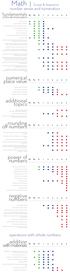 Math Scope & Sequence fundamentals number sense and numeration of the decimal system Count to 10 by units Associate number to numeral (1-10) KN 1 KN 1 KN 2 KN 2 Identify odd and even numbers/numerals and
Prentice Hall Mathematics: Course 1 2008 Correlated to: Arizona Academic Standards for Mathematics (Grades 6)
 PO 1. Express fractions as ratios, comparing two whole numbers (e.g., ¾ is equivalent to 3:4 and 3 to 4). Strand 1: Number Sense and Operations Every student should understand and use all concepts and
Math 5th grade. Create your own number and explain how to use expanded form to show place value to the ten millions place.
 Number Properties and Operations Whole number sense and addition and subtraction are key concepts and skills developed in early childhood. Students build on their number sense and counting sense to develop
Chapter 111. Texas Essential Knowledge and Skills for Mathematics. Subchapter A. Elementary
 Elementary 111.A. Chapter 111. Texas Essential Knowledge and Skills for Mathematics Subchapter A. Elementary Statutory Authority: The provisions of this Subchapter A issued under the Texas Education Code,
of surface, 569-571, 576-577, 578-581 of triangle, 548 Associative Property of addition, 12, 331 of multiplication, 18, 433
 Absolute Value and arithmetic, 730-733 defined, 730 Acute angle, 477 Acute triangle, 497 Addend, 12 Addition associative property of, (see Commutative Property) carrying in, 11, 92 commutative property
-- Martensdale-St. Marys Community School Math Curriculum
 -- Martensdale-St. Marys Community School Standard 1: Students can understand and apply a variety of math concepts. Benchmark; The student will: A. Understand and apply number properties and operations.
Primary Curriculum 2014
 Primary Curriculum 2014 Suggested Key Objectives for Mathematics at Key Stages 1 and 2 Year 1 Maths Key Objectives Taken from the National Curriculum 1 Count to and across 100, forwards and backwards,
STRAND: Number and Operations Algebra Geometry Measurement Data Analysis and Probability STANDARD:
 how August/September Demonstrate an understanding of the place-value structure of the base-ten number system by; (a) counting with understanding and recognizing how many in sets of objects up to 50, (b)
Numeracy Targets. I can count at least 20 objects
 Targets 1c I can read numbers up to 10 I can count up to 10 objects I can say the number names in order up to 20 I can write at least 4 numbers up to 10. When someone gives me a small number of objects
NCTM Curriculum Focal Points for Grade 5. Everyday Mathematics, Grade 5
 NCTM Curriculum Focal Points and, Grade 5 NCTM Curriculum Focal Points for Grade 5 Number and Operations and Algebra: Developing an understanding of and fluency with division of whole numbers Students
COMMON CORE STATE STANDARDS FOR MATHEMATICS 3-5 DOMAIN PROGRESSIONS
 COMMON CORE STATE STANDARDS FOR MATHEMATICS 3-5 DOMAIN PROGRESSIONS Compiled by Dewey Gottlieb, Hawaii Department of Education June 2010 Operations and Algebraic Thinking Represent and solve problems involving
Indicator 2: Use a variety of algebraic concepts and methods to solve equations and inequalities.
 3 rd Grade Math Learning Targets Algebra: Indicator 1: Use procedures to transform algebraic expressions. 3.A.1.1. Students are able to explain the relationship between repeated addition and multiplication.
My Year 1 Maths Targets
 My Year 1 Maths Targets Number number and place value I can count to and across 100, forwards and backwards, beginning with 0 or 1, or from any given number. I can count in multiples of twos, fives and
Such As Statements, Kindergarten Grade 8
 Such As Statements, Kindergarten Grade 8 This document contains the such as statements that were included in the review committees final recommendations for revisions to the mathematics Texas Essential
Voyager Sopris Learning Vmath, Levels C-I, correlated to the South Carolina College- and Career-Ready Standards for Mathematics, Grades 2-8
 Page 1 of 35 VMath, Level C Grade 2 Mathematical Process Standards 1. Make sense of problems and persevere in solving them. Module 3: Lesson 4: 156-159 Module 4: Lesson 7: 220-223 2. Reason both contextually
Mathematics K 6 continuum of key ideas
 Mathematics K 6 continuum of key ideas Number and Algebra Count forwards to 30 from a given number Count backwards from a given number in the range 0 to 20 Compare, order, read and represent to at least
Mercer County Schools
 Mercer County Schools PRIORITIZED CURRICULUM Mathematics Content Maps Second Grade Mercer County Schools PRIORITIZED CURRICULUM The Mercer County Schools Prioritized Curriculum is composed of West Virginia
Algebra 1 2008. Academic Content Standards Grade Eight and Grade Nine Ohio. Grade Eight. Number, Number Sense and Operations Standard
 Academic Content Standards Grade Eight and Grade Nine Ohio Algebra 1 2008 Grade Eight STANDARDS Number, Number Sense and Operations Standard Number and Number Systems 1. Use scientific notation to express
Quarter One: August-October
 Quarter One: August-October (Chapters 1 3, 5-6, 10) August - December Quarterly Addition facts with sums through 20 General Math Content 1. Write sums through 20. 1. Choose and enter the appropriate answer.
MATHEMATICS. Standard Course of Study and Grade Level Competencies
 MATHEMATICS Standard Course of Study and Grade Level Competencies K-12 Public Schools of North Carolina State Board of Education Department of Public Instruction TABLE OF CONTENTS ACKNOWLEDGMENTS...1
CAMI Education linked to CAPS: Mathematics
 - 1 - TOPIC 1.1 Whole numbers _CAPS curriculum TERM 1 CONTENT Mental calculations Revise: Multiplication of whole numbers to at least 12 12 Ordering and comparing whole numbers Revise prime numbers to
CCSS Mathematics Implementation Guide Grade 5 2012 2013. First Nine Weeks
 First Nine Weeks s The value of a digit is based on its place value. What changes the value of a digit? 5.NBT.1 RECOGNIZE that in a multi-digit number, a digit in one place represents 10 times as much
Republic of the Philippines Department of Education DepEd Complex, Meralco Avenue Pasig City. K to 12 Curriculum Guide MATHEMATICS
 Republic of the Philippines Department of Education DepEd Complex, Meralco Avenue Pasig City K to 12 Curriculum Guide MATHEMATICS (Grade 1 to Grade 10) January 31, 2012 CONCEPTUAL FRAMEWORK Mathematics
Fourth Grade Math Standards and "I Can Statements"
 Fourth Grade Math Standards and "I Can Statements" Standard - CC.4.OA.1 Interpret a multiplication equation as a comparison, e.g., interpret 35 = 5 x 7 as a statement that 35 is 5 times as many as 7 and
Standards and progression point examples
 Mathematics Progressing towards Foundation Progression Point 0.5 At 0.5, a student progressing towards the standard at Foundation may, for example: connect number names and numerals with sets of up to
The symbols indicate where the topic is first introduced or specifically addressed.
 ingapore Math Inc. cope and equence U: U.. Edition : ommon ore Edition : tandards Edition : ommon ore tandards 1 2 3 4 5 Reviews in ommon ore Edition cover just the unit whereas those in U.. and tandards
Manitoba Curriculum. Alignment with Mathletics. Supported by independent evidence-based research and practice. Powerful reporting.
 Supported by independent evidence-based research practice. Follows provincial curricula Powerful reporting Student centred Content Kindergarten Grade 1 Grade 2 02 04 08 Grade 10 Applied & Pre-Calculus
The Australian Curriculum Mathematics
 The Australian Curriculum Mathematics Mathematics ACARA The Australian Curriculum Number Algebra Number place value Fractions decimals Real numbers Foundation Year Year 1 Year 2 Year 3 Year 4 Year 5 Year
In mathematics, there are four attainment targets: using and applying mathematics; number and algebra; shape, space and measures, and handling data.
 MATHEMATICS: THE LEVEL DESCRIPTIONS In mathematics, there are four attainment targets: using and applying mathematics; number and algebra; shape, space and measures, and handling data. Attainment target
Level 1 - Maths Targets TARGETS. With support, I can show my work using objects or pictures 12. I can order numbers to 10 3
 Ma Data Hling: Interpreting Processing representing Ma Shape, space measures: position shape Written Mental method s Operations relationship s between them Fractio ns Number s the Ma1 Using Str Levels
Common Core State Standards for Mathematics Accelerated 7th Grade
 A Correlation of 2013 To the to the Introduction This document demonstrates how Mathematics Accelerated Grade 7, 2013, meets the. Correlation references are to the pages within the Student Edition. Meeting
Common Core Unit Summary Grades 6 to 8
 Common Core Unit Summary Grades 6 to 8 Grade 8: Unit 1: Congruence and Similarity- 8G1-8G5 rotations reflections and translations,( RRT=congruence) understand congruence of 2 d figures after RRT Dilations
Bridging Documents for Mathematics
 Bridging Documents for Mathematics 5 th /6 th Class, Primary Junior Cycle, Post-Primary Primary Post-Primary Card # Strand(s): Number, Measure Number (Strand 3) 2-5 Strand: Shape and Space Geometry and
LESSON 4 Missing Numbers in Multiplication Missing Numbers in Division LESSON 5 Order of Operations, Part 1 LESSON 6 Fractional Parts LESSON 7 Lines,
 Saxon Math 7/6 Class Description: Saxon mathematics is based on the principle of developing math skills incrementally and reviewing past skills daily. It also incorporates regular and cumulative assessments.
NUMBER CORNER YEARLONG CONTENT OVERVIEW
 August & September Workouts Calendar Grid Quilt Block Symmetries Identifying shapes and symmetries Calendar Collector Two Penny Toss Probability and data analysis Computational Fluency Mental Math Fluently
CCSS-M Critical Areas: Kindergarten
 CCSS-M Critical Areas: Kindergarten Critical Area 1: Represent and compare whole numbers Students use numbers, including written numerals, to represent quantities and to solve quantitative problems, such
Chapter 111. Texas Essential Knowledge and Skills for Mathematics. Subchapter B. Middle School
 Middle School 111.B. Chapter 111. Texas Essential Knowledge and Skills for Mathematics Subchapter B. Middle School Statutory Authority: The provisions of this Subchapter B issued under the Texas Education
2nd Grade Math Common Core Curriculum
 Quarter 1 I. Number 2.1.2.B.1 To allow for refinement of curricular content and to guide the creation of quality aligned assessments, the Objectives column is intentionally incomplete. The District s Curriculum
Grade 6 Mathematics Assessment. Eligible Texas Essential Knowledge and Skills
 Grade 6 Mathematics Assessment Eligible Texas Essential Knowledge and Skills STAAR Grade 6 Mathematics Assessment Mathematical Process Standards These student expectations will not be listed under a separate
Big Ideas in Mathematics
 Big Ideas in Mathematics which are important to all mathematics learning. (Adapted from the NCTM Curriculum Focal Points, 2006) The Mathematics Big Ideas are organized using the PA Mathematics Standards
Grade 5 Mathematics Curriculum Guideline Scott Foresman - Addison Wesley 2008. Chapter 1: Place, Value, Adding, and Subtracting
 Grade 5 Math Pacing Guide Page 1 of 9 Grade 5 Mathematics Curriculum Guideline Scott Foresman - Addison Wesley 2008 Test Preparation Timeline Recommendation: September - November Chapters 1-5 December
1st Grade Math Standard I Rubric. Number Sense. Score 4 Students show proficiency with numbers beyond 100.
 1st Grade Math Standard I Rubric Number Sense Students show proficiency with numbers beyond 100. Students will demonstrate an understanding of number sense by: --counting, reading, and writing whole numbers
SCOPE & SEQUENCE. Kindergarten, First Grade, and Second Grade. Skills and Activities
 SCOPE & SEQUENCE Kindergarten, First Grade, and Second Grade Skills and Activities INNOVATIVE LEARNING CONCEPTS INC. creators of TOUCHMATH TouchMath materials were first published in 1975. Innovative Learning
Math - 5th Grade. two digit by one digit multiplication fact families subtraction with regrouping
 Number and Operations Understand division of whole numbers N.MR.05.01 N.MR.05.02 N.MR.05.03 Understand the meaning of division of whole numbers with and without remainders; relate division to and to repeated
Math 0980 Chapter Objectives. Chapter 1: Introduction to Algebra: The Integers.
 Math 0980 Chapter Objectives Chapter 1: Introduction to Algebra: The Integers. 1. Identify the place value of a digit. 2. Write a number in words or digits. 3. Write positive and negative numbers used
Georgia Standards Alignment Grades One through Six
 Georgia Standards Alignment Grades One through Six Trademark of Renaissance Learning, Inc., and its subsidiaries, registered, common law, or pending registration in the United States and other countries.
Analysis of California Mathematics standards to Common Core standards- Kindergarten
 Analysis of California Mathematics standards to Common Core standards- Kindergarten Strand CA Math Standard Domain Common Core Standard (CCS) Alignment Comments in reference to CCS Strand Number Sense
Thank you for your interest in Inspiration and Kidspiration!
 The Inspired Standards Match is designed to demonstrate the many ways Kidspiration and Inspiration support the standards and to give educators ideas for using these tools to meet learning goals across
BPS Math Year at a Glance (Adapted from A Story Of Units Curriculum Maps in Mathematics K-5) 1
 Grade 4 Key Areas of Focus for Grades 3-5: Multiplication and division of whole numbers and fractions-concepts, skills and problem solving Expected Fluency: Add and subtract within 1,000,000 Module M1:
Prentice Hall Mathematics Courses 1-3 Common Core Edition 2013
 A Correlation of Prentice Hall Mathematics Courses 1-3 Common Core Edition 2013 to the Topics & Lessons of Pearson A Correlation of Courses 1, 2 and 3, Common Core Introduction This document demonstrates
Grade 4 Unit 3: Multiplication and Division; Number Sentences and Algebra
 Grade 4 Unit 3: Multiplication and Division; Number Sentences and Algebra Activity Lesson 3-1 What s My Rule? page 159) Everyday Mathematics Goal for Mathematical Practice GMP 2.2 Explain the meanings
Pre-Algebra 2008. Academic Content Standards Grade Eight Ohio. Number, Number Sense and Operations Standard. Number and Number Systems
 Academic Content Standards Grade Eight Ohio Pre-Algebra 2008 STANDARDS Number, Number Sense and Operations Standard Number and Number Systems 1. Use scientific notation to express large numbers and small
Academic Standards for Mathematics
 Academic Standards for Grades Pre K High School Pennsylvania Department of Education INTRODUCTION The Pennsylvania Core Standards in in grades PreK 5 lay a solid foundation in whole numbers, addition,
1 ST GRADE COMMON CORE STANDARDS FOR SAXON MATH
 1 ST GRADE COMMON CORE STANDARDS FOR SAXON MATH Calendar The following tables show the CCSS focus of The Meeting activities, which appear at the beginning of each numbered lesson and are taught daily,
Assessment Anchors and Eligible Content
 M07.A-N The Number System M07.A-N.1 M07.A-N.1.1 DESCRIPTOR Assessment Anchors and Eligible Content Aligned to the Grade 7 Pennsylvania Core Standards Reporting Category Apply and extend previous understandings
Open-Ended Problem-Solving Projections
 MATHEMATICS Open-Ended Problem-Solving Projections Organized by TEKS Categories TEKSING TOWARD STAAR 2014 GRADE 7 PROJECTION MASTERS for PROBLEM-SOLVING OVERVIEW The Projection Masters for Problem-Solving
The National Curriculum 2014 Programmes of Study for Mathematics
 The National Curriculum 2014 Programmes of Study for Mathematics Information inserted by the Lancashire Mathematics Team to support schools and teachers in identifying elements of the curriculum that have
Grade 5 Common Core State Standard
 2.1.5.B.1 Apply place value concepts to show an understanding of operations and rounding as they pertain to whole numbers and decimals. M05.A-T.1.1.1 Demonstrate an understanding that 5.NBT.1 Recognize
r the COR Common Core State Standards Learning Pathways
 BUI LT fo COM r the MON COR E 2015 2016 Common Core State Standards Learning Pathways Table of Contents Grade 3...3 Grade 4...8 Grade 5... 13 Grade 6... 18 Grade 7...26 Grade 8...32 Algebra Readiness...36
Grade 6 Mathematics Performance Level Descriptors
 Limited Grade 6 Mathematics Performance Level Descriptors A student performing at the Limited Level demonstrates a minimal command of Ohio s Learning Standards for Grade 6 Mathematics. A student at this
Discovering Math: Exploring Geometry Teacher s Guide
 Teacher s Guide Grade Level: 6 8 Curriculum Focus: Mathematics Lesson Duration: Three class periods Program Description Discovering Math: Exploring Geometry From methods of geometric construction and threedimensional
MAFS: Mathematics Standards GRADE: K
 MAFS: Mathematics Standards GRADE: K Domain: COUNTING AND CARDINALITY Cluster 1: Know number names and the count sequence. CODE MAFS.K.CC.1.1 Count to 100 by ones and by tens. MAFS.K.CC.1.2 MAFS.K.CC.1.3
Functional Math II. Information CourseTitle. Types of Instruction
 Functional Math II Course Outcome Summary Riverdale School District Information CourseTitle Functional Math II Credits 0 Contact Hours 135 Instructional Area Middle School Instructional Level 8th Grade
McDougal Littell California:
 McDougal Littell California: Pre-Algebra Algebra 1 correlated to the California Math Content s Grades 7 8 McDougal Littell California Pre-Algebra Components: Pupil Edition (PE), Teacher s Edition (TE),
Quick Reference ebook
 This file is distributed FREE OF CHARGE by the publisher Quick Reference Handbooks and the author. Quick Reference ebook Click on Contents or Index in the left panel to locate a topic. The math facts listed
Solve addition and subtraction word problems, and add and subtract within 10, e.g., by using objects or drawings to represent the problem.
 Solve addition and subtraction word problems, and add and subtract within 10, e.g., by using objects or drawings to represent the problem. Solve word problems that call for addition of three whole numbers
Geometry Progress Ladder
 Geometry Progress Ladder Maths Makes Sense Foundation End-of-year objectives page 2 Maths Makes Sense 1 2 End-of-block objectives page 3 Maths Makes Sense 3 4 End-of-block objectives page 4 Maths Makes
How To Learn To Understand And Understand The Math Of The Year
 Year R Maths Objectives In order to meet the Early Learning Goals at the end of Year R children must be able to: Numbers Count reliably with numbers from -0, place them in order and say which number is
Arizona s College and Career Ready Standards Mathematics
 Arizona s College and Career Ready Mathematics Mathematical Practices Explanations and Examples Third Grade ARIZONA DEPARTMENT OF EDUCATION HIGH ACADEMIC STANDARDS FOR STUDENTS State Board Approved June
MATHEMATICS GRADE 2 Extension Projects
 MATHEMATICS GRADE 2 Extension Projects WITH INVESTIGATIONS 2009 These projects are optional and are meant to be a springboard for ideas to enhance the Investigations curriculum. Use them to help your students
Prentice Hall: Middle School Math, Course 1 2002 Correlated to: New York Mathematics Learning Standards (Intermediate)
 New York Mathematics Learning Standards (Intermediate) Mathematical Reasoning Key Idea: Students use MATHEMATICAL REASONING to analyze mathematical situations, make conjectures, gather evidence, and construct
ModuMath Basic Math Basic Math 1.1 - Naming Whole Numbers Basic Math 1.2 - The Number Line Basic Math 1.3 - Addition of Whole Numbers, Part I
 ModuMath Basic Math Basic Math 1.1 - Naming Whole Numbers 1) Read whole numbers. 2) Write whole numbers in words. 3) Change whole numbers stated in words into decimal numeral form. 4) Write numerals in
Key Stage 2 Mathematics Programme of Study
 Deeloping numerical reasoning Identify processes and connections Represent and communicate Reiew transfer mathematical to a ariety of contexts and eeryday situations identify the appropriate steps and
Senior Phase Grade 8 Today Planning Pack MATHEMATICS
 M780636110236 Senior Phase Grade 8 Today Planning Pack MATHEMATICS Contents: Work Schedule: Page Grade 8 2 Lesson Plans: Grade 8 4 Rubrics: Rubric 1: Recognising, classifying and representing numbers...22
FOREWORD. Executive Secretary
 FOREWORD The Botswana Examinations Council is pleased to authorise the publication of the revised assessment procedures for the Junior Certificate Examination programme. According to the Revised National
Unit 9. Unit 10. Unit 11. Unit 12. Introduction Busy Ant Maths Year 2 Medium-Term Plans. Number - Geometry - Position & direction
 Busy Ant Maths Year Medium-Term Plans Unit 9 Geometry - Position & direction Unit 0 ( Temperature) Unit Statistics Unit Fractions (time) 8 Busy Ant Maths Year Medium-Term Plans Introduction Unit Geometry
How do you compare numbers? On a number line, larger numbers are to the right and smaller numbers are to the left.
 The verbal answers to all of the following questions should be memorized before completion of pre-algebra. Answers that are not memorized will hinder your ability to succeed in algebra 1. Number Basics
5 th Grade Texas Mathematics: Unpacked Content
 5 th Grade Texas Mathematics: Unpacked Content What is the purpose of this document? To increase student achievement by ensuring educators understand specifically what the new standards mean a student
Geometry and Measurement
 The student will be able to: Geometry and Measurement 1. Demonstrate an understanding of the principles of geometry and measurement and operations using measurements Use the US system of measurement for
Performance Level Descriptors Grade 6 Mathematics
 Performance Level Descriptors Grade 6 Mathematics Multiplying and Dividing with Fractions 6.NS.1-2 Grade 6 Math : Sub-Claim A The student solves problems involving the Major Content for grade/course with
MATH 0110 Developmental Math Skills Review, 1 Credit, 3 hours lab
 MATH 0110 Developmental Math Skills Review, 1 Credit, 3 hours lab MATH 0110 is established to accommodate students desiring non-course based remediation in developmental mathematics. This structure will