
Section 4.5 Exponential and Logarithmic Equations
|
|
|
- Patience Gregory
- 9 years ago
- Views:
Transcription
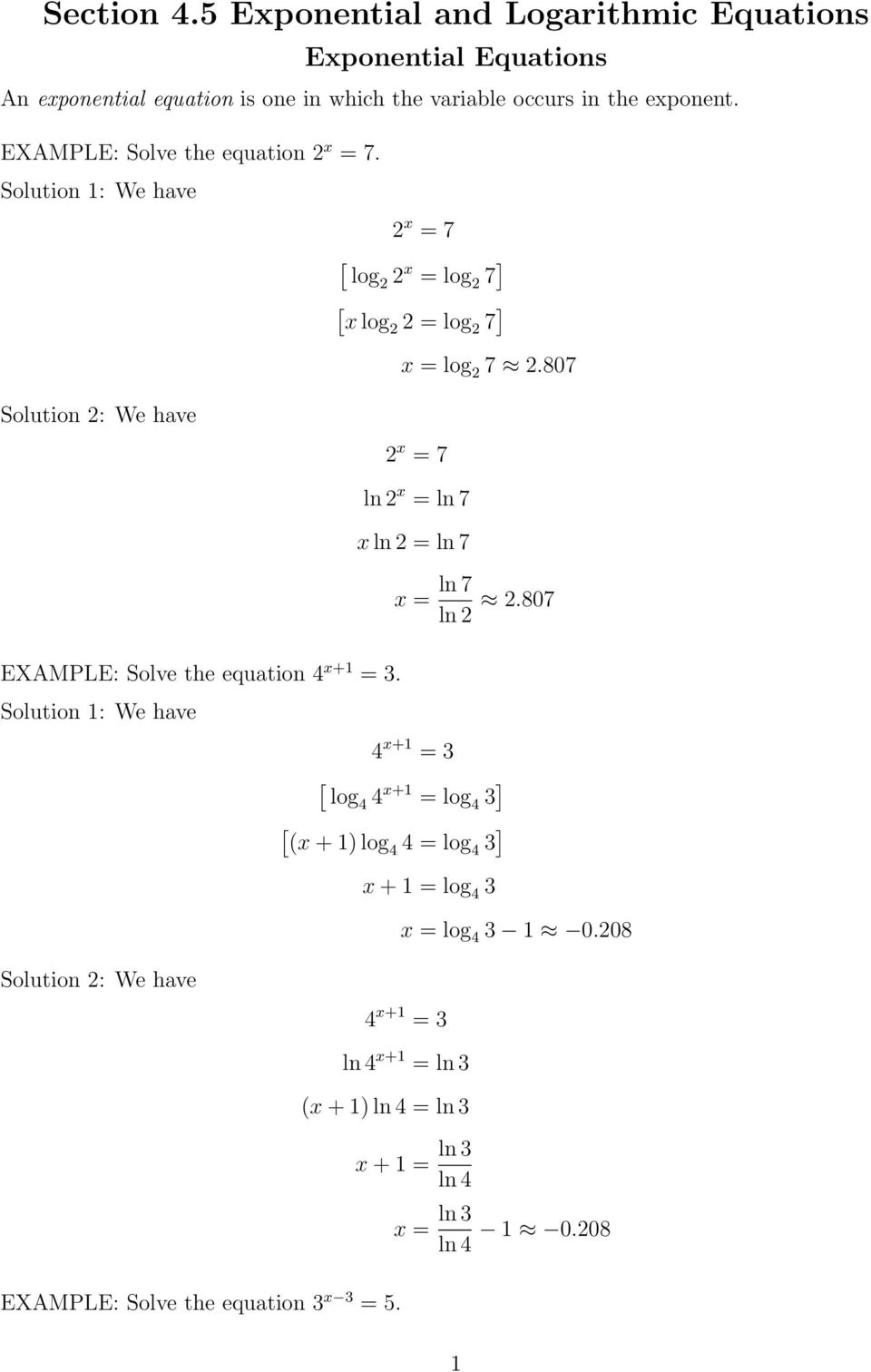
1 Section 4.5 Exponential and Logarithmic Equations Exponential Equations An exponential equation is one in which the variable occurs in the exponent. EXAMPLE: Solve the equation x = 7. Solution 1: We have x = 7 log x = log 7 ] xlog = log 7 ] Solution : We have EXAMPLE: Solve the equation 4 x+1 = 3. Solution 1: We have x = log x = 7 ln x = ln7 xln = ln7 x = ln7 ln x+1 = 3 log4 4 x+1 = log 4 3 ] (x+1)log4 4 = log 4 3 ] Solution : We have x+1 = log 4 3 x = log x+1 = 3 ln4 x+1 = ln3 (x+1)ln4 = ln3 EXAMPLE: Solve the equation 3 x 3 = 5. x+1 = ln3 ln4 x = ln ln4 1
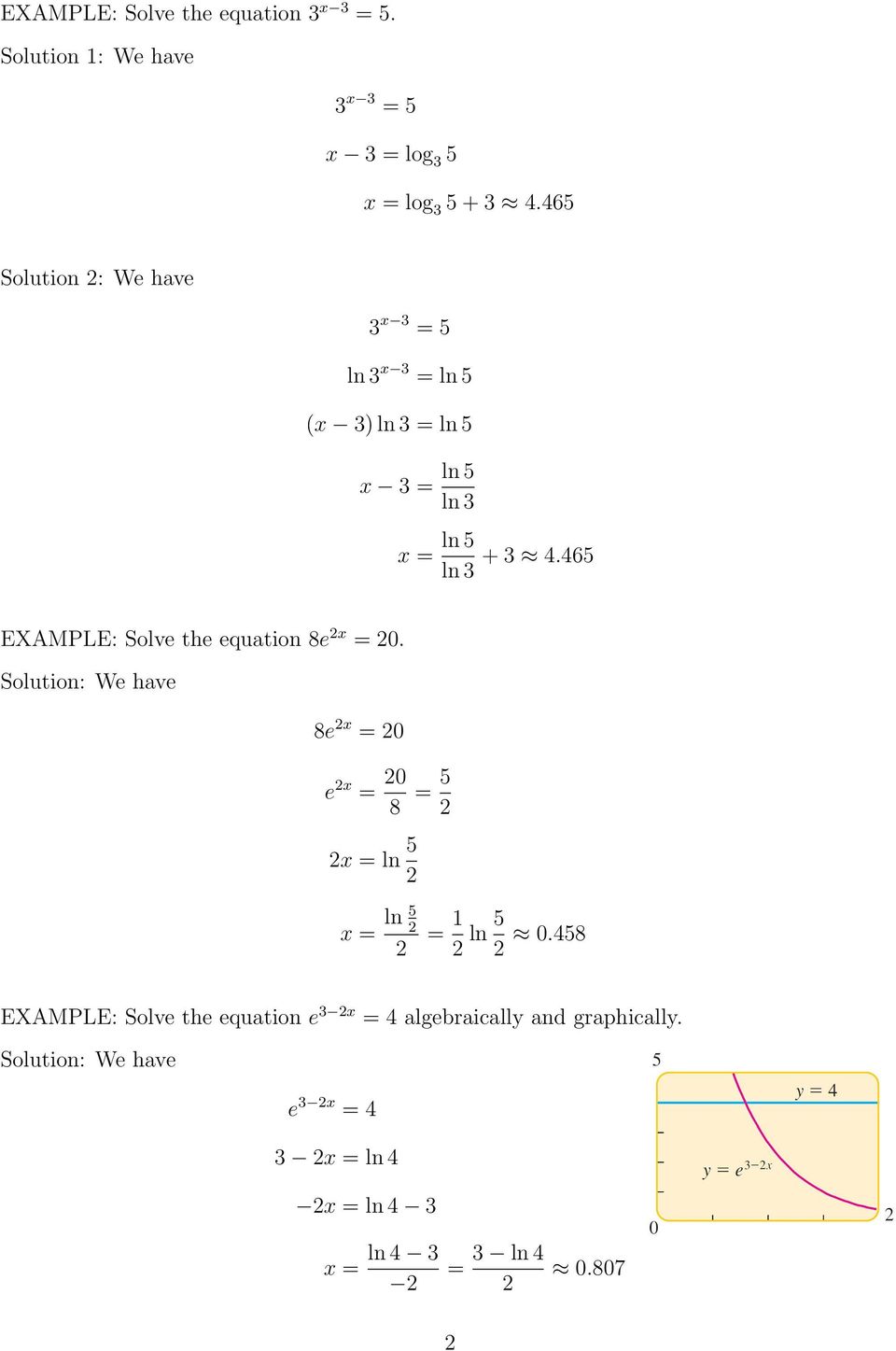
2 EXAMPLE: Solve the equation 3 x 3 = 5. Solution 1: We have 3 x 3 = 5 x 3 = log 3 5 x = log Solution : We have 3 x 3 = 5 ln3 x 3 = ln5 (x 3)ln3 = ln5 x 3 = ln5 ln3 x = ln ln3 EXAMPLE: Solve the equation 8e x = 0. 8e x = 0 e x = 0 8 = 5 x = ln 5 x = ln 5 = 1 ln EXAMPLE: Solve the equation e 3 x = 4 algebraically and graphically. e 3 x = 4 3 x = ln4 x = ln4 3 x = ln4 3 = 3 ln
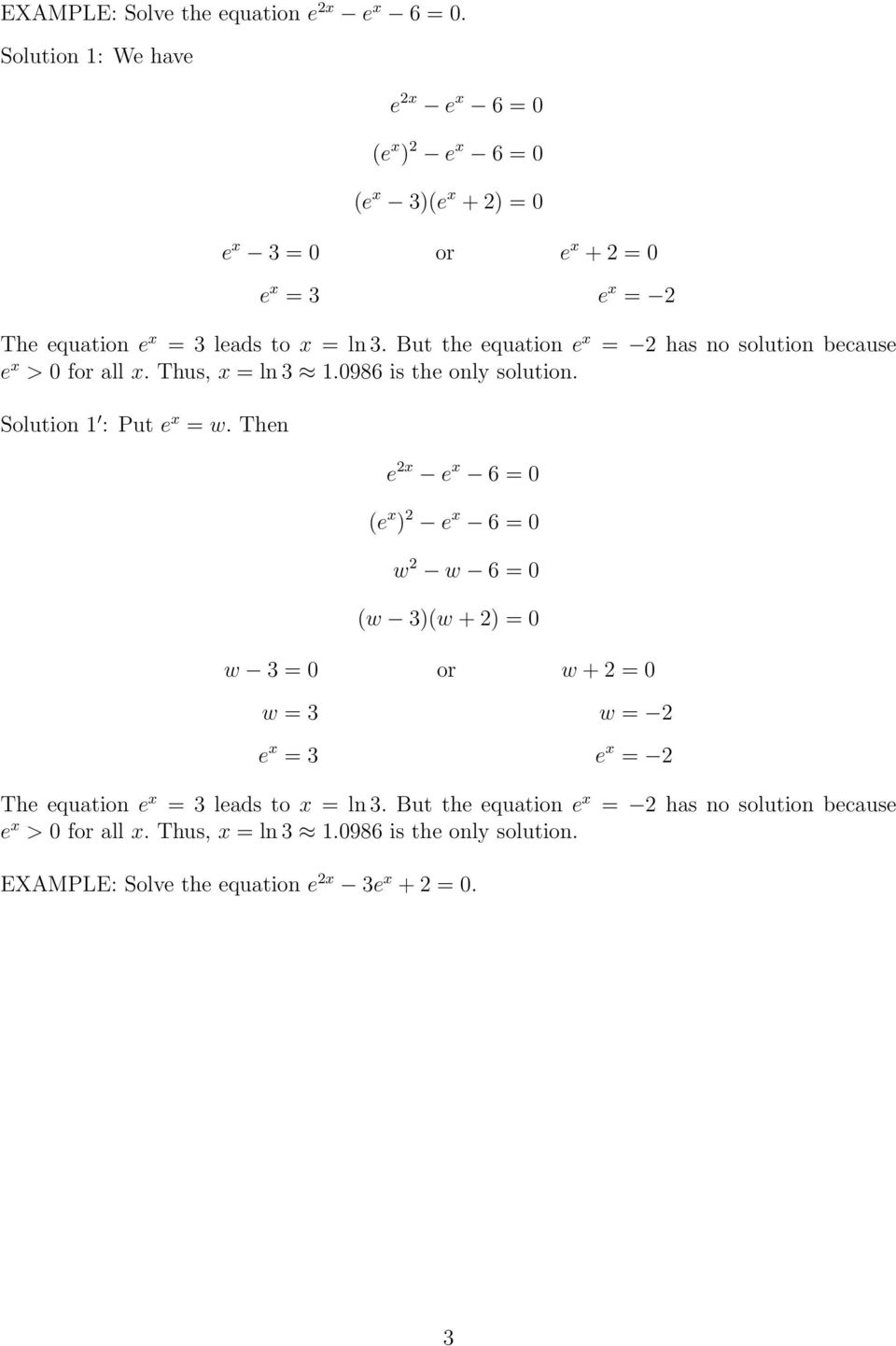
3 EXAMPLE: Solve the equation e x e x 6 = 0. Solution 1: We have e x e x 6 = 0 (e x ) e x 6 = 0 (e x 3)(e x +) = 0 e x 3 = 0 or e x + = 0 e x = 3 e x = The equation e x = 3 leads to x = ln3. But the equation e x = has no solution because e x > 0 for all x. Thus, x = ln is the only solution. Solution 1 : Put e x = w. Then e x e x 6 = 0 (e x ) e x 6 = 0 w w 6 = 0 (w 3)(w +) = 0 w 3 = 0 or w+ = 0 w = 3 e x = 3 w = e x = The equation e x = 3 leads to x = ln3. But the equation e x = has no solution because e x > 0 for all x. Thus, x = ln is the only solution. EXAMPLE: Solve the equation e x 3e x + = 0. 3
4 EXAMPLE: Solve the equation e x 3e x + = 0. Solution 1: We have e x 3e x + = 0 (e x ) 3e x + = 0 (e x 1)(e x ) = 0 e x 1 = 0 or e x = 0 e x = 1 e x = x = 0 x = ln Solution 1 : Put e x = w. Then w 3w + = 0 (w 1)(w ) = 0 w 1 = 0 or w = 0 w = 1 w = e x = 1 e x = x = 0 x = ln EXAMPLE: Solve the equation 7 x 3 7 x +1 = 0. Solution: Put 7 x = w. Then w 3w +1 = 0 = w = ( 3)± ( 3) ( so 7 x = 3± 5 3± ) 5, therefore x = log 7. = 3± 5 EXAMPLE: Solve the equation 7 x 7 x 1 = 0. Solution: Put 7 x = w. Then Since 1 5 w w 1 = 0 = w = ( 1)± ( 1) 4 1 ( 1) 1 < 0, it follows that 7 x = 1+ 5 = x = log 7 ( 1+ ) 5 = 1± 5 EXAMPLE: Solve the equation 3xe x +x e x = 0. 3xe x +x e x = 0 xe x (3+x) = 0 x(3+x) = 0 x = 0 or 3+x = 0 x = 0 x = 3 4

5 Logarithmic Equations A logarithmic equation is one in which a logarithm of the variable occurs. EXAMPLE: Solve the equation lnx = 8. lnx = 8 e lnx = e 8] x = e 8 EXAMPLE: Solve the equation log (x+) = 5. log (x+) = 5 log (x+) = 5] x+ = 5 x = 5 = 3 = 30 EXAMPLE: Solve the equation log 7 (5 x) = 3. log 7 (5 x) = 3 7 log (5 x) 7 = 7 3] 5 x = 7 3 x = = = 318 EXAMPLE: Solve the equation 4+3log(x) = 16. 5
![lnx = 8 e lnx = e 8] x = e 8 EXAMPLE: Solve the equation log (x+) = 5.](/docs-images/46/21103456/images/page_5.jpg "log (x+) = 5 log (x+) = 5] x+ = 5 x = 5 = 3 = 30 EXAMPLE: Solve the equation log 7 (5 x) = 3.")
6 EXAMPLE: Solve the equation 4+3log(x) = log(x) = 16 3log(x) = 1 log(x) = 4 x = 10 4 x = 104 = 10,000 = 5,000 EXAMPLE: Solve the equation log(x+)+log(x 1) = 1 algebraically and graphically. log(x+)+log(x 1) = 1 log(x+)(x 1)] = 1 (x+)(x 1) = 10 x +x = 10 x +x 1 = 0 (x+4)(x 3) = 0 x+4 = 0 or x 3 = 0 x = 4 x = 3 We check these potential solutions in the original equation and find that x = 4 is not a solution (because logarithms of negative numbers are undefined), but x = 3 is a solution. To solve the equation graphically we rewrite it as log(x+)+log(x 1) 1 = 0 and then graph y = log(x+)+log(x 1) 1. The solutions are the x-intercepts of the graph. EXAMPLE: Solve the following equations (a) log(x+8)+log(x 1) = 1 (b) log(x 1) log(x+1) = 3 6
![log(x+)+log(x 1) = 1 log(x+)(x 1)] = 1 (x+)(x 1) = 10 x +x = 10 x +x 1 = 0 (x+4)(x 3) = 0 x+4 = 0 or x 3 = 0 x = 4 x = 3 We check these potential solutions in the original equation and](/docs-images/46/21103456/images/page_6.jpg "find that x = 4 is not a solution (because logarithms of negative numbers are undefined), but x = 3 is a solution.")
7 EXAMPLE: Solve the following equations (a) log(x+8)+log(x 1) = 1 (b) log(x 1) log(x+1) = 3 Solution: (a) We have log(x+8)+log(x 1) = 1 log(x+8)(x 1)] = 1 (x+8)(x 1) = 10 x +7x 8 = 10 x +7x 18 = 0 (x+9)(x ) = 0 x+9 = 0 or x = 0 x = 9 x = We check these potential solutions in the original equation and find that x = 9 is not a solution (because logarithms of negative numbers are undefined), but x = is a solution. (b) We have log(x 1) log(x+1) = 3 log x 1 x+1 = 3 x 1 x+1 = 103 (x 1)(x+1) x+1 = 1000 x 1 = 1000 x = 1001 EXAMPLE: Solve the equation x = ln(x+) graphically. Solution: We first move all terms to one side of the equation x ln(x+) = 0. Then we graph y = x ln(x+). The solutions are the x-intercepts of the graph. EXAMPLE: Find the solution of the equation, correct to two decimal places. (a) 10 x+3 = 6 x (b) 5 ln(3 x) = 4 (c) log (x+)+log (x 1) = 7

8 EXAMPLE: Find the solution of the equation, correct to two decimal places. (a) 10 x+3 = 6 x (b) 5 ln(3 x) = 4 (c) log (x+)+log (x 1) = Solution: (a) We have 10 x+3 = 6 x ln10 x+3 = ln6 x (x+3)ln10 = xln6 xln10+3ln10 = xln6 xln10 xln6 = 3ln10 x(ln10 ln6) = 3ln10 x = 3ln10 ln10 ln (b) We have 5ln(3 x) = 4 ln(3 x) = x = e 4/5 x = 3 e 4/ (c) We have log (x+)+log (x 1) = log (x+)(x 1) = (x+)(x 1) = 4 x +x = 4 x +x 6 = 0 (x )(x+3) = 0 x = 0 or x+3 = 0 x = x = 3 Since x = 3 is not from the domain of log (x+)+log (x 1), the only answer is x =. 8

9 Applications EXAMPLE: If I 0 and I denote the intensity of light before and after going through a material and x is the distance (in feet) the light travels in the material, then according to the Beer- Lambert Law 1 k ln ( I I 0 ) = x where k is a constant depending on the type of material. (a) Solve the equation for I. (b) For a certain lake k = 0.05 and the light intensity is I 0 = 14 lumens (lm). Find the light intensity at a depth of 0 ft. Solution: (a) We first isolate the logarithmic term. 1 k ln ( I I 0 ) = x ( ) I ln = kx I 0 I I 0 = e kx I = I 0 e kx (b) We find I using the formula from part (a). I = I 0 e kx = 14e ( 0.05)(0) 8.49 The light intensity at a depth of 0 ft is about 8.5 lm. EXAMPLE: A sum of $5000 is invested at an interest rate of 5% per year. Find the time required for the money to double if the interest is compounded according to the following method. (a) Semiannual (b) Continuous 9

10 EXAMPLE: A sum of $5000 is invested at an interest rate of 5% per year. Find the time required for the money to double if the interest is compounded according to the following method. (a) Semiannual (b) Continuous Solution: (a) We use the formula for compound interest A(t) = P ( 1+ r ) nt n with P = $5000, A(t) = $10,000, r = 0.05, n = and solve the resulting exponential equation for t. ( ) t = 10,000 The money will double in years. (1.05) t = log1.05 t = log tlog1.05 = log t = log log (b) We use the formula for continuously compounded interest A(t) = Pe rt with P = $5000, A(t) = $10,000, r = 0.05 and solve the resulting exponential equation for t. 5000e 0.05t = 10,000 e 0.05t = 0.05t = ln The money will double in years. t = ln EXAMPLE: A sum of $1000 is invested at an interest rate of 4% per year. Find the time required for the amount to grow to $4000 if interest is compounded continuously. 10

11 EXAMPLE: A sum of $1000 is invested at an interest rate of 4% per year. Find the time required for the amount to grow to $4000 if interest is compounded continuously. Solution: We use the formula for continuously compounded interest A(t) = Pe rt with P = $1000, A(t) = $4000, r = 0.04 and solve the resulting exponential equation for t. 1000e 0.04t = 4000 e 0.04t = t = ln4 t = ln The amount will be $4000 in about 34 years and 8 months. 11

Logarithmic and Exponential Equations
 11.5 Logarithmic and Exponential Equations 11.5 OBJECTIVES 1. Solve a logarithmic equation 2. Solve an exponential equation 3. Solve an application involving an exponential equation Much of the importance
CHAPTER FIVE. Solutions for Section 5.1. Skill Refresher. Exercises
 CHAPTER FIVE 5.1 SOLUTIONS 265 Solutions for Section 5.1 Skill Refresher S1. Since 1,000,000 = 10 6, we have x = 6. S2. Since 0.01 = 10 2, we have t = 2. S3. Since e 3 = ( e 3) 1/2 = e 3/2, we have z =
MAT12X Intermediate Algebra
 MAT12X Intermediate Algebra Workshop I - Exponential Functions LEARNING CENTER Overview Workshop I Exponential Functions of the form y = ab x Properties of the increasing and decreasing exponential functions
Simplify the rational expression. Find all numbers that must be excluded from the domain of the simplified rational expression.
 MAC 1105 Final Review Simplify the rational expression. Find all numbers that must be excluded from the domain of the simplified rational expression. 1) 8x 2-49x + 6 x - 6 A) 1, x 6 B) 8x - 1, x 6 x -
6.4 Logarithmic Equations and Inequalities
 6.4 Logarithmic Equations and Inequalities 459 6.4 Logarithmic Equations and Inequalities In Section 6.3 we solved equations and inequalities involving exponential functions using one of two basic strategies.
a. all of the above b. none of the above c. B, C, D, and F d. C, D, F e. C only f. C and F
 FINAL REVIEW WORKSHEET COLLEGE ALGEBRA Chapter 1. 1. Given the following equations, which are functions? (A) y 2 = 1 x 2 (B) y = 9 (C) y = x 3 5x (D) 5x + 2y = 10 (E) y = ± 1 2x (F) y = 3 x + 5 a. all
12.6 Logarithmic and Exponential Equations PREPARING FOR THIS SECTION Before getting started, review the following:
 Section 1.6 Logarithmic and Exponential Equations 811 1.6 Logarithmic and Exponential Equations PREPARING FOR THIS SECTION Before getting started, review the following: Solve Quadratic Equations (Section
Section 4-7 Exponential and Logarithmic Equations. Solving an Exponential Equation. log 2. 3 2 log 5. log 2 1.4406
 314 4 INVERSE FUNCTIONS; EXPONENTIAL AND LOGARITHMIC FUNCTIONS Section 4-7 Exponential and Logarithmic Equations Exponential Equations Logarithmic Equations Change of Base Equations involving exponential
Math 120 Final Exam Practice Problems, Form: A
 Math 120 Final Exam Practice Problems, Form: A Name: While every attempt was made to be complete in the types of problems given below, we make no guarantees about the completeness of the problems. Specifically,
Solving Exponential Equations
 Solving Exponential Equations Deciding How to Solve Exponential Equations When asked to solve an exponential equation such as x + 6 = or x = 18, the first thing we need to do is to decide which way is
Solving Compound Interest Problems
 Solving Compound Interest Problems What is Compound Interest? If you walk into a bank and open up a savings account you will earn interest on the money you deposit in the bank. If the interest is calculated
College Algebra. George Voutsadakis 1. LSSU Math 111. Lake Superior State University. 1 Mathematics and Computer Science
 College Algebra George Voutsadakis 1 1 Mathematics and Computer Science Lake Superior State University LSSU Math 111 George Voutsadakis (LSSU) College Algebra December 2014 1 / 91 Outline 1 Exponential
Equations. #1-10 Solve for the variable. Inequalities. 1. Solve the inequality: 2 5 7. 2. Solve the inequality: 4 0
 College Algebra Review Problems for Final Exam Equations #1-10 Solve for the variable 1. 2 1 4 = 0 6. 2 8 7 2. 2 5 3 7. = 3. 3 9 4 21 8. 3 6 9 18 4. 6 27 0 9. 1 + log 3 4 5. 10. 19 0 Inequalities 1. Solve
Section 1. Logarithms
 Worksheet 2.7 Logarithms and Exponentials Section 1 Logarithms The mathematics of logarithms and exponentials occurs naturally in many branches of science. It is very important in solving problems related
FINAL EXAM SECTIONS AND OBJECTIVES FOR COLLEGE ALGEBRA
 FINAL EXAM SECTIONS AND OBJECTIVES FOR COLLEGE ALGEBRA 1.1 Solve linear equations and equations that lead to linear equations. a) Solve the equation: 1 (x + 5) 4 = 1 (2x 1) 2 3 b) Solve the equation: 3x
LESSON EIII.E EXPONENTS AND LOGARITHMS
 LESSON EIII.E EXPONENTS AND LOGARITHMS LESSON EIII.E EXPONENTS AND LOGARITHMS OVERVIEW Here s what ou ll learn in this lesson: Eponential Functions a. Graphing eponential functions b. Applications of eponential
100. In general, we can define this as if b x = a then x = log b
 Exponents and Logarithms Review 1. Solving exponential equations: Solve : a)8 x = 4! x! 3 b)3 x+1 + 9 x = 18 c)3x 3 = 1 3. Recall: Terminology of Logarithms If 10 x = 100 then of course, x =. However,
8.7 Exponential Growth and Decay
 Section 8.7 Exponential Growth and Decay 847 8.7 Exponential Growth and Decay Exponential Growth Models Recalling the investigations in Section 8.3, we started by developing a formula for discrete compound
Pre-Session Review. Part 2: Mathematics of Finance
 Pre-Session Review Part 2: Mathematics of Finance For this section you will need a calculator with logarithmic and exponential function keys (such as log, ln, and x y ) D. Exponential and Logarithmic Functions
Solutions to Exercises, Section 4.5
 Instructor s Solutions Manual, Section 4.5 Exercise 1 Solutions to Exercises, Section 4.5 1. How much would an initial amount of $2000, compounded continuously at 6% annual interest, become after 25 years?
Solving DEs by Separation of Variables.
 Solving DEs by Separation of Variables. Introduction and procedure Separation of variables allows us to solve differential equations of the form The steps to solving such DEs are as follows: dx = gx).
Inverse Functions and Logarithms
 Section 3. Inverse Functions and Logarithms 1 Kiryl Tsishchanka Inverse Functions and Logarithms DEFINITION: A function f is called a one-to-one function if it never takes on the same value twice; that
Assessment Schedule 2013
 NCEA Level Mathematics (9161) 013 page 1 of 5 Assessment Schedule 013 Mathematics with Statistics: Apply algebraic methods in solving problems (9161) Evidence Statement ONE Expected Coverage Merit Excellence
MPE Review Section III: Logarithmic & Exponential Functions
 MPE Review Section III: Logarithmic & Eponential Functions FUNCTIONS AND GRAPHS To specify a function y f (, one must give a collection of numbers D, called the domain of the function, and a procedure
Vocabulary Words and Definitions for Algebra
 Name: Period: Vocabulary Words and s for Algebra Absolute Value Additive Inverse Algebraic Expression Ascending Order Associative Property Axis of Symmetry Base Binomial Coefficient Combine Like Terms
Week 2: Exponential Functions
 Week 2: Exponential Functions Goals: Introduce exponential functions Study the compounded interest and introduce the number e Suggested Textbook Readings: Chapter 4: 4.1, and Chapter 5: 5.1. Practice Problems:
Chapter 7 Outline Math 236 Spring 2001
 Chapter 7 Outline Math 236 Spring 2001 Note 1: Be sure to read the Disclaimer on Chapter Outlines! I cannot be responsible for misfortunes that may happen to you if you do not. Note 2: Section 7.9 will
ALGEBRA REVIEW LEARNING SKILLS CENTER. Exponents & Radicals
 ALGEBRA REVIEW LEARNING SKILLS CENTER The "Review Series in Algebra" is taught at the beginning of each quarter by the staff of the Learning Skills Center at UC Davis. This workshop is intended to be an
3.2 LOGARITHMIC FUNCTIONS AND THEIR GRAPHS. Copyright Cengage Learning. All rights reserved.
 3.2 LOGARITHMIC FUNCTIONS AND THEIR GRAPHS Copyright Cengage Learning. All rights reserved. What You Should Learn Recognize and evaluate logarithmic functions with base a. Graph logarithmic functions.
10.6 Functions - Compound Interest
 10.6 Functions - Compound Interest Objective: Calculate final account balances using the formulas for compound and continuous interest. An application of exponential functions is compound interest. When
1.3 Algebraic Expressions
 1.3 Algebraic Expressions A polynomial is an expression of the form: a n x n + a n 1 x n 1 +... + a 2 x 2 + a 1 x + a 0 The numbers a 1, a 2,..., a n are called coefficients. Each of the separate parts,
4.6 Exponential and Logarithmic Equations (Part I)
 4.6 Eponential and Logarithmic Equations (Part I) In this section you will learn to: solve eponential equations using like ases solve eponential equations using logarithms solve logarithmic equations using
MBA Jump Start Program
 MBA Jump Start Program Module 2: Mathematics Thomas Gilbert Mathematics Module Online Appendix: Basic Mathematical Concepts 2 1 The Number Spectrum Generally we depict numbers increasing from left to right
List the elements of the given set that are natural numbers, integers, rational numbers, and irrational numbers. (Enter your answers as commaseparated
 MATH 142 Review #1 (4717995) Question 1 2 3 4 5 6 7 8 9 10 11 12 13 14 15 16 17 18 19 20 21 22 23 24 25 26 27 28 29 30 31 Description This is the review for Exam #1. Please work as many problems as possible
Nominal and Real U.S. GDP 1960-2001
 Problem Set #5-Key Sonoma State University Dr. Cuellar Economics 318- Managerial Economics Use the data set for gross domestic product (gdp.xls) to answer the following questions. (1) Show graphically
Compound Interest. Invest 500 that earns 10% interest each year for 3 years, where each interest payment is reinvested at the same rate:
 Compound Interest Invest 500 that earns 10% interest each year for 3 years, where each interest payment is reinvested at the same rate: Table 1 Development of Nominal Payments and the Terminal Value, S.
What are the place values to the left of the decimal point and their associated powers of ten?
 The verbal answers to all of the following questions should be memorized before completion of algebra. Answers that are not memorized will hinder your ability to succeed in geometry and algebra. (Everything
4.1 INTRODUCTION TO THE FAMILY OF EXPONENTIAL FUNCTIONS
 Functions Modeling Change: A Preparation for Calculus, 4th Edition, 2011, Connally 4.1 INTRODUCTION TO THE FAMILY OF EXPONENTIAL FUNCTIONS Functions Modeling Change: A Preparation for Calculus, 4th Edition,
Higher Education Math Placement
 Higher Education Math Placement Placement Assessment Problem Types 1. Whole Numbers, Fractions, and Decimals 1.1 Operations with Whole Numbers Addition with carry Subtraction with borrowing Multiplication
Chemical Kinetics. Reaction Rate: The change in the concentration of a reactant or a product with time (M/s). Reactant Products A B
 Reaction Rates: Chemical Kinetics Reaction Rate: The change in the concentration of a reactant or a product with time (M/s). Reactant Products A B change in number of moles of B Average rate = change in
2312 test 2 Fall 2010 Form B
 2312 test 2 Fall 2010 Form B 1. Write the slope-intercept form of the equation of the line through the given point perpendicular to the given lin point: ( 7, 8) line: 9x 45y = 9 2. Evaluate the function
Lecture 3 : The Natural Exponential Function: f(x) = exp(x) = e x. y = exp(x) if and only if x = ln(y)
 Lecture 3 : The Natural Exponential Function: f(x) = exp(x) = Last day, we saw that the function f(x) = ln x is one-to-one, with domain (, ) and range (, ). We can conclude that f(x) has an inverse function
 Logarithms f a>1or0
 Mathematics Pre-Test Sample Questions A. { 11, 7} B. { 7,0,7} C. { 7, 7} D. { 11, 11}
 Mathematics Pre-Test Sample Questions 1. Which of the following sets is closed under division? I. {½, 1,, 4} II. {-1, 1} III. {-1, 0, 1} A. I only B. II only C. III only D. I and II. Which of the following
Some Lecture Notes and In-Class Examples for Pre-Calculus:
 Some Lecture Notes and In-Class Examples for Pre-Calculus: Section.7 Definition of a Quadratic Inequality A quadratic inequality is any inequality that can be put in one of the forms ax + bx + c < 0 ax
eday Lessons HSCC Precalculus Logarithims F-LE 4, BF-B 5 11/2014 E-Lesson 1
 eday Lessons HSCC Precalculus Logarithims F-LE 4, BF-B 5 11/2014 E-Lesson 1 Enclosed are the E-Day assignments required to make up the 3 calamity days missed during the 2014-2015 school year for High School
1. Then f has a relative maximum at x = c if f(c) f(x) for all values of x in some
 Section 3.1: First Derivative Test Definition. Let f be a function with domain D. 1. Then f has a relative maximum at x = c if f(c) f(x) for all values of x in some open interval containing c. The number
$496. 80. Example If you can earn 6% interest, what lump sum must be deposited now so that its value will be $3500 after 9 months?
 Simple Interest, Compound Interest, and Effective Yield Simple Interest The formula that gives the amount of simple interest (also known as add-on interest) owed on a Principal P (also known as present
MATH 34A REVIEW FOR MIDTERM 2, WINTER 2012. 1. Lines. (1) Find the equation of the line passing through (2,-1) and (-2,9). y = 5
 MATH 34A REVIEW FOR MIDTERM 2, WINTER 2012 ANSWERS 1. Lines (1) Find the equation of the line passing through (2,-1) and (-2,9). y = 5 2 x + 4. (2) Find the equation of the line which meets the x-axis
Solving Rational Equations and Inequalities
 8-5 Solving Rational Equations and Inequalities TEKS 2A.10.D Rational functions: determine the solutions of rational equations using graphs, tables, and algebraic methods. Objective Solve rational equations
Homework # 3 Solutions
 Homework # 3 Solutions February, 200 Solution (2.3.5). Noting that and ( + 3 x) x 8 = + 3 x) by Equation (2.3.) x 8 x 8 = + 3 8 by Equations (2.3.7) and (2.3.0) =3 x 8 6x2 + x 3 ) = 2 + 6x 2 + x 3 x 8
MTH 100 College Algebra Essex County College Division of Mathematics Sample Review Questions 1 Created June 6, 2011
 MTH 00 College Algebra Essex County College Division of Mathematics Sample Review Questions Created June 6, 0 Math 00, Introductory College Mathematics, covers the mathematical content listed below. In
Dimensional Analysis and Exponential Models
 MAT 42 College Mathematics Module XP Dimensional Analysis and Exponential Models Terri Miller revised December 3, 200. Dimensional Analysis The purpose of this section is to convert between various types
MA107 Precalculus Algebra Exam 2 Review Solutions
 MA107 Precalculus Algebra Exam 2 Review Solutions February 24, 2008 1. The following demand equation models the number of units sold, x, of a product as a function of price, p. x = 4p + 200 a. Please write
1.2 GRAPHS OF EQUATIONS. Copyright Cengage Learning. All rights reserved.
 1.2 GRAPHS OF EQUATIONS Copyright Cengage Learning. All rights reserved. What You Should Learn Sketch graphs of equations. Find x- and y-intercepts of graphs of equations. Use symmetry to sketch graphs
A.2. Exponents and Radicals. Integer Exponents. What you should learn. Exponential Notation. Why you should learn it. Properties of Exponents
 Appendix A. Exponents and Radicals A11 A. Exponents and Radicals What you should learn Use properties of exponents. Use scientific notation to represent real numbers. Use properties of radicals. Simplify
With compound interest you earn an additional $128.89 ($1628.89 - $1500).
 Compound Interest Interest is the amount you receive for lending money (making an investment) or the fee you pay for borrowing money. Compound interest is interest that is calculated using both the principle
E INV 1 AM 11 Name: INTEREST. There are two types of Interest : and. The formula is. I is. P is. r is. t is
 E INV 1 AM 11 Name: INTEREST There are two types of Interest : and. SIMPLE INTEREST The formula is I is P is r is t is NOTE: For 8% use r =, for 12% use r =, for 2.5% use r = NOTE: For 6 months use t =
Sample Problems. Practice Problems
 Lecture Notes Quadratic Word Problems page 1 Sample Problems 1. The sum of two numbers is 31, their di erence is 41. Find these numbers.. The product of two numbers is 640. Their di erence is 1. Find these
Dimensional Analysis; Exponential and Logarithmic Growth/Decay
 MAT 42 College Mathematics Module #5 Dimensional Analysis; Exponential and Logarithmic Growth/Decay Terri Miller Spring 2009 revised November 7, 2009. Dimensional Analysis The purpose of this section is
Exponential and Logarithmic Functions
 Chapter 6 Eponential and Logarithmic Functions Section summaries Section 6.1 Composite Functions Some functions are constructed in several steps, where each of the individual steps is a function. For eample,
Answer Key for California State Standards: Algebra I
 Algebra I: Symbolic reasoning and calculations with symbols are central in algebra. Through the study of algebra, a student develops an understanding of the symbolic language of mathematics and the sciences.
QUADRATIC, EXPONENTIAL AND LOGARITHMIC FUNCTIONS
 QUADRATIC, EXPONENTIAL AND LOGARITHMIC FUNCTIONS Content 1. Parabolas... 1 1.1. Top of a parabola... 2 1.2. Orientation of a parabola... 2 1.3. Intercept of a parabola... 3 1.4. Roots (or zeros) of a parabola...
This is a square root. The number under the radical is 9. (An asterisk * means multiply.)
 Page of Review of Radical Expressions and Equations Skills involving radicals can be divided into the following groups: Evaluate square roots or higher order roots. Simplify radical expressions. Rationalize
Review of Intermediate Algebra Content
 Review of Intermediate Algebra Content Table of Contents Page Factoring GCF and Trinomials of the Form + b + c... Factoring Trinomials of the Form a + b + c... Factoring Perfect Square Trinomials... 6
SOLVING EQUATIONS WITH RADICALS AND EXPONENTS 9.5. section ( 3 5 3 2 )( 3 25 3 10 3 4 ). The Odd-Root Property
 498 (9 3) Chapter 9 Radicals and Rational Exponents Replace the question mark by an expression that makes the equation correct. Equations involving variables are to be identities. 75. 6 76. 3?? 1 77. 1
SOLVING EQUATIONS WITH EXCEL
 SOLVING EQUATIONS WITH EXCEL Excel and Lotus software are equipped with functions that allow the user to identify the root of an equation. By root, we mean the values of x such that a given equation cancels
FACTORING QUADRATICS 8.1.1 and 8.1.2
 FACTORING QUADRATICS 8.1.1 and 8.1.2 Chapter 8 introduces students to quadratic equations. These equations can be written in the form of y = ax 2 + bx + c and, when graphed, produce a curve called a parabola.
Microeconomic Theory: Basic Math Concepts
 Microeconomic Theory: Basic Math Concepts Matt Van Essen University of Alabama Van Essen (U of A) Basic Math Concepts 1 / 66 Basic Math Concepts In this lecture we will review some basic mathematical concepts
1 Lecture: Integration of rational functions by decomposition
 Lecture: Integration of rational functions by decomposition into partial fractions Recognize and integrate basic rational functions, except when the denominator is a power of an irreducible quadratic.
Algebra I Vocabulary Cards
 Algebra I Vocabulary Cards Table of Contents Expressions and Operations Natural Numbers Whole Numbers Integers Rational Numbers Irrational Numbers Real Numbers Absolute Value Order of Operations Expression
For additional information, see the Math Notes boxes in Lesson B.1.3 and B.2.3.
 EXPONENTIAL FUNCTIONS B.1.1 B.1.6 In these sections, students generalize what they have learned about geometric sequences to investigate exponential functions. Students study exponential functions of the
Math Review. for the Quantitative Reasoning Measure of the GRE revised General Test
 Math Review for the Quantitative Reasoning Measure of the GRE revised General Test www.ets.org Overview This Math Review will familiarize you with the mathematical skills and concepts that are important
Algebra. Exponents. Absolute Value. Simplify each of the following as much as possible. 2x y x + y y. xxx 3. x x x xx x. 1. Evaluate 5 and 123
 Algebra Eponents Simplify each of the following as much as possible. 1 4 9 4 y + y y. 1 5. 1 5 4. y + y 4 5 6 5. + 1 4 9 10 1 7 9 0 Absolute Value Evaluate 5 and 1. Eliminate the absolute value bars from
5.1 Radical Notation and Rational Exponents
 Section 5.1 Radical Notation and Rational Exponents 1 5.1 Radical Notation and Rational Exponents We now review how exponents can be used to describe not only powers (such as 5 2 and 2 3 ), but also roots
COMPETENCY TEST SAMPLE TEST. A scientific, non-graphing calculator is required for this test. C = pd or. A = pr 2. A = 1 2 bh
 BASIC MATHEMATICS COMPETENCY TEST SAMPLE TEST 2004 A scientific, non-graphing calculator is required for this test. The following formulas may be used on this test: Circumference of a circle: C = pd or
Also, compositions of an exponential function with another function are also referred to as exponential. An example would be f(x) = 4 + 100 3-2x.
 Exponential Functions Exponential functions are perhaps the most important class of functions in mathematics. We use this type of function to calculate interest on investments, growth and decline rates
3.2. Solving quadratic equations. Introduction. Prerequisites. Learning Outcomes. Learning Style
 Solving quadratic equations 3.2 Introduction A quadratic equation is one which can be written in the form ax 2 + bx + c = 0 where a, b and c are numbers and x is the unknown whose value(s) we wish to find.
Students Currently in Algebra 2 Maine East Math Placement Exam Review Problems
 Students Currently in Algebra Maine East Math Placement Eam Review Problems The actual placement eam has 100 questions 3 hours. The placement eam is free response students must solve questions and write
Factoring Polynomials
 UNIT 11 Factoring Polynomials You can use polynomials to describe framing for art. 396 Unit 11 factoring polynomials A polynomial is an expression that has variables that represent numbers. A number can
Midterm 2 Review Problems (the first 7 pages) Math 123-5116 Intermediate Algebra Online Spring 2013
 Midterm Review Problems (the first 7 pages) Math 1-5116 Intermediate Algebra Online Spring 01 Please note that these review problems are due on the day of the midterm, Friday, April 1, 01 at 6 p.m. in
ALGEBRA 2: 4.1 Graph Quadratic Functions in Standard Form
 ALGEBRA 2: 4.1 Graph Quadratic Functions in Standard Form Goal Graph quadratic functions. VOCABULARY Quadratic function A function that can be written in the standard form y = ax 2 + bx+ c where a 0 Parabola
Core Maths C3. Revision Notes
 Core Maths C Revision Notes October 0 Core Maths C Algebraic fractions... Cancelling common factors... Multipling and dividing fractions... Adding and subtracting fractions... Equations... 4 Functions...
Absolute Value Equations and Inequalities
 Key Concepts: Compound Inequalities Absolute Value Equations and Inequalities Intersections and unions Suppose that A and B are two sets of numbers. The intersection of A and B is the set of all numbers
Functions. MATH 160, Precalculus. J. Robert Buchanan. Fall 2011. Department of Mathematics. J. Robert Buchanan Functions
 Functions MATH 160, Precalculus J. Robert Buchanan Department of Mathematics Fall 2011 Objectives In this lesson we will learn to: determine whether relations between variables are functions, use function
MATH 60 NOTEBOOK CERTIFICATIONS
 MATH 60 NOTEBOOK CERTIFICATIONS Chapter #1: Integers and Real Numbers 1.1a 1.1b 1.2 1.3 1.4 1.8 Chapter #2: Algebraic Expressions, Linear Equations, and Applications 2.1a 2.1b 2.1c 2.2 2.3a 2.3b 2.4 2.5
Zeros of Polynomial Functions
 Zeros of Polynomial Functions The Rational Zero Theorem If f (x) = a n x n + a n-1 x n-1 + + a 1 x + a 0 has integer coefficients and p/q (where p/q is reduced) is a rational zero, then p is a factor of
PRE-CALCULUS GRADE 12
 PRE-CALCULUS GRADE 12 [C] Communication Trigonometry General Outcome: Develop trigonometric reasoning. A1. Demonstrate an understanding of angles in standard position, expressed in degrees and radians.
Section 1. Inequalities -5-4 -3-2 -1 0 1 2 3 4 5
 Worksheet 2.4 Introduction to Inequalities Section 1 Inequalities The sign < stands for less than. It was introduced so that we could write in shorthand things like 3 is less than 5. This becomes 3 < 5.
Algebra 2: Themes for the Big Final Exam
 Algebra : Themes for the Big Final Exam Final will cover the whole year, focusing on the big main ideas. Graphing: Overall: x and y intercepts, fct vs relation, fct vs inverse, x, y and origin symmetries,
Plot the following two points on a graph and draw the line that passes through those two points. Find the rise, run and slope of that line.
 Objective # 6 Finding the slope of a line Material: page 117 to 121 Homework: worksheet NOTE: When we say line... we mean straight line! Slope of a line: It is a number that represents the slant of a line
2.1 Increasing, Decreasing, and Piecewise Functions; Applications
 2.1 Increasing, Decreasing, and Piecewise Functions; Applications Graph functions, looking for intervals on which the function is increasing, decreasing, or constant, and estimate relative maxima and minima.
Algebra 2 Unit 8 (Chapter 7) CALCULATORS ARE NOT ALLOWED
 Algebra Unit 8 (Chapter 7) CALCULATORS ARE NOT ALLOWED. Graph eponential functions. (Sections 7., 7.) Worksheet 6. Solve eponential growth and eponential decay problems. (Sections 7., 7.) Worksheet 8.
SUFFOLK COMMUNITY COLLEGE MATHEMATICS AND COMPUTER SCIENCE DEPARTMENT STUDENT COURSE OUTLINE Fall 2011
 SUFFOLK COMMUNITY COLLEGE MATHEMATICS AND COMPUTER SCIENCE DEPARTMENT STUDENT COURSE OUTLINE Fall 2011 INSTRUCTOR: Professor Emeritus Donald R. Coscia OFFICE: Online COURSE: MAT111-Algebra II SECTION &
9.2 Summation Notation
 9. Summation Notation 66 9. Summation Notation In the previous section, we introduced sequences and now we shall present notation and theorems concerning the sum of terms of a sequence. We begin with a
Materials: #9-1 exploration answers overhead; Do Now and answers overhead; note-taking templates; practice worksheet; homework #9-2
 Pre-AP Algebra 2 Unit 9 - Lesson 2 Introduction to Logarithms Objectives: Students will be able to convert between exponential and logarithmic forms of an expression, including the use of the common log.
GRE Prep: Precalculus
 GRE Prep: Precalculus Franklin H.J. Kenter 1 Introduction These are the notes for the Precalculus section for the GRE Prep session held at UCSD in August 2011. These notes are in no way intended to teach
Section 3.1 Quadratic Functions and Models
 Section 3.1 Quadratic Functions and Models DEFINITION: A quadratic function is a function f of the form fx) = ax 2 +bx+c where a,b, and c are real numbers and a 0. Graphing Quadratic Functions Using the
How do you compare numbers? On a number line, larger numbers are to the right and smaller numbers are to the left.
 The verbal answers to all of the following questions should be memorized before completion of pre-algebra. Answers that are not memorized will hinder your ability to succeed in algebra 1. Number Basics
a b c d e You have two hours to do this exam. Please write your name on this page, and at the top of page three. GOOD LUCK! 3. a b c d e 12.
 MA123 Elem. Calculus Fall 2015 Exam 2 2015-10-22 Name: Sec.: Do not remove this answer page you will turn in the entire exam. No books or notes may be used. You may use an ACT-approved calculator during