
AP Biology 2011 Scoring Guidelines Form B
|
|
|
- Madeleine Richards
- 9 years ago
- Views:
Transcription
1 AP Biology 2011 Scoring Guidelines Form B The College Board The College Board is a not-for-profit membership association whose mission is to connect students to college success and opportunity. Founded in 1900, the College Board is composed of more than 5,700 schools, colleges, universities and other educational organizations. Each year, the College Board serves seven million students and their parents, 23,000 high schools, and 3,800 colleges through major programs and services in college readiness, college admission, guidance, assessment, financial aid and enrollment. Among its widely recognized programs are the SAT, the PSAT/NMSQT, the Advanced Placement Program (AP ), SpringBoard and ACCUPLACER. The College Board is committed to the principles of excellence and equity, and that commitment is embodied in all of its programs, services, activities and concerns. College Board, ACCUPLACER, Advanced Placement Program, AP, AP Central, SAT, SpringBoard and the acorn logo are registered trademarks of the College Board. Admitted Class Evaluation Service is a trademark owned by the College Board. PSAT/NMSQT is a registered trademark of the College Board and National Merit Scholarship Corporation. All other products and services may be trademarks of their respective owners. Permission to use copyrighted College Board materials may be requested online at: AP Central is the official online home for the AP Program: apcentral.collegeboard.com.

2 Question 1 The cell cycle is fundamental to the reproduction of eukaryotic cells. (a) Describe the phases of the cell cycle. (6 points maximum) Correct order of cycle phases (1 point for entire correct list) Interphase Prophase (Prometaphase) Metaphase Anaphase Telophase Cytokinesis OR G1 S G2 M Correct description of at least one important structural or molecular characteristic of each phase (1 point each; 5 points maximum) Interphase (including, if specified, G 1, S, G 2 subphases, correctly ordered): Chromatin dispersed in nucleus; nuclear envelope and nucleoli are intact and functional; DNA is replicated here. G1, G2: Cell growth. S: DNA replication. Mitosis: Nuclear division. Prophase: Chromosomes begin to condense from chromatin; spindle apparatus assembled. (Prometaphase): Nuclear envelope disperses, nucleoli disperse, chromosomes connect to spindle apparatus fibers and begin to show motility. Metaphase: Chromosomes reach maximum condensation and align on metaphase plate/plane. Anaphase: Two-chromatid chromosomes split into two daughter (one-chromatid) chromosomes; chromosomes move to opposite poles of the spindle apparatus. Telophase: Chromosomes disperse back to chromatin form, nuclear envelope reassembles, nucleoli reassemble. Cytokinesis: If this occurs, it is normally coordinated with telophase; cell division. (b) Explain the role of THREE of the following in mitosis or cytokinesis. (3 points maximum) Kinetochores Microtubules Motor proteins Actin filaments Correct explanation of function (1 point each; if all four are chosen, only the first three are scored) Kinetochores: Located in centromeres of condensed chromosomes; microtubule attachment sites necessary for chromosome positioning and movement. Microtubules: Fundamental structural element of the spindle apparatus; framework on which chromosome motility is generated; define axis of division and cytokinesis. Motor proteins (correct location and function must be specified): In kinetochores, move chromosomes during mitosis, including anaphase separation; involves kinesins and dyneins. OR In animal cell cleavage furrow, generate force to pinch cell in two; involves myosins. Actin filaments: Assemble under the membrane at the cytokinesis site; interact with myosin motor proteins to generate force to pinch cell in two; also interact with astral microtubules of the spindle to position the spindle apparatus in the cell.

3 Question 1 (continued) (c) Describe how the cell cycle is regulated and discuss ONE consequence of abnormal regulation. (3 points maximum) Regulation: Correct description of checkpoints, which block cell cycle progress unless specific molecular and/or physical conditions are satisfied (1 point each; 2 points maximum) Action of MPF and CDKs in checkpoint regulation Contact inhibition of mitosis Hormones; growth factor control of cell cycle activity Correct discussion of the consequences of abnormal cell cycle regulation (1 point maximum) Uncontrolled cell proliferation, as in cancer Apoptosis Non-disjunction/aneuploidy/broken chromosomes from abnormal spindle events

4 Question 2 Ecological succession describes the pattern of changes in communities over time. The graph below shows changes in plant diversity following the abandonment of an agricultural field in a temperate biome. (a) Discuss the differences in plant diversity shown in the graph and explain how the changes affect the animal species composition between years 0 and 120. (4 points maximum) Discussion of differences in diversity shown in the graph (2 points maximum) Differences in the amount of diversity o More diversity in ground flora and shrubs o Less diversity in understory and canopy Differences in the rate of change in diversity o Rapid change in ground flora and shrubs o Slow change in understory and canopy Differences in the rate to community stabilization o Faster for ground flora o Slower for understory and canopy Explanation of effect on animal species composition (2 points maximum) Pioneer community consists of small herbivores, insects, and other small, ground-dwelling animals. Climax community consists of insects, birds, and mammals and is multilayered. (b) Identify TWO biotic and TWO abiotic factors and discuss how each could influence the pattern of ecological succession. (4 points maximum) Examples of biotic factors (1 point for each identification and 1 point for each appropriate discussion of its influence on succession; 2 points maximum) Competition Predation Herbivory

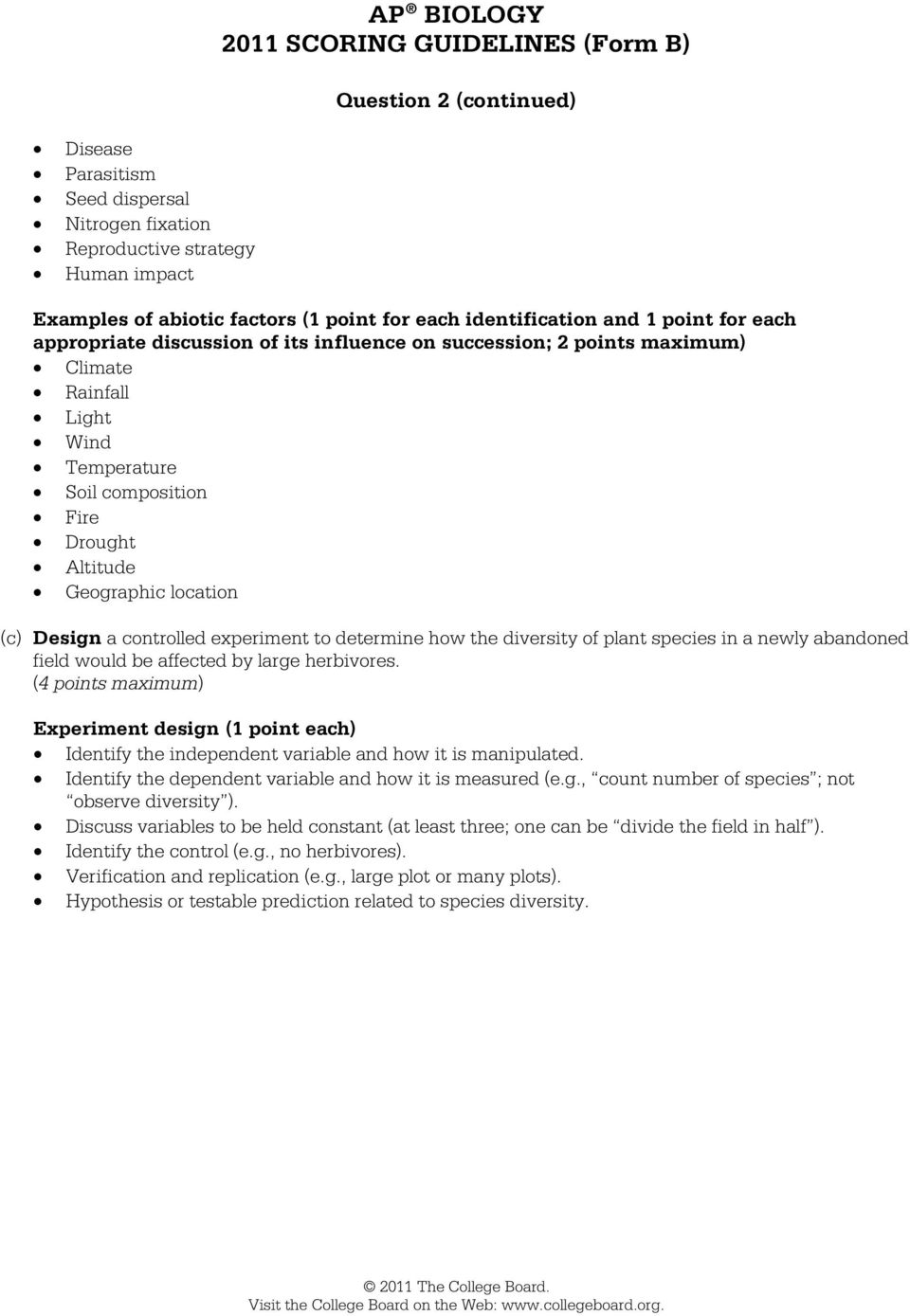
5 Disease Parasitism Seed dispersal Nitrogen fixation Reproductive strategy Human impact AP BIOLOGY Question 2 (continued) Examples of abiotic factors (1 point for each identification and 1 point for each appropriate discussion of its influence on succession; 2 points maximum) Climate Rainfall Light Wind Temperature Soil composition Fire Drought Altitude Geographic location (c) Design a controlled experiment to determine how the diversity of plant species in a newly abandoned field would be affected by large herbivores. (4 points maximum) Experiment design (1 point each) Identify the independent variable and how it is manipulated. Identify the dependent variable and how it is measured (e.g., count number of species ; not observe diversity ). Discuss variables to be held constant (at least three; one can be divide the field in half ). Identify the control (e.g., no herbivores). Verification and replication (e.g., large plot or many plots). Hypothesis or testable prediction related to species diversity.
6 Question 3 Invasive species, such as red fire ants, introduced into an ecosystem often threaten native plants and animals. (a) Describe THREE different factors that contribute to the success of invasive species in an ecosystem. (3 points maximum) Factors that contribute to the success of invasive species (1 point each) No natural predators, parasites, pathogens. Effective aggressive mechanism of invasive organism. No limitation on resources. No environmental inhibitors (e.g., pollutants). R-selected species; increased season for reproduction; large or logarithmic populations. Variation in phenotype of large population. Available niche not occupied by any other species, hence no successful competitors. Prey lack effective defense mechanism against introduced species. Appropriate environmental conditions (e.g., rainfall, temperature). (b) Discuss THREE ways that an invasive species can affect its new ecosystem. (3 points maximum) Ways that an invasive species can affect its new ecosystem (1 point each) Eliminates or decreases competitive species, thus decreasing biodiversity. Gause s Law of Competitive Exclusion. Decreases resources available for other species (food, shelter, reproductive space). Changes habitat (adds toxins; overpopulation). Addition of invasive species to unoccupied niche, thus increasing biodiversity. Introduction of parasitic microorganism living in the invasive species into native population. Resource partitioning.

7 Question 3 (continued) (c) The map indicates the spread of the red fire ant after its initial entrance into the United States at the port of Mobile, Alabama, in the 1930s. Discuss TWO environmental factors that might have determined the pattern of fire ant invasion. (2 points maximum) Environmental factors that might have determined the pattern of fire ant invasion (1 point each) Temperature: Warm temperatures (lack of freezing), as found in southeastern United States. Rainfall/humidity: Adequate moisture, as found in southeastern United States. Appropriate soil composition for nest building. Available space and unlimited resources. Habitat limitation: Salt water on southern and eastern coasts. (d) Discuss TWO possible methods of eradicating or slowing the spread of these ants, including the environmental consequences of each method. (2 points maximum) Response must include both methods and consequences. Methods (1 point) Introduce sterile males or females Pesticide Introduce predator Introduce infectious agent Eliminate food source or preferred habitat AND Consequences (1 point) May lead to increase in population size of other species; opening of new niche. Toxic to other organisms or the environment; pesticide-resistant strain increases. Long-term effects (positive or negative) on other species when fire ant population decreases. Effects of infectious agent on other species. Effects on other species.

8 Question 4 Phylogeny reflects the evolutionary history of organisms. (a) Discuss TWO mechanisms of speciation that lead to the development of separate species from a common ancestor. (2 points maximum) Mechanisms that lead to the development of separate species from a common ancestor (1 point each) Geographic isolation (or allopatric speciation) takes place when a population of one species becomes physically separated by some geographic barrier such as a river, mountain range, etc. Long-term isolation of two populations eventually leads to reproductive isolation. Sympatric speciation happens when new species arise as a result of reproductive isolation within the population range for example, because of polyploidy or switching mating behaviors (fruit flies going from hawthorn to apple to lay eggs). Eventually the two populations are unable to interbreed. Reproductive isolation by prezygotic barriers, such as habitat, temporal, behavioral, mechanical, or gametic incompatibility. Reproductive isolation by postzygotic barriers (e.g., reduced hybrid viability or fertility) leads to speciation. (b) Explain THREE methods that have been used to investigate the phylogeny of organisms. Describe a strength or weakness of each method. (6 points maximum) Response earns 1 point for each method explained and 1 point for either a strength OR a weakness. Methods (1 point) AND Strengths (1 point) OR Weaknesses (1 point) Fossils (paleontology) Determine time; reveal extinct species. Not all species leave fossils. Fossil record is incomplete. Anatomy/morphology Homologous structures indicate evolutionary relationships. Analogous structures. Some taxa have little diversity (e.g., bacteria). Some morphology reflects environment or Embryology/development Molecular traits (amino acid sequence in proteins or base sequence in DNA) Behavioral traits Reveals similarities in structures and patterns of development that are not evident in adults. Large numbers of traits. Allow study of evolution between closely related species. Most accurate. Some behaviors are genetic (e.g., frog calls). diet. Similarities between species may be lost in later development. No (or little) data for extinct species. Variation within species blurs differences between species. Behavior maybe culturally transmitted or learned (e.g., bird calls).

9 Question 4 (continued) (c) The two phylogenetic trees represent the relationship of whales to six other mammals. All of the organisms shown have a pulley-shaped astragalus bone in the ankle except for the whale.

10 Question 4 (continued) DATA ON PRESENCE OF SPECIFIC DNA SEQUENCES + sequence present sequence absent? undetermined Locus Cow Deer +? Whale ? + +? + Hippo? ? + Pig??? + + Peccary???????????? + Camel For each tree, describe a monophyletic group, the closest relative to the whale, and the point at which the pulley astragalus was lost or gained. (3 points maximum) o o o Correctly identifying a monophyletic group in BOTH Tree I and II (a number of correct possibilities) or correctly defining a monophyletic group as a species and all of its descendants. (1 point) Correctly identifying the camel as the closest relative to the whale in Tree I AND the hippo in Tree II. (1 point) Stating that the gain of the pulley astragalus bone in Tree I occurs between the whale and the camel, OR that the loss of the bone occurs on the line to whales, AND that the loss of the pulley astragalus bone in Tree II occurs between the common ancestor of the hippo and the whale. (1 point) Based on the principle of parsimony (the simplest explanation is the best) and the genomic information in the table shown, identify which tree is the best representation of the evolutionary relationship of these animals, and justify your answer. (1 point maximum) Identification of correct tree Tree II Justifications include but are not limited to The camel is the out-group, with none of the 13 sequences. The peccary and pig have the fewest sequences, but they are similar. The deer and cow share the same half of the 13 sequences. The whale and hippo have a similar pattern of DNA sequences. Note: No point is earned for using the pulley astragalus bone to justify Tree II, nor for discussing common environments, body shapes, or feeding habits.

Cell Growth and Reproduction Module B, Anchor 1
 Cell Growth and Reproduction Module B, Anchor 1 Key Concepts: - The larger a cell becomes, the more demands the cell places on its DNA. In addition, a larger cell is less efficient in moving nutrients
List, describe, diagram, and identify the stages of meiosis.
 Meiosis and Sexual Life Cycles In this topic we will examine a second type of cell division used by eukaryotic cells: meiosis. In addition, we will see how the 2 types of eukaryotic cell division, mitosis
Chapter 12: The Cell Cycle
 Name Period Chapter 12: The Cell Cycle Overview: 1. What are the three key roles of cell division? State each role, and give an example. Key Role Example 2. What is meant by the cell cycle? Concept 12.1
Lecture 7 Mitosis & Meiosis
 Lecture 7 Mitosis & Meiosis Cell Division Essential for body growth and tissue repair Interphase G 1 phase Primary cell growth phase S phase DNA replication G 2 phase Microtubule synthesis Mitosis Nuclear
The cell cycle, mitosis and meiosis
 The cell cycle, mitosis and meiosis Learning objective This learning material is about the life cycle of a cell and the series of stages by which genetic materials are duplicated and partitioned to produce
www.njctl.org PSI Biology Mitosis & Meiosis
 Mitosis and Meiosis Mitosis Classwork 1. Identify two differences between meiosis and mitosis. 2. Provide an example of a type of cell in the human body that would undergo mitosis. 3. Does cell division
LAB 8 EUKARYOTIC CELL DIVISION: MITOSIS AND MEIOSIS
 LAB 8 EUKARYOTIC CELL DIVISION: MITOSIS AND MEIOSIS Los Angeles Mission College Biology 3 Name: Date: INTRODUCTION BINARY FISSION: Prokaryotic cells (bacteria) reproduce asexually by binary fission. Bacterial
If and when cancer cells stop dividing, they do so at random points, not at the normal checkpoints in the cell cycle.
 Cancer cells have escaped from cell cycle controls Cancer cells divide excessively and invade other tissues because they are free of the body s control mechanisms. Cancer cells do not stop dividing when
Cell Division CELL DIVISION. Mitosis. Designation of Number of Chromosomes. Homologous Chromosomes. Meiosis
 Cell Division CELL DIVISION Anatomy and Physiology Text and Laboratory Workbook, Stephen G. Davenport, Copyright 2006, All Rights Reserved, no part of this publication can be used for any commercial purpose.
Meiosis is a special form of cell division.
 Page 1 of 6 KEY CONCEPT Meiosis is a special form of cell division. BEFORE, you learned Mitosis produces two genetically identical cells In sexual reproduction, offspring inherit traits from both parents
1. Why is mitosis alone insufficient for the life cycle of sexually reproducing eukaryotes?
 Chapter 13: Meiosis and Sexual Life Cycles 1. Why is mitosis alone insufficient for the life cycle of sexually reproducing eukaryotes? 2. Define: gamete zygote meiosis homologous chromosomes diploid haploid
Lecture 10 Friday, March 20, 2009
 Lecture 10 Friday, March 20, 2009 Reproductive isolating mechanisms Prezygotic barriers: Anything that prevents mating and fertilization is a prezygotic mechanism. Habitat isolation, behavioral isolation,
Chapter 12: The Cell Cycle
 Name Period Chapter 12: The Cell Cycle Overview: 1. What are the three key roles of cell division? State each role, and give an example. Key Role Reproduction Growth and development Tissue removal Example
Lecture 11 The Cell Cycle and Mitosis
 Lecture 11 The Cell Cycle and Mitosis In this lecture Cell division Chromosomes The cell cycle Mitosis PPMAT Apoptosis What is cell division? Cells divide in order to reproduce themselves The cell cycle
CHAPTER 9 CELLULAR REPRODUCTION P. 243-257
 CHAPTER 9 CELLULAR REPRODUCTION P. 243-257 SECTION 9-1 CELLULAR GROWTH Page 244 ESSENTIAL QUESTION Why is it beneficial for cells to remain small? MAIN IDEA Cells grow until they reach their size limit,
Chapter 3. Cell Division. Laboratory Activities Activity 3.1: Mock Mitosis Activity 3.2: Mitosis in Onion Cells Activity 3.
 Chapter 3 Cell Division Laboratory Activities Activity 3.1: Mock Mitosis Activity 3.2: Mitosis in Onion Cells Activity 3.3: Mock Meiosis Goals Following this exercise students should be able to Recognize
Cell Division Mitosis and the Cell Cycle
 Cell Division Mitosis and the Cell Cycle A Chromosome and Sister Chromatids Key Points About Chromosome Structure A chromosome consists of DNA that is wrapped around proteins (histones) and condensed Each
AP Biology Essential Knowledge Student Diagnostic
 AP Biology Essential Knowledge Student Diagnostic Background The Essential Knowledge statements provided in the AP Biology Curriculum Framework are scientific claims describing phenomenon occurring in
The Huntington Library, Art Collections, and Botanical Gardens
 The Huntington Library, Art Collections, and Botanical Gardens Rooting for Mitosis Overview Students will fix, stain, and make slides of onion root tips. These slides will be examined for the presence
1. When new cells are formed through the process of mitosis, the number of chromosomes in the new cells
 Cell Growth and Reproduction 1. When new cells are formed through the process of mitosis, the number of chromosomes in the new cells A. is half of that of the parent cell. B. remains the same as in the
Cellular Reproduction
 9 Cellular Reproduction section 1 Cellular Growth Before You Read Think about the life cycle of a human. On the lines below, write some of the stages that occur in the life cycle of a human. In this section,
From DNA to Protein
 Nucleus Control center of the cell contains the genetic library encoded in the sequences of nucleotides in molecules of DNA code for the amino acid sequences of all proteins determines which specific proteins
AP Biology Unit I: Ecological Interactions
 AP Biology Unit I: Ecological Interactions Essential knowledge 1.C.1: Speciation and extinction have occurred throughout the Earth s history. Species extinction rates are rapid at times of ecological stress.
Biology 3A Laboratory MITOSIS Asexual Reproduction
 Biology 3A Laboratory MITOSIS Asexual Reproduction OBJECTIVE To study the cell cycle and understand how, when and why cells divide. To study and identify the major stages of cell division. To relate the
CHROMOSOME STRUCTURE CHROMOSOME NUMBERS
 CHROMOSOME STRUCTURE 1. During nuclear division, the DNA (as chromatin) in a Eukaryotic cell's nucleus is coiled into very tight compact structures called chromosomes. These are rod-shaped structures made
AP Microeconomics 2011 Scoring Guidelines
 AP Microeconomics 2011 Scoring Guidelines The College Board The College Board is a not-for-profit membership association whose mission is to connect students to college success and opportunity. Founded
Biology 1406 - Notes for exam 5 - Population genetics Ch 13, 14, 15
 Biology 1406 - Notes for exam 5 - Population genetics Ch 13, 14, 15 Species - group of individuals that are capable of interbreeding and producing fertile offspring; genetically similar 13.7, 14.2 Population
AP Environmental Science 2010 Free-Response Questions
 AP Environmental Science 2010 Free-Response Questions The College Board The College Board is a not-for-profit membership association whose mission is to connect students to college success and opportunity.
Practice Questions 1: Evolution
 Practice Questions 1: Evolution 1. Which concept is best illustrated in the flowchart below? A. natural selection B. genetic manipulation C. dynamic equilibrium D. material cycles 2. The diagram below
The Somatic Cell Cycle
 The Somatic Cell Cycle Maternal chromosome Diploid Zygote Diploid Zygote Paternal chromosome MITOSIS MITOSIS Maternal chromosome Diploid organism Diploid organism Paternal chromosome Int terpha ase The
CHAPTER 10 CELL CYCLE AND CELL DIVISION
 CHAPTER 10 CELL CYCLE AND CELL DIVISION Cell division is an inherent property of living organisms. It is a process in which cells reproduce their own kind. The growth, differentiation, reproduction and
AP Macroeconomics 2010 Scoring Guidelines
 AP Macroeconomics 2010 Scoring Guidelines The College Board The College Board is a not-for-profit membership association whose mission is to connect students to college success and opportunity. Founded
Bio EOC Topics for Cell Reproduction: Bio EOC Questions for Cell Reproduction:
 Bio EOC Topics for Cell Reproduction: Asexual vs. sexual reproduction Mitosis steps, diagrams, purpose o Interphase, Prophase, Metaphase, Anaphase, Telophase, Cytokinesis Meiosis steps, diagrams, purpose
Sexual Reproduction. The specialized cells that are required for sexual reproduction are known as. And come from the process of: GAMETES
 Sexual Reproduction Sexual Reproduction We know all about asexual reproduction 1. Only one parent required. 2. Offspring are identical to parents. 3. The cells that produce the offspring are not usually
Chapter 13: Meiosis and Sexual Life Cycles
 Name Period Concept 13.1 Offspring acquire genes from parents by inheriting chromosomes 1. Let s begin with a review of several terms that you may already know. Define: gene locus gamete male gamete female
Summary. 16 1 Genes and Variation. 16 2 Evolution as Genetic Change. Name Class Date
 Chapter 16 Summary Evolution of Populations 16 1 Genes and Variation Darwin s original ideas can now be understood in genetic terms. Beginning with variation, we now know that traits are controlled by
4.2 Meiosis. Meiosis is a reduction division. Assessment statements. The process of meiosis
 4.2 Meiosis Assessment statements State that meiosis is a reduction division of a diploid nucleus to form haploid nuclei. Define homologous chromosomes. Outline the process of meiosis, including pairing
AP Macroeconomics 2011 Scoring Guidelines
 AP Macroeconomics 2011 Scoring Guidelines The College Board The College Board is a not-for-profit membership association whose mission is to connect students to college success and opportunity. Founded
The illustrations below reflect other scientists results in identifying and counting the stages of the onion root tip and the whitefish blastula.
 Abstract: The purpose of this laboratory experiment was to identify in what stage of mitosis viewed cells were in. The stages of mitosis include prophase, metaphase, anaphase and telophase. Although the
Guided Notes: Chapter 9 Cellular Reproduction
 Guided Notes: Cellular Reproduction When do cells divide? Cells grow and function normally until they become too. Cell size is because increases faster than This means that there is not enough area on
Matter and Energy in Ecosystems
 Matter and Energy in Ecosystems The interactions that take place among biotic and abiotic factors lead to transfers of energy and matter. Every species has a particular role, or niche, in an ecosystem.
Mitosis in Onion Root Tip Cells
 Mitosis in Onion Root Tip Cells A quick overview of cell division The genetic information of plants, animals and other eukaryotic organisms resides in several (or many) individual DNA molecules, or chromosomes.
AP Macroeconomics 2008 Scoring Guidelines Form B
 AP Macroeconomics 2008 Scoring Guidelines Form B The College Board: Connecting Students to College Success The College Board is a not-for-profit membership association whose mission is to connect students
Sexual Reproduction. and Meiosis. Sexual Reproduction
 Sexual Reproduction and Meiosis Describe the stages of meiosis and how sex cells are produced. Explain why meiosis is needed for sexual reproduction. Name the cells that are involved in fertilization.
LAB 09 Cell Division
 LAB 09 Cell Division Introduction: One of the characteristics of living things is the ability to replicate and pass on genetic information to the next generation. Cell division in individual bacteria and
Cell Cycle in Onion Root Tip Cells (IB)
 Cell Cycle in Onion Root Tip Cells (IB) A quick overview of cell division The genetic information of plants, animals and other eukaryotic organisms resides in several (or many) individual DNA molecules,
Chapter 13: Meiosis and Sexual Life Cycles
 Name Period Chapter 13: Meiosis and Sexual Life Cycles Concept 13.1 Offspring acquire genes from parents by inheriting chromosomes 1. Let s begin with a review of several terms that you may already know.
AP Macroeconomics 2008 Scoring Guidelines
 AP Macroeconomics 2008 Scoring Guidelines The College Board: Connecting Students to College Success The College Board is a not-for-profit membership association whose mission is to connect students to
Biology 1406 Exam 4 Notes Cell Division and Genetics Ch. 8, 9
 Biology 1406 Exam 4 Notes Cell Division and Genetics Ch. 8, 9 Ch. 8 Cell Division Cells divide to produce new cells must pass genetic information to new cells - What process of DNA allows this? Two types
Sample Questions for Exam 3
 Sample Questions for Exam 3 1. All of the following occur during prometaphase of mitosis in animal cells except a. the centrioles move toward opposite poles. b. the nucleolus can no longer be seen. c.
AP Calculus AB 2011 Scoring Guidelines
 AP Calculus AB Scoring Guidelines The College Board The College Board is a not-for-profit membership association whose mission is to connect students to college success and opportunity. Founded in 9, the
Chapter 54: Community Ecology
 Name Period Concept 54.1 Community interactions are classified by whether they help, harm, or have no effect on the species involved. 1. What is a community? List six organisms that would be found in your
5. The cells of a multicellular organism, other than gametes and the germ cells from which it develops, are known as
 1. True or false? The chi square statistical test is used to determine how well the observed genetic data agree with the expectations derived from a hypothesis. True 2. True or false? Chromosomes in prokaryotic
Cell Division Simulation: Bacteria Activity One
 Cell Division Simulation: Bacteria Activity One Introduction All living things are made of cells. Some living things, like plants and animals, are made of millions of cells. But some living things are
CCR Biology - Chapter 14 Practice Test - Summer 2012
 Name: Class: Date: CCR Biology - Chapter 14 Practice Test - Summer 2012 Multiple Choice Identify the choice that best completes the statement or answers the question. 1. Zebras live on the savannas of
Ecology Module B, Anchor 4
 Ecology Module B, Anchor 4 Key Concepts: - The biological influences on organisms are called biotic factors. The physical components of an ecosystem are called abiotic factors. - Primary producers are
AP Macroeconomics 2009 Scoring Guidelines
 AP Macroeconomics 2009 Scoring Guidelines The College Board The College Board is a not-for-profit membership association whose mission is to connect students to college success and opportunity. Founded
1. Biodiversity & Distribution of Life
 National 5 Biology Unit 3 Life on Earth Summary notes 1. Biodiversity & Distribution of Life Perhaps the best place to start in this topic is with Biomes. Biomes are regions of our planet which have a
AS Biology Unit 2 Key Terms and Definitions. Make sure you use these terms when answering exam questions!
 AS Biology Unit 2 Key Terms and Definitions Make sure you use these terms when answering exam questions! Chapter 7 Variation 7.1 Random Sampling Sampling a population to eliminate bias e.g. grid square
1. Identify each phase of mitosis on the onion root tip and the whitefish blastula. 3. Explain differences in mitosis between plant and animal cells.
 Mitosis Objectives Having completed the lab on mitosis, you should be able to: 1. Identify each phase of mitosis on the onion root tip and the whitefish blastula. 2. Describe the events during each phase
MCAS Biology. Review Packet
 MCAS Biology Review Packet 1 Name Class Date 1. Define organic. THE CHEMISTRY OF LIFE 2. All living things are made up of 6 essential elements: SPONCH. Name the six elements of life. S N P C O H 3. Elements
Biology Behind the Crime Scene Week 4: Lab #4 Genetics Exercise (Meiosis) and RFLP Analysis of DNA
 Page 1 of 5 Biology Behind the Crime Scene Week 4: Lab #4 Genetics Exercise (Meiosis) and RFLP Analysis of DNA Genetics Exercise: Understanding how meiosis affects genetic inheritance and DNA patterns
Principles of Ecology
 2 Principles of Ecology section 1 Organisms and Their Relationships Before You Read On the lines below, list the organisms that you have encountered today. You share the same environment with these organisms.
Appendix C DNA Replication & Mitosis
 K.Muma Bio 6 Appendix C DNA Replication & Mitosis Study Objectives: Appendix C: DNA replication and Mitosis 1. Describe the structure of DNA and where it is found. 2. Explain complimentary base pairing:
The Cell Cycle: A series of modeling activities
 The Cell Cycle: A series of modeling activities Cancer Education Project University of Rochester Premise: Students learn best when exposed to a variety of activities Overview 1. Information Gathering:
CELL DIVISION. STAGES OF MITOTIC DIVISION (Diag. C1)
 1 CELL DIVISION Cell division is the process by which cells replicate in order to replace cell loss, repair tissue damage and reproduce the organism. Two types of cell division are encountered in the Eukaryotic
Ecology Symbiotic Relationships
 Ecology Symbiotic Relationships Overview of the Co-evolution and Relationships Exhibited Among Community Members What does Symbiosis mean? How do we define Symbiosis? Symbiosis in the broadest sense is
Worksheet: The theory of natural selection
 Worksheet: The theory of natural selection Senior Phase Grade 7-9 Learning area: Natural Science Strand: Life and living Theme: Biodiversity, change and continuity Specific Aim 1: Acquiring knowledge of
Use this diagram of a food web to answer questions 1 through 5.
 North arolina Testing Program EO iology Sample Items Goal 4 Use this diagram of a food web to answer questions 1 through 5. coyotes 3. If these organisms were arranged in a food pyramid, which organism
AP Biology 2015 Free-Response Questions
 AP Biology 2015 Free-Response Questions College Board, Advanced Placement Program, AP, AP Central, and the acorn logo are registered trademarks of the College Board. AP Central is the official online home
Ecology 1 Star. 1. Missing from the diagram of this ecosystem are the
 Name: ate: 1. Missing from the diagram of this ecosystem are the 5. ase your answer(s) to the following question(s) on the diagram below and on your knowledge of biology.. biotic factors and decomposers.
BioSci 2200 General Genetics Problem Set 1 Answer Key Introduction and Mitosis/ Meiosis
 BioSci 2200 General Genetics Problem Set 1 Answer Key Introduction and Mitosis/ Meiosis Introduction - Fields of Genetics To answer the following question, review the three traditional subdivisions of
Lesson Overview. Biodiversity. Lesson Overview. 6.3 Biodiversity
 Lesson Overview 6.3 6.3 Objectives Define biodiversity and explain its value. Identify current threats to biodiversity. Describe how biodiversity can be preserved. THINK ABOUT IT From multicolored coral
Pores and pumps: facilitated diffusion, active transport, cotransport
 Cell Biology Learning Objectives Core objectives: 1. Students will understand the structures and purposes of basic components of prokaryotic and eukaryotic cells, especially macromolecules, membranes,
How Cancer Begins???????? Chithra Manikandan Nov 2009
 Cancer Cancer is one of the most common diseases in the developed world: 1 in 4 deaths are due to cancer 1 in 17 deaths are due to lung cancer Lung cancer is the most common cancer in men Breast cancer
AP Calculus AB 2007 Scoring Guidelines Form B
 AP Calculus AB 7 Scoring Guidelines Form B The College Board: Connecting Students to College Success The College Board is a not-for-profit membership association whose mission is to connect students to
AP Calculus AB 2010 Free-Response Questions Form B
 AP Calculus AB 2010 Free-Response Questions Form B The College Board The College Board is a not-for-profit membership association whose mission is to connect students to college success and opportunity.
Grade 10 - Sustainability of Ecosystems - Pre-Assessment. Grade 7 - Interactions Within Ecosystems. Grade 10 - Sustainability of Ecosystems
 Purpose: This document is for grade 10 teachers to use as a pre-assessment for the Sustainability of Ecosystems unit. It assesses students understanding of the of the end of unit knowledge outcomes from
3. Which relationship can correctly be inferred from the data presented in the graphs below?
 1. Recent evidence indicates that lakes in large areas of New York State are being affected by acid rain. The major effect of acid rain in the lakes is (1) an increase in game fish population levels (3)
Cell Biology Questions and Learning Objectives
 Cell Biology Questions and Learning Objectives (with hypothetical learning materials that might populate the objective) The topics and central questions listed here are typical for an introductory undergraduate
Understanding by Design. Title: BIOLOGY/LAB. Established Goal(s) / Content Standard(s): Essential Question(s) Understanding(s):
 Understanding by Design Title: BIOLOGY/LAB Standard: EVOLUTION and BIODIVERSITY Grade(s):9/10/11/12 Established Goal(s) / Content Standard(s): 5. Evolution and Biodiversity Central Concepts: Evolution
Lecture 2: Mitosis and meiosis
 Lecture 2: Mitosis and meiosis 1. Chromosomes 2. Diploid life cycle 3. Cell cycle 4. Mitosis 5. Meiosis 6. Parallel behavior of genes and chromosomes Basic morphology of chromosomes telomere short arm
AP Biology 2013 Free-Response Questions
 AP Biology 2013 Free-Response Questions About the College Board The College Board is a mission-driven not-for-profit organization that connects students to college success and opportunity. Founded in 1900,
CCR Biology - Chapter 5 Practice Test - Summer 2012
 Name: Class: Date: CCR Biology - Chapter 5 Practice Test - Summer 2012 Multiple Choice Identify the choice that best completes the statement or answers the question. 1. If a cell cannot move enough material
AP Human Geography 2011 Scoring Guidelines
 AP Human Geography 2011 Scoring Guidelines The College Board The College Board is a not-for-profit membership association whose mission is to connect students to college success and opportunity. Founded
MITOSIS IN ONION ROOT TIP CELLS: AN INTRODUCTION TO LIGHT MICROSCOPY
 MITOSIS IN ONION ROOT TIP CELLS: AN INTRODUCTION TO LIGHT MICROSCOPY Adapted from Foundations of Biology I; Lab 6 Introduction to Microscopy Dr. John Robertson, Westminster College Biology Department,
Name: Class: Date: Multiple Choice Identify the choice that best completes the statement or answers the question.
 Name: Class: Date: Chapter 17 Practice Multiple Choice Identify the choice that best completes the statement or answers the question. 1. The correct order for the levels of Linnaeus's classification system,
Workshop: Cellular Reproduction via Mitosis & Meiosis
 Workshop: Cellular Reproduction via Mitosis & Meiosis Introduction In this workshop you will examine how cells divide, including how they partition their genetic material (DNA) between the two resulting
Problem Set 5 BILD10 / Winter 2014 Chapters 8, 10-12
 Chapter 8: Evolution and Natural Selection 1) A population is: a) a group of species that shares the same habitat. b) a group of individuals of the same species that lives in the same general location
Quick Hit Activity Using UIL Science Contests For Formative and Summative Assessments of Pre-AP and AP Biology Students
 Quick Hit Activity Using UIL Science Contests For Formative and Summative Assessments of Pre-AP and AP Biology Students Activity Title: Quick Hit Goal of Activity: To perform formative and summative assessments
AP Biology 2008 Scoring Guidelines Form B
 AP Biology 2008 Scoring Guidelines Form B The College Board: Connecting Students to College Success The College Board is a not-for-profit membership association whose mission is to connect students to
REVIEW UNIT 10: ECOLOGY SAMPLE QUESTIONS
 Period Date REVIEW UNIT 10: ECOLOGY SAMPLE QUESTIONS A. Sample Multiple Choice Questions Complete the multiple choice questions to review this unit. 1. All of the following are density-dependent factors
Introduction to Ecology
 Introduction to Ecology Ecology is the scientific study of the interactions between living organisms and their environment. Scientists who study ecology are called ecologists. Because our planet has many
Key Idea 2: Ecosystems
 Key Idea 2: Ecosystems Ecosystems An ecosystem is a living community of plants and animals sharing an environment with non-living elements such as climate and soil. An example of a small scale ecosystem
AP Chemistry 2010 Scoring Guidelines Form B
 AP Chemistry 2010 Scoring Guidelines Form B The College Board The College Board is a not-for-profit membership association whose mission is to connect students to college success and opportunity. Founded