
Chapter 54: Community Ecology
|
|
|
- Brice Griffin
- 9 years ago
- Views:
Transcription
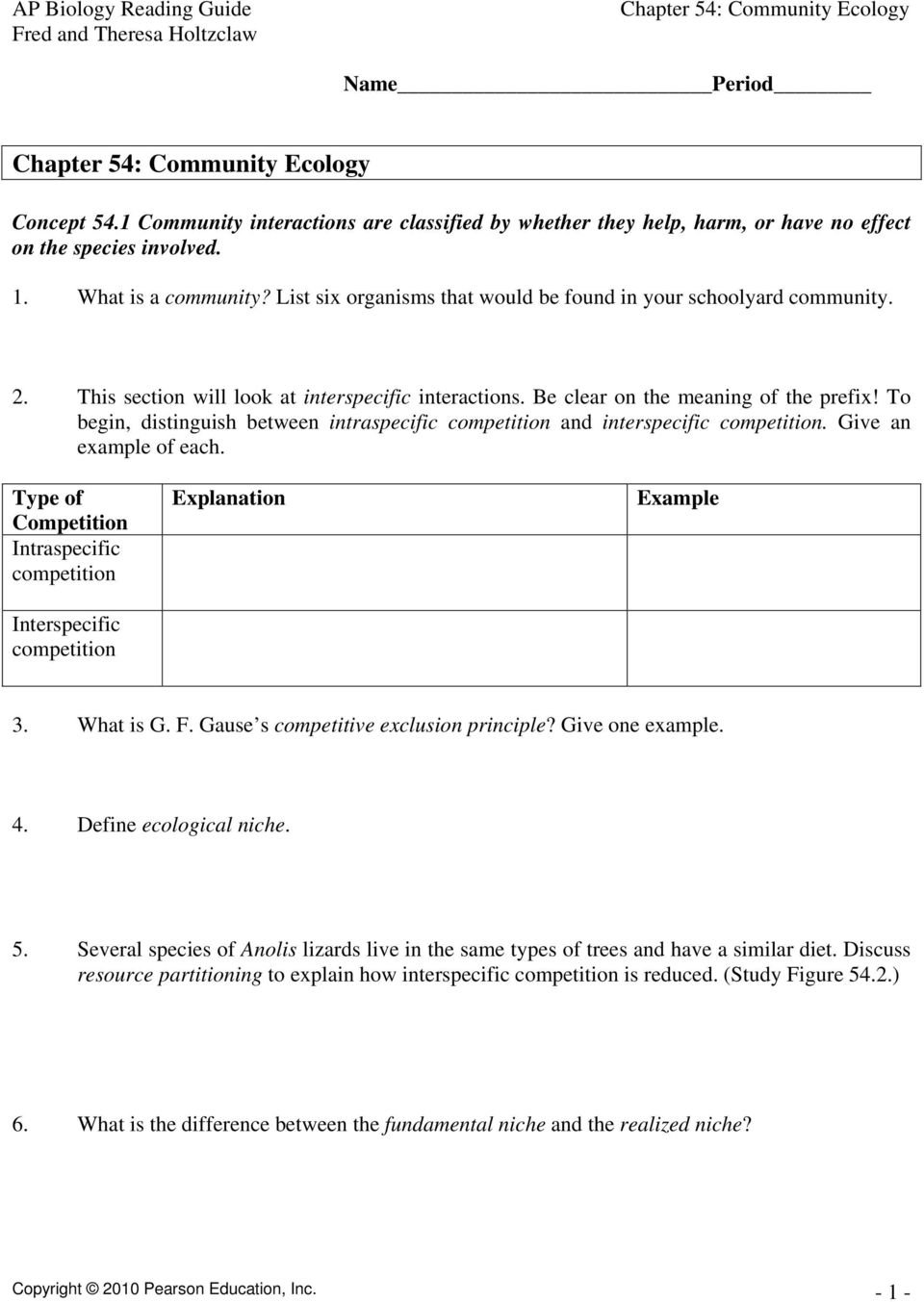
1 Name Period Concept 54.1 Community interactions are classified by whether they help, harm, or have no effect on the species involved. 1. What is a community? List six organisms that would be found in your schoolyard community. 2. This section will look at interspecific interactions. Be clear on the meaning of the prefix! To begin, distinguish between intraspecific competition and interspecific competition. Give an example of each. Type of Competition Intraspecific competition Interspecific competition Explanation Example 3. What is G. F. Gause s competitive exclusion principle? Give one example. 4. Define ecological niche. 5. Several species of Anolis lizards live in the same types of trees and have a similar diet. Discuss resource partitioning to explain how interspecific competition is reduced. (Study Figure 54.2.) 6. What is the difference between the fundamental niche and the realized niche? Copyright 2010 Pearson Education, Inc
2 7. Study Figure 54.5, and then explain what is meant by character displacement. (To do this, you will have to learn or review the difference between sympatric populations and allopatric populations. You will find this information in Chapter 24.) 8. Predation is a term that you probably already know. Can you give examples of some predator-prey combinations as listed below? Predator Prey Example Fungus Bacteria Fungus Plant Plant 9. List three special adaptations that predator species possess for obtaining food. 10. List three ways prey species elude predators. 11. Compare the two types of mimicry. Type of Mimicry Description Example Batesian Müllerian 12. What is herbivory? Copyright 2010 Pearson Education, Inc

3 13. Did you list any special herbivore adaptations for predation in your response to question 9? Or plant adaptations to avoid herbivory? List two adaptations for each category here. 14. Describe and give an example of each of the following interactions: Type of Interaction symbiosis Description Example parasitism commensalism mutualism 15. Which category above includes the other three? Note that other texts may define this term more narrowly. 16. Your text uses +/ symbols to indicate how interspecific interactions affect survival and reproduction of the two species. Use this notation for each of these interactions. Type of Interaction +/+, +/, /, +/0 predation commensalism mutualism parasitism interspecific competition herbivory Copyright 2010 Pearson Education, Inc

4 17. What is species diversity? What are its two components? Why is it important? 18. What does an ecologist summarize in a food web? 19. Know the levels of trophic structure in food chains. Give a food chain here, including four links that might be found in a prairie community, and tell the level for each organism. 20. Name every organism in the pictured food chain, and give the trophic level in the box. 21. According to the energetic hypothesis, why are food chains limited in length? How much energy is typically transferred to each higher level? 22. What is a dominant species? For the area where you live, what would be considered a dominant tree species? Copyright 2010 Pearson Education, Inc

5 23. How is a keystone species different from a dominant species? 24. Name one keystone species, and explain the effect its removal has on the ecosystem. 25. Explain facilitator or foundation species and give an example. You may omit bottom-up and top-down controls. Concept 54.2 Disturbance influences species diversity and composition 26. What is the intermediate disturbance hypothesis? Give an example of a disturbance event, and explain the effect it has on the community. 27. Ecological succession is the changes in species that occupy an area after a disturbance. What is the difference between primary succession and secondary succession? Concept 54.3 Biogeographic factors affect community biodiversity 28. Explain latitudinal gradients in terms of species richness. Where is species richness greatest? 29. There are probably two key factors in latitudinal gradients. List and explain both here, and put a star next to the one that is probably the primary cause of the latitudinal difference in biodiversity. 30. Explain what is demonstrated by a species-area curve. Copyright 2010 Pearson Education, Inc

6 31. Renowned American ecologists Robert MacArthur and E. O. Wilson developed a model of island biogeography. While the model can be demonstrated with islands, any isolated habitat represents an island. What are the two factors that determine the number of species on the island? 32. What two physical features of the island affect immigration and extinction rates? 33. Why do small islands have lower immigration rates? Higher extinction rates? 34. Closer islands have extinction rates and immigration rates. 35. What is the island equilibrium model? 36. Use this model to describe how an island s size and distance from the mainland affect the island s species richness. 37. Label this figure to show immigration, extinction, island size, and equilibrium. Then explain what each figure shows. Copyright 2010 Pearson Education, Inc

7 Concept 54.4 Community ecology is useful for understanding pathogen life cycles and controlling human disease 38. Let s pull a couple of ideas from this section: What is a pathogen? 39. What is a zoonotic pathogen? List three examples. 40. What is a vector? List three examples. Testing Your Knowledge: Self-Quiz Answers Now you should be ready to test your knowledge. Place your answers here: Copyright 2010 Pearson Education, Inc

14.1. Every organism has a habitat and a niche. A habitat differs from a niche. Interactions in Ecosystems CHAPTER 14.
 SECTION 14.1 HABITAT AND NICHE Study Guide KEY CONCEPT Every organism has a habitat and a niche. VOCABULARY habitat ecological niche competitive exclusion ecological equivalent A habitat differs from a
Matter and Energy in Ecosystems
 Matter and Energy in Ecosystems The interactions that take place among biotic and abiotic factors lead to transfers of energy and matter. Every species has a particular role, or niche, in an ecosystem.
Ecology Symbiotic Relationships
 Ecology Symbiotic Relationships Overview of the Co-evolution and Relationships Exhibited Among Community Members What does Symbiosis mean? How do we define Symbiosis? Symbiosis in the broadest sense is
AP Biology Unit I: Ecological Interactions
 AP Biology Unit I: Ecological Interactions Essential knowledge 1.C.1: Speciation and extinction have occurred throughout the Earth s history. Species extinction rates are rapid at times of ecological stress.
Introduction to Ecology
 Introduction to Ecology Ecology is the scientific study of the interactions between living organisms and their environment. Scientists who study ecology are called ecologists. Because our planet has many
CHAPTER 20 COMMUNITY ECOLOGY
 CHAPTER 20 COMMUNITY ECOLOGY MULTIPLE CHOICE 1. The relationship between a predator and its prey is best illustrated by a. a snake eating a bird. c. a lion eating a zebra. b. a fox eating a mouse. d. a
CCR Biology - Chapter 14 Practice Test - Summer 2012
 Name: Class: Date: CCR Biology - Chapter 14 Practice Test - Summer 2012 Multiple Choice Identify the choice that best completes the statement or answers the question. 1. Zebras live on the savannas of
Ecology Module B, Anchor 4
 Ecology Module B, Anchor 4 Key Concepts: - The biological influences on organisms are called biotic factors. The physical components of an ecosystem are called abiotic factors. - Primary producers are
Jennifer Carmack Cannon s Point Unit
 Jennifer Carmack Cannon s Point Unit Unit Organizer: (Approximate Time: 5 days) OVERVIEW: Organisms are dependent upon other organisms for survival. The absence of one organism can disrupt all other organisms
REVIEW UNIT 10: ECOLOGY SAMPLE QUESTIONS
 Period Date REVIEW UNIT 10: ECOLOGY SAMPLE QUESTIONS A. Sample Multiple Choice Questions Complete the multiple choice questions to review this unit. 1. All of the following are density-dependent factors
What activities do you think an organism would use bioluminescence for?
 Relationships for Survival: The Role of Bioluminescence overview In these activities, students will focus on ecological relationships and investigate the many ways that species might interact using bioluminescence.
Chapter 55: Ecosystems
 Name Period Overview: 1. What is an ecosystem? 2. Where does energy enter most ecosystems? How is it converted to chemical energy and then passed through the ecosystem? How is it lost? Remember this: energy
Principles of Ecology
 2 Principles of Ecology section 1 Organisms and Their Relationships Before You Read On the lines below, list the organisms that you have encountered today. You share the same environment with these organisms.
6. Which of the following is not a basic need off all animals a. food b. *friends c. water d. protection from predators. NAME SOL 4.
 NAME SOL 4.5 REVIEW - Revised Habitats, Niches and Adaptations POPULATION A group of the same species living in the same place at the same time. COMMUNITY-- All of the populations that live in the same
Ecology 1 Star. 1. Missing from the diagram of this ecosystem are the
 Name: ate: 1. Missing from the diagram of this ecosystem are the 5. ase your answer(s) to the following question(s) on the diagram below and on your knowledge of biology.. biotic factors and decomposers.
STUDY GUIDE ECOLOGY. CHAPTER 21: Populations 1. An overview of ecology. Ecology is the study of interactions between organisms and their environment.
 STUDY GUIDE ECOLOGY CHAPTER 21: Populations 1. An overview of ecology. Ecology is the study of interactions between organisms and their environment. 2. A Hierarchy of interactions: cells tissues organs
FOUR (4) FACTORS AFFECTING DENSITY
 POPULATION SIZE REGULATION OF POPULATIONS POPULATION GROWTH RATES SPECIES INTERACTIONS DENSITY = NUMBER OF INDIVIDUALS PER UNIT AREA OR VOLUME POPULATION GROWTH = CHANGE IN DENSITY OVER TIME FOUR (4) FACTORS
Understanding by Design. Title: BIOLOGY/LAB. Established Goal(s) / Content Standard(s): Essential Question(s) Understanding(s):
 Understanding by Design Title: BIOLOGY/LAB Standard: EVOLUTION and BIODIVERSITY Grade(s):9/10/11/12 Established Goal(s) / Content Standard(s): 5. Evolution and Biodiversity Central Concepts: Evolution
The Need Is Mutual: The Importance of Biological Interactions
 The Need Is Mutual: The Importance of Biological Interactions Science Topic: Food Webs Grades: 6 th -8 th Essential Question: What kinds of relationships are involved in biological interactions? Lesson
13.1. Principles of Ecology CHAPTER 13. Ecology is the study of the relationships among organisms and their environment.
 SECTION 13.1 KEY CONCEPT ECOLOGISTS STUDY RELATIONSHIPS Study Guide Ecology is the study of the relationships among organisms and their environment. VOCABULARY ecology community MAIN IDEA: Ecologists study
FOOD CHAINS, FOOD WEBS AND ECOLOGICAL PYRAMIDS
 FOOD CHAINS, FOOD WEBS AND ECOLOGICAL PYRAMIDS SECTION 1 In an ecosystem, plants capture the sun's energy and use it to convert inorganic compounds into energy-rich organic compounds. This process of using
Symbiotic Relationships Grade Seven
 Ohio Standards Connection: Life Sciences Benchmark C Explain how energy entering the ecosystems as sunlight supports the life of organisms through photosynthesis and the transfer of energy through the
Practice Questions 1: Evolution
 Practice Questions 1: Evolution 1. Which concept is best illustrated in the flowchart below? A. natural selection B. genetic manipulation C. dynamic equilibrium D. material cycles 2. The diagram below
Use this diagram of a food web to answer questions 1 through 5.
 North arolina Testing Program EO iology Sample Items Goal 4 Use this diagram of a food web to answer questions 1 through 5. coyotes 3. If these organisms were arranged in a food pyramid, which organism
Grade 10 - Sustainability of Ecosystems - Pre-Assessment. Grade 7 - Interactions Within Ecosystems. Grade 10 - Sustainability of Ecosystems
 Purpose: This document is for grade 10 teachers to use as a pre-assessment for the Sustainability of Ecosystems unit. It assesses students understanding of the of the end of unit knowledge outcomes from
Activity 1.6: Food for Thought: Climate Change and Trophic Cascades
 Activity 1.6: Food for Thought: Climate Change and Trophic Cascades Grades 7 9 Description: Students will read an article about the impact of melting ice on the Arctic food web. Students will diagram food
Figure 4. Clown fish and anemone. Figure 5. Sea spider. Page 2 of 6. Saylor URL: www.saylor.org/bio102
 Symbiosis The phrase symbiotic relationship simply refers to a close ecological relationship between two different species. These relationships differ along a spectrum from positive to negative interactions.
NOTE TO TEACHER: It is appropriate to introduce the mitochondria (where energy is made) as a major structure common to all cells.
 5.2.1 Recall the cell as the smallest unit of life and identify its major structures (including cell membrane, cytoplasm, nucleus, and vacuole). Taxonomy level: 1.1 and 1.2-A Remember Factual Knowledge
Biology Keystone (PA Core) Quiz Ecology - (BIO.B.4.1.1 ) Ecological Organization, (BIO.B.4.1.2 ) Ecosystem Characteristics, (BIO.B.4.2.
 Biology Keystone (PA Core) Quiz Ecology - (BIO.B.4.1.1 ) Ecological Organization, (BIO.B.4.1.2 ) Ecosystem Characteristics, (BIO.B.4.2.1 ) Energy Flow 1) Student Name: Teacher Name: Jared George Date:
2.2 Interactions Among Species
 Key Terms ecological niche bog predator prey mutualism parasite ecological niche the way that an organism occupies a position in an ecosystem, including all the necessary biotic and abiotic factors 2.2
Ecosystems and Food Webs
 Ecosystems and Food Webs How do AIS affect our lakes? Background Information All things on the planet both living and nonliving interact. An Ecosystem is defined as the set of elements, living and nonliving,
Creating Chains and Webs to Model Ecological Relationships
 Creating Chains and Webs to Model Ecological Relationships Overview This hands-on activity supports the HHMI short film The Guide and the 2015 Holiday Lectures on Science: Patterns and Processes in Ecology.
Global Ecology and Wildlife Conservation
 Vaughan Centre for Lifelong Learning Part-Time Certificate of Higher Education in Global Ecology and Wildlife Conservation Delivered via Distance Learning FAQs What are the aims of the course? This course
Regents Biology LAB. STUDY OF POPULATION DENSITY ON A SUBURBAN LAWN
 Period Date LAB. STUDY OF POPULATION DENSITY ON A SUBURBAN LAWN Ecological communities are built on the interactions between the creatures (both plants and animals) that live there and the physical environment
ECOSYSTEM RESPONSES. reflect
 reflect There is a saying, No man is an island, which means that people need one another in order to survive. Everyone on Earth is interconnected in some way. This is not only true of human beings, but
AP Biology 2011 Scoring Guidelines Form B
 AP Biology 2011 Scoring Guidelines Form B The College Board The College Board is a not-for-profit membership association whose mission is to connect students to college success and opportunity. Founded
Lesson Overview. Biodiversity. Lesson Overview. 6.3 Biodiversity
 Lesson Overview 6.3 6.3 Objectives Define biodiversity and explain its value. Identify current threats to biodiversity. Describe how biodiversity can be preserved. THINK ABOUT IT From multicolored coral
Grassland Food Webs: Teacher Notes
 Grassland Food Webs: Teacher Notes Alan Henderson ecosystem Objectives After completing this activity students will be able to: Create a food web and identify producers and consumers. Assign organisms
MCAS Biology. Review Packet
 MCAS Biology Review Packet 1 Name Class Date 1. Define organic. THE CHEMISTRY OF LIFE 2. All living things are made up of 6 essential elements: SPONCH. Name the six elements of life. S N P C O H 3. Elements
The main source of energy in most ecosystems is sunlight.
 Energy in Ecosystems: Ecology: Part 2: Energy and Biomass The main source of energy in most ecosystems is sunlight. What is the amount of energy from the sun? 100 W/ft 2 The energy gets transferred through
Environmental Science
 Environmental Science UNIT I: Introduction to Environmental Science The student will demonstrate the ability to use scientific skills necessary to identify and analyze environmental issues. a. Define environmental
Symbiotic Relationships in Marine Ecosystems
 This website would like to remind you: Your browser (Apple Safari 7) is out of date. Update your browser for more security, comfort and the best experience on this site. lesson Symbiotic Relationships
Biology 1406 - Notes for exam 5 - Population genetics Ch 13, 14, 15
 Biology 1406 - Notes for exam 5 - Population genetics Ch 13, 14, 15 Species - group of individuals that are capable of interbreeding and producing fertile offspring; genetically similar 13.7, 14.2 Population
CCR Biology - Chapter 13 Practice Test - Summer 2012
 Name: Class: Date: CCR Biology - Chapter 13 Practice Test - Summer 2012 Multiple Choice Identify the choice that best completes the statement or answers the question. 1. A group of organisms of the same
Ecology - scientific study of how individuals interact with their environment 34.1
 Biology 1407 Exam 4 Notes - Ecology Ch.35-36 Ecology - scientific study of how individuals interact with their environment 34.1 - organisms have adapted to - evolved in - a particular set of conditions;
Section 3: Trophic Structures
 Marine Conservation Science and Policy Service learning Program Trophic Structure refers to the way in which organisms utilize food resources and hence where energy transfer occurs within an ecosystem.
Chapter 3. 3.3 Energy Flow in Ecosystems
 Chapter 3 3.3 Energy Flow in Ecosystems Key Questions: 1) What happens to energy stored in body tissues when one organism eats another? 2) How does energy flow through an ecosystem? 3) What do the three
PLANET EARTH: Seasonal Forests
 PLANET EARTH: Seasonal Forests Teacher s Guide Grade Level: 6-8 Running Time: 42 minutes Program Description Investigate temperate forests and find some of the most elusive creatures and welladapted plant
Population Ecology. Life History Traits as Evolutionary Adaptations
 Population Ecology An Overview of Population Ecology Population ecology is the study of factors that affect population: Density Growth A population is a group of individuals of a single species that occupy
Program goal: Students will have a better awareness and understanding of butterflies and their habitats
 Butterfly Builders Students will investigate butterflies and their life cycle through a variety of activities including a story, game and science investigation. The lesson will end with a guided trip to
ENVIRONMENTAL SCIENCE CURRICULUM for CLASS IX to X
 ENVIRONMENTAL SCIENCE CURRICULUM for CLASS IX to X The Royal Society for Protection of Nature (RSPN) in collaboration with Department of Curriculum Research & Development (DCRD) of Ministry of Education
Seventh Grade Science Content Standards and Objectives
 Seventh Grade Science Content Standards and Objectives Standard 2: Nature of Science Students will demonstrate an understanding of the history of science and the evolvement of scientific knowledge. SC.S.7.1
Complete tests for CO 2 and H 2 Link observations of acid reactions to species
 Acids and Bases 1. Name common acids and bases found at home and at school 2. Use formulae for common acids and bases 3. Give examples of the uses of acids and bases 4. State that all solutions are acidic,
1. Biodiversity & Distribution of Life
 National 5 Biology Unit 3 Life on Earth Summary notes 1. Biodiversity & Distribution of Life Perhaps the best place to start in this topic is with Biomes. Biomes are regions of our planet which have a
Food Chains and Food Webs
 Program Support Notes by: Spiro Liacos B.Ed. Produced by: VEA Pty Ltd Commissioning Editor: Sandra Frerichs B.Ed, M.Ed. Executive Producers: Edwina Baden-Powell B.A, CVP. Sandra Frerichs B.Ed, M.Ed. You
SALEM COMMUNITY COLLEGE Course Syllabus. Course Title: Environmental Science I. Course Code: BIO103. Lecture Hours: 2 Laboratory Hours: 4 Credits: 4
 SALEM COMMUNITY COLLEGE Course Syllabus Course Title: Environmental Science I Course Code: BIO103 Lecture Hours: 2 Laboratory Hours: 4 Credits: 4 Course Description: Environmental Science I is the first
FOR TEACHERS ONLY. The University of the State of New York REGENTS HIGH SCHOOL EXAMINATION LIVING ENVIRONMENT
 LE FOR TEACHERS ONLY The University of the State of New York REGENTS HIGH SCHOOL EXAMINATION LIVING ENVIRONMENT Thursday, January 29, 2004 9:15 a.m. to 12:15 p.m., only SCORING KEY AND RATING GUIDE Directions
D. Categorize Words. E. Find the Odd Word
 Answer Key Vocabulary Practice A. Synonyms or Antonyms 1. synonym 2. antonym 3. antonym 4. synonym 5. antonym 6. antonym B. Stepped-Out Vocabulary 1. A species that has an unusually large effect on its
Rain Forests. America's. Web of Life. Rain Forest Ecology. Prince William Network's OVERVIEW OBJECTIVES SUBJECTS
 Rain Forest Ecology National Science Education Standards Standard C: Life Sciences Populations and ecosystems. Standard C: Life Sciences Diversity and adaptation of organisms. Standard F: Science in Personal
Maintenance of Diversity
 Maintenance of Diversity 1. Succession 2. Loss of Diversity 3. General Mechanisms that Maintain Diversity 4. Specific Mechanisms that Maintain Diversity Maintenance of species diversity 1. Ecological succession
HUMANPOPULATIONGROWTHANDNATURAL RESOURCES Study Guide. As the human population grows, the demand for Earth s resources increases.
 SECTION 16.1 HUMANPOPULATIONGROWTHANDNATURAL RESOURCES Study Guide KEY CONCEPT As the human population grows, the demand for Earth s resources increases. VOCABULARY nonrenewable resource renewable resource
Differences Between 1997 Illinois Learning Standards and 2014 Illinois Learning Standards (NGSS)
 Differences Between 1997 Illinois Learning Standards and 2014 Illinois Learning Standards (NGSS) 1997 Illinois Learning Standards in Science 2014 Illinois Learning Standards (NGSS) Grouped by grade spans:
Life processes. All animals have to carry out seven life processes. These are: 2. Respiration taking in one gas and getting rid of another
 Food chains Life processes All animals have to carry out seven life processes. These are: 1. Movement being able to move its body 2. Respiration taking in one gas and getting rid of another 3. Reproduction
Ecology and Simpson s Diversity Index
 ACTIVITY BRIEF Ecology and Simpson s Diversity Index The science at work Ecologists, such as those working for the Environmental Agency, are interested in species diversity. This is because diversity is
The Effect of a Changing Climate on Trophic Interactions
 The Effect of a Changing Climate on Trophic Interactions 1 A Brief Overview impacts of climate change components of an ecosystem food webs and trophic levels changes in phenology range shifts ecosystem
The animals at higher levels are more competitive, so fewer animals survive. B.
 Energy Flow in Ecosystems 1. The diagram below shows an energy pyramid. Which of the following best explains why the number of organisms at each level decreases while moving up the energy pyramid? The
Adopt an Ecosystem Project Grade Ten
 Ohio Standards Connection: Life Sciences Benchmark F Explain the structure and function of ecosystems and relate how ecosystems change over time. Indicator 15 Explain how living things interact with abiotic
Species Richness: Small Scale
 Species Richness: Small Scale Rebecca L Brown, Eastern Washington University, Cheney, Washington, USA Lee Anne Jacobs, University of North Carolina, Chapel Hill, North Carolina, USA Robert K Peet, University
The need for longitudinal study of the dual roles of insects as pests and food resources in agroecosystems
 THE H. R. MacCARTHY LECTURE COMMITTEE IS PLEASED TO PRESENT THE 15 TH ANNUAL H. R. MacCARTHY PEST MANAGEMENT LECTURE ENTITLED The need for longitudinal study of the dual roles of insects as pests and food
Ecosystems. The two main ecosystem processes: Energy flow and Chemical cycling
 Ecosystems THE REALM OF ECOLOGY Biosphere An island ecosystem A desert spring ecosystem Biosphere Ecosystem Ecology: Interactions between the species in a given habitat and their physical environment.
Unit: Plants & Animals (Grade 2)
 Unit: Plants & Animals (Grade 2) Content Area: Science Course(s): Science Time Period: 8 weeks Length: Weeks Status: Published Unit Overview Students will determine the life cycles of plants and animals
GCSE Science: Biology
 Nutrients 23 slides 9 Flash activities Accompanied by Nutrients Energy from food Protein For OCR Gateway Diet, Exercise and Health 34 slides 14 Flash activities Accompanied by Diet, Exercise and Health
All the organisms that live together in a place are called
 25 Community Ecology Concept Outline 25.1 Interactions among competing species shape ecological niches. The Realized Niche. Interspecific interactions often limit the portion of their niche that they can
Worksheet: The food chain
 Worksheet: The food chain Foundation Phase Grade 1-3 Learning area: Natural Science Specific Aim 2: Investigating phenomena in natural sciences Activity Sheet Activity 1: What is a food chain? Every time
This hands-on activity incorporates observing, classifying, predicting, sequencing, formulating models, and drawing conclusions.
 SCIENCE Science and the Environment 4 th Grade FOOD CHAINS Overview: All organisms, or living things, depend on other organisms for nutrients. The movement of nutrients through an environment is visualized
Interactions between rodent borne diseases and climate, and the risks for public and animal health
 Interactions between rodent borne diseases and climate, and the risks for public and animal health Mare Lõhmus Climate centrum / SMS / KMF National Veterinary Institute Uppsala, Sweden The source of many
Fighting Fire with Fire: Can Fire Positively Impact an Ecosystem?
 Fighting Fire with Fire: Can Fire Positively Impact an Ecosystem? Science Topic: Fire Ecology Grades: 6 th 8 th Essential Questions: What role does fire play in maintaining healthy ecosystems? How does
Sample Unit Plan. Ecology Explorers
 Appendix G.04 Appendix G: Seeing Reason Tool Resources Sample Unit Plan Ecology Explorers Classroom Information Subject Area Science, Language Arts Grade Level(s) 6 8 Unit Summary In this project, students
Biology 3998 Seminar II. How To Give a TERRIBLE PowerPoint Presentation
 Biology 3998 Seminar II How To Give a TERRIBLE PowerPoint Presentation How to Give a TERRIBLE PowerPoint Presentation [Don t use a summary slide to keep the audience oriented throughout the presentation]
Food Web Crasher. An introduction to food chains and food webs
 Food Web Crasher An introduction to food chains and food webs Activity Students create a physical food web and watch what happens when an aquatic nuisance species is introduced into the ecosystem. Grade
Worksheet: The theory of natural selection
 Worksheet: The theory of natural selection Senior Phase Grade 7-9 Learning area: Natural Science Strand: Life and living Theme: Biodiversity, change and continuity Specific Aim 1: Acquiring knowledge of
Introduction to Landscape Ecology
 Instructor: K. McGarigal Introduction to Landscape Ecology Assigned Reading: Turner et al. 2001 (Chapter 1) Objective: Describe the focus of the science of landscape ecology, including its historical context
Endemic and Introduced Species Lesson Plan
 Grade Level: 6-8 Curriculum Focus: Ecosystems and Biomes Lesson Duration: Two class periods Student Objectives Materials Understand and apply the term endemic to animal and plant life, meaning native,
Broken Arrow Public Schools AP Environmental Science Objectives Revised 11-19-08
 1 st six weeks 1 Identify questions and problems that can be answered through scientific investigation. 2 Design and conduct scientific investigations to answer questions about the world by creating hypotheses;
Chapter 39: Plant Responses to Internal and External Signals
 Name Period Concept 39.1 Signal transduction pathways link signal reception to response This concept brings together the general ideas on cell communication from Chapter 11 with specific examples of signal
Section 5.1 Food chains and food webs
 Section 5.1 Food chains and food webs The ultimate source of energy in an ecosystem comes from sunlight This energy is converted to an organic form using photosynthesis which is then passed between organisms
Population, Community & Ecosystem Worksheet
 Population, Community & Ecosystem Worksheet Name Section A: Intro to Ecology The wolves and moose of Isle Royale are known world-wide, and they are the focus of the longest-running study of a predator-prey
Communities and Biomes
 Name Date Class Communities and Biomes Section 3.1 Communities n your textbook, read about living in a community. Determine if the statement is true. f it is not, rewrite the italicized part to make it
Biodiversity Concepts
 Biodiversity Concepts WHAT IS BIODIVERSITY? Biodiversity is the variety of life on Earth. For any kind of animal or plant each individual is not exactly the same as any other; nor are species or ecosystems.
Science Standards of Learning for Virginia Public Schools Correlation with National Science Standards
 Standards of Learning for Virginia Public Schools Correlation with National Standards Key P = Pre-activity E = Extension activity C = Core activity S = Supplemental activity Standard Strands Finding Common
AP Biology ~ 2015-2016
 AP Biology ~ 2015-2016 To all AP Biology Students and their Parents: May 19 2015 Welcome to Advanced Placement Biology. I have put together this AP Biology Summer Assignment to help prepare you for what
CORPORATE POLICY STATEMENT NO. 12 MANAGEMENT OF PEST ANIMALS
 1. OBJECTIVE CORPORATE POLICY STATEMENT NO. 12 MANAGEMENT OF PEST ANIMALS August 2015 To provide direction and guidance for the management of pest animals on lands and waters managed by the Department
Course Description, BOT*3050, Plant Functional Ecology, Fall 2013 Department of Integrative Biology
 Lecture: Laboratory: Instructor: Office hours: Laboratory Coordinator: Teaching Assistant : Course Description: Prerequisites: Required Textbooks: 10:30-11:20 MWF MW classes will be in MACK 117 unless
Environmental Science Merit Badge Workbook
 Merit Badge Workbook This workbook can help you but you still need to read the merit badge pamphlet. This Workbook can help you organize your thoughts as you prepare to meet with your merit badge counselor.
5.1 Ecosystems, Energy, and Nutrients
 CHAPTER 5 ECOSYSTEMS 5.1 Ecosystems, Energy, and Nutrients Did anyone ever ask you the question: Where do you get your energy? Energy enters our world from the Sun but how does the Sun s energy become
Chapter 12: The Cell Cycle
 Name Period Chapter 12: The Cell Cycle Overview: 1. What are the three key roles of cell division? State each role, and give an example. Key Role Example 2. What is meant by the cell cycle? Concept 12.1
ECOSYSTEM 1. SOME IMPORTANT TERMS
 ECOSYSTEM 1. SOME IMPORTANT TERMS ECOSYSTEM:- A functional unit of nature where interactions of living organisms with physical environment takes place. STRATIFICATION:- Vertical distribution of different
Previously Published Works UC Santa Cruz
 Previously Published Works UC Santa Cruz A University of California author or department has made this article openly available. Thanks to the Academic Senate s Open Access Policy, a great many UC-authored