
Lecture 10 Friday, March 20, 2009
|
|
|
- Daniela Peters
- 9 years ago
- Views:
Transcription
1 Lecture 10 Friday, March 20, 2009 Reproductive isolating mechanisms Prezygotic barriers: Anything that prevents mating and fertilization is a prezygotic mechanism. Habitat isolation, behavioral isolation, temporal isolation, mechanical isolation and gametic isolation are all examples of prezygotic isolating mechanisms. Some species of fruit flies in the genus Rhagoletis provide an example of habitat and behavioral isolating mechanisms. Different species are reproductively isolated because each species lays its eggs on different host species. Adults return to lay eggs on the hosts from which they emerged. Some species of fruit flies in the genus Drosophila are reproductively isolated because of mechanical incompatibility of their genitalia. Postzygotic barriers: Postzygotic barriers prevent a hybrid zygote from developing into a viable, fertile adult. The mule is a typical example. Reduced viability or fertility of hybrid individuals or reduced viability or fertility of the offspring of hybrid individuals are evidence of postzygotic reproductive isolation. Differences in chromosome number or arrangement of genes on chromosomes usually result in postzygotic isolation because chromosomes may not pair normally during mitosis or meiosis. The formation of new species requires some initial reduction of gene flow Two processes of speciation are thought to be important: allopatric speciation and sympatric speciation. Allopatric speciation: The first step in allopatric speciation is the restriction of dispersal between two or more populations that would otherwise freely interbreed. One possibility is that a geographic barrier such as a river or desert forms. The separation of two populations by such a barrier is called a vicariant event. A second possibility is that individuals from a source population colonize a new geographic area that is separated from the source population by a nearly complete barrier to gene flow. The establishment of a new population is a founder event. Both vicariant and founder events may reduce gene flow sufficiently that reproductive isolating mechanisms can evolve afterwards. Whether a geographic barrier leads to allopatric speciation or not depends on dispersal ability. A barrier may lead to speciation in some groups but not in others. For example, a river may be a barrier for a snake but not a bird. In the Origin, Darwin emphasized that isolation led to the evolution of separate species. The neo-darwinian theory is essentially the same. If there is no gene flow between two populations, they will evolve independently under the combined

2 effects of mutation, natural selection, and genetic drift and will eventually be recognized as different species. Reproductive isolating mechanisms will eventually evolve in the absence of gene flow. Female choice can play an important role in species formation, as illustrated by the cichlid fishes and birds of paradise. Accidental differences in female preference can lead to rapid evolution of reproductive isolation. Cichlid fishes have evolved into hundreds of species in a relatively short time. Founder events: Founder events are thought to be important for species formation because they create opportunities for rapid changes in allele frequencies both because of natural selection and genetic drift. If the founder group is small, genetic drift alone can cause substantial changes in allele frequencies in the new population, and some of those changes can result in morphological change and reproductive isolation. In the extreme case of a population founded by a single individual capable of self-fertilization, a gene can become homozygous for an allele that is in low frequency in the source population. A population arriving in a new area may experience new environmental conditions that lead to rapid evolution as the population adapts to the new conditions. Adaptive radiation: An adaptive radiation is the evolution of numerous species from a common ancestor in an environment that presents new opportunities. Cactuses are the result of an adaptive radiation in the deserts of North and South America. Many adaptive radiations occur on remote islands or in island-like habitats such as lakes because there are many opportunities for founder events. Both natural selection and genetic drift may lead to rapid evolution. Hawaiian honeycreepers and cichlid fishes found in African lakes are good examples of adaptive radiations in restricted areas. Laboratory experiments: Reproductive isolation between two groups can evolve in a laboratory experiment. In two groups of fruit flies, a prezygotic barrier evolved in a laboratory experiment when flies were raised on starch or maltose, illustrated in Fig in the textbook. Sympatric speciation can occur. Other processes can reduce gene flow and lead to the evolution reproductive isolation of sympatric populations without an initial restriction in dispersal. In plants, polyploidy can lead to immediate reproductive isolation: Mutations can create polyploid plants that have either one parent (autopolyploid) or two parents (allopolyploid). A polyploid self-fertile plant is likely to be reproductively isolated by a postzygotic mechanism from its parent(s) because it has a different

3 number of chromosomes, as illustrated in Fig The genus Clarkia provides several examples of allopolyploid and autopolyploid species. Many domesticated plants are polyploid, including oats, wheat, barley, potatoes, bananas, and tobacco. It is likely that polyploid individuals were selected early in the process of domestication of plants, both because they had unusual properties and because they were reproductively isolated from their wild relatives. Gene flow from wild plants would tend to make domestication more difficult. In animals, sympatric speciation can occur because of differences in habitat or food preference: Host shifts combined with extreme habitat fidelity can lead to rapid speciation, as has occurred in fig wasps, discussed already by Dr. Feldman. Each species of fig has its own wasp species. New species in the genus Rhagoletis have evolved when new host species were colonized. Macroevolution and microevolution Microevolution is the process of change in individual species. Macroevolution is evolutionary change above the species level, including the formation of species, the diversification of species, and the appearance of major evolutionary developments. One of the important questions in evolutionary biology is how well macroevolutionary patterns can be predicted from our understanding of microevolution. The punctuated equilibrium theory Pattern: The punctuated equilibrium theory is a generalization about the pattern of evolution as seen in the fossil record. The pattern is the stasis of established wide-spread lineages and morphological change when new species appear. The two are compared in Fig What is not seen very often in the fossil record is gradual and continuous change in widespread species. Darwin s explanation for not seeing this pattern was the imperfection of the fossil record. Even when the fossil record of some groups is more complete, the punctuated equilibrium pattern instead of a gradual pattern is often found. The fossil record of humans and their immediate ancestors, which will be reviewed later, in an example of the punctuated equilibrium pattern. Consistent with neo-darwinism: Rapid changes can be explained by the effects of natural selection. What appears to be very rapid in the fossil record may have taken 50,000 years or longer, which is plenty of time for natural selection and genetic drift to cause substantial morphological change. Stasis can result from selection and from habitat choice. Species tend to remain in those environments to which they are well adapted. During the Pleistocene, glaciers covered much of the northern Europe, Asia and North America. Many species, including oak and spruce trees, that previously lived in the north shifted their ranges to the south and then returned to the north as the climate changed.

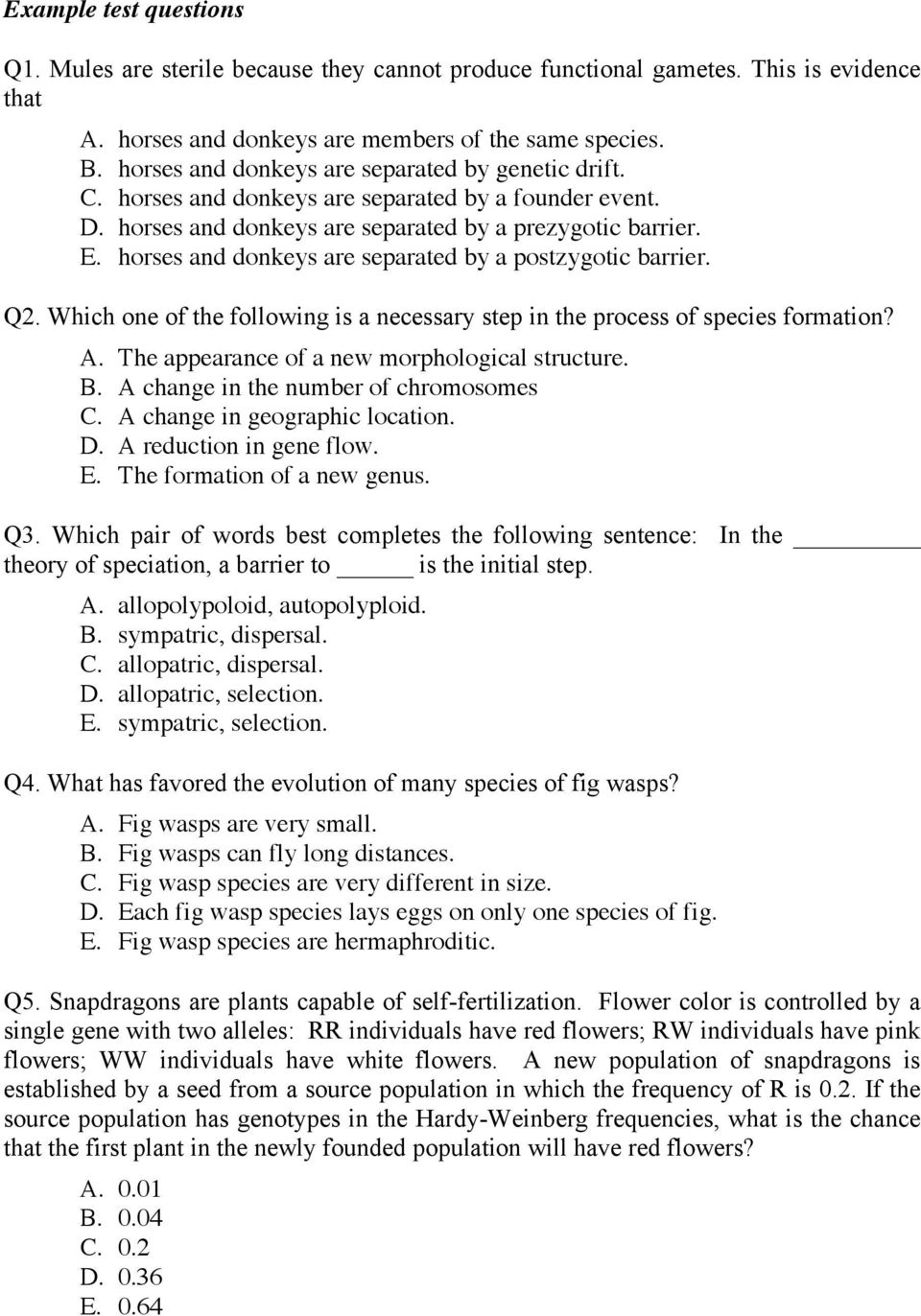
4 Example test questions Q1. Mules are sterile because they cannot produce functional gametes. This is evidence that A. horses and donkeys are members of the same species. B. horses and donkeys are separated by genetic drift. C. horses and donkeys are separated by a founder event. D. horses and donkeys are separated by a prezygotic barrier. E. horses and donkeys are separated by a postzygotic barrier. Q2. Which one of the following is a necessary step in the process of species formation? A. The appearance of a new morphological structure. B. A change in the number of chromosomes C. A change in geographic location. D. A reduction in gene flow. E. The formation of a new genus. Q3. Which pair of words best completes the following sentence: In the theory of speciation, a barrier to is the initial step. A. allopolypoloid, autopolyploid. B. sympatric, dispersal. C. allopatric, dispersal. D. allopatric, selection. E. sympatric, selection. Q4. What has favored the evolution of many species of fig wasps? A. Fig wasps are very small. B. Fig wasps can fly long distances. C. Fig wasp species are very different in size. D. Each fig wasp species lays eggs on only one species of fig. E. Fig wasp species are hermaphroditic. Q5. Snapdragons are plants capable of self-fertilization. Flower color is controlled by a single gene with two alleles: RR individuals have red flowers; RW individuals have pink flowers; WW individuals have white flowers. A new population of snapdragons is established by a seed from a source population in which the frequency of R is 0.2. If the source population has genotypes in the Hardy-Weinberg frequencies, what is the chance that the first plant in the newly founded population will have red flowers? A B C. 0.2 D E. 0.64
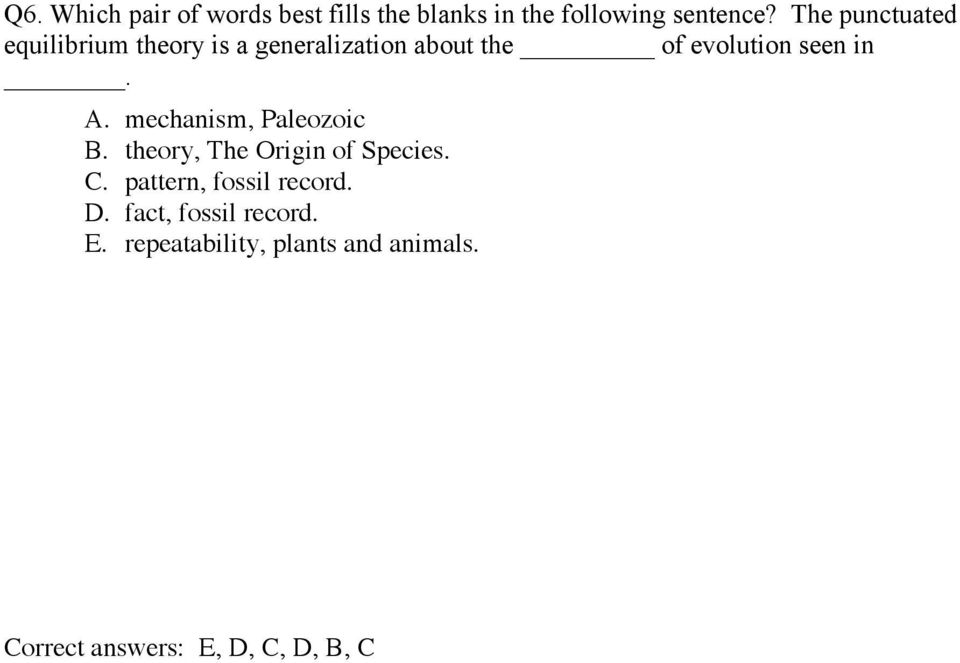
5 Q6. Which pair of words best fills the blanks in the following sentence? The punctuated equilibrium theory is a generalization about the of evolution seen in. A. mechanism, Paleozoic B. theory, The Origin of Species. C. pattern, fossil record. D. fact, fossil record. E. repeatability, plants and animals. Correct answers: E, D, C, D, B, C
Biology 1406 - Notes for exam 5 - Population genetics Ch 13, 14, 15
 Biology 1406 - Notes for exam 5 - Population genetics Ch 13, 14, 15 Species - group of individuals that are capable of interbreeding and producing fertile offspring; genetically similar 13.7, 14.2 Population
Summary. 16 1 Genes and Variation. 16 2 Evolution as Genetic Change. Name Class Date
 Chapter 16 Summary Evolution of Populations 16 1 Genes and Variation Darwin s original ideas can now be understood in genetic terms. Beginning with variation, we now know that traits are controlled by
Principles of Evolution - Origin of Species
 Theories of Organic Evolution X Multiple Centers of Creation (de Buffon) developed the concept of "centers of creation throughout the world organisms had arisen, which other species had evolved from X
Evolution (18%) 11 Items Sample Test Prep Questions
 Evolution (18%) 11 Items Sample Test Prep Questions Grade 7 (Evolution) 3.a Students know both genetic variation and environmental factors are causes of evolution and diversity of organisms. (pg. 109 Science
Preparation. Educator s Section: pp. 1 3 Unit 1 instructions: pp. 4 5 Unit 2 instructions: pp. 6 7 Masters/worksheets: pp. 8-17
 ActionBioscience.org lesson To accompany the article by Lawrence M. Page, Ph.D.: "Planetary Biodiversity Inventories: A Response to the Taxonomic Crisis" (May 2006) http://www.actionbioscience.org/biodiversity/page.html
Problem Set 5 BILD10 / Winter 2014 Chapters 8, 10-12
 Chapter 8: Evolution and Natural Selection 1) A population is: a) a group of species that shares the same habitat. b) a group of individuals of the same species that lives in the same general location
Practice Questions 1: Evolution
 Practice Questions 1: Evolution 1. Which concept is best illustrated in the flowchart below? A. natural selection B. genetic manipulation C. dynamic equilibrium D. material cycles 2. The diagram below
Science 10-Biology Activity 14 Worksheet on Sexual Reproduction
 Science 10-Biology Activity 14 Worksheet on Sexual Reproduction 10 Name Due Date Show Me NOTE: This worksheet is based on material from pages 367-372 in Science Probe. 1. Sexual reproduction requires parents,
Heredity - Patterns of Inheritance
 Heredity - Patterns of Inheritance Genes and Alleles A. Genes 1. A sequence of nucleotides that codes for a special functional product a. Transfer RNA b. Enzyme c. Structural protein d. Pigments 2. Genes
Understanding by Design. Title: BIOLOGY/LAB. Established Goal(s) / Content Standard(s): Essential Question(s) Understanding(s):
 Understanding by Design Title: BIOLOGY/LAB Standard: EVOLUTION and BIODIVERSITY Grade(s):9/10/11/12 Established Goal(s) / Content Standard(s): 5. Evolution and Biodiversity Central Concepts: Evolution
AP Biology Essential Knowledge Student Diagnostic
 AP Biology Essential Knowledge Student Diagnostic Background The Essential Knowledge statements provided in the AP Biology Curriculum Framework are scientific claims describing phenomenon occurring in
A Hands-On Exercise To Demonstrate Evolution
 HOW-TO-DO-IT A Hands-On Exercise To Demonstrate Evolution by Natural Selection & Genetic Drift H ELEN J. YOUNG T RUMAN P. Y OUNG Although students learn (i.e., hear about) the components of evolution by
Sexual Reproduction. and Meiosis. Sexual Reproduction
 Sexual Reproduction and Meiosis Describe the stages of meiosis and how sex cells are produced. Explain why meiosis is needed for sexual reproduction. Name the cells that are involved in fertilization.
Incomplete Dominance and Codominance
 Name: Date: Period: Incomplete Dominance and Codominance 1. In Japanese four o'clock plants red (R) color is incompletely dominant over white (r) flowers, and the heterozygous condition (Rr) results in
AP Biology 2011 Scoring Guidelines Form B
 AP Biology 2011 Scoring Guidelines Form B The College Board The College Board is a not-for-profit membership association whose mission is to connect students to college success and opportunity. Founded
Practice Problems 4. (a) 19. (b) 36. (c) 17
 Chapter 10 Practice Problems Practice Problems 4 1. The diploid chromosome number in a variety of chrysanthemum is 18. What would you call varieties with the following chromosome numbers? (a) 19 (b) 36
PLANT EVOLUTION DISPLAY Handout
 PLANT EVOLUTION DISPLAY Handout Name: TA and Section time Welcome to UCSC Greenhouses. This sheet explains a few botanical facts about plant reproduction that will help you through the display and handout.
Sexual Reproduction. The specialized cells that are required for sexual reproduction are known as. And come from the process of: GAMETES
 Sexual Reproduction Sexual Reproduction We know all about asexual reproduction 1. Only one parent required. 2. Offspring are identical to parents. 3. The cells that produce the offspring are not usually
3 VARIATION IN CHROMOSOME NUMBER & STRUCTURE
 3 VARIATION IN CHROMOSOME NUMBER & STRUCTURE 3.1 Chromosome Number in Different Species In "higher organisms (diploids), members of same species typically have identical numbers of chromosomes in each
Chapter 13: Meiosis and Sexual Life Cycles
 Name Period Concept 13.1 Offspring acquire genes from parents by inheriting chromosomes 1. Let s begin with a review of several terms that you may already know. Define: gene locus gamete male gamete female
Meiosis is a special form of cell division.
 Page 1 of 6 KEY CONCEPT Meiosis is a special form of cell division. BEFORE, you learned Mitosis produces two genetically identical cells In sexual reproduction, offspring inherit traits from both parents
Chapter 9 Patterns of Inheritance
 Bio 100 Patterns of Inheritance 1 Chapter 9 Patterns of Inheritance Modern genetics began with Gregor Mendel s quantitative experiments with pea plants History of Heredity Blending theory of heredity -
Laboratory 1 Evolution by Means of Natural Selection copyright 2011 Dana Krempels
 Laboratory 1 Evolution by Means of Natural Selection copyright 2011 Dana Krempels (FOR TODAY'S LAB, WEAR CLOTHING THAT WILL ALLOW YOU TO ROOT AROUND IN THE GRASS. NO HIGH HEELS, SHORT DRESSES, ETC. DRESS
Bio EOC Topics for Cell Reproduction: Bio EOC Questions for Cell Reproduction:
 Bio EOC Topics for Cell Reproduction: Asexual vs. sexual reproduction Mitosis steps, diagrams, purpose o Interphase, Prophase, Metaphase, Anaphase, Telophase, Cytokinesis Meiosis steps, diagrams, purpose
Agriculture between High Tech and Organics
 Agriculture between High Tech and Organics Denver AAAS 2003 Symposium February 15 Klaus Ammann [email protected] www.bio-scope.org www.academia-engelberg.ch Natural geneflow with its many possibilities
Evolution, Natural Selection, and Adaptation
 Evolution, Natural Selection, and Adaptation Nothing in biology makes sense except in the light of evolution. (Theodosius Dobzhansky) Charles Darwin (1809-1882) Voyage of HMS Beagle (1831-1836) Thinking
Connected Experience: Evolution and the Galápagos Tortoise
 Connected Experience: Evolution and the Galápagos Tortoise GRADE LEVELS 6 th -8 th ; California Content Standards for 7 th and High School Biology Objectives SUBJECTS Life Sciences DURATION Pre-Visit:
Name: 4. A typical phenotypic ratio for a dihybrid cross is a) 9:1 b) 3:4 c) 9:3:3:1 d) 1:2:1:2:1 e) 6:3:3:6
 Name: Multiple-choice section Choose the answer which best completes each of the following statements or answers the following questions and so make your tutor happy! 1. Which of the following conclusions
Biology Final Exam Study Guide: Semester 2
 Biology Final Exam Study Guide: Semester 2 Questions 1. Scientific method: What does each of these entail? Investigation and Experimentation Problem Hypothesis Methods Results/Data Discussion/Conclusion
Mechanisms of Evolution
 page 2 page 3 Teacher's Notes Mechanisms of Evolution Grades: 11-12 Duration: 28 mins Summary of Program Evolution is the gradual change that can be seen in a population s genetic composition, from one
Heredity. Sarah crosses a homozygous white flower and a homozygous purple flower. The cross results in all purple flowers.
 Heredity 1. Sarah is doing an experiment on pea plants. She is studying the color of the pea plants. Sarah has noticed that many pea plants have purple flowers and many have white flowers. Sarah crosses
Lesson Overview. Biodiversity. Lesson Overview. 6.3 Biodiversity
 Lesson Overview 6.3 6.3 Objectives Define biodiversity and explain its value. Identify current threats to biodiversity. Describe how biodiversity can be preserved. THINK ABOUT IT From multicolored coral
2. Fill in the blank. The of a cell is like a leader, directing and telling the different parts of the cell what to do.
 1. Plant and animal cells have some similarities as well as differences. What is one thing that plant and animal cells have in common? A. cell wall B. chlorophyll C. nucleus D. chloroplasts 2. Fill in
Macroevolution: Change above the species level NABT 2006 Evolution Symposium
 Introduction Macroevolution: Change above the species level NABT 2006 Evolution Symposium The basic concept of evolution change over time can be examined in two different time frames. The first, which
GENETIC CROSSES. Monohybrid Crosses
 GENETIC CROSSES Monohybrid Crosses Objectives Explain the difference between genotype and phenotype Explain the difference between homozygous and heterozygous Explain how probability is used to predict
UNIVERSITY OF CAMBRIDGE INTERNATIONAL EXAMINATIONS International General Certificate of Secondary Education
 *9282687787* UNIVERSITY OF CAMBRIDGE INTERNATIONAL EXAMINATIONS International General Certificate of Secondary Education BIOLOGY 0610/21 Paper 2 Core October/November 2012 1 hour 15 minutes Candidates
CCR Biology - Chapter 7 Practice Test - Summer 2012
 Name: Class: Date: CCR Biology - Chapter 7 Practice Test - Summer 2012 Multiple Choice Identify the choice that best completes the statement or answers the question. 1. A person who has a disorder caused
The Art of the Tree of Life. Catherine Ibes & Priscilla Spears March 2012
 The Art of the Tree of Life Catherine Ibes & Priscilla Spears March 2012 from so simple a beginning endless forms most beautiful and most wonderful have been, and are being, evolved. Charles Darwin, The
Chapter 13: Meiosis and Sexual Life Cycles
 Name Period Chapter 13: Meiosis and Sexual Life Cycles Concept 13.1 Offspring acquire genes from parents by inheriting chromosomes 1. Let s begin with a review of several terms that you may already know.
The Evolution of Populations
 23 he Evolution of Populations Key oncepts 23.1 enetic variation makes evolution possible 23.2 he Hardy-Weinberg equation can be used to test whether a population is evolving 23.3 Natural selection, genetic
BIO 1: Review: Evolution
 Name: Class: Date: ID: A BIO 1: Review: Evolution True/False Indicate whether the statement is true or false. 1. Radiometric dating measures the age of an object by measuring the proportions of radioactive
5 GENETIC LINKAGE AND MAPPING
 5 GENETIC LINKAGE AND MAPPING 5.1 Genetic Linkage So far, we have considered traits that are affected by one or two genes, and if there are two genes, we have assumed that they assort independently. However,
Although Darwin titled his book On the Origin of Species,
 22 The Origin of Species Concept Outline 22.1 Species are the basic units of evolution. The Nature of Species. Species are groups of actually or potentially interbreeding natural populations which are
Genetics for the Novice
 Genetics for the Novice by Carol Barbee Wait! Don't leave yet. I know that for many breeders any article with the word genetics in the title causes an immediate negative reaction. Either they quickly turn
MCB41: Second Midterm Spring 2009
 MCB41: Second Midterm Spring 2009 Before you start, print your name and student identification number (S.I.D) at the top of each page. There are 7 pages including this page. You will have 50 minutes for
AP: LAB 8: THE CHI-SQUARE TEST. Probability, Random Chance, and Genetics
 Ms. Foglia Date AP: LAB 8: THE CHI-SQUARE TEST Probability, Random Chance, and Genetics Why do we study random chance and probability at the beginning of a unit on genetics? Genetics is the study of inheritance,
Chapter 3. Chapter Outline. Chapter Outline 9/11/10. Heredity and Evolu4on
 Chapter 3 Heredity and Evolu4on Chapter Outline The Cell DNA Structure and Function Cell Division: Mitosis and Meiosis The Genetic Principles Discovered by Mendel Mendelian Inheritance in Humans Misconceptions
Dissect a Flower. Huntington Library, Art Collections, and Botanical Gardens
 Huntington Library, Art Collections, and Botanical Gardens Dissect a Flower Overview Students dissect an Alstroemeria or similar flower to familiarize themselves with the basic parts of a flower. They
CHROMOSOMES AND INHERITANCE
 SECTION 12-1 REVIEW CHROMOSOMES AND INHERITANCE VOCABULARY REVIEW Distinguish between the terms in each of the following pairs of terms. 1. sex chromosome, autosome 2. germ-cell mutation, somatic-cell
Worksheet: The theory of natural selection
 Worksheet: The theory of natural selection Senior Phase Grade 7-9 Learning area: Natural Science Strand: Life and living Theme: Biodiversity, change and continuity Specific Aim 1: Acquiring knowledge of
Name Class Date WHAT I KNOW. about how organisms have changed. grown in complexity over time.
 History of Life Evolution Q: How do fossils help biologists understand the history of life on Earth? 19.1 How do scientists use fossils to study Earth s history? WHAT I KNOW SAMPLE ANSWER: Fossils give
I. Genes found on the same chromosome = linked genes
 Genetic recombination in Eukaryotes: crossing over, part 1 I. Genes found on the same chromosome = linked genes II. III. Linkage and crossing over Crossing over & chromosome mapping I. Genes found on the
Campbell Biology in Focus Correlation for AP Biology Curriculum Framework
 Campbell Biology in Focus Correlation for AP Biology Curriculum Framework Chapters/ Graphical analysis of allele frequencies in a population 5 Application of the Hardy-Weinberg equilibrium equation 1,
WJEC AS Biology Biodiversity & Classification (2.1 All Organisms are related through their Evolutionary History)
 Name:.. Set:. Specification Points: WJEC AS Biology Biodiversity & Classification (2.1 All Organisms are related through their Evolutionary History) (a) Biodiversity is the number of different organisms
XII. Biology, Grade 10
 XII. Biology, Grade 10 Grade 10 Biology Pilot Test The spring 2004 Grade 10 MCAS Biology Test was based on learning standards in the Biology content strand of the Massachusetts Science and Technology/Engineering
1. Why is mitosis alone insufficient for the life cycle of sexually reproducing eukaryotes?
 Chapter 13: Meiosis and Sexual Life Cycles 1. Why is mitosis alone insufficient for the life cycle of sexually reproducing eukaryotes? 2. Define: gamete zygote meiosis homologous chromosomes diploid haploid
Introduction to Physical Anthropology - Study Guide - Focus Topics
 Introduction to Physical Anthropology - Study Guide - Focus Topics Chapter 1 Species: Recognize all definitions. Evolution: Describe all processes. Culture: Define and describe importance. Biocultural:
Parental care and sexual conflict. Email: [email protected]
 Parental care and sexual conflict René van Dijk Email: [email protected] Papers for 15 November Team 1 Royle,, N. J., I. R. Hartley & G. A. Parker. 2002. Sexual conflict reduces offspring fitness
Tuesday 14 May 2013 Morning
 THIS IS A NEW SPECIFICATION H Tuesday 14 May 2013 Morning GCSE TWENTY FIRST CENTURY SCIENCE BIOLOGY A A161/02 Modules B1 B2 B3 (Higher Tier) *A137150613* Candidates answer on the Question Paper. A calculator
240Tutoring Life Science Study Material
 240Tutoring Life Science Study Material This information is a sample of the instructional content and practice questions found on the 240Tutoring GACE Early Childhood Education. This information is meant
Mendelian Genetics in Drosophila
 Mendelian Genetics in Drosophila Lab objectives: 1) To familiarize you with an important research model organism,! Drosophila melanogaster. 2) Introduce you to normal "wild type" and various mutant phenotypes.
Ecology - scientific study of how individuals interact with their environment 34.1
 Biology 1407 Exam 4 Notes - Ecology Ch.35-36 Ecology - scientific study of how individuals interact with their environment 34.1 - organisms have adapted to - evolved in - a particular set of conditions;
Terms: The following terms are presented in this lesson (shown in bold italics and on PowerPoint Slides 2 and 3):
 Unit B: Understanding Animal Reproduction Lesson 4: Understanding Genetics Student Learning Objectives: Instruction in this lesson should result in students achieving the following objectives: 1. Explain
LAB : THE CHI-SQUARE TEST. Probability, Random Chance, and Genetics
 Period Date LAB : THE CHI-SQUARE TEST Probability, Random Chance, and Genetics Why do we study random chance and probability at the beginning of a unit on genetics? Genetics is the study of inheritance,
Name: Class: Date: ID: A
 Name: Class: _ Date: _ Meiosis Quiz 1. (1 point) A kidney cell is an example of which type of cell? a. sex cell b. germ cell c. somatic cell d. haploid cell 2. (1 point) How many chromosomes are in a human
Trasposable elements: P elements
 Trasposable elements: P elements In 1938 Marcus Rhodes provided the first genetic description of an unstable mutation, an allele of a gene required for the production of pigment in maize. This instability
A and B are not absolutely linked. They could be far enough apart on the chromosome that they assort independently.
 Name Section 7.014 Problem Set 5 Please print out this problem set and record your answers on the printed copy. Answers to this problem set are to be turned in to the box outside 68-120 by 5:00pm on Friday
7A The Origin of Modern Genetics
 Life Science Chapter 7 Genetics of Organisms 7A The Origin of Modern Genetics Genetics the study of inheritance (the study of how traits are inherited through the interactions of alleles) Heredity: the
Course Outline. Parental care and sexual conflict. Papers for 22 October. What is sexual conflict? 10/19/2009
 Parental and sexual conflict Course Outline 1. Sexual selection * 2. Parent offspring conflict * 3. Sexual conflict over parental René van Dijk Email: [email protected] 19 October 2009 4. Genomic
(1-p) 2. p(1-p) From the table, frequency of DpyUnc = ¼ (p^2) = #DpyUnc = p^2 = 0.0004 ¼(1-p)^2 + ½(1-p)p + ¼(p^2) #Dpy + #DpyUnc
 Advanced genetics Kornfeld problem set_key 1A (5 points) Brenner employed 2-factor and 3-factor crosses with the mutants isolated from his screen, and visually assayed for recombination events between
Basic Principles of Forensic Molecular Biology and Genetics. Population Genetics
 Basic Principles of Forensic Molecular Biology and Genetics Population Genetics Significance of a Match What is the significance of: a fiber match? a hair match? a glass match? a DNA match? Meaning of
Chapter 38: Angiosperm Reproduction and Biotechnology
 Name Period Concept 38.1 Flowers, double fertilization, and fruits are unique features of the angiosperm life cycle This may be a good time for you to go back to Chapter 29 and review alternation of generation
Human Blood Types: Codominance and Multiple Alleles. Codominance: both alleles in the heterozygous genotype express themselves fully
 Human Blood Types: Codominance and Multiple Alleles Codominance: both alleles in the heterozygous genotype express themselves fully Multiple alleles: three or more alleles for a trait are found in the
Name. Period. Date. Science.. Variation and Selection in the...egyptian Origami Bird (Avis papyrus)..
 Name. Period. Date. Science.. Variation and Selection in the....egyptian Origami Bird (Avis papyrus).. INTRODUCTION: The Egyptian Origami Bird (Avis papyrus) lives in arid regions of North Africa.. It
A trait is a variation of a particular character (e.g. color, height). Traits are passed from parents to offspring through genes.
 1 Biology Chapter 10 Study Guide Trait A trait is a variation of a particular character (e.g. color, height). Traits are passed from parents to offspring through genes. Genes Genes are located on chromosomes
NATIONAL SENIOR CERTIFICATE GRADE 12
 NATIONAL SENIOR CERTIFICATE GRADE 12 LIFE SCIENCES P2 FEBRUARY/MARCH 2015 MEMORANDUM MARKS: 150 This memorandum consists of 12 pages. Life Sciences/P2 2 DBE/Feb. Mar. 2015 PRINCIPLES RELATED TO MARKING
FAQs: Gene drives - - What is a gene drive?
 FAQs: Gene drives - - What is a gene drive? During normal sexual reproduction, each of the two versions of a given gene has a 50 percent chance of being inherited by a particular offspring (Fig 1A). Gene
AP Biology. The four big ideas are:
 AP Biology Course Overview: This course is an intensive study in biological concepts that emphasizes inquiry based learning. It is structured around the four Big Ideas and the Enduring Understandings that
Pre-lab homework Lab 2: Reproduction in Protists, Fungi, Moss and Ferns
 Pre-lab homework Lab 2: Reproduction in Protists, Fungi, Moss and Ferns Lab Section: Name: 1. Last week in lab you looked at the reproductive cycle of the animals. This week s lab examines the cycles of
Chromosomes, Mapping, and the Meiosis Inheritance Connection
 Chromosomes, Mapping, and the Meiosis Inheritance Connection Carl Correns 1900 Chapter 13 First suggests central role for chromosomes Rediscovery of Mendel s work Walter Sutton 1902 Chromosomal theory
GCSE BITESIZE Examinations
 GCSE BITESIZE Examinations General Certificate of Secondary Education AQA SCIENCE A BLY1B Unit Biology B1b (Evolution and Environment) AQA BIOLOGY Unit Biology B1b (Evolution and Environment) FOUNDATION
Reproductive System & Development: Practice Questions #1
 Reproductive System & Development: Practice Questions #1 1. Which two glands in the diagram produce gametes? A. glands A and B B. glands B and E C. glands C and F D. glands E and F 2. Base your answer
Plant Reproduction. 2. Evolutionarily, floral parts are modified A. stems B. leaves C. roots D. stolons E. suberins
 Plant Reproduction 1. Angiosperms use temporary reproductive structures that are not present in any other group of plants. These structures are called A. cones B. carpels C. receptacles D. flowers E. seeds
B2 5 Inheritrance Genetic Crosses
 B2 5 Inheritrance Genetic Crosses 65 minutes 65 marks Page of 55 Q. A woman gives birth to triplets. Two of the triplets are boys and the third is a girl. The triplets developed from two egg cells released
Activity 4 Probability, Genetics, and Inheritance
 Activity 4 Probability, Genetics, and Inheritance Objectives After completing this activity students will understand basic probability and single-gene inheritance. Students will be able to predict expected
Extinction; Lecture-8
 I. introduction Definition Current extinction Genetic drift Extinction; Lecture-8 II. 3 types of extinction 1. background 2. mass 3. stochastic III. 5 periods of mass IV. human caused 1. on land and in
Cell Growth and Reproduction Module B, Anchor 1
 Cell Growth and Reproduction Module B, Anchor 1 Key Concepts: - The larger a cell becomes, the more demands the cell places on its DNA. In addition, a larger cell is less efficient in moving nutrients
The Concept of Inclusive Fitness 1 Ethology and Behavioral Ecology Spring 2008
 The Concept of Inclusive Fitness 1 Ethology and Behavioral Ecology Spring 2008 I. The components of Fitness A. Direct fitness W d, darwinian fitness, W gained by increasing ones own reproduction relative
Genetics 301 Sample Final Examination Spring 2003
 Genetics 301 Sample Final Examination Spring 2003 50 Multiple Choice Questions-(Choose the best answer) 1. A cross between two true breeding lines one with dark blue flowers and one with bright white flowers
Genetics 1. Defective enzyme that does not make melanin. Very pale skin and hair color (albino)
 Genetics 1 We all know that children tend to resemble their parents. Parents and their children tend to have similar appearance because children inherit genes from their parents and these genes influence
XVIII. Biology, High School
 XVIII. Biology, High School High School Biology Test The spring 2013 high school Biology test was based on learning standards in the Biology content strand of the Massachusetts Science and Technology/Engineering
Hardy-Weinberg Equilibrium Problems
 Hardy-Weinberg Equilibrium Problems 1. The frequency of two alleles in a gene pool is 0.19 (A) and 0.81(a). Assume that the population is in Hardy-Weinberg equilibrium. (a) Calculate the percentage of
Lecture 2: Mitosis and meiosis
 Lecture 2: Mitosis and meiosis 1. Chromosomes 2. Diploid life cycle 3. Cell cycle 4. Mitosis 5. Meiosis 6. Parallel behavior of genes and chromosomes Basic morphology of chromosomes telomere short arm
The Genetics of Drosophila melanogaster
 The Genetics of Drosophila melanogaster Thomas Hunt Morgan, a geneticist who worked in the early part of the twentieth century, pioneered the use of the common fruit fly as a model organism for genetic
Conservation of Small Populations: Effective Population Sizes, Inbreeding, and the 50/500 Rule
 12 Conservation of Small Populations: Effective Population Sizes, Inbreeding, and the 50/500 Rule Luke J. Harmon and Stanton Braude Introduction and Background Populationsizeisextremelyimportantinevaluatingconservationprioritiesforaspecies.
The correct answer is c A. Answer a is incorrect. The white-eye gene must be recessive since heterozygous females have red eyes.
 1. Why is the white-eye phenotype always observed in males carrying the white-eye allele? a. Because the trait is dominant b. Because the trait is recessive c. Because the allele is located on the X chromosome
WEEK 6 EOC Review Evolution, Human Body, Biotechnology
 WEEK 6 EOC Review Evolution, Human Body, Biotechnology Benchmarks: SC.912.L.15.13 Describe the conditions required for natural selection, including: overproduction of offspring, inherited variation, and
LAB : PAPER PET GENETICS. male (hat) female (hair bow) Skin color green or orange Eyes round or square Nose triangle or oval Teeth pointed or square
 Period Date LAB : PAPER PET GENETICS 1. Given the list of characteristics below, you will create an imaginary pet and then breed it to review the concepts of genetics. Your pet will have the following