
The Language IN Math:Strategies for Developing Math Vocabulary
|
|
|
- Preston Newton
- 9 years ago
- Views:
Transcription
1 The Language IN Math:Strategies for Developing Math Vocabulary Math, Limited English Proficiency Learners Grades K-6 How do we teach mathematics vocabulary effectively? This workshop will focus on specific strategies and activities based on research from many sources, including the work of Robert Marzano. You will actively participate in activities designed for engaging students as they interact with the language used in the mathematics class. You will take home strategies you can use immediately and understand why they work. Although the examples used are focused on mathematics, the research and strategies are relevant and can be adapted for any content area. Kimberly Rimbey Phoenix, Arizona Kimberly Rimbey is a National Board Certified teacher in early adolescent mathematics and has taught for almost 20 years in Arizona. As a math specialist, she works with atrisk students as well as with their teachers. Her passion is helping teachers implement mathematics best practices strategies through a variety of professional development opportunities that include model lessons, co-teaching, co-planning and presentations. Kimberly holds two master s degrees: one in early childhood education and the other in educational leadership. Kimberly is the recipient of the 2001 Presidential Award for Excellence in Mathematics Teaching.

2 The Language IN Mathematics Strategies for developing Math Vocabulary Welcome Why Develop Math Vocabulary Word Walls vs. Word Banks Classroom Ideas Frayer Model SNAP! Math Bingo/WORDO Vocabulary Riddles Word Sorts Group Solutions from GEMS Portable Word Walls Vocabulary Tests Math Vocabulary Journals The Language OF Mathematics Presented by Kimberly Rimbey, NBCT, M.Ed., M.Ed. Teacher Training Corps, 2006

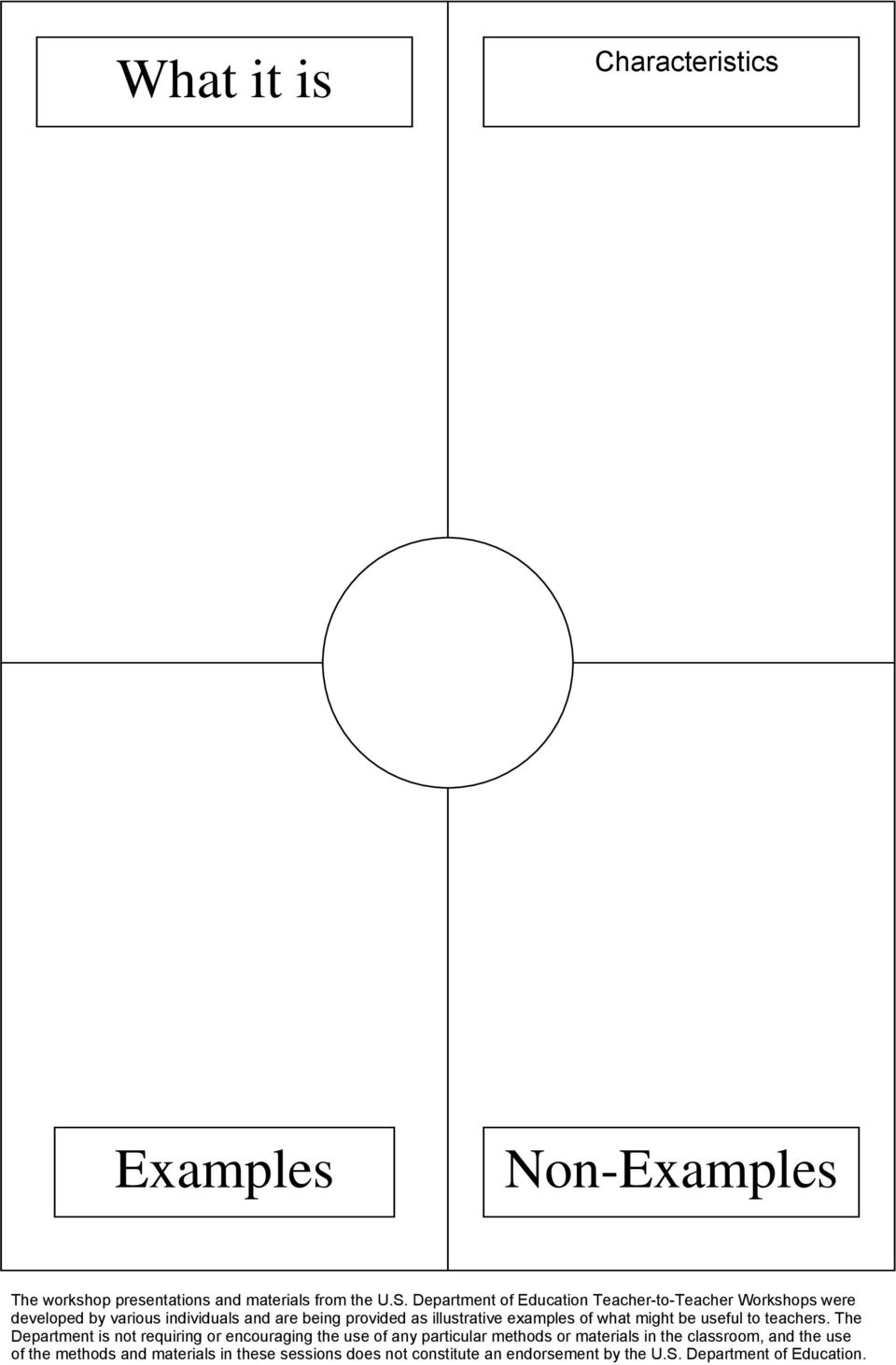
3 What it is Characteristics Examples Non-Examples
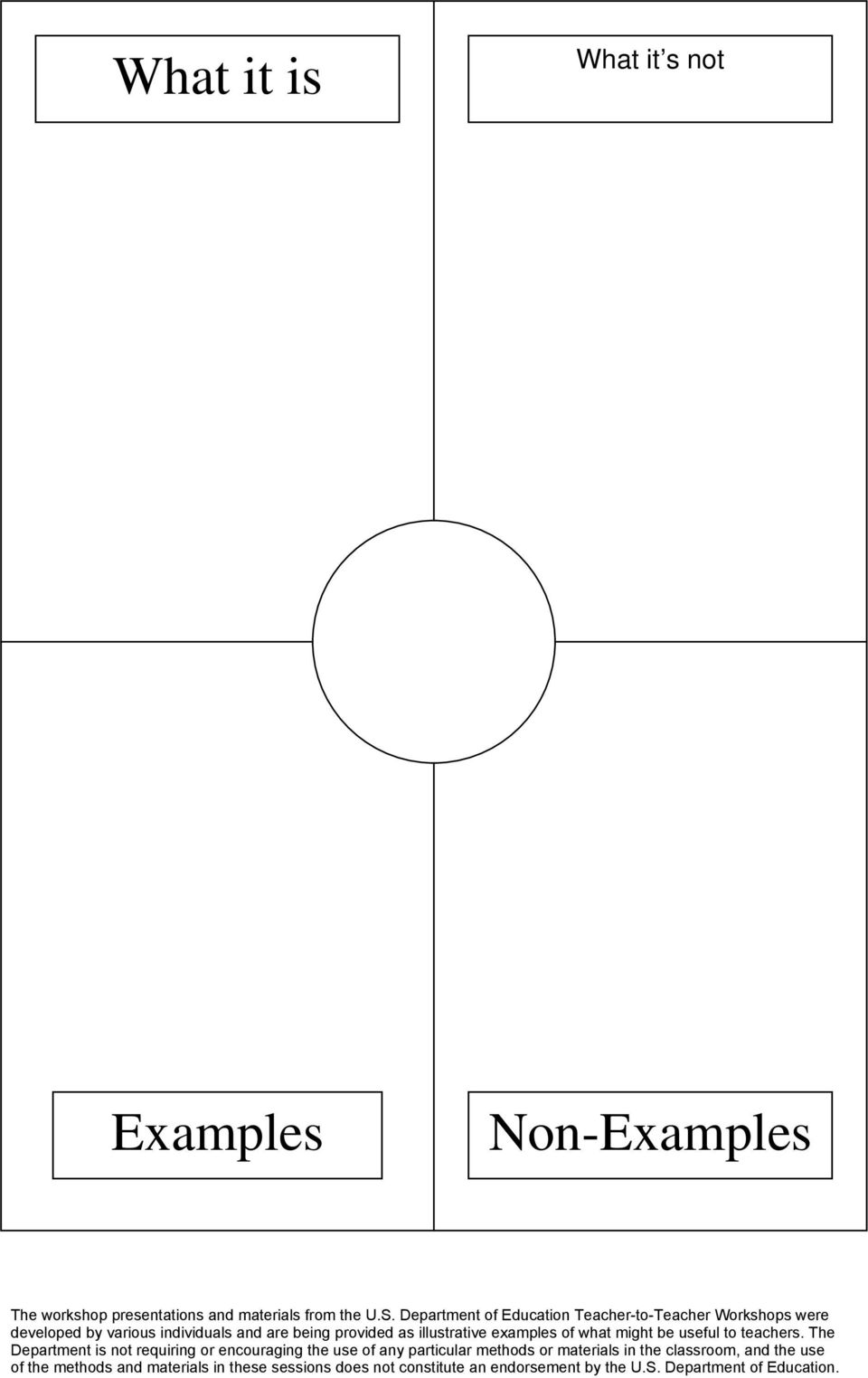
4 What it is What it s not Examples Non-Examples
5 Primary SNAP! Cut strips apart. Place in a cup or bowl. Student draw out one strip & name the object/symbol. If correct, the student keeps the strip; if incorrect, the student puts the strip back. If the student gets the SNAP card (has a star on it), all strips must be put back in the cup. The cup passes from one student to the next until someone gets the key number or time runs out SNAP! SNAP!

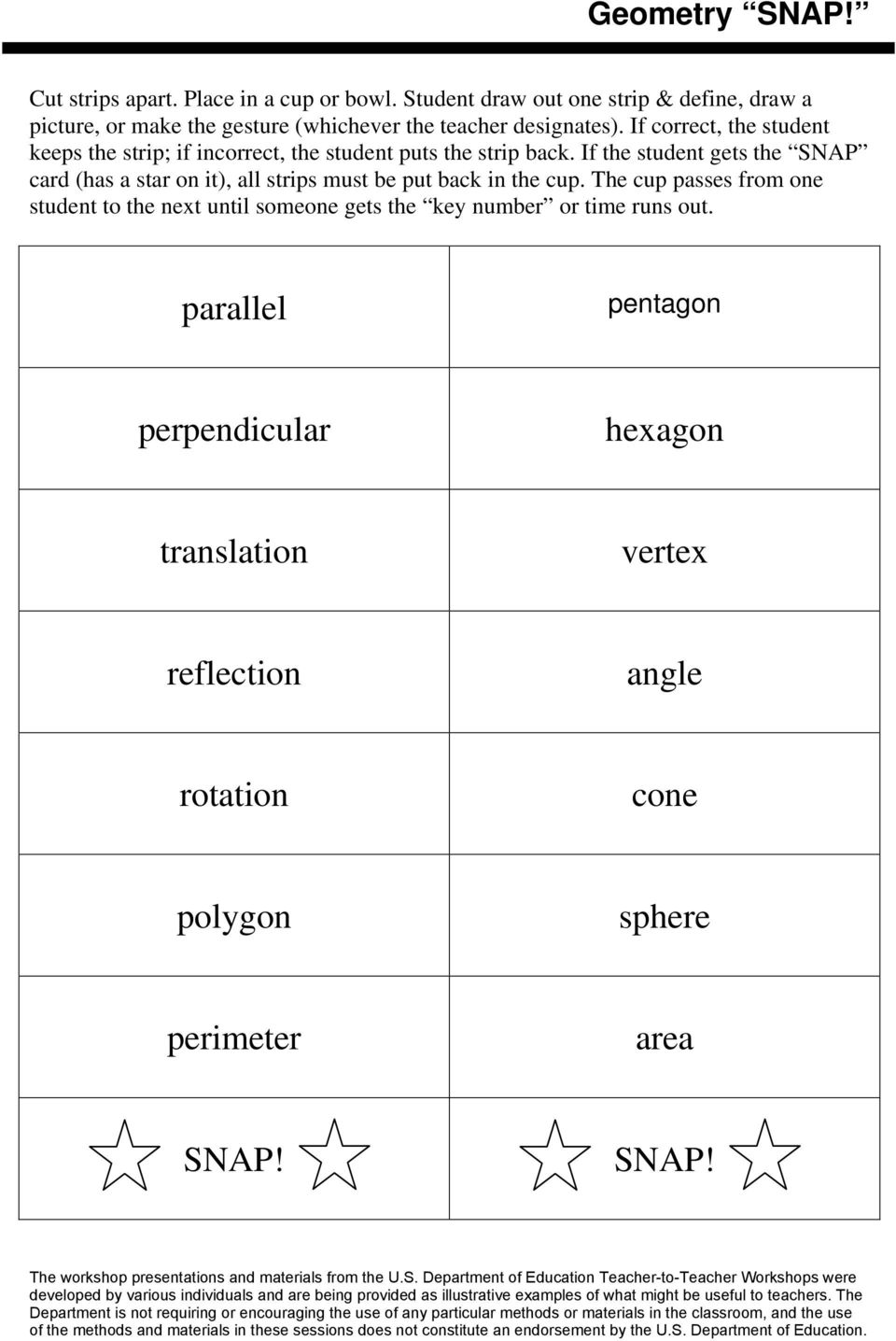
6 Geometry SNAP! Cut strips apart. Place in a cup or bowl. Student draw out one strip & define, draw a picture, or make the gesture (whichever the teacher designates). If correct, the student keeps the strip; if incorrect, the student puts the strip back. If the student gets the SNAP card (has a star on it), all strips must be put back in the cup. The cup passes from one student to the next until someone gets the key number or time runs out. parallel pentagon perpendicular hexagon translation vertex reflection angle rotation cone polygon sphere perimeter area SNAP! SNAP!
7 WORDO

8 WORDO

9 Vocabulary Riddles In this activity, invite your students to be mind readers. Choose a word from the word bank and write it down--don t let anyone see it. Have students number their scratch paper 1-5. You will give them five clues about a word you chose. They are to take a guess after each clue and write that guess down. By the fifth clue, everyone should guess your word. 1. It s one of the words on in the math word bank. 2. It has five letters. 3. It has an i for a vowel. 4. It is a unit of length. 5. It completes this sentence: Mrs. Bradley drove 7 to get to the mall. Word Sorts Word sorts can be done in many ways. You can sort by many different characteristics including the following: vowels consonant sounds number of letters math standard categories Today s word sort will have you sorting measurement vocabulary by category (length, weight, capacity).

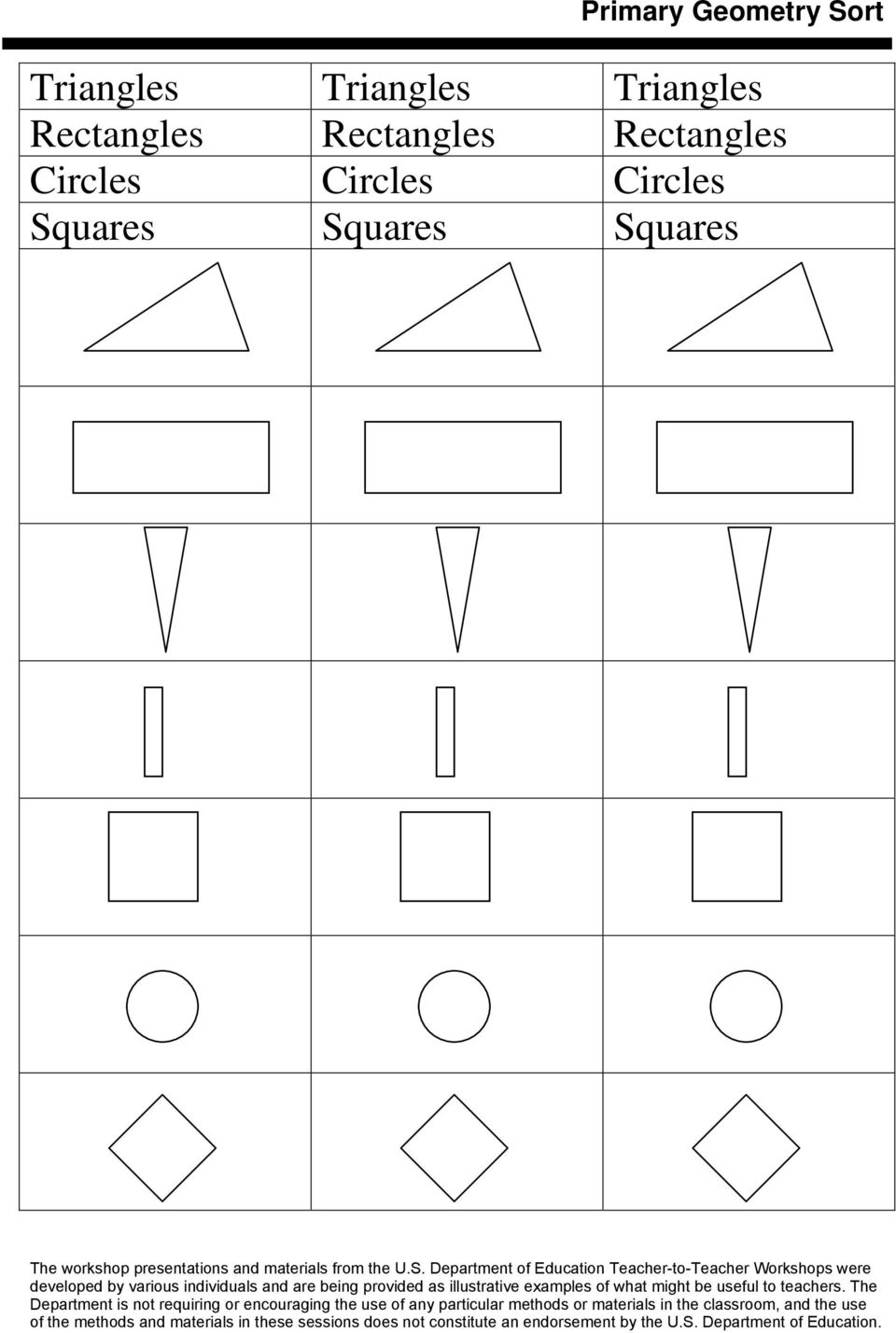
10 Primary Geometry Sort Triangles Triangles Triangles Rectangles Rectangles Rectangles Circles Circles Circles Squares Squares Squares
11 Measurement Sort Length Length Length Length Weight/Mass Weight/Mass Weight/Mass Weight/Mass Capacity Capacity Capacity Capacity inch inch inch inch foot foot foot foot yard yard yard yard mile mile mile mile cm cm cm cm m m m m mm mm mm mm liter liter liter liter km km km km milliliter milliliter milliliter milliliter ounce ounce ounce ounce cup cup cup cup gallon gallon gallon gallon pint pint pint pint pound pound pound pound quart quart quart quart dm dm dm dm hm hm hm hm dkm dkm dkm dkm

12 Portable Word Banks For the convenience of the individual child, a portable word bank may be desirable. Very young children may have difficulty seeing the word wall from their seats, so table-top word banks may be helpful. Students who leave the room for special classes such as SEI classes or Special Ed. classes can take their word banks with them. These can be personalized, illustrated, color coded, or individualized in a variety of ways. They can be listed by standard or alphabetically. The students can enter the words, or the teacher can do that. Materials needed include file folders, colored pencils/markers, and word lists. Vocabulary Tests Vocabulary tests can take on a variety of looks. Since this is a vocabulary test rather than a spelling test, it s perfectly fine for the kids to use the word bank to assist them with spelling in fact, I would encourage it!!! Here s a sample 1. Number one begins with a g and is a measure of capacity. 2. Number two begins with a y and is a measure of length 3. Number three begins with an o and is a measure of weight. 4. Number four rhymes with cinch and is a measure of length. 5. Number five completes this sentence, Mrs. Rimbey lives 15 away from the school.

13 Vocabulary Journals Vocabulary journals go beyond having the students simply list their math vocabulary words. They include illustrations and/or definitions as well. Below is a sample entry for a vocabulary journal. Rectangle: A four-sided shape with 4 right angles. Examples: Non-Examples:

14 Math Vocabulary

15 Math Vocabulary
FCAT FLORIDA COMPREHENSIVE ASSESSMENT TEST. Mathematics Reference Sheets. Copyright Statement for this Assessment and Evaluation Services Publication
 FCAT FLORIDA COMPREHENSIVE ASSESSMENT TEST Mathematics Reference Sheets Copyright Statement for this Assessment and Evaluation Services Publication Authorization for reproduction of this document is hereby
Grade 8 Mathematics Geometry: Lesson 2
 Grade 8 Mathematics Geometry: Lesson 2 Read aloud to the students the material that is printed in boldface type inside the boxes. Information in regular type inside the boxes and all information outside
ISAT Mathematics Performance Definitions Grade 4
 ISAT Mathematics Performance Definitions Grade 4 EXCEEDS STANDARDS Fourth-grade students whose measured performance exceeds standards are able to identify, read, write, represent, and model whole numbers
Grade 1 Geometric Shapes Conceptual Lessons Unit Outline Type of Knowledge & SBAC Claim Prerequisite Knowledge:
 Grade 1 Geometric Shapes Conceptual Lessons Unit Outline Type of Knowledge & SBAC Claim Prerequisite Knowledge: Standards: Lesson Title and Objective/Description Shape names: square, rectangle, triangle,
Lesson 18 Pythagorean Triples & Special Right Triangles
 Student Name: Date: Contact Person Name: Phone Number: Teas Assessment of Knowledge and Skills Eit Level Math Review Lesson 18 Pythagorean Triples & Special Right Triangles TAKS Objective 6 Demonstrate
Assessment For The California Mathematics Standards Grade 3
 Introduction: Summary of Goals GRADE THREE By the end of grade three, students deepen their understanding of place value and their understanding of and skill with addition, subtraction, multiplication,
Converting Units of Measure Measurement
 Converting Units of Measure Measurement Outcome (lesson objective) Given a unit of measurement, students will be able to convert it to other units of measurement and will be able to use it to solve contextual
Building a Bridge to Academic Vocabulary in Mathematics
 Building a Bridge to Academic Vocabulary in Mathematics AISD Elementary Mathematics Department How Students Develop a Repertoire of Academic English in Mathematics Developed and researched by the AISD
Identifying and Describing Polygons: A Geometry Lesson
 Identifying and Describing Polygons: A Geometry Lesson Lesson Plan R6 Overview In this lesson, students learn to identify and describe polygons and compare and contrast them with figures that are not polygons.
EVERY DAY COUNTS CALENDAR MATH 2005 correlated to
 EVERY DAY COUNTS CALENDAR MATH 2005 correlated to Illinois Mathematics Assessment Framework Grades 3-5 E D U C A T I O N G R O U P A Houghton Mifflin Company YOUR ILLINOIS GREAT SOURCE REPRESENTATIVES:
Objective To guide exploration of the connection between reflections and line symmetry. Assessment Management
 Line Symmetry Objective To guide exploration of the connection between reflections and line symmetry. www.everydaymathonline.com epresentations etoolkit Algorithms Practice EM Facts Workshop Game Family
MEASUREMENTS. U.S. CUSTOMARY SYSTEM OF MEASUREMENT LENGTH The standard U.S. Customary System units of length are inch, foot, yard, and mile.
 MEASUREMENTS A measurement includes a number and a unit. 3 feet 7 minutes 12 gallons Standard units of measurement have been established to simplify trade and commerce. TIME Equivalences between units
angle attribute Figure 1 4 right angles opposite sides parallel Lesson 14 5 Lesson 14 4 Vocab
 Vocab angle attribute 006_055_G4_VisV_101741.indd Page F46 2/13/10 11:27:36 PM u-s014 /Volumes/114/GO00403/GO00403_Natl_Visual_Voca_Cards_G4%0 Figure 1 4 right angles opposite sides parallel endpoint hexagon
Fractional Part of a Set
 Addition and Subtraction Basic Facts... Subtraction Basic Facts... Order in Addition...7 Adding Three Numbers...8 Inverses: Addition and Subtraction... Problem Solving: Two-Step Problems... 0 Multiplication
Lesson #13 Congruence, Symmetry and Transformations: Translations, Reflections, and Rotations
 Math Buddies -Grade 4 13-1 Lesson #13 Congruence, Symmetry and Transformations: Translations, Reflections, and Rotations Goal: Identify congruent and noncongruent figures Recognize the congruence of plane
Scope and Sequence KA KB 1A 1B 2A 2B 3A 3B 4A 4B 5A 5B 6A 6B
 Scope and Sequence Earlybird Kindergarten, Standards Edition Primary Mathematics, Standards Edition Copyright 2008 [SingaporeMath.com Inc.] The check mark indicates where the topic is first introduced
3. Relationship between this Unit and the Principles and Standards for School Mathematics (NCTM 2000). This Unit
 4 th Grade Mathematics Lesson Plan April 16-18, 2002 Brewer Island School, San Mateo, CA Instructor: Akihiko Takahashi 1. Title of Unit: Finding the Area of Shapes 2. Goal: a. To deepen students understanding
Line Segments, Rays, and Lines
 HOME LINK Line Segments, Rays, and Lines Family Note Help your child match each name below with the correct drawing of a line, ray, or line segment. Then observe as your child uses a straightedge to draw
Capacity. Assessment Management
 Capacity Objective To review units of capacity. www.everydaymathonline.com epresentations etoolkit Algorithms Practice EM Facts Workshop Game Family Letters Assessment Management Common Core State Standards
Indicator 2: Use a variety of algebraic concepts and methods to solve equations and inequalities.
 3 rd Grade Math Learning Targets Algebra: Indicator 1: Use procedures to transform algebraic expressions. 3.A.1.1. Students are able to explain the relationship between repeated addition and multiplication.
Objective To introduce a formula to calculate the area. Family Letters. Assessment Management
 Area of a Circle Objective To introduce a formula to calculate the area of a circle. www.everydaymathonline.com epresentations etoolkit Algorithms Practice EM Facts Workshop Game Family Letters Assessment
Grade 3 Core Standard III Assessment
 Grade 3 Core Standard III Assessment Geometry and Measurement Name: Date: 3.3.1 Identify right angles in two-dimensional shapes and determine if angles are greater than or less than a right angle (obtuse
Copyright 2008 [SingaporeMath.com Inc.]. All rights reserved.
![Copyright 2008 [SingaporeMath.com Inc.]. All rights reserved.](/thumbs/40/21422510.jpg "Copyright 2008 [SingaporeMath.com Inc.]. All rights reserved.") Assessment Test for Singapore Primary Mathematics 2B Standards Edition This test covers material taught in Primary Mathematics 2B Standards Edition (http://www.singaporemath.com/) 1. Fill in the blanks
Assessment Test for Singapore Primary Mathematics 2B Standards Edition This test covers material taught in Primary Mathematics 2B Standards Edition (http://www.singaporemath.com/) 1. Fill in the blanks
Third Grade Shapes Up! Grade Level: Third Grade Written by: Jill Pisman, St. Mary s School East Moline, Illinois Length of Unit: Eight Lessons
 Third Grade Shapes Up! Grade Level: Third Grade Written by: Jill Pisman, St. Mary s School East Moline, Illinois Length of Unit: Eight Lessons I. ABSTRACT This unit contains lessons that focus on geometric
GRADE 6 MATHEMATICS CORE 1 VIRGINIA STANDARDS OF LEARNING. Spring 2006 Released Test. Property of the Virginia Department of Education
 VIRGINIA STANDARDS OF LEARNING Spring 2006 Released Test GRADE 6 MATHEMATICS CORE 1 Property of the Virginia Department of Education 2006 by the Commonwealth of Virginia, Department of Education, P.O.
Unit 2 Module 3: Generating Examples and Nonexamples
 Unit 2 Module 3: Generating Examples and Nonexamples Section 1 Slide 1 Title Slide Welcome to the third module in the Vocabulary Instructional Routines unit, Generating Examples and Nonexamples. Slide
Mathematics Scope and Sequence, K-8
 Standard 1: Number and Operation Goal 1.1: Understands and uses numbers (number sense) Mathematics Scope and Sequence, K-8 Grade Counting Read, Write, Order, Compare Place Value Money Number Theory K Count
1. I have 4 sides. My opposite sides are equal. I have 4 right angles. Which shape am I?
 Which Shape? This problem gives you the chance to: identify and describe shapes use clues to solve riddles Use shapes A, B, or C to solve the riddles. A B C 1. I have 4 sides. My opposite sides are equal.
Unit 8 Angles, 2D and 3D shapes, perimeter and area
 Unit 8 Angles, 2D and 3D shapes, perimeter and area Five daily lessons Year 6 Spring term Recognise and estimate angles. Use a protractor to measure and draw acute and obtuse angles to Page 111 the nearest
Lesson 1: Linear Measurement
 Lesson 1: Linear Selected Content Standards Benchmarks Addressed: M-1-M Applying the concepts of length, area, surface area, volume, capacity, weight, mass, money, time, temperature, and rate to real-world
Grade 6 FCAT 2.0 Mathematics Sample Questions
 Grade FCAT. Mathematics Sample Questions The intent of these sample test materials is to orient teachers and students to the types of questions on FCAT. tests. By using these materials, students will become
Minnesota Academic Standards
 A Correlation of to the Minnesota Academic Standards Grades K-6 G/M-204 Introduction This document demonstrates the high degree of success students will achieve when using Scott Foresman Addison Wesley
of surface, 569-571, 576-577, 578-581 of triangle, 548 Associative Property of addition, 12, 331 of multiplication, 18, 433
 Absolute Value and arithmetic, 730-733 defined, 730 Acute angle, 477 Acute triangle, 497 Addend, 12 Addition associative property of, (see Commutative Property) carrying in, 11, 92 commutative property
Perimeter, Area and Volume What Do Units Tell You About What Is Being Measured? Overview
 Perimeter, Area and Volume What Do Units Tell You About What Is Being Measured? Overview Summary of Lessons: This set of lessons was designed to develop conceptual understanding of the unique attributes
Dŵr y Felin Comprehensive School. Perimeter, Area and Volume Methodology Booklet
 Dŵr y Felin Comprehensive School Perimeter, Area and Volume Methodology Booklet Perimeter, Area & Volume Perimeters, Area & Volume are key concepts within the Shape & Space aspect of Mathematics. Pupils
Volume of Right Prisms Objective To provide experiences with using a formula for the volume of right prisms.
 Volume of Right Prisms Objective To provide experiences with using a formula for the volume of right prisms. www.everydaymathonline.com epresentations etoolkit Algorithms Practice EM Facts Workshop Game
4 th Grade Summer Mathematics Review #1. Name: 1. How many sides does each polygon have? 2. What is the rule for this function machine?
 . How many sides does each polygon have? th Grade Summer Mathematics Review #. What is the rule for this function machine? A. Pentagon B. Nonagon C. Octagon D. Quadrilateral. List all of the factors of
Classifying Lesson 1 Triangles
 Classifying Lesson 1 acute angle congruent scalene Classifying VOCABULARY right angle isosceles Venn diagram obtuse angle equilateral You classify many things around you. For example, you might choose
Grade 8 FCAT 2.0 Mathematics Sample Questions
 Grade FCAT. Mathematics Sample Questions The intent of these sample test materials is to orient teachers and students to the types of questions on FCAT. tests. By using these materials, students will become
Quarter One: August-October
 Quarter One: August-October (Chapters 1 3, 5-6, 10) August - December Quarterly Addition facts with sums through 20 General Math Content 1. Write sums through 20. 1. Choose and enter the appropriate answer.
Glow-in-the-Dark Geometry
 The Big Idea Glow-in-the-Dark Geometry This week you ll make geometric shapes out of glow sticks. The kids will try all sizes and shapes of triangles and quadrilaterials, then lay out sticks in mystical
Geometry Unit 6 Areas and Perimeters
 Geometry Unit 6 Areas and Perimeters Name Lesson 8.1: Areas of Rectangle (and Square) and Parallelograms How do we measure areas? Area is measured in square units. The type of the square unit you choose
Charlesworth School Year Group Maths Targets
 Charlesworth School Year Group Maths Targets Year One Maths Target Sheet Key Statement KS1 Maths Targets (Expected) These skills must be secure to move beyond expected. I can compare, describe and solve
Music Makers. paper clips
 Fifth Grade Science Design Brief Music Makers Background: We know that sound is a form of energy produced and transmitted by vibrating matter and that pitch is determined by the frequency of a vibrating
Performance Assessment Task Which Shape? Grade 3. Common Core State Standards Math - Content Standards
 Performance Assessment Task Which Shape? Grade 3 This task challenges a student to use knowledge of geometrical attributes (such as angle size, number of angles, number of sides, and parallel sides) to
SAMPLE TEST MATHEMATICS. 2007 Oregon Content Standards Grades 3-8 GRADE 5
 SAMPLE TEST MATHEMATICS GRADE 5 2007 Oregon Content Standards Grades 3-8 It is the policy of the State Board of Education and a priority of the that there will be no discrimination or harassment on the
Preparation Prepare a set of standard triangle shapes for each student. The shapes are found in the Guess My Rule Cards handout.
 Classifying Triangles Student Probe How are triangles A, B, and C alike? How are triangles A, B, and C different? A B C Answer: They are alike because they each have 3 sides and 3 angles. They are different
Conversion Formulas and Tables
 Conversion Formulas and Tables Metric to English, Introduction Most of the world, with the exception of the USA, uses the metric system of measurements exclusively. In the USA there are many people that
Geometry Progress Ladder
 Geometry Progress Ladder Maths Makes Sense Foundation End-of-year objectives page 2 Maths Makes Sense 1 2 End-of-block objectives page 3 Maths Makes Sense 3 4 End-of-block objectives page 4 Maths Makes
Calculating Area, Perimeter and Volume
 Calculating Area, Perimeter and Volume You will be given a formula table to complete your math assessment; however, we strongly recommend that you memorize the following formulae which will be used regularly
Pre-Algebra 2008. Academic Content Standards Grade Eight Ohio. Number, Number Sense and Operations Standard. Number and Number Systems
 Academic Content Standards Grade Eight Ohio Pre-Algebra 2008 STANDARDS Number, Number Sense and Operations Standard Number and Number Systems 1. Use scientific notation to express large numbers and small
Problem of the Month: Cutting a Cube
 Problem of the Month: The Problems of the Month (POM) are used in a variety of ways to promote problem solving and to foster the first standard of mathematical practice from the Common Core State Standards:
Overview. Essential Questions. Grade 8 Mathematics, Quarter 4, Unit 4.3 Finding Volume of Cones, Cylinders, and Spheres
 Cylinders, and Spheres Number of instruction days: 6 8 Overview Content to Be Learned Evaluate the cube root of small perfect cubes. Simplify problems using the formulas for the volumes of cones, cylinders,
Illinois State Standards Alignments Grades Three through Eleven
 Illinois State Standards Alignments Grades Three through Eleven Trademark of Renaissance Learning, Inc., and its subsidiaries, registered, common law, or pending registration in the United States and other
Numeracy Targets. I can count at least 20 objects
 Targets 1c I can read numbers up to 10 I can count up to 10 objects I can say the number names in order up to 20 I can write at least 4 numbers up to 10. When someone gives me a small number of objects
Convert between units of area and determine the scale factor of two similar figures.
 CHAPTER 5 Units of Area c GOAL Convert between units of area and determine the scale factor of two. You will need a ruler centimetre grid paper a protractor a calculator Learn about the Math The area of
Unit 2 Title: Word Work Grade Level: 1 st Grade Timeframe: 6 Weeks
 Unit 2 Title: Grade Level: 1 st Grade Timeframe: 6 Weeks Unit Overview: This unit of word work will focus on the student s ability to identify and pronounce the initial, medial vowel, and final sounds.
Target To know the properties of a rectangle
 Target To know the properties of a rectangle (1) A rectangle is a 3-D shape. (2) A rectangle is the same as an oblong. (3) A rectangle is a quadrilateral. (4) Rectangles have four equal sides. (5) Rectangles
Level 1 - Maths Targets TARGETS. With support, I can show my work using objects or pictures 12. I can order numbers to 10 3
 Ma Data Hling: Interpreting Processing representing Ma Shape, space measures: position shape Written Mental method s Operations relationship s between them Fractio ns Number s the Ma1 Using Str Levels
MULTIPLE CHOICE. Choose the one alternative that best completes the statement or answers the question.
 Santa Monica College COMPASS Geometry Sample Test MULTIPLE CHOICE. Choose the one alternative that best completes the statement or answers the question. Find the area of the shaded region. 1) 5 yd 6 yd
Essential Question: Why does what we measure influence how we measure?
 Core Content: 5.MD.1 Convert among different-sized standard measurement units within a given measurement system (e.g., convert 5 cm to 0.05 m), and use these conversions in solving multi-step, real world
STRAND: Number and Operations Algebra Geometry Measurement Data Analysis and Probability STANDARD:
 how August/September Demonstrate an understanding of the place-value structure of the base-ten number system by; (a) counting with understanding and recognizing how many in sets of objects up to 50, (b)
SAMPLE TEST MATHEMATICS. 2009 Oregon Content Standards High School HIGH SCHOOL
 SAMPLE TEST MATHEMATICS HIGH SCHOOL 2009 Oregon Content Standards High School It is the policy of the State Board of Education and a priority of the that there will be no discrimination or harassment on
Thank you for your interest in Inspiration and Kidspiration!
 The Inspired Standards Match is designed to demonstrate the many ways Kidspiration and Inspiration support the standards and to give educators ideas for using these tools to meet learning goals across
Geometry of 2D Shapes
 Name: Geometry of 2D Shapes Answer these questions in your class workbook: 1. Give the definitions of each of the following shapes and draw an example of each one: a) equilateral triangle b) isosceles
Name: Seventh Grade Science Teacher: Page 1
 Name: Seventh Grade Science Teacher: Page 1 Why should you do this Packet? Dear future 8 th grade student, You are most likely asking yourself, what the heck is this and why do I have to do it? Let me
Grade 4 Mathematics Measurement: Lesson 1
 Grade 4 Mathematics Measurement: Lesson 1 Read aloud to the students the material that is printed in boldface type inside the boxes. Information in regular type inside the boxes and all information outside
1) (-3) + (-6) = 2) (2) + (-5) = 3) (-7) + (-1) = 4) (-3) - (-6) = 5) (+2) - (+5) = 6) (-7) - (-4) = 7) (5)(-4) = 8) (-3)(-6) = 9) (-1)(2) =
 Extra Practice for Lesson Add or subtract. ) (-3) + (-6) = 2) (2) + (-5) = 3) (-7) + (-) = 4) (-3) - (-6) = 5) (+2) - (+5) = 6) (-7) - (-4) = Multiply. 7) (5)(-4) = 8) (-3)(-6) = 9) (-)(2) = Division is
Calculating the Surface Area of a Cylinder
 Calculating the Measurement Calculating The Surface Area of a Cylinder PRESENTED BY CANADA GOOSE Mathematics, Grade 8 Introduction Welcome to today s topic Parts of Presentation, questions, Q&A Housekeeping
Contents. Grades K-2 1. Math Notebook Cover Template 2. Table of Contents Template
 Getting started with Interactive Math Notebooks Contents Grade 3-5 1. Math Notebook Expectations 2. Preparing your Math Notebook 3. Math Notebook Cover Template 4. Hints for Implementing Math Notebooks
Perimeter, Area, and Volume
 Perimeter, Area, and Volume Perimeter of Common Geometric Figures The perimeter of a geometric figure is defined as the distance around the outside of the figure. Perimeter is calculated by adding all
SJO PW - Język angielski ogólnotechniczny, Poziom B2 Opracowanie: I. Zamecznik, M. Witczak, H. Maniecka, A. Hilgier,
 GEOMETRY AND MEASUREMENT - Teacher s notes and key to tasks Introduction (5 minutes one week before the actual LESSON): 1. Elicit vocabulary connected with geometric figures ask the students (SS) to look
Investigating Relationships of Area and Perimeter in Similar Polygons
 Investigating Relationships of Area and Perimeter in Similar Polygons Lesson Summary: This lesson investigates the relationships between the area and perimeter of similar polygons using geometry software.
1st Grade Math Standard I Rubric. Number Sense. Score 4 Students show proficiency with numbers beyond 100.
 1st Grade Math Standard I Rubric Number Sense Students show proficiency with numbers beyond 100. Students will demonstrate an understanding of number sense by: --counting, reading, and writing whole numbers
12 Surface Area and Volume
 12 Surface Area and Volume 12.1 Three-Dimensional Figures 12.2 Surface Areas of Prisms and Cylinders 12.3 Surface Areas of Pyramids and Cones 12.4 Volumes of Prisms and Cylinders 12.5 Volumes of Pyramids
NUMBER CORNER YEARLONG CONTENT OVERVIEW
 August & September Workouts Calendar Grid Quilt Block Symmetries Identifying shapes and symmetries Calendar Collector Two Penny Toss Probability and data analysis Computational Fluency Mental Math Fluently
4. 32 cookies were divided among some children. Each child got 4 cookies. How many children were there?
 Assessment Test for Singapore Primary Mathematics 2B U.S. Edition This test covers material taught in Primary Mathematics 2B, U.S. Edition (http://www.singaporemath.com/) 1. Fill in the blanks with the
Activities Grades K 2 THE FOUR-SQUARE QUILT. Put triangles together to make patterns.
 Activities Grades K 2 www.exploratorium.edu/geometryplayground/activities THE FOUR-SQUARE QUILT Put triangles together to make patterns. [45 minutes] Materials: Four-Square Quilt Template (attached) Triangle
Which two rectangles fit together, without overlapping, to make a square?
 SHAPE level 4 questions 1. Here are six rectangles on a grid. A B C D E F Which two rectangles fit together, without overlapping, to make a square?... and... International School of Madrid 1 2. Emily has
Such As Statements, Kindergarten Grade 8
 Such As Statements, Kindergarten Grade 8 This document contains the such as statements that were included in the review committees final recommendations for revisions to the mathematics Texas Essential
Summer Math Packet. For Students Entering Grade 5 $3.98. Student s Name 63 9 = Review and Practice of Fairfield Math Objectives and CMT Objectives
 Summer Math Packet 63 9 = Green Yellow Green Orange Orange Yellow $3.98 1 Green A B C D Red 8 1 2 3 4 5 Student s Name June 2013 Review and Practice of Fairfield Math Objectives and CMT Objectives 1 Summer
Three-Dimensional Figures or Space Figures. Rectangular Prism Cylinder Cone Sphere. Two-Dimensional Figures or Plane Figures
 SHAPE NAMES Three-Dimensional Figures or Space Figures Rectangular Prism Cylinder Cone Sphere Two-Dimensional Figures or Plane Figures Square Rectangle Triangle Circle Name each shape. [triangle] [cone]
Prentice Hall Mathematics: Course 1 2008 Correlated to: Arizona Academic Standards for Mathematics (Grades 6)
 PO 1. Express fractions as ratios, comparing two whole numbers (e.g., ¾ is equivalent to 3:4 and 3 to 4). Strand 1: Number Sense and Operations Every student should understand and use all concepts and
Geometry of Minerals
 Geometry of Minerals Objectives Students will connect geometry and science Students will study 2 and 3 dimensional shapes Students will recognize numerical relationships and write algebraic expressions
Discovering Math: Exploring Geometry Teacher s Guide
 Teacher s Guide Grade Level: 6 8 Curriculum Focus: Mathematics Lesson Duration: Three class periods Program Description Discovering Math: Exploring Geometry From methods of geometric construction and threedimensional
II. 2007 Core Knowledge National Conference, First Graders Measure Up!, Grade 1 1
 First Graders Measure Up! Grade Level or Special Area: First Grade Written by: Cindy Todd and Nancy Sanchez, Roscoe Wilson Elementary Magnet School, Lubbock, TX Length of Unit: Ten Lessons (10 days) I.
Measurement: Converting Distances
 Measurement: Converting Distances Measuring Distances Measuring distances is done by measuring length. You may use a different system to measure length differently than other places in the world. This
SCOPE & SEQUENCE. Kindergarten, First Grade, and Second Grade. Skills and Activities
 SCOPE & SEQUENCE Kindergarten, First Grade, and Second Grade Skills and Activities INNOVATIVE LEARNING CONCEPTS INC. creators of TOUCHMATH TouchMath materials were first published in 1975. Innovative Learning
TEKS TAKS 2010 STAAR RELEASED ITEM STAAR MODIFIED RELEASED ITEM
 7 th Grade Math TAKS-STAAR-STAAR-M Comparison Spacing has been deleted and graphics minimized to fit table. (1) Number, operation, and quantitative reasoning. The student represents and uses numbers in
Maths Targets for pupils in Year 2
 Maths Targets for pupils in Year 2 A booklet for parents Help your child with mathematics For additional information on the agreed calculation methods, please see the school website. ABOUT THE TARGETS
Math Mammoth End-of-the-Year Test, Grade 6, Answer Key
 Math Mammoth End-of-the-Year Test, Grade 6, Answer Key Instructions to the teacher: In order to continue with the Math Mammoth Grade 7 Complete Worktext, I recommend that the student score a minimum of
High Flying Balloons
 Second Grade Science Design Brief High Flying Balloons Background: In our study of science we have been investigating the three stages of matter: solids, liquids and gases. You will use your knowledge
G3-33 Building Pyramids
 G3-33 Building Pyramids Goal: Students will build skeletons of pyramids and describe properties of pyramids. Prior Knowledge Required: Polygons: triangles, quadrilaterals, pentagons, hexagons Vocabulary:
NEW MEXICO Grade 6 MATHEMATICS STANDARDS
 PROCESS STANDARDS To help New Mexico students achieve the Content Standards enumerated below, teachers are encouraged to base instruction on the following Process Standards: Problem Solving Build new mathematical
MD5-26 Stacking Blocks Pages 115 116
 MD5-26 Stacking Blocks Pages 115 116 STANDARDS 5.MD.C.4 Goals Students will find the number of cubes in a rectangular stack and develop the formula length width height for the number of cubes in a stack.
Math - 5th Grade. two digit by one digit multiplication fact families subtraction with regrouping
 Number and Operations Understand division of whole numbers N.MR.05.01 N.MR.05.02 N.MR.05.03 Understand the meaning of division of whole numbers with and without remainders; relate division to and to repeated
Cylinder Volume Lesson Plan
 Cylinder Volume Lesson Plan Concept/principle to be demonstrated: This lesson will demonstrate the relationship between the diameter of a circle and its circumference, and impact on area. The simplest
Measurement/Volume and Surface Area Long-Term Memory Review Grade 7, Standard 3.0 Review 1
 Review 1 1. Explain how to convert from a larger unit of measurement to a smaller unit of measurement. Include what operation(s) would be used to make the conversion. 2. What basic metric unit would be
MEASUREMENT. Historical records indicate that the first units of length were based on people s hands, feet and arms. The measurements were:
 MEASUREMENT Introduction: People created systems of measurement to address practical problems such as finding the distance between two places, finding the length, width or height of a building, finding