
Geometry of Minerals
|
|
|
- Herbert Riley
- 9 years ago
- Views:
Transcription
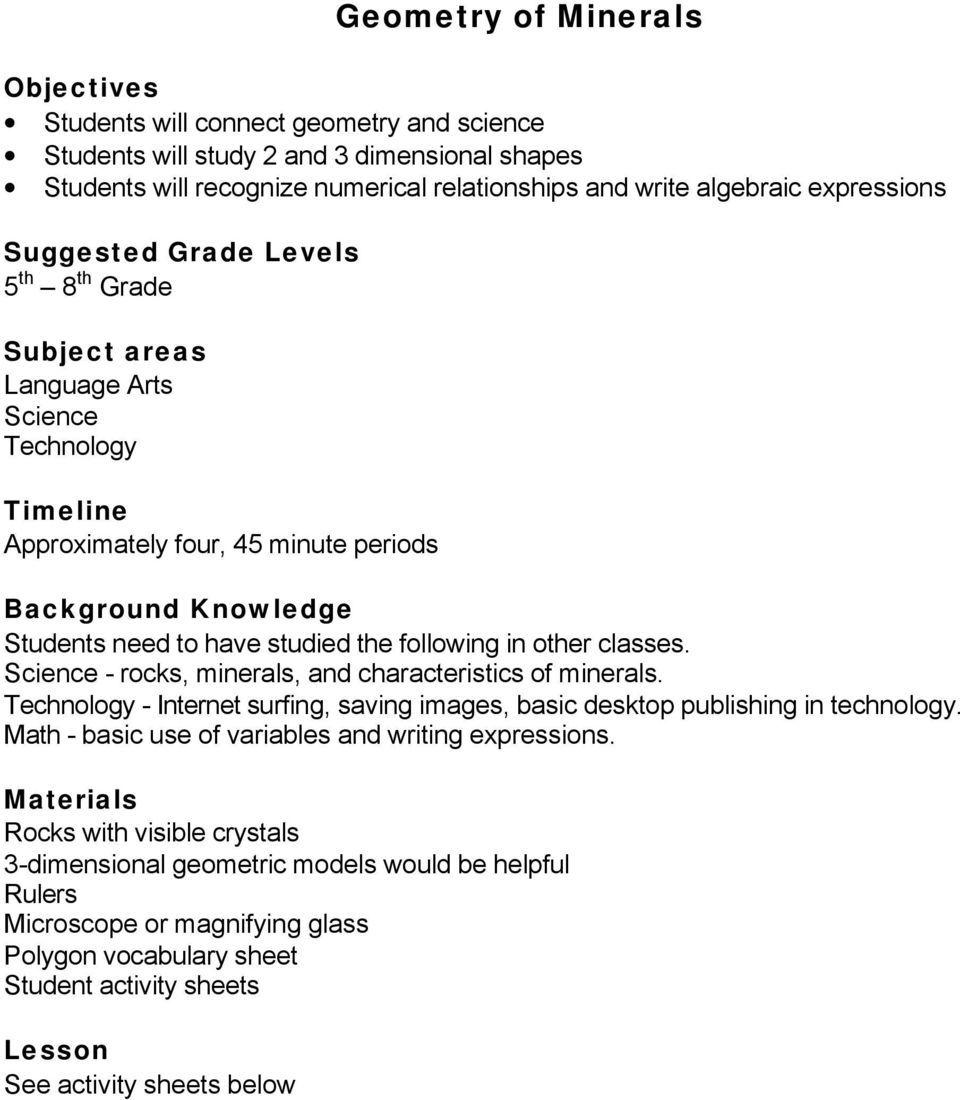
1 Geometry of Minerals Objectives Students will connect geometry and science Students will study 2 and 3 dimensional shapes Students will recognize numerical relationships and write algebraic expressions Suggested Grade Levels 5 th 8 th Grade Subject areas Language Arts Science Technology Timeline Approximately four, 45 minute periods Background Knowledge Students need to have studied the following in other classes. Science - rocks, minerals, and characteristics of minerals. Technology - Internet surfing, saving images, basic desktop publishing in technology. Math - basic use of variables and writing expressions. Materials Rocks with visible crystals 3-dimensional geometric models would be helpful Rulers Microscope or magnifying glass Polygon vocabulary sheet Student activity sheets Lesson See activity sheets below
2 Vocabulary Polygon a closed shape with all straight edges Face flat surface of a polygon Vertex corner point where two sides intersect Vertices plural for vertex Edge on a polygon, the segment that connects two vertices on a pyramid or prism, the segment where two faces meet Diagonal the segment from one vertex to any other nonadjacent vertex Prism Three-dimensional shape with parallel top and bottom faces Pyramid three-dimensional shape with one base and the top comes to a point Polygons Name Number of sides Triangle 3 Quadrilateral 4 Pentagon 5 Hexagon 6 Heptagon 7 Octagon 8 Nonagon 9 Decagon 10 Undecagon 11 Dodecagon 12 n-gon n sides

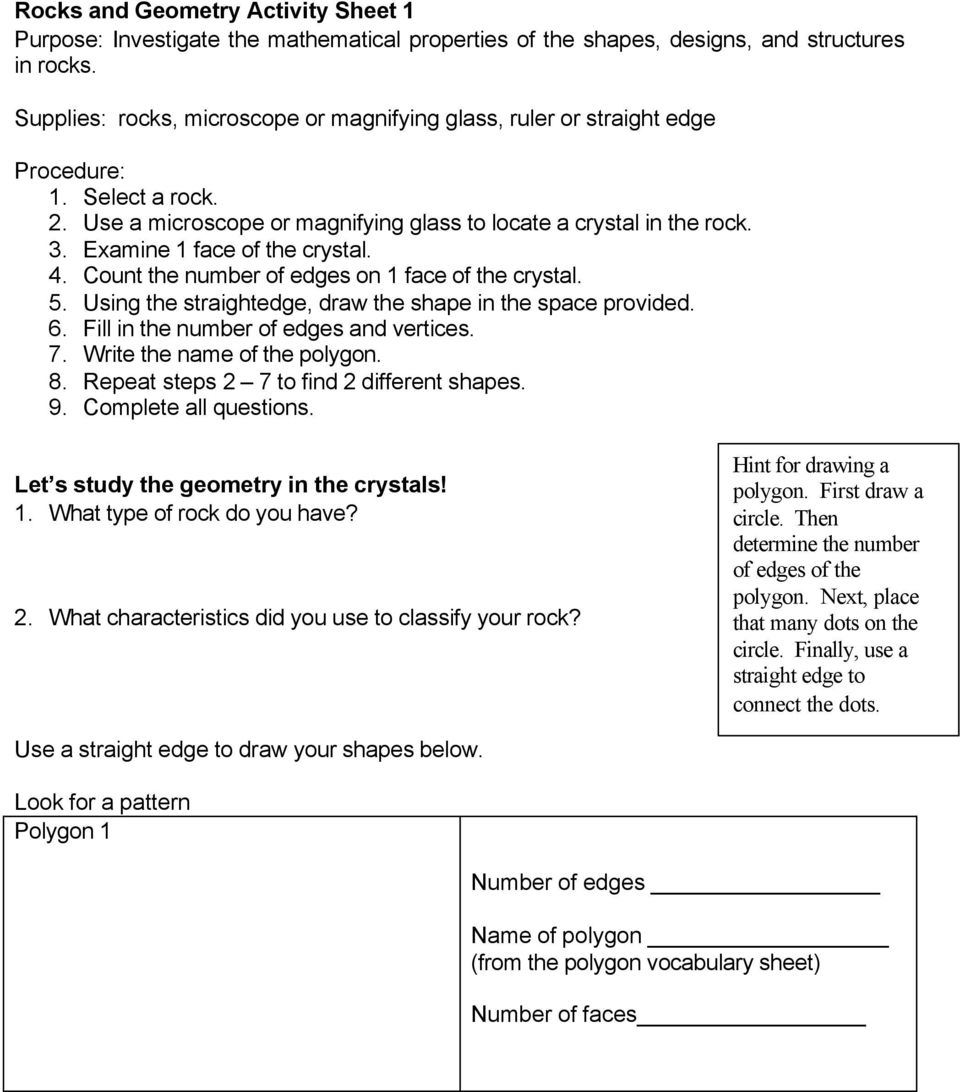
3 Rocks and Geometry Activity Sheet 1 Purpose: Investigate the mathematical properties of the shapes, designs, and structures in rocks. Supplies: rocks, microscope or magnifying glass, ruler or straight edge Procedure: 1. Select a rock. 2. Use a microscope or magnifying glass to locate a crystal in the rock. 3. Examine 1 face of the crystal. 4. Count the number of edges on 1 face of the crystal. 5. Using the straightedge, draw the shape in the space provided. 6. Fill in the number of edges and vertices. 7. Write the name of the polygon. 8. Repeat steps 2 7 to find 2 different shapes. 9. Complete all questions. Let s study the geometry in the crystals! 1. What type of rock do you have? 2. What characteristics did you use to classify your rock? Hint for drawing a polygon. First draw a circle. Then determine the number of edges of the polygon. Next, place that many dots on the circle. Finally, use a straight edge to connect the dots. Use a straight edge to draw your shapes below. Look for a pattern Polygon 1 Number of edges Name of polygon (from the polygon vocabulary sheet) Number of faces
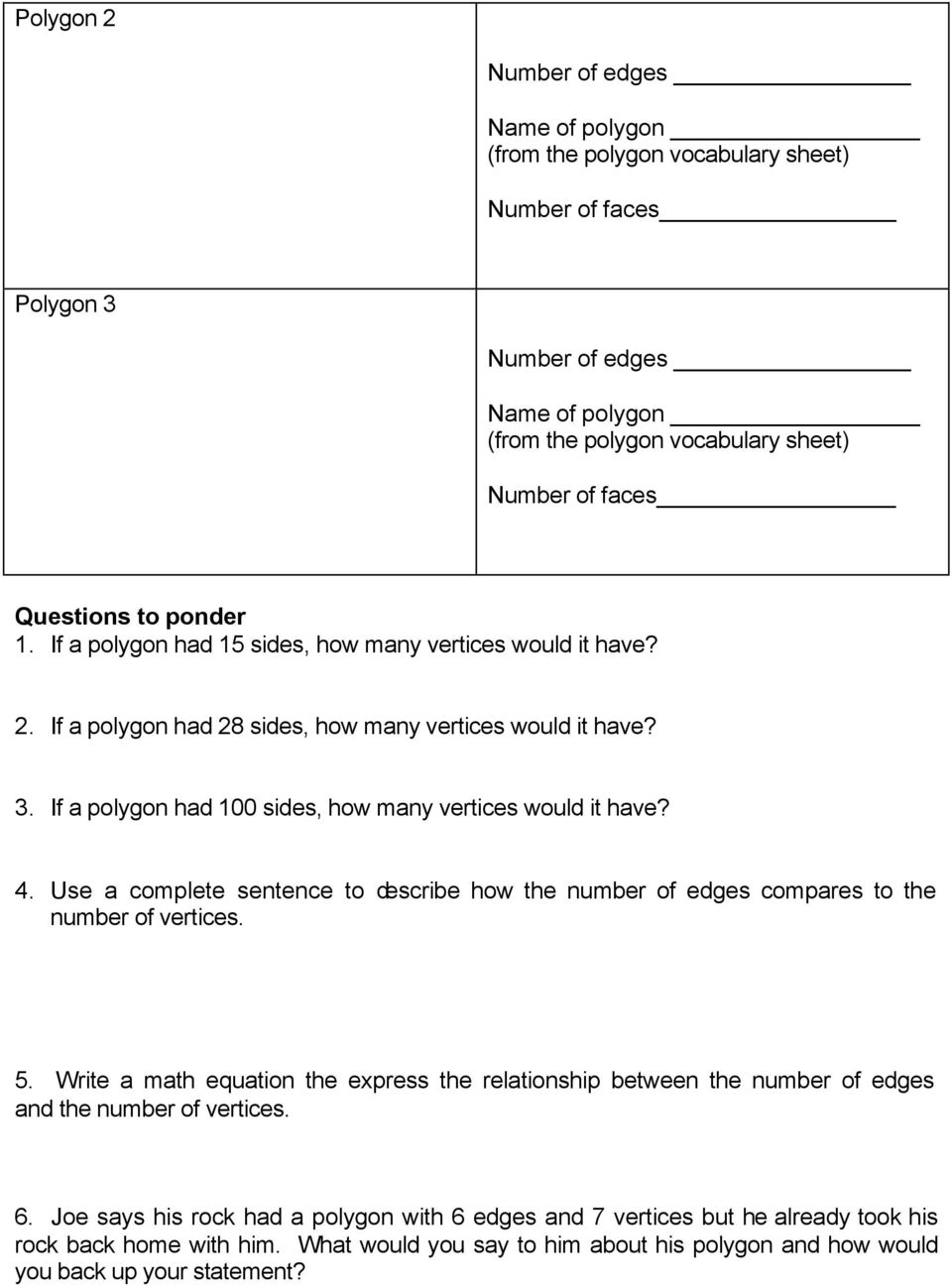
4 Polygon 2 Number of edges Name of polygon (from the polygon vocabulary sheet) Number of faces Polygon 3 Number of edges Name of polygon (from the polygon vocabulary sheet) Number of faces Questions to ponder 1. If a polygon had 15 sides, how many vertices would it have? 2. If a polygon had 28 sides, how many vertices would it have? 3. If a polygon had 100 sides, how many vertices would it have? 4. Use a complete sentence to describe how the number of edges compares to the number of vertices. 5. Write a math equation the express the relationship between the number of edges and the number of vertices. 6. Joe says his rock had a polygon with 6 edges and 7 vertices but he already took his rock back home with him. What would you say to him about his polygon and how would you back up your statement?
5 Rocks and Geometry Activity Sheet 2 Let s look for more patterns in polygons. On each shape below draw all the diagonals possible but only from 1 vertex. Determine the number of edges, the number of diagonals you drew, and the number of triangles formed. Name of polygon Number of edges = Number of diagonals = Number of triangles formed= Name of polygon Number of edges = Number of diagonals = Number of triangles formed= Name of polygon Number of edges = Number of diagonals = Number of triangles formed= Name of polygon Number of edges = Number of diagonals = Number of triangles formed=

6 Questions to ponder Look for patterns in the numbers on your polygons to try to answer these questions. Consider a decagon. How many diagonals could you draw from 1 vertex? How many triangles would be formed? 1. Consider a polygon with 22 sides. How many diagonals could you draw from 1 vertex? How many triangles would be formed? 2. Consider a triangle with 53 sides. How many diagonals could you draw from 1 vertex? How many triangles would be formed? 3. Use a complete sentence to describe how the number of diagonals you can draw from 1 vertex compares to the number of edges on any polygon. 5. Write an algebraic equation to show the above relationship. 6. Describe how the number of triangles formed compares to the number of edges when the diagonals are drawn from 1 vertex on any polygon. 7. Write an algebraic equation to show this relationship. 8. Can a polygon with 33 sides, have 30 diagonals from 1 vertex, and form 30 triangles? Explain your answer.

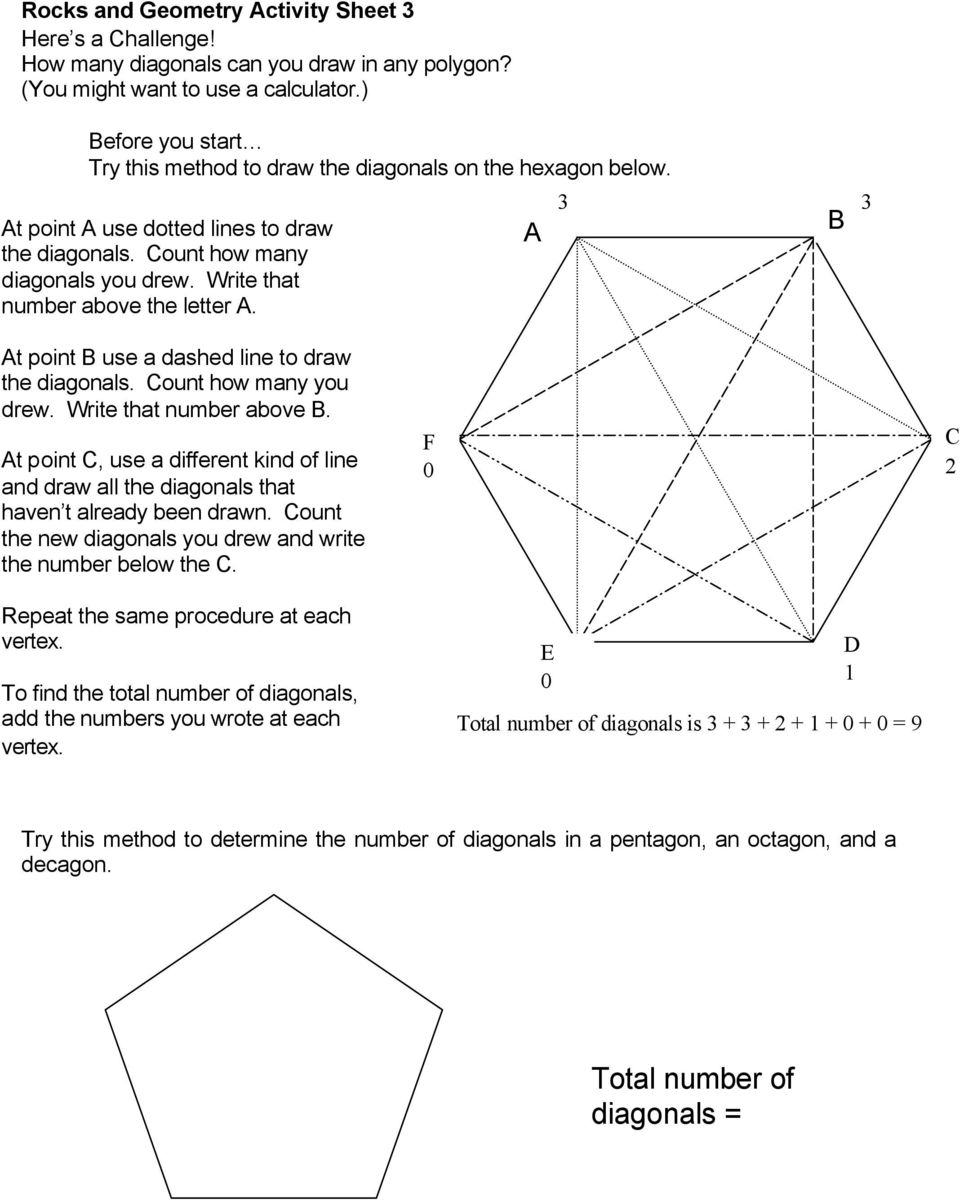
7 Rocks and Geometry Activity Sheet 3 Here s a Challenge! How many diagonals can you draw in any polygon? (You might want to use a calculator.) Before you start Try this method to draw the diagonals on the hexagon below. At point A use dotted lines to draw the ` diagonals. Count how many diagonals ` you drew. Write that number above the letter A. A 3 3 B At point B use a dashed line to draw the Try diagonals. this Count how many you drew. Write that number above B. At point C, use a different kind of line and draw all the diagonals that haven t already been drawn. Count the new diagonals you drew and write the number below the C. Repeat Try these! the same procedure at each vertex. To find the total number of diagonals, add the numbers you wrote at each vertex. F 0 E 0 Total number of diagonals is = 9 D 1 C 2 Try this method to determine the number of diagonals in a pentagon, an octagon, and a decagon. Total number of diagonals =
8 Total number of diagonals = Total number of diagonals = Look for a pattern in the number of diagonals drawn from consecutive vertices. Try these! 1. How many diagonals would a 15-gon have? 2. How many diagonals would a 25-gon have? 3. Use complete sentences to tell someone on the phone how to calculate the number of diagonals in a polygon with 40 sides.

9 Rocks and Geometry Activity Sheet 4 Let s Go 3-D! Look at your rock again with your microscope or magnifying glass. This time look for the whole crystal with its flat sides and top and bottom surfaces. Describe what you see using the geometry terms of faces, edges, and vertices. Tell how many faces you see on 1 crystal and give the shape of the faces on the crystal. Try to draw what the crystal would look like if you took it out of the rock. Trade rocks with someone. Examine this rock, too. Write a description of the crystals you see in this rock. Write a brief comparison of the similarities and differences between the crystals in the 2 rocks.

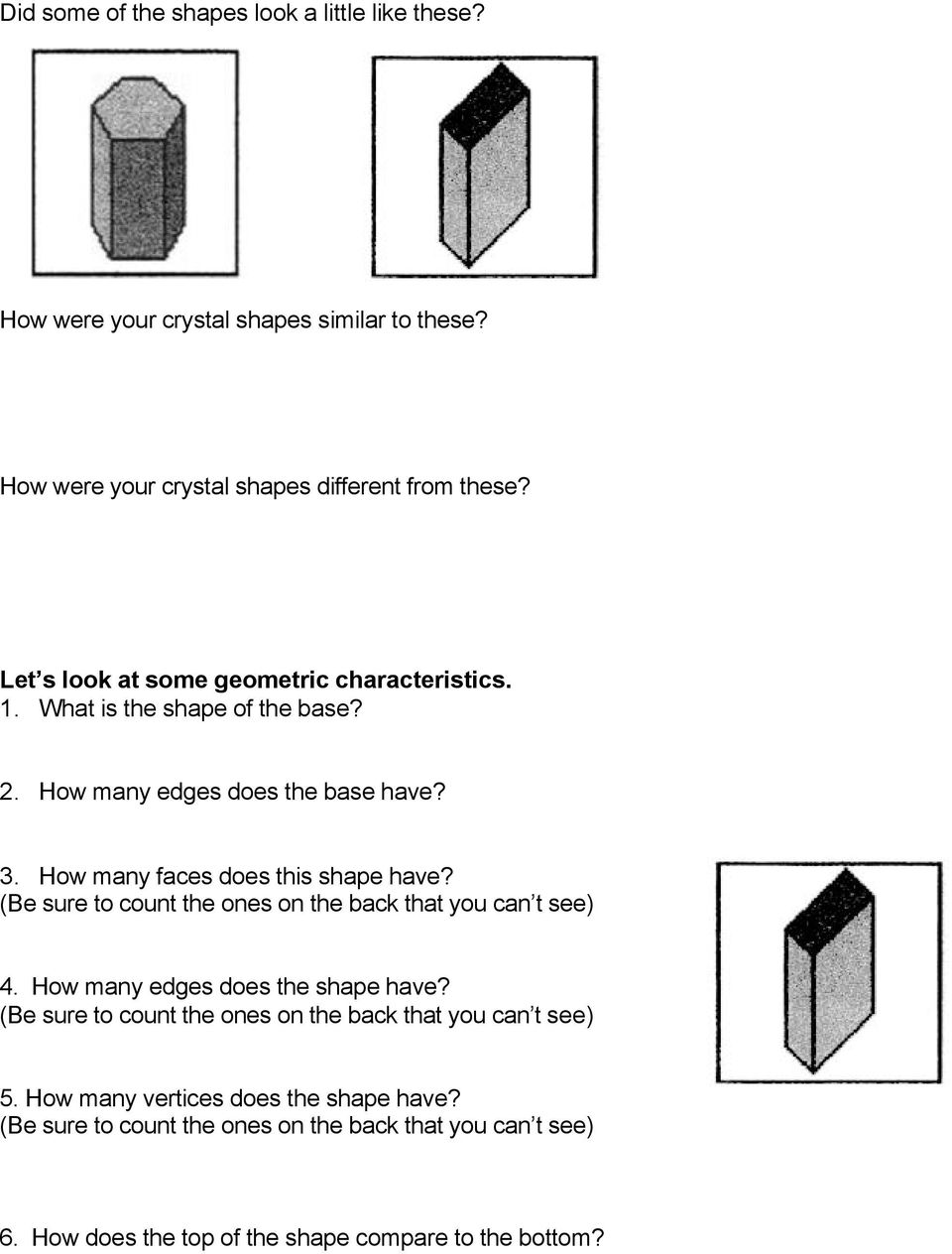
10 Did some of the shapes look a little like these? How were your crystal shapes similar to these? How were your crystal shapes different from these? Let s look at some geometric characteristics. 1. What is the shape of the base? 2. How many edges does the base have? 3. How many faces does this shape have? (Be sure to count the ones on the back that you can t see) 4. How many edges does the shape have? (Be sure to count the ones on the back that you can t see) 5. How many vertices does the shape have? (Be sure to count the ones on the back that you can t see) 6. How does the top of the shape compare to the bottom?
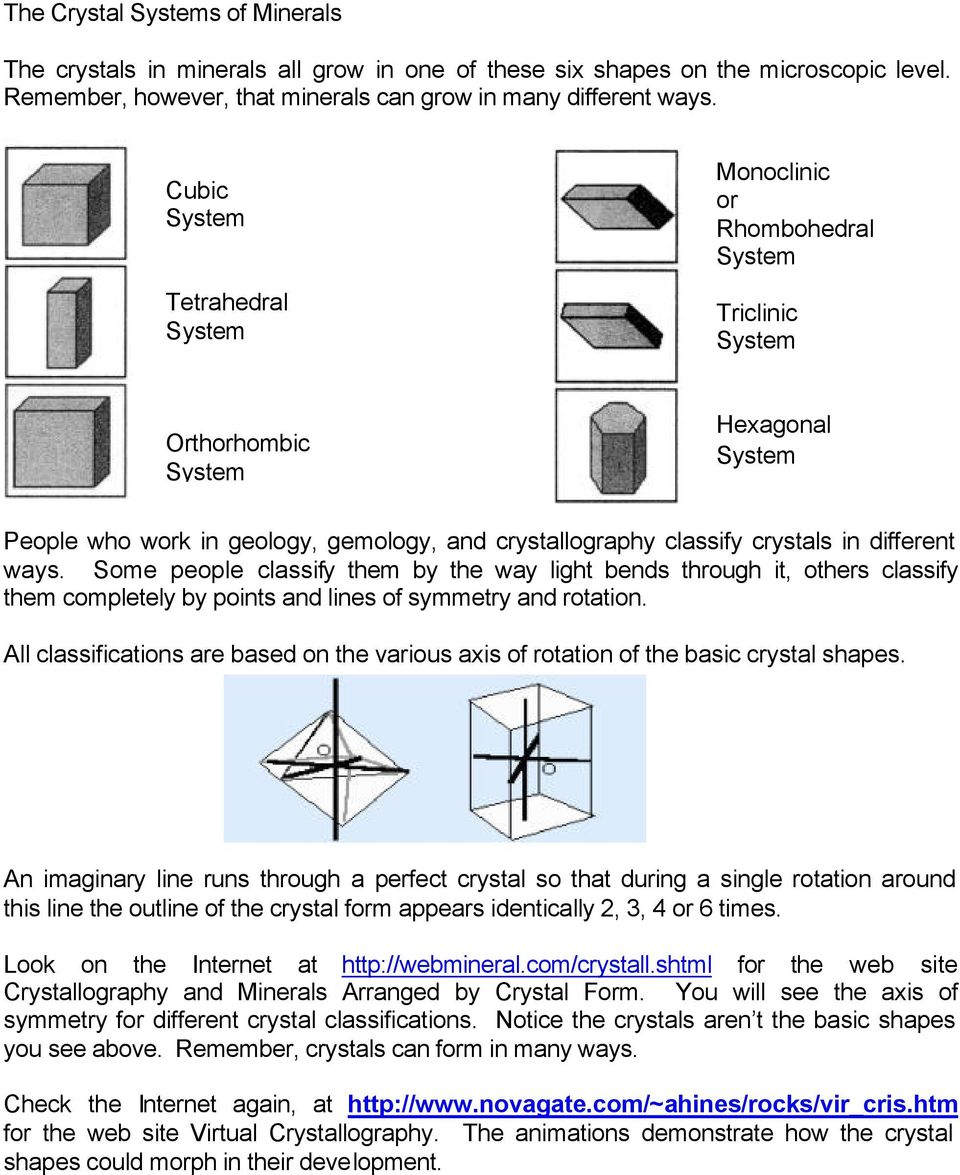
11 The Crystal Systems of Minerals The crystals in minerals all grow in one of these six shapes on the microscopic level. Remember, however, that minerals can grow in many different ways. Cubic System Tetrahedral System Monoclinic or Rhombohedral System Triclinic System Orthorhombic System Hexagonal System People who work in geology, gemology, and crystallography classify crystals in different ways. Some people classify them by the way light bends through it, others classify them completely by points and lines of symmetry and rotation. All classifications are based on the various axis of rotation of the basic crystal shapes. An imaginary line runs through a perfect crystal so that during a single rotation around this line the outline of the crystal form appears identically 2, 3, 4 or 6 times. Look on the Internet at for the web site Crystallography and Minerals Arranged by Crystal Form. You will see the axis of symmetry for different crystal classifications. Notice the crystals aren t the basic shapes you see above. Remember, crystals can form in many ways. Check the Internet again, at for the web site Virtual Crystallography. The animations demonstrate how the crystal shapes could morph in their development.
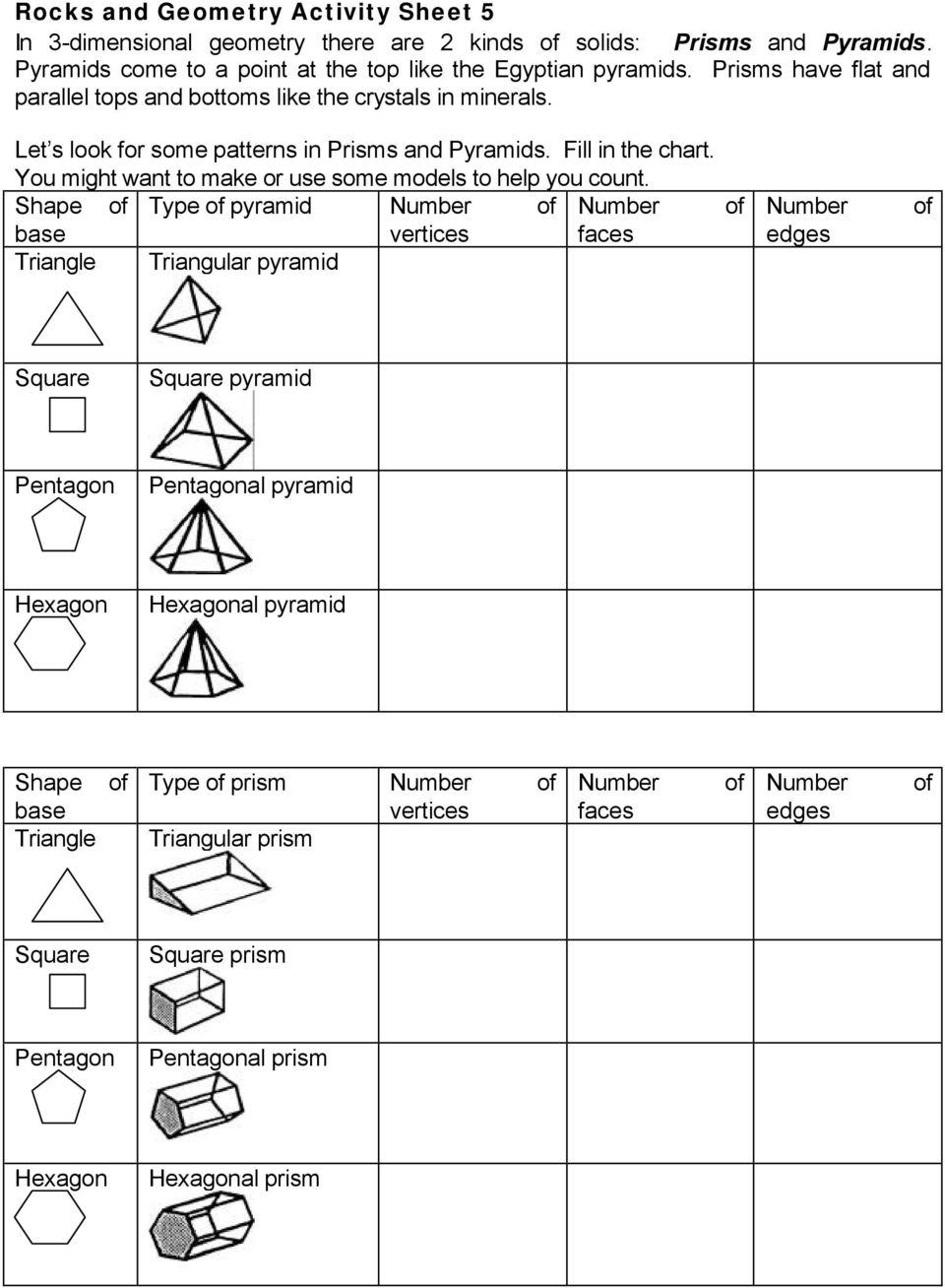
12 Rocks and Geometry Activity Sheet 5 In 3-dimensional geometry there are 2 kinds of solids: Prisms and Pyramids. Pyramids come to a point at the top like the Egyptian pyramids. Prisms have flat and parallel tops and bottoms like the crystals in minerals. Let s look for some patterns in Prisms and Pyramids. Fill in the chart. You might want to make or use some models to help you count. Shape of Type of pyramid Number of Number base vertices faces Triangle Triangular pyramid of Number edges of Square Square pyramid Pentagon Pentagonal pyramid Hexagon Hexagonal pyramid Shape base Triangle of Type of prism Number of vertices Triangular prism Number faces of Number edges of Square Square prism Pentagon Pentagonal prism Hexagon Hexagonal prism
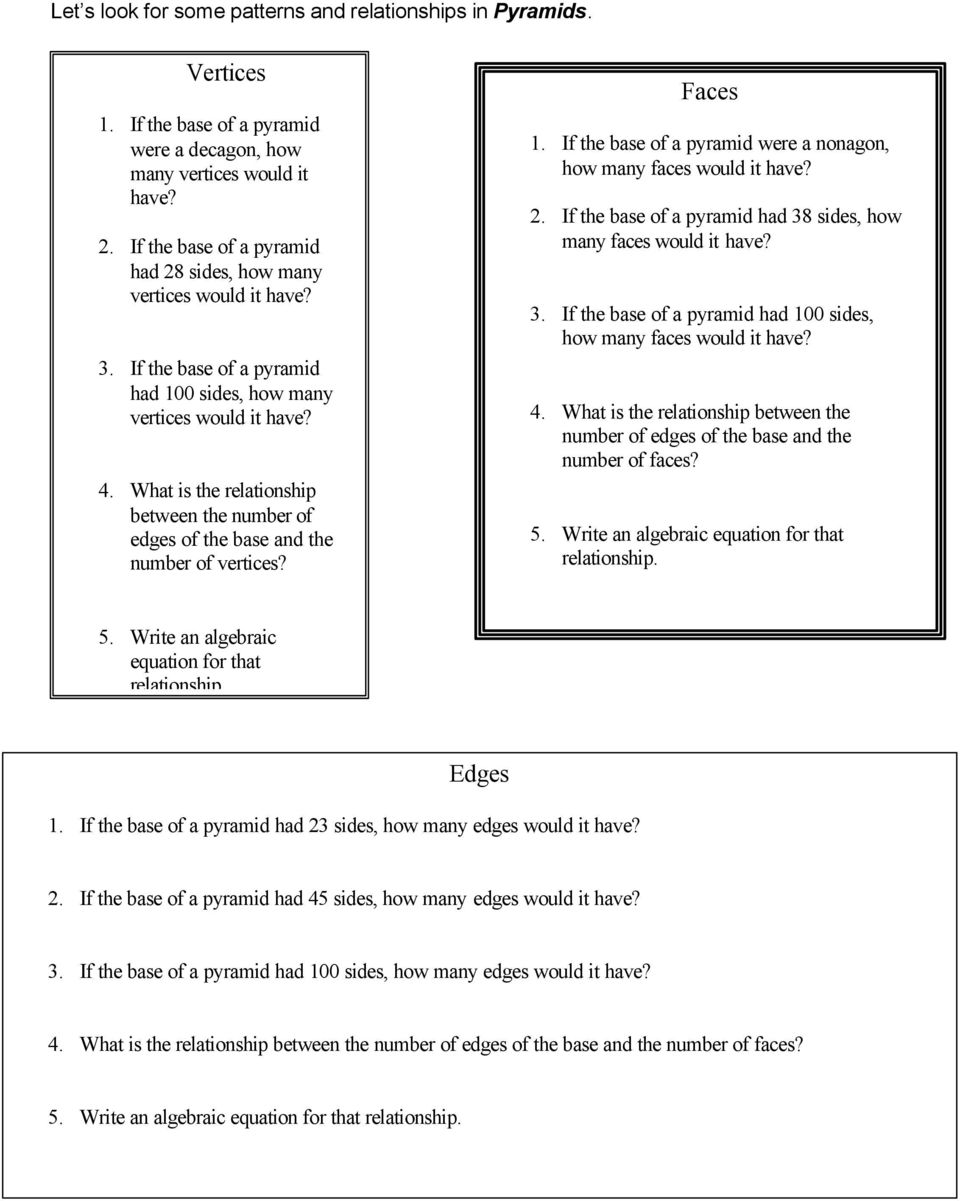
13 Let s look for some patterns and relationships in Pyramids. Vertices 1. If the base of a pyramid were a decagon, how many vertices would it have? 2. If the base of a pyramid had 28 sides, how many vertices would it have? 3. If the base of a pyramid had 100 sides, how many vertices would it have? 4. What is the relationship between the number of edges of the base and the number of vertices? Faces 1. If the base of a pyramid were a nonagon, how many faces would it have? 2. If the base of a pyramid had 38 sides, how many faces would it have? 3. If the base of a pyramid had 100 sides, how many faces would it have? 4. What is the relationship between the number of edges of the base and the number of faces? 5. Write an algebraic equation for that relationship. 5. Write an algebraic equation for that relationship. Edges 1. If the base of a pyramid had 23 sides, how many edges would it have? 2. If the base of a pyramid had 45 sides, how many edges would it have? 3. If the base of a pyramid had 100 sides, how many edges would it have? 4. What is the relationship between the number of edges of the base and the number of faces? 5. Write an algebraic equation for that relationship.
14 Let s look for some patterns and relationships in Prisms. Vertices 1. If the base of a prism were a decagon, how many vertices would it have? 2. If the base of a prism had 28 sides, how many vertices would it have? 3. If the base of a prism had 100 sides, how many vertices would it have? 4. What is the relationship between the number of edges of the base and the number of vertices? 5. Write an algebraic equation for that relationship. Faces 1. If the base of a prism were a nonagon, how many faces would it have? 2. If the base of a prism had 38 sides, how many faces would it have? 3. If the base of a prism had 100 sides, how many faces would it have? 4. What is the relationship between the number of edges of the base and the number of faces? 5. Write an algebraic equation for that relationship. Edges 1. If the base of a prism had 23 sides, how many edges would it have? 2. If the base of a prism had 45 sides, how many edges would it have? 3. If the base of a prism had 100 sides, how many edges would it have? 4. What is the relationship between the number of edges of the base and the number of faces? 5. Write an algebraic equation for that relationship.

15 Minerals from Mars! / Extension We know some of the minerals on Mars because meteorites from Mars have been recovered from Antarctica. The following minerals are found on Mars: Hematite Calcite Olivine Plagioclase Clinopyroxene Pyrite Orthopyroxene Magnesite Jarosite Magnetite We can look up the properties of these minerals and find their crystal class on the Internet. Go to again, Crystallography. Select A to Z List in the top navigation bar. Use the alphabetical listings to look up the characteristics of the minerals and their characteristics in the list above.
16 Museum Curator Project / Evaluation Imagine you are the curator for a museum. You get to decide what the museum puts on display. You just acquired several rocks and minerals from Mars but you only have room to display three of them. You must choose which three to put on display. You have at least one of each mineral listed above. A museum always provides its patrons with information about their exhibits. You must create the sign that goes with each Mars rock that provides the following information about the minerals you choose: color, luster, hardness, cleavage, streak, and the basic crystal system with the number of faces, edges, and vertices. Your sign must include the reason you chose to display this mineral instead of the others. Your museum patrons will want to know when the Mars rock displays are ready. You must also design a banner for flag to hang from the poles around your museum to announce the Mars Rock Exhibit. School Project: For each of the three minerals you choose you will create a page with the following information: color, luster, hardness, cleavage, streak, and the crystal system. This information will be arranged in a way it would fit on a sign on the rock display in a museum. Each page will contain a picture of the mineral and a paragraph that explains why you chose this mineral to put in the museum display. On another piece of paper, create a banner or flag announcing the Mars Rock Exhibit. Your project will be graded with the following rubric. Item being graded Points possible Your points Science information: name, color, luster, 30 hardness, cleavage, and streak. Math information: the number of faces, edges, 30 and vertices. Explanation/rational for mineral choices. 10 Language Arts Skills: paragraph structure, 15 sentence structure, spelling, grammar, punctuation. Presentation: pictures, layout, clean, neat, easy 15 to read, colorful, tasteful. Total points possible 100 Your grade

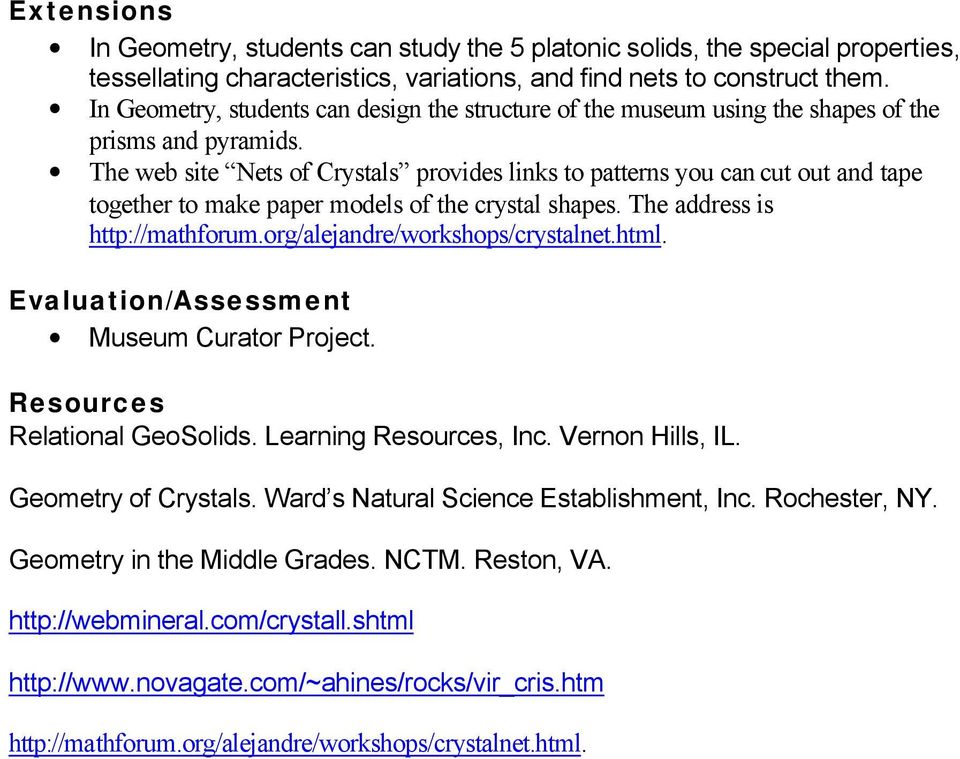
17 Extensions In Geometry, students can study the 5 platonic solids, the special properties, tessellating characteristics, variations, and find nets to construct them. In Geometry, students can design the structure of the museum using the shapes of the prisms and pyramids. The web site Nets of Crystals provides links to patterns you can cut out and tape together to make paper models of the crystal shapes. The address is Evaluation/Assessment Museum Curator Project. Resources Relational GeoSolids. Learning Resources, Inc. Vernon Hills, IL. Geometry of Crystals. Ward s Natural Science Establishment, Inc. Rochester, NY. Geometry in the Middle Grades. NCTM. Reston, VA
Shape Dictionary YR to Y6
 Shape Dictionary YR to Y6 Guidance Notes The terms in this dictionary are taken from the booklet Mathematical Vocabulary produced by the National Numeracy Strategy. Children need to understand and use
G3-33 Building Pyramids
 G3-33 Building Pyramids Goal: Students will build skeletons of pyramids and describe properties of pyramids. Prior Knowledge Required: Polygons: triangles, quadrilaterals, pentagons, hexagons Vocabulary:
Line Segments, Rays, and Lines
 HOME LINK Line Segments, Rays, and Lines Family Note Help your child match each name below with the correct drawing of a line, ray, or line segment. Then observe as your child uses a straightedge to draw
UNIT H1 Angles and Symmetry Activities
 UNIT H1 Angles and Symmetry Activities Activities H1.1 Lines of Symmetry H1.2 Rotational and Line Symmetry H1.3 Symmetry of Regular Polygons H1.4 Interior Angles in Polygons Notes and Solutions (1 page)
Third Grade Shapes Up! Grade Level: Third Grade Written by: Jill Pisman, St. Mary s School East Moline, Illinois Length of Unit: Eight Lessons
 Third Grade Shapes Up! Grade Level: Third Grade Written by: Jill Pisman, St. Mary s School East Moline, Illinois Length of Unit: Eight Lessons I. ABSTRACT This unit contains lessons that focus on geometric
Volume of Right Prisms Objective To provide experiences with using a formula for the volume of right prisms.
 Volume of Right Prisms Objective To provide experiences with using a formula for the volume of right prisms. www.everydaymathonline.com epresentations etoolkit Algorithms Practice EM Facts Workshop Game
Angle - a figure formed by two rays or two line segments with a common endpoint called the vertex of the angle; angles are measured in degrees
 Angle - a figure formed by two rays or two line segments with a common endpoint called the vertex of the angle; angles are measured in degrees Apex in a pyramid or cone, the vertex opposite the base; in
11.3 Curves, Polygons and Symmetry
 11.3 Curves, Polygons and Symmetry Polygons Simple Definition A shape is simple if it doesn t cross itself, except maybe at the endpoints. Closed Definition A shape is closed if the endpoints meet. Polygon
Target To know the properties of a rectangle
 Target To know the properties of a rectangle (1) A rectangle is a 3-D shape. (2) A rectangle is the same as an oblong. (3) A rectangle is a quadrilateral. (4) Rectangles have four equal sides. (5) Rectangles
Investigating Relationships of Area and Perimeter in Similar Polygons
 Investigating Relationships of Area and Perimeter in Similar Polygons Lesson Summary: This lesson investigates the relationships between the area and perimeter of similar polygons using geometry software.
Angles that are between parallel lines, but on opposite sides of a transversal.
 GLOSSARY Appendix A Appendix A: Glossary Acute Angle An angle that measures less than 90. Acute Triangle Alternate Angles A triangle that has three acute angles. Angles that are between parallel lines,
2. If C is the midpoint of AB and B is the midpoint of AE, can you say that the measure of AC is 1/4 the measure of AE?
 MATH 206 - Midterm Exam 2 Practice Exam Solutions 1. Show two rays in the same plane that intersect at more than one point. Rays AB and BA intersect at all points from A to B. 2. If C is the midpoint of
Grade 8 Mathematics Geometry: Lesson 2
 Grade 8 Mathematics Geometry: Lesson 2 Read aloud to the students the material that is printed in boldface type inside the boxes. Information in regular type inside the boxes and all information outside
E XPLORING QUADRILATERALS
 E XPLORING QUADRILATERALS E 1 Geometry State Goal 9: Use geometric methods to analyze, categorize and draw conclusions about points, lines, planes and space. Statement of Purpose: The activities in this
ISAT Mathematics Performance Definitions Grade 4
 ISAT Mathematics Performance Definitions Grade 4 EXCEEDS STANDARDS Fourth-grade students whose measured performance exceeds standards are able to identify, read, write, represent, and model whole numbers
Which two rectangles fit together, without overlapping, to make a square?
 SHAPE level 4 questions 1. Here are six rectangles on a grid. A B C D E F Which two rectangles fit together, without overlapping, to make a square?... and... International School of Madrid 1 2. Emily has
3D shapes. Level A. 1. Which of the following is a 3-D shape? A) Cylinder B) Octagon C) Kite. 2. What is another name for 3-D shapes?
 Level A 1. Which of the following is a 3-D shape? A) Cylinder B) Octagon C) Kite 2. What is another name for 3-D shapes? A) Polygon B) Polyhedron C) Point 3. A 3-D shape has four sides and a triangular
Grade 7/8 Math Circles November 3/4, 2015. M.C. Escher and Tessellations
 Faculty of Mathematics Waterloo, Ontario N2L 3G1 Centre for Education in Mathematics and Computing Tiling the Plane Grade 7/8 Math Circles November 3/4, 2015 M.C. Escher and Tessellations Do the following
Mathematics Materials for Tomorrow s Teachers
 M2T2 E 1 Geometry Mathematics Materials for Tomorrow s Teachers STATE GOAL 9: Use geometric methods to analyze, categorize, and draw conclusions about points, lines, planes, and space. Statement of Purpose:
Lesson #13 Congruence, Symmetry and Transformations: Translations, Reflections, and Rotations
 Math Buddies -Grade 4 13-1 Lesson #13 Congruence, Symmetry and Transformations: Translations, Reflections, and Rotations Goal: Identify congruent and noncongruent figures Recognize the congruence of plane
Geometry Progress Ladder
 Geometry Progress Ladder Maths Makes Sense Foundation End-of-year objectives page 2 Maths Makes Sense 1 2 End-of-block objectives page 3 Maths Makes Sense 3 4 End-of-block objectives page 4 Maths Makes
Dear Grade 4 Families,
 Dear Grade 4 Families, During the next few weeks, our class will be exploring geometry. Through daily activities, we will explore the relationship between flat, two-dimensional figures and solid, three-dimensional
SOLIDS, NETS, AND CROSS SECTIONS
 SOLIDS, NETS, AND CROSS SECTIONS Polyhedra In this section, we will examine various three-dimensional figures, known as solids. We begin with a discussion of polyhedra. Polyhedron A polyhedron is a three-dimensional
Tessellating with Regular Polygons
 Tessellating with Regular Polygons You ve probably seen a floor tiled with square tiles. Squares make good tiles because they can cover a surface without any gaps or overlapping. This kind of tiling is
Discovering Math: Exploring Geometry Teacher s Guide
 Teacher s Guide Grade Level: 6 8 Curriculum Focus: Mathematics Lesson Duration: Three class periods Program Description Discovering Math: Exploring Geometry From methods of geometric construction and threedimensional
Algebra Geometry Glossary. 90 angle
 lgebra Geometry Glossary 1) acute angle an angle less than 90 acute angle 90 angle 2) acute triangle a triangle where all angles are less than 90 3) adjacent angles angles that share a common leg Example:
Area of Parallelograms, Triangles, and Trapezoids (pages 314 318)
 Area of Parallelograms, Triangles, and Trapezoids (pages 34 38) Any side of a parallelogram or triangle can be used as a base. The altitude of a parallelogram is a line segment perpendicular to the base
Area of Parallelograms (pages 546 549)
 A Area of Parallelograms (pages 546 549) A parallelogram is a quadrilateral with two pairs of parallel sides. The base is any one of the sides and the height is the shortest distance (the length of a perpendicular
56 questions (multiple choice, check all that apply, and fill in the blank) The exam is worth 224 points.
 6.1.1 Review: Semester Review Study Sheet Geometry Core Sem 2 (S2495808) Semester Exam Preparation Look back at the unit quizzes and diagnostics. Use the unit quizzes and diagnostics to determine which
Glow-in-the-Dark Geometry
 The Big Idea Glow-in-the-Dark Geometry This week you ll make geometric shapes out of glow sticks. The kids will try all sizes and shapes of triangles and quadrilaterials, then lay out sticks in mystical
Activity Set 4. Trainer Guide
 Geometry and Measurement of Solid Figures Activity Set 4 Trainer Guide Mid_SGe_04_TG Copyright by the McGraw-Hill Companies McGraw-Hill Professional Development GEOMETRY AND MEASUREMENT OF SOLID FIGURES
Chapter 18 Symmetry. Symmetry of Shapes in a Plane 18.1. then unfold
 Chapter 18 Symmetry Symmetry is of interest in many areas, for example, art, design in general, and even the study of molecules. This chapter begins with a look at two types of symmetry of two-dimensional
12-1 Representations of Three-Dimensional Figures
 Connect the dots on the isometric dot paper to represent the edges of the solid. Shade the tops of 12-1 Representations of Three-Dimensional Figures Use isometric dot paper to sketch each prism. 1. triangular
Warning! Construction Zone: Building Solids from Nets
 Brief Overview: Warning! Construction Zone: Building Solids from Nets In this unit the students will be examining and defining attributes of solids and their nets. The students will be expected to have
PERIMETER AND AREA. In this unit, we will develop and apply the formulas for the perimeter and area of various two-dimensional figures.
 PERIMETER AND AREA In this unit, we will develop and apply the formulas for the perimeter and area of various two-dimensional figures. Perimeter Perimeter The perimeter of a polygon, denoted by P, is the
Circumference Pi Regular polygon. Dates, assignments, and quizzes subject to change without advance notice.
 Name: Period GPreAP UNIT 14: PERIMETER AND AREA I can define, identify and illustrate the following terms: Perimeter Area Base Height Diameter Radius Circumference Pi Regular polygon Apothem Composite
Teaching Guidelines. Knowledge and Skills: Can specify defining characteristics of common polygons
 CIRCLE FOLDING Teaching Guidelines Subject: Mathematics Topics: Geometry (Circles, Polygons) Grades: 4-6 Concepts: Property Diameter Radius Chord Perimeter Area Knowledge and Skills: Can specify defining
Grade 3 Core Standard III Assessment
 Grade 3 Core Standard III Assessment Geometry and Measurement Name: Date: 3.3.1 Identify right angles in two-dimensional shapes and determine if angles are greater than or less than a right angle (obtuse
Grade 3 Geometry and Spatial Sense. Name:
 Grade 3 Geometry and Spatial Sense Name: Ontario Mathematics Curriculum Grades 1 to 8, 1997 Strand: Geometry and Spatial Sense Grade: 3 All rights reserved Developed by T. Tasker May be photocopied for
Which shapes make floor tilings?
 Which shapes make floor tilings? Suppose you are trying to tile your bathroom floor. You are allowed to pick only one shape and size of tile. The tile has to be a regular polygon (meaning all the same
EVERY DAY COUNTS CALENDAR MATH 2005 correlated to
 EVERY DAY COUNTS CALENDAR MATH 2005 correlated to Illinois Mathematics Assessment Framework Grades 3-5 E D U C A T I O N G R O U P A Houghton Mifflin Company YOUR ILLINOIS GREAT SOURCE REPRESENTATIVES:
Shapes & Designs Notes
 Problem 1.1 Definitions: regular polygons - polygons in which all the side lengths and angles have the same measure edge - also referred to as the side of a figure tiling - covering a flat surface with
Problem of the Month: Cutting a Cube
 Problem of the Month: The Problems of the Month (POM) are used in a variety of ways to promote problem solving and to foster the first standard of mathematical practice from the Common Core State Standards:
Chapter 8 Geometry We will discuss following concepts in this chapter.
 Mat College Mathematics Updated on Nov 5, 009 Chapter 8 Geometry We will discuss following concepts in this chapter. Two Dimensional Geometry: Straight lines (parallel and perpendicular), Rays, Angles
Geometric Patterns. Introduction. Geometric Patterns 1 ~ Border Patterns. Geometric Patterns 2 ~ Tile Patterns
 Geometric Patterns Geometric Patterns Introduction In working with shapes, whether mathematically or artistically, it is necessary to have a good feeling for how more complex shapes can be made from simpler
Acquisition Lesson Planning Form Key Standards addressed in this Lesson: MM2A3d,e Time allotted for this Lesson: 4 Hours
 Acquisition Lesson Planning Form Key Standards addressed in this Lesson: MM2A3d,e Time allotted for this Lesson: 4 Hours Essential Question: LESSON 4 FINITE ARITHMETIC SERIES AND RELATIONSHIP TO QUADRATIC
Illinois State Standards Alignments Grades Three through Eleven
 Illinois State Standards Alignments Grades Three through Eleven Trademark of Renaissance Learning, Inc., and its subsidiaries, registered, common law, or pending registration in the United States and other
Level 1 - Maths Targets TARGETS. With support, I can show my work using objects or pictures 12. I can order numbers to 10 3
 Ma Data Hling: Interpreting Processing representing Ma Shape, space measures: position shape Written Mental method s Operations relationship s between them Fractio ns Number s the Ma1 Using Str Levels
Three-Dimensional Figures or Space Figures. Rectangular Prism Cylinder Cone Sphere. Two-Dimensional Figures or Plane Figures
 SHAPE NAMES Three-Dimensional Figures or Space Figures Rectangular Prism Cylinder Cone Sphere Two-Dimensional Figures or Plane Figures Square Rectangle Triangle Circle Name each shape. [triangle] [cone]
MD5-26 Stacking Blocks Pages 115 116
 MD5-26 Stacking Blocks Pages 115 116 STANDARDS 5.MD.C.4 Goals Students will find the number of cubes in a rectangular stack and develop the formula length width height for the number of cubes in a stack.
Drawing Lines of Symmetry Grade Three
 Ohio Standards Connection Geometry and Spatial Sense Benchmark H Identify and describe line and rotational symmetry in two-dimensional shapes and designs. Indicator 4 Draw lines of symmetry to verify symmetrical
DISCOVERING 3D SHAPES
 . DISCOVERING 3D SHAPES WORKSHEETS OCTOBER-DECEMBER 2009 1 . Worksheet 1. Cut out and stick the shapes. SHAPES WHICH ROLL SHAPES WHICH SLIDE 2 . Worksheet 2: COMPLETE THE CHARTS Sphere, triangle, prism,
Classifying Lesson 1 Triangles
 Classifying Lesson 1 acute angle congruent scalene Classifying VOCABULARY right angle isosceles Venn diagram obtuse angle equilateral You classify many things around you. For example, you might choose
Geometry and Measurement
 The student will be able to: Geometry and Measurement 1. Demonstrate an understanding of the principles of geometry and measurement and operations using measurements Use the US system of measurement for
Identifying and Describing Polygons: A Geometry Lesson
 Identifying and Describing Polygons: A Geometry Lesson Lesson Plan R6 Overview In this lesson, students learn to identify and describe polygons and compare and contrast them with figures that are not polygons.
Unit 8 Angles, 2D and 3D shapes, perimeter and area
 Unit 8 Angles, 2D and 3D shapes, perimeter and area Five daily lessons Year 6 Spring term Recognise and estimate angles. Use a protractor to measure and draw acute and obtuse angles to Page 111 the nearest
12 Surface Area and Volume
 12 Surface Area and Volume 12.1 Three-Dimensional Figures 12.2 Surface Areas of Prisms and Cylinders 12.3 Surface Areas of Pyramids and Cones 12.4 Volumes of Prisms and Cylinders 12.5 Volumes of Pyramids
WORK SCHEDULE: MATHEMATICS 2007
 , K WORK SCHEDULE: MATHEMATICS 00 GRADE MODULE TERM... LO NUMBERS, OPERATIONS AND RELATIONSHIPS able to recognise, represent numbers and their relationships, and to count, estimate, calculate and check
Overview. Essential Questions. Grade 8 Mathematics, Quarter 4, Unit 4.3 Finding Volume of Cones, Cylinders, and Spheres
 Cylinders, and Spheres Number of instruction days: 6 8 Overview Content to Be Learned Evaluate the cube root of small perfect cubes. Simplify problems using the formulas for the volumes of cones, cylinders,
Intermediate Math Circles October 10, 2012 Geometry I: Angles
 Intermediate Math Circles October 10, 2012 Geometry I: Angles Over the next four weeks, we will look at several geometry topics. Some of the topics may be familiar to you while others, for most of you,
Senior Phase Grade 8 Today Planning Pack MATHEMATICS
 M780636110236 Senior Phase Grade 8 Today Planning Pack MATHEMATICS Contents: Work Schedule: Page Grade 8 2 Lesson Plans: Grade 8 4 Rubrics: Rubric 1: Recognising, classifying and representing numbers...22
1. Kyle stacks 30 sheets of paper as shown to the right. Each sheet weighs about 5 g. How can you find the weight of the whole stack?
 Prisms and Cylinders Answer Key Vocabulary: cylinder, height (of a cylinder or prism), prism, volume Prior Knowledge Questions (Do these BEFORE using the Gizmo.) [Note: The purpose of these questions is
Geometry Notes PERIMETER AND AREA
 Perimeter and Area Page 1 of 57 PERIMETER AND AREA Objectives: After completing this section, you should be able to do the following: Calculate the area of given geometric figures. Calculate the perimeter
MATH STUDENT BOOK. 8th Grade Unit 6
 MATH STUDENT BOOK 8th Grade Unit 6 Unit 6 Measurement Math 806 Measurement Introduction 3 1. Angle Measures and Circles 5 Classify and Measure Angles 5 Perpendicular and Parallel Lines, Part 1 12 Perpendicular
TECHNICAL DRAWING (67)
 TECHNICAL DRAWING (67) (Candidates offering Technical Drawing Applications are not eligible to offer Technical Drawing.) Aims: 1. To develop competence among the students to pursue technical courses like
angle attribute Figure 1 4 right angles opposite sides parallel Lesson 14 5 Lesson 14 4 Vocab
 Vocab angle attribute 006_055_G4_VisV_101741.indd Page F46 2/13/10 11:27:36 PM u-s014 /Volumes/114/GO00403/GO00403_Natl_Visual_Voca_Cards_G4%0 Figure 1 4 right angles opposite sides parallel endpoint hexagon
What You ll Learn. Why It s Important
 These students are setting up a tent. How do the students know how to set up the tent? How is the shape of the tent created? How could students find the amount of material needed to make the tent? Why
Platonic Solids. Some solids have curved surfaces or a mix of curved and flat surfaces (so they aren't polyhedra). Examples:
 Solid Geometry Solid Geometry is the geometry of three-dimensional space, the kind of space we live in. Three Dimensions It is called three-dimensional or 3D because there are three dimensions: width,
Grade 4 Mathematics Patterns, Relations, and Functions: Lesson 1
 Grade 4 Mathematics Patterns, Relations, and Functions: Lesson 1 Read aloud to the students the material that is printed in boldface type inside the boxes. Information in regular type inside the boxes
then unfold line 1 line 2 line 3
 Chapter 18 Symmetry Symmetry is of interest in art and design in general and in the study of molecules, for example. This chapter begins with a look at two types of symmetry of 2-dimensional shapes, and
MATH STUDENT BOOK. 6th Grade Unit 8
 MATH STUDENT BOOK 6th Grade Unit 8 Unit 8 Geometry and Measurement MATH 608 Geometry and Measurement INTRODUCTION 3 1. PLANE FIGURES 5 PERIMETER 5 AREA OF PARALLELOGRAMS 11 AREA OF TRIANGLES 17 AREA OF
Number Sense and Operations
 Number Sense and Operations representing as they: 6.N.1 6.N.2 6.N.3 6.N.4 6.N.5 6.N.6 6.N.7 6.N.8 6.N.9 6.N.10 6.N.11 6.N.12 6.N.13. 6.N.14 6.N.15 Demonstrate an understanding of positive integer exponents
Which Shape? Student Task Core Idea 4 Geometry and Measurement
 Which Shape? Student Task Core Idea 4 Geometry and Measurement Identify circles, triangles, and squares among a collection of shapes. Identify two attributes of all triangles. Recognize and use characteristics,
Common Core Unit Summary Grades 6 to 8
 Common Core Unit Summary Grades 6 to 8 Grade 8: Unit 1: Congruence and Similarity- 8G1-8G5 rotations reflections and translations,( RRT=congruence) understand congruence of 2 d figures after RRT Dilations
Scope and Sequence KA KB 1A 1B 2A 2B 3A 3B 4A 4B 5A 5B 6A 6B
 Scope and Sequence Earlybird Kindergarten, Standards Edition Primary Mathematics, Standards Edition Copyright 2008 [SingaporeMath.com Inc.] The check mark indicates where the topic is first introduced
Geometry Course Summary Department: Math. Semester 1
 Geometry Course Summary Department: Math Semester 1 Learning Objective #1 Geometry Basics Targets to Meet Learning Objective #1 Use inductive reasoning to make conclusions about mathematical patterns Give
Mathematics K 6 continuum of key ideas
 Mathematics K 6 continuum of key ideas Number and Algebra Count forwards to 30 from a given number Count backwards from a given number in the range 0 to 20 Compare, order, read and represent to at least
Pre-Algebra 2008. Academic Content Standards Grade Eight Ohio. Number, Number Sense and Operations Standard. Number and Number Systems
 Academic Content Standards Grade Eight Ohio Pre-Algebra 2008 STANDARDS Number, Number Sense and Operations Standard Number and Number Systems 1. Use scientific notation to express large numbers and small
Geometry Unit 6 Areas and Perimeters
 Geometry Unit 6 Areas and Perimeters Name Lesson 8.1: Areas of Rectangle (and Square) and Parallelograms How do we measure areas? Area is measured in square units. The type of the square unit you choose
MATHEMATICS GRADE 2 Extension Projects
 MATHEMATICS GRADE 2 Extension Projects WITH INVESTIGATIONS 2009 These projects are optional and are meant to be a springboard for ideas to enhance the Investigations curriculum. Use them to help your students
Star and convex regular polyhedra by Origami.
 Star and convex regular polyhedra by Origami. Build polyhedra by Origami.] Marcel Morales Alice Morales 2009 E D I T I O N M O R A L E S Polyhedron by Origami I) Table of convex regular Polyhedra... 4
N Q.3 Choose a level of accuracy appropriate to limitations on measurement when reporting quantities.
 Performance Assessment Task Swimming Pool Grade 9 The task challenges a student to demonstrate understanding of the concept of quantities. A student must understand the attributes of trapezoids, how to
Integrated Math Concepts Module 10. Properties of Polygons. Second Edition. Integrated Math Concepts. Solve Problems. Organize. Analyze. Model.
 Solve Problems Analyze Organize Reason Integrated Math Concepts Model Measure Compute Communicate Integrated Math Concepts Module 1 Properties of Polygons Second Edition National PASS Center 26 National
Conjectures. Chapter 2. Chapter 3
 Conjectures Chapter 2 C-1 Linear Pair Conjecture If two angles form a linear pair, then the measures of the angles add up to 180. (Lesson 2.5) C-2 Vertical Angles Conjecture If two angles are vertical
Activity 1 Find lines of symmetry.
 Name Find and Draw Lines of Symmetry Essential Question How do you find lines of symmetry? Lesson 10.6 Geometry 4.G.A.3 MATHEMATICAL PRACTICES MP1, MP7, MP8 Unlock the Problem How many lines of symmetry
Objective To guide exploration of the connection between reflections and line symmetry. Assessment Management
 Line Symmetry Objective To guide exploration of the connection between reflections and line symmetry. www.everydaymathonline.com epresentations etoolkit Algorithms Practice EM Facts Workshop Game Family
Curriculum Map by Block Geometry Mapping for Math Block Testing 2007-2008. August 20 to August 24 Review concepts from previous grades.
 Curriculum Map by Geometry Mapping for Math Testing 2007-2008 Pre- s 1 August 20 to August 24 Review concepts from previous grades. August 27 to September 28 (Assessment to be completed by September 28)
Grade 1 Geometric Shapes Conceptual Lessons Unit Outline Type of Knowledge & SBAC Claim Prerequisite Knowledge:
 Grade 1 Geometric Shapes Conceptual Lessons Unit Outline Type of Knowledge & SBAC Claim Prerequisite Knowledge: Standards: Lesson Title and Objective/Description Shape names: square, rectangle, triangle,
ME 111: Engineering Drawing
 ME 111: Engineering Drawing Lecture # 14 (10/10/2011) Development of Surfaces http://www.iitg.ernet.in/arindam.dey/me111.htm http://www.iitg.ernet.in/rkbc/me111.htm http://shilloi.iitg.ernet.in/~psr/ Indian
Grade 7 & 8 Math Circles Circles, Circles, Circles March 19/20, 2013
 Faculty of Mathematics Waterloo, Ontario N2L 3G Introduction Grade 7 & 8 Math Circles Circles, Circles, Circles March 9/20, 203 The circle is a very important shape. In fact of all shapes, the circle is
Geometry Chapter 1. 1.1 Point (pt) 1.1 Coplanar (1.1) 1.1 Space (1.1) 1.2 Line Segment (seg) 1.2 Measure of a Segment
 Geometry Chapter 1 Section Term 1.1 Point (pt) Definition A location. It is drawn as a dot, and named with a capital letter. It has no shape or size. undefined term 1.1 Line A line is made up of points
How does one make and support a reasonable conclusion regarding a problem? How does what I measure influence how I measure?
 Middletown Public Schools Mathematics Unit Planning Organizer Subject Mathematics Grade/Course Grade 7 Unit 3 Two and Three Dimensional Geometry Duration 23 instructional days (+4 days reteaching/enrichment)
Linking Mathematics and Culture to Teach Geometry Concepts Vincent Snipes and Pamela Moses
 Linking Mathematics and Culture to Teach Geometry Concepts Vincent Snipes and Pamela Moses Introduction Throughout history, mathematics has been used by different peoples in various ways. Arithmetic and
Lesson 1.1 Building Blocks of Geometry
 Lesson 1.1 Building Blocks of Geometry For Exercises 1 7, complete each statement. S 3 cm. 1. The midpoint of Q is. N S Q 2. NQ. 3. nother name for NS is. 4. S is the of SQ. 5. is the midpoint of. 6. NS.
ART & BOOKS by Shannon Christensen TEACHING KINDERGARTEN
 ART & BOOKS by Shannon Christensen TEACHING KINDERGARTEN LESSON #1 LINES CONCEPT THE DOT by Peter H. Reynolds TEACHING KINDERGARTEN LESSON #1 LINES & THE DOT OBJECTIVE The student should be able to 1)
Estimating Angle Measures
 1 Estimating Angle Measures Compare and estimate angle measures. You will need a protractor. 1. Estimate the size of each angle. a) c) You can estimate the size of an angle by comparing it to an angle
Week 1 Chapter 1: Fundamentals of Geometry. Week 2 Chapter 1: Fundamentals of Geometry. Week 3 Chapter 1: Fundamentals of Geometry Chapter 1 Test
 Thinkwell s Homeschool Geometry Course Lesson Plan: 34 weeks Welcome to Thinkwell s Homeschool Geometry! We re thrilled that you ve decided to make us part of your homeschool curriculum. This lesson plan
Roof Framing Geometry & Trigonometry for Polygons
 Roof Framing Geometry & Trigonometry for Polygons section view polygon side length polygon center inscribed circle central angle plan angle working angle plan view plan view projection B angle B exterior
CAMI Education linked to CAPS: Mathematics
 - 1 - TOPIC 1.1 Whole numbers _CAPS curriculum TERM 1 CONTENT Mental calculations Revise: Multiplication of whole numbers to at least 12 12 Ordering and comparing whole numbers Revise prime numbers to
Glencoe. correlated to SOUTH CAROLINA MATH CURRICULUM STANDARDS GRADE 6 3-3, 5-8 8-4, 8-7 1-6, 4-9
 Glencoe correlated to SOUTH CAROLINA MATH CURRICULUM STANDARDS GRADE 6 STANDARDS 6-8 Number and Operations (NO) Standard I. Understand numbers, ways of representing numbers, relationships among numbers,