
II Core Knowledge National Conference, First Graders Measure Up!, Grade 1 1
|
|
|
- Cleopatra Randall
- 9 years ago
- Views:
Transcription
1 First Graders Measure Up! Grade Level or Special Area: First Grade Written by: Cindy Todd and Nancy Sanchez, Roscoe Wilson Elementary Magnet School, Lubbock, TX Length of Unit: Ten Lessons (10 days) I. ABSTRACT Through the use of various strategies, students will become familiar with instruments of measurement such as rulers, balance scales, cups, quarts, and gallons. Students will also learn how to measure and compare objects according to length, mass, and volume using standard and non-standard units. II. OVERVIEW A. Concept Objectives 1. The student develops an understanding of the use of standard and non-standard units to describe length, weight, and capacity. (TEKS Math 1.7, adapted) 2. The student develops an understanding of the use of age-appropriate tools and models to verify that organisms and objects and parts of organisms and objects can be observed, described, and measured. (TEKS Science 1.4, adapted) 3. The student understands the importance of listening attentively and engaging actively in a variety of oral language experiences. (TEKS ELA 1.1, adapted) B. Content from the Core Knowledge Sequence 1. Measurement p. 36 a. Linear measure i. Measure length using non-standard units. ii. Measure length in inches and feet, and in centimeters. iii. Measure and draw line segments in inches and centimeters. b. Weight (mass) i. Compare weights of objects using a balance scale. ii. Measure weight in non-standard units and in pounds. c. Capacity (volume) i. Estimate and measure capacity in cups ii. Identify quart, gallon. 2. Properties of Matter: Measurement p. 38 a. Units of measurement: i. Length: centimeter, inch, foot ii. Volume: gallon, quart 3. Fiction p. 25 a. Stories i. Jack and the Beanstalk ii. The Knee-High Man (African American folktale) iii. Rapunzel C. Skill Objectives 1. The student is expected to estimate and measure length, capacity, and weight of objects using non-standard and standard units. (TEKS Math 1.7A, adapted) 2. The student is expected to describe the relationship between the size of the unit and the number of units needed in a measurement (TEKS Math 1.7B) 3. The student listens attentively and engages actively in a variety of oral language experiences. (TEKS ELA 1.1) 2007 Core Knowledge National Conference, First Graders Measure Up!, Grade 1 1

2 4. The student is expected to determine the purpose for listening such as to get information to solve problems, and to enjoy and appreciate. (TEKS ELA 1.1A) 5. The student is expected to respond appropriately and courteously to directions and questions. (TEKS ELA 1.1B) 6. The student is expected to listen critically to interpret and evaluate. (TEKS ELA 1.1D) 7. The student uses age-appropriate tools and models to verify that organisms and objects and parts of organisms and objects can be observed, described, and measured. (TEKS Science 1.4) III. IV. BACKGROUND KNOWLEDGE A. For Teachers 1. Van de Walle, John A. and Lovin, LouAnn H. Teaching Student Centered Mathematics Grades K-3, Volume 1 B. For Students 1. K-Measurement (p. 18) 2. K-Plants and Plant Growth (p. 19) RESOURCES A. Hirsch, Jr. E. D. What Your First Grader Needs to Know B. Murphy, Stuart J. Room for Ripley C. Pluckrose, Henry. Capacity D. Pluckrose, Henry. Length E. Rey, Margret. Pretzel V. LESSONS Lesson One: Bean Plant Measurement A. Daily Objectives 1. Concept Objective(s) a. The student develops an understanding of the use of age-appropriate tools and models to verify that organisms and objects and parts of organisms and objects can be observed, described, and measured. (TEKS Science 1.4, adapted) b. The student understands the importance of listening attentively and engaging actively in a variety of oral language experiences. (TEKS ELA 1.1, adapted) 2. Lesson Content a. Measurement p. 36 i. Linear measure Measure length in inches and feet, and in centimeters. 3. Skill Objective(s) a. The student uses age-appropriate tools and models to verify that organisms and objects and parts of organisms and objects can be observed, described, and measured. (TEKS Science 1.4) b. The student is expected to respond appropriately and courteously to directions and questions. (TEKS ELA 1.1B) B. Materials 2007 Core Knowledge National Conference, First Graders Measure Up!, Grade 1 2
3 1. Jack and the Beanstalk (found in What Your First Grader Needs to Know or any version) 2. Container for each student or group of students with soil in them 3. Bean seeds C. Key Vocabulary 1. Measure find out size or amount of D. Procedures/Activities 1. Read Jack and the Beanstalk. Discuss the story and talk about the beanstalk growing so tall. Ask students how we could find out how tall the beanstalk is. 2. Introduce vocabulary and write word and definition on chart tablet where visible to all. 3. Tell students they are going to plant bean seeds. They will observe and measure the plant as soon as it comes out of the dirt. 4. Have students plant the seeds in the containers. Each student can have their own container and seeds, or this can be done in small groups. The seed should be planted about one inch deep. 5. Water the seeds and place the containers in a sunny window. Students will check plants each day for growth. E. Assessment/Evaluation 1. Teacher observation of student participation in group work. Lesson Two: Non-Standard Linear Measurement A. Daily Objectives 1. Concept Objective(s) a. The student develops an understanding of the use of non-standard units to describe length, weight, and capacity. (TEKS Math 1.7, adapted) b. The student develops an understanding of the use of age-appropriate tools and models to verify that organisms and objects and parts of organisms and objects can be observed, described, and measured. (TEKS Science 1.4, adapted) c. The student understands the importance of listening attentively and engaging actively in a variety of oral language experiences. (TEKS ELA 1.1, adapted) 2. Lesson Content a. Measurement p. 36 i. Linear measure Measure length using non-standard units. 3. Skill Objective(s) a. The student is expected to estimate and measure length, capacity, and weight of objects using non-standard and standard units. (TEKS Math 1.7A, adapted) b. The student listens attentively and engages actively in a variety of oral language experiences. (TEKS ELA 1.1) B. Materials 1. Length by Henry Pluckrose 2. Items to be measured (scissors, pencil, glue bottle, crayon, book or any other small items in the classroom) 3. Unfix Cubes, popsicle sticks, straws, or other non-standard units to use for measuring 2007 Core Knowledge National Conference, First Graders Measure Up!, Grade 1 3
4 4. Appendix A-1 (Inch Worms) 1 copy per student 5. Appendix A-2 (Plant Growth Chart) 1 copy per student C. Key Vocabulary 1. Length The measurement of something from one end to the other 2. Standard measurement of length Units used to measure length that are the same everywhere such as inches and centimeters 3. Non-standard measurement of length Units used to measure length that are not the same such as hand spans and paces D. Procedures/Activities 1. Read and discuss Length by Henry Pluckrose 2. Introduce vocabulary words and write the words and definitions on the chart tablet started yesterday. 3. Tell students they will be measuring the length of different items with nonstandard units. 4. Demonstrate how to measure the length of an item such as a pencil by placing the edge of the Unifix Cubes at one end of the pencil and continue adding cubes until they are the same length as the pencil. Count the cubes to determine how many Unifix Cubes long the pencil is. Repeat this procedure with other items. 5. Give each student a copy of Appendix A-1 and the items to be measured. Have students cut the inch worms out and glue both parts together to make a ruler that is 12 inch worms long. Have students measure the items and record their answers on Appendix A Students will check bean plants and measure and record results on Appendix A-2 E. Assessment/Evaluation 1. Teacher observation of students while they are measuring items. 2. Teacher will collect Appendix A-1 and assess completion and how reasonable measurements are. Lesson Three: How Long is Your Name? A. Daily Objectives 1. Concept Objective(s) a. The student develops an understanding of the use of standard and nonstandard units to describe length, weight, and capacity. (TEKS Math 1.7, adapted) b. The student develops an understanding of the use of age-appropriate tools and models to verify that organisms and objects and parts of organisms and objects can be observed, described, and measured. (TEKS Science 1.4, adapted) c. The student understands the importance of listening attentively and engaging actively in a variety of oral language experiences. (TEKS ELA 1.1, adapted) 2. Lesson Content a. Measurement p. 36 i. Linear measure Measure length using non-standard units. 3. Skill Objective(s) a. The student is expected to estimate and measure length, capacity, and weight of objects using non-standard and standard units. (TEKS Math 1.7A, adapted) 2007 Core Knowledge National Conference, First Graders Measure Up!, Grade 1 4
5 b. The student is expected to describe the relationship between the size of the unit and the number of units needed in a measurement (TEKS Math 1.7B) c. The student is expected to respond appropriately and courteously to directions and questions (TEKS ELA 1.1B) B. Materials 1. Pretzel by Margret Rey 2. Appendix B-1 (Dachshund Pattern) 1 copy per student 3. Appendix B-2 (Graph paper) 1 copy per 4 students 4. Appendix A-2 (Plant Growth Chart) C. Key Vocabulary D. Procedures/Activities 1. Read Pretzel by Margret Rey 2. Ask students what is special about dachshunds. (They have long bodies) 3. Tell students to imagine if these dogs could grow longer and longer. 4. Tell students they will each make a long dachshund. Show the head and tail. Discuss how the middle part of the body is missing. 5. Give each student a strip of graph paper. Tell them they will write their first name putting one letter in each square. Demonstrate this using your name. Show students how to cut their strip at each end where their name begins and ends. The strips are the missing parts of the dog s body. 6. Tell students to count each square to see how long their name is. Students will construct a dachshund using the head and tail with their name in between for the body. 7. Make a graph on the board or butcher paper to show how many students have 4, 5, 6, etc. letters in their name. Discuss who has the longest name, shortest name, etc. 8. Students will check bean plants and measure and record results on Appendix A- 2. E. Assessment/Evaluation 1. Teacher observation of students making the body of their dachshund using their name. 2. Participation in class discussion while making the name graph. Lesson Four: Length Challenges A Daily Objectives 1. Concept Objective(s) a. The student develops an understanding of the use of standard and nonstandard units to describe length, weight, and capacity. (TEKS Math 1.7, adapted) b. The student understands the importance of listening attentively and engaging actively in a variety of oral language experiences. (TEKS ELA 1.1, adapted) 2. Lesson Content a. Measurement p. 36 i. Linear measure Measure length in inches and feet, and in centimeters. Measure and draw line segments in inches and centimeters Core Knowledge National Conference, First Graders Measure Up!, Grade 1 5

6 b. Properties of Matter: Measurement p. 38 ii. Units of measurement Length: centimeter, inch, foot 3. Skill Objective(s) a. The student is expected to estimate and measure length, capacity, and weight of objects using non-standard and standard units. (TEKS Math 1.7A, adapted) b. The student is expected to describe the relationship between the size of the unit and the number of units needed in a measurement (TEKS Math 1.7B) c. The student is expected to determine the purpose for listening such as to get information to solve problems, and to enjoy and appreciate. (TEKS ELA 1.1A) B. Materials 1. Rapunzel (found in What Your First Grader Needs to Know or any version) 2. Straws 3. Ping-pong balls 4. Small toy cars 5. Long ramp (wooden board) 6. Ruler with inch and centimeter markings 7. Paper fans 8. Variety of wind-up toys 9. Appendix C-1 (How Far?) Cut apart and laminated for each center 10. Appendix C-2 (Recording Sheet) 1 per student 11. Appendix C-3 (Fish Pattern) C. Key Vocabulary 1. Inch A standard unit of measurement equal to one twelfth of a ruler 2. Centimeter A standard unit of measurement about one half an inch long 3. Ruler Measuring stick twelve inches long D. Procedures/Activities 1. Read Rapunzel and discuss the length of her hair. Ask students how we could find out how long her hair is. What standard unit could we use to measure with? 2. Show students a ruler and point to the inch side and the centimeter side. Introduce the vocabulary words and write the words and definitions on the chart paper. 3. Brainstorm types of relays/races. Ask how many events involve length? (e.g. Who can jump the longest distance? Who can throw a football the longest distance?) Tell students that they will be participating in relays today. 4. Explain the length challenge activities. Instructions are on Appendix C-1. Divide class into four groups. 5. Give each student a copy of Appendix C-2. Students will rotate by groups to each station and record their results. (Students may need to collaborate using more than one ruler to measure sometimes.) 6. Students will check bean plants and measure and record results on Appendix A- 2. E. Assessment/Evaluation 1. Teacher observation of student participation in length challenge activities. 2. Teacher will collect Appendix C-2 and assess work completion and how reasonable the measurements are Core Knowledge National Conference, First Graders Measure Up!, Grade 1 6
7 Lesson Five: How Tall Are You? A. Daily Objectives 1. Concept Objective(s) a. The student develops an understanding of the use of standard and nonstandard units to describe length, weight, and capacity. (TEKS Math 1.7, adapted) b. The student develops an understanding of the use of age-appropriate tools and models to verify that organisms and objects and parts of organisms and objects can be observed, described, and measured. (TEKS Science 1.4, adapted) c. The student understands the importance of listening attentively and engaging actively in a variety of oral language experiences. (TEKS ELA 1.1 adapted) 2. Lesson Content a. Measurement p. 36 i. Linear measure Measure length in inches and feet, and in centimeters. b. Properties of Matter: Measurement p. 38 i. Units of measurement: Length: centimeter, inch, foot 3. Skill Objective(s) a. The student is expected to estimate and measure length, capacity, and weight of objects using non-standard and standard units. (TEKS Math 1.7A, adapted) b. The student is expected to describe the relationship between the size of the unit and the number of units needed in a measurement (TEKS Math 1.7B) c. The student listens attentively and engages actively in a variety of oral language experiences. (TEKS ELA 1.1) B. Materials 1. The Knee-High Man (found in What Your First Grader Needs to Know or any version) 2. Butcher paper one body length piece for every two students 3. Rulers and/or yard sticks C. Key Vocabulary 1. Height distance from bottom to top 2. Shorter not long or tall 3. Taller extending to a great or specified height 4. Foot Standard unit of measurement equal to twelve inches 5. Yard Standard unit of measurement equal to three feet (36 inches) 6. Yardstick Measuring stick three feet long D. Procedures/Activities 1. Read The Knee-High Man 2. Discuss the different heights of the knee-high man and the different animals. 3. Talk about the difference between length and height. Introduce the vocabulary words and add the words and definitions to the chart tablet. 4. Ask students to stand up and look at their neighbors. Ask if we are all the same height. Tell students they are going to measure to see how tall they are Core Knowledge National Conference, First Graders Measure Up!, Grade 1 7

8 5. Tape a piece of butcher paper to the wall. Have students #1 and #2 come up and teacher marks their heights on the paper. Write each students name by their height. Continue process, measuring and marking two students per butcher paper strip. 6. Allow students to come up and measure their heights with a ruler. Demonstrate how to put the beginning of the ruler at the bottom of the paper and hold the ruler so it goes up and down. Have students work in pairs. Put the ruler down, one marks the top of the ruler with their finger, the other moves the ruler up. Continue until they reach the top of their mark. You could use a yard stick if available. 7. On the board or butcher paper, make a graph of the students heights. 8. Discuss who is the tallest in the class, who is the shortest, etc. 9. Students will check bean plants and measure and record results on Appendix A- 2. E. Assessment/Evaluation 1. Teacher observation of student participation in measuring heights and discussion of the results. Lesson Six: What Balances It? A. Daily Objectives 1. Concept Objective(s) a. The student develops an understanding of the use of standard and nonstandard units to describe length, weight, and capacity. (TEKS Math 1.7, adapted) b. The student develops an understanding of the use of age-appropriate tools and models to verify that organisms and objects and parts of organisms and objects can be observed, described, and measured. (TEKS Science 1.4, adapted) c. The student understands the importance of listening attentively and engaging actively in a variety of oral language experiences. (TEKS ELA 1.1, adapted) 2. Lesson Content a. Measurement p. 36 b. Weight (mass) i. Compare weights of objects using a balance scale. 3. Skill Objective(s) a. The student is expected to estimate and measure length, capacity, and weight of objects using non-standard and standard units. (TEKS Math 1.7A, adapted) b. The student is expected to describe the relationship between the size of the unit and the number of units needed in a measurement (TEKS Math 1.7B) c. The student is expected to listen critically to interpret and evaluate. (TEKS ELA 1.1D) B. Materials 1. Balance scales 2. Collections of light to heavy objects 3. Containers of non-standard units pennies cotton balls 2007 Core Knowledge National Conference, First Graders Measure Up!, Grade 1 8

9 6. Unifix Cubes 7. Appendix D-1 (Balance Activities) (Cut and laminated to use at each station) 8. Appendix D-2 (Predict and Check) C. Key Vocabulary 1. Balance Equalize 2. Weight Amount something weighs 3. Equal The same 4. Predict Say in advance, a good guess D. Procedures/Activities 1. Introduce vocabulary words and write words and definitions on chart tablet. 2. Show students a pan balance. Tell them to pretend it is a seesaw. Ask what would happen if they were on one side of the seesaw and one of their parents were on the other side. What could you do to make it balance? (Put more kids on the side they are on until the combined weights equal the weight of their parent.) 3. Ask students what they think would happen if you put 8 pennies on both sides. Do this and ask students if their predictions were correct. Ask what if you put 8 pennies on one side and 8 cotton balls on the other? Do this and ask students if their predictions were correct. Take pennies away one at a time until the scales are balanced. Students will count down each time you take away a penny to see how many pennies the cotton balls weigh. 4. Tell students they will find two objects that they think have the same weight. (e.g. a book and a box) Have students predict what will happen when the objects are placed on the scale. Have students check to see if their predictions were correct. 5. Tell students to put the book on one side of the pan balance. Tell them to predict how many Unifix Cubes the book weighs and record their answers. Tell students to add Unifix Cubes to the other side until the scale is balanced. Ask if their predictions were correct. (Any non-standard unit can be used in place of the Unfix Cubes.) 6. Explain the balance activities. Give each student a copy of Appendix D-2. Divide the class into 4 groups. Groups will rotate through stations A-D. Have students predict, complete activity, and record their answers on Appendix D Students will check bean plants and measure and record results on Appendix A- 2. E Assessment/Evaluation 1. Teacher observation of student participation in group activities. 2 Teacher observation of listening skills and accuracy of predictions. 3. Teacher will collect Appendix D-2 and assess work completion and how reasonable predictions are. Lesson Seven: Weighing in Pounds A Daily Objectives 1. Concept Objective(s) a. The student develops an understanding of the use of standard and nonstandard units to describe length, weight, and capacity. (TEKS Math 1.7, adapted) b. The student develops an understanding of the use of age-appropriate tools and models to verify that organisms and objects and parts of organisms and objects can be observed, described, and measured. (TEKS Science 1.4 adapted) 2007 Core Knowledge National Conference, First Graders Measure Up!, Grade 1 9
10 c. The student understands the importance of listening attentively and engaging actively in a variety of oral language experiences. (TEKS ELA 1.1, adapted) 2. Lesson Content a. Measurement p. 36 ii. Weight (mass) Measure weight in non-standard units and in pounds. 3. Skill Objective(s) a. The student is expected to estimate and measure length, capacity, and weight of objects using non-standard and standard units. (TEKS Math 1.7A, adapted) b. The student is expected to describe the relationship between the size of the unit and the number of units needed in a measurement (TEKS Math 1.7B) c. The student is expected to respond appropriately and courteously to directions and questions. (TEKS ELA 1.1B) B. Materials 1. Diet Scale or balance scale with an object that weighs 1 lb. (e.g. 1 lb. fishing weight) 2. Collection of light and heavy objects (1lb., less than 1 lb. and more than 1 lb.) 3. Appendix E (Recording Sheet) 1 copy per student C. Key Vocabulary 1. Pound A standard unit of weight equal to 16 ounces D. Procedures/Activities 1. Introduce vocabulary word and write word and definition on chart paper. Review procedures used to weigh items using the balance scale. 2. Tell students today they will be measuring weight in pounds. Discuss things that are weighed in pounds. (e.g. people s weight, fruits, vegetables, etc.) 3. Demonstrate how to use the diet scale. (If you do not have access to a diet scale, you can use a balance scale and an item that weighs one pound such as a one pound fishing weight. Put the one pound item on one side of the balance scale and students will find items that weigh one pound, less than one pound, or more than one pound by putting different items on the other side of the balance scale.) 4. Put different items on the diet scale. Students will determine if each item weighs one pound, less than one pound, or more than one pound. 5. Give each student a copy of Appendix E. Divide students into small groups. Each group will need a diet scale or balance pan with 1 pound weight and items to weigh. 6. Students will check bean plants and measure and record results on Appendix A- 2. E. Assessment/Evaluation 1. Teacher observation of student participation in group activity. 2. Teacher will collect appendix E and assess work completion and reasonable answers. Lesson Eight: Measuring Capacity in Cups A Daily Objectives 1. Concept Objective(s) 2007 Core Knowledge National Conference, First Graders Measure Up!, Grade 1 10
11 B C D a. The student develops an understanding of the use of standard and nonstandard units to describe length, weight, and capacity. (TEKS Math 1.7, adapted) b. The student develops an understanding of the use of age-appropriate tools and models to verify that organisms and objects and parts of organisms and objects can be observed, described, and measured. (TEKS Science 1.4 adapted) c. The student understands the importance of listening attentively and engaging actively in a variety of oral language experiences. (TEKS ELA 1.1, adapted) 2. Lesson Content a. Measurement p. 36 i. Capacity (volume) Estimate and measure capacity in cups 3. Skill Objective(s) a. The student is expected to estimate and measure length, capacity, and weight of objects using non-standard and standard units. (TEKS Math 1.7A, adapted) b. The student is expected to describe the relationship between the size of the unit and the number of units needed in a measurement (TEKS Math 1.7B) c. The student is expected to determine the purpose for listening such as to get information to solve problems, and to enjoy and appreciate. (TEKS ELA 1.1A) Materials 1. Capacity by Henry Pluckrose 2. 4 small containers, 4 medium containers, 4 large containers 3. 8 measuring cups (4 1 cup, 4 ½ cup) 4. Material that can be scooped and measured such as beans, rice, etc. 5. Appendix F (Recording Sheet) Key Vocabulary 1. Capacity The most that a container can hold. Procedures/Activities 1. Read Capacity by Henry Pluckrose and discuss. 2. Introduce vocabulary word and write word and definition on chart tablet. 3. Divide students into 4 groups. Give each group a small, medium, and large container, 2 different size measuring cups, rice, beans, etc, and a copy of Appendix F. 4. Have students estimate how many large scoops the first container will hold and record their answers. Have them fill the container using level scoops of rice or beans. Have students record the results on their recording sheets. 5. Have students follow this procedure with the other two containers. 6. Have students follow this same procedure with the smaller scoop and record their results on their recording sheets. 7. Students will check bean plants and measure and record results on Appendix A- 2. E. Assessment/Evaluation 1. Teacher observation of student participation in group activities. 2. Teacher will collect appendix F and assess work completion and how reasonable predictions and answers are Core Knowledge National Conference, First Graders Measure Up!, Grade 1 11

12 Lesson Nine: Identifying Quarts and Gallons A. Daily Objectives 1. Concept Objective(s) a. The student develops an understanding of the use of standard and nonstandard units to describe length, weight, and capacity. (TEKS Math 1.7, adapted) b. The student develops an understanding of the use of age-appropriate tools and models to verify that organisms and objects and parts of organisms and objects can be observed, described, and measured. (TEKS Science 1.4 adapted) c. The student understands the importance of listening attentively and engaging actively in a variety of oral language experiences. (TEKS ELA 1.1, adapted) 2. Lesson Content a. Measurement p. 36 i. Capacity (volume) Estimate and measure capacity in cups Identify quart, gallon b. Properties of Matter: Measurement p. 38 i. Units of measurement: Volume: gallon, quart 3. Skill Objective(s) a. The student is expected to estimate and measure length, capacity, and weight of objects using non-standard and standard units. (TEKS Math 1.7A, adapted) b. The student is expected to describe the relationship between the size of the unit and the number of units needed in a measurement (TEKS Math 1.7B) c. The student is expected to determine the purpose for listening such as to get information to solve problems, and to enjoy and appreciate. (TEKS ELA 1.1A) B. Materials 1. Room for Ripley, by Stuart J. Murphy 2. Quart and gallon containers 3. Measuring cup 4. Appendix G (Fish bowl) 1 copy per student C. Key Vocabulary 1. Quart A standard unit of liquid measure equal to 4 cups 2. Gallon A standard unit of liquid measure equal to 4 quarts D. Procedures/Activities 1. Read Room for Ripley by Stuart J. Murphy. 2. This lesson could be done as a whole group, or you could divide the class into small groups. Show students the quart and gallon containers. Discuss items like milk, water, or orange juice that come in containers of different capacities. 3. Show students the measuring cup and ask them to estimate how many cups it will take to fill the quart container. Record their estimates then fill the cup with water and pour the water into the quart until it is full. Record the capacity of the container. (How many cups equal one quart?) 2007 Core Knowledge National Conference, First Graders Measure Up!, Grade 1 12

13 4. Follow this procedure with the gallon container. Ask students to estimate how many quarts make a gallon. Fill the quart container with water and pour the water into the gallon container until it is full. Record the capacity of the container. (How many quarts equal one gallon?) 5. Have students generate definitions for the two vocabulary words and add these words and definitions to the class chart. 6. Give each student a copy of Appendix G. Ask students how many quarts make a gallon. Tell students to pretend that the picture is a gallon. Demonstrate while you give instructions. Tell students to fold the paper in half. Have them fold the paper in half the other way. Tell students to cut their paper on both folds making 4 pieces. Tell students to pretend that the 4 pieces are a quart. Have them lay the 4 pieces on their desks to show that 4 quarts make a gallon. Ask students how many cups make a quart. Tell students to take one of their quarts and fold it in half. Have them fold the quart in half the other way. Tell students to cut this piece of paper on both folds making 4 pieces. Tell students to pretend that the 4 smaller pieces of paper are cups. Have them lay the 4 smaller pieces of paper on their desks to show that 4 cups make a quart. Ask students how many cups make a gallon. Repeat the proceding procedure with the other 3 pieces of paper. Tell students to put all 16 pieces of paper back together to show that 16 cups make a gallon. 7. Students will check bean plants and measure and record results on appendix A-2. E. Assessment/Evaluation 1. Teacher observation of listening skills and accuracy of predictions. 2. Teacher observation of students taking apart and putting together the fish bowl to show quarts, cups, and a gallon. Lesson Ten: Unit Assessment A. Daily Objectives 1. Concept Objective(s) a. The student develops an understanding of the use of standard and nonstandard units to describe length, weight, and capacity. (TEKS Math 1.7, adapted) b. The student develops an understanding of the use of age-appropriate tools and models to verify that organisms and objects and parts of organisms and objects can be observed, described, and measured. (TEKS Science 1.4 adapted) c. The student understands the importance of listening attentively and engaging actively in a variety of oral language experiences. (TEKS ELA 1.1, adapted) 2. Lesson Content a. Measurement p. 36 i. Linear measure Measure length in inches and feet, and in centimeters. Measure and draw line segments in inches and centimeters. ii. Weight (mass) Compare weights of objects using a balance scale. iii. Capacity (volume) Identify quart, gallon b. Properties of Matter: Measurement p Core Knowledge National Conference, First Graders Measure Up!, Grade 1 13

14 i. Units of measurement: Length: centimeter, inch, foot Volume: gallon, quart 3. Skill Objective(s) a. The student is expected to estimate and measure length, capacity, and weight of objects using non-standard and standard units. (TEKS Math 1.7A, adapted) b. The student is expected to describe the relationship between the size of the unit and the number of units needed in a measurement (TEKS Math 1.7B) c. The student uses age appropriate tools and models to verify that organisms and objects and parts of organisms and objects can be observed, describes, and measured. (TEKS Science 1.4) B. Materials 1. Appendix H 1 copy per student 2. Rulers with inch and centimeter markings 1 per student C. Key Vocabulary D. Procedures/Activities 1. The teacher should look at the unit assessment and review students for the assessment prior to administering it. You could make a transparency of the assessment to use for a review depending on your class. 2. Give each student a copy of Appendix H and a ruler. Read the instructions and administer the unit assessment. E. Assessment/Evaluation 1. Teacher will collect the unit assessment. Students should be able to complete the assessment with at least 85% accuracy. VI. VII. HANDOUTS/WORKSHEETS A. Appendix A-1: Inch Worms B. Appendix A-2: Plant Growth Chart C. Appendix B-1: Dachshund Pattern D. Appendix B-2: Graph Paper E. Appendix C-1: How Far? F. Appendix C-2: Length Challenges Recording Sheet G. Appendix C-3: Fish Pattern H. Appendix D-1: Balance Activities I. Appendix D-2: Predict and Check J. Appendix E: Weighing in Pounds Recording Sheet K. Appendix F: Capacity Recording Sheet L. Appendix G: Fish Bowl M. Appendix H: Unit Assessment BIBLIOGRAPHY A. Hirsch Jr., E. D. What Your First Grader Needs to Know. New York, NY: Dell Publishing, 1997, B. Murphy, Stuart J. Room for Ripley. New York, NY: Harper Collins Publishers, 1999, C. Pluckrose, Henry. Capacity. Chicago, IL: Childrens Press, 1995, X 2007 Core Knowledge National Conference, First Graders Measure Up!, Grade 1 14
15 D. Pluckrose, Henry. Length. Chicago, IL: Childrens Press, 1995, E. Rey, Margret. Pretzel. New York, NY: Houghton Mifflin Company, 1972, F. Van de Walle, John A. and Lovin, LouAnn H. Teaching Student Centered Mathematics Grades K-3, Volume 1, Boston, MA: Pearson Education, 2006, Core Knowledge National Conference, First Graders Measure Up!, Grade 1 15

16 Appendix A-1 Item to be measured. How many inch worms? 2007 Core Knowledge National Conference, First Graders Measure Up!, Grade 1 16

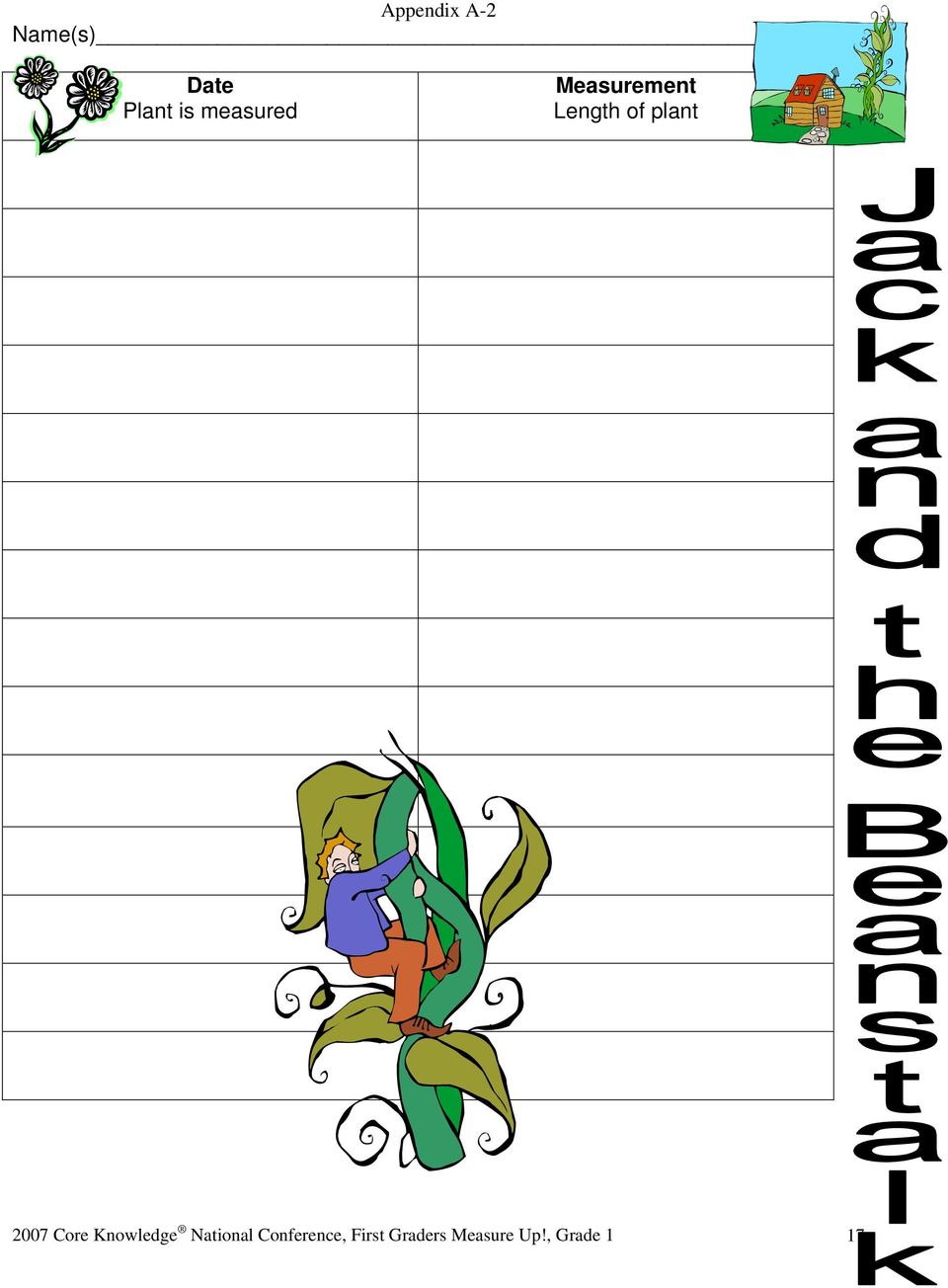
17 Appendix A-2 Name(s) Date Plant is measured Measurement Length of plant 2007 Core Knowledge National Conference, First Graders Measure Up!, Grade 1 17
18 Appendix B-1 Cut in half on this line Core Knowledge National Conference, First Graders Measure Up!, Grade 1 18

19 Appendix B Core Knowledge National Conference, First Graders Measure Up!, Grade 1 19
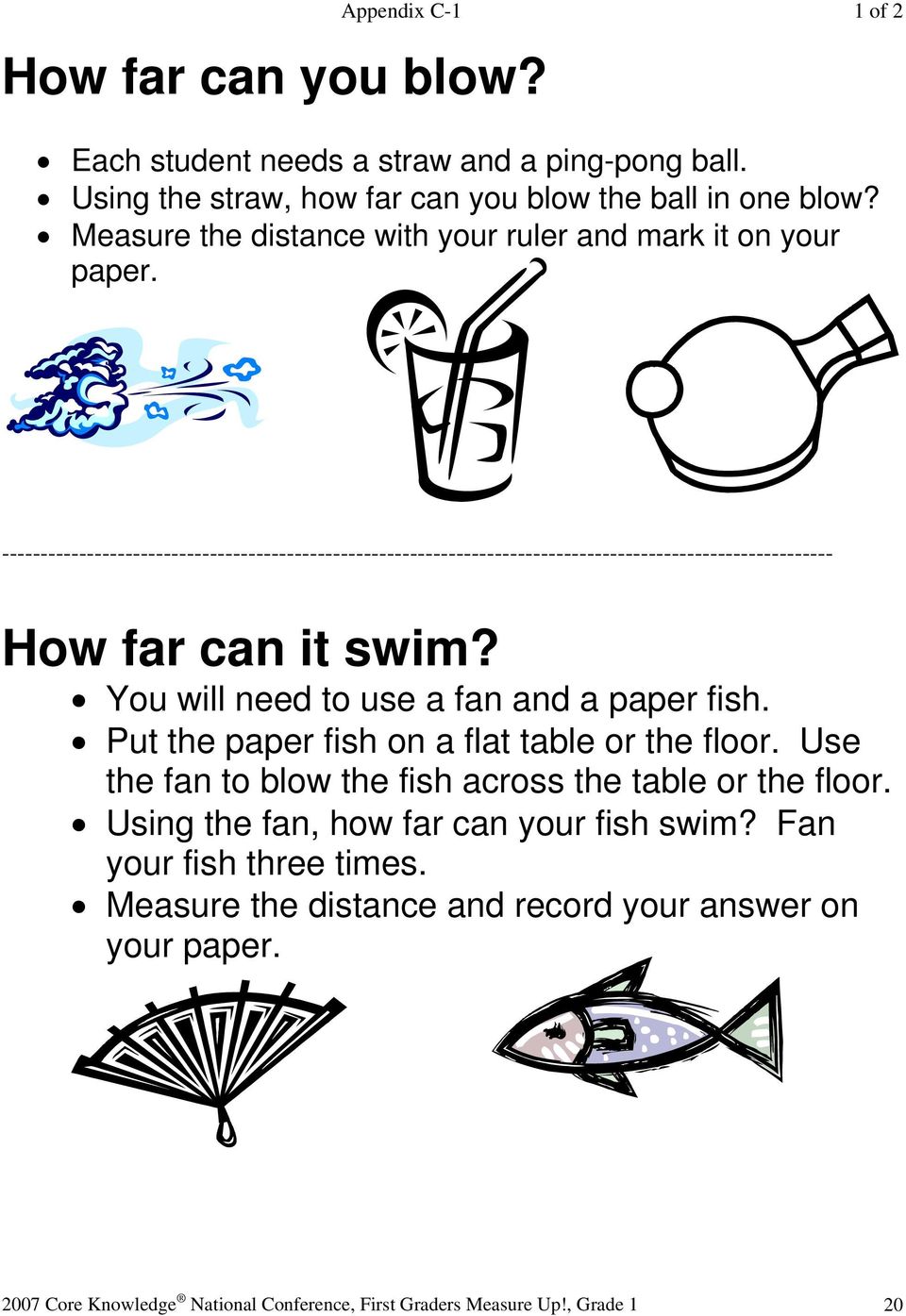
20 How far can you blow? Appendix C-1 1 of 2 Each student needs a straw and a ping-pong ball. Using the straw, how far can you blow the ball in one blow? Measure the distance with your ruler and mark it on your paper How far can it swim? You will need to use a fan and a paper fish. Put the paper fish on a flat table or the floor. Use the fan to blow the fish across the table or the floor. Using the fan, how far can your fish swim? Fan your fish three times. Measure the distance and record your answer on your paper Core Knowledge National Conference, First Graders Measure Up!, Grade 1 20
21 Appendix C-1 2 of 2 How far can it walk? You will need a wind-up toy. Wind the toy. Let it travel as far as you can. Measure the distance and record your answer on your paper How far can it roll? Make a ramp. Use a toy car. How far can your car travel when it goes down the ramp? Measure the length and record your answer. First Graders Measure-Up!, Grade Core Knowledge Conference 21
22 Appendix C-2 Name Stations How far can you blow the ball in one blow? How far can your fish swim? How far can your wind-up toy travel? How far can your car travel? INCHES INCHES INCHES INCHES Using your ruler, draw a line that is 6 inches long. Using your ruler, draw a line that is 6 centimeters long. Draw a circle around the line that is the longest. First Graders Measure-Up!, Grade Core Knowledge Conference 22
23 Appendix C-3 First Graders Measure-Up!, Grade Core Knowledge Conference 23
24 Appendix D-1 1. Raise two objects. One in each hand. 2. Predict which object will be heavier. Record your prediction. 3. Check to see what happens to each side when you put them on the balance scale. What do you see? Record your answer. 1. Put a heavy object on one side of the balance scale. 2. Predict how many lighter objects balance the heavy one. Record your prediction. 3. Check how many lighter objects balance the heavy one. What do you see? Record your answer. A B 1. Raise two objects. One in each hand. 2. Predict which objects will have the same weight. 3. Check the objects with a balance scale. What do you see? Record your answer. 1. Raise three or more objects 2. Predict which object is the heaviest and which is the lightest. Place in order of heaviness. Record your answer. 3. Check the objects by placing them on the balance scale. What do you see? Record your answer. C D First Graders Measure-Up!, Grade Core Knowledge Conference 24
25 I Predict A Appendix D-2 I Checked and I saw A B B C C D D First Graders Measure-Up!, Grade Core Knowledge Conference 25
26 Appendix E Name Weigh the item. Circle the correct answer. Item 1 pound < = > Less Equal Greater < = > Less Equal Greater < = > Less Equal Greater < = > Less Equal Greater < = > Less Equal Greater < = > Less Equal Greater < = > Less Equal Greater < = > Less Equal Greater < = > Less Equal Greater < = > Less Equal Greater < = > Less Equal Greater < = > Less Equal Greater First Graders Measure-Up!, Grade Core Knowledge Conference 26
27 Appendix F Name Measure the capacity of each container with both a small and a large scoop. Record your measurements. Estimate: Estimate: A small scoops Actual: large scoops Actual: small scoops Estimate: large scoops Estimate: B small scoops Actual: large scoops Actual: small scoops Estimate: large scoops Estimate: C small scoops Actual: large scoops Actual: small scoops Estimate: large scoops Estimate: D small scoops Actual: large scoops Actual: small scoops large scoops First Graders Measure-Up!, Grade Core Knowledge Conference 27
28 Appendix G First Graders Measure-Up!, Grade Core Knowledge Conference 28
29 Appendix H 1 of 2 Name Unit Assessment Use the inch side of your ruler to measure the lines. Record your answer in the boxes Draw a line that is 6 centimeters long. 7. Draw a line that is 4 centimeters long. 8. Draw a line that is 9 centimeters long. 9. Draw a line that is 2 inches long. 10. Draw a line that is 5 inches long. First Graders Measure-Up!, Grade Core Knowledge Conference 29
30 Appendix H 2 of 2 Draw a line to the correct side of the pan balance for each object Circle the item that holds less Cup or 1 Gallon Quart or 1 Cup Gallon or 1 Quart Circle the item that holds more Gallon or 1 Quart Cup or 1 Gallon Quart or 1 Cup First Graders Measure-Up!, Grade Core Knowledge Conference 30
The Long and Short of It: Introducing Measurement in Primary Grades
 California State Standards: Kindergarten MG. - Compare the length, weight, and capacity of objects by making direct comparisons with reference objects (e.g., note which object is shorter, longer, taller,
Let s Measure Pre-Kindergarten
 Ohio Standards Connection Measurement Standard Benchmark D Apply measurement techniques to measure length, weight and volume (capacity). Indicator 6 Measure length and volume (capacity) using non-standard
What is Energy? 1 45 minutes Energy and You: Energy Picnic Science, Physical Education Engage
 Unit Grades K-3 Awareness Teacher Overview What is energy? Energy makes change; it does things for us. It moves cars along the road and boats over the water. It bakes a cake in the oven and keeps ice frozen
I. ABSTRACT II. III. IV.
 Teaching About Magnets in Kindergarten Grade Level or Special Area: Kindergarten Written by: Lori Dawn Montanez, Swallows Charter Academy, Pueblo West, CO Length of Unit: Five lessons (approximately two
Units and Measurements
 Units and Measurements Preparation Grade Level: K-3 Group Size: 20-30 Time: 45-60 Minutes Presenters: 3-5 Objectives This lesson will enable students to: Define and identify various units of measurements.
FIDDLIN WITH FRACTIONS
 FIDDLIN WITH FRACTIONS Special Area: Connections (Fourth and Fifth Grade) Written by: (Dawn Ramos, Joan Johnson, Mindy Wilshusen, St. Mary s School) Length of Unit: (6 Lessons) I. ABSTRACT The purpose
Measuring with a Ruler
 Measuring with a Ruler Objective To guide children as they measure line segments to the nearest inch, _ inch, _ inch, centimeter, _ centimeter, and millimeter. www.everydaymathonline.com epresentations
Grade 4 Mathematics Measurement: Lesson 1
 Grade 4 Mathematics Measurement: Lesson 1 Read aloud to the students the material that is printed in boldface type inside the boxes. Information in regular type inside the boxes and all information outside
Danielle Abrahamson and Susan Michalek, Academy of Charter Schools, Denver, Colorado Four lessons over a period of five to seven days
 MATTER: Grade Level: Presented by: Length of Unit: ITS STATES AND PROPERTIES First Grade Danielle Abrahamson and Susan Michalek, Academy of Charter Schools, Denver, Colorado Four lessons over a period
Pushes and Pulls. TCAPS Created June 2010 by J. McCain
 Pushes and Pulls K i n d e r g a r t e n S c i e n c e TCAPS Created June 2010 by J. McCain Table of Contents Science GLCEs incorporated in this Unit............... 2-3 Materials List.......................................
[Measurement] [Basic: Measurement - K]
![[Measurement] [Basic: Measurement - K]](/thumbs/40/21418811.jpg "[Measurement] [Basic: Measurement - K]") [Measurement] [Basic: Measurement - K] BACKGROUND Measurement is an important skill all students need to acquire be it for science, cooking in the kitchen, or building a house. Helping students develop
[Measurement] [Basic: Measurement - K] BACKGROUND Measurement is an important skill all students need to acquire be it for science, cooking in the kitchen, or building a house. Helping students develop
Assessment For The California Mathematics Standards Grade 3
 Introduction: Summary of Goals GRADE THREE By the end of grade three, students deepen their understanding of place value and their understanding of and skill with addition, subtraction, multiplication,
Third Grade Shapes Up! Grade Level: Third Grade Written by: Jill Pisman, St. Mary s School East Moline, Illinois Length of Unit: Eight Lessons
 Third Grade Shapes Up! Grade Level: Third Grade Written by: Jill Pisman, St. Mary s School East Moline, Illinois Length of Unit: Eight Lessons I. ABSTRACT This unit contains lessons that focus on geometric
High Flying Balloons
 Second Grade Science Design Brief High Flying Balloons Background: In our study of science we have been investigating the three stages of matter: solids, liquids and gases. You will use your knowledge
MAPS AND GLOBES: WHERE IN THE WORLD ARE WE?
 MAPS AND GLOBES: WHERE IN THE WORLD ARE WE? Grade Level: Kindergarten Presented by: Karen Davis and Tamara Young, Tate Elementary, Van Buren, AR Length of unit:5 lessons I. ABSTRACT A. This unit focuses
LRSD Pre-Kindergarten Curriculum Science Lessons & Experiences
 Science activities provide the opportunity for students to experience the word around them. Complementary science tasks were developed in June 2013 to enhance and give additional experiences related to
Simple machines provide a mechanical advantage that makes our work faster and easier, and they are all around us every day.
 LEARNING MODULE: SIMPLE MACHINES Pre-Visit Activities We suggest that you use these pre-visit classroom acitivites to prepare your students for a rewarding Museum visit. Before your visit, introduce your
II. III. IV. RESOURCES A. Best Buy Bargain Books, Social Studies K-1 by Frank Schaffer ISBN 0867344512
 What on Earth is...a Map?...a Globe? Grade Level: Kindergarten Written by: Lisa Fagan Cross County Elementary, Teressa Davis Vanndale Elementary, Amy Searcy, and Cheryl Green Hickory Ridge Elementary,
Explore architectural design and act as architects to create a floor plan of a redesigned classroom.
 ARCHITECTURAL DESIGN AT A GLANCE Explore architectural design and act as architects to create a floor plan of a redesigned classroom. OBJECTIVES: Students will: Use prior knowledge to discuss functions
Grade 4 Mathematics Measurement: Lesson 3
 Grade 4 Mathematics Measurement: Lesson 3 Read aloud to the students the material that is printed in boldface type inside the boxes. Information in regular type inside the boxes and all information outside
1 ST GRADE COMMON CORE STANDARDS FOR SAXON MATH
 1 ST GRADE COMMON CORE STANDARDS FOR SAXON MATH Calendar The following tables show the CCSS focus of The Meeting activities, which appear at the beginning of each numbered lesson and are taught daily,
2002 Worcester Public Schools (WPS) Benchmarks for Grade 3 1. 03.SC.TE.05 Develop a knowledge and understanding of the metric measurement system.
 3.G.2 What is a Centimeter? An introduction to measuring length in the metric system Grade Level 3 Sessions Seasonality Instructional Mode(s) Team Size WPS Benchmarks MA Frameworks Key Words (1): 1 at
II. 2008 Core Knowledge National Conference, 2 nd Grade, Action! Action! We Want Fractions 1
 ACTION! ACTION! We Want Fractions! Grade Level or Special Area: Second Grade Written by: Monique Cavaleri, Marie Maggio, Anne Slack, P.S.108, Brooklyn New York Length of Unit: 5 Lessons I. ABSTRACT Fractions
Objective To introduce a formula to calculate the area. Family Letters. Assessment Management
 Area of a Circle Objective To introduce a formula to calculate the area of a circle. www.everydaymathonline.com epresentations etoolkit Algorithms Practice EM Facts Workshop Game Family Letters Assessment
EE6-5 Solving Equations with Balances Pages 77 78
 EE6-5 Solving Equations with Balances Pages 77 78 STANDARDS 6.EE.B.5, 6.EE.B.6 Goals Students will use pictures to model and solve equations. Vocabulary balance equation expression sides (of an equation)
Air Pressure Pressure in the real world
 Air Pressure Pressure in the real world OBJECTIVES Students will conduct experiments and collect data. Students will learn how air pressure affects real-world phenomena. Students will gain an understanding
Indicator 2: Use a variety of algebraic concepts and methods to solve equations and inequalities.
 3 rd Grade Math Learning Targets Algebra: Indicator 1: Use procedures to transform algebraic expressions. 3.A.1.1. Students are able to explain the relationship between repeated addition and multiplication.
Customary Length, Weight, and Capacity
 15 CHAPTER Lesson 15.1 Customary Length, Weight, and Capacity Measuring Length Measure each object to the nearest inch. 1. The crayon is about inches long. 2. 3. The toothbrush is about The rope is about
Kindergarten, What Animals Need 2005 Colorado Summer Writing Institute 1
 What Animals Need Grade Level or Special Area: Kindergarten Written by: Karla Burkhalter, Lincoln Academy, Arvada, CO Length of Unit: Eight lessons (seven 20-minute lessons, one lesson with a varying time
First Grade Unit A: PHYSICAL SCIENCE Chapter 1: Observing Solids, Liquids and Gases Lessons 1 to 5
 First Grade Unit A: PHYSICAL SCIENCE Chapter 1: Observing Solids, Liquids and Gases Lessons 1 to 5 Physical Science Overview Materials (matter) come in different forms. Water can be rain falling (liquid)
II. III. 2004 Core Knowledge National Conference, Grade Level, (Unit Name Here) 1
 Teaching A Touchy Topic: Life Cycles and Reproduction Grade Level: Fifth Grade Written by: Kimberly Ruckh, Linda Cambra, Dallas Bankston; Challenge Charter School, Glendale, Az. Length of Unit: Five Lessons
Force and Motion Grade 2
 Suggested Time Frame: 2-3 days Materials: Tennis balls, 10 Golf balls, 10 Marbles, 10 Ping pong balls, 10 Measuring tapes, 10 Rulers, 10 Stopwatch Masking tape Towel Sandpaper Wax paper Paper cups Matching
III. BACKGROUND KNOWLEDGE
 Chemical Bonds and Reactions (Water) Grade Level: 7 (Applied Technology) Presented by: James Rubright, Three Oaks Middle School, Fort Myers, Florida Length of Unit: Ten Daily Lessons and Activities I.
Integrated Physics & Chemistry Supply List (2010)
 Integrated Physics & Chemistry Supply List (2010) Integrated Physics and Chemistry is a physical science course covering basic concepts found in chemistry and physics. Topics included in the study are
Understanding Ratios Grade Five
 Ohio Standards Connection: Number, Number Sense and Operations Standard Benchmark B Use models and pictures to relate concepts of ratio, proportion and percent. Indicator 1 Use models and visual representation
The Ten Commandments
 The Ten Commandments Teacher Pep Talk: God had miraculously led His people (the Israelites) out of Egypt and safely through the Red Sea. Now at long last the Israelites had arrived at the mountain of God.
I. ABSTRACT II. III. IV.
 Teaching Musical Instruments in Kindergarten Grade Level or Special Area: Kindergarten Written by: Lori Dawn Montanez, Swallows Charter Academy, Pueblo, CO Length of Unit: 10 days (nine lessons plus a
Have several sets of truck pieces (see below for list of truck pieces) cut out for the group.
 TEACHER S GUIDE III Grades: 3rd and 4th Grade The exercises below are meant to inspire greater creativity with more complex tasks and reasoning. Students are required to pay attention and follow instructions
Week 4 Lesson Plan. Pre-K. Our Neighborhood. Macmillan /McGraw-Hill. Extend. the Unit
 Lesson Plan Extend Unit the Unit Pre-K Our Neighborhood Alphabet Time.....................2-3 Book Time.........................-5 Retelling Puppets..................6-7 Content Area......................8-9
Science Grade 05 Unit 04 Exemplar Lesson 01: Types of Energy
 Grade 05 Unit 04 Exemplar Lesson 01: Types of Energy This lesson is one approach to teaching the State Standards associated with this unit. Districts are encouraged to customize this lesson by supplementing
4 th Grade Summer Mathematics Review #1. Name: 1. How many sides does each polygon have? 2. What is the rule for this function machine?
 . How many sides does each polygon have? th Grade Summer Mathematics Review #. What is the rule for this function machine? A. Pentagon B. Nonagon C. Octagon D. Quadrilateral. List all of the factors of
III. BACKGROUND KNOWLEDGE
 Chemistry: Phase Changes: Heat and Matter Grade Level: 5 Presented by: Gail Scott-Taylor, R.N. Harris Integrated Arts/Core Knowledge School Length of Unit: Seven lessons I. ABSTRACT Roll up your sleeves
Science Grade 1 Forces and Motion
 Science Grade 1 Forces and Motion Description: The students in this unit will use their inquiry skills to explore pushing, pulling, and gravity. They will also explore the different variables which affect
Quarter One: August-October
 Quarter One: August-October (Chapters 1 3, 5-6, 10) August - December Quarterly Addition facts with sums through 20 General Math Content 1. Write sums through 20. 1. Choose and enter the appropriate answer.
Volume of Right Prisms Objective To provide experiences with using a formula for the volume of right prisms.
 Volume of Right Prisms Objective To provide experiences with using a formula for the volume of right prisms. www.everydaymathonline.com epresentations etoolkit Algorithms Practice EM Facts Workshop Game
Force and Motion: Ramp It Up
 Force and Motion: Grade Level: 4-5 Time: 3 class periods By: Carrie D. Perry (Bedford County Public Schools) Overview After watching an engaging video on Olympic alpine skiers, students then participate
Getting to Know Newton
 Introduction Overview This first program introduces students to the idea of motion, and the forces that start the movement of an object. Students are introduced to Isaac Newton who is best known for the
Understand numbers, ways of representing numbers, relationships among numbers, and number systems
 Equivalent Fractions and Comparing Fractions: Are You My Equal? Brief Overview: This four day lesson plan will explore the mathematical concept of identifying equivalent fractions and using this knowledge
By Heather Forest. Outcome: Students will learn about farm animals and how the animals in this story adopt human traits.
 Outcome: Students will learn about farm animals and how the animals in this story adopt human traits. Materials: Blackboard or Whiteboard From Seeds to Cake Sequencing worksheet Hen Body Parts worksheet,
Phonics. P.041 High Frequency Words. Objective The student will read high frequency words.
 2005 The Florida Center for Reading Research (Revised, 2008) Objective The student will read high frequency words. Phonics P.041 High Frequency Words Sandpaper Words Materials Tactile word patterns (Activity
Essential Question: Why does what we measure influence how we measure?
 Core Content: 5.MD.1 Convert among different-sized standard measurement units within a given measurement system (e.g., convert 5 cm to 0.05 m), and use these conversions in solving multi-step, real world
Activity: Building a Catapult
 Mechanical Engineering Activity: Building a Catapult In this activity, youth learn how to design and build a catapult that uses a pivot arm (lever) and a fulcrum to launch a Ping-Pong ball across the room.
Unit 2 Number and Operations Fractions: Multiplying and Dividing Fractions
 Unit Number and Operations Fractions: Multiplying and Dividing Fractions Introduction In this unit, students will divide whole numbers and interpret the answer as a fraction instead of with a remainder.
Middle Value (Median) of a Set of Data
 Middle Value (Median) of a Set of Data Objectives To guide children as they sort numerical data and arrange data in ascending or descending order, and as they find the middle value (median) for a set of
Homework Activities for Kindergarten
 Homework Activities for Kindergarten Listed below are several learning activities for your child to complete at home to reinforce skills being taught in school. The sight words are on the last page. Reading
Air and Weather FOSS kit
 Air and Weather FOSS kit 2. E. 1 Understand patterns of weather and factors that affect weather. 2.E.1.1 Summarize how energy from the sun serves as a source of light that warms the land, air and water.
Kinetic and Potential Energy
 Kinetic and Potential Energy Vocabulary: kinetic energy energy of movement potential energy stored energy potential chemical energy stored energy released by chemical changes Comprehension Questions 1.
Personal Timelines Grade Two
 Ohio Standards Connection Data Analysis and Probability Benchmark C Represent data using objects, picture graphs and bar graphs. Indicators 3. Read and construct simple timelines to sequence events. 5.
Measurement/Volume and Surface Area Long-Term Memory Review Grade 7, Standard 3.0 Review 1
 Review 1 1. Explain how to convert from a larger unit of measurement to a smaller unit of measurement. Include what operation(s) would be used to make the conversion. 2. What basic metric unit would be
Preschool March Lessons. Dr. Seuss Day. One Day Free Sample
 Preschool March Lessons Dr. Seuss Day One Day Free Sample Kids R Learning Preschool Lesson Plans Letter R - Number 9 Dr. Seuss Day Circle Time: Left & Right Feet Read the story the Foot Book Explain to
Music Makers. paper clips
 Fifth Grade Science Design Brief Music Makers Background: We know that sound is a form of energy produced and transmitted by vibrating matter and that pitch is determined by the frequency of a vibrating
Capacity. Assessment Management
 Capacity Objective To review units of capacity. www.everydaymathonline.com epresentations etoolkit Algorithms Practice EM Facts Workshop Game Family Letters Assessment Management Common Core State Standards
FIRST GRADE MATH Summer 2011
 Standards Summer 2011 1 OA.1 Use addition and subtraction within 20 to solve word problems involving situations of adding to, taking from, putting together, taking apart, and comparing, with unknowns in
Solids, Liquids, and Gases
 Solids, Liquids, and Gases nd Intended for Grade: 2 Grade Subject: Science Description: Activities to help students understand solids, liquids, gases, and the changes between these states. Objective: The
Subject: Math Grade Level: 5 Topic: The Metric System Time Allotment: 45 minutes Teaching Date: Day 1
 Subject: Math Grade Level: 5 Topic: The Metric System Time Allotment: 45 minutes Teaching Date: Day 1 I. (A) Goal(s): For student to gain conceptual understanding of the metric system and how to convert
1 st Grade Math Do-Anytime Activities
 1 st Grade Have your child help create a number line (0-15) outside with sidewalk chalk. Call out a number and have your child jump on that number. Make up directions such as Hop to the number that is
Second Grade Summer Math Packet. Name Meriden Public Schools
 Second Grade Summer Math Packet Name Meriden Public Schools Dear Parents and Students, This summer's math packet contains problems and questions that were practiced in second grade. In order to keep you
STATE GOAL 7: Estimate, make and use measurements of objects, quantities and relationships and determine acceptable
 C 1 Measurement H OW MUCH SPACE DO YOU N EED? STATE GOAL 7: Estimate, make and use measurements of objects, quantities and relationships and determine acceptable levels of accuracy Statement of Purpose:
A booklet for Parents
 By the end of Year 2, most children should be able to Count up to 100 objects by grouping them and counting in tens, fives or twos; explain what each digit in a two-digit number represents, including numbers
MD5-26 Stacking Blocks Pages 115 116
 MD5-26 Stacking Blocks Pages 115 116 STANDARDS 5.MD.C.4 Goals Students will find the number of cubes in a rectangular stack and develop the formula length width height for the number of cubes in a stack.
Comprehension. Sentence Structure and Meaning C.001. Objective The student will identify key parts of the text.
 C.001 Sentence Structure and Meaning Sentence-Picture Match Objective The student will identify key parts of the text. Materials Pocket chart Picture cards Use picture cards from core reading program or
Solar Cooking. Design Challenge: Make a solar cooker that will heat a piece of hot dog. Be prepared to show your solar cooker to your class.
 First Grade Science Design Brief Solar Cooking Background: The sun gives us energy. It provides the earth with heat and light. It helps grow food, makes weather, and keeps living things alive. We can use
Activities and Ideas: Plants, Trees, and Seeds
 Mathematics Measurement: Take students outside to the playground with a list of plant and/or tree items they will find there (tree trunks, branches, leaves, seeds, flowers, etc.) and a measurement tool
NAILING RUST. Jim Lowry, fourth-grade teacher Webster Elementary School Pemberville, OH
 Jim Lowry, fourth-grade teacher Webster Elementary School Pemberville, OH NAILING RUST Lesson Summary for Grades 3 8 The students are grouped in pairs and go on a walking tour of the school grounds. They
Paper Airplanes. Linsey Fordyce. Fall 2014. TEFB 413 Section # 504
 Model- Based Inquiry Learning Lesson Plan Paper Airplanes Linsey Fordyce Fall 2014 TEFB 413 Section # 504 1. BACKGROUND INFORMATION OF LESSON LESSON OBJECTIVES Students will investigate through model-
Discovering Math: Using and Collecting Data Teacher s Guide
 Teacher s Guide Grade Level: 3-5 Curriculum Focus: Mathematics Lesson Duration: Four class periods Program Description Discovering Math: Using and Collecting Data From data points and determining spread
Begin the Investigation
 s c i e n c e i n v e s t i g a t i o n Blow, Wind, Blow! Curious George Flies a Kite One windy day George becomes curious about the way the wind moves things. He ends up having a very exciting kite ride.
Spring Scale Engineering
 Spring Scale Engineering Provided by TryEngineering - Lesson Focus Lesson focuses on the engineering behind building a spring scale and its use as a measuring device. Students work in teams to design,
Converting Units of Measure Measurement
 Converting Units of Measure Measurement Outcome (lesson objective) Given a unit of measurement, students will be able to convert it to other units of measurement and will be able to use it to solve contextual
Grade 4 - Module 5: Fraction Equivalence, Ordering, and Operations
 Grade 4 - Module 5: Fraction Equivalence, Ordering, and Operations Benchmark (standard or reference point by which something is measured) Common denominator (when two or more fractions have the same denominator)
Days. Day 1. Reflection Teacher Responsibilities. Lesson Plans
 Days Day 1 Lesson Plans Call the students to the carpet by the number of letters in their names. If your name has less than 5 letters, come to the carpet. If your name has more than 5 letters, come to
Barter vs. Money. Grade One. Overview. Prerequisite Skills. Lesson Objectives. Materials List
 Grade One Barter vs. Money Overview Students share the book Sheep in a Shop, by Nancy Shaw, to learn about choice, making decisions, trade, and the barter system. They complete worksheets on comparing
Commutative Property Grade One
 Ohio Standards Connection Patterns, Functions and Algebra Benchmark E Solve open sentences and explain strategies. Indicator 4 Solve open sentences by representing an expression in more than one way using
Lesson 1: Linear Measurement
 Lesson 1: Linear Selected Content Standards Benchmarks Addressed: M-1-M Applying the concepts of length, area, surface area, volume, capacity, weight, mass, money, time, temperature, and rate to real-world
Exploring Animal Environments
 Third Grade Science Design Brief Exploring Animal Environments forest - desert - grassland rainforest - marshland - swamp - pond - river - ocean - stream Background: In our studies of science, we have
Summer Math Reinforcement Packet Students Entering into 2 nd Grade
 1 Summer Math Reinforcement Packet Students Entering into 2 nd Grade Our first graders had a busy year learning new math skills. Mastery of all these skills is extremely important in order to develop a
Linear, Square and Cubic Units Grade Five
 Ohio Standards Connection Measurement Benchmark F Analyze and explain what happens to area and perimeter or surface area and volume when the dimensions of an object are changed. Indicator 4 Demonstrate
Using Proportions to Solve Percent Problems I
 RP7-1 Using Proportions to Solve Percent Problems I Pages 46 48 Standards: 7.RP.A. Goals: Students will write equivalent statements for proportions by keeping track of the part and the whole, and by solving
Scope and Sequence KA KB 1A 1B 2A 2B 3A 3B 4A 4B 5A 5B 6A 6B
 Scope and Sequence Earlybird Kindergarten, Standards Edition Primary Mathematics, Standards Edition Copyright 2008 [SingaporeMath.com Inc.] The check mark indicates where the topic is first introduced
The Digestive System: Where does food go? Teacher Version
 The Digestive System: Where does food go? Teacher Version In this lab you will learn about your digestive system. We will use everyday objects like yarn and a ziplock bag to understand how long our digestive
Fun for all the Family 3- Quite a few games for articles and determiners
 Fun for all the Family 3- Quite a few games for articles and determiners Articles in English is one of those grammar points that are fairly easy to explain the fundamentals of, but even Advanced learners
Interaction at a Distance
 Interaction at a Distance Lesson Overview: Students come in contact with and use magnets every day. They often don t consider that there are different types of magnets and that they are made for different
Second Grade, Levers and Pulleys and Gears, Oh My! 2005 Colorado Unit Writing Project 1
 Levers and Pulleys and Gears, Oh My! Grade Level or Special Area: 2 nd Grade, Science Written by: Amy Hoen, Academy Elementary School, Westminster, CO Length of Unit: Six lessons (approximately six days;
3rd Grade Lesson Fractions
 3rd Grade Lesson Fractions Lesson planning team: Tracey Carter, Rebecca Kotler, Tom McDougal Instructor: Tracey Carter Focus Question Sixth Annual Lesson Study Conference DePaul University Chicago, Illinois
Summer Math Packet. For Students Entering Grade 5 $3.98. Student s Name 63 9 = Review and Practice of Fairfield Math Objectives and CMT Objectives
 Summer Math Packet 63 9 = Green Yellow Green Orange Orange Yellow $3.98 1 Green A B C D Red 8 1 2 3 4 5 Student s Name June 2013 Review and Practice of Fairfield Math Objectives and CMT Objectives 1 Summer
Ideas for Using Books to Support Social Emotional Development. I Can Share By Karen Katz
 Book Nook Ideas for Using Books to Support Social Emotional Development I Can Share By Karen Katz I Can Share is a Lift-the-Flap book geared for toddlers and young preschoolers which can be used to help