
Low voltage circuit breakers. Working with trip characteristic curves
|
|
|
- Lawrence Marshall
- 9 years ago
- Views:
Transcription
1 Low voltage circuit breakers Working with trip characteristic curves
2

3 Index 1. Introduction Main Definitions ABB Low Voltage Circuit Breakers complying with the Standards UL 489 and UL Common terms on Low Voltage Circuit Breakers ABB Low Voltage Circuit Breakers Molded-Case Circuit Breakers (Tmax) Low Voltage Power Circuit Breakers (Emax) Thermal Magnetic and Electronic Trip Units for ABB Circuit Breakers 4.1 Thermal Magnetic Trip Units Overload Protection (L) Instantaneous Short Circuit Protection (I) Thermal magnetic Trip Units for Tmax Circuit Breakers Time-Current Curve of a Thermal magnetic Trip Unit TMA Setting Examples of a Trip Unit TMA Electronic Trip Units Overload Protection (L) Short-Circuit Protection with Delayed Trip (S) Instantaneous Short-Circuit Protection (I) Ground-Fault Protection (G) Electronic Trip Units for Tmax Circuit Breakers Setting Examples of a Trip Unit PR222DS Electronic Trip Units for Emax Circuit Breakers Trip Curves of ABB Trip Units 5.1 Trip Curves of Thermal magnetic Trip Units Trip Curves of Electronic Trip Units Functions L and S Function I Function G Curves of Current Limiting Circuit Breakers: Let-Through Values of I 2 t and Peak Current Annex A: Tolerance in the Trip Curves Glossary Low Voltage Products & Systems 1 1SXU2117B21
4 Introduction 1. Introduction This White Paper is to clarify the reading and the interpretation of the characteristic curves (trip curves, specific let-through energy curves and limitation curves) of the Molded-Case Circuit Breakers (MCCBs) and Low Voltage Power Circuit Breakers (LVPCBs) manufactured by ABB in compliance with the following Standards: - UL 489: Molded-Case Circuit Breakers, Molded-Case Switches and Circuit Breaker Enclosures - UL 166: Low-Voltage AC and DC Power Circuit Breakers Used in Enclosures - ANSI C37.13: IEEE Standard for Low-Voltage AC Power Circuit Breakers Used in Enclosures - ANSI C37.16: Low-Voltage Power Circuit Breakers and AC Power Circuit Protectors. Preferred Ratings, Related Requirements, and Application Recommendations - ANSI C37.17: American National Standard for Trip Devices for AC and General Purpose DC Low Voltage Power Circuit Breakers This publication is divided into four parts. The first part (Chapters 1 and 2) describes the purpose of this White Paper and all the useful definitions. The second part (Chapter 3) provides an in depth look at ABB UL industrial circuit breakers. The third part (Chapter 4) describes the trip units of ABB circuit breakers and the characteristic trip curves. Finally, the fourth part (Chapters 5 and 6) provides examples of curves to help comprehension and interpretation of the contained information. 2 Low Voltage Products & Systems 1SXU2117B21
5 Main definitions 2. Main Definitions The main definitions below are from the UL 489, UL 166, ANSI C37.13 and ANSI C37.17 Standards. Definitions from the Standard UL 489 (MCCB) Underwriters Laboratories 1 - ADJUSTABLE CIRCUIT BREAKER: a circuit breaker that has adjustable time/current tripping characteristics. These may include: a) Inverse-time (such as continuous current, long time, and/or short time); b) Instantaneous; c) Ground-fault. 2 - ADJUSTABLE INSTANTANEOUS RELEASE (TRIP): that part of an overcurrent trip element that can be adjusted to trip a circuit breaker instantaneously at various values of current within a predetermined range of currents. 3 - CIRCUIT BREAKER: a device designed to open and close a circuit by nonautomatic means, and to open the circuit automatically on a predetermined overcurrent, without damage to itself when properly applied within its rating. 4 - CIRCUIT BREAKERS WITH GROUND-FAULT PROTECTION FOR EQUIP- MENT: circuit breakers that perform all normal circuit breaker functions and also trip when a fault current to ground exceeds a predetermined value. 5 - CURRENT-LIMITING CIRCUIT BREAKER: one that does not employ a fusible element and, when operating within its current-limiting range, limits the let-through I 2 t (see definition 2 AMPERES SQUARED SECONDS) to a value less than the I 2 t of a 1/2-cycle wave of the symmetrical prospective current. Ik Limited short-circuit current Prospective current t Low Voltage Products & Systems 3 1SXU2117B21

6 Main definitions 6 - CURRENT-LIMITING RANGE: the RMS symmetrical prospective currents between the threshold current and the maximum interrupting rating current. 7 - CURRENT SETTING (lr): the RMS current an adjustable circuit breaker is set to carry continuously without tripping. It is normally expressed as a percentage of the rated current and is adjustable. 8 - FIXED INSTANTANEOUS RELEASE (TRIP): that part of an overcurrent release element which contains a nonadjustable means that is set to trip a circuit breaker instantaneously above a predetermined value of current. 9 - FRAME: an assembly consisting of all parts of a circuit breaker except an interchangeable trip unit. 1 - FRAME SIZE: a term applied to a group of circuit breakers of similar physical configuration. Frame size is expressed in amperes and corresponds to the largest ampere rating available in the group. The same frame size designation may be applied to more than one group of circuit breakers GROUND-FAULT DELAY: an intentional time delay in the tripping function of a circuit breaker when a ground-fault occurs GROUND-FAULT PICKUP SETTING: the nominal value of the ground-fault current at which the ground-fault delay function is initiated INSTANTANEOUS OVERRIDE: a fixed current level at which an adjustable circuit breaker will override all settings and will trip instantaneously INSTANTANEOUS PICKUP SETTING: the nominal value of current that an adjustable circuit breaker is set to trip instantaneously INSTANTANEOUS TRIP: a qualifying term indicating that no delay is purposely introduced in the automatic tripping of the circuit breaker INSTANTANEOUS TRIP CIRCUIT BREAKER (MOTOR CIRCUIT PROTEC- TOR OR CIRCUIT INTERRUPTER): is one intended to provide short circuit protection only. Although acting instantaneously under short circuit conditions, these circuit breakers are permitted to include a transient dampening action to ride through initial motor transients INTERCHANGEABLE TRIP UNIT: one which can be interchanged by a user among circuit breaker frames of the same design (to see also definition 32 RATING PLUG) INTERRUPTING RATING: the highest current at rated voltage that a device is intended to interrupt under standard test conditions INVERSE TIME: a qualifying term indicating that there is a purposely introduced delayed tripping in which the delay decreases as the magnitude of the current increases. 2 - I 2 t (AMPERES SQUARED SECONDS): an expression related to the circuit energy as a result of current flow. With respect to circuit breakers, the I 2 t [A 2 s] is expressed for the current flow between the initiation of the fault current and the clearing of the circuit LONG-TIME DELAY: an intentional time delay in the overload tripping of an adjustable circuit breaker s inverse time characteristics. The position of the long time portion of the trip curve is normally referenced in seconds at 6 percent of the current setting (Ir) LONG-TIME PICKUP: the current at which the long-time delay function is initiated MOLDED-CASE CIRCUIT BREAKER: a circuit breaker which is assembled as an integral unit in a supportive and enclosed housing of insulating material. 4 Low Voltage Products & Systems 1SXU2117B21
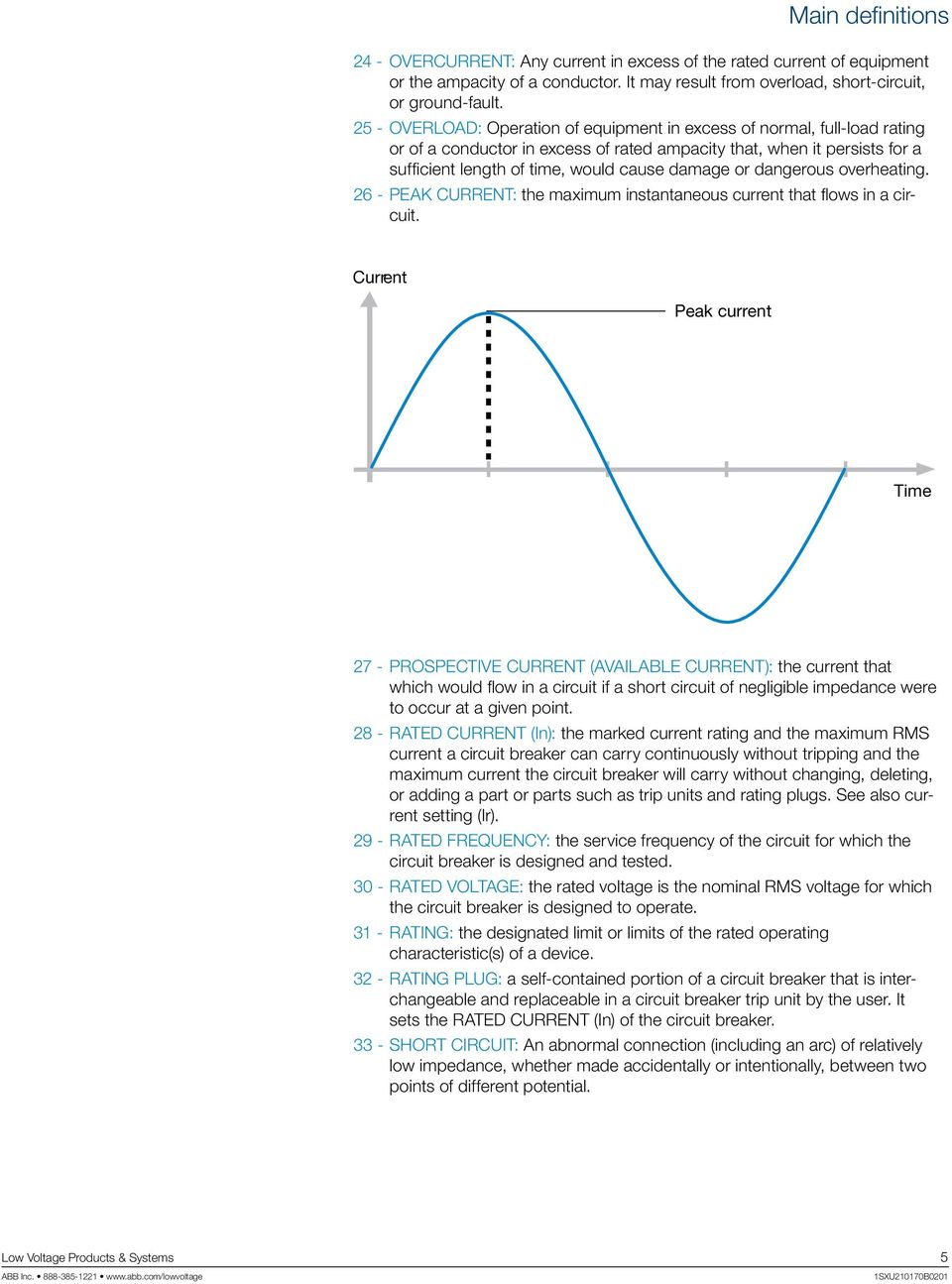
7 Main definitions 24 - OVERCURRENT: Any current in excess of the rated current of equipment or the ampacity of a conductor. It may result from overload, short-circuit, or ground-fault OVERLOAD: Operation of equipment in excess of normal, full-load rating or of a conductor in excess of rated ampacity that, when it persists for a sufficient length of time, would cause damage or dangerous overheating PEAK CURRENT: the maximum instantaneous current that flows in a circuit. Current Peak current Time 27 - PROSPECTIVE CURRENT (AVAILABLE CURRENT): the current that which would flow in a circuit if a short circuit of negligible impedance were to occur at a given point RATED CURRENT (In): the marked current rating and the maximum RMS current a circuit breaker can carry continuously without tripping and the maximum current the circuit breaker will carry without changing, deleting, or adding a part or parts such as trip units and rating plugs. See also current setting (Ir) RATED FREQUENCY: the service frequency of the circuit for which the circuit breaker is designed and tested. 3 - RATED VOLTAGE: the rated voltage is the nominal RMS voltage for which the circuit breaker is designed to operate RATING: the designated limit or limits of the rated operating characteristic(s) of a device RATING PLUG: a self-contained portion of a circuit breaker that is interchangeable and replaceable in a circuit breaker trip unit by the user. It sets the RATED CURRENT (In) of the circuit breaker SHORT CIRCUIT: An abnormal connection (including an arc) of relatively low impedance, whether made accidentally or intentionally, between two points of different potential. Low Voltage Products & Systems 5 1SXU2117B21
8 Main definitions 34 - SHORT CIRCUIT CURRENT RATING: the maximum RMS prospective (available) current to which a device can be connected when protected by the specified overcurrent protective devices. The rating is expressed in amperes and volts SHORT-TIME DELAY: an intentional time delay in the tripping of a circuit breaker between the overload and the instantaneous pickup settings SHORT-TIME PICKUP: the current at which the short-time delay function is initiated THRESHOLD CURRENT the RMS symmetrical prospective current at the threshold of the current limiting range, where: a) the peak current let-through in each phase is less than the peak of that symmetrical prospective current, and b) the I 2 t in each phase is less than the I 2 t of a 1/2 cycle wave of the symmetrical prospective current TRIPPING: the opening of a circuit breaker by actuation of the release mechanism TRIP UNIT: a self-contained portion of a circuit breaker that is interchangeable and replaceable in a circuit breaker frame by the user. It actuates the circuit breaker release mechanism and it sets the RATED CURRENT (In) of the circuit breaker unless a rating plug is used (to see also definition 32 RATING PLUG). Definitions from the Standards ANSI C37.13 and ANSI C37.17 American National Standard Institute (1) In this document the direct-acting overcurrent electronic trip device, installed in the Low Voltage Power Circuit Breakers, is called electronic trip unit. 4 - DIRECT-ACTING OVERCURRENT ELECTRONIC TRIP DEVICE (1) : a release or tripping system that is completely self contained in a circuit breaker and which requires no external power or control circuits to cause it to function, and is activated by means of analog or digital processing of a sampling of the current flowing through the circuit breaker. Information functions, if provided, may require external power and/or control circuits. The direct-acting overcurrent trip devices may include ground trip elements RATED MAXIMUM VOLTAGE: the rated maximum voltage of a circuit breaker is the highest rms voltage, three-phase or single-phase, at which it is designed to perform. The circuit breaker shall be rated at one or more of the following maximum voltages: 635V, 58V, or 254V. For fused circuit breakers, the 635V rated maximum voltage becomes 6V to match the fuse rating RATED FREQUENCY: the rated frequency of a circuit breaker is the frequency at which it is designed to perform. The standard frequency is 6Hz. Application at other frequencies should receive special consideration RATED CONTINUOUS CURRENT: the rated continuous current of a circuit breaker is the designated limit of rms current at rated frequency that it shall be required to carry continuously without exceeding the temperature limitations designated in Section 7 (in ANSI C37.13). The preferred continuous current ratings of the various frame sizes are listed in ANSI C The rated continuous current of a circuit breaker equipped with direct-acting trip devices or fuses of a lower rating than the frame size of the circuit breaker is determined by the rating of those devices. 6 Low Voltage Products & Systems 1SXU2117B21
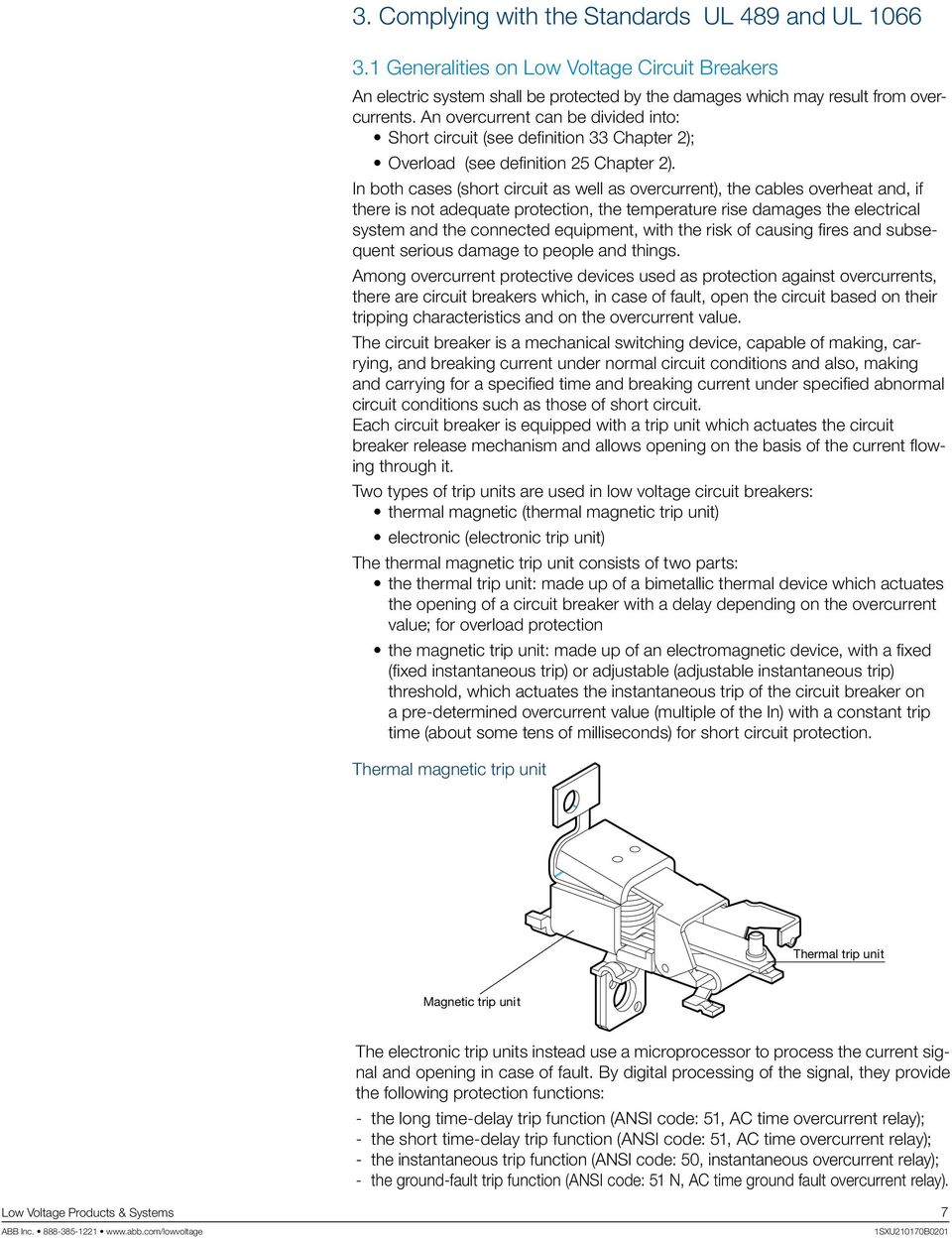
9 3. Complying with the Standards UL 489 and UL Generalities on Low Voltage Circuit Breakers An electric system shall be protected by the damages which may result from overcurrents. An overcurrent can be divided into: Short circuit (see definition 33 Chapter 2); Overload (see definition 25 Chapter 2). In both cases (short circuit as well as overcurrent), the cables overheat and, if there is not adequate protection, the temperature rise damages the electrical system and the connected equipment, with the risk of causing fires and subsequent serious damage to people and things. Among overcurrent protective devices used as protection against overcurrents, there are circuit breakers which, in case of fault, open the circuit based on their tripping characteristics and on the overcurrent value. The circuit breaker is a mechanical switching device, capable of making, carrying, and breaking current under normal circuit conditions and also, making and carrying for a specified time and breaking current under specified abnormal circuit conditions such as those of short circuit. Each circuit breaker is equipped with a trip unit which actuates the circuit breaker release mechanism and allows opening on the basis of the current flowing through it. Two types of trip units are used in low voltage circuit breakers: thermal magnetic (thermal magnetic trip unit) electronic (electronic trip unit) The thermal magnetic trip unit consists of two parts: the thermal trip unit: made up of a bimetallic thermal device which actuates the opening of a circuit breaker with a delay depending on the overcurrent value; for overload protection the magnetic trip unit: made up of an electromagnetic device, with a fixed (fixed instantaneous trip) or adjustable (adjustable instantaneous trip) threshold, which actuates the instantaneous trip of the circuit breaker on a pre-determined overcurrent value (multiple of the In) with a constant trip time (about some tens of milliseconds) for short circuit protection. Thermal magnetic trip unit Thermal trip unit Magnetic trip unit The electronic trip units instead use a microprocessor to process the current signal and opening in case of fault. By digital processing of the signal, they provide the following protection functions: - the long time-delay trip function (ANSI code: 51, AC time overcurrent relay); - the short time-delay trip function (ANSI code: 51, AC time overcurrent relay); - the instantaneous trip function (ANSI code: 5, instantaneous overcurrent relay); - the ground-fault trip function (ANSI code: 51 N, AC time ground fault overcurrent relay). Low Voltage Products & Systems 7 1SXU2117B21
10 Low Voltage Circuit Breakers 3.2 ABB Low Voltage Circuit Breakers ABB offers the following circuit breaker types: - Low Voltage Molded Case Circuit Breakers (MCCBs) of Tmax series, for rated currents from 15A up to 3A. - the Low Voltage Power Circuit Breakers (LVPCBs) of Emax series, for rated continuous currents in a range from 4A to 5A. These devices are described, focusing on the trip units (thermal magnetic and electronic) with which they are equipped Molded-Case Circuit Breakers (Tmax) The circuit breakers of Tmax series (T1 1P, T1, T2, T3, T4, T5, T6, T7 and T8) are designed complying with the Standards UL 489 and can be applied in installations with currents from 15 to 3A, with rated voltages of 24V, 277V, 48V, 6Y/347V and 6VAC. Depending on short circuit requirements, Tmax can be chosen per the table below. Type Tmax T1 1p Tmax T1 Tmax T2 Tmax T3 Tmax Ts3 Tmax Ts3 Frame size [A] Number of poles [Nr] Rated voltage AC (5-6Hz) [V] 347 6Y/ Y/ DC [V] Interrupting ratings B N S H N S N H L N H L 24V AC [ka rms] V AC [ka rms] V AC [ka rms] V AC [ka rms] Y/347V AC [ka rms] V AC [ka rms] V DC (2 poles in series) [ka rms] V DC (3 poles in series) [ka rms] V DC (2 poles in series) [ka rms] V DC (3 poles in series) [ka rms] Trip units TMF TMD/TMA ELT MA Electronic Dimensions H [in/mm] 5.12/ / /13 5.9/15 6.7/17 6.7/17 W 3p [in/mm] 1/25.4 3/ /9 4.13/ / /15 D [in/mm] 2.76/7 2.76/7 2.76/7 2.76/7 4.7/ /13.5 Mechanical life [No. operations] In15A = 1kA@277VAC 1kA@347VAC 2 In15A = 35kA@24VAC 14kA@48Y/277 VAC 3 T5 6 with electronic trip units only and in three pole version 4 2p breakers: available only in N interrupting rating 5 In from 15A up to 3A=65kA@48V AC 8 Low Voltage Products & Systems 1SXU2117B21
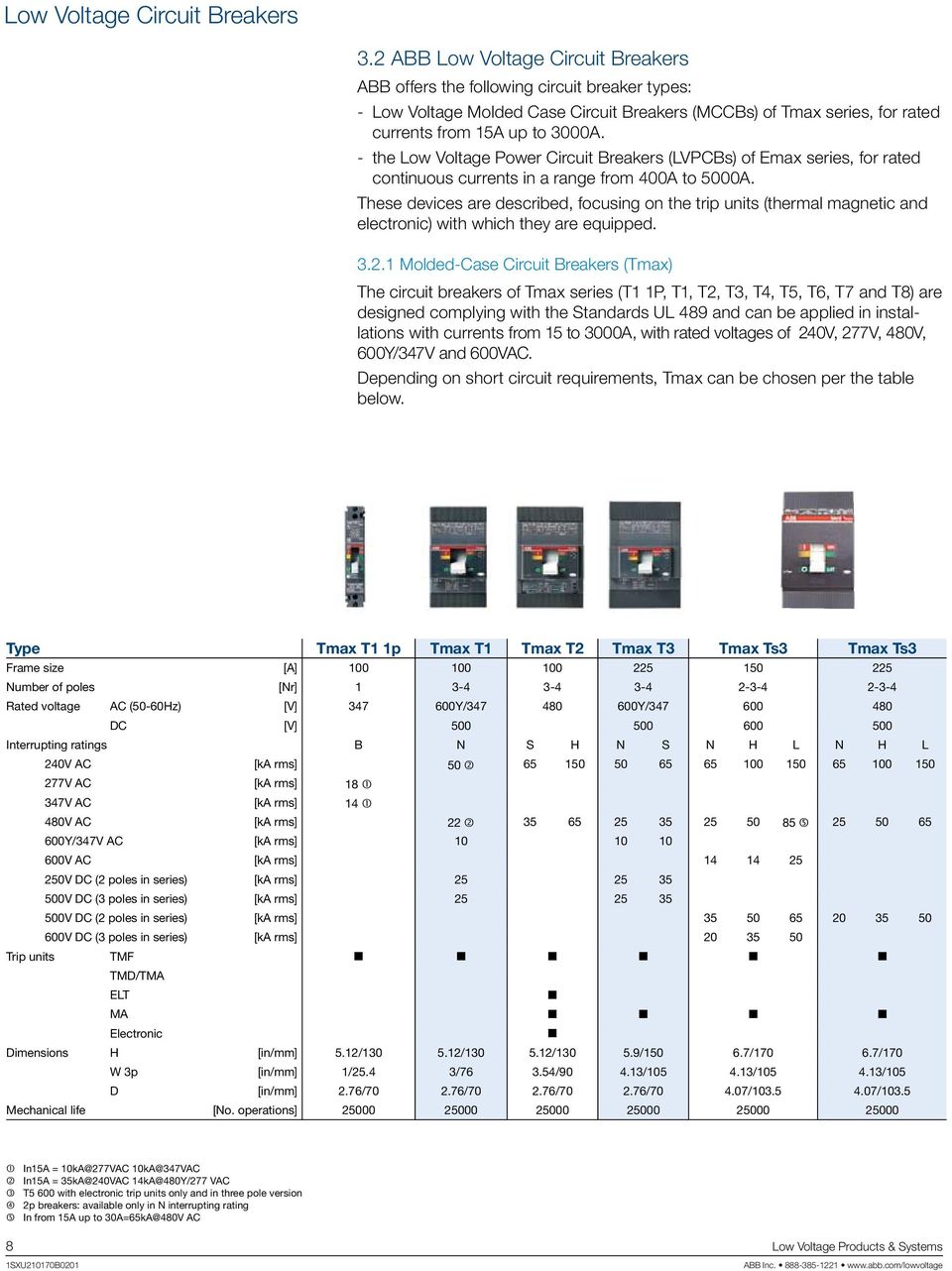
11 Low Voltage Circuit Breakers In addition, the circuit breakers Tmax T2H, T4H, T4V, T5H and T5V, are also Current Limiting Circuit Breakers (see definition 5 Chapter 2). In these devices, the system adopted for electric arc extinguishing allows high short circuit currents to be interrupted in very short times. The remarkable speed of contacts opening and the structure of the arcing chamber contribute to the extinguishing of the arc in the shortest possible time, limiting the value of the let-through energy I 2 t and allowing them to be Current Limiting Circuit Breakers. For single phase applications, the single-pole circuit breaker T1B 1P, with interrupting rating of 18kA at 277Vac, is available. Tmax series molded case circuit breakers can be equipped with both Thermal magnetic (TMF, TMD, TMA) as well as electronic (PR221DS, PR222DS/P and PR222DS/PD-A) trip units, whose main characteristics and functions shall be described in Chapter 4. The molded case circuit breakers equipped with electronic trip units are not intended for DC systems. The main characteristics of the protection devices of Tmax series are summarized in the following table: Type Tmax T4 Tmax T5 Tmax T6 Tmax T7 Insulated case T8 Frame size Number of poles [A] [Nr] , 2, 25 & 3 3 Rated voltage AC (5-6Hz) [V] DC [V] Interrupting ratings N S H L V N S H L V N S H L S H L T8V 24V AC [ka rms] V AC 347V AC [ka rms] [ka rms] 48V AC [ka rms] Y/347V AC [ka rms] 6V AC [ka rms] V DC (2 poles in series) [ka rms] 5V DC (3 poles in series) [ka rms] 5V DC (2 poles in series) [ka rms] V DC (3 poles in series) [ka rms] Trip units TMF TMD/TMA ELT MA Electronic Dimensions H [in/mm] 8.7/25 8.7/ / / / 382 W 3p [in/mm] 4.13/ / / / / 427 D [in/mm] 4.7/ / / /154 (toggle) 7/178 (motor) 11.2 / 282 Mechanical life [No. operations] 2, 2, 2, 1, 15, 1 In15A = 1kA@277 VAC 1kA@347 VAC 2 In15A = 35kA@24 VAC 14kA@48Y/277 VAC 3 T5 6 with electronic trip units only and in three pole version- 4 2p T4N25 and T5N4 available only in N interrupting capacity. 5 In from 15A up to 3A=65kA@48 VAC 6 Applies to MCS only. Low Voltage Products & Systems 9 1SXU2117B21

12 Low Voltage Circuit Breakers Low Voltage Power Circuit Breakers (Emax) The family of Low Voltage Power Circuit Breakers which ABB offers, in compliance with Std. UL 166, is formed by Emax CBs type E1, E2, E3, E4 and E6 which cover a range of currents from 4 to 5A, at 635V (rated maximum voltage). These circuit breakers, with different levels of performance (B-A, N-A, S-A, H-A, V-A, L-A) and ampere ratings, are able to break short-circuit Common data Voltages Rated maximum voltage [V] 635 Rated voltage [V] 6 Test voltage (1 min. 5/6 Hz) [kv] 2.2 Frequency [Hz] 5-6 Number of poles 3-4 Version Fixed (F) - Draw out (W) E1 E2 Level of performance Currents Frame size [A] B-A N-A B-A N-A S-A H-A [A] [A] Capacity of neutral pole for four-pole circuit breakers [%Iu] Rated short circuit current [A] [A] [A] 24 V [ka] V [ka] V [ka] Rated short time current [ka] Trip units Trip times PR121/P PR122/P PR123/P Make time (max) [ms] Break time (I<ST current) (max) [ms] Break time (I>ST current) (max) [ms] Overall dimensions Fixed: H = 418 mm/16.46 in - D = 32 mm/11.89 in * W (3 poles/4 poles) [mm] 296/ /386 W (3 poles/4 poles) [in] 11.65/ /15. 2 Draw out: H = 461 mm/18.15 in - D = mm/15.61 in ** W (3 poles/4 poles) [mm] 324/ /414 W (3 poles/4 poles) [in] 12.76/ /16. 3 Weights (Circuit breaker complete with trip unit, RH terminals, CS, excluding accessories) Fixed Draw out 3 poles/4 poles [kg] 45/54 5/61 3 poles/4 poles [lbs] 99/119 11/134 3 poles/4 poles [kg] 7/82 78/93 3 poles/4 poles [lbs] 154/ /25 (1) four poles only. * for E3X-A: H = 438 mm/ in - D = 32 mm/ in ** for E3X-A: H = 481 mm/ in - D = mm/ in E1 B-A / N-A E2 B-A / N-A / S-A / H-A Continuous current rating Iu [A] Mechanical life with regular ordinary maintenance [No. Operations x 1] Operation frequency [Operations/hour] Electrical life [No. Operations x 1] Operation frequency [Operations/hour] (2) 1 for E3X-A. (3) 1.5 for E3X-A. 1 Low Voltage Products & Systems 1SXU2117B21
![These circuit breakers, with different levels of performance (B-A, N-A, S-A, H-A, V-A, L-A) and ampere ratings, are able to break short-circuit Common data Voltages Rated maximum voltage [V] 635](/docs-images/47/20933902/images/page_12.jpg "Rated voltage [V] 6 Test voltage (1 min. 5/6 Hz) [kv] 2.")
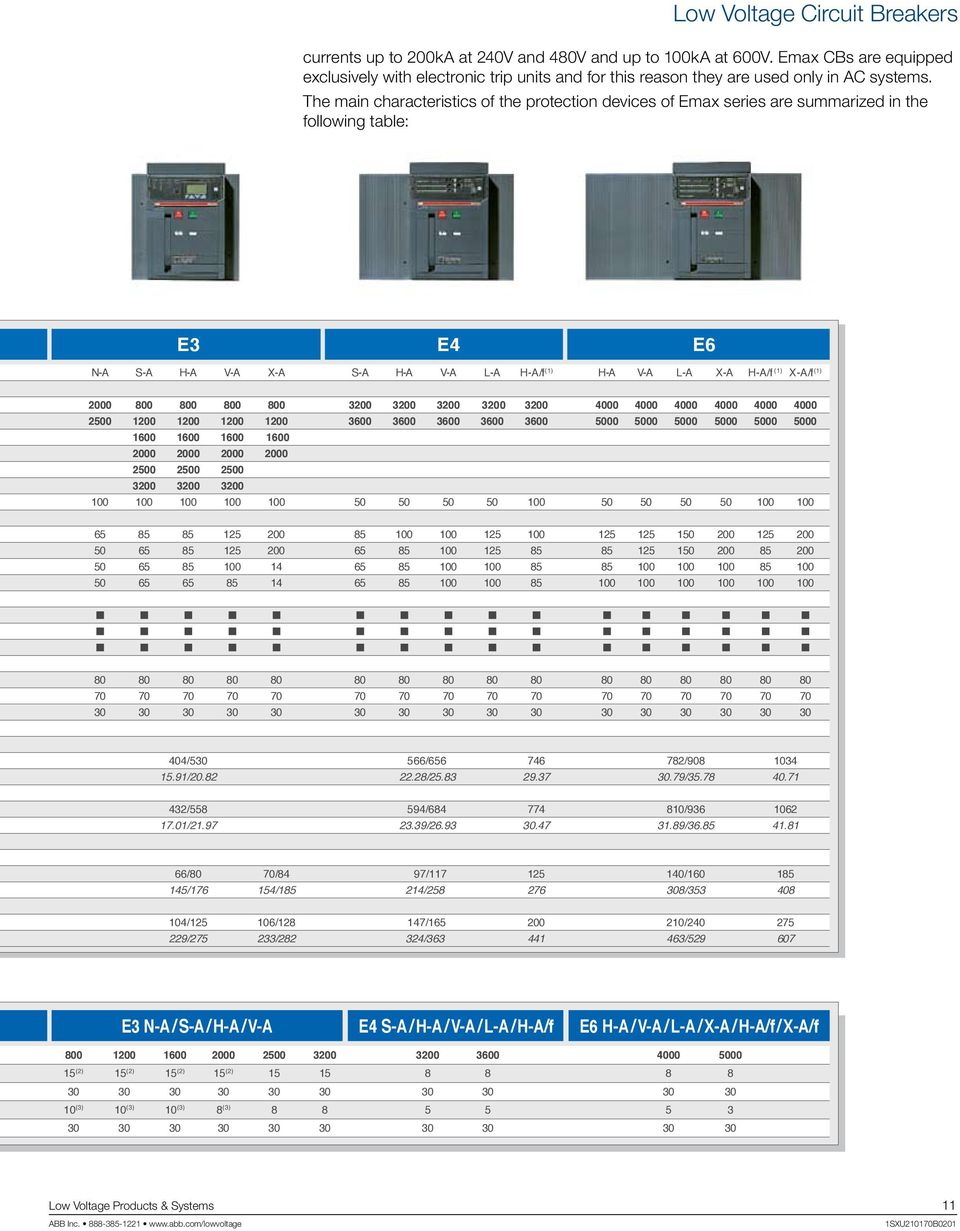
13 Low Voltage Circuit Breakers currents up to 2kA at 24V and 48V and up to 1kA at 6V. Emax CBs are equipped exclusively with electronic trip units and for this reason they are used only in AC systems. The main characteristics of the protection devices of Emax series are summarized in the following table: E3 E4 E6 (1) N -A S-A H-A V-A X-A S-A H-A V-A L-A H-A/f H-A V-A L-A X-A H-A/f (1) X-A/f (1) /53 566/ / / / / / / / / / / /8 7/84 97/ / / / / / /125 16/ / / / / / / E 3 N-A / S-A / H-A / V-A E4 S-A / H-A / V-A / L-A / H-A/f E6 H-A / V-A / L-A / X-A / H-A/f / X-A/f (2) 15 (2) 15 (2) 15 (2) (3) 1 (3) 1 (3) 8 (3) Low Voltage Products & Systems 11 1SXU2117B21
14 Thermal magnetic and electronic trip units 4. Thermal magnetic and Electronic Trip Units In this chapter the characteristics, protection functions and trip curves of the thermal magnetic and electronic trip units used on ABB circuit breakers are described. 4.1 Thermal magnetic Trip Units Thermal magnetic trip units are devices which provide combined protection against overload and short-circuit. This type of trip unit is used for: AC/DC power distribution, electrical equipment protection (transformers, motors, generators) and capacitor protection. ABB thermal magnetic trip units are mounted on MCCBs Tmax only and offer the following protections: Overload Protection (L) The protection against overloads is provided by a thermal device with inverse time trip characteristic. Identified by the letter L, it is a protection that trips when the fault current exceeds threshold I 1 either, adjustable or fixed, according to the type of trip unit. The application range of this protection concerns all the installations which can be subject to low-value but long-time overcurrents, which are dangerous for the equipment and cables Instantaneous Short Circuit Protection (I) The protection against short circuit is provided by a magnetic device with a trip time independent of the fault current value. Identified by the letter I, it is a protection that trips instantaneously when the fault current exceeds threshold I 3 either, adjustable or fixed, according to the type of trip unit. This protection trips to quickly eliminate high value currents with no intentional delay. 12 Low Voltage Products & Systems 1SXU2117B21

15 t [s] t [s] Thermal magnetic and electronic trip units Thermal magnetic Trip Units for Tmax Circuit Breakers As regards Tmax CBs, ABB offers three different types of Thermal magnetic trip units (TMF, TMD and TMA). The protections and the trip thresholds are shown in the following table: TMF TMD TMA Time-current curve Time-current curve Time-current curve t [s] L L L I I I xin xin xin Trip unit front Trip unit front Trip unit front MAX MED MIN I1 (4ϒC) MIN 35 A MED 42 A MAX 5 A I3 5A MAX I3 I1 (4ϒ) MED MAX MED MIN MAX MIN In=4A 4A 3A 2A 4A 34A 28A MIN MAX MIN MED MED - Overload protection L Thermal trip threshold: I 1 = In - Short-circuit protection I Magnetic trip threshold: I 3 = 1xIn - Overload protection L Thermal trip threshold: I 1 = (.7 1) In - Short-circuit protection I Magnetic trip threshold: I 3 = 1 In - Overload protection L Thermal trip threshold: I 1 = (.7 1) In - Short-circuit protection I Magnetic trip threshold: I 3 = (5 1) In t [s] Time-current curve For circuit breakers Tmax T2 and T3, magnetic only trip units, MA, with adjustable threshold, are also available; they, complying with Standard UL 58 Industrial Control Equipment, can be used in a Combination Motor Controller Type D (Instantaneous-Trip Circuit Breaker + Magnetic Motor Controller + Overload Relay). Trip unit front - Short-circuit protection I MA I MAX I3 MAX MED MIN 4A 3A 2A MED MIN In=2A Magnetic trip threshold: I 3 = (6 12)xIn xin Low Voltage Products & Systems 13 1SXU2117B21
![The protections and the trip thresholds are shown in the following table: TMF TMD TMA Time-current curve Time-current curve Time-current curve t [s] L L L I I I xin xin xin Trip unit front Trip unit](/docs-images/47/20933902/images/page_15.jpg "front Trip unit front MAX MED MIN I1 (4ϒC) MIN 35 A MED 42 A MAX 5 A I3 5A MAX I3 I1 (4ϒ) MED MAX MED MIN MAX MIN In=4A 4A 3A 2A 4A 34A 28A MIN MAX MIN MED MED - Overload protection L Thermal trip")
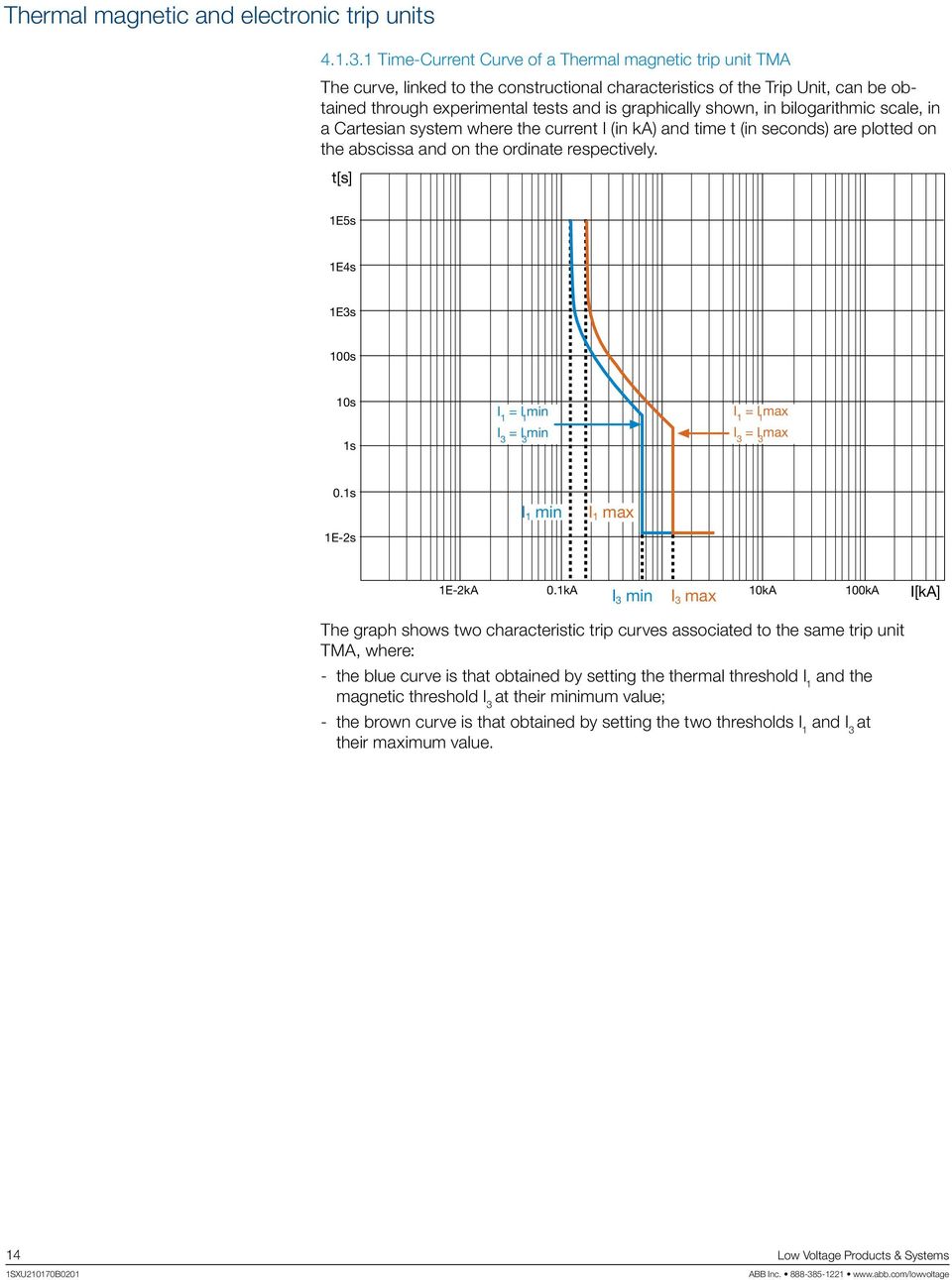
16 Thermal magnetic and electronic trip units Time-Current Curve of a Thermal magnetic trip unit TMA The curve, linked to the constructional characteristics of the Trip Unit, can be obtained through experimental tests and is graphically shown, in bilogarithmic scale, in a Cartesian system where the current I (in ka) and time t (in seconds) are plotted on the abscissa and on the ordinate respectively. t[s] 1E5s 1E4s 1E3s 1s 1s 1s I 1 = I 1 min I 3 = I 3 min I 1 = I 1 max I 3 = I 3 max.1s 1E-2s I 1 min I 1 max 1E-2kA.1kA 1kA 1kA I 3 min I 3 max I[kA] The graph shows two characteristic trip curves associated to the same trip unit TMA, where: - the blue curve is that obtained by setting the thermal threshold I 1 and the magnetic threshold I 3 at their minimum value; - the brown curve is that obtained by setting the two thresholds I 1 and I 3 at their maximum value. 14 Low Voltage Products & Systems 1SXU2117B21
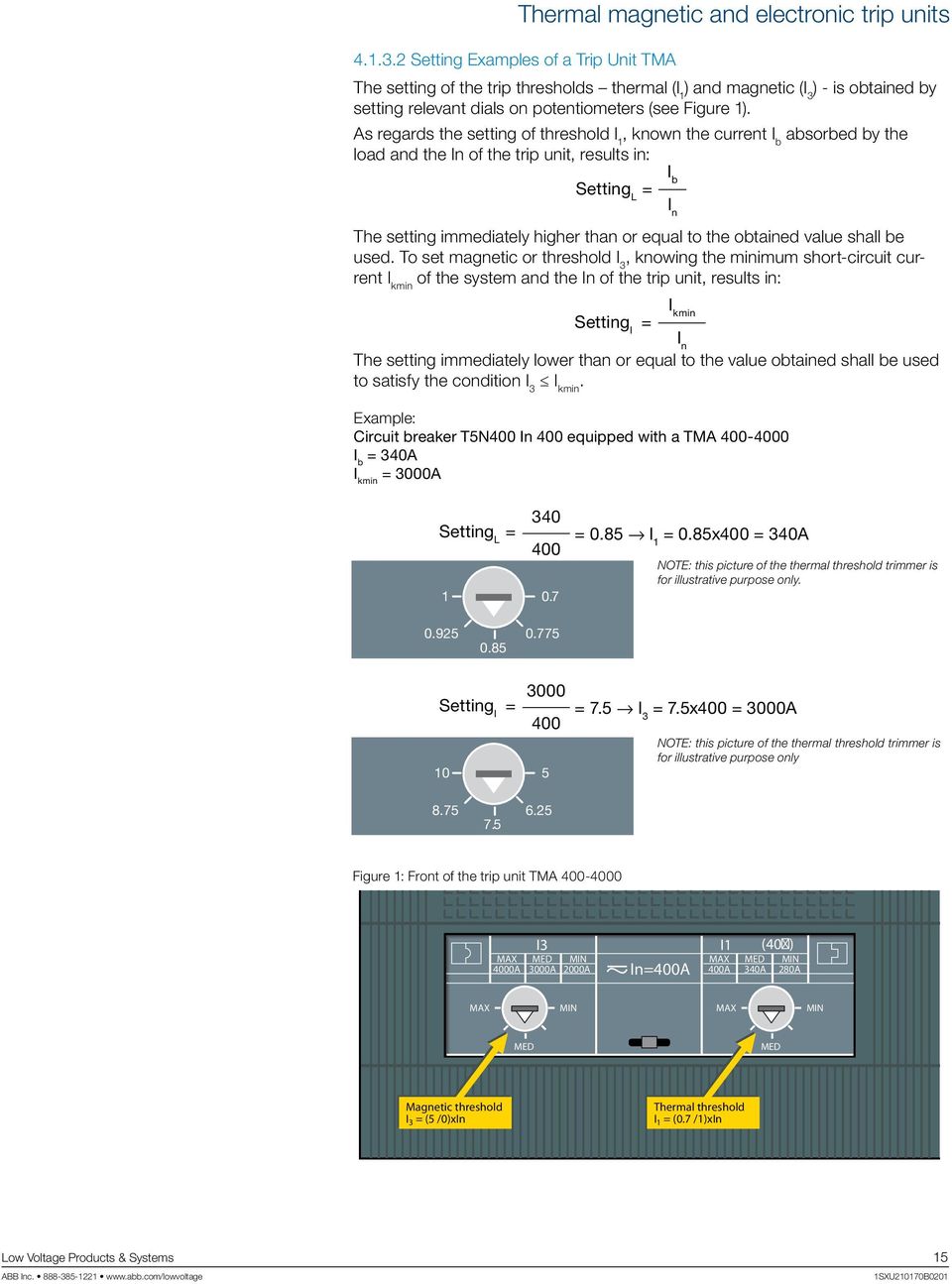
17 Thermal magnetic and electronic trip units Setting Examples of a Trip Unit TMA The setting of the trip thresholds thermal (I 1 ) and magnetic (I 3 ) - is obtained by setting relevant dials on potentiometers (see Figure 1). As regards the setting of threshold I 1, known the current I b absorbed by the load and the In of the trip unit, results in: Setting L = I b In The setting immediately higher than or equal to the obtained value shall be used. To set magnetic or threshold I 3, knowing the minimum short-circuit current I kmin of the system and the In of the trip unit, results in: Setting I = The setting immediately lower than or equal to the value obtained shall be used to satisfy the condition I 3 I kmin. I kmin Example: Circuit breaker T5N4 In 4 equipped with a TMA 4-4 I b = 34A I kmin = 3A I n Setting L = =.85 I 1 =.85x4 = 34A NOTE: this picture of the thermal threshold trimmer is for illustrative purpose only Setting I = 3 4 = 7.5 I 3 = 7.5x4 = 3A NOTE: this picture of the thermal threshold trimmer is for illustrative purpose only Figure 1: Front of the trip unit TMA 4-4 I3 I1 (4 ) MAX MED MIN 4A 3A 2A In=4A MAX MED MIN 4A 34A 28A MAX MIN MAX MIN MED MED Magnetic threshold I 3 = (5 /)xin Thermal threshold I 1 = (.7 /1)xIn Low Voltage Products & Systems 15 1SXU2117B21
18 Electronic trip units 4.2 Electronic Trip Units Electronic trip units are overcurent protection based on microprocessor electronics. Compared with Thermal magnetic trip units, they allow precise setting both in terms of current providing more accurate protection. ABB electronic trip units, which are available on Tmax and Emax CBs, use the following protection functions Overload Protection (L) Protection against overloads (long time delay trip function, ANSI code 51, AC time overcurrent relay), is identified by Function L. If the fault current exceeds the set threshold I 1, this protection trips according to an inverse time characteristic, where the link time-current is represented by the relation I 2 t = K (constant let-through energy); with this curve, the tripping time decreases as the current increases. I 1 represents the adjustable value of the trip threshold of the thermal protection and it is called long time pickup. This protection cannot be excluded. The inverse time characteristic curve of function L is graphically represented, in bilogarithmic scale as shown in Figure 2. Figure 2: Trip curve with inverse time curve (I 2 t = K) of protection L of a Tmax t[s] 1E3s 1s 1s 1s.1s 1E-2kA.1kA 1kA 1kA I[kA] The electronic trip unit makes many possible trip settings available for Function L, more precisely, a bundle of parallel lines. Each line is identified by a time t1 (the long time delay) which represents the trip time of the protection, in seconds, in correspondence with a multiple of I 1. This multiple depends on the trip unit and is equal to 3 I 1 for Emax CBs and 6 I 1 for Tmax CBs. 16 Low Voltage Products & Systems 1SXU2117B21

19 Electronic trip units To explain this concept, consider a molded-case circuit breaker Tmax T4N25, equipped with an electronic trip unit PR222DS/P In 1, set at I 1 =1 In=1A (6 I 1 = 6A). PR222DS/P allows four trip curves corresponding to a time t 1 of 3, 6, 9 and 18s at 6 x I 1 (see Figure 3). t[s] Figure 3: Trip curves of function L of a trip unit PR222DS/P In 1 Curve I 2 t=k 1E3s 1s Function L tl = 18s tl = 9s tl = 6s tl = 3s 1s curve at 18s curve at 9s curve at 6s curve at 3s.1s.1kA 6x11 1kA 1kA I[kA] Short Circuit Protection with Delayed Trip (S) Protection against short circuit with time delay trip (short time delay trip function, ANSI code 51, AC time overcurrent relay), is identified by Function S. If the fault current exceeds the set threshold I 2, the protection trips with the following characteristic: with inverse time according to the relation I 2 t = K: with this curve, the higher the fault current is, the shorter is the trip time; or with constant time delay according to the relation t = K: with this curve the trip time is independent of the current. I 2 represents the adjustable value of the protection trip threshold called short time pickup. This protection can be excluded. Curves t=k/i 2 (constant let-through energy) As regards the trend of the curve, from a conceptual point of view, the considerations made for protection L remain valid, except for the fact that the characteristic trip curve of protection S passes through a point (I,t) identified by the time t 2 (the short time delay) which represents the trip time of the protection, in Low Voltage Products & Systems 17 1SXU2117B21
![t[s] Figure 3: Trip curves of function L of a trip unit PR222DS/P In 1 Curve I 2 t=k 1E3s 1s Function L tl = 18s tl = 9s tl = 6s tl = 3s 1s curve at 18s curve at 9s curve at 6s curve at 3s.1s.1kA 6x11 1kA 1kA I[kA] 4.](/docs-images/47/20933902/images/page_19.jpg "2.2 Short Circuit Protection with Delayed Trip (S) Protection against short circuit with time delay trip (short time delay trip function, ANSI code 51, AC time overcurrent relay), is identified by")
20 Electronic trip units seconds, in correspondence with a multiple of rated current In. This multiple of In depends on the trip unit and is equal to 1 In for Emax and 8 In for Tmax. t[s] Figure 4: Trip curves of function S (I 2 t ON) of a trip unit PR222DS/P In 25 Curve I 2 t=k 1s t2 =.5s Function S curve at.5s t2 =.25s curve at.25s t2 =.1s curve at.1s t2 =.5s curve at.5s 1kA 8xIn I[kA] Curves t=k (constant time) Protection S with constant time delay is characterized by the same short time delay, t 2 (adjustable), for all fault currents higher than or equal to the short time pickup, I 2. Considering Tmax T4N25 equipped with a trip unit PR222DS/P In 1, turn OFF the curve I 2 t=k of function S (thus, four trip curves at t=k become available, corresponding to a time t 2 of.5,.1,.25 and.5s ). Then set the following values for Function S: I 2 = 6.4 In =6.4 1= 64A (short time pickup) t 2 =.1s (short time delay) The curve which is obtained is shown with an orange line in Figure 5. Figure 5: Trip curves at.1s and.5s for function S (I 2 t OFF) of a trip unit PR222DS/P In 1 By changing the short time delay from.1s to.5s, the green curve is used. For fault currents higher or equal to the threshold I 2 of 64A, the protection function shall trip within the set time t 2. For another example of curve reading, see Chapter Low Voltage Products & Systems 1SXU2117B21

21 Electronic trip units Instantaneous Short Circuit Protection (I) The instantaneous protection against short circuit (instantaneous trip function, ANSI code 5, instantaneous overcurrent relay) is identified by Function I. If the fault current exceeds the set threshold value I 3, the function initiates the instantaneous opening of the circuit breaker. I 3 represents the adjustable value of the trip threshold of the protection, called instantaneous pickup setting. If function I is turned off during a short-circuit, the release mechanism will trip at the instantaneous override of the circuit breaker. The part of curve associated to this protection is the blue one in Figure 6. t[s] 1E5s Figure 6: Protection functions L-I 1E4s 1E3s L 1s 1s 1s.1s 1E-2s 1E-3s I 3 = 15A 1E-3kA 1E-2kA.1kA 1kA 1kA I[kA] I The graph represents the trip curve L-I of a circuit breaker Tmax T4N25 equipped with an electronic trip unit PR 222DS/P-LSIG In 1. To find another example of reading the curve, refer to Chapter 5. Figure 7: Typical time-current curve for electronic trip circuit breaker (I 2 t ON) t[s] 1 Long time pickup Figure 8: Typical time-current curve for electronic trip circuit breaker (I 2 t OFF) t[s] 1 Long time pickup 1 Long time delay 1 Long time delay Time in seconds 1 1. Short time pickup Short time delay (I 2 t ON) Time in seconds 1 1. Short time pickup Short time delay (I 2 t OFF).1 Instantaneous pickup.1 Instantaneous pickup xin Multiples of rated current xin Multiples of rated current Low Voltage Products & Systems 19 1SXU2117B21
22 Electronic trip units Ground-Fault Protection (G) The most advanced electronic trip units have an integrated protection against ground faults (ground-fault trip function, ANSI code 51 N, AC time ground fault overcurrent relay) identified with the Function G. It is a protection against ground fault with curve I 2 t = K or curve t = K. The parameters of this function are: the ground-fault pickup setting (I 4 ) and the ground fault-delay (t 4 ). As regards the trip curves, which are illustrated in Figure 9, the concepts mentioned previously for protection S are valid. This function protects against ground fault, since it addresses situations in which the fault current has such values that phase protections (L, S, I) are not actuated. Function G is deactivated for fault currents higher than a multiple of In (variable according to the trip unit). This protection can be turned off. Figure 9: Trip curves of function G Function G with curve t = K/I 2 Function G with curve t = K t[s] t[s] 1E4s 1E4s 1E3s 1E3s 1s 1s t = K/I 2 1s 1s t = K 1s 1s.1s.1s 1E-2s 1E-2s 1E-3s 1E-3s 1E-3kA 1E-2kA.1kA 1kA 1kA 1kA 1E3kA I[kA] 1E-3kA 1E-2kA.1kA 1kA 1kA 1kA 1E3kA I[kA] 2 Low Voltage Products & Systems 1SXU2117B21
23 Protection functions L-S-I Protection functions L-S-I Protection functions L-S-I t [s] t [s] t [s] L L Electronic trip units Electronic Trip Units for Tmax Circuit Breakers For Tmax MCCBs, ABB offers three different versions of trip units: - PR221DS-LS/I for T2, T4, T5 and T6; - PR222DS/P for T4, T5 and T6; - PR222DS/PD-A for T4, T5 and T6, with the dialogue unit to allow the circuit breakers to communicate on a network using the Modbus RTU protocol. The implemented protection functions and their relevant trip thresholds are shown in the following table: PR221DS-LS/I PR222DS/P-LSIG PR222DS/PD-A-LSIG L S I 2 t ON S I 2 t OFF S I 2 t ON S I 2 t OFF S I 2 t ON I I I xin t [s] xin Protection function G t [s] xin Protection function G G G Trip unit front Trip unit front Trip unit front xin xin I1 = In x (.4 + L PR221DS ) t1 3s 12s 1=6I1 I2= S In x ( I3= I ) t2 OFF ON 5 1 % N Test Test I1 = In x ( I1 = In x ( I3 = In x ( I1 = In x ( ) ) ) L S I G + t1 t2 I=8In 1 t4 I1 max=in MAN ON 3s.5s.1s 6s.1s.2s 9s.25s.4s 5 max ELT OFF t=6i1.5s I>I2.8s I>I4 Test/Prg PR222DS/P N % Test I1 = In x ( I1 = In x ( I3 = In x ( I1 = In x ( ) ) ) L S I G + t1 t2 I=8In 1 t4 I1 max=in MAN LOC ON 3s.5s.1s 6s.1s.2s 9s.25s.4s 5 max ELT REM OFF t=6i1.5s I>I2.8s I>I4 Test/Prg PR222DS/PD N % Protection functions and trip threshold settings - L (cannot be excluded) I 1 = (.4 1) In curve: I 2 t = K - S (can be excluded) I 2 = (1 1) In curve: I 2 t = K - I (can be excluded) I 3 = (1 1) In Protection functions and trip threshold settings - L (cannot be excluded) I 1 = (.4 1) In curve: I 2 t = K - S (can be excluded) I 2 = (.6 1) In curve: I 2 t = K ON I 2 = (.6 1) In curve: I 2 t = K OFF - I (can be excluded) I 3 = (1.5 12) In - G (can be excluded) I 4 = (.2 1) In curve: I 2 t = K Protection functions and trip threshold settings L (cannot be excluded) I 1 = (.4 1) In curve: I 2 t = K S (can be excluded) I 2 = (.6 1) In curve: I 2 t = K ON I 2 = (.6 1) In curve: I 2 t = K OFF I (can be excluded) I 3 = (1.5 12) In G (can be excluded) I 4 = (.2 1) In curve: I 2 t = K For Tmax T2, T4, T5 and T6 also the electronic trip unit PR221DS-I is available; Complying with the Standard UL 58 Industrial Control Equipment, these units can be used in a Combination Motor Controller Type D (Instantaneous- Trip Circuit Breaker + Magnetic Motor Controller + Overload Relay). Time-current curve Trip unit front Protection function I t [s] PR221DS-I I I2= In x ( I3= I ) OFF ON 5 1 % N Test + - I 3 = (1 1) In PR221DS xin Low Voltage Products & Systems 21 1SXU2117B21
24 Electronic trip units Setting Examples of a Trip Unit PR222DS/P Taking into consideration a circuit breaker Tmax T4H25 In 15 equipped with an electronic trip unit PR222DS/P-LSIG - the letter H identifies the interrupting rating of the circuit breaker which in the example is 65kA at 48V; - 25A is the frame size of the circuit breaker; - In is the rated current of the circuit breaker which in this specific case is 15A. As an example, let s consider some typical settings for the protections L and I. - setting of protection L To set the threshold I 1, once the current I b required by the load and the In of the trip unit are known: Setting L = I b I n The available setting immediately higher than or equal to the value obtained is used. For example, a load requires a current I b of 69A, given a current In equal to 15A: 69 Setting L = 15 =.46 To set this, the dip switches shall be moved to the position corresponding to.2 and.4 so that I 1 = In x (,4*+.2+.4) = 15 x.46 = 69A. To select, for example, the curve at 3s, the two dip switches corresponding to t 1 shall be moved to the lowest position. Figure 1: Dip switch of function L I1 = In x (.4 + L I1 max=in 3s 6s 9s max t1 t=6i1 PR222DS/PD * With function L, the value.4 is set by default and must be added to the other coefficients to obtain the correct value of I Low Voltage Products & Systems 1SXU2117B21
25 Electronic trip units - setting of protection I To set the threshold I 3, once the minimum short-circuit current of the circuit I K min and the current In of the trip unit are known: Setting I = I K min I n The available setting immediately lower than or equal to the value obtained shall be taken to comply with the condition I 3 I K min. By assuming in the application a minimum short circuit current I K min = 15A, then the following is true: 15 Setting I = 15 = 1 The following values can be adjusted: I3 = = 1425A. To obtain I3 = 1425A, the dip switches shall be moved to correspond to 1.5, 3 and 5 so that: I3 = In x ( ) = 15 x 9.5 = 1425A. Figure 11: Dip switch of function I I3 = I In x ( ) MAN LOC ELT REM ON OFF N 1 % 5 NOTE: For more detailed information on thermal magnetic and electronic trip units for Tmax CBs, reference shall be made to the technical catalogue ABB Molded Case Circuit Breakers UL 489 and CSA C22.2 Standard. Low Voltage Products & Systems 23 1SXU2117B21
26 off off off I=3xI1 I=1xIn I>I s s s 5Hz 6Hz OFF 5% 1% 2% xin Electronic trip units Electronic Trip Units for Emax Circuit Breakers For the circuit breakers of Emax series, ABB offers three different types of electronic trip units (PR121/P, PR122/P, PR123/P). The protection functions and their relevant trip thresholds are shown in the following table: PR121/P LSIG PR122/P LSIG PR123/P LSIG t [s] Protection functions L-S-I L Protection function G t [s] S I 2 t OFF S I 2 t ON I G xin xin Trip unit front Trip unit front Trip unit front L S I G + I1 = I1max=In I2 = I3 = I4 = xin t1 xin t2 xin xin t4 ALARM ALARM ALARM ALARM frequency SACE PR121/ P Nr. = In = 2A Test WL COM Power TX RX BT SIGNALLING Power COM Power TX RX MEASURING Power On Test ALARM SACE PR123/P Nr. = WARNING Current In = 32A I1 125 A Ig: I2 617 A I3 622 A Test L Prealarm ESC SIGNALLING Power COM Power TX RX ALARM SACE PR122/P Nr. = WARNING Current In = 32A I1 125 A Ig: I2 617 I3 622 A Test L Prealarm ESC Protection functions and trip threshold settings L (cannot be excluded) I 1 = (.4 1) In curve: t=k/i 2 S (can be excluded) I 2 = (1 1) In curve: t=k/i 2 I 2 = (1 1) In curve: t=k I (can be excluded) I 3 = (1.5 15) In - G (can be excluded) I 4 = (.2 1) In curve: t=k/i 2 I 4 = (.2 1) In curve: t=k Protection functions and trip threshold settings - L (cannot be excluded) I 1 = (.4 1) In curve: t=k/i 2 - S (can be excluded) I 2 = (.6 1) In curve: t=k/i 2 I 2 = (.6 1) In curve: t=k - I (can be excluded) I 3 = (1.5 15) In - G (can be excluded) I 4 = (.2 1) In curve: t=k/i 2 I 4 = (.2 1) In curve: t=k Protection functions and trip threshold settings - L (cannot be excluded) I 1 = (.4 1) In curve: t=k/i 2 - S (can be excluded) I 2 = (.6 1) In curve: t=k/i 2 I 2 = (.6 1) In curve: t=k - I (can be excluded) I 3 = (1.5 15) In - G (can be excluded) I 4 = (.2 1) In curve: t=k/i 2 I 4 = (.2 1) In curve: t=k NOTE: For more detailed information on electronic trip units for Emax CBs, reference shall be made to the technical catalogue Emax Low Voltage Power Circuit Breakers, marked UL. 24 Low Voltage Products & Systems 1SXU2117B21
27 5. Trip Curves of ABB Trip Units Trip curves of ABB Trip units The following chapter illustrates the trip curves of ABB thermal magnetic and electronic trip units and gives some examples. 5.1 Trip Curves of Thermal magnetic Trip Units Let s consider a Tmax T4H25 In 25 equipped with a Thermal magnetic trip unit TMA Compatible with the rated currents of the loads protected by the circuit breaker, the short circuit currents calculated at its installation point and with the installation requirements, the settings of the protection functions are the following: I 1 : 2A (overload protection) I 3 : 2A (short circuit protection) t[s] 1E5s Figure 12: Trip curve* of Tmax T4H25 In 25 I 1 =2A 1E4s 1E3s 1s 1s t1=36.8s L 1s.1s I 1E-2s 1E-3s 1E-2kA I ol = 3A I 3 =2 A 1kA I[kA] Assuming an overload current I ol of 3A, the trip time of the circuit breaker can be read from the time-current curve as follows: 1) start from a current value I ol = 3A on the x-axis 2) move vertically to the intersection with the time-current curve 3) from the intersection point move horizontally to the left to the intersection with the time-axis 4) the value read is the time t 1, which represents the extinction time of the over load; in this example it is: t 1 = 36.8s. With fault currents exceeding 2A(which is the set threshold I 3 ), the circuit breaker shall open almost instantaneously (in tens of milliseconds). The yellow line represents the instantaneous override of the circuit breaker. (*) The time-current curve has been traced without considering the tolerances and under hot trip conditions. Low Voltage Products & Systems 25 1SXU2117B21
28 Trip curves of ABB Trip units 5.2 Trip Curves of Electronic Trip Units t[s] Functions L and S Curves t=k/i 2 (I 2 t ON) of Functions L and S A circuit breaker Tmax T4H25 equipped with an electronic trip unit PR222DS/ P-LSIG In 25 is considered; protection functions L and S are activated while protection I is not activated. The curve I 2 t = K of function S has been positioned to ON, whereas for function L such curve is set by default (see Chapter 4, clause Overload Protection (L) ); the trip curve of the circuit breaker is represented in Figure 13 (the yellow line is associated to the instantaneous override of the circuit breaker). Figure 13: Time-current curve of Tmax T4H25 PR222DS/P-LSIG In 25 (I 2 t ON) 1E5s 1E4s L 1E3s 1s 1s 1s.1s S 1E-2s 1E-3s 1E-3kA 1E-2kA.1kA 1kA 1kA 1kA 1E3kA I[kA] Describing in details function L and considering the following settings: I 1 =.5 In =.5 25 = 125A (long time pickup) t 1 = 3s (long time delay) Here are some indications on how to read and what information to get from the reading of the inverse time curve with constant let-through energy characteristics (from a conceptual point of view this is valid also for function S with curve I 2 t = K). Assuming a fault current I ol = 375A, the clearing time of the fault can be read directly from the curve represented in Figure 14, as follows: 1) start from the fault current value I ol on the horizontal axis 2) move vertically to the intersection with the time-current curve 3) from the intersection point move horizontally to the left to cross the timeaxis 4) the value read is the time t 1, which represents the extinction time of the overload; in this example it is equal to 12s 26 Low Voltage Products & Systems 1SXU2117B21
29 Trip curves of ABB Trip units t[s] Figure 14: Curve - 3s - of Function L 1s 1s t=12 s L 1s.1kA I 1 I ol = 375 A 1kA I[kA] The time read directly on the graph can also be obtained analytically as follows. Since the curve under examination has I 2 t constant, the condition below shall be always true: (6 I 1 ) 2 t 1 = const = I 2 t (*) (*) This relationship is valid for overload currents up to 12 In. Where: - the expression (6 I 1 ) 2 t 1 is the specific let-through energy associated to the curve at 3s; - the expression I 2 t represents the product between a generic overload current squared and the time necessary to the protection to open the circuit. The trip time of the protection function for a fault current I ol = 375A can be obtained as follows: (6 x 125) 2 x 3 - (6xI 1 ) 2 2 x t 1 = I ol x t t = = 12s t = 12s If, for example, the installation requires that the assumed overload of 375A is cut off in a time t e lower than 15s, the characteristic trip curve at 3s fully meets the requirement, because it ensures that the protection trips within 12s. This conclusion can be reached: from the relationship (6 I 1 ) 2 t 1 = I 2 t = const; for a fault clearing time t e 15s it results: (6 I1) 2 t = t e from which: (6 125) 2 t = to obtain the time t (maximum trip time delay to comply with the installation requirements) x 15 t = = 3,75s (6x125) 2 The suitable curve is that with t 1 lower than t ; therefore the curve to use is that at 3s. The reasoning above can be applied to function S with curve at I 2 t = K (I 2 t ON). Low Voltage Products & Systems 27 1SXU2117B21
30 Trip curves of ABB Trip units Curves t = K (I 2 t OFF) of function S Now take into consideration the previous example, but with the curve of protection S set at constant time t=k (I 2 t OFF); in this case the time-current curve is as follows: t[s] Figure 15: Time-current curve of Tmax T4H25 PR222DS/P-LSIG In 25 (I 2 t = K OFF) 1E4s 1E3s L 1s 1s 1s.1s S 1E-2s 1E-3s 1E-2kA.1kA 1kA 1kA 1kA 1E3kA I[kA] By setting a generic value for function S: I 2 = 5.8 In = = 145A (short time pickup) t 2 =.1s (short time delay) If a short circuit occurs, all the overcurrents I g higher than or equal to I 2 shall be cut off within the time t 2, as it can be read from the graph of Figure 16 as follows: 1) start on the x-axis from a fault current value I g (in Figure 16 I g = 2A) 2) move vertically to the intersection with the time-current curve 3) from the intersection point move horizontally to the left to cross the time-axis 4) the value read is the time t 2, which represents the maximum fault extinction time; in this case, it s 1ms. Figure 16: Function S at t =.1s t[s] 1s.1s t=.1s S (t = k) 1kA I 2 I g = 2A I[kA] 28 Low Voltage Products & Systems 1SXU2117B21
31 Trip curves of ABB Trip units Function I By considering again a circuit breaker Tmax T4H25 equipped with a trip unit PR222DS/P-LSIG In 25 and setting as an example the following values: - Function L (long time-delay trip function): I 1 = 1 In = 1 25 = 25A (long time pickup) Curve: 3s (long time delay) - Function S (short time-delay trip function): OFF - Function I (instantaneous trip function): I 3 = 7 In = 7 25 = 1.75kA (instantaneous pickup setting) t[s] The characteristic trip curve obtained is represented in Figure 17. Figure 17: Tmax T4H25 PR222DS/P-LSIG In 25 1E6s 1E5s 1E4s 1E3s L 1s 1s 1s.1s I 1E-2s 1E-3s 1E-4s I 3 =1.75kA 1E-3kA 1E-2kA.1kA 1kA 1kA 1kA 1E3kA All the short-circuit currents exceeding 1.75kA shall be cut off in a few milliseconds. The yellow line represents the instantaneous override of the circuit breaker. I[kA] Low Voltage Products & Systems 29 1SXU2117B21
32 Trip curves of ABB Trip units Function G Function G for ground-fault protection is available. Here are two examples of the curves associated with this protective function, first the trip curve with I 2 t = K and then the trip curve with t = K are examined. A circuit breaker Emax E1B 16 equipped with a trip unit PR122P-LSIG In = 16A is used. Curves I 2 t = K The settings of function G are: Characteristic I 2 t= K: ON Threshold: I 4 =.2 16 =.32kA (ground-fault pickup setting) Curve: t 4 =.1s (ground fault-delay) The characteristic curve obtained is represented in Figure 18. Figure 18: Function G at t = K/I 2 t[s] 1E4s 1E3s 1s 1s 1s tg=.8s.1s 1E-2s 1E-3s I 4 =.32kA 1E-3kA 1E-2kA.1kA I 1kA 1kA I[kA] g =.5kA With a prospective fault current Ig =.5kA on the x-axis, move vertically to the intersection with the curve; from this intersection point move to the left to cut the time-axis. The value read is the fault clearing time tg; in this example tg =.8s. 3 Low Voltage Products & Systems 1SXU2117B21
33 Trip curves of ABB Trip units Curves t = K The settings of function G are: Characteristic I 2 t= K: OFF Threshold: I 4 =.2 16 =.32kA (ground-fault pickup setting) Curve: t 4 =.1s (ground-fault delay) The characteristic trip curve obtained is represented in Figure 19. Figure 19: Function G at t = K t[s] 1E4s 1E3s 1s 1s 1s.1s t 4 =.1s 1E-2s 1E-3s I 4 =.32kA 1E-3kA 1E-2kA.1kA 1kA 1kA 1kA I[kA] As it results from the reading of the graph, the ground fault currents exceeding the set threshold I 4 =.32kA shall be quenched in a time t 4 equal to.1s. NOTES: 1) As regards the protection functions just described, for more detailed information on the possible settings of the thresholds and the trip times and on the possible curves available with electronic trip units on Tmax and Emax CBs, reference is to be made to the relevant technical catalogues by ABB. 2) The time-current curves used in the examples of this chapter have been plotted without considering the tolerance over trip thresholds and times. For a thorough analysis please refer to Annex A. Low Voltage Products & Systems 31 1SXU2117B21
34 Curves of current limiting circuit breakers 6. Curves of Current Limiting Circuit Breakers: Let-Through Values of I 2 t and Peak Current For the molded-case circuit breakers marked Current Limiting, the peak current and the energy let-through curves have been made available. These curves are shown in Figures 2 and 21 and once the available shortcircuit current is known, allow one to determine: - the maximum peak let-through current (from the limitation curves) - the let-through I 2 t value (from the specific let-through energy curves). Figure 2: Specific let-through energy curve I 2 t [MA 2 s] 1 Figure 21: Limitation curve I p [ka] Irms [ka] Irms [ka] 1 The limitation curves are associated with the voltage applied to the circuit breaker; in general, for the same available short circuit current, if the voltage applied is higher, the limiting capacity of the device shall decrease, letting through a higher peak current and I 2 t. These curves are made available for each rated voltage of the device. Their use is prescribed in the Standard UL 58A Industrial Control Panels and in particular in the supplement SB: SHORT CIRCUIT CURRENT RATINGS FOR INDUSTRIAL CONTROL PANELS. 32 Low Voltage Products & Systems 1SXU2117B21
35 Curves of current limiting circuit breakers From the limitation curves the peak value let-through and/or the I 2 t value can be determined as follows: 1) choose the curves corresponding to the proper rated voltage. 2) select the available short circuit current along the horizontal axis. 3) move vertically to the intersection with the curve corresponding to the rated current of the trip unit. 4) move horizontally left to the intersection with the vertical axis to determine the peak let-through current or I 2 t value. Consider a Tmax T4H25 equipped with a trip unit PR222DS/P-LSIG In 25; by assuming an available short-circuit current of 2kA at the installation point, we obtain the peak current and the let-through energy by reading them on their relevant curves. Specific let-through energy curve With a rated voltage of 48V in the circuit, the following curve is available: Figure 22: Specific let-through energy 48V I 2 t [MA 2 s] kA 1 Irms [ka] 1 As it can be read in the graph, corresponding to an available short-circuit current of 2kA, the energy let-through by the circuit breaker is about.85ma 2 s. Low Voltage Products & Systems 33 1SXU2117B21
36 Curves of current limiting circuit breakers I p [ka] 1 Limitation curve With a rated voltage of 48V in the circuit, the following curve is available: Figure 23: Limitation curve of T4 25 at 48V kA 1 Irms [ka] 1 For an available short circuit current of 2kA, the peak value let-through by the circuit breaker is about 21kA. As it can be noted, with 2kA of available short circuit current, without the limiting action of the circuit breaker, there would have been a peak let-through current of 4kA. It is important to make clear that the limiting effect of a circuit breaker does not influence its choice from the point of view of its interrupting rating since the adequate interrupting rating of a circuit breaker is chosen according to the prospective short- circuit current calculated at its installation point and according to the voltage of the system, without considering the limitation of the current peak introduced by the circuit breaker itself. The equipment and the components which take advantage of the limiting effect of the circuit breaker are on the load side. 34 Low Voltage Products & Systems 1SXU2117B21
37 Annex A: Tolerance in the Trip Curves The time-current curves used in the examples of Chapter 5 have been traced without taking into consideration the tolerance over the currents and the trip times. The tolerance is the range within which a protection function can operate. All the electronic trip units have, for each protection function, a well defined tolerance. As a consequence, their tripping is represented by two curves: the first curve reports the highest trip times (upper curve) while the other one reports the fastest trip times (lower curve). Consider a circuit breaker Tmax T4H25 equipped with a trip unit PR222DS/P- LSIG In 25 and fixing these settings: - Function L (long time delay trip function): I 1 = 1 In = 1 25 = 25A (long time pickup) curve: 3s (long time delay) - Function S (short time-delay trip function) t = K: I 2 = 5.8 In = 5.8 In = 145A t 2 =.5s - Function I (instantaneous trip function): OFF protective function S can be analyzed as follows: The green curve represents the real characteristic trip curve of the trip unit, including tolerances ( I 2 ± 1 % and t 2 ± 1 %); the red curve represents instead the trip curve traced without keeping into account the tolerance values. With the set values it shows: - for fault currents ranging from I 2-1% and I 2 +1% (tolerance over the trip threshold), protection S shall trip with a delay time t 2 from.45 to 4.75s; - for faults currents exceeding I 2 +1%, protection S shall trip with a delay time t 2 from.45 to.55s (tolerance over the trip times). This can be observed also by reading the curve in Figure 24. Figure 24: Tolerances of function S at t = K Curves of current limiting circuit breakers 1s t=4.75s lower curve upper curve S 1s t 2 +1%=.55s t 2-1%=.45s.1s I 2-1% I 2 +1% Low Voltage Products & Systems 35 1SXU2117B21
38 Glossary TMF TMD TMA MA Function L Function S Function I Function G In I 1 t 1 I 2 t 2 I 3 I 4 t 4 I rms I p I 2 t CBs K Thermal magnetic trip unit with fixed thermal and magnetic thresholds Thermal magnetic trip unit with adjustable thermal threshold and fixed magnetic threshold Thermal magnetic trip unit with adjustable thermal and magnetic thresholds magnetic only trip unit with adjustable threshold overload protection (long time-delay trip function) short-circuit protection with delayed trip (short time delay trip function) instantaneous short-circuit protection (instantaneous trip function) ground-fault protection (ground-fault trip function) rated current of the circuit breaker long time pickup long time delay short time pickup short time delay instantaneous pickup setting ground-fault pickup setting ground-fault delay available short-circuit current peak current specific let-through energy Circuit Breakers Constant 36 Low Voltage Products & Systems 1SXU2117B21
39
40 Contact us ABB Inc. Low Voltage Control Products & Systems 126 Hatton Road Wichita Falls, TX 7632 Phone: Fax: USA Technical help: , Option 4 7:3AM to 5:3PM, CST, Monday - Friday Find USA Authorized Distributors LV153 [1SXU2117B21] June, 29
Working with the Trip Characteristic Curves of ABB SACE Low Voltage Circuit-Breakers 1SDC007400G0201
 Low Voltage Circuit-Breakers 1SDC74G21 Index 1. Introduction... 2 2. Main Definitions... 3 3. complying with the Standards UL 489 and UL 166 3.1 Generalities on Low Voltage Circuit Breakers... 7 3.2...
General information Circuit breakers for power distribution T1 T3
 Circuit breakers for power distribution T1 T3 T1 T2 T3 T1 1P T1 T2 T3 UL 489 CSA C22.2 Frame size A 100 100 100 225 Number of poles Nr 1 3, 4 3, 4 3, 4 Rated voltage AC (50-60 Hz) V 277 600Y / 347V 480
CIRCUIT BREAKER INTERRUPTING CAPACITY AND SHORT-TIME CURRENT RATINGS
 CIRCUIT BREAKER INTERRUPTING CAPACITY AND SHORT-TIME CURRENT RATINGS David D. Roybal, P.E. Senior Member, IEEE Eaton Electrical 3697 Mount Diablo Boulevard Lafayette, CA 94549 Abstract Low-voltage circuit
Molded case circuit breakers
 Molded case circuit breakers Introduction ABB is once again demonstrating its commitment to new product development and its superiority in product technology. Never before has the industry seen such high
Alternate Methods to Short Circuit Breaker Coordination
 Alternate Methods to Short Circuit Breaker Coordination Nguyen Perez, PE Senior Electrical Engineer 2600 Douglas Road, Suite 301 Coral Gables, Florida 305.529.1515 (p) www.brplusa.com Importance in Healthcare
Electronic Trip Circuit Breaker Basics Circuit Breaker Application Guide Class 0600
 Electronic Trip Circuit Breaker Basics Circuit Breaker Application Guide Class 0600 Data Bulletin 0600DB1104 03/2012 Retain for future use. Electronic Trip Circuit Breaker Basics 0600DB1104 Table of Contents
Tmax MCCBs. Molded case circuit breakers. Tmax
 Molded case circuit breakers Introduction ABB is once again demonstrating its commitment to new product development and its superiority in product performance. Never before has the industry seen such high
Data Bulletin. Circuit Breaker Characteristic Trip Curves and Coordination Class 0600 TRIP CURVES AND COORDINATION CIRCUIT BREAKER TRIP CURVES
 Data Bulletin Bulletin No. 000DB0 August 0 Cedar Rapids, IA, USA Class 000 TRIP CURVES AND COORDINATION CIRCUIT BREAKER TRIP CURVES Thermal Tripping Characteristics agnetic Tripping Characteristics A coordination
Data Bulletin. Choosing a Trip Unit for PowerPact H-, J-, and L-Frame Circuit Breakers. Introduction. Thermal-Magnetic or Electronic Trip Unit?
 Data Bulletin 011DB110 07/01 Choosing a Trip Unit for PowerPact H-, J-, and L-Frame Circuit Breakers ENGLISH Inoduction Thermal-Magnetic or Eleconic Trip Unit? Thermal-Magnetic Trip Units 01171 t 0119
Guidelines on the Short Circuit Current Rating for Industrial Control Panels
 usa.siemens.com/sccr Guidelines on the Short Circuit Current Rating for Industrial Control Panels Technical Paper for Practical Applications White Paper I October 2014 As per NEC Edition 2014, and UL508A
Circuit Breakers and Switchgear. Thomas Greer Director of Engineering TLG Services
 Circuit Breakers and Switchgear Thomas Greer Director of Engineering TLG Services Presentation Outline Switchgear Definition Overcurrent Protection Devices Circuit Breaker Trip Curves and Coordination
Thermal-Magnetic / Magnetic Only Molded Case Circuit Breakers
 Thermal-Magnetic / Magnetic Only Molded Case Circuit Breakers Catalog 2004 Class 601 CONTENTS Description..............................................Page INTRODUCTION.............................................
Sentron Series Circuit Breakers
 Sentron Series Circuit Breakers Siemens Sentron Series circuit breakers are available in nine frame sizes: ED, FD, JD, LD, LMD, MD, ND, PD, and RD. Sentron Series circuit breakers have a wide range of
Dimensions, Inches (mm) No. of Poles Width Height Depth 2, 3 8.25 (210) 16 (407) 5.5 (140) 4 11.125 (283) 16 (407) 5.5 (140)
 9-10N Supersedes Selection Data 9-10N, pages, 1-, dated dated March March 1995 1995 Mailed to: E, D, C/9-100A, 31-A, INTERRUPTING CAPACITY RATINGS IEC 947- Interrupting Capacity s➀ Interrupting Capacity
Submit shop drawings for equipment provided under this section Shop drawings shall indicate:
 Section 16435 - SWITCHBOARDS Introduction Part 1 - General Reference The work under this section is subject to requirements of the Contract Documents including the General Conditions, Supplementary Conditions,
Index. 17 - Molded case circuit breakers. Molded case circuit breakers. Tmax UL489B Photovoltaic circuit breakers...17.67-17.70
 Molded case circuit breakers Index Molded case circuit breakers - Molded case circuit breakers Formula...1 -.10 General information Introduction...1 Circuit breakers for power distribution...2 explanation...3
Technical catalogue - 2015.10. SACE Tmax XT New low voltage moulded-case circuit-breakers up to 250 A
 Technical catalogue - 2015.10 SACE Tmax XT New low voltage moulded-case circuit-breakers up to 250 A Construction Characteristics 1 The SACE Tmax XT Ranges 2 Accessories 3 Characteristic Curves and Technical
CONDUCTOR SHORT-CIRCUIT PROTECTION
 CONDUCTOR SHORT-CIRCUIT PROTECTION Introduction: This paper analyzes the protection of wire from fault currents. It gives the specifier the necessary information regarding the short-circuit current rating
Bulletin 150 Smart Motor Controllers SMC-3 Smart Motor Controller
 Overview/Modes of Operation Bulletin 150 Smart Motor Controller The SMC-3 is a compact, simple to use, solid-state motor controller designed to operate 3-phase motors. It features a built-in overload relay
Tmax. Molded case circuit breakers. Phone: 800.894.0412 - Fax: 888.723.4773 - Web: www.clrwtr.com - Email: [email protected]. Tmax.
 Molded case circuit breakers Introduction ABB is once again demonstrating its commitment to new product development and its superiority in product performance. Never before has the industry seen such high
PRODUCT GUIDE. SL Medium Voltage IEC Vacuum Contactors
 PRODUCT GUIDE SL Medium Voltage IEC Vacuum Contactors Table of Contents 1 Overview Introduction....................................................2 Features........................................................2
OVERCURRENT & EARTH FAULT RELAYS. To study the protection of equipment and system by relays in conjunction with switchgear.
 OVERCURRENT & EARTH FAULT RELAYS Objective: To study the protection of equipment and system by relays in conjunction with switchgear. Theory: The function of a relay is to detect abnormal conditions in
Mini Circuit Breakers, Fuse Blocks, and Electronic Circuit Protection
 Technical Data Mini Circuit Breakers, Fuse Blocks, and Electronic Circuit Protection Topic Page 1489-M Miniature Circuit Breakers 2 1492-SP Supplementary Protectors 15 1492-D Circuit Breakers 27 188 Regional
STANDARDS AND RATINGS FOR THE APPLICATION OF MOLDED CASE, INSULATED CASE, AND POWER CIRCUIT BREAKERS
 STANDARDS AND RATINGS FOR THE APPLICATION OF MOLDED CASE, INSULATED CASE, AND POWER CIRCUIT BREAKERS David D. Roybal, P.E. Senior Member, IEEE Cutler-Hammer, Inc. 3697 Mount Diablo Boulevard Lafayette,
Secondary Unit Substations
 14 SWITCHGEAR Secondary Unit Substations Overview Siemens offers a wide variety of unit substation designs to meet customer requirements. A unit substation consists of one or more transformers mechanically
The Importance of the X/R Ratio in Low-Voltage Short Circuit Studies
 The Importance of the X/R Ratio in Low-Voltage Short Circuit Studies DATE: November 17, 1999 REVISION: AUTHOR: John Merrell Introduction In some short circuit studies, the X/R ratio is ignored when comparing
Brochure April 2012. Moulded-case circuit-breakers overview SACE Tmax
 Brochure April 0 Moulded-case circuit-breakers overview SACE Tmax A single family of moulded-case circuit-breakers up to 00 A Tmax moulded-case circuit-breakers guarantee an extremely high performance
Circuit Breakers. Next Generation of Protection Capabilities
 Circuit Breakers Next Generation of Protection Capabilities Circuit Breaker Offering Rockwell Automation offers a full line of Allen-Bradley circuit breakers and motor protection devices to help meet many
Molded Case Circuit Breakers, Motor Protection Circuit Breakers, and Motor Circuit Protectors. Technical Data
 Molded Case Circuit Breakers, Motor Protection Circuit Breakers, and Motor Circuit Protectors Technical Data Table of Contents Introduction... 4 Definitions... 5 Product Range... 8 Product Line Overview...11
New SACE Emax 2 for UL 1066 From Circuit Breaker to Power Manager
 New SACE Emax 2 for UL 1066 From Circuit Breaker to Power Manager 2 1SDC200039B0201 New SACE Emax 2 for UL 1066 Circuit breakers switch power SACE Emax 2 manages it. SACE Emax 2 is the new benchmark of
SENTRON Switching and Protection Devices Air Circuit Breakers
 Siemens AG 9 SENTRON Switching and rotection Devices Air Circuit reakers 5 5/ Introduction 3WL Air Circuit reakers 3WL Air Circuit reakers/ Non-Automatic Air Circuit reakers up to 63 A (AC) 5/6 General
Technical catalogue - Ordering Codes. SACE Tmax XT New low voltage moulded-case circuit-breakers up to 250 A 50 C rated
 Technical catalogue - Ordering Codes SACE Tmax XT New low voltage moulded-case circuit-breakers up to 250 A 50 C rated New SACE Tmax XT. Simply XTraordinary. Today a highly advanced range of circuit-breakers
CAT ATC POWER BREAKER & POWER CASE SWITCH AUTOMATIC TRANSFER SWITCH
 CAT ATC POWER BREAKER & POWER CASE SWITCH AUTOMATIC TRANSFER SWITCH Cat transfer switches are designed for a variety of standby power applications. They provide flexibility, reliability and value in a
Low Voltage Products. Switches Automatic Transfer Switches
 Low Voltage Products Switches Automatic Transfer Switches Growing importance of a secure power supply Standby power is an integral part of many industrial and domestic electrical systems. High energy prices,
Circuit Breakers Supplementary Protectors Manual Motor Controllers
 WHITE PAPER Circuit Breakers Supplementary Protectors Manual Motor Controllers Circuit Protection Methods Differentiating between Supplementary Protection, Branch Circuit Protection, and Self-Protected
Low Voltage Transformer Through-Fault Protection: A System Approach
 Data Bulletin 7400DB1001 Nashville, TN USA Low Voltage Transformer Through-Fault Protection: A System Approach Introduction Low Voltage Transformer Protection Criteria NEC Article 450 Transformers and
Breaking and protection devices
 Breaking and protection devices 05 POWER GUIDE 2009 / BOOK 05 INTRO The purpose of selecting a protection device is to perform two essential functions: to protect people and to protect trunking, while
High Speed Fuses. High Speed Fuses
 Section Contents Page General Applications........................ 9-95 North American fuses & accessories............9-113 DFJ - High speed Class J fuse...................97 Square Body fuses & accessories............
UL 508A Industrial Control Panels Power Distribution and Control. Lunch & Learn Training. 2002 Eaton Corporation. All rights reserved.
 UL 508A Industrial Control Panels Power Distribution and Control Lunch & Learn Training 2002 Eaton Corporation. All rights reserved. Agenda Who is UL and what role do they play? What is the UL 508A Standard?
BRITISH STYLE SEMICONDUCTOR PROTECTION FUSES
 The Edison British Style semiconductor protection fuses include a 660VAC line utilizing new filler technology. These new fuses have greatly reduced peak let-through current and energy under fault conditions
Overcurrent Protection
 Overcurrent Protection Data Bulletin 0600DB0301 R03/12, 03/2012 0600DB0301 R03/12, 03/2012 Overcurrent Protection Table of Contents Table of Contents Section 1: Overcurrent Protection Fundamentals and
ABB 1 NEW. Three-phase monitoring relay for grid feeding CM-UFS.1. Data sheet. Features. Approvals. Marks. Order data. Order data - Accessories
 2CDC 251 014 F0t09 Features Monitoring of three-phase mains for grid feeding Type-tested in accordance with DIN V VDE V 0126-1-1: February 2006 Neutral conductor connection configurable Can also be used
Tmax. Technical catalogue. Low voltage moulded-case circuit-breakers up to 630 A 1SDC210004D0204
 Technical catalogue Tmax Low voltage moulded-case circuit-breakers up to 630 A 1SDC210004D0204 VERVIEW MAIN CHARACTERISTICS THE RANGES ACCESSORIES CHARACTERISTIC CURVES AND TECHNICAL INFORMATION WIRING
RM17TE 183...528 V AC. Main. Product or component type. Product specific application. Relay monitored parameters 250 V DC 5 A DC
 Characteristics multifunction control relay RM17-TE - range 183..528 V AC Complementary Reset time Maximum switching voltage Minimum switching current Maximum switching current [Us] rated supply voltage
Engineering Series Ratings: Is It Practical?
 Engineering Series Ratings: Is It Practical? By the National Electrical Manufacturers Association The 2005 National Electrical Code (NEC) introduces a change regarding series ratings for circuit breakers
Primary and Secondary Electrical Distribution Systems
 Primary and Secondary Electrical Distribution Systems Critical Facilities Round Table 12th Quarterly Membership Meeting June 2, 2006 David D. Roybal. P.E. Eaton Electrical Cutler-Hammer Products Utility
AutoLink Three-Phase Sectionalizer Specifications. Scope. General. Applicable Standards. Operating principle
 Scope This specification stipulates the minimum requirements for mechanically linked three-phase electronic sectionalizers, for use on outdoor medium voltage overhead lines of 15, 27, and 38 kv. Electronic
Arc Flash Hazards. Electrical Hazards. Dan Neeser Field Application Engineer [email protected]. Electrical Hazards 2/18/2015. Shock.
 Arc Flash Hazards Dan Neeser Field Application Engineer [email protected] Electrical Hazards Electrical Hazards Shock Arc Flash Arc Blast 2 1 Arcing Fault Basics 35,000 F Radiant Heat & UV Speed of
SUGGESTED SPECIFICATION for Series 185 Service Entrance Rated Automatic Transfer Switches
 SUGGESTED SPECIFICATION for Series 185 Service Entrance Rated Automatic Transfer Switches PART 1 GENERAL 1.01 Scope Optional Standby Power Generator Systems A. Furnish and install automatic transfer switches
ABB 1. Three-phase monitoring relay CM-PFS. Data sheet. Features. Approvals. Marks. Order data. Order data - Accessories. Application.
 1SR 430 824 F9300 Features Monitoring of three-phase mains for phase sequence and failure Powered by the measuring circuit 2 c/o (SPDT) contacts 1 LED for status indication Approvals R: yellow LED - relay
Choosing the Best Solution for Reducing Arc Energy
 CONVENTION SESSION HANDOUT Choosing the Best Solution for Reducing Arc Energy Terry L. Schiazza, Business Development Manager Square D / Schneider Electric SESSION #11 Independent Electrical Contractors
RM35UA13MW. range 15..600 V. Main. Product or component type. Relay monitored parameters
 Characteristics multifunction voltage control relay RM35-U - range 15..600 V Complementary Reset time Maximum switching voltage [Us] rated supply voltage Supply voltage limits Power consumption in W Main
Short Circuit Current Calculations
 Introduction Several sections of the National Electrical Code relate to proper overcurrent protection. Safe and reliable application of overcurrent protective devices based on these sections mandate that
White paper. ABB solutions for switching and protection of low speed wind turbines
 White paper ABB solutions for switching and protection of low speed wind turbines ABB solutions for switching and protection of low speed wind turbines Index 1 Introduction...2 2 Full converter configuration...4
CEF 9 CEF-S 23 CEF-VT 27 CMF 31 WBP 39 WBT 47 BPS 61
 FUSES Catalogue CEF 9 CEF-S 23 CEF-VT 27 CMF 31 WBP 39 WBT 47 BPS 61 INTRODUCTION The main function of current limiting fuses is to protect electrical apparatus, such as distribution transformers, motors
ACS-30-EU-EMDR-10-MOD
 Multi-application heat tracing Control and Monitoring in commercial and residential buildings Roof & Gutter de-icing sensor module Technical Information Approvals Module IP rating Ambient operating temperature
VL circuit breakers. Information guide. www.usa.siemens.com/circuitbreakers
 VL circuit breakers Information guide www.usa.siemens.com/circuitbreakers Table of contents Technical data 2 8 DG 150A frame 9 14 FG 250A frame 15 20 JG 400A frame 21 26 LG 600A frame 27 32 MG 800A frame
Uncompromising safety and comfort The next generation of miniature circuit breakers MCB S 200/S 200 M
 Uncompromising safety and comfort The next generation of miniature circuit breakers MCB S 200/S 200 M The details make the difference MCB S 200/S 200 M A range designed to ensure efficiency and protection
Medium Voltage Products. PR512 Microprocessor-based self-supplied protection relays
 Medium Voltage Products PR512 Microprocessor-based self-supplied protection relays DESCRIPTION CHARACTERISTICS AND ORDERING CODES PR512/P (50-51) UNIT PR512/P (50-51-50N-51N) UNIT PR512/PD (50-51-50N-51N
Safety By Design. Strategies for Electrical Contractors
 Safety By Design Strategies for Electrical Contractors Introduction Engineering and system design significantly impact worker safety System design provides opportunity to eliminate/minimize workers exposure
101 BASICS SERIES LEARNING MODULE 3: FUNDAMENTALS OF ELECTRICAL DISTRIBUTION. Cutler-Hammer
 101 BASICS SERIES LEARNING MODULE 3: FUNDAMENTALS OF ELECTRICAL DISTRIBUTION Cutler-Hammer WELCOME Welcome to Module 3, Fundamentals of Electrical Distribution. If you have successfully completed Module
Integrating SPDs in Switchgear & Switchboards Causes More Problems than it Solves
 Integrating SPDs in Switchgear & Switchboards Causes More Problems than it Solves White Paper July 2010 Integrating surge protective devices (SPD) into distribution equipment (i.e. switchgear, switchboards,
Low voltage Direct Current Network. Compact NSX DC PV. Circuit breakers and switch disconnectors for solar application.
 Low voltage Direct Current Network Compact NSX DC PV Circuit breakers and switch disconnectors for solar application Catalogue 2012 Compact NSX DC PV A complete DC offer for solar application from 80
Arc Terminator Active Arc-Resistant Switchgear
 Arc Terminator Active Arc-Resistant Switchgear Increasing safety and productivity by extinguishing internal arcing faults within the switchgear. The Square D Arc Terminator from Schneider Electric offers
Voltage monitoring relays CM-ESS.2 For single-phase AC/DC voltages
 Data sheet Voltage monitoring relays CM-ESS.2 For single-phase AC/DC voltages The CM-ESS.2 is an electronic voltage monitoring relay that provides reliable monitoring of voltages as well as detection of
Bussmann. All-In-One Module. Bussmann Power Module Switch. How to configure Part Numbers: Step 1: Select Switch Amperage 1
 How to configure Part Numbers: Step : Select Switch Amperage Power Module Switch Rating (Amps) Power Module Switch Catalog No. 30 3 60 6 00 200 2 400 4 Step 2: Select Options Needed 5 Bussmann Power Module
Current valve. for AC 24 V pulse/pause control of electrical loads up to 30 kw
 4 937 DESIO Current valve for AC 24 V pulse/pause control of electrical loads up to 30 kw SEA45.1 Use The current valve is used for the control of electric heating elements in heating, ventilation and
PREFACE. Your comments or suggestions are welcome and appreciated. They should be sent to:
 PREFACE UL has developed the Molded-Case Circuit Breaker (MCCB) Marking Guide for electrical inspectors, electric utilities, contractors, installers, users, designers, and other interested parties to aid
Data Bulletin Variable Frequency Drives and Short-Circuit Current Ratings
 Data Bulletin Variable Frequency Drives and Short-Circuit Current Ratings 8800DB1203 03/2013 Retain for future use. Introduction Short-circuit current s (SCCRs) for variable frequency drives (VFDs) is
Franco Vecchiato, SAM LPBS Regional Manager New SACE Emax 2 From Circuit-breaker to Power Manager
 Franco Vecchiato, SAM LPBS Regional Manager New SACE Emax 2 From Circuit-breaker to Power Manager SACE Emax 2 From Circuit-Breaker to Power Manager Our customers need more efficient solutions, to Increase
Electronic overload relay EF65, EF96 and EF146
 Data sheet Electronic overload relay EF65, EF96 and EF146 Electronic overload relays offer reliable protection in case of overload and phase-failure. They are the alternative to thermal overload relays.
Power Supply Unit, Primary Switched, Narrow Design MINI-PS-12-24DC/24DC/1
 Power Supply Unit, Primary Switched, Narrow Design MINI POWER provides: Extra narrow design with widths of 22.5 mm, 45 mm, and 67.5 mm (0.886, 1.772, and 2.657 in.) Global use due to a wide-range input
Technical catalog - Edition 2015. SACE Tmax PV Adaptability, versatility and complete freedom continue
 Technical catalog - Edition 205 SCE Tmax PV daptability, versatility and complete freedom continue SCE Tmax PV automatic molded case circuit-breakers and molded case switch-disconnectors The Tmax PV line
EARTHING SYSTEM CALCULATION
 BAZIAN STEAL FACTORY S/S 132/11kV, 1x30/40MVA EARTHING SYSTEM CALCULATION Kurdistan Region Sulaimani May 2011 Bazian Steal Factory S/S 132/11kV, 1x30/40 MVA Contents: 1. Introduction... 3 2. List of references
AP/UP, AP/MIL Series. Magnetic Circuit Protectors
 AP/UP, AP/MIL Series Magnetic Circuit Protectors Introduction Poles Configurations Operating Characteristics Delay Curves Specifications Decision Tables 71 72 75 76 77 78 79 AP/UP, AP/MIL Series Hydraulic
RM4TG20 three-phase network control relay RM4-T - range 200..500 V
 Characteristics three-phase network control relay RM4-T - range 200..500 V Complementary [Us] rated supply voltage Output contacts Setting accuracy of time delay Delay at power up Measuring cycle Marking
Simplified Guide To Understanding Short-Circuit Current Rating FIND IT, FIX IT, FORGET IT
 Simplified Guide To Understanding Short-Circuit Current Rating FIND IT, FIX IT, FORGET IT Are You Ready For The New SCCR Marking Requirements? What Is A Short-Circuit Current Rating (SCCR)? SCCRs on components
ELR: ABB range of front panel residual current relays Protection device according to IEC/EN 60947-2 Annex M
 ELR: ABB range of front panel residual current relays Protection device according to IEC/EN 60947-2 Annex M Tested, certified, reliable Network monitoring and protection The electronic residual current
Current Limiting Protector For Systems rated 2.8-38kV and continuous currents through 5000A.
 Current Limiting Protector For Systems rated 2.8-38kV and continuous currents through 5000A. Arc Flash and Arc Blast reduction Network protection SCADA adaptable Indoor/outdoor application Professional
A USERS GUIDE TO ARC RESISTANT LOW VOLTAGE SWITCHGEAR & MOTOR CONTROL ANALYTICAL COMPARISON VS ARC FLASH TEST RESULTS
 A USERS GUIDE TO ARC RESISTANT LOW VOLTAGE SWITCHGEAR & MOTOR CONTROL ANALYTICAL COMPARISON VS ARC FLASH TEST RESULTS By: Gabriel Arce, ABB, San Luis Potosi, Mexico Casey McCollum, ABB, Houston, TX John
Fuseology. Medium Voltage Fuses. Continuous Current-Carrying Capacity. General. Interrupting Rating. Additional Rules.
 Fuseology Medium Voltage Fuses General Fuses above are classified under one of three classifications as defined in ANSI/IEEE C37.40. 1. General Purpose Current-Limiting Fuse: A fuse capable of interrupting
Type: DILM115(RAC240) Article No.: 239548 Sales text Contactor,55kW/400V,AC operated. Ordering information
 Type: DILM115(RAC240) Article No.: 239548 Sales text Contactor,55kW/400V,AC operated Ordering information Connection technique Description Description Rated operational current Screw terminals 3 pole AC
Temperature monitoring relays CM-TCS Monitoring relays for monitoring temperatures with a PT100 sensor (2- or 3-wire connection)
 Data sheet Temperature monitoring relays CM-TCS Monitoring relays for monitoring temperatures with a PT100 sensor (2- or 3-wire connection) The temperature monitoring relays CM-TCS monitor overtemperature,
Phone: 800.894.0412 - Fax: 888.723.4773 - Web: www.clrwtr.com - Email: [email protected]
 Product description Wide rated operational voltage 208 600 V AC Wide rated control supply voltage 100 250 V, 50/60 Hz Rated operational current 18 to 370 A Wide ambient temperature range, -25 to +60 ºC
Thermal-Magnetic Circuit Breaker 3120-...-M1-..
 Thermal-Magnetic Circuit Breaker -...-M-.. Description Single or two pole rocker switch/thermal-magnetic circuit breaker with trip-free mechanism (S-type TM CBE to EN 34). The addition of a magnetic tripping
Electronic overload relay EF19 and EF45
 Data sheet Electronic overload relay EF19 and EF45 Electronic overload relays offer reliable protection in case of overload and phase-failure. They are the alternative to thermal overload relays. Motor
Protection from Short-circuit
 Protection from Short-circuit Back-up Fuse-Link with ÜLA (controlled power dissipation) Test device for tripping device Special version with threat High-voltage Fuse-Link for voltage transformers (HSW)
DIMENSIONING OF CURRENT TRANSFORMERS FOR PROTECTON APPLICATION
 ÿþ üûúùø öõöôùóùõò CT Dimensioning DIMENSIONING OF CURRENT TRANSFORMERS FOR PROTECTON APPLICATION Application note GER3973 1 CT Dimensioning ÿþ üûúùø öõöôùóùõò GER-3973 Application note ÿþ üûúùø öõöôùóùõò
Circuit Breakers. NRC Series. NRC Series. 900 www.idec.com
 Switches & Pilot Lights Display Lights NRC series circuit breakers offer circuit protection which is far superior to using fuses in applications containing relay circuits, motor circuits, heater circuits,
Data Center Power Overload Protection: Circuit breakers and branch circuit protection for data centers
 Data Center Power Overload Protection: Circuit breakers and branch circuit protection for data centers 2009, Raritan Inc. Introduction Over the past few years, average power consumption per server has
Power System Selectivity: The Basics of Protective Coordination
 Feature Power System Selectivity: The Basics of Protective Coordination by Gary H. Fox, PE GE Specification Engineer The intent of this article is to provide a brief primer about the essence of coordinating
DISTRIBUTION TRANSFORMER OVERLOAD PROTECTION TRIPPING CIRCUIT
 DISTRIBUTION TRANSFORMER OVERLOAD PROTECTION TRIPPING CIRCUIT Dr. Dipesh Patel 1, Jigar Juthani 2, Harsh Parikh 3, Rushit Bhavsar 4, Ujjaval Darbar 5 1 Head of Electrical Department, BITS edu campus, Vadodara
Atlanta Chapter IEEE Industry Applications Society
 Atlanta Chapter IEEE Industry Applications Society Electrical Equipment Room Design Considerations presented at the Sheraton Buckhead Hotel Atlanta, Georgia November 20, 2006 Outline 1. Definitions 2.
Three-phase monitoring relay CM-PFE
 Data sheet Three-phase monitoring relay CM-PFE The CM-PFE is a three-phase monitoring relay that monitors the phase parameter phase sequence and phase failure in three-phase mains. 2CDC 251 005 S0012 Characteristics
Emax DC. Annex to the technical catalogue. Low voltage Switch-disconnectors and Automatic circuit-breakers for Direct Current Applications
 Annex to the technical catalogue Emax DC Low voltage Switch-disconnectors and Automatic circuit-breakers for Direct Current Applications 1SDC200012D0201 Index SACE Emax DC automatic circuit-breakers...
Electronic timer CT-AHD.12 OFF-delayed with 1 c/o (SPDT) contact
 Data sheet Electronic timer CT-AHD.12 OFF-delayed with 1 c/o (SPDT) contact The CT-AHD.12 is an electronic time relay with OFF-delay. It is from the CT-D range. With their MDRC profile and a width of only
SAFETY PRECAUTIONS AND INSTRUCTIONS FOR USE OF TECHNICAL INFORMATION
 SAFETY PRECAUTIONS AND INSTRUCTIONS FOR USE OF TECHNICAL INFORMATION Please read and understand the product instruction manual before installing, servicing or operating Yaskawa products. Technical content
Manual motor starter MS116
 Data sheet Manual motor starter MS116 Manual motor starters are electromechanical devices for motor and circuit protection. These devices offer local motor disconnect means, manual ON/ OFF control, and
Reverse-feed applications for circuit breakers
 Technical Publication PU01200001E Contents Description Page Intoduction.......................................................................... 2 breaker classifications..........................................................