
17-Jul-12 Chemsheets A
|
|
|
- Edith Dean
- 9 years ago
- Views:
Transcription
1 17-Jul-12 Chemsheets A

2 AS THERMODYNAMICS REVISION What is enthalpy? It is a measure of the heat content of a substance Enthalpy change ( H) = Change in heat content at constant pressure Standard conditions ( H ) = 100 kpa and a stated temperature Exothermic reactions Endothermic reactions Standard enthalpy change of formation ( H f ) ( enthalpy of formation ) Enthalpy change when 1 mole of a substance is formed from its constituent elements with all reactants and products in standard states under standard conditions. e.g. CH 4(g). H 2O(l) NH 3(g) C 2H 5OH(l) CH 3Br(l) Na 2O(s)..... Note: re H f of an element in its standard state = 0 by definition Standard enthalpy change of combustion ( H c ) ( enthalpy of combustion ) Enthalpy change when 1 mole of a substance is completely burned in oxygen with all reactants and products in standard states under standard conditions. e.g. CH 4(g). H 2(g) C 2H 6(g) C 2H 5OH(l) Na(s) C 6H 14(l) Jul-12 Chemsheets A

3 Hess s Law Calculations The enthalpy change for a reaction is independent of the route taken A B C e.g. the enthalpy change to go from A B direct is the same as going from A C B 1) Calculations involving enthalpies of formation ( Type 1 questions ) If the enthalpy of formation for the reactants and products in a reaction are known, the overall enthalpy change is easy to calculate. H = [SUM of H f products] [SUM H f reactants] Remember that H f of all elements is zero. Watch for the very frequent mistake of doing reactants products, rather than products reactants. If the overall enthalpy change for a reaction is known along with the enthalpy of formation of all but one of the reactants/products, then this equation can be used to find the missing enthalpy of formation. Example Calculate the overall enthalpy change for this reaction: H f CH 4(g) = -75, CO 2(g) = -393, H 2O(l) = -286 kj/mol CH 4(g) + 2 O 2(g) CO 2(g) + 2 H 2O(l) 2) Calculations involving enthalpies of combustion ( Type 2 questions ) Questions that involve enthalpies of combustion can usually be done using the cycle shown below. The reaction involved across the top is often an enthalpy of formation (from elements to a compound). The sum of the clockwise arrows equals the sum of the anticlockwise arrows. Be careful when drawing your cycle to ensure that arrows are going in the right direction and the number of moles is correct. reactants H c H oxides products H c If you use a cycle like this, there is no need to worry about getting the number of oxygen molecules in the downward arrows Jul-12 Chemsheets A

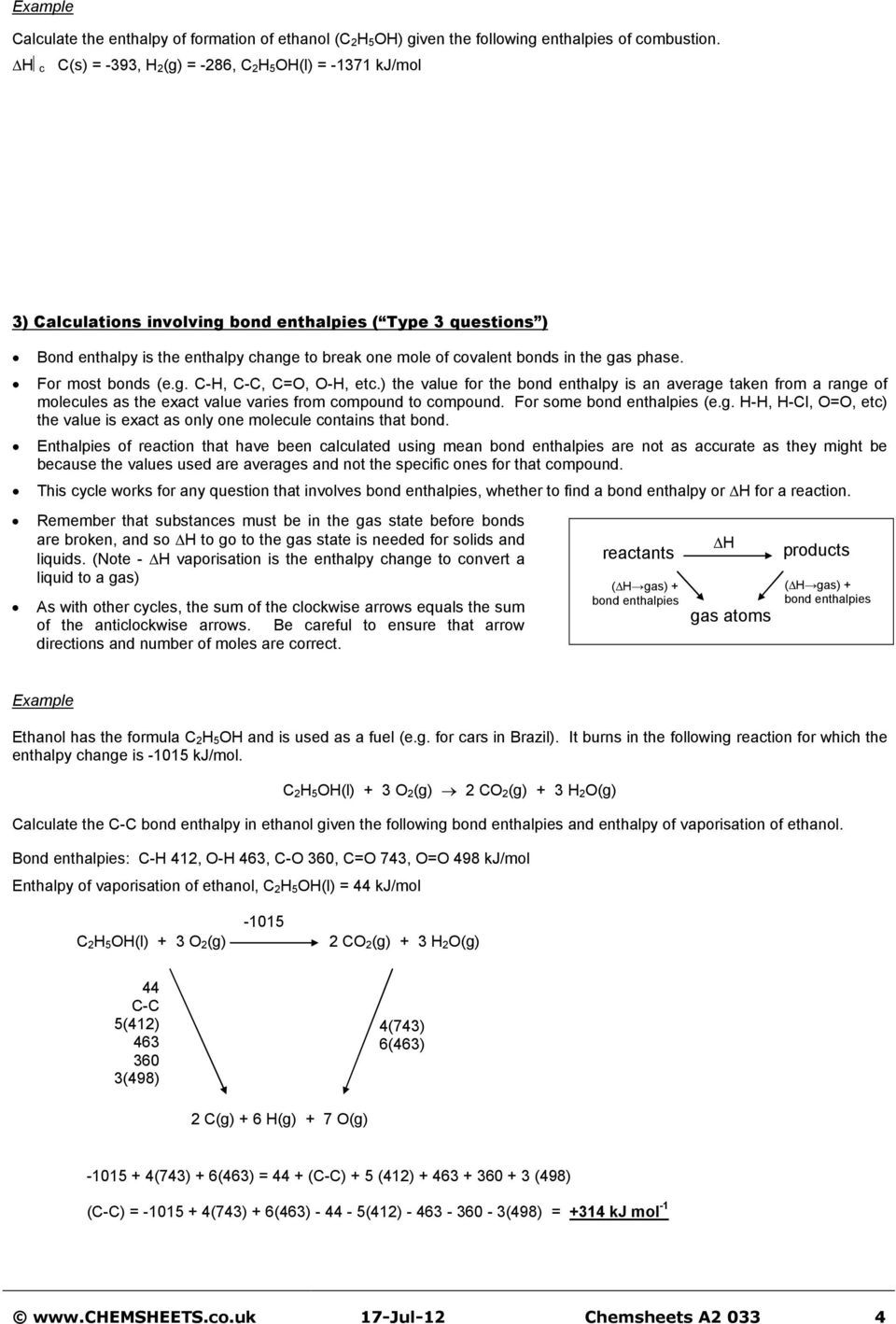
4 Example Calculate the enthalpy of formation of ethanol (C 2H 5OH) given the following enthalpies of combustion. H c C(s) = -393, H 2(g) = -286, C 2H 5OH(l) = kj/mol 3) Calculations involving bond enthalpies ( Type 3 questions ) Bond enthalpy is the enthalpy change to break one mole of covalent bonds in the gas phase. For most bonds (e.g. C-H, C-C, C=O, O-H, etc.) the value for the bond enthalpy is an average taken from a range of molecules as the exact value varies from compound to compound. For some bond enthalpies (e.g. H-H, H-Cl, O=O, etc) the value is exact as only one molecule contains that bond. Enthalpies of reaction that have been calculated using mean bond enthalpies are not as accurate as they might be because the values used are averages and not the specific ones for that compound. This cycle works for any question that involves bond enthalpies, whether to find a bond enthalpy or H for a reaction. Remember that substances must be in the gas state before bonds are broken, and so H to go to the gas state is needed for solids and liquids. (Note - H vaporisation is the enthalpy change to convert a liquid to a gas) As with other cycles, the sum of the clockwise arrows equals the sum of the anticlockwise arrows. Be careful to ensure that arrow directions and number of moles are correct. reactants ( H gas) + bond enthalpies H gas atoms products ( H gas) + bond enthalpies Example Ethanol has the formula C 2H 5OH and is used as a fuel (e.g. for cars in Brazil). It burns in the following reaction for which the enthalpy change is kj/mol. C 2H 5OH(l) + 3 O 2(g) 2 CO 2(g) + 3 H 2O(g) Calculate the C-C bond enthalpy in ethanol given the following bond enthalpies and enthalpy of vaporisation of ethanol. Bond enthalpies: C-H 412, O-H 463, C-O 360, C=O 743, O=O 498 kj/mol Enthalpy of vaporisation of ethanol, C 2H 5OH(l) = 44 kj/mol C 2H 5OH(l) + 3 O 2(g) CO 2(g) + 3 H 2O(g) 44 C-C 5(412) (498) 4(743) 6(463) 2 C(g) + 6 H(g) + 7 O(g) (743) + 6(463) = 44 + (C-C) + 5 (412) (498) (C-C) = (743) + 6(463) (412) (498) = +314 kj mol Jul-12 Chemsheets A
5 TASK 1 A MIXTURE OF SIMPLE AS THERMODYNAMICS QUESTIONS 1 Find H f of butane given that the following data. H c: C 4H 10(g) = 2877, C(s) = 394, H 2(g) = 286 kj mol -1 2 Find H for the following reaction using the data below. C 3H 8(g) + 5 O 2(g) 3 CO 2(g) + 4 H 2O(l) H f: C 3H 8(g) = 104, CO 2(g) = 394, H 2O(l) = 286 kj mol -1 3 Find H for the following reaction using the bond enthalpy data below. C 2H 6(g) + 3½ O 2(g) 2 CO 2(g) + 3 H 2O(g) C-C = 348, C-H = 412, O=O = 496, C=O = 743, O-H = 463 kj mol -1 4 Find H c of propan-2-ol given that the following data. H f: CH 3CH(OH)CH 3(l) = 318, H c: C(s) = 394, H 2(g) = 286 kj mol -1 5 Calculate H f of CCl 4(l) given the following data. CCl 4(l) CCl 4(g) = +31 kj mol -1 C(s) C(g) = +715 kj mol -1 Bond enthalpy (Cl-Cl) = +242 kj mol -1 Bond enthalpy (C-Cl) = +338 kj mol -1 6 Find H for the hydrogenation of propene using the data below. CH 3CH=CH 2(g) + H 2(g) CH 3CH 2CH 3(g) H c: CH 3CH=CH 2(g) = 2059, H 2(g) = 286, CH 3CH 2CH 3(g) = 2220 kj mol g of propanone was burned in a calorimeter containing 80 g of water. The temperature rose by 47.3ºC. Calculate H c for propanone given the specific heat capacity of water is 4.18 J mol -1 K cm 3 of 2.0 mol dm -3 nitric acid was reacted with 25 cm 3 of 2.0 mol dm -3 potassium hydroxide is an insulated cup. The temperature rose from 20.2ºC to 33.9ºC. Calculate H for the reaction given the specific heat capacity of water is 4.18 J mol -1 K The engines of the lunar module of Apollo 11 used methylhydrazine (CH 3NHNH 2) and dinitrogen tetraoxide. They react as follows: 4 CH 3NHNH 2(l) + 5 N 2O 4(l) 4 CO 2(g) + 12 H 2O(l) + 9 N 2(g) Calculate the enthalpy change for the reaction using the following data: H f : CH 3NHNH 2(l) = +53, N 2O 4 (l) = -20, CO 2(g) = -393, H 2O(l) = -286 kjmol -1 10) a) State Hess s law. b) Calculate H f of the following using the H c values provided. i) ethyne (C 2H 2(g)) ii) ethanol (C 2H 5OH(l)) H c (kjmol -1 ): C(s) = -393; H 2(g) = -286; C 2H 2(g) = -1300; C 2H 5OH(l) = What is the sign of the following enthalpy changes (+ or -)? a) combustion of magnesium b) freezing water c) melting ice 12 Calculate the average C-C bond enthalpy in benzene (C 6H 6) given the following data. H f (C 6H 6(l)) = +49 kjmol -1 C(s) C(g) H = +715 kjmol -1 H 2(g) 2 H(g) H = +436 kjmol -1 C 6H 6(l) C 6H 6(g) H = +31 kjmol -1 E (C-H) = +413 kjmol Jul-12 Chemsheets A

6 TASK 2 EXTRA BOND ENTHALPY CALCULATIONS Use this data in the questions that follow. Bond kjmol -1 Bond kjmol -1 Bond kjmol -1 Bond kjmol -1 H-H 436 C=C 612 O=O 496 N N 944 Cl-Cl 242 C-C 348 Br-Br 193 C-O 360 H-Cl 431 C-H 412 C-Br 276 S=O 743 H a (kj mol -1 ): C(s) +715; S(s) +223 H f (kj mol -1 ): NH 3(g) 46; H 2O(l) 286; C 2H 5OH(l) 278; SO 2(g) 297 H vap (kj mol -1 ): H 2O(l) +42; C 2H 5OH(l) +44 1) Calculate H for the following reaction using the bond enthalpies. a) H 2(g) + Cl 2(g) 2 HCl(g) b) C 2H 4(g) + Br 2(g) C 2H 4Br 2(g) c) H f of C 3H 8(g) 2) Calculate the average N-H bond enthalpy in ammonia. 3) Calculate the mean O-H bond enthalpy in water. 4) Calculate the O-H bond strength in C 2H 5OH(l). 5) Calculate the mean S=O bond strength in SO 2(g) Jul-12 Chemsheets A

7 DEFINITIONS Enthalpy change Definition Exo/endothermic Example Enthalpy of formation ( H f): Enthalpy change when one mole of a substance is formed from its constituent elements with all substances in their standard states Exothermic (-ve) for most substances e.g. Na2O(s) 2 Na(s) + ½ O 2(g) Na 2O(s) Enthalpy of combustion ( H c) Ionisation enthalpy ( H i) Enthalpy change when one mole of a substance undergoes complete combustion in oxygen with all substances in standard states The first ionisation energy is the enthalpy change when one mole of gaseous atoms loses one electron per atom to produce gaseous 1+ ions. The second ionisation energy is when one mole of gaseous 2+ ions is produced from one mole of 1+ ions. Exothermic (-ve) e.g. hydrogen H 2(g) + ½ O 2(g) H 2O(g) Endothermic (+ve) e.g. magnesium Mg(g) Mg + (g) + e - Endothermic (+ve) e.g. magnesium Mg + (g) Mg 2+ (g) + e - Electron affinity ( H ea) The first electron affinity is the enthalpy change when one mole of gaseous atoms gains one electron per atom to produce gaseous 1- ions. Exothermic (-ve) for many non-metals e.g. oxygen O(g) + e - O - (g) The second electron affinity is the enthalpy change when one mole of gaseous 1- ions gains one electron per ion to produce gaseous 2- ions. Endothermic (+ve) as adding ve electron to ve ion e.g. oxygen O - (g) + e - O 2- (g) Enthalpy of atomisation ( H a) Hydration enthalpy ( H hyd) Enthalpy of solution ( H sol) Bond dissociation enthalpy ( H dis) Lattice enthalpy of formation ( H L) Lattice enthalpy of disociation ( H L) Enthalpy change when one mole of gaseous atoms is produced from an element in its normal state. Enthalpy change when one mole of gaseous ions become hydrated (dissolved in water). Enthalpy change when one mole of an ionic solid dissolves in an amount of water large enough so that the dissolved ions are well separated and do not interact with each other. Enthalpy change when one mole of covalent bonds is broken in the gaseous state. Enthalpy change when one mole of a solid ionic compound is formed from into its constituent ions in the gas phase Enthalpy change when one mole of a solid ionic compound is broken up into its constituent ions in the gas phase Endothermic (+ve) e.g. iodine ½ I 2(s) I(g) Exothermic (-ve) e.g. magnesium ions Mg 2+ (g) + aq Mg 2+ (aq) Varies e.g. magnesium chloride MgCl 2(s) + aq Mg 2+ (aq) + 2 Cl - (aq) Endothermic (+ve) e.g. I-I bond I 2(g) 2 I(g) Exothermic (-ve) e.g. magnesium chloride Mg 2+ (g) + 2 Cl - (g) MgCl 2(s) Endothermic (+ve) e.g. magnesium chloride MgCl 2(s) Mg 2+ (g) + 2 Cl - (g) 17-Jul-12 Chemsheets A

8 TASK 3 DEFINITIONS 1) H f of C 6H 6(l).... 2) H f of CH 3COOH(l).. 3) H c of H 2(g) 4) H c of CH 3COOH(l).. 5) 1st ionisation energy of aluminium.. 6) 2nd ionisation energy of aluminium. 7) 3rd ionisation energy of aluminium.. 8) 1st electron affinity of chlorine.. 9) lattice enthalpy of formation of sodium oxide. 10) lattice enthalpy of dissociation of aluminium oxide 11) H hyd of sodium ions. 12) H hyd of oxide ions. 13) H sol of sodium oxide 14) H sol of magnesium carbonate 15) Bond dissociation enthalpy of water. 16) Bond dissociation enthalpy of hydrogen.. 17) H a of bromine 18) Bond dissociation enthalpy of bromine ) Enthalpy of vaporisation of bromine ) 1st electron affinity of bromine Jul-12 Chemsheets A

9 TASK 4 MAKING SURE OF DEFINITIONS For each of the following reactions, name the enthalpy change. There may be more than one possible answer to some. Some answers may involve more than one enthalpy change! e.g. CH 4(g) + 2 O 2(g) CO 2(g) + 2 H 2O(l) enthalpy of combustion of CH 4(g) e.g. 2 CH 4(g) + 4 O 2(g) 2 CO 2(g) + 4 H 2O(l) 2 x enthalpy of combustion of CH 4(g) 1) Ca(g) Ca + (g) + e ) S(g) + 2 e - S 2- (g).... 3) Al 2O 3(s) 2 Al 3+ (g) + 3 O 2- (g).... 4) NaBr(s) Na + (aq) + Br - (aq).... 5) I 2(s) 2 I(g).... 6) C 3H 8(g) + 5O 2(g) 3CO 2(g) + 4H 2O(l).... 7) 4 Al(s) + 3 O 2(g) 2 Al 2O 3(s).... 8) Ca 2+ (g) + O 2- (g) CaO(s).... 9) Na(s) Na(g) ) P 4(s) 4 P(g) ) HCl(g) H(g) + Cl(g) ) H 2O(l) 2 H(g) + O(g) ) Al(g) Al 3+ (g) + 3 e ) Ca 2+ (g) Ca 2+ (aq) ) Mg(s) Mg 2+ (g) + 2 e ) Mg(s) + ½ O 2(g) MgO(s) Jul-12 Chemsheets A

10 SOLUTION CALCULATIONS This cycle works for questions involving enthalpies of solution. It is a simple cycle from a solid to gas ions to dissolved ions. Ionic solid H sol Dissolved ions Beware of whether the lattice enthalpy is formation or dissociation. Lattice enthalpy of formation Gas ions Hydration enthalpies Example Calculate the enthalpy of solution of magnesium chloride given that the lattice enthalpy of formation of magnesium chloride is kjmol -1 and the enthalpies of hydration of magnesium and chloride ions are and -364 kjmol -1 respectively MgCl 2 (s) H sol Mg 2+ (aq) + 2 Cl - (aq) H sol = (-364) (-364) H sol = (-364) H sol = -155 kj mol -1 Mg 2+ (g) + 2 Cl - (g) TASK 5 SOLUTION CALCULATIONS 1) Calculate the enthalpy of solution of NaCl given that the lattice enthalpy of formation of NaCl is -771 kjmol -1 and the enthalpies of hydration of sodium and chloride ions are -406 and -364 kjmol -1 respectively. 2) Calculate the enthalpy of hydration of bromide ions given that the hydration enthalpy of barium ions is kjmol -1, the lattice enthalpy of formation for BaBr 2 is kjmol -1 and the enthalpy of solution of BaBr 2 = -38 kjmol -1. 3) Calculate the lattice enthalpy of formation of calcium iodide given that its enthalpy of solution is -120 kjmol -1 and the enthalpies of hydration of calcium and iodide ions are and -293 kjmol -1 respectively. 4) Calculate the enthalpy of solution of the ammonium chloride using this data: H hyd (kj mol -1 + ): NH 4-301; Cl ; Lattice enthalpy of formation (kj mol -1 ): ammonium chloride Jul-12 Chemsheets A

11 BORN-HABER CYCLES The lattice enthalpy of a compound is an indication of the strength of the ionic bonding. The greater the magnitude of the lattice enthalpy, the stronger the bonding. Generally speaking, compounds with smaller ions and ions with higher charges have stronger attractions and so greater lattice enthalpy. e.g. NaCl has a higher lattice enthalpy than KCl as they Na + ion is smaller than the K + ion. e.g. MgCl 2 has a higher lattice enthalpy than NaCl as the Mg 2+ ion has a higher charge and is smaller than the Na + ion. A Born-Haber cycle is a cycle that includes all the enthalpy changes in the formation of an ionic compound. GASEOUS METAL ION(S) AND GASEOUS NON-METAL ATOMS ionisation energy/ies of metal atom(s) GASEOUS ATOMS electron affinity/ies of non-metal atom(s) atomisation of metal and nonmetal enthalpy of formation ELEMENTS IN NORMAL STATES SOLID IONIC COMPOUND GASEOUS IONS lattice enthalpy of formation Enthalpy of formation = sum of all the other enthalpy values Please note that: steps should have values and labels written on it is best to show each separate step (e.g. if both elements are atomised, show this as two steps) sometimes each separate ionisation enthalpy and/or electron affinity are shown as separate steps Comparison of values of lattice enthalpy from Born-Haber cycles to theoretical values Lattice enthalpies can be calculated either by: a Born-Haber cycle (which uses experimentally measured values for the other enthalpy changes) theoretical calculation based on the charge and size of positive and negative ions The closer the experimentally measured value, using a Born-Haber cycle, to the theoretical value, the purer the ionic bonding. If the difference is large, then the compound has some covalent character. The more polarising the positive ion, the more the negative ion is distorted in shape and the more covalent character. The smaller the positive ion, and the higher its charge, the more polarising it is. Larger negative ions are polarised more easily. Substance LiCl LiI NaI MgO Experimental value (from Born-Haber cycle) / kj mol Theoretical value / kj mol Difference / kj mol Jul-12 Chemsheets A

12 Example Calculate the lattice enthalpy of formation of magnesium chloride given the following data: Enthalpy of formation of magnesium chloride = 642 kj mol -1 Enthalpy of atomisation of magnesium = +150 kj mol -1 Enthalpy of atomisation of chlorine = +121 kj mol -1 1st ionisation enthalpy of magnesium = +736 kj mol -1 2nd ionisation enthalpy of magnesium = kj mol -1 1st electron affinity of chlorine = 364 kj mol -1 Mg 2+ (g) + 2 Cl(g) + 2 e - 2nd ionisation enthalpy of Mg st ionisation enthalpy of Mg 736 Mg + (g) + 2 Cl(g) + e - 2(-364) 2 x electron affinity of Cl Mg(g) + 2 Cl(g) Mg 2+ (g) + 2 Cl - (g) 2 x Enthalpy of atomisation of Cl 2(121) Enthalpy of atomisation of Mg 150 Enthalpy of formation of MgCl Mg(g) + Cl 2 (g) Mg(s) + Cl2(g) MgCl 2 (s) lattice enthalpy of formation of MgCl 2 Enthalpy of formation = sum of the others 642 = (121) ( 364) + LE 642 = LE LE = = 2492 kj mol -1 Example Calculate the enthalpy of formation of sodium bromide given the following data: Lattice enthalpy of formation of sodium bromide = 733 kj mol -1 Enthalpy of atomisation of sodium = +109 kj mol -1 Enthalpy of atomisation of bromine = +112 kj mol -1 1st ionisation enthalpy of sodium = +494 kj mol -1 1st electron affinity of bromine = 342 kj mol Jul-12 Chemsheets A

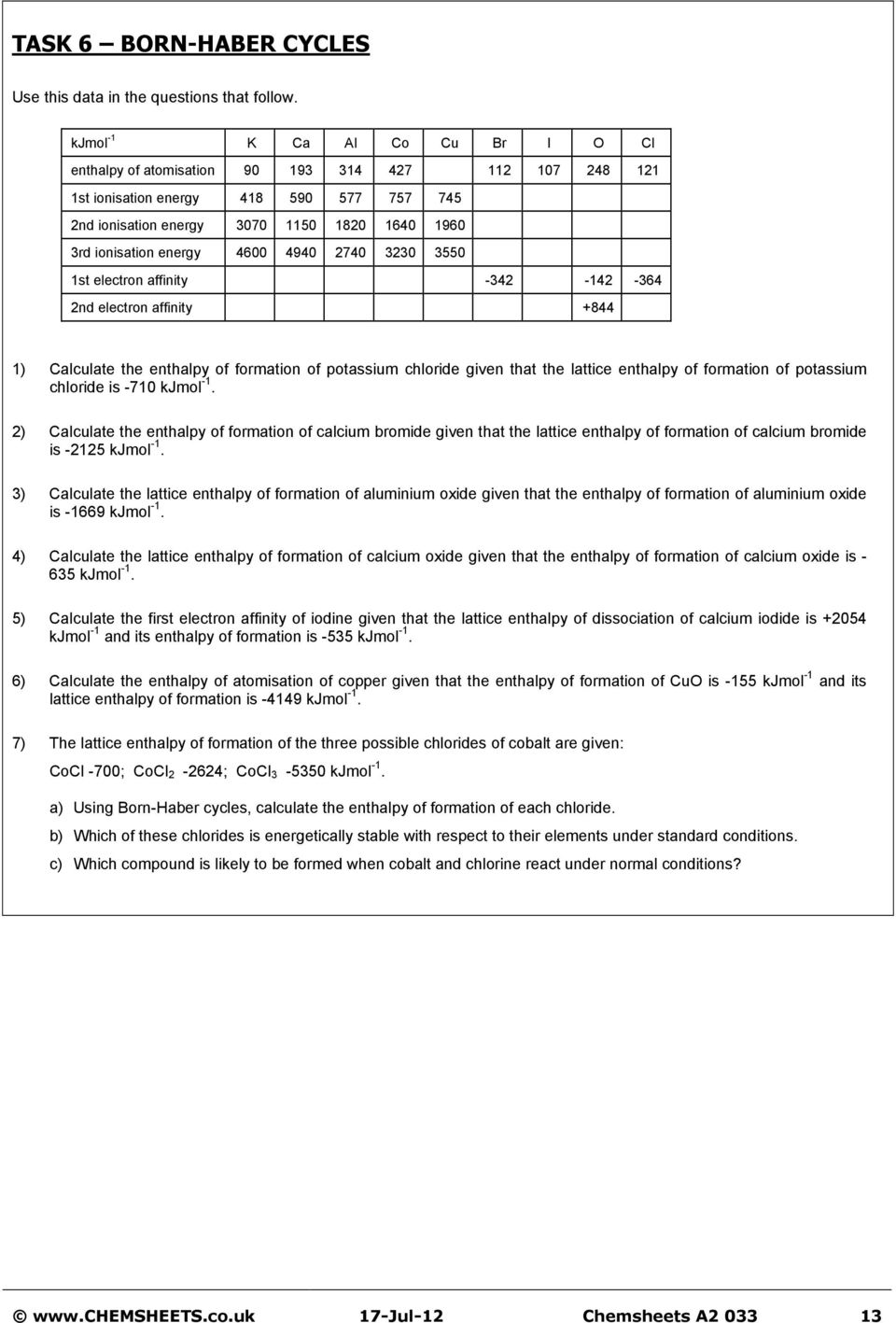
13 TASK 6 BORN-HABER CYCLES Use this data in the questions that follow. kjmol -1 K Ca Al Co Cu Br I O Cl enthalpy of atomisation st ionisation energy nd ionisation energy rd ionisation energy st electron affinity nd electron affinity ) Calculate the enthalpy of formation of potassium chloride given that the lattice enthalpy of formation of potassium chloride is -710 kjmol -1. 2) Calculate the enthalpy of formation of calcium bromide given that the lattice enthalpy of formation of calcium bromide is kjmol -1. 3) Calculate the lattice enthalpy of formation of aluminium oxide given that the enthalpy of formation of aluminium oxide is kjmol -1. 4) Calculate the lattice enthalpy of formation of calcium oxide given that the enthalpy of formation of calcium oxide is kjmol -1. 5) Calculate the first electron affinity of iodine given that the lattice enthalpy of dissociation of calcium iodide is kjmol -1 and its enthalpy of formation is -535 kjmol -1. 6) Calculate the enthalpy of atomisation of copper given that the enthalpy of formation of CuO is -155 kjmol -1 and its lattice enthalpy of formation is kjmol -1. 7) The lattice enthalpy of formation of the three possible chlorides of cobalt are given: CoCl -700; CoCl ; CoCl kjmol -1. a) Using Born-Haber cycles, calculate the enthalpy of formation of each chloride. b) Which of these chlorides is energetically stable with respect to their elements under standard conditions. c) Which compound is likely to be formed when cobalt and chlorine react under normal conditions? 17-Jul-12 Chemsheets A
14 TASK 7 A VARIETY OF H QUESTIONS 1 a) The symbol H is often used. Explain what the H and each mean. (2) b) Define standard enthalpy of formation. (3) c) Write an equation representing the standard enthalpy of formation of: i) water ii) propan-1-ol (2) d) Define standard enthalpy of combustion. (2) e) Write an equation representing the standard enthalpy of combustion of: i) hydrogen ii) propan-1-ol (2) (Total 11) 2 a) State Hess s law. (1) b) Calculate the enthalpy of formation of HCl using the data below. H 2(g) 2 H(g) H = +436 kj mol -1 Cl 2(g) 2 Cl(g) H = +242 kj mol -1 HCl(g) H(g) + Cl(g) H = +431 kj mol -1 (3) c) What will be the first step in the mechanism for the reaction for the formation of HCl? (1) d) Explain your answer to (c). (1) (Total 5) 3 Calculate a value for the mean bond enthalpy of the O-H bond in water using the data below. H 2(g) 2 H(g) H = +436 kj mol -1 O 2(g) 2 O(g) H = +496 kj mol -1 H 2(g) + ½ O 2(g) H 2O(g) H = -242 kj mol -1 (Total 3) 4 Hydrogen sulphide, H 2S, is a liquid at room temperature. Calculate the average H-S bond enthalpy in hydrogen sulphide given that the enthalpy of formation of hydrogen sulphide is 20 kj mol -1 and the following data. H 2(g) 2 H(g) H = +436 kj mol -1 S(s) S(g) H = +223 kj mol -1 H 2S(l) H 2S(g) H = +19 kj mol -1 (Total 3) 5 a) The standard enthalpy of formation of propane is -104 kj mol -1. Given that the standard enthalpies of formation of carbon dioxide and water are -394 and -286 kj mol -1 respectively, calculate the standard enthalpy change of combustion of propane. (3) b) Using bond enthalpies only, calculate the standard enthalpy of combustion of propane. C-C 348, C-H 412, O=O 496, C-O 360, C=O 743, H-O 463 kj mol -1 (3) c) Compare your answers to (a) and (b) and comment on any difference. (2) (Total 8) 6 What is the sign (+ or -) of the following standard enthalpy changes (justify your answer)? a) condensing steam b) combustion of octane c) boiling ethanol (Total 3) 17-Jul-12 Chemsheets A

15 7 Write equations representing each of the following: a) 1st electron affinity of iodine e) bond dissociation energy of iodine b) lattice enthalpy of formation of magnesium iodide f) enthalpy of solution of magnesium iodide c) enthalpy of atomisation of iodine g) 2nd ionisation energy of magnesium d) enthalpy of solution of sodium carbonate h) enthalpy of hydration of calcium ions (Total 8) 8 The standard enthalpy change of combustion of propanoic acid is kj mol -1. Given that the standard enthalpies of formation of carbon dioxide and water are -393 and -286 kj mol -1 respectively, calculate the standard enthalpy change of formation of propanoic acid. (Total 3) 9 Calculate the enthalpy of hydration of bromide ions given that the hydration enthalpy of barium ions is kj mol -1, the lattice enthalpy for BaBr 2 is kj mol -1 and the enthalpy of solution of BaBr 2 = -38 kjmol -1. (Total 3) 10 Use the data below to calculate the enthalpy of solution of a) magnesium sulphate b) barium sulphate Lattice enthalpy of formation (kj mol -1 ): MgSO 4 = -2833; BaSO 4 = Hydration enthalpy (kj mol -1 ): Mg 2+ = -1891; Ba 2+ = -1360; SO 2-4 = (Total 5) 11 a) Define lattice enthalpy of formation. (1) b) For each pair of compounds, predict which will have the lattice enthalpy of greatest magnitude, and explain why. i) LiF or NaF ii) CaO or MgO iii) NaCl or MgCl 2 (6) (Total 7) 12 Show why calcium and chlorine react together to form CaCl 2 rather than CaCl or CaCl 3 (you will need three Born-Haber cycles to do this). The lattice enthalpies of formation of the chlorides are: CaCl = -719; CaCl 2 = -2218; CaCl 3 = kj mol -1. You will also need to use data in the table in question 5. (Total 10) 13 In each of the following questions you should draw a clear Born-Haber cycle and use data from the table below. kj mol -1 Na Al Hg Ca Cl Br I O enthalpy of atomisation st ionisation energy nd ionisation energy rd ionisation energy st electron affinity nd electron affinity +844 a) Calculate the lattice enthalpy of formation of aluminium oxide given that its enthalpy of formation is kj/mol. (6) b) Calculate the enthalpy of formation of sodium iodide given that its lattice enthalpy of formation is -684 kj mol -1. (6) c) Calculate the first electron affinity of bromine given that the lattice enthalpy of formation of calcium bromide is kj mol -1 and the enthalpy of formation is calcium bromide is -675 kj mol -1. (6) d) Calculate the second ionisation energy of mercury given that the lattice enthalpy of dissociation of mercury (II) chloride is kj mol -1 and the enthalpy of formation is mercury (II) chloride is -230 kj mol -1. (6) (Total 24) 17-Jul-12 Chemsheets A

16 14 Calculate the enthalpy of formation of magnesium sulphide given the following data. Lattice enthalpy of formation of magnesium sulphide H = kj mol -1 Mg(s) Mg(g) H = kj mol -1 Mg(g) Mg + (g) + e - H = kj mol -1 Mg + (g) Mg 2+ (g) + e - H = kj mol -1 S(s) S(g) H = kj mol -1 S(g) + e - S - (g) H = kj mol -1 S - (g) + e - S 2- (g) H = kj mol -1 (Total 6) 15 Lattice enthalpy gives us useful information about the structure of an ionic compound. a) Explain why the magnitude of the lattice enthalpy of: i) KCl (-701) is less than CaCl 2 (-2237) ii) NaF (-902) is greater than KF (-801) (3) b) Using the sizes and charges of ions and the laws of electrostatics, theoretical values can be calculated for lattice enthalpies. The table below shows a comparison between values measured using experimental data with Born- Haber cycles, and theoretical values. NaCl NaBr NaI AgCl AgBr AgI Experimental value (kj mol -1 ) Theoretical value (kj mol -1 ) For many substances, the measured and theoretical values are very similar, such the as the sodium halides, but for some substances there is a significant difference, such as the silver halides. Account for this difference. (2) (Total 5) 16 Use the following data to calculate the average C-S bond energy in CS 2(l). Enthalpy of atomisation of sulphur = kj mol -1 Enthalpy of atomisation of carbon = kj mol -1 Enthalpy of formation of CS 2(l) = + 88 kj mol -1 Enthalpy of vaporisation of CS 2(l) = +27 kj mol -1 i.e. CS 2(l) CS 2(g) (Total 4) 17 The enthalpy of hydration of magnesium and sodium ions are and -406 kj mol -1 respectively. Explain why the enthalpy of hydration of Mg 2+ has a greater magnitude than that of Na +. (Total 2) 17-Jul-12 Chemsheets A

17 ENTROPY What is entropy? Entropy (S) is disorder. The more disordered (or random) something is, the greater the entropy. Gases have the most entropy (particles are move rapidly and randomly) whereas solids have least entropy (particles vibrating about fixed positions). There is a tendency for entropy to increase, i.e. for things to become more disordered. How does the entropy of a substance vary with temperature? The higher the temperature, the faster the particles vibrate/move and so the greater the entropy (disorder). Gases have the most entropy (particles are move rapidly and randomly) whereas solids have least entropy (particles vibrating about fixed positions). S (gas) > S (liquid) > S (solid) The variation with temperature and state of a substance is shown. Note how: entropy increases with temperature (at 0 K, S = 0); S (Jmol -1 K -1 ) GAS there are big increases in entropy on state changes (melting and boiling); the entropy increase from liquid to gas is greater than that for solid to liquid due to the large amount of disorder in gases compared to solids and liquids. SOLID LIQUID melting boiling Temperature How does the entropy of different substances compare? substance S (Jmol -1 K -1 ) Note the entropy units J mol -1 K -1, not kj. The more ordered the structure the lower the entropy. Structures like diamond and graphite are very highly structured and so have very low entropies. C (diamond) C (graphite) SiO 2 (s) H 2O (l) NaCl (s) MgCl 2 (s) H 2O (g) CO 2 (g) Jul-12 Chemsheets A

18 Working out the entropy change for a reaction: We can calculate the entropy change for a reaction: S = [SUM S products ] [SUM S reactants ] Example Calculate the entropy change for this reaction: C 2H 5OH(l) + 3 O 2(g) 2 CO 2(g) + 3 H 2O(l) Entropy: C 2H 5OH(l) = 161, O 2(g) = 205, CO 2(g) = 214, H 2O(l) = 70 J mol -1 K -1 S S = [SUM of S products] [SUM S reactants] S = [2(214) + 3(70)] [ (205)] = -138 J mol -1 K -1 Predicting the sign of an entropy change In the same way as a decrease in enthalpy ( H -ve) is a driving force in making reactions go, so is an increase in entropy ( S +ve), i.e., an increase in disorder is favourable. For many reactions it is possible to tell whether entropy will increase or decrease by looking at the equation. e.g. NH 4NO 3(s) N 2O(g) + 2 H 2O(g) one mole of solid gives three moles of gas far more disorder S +ve TASK 8 ENTROPY CALCULATIONS Use this data in the questions that follow. substance S (J mol -1 K -1 ) H f (kj mol -1 ) substance S (J mol -1 K -1 ) H 2O(g) Fe(s) 27 H 2O(l) 70 O 2(g) 205 H f (kj mol -1 ) H 2(g) 131 Fe 2O 3(s) Cl 2(g) 223 C(graphite) 5.7 HCl(g) 187 CO 2(g) NaHCO 3(s) N 2(g) 192 Na 2CO 3(s) NH 3(g) 193 C 3H 8(g) 270 1) a) Predict the sign of S for the following reactions, where possible, giving your reasoning for each one. i) H 2O(g) H 2O(l) ii) H 2(g) + Cl 2(g) 2 HCl(g) iii) C 3H 8(g) + 5 O 2(g) 3 CO 2(g) + 4 H 2O(l) b) Calculate S for the above reactions. 2) a) Sketch a graph to show how the entropy of water varies with temperature. b) Show clearly the melting and boiling points on your graph Jul-12 Chemsheets A
![3(205)] = -138 J mol -1 K -1 Predicting the sign of an entropy change In the same way as a decrease in enthalpy ( H -ve) is a driving force in making reactions go, so is an increase in entropy ( S](/docs-images/47/20843306/images/page_18.jpg "+ve), i.e., an increase in disorder is favourable. For many reactions it is possible to tell whether entropy will increase or decrease by looking")
19 GIBBS FREE ENERGY & FEASIBLE REACTIONS What is Gibbs free energy? Gibbs free energy (G) combines the two thermodynamic factors of enthalpy (H) and entropy (S). G = H - T S What is the connection between Gibbs free energy change and thermodynamic feasibility? When G 0, a reaction is thermodynamically feasible. This means the reaction can happen (it might not happen as the activation is too high). The term spontaneous is taken to mean the same thing as feasible, but it still means that a reaction can happen rather than that it actually does! How does temperature affect feasibility? H S How G varies with temperature How feasibility varies with temperature -ve +ve G always ve Reaction feasible at all temperatures -ve -ve G ve at low T, +ve at high T Reaction feasible at low T, not feasible at high T +ve +ve G +ve at low T, -ve at high T Reaction not feasible at low T, feasible at high T +ve -ve G always +ve Reaction not feasible at all temperatures How does this link to changes of state? Melting A substance cannot melt below its melting point as G for melting is +ve below the melting point. At the melting point, G = 0 and so melting is feasible and the substance melts. Boiling A substance cannot boil below its boiling point as G for boiling is +ve below the boiling point. At the boiling point, G = 0 and so boiling is feasible and the substance boils Jul-12 Chemsheets A

20 Example 1 Zinc carbonate decomposes on heating: ZnCO 3(s) ZnO(s) + CO 2(g) ZnCO 3(s) ZnO(s) CO 2(g) H f (kj mol -1 ) S (J mol -1 K -1 ) a) Calculate H, S and G for this reaction at 298 K. b) Is the reaction spontaneous at 298 K? c) Give the temperature range in which the decomposition of ZnCO 3 is spontaneous a) H H = [SUM of H f products] [SUM H f reactants] H = [ ] [-812] = +70 kj mol -1 S S = [SUM of S products] [SUM S reactants] S = [ ] [83] = +85 J mol -1 K -1 S G = H - T S H = (85) = J mol -1 K b) Reaction is not spontaneous at 298 K as G is +ve c) G = H - T S when G = 0, H - T S = 0 T = H = +70 = 824 K S ( +85 / 1000) The reaction is spontaneous when T 824 K Example 2 The enthalpy of vaporisation of ethanol is kj mol -1. The boiling point of ethanol is 78 C. Calculate the entropy change for the vaporisation of ethanol. G = H - T S At boiling point, G = 0, H - T S = 0 S = H = = kj mol -1 K -1 = 124 J mol -1 K -1 T Jul-12 Chemsheets A
![c) Give the temperature range in which the decomposition of ZnCO 3 is spontaneous a) H H = [SUM of H f products] [SUM H f reactants] H = [-348-394] [-812] = +70 kj mol -1 S S = [SUM of S products]](/docs-images/47/20843306/images/page_20.jpg "[SUM S reactants] S = [44 + 124] [83] = +85 J mol -1 K -1 S G = H - T S H = 70-298 (85) = +44.")
21 TASK 9 GIBBS FREE ENERGY CALCULATIONS Use this data in the questions that follow. substance S (J mol -1 K -1 ) H f (kj mol -1 ) substance S (J mol -1 K -1 ) H 2O(g) Fe(s) 27 H 2O(l) 70 O 2(g) 205 H f (kj mol -1 ) H 2(g) 131 Fe 2O 3(s) Cl 2(g) 223 C(graphite) 5.7 HCl(g) 187 CO 2(g) NaHCO 3(s) N 2(g) 192 Na 2CO 3(s) NH 3(g) 193 C 3H 8(g) 270 1) a) Calculate G for the following reaction at 298 K. H 2(g) + Cl 2(g) 2 HCl(g) H = -185 kj mol -1 S = 20 J K -1 mol -1 b) Is this reaction feasible at 298 K? c) Why does this reaction not happen at room temperature? 2) For the decomposition: 2 NaHCO 3(s) Na 2CO 3(s) + CO 2(g) + H 2O(g) a) Calculate H and S. b) Calculate G at 298 K. c) Calculate the temperature range over which the reaction is feasible. 3) Graphite burns in oxygen to form carbon dioxide. C(graphite) + O 2(g) CO 2(g) a) Calculate S at 298 K. b) Calculate G at 298 K. 4) For the reaction: 2 Fe(s) + 3 / 2 O 2(g) Fe 2O 3(s) a) Calculate H and S. b) Calculate G at 298 K. c) Calculate the temperature range over which the reaction is feasible. 5) a) Calculate S for this reaction at 298 K: Mg(s) + ½ O 2(g) MgO(s) H = -602 kj mol -1 G = -570 kj mol -1 b) Explain the sign and magnitude of S. 6) a) Calculate H, S and G for the following reaction at 298 K: Fe 2O 3(s) + 3 H 2(g) 2 Fe(s) + 3 H 2O(g) b) Will this reaction be feasible at 298K? c) Calculate the temperature range over which the reaction is feasible Jul-12 Chemsheets A
22 7) a) Calculate S for the following process which takes place 91 K: CH 4(s) CH 4(l) H = 0.94 kjmol -1 b) Calculate the boiling point of methane given: CH 4(l) CH 4(g) H = 8.2 kjmol -1 S = 73.2 Jmol -1 K -1 c) Compare the magnitude of the S values for melting and boiling methane and comment on the difference. d) Explain why both melting and boiling are feasible at the temperatures shown, despite being endothermic. 8) The following enthalpy changes are at 298 K: H hyd (kjmol -1 ): K ; Cl Lattice enthalpy KCl = -701 kjmol -1 a) Calculate the standard enthalpy of solution of potassium chloride at 298 K. b) Potassium chloride dissolves readily in water at 298 K. Deduce the sign of the entropy change for this reaction, and explain your reasoning. c) Explain, in terms of the behaviour of particles, why the entropy change has the sign given in your answer to (b). d) Use your answer to (a) to calculate the smallest possible entropy change there must be when potassium chloride dissolves in water at 298 K, given that it is a feasible change. 9) Use the data in the table to answer this question. CaCO 3(s) CaO(s) CO 2(g) MgCO 3(s) MgO(s) H f (kj mol -1 ) S (J mol -1 K -1 ) a) A reaction that can be made to take place by changing the conditions is: CaCO 3(s) CaO(s) + CO 2(g) i) Calculate H for this reaction. (1) ii) Calculate S for this reaction. (1) iii) Calculate G for this reaction at 298 K. (1) iv) Is the reaction spontaneous at 298 K? (1) v) Will increasing or decreasing the temperature help to make G more negative? (1) vi) At what temperature will G equal zero? (3) vii) Give the temperature range in which the decomposition of CaCO 3 is spontaneous. (1) viii) How can this reaction be spontaneous even though it is endothermic? (1) b) Repeat your calculations for the decomposition of MgCO 3 to find the temperature at which is undergoes similar decomposition. (4) c) i) Use your results to compare the thermal stability of MgCO 3 and CaCO 3. (1) ii) Suggest a reason for the difference in thermal stability of MgCO 3 and CaCO 3. (1) (Total 16) 10) State the sign of the entropy change in the following reactions (or whether it stays roughly constant), justifying your answer in each case. a) CO(g) + H 2O(g) CO 2(g) + H 2(g) c) NaCl(s) + aq Na + (aq) + Cl - (aq) b) N 2(g) + 3 H 2(g) 2 NH 3(g) d) I 2(s) I 2(g) (Total 4) 17-Jul-12 Chemsheets A
23 FULL WORKED SOLUTIONS are available to subscribers of Subscribe for many more exercises with answers. C(s) + 2 H 2(g) CH 4(g) H 2(g) + ½ O 2(g) H 2O(l) ½ N 2(g) + 3/2 H 2(g) NH 3(g) 2 C(s) + 3 H 2(g) + ½ O 2(g) C 2H 5OH(l) C(s) + 3/2 H 2(g) + ½ Br 2(l) CH 3Br(l) 2 Na(s) + ½ O 2(g) Na 2O(s) CH 4(g) + 2 O 2(g) CO 2(g) + 2 H 2O(l) H 2(g) + ½ O 2(g) H 2O(l) C 2H 6(g) + 3½ O 2(g) 2 CO 2(g) + 3 H 2O(l) Na(s) + ¼ O 2(g) ½ Na 2O(s) C 6H 14(g) + 9½ O 2(g) 6 CO 2(g) + 7 H 2O(l) TASK 1 A MIXTURE OF SIMPLE AS THERMODYNAMICS QUESTIONS kj mol kj mol kj mol kj mol kj mol kj mol kj mol kj mol kj mol , -277 kj mol kj mol a kj mol -1 b kj mol -1 c kj mol -1 TASK 2 EXTRA BOND ENTHALPY CALCULATIONS 1 a -184 kj mol -1 b -95 kj mol -1 c -103 kj mol kj mol kj mol kj mol kj mol -1 TASK 5 SOLUTION CALCULATIONS 1 +1 kj mol kj mol kj mol kj mol -1 TASK 6 BORN_HABER CYCLES kj mol kj mol kj mol kj mol kj mol kj mol -1 7 CoCl = +241 kj mol -1, CoCl 2 = -286 kj mol -1, CoCl 3 = -25 kj mol Jul-12 Chemsheets A
24 TASK 7 A VARIETY OF H QUESTIONS 2b -92 kj mol kj mol kj mol -1 5a kj mol -1, b kj mol kj mol kj mol -1 10a -62 kj mol -1, b +110 kj mol CaCl = -179, CaCl 2 = -771, CaCl 3 = kj mol -1 13a kj mol -1, b -288 kj mol -1, c -342 kj mol -1, d = kj mol kj mol kj mol -1 TASK 8 ENTROPY CALCULATIONS 1b i -119 J mol -1 K -1 ii +20 J mol -1 K -1 iii -373 J mol -1 K -1 TASK 9 GIBBS FREE ENERGY CALCULATIONS 1a -191 kj mol -1 2a H = +129 kj mol -1, S = +335 J mol -1 K -1, b kj mol -1, c T 385 K 3 H = -394 kj mol -1, S = +3.3 J mol -1 K -1, G = -395 kj mol -1 4 H = -822 kj mol -1, S = -272 J mol -1 K -1, G = -741 kj mol -1, T 3028 K 5 S = -107 J mol -1 K -1 6 H = +96 kj mol -1, S = +138 J mol -1 K -1, G = kj mol -1, T 696 K 7a S = J mol -1 K -1, b 112 K 8a H = +15 kj mol -1, d S = J mol -1 K -1 9a 9b H = +178 kj mol -1, S = +164 J mol -1 K -1, G = +129 kj mol -1, T 1085 K H = +117 kj mol -1, S = +175 J mol -1 K -1, G = kj mol -1, T 669 K 17-Jul-12 Chemsheets A
SUGGESTION ANSWER SCHEME CHAPTER 8: THERMOCHEMISTRY. 1 (a) Use the data in the table below to answer the following questions:
 SUGGESTION ANSWER SCHEME CHAPTER 8: THERMOCHEMISTRY ANSWER SCHEME UPS 2004/2005 SK027 1 (a) Use the data in the table below to answer the following questions: Enthalpy change ΔH (kj/mol) Atomization energy
IB Chemistry. DP Chemistry Review
 DP Chemistry Review Topic 1: Quantitative chemistry 1.1 The mole concept and Avogadro s constant Assessment statement Apply the mole concept to substances. Determine the number of particles and the amount
In the box below, draw the Lewis electron-dot structure for the compound formed from magnesium and oxygen. [Include any charges or partial charges.
 Name: 1) Which molecule is nonpolar and has a symmetrical shape? A) NH3 B) H2O C) HCl D) CH4 7222-1 - Page 1 2) When ammonium chloride crystals are dissolved in water, the temperature of the water decreases.
Enthalpy of Reaction and Calorimetry worksheet
 Enthalpy of Reaction and Calorimetry worksheet 1. Calcium carbonate decomposes at high temperature to form carbon dioxide and calcium oxide, calculate the enthalpy of reaction. CaCO 3 CO 2 + CaO 2. Carbon
INTI COLLEGE MALAYSIA A? LEVEL PROGRAMME CHM 111: CHEMISTRY MOCK EXAMINATION: DECEMBER 2000 SESSION. 37 74 20 40 60 80 m/e
 CHM111(M)/Page 1 of 5 INTI COLLEGE MALAYSIA A? LEVEL PROGRAMME CHM 111: CHEMISTRY MOCK EXAMINATION: DECEMBER 2000 SESSION SECTION A Answer ALL EIGHT questions. (52 marks) 1. The following is the mass spectrum
Balancing Chemical Equations Worksheet
 Balancing Chemical Equations Worksheet Student Instructions 1. Identify the reactants and products and write a word equation. 2. Write the correct chemical formula for each of the reactants and the products.
WRITING CHEMICAL FORMULA
 WRITING CHEMICAL FORMULA For ionic compounds, the chemical formula must be worked out. You will no longer have the list of ions in the exam (like at GCSE). Instead you must learn some and work out others.
Mr. Bracken. Multiple Choice Review: Thermochemistry
 Mr. Bracken AP Chemistry Name Period Multiple Choice Review: Thermochemistry 1. If this has a negative value for a process, then the process occurs spontaneously. 2. This is a measure of how the disorder
Which substance contains positive ions immersed in a sea of mobile electrons? A) O2(s) B) Cu(s) C) CuO(s) D) SiO2(s)
 BONDING MIDTERM REVIEW 7546-1 - Page 1 1) Which substance contains positive ions immersed in a sea of mobile electrons? A) O2(s) B) Cu(s) C) CuO(s) D) SiO2(s) 2) The bond between hydrogen and oxygen in
Bomb Calorimetry. Example 4. Energy and Enthalpy
 Bomb Calorimetry constant volume often used for combustion reactions heat released by reaction is absorbed by calorimeter contents need heat capacity of calorimeter q cal = q rxn = q bomb + q water Example
Bonding Practice Problems
 NAME 1. When compared to H 2 S, H 2 O has a higher 8. Given the Lewis electron-dot diagram: boiling point because H 2 O contains stronger metallic bonds covalent bonds ionic bonds hydrogen bonds 2. Which
Standard Free Energies of Formation at 298 K. Average Bond Dissociation Energies at 298 K
 1 Thermodynamics There always seems to be at least one free response question that involves thermodynamics. These types of question also show up in the multiple choice questions. G, S, and H. Know what
Chapter 5. Chemical Reactions and Equations. Introduction. Chapter 5 Topics. 5.1 What is a Chemical Reaction
 Introduction Chapter 5 Chemical Reactions and Equations Chemical reactions occur all around us. How do we make sense of these changes? What patterns can we find? 1 2 Copyright The McGraw-Hill Companies,
W1 WORKSHOP ON STOICHIOMETRY
 INTRODUCTION W1 WORKSHOP ON STOICHIOMETRY These notes and exercises are designed to introduce you to the basic concepts required to understand a chemical formula or equation. Relative atomic masses of
4. Using the data from Handout 5, what is the standard enthalpy of formation of BaO (s)? What does this mean?
 HOMEWORK 3A 1. In each of the following pairs, tell which has the higher entropy. (a) One mole of liquid water or one mole of water vapor (b) One mole of dry ice or one mole of carbon dioxide at 1 atm
Chemistry: Chemical Equations
 Chemistry: Chemical Equations Write a balanced chemical equation for each word equation. Include the phase of each substance in the equation. Classify the reaction as synthesis, decomposition, single replacement,
87 16 70 20 58 24 44 32 35 40 29 48 (a) graph Y versus X (b) graph Y versus 1/X
 HOMEWORK 5A Barometer; Boyle s Law 1. The pressure of the first two gases below is determined with a manometer that is filled with mercury (density = 13.6 g/ml). The pressure of the last two gases below
Unit 10A Stoichiometry Notes
 Unit 10A Stoichiometry Notes Stoichiometry is a big word for a process that chemist s use to calculate amounts in reactions. It makes use of the coefficient ratio set up by balanced reaction equations
Writing and Balancing Chemical Equations
 Name Writing and Balancing Chemical Equations Period When a substance undergoes a chemical reaction, chemical bonds are broken and new bonds are formed. This results in one or more new substances, often
Chemistry Assessment Unit AS 1
 Centre Number 71 Candidate Number ADVANCED SUBSIDIARY (AS) General Certificate of Education January 2011 Chemistry Assessment Unit AS 1 assessing Basic Concepts in Physical and Inorganic Chemistry [AC111]
The first law: transformation of energy into heat and work. Chemical reactions can be used to provide heat and for doing work.
 The first law: transformation of energy into heat and work Chemical reactions can be used to provide heat and for doing work. Compare fuel value of different compounds. What drives these reactions to proceed
Question Bank Electrolysis
 Question Bank Electrolysis 1. (a) What do you understand by the terms (i) electrolytes (ii) non-electrolytes? (b) Arrange electrolytes and non-electrolytes from the following substances (i) sugar solution
Test Review # 9. Chemistry R: Form TR9.13A
 Chemistry R: Form TR9.13A TEST 9 REVIEW Name Date Period Test Review # 9 Collision theory. In order for a reaction to occur, particles of the reactant must collide. Not all collisions cause reactions.
Formulae, stoichiometry and the mole concept
 3 Formulae, stoichiometry and the mole concept Content 3.1 Symbols, Formulae and Chemical equations 3.2 Concept of Relative Mass 3.3 Mole Concept and Stoichiometry Learning Outcomes Candidates should be
Chemistry B11 Chapter 4 Chemical reactions
 Chemistry B11 Chapter 4 Chemical reactions Chemical reactions are classified into five groups: A + B AB Synthesis reactions (Combination) H + O H O AB A + B Decomposition reactions (Analysis) NaCl Na +Cl
Thermodynamics Worksheet I also highly recommend Worksheets 13 and 14 in the Lab Manual
 Thermodynamics Worksheet I also highly recommend Worksheets 13 and 14 in the Lab Manual 1. Predict the sign of entropy change in the following processes a) The process of carbonating water to make a soda
Topic 4 National Chemistry Summary Notes. Formulae, Equations, Balancing Equations and The Mole
 Topic 4 National Chemistry Summary Notes Formulae, Equations, Balancing Equations and The Mole LI 1 The chemical formula of a covalent molecular compound tells us the number of atoms of each element present
Chapter 8 - Chemical Equations and Reactions
 Chapter 8 - Chemical Equations and Reactions 8-1 Describing Chemical Reactions I. Introduction A. Reactants 1. Original substances entering into a chemical rxn B. Products 1. The resulting substances from
Spring 2009. kj mol 125 0-229 -92. H f. H rxn = Σ H f (products) - Σ H f (reactants)
 Spring 2009 2. The reaction of an elemental halogen with an alkane is a very common reaction. The reaction between chlorine and butane is provided below. (NOTE: Questions a d and f pertain to this reaction.)
Summer Holidays Questions
 Summer Holidays Questions Chapter 1 1) Barium hydroxide reacts with hydrochloric acid. The initial concentration of the 1 st solution its 0.1M and the volume is 100ml. The initial concentration of the
Candidate Style Answer
 Candidate Style Answer Chemistry A Unit F321 Atoms, Bonds and Groups High banded response This Support Material booklet is designed to accompany the OCR GCE Chemistry A Specimen Paper F321 for teaching
Chapter 16: Tests for ions and gases
 The position of hydrogen in the reactivity series Hydrogen, although not a metal, is included in the reactivity series because it, like metals, can be displaced from aqueous solution, only this time the
Unit 6 The Mole Concept
 Chemistry Form 3 Page 62 Ms. R. Buttigieg Unit 6 The Mole Concept See Chemistry for You Chapter 28 pg. 352-363 See GCSE Chemistry Chapter 5 pg. 70-79 6.1 Relative atomic mass. The relative atomic mass
Atomic Structure. Name Mass Charge Location Protons 1 +1 Nucleus Neutrons 1 0 Nucleus Electrons 1/1837-1 Orbit nucleus in outer shells
 Atomic Structure called nucleons Name Mass Charge Location Protons 1 +1 Nucleus Neutrons 1 0 Nucleus Electrons 1/1837-1 Orbit nucleus in outer shells The number of protons equals the atomic number This
B) atomic number C) both the solid and the liquid phase D) Au C) Sn, Si, C A) metal C) O, S, Se C) In D) tin D) methane D) bismuth B) Group 2 metal
 1. The elements on the Periodic Table are arranged in order of increasing A) atomic mass B) atomic number C) molar mass D) oxidation number 2. Which list of elements consists of a metal, a metalloid, and
6 Reactions in Aqueous Solutions
 6 Reactions in Aqueous Solutions Water is by far the most common medium in which chemical reactions occur naturally. It is not hard to see this: 70% of our body mass is water and about 70% of the surface
ATOMS. Multiple Choice Questions
 Chapter 3 ATOMS AND MOLECULES Multiple Choice Questions 1. Which of the following correctly represents 360 g of water? (i) 2 moles of H 2 0 (ii) 20 moles of water (iii) 6.022 10 23 molecules of water (iv)
CHEMICAL REACTIONS AND REACTING MASSES AND VOLUMES
 CHEMICAL REACTIONS AND REACTING MASSES AND VOLUMES The meaning of stoichiometric coefficients: 2 H 2 (g) + O 2 (g) 2 H 2 O(l) number of reacting particles 2 molecules of hydrogen react with 1 molecule
Amount of Substance. http://www.avogadro.co.uk/definitions/elemcompmix.htm
 Page 1 of 14 Amount of Substance Key terms in this chapter are: Element Compound Mixture Atom Molecule Ion Relative Atomic Mass Avogadro constant Mole Isotope Relative Isotopic Mass Relative Molecular
Chemistry Post-Enrolment Worksheet
 Name: Chemistry Post-Enrolment Worksheet The purpose of this worksheet is to get you to recap some of the fundamental concepts that you studied at GCSE and introduce some of the concepts that will be part
Thermodynamics. Thermodynamics 1
 Thermodynamics 1 Thermodynamics Some Important Topics First Law of Thermodynamics Internal Energy U ( or E) Enthalpy H Second Law of Thermodynamics Entropy S Third law of Thermodynamics Absolute Entropy
Stoichiometry Review
 Stoichiometry Review There are 20 problems in this review set. Answers, including problem set-up, can be found in the second half of this document. 1. N 2 (g) + 3H 2 (g) --------> 2NH 3 (g) a. nitrogen
EDULABZ. Na 2 + H 2 CO 3. O + CO 2 (b) CaO + H 2. + NaCl AgCl + NaNO 3 3. Which of the following reactions does not take place?
 4 TRANSFORMATION OF SUBSTANCE I. Multiple choice questions: (Tick the correct option). 1. The reaction between magnesium and oxygen is: (a) an endothermic reaction (b) an exothermic reaction (c) a catalysed
Chapter 8: Chemical Equations and Reactions
 Chapter 8: Chemical Equations and Reactions I. Describing Chemical Reactions A. A chemical reaction is the process by which one or more substances are changed into one or more different substances. A chemical
www.chemsheets.co.uk 10-Jan-15 Chemsheets AS 008 1
 www.chemsheets.co.uk 10-Jan-15 Chemsheets AS 008 1 1 - FORMULAS If you are serious about doing A level Chemistry, you MUST be able to write a formula without a second thought. It is the single most essential
CHEMICAL REACTIONS. Chemistry 51 Chapter 6
 CHEMICAL REACTIONS A chemical reaction is a rearrangement of atoms in which some of the original bonds are broken and new bonds are formed to give different chemical structures. In a chemical reaction,
Instructions Answer all questions in the spaces provided. Do all rough work in this book. Cross through any work you do not want to be marked.
 GCSE CHEMISTRY Higher Tier Chemistry 1H H Specimen 2018 Time allowed: 1 hour 45 minutes Materials For this paper you must have: a ruler a calculator the periodic table (enclosed). Instructions Answer all
Experiment 1 Chemical Reactions and Net Ionic Equations
 Experiment 1 Chemical Reactions and Net Ionic Equations I. Objective: To predict the products of some displacement reactions and write net ionic equations. II. Chemical Principles: A. Reaction Types. Chemical
Unit 9 Stoichiometry Notes (The Mole Continues)
 Unit 9 Stoichiometry Notes (The Mole Continues) is a big word for a process that chemist s use to calculate amounts in reactions. It makes use of the coefficient ratio set up by balanced reaction equations
Chemical Equations. Chemical Equations. Chemical reactions describe processes involving chemical change
 Chemical Reactions Chemical Equations Chemical reactions describe processes involving chemical change The chemical change involves rearranging matter Converting one or more pure substances into new pure
IB Chemistry 1 Mole. One atom of C-12 has a mass of 12 amu. One mole of C-12 has a mass of 12 g. Grams we can use more easily.
 The Mole Atomic mass units and atoms are not convenient units to work with. The concept of the mole was invented. This was the number of atoms of carbon-12 that were needed to make 12 g of carbon. 1 mole
Sample Exercise 8.1 Magnitudes of Lattice Energies
 Sample Exercise 8.1 Magnitudes of Lattice Energies Without consulting Table 8.2, arrange the following ionic compounds in order of increasing lattice energy: NaF, CsI, and CaO. Analyze: From the formulas
Chapter 1: Moles and equations. Learning outcomes. you should be able to:
 Chapter 1: Moles and equations 1 Learning outcomes you should be able to: define and use the terms: relative atomic mass, isotopic mass and formula mass based on the 12 C scale perform calculations, including
Unit 19 Practice. Name: Class: Date: Multiple Choice Identify the choice that best completes the statement or answers the question.
 Name: Class: Date: Unit 19 Practice Multiple Choice Identify the choice that best completes the statement or answers the question. 1) The first law of thermodynamics can be given as. A) E = q + w B) =
Paper 1 (7405/1): Inorganic and Physical Chemistry Mark scheme
 AQA Qualifications A-level Chemistry Paper (7405/): Inorganic and Physical Chemistry Mark scheme 7405 Specimen paper Version 0.5 MARK SCHEME A-level Chemistry Specimen paper 0. This question is marked
1. When the following equation is balanced, the coefficient of Al is. Al (s) + H 2 O (l)? Al(OH) 3 (s) + H 2 (g)
 1. When the following equation is balanced, the coefficient of Al is. Al (s) + H 2 O (l)? Al(OH) (s) + H 2 (g) A) 1 B) 2 C) 4 D) 5 E) Al (s) + H 2 O (l)? Al(OH) (s) + H 2 (g) Al (s) + H 2 O (l)? Al(OH)
Moles. Balanced chemical equations Molar ratios Mass Composition Empirical and Molecular Mass Predicting Quantities Equations
 Moles Balanced chemical equations Molar ratios Mass Composition Empirical and Molecular Mass Predicting Quantities Equations Micro World atoms & molecules Macro World grams Atomic mass is the mass of an
UNIT 1 THERMOCHEMISTRY
 UNIT 1 THERMOCHEMISTRY THERMOCHEMISTRY LEARNING OUTCOMES Students will be expected to: THERMOCHEMISTRY STSE analyse why scientific and technological activities take place in a variety individual and group
Moles. Moles. Moles. Moles. Balancing Eqns. Balancing. Balancing Eqns. Symbols Yields or Produces. Like a recipe:
 Like a recipe: Balancing Eqns Reactants Products 2H 2 (g) + O 2 (g) 2H 2 O(l) coefficients subscripts Balancing Eqns Balancing Symbols (s) (l) (aq) (g) or Yields or Produces solid liquid (pure liquid)
Periodic Table, Valency and Formula
 Periodic Table, Valency and Formula Origins of the Periodic Table Mendelѐѐv in 1869 proposed that a relationship existed between the chemical properties of elements and their atomic masses. He noticed
Chemical Calculations: Formula Masses, Moles, and Chemical Equations
 Chemical Calculations: Formula Masses, Moles, and Chemical Equations Atomic Mass & Formula Mass Recall from Chapter Three that the average mass of an atom of a given element can be found on the periodic
Chapter 8 Concepts of Chemical Bonding
 Chapter 8 Concepts of Chemical Bonding Chemical Bonds Three types: Ionic Electrostatic attraction between ions Covalent Sharing of electrons Metallic Metal atoms bonded to several other atoms Ionic Bonding
Chapter 3: Stoichiometry
 Chapter 3: Stoichiometry Key Skills: Balance chemical equations Predict the products of simple combination, decomposition, and combustion reactions. Calculate formula weights Convert grams to moles and
DETERMINING THE ENTHALPY OF FORMATION OF CaCO 3
 DETERMINING THE ENTHALPY OF FORMATION OF CaCO 3 Standard Enthalpy Change Standard Enthalpy Change for a reaction, symbolized as H 0 298, is defined as The enthalpy change when the molar quantities of reactants
MOLES AND MOLE CALCULATIONS
 35 MOLES ND MOLE CLCULTIONS INTRODUCTION The purpose of this section is to present some methods for calculating both how much of each reactant is used in a chemical reaction, and how much of each product
NOTE: This practice exam contains more than questions than the real final.
 NOTE: This practice exam contains more than questions than the real final 1 The wavelength of light emitted from a green laser pointer is 532 10 2 nm What is the wavelength in meters? 532 10-7 m 2 What
Chapter 6 Notes Science 10 Name:
 6.1 Types of Chemical Reactions a) Synthesis (A + B AB) Synthesis reactions are also known as reactions. When this occurs two or more reactants (usually elements) join to form a. A + B AB, where A and
APPENDIX B: EXERCISES
 BUILDING CHEMISTRY LABORATORY SESSIONS APPENDIX B: EXERCISES Molecular mass, the mole, and mass percent Relative atomic and molecular mass Relative atomic mass (A r ) is a constant that expresses the ratio
Stoichiometry. 1. The total number of moles represented by 20 grams of calcium carbonate is (1) 1; (2) 2; (3) 0.1; (4) 0.2.
 Stoichiometry 1 The total number of moles represented by 20 grams of calcium carbonate is (1) 1; (2) 2; (3) 01; (4) 02 2 A 44 gram sample of a hydrate was heated until the water of hydration was driven
Chapter 5, Calculations and the Chemical Equation
 1. How many iron atoms are present in one mole of iron? Ans. 6.02 1023 atoms 2. How many grams of sulfur are found in 0.150 mol of sulfur? [Use atomic weight: S, 32.06 amu] Ans. 4.81 g 3. How many moles
Writing, Balancing and Predicting Products of Chemical Reactions.
 Writing, Balancing and Predicting Products of Chemical Reactions. A chemical equation is a concise shorthand expression which represents the relative amount of reactants and products involved in a chemical
stoichiometry = the numerical relationships between chemical amounts in a reaction.
 1 REACTIONS AND YIELD ANSWERS stoichiometry = the numerical relationships between chemical amounts in a reaction. 2C 8 H 18 (l) + 25O 2 16CO 2 (g) + 18H 2 O(g) From the equation, 16 moles of CO 2 (a greenhouse
Cambridge International Examinations Cambridge International Advanced Subsidiary and Advanced Level
 Cambridge International Examinations Cambridge International Advanced Subsidiary and Advanced Level *0123456789* CHEMISTRY 9701/02 Paper 2 AS Level Structured Questions For Examination from 2016 SPECIMEN
SUPPLEMENTARY TOPIC 3 ENERGY AND CHEMICAL REACTIONS
 SUPPLEMENTARY TOPIC 3 ENERGY AND CHEMICAL REACTIONS Rearranging atoms. In a chemical reaction, bonds between atoms in one or more molecules (reactants) break and new bonds are formed with other atoms to
Final. Mark Scheme. Chemistry CHEM5. (Specification 2420) Unit 5: Energetics, Redox and Inorganic Chemistry
 Version.4 General Certificate of Education (A-level) January 203 Chemistry CHEM5 (Specification 2420) Unit 5: Energetics, Redox and Inorganic Chemistry Final Mark Scheme Mark schemes are prepared by the
1 Exercise 2.19a pg 86
 In this solution set, an underline is used to show the last significant digit of numbers. For instance in x = 2.51693 the 2,5,1, and 6 are all significant. Digits to the right of the underlined digit,
EDEXCEL INTERNATIONAL GCSE CHEMISTRY EDEXCEL CERTIFICATE IN CHEMISTRY ANSWERS SECTION E
 EDEXCEL INTERNATIONAL GCSE CHEMISTRY EDEXCEL CERTIFICATE IN CHEMISTRY ANSWERS SECTION E (To save endless repetition, wherever they are included, comments are intended for homeschooling parents who may
Chapter 11. Electrochemistry Oxidation and Reduction Reactions. Oxidation-Reduction Reactions. Oxidation-Reduction Reactions
 Oxidation-Reduction Reactions Chapter 11 Electrochemistry Oxidation and Reduction Reactions An oxidation and reduction reaction occurs in both aqueous solutions and in reactions where substances are burned
11-1 Stoichiometry. Represents
 11-1 Stoichiometry What is stoichiometry? Calculations that relate the quantities of substances. It is the study of quantitative (measurable amounts) relationships in chemical reactions and equations.
Chapter 3 Mass Relationships in Chemical Reactions
 Chapter 3 Mass Relationships in Chemical Reactions Student: 1. An atom of bromine has a mass about four times greater than that of an atom of neon. Which choice makes the correct comparison of the relative
Proton Neutron Electron Relative Charge +1 0-1 Relative Mass 1 1 1/2000
 Atomic Structure (a) describe protons, neutrons and electrons in terms of relative charge and relative mass; Proton Neutron Electron Relative Charge +1 0-1 Relative Mass 1 1 1/2000 (b) describe the distribution
Problem Solving. Stoichiometry of Gases
 Skills Worksheet Problem Solving Stoichiometry of Gases Now that you have worked with relationships among moles, mass, and volumes of gases, you can easily put these to work in stoichiometry calculations.
UNIT (4) CALCULATIONS AND CHEMICAL REACTIONS
 UNIT (4) CALCULATIONS AND CHEMICAL REACTIONS 4.1 Formula Masses Recall that the decimal number written under the symbol of the element in the periodic table is the atomic mass of the element. 1 7 8 12
Chapter 7: Chemical Reactions
 Chapter 7 Page 1 Chapter 7: Chemical Reactions A chemical reaction: a process in which at least one new substance is formed as the result of a chemical change. A + B C + D Reactants Products Evidence that
Chapter 3. Chemical Reactions and Reaction Stoichiometry. Lecture Presentation. James F. Kirby Quinnipiac University Hamden, CT
 Lecture Presentation Chapter 3 Chemical Reactions and Reaction James F. Kirby Quinnipiac University Hamden, CT The study of the mass relationships in chemistry Based on the Law of Conservation of Mass
ENTHALPY CHANGES FOR A CHEMICAL REACTION scaling a rxn up or down (proportionality) quantity 1 from rxn heat 1 from Δ r H. = 32.
 CHEMISTRY 103 Help Sheet #10 Chapter 4 (Part II); Sections 4.6-4.10 Do the topics appropriate for your lecture Prepared by Dr. Tony Jacob http://www.chem.wisc.edu/areas/clc (Resource page) Nuggets: Enthalpy
Chapter 3! Stoichiometry: Calculations with Chemical Formulas and Equations. Stoichiometry
 Chapter 3! : Calculations with Chemical Formulas and Equations Anatomy of a Chemical Equation CH 4 (g) + 2O 2 (g) CO 2 (g) + 2 H 2 O (g) Anatomy of a Chemical Equation CH 4 (g) + 2 O 2 (g) CO 2 (g) + 2
20.2 Chemical Equations
 All of the chemical changes you observed in the last Investigation were the result of chemical reactions. A chemical reaction involves a rearrangement of atoms in one or more reactants to form one or more
Balancing chemical equations
 Balancing chemical equations The law of conservation of mass In order to balance a chemical equation, it is important to understand the law of conservation of mass. Definition 1: The law of conservation
Chapter 5 Chemical Quantities and Reactions. Collection Terms. 5.1 The Mole. A Mole of a Compound. A Mole of Atoms.
 Chapter 5 Chemical Quantities and Reactions 5.1 The Mole Collection Terms A collection term states a specific number of items. 1 dozen donuts = 12 donuts 1 ream of paper = 500 sheets 1 case = 24 cans 1
4.5 Physical Properties: Solubility
 4.5 Physical Properties: Solubility When a solid, liquid or gaseous solute is placed in a solvent and it seems to disappear, mix or become part of the solvent, we say that it dissolved. The solute is said
Balancing Chemical Equations Practice
 Science Objectives Students will describe what reactants and products in a chemical equation mean. Students will explain the difference between coefficients and subscripts in chemical equations. Students
Thermochemical equations allow stoichiometric calculations.
 CHEM 1105 THERMOCHEMISTRY 1. Change in Enthalpy ( H) Heat is evolved or absorbed in all chemical reactions. Exothermic reaction: heat evolved - heat flows from reaction mixture to surroundings; products
Chapter 6 Chemical Calculations
 Chapter 6 Chemical Calculations 1 Submicroscopic Macroscopic 2 Chapter Outline 1. Formula Masses (Ch 6.1) 2. Percent Composition (supplemental material) 3. The Mole & Avogadro s Number (Ch 6.2) 4. Molar
SCH 4C1 Unit 2 Problem Set Questions taken from Frank Mustoe et all, "Chemistry 11", McGraw-Hill Ryerson, 2001
 SCH 4C1 Unit 2 Problem Set Questions taken from Frank Mustoe et all, "Chemistry 11", McGraw-Hill Ryerson, 2001 1. A small pin contains 0.0178 mol of iron. How many atoms of iron are in the pin? 2. A sample
Stoichiometry. Unit Outline
 3 Stoichiometry Unit Outline 3.1 The Mole and Molar Mass 3.2 Stoichiometry and Compound Formulas 3.3 Stoichiometry and Chemical Reactions 3.4 Stoichiometry and Limiting Reactants 3.5 Chemical Analysis
Monatomic Ions. A. Monatomic Ions In order to determine the charge of monatomic ions, you can use the periodic table as a guide:
 Monatomic Ions Ions are atoms that have either lost or gained electrons. While atoms are neutral, ions are charged particles. A loss of electrons results in a positive ion or cation (pronounced cat-eye-on
Stoichiometry. 1. The total number of moles represented by 20 grams of calcium carbonate is (1) 1; (2) 2; (3) 0.1; (4) 0.2.
 Stoichiometry 1 The total number of moles represented by 20 grams of calcium carbonate is (1) 1; (2) 2; (3) 01; (4) 02 2 A 44 gram sample of a hydrate was heated until the water of hydration was driven
Chemistry Diagnostic Questions
 Chemistry Diagnostic Questions Answer these 40 multiple choice questions and then check your answers, located at the end of this document. If you correctly answered less than 25 questions, you need to
Sample Exercise 8.1 Magnitudes of Lattice Energies
 Sample Exercise 8.1 Magnitudes of Lattice Energies Without consulting Table 8.2, arrange the ionic compounds NaF, CsI, and CaO in order of increasing lattice energy. Analyze From the formulas for three