
CHEM 36 General Chemistry EXAM #1 February 13, 2002
|
|
|
- Sara Owens
- 9 years ago
- Views:
Transcription
1 CHEM 36 General Chemistry EXAM #1 February 13, 2002 Name: Serkey, Anne INSTRUCTIONS: Read through the entire exam before you begin. Answer all of the questions. For questions involving calculations, show all of your work -- HOW you arrived at a particular answer is MORE important than the answer itself! Circle your final answer to numerical questions. The entire exam is worth a total of 150 points. Attached are a periodic table and a formula sheet jam-packed with useful stuff. Good Luck! Page Possible Points Points Earned TOTAL:
2 1. [10 pts] The sap in a maple tree can be described approximately as a 3.0% (by mass) solution of sucrose (C 12 H 22 O 11 - MW = g/mol) in water. If the density of the sap is g/ml, and assuming that sap consists only of sucrose and water, calculate the molarity of sucrose in the sap. We are given that the sap has a sucrose concentration of 3.0 %, which means that we know that there are 3.0 grams sucrose/100.0 grams sap We want to get the molarity, so we need to convert the above concentration to moles sucrose/liter sap 3.0 g sucrose x g sap x 1000 ml x 1 mol sucrose = mol/l g sap ml sap 1 L g sucrose Rounding to 2 sig figs, gives: mol sucrose/l sap 2. [10 pts] The rising of sap in trees is caused largely by osmosis; the concentration of dissolved sucrose in sap is higher than that of the groundwater outside the tree. Calculate the osmotic pressure of a sap solution at 25.0 o C. Using the molarity from the previous problem, we can use the osmotic pressure formula: P = MRT Substituting: P = ( mol/l)( L-atm/mol-K)( K) = atm = 2.2 atm 2

3 3. [15 pts] Maple syrup is the concentrated sap solution that results when most of the water is boiled off. If 40.0 liters of sap is boiled down to a volume of 1.00 liters (of syrup), what is the normal boiling point of the resultant syrup solution? (You may assume that the boiling process removes only water and that the sucrose does not react chemically during the boiling process. Recall, also, from problem #1 that sap is 97% water!) The boiling point of pure water (the solvent in the sap and syrup) is o C so we need to know how much the presence of the sucrose elevates the BP. So, we use the BP elevation equation which requires values for the BP elevation constant (K b ) and the molality of the sucrose in the syrup. The former is given to us and the latter must be calculated from the number of moles of sucrose and the mass (kg) of water remaining in the syrup. First, the number of moles of sucrose is calculated from the sucrose molarity (in the sap) and the volume of sap used to make 1.00 Liter of syrup: n sucrose = 40.0 L x mol sucrose = mol sucrose L Finding the mass of water remaining in the syrup is a 2-step process: first we determine the mass of water in 40.0 L of sap and then we subtract the amount of water that was boiled off to make the syrup (39.0 L = 39.0 kg). If we know the volume of sap, then we can calculate the mass of the sap (using the density) and then, knowing that the sap is 97.0 % water, we can calculate the mass of water in the sap: 40.0 L sap x 1000 ml x g sap x 97.0 g water = x 10 4 g water L ml g sap So, the amount of water remaining in the syrup is: x 10 4 g 3.90 x 10 4 g = g water remaining in the syrup The molality of sucrose in the syrup is: m = mol sucrose = mol sucrose = mol sucrose/kg H 2 O kg water kg water Finally: DT b = K b m = (0.512 K-kg/mol)( mol/kg) = K (= o C) So, T b = T o b + DT b = = o C» 110 o C 3
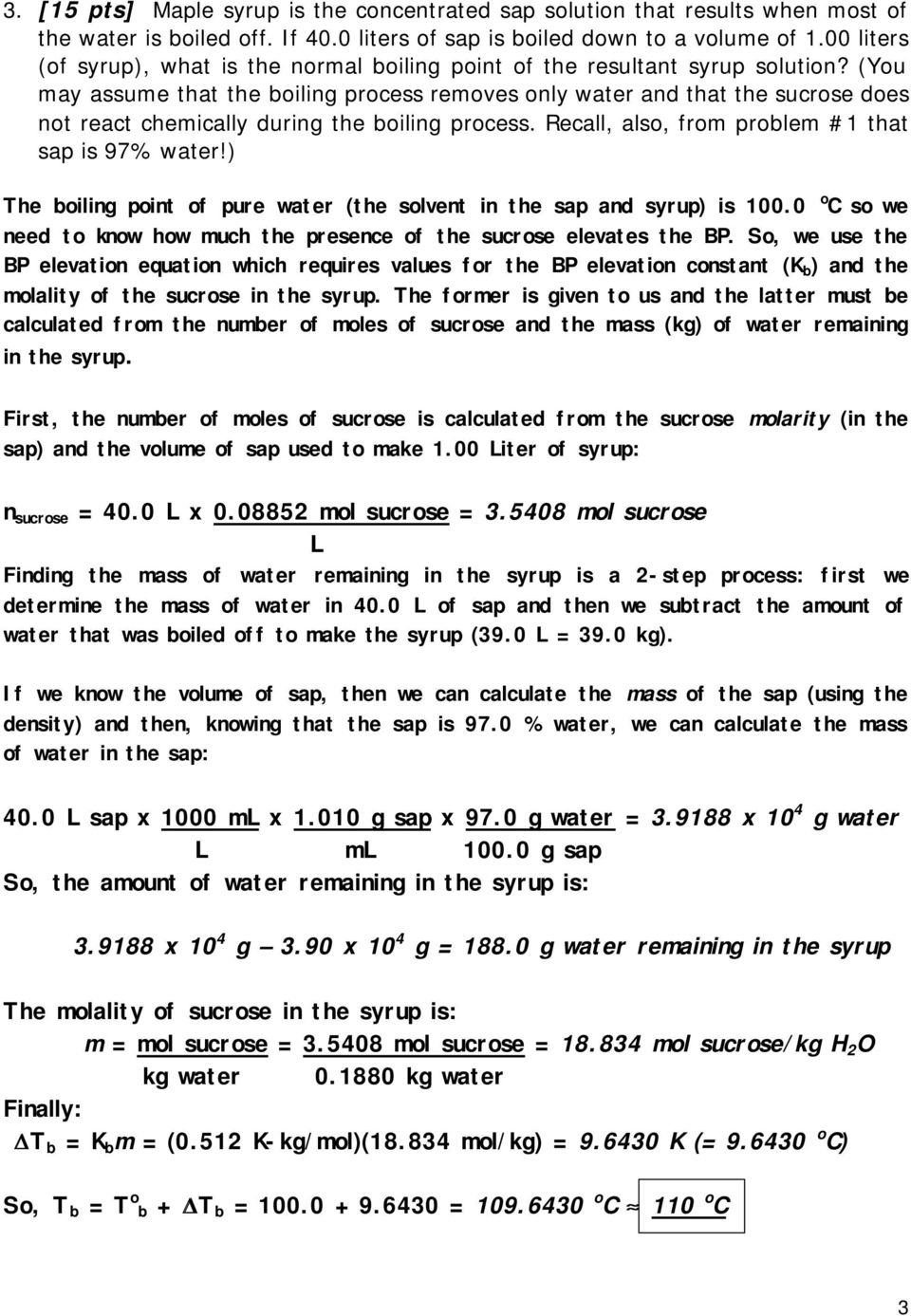
4 4. [10 pts] Arrange the following substances in order of increasing normal boiling points and explain your reasoning: He, H 2 O, Ar, KNO 3, O 2. Increasing Boiling Point He, Ar, O 2, H 2 O, KNO 3 BP and magnitude of intermolecular forces are directly correlated: He and Ar: Both noble gases, so very weak London Dispersion Forces hold them together (instantaneous dipole-induced dipole). Ar is more massive than He and more easily polarizable, so London Forces are larger. O 2 : Nonpolar, so London Forces dominate larger than for He or Ar because molecule is bigger and, thus, more easily polarizable. H 2 O: Polar and can do Hydrogen bonding (10 100x stronger than London forces) KNO 3 : Ionic bond (ion-ion interaction) about 10x stronger than H-bonding 5. [10 pts] The Henry's law constant at 25 o C for oxygen dissolved in water is 7.68 x 10 2 atm-l/mol. If the partial pressure of O 2 in the atmosphere is 0.20 atm, calculate the number of moles of O 2 dissolved in a liter of water. According to Henry s Law: P O2 = K O2 [O 2 (aq)] Solve for concentration of O 2 (aq): [O 2 (aq)] = P O2 /K O2 = 0.20 atm/7.68 x 10 2 atm-l/mol = x 10-4 mol/l So, in 1 L: 1 L x x 10-4 mol/l = 2.6 x 10⁻⁴ mol O 2 4
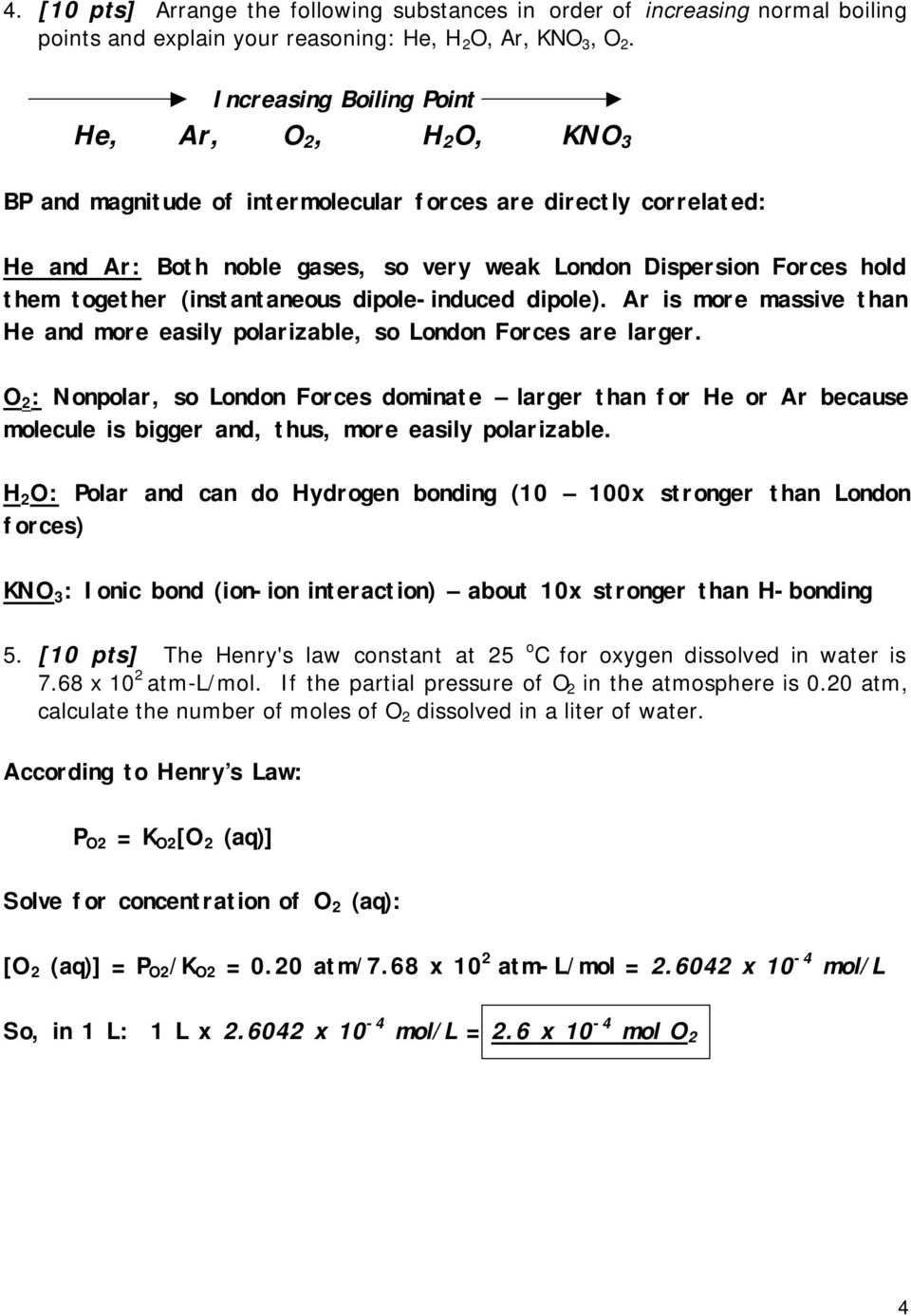
5 6. [15 pts] At 20 o C, the vapor pressure of toluene is atm and the vapor pressure of benzene is atm. Equal chemical amounts (equal number of moles) of toluene and benzene are mixed and form an ideal solution. Calculate the mole fraction of benzene and toluene in the vapor in equilibrium with this solution. We are given the following data: P o Toluene = atm c Toluene = P o Benzene = atm c Benzene = Using Raoult s Law, we can get the VP of each compound above the solution: P Toluene = c Toluene P o Toluene = (0.500)( atm) = atm P Benzene = c Benzene P o Benzene = (0.500)( atm) = atm So, in the vapor, we can calculate the mole fraction for each compound by calculating the vapor pressure fraction: c Benzene = P Benzene /(P Toluene + P Benzene ) = atm/( atm atm) c Benzene = / = = = c Benzene c Toluene = 1 - c Benzene = = = = c Toluene 7. [10 pts] Benzene and toluene are both mainly non-polar compounds. If instead of toluene, an equivalent chemical amount of a polar compound like benzoic acid were dissolved in benzene, how would you expect the partial pressure of benzene above the solution to deviate from the partial pressure of benzene above an ideal solution (if at all)? Explain. Raoult s Law holds for an Ideal Solution: P Benzene = c Benzene P o Benzene Adding a polar compound to a non-polar solvent will result in an increased intermolecular attraction between the (polar) solute and the (non-polar) solvent relative to the intermolecular attraction between a non-polar solute and the non-polar solvent. This will reduce P Benzene, giving a negative deviation to Raoult s Law. 5
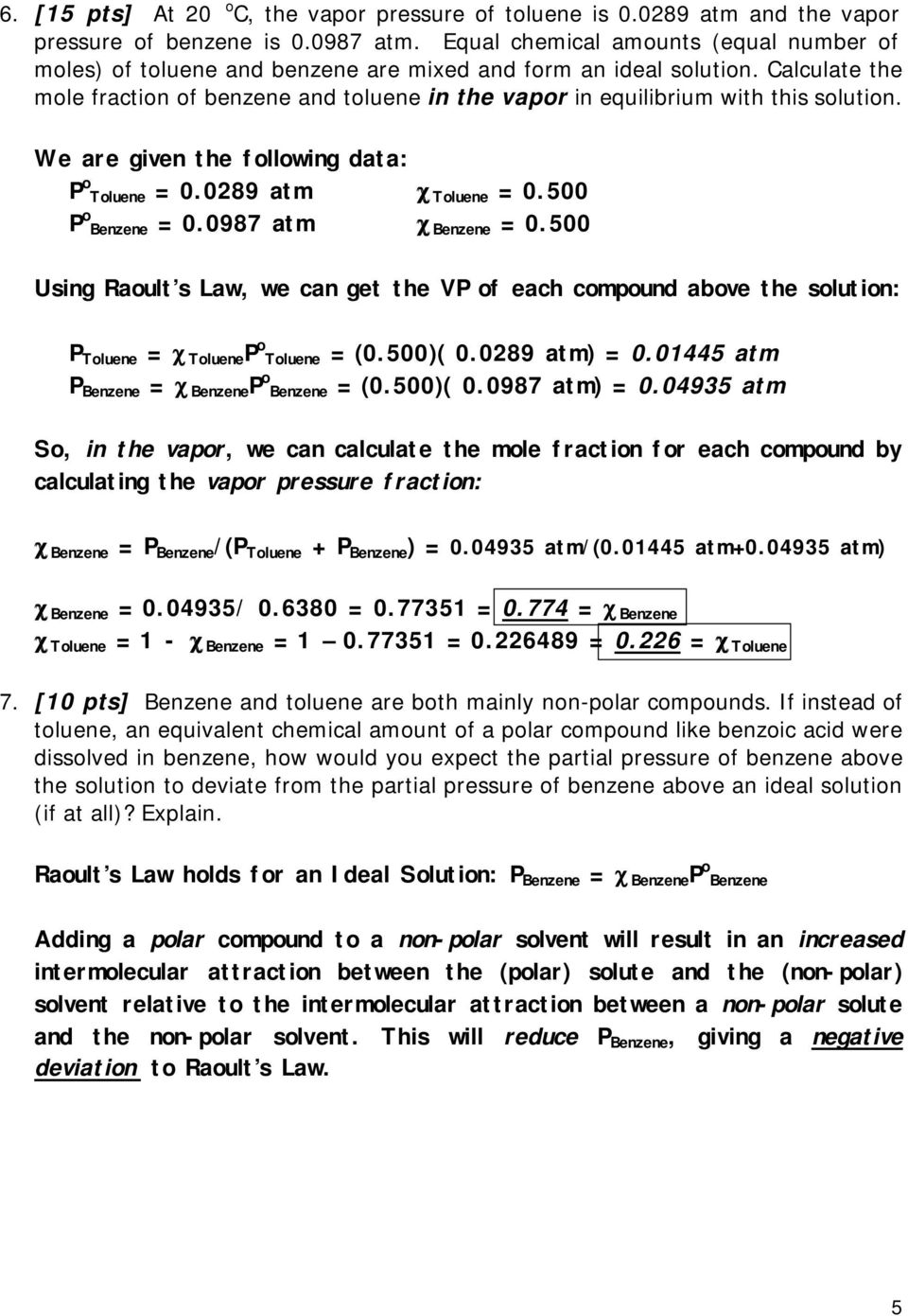
6 8. [15 pts] Mercury is the only metallic element that is a liquid at room temperature. Calculate the boiling point of mercury ( o C). Some thermodynamic data that you might find helpful: H o f [Hg(g)] = kj/mol S o [Hg(l)] = 75.9 J/mol-K S o [Hg(g)] = J/mol-K First, let s write the equation for the vaporization of mercury: Hg (l) Hg (g) We need values for DH o vap and DS o vap: DH o vap = DH o f [Hg (g)] - DH o f [Hg (l)] = kj/mol 0 = kj DS o vap = S o [Hg (g)] - S o [Hg (l)] = J/mol-K 75.9 J/mol-K = 99.1 J/K Ok, invoking Gibbs-Helmholtz: DG o = DH o vap - T b DS o vap For a system in equilibrium: DG o = 0 0 = DH o vap - T b DS o vap Solving for T b : T b = DH o vap/ds o vap = x 10 3 J/99.1 J/K = K Converting to Celsius: T b = K K = o C = 346. o C 6
![0 J/mol-K First, let s write the equation for the vaporization of mercury: Hg (l) Hg (g) We need values for DH o vap and DS o vap: DH o vap = DH o f [Hg (g)] - DH o f [Hg (l)] = 61.40 kj/mol 0 = 61.](/docs-images/46/21118735/images/page_6.jpg "40 kj DS o vap = S o [Hg (g)] - S o [Hg (l)] = 175.0 J/mol-K 75.9 J/mol-K = 99.")
7 Ammonium nitrate can decompose to form dinitrogen oxide: NH 4 NO 3 (s) N 2 O (g) + 2H 2 O (g) Some thermodynamic data that you might find helpful: Compound DH o f (kj/mol) DG o f (kj/mol) NH 4 NO 3 (s) N 2 O (g) H 2 O (g) a. [10 pts] Using the thermodynamic data provided, calculate the standard molar enthalpy change ( H o ) for this reaction. DH o = [DH o f (N 2 O) + 2DH o f (H 2 O)] - DH o f (NH 4 NO 3 ) = [82.1 kj/mol + 2( kj/mol)] ( kj/mol) = kj kj = kj b. [5 pts] Based on the H o rxn that you calculated above, is this process exothermic or endothermic? exothermic endothermic (Circle One) c. [10 pts] Calculate the change in standard molar free energy ( G o ) at 25 o C for this process. DG o = [DG o f (N 2 O) + 2DG o f (H 2 O)] - DG o f (NH 4 NO 3 ) = [104.2 kj/mol + 2( kj/mol)] ( kj/mol) = kj kj = kj d. [5 pts] Based on the G o rxn calculated in part c, is this reaction spontaneous process at 25 o C? spontaneous not spontaneous (Circle One) 7
![DH o = [DH o f (N 2 O) + 2DH o f (H 2 O)] - DH o f (NH 4 NO 3 ) = [82.1 kj/mol + 2(-241.8 kj/mol)] (-365.6 kj/mol) = -401.50 kj + 365.6 kj = -35.9 kj b.](/docs-images/46/21118735/images/page_7.jpg "[5 pts] Based on the H o rxn that you calculated above, is this process exothermic or endothermic? exothermic endothermic (Circle One) c.")
8 e. [5 pts] Would you expect S o for this reaction to be positive or negative? (Don't do any calculations! Base your answer only on inspection of the reaction equation.) Briefly explain. positive negative (Circle One) Reactants are solid and the products are both gases, so the volume occupied by the compounds increases tremendously when going from reactants to products greater volume means more microstates which translates to greater entropy. f. [10 pts] Now, using the thermodynamic data provided, calculate the standard molar entropy change ( S o ) for this reaction. Invoking Gibbs-Helmholtz: DG o = DH o - TDS o Solving for DS o : DS o = DH o - DG o = x 10 3 J ( x 10 3 J) = J/K T K Rounding: DS o = J/K g. [10 pts] Over what range of temperature (if any) is this reaction spontaneous? Well, recall that DH o is negative and DS o is positive; for an exothermic process that results in an increase in entropy of the system, DG is always negative: DG = DH o - TDS o So, the reaction will be spontaneous at ALL temperatures! 8
![means more microstates which translates to greater entropy. f. [10 pts] Now, using the thermodynamic data provided, calculate the standard molar entropy change ( S o ) for this reaction.](/docs-images/46/21118735/images/page_8.jpg "Invoking Gibbs-Helmholtz: DG o = DH o - TDS o Solving for DS o : DS o = DH o - DG o = -35.9 x 10 3 J (-169.1 x 10 3 J) = 446.755 J/K T 298.15 K Rounding: DS o = 446.8 J/K g.")
9 Extra Credit! -- 5 pts You take a bottle of a soft drink out of your refrigerator. The contents are liquid and stay liquid, even when you shake them. Thirsty, you remove the cap, and the liquid freezes solid! Offer a possible explanation for this observation. Gosh, that refrigerator must be cold! If the soft drink is cooled to a temperature that is below the FP of pure water, then the dissolved CO 2 could lower the FP of the soft drink so that it was still a liquid if the temperature was above the FP of the solution. When the bottle is opened, however, the dissolved CO 2 bubbles out of solution, decreasing the concentration of dissolved gas, and raising the FP of the solution. If the FP is raised to a temperature that is greater than the temperature of the solution, then it will freeze. 9
Chapter 13. Properties of Solutions
 Sample Exercise 13.1 (p. 534) By the process illustrated below, water vapor reacts with excess solid sodium sulfate to form the hydrated form of the salt. The chemical reaction is Na 2 SO 4(s) + 10 H 2
Solutions. Chapter 13. Properties of Solutions. Lecture Presentation
 Lecture Presentation Chapter 13 Properties of Yonsei University homogeneous mixtures of two or more pure substances: may be gases, liquids, or solids In a solution, the solute is dispersed uniformly throughout
13.3 Factors Affecting Solubility Solute-Solvent Interactions Pressure Effects Temperature Effects
 Week 3 Sections 13.3-13.5 13.3 Factors Affecting Solubility Solute-Solvent Interactions Pressure Effects Temperature Effects 13.4 Ways of Expressing Concentration Mass Percentage, ppm, and ppb Mole Fraction,
48 Practice Problems for Ch. 17 - Chem 1C - Joseph
 48 Practice Problems for Ch. 17 - Chem 1C - Joseph 1. Which of the following concentration measures will change in value as the temperature of a solution changes? A) mass percent B) mole fraction C) molality
Name Class Date. In the space provided, write the letter of the term or phrase that best completes each statement or best answers each question.
 Assessment Chapter Test A Chapter: States of Matter In the space provided, write the letter of the term or phrase that best completes each statement or best answers each question. 1. The kinetic-molecular
Sample Test 1 SAMPLE TEST 1. CHAPTER 12
 13 Sample Test 1 SAMPLE TEST 1. CHAPTER 12 1. The molality of a solution is defined as a. moles of solute per liter of solution. b. grams of solute per liter of solution. c. moles of solute per kilogram
ESSAY. Write your answer in the space provided or on a separate sheet of paper.
 Test 1 General Chemistry CH116 Summer, 2012 University of Massachusetts, Boston Name ESSAY. Write your answer in the space provided or on a separate sheet of paper. 1) Sodium hydride reacts with excess
PV (0.775 atm)(0.0854 L) n = = = 0.00264 mol RT -1-1
 catalyst 2 5 g ¾¾¾¾ 2 4 g 2 g DH298 = rxn DS298 C H OH( ) C H ( ) + H O( ) 45.5 kj/mol ; = 126 J/(K mol ) ethanol ethene water rxn 1 atm 760 torr PV (0.775 atm)(0.0854 L) n = = = 0.00264 mol RT -1-1 (0.08206
Chapter 13 Properties of Solutions
 Chemistry, The Central Science, 10th edition Theodore L. Brown; H. Eugene LeMay, Jr.; and Bruce E. Bursten Chapter 13 Properties of are homogeneous mixtures of two or more pure substances. In a solution,
MULTIPLE CHOICE. Choose the one alternative that best completes the statement or answers the question.
 A.P. Chemistry Practice Test: Ch. 11, Solutions Name MULTIPLE CHOICE. Choose the one alternative that best completes the statement or answers the question. 1) Formation of solutions where the process is
CHEM 105 HOUR EXAM III 28-OCT-99. = -163 kj/mole determine H f 0 for Ni(CO) 4 (g) = -260 kj/mole determine H f 0 for Cr(CO) 6 (g)
 CHEM 15 HOUR EXAM III 28-OCT-99 NAME (please print) 1. a. given: Ni (s) + 4 CO (g) = Ni(CO) 4 (g) H Rxn = -163 k/mole determine H f for Ni(CO) 4 (g) b. given: Cr (s) + 6 CO (g) = Cr(CO) 6 (g) H Rxn = -26
Why? Intermolecular Forces. Intermolecular Forces. Chapter 12 IM Forces and Liquids. Covalent Bonding Forces for Comparison of Magnitude
 1 Why? Chapter 1 Intermolecular Forces and Liquids Why is water usually a liquid and not a gas? Why does liquid water boil at such a high temperature for such a small molecule? Why does ice float on water?
vap H = RT 1T 2 = 30.850 kj mol 1 100 kpa = 341 K
 Thermodynamics: Examples for chapter 6. 1. The boiling point of hexane at 1 atm is 68.7 C. What is the boiling point at 1 bar? The vapor pressure of hexane at 49.6 C is 53.32 kpa. Assume that the vapor
Chapter 11 Properties of Solutions
 Chapter 11 Properties of Solutions 11.1 Solution Composition A. Molarity moles solute 1. Molarity ( M ) = liters of solution B. Mass Percent mass of solute 1. Mass percent = 1 mass of solution C. Mole
States of Matter CHAPTER 10 REVIEW SECTION 1. Name Date Class. Answer the following questions in the space provided.
 CHAPTER 10 REVIEW States of Matter SECTION 1 SHORT ANSWER Answer the following questions in the space provided. 1. Identify whether the descriptions below describe an ideal gas or a real gas. ideal gas
CHEM 120 Online Chapter 7
 CHEM 120 Online Chapter 7 Date: 1. Which of the following statements is not a part of kinetic molecular theory? A) Matter is composed of particles that are in constant motion. B) Particle velocity increases
2. Why does the solubility of alcohols decrease with increased carbon chain length?
 Colligative properties 1 1. What does the phrase like dissolves like mean. 2. Why does the solubility of alcohols decrease with increased carbon chain length? Alcohol in water (mol/100g water) Methanol
EXERCISES. 16. What is the ionic strength in a solution containing NaCl in c=0.14 mol/dm 3 concentration and Na 3 PO 4 in 0.21 mol/dm 3 concentration?
 EXERISES 1. The standard enthalpy of reaction is 512 kj/mol and the standard entropy of reaction is 1.60 kj/(k mol) for the denaturalization of a certain protein. Determine the temperature range where
Exam 4 Practice Problems false false
 Exam 4 Practice Problems 1 1. Which of the following statements is false? a. Condensed states have much higher densities than gases. b. Molecules are very far apart in gases and closer together in liquids
Bomb Calorimetry. Example 4. Energy and Enthalpy
 Bomb Calorimetry constant volume often used for combustion reactions heat released by reaction is absorbed by calorimeter contents need heat capacity of calorimeter q cal = q rxn = q bomb + q water Example
Intermolecular Forces
 Intermolecular Forces: Introduction Intermolecular Forces Forces between separate molecules and dissolved ions (not bonds) Van der Waals Forces 15% as strong as covalent or ionic bonds Chapter 11 Intermolecular
Chapter 18 Homework Answers
 Chapter 18 Homework Answers 18.22. 18.24. 18.26. a. Since G RT lnk, as long as the temperature remains constant, the value of G also remains constant. b. In this case, G G + RT lnq. Since the reaction
5. Which temperature is equal to +20 K? 1) 253ºC 2) 293ºC 3) 253 C 4) 293 C
 1. The average kinetic energy of water molecules increases when 1) H 2 O(s) changes to H 2 O( ) at 0ºC 3) H 2 O( ) at 10ºC changes to H 2 O( ) at 20ºC 2) H 2 O( ) changes to H 2 O(s) at 0ºC 4) H 2 O( )
The first law: transformation of energy into heat and work. Chemical reactions can be used to provide heat and for doing work.
 The first law: transformation of energy into heat and work Chemical reactions can be used to provide heat and for doing work. Compare fuel value of different compounds. What drives these reactions to proceed
Chemistry 151 Final Exam
 Chemistry 151 Final Exam Name: SSN: Exam Rules & Guidelines Show your work. No credit will be given for an answer unless your work is shown. Indicate your answer with a box or a circle. All paperwork must
David A. Katz Department of Chemistry Pima Community College
 Solutions David A. Katz Department of Chemistry Pima Community College A solution is a HOMOGENEOUS mixture of 2 or more substances in a single phase. One constituent t is usually regarded as the SOLVENT
Chemistry Ch 15 (Solutions) Study Guide Introduction
 Chemistry Ch 15 (Solutions) Study Guide Introduction Name: Note: a word marked (?) is a vocabulary word you should know the meaning of. A homogeneous (?) mixture, or, is a mixture in which the individual
Phase diagram of water. Note: for H 2 O melting point decreases with increasing pressure, for CO 2 melting point increases with increasing pressure.
 Phase diagram of water Note: for H 2 O melting point decreases with increasing pressure, for CO 2 melting point increases with increasing pressure. WATER Covers ~ 70% of the earth s surface Life on earth
Chem 31 Fall 2002. Chapter 3. Stoichiometry: Calculations with Chemical Formulas and Equations. Writing and Balancing Chemical Equations
 Chem 31 Fall 2002 Chapter 3 Stoichiometry: Calculations with Chemical Formulas and Equations Writing and Balancing Chemical Equations 1. Write Equation in Words -you cannot write an equation unless you
Thermodynamics Worksheet I also highly recommend Worksheets 13 and 14 in the Lab Manual
 Thermodynamics Worksheet I also highly recommend Worksheets 13 and 14 in the Lab Manual 1. Predict the sign of entropy change in the following processes a) The process of carbonating water to make a soda
CHEMISTRY. Matter and Change. Section 13.1 Section 13.2 Section 13.3. The Gas Laws The Ideal Gas Law Gas Stoichiometry
 CHEMISTRY Matter and Change 13 Table Of Contents Chapter 13: Gases Section 13.1 Section 13.2 Section 13.3 The Gas Laws The Ideal Gas Law Gas Stoichiometry State the relationships among pressure, temperature,
Chemistry B11 Chapter 4 Chemical reactions
 Chemistry B11 Chapter 4 Chemical reactions Chemical reactions are classified into five groups: A + B AB Synthesis reactions (Combination) H + O H O AB A + B Decomposition reactions (Analysis) NaCl Na +Cl
Chapter 13: Properties of Solutions
 Chapter 13: Properties of Solutions Problems: 9-10, 13-17, 21-42, 44, 49-60, 71-72, 73 (a,c), 77-79, 84(a-c), 91 solution: homogeneous mixture of a solute dissolved in a solvent solute: solvent: component(s)
Final Exam CHM 3410, Dr. Mebel, Fall 2005
 Final Exam CHM 3410, Dr. Mebel, Fall 2005 1. At -31.2 C, pure propane and n-butane have vapor pressures of 1200 and 200 Torr, respectively. (a) Calculate the mole fraction of propane in the liquid mixture
1. Thermite reaction 2. Enthalpy of reaction, H 3. Heating/cooling curves and changes in state 4. More thermite thermodynamics
 Chem 105 Fri 10-23-09 1. Thermite reaction 2. Enthalpy of reaction, H 3. Heating/cooling curves and changes in state 4. More thermite thermodynamics 10/23/2009 1 Please PICK UP your graded EXAM in front.
FORMA is EXAM I, VERSION 1 (v1) Name
 FORMA is EXAM I, VERSION 1 (v1) Name 1. DO NOT TURN THIS PAGE UNTIL DIRECTED TO DO SO. 2. These tests are machine graded; therefore, be sure to use a No. 1 or 2 pencil for marking the answer sheets. 3.
Unit 3 Notepack Chapter 7 Chemical Quantities Qualifier for Test
 Unit 3 Notepack Chapter 7 Chemical Quantities Qualifier for Test NAME Section 7.1 The Mole: A Measurement of Matter A. What is a mole? 1. Chemistry is a quantitative science. What does this term mean?
Thermodynamics. Thermodynamics 1
 Thermodynamics 1 Thermodynamics Some Important Topics First Law of Thermodynamics Internal Energy U ( or E) Enthalpy H Second Law of Thermodynamics Entropy S Third law of Thermodynamics Absolute Entropy
Colligative Properties
 CH302 LaBrake and Vanden Bout Colligative Properties PROBLEM #1: Give the molecular formula, the van t hoff factor for the following Ionic Compounds as well as guess the solubility of the compounds. If
Chemistry 110 Lecture Unit 5 Chapter 11-GASES
 Chemistry 110 Lecture Unit 5 Chapter 11-GASES I. PROPERITIES OF GASES A. Gases have an indefinite shape. B. Gases have a low density C. Gases are very compressible D. Gases exert pressure equally in all
Solution concentration = how much solute dissolved in solvent
 Solutions 1 Solutions Concentration Solution concentration = how much solute dissolved in solvent Coffee crystal = solute Water = solvent Liquid Coffee = solution so a solute is dissolved in solvent to
CHEMISTRY STANDARDS BASED RUBRIC ATOMIC STRUCTURE AND BONDING
 CHEMISTRY STANDARDS BASED RUBRIC ATOMIC STRUCTURE AND BONDING Essential Standard: STUDENTS WILL UNDERSTAND THAT THE PROPERTIES OF MATTER AND THEIR INTERACTIONS ARE A CONSEQUENCE OF THE STRUCTURE OF MATTER,
Other Stoich Calculations A. mole mass (mass mole) calculations. GIVEN mol A x CE mol B. PT g A CE mol A MOLE MASS :
 Chem. I Notes Ch. 12, part 2 Using Moles NOTE: Vocabulary terms are in boldface and underlined. Supporting details are in italics. 1 MOLE = 6.02 x 10 23 representative particles (representative particles
10.7 Kinetic Molecular Theory. 10.7 Kinetic Molecular Theory. Kinetic Molecular Theory. Kinetic Molecular Theory. Kinetic Molecular Theory
 Week lectures--tentative 0.7 Kinetic-Molecular Theory 40 Application to the Gas Laws 0.8 Molecular Effusion and Diffusion 43 Graham's Law of Effusion Diffusion and Mean Free Path 0.9 Real Gases: Deviations
Enthalpy of Reaction and Calorimetry worksheet
 Enthalpy of Reaction and Calorimetry worksheet 1. Calcium carbonate decomposes at high temperature to form carbon dioxide and calcium oxide, calculate the enthalpy of reaction. CaCO 3 CO 2 + CaO 2. Carbon
Thermodynamics and Equilibrium
 Chapter 19 Thermodynamics and Equilibrium Concept Check 19.1 You have a sample of 1.0 mg of solid iodine at room temperature. Later, you notice that the iodine has sublimed (passed into the vapor state).
Thermochemistry. r2 d:\files\courses\1110-20\99heat&thermorans.doc. Ron Robertson
 Thermochemistry r2 d:\files\courses\1110-20\99heat&thermorans.doc Ron Robertson I. What is Energy? A. Energy is a property of matter that allows work to be done B. Potential and Kinetic Potential energy
Chemistry 1050 Chapter 13 LIQUIDS AND SOLIDS 1. Exercises: 25, 27, 33, 39, 41, 43, 51, 53, 57, 61, 63, 67, 69, 71(a), 73, 75, 79
 Chemistry 1050 Chapter 13 LIQUIDS AND SOLIDS 1 Text: Petrucci, Harwood, Herring 8 th Edition Suggest text problems Review questions: 1, 5!11, 13!17, 19!23 Exercises: 25, 27, 33, 39, 41, 43, 51, 53, 57,
EXPERIMENT 12: Empirical Formula of a Compound
 EXPERIMENT 12: Empirical Formula of a Compound INTRODUCTION Chemical formulas indicate the composition of compounds. A formula that gives only the simplest ratio of the relative number of atoms in a compound
Final Exam Review. I normalize your final exam score out of 70 to a score out of 150. This score out of 150 is included in your final course total.
 Final Exam Review Information Your ACS standardized final exam is a comprehensive, 70 question multiple choice (a d) test featuring material from BOTH the CHM 101 and 102 syllabi. Questions are graded
Boyle s law - For calculating changes in pressure or volume: P 1 V 1 = P 2 V 2. Charles law - For calculating temperature or volume changes: V 1 T 1
 Common Equations Used in Chemistry Equation for density: d= m v Converting F to C: C = ( F - 32) x 5 9 Converting C to F: F = C x 9 5 + 32 Converting C to K: K = ( C + 273.15) n x molar mass of element
Chapter 14 Solutions
 Chapter 14 Solutions 1 14.1 General properties of solutions solution a system in which one or more substances are homogeneously mixed or dissolved in another substance two components in a solution: solute
4. Using the data from Handout 5, what is the standard enthalpy of formation of BaO (s)? What does this mean?
 HOMEWORK 3A 1. In each of the following pairs, tell which has the higher entropy. (a) One mole of liquid water or one mole of water vapor (b) One mole of dry ice or one mole of carbon dioxide at 1 atm
11 Thermodynamics and Thermochemistry
 Copyright ç 1996 Richard Hochstim. All rights reserved. Terms of use.» 37 11 Thermodynamics and Thermochemistry Thermodynamics is the study of heat, and how heat can be interconverted into other energy
Chapter 6 Thermodynamics: The First Law
 Key Concepts 6.1 Systems Chapter 6 Thermodynamics: The First Law Systems, States, and Energy (Sections 6.1 6.8) thermodynamics, statistical thermodynamics, system, surroundings, open system, closed system,
MULTIPLE CHOICE. Choose the one alternative that best completes the statement or answers the question.
 General Chemistry PHS 1015 Practice Exam 4 Name MULTIPLE CHOICE. Choose the one alternative that best completes the statement or answers the question. 1) Which of the following statements about pressure
MULTIPLE CHOICE. Choose the one alternative that best completes the statement or answers the question.
 Exam Name MULTIPLE CHOICE. Choose the one alternative that best completes the statement or answers the question. 1) Given: 4 NO2(g) + O2(g) 2 N2O5(g) ΔH = -110.2 kj find ΔH for N2O5(g) 2 NO2(g) + 1/2 O2(g).
Liquid phase. Balance equation Moles A Stoic. coefficient. Aqueous phase
 STOICHIOMETRY Objective The purpose of this exercise is to give you some practice on some Stoichiometry calculations. Discussion The molecular mass of a compound is the sum of the atomic masses of all
Answer Key Chemistry If8766 Moles And Mass
 If8766 Moles And Mass Free PDF ebook Download: If8766 Moles And Mass Download or Read Online ebook answer key chemistry if8766 moles and mass in PDF Format From The Best User Guide Database Moles and Mass.
Spring 2009. kj mol 125 0-229 -92. H f. H rxn = Σ H f (products) - Σ H f (reactants)
 Spring 2009 2. The reaction of an elemental halogen with an alkane is a very common reaction. The reaction between chlorine and butane is provided below. (NOTE: Questions a d and f pertain to this reaction.)
Chapter 10. Can You... 1. draw the Lewis structure for a given covalently bonded molecule?
 Chapter 10 Can You... 1. draw the Lewis structure for a given covalently bonded molecule? e.g. SF 6 and CH 3 Cl 2. identify and count the number of non-bonding and bonding domains within a given covalently
The Gas Laws. Our Atmosphere. Pressure = Units of Pressure. Barometer. Chapter 10
 Our Atmosphere The Gas Laws 99% N 2 and O 2 78% N 2 80 70 Nitrogen Chapter 10 21% O 2 1% CO 2 and the Noble Gases 60 50 40 Oxygen 30 20 10 0 Gas Carbon dioxide and Noble Gases Pressure Pressure = Force
Standard Free Energies of Formation at 298 K. Average Bond Dissociation Energies at 298 K
 1 Thermodynamics There always seems to be at least one free response question that involves thermodynamics. These types of question also show up in the multiple choice questions. G, S, and H. Know what
10. Calculate the mass percent nitrogen in (NH 4 ) 2 CO 3 (molar mass = 96.09 g/mol). a. 29.1 % c. 17.9 % e. 14.6 % b. 35.9 % d. 0.292 % f. 96.
 Chem 171-2-3: Final Exam Review Multiple Choice Problems 1. What is the molar mass of barium perchlorate, Ba(ClO 4 ) 2? a. 189.90 g/mol c. 272.24 g/mol e. 336.20 g/mol b. 240.24 g/mol d. 304.24 g/mol f.
Chem 1A Exam 2 Review Problems
 Chem 1A Exam 2 Review Problems 1. At 0.967 atm, the height of mercury in a barometer is 0.735 m. If the mercury were replaced with water, what height of water (in meters) would be supported at this pressure?
Thermodynamics of Mixing
 Thermodynamics of Mixing Dependence of Gibbs energy on mixture composition is G = n A µ A + n B µ B and at constant T and p, systems tend towards a lower Gibbs energy The simplest example of mixing: What
What s in a Mole? Molar Mass
 LESSON 10 What s in a Mole? Molar Mass OVERVIEW Key Ideas Lesson Type Lab: Groups of 4 Chemists compare moles of substances rather than masses because moles are a way of counting atoms. When considering
Chem 112 Intermolecular Forces Chang From the book (10, 12, 14, 16, 18, 20,84,92,94,102,104, 108, 112, 114, 118 and 134)
 Chem 112 Intermolecular Forces Chang From the book (10, 12, 14, 16, 18, 20,84,92,94,102,104, 108, 112, 114, 118 and 134) 1. Helium atoms do not combine to form He 2 molecules, What is the strongest attractive
87 16 70 20 58 24 44 32 35 40 29 48 (a) graph Y versus X (b) graph Y versus 1/X
 HOMEWORK 5A Barometer; Boyle s Law 1. The pressure of the first two gases below is determined with a manometer that is filled with mercury (density = 13.6 g/ml). The pressure of the last two gases below
Energy and Chemical Reactions. Characterizing Energy:
 Energy and Chemical Reactions Energy: Critical for virtually all aspects of chemistry Defined as: We focus on energy transfer. We observe energy changes in: Heat Transfer: How much energy can a material
Thermodynamics. Chapter 13 Phase Diagrams. NC State University
 Thermodynamics Chapter 13 Phase Diagrams NC State University Pressure (atm) Definition of a phase diagram A phase diagram is a representation of the states of matter, solid, liquid, or gas as a function
CP Chemistry Review for Stoichiometry Test
 CP Chemistry Review for Stoichiometry Test Stoichiometry Problems (one given reactant): 1. Make sure you have a balanced chemical equation 2. Convert to moles of the known substance. (Use the periodic
CHAPTER 10: INTERMOLECULAR FORCES: THE UNIQUENESS OF WATER Problems: 10.2, 10.6,10.15-10.33, 10.35-10.40, 10.56-10.60, 10.101-10.
 CHAPTER 10: INTERMOLECULAR FORCES: THE UNIQUENESS OF WATER Problems: 10.2, 10.6,10.15-10.33, 10.35-10.40, 10.56-10.60, 10.101-10.102 10.1 INTERACTIONS BETWEEN IONS Ion-ion Interactions and Lattice Energy
AP Chemistry 2009 Scoring Guidelines
 AP Chemistry 2009 Scoring Guidelines The College Board The College Board is a not-for-profit membership association whose mission is to connect students to college success and opportunity. Founded in 1900,
Unit 19 Practice. Name: Class: Date: Multiple Choice Identify the choice that best completes the statement or answers the question.
 Name: Class: Date: Unit 19 Practice Multiple Choice Identify the choice that best completes the statement or answers the question. 1) The first law of thermodynamics can be given as. A) E = q + w B) =
AP CHEMISTRY 2009 SCORING GUIDELINES (Form B)
 AP CHEMISTRY 2009 SCORING GUIDELINES (Form B) Question 3 (10 points) 2 H 2 O 2 (aq) 2 H 2 O(l) + O 2 (g) The mass of an aqueous solution of H 2 O 2 is 6.951 g. The H 2 O 2 in the solution decomposes completely
Freezing Point Depression: Why Don t Oceans Freeze? Teacher Advanced Version
 Freezing Point Depression: Why Don t Oceans Freeze? Teacher Advanced Version Freezing point depression describes the process where the temperature at which a liquid freezes is lowered by adding another
CHEMISTRY II FINAL EXAM REVIEW
 Name Period CHEMISTRY II FINAL EXAM REVIEW Final Exam: approximately 75 multiple choice questions Ch 12: Stoichiometry Ch 5 & 6: Electron Configurations & Periodic Properties Ch 7 & 8: Bonding Ch 14: Gas
UNIT 1 THERMOCHEMISTRY
 UNIT 1 THERMOCHEMISTRY THERMOCHEMISTRY LEARNING OUTCOMES Students will be expected to: THERMOCHEMISTRY STSE analyse why scientific and technological activities take place in a variety individual and group
Experiment 12E LIQUID-VAPOR EQUILIBRIUM OF WATER 1
 Experiment 12E LIQUID-VAPOR EQUILIBRIUM OF WATER 1 FV 6/26/13 MATERIALS: PURPOSE: 1000 ml tall-form beaker, 10 ml graduated cylinder, -10 to 110 o C thermometer, thermometer clamp, plastic pipet, long
Chapter 7 : Simple Mixtures
 Chapter 7 : Simple Mixtures Using the concept of chemical potential to describe the physical properties of a mixture. Outline 1)Partial Molar Quantities 2)Thermodynamics of Mixing 3)Chemical Potentials
DETERMINING THE ENTHALPY OF FORMATION OF CaCO 3
 DETERMINING THE ENTHALPY OF FORMATION OF CaCO 3 Standard Enthalpy Change Standard Enthalpy Change for a reaction, symbolized as H 0 298, is defined as The enthalpy change when the molar quantities of reactants
Chapter 13 - Solutions
 Chapter 13 - Solutions 13-1 Types of Mixtures I. Solutions A. Soluble 1. Capable of being dissolved B. Solution 1. A homogeneous mixture of two or more substances in a single phase C. Solvent 1. The dissolving
Lecture Notes: Gas Laws and Kinetic Molecular Theory (KMT).
 CHEM110 Week 9 Notes (Gas Laws) Page 1 of 7 Lecture Notes: Gas Laws and Kinetic Molecular Theory (KMT). Gases Are mostly empty space Occupy containers uniformly and completely Expand infinitely Diffuse
Exam 2 Chemistry 65 Summer 2015. Score:
 Name: Exam 2 Chemistry 65 Summer 2015 Score: Instructions: Clearly circle the one best answer 1. Valence electrons are electrons located A) in the outermost energy level of an atom. B) in the nucleus of
Honors Chemistry: Unit 6 Test Stoichiometry PRACTICE TEST ANSWER KEY Page 1. A chemical equation. (C-4.4)
 Honors Chemistry: Unit 6 Test Stoichiometry PRACTICE TEST ANSWER KEY Page 1 1. 2. 3. 4. 5. 6. Question What is a symbolic representation of a chemical reaction? What 3 things (values) is a mole of a chemical
AP CHEMISTRY 2007 SCORING GUIDELINES. Question 2
 AP CHEMISTRY 2007 SCORING GUIDELINES Question 2 N 2 (g) + 3 F 2 (g) 2 NF 3 (g) ΔH 298 = 264 kj mol 1 ; ΔS 298 = 278 J K 1 mol 1 The following questions relate to the synthesis reaction represented by the
Test Review # 9. Chemistry R: Form TR9.13A
 Chemistry R: Form TR9.13A TEST 9 REVIEW Name Date Period Test Review # 9 Collision theory. In order for a reaction to occur, particles of the reactant must collide. Not all collisions cause reactions.
stoichiometry = the numerical relationships between chemical amounts in a reaction.
 1 REACTIONS AND YIELD ANSWERS stoichiometry = the numerical relationships between chemical amounts in a reaction. 2C 8 H 18 (l) + 25O 2 16CO 2 (g) + 18H 2 O(g) From the equation, 16 moles of CO 2 (a greenhouse
Review - After School Matter Name: Review - After School Matter Tuesday, April 29, 2008
 Name: Review - After School Matter Tuesday, April 29, 2008 1. Figure 1 The graph represents the relationship between temperature and time as heat was added uniformly to a substance starting at a solid
Introductory Chemistry, 3 rd Edition Nivaldo Tro. Roy Kennedy Massachusetts Bay Community College Wellesley Hills, Maqqwertd ygoijpk[l
 Introductory Chemistry, 3 rd Edition Nivaldo Tro Quantities in Car an octane and oxygen molecules and carbon dioxide and water Chemical Reactions Roy Kennedy Massachusetts Bay Community College Wellesley
Problem Set 3 Solutions
 Chemistry 360 Dr Jean M Standard Problem Set 3 Solutions 1 (a) One mole of an ideal gas at 98 K is expanded reversibly and isothermally from 10 L to 10 L Determine the amount of work in Joules We start
IB Chemistry 1 Mole. One atom of C-12 has a mass of 12 amu. One mole of C-12 has a mass of 12 g. Grams we can use more easily.
 The Mole Atomic mass units and atoms are not convenient units to work with. The concept of the mole was invented. This was the number of atoms of carbon-12 that were needed to make 12 g of carbon. 1 mole
Chemical Equations & Stoichiometry
 Chemical Equations & Stoichiometry Chapter Goals Balance equations for simple chemical reactions. Perform stoichiometry calculations using balanced chemical equations. Understand the meaning of the term
Chapter 6 Chemical Calculations
 Chapter 6 Chemical Calculations 1 Submicroscopic Macroscopic 2 Chapter Outline 1. Formula Masses (Ch 6.1) 2. Percent Composition (supplemental material) 3. The Mole & Avogadro s Number (Ch 6.2) 4. Molar
H 2O gas: molecules are very far apart
 Non-Covalent Molecular Forces 2/27/06 3/1/06 How does this reaction occur: H 2 O (liquid) H 2 O (gas)? Add energy H 2O gas: molecules are very far apart H 2O liquid: bonding between molecules Use heat
Chemistry B11 Chapter 6 Solutions and Colloids
 Chemistry B11 Chapter 6 Solutions and Colloids Solutions: solutions have some properties: 1. The distribution of particles in a solution is uniform. Every part of the solution has exactly the same composition
5 Answers and Solutions to Text Problems
 Energy and States of Matter 5 Answers and Solutions to Text Problems 5.1 At the top of the hill, all of the energy of the car is in the form of potential energy. As it descends down the hill, potential
Chemistry 11 Some Study Materials for the Final Exam
 Chemistry 11 Some Study Materials for the Final Exam Prefix Abbreviation Exponent giga G 10 9 mega M 10 6 kilo k 10 3 hecto h 10 2 deca da 10 1 deci d 10-1 centi c 10-2 milli m 10-3 micro µ 10-6 nano n