
POSITION CONTROL OF DC SERVO MOTORS USING SOFT-CORE PROCESSOR ON FPGA TO MOVE ROBOT ARM
|
|
|
- Gyles Norman
- 9 years ago
- Views:
Transcription
1 POSITION CONTROL OF DC SERVO MOTORS USING SOFT-CORE PROCESSOR ON FPGA TO MOVE ROBOT ARM 1 A. Z. MANSOOR, 2 M. R. KHALIL, 3 O. A. JASIM 1 Asstt Prof., Department of Electrical Technical Engineering, Technical College, Mosul, Iraq 2 Asstt Prof., Department of Electrical Technical Engineering, Technical College, Mosul, Iraq 3 Msc. Student, Department of Computer Technical Engineering, Technical College, Mosul, Iraq [email protected] ABSTRACT A new method of controlling position of DC Servo motor using PicoBlaze soft-core processor on Field Programmable Gate Array (FPGA) is adopted. The soft processor is used to generate the PWM required to create motor motion and direction. The soft processor hardware system is build using VHDL, while the processor is programmed using assembly language. The type of control board used is XILINX FPGA SPARTAN-3E (XC3S500E). The system performance is debugged using chipscope technique and oscilloscope. The real time operation performance is done with five DC servo motors that are joined for testing motion of the robot arm. The results show that the position of the servo motors set was controlled efficiently. Keywords: Field Programmable Gate Array (FPGA), Soft-core processor, Very High Speed Integrated Circuit Hardware Description Language (VHDL), Pulse Width Modulation (PWM) 1. INTRODUCTION Servo motor is an Electro-mechanical device in which the electrical input signal controls the motor motion. It is designed for closed loop feedback systems. The output of the motor is coupled to a control circuit; as the motor turns, its speed and/or position are relayed to the control circuit. If the rotation of the motor is impeded for whatever reason, the feedback mechanism senses that the output of the motor is not yet in the desired location. The control circuit continues to correct the error until the motor finally reaches its proper point [1]. The input signal is pulse width modulation (PWM) in which the width of on pulse determines the position (angle) of the motor shaft and the amount of increment or decrement in the on pulse width determines the speed of rotation. The signal must be send every 20ms (50Hz). The digital control techniques have predominated over other analog counts parts. The advantages of digital controllers are: Reconfigurability, Power saving options,less external passive components,less sensitive to temperature variation and High efficiency. The available digital control hardware options include FPGA, Complex Programmable Logic Device (CPLD), Digital Signal Processor (DSP), and Micro Control Unit (MCU). Micro-processor based control scheme have the advantages of flexibility, higher reliability and lower cost, but the demanding control requirements of modern power conditioning systems will overload most general purpose micro-processors and the computing speed of microprocessor limits the use of microprocessor in complex algorithms. Present-day embedded systems use single-chip microcontrollers. Contemporary microcontrollers are available with 8-, 16- and 32-bit processing capability along with a peripheral set containing ADC, timer/counter and networks (I2C, CAN, SPI, and UART). For most applications the microcontroller-based board is adequate. For applications where there is a need to integrate custom logic for faster control and additional peripherals, the microcontroller or microprocessor board is augmented by a FPGA[2]. The FPGA is chosen because its circuit can be programmed easily in both hardware and software, Its capacity and speed compete and allow most functions in the control to be integrated on a single 99

2 chip, known as the System On Chip (SoC) design. It is compact and reliable, it is very low development costs, easy and very inexpensively to change designs. Considering all of its features, FPGA provides a good platform for controlling servo motors. In this work, FPGA used to control the motion of the robot arm that contains five DC servo motors by PicoBlaze soft-core processor that generate pulse width modulation(pwm) signals to determine the position and speed of the motors. 2. LITERATURE REVIEW Using FPGA based soft-core processor instead of a conventional architecture to control and drive high resolution motors like servos is a research area that has been receiving a considerable attention in the recent years. Soft-core processors can be used in various applications. A floating-point controller [3] and neuron-network for self-learning [4] have used original or customized PicoBlaze core for processing and controlling operation. The customizability and small size of PicoBlaze makes it an ideal soft-core processor for many applications. Controlling of DC servo motor [5], a robot hand [6], an autonomous mobile robot [7], a mobile robot[8] and an autonomous omnidirectional mobile robot [9] have used softcore processor in the FPGA device for controlling operation. In this paper we proposed a controlling method of DC servo motors using PicoBlaze softcore processor to move a robot arm in an efficient and accurate manner that saves the area of the FPGA device resources. core) and can be synthesized along with other logic. PicoBlaze is optimized for efficiency and occupies only about 96 slices, which amount 2% of the resources in Spartan-3E (XC3S500E). It is compact and flexible and can be used for simple data processing and control, particularly for non-timecritical house-keeping and I/O operations. The PicoBlaze processor can be easily integrated into a larger system and adds another dimension of flexibility in an FPGA-based design [10]. Many tasks can be done by either a customized hardware (VHDL) or a processor. The tradeoff is between the hardware complexity, performance and ease of development. There is no exact rule on which one to choose. Because developing software is usually easier than creating customized hardware, the processor option is generally preferable for non time critical applications. We can determine the feasibility of this option by examining the computation complexity. PicoBlaze requires two clock cycles to complete an instruction. If the system clock is 50 MHz, 25 million instructions can be performed in one second [10]. 5. HARDWARE DESIGN The PicoBlaze processor is fully designed by VHDL. It consists of KCPSM3 and single block RAM. Figure.1 illustrates the block diagram of picoblaze processor. 3. SERVO MOTORS The type of DC servo motors used in this work is Hitec DC servo motors, five motors were used. The motors rotate to a limit up to 180 degree only in both clockwise and counterclockwise direction that is sufficient for robot arm free motion. These motors are more suitable for robot applications because of step accuracy, small size, light weight and high torque. 4. PICOBLAZE SOFT-CORE PROCESSOR In this work a PicoBlaze soft-core processor that is a compact 8-bit soft core processor for Xilinx FPGA devices is used. It is provided as a celllevel HDL description (which is known as soft Figure 1. Block Diagram of PicoBlaze Processor with Single 1Kx18 Block RAM as the Instruction Store The KCPSM3 is 8-bit processor connected together with single block RAM that is used to form a ROM store for a program of up to 1024 instructions [11]. 100

3 Figure.2 illustrates the hardware design. The input and output decoders are designed outside the processor using VHDL language to check the port address, read strobe signal and write strobe signal are coming from the processor to determine the input and output port. Movement (1º) = 2ms/180º = ms ( µs) Figure 3. Timing Constraints of The Control Signal 7. SOFTWARE SPEED CONTROL Figure 2. Block Diagram of FPGA Hardware Design and Overall Work The interrupt control circuit is designed to interrupt the PicoBlaze. This circuit contains up counter to count from 0 to 499 and comparator to compare the counter value with 499,so this will interrupt the PicoBlaze every 500 clock. Since the system clock is 50MHz, this means that the interrupt occur every 10µs. Interrupt period = Max. counter value/system clock Speed is measurement of the time that the servo take to rotate a certain number of degrees. It is specified in degree/second. The software speed control of the servo motor is determined by the amount of increment or decrement of an on pulse (logic high) between current on pulse and next on pulse. If the amount of increment or decrement is too small (1µs = 0.09º), the motor will rotate very slow at minimum speed,and if the amount of increment or decrement is too large (equal to the amount of desired position), the motor will rotate at maximum speed. 6. SOFTWARE POSITION CONTROL The controller must generate a continuous pulse width modulation(pwm) for the DC servo motor at 20ms (50 Hz). The duration of the on pulse (logic high) determines the position of the servo shaft, the range of duration between 0.5ms (0º) and 2.5ms (180º). A short on pulse (0.5ms) moves the servo to the far left, while a long on pulse (2.5ms) moves the servo to the far right. Intermediate length pulses (1.5ms) correspond to intermediate positions. Figure.3 illustrates the timing constraints of the control signal. Since the rotation limits to 180º and the duration range is 2ms (2.5ms 0.5ms=2ms), so the amount of movement for each one degree equal ms ( µs). 8. SOFTWARE PROGRAM The PicoBlaze processor is programmed using assembly language that make it very easy and flexible for development. The instructions are stored in the single block RAM 1KX18. Because the processor execute the instructions sequentially and the PWM requires continuous pulses, interrupt should be used to generate continuous pulses. The resolution of PWM is 16-bit because interrupt event occur every 10µs and the total pulse repeated every 20ms (50Hz) so the software counter should has a value of 2000 (7D0H) that is 16-bit. software counter = 20ms/10µs=2000 If the interrupt occurs every 1µs, this means that the processor should execute both interrupt service routine (ISR) and main program in 1µs for each. 101

4 Because PicoBlaze execute each instruction in 2 clock cycle and the system clock is 50MHz, so in 1µs it can execute 25 instructions only and this is too little. To control five servo motors to move the arm freely we need about ( ) instructions to be executed. Execution of 250 instructions need 500 clock, so the interrupt should occur at least every 500 clock that mean 10 µs. This is sufficient resolution for our work. Figure.4 illustrates a flow chart of the software program. As it was mentioned, the minimum speed at 1µs(0.09º). so at 10 µs : 10 * 0.09º = 0.9º. The minimum speed at 10 µs equal 0.9º. Figure 4. The Flow Chart of The Controlled Program 102

5 9. ISOLATION CIRCUIT The isolation circuit is important to isolate the FPGA I/O pins from being overloaded by excessive currents and to be isolated from the high voltage coming back from servo motor drive circuit because the motor voltage and current are higher than FPGA. This will provide safety for FPGA board from any high current and voltage reverse back to the board. The circuit is illustrated in figure.5. design since the designed system occupied only 4% from the FPGA Spartan-3E(XC3S500E) slices, additionally, the designed system in the FPGA explores the generation of PWM using software (assembly language) executed by PicoBlaze rather than using hardware peripherals circuits to generate PWM (designed by VHDL). This improves the dynamics of the PWM which are totally flexible and customizable PWM parameters by software definition. The position control with PWM technique is debugged in real time by using ChipScope software and oscilloscope. Figure.7 and 8 shows the results obtained using ChipScope software. Figure.7 display that the pulse width for each motor, for example is 1.5ms in "pwm_ch_2". While figure.8 displays that the period time of the "on" and "off" is 20ms. Figure.9, 10 and 11 present the results obtained by the oscilloscope. Figure.12 shows the overall structure of the designed control system. The results demonstrate that the position control of the servo motors is accurate and efficient. Figure.5 Isolation Circuit Diagram for One Servo Motor It consists of three parts: part (1) used to protect the FPGA pins, part (2) is an optocoupler circuit that make the voltage level isolation, and part (3) which gives the appropriate level of voltage to the servo motor. The output of the circuit is connected to control signal for one servo motor, so it needs five isolation circuits one for each motor. 10. ROBOT ARM The robot arm has 4 degree of freedom(4dof). The arm uses five servo motors: 1 x HS-475HB in the base, 1 x HS-755HB in the shoulder, 1 x HS- 645MG in the elbow, 1 x HS-475HB in the wrist, and 1 x HS-422 in the gripper. Figure.7 Practical Chipscope Results of On Pulse time 11. RESULTS Designing a control system using conventional architecture of hardware peripherals elements (designing by VHDL) or a soft-core processor in conjunction with hardware peripherals elements as explained in [13] and [14] to generate PWM signals takes a lot of resources from the FPGA device. So using compact soft-core processor like PicoBlaze to generate PWM signals without using additional hardware peripherals elements makes the design more reliable and efficient in reserving resources of the device when compared with conventional Figure.8 Practical Chipscope Results of On and Off Pulse Period 103

6 12. CONCLUSION This paper demonstrated a hardware and software co-design of a controller that used to control a robot arm with five servo motors. PicoBlaze soft-core processor (controller) was used to control the position and speed for the servo motors by the PWM signals that were generated using processor interrupt. This advantage makes the system very convenient since it allows the processor to perform another tasks with the controlling of servo motors at the same time. Additionally, the system can be expanded simply in a case of needing to increase the number of motors or needing additional processing operations by adding another PicoBlaze processors to the design that make the system very efficient and flexible. An accurate position control of servo motors jointed to a robotic arm system was achieved successfully using PicoBlaze soft-core processor configured on FPGA Spartan-3E slices employing pulse width modulation (PWM) technique. Future work will focus on enhancement of drive control tasks and further application development by configuring multiple PicoBlaze processors system to control more number of motors and using a reference clock more than 50MHz with 16-bit resolution and decreasing the interrupt period to less than 10µs with attention to the dead band width period of the motors to increase accuracy of the servo shaft position. REFRENCES: [1] G.Mccomb and M.Predko,"Robot Builder's Bonanza",2006,pp [2] R. Dubey,"Introduction to Embedded System Design Using Field Programmable Gate Arrays",2009, pp [3] J. Kadlec and R. Gook, Floating point controller as a PicoBlaze network on a single Spartan 3 FPGA, in MAPLD05, [4] J. A. Starzyk, Y. Guo, Z. Zhu, Dynamically reconfigurable neuron architecture for the implementation of self-organizing learning array, in Proceedings of the 18th IPDPS, [5] A. Das, K. Banerjee, "Fast Prototyping of a Digital PID Controller on a FPGA based Soft- Core Microcontroller for precision control of a Brushed DC Servo Motor", IEEE, 35th Annual Conference of IEEE Industrial Electronics, 2009, pp [6] Y.W.Liu, M.H.Jin, R.Wei, H.G. Cai, H. Liu, N. Seitz, R. Gruber, G. Hirzinger, Embedded 104 FPGA-based Control of the HIT/DLR Hand, IEEE/ASME, International Conference on Advanced Intelligent Mechatronics, Monterey, California, USA, 2005, July, pp [7] M. S. Lateef, Design and Implementation of FPGA Based Adaptive Neural Controller for Intelligent Robot Navigation, 2011, Msc. thesis, Engineering College, University of Mosul, Iraq. [8] D. F. Wolf, J. A. Holanda, V. Bonato, R. Peron, E. Marques, An FPGA Based Mobile Robot Controller, IEEE, 3rd Southern Conference on Programmable Logic, 2007, pp [9] H.C. Huang and C.C. Tsai, FPGA Implementation of an Embedded Robust Adaptive Controller for Autonomous Omnidirectional Mobile Platform, IEEE Transactions on Industrial Electronics, 2009, vol.56, iss.5, pp [10] P.P.Chu - Cleveland State University, "FPGA Prototyping by VHDL Examples", 2008, pp [11] Xilinx Inc. - UG129 (v2.0), " PicoBlaze 8-bit Embedded Microcontroller User Guide ", January 28, 2010, pp [12] K. Chapman, " KCPSM3 8-bit Microcontroller ", October 2003, Xilinx Inc.,pp [13] K. Chaplin and K. Chapman, "JTAG Loader", 2004, Xilinx Inc., pp [14] P. R. Wilson,"Design Recipes for FPGAs", 2007,pp [15] V. A. Pedroni, " Circuit Design with VHDL ", 2004, pp [16] Xilinx Inc., " Spartan-3E FPGA Family: Complete Data Sheet", April 18, 2008,pp [17] Xilinx Inc. - UG230 (v1.1), " Spartan-3E FPGA Starter Kit Board User Guide", June 20, 2008, pp [18] Xilinx Inc. - UG029 (v10.1), "ChipScope Pro 10.1 Software and Cores User Guide", March 24, 2008,pp [19] Xilinx Inc. - XAPP477 (v1.0.1), " Embedded Processing and Control Solutions for Spartan-3 FPGAs", August 11, 2003, pp [20] W. Hongxing, L. Chengcheng, C. Diansheng, W. Jun, W. Tianmiao, "Research on Reconfigurable Robot Controller Based on ARM and FPGA", IEEE International Conference of Industrial Informatics (INDIN), DCC, Daejeon, Korea, 2008 July 13-16, pp

7 Figure.9 Practical oscilloscope results for the pulse that moving the motor to position (0º) with a pulse width of 0.5ms Figure.12 Overall work Figure.10 Practical oscilloscope results for the pulse that moving the motor to position (90º) with a pulse width of 1.5ms Figure.11 Practical oscilloscope results for a train of pulses that moving the motor to position (180º) with a pulse width of 2.5ms and the pulse repeated every 20ms 105

8 AUTHOR PROFILES: Omar A. Jasim received the Bsc. degree in Technical Computer Engineering from Technical College of Mosul, Iraq, in Currently, he is a research student of master degree in Technical College of Mosul, Iraq. His interests are in control system design, Robots design and computer networking. Mazin R. Khalil received the master degree in Electronic Engineering from university of Mosul, Iraq, in He is an Associate Professor at Technical College of Mosul, in Iraq. He published 20 scientific researches and two books. His interests are in control system design. Dr. Abdul-kareem Z. Mansoor received the degree of the PH.D in Power Electronic Engineering from college of Automation-Technical university, Bulgaria, in Currently, he is an Associate Professor at Technical College of Mosul, in Iraq. His interests are in power system control design and motors control and drive. 106

A 5 Degree Feedback Control Robotic Arm (Haptic Arm)
 A 5 Degree Feedback Control Robotic Arm (Haptic Arm) 1 Prof. Sheetal Nirve, 2 Mr.Abhilash Patil, 3 Mr.Shailesh Patil, 4 Mr.Vishal Raut Abstract: Haptics is the science of applying touch sensation and control
DESIGN OF 6 DOF ROBOTIC ARM CONTROLLED OVER THE INTERNET
 DESIGN OF 6 DOF ROBOTIC ARM CONTROLLED OVER THE INTERNET G. Rajiv and Sivakumar Sathyabama University, Chennai, India E-Mail: [email protected] ABSTRACT The purpose of the project is to build a robotic
Eric Mitchell April 2, 2012 Application Note: Control of a 180 Servo Motor with Arduino UNO Development Board
 Eric Mitchell April 2, 2012 Application Note: Control of a 180 Servo Motor with Arduino UNO Development Board Abstract This application note is a tutorial of how to use an Arduino UNO microcontroller to
INTRODUCTION TO SERIAL ARM
 INTRODUCTION TO SERIAL ARM A robot manipulator consists of links connected by joints. The links of the manipulator can be considered to form a kinematic chain. The business end of the kinematic chain of
NIOS II Based Embedded Web Server Development for Networking Applications
 NIOS II Based Embedded Web Server Development for Networking Applications 1 Sheetal Bhoyar, 2 Dr. D. V. Padole 1 Research Scholar, G. H. Raisoni College of Engineering, Nagpur, India 2 Professor, G. H.
7a. System-on-chip design and prototyping platforms
 7a. System-on-chip design and prototyping platforms Labros Bisdounis, Ph.D. Department of Computer and Communication Engineering 1 What is System-on-Chip (SoC)? System-on-chip is an integrated circuit
8051 MICROCONTROLLER COURSE
 8051 MICROCONTROLLER COURSE Objective: 1. Familiarization with different types of Microcontroller 2. To know 8051 microcontroller in detail 3. Programming and Interfacing 8051 microcontroller Prerequisites:
FPGA Based Robotic Arm With Six Degrees of Freedom
 FPGA Based Robotic Arm With Six Degrees of Freedom Shri Lakshmi Pravalika Student, Department of Electronics and Communication Engineering Saveetha Engineering College, Chennai, Tamilnadu, India Dr. Alex
AC 2007-2485: PRACTICAL DESIGN PROJECTS UTILIZING COMPLEX PROGRAMMABLE LOGIC DEVICES (CPLD)
 AC 2007-2485: PRACTICAL DESIGN PROJECTS UTILIZING COMPLEX PROGRAMMABLE LOGIC DEVICES (CPLD) Samuel Lakeou, University of the District of Columbia Samuel Lakeou received a BSEE (1974) and a MSEE (1976)
Designing an efficient Programmable Logic Controller using Programmable System On Chip
 Designing an efficient Programmable Logic Controller using Programmable System On Chip By Raja Narayanasamy, Product Apps Manager Sr, Cypress Semiconductor Corp. A Programmable Logic Controller (PLC) is
PROJECT PRESENTATION ON CELLPHONE OPERATED ROBOTIC ASSISTANT
 PROJECT PRESENTATION ON CELLPHONE OPERATED ROBOTIC ASSISTANT ELECTRONICS ENGINEERING DEPARTMENT SVNIT, SURAT-395007, INDIA Prepared by: Anurag Gupta (U05EC401) Dhrumeel Bakshi (U05EC326) Dileep Dhakal
Soft processors for microcontroller programming education
 Soft processors for microcontroller programming education Charles Goetzman Computer Science University of Wisconsin La Crosse [email protected] Jeff Fancher Electronics Western Technical College
Using Arduino Microcontrollers to Sense DC Motor Speed and Position
 ECE480 Design Team 3 Using Arduino Microcontrollers to Sense DC Motor Speed and Position Tom Manner April 4, 2011 page 1 of 7 Table of Contents 1. Introduction ----------------------------------------------------------
DS1104 R&D Controller Board
 DS1104 R&D Controller Board Cost-effective system for controller development Highlights Single-board system with real-time hardware and comprehensive I/O Cost-effective PCI hardware for use in PCs Application
STEPPER MOTOR SPEED AND POSITION CONTROL
 STEPPER MOTOR SPEED AND POSITION CONTROL Group 8: Subash Anigandla Hemanth Rachakonda Bala Subramanyam Yannam Sri Divya Krovvidi Instructor: Dr. Jens - Peter Kaps ECE 511 Microprocessors Fall Semester
ECE 495 Project 3: Shocker Actuator Subsystem and Website Design. Group 1: One Awesome Engineering
 ECE 495 Project 3: Shocker Actuator Subsystem and Website Design Group 1: One Awesome Engineering Luquita Edwards Evan Whetsell Sunny Verma Thomas Ryan Willis Long I. Executive Summary The main goal behind
Networking Remote-Controlled Moving Image Monitoring System
 Networking Remote-Controlled Moving Image Monitoring System First Prize Networking Remote-Controlled Moving Image Monitoring System Institution: Participants: Instructor: National Chung Hsing University
Pulse Width Modulation Applications
 Pulse Width Modulation Applications Lecture 21 EE 383 Microcomputers Learning Objectives What is DTMF? How to use PWM to generate DTMF? How to use PWM to control a servo motor? How to use PWM to control
Programmable Logic Controllers Definition. Programmable Logic Controllers History
 Definition A digitally operated electronic apparatus which uses a programmable memory for the internal storage of instructions for implementing specific functions such as logic, sequencing, timing, counting,
ELEC 5260/6260/6266 Embedded Computing Systems
 ELEC 5260/6260/6266 Embedded Computing Systems Spring 2016 Victor P. Nelson Text: Computers as Components, 3 rd Edition Prof. Marilyn Wolf (Georgia Tech) Course Topics Embedded system design & modeling
Microtronics technologies Mobile: 99707 90092
 For more Project details visit: http://www.projectsof8051.com/rfid-based-attendance-management-system/ Code Project Title 1500 RFid Based Attendance System Synopsis for RFid Based Attendance System 1.
Servo Info and Centering
 Info and Centering A servo is a mechanical motorized device that can be instructed to move the output shaft attached to a servo wheel or arm to a specified position. Inside the servo box is a DC motor
Microcontrollers in Practice
 M. Mitescu I. Susnea Microcontrollers in Practice With 117 Figures, 34 Tables and CD-Rom 4y Springer Contents Resources of Microcontrollers, 1 1.1 In this Chapter 1 1.2 Microcontroller Architectures 1
C8051F020 Utilization in an Embedded Digital Design Project Course. Daren R. Wilcox Southern Polytechnic State University Marietta, Georgia
 C8051F020 Utilization in an Embedded Digital Design Project Course Daren R. Wilcox Southern Polytechnic State University Marietta, Georgia Abstract In this paper, the utilization of the C8051F020 in an
FPGA Implementation of an Advanced Traffic Light Controller using Verilog HDL
 FPGA Implementation of an Advanced Traffic Light Controller using Verilog HDL B. Dilip, Y. Alekhya, P. Divya Bharathi Abstract Traffic lights are the signaling devices used to manage traffic on multi-way
DAC Digital To Analog Converter
 DAC Digital To Analog Converter DAC Digital To Analog Converter Highlights XMC4000 provides two digital to analog converters. Each can output one analog value. Additional multiple analog waves can be generated
Lab Experiment 1: The LPC 2148 Education Board
 Lab Experiment 1: The LPC 2148 Education Board 1 Introduction The aim of this course ECE 425L is to help you understand and utilize the functionalities of ARM7TDMI LPC2148 microcontroller. To do that,
Digital Systems Based on Principles and Applications of Electrical Engineering/Rizzoni (McGraw Hill
 Digital Systems Based on Principles and Applications of Electrical Engineering/Rizzoni (McGraw Hill Objectives: Analyze the operation of sequential logic circuits. Understand the operation of digital counters.
dspace DSP DS-1104 based State Observer Design for Position Control of DC Servo Motor
 dspace DSP DS-1104 based State Observer Design for Position Control of DC Servo Motor Jaswandi Sawant, Divyesh Ginoya Department of Instrumentation and control, College of Engineering, Pune. ABSTRACT This
CSE2102 Digital Design II - Topics CSE2102 - Digital Design II
 CSE2102 Digital Design II - Topics CSE2102 - Digital Design II 6 - Microprocessor Interfacing - Memory and Peripheral Dr. Tim Ferguson, Monash University. AUSTRALIA. Tel: +61-3-99053227 FAX: +61-3-99053574
Accurate Measurement of the Mains Electricity Frequency
 Accurate Measurement of the Mains Electricity Frequency Dogan Ibrahim Near East University, Faculty of Engineering, Lefkosa, TRNC [email protected] Abstract The frequency of the mains electricity supply
Open Architecture Design for GPS Applications Yves Théroux, BAE Systems Canada
 Open Architecture Design for GPS Applications Yves Théroux, BAE Systems Canada BIOGRAPHY Yves Théroux, a Project Engineer with BAE Systems Canada (BSC) has eight years of experience in the design, qualification,
An overview of Computerised Numeric Control (C.N.C.) and Programmable Logic Control (P.L.C.) in machine automation
 An overview of Computerised Numeric Control (C.N.C.) and Programmable Logic Control (P.L.C.) in machine automation By Pradeep Chatterjee, Engine Division Maintenance, TELCO, Jamshedpur 831010 E-mail: [email protected]
Speed Control of Induction Motor using VHDL Implementation of PWM Technique
 International Journal of Electrical Engineering. ISSN 0974-2158 Volume 7, Number 1 (2014), pp.1-9 International Research Publication House http://www.irphouse.com Speed Control of Induction Motor using
Best Practises for LabVIEW FPGA Design Flow. uk.ni.com ireland.ni.com
 Best Practises for LabVIEW FPGA Design Flow 1 Agenda Overall Application Design Flow Host, Real-Time and FPGA LabVIEW FPGA Architecture Development FPGA Design Flow Common FPGA Architectures Testing and
Digital Single Axis Controller
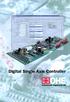 Digital Single Axis Controller The concept of intelligent hydraulic drive a vision? DSAC (Digital Single Axis Controller) Do you need hydraulic servo drive for your machine/system? What would it be like
DEPARTMENT OF COMPUTER SCIENCE & ENGINEERING Question Bank Subject Name: EC6504 - Microprocessor & Microcontroller Year/Sem : II/IV
 DEPARTMENT OF COMPUTER SCIENCE & ENGINEERING Question Bank Subject Name: EC6504 - Microprocessor & Microcontroller Year/Sem : II/IV UNIT I THE 8086 MICROPROCESSOR 1. What is the purpose of segment registers
Serial port interface for microcontroller embedded into integrated power meter
 Serial port interface for microcontroller embedded into integrated power meter Mr. Borisav Jovanović, Prof. dr. Predrag Petković, Prof. dr. Milunka Damnjanović, Faculty of Electronic Engineering Nis, Serbia
International Journal of Advancements in Research & Technology, Volume 2, Issue3, March -2013 1 ISSN 2278-7763
 International Journal of Advancements in Research & Technology, Volume 2, Issue3, March -2013 1 FPGA IMPLEMENTATION OF HARDWARE TASK MANAGEMENT STRATEGIES Assistant professor Sharan Kumar Electronics Department
Controlling a Dot Matrix LED Display with a Microcontroller
 Controlling a Dot Matrix LED Display with a Microcontroller By Matt Stabile and programming will be explained in general terms as well to allow for adaptation to any comparable microcontroller or LED matrix.
A Flexible Closed Loop PMDC Motor Speed Control System for Precise Positioning
 A Flexible Closed Loop PMDC Motor Speed Control System for Precise Positioning Shakil Seeraji Department of Aeronautical Engineering Military Institute of Science and Technology Mirpur Cantonment, Dhaka-1216,
Lesson 7: SYSTEM-ON. SoC) AND USE OF VLSI CIRCUIT DESIGN TECHNOLOGY. Chapter-1L07: "Embedded Systems - ", Raj Kamal, Publs.: McGraw-Hill Education
 Lesson 7: SYSTEM-ON ON-CHIP (SoC( SoC) AND USE OF VLSI CIRCUIT DESIGN TECHNOLOGY 1 VLSI chip Integration of high-level components Possess gate-level sophistication in circuits above that of the counter,
Reconfigurable System-on-Chip Design
 Reconfigurable System-on-Chip Design MITCHELL MYJAK Senior Research Engineer Pacific Northwest National Laboratory PNNL-SA-93202 31 January 2013 1 About Me Biography BSEE, University of Portland, 2002
Digitale Signalverarbeitung mit FPGA (DSF) Soft Core Prozessor NIOS II Stand Mai 2007. Jens Onno Krah
 (DSF) Soft Core Prozessor NIOS II Stand Mai 2007 Jens Onno Krah Cologne University of Applied Sciences www.fh-koeln.de [email protected] NIOS II 1 1 What is Nios II? Altera s Second Generation
Room Temperature based Fan Speed Control System using Pulse Width Modulation Technique
 Room Temperature based Fan Speed Control System using Pulse Width Modulation Technique Vaibhav Bhatia Department of Electrical and Electronics Engg., Bhagwan Parshuram Institute of Technology, New Delhi-110089,
Embedded Systems on ARM Cortex-M3 (4weeks/45hrs)
 Embedded Systems on ARM Cortex-M3 (4weeks/45hrs) Course & Kit Contents LEARN HOW TO: Use of Keil Real View for ARM Use ARM Cortex-M3 MCU for professional embedded application development Understanding
Real Time Monitoring System based on Embedded Linux Application
 Real Time Monitoring System based on Embedded Linux Application 1 Unnati Patel, 2 Vijay N. Chavda 1 ME Scholar, 2 Assistant Professor, VLSI and Embedded system, GTU PG School, Gandhinagar, India 1 [email protected],
Servo Motors (SensorDAQ only) Evaluation copy. Vernier Digital Control Unit (DCU) LabQuest or LabPro power supply
 Servo Motors (SensorDAQ only) Project 7 Servos are small, relatively inexpensive motors known for their ability to provide a large torque or turning force. They draw current proportional to the mechanical
Ocean Controls RC Servo Motor Controller
 Ocean Controls RC Servo Motor Controller RC Servo Motors: RC Servo motors are used in radio-controlled model cars and planes, robotics, special effects, test equipment and industrial automation. At the
JTAG-HS2 Programming Cable for Xilinx FPGAs. Overview. Revised January 22, 2015 This manual applies to the HTAG-HS2 rev. A
 1300 Henley Court Pullman, WA 99163 509.334.6306 www.digilentinc.com Programming Cable for Xilinx FPGAs Revised January 22, 2015 This manual applies to the HTAG-HS2 rev. A Overview The Joint Test Action
AUTOMATIC NIGHT LAMP WITH MORNING ALARM USING MICROPROCESSOR
 AUTOMATIC NIGHT LAMP WITH MORNING ALARM USING MICROPROCESSOR INTRODUCTION This Project "Automatic Night Lamp with Morning Alarm" was developed using Microprocessor. It is the Heart of the system. The sensors
White Paper Implementing a Flexible CPLD-Only Digital Dashboard for Automobiles
 Introduction White Paper Implementing a Flexible CPLD-Only Digital Dashboard for Automobiles An automotive dashboard acts as a nerve center that consolidates all information pertaining to the safe driving
Construction and Application of a Computer Based Interface Card
 Session 4 Construction and Application of a Computer Based Interface Card Michael Combs Telescope Operations Engineer [email protected] Morehead State University Morehead, Kentucky Ahmad Zargari,
Technical Note. Micron NAND Flash Controller via Xilinx Spartan -3 FPGA. Overview. TN-29-06: NAND Flash Controller on Spartan-3 Overview
 Technical Note TN-29-06: NAND Flash Controller on Spartan-3 Overview Micron NAND Flash Controller via Xilinx Spartan -3 FPGA Overview As mobile product capabilities continue to expand, so does the demand
Digital To Analog Converter with Sine Wave Output
 Digital To Analog Converter with Sine Wave Output Overview In this Lab we will build a resistive ladder network and use the BASIC Stamp to generate the digital data for the D/A conversions. PBASIC will
The Design of DSP controller based DC Servo Motor Control System
 International Conference on Advances in Energy and Environmental Science (ICAEES 2015) The Design of DSP controller based DC Servo Motor Control System Haiyan Hu *, Hong Gu, Chunguang Li, Xiaowei Cai and
Palaparthi.Jagadeesh Chand. Associate Professor in ECE Department, Nimra Institute of Science & Technology, Vijayawada, A.P.
 Patient Monitoring Using Embedded Palaparthi.Jagadeesh Chand Associate Professor in ECE Department, Nimra Institute of Science & Technology, Vijayawada, A.P Abstract The aim of this project is to inform
A PC-BASED TIME INTERVAL COUNTER WITH 200 PS RESOLUTION
 35'th Annual Precise Time and Time Interval (PTTI) Systems and Applications Meeting San Diego, December 2-4, 2003 A PC-BASED TIME INTERVAL COUNTER WITH 200 PS RESOLUTION Józef Kalisz and Ryszard Szplet
Pmod peripheral modules are powered by the host via the interface s power and ground pins.
 Digilent Pmod Interface Specification Revision: November 20, 2011 1300 NE Henley Court, Suite 3 Pullman, WA 99163 (509) 334 6306 Voice (509) 334 6300 Fax Introduction The Digilent Pmod interface is used
How To Control A Single Phase Sinusoidal Pulse Width Modulation (S) Controller Based Inverter For Photovoltaic Power Generation
 2012 International Conference on Clean and Green Energy IPCBEE vol.27 (2012) (2012) IACSIT Press, Singapore LOW COST, HIGH EFFICIENT S CONTROLLER FOR PHOTOVOLTAIC INVERTER Aswinkarthik R V 1+, Vivekshankar
Computer and Set of Robots
 Lesson 11:DESIGN PROCESS EXAMPLES Mobile-Phone, Mobile- Computer and Set of Robots 1 Mobile Phone 2 Mobile phone SoC (System-on-Chip) Hardware units Microcontroller or ASIP (Application Specific Instruction
FRC WPI Robotics Library Overview
 FRC WPI Robotics Library Overview Contents 1.1 Introduction 1.2 RobotDrive 1.3 Sensors 1.4 Actuators 1.5 I/O 1.6 Driver Station 1.7 Compressor 1.8 Camera 1.9 Utilities 1.10 Conclusion Introduction In this
EFC 3600. Frequency converters
 2 Bosch Rexroth AG Electric Drives and Controls Documentation Compact and complete: space saving side-by-side assembly, plug-in I/O terminals, with brake chopper and mains filter for ultra-simple installation
Rotary Encoder Interface for Spartan-3E Starter Kit
 Rotary Encoder Interface for Spartan-3E Starter Kit Ken Chapman Xilinx Ltd 2 th February 26 Rev.2 With thanks to Peter Alfke (Xilinx Inc.) Limitations Limited Warranty and Disclaimer. These designs are
PowerPC Microprocessor Clock Modes
 nc. Freescale Semiconductor AN1269 (Freescale Order Number) 1/96 Application Note PowerPC Microprocessor Clock Modes The PowerPC microprocessors offer customers numerous clocking options. An internal phase-lock
A Master-Slave DSP Board for Digital Control
 A Master-Slave DSP Board for Digital Control ROSA, F. E. 1 ; CARRARA, A. R. S. 2 ; SOUZA, A.H. 3 (1) M.Sc. candidate e-mail [email protected] (2) Professor, Ph.D. e-mail [email protected]
Six-servo Robot Arm. DAGU Hi-Tech Electronic Co., LTD www.arexx.com.cn. Six-servo Robot Arm
 Six-servo Robot Arm 1 1, Introduction 1.1, Function Briefing Servo robot, as the name suggests, is the six servo motor-driven robot arm. Since the arm has a few joints, we can imagine, our human arm, in
Hardware and Logic Implementation of Multiple Alarm System for GSM BTS Rooms
 Hardware and Logic Implementation of Multiple Alarm System for GSM BTS Rooms Arifa Ferdousi 1 and Sadeque Reza Khan 2 1 Dept. of Computer Science and Engineering, Varendra University, Rajshahi, Bangladesh
BUILD VERSUS BUY. Understanding the Total Cost of Embedded Design. www.ni.com/buildvsbuy
 BUILD VERSUS BUY Understanding the Total Cost of Embedded Design Table of Contents I. Introduction II. The Build Approach: Custom Design a. Hardware Design b. Software Design c. Manufacturing d. System
Hardware and Software
 Hardware and Software 1 Hardware and Software: A complete design Hardware and software support each other Sometimes it is necessary to shift functions from software to hardware or the other way around
Embedded Component Based Programming with DAVE 3
 Embedded Component Based Programming with DAVE 3 By Mike Copeland, Infineon Technologies Introduction Infineon recently introduced the XMC4000 family of ARM Cortex -M4F processor-based MCUs for industrial
A New Programmable RF System for System-on-Chip Applications
 Vol. 6, o., April, 011 A ew Programmable RF System for System-on-Chip Applications Jee-Youl Ryu 1, Sung-Woo Kim 1, Jung-Hun Lee 1, Seung-Hun Park 1, and Deock-Ho Ha 1 1 Dept. of Information and Communications
All Programmable Logic. Hans-Joachim Gelke Institute of Embedded Systems. Zürcher Fachhochschule
 All Programmable Logic Hans-Joachim Gelke Institute of Embedded Systems Institute of Embedded Systems 31 Assistants 10 Professors 7 Technical Employees 2 Secretaries www.ines.zhaw.ch Research: Education:
SuperIOr Controller. Digital Dynamics, Inc., 2014 All Rights Reserved. Patent Pending. Rev: 5-16-14 1
 SuperIOr Controller The SuperIOr Controller is a game changer in the world of high speed embedded control. The system combines incredible speed of both control and communication with revolutionary configurable
ETEC 2301 Programmable Logic Devices. Chapter 10 Counters. Shawnee State University Department of Industrial and Engineering Technologies
 ETEC 2301 Programmable Logic Devices Chapter 10 Counters Shawnee State University Department of Industrial and Engineering Technologies Copyright 2007 by Janna B. Gallaher Asynchronous Counter Operation
Voice Dialer Speech Recognition Dialing IC
 Speech Recognition Dialing IC Speaker Dependent IC for Voice Dialing Applications GENERAL DESCRIPTION The IC, from the Interactive Speech family of products, is an application specific standard product
Project Plan. Project Plan. May13-06. Logging DC Wattmeter. Team Member: Advisor : Ailing Mei. Collin Christy. Andrew Kom. Client: Chongli Cai
 Project Plan May13-06 Logging DC Wattmeter Team Member: Ailing Mei Andrew Kom Chongli Cai Advisor : Collin Christy Client: Garmin International David Hoffman Qiaoya Cui Table of Contents Need Statement...
RAPID PROTOTYPING OF DIGITAL SYSTEMS Second Edition
 RAPID PROTOTYPING OF DIGITAL SYSTEMS Second Edition A Tutorial Approach James O. Hamblen Georgia Institute of Technology Michael D. Furman Georgia Institute of Technology KLUWER ACADEMIC PUBLISHERS Boston
Number 1 in efficiency
 PowerXL DE1 Variable Speed Starter www.eaton.eu/de1 Number 1 in efficiency The easiest way of variable motor speed NEW Variation DE11 The new device category! The PowerXL DE1 Variable Speed Starter Why
Digital Signal Controller Based Automatic Transfer Switch
 Digital Signal Controller Based Automatic Transfer Switch by Venkat Anant Senior Staff Applications Engineer Freescale Semiconductor, Inc. Abstract: An automatic transfer switch (ATS) enables backup generators,
DEVELOPMENT OF DEVICES AND METHODS FOR PHASE AND AC LINEARITY MEASUREMENTS IN DIGITIZERS
 DEVELOPMENT OF DEVICES AND METHODS FOR PHASE AND AC LINEARITY MEASUREMENTS IN DIGITIZERS U. Pogliano, B. Trinchera, G.C. Bosco and D. Serazio INRIM Istituto Nazionale di Ricerca Metrologica Torino (Italia)
2.0 Command and Data Handling Subsystem
 2.0 Command and Data Handling Subsystem The Command and Data Handling Subsystem is the brain of the whole autonomous CubeSat. The C&DH system consists of an Onboard Computer, OBC, which controls the operation
NTE2053 Integrated Circuit 8 Bit MPU Compatible A/D Converter
 NTE2053 Integrated Circuit 8 Bit MPU Compatible A/D Converter Description: The NTE2053 is a CMOS 8 bit successive approximation Analog to Digital converter in a 20 Lead DIP type package which uses a differential
Lecture N -1- PHYS 3330. Microcontrollers
 Lecture N -1- PHYS 3330 Microcontrollers If you need more than a handful of logic gates to accomplish the task at hand, you likely should use a microcontroller instead of discrete logic gates 1. Microcontrollers
Extended Boundary Scan Test breaching the analog ban. Marcel Swinnen, teamleader test engineering
 Extended Boundary Scan Test breaching the analog ban Marcel Swinnen, teamleader test engineering 11-11-2014 2 zero-defect quality impossible to produce zero-defect boards early involvement services (Design
The WIMP51: A Simple Processor and Visualization Tool to Introduce Undergraduates to Computer Organization
 The WIMP51: A Simple Processor and Visualization Tool to Introduce Undergraduates to Computer Organization David Sullins, Dr. Hardy Pottinger, Dr. Daryl Beetner University of Missouri Rolla Session I.
Welcome to the tutorial for the MPLAB Starter Kit for dspic DSCs
 Welcome to the tutorial for the MPLAB Starter Kit for dspic DSCs Welcome to this tutorial on Microchip s MPLAB Starter Kit for dspic Digital Signal Controllers, or DSCs. The starter kit is an all-in-one
Access Control Using Smartcard And Passcode
 IOSR Journal of Electrical and Electronics Engineering (IOSR-JEEE) e-issn: 2278-1676 Volume 4, Issue 5 (Jan. - Feb. 2013), PP 29-34 Access Control Using Smartcard And Passcode Omorogiuwa Eseosa 1., Uhunmwangho
Current Loop Tuning Procedure. Servo Drive Current Loop Tuning Procedure (intended for Analog input PWM output servo drives) General Procedure AN-015
 Servo Drive Current Loop Tuning Procedure (intended for Analog input PWM output servo drives) The standard tuning values used in ADVANCED Motion Controls drives are conservative and work well in over 90%
DESIGN AND IMPLEMENTATION OF A SIMPLE, LOW-COST ROBOTIC ARM
 DESIGN AND IMPLEMENTATION OF A SIMPLE, LOW-COST ROBOTIC ARM Mashad Uddin Saleh 1, Gazi Mahamud Hasan 2, Mohammad Abdullah Al Shohel 3, Md. Abul Hasnat Ferdous 4, Biswajit Biswas Dipan 5 Alumni, Dept. of
Freescale Semiconductor, I
 nc. Application Note 6/2002 8-Bit Software Development Kit By Jiri Ryba Introduction 8-Bit SDK Overview This application note describes the features and advantages of the 8-bit SDK (software development
Interfacing Analog to Digital Data Converters
 Converters In most of the cases, the PIO 8255 is used for interfacing the analog to digital converters with microprocessor. We have already studied 8255 interfacing with 8086 as an I/O port, in previous
A Surveillance Robot with Climbing Capabilities for Home Security
 Available Online at www.ijcsmc.com International Journal of Computer Science and Mobile Computing A Monthly Journal of Computer Science and Information Technology IJCSMC, Vol. 2, Issue. 11, November 2013,
Solutions for Increasing the Number of PC Parallel Port Control and Selecting Lines
 Solutions for Increasing the Number of PC Parallel Port Control and Selecting Lines Mircea Popa Abstract: The paper approaches the problem of control and selecting possibilities offered by the PC parallel
CPU systron S 200 - S 250 - S 250c. systron S 200 - S 250 - S 250c. CPUs to the process modules. Stand-alone PLC
 E031019 000823 systron S 200 - S 250 - S 250c CPU systron S 200 - S 250 - S 250c 45 mm width Flexible and expandable Easy to use software for bus connection (S 250/ S 250c) CPUs to the process modules
Monitoring of Intravenous Drip Rate
 Monitoring of Intravenous Drip Rate Vidyadhar V. Kamble, Prem C. Pandey, Chandrashekar P. Gadgil, and Dinesh S. Choudhary Abstract A drip rate meter, for monitoring intravenous infusion, is developed using