
Solving Systems of Linear Equations Substitutions
|
|
|
- Elvin Bryant
- 9 years ago
- Views:
Transcription
1 Solving Systems of Linear Equations Substitutions Outcome (learning objective) Students will accurately solve a system of equations algebraically using substitution. Student/Class Goal Students thinking about continuing their academic studies in a postsecondary institution will need to know and be able to do problems on solving systems of equations. Time Frame 1-2 hours Standard Use Math to Solve Problems and Communicate NRS EFL 5-6 Activity Addresses Benchmarks (content) Primary Benchmarks M.5.19, M.6.19 Supporting Benchmarks M.5.16, M.6.16, M.5.28, M.6.29 Materials Paper and pencils Steps to Solve a System of Equations by Substitution Handout Using Substitution to Solve Systems of Equations Activity Math Scavenger Hunt Teacher Resource Math Scavenger Hunt Student Answer Sheet Substitution Scavenger Hunt Information Sheet/Answers Learner Prior Knowledge Students should be fluent in solving linear equations and integer operations. They should have the ability to solve systems of equations by graphing. They will have completed earlier lessons on systems of equations, such as Solving Systems of Linear Equations Graphing. Teacher Note Be sure to classify each system as consistent or inconsistent and dependent or independent. Instructional Activities Step 1 On the board, write the sample system (-x + 2y = 4 and 5x 3y = 1) found on handout, Steps to Solve a System of Equations by Substitution. Ask the class how they might solve the system of equations (graphing). Remind the class that this is the method that they just studied in class. Ask the class if they know of any other methods to solve this system /problem. Ask if they think the system could be solved algebraically. Using the steps outlined on the handout for solving a system of equations by substitution, demonstrate how to solve this system of equations by substitution. Step 2 - Distribute copies of Steps to Solve a System of Equations by Substitution handout. Ask the students to review the steps on the handout. Using the three sample systems on the handout, teacher works through each example with student input, asking questions: Which equation would be best to rewrite for substitution? Which variable do we want to solve for first? What does the equation look like after we substitute? Do the solutions work for both equations? Step 3 Working in pairs, students will complete the Using Substitution to Solve Systems of Equations activity. Students will match the systems of equations with the correct equation modified for substitution. Step 4 - After verifying that the students have selected the correct modified equations on the worksheet, solve the systems of equations found on Using Substitution to Solve Systems of Equations. Step 5 Set up a Math Scavenger Hunt in the classroom using the directions found in the Math Scavenger Hunt Teacher Resource and Answer Sheet. The questions and answers found in the Substitution Scavenger Hunt Information Sheet will provide the questions and solutions to place on

2 each clue card. The answers are also included for your reference. Assessment/Evidence (based on outcome) Math Scavenger Hunt completed with 100% accuracy. Teacher Reflection/Lesson Evaluation This lesson has not yet been field tested. Next Steps This is part of a series of lessons on solving systems of linear equations. To continue the study, complete Solving Systems of Linear Equations Elimination. Technology Integration Systems of Linear Equations: Solving by Substitution Solving Systems of Equations by Substitution

3 Steps to Solve a System of Equations by Substitution 1. Solve one equation for one of the variables. 2. Substitute the resulting expression in the other equation. 3. Solve the resulting equation for the first variable. 4. Find the values of the variables by substituting the solution back into the original equation to solve for the second variable. 5. Check the solution in both equations of the system. Example -x + 2y = 4 5x 3y = 1 Step 1 Since the first equation has a term with a coefficient of -1 or 1, solve the first equation for x -x +2y -2y = 4-2y (subtract 2y from both sides) -x = 4-2y (result after subtracting 2y from both sides) -x/-1 = (4-2y)/-1 (divide both sides by -1 so x is positive) X = 2y -4 (flipped the order of the terms) Step 2 (substitute for x) 5(2y 4) 3y = 1 (Substitute the resulting expression into the other equation) Step 3 (solve for y) 10y -20-3y = 1 (distribute the 5) 7y -20 = 1 (combine like terms) 7y = (add 5 to both sides) 7y = 21 7y/7 = 21/7 (divide both sides by 7) y = 3 Step 4 (solve for x) -x + 2y = 4 (original equation) -x + 2(3) = 4 (y value substituted into the equation) -x + 6 = 4 -x +6 6 = 4-6 (subtract 6 from both sides) -x = -2 (combine like terms) -x/-1 = -2/-1 (divide both sides by -1) X = 2

4 Step 5 (check your answer) -x + 2y = 4 -(2) + 2(3) = = 4 4 = 4 5x 3y = 1 5(2) -3(3) = = 1 1 = 1 (Results of substituting the solutions into both equations) Sample Systems to Solve 5x y = 1 3x + 2y = 13 r = 5 s 2r + 7s = 0 4a + b 8 = 0 5a + 3b 3 = 0

5 Using Substitution to Solve Systems of Equations Activity Directions Match the system of equations with the modified equation that can be used to solve the system of equations by substitution. Draw a line between the system and the equation used to substitute. 2x + y = 11 x y = 2 x = -2y + 6 4x y = 7 5x 8y = 2 x = -6y + 5 2x + 2y = 4 3x 3y =18 y = -2x + 1 2x + y = 1 10x - 4y = 2 y = 4x 7-3x y = -13 X + 2y = 6 x = y + 2 2x 6y = 4 X + 6y = 5 x = -y + 2
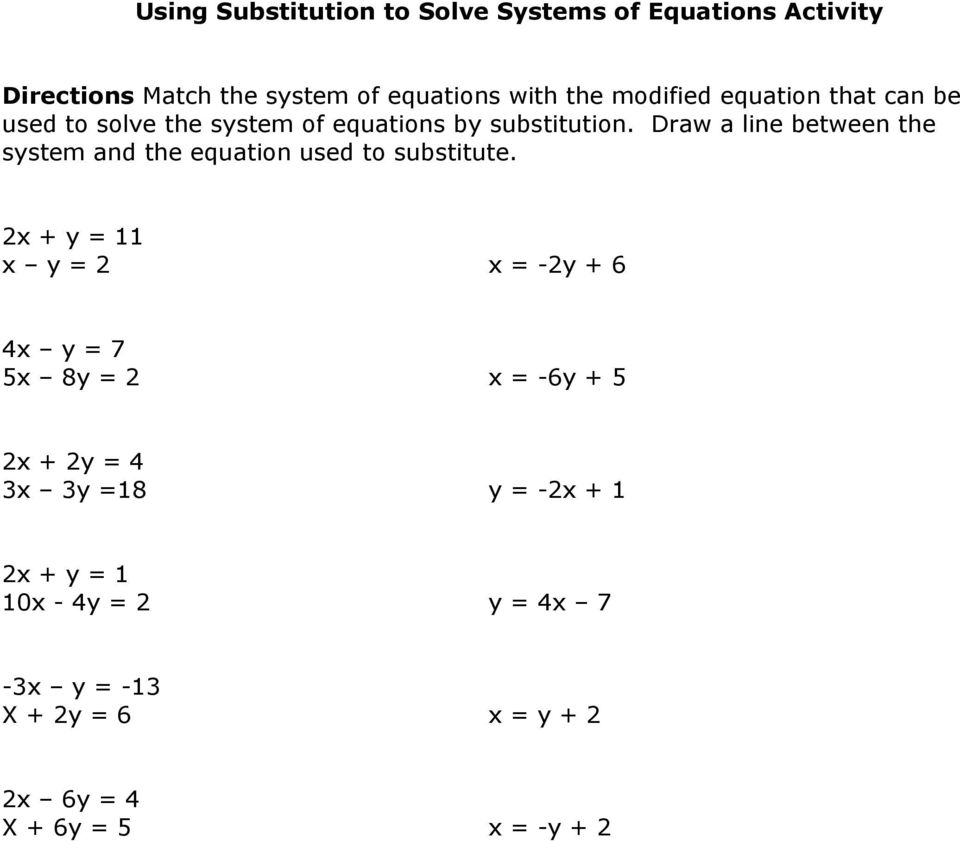
6 Activity Answers 2x + y = 11 x y = 2 x = y + 2 4x y = 7 5x 8y = 2 y = 4x 7 2x + 2y = 4 3x 3y =18 x = -y + 2 2x + y = 1 10x - 4y = 2 y = -2x + 1-3x y = -13 X + 2y = 6 x = -2y + 6 2x 6y = 4 X + 6y = 5 x = -6y + 5

7 Supplies Paper or card stock (8 ½ by 11 ) 2 colored markers Tape A math scavenger hunt is a fun way to assess the math skills of your students. Most any math topic can be evaluated with this activity, and the students will stay active as they move around the room solving problems and searching for the answers. Students can work in groups or alone as they complete the activity. To set up a scavenger hunt select 6-8 problems with answers. Before you make the scavenger hunt clue cards, do some planning to make sure each problem and its answer will be on different cards. This has already been done for you in the series of lessons on systems of equations. When you have decided on the problem and answer to place on each card, write a problem at the top (portrait orientation) of the clue card and a solution at the bottom of the card. Write all the answers in one color of marker, and use the second color for the problems. Tape these sheets around the room. Math Clue Card Example 2 x 4 10 Now it is time for the students to complete the Math Scavenger Hunt. Give each student a Scavenger Hunt Answer Sheet (see below). Students can start their hunt at any location in the room. This way the class will be spread out around the classroom. At their first stop, the students will write the problem on their answer sheet and solve it. Remember the problem will be at the bottom of the sheet. There is space on the answer sheet for the students to show their work. Once they have solved this problem they will find the Scavenger Hunt Clue Card with their answer. The problem at the bottom of this clue card will be the students next problem to solve. If the students don t find their answer when they look around the room, the students know to redo their work. Students continue with this process until all the problems have been completed, and they return to the card which contains their first problem. The answers can be corrected quickly because the answers will be in a specific order. Remember each student will start the Scavenger Hunt in a different place in the answer sequence.

8 Problems Answers

9 Use the following systems of equations and solutions to create a Math Scavenger Hunt for the students. The systems in the left column should be placed on the same card as the solutions next to them. Note The solutions do not match the systems they are next to! X 2y = 0 (12, 17) 2x 5y = -4-1/2 x y = -3 (4, 1) X + 3y = 6 y = 8 x (2, 3) 4x 3y = -3 x = 8y (6, 0) x 4y = 12 y = x + 5 (24, 3) y = 2x - 7 -x + 2y = 4 (2, 1) 5x 3y = 1-3x y = -13 (3, 5) x + 2y = 6 4x y = 7 (4, 4) 5x 8y = 2

10 Use the following systems of equations and solutions to create a Math Scavenger Hunt for the students. The systems in the left column should be placed on the same card as the solutions next to them. X 2y = 0 (12, 17) 2x 5y = -4-1/2 x y = -3 (4, 1) X + 3y = 6 y = 8 x (2, 3) 4x 3y = -3 x = 8y (6, 0) x 4y = 12 y = x + 5 (24, 3) y = 2x - 7 -x + 2y = 4 (2, 1) 5x 3y = 1-3x y = -13 (3, 5) x + 2y = 6 4x y = 7 (4, 4) 5x 8y = 2

Solving Systems of Linear Equations Substitutions
 Solving Systems of Linear Equations Substitutions Outcome (lesson objective) Students will accurately solve a system of equations algebraically using substitution. Student/Class Goal Students thinking
Solving Systems of Linear Equations Elimination (Addition)
 Solving Systems of Linear Equations Elimination (Addition) Outcome (lesson objective) Students will accurately solve systems of equations using elimination/addition method. Student/Class Goal Students
Solving Systems of Linear Equations Graphing
 Solving Systems of Linear Equations Graphing Outcome (learning objective) Students will accurately solve a system of equations by graphing. Student/Class Goal Students thinking about continuing their academic
HOW MUCH WILL I SPEND ON GAS?
 HOW MUCH WILL I SPEND ON GAS? Outcome (lesson objective) The students will use the current and future price of gasoline to construct T-charts, write algebraic equations, and plot the equations on a graph.
Solving Systems of Linear Equations Putting it All Together
 Solving Systems of Linear Equations Putting it All Together Outcome (lesson objective) Students will determine the best method to use when solving systems of equation as they solve problems using graphing,
Solving Systems of Equations Introduction
 Solving Systems of Equations Introduction Outcome (learning objective) Students will write simple systems of equations and become familiar with systems of equations vocabulary terms. Student/Class Goal
Solving Systems of Linear Equations Putting it All Together
 Solving Systems of Linear Equations Putting it All Together Outcome (learning objective) Students will determine the best method to use when solving systems of equation as they solve problems using graphing,
Solving Systems of Linear Equations Putting it All Together
 Solving Systems of Linear Equations Putting it All Together Student/Class Goal Students thinking about continuing their academic studies in a post-secondary institution will need to know and be able to
Title: Patterns and Puzzles
 X Stackable Cert. Documentation Technology Study / Life skills EL-Civics Career Pathways Police Paramedic Fire Rescue Medical Asst. EKG / Cardio Phlebotomy Practical Nursing Healthcare Admin Pharmacy Tech
Converting Units of Measure Measurement
 Converting Units of Measure Measurement Outcome (lesson objective) Given a unit of measurement, students will be able to convert it to other units of measurement and will be able to use it to solve contextual
Have pairs share with the class. Students can work in pairs to categorize their food according to the food groups in the food pyramid.
 FOOD PYRAMID MENU Outcome (lesson objective) Students will read charts about nutrition, exercise, and caloric intake, practice vocabulary strategies and integrate that information with their own experience
TEMPERATURE BAR GRAPH
 TEMPERATURE BAR GRAPH Outcome (lesson objective) Students will figure mean, median and mode using weather, temperature data, create a bar graph charting one city s high and low temperatures, and formulate
6-3 Solving Systems by Elimination
 Warm Up Simplify each expression. 1. 2y 4x 2(4y 2x) 2. 5(x y) + 2x + 5y Write the least common multiple. 3. 3 and 6 4. 4 and 10 5. 6 and 8 Objectives Solve systems of linear equations in two variables
Solving Systems of Linear Equations Using Matrices
 Solving Systems of Linear Equations Using Matrices What is a Matrix? A matrix is a compact grid or array of numbers. It can be created from a system of equations and used to solve the system of equations.
Using Algebra Tiles for Adding/Subtracting Integers and to Solve 2-step Equations Grade 7 By Rich Butera
 Using Algebra Tiles for Adding/Subtracting Integers and to Solve 2-step Equations Grade 7 By Rich Butera 1 Overall Unit Objective I am currently student teaching Seventh grade at Springville Griffith Middle
3.1 Solving Systems Using Tables and Graphs
 Algebra 2 Chapter 3 3.1 Solve Systems Using Tables & Graphs 3.1 Solving Systems Using Tables and Graphs A solution to a system of linear equations is an that makes all of the equations. To solve a system
Lines, Lines, Lines!!! Slope-Intercept Form ~ Lesson Plan
 Lines, Lines, Lines!!! Slope-Intercept Form ~ Lesson Plan I. Topic: Slope-Intercept Form II. III. Goals and Objectives: A. The student will write an equation of a line given information about its graph.
Accommodated Lesson Plan on Solving Systems of Equations by Elimination for Diego
 Accommodated Lesson Plan on Solving Systems of Equations by Elimination for Diego Courtney O Donovan Class: Algebra 1 Day #: 6-7 Grade: 8th Number of Students: 25 Date: May 12-13, 2011 Goal: Students will
Title: Basic Metric Measurements Conversion (police)
 X X Stackable Certificate Documentation Technology Study / Life skills EL-Civics Career Pathways Police Paramedic Fire Rescue Medical Asst. EKG / Cardio Phlebotomy Practical Nursing Healthcare Admin Pharmacy
READING THE NEWSPAPER
 READING THE NEWSPAPER Outcome (lesson objective) Students will comprehend and critically evaluate text as they read to find the main idea. They will construct meaning as they analyze news articles and
Title: Basic Metric Measurements Conversion
 Stackable Certificate Documentation Technology Study / Life skills EL-Civics Career Pathways Police Paramedic Fire Rescue Medical Asst. EKG / Cardio Phlebotomy Practical Nursing Healthcare Admin Pharmacy
Commutative Property Grade One
 Ohio Standards Connection Patterns, Functions and Algebra Benchmark E Solve open sentences and explain strategies. Indicator 4 Solve open sentences by representing an expression in more than one way using
Acquisition Lesson Planning Form Key Standards addressed in this Lesson: MM2A2c Time allotted for this Lesson: 5 Hours
 Acquisition Lesson Planning Form Key Standards addressed in this Lesson: MM2A2c Time allotted for this Lesson: 5 Hours Essential Question: LESSON 2 Absolute Value Equations and Inequalities How do you
5 Systems of Equations
 Systems of Equations Concepts: Solutions to Systems of Equations-Graphically and Algebraically Solving Systems - Substitution Method Solving Systems - Elimination Method Using -Dimensional Graphs to Approximate
Curriculum Alignment Project
 Curriculum Alignment Project Math Unit Date: Unit Details Title: Solving Linear Equations Level: Developmental Algebra Team Members: Michael Guy Mathematics, Queensborough Community College, CUNY Jonathan
Writing a Well-Structured Paragraph
 Writing a Well-Structured Paragraph Objectives Students will recognize the parts of a 3.5 paragraph. Students will write a well structured 3.5 paragraph. Standard(s) Addressed in Lesson Benchmark(s) Addressed
USING ALGEBRA TILES EFFECTIVELY
 MATHEMATICS USING ALGEBRA TILES EFFECTIVELY TOOLS FOR UNDERSTANDING by Bettye C. Hall Reviewers James Gates, Ed.D. Yvonne S. Gentzler, Ph.D. AUTHOR Bettye C. Hall is the former Director of Mathematics
Math Common Core Sampler Test
 High School Algebra Core Curriculum Math Test Math Common Core Sampler Test Our High School Algebra sampler covers the twenty most common questions that we see targeted for this level. For complete tests
PREPARING A PERSONAL LETTER
 PREPARING A PERSONAL LETTER Outcome (lesson objective) Students will identify the parts and format of a personal (friendly) letter then write a letter using the appropriate format with proper spelling,
In this section, you will develop a method to change a quadratic equation written as a sum into its product form (also called its factored form).
 CHAPTER 8 In Chapter 4, you used a web to organize the connections you found between each of the different representations of lines. These connections enabled you to use any representation (such as a graph,
Name of Lesson: Properties of Equality A Review. Mathematical Topic: The Four Properties of Equality. Course: Algebra I
 Name of Lesson: Properties of Equality A Review Mathematical Topic: The Four Properties of Equality Course: Algebra I Time Allocation: One (1) 56 minute period Pre-requisite Knowledge: The students will
2.3. Finding polynomial functions. An Introduction:
 2.3. Finding polynomial functions. An Introduction: As is usually the case when learning a new concept in mathematics, the new concept is the reverse of the previous one. Remember how you first learned
Linear Equations. 5- Day Lesson Plan Unit: Linear Equations Grade Level: Grade 9 Time Span: 50 minute class periods By: Richard Weber
 Linear Equations 5- Day Lesson Plan Unit: Linear Equations Grade Level: Grade 9 Time Span: 50 minute class periods By: Richard Weber Tools: Geometer s Sketchpad Software Overhead projector with TI- 83
Zeros of Polynomial Functions
 Zeros of Polynomial Functions The Rational Zero Theorem If f (x) = a n x n + a n-1 x n-1 + + a 1 x + a 0 has integer coefficients and p/q (where p/q is reduced) is a rational zero, then p is a factor of
MATH 110 College Algebra Online Families of Functions Transformations
 MATH 110 College Algebra Online Families of Functions Transformations Functions are important in mathematics. Being able to tell what family a function comes from, its domain and range and finding a function
Polynomials and Factoring. Unit Lesson Plan
 Polynomials and Factoring Unit Lesson Plan By: David Harris University of North Carolina Chapel Hill Math 410 Dr. Thomas, M D. 2 Abstract This paper will discuss, and give, lesson plans for all the topics
27 Before, During, and After Reading Activities with Graphic Organizers to be used with nonfiction passages for students in Grades 2 5!
 1 27 Before, During, and After Reading Activities with Graphic Organizers to be used with nonfiction passages for students in Grades 2 5! - These activities and graphic organizers can be: - used by teachers
Activities with Paper How To Make and Test a Paper Airplane
 Art/Math Grades K-4 One Lesson TM 1 Overview In this lesson, students will learn how to make a paper airplane. They will then test whose airplane flies farthest and will record the outcomes on a graph.
Tennessee Department of Education
 Tennessee Department of Education Task: Pool Patio Problem Algebra I A hotel is remodeling their grounds and plans to improve the area around a 20 foot by 40 foot rectangular pool. The owner wants to use
Brain Game. 3.4 Solving and Graphing Inequalities HOW TO PLAY PRACTICE. Name Date Class Period. MATERIALS game cards
 Name Date Class Period Brain Game 3.4 Solving and Graphing Inequalities MATERIALS game cards HOW TO PLAY Work with another student. Shuffle the cards you receive from your teacher. Then put them face down
Algebraic expressions are a combination of numbers and variables. Here are examples of some basic algebraic expressions.
 Page 1 of 13 Review of Linear Expressions and Equations Skills involving linear equations can be divided into the following groups: Simplifying algebraic expressions. Linear expressions. Solving linear
Fractions and Linear Equations
 Fractions and Linear Equations Fraction Operations While you can perform operations on fractions using the calculator, for this worksheet you must perform the operations by hand. You must show all steps
Solving Equations Involving Parallel and Perpendicular Lines Examples
 Solving Equations Involving Parallel and Perpendicular Lines Examples. The graphs of y = x, y = x, and y = x + are lines that have the same slope. They are parallel lines. Definition of Parallel Lines
Minnesota Academic Standards
 A Correlation of to the Minnesota Academic Standards Grades K-6 G/M-204 Introduction This document demonstrates the high degree of success students will achieve when using Scott Foresman Addison Wesley
What s Your Angle? (Measurement)
 The Middle School Math Project What s Your Angle? (Measurement) Objective Using inductive reasoning, students will devise procedures for using a protractor to measure the number of degrees in an angle.
Welcome! 8 th Grade Honors Algebra Informational Meeting
 Welcome! 8 th Grade Honors Algebra Informational Meeting Agenda Why Honors Algebra In Middle School? Placement Process Specifics of the Class Student Responsibilities Parent Responsibilities Math Program
Systems of Equations Involving Circles and Lines
 Name: Systems of Equations Involving Circles and Lines Date: In this lesson, we will be solving two new types of Systems of Equations. Systems of Equations Involving a Circle and a Line Solving a system
Write the Equation of the Line Review
 Connecting Algebra 1 to Advanced Placement* Mathematics A Resource and Strategy Guide Objective: Students will be assessed on their ability to write the equation of a line in multiple methods. Connections
A Concrete Introduction. to the Abstract Concepts. of Integers and Algebra using Algebra Tiles
 A Concrete Introduction to the Abstract Concepts of Integers and Algebra using Algebra Tiles Table of Contents Introduction... 1 page Integers 1: Introduction to Integers... 3 2: Working with Algebra Tiles...
Unit #3: Investigating Quadratics (9 days + 1 jazz day + 1 summative evaluation day) BIG Ideas:
 Unit #3: Investigating Quadratics (9 days + 1 jazz day + 1 summative evaluation day) BIG Ideas: Developing strategies for determining the zeroes of quadratic functions Making connections between the meaning
Solving Rational Equations
 Lesson M Lesson : Student Outcomes Students solve rational equations, monitoring for the creation of extraneous solutions. Lesson Notes In the preceding lessons, students learned to add, subtract, multiply,
Factoring Quadratic Expressions
 Factoring the trinomial ax 2 + bx + c when a = 1 A trinomial in the form x 2 + bx + c can be factored to equal (x + m)(x + n) when the product of m x n equals c and the sum of m + n equals b. (Note: the
TRAINGING GUIDE. To Log in type the web address www.readinga-z.com into your browser. This will open the Reading A-Z home page.
 TRAINGING GUIDE Getting Started To Log in type the web address www.readinga-z.com into your browser. This will open the Reading A-Z home page. Click Members at top right hand corner of the screen. Type
EQUATIONS and INEQUALITIES
 EQUATIONS and INEQUALITIES Linear Equations and Slope 1. Slope a. Calculate the slope of a line given two points b. Calculate the slope of a line parallel to a given line. c. Calculate the slope of a line
Algebra 2 PreAP. Name Period
 Algebra 2 PreAP Name Period IMPORTANT INSTRUCTIONS FOR STUDENTS!!! We understand that students come to Algebra II with different strengths and needs. For this reason, students have options for completing
Algebra Cheat Sheets
 Sheets Algebra Cheat Sheets provide you with a tool for teaching your students note-taking, problem-solving, and organizational skills in the context of algebra lessons. These sheets teach the concepts
Media. Copyright 2005 Literacy Volunteers of DuPage
 Media INTRODUCTION Before tutors and students can begin planning lessons, goals need to be set according to those expressed by the student and his/her existing level of English. Once the goals have been
Plotting Ordered Pairs on a Four Quadrant Grid Grade Five
 Ohio Standards Connection Geometry and Spatial Sense Benchmark C Specify locations and plot ordered pairs on a coordinate plane. Indicator 6 Extend understanding of coordinate system to include points
Analyzing and Solving Pairs of Simultaneous Linear Equations
 Analyzing and Solving Pairs of Simultaneous Linear Equations Mathematics Grade 8 In this unit, students manipulate and interpret equations in one variable, then progress to simultaneous equations. They
4.3-4.4 Systems of Equations
 4.3-4.4 Systems of Equations A linear equation in 2 variables is an equation of the form ax + by = c. A linear equation in 3 variables is an equation of the form ax + by + cz = d. To solve a system of
Prentice Hall: Middle School Math, Course 1 2002 Correlated to: New York Mathematics Learning Standards (Intermediate)
 New York Mathematics Learning Standards (Intermediate) Mathematical Reasoning Key Idea: Students use MATHEMATICAL REASONING to analyze mathematical situations, make conjectures, gather evidence, and construct
Barter vs. Money. Grade One. Overview. Prerequisite Skills. Lesson Objectives. Materials List
 Grade One Barter vs. Money Overview Students share the book Sheep in a Shop, by Nancy Shaw, to learn about choice, making decisions, trade, and the barter system. They complete worksheets on comparing
Lesson 4: Solving and Graphing Linear Equations
 Lesson 4: Solving and Graphing Linear Equations Selected Content Standards Benchmarks Addressed: A-2-M Modeling and developing methods for solving equations and inequalities (e.g., using charts, graphs,
Glencoe. correlated to SOUTH CAROLINA MATH CURRICULUM STANDARDS GRADE 6 3-3, 5-8 8-4, 8-7 1-6, 4-9
 Glencoe correlated to SOUTH CAROLINA MATH CURRICULUM STANDARDS GRADE 6 STANDARDS 6-8 Number and Operations (NO) Standard I. Understand numbers, ways of representing numbers, relationships among numbers,
Lesson Element Build and test your own capacitor Instructions and answers for teachers
 Lesson Element Build and test your own capacitor Instructions and answers for teachers These instructions should accompany the OCR resource Build and test your own capacitor activity which supports OCR
Graphing Equations. with Color Activity
 Graphing Equations with Color Activity Students must re-write equations into slope intercept form and then graph them on a coordinate plane. 2011 Lindsay Perro Name Date Between The Lines Re-write each
Alum Rock Elementary Union School District Algebra I Study Guide for Benchmark III
 Alum Rock Elementary Union School District Algebra I Study Guide for Benchmark III Name Date Adding and Subtracting Polynomials Algebra Standard 10.0 A polynomial is a sum of one ore more monomials. Polynomial
Factoring Quadratic Trinomials
 Factoring Quadratic Trinomials Student Probe Factor x x 3 10. Answer: x 5 x Lesson Description This lesson uses the area model of multiplication to factor quadratic trinomials. Part 1 of the lesson consists
Answers Teacher Copy. Systems of Linear Equations Monetary Systems Overload. Activity 3. Solving Systems of Two Equations in Two Variables
 of 26 8/20/2014 2:00 PM Answers Teacher Copy Activity 3 Lesson 3-1 Systems of Linear Equations Monetary Systems Overload Solving Systems of Two Equations in Two Variables Plan Pacing: 1 class period Chunking
Core Maths C1. Revision Notes
 Core Maths C Revision Notes November 0 Core Maths C Algebra... Indices... Rules of indices... Surds... 4 Simplifying surds... 4 Rationalising the denominator... 4 Quadratic functions... 4 Completing the
Linear Equations in One Variable
 Linear Equations in One Variable MATH 101 College Algebra J. Robert Buchanan Department of Mathematics Summer 2012 Objectives In this section we will learn how to: Recognize and combine like terms. Solve
What does the number m in y = mx + b measure? To find out, suppose (x 1, y 1 ) and (x 2, y 2 ) are two points on the graph of y = mx + b.
 PRIMARY CONTENT MODULE Algebra - Linear Equations & Inequalities T-37/H-37 What does the number m in y = mx + b measure? To find out, suppose (x 1, y 1 ) and (x 2, y 2 ) are two points on the graph of
Materials: Student-paper, pencil, circle manipulatives, white boards, markers Teacher- paper, pencil, circle manipulatives, worksheet
 Topic: Creating Mixed Numbers and Improper Fractions SOL: 5.7- The student will add and subtract with fractions and mixed numbers, with and without regrouping, and express answers in simplest form. Problems
How To Factor Quadratic Trinomials
 Factoring Quadratic Trinomials Student Probe Factor Answer: Lesson Description This lesson uses the area model of multiplication to factor quadratic trinomials Part 1 of the lesson consists of circle puzzles
Unit 3: Day 2: Factoring Polynomial Expressions
 Unit 3: Day : Factoring Polynomial Expressions Minds On: 0 Action: 45 Consolidate:10 Total =75 min Learning Goals: Extend knowledge of factoring to factor cubic and quartic expressions that can be factored
Zeros of Polynomial Functions
 Review: Synthetic Division Find (x 2-5x - 5x 3 + x 4 ) (5 + x). Factor Theorem Solve 2x 3-5x 2 + x + 2 =0 given that 2 is a zero of f(x) = 2x 3-5x 2 + x + 2. Zeros of Polynomial Functions Introduction
7 th Grade Integer Arithmetic 7-Day Unit Plan by Brian M. Fischer Lackawanna Middle/High School
 7 th Grade Integer Arithmetic 7-Day Unit Plan by Brian M. Fischer Lackawanna Middle/High School Page 1 of 20 Table of Contents Unit Objectives........ 3 NCTM Standards.... 3 NYS Standards....3 Resources
Local Government and Leaders Grade Three
 Ohio Standards Connection: Government Benchmark A Identify the responsibilities of the branches of the U.S. government and explain why they are necessary. Indicator 2 Explain the structure of local governments
Using Ohm s Law to Build a Voltage Divider
 Using Ohm s Law to Build a Voltage Provided by TryEngineering - Lesson Focus Students will design, build, and characterize one of the basic circuits of electrical engineering, the voltage divider. These
Compare & Contrast Essay
 Compare & Contrast Essay Outcome (lesson objective) Students will explore the similarities and differences between two texts, then write a compare and contrast essay. Student/Class Goal Students are often
2.6 Exponents and Order of Operations
 2.6 Exponents and Order of Operations We begin this section with exponents applied to negative numbers. The idea of applying an exponent to a negative number is identical to that of a positive number (repeated
Introduction Assignment
 PRE-CALCULUS 11 Introduction Assignment Welcome to PREC 11! This assignment will help you review some topics from a previous math course and introduce you to some of the topics that you ll be studying
Hands-On Math Algebra
 Hands-On Math Algebra by Pam Meader and Judy Storer illustrated by Julie Mazur Contents To the Teacher... v Topic: Ratio and Proportion 1. Candy Promotion... 1 2. Estimating Wildlife Populations... 6 3.
Arithmetic and Algebra of Matrices
 Arithmetic and Algebra of Matrices Math 572: Algebra for Middle School Teachers The University of Montana 1 The Real Numbers 2 Classroom Connection: Systems of Linear Equations 3 Rational Numbers 4 Irrational
https://williamshartunionca.springboardonline.org/ebook/book/27e8f1b87a1c4555a1212b...
 of 19 9/2/2014 12:09 PM Answers Teacher Copy Plan Pacing: 1 class period Chunking the Lesson Example A #1 Example B Example C #2 Check Your Understanding Lesson Practice Teach Bell-Ringer Activity Students
Current California Math Standards Balanced Equations
 Balanced Equations Current California Math Standards Balanced Equations Grade Three Number Sense 1.0 Students understand the place value of whole numbers: 1.1 Count, read, and write whole numbers to 10,000.
Slope-Intercept Form of a Linear Equation Examples
 Slope-Intercept Form of a Linear Equation Examples. In the figure at the right, AB passes through points A(0, b) and B(x, y). Notice that b is the y-intercept of AB. Suppose you want to find an equation
Adding and Subtracting Integers Unit. Grade 7 Math. 5 Days. Tools: Algebra Tiles. Four-Pan Algebra Balance. Playing Cards
 Adding and Subtracting Integers Unit Grade 7 Math 5 Days Tools: Algebra Tiles Four-Pan Algebra Balance Playing Cards By Dawn Meginley 1 Objectives and Standards Objectives: Students will be able to add
Mathematical goals. Starting points. Materials required. Time needed
 Level A3 of challenge: C A3 Creating and solving harder equations equations Mathematical goals Starting points Materials required Time needed To enable learners to: create and solve equations, where the
GRADE 3 CURRICULUM COMPANION - ACTIVITIES PANOPLY SCHOOL DAYS ~ STUDENT ART TENT
 ACTIVITY ONE (BEFORE VISITNG PANOPLY SCHOOL DAYS) ART VOCABULARY Students will learn art related vocabulary words in order to better understand and evaluate what they observe in the Student Art Tent. Within
Science Grade 1 Forces and Motion
 Science Grade 1 Forces and Motion Description: The students in this unit will use their inquiry skills to explore pushing, pulling, and gravity. They will also explore the different variables which affect
SYSTEMS OF LINEAR EQUATIONS
 SYSTEMS OF LINEAR EQUATIONS Sstems of linear equations refer to a set of two or more linear equations used to find the value of the unknown variables. If the set of linear equations consist of two equations
EE6-5 Solving Equations with Balances Pages 77 78
 EE6-5 Solving Equations with Balances Pages 77 78 STANDARDS 6.EE.B.5, 6.EE.B.6 Goals Students will use pictures to model and solve equations. Vocabulary balance equation expression sides (of an equation)
Solving Linear Equations
 Solving Linear Equations Lesson: Solving Linear Equations Length: 45 minutes Age or Grade Level Intended: High School - 9 th grade Academic Standard(s): A1.2.1 Solve linear equations Performance Objective(s):
investigations. K.2 C Gather information using simple equipment and tools to extend the senses.
 KINDERGARTEN Unit 7: Exploring Characteristics and Basic Needs of Living Organisms 2010 TEKS 1998 TEKS Curriculum and Instruction Considerations K.2 The student develops abilities to ask questions and
POLYNOMIAL FUNCTIONS
 POLYNOMIAL FUNCTIONS Polynomial Division.. 314 The Rational Zero Test.....317 Descarte s Rule of Signs... 319 The Remainder Theorem.....31 Finding all Zeros of a Polynomial Function.......33 Writing a
Lesson Description. Texas Essential Knowledge and Skills (Target standards) Texas Essential Knowledge and Skills (Prerequisite standards)
 Lesson Description Students will learn various methods to pay for college, including savings, grants, scholarships, student loans, and work-study. They will create an interactive notebook in which they
Current Standard: Mathematical Concepts and Applications Shape, Space, and Measurement- Primary
 Shape, Space, and Measurement- Primary A student shall apply concepts of shape, space, and measurement to solve problems involving two- and three-dimensional shapes by demonstrating an understanding of: