
Unit 7: Radical Functions & Rational Exponents
|
|
|
- Martin Carr
- 9 years ago
- Views:
Transcription
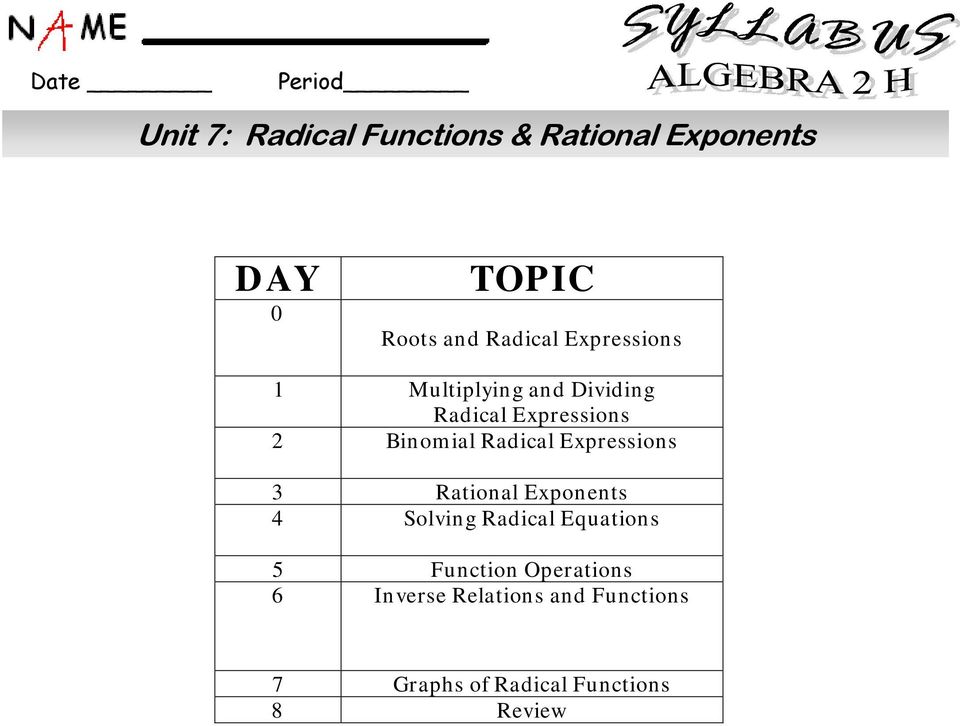
1 Date Period Unit 7: Radical Functions & Rational Exponents DAY 0 TOPIC Roots and Radical Expressions Multiplying and Dividing Radical Expressions Binomial Radical Expressions Rational Exponents 4 Solving Radical Equations 5 Function Operations 6 Inverse Relations and Functions 7 Graphs of Radical Functions 8 Review
2 U7D0: Roots and Radical Expressions (7.) Read pages 6 65 in your textbook to prepare yourself to do the homework problems. All of this information should be review from a previous course. The only new topic is the idea of absolute value. Do the best you can with this we will go over it to start class tomorrow. Here are some additional notes that might help you U7D: Multiplying & Dividing Radical Expressions (7.) Vocab: Like radicals have Think of this the same was as you think about like terms Conjugates Page of 8

3 NOTES THROUGH EXAMPLES: Page of 8

4 U7D: Binomial Radical Expressions (7.) Page of 8

5 Page 4 of 8

6 U7D: Rational Exponents (7.4) Property Equals Example a m a a n m n ab m m a a a m n a b x a m x y a Page 5 of 8

7 U7D4: Solving Radical Equations (7.4) A radical equation is an equation that has a variable in a radicand or has a variable with a rational exponent. ( x ) x 0 5 radical equations x 0 NOT a radical equation Give your own: Radical equation Non radical equation To solve a radical equation: isolate the radical on one side of the equation and then raise both sides of the equation to the same power.. x 6. 5x 6 0 CHECK!! You can solve equations of the form m n x n k by raising each side of the equation to the power. m. x x 54 Page 6 of 8

8 Extraneous solutions can be introduced when you raise both sides of an equation to a power. So CHECK all possible solutions in the original equation! 5. x 5 x 6. 5 x x CHECK x x x x 7 0 CHECK Closure: investigate checking for extraneous solutions using your calculator.. Solve x x 7 5. How many apparent solutions do you get?. Any or all apparent solutions mabe extraneous. One way to find out is to let y = the left side of the equation and y = the right sides. Graph the two equations. In how many points do they intersect?. The x-values of the points of intersection are solutions of the original equation. Are any or the apparent solutions extraneous? 4. Substitute the apparent solutions in the original equation. Does this algebraic check agree with the calculator check? Page 7 of 8

9 U7D5: Function Operations (7.6) Function Operations Operation Function Operation Examples ( f g)( x) f( x) g( x) f x 5x 4 x g x 5x Addition Subtraction ( f g)( x) f( x) g( x) Domain: ( f g)() f x 5x 4 x g x 5x Domain: ( f g)() ( f g) x f( x) g( x) f x x g x x Multiplication Division f f( x) ( x), g( x) 0 g g( x) Domain: ( f g) 4 f x x g x x f Domain: (6) g Page 8 of 8

10 Definition of a composition function: f g x f g x f of g of x g f x g f x g of f of x Example: f x 5x g x x Page 9 of 8

11 More practice with composite functions: Now, evaluating composite functions: WOrDie: Additional Practice: Page 0 of 8

12 U7D6: Inverse Relations & Functions (7.7) Warmup: What do the words relation and function mean? How do they compare? How do you determine if a relation is a function? Use the graphs below An inverse function the process that a function does Relation r DOMAIN RANGE Relation s DOMAIN RANGE Plot each ordered pair given below. Then, write the inverse point by switching x, y to yx., Point, 4,, 5,, x, y Inverse yx, Extension: What line is each point reflected over? Page of 8

13 To find the inverse of a function, rewrite with x and y, then switch the letters and solve for y Example : y x Example : f x x 0 Domain/Range of Function: Domain/Range of Function: Domain/Range of Inverse: Domain/Range of Inverse: Is the inverse a function? Is the inverse a function? Find f (this is the notation for the of f ) when f x 4x. Then find f f 6. FACT: Composition of Inverse functions If f and f are inverse functions, then f f x and f f x. Examples: For the function f x 4 7 x, find f f 9 and f f. Given the relation y x, answer the following. a) Is the relation a function? b) What is the domain of the relation? c) What is the range of the relation? d) What is the inverse of the relation? e) What is the domain of the inverse? f) What is the range of the inverse? g) Graph the relation and use the line of symmetry to graph the inverse is it a function?! Page of 8

14 Note: The inverse of a function MAY NOT be a function. If the inverse is also a function, it is referred to as the inverse function. Method - Determine graphically if a function has an inverse which is also a function: Use the horizontal line test to determine if a function has an inverse function. If ANY horizontal line intersects your original function in ONLY ONE location, your function has an inverse which is also a function. The function y = x +, shown at the right, HAS an inverse function because it passes the horizontal line test. Method - Determine graphically if a function has an inverse which is also a function: If a function has an inverse function, the reflection of that original function in the identity line y = x will also be a function (it will pass the vertical line test for functions). The example at the left shows the original function, y = x, in blue solid. The reflection over the identity line y = x is shown in red - dashed. The red dashed line will not pass the vertical line test for functions, thus y = x does not have an inverse function. You can see that the inverse exists, but it is NOT a function. NOTE: With functions such as y = x, it is possible to restrict the domain to obtain an inverse function for a portion of the graph. This means that you will be looking at only a selected section of the original graph that will pass the horizontal line test for the existence of an inverse function. For example: or } by restricting the graph in such a manner, you guarantee the existence of an inverse function for a portion of the graph. (Other restrictions are also possible.) Page of 8

15 Additional Practice Wrap up: What is an inverse of a function? How do you find an inverse from a graph/equation? Page 4 of 8

16 U7D7: Graphs of Radical Functions (7.8) Two Types of Radical Functions Function Type Square Root Cube Root Parent Function y x y x Equation with Parameters y a xh k y a xh k My Personal Notes Page 5 of 8

17 U7D8: Review!. If f(x)= x and g(x)=x, what is g f ( x)? a. 6x b. 9x c. 8x d. 4 8x. Which expression is NOT equivalent to a. xy b x y 4 x y c. 4 x y d. 4 9x y. Which expression is NOT equivalent to 4 4n a. 4 (4 n ) b. n c. n d. n 4. How do you write with a rationalized denominator? 5 a. - b. c. 4 d If f( x) 4x, a. 4 what is f ( f (4)? b. 0 c. 4 d How can you write a. 5 xy b. 0 xy 5 xy with a rationalized denominator c. 0x y xy d. 4 x y xy 7. Which of the following expressions is in simplified form? a. 0x b. 8x c. 6 d. y= 5 8. Which statement is NOT true? 4 a. 9 b. 9 c. 7 d. 8 Page 6 of 8

18 9. If f(x)= x and g(x)=x, what is g f ( x)? 4 a. 8x b. 8x c. 6x d. 9x 0 Which expression is NOT equivalent to a. 4 4n b. 4 4n n c. n d. n. Simplify the expression completely. CHECK for extraneous solutions ( points each) x b. 4 a. 4 x 7. Simplify the expression completely. CHECK for extraneous solutions a. x 8 b. x 7 x Page 7 of 8

Chapter 7 - Roots, Radicals, and Complex Numbers
 Math 233 - Spring 2009 Chapter 7 - Roots, Radicals, and Complex Numbers 7.1 Roots and Radicals 7.1.1 Notation and Terminology In the expression x the is called the radical sign. The expression under the
This is a square root. The number under the radical is 9. (An asterisk * means multiply.)
 Page of Review of Radical Expressions and Equations Skills involving radicals can be divided into the following groups: Evaluate square roots or higher order roots. Simplify radical expressions. Rationalize
2.3. Finding polynomial functions. An Introduction:
 2.3. Finding polynomial functions. An Introduction: As is usually the case when learning a new concept in mathematics, the new concept is the reverse of the previous one. Remember how you first learned
Algebra 2 Year-at-a-Glance Leander ISD 2007-08. 1st Six Weeks 2nd Six Weeks 3rd Six Weeks 4th Six Weeks 5th Six Weeks 6th Six Weeks
 Algebra 2 Year-at-a-Glance Leander ISD 2007-08 1st Six Weeks 2nd Six Weeks 3rd Six Weeks 4th Six Weeks 5th Six Weeks 6th Six Weeks Essential Unit of Study 6 weeks 3 weeks 3 weeks 6 weeks 3 weeks 3 weeks
1.3 Algebraic Expressions
 1.3 Algebraic Expressions A polynomial is an expression of the form: a n x n + a n 1 x n 1 +... + a 2 x 2 + a 1 x + a 0 The numbers a 1, a 2,..., a n are called coefficients. Each of the separate parts,
Vocabulary Words and Definitions for Algebra
 Name: Period: Vocabulary Words and s for Algebra Absolute Value Additive Inverse Algebraic Expression Ascending Order Associative Property Axis of Symmetry Base Binomial Coefficient Combine Like Terms
Exponents, Radicals, and Scientific Notation
 General Exponent Rules: Exponents, Radicals, and Scientific Notation x m x n = x m+n Example 1: x 5 x = x 5+ = x 7 (x m ) n = x mn Example : (x 5 ) = x 5 = x 10 (x m y n ) p = x mp y np Example : (x) =
Algebra 1 Course Title
 Algebra 1 Course Title Course- wide 1. What patterns and methods are being used? Course- wide 1. Students will be adept at solving and graphing linear and quadratic equations 2. Students will be adept
ALGEBRA 2: 4.1 Graph Quadratic Functions in Standard Form
 ALGEBRA 2: 4.1 Graph Quadratic Functions in Standard Form Goal Graph quadratic functions. VOCABULARY Quadratic function A function that can be written in the standard form y = ax 2 + bx+ c where a 0 Parabola
Algebra I Vocabulary Cards
 Algebra I Vocabulary Cards Table of Contents Expressions and Operations Natural Numbers Whole Numbers Integers Rational Numbers Irrational Numbers Real Numbers Absolute Value Order of Operations Expression
LAKE ELSINORE UNIFIED SCHOOL DISTRICT
 LAKE ELSINORE UNIFIED SCHOOL DISTRICT Title: PLATO Algebra 1-Semester 2 Grade Level: 10-12 Department: Mathematics Credit: 5 Prerequisite: Letter grade of F and/or N/C in Algebra 1, Semester 2 Course Description:
Simplification of Radical Expressions
 8. Simplification of Radical Expressions 8. OBJECTIVES 1. Simplify a radical expression by using the product property. Simplify a radical expression by using the quotient property NOTE A precise set of
ALGEBRA I (Created 2014) Amherst County Public Schools
 ALGEBRA I (Created 2014) Amherst County Public Schools The 2009 Mathematics Standards of Learning Curriculum Framework is a companion document to the 2009 Mathematics Standards of Learning and amplifies
Mathematics Online Instructional Materials Correlation to the 2009 Algebra I Standards of Learning and Curriculum Framework
 Provider York County School Division Course Syllabus URL http://yorkcountyschools.org/virtuallearning/coursecatalog.aspx Course Title Algebra I AB Last Updated 2010 - A.1 The student will represent verbal
Rational Exponents. Squaring both sides of the equation yields. and to be consistent, we must have
 8.6 Rational Exponents 8.6 OBJECTIVES 1. Define rational exponents 2. Simplify expressions containing rational exponents 3. Use a calculator to estimate the value of an expression containing rational exponents
How To Understand And Solve Algebraic Equations
 College Algebra Course Text Barnett, Raymond A., Michael R. Ziegler, and Karl E. Byleen. College Algebra, 8th edition, McGraw-Hill, 2008, ISBN: 978-0-07-286738-1 Course Description This course provides
5.1 Radical Notation and Rational Exponents
 Section 5.1 Radical Notation and Rational Exponents 1 5.1 Radical Notation and Rational Exponents We now review how exponents can be used to describe not only powers (such as 5 2 and 2 3 ), but also roots
Prentice Hall Mathematics: Algebra 2 2007 Correlated to: Utah Core Curriculum for Math, Intermediate Algebra (Secondary)
 Core Standards of the Course Standard 1 Students will acquire number sense and perform operations with real and complex numbers. Objective 1.1 Compute fluently and make reasonable estimates. 1. Simplify
Section 8.4 - Composite and Inverse Functions
 Math 127 - Section 8.4 - Page 1 Section 8.4 - Composite and Inverse Functions I. Composition of Functions A. If f and g are functions, then the composite function of f and g (written f g) is: (f g)( =
Higher Education Math Placement
 Higher Education Math Placement Placement Assessment Problem Types 1. Whole Numbers, Fractions, and Decimals 1.1 Operations with Whole Numbers Addition with carry Subtraction with borrowing Multiplication
MATH 095, College Prep Mathematics: Unit Coverage Pre-algebra topics (arithmetic skills) offered through BSE (Basic Skills Education)
 MATH 095, College Prep Mathematics: Unit Coverage Pre-algebra topics (arithmetic skills) offered through BSE (Basic Skills Education) Accurately add, subtract, multiply, and divide whole numbers, integers,
8-6 Radical Expressions and Rational Exponents. Warm Up Lesson Presentation Lesson Quiz
 8-6 Radical Expressions and Rational Exponents Warm Up Lesson Presentation Lesson Quiz Holt Algebra ALgebra2 2 Warm Up Simplify each expression. 1. 7 3 7 2 16,807 2. 11 8 11 6 121 3. (3 2 ) 3 729 4. 5.
9.3 OPERATIONS WITH RADICALS
 9. Operations with Radicals (9 1) 87 9. OPERATIONS WITH RADICALS In this section Adding and Subtracting Radicals Multiplying Radicals Conjugates In this section we will use the ideas of Section 9.1 in
Brunswick High School has reinstated a summer math curriculum for students Algebra 1, Geometry, and Algebra 2 for the 2014-2015 school year.
 Brunswick High School has reinstated a summer math curriculum for students Algebra 1, Geometry, and Algebra 2 for the 2014-2015 school year. Goal The goal of the summer math program is to help students
Algebra II End of Course Exam Answer Key Segment I. Scientific Calculator Only
 Algebra II End of Course Exam Answer Key Segment I Scientific Calculator Only Question 1 Reporting Category: Algebraic Concepts & Procedures Common Core Standard: A-APR.3: Identify zeros of polynomials
Algebraic expressions are a combination of numbers and variables. Here are examples of some basic algebraic expressions.
 Page 1 of 13 Review of Linear Expressions and Equations Skills involving linear equations can be divided into the following groups: Simplifying algebraic expressions. Linear expressions. Solving linear
Radicals - Rationalize Denominators
 8. Radicals - Rationalize Denominators Objective: Rationalize the denominators of radical expressions. It is considered bad practice to have a radical in the denominator of a fraction. When this happens
Multiplying and Dividing Radicals
 9.4 Multiplying and Dividing Radicals 9.4 OBJECTIVES 1. Multiply and divide expressions involving numeric radicals 2. Multiply and divide expressions involving algebraic radicals In Section 9.2 we stated
FINAL EXAM SECTIONS AND OBJECTIVES FOR COLLEGE ALGEBRA
 FINAL EXAM SECTIONS AND OBJECTIVES FOR COLLEGE ALGEBRA 1.1 Solve linear equations and equations that lead to linear equations. a) Solve the equation: 1 (x + 5) 4 = 1 (2x 1) 2 3 b) Solve the equation: 3x
6.1 Add & Subtract Polynomial Expression & Functions
 6.1 Add & Subtract Polynomial Expression & Functions Objectives 1. Know the meaning of the words term, monomial, binomial, trinomial, polynomial, degree, coefficient, like terms, polynomial funciton, quardrtic
Copy in your notebook: Add an example of each term with the symbols used in algebra 2 if there are any.
 Algebra 2 - Chapter Prerequisites Vocabulary Copy in your notebook: Add an example of each term with the symbols used in algebra 2 if there are any. P1 p. 1 1. counting(natural) numbers - {1,2,3,4,...}
Algebra I Credit Recovery
 Algebra I Credit Recovery COURSE DESCRIPTION: The purpose of this course is to allow the student to gain mastery in working with and evaluating mathematical expressions, equations, graphs, and other topics,
Radicals - Multiply and Divide Radicals
 8. Radicals - Multiply and Divide Radicals Objective: Multiply and divide radicals using the product and quotient rules of radicals. Multiplying radicals is very simple if the index on all the radicals
Determine If An Equation Represents a Function
 Question : What is a linear function? The term linear function consists of two parts: linear and function. To understand what these terms mean together, we must first understand what a function is. The
ALGEBRA REVIEW LEARNING SKILLS CENTER. Exponents & Radicals
 ALGEBRA REVIEW LEARNING SKILLS CENTER The "Review Series in Algebra" is taught at the beginning of each quarter by the staff of the Learning Skills Center at UC Davis. This workshop is intended to be an
Algebra and Geometry Review (61 topics, no due date)
 Course Name: Math 112 Credit Exam LA Tech University Course Code: ALEKS Course: Trigonometry Instructor: Course Dates: Course Content: 159 topics Algebra and Geometry Review (61 topics, no due date) Properties
Notes for EER #4 Graph transformations (vertical & horizontal shifts, vertical stretching & compression, and reflections) of basic functions.
 Notes for EER #4 Graph transformations (vertical & horizontal shifts, vertical stretching & compression, and reflections) of basic functions. Basic Functions In several sections you will be applying shifts
Math 10C. Course: Polynomial Products and Factors. Unit of Study: Step 1: Identify the Outcomes to Address. Guiding Questions:
 Course: Unit of Study: Math 10C Polynomial Products and Factors Step 1: Identify the Outcomes to Address Guiding Questions: What do I want my students to learn? What can they currently understand and do?
ALGEBRA 2 Functions/Relations/Polynomial Operations 1A, 1B, 1C, 1D, 1E, 1F, 1G,2D, 7I, 7B, 7C
 Unit 1 Unit 2 1) Domain/Range - Multiple Representations Interval Notation/Set Notation/Inequalities 2) Function notation, composite functions 3) Operations with Functions - Incude add/sub/multiply polynomials,
1.3 Polynomials and Factoring
 1.3 Polynomials and Factoring Polynomials Constant: a number, such as 5 or 27 Variable: a letter or symbol that represents a value. Term: a constant, variable, or the product or a constant and variable.
What are the place values to the left of the decimal point and their associated powers of ten?
 The verbal answers to all of the following questions should be memorized before completion of algebra. Answers that are not memorized will hinder your ability to succeed in geometry and algebra. (Everything
SECTION 0.6: POLYNOMIAL, RATIONAL, AND ALGEBRAIC EXPRESSIONS
 (Section 0.6: Polynomial, Rational, and Algebraic Expressions) 0.6.1 SECTION 0.6: POLYNOMIAL, RATIONAL, AND ALGEBRAIC EXPRESSIONS LEARNING OBJECTIVES Be able to identify polynomial, rational, and algebraic
ARE YOU A RADICAL OR JUST A SQUARE ROOT? EXAMPLES
 ARE YOU A RADICAL OR JUST A SQUARE ROOT? EXAMPLES 1. Squaring a number means using that number as a factor two times. 8 8(8) 64 (-8) (-8)(-8) 64 Make sure students realize that x means (x ), not (-x).
Exponents and Radicals
 Exponents and Radicals (a + b) 10 Exponents are a very important part of algebra. An exponent is just a convenient way of writing repeated multiplications of the same number. Radicals involve the use of
Alum Rock Elementary Union School District Algebra I Study Guide for Benchmark III
 Alum Rock Elementary Union School District Algebra I Study Guide for Benchmark III Name Date Adding and Subtracting Polynomials Algebra Standard 10.0 A polynomial is a sum of one ore more monomials. Polynomial
Section 5.0A Factoring Part 1
 Section 5.0A Factoring Part 1 I. Work Together A. Multiply the following binomials into trinomials. (Write the final result in descending order, i.e., a + b + c ). ( 7)( + 5) ( + 7)( + ) ( + 7)( + 5) (
CORRELATED TO THE SOUTH CAROLINA COLLEGE AND CAREER-READY FOUNDATIONS IN ALGEBRA
 We Can Early Learning Curriculum PreK Grades 8 12 INSIDE ALGEBRA, GRADES 8 12 CORRELATED TO THE SOUTH CAROLINA COLLEGE AND CAREER-READY FOUNDATIONS IN ALGEBRA April 2016 www.voyagersopris.com Mathematical
Algebra Unpacked Content For the new Common Core standards that will be effective in all North Carolina schools in the 2012-13 school year.
 This document is designed to help North Carolina educators teach the Common Core (Standard Course of Study). NCDPI staff are continually updating and improving these tools to better serve teachers. Algebra
Math 0980 Chapter Objectives. Chapter 1: Introduction to Algebra: The Integers.
 Math 0980 Chapter Objectives Chapter 1: Introduction to Algebra: The Integers. 1. Identify the place value of a digit. 2. Write a number in words or digits. 3. Write positive and negative numbers used
Radicals - Rational Exponents
 8. Radicals - Rational Exponents Objective: Convert between radical notation and exponential notation and simplify expressions with rational exponents using the properties of exponents. When we simplify
BookTOC.txt. 1. Functions, Graphs, and Models. Algebra Toolbox. Sets. The Real Numbers. Inequalities and Intervals on the Real Number Line
 College Algebra in Context with Applications for the Managerial, Life, and Social Sciences, 3rd Edition Ronald J. Harshbarger, University of South Carolina - Beaufort Lisa S. Yocco, Georgia Southern University
Definition 8.1 Two inequalities are equivalent if they have the same solution set. Add or Subtract the same value on both sides of the inequality.
 8 Inequalities Concepts: Equivalent Inequalities Linear and Nonlinear Inequalities Absolute Value Inequalities (Sections 4.6 and 1.1) 8.1 Equivalent Inequalities Definition 8.1 Two inequalities are equivalent
Graphing Rational Functions
 Graphing Rational Functions A rational function is defined here as a function that is equal to a ratio of two polynomials p(x)/q(x) such that the degree of q(x) is at least 1. Examples: is a rational function
3.1. RATIONAL EXPRESSIONS
 3.1. RATIONAL EXPRESSIONS RATIONAL NUMBERS In previous courses you have learned how to operate (do addition, subtraction, multiplication, and division) on rational numbers (fractions). Rational numbers
Algebra 2 Chapter 1 Vocabulary. identity - A statement that equates two equivalent expressions.
 Chapter 1 Vocabulary identity - A statement that equates two equivalent expressions. verbal model- A word equation that represents a real-life problem. algebraic expression - An expression with variables.
Welcome to Math 19500 Video Lessons. Stanley Ocken. Department of Mathematics The City College of New York Fall 2013
 Welcome to Math 19500 Video Lessons Prof. Department of Mathematics The City College of New York Fall 2013 An important feature of the following Beamer slide presentations is that you, the reader, move
Review of Intermediate Algebra Content
 Review of Intermediate Algebra Content Table of Contents Page Factoring GCF and Trinomials of the Form + b + c... Factoring Trinomials of the Form a + b + c... Factoring Perfect Square Trinomials... 6
South Carolina College- and Career-Ready (SCCCR) Algebra 1
 South Carolina College- and Career-Ready (SCCCR) Algebra 1 South Carolina College- and Career-Ready Mathematical Process Standards The South Carolina College- and Career-Ready (SCCCR) Mathematical Process
Linear Equations. Find the domain and the range of the following set. {(4,5), (7,8), (-1,3), (3,3), (2,-3)}
 Linear Equations Domain and Range Domain refers to the set of possible values of the x-component of a point in the form (x,y). Range refers to the set of possible values of the y-component of a point in
Negative Integer Exponents
 7.7 Negative Integer Exponents 7.7 OBJECTIVES. Define the zero exponent 2. Use the definition of a negative exponent to simplify an expression 3. Use the properties of exponents to simplify expressions
Lesson 9: Radicals and Conjugates
 Student Outcomes Students understand that the sum of two square roots (or two cube roots) is not equal to the square root (or cube root) of their sum. Students convert expressions to simplest radical form.
Method To Solve Linear, Polynomial, or Absolute Value Inequalities:
 Solving Inequalities An inequality is the result of replacing the = sign in an equation with ,, or. For example, 3x 2 < 7 is a linear inequality. We call it linear because if the < were replaced with
12) 13) 14) (5x)2/3. 16) x5/8 x3/8. 19) (r1/7 s1/7) 2
 DMA 080 WORKSHEET # (8.-8.2) Name Find the square root. Assume that all variables represent positive real numbers. ) 6 2) 8 / 2) 9x8 ) -00 ) 8 27 2/ Use a calculator to approximate the square root to decimal
1.6 The Order of Operations
 1.6 The Order of Operations Contents: Operations Grouping Symbols The Order of Operations Exponents and Negative Numbers Negative Square Roots Square Root of a Negative Number Order of Operations and Negative
EQUATIONS and INEQUALITIES
 EQUATIONS and INEQUALITIES Linear Equations and Slope 1. Slope a. Calculate the slope of a line given two points b. Calculate the slope of a line parallel to a given line. c. Calculate the slope of a line
PRE-CALCULUS GRADE 12
 PRE-CALCULUS GRADE 12 [C] Communication Trigonometry General Outcome: Develop trigonometric reasoning. A1. Demonstrate an understanding of angles in standard position, expressed in degrees and radians.
Algebra 1 Course Information
 Course Information Course Description: Students will study patterns, relations, and functions, and focus on the use of mathematical models to understand and analyze quantitative relationships. Through
Mathematics Georgia Performance Standards
 Mathematics Georgia Performance Standards K-12 Mathematics Introduction The Georgia Mathematics Curriculum focuses on actively engaging the students in the development of mathematical understanding by
x 2 + y 2 = 1 y 1 = x 2 + 2x y = x 2 + 2x + 1
 Implicit Functions Defining Implicit Functions Up until now in this course, we have only talked about functions, which assign to every real number x in their domain exactly one real number f(x). The graphs
Keystone Exams: Algebra I Assessment Anchors and Eligible Content. Pennsylvania
 Keystone Exams: Algebra I Assessment Anchors and Pennsylvania Algebra 1 2010 STANDARDS MODULE 1 Operations and Linear Equations & Inequalities ASSESSMENT ANCHOR A1.1.1 Operations with Real Numbers and
Solving Rational Equations and Inequalities
 8-5 Solving Rational Equations and Inequalities TEKS 2A.10.D Rational functions: determine the solutions of rational equations using graphs, tables, and algebraic methods. Objective Solve rational equations
COLLEGE ALGEBRA. Paul Dawkins
 COLLEGE ALGEBRA Paul Dawkins Table of Contents Preface... iii Outline... iv Preliminaries... Introduction... Integer Exponents... Rational Exponents... 9 Real Exponents...5 Radicals...6 Polynomials...5
X On record with the USOE.
 Textbook Alignment to the Utah Core Algebra 2 Name of Company and Individual Conducting Alignment: Chris McHugh, McHugh Inc. A Credential Sheet has been completed on the above company/evaluator and is
Math Common Core Sampler Test
 High School Algebra Core Curriculum Math Test Math Common Core Sampler Test Our High School Algebra sampler covers the twenty most common questions that we see targeted for this level. For complete tests
Indiana State Core Curriculum Standards updated 2009 Algebra I
 Indiana State Core Curriculum Standards updated 2009 Algebra I Strand Description Boardworks High School Algebra presentations Operations With Real Numbers Linear Equations and A1.1 Students simplify and
South Carolina College- and Career-Ready (SCCCR) Pre-Calculus
 South Carolina College- and Career-Ready (SCCCR) Pre-Calculus Key Concepts Arithmetic with Polynomials and Rational Expressions PC.AAPR.2 PC.AAPR.3 PC.AAPR.4 PC.AAPR.5 PC.AAPR.6 PC.AAPR.7 Standards Know
Algebra II. Weeks 1-3 TEKS
 Algebra II Pacing Guide Weeks 1-3: Equations and Inequalities: Solve Linear Equations, Solve Linear Inequalities, Solve Absolute Value Equations and Inequalities. Weeks 4-6: Linear Equations and Functions:
Algebra 1 If you are okay with that placement then you have no further action to take Algebra 1 Portion of the Math Placement Test
 Dear Parents, Based on the results of the High School Placement Test (HSPT), your child should forecast to take Algebra 1 this fall. If you are okay with that placement then you have no further action
Algebra 2: Themes for the Big Final Exam
 Algebra : Themes for the Big Final Exam Final will cover the whole year, focusing on the big main ideas. Graphing: Overall: x and y intercepts, fct vs relation, fct vs inverse, x, y and origin symmetries,
This unit will lay the groundwork for later units where the students will extend this knowledge to quadratic and exponential functions.
 Algebra I Overview View unit yearlong overview here Many of the concepts presented in Algebra I are progressions of concepts that were introduced in grades 6 through 8. The content presented in this course
Solving Quadratic Equations
 9.3 Solving Quadratic Equations by Using the Quadratic Formula 9.3 OBJECTIVES 1. Solve a quadratic equation by using the quadratic formula 2. Determine the nature of the solutions of a quadratic equation
Course Outlines. 1. Name of the Course: Algebra I (Standard, College Prep, Honors) Course Description: ALGEBRA I STANDARD (1 Credit)
 Course Outlines 1. Name of the Course: Algebra I (Standard, College Prep, Honors) Course Description: ALGEBRA I STANDARD (1 Credit) This course will cover Algebra I concepts such as algebra as a language,
MBA Jump Start Program
 MBA Jump Start Program Module 2: Mathematics Thomas Gilbert Mathematics Module Online Appendix: Basic Mathematical Concepts 2 1 The Number Spectrum Generally we depict numbers increasing from left to right
ALGEBRA 2 CRA 2 REVIEW - Chapters 1-6 Answer Section
 ALGEBRA 2 CRA 2 REVIEW - Chapters 1-6 Answer Section MULTIPLE CHOICE 1. ANS: C 2. ANS: A 3. ANS: A OBJ: 5-3.1 Using Vertex Form SHORT ANSWER 4. ANS: (x + 6)(x 2 6x + 36) OBJ: 6-4.2 Solving Equations by
MPE Review Section III: Logarithmic & Exponential Functions
 MPE Review Section III: Logarithmic & Eponential Functions FUNCTIONS AND GRAPHS To specify a function y f (, one must give a collection of numbers D, called the domain of the function, and a procedure
MATH 10034 Fundamental Mathematics IV
 MATH 0034 Fundamental Mathematics IV http://www.math.kent.edu/ebooks/0034/funmath4.pdf Department of Mathematical Sciences Kent State University January 2, 2009 ii Contents To the Instructor v Polynomials.
HIBBING COMMUNITY COLLEGE COURSE OUTLINE
 HIBBING COMMUNITY COLLEGE COURSE OUTLINE COURSE NUMBER & TITLE: - Beginning Algebra CREDITS: 4 (Lec 4 / Lab 0) PREREQUISITES: MATH 0920: Fundamental Mathematics with a grade of C or better, Placement Exam,
Thnkwell s Homeschool Precalculus Course Lesson Plan: 36 weeks
 Thnkwell s Homeschool Precalculus Course Lesson Plan: 36 weeks Welcome to Thinkwell s Homeschool Precalculus! We re thrilled that you ve decided to make us part of your homeschool curriculum. This lesson
Factoring Special Polynomials
 6.6 Factoring Special Polynomials 6.6 OBJECTIVES 1. Factor the difference of two squares 2. Factor the sum or difference of two cubes In this section, we will look at several special polynomials. These
A Quick Algebra Review
 1. Simplifying Epressions. Solving Equations 3. Problem Solving 4. Inequalities 5. Absolute Values 6. Linear Equations 7. Systems of Equations 8. Laws of Eponents 9. Quadratics 10. Rationals 11. Radicals
A.2. Exponents and Radicals. Integer Exponents. What you should learn. Exponential Notation. Why you should learn it. Properties of Exponents
 Appendix A. Exponents and Radicals A11 A. Exponents and Radicals What you should learn Use properties of exponents. Use scientific notation to represent real numbers. Use properties of radicals. Simplify
Make sure you look at the reminders or examples before each set of problems to jog your memory! Solve
 Name Date Make sure you look at the reminders or examples before each set of problems to jog your memory! I. Solving Linear Equations 1. Eliminate parentheses. Combine like terms 3. Eliminate terms by
7.1 Graphs of Quadratic Functions in Vertex Form
 7.1 Graphs of Quadratic Functions in Vertex Form Quadratic Function in Vertex Form A quadratic function in vertex form is a function that can be written in the form f (x) = a(x! h) 2 + k where a is called
Factoring Polynomials
 UNIT 11 Factoring Polynomials You can use polynomials to describe framing for art. 396 Unit 11 factoring polynomials A polynomial is an expression that has variables that represent numbers. A number can
Algebra 1 Advanced Mrs. Crocker. Final Exam Review Spring 2014
 Name: Mod: Algebra 1 Advanced Mrs. Crocker Final Exam Review Spring 2014 The exam will cover Chapters 6 10 You must bring a pencil, calculator, eraser, and exam review flip book to your exam. You may bring
KEANSBURG SCHOOL DISTRICT KEANSBURG HIGH SCHOOL Mathematics Department. HSPA 10 Curriculum. September 2007
 KEANSBURG HIGH SCHOOL Mathematics Department HSPA 10 Curriculum September 2007 Written by: Karen Egan Mathematics Supervisor: Ann Gagliardi 7 days Sample and Display Data (Chapter 1 pp. 4-47) Surveys and
2.1 Increasing, Decreasing, and Piecewise Functions; Applications
 2.1 Increasing, Decreasing, and Piecewise Functions; Applications Graph functions, looking for intervals on which the function is increasing, decreasing, or constant, and estimate relative maxima and minima.
SECTION 2.5: FINDING ZEROS OF POLYNOMIAL FUNCTIONS
 SECTION 2.5: FINDING ZEROS OF POLYNOMIAL FUNCTIONS Assume f ( x) is a nonconstant polynomial with real coefficients written in standard form. PART A: TECHNIQUES WE HAVE ALREADY SEEN Refer to: Notes 1.31
Students will be able to simplify and evaluate numerical and variable expressions using appropriate properties and order of operations.
 Outcome 1: (Introduction to Algebra) Skills/Content 1. Simplify numerical expressions: a). Use order of operations b). Use exponents Students will be able to simplify and evaluate numerical and variable
Examples of Tasks from CCSS Edition Course 3, Unit 5
 Examples of Tasks from CCSS Edition Course 3, Unit 5 Getting Started The tasks below are selected with the intent of presenting key ideas and skills. Not every answer is complete, so that teachers can