
OBJECTIVE: To measure Chemical Oxygen Demand. BACKGROUND AND PRINCIPLE: SELECTION OF METHODS. Page 1
|
|
|
- Trevor Cooper
- 9 years ago
- Views:
Transcription
1 Page 1 Indian Institute of Technology Delhi Department of Civil Engineering CEL212 Environmental Engineering (Second Semester ) Experiment 5: Chemical Oxygen Demand OBJECTIVE: To measure Chemical Oxygen Demand. BACKGROUND AND PRINCIPLE: The chemical oxygen demand (COD) determines the amount of oxygen required for chemical oxidation of organic matter using a strong chemical oxidant, such as, potassium dichromate under reflux conditions. This test is widely used to determine: a) Degree of pollution in water bodies and their self-purification capacity, b) Efficiency of treatment plants, c) Pollution loads, and d) Provides rough idea of Biochemical oxygen demand (BOD) which can be used to determine sample volume for BOD estimation. The limitation of the test lies in its inability to differentiate between the biologically oxidizable and biologically inert material and to find out the system rate constant of aerobic biological stabilization. Most of the organic matters are-destroyed when boiled with a mixture of potassium dichromate and sulphuric acid producing carbon dioxide and water. A sample is refluxed with a known amount of potassium dichromate in sulphuric acid medium and the excess of dichromate is titrated against ferrous ammonium sulphate. The amount of dichromate consumed is proportional to the oxygen required to oxidize the oxidizable organic matter. SELECTION OF METHODS reflux. There are two methods available for COD determination namely open reflux and closed Open Reflux Principle: Suitable for a wide range of wastes with a large sample size. Due to it higher oxidizing ability dichromate reflux method is preferred over other procedures using other oxidants (e.g. potassium permanganate). Oxidation of most organic compounds is up to % of the theoretical value. Closed Reflux Principle: This method is conducted with ampules and culture tubes with pre-measured reagents. Measurement of sample volume and reagent volume are critical.

2 Page 2 Chemical Reactions: This method is economical in the use of metallic salt reagents and generate smaller quantity of hazardous wastes. Volatile organic compounds (VOC) gets completely oxidized in a closed system than the open because of longer contact time with oxidants. C n H a O b N c + d Cr 2 O (8d+c) H + => nco 2 +[(a+8d-3c)/2]h 2 O+c NH dCr 3+ (1) Here d= (2n/3) + (a/6)-(b/3)-(c/2) During experiment, excess dichromate concentration is determined by titrating it with ferrous ammonium sulfate (FAS). The reaction is given by: Here d= (2n/3) + (a/6)-(b/3)-(c/2) 6Fe 2+ + Cr 2 O H + => 6Fe Cr 3+ +7H 2 O (2) SAMPLING AND HANDLING REQUIREMENTS S. N o Determination Container Preservation Technique Min Vol, ml Maximum storage Recommended Regulatory 1. COD Plastic, Glass REAGENTS: Analyze as soon as possible, or add H 2 SO 4 to ph < 2; refrigerate days 28 d Standard Potassium dichromate (K 2 Cr 2 O 7 ) digestion solution, M: Add to about 500 ml distilled water g K 2 Cr 2 O 7, primary standard grade, previously dried at 150 C for 2 h, 167 ml conc. H 2 SO 4, and 33.3 g HgSO 4. Dissolve, cool to room temperature, and dilute to 1000 ml. Sulfuric acid reagent: Add H 2 SO 4 at the rate of 5.5 g Ag2SO4/kg H 2 SO 4 or g silver sulphate/l H 2 SO 4. Let stand 1 to 2 d to dissolve and mix. This accelerates the oxidation of straightchain aliphatic and aromatic compounds. (1 Kg = ml of H 2 SO 4 and take g of Ag 2 SO 4 to 2 L of H 2 SO 4 or g of Ag 2 SO 4 to 2.2 L of H 2 SO 4 ) Ferroin Indicator solution:
![C n H a O b N c + d Cr 2 O 7 2- + (8d+c) H + => nco 2 +[(a+8d-3c)/2]h 2 O+c NH 4 + +2dCr 3+ (1) Here d= (2n/3) + (a/6)-(b/3)-(c/2) During experiment, excess dichromate concentration is determined by](/docs-images/47/20821820/images/page_2.jpg "titrating it with ferrous ammonium sulfate (FAS).")
3 Page 3 This indicator is used to indicate change in oxidation-reduction potential of the solution and indicates the condition when all dichromate has been reduced by ferrous ion. It gives a very sharp brown color change which can be seen in spite of blue color generated by the Cr 3+ ions formed on reduction of the dichromate. Standard ferrous ammonium sulfate titrant (FAS), approximately 0.10M: Dissolve 39.2 g Fe (NH 4 ) 2 (SO 4 ) 2.6H 2 O in distilled water. Add 20 ml conc. H 2 SO 4, cool, and dilute to 1000 ml. Standardize solution daily against standard K 2 Cr 2 O 7 digestion solution as follows: Pipet 5.00 ml digestion solution into a small beaker. Add 10 ml reagent water to substitute for sample. Cool to room temperature. Add 1 to 2 drops diluted Ferroin indicator and titrate with FAS titrant. PROCEDURE: Molarity of FAS solution = [V K2Cr2O7 0.1] / (V FAS ) Where: V K2Cr2O7 = volume of K 2 Cr 2 O 7 (ml); V FAS = volume of FAS (ml) 1. Wash culture tubes and caps with 20% H 2 SO 4 before using to prevent contamination. 2. Place sample (2.5 ml) in culture tube and Add K 2 Cr 2 O 7 digestion solution (1.5 ml). 3. Carefully run sulphuric acid reagent (3.5 ml) down inside of vessel so an acid layer is formed under the sample-digestion solution layer and tightly cap tubes or seal ampules, and invert each several times to mix completely. 4. Place tubes in block digester preheated to 150 C and reflux for 2 h behind a protective shield. 5. Cool to room temperature and place vessels in test tube rack. Some mercuric sulfate may precipitate out but this will not affect the analysis. 6. Add 1 to 2 drops of Ferroin indicator and stir rapidly on magnetic stirrer while titrating with standardized 0.10 M FAS. 7. The end point is a sharp color change from blue-green to reddish brown, although the blue green may reappear within minutes. 8. In the same manner reflux and titrate a blank containing the reagents and a volume of distilled water equal to that of the sample. 9. COD is given by COD (mg O 2 /L) = [(A-B) M 8000) / (V sample ) Where: A = volume of FAS used for blank (ml) B = volume of FAS used for sample (ml) M = molarity of FAS 8000 = milli equivalent weight of oxygen (8) 1000 ml/l.

4 Page 4 ANSWER THESE QUESTIONS ALSO: 1. Why do the COD analysis and BOD analysis give different results for the same waste? 2. What could be inferred from the following samples concerning the relative ease of biodegradability: Sample A (5-d BOD/COD=24/30) and Sample B (5-d BOD/COD=10/50)? REFERENCE MATERIALS:

5 Page 5 1) AWWA, WEF, APHA, 1998, Standard Methods for the Examination of Water and Wastewater (Methods: 5220 C. Closed Reflux Titrimetric Method) 2) Sawyer, C.N., McCarty, P.L., and Parkin, G.F Chemistry for Environmental Engineering 4 th Edition. Tata McGraw-Hill Publishing Company Limited.

6 Page 6 Indian Institute of Technology Delhi Department of Civil Engineering CEL212 Environmental Engineering (Second Semester ) Experiment 5: Dissolved Oxygen (4500-O. C. Azide Modification) OBJECTIVES: To determine Dissolved Oxygen (D.O) concentration in a water sample. BACKGROUND AND PRINCIPLE: The test was first developed by Lajos Winkler while working on his doctoral dissertation in Dissolved oxygen (D.O) levels in environmental water depend on the physiochemical and biochemical activities in water body and it is an important useful in pollution and waste treatment process control. D.O levels in natural waters and wastewaters depend on physical, chemical and biological activities in water body. The solubility of atmospheric oxygen in fresh water ranges from 14.6mg/L at 0 C to about 7.0mg/L at 35 C under normal atmospheric pressure. Since it is poorly soluble gas, its solubility directly varies with the atmospheric pressure at any given temperature. SELECTION OF METHODS Two methods are commonly used are iodometric method membrane electrode procedure. Iodometric Method Titration-based method which depends on oxidizing property of D.O Oxygen present in sample rapidly oxidizes the dispersed divalent manganous hydroxide to its higher valency, which is precipitated as a brown hydrated oxide after the addition of NaOH / KOH and KI. Upon acidification, manganese reverts to divalent state and liberates iodine from KI equivalent to the original DO content. The liberated iodine is titrated against Na2S2O3 (N/40) using starch as an indicator Membrane Electrode Procedure Which works based on the rate of diffusion of molecular oxygen across a membrane. Azide Modification (For nitrite-n < 0.05 mg/l and Ferrous iron<1 mg/l) The azide modification is used to minimize the effect of interfering materials. It removes interference caused by nitrite which is most commonly found interference in biologically treated effluents and in incubated BOD samples.

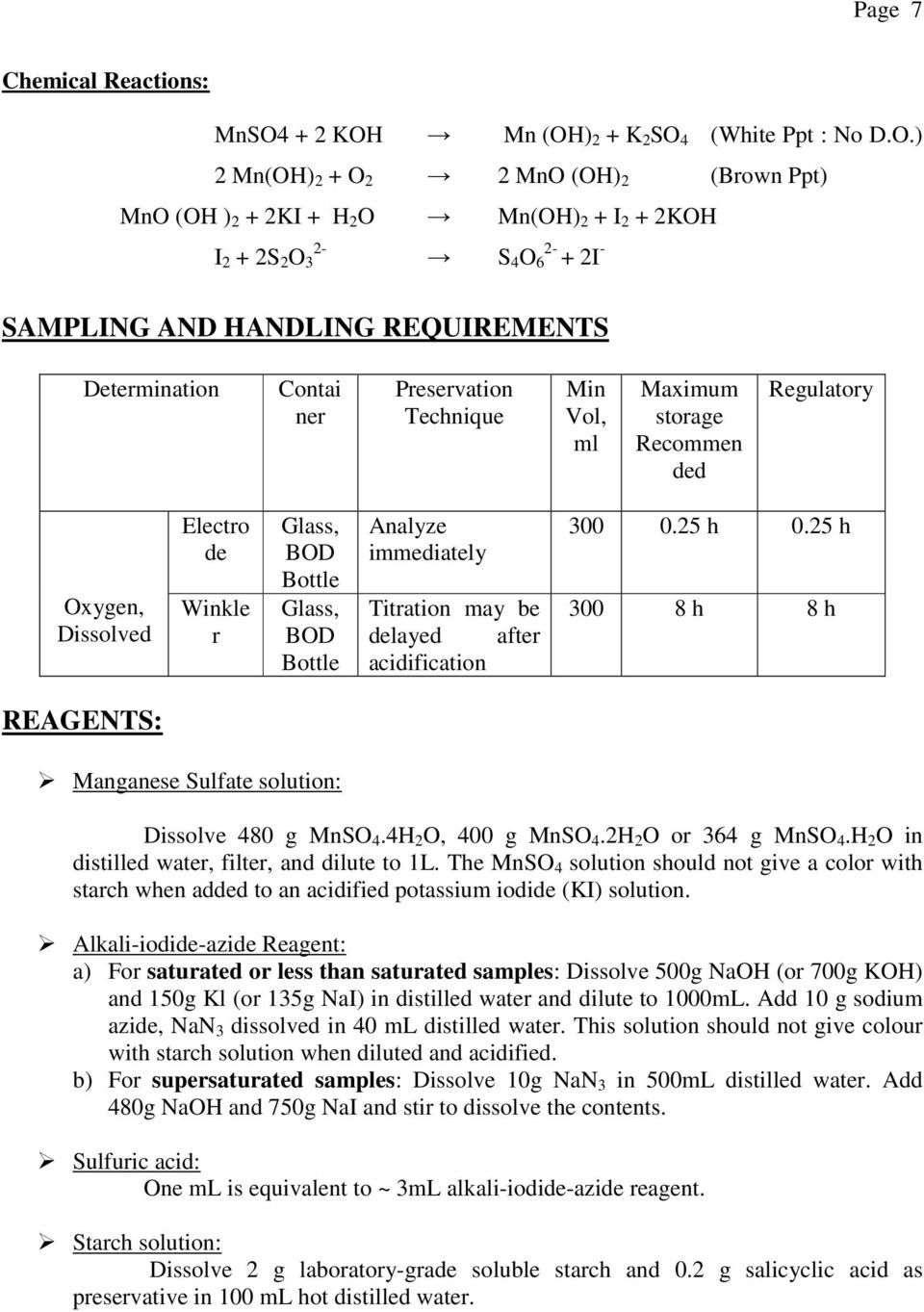
7 Page 7 Chemical Reactions: MnSO4 + 2 KOH Mn (OH) 2 + K 2 SO 4 (White Ppt : No D.O.) 2 Mn(OH) 2 + O 2 2 MnO (OH) 2 (Brown Ppt) MnO (OH ) 2 + 2KI + H 2 O Mn(OH) 2 + I 2 + 2KOH 2- I 2 + 2S 2 O 3 2- S 4 O 6 + 2I - SAMPLING AND HANDLING REQUIREMENTS Determination Contai ner Preservation Technique Min Vol, ml Maximum storage Recommen ded Regulatory Oxygen, Dissolved Electro de Winkle r Glass, BOD Bottle Glass, BOD Bottle Analyze immediately Titration may be delayed after acidification h 0.25 h h 8 h REAGENTS: Manganese Sulfate solution: Dissolve 480 g MnSO 4.4H 2 O, 400 g MnSO 4.2H 2 O or 364 g MnSO 4.H 2 O in distilled water, filter, and dilute to 1L. The MnSO 4 solution should not give a color with starch when added to an acidified potassium iodide (KI) solution. Alkali-iodide-azide Reagent: a) For saturated or less than saturated samples: Dissolve 500g NaOH (or 700g KOH) and 150g Kl (or 135g NaI) in distilled water and dilute to 1000mL. Add 10 g sodium azide, NaN 3 dissolved in 40 ml distilled water. This solution should not give colour with starch solution when diluted and acidified. b) For supersaturated samples: Dissolve 10g NaN 3 in 500mL distilled water. Add 480g NaOH and 750g NaI and stir to dissolve the contents. Sulfuric acid: One ml is equivalent to ~ 3mL alkali-iodide-azide reagent. Starch solution: Dissolve 2 g laboratory-grade soluble starch and 0.2 g salicyclic acid as preservative in 100 ml hot distilled water.
8 Page 8 Standard sodium thiosulfate titrant: Dissolve g Na 2 S 2 O 3. 5H 2 O in distiller water and add 1.5 ml 6N NaOH or 0.4 g solid NaOH and dilute to 1000 ml. Standardize with bi-iodate solution. PROCEDURE 1) Make dilution water by adding 2 ml/l of following reagents in distilled water: a. Phosphate buffer solution b. Magnesium sulfate solution c. Calcium chloride solution d. Ferric chloride solution e. Sodium Sulfite solution 2) Collect sample in a BOD bottle using D.O sampler. 3) NOTE: Use separate pipettes of 2 ml capacity for each reagent and take care that tip of the pipette in each case is dipped well below the liquid surfaces carefully. a. Add 1mL MnSO4 followed by 1mL of alkali-iodide-azide reagent to a sample collected in 250 to 300mL bottle up to the brim. The tip of the pipette should be below the liquid level while adding these reagents. Stopper immediately. Rinse the pipettes before putting them to reagent bottles. b. Mix well by inverting the bottle 2-3 times and allow the precipitate to settle leaving 150 ml clear supernatant. The precipitate is white if the sample is devoid of oxygen, and becomes increasingly brown with rising oxygen content. 4) At this stage, add 1mL conc. H2SO4. 5) Replace the stopper and mix well till precipitate goes into solution. 6) Take 201 ml of this solution in a conical flask and titrate against std. Na2S2O3 soln. 7) Add 2 drops of starch indicator and continue to titrate till the color of the solution becomes either colorless or changes to its original sample color. 8) Note down volume of 0.025N sodium thiosulfate consumed. 9) As 1 ml of sodium thiosulfate of 0.025N equals to 1 mg/l dissolved oxygen. 10) Dissolved oxygen (D.O) (in mg/l) = ml of sodium thiosulfate (0.025N) consumed.

9 Page 9 ANSWER THESE QUESTIONS ALSO (for Submission with Lab report): 1. What precautions do you need to take during DO measurement in raw wastewater sample? Hint: This sample can have both oxidizing and reducing agents. REFERENCE MATERIAL: AWWA, WEF, APHA, 1998, Standard Methods for the Examination of Water and Wastewater Sawyer, C. N., McCarty, P. L., and Parkin, G. F Chemistry for Environmental Engineering. Fourth Edition, McGraw-Hill, Inc., New York.

10 Page Additional Question (Not for Submission) QA1. Compute ultimate BOD and oxygen consumption rate constant using the following data for a stream receiving treated effluent. Time (days) BOD exerted at time t (Y t ) Q2. To determine BOD of a sample, three dilutions of the samples are made (BOD bottle volume=300ml). In the BOD dilution water (without sample), initial DO=0 (blank). All samples are incubated at 20 C for 5 days. Look at the following data and calculate 5-day BOD value of the sample at 15 C? t-day BOD= [DO t -DO 0 ]/(P) (1) where P= Dilution factor = 300mL/(sample volume in ml) Bottle no. Wastewater sample (ml) Initial DO (mg/l) (DO 0 ) DO at 5-day (ml) (DO 5 )

NANYANG TECHNOLOGICAL UNIVERSITY. School of Civil and Environmental Engineering. CV2701: Laboratory 2A. Laboratory Manual. For
 NANYANG TECHNOLOGICAL UNIVERSITY School of Civil and Environmental Engineering CV2701: Laboratory 2A Laboratory Manual For Experiment Lab 2A-6(ENV) Wastewater Quality Analysis Location : Environment Laboratory,
OXIDATION-REDUCTION TITRATIONS-Permanganometry
 Experiment No. Date OXIDATION-REDUCTION TITRATIONS-Permanganometry INTRODUCTION Potassium permanganate, KMnO 4, is probably the most widely used of all volumetric oxidizing agents. It is a powerful oxidant
5.0 EXPERIMENT ON DETERMINATION OF TOTAL HARDNESS
 5.0 EXPERIMENT ON DETERMINATION OF TOTAL HARDNESS Sl. No. Contents Preamble 5.1 Aim 5.2 Introduction 5.2.1 Environmental Significance 5.3 Principle 5.4 Materials Required 5.4.1 Apparatus Required 5.4.2
4.0 EXPERIMENT ON DETERMINATION OF CHLORIDES
 4.0 EXPERIMENT ON DETERMINATION OF CHLORIDES Sl. No. Contents Preamble 4.1 Aim 4.2 Introduction 4.2.1 Environmental Significance 4.3 Principle 4.4 Materials Required 4.4.1 Apparatus Required 4.4.2 Chemicals
Estimation of Alcohol Content in Wine by Dichromate Oxidation followed by Redox Titration
 Sirromet Wines Pty Ltd 850-938 Mount Cotton Rd Mount Cotton Queensland Australia 4165 www.sirromet.com Courtesy of Jessica Ferguson Assistant Winemaker & Chemist Downloaded from seniorchem.com/eei.html
Nitrogen, Ammonia. Known Addition ISE Method 1 Method 10002 Minimum of 0.8 mg/l NH 3 N. Ammonia ISE. Test preparation. Instrument-specific table
 Nitrogen, Ammonia DOC316.53.01234 Known Addition ISE Method 1 Method 10002 Minimum of 0.8 mg/l NH 3 N Scope and application: For wastewater 2. Ammonia ISE 1 Adapted from the Standard Methods for the Examination
A Volumetric Analysis (Redox Titration) of Hypochlorite in Bleach
 CHEM 311L Quantitative Analysis Laboratory Revision 2.3 A Volumetric Analysis (Redox Titration) of Hypochlorite in Bleach In this laboratory exercise, we will determine the concentration of the active
How to prepare standard solutions
 World Bank & Government of The Netherlands funded Training module # WQ -04 How to prepare standard solutions New Delhi, May 1999 CSMRS Building, 4th Floor, Olof Palme Marg, Hauz Khas, New Delhi 11 00 16
Cadmium Reduction Method Method 8039 0.3 to 30.0 mg/l NO 3 N (HR) Powder Pillows or AccuVac Ampuls
 Nitrate DOC316.53.01066 Cadmium Reduction Method Method 8039 0.3 to 30.0 mg/l NO 3 N (HR) Powder Pillows or AccuVac Ampuls Scope and application: For water, wastewater and seawater. Test preparation Instrument-specific
Solutions and Dilutions
 Learning Objectives Students should be able to: Content Design a procedure for making a particular solution and assess the advantages of different approaches. Choose the appropriate glassware to ensure
USEPA 1 FerroVer Method 2 Method 8008 0.02 to 3.00 mg/l Fe Powder Pillows or AccuVac Ampuls
 Iron, Total DOC316.53.01053 USEPA 1 FerroVer Method 2 Method 8008 0.02 to 3.00 mg/l Fe Powder Pillows or AccuVac Ampuls Scope and application: For water, wastewater and seawater; digestion is required
HS 1003 Part 2 HS 1003 Heavy Metals Test
 HS 1003 Heavy Metals Test 1. Purpose This test method is used to analyse the heavy metal content in an aliquot portion of stabilised hot acetic acid extract by Atomic Absorption Spectroscopy (AAS). Note:
1.4 This method is capable of measuring DO in the range of 0.20 to 20 mg/l.
 Luminescence Measurement of Dissolved Oxygen in Water and Wastewater and for Use in the Determination of BOD 5 and cbod 5 Revision 1.2 October 2011 1. Scope and Application 1.1 This method is for the measurement
Dimethylglyoxime Method Method 10220 0.1 to 6.0 mg/l Ni TNTplus 856
 Nickel DOC316.53.01065 Dimethylglyoxime Method Method 10220 0.1 to 6.0 mg/l Ni TNTplus 856 Scope and application: For water and wastewater. Test preparation Instrument-specific information Table 1 shows
Preparation of frequently used solutions
 Preparation of frequently used solutions Content 1. Diluting Concentrated Acids (Last Login: 08/08/2009) 2. Indicators (Last Login: 27/07/2009) 3. Standard Buffer Solutions (Last Login: 27/07/2009) 4.
Phosphorus, Reactive (Orthophosphate)
 Phosphorus, Reactive (Orthophosphate) DOC316.53.01113 Amino Acid Method 1 Method 8178 0.23 to 30.00 mg/l PO 4 Reagent Solution Scope and application: For water, wastewater and seawater. 1 Adapted from
ACID-BASE TITRATIONS: DETERMINATION OF CARBONATE BY TITRATION WITH HYDROCHLORIC ACID BACKGROUND
 #3. Acid - Base Titrations 27 EXPERIMENT 3. ACID-BASE TITRATIONS: DETERMINATION OF CARBONATE BY TITRATION WITH HYDROCHLORIC ACID BACKGROUND Carbonate Equilibria In this experiment a solution of hydrochloric
Determination of the amount of sodium carbonate and sodium hydroxide in a mixture by titration.
 Module 9 : Experiments in Chemistry Lecture 38 : Titrations : Acid-Base, Redox and Complexometric Objectives In this lecture you will learn the techniques to do following Determination of the amount of
Chapter 16: Tests for ions and gases
 The position of hydrogen in the reactivity series Hydrogen, although not a metal, is included in the reactivity series because it, like metals, can be displaced from aqueous solution, only this time the
Practical Lesson No 4 TITRATIONS
 Practical Lesson No 4 TITRATIONS Reagents: 1. NaOH standard solution 0.1 mol/l 2. H 2 SO 4 solution of unknown concentration 3. Phenolphthalein 4. Na 2 S 2 O 3 standard solution 0.1 mol/l 5. Starch solution
Direct ISE Method Method 8359 10 to 1000 mg/l Na + Sodium ISE
 Sodium DOC316.53.01240 Direct ISE Method Method 8359 10 to 1000 mg/l Na + Sodium ISE Scope and application: For drinking water and process water. Test preparation Instrument-specific information This procedure
Santa Monica College Chemistry 11
 Types of Reactions Objectives The objectives of this laboratory are as follows: To perform and observe the results of a variety of chemical reactions. To become familiar with the observable signs of chemical
Appendix D lists the Field Services Standard Operating Procedures. Appendix E lists the Biological Monitoring Standard Operating Procedures.
 Page 16 of 87 3.3 Sample Collection, Storage and Preservation Figure 3 details required containers, sample volumes, preservation techniques, and holding times for proper sample collection. A discussion
Analysis of Vitamin C Using Iodine. Introduction
 Analysis of Vitamin C Using Iodine Introduction Vitamin C (ascorbic acid) is oxidized to dehydroascorbic acid using a mild oxidizing agent such as iodine. The oxidation is a two- electron process, following
Estimation of Hardness of Water by EDTA Method
 Estimation of Hardness of Water by EDTA Method 1 EXPERIMENT 1 Estimation of Hardness of Water by EDTA Method INTRODUCTION Water hardness is the traditional measure of the capacity of water to precipitate
12.097 Environmental Chemistry of Boston Harbor IAP 2006 DETERMINATION OF DISSOLVED OXYGEN BY WINKLER TITRATION
 1.097 Environmental Chemistry of Boston Harbor IAP 006 Lab 1: DETERMINATION OF DISSOLVED OXYGEN BY WINKLER TITRATION 1. Background Knowledge of the dissolved oxygen (O ) concentration in seawater is often
Standard Operating Procedure for Total Kjeldahl Nitrogen (Lachat Method)
 Standard Operating Procedure for Total Kjeldahl Nitrogen (Lachat Method) Grace Analytical Lab 536 South Clark Street 10th Floor Chicago, IL 60605 April 15, 1994 Revision 2 Standard Operating Procedure
Ion Selective Electrodes
 Ion Selective Electrodes OAKTON has a large selection of Ion Selective Electrodes () to suit a wide variety of applications. Each electrode has a typical response time of 20 to 30 seconds but will vary
WRITING CHEMICAL FORMULA
 WRITING CHEMICAL FORMULA For ionic compounds, the chemical formula must be worked out. You will no longer have the list of ions in the exam (like at GCSE). Instead you must learn some and work out others.
Method 8155 NITROGEN, AMMONIA (0 to 0.50 mg/l NH 3 -N) For water, wastewater, seawater
 Method 8155 NITROGEN, AMMONIA (0 to 0.50 mg/l NH 3 -N) For water, wastewater, seawater Salicylate Method * 1. Enter the stored program number for ammonia nitrogen (NH 3 -N). 2. Press: 64 ENTER The display
Standardization of Potassium Permanganate solution with Standard Sodium Oxalate Solution.
 Experiment Number: 07 Name of the experiment: Standardization of Potassium Permanganate solution with Standard Sodium Oxalate Solution. Course: Chem-114 Name: Noor Nashid Islam Roll: 0105044 Group: A2
ANALYSIS OF FOOD AND NATURAL PRODUCTS LABORATORY EXERCISE
 ANALYSIS OF FOOD AND NATURAL PRODUCTS LABORATORY EXERCISE Determination of total nitrogen in food and crude protein calculation (Kjeldahl method) Responsible person: Assoc.Prof. Ing.Kateřina Riddellová,
(1) Hydrochloric acid reacts with sodium hypochlorite to form hypochlorous acid: NaOCl(aq) + HCl(aq) HOCl(aq) + NaCl(aq) hypochlorous acid
 The Determination of Hypochlorite in Bleach Reading assignment: Chang, Chemistry 10 th edition, pages 156-159. We will study an example of a redox titration in order to determine the concentration of sodium
How to measure Ammonia and Organic Nitrogen: Kjeldahl Method
 World Bank & Government of The Netherlands funded Training module # WQ - 38 How to measure Ammonia and Organic Nitrogen: Kjeldahl Method New Delhi, March 2000 CSMRS Building, 4th Floor, Olof Palme Marg,
Topic 4 National Chemistry Summary Notes. Formulae, Equations, Balancing Equations and The Mole
 Topic 4 National Chemistry Summary Notes Formulae, Equations, Balancing Equations and The Mole LI 1 The chemical formula of a covalent molecular compound tells us the number of atoms of each element present
K + Cl - Metal M. Zinc 1.0 M M(NO
 Redox and Electrochemistry This section should be fresh in your minds because we just did this section in the text. Closely related to electrochemistry is redox chemistry. Count on at least one question
HOMEWORK 4A. Definitions. Oxidation-Reduction Reactions. Questions
 HOMEWORK 4A Oxidation-Reduction Reactions 1. Indicate whether a reaction will occur or not in each of following. Wtiring a balcnced equation is not necessary. (a) Magnesium metal is added to hydrochloric
Precipitation Titration: Determination of Chloride by the Mohr Method by Dr. Deniz Korkmaz
 Precipitation Titration: Determination of Chloride by the Mohr Method by Dr. Deniz Korkmaz Introduction Titration is a process by which the concentration of an unknown substance in solution is determined
Number of moles of solute = Concentration (mol. L ) x Volume of solution (litres) or n = C x V
 44 CALCULATIONS INVOLVING SOLUTIONS INTRODUCTION AND DEFINITIONS Many chemical reactions take place in aqueous (water) solution. Quantities of such solutions are measured as volumes, while the amounts
Chlorine, Total. DPD Method 1 Method 10101 0.09 to 5.00 mg/l Cl 2 Test 'N Tube Vials. Test preparation. Instrument-specific information
 Chlorine, Total DOC316.53.01028 DPD Method 1 Method 10101 0.09 to 5.00 mg/l Cl 2 Test 'N Tube Vials Scope and application: For testing higher levels of total (free plus combined) chlorine in drinking water,
IB Chemistry. DP Chemistry Review
 DP Chemistry Review Topic 1: Quantitative chemistry 1.1 The mole concept and Avogadro s constant Assessment statement Apply the mole concept to substances. Determine the number of particles and the amount
Lab #13: Qualitative Analysis of Cations and Anions
 Lab #13: Qualitative Analysis of Cations and Anions Objectives: 1. To understand the rationale and the procedure behind the separation for various cations and anions. 2. To perform qualitative analysis
Decomposition. Composition
 Decomposition 1. Solid ammonium carbonate is heated. 2. Solid calcium carbonate is heated. 3. Solid calcium sulfite is heated in a vacuum. Composition 1. Barium oxide is added to distilled water. 2. Phosphorus
LZV585 (B) The 1-cm path is aligned with the arrow on the adapter. 5940506
 Chlorine, Total DOC316.53.01029 USEPA DPD Method 1 Method 10070 0.1 to 10.0 mg/l Cl 2 (HR) Powder Pillows Scope and application: For testing higher levels of total chlorine (free and combined) in drinking
Additional Lecture: TITRATION BASICS
 Additional Lecture: TITRATION BASICS 1 Definition and Applications Titration is the incremental addition of a reagent solution (called titrant) to the analyte until the reaction is complete Common applications:
FerroVer Method 1 Method 10249 0.1 to 3.0, 1.0 to 30.0 and 10.0 to 300.0 mg/l Fe Powder Pillows
 Iron, Total DOC316.53.01314 FerroVer Method 1 Method 10249 0.1 to 3.0, 1.0 to 30.0 and 10.0 to 300.0 mg/l Fe Powder Pillows Scope and application: For oil and gas field waters; digestion is required for
III. Chemical Kinetics
 WARNING NOTICE: The experiments described in these materials are potentially hazardous and require a high level of safety training, special facilities and equipment, and supervision by appropriate individuals.
Aqueous Solutions. Water is the dissolving medium, or solvent. Some Properties of Water. A Solute. Types of Chemical Reactions.
 Aqueous Solutions and Solution Stoichiometry Water is the dissolving medium, or solvent. Some Properties of Water Water is bent or V-shaped. The O-H bonds are covalent. Water is a polar molecule. Hydration
Experiment 16-Acids, Bases and ph
 Definitions acid-an ionic compound that releases or reacts with water to form hydrogen ion (H + ) in aqueous solution. They taste sour and turn litmus red. Acids react with certain metals such as zinc,
Syllabus OC18 Use litmus or a universal indicator to test a variety of solutions, and classify these as acidic, basic or neutral
 Chemistry: 9. Acids and Bases Please remember to photocopy 4 pages onto one sheet by going A3 A4 and using back to back on the photocopier Syllabus OC18 Use litmus or a universal indicator to test a variety
LACHAT METHOD NUMBER 10-204-00-5-D Rev 1, 21 March 2011 SCOPE AND APPLICATION Approximately 3-500 g CN/L 2-500 g CN/L. 09e
 1 SIDE BY SIDE COMPARISON TABLE FOR THE DETERMINATION OF CYANIDE BY UV DIGESTION AND AMPEROMETRIC DETECTION FIA METHOD - 10-204-00-5-D (ASTM D7511-09 e ) TOPIC Method ASTM D7511-09e LACHAT METHOD NUMBER
Quaternary Ammonium Compounds DOC316.53.01128
 Quaternary Ammonium Compounds DOC316.53.01128 Direct Binary Complex Method Method 8337 0.2 to 5.0 mg/l as CTAB (cetyl-trimethylammonium bromide) Powder Pillows Scope and application: For cooling tower
Determination of calcium by Standardized EDTA Solution
 Determination of calcium by Standardized EDTA Solution Introduction The classic method of determining calcium and other suitable cations is titration with a standardized solution of ethylenediaminetetraacetic
Chemistry 119: Experiment 7. Potentiometric Titration of Ascorbic Acid in Vitamin C Tablets
 Chemistry 119: Experiment 7 Potentiometric Titration of Ascorbic Acid in Vitamin C Tablets Vitamin C is another name for ascorbic acid (C 6 H 8 O 6, see below ), a weak acid that can be determined by titration
Molarity of Ions in Solution
 APPENDIX A Molarity of Ions in Solution ften it is necessary to calculate not only the concentration (in molarity) of a compound in aqueous solution but also the concentration of each ion in aqueous solution.
Properties of Alcohols and Phenols Experiment #3
 Properties of Alcohols and Phenols Experiment #3 Objectives: To observe the solubility of alcohols relative to their chemical structure, to perform chemical tests to distinguish primary, secondary and
Measurement by Ion Selective Electrodes
 Measurement by Ion Selective Electrodes Adrian Vazquez May 8, 2012 Why Use Ion Selective Electrodes? Responsive over a wide concentration range Not affected by color or turbidity of sample Rugged and durable
DR/4000 PROCEDURE. CHLORINE, Free
 DR/4000 PROCEDURE CHLORINE, Free Method 10069 DPD method* UHR (0.1 10.0 mg/l as Cl 2 ) Scope and Application: For testing higher levels of free chlorine (hypochlorous acid and hypochlorite ion) in drinking
ph: Measurement and Uses
 ph: Measurement and Uses One of the most important properties of aqueous solutions is the concentration of hydrogen ion. The concentration of H + (or H 3 O + ) affects the solubility of inorganic and organic
IODINE CLOCK. A Study of Reaction Rates.
 IODINE CLOCK A Study of Reaction Rates. In this lab you will be studying the Law of Mass Action. Please review that law in your text in the chapter on Chemical Kinetics. Basically, the law states that
FIVE-DAY BIOCHEMICAL 7.0 OXYGEN DEMAND
 FIVE-DAY BIOCHEMICAL 7.0 OXYGEN DEMAND by G.C. Delzer and S.W. McKenzie BOD 1 Page 7.0 Five-day biochemical oxygen demand... BOD-3 7.0.1 Equipment and supplies... 6 7.0.2 Sample collection and storage...
Experiment 5. Chemical Reactions A + X AX AX A + X A + BX AX + B AZ + BX AX + BZ
 Experiment 5 Chemical Reactions OBJECTIVES 1. To observe the various criteria that are used to indicate that a chemical reaction has occurred. 2. To convert word equations into balanced inorganic chemical
Environmental Water Testing: Surface Water, Groundwater, Hard Water, Wastewater, & Seawater
 Document: AND Sol Env 08 2013 Environmental Water Testing: Surface Water, Groundwater, Hard Water, Wastewater, & Seawater Matrix specific sample preparation and testing methods for environmental waters
Standard methods in water analysis
 Branch General analytical laboratories; water analysis Keywords Water analysis; standard methods; ASTM; DIN; ISO; USP; EPA; SLMB; EN; SCA; titration; ion chromatography; voltammetry; branch 1; branch 2
Experiment 7: Titration of an Antacid
 1 Experiment 7: Titration of an Antacid Objective: In this experiment, you will standardize a solution of base using the analytical technique known as titration. Using this standardized solution, you will
Prussian blue and cyanotype printing
 CHEM 101lab, fall 2008, J. Peters and cyanotype printing Ferric ferrocyanide, commonly known as, was first synthesized in 1704 in Berlin. has a very intense dark blue color and has been used extensively
SODIUM CARBOXYMETHYL CELLULOSE
 SODIUM CARBOXYMETHYL CELLULOSE Prepared at the 28th JECFA (1984), published in FNP 31/2 (1984) and in FNP 52 (1992). Metals and arsenic specifications revised at the 55 th JECFA (2000). An ADI not specified
Sodium and Potassium chlorate synthesis, the complete guide
 Sodium and Potassium chlorate synthesis, the complete guide Made by Plante1999 It is know that chlorates can be easily made. Much of the chlorate made by individual are used in pyrotechnic, but this thread
EXPERIMENT 5. Molecular Absorption Spectroscopy: Determination of Iron With 1,10-Phenanthroline
 EXPERIMENT 5 Molecular Absorption Spectroscopy: Determination of Iron With 1,10-Phenanthroline UNKNOWN Submit a clean, labeled 100-mL volumetric flask to the instructor so that your unknown iron solution
Experiment 8 - Double Displacement Reactions
 Experiment 8 - Double Displacement Reactions A double displacement reaction involves two ionic compounds that are dissolved in water. In a double displacement reaction, it appears as though the ions are
Laboratory 22: Properties of Alcohols
 Introduction Alcohols represent and important class of organic molecules. In this experiment you will study the physical and chemical properties of alcohols. Solubility in water, and organic solvents,
The Influence of Carbon Dioxide on Algae Growth
 The Influence of Carbon Dioxide on Algae Growth The first objective of this experiment is to show that increased atmospheric concentrations of carbon dioxide, CO 2, can stimulate algae growth. The second
General Chemistry Lab Experiment 6 Types of Chemical Reaction
 General Chemistry Lab Experiment 6 Types of Chemical Reaction Introduction Most ordinary chemical reactions can be classified as one of five basic types. The first type of reaction occurs when two or more
Instructions Answer all questions in the spaces provided. Do all rough work in this book. Cross through any work you do not want to be marked.
 GCSE CHEMISTRY Higher Tier Chemistry 1H H Specimen 2018 Time allowed: 1 hour 45 minutes Materials For this paper you must have: a ruler a calculator the periodic table (enclosed). Instructions Answer all
Color, True and Apparent
 Color, True and Apparent DOC316.53.01037 Platinum-Cobalt Standard Method 1, 2, 3 Method 8025 15 to 500 color units Scope and application: For water, wastewater and seawater; equivalent to NCASI method
Solution a homogeneous mixture = A solvent + solute(s) Aqueous solution water is the solvent
 Solution a homogeneous mixture = A solvent + solute(s) Aqueous solution water is the solvent Water a polar solvent: dissolves most ionic compounds as well as many molecular compounds Aqueous solution:
HEXAVALENT CHROMIUM REMOVAL FROM INDUSTRIAL WATSEWATER BY CHEMICAL PRECIPITATION METHOD
 HEXAVALENT CHROMIUM REMOVAL FROM INDUSTRIAL WATSEWATER BY CHEMICAL PRECIPITATION METHOD Dr. C.R.Ramakrishnaiah P.G-Environmental Engineering Dept of Civil Engineering, B.M.S. College of Engineering Bull
Neutralizing an Acid and a Base
 Balancing Act Teacher Information Objectives In this activity, students neutralize a base with an acid. Students determine the point of neutralization of an acid mixed with a base while they: Recognize
Simulation of the determination of lead azide content in waste water from explosives manufacture
 Simulation of the determination of lead azide content in waste water from explosives manufacture Lead azide ranks in the category of intensive explosives, which may, even in an insignificant amount, initiate
ENE 806, Project Report 3 CHEMICAL PRECIPITATION: WATER SOFTENING. Grégoire Seyrig Wenqian Shan
 ENE 806, Project Report 3 CHEMICAL PRECIPITATION: WATER SOFTENING Grégoire Seyrig Wenqian Shan College of Engineering, Michigan State University Spring 2007 ABSTRACT The groundwater with high level initial
Question Bank Electrolysis
 Question Bank Electrolysis 1. (a) What do you understand by the terms (i) electrolytes (ii) non-electrolytes? (b) Arrange electrolytes and non-electrolytes from the following substances (i) sugar solution
CHEMICAL DETERMINATION OF EVERYDAY HOUSEHOLD CHEMICALS
 CHEMICAL DETERMINATION OF EVERYDAY HOUSEHOLD CHEMICALS Purpose: It is important for chemists to be able to determine the composition of unknown chemicals. This can often be done by way of chemical tests.
Water Softening for Hardness Removal. Hardness in Water. Methods of Removing Hardness 5/1/15. WTRG18 Water Softening and Hardness
 Water Softening for Removal 1 in Water High concentration of calcium (Ca2+) and magnesium (Mg2+) ions in water cause hardness Generally, water containing more than 100 mg/l of hardness expressed as calcium
SPIKE RECOVERY AND DETERMINING A METHOD DETECTION LIMIT Pamela Doolittle, University of Wisconsin Madison, [email protected] 2014
 SPIKE RECOVERY AND DETERMINING A METHOD DETECTION LIMIT Pamela Doolittle, University of Wisconsin Madison, [email protected] 2014 This experiment explores quality assurance practices which are commonly
Color, True and Apparent
 Color, True and Apparent DOC316.53.01037 Platinum-Cobalt Standard Method 1, 2, 3 Method 8025 15 to 500 color units 5 to 500 color units (low range technique) Scope and application: For water, wastewater
Exp 13 Volumetric Analysis: Acid-Base titration
 Exp 13 Volumetric Analysis: Acid-Base titration Exp. 13 video (time: 47:17 minutes) Titration - is the measurement of the volume of a standard solution required to completely react with a measured volume
2. ATOMIC, MOLECULAR AND EQUIVALENT MASSES
 2. ATOMIC, MOLECULAR AND EQUIVALENT MASSES INTRODUCTION: EQUIVALENT WEIGHT Since hydrogen is the lightest of all elements, it was chosen as a standard for determination of equivalent weights. On this basis,
EXPERIMENT 12 A SOLUBILITY PRODUCT CONSTANT
 PURPOSE: 1. To determine experimentally the molar solubility of potassium acid tartrate in water and in a solution of potassium nitrate. 2. To examine the effect of a common ion on the solubility of slightly
Petri Dish Electrolysis Electrolysis Reactions
 elearning 2009 Introduction Petri Dish Electrolysis Electrolysis Reactions Publication No. 95008 Electrolysis is defined as the decomposition of a substance by means of an electric current. When an electric
To see how this data can be used, follow the titration of hydrofluoric acid against sodium hydroxide below. HF (aq) + NaOH (aq) H2O (l) + NaF (aq)
 Weak Acid Titration v120413 You are encouraged to carefully read the following sections in Tro (2 nd ed.) to prepare for this experiment: Sec 4.8, pp 158-159 (Acid/Base Titrations), Sec 16.4, pp 729-43
6 Reactions in Aqueous Solutions
 6 Reactions in Aqueous Solutions Water is by far the most common medium in which chemical reactions occur naturally. It is not hard to see this: 70% of our body mass is water and about 70% of the surface
Experiment 12- Classification of Matter Experiment
 Experiment 12- Classification of Matter Experiment Matter can be classified into two groups: mixtures and pure substances. Mixtures are the most common form of matter and consist of mixtures of pure substances.
TERRA TEK LIMITED GUIDE TO SAMPLE HANDLING. Version 1.06
 TERRA TEK LIMITED GUIDE TO SAMPLE HANDLING Version 1.06 September 2009 Guidance on Sample Containers & Storage Conditions - SOIL SAMPLES 500ml Plastic Tub Suitable for: Inorganic Parameters, usually sufficient
Complexometric Titrations
 Complexometric Titrations Complexometric titrations are based on the formation of a soluble complex upon the reaction of the species titrated with the titrant. M + L ML In the module Chemistry 2 you were
W1 WORKSHOP ON STOICHIOMETRY
 INTRODUCTION W1 WORKSHOP ON STOICHIOMETRY These notes and exercises are designed to introduce you to the basic concepts required to understand a chemical formula or equation. Relative atomic masses of
PECTINS. SYNONYMS INS No. 440 DEFINITION DESCRIPTION. FUNCTIONAL USES Gelling agent, thickener, stabilizer, emulsifier CHARACTERISTICS
 PECTINS SYNONYMS INS No. 440 Prepared at the 71 st JECFA (2009) and published in FAO JECFA Monographs 7 (2009), superseding specifications prepared at the 68 th JECFA (2007) and published in FAO JECFA
MASSACHUSETTS INSTITUTE OF TECHNOLOGY Department of Chemistry 5.310 Laboratory Chemistry THE POTENTIOMETRIC TITRATION OF AN ACID MIXTURE 1
 MASSACHUSETTS INSTITUTE OF TECHNOLOGY Department of Chemistry 5.310 Laboratory Chemistry EXPERIMENT #5 THE POTENTIOMETRIC TITRATION OF AN ACID MIXTURE 1 I. PURPOSE OF THE EXPERIMENT In this experiment
Esterification Method 1 Method 8196 27 to 2800 mg/l (as acetic acid) Reagent Solution
 Volatile Acids DOC316.53.01144 Esterification Method 1 Method 8196 27 to 2800 mg/l (as acetic acid) Reagent Solution Scope and application: For digestor sludges. 1 Adapted from The Analyst, 87, 949 (1962).
Physical Changes and Chemical Reactions
 Physical Changes and Chemical Reactions Gezahegn Chaka, Ph.D., and Sudha Madhugiri, Ph.D., Collin College Department of Chemistry Objectives Introduction To observe physical and chemical changes. To identify
PROTEINS (LOWRY) PROTOCOL
 1 PROTEINS (LOWRY) PROTOCOL 1. INTRODUCTION The Lowry Assay: Protein by Folin Reaction (Lowry et al., 1951) has been the most widely used method to estimate the amount of proteins (already in solution