
Properties of Alcohols and Phenols Experiment #3
|
|
|
- Abigayle Heath
- 9 years ago
- Views:
Transcription
1 Properties of Alcohols and Phenols Experiment #3 Objectives: To observe the solubility of alcohols relative to their chemical structure, to perform chemical tests to distinguish primary, secondary and tertiary alcohols, and a color test for phenol. Introduction The general formula of an alcohol is ROH in which the R is an aliphatic hydrocarbon group. Alcohols may be looked upon as derivatives of water, HOH. One hydrogen of water is substituted by an alkyl group, R. Like water, alcohols show hydrogen bonding. As the chain of the R group increases the hydrocarbon character of the compound overshadows the polar character of the OH group. Consequently, the solubility and boiling point of an alcohol are affected by the length of the carbon chain and the shape of the molecule. The short chain alcohols are soluble in water, whereas the longer chain alcohols are insoluble in water. In general a molecule which is more compact (i.e., more branched) will be more soluble in water and will have a lower boiling point than the straight chain isomer. Phenols are aromatic alcohols, in which R is an aromatic ring. This experiment will demonstrate some of the properties of alcohols and phenols. Although alkyl alcohols have an -OH group, they do not ionize in water, whereas phenols ionize like acids (donating a proton to water). The -OH group of alkyl alcohols can be positioned on different carbon atoms of the carbon chain and are classified as primary (1 ), secondary (2 ), or tertiary (3 ) alcohols depending on whether the -OH group is attached to a carbon with 1, 2 or 3 other carbon atoms attached to it. These different alcohols react differently with Lucas reagent and with Bordwell-Wellman reagent; hence these reagents can be used for identifying the class of alcohol. The relative acidity of phenols can be used to characterize this class of alcohols relative to the alkyl alcohols. This property will be exploited in the identification of phenol. Materials Test tubes, Bordwell-Wellman reagent, n-butyl alcohol (1-butanol), secondary-butyl alcohol (2- butanol), tertiary-butyl alcohol (2-methyl-2-propanol), glycerol, ferric chloride solution, Lucas reagent, phenol (3% solution), 10% sodium hydroxide solution, acetone, unknown. Notice: Each student must have his/her own unknown and be sure to record the number of your unknown on the report sheet. If you work in pairs, each pair must have 2 unknowns. Keep the tubes containing your unknown at your bench until you finish all parts of the lab. 19

2 Part A. Solubility To test the solubility in water of alcohols, add several (10) drops of alcohol to about 2 ml water, shake the test tube vigorously [Use a cork to stopper the test tube; do not use your thumb] and notice if two layers form. If two layers form, the liquids are immiscible, hence, insoluble or of only limited solubility. You should make sure you mix viscous alcohols (such as glycerol) well because they may not dissolve immediately. Procedure 1. Place 2 ml of water into each of 5 small test tubes. 2. To one test tube add 10 drops of n-butyl alcohol (1-butanol). To a second test tube add 10 drops of sec-butyl alcohol (2-butanol). To a third test tube add 10 drops t-butyl alcohol (2-methyl-2-propanol), and to a fourth test tube add 10 drops glycerol, to a fifth test tube add 10 drops of your unknown. If you are working in pairs, you should have a sixth test tube with the second unknown. 3. Stir each mixture by holding the top of the tube and tapping the bottom with your finger. Note whether these substances are soluble in water. You may have to stir the viscous glycerol sample vigorously. Record your observation on the Report Sheet, Table 1. You may dispose of these solutions in the sink and flush with water. Part B. Lucas Test for Primary, Secondary and Tertiary Alcohols. The Lucas reagent is a solution of zinc chloride in concentrated HCl. This solution must be made freshly to get proper results. The test depends on a difference in the rate of reaction of these alcohols. The general equation for the reaction is: Tertiary alcohols react IMMEDIATELY. The test tube will get hot, and because the chloride is insoluble two layers may be apparent, or a cloudy dispersion forms. Secondary alcohols will become cloudy in 5 to 10 minutes. If cloudiness does not appear place test tube in a hot water bath and observe. Primary alcohols give no reaction in a reasonable length of time. 20
![thumb] and notice if two layers form. If two layers form, the liquids are immiscible, hence, insoluble or of only limited solubility.](/docs-images/47/20749749/images/page_2.jpg "You should make sure you mix viscous alcohols (such as glycerol) well because they may not dissolve immediately. Procedure 1. Place 2 ml of water into each of 5 small test tubes. 2. To one test tube add 10 drops of n-butyl alcohol (1-butanol).")
3 CAUTION! Lucas reagent contains concentrated hydrochloric acid - Handle It With Care Procedure 1. Place 1 ml of Lucas reagent in each of four (5 if you work in pairs) clean test tubes. 2. Add 6 drops of 1-butanol to one test tube. Shake the test tube to mix the reagents and notice whether the mixture gets cloudy and how long it takes. 3. In a second test tube place 6 drops of 2-butanol, shake and note how long it takes the tube to get cloudy. 4. In a third test tube place 6 drops of t-butyl alcohol, shake and note how long it takes the tube to get cloudy. 5. In the fourth (and fifth for pairs) test tube place 6 drops of your unknown and shake. 6. Record observations on the Report Sheet, Table 2. Dispose of these reagents in the "Halogenated Organic Liquid Waste" container in the hood. Part C. Bordwell-Wellman Test The Bordwell-Wellman test solution contains potassium dichromate dissolved in sulfuric 2- acid. It is an orange-yellow solution. The orange-yellow color is due to the Cr2O 7 ion. The oxidation number of chromium is +6. This reagent will oxidize primary and secondary alcohols 3+ and, in turn, becomes reduced. The chromium in dichromate is reduced to chromic ion, Cr. A greenish colored solution results. This color change from orange-yellow to green serves as an indicator for the presence of a primary or secondary alcohol. A primary alcohol is oxidized first to an aldehyde, which will be further oxidized to an acid. 21

4 USE EXTREME CARE WITH THIS REAGENT, IT IS VERY CORROSIVE! WASH IMMEDIATELY IF YOU GET ANY ON YOUR SKIN OR CLOTHING!!! Procedure 1. Place 1 ml of acetone in each of four (or 5 if you work in pairs) small test tubes. 2. Add 4 drops of n-butyl alcohol to one test tube; 4 drops of 2-butanol to a second test tube; and 4 drops of t-butyl alcohol to a third test tube; and 4 drops of your unknown to the remaining test tube(s). 3. To each test tube add 1 drop of Bordwell-Wellman reagent and shake. 4. Record your observations on the Report Sheet, Table 2. Dispose of these reagents in the Organic Liquid Waste container in the hood. Part D. Phenols Phenols form highly colored coordination complexes with ferric ion. A blue-violet colored solution results. Procedure 1. Place 10 drops of 3% phenol solution in a test tube. 2. Place 10 drops of your unknown in 10 drops of water, if it was soluble in part A, in another test tube. If your unknown was not soluble in water, would you expect it to be phenol? 3. Add 1 drop of ferric chloride solution to each and shake. 4. Answer questions 4 through 6 about this reaction on the Report Sheet. Dispose of these reagents in the Organic Liquid Waste container in the hood. 22

5 Name Alcohols and Phenols Experiment #3 Section Pre-Lab Exercise 1. Draw structures of one primary alcohol, one secondary alcohol and one tertiary alcohol and give the correct name for each structure you have drawn. 2. Explain why many alcohols are soluble in water. What part of an alcohol will limit its solubility in water? What part of an alcohol may make it soluble in water. 3. Describe the difference between alcohols and phenols. 23

6 Blank Page 24

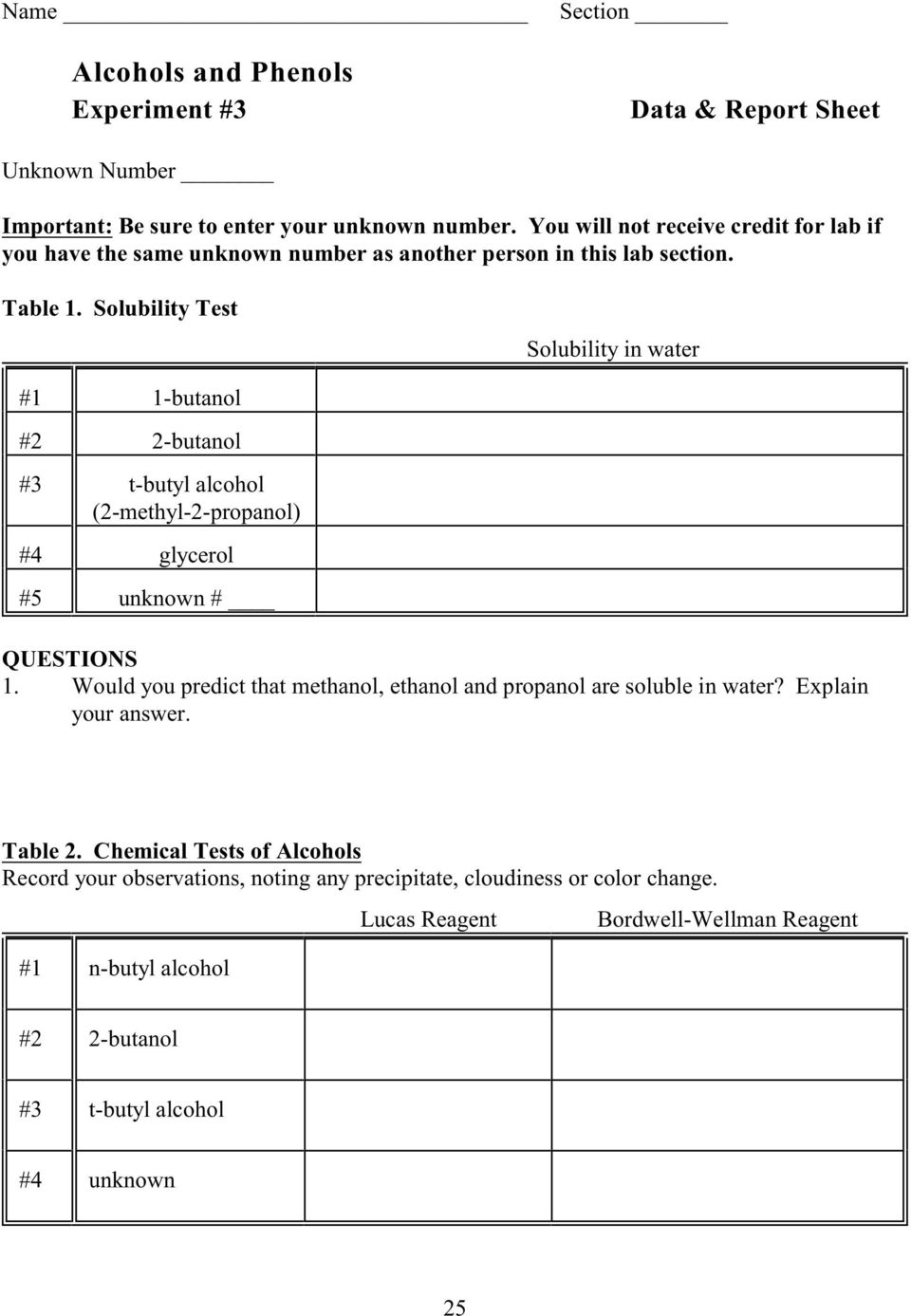
7 Name Alcohols and Phenols Experiment #3 Section Data & Report Sheet Unknown Number Important: Be sure to enter your unknown number. You will not receive credit for lab if you have the same unknown number as another person in this lab section. Table 1. Solubility Test Solubility in water #1 1-butanol #2 2-butanol #3 t-butyl alcohol (2-methyl-2-propanol) #4 glycerol #5 unknown # QUESTIONS 1. Would you predict that methanol, ethanol and propanol are soluble in water? Explain your answer. Table 2. Chemical Tests of Alcohols Record your observations, noting any precipitate, cloudiness or color change. #1 n-butyl alcohol Lucas Reagent Bordwell-Wellman Reagent #2 2-butanol #3 t-butyl alcohol #4 unknown 25
8 2. Show the chemical reactions for the Lucas test and the Bordwell-Wellman test with each of the three butyl alcohols (1-butanol, 2-butanol and 2-methyl-2-propanol) that react with each of these reagents. You do not need to show cases where there is no reaction. 3. What is the color of the ferric chloride solution before adding it to phenol? 4. What is the color of the solution after the reaction between phenol and ferric chloride takes place? 5. From the results with ferric chloride, would you classify your unknown as a phenol? 6. What is your unknown number and what class of alcohol is your unknown (primary, secondary, tertiary, or phenol): 26

Laboratory 22: Properties of Alcohols
 Introduction Alcohols represent and important class of organic molecules. In this experiment you will study the physical and chemical properties of alcohols. Solubility in water, and organic solvents,
Experiment #8 properties of Alcohols and Phenols
 Introduction Experiment #8 properties of Alcohols and Phenols As has been mentioned before, over 20 million organic compounds have been identified. If each substance had to be studied as an entity completely
IDENTIFICATION OF ALCOHOLS
 IDENTIFICATION OF ALCOHOLS Alcohols are organic compounds that which considered as derivatives of water. One of the hydrogen atoms of water molecule (H-O-H) has been replaced by an alkyl or substituted
Experiment 6 Qualitative Tests for Alcohols, Alcohol Unknown, IR of Unknown
 Experiment 6 Qualitative Tests for Alcohols, Alcohol Unknown, I of Unknown In this experiment you are going to do a series of tests in order to determine whether or not an alcohol is a primary (1 ), secondary
Identification of Unknown Organic Compounds
 Identification of Unknown Organic Compounds Introduction The identification and characterization of the structures of unknown substances are an important part of organic chemistry. Although it is often
Austin Peay State University Department of Chemistry CHEM 1021 TESTING FOR ORGANIC FUNCTIONAL GROUPS
 TESTING FOR ORGANIC FUNCTIONAL GROUPS Caution: Chromic acid is hazardous as are many of the organic substances in today s experiment. Treat all unknowns with extreme care. Many organic substances are flammable.
Chapter 5 Classification of Organic Compounds by Solubility
 Chapter 5 Classification of Organic Compounds by Solubility Deductions based upon interpretation of simple solubility tests can be extremely useful in organic structure determination. Both solubility and
The Chemistry of Carbohydrates
 The Chemistry of Carbohydrates Experiment #5 Objective: To determine the carbohydrate class of an unknown by carrying out a series of chemical reactions with the unknown and known compounds in each class
Assessment Schedule 2013 Chemistry: Demonstrate understanding of the properties of organic compounds (91391)
 NCEA Level 3 Chemistry (91391) 2013 page 1 of 8 Assessment Schedule 2013 Chemistry: Demonstrate understanding of the properties of organic compounds (91391) Evidence Statement Q Evidence Achievement Achievement
CHM220 Addition lab. Experiment: Reactions of alkanes, alkenes, and cycloalkenes*
 CM220 Addition lab Experiment: Reactions of alkanes, alkenes, and cycloalkenes* Purpose: To investigate the physical properties, solubility, and density of some hydrocarbon. To compare the chemical reactivity
Name Lab #3: Solubility of Organic Compounds Objectives: Introduction: soluble insoluble partially soluble miscible immiscible
 Lab #3: Solubility of rganic Compounds bjectives: - Understanding the relative solubility of organic compounds in various solvents. - Exploration of the effect of polar groups on a nonpolar hydrocarbon
H H H O. Pre-Lab Exercises Lab 6: Organic Chemistry. Lab 6: Organic Chemistry Chemistry 100. 1. Define the following: a.
 Lab 6: Organic hemistry hemistry 100 1. Define the following: a. ydrocarbon Pre-Lab Exercises Lab 6: Organic hemistry Name Date Section b. Saturated hydrocarbon c. Unsaturated hydrocarbon 2. The formula
CHM220 Nucleophilic Substitution Lab. Studying S N 1 and S N 2 Reactions: Nucloephilic Substitution at Saturated Carbon*
 CHM220 Nucleophilic Substitution Lab Studying S N 1 and S N 2 Reactions: Nucloephilic Substitution at Saturated Carbon* Purpose: To convert a primary alcohol to an alkyl bromide using an S N 2 reaction
Making Biodiesel from Virgin Vegetable Oil: Teacher Manual
 Making Biodiesel from Virgin Vegetable Oil: Teacher Manual Learning Goals: Students will understand how to produce biodiesel from virgin vegetable oil. Students will understand the effect of an exothermic
EXPERIMENT 6 (Organic Chemistry II) Identification of Ketones and Aldehydes
 EXPERIMENT 6 (rganic hemistry II) Identification of Ketones and Aldehydes Pahlavan/herif hemicals 2,4-Dinitrophenylhydrazine(DNP) 0.10 M AgN 3 2-propanol Benzaldehyde 10% Na 2-butanol Methyl ethyl Ketone
Non-polar hydrocarbon chain
 THE SCIENCE OF SOAPS AND DETERGENTS 2000 by David A. Katz. All rights reserved Reproduction permitted for educational purposes as long as the original copyright is included. INTRODUCTION A soap is a salt
Experiment 3: Extraction: Separation of an Acidic, a Basic and a Neutral Substance
 1 Experiment 3: Extraction: Separation of an Acidic, a Basic and a Neutral Substance Read pp 142-155, 161-162, Chapter 10 and pp 163-173, Chapter 11, in LTOC. View the videos: 4.2 Extraction (Macroscale);
Separation by Solvent Extraction
 Experiment 3 Separation by Solvent Extraction Objectives To separate a mixture consisting of a carboxylic acid and a neutral compound by using solvent extraction techniques. Introduction Frequently, organic
Organic Chemistry Lab Experiment 4 Preparation and Properties of Soap
 Organic Chemistry Lab Experiment 4 Preparation and Properties of Soap Introduction A soap is the sodium or potassium salt of a long-chain fatty acid. The fatty acid usually contains 12 to 18 carbon atoms.
Experiment 8 - Double Displacement Reactions
 Experiment 8 - Double Displacement Reactions A double displacement reaction involves two ionic compounds that are dissolved in water. In a double displacement reaction, it appears as though the ions are
But in organic terms: Oxidation: loss of H 2 ; addition of O or O 2 ; addition of X 2 (halogens).
 Reactions of Alcohols Alcohols are versatile organic compounds since they undergo a wide variety of transformations the majority of which are either oxidation or reduction type reactions. Normally: Oxidation
Reminder: These notes are meant to supplement, not replace the laboratory manual. SN1 Reaction Notes
 Reminder: These notes are meant to supplement, not replace the laboratory manual. SN1 Reaction Notes Background and Application Substitution Nucleophilic First Order (SN1) reactions are one of the most
MULTIPLE CHOICE. Choose the one alternative that best completes the statement or answers the question.
 Ch14_PT MULTIPLE CHOICE. Choose the one alternative that best completes the statement or answers the question. 1) Compounds with the -OH group attached to a saturated alkane-like carbon are known as A)
Saturated NaCl solution rubber tubing (2) Glass adaptor (2) thermometer adaptor heating mantle
 EXPERIMENT 5 (Organic Chemistry II) Pahlavan/Cherif Dehydration of Alcohols - Dehydration of Cyclohexanol Purpose - The purpose of this lab is to produce cyclohexene through the acid catalyzed elimination
CHEMICAL DETERMINATION OF EVERYDAY HOUSEHOLD CHEMICALS
 CHEMICAL DETERMINATION OF EVERYDAY HOUSEHOLD CHEMICALS Purpose: It is important for chemists to be able to determine the composition of unknown chemicals. This can often be done by way of chemical tests.
PREPARATION AND PROPERTIES OF A SOAP
 (adapted from Blackburn et al., Laboratory Manual to Accompany World of Chemistry, 2 nd ed., (1996) Saunders College Publishing: Fort Worth) Purpose: To prepare a sample of soap and to examine its properties.
The Synthesis of trans-dichlorobis(ethylenediamine)cobalt(iii) Chloride
 CHEM 122L General Chemistry Laboratory Revision 2.0 The Synthesis of trans-dichlorobis(ethylenediamine)cobalt(iii) Chloride To learn about Coordination Compounds and Complex Ions. To learn about Isomerism.
4.5 Physical Properties: Solubility
 4.5 Physical Properties: Solubility When a solid, liquid or gaseous solute is placed in a solvent and it seems to disappear, mix or become part of the solvent, we say that it dissolved. The solute is said
Recovery of Elemental Copper from Copper (II) Nitrate
 Recovery of Elemental Copper from Copper (II) Nitrate Objectives: Challenge: Students should be able to - recognize evidence(s) of a chemical change - convert word equations into formula equations - perform
Properties of Acids and Bases
 Lab 22 Properties of Acids and Bases TN Standard 4.2: The student will investigate the characteristics of acids and bases. Have you ever brushed your teeth and then drank a glass of orange juice? What
Copyright 2010 Pearson Education, Inc. Chapter Fourteen 1
 An alcohol has an OH bonded to an alkyl group; a phenol has an OH bonded directly to an aromatic ring; and an ether has an O bonded to two organic groups. Chapter Fourteen 1 Ethyl alcohol, dimethyl ether,
Chapter 12 Organic Compounds with Oxygen and Sulfur
 Chapter 12 Organic Compounds with Oxygen and Sulfur 1 Alcohols An alcohol contains a hydroxyl group ( OH) that replaces a hydrogen atom in a hydrocarbon. A phenol contains a hydroxyl group ( OH) attached
ORGANIC COMPOUNDS IN THREE DIMENSIONS
 (adapted from Blackburn et al., Laboratory Manual to Accompany World of hemistry, 2 nd ed., (1996) Saunders ollege Publishing: Fort Worth) Purpose: To become familiar with organic molecules in three dimensions
In this experiment, we will use three properties to identify a liquid substance: solubility, density and boiling point..
 Identification of a Substance by Physical Properties 2009 by David A. Katz. All rights reserved. Permission for academic use provided the original copyright is included Every substance has a unique set
Lab: Properties of Polar and Nonpolar Substances
 Lab: Properties of Polar and Nonpolar Substances Purpose: To explain the interactions of matter in relation to polarity. Stations 1 and 2 - il and water do not mix As a metaphor, oil and water are often
IB Chemistry. DP Chemistry Review
 DP Chemistry Review Topic 1: Quantitative chemistry 1.1 The mole concept and Avogadro s constant Assessment statement Apply the mole concept to substances. Determine the number of particles and the amount
Lab #13: Qualitative Analysis of Cations and Anions
 Lab #13: Qualitative Analysis of Cations and Anions Objectives: 1. To understand the rationale and the procedure behind the separation for various cations and anions. 2. To perform qualitative analysis
Enzyme Pre-Lab. Using the Enzyme worksheet and Enzyme lab handout answer the Pre-Lab questions the pre-lab must be complete before beginning the lab.
 Enzyme Pre-Lab Using the Enzyme worksheet and Enzyme lab handout answer the Pre-Lab questions the pre-lab must be complete before beginning the lab. Background: In this investigation, you will study several
Alcohols. Copyright 2009 by Pearson Education, Inc. Copyright 2009 Pearson Education, Inc. CH 3 CH 2 CH 2 OH 1-propanol OH
 Chapter 12 rganic Compounds with xygen and Sulfur 12.1 Alcohols, Thiols, and Ethers Alcohols An alcohol contains a hydroxyl group ( ) attached to a carbon chain. A phenol contains a hydroxyl group ( )
EXPERIMENT 10: TITRATION AND STANDARDIZATION
 EXPERIMENT 10: TITRATION AND STANDARDIZATION PURPOSE To determine the molarity of a NaOH solution by titrating it with a standard HCl solution. To determine the molarity of acetic acid in vinegar using
Unit 2 Review: Answers: Review for Organic Chemistry Unit Test
 Unit 2 Review: Answers: Review for Organic Chemistry Unit Test 2. Write the IUPAC names for the following organic molecules: a) acetone: propanone d) acetylene: ethyne b) acetic acid: ethanoic acid e)
LABORATORY 5 DETECTION OF FUNCTIONAL GROUPS IN ORGANIC COMPOUNDS
 LABATY 5 DETETIN F FUNTINAL GUPS IN GANI MPUNDS I. haracteristic reactions differentiating saturated aliphatic hydrocarbons from unsaturated aliphatic hydrocarbons 1. The test of bromine addition. Unsaturated
DYES AND DYEING 2003 by David A. Katz. All rights reserved. Permission for classroom use provided original copyright is included.
 DYES AND DYEING 2003 by David A. Katz. All rights reserved. Permission for classroom use provided original copyright is included. Dyeing of textiles has been practiced for thousands of years with the first
Amino Acids, Peptides, and Proteins
 1 Amino Acids, Peptides, and Proteins Introduction Amino Acids Amino acids are the building blocks of proteins. In class you learned the structures of the 20 common amino acids that make up proteins. All
Santa Monica College Chemistry 11
 Types of Reactions Objectives The objectives of this laboratory are as follows: To perform and observe the results of a variety of chemical reactions. To become familiar with the observable signs of chemical
CH 102 Practice Exam 2 PCC-Sylvania
 CH 102 Practice Exam 2 PCC-Sylvania True/False Indicate if the statement is true or false. 1.Tertiary alcohols are not easily oxidized. 2.Secondary alcohols can be oxidized to aldehydes. 3.Primary alcohols
CHM 130LL: ph, Buffers, and Indicators
 CHM 130LL: ph, Buffers, and Indicators Many substances can be classified as acidic or basic. Acidic substances contain hydrogen ions, H +, while basic substances contain hydroxide ions, OH. The relative
EXPERIMENT 3 (Organic Chemistry II) Nitration of Aromatic Compounds: Preparation of methyl-m-nitrobenzoate
 EXPERIMENT 3 (Organic Chemistry II) Nitration of Aromatic Compounds: Preparation of methyl-m-nitrobenzoate Pahlavan/Cherif Purpose a) Study electrophilic aromatic substitution reaction (EAS) b) Study regioselectivity
experiment5 Understanding and applying the concept of limiting reagents. Learning how to perform a vacuum filtration.
 81 experiment5 LECTURE AND LAB SKILLS EMPHASIZED Synthesizing an organic substance. Understanding and applying the concept of limiting reagents. Determining percent yield. Learning how to perform a vacuum
Chem101: General Chemistry Lecture 9 Acids and Bases
 : General Chemistry Lecture 9 Acids and Bases I. Introduction A. In chemistry, and particularly biochemistry, water is the most common solvent 1. In studying acids and bases we are going to see that water
Separation of Amino Acids by Paper Chromatography
 Separation of Amino Acids by Paper Chromatography Chromatography is a common technique for separating chemical substances. The prefix chroma, which suggests color, comes from the fact that some of the
Types of Reactions. CHM 130LL: Chemical Reactions. Introduction. General Information
 Introduction CHM 130LL: Chemical Reactions We often study chemistry to understand how and why chemicals (reactants) can be transformed into different chemicals (products) via a chemical reaction: Reactants
BOND TYPES: THE CLASSIFICATION OF SUBSTANCES
 BOND TYPES: THE CLASSIFICATION OF SUBSTANCES Every (pure) substance has a unique set of intrinsic properties which distinguishes it from all other substances. What inferences, if any can be made from a
One problem often faced in qualitative analysis is to test for one ion in a
 Chemistry 112 Laboratory: Silver Group Analysis Page 11 ANALYSIS OF THE SILVER GROUP CATIONS Ag + Pb Analysis of a Mixture of Cations One problem often faced in qualitative analysis is to test for one
Chemical Reactions in Water Ron Robertson
 Chemical Reactions in Water Ron Robertson r2 f:\files\courses\1110-20\2010 possible slides for web\waterchemtrans.doc Properties of Compounds in Water Electrolytes and nonelectrolytes Water soluble compounds
Experiment 16-Acids, Bases and ph
 Definitions acid-an ionic compound that releases or reacts with water to form hydrogen ion (H + ) in aqueous solution. They taste sour and turn litmus red. Acids react with certain metals such as zinc,
# 12 Condensation Polymerization: Preparation of Two Types of Polyesters
 # 12 Condensation Polymerization: Preparation of Two Types of Polyesters Submitted by: Arturo Contreras, Visiting Scholar, Center for Chemical Education, Miami University, Middletown, OH; 1996 1997. I.
Unit Vocabulary: o Organic Acid o Alcohol. o Ester o Ether. o Amine o Aldehyde
 Unit Vocabulary: Addition rxn Esterification Polymer Alcohol Ether Polymerization Aldehyde Fermentation Primary Alkane Functional group Saponification Alkene Halide (halocarbon) Saturated hydrocarbon Alkyne
Alcohols An alcohol contains a hydroxyl group ( OH) attached to a carbon chain. A phenol contains a hydroxyl group ( OH) attached to a benzene ring.
 Chapter : rganic Compounds with xygen Alcohols, Ethers Alcohols An alcohol contains a hydroxyl group ( H) attached to a carbon chain. A phenol contains a hydroxyl group ( H) attached to a benzene ring.
Experiment 7: Titration of an Antacid
 1 Experiment 7: Titration of an Antacid Objective: In this experiment, you will standardize a solution of base using the analytical technique known as titration. Using this standardized solution, you will
EXPERIMENT 10 Chemistry 110. Solutions Part 2 ACIDS, BASES, AND ELECTROLYTES
 EXPERIMENT 10 Chemistry 110 Solutions Part 2 ACIDS, BASES, AND ELECTROLYTES PURPOSE: The purpose of this experiment is to determine the properties of solutions of acids, bases and electrolytes. Students
ISOLATION OF CAFFEINE FROM TEA
 ISLATIN F CAFFEINE FRM TEA Introduction In this experiment, caffeine is isolated from tealeaves. The chief problem with the isolation is that caffeine does not exist alone in the tealeaves, but other natural
Organic Functional Groups Chapter 7. Alcohols, Ethers and More
 Organic Functional Groups Chapter 7 Alcohols, Ethers and More 1 What do you do when you are in Pain? What do you do when you are in a lot of pain? 2 Functional Groups A functional group is an atom, groups
F322: Chains, Energy and Resources 2.2.4 Alcohols
 F322: hains, Energy and Resources 2.2.4 Alcohols 167 marks 1. This question is about the six alcohols below. butan-2-ol 2-methylpentan-3-ol propan-1-ol ethane-1,2-diol 2-methylpropan-2-ol propan-2-ol Which
ph units constitute a scale which allows scientists to determine the acid or base content of a substance or solution. The ph 0
 ACID-BASE TITRATION LAB PH 2.PALM INTRODUCTION Acids and bases represent a major class of chemical substances. We encounter them every day as we eat, clean our homes and ourselves, and perform many other
Molar Mass of Butane
 Cautions Butane is toxic and flammable. No OPEN Flames should be used in this experiment. Purpose The purpose of this experiment is to determine the molar mass of butane using Dalton s Law of Partial Pressures
Alkanes. Chapter 1.1
 Alkanes Chapter 1.1 Organic Chemistry The study of carbon-containing compounds and their properties What s so special about carbon? Carbon has 4 bonding electrons. Thus, it can form 4 strong covalent bonds
EXPERIMENT 1: Survival Organic Chemistry: Molecular Models
 EXPERIMENT 1: Survival Organic Chemistry: Molecular Models Introduction: The goal in this laboratory experience is for you to easily and quickly move between empirical formulas, molecular formulas, condensed
AN EXPERIMENT IN ALCHEMY: COPPER TO SILVER TO GOLD 2005, 2000, 1996 by David A. Katz. All rights reserved
 AN EXPERIMENT IN ALCHEMY: COPPER TO SILVER TO GOLD 2005, 2000, 1996 by David A. Katz. All rights reserved INTRODUCTION One of the goals of the ancient alchemists was to convert base metals into gold. Although
Determination of Aspirin using Back Titration
 Determination of Aspirin using Back Titration This experiment is designed to illustrate techniques used in a typical indirect or back titration. You will use the NaH you standardized last week to back
Sugar or Salt? Ionic and Covalent Bonds
 Lab 11 Sugar or Salt? Ionic and Covalent Bonds TN Standard 2.1: The student will investigate chemical bonding. Have you ever accidentally used salt instead of sugar? D rinking tea that has been sweetened
Organic Molecules of Life - Exercise 2
 Organic Molecules of Life - Exercise 2 Objectives -Know the difference between a reducing sugar and a non-reducing sugar. -Distinguish Monosaccharides from Disaccharides and Polysaccharides -Understand
This experiment involves the separation and identification of ions using
 Chemistry 112: Reactions Involving Complex Ions Page 27 COMPLEX IONS AND AMPHOTERISM This experiment involves the separation and identification of ions using two important reaction types: (i) the formation
EXPERIMENT 12: Empirical Formula of a Compound
 EXPERIMENT 12: Empirical Formula of a Compound INTRODUCTION Chemical formulas indicate the composition of compounds. A formula that gives only the simplest ratio of the relative number of atoms in a compound
Page 1. 6. Which hydrocarbon is a member of the alkane series? (1) 1. Which is the structural formula of methane? (1) (2) (2) (3) (3) (4) (4)
 1. Which is the structural formula of methane? 6. Which hydrocarbon is a member of the alkane series? 7. How many carbon atoms are contained in an ethyl group? 1 3 2 4 2. In the alkane series, each molecule
Experiment 5 Preparation of Cyclohexene
 Experiment 5 Preparation of yclohexene In this experiment we will prepare cyclohexene from cyclohexanol using an acid catalyzed dehydration reaction. We will use the cyclohexanol that we purified in our
IB Chemistry 1 Mole. One atom of C-12 has a mass of 12 amu. One mole of C-12 has a mass of 12 g. Grams we can use more easily.
 The Mole Atomic mass units and atoms are not convenient units to work with. The concept of the mole was invented. This was the number of atoms of carbon-12 that were needed to make 12 g of carbon. 1 mole
Mixtures and Pure Substances
 Unit 2 Mixtures and Pure Substances Matter can be classified into two groups: mixtures and pure substances. Mixtures are the most common form of matter and consist of mixtures of pure substances. They
Chemistry of Biodiesel Production. Teacher Notes. DAY 1: Biodiesel synthesis (50 minutes)
 Chemistry of Biodiesel Production Teacher Notes DAY 1: Biodiesel synthesis (50 minutes) NOTE: The lab preparation instructions / lab protocol assumes classes of 32 students, with 8 groups of 4 students
Honors Chemistry: Unit 6 Test Stoichiometry PRACTICE TEST ANSWER KEY Page 1. A chemical equation. (C-4.4)
 Honors Chemistry: Unit 6 Test Stoichiometry PRACTICE TEST ANSWER KEY Page 1 1. 2. 3. 4. 5. 6. Question What is a symbolic representation of a chemical reaction? What 3 things (values) is a mole of a chemical
CHEMICAL REACTIONS OF COPPER AND PERCENT YIELD KEY
 CHEMICAL REACTIONS OF COPPER AND PERCENT YIELD Objective To gain familiarity with basic laboratory procedures, some chemistry of a typical transition element, and the concept of percent yield. Apparatus
EXPERIMENT 2 THE HYDROLYSIS OF t-butyl CHLORIDE. PURPOSE: To verify a proposed mechanism for the hydrolysis of t-butyl Chloride.
 PURPOSE: To verify a proposed mechanism for the hydrolysis of t-butyl Chloride. PRINCIPLES: Once the Rate Law for a reaction has been experimentally established the next step is its explanation in terms
Synthesis of Aspirin and Oil of Wintergreen
 Austin Peay State University Department of hemistry hem 1121 autions Purpose Introduction Acetic Anhydride corrosive and a lachrymator all transfers should be done in the vented fume hood Methanol, Ethanol
Experiment 1: Colligative Properties
 Experiment 1: Colligative Properties Determination of the Molar Mass of a Compound by Freezing Point Depression. Objective: The objective of this experiment is to determine the molar mass of an unknown
Determination of a Chemical Formula
 1 Determination of a Chemical Formula Introduction Molar Ratios Elements combine in fixed ratios to form compounds. For example, consider the compound TiCl 4 (titanium chloride). Each molecule of TiCl
Properties of Acids and Bases
 Properties of Acids and Bases (Adapted from Flinn Scientific Acid Base Test Kit I #AP4567) Introduction Battery acid, stomach acid, acid rain just a few acids in our everyday life! What does it mean when
OXIDATION-REDUCTION TITRATIONS-Permanganometry
 Experiment No. Date OXIDATION-REDUCTION TITRATIONS-Permanganometry INTRODUCTION Potassium permanganate, KMnO 4, is probably the most widely used of all volumetric oxidizing agents. It is a powerful oxidant
#9 Condensation Polymerization: Preparation of Nylon 6/10
 #9 Condensation Polymerization: Preparation of Nylon 6/10 Submitted by: Arturo Contreras, Visiting Scholar, Center for Chemical Education, Miami University, Middletown, OH; 1996 1997. I. INTRODUCTION Description
Chapter 16: Tests for ions and gases
 The position of hydrogen in the reactivity series Hydrogen, although not a metal, is included in the reactivity series because it, like metals, can be displaced from aqueous solution, only this time the
SOLUBILITY OF A SALT IN WATER AT VARIOUS TEMPERATURES LAB
 SOLUBILITY OF A SALT IN WATER AT VARIOUS TEMPERATURES LAB Purpose: Most ionic compounds are considered by chemists to be salts and many of these are water soluble. In this lab, you will determine the solubility,
EXPERIMENT 4: IONIC AND COVALENT PROPERTIES
 EXPERIMENT 4: IONIC AND COVALENT PROPERTIES PURPOSE To measure and observe properties of various substances. To arrange the substances into groups on the basis of their properties. To learn the properties
Summer Holidays Questions
 Summer Holidays Questions Chapter 1 1) Barium hydroxide reacts with hydrochloric acid. The initial concentration of the 1 st solution its 0.1M and the volume is 100ml. The initial concentration of the
Reactions of Aldehydes and Ketones
 Reactions of Aldehydes and Ketones Structure Deduction using lassification Tests 1 Determination of Structure Determining the structure of an unknown organic compound is an exercise in deductive reasoning.
Laboratory 28: Properties of Lipids
 Introduction Lipids are naturally occuring substances that are arbitrarily grouped together on the basis of their insolubility in water (a polar solvent) and solubility in nonpolar solvents. Lipids include
1. Qualitative Analysis of Chromium, Iron, and Copper
 1. Qualitative Analysis of Chromium, Iron, and Copper Introduction We have used copper and iron as basic materials since the Bronze and Iron Ages, but our extensive use of chromium began only after the
HOMEWORK 4A. Definitions. Oxidation-Reduction Reactions. Questions
 HOMEWORK 4A Oxidation-Reduction Reactions 1. Indicate whether a reaction will occur or not in each of following. Wtiring a balcnced equation is not necessary. (a) Magnesium metal is added to hydrochloric
THE ACTIVITY OF LACTASE
 THE ACTIVITY OF LACTASE Lab VIS-8 From Juniata College Science in Motion Enzymes are protein molecules which act to catalyze the chemical reactions in living things. These chemical reactions make up the
Chemistry B11 Chapter 6 Solutions and Colloids
 Chemistry B11 Chapter 6 Solutions and Colloids Solutions: solutions have some properties: 1. The distribution of particles in a solution is uniform. Every part of the solution has exactly the same composition
Experiment 5. Chemical Reactions A + X AX AX A + X A + BX AX + B AZ + BX AX + BZ
 Experiment 5 Chemical Reactions OBJECTIVES 1. To observe the various criteria that are used to indicate that a chemical reaction has occurred. 2. To convert word equations into balanced inorganic chemical
Experiment 12- Classification of Matter Experiment
 Experiment 12- Classification of Matter Experiment Matter can be classified into two groups: mixtures and pure substances. Mixtures are the most common form of matter and consist of mixtures of pure substances.