
Standardization of Potassium Permanganate solution with Standard Sodium Oxalate Solution.
|
|
|
- Horace Tucker
- 9 years ago
- Views:
Transcription
1 Experiment Number: 07 Name of the experiment: Standardization of Potassium Permanganate solution with Standard Sodium Oxalate Solution. Course: Chem-114 Name: Noor Nashid Islam Roll: Group: A2 Partner s Roll: Department: C.S.E. Date of Performance: Date of Submission:

2 Objective: The objective of this experiment is to determine the strength of Potassium Permanganate with a standard Sodium Oxalate solution. This reaction helps to study about oxidation and reduction theory. As, the color of potassium permanganate changes with the reaction, no further indicator is used in this experiment to determine the end point. Theory: In this experiment, potassium permanganate solution is standardized with the help of standard sodium oxalate solution. The reaction that occurs here is oxidation and reduction reaction. An oxidation-reduction reaction (red ox) is a reaction in which electrons are transferred between species or in which atoms change oxidation numbers. Oxidation is the half reaction in which there is loss of electrons by a species (or increase of oxidation number of an atom). Reduction is the half reaction in which there is a gain of electrons by a species (or decrease of oxidation number of an atom). Reaction involved in this reaction is: MnO H e - Mn H 2 O 2 KMnO Na 2 C 2 O H 2 SO 4 K 2 SO MnSO Na 2 SO CO 2 + 8

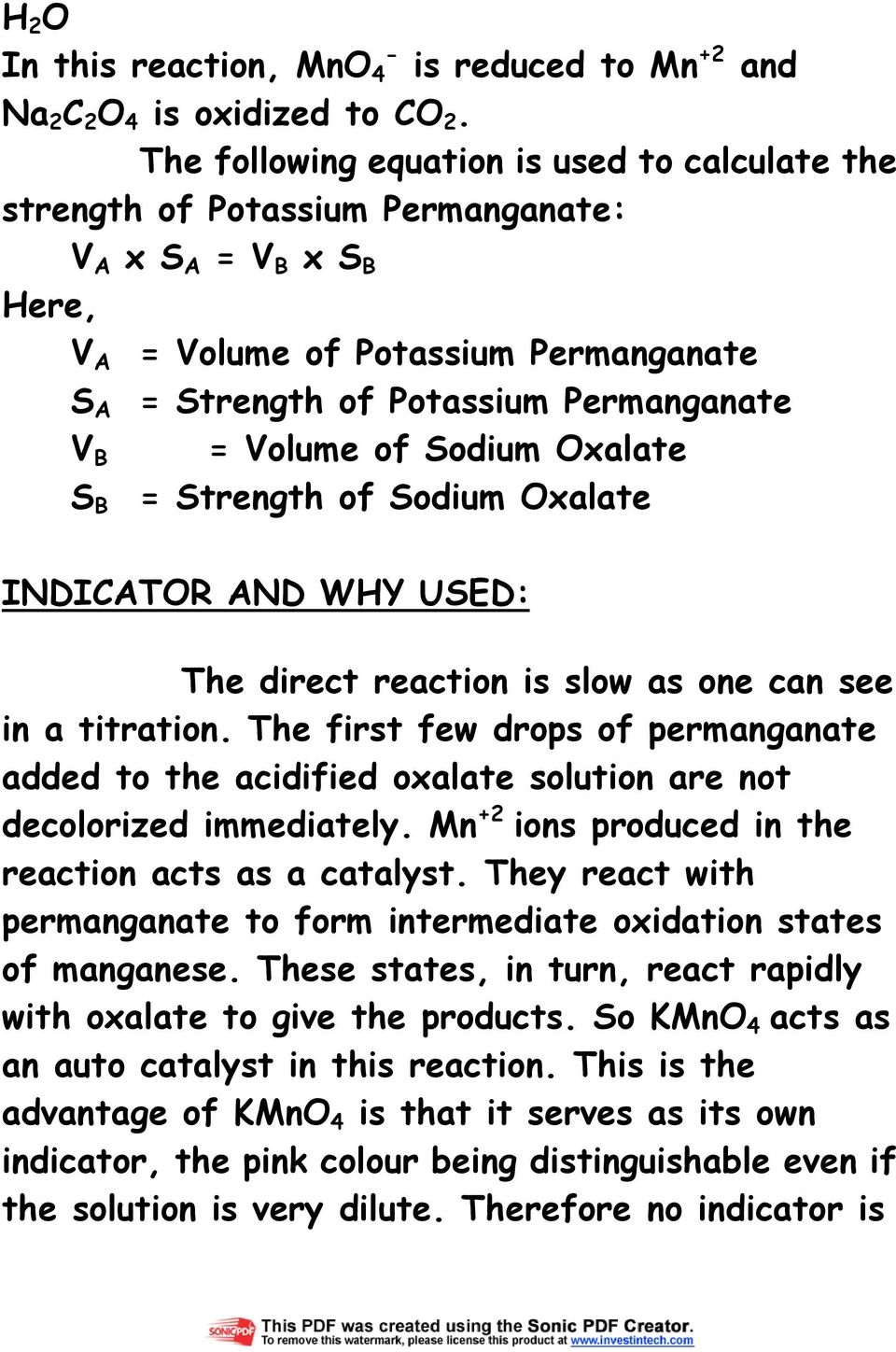
3 H 2 O In this reaction, MnO - 4 is reduced to Mn +2 and Na 2 C 2 O 4 is oxidized to CO 2. The following equation is used to calculate the strength of Potassium Permanganate: V A x S A = V B x S B Here, V A = Volume of Potassium Permanganate S A = Strength of Potassium Permanganate V B = Volume of Sodium Oxalate S B = Strength of Sodium Oxalate INDICATOR AND WHY USED: The direct reaction is slow as one can see in a titration. The first few drops of permanganate added to the acidified oxalate solution are not decolorized immediately. Mn +2 ions produced in the reaction acts as a catalyst. They react with permanganate to form intermediate oxidation states of manganese. These states, in turn, react rapidly with oxalate to give the products. So KMnO 4 acts as an auto catalyst in this reaction. This is the advantage of KMnO 4 is that it serves as its own indicator, the pink colour being distinguishable even if the solution is very dilute. Therefore no indicator is
4 used in this reaction. Apparatus: 1. Conical flask 2. Burette 3. Pipette 4. Volumetric flask 5. Stand 6. Funnel Name of the chemicals used: 1. Sodium Oxalate Solution (Na 2 C 2 O 4 ) 2. H 2 SO 4 solution (2N) 3. Potassium Permanganate Solution (KMnO 4 ) 4. Distilled water Data: TABLE: 1 (Standardization of Potassium Permanganate solution with Standard Sodium Oxalate solution) Burette

5 reading Initial Readi ng Final Readi ng ml ml (No t taken) Calculation: In this case weight taken=0.739 Weight to be taken = So the strength of Na2C2O4 = (0.739X0.1)/ N

6 =0.11 N From V red X S red = Vox X S ox Here, V Na2C2O4 = 10 ml S Na2C2O4 = 0.11 N V KMnO4 = 10.7 ml S KMnO4 =? So, 10 X 0.11 = 10.7 X S KMnO4 => S KMnO4 = 0.103N Result: The Determined Strength of Potassium Permanganate Solution is: SKMnO4 = N Percentage of error:

7 ( Known Value Observed Value ) X 100 Percentage of error = Known value Known value = N Observed amount of iron = N Percentage of error = 1.9% Precautions: At first the burette was cleaned with distilled water carefully; then it was rinsed with rinse solution to avoid the density change of the given solution. In the same way the pipette was also washed with distilled water and rinsed with the rinse solution. All the apparatus were handled carefully and according to the rules. The pipette was kept on a clean sheet of paper. The key of the burette was operated carefully to make sure that one-drop of Acid falls into the conical flask at a time. The conical flask was kept on a white paper

8 to trace the color change of the solution. At first the key of the burette was fully opened to let the solution fall free to make the bubbles go out. On the basis of the result it was found that the balance is very much sensitive. So for this reason the result can be varied. While measuring the lower meniscus of the burette an error may be happened for the parallax error. So concentration should be needed here. Discussion: As KMnO 4 is not a primary standard substance so determination of the strength of it will be erroneous. Many factors are responsible for this error. These are stated below: i The solution must be strongly acidic in order to avoid other side reactions. Here sulphuric acid is normally used. Nitric acid is unsuitable since nitrate ion is a moderately strong oxidizing agent which may interfere with KMnO 4. If HCl

9 is used it may be oxidized to chlorine by permanganate. If chloride ion is present, high results are obtained because some permanganate is used up in oxidizing the HCl to eliminate the interference of chloride ions. The main reason for using acid in the titration is that it transforms oxalate to oxalic acid and this acid solution reduces the KMnO 4. Any side reaction may hamper the result. So only sulphuric acid should be used MnO H Cl -1 2 Mn Cl H 2 O ii Reading might be wrong due to poor eye sight and non-vertical readings. The readings must be taken vertically considering the lower meniscus of the concave surface of the liquid. iii If any air bubble enters the burette while pouring acid, air bubble should be removed by dropping out the solution forcibly until the air bubble is out of the burette. Or else, the presence of air bubble will hamper the reading of the volume.

10 iv While performing the experiment we should be careful so that misuse of solution can not happen. While taking KMnO 4 solution from the burette, one or two drops might fall on the body surface of the conical flask and might stick on it. These drops would not participate in the reaction but we might count these drops in out reading from the burette. v After pouring any substance in the conical flask with the help of the pipette, if there is any liquid at the tip of the pipette, it should be ignored. But by no means it should be blown out. vi Burette and pipette was first washed with distilled water then those were rinsed. It was necessary to perform to get accurate result. viiduring our experiment the burette was leaking, and as it was not noticed earlier so error might have occurred. When it came to our consideration, we did necessary things to tight it. At first for our callousness, the result might have deceived us.

11 viiiin the KMnO 4 solution, there remains some impurities mainly MnO 2. Some Mn +2 are produced from MnO 2 which reacts with KMnO 4 and forms more MnO 2. This is known as auto decomposition. This will manipulate the result. 2 MnO H 2 O + 3 Mn +2 5 MnO H + ix) Even in the distilled water there remains some reducing agent which reacts with MnO 2 and produces more MnO 2 and more auto decomposition occurs. This is also responsible for erroneous result. To safeguard this re-distilled water from alkaline permanganate should be used. 4 MnO H 2 O (containing reducing agent) 4 MnO O 2 + 4OH -1 x) Even in the distilled water there remain some reducing agents which react with MnO 2 and produce more MnO 2 and more auto decomposition occurs. This is also responsible for erroneous result. 4 MnO H 2 O (containing reducing agent) 4 MnO O 2 + 4OH -1

12 XI) Permanganate solution should be added moderately and at the same time it has to be stirred to clear the solution constantly. But nonreactor permanganate should no way be allowed to accumulate in the solution because this may result in auto decomposition which will definitely manipulate the result. Reference books: 1) A Text Book of Quantitative analysis. A.L.Vogel 2) Practical Chemistry Huq and Jabber Main

OXIDATION-REDUCTION TITRATIONS-Permanganometry
 Experiment No. Date OXIDATION-REDUCTION TITRATIONS-Permanganometry INTRODUCTION Potassium permanganate, KMnO 4, is probably the most widely used of all volumetric oxidizing agents. It is a powerful oxidant
A Volumetric Analysis (Redox Titration) of Hypochlorite in Bleach
 CHEM 311L Quantitative Analysis Laboratory Revision 2.3 A Volumetric Analysis (Redox Titration) of Hypochlorite in Bleach In this laboratory exercise, we will determine the concentration of the active
4.0 EXPERIMENT ON DETERMINATION OF CHLORIDES
 4.0 EXPERIMENT ON DETERMINATION OF CHLORIDES Sl. No. Contents Preamble 4.1 Aim 4.2 Introduction 4.2.1 Environmental Significance 4.3 Principle 4.4 Materials Required 4.4.1 Apparatus Required 4.4.2 Chemicals
hij Teacher Resource Bank GCE Chemistry PSA10: A2 Inorganic Chemistry Carry out a redox titration
 hij Teacher Resource Bank GCE Chemistry : A2 Inorganic Chemistry Copyright 2009 AQA and its licensors. All rights reserved. The Assessment and Qualifications Alliance (AQA) is a company limited by guarantee
Coordination Compounds with Copper (II) Prelab (Week 2)
 Coordination Compounds with Copper (II) Prelab (Week 2) Name Total /10 SHOW ALL WORK NO WORK = NO CREDIT 1. What is the purpose of this experiment? 2. Write the generic chemical formula for the coordination
EXPERIMENT 10: TITRATION AND STANDARDIZATION
 EXPERIMENT 10: TITRATION AND STANDARDIZATION PURPOSE To determine the molarity of a NaOH solution by titrating it with a standard HCl solution. To determine the molarity of acetic acid in vinegar using
Syllabus OC18 Use litmus or a universal indicator to test a variety of solutions, and classify these as acidic, basic or neutral
 Chemistry: 9. Acids and Bases Please remember to photocopy 4 pages onto one sheet by going A3 A4 and using back to back on the photocopier Syllabus OC18 Use litmus or a universal indicator to test a variety
Acetic Acid Content of Vinegar: An Acid-Base Titration E10-1
 Experiment 10 Acetic Acid Content of Vinegar: An Acid-Base Titration E10-1 E10-2 The task The goal of this experiment is to determine accurately the concentration of acetic acid in vinegar via volumetric
Estimation of Alcohol Content in Wine by Dichromate Oxidation followed by Redox Titration
 Sirromet Wines Pty Ltd 850-938 Mount Cotton Rd Mount Cotton Queensland Australia 4165 www.sirromet.com Courtesy of Jessica Ferguson Assistant Winemaker & Chemist Downloaded from seniorchem.com/eei.html
Juice Titration. Background. Acid/Base Titration
 Juice Titration Background Acids in Juice Juice contains both citric and ascorbic acids. Citric acid is used as a natural preservative and provides a sour taste. Ascorbic acid is a water-soluble vitamin
(1) Hydrochloric acid reacts with sodium hypochlorite to form hypochlorous acid: NaOCl(aq) + HCl(aq) HOCl(aq) + NaCl(aq) hypochlorous acid
 The Determination of Hypochlorite in Bleach Reading assignment: Chang, Chemistry 10 th edition, pages 156-159. We will study an example of a redox titration in order to determine the concentration of sodium
Acid Base Titrations
 Acid Base Titrations Introduction A common question chemists have to answer is how much of something is present in a sample or a product. If the product contains an acid or base, this question is usually
Simulation of the determination of lead azide content in waste water from explosives manufacture
 Simulation of the determination of lead azide content in waste water from explosives manufacture Lead azide ranks in the category of intensive explosives, which may, even in an insignificant amount, initiate
Topic 4 National Chemistry Summary Notes. Formulae, Equations, Balancing Equations and The Mole
 Topic 4 National Chemistry Summary Notes Formulae, Equations, Balancing Equations and The Mole LI 1 The chemical formula of a covalent molecular compound tells us the number of atoms of each element present
2. ATOMIC, MOLECULAR AND EQUIVALENT MASSES
 2. ATOMIC, MOLECULAR AND EQUIVALENT MASSES INTRODUCTION: EQUIVALENT WEIGHT Since hydrogen is the lightest of all elements, it was chosen as a standard for determination of equivalent weights. On this basis,
Illinois Central College CHEMISTRY 132 Laboratory Section: solution 2-50 ml beakers KHSO 3
 Exercise 8 Page 1 Illinois Central College CHEMISTRY 132 Laboratory Section: Redox Titration Name: Equipment 1-25.00 ml burette 0.100 N KMn 4 solution 2-50 ml beakers KHS 3 solution of unknown Normality
CHEM 105 HOUR EXAM III 28-OCT-99. = -163 kj/mole determine H f 0 for Ni(CO) 4 (g) = -260 kj/mole determine H f 0 for Cr(CO) 6 (g)
 CHEM 15 HOUR EXAM III 28-OCT-99 NAME (please print) 1. a. given: Ni (s) + 4 CO (g) = Ni(CO) 4 (g) H Rxn = -163 k/mole determine H f for Ni(CO) 4 (g) b. given: Cr (s) + 6 CO (g) = Cr(CO) 6 (g) H Rxn = -26
Vitamin C Content of Fruit Juice
 1 Vitamin C Content of Fruit Juice Introduction Vitamin C Vitamins are organic compounds that have important biological functions. For instance, in humans they enable a variety of enzymes in the body to
Chemical Reactions in Water Ron Robertson
 Chemical Reactions in Water Ron Robertson r2 f:\files\courses\1110-20\2010 possible slides for web\waterchemtrans.doc Properties of Compounds in Water Electrolytes and nonelectrolytes Water soluble compounds
Additional Lecture: TITRATION BASICS
 Additional Lecture: TITRATION BASICS 1 Definition and Applications Titration is the incremental addition of a reagent solution (called titrant) to the analyte until the reaction is complete Common applications:
Lab #10 How much Acetic Acid (%) is in Vinegar?
 Lab #10 How much Acetic Acid (%) is in Vinegar? SAMPLE CALCULATIONS NEED TO BE DONE BEFORE LAB MEETS!!!! Purpose: You will determine the amount of acetic acid in white vinegar (sold in grocery stores)
HOW TO MAKE STANDARD SOLUTIONS FOR CHEMISTRY
 HOW TO MAKE STANDARD SOLUTIONS FOR CHEMISTRY Phillip Bigelow Chemists make two common types of "standard solutions": Molar solutions Normal solutions Both of these solutions are concentrations (or strengths
ACID-BASE TITRATIONS: DETERMINATION OF CARBONATE BY TITRATION WITH HYDROCHLORIC ACID BACKGROUND
 #3. Acid - Base Titrations 27 EXPERIMENT 3. ACID-BASE TITRATIONS: DETERMINATION OF CARBONATE BY TITRATION WITH HYDROCHLORIC ACID BACKGROUND Carbonate Equilibria In this experiment a solution of hydrochloric
Instructions Answer all questions in the spaces provided. Do all rough work in this book. Cross through any work you do not want to be marked.
 GCSE CHEMISTRY Higher Tier Chemistry 1H H Specimen 2018 Time allowed: 1 hour 45 minutes Materials For this paper you must have: a ruler a calculator the periodic table (enclosed). Instructions Answer all
Chapter 16: Tests for ions and gases
 The position of hydrogen in the reactivity series Hydrogen, although not a metal, is included in the reactivity series because it, like metals, can be displaced from aqueous solution, only this time the
Austin Peay State University Department of Chemistry CHEM 1021 TESTING FOR ORGANIC FUNCTIONAL GROUPS
 TESTING FOR ORGANIC FUNCTIONAL GROUPS Caution: Chromic acid is hazardous as are many of the organic substances in today s experiment. Treat all unknowns with extreme care. Many organic substances are flammable.
HOMEWORK 4A. Definitions. Oxidation-Reduction Reactions. Questions
 HOMEWORK 4A Oxidation-Reduction Reactions 1. Indicate whether a reaction will occur or not in each of following. Wtiring a balcnced equation is not necessary. (a) Magnesium metal is added to hydrochloric
Apparatus error for each piece of equipment = 100 x margin of error quantity measured
 1) Error Analysis Apparatus Errors (uncertainty) Every time you make a measurement with a piece of apparatus, there is a small margin of error (i.e. uncertainty) in that measurement due to the apparatus
5.0 EXPERIMENT ON DETERMINATION OF TOTAL HARDNESS
 5.0 EXPERIMENT ON DETERMINATION OF TOTAL HARDNESS Sl. No. Contents Preamble 5.1 Aim 5.2 Introduction 5.2.1 Environmental Significance 5.3 Principle 5.4 Materials Required 5.4.1 Apparatus Required 5.4.2
BACKGROUND INFORMATION
 BACKGROUND INFORMATION It is often important to measure the concentration of glucose in a solution. The so-called ISOTONIC drinks can be tested to see if they are in fact isotonic with the blood. You may
4 theoretical problems 2 practical problems
 1 st 4 theoretical problems 2 practical problems FIRST INTERNATIONAL CHEMISTRY OLYMPIAD PRAGUE 1968 CZECHOSLOVAKIA THEORETICAL PROBLEMS PROBLEM 1 A mixture of hydrogen and chlorine kept in a closed flask
The Determination of Acid Content in Vinegar
 The Determination of Acid Content in Vinegar Reading assignment: Chang, Chemistry 10 th edition, pages 153-156. Goals We will use a titration to determine the concentration of acetic acid in a sample of
To see how this data can be used, follow the titration of hydrofluoric acid against sodium hydroxide below. HF (aq) + NaOH (aq) H2O (l) + NaF (aq)
 Weak Acid Titration v120413 You are encouraged to carefully read the following sections in Tro (2 nd ed.) to prepare for this experiment: Sec 4.8, pp 158-159 (Acid/Base Titrations), Sec 16.4, pp 729-43
Solution a homogeneous mixture = A solvent + solute(s) Aqueous solution water is the solvent
 Solution a homogeneous mixture = A solvent + solute(s) Aqueous solution water is the solvent Water a polar solvent: dissolves most ionic compounds as well as many molecular compounds Aqueous solution:
15. Acid-Base Titration. Discover the concentration of an unknown acid solution using acid-base titration.
 S HIFT INTO NEUTRAL 15. Acid-Base Titration Shift into Neutral Student Instruction Sheet Challenge Discover the concentration of an unknown acid solution using acid-base titration. Equipment and Materials
Saturated NaCl solution rubber tubing (2) Glass adaptor (2) thermometer adaptor heating mantle
 EXPERIMENT 5 (Organic Chemistry II) Pahlavan/Cherif Dehydration of Alcohols - Dehydration of Cyclohexanol Purpose - The purpose of this lab is to produce cyclohexene through the acid catalyzed elimination
Question Bank Electrolysis
 Question Bank Electrolysis 1. (a) What do you understand by the terms (i) electrolytes (ii) non-electrolytes? (b) Arrange electrolytes and non-electrolytes from the following substances (i) sugar solution
ANALYSIS OF FOOD AND NATURAL PRODUCTS LABORATORY EXERCISE
 ANALYSIS OF FOOD AND NATURAL PRODUCTS LABORATORY EXERCISE Determination of total nitrogen in food and crude protein calculation (Kjeldahl method) Responsible person: Assoc.Prof. Ing.Kateřina Riddellová,
Determination of the amount of sodium carbonate and sodium hydroxide in a mixture by titration.
 Module 9 : Experiments in Chemistry Lecture 38 : Titrations : Acid-Base, Redox and Complexometric Objectives In this lecture you will learn the techniques to do following Determination of the amount of
GCE Chemistry PSA14: A2 Physical Chemistry Determine an equilibrium contstant
 hij Teacher Resource Bank GCE Chemistry : A2 Physical Chemistry Determine an equilibrium contstant Copyright 2009 AQA and its licensors. All rights reserved. The Assessment and Qualifications Alliance
Practical Lesson No 4 TITRATIONS
 Practical Lesson No 4 TITRATIONS Reagents: 1. NaOH standard solution 0.1 mol/l 2. H 2 SO 4 solution of unknown concentration 3. Phenolphthalein 4. Na 2 S 2 O 3 standard solution 0.1 mol/l 5. Starch solution
Lab 25. Acid-Base Titration and Neutralization Reactions: What Is the Concentration of Acetic Acid in Each Sample of Vinegar?
 Lab 25. Acid-Base Titration and Neutralization Reactions: What Is the Concentration of Acetic Acid in Each Sample of Vinegar? Introduction Vinegar is basically a solution of acetic acid (CH3COOH). It is
Calcium Analysis by EDTA Titration
 Calcium Analysis by EDTA Titration ne of the factors that establish the quality of a water supply is its degree of hardness. The hardness of water is defined in terms of its content of calcium and magnesium
Neutralizing an Acid and a Base
 Balancing Act Teacher Information Objectives In this activity, students neutralize a base with an acid. Students determine the point of neutralization of an acid mixed with a base while they: Recognize
Chem 1B Saddleback College Dr. White 1. Experiment 8 Titration Curve for a Monoprotic Acid
 Chem 1B Saddleback College Dr. White 1 Experiment 8 Titration Curve for a Monoprotic Acid Objectives To learn the difference between titration curves involving a strong acid with a strong base and a weak
EXPERIMENT 7 Reaction Stoichiometry and Percent Yield
 EXPERIMENT 7 Reaction Stoichiometry and Percent Yield INTRODUCTION Stoichiometry calculations are about calculating the amounts of substances that react and form in a chemical reaction. The word stoichiometry
TITRATION OF VITAMIN C
 TITRATION OF VITAMIN C Introduction: In this lab, we will be performing two different types of titrations on ascorbic acid, more commonly known as Vitamin C. The first will be an acid-base titration in
Leaving Certificate Chemistry Student Laboratory Notebook. Suggested Answers. by Declan Kennedy and Don O Shea
 Leaving Certificate Chemistry Student Laboratory Notebook Suggested Answers by Declan Kennedy and Don O Shea Experiment 3.2. To carry out flame tests with salts of lithium, sodium, potassium, barium, strontium
Estimation of Hardness of Water by EDTA Method
 Estimation of Hardness of Water by EDTA Method 1 EXPERIMENT 1 Estimation of Hardness of Water by EDTA Method INTRODUCTION Water hardness is the traditional measure of the capacity of water to precipitate
Preparation of frequently used solutions
 Preparation of frequently used solutions Content 1. Diluting Concentrated Acids (Last Login: 08/08/2009) 2. Indicators (Last Login: 27/07/2009) 3. Standard Buffer Solutions (Last Login: 27/07/2009) 4.
CHEMICAL REACTIONS AND REACTING MASSES AND VOLUMES
 CHEMICAL REACTIONS AND REACTING MASSES AND VOLUMES The meaning of stoichiometric coefficients: 2 H 2 (g) + O 2 (g) 2 H 2 O(l) number of reacting particles 2 molecules of hydrogen react with 1 molecule
ph units constitute a scale which allows scientists to determine the acid or base content of a substance or solution. The ph 0
 ACID-BASE TITRATION LAB PH 2.PALM INTRODUCTION Acids and bases represent a major class of chemical substances. We encounter them every day as we eat, clean our homes and ourselves, and perform many other
Lab #13: Qualitative Analysis of Cations and Anions
 Lab #13: Qualitative Analysis of Cations and Anions Objectives: 1. To understand the rationale and the procedure behind the separation for various cations and anions. 2. To perform qualitative analysis
K + Cl - Metal M. Zinc 1.0 M M(NO
 Redox and Electrochemistry This section should be fresh in your minds because we just did this section in the text. Closely related to electrochemistry is redox chemistry. Count on at least one question
Properties of Acids and Bases
 Lab 22 Properties of Acids and Bases TN Standard 4.2: The student will investigate the characteristics of acids and bases. Have you ever brushed your teeth and then drank a glass of orange juice? What
Continuous process of sodium bicarbonate production by Solvay method
 Continuous process of sodium bicarbonate production by Solvay method Manual to experiment nr 10 Instructor: Dr Tomasz S. Pawłowski 1 Goal of the experiment The goal of the experiment is introduction of
Acid-Base Titrations. Setup for a Typical Titration. Titration 1
 Titration 1 Acid-Base Titrations Molarities of acidic and basic solutions can be used to convert back and forth between moles of solutes and volumes of their solutions, but how are the molarities of these
EDEXCEL INTERNATIONAL GCSE CHEMISTRY EDEXCEL CERTIFICATE IN CHEMISTRY ANSWERS SECTION C
 EDEXCEL INTERNATIONAL GCSE CHEMISTRY EDEXCEL CERTIFICATE IN CHEMISTRY ANSWERS SECTION C Chapter 16 1. Burn sulfur in air to give sulfur dioxide. S(s) + O 2 (g) ----> SO 2 (g) Pass this with more air over
Volumetric Analysis. Lecture 5 Experiment 9 in Beran page 109 Prelab = Page 115
 Volumetric Analysis Lecture 5 Experiment 9 in Beran page 109 Prelab = Page 115 Experimental Aims To prepare and standardize (determine concentration) a NaOH solution Using your standardized NaOH calculate
Identification of Unknown Organic Compounds
 Identification of Unknown Organic Compounds Introduction The identification and characterization of the structures of unknown substances are an important part of organic chemistry. Although it is often
Stoichiometry Limiting Reagent Laboratory. Chemistry 118 Laboratory University of Massachusetts, Boston
 Chemistry 118 Laboratory University of Massachusetts, Boston STOICHIOMETRY - LIMITING REAGENT --------------------------------------------------------------------------------------------------------------------------------------------
Decomposition. Composition
 Decomposition 1. Solid ammonium carbonate is heated. 2. Solid calcium carbonate is heated. 3. Solid calcium sulfite is heated in a vacuum. Composition 1. Barium oxide is added to distilled water. 2. Phosphorus
Titration. Lecture # 8. Titrations in Analytical Chemistry. Other Forms of Titration. End Point vs. Equivalence Point. Minimizing Titration Error
 Lecture # MnO 5 H C O H CO Mn H O (purple) (colorless) (colorless) (colorless) Volumetric Analysis 0 ml s in Analytical Chemistry 11 Gravimetric Analysis Other Forms of End Point vs. Equivalence Point
TEACHER VERSION: Micro scale How Can We Determine the Actual Percentage of H 2 O 2 in a Commercial (Drugstore) Bottle of Hydrogen Peroxide?
 TEACHER VERSION: Micro scale How Can We Determine the Actual Percentage of H 2 O 2 in a Commercial (Drugstore) Bottle of Hydrogen Peroxide? This is a micro scale revision of the AP chemistry Guided - Inquiry
How to prepare standard solutions
 World Bank & Government of The Netherlands funded Training module # WQ -04 How to prepare standard solutions New Delhi, May 1999 CSMRS Building, 4th Floor, Olof Palme Marg, Hauz Khas, New Delhi 11 00 16
HS 1003 Part 2 HS 1003 Heavy Metals Test
 HS 1003 Heavy Metals Test 1. Purpose This test method is used to analyse the heavy metal content in an aliquot portion of stabilised hot acetic acid extract by Atomic Absorption Spectroscopy (AAS). Note:
Summer 2003 CHEMISTRY 115 EXAM 3(A)
 Summer 2003 CHEMISTRY 115 EXAM 3(A) 1. In which of the following solutions would you expect AgCl to have the lowest solubility? A. 0.02 M BaCl 2 B. pure water C. 0.02 M NaCl D. 0.02 M KCl 2. Calculate
Determination of Citric Acid in Powdered Drink Mixes
 Determination of Citric Acid in Powdered Drink Mixes Citric acid and its salts (sodium citrate and potassium citrate) are found in many foods, drinks, pharmaceuticals, shampoos, and cosmetics. The tartness
Chemical Equations & Stoichiometry
 Chemical Equations & Stoichiometry Chapter Goals Balance equations for simple chemical reactions. Perform stoichiometry calculations using balanced chemical equations. Understand the meaning of the term
Experiment 12- Classification of Matter Experiment
 Experiment 12- Classification of Matter Experiment Matter can be classified into two groups: mixtures and pure substances. Mixtures are the most common form of matter and consist of mixtures of pure substances.
Summer Holidays Questions
 Summer Holidays Questions Chapter 1 1) Barium hydroxide reacts with hydrochloric acid. The initial concentration of the 1 st solution its 0.1M and the volume is 100ml. The initial concentration of the
Precipitation Titration: Determination of Chloride by the Mohr Method by Dr. Deniz Korkmaz
 Precipitation Titration: Determination of Chloride by the Mohr Method by Dr. Deniz Korkmaz Introduction Titration is a process by which the concentration of an unknown substance in solution is determined
Chemistry 52. Reacts with active metals to produce hydrogen gas. Have a slippery, soapy feeling. React with carbonates to produce CO 2
 ACID AND BASE STRENGTH Experiment #2 PURPOSE: 1. To distinguish between acids, bases and neutral substances, by observing their effect on some common indicators. 2. To distinguish between strong and weak
AN EXPERIMENT IN ALCHEMY: COPPER TO SILVER TO GOLD 2005, 2000, 1996 by David A. Katz. All rights reserved
 AN EXPERIMENT IN ALCHEMY: COPPER TO SILVER TO GOLD 2005, 2000, 1996 by David A. Katz. All rights reserved INTRODUCTION One of the goals of the ancient alchemists was to convert base metals into gold. Although
Acid Base Titration: ph Titration Curve
 Acid Base Titration: ph Titration Curve OVERVIEW In this experiment, you will perform a ph-monitored titration of acetic acid and of an unknown acid. From the ph titration of the acetic acid, you will
Topic 18 Acids and Bases. 18.1 Exercises
 Topic 18 Acids and Bases 18.1 Exercises 1. Define: (a) ph The negative log of the hydrogen ion concentration in a solution. i.e. ph = log[h 3 O + ] (b) poh The negative log of hydroxide ion concentration
Determination of a Chemical Formula
 1 Determination of a Chemical Formula Introduction Molar Ratios Elements combine in fixed ratios to form compounds. For example, consider the compound TiCl 4 (titanium chloride). Each molecule of TiCl
Chemistry 119: Experiment 7. Potentiometric Titration of Ascorbic Acid in Vitamin C Tablets
 Chemistry 119: Experiment 7 Potentiometric Titration of Ascorbic Acid in Vitamin C Tablets Vitamin C is another name for ascorbic acid (C 6 H 8 O 6, see below ), a weak acid that can be determined by titration
EXPERIMENT 7 Electrochemical Cells: A Discovery Exercise 1. Introduction. Discussion
 EXPERIMENT 7 Electrochemical Cells: A Discovery Exercise 1 Introduction This lab is designed for you to discover the properties of electrochemical cells. It requires little previous knowledge of electrochemical
Determination of Ascorbic Acid in Vitamin C Tablets by Redox and Acid/Base Titrations
 hemistry 211 Spring 2011 Purpose: Determination of Ascorbic Acid in Vitamin Tablets by Redox and Acid/Base Titrations To determine the quantity of Vitamin (ascorbic acid) found in commercially available
General Chemistry Lab Experiment 6 Types of Chemical Reaction
 General Chemistry Lab Experiment 6 Types of Chemical Reaction Introduction Most ordinary chemical reactions can be classified as one of five basic types. The first type of reaction occurs when two or more
REACTIONS OF SOME TRANSITION METAL IONS
 Transition Metals 2815 1 REACTIONS OF SOME TRANSITION METAL IONS COBALT Cobalt(II) aqueous solutions contain the pink, octahedral hexaaquacobalt(ii) ion. hexaaqua ions can also be present in solid samples
Coimisiún na Scrúduithe Stáit State Examinations Commission
 2015. M33 Coimisiún na Scrúduithe Stáit State Examinations Commission LEAVING CERTIFICATE EXAMINATION, 2015 CHEMISTRY ORDINARY LEVEL TUESDAY, 16 JUNE AFTERNOON 2.00 TO 5.00 400 MARKS Answer eight questions
Dimethylglyoxime Method Method 10220 0.1 to 6.0 mg/l Ni TNTplus 856
 Nickel DOC316.53.01065 Dimethylglyoxime Method Method 10220 0.1 to 6.0 mg/l Ni TNTplus 856 Scope and application: For water and wastewater. Test preparation Instrument-specific information Table 1 shows
Solutions and Dilutions
 Learning Objectives Students should be able to: Content Design a procedure for making a particular solution and assess the advantages of different approaches. Choose the appropriate glassware to ensure
Stoichiometry Limiting Reagent Laboratory. Chemistry 118 Laboratory University of Massachusetts, Boston
 Chemistry 118 Laboratory University of Massachusetts, Boston STOICHIOMETRY - LIMITING REAGENT -----------------------------------------------------------------------------------------------------------------------------
Analytical Chemistry Lab Reports
 Analytical Chemistry Lab Reports Format and Calculations John Collins [email protected] Measurement Analytical chemistry is entirely about measurement, what these measurements signify, and the understanding
Q1. A student studied the reaction between dilute hydrochloric acid and an excess of calcium carbonate.
 Q. A student studied the reaction between dilute hydrochloric acid and an excess of calcium carbonate. calcium carbonate + hydrochloric acid calcium chloride + water + carbon dioxide The student measured
EXPERIMENT 8: Activity Series (Single Displacement Reactions)
 EPERIMENT 8: Activity Series (Single Displacement Reactions) PURPOSE a) Reactions of metals with acids and salt solutions b) Determine the activity of metals c) Write a balanced molecular equation, complete
Aqueous Solutions. Water is the dissolving medium, or solvent. Some Properties of Water. A Solute. Types of Chemical Reactions.
 Aqueous Solutions and Solution Stoichiometry Water is the dissolving medium, or solvent. Some Properties of Water Water is bent or V-shaped. The O-H bonds are covalent. Water is a polar molecule. Hydration
IB Chemistry. DP Chemistry Review
 DP Chemistry Review Topic 1: Quantitative chemistry 1.1 The mole concept and Avogadro s constant Assessment statement Apply the mole concept to substances. Determine the number of particles and the amount
Petri Dish Electrolysis Electrolysis Reactions
 elearning 2009 Introduction Petri Dish Electrolysis Electrolysis Reactions Publication No. 95008 Electrolysis is defined as the decomposition of a substance by means of an electric current. When an electric
EXPERIMENT 2 THE HYDROLYSIS OF t-butyl CHLORIDE. PURPOSE: To verify a proposed mechanism for the hydrolysis of t-butyl Chloride.
 PURPOSE: To verify a proposed mechanism for the hydrolysis of t-butyl Chloride. PRINCIPLES: Once the Rate Law for a reaction has been experimentally established the next step is its explanation in terms
GCSE Further Additional Science. Higher Tier. Unit 2 Chemistry 3H SPECIMEN MARK SCHEME V1
 GCSE Further Additional Science Higher Tier Unit 2 Chemistry 3H SPECIMEN MARK SCHEME V Copyright 202 AQA and its licensors. All rights reserved. The Assessment and Qualifications Alliance (AQA) is a company
Dissolving of sodium hydroxide generates heat. Take care in handling the dilution container.
 TITRATION: STANDARDIZATION OF A BASE AND ANALYSIS OF STOMACH ANTACID TABLETS 2009, 1996, 1973 by David A. Katz. All rights reserved. Reproduction permitted for education use provided original copyright
STANDARDIZATION OF A SODIUM HYDROXIDE SOLUTION EXPERIMENT 14
 STANDARDIZATION OF A SODIUM HYDROXIDE SOLUTION EXPERIMENT 14 OBJECTIVE The objective of this experiment will be the standardization of sodium hydroxide using potassium hydrogen phthalate by the titration
Experiment 7: Titration of an Antacid
 1 Experiment 7: Titration of an Antacid Objective: In this experiment, you will standardize a solution of base using the analytical technique known as titration. Using this standardized solution, you will
Chem101: General Chemistry Lecture 9 Acids and Bases
 : General Chemistry Lecture 9 Acids and Bases I. Introduction A. In chemistry, and particularly biochemistry, water is the most common solvent 1. In studying acids and bases we are going to see that water
Experiment 8 - Double Displacement Reactions
 Experiment 8 - Double Displacement Reactions A double displacement reaction involves two ionic compounds that are dissolved in water. In a double displacement reaction, it appears as though the ions are
Measuring volume of gas produced Measuring precipitation (because sulphur is produced) e.g. look for X to disappear Measure mass lost
 Introduction My investigation is about the rate of reaction. A rate of reaction is defined as how fast or slow a reaction takes place. For example, the oxidation of iron under the atmosphere is a slow